WO2015156380A1 - 香料組成物 - Google Patents
香料組成物 Download PDFInfo
- Publication number
- WO2015156380A1 WO2015156380A1 PCT/JP2015/061185 JP2015061185W WO2015156380A1 WO 2015156380 A1 WO2015156380 A1 WO 2015156380A1 JP 2015061185 W JP2015061185 W JP 2015061185W WO 2015156380 A1 WO2015156380 A1 WO 2015156380A1
- Authority
- WO
- WIPO (PCT)
- Prior art keywords
- ppm
- ppb
- food
- less
- trisulfide
- Prior art date
- Legal status (The legal status is an assumption and is not a legal conclusion. Google has not performed a legal analysis and makes no representation as to the accuracy of the status listed.)
- Ceased
Links
Classifications
-
- A—HUMAN NECESSITIES
- A23—FOODS OR FOODSTUFFS; TREATMENT THEREOF, NOT COVERED BY OTHER CLASSES
- A23L—FOODS, FOODSTUFFS OR NON-ALCOHOLIC BEVERAGES, NOT OTHERWISE PROVIDED FOR; PREPARATION OR TREATMENT THEREOF
- A23L27/00—Spices; Flavouring agents or condiments; Artificial sweetening agents; Table salts; Dietetic salt substitutes; Preparation or treatment thereof
- A23L27/20—Synthetic spices, flavouring agents or condiments
- A23L27/205—Heterocyclic compounds
-
- A—HUMAN NECESSITIES
- A23—FOODS OR FOODSTUFFS; TREATMENT THEREOF, NOT COVERED BY OTHER CLASSES
- A23L—FOODS, FOODSTUFFS OR NON-ALCOHOLIC BEVERAGES, NOT OTHERWISE PROVIDED FOR; PREPARATION OR TREATMENT THEREOF
- A23L27/00—Spices; Flavouring agents or condiments; Artificial sweetening agents; Table salts; Dietetic salt substitutes; Preparation or treatment thereof
- A23L27/20—Synthetic spices, flavouring agents or condiments
- A23L27/202—Aliphatic compounds
- A23L27/2022—Aliphatic compounds containing sulfur
-
- A—HUMAN NECESSITIES
- A23—FOODS OR FOODSTUFFS; TREATMENT THEREOF, NOT COVERED BY OTHER CLASSES
- A23L—FOODS, FOODSTUFFS OR NON-ALCOHOLIC BEVERAGES, NOT OTHERWISE PROVIDED FOR; PREPARATION OR TREATMENT THEREOF
- A23L27/00—Spices; Flavouring agents or condiments; Artificial sweetening agents; Table salts; Dietetic salt substitutes; Preparation or treatment thereof
- A23L27/20—Synthetic spices, flavouring agents or condiments
- A23L27/202—Aliphatic compounds
- A23L27/2024—Aliphatic compounds having oxygen as the only hetero atom
Definitions
- This invention relates to the fragrance
- Patent Documents 1 and 2 As a flavor base that imparts a feeling of cooking, a paste made of spicy vegetables (onion, etc.) fried for a long time, or a product that has been frozen and refrigerated is commercially available (Patent Documents 1 and 2). However, these products have a strong roasted feeling, a problem of impairing the natural flavor of the food, and a problem of not being able to obtain a mellow cooking feeling due to spicy vegetables fried for a short time.
- Non-patent Document 1 an ingredient that gives a mild cooking feeling with onions fried for a short time has not been identified yet.
- Patent Documents 1 and 2 A method using methylpropyl trisulfide or 1-propenylpropyl trisulfide has also been reported as a technique for imparting a cooking feeling.
- Patent Documents 1 and 2 the cooking feelings described in these are cooking feelings obtained with spicy vegetables that have been fried for a long time, and no technique is known that can provide a mild cooking feeling with spicy vegetables that have been fried for a short time.
- the present invention provides a flavor that is expressed by frying spicy vegetables for a short time, can be easily produced, and can be used for a wide range of compositions that can impart a flavor to foods and drinks and seasonings.
- the purpose is to provide.
- the present invention is as follows. [1] containing (A) 3,4-dimethylthiophene and (B) at least one compound selected from the group consisting of dipropyltrisulfide, 2-methyl-2-pentenal and furfuryl alcohol; And a fragrance composition in which the weight ratio of (B) is 1: 6 ⁇ 10 ⁇ 8 to 5 ⁇ 10 7 .
- Seasoning comprising adding (A) 3,4-dimethylthiophene and (B) at least one compound selected from the group consisting of dipropyltrisulfide, 2-methyl-2-pentenal and furfuryl alcohol A method for producing a material, wherein the additive concentration is (A) 1 ppb to 1.8% and (B) 1 ppb to 5%.
- the method further includes the step of adding (C) at least one compound selected from the group consisting of methylpropyl trisulfide (C1), dimethyltrisulfide (C2) and hexanoic acid (C3). ) 500 ppm or less, (C2) 500 ppm or less, and (C3) 2.5% or less.
- [7] A seasoning obtained by the method according to [5] or [6].
- [8] Food and drink comprising the step of adding (A) 3,4-dimethylthiophene and (B) at least one compound selected from the group consisting of dipropyltrisulfide, 2-methyl-2-pentenal and furfuryl alcohol A method for producing a product, wherein the additive concentration is (A) 0.01 ppb to 180 ppm and (B) 0.01 ppb to 500 ppm.
- the method further includes (C) adding at least one compound selected from the group consisting of methylpropyl trisulfide (C1), dimethyl trisulfide (C2), and hexanoic acid (C3), wherein the addition concentration is (C1 ) 5 ppm or less, (C2) 5 ppm or less and (C3) 250 ppm or less.
- C1 methylpropyl trisulfide
- C2 dimethyl trisulfide
- C3 hexanoic acid
- a step of adding (A) 3,4-dimethylthiophene and (B) at least one compound selected from the group consisting of dipropyltrisulfide, 2-methyl-2-pentenal and furfuryl alcohol to food and drink A method for imparting a cooking feeling, comprising: (A) 0.01 ppb to 180 ppm and (B) 0.01 ppb to 500 ppm.
- the method further includes the step of adding (C) at least one compound selected from the group consisting of methylpropyl trisulfide (C1), dimethyltrisulfide (C2) and hexanoic acid (C3), wherein the addition concentration is (C1 ) 5 ppm or less, (C2) 5 ppm or less and (C3) 250 ppm or less.
- C1 methylpropyl trisulfide
- C2 dimethyltrisulfide
- C3 hexanoic acid
- [18] It further contains (C) at least one compound selected from the group consisting of 5 ppm or less of methylpropyl trisulfide (C1), 5 ppm or less of dimethyl trisulfide (C2), and 250 ppm or less of hexanoic acid (C3).
- C1 methylpropyl trisulfide
- C2 dimethyl trisulfide
- C3 hexanoic acid
- the fragrance composition of the present invention By using the fragrance composition of the present invention, a mellow flavor of spicy vegetables fried for a short time can be easily imparted to foods and drinks and seasonings. Since the fragrance composition of the present invention is obtained by mixing a predetermined compound at a specific weight ratio, it can be manufactured by an apparatus generally used by those skilled in the art, and its manufacturing conditions are easily controlled. Can do. Furthermore, since the fragrance composition of the present invention contains a predetermined compound and it is not necessary to adjust the composition according to the type of food and drink and seasoning, it is widely used for various food and drink and seasonings. Can do.
- the present invention (A) 3,4-dimethylthiophene and (B) at least one compound selected from the group consisting of dipropyltrisulfide (B1), 2-methyl-2-pentenal (B2) and furfuryl alcohol (B3)
- B1 dipropyltrisulfide
- B2 2-methyl-2-pentenal
- B3 furfuryl alcohol
- a fragrance composition (first embodiment) which contains (A) and (B) in a weight ratio of 1: 1 ⁇ 10 ⁇ 6 to 2 ⁇ 10 6 .
- the weight ratio between the two is within the above range, an excellent cooking feeling can be imparted to food and drink.
- the “cooking feeling” means a sense of unity and unity of cooking and flavor, and refers to a taste produced when the food is cooked, not the taste or flavor of the material itself.
- the flavor that occurs when cooked include flavors generated by fried, baked, fried, roasted, stewed, and the like.
- a flavor that mellowly enhances the flavor of the whole dish with spicy vegetables that have been fried for a short time is preferable, rather than a fragrant flavor with a roasted feeling caused by spicy vegetables that have been fried for a long time.
- the short time is a time when the spicy vegetable does not change to brown or fox.
- Spicy vegetables include allium plants such as onions, charlottes, garlic, leeks, and leaks, and Brassica plants such as cabbage, turnip, and Chinese cabbage.
- an onion and a charlotte are more preferable.
- the compounds included as (B) may be used alone or in any combination.
- (B) is not particularly limited, and examples thereof include the following structures (B1) to (B7).
- the weight ratio of dipropyl trisulfide, 2-methyl-2-pentenal and furfuryl alcohol is, for example, dipropyl trisulfide: 2-methyl-2-pentenal.
- Furfuryl alcohol 1: 2 ⁇ 10 ⁇ 8 to 5 ⁇ 10 7 : 2 ⁇ 10 ⁇ 8 to 5 ⁇ 10 7 , preferably 1: 3 ⁇ 10 ⁇ 7 to 4 ⁇ 10 6 : 3 ⁇ 10 ⁇ 7 to 4 ⁇ 10 6 , more preferably 1: 1 ⁇ 10 ⁇ 6 to 1 ⁇ 10 6 : 1 ⁇ 10 ⁇ 6 to 1 ⁇ 10 6 , particularly preferably 1: 1 ⁇ 10 ⁇ 4 to 1 ⁇ 10 4 : 1 ⁇ 10 ⁇ 4 to 1 ⁇ 10 4 .
- (B) among (B1) to (B7), (B4), (B5), (B6) and (B7) are preferable. In the present invention, among these, (B7) is particularly preferable.
- (C) by further using at least one compound selected from the group consisting of (C1) methylpropyl trisulfide, (C2) dimethyl trisulfide and (C3) hexanoic acid, The sense of unity of flavor is increased, and an excellent cooking feeling can be imparted.
- the compounds included as (C) may be used alone or in any combination.
- (C) is not particularly limited, but includes the following structures (C1) to (C7).
- (C1) methylpropyl trisulfide, (C2) dimethyl trisulfide, (C3) hexanoic acid, (C4) methylpropyl trisulfide and dimethyl trisulfide, (C5) methylpropyl trisulfide and hexanoic acid, (C6) dimethyl trisulfide and hexanoic acid, (C7) methylpropyl trisulfide, dimethyl trisulfide and hexanoic acid.
- it is 1: 2 ⁇ 10 ⁇ 3 to 1 ⁇ 10 11 , more preferably 1: 1 to 1 ⁇ 10 7 .
- ⁇ 12 to 5 ⁇ 10 11 2 ⁇ 10 ⁇ 12 to 3 ⁇ 10 13 , preferably 1: 3 ⁇ 10 ⁇ 10 to 3 ⁇ 10 9 : 2 ⁇ 10 ⁇ 3 to 1 ⁇ 10 11 , more preferably It is 1: 1 ⁇ 10 ⁇ 5 to 1 ⁇ 10 5 : 1 to 1 ⁇ 10 7 , and particularly preferably 1: 1 ⁇ 10 ⁇ 3 to 1 ⁇ 10 3 : 1 to 1 ⁇ 10 7 .
- (C) Among (C1) to (C7), (C4), (C5), (C6) and (C7) are preferable. In the present invention, among these, (C7) is particularly preferable.
- the weight ratio between the two is within the above range, a better cooking feeling can be imparted.
- the food when (C) is combined with (A) and (B), the food has a cooking feeling superior to that of only the combination of (A) and (B), particularly excellent cooking feeling in terms of less fragrant flavor. And can be added to seasonings.
- (A) to (C) used in the present invention are compounds synthesized by a method known per se, spicy vegetables, etc., for example, allium plants such as onion, charlotte, garlic, leeks, leaks, cabbage, turnip, Chinese cabbage An extract extracted from a Brassica plant such as the above by a method known per se, a commercially available product, and the like can be suitably used.
- the concept of the above-mentioned compound contained in the fragrance composition of the present invention includes those having a structure that is in an equilibrium relationship with the compound in an aqueous solution and can be easily interconverted (for example, tautomers, ionized forms, etc.). Included, and mixtures of both.
- the fragrance composition of the present invention can be produced by appropriately adding and mixing the various compounds described above.
- the order and intervals of adding the compounds are not particularly limited, and can be set as appropriate according to the purpose of use.
- the flavor composition of the present invention can also be obtained by heating a specific spicy vegetable and then extracting it with fats and oils. If the above-mentioned various compounds are contained at a predetermined concentration, the extract itself is used as a flavoring agent. It can also be used.
- Examples of the spicy vegetables to be heated include allium plants such as onions, shallots, garlic, leeks, and leaks, and Brassica plants such as cabbage, turnip, and Chinese cabbage, and the oils and fats used for extraction include various animal and vegetable oils. .
- the perfume composition of the present invention may be composed of only the various compounds described above, or may further contain other components.
- other components include, but are not limited to, alcohols, phenols, aldehydes, ketones, ethers, acids, lactones, esters, nitrogen-containing compounds, sulfur-containing compounds that are commonly used as food fragrances. Compounds.
- the fragrance composition of the present invention may further contain a base usually used in the fragrance field.
- a base usually used in the fragrance field.
- examples of the base include water, ethanol, glycerin, propylene glycol, various animal and vegetable oils, and the like.
- various sugars such as sucrose and glucose, protein, peptide, amino acid, salt, solid fat, silicon dioxide, and their Examples of the mixture include yeast cells and various powder extracts.
- the above-mentioned various compounds can be set to the following concentrations, for example.
- the fragrance composition of the present invention can be used as a fragrance composition for imparting a feeling of cooking.
- the cooking feeling is as described above.
- the flavor composition of the present invention may be in the form of a seasoning or a food or drink, and the seasoning or food or drink containing the flavor composition of the present invention is also included in the present invention (second aspect).
- the seasoning in the present invention is not particularly limited, and specific examples include natural seasonings and flavor seasonings.
- Natural seasonings include, for example, various meat extracts such as chicken extract, beef extract, pork extract and lamb extract; various pork extracts such as chicken extract, beef bone extract and pork bone extract; , Guchi extract, Scallop extract, Sea bream extract, Sea bream extract, Niboshi extract, Dried scallop extract, and other seafood extracts; Various sushi extracts such as bonito extract, bonito extract, Soda bun extract; Onion extract, Chinese cabbage extract, Various vegetable extracts such as celery extract; various seaweed extracts such as kelp extract; various spice extracts such as garlic extract, chili extract, pepper extract, cacao extract; yeast extract; various protein hydrolysates; soy sauce, fish sauce , Various fermented seasonings such as soy sauce and miso.
- flavor seasonings examples include chicken flavor seasonings, beef flavor seasonings, pork flavor seasonings, and other meat-flavored seasonings; salmon flavor seasonings, boiled and dried flavor seasonings, dried scallop flavor seasonings, and crustaceans.
- seafood flavor seasonings such as flavor seasonings; various spicy vegetable flavor seasonings; kelp flavor seasonings and the like.
- salt which is a basic seasoning, an umami seasoning, etc. are mentioned.
- the method and conditions for adding and mixing the flavor composition of the present invention to the seasoning are not particularly limited, and can be appropriately set according to the form of the seasoning. Although it does not specifically limit as a form of the seasoning of this invention, For example, a powder, a liquid, a paste, etc. are mentioned.
- the above-mentioned various compounds constituting the fragrance composition of the present invention may be mixed and then added to the seasoning, or various compounds may be individually added to the seasoning.
- fragrance composition of the present invention and the above-mentioned various compounds can be added not only during the production of the seasoning but also after the production of the seasoning.
- Examples of the food and drink containing the fragrance composition of the present invention include beverages such as consomme soup, potage soup, cream soup, etc .; , Stir-fried meat vegetables, nasi goreng, grilled rice noodles, fried egg, kinpira burdock, carrille, stir-fried meat, etc.
- Pizza dough baked goods such as bread; various fried foods such as fried, fried, fried, tempura and batters and bread crumbs thereof; dressings (eg, Japanese-style dressing, creamy dressing, Caesar dressing, French dressing, tartar sauce, mayonnaise, etc.); Sauce (eg, steak sauce, ginger grilled sauce, pizza sauce, yakiniku Sauce, demi-glace sauce, etc.); and their processed products (e.g., microwave cooking food products, instant foods, frozen foods, dried foods etc.) and the like.
- dressings eg, Japanese-style dressing, creamy dressing, Caesar dressing, French dressing, tartar sauce, mayonnaise, etc.
- Sauce eg, steak sauce, ginger grilled sauce, pizza sauce, yakiniku Sauce, demi-glace sauce, etc.
- processed products e.g., microwave cooking food products, instant foods, frozen foods, dried foods etc.
- the method and conditions for adding and mixing the fragrance composition of the present invention to food and drink are not particularly limited, and can be set as appropriate according to the type of food and drink. You may add to said food / beverage products, after mixing all the said various compounds which comprise the fragrance
- the types, combinations, weight ratios, and the like of the compounds to be added are the same as those of the fragrance composition of the present invention, and the order and intervals of the compounds to be added are not particularly limited.
- the fragrance composition of the present invention and the above-mentioned various compounds can be added not only during the production of food and drink but also after the production of food and drink. Moreover, the fragrance
- the content of the various compounds can be appropriately set according to the type of the food or drink.
- the various compounds in the final food and drink are contained in the following concentrations: (A) 3,4-dimethylthiophene: 0.01 ppb to 180 ppm, preferably 0.05 ppb to 150 ppm, more preferably 0.1 ppb to 100 ppm (B1) Dipropyl trisulfide: 0.01 ppb to 500 ppm, preferably 0.05 ppb to 200 ppm, more preferably 0.1 ppb to 100 ppm (B2) 2-methyl-2-pentenal: 0.01 ppb to 500 ppm, preferably 0.05 ppb to 200 ppm, more preferably 0.1 ppb to 100 ppm (B3) Furfuryl alcohol: 0.01 ppb to 500 ppm
- the various compounds in the final food and drink are contained in the following concentrations: (A) 3,4-dimethylthiophene: 0.01 ppb to 180 ppm, preferably 0.05 ppb to 150 ppm, more preferably 0.1 ppb to 100 ppm (B1) Dipropyl trisulfide: 0.01 ppb to 500 ppm, preferably 0.05 ppb to 200 ppm, more preferably 0.1 ppb to 100 ppm (B2) 2-methyl-2-pentenal: 0.01 ppb to 500 ppm, preferably 0.05 ppb to 200 ppm, more preferably 0.1 ppb to 100 ppm (B3) Furfuryl alcohol: 0.01 ppb to 500 ppm, preferably 0.05 ppb to 200 ppm, more preferably 0.1 ppb to 100 ppm (C1) methylpropyl trisulf
- the content of each of the various compounds can be appropriately set according to the type of the seasoning.
- Various compounds in the seasoning are contained in the following concentrations: (A) 3,4-dimethylthiophene: 1 ppb to 1.8%, preferably 5 ppb to 1.5%, more preferably 10 ppb to 1% (B1) Dipropyl trisulfide: 1 ppb to 5%, preferably 5 ppb to 2%, more preferably 10 ppb to 1% (B2) 2-methyl-2-pentenal: 1 ppb to 5%, preferably 5 ppb to 2%, more preferably 10 ppb to 1% (B3) Furfuryl alcohol: 1 ppb to 5%, preferably 5 ppb to 2%, more preferably 10 ppb to 1% (C1) Methyl propyl trisulfide: 500 ppm or less, preferably 300 ppm or less, more preferably 100 ppm or less, particularly
- the content of the above various compounds in foods and beverages and seasonings can be measured by a method known per se.
- a head space analysis method such as SPME (Solid Phase Micro Extraction) method or a direct injection method such as solvent extraction using a gas chromatograph-mass spectrometer.
- pretreatment such as concentration on the extracted components as necessary.
- 3,4-dimethylthiophene is a SPME fiber (50/30 ⁇ m, DVB / CAR / PDMS 57298-U: Gray) while 5 ml of a measurement sample is sealed in a 20 ml vial and heated to 50 ° C. Is exposed to the head space portion for 60 minutes to adsorb and concentrate the components, and then introduced into a gas chromatograph.
- the present invention provides (A) 3,4-dimethylthiophene as a seasoning or food and drink, (B) Provided is a method for producing a seasoning or a food or drink comprising the step of adding at least one compound selected from the group consisting of dipropyltrisulfide, 2-methyl-2-pentenal and furfuryl alcohol (third Embodiment).
- Steps other than the steps of adding (A) and (B) to the food and drink can be performed by a method known per se using raw materials usually used in the production of the food and drink.
- (A) and (B) may be added at any stage of the process of producing the food and drink, and the timing of adding (A) and (B) to the food and drink is separate, even at the same time. Any of these may be added first.
- (A) and (B) can be added not only during the production of food and drink but also after the production of food and drink.
- the concentration of (A) 3,4-dimethylthiophene added to the food or drink is appropriately changed depending on the food or drink, etc., but is usually 0.01 ppb to 180 ppm, preferably 0.05 ppb to 150 ppm, more preferably 0.1 ppb. ⁇ 100 ppm.
- excellent cooking is achieved by adding the content of (A) in the final food and drink to the above concentration (concentration at the time of eating). Incense can be obtained effectively.
- concentration to the food / beverage products diluted suitably before the said eating of (A) is the final food / beverage products.
- the concentration of (A) can be increased according to the dilution rate so that it falls within the above range.
- the concentration of (A) in the food or drink is usually 0.1 ppb to 1800 ppm, preferably 0.5 ppb to 1500 ppm, more preferably 1 ppb to 1000 ppm.
- the addition amount of the food and drink in which each component is also diluted can be converted as described above.
- the addition concentration of (B) in the final food or drink may be a single amount or a total amount of any combination.
- (B) is not particularly limited, but the total amount of the components represented by the following (B1) to (B7) is usually 0.01 ppb to 500 ppm, preferably 0.05 ppb to 200 ppm, more preferably 0.1 ppb. ⁇ 100 ppm.
- the constitution (B1) above it is usually 0.01 ppb to 500 ppm, preferably 0.05 ppb to 200 ppm, more preferably 0.1 ppb to 100 ppm.
- it is usually 0.01 ppb to 500 ppm, preferably 0.05 ppb to 200 ppm, more preferably 0.1 ppb to 100 ppm.
- it is usually 0.01 ppb to 500 ppm, preferably 0.05 ppb to 200 ppm, more preferably 0.1 ppb to 100 ppm.
- each addition amount can be calculated according to the ratio described in the perfume composition of the present invention.
- the addition amount of dipropyl trisulfide and 2-methyl-2-pentenal is usually 0.005 ppb to 250 ppm and 0.005 ppb to 250 ppm, preferably 0.025 ppb, respectively. ⁇ 100 ppm and 0.025 ppb ⁇ 100 ppm, more preferably 0.05 ppb ⁇ 50 ppm and 0.05 ppb ⁇ 50 ppm.
- the addition amounts of dipropyl trisulfide and furfuryl alcohol are usually 0.005 ppb to 250 ppm and 0.005 ppb to 250 ppm, preferably 0.025 ppb to 100 ppm and 0.025 ppb to 100 ppm, respectively. More preferably 0.05 ppb to 50 ppm and 0.05 ppb to 50 ppm.
- the addition amounts of 2-methyl-2-pentenal and furfuryl alcohol are usually 0.005 ppb to 250 ppm and 0.005 ppb to 250 ppm, preferably 0.025 ppb to 100 ppm and 0.005 ppm, respectively. It is 025 ppb to 100 ppm, more preferably 0.05 ppb to 50 ppm and 0.05 ppb to 50 ppm.
- the addition amounts of dipropyl trisulfide, 2-methyl-2-pentenal and furfuryl alcohol are usually 0.005 ppb to 250 ppm, 0.005 ppb to 250 ppm and 0.005 ppb to 250 ppm, respectively.
- they are 0.025 ppb to 100 ppm, 0.025 ppb to 100 ppm, and 0.025 ppb to 100 ppm, more preferably 0.05 ppb to 50 ppm, 0.05 ppb to 50 ppm, and 0.05 ppb to 50 ppm.
- the above (B1) to (B7) are not particularly limited, but (B4), (B5), (B6) and (B7) are preferable. In the present invention, among these, (B7) is particularly preferable.
- the production method further comprises a step of adding at least one compound selected from the group consisting of (C1) methylpropyl trisulfide, (C2) dimethyl trisulfide, and (C3) hexanoic acid.
- the addition concentration of (C1) or (C2) in the final food or drink is appropriately changed depending on the food or drink to be added, but is usually less than 10 ppm, preferably 5 ppm or less, more preferably 3 ppm or less, and particularly preferably 100 ppb.
- the lower limit is not particularly limited, but is usually 1 ppb or more.
- the addition concentration of (C3) in the final food and drink is appropriately changed depending on the food and drink to be added, etc., it is usually less than 500 ppm, preferably 250 ppm or less, more preferably 100 ppm or less, particularly preferably 10 ppm or less, Although a minimum is not specifically limited, Usually, it is 1 ppb or more. If it is in the said range, a preferable cooking feeling is provided, but when it becomes 500 ppm or more, a different flavor may be provided and it is not preferable.
- (C1) to (C3) can be added not only during the production of food and drink, but also after the production of food and drink.
- Steps other than the steps of adding (A) and (B) to the seasoning can be performed by a method known per se using raw materials usually used in the production of the seasoning.
- (A) and (B) may be added at any stage of the process of producing the seasoning, and the timing of adding (A) and (B) to the seasoning may be simultaneous or different. Any of these may be added first.
- the concentration of (A) 3,4-dimethylthiophene added to the seasoning is appropriately changed depending on the form of the seasoning, etc., but is usually 1 ppb to 1.8%, preferably 5 ppb to 1.5%, more preferably 10 ppb to 1%.
- an excellent cooked incense can be imparted to a food or drink by adding the (A) content in the final food or drink to the above concentration.
- the additive concentration of (B) in the seasoning may be a single amount or a total amount of any combination.
- (B) is not particularly limited, but the total amount of the components represented by the above (B1) to (B7) is usually 1 ppb to 5%, preferably 5 ppb to 2%, more preferably 10 ppb to 1%. .
- each addition amount can be calculated according to the ratio described in the perfume composition of the present invention.
- the addition amounts of dipropyl trisulfide and 2-methyl-2-pentenal are usually 0.5 ppb to 2.5% and 0.5 ppb to 2.5%, respectively. And preferably 2.5 ppb to 1% and 2.5 ppb to 1%, more preferably 5 ppb to 0.5% and 5 ppb to 0.5%.
- the addition amounts of dipropyl trisulfide and furfuryl alcohol are usually 0.5 ppb to 2.5% and 0.5 ppb to 2.5%, respectively preferably 2.5 ppb to 1 % And 2.5 ppb to 1%, more preferably 5 ppb to 0.5% and 5 ppb to 0.5%.
- the addition amounts of 2-methyl-2-pentenal and furfuryl alcohol are usually 0.5 ppb to 2.5% and 0.5 ppb to 2.5%, respectively preferably 2. 5 ppb to 1% and 2.5 ppb to 1%, more preferably 5 ppb to 0.5% and 5 ppb to 0.5%.
- the addition amount of dipropyltrisulfide, 2-methyl-2-pentenal and furfuryl alcohol is usually 0.5 ppb to 2.5%, preferably 2.5 ppb to 1%, respectively. More preferably, they are 5 ppb to 0.5% and 5 ppb to 0.5%.
- the above (B1) to (B7) are not particularly limited, but (B4), (B5), (B6) and (B7) are preferable. In the present invention, among these, (B7) is particularly preferable.
- the production method further includes the step of adding at least one compound selected from the group consisting of (C1) methylpropyl trisulfide, (C2) dimethyl trisulfide, and (C3) hexanoic acid.
- the addition concentration of (C1) or (C2) in the seasoning is appropriately changed depending on the form of the seasoning to be added, but is usually less than 1000 ppm, preferably 500 ppm or less, more preferably 300 ppm or less, and particularly preferably 10 ppm.
- the lower limit is not particularly limited, but is usually 100 ppb or more.
- the addition concentration of (C3) in the seasoning is appropriately changed depending on the form of the seasoning to be added, but is usually less than 5%, preferably 2.5% or less, more preferably 1% or less, particularly preferably. Although it is 0.1% or less and a minimum is not specifically limited, Usually, it is 100 ppb or more.
- a seasoning or a food or drink produced by the production method of the present invention is also included in the present invention.
- the said seasoning or food-drinks are the seasonings or food-drinks to which the cooking feeling was provided.
- the provision method of the cooking feeling to food-drinks including the process of adding said various compounds contained in the fragrance
- the method may further include the step of adding at least one compound selected from the group consisting of (C1) methylpropyl trisulfide, (C2) dimethyl trisulfide, and (C3) hexanoic acid.
- C1 methylpropyl trisulfide (C2) dimethyl trisulfide, and (C3) hexanoic acid.
- the definition of the component to be added, the weight ratio, the addition amount, and the like is the same as that defined in the above fragrance composition and production method.
- sample preparation method (A) to (C) component mixed sample (A) to (C) component mixed sample is diluted with 10 mg of 3,4-dimethylthiophene to 10 ml with 99.5% ethanol and diluted to 10,000 ppm. Was prepared. The above solution was added to each evaluation system so that the eating concentration was 1 ppm, and stirred well to prepare a 1 ppm sample. Similarly, samples having the following components and eating concentrations were prepared. ⁇ 3,4-dimethylthiophene: manufactured by Fujimoto Molecular Chemical Co., Ltd. ⁇ dipropyl trisulfide: manufactured by Fujimoto Molecular Chemical Co., Ltd.
- Example 1 Effect of Addition to Potato Potage Potato Potage as a Sample with a Cooking Feel (Positive Control: P), Potato Potage with a Partially Changed Positive Control Recipe as a Sample without a Cooking Feel (Negative Control: N) Prepared.
- Potato Potage (P) was prepared by adding 48g of chopped onion to which 18g of water had been added to 90g of "AJINOMOTO Sarasara Canola Oil” manufactured by J-Oil Mills Co., Ltd.
- Potato Potage is the same material and preparation method as Potato Potage (P), but only the method of boiling sautéed onion and potato was changed as follows.
- As the saute onion 600 g of chopped onion to which 18 g of water was added was fried with 90 g of canola oil for 5 minutes on low heat, and 78.4 g was used.
- 240 g of potato cut into 5 mm thickness was mixed with 450 ml of water and heated for 20 minutes on medium heat, then three chicken consomme cubes were added, and the evaporated water was added with hot water.
- the components were evaluated by adding 6 mg of 10,000 ppm 3,4-dimethylthiophene to 60 g of potato potage (N), stirring well, and preparing a 1 ppm sample. Similarly, samples at each eating concentration were prepared and evaluated at the eating concentrations shown in Table 1.
- the sensory evaluation was performed by three specialized panelists, and the strength of cooking of the component mixed sample with respect to the cooking feeling of potato potage (P) was evaluated as compared to the additive-free product. Evaluation criteria are -: Unfavorable effect ⁇ : Unclear effect (no difference between additive potato potage (N) and effect) +: A cooking feeling imparting effect +++: A strong cooking feeling imparting effect was assumed. The results are shown in Table 1. As a result of sensory evaluation, the bulge of flavor increased and an effect of imparting a natural cooking feeling was recognized.
- Example 2 Effect of addition to instant cup soup
- Instant cup soup was prepared by using "Kunol (registered trademark) cup soup potage” manufactured by Ajinomoto Co., Inc. and dissolving one bag of soup powder in 150 ml of hot water. .
- a sample was prepared by adding the above-mentioned component mixed sample to 150 ml of the soup so as to have the eating concentration shown in the table below.
- Sensory evaluation is performed by three specialized panelists, and the evaluation criteria are as follows:-: Unfavorable effect ⁇ : Unclear effect (no difference in effect from additive-free soup) +: Cooking feeling imparting effect ++: Strong cooking feeling imparting effect +++: Stronger cooking feeling imparting effect +++++: Very strong cooking feeling imparting effect.
- the results are shown in Table 2. As a result of sensory evaluation, the flavor of potage vegetables became stronger and the effect of imparting a feeling of cooking was recognized.
- a sample was prepared by adding the above-mentioned component mixed sample to 100 g of this carnet moida so as to have the eating concentration shown in the table below.
- Sensory evaluation is performed by three specialist panelists, and the evaluation criteria are as compared with the additive-free product-: unfavorable effect ⁇ : unclear effect (no difference in effect compared to additive-free Carnet Moida) +: A cooking feeling imparting effect +++: A strong cooking feeling imparting effect was assumed.
- the results are shown in Table 3. As a result of sensory evaluation, the fragrance of the fried meat increased and the effect of imparting a feeling of cooking was recognized.
- Example 4 Effect of addition to cooking evaluation system using flavor seasoning for rice
- “Rice Cook (registered trademark) fried rice” manufactured by Ajinomoto Co., Inc. is used as a cooking evaluation system.
- a fried rice made with a bowl was used.
- Fried rice is 18.5 g of chopped long onion, 21.6 g of “Rice Cook (registered trademark) for fried rice”, 400 g of fresh rice that has been mixed with the above-mentioned component mixed sample so as to have the eating concentration described in the table below, 520 g of water was put into a rice cooker and cooked.
- fried rice mixed with 100 g of fried egg and 75 g of chopped char siu was used as a negative control.
- the above-mentioned component mixed sample was added to 800 g of this fried rice so as to have the eating concentration shown in the following table to prepare a sample.
- Sensory evaluation is performed by three specialized panelists, and the evaluation criteria are compared to additive-free products-: unfavorable effect ⁇ : effect is unclear (no difference in effect from additive-free fried rice) +: A cooking feeling imparting effect +++: A strong cooking feeling imparting effect was assumed.
- the results are shown in Table 4. As a result of sensory evaluation, the flavor of stir-fried leek became stronger and the effect of giving a feeling of cooking was recognized.
- Example 5 3,4-Dimethylthiophene ⁇ Dipropyl Trisulfide An ethanol solution of 3,4-dimethylthiophene and dipropyl trisulfide was prepared as described above (Sample Preparation Method). Add 100 mg of 3,4-dimethylthiophene to 9 ml with 99.5% ethanol to 10 ml, add 10,000 ppm of 3,4-dimethylthiophene 100 mg to 10 ml of 99.5% ethanol, stir well, and add 100 ppm Samples were prepared and added to potato potage (N) prepared as described in Example 1 to 0-2000 ppm. In the same manner, dipropyltrisulfide was added so as to be 0 to 1000 ppm and evaluated.
- Example 6 3,4-Dimethylthiophene ⁇ 2-Methyl-2-pentenal
- a 3,4-dimethylthiophene and 2-methyl-2-pentenal solution was prepared as described above (Sample Preparation Method). Add 100 mg of 3,4-dimethylthiophene to 9 ml with 99.5% ethanol to 10 ml, add 10,000 ppm of 3,4-dimethylthiophene 100 mg to 10 ml of 99.5% ethanol, stir well, and add 100 ppm Samples were prepared and added to potato potage (N) prepared as described in Example 1 to 0-2000 ppm. Similarly, 2-methyl-2-pentenal was added so as to be 0 to 1000 ppm and evaluated.
- the sensory evaluation was performed by three specialized panelists, and the strength of the cooking feeling of the following samples was evaluated.
- the evaluation criteria are the same as in (Example 5).
- the results are shown in Table 6.
- Example 7 3,4-dimethylthiophene x furfuryl alcohol
- a 3,4-dimethylthiophene and furfuryl alcohol solution was prepared as described above (Sample Preparation Method). Add 100 mg of 3,4-dimethylthiophene to 9 ml with 99.5% ethanol to 10 ml, add 10,000 ppm of 3,4-dimethylthiophene 100 mg to 10 ml of 99.5% ethanol, stir well, and add 100 ppm Samples were prepared and added to potato potage (N) prepared as described in Example 1 to 0-2000 ppm. Similarly, furfuryl alcohol was added and evaluated so as to be 0 to 1000 ppm.
- the sensory evaluation was performed by three specialized panelists, and the strength of the cooking feeling of the following samples was evaluated.
- the evaluation criteria are the same as in (Example 5).
- the results are shown in Table 7. As a result of sensory evaluation, in the range of “+” and “++” in the table, the bulge of flavor increased and an effect of imparting a natural cooking feeling was recognized.
- Example 8 3,4-dimethylthiophene x dipropyl trisulfide x methylpropyl trisulfide 3,4-dimethylthiophene, dipropyl trisulfide and methylpropyl trisulfide solutions were prepared as described above (Sample Preparation Method). Add 100 mg of 3,4-dimethylthiophene to 9 ml with 99.5% ethanol to 10 ml, add 10,000 ppm of 3,4-dimethylthiophene 100 mg to 10 ml of 99.5% ethanol, stir well, and add 100 ppm A sample was prepared and added to potato potage (N) prepared as described in (Example 1) to 200 ppb.
- N potato potage
- Example 9 3,4-Dimethylthiophene ⁇ 2-Methyl-2-pentenal ⁇ Methylpropyltrisulfide
- a 3,4-dimethylthiophene, 2-methyl-2-pentenal and methylpropyl trisulfide solution was prepared as described above (Sample Preparation Method). Add 100 mg of 3,4-dimethylthiophene to 9 ml with 99.5% ethanol to 10 ml, add 10,000 ppm of 3,4-dimethylthiophene 100 mg to 10 ml of 99.5% ethanol, stir well, and add 100 ppm A sample was prepared and added to potato potage (N) prepared as described in (Example 1) to 200 ppb.
- Example 10 3,4-dimethylthiophene x furfuryl alcohol x methylpropyl trisulfide
- a 3,4-dimethylthiophene, furfuryl alcohol, and methylpropyl trisulfide solution was prepared as described above (Sample Preparation Method). Add 100 mg of 3,4-dimethylthiophene to 9 ml with 99.5% ethanol to 10 ml, add 10,000 ppm of 3,4-dimethylthiophene 100 mg to 10 ml of 99.5% ethanol, stir well, and add 100 ppm A sample was prepared and added to potato potage (N) prepared as described in (Example 1) to 200 ppb.
- Example 11 3,4-Dimethylthiophene ⁇ Dipropyl Trisulfide ⁇ 2-Methyl-2-pentenal ⁇ Furfuryl Alcohol ⁇ Methylpropyl Trisulfide ⁇ Dimethyl Trisulfide As described above (Sample Preparation Method) 3, 4-dimethylthiophene, dipropyl trisulfide, 2-methyl-2-pentenal, furfuryl alcohol, methylpropyl trisulfide and dimethyl trisulfide solutions were prepared.
- Example 2 Add 100 mg of 3,4-dimethylthiophene to 10 ml with 99.5% ethanol and add 10,000 mg of 3,4-dimethylthiophene to 10 ml of water, stir well to prepare a 100 ppm sample ( Example 2)
- 20 ppb was added to an instant cup soup prepared as described.
- dipropyl trisulfide, 2-methyl-2-pentenal, furfuryl alcohol, and methylpropyl trisulfide were added to 100 ppb, 10 ppb, 1 ppm, and 10 ppb, respectively.
- dimethyl trisulfide was added to evaluate at 0 to 10 ppm. The sensory evaluation was performed by two specialized panelists, and the strength of the cooking feeling of the following samples was evaluated.
- Example 12 3,4-dimethylthiophene ⁇ dipropyl trisulfide ⁇ 2-methyl-2-pentenal ⁇ furfuryl alcohol ⁇ methylpropyl trisulfide ⁇ hexanoic acid 3,4 as described above (Sample Preparation Method) -Dimethylthiophene, dipropyl trisulfide, 2-methyl-2-pentenal, furfuryl alcohol, methylpropyl trisulfide and hexanoic acid solutions were prepared.
- Example 2 Add 100 mg of 3,4-dimethylthiophene to 10 ml with 99.5% ethanol and add 10,000 mg of 3,4-dimethylthiophene to 10 ml of water, stir well to prepare a 100 ppm sample ( Example 2) To an instant cup soup prepared as described, 20 ppb was added. Similarly, dipropyl trisulfide, 2-methyl-2-pentenal, furfuryl alcohol, and methylpropyl trisulfide were added to 100 ppb, 10 ppb, 1 ppm, and 10 ppb, respectively. Further, hexanoic acid was added so as to be 0 to 1000 ppm for evaluation.
- the sensory evaluation was performed by two specialized panelists, and the strength of the cooking feeling of the following samples was evaluated.
- the evaluation criteria are the same as in (Example 2).
- the results are shown in Table 12.
- the flavor bulge increased and an effect of imparting a natural cooking feeling was recognized.
- this effect was high when hexanoic acid was in the range of 100 ppb to 10 ppm.
- a fragrance composition capable of effectively imparting a cooking feeling to foods and drinks and seasonings is provided. Therefore, the fragrance composition of the present invention is particularly useful in the field of food and drink.
Landscapes
- Health & Medical Sciences (AREA)
- Nutrition Science (AREA)
- Life Sciences & Earth Sciences (AREA)
- Chemical & Material Sciences (AREA)
- Engineering & Computer Science (AREA)
- Food Science & Technology (AREA)
- Polymers & Plastics (AREA)
- Seasonings (AREA)
- Seeds, Soups, And Other Foods (AREA)
- Coloring Foods And Improving Nutritive Qualities (AREA)
- Fats And Perfumes (AREA)
Abstract
Description
[1](A)3,4-ジメチルチオフェンならびに
(B)ジプロピルトリスルフィド、2-メチル-2-ペンテナール及びフルフリルアルコールからなる群から選択される少なくとも一つの化合物
を含有し、(A)と(B)の重量比が1:6×10⁻⁸~5×10⁷である、香料組成物。
[2]さらに(C)メチルプロピルトリスルフィド(C1)、ジメチルトリスルフィド(C2)及びヘキサン酸(C3)からなる群から選択される少なくとも一つの化合物を含有し、重量比は(A)と(C1)又は(C2)が1:6×10-14~5×10⁵及び(A)と(C3)が1:6×10-14~3×10⁷である、[1]に記載の香料組成物。
[3]調理感の付与用である、[1]又は[2]に記載の香料組成物。
[4][1]~[3]のいずれか1項に記載の香料組成物を含有する、調味料又は飲食品。
[5](A)3,4-ジメチルチオフェンならびに
(B)ジプロピルトリスルフィド、2-メチル-2-ペンテナール及びフルフリルアルコールからなる群から選択される少なくとも一つの化合物
を添加する工程を含む調味料の製造方法であって、添加濃度が(A)1ppb~1.8%及び(B)1ppb~5%である方法。
[6]さらに(C)メチルプロピルトリスルフィド(C1)、ジメチルトリスルフィド(C2)及びヘキサン酸(C3)からなる群から選択される少なくとも一つの化合物を添加する工程を含み、添加濃度が(C1)500ppm以下、(C2)500ppm以下及び(C3)2.5%以下である[5]に記載の方法。
[7][5]又は[6]に記載の方法によって得られる調味料。
[8](A)3,4-ジメチルチオフェンならびに
(B)ジプロピルトリスルフィド、2-メチル-2-ペンテナール及びフルフリルアルコールからなる群から選択される少なくとも一つの化合物
を添加する工程を含む飲食品の製造方法であって、添加濃度が(A)0.01ppb~180ppm及び(B)0.01ppb~500ppmである方法。
[9]さらに(C)メチルプロピルトリスルフィド(C1)、ジメチルトリスルフィド(C2)及びヘキサン酸(C3)からなる群から選択される少なくとも一つの化合物を添加する工程を含み、添加濃度が(C1)5ppm以下、(C2)5ppm以下及び(C3)250ppm以下である[8]に記載の方法。
[10]飲食品が、調理感が付与された飲食品である、[8]又は[9]に記載の方法。
[11][8]~[10]のいずれか1項に記載の方法によって得られる飲食品。
[12]飲食品がコンソメスープ、ポタージュスープ又はクリームスープである、[11]に記載の飲食品。
[13]飲食品へ
(A)3,4-ジメチルチオフェンならびに
(B)ジプロピルトリスルフィド、2-メチル-2-ペンテナール及びフルフリルアルコールからなる群から選択される少なくとも一つの化合物
を添加する工程を含む調理感の付与方法であって、添加濃度が(A)0.01ppb~180ppm及び(B)0.01ppb~500ppmである方法。
[14]さらに(C)メチルプロピルトリスルフィド(C1)、ジメチルトリスルフィド(C2)及びヘキサン酸(C3)からなる群から選択される少なくとも一つの化合物を添加する工程を含み、添加濃度が(C1)5ppm以下、(C2)5ppm以下及び(C3)250ppm以下である[13]に記載の方法。
[15](A)3,4-ジメチルチオフェンを1ppb~1.8%ならびに
(B)ジプロピルトリスルフィド、2-メチル-2-ペンテナール及びフルフリルアルコールからなる群から選択される少なくとも一つの化合物を1ppb~5%含有する調味料。
[16]さらに(C)500ppm以下のメチルプロピルトリスルフィド(C1)、500ppm以下のジメチルトリスルフィド(C2)及び2.5%以下のヘキサン酸(C3)からなる群から選択される少なくとも一つの化合物を含有する[15]に記載の調味料。
[17](A)3,4-ジメチルチオフェンを0.01ppb~180ppmならびに
(B)ジプロピルトリスルフィド、2-メチル-2-ペンテナール及びフルフリルアルコールからなる群から選択される少なくとも一つの化合物を0.01ppb~500ppm含有する飲食品。
[18]さらに(C)5ppm以下のメチルプロピルトリスルフィド(C1)、5ppm以下のジメチルトリスルフィド(C2)及び250ppm以下のヘキサン酸(C3)からなる群から選択される少なくとも一つの化合物を含有する[17]に記載の飲食品。
[19]飲食品がコンソメスープ、ポタージュスープ又はクリームスープである、[17]又は[18]に記載の飲食品。
本発明の香料組成物は、所定の化合物を特定の重量比で混合することにより得られるため、当業者において一般に利用されている装置で製造することができ、その製造条件も容易に制御することができる。
さらに、本発明の香料組成物は所定の化合物を含有するものであり、飲食品及び調味料の種類に応じて組成を調整する必要はないため、様々な飲食品及び調味料に広く利用することができる。
(A)3,4-ジメチルチオフェンならびに
(B)ジプロピルトリスルフィド(B1)、2-メチル-2-ペンテナール(B2)及びフルフリルアルコール(B3)からなる群から選択される少なくとも一つの化合物
を含有し、(A)と(B)の重量比が1:1×10⁻⁶~2×10⁶である、香料組成物(第1の態様)を提供する。
短時間とは、香辛野菜が褐色又はきつね色に変化しない程度の時間である。
香辛野菜としては、タマネギ、シャロット、ニンニク、ネギ、リークなどのアリウム属植物やキャベツ、カブ、ハクサイなどのアブラナ属植物が挙げられるが、タマネギ、シャロット、ニンニク、ネギ、リークなどのアリウム属植物が好ましく、タマネギ、シャロットがより好ましい。
(B1)ジプロピルトリスルフィド、
(B2)2-メチル-2-ペンテナール、
(B3)フルフリルアルコール、
(B4)ジプロピルトリスルフィド及び2-メチル-2-ペンテナール、
(B5)ジプロピルトリスルフィド及びフルフリルアルコール、
(B6)2-メチル-2-ペンテナール及びフルフリルアルコール、
(B7)ジプロピルトリスルフィド、2-メチル-2-ペンテナール及びフルフリルアルコール。
(C1)メチルプロピルトリスルフィド、
(C2)ジメチルトリスルフィド、
(C3)ヘキサン酸、
(C4)メチルプロピルトリスルフィド及びジメチルトリスルフィド、
(C5)メチルプロピルトリスルフィド及びヘキサン酸、
(C6)ジメチルトリスルフィド及びヘキサン酸、
(C7)メチルプロピルトリスルフィド、ジメチルトリスルフィド及びヘキサン酸。
また(A)と(C3)との重量比は、特に限定されないが、通常、(A):(C3)=1:6×10-14~3×10⁷であり、好ましくは1:7×10-12~2×10⁶、より好ましくは1:1×10⁻⁸~1×10⁵、特に好ましくは1:1×10⁻⁶~1×10³である。
また(B)と(C3)との重量比は、特に限定されないが、通常、(B):(C3)=1:2×10-14~3×10⁷であり、好ましくは1:5×10-12~2×10⁶、より好ましくは1:1×10⁻⁸~1×10⁵、特に好ましくは1:1×10⁻⁶~1×10³である。
両者の重量比が上記範囲内であることにより、より優れた調理感を付与することができる。
また(A):(B):(C3)=1:6×10⁻⁸~5×10⁷:6×10-14~3×10⁷であり、好ましくは1:3×10⁻⁷~4×10⁶:7×10-12~2×10⁶、より好ましくは1:1×10⁻⁶~1×10⁶:1×10⁻⁸~1×10⁵、特に好ましくは1:1×10⁻⁴~1×10⁴:1×10⁻⁶~1×10³である。
重量比が上記範囲内であることにより、より優れた調理感を飲食品及び調味料に付与することができる。
また、本発明の香料組成物は特定の香辛野菜を加熱した後、油脂で抽出することによっても得られ、上述の各種化合物を所定の濃度で含有するのであれば該抽出物そのものを香味料として使用することもできる。この加熱対象の香辛野菜は、例えばタマネギ、シャロット、ニンニク、ネギ、リークなどのアリウム属植物やキャベツ、カブ、ハクサイなどのアブラナ属植物が挙げられ、抽出に用いる油脂は各種動植物油類が挙げられる。
また粉末状や顆粒状の固形の場合の基剤としては、例えば、澱粉、デキストリン、シクロデキストリン、スクロースやグルコースなどの各種糖類、蛋白質、ペプチド、アミノ酸、食塩、固形脂、二酸化ケイ素、及びそれらの混合物、また酵母菌体や各種の粉末エキス類等が挙げられる。
(A)3,4-ジメチルチオフェン:3重量ppb~99.9重量%、好ましくは15重量ppb~50重量%、より好ましくは150重量ppb~33.3重量%
(B1)ジプロピルトリスルフィド:3重量ppb~99.9重量%、好ましくは15重量ppb~50重量%、より好ましくは150重量ppb~33.3重量%
(B2)2-メチル-2-ペンテナール:3重量ppb~99.9重量%、好ましくは15重量ppb~50重量%、より好ましくは150重量ppb~33.3重量%
(B3)フルフリルアルコール:3重量ppb~99.9重量%、好ましくは15重量ppb~50重量%、より好ましくは150重量ppb~33.3重量%
(C1)メチルプロピルトリスルフィド:300重量ppm~99.9重量%、好ましくは900重量ppm~50重量%、より好ましくは0.15重量%~33.3重量%
(C2)ジメチルトリスルフィド:300重量ppm~99.9重量%、好ましくは900重量ppm~50重量%、より好ましくは0.15重量%~33.3重量%
(C3)ヘキサン酸:0.3重量%~99.9重量%、好ましくは0.9重量%~99.9重量%、より好ましくは1.5重量%~99.9重量%
(A)3,4-ジメチルチオフェン:0.01ppb~180ppm、好ましくは0.05ppb~150ppm、より好ましくは0.1ppb~100ppm
(B1)ジプロピルトリスルフィド:0.01ppb~500ppm、好ましくは0.05ppb~200ppm、より好ましくは0.1ppb~100ppm
(B2)2-メチル-2-ペンテナール:0.01ppb~500ppm、好ましくは0.05ppb~200ppm、より好ましくは0.1ppb~100ppm
(B3)フルフリルアルコール:0.01ppb~500ppm、好ましくは0.05ppb~200ppm、より好ましくは0.1ppb~100ppm
(C1)メチルプロピルトリスルフィド:5ppm以下、好ましくは3ppm以下、より好ましくは1ppm以下、特に好ましくは100ppb以下であり、下限は特に限定されないが、通常1ppb以上
(C2)ジメチルトリスルフィド:5ppm以下、好ましくは3ppm以下、より好ましくは1ppm以下、特に好ましくは100ppb以下であり、下限は特に限定されないが、通常1ppb以上
(C3)ヘキサン酸:250ppm以下、好ましくは100ppm以下、より好ましくは10ppm以下であり、下限は特に限定されないが、通常1ppb以上。
(A)3,4-ジメチルチオフェン:0.01ppb~180ppm、好ましくは0.05ppb~150ppm、より好ましくは0.1ppb~100ppm
(B1)ジプロピルトリスルフィド:0.01ppb~500ppm、好ましくは0.05ppb~200ppm、より好ましくは0.1ppb~100ppm
(B2)2-メチル-2-ペンテナール:0.01ppb~500ppm、好ましくは0.05ppb~200ppm、より好ましくは0.1ppb~100ppm
(B3)フルフリルアルコール:0.01ppb~500ppm、好ましくは0.05ppb~200ppm、より好ましくは0.1ppb~100ppm
(C1)メチルプロピルトリスルフィド:5ppm以下、好ましくは3ppm以下、より好ましくは1ppm以下、特に好ましくは100ppb以下であり、下限は特に限定されないが、通常1ppb以上
(C2)ジメチルトリスルフィド:5ppm以下、好ましくは3ppm以下、より好ましくは1ppm以下、特に好ましくは100ppb以下であり、下限は特に限定されないが、通常1ppb以上
(C3)ヘキサン酸:250ppm以下、好ましくは100ppm以下、より好ましくは10ppm以下であり、下限は特に限定されないが、通常1ppb以上。
(A)3,4-ジメチルチオフェン:1ppb~1.8%、好ましくは5ppb~1.5%、より好ましくは10ppb~1%
(B1)ジプロピルトリスルフィド:1ppb~5%、好ましくは5ppb~2%、より好ましくは10ppb~1%
(B2)2-メチル-2-ペンテナール:1ppb~5%、好ましくは5ppb~2%、より好ましくは10ppb~1%
(B3)フルフリルアルコール:1ppb~5%、好ましくは5ppb~2%、より好ましくは10ppb~1%
(C1)メチルプロピルトリスルフィド:500ppm以下、好ましくは300ppm以下、より好ましくは100ppm以下、特に好ましくは10ppm以下であり、下限は特に限定されないが、通常100ppb以上
(C2)ジメチルトリスルフィド:500ppm以下、好ましくは300ppm以下、より好ましくは100ppm以下、特に好ましくは10ppm以下であり、下限は特に限定されないが、通常100ppb以上
(C3)ヘキサン酸:2.5%以下、好ましくは1%以下、より好ましくは1000ppm以下であり、下限は特に限定されないが、通常100ppb以上。
具体的には、例えば3,4-ジメチルチオフェンは測定試料5mlを20mlのバイアル瓶に密封して50℃に加温しながらSPMEファイバー(50/30μm、DVB/CAR/PDMS 57298-U:Gray)をヘッドスペース部分に60分間曝露し成分を吸着・濃縮した後にガスクロマトグラフに導入することにより測定することができる。
(A)3,4-ジメチルチオフェンならびに、
(B)ジプロピルトリスルフィド、2-メチル-2-ペンテナール及びフルフリルアルコールからなる群から選択される少なくとも一つの化合物を添加する工程を含む調味料又は飲食品の製造方法を提供する(第3の態様)。
飲食品に添加する(A)3,4-ジメチルチオフェンの添加濃度はその飲食品等によって適宜変更されるが、通常0.01ppb~180ppm、好ましくは0.05ppb~150ppm、より好ましくは0.1ppb~100ppmである。例えば、そのまま喫食され得る最終飲食品を製造する場合には、当該最終飲食品中の(A)の含有量が前記の濃度(喫食時の濃度)となるように添加することで、優れた調理香を効果的に得ることができる。また、最終飲食品を調製するために喫食前に適宜希釈される飲食品を製造する場合には、(A)の当該喫食前に適宜希釈される飲食品への添加濃度は、最終飲食品中の(A)の濃度が上記範囲となるように、その希釈率に応じて増やすことができる。例えば、喫食時に10倍希釈される飲食品を製造する場合には、当該飲食品中の(A)の濃度が通常0.1ppb~1800ppm、好ましくは0.5ppb~1500ppm、より好ましくは1ppb~1000ppmとなるように添加することで優れた調理香を効果的に得ることができる。以下各成分も希釈される飲食品の添加量は上記のように換算することができる。
(B1)ジプロピルトリスルフィド、
(B2)2-メチル-2-ペンテナール、
(B3)フルフリルアルコール、
(B4)ジプロピルトリスルフィド及び2-メチル-2-ペンテナール、
(B5)ジプロピルトリスルフィド及びフルフリルアルコール、
(B6)2-メチル-2-ペンテナール及びフルフリルアルコール、
(B7)ジプロピルトリスルフィド、2-メチル-2-ペンテナール及びフルフリルアルコール。
上記(B2)の構成である場合、通常0.01ppb~500ppm、好ましくは0.05ppb~200ppm、より好ましくは0.1ppb~100ppmである。
上記(B3)の構成である場合、通常0.01ppb~500ppm、好ましくは0.05ppb~200ppm、より好ましくは0.1ppb~100ppmである。
例えば、(B4)の構成である場合には、ジプロピルトリスルフィド及び2-メチル-2-ペンテナールの添加量は、それぞれ、通常0.005ppb~250ppm及び0.005ppb~250ppm、好ましくは0.025ppb~100ppm及び0.025ppb~100ppm、より好ましくは0.05ppb~50ppm及び0.05ppb~50ppmである。
最終飲食品中の(C1)又は(C2)の添加濃度は、添加する飲食品等によって適宜変更されるが、通常10ppm未満であり、好ましくは5ppm以下、より好ましくは3ppm以下、特に好ましくは100ppb以下であり、下限は特に限定されないが、通常1ppb以上である。上記範囲内であれば好ましい調理感が付与されるが、10ppm以上になると異風味が付与されることがあり好ましくない。
最終飲食品中の(C3)の添加濃度は、添加する飲食品等によって適宜変更されるが、通常500ppm未満であり、好ましくは250ppm以下、より好ましくは100ppm以下、特に好ましくは10ppm以下であり、下限は特に限定されないが、通常1ppb以上である。上記範囲内であれば好ましい調理感が付与されるが、500ppm以上になると異風味が付与されることがあり好ましくない。
(C1)~(C3)は、飲食品の製造中のみならず、飲食品の製造後にも添加することができる。
調味料に添加する(A)3,4-ジメチルチオフェンの添加濃度は調味料の形態等によって適宜変更されるが、通常1ppb~1.8%、好ましくは5ppb~1.5%、より好ましくは10ppb~1%である。例えば、当該最終飲食品中の(A)の含有量が前記の濃度となるように添加することで、優れた調理香を飲食品に付与することができる。
例えば、(B4)の構成である場合には、ジプロピルトリスルフィド及び2-メチル-2-ペンテナールの添加量は、それぞれ、通常0.5ppb~2.5%及び0.5ppb~2.5%、好ましくは2.5ppb~1%及び2.5ppb~1%、より好ましくは5ppb~0.5%及び5ppb~0.5%である。
調味料中の(C1)又は(C2)の添加濃度は、添加する調味料の形態によって適宜変更されるが、通常1000ppm未満であり、好ましくは500ppm以下、より好ましくは300ppm以下、特に好ましくは10ppm以下であり、下限は特に限定されないが、通常100ppb以上である。
調味料中の(C3)の添加濃度は、添加する調味料の形態によって適宜変更されるが、通常5%未満であり、好ましくは2.5%以下、より好ましくは1%以下、特に好ましくは0.1%以下であり、下限は特に限定されないが、通常100ppb以上である。
具体的には飲食品へ
(A)3,4-ジメチルチオフェンを0.01ppb~180ppmならびに、
(B)ジプロピルトリスルフィド、2-メチル-2-ペンテナール及びフルフリルアルコールからなる群から選択される少なくとも一つの化合物を0.01ppb~500ppmを添加する工程を含む、調理感の付与方法であり、さらに(C1)メチルプロピルトリスルフィド、(C2)ジメチルトリスルフィド及び(C3)ヘキサン酸からなる群から選択される少なくとも一つの化合物を添加する工程を含んでもよい。
添加する成分、重量比、添加量等の定義は上記香料組成物及び製造方法において定義したものと同じである。
(A)~(C)成分混合試料
(A)~(C)成分混合試料は、3,4-ジメチルチオフェン100mgを、99.5%エタノールで10mlにメスアップして希釈し、10,000ppm溶液を調製した。
上記溶液を各評価系に喫食濃度1ppmになるように添加、良く撹拌し、1ppm試料を調製した。同様に下記の各成分、各喫食濃度の試料を調製した。
・3,4-ジメチルチオフェン:株式会社 藤本分子化学製
・ジプロピルトリスルフィド:株式会社 藤本分子化学製
・2-メチル-2-ペンテナール:シグマアルドリッチ社製
・フルフリルアルコール:シグマアルドリッチ社製
・メチルプロピルトリスルフィド:株式会社 藤本分子化学製
・ジメチルトリスルフィド:シグマアルドリッチ社製
・ヘキサン酸:シグマアルドリッチ社製
調理感のあるサンプル(ポジティブコントロール:P)としてポテトポタージュ、調理感のないサンプル(ネガティブコントロール:N)としてポジティブコントロールのレシピを一部変更したポテトポタージュを調製した。
ポテトポタージュ(P)は、水18gを添加したみじん切りタマネギ600gを、株式会社J-オイルミルズ製「AJINOMOTOさらさらキャノーラ油」90gで、弱火で25分炒めたソテーオニオン48gと、雪印メグミルク株式会社製「雪印北海道バター 食塩不使用」と等重量の日清製粉株式会社製「日清フラワー薄力小麦粉」を、弱火で30分加熱混合したルー23gに、皮をむいて5mm厚に切ったジャガイモ240gと味の素株式会社製「クノール(登録商標)チキンコンソメ」キューブ3個と水450mlを、中火で20分加熱混合し、蒸発した水分を熱湯で足し、ミキサーで磨砕したものを600g加え、さらに株式会社明治製「明治おいしい牛乳」360gを加え、弱火で沸騰後3分間加熱した後、ミキサーで磨砕し、裏ごしし、セブンアンドアイホールディングス製「セブンプレミアム北海道純生クリーム」45gを加えて調製した。
ポテトポタージュ(N)は、ポテトポタージュ(P)と同じ材料と調製方法であるが、ソテーオニオンとジャガイモを茹でる方法のみ、次のように変更した。
ソテーオニオンは、水18gを添加したみじん切りタマネギ600gをキャノーラ油90gで、弱火で5分炒め、78.4gを使用した。5mm厚に切ったジャガイモ240gを水450mlで、中火で20分加熱混合した後に、チキンコンソメキューブ3個を加え、蒸発した水分を熱湯で足したものを使用した。
官能評価は、専門のパネラー3名で行い、ポテトポタージュ(P)が有する調理感に対する成分混合試料の調理感について、無添加品と比較してその強弱を評価した。評価基準は、
-:好ましくない効果あり
±:効果が不明瞭(無添加のポテトポタージュ(N)と効果の差がない)
+:調理感付与効果あり
++:強い調理感付与効果あり
とした。
結果を表1に示す。官能評価の結果、風味のふくらみが増し、自然な調理感を付与する効果が認められた。
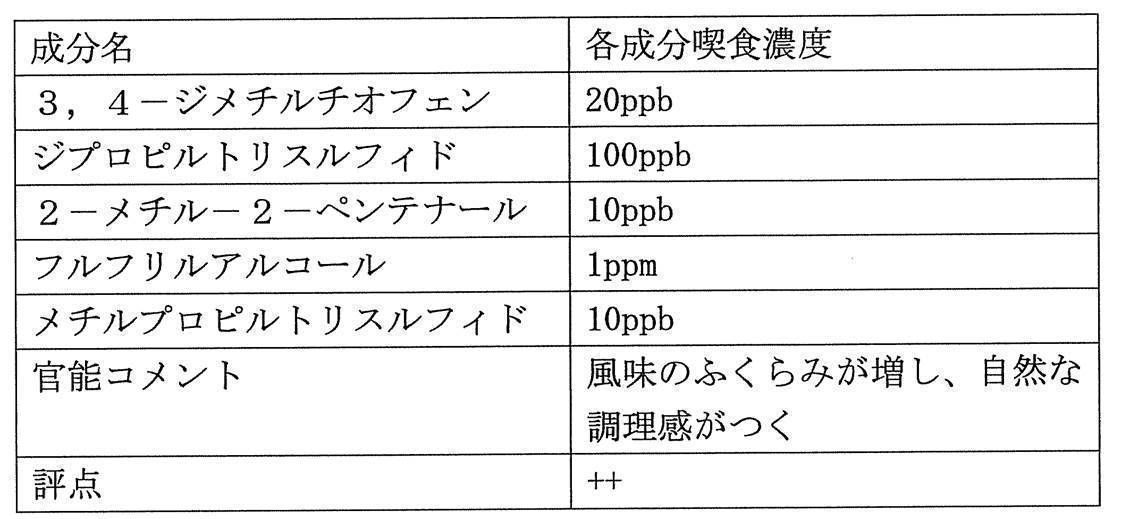
インスタントカップスープは、味の素株式会社製「クノール(登録商標)カップスープ ポタージュ」を使用し、一袋分のスープ粉末を熱湯150mlに溶解して調製した。このスープ150mlに、前述の成分混合試料を、下表に記載の喫食濃度となるように添加し、試料を調製した。
官能評価は、専門のパネラー3名で行い、評価基準は、無添加品と比較して
-:好ましくない効果あり
±:効果が不明瞭(無添加のスープと効果の差がない)
+:調理感付与効果あり
++:強い調理感付与効果あり
+++:さらに強い調理感付与効果あり
++++:非常に強い調理感付与効果あり
とした。
結果を表2に示す。官能評価の結果、ポタージュの野菜の風味が強くなり、調理感を付与する効果が認められた。

肉用風味調味料は、ブラジル味の素社製「Tempero SAZON(登録商標)para Carnes」を使用し、調理評価系としてブラジル料理「カルネ・モイダ(Carne Moida;牛挽肉の炒め物)」を調理し使用した。
カルネ・モイダは、みじん切りタマネギ75gを大さじ1の油で炒め、さらに牛挽肉500gを加えて炒めたところに、カゴメ株式会社製「カゴメカットトマト」115g、塩5g、「Tempero SAZON(R)」5gを添加し、軽く炒めて調製した。このカルネ・モイダをネガティブコントロールとした。このカルネ・モイダ100gに、前述の成分混合試料を、下表に記載の喫食濃度となるように添加し、試料を調製した。
官能評価は、専門のパネラー3名で行い、評価基準は、無添加品と比較して
-:好ましくない効果あり
±:効果が不明瞭(無添加のカルネ・モイダと効果の差がない)
+:調理感付与効果あり
++:強い調理感付与効果あり
とした。
結果を表3に示す。官能評価の結果、炒めた肉の香ばしさが増し、調理感を付与する効果が認められた。
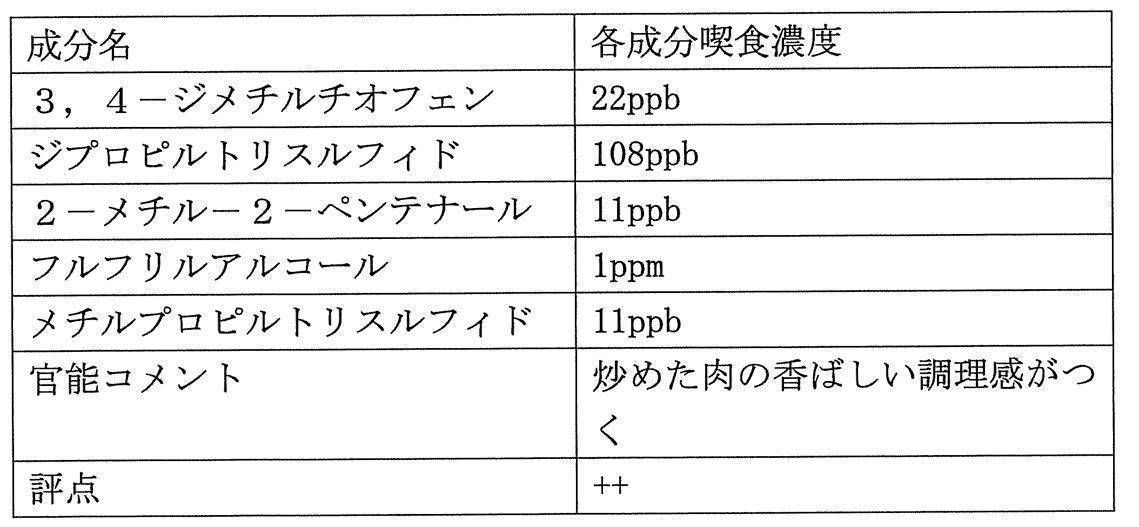
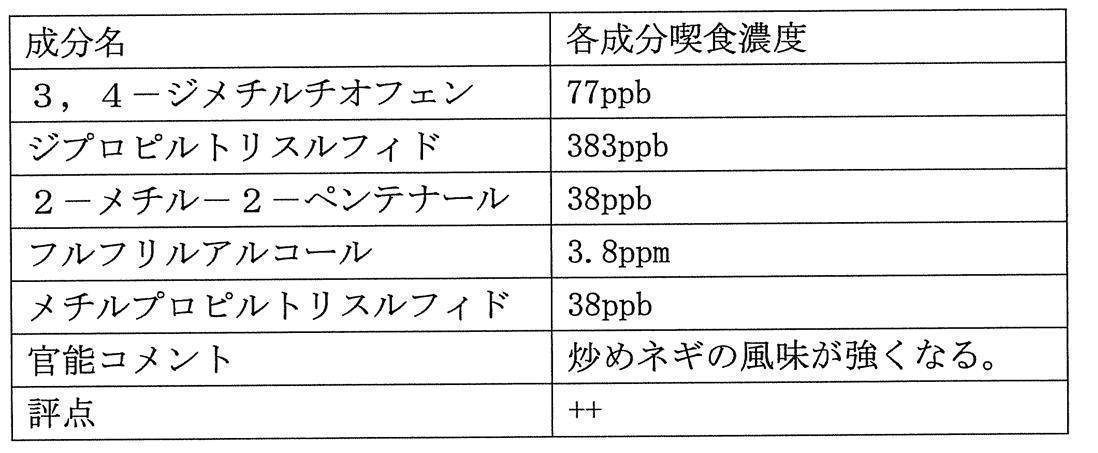
ご飯用風味調味料は、味の素株式会社製「Rice Cook(登録商標)チャーハン用」を使用し、調理評価系として炊飯器で作るチャーハンを使用した。チャーハンは、みじん切り長ネギ18.5gと「Rice Cook(登録商標)チャーハン用」21.6gと、前述の成分混合試料を下表に記載の喫食濃度となるように混合し、洗米した生米400gと水520gを炊飯釜に投入し炊飯した。炊飯後、炒り卵100gとみじん切りチャーシュー75gと混ぜ合わせたチャーハンをネガティブコントロールとした。このチャーハン800gに、前述の成分混合試料を、下表に記載の喫食濃度となるように添加し、試料を調製した。
官能評価は、専門のパネラー3名で行い、評価基準は、無添加品と比較して
-:好ましくない効果あり
±:効果が不明瞭(無添加のチャーハンと効果の差がない)
+:調理感付与効果あり
++:強い調理感付与効果あり
とした。
結果を表4に示す。官能評価の結果、炒めネギの風味が強くなり、調理感を付与する効果が認められた。
上記(試料調製方法)に記載のように3,4-ジメチルチオフェン及びジプロピルトリスルフィドのエタノール溶液を調製した。3,4-ジメチルチオフェン100mgを99.5%エタノールで10mlにメスアップして調製した10,000ppmの3,4-ジメチルチオフェン100mgを10mlの99.5%エタノールに添加し、よく撹拌し、100ppm試料を調製し、(実施例1)記載のように調製したポテトポタージュ(N)に0~2000ppmになるように添加した。同様にジプロピルトリスルフィドを0~1000ppmになるように添加して評価した。
官能評価は、専門のパネラー3名で行い、下記試料の有する調理感について、その強弱を評価した。評価基準は、
-:好ましくない効果あり
±:効果が不明瞭(無添加のポテトポタージュ(N)と効果の差がない)
+:調理感付与効果あり
++:強い調理感付与効果あり
+++:非常に強い調理感付与効果あり
とした。
結果を表5に示す。官能評価の結果、表中の「+」「++」の範囲において風味のふくらみが増し、自然な調理感を付与する効果が認められた。

上記(試料調製方法)に記載のように3,4-ジメチルチオフェン及び2-メチル-2-ペンテナール溶液を調製した。3,4-ジメチルチオフェン100mgを99.5%エタノールで10mlにメスアップして調製した10,000ppmの3,4-ジメチルチオフェン100mgを10mlの99.5%エタノールに添加し、よく撹拌し、100ppm試料を調製し、(実施例1)記載のように調製したポテトポタージュ(N)に0~2000ppmになるように添加した。同様に2-メチル-2-ペンテナールを0~1000ppmになるように添加して評価した。
官能評価は、専門のパネラー3名で行い、下記試料の有する調理感について、その強弱を評価した。評価基準は、(実施例5)と同じである。
結果を表6に示す。官能評価の結果、表中の「+」「++」の範囲において風味のふくらみが増し、自然な調理感を付与する効果が認められた。

上記(試料調製方法)に記載のように3,4-ジメチルチオフェン及びフルフリルアルコール溶液を調製した。3,4-ジメチルチオフェン100mgを99.5%エタノールで10mlにメスアップして調製した10,000ppmの3,4-ジメチルチオフェン100mgを10mlの99.5%エタノールに添加し、よく撹拌し、100ppm試料を調製し、(実施例1)記載のように調製したポテトポタージュ(N)に0~2000ppmになるように添加した。同様にフルフリルアルコールを0~1000ppmになるように添加して評価した。
官能評価は、専門のパネラー3名で行い、下記試料の有する調理感について、その強弱を評価した。評価基準は、(実施例5)と同じである。
結果を表7に示す。官能評価の結果、表中の「+」「++」の範囲において風味のふくらみが増し、自然な調理感を付与する効果が認められた。

上記(試料調製方法)に記載のように3,4-ジメチルチオフェン、ジプロピルトリスルフィド及びメチルプロピルトリスルフィド溶液を調製した。3,4-ジメチルチオフェン100mgを99.5%エタノールで10mlにメスアップして調製した10,000ppmの3,4-ジメチルチオフェン100mgを10mlの99.5%エタノールに添加し、よく撹拌し、100ppm試料を調製し、(実施例1)記載のように調製したポテトポタージュ(N)に200ppbになるように添加した。同様にジプロピルトリスルフィドを10ppbになるように添加した。さらにメチルプロピルトリスルフィドを0~100ppmになるように添加して評価した。
官能評価は、専門のパネラー3名で行い、下記試料の有する調理感について、その強弱を評価した。評価基準は、(実施例5)と同じである。
結果を表8に示す。官能評価の結果、表中の「+」「++」「+++」の範囲において風味のふくらみが増し、自然な調理感を付与する効果が認められた。特に、メチルプロピルトリスルフィドが10ppb~100ppbの範囲で本効果が高かった。

上記(試料調製方法)に記載のように3,4-ジメチルチオフェン、2-メチル-2-ペンテナール及びメチルプロピルトリスルフィド溶液を調製した。3,4-ジメチルチオフェン100mgを99.5%エタノールで10mlにメスアップして調製した10,000ppmの3,4-ジメチルチオフェン100mgを10mlの99.5%エタノールに添加し、よく撹拌し、100ppm試料を調製し、(実施例1)記載のように調製したポテトポタージュ(N)に200ppbになるように添加した。同様に2-メチル-2-ペンテナールを10ppbになるように添加した。さらにメチルプロピルトリスルフィドを0~100ppmになるように添加して評価した。
官能評価は、専門のパネラー3名で行い、下記試料の有する調理感について、その強弱を評価した。評価基準は、(実施例5)と同じである。
結果を表9に示す。官能評価の結果、表中の「+」「++」「+++」の範囲において風味のふくらみが増し、自然な調理感を付与する効果が認められた。特に、メチルプロピルトリスルフィドが10ppb~100ppbの範囲で本効果が高かった。

上記(試料調製方法)に記載のように3,4-ジメチルチオフェン、フルフリルアルコール及びメチルプロピルトリスルフィド溶液を調製した。3,4-ジメチルチオフェン100mgを99.5%エタノールで10mlにメスアップして調製した10,000ppmの3,4-ジメチルチオフェン100mgを10mlの99.5%エタノールに添加し、よく撹拌し、100ppm試料を調製し、(実施例1)記載のように調製したポテトポタージュ(N)に200ppbになるように添加した。同様にフルフリルアルコールを10ppbになるように添加した。さらにメチルプロピルトリスルフィドを0~100ppmになるように添加して評価した。
官能評価は、専門のパネラー3名で行い、下記試料の有する調理感について、その強弱を評価した。評価基準は、(実施例5)と同じである。
結果を表10に示す。官能評価の結果、表中の「+」「++」「+++」の範囲において風味のふくらみが増し、自然な調理感を付与する効果が認められた。特にメチルプロピルトリスルフィドが10ppb~100ppbの範囲で、本効果が高かった。

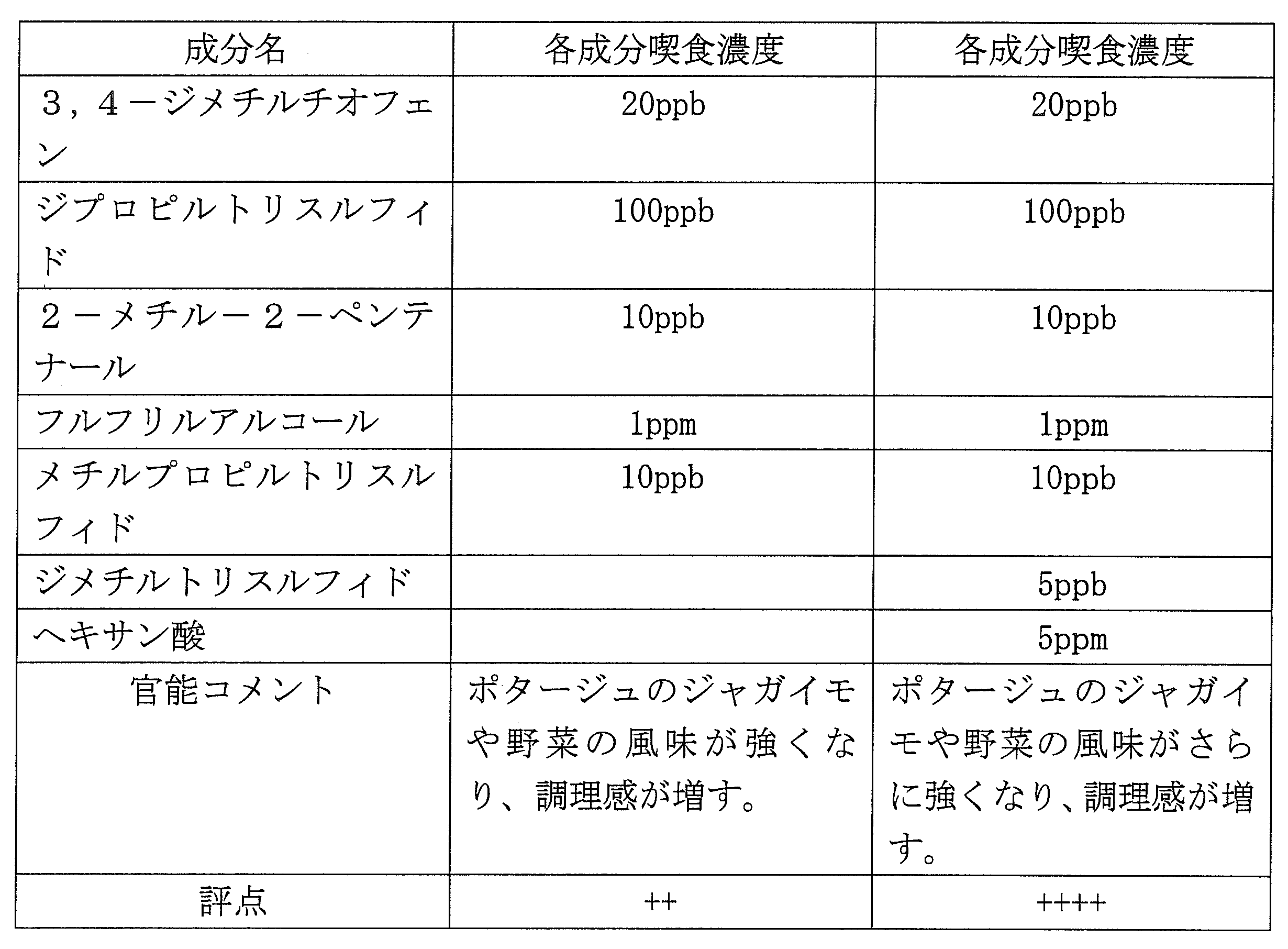
上記(試料調製方法)に記載のように3,4-ジメチルチオフェン、ジプロピルトリスルフィド、2-メチル-2-ペンテナール、フルフリルアルコール、メチルプロピルトリスルフィド及びジメチルトリスルフィド溶液を調製した。3,4-ジメチルチオフェン100mgを99.5%エタノールで10mlにメスアップして調製した10,000ppm3,4-ジメチルチオフェン100mgを10mlの水に添加し、よく撹拌し、100ppm試料を調製し、(実施例2)記載のように調製したインスタントカップスープに20ppbになるように添加した。同様にジプロピルトリスルフィド、2-メチル-2-ペンテナール、フルフリルアルコール、メチルプロピルトリスルフィドをそれぞれ100ppb、10ppb、1ppm、10ppbになるように添加した。さらにジメチルトリスルフィドを0~10ppmになるように添加して評価した。
官能評価は、専門のパネラー2名で行い、下記試料の有する調理感について、その強弱を評価した。評価基準は、(実施例2)と同じである。
結果を表11に示す。官能評価の結果、表中の「++」「+++」「++++」の範囲において風味のふくらみが増し、自然な調理感を付与する効果が認められた。特に、ジメチルトリスルフィドが1ppb~10ppbの範囲で本効果が高かった。

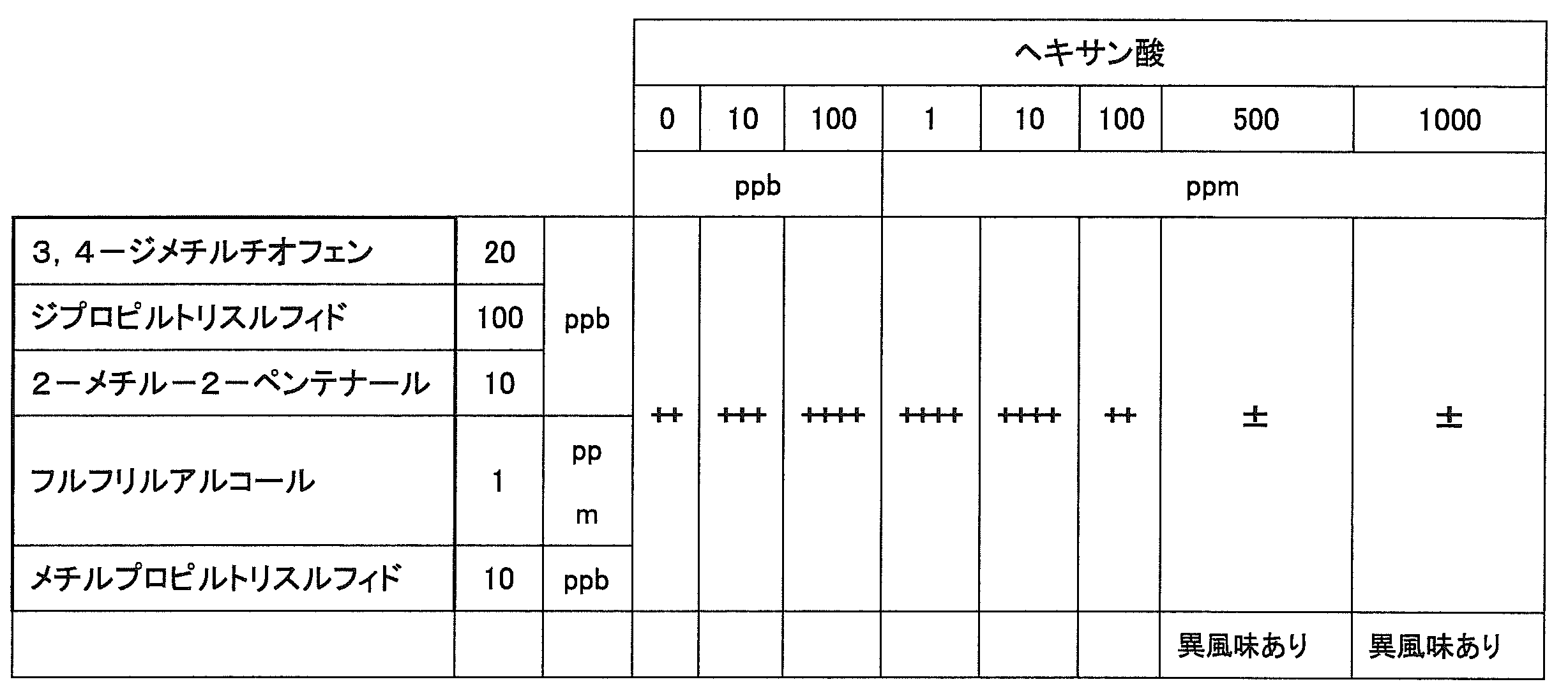
上記(試料調製方法)に記載のように3,4-ジメチルチオフェン、ジプロピルトリスルフィド、2-メチル-2-ペンテナール、フルフリルアルコール、メチルプロピルトリスルフィド及びヘキサン酸溶液を調製した。3,4-ジメチルチオフェン100mgを99.5%エタノールで10mlにメスアップして調製した10,000ppm3,4-ジメチルチオフェン100mgを10mlの水に添加し、よく撹拌し、100ppm試料を調製し、(実施例2)記載のように調製したインスタントカップスープに20ppbになるように添加した。同様にジプロピルトリスルフィド、2-メチル-2-ペンテナール、フルフリルアルコール、メチルプロピルトリスルフィドをそれぞれ100ppb、10ppb、1ppm、10ppbになるように添加した。さらにヘキサン酸を0~1000ppmになるように添加して評価した。
官能評価は、専門のパネラー2名で行い、下記試料の有する調理感について、その強弱を評価した。評価基準は、(実施例2)と同じである。
結果を表12に示す。官能評価の結果、表中の「++」「+++」「++++」の範囲において風味のふくらみが増し、自然な調理感を付与する効果が認められた。特に、ヘキサン酸が100ppb~10ppmの範囲で本効果が高かった。
インスタントカップスープは、味の素株式会社製「クノール(登録商標)カップスープ ポタージュ」を使用し、一袋分のスープ粉末を熱湯150mlに溶解して調製した。このスープ150mlに、前述の成分混合試料を、下表に記載の喫食濃度となるように添加し、試料を調製した。
官能評価は、専門のパネラー2名で行い、下記試料の有する調理感について、その強弱を評価した。評価基準は、(実施例2)と同じである。
結果を表13に示す。官能評価の結果、3,4-ジメチルチオフェン、ジプロピルトリスルフィド、2-メチル-2-ペンテナール、フルフリルアルコール、メチルプロピルトリスルフィドに加えて、シメチルトリスルフィド、ヘキサン酸を添加した試験区において、より野菜の風味が増し、調理感を付与する効果が認められた。
Claims (19)
- (A)3,4-ジメチルチオフェンならびに
(B)ジプロピルトリスルフィド、2-メチル-2-ペンテナール及びフルフリルアルコールからなる群から選択される少なくとも一つの化合物
を含有し、(A)と(B)の重量比が1:6×10⁻⁸~5×10⁷である、香料組成物。 - さらに(C)メチルプロピルトリスルフィド(C1)、ジメチルトリスルフィド(C2)及びヘキサン酸(C3)からなる群から選択される少なくとも一つの化合物を含有し、重量比は(A)と(C1)又は(C2)が1:6×10-14~5×10⁵及び(A)と(C3)が1:6×10-14~3×10⁷である、請求項1に記載の香料組成物。
- 調理感の付与用である、請求項1又は2に記載の香料組成物。
- 請求項1~3のいずれか1項に記載の香料組成物を含有する、調味料又は飲食品。
- (A)3,4-ジメチルチオフェンならびに
(B)ジプロピルトリスルフィド、2-メチル-2-ペンテナール及びフルフリルアルコールからなる群から選択される少なくとも一つの化合物
を添加する工程を含む調味料の製造方法であって、添加濃度が(A)1ppb~1.8%及び(B)1ppb~5%である方法。 - さらに(C)メチルプロピルトリスルフィド(C1)、ジメチルトリスルフィド(C2)及びヘキサン酸(C3)からなる群から選択される少なくとも一つの化合物を添加する工程を含み、添加濃度が(C1)500ppm以下、(C2)500ppm以下及び(C3)2.5%以下である請求項5に記載の方法。
- 請求項5または6に記載の方法によって得られる調味料。
- (A)3,4-ジメチルチオフェンならびに
(B)ジプロピルトリスルフィド、2-メチル-2-ペンテナール及びフルフリルアルコールからなる群から選択される少なくとも一つの化合物
を添加する工程を含む飲食品の製造方法であって、添加濃度が(A)0.01ppb~180ppm及び(B)0.01ppb~500ppmである方法。 - さらに(C)メチルプロピルトリスルフィド(C1)、ジメチルトリスルフィド(C2)及びヘキサン酸(C3)からなる群から選択される少なくとも一つの化合物を添加する工程を含み、添加濃度が(C1)5ppm以下、(C2)5ppm以下及び(C3)250ppm以下である請求項8に記載の方法。
- 飲食品が、調理感が付与された飲食品である、請求項8又は9に記載の方法。
- 請求項8~10のいずれか1項に記載の方法によって得られる飲食品。
- 飲食品がコンソメスープ、ポタージュスープ又はクリームスープである、請求項11に記載の飲食品。
- 飲食品へ
(A)3,4-ジメチルチオフェンならびに
(B)ジプロピルトリスルフィド、2-メチル-2-ペンテナール及びフルフリルアルコールからなる群から選択される少なくとも一つの化合物
を添加する工程を含む調理感の付与方法であって、添加濃度が(A)0.01ppb~180ppm及び(B)0.01ppb~500ppmである方法。 - さらに(C)メチルプロピルトリスルフィド(C1)、ジメチルトリスルフィド(C2)及びヘキサン酸(C3)からなる群から選択される少なくとも一つの化合物を添加する工程を含み、添加濃度が(C1)5ppm以下、(C2)5ppm以下及び(C3)250ppm以下である請求項13に記載の方法。
- (A)3,4-ジメチルチオフェンを1ppb~1.8%ならびに
(B)ジプロピルトリスルフィド、2-メチル-2-ペンテナール及びフルフリルアルコールからなる群から選択される少なくとも一つの化合物を1ppb~5%含有する調味料。 - さらに(C)500ppm以下のメチルプロピルトリスルフィド(C1)、500ppm以下のジメチルトリスルフィド(C2)及び2.5%以下のヘキサン酸(C3)からなる群から選択される少なくとも一つの化合物を含有する請求項15に記載の調味料。
- (A)3,4-ジメチルチオフェンを0.01ppb~180ppmならびに
(B)ジプロピルトリスルフィド、2-メチル-2-ペンテナール及びフルフリルアルコールからなる群から選択される少なくとも一つの化合物を0.01ppb~500ppm含有する飲食品。 - さらに(C)5ppm以下のメチルプロピルトリスルフィド(C1)、5ppm以下のジメチルトリスルフィド(C2)及び250ppm以下のヘキサン酸(C3)からなる群から選択される少なくとも一つの化合物を含有する請求項17に記載の飲食品。
- 飲食品がコンソメスープ、ポタージュスープ又はクリームスープである、請求項17又は18に記載の飲食品。
Priority Applications (3)
| Application Number | Priority Date | Filing Date | Title |
|---|---|---|---|
| JP2016512783A JPWO2015156380A1 (ja) | 2014-04-11 | 2015-04-10 | 香料組成物 |
| MYPI2016703738A MY186517A (en) | 2014-04-11 | 2015-04-10 | Flavouring composition |
| PH12016501991A PH12016501991A1 (en) | 2014-04-11 | 2016-10-07 | Flavouring composition |
Applications Claiming Priority (2)
| Application Number | Priority Date | Filing Date | Title |
|---|---|---|---|
| JP2014082235 | 2014-04-11 | ||
| JP2014-082235 | 2014-04-11 |
Publications (1)
| Publication Number | Publication Date |
|---|---|
| WO2015156380A1 true WO2015156380A1 (ja) | 2015-10-15 |
Family
ID=54287951
Family Applications (1)
| Application Number | Title | Priority Date | Filing Date |
|---|---|---|---|
| PCT/JP2015/061185 Ceased WO2015156380A1 (ja) | 2014-04-11 | 2015-04-10 | 香料組成物 |
Country Status (5)
| Country | Link |
|---|---|
| JP (1) | JPWO2015156380A1 (ja) |
| MY (1) | MY186517A (ja) |
| PH (1) | PH12016501991A1 (ja) |
| TW (1) | TWI683629B (ja) |
| WO (1) | WO2015156380A1 (ja) |
Cited By (3)
| Publication number | Priority date | Publication date | Assignee | Title |
|---|---|---|---|---|
| WO2016175323A1 (ja) * | 2015-04-28 | 2016-11-03 | 味の素株式会社 | 香料組成物 |
| WO2020098952A1 (en) * | 2018-11-16 | 2020-05-22 | Symrise Ag | Dry onion preparation ii |
| WO2020098950A1 (en) * | 2018-11-16 | 2020-05-22 | Symrise Ag | Dry onion preparation i |
Citations (1)
| Publication number | Priority date | Publication date | Assignee | Title |
|---|---|---|---|---|
| JP2003000182A (ja) * | 2001-06-21 | 2003-01-07 | Ogawa & Co Ltd | 香味賦与前駆体 |
Family Cites Families (3)
| Publication number | Priority date | Publication date | Assignee | Title |
|---|---|---|---|---|
| JP2006034264A (ja) * | 2004-07-30 | 2006-02-09 | Fine Foods Kk | ペースト状調味料 |
| CN101455331A (zh) * | 2008-06-04 | 2009-06-17 | 南京农业大学 | 超临界二氧化碳洋葱叶中提取洋葱油的方法 |
| JP2012200159A (ja) * | 2011-03-23 | 2012-10-22 | Kaneka Corp | 塩味増強剤 |
-
2015
- 2015-04-10 JP JP2016512783A patent/JPWO2015156380A1/ja active Pending
- 2015-04-10 WO PCT/JP2015/061185 patent/WO2015156380A1/ja not_active Ceased
- 2015-04-10 TW TW104111609A patent/TWI683629B/zh not_active IP Right Cessation
- 2015-04-10 MY MYPI2016703738A patent/MY186517A/en unknown
-
2016
- 2016-10-07 PH PH12016501991A patent/PH12016501991A1/en unknown
Patent Citations (1)
| Publication number | Priority date | Publication date | Assignee | Title |
|---|---|---|---|---|
| JP2003000182A (ja) * | 2001-06-21 | 2003-01-07 | Ogawa & Co Ltd | 香味賦与前駆体 |
Non-Patent Citations (4)
| Title |
|---|
| BUTZ, P. ET AL.: "Ultra-high pressure processing of onions: chemical and sensory changes", LWT - FOOD SCIENCE AND TECHNOLOGY, vol. 27, 1994, pages 463 - 467, XP055230221 * |
| FAHEID, S. M. M. ET AL.: "Application of onion and garlic flavours in spaghetti manufacture", DEUTSHE LEBENSMITTEL-RUNDSCHAU, vol. 94, no. 6, 1998, pages 187 - 192, XP000939058 * |
| RESEMANN, J. ET AL.: "Comparative study on the interrelation between flavor related parameters of different onion (Allium cepa L.) cultivars and their applicability to forecasting onion oil yield", JOURNAL OF FOOD, AGRICULTURE & ENVIRONMENT, vol. 1, no. 3&4, 2003, pages 104 - 111, XP055230219 * |
| WU, J. L. ET AL.: "Volatile flavor compounds from shallots", JOURNAL OF FOOD SCIENCE, vol. 47, no. 2, 1982, pages 606 - 608, XP055230218, ISSN: 0022-1147 * |
Cited By (4)
| Publication number | Priority date | Publication date | Assignee | Title |
|---|---|---|---|---|
| WO2016175323A1 (ja) * | 2015-04-28 | 2016-11-03 | 味の素株式会社 | 香料組成物 |
| JPWO2016175323A1 (ja) * | 2015-04-28 | 2017-11-09 | 味の素株式会社 | 香料組成物 |
| WO2020098952A1 (en) * | 2018-11-16 | 2020-05-22 | Symrise Ag | Dry onion preparation ii |
| WO2020098950A1 (en) * | 2018-11-16 | 2020-05-22 | Symrise Ag | Dry onion preparation i |
Also Published As
| Publication number | Publication date |
|---|---|
| TWI683629B (zh) | 2020-02-01 |
| PH12016501991A1 (en) | 2017-01-09 |
| JPWO2015156380A1 (ja) | 2017-04-13 |
| MY186517A (en) | 2021-07-23 |
| TW201601639A (zh) | 2016-01-16 |
Similar Documents
| Publication | Publication Date | Title |
|---|---|---|
| JP7156270B2 (ja) | 焼けた油の風味を付与するための組成物 | |
| JP6160131B2 (ja) | 香料組成物 | |
| JP6610662B2 (ja) | 香料組成物 | |
| JP2022082685A (ja) | 味質向上剤 | |
| WO2017061524A1 (ja) | 香味油の製造方法 | |
| JP6414051B2 (ja) | 風味付与組成物、煮込み料理様風味が付与された飲食品及びその製造方法 | |
| TWI683629B (zh) | 香料組成物 | |
| JP7671721B2 (ja) | 揚げたて感付与組成物 | |
| JP2018042484A (ja) | 香味野菜の風味増強方法 | |
| JP7363481B2 (ja) | 風味組成物 | |
| JP6801209B2 (ja) | 香料組成物 | |
| JP5939784B2 (ja) | 液状調味料 | |
| JP7147748B2 (ja) | 肉又は豆の焦げ風味を付与するための組成物 | |
| JP5867661B1 (ja) | 香料組成物 | |
| JP7329330B2 (ja) | 風味付与調味料 | |
| WO2022004588A1 (ja) | 香味組成物 | |
| JP7238455B2 (ja) | 食品、香味料および食品の製造方法、ならびに食品に香味を付与する方法 | |
| WO2017170196A1 (ja) | 調理感付与剤 | |
| JP6823558B2 (ja) | もやしの青臭さを低減する調味料 | |
| JP6323765B2 (ja) | 液状調味料 | |
| JP6832613B2 (ja) | トウガラシ含有スープ類の製造方法 |
Legal Events
| Date | Code | Title | Description |
|---|---|---|---|
| 121 | Ep: the epo has been informed by wipo that ep was designated in this application |
Ref document number: 15776262 Country of ref document: EP Kind code of ref document: A1 |
|
| ENP | Entry into the national phase |
Ref document number: 2016512783 Country of ref document: JP Kind code of ref document: A |
|
| WWE | Wipo information: entry into national phase |
Ref document number: 12016501991 Country of ref document: PH |
|
| NENP | Non-entry into the national phase |
Ref country code: DE |
|
| REG | Reference to national code |
Ref country code: BR Ref legal event code: B01A Ref document number: 112016023230 Country of ref document: BR |
|
| 122 | Ep: pct application non-entry in european phase |
Ref document number: 15776262 Country of ref document: EP Kind code of ref document: A1 |
|
| ENP | Entry into the national phase |
Ref document number: 112016023230 Country of ref document: BR Kind code of ref document: A2 Effective date: 20161005 |