WO2015156258A1 - 熱伝導性感圧接着性積層シートの製造方法、熱伝導性感圧接着性積層シート、及び、電子機器 - Google Patents
熱伝導性感圧接着性積層シートの製造方法、熱伝導性感圧接着性積層シート、及び、電子機器 Download PDFInfo
- Publication number
- WO2015156258A1 WO2015156258A1 PCT/JP2015/060759 JP2015060759W WO2015156258A1 WO 2015156258 A1 WO2015156258 A1 WO 2015156258A1 JP 2015060759 W JP2015060759 W JP 2015060759W WO 2015156258 A1 WO2015156258 A1 WO 2015156258A1
- Authority
- WO
- WIPO (PCT)
- Prior art keywords
- sensitive adhesive
- conductive pressure
- heat conductive
- meth
- polymer
- Prior art date
- Legal status (The legal status is an assumption and is not a legal conclusion. Google has not performed a legal analysis and makes no representation as to the accuracy of the status listed.)
- Ceased
Links
Images


Classifications
-
- H—ELECTRICITY
- H10—SEMICONDUCTOR DEVICES; ELECTRIC SOLID-STATE DEVICES NOT OTHERWISE PROVIDED FOR
- H10W—GENERIC PACKAGES, INTERCONNECTIONS, CONNECTORS OR OTHER CONSTRUCTIONAL DETAILS OF DEVICES COVERED BY CLASS H10
- H10W40/00—Arrangements for thermal protection or thermal control
- H10W40/20—Arrangements for cooling
- H10W40/25—Arrangements for cooling characterised by their materials
-
- H—ELECTRICITY
- H10—SEMICONDUCTOR DEVICES; ELECTRIC SOLID-STATE DEVICES NOT OTHERWISE PROVIDED FOR
- H10W—GENERIC PACKAGES, INTERCONNECTIONS, CONNECTORS OR OTHER CONSTRUCTIONAL DETAILS OF DEVICES COVERED BY CLASS H10
- H10W40/00—Arrangements for thermal protection or thermal control
- H10W40/20—Arrangements for cooling
- H10W40/25—Arrangements for cooling characterised by their materials
- H10W40/251—Organics
-
- H—ELECTRICITY
- H10—SEMICONDUCTOR DEVICES; ELECTRIC SOLID-STATE DEVICES NOT OTHERWISE PROVIDED FOR
- H10W—GENERIC PACKAGES, INTERCONNECTIONS, CONNECTORS OR OTHER CONSTRUCTIONAL DETAILS OF DEVICES COVERED BY CLASS H10
- H10W40/00—Arrangements for thermal protection or thermal control
- H10W40/70—Fillings or auxiliary members in containers or in encapsulations for thermal protection or control
-
- H—ELECTRICITY
- H10—SEMICONDUCTOR DEVICES; ELECTRIC SOLID-STATE DEVICES NOT OTHERWISE PROVIDED FOR
- H10W—GENERIC PACKAGES, INTERCONNECTIONS, CONNECTORS OR OTHER CONSTRUCTIONAL DETAILS OF DEVICES COVERED BY CLASS H10
- H10W40/00—Arrangements for thermal protection or thermal control
- H10W40/20—Arrangements for cooling
- H10W40/25—Arrangements for cooling characterised by their materials
- H10W40/255—Arrangements for cooling characterised by their materials having a laminate or multilayered structure, e.g. direct bond copper [DBC] ceramic substrates
-
- H—ELECTRICITY
- H10—SEMICONDUCTOR DEVICES; ELECTRIC SOLID-STATE DEVICES NOT OTHERWISE PROVIDED FOR
- H10W—GENERIC PACKAGES, INTERCONNECTIONS, CONNECTORS OR OTHER CONSTRUCTIONAL DETAILS OF DEVICES COVERED BY CLASS H10
- H10W40/00—Arrangements for thermal protection or thermal control
- H10W40/20—Arrangements for cooling
- H10W40/25—Arrangements for cooling characterised by their materials
- H10W40/258—Metallic materials
Definitions
- the present invention relates to a method for producing a heat conductive pressure-sensitive adhesive laminate sheet, a heat conductive pressure-sensitive adhesive laminate sheet obtained by the production method, and an electronic device including the heat conductive pressure-sensitive adhesive laminate sheet.
- thermal diffusion sheet with excellent thermal conductivity in the direction (plane direction) perpendicular to the thickness direction should be used as a countermeasure against so-called heat spots where the temperature of electronic components rises locally. There is.
- the heat diffusion sheet can alleviate heat spots by transferring heat in the thickness direction and quickly diffusing in the surface direction.
- the heat diffusion sheet has a hard surface, is inferior in shape followability, and has poor adhesion to the heat generator or the heat radiator. For this reason, when the sheet is sandwiched between the heat generating body and the heat radiating body, cracks may occur in the sheet, or thermal conductivity and thermal diffusibility as expected may not be obtained. Therefore, the adhesion to other members is improved by providing a layer having flexibility and adhesiveness such as a pressure-sensitive adhesive layer on at least one surface of the heat diffusion sheet.
- Patent Document 1 includes a plate-shaped boron nitride particle and a rubber component, and has a thermal conductivity in a direction perpendicular to the thickness direction of 4 W / m ⁇ K or more, and at least one of the thermal conductive layers.
- a heat conductive sheet comprising an adhesive layer laminated in the direction is disclosed.
- a base material layer (hereinafter referred to as “heat diffusion layer”) made of a heat diffusion sheet is provided on one surface, and a heat conductive pressure sensitive adhesive layer having heat conductivity and pressure sensitive adhesive property on the other surface.
- the heat conductive pressure-sensitive adhesive laminated sheet is used by attaching the surface on the heat conductive pressure-sensitive adhesive layer side to an adherend that is a heating element or a heat radiator.
- Patent Document 2 discloses a base material, a decoration layer provided on one side of the base material, and a side provided on the other side of the base material.
- the pressure-sensitive adhesive sheet is provided with a plurality of through-holes penetrating from one surface to the other surface.
- a pressure-sensitive adhesive sheet having a pore density of 1 to 300 ⁇ m and a pore density of 30 to 50,000 per 100 cm 2 is disclosed.
- Patent Document 3 discloses an adhesive sheet that is used by being attached to a smooth adherend such as a window glass, and is formed on a sheet body made of a synthetic resin film and one surface of the sheet body. Provided with an adhesive layer to be attached to the adhesive body, and a slit formed so as to penetrate the sheet body and the adhesive layer, at least the whole of the slit does not overlap with a straight line connecting one end and the other end, An adhesive sheet is disclosed.
- JP 2013-176980 A JP 2005-75953 A JP 2012-126855 A
- the present invention is a method for producing a heat conductive pressure-sensitive adhesive laminate sheet that can suppress air entrapment when attached to an adherend and is easy to reattach, and is manufactured with simple equipment.
- a heat-conductive pressure-sensitive adhesive laminate sheet, a heat-conductive pressure-sensitive adhesive laminate sheet obtained by the manufacturing method, and an electronic device including the heat-conductive pressure-sensitive adhesive laminate sheet Is an issue.
- the present inventors produced a heat conductive pressure-sensitive adhesive laminated sheet under predetermined conditions, and as a result, minute irregularities are formed on the surface of the heat conductive pressure-sensitive adhesive layer. As a result, it was found that air entrainment can be suppressed and re-sticking is facilitated.
- the first aspect of the present invention is a heat conductive pressure-sensitive adhesive comprising a heat diffusion layer having a thermal conductivity in the plane direction of 10 W / (m ⁇ K) or more and a heat conductive pressure-sensitive adhesive layer.
- the gel fraction of the post-filtered crosslinked polymer composition (H) obtained by drying the filtrate obtained by the gel-containing dispersion preparation step and the filtration step is 75% by mass or more, heat conduction Is a method for producing a pressure-sensitive adhesive laminate sheet (F).
- a heat conductive pressure-sensitive adhesive laminated sheet comprising: a heat diffusion layer having a thermal conductivity in the plane direction of 10 W / (m ⁇ K) or more; and a heat conductive pressure-sensitive adhesive layer.
- the crosslinked polymer composition (A) containing the thermally conductive filler (C1) and the (meth) acrylic acid ester polymer (A0) is immersed in a solvent and stirred.
- thermal conductive filler can be added to improve the thermal conductivity of the thermally conductive pressure-sensitive adhesive laminate sheet (F), and its thermal conductivity is 0.3 W /
- the filler which is m * K or more is meant.
- (Meth) acryl means “acryl and / or methacryl”.
- the crosslinked polymer composition (A) comprises a (meth) acrylic acid ester polymer (A1), a (meth) acrylic acid ester monomer ( ⁇ 1), In the precursor composition containing the polyfunctional monomer (B1) and the thermally conductive filler (C1), at least a polymerization reaction of the (meth) acrylic acid ester monomer ( ⁇ 1) and (meth) acrylic It is preferably obtained by performing a crosslinking reaction of a polymer containing a structural unit derived from the acid ester polymer (A1) and / or the (meth) acrylic acid ester monomer ( ⁇ 1).
- polymerization reaction of (meth) acrylate monomer ( ⁇ 1) means a polymerization reaction for obtaining a polymer containing a structural unit derived from (meth) acrylate monomer ( ⁇ 1).
- (meth) acrylic acid ester polymer (A1) and / or (meth) acrylic acid ester monomer ( ⁇ 1) -derived polymer cross-linking reaction means (meth) acrylic acid ester Cross-linking reaction between polymers (A1), cross-linking reaction between polymers containing structural units derived from (meth) acrylate monomer ( ⁇ 1), and (meth) acrylate polymer (A1) and ( Among crosslinking reactions with a polymer containing a structural unit derived from a (meth) acrylate monomer ( ⁇ 1), it means one or a plurality of crosslinking reactions.
- the predetermined mesh opening is preferably 1000 ⁇ m or less.
- the third aspect of the present invention is a heat conductive pressure-sensitive adhesive laminate sheet (F) obtained by the method for producing a heat conductive pressure-sensitive adhesive laminate sheet (F) according to the first and second aspects of the present invention. It is.
- a fourth aspect of the present invention is an electronic device including the thermally conductive pressure-sensitive adhesive laminated sheet (F) according to the second aspect of the present invention.
- a method for producing a heat conductive pressure-sensitive adhesive laminated sheet that can suppress the biting of air when attached to an adherend and is easy to reattach, and is manufactured with simple equipment.
- the manufacturing method of the heat conductive pressure-sensitive-adhesive laminated sheet which can be provided can be provided.
- the electronic device provided with the heat conductive pressure sensitive adhesive laminated sheet obtained by this manufacturing method and this heat conductive pressure sensitive adhesive laminated sheet can be provided.
- FIG. 3 is a diagram schematically showing the states of manufacturing steps S1 to S4 of a manufacturing method S10 of a heat conductive pressure-sensitive adhesive laminated sheet according to the first embodiment of the present invention. It is a flowchart explaining one Embodiment of the manufacturing method of the heat conductive pressure-sensitive-adhesive laminated sheet which concerns on the 2nd aspect of this invention.
- FIG. 7 is a diagram schematically showing the states of manufacturing steps S11 to S16 of a manufacturing method S20 of a heat conductive pressure-sensitive adhesive laminated sheet according to a second embodiment of the present invention. It is the figure which showed schematically the usage example of the heat conductive pressure-sensitive-adhesive laminated sheet.
- FIG. 1 is a flowchart for explaining a production method S10 (hereinafter sometimes abbreviated as “this production method S10”) of a heat conductive pressure-sensitive adhesive laminated sheet (F) according to the first embodiment of the present invention. is there.
- this manufacturing method S10 includes a polymer gel-containing dispersion preparation step S1, a filtration step S2, a coating step S3, and a solvent removal step S4.
- FIG. 1 is a flowchart for explaining a production method S10 (hereinafter sometimes abbreviated as “this production method S10”) of a heat conductive pressure-sensitive adhesive laminated sheet (F) according to the first embodiment of the present invention. is there.
- this manufacturing method S10 includes a polymer gel-containing dispersion preparation step S1, a filtration step S2, a coating step S3, and a solvent removal step S4.
- the heat conductive pressure-sensitive adhesive laminate sheet (F) 10 manufactured by this manufacturing method S10 includes a heat diffusion layer 8 and a heat conductive pressure-sensitive adhesive layer having irregularities on the surface. 9.
- each step will be described.
- Polymer gel-containing dispersion preparation step S1 In the polymer gel-containing dispersion preparation step S1, the crosslinked polymer composition (A) containing the thermally conductive filler (C1) and the (meth) acrylate polymer (A0) is immersed in a solvent and stirred. In this step, a polymer gel-containing dispersion is prepared.
- the (meth) acrylic acid ester polymer (A0) is a polymer having a (meth) acrylic acid ester monomer unit as a main component.
- the “main component” means a component that is contained by 50% by weight or more.
- the (meth) acrylic acid ester polymer (A0) includes a (meth) acrylic acid ester polymer (A1), a (meth) acrylic acid ester monomer ( ⁇ 1), a polyfunctional monomer (B1), In the precursor composition containing the thermally conductive filler (C1), at least the polymerization reaction of the (meth) acrylate monomer ( ⁇ 1), the (meth) acrylate polymer (A1) and / or The polymer component of the crosslinked polymer composition (A) obtained by performing a crosslinking reaction of a polymer containing a structural unit derived from the (meth) acrylate monomer ( ⁇ 1) is preferable.
- the crosslinked polymer-containing composition (A) contains a heat conductive filler (C1).
- the thermally conductive filler (C1) used in the present invention can improve the thermal conductivity of the thermally conductive pressure-sensitive adhesive layer by adding it, and the inorganic compound has a thermal conductivity of 0.3 W / m ⁇ K or more. It is.
- thermally conductive filler (C1) include metal hydroxides such as aluminum hydroxide, gallium hydroxide, indium hydroxide, magnesium hydroxide, calcium hydroxide, strontium hydroxide, and barium hydroxide; aluminum oxide ( Alumina), metal oxides such as magnesium oxide and zinc oxide; metal carbonates such as calcium carbonate and aluminum carbonate; metal nitrides such as boron nitride and aluminum nitride; zinc borate hydrate; kaolin clay; calcium aluminate water Examples thereof include: Japanese; Dosonite; Silica; Expanded graphite powder, artificial graphite, carbon black, carbon fiber, and other carbon-containing conductive fillers.
- metal hydroxides such as aluminum hydroxide, gallium hydroxide, indium hydroxide, magnesium hydroxide, calcium hydroxide, strontium hydroxide, and barium hydroxide
- aluminum oxide ( Alumina) metal oxides such as magnesium oxide and zinc oxide
- metal carbonates such as calcium carbonate and aluminum carbonate
- metal hydroxides and metal oxides are preferred, metal hydroxides are more preferred, aluminum hydroxide and aluminum oxide (alumina) are more preferred, and aluminum hydroxide is even more preferred.
- a heat conductive filler (C1) may be used individually by 1 type, and may use 2 or more types together.
- the amount of the thermally conductive filler (C1) contained in the cross-linked polymer composition (A) is 150 parts by mass or more and 1500 parts by mass or less with respect to 100 parts by mass of the (meth) acrylic acid ester polymer (A0). Preferably, it is 200 to 1300 parts by mass, more preferably 350 to 1000 parts by mass.
- content of a heat conductive filler (C1) more than the said minimum, it becomes easy to exhibit the effect which improves the heat conductivity of a heat conductive pressure-sensitive-adhesive layer.
- the hardness of the crosslinked polymer composition (A) and the crosslinked crosslinked polymer composition (H) is prevented from increasing by setting the content of the heat conductive filler (C1) to the upper limit or less. It can prevent, and it can prevent that the air venting property of a heat conductive pressure-sensitive-adhesive laminated sheet (F) falls.
- the average particle diameter of the heat conductive filler (C1) is preferably 0.5 ⁇ m or more and 15 ⁇ m or less, and more preferably 5 ⁇ m or more and 12 ⁇ m or less.
- the BET specific surface area of the heat conductive filler (C1) is preferably 0.3 m 2 / g or more and 10 m 2 / g or less, and more preferably 0.5 m 2 / g or more and 2 m 2 / g or less. preferable.
- BET specific surface area means that measured by the following method. First, a mixed gas of nitrogen and helium is introduced into a BET specific surface area measuring apparatus, and a sample cell containing a sample (an object to be measured for BET specific surface area) is immersed in liquid nitrogen to adsorb nitrogen gas to the sample surface. After reaching adsorption equilibrium, the sample cell is placed in a water bath and warmed to room temperature, and nitrogen adhering to the sample is desorbed. Since the mixing ratio of the gas before and after passing through the sample cell changes during the adsorption and desorption of nitrogen gas, this change is detected by a thermal conductivity detector (TCD) using a gas with a constant mixing ratio of nitrogen and helium as a control.
- TCD thermal conductivity detector
- the adsorption amount and desorption amount of nitrogen gas are obtained.
- a unit amount of nitrogen gas is introduced into the apparatus for calibration, and the surface area value corresponding to the value detected by TCD is obtained to obtain the surface area of the sample.
- the BET specific surface area can be determined by dividing the determined surface area by the mass of the sample.
- the cross-linked polymer composition (A) in addition to the (meth) acrylic acid ester polymer (A0) and the heat conductive filler (C1), various known additions are added within a range that satisfies the required performance.
- An agent may be introduced.
- Known additives include, for example, flame retardants such as phosphate esters; foaming agents (including foaming aids); glass fibers; external cross-linking agents; pigments; fillers such as titanium dioxide; nanomaterials such as fullerenes and carbon nanotubes. Particles; Polyphenol-based, hydroquinone-based, hindered amine-based antioxidants; and the like.
- the crosslinked polymer-containing composition (A) comprises a (meth) acrylic acid ester polymer (A1), a (meth) acrylic acid ester monomer ( ⁇ 1), a polyfunctional monomer (B1), a heat In the precursor composition containing the conductive filler (C1), at least the polymerization reaction of the (meth) acrylate monomer ( ⁇ 1), the (meth) acrylate polymer (A1) and / or (meta) And a crosslinking reaction of a polymer containing a structural unit derived from an acrylate monomer ( ⁇ 1).
- a (meth) acrylic acid ester polymer (A0) as a polymer component of the crosslinked polymer-containing composition (A) is preferably obtained.
- the crosslinked polymer-containing composition (A) includes a (meth) acrylic acid ester polymer (A0) as a polymer component and a thermally conductive filler (C1).
- the (meth) acrylic acid ester polymer (A0) and the thermally conductive filler (C1) may be bonded at least partially.
- the precursor composition comprises a (meth) acrylic acid ester polymer (A1), a (meth) acrylic acid ester monomer ( ⁇ 1), a polyfunctional monomer (B1), and a thermally conductive filler (C1). ) And. Moreover, as described later, the precursor composition may contain a polymerization initiator (D1) and a phosphate ester (E1). In addition, when obtaining a crosslinked-containing polymer composition (A) using a precursor composition, the polymerization reaction and crosslinking reaction of a (meth) acrylic acid ester monomer ((alpha) 1) are performed at least.
- the polymer containing the structural unit derived from the (meth) acrylate monomer ( ⁇ 1) is mixed with the component of the (meth) acrylate polymer (A1) and / or one. Partially combine.
- the (meth) acrylic acid ester polymer (A1), the (meth) acrylic acid ester monomer ( ⁇ 1), and the polyfunctional monomer (B1) are collectively referred to as “(meta ) Acrylic resin precursor (P1) ”.
- the proportion of the (meth) acrylic acid ester polymer (A1) and the (meth) acrylic acid ester monomer ( ⁇ 1) used is (mass) acrylic resin precursor (P1) being 100% by mass,
- the meth) acrylate polymer (A1) is preferably 5% by mass or more and 70% by mass or less, and the (meth) acrylic acid ester monomer ( ⁇ 1) is preferably 29.9% by mass or more and 94.9% by mass or less.
- the (meth) acrylic acid ester polymer (A1) is 5% by mass or more and 60% by mass or less, and the (meth) acrylic acid ester monomer ( ⁇ 1) is 39.8% by mass or more and 94.8% by mass or less.
- the (meth) acrylic acid ester polymer (A1) is 10% by mass to 50% by mass, and the (meth) acrylic acid ester monomer ( ⁇ 1) is 49.7% by mass to 89.7% by mass. so Rukoto is more preferable.
- the precursor composition can be easily molded.
- the (meth) acrylic acid ester polymer (A1) that can be used in the present invention is not particularly limited, but the (meth) acrylic acid ester monomer that forms a homopolymer having a glass transition temperature of ⁇ 20 ° C. or lower. It is preferable to contain the unit (a1) and the monomer unit (a2) having an organic acid group.
- the (meth) acrylate monomer (a1m) that gives the unit (a1) of the (meth) acrylate monomer is not particularly limited.
- ethyl acrylate the glass transition temperature of the homopolymer is -24 ° C
- n-propyl acrylate (-37 ° C)
- n-butyl acrylate (-54 ° C)
- sec-butyl acrylate (-22 ° C)
- n-octyl acrylate -65 ° C
- 2-ethylhexyl acrylate -50 ° C
- n-octyl methacrylate (-25 ° C)
- a (meth) acrylic acid alkyl ester that forms a homopolymer having a glass transition temperature of ⁇ 20 ° C.
- n-decyl methacrylate (-49 ° C.); 2-methoxyethyl acrylate
- the glass transition temperature is ⁇ 50 ° C.), 3-methoxypropyl acrylate (-75 ° C.), 3-methoxybutyl acrylate (-56 ° C.), ethoxymethyl acrylate ( ⁇ 50 ° C.), etc.
- (meth) acrylic acid alkoxyalkyl esters that form a homopolymer of 20 ° C. or lower. Among them, (meth) acrylic acid alkyl ester forming a homopolymer having a glass transition temperature of ⁇ 20 ° C.
- (meth) acrylic acid alkoxyalkyl ester forming a homopolymer having a glass transition temperature of ⁇ 20 ° C. or lower (meth) acrylic acid alkyl ester forming a homopolymer having a glass transition temperature of ⁇ 20 ° C. or lower is more preferable, and 2-ethylhexyl acrylate is more preferable.
- acrylic acid ester monomers (a1m) may be used alone or in combination of two or more.
- the monomer unit (a1) derived therefrom is preferably 80% by mass or more and 99.9% by mass in the (meth) acrylic acid ester polymer (A1).
- it is used for polymerization in such an amount that it is more preferably 85 mass% or more and 99.5 mass% or less.
- the amount of the (meth) acrylic acid ester monomer (a1m) is within the above range, the viscosity of the polymerization system at the time of polymerization can be easily maintained within an appropriate range.
- the monomer (a2m) that gives the monomer unit (a2) having an organic acid group is not particularly limited, but representative examples thereof include organic acid groups such as a carboxyl group, an acid anhydride group, and a sulfonic acid group.
- monomers containing sulfenic acid groups, sulfinic acid groups, phosphoric acid groups, and the like can also be used.
- the monomer having a carboxyl group include, for example, ⁇ , ⁇ -ethylenically unsaturated monocarboxylic acids such as acrylic acid, methacrylic acid, and crotonic acid, and ⁇ , ⁇ such as itaconic acid, maleic acid, and fumaric acid.
- ⁇ , ⁇ -ethylenically unsaturated polyvalent carboxylic acid partial esters such as monomethyl itaconate, monobutyl maleate and monopropyl fumarate can be exemplified.
- the monomer having a sulfonic acid group examples include allyl sulfonic acid, methallyl sulfonic acid, vinyl sulfonic acid, styrene sulfonic acid, ⁇ , ⁇ -unsaturated sulfonic acid such as acrylamide-2-methylpropane sulfonic acid, And salts thereof.
- the monomer (a2m) among the monomers having an organic acid group exemplified above, a monomer having a carboxyl group is more preferable, and an ⁇ , ⁇ -ethylenically unsaturated monocarboxylic acid is more preferable. (Meth) acrylic acid is particularly preferred. These monomers are industrially inexpensive and can be easily obtained, have good copolymerizability with other monomer components, and are preferable in terms of productivity. In addition, a monomer (a2m) may be used individually by 1 type, and may use 2 or more types together.
- the monomer unit (a2) derived from the monomer unit (a2) is preferably 0.1% by mass or more and 20% by mass or less in the (meth) acrylic acid ester polymer (A1). More preferably, it is used for the polymerization in such an amount that it is 0.5 to 15% by mass.
- the usage-amount of the monomer (a2m) which has an organic acid group exists in the said range, it will become easy to maintain the viscosity of the polymerization system at the time of superposition
- the monomer unit (a2) having an organic acid group is introduced into the (meth) acrylic acid ester polymer (A1) by polymerization of the monomer (a2m) having an organic acid group as described above.
- an organic acid group may be introduced by a known polymer reaction after the (meth) acrylic acid ester polymer (A1) is formed.
- the (meth) acrylic acid ester polymer (A1) may contain a monomer unit (a3) derived from a monomer (a3m) having a functional group other than an organic acid group.
- the functional group other than the organic acid group include a hydroxyl group, an amino group, an amide group, an epoxy group, and a mercapto group.
- Examples of the monomer having a hydroxyl group include (meth) acrylic acid hydroxyalkyl esters such as (meth) acrylic acid 2-hydroxyethyl and (meth) acrylic acid 3-hydroxypropyl.
- Examples of the monomer having an amino group include N, N-dimethylaminomethyl (meth) acrylate, N, N-dimethylaminoethyl (meth) acrylate, and aminostyrene.
- Examples of monomers having an amide group include ⁇ , ⁇ -ethylenically unsaturated carboxylic acid amide monomers such as acrylamide, methacrylamide, N-methylol acrylamide, N-methylol methacrylamide, and N, N-dimethylacrylamide. Can be mentioned.
- Examples of the monomer having an epoxy group include glycidyl (meth) acrylate and allyl glycidyl ether.
- the monomer (a3m) having a functional group other than the organic acid group one type may be used alone, or two or more types may be used in combination.
- the monomer unit (a3) derived therefrom is 10% by mass or less in the (meth) acrylate polymer (A1). It is preferable to use it for polymerization in such an amount.
- the monomer (a3m) of 10% by mass or less it becomes easy to keep the viscosity of the polymerization system during polymerization in an appropriate range.
- the (meth) acrylic acid ester polymer (A1) has a (meth) acrylic acid ester monomer unit (a1) that forms a homopolymer having a glass transition temperature of ⁇ 20 ° C. or lower, and an organic acid group.
- a monomer derived from the monomer (a4m) copolymerizable with the above-described monomer may be contained.
- the monomer (a4m) is not particularly limited, and specific examples thereof include (meth) acrylate monomers other than the (meth) acrylate monomer (a1m), ⁇ , ⁇ -ethylenic monomers. Saturated polyvalent carboxylic acid complete ester, alkenyl aromatic monomer, vinyl cyanide monomer, carboxylic acid unsaturated alcohol ester, olefin monomer and the like can be mentioned.
- the (meth) acrylate monomer other than the (meth) acrylate monomer (a1m) include methyl acrylate (homopolymer having a glass transition temperature of 10 ° C.), methyl methacrylate. (105 ° C.), ethyl methacrylate (63 ° C.), n-propyl methacrylate (25 ° C.), n-butyl methacrylate (20 ° C.), and the like.
- ⁇ , ⁇ -ethylenically unsaturated polyvalent carboxylic acid complete ester examples include dimethyl fumarate, diethyl fumarate, dimethyl maleate, diethyl maleate, dimethyl itaconate and the like.
- alkenyl aromatic monomer examples include styrene, ⁇ -methylstyrene, methyl ⁇ -methylstyrene, vinyltoluene and the like.
- vinyl cyanide monomer examples include acrylonitrile, methacrylonitrile, ⁇ -chloroacrylonitrile, ⁇ -ethylacrylonitrile and the like.
- carboxylic acid unsaturated alcohol ester monomer examples include vinyl acetate.
- olefin monomer examples include ethylene, propylene, butene, pentene and the like.
- the monomer (a4m) one type may be used alone, or two or more types may be used in combination.
- the amount of the monomer unit (a4) derived therefrom is preferably 10% by mass or less, more preferably 5% by mass or less in the (meth) acrylate polymer (A1). It is subjected to polymerization in such an amount.
- the (meth) acrylic acid ester polymer (A1) has the above-mentioned (meth) acrylic acid ester monomer (a1m) that forms a homopolymer having a glass transition temperature of ⁇ 20 ° C. or lower, and an organic acid group.
- Monomer (a2m) a monomer containing a functional group other than an organic acid group (a3m) used as necessary, and a monomer copolymerizable with these monomers used as needed It can be particularly suitably obtained by copolymerizing the monomer (a4m).
- the polymerization method for obtaining the (meth) acrylic acid ester polymer (A1) is not particularly limited, and may be any of solution polymerization, emulsion polymerization, suspension polymerization, bulk polymerization, and the like, or any other method. .
- solution polymerization is preferable, and among them, solution polymerization using a carboxylic acid ester such as ethyl acetate or ethyl lactate or an aromatic solvent such as benzene, toluene or xylene is more preferable.
- the monomer may be added in portions to the polymerization reaction vessel, but it is preferable to add the whole amount at once.
- the method for initiating the polymerization is not particularly limited, but it is preferable to use a thermal polymerization initiator as the polymerization initiator.
- the thermal polymerization initiator is not particularly limited, and for example, a peroxide polymerization initiator or an azo compound polymerization initiator can be used.
- Peroxide polymerization initiators include hydroperoxides such as t-butyl hydroperoxide, peroxides such as benzoyl peroxide and cyclohexanone peroxide, and persulfates such as potassium persulfate, sodium persulfate and ammonium persulfate. Can be mentioned. These peroxides can also be used as a redox catalyst in appropriate combination with a reducing agent.
- the usage-amount of a polymerization initiator is not specifically limited, It is preferable that it is the range of 0.01 to 50 mass parts with respect to 100 mass parts of monomers.
- polymerization conditions (polymerization temperature, pressure, stirring conditions, etc.) of these monomers are not particularly limited.
- the obtained polymer is separated from the polymerization medium if necessary.
- the separation method is not particularly limited.
- the (meth) acrylic acid ester polymer (A1) can be obtained by placing the polymerization solution under reduced pressure and distilling off the polymerization solvent.
- the weight average molecular weight (Mw) of the (meth) acrylic acid ester polymer (A1) is measured by gel permeation chromatography (GPC method) and may be in the range of 1,000 to 1,000,000 in terms of standard polystyrene. Preferably, it is in the range of 100,000 or more and 500,000 or less.
- the weight average molecular weight of the (meth) acrylic acid ester polymer (A1) can be controlled by appropriately adjusting the amount of the polymerization initiator used in the polymerization and the amount of the chain transfer agent.
- the (meth) acrylate monomer ( ⁇ 1) is not particularly limited as long as it contains the (meth) acrylate monomer, but forms a homopolymer having a glass transition temperature of ⁇ 20 ° C. or lower. It is preferable to contain the (meth) acrylic acid ester monomer (a5m).
- a (meth) acrylate monomer (a5m) that forms a homopolymer having a glass transition temperature of ⁇ 20 ° C. or lower, it is used for the synthesis of a (meth) acrylate polymer (A1) (meth) )
- a (meth) acrylic acid ester monomer (a5m) may be used individually by 1 type, and may use 2 or more types together.
- the ratio of the (meth) acrylate monomer (a5m) in the (meth) acrylate monomer ( ⁇ 1) is preferably 50% by mass to 100% by mass, more preferably 75% by mass to 100% by mass. It is as follows. By making the ratio of the (meth) acrylic acid ester monomer (a5m) in the (meth) acrylic acid ester monomer ( ⁇ 1) within the above range, the heat conductive feeling excellent in heat conductive pressure-sensitive adhesiveness and flexibility. It becomes easy to obtain a pressure bonding layer.
- the (meth) acrylic acid ester monomer ( ⁇ 1) is a (meth) acrylic acid ester monomer (a5m) that forms a homopolymer having a glass transition temperature of ⁇ 20 ° C. or lower. It is good also as a mixture of the monomer (a6m) which has a polymerizable organic acid group.
- Examples of the monomer (a6m) include monomers having an organic acid group similar to those exemplified as the monomer (a2m) used for the synthesis of the (meth) acrylic acid ester polymer (A1). be able to.
- a monomer (a6m) may be used individually by 1 type, and may use 2 or more types together.
- the ratio of the monomer (a6m) in the (meth) acrylic acid ester monomer ( ⁇ 1) is preferably 30% by mass or less, and more preferably 10% by mass or less.
- the (meth) acrylic acid ester monomer ( ⁇ 1) in addition to the (meth) acrylic acid ester monomer (a5m) and the monomer (a6m) having an organic acid group that can be optionally copolymerized, It is good also as a mixture containing the monomer (a7m) copolymerizable with these.
- Examples of the monomer (a7m) include the monomer (a3m) used for the synthesis of the (meth) acrylic acid ester polymer (A1) and the same amount as those exemplified as the monomer (a4m).
- the body can be mentioned.
- a monomer (a7m) may be used individually by 1 type, and may use 2 or more types together.
- the ratio of the monomer (a7m) in the (meth) acrylic acid ester monomer ( ⁇ 1) is preferably 20% by mass or less, and more preferably 15% by mass or less.
- the precursor composition contains the polyfunctional monomer (B1) as an essential component.
- the polyfunctional monomer (B1) is included.
- a certain degree of crosslinking reaction proceeds without using a polyfunctional monomer.
- a body (B1) is included.
- the polyfunctional monomer (B1) that can be used in the present invention, a monomer that can be copolymerized with the monomer contained in the (meth) acrylic acid ester monomer ( ⁇ 1) is used. Further, the polyfunctional monomer (B1) has a plurality of polymerizable unsaturated bonds, and preferably has the unsaturated bond at the terminal.
- intramolecular and / or intermolecular crosslinking is introduced into the copolymer, so that a crosslinked polymer composition (A) and a crosslinked crosslinked polymer composition after filtration are introduced. It becomes easy to make the gel fraction of a thing (H) into a desired range.
- polyfunctional monomer (B1) examples include 1,6-hexanediol di (meth) acrylate, 1,2-ethylene glycol di (meth) acrylate, 1,12-dodecanediol di (meth) acrylate, polyethylene Glycol di (meth) acrylate, polypropylene glycol di (meth) acrylate, neopentyl glycol di (meth) acrylate, pentaerythritol di (meth) acrylate, trimethylolpropane tri (meth) acrylate, pentaerythritol tri (meth) acrylate, ditri Multifunctional (meth) acrylates such as methylolpropane tri (meth) acrylate, pentaerythritol tetra (meth) acrylate, dipentaerythritol hexa (meth) acrylate, and 2,4-bis (to Other substituted triazines, such as chloro
- a polyfunctional monomer (B1) may be used individually by 1 type, and may use 2 or more types together.
- the amount of the polyfunctional monomer (B1) used is preferably 0.1% by mass or more and 20% by mass or less, with the (meth) acrylic resin precursor (P1) being 100% by mass, and 0.2% by mass. % To 10% by mass, more preferably 0.3% to 8% by mass.
- the usage-amount of a heat conductive filler (C1) is 150 to 1500 mass parts with respect to 100 mass parts of (meth) acrylic resin precursors (P1), and is 200 to 1300 mass parts. It is more preferable that it is 350 mass parts or more and 1000 mass parts or less.
- Polymerization initiator (D1) When obtaining the crosslinked polymer-containing composition (A), the components contained in the (meth) acrylic resin precursor (P1) are polymerized as described above. In order to accelerate the polymerization reaction, it is preferable to use a polymerization initiator (D1).
- the polymerization initiator (D1) include a photopolymerization initiator, an azo thermal polymerization initiator, and an organic peroxide thermal polymerization initiator. However, it is preferable to use an organic peroxide thermal polymerization initiator from the viewpoint of imparting strong adhesiveness to the obtained heat conductive pressure-sensitive adhesive layer.
- acylphosphine oxide compounds are preferred.
- Preferred examples of the acylphosphine oxide compound that is a photopolymerization initiator include bis (2,4,6-trimethylbenzoyl) phenylphosphine oxide and 2,4,6-trimethylbenzoyldiphenylphosphine oxide.
- azo-based thermal polymerization initiator 2,2′-azobisisobutyronitrile, 2,2′-azobis (2,4-dimethylvaleronitrile), 2,2′-azobis (2-methylbutyronitrile) ) And the like.
- organic peroxide thermal polymerization initiator examples include hydroperoxides such as t-butyl hydroperoxide, benzoyl peroxide, cyclohexanone peroxide, 1,6-bis (t-butylperoxycarbonyloxy) hexane, 1,1-bis ( and a peroxide such as t-butylperoxy) -3,3,5-trimethylcyclohexanone.
- hydroperoxides such as t-butyl hydroperoxide, benzoyl peroxide, cyclohexanone peroxide, 1,6-bis (t-butylperoxycarbonyloxy) hexane, 1,1-bis ( and a peroxide such as t-butylperoxy) -3,3,5-trimethylcyclohexanone.
- organic peroxide thermal polymerization initiators those having a 1-minute half-life temperature of 100 ° C. or more and 170 ° C. or less are preferable.
- the amount of the polymerization initiator (D1) used is preferably 0.01 parts by mass or more and 10 parts by mass or less, and 0.1 parts by mass or more with respect to 100 parts by mass of the (meth) acrylic resin precursor (P1). It is more preferably 5 parts by mass or less, and further preferably 0.3 parts by mass or more and 2 parts by mass or less.
- the polymerization conversion rate of the (meth) acrylic acid ester monomer ( ⁇ 1) is preferably 95% by mass or more. If the polymerization conversion rate of the (meth) acrylic acid ester monomer ( ⁇ 1) is 95% by mass or more, it becomes easy to prevent the monomer odor from remaining in the heat conductive pressure-sensitive adhesive layer.
- the precursor composition may contain a phosphate ester (E1).
- a phosphate ester (E1) By containing the phosphate ester (E1), it becomes easy to impart excellent flame retardancy to the heat conductive pressure-sensitive adhesive layer.
- the phosphate ester (E1) used in the present invention preferably has a viscosity at 25 ° C. of 3000 mPa ⁇ s or more.
- the viscosity of the phosphate ester (E1) means the viscosity measured by the method described below.
- the viscosity of the phosphoric ester (E1) is measured using a B-type viscometer (manufactured by Tokyo Keiki Co., Ltd.) according to the following procedure.
- a B-type viscometer manufactured by Tokyo Keiki Co., Ltd.
- (1) Weigh 300 ml of phosphate ester in a normal temperature environment and place it in a 500 ml container.
- (2) Stirring rotor No. Select one from 1, 2, 3, 4, 5, 6, and 7 and attach to the viscometer.
- the container containing the phosphate ester is placed on the viscometer, and the rotor is submerged in the condensed phosphate ester in the container.
- the rotation speed is selected from 20, 10, 4, and 2.
- the rotation speed is selected from 20, 10, 4, and 2.
- the value obtained by multiplying the read numerical value by the coefficient A is the viscosity [mPa ⁇ s].
- the coefficient A is the selected rotor No. as shown in Table 1 below. And the number of revolutions.
- the phosphate ester (E1) used in the present invention is always a liquid in a temperature range of 15 ° C. or more and 100 ° C. or less under atmospheric pressure. If the phosphate ester (E1) is a liquid when mixed, the workability is good and it is easy to obtain the crosslinked polymer-containing composition (A). When the crosslinked polymer composition (A) containing the phosphate ester (E1) is obtained, it is preferable to mix each substance constituting the precursor composition in an environment of 15 ° C. or higher and 100 ° C. or lower.
- the temperature at the time of mixing in the above range, the temperature becomes equal to or higher than the glass transition temperature of the precursor composition, and it is easy to prevent volatilization or polymerization reaction of monomers and the like contained in the precursor composition. , Environmental performance and workability can be improved.
- either a condensed phosphate ester or a non-condensed phosphate ester can be used as the phosphate ester (E1).
- condensed phosphate ester means one having a plurality of phosphate ester moieties in one molecule
- non-condensed phosphate ester means one phosphate ester moiety in one molecule. It means something that exists only. Specific examples of the phosphate ester (E1) that satisfies the conditions described so far are listed below.
- condensed phosphate ester examples include aromatic condensed phosphate esters such as 1,3-phenylene bis (diphenyl phosphate), bisphenol A bis (diphenyl phosphate), resorcinol bis (diphenyl phosphate); polyoxyalkylene bisdichloroalkyl And halogen-containing condensed phosphates such as phosphates; non-aromatic non-halogen-based condensed phosphates; Of these, aromatic condensed phosphates are preferred because of their relatively low specific gravity, no risk of releasing harmful substances (such as halogens), and availability, and 1,3-phenylenebis (diphenyl phosphate). ), Bisphenol A bis (diphenyl phosphate) is more preferred.
- aromatic condensed phosphate esters such as 1,3-phenylene bis (diphenyl phosphate), bisphenol A bis (diphenyl phosphate), resorcinol bis (diphenyl phosphate); polyoxyal
- non-condensed phosphate ester examples include aromatics such as triphenyl phosphate, tricresyl phosphate, trixylenyl phosphate, cresyl diphenyl phosphate, cresyl-2,6-xylenyl phosphate, 2-ethylhexyl diphenyl phosphate And phosphoric acid esters; halogen-containing phosphoric acid esters such as tris ( ⁇ -chloropropyl) phosphate, trisdichloropropylphosphate, tris (tribromoneopentyl) phosphate; Of these, aromatic phosphates are preferred because no harmful substances (such as halogen) are generated.
- phosphate ester (E1) one type may be used alone, or two or more types may be used in combination.
- the amount is preferably 120 parts by mass or less, with the total of the (meth) acrylic resin precursor (P1) being 100 parts by mass, It is more preferable that the amount is not more than part by mass.
- additives In the precursor composition, various known additives are added in addition to the substances described so far, within a range that can satisfy the performance such as thermal conductivity and pressure-sensitive adhesiveness required for the heat-conductive pressure-sensitive adhesive layer. be able to.
- foaming agents include foaming aids; heat conductive fillers such as metal hydroxides and metal salt hydrates excluding the above-mentioned heat conductive filler (C1); glass fibers; Thermally conductive inorganic compounds excluding the above-mentioned thermally conductive filler (C1) such as PITCH-based carbon fibers; external cross-linking agents; pigments; fillers such as titanium dioxide; nanoparticles such as fullerenes and carbon nanotubes; polyphenols and hydroquinones And antioxidants such as hindered amines.
- foaming agents including foaming aids
- heat conductive fillers such as metal hydroxides and metal salt hydrates excluding the above-mentioned heat conductive filler (C1)
- glass fibers such as glass fibers
- Thermally conductive inorganic compounds excluding the above-mentioned thermally conductive filler (C1) such as PITCH-based carbon fibers
- external cross-linking agents such as pigments
- fillers such as titanium dioxide; nano
- the crosslinked polymer-containing composition (A) contains a heat conductive filler (C1) and a (meth) acrylic acid ester polymer (A0).
- the crosslinked polymer-containing composition (A) is prepared by mixing the above-mentioned substances constituting the precursor composition to prepare the precursor composition, and then at least a polymerization reaction of the (meth) acrylic acid ester monomer ( ⁇ 1). And a crosslinking reaction of a polymer containing a structural unit derived from the (meth) acrylic acid ester polymer (A1) and / or the (meth) acrylic acid ester monomer ( ⁇ 1).
- the “crosslinked polymer composition (A)” includes a non-crosslinked component such as a linear polymer or a branched polymer that is not crosslinked and is dissolved in a solvent.
- the gel fraction of the crosslinked polymer composition (A) is preferably 75% by mass or more, and more preferably 85% by mass or more.
- a polymer gel having a particle size equal to or smaller than the mesh opening is prepared, and a post-filtration crosslinked polymer composition (H) having a desired gel fraction is prepared. This makes it easier to produce a heat conductive pressure-sensitive adhesive layer having minute irregularities.
- the gel fraction of the crosslinked polymer-containing composition (A) is preferably 99% by mass or less, and more preferably 95% by mass or less.
- the non-crosslinking component serves to connect the cross-linking components together. It is possible to effectively prevent the heat conductive pressure-sensitive adhesive layer from peeling off from the material layer, and it is possible to increase the pressure-sensitive adhesive property of the heat conductive pressure-sensitive adhesive laminate sheet (F).
- the gel fraction in the present invention means, for example, that 0.2 g of a dry sample of the crosslinked polymer composition (A) is wrapped with a wire mesh having an opening of 234 ⁇ m, immersed in 100 ml of ethyl acetate for 23 hours, and filtered by taking it out.
- heating is preferably performed when the polymerization and the crosslinking reaction are performed.
- heating for example, hot air, an electric heater, infrared rays, or the like can be used.
- the heating temperature at this time is preferably a temperature at which the polymerization initiator is efficiently decomposed and the polymerization of the (meth) acrylate monomer ( ⁇ 1) proceeds.
- the temperature range varies depending on the type of polymerization initiator used, but is preferably 100 ° C. or higher and 200 ° C. or lower, and more preferably 120 ° C. or higher and 180 ° C. or lower.
- the method for forming the precursor composition into a sheet is not particularly limited.
- the above precursor composition is sandwiched between arbitrary substrates to form a sheet, and the precursor composition thus sandwiched is further pressed between two rolls.
- dye in that case, etc. are mentioned.
- a sheet-like crosslinked polymer composition (A) can be obtained by forming the precursor composition into a sheet and then performing polymerization and a crosslinking reaction. It is preferable from the viewpoint of productivity that the crosslinked polymer composition (A) is in the form of a sheet because the amount of the crosslinked polymer composition (A) to be immersed in a predetermined amount of solvent can be easily adjusted.
- the shape and size of the crosslinked polymer composition (A) when immersed in a solvent are not particularly limited as long as it does not prevent the crosslinked polymer composition (A) from being immersed and stirred in a solvent. Therefore, for example, the end portion of the product to be discarded in the manufacturing process of the heat conductive pressure sensitive adhesive sheet using the precursor composition as a raw material, or a torn used heat conductive pressure sensitive adhesive sheet as a material Can be used as Therefore, the manufacturing method of the heat conductive pressure-sensitive-adhesive laminate sheet of the present invention can be preferably employed from the viewpoint of economy and effective utilization of resources.
- the polymer gel-containing dispersion preparation step S1 in addition to using the sheet-like material of the crosslinked polymer composition (A) as described above, it was cut into a block shape or crushed Things may be immersed.
- the cross-linked polymer composition (A) is immersed in a solvent and stirred.
- the solvent used at this time it is preferable to use a solvent capable of at least partially dissolving a linear polymer or branched polymer having a structural unit similar to that of the crosslinked polymer composition (A).
- solvents examples include ester solvents such as ethyl acetate, methyl acetate, and butyl acetate; aromatic hydrocarbon solvents such as toluene and xylene; aliphatic hydrocarbon solvents such as cyclohexane and n-hexane; acetone , Ketone solvents such as methyl ethyl ketone and methyl isobutyl ketone; ether solvents such as tetrahydrofuran; and the like.
- ester solvents such as ethyl acetate, methyl acetate, and butyl acetate
- aromatic hydrocarbon solvents such as toluene and xylene
- aliphatic hydrocarbon solvents such as cyclohexane and n-hexane
- acetone Ketone solvents
- ether solvents such as tetrahydrofuran; and
- the amount of the solvent in which the crosslinked polymer composition (A) is immersed may be an amount that can dissolve the non-crosslinked component of the crosslinked polymer composition (A). It can be set as appropriate depending on the gel fraction of A).
- the polymer-containing dispersion is prepared by immersing the cross-linked polymer composition (A) in a solvent and stirring.
- non-crosslinked components such as linear polymers and branched polymers in the crosslinked polymer composition (A) absorb the solvent. After swelling, at least part of it is dissolved in the solvent.
- the cross-linking component in the crosslinked polymer-containing composition (A) exhibits finite swelling, absorbs the solvent, swells, and becomes a polymer gel without dissolving.
- a schematic diagram is shown in S1 of FIG.
- a polymer gel-containing dispersion 5 comprising a dispersion 3 containing a non-crosslinking component and a polymer gel 4 is prepared by immersing the crosslinked polymer-containing composition (A) 1 in a solvent 2 and stirring.
- the non-crosslinking component does not necessarily exist, but is preferably present.
- the method of stirring after immersing the crosslinked polymer composition (A) in a solvent gives a sufficient share to the crosslinked polymer composition (A) and the solvent, and has a particle size of a predetermined size.
- a molecular gel can be produced.
- 100 parts by mass of the block-like crosslinked polymer composition (A) is immersed in 300 parts by mass of ethyl acetate or toluene and then stirred, if the stirring is performed for 300 minutes at 1000 rpm, the crosslinked polymer composition
- the share of the product (A) and the solvent is sufficient, and a polymer gel having a predetermined particle size can be produced.
- the rotation speed and stirring time of stirring can be appropriately set depending on the mass, shape, or size (volume ratio with respect to the solvent) of the crosslinked polymer composition (A) immersed in the solvent.
- antioxidant after dipping the composition (A) in a solvent.
- examples of the antioxidant include polyphenol-based, hydroquinone-based and hindered amine-based antioxidants.
- the usage-amount of antioxidant is 0.1 mass part or more and 10 mass parts or less with respect to 100 mass parts of (meth) acrylic resin precursors (P1) among the precursor compositions of a crosslinked-containing polymer composition (A).
- the polymer gel which has a particle diameter below the mesh opening of a mesh is produced, and it becomes easy to form the heat conductive pressure-sensitive-adhesive layer which has a micro unevenness
- the timing of adding the antioxidant is not particularly limited as long as it is before the further crosslinking reaction of the crosslinked polymer composition (A) proceeds in the dispersion, and the crosslinked polymer composition (A) It may be added to the solvent before dipping in the solvent or simultaneously with dipping.
- the filtration step S2 is a step of obtaining a filtrate by filtering the polymer gel-containing dispersion with a mesh having a predetermined opening.
- a schematic diagram is shown in S2 of FIG. That is, in the filtration step S2, the polymer gel-containing dispersion 5 is poured onto the fixed mesh 6 to obtain the filtrate 7. At this time, the polymer gel particles 4a having a particle diameter larger than the mesh opening of the mesh 6 remain on the mesh 6 as a residue, and the polymer gel 4b having a particle diameter equal to or smaller than the mesh 6 opening passes through the mesh. And contained in the filtrate 7.
- the filtration method is not particularly limited as long as a filtrate that passes through a mesh having a predetermined particle diameter can be obtained.
- natural filtration at normal temperature and normal pressure may be performed, and vacuum filtration or pressure filtration may be performed for the purpose of shortening the filtration time or improving the yield.
- the mesh used in the filtration step S2 is not particularly limited as long as it can prevent fibers from expanding with respect to the solvent and changing the filtration accuracy.
- Examples of such mesh include metal mesh such as stainless steel mesh and galvanized mesh, and mesh made of resin such as nylon mesh, polyester mesh, polyethylene mesh, and Teflon (registered trademark) mesh. It is preferable to use a metal mesh from the viewpoint of safety, low cost, and availability.
- the mesh opening needs to be 1.3 times or less the thickness of the filtrate to be applied on the thermal diffusion layer described later. By making the mesh opening less than 1.3 times the thickness of the filtrate, it is possible to prevent the occurrence of pinholes when applying the filtrate, and the solvent is removed from the filtrate in the solvent removal step S4. When the heat conductive pressure-sensitive adhesive layer is formed, excessive irregularities can be prevented on the surface of the heat conductive pressure-sensitive adhesive layer. The resulting self-adhesiveness can be effectively imparted.
- the mesh opening is preferably 1000 ⁇ m or less, more preferably 800 ⁇ m or less, and even more preferably 600 ⁇ m or less.
- the mesh opening By setting the mesh opening to 1000 ⁇ m or less, the particle diameter of the polymer gel contained in the filtrate can be limited to the mesh opening or less, and even if the applied filtrate is thick, the solvent When the solvent is removed from the filtrate in the removing step S4 to form a heat conductive pressure-sensitive adhesive layer, it is possible to prevent the formation of excessive irregularities on the surface of the heat conductive pressure-sensitive adhesive layer. Self-adhesion caused by minute irregularities on the pressure-bonding layer surface can be more effectively imparted.
- the mesh opening is preferably 250 ⁇ m or more, more preferably 260 ⁇ m or more, and further preferably 280 ⁇ m or more.
- the surface of the heat conductive pressure-sensitive adhesive layer has an appropriate size.
- the air-removability and self-adhesiveness produced by the minute unevenness on the surface of the heat conductive pressure-sensitive adhesive layer can be effectively imparted.
- the solid concentration of the filtrate obtained by the filtration step S2 is preferably 10 to 40% by mass, more preferably 15 to 35% by mass.
- the handleability of the filtrate is excellent, and it becomes easy to apply the filtrate to a predetermined thickness in the application step S3 described later. Removal of the solvent is facilitated in the solvent removal step S4.
- the gel fraction of the crosslinked polymer-containing composition (H) after filtration is 75% by mass or more, and preferably 85% by mass or more.
- a polymer gel having a particle size equal to or smaller than the mesh opening is produced, and a heat conductive pressure-sensitive adhesive layer having minute irregularities is easily produced.
- the gel fraction of the crosslinked polymer-containing composition (H) after filtration is preferably 99% by mass or less, and more preferably 95% by mass or less.
- the heat conductive pressure-sensitive adhesive sheet plays a role of connecting the cross-linking components together with the non-cross-linking component.
- the gel fraction of the post-filtration crosslinked polymer composition (H) in the present invention is, for example, a 0.2 g dry sample of the post-filtration crosslinked polymer composition (H) wrapped in a wire mesh with an opening of 234 ⁇ m, and acetic acid. It is immersed in 100 ml of ethyl for 24 hours and filtered, and then the wire mesh taken out is dried at 50 ° C. for 1 hour, and the dry mass of the insoluble matter remaining on the wire mesh having an opening of 234 ⁇ m is measured. This is the required value.
- Gel fraction (mass%) ((dry mass of insoluble matter remaining in wire mesh with opening of 234 ⁇ m after immersion in ethyl acetate) / (dry mass of sample before immersion in ethyl acetate)) ⁇ 100
- the coating step S3 is a step of coating the filtrate on the thermal diffusion layer to a predetermined thickness.
- a laminated body in which the filtrate 7 is applied to the thermal diffusion layer 8 is shown in S3 of FIG.
- the method for applying the filtrate to the thermal diffusion layer in the application step S3 is not particularly limited, and a known application method can be applied. For example, a coating method using a die coater, a bar coater, a gravure coater, a knife coater, a roll coater, a doctor blade or the like can be employed.
- the mesh opening used in the filtration step S2 needs to be 1.3 times or less of the thickness applied on the heat diffusion layer. Therefore, it is necessary that the thickness of the filtrate applied on the heat diffusion layer be (1.3 times) or more (that is, 0.77 or more) times the mesh opening. Further, while satisfying such conditions, the thickness of the filtrate to be applied is preferably 200 ⁇ m or more and 800 ⁇ m or less, more preferably 200 ⁇ m or more and 700 ⁇ m or less, and further preferably 200 ⁇ m or more and 600 ⁇ m or less. By setting the thickness of the filtrate to be applied within the above range, sufficient adhesion can be maintained between the heat-conductive pressure-sensitive adhesive layer and the adherend.
- the thermal diffusion layer is a layer that has high thermal conductivity in the plane direction and conducts heat to the heat radiating body while diffusing heat received from the heating element in the plane direction of the thermal diffusion layer.
- the thermal conductivity in the surface direction of the thermal diffusion layer is 10 W / (m ⁇ K) or more, preferably 20 W / (m ⁇ K) or more, and more preferably 30 W / (m ⁇ K) or more. preferable.
- the thermal diffusion layer has a certain thermal conductivity in the thickness direction from the viewpoint of conducting heat conduction from the heating element to the radiator.
- the thermal conductivity in the thickness direction of the thermal diffusion layer is 10 W / (m ⁇ K) or more, preferably 20 W / (m ⁇ K) or more, and more preferably 30 W / (m ⁇ K) or more. preferable.
- the heat diffusion layer becomes the base of the heat conductive pressure-sensitive adhesive layer after the solvent removal step S4, so that even if the cohesion of the heat conductive pressure-sensitive adhesive layer is somewhat insufficient, the sheet of the heat conductive pressure-sensitive adhesive layer The shape can be kept.
- the heat diffusion layer may be made of a material that does not have pressure-sensitive adhesiveness.
- the heat diffusion layer is made of a material that does not have pressure-sensitive adhesiveness and the object is disposed so as to contact the surface of the heat diffusion layer, the object is removed from the surface of the heat diffusion layer.
- the surface of the heat conductive pressure-sensitive adhesive laminate sheet (F) can be prevented from adhering to the object, the heat conductive pressure-sensitive adhesive laminate sheet (F) can be reused as it is even when the object is fixed again. Is possible. From such a viewpoint, it is preferable that the surface of the thermal diffusion layer has slipperiness.
- fixing members such as a screw.
- the thermal diffusion layer may be made of a material having pressure sensitive adhesiveness.
- Preferred materials for constituting the heat diffusion layer satisfying the above conditions include graphite sheet, metal foil such as aluminum foil and copper foil, or heat conduction such as a sheet-like material in which a heat conductive filler is filled in a binder resin.
- Materials Thermal Interface Material; hereinafter, may be simply referred to as “TIM”).
- TIM Thermal Interface Material
- the same thing as the said heat conductive filler (C1) can be mentioned as a heat conductive filler with which it fills.
- the binder resin includes silicone resin, epoxy resin, acrylic resin, polyimide resin, fluorine resin, polyamideimide resin, polyesterimide resin, polyamide resin, cyanate ester resin, urethane resin, aromatic polyester resin, polyphenylene ether resin, etc. Can be mentioned. Among these, from the viewpoint of availability at low cost, a silicone resin and an acrylic resin are preferable, and an acrylic resin is more preferable.
- the thermal diffusion layer may be composed of one kind of material or may be composed of a combination of plural kinds of materials.
- the sheet-like product may further contain a known additive.
- the heat diffusion layer can be provided with a combination of functions such as scratch resistance and insulating properties by appropriately selecting materials according to the application. Further, another layer may be interposed between the heat diffusion layer and the heat conductive pressure-sensitive adhesive layer as long as the effect intended by the present invention is not hindered.
- the thickness of the heat diffusion layer can be appropriately set according to the use of the heat conductive pressure-sensitive adhesive laminated sheet (F) and the material to be selected. From the viewpoint of reducing the thermal resistance of the heat conductive pressure-sensitive adhesive laminated sheet (F), a thinner one is preferable, and from the viewpoint of facilitating handling, it is preferable to have a certain thickness.
- the thickness of the heat diffusion layer is preferably from 0.05 mm to 10 mm, more preferably from 0.08 mm to 5 mm, and still more preferably from 0.1 mm to 3 mm.
- the solvent removal step S4 is a step of obtaining a heat conductive pressure-sensitive adhesive layer by removing the solvent from the filtrate applied to one side of the thermal diffusion layer in the coating step S3.
- the method for removing the solvent in the solvent removal step S4 is not particularly limited, and a known heating method can be applied. For example, a method of allowing a laminate having a thermal diffusion layer and a filtrate coating film to stand in the atmosphere and evaporating the solvent spontaneously; putting into a laminate vacuum dryer having a thermal diffusion layer and a filtrate coating film, and vacuum drying A method of performing; a method of heating a laminate having a thermal diffusion layer and a filtrate coating film into an oven; and the like.
- the heating temperature in the case of using the heating method is not particularly limited as long as the solvent can be vaporized and the function of the heat diffusion layer is impaired.
- the heating temperature may be about 100 ° C.
- the heating temperature may be about 150 ° C.
- it is not lower than the boiling point of the solvent and not higher than 200 ° C.
- the heating time can be appropriately set according to the amount of the filtrate to be applied on the substrate, and is preferably 10 minutes to 3 hours.
- Thermal conductive pressure-sensitive adhesive layer (single side)>
- the heat conductive pressure-sensitive adhesive layer is formed on the heat diffusion layer by removing the solvent from the filtrate on the heat diffusion layer.
- a schematic diagram of the heat conductive pressure-sensitive adhesive sheet (F) 10 in which the heat conductive pressure-sensitive adhesive layer 9 is laminated on one surface of the thermal diffusion layer 8 is shown in S4 of FIG.
- S ⁇ b> 4 of FIG. 2 irregularities are formed on the surface of the heat conductive pressure-sensitive adhesive layer 9. The unevenness is minute and does not affect the appearance.
- the surface of the heat conductive pressure-sensitive adhesive layer is formed with minute irregularities, whereby the heat conductive pressure-sensitive adhesive. Since air that is bitten at the time of bonding of the conductive laminate sheet (F) 10 can be extracted to the outside from the concavo-convex portion, it is possible to suppress the biting of air.
- the uneven portion functions like a suction cup, and has a so-called self-adhesive property by applying pressure so that it is pressed from the heat diffusion layer side. And thermal conductivity are not reduced.
- the thickness of the heat conductive pressure-sensitive adhesive layer is not particularly limited, but the thickness of the heat conductive pressure-sensitive adhesive sheet (F) is reduced by forming the heat conductive pressure-sensitive adhesive layer thin. The thermal resistance in the vertical direction can be lowered. On the other hand, the heat conductive pressure-sensitive adhesive layer (F) can be easily handled by providing the heat conductive pressure-sensitive adhesive layer with a certain thickness. From these viewpoints, the thickness of the heat conductive pressure-sensitive adhesive layer is preferably 50 ⁇ m or more and 400 ⁇ m or less, more preferably 60 ⁇ m or more and 300 ⁇ m or less, and still more preferably 70 ⁇ m or more and 250 ⁇ m or less.
- FIG. 3 is a flowchart for explaining a production method S20 (hereinafter sometimes abbreviated as “the present production method S20”) of the heat conductive pressure-sensitive adhesive laminated sheet (F) according to the second aspect of the present invention. is there.
- this production method S20 includes a polymer gel-containing dispersion preparation step S11, a filtration step S12, a first application step S13, a first solvent removal step S14, a second application step S15, Second solvent removal step S16.
- FIG. 3 is a flowchart for explaining a production method S20 (hereinafter sometimes abbreviated as “the present production method S20”) of the heat conductive pressure-sensitive adhesive laminated sheet (F) according to the second aspect of the present invention. is there.
- this production method S20 includes a polymer gel-containing dispersion preparation step S11, a filtration step S12, a first application step S13, a first solvent removal step S14, a second application step S15, Second solvent removal step S16.
- the heat conductive pressure-sensitive adhesive laminated sheet (F) 20 produced by this production method S20 includes a heat diffusion layer 8 as an intermediate layer and front and back layers having irregularities on the surface.
- a heat conductive pressure-sensitive adhesive layer 9 As a heat conductive pressure-sensitive adhesive layer 9.
- Polymer gel-containing dispersion preparation step S11 The polymer gel-containing dispersion preparation step S11 can be the same step as the polymer gel-containing dispersion preparation step S1.
- S1 is “S11”
- solvent removal step S4 is “first solvent removal step S14 and second solvent removal step S16”
- FOG. 2 is read as “FIG. 4”.
- Filtration step S12 The filtration step S12 can be the same step as the filtration step S2.
- “S2” is “S12”
- “application step S3” is “first application step S13 and second application step S15”
- “solvent removal step S4” is “first”.
- “Solvent removal step S14 and second solvent removal step S16” and “FIG. 2” are read as “FIG. 4”.
- the first application step S13 is a step of applying the filtrate obtained in the filtration step S12 to a predetermined thickness on one surface of the thermal diffusion layer.
- the first application step S13 can be the same step as the application step S3.
- the “coating step S3” is “first coating step S13”
- the “filtration step S2” is “filtration step S12”
- the “solvent removal step S4” is “first solvent removal”.
- Step S14 and second solvent removal step S16” and “FIG. 2” are read as “FIG. 4”.
- the heat conductive pressure-sensitive adhesive sheet (F) since the heat conductive pressure-sensitive adhesive sheet (F) according to the second aspect of the present invention has the heat conductive pressure-sensitive adhesive layer laminated on both surfaces of the heat diffusion layer, it is usually a heating element or a heat radiator. Is contacted via a heat conductive pressure sensitive adhesive layer rather than a heat diffusion layer. Therefore, in the description regarding the coating step S3, properties such as “slipperiness” that are preferably provided on the surface of the thermal diffusion layer are not necessarily required.
- the first solvent removal step S14 is a step of obtaining a heat conductive pressure-sensitive adhesive layer by removing the solvent from the filtrate applied to one surface of the thermal diffusion layer in the first coating step S13.
- a laminated body in which the heat conductive pressure-sensitive adhesive layer 9 is laminated on one surface of the thermal diffusion layer 8 is shown in S14 of FIG.
- the method for removing the solvent in the first solvent removal step S14 is not particularly limited, and the known methods exemplified in the solvent removal step S4 can be applied.
- the second application step S15 is a step of applying the filtrate obtained in the filtration step S12 to a predetermined thickness on the other surface of the thermal diffusion layer (the surface opposite to the surface where the filtrate is applied in the first application step S13).
- is there. 4 shows a laminate in which the heat conductive pressure-sensitive adhesive layer 9 is laminated on one surface of the thermal diffusion layer 8 and the filtrate 7 is applied on the other surface.
- the method of applying the filtrate to the thermal diffusion layer in the second application step S15 and the thickness of the filtrate to be applied can be the same as those in the first application step S13.
- Second solvent removal step S16 is a step of obtaining a heat conductive pressure-sensitive adhesive layer by removing the solvent from the filtrate applied to the other surface of the heat diffusion layer in the second application step S15.
- a heat conductive pressure-sensitive adhesive layer 9 is laminated on the other surface of the heat diffusion layer 8 in S16 of FIG. 2, and the heat conductive pressure-sensitive adhesive layers 9, 9 are laminated on both surfaces of the heat diffusion layer 8.
- the pressure-adhesive laminated sheet (F) 20 is shown.
- the method for removing the solvent in the second solvent removal step S16 can be the same as that in the first solvent removal step S14.
- Thermal conductive pressure-sensitive adhesive layer (both sides)>
- the solvent is removed from the filtrate on the heat diffusion layer, thereby forming a heat conductive pressure sensitive adhesive layer on the heat diffusion layer.
- 4 shows that the heat conductive pressure-sensitive adhesive layer 9 is laminated on one side of the heat diffusion layer 8, and in S16 of FIG. 4, the heat conductive pressure-sensitive adhesive layer 9, A state where 9 is laminated is shown.
- irregularities are formed on the surface of the heat conductive pressure-sensitive adhesive layer 9. The unevenness is fine and does not affect the appearance.
- the heat conductive pressure-sensitive adhesive laminated sheet (F) 20 manufactured by the present manufacturing method S20 the heat conductive pressure-sensitive adhesive is formed by forming minute irregularities on the surface of the heat conductive pressure-sensitive adhesive layer. Since the air that is bitten when the conductive laminate sheet (F) 20 is affixed can be extracted from the uneven portion to the outside, the biting of air can be suppressed. In addition, the uneven portion functions like a suction cup, and has a so-called self-adhesive property by applying pressure so that it is pressed from the heat diffusion layer side. And thermal conductivity are not reduced.
- the thickness of the heat conductive pressure-sensitive adhesive layer is not particularly limited, but the thickness of the heat conductive pressure-sensitive adhesive laminated sheet (F) is reduced by forming the heat conductive pressure-sensitive adhesive layer thin. The thermal resistance in the vertical direction can be lowered. On the other hand, the heat conductive pressure-sensitive adhesive layer (F) can be easily handled by providing the heat conductive pressure-sensitive adhesive layer with a certain thickness. From these viewpoints, the thickness of one layer of the heat conductive pressure-sensitive adhesive layer is preferably 50 ⁇ m or more and 400 ⁇ m or less, more preferably 60 ⁇ m or more and 300 ⁇ m or less, and further preferably 70 ⁇ m or more and 250 ⁇ m or less. preferable.
- the polymer gel-containing dispersion preparation step S11, the filtration step S12, the first application step S13, the first solvent removal step S14, the second application step S15, and the second solvent removal step S16 are as described above.
- this manufacturing method S20 was demonstrated about the form included in order, this invention is not limited to the said embodiment.
- the solvent is simultaneously removed from the filtrate on the front and back of the heat diffusion layer, that is, after performing the first application step S13 and the second application step S15.
- the first solvent removal step S14 and the second solvent removal step S16 may be performed simultaneously.
- the thermal conductivity and thermal diffusivity are not easily impaired. Moreover, there is no possibility that the function of the thermal diffusion layer is impaired. Furthermore, the production of the heat conductive pressure-sensitive adhesive laminated sheet (F) by this production method does not require precise processing using a laser or a cutter, and can be carried out with simple production equipment.
- the heat conductive pressure-sensitive adhesive laminate sheet (F) of the present invention has a particularly high thermal conductivity in the surface direction of the heat diffusion layer, and the heat conductive pressure-sensitive adhesive layer has a pressure-sensitive adhesive property in addition to the heat conductivity. Therefore, it can be used for applications such as efficiently conducting heat from the heat generating element to the heat dissipating member by being interposed between the heat generating element and the heat dissipating element.
- the heat conductive pressure-sensitive-adhesive laminated sheet (F) of this invention can be attached to the electronic component which is a heat generating body with which an electronic device is equipped, and can be used as a part of this electronic component.
- FIG. FIG. 5 is a diagram for explaining a usage example of the heat conductive pressure-sensitive adhesive laminated sheet (F).
- FIG. 5A is a perspective view schematically showing a part of an electronic device such as a personal computer.
- FIG. 5A shows a substrate 11, an electronic component 12 that is a heating element installed on the substrate 11, a heat sink 13 that is a radiator, and a thermally conductive pressure-sensitive adhesive disposed between the electronic component 12 and the heat sink 13.
- the laminated sheet (F) 14 is shown.
- the thermal conductivity and pressure sensitive adhesive laminate sheet (F) 14 is sandwiched between the electronic component 12 and the heat sink 13 and fixed by an arbitrary fixing means such as a screw. Since the pressure-bonding laminated sheet (F) 14 has high thermal conductivity, the heat generated by the electronic component 12 is efficiently transferred to the heat sink 13 via the heat-conductive pressure-sensitive adhesive sheet (F) 14. The heat is transmitted from the heat sink 13.
- FIG. 5B schematically shows a state in which the NPN transistor 22a and the PNP transistor 22b, which are heating elements, are attached to the heat sink 23, which is a radiator, through the heat conductive pressure-sensitive adhesive laminated sheets (F) 24, 24. It is a perspective view shown.
- FIG. 5 (B) by attaching the NPN transistor 22a and the PNP transistor 22b to the single heat sink 23 via the heat conductive pressure-sensitive adhesive laminated sheets (F) 24, 24 by any fixing means, Since the heat conductive pressure-sensitive adhesive laminate sheet (F) 24 has high thermal conductivity, the heat generated by the NPN transistor 22a and the PNP transistor 22b is heat conductive pressure-sensitive adhesive laminate sheets (F) 24, 24.
- the NPN transistor 22a and the PNP transistor 22b are both attached to one heat sink 23 via the heat conductive pressure-sensitive adhesive laminate sheets (F) 24 and 24 having high heat conductivity, thereby allowing NPN It is possible to suppress a temperature difference between the transistor 22a and the PNP transistor 22b.
- FIG. 5C is a cross-sectional view schematically showing a state in which the two transistors 32 and 32 which are heating elements are fixed by an arbitrary fixing means via the heat conductive pressure-sensitive adhesive laminated sheet (F) 34. is there.
- the two heat generating elements 32, 32 are fixed via the heat conductive pressure-sensitive adhesive laminate sheet (F) 34, whereby the heat conductive pressure-sensitive adhesive laminate sheet (F ) 34 has high thermal conductivity, so if one of the two heating elements 32, 32 is higher in temperature than the other, heat can be transferred quickly from one to the other. It can suppress that a temperature difference arises between the bodies 32 and 32.
- FIG. 5C is a cross-sectional view schematically showing a state in which the two transistors 32 and 32 which are heating elements are fixed by an arbitrary fixing means via the heat conductive pressure-sensitive adhesive laminated sheet (F) 34. is there.
- the two heat generating elements 32, 32 are fixed via the heat conductive pressure-sensitive adhesive laminate sheet (F) 34, whereby the heat
- the heat sink is used as the heat radiating body, but the housing of the electronic component or the like can also be used as the heat radiating body.
- the heat conductive pressure-sensitive adhesive laminated sheet (F) will be described.
- the heat conductive pressure-sensitive adhesive laminated sheet (F) of the present invention can be used as a part of an electronic component provided in an electronic device.
- the electronic device and electronic component include electroluminescence (EL), a component around a heat generating part in a device having a light emitting diode (LED) light source, a component around a power device such as an automobile, a fuel cell, a solar cell, and a battery.
- EL electroluminescence
- LED light emitting diode
- a method for using the LED light source as described below can be used. That is, it is directly attached to the LED light source; sandwiched between the LED light source and a heat dissipation material (heat sink, fan, Peltier element, heat pipe, graphite sheet, etc.); , Heat pipe, graphite sheet, etc.); used as a housing surrounding the LED light source; pasted on a housing surrounding the LED light source; filling a gap between the LED light source and the housing;
- Examples of LED light source applications include backlight devices for display devices having transmissive liquid crystal panels (TVs, mobile phones, PCs, notebook PCs, PDAs, etc.); vehicle lamps; industrial lighting; commercial lighting; Lighting; and the like.
- LED light source examples include the following. That is, PDP panel; IC heating part; Cold cathode tube (CCFL); Organic EL light source; Inorganic EL light source; High luminance light emitting LED light source; High luminance light emitting organic EL light source; And so on.
- the heat conductive pressure-sensitive adhesive laminated sheet (F) of the present invention can be applied to the housing of the apparatus.
- a device provided in an automobile or the like it is affixed inside a casing provided in the automobile; affixed outside the casing provided in the automobile; a heat generating part (inside the casing provided in the automobile) Connecting the car navigation / fuel cell / heat exchanger) and the housing; affixing to a heat sink connected to the heat generating part (car navigation / fuel cell / heat exchanger) in the housing of the automobile; Etc.
- the heat conductive pressure-sensitive adhesive laminate sheet (F) of the present invention can be used in the same manner.
- the heat conductive pressure-sensitive adhesive laminated sheet (F) of the present invention is not limited to the above-described usage method, and can be used in other methods depending on the application.
- used for heat uniformity of carpets and warm mats, etc . used as LED light source / heat source sealant; used as solar cell sealant; used as solar cell backsheet Used between the backsheet of the solar cell and the roof; used inside the heat insulating layer inside the vending machine; used inside the housing of the organic EL lighting with a desiccant or a hygroscopic agent; organic EL lighting Use with desiccant and hygroscopic agent on the heat conductive layer inside the housing of the LED; Use with desiccant and hygroscopic agent on the heat conductive layer and heat dissipation layer inside the housing of the organic EL lighting Used for heat conduction layer inside the housing of organic EL lighting, epoxy heat dissipation layer, and on top of it with desiccant and moisture absorbent; cooling equipment, clothing
- Example 1 A reactor was charged with 100 parts of a monomer mixture composed of 94% 2-ethylhexyl acrylate and 6% acrylic acid, 0.03 parts 2,2′-azobisisobutyronitrile and 700 parts ethyl acetate. Then, after substitution with nitrogen, a polymerization reaction was carried out at 80 ° C. for 6 hours. The polymerization conversion rate was 97%. The obtained polymer was dried under reduced pressure to evaporate ethyl acetate to obtain a viscous solid (meth) acrylic acid ester polymer (A1-1).
- the weight average molecular weight (Mw) of the (meth) acrylic acid ester polymer (A1-1) was 270,000, and the weight average molecular weight (Mw) / number average molecular weight (Mn) was 3.1.
- the weight average molecular weight (Mw) and the number average molecular weight (Mn) were determined in terms of standard polystyrene by gel permeation chromatography using tetrahydrofuran as an eluent.
- thermally conductive filler (C1) average particle size: 8 ⁇ m, BET specific surface area: 0.8 m 2 / G) 300 parts and alumina (made by Showa Denko KK, trade name “AL-47-H”, average particle size: 3 ⁇ m, B T specific surface area: and 1.1 m 2 / g) 300 parts of phosphoric acid ester (manufactured by Ajinomoto Fine-Techno Co., Ltd., trade name "Reophos 65", the compound name "triaryl phosphate isopropyl halide”) 85 parts of the These were weighed with an electronic balance and mixed with 30 parts of the (meth) acrylic acid ester polymer (A1-1).
- a thermostatic bath manufactured by Toki Sangyo Co., Ltd., trade name “Viscomate 150III”
- a Hobart mixer manufactured by Kodaira Manufacturing Co., Ltd., trade name “ACM-5LVT type”, capacity: 5 L
- the temperature control of the Hobart container was set to 50 ° C.
- the vacuum ⁇ 0.1 MPaG
- the rotation speed scale was set to 3
- the mixture was stirred for 30 minutes to obtain a precursor composition Z1.
- the precursor composition Z1 was dropped on a release PET film having a thickness of 75 ⁇ m, and another release PET film having a thickness of 75 ⁇ m was further covered on the precursor composition Z1.
- Two laminates in which the precursor composition Z1 was sandwiched between release PET films were adjusted so that the thickness of the precursor composition Z1 (crosslinked polymer composition (A)) was 1 mm.
- the precursor composition Z1 was formed into a sheet by passing between rolls. Thereafter, the laminate was put into an oven, heated at 120 ° C. for 15 minutes, and then heated at 150 ° C. for 25 minutes.
- the (meth) acrylic acid ester monomer and the polyfunctional monomer are polymerized, and at the same time, the (meth) acrylic acid ester polymer (A1- A polymer containing a structural unit derived from 1) and a (meth) acrylic acid ester monomer was crosslinked to obtain a crosslinked polymer-containing composition (A) having a thickness of 1 mm sandwiched between release films.
- the polymerization conversion rate of all monomers was calculated from the amount of residual monomers in the crosslinked polymer composition (A) and found to be 99.9%.
- a metal mesh having an opening of 299 ⁇ m is fixed on a reactor different from the reactor in which the polymer gel-containing dispersion is placed, and 401 parts by mass of the polymer gel-containing dispersion is placed on the metal mesh.
- 386 parts by mass of a filtrate was produced (ie, 15 parts by mass was a component that could not pass through a 299 ⁇ m mesh).
- the solid content concentration of the filtrate was 22.0%.
- a part of the filtrate obtained after filtering the crosslinked polymer composition (A) was vacuum-dried to obtain a crosslinked polymer composition (H) after filtration.
- the gel fraction of the crosslinked polymer-containing composition (A) measured at an opening of 234 ⁇ m is 91.1% by mass.
- a laminate composed of an aluminum foil and a filtrate coating film was put into an oven and heated at 150 ° C. for 30 minutes.
- a heat conductive pressure sensitive adhesive layer having a thickness of 100 ⁇ m is formed on the aluminum foil, and the heat conductive pressure sensitive adhesive layer is formed on one surface of the aluminum foil (heat diffusion layer).
- the heat conductive pressure-sensitive-adhesive laminated sheet (F) obtained by laminating was obtained.
- Example 2 Example 2 and Comparative Examples 1 to 3
- the composition of each substance used in the precursor composition was changed to the precursor composition Z2 instead of the precursor composition Z1 in Table 2 used in Example 1, and the base material layer was a graphite sheet (heat A sheet according to Example 2 was produced in the same manner as in Example 1 except that the diffusion layer was changed to Taisei Laminate Co., Ltd.
- the said evaluation was performed with respect to the aluminum foil itself used in Example 1, without laminating
- Example 1 except that the precursor composition was changed from the precursor composition Z1 used in Example 1 to the precursor composition ZC1, and the base material layer was changed to the graphite sheet used in Example 2, Example 1 and Similarly, a sheet according to Comparative Example 2 was produced. Moreover, the sheet
- FIG. 1 the precursor composition was changed from the precursor composition Z1 used in Example 1 to the precursor composition ZC1
- the base material layer was changed to the graphite sheet used in Example 2
- a sheet according to Comparative Example 2 was produced.
- seat which concerns on the comparative example 3 was produced like Example 1 except having changed the base material layer into the PET film of thickness 100 micrometers from the aluminum foil used in Example 1.
- the sheets according to Examples 1 and 2 were excellent in air bleeding and heat diffusibility.
- the sheet according to Comparative Example 1 having no heat conductive pressure-sensitive adhesive layer has high hardness, it cannot be attached to the glass plate, and the air bleedability cannot be evaluated. Moreover, it was inferior also to thermal diffusivity.
- seat which concerns on the comparative example 2 in which the precursor composition did not contain the polyfunctional monomer was inferior to air bleeding property and thermal diffusibility.
- the sheet according to Comparative Example 3 using a PET film (surface direction thermal conductivity of 0.2 W / (m ⁇ K)) instead of the heat diffusion layer was excellent in air venting but inferior in heat diffusion. It was.
- a heat conductive pressure-sensitive adhesive laminated sheet (hereinafter sometimes simply referred to as “sheet”) having a heat conductive pressure-sensitive adhesive layer 1 and a heat conductive pressure-sensitive adhesive layer 2 as front and back layers is prepared. After that, it is cut into a square of 100 mm ⁇ 100 mm, placed on a glass plate so that the surface of the heat conductive pressure-sensitive adhesive layer 1 or the heat conductive pressure-sensitive adhesive layer 2 is in contact, and a roller with a load of 0.5 gf is reciprocated once from the top Affixed to a glass plate. At this time, the evaluation was made based on whether or not there is an air pocket in which the area calculated by the following is 100 mm 2 or more.
- the sheet is cut into a size of 25 mm ⁇ 120 mm, and the heat conductive pressure-sensitive adhesive laminated sheet is placed on the heat insulating material with the surface on the heat conductive pressure-sensitive adhesive layer 1 side down.
- a heater was placed. At this time, the sheet was placed so that the short side of the sheet was aligned with one side of the ceramic heater.
- Example 3 A filtrate (solid content concentration 22.0%) was produced in the same manner as in Example 1. Next, by applying the above filtrate to a thickness of 200 ⁇ m on a 200 ⁇ m-thick aluminum foil cut to 200 mm ⁇ 300 mm as a thermal diffusion layer by using a bar coater. Applied.
- a laminate composed of an aluminum foil and a filtrate coating film was put into an oven and heated at 150 ° C. for 30 minutes.
- the solvent is evaporated from the filtrate to form a heat conductive pressure-sensitive adhesive layer having a thickness of 100 ⁇ m on one surface of the aluminum foil, and a laminate composed of the aluminum foil and the heat conductive pressure-sensitive adhesive layer 1.
- the filtrate is applied to the other surface of the aluminum foil (the surface opposite to the surface on which the heat conductive pressure-sensitive adhesive layer 1 is laminated) using a bar coater so as to have a thickness of 200 ⁇ m. Was applied.
- the laminate composed of the heat conductive pressure-sensitive adhesive layer 1, the aluminum foil, and the filtrate coating film was put into an oven and heated at 150 ° C. for 30 minutes.
- the solvent is evaporated from the filtrate to form a heat conductive pressure-sensitive adhesive layer 2 having a thickness of 100 ⁇ m on the other surface of the aluminum foil.
- a heat conductive pressure-sensitive adhesive laminate sheet (F) comprising the heat conductive pressure-sensitive adhesive layers 1 and 2 as layers was obtained.
- Example 4 (Example 4 and Comparative Examples 4 to 6)
- the composition of each substance used in the precursor composition as the material of the heat conductive pressure-sensitive adhesive layer 1 is changed to the precursor composition Z2 instead of the precursor composition Z1 in Table 2 used in Example 3, and A sheet according to Example 4 was produced in the same manner as in Example 3 except that the material layer was changed to a graphite sheet (same as in Example 2).
- the said evaluation was performed with respect to the aluminum foil itself used in Example 3, without laminating
- the precursor composition used as the material of the heat conductive pressure-sensitive adhesive layer 2 was changed from the precursor composition Z1 used in Example 3 to the precursor composition ZC1, and the base material layer was used in Example 4.
- a sheet according to Comparative Example 5 was produced in the same manner as Example 3 except that the sheet was changed. Further, except that the base material layer was changed from the aluminum foil used in Example 3 to a PET film having a thickness of 100 ⁇ m (surface direction thermal conductivity 0.2 W / (m ⁇ K)), the same as in Example 3. Thus, a sheet according to Comparative Example 6 was produced.
- both the heat conductive pressure-sensitive adhesive layers 1 and 2 were excellent in air bleeding and heat diffusivity.
- the sheet according to Comparative Example 4 which does not have a heat conductive pressure-sensitive adhesive layer has a high hardness, and thus does not stick to the glass plate, and the air bleedability cannot be evaluated. Moreover, it was inferior also to thermal diffusivity.
- the sheet according to Comparative Example 5 was inferior in the air release property of the surface on the side of the heat conductive pressure-sensitive adhesive layer 2 in which the precursor composition did not contain the polyfunctional monomer, and inferior in the thermal diffusion effect. .
- the sheet according to Comparative Example 6 using a PET film instead of the aluminum foil as the thermal diffusion layer was inferior in thermal diffusibility, although it was excellent in the air venting property of the heat conductive pressure-sensitive adhesive layers 1 and 2.
Landscapes
- Adhesive Tapes (AREA)
- Laminated Bodies (AREA)
Abstract
面方向の熱伝導率が10W/(m・K)以上である熱拡散層と、熱伝導性感圧接着層と、を備えた熱伝導性感圧接着性積層シート(F)の製造方法であって、熱伝導性フィラー(C1)及び(メタ)アクリル酸エステル重合体(A0)を含有する含架橋体高分子組成物(A)を、溶剤に浸漬し、撹拌して高分子ゲル含有分散液を作製する高分子ゲル含有分散液作製工程と、高分子ゲル含有分散液を所定の目開きを有するメッシュでろ過して濾液を得る濾過工程と、濾液を熱拡散層の少なくとも一方の面に所定の厚さに塗布する塗布工程と、熱拡散層上の濾液中の溶剤を除去して熱伝導性感圧接着層を得る溶剤除去工程と、を含み、所定の目開きが、所定の厚さの1.3倍以下であり、含架橋体高分子組成物(A)を高分子ゲル含有分散液作製工程及び濾過工程に供して得られる濾液を乾燥してなる濾過後含架橋体高分子組成物(H)のゲル分率が75質量%以上であることを特徴とする、熱伝導性感圧接着性積層シート(F)の製造方法とする。
Description
本発明は、熱伝導性感圧接着性積層シートの製造方法、該製造方法により得られる熱伝導性感圧接着性積層シート、及び、該熱伝導性感圧接着性積層シートを備えた電子機器に関する。
近年、プラズマディスプレイパネル(PDP)、集積回路(IC)チップ等のような電子部品は、その高性能化に伴って発熱量が増大している。その結果、温度上昇による機能障害対策を講じる必要が生じている。一般的には、金属製のヒートシンク、放熱板、放熱フィン等の放熱体を電子部品等に備えられる発熱体に取り付けることによって放熱させる方法が採られている。発熱体から放熱体への熱伝導を効率よく行うためには、熱伝導性が高い、シート状の部材(熱伝導性シート)を発熱体と放熱体との間に挟むことが行われている。
熱伝導性シートのうち、電子部品の温度が局所的に上昇するいわゆるヒートスポット対策として、特に厚み方向に直交する方向(面方向)の熱伝導性に優れる「熱拡散シート」を使用されることがある。熱拡散シートは、熱を厚み方向へ伝えるともに、面方向へ速やかに拡散させることにより、ヒートスポットを緩和させることができる。
熱拡散シートは、その材質上、表面が硬く、形状追随性に劣り、発熱体又は放熱体に対する密着性が悪かった。そのため、発熱体と放熱体との間に挟んだときにシートにクラックが生じる場合や、本来期待されているほどの熱伝導性及び熱拡散性が得られない場合があった。そこで、熱拡散シートの少なくとも片面に、感圧接着層等の柔軟性及び接着性を有する層を備えさせることにより、他の部材との密着性を向上させることが行われる。例えば特許文献1には、板状の窒化ホウ素粒子およびゴム成分を含有し、厚み方向に対する直交方向の熱伝導率が、4W/m・K以上である熱伝導層と、熱伝導層の少なくとも一方面に積層される粘着剤層とを備えることを特徴とする熱伝導性シートが開示されている。
以下、一方の面に熱拡散シートからなる基材層(以下、「熱拡散層」と称する。)を備え、他方の面に熱伝導性及び感圧接着性を有する熱伝導性感圧接着層を備えた少なくとも2層からなる積層シート、又は、中間層として熱拡散層を備え、表裏層として熱伝導性感圧接着層を備えた少なくとも3層からなる積層シートを、熱伝導性感圧接着性積層シートという。熱伝導性感圧接着性積層シートは、熱伝導性感圧接着層側の面を発熱体又は放熱体である被着体に貼りつけて使用される。
以下、一方の面に熱拡散シートからなる基材層(以下、「熱拡散層」と称する。)を備え、他方の面に熱伝導性及び感圧接着性を有する熱伝導性感圧接着層を備えた少なくとも2層からなる積層シート、又は、中間層として熱拡散層を備え、表裏層として熱伝導性感圧接着層を備えた少なくとも3層からなる積層シートを、熱伝導性感圧接着性積層シートという。熱伝導性感圧接着性積層シートは、熱伝導性感圧接着層側の面を発熱体又は放熱体である被着体に貼りつけて使用される。
熱伝導性感圧接着性積層シートを被着体に貼り付ける際、熱伝導性感圧接着性積層シートと被着体との間に空気が噛み込まれて残留してしまうことがあった。このように残留した空気(空気溜まり)の発生は、接着性及び熱伝導率低下の要因となる。そこで、このような空気の噛み込みを解消するための技術として、例えば特許文献2には、基材と、基材の一方の側に設けられた装飾層と、基材の他方の側に設けられた粘着剤層とを備え、一方の面から他方の面に貫通する貫通孔が複数形成されている粘着シートであって、貫通孔の基材、装飾層及び粘着剤層における孔径は0.1~300μmであり、孔密度は30~50,000個/100cm2であることを特徴とする粘着シートが開示されている。
また、特許文献3には、窓ガラス等の平滑な被貼着体に貼り付けて使用する貼着シートであって、合成樹脂フィルムよりなるシート体と、シート体の一方面に形成され、被貼着体に貼り付けられる貼着層と、シート体及び貼着層を貫通するように形成されたスリットとを備え、スリットの少なくとも全体は、その一端とその他端とを結ぶ直線に重ならない、貼着シートが開示されている。
上記特許文献2や特許文献3に開示されている技術によれば、シートと被着体との間の空気を、シートの厚み方向に貫通して設けられた孔やスリットを介して排出することができるため、シートと被着体との間に空気が残留することを抑制することができる。
しかしながら、上記従来技術のようにシートに貫通孔やスリットを設けると、シートの外観が損なわれる虞があった。また、該貫通孔やスリットにより発熱体と放熱体とが空気の層を介して厚み方向に連通するため、熱伝導性が損なわれる虞があった。さらに、粘着層が自己粘着性を有する場合、粘着シートを貼り直すためにシートを剥がした際に、被着体に粘着層の一部(シートカス)が残ることがあり、粘着シートを貼り直すことが困難となることがあった。
また、粘着シートに微細な貫通孔やスリットを設けるためには、シートの作製工程に加えて、レーザー又はカッターを用いた精密加工を行う必要があり、製造工程の複雑化又は製造設備の高度化が必要となる場合があった。
また、粘着シートに微細な貫通孔やスリットを設けるためには、シートの作製工程に加えて、レーザー又はカッターを用いた精密加工を行う必要があり、製造工程の複雑化又は製造設備の高度化が必要となる場合があった。
そこで本発明は、被着体に貼り付けた際の空気の噛み込みを抑制でき、貼り直しが容易である熱伝導性感圧接着性積層シートの製造方法であって、簡易な設備で製造することが可能な熱伝導性感圧接着性積層シートの製造方法、該製造方法により得られる熱伝導性感圧接着性積層シート、及び、該熱伝導性感圧接着性積層シートを備えた電子機器を提供することを課題とする。
本発明者らは、上記課題に鑑み鋭意検討を行った結果、所定の条件により熱伝導性感圧接着性積層シートを作製したところ、熱伝導性感圧接着層の表面に微小な凹凸が形成されることにより、空気の噛み込みを抑制でき、且つ、貼り直しが容易となることを見出した。
すなわち、本発明の第1の態様は、面方向の熱伝導率が10W/(m・K)以上である熱拡散層と、熱伝導性感圧接着層と、を備えた熱伝導性感圧接着性積層シート(F)の製造方法であって、熱伝導性フィラー(C1)及び(メタ)アクリル酸エステル重合体(A0)を含有する含架橋体高分子組成物(A)を、溶剤に浸漬し、撹拌して高分子ゲル含有分散液を作製する高分子ゲル含有分散液作製工程と、高分子ゲル含有分散液を所定の目開きを有するメッシュでろ過して濾液を得る濾過工程と、濾液を熱拡散層の片面に所定の厚さに塗布する塗布工程と、熱拡散層上の濾液中の溶剤を除去して熱伝導性感圧接着層を得る溶剤除去工程と、を含み、所定の目開きが、所定の厚さの1.3倍以下であり、含架橋体高分子組成物(A)を高分子ゲル含有分散液作製工程及び濾過工程に供して得られる濾液を乾燥してなる濾過後含架橋体高分子組成物(H)のゲル分率が75質量%以上であることを特徴とする、熱伝導性感圧接着性積層シート(F)の製造方法である。
本発明の第2の態様は、面方向の熱伝導率が10W/(m・K)以上である熱拡散層と、熱伝導性感圧接着層と、を備えた熱伝導性感圧接着性積層シート(F)の製造方法であって、熱伝導性フィラー(C1)及び(メタ)アクリル酸エステル重合体(A0)を含有する含架橋体高分子組成物(A)を、溶剤に浸漬し、撹拌して高分子ゲル含有分散液を作製する高分子ゲル含有分散液作製工程と、高分子ゲル含有分散液を所定の目開きを有するメッシュでろ過して濾液を得る濾過工程と、濾液を熱拡散層の一方の面に所定の厚さに塗布する第1塗布工程と、熱拡散層の一方の面に塗布された濾液中の溶剤を除去して熱伝導性感圧接着層を得る第1溶剤除去工程と、濾液を熱拡散層の他方の面に所定の厚さに塗布する第2塗布工程と、熱拡散層の他方の面に塗布された濾液中の溶剤を除去して熱伝導性感圧接着層を得る第2溶剤除去工程と、を含み、所定の目開きが、所定の厚さの1.3倍以下であり、含架橋体高分子組成物(A)を高分子ゲル含有分散液作製工程及び濾過工程に供して得られる濾液を乾燥してなる濾過後含架橋体高分子組成物(H)のゲル分率が75質量%以上であることを特徴とする、熱伝導性感圧接着性積層シート(F)の製造方法である。
本明細書中において「熱伝導性フィラー」とは、添加することによって熱伝導性感圧接着性積層シート(F)の熱伝導性を向上させることができ、自身の熱伝導率が0.3W/m・K以上であるフィラーを意味する。また「(メタ)アクリル」とは、「アクリル、及び/又は、メタクリル」を意味する。
本発明の第1及び第2の態様において、含架橋体高分子組成物(A)が、(メタ)アクリル酸エステル重合体(A1)と、(メタ)アクリル酸エステル単量体(α1)と、多官能性単量体(B1)と、熱伝導性フィラー(C1)と、を含む前駆体組成物において、少なくとも(メタ)アクリル酸エステル単量体(α1)の重合反応と、(メタ)アクリル酸エステル重合体(A1)及び/又は(メタ)アクリル酸エステル単量体(α1)由来の構造単位を含む重合体の架橋反応と、を行うことにより得られるものであることが好ましい。
本明細書中において「(メタ)アクリル酸エステル単量体(α1)の重合反応」とは、(メタ)アクリル酸エステル単量体(α1)由来の構造単位を含む重合体を得る重合反応を意味する。また、「(メタ)アクリル酸エステル重合体(A1)及び/又は(メタ)アクリル酸エステル単量体(α1)由来の構造単位を含む重合体の架橋反応」とは、(メタ)アクリル酸エステル重合体(A1)同士の架橋反応、(メタ)アクリル酸エステル単量体(α1)由来の構造単位を含む重合体同士の架橋反応、及び、(メタ)アクリル酸エステル重合体(A1)と(メタ)アクリル酸エステル単量体(α1)由来の構造単位を含む重合体との架橋反応のうち、一又は複数の架橋反応を意味する。
本発明の第1及び第2の態様において、メッシュの所定の目開きが1000μm以下であることが好ましい。
本発明の第3の態様は、上記本発明の第1及び第2の態様に係る熱伝導性感圧接着性積層シート(F)の製造方法により得られる熱伝導性感圧接着性積層シート(F)である。
本発明の第4の態様は、上記本発明の第2の態様に係る熱伝導性感圧接着性積層シート(F)を備えた電子機器である。
本発明によれば、被着体に貼り付けた際の空気の噛み込みを抑制でき、貼り直しが容易である熱伝導性感圧接着性積層シートの製造方法であって、簡易な設備で製造することが可能な熱伝導性感圧接着性積層シートの製造方法を提供することができる。また、該製造方法によって得られる熱伝導性感圧接着性積層シート、及び、該熱伝導性感圧接着性積層シートを備えた電子機器を提供することができる。
以下、本発明の実施の形態について説明する。なお、以下に示す形態は本発明の例示であり、本発明は以下に示す形態に限定されない。また、特に断らない限り、数値A及びBについて「A~B」という表記は「A以上B以下」を意味するものとする。かかる表記において数値Bのみに単位を付した場合には、当該単位が数値Aにも適用されるものとする。
1.熱伝導性感圧接着性積層シート(F)の製造方法(I)
以下、本発明の第1の態様に係る熱伝導性感圧接着性積層シート(F)の製造方法について説明する。図1は、本発明の第1の態様に係る熱伝導性感圧接着性積層シート(F)の製造方法S10(以下、「本製造方法S10」と略記することがある。)を説明するフローチャートである。図1に示すように本製造方法S10は、高分子ゲル含有分散液作製工程S1と、濾過工程S2と、塗布工程S3と、溶剤除去工程S4と、を含む。図2は、本製造方法S10の各工程S1~S4の様子を概略的に示す図である。図2最下部のS4に示すように、本製造方法S10により製造される熱伝導性感圧接着性積層シート(F)10は、熱拡散層8と、表面に凹凸を有する熱伝導性感圧接着層9と、を備える。以下、各工程について説明する。
以下、本発明の第1の態様に係る熱伝導性感圧接着性積層シート(F)の製造方法について説明する。図1は、本発明の第1の態様に係る熱伝導性感圧接着性積層シート(F)の製造方法S10(以下、「本製造方法S10」と略記することがある。)を説明するフローチャートである。図1に示すように本製造方法S10は、高分子ゲル含有分散液作製工程S1と、濾過工程S2と、塗布工程S3と、溶剤除去工程S4と、を含む。図2は、本製造方法S10の各工程S1~S4の様子を概略的に示す図である。図2最下部のS4に示すように、本製造方法S10により製造される熱伝導性感圧接着性積層シート(F)10は、熱拡散層8と、表面に凹凸を有する熱伝導性感圧接着層9と、を備える。以下、各工程について説明する。
1.1.高分子ゲル含有分散液作製工程S1
高分子ゲル含有分散液作製工程S1は、熱伝導性フィラー(C1)及び(メタ)アクリル酸エステル重合体(A0)を含有する含架橋体高分子組成物(A)を、溶剤に浸漬し、撹拌して高分子ゲル含有分散液を作製する工程である。
高分子ゲル含有分散液作製工程S1は、熱伝導性フィラー(C1)及び(メタ)アクリル酸エステル重合体(A0)を含有する含架橋体高分子組成物(A)を、溶剤に浸漬し、撹拌して高分子ゲル含有分散液を作製する工程である。
<(メタ)アクリル酸エステル重合体(A0)>
本発明において(メタ)アクリル酸エステル重合体(A0)は、(メタ)アクリル酸エステル単量体単位を主成分とする重合体である。
なお、「主成分」とは、50重量%以上含有する成分であることを意味する。
本発明において(メタ)アクリル酸エステル重合体(A0)は、(メタ)アクリル酸エステル単量体単位を主成分とする重合体である。
なお、「主成分」とは、50重量%以上含有する成分であることを意味する。
(メタ)アクリル酸エステル重合体(A0)は、(メタ)アクリル酸エステル重合体(A1)と、(メタ)アクリル酸エステル単量体(α1)と、多官能性単量体(B1)と、熱伝導性フィラー(C1)と、を含む前駆体組成物において、少なくとも(メタ)アクリル酸エステル単量体(α1)の重合反応と、(メタ)アクリル酸エステル重合体(A1)及び/又は(メタ)アクリル酸エステル単量体(α1)由来の構造単位を含む重合体の架橋反応と、を行うことにより得られる含架橋体高分子組成物(A)の、ポリマー成分であることが好ましい。
<熱伝導性フィラー(C1)>
本発明において、含架橋体高分子組成物(A)は熱伝導性フィラー(C1)を含有する。本発明に用いる熱伝導性フィラー(C1)は、添加することによって熱伝導性感圧接着層の熱伝導性を向上させることができ、熱伝導率が0.3W/m・K以上である無機化合物である。
本発明において、含架橋体高分子組成物(A)は熱伝導性フィラー(C1)を含有する。本発明に用いる熱伝導性フィラー(C1)は、添加することによって熱伝導性感圧接着層の熱伝導性を向上させることができ、熱伝導率が0.3W/m・K以上である無機化合物である。
熱伝導性フィラー(C1)の具体例としては、水酸化アルミニウム、水酸化ガリウム、水酸化インジウム、水酸化マグネシウム、水酸化カルシウム、水酸化ストロンチウム、水酸化バリウムなどの金属水酸化物;酸化アルミニウム(アルミナ)、酸化マグネシウム、酸化亜鉛などの金属酸化物;炭酸カルシウム、炭酸アルミニウムなどの金属炭酸塩;窒化ホウ素、窒化アルミニウムなどの金属窒化物;ホウ酸亜鉛水和物;カオリンクレー;アルミン酸カルシウム水和物;ドーソナイト;シリカ;膨張化黒鉛粉、人造黒鉛、カーボンブラック、炭素繊維などの、炭素含有導電性フィラー;等を挙げることができる。中でも金属水酸化物及び金属酸化物が好ましく、金属水酸化物がより好ましく、水酸化アルミニウム及び酸化アルミニウム(アルミナ)がより好ましく、水酸化アルミニウムがさらに好ましい。熱伝導性フィラー(C1)は一種を単独で使用してもよく、二種以上を併用してもよい。
含架橋体高分子組成物(A)が含有する熱伝導性フィラー(C1)の量は、(メタ)アクリル酸エステル重合体(A0)100質量部に対して、150質量部以上1500質量部以下であることが好ましく、200質量部以上1300質量部以下であることがより好ましく、350質量部以上1000質量部以下であることが更に好ましい。熱伝導性フィラー(C1)の含有量を上記下限以上とすることによって、熱伝導性感圧接着層の熱伝導性を向上させる効果を発揮しやすくなる。一方、熱伝導性フィラー(C1)の含有量を上記上限以下とすることによって、含架橋体高分子組成物(A)及び濾過後含架橋体高分子組成物(H)の硬度が上昇することを防止することができ、それにより、熱伝導性感圧接着性積層シート(F)の空気抜性が低下することを防止することができる。
熱伝導性フィラー(C1)の平均粒径は、0.5μm以上15μm以下であることが好ましく、5μm以上12μm以下であることがより好ましい。また、熱伝導性フィラー(C1)のBET比表面積は、0.3m2/g以上10m2/g以下であることが好ましく、0.5m2/g以上2m2/g以下であることがより好ましい。熱伝導性フィラー(C1)の平均粒径及びBET比表面積を上記範囲内とすることによって、熱伝導性フィラー(C1)の含有量を増やしても、含架橋体高分子組成物(A)及び濾過後含架橋体高分子組成物(H)が脆くなりにくくすることができ、作業性に優れる。
なお、本発明において「BET比表面積」とは、以下の方法で計測したものを意味する。まず、窒素及びヘリウムの混合ガスをBET比表面積測定装置内に導入し、試料(BET比表面積の測定対象物)を入れた試料セルを液体窒素に浸して、窒素ガスを試料表面に吸着させる。吸着平衡に達した後、試料セルを水浴に入れ常温まで温め、試料に付着していた窒素を脱着させる。窒素ガスの吸着、脱着時に試料セルを通過する前後のガスの混合比は変化するので、この変化を窒素及びヘリウムの混合比が一定のガスを対照として熱伝導度検出器(TCD)で検知し、窒素ガスの吸着量及び脱着量を求める。測定前に単位量の窒素ガスを装置内に導入してキャリブレーションを行い、TCDで検出した値に対応する表面績の値を求めておくことにより、その試料の表面積を求める。そして、求めた表面積をその試料の質量で除すことにより、BET比表面積を求めることができる。
含架橋体高分子組成物(A)を得るにあたり、(メタ)アクリル酸エステル重合体(A0)及び熱伝導性フィラー(C1)に加え、求められる性能を満足できる範囲で、更に、公知の各種添加剤を導入してもよい。
公知の添加剤としては、例えば、リン酸エステル等の難燃剤;発泡剤(発泡助剤を含む。);ガラス繊維;外部架橋剤;顔料;二酸化チタンなどのフィラー;フラーレン、カーボンナノチューブなどのナノ粒子;ポリフェノール系、ハイドロキノン系、ヒンダードアミン系などの酸化防止剤;などを挙げることができる。
公知の添加剤としては、例えば、リン酸エステル等の難燃剤;発泡剤(発泡助剤を含む。);ガラス繊維;外部架橋剤;顔料;二酸化チタンなどのフィラー;フラーレン、カーボンナノチューブなどのナノ粒子;ポリフェノール系、ハイドロキノン系、ヒンダードアミン系などの酸化防止剤;などを挙げることができる。
含架橋体高分子組成物(A)は、(メタ)アクリル酸エステル重合体(A1)と、(メタ)アクリル酸エステル単量体(α1)と、多官能性単量体(B1)と、熱伝導性フィラー(C1)と、を含む前駆体組成物において、少なくとも(メタ)アクリル酸エステル単量体(α1)の重合反応と、(メタ)アクリル酸エステル重合体(A1)及び/又は(メタ)アクリル酸エステル単量体(α1)由来の構造単位を含む重合体の架橋反応と、を行うことにより得られるものであることが好ましい。該重合反応及び該架橋反応によって、(メタ)アクリル酸エステル重合体(A1)と、(メタ)アクリル酸エステル単量体(α1)と、多官能性単量体(B1)とを含む成分から、前記含架橋体高分子組成物(A)のポリマー成分としての(メタ)アクリル酸エステル重合体(A0)が好適に得られる。含架橋体高分子組成物(A)は、ポリマー成分としての(メタ)アクリル酸エステル重合体(A0)と、熱伝導性フィラー(C1)と、を含む。なお、(メタ)アクリル酸エステル重合体(A0)と熱伝導性フィラー(C1)とは、少なくとも一部分において結合していてもよい。
<前駆体組成物>
前駆体組成物は、(メタ)アクリル酸エステル重合体(A1)と、(メタ)アクリル酸エステル単量体(α1)と、多官能性単量体(B1)と、熱伝導性フィラー(C1)と、を含んでいる。また、後述するように、前駆体組成物は重合開始剤(D1)、及び、リン酸エステル(E1)を含んでいてもよい。なお、前駆体組成物を用いて含架橋体高分子組成物(A)を得る際には、少なくとも(メタ)アクリル酸エステル単量体(α1)の重合反応及び架橋反応が行われる。当該重合反応及び架橋反応を行うことによって(メタ)アクリル酸エステル単量体(α1)由来の構造単位を含む重合体は(メタ)アクリル酸エステル重合体(A1)の成分と混合及び/又は一部結合する。
本発明において、(メタ)アクリル酸エステル重合体(A1)、(メタ)アクリル酸エステル単量体(α1)、及び、多官能性単量体(B1)の3つを総称して「(メタ)アクリル樹脂前駆体(P1)」と呼ぶことがある。
前駆体組成物は、(メタ)アクリル酸エステル重合体(A1)と、(メタ)アクリル酸エステル単量体(α1)と、多官能性単量体(B1)と、熱伝導性フィラー(C1)と、を含んでいる。また、後述するように、前駆体組成物は重合開始剤(D1)、及び、リン酸エステル(E1)を含んでいてもよい。なお、前駆体組成物を用いて含架橋体高分子組成物(A)を得る際には、少なくとも(メタ)アクリル酸エステル単量体(α1)の重合反応及び架橋反応が行われる。当該重合反応及び架橋反応を行うことによって(メタ)アクリル酸エステル単量体(α1)由来の構造単位を含む重合体は(メタ)アクリル酸エステル重合体(A1)の成分と混合及び/又は一部結合する。
本発明において、(メタ)アクリル酸エステル重合体(A1)、(メタ)アクリル酸エステル単量体(α1)、及び、多官能性単量体(B1)の3つを総称して「(メタ)アクリル樹脂前駆体(P1)」と呼ぶことがある。
本発明において、(メタ)アクリル酸エステル重合体(A1)及び(メタ)アクリル酸エステル単量体(α1)の使用割合は、(メタ)アクリル樹脂前駆体(P1)を100質量%として、(メタ)アクリル酸エステル重合体(A1)が5質量%以上70質量%以下、(メタ)アクリル酸エステル単量体(α1)が29.9質量%以上94.9質量%以下であることが好ましく、(メタ)アクリル酸エステル重合体(A1)が5質量%以上60質量%以下、(メタ)アクリル酸エステル単量体(α1)が39.8質量%以上94.8質量%以下であることがより好ましく、(メタ)アクリル酸エステル重合体(A1)が10質量%以上50質量%以下、(メタ)アクリル酸エステル単量体(α1)が49.7質量%以上89.7質量%以下であることが更に好ましい。(メタ)アクリル酸エステル重合体(A1)及び(メタ)アクリル酸エステル単量体(α1)の使用割合を上記範囲とすることによって、前駆体組成物を成形し易くなる。
((メタ)アクリル酸エステル重合体(A1))
本発明に用いることができる(メタ)アクリル酸エステル重合体(A1)は特に限定されないが、ガラス転移温度が-20℃以下となる単独重合体を形成する(メタ)アクリル酸エステル単量体の単位(a1)、及び、有機酸基を有する単量体単位(a2)を含有することが好ましい。
本発明に用いることができる(メタ)アクリル酸エステル重合体(A1)は特に限定されないが、ガラス転移温度が-20℃以下となる単独重合体を形成する(メタ)アクリル酸エステル単量体の単位(a1)、及び、有機酸基を有する単量体単位(a2)を含有することが好ましい。
上記(メタ)アクリル酸エステル単量体の単位(a1)を与える(メタ)アクリル酸エステル単量体(a1m)は特に限定されないが、例えば、アクリル酸エチル(単独重合体のガラス転移温度は、-24℃)、アクリル酸n-プロピル(同-37℃)、アクリル酸n-ブチル(同-54℃)、アクリル酸sec-ブチル(同-22℃)、アクリル酸n-ヘプチル(同-60℃)、アクリル酸n-ヘキシル(同-61℃)、アクリル酸n-オクチル(同-65℃)、アクリル酸2-エチルヘキシル(同-50℃)、メタクリル酸n-オクチル(同-25℃)、メタクリル酸n-デシル(同-49℃)などの、ガラス転移温度が-20℃以下となる単独重合体を形成する(メタ)アクリル酸アルキルエステル;アクリル酸2-メトキシエチル(同-50℃)、アクリル酸3-メトキシプロピル(同-75℃)、アクリル酸3-メトキシブチル(同-56℃)、アクリル酸エトキシメチル(同-50℃)などの、ガラス転移温度が-20℃以下となる単独重合体を形成する(メタ)アクリル酸アルコキシアルキルエステル;などを挙げることができる。中でも、ガラス転移温度が-20℃以下となる単独重合体を形成する(メタ)アクリル酸アルキルエステル、ガラス転移温度が-20℃以下となる単独重合体を形成する(メタ)アクリル酸アルコキシアルキルエステルが好ましく、ガラス転移温度が-20℃以下となる単独重合体を形成する(メタ)アクリル酸アルキルエステルがより好ましく、アクリル酸2-エチルヘキシルがさらに好ましい。
これらの(メタ)アクリル酸エステル単量体(a1m)は、一種を単独で使用してもよく、二種以上を併用してもよい。
(メタ)アクリル酸エステル単量体(a1m)は、それから導かれる単量体単位(a1)が、(メタ)アクリル酸エステル重合体(A1)中、好ましくは80質量%以上99.9質量%以下、より好ましくは85質量%以上99.5質量%以下となるような量で重合に供する。(メタ)アクリル酸エステル単量体(a1m)の使用量が上記範囲内であると、重合時の重合系の粘度を適正な範囲に保つことが容易になる。
次に、有機酸基を有する単量体単位(a2)について説明する。有機酸基を有する単量体単位(a2)を与える単量体(a2m)は特に限定されないが、その代表的なものとして、カルボキシル基、酸無水物基、スルホン酸基などの有機酸基を有する単量体を挙げることができる。また、これらのほか、スルフェン酸基、スルフィン酸基、燐酸基などを含有する単量体も使用することができる。
カルボキシル基を有する単量体の具体例としては、例えば、アクリル酸、メタクリル酸、クロトン酸などのα,β-エチレン性不飽和モノカルボン酸や、イタコン酸、マレイン酸、フマル酸などのα,β-エチレン性不飽和多価カルボン酸の他、イタコン酸モノメチル、マレイン酸モノブチル、フマル酸モノプロピルなどのα,β-エチレン性不飽和多価カルボン酸部分エステルなどを挙げることができる。また、無水マレイン酸、無水イタコン酸などの、加水分解などによりカルボキシル基に誘導することができる基を有するものも同様に使用することができる。
スルホン酸基を有する単量体の具体例としては、アリルスルホン酸、メタリルスルホン酸、ビニルスルホン酸、スチレンスルホン酸、アクリルアミド-2-メチルプロパンスルホン酸などのα,β-不飽和スルホン酸、及び、これらの塩を挙げることができる。
単量体(a2m)としては、上に例示した有機酸基を有する単量体のうち、カルボキシル基を有する単量体がより好ましく、α,β-エチレン性不飽和モノカルボン酸がさらに好ましく、(メタ)アクリル酸が特に好ましい。これらの単量体は工業的に安価で容易に入手することができ、他の単量体成分との共重合性も良く、生産性の点でも好ましい。なお、単量体(a2m)は、一種を単独で使用してもよく、二種以上を併用してもよい。
有機酸基を有する単量体(a2m)は、それから導かれる単量体単位(a2)が(メタ)アクリル酸エステル重合体(A1)中、好ましくは0.1質量%以上20質量%以下、より好ましくは0.5質量%以上15質量%以下となるような量で重合に供する。有機酸基を有する単量体(a2m)の使用量が上記範囲内であると、重合時の重合系の粘度を適正な範囲に保つことが容易になる。
なお、有機酸基を有する単量体単位(a2)は、前述のように、有機酸基を有する単量体(a2m)の重合によって、(メタ)アクリル酸エステル重合体(A1)中に導入するのが簡便であり好ましいが、(メタ)アクリル酸エステル重合体(A1)生成後に、公知の高分子反応により、有機酸基を導入してもよい。
また、(メタ)アクリル酸エステル重合体(A1)は、有機酸基以外の官能基を有する単量体(a3m)から誘導される単量体単位(a3)を含有していてもよい。上記有機酸基以外の官能基としては、水酸基、アミノ基、アミド基、エポキシ基、メルカプト基などを挙げることができる。
水酸基を有する単量体としては、(メタ)アクリル酸2-ヒドロキシエチル、(メタ)アクリル酸3-ヒドロキシプロピルなどの、(メタ)アクリル酸ヒドロキシアルキルエステルなどを挙げることができる。
アミノ基を有する単量体としては、(メタ)アクリル酸N,N-ジメチルアミノメチル、(メタ)アクリル酸N,N-ジメチルアミノエチル、アミノスチレンなどを挙げることができる。
アミド基を有する単量体としては、アクリルアミド、メタクリルアミド、N-メチロールアクリルアミド、N-メチロールメタクリルアミド、N,N-ジメチルアクリルアミドなどのα,β-エチレン性不飽和カルボン酸アミド単量体などを挙げることができる。
エポキシ基を有する単量体としては、(メタ)アクリル酸グリシジル、アリルグリシジルエーテルなどを挙げることができる。
有機酸基以外の官能基を有する単量体(a3m)は、一種を単独で使用してもよく、二種以上を併用してもよい。
これらの有機酸基以外の官能基を有する単量体(a3m)は、それから導かれる単量体単位(a3)が、(メタ)アクリル酸エステル重合体(A1)中、10質量%以下となるような量で重合に使用することが好ましい。10質量%以下の単量体(a3m)を使用することにより、重合時の重合系の粘度を適正な範囲に保つことが容易になる。
(メタ)アクリル酸エステル重合体(A1)は、上述したガラス転移温度が-20℃以下となる単独重合体を形成する(メタ)アクリル酸エステル単量体単位(a1)、有機酸基を有する単量体単位(a2)、及び、有機酸基以外の官能基を有する単量体単位(a3)以外に、上述した単量体と共重合可能な単量体(a4m)から誘導される単量体単位(a4)を含有していてもよい。
単量体(a4m)は、特に限定されないが、その具体例として、上記(メタ)アクリル酸エステル単量体(a1m)以外の(メタ)アクリル酸エステル単量体、α,β-エチレン性不飽和多価カルボン酸完全エステル、アルケニル芳香族単量体、シアン化ビニル単量体、カルボン酸不飽和アルコールエステル、オレフィン系単量体などを挙げることができる。
上記(メタ)アクリル酸エステル単量体(a1m)以外の(メタ)アクリル酸エステル単量体の具体例としては、アクリル酸メチル(単独重合体のガラス転移温度は、10℃)、メタクリル酸メチル(同105℃)、メタクリル酸エチル(同63℃)、メタクリル酸n-プロピル(同25℃)、メタクリル酸n-ブチル(同20℃)などを挙げることができる。
α,β-エチレン性不飽和多価カルボン酸完全エステルの具体例としては、フマル酸ジメチル、フマル酸ジエチル、マレイン酸ジメチル、マレイン酸ジエチル、イタコン酸ジメチルなどを挙げることができる。
アルケニル芳香族単量体の具体例としては、スチレン、α-メチルスチレン、メチルα-メチルスチレン、及びビニルトルエンなどを挙げることができる。
シアン化ビニル単量体の具体例としては、アクリロニトリル、メタクリロニトリル、α-クロロアクリロニトリル、α-エチルアクリロニトリルなどを挙げることができる。
カルボン酸不飽和アルコールエステル単量体の具体例としては、酢酸ビニルなどを挙げることができる。
オレフィン系単量体の具体例としては、エチレン、プロピレン、ブテン、ペンテンなどを挙げることができる。
単量体(a4m)は、一種を単独で使用してもよく、二種以上を併用してもよい。
単量体(a4m)は、それから導かれる単量体単位(a4)の量が、(メタ)アクリル酸エステル重合体(A1)中、好ましくは10質量%以下、より好ましくは5質量%以下となるような量で重合に供する。
(メタ)アクリル酸エステル重合体(A1)は、上述した、ガラス転移温度が-20℃以下となる単独重合体を形成する(メタ)アクリル酸エステル単量体(a1m)、有機酸基を有する単量体(a2m)、必要に応じて使用する、有機酸基以外の官能基を含有する単量体(a3m)、及び、必要に応じて使用するこれらの単量体と共重合可能な単量体(a4m)を共重合することによって特に好適に得ることができる。
(メタ)アクリル酸エステル重合体(A1)を得る際の重合方法は特に限定されず、溶液重合、乳化重合、懸濁重合、塊状重合などのいずれであってもよく、これら以外の方法でもよい。ただしこれらの重合方法の中で溶液重合が好ましく、中でも重合溶媒として、酢酸エチル、乳酸エチルなどのカルボン酸エステルやベンゼン、トルエン、キシレンなどの芳香族溶媒を用いた溶液重合がより好ましい。重合に際して、単量体は、重合反応容器に分割添加してもよいが、全量を一括添加するのが好ましい。重合開始の方法は、特に限定されないが、重合開始剤として熱重合開始剤を用いるのが好ましい。当該熱重合開始剤は特に限定されず、例えば過酸化物重合開始剤やアゾ化合物重合開始剤を用いることができる。
過酸化物重合開始剤としては、t-ブチルヒドロペルオキシドのようなヒドロペルオキシドや、ベンゾイルペルオキシド、シクロヘキサノンペルオキシドのようなペルオキシドの他、過硫酸カリウム、過硫酸ナトリウム、過硫酸アンモニウムなどの過硫酸塩などを挙げることができる。これらの過酸化物は、還元剤と適宜組み合わせて、レドックス系触媒として使用することもできる。
アゾ化合物重合開始剤としては、2,2’-アゾビスイソブチロニトリル、2,2’-アゾビス(2,4-ジメチルバレロニトリル)、2,2’-アゾビス(2-メチルブチロニトリル)などを挙げることができる。
重合開始剤の使用量は特に限定されないが、単量体100質量部に対して0.01質量部以上50質量部以下の範囲であることが好ましい。
これらの単量体のその他の重合条件(重合温度、圧力、撹拌条件など)は、特に制限がない。
重合反応終了後、必要により、得られた重合体を重合媒体から分離する。分離の方法は特に限定されない。例えば、溶液重合の場合、重合溶液を減圧下に置き、重合溶媒を留去することによって、(メタ)アクリル酸エステル重合体(A1)を得ることができる。
(メタ)アクリル酸エステル重合体(A1)の重量平均分子量(Mw)は、ゲルパーミエーションクロマトグラフ法(GPC法)で測定して、標準ポリスチレン換算で1000以上100万以下の範囲にあることが好ましく、10万以上50万以下の範囲にあることが、より好ましい。(メタ)アクリル酸エステル重合体(A1)の重量平均分子量は、重合の際に使用する重合開始剤の量や、連鎖移動剤の量を適宜調整することによって制御することができる。
((メタ)アクリル酸エステル単量体(α1))
(メタ)アクリル酸エステル単量体(α1)は、(メタ)アクリル酸エステル単量体を含有するものであれば特に限定されないが、ガラス転移温度が-20℃以下となる単独重合体を形成する(メタ)アクリル酸エステル単量体(a5m)を含有するものであることが好ましい。
(メタ)アクリル酸エステル単量体(α1)は、(メタ)アクリル酸エステル単量体を含有するものであれば特に限定されないが、ガラス転移温度が-20℃以下となる単独重合体を形成する(メタ)アクリル酸エステル単量体(a5m)を含有するものであることが好ましい。
ガラス転移温度が-20℃以下となる単独重合体を形成する(メタ)アクリル酸エステル単量体(a5m)の例としては、(メタ)アクリル酸エステル重合体(A1)の合成に用いる(メタ)アクリル酸エステル単量体(a1m)と同様の(メタ)アクリル酸エステル単量体を挙げることができる。(メタ)アクリル酸エステル単量体(a5m)は、一種を単独で使用してもよく、二種以上を併用してもよい。
(メタ)アクリル酸エステル単量体(α1)における(メタ)アクリル酸エステル単量体(a5m)の比率は、好ましくは50質量%以上100質量%以下、より好ましくは75質量%以上100質量%以下である。(メタ)アクリル酸エステル単量体(α1)における(メタ)アクリル酸エステル単量体(a5m)の比率を上記範囲とすることによって、熱伝導性感圧接着性や柔軟性に優れた熱伝導性感圧接着層を得やすくなる。
また、(メタ)アクリル酸エステル単量体(α1)は、ガラス転移温度が-20℃以下となる単独重合体を形成する(メタ)アクリル酸エステル単量体(a5m)、及び、これらと共重合可能な有機酸基を有する単量体(a6m)の混合物としてもよい。
上記単量体(a6m)の例としては、(メタ)アクリル酸エステル重合体(A1)の合成に用いる単量体(a2m)として例示したものと同様の有機酸基を有する単量体を挙げることができる。単量体(a6m)は、一種を単独で使用してもよく、二種以上を併用してもよい。
(メタ)アクリル酸エステル単量体(α1)における単量体(a6m)の比率は、30質量%以下が好ましく、より好ましくは10質量%以下である。(メタ)アクリル酸エステル単量体(α1)における単量体(a6m)の比率を上記範囲とすることによって、熱伝導性感圧接着性や柔軟性に優れた熱伝導性感圧接着層を得やすくなる。
(メタ)アクリル酸エステル単量体(α1)は、(メタ)アクリル酸エステル単量体(a5m)及び所望により共重合させることができる有機酸基を有する単量体(a6m)の他に、これらと共重合可能な単量体(a7m)も含む混合物としてもよい。
上記単量体(a7m)の例としては、(メタ)アクリル酸エステル重合体(A1)の合成に用いる単量体(a3m)、及び単量体(a4m)として例示したものと同様の単量体を挙げることができる。単量体(a7m)は、一種を単独で使用してもよく、二種以上を併用してもよい。
(メタ)アクリル酸エステル単量体(α1)における単量体(a7m)の比率は、20質量%以下であることが好ましく、15質量%以下であることがより好ましい。
(多官能性単量体(B1))
本発明において、前駆体組成物は多官能性単量体(B1)を必須の成分として含む。通常、ラジカル熱重合などの重合時には、多官能性単量体を用いずともある程度の架橋反応は進行する。しかしながら、所望の量の架橋構造を確実に形成させ、メッシュの目開き以下の粒子径を有する高分子ゲルを作製し、微小な凹凸を有する感圧接着層を形成できることから、多官能性単量体(B1)を含むことが好ましい。
本発明において、前駆体組成物は多官能性単量体(B1)を必須の成分として含む。通常、ラジカル熱重合などの重合時には、多官能性単量体を用いずともある程度の架橋反応は進行する。しかしながら、所望の量の架橋構造を確実に形成させ、メッシュの目開き以下の粒子径を有する高分子ゲルを作製し、微小な凹凸を有する感圧接着層を形成できることから、多官能性単量体(B1)を含むことが好ましい。
本発明に用いることができる多官能性単量体(B1)としては、(メタ)アクリル酸エステル単量体(α1)に含まれる単量体と共重合可能なものを用いる。また、当該多官能性単量体(B1)は重合性不飽和結合を複数有しており、該不飽和結合を末端に有することが好ましい。このような多官能性単量体(B1)を用いることによって、共重合体に分子内及び/又は分子間架橋を導入して、架橋体高分子組成物(A)及び濾過後含架橋体高分子組成物(H)のゲル分率を所望の範囲とすることが容易になる。
多官能性単量体(B1)としては、例えば1,6-ヘキサンジオールジ(メタ)アクリレート、1,2-エチレングリコールジ(メタ)アクリレート、1,12-ドデカンジオールジ(メタ)アクリレート、ポリエチレングリコールジ(メタ)アクリレート、ポリプロピレングリコールジ(メタ)アクリレート、ネオペンチルグリコールジ(メタ)アクリレート、ペンタエリスリトールジ(メタ)アクリレート、トリメチロールプロパントリ(メタ)アクリレート、ペンタエリスリトールトリ(メタ)アクリレート、ジトリメチロールプロパントリ(メタ)アクリレート、ペンタエリスリトールテトラ(メタ)アクリレート、ジペンタエリスリトールヘキサ(メタ)アクリレートなどの多官能性(メタ)アクリレートや、2,4-ビス(トリクロロメチル)-6-p-メトキシスチレン-5-トリアジンなどの置換トリアジンの他、4-アクリルオキシベンゾフェノンのようなモノエチレン系不飽和芳香族ケトンなどを用いることができる。多官能性(メタ)アクリレートが好ましく、ペンタエリスリトールジ(メタ)アクリレート、ペンタエリスリトールトリ(メタ)アクリレート、ペンタエリスリトールテトラ(メタ)アクリレートがより好ましい。多官能性単量体(B1)は、一種を単独で使用してもよく、二種以上を併用してもよい。
多官能性単量体(B1)の使用量は、(メタ)アクリル樹脂前駆体(P1)を100質量%として、0.1質量%以上20質量%以下であることが好ましく、0.2質量%以上10質量%以下であることがより好ましく、0.3質量%以上8質量%以下であることが更に好ましい。多官能性単量体(B1)の使用量を上記範囲とすることによって、メッシュの目開き以下の粒子径を有する高分子ゲルを作製し、微小な凹凸を有する熱伝導性感圧接着層を形成し易くなる。また、熱伝導性感圧接着層に適正な凝集力を付与し易くなる。
<熱伝導性フィラー(C1)>
熱伝導性フィラー(C1)については、既に上述したためここでの説明は割愛する。
熱伝導性フィラー(C1)については、既に上述したためここでの説明は割愛する。
熱伝導性フィラー(C1)の使用量は、(メタ)アクリル樹脂前駆体(P1)100質量部に対して150質量部以上1500質量部以下であることが好ましく、200質量部以上1300質量部以下であることがより好ましく、350質量部以上1000質量部以下であることが更に好ましい。熱伝導性フィラー(C1)の使用量を上記下限以上とすることによって、熱伝導性感圧接着層の熱伝導性を向上させる効果を発揮しやすくなる。一方、熱伝導性フィラー(C1)の使用量を上記上限以下とすることによって、含架橋体高分子組成物(A)及び濾過後含架橋体高分子組成物(H)の硬度が上昇することを防止することができ、それにより、熱伝導性感圧接着性積層シート(F)の空気抜性が低下することを防止することができる。
(重合開始剤(D1))
含架橋体高分子組成物(A)を得る際、上述したように(メタ)アクリル樹脂前駆体(P1)に含まれる成分が重合する。当該重合反応を促進するため、重合開始剤(D1)を用いることが好ましい。当該重合開始剤(D1)としては、光重合開始剤、アゾ系熱重合開始剤、有機過酸化物熱重合開始剤などが挙げられる。ただし、得られる熱伝導性感圧接着層に強い接着性を付与する等の観点からは、有機過酸化物熱重合開始剤を用いることが好ましい。
含架橋体高分子組成物(A)を得る際、上述したように(メタ)アクリル樹脂前駆体(P1)に含まれる成分が重合する。当該重合反応を促進するため、重合開始剤(D1)を用いることが好ましい。当該重合開始剤(D1)としては、光重合開始剤、アゾ系熱重合開始剤、有機過酸化物熱重合開始剤などが挙げられる。ただし、得られる熱伝導性感圧接着層に強い接着性を付与する等の観点からは、有機過酸化物熱重合開始剤を用いることが好ましい。
光重合開始剤としては、公知の各種光重合開始剤を用いることができる。その中でも、アシルホスフィンオキサイド系化合物が好ましい。好ましい光重合開始剤であるアシルホスフィンオキサイド系化合物としては、ビス(2,4,6-トリメチルベンゾイル)フェニルホスフィンオキサイド、2,4,6-トリメチルベンゾイルジフェニルホスフィンオキサイドなどが挙げられる。
アゾ系熱重合開始剤としては、2,2’-アゾビスイソブチロニトリル、2,2’-アゾビス(2,4-ジメチルバレロニトリル)、2,2’-アゾビス(2-メチルブチロニトリル)などが挙げられる。
有機過酸化物熱重合開始剤としては、t-ブチルヒドロペルオキシドのようなヒドロペルオキシドや、ベンゾイルペルオキシド、シクロヘキサノンペルオキシド、1,6-ビス(t-ブチルペルオキシカルボニルオキシ)ヘキサン、1,1-ビス(t-ブチルペルオキシ)-3,3,5-トリメチルシクロヘキサノンのようなペルオキシドなどを挙げることができる。ただし、熱分解時に臭気の原因となる揮発性物質を放出しないものが好ましい。また、有機過酸化物熱重合開始剤の中でも、1分間半減期温度が100℃以上かつ170℃以下のものが好ましい。
上記重合開始剤(D1)の使用量は、(メタ)アクリル樹脂前駆体(P1)100質量部に対して0.01質量部以上10質量部以下であることが好ましく、0.1質量部以上5質量部以下であることがより好ましく、0.3質量部以上2質量部以下であることが更に好ましい。
重合開始剤(D1)の使用量を上記範囲とすることによって、(メタ)アクリル酸エステル単量体(α1)の重合転化率を適正な範囲にし易くなり、熱伝導性感圧接着層に単量体臭が残ることを防止し易くなる。
なお、(メタ)アクリル酸エステル単量体(α1)の重合転化率は、95質量%以上であることが好ましい。(メタ)アクリル酸エステル単量体(α1)の重合転化率が95質量%以上であれば、熱伝導性感圧接着層に単量体臭が残ることを防止し易くなる。
重合開始剤(D1)の使用量を上記範囲とすることによって、(メタ)アクリル酸エステル単量体(α1)の重合転化率を適正な範囲にし易くなり、熱伝導性感圧接着層に単量体臭が残ることを防止し易くなる。
なお、(メタ)アクリル酸エステル単量体(α1)の重合転化率は、95質量%以上であることが好ましい。(メタ)アクリル酸エステル単量体(α1)の重合転化率が95質量%以上であれば、熱伝導性感圧接着層に単量体臭が残ることを防止し易くなる。
<リン酸エステル(E1)>
前駆体組成物は、リン酸エステル(E1)を含有していてもよい。リン酸エステル(E1)を含有することによって、熱伝導性感圧接着層に優れた難燃性を付与し易くなる。
前駆体組成物は、リン酸エステル(E1)を含有していてもよい。リン酸エステル(E1)を含有することによって、熱伝導性感圧接着層に優れた難燃性を付与し易くなる。
本発明に用いるリン酸エステル(E1)は、25℃における粘度が3000mPa・s以上であることが好ましい。リン酸エステル(E1)の粘度を上記範囲とすることで、前駆体組成物を、所望の形状に成形してから重合及び架橋反応を行う場合に、前駆体組成物を成形し易くなる。なお、本発明においてリン酸エステル(E1)の「粘度」とは、以下に説明する方法によって測定した粘度を意味する。
(リン酸エステル(E1)の粘度測定方法)
リン酸エステル(E1)の粘度測定には、B型粘度計(東京計器株式会社製)を用いて、以下に示す手順で行う。
(1)常温の環境でリン酸エステルを300ml計量し、500mlの容器に入れる。
(2)攪拌用ロータNo.1、2、3、4、5、6、7から、いずれかを選択し、粘度計に取り付ける。
(3)リン酸エステルが入った容器を粘度計の上に置き、ロータを該容器内の縮合リン酸エステルに沈める。このとき、ロータの目印となる凹みが丁度、リン酸エステルの液状界面にくるように沈める。
(4)回転数を20、10、4、2の中から選択する。
(5)攪拌スイッチを入れ、1分後の数値を読み取る。
(6)読み取った数値に、係数Aを掛け算した値が粘度[mPa・s]となる。
なお、係数Aは、下記表1に示すように、選択したロータNo.と回転数とから決まる。
リン酸エステル(E1)の粘度測定には、B型粘度計(東京計器株式会社製)を用いて、以下に示す手順で行う。
(1)常温の環境でリン酸エステルを300ml計量し、500mlの容器に入れる。
(2)攪拌用ロータNo.1、2、3、4、5、6、7から、いずれかを選択し、粘度計に取り付ける。
(3)リン酸エステルが入った容器を粘度計の上に置き、ロータを該容器内の縮合リン酸エステルに沈める。このとき、ロータの目印となる凹みが丁度、リン酸エステルの液状界面にくるように沈める。
(4)回転数を20、10、4、2の中から選択する。
(5)攪拌スイッチを入れ、1分後の数値を読み取る。
(6)読み取った数値に、係数Aを掛け算した値が粘度[mPa・s]となる。
なお、係数Aは、下記表1に示すように、選択したロータNo.と回転数とから決まる。

また、本発明に用いるリン酸エステル(E1)は、大気圧下での15℃以上100℃以下の温度領域において常に液体であることが好ましい。リン酸エステル(E1)が混合する際に液体であれば、作業性が良く、含架橋体高分子組成物(A)を得ることが容易になる。リン酸エステル(E1)を含んだ含架橋体高分子組成物(A)を得る際、15℃以上100℃以下の環境で、前駆体組成物を構成する各物質を混合することが好ましい。混合時の温度を上記範囲とすることによって、前駆体組成物のガラス転移温度以上とし、前駆体組成物に含まれる単量体等の揮発あるいは重合反応が始まってしまうことを防止し易くなるため、環境性及び作業性を良くすることができる。
本発明には、リン酸エステル(E1)として、縮合リン酸エステルも非縮合リン酸エステルも用いることができる。ここでいう「縮合リン酸エステル」とは、1分子内にリン酸エステル部位が複数存在するものを意味し、「非縮合リン酸エステル」とは、1分子内にリン酸エステル部位が1つだけ存在するものを意味する。これまでに説明した条件を満たすリン酸エステル(E1)の具体例を以下に列記する。
縮合リン酸エステルの具体例としては、1,3-フェニレンビス(ジフェニルホスフェート)、ビスフェノールAビス(ジフェニルホスフェート)、レゾルシノールビス(ジフェニルホスフェート)などの芳香族縮合リン酸エステル;ポリオキシアルキレンビスジクロロアルキルホスフェートなどの含ハロゲン系縮合リン酸エステル;非芳香族非ハロゲン系縮合リン酸エステル;などが挙げられる。これらの中でも、比重が比較的小さく、有害物質(ハロゲンなど)の放出の危険がなく、入手も容易であることなどから、芳香族縮合リン酸エステルが好ましく、1,3-フェニレンビス(ジフェニルホスフェート)、ビスフェノールAビス(ジフェニルホスフェート)がより好ましい。
非縮合リン酸エステルの具体例としては、トリフェニルホスフェート、トリクレジルホスフェート、トリキシレニルホスフェート、クレジルジフェニルホスフェート、クレジル-2,6-キシレニルホスフェート、2-エチルヘキシルジフェニルホスフェートなどの芳香族リン酸エステル;トリス(β-クロロプロピル)ホスフェート、トリスジクロロプロピルホスフェート、トリス(トリブロモネオペンチル)ホスフェートなどの含ハロゲン系リン酸エステル;などが挙げられる。この中でも、有害物質(ハロゲンなど)が発生しないことなどから、芳香族リン酸エステルが好ましい。
リン酸エステル(E1)は、一種を単独で用いてもよく、二種以上を併用してもよい。
熱伝導性感圧接着層にリン酸エステル(E1)を用いる場合、その量は、(メタ)アクリル樹脂前駆体(P1)の合計を100質量部として、120質量部以下であることが好ましく、100質量部以下であることがより好ましい。リン酸エステル(E1)の含有量を上記範囲とすることによって、熱伝導性感圧接着層の感圧接着性を維持しやすくなる。
(その他の添加剤)
前駆体組成物には、熱伝導性感圧接着層に求められる熱伝導性や感圧接着性等の性能を満足できる範囲で、これまでに説明した物質以外にも公知の各種添加剤を添加することができる。
公知の添加剤としては、発泡剤(発泡助剤を含む。);上述した熱伝導性フィラー(C1)を除いた金属の水酸化物や金属塩水和物などの熱伝導性フィラー;ガラス繊維;PITCH系炭素繊維などの、上述した熱伝導性フィラー(C1)を除いた熱伝導性無機化合物;外部架橋剤;顔料;二酸化チタンなどのフィラー;フラーレン、カーボンナノチューブなどのナノ粒子;ポリフェノール系、ハイドロキノン系、ヒンダードアミン系などの酸化防止剤;などを挙げることができる。
前駆体組成物には、熱伝導性感圧接着層に求められる熱伝導性や感圧接着性等の性能を満足できる範囲で、これまでに説明した物質以外にも公知の各種添加剤を添加することができる。
公知の添加剤としては、発泡剤(発泡助剤を含む。);上述した熱伝導性フィラー(C1)を除いた金属の水酸化物や金属塩水和物などの熱伝導性フィラー;ガラス繊維;PITCH系炭素繊維などの、上述した熱伝導性フィラー(C1)を除いた熱伝導性無機化合物;外部架橋剤;顔料;二酸化チタンなどのフィラー;フラーレン、カーボンナノチューブなどのナノ粒子;ポリフェノール系、ハイドロキノン系、ヒンダードアミン系などの酸化防止剤;などを挙げることができる。
<含架橋体高分子組成物(A)>
含架橋体高分子組成物(A)は、熱伝導性フィラー(C1)及び(メタ)アクリル酸エステル重合体(A0)を含有する。
含架橋体高分子組成物(A)は、前駆体組成物を構成する上述した物質を混合して前駆体組成物を作製した後、少なくとも(メタ)アクリル酸エステル単量体(α1)の重合反応と、(メタ)アクリル酸エステル重合体(A1)及び/又は(メタ)アクリル酸エステル単量体(α1)由来の構造単位を含む重合体の架橋反応と、を行うことにより得ることが好ましい。ここで、「含架橋体高分子組成物(A)」には、架橋されておらず、溶剤に溶解する線状高分子又は分岐高分子等の非架橋成分が含まれていることが好ましい。
含架橋体高分子組成物(A)は、熱伝導性フィラー(C1)及び(メタ)アクリル酸エステル重合体(A0)を含有する。
含架橋体高分子組成物(A)は、前駆体組成物を構成する上述した物質を混合して前駆体組成物を作製した後、少なくとも(メタ)アクリル酸エステル単量体(α1)の重合反応と、(メタ)アクリル酸エステル重合体(A1)及び/又は(メタ)アクリル酸エステル単量体(α1)由来の構造単位を含む重合体の架橋反応と、を行うことにより得ることが好ましい。ここで、「含架橋体高分子組成物(A)」には、架橋されておらず、溶剤に溶解する線状高分子又は分岐高分子等の非架橋成分が含まれていることが好ましい。
含架橋体高分子組成物(A)のゲル分率は75質量%以上であることが好ましく、85質量%以上であることがより好ましい。ゲル分率が75質量%以上であることにより、メッシュの目開き以下の粒子径を有する高分子ゲルを作製し、所望のゲル分率を有する濾過後含架橋体高分子組成物(H)を作製することが容易になり、微小な凹凸を有する熱伝導性感圧接着層を作製し易くなる。一方、含架橋体高分子組成物(A)のゲル分率は99質量%以下であることが好ましく、95質量%以下であることがより好ましい。ゲル分率が99質量%以下であることにより、熱伝導性感圧接着層において、非架橋成分によって架橋成分同士を繋ぐ役割を果たすことで、熱伝導性感圧接着性積層シート(F)において、基材層から熱伝導性感圧接着層が剥がれ落ちることを効果的に防止することができ、また、熱伝導性感圧接着性積層シート(F)の感圧接着性を高くすることができる。
本発明におけるゲル分率とは、例えば、含架橋体高分子組成物(A)の乾燥サンプル0.2gを目開き234μmの金網で包み、酢酸エチル100ml中に23時間浸漬し、取り出すことで濾過を行い、その後取り出した金網を50℃で1時間乾燥させ、目開き234μmの金網に残った不溶解分の乾燥質量を測定し、次式により求められる値である。
ゲル分率(質量%)=((酢酸エチル浸漬後目開き234μmの金網に残った不溶解分の乾燥質量)/(酢酸エチル浸漬前のサンプルの乾燥質量))×100
本発明におけるゲル分率とは、例えば、含架橋体高分子組成物(A)の乾燥サンプル0.2gを目開き234μmの金網で包み、酢酸エチル100ml中に23時間浸漬し、取り出すことで濾過を行い、その後取り出した金網を50℃で1時間乾燥させ、目開き234μmの金網に残った不溶解分の乾燥質量を測定し、次式により求められる値である。
ゲル分率(質量%)=((酢酸エチル浸漬後目開き234μmの金網に残った不溶解分の乾燥質量)/(酢酸エチル浸漬前のサンプルの乾燥質量))×100
高分子ゲル含有分散液作製工程S1において、上記重合及び架橋反応を行う際には加熱することが好ましい。当該加熱には、例えば、熱風、電気ヒーター、赤外線等を用いることができる。このときの加熱温度は、重合開始剤が効率良く分解し、(メタ)アクリル酸エステル単量体(α1)の重合が進行する温度が好ましい。温度範囲は、用いる重合開始剤の種類等により異なるが、100℃以上200℃以下が好ましく、120℃以上180℃以下がより好ましい。
前駆体組成物の全体を短時間で均等に加熱し、均質な含架橋体高分子組成物(A)を作製する観点から、前駆体組成物をシート状に成形してから加熱することが好ましい。ここで、前駆体組成物をシート状に成形する方法は特に限定されない。好適な方法としては、例えば、任意の基材間に上記前駆体組成物を挟んでシート状に成形する方法、このようにして挟んだ前駆体組成物をさらに2つのロールの間に通して押圧することでシート状に成形する方法、及び、押出機を用いて上記前駆体組成物を押出し、その際にダイスを通して厚さを制御することでシート状に成形する方法などが挙げられる。
前駆体組成物をシート状に成形してから重合及び架橋反応を行うことにより、シート状の含架橋体高分子組成物(A)を得ることができる。含架橋体高分子組成物(A)がシート状であることは、所定量の溶剤に浸漬させる含架橋体高分子組成物(A)の量を調整し易くなるため、生産性の観点からも好ましい。
前駆体組成物をシート状に成形してから重合及び架橋反応を行うことにより、シート状の含架橋体高分子組成物(A)を得ることができる。含架橋体高分子組成物(A)がシート状であることは、所定量の溶剤に浸漬させる含架橋体高分子組成物(A)の量を調整し易くなるため、生産性の観点からも好ましい。
溶剤に浸漬させる際の含架橋体高分子組成物(A)の形状及びサイズは、含架橋体高分子組成物(A)を溶剤に浸漬及び撹拌することを妨げないものであれば、特に限定されない。そのため、例えば、上記前駆体組成物を原料とする熱伝導性感圧接着性シートの製造工程において切り捨てられることとなる製品の端部、或いは、ちぎれた使用済みの熱伝導性感圧接着性シートを材料として使用することができる。従って、本発明の熱伝導性感圧接着性積層シートの製造方法は、経済性及び資源の有効活用の観点からも、好ましく採用することができる。一方、高分子ゲル含有分散液作製工程S1の一部として、上記のように含架橋体高分子組成物(A)のシート状物を用いる以外にも、ブロック状に切り出したもの、又は、破砕したものを浸漬させてもよい。
<溶剤>
高分子ゲル含有分散液作製工程S1において、含架橋体高分子組成物(A)を溶剤中に浸漬して撹拌する。このとき用いる溶剤としては、含架橋体高分子組成物(A)と構成単位が類似する線状高分子又は分岐高分子を少なくとも部分的に溶解することのできる溶剤を用いることが好ましい。このような溶剤としては、例えば、酢酸エチル、酢酸メチル、酢酸ブチル等のエステル系溶剤;トルエン、キシレン等の芳香族炭化水素系溶剤;シクロヘキサン、n-ヘキサン等の脂肪族炭化水素系溶剤;アセトン、メチルエチルケトン、メチルイソブチルケトン等のケトン系溶剤;テトラヒドロフラン等のエーテル系溶剤;等が挙げられる。中でも、安価であり、取り扱い性に優れ、後述する溶剤除去工程S4で容易に溶剤を除去し易い観点から、酢酸エチル又はトルエンを用いることがより好ましい。
溶剤は、一種類を単独で用いてもよく、複数種を併用してもよい。
高分子ゲル含有分散液作製工程S1において、含架橋体高分子組成物(A)を溶剤中に浸漬して撹拌する。このとき用いる溶剤としては、含架橋体高分子組成物(A)と構成単位が類似する線状高分子又は分岐高分子を少なくとも部分的に溶解することのできる溶剤を用いることが好ましい。このような溶剤としては、例えば、酢酸エチル、酢酸メチル、酢酸ブチル等のエステル系溶剤;トルエン、キシレン等の芳香族炭化水素系溶剤;シクロヘキサン、n-ヘキサン等の脂肪族炭化水素系溶剤;アセトン、メチルエチルケトン、メチルイソブチルケトン等のケトン系溶剤;テトラヒドロフラン等のエーテル系溶剤;等が挙げられる。中でも、安価であり、取り扱い性に優れ、後述する溶剤除去工程S4で容易に溶剤を除去し易い観点から、酢酸エチル又はトルエンを用いることがより好ましい。
溶剤は、一種類を単独で用いてもよく、複数種を併用してもよい。
含架橋体高分子組成物(A)を浸漬する溶剤の量は、含架橋体高分子組成物(A)の非架橋成分を溶解することが可能な量であればよく、含架橋体高分子組成物(A)のゲル分率により適宜設定することが可能である。
<高分子ゲル含有分散液>
高分子ゲル含有分散液作製工程S1において、含架橋体高分子組成物(A)を溶剤中に浸漬して撹拌することにより高分子ゲル含有分散液を作製する。含架橋体高分子組成物(A)を溶剤中に浸漬し、撹拌すると、含架橋体高分子組成物(A)のうち、線状高分子、分岐高分子等の非架橋成分は溶剤を吸収して膨潤後、少なくともその一部が溶剤に溶解する。一方、含架橋体高分子組成物(A)のうちの架橋成分は、有限の膨潤性を示し、溶剤を吸収して膨潤後、溶解することなく高分子ゲルとなる。
図2のS1にその概略図を示す。すなわち、含架橋体高分子組成物(A)1を溶剤2に浸漬し、撹拌することにより、非架橋成分を含む分散液3と高分子ゲル4とからなる高分子ゲル含有分散液5を作製する。なお、非架橋成分は必ずしも存在していなくともよいが、存在していることが好ましい。
高分子ゲル含有分散液作製工程S1において、含架橋体高分子組成物(A)を溶剤中に浸漬して撹拌することにより高分子ゲル含有分散液を作製する。含架橋体高分子組成物(A)を溶剤中に浸漬し、撹拌すると、含架橋体高分子組成物(A)のうち、線状高分子、分岐高分子等の非架橋成分は溶剤を吸収して膨潤後、少なくともその一部が溶剤に溶解する。一方、含架橋体高分子組成物(A)のうちの架橋成分は、有限の膨潤性を示し、溶剤を吸収して膨潤後、溶解することなく高分子ゲルとなる。
図2のS1にその概略図を示す。すなわち、含架橋体高分子組成物(A)1を溶剤2に浸漬し、撹拌することにより、非架橋成分を含む分散液3と高分子ゲル4とからなる高分子ゲル含有分散液5を作製する。なお、非架橋成分は必ずしも存在していなくともよいが、存在していることが好ましい。
含架橋体高分子組成物(A)を溶剤中に浸漬後、撹拌する方法は、含架橋体高分子組成物(A)と溶剤とに十分なシェアを与え、所定の大きさの粒子径を有する高分子ゲルを作製することができるものであれば、特に限定されない。例えば、100質量部のブロック状の含架橋体高分子組成物(A)を300質量部の酢酸エチル又はトルエンに浸漬した後撹拌する場合、回転数1000rpmで300分間撹拌すれば、含架橋体高分子組成物(A)と溶剤とのシェアが十分となり、所定の大きさの粒子径を有する高分子ゲルを作製することができる。撹拌の回転数及び撹拌時間は、溶剤に浸漬する含架橋体高分子組成物(A)の質量、形状、又は、サイズ(溶剤に対する体積比)により、適宜設定することが可能である。
高分子ゲル含有分散液作製工程S1において、放置時間中に分散液中で含架橋体高分子組成物(A)のさらなる架橋反応が進行してしまう可能性を抑止できるという観点から、含架橋体高分子組成物(A)を溶剤中に浸漬後、さらに酸化防止剤を添加することが好ましい。酸化防止剤としては、ポリフェノール系、ハイドロキノン系、ヒンダードアミン系などの酸化防止剤を挙げることができる。
酸化防止剤の使用量は、含架橋体高分子組成物(A)の前駆体組成物のうち(メタ)アクリル樹脂前駆体(P1)100質量部に対して0.1質量部以上10質量部以下であることが好ましく、0.3質量部以上8質量部以下であることがより好ましく、0.5質量部以上5質量部以下であることが更に好ましい。酸化防止剤の使用量を上記範囲とすることによって、メッシュの目開き以下の粒子径を有する高分子ゲルを作製し、微小な凹凸を有する熱伝導性感圧接着層を形成し易くなる。また、熱伝導性感圧接着層に適正な凝集力を付与し易くなる。
酸化防止剤を添加するタイミングは、分散液中で含架橋体高分子組成物(A)のさらなる架橋反応が進行してしまう前であれば特に限定されず、含架橋体高分子組成物(A)を溶剤に浸漬する前、又は、浸漬するのと同時に溶剤中に添加してもよい。
酸化防止剤の使用量は、含架橋体高分子組成物(A)の前駆体組成物のうち(メタ)アクリル樹脂前駆体(P1)100質量部に対して0.1質量部以上10質量部以下であることが好ましく、0.3質量部以上8質量部以下であることがより好ましく、0.5質量部以上5質量部以下であることが更に好ましい。酸化防止剤の使用量を上記範囲とすることによって、メッシュの目開き以下の粒子径を有する高分子ゲルを作製し、微小な凹凸を有する熱伝導性感圧接着層を形成し易くなる。また、熱伝導性感圧接着層に適正な凝集力を付与し易くなる。
酸化防止剤を添加するタイミングは、分散液中で含架橋体高分子組成物(A)のさらなる架橋反応が進行してしまう前であれば特に限定されず、含架橋体高分子組成物(A)を溶剤に浸漬する前、又は、浸漬するのと同時に溶剤中に添加してもよい。
1.2.濾過工程S2
濾過工程S2は、上記高分子ゲル含有分散液を所定の目開きを有するメッシュで濾過して濾液を得る工程である。図2のS2にその概略図を示す。すなわち、濾過工程S2において、固定したメッシュ6に高分子ゲル含有分散液5を注ぎ、濾液7を得る。このとき、メッシュ6の目開きよりも大きい粒子径を有する高分子ゲル粒子4aは、残渣としてメッシュ6上に残り、メッシュ6の目開き以下の粒子径を有する高分子ゲル4bは、メッシュを通過し、濾液7中に含まれることとなる。
濾過工程S2は、上記高分子ゲル含有分散液を所定の目開きを有するメッシュで濾過して濾液を得る工程である。図2のS2にその概略図を示す。すなわち、濾過工程S2において、固定したメッシュ6に高分子ゲル含有分散液5を注ぎ、濾液7を得る。このとき、メッシュ6の目開きよりも大きい粒子径を有する高分子ゲル粒子4aは、残渣としてメッシュ6上に残り、メッシュ6の目開き以下の粒子径を有する高分子ゲル4bは、メッシュを通過し、濾液7中に含まれることとなる。
濾過の方法は、所定の粒子径を有するメッシュを通過した濾液を得ることができるものであれば特に限定されない。例えば、常温常圧での自然濾過を行ってもよく、濾過時間の短縮又は収率の向上を目的として、減圧濾過又は加圧濾過を行ってもよい。
濾過工程S2で使用するメッシュは、溶剤に対して繊維膨張し、濾過精度が変化することを防止できるものであれば特に限定されない。このようなメッシュとしては、例えば、ステンレスメッシュ、亜鉛メッキメッシュ等の金属メッシュや、ナイロンメッシュ、ポリエステルメッシュ、ポリエチレンメッシュ、テフロン(登録商標)メッシュ等樹脂製のメッシュが挙げられ、耐溶剤性、汎用性、安価で手に入りやすい観点から金属メッシュを使用することが好ましい。
メッシュの目開きは後述する熱拡散層上に塗布する濾液の厚さの1.3倍以下であることが必要である。メッシュの目開きを濾液の厚さの1.3倍以下にすることによって、濾液を塗工する際にピンホールが生じることを防ぐことができる他、溶剤除去工程S4で濾液から溶剤を除去して熱伝導性感圧接着剤層を形成した際に、熱伝導性感圧接着層の表面に過度の大きさの凹凸が生じることを防ぐことができ、熱伝導性感圧接着層表面の微小な凹凸により生じる自着性を効果的に付与することができる。
また、メッシュの目開きは、1000μm以下であることが好ましく、800μm以下であることがより好ましく、600μm以下であることが更に好ましい。メッシュの目開きを1000μm以下とすることによって、濾液に含まれる高分子ゲルの粒子径をメッシュの目開き以下のものに限定することが可能となり、塗布する濾液の厚さが厚い場合でも、溶剤除去工程S4で濾液から溶剤を除去して熱伝導性感圧接着層を形成した際に、熱伝導性感圧接着層の表面に過度の大きさの凹凸が生じることを防ぐことができ、熱伝導性感圧接着層表面の微小な凹凸により生じる自着性をより効果的に付与することができる。
また、メッシュの目開きは250μm以上であることが好ましく、260μm以上であることがより好ましく、280μm以上であることが更に好ましい。メッシュの目開きを250μm以上とすることによって、溶剤除去工程S4で濾液から溶剤を除去して熱伝導性感圧接着剤層を形成した際に、熱伝導性感圧接着層の表面に適度な大きさの凹凸を生じさせることができ、熱伝導性感圧接着層表面の微小な凹凸により生じる空気抜き性と自着性を効果的に付与することができる。
また、メッシュの目開きは、1000μm以下であることが好ましく、800μm以下であることがより好ましく、600μm以下であることが更に好ましい。メッシュの目開きを1000μm以下とすることによって、濾液に含まれる高分子ゲルの粒子径をメッシュの目開き以下のものに限定することが可能となり、塗布する濾液の厚さが厚い場合でも、溶剤除去工程S4で濾液から溶剤を除去して熱伝導性感圧接着層を形成した際に、熱伝導性感圧接着層の表面に過度の大きさの凹凸が生じることを防ぐことができ、熱伝導性感圧接着層表面の微小な凹凸により生じる自着性をより効果的に付与することができる。
また、メッシュの目開きは250μm以上であることが好ましく、260μm以上であることがより好ましく、280μm以上であることが更に好ましい。メッシュの目開きを250μm以上とすることによって、溶剤除去工程S4で濾液から溶剤を除去して熱伝導性感圧接着剤層を形成した際に、熱伝導性感圧接着層の表面に適度な大きさの凹凸を生じさせることができ、熱伝導性感圧接着層表面の微小な凹凸により生じる空気抜き性と自着性を効果的に付与することができる。
濾過工程S2により得られる濾液の固形分濃度は、好ましくは10~40質量%、より好ましくは15~35質量%である。濾液の固形分濃度が10~40質量%の範囲内にあることにより、濾液の取り扱い性に優れ、後述する塗布工程S3において濾液を所定の厚さに塗布することが容易になる他、後述する溶剤除去工程S4において溶剤の除去が容易になる。
濾過後含架橋体高分子組成物(H)のゲル分率は75質量%以上であり、85質量%以上であることが好ましい。ゲル分率が75質量%以上であることにより、メッシュの目開き以下の粒子径を有する高分子ゲルを作製し、微小な凹凸を有する熱伝導性感圧接着層を作製し易くなる。一方、濾過後含架橋体高分子組成物(H)のゲル分率は99質量%以下であることが好ましく、95質量%以下であることがより好ましい。ゲル分率が99質量%以下であることにより、熱伝導性感圧接着層において、非架橋成分によって架橋成分同士を繋ぐ役割を果たすことで、熱伝導性感圧接着性積層シート(F)において、熱拡散層から熱伝導性感圧接着層が剥がれ落ちることを効果的に防止することができ、また、熱伝導性感圧接着性積層シート(F)の感圧接着性を高くすることができる。
本発明における濾過後含架橋体高分子組成物(H)のゲル分率とは、例えば、濾過後含架橋体高分子組成物(H)の乾燥サンプル0.2gを目開き234μmの金網で包み、酢酸エチル100ml中に24時間浸漬し、取り出すことで濾過を行い、その後取り出した金網を50℃で1時間乾燥させ、目開き234μmの金網に残った不溶解分の乾燥質量を測定し、次式により求められる値である。
ゲル分率(質量%)=((酢酸エチル浸漬後目開き234μmの金網に残った不溶解分の乾燥質量)/(酢酸エチル浸漬前のサンプルの乾燥質量))×100
本発明における濾過後含架橋体高分子組成物(H)のゲル分率とは、例えば、濾過後含架橋体高分子組成物(H)の乾燥サンプル0.2gを目開き234μmの金網で包み、酢酸エチル100ml中に24時間浸漬し、取り出すことで濾過を行い、その後取り出した金網を50℃で1時間乾燥させ、目開き234μmの金網に残った不溶解分の乾燥質量を測定し、次式により求められる値である。
ゲル分率(質量%)=((酢酸エチル浸漬後目開き234μmの金網に残った不溶解分の乾燥質量)/(酢酸エチル浸漬前のサンプルの乾燥質量))×100
1.3.塗布工程S3
塗布工程S3は濾液を熱拡散層上に所定の厚さに塗布する工程である。図2のS3に熱拡散層8に濾液7が塗布された積層体を示す。塗布工程S3で熱拡散層に濾液を塗布する方法は、特に限定されず、公知の塗布方法を適用できる。例えば、ダイコーター、バーコーター、グラビアコーター、ナイフコーター、ロールコーター、ドクターブレード等を用いた塗布方法を採用することができる。
塗布工程S3は濾液を熱拡散層上に所定の厚さに塗布する工程である。図2のS3に熱拡散層8に濾液7が塗布された積層体を示す。塗布工程S3で熱拡散層に濾液を塗布する方法は、特に限定されず、公知の塗布方法を適用できる。例えば、ダイコーター、バーコーター、グラビアコーター、ナイフコーター、ロールコーター、ドクターブレード等を用いた塗布方法を採用することができる。
上述のように、濾過工程S2で使用するメッシュの目開きは熱拡散層上に塗布する厚さの1.3倍以下であることが必要である。従って、熱拡散層上に濾液を塗布する厚さは、メッシュの目開きの(1.3分の1)倍以上(すなわち0.77倍以上)とすることが必要である。また、かかる条件を満たしつつ、塗布する濾液の厚さは200μm以上800μm以下であることが好ましく、200μm以上700μm以下であることがより好ましく、200μm以上600μm以下であることが更に好ましい。塗布する濾液の厚さを上記範囲とすることによって、被着体との熱伝導性感圧接着層との間に十分な密着性を保つことができる。
<熱拡散層>
塗布工程S3において、熱拡散層上に濾過工程S2で得た濾液が塗布される。熱拡散層は、面方向に高い熱伝導性を有し、発熱体から受けた熱を熱拡散層の面方向へ拡散しつつ放熱体への熱伝導を行う層である。熱拡散層の面方向の熱伝導率は、10W/(m・K)以上であり、20W/(m・K)以上であることが好ましく、30W/(m・K)以上であることがより好ましい。熱拡散層の面方向の熱伝導率を上記下限以上とすることにより、熱伝導性感圧接着性積層シート(F)に適切な熱拡散性を付与し、ヒートスポットを緩和し易くなる。
一方、発熱体から放熱体への熱伝導を担う観点から熱拡散層は厚み方向にも一定の熱伝導性を有していることが好ましい。熱拡散層の厚み方向の熱伝導率は、10W/(m・K)以上であり、20W/(m・K)以上であることが好ましく、30W/(m・K)以上であることがより好ましい。
また、熱拡散層は、溶剤除去工程S4後には熱伝導性感圧接着層の下地となることにより、熱伝導性感圧接着層の凝集力が多少不足した場合でも、熱伝導性感圧接着層のシート形状を保つことができる。
塗布工程S3において、熱拡散層上に濾過工程S2で得た濾液が塗布される。熱拡散層は、面方向に高い熱伝導性を有し、発熱体から受けた熱を熱拡散層の面方向へ拡散しつつ放熱体への熱伝導を行う層である。熱拡散層の面方向の熱伝導率は、10W/(m・K)以上であり、20W/(m・K)以上であることが好ましく、30W/(m・K)以上であることがより好ましい。熱拡散層の面方向の熱伝導率を上記下限以上とすることにより、熱伝導性感圧接着性積層シート(F)に適切な熱拡散性を付与し、ヒートスポットを緩和し易くなる。
一方、発熱体から放熱体への熱伝導を担う観点から熱拡散層は厚み方向にも一定の熱伝導性を有していることが好ましい。熱拡散層の厚み方向の熱伝導率は、10W/(m・K)以上であり、20W/(m・K)以上であることが好ましく、30W/(m・K)以上であることがより好ましい。
また、熱拡散層は、溶剤除去工程S4後には熱伝導性感圧接着層の下地となることにより、熱伝導性感圧接着層の凝集力が多少不足した場合でも、熱伝導性感圧接着層のシート形状を保つことができる。
熱拡散層は、感圧接着性を有さない材料によって構成されていてもよい。熱拡散層が感圧接着性を有さない材料によって構成されている場合であって、かつ、熱拡散層表面に接するように物体が配置されている場合、熱拡散層表面から物体を取り外す際に、熱伝導性感圧接着性積層シート(F)の表面が物体に固着することを防止できるため、物体を固定しなおす場合でも熱伝導性感圧接着性積層シート(F)をそのまま再利用することが可能となる。かかる観点から、熱拡散層表面は滑り性を備えていることが好ましい。ただし、熱伝導性感圧接着性積層シート(F)に物体を固定する際には、ネジなどの固定部材を用いることが好ましい。なお、熱拡散層は、感圧接着性を有する材料によって構成されていてもよい。
上記条件を満たす熱拡散層を構成する好ましい材料としては、グラファイトシート、アルミニウム箔や銅箔など金属製の箔、又は、バインダー樹脂中に熱伝導性フィラーが充填されたシート状物などの熱伝導材料(Thermal Interface Material;以下、単に「TIM」ということがある。)が挙げられる。
ここで、バインダー樹脂中に熱伝導性フィラーが充填されたシート状物を作製する場合、充填する熱伝導性フィラーとしては、上記熱伝導性フィラー(C1)と同一のものを挙げることができる。また、バインダー樹脂としては、シリコーン樹脂、エポキシ樹脂、アクリル樹脂、ポリイミド樹脂、フッ素樹脂、ポリアミドイミド樹脂、ポリエステルイミド樹脂、ポリアミド樹脂、シアネートエステル樹脂、ウレタン樹脂、芳香族ポリエステル樹脂、ポリフェニレンエーテル樹脂などを挙げることができる。これらの中でも安価で入手できるなどの観点からは、シリコーン樹脂、アクリル樹脂が好ましく、アクリル樹脂がより好ましい。なお、熱拡散層は一種の材料で構成されていてもよく複数種の材料を組み合わせて構成されていてもよい。シート状物は、さらに公知の添加剤を含んでよい。
ここで、バインダー樹脂中に熱伝導性フィラーが充填されたシート状物を作製する場合、充填する熱伝導性フィラーとしては、上記熱伝導性フィラー(C1)と同一のものを挙げることができる。また、バインダー樹脂としては、シリコーン樹脂、エポキシ樹脂、アクリル樹脂、ポリイミド樹脂、フッ素樹脂、ポリアミドイミド樹脂、ポリエステルイミド樹脂、ポリアミド樹脂、シアネートエステル樹脂、ウレタン樹脂、芳香族ポリエステル樹脂、ポリフェニレンエーテル樹脂などを挙げることができる。これらの中でも安価で入手できるなどの観点からは、シリコーン樹脂、アクリル樹脂が好ましく、アクリル樹脂がより好ましい。なお、熱拡散層は一種の材料で構成されていてもよく複数種の材料を組み合わせて構成されていてもよい。シート状物は、さらに公知の添加剤を含んでよい。
上記材料以外にも、用途に応じて適宜材料を選択することにより、熱拡散層には、耐擦傷性、絶縁性等の機能を複合的に備えさせることが可能である。また、熱拡散層と熱伝導性感圧接着層との間には、本発明が意図する効果を妨げない範囲で他の層を介在させてもよい。
熱拡散層の厚さは、熱伝導性感圧接着性積層シート(F)の用途、及び、選択する材料に応じて適宜設定することが可能である。熱伝導性感圧接着性積層シート(F)の熱抵抗を低くする観点からは薄い方が好ましく、取り扱いを容易にする観点からは、ある程度の厚さを有することが好ましい。熱拡散層の厚さは、0.05mm以上10mm以下が好ましく、0.08mm以上5mm以下がより好ましく、0.1mm以上3mm以下が更に好ましい。
1.4.溶剤除去工程S4
溶剤除去工程S4は塗布工程S3で熱拡散層の片面に塗布された濾液から溶剤を除去して熱伝導性感圧接着層を得る工程である。溶剤除去工程S4で溶剤を除去する方法は、特に限定されず、公知の加熱方法を適用できる。例えば、熱拡散層及び濾液の塗膜を有する積層体を大気中に放置して溶剤を自然蒸発させる方法;熱拡散層及び濾液の塗膜を有する積層体真空乾燥機に投入して真空乾燥を行う方法;熱拡散層及び濾液の塗膜を有する積層体をオーブンに投入して加熱する方法;等が挙げられる。加熱する方法を用いる場合の加熱温度は、溶剤を気化させることが可能であり、熱拡散層の機能を損ねる条件でなければ特に限定されない。加熱温度は、例えば、溶剤が酢酸エチル(沸点77.1℃)の場合には100℃程度で加熱すればよく、溶剤がトルエン(沸点110℃)の場合には150℃程度で加熱すればよく、好ましくは溶剤の沸点以上200℃以下である。加熱時間は、基材上に塗布する濾液の量に応じて適宜設定することが可能であり、好ましくは10分~3時間である。
溶剤除去工程S4は塗布工程S3で熱拡散層の片面に塗布された濾液から溶剤を除去して熱伝導性感圧接着層を得る工程である。溶剤除去工程S4で溶剤を除去する方法は、特に限定されず、公知の加熱方法を適用できる。例えば、熱拡散層及び濾液の塗膜を有する積層体を大気中に放置して溶剤を自然蒸発させる方法;熱拡散層及び濾液の塗膜を有する積層体真空乾燥機に投入して真空乾燥を行う方法;熱拡散層及び濾液の塗膜を有する積層体をオーブンに投入して加熱する方法;等が挙げられる。加熱する方法を用いる場合の加熱温度は、溶剤を気化させることが可能であり、熱拡散層の機能を損ねる条件でなければ特に限定されない。加熱温度は、例えば、溶剤が酢酸エチル(沸点77.1℃)の場合には100℃程度で加熱すればよく、溶剤がトルエン(沸点110℃)の場合には150℃程度で加熱すればよく、好ましくは溶剤の沸点以上200℃以下である。加熱時間は、基材上に塗布する濾液の量に応じて適宜設定することが可能であり、好ましくは10分~3時間である。
<熱伝導性感圧接着層(片面)>
溶剤除去工程S4において、熱拡散層上の濾液から溶剤を除去することにより、熱拡散層上に熱伝導性感圧接着層が形成される。図2のS4に、熱拡散層8の片面に熱伝導性感圧接着層9が積層されてなる熱伝導性感圧接着性積層シート(F)10の概略図を示した。図2のS4に表れているように、熱伝導性感圧接着層9の表面には凹凸が形成されている。当該凹凸は微小であり、外観に影響を与えることがない。
本製造方法S10により製造される熱伝導性感圧接着性積層シート(F)10によれば、熱伝導性感圧接着層の表面に微小な凹凸が形成されていることにより、該熱伝導性感圧接着性積層シート(F)10の貼り付け時に噛み込まれる空気を該凹凸部分から外部へ抜くことできるため、空気の噛み込みを抑制することが可能となる。また、該凹凸部分は吸盤のように機能し、熱拡散層側から押しつけるように圧力を加えることにより被着体に密着する、いわゆる自着性を有するため、凹凸が形成されていることにより接着性及び熱伝導率が低下することがない。
溶剤除去工程S4において、熱拡散層上の濾液から溶剤を除去することにより、熱拡散層上に熱伝導性感圧接着層が形成される。図2のS4に、熱拡散層8の片面に熱伝導性感圧接着層9が積層されてなる熱伝導性感圧接着性積層シート(F)10の概略図を示した。図2のS4に表れているように、熱伝導性感圧接着層9の表面には凹凸が形成されている。当該凹凸は微小であり、外観に影響を与えることがない。
本製造方法S10により製造される熱伝導性感圧接着性積層シート(F)10によれば、熱伝導性感圧接着層の表面に微小な凹凸が形成されていることにより、該熱伝導性感圧接着性積層シート(F)10の貼り付け時に噛み込まれる空気を該凹凸部分から外部へ抜くことできるため、空気の噛み込みを抑制することが可能となる。また、該凹凸部分は吸盤のように機能し、熱拡散層側から押しつけるように圧力を加えることにより被着体に密着する、いわゆる自着性を有するため、凹凸が形成されていることにより接着性及び熱伝導率が低下することがない。
本発明の第1の態様において、熱伝導性感圧接着層の厚さは特に限定されないが、熱伝導性感圧接着層を薄く形成することによって、熱伝導性感圧接着性積層シート(F)の厚さ方向の熱抵抗を低くすることができる。一方、熱伝導性感圧接着層にある程度の厚さをもたせることによって、熱伝導性感圧接着性積層シート(F)の取り扱いが容易になる。これらの観点から、熱伝導性感圧接着層の厚さは50μm以上400μm以下にすることが好ましく、60μm以上300μm以下であることがより好ましく、70μm以上250μm以下であることが更に好ましい。
2.熱伝導性感圧接着性積層シート(F)の製造方法(II)
次に、本発明の第2の態様に係る熱伝導性感圧接着性積層シート(F)の製造方法について説明する。図3は、本発明の第2の態様に係る熱伝導性感圧接着性積層シート(F)の製造方法S20(以下、「本製造方法S20」と略記することがある。)を説明するフローチャートである。図3に示すように本製造方法S20は、高分子ゲル含有分散液作製工程S11と、濾過工程S12と、第1塗布工程S13と、第1溶剤除去工程S14と、第2塗布工程S15と、第2溶剤除去工程S16と、を含む。図4は、本製造方法S20の各工程S11~S16の様子を概略的に示す図である。図4右下のS16に示すように、本製造方法S20により製造される熱伝導性感圧接着性積層シート(F)20は、中間層としての熱拡散層8と、表面に凹凸を有する表裏層としての熱伝導性感圧接着層9,9と、を備える。以下、各工程について説明する。
次に、本発明の第2の態様に係る熱伝導性感圧接着性積層シート(F)の製造方法について説明する。図3は、本発明の第2の態様に係る熱伝導性感圧接着性積層シート(F)の製造方法S20(以下、「本製造方法S20」と略記することがある。)を説明するフローチャートである。図3に示すように本製造方法S20は、高分子ゲル含有分散液作製工程S11と、濾過工程S12と、第1塗布工程S13と、第1溶剤除去工程S14と、第2塗布工程S15と、第2溶剤除去工程S16と、を含む。図4は、本製造方法S20の各工程S11~S16の様子を概略的に示す図である。図4右下のS16に示すように、本製造方法S20により製造される熱伝導性感圧接着性積層シート(F)20は、中間層としての熱拡散層8と、表面に凹凸を有する表裏層としての熱伝導性感圧接着層9,9と、を備える。以下、各工程について説明する。
2.1.高分子ゲル含有分散液作製工程S11
高分子ゲル含有分散液作製工程S11は、上記高分子ゲル含有分散液作製工程S1と同一の工程とすることができる。なお、上記高分子ゲル含有分散液作製工程S1に関する記載中、「S1」は「S11」と、「溶剤除去工程S4」は「第1溶剤除去工程S14及び第2溶剤除去工程S16」と、「図2」は「図4」と、読み替えるものとする。
高分子ゲル含有分散液作製工程S11は、上記高分子ゲル含有分散液作製工程S1と同一の工程とすることができる。なお、上記高分子ゲル含有分散液作製工程S1に関する記載中、「S1」は「S11」と、「溶剤除去工程S4」は「第1溶剤除去工程S14及び第2溶剤除去工程S16」と、「図2」は「図4」と、読み替えるものとする。
2.2.濾過工程S12
濾過工程S12は、上記濾過工程S2と同一の工程とすることができる。なお、上記濾過工程S2に関する記載中、「S2」は「S12」と、「塗布工程S3」は「第1塗布工程S13及び第2塗布工程S15」と、「溶剤除去工程S4」は「第1溶剤除去工程S14及び第2溶剤除去工程S16」と、「図2」は「図4」と、読み替えるものとする。
濾過工程S12は、上記濾過工程S2と同一の工程とすることができる。なお、上記濾過工程S2に関する記載中、「S2」は「S12」と、「塗布工程S3」は「第1塗布工程S13及び第2塗布工程S15」と、「溶剤除去工程S4」は「第1溶剤除去工程S14及び第2溶剤除去工程S16」と、「図2」は「図4」と、読み替えるものとする。
2.3.第1塗布工程S13
第1塗布工程S13は濾過工程S12で得た濾液を熱拡散層の一方の面に所定の厚さに塗布する工程である。第1塗布工程S13は、塗布工程S3と同一の工程とすることができる。なお、上記塗布工程S3に関する記載中、「塗布工程S3」は「第1塗布工程S13」と、「濾過工程S2」は「濾過工程S12」と、「溶剤除去工程S4」は「第1溶剤除去工程S14及び第2溶剤除去工程S16」と、「図2」は「図4」と、読み替えるものとする。また、本発明の第2の態様に係る熱伝導性感圧接着性積層シート(F)は、熱拡散層の両面に熱伝導性感圧接着層が積層されているため、通常、発熱体又は放熱体には、熱拡散層ではなく熱伝導性感圧接着層を介して接触する。よって、上記塗布工程S3に関する説明において、熱拡散層表面が備えていることが好ましい「滑り性」等の性質は必ずしも要求されない。
第1塗布工程S13は濾過工程S12で得た濾液を熱拡散層の一方の面に所定の厚さに塗布する工程である。第1塗布工程S13は、塗布工程S3と同一の工程とすることができる。なお、上記塗布工程S3に関する記載中、「塗布工程S3」は「第1塗布工程S13」と、「濾過工程S2」は「濾過工程S12」と、「溶剤除去工程S4」は「第1溶剤除去工程S14及び第2溶剤除去工程S16」と、「図2」は「図4」と、読み替えるものとする。また、本発明の第2の態様に係る熱伝導性感圧接着性積層シート(F)は、熱拡散層の両面に熱伝導性感圧接着層が積層されているため、通常、発熱体又は放熱体には、熱拡散層ではなく熱伝導性感圧接着層を介して接触する。よって、上記塗布工程S3に関する説明において、熱拡散層表面が備えていることが好ましい「滑り性」等の性質は必ずしも要求されない。
2.4.第1溶剤除去工程S14
第1溶剤除去工程S14は第1塗布工程S13で熱拡散層の一方の面に塗布された濾液から溶剤を除去して熱伝導性感圧接着層を得る工程である。図4のS14に熱拡散層8の一方の面に熱伝導性感圧接着層9が積層された積層体を示す。第1溶剤除去工程S14で溶剤を除去する方法は、特に限定されず、上記溶剤除去工程S4で例示した公知の方法を適用できる。
第1溶剤除去工程S14は第1塗布工程S13で熱拡散層の一方の面に塗布された濾液から溶剤を除去して熱伝導性感圧接着層を得る工程である。図4のS14に熱拡散層8の一方の面に熱伝導性感圧接着層9が積層された積層体を示す。第1溶剤除去工程S14で溶剤を除去する方法は、特に限定されず、上記溶剤除去工程S4で例示した公知の方法を適用できる。
2.5.第2塗布工程S15
第2塗布工程S15は、濾過工程S12で得た濾液を熱拡散層の他方の面(第1塗布工程S13で濾液を塗布した面と反対側の面)に所定の厚さに塗布する工程である。図4のS15に熱拡散層8の一方の面に熱伝導性感圧接着層9が積層され、他方の面に濾液7が塗布された積層体を示す。第2塗布工程S15で熱拡散層に濾液を塗布する方法、及び、塗布する濾液の厚さは、第1塗布工程S13と同様とすることができる。
第2塗布工程S15は、濾過工程S12で得た濾液を熱拡散層の他方の面(第1塗布工程S13で濾液を塗布した面と反対側の面)に所定の厚さに塗布する工程である。図4のS15に熱拡散層8の一方の面に熱伝導性感圧接着層9が積層され、他方の面に濾液7が塗布された積層体を示す。第2塗布工程S15で熱拡散層に濾液を塗布する方法、及び、塗布する濾液の厚さは、第1塗布工程S13と同様とすることができる。
2.6.第2溶剤除去工程S16
第2溶剤除去工程S16は第2塗布工程S15で熱拡散層の他方の面に塗布された濾液から溶剤を除去して熱伝導性感圧接着層を得る工程である。図2のS16に熱拡散層8の他方の面にも熱伝導性感圧接着層9が積層され、熱拡散層8の両面に熱伝導性感圧接着層9,9が積層されてなる熱伝導性感圧接着性積層シート(F)20を示す。第2溶剤除去工程S16で溶剤を除去する方法は、第1溶剤除去工程S14と同様とすることができる。
第2溶剤除去工程S16は第2塗布工程S15で熱拡散層の他方の面に塗布された濾液から溶剤を除去して熱伝導性感圧接着層を得る工程である。図2のS16に熱拡散層8の他方の面にも熱伝導性感圧接着層9が積層され、熱拡散層8の両面に熱伝導性感圧接着層9,9が積層されてなる熱伝導性感圧接着性積層シート(F)20を示す。第2溶剤除去工程S16で溶剤を除去する方法は、第1溶剤除去工程S14と同様とすることができる。
<熱伝導性感圧接着層(両面)>
第1溶剤除去工程S14及び第2溶剤除去工程S16において、熱拡散層上の濾液から溶剤を除去することにより、熱拡散層上に熱伝導性感圧接着層が形成される。図4のS14には熱拡散層8の片面に熱伝導性感圧接着層9が積層されている様子が、図4のS16には熱拡散層8の表裏面に熱伝導性感圧接着層9,9が積層されている様子が表れている。図4のS14及びS16に表れているように、熱伝導性感圧接着層9の表面には凹凸が形成されている。当該凹凸は微細であり、外観に影響を与えることがない。
本製造方法S20により製造される熱伝導性感圧接着性積層シート(F)20によれば、熱伝導性感圧接着層の表面に微小な凹凸が形成されていることにより、該熱伝導性感圧接着性積層シート(F)20の貼り付け時に噛み込まれる空気を該凹凸部分から外部へ抜くことできるため、空気の噛み込みを抑制することが可能となる。また、該凹凸部分は吸盤のように機能し、熱拡散層側から押しつけるように圧力を加えることにより被着体に密着する、いわゆる自着性を有するため、凹凸が形成されていることにより接着性及び熱伝導率が低下することがない。
第1溶剤除去工程S14及び第2溶剤除去工程S16において、熱拡散層上の濾液から溶剤を除去することにより、熱拡散層上に熱伝導性感圧接着層が形成される。図4のS14には熱拡散層8の片面に熱伝導性感圧接着層9が積層されている様子が、図4のS16には熱拡散層8の表裏面に熱伝導性感圧接着層9,9が積層されている様子が表れている。図4のS14及びS16に表れているように、熱伝導性感圧接着層9の表面には凹凸が形成されている。当該凹凸は微細であり、外観に影響を与えることがない。
本製造方法S20により製造される熱伝導性感圧接着性積層シート(F)20によれば、熱伝導性感圧接着層の表面に微小な凹凸が形成されていることにより、該熱伝導性感圧接着性積層シート(F)20の貼り付け時に噛み込まれる空気を該凹凸部分から外部へ抜くことできるため、空気の噛み込みを抑制することが可能となる。また、該凹凸部分は吸盤のように機能し、熱拡散層側から押しつけるように圧力を加えることにより被着体に密着する、いわゆる自着性を有するため、凹凸が形成されていることにより接着性及び熱伝導率が低下することがない。
本発明の第2の態様において、熱伝導性感圧接着層の厚さは特に限定されないが、熱伝導性感圧接着層を薄く形成することによって、熱伝導性感圧接着性積層シート(F)の厚さ方向の熱抵抗を低くすることができる。一方、熱伝導性感圧接着層にある程度の厚さをもたせることによって、熱伝導性感圧接着性積層シート(F)の取り扱いが容易になる。これらの観点から熱伝導性感圧接着層の1層の厚さは、それぞれ、50μm以上400μm以下にすることが好ましく、60μm以上300μm以下であることがより好ましく、70μm以上250μm以下であることが更に好ましい。
以上、高分子ゲル含有分散液作製工程S11と、濾過工程S12と、第1塗布工程S13と、第1溶剤除去工程S14と、第2塗布工程S15と、第2溶剤除去工程S16と、をこの順に含む形態について、本製造方法S20を説明したが、本発明は当該実施形態に限定されない。例えば、熱拡散層の表裏に濾液を所定の厚みに塗布した後、熱拡散層の表裏の濾液から溶剤を同時に除去する形態、すなわち、第1塗布工程S13及び第2塗布工程S15を行った後に、第1溶剤除去工程S14及び第2溶剤除去工程S16を同時に行う形態としてもよい。
3.諸特性
従来のシートに形成される貫通孔やスリットによれば、貫通孔やスリットがシートの厚み方向に貫通しているため、発熱体と放熱体とが空気の層を介して厚み方向に連通するため、熱伝導性及び熱拡散性が損なわれる虞があった。また、熱拡散層が耐擦傷性、絶縁性等の機能を複合的に備えている場合には、貫通孔やスリット部分において熱拡散層の当該機能が発揮されない虞があった。一方、本発明に係る熱伝導性感圧接着性積層シート(F)では、凹凸は熱伝導性感圧接着層のみに形成されているため、発熱体と放熱体とが空気の層を介して厚み方向に連通することはなく、熱伝導性及び熱拡散性が損なわれ難い。また、熱拡散層の機能が損なわれる恐れがない。さらに、本製造方法による熱伝導性感圧接着性積層シート(F)の製造は、レーザー又はカッターを用いた精密加工を行う必要がないため、簡易な製造設備により行うことが可能である。
従来のシートに形成される貫通孔やスリットによれば、貫通孔やスリットがシートの厚み方向に貫通しているため、発熱体と放熱体とが空気の層を介して厚み方向に連通するため、熱伝導性及び熱拡散性が損なわれる虞があった。また、熱拡散層が耐擦傷性、絶縁性等の機能を複合的に備えている場合には、貫通孔やスリット部分において熱拡散層の当該機能が発揮されない虞があった。一方、本発明に係る熱伝導性感圧接着性積層シート(F)では、凹凸は熱伝導性感圧接着層のみに形成されているため、発熱体と放熱体とが空気の層を介して厚み方向に連通することはなく、熱伝導性及び熱拡散性が損なわれ難い。また、熱拡散層の機能が損なわれる恐れがない。さらに、本製造方法による熱伝導性感圧接着性積層シート(F)の製造は、レーザー又はカッターを用いた精密加工を行う必要がないため、簡易な製造設備により行うことが可能である。
4.使用例
本発明の熱伝導性感圧接着性積層シート(F)は、特に熱拡散層の面方向の熱伝導性が高く、且つ熱伝導性感圧接着層が熱伝導性に加えて感圧接着性を有しているため、発熱体と放熱体との間に介在させて、発熱体から放熱体への熱伝導を効率よく行うなどの用途に使用できる。また、本発明の熱伝導性感圧接着性積層シート(F)は、電子機器に備えられる発熱体である電子部品に取り付け、該電子部品の一部として用いることができる。本発明の熱伝導性感圧接着性積層シート(F)の使用例について、図5を参照しつつ説明する。図5は、熱伝導性感圧接着性積層シート(F)の使用例を説明する図である。
本発明の熱伝導性感圧接着性積層シート(F)は、特に熱拡散層の面方向の熱伝導性が高く、且つ熱伝導性感圧接着層が熱伝導性に加えて感圧接着性を有しているため、発熱体と放熱体との間に介在させて、発熱体から放熱体への熱伝導を効率よく行うなどの用途に使用できる。また、本発明の熱伝導性感圧接着性積層シート(F)は、電子機器に備えられる発熱体である電子部品に取り付け、該電子部品の一部として用いることができる。本発明の熱伝導性感圧接着性積層シート(F)の使用例について、図5を参照しつつ説明する。図5は、熱伝導性感圧接着性積層シート(F)の使用例を説明する図である。
図5(A)は、パーソナルコンピュータ等の電子機器の一部を概略的に示す斜視図である。図5(A)には、基板11、基板11上に設置した発熱体である電子部品12、放熱体であるヒートシンク13、及び電子部品12とヒートシンク13との間に配置した熱伝導性感圧接着性積層シート(F)14と、を示している。
図5(A)に示したように、電子部品12とヒートシンク13とで熱伝導性感圧接着性積層シート(F)14を挟んでビスなどの任意の固定手段により固定することによって、熱伝導性感圧接着性積層シート(F)14は高い熱伝導性を有しているので、電子部品12で発した熱は熱伝導性感圧接着性積層シート(F)14を介してヒートシンク13へと効率よく伝えられ、ヒートシンク13から放熱される。
図5(A)に示したように、電子部品12とヒートシンク13とで熱伝導性感圧接着性積層シート(F)14を挟んでビスなどの任意の固定手段により固定することによって、熱伝導性感圧接着性積層シート(F)14は高い熱伝導性を有しているので、電子部品12で発した熱は熱伝導性感圧接着性積層シート(F)14を介してヒートシンク13へと効率よく伝えられ、ヒートシンク13から放熱される。
図5(B)は、放熱体であるヒートシンク23に熱伝導性感圧接着性積層シート(F)24、24を介して発熱体であるNPNトランジスタ22a及びPNPトランジスタ22bを取り付けた様子を概略的に示す斜視図である。
図5(B)に示したように、1つのヒートシンク23に熱伝導性感圧接着性積層シート(F)24、24を介してNPNトランジスタ22a及びPNPトランジスタ22bを任意の固定手段により取り付けることによって、熱伝導性感圧接着性積層シート(F)24は高い熱伝導性を有しているので、NPNトランジスタ22a及びPNPトランジスタ22bで発した熱は熱伝導性感圧接着性積層シート(F)24、24を介してヒートシンク23へと効率よく伝えられ、ヒートシンク23から放熱される。このとき、NPNトランジスタ22a及びPNPトランジスタ22bが、共に、高い熱伝導性を有する熱伝導性感圧接着性積層シート(F)24、24を介して一つのヒートシンク23に取り付けられていることによって、NPNトランジスタ22aとPNPトランジスタ22bとで温度差が生じることを抑制できる。
図5(B)に示したように、1つのヒートシンク23に熱伝導性感圧接着性積層シート(F)24、24を介してNPNトランジスタ22a及びPNPトランジスタ22bを任意の固定手段により取り付けることによって、熱伝導性感圧接着性積層シート(F)24は高い熱伝導性を有しているので、NPNトランジスタ22a及びPNPトランジスタ22bで発した熱は熱伝導性感圧接着性積層シート(F)24、24を介してヒートシンク23へと効率よく伝えられ、ヒートシンク23から放熱される。このとき、NPNトランジスタ22a及びPNPトランジスタ22bが、共に、高い熱伝導性を有する熱伝導性感圧接着性積層シート(F)24、24を介して一つのヒートシンク23に取り付けられていることによって、NPNトランジスタ22aとPNPトランジスタ22bとで温度差が生じることを抑制できる。
図5(C)は、発熱体である2つのトランジスタ32、32が熱伝導性感圧接着性積層シート(F)34を介して任意の固定手段により固定された様子を概略的に示す断面図である。
図5(C)に示したように、2つの発熱体32、32が熱伝導性感圧接着性積層シート(F)34を介して固定されることによって、熱伝導性感圧接着性積層シート(F)34は高い熱伝導性を有しているので、2つの発熱体32、32の一方の温度が他方に比べて高くなれば、一方から他方へと速やかに熱を伝えられるので、2つの発熱体32、32の間で温度差が生じることを抑制できる。
図5(C)に示したように、2つの発熱体32、32が熱伝導性感圧接着性積層シート(F)34を介して固定されることによって、熱伝導性感圧接着性積層シート(F)34は高い熱伝導性を有しているので、2つの発熱体32、32の一方の温度が他方に比べて高くなれば、一方から他方へと速やかに熱を伝えられるので、2つの発熱体32、32の間で温度差が生じることを抑制できる。
なお、上記例では放熱体としてヒートシンクを用いたが、電子部品の筐体などを放熱体とすることもできる。以下、熱伝導性感圧接着性積層シート(F)の他の使用例について説明する。
本発明の熱伝導性感圧接着性積層シート(F)は、電子機器に備えられる電子部品の一部として用いることができる。当該電子機器及び電子部品の具体例としては、エレクトロルミネッセンス(EL)、発光ダイオード(LED)光源を有する機器における発熱部周囲の部品、自動車等のパワーデバイス周囲の部品、燃料電池、太陽電池、バッテリー、携帯電話、携帯情報端末(PDA)、ノートパソコン、液晶パネル、表面伝導型電子放出素子ディスプレイ(SED)、プラズマディスプレイパネル(PDP)、又は集積回路(IC)などの発熱部を有する機器や部品を挙げることができる。
なお、本発明の熱伝導性感圧接着性積層シート(F)の電子機器への使用方法の一例としては、LED光源を例にすると下記に記述するような使用方法を挙げることができる。すなわちLED光源に直接貼り付ける;LED光源と放熱材料(ヒートシンク、ファン、ペルチェ素子、ヒートパイプ、グラファイトシート等)との間に挟みこむ;LED光源に接続された放熱材料(ヒートシンク、ファン、ペルチェ素子、ヒートパイプ、グラファイトシート等)に貼り付ける;LED光源を取り囲む筐体として使用する;LED光源を取り囲む筐体に貼り付ける;LED光源と筐体との隙間を埋める;等の方法である。LED光源の用途例としては、透過型の液晶パネルを有する表示装置のバックライト装置(テレビ、携帯、PC、ノートPC、PDA等);車両用灯具;工業用照明;商業用照明;一般住宅用照明;等が挙げられる。
また、LED光源以外の具体例としては、以下のものが挙げられる。すなわち、PDPパネル;IC発熱部;冷陰極管(CCFL);有機EL光源;無機EL光源;高輝度発光LED光源;高輝度発光有機EL光源;高輝度発光無機EL光源;CPU;MPU;半導体素子;等である。
更に本発明の熱伝導性感圧接着性積層シート(F)の使用方法としては、装置の筐体に貼り付けること等を挙げることができる。例えば、自動車等に備えられる装置に使用する場合、自動車に備えられる筐体の内部に貼り付ける;自動車に備えられる筐体の外側に貼り付ける;自動車に備えられる筐体の内部にある発熱部(カーナビ/燃料電池/熱交換器)と該筐体とを接続する;自動車に備えられる筐体の内部にある発熱部(カーナビ/燃料電池/熱交換器)に接続した放熱板に貼り付ける;こと等が挙げられる。
なお、自動車以外にも、同様の方法で本発明の熱伝導性感圧接着性積層シート(F)を使用することができる。その対象としては、例えばパソコン;住宅;テレビ;携帯電話機;自動販売機;冷蔵庫;太陽電池;表面伝導型電子放出素子ディスプレイ(SED);有機ELディスプレイ;無機ELディスプレイ;有機EL照明;無機EL照明;有機ELディスプレイ;ノートパソコン;PDA;燃料電池;半導体装置;炊飯器;洗濯機;洗濯乾燥機;光半導体素子と蛍光体とを組み合わせた光半導体装置;各種パワーデバイス;ゲーム機;キャパシタ;等が挙げられる。
更に、本発明の熱伝導性感圧接着性積層シート(F)は上記の使用方法に留まらず、用途に応じて他の方法で使用することも可能である。例えば、カーペットや温暖マット等の熱の均一化のために使用する;LED光源/熱源の封止剤として使用する;太陽電池セルの封止剤として使用する;太陽電池のバックシ-トとして使用する;太陽電池のバックシ-トと屋根との間に使用する;自動販売機内部の断熱層の内側に使用する;有機EL照明の筐体内部に、乾燥剤や吸湿剤と共に使用する;有機EL照明の筐体内部の熱伝導層及びその上に、乾燥剤や吸湿剤と共に使用する;有機EL照明の筐体内部の熱伝導層、放熱層、及びその上に、乾燥剤や吸湿剤と共に使用する;有機EL照明の筐体内部の熱伝導層、エポキシ系の放熱層、及びその上に、乾燥剤や吸湿剤と共に使用する;人や動物を冷やすための装置、衣類、タオル、シート等の冷却部材に対し、身体と反対の面に使用する;電子写真複写機、電子写真プリンタ等の画像成形装置に搭載する定着装置の加圧部材に使用する;電子写真複写機、電子写真プリンタ等の画像成形装置に搭載する定着装置の加圧部材そのものとして使用する;制膜装置の処理対象体を載せる熱流制御用伝熱部として使用する;制膜装置の処理対象体を載せる熱流制御用伝熱部に使用する;放射性物質格納容器の外層と内装の間に使用する;太陽光線を吸収するソーラパネルを設置したボックス体の中に使用する;CCFLバックライトの反射シートとアルミシャーシの間に使用する;こと等を挙げることができる。
以下に、実施例にて本発明をさらに詳しく説明するが、本発明は実施例に限定されるものではない。なお、ここで用いる「部」や「%」は、特に断らない限り、質量基準である。
[評価方法(I)]
熱伝導性感圧接着層を片面に有する実施例1、2に係る熱伝導性感圧接着性積層シート、及び、比較例1~3で得られたシートの性能を、以下に示す方法で評価した。
熱伝導性感圧接着層を片面に有する実施例1、2に係る熱伝導性感圧接着性積層シート、及び、比較例1~3で得られたシートの性能を、以下に示す方法で評価した。
<空気抜性>
後に説明するようにして熱伝導性感圧接着性積層シート(以下、単に「シート」ということがある。)を作製後、100mm×100mmの正方形にカットし、熱伝導性感圧接着層側の面が接するようにガラス板に載せ、熱拡散層側の面から荷重0.5gfのローラーを1往復させてガラス板に貼りつけた。このとき、下記により算出される面積が100mm2以上となる空気溜まりが存在するか否かで評価した。下記により算出される面積が100mm2以上となる空気溜まりが存在しない場合を「○」、存在する場合を「×」として、その結果を表3に示した。この評価が「○」であれば、噛み込まれる空気が少なく、密着性及び外観品質に優れていると言える。
空気溜まりの面積の算出は、最も大きな空気溜まりを囲むことができる最も面積の小さい長方形を作図し、その長方形の面積を測定することにより算出した。
後に説明するようにして熱伝導性感圧接着性積層シート(以下、単に「シート」ということがある。)を作製後、100mm×100mmの正方形にカットし、熱伝導性感圧接着層側の面が接するようにガラス板に載せ、熱拡散層側の面から荷重0.5gfのローラーを1往復させてガラス板に貼りつけた。このとき、下記により算出される面積が100mm2以上となる空気溜まりが存在するか否かで評価した。下記により算出される面積が100mm2以上となる空気溜まりが存在しない場合を「○」、存在する場合を「×」として、その結果を表3に示した。この評価が「○」であれば、噛み込まれる空気が少なく、密着性及び外観品質に優れていると言える。
空気溜まりの面積の算出は、最も大きな空気溜まりを囲むことができる最も面積の小さい長方形を作図し、その長方形の面積を測定することにより算出した。
<熱拡散効果>
後に説明するようにしてシートを作製後、25mm×120mmの大きさにカットし、断熱材の上に、熱伝導性感圧接着性積層シートを熱拡散層が下になるように載せ、さらにその上(熱伝導性感圧接着層側の面)に、厚さ0.05mmの両面テープを介して接触面積が25mm×25mmとなるよう、25mm×25mmの平板状のセラミックヒータを載せた。このとき、シートの短辺とセラミックヒータの一辺とを揃えるようにして載せた。その後、23℃雰囲気下で、セラミックヒータに20Vの電圧を付加し、60分後にセラミックヒータとシートとを上面側からサーモビジョンで撮影した。セラミックヒータ表面温度の最も高温部の温度を測定し、その結果を表3に示した。本測定値が90℃以下であれば熱拡散効果が高いと判断した。
後に説明するようにしてシートを作製後、25mm×120mmの大きさにカットし、断熱材の上に、熱伝導性感圧接着性積層シートを熱拡散層が下になるように載せ、さらにその上(熱伝導性感圧接着層側の面)に、厚さ0.05mmの両面テープを介して接触面積が25mm×25mmとなるよう、25mm×25mmの平板状のセラミックヒータを載せた。このとき、シートの短辺とセラミックヒータの一辺とを揃えるようにして載せた。その後、23℃雰囲気下で、セラミックヒータに20Vの電圧を付加し、60分後にセラミックヒータとシートとを上面側からサーモビジョンで撮影した。セラミックヒータ表面温度の最も高温部の温度を測定し、その結果を表3に示した。本測定値が90℃以下であれば熱拡散効果が高いと判断した。
[熱伝導性感圧接着性積層シートの作製]
(実施例1)
反応器に、アクリル酸2-エチルヘキシル94%とアクリル酸6%とからなる単量体混合物100部、2,2’-アゾビスイソブチロニトリル0.03部及び酢酸エチル700部を入れて均一に溶解し、窒素置換後、80℃で6時間重合反応を行った。重合転化率は97%であった。得られた重合体を減圧乾燥して酢酸エチルを蒸発させ、粘性のある固体状の(メタ)アクリル酸エステル重合体(A1-1)を得た。(メタ)アクリル酸エステル重合体(A1-1)の重量平均分子量(Mw)は270,000、重量平均分子量(Mw)/数平均分子量(Mn)は3.1であった。重量平均分子量(Mw)及び数平均分子量(Mn)は、テトラヒドロフランを溶離液とするゲルパーミエーションクロマトグラフィーにより、標準ポリスチレン換算で求めた。
(実施例1)
反応器に、アクリル酸2-エチルヘキシル94%とアクリル酸6%とからなる単量体混合物100部、2,2’-アゾビスイソブチロニトリル0.03部及び酢酸エチル700部を入れて均一に溶解し、窒素置換後、80℃で6時間重合反応を行った。重合転化率は97%であった。得られた重合体を減圧乾燥して酢酸エチルを蒸発させ、粘性のある固体状の(メタ)アクリル酸エステル重合体(A1-1)を得た。(メタ)アクリル酸エステル重合体(A1-1)の重量平均分子量(Mw)は270,000、重量平均分子量(Mw)/数平均分子量(Mn)は3.1であった。重量平均分子量(Mw)及び数平均分子量(Mn)は、テトラヒドロフランを溶離液とするゲルパーミエーションクロマトグラフィーにより、標準ポリスチレン換算で求めた。
次に、アクリル酸2-エチルヘキシル(2EHA)69部と、有機過酸化物熱重合開始剤(1,6-ビス(t-ブチルペルオキシカルボニルオキシ)ヘキサン(1分間半減期温度は150℃である。))1部と、ペンタエリスリトールトリアクリレート、ペンタエリスリトールテトラアクリレート及びペンタエリスリトールジアクリレートを60:35:5の割合で混合した、架橋剤である多官能性単量体(ライトアクリレートPE-3A、共栄社化学株式会社製)1部と、熱伝導性フィラー(C1)としての水酸化アルミニウム(日本軽金属株式会社製、商品名「BF-083」、平均粒径:8μm、BET比表面積:0.8m2/g)300部、及び、アルミナ(昭和電工株式会社製、商品名「AL-47-H」、平均粒径:3μm、BET比表面積:1.1 m2/g)300部と、リン酸エステル(味の素ファインテクノ株式会社製、商品名「レオフォス65」、化合物名「リン酸トリアリールイソプロピル化物」)85部と、を電子天秤で計量し、これらを上記(メタ)アクリル酸エステル重合体(A1-1)30部と混合した。混合には、恒温槽(東機産業株式会社製、商品名「ビスコメイト 150III」)及びホバートミキサー(株式会社小平製作所製、商品名「ACM-5LVT型」、容量:5L)を用いた。ホバート容器の温調は50℃に設定し、真空(-0.1MPaG)にして、回転数目盛を3にして30分間攪拌し、前駆体組成物Z1を得た。
次に上記前駆体組成物Z1を、厚さ75μmの離型PETフィルム上に垂らし、当該前駆体組成物Z1上にさらに、厚さ75μmの他の離型PETフィルムを被せた。前駆体組成物Z1が離型PETフィルムに挟持されたこの積層体を、前駆体組成物Z1(含架橋体高分子組成物(A))の厚さが1mmとなるように間隔を調整した2つのロールの間に通し、前駆体組成物Z1をシート状に成形した。その後、当該積層体をオーブンに投入し、120℃で15分間加熱し、引き続き、150℃で25分間加熱した。これによって、(メタ)アクリル酸エステル単量体及び多官能性単量体を重合させ、またほぼ同時に、架橋剤である多官能性単量体により、(メタ)アクリル酸エステル重合体(A1-1)及び(メタ)アクリル酸エステル単量体由来の構造単位を含む重合体を架橋させることにより、離型フィルムに挟持された厚さ1mmの含架橋体高分子組成物(A)を得た。なお、含架橋体高分子組成物(A)中の残存単量体量から、全単量体の重合転化率を計算したところ、99.9%であった。
次に、反応器に、300質量部のトルエン、1質量部の酸化防止剤(AO-60、株式会社ADEKA製)及び100質量部の含架橋体高分子組成物(A)を入れ、含架橋体高分子組成物(A)をトルエンに浸漬させた。その後、ホバートミキサー(小平製作所 商品名ACM-5LVT型)を用いて、回転数1000rpmで300分間撹拌し、401質量部の高分子ゲル含有分散液を作製した。
次に、上記高分子ゲル含有分散液が入れられている反応器とは異なる反応器上に目開き299μmの金属メッシュを固定し、金属メッシュの上に401質量部の高分子ゲル含有分散液を注ぎ、金属メッシュを通過させることにより、386質量部の濾液を作製した(すなわち、15質量部が299μmのメッシュを通過できなかった成分である)。なお、濾液の固形分濃度は22.0%であった。
含架橋体高分子組成物(A)を濾過した後に得られる濾液の一部を真空乾燥して濾過後含架橋体高分子組成物(H)を得た。濾過後含架橋体高分子組成物(H)について、ゲル分率を測定したところ、89.5質量%であった。これにより、含架橋体高分子組成物(A)の、目開き234μmにて測定されるゲル分率は91.1質量%であると計算される。
含架橋体高分子組成物(A)を濾過した後に得られる濾液の一部を真空乾燥して濾過後含架橋体高分子組成物(H)を得た。濾過後含架橋体高分子組成物(H)について、ゲル分率を測定したところ、89.5質量%であった。これにより、含架橋体高分子組成物(A)の、目開き234μmにて測定されるゲル分率は91.1質量%であると計算される。
次に、熱拡散層として200mm×300mmにカットした厚さ200μmのアルミニウム箔の上に、上記濾液を厚さ200μmとなるように、バーコータを用いて塗工することにより塗布した。
表2に使用したアルミニウム箔のXY方向(面方向)の熱伝導率及び硬度のカタログ値を示す。
表2に使用したアルミニウム箔のXY方向(面方向)の熱伝導率及び硬度のカタログ値を示す。
次に、アルミニウム箔及び濾液の塗膜からなる積層体をオーブンに投入し、150℃で30分間加熱した。この溶剤除去工程によって、濾液から溶剤を気化させることにより、アルミニウム箔の上に厚さ100μmの熱伝導性感圧接着層を形成し、アルミニウム箔(熱拡散層)の片面に熱伝導性感圧接着層が積層されてなる熱伝導性感圧接着性積層シート(F)を得た。
(実施例2及び比較例1~3)
前駆体組成物に用いる各物質の配合を、実施例1で用いた表2の前駆体組成物Z1に代えて前駆体組成物Z2に変更し、基材層を厚さ100μmのグラファイトシート(熱拡散層;大成ラミネート株式会社製)に変更した以外は、実施例1と同様にして実施例2に係るシートを作製した。また、比較例1では、熱伝導性感圧接着層を積層せず、実施例1で使用したアルミニウム箔そのものに対して、上記評価を行った。また、前駆体組成物を実施例1で用いた前駆体組成物Z1から前駆体組成物ZC1に変更し、基材層を実施例2で使用したグラファイトシートに変更した以外は、実施例1と同様にして比較例2に係るシートを作製した。また、基材層を実施例1で用いたアルミニウム箔から厚さ100μmのPETフィルムに変更した以外は、実施例1と同様にして比較例3に係るシートを作製した。
前駆体組成物に用いる各物質の配合を、実施例1で用いた表2の前駆体組成物Z1に代えて前駆体組成物Z2に変更し、基材層を厚さ100μmのグラファイトシート(熱拡散層;大成ラミネート株式会社製)に変更した以外は、実施例1と同様にして実施例2に係るシートを作製した。また、比較例1では、熱伝導性感圧接着層を積層せず、実施例1で使用したアルミニウム箔そのものに対して、上記評価を行った。また、前駆体組成物を実施例1で用いた前駆体組成物Z1から前駆体組成物ZC1に変更し、基材層を実施例2で使用したグラファイトシートに変更した以外は、実施例1と同様にして比較例2に係るシートを作製した。また、基材層を実施例1で用いたアルミニウム箔から厚さ100μmのPETフィルムに変更した以外は、実施例1と同様にして比較例3に係るシートを作製した。
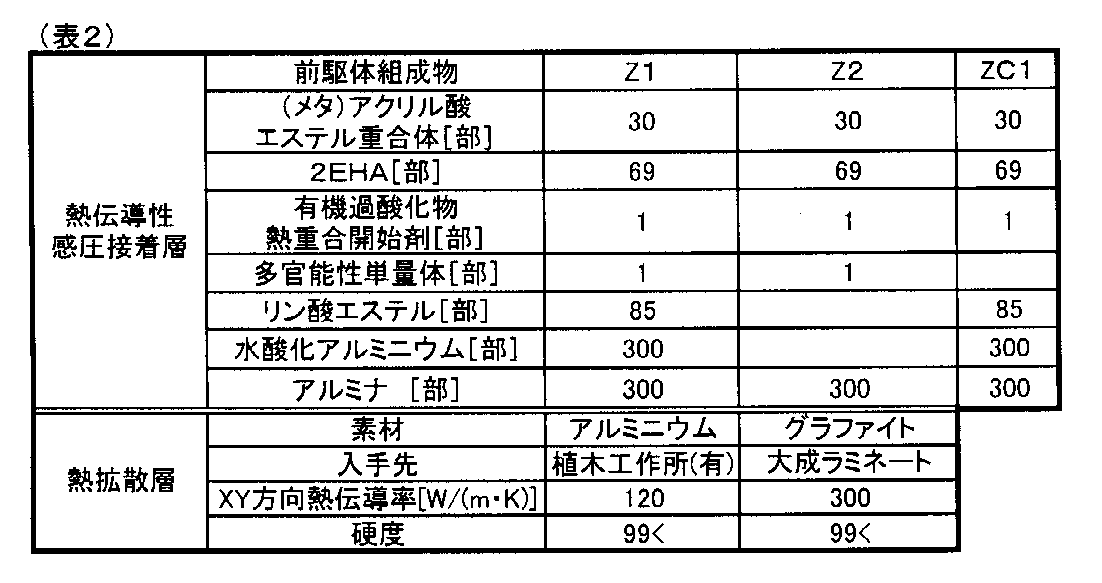
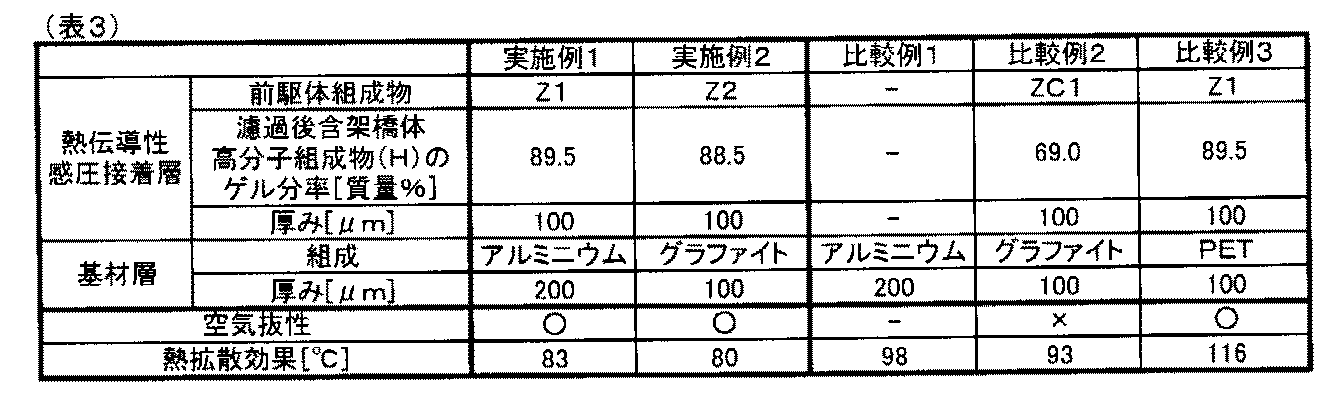
表3に示したように、実施例1及び2に係るシートは空気抜性及び熱拡散性に優れていた。一方、熱伝導性感圧接着層を有さない比較例1に係るシートは硬度が高いためガラス板に貼りつかず、空気抜性を評価することができなかった。また、熱拡散性にも劣るものであった。前駆体組成物が多官能性単量体を含んでいなかった比較例2に係るシートは、空気抜性及び熱拡散性に劣るものであった。熱拡散層の代わりにPETフィルム(面方向の熱伝導率0.2W/(m・K))を使用した比較例3に係るシートは空気抜性には優れるものの熱拡散性に劣るものであった。
[評価方法(II)]
次に、熱伝導性感圧接着層を両面に有する実施例3、4に係る熱伝導性感圧接着性積層シート、及び、比較例4~6で得られたシートの性能を、以下に示す方法で評価した。
次に、熱伝導性感圧接着層を両面に有する実施例3、4に係る熱伝導性感圧接着性積層シート、及び、比較例4~6で得られたシートの性能を、以下に示す方法で評価した。
<空気抜性>
後に説明するようにして表裏層として、熱伝導性感圧接着層1及び熱伝導性感圧接着層2を有する熱伝導性感圧接着性積層シート(以下、単に「シート」ということがある。)を作製後、100mm×100mmの正方形にカットし、熱伝導性感圧接着層1又熱伝導性感圧接着層2の面が接するようにガラス板に載せ、上面から荷重0.5gfのローラーを1往復させてガラス板に貼りつけた。このとき、下記により算出される面積が100mm2以上となる空気溜まりが存在するか否かで評価した。下記により算出される面積が100mm2以上となる空気溜まりが存在しない場合を「○」、存在する場合を「×」として、その結果を表4に示した。この評価が「○」であれば、噛み込まれる空気が少なく、密着性及び外観品質に優れていると言える。
空気溜まりの面積の算出は、最も大きな空気溜まりを囲むことができる最も面積の小さい長方形を作図し、その長方形の面積を測定することにより算出した。
後に説明するようにして表裏層として、熱伝導性感圧接着層1及び熱伝導性感圧接着層2を有する熱伝導性感圧接着性積層シート(以下、単に「シート」ということがある。)を作製後、100mm×100mmの正方形にカットし、熱伝導性感圧接着層1又熱伝導性感圧接着層2の面が接するようにガラス板に載せ、上面から荷重0.5gfのローラーを1往復させてガラス板に貼りつけた。このとき、下記により算出される面積が100mm2以上となる空気溜まりが存在するか否かで評価した。下記により算出される面積が100mm2以上となる空気溜まりが存在しない場合を「○」、存在する場合を「×」として、その結果を表4に示した。この評価が「○」であれば、噛み込まれる空気が少なく、密着性及び外観品質に優れていると言える。
空気溜まりの面積の算出は、最も大きな空気溜まりを囲むことができる最も面積の小さい長方形を作図し、その長方形の面積を測定することにより算出した。
<熱拡散効果>
後に説明するようにしてシートを作製後、25mm×120mmの大きさにカットし、断熱材の上に、熱伝導性感圧接着性積層シートを熱伝導性感圧接着層1側の面が下になるように載せ、さらにその上(熱伝導性感圧接着層2側の面)に、厚さ0.05mmの両面テープを介して接触面積が25mm×25mmとなるよう、25mm×25mmの平板状のセラミックヒータを載せた。このとき、シートの短辺とセラミックヒータの一辺とを揃えるようにして載せた。その後、23℃雰囲気下で、セラミックヒータに20Vの電圧を付加し、60分後にセラミックヒータとシートとを上面側からサーモビジョンで撮影した。セラミックヒータ表面温度の最も高温部の温度を測定し、その結果を表4に示した。本測定値が90℃以下であれば熱拡散効果が高いと判断した。
後に説明するようにしてシートを作製後、25mm×120mmの大きさにカットし、断熱材の上に、熱伝導性感圧接着性積層シートを熱伝導性感圧接着層1側の面が下になるように載せ、さらにその上(熱伝導性感圧接着層2側の面)に、厚さ0.05mmの両面テープを介して接触面積が25mm×25mmとなるよう、25mm×25mmの平板状のセラミックヒータを載せた。このとき、シートの短辺とセラミックヒータの一辺とを揃えるようにして載せた。その後、23℃雰囲気下で、セラミックヒータに20Vの電圧を付加し、60分後にセラミックヒータとシートとを上面側からサーモビジョンで撮影した。セラミックヒータ表面温度の最も高温部の温度を測定し、その結果を表4に示した。本測定値が90℃以下であれば熱拡散効果が高いと判断した。
[熱伝導性感圧接着性積層シートの作製]
(実施例3)
実施例1と同様の方法で濾液(固形分濃度22.0%)を作製した。次に、熱拡散層として200mm×300mmにカットした厚さ200μmのアルミニウム箔(実施例1と同一)の上に、上記濾液を厚さ200μmとなるように、バーコータを用いて塗工することにより塗布した。
(実施例3)
実施例1と同様の方法で濾液(固形分濃度22.0%)を作製した。次に、熱拡散層として200mm×300mmにカットした厚さ200μmのアルミニウム箔(実施例1と同一)の上に、上記濾液を厚さ200μmとなるように、バーコータを用いて塗工することにより塗布した。
次に、アルミニウム箔及び濾液の塗膜からなる積層体をオーブンに投入し、150℃で30分間加熱した。この溶剤除去工程によって、濾液から溶剤を気化させることにより、アルミニウム箔の一方の面に厚さ100μmの熱伝導性感圧接着層を形成し、アルミニウム箔と熱伝導性感圧接着層1とからなる積層体を得た。
次に、アルミニウム箔の他方の面(熱伝導性感圧接着層1が積層されている面と反対側の面)に、上記濾液を厚さ200μmとなるように、バーコータを用いて塗工することにより塗布した。
次に、熱伝導性感圧接着層1、アルミニウム箔、及び、濾液の塗膜からなる積層体をオーブンに投入し、150℃で30分間加熱した。この溶剤除去工程によって、濾液から溶剤を気化させることにより、アルミニウム箔の他方の面に厚さ100μmの熱伝導性感圧接着層2を形成し、中間層であるアルミニウム箔(熱拡散層)と表裏層である熱伝導性感圧接着層1、2とからなる熱伝導性感圧接着性積層シート(F)を得た。
(実施例4及び比較例4~6)
熱伝導性感圧接着層1の材料となる前駆体組成物に用いる各物質の配合を、実施例3で用いた表2の前駆体組成物Z1に代えて前駆体組成物Z2に変更し、基材層をグラファイトシート(実施例2と同一)に変更した以外は、実施例3と同様にして実施例4に係るシートを作製した。また、比較例4では、熱伝導性感圧接着層1、2を積層せず、実施例3で使用したアルミニウム箔そのものに対して、上記評価を行った。また、熱伝導性感圧接着層2の材料となる前駆体組成物を実施例3で用いた前駆体組成物Z1から前駆体組成物ZC1に変更し、基材層を実施例4で使用したグラファイトシートに変更した以外は、実施例3と同様にして比較例5に係るシートを作製した。また、基材層を実施例3で用いたアルミニウム箔から厚さ100μmのPETフィルム(面方向の熱伝導率0.2W/(m・K))に変更した以外は、実施例3と同様にして比較例6に係るシートを作製した。
熱伝導性感圧接着層1の材料となる前駆体組成物に用いる各物質の配合を、実施例3で用いた表2の前駆体組成物Z1に代えて前駆体組成物Z2に変更し、基材層をグラファイトシート(実施例2と同一)に変更した以外は、実施例3と同様にして実施例4に係るシートを作製した。また、比較例4では、熱伝導性感圧接着層1、2を積層せず、実施例3で使用したアルミニウム箔そのものに対して、上記評価を行った。また、熱伝導性感圧接着層2の材料となる前駆体組成物を実施例3で用いた前駆体組成物Z1から前駆体組成物ZC1に変更し、基材層を実施例4で使用したグラファイトシートに変更した以外は、実施例3と同様にして比較例5に係るシートを作製した。また、基材層を実施例3で用いたアルミニウム箔から厚さ100μmのPETフィルム(面方向の熱伝導率0.2W/(m・K))に変更した以外は、実施例3と同様にして比較例6に係るシートを作製した。
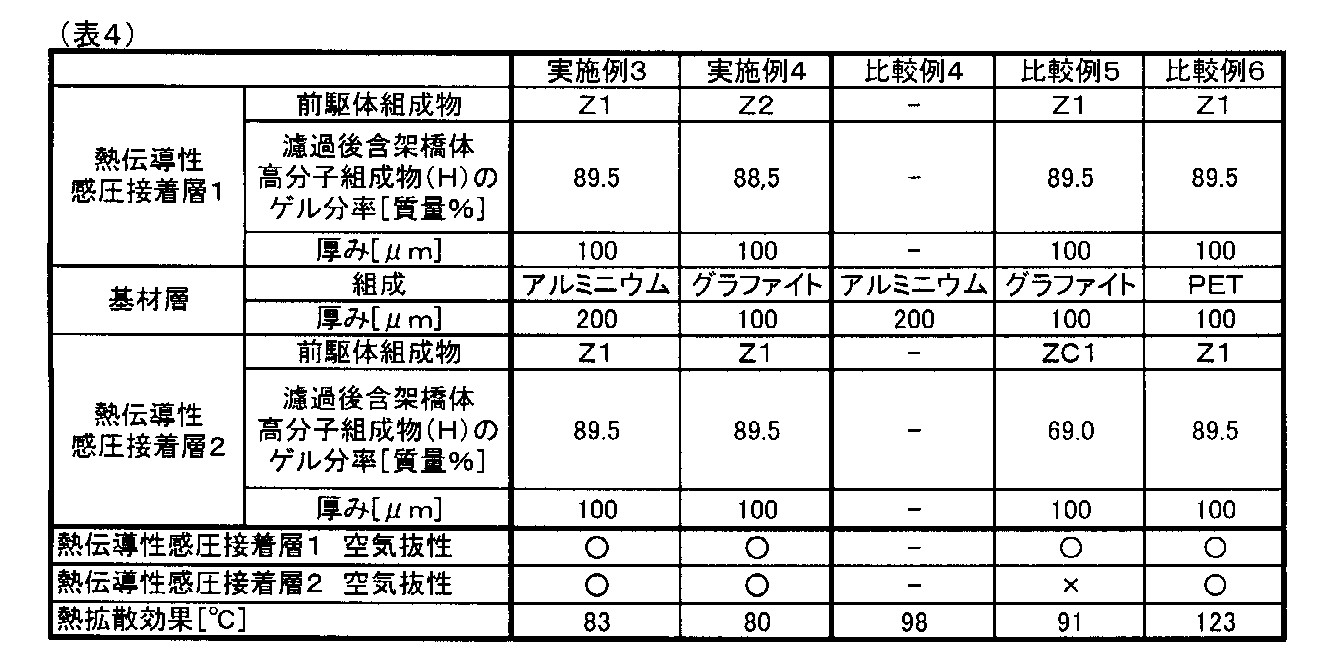
表4に示したように、実施例3及び4に係るシートは、熱伝導性感圧接着層1、2ともに空気抜性に優れ、熱拡散性にも優れていた。一方、熱伝導性感圧接着層を有さない比較例4に係るシートは硬度が高いためガラス板に貼りつかず、空気抜性を評価することができなかった。また、熱拡散性にも劣るものであった。比較例5に係るシートは、前駆体組成物が多官能性単量体を含んでいなかった熱伝導性感圧接着層2側の面の空気抜性に劣り、熱拡散効果にも劣っていた。熱拡散層であるアルミ箔の代わりにPETフィルムを使用した比較例6に係るシートは、熱伝導性感圧接着層1、2の空気抜性に優れるものの、熱拡散性に劣るものであった。
1 含架橋体高分子組成物(A)
2 溶剤
3 分散液
4、4a、4b 高分子ゲル
5 高分子ゲル含有分散液
6 メッシュ
7 濾液
8 熱拡散層
9 熱伝導性感圧接着層
10、20、14、24、34 熱伝導性感圧接着性積層シート(F)
11 基板
12、22a、22b、32 発熱体
13、23 放熱体
2 溶剤
3 分散液
4、4a、4b 高分子ゲル
5 高分子ゲル含有分散液
6 メッシュ
7 濾液
8 熱拡散層
9 熱伝導性感圧接着層
10、20、14、24、34 熱伝導性感圧接着性積層シート(F)
11 基板
12、22a、22b、32 発熱体
13、23 放熱体
Claims (6)
- 面方向の熱伝導率が10W/(m・K)以上である熱拡散層と、熱伝導性感圧接着層と、を備えた熱伝導性感圧接着性積層シート(F)の製造方法であって、
熱伝導性フィラー(C1)及び(メタ)アクリル酸エステル重合体(A0)を含有する含架橋体高分子組成物(A)を、溶剤に浸漬し、撹拌して高分子ゲル含有分散液を作製する高分子ゲル含有分散液作製工程と、
前記高分子ゲル含有分散液を所定の目開きを有するメッシュでろ過して濾液を得る濾過工程と、
前記濾液を前記熱拡散層の片面に所定の厚さに塗布する塗布工程と、
前記熱拡散層上の前記濾液中の前記溶剤を除去して熱伝導性感圧接着層を得る溶剤除去工程と、
を含み、
前記所定の目開きが、前記所定の厚さの1.3倍以下であり、
前記含架橋体高分子組成物(A)を前記高分子ゲル含有分散液作製工程及び前記濾過工程に供して得られる濾液を乾燥してなる濾過後含架橋体高分子組成物(H)のゲル分率が75質量%以上であることを特徴とする、
熱伝導性感圧接着性積層シート(F)の製造方法。 - 面方向の熱伝導率が10W/(m・K)以上である熱拡散層と、熱伝導性感圧接着層と、を備えた熱伝導性感圧接着性積層シート(F)の製造方法であって、
熱伝導性フィラー(C1)及び(メタ)アクリル酸エステル重合体(A0)を含有する含架橋体高分子組成物(A)を溶剤に浸漬し、撹拌して高分子ゲル含有分散液を作製する高分子ゲル含有分散液作製工程と、
前記高分子ゲル含有分散液を所定の目開きを有するメッシュでろ過して濾液を得る濾過工程と、
前記濾液を前記熱拡散層の一方の面に所定の厚さに塗布する第1塗布工程と、
前記熱拡散層の前記一方の面に塗布された前記濾液中の前記溶剤を除去して熱伝導性感圧接着層を得る第1溶剤除去工程と、
前記濾液を前記熱拡散層の他方の面に前記所定の厚さに塗布する第2塗布工程と、
前記熱拡散層の前記他方の面に塗布された前記濾液中の前記溶剤を除去して熱伝導性感圧接着層を得る第2溶剤除去工程と、
を含み、
前記所定の目開きが、前記所定の厚さの1.3倍以下であり、
前記含架橋体高分子組成物(A)を前記高分子ゲル含有分散液作製工程及び前記濾過工程に供して得られる濾液を乾燥してなる濾過後含架橋体高分子組成物(H)のゲル分率が75質量%以上であることを特徴とする、
熱伝導性感圧接着性積層シート(F)の製造方法。 - 前記含架橋体高分子組成物(A)が、(メタ)アクリル酸エステル重合体(A1)と、(メタ)アクリル酸エステル単量体(α1)と、多官能性単量体(B1)と、熱伝導性フィラー(C1)と、を含む前駆体組成物において、少なくとも(メタ)アクリル酸エステル単量体(α1)の重合反応と、(メタ)アクリル酸エステル重合体(A1)及び/又は(メタ)アクリル酸エステル単量体(α1)由来の構造単位を含む重合体の架橋反応と、を行うことにより得られるものである、請求項1又は2に記載の熱伝導性感圧接着性積層シート(F)の製造方法。
- メッシュの所定の目開きが1000μm以下であることを特徴とする、請求項1~3のいずれかに記載の熱伝導性感圧接着性積層シート(F)の製造方法。
- 請求項1~4のいずれかに記載の熱伝導性感圧接着性積層シート(F)の製造方法により得られる熱伝導性感圧接着性積層シート(F)。
- 請求項5に記載の熱伝導性感圧接着性積層シート(F)を備えた電子機器。
Applications Claiming Priority (4)
| Application Number | Priority Date | Filing Date | Title |
|---|---|---|---|
| JP2014079011 | 2014-04-07 | ||
| JP2014-079009 | 2014-04-07 | ||
| JP2014079009 | 2014-04-07 | ||
| JP2014-079011 | 2014-04-07 |
Publications (1)
| Publication Number | Publication Date |
|---|---|
| WO2015156258A1 true WO2015156258A1 (ja) | 2015-10-15 |
Family
ID=54287834
Family Applications (1)
| Application Number | Title | Priority Date | Filing Date |
|---|---|---|---|
| PCT/JP2015/060759 Ceased WO2015156258A1 (ja) | 2014-04-07 | 2015-04-06 | 熱伝導性感圧接着性積層シートの製造方法、熱伝導性感圧接着性積層シート、及び、電子機器 |
Country Status (1)
| Country | Link |
|---|---|
| WO (1) | WO2015156258A1 (ja) |
Citations (7)
| Publication number | Priority date | Publication date | Assignee | Title |
|---|---|---|---|---|
| JPH03156923A (ja) * | 1989-11-15 | 1991-07-04 | Mitsui Toatsu Chem Inc | ウエハ加工用フィルム |
| JPH04216888A (ja) * | 1990-02-27 | 1992-08-06 | Minnesota Mining & Mfg Co <3M> | 中空多孔性アシッドフリーアクリレート系高分子量微小球 |
| JP2002285121A (ja) * | 2001-03-27 | 2002-10-03 | Nippon Zeon Co Ltd | 感圧接着性組成物およびそれを用いたシート |
| JP2011089113A (ja) * | 2009-09-24 | 2011-05-06 | Dic Corp | 粘着テープ |
| JP2014005336A (ja) * | 2012-06-22 | 2014-01-16 | Nippon Zeon Co Ltd | 熱伝導性感圧接着剤組成物、熱伝導性感圧接着性シート状成形体、これらの製造方法、及び電子機器 |
| WO2014021090A1 (ja) * | 2012-07-30 | 2014-02-06 | 日東電工株式会社 | 熱伝導性粘着シート |
| JP2014114377A (ja) * | 2012-12-10 | 2014-06-26 | Dic Corp | 粘着剤組成物、粘着剤及び粘着テープ |
-
2015
- 2015-04-06 WO PCT/JP2015/060759 patent/WO2015156258A1/ja not_active Ceased
Patent Citations (7)
| Publication number | Priority date | Publication date | Assignee | Title |
|---|---|---|---|---|
| JPH03156923A (ja) * | 1989-11-15 | 1991-07-04 | Mitsui Toatsu Chem Inc | ウエハ加工用フィルム |
| JPH04216888A (ja) * | 1990-02-27 | 1992-08-06 | Minnesota Mining & Mfg Co <3M> | 中空多孔性アシッドフリーアクリレート系高分子量微小球 |
| JP2002285121A (ja) * | 2001-03-27 | 2002-10-03 | Nippon Zeon Co Ltd | 感圧接着性組成物およびそれを用いたシート |
| JP2011089113A (ja) * | 2009-09-24 | 2011-05-06 | Dic Corp | 粘着テープ |
| JP2014005336A (ja) * | 2012-06-22 | 2014-01-16 | Nippon Zeon Co Ltd | 熱伝導性感圧接着剤組成物、熱伝導性感圧接着性シート状成形体、これらの製造方法、及び電子機器 |
| WO2014021090A1 (ja) * | 2012-07-30 | 2014-02-06 | 日東電工株式会社 | 熱伝導性粘着シート |
| JP2014114377A (ja) * | 2012-12-10 | 2014-06-26 | Dic Corp | 粘着剤組成物、粘着剤及び粘着テープ |
Similar Documents
| Publication | Publication Date | Title |
|---|---|---|
| CN103547644B (zh) | 导热性压敏粘接性片状成型体、其制造方法及电子设备 | |
| CN102165028A (zh) | 导热性压敏粘接剂组合物、导热性压敏粘接性片以及电子部件 | |
| JPWO2012132656A1 (ja) | 熱伝導性感圧接着剤組成物、熱伝導性感圧接着性シート状成形体、これらの製造方法、及び電子部品 | |
| WO2013047145A1 (ja) | 熱伝導性感圧接着剤組成物、熱伝導性感圧接着性シート状成形体、これらの製造方法、及び電子部品 | |
| WO2013183389A1 (ja) | 熱伝導性感圧接着剤組成物、熱伝導性感圧接着性シート状成形体、これらの製造方法、及び電子機器 | |
| WO2013084750A1 (ja) | 熱伝導性感圧接着剤組成物、熱伝導性感圧接着性シート状成形体、これらの製造方法、及び電子機器 | |
| JP2014028903A (ja) | 熱伝導性積層シート、熱伝導性積層シートの製造方法、及び電子機器 | |
| JP2013129814A (ja) | 熱伝導性感圧接着剤組成物、熱伝導性感圧接着性シート状成形体、これらの製造方法、及び電子機器 | |
| JP2013124289A (ja) | 熱伝導性感圧接着剤組成物、熱伝導性感圧接着性シート状成形体、これらの製造方法、及び電子機器 | |
| WO2013061830A1 (ja) | 熱伝導性感圧接着剤組成物、熱伝導性感圧接着性シート状成形体、これらの製造方法、及び電子部品 | |
| WO2015156257A1 (ja) | 熱伝導性感圧接着性積層シートの製造方法、熱伝導性感圧接着性積層シート、及び、電子機器 | |
| WO2013175950A1 (ja) | 熱伝導性感圧接着剤組成物、熱伝導性感圧接着性シート状成形体、これらの製造方法、及び電子機器 | |
| WO2015060092A1 (ja) | 熱伝導性感圧接着剤組成物、熱伝導性感圧接着性シート状成形体、これらの製造方法、及び電子機器 | |
| JP2015067638A (ja) | 熱伝導性感圧接着剤組成物、熱伝導性感圧接着性シート状成形体、これらの製造方法、及び電子機器 | |
| JP2014005336A (ja) | 熱伝導性感圧接着剤組成物、熱伝導性感圧接着性シート状成形体、これらの製造方法、及び電子機器 | |
| JP2015067640A (ja) | 熱伝導性感圧接着剤組成物、熱伝導性感圧接着性シート状成形体、これらの製造方法、及び電子機器 | |
| JP2014009287A (ja) | 熱伝導性感圧接着剤組成物、熱伝導性感圧接着性シート状成形体、これらの製造方法、及び電子機器 | |
| WO2015156258A1 (ja) | 熱伝導性感圧接着性積層シートの製造方法、熱伝導性感圧接着性積層シート、及び、電子機器 | |
| JP2015117341A (ja) | 熱伝導性感圧接着性積層シートの製造方法、熱伝導性感圧接着性積層シート、及び、電子機器 | |
| WO2015056577A1 (ja) | 熱伝導性感圧接着性積層シート、熱伝導性感圧接着性積層シートの製造方法、及び電子機器 | |
| WO2015156254A1 (ja) | 熱伝導性感圧接着性積層シートの製造方法、熱伝導性感圧接着性積層シート、及び、電子機器 | |
| JP2013095779A (ja) | 熱伝導性感圧接着剤組成物、熱伝導性感圧接着性シート状成形体、これらの製造方法、及び電子機器 | |
| JP2015067637A (ja) | 熱伝導性感圧接着剤組成物、熱伝導性感圧接着性シート状成形体、これらの製造方法、及び電子機器 | |
| JP5652365B2 (ja) | 熱伝導性感圧接着剤組成物、熱伝導性感圧接着性シート状成形体、これらの製造方法、及び電子部品 | |
| CN103221501B (zh) | 导热性压敏粘接剂组合物、导热性压敏粘接性片状成型体、它们的制造方法、以及电子部件 |
Legal Events
| Date | Code | Title | Description |
|---|---|---|---|
| 121 | Ep: the epo has been informed by wipo that ep was designated in this application |
Ref document number: 15777554 Country of ref document: EP Kind code of ref document: A1 |
|
| NENP | Non-entry into the national phase |
Ref country code: DE |
|
| 122 | Ep: pct application non-entry in european phase |
Ref document number: 15777554 Country of ref document: EP Kind code of ref document: A1 |
|
| NENP | Non-entry into the national phase |
Ref country code: JP |