WO2015146334A1 - 手袋 - Google Patents
手袋 Download PDFInfo
- Publication number
- WO2015146334A1 WO2015146334A1 PCT/JP2015/053821 JP2015053821W WO2015146334A1 WO 2015146334 A1 WO2015146334 A1 WO 2015146334A1 JP 2015053821 W JP2015053821 W JP 2015053821W WO 2015146334 A1 WO2015146334 A1 WO 2015146334A1
- Authority
- WO
- WIPO (PCT)
- Prior art keywords
- urethane resin
- mass
- fluorine compound
- aqueous urethane
- glove
- Prior art date
- Legal status (The legal status is an assumption and is not a legal conclusion. Google has not performed a legal analysis and makes no representation as to the accuracy of the status listed.)
- Ceased
Links
Classifications
-
- D—TEXTILES; PAPER
- D06—TREATMENT OF TEXTILES OR THE LIKE; LAUNDERING; FLEXIBLE MATERIALS NOT OTHERWISE PROVIDED FOR
- D06M—TREATMENT, NOT PROVIDED FOR ELSEWHERE IN CLASS D06, OF FIBRES, THREADS, YARNS, FABRICS, FEATHERS OR FIBROUS GOODS MADE FROM SUCH MATERIALS
- D06M15/00—Treating fibres, threads, yarns, fabrics, or fibrous goods made from such materials, with macromolecular compounds; Such treatment combined with mechanical treatment
- D06M15/19—Treating fibres, threads, yarns, fabrics, or fibrous goods made from such materials, with macromolecular compounds; Such treatment combined with mechanical treatment with synthetic macromolecular compounds
- D06M15/37—Macromolecular compounds obtained otherwise than by reactions only involving carbon-to-carbon unsaturated bonds
- D06M15/564—Polyureas, polyurethanes or other polymers having ureide or urethane links; Precondensation products forming them
-
- A—HUMAN NECESSITIES
- A41—WEARING APPAREL
- A41D—OUTERWEAR; PROTECTIVE GARMENTS; ACCESSORIES
- A41D19/00—Gloves
- A41D19/015—Protective gloves
- A41D19/01547—Protective gloves with grip improving means
- A41D19/01558—Protective gloves with grip improving means using a layer of grip improving material
-
- D—TEXTILES; PAPER
- D06—TREATMENT OF TEXTILES OR THE LIKE; LAUNDERING; FLEXIBLE MATERIALS NOT OTHERWISE PROVIDED FOR
- D06M—TREATMENT, NOT PROVIDED FOR ELSEWHERE IN CLASS D06, OF FIBRES, THREADS, YARNS, FABRICS, FEATHERS OR FIBROUS GOODS MADE FROM SUCH MATERIALS
- D06M23/00—Treatment of fibres, threads, yarns, fabrics or fibrous goods made from such materials, characterised by the process
- D06M23/04—Processes in which the treating agent is applied in the form of a foam
-
- A—HUMAN NECESSITIES
- A41—WEARING APPAREL
- A41D—OUTERWEAR; PROTECTIVE GARMENTS; ACCESSORIES
- A41D19/00—Gloves
- A41D19/0055—Plastic or rubber gloves
-
- D—TEXTILES; PAPER
- D06—TREATMENT OF TEXTILES OR THE LIKE; LAUNDERING; FLEXIBLE MATERIALS NOT OTHERWISE PROVIDED FOR
- D06M—TREATMENT, NOT PROVIDED FOR ELSEWHERE IN CLASS D06, OF FIBRES, THREADS, YARNS, FABRICS, FEATHERS OR FIBROUS GOODS MADE FROM SUCH MATERIALS
- D06M2101/00—Chemical constitution of the fibres, threads, yarns, fabrics or fibrous goods made from such materials, to be treated
- D06M2101/16—Synthetic fibres, other than mineral fibres
- D06M2101/30—Synthetic polymers consisting of macromolecular compounds obtained otherwise than by reactions only involving carbon-to-carbon unsaturated bonds
- D06M2101/34—Polyamides
Definitions
- the present invention relates to a glove having a film made of an aqueous urethane resin composition.
- Synthetic rubbers such as natural rubber and nitrile rubber, which are generally used as elastic materials, can cause allergies due to contact with them, so they may be avoided in glove applications.
- rubber elasticity A relatively flexible solvent-type urethane resin having a high molecular weight is widely used.
- a glove using the water-based urethane resin for example, a glove using a water-dispersed resin liquid containing water-based urethane and an organic filler is known (see, for example, Patent Document 1).
- a glove using a water-dispersed resin liquid containing water-based urethane and an organic filler is known (see, for example, Patent Document 1).
- the film made of the water-based urethane resin is formed on the outside of the glove, there is a problem that the grip (non-slip) property is poor.
- the problem to be solved by the present invention is to provide a glove having improved oil grip properties using a water-based urethane resin.
- the present invention provides a glove having a film obtained by using an aqueous urethane resin composition containing an aqueous urethane resin (A), an aqueous medium (B) and a fluorine compound (C). is there.
- the glove of the present invention is excellent in oil grip, texture and flexibility. Moreover, since the water-based urethane resin composition is used, the environmental load at the time of glove manufacture is also small. Therefore, the glove of the present invention can be suitably used as an industrial glove used in various fields such as the chemical industry field, food field, and medical field.
- the glove of the present invention has a film obtained using an aqueous urethane resin composition containing an aqueous urethane resin (A), an aqueous medium (B) and a fluorine compound (C).
- the aqueous urethane resin (A) can be dispersed in an aqueous medium (B) to be described later.
- the aqueous urethane resin (A) has a hydrophilic group such as an anionic group, a cationic group, or a nonionic group; Those that are forcibly dispersed in the aqueous medium (B) can be used.
- These aqueous urethane resins (A) may be used alone or in combination of two or more. Among these, from the viewpoint of easy availability of raw materials, it is preferable to use an aqueous urethane resin having a hydrophilic group, and it is more preferable to use an aqueous urethane resin having an anionic group.
- Examples of a method for obtaining the aqueous urethane resin having an anionic group include a method using, as a raw material, one or more compounds selected from the group consisting of a compound having a carboxyl group and a compound having a sulfonyl group.
- Examples of the compound having a carboxyl group include 2,2′-dimethylolpropionic acid, 2,2′-dimethylolbutanoic acid, 2,2′-dimethylolbutyric acid, 2,2′-valeric acid, and the like. Can do. These compounds may be used alone or in combination of two or more.
- Examples of the compound having a sulfonyl group include 3,4-diaminobutanesulfonic acid, 3,6-diamino-2-toluenesulfonic acid, 2,6-diaminobenzenesulfonic acid, N- (2-aminoethyl)- 2-Aminoethylsulfonic acid or the like can be used. These compounds may be used alone or in combination of two or more.
- the carboxyl group and sulfonyl group may be partially or completely neutralized with a basic compound in the aqueous urethane resin composition.
- a basic compound include organic amines such as ammonia, triethylamine, pyridine, and morpholine; alkanolamines such as monoethanolamine and dimethylethanolamine; metal base compounds including sodium, potassium, lithium, calcium, and the like. Can do.
- Examples of the method for obtaining the aqueous urethane resin having a cationic group include a method using one or more compounds having an amino group as a raw material.
- Examples of the compound having an amino group include compounds having primary and secondary amino groups such as triethylenetetramine and diethylenetriamine; N-alkyldialkanolamines such as N-methyldiethanolamine and N-ethyldiethanolamine, and N-methyl.
- a compound having a tertiary amino group such as N-alkyldiaminoalkylamine such as diaminoethylamine and N-ethyldiaminoethylamine can be used. These compounds may be used alone or in combination of two or more.
- Examples of the method for obtaining the aqueous urethane resin having a nonionic group include a method using one or more compounds having an oxyethylene structure as a raw material.
- Examples of the compound having an oxyethylene structure include polyether polyols having an oxyethylene structure such as polyoxyethylene glycol, polyoxyethylene polyoxypropylene glycol, and polyoxyethylene polyoxytetramethylene glycol. These compounds may be used alone or in combination of two or more.
- Examples of the emulsifier that can be used in obtaining the aqueous urethane resin that is forcibly dispersed in the aqueous medium (B) include polyoxyethylene nonyl phenyl ether, polyoxyethylene lauryl ether, polyoxyethylene styryl phenyl ether, Nonionic emulsifiers such as polyoxyethylene sorbitol tetraoleate and polyoxyethylene / polyoxypropylene copolymers; fatty acid salts such as sodium oleate, alkyl sulfate esters, alkylbenzene sulfonates, alkyl sulfosuccinates, naphthalene sulfonates Anionic emulsifiers such as salts, polyoxyethylene alkyl sulfates, alkane sulfonate sodium salts, alkyl diphenyl ether sodium sulfonates; alkyl amine salts, alkyl trimethyl
- aqueous urethane resin (A) a polyol (a1), a polyisocyanate (a2), a chain extender (a3), and an aqueous urethane resin having a hydrophilic group as described above are produced as necessary.
- a polyol (a1), a polyisocyanate (a2), a chain extender (a3), and an aqueous urethane resin having a hydrophilic group as described above are produced as necessary.
- those obtained by reacting the raw materials used for the purpose can be used.
- polyol (a1) examples include polyether polyol, polyester polyol, polyacryl polyol, polycarbonate polyol, polybutadiene polyol, compound having a carboxyl group, compound having a sulfonyl group, compound having an amino group, and oxy A compound having an ethylene structure or the like can be used. These polyols may be used alone or in combination of two or more. Among these, the polyol (a1) contains at least one selected from the group consisting of polyester polyols, polyether polyols and polycarbonate polyols from the viewpoint that oil grip properties, flexibility and chemical resistance can be further improved. It is preferable to do.
- polyester polyol for example, a reaction product of a compound having a hydroxyl group and a polybasic acid can be used.
- Examples of the compound having a hydroxyl group include ethylene glycol, propylene glycol, butanediol, pentanediol, hexanediol, heptanediol, octanediol, nonanediol, decanediol, diethylene glycol, dipropylene glycol, neopentyl glycol, and 3-methyl.
- Pentanediol, cyclohexanedimethanol, trimethylolpropane, trimethylolethane, glycerin and the like can be used. These compounds may be used alone or in combination of two or more.
- polybasic acid examples include oxalic acid, malonic acid, succinic acid, adipic acid, sebacic acid, azelaic acid, 1,12-dodecanedicarboxylic acid, maleic acid, glutaric acid, pimelic acid, itaconic acid, chlorendic acid, 1,2,4-butane-tricarboxylic acid, chlorendic acid, terephthalic acid, isophthalic acid, phthalic acid, 1,4-naphthalenedicarboxylic acid, 2,5-naphthalenedicarboxylic acid, 2,6-naphthalenedicarboxylic acid, naphthalic acid, Biphenyldicarboxylic acid, 1,2-bis (phenoxy) ethane-p, p'-dicarboxylic acid and anhydrides or ester-forming derivatives of these dicarboxylic acids; p-hydroxybenzoic acid, p- (2-hydroxyethoxy) benzoic acid and These hydroxycarboxylic acids
- the hydroxyl value of the polyester polyol is preferably in the range of 20 to 230 mgKOH / g, more preferably in the range of 28 to 110 mgKOH / g, from the viewpoint of further improving oil grip properties and flexibility.
- the hydroxyl value of the polyester polyol is a value measured according to JISK0070-1992.
- polyether polyol examples include polyoxyethylene polyol, polyoxypropylene polyol, polyoxytetramethylene polyol, polyoxyethylene polyoxypropylene polyol, polyoxyethylene polyoxytetramethylene polyol, polyoxypropylene polyoxytetramethylene polyol. Etc. can be used. These polyether polyols may be used alone or in combination of two or more.
- polycarbonate polyol for example, those obtained by reacting a carbonate ester and / or phosgene with a compound having two or more hydroxyl groups can be used.
- carbonate ester for example, methyl carbonate, dimethyl carbonate, ethyl carbonate, diethyl carbonate, cyclocarbonate, diphenyl carbonate and the like can be used. These carbonates may be used alone or in combination of two or more.
- the same compounds as the chain extender having the hydroxyl group can be used. These compounds may be used alone or in combination of two or more. Among these, it is preferable to use an aliphatic polyol and / or an alicyclic polyol from the viewpoint that the cutting property can be further improved. 1,4-butanediol, 1,5-pentanediol, 1,6-hexanediol More preferably, at least one compound selected from the group consisting of 1,4-cyclohexanedimethanol is used.
- the total amount of the polyester polyol, the polyether polyol and the polycarbonate polyol is preferably 70% by mass or more in the polyol (a1) from the viewpoint of further improving oil grip properties and flexibility. More preferably.
- polyisocyanate (a2) examples include aromatic polyisocyanates such as phenylene diisocyanate, tolylene diisocyanate, diphenylmethane diisocyanate, naphthalene diisocyanate, polymethylene polyphenyl polyisocyanate, carbodiimidized diphenylmethane polyisocyanate; hexamethylene diisocyanate, lysine diisocyanate, Aliphatic or alicyclic polyisocyanates such as cyclohexane diisocyanate, isophorone diisocyanate, dicyclohexylmethane diisocyanate, xylylene diisocyanate, tetramethylxylylene diisocyanate, dimer acid diisocyanate and norbornene diisocyanate can be used. These polyisocyanates may be used alone or in combination of two or more. Among these, aromatic polyisocyanate is preferably used, and dipheny
- chain extender (a3) examples include ethylenediamine, 1,2-propanediamine, 1,6-hexamethylenediamine, piperazine, 2,5-dimethylpiperazine, isophoronediamine, 1,2-cyclohexanediamine, 1, Chain extenders having amino groups such as 3-cyclohexanediamine, 1,4-cyclohexanediamine, 4,4′-dicyclohexylmethanediamine, 3,3′-dimethyl-4,4′-dicyclohexylmethanediamine, hydrazine; ethylene glycol , Diethylene recall, triethylene glycol, propylene glycol, dipropylene glycol, 1,3-propanediol, 1,3-butanediol, 1,4-butanediol, hexamethylene glycol, saccharose, methylene glycol, glyce Emissions, sorbitol, bisphenol A, 4,4'-dihydroxydiphenyl, 4,4'-dio
- the polyol (a1), the polyisocyanate (a2), and the chain extender (a3) are mixed in the absence of a solvent or in the presence of an organic solvent
- a process for producing by reacting in the range of 50 to 100 ° C. for 3 to 15 hours; mixing the polyol (a1) and the polyisocyanate (a2) in the absence of a solvent or in the presence of an organic solvent;
- a urethane prepolymer having an isocyanate group is obtained by reacting in the range of 100 ° C. for 3 to 15 hours, and then the urethane prepolymer is reacted with the chain extender (a3). It is done.
- An organic solvent was used in the reaction
- the reaction of the polyol (a1), the polyisocyanate (a2), and the chain extender (a3) is carried out by adding the total of hydroxyl groups and amino groups of the polyol (a1) and the chain extender (a3),
- the equivalent ratio [isocyanate group / hydroxyl group and amino group] of the isocyanate group of the isocyanate (a2) is preferably in the range of 0.9 to 1.1, and preferably in the range of 0.95 to 1.05. More preferred.
- Examples of the organic solvent that can be used in producing the aqueous urethane resin (A) include ketone solvents such as acetone and methyl ethyl ketone; ether solvents such as tetrahydrofuran and dioxane; acetate solvents such as ethyl acetate and butyl acetate. Nitrile solvents such as acetonitrile; amide solvents such as dimethylformamide and N-methylpyrrolidone can be used.
- the said organic solvent may be used independently or may use 2 or more types together.
- the weight average molecular weight of the water-based urethane resin (A) obtained by the above method is in the range of 30,000 to 1,000,000 from the viewpoint of further improving oil grip properties, flexibility and mechanical strength. It is preferable that it is in the range of 50,000 to 500,000.
- the weight average molecular weight of the said water-based urethane resin (A) shows the value measured on condition of the following by the gel permeation chromatography (GPC) method.
- Measuring device High-speed GPC device (“HLC-8220GPC” manufactured by Tosoh Corporation) Column: The following columns manufactured by Tosoh Corporation were connected in series. "TSKgel G5000" (7.8 mm ID x 30 cm) x 1 "TSKgel G4000” (7.8 mm ID x 30 cm) x 1 "TSKgel G3000” (7.8 mm ID x 30 cm) x 1 “TSKgel G2000” (7.8 mm ID ⁇ 30 cm) ⁇ 1 detector: RI (differential refractometer) Column temperature: 40 ° C Eluent: Tetrahydrofuran (THF) Flow rate: 1.0 mL / min Injection amount: 100 ⁇ L (tetrahydrofuran solution with a sample concentration of 0.4 mass%) Standard sample: A calibration curve was prepared using the following standard polystyrene.
- the content of the water-based urethane resin (A) is preferably in the range of 10 to 60% by mass in the water-based urethane resin composition from the viewpoint that storage stability and workability can be improved. A range is more preferable.
- aqueous medium (B) for example, water, an organic solvent miscible with water, a mixture thereof, or the like can be used.
- organic solvent miscible with water include alcohol solvents such as methanol, ethanol, n-propanol and isopropanol; ketone solvents such as acetone and methyl ethyl ketone; polyalkylene glycol solvents such as ethylene glycol, diethylene glycol and propylene glycol; An alkyl ether solvent of polyol; a lactam solvent such as N-methyl-2-pyrrolidone can be used.
- the content of the aqueous medium (B) is preferably in the range of 40 to 85% by mass, and in the range of 45 to 70% by mass in the aqueous urethane resin composition from the viewpoint of improving storage stability and workability. It is more preferable that
- the fluorine compound (C) is an essential component for imparting excellent oil grip properties.
- a fluorine compound known as a surfactant or a surface modifier can be used.
- the said fluorine compound (C) may be used independently, or may use 2 or more types together.
- the fluorine compound (C) is a polymerizable monomer having a fluorinated alkyl group having 4 to 6 carbon atoms from the viewpoint of further improving the solubility in the aqueous medium (B) and the oil grip property.
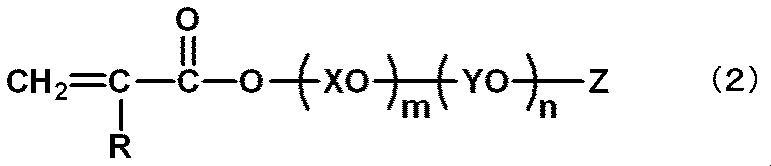
- a polymer obtained by polymerizing a polymerizable monomer (c) having a polymerizable monomer (c2) having a polyoxyalkylene chain represented by c1) and the following general formula (2) as an essential component is used. It is preferable.
- R is a hydrogen atom or a methyl group
- X and Y are each an independent alkylene group
- m and n are each 0 or an integer of 1 or more, and the sum of m and n is 3 or more
- Z is a hydrogen atom or an alkyl group having 1 to 6 carbon atoms.
- polymerizable monomer (c1) for example, one represented by the following general formula (1) can be used.
- R represents a hydrogen atom, a fluorine atom, a methyl group, a cyano group, a phenyl group, a benzyl group, or —C n H 2n —Rf ′ (n represents an integer of 1 to 8, Rf ′ Represents any one group of the following formulas (Rf-1) to (Rf-7)), and L represents any one group of the following formulas (L-1) to (L-10): Rf represents any one of the following formulas (Rf-1) to (Rf-7).
- n represents an integer of 1 to 8.
- m represents an integer of 1 to 8
- n represents an integer of 0 to 8.
- Rf ′′ represents any one of the following formulas (Rf-1) to (Rf-7).
- n represents an integer of 4 to 6.
- m is an integer of 1 to 5, and n is 0 to 4
- p is 0.
- It is an integer of ⁇ 4, and the sum of m, n, and p is 4 to 5.
- the amount of the polymerizable monomer (c1) used is preferably in the range of 3 to 60% by mass in the polymerizable monomer (c) from the viewpoint that oil grip properties can be further improved. A range of ⁇ 50 mass% is more preferred.
- the polymerizable monomer (c2) is a monomer having a polyoxyalkylene chain.
- As said polymerizable monomer (c2) what is represented by following General formula (2) can be used, for example.
- the polymerizable monomer (c2) may be used alone or in combination of two or more.
- R 1 is a hydrogen atom or a methyl group
- X and Y are each independently an alkylene group
- m and n are each 0 or an integer of 1 or more, and the sum of m and n is 3 or more.
- Z is a hydrogen atom or an alkyl group having 1 to 6 carbon atoms.
- X and Y in the said General formula (2) are alkylene groups, this alkylene group may have a substituent.
- Specific examples of the —O— (XO) m— (YO) n— moiety include polyoxypropylene in which the number of repeating units m is an integer of 3 or more, n is 0, and X is propylene, the number of repeating units m Polyoxybutylene in which n is an integer of 3 or more and n is 0, and X is butylene, polyoxytetramethylene in which the number of repeating units m is an integer of 3 or more, n is 0, and X is tetramethylene,
- the number of repeating units m and n are both integers of 1 or more, and polyoxyalkylene which is a copolymer of ethylene oxide and propylene oxide in which X or Y is ethylene and the other is propylene, and the number of repeating units m and n are both Polyoxyalkylene which is a
- the degree of polymerization of these polyoxyalkylenes is preferably in the range of 3 to 50.
- the repeating unit containing X and the repeating unit containing Y may be arrange
- butylene refers to a branched alkylene having 4 carbon atoms
- tetramethylene refers to a linear alkylene having 4 carbon atoms.
- Propylene may be linear or branched.
- polymerizable monomer (c2) examples include polypropylene glycol mono (meth) acrylate, polytetramethylene glycol (meth) acrylate, poly (ethylene glycol / propylene glycol) mono (meth) acrylate, polyethylene Glycol / polypropylene glycol mono (meth) acrylate, poly (ethylene glycol / tetramethylene glycol) mono (meth) acrylate, polyethylene glycol / polytetramethylene glycol mono (meth) acrylate, poly (propylene glycol / tetramethylene glycol) mono (meta) ) Acrylate, Polypropylene glycol / Polytetramethylene glycol mono (meth) acrylate, Poly (propylene glycol / Butylene glycol) (Meth) acrylate, polypropylene glycol / polybutylene glycol mono (meth) acrylate, poly (ethylene glycol / butylene glycol) mono (meth) acryl
- Poly (ethylene glycol / propylene glycol) means a random copolymer of ethylene glycol and propylene glycol
- polyethylene glycol / polypropylene glycol means a block copolymer of ethylene glycol and propylene glycol. Meaning, and so on.
- monomers (B) since compatibility with other components in the coating composition of the present invention is improved, at least a polyoxypropylene chain, a polyoxybutylene chain or a polyoxytetramethylene chain is present.
- Method (Meth) acrylates having at least polyoxybutylene chains or polyoxytetramethylene chains are more preferable.
- the polymerizable monomer (c2) it is preferable to use a monomer having a polyoxyethylene chain from the viewpoint of further improving the compatibility with the aqueous medium (B). Those having a propylene chain are more preferable, and poly (ethylene glycol / propylene glycol) mono (meth) acrylate is still more preferable.
- the polymerizable monomer (c2) having a polyoxyethylene chain and a polyoxypropylene chain as the molar ratio [EO / PO] of the polyoxyethylene chain to the polyoxypropylene chain
- it is preferably in the range of 10/90 to 80/20, more preferably in the range of 20/80 to 60/40.
- Examples of the polymerizable monomer (c2) include “NK ester AMP-10G”, “NK ester AMP-20G”, “NK ester AMP-60G” manufactured by Shin-Nakamura Chemical Co., Ltd., and NOF Corporation.
- the polymerizable monomer (c2) is used in an amount that can further improve oil grip properties, solubility in the aqueous medium (B), and mechanical strength.
- the content is preferably in the range of 40 to 97% by mass, more preferably in the range of 50 to 95% by mass.
- the polymerizable monomer (c) may use other polymerizable monomer in addition to the polymerizable monomer (c1) and the polymerizable monomer (c2).
- Examples of the other polymerizable monomer include a polymerizable monomer represented by the following general formula (3); a polymerizable monomer having a hydrolyzable silyl group; styrene, ⁇ -methylstyrene, p Aromatic vinyl compounds such as methylstyrene and p-methoxystyrene; maleimide compounds such as maleimide, methylmaleimide, ethylmaleimide, propylmaleimide, butylmaleimide, hexylmaleimide, octylmaleimide, dodecylmaleimide, stearylmaleimide, phenylmaleimide, cyclohexylmaleimide Etc. can also be used. These polymerizable monomers may be used alone or in combination of two or more.
- R 1 is a hydrogen atom or a methyl group
- R 2 is an alkyl group having a linear, branched or ring structure having 1 to 18 carbon atoms.
- R 2 is an alkyl group having a linear, branched or cyclic structure having 1 to 18 carbon atoms, and this alkyl group is an aliphatic or aromatic hydrocarbon. It may have a substituent such as a group or a hydroxyl group.
- polymerizable monomer represented by the general formula (3) examples include methyl (meth) acrylate, ethyl (meth) acrylate, propyl (meth) acrylate, butyl (meth) acrylate, ( The number of carbon atoms of (meth) acrylic acid such as octyl (meth) acrylate, 2-ethylhexyl (meth) acrylate, decyl (meth) acrylate, dodecyl (meth) acrylate, stearyl (meth) acrylate, etc.
- dicyclopentanyloxylethyl (meth) acrylate isobornyloxylethyl (meth) acrylate, isobornyl (meth) acrylate, adamantyl (meth) acrylate, dimethyladamantyl (meth) acrylate, dicyclopentanyl ( (Meth) acrylate, dicyclopentenyl (meth) acrylate
- bridging cyclic alkyl ester having 1 to 18 carbon atoms of acrylic acid.
- the fluorine atom content in the fluorine compound (C) is preferably in the range of 1 to 40% by mass from the viewpoint of further improving oil grip properties and solubility in the aqueous medium (B). A range of 2 to 35% by mass is more preferable.
- the content rate of the fluorine atom in the said fluorine compound (C) shows the value computed from the mass ratio of the fluorine atom with respect to the total amount of a polymerizable monomer (c).
- the number average molecular weight of the fluorine compound (C) is preferably in the range of 2,000 to 100,000 from the viewpoint of further improving the oil grip properties and the solubility in the aqueous medium (B). , 500 to 50,000 is more preferable.
- the number average molecular weight of the said fluorine compound (C) is the value converted into polystyrene based on GPC measurement.
- the measurement conditions for GPC are as follows.
- the amount of the fluorine compound (C) used is in the range of 1 to 25 parts by mass with respect to 100 parts by mass of the aqueous urethane resin from the viewpoint of further improving oil grip properties and solubility with the aqueous medium (B).
- the range of 2 to 20 parts by mass is more preferable.
- the water-based urethane resin composition used in the present invention contains the water-based urethane resin (A), the water-based medium (B), and the fluorine compound (C) as essential components, but contains other additives as necessary. May be.
- additives examples include associative thickeners, antifoaming agents, urethanization catalysts, silane coupling agents, fillers, thixotropic agents, tackifiers, waxes, heat stabilizers, and light resistance stabilizers.
- Fluorescent brightener foaming agent, foam stabilizer, thermoplastic resin, thermosetting resin, pigment, dye, conductivity imparting agent, antistatic agent, moisture permeability imparting agent, water repellent, oil repellent, hollow foam
- a crystal water-containing compound, a flame retardant, a water absorbent, a moisture absorbent, a deodorant, a fungicide, an antiseptic, an algae, a pigment dispersant, an antiblocking agent, a hydrolysis inhibitor, and the like can be used. These additives may be used alone or in combination of two or more.
- water-based urethane resin composition used in the present invention requires different durability and flexibility depending on the intended use, for example, styrene-butadiene copolymer (SBR), butadiene copolymer (BR), Isoprene copolymer (IR), ethylene-propylene-diene copolymer (EPDM), chloroprene polymer (CR), acrylonitrile-butadiene copolymer (NBR), butyl polymer (IIR), natural rubber (NR), etc. It may contain.
- SBR styrene-butadiene copolymer
- BR butadiene copolymer
- IR Isoprene copolymer
- EPDM ethylene-propylene-diene copolymer
- CR chloroprene polymer
- NBR acrylonitrile-butadiene copolymer
- IIR acrylonitrile-butadiene copolymer
- NR natural rubber
- acrylonitrile-butadiene copolymer for example, those obtained by polymerizing acrylonitrile, butadiene and other vinyl polymers as required can be used.
- the carboxyl group in the said water-based urethane resin (A) is neutralized as needed, Then, The aqueous medium (B) is supplied and mixed, and the aqueous urethane resin (A) is dispersed in the aqueous medium (B). Next, when an organic solvent is used during the production of the aqueous urethane resin (A), the solvent is removed. Then, the method of manufacturing by adding and stirring the said fluorine compound (C) and the said other additive as needed is mentioned.
- a machine such as a homogenizer may be used as necessary.
- the viscosity of the aqueous urethane resin composition is preferably in the range of 50 to 10,000 mPa ⁇ s, more preferably in the range of 1,000 to 3,000 mPa ⁇ s, from the viewpoint that workability can be further improved. .
- the viscosity of the aqueous urethane resin composition is a value measured with a B-type viscometer at 25 ° C.
- aqueous urethane resin composition used in the present invention can be used not only for gloves but also for medical tubes such as catheter tubes.
- a method for producing a glove having a film obtained by using the aqueous urethane resin composition for example, after first dipping a hand mold, a tube mold, etc. in a coagulant described later, it is dried as necessary. Then, after the metal salt or the like in the coagulant is attached to the surface of the hand mold or the like, and then the hand mold or the like is immersed in the aqueous urethane resin composition, the surface is washed with water and dried.
- a method for producing a glove having a solidified film on the surface of the hand mold or the like can be mentioned.
- the coagulant examples include metal salt solutions such as calcium nitrate, calcium chloride, zinc nitrate, zinc chloride, magnesium acetate, aluminum sulfate, and sodium chloride; acid solutions such as formic acid and acetic acid.
- the solvent that can dissolve the metal salt and acid include water, methanol, ethanol, and isopropanol.
- the metal salt contained in the coagulant is preferably contained in an amount of about 1 to 50% by mass with respect to the total amount of the coagulant.
- the time for immersing the coated material in the coagulant is preferably about 1 to 10 minutes.
- the coagulant is preferably used at a temperature of about 5 to 60 ° C.
- the hand mold or tube mold When the hand mold or tube mold is immersed in the coagulant, it may be at room temperature or may be heated to approximately 30 to 70 ° C. Further, the coagulant may be at normal temperature as in the hand mold or the like, but may be heated to approximately 30 to 70 ° C. when the hand mold or the like is heated.
- the hand shape or tube shape may be preliminarily equipped with a glove-like material or a tubular material made of knitted material such as nylon fiber. Specifically, first, after immersing a hand mold or the like on which the knitted glove-like article is attached in the coagulant, the coagulant is dried as necessary, so that the glove-like article is solidified. Impregnating agent. Next, after immersing the hand mold or the like in the aqueous urethane resin composition, the surface is washed with water and dried to form a glove made of a solidified film on the surface of the glove-like material.
- a glove made of a solidified film having a shape corresponding to the hand mold or the like can be obtained. Also when manufacturing the said pipe
- the knitted fabric is not limited to the nylon fiber, but may be made of polyester fiber, aramid fiber, polyethylene fiber, cotton or the like. Moreover, the textile fabric which consists of the said fiber can also be used instead of the said knitting. Moreover, instead of the knitted fabric, a glove-like article or a tubular article made of a resin material such as vinyl chloride, natural rubber, or synthetic rubber can be used.
- the film formed on the glove preferably has a foamed structure from the viewpoint of further improving the oil grip property.
- the film has a foam structure, oil adhering to the glove enters the foam structure, and oil grip properties are further improved.
- the aqueous urethane resin composition to be used is mechanically foamed in advance with a hand mixer or the like to obtain a foaming liquid, and the bills and the like are immersed in the foaming liquid.
- the method of making it include.
- the foaming ratio of the aqueous urethane resin composition for obtaining the film having the foamed structure is preferably in the range of 1.2 to 4 times from the viewpoint of further improving the oil grip property.
- the said expansion ratio shows ratio of the mass of the water-based urethane resin composition before and behind foaming.
- the fluorine atom content in the film obtained by the above method is preferably in the range of 0.01 to 9% by mass from the viewpoint that the texture, mechanical strength and oil grip properties of the glove can be further improved.
- the range of 0.1 to 8% by mass is more preferable.
- the fluorine atom content in the film is determined by burning the film together with an appropriate auxiliary combustor using an automatic sample combustion device, collecting the generated gas in 15 mL of an absorbing solution, and then burning the absorbing solution after burning. The value obtained by diluting as necessary and performing quantitative analysis by the following ion chromatograph is shown.
- TDFOA 3,3,4,4,5,5,6,6,7,7,8,8,8-tridecafluorooctyl acrylate
- TDFOA average repetition
- EOPOA polyethylene glycol polypropylene glycol monoacrylate
- Two types of dripping solutions of a radical polymerization initiator solution in which 8 parts by mass of t-butylperoxy-2-ethylhexanoate was dissolved in 20 parts by mass of toluene were set in separate dripping apparatuses, and the flask was heated to 105 ° C.
- the fluorine compound (C-1) had a number average molecular weight of 5,700 and a weight average molecular weight of 11,200.
- the fluorine atom content was 5.9% by mass.
- Each type of dropping liquid was set in a separate dropping apparatus, and dropped simultaneously over 2 hours while keeping the inside of the flask at 105 ° C. After completion of the dropping, the mixture was stirred at 105 ° C. for 13 hours, and then the solvent was distilled off under reduced pressure to obtain a fluorine compound (C-2).
- the fluorine compound (C-2) had a number average molecular weight of 5,100 and a weight average molecular weight of 10,100. Moreover, the content rate of the fluorine atom was 12 mass%.
- the fluorine compound (C-3) had a number average molecular weight of 6,200 and a weight average molecular weight of 12,300.
- the fluorine atom content was 0.47% by mass.
- Preparation Example 1 Preparation of water-based urethane resin composition (X-1)
- the polyester polyol (a1-1-1) was 900. 18.6 parts by mass of ethylene glycol, 40.2 parts by mass of dimethylolpropionic acid, 275.1 parts by mass of diphenylmethane diisocyanate, and 824.0 parts by mass of methyl ethyl ketone as an organic solvent are reacted at 70 ° C. It was. When the reaction product reaches the specified viscosity, 2 parts by mass of methanol is added and stirred for 1 hour to complete the reaction.
- Example 1 Nylon fiber knitted gloves were attached to the hand mold, dipped in a 20% by mass calcium nitrate aqueous solution for 15 seconds, and then pulled up. Next, the hand mold was dipped in the aqueous urethane resin composition (X-1) having a viscosity of 400 mPa ⁇ s (Brookfield viscometer, 30 revolutions) in advance with carboxymethyl cellulose for 0.5 minutes, and the surface of the knitted glove After forming a solidified film of the aqueous urethane resin composition (X-1), the film was pulled up. Thereafter, the hand mold was dipped in water for 60 minutes and pulled up. Subsequently, the hand mold was dried at 70 ° C.
- the knitted glove was taken out from the hand mold to obtain a glove having a film.
- membrane was 0.070 mass%.
- Examples 2 to 3, Comparative Example 1 A glove was obtained in the same manner as in Example 1 except that the type of the aqueous urethane resin composition used was changed as shown in Table 1.
- Example 4 Nylon fiber knitted gloves were attached to the hand mold, dipped in a 20% by mass calcium nitrate aqueous solution for 15 seconds, and then pulled up.
- an aqueous urethane resin composition (X-1) having a viscosity of 400 mPa ⁇ s (Brookfield viscometer, 30 rotations) in advance with carboxymethylcellulose was foamed (foaming ratio: 1.2 times) with a hand mixer.
- the hand mold was soaked in it for 0.5 minutes to form a solidified film of an aqueous urethane resin on the surface of the knitted glove, and then pulled up. Thereafter, the hand mold was dipped in water for 60 minutes and pulled up.
- the hand mold was dried at 70 ° C. for 20 minutes and continuously at 120 ° C. for 30 minutes. Subsequently, the knitted glove was taken out from the hand mold to obtain a glove having a film.
- membrane was 0.070 mass%.
- Examples 1 to 4 which are gloves of the present invention were excellent in oil grip.
- Examples 1, 2, and 4 using a fluorine compound (C) having a fluorine atom content within a specific range had particularly good oil grip properties.
- the used fluorine compounds (C-1) to (C-3) had good solubility in water.
- the comparative example 1 is an aspect which does not contain a fluorine compound (C), it turned out that oil grip property is unsatisfactory.
Landscapes
- Engineering & Computer Science (AREA)
- Textile Engineering (AREA)
- Chemical & Material Sciences (AREA)
- Chemical Kinetics & Catalysis (AREA)
- Polyurethanes Or Polyureas (AREA)
- Gloves (AREA)
Abstract
本発明が解決しようとする課題は、水性ウレタン樹脂を使用して、オイルグリップ性を向上した手袋を提供することである。本発明は、水性ウレタン樹脂(A)、水性媒体(B)及びフッ素化合物(C)を含有する水性ウレタン樹脂組成物を用いて得られた皮膜を有することを特徴とする手袋を提供するものである。前記フッ素化合物(C)は、優れたオイルグリップ性を付与するうえで必須の成分である。前記フッ素化合物(C)としては、界面活性剤や表面改質剤として知られるフッ素化合物等を用いることができる。本発明の手袋は、オイルグリップ性、風合い、柔軟性に優れるものである。また、水性ウレタン樹脂組成物を使用していることから、手袋製造時の環境負荷も小さいものである。従って、本発明の手袋は、化学工業分野、食品分野、医療分野等の様々な分野で使用される産業用手袋として好適に利用することができる。
Description
本発明は、水性ウレタン樹脂組成物による皮膜を有する手袋に関するものである。
一般に弾性を有する材料として使用される天然ゴムやニトリルゴムなどの合成ゴムは、接触によりアレルギーを引き起こす危険性があるため、手袋用途では使用が避けられる場合があり、これに代わる材料として、ゴム弾性を有し比較的柔軟な溶剤型ウレタン樹脂が広く利用されている。
一方、近年の環境調和型製品への要求に対する社会的気運の高まりを受け、手袋用途においても溶剤系ウレタン樹脂から水性ウレタン樹脂への移行が求められている。
前記水性ウレタン樹脂を使用した手袋としては、例えば、水性ウレタンと有機充填剤とを含有する水性分散樹脂液を使用した手袋が知られている(例えば、特許文献1を参照)。しかしながら、前記水性ウレタン樹脂による皮膜を手袋外部に形成した場合には、グリップ(滑り止め)性に乏しい問題があった。
現在、産業用手袋が使用される用途は多岐に渡り、例えば、機械油の付着した工業製品を取り扱う用途では、手袋に機械油が付着しても滑らずに工業部品を保持できる優れたオイルグリップ性が要求されている。
本発明が解決しようとする課題は、水性ウレタン樹脂を使用して、オイルグリップ性を向上した手袋を提供することである。
本発明は、水性ウレタン樹脂(A)、水性媒体(B)及びフッ素化合物(C)を含有する水性ウレタン樹脂組成物を用いて得られた皮膜を有することを特徴とする手袋を提供するものである。
本発明の手袋は、オイルグリップ性、風合い、柔軟性に優れるものである。また、水性ウレタン樹脂組成物を使用していることから、手袋製造時の環境負荷も小さいものである。従って、本発明の手袋は、化学工業分野、食品分野、医療分野等の様々な分野で使用される産業用手袋として好適に利用することができる。
本発明の手袋は、水性ウレタン樹脂(A)、水性媒体(B)及びフッ素化合物(C)を含有する水性ウレタン樹脂組成物を用いて得られた皮膜を有するものである。
前記水性ウレタン樹脂(A)は、後述する水性媒体(B)中に分散等し得るものであり、例えば、アニオン性基、カチオン性基、ノニオン性基等の親水性基を有するもの;乳化剤で強制的に水性媒体(B)中に分散するものなどを用いることができる。これらの水性ウレタン樹脂(A)は単独で用いても2種以上を併用してもよい。これらの中でも、原料入手の容易性の点から、親水性基を有する水性ウレタン樹脂を用いることが好ましく、アニオン性基を有する水性ウレタン樹脂を用いることがより好ましい。
前記アニオン性基を有する水性ウレタン樹脂を得る方法としては、例えば、カルボキシル基を有する化合物及びスルホニル基を有する化合物からなる群より選ばれる1種以上の化合物を原料として用いる方法が挙げられる。
前記カルボキシル基を有する化合物としては、例えば、2,2’-ジメチロールプロピオン酸、2,2’-ジメチロールブタン酸、2,2’-ジメチロール酪酸、2,2’-吉草酸等を用いることができる。これらの化合物は単独で用いても2種以上を併用してもよい。
前記スルホニル基を有する化合物としては、例えば、3,4-ジアミノブタンスルホン酸、3,6-ジアミノ-2-トルエンスルホン酸、2,6-ジアミノベンゼンスルホン酸、N-(2-アミノエチル)-2-アミノエチルスルホン酸等を用いることができる。これらの化合物は単独で用いても2種以上を併用してもよい。
前記カルボキシル基及びスルホニル基は、水性ウレタン樹脂組成物中で、一部又は全部が塩基性化合物に中和されていてもよい。前記塩基性化合物としては、例えば、アンモニア、トリエチルアミン、ピリジン、モルホリン等の有機アミン;モノエタノールアミン、ジメチルエタノールアミン等のアルカノールアミン;ナトリウム、カリウム、リチウム、カルシウム等を含む金属塩基化合物などを用いることができる。
前記カチオン性基を有する水性ウレタン樹脂を得る方法としては、例えば、アミノ基を有する化合物の1種又は2種以上を原料として用いる方法が挙げられる。
前記アミノ基を有する化合物としては、例えば、トリエチレンテトラミン、ジエチレントリアミン等の1級及び2級アミノ基を有する化合物;N-メチルジエタノールアミン、N-エチルジエタノールアミン等のN-アルキルジアルカノールアミン、N-メチルジアミノエチルアミン、N-エチルジアミノエチルアミン等のN-アルキルジアミノアルキルアミンなどの3級アミノ基を有する化合物などを用いることができる。これらの化合物は単独で用いても2種以上を併用してもよい。
前記ノニオン性基を有する水性ウレタン樹脂を得る方法としては、例えば、オキシエチレン構造を有する化合物の1種又は2種以上を原料として用いる方法が挙げられる。
前記オキシエチレン構造を有する化合物としては、例えば、ポリオキシエチレングリコール、ポリオキシエチレンポリオキシプロピレングリコール、ポリオキシエチレンポリオキシテトラメチレングリコール等のオキシエチレン構造を有するポリエーテルポリオールを用いることができる。これらの化合物は単独で用いても2種以上を併用してもよい。
前記強制的に水性媒体(B)中に分散する水性ウレタン樹脂を得る際に用いることができる乳化剤としては、例えば、ポリオキシエチレンノニルフェニルエーテル、ポリオキシエチレンラウリルエーテル、ポリオキシエチレンスチリルフェニルエーテル、ポリオキシエチレンソルビトールテトラオレエート、ポリオキシエチレン・ポリオキシプロピレン共重合体等のノニオン系乳化剤;オレイン酸ナトリウム等の脂肪酸塩、アルキル硫酸エステル塩、アルキルベンゼンスルフォン酸塩、アルキルスルホコハク酸塩、ナフタレンスルフォン酸塩、ポリオキシエチレンアルキル硫酸塩、アルカンスルフォネートナトリウム塩、アルキルジフェニルエーテルスルフォン酸ナトリウム塩等のアニオン系乳化剤;アルキルアミン塩、アルキルトリメチルアンモニウム塩、アルキルジメチルベンジルアンモニウム塩等のカチオン系乳化剤などを用いることができる。これらの乳化剤は単独で用いても2種以上を併用してもよい。
前記水性ウレタン樹脂(A)としては、具体的には、ポリオール(a1)、ポリイソシアネート(a2)、鎖伸長剤(a3)及び必要に応じて前記した親水性基を有する水性ウレタン樹脂を製造するために用いる原料を反応して得られるものを用いることができる。
前記ポリオール(a1)としては、例えば、ポリエーテルポリオール、ポリエステルポリオール、ポリアクリルポリオール、ポリカーボネートポリオール、ポリブタジエンポリオール、前記カルボキシル基を有する化合物、前記スルホニル基を有する化合物、前記アミノ基を有する化合物、前記オキシエチレン構造を有する化合物等を用いることができる。これらのポリオールは単独で用いても2種以上を併用してもよい。前記ポリオール(a1)としては、これらの中でも、オイルグリップ性、柔軟性及び耐薬品性をより一層向上できる点から、ポリエステルポリオール、ポリエーテルポリオール及びポリカーボネートポリオールからなる群より選ばれる1種以上を含有することが好ましい。
前記ポリエステルポリオールとしては、例えば、水酸基を有する化合物と多塩基酸との反応物を用いることができる。
前記水酸基を有する化合物としては、例えば、エチレングリコール、プロピレングリコール、ブタンジオール、ペンタンジオール、ヘキサンジオール、ヘプタンジオール、オクタンジオール、ノナンジオール、デカンジオール、ジエチレングリコール、ジプロピレングリコール、ネオペンチルグリコール、3-メチルペンタンジオール、シクロヘキサンジメタノール、トリメチロールプロパン、トリメチロールエタン、グリセリン等を用いることができる。これらの化合物は単独で用いても2種以上を併用してもよい。
前記多塩基酸としては、例えば、シュウ酸、マロン酸、コハク酸、アジピン酸、セバシン酸、アゼライン酸、1,12-ドデカンジカルボン酸、マレイン酸、グルタル酸、ピメリン酸、イタコン酸、クロレンド酸、1,2,4-ブタン-トリカルボン酸、クロレンド酸、テレフタル酸、イソフタル酸、フタル酸、1,4-ナフタレンジカルボン酸、2,5-ナフタレンジカルボン酸、2,6-ナフタレンジカルボン酸、ナフタル酸、ビフェニルジカルボン酸、1,2-ビス(フェノキシ)エタン-p,p’-ジカルボン酸及びこれらジカルボン酸の無水物あるいはエステル形成誘導体;p-ヒドロキシ安息香酸、p-(2-ヒドロキシエトキシ)安息香酸及びこれらのヒドロキシカルボン酸等を用いることができる。これらの化合物は単独で用いても2種以上を併用してもよい。
前記ポリエステルポリオールの水酸基価としては、オイルグリップ性及び柔軟性をより一層向上できる点から、20~230mgKOH/gの範囲であることが好ましく、28~110mgKOH/gの範囲であることがより好ましい。なお、前記ポリエステルポリオールの水酸基価は、JISK0070-1992に準拠して測定した値を示す。
前記ポリエーテルポリオールとしては、例えば、ポリオキシエチレンポリオール、ポリオキシプロピレンポリオール、ポリオキシテトラメチレンポリオール、ポリオキシエチレンポリオキシプロピレンポリオール、ポリオキシエチレンポリオキシテトラメチレンポリオール、ポリオキシプロピレンポリオキシテトラメチレンポリオール等を用いることができる。これらのポリエーテルポリオールは単独で用いても2種以上を併用してもよい。
前記ポリカーボネートポリオールとしては、例えば、炭酸エステル及び/又はホスゲンと、2個以上の水酸基を有する化合物とを反応させて得られるものを用いることができる。
前記炭酸エステルとしては、例えば、メチルカーボネート、ジメチルカーボネート、エチルカーボネート、ジエチルカーボネート、シクロカーボネート、ジフェニルカーボネート等を用いることができる。これらの炭酸エステルは単独で用いても2種以上を併用してもよい。
また、前記2個以上の水酸基を有する化合物としては、例えば、前記水酸基を有する鎖伸長剤と同様のものを用いることができる。これらの化合物は単独で用いても2種以上を併用してもよい。これらの中でも、カッティング性をより一層向上できる点から、脂肪族ポリオール及び/又は脂環式ポリオールを用いることが好ましく、1,4-ブタンジオール、1,5-ペンタンジオール、1,6-ヘキサンジオール、1,4-シクロヘキサンジメタノールからなる群より選ばれる1種以上の化合物を用いることがより好ましい。
前記ポリエステルポリオール、ポリエーテルポリオール及びポリカーボネートポリオールの合計量としては、オイルグリップ性、及び、柔軟性をより一層向上できる点から、ポリオール(a1)中70質量%以上であることが好ましく、80質量%以上であることがより好ましい。
前記ポリイソシアネート(a2)としては、例えば、フェニレンジイソシアネート、トリレンジイソシアネート、ジフェニルメタンジイソシアネート、ナフタレンジイソシアネート、ポリメチレンポリフェニルポリイソシアネート、カルボジイミド化ジフェニルメタンポリイソシアネート等の芳香族ポリイソシアネート;ヘキサメチレンジイソシアネート、リジンジイソシアネート、シクロヘキサンジイソシアネート、イソホロンジイソシアネート、ジシクロヘキシルメタンジイソシアネート、キシリレンジイソシアネート、テトラメチルキシリレンジイソシアネート、ダイマー酸ジイソシアネート、ノルボルネンジイソシアネート等の脂肪族または脂環式ポリイソシアネートなどを用いることができる。これらのポリイソシアネートは単独で用いても2種以上を併用してもよい。これらの中でも、オイルグリップ性、及び、柔軟性をより一層向上できる点から、芳香族ポリイソシアネートを用いることが好ましく、ジフェニルメタンジイソシアネートを用いることがより好ましい。
前記鎖伸長剤(a3)としては、例えば、エチレンジアミン、1,2-プロパンジアミン、1,6-ヘキサメチレンジアミン、ピペラジン、2,5-ジメチルピペラジン、イソホロンジアミン、1,2-シクロヘキサンジアミン、1,3-シクロヘキサンジアミン、1,4-シクロヘキサンジアミン、4,4’-ジシクロヘキシルメタンジアミン、3,3’-ジメチル-4,4’-ジシクロヘキシルメタンジアミン、ヒドラジン等のアミノ基を有する鎖伸長剤;エチレングリコール、ジエチレンリコール、トリエチレングリコール、プロピレングリコール、ジプロピレングリコール、1,3-プロパンジオール、1,3-ブタンジオール、1,4-ブタンジオール、ヘキサメチレングリコール、サッカロース、メチレングリコール、グリセリン、ソルビトール、ビスフェノールA、4,4’-ジヒドロキシジフェニル、4,4’-ジヒドロキシジフェニルエーテル、トリメチロールプロパン等の水酸基を有する鎖伸長剤などを用いることができる。これらの鎖伸長剤は単独で用いても2種以上を併用してもよい。これらの中でも、オイルグリップ性及び耐薬品性をより一層向上できる点から、水酸基を有する鎖伸長剤を用いることが好ましい。
前記水性ウレタン樹脂(A)の製造方法としては、例えば、無溶剤下または有機溶剤の存在下、前記ポリオール(a1)と前記ポリイソシアネート(a2)と前記鎖伸長剤(a3)とを混合し、50~100℃の範囲で、3~15時間反応させることによって製造する方法;無溶剤下または有機溶剤の存在下で、前記ポリオール(a1)と前記ポリイソシアネート(a2)とを混合し、50~100℃の範囲で3~15時間反応させることによって、イソシアネート基を有するウレタンプレポリマーを得、次いで、該ウレタンプレポリマーと前記鎖伸長剤(a3)とを反応させることによって製造する方法等が挙げられる。前記反応で有機溶剤を使用した
前記ポリオール(a1)と前記ポリイソシアネート(a2)と前記鎖伸長剤(a3)との反応は、前記ポリオール(a1)及び前記鎖伸長剤(a3)が有する水酸基及びアミノ基の合計と、前記ポリイソシアネート(a2)が有するイソシアネート基との当量割合[イソシアネート基/水酸基及びアミノ基]が0.9~1.1の範囲であることが好ましく、0.95~1.05の範囲であることがより好ましい。
前記水性ウレタン樹脂(A)を製造する際に用いることができる前記有機溶剤としては、例えば、アセトン、メチルエチルケトン等のケトン溶剤;テトラヒドロフラン、ジオキサン等のエーテル溶剤;酢酸エチル、酢酸ブチル等の酢酸エステル溶剤;アセトニトリル等のニトリル溶剤;ジメチルホルムアミド、N-メチルピロリドン等のアミド溶剤などを用いることができる。前記有機溶剤は、単独で用いても2種以上を併用してもよい。
以上の方法により得られる前記水性ウレタン樹脂(A)の重量平均分子量としては、オイルグリップ性、柔軟性及び機械的強度をより一層向上できる点から、30,000~1,000,000の範囲であることが好ましく、50,000~500,000の範囲であることがより好ましい。なお、前記水性ウレタン樹脂(A)の重量平均分子量は、ゲル・パーミエーション・クロマトグラフィー(GPC)法により、下記の条件で測定した値を示す。
測定装置:高速GPC装置(東ソー株式会社製「HLC-8220GPC」)
カラム:東ソー株式会社製の下記のカラムを直列に接続して使用した。
「TSKgel G5000」(7.8mmI.D.×30cm)×1本
「TSKgel G4000」(7.8mmI.D.×30cm)×1本
「TSKgel G3000」(7.8mmI.D.×30cm)×1本
「TSKgel G2000」(7.8mmI.D.×30cm)×1本
検出器:RI(示差屈折計)
カラム温度:40℃
溶離液:テトラヒドロフラン(THF)
流速:1.0mL/分
注入量:100μL(試料濃度0.4質量%のテトラヒドロフラン溶液)
標準試料:下記の標準ポリスチレンを用いて検量線を作成した。
カラム:東ソー株式会社製の下記のカラムを直列に接続して使用した。
「TSKgel G5000」(7.8mmI.D.×30cm)×1本
「TSKgel G4000」(7.8mmI.D.×30cm)×1本
「TSKgel G3000」(7.8mmI.D.×30cm)×1本
「TSKgel G2000」(7.8mmI.D.×30cm)×1本
検出器:RI(示差屈折計)
カラム温度:40℃
溶離液:テトラヒドロフラン(THF)
流速:1.0mL/分
注入量:100μL(試料濃度0.4質量%のテトラヒドロフラン溶液)
標準試料:下記の標準ポリスチレンを用いて検量線を作成した。
(標準ポリスチレン)
東ソー株式会社製「TSKgel 標準ポリスチレン A-500」
東ソー株式会社製「TSKgel 標準ポリスチレン A-1000」
東ソー株式会社製「TSKgel 標準ポリスチレン A-2500」
東ソー株式会社製「TSKgel 標準ポリスチレン A-5000」
東ソー株式会社製「TSKgel 標準ポリスチレン F-1」
東ソー株式会社製「TSKgel 標準ポリスチレン F-2」
東ソー株式会社製「TSKgel 標準ポリスチレン F-4」
東ソー株式会社製「TSKgel 標準ポリスチレン F-10」
東ソー株式会社製「TSKgel 標準ポリスチレン F-20」
東ソー株式会社製「TSKgel 標準ポリスチレン F-40」
東ソー株式会社製「TSKgel 標準ポリスチレン F-80」
東ソー株式会社製「TSKgel 標準ポリスチレン F-128」
東ソー株式会社製「TSKgel 標準ポリスチレン F-288」
東ソー株式会社製「TSKgel 標準ポリスチレン F-550」
東ソー株式会社製「TSKgel 標準ポリスチレン A-500」
東ソー株式会社製「TSKgel 標準ポリスチレン A-1000」
東ソー株式会社製「TSKgel 標準ポリスチレン A-2500」
東ソー株式会社製「TSKgel 標準ポリスチレン A-5000」
東ソー株式会社製「TSKgel 標準ポリスチレン F-1」
東ソー株式会社製「TSKgel 標準ポリスチレン F-2」
東ソー株式会社製「TSKgel 標準ポリスチレン F-4」
東ソー株式会社製「TSKgel 標準ポリスチレン F-10」
東ソー株式会社製「TSKgel 標準ポリスチレン F-20」
東ソー株式会社製「TSKgel 標準ポリスチレン F-40」
東ソー株式会社製「TSKgel 標準ポリスチレン F-80」
東ソー株式会社製「TSKgel 標準ポリスチレン F-128」
東ソー株式会社製「TSKgel 標準ポリスチレン F-288」
東ソー株式会社製「TSKgel 標準ポリスチレン F-550」
前記水性ウレタン樹脂(A)の含有量としては、保存性及び作業性を向上できる点から、前記水性ウレタン樹脂組成物中10~60質量%の範囲であることが好ましく、20~50質量%の範囲であることがより好ましい。
前記水性媒体(B)としては、例えば、水、水と混和する有機溶剤、及びこれらの混合物等を用いることができる。前記水と混和する有機溶剤としては、例えば、メタノール、エタノール、n-プロパノール、イソプロパノール等のアルコール溶剤;アセトン、メチルエチルケトン等のケトン溶剤;エチレングリコール、ジエチレングリコール、プロピレングリコール等のポリアルキレングリコール溶剤;ポリアルキレンポリオールのアルキルエーテル溶剤;N-メチル-2-ピロリドン等のラクタム溶剤などを用いることができる。
前記水性媒体(B)の含有量としては、保存性及び作業性を向上できる点から、前記水性ウレタン樹脂組成物中40~85質量%の範囲であることが好ましく、45~70質量%の範囲であることがより好ましい。
前記フッ素化合物(C)は、優れたオイルグリップ性を付与するうえで必須の成分である。前記フッ素化合物(C)としては、界面活性剤や表面改質剤として知られるフッ素化合物等を用いることができる。前記フッ素化合物(C)は単独で用いても2種以上を併用してもよい。
前記フッ素化合物(C)としては、前記水性媒体(B)への溶解性及びオイルグリップ性をより一層向上できる点から、炭素原子数4~6のフッ素化アルキル基を有する重合性単量体(c1)及び下記一般式(2)で表されるポリオキシアルキレン鎖を有する重合性単量体(c2)を必須成分とする重合性単量体(c)を重合して得られたものを用いることが好ましい。
前記重合性単量体(c1)としては、例えば、下記一般式(1)で表されるものを用いることができる。


前記重合性単量体(c1)の使用量としては、オイルグリップ性をより一層向上できる点から、前記重合性単量体(c)中3~60質量%の範囲であることが好ましく、5~50質量%の範囲がより好ましい。
前記重合性単量体(c2)は、ポリオキシアルキレン鎖を有する単量体である。前記重合性単量体(c2)としては、例えば、下記一般式(2)で表されるものを用いることができる。前記重合性単量体(c2)は単独で用いて2種以上を併用してもよい。

なお、上記一般式(2)中のX及びYはアルキレン基であるが、このアルキレン基は、置換基を有していてもよい。-O-(XO)m-(YO)n-部分の具体例としては、繰返し単位数mが3以上の整数でnが0であり、かつXがプロピレンであるポリオキシプロピレン、繰返し単位数mが3以上の整数でnが0であり、かつXがブチレンであるポリオキシブチレン、繰返し単位数mが3以上の整数でnが0であり、かつXがテトラメチレンであるポリオキシテトラメチレン、繰返し単位数m及びnがともに1以上の整数であり、かつX又はYがエチレンで他方がプロピレンであるエチレンオキシドとプロピレンオキシドとの共重合体であるポリオキシアルキレン、繰返し単位数m及びnがともに1以上の整数であり、かつX又はYがプロピレンで他方がブチレンであるプロピレンオキサイドとブチレンオキサイドとの共重合体であるポリオキシアルキレン、繰返し単位数m及びnがともに1以上の整数であり、かつX又はYがエチレンで他方がテトラメチレンであるエチレンオキサイドとテトラヒドロフランとの共重合体であるポリオキシアルキレン等が挙げられる。なお、これらのポリオキシアルキレンの重合度、すなわち一般式(2)中のmとnとの合計が3~50の範囲のものが好ましい。なお、Xを含む繰返し単位とYを含む繰返し単位とは、ランダム状に配置されてもブロック状に配置されても構わない。なお、本発明において、「ブチレン」とは炭素原子数が4つの分岐状のアルキレンをいい、「テトラメチレン」とは炭素原子数が4つの直鎖状のアルキレンをいう。また、「プロピレン」は直鎖状のものでも分岐状のものでもよい。
前記重合性単量体(c2)のより具体的な例としては、ポリプロピレングリコールモノ(メタ)アクリレート、ポリテトラメチレングリコール(メタ)アクリレート、ポリ(エチレングリコール・プロピレングリコール)モノ(メタ)アクリレート、ポリエチレングリコール・ポリプロピレングリコールモノ(メタ)アクリレート、ポリ(エチレングリコール・テトラメチレングリコール)モノ(メタ)アクリレート、ポリエチレングリコール・ポリテトラメチレングリコールモノ(メタ)アクリレート、ポリ(プロピレングリコール・テトラメチレングリコール)モノ(メタ)アクリレート、ポリプロピレングリコール・ポリテトラメチレングリコールモノ(メタ)アクリレート、ポリ(プロピレングリコール・ブチレングリコール)モノ(メタ)アクリレート、ポリプロピレングリコール・ポリブチレングリコールモノ(メタ)アクリレート、ポリ(エチレングリコール・ブチレングリコール)モノ(メタ)アクリレート、ポリエチレングリコール・ポリブチレングリコールモノ(メタ)アクリレート、ポリ(テトラエチレングリコール・ブチレングリコール)モノ(メタ)アクリレート、ポリテトラエチレングリコール・ポリブチレングリコールモノ(メタ)アクリレート、ポリブチレングリコールモノ(メタ)アクリレート、ポリ(エチレングリコール・トリメチレングリコール)モノ(メタ)アクリレート、ポリエチレングリコール・ポリトリメチレングリコールモノ(メタ)アクリレート、ポリ(プロピレングリコール・トリメチレングリコール)モノ(メタ)アクリレート、ポリプロピレングリコール・ポリトリメチレングリコールモノ(メタ)アクリレート、ポリ(トリメチレングリコール・テトラメチレングリコール)モノ(メタ)アクリレート、ポリトリメチレングリコール・ポリテトラメチレングリコールモノ(メタ)アクリレート、ポリ(ブチレングリコール・トリメチレングリコール)モノ(メタ)アクリレート、ポリブチレングリコール・ポリトリメチレングリコールモノ(メタ)アクリレート等が挙げられる。これらの単量体(B)は、1種類のみで用いることも2種以上併用することもできる。
なお、「ポリ(エチレングリコール・プロピレングリコール)」は、エチレングリコールとプロピレングリコールとのランダム共重合物を意味し、「ポリエチレングリコール・ポリプロピレングリコール」は、エチレングリコールとプロピレングリコールとのブロック共重合物を意味し、他のものも同様である。これらの単量体(B)の中でも、本発明のコーティング組成物中の他の成分との相溶性が良好となることから、少なくともポリオキシプロピレン鎖、ポリオキシブチレン鎖又はポリオキシテトラメチレン鎖を有する(メタ)アクリレートが好ましく、少なくともポリオキシブチレン鎖又はポリオキシテトラメチレン鎖を有する(メタ)アクリレートがより好ましい。
前記重合性単量体(c2)としては、前記水性媒体(B)との相溶性がより一層向上する点から、ポリオキシエチレン鎖を有するものを用いることが好ましく、ポリオキシエチレン鎖及びポリオキシプロピレン鎖を有するものがより好ましく、ポリ(エチレングリコール・プロピレングリコール)モノ(メタ)アクリレートが更に好ましい。
また、前記重合性単量体(c2)としてポリオキシエチレン鎖及びポリオキシプロピレン鎖を有するものを用いる場合の、ポリオキシエチレン鎖とポリオキシプロピレン鎖とのモル比[EO/PO]としては、前記水性媒体(B)との相溶性がより一層向上する点から、10/90~80/20の範囲であることが好ましく、20/80~60/40の範囲がより好ましい。
前記重合性単量体(c2)としては、例えば、新中村化学工業株式会社製の「NKエステルAMP-10G」、「NKエステルAMP-20G」、「NKエステルAMP-60G」、日油株式会社製の「ブレンマーPME-100」、「ブレンマーPME-200」、「ブレンマーPME-400」、「ブレンマーPME-4000」、「ブレンマーPP-1000」、「ブレンマーPP-500」、「ブレンマーPP-800」、「ブレンマー70PEP-350B」、「ブレンマー55PET-800」、「ブレンマー50POEP-800B」、「ブレンマー10PPB-500B」、「ブレンマーNKH-5050」、「ブレンマーAP-400」、サートマー社製の「SR604」等を市販品として入手することができる。
前記重合性単量体(c2)の使用量としては、オイルグリップ性、前記水性媒体(B)への溶解性及び機械的強度をより一層向上できる点から、前記重合性単量体(c)中40~97質量%の範囲であることが好ましく、50~95質量%の範囲がより好ましい。
前記重合性単量体(c)は、前記重合性単量体(c1)及び前記重合性単量体(c2)以外に他の重合性単量体を使用してもよい。
前記その他の重合性単量体としては、例えば、下記一般式(3)で表される重合性単量体;加水分解性シリル基を有する重合性単量体;スチレン、α-メチルスチレン、p-メチルスチレン、p-メトキシスチレン等の芳香族ビニル化合物;マレイミド、メチルマレイミド、エチルマレイミド、プロピルマレイミド、ブチルマレイミド、ヘキシルマレイミド、オクチルマレイミド、ドデシルマレイミド、ステアリルマレイミド、フェニルマレイミド、シクロヘキシルマレイミド等のマレイミド化合物などを用いることもできる。これらの重合性単量体は単独で用いても2種以上を併用してもよい。

なお、上記一般式(3)中のR2は炭素原子数1~18の直鎖状、分岐状又は環構造を有するアルキル基であるが、このアルキル基は、脂肪族又は芳香族の炭化水素基、水酸基等の置換基を有していてもよい。上記一般式(3)で表される重合性単量体の具体例としては、(メタ)アクリル酸メチル、(メタ)アクリル酸エチル、(メタ)アクリル酸プロピル、(メタ)アクリル酸ブチル、(メタ)アクリル酸オクチル、(メタ)アクリル酸-2-エチルヘキシル、(メタ)アクリル酸デシル、(メタ)アクリル酸ドデシル、(メタ)アクリル酸ステアリル等の(メタ)アクリル酸の炭素原子数が1~18のアルキルエステル;ジシクロペンタニルオキシルエチル(メタ)アクリレート、イソボルニルオキシルエチル(メタ)アクリレート、イソボルニル(メタ)アクリレート、アダマンチル(メタ)アクリレート、ジメチルアダマンチル(メタ)アクリレート、ジシクロペンタニル(メタ)アクリレート、ジシクロペンテニル(メタ)アクリレート等の(メタ)アクリル酸の炭素原子数1~18の橋架け環状アルキルエステルなどが挙げられる。これらの重合性単量体は単独で用いても2種以上を併用してもよい。
前記フッ素化合物(C)中のフッ素原子の含有率としては、オイルグリップ性及び水性媒体(B)との溶解性をより一層向上できる点から、1~40質量%の範囲であることが好ましく、2~35質量%の範囲であることがより好ましい。なお、前記フッ素化合物(C)中のフッ素原子の含有率は、重合性単量体(c)の合計量に対するフッ素原子の質量比率から算出した値を示す。
前記フッ素化合物(C)の数平均分子量としては、オイルグリップ性及び水性媒体(B)との溶解性をより一層向上できる点から、2,000~100,000の範囲であることが好ましく、2,500~50,000の範囲がより好ましい。なお、前記フッ素化合物(C)の数平均分子量は、GPC測定に基づきポリスチレン換算した値である。なお、GPCの測定条件は以下の通りである。
[GPC測定条件]
測定装置:東ソー株式会社製「HLC-8220 GPC」
カラム:東ソー株式会社製ガードカラム「HHR-H」(6.0mmI.D.×4cm)+東ソー株式会社製「TSK-GEL GMHHR-N」(7.8mmI.D.×30cm)
+東ソー株式会社製「TSK-GEL GMHHR-N」(7.8mmI.D.×30cm)
+東ソー株式会社製「TSK-GEL GMHHR-N」(7.8mmI.D.×30cm)
+東ソー株式会社製「TSK-GEL GMHHR-N」(7.8mmI.D.×30cm)
検出器:ELSD(オルテック製「ELSD2000」)
データ処理:東ソー株式会社製「GPC-8020モデルIIデータ解析バージョン4.30」
測定条件:カラム温度 40℃
展開溶媒 テトラヒドロフラン(THF)
流速 1.0ml/分
試料:樹脂固形分換算で1質量%のテトラヒドロフラン溶液をマイクロフィルターでろ過したもの(100μl)。
標準試料:前記「GPC-8020モデルIIデータ解析バージョン4.30」の測定マニュアルに準拠して、分子量が既知の下記の単分散ポリスチレンを用いた。
測定装置:東ソー株式会社製「HLC-8220 GPC」
カラム:東ソー株式会社製ガードカラム「HHR-H」(6.0mmI.D.×4cm)+東ソー株式会社製「TSK-GEL GMHHR-N」(7.8mmI.D.×30cm)
+東ソー株式会社製「TSK-GEL GMHHR-N」(7.8mmI.D.×30cm)
+東ソー株式会社製「TSK-GEL GMHHR-N」(7.8mmI.D.×30cm)
+東ソー株式会社製「TSK-GEL GMHHR-N」(7.8mmI.D.×30cm)
検出器:ELSD(オルテック製「ELSD2000」)
データ処理:東ソー株式会社製「GPC-8020モデルIIデータ解析バージョン4.30」
測定条件:カラム温度 40℃
展開溶媒 テトラヒドロフラン(THF)
流速 1.0ml/分
試料:樹脂固形分換算で1質量%のテトラヒドロフラン溶液をマイクロフィルターでろ過したもの(100μl)。
標準試料:前記「GPC-8020モデルIIデータ解析バージョン4.30」の測定マニュアルに準拠して、分子量が既知の下記の単分散ポリスチレンを用いた。
(単分散ポリスチレン)
東ソー株式会社製「A-500」
東ソー株式会社製「A-1000」
東ソー株式会社製「A-2500」
東ソー株式会社製「A-5000」
東ソー株式会社製「F-1」
東ソー株式会社製「F-2」
東ソー株式会社製「F-4」
東ソー株式会社製「F-10」
東ソー株式会社製「F-20」
東ソー株式会社製「F-40」
東ソー株式会社製「F-80」
東ソー株式会社製「F-128」
東ソー株式会社製「F-288」
東ソー株式会社製「F-550」
東ソー株式会社製「A-500」
東ソー株式会社製「A-1000」
東ソー株式会社製「A-2500」
東ソー株式会社製「A-5000」
東ソー株式会社製「F-1」
東ソー株式会社製「F-2」
東ソー株式会社製「F-4」
東ソー株式会社製「F-10」
東ソー株式会社製「F-20」
東ソー株式会社製「F-40」
東ソー株式会社製「F-80」
東ソー株式会社製「F-128」
東ソー株式会社製「F-288」
東ソー株式会社製「F-550」
前記フッ素化合物(C)の使用量としては、オイルグリップ性及び水性媒体(B)との溶解性をより一層向上できる点から、前記水性ウレタン樹脂100質量部に対して1~25質量部の範囲であることが好ましく、2~20質量部の範囲がより好ましい。
本発明で用いる水性ウレタン樹脂組成物は、前記水性ウレタン樹脂(A)、前記水性媒体(B)及び前記フッ素化合物(C)を必須成分として含有するが、必要に応じてその他の添加剤を含有してもよい。
前記その他の添加剤としては、例えば、会合型増粘剤、消泡剤、ウレタン化触媒、シランカップリング剤、充填剤、チキソ性付与剤、粘着付与剤、ワックス、熱安定剤、耐光安定剤、蛍光増白剤、発泡剤、泡安定剤、熱可塑性樹脂、熱硬化性樹脂、顔料、染料、導電性付与剤、帯電防止剤、透湿性付与剤、撥水剤、撥油剤、中空発泡体、結晶水含有化合物、難燃剤、吸水剤、吸湿剤、消臭剤、防黴剤、防腐剤、防藻剤、顔料分散剤、ブロッキング防止剤、加水分解防止剤等を用いることができる。これらの添加剤は単独で用いても2種以上を併用してもよい。
また、本発明で用いる水性ウレタン樹脂組成物は、使用用途によって異なる耐久性や柔軟性が必要とされることから、例えば、スチレン-ブタジエン共重合体(SBR)、ブタジエン共重合体(BR)、イソプレン共重合体(IR)、エチレン-プロピレン-ジエン共重合体(EPDM)、クロロプレン重合体(CR)、アクリロニトリル-ブタジエン共重合体(NBR)、ブチル重合体(IIR)、天然ゴム(NR)等を含有してもよい。
前記アクリロニトリル-ブタジエン共重合体としては、例えば、アクリロニトリルとブタジエンと必要に応じてその他のビニル重合体とを重合することによって得られるものを用いることができる。
前記水性ウレタン樹脂組成物の製造方法としては、前記水性ウレタン樹脂(A)を得た後、必要に応じて、前記水性ウレタン樹脂(A)中のカルボキシル基を必要に応じて中和し、次いで、前記水性媒体(B)を供給・混合し、該水性媒体(B)中に前記水性ウレタン樹脂(A)を分散させる。次いで、前記水性ウレタン樹脂(A)の製造時に有機溶剤を用いた場合には、脱溶剤する。その後、前記フッ素化合物(C)及び必要に応じて前記その他の添加剤を添加・撹拌することによって製造する方法が挙げられる。
前記水性ウレタン樹脂(A)と前記水性媒体(B)とを混合する際には、必要に応じてホモジナイザー等の機械を使用しても良い。
また、前記水性ウレタン樹脂組成物を製造する際には、前記水性媒体(B)中における前記水性ウレタン樹脂(A)の分散性を向上させる点から、前述の乳化剤を用いてもよい。
前記水性ウレタン樹脂組成物の粘度としては、作業性をより一層向上できる点から、50~10,000mPa・sの範囲であることが好ましく、1,000~3,000mPa・sの範囲がより好ましい。なお、前記水性ウレタン樹脂組成物の粘度は、25℃においてB型粘度計にて測定した値を示す
本発明で用いる前記水性ウレタン樹脂組成物は、手袋以外にも、カテーテルの管等の医療用チューブなどにも使用することができる。
前記水性ウレタン樹脂組成物を用いて得られた皮膜を有する手袋を製造する方法としては、例えば、はじめに手型、管型等を後述する凝固剤中に浸漬した後、必要に応じて乾燥することで、前記手型等の表面に前記凝固剤中の金属塩等を付着させ、次いで、前記手型等を前記水性ウレタン樹脂組成物中に浸漬した後、その表面を水で洗浄し、乾燥することにより、前記手型等の表面に凝固した皮膜を有する手袋を製造する方法が挙げられる。
前記凝固剤としては、例えば、硝酸カルシウム、塩化カルシウム、硝酸亜鉛、塩化亜鉛、酢酸マグネシウム、硫酸アルミニウム、塩化ナトリウム等の金属塩溶液;蟻酸、酢酸等の酸溶液などを用いることができる。前記金属塩や酸を溶解しうる溶媒としては、例えば、水、メタノール、エタノール、イソプロパノール等を用いることができる。前記凝固剤中に含まれる金属塩は、前記凝固剤の全量に対して1~50質量%程度含まれることが好ましい。また、前記凝固剤中に前記塗布物を浸漬する時間は、概ね1~10分程度であることが好ましい。また、前記凝固剤は、概ね5~60℃の温度で使用することが好ましい。
前記手型や管型は、凝固剤中に浸漬する際に、常温であってもよく、概ね30~70℃に加温されていてもよい。また、前記凝固剤も、前記手型等と同様に常温であってもよいが、前記手型等が加温されている場合には、概ね30~70℃に加温されていてもよい。
また、前記手型や管型には、予めナイロン繊維等の編み物からなる手袋状物や管状物が装着されていてもよい。具体的には、はじめに、前記編み物からなる手袋状物等が装着された手型等を、前記凝固剤中に浸漬した後、必要に応じて乾燥することで、前記手袋状物等に前記凝固剤を含浸する。次いで、前記手型等を前記水性ウレタン樹脂組成物中に浸漬した後、その表面を水で洗浄し、乾燥することで、前記手袋状物等の表面に凝固した皮膜からなる手袋等が形成し、前記手型及び手袋状物等から前記手袋等を剥離することで、前記手型等に応じた形状をした凝固皮膜からなる手袋等を得ることができる。前記管を製造する場合も、前記管型、及び、ナイロン繊維等の編み物からなる管状物を用いること以外は、前記と同様の方法で製造することができる。
前記編み物は、前記ナイロン繊維に限らず、ポリエステル繊維やアラミド繊維、ポリエチレン繊維、綿等によって構成されたものを用いることができる。また、前記編み物の代わりに、前記繊維からなる織物を用いることもできる。また、前記編み物の代わりに、塩化ビニル、天然ゴム、合成ゴム等の樹脂材料からなる手袋状物や管状物を用いることもできる。
また、前記手袋に形成される前記皮膜としては、オイルグリップ性をより一層向上できる点から、発泡構造を有するものであることが好ましい。前記皮膜が発泡構造を有する場合には、手袋に付着する油が前記発泡構造に入り込み、オイルグリップ性が一層向上する。
前記皮膜に発泡構造を形成させる方法としては、前述した手袋の製造方法において、用いる水性ウレタン樹脂組成物をハンドミキサー等により予め機械発泡等させ発泡液を得、該発泡液に前記手形等を浸漬させる方法が挙げられる。
前記発泡構造を有する皮膜を得る際の前記水性ウレタン樹脂組成物の発泡倍率としては、オイルグリップ性をより一層向上できる点から、1.2~4倍の範囲であることが好ましい。なお、前記発泡倍率は、発泡前後の水性ウレタン樹脂組成物の質量の比を示す。
以上の方法により得られる皮膜中のフッ素原子の含有率としては、手袋の風合い、機械的強度及びオイルグリップ性をより一層向上できる点から、0.01~9質量%の範囲であることが好ましく、0.1~8質量%の範囲であることがより好ましい。
なお、前記皮膜中のフッ素原子の含有率は、皮膜を、適切な助燃剤と共に自動試料燃焼装置を用いて燃焼させ、発生したガスを吸収液15mLに捕集し、燃焼後、その吸収液を必要に応じて希釈し、下記のイオンクロマトグラフにより定量分析を行って得られた値を示す。
[分析装置]
(自動試料燃焼装置)三菱化学アナリテック社製「AQF-100」
(イオンクロマトグラフ)Thermo Fisher Scientific社製「ICS-3000」
(自動試料燃焼装置)三菱化学アナリテック社製「AQF-100」
(イオンクロマトグラフ)Thermo Fisher Scientific社製「ICS-3000」
[測定条件]
(自動試料燃焼装置)
温度;Inlet 1,000℃、Outlet 1,100℃
ガス流量;酸素400mL/min、アルゴン/酸素200mL/min、アルゴン( 送水ユニット:目盛4)150mL/min
(イオンクロマトグラフ)
分離カラム;Dicnex IonPac AS18(4mm×250mm)
ガードカラム;Dicnex IonPac AG18(4mm×50mm)
除去システム;AERS-500(エクスターナルモード)
検出器;電気伝導度検出器
溶離液;水酸化カリウム水溶液(溶離液ジェネレーターEGCiiiを使用)
溶離液流量;1mL/min
試料注入量;250μL
(自動試料燃焼装置)
温度;Inlet 1,000℃、Outlet 1,100℃
ガス流量;酸素400mL/min、アルゴン/酸素200mL/min、アルゴン( 送水ユニット:目盛4)150mL/min
(イオンクロマトグラフ)
分離カラム;Dicnex IonPac AS18(4mm×250mm)
ガードカラム;Dicnex IonPac AG18(4mm×50mm)
除去システム;AERS-500(エクスターナルモード)
検出器;電気伝導度検出器
溶離液;水酸化カリウム水溶液(溶離液ジェネレーターEGCiiiを使用)
溶離液流量;1mL/min
試料注入量;250μL
[フッ素原子の含有率の算出方法]
試料(皮膜)中の全フッ素の含有率(質量%)=(測定溶液中のF-面積-検量線切片)/検量線の傾き×吸収液量[mL]×希釈率[倍]/(試料採取量[mg]/1000)/10000
(*測定溶液=250μLの注入試料)
試料(皮膜)中の全フッ素の含有率(質量%)=(測定溶液中のF-面積-検量線切片)/検量線の傾き×吸収液量[mL]×希釈率[倍]/(試料採取量[mg]/1000)/10000
(*測定溶液=250μLの注入試料)
以下、実施例を用いて、本発明をより詳細に説明する。
[合成例1]ポリエステルポリオール(a1-1-1)の合成
3リットルのフラスコに1,4-ブタンジオールを477.5質量部、アジピン酸を693.5質量部、及び、エステル化触媒としてテトライソプロポキシチタンを0.06質量部添加し、120℃でそれらを溶融した。次いで、撹拌しながら3時間~4時間かけて220℃へ昇温し10時間保持した後、100℃に冷却することによって、ポリエステルポリオール(a1-1-1)(水酸基価:62.3mgKOH/g)を調製した。
3リットルのフラスコに1,4-ブタンジオールを477.5質量部、アジピン酸を693.5質量部、及び、エステル化触媒としてテトライソプロポキシチタンを0.06質量部添加し、120℃でそれらを溶融した。次いで、撹拌しながら3時間~4時間かけて220℃へ昇温し10時間保持した後、100℃に冷却することによって、ポリエステルポリオール(a1-1-1)(水酸基価:62.3mgKOH/g)を調製した。
[合成例2]フッ素化合物(C-1)の合成
撹拌装置、コンデンサ-、滴下装置及び温度計を備えたガラスフラスコに、トルエンを200質量部入れ、窒素気流中、攪拌しながら105℃に昇温した。次いで、3,3,4,4,5,5,6,6,7,7,8,8,8-トリデカフルオロオクチルアクリレート(以下、「TDFOA」と略記する。)10質量部及び平均繰り返し単位数11のオキシエチレン部位と平均繰り返し単位数22のオキシプロピレン部位を有するポリエチレングリコールポリプロピレングリコールモノアクリレート(以下、「EOPOA」と略記する。)90質量部をトルエン125質量部に溶解したモノマー溶液と、t-ブチルペルオキシ-2-エチルヘキサノエート8質量部をトルエン20質量部に溶解したラジカル重合開始剤溶液の2種類の滴下液をそれぞれ別々の滴下装置にセットし、フラスコ内を105℃に保ちながら同時に2時間かけて滴下した。滴下終了後、105℃で13時間攪拌した後、減圧下で溶媒を留去することにより、フッ素化合物(C-1)を得た。前記フッ素化合物(C-1)の数平均分子量は5,700、重量平均分子量は11,200であった。また、フッ素原子の含有率は5.9質量%であった。
撹拌装置、コンデンサ-、滴下装置及び温度計を備えたガラスフラスコに、トルエンを200質量部入れ、窒素気流中、攪拌しながら105℃に昇温した。次いで、3,3,4,4,5,5,6,6,7,7,8,8,8-トリデカフルオロオクチルアクリレート(以下、「TDFOA」と略記する。)10質量部及び平均繰り返し単位数11のオキシエチレン部位と平均繰り返し単位数22のオキシプロピレン部位を有するポリエチレングリコールポリプロピレングリコールモノアクリレート(以下、「EOPOA」と略記する。)90質量部をトルエン125質量部に溶解したモノマー溶液と、t-ブチルペルオキシ-2-エチルヘキサノエート8質量部をトルエン20質量部に溶解したラジカル重合開始剤溶液の2種類の滴下液をそれぞれ別々の滴下装置にセットし、フラスコ内を105℃に保ちながら同時に2時間かけて滴下した。滴下終了後、105℃で13時間攪拌した後、減圧下で溶媒を留去することにより、フッ素化合物(C-1)を得た。前記フッ素化合物(C-1)の数平均分子量は5,700、重量平均分子量は11,200であった。また、フッ素原子の含有率は5.9質量%であった。
[合成例3]フッ素化合物(C-2)の合成
撹拌装置、コンデンサ-、滴下装置、温度計を備えたガラスフラスコに、トルエンを200質量部入れ、窒素気流中、攪拌しながら105℃に昇温した。次いで、TDFOA20質量部及びEOPOA80質量部をトルエン125質量部に溶解したモノマー溶液と、t-ブチルペルオキシ-2-エチルヘキサノエート8質量部をトルエン20質量部に溶解したラジカル重合開始剤溶液の2種類の滴下液をそれぞれ別々の滴下装置にセットし、フラスコ内を105℃に保ちながら同時に2時間かけて滴下した。滴下終了後、105℃で13時間攪拌した後、減圧下で溶媒を留去することにより、フッ素化合物(C-2)を得た。このフッ素化合物(C-2)の数平均分子量は5,100、重量平均分子量は10,100であった。また、フッ素原子の含有率は12質量%であった。
撹拌装置、コンデンサ-、滴下装置、温度計を備えたガラスフラスコに、トルエンを200質量部入れ、窒素気流中、攪拌しながら105℃に昇温した。次いで、TDFOA20質量部及びEOPOA80質量部をトルエン125質量部に溶解したモノマー溶液と、t-ブチルペルオキシ-2-エチルヘキサノエート8質量部をトルエン20質量部に溶解したラジカル重合開始剤溶液の2種類の滴下液をそれぞれ別々の滴下装置にセットし、フラスコ内を105℃に保ちながら同時に2時間かけて滴下した。滴下終了後、105℃で13時間攪拌した後、減圧下で溶媒を留去することにより、フッ素化合物(C-2)を得た。このフッ素化合物(C-2)の数平均分子量は5,100、重量平均分子量は10,100であった。また、フッ素原子の含有率は12質量%であった。
[合成例4]フッ素化合物(C-3)の合成
撹拌装置、コンデンサ-、滴下装置、温度計を備えたガラスフラスコに、トルエンを200質量部入れ、窒素気流中、攪拌しながら105℃に昇温した。次いで、TDFOA0.8質量部及びEOPOA99.2質量部をトルエン125質量部に溶解したモノマー溶液と、t-ブチルペルオキシ-2-エチルヘキサノエート8質量部をトルエン20質量部に溶解したラジカル重合開始剤溶液の2種類の滴下液をそれぞれ別々の滴下装置にセットし、フラスコ内を105℃に保ちながら同時に2時間かけて滴下した。滴下終了後、105℃で13時間攪拌した後、減圧下で溶媒を留去することにより、フッ素化合物(C-3)を得た。このフッ素化合物(C-3)の数平均分子量は6,200、重量平均分子量は12,300であった。また、フッ素原子の含有率は0.47質量%であった。
撹拌装置、コンデンサ-、滴下装置、温度計を備えたガラスフラスコに、トルエンを200質量部入れ、窒素気流中、攪拌しながら105℃に昇温した。次いで、TDFOA0.8質量部及びEOPOA99.2質量部をトルエン125質量部に溶解したモノマー溶液と、t-ブチルペルオキシ-2-エチルヘキサノエート8質量部をトルエン20質量部に溶解したラジカル重合開始剤溶液の2種類の滴下液をそれぞれ別々の滴下装置にセットし、フラスコ内を105℃に保ちながら同時に2時間かけて滴下した。滴下終了後、105℃で13時間攪拌した後、減圧下で溶媒を留去することにより、フッ素化合物(C-3)を得た。このフッ素化合物(C-3)の数平均分子量は6,200、重量平均分子量は12,300であった。また、フッ素原子の含有率は0.47質量%であった。
[調製例1]水性ウレタン樹脂組成物(X-1)の調製
温度計、窒素ガス導入管及び撹拌機を備えた窒素置換された容器中で、前記ポリエステルポリオール(a1-1-1)を900質量部、エチレングリコールを18.6質量部、ジメチロールプロピオン酸40.2質量部、ジフェニルメタンジイソシアネート275.1質量部、及び有機溶剤としてメチルエチルケトンを824.0質量部の存在下、70℃で反応させた。
反応物が規定粘度に達した時点でメタノール2質量部を加えて1時間撹拌して反応を終了し、更に希釈溶剤としてメチルエチルケトンを686.7質量部追加することでウレタン樹脂の有機溶剤溶液を得た。
次いで、前記ウレタン樹脂の有機溶剤溶液に、中和剤としてトリエチルアミンを30.3質量部加えて攪拌し、更に水(B-1)を4120.6質量部加え撹拌することにより、ウレタン樹脂の水分散体を得た。次いで、前記ウレタン樹脂の水分散体を脱溶剤することにより、水(B-1)を含む不揮発分35質量%の水性ウレタン樹脂組成物(A-1)を得た。
次いで、得られた不揮発分35質量%の水性ウレタン樹脂(A-1)100質量部に、合成例2で得られたフッ素化合物(C-1)を0.4質量部加えて30分間撹拌し、水性ウレタン樹脂組成物(X-1)を得た。
温度計、窒素ガス導入管及び撹拌機を備えた窒素置換された容器中で、前記ポリエステルポリオール(a1-1-1)を900質量部、エチレングリコールを18.6質量部、ジメチロールプロピオン酸40.2質量部、ジフェニルメタンジイソシアネート275.1質量部、及び有機溶剤としてメチルエチルケトンを824.0質量部の存在下、70℃で反応させた。
反応物が規定粘度に達した時点でメタノール2質量部を加えて1時間撹拌して反応を終了し、更に希釈溶剤としてメチルエチルケトンを686.7質量部追加することでウレタン樹脂の有機溶剤溶液を得た。
次いで、前記ウレタン樹脂の有機溶剤溶液に、中和剤としてトリエチルアミンを30.3質量部加えて攪拌し、更に水(B-1)を4120.6質量部加え撹拌することにより、ウレタン樹脂の水分散体を得た。次いで、前記ウレタン樹脂の水分散体を脱溶剤することにより、水(B-1)を含む不揮発分35質量%の水性ウレタン樹脂組成物(A-1)を得た。
次いで、得られた不揮発分35質量%の水性ウレタン樹脂(A-1)100質量部に、合成例2で得られたフッ素化合物(C-1)を0.4質量部加えて30分間撹拌し、水性ウレタン樹脂組成物(X-1)を得た。
[調製例2~4]水性ウレタン樹脂組成物(X-2)~(X-4)の調製
用いるフッ素化合物(C)の種類を表1に示す通りに変更した以外は、調整例1と同様にして水性ウレタン樹脂組成物(X-2)~(X-4)を得た。
用いるフッ素化合物(C)の種類を表1に示す通りに変更した以外は、調整例1と同様にして水性ウレタン樹脂組成物(X-2)~(X-4)を得た。
[実施例1]
手型にナイロン繊維による編み手袋を装着し、20質量%硝酸カルシウム水溶液に15秒間浸漬した後、引きあげた。次いで、予めカルボキシメチルセルロースで粘度を400mPa・s(ブルックフィールド型粘度計、30回転)にした前記水性ウレタン樹脂組成物(X-1)中に該手型を0.5分間浸漬させ、編み手袋表面に水性ウレタン樹脂組成物(X-1)の凝固皮膜を形成させた後に引き上げた。その後、該手型を水に60分間浸漬させ引きあげた。ついで、該手型を70℃で20分間乾燥し、連続して120℃で30分間乾燥させた。次いで、手型から編み手袋を取り出し、皮膜を有する手袋を得た。なお、前記皮膜中のフッ素原子の含有率は、0.070質量%であった。
手型にナイロン繊維による編み手袋を装着し、20質量%硝酸カルシウム水溶液に15秒間浸漬した後、引きあげた。次いで、予めカルボキシメチルセルロースで粘度を400mPa・s(ブルックフィールド型粘度計、30回転)にした前記水性ウレタン樹脂組成物(X-1)中に該手型を0.5分間浸漬させ、編み手袋表面に水性ウレタン樹脂組成物(X-1)の凝固皮膜を形成させた後に引き上げた。その後、該手型を水に60分間浸漬させ引きあげた。ついで、該手型を70℃で20分間乾燥し、連続して120℃で30分間乾燥させた。次いで、手型から編み手袋を取り出し、皮膜を有する手袋を得た。なお、前記皮膜中のフッ素原子の含有率は、0.070質量%であった。
[実施例2~3、比較例1]
用いる水性ウレタン樹脂組成物の種類を表1に示す通りに変更した以外は、実施例1と同様にして手袋を得た。
用いる水性ウレタン樹脂組成物の種類を表1に示す通りに変更した以外は、実施例1と同様にして手袋を得た。
[実施例4]
手型にナイロン繊維による編み手袋を装着し、20質量%硝酸カルシウム水溶液に15秒間浸漬した後、引きあげた。次いで、予めカルボキシメチルセルロースで粘度を400mPa・s(ブルックフィールド型粘度計、30回転)にした水性ウレタン樹脂組成物(X-1)をハンドミキサーにより発泡(発泡倍率:1.2倍)させ、その中に該手型を0.5分間浸漬させ、編み手袋表面に水性ウレタン樹脂の凝固皮膜を形成させた後に引き上げた。その後、該手型を水に60分間浸漬させ引きあげた。ついで、該手型を70℃で20分間乾燥し、連続して120℃で30分間乾燥させた。次いで、手型から編み手袋を取り出し、皮膜を有する手袋を得た。なお、前記皮膜中のフッ素原子の含有率は、0.070質量%であった。
手型にナイロン繊維による編み手袋を装着し、20質量%硝酸カルシウム水溶液に15秒間浸漬した後、引きあげた。次いで、予めカルボキシメチルセルロースで粘度を400mPa・s(ブルックフィールド型粘度計、30回転)にした水性ウレタン樹脂組成物(X-1)をハンドミキサーにより発泡(発泡倍率:1.2倍)させ、その中に該手型を0.5分間浸漬させ、編み手袋表面に水性ウレタン樹脂の凝固皮膜を形成させた後に引き上げた。その後、該手型を水に60分間浸漬させ引きあげた。ついで、該手型を70℃で20分間乾燥し、連続して120℃で30分間乾燥させた。次いで、手型から編み手袋を取り出し、皮膜を有する手袋を得た。なお、前記皮膜中のフッ素原子の含有率は、0.070質量%であった。
[オイルグリップ性の評価方法]
15cm×7cm×2.5cmの角材の外面に離型紙(リンテック株式会社製「EK-100D」)を離型面が外側になるように貼り重量が320gになるようにした。これに、ひもで1kgのおもりを吊り下げた装置を作成した。次いで、実施例及び比較例で得られた手袋を装着した親指と人差し指とをそれぞれオイル(大澤ワックス株式会社製「BM-1K」)に浸した後、角材の上端から4cmの中央部を表側と裏側から親指と人差し指とでつまみ持ち上げる。このときおもりと一緒に角材が持ち上がればオイルグリップ性が良好であると判定した。また、角材を持ち上げた後角材がすべり落ちまでの時間(秒)を測定し、その時間が長い程オイルグリップ性に優れると判定した。
15cm×7cm×2.5cmの角材の外面に離型紙(リンテック株式会社製「EK-100D」)を離型面が外側になるように貼り重量が320gになるようにした。これに、ひもで1kgのおもりを吊り下げた装置を作成した。次いで、実施例及び比較例で得られた手袋を装着した親指と人差し指とをそれぞれオイル(大澤ワックス株式会社製「BM-1K」)に浸した後、角材の上端から4cmの中央部を表側と裏側から親指と人差し指とでつまみ持ち上げる。このときおもりと一緒に角材が持ち上がればオイルグリップ性が良好であると判定した。また、角材を持ち上げた後角材がすべり落ちまでの時間(秒)を測定し、その時間が長い程オイルグリップ性に優れると判定した。
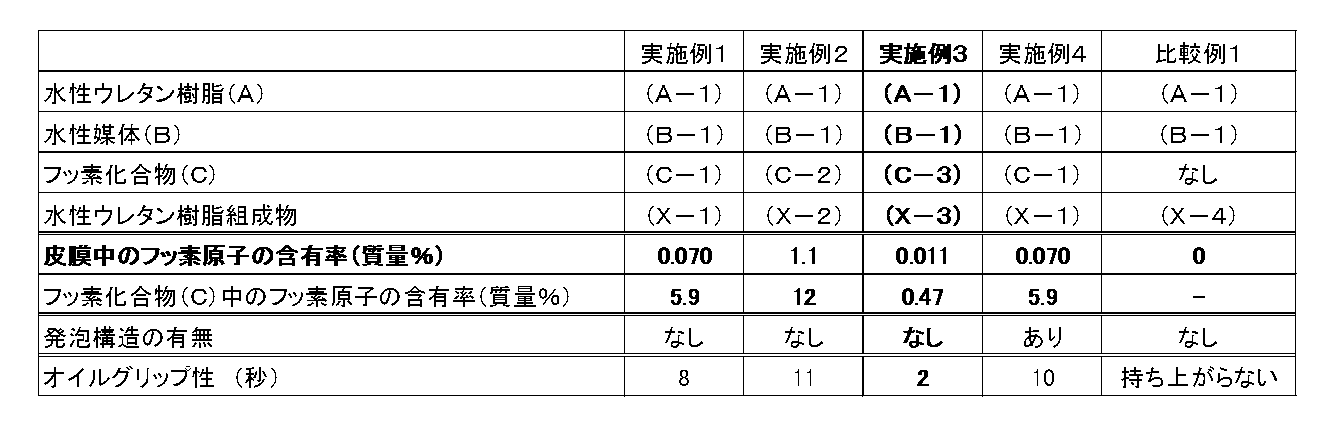
本発明の手袋である実施例1~4は、オイルグリップ性に優れることが分かった。特に、フッ素化合物(C)として、フッ素原子の含有率が特定の範囲であるものを用いた実施例1、2及び4は、オイルグリップ性が特に良好であった。また、使用したフッ素化合物(C-1)~(C-3)は水への溶解性が良好であった。
一方、比較例1は、フッ素化合物(C)を含有しない態様であるが、オイルグリップ性が不良であることが分かった。
Claims (10)
- 水性ウレタン樹脂(A)、水性媒体(B)及びフッ素化合物(C)を含有する水性ウレタン樹脂組成物を用いて得られた皮膜を有することを特徴とする手袋。
- 前記フッ素化合物(C)が、炭素原子数4~6のフッ素化アルキル基を有する重合性単量体(c1)及び下記一般式(2)で表されるポリオキシアルキレン鎖を有する重合性単量体(c2)を必須成分とする重合性単量体(c)を重合して得られたものである請求項1記載の手袋。

- 前記皮膜中のフッ素原子の含有率が、0.02~9質量%の範囲である請求項1記載の手袋。
- 前記フッ素化合物(C)中のフッ素原子の含有率が、1~40質量%の範囲である請求項1記載の手袋。
- 前記フッ素化合物(C)の数平均分子量が、2000~100,000の範囲である請求項1記載の手袋。
- 前記フッ素化合物(C)の使用量が、前記水性ウレタン樹脂(A)100質量部に対して、1~25質量部の範囲である請求項1記載の手袋。
- 前記水性ウレタン樹脂(A)が、ポリエステルポリオール、ポリエーテルポリオール及びポリカーボネートポリオールからなる群より選ばれる1種以上を含むポリオール(a1)、ポリイソシアネート(a2)及び鎖伸長剤(a3)を反応させて得られたものである請求項1記載の手袋。
- 前記ポリイソシアネート(a2)が、芳香族ポリイソシアネートである請求項7記載の手袋。
- 前記鎖伸長剤(a3)が、水酸基を有するものである請求項7記載の手袋。
- 前記皮膜が発泡構造を有するものである請求項1~9のいずれか1項記載の手袋。
Priority Applications (1)
| Application Number | Priority Date | Filing Date | Title |
|---|---|---|---|
| JP2015534712A JP5835535B1 (ja) | 2014-03-26 | 2015-02-12 | 手袋 |
Applications Claiming Priority (2)
| Application Number | Priority Date | Filing Date | Title |
|---|---|---|---|
| JP2014063779 | 2014-03-26 | ||
| JP2014-063779 | 2014-03-26 |
Publications (1)
| Publication Number | Publication Date |
|---|---|
| WO2015146334A1 true WO2015146334A1 (ja) | 2015-10-01 |
Family
ID=54194872
Family Applications (1)
| Application Number | Title | Priority Date | Filing Date |
|---|---|---|---|
| PCT/JP2015/053821 Ceased WO2015146334A1 (ja) | 2014-03-26 | 2015-02-12 | 手袋 |
Country Status (2)
| Country | Link |
|---|---|
| JP (1) | JP5835535B1 (ja) |
| WO (1) | WO2015146334A1 (ja) |
Cited By (6)
| Publication number | Priority date | Publication date | Assignee | Title |
|---|---|---|---|---|
| WO2017073171A1 (ja) * | 2015-10-30 | 2017-05-04 | Dic株式会社 | 手袋 |
| JP2018514654A (ja) * | 2016-04-01 | 2018-06-07 | Dic株式会社 | 手袋 |
| CN108778014A (zh) * | 2016-04-19 | 2018-11-09 | Dic株式会社 | 手套 |
| CN111094651A (zh) * | 2017-09-14 | 2020-05-01 | Dic株式会社 | 合成皮革的制造方法 |
| CN111132570A (zh) * | 2017-09-14 | 2020-05-08 | Dic株式会社 | 手套的制造方法 |
| US11046805B2 (en) | 2016-06-01 | 2021-06-29 | Dic Corporation | Method for producing coagulate |
Citations (3)
| Publication number | Priority date | Publication date | Assignee | Title |
|---|---|---|---|---|
| JP2003533573A (ja) * | 2000-05-16 | 2003-11-11 | ダウ グローバル テクノロジーズ インコーポレイティド | 帯電防止特性を有するポリマーフィルム |
| JP2011080016A (ja) * | 2009-10-09 | 2011-04-21 | Mitsubishi Chemicals Corp | ポリウレタン及びその製造方法 |
| WO2013018478A1 (ja) * | 2011-07-29 | 2013-02-07 | Dic株式会社 | ポリウレタンフィルム及びそれを用いたフィルム加工品 |
Family Cites Families (1)
| Publication number | Priority date | Publication date | Assignee | Title |
|---|---|---|---|---|
| WO2012002361A1 (ja) * | 2010-07-02 | 2012-01-05 | Dic株式会社 | フッ素系界面活性剤、それを用いたコーティング組成物及びレジスト組成物 |
-
2015
- 2015-02-12 JP JP2015534712A patent/JP5835535B1/ja not_active Expired - Fee Related
- 2015-02-12 WO PCT/JP2015/053821 patent/WO2015146334A1/ja not_active Ceased
Patent Citations (3)
| Publication number | Priority date | Publication date | Assignee | Title |
|---|---|---|---|---|
| JP2003533573A (ja) * | 2000-05-16 | 2003-11-11 | ダウ グローバル テクノロジーズ インコーポレイティド | 帯電防止特性を有するポリマーフィルム |
| JP2011080016A (ja) * | 2009-10-09 | 2011-04-21 | Mitsubishi Chemicals Corp | ポリウレタン及びその製造方法 |
| WO2013018478A1 (ja) * | 2011-07-29 | 2013-02-07 | Dic株式会社 | ポリウレタンフィルム及びそれを用いたフィルム加工品 |
Cited By (13)
| Publication number | Priority date | Publication date | Assignee | Title |
|---|---|---|---|---|
| KR102053696B1 (ko) | 2015-10-30 | 2019-12-10 | 디아이씨 가부시끼가이샤 | 장갑 |
| JP6137660B1 (ja) * | 2015-10-30 | 2017-05-31 | Dic株式会社 | 手袋 |
| KR20180056693A (ko) * | 2015-10-30 | 2018-05-29 | 디아이씨 가부시끼가이샤 | 장갑 |
| WO2017073171A1 (ja) * | 2015-10-30 | 2017-05-04 | Dic株式会社 | 手袋 |
| JP2018514654A (ja) * | 2016-04-01 | 2018-06-07 | Dic株式会社 | 手袋 |
| CN108778014B (zh) * | 2016-04-19 | 2021-01-15 | Dic株式会社 | 手套 |
| CN108778014A (zh) * | 2016-04-19 | 2018-11-09 | Dic株式会社 | 手套 |
| US11046805B2 (en) | 2016-06-01 | 2021-06-29 | Dic Corporation | Method for producing coagulate |
| CN111094651A (zh) * | 2017-09-14 | 2020-05-01 | Dic株式会社 | 合成皮革的制造方法 |
| CN111132570A (zh) * | 2017-09-14 | 2020-05-08 | Dic株式会社 | 手套的制造方法 |
| EP3666101A4 (en) * | 2017-09-14 | 2020-11-11 | DIC Corporation | GLOVE MANUFACTURING PROCESS |
| US11001963B2 (en) | 2017-09-14 | 2021-05-11 | Dic Corporation | Method for manufacturing synthetic leather |
| CN111094651B (zh) * | 2017-09-14 | 2022-09-02 | Dic株式会社 | 合成皮革的制造方法 |
Also Published As
| Publication number | Publication date |
|---|---|
| JP5835535B1 (ja) | 2015-12-24 |
| JPWO2015146334A1 (ja) | 2017-04-13 |
Similar Documents
| Publication | Publication Date | Title |
|---|---|---|
| JP5835535B1 (ja) | 手袋 | |
| KR102081646B1 (ko) | 수성 수지 조성물, 및 장갑 | |
| JP5943453B2 (ja) | 手袋 | |
| JP6767504B2 (ja) | 水性コーティング組成物及びその調製方法 | |
| WO2017013926A1 (ja) | 凝固物の製造方法 | |
| TW201815925A (zh) | 多孔體之製造方法 | |
| JP6218005B1 (ja) | 手袋 | |
| JP6540914B1 (ja) | 手袋の製造方法 | |
| WO2019202938A1 (ja) | 樹脂組成物、及び、合成皮革 | |
| JP6984757B2 (ja) | 手袋 | |
| WO2019064634A1 (ja) | 水系樹脂組成物 | |
| JP6137660B1 (ja) | 手袋 | |
| JP7289314B2 (ja) | 水性樹脂組成物、皮膜、及び、透湿性防水布帛 | |
| JP6323620B1 (ja) | 凝固物の製造方法 |
Legal Events
| Date | Code | Title | Description |
|---|---|---|---|
| ENP | Entry into the national phase |
Ref document number: 2015534712 Country of ref document: JP Kind code of ref document: A |
|
| 121 | Ep: the epo has been informed by wipo that ep was designated in this application |
Ref document number: 15767981 Country of ref document: EP Kind code of ref document: A1 |
|
| NENP | Non-entry into the national phase | ||
| 122 | Ep: pct application non-entry in european phase |
Ref document number: 15767981 Country of ref document: EP Kind code of ref document: A1 |