WO2015146183A1 - ポリエステル樹脂組成物およびその製造方法 - Google Patents
ポリエステル樹脂組成物およびその製造方法 Download PDFInfo
- Publication number
- WO2015146183A1 WO2015146183A1 PCT/JP2015/001746 JP2015001746W WO2015146183A1 WO 2015146183 A1 WO2015146183 A1 WO 2015146183A1 JP 2015001746 W JP2015001746 W JP 2015001746W WO 2015146183 A1 WO2015146183 A1 WO 2015146183A1
- Authority
- WO
- WIPO (PCT)
- Prior art keywords
- polyester resin
- resin composition
- composition according
- formula
- compound represented
- Prior art date
- Legal status (The legal status is an assumption and is not a legal conclusion. Google has not performed a legal analysis and makes no representation as to the accuracy of the status listed.)
- Ceased
Links
Classifications
-
- C—CHEMISTRY; METALLURGY
- C08—ORGANIC MACROMOLECULAR COMPOUNDS; THEIR PREPARATION OR CHEMICAL WORKING-UP; COMPOSITIONS BASED THEREON
- C08L—COMPOSITIONS OF MACROMOLECULAR COMPOUNDS
- C08L67/00—Compositions of polyesters obtained by reactions forming a carboxylic ester link in the main chain; Compositions of derivatives of such polymers
- C08L67/02—Polyesters derived from dicarboxylic acids and dihydroxy compounds
-
- C—CHEMISTRY; METALLURGY
- C08—ORGANIC MACROMOLECULAR COMPOUNDS; THEIR PREPARATION OR CHEMICAL WORKING-UP; COMPOSITIONS BASED THEREON
- C08G—MACROMOLECULAR COMPOUNDS OBTAINED OTHERWISE THAN BY REACTIONS ONLY INVOLVING UNSATURATED CARBON-TO-CARBON BONDS
- C08G63/00—Macromolecular compounds obtained by reactions forming a carboxylic ester link in the main chain of the macromolecule
- C08G63/78—Preparation processes
-
- C—CHEMISTRY; METALLURGY
- C08—ORGANIC MACROMOLECULAR COMPOUNDS; THEIR PREPARATION OR CHEMICAL WORKING-UP; COMPOSITIONS BASED THEREON
- C08K—Use of inorganic or non-macromolecular organic substances as compounding ingredients
- C08K3/00—Use of inorganic substances as compounding ingredients
- C08K3/16—Halogen-containing compounds
-
- C—CHEMISTRY; METALLURGY
- C08—ORGANIC MACROMOLECULAR COMPOUNDS; THEIR PREPARATION OR CHEMICAL WORKING-UP; COMPOSITIONS BASED THEREON
- C08K—Use of inorganic or non-macromolecular organic substances as compounding ingredients
- C08K5/00—Use of organic ingredients
- C08K5/04—Oxygen-containing compounds
- C08K5/09—Carboxylic acids; Metal salts thereof; Anhydrides thereof
- C08K5/098—Metal salts of carboxylic acids
-
- C—CHEMISTRY; METALLURGY
- C08—ORGANIC MACROMOLECULAR COMPOUNDS; THEIR PREPARATION OR CHEMICAL WORKING-UP; COMPOSITIONS BASED THEREON
- C08K—Use of inorganic or non-macromolecular organic substances as compounding ingredients
- C08K2201/00—Specific properties of additives
- C08K2201/014—Additives containing two or more different additives of the same subgroup in C08K
Definitions
- the present invention relates to a polyester resin composition and a method for producing the same.
- Polyester is one of the most commonly used synthetic resins around the world as fibers, bottles, films, sheets, containers, etc., because it is excellent in mechanical strength, chemical stability, transparency, and inexpensive.
- Polyester has a problem that the acidic carboxyl group at the end serves as a catalyst and promotes hydrolysis of ester bonds.
- As a means for improving the hydrolysis resistance of polyester for example, addition of a copper compound having an acid value reducing effect can be mentioned.
- Patent Document 1 discloses a polyester film containing copper (I) iodide, and describes that thermal stability is improved by containing copper (I) iodide.
- Patent Document 2 discloses a polyester film containing a copper compound, which describes that an acid value can be reduced and hydrolysis resistance is improved.
- Patent Document 3 discloses a biaxially stretched polyester film having at least one of an organic copper salt such as copper (II) acetate and a halide, and an organic copper salt such as copper (II) acetate and an iodide. Is described as being effective for decarboxylation.
- Patent Document 1 when a polyester resin as a raw material for a polyester film is produced, the dispersibility is poor only by adding copper (I) iodide, and the thermal stability cannot be sufficiently improved.
- Patent Document 3 when an organic copper salt such as copper (II) acetate is contained, there is a problem that the polyester film is colored.
- An object of the present invention is to provide a polyester resin composition excellent in hydrolysis resistance and color tone and a method for producing the same.
- a polyester resin composition excellent in hydrolysis resistance and color tone can be obtained.
- the present invention relates to a polyester resin composition containing at least one selected additive.
- copper halide has an acid value reducing effect and a hydrolysis resistance improving effect on a polyester resin.
- copper halide alone has a small acid value reduction effect and an insufficient hydrolysis resistance improvement effect.
- the cause is considered to be due to the low dispersibility of the copper halide. Therefore, in addition to the copper halide, in order to improve the dispersibility of the copper halide, at least one additive selected from the compound represented by the formula (i) and the compound represented by the formula (ii) is blended It is considered effective to do.
- polyester resin used in the embodiment of the present invention is obtained by polycondensation using dicarboxylic acid or dicarboxylic acid dialkyl ester and diol as main raw materials.
- the main raw material indicates that the constituent unit of dicarboxylic acid or dicarboxylic acid dialkyl ester and diol in the polymer is 25% by weight or more.
- the constituent unit of dicarboxylic acid or dicarboxylic acid dialkyl ester and diol in the polymer is preferably 40% by weight or more, more preferably 50% by weight or more, further preferably 95% by weight or more, and most preferably 100% by weight. .
- dicarboxylic acid or dicarboxylic acid dialkyl ester examples include terephthalic acid, isophthalic acid, 2,6-naphthalenedicarboxylic acid, diphenyl-4,4′-dicarboxylic acid, diphenyl ether-4,4′-dicarboxylic acid, and diphenylthioether-4.
- the dicarboxylic acid dialkyl ester referred to herein includes the above-mentioned lower alkyl esters, acid anhydrides, acyl chlorides, and the like of dicarboxylic acids, and methyl esters, ethyl esters, hydroxyethyl esters, and the like are preferably used.
- dicarboxylic acid or dicarboxylic acid dialkyl ester used in the embodiment of the present invention it is preferable to use an aromatic dicarboxylic acid or an aromatic dicarboxylic acid dialkyl ester in that the obtained polyester resin is excellent in heat resistance. It is more preferable to use the dimethyl ester.
- diol used in the embodiment of the present invention examples include ethylene glycol, 1,3-propanediol, neopentyl glycol, 1,5-pentanediol, 1,6-hexanediol, decamethylene glycol, 2,2 , 4,4-tetramethyl-1,3-cyclobutanediol, cyclohexanedimethanol, xylylene glycol, polyethylene glycol, polypropylene glycol, polytetramethylene glycol, bisphenol A-ethylene oxide adduct, 4,4'-dihydroxybiphenyl, hydroquinone Resorcinol, 4,4′-dihydroxydiphenyl ketone, 4,4′-dihydroxydiphenyl ether, bis (4-hydroxyphenyl) methane, 1,2-bis (4-hydroxyphenyl) ethane, 4, '- dihydroxydiphenyl sulfone, 4,4'-dihydroxydiphenyl thioether
- polyester resin used in the embodiment of the present invention include, for example, parahydroxybenzoic acid, metahydroxybenzoic acid, 2-hydroxy-6 -Naphthoic acid, 2-hydroxy-3-naphthoic acid, 1-hydroxy-5-naphthoic acid, 4-hydroxy-4'-carboxydiphenyl ether, 4-aminophenol and the like.
- the polyester resin used in the embodiment of the present invention may be any polyester resin that can be obtained by polycondensation using dicarboxylic acid or dicarboxylic acid dialkyl ester and diol as main raw materials.
- dicarboxylic acid, dicarboxylic acid dialkyl ester, and diol may be used alone, or two or more kinds may be used in combination.
- Examples of the polyester resin used in the embodiment of the present invention include polyethylene terephthalate, polypropylene terephthalate, polycyclohexanedimethylene terephthalate, polyethylene isophthalate, polypropylene isophthalate, polybutylene isophthalate, polycyclohexane dimethylene isophthalate, and polyethylene naphthalate.
- / represents a copolymer.
- a polyester resin having a thermotropic liquid crystallinity composed of a structural unit selected from an aromatic oxycarbonyl unit, an aromatic dioxy unit, an aromatic dicarbonyl unit, an aromatic aminooxy unit, an ethylene oxide unit and the like can also be used. .
- a polyester resin obtained from terephthalic acid or a dimethyl ester thereof is preferable in terms of excellent heat resistance.
- the intrinsic viscosity measured at 25 ° C. using an o-chlorophenol solvent is preferably 0.50 or more, more preferably 0.55 or more. More preferably, it is 0.6 or more.
- the intrinsic viscosity is preferably 1.8 or less, more preferably 1.5 or less, and still more preferably 1.4 or less.
- the mechanical strength tends to be improved.
- the intrinsic viscosity is 1.8 or less, melt processing tends to be easy.
- the polyester resin composition when the total blending amount of polycondensation catalyst other than polyester resin, copper halide, additive, etc. is less than 1% by weight, the polyester resin composition was measured by dissolving in o-chlorophenol solvent.
- the viscosity is defined as the intrinsic viscosity of the polyester resin.
- the polyester resin composition contains a polycondensation catalyst, copper halides, additives, etc. in a total of 1% by weight or more, the additives, etc. are removed so that the total amount of these compounds is less than 1% by weight. Intrinsic viscosity is measured.
- the acid value of the polyester resin according to the embodiment of the present invention is preferably 13 eq / t or less.
- the acid value of the polyester resin is more preferably 10 eq / t or less, further preferably 5 eq / t or less, and most preferably 2 eq / t or less.
- the acid value of the polyester resin can be measured by titration.
- the polyester resin composition is dissolved in the ortho-cresol solvent.
- the acid value obtained by titration at 25 ° C. using a 0.02 N aqueous NaOH solution is defined as the acid value of the polyester resin.
- the polyester resin composition contains a polycondensation catalyst, copper halides, additives, etc. in a total of 1% by weight or more, the additives, etc. are removed so that the total amount of these compounds is less than 1% by weight. Measure the acid value.
- the polyester resin according to the embodiment of the present invention exhibits an acid value reducing effect when a part of the end of the polymer chain becomes a benzoic acid end by a decarboxylation reaction.
- the amount of the benzoic acid end group is preferably 3 eq / t or more.
- the amount of benzoic acid end groups is more preferably 10 eq / t or more, further preferably 15 eq / t or more, and most preferably 19 eq / t or more.
- Hydrolysis resistance can be improved by setting the amount of benzoic acid end groups to 3 eq / t or more.
- the amount of benzoic acid end groups is preferably 30 eq / t or less.
- the amount of benzoic acid end groups is more preferably 25 eq / t or less. By setting the amount of benzoic acid end groups to 30 eq / t or less, the degree of polymerization of the polymer can be easily increased.
- the amount of benzoic acid end groups can be measured by NMR.
- the polyester resin composition is obtained by NMR measurement.
- the amount of benzoic acid end groups is defined as the amount of benzoic acid end groups of the polyester resin.
- the copper halide of the embodiment of the present invention includes, for example, copper (I) iodide, copper (II) iodide, copper (I) bromide, copper (II) bromide, copper chloride ( I), copper chloride (II) and the like.
- Copper halides are composed of copper (I) iodide, copper (II) iodide, copper bromide (I), odor, and the like. Copper (II) iodide is preferable, and copper (I) iodide and copper (I) bromide are particularly preferable.
- the copper valence of the copper halide is preferably monovalent or divalent.
- the halogen atom of the copper halide preferably contains at least one selected from iodine, bromine and chlorine.
- the copper halide in order to improve the dispersibility of the copper halide and efficiently reduce the acid value, it is preferable to blend the copper halide in an amount of 0.01 mmol or more per 100 g of the polyester resin, more preferably It is 0.02 mmol or more. Moreover, it is preferable to mix
- the blending amount of the copper halide can be calculated based on the theoretical polymer amount assuming that all the raw materials are polycondensed.
- MXn is preferably iodide or bromide, and particularly preferably potassium iodide or potassium bromide.
- X of MXn of the embodiment of the present invention is preferably iodine or bromine, and M of MXn of the embodiment of the present invention is preferably potassium.
- R is hydrogen or an alkyl group having 1 to 30 carbon atoms
- R is hydrogen or an alkyl group having 1 to 30 carbon atoms
- (RCOO) nM is preferably a saturated fatty acid salt, and stearates such as potassium stearate, lithium stearate, calcium stearate, etc. And acetates such as potassium acetate, lithium acetate and calcium acetate are more preferred.
- R in (RCOO) nM is preferably hydrogen or a linear saturated alkyl group having 1 to 30 carbon atoms, and more preferably a linear saturated alkyl group having 1 to 17 carbon atoms. .
- At least one selected from a compound represented by MXn and a compound represented by (RCOO) nM It is preferable to blend 0.01 mmol or more per 100 g of the polyester resin, and more preferably 0.02 mmol or more. Moreover, it is preferable to mix
- the amount is 0.01 mmol or more, the dispersibility of the copper halide is improved, and the acid value reducing effect tends to be improved.
- 3 mmol or less the dispersibility of MXn or (RCOO) nM itself tends to be good.
- the mixing ratio of the copper halide and the additive Is preferably adjusted to a specific range.
- the blending ratio (P / Q) of at least one additive (Pmol) selected from the compounds represented by formula (I) and the copper halide (Qmol) is 0.1 or more, and 0.5 or more. Is more preferable, and more preferably 1.00 or more. Further, the blending ratio (P / Q) is preferably 50 or less, more preferably 25 or less, and even more preferably 2.00 or less. When P / Q is 0.1 or more, the copper halide can be sufficiently dispersed. Moreover, when P / Q is 50 or less, the dispersibility of the additive itself tends to be good.
- the manufacturing method of the polyester resin obtained by using dicarboxylic acid or dicarboxylic acid dialkyl ester and diol as the main raw materials used in the embodiment of the present invention comprises the following two-stage steps. That is, a first stage process comprising (A) esterification reaction or (B) transesterification reaction, followed by a second stage process comprising (C) polycondensation reaction.
- the esterification reaction step is an esterification reaction of dicarboxylic acid and diol at a predetermined temperature, and the reaction is carried out until a predetermined amount of water is distilled off.
- This is a step of obtaining a condensate.
- the step (B) is a step of obtaining a low polycondensate by transesterifying the dicarboxylic acid dialkyl ester and the diol at a predetermined temperature and carrying out the reaction until a predetermined amount of alcohol is distilled off. It is.
- the (C) polycondensation reaction which is the second step, proceeds the dediol reaction by heating and reducing the pressure of the low polycondensate obtained by the (A) esterification reaction or (B) transesterification reaction. In this step, a high molecular weight polyester resin is obtained.
- a catalyst used for the esterification reaction for example, a compound such as manganese, cobalt, zinc, titanium, calcium, etc. may be used or it is non-catalytic. May be.
- a catalyst used for transesterification compounds, such as magnesium, manganese, calcium, cobalt, zinc, lithium, titanium, are used, for example.
- a catalyst used for a polycondensation reaction compounds, such as antimony, titanium, aluminum, tin, germanium, etc. are used, for example.
- antimony compounds include antimony oxides, antimony carboxylic acids, antimony alkoxides, and the like.
- examples of the antimony oxide include antimony trioxide and antimony pentoxide.
- examples of the antimony carboxylic acid include antimony acetate, antimony oxalate, and antimony potassium tartrate. Examples thereof include antimony tri-n-butoxide and antimony triethoxide.
- titanium compounds include titanium alkoxides such as titanium complexes, tetra-i-propyl titanate, tetra-n-butyl titanate, tetra-n-butyl titanate tetramer, titanium oxides obtained by hydrolysis of titanium alkoxide, titanium acetyl Examples include acetonate.
- titanium complexes such as titanium complexes, tetra-i-propyl titanate, tetra-n-butyl titanate, tetra-n-butyl titanate tetramer, titanium oxides obtained by hydrolysis of titanium alkoxide, titanium acetyl Examples include acetonate.
- a titanium complex having a polycarboxylic acid and / or hydroxycarboxylic acid and / or a polyhydric alcohol as a chelating agent is preferable because the thermal stability and color tone deterioration of the polymer can be prevented.
- Examples of the chelating agent for the titanium compound include lactic acid, citric acid, mannitol, tripentaerythritol and the like.
- a titanium mannitol chelate complex obtained by the method described in JP-A 2010-1000080 is preferable as a catalyst because it can suppress the generation of foreign particles of the polymer.
- Examples of the aluminum compound include aluminum carboxylate, aluminum alkoxide, aluminum chelate compound, basic aluminum compound and the like. Specific examples of the aluminum compound include aluminum acetate, aluminum hydroxide, aluminum carbonate, aluminum ethoxide, aluminum isopropoxide, aluminum acetylacetonate, and basic aluminum acetate.
- tin compounds include monobutyltin oxide, dibutyltin oxide, methylphenyltin oxide, tetraethyltin oxide, hexaethylditin oxide, triethyltin hydroxide, monobutylhydroxytin oxide, monobutyltin trichloride, and dibutyltin sulfide. It is done.
- germanium compound examples include germanium oxide and germanium alkoxide.
- germanium oxide examples include germanium dioxide and germanium tetroxide.
- germanium alkoxide examples include germanium tetraethoxide and germanium tetrabutoxide.
- magnesium compound examples include magnesium oxide, magnesium hydroxide, magnesium alkoxide, magnesium acetate, and magnesium carbonate.
- manganese compound examples include manganese chloride, manganese bromide, manganese nitrate, manganese carbonate, manganese acetylacetonate, and manganese acetate.
- the calcium compound examples include calcium oxide, calcium hydroxide, calcium alkoxide, calcium acetate, and calcium carbonate.
- cobalt compound examples include cobalt chloride, cobalt nitrate, cobalt carbonate, cobalt acetylacetonate, cobalt naphthenate, and cobalt acetate tetrahydrate.
- the zinc compound examples include zinc oxide, zinc alkoxide, and zinc acetate.
- These metal compounds may be hydrates.
- a phosphorus compound may be added as a stabilizer.
- the phosphorus compound include phosphoric acid, trimethyl phosphate, triethyl phosphate, ethyl diethylphosphonoacetate, 3,9-bis (2,6-di-t-butyl-4-methylphenoxy)- 2,4,8,10-tetraoxa-3,9-diphosphaspiro [5,5] undecane, tetrakis (2,4-di-t-butyl-5-methylphenyl) [1,1-biphenyl] -4,4 Examples include '-diylbisphosphonite.
- solid phase polymerization when a higher molecular weight polyester resin is used, solid phase polymerization may be performed.
- the solid phase polymerization is not particularly limited in apparatus and method, but is performed by heating in an inert gas atmosphere or under reduced pressure.
- the inert gas is not particularly limited as long as it is inert to the polyester, and examples thereof include nitrogen, argon, helium, carbon dioxide gas, etc. Nitrogen is preferably used from the viewpoint of economy. Further, as the depressurization condition, lower pressure is advantageous because the time required for the solid phase polymerization reaction can be shortened, but it is preferable to maintain 110 Pa or more.
- the polyester resin used in the embodiment of the present invention can be produced by batch polymerization, semi-continuous polymerization, or continuous polymerization.
- a dye used for a resin or the like as a color tone adjusting agent may be added.
- COLOR INDEX GENERIC NAME blue color tone adjusters such as SOLVENT BLUE 104 and SOLVENT BLUE 45
- purple color tone adjusters such as SOLVENT VIOLET 36 have good heat resistance at high temperatures. It is preferable because of excellent color developability. These may be used alone or in combination of two or more.
- an antioxidant an ultraviolet absorber, a flame retardant, a fluorescent brightening agent, a matting agent, a plasticizer or an antifoaming agent, or other additives may be added as necessary.
- a copper halide and an additive are added at the time of (i) polyester resin manufacture, (ii) polyester resin And (iii) a method of mixing with a polyester resin in a solvent. Since the effect of reducing the acid value of the polyester resin by the copper compound is promoted when the copper halide and the additive are melt-mixed with the molten polyester resin, the methods (i) and (ii) are preferred. Further, the polyester resin, the copper halide and the additive are mixed at a higher temperature, so that the effect of reducing the acid value of the polyester resin is increased.
- the temperature at which the polyester resin, the copper halide and the additive are mixed is more preferably 240 ° C. or higher, and further preferably 270 ° C. or higher.
- the form of adding the polycondensation catalyst, copper halide, and other additives one kind of addition form selected from a single, a solution, and a suspension is used.
- the weight of each polycondensation catalyst, copper halide, and other additive / diol The expressed ratio is preferably 1/100 to 20/100.
- at least one additive selected from a compound represented by the following formula (i) and a compound represented by the following (ii) formula is used: And may be added in advance.
- M is an alkali metal or alkaline earth metal
- polyester resin composition of the embodiment of the present invention is excellent in hydrolysis resistance.
- the number average molecular weight of the polyester resin after treating the polyester resin composition under the conditions of 121 ° C. and 100% RH for 24 hours is divided by the number average molecular weight before the treatment. It can evaluate by calculating
- the number average molecular weight can be measured by gel permeation chromatography.
- the number average molecular weight maintenance rate is preferably 75% or more.
- the number average molecular weight maintenance rate is more preferably 80% or more, further preferably 85% or more, and particularly preferably 90% or more.
- the color tone of the polyester resin composition pellet of the embodiment of the present invention can be evaluated by a Hunter value (L value, b value) using a color difference meter.
- the polyester resin composition is discharged in a strand form from a molten state, quenched in water and solidified, and then the L value of the cut pellet is preferably 50 or more.
- the L value of the pellet is more preferably 55 or more, and further preferably 60 or more.
- the b value of the pellet is preferably closer to zero.
- the b value of the pellet is more preferably 0 or more and 13 or less, further preferably 0 or more and 11.5 or less, and most preferably 0 or more and 10 or less.
- the dispersibility of the copper halide in the polyester resin composition of the embodiment of the present invention can be evaluated by solution haze using a haze meter.
- the haze of a solution obtained by dissolving a polyester resin composition in orthocresol is preferably 3.0 or less.
- the haze is more preferably 2.0 or less, and further preferably 1.0 or less.
- the polyester resin composition obtained in the embodiment of the present invention can be molded by a known processing method, and can be processed into various products such as fibers, films, bottles, and injection molded products.
- a normal melt spinning-drawing process can be applied to a method of processing a polyester resin composition into a fiber. Specifically, after the polyester resin composition is heated to the melting point of the polyester resin or higher and melted, it is discharged from the pores, cooled and solidified with cooling air, applied with an oil agent, taken up by a take-up roller, and taken up. Undrawn yarn can be collected by winding with a winding device disposed after the roller.
- the undrawn yarn wound in this way is drawn with a pair of heated rollers or more, and finally subjected to tension or relaxation heat treatment to become a fiber having physical properties such as mechanical properties according to the application. .
- stretching process after taking up in the above-mentioned melt spinning process, it can carry out continuously, without winding once, and it can be set as continuous extending
- the draw ratio, the stretching temperature, and the heat treatment conditions can be appropriately selected depending on the fineness, strength, elongation, shrinkage, etc. of the target fiber.
- the polyester resin composition After the polyester resin composition is vacuum-heated and dried at 180 ° C. for 3 hours or more, it is supplied to a single-screw or twin-screw extruder heated to 270 to 320 ° C. under a nitrogen stream or under vacuum so that the intrinsic viscosity does not decrease.
- the polymer is plasticized, melt extruded from a slit die, and cooled and solidified on a casting roll to obtain an unstretched film.
- filters for example, filters made of materials such as sintered metal, porous ceramics, sand, and wire mesh, in order to remove foreign substances and altered polymers.
- the sheet-like material molded as described above is biaxially stretched.
- the film is stretched biaxially in the longitudinal direction and the width direction and heat-treated.
- a sequential biaxial stretching method such as stretching in the width direction after stretching in the longitudinal direction, or (ii) simultaneous stretching in the longitudinal direction and the width direction simultaneously using a simultaneous biaxial tenter or the like. Examples thereof include a biaxial stretching method, and (iii) a method in which a sequential biaxial stretching method and a simultaneous biaxial stretching method are combined.
- it is desirable that the heat treatment after the stretching process is effectively performed without causing relaxation of molecular chain orientation due to excessive heat treatment.
- various additives may be added within a range that does not impair the effect.
- one or more additives such as colorants including pigments and dyes, lubricants, antistatic agents, flame retardants, ultraviolet absorbers, antibacterial agents, nucleating agents, plasticizers, release agents, and the like are added. You can also.
- the polyester resin composition of the embodiment of the present invention can be used as various products such as fibers, films, bottles, injection-molded products, taking advantage of excellent hydrolysis resistance and good color tone. These products are useful for agricultural materials, horticultural materials, fishery materials, civil engineering / architectural materials, stationery, medical supplies, automotive parts, electrical / electronic components or other uses.
- polyester resin (unit: eq / t)
- the polyester resin composition was dissolved in an ortho cresol solvent. This solution was titrated with a 0.02 normal NaOH aqueous solution at 25 ° C. using an automatic titrator (COM-550, manufactured by Hiranuma Sangyo Co., Ltd.) to determine the acid value.
- COM-550 automatic titrator
- polyester resin composition was dissolved in heavy hexafluoroisopropanol solvent. 1 H-NMR of this solution was measured with a 400 MHz nuclear magnetic resonance apparatus (NMR) manufactured by JEOL.
- NMR nuclear magnetic resonance apparatus
- the amount of benzoic acid end group was calculated using the following formula.
- polyester resin composition was pressed at 280 ° C to form a plate having a thickness of 1 mm, and then kept under high humidity conditions of 121 ° C and 100% RH for 24 hours.
- the number average molecular weight of the polyester resin in the plate before and after the high humidity condition treatment was determined, and the maintenance ratio (%) of the number average molecular weight after the high humidity condition treatment with respect to the number average molecular weight before the high humidity condition treatment was calculated.
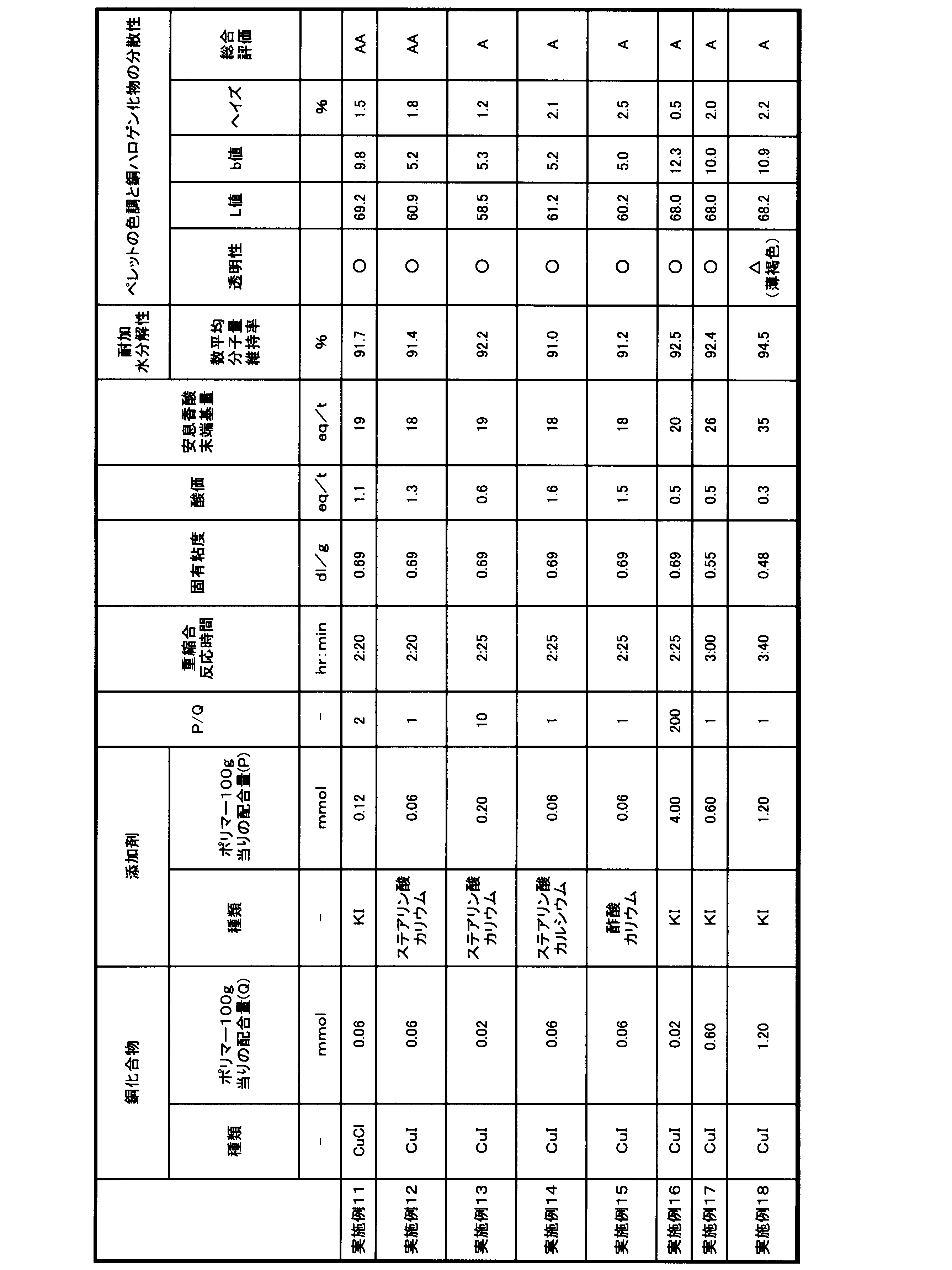
- Example 1 0.05 mmol of magnesium acetate in terms of magnesium atoms was added to 100 parts by weight of dimethyl terephthalate and 60 parts by weight of ethylene glycol with respect to 100 g of the resulting polymer. After melting in a nitrogen atmosphere at 150 ° C., the temperature was raised to 240 ° C. over 4 hours with stirring, and methanol was distilled to conduct a transesterification reaction to obtain bis (hydroxyethyl) terephthalate.
- Bis (hydroxyethyl) terephthalate was put into a test tube and kept in a molten state at 250 ° C.
- 0.2 mmol of antimony trioxide per 100 g of polymer obtained, 0.1 mmol of trimethyl phosphate per 100 g of polymer obtained, 0.06 mmol of copper (I) iodide per 100 g of polymer obtained, 0.06 mmol per 100 g of polymer obtained Of potassium iodide was weighed.
- Antimony trioxide and trimethyl phosphate were mixed to form a 6.5% by weight ethylene glycol solution and added to the test tube.
- copper (I) iodide, potassium iodide and ethylene glycol were mixed at a weight ratio of 3.50 / 3.05 / 100 and added to the test tube.
- the temperature in the reactor was gradually raised from 250 ° C. to 290 ° C. over 60 minutes, and the pressure was reduced from normal pressure to 130 Pa over 60 minutes.
- the polycondensation reaction was continued at 290 ° C. and 130 Pa, and the polycondensation was stopped when the torque applied to the test tube stirring rod reached a value corresponding to the target intrinsic viscosity.
- the melt was discharged in a strand shape into 20 ° C. water from a discharge port having a 9 mm diameter, quenched, and then cut at intervals of 4 mm to obtain pellets.
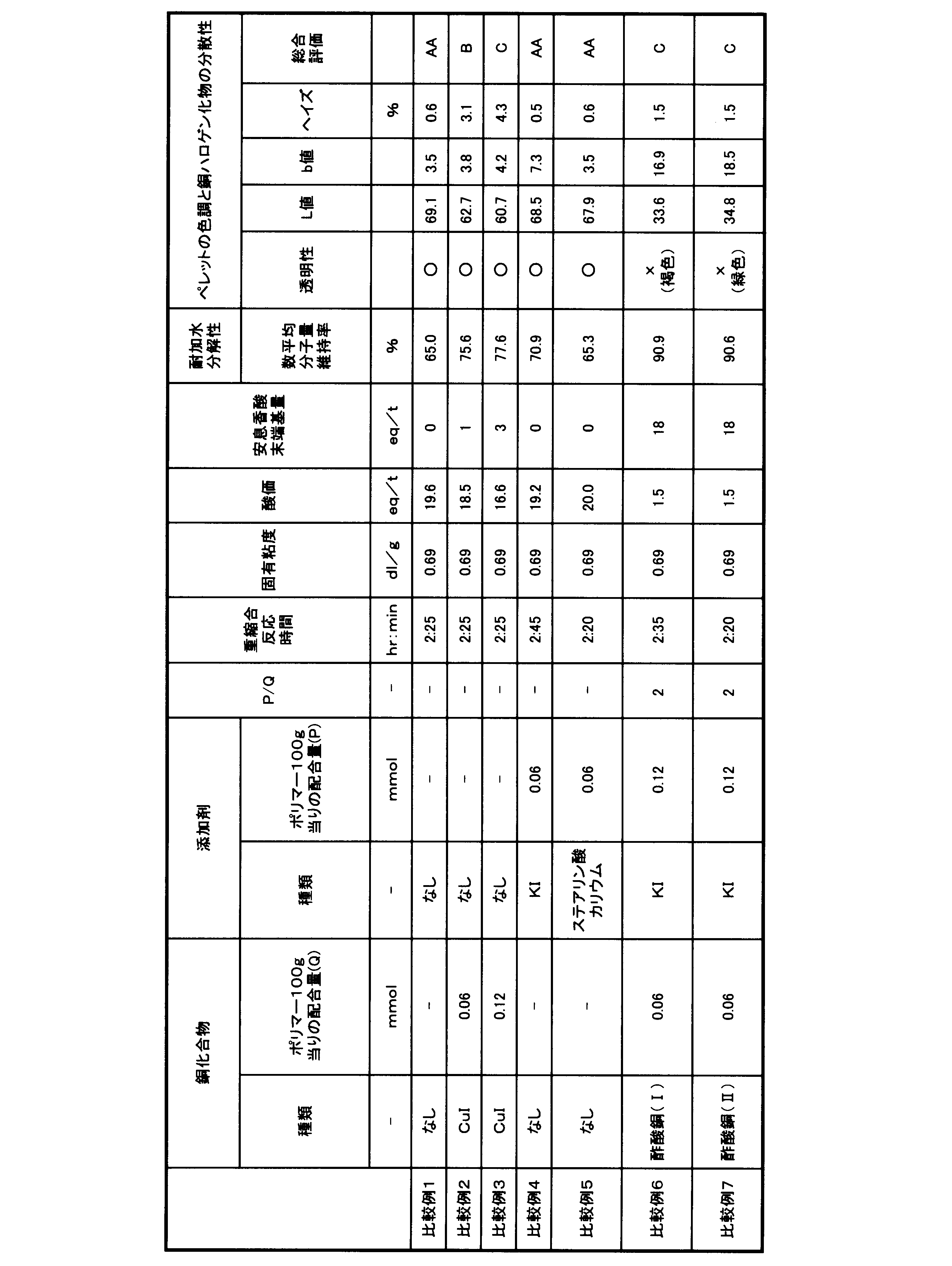
- the obtained polyester resin composition pellets were vacuum dried at 80 ° C. for 24 hours. The results are shown in Table 1.
- Examples 2 to 16 and Comparative Examples 1 to 7 A polyester resin composition was obtained in the same manner as in Example 1 except that the type and blending amount of copper halide and / or the type and blending amount of additive were changed.
- Examples 17 and 18 The polycondensation reaction was carried out in the same manner as the method shown in Example 1 except that the blending amount of copper iodide (I) and the blending amount of potassium iodide were changed. Did not reach the torque.
- Comparative Example 8 20 g of a 50% by weight aqueous solution of an equimolar salt of hexamethylenediamine and adipic acid was charged into a test tube, placed in an autoclave, sealed, and then purged with nitrogen. The jacket temperature was set to 310 ° C. and heating was started. After the internal pressure of the can reached 1.7 MPa, the internal pressure of the can was maintained at 1.7 MPa for 3 hours. Thereafter, the jacket temperature was set to 320 ° C., and the internal pressure of the can was released to normal pressure over 1 hour. Thereafter, the heating was stopped when the temperature inside the can reached 285 ° C. After cooling to room temperature, the test tube was removed from the autoclave to obtain a polyamide resin. This polyamide resin had a relative viscosity of 2.7 and an amount of carboxy end groups of 78 mol / t.
- Example 7 except that an aqueous solution prepared by dissolving 0.00518 mmol of copper iodide and 0.0518 mmol of potassium iodide in 2 g of water was added to 20 g of a 50 wt% aqueous solution of an equimolar salt of hexamethylenediamine and adipic acid. Under the conditions, a polyamide resin composition was obtained. The relative viscosity of this polyamide resin composition was 2.8, and the carboxyl end group amount was 77 mol / t.
Landscapes
- Chemical & Material Sciences (AREA)
- Health & Medical Sciences (AREA)
- Chemical Kinetics & Catalysis (AREA)
- Medicinal Chemistry (AREA)
- Polymers & Plastics (AREA)
- Organic Chemistry (AREA)
- Polyesters Or Polycarbonates (AREA)
- Compositions Of Macromolecular Compounds (AREA)
Abstract
Description
(1)ジカルボン酸またはジカルボン酸ジアルキルエステルと、ジオールとを主原料として得られるポリエステル樹脂に、
銅ハロゲン化物と、
下記(i)式で表される化合物および下記(ii)式で表される化合物から選ばれる少なくとも一種の添加剤と、を配合してなることを特徴とするポリエステル樹脂組成物。
MXn ・・・(i)
(ここで、Mは、アルカリ金属またはアルカリ土類金属であり、Xは、臭素、ヨウ素、および塩素から選ばれる少なくとも一種であり、n=1または2である)
(RCOO)nM ・・・(ii)
(ここで、Rは、水素または炭素数1~30のアルキル基であり、Mは、アルカリ金属またはアルカリ土類金属であり、n=1または2である)
銅ハロゲン化物と、
下記(i)式で表される化合物および下記(ii)式で表される化合物から選ばれる少なくとも一種の添加剤と、を、添加することを特徴とするポリエステル樹脂組成物の製造方法。
MXn ・・・(i)
(ここで、Mは、アルカリ金属またはアルカリ土類金属であり、Xは、臭素、ヨウ素、および塩素から選ばれる少なくとも一種であり、n=1または2である)
(RCOO)nM ・・・(ii)
(ここで、Rは、水素または炭素数1~30のアルキル基であり、Mは、アルカリ金属またはアルカリ土類金属であり、n=1または2である)
MXn ・・・(i)
(ここで、Mは、アルカリ金属またはアルカリ土類金属であり、Xは、臭素、ヨウ素、および塩素から選ばれる少なくとも一種であり、n=1または2である)
(RCOO)nM ・・・(ii)
(ここで、Rは、水素または炭素数1~30のアルキル基であり、Mは、アルカリ金属またはアルカリ土類金属であり、n=1または2である)
本発明の実施形態で使用されるポリエステル樹脂は、ジカルボン酸またはジカルボン酸ジアルキルエステルと、ジオールとを主原料として重縮合することにより得られる。ここで、主原料とは、ポリマー中のジカルボン酸またはジカルボン酸ジアルキルエステルと、ジオールとの構成単位が、25重量%以上であることを示す。ポリマー中のジカルボン酸またはジカルボン酸ジアルキルエステルと、ジオールとの構成単位は、好ましくは40重量%以上、より好ましくは50重量%以上、さらに好ましくは95重量%以上、最も好ましくは100重量%である。
本発明の実施形態の銅ハロゲン化物は、例えば、ヨウ化銅(I)、ヨウ化銅(II)、臭化銅(I)、臭化銅(II)、塩化銅(I)、塩化銅(II)等が挙げられる。耐加水分解性向上効果が大きく、かつ着色の少ないポリエステル樹脂を得ることができる点で、銅ハロゲン化物は、ヨウ化銅(I)、ヨウ化銅(II)、臭化銅(I)、臭化銅(II)が好ましく、ヨウ化銅(I)、臭化銅(I)が特に好ましい。銅ハロゲン化物の銅の価数は一価もしくは二価であることが好ましい。また、銅ハロゲン化物のハロゲン原子は、ヨウ素、臭素および塩素から選ばれる少なくとも一種を含むことが好ましい。
本発明の実施形態のMXn(ここで、Mは、アルカリ金属またはアルカリ土類金属であり、Xは、臭素、ヨウ素、および塩素から選ばれる少なくとも一種であり、n=1または2である)としては、例えば、ヨウ化リチウム、臭化リチウム、塩化リチウム、ヨウ化ナトリウム、臭化ナトリウム、塩化ナトリウム、ヨウ化カリウム、臭化カリウム、塩化カリウム、ヨウ化マグネシウム、臭化マグネシウム、塩化マグネシウム、ヨウ化カルシウム、臭化カルシウム、塩化カルシウム等が挙げられる。銅ハロゲン化物の分散性を向上させ、酸価低減効果および耐加水分解性を向上させるためには、MXnは、ヨウ化物、臭化物が好ましく、特にヨウ化カリウム、臭化カリウムが好ましい。本発明の実施形態のMXnのXは、ヨウ素または臭素であることが好ましく、本発明の実施形態のMXnのMは、カリウムであることが好ましい。
本発明の実施形態において、銅ハロゲン化物の分散性を向上させ、効率的に酸価を低減させるためには、銅ハロゲン化物と添加剤の配合比率を特定範囲に調整することが好ましい。具体的には、MXn(ここで、Mは、アルカリ金属またはアルカリ土類金属であり、Xは、臭素、ヨウ素、および塩素から選ばれる少なくとも一種であり、n=1または2である)で表される化合物、および(RCOO)nM (ここで、Rは、水素または炭素数1~30のアルキル基であり、Mは、アルカリ金属またはアルカリ土類金属であり、n=1または2である)で表される化合物から選ばれる少なくとも一種の添加剤(Pmol)と、銅ハロゲン化物(Qmol)の配合比(P/Q)を0.1以上とすることが好ましく、0.5以上とすることがより好ましく、1.00以上とすることがさらに好ましい。また、配合比(P/Q)を50以下とすることが好ましく、25以下とすることがより好ましく、2.00以下とすることがさらに好ましい。P/Qが0.1以上の場合には、銅ハロゲン化物を十分に分散させることができる。また、P/Qが50以下場合には、添加剤自身の分散性が良好となる傾向がある。
本発明の実施形態に用いられる、ジカルボン酸またはジカルボン酸ジアルキルエステルと、ジオールとを主原料として得られるポリエステル樹脂の製造方法は、次の2段階の工程から成る。すなわち、(A)エステル化反応、または(B)エステル交換反応からなる1段階目の工程と、それに続く(C)重縮合反応からなる2段階目の工程である。
本発明の実施形態のポリエステル樹脂組成物の製造方法としては、銅ハロゲン化物と添加剤を、(i)ポリエステル樹脂製造時に添加する方法、(ii)ポリエステル樹脂と溶融混練する方法、(iii)ポリエステル樹脂と溶媒中で混合する方法等が挙げられる。銅化合物によるポリエステル樹脂の酸価低減効果は、溶融状態のポリエステル樹脂に、銅ハロゲン化物と添加剤を溶融混合するときに促進されるので、(i)、(ii)の方法が好ましい。また、ポリエスエル樹脂と、銅ハロゲン化物と添加剤とを高温で混合するほど、ポリエステル樹脂の酸価低減効果が大きくなるので、200℃以上で混合することが好ましい。ポリエスエル樹脂と、銅ハロゲン化物と添加剤とを混合する温度は、より好ましくは240℃以上であり、さらに好ましくは270℃以上である。ポリエステル樹脂製造時に添加する場合、銅ハロゲン化物と添加剤は、上述したポリエステル樹脂の製造方法における(A)または(B)工程、それに続く(C)工程のいずれの段階で添加しても良い。効率的に酸価を低減し、高い耐加水分解性を示すポリエステル樹脂組成物を得るためには、(C)工程の重縮合開始時もしくは重縮合反応中に添加することが好ましい。特に、銅ハロゲン化物の分散性を向上させるためには、(C)工程の重縮合反応開始時に添加することが好ましい。重縮合触媒、銅ハロゲン化物、およびその他の添加剤を添加する形態としては、それぞれ、単独、溶液、および懸濁液から選ばれる1種の添加形態が用いられる。重縮合触媒、銅ハロゲン化物、およびその他の添加剤を、それぞれ、ジオール溶液もしくは懸濁液として添加する場合は、重縮合触媒、銅ハロゲン化物、およびその他の添加剤の各重量/ジオールの重量で表される比を、1/100~20/100とするのが好ましい。ポリエステル樹脂への銅ハロゲン化物の分散性を向上させるために、下記(i)式で表される化合物および下記(ii)式で表される化合物から選ばれる少なくとも一種の添加剤を、銅ハロゲン化物とあらかじめ混合して添加しても良い。
(ここで、Mは、アルカリ金属またはアルカリ土類金属であり、Xは、臭素、ヨウ素、および塩素から選ばれる少なくとも一種であり、n=1または2である)
(ここで、Rは、水素または炭素数1~30のアルキル基であり、Mは、アルカリ金属またはアルカリ土類金属であり、n=1または2である)
本発明の実施形態のポリエステル樹脂組成物は耐加水分解性に優れる。耐加水分解性を評価するためには、ポリエステル樹脂組成物を、121℃、100%RH条件下で24時間処理した後のポリエステル樹脂の数平均分子量を、処理前の数平均分子量で割った数平均分子量維持率を求めることで評価することができる。数平均分子量はゲルパーミエーションクロマトグラフィーにより測定することができる。優れた耐加水分解性を発現させるためには、数平均分子量維持率は75%以上が好ましい。数平均分子量維持率は80%以上がより好ましく、85%以上がさらに好ましく、90%以上が特に好ましい。
・SKケミカル社製テレフタル酸ジメチル
・日本触媒社製エチレングリコール
ポリエステル樹脂組成物を、o-クロロフェノール溶媒に溶解し、0.5g/dL、0.2g/dL、0.1g/dLの濃度の溶液を調整した。その後、得られた濃度Cの溶液の25℃における相対粘度(ηr)を、ウベロ-デ粘度管により測定し、(ηr-1)/CをCに対してプロットした。そして、得られた結果を濃度0に外挿することにより、固有粘度を求めた。
ポリエステル樹脂組成物をオルトクレゾール溶媒に溶解した。自動滴定装置(平沼産業社製、COM-550)にて、この溶液を、25℃、0.02規定のNaOH水溶液で滴定することで酸価を求めた。
ポリエステル樹脂組成物を重ヘキサフルオロイソプロパノール溶媒に溶解した。日本電子社製400MHz核磁気共鳴装置(NMR)にて、この溶液の1H-NMRを測定した。
安息香酸末端基量(eq/t)=7.47ppmのピーク面積÷8.10ppmのピーク面積×2×1000000÷192
ポリエステル樹脂組成物を280℃でプレスし、厚さ1mmのプレートとした後に、24時間、121℃、100%RHの高湿度条件下で保持した。高湿度条件処理前後のプレートにおけるポリエステル樹脂の数平均分子量を求め、高湿度条件処理前の数平均分子量に対する高湿度条件処理後の数平均分子量の維持率(%)を算出した。
ポンプ:Waters 515(Waters製)
検出器:示差屈折率計 Waters 410(Waters製)
カラム:Shodex HFIP-806M(2本)+HFIP-LG
溶媒:ヘキサフルオロイソプロパノール(0.005N-トリフルオロ酢酸ナトリウム添加)
流速:1.0ml/min
試料注入量:0.1ml
温度:30℃
分子量校正:ポリメチルメタクリレート
吐出後のポリエステル樹脂組成物が、目視で透明性が高く、無色であるものを○、薄い着色のあるものの透明性が高いものを△、透明性の低いものもしくは濃い着色のあるものを×とした。
色差計(スガ試験機社製SMカラーコンピュータ型式SM-T45)を用いて、JIS Z8730に記載の表色系に基づきハンター値(L値、b値)を求めた。
吐出後のポリエステル樹脂組成物2gをフェノール/1,1,2,2,テトラクロロエタンの3/2(容積比)混合溶液20mlに溶解した。この溶液を光路長20mmのセルに入れ、ヘイズメーター(スガ試験機社製 HZ-1)によって積分球式光電光度法にて分析を行った(単位;%)。
色調(ハンター値)と分散性(ヘイズ値)を、以下の基準で分類した。L値は大きいほど好ましい。b値はゼロに近づくほど好ましい。ヘイズの値はゼロ%に近づくほど好ましい。
AA;L≧60、b≦10、ヘイズ≦2%を満たすもの
A ;AAではなく、L≧50、b≦13、ヘイズ≦3%を満たすもの
B ;AA、Aではなく、L≧40かつb≦15かつヘイズ≦4%を満たすもの
C ;AA、A、Bのいずれも満たさないもの
98%硫酸中、0.01g/ml濃度、25℃でオストワルド式粘度計を用いて測定を行った。
ポリアミド樹脂約0.5gを精秤し、ベンジルアルコール20mlを加えて190℃で溶解し、0.02N水酸化カリウムエタノール溶液を用いて滴定した。
テレフタル酸ジメチル100重量部とエチレングリコール60重量部に、得られるポリマー100gに対してマグネシウム原子換算で0.05mmolの酢酸マグネシウムを添加した。150℃、窒素雰囲気下で溶融後、攪拌しながら240℃まで4時間かけて昇温して、メタノールを留出させることにより、エステル交換反応を行い、ビス(ヒドロキシエチル)テレフタレートを得た。
銅ハロゲン化物の種類と配合量および/または添加剤の種類と配合量を変更する以外は、実施例1に示した方法と同様の方法でポリエステル樹脂組成物を得た。
ヨウ化銅(I)の配合量、およびヨウ化カリウムの配合量を変更する以外は、実施例1に示した方法と同様の方法で重縮合反応を行ったが、記載の時間までに目標とするトルクには到達しなかった。

ヘキサメチレンジアミンとアジピン酸の等モル塩の50重量%水溶液20gを試験管に仕込み、オートクレーブに入れて、密閉した後、窒素置換した。ジャケット温度を310℃に設定し、加熱を開始した。缶内圧力が1.7MPaに到達した後、缶内圧力を1.7MPaで3時間保持した。その後、ジャケット温度を320℃に設定し、1時間かけて缶内圧力を常圧に放圧した。その後、缶内温度が285℃に到達した時点で、加熱を停止した。室温に放冷後、試験管をオートクレーブから取り出し、ポリアミド樹脂を得た。このポリアミド樹脂の相対粘度は2.7、カルボキシ末端基量は78mol/tであった。
ヘキサメチレンジアミンとアジピン酸の等モル塩の50重量%水溶液20gに、ヨウ化銅0.00518mmolとヨウ化カリウム0.0518mmolを水2gに溶解させた水溶液を添加する以外は、実施例7と同様の条件で、ポリアミド樹脂組成物を得た。このポリアミド樹脂組成物の相対粘度は2.8、カルボキシル末端基量は77mol/tであった。
Claims (19)
- ジカルボン酸またはジカルボン酸ジアルキルエステルと、ジオールとを主原料として得られるポリエステル樹脂に、
銅ハロゲン化物と、
下記(i)式で表される化合物および下記(ii)式で表される化合物から選ばれる少なくとも一種の添加剤と、を配合してなることを特徴とするポリエステル樹脂組成物。
MXn ・・・(i)
(ここで、Mは、アルカリ金属またはアルカリ土類金属であり、Xは、臭素、ヨウ素、および塩素から選ばれる少なくとも一種であり、n=1または2である)
(RCOO)nM ・・・(ii)
(ここで、Rは、水素または炭素数1~30のアルキル基であり、Mは、アルカリ金属またはアルカリ土類金属であり、n=1または2である) - ポリエステル樹脂100gあたり、銅ハロゲン化物を、0.01~1mmol配合することを特徴とする請求項1に記載のポリエステル樹脂組成物。
- ポリエステル樹脂100gあたり、前記(i)式で表される化合物および前記(ii)式で表される化合物から選ばれる少なくとも一種の添加剤を、0.01~3mmol配合することを特徴とする請求項1または2に記載のポリエステル樹脂組成物。
- 前記(i)式で表される化合物および前記(ii)式で表される化合物から選ばれる少なくとも一種の添加剤(Pmol)と銅ハロゲン化物(Qmol)の配合比(P/Q)が、0.1~50であることを特徴とする請求項1~3のいずれか一項に記載のポリエステル樹脂組成物。
- 銅ハロゲン化物の銅の価数が一価もしくは二価であることを特徴とする請求項1~4のいずれか一項に記載のポリエステル樹脂組成物。
- 銅ハロゲン化物のハロゲン原子がヨウ素、臭素および塩素から選ばれる少なくとも一種を含むことを特徴とする請求項1~5のいずれか一項に記載のポリエステル樹脂組成物。
- 前記(i)式で表される化合物のXが、ヨウ素または臭素であることを特徴とする請求項1~6のいずれか一項に記載のポリエステル樹脂組成物。
- 前記(i)式で表される化合物のMが、カリウムであることを特徴とする請求項1~7のいずれか一項に記載のポリエステル樹脂組成物。
- 前記(ii)式で表される化合物のRが、水素または炭素数1~30の直鎖飽和アルキル基であることを特徴とする請求項1~8のいずれか一項に記載のポリエステル樹脂組成物。
- 前記(ii)式で表される化合物のRが、炭素数1~17の直鎖飽和アルキル基であることを特徴とする請求項9に記載のポリエステル樹脂組成物。
- 前記(ii)式で表される化合物が、酢酸カリウムまたはステアリン酸カリウムであることを特徴とする請求項10に記載のポリエステル樹脂組成物。
- 前記ジカルボン酸またはジカルボン酸ジアルキルエステルが、芳香族ジカルボン酸または芳香族ジカルボン酸ジアルキルエステルである請求項1~11のいずれか一項に記載のポリエステル樹脂組成物。
- 前記ジオールがエチレングリコールである請求項1~12のいずれか一項に記載のポリエステル樹脂組成物。
- ポリエステル樹脂の固有粘度が0.50~1.8である請求項1~13いずれか一項に記載のポリエステル樹脂組成物。
- ポリエステル樹脂の酸価が13eq/t以下であることを特徴とする請求項1~14のいずれか一項に記載のポリエステル樹脂組成物。
- ポリエステル樹脂の安息香酸末端基量が3~30eq/tであることを特徴とする請求項1~15のいずれか一項に記載のポリエステル樹脂組成物。
- 溶液ヘイズが3%以下であることを特徴とする請求項1~16のいずれか一項に記載のポリエステル樹脂組成物。
- ジカルボン酸またはジカルボン酸ジアルキルエステルと、ジオールとを主原料として得られるポリエステル樹脂に、
銅ハロゲン化物と、
下記(i)式で表される化合物および下記(ii)式で表される化合物から選ばれる少なくとも一種の添加剤と、を、添加することを特徴とするポリエステル樹脂組成物の製造方法。
MXn ・・・(i)
(ここで、Mは、アルカリ金属またはアルカリ土類金属であり、Xは、臭素、ヨウ素、および塩素から選ばれる少なくとも一種であり、n=1または2である)
(RCOO)nM ・・・(ii)
(ここで、Rは、水素または炭素数1~30のアルキル基であり、Mは、アルカリ金属またはアルカリ土類金属であり、n=1または2である) - ポリエステル樹脂に、銅ハロゲン化物と、前記添加剤とを、重縮合反応開始時もしくは重縮合反応中に添加することを特徴とする請求項18に記載のポリエステル樹脂組成物の製造方法。
Priority Applications (4)
| Application Number | Priority Date | Filing Date | Title |
|---|---|---|---|
| JP2015518665A JPWO2015146183A1 (ja) | 2014-03-28 | 2015-03-26 | ポリエステル樹脂組成物およびその製造方法 |
| KR1020167025934A KR20160140629A (ko) | 2014-03-28 | 2015-03-26 | 폴리에스테르 수지 조성물 및 그의 제조 방법 |
| CN201580014244.8A CN106103540B (zh) | 2014-03-28 | 2015-03-26 | 聚酯树脂组合物及其制造方法 |
| US15/128,041 US9920180B2 (en) | 2014-03-28 | 2015-03-26 | Polyester resin composition and method for producing same |
Applications Claiming Priority (2)
| Application Number | Priority Date | Filing Date | Title |
|---|---|---|---|
| JP2014069248 | 2014-03-28 | ||
| JP2014-069248 | 2014-03-28 |
Publications (1)
| Publication Number | Publication Date |
|---|---|
| WO2015146183A1 true WO2015146183A1 (ja) | 2015-10-01 |
Family
ID=54194727
Family Applications (1)
| Application Number | Title | Priority Date | Filing Date |
|---|---|---|---|
| PCT/JP2015/001746 Ceased WO2015146183A1 (ja) | 2014-03-28 | 2015-03-26 | ポリエステル樹脂組成物およびその製造方法 |
Country Status (5)
| Country | Link |
|---|---|
| US (1) | US9920180B2 (ja) |
| JP (1) | JPWO2015146183A1 (ja) |
| KR (1) | KR20160140629A (ja) |
| CN (1) | CN106103540B (ja) |
| WO (1) | WO2015146183A1 (ja) |
Cited By (2)
| Publication number | Priority date | Publication date | Assignee | Title |
|---|---|---|---|---|
| JPWO2017163974A1 (ja) * | 2016-03-25 | 2019-01-24 | 東レ株式会社 | ポリエステル組成物およびその製造方法 |
| JP2021113163A (ja) * | 2020-01-17 | 2021-08-05 | 株式会社トクヤマデンタル | 歯科用硬化性組成物 |
Families Citing this family (2)
| Publication number | Priority date | Publication date | Assignee | Title |
|---|---|---|---|---|
| US20230366752A1 (en) * | 2022-05-11 | 2023-11-16 | Shockwatch, Inc | Temperature indicator |
| CN116515093B (zh) * | 2023-05-31 | 2026-03-20 | 金发科技股份有限公司 | 一种可生物降解脂肪族聚酯组合物及其制备方法和应用 |
Citations (6)
| Publication number | Priority date | Publication date | Assignee | Title |
|---|---|---|---|---|
| JPS5494550A (en) * | 1978-01-10 | 1979-07-26 | Teijin Ltd | Polyester compostion |
| JPS62177057A (ja) * | 1986-01-30 | 1987-08-03 | Toray Ind Inc | ポリエステルフイルム |
| JPH01172448A (ja) * | 1987-12-28 | 1989-07-07 | Teijin Ltd | フイルム用ポリエステル組成物 |
| JPH05230201A (ja) * | 1992-02-24 | 1993-09-07 | Dainippon Ink & Chem Inc | ポリエステルの製造方法 |
| JP2010202837A (ja) * | 2009-03-06 | 2010-09-16 | Mitsubishi Plastics Inc | 二軸配向ポリエステルフィルム |
| JP2010265459A (ja) * | 2009-05-15 | 2010-11-25 | Mitsubishi Polyester Film Gmbh | 脱カルボキシル化触媒を含有する二軸延伸ポリエステルフィルム、その製造方法およびその使用 |
Family Cites Families (3)
| Publication number | Priority date | Publication date | Assignee | Title |
|---|---|---|---|---|
| JPS573826A (en) * | 1980-06-10 | 1982-01-09 | Unitika Ltd | Production of heat-stable polyester |
| JP3882802B2 (ja) * | 2003-10-16 | 2007-02-21 | 東洋製罐株式会社 | 包装体 |
| JP6034074B2 (ja) * | 2012-07-03 | 2016-11-30 | 旭化成株式会社 | 共重合ポリアミド |
-
2015
- 2015-03-26 US US15/128,041 patent/US9920180B2/en not_active Expired - Fee Related
- 2015-03-26 CN CN201580014244.8A patent/CN106103540B/zh not_active Expired - Fee Related
- 2015-03-26 WO PCT/JP2015/001746 patent/WO2015146183A1/ja not_active Ceased
- 2015-03-26 JP JP2015518665A patent/JPWO2015146183A1/ja active Pending
- 2015-03-26 KR KR1020167025934A patent/KR20160140629A/ko not_active Withdrawn
Patent Citations (6)
| Publication number | Priority date | Publication date | Assignee | Title |
|---|---|---|---|---|
| JPS5494550A (en) * | 1978-01-10 | 1979-07-26 | Teijin Ltd | Polyester compostion |
| JPS62177057A (ja) * | 1986-01-30 | 1987-08-03 | Toray Ind Inc | ポリエステルフイルム |
| JPH01172448A (ja) * | 1987-12-28 | 1989-07-07 | Teijin Ltd | フイルム用ポリエステル組成物 |
| JPH05230201A (ja) * | 1992-02-24 | 1993-09-07 | Dainippon Ink & Chem Inc | ポリエステルの製造方法 |
| JP2010202837A (ja) * | 2009-03-06 | 2010-09-16 | Mitsubishi Plastics Inc | 二軸配向ポリエステルフィルム |
| JP2010265459A (ja) * | 2009-05-15 | 2010-11-25 | Mitsubishi Polyester Film Gmbh | 脱カルボキシル化触媒を含有する二軸延伸ポリエステルフィルム、その製造方法およびその使用 |
Cited By (2)
| Publication number | Priority date | Publication date | Assignee | Title |
|---|---|---|---|---|
| JPWO2017163974A1 (ja) * | 2016-03-25 | 2019-01-24 | 東レ株式会社 | ポリエステル組成物およびその製造方法 |
| JP2021113163A (ja) * | 2020-01-17 | 2021-08-05 | 株式会社トクヤマデンタル | 歯科用硬化性組成物 |
Also Published As
| Publication number | Publication date |
|---|---|
| US9920180B2 (en) | 2018-03-20 |
| JPWO2015146183A1 (ja) | 2017-04-13 |
| KR20160140629A (ko) | 2016-12-07 |
| US20170096541A1 (en) | 2017-04-06 |
| CN106103540A (zh) | 2016-11-09 |
| CN106103540B (zh) | 2018-04-17 |
Similar Documents
| Publication | Publication Date | Title |
|---|---|---|
| US7199212B2 (en) | Polymerization catalyst for polyesters, polyesters produced with the same and process for producing polyesters | |
| US9920180B2 (en) | Polyester resin composition and method for producing same | |
| JP3727144B2 (ja) | 結晶化抑制型ポリエステル | |
| JP2019085504A (ja) | ポリエステル樹脂組成物及びその製造方法 | |
| JP6468199B2 (ja) | ポリエステル樹脂組成物およびその製造方法 | |
| JP6277804B2 (ja) | ポリエチレンテレフタレート樹脂組成物及びその製造方法 | |
| JP6296059B2 (ja) | 吸湿性ポリエステル繊維及びその製造方法 | |
| JP3727145B2 (ja) | 結晶化抑制型ポリエステル | |
| JP2017008286A (ja) | ポリエステル樹脂組成物およびその製造方法 | |
| JP5098373B2 (ja) | ポリエステル樹脂組成物の製造法 | |
| JP2019167439A (ja) | ポリエステル樹脂組成物およびその製造方法 | |
| KR20230119466A (ko) | 티타늄계 촉매를 포함하는 필름용 폴리에스테르 수지 조성물 및 그 제조방법 | |
| JP2016079341A (ja) | ポリエステル組成物およびその製造方法 | |
| RU2415164C2 (ru) | Сложнополиэфирная полимерная композиция, способ ее получения и формованное изделие | |
| JP2015067661A (ja) | ポリエステル樹脂およびその製造方法 | |
| JP2019065121A (ja) | ポリエステル樹脂組成物およびその製造方法 | |
| JP2018021136A (ja) | ポリエステル樹脂組成物の製造方法 | |
| JP2022025982A (ja) | ポリエステル樹脂組成物の製造方法 | |
| CN1328318C (zh) | 正色化聚酯树脂组合物及其成形加工制品 | |
| JP2016117838A (ja) | ポリエステル組成物およびその製造方法 | |
| JP2007277305A (ja) | 熱可塑性ポリエステルおよびその製造方法並びにフィルム | |
| JP2018141034A (ja) | ポリエステル重合用触媒およびポリエステル樹脂組成物の製造方法 | |
| JP5616203B2 (ja) | 共重合芳香族ポリエステルおよびそれを用いた二軸配向フィルム | |
| JP2025027757A (ja) | ポリエステル樹脂組成物、フィルムおよびポリエステル樹脂組成物の製造方法 | |
| JP2024112092A (ja) | ポリブチレンテレフタレートおよびポリエステルフィルム |
Legal Events
| Date | Code | Title | Description |
|---|---|---|---|
| ENP | Entry into the national phase |
Ref document number: 2015518665 Country of ref document: JP Kind code of ref document: A |
|
| 121 | Ep: the epo has been informed by wipo that ep was designated in this application |
Ref document number: 15769734 Country of ref document: EP Kind code of ref document: A1 |
|
| ENP | Entry into the national phase |
Ref document number: 20167025934 Country of ref document: KR Kind code of ref document: A |
|
| WWE | Wipo information: entry into national phase |
Ref document number: 15128041 Country of ref document: US |
|
| NENP | Non-entry into the national phase |
Ref country code: DE |
|
| 122 | Ep: pct application non-entry in european phase |
Ref document number: 15769734 Country of ref document: EP Kind code of ref document: A1 |