WO2015137302A1 - 口腔用組成物及び歯面への光沢付与剤 - Google Patents
口腔用組成物及び歯面への光沢付与剤 Download PDFInfo
- Publication number
- WO2015137302A1 WO2015137302A1 PCT/JP2015/056927 JP2015056927W WO2015137302A1 WO 2015137302 A1 WO2015137302 A1 WO 2015137302A1 JP 2015056927 W JP2015056927 W JP 2015056927W WO 2015137302 A1 WO2015137302 A1 WO 2015137302A1
- Authority
- WO
- WIPO (PCT)
- Prior art keywords
- gloss
- polyethylene glycol
- component
- composition
- viscosity
- Prior art date
- Legal status (The legal status is an assumption and is not a legal conclusion. Google has not performed a legal analysis and makes no representation as to the accuracy of the status listed.)
- Ceased
Links
Classifications
-
- A—HUMAN NECESSITIES
- A61—MEDICAL OR VETERINARY SCIENCE; HYGIENE
- A61K—PREPARATIONS FOR MEDICAL, DENTAL OR TOILETRY PURPOSES
- A61K8/00—Cosmetics or similar toiletry preparations
- A61K8/18—Cosmetics or similar toiletry preparations characterised by the composition
- A61K8/30—Cosmetics or similar toiletry preparations characterised by the composition containing organic compounds
- A61K8/55—Phosphorus compounds
-
- A—HUMAN NECESSITIES
- A61—MEDICAL OR VETERINARY SCIENCE; HYGIENE
- A61K—PREPARATIONS FOR MEDICAL, DENTAL OR TOILETRY PURPOSES
- A61K8/00—Cosmetics or similar toiletry preparations
- A61K8/18—Cosmetics or similar toiletry preparations characterised by the composition
- A61K8/72—Cosmetics or similar toiletry preparations characterised by the composition containing organic macromolecular compounds
- A61K8/84—Cosmetics or similar toiletry preparations characterised by the composition containing organic macromolecular compounds obtained by reactions otherwise than those involving only carbon-carbon unsaturated bonds
- A61K8/86—Polyethers
-
- A—HUMAN NECESSITIES
- A61—MEDICAL OR VETERINARY SCIENCE; HYGIENE
- A61Q—SPECIFIC USE OF COSMETICS OR SIMILAR TOILETRY PREPARATIONS
- A61Q11/00—Preparations for care of the teeth, of the oral cavity or of dentures; Dentifrices, e.g. toothpastes; Mouth rinses
Definitions
- the present invention relates to an oral composition having an excellent effect of imparting gloss to the tooth surface, reducing bitterness and stickiness and having a good feeling of use, and an agent for imparting gloss to the tooth surface.
- Patent Documents 5 to 8 JP 2010-215568 A, JP 2013-129621 A, JP 2013-129620 A, JP 2013-12619 A).
- these techniques have problems such as stickiness derived from propylene glycol alginate and the types of fragrances that can be used are limited.
- polyethylene glycol is generally used as a humectant or thickener in the oral field, but there are few examples of blending highly polymerized polyethylene glycol having an average molecular weight of 50,000, particularly 100,000 or more, into the preparation.
- Patent Document 9 Japanese Patent Application Laid-Open No. 2013-112613 proposes that when highly polymerized polyethylene glycol and fine calcium carbonate are used in combination, the effect of promoting remineralization is excellent.
- the highly polymerized polyethylene glycol has a problem of stickiness. Note that Patent Document 9 does not mention glossiness imparted to the tooth surface.
- the present invention has been made in view of the above circumstances, and provides an oral composition having an excellent effect of imparting gloss to the tooth surface, reducing bitterness and stickiness and having a good feeling of use, and an agent for imparting gloss to the tooth surface.
- the purpose is to do.
- the components (A) and (B) act specifically and give the above-mentioned special effects.
- the gloss imparting effect on the tooth surface is low, and even when the component (A) and polyethylene glycol having a low degree of polymerization are combined, the gloss is obtained.
- the imparting effect is low.
- a surprisingly high gloss imparting effect can be provided.
- an oral composition comprising (A) calcium glycerophosphate and (B) highly polymerized polyethylene glycol.
- the highly polymerized polyethylene glycol as component (B) has a viscosity of 10 mPa ⁇ s or more at 25 ° C. measured at 25 ° C. measured with a Brookfield viscometer and 2 W / V at 25 ° C. measured with the viscometer.
- Component (A) is 0.005 to 1% by mass.
- component (B) containing 0.01 to 0.5% by mass of component (B).
- component (B) containing 0.01 to 0.5% by mass of component (B).
- component (B) containing 0.01 to 0.5% by mass of component (B).
- component (B) containing 0.01 to 0.5% by mass of component (B).
- component (B) containing 0.01 to 0.5% by mass of component (B).
- component (A) component / (B) component is 0.05 to 20 as a mass ratio.
- a gloss imparting agent for tooth surfaces comprising (A) calcium glycerophosphate and (B) highly polymerized polyethylene glycol.
- the highly polymerized polyethylene glycol as component (B) has a viscosity of 10 mPa ⁇ s or more at 25 ° C. measured at 25
- an oral composition having an excellent effect of imparting gloss to the tooth surface, reducing bitterness and stickiness and having a good feeling of use, and an agent for imparting gloss to the tooth surface.
- a composition of the present invention can be suitably used as an oral composition for children with sensitive taste.
- the present invention is characterized in that (A) calcium glycerophosphate and (B) highly polymerized polyethylene glycol are used in combination.
- Calcium glycerophosphate provides a gloss imparting effect on the tooth surface when combined with the component (B). It can also be a calcium source.
- calcium glycerophosphate those derived from natural products and synthetic products can be used.
- a commercially available product such as a trade name “Calcium glycerophosphate” manufactured by Iwaki Pharmaceutical Co., Ltd. may be used.
- the blending amount of (A) calcium glycerophosphate is preferably 0.005 to 1% (mass%, the same applies hereinafter) of the whole composition, more preferably 0.05 to 0.5%, still more preferably 0.1 to 0.3%. As the blending amount increases, a gloss imparting effect and a stickiness reducing effect can be imparted, and 0.005% or more is preferably blended to sufficiently provide both effects. When the content is 1% or less, the bitter taste of calcium glycerophosphate does not appear strongly, and it is suitable for giving a bitter taste reducing effect by the combined use of the component (B).
- (B) Highly polymerized polyethylene glycol is a polymer compound having a structure in which ethylene glycol is polymerized.
- the viscosity of a 5 W / V (mass / volume (volume))% aqueous solution at 25 ° C. measured with a Brookfield viscometer is The viscosity is preferably 10 mPa ⁇ s or more and the viscosity of a 2 W / V% aqueous solution at 25 ° C. measured by the viscometer is 800 mPa ⁇ s or less.
- the highly polymerized polyethylene glycol preferably has the following viscosity physical properties (1) or (2).
- Viscosity of 5 W / V% aqueous solution at 25 ° C. is 10 to 20,000 mPa ⁇ s
- the viscosity of the 2 W / V% aqueous solution at 25 ° C. is 800 mPa ⁇ s or less.
- more preferable highly polymerized polyethylene glycol is 5 W at 25 ° C.
- the viscosity of the / V% aqueous solution is 10 to 18,000 mPa ⁇ s, particularly 30 to 10,000 mPa ⁇ s, especially 55 to 2,000 mPa ⁇ s.
- the viscosity of the 5 W / V% aqueous solution at 25 ° C. is 10 mPa ⁇ s or more, the gloss imparting effect and the bitterness masking effect of calcium glycerophosphate are particularly good.
- a highly polymerized polyethylene glycol having a 2 W / V% aqueous solution at 25 ° C. having a viscosity of 800 mPa ⁇ s or less there is little stickiness and the feeling of use is very good, and the stability of the dentifrice is particularly good.
- a commercially available product can be used as such highly polymerized polyethylene glycol.
- POLYOX WSR N-10, N-20, N-80, N-750, N-12K, N-60K, and other Polyox WSR series are commercially available. Can be used.
- the amount of the highly polymerized polyethylene glycol is preferably 0.01 to 0.5% of the total composition, more preferably 0.03 to 0.3%, still more preferably 0.05 to 0.1%. It is. As the blending amount increases, a gloss imparting effect and a bitter taste masking effect can be imparted, and 0.01% or more is preferably blended to sufficiently provide both effects. 0.5% or less is suitable for reducing the feeling of stickiness. It is also suitable for suppressing a decrease in stability particularly when prepared as a dentifrice composition.
- the blending ratio of the component (A) calcium glycerophosphate and the component (B) highly polymerized polyethylene glycol (A) / (B) can be 0.01 to 100 in terms of mass ratio. 20, more preferably 0.2 to 16, particularly preferably 1 to 6. Within this range, the effect of imparting gloss to the tooth surface is more excellent, bitterness and stickiness are reduced, and the feeling of use is further improved. The greater the (A) / (B), the greater the gloss-imparting effect.
- the oral composition of the present invention can be prepared as a toothpaste such as a toothpaste, a liquid toothpaste and a liquid toothpaste, and a mouthwash, but it can be suitably prepared as a toothpaste, particularly a toothpaste.
- the toothpaste can contain an abrasive, a thickener, a binder, a surfactant, and if necessary, a flavor, sweetener, colorant, preservative, medicinal component, and the like.
- a compounding quantity may be a normal quantity in the range which does not prevent the effect of this invention.
- silica-based abrasives such as silica gel, precipitated silica, aluminosilicate, zirconosilicate, dicalcium phosphate dihydrate and anhydrous, tertiary calcium phosphate, tetracalcium phosphate, calcium pyrophosphate, etc.
- Agents calcium carbonate, aluminum hydroxide, alumina, zeolite, hydroxyapatite, synthetic resin abrasives, and the like.
- the blending amount of these abrasives is usually 2 to 50%, particularly 10 to 30% of the whole composition.
- the thickener examples include sugar alcohols such as sorbit and xylit, glycerin, propylene glycol, and polyhydric alcohols such as polyethylene glycol having an average molecular weight of 190 to 2,000 (average molecular weight described in the quasi-drug material standard). .
- the amount of these thickening agents is usually 5 to 60%.
- Polyethylene glycol having an average molecular weight of 190 to 2,000 is preferred because it has good compatibility with the component (B), which is a polymer, and can easily swell and disperse in the aqueous phase.
- an organic or inorganic binder can be blended.
- cellulose derivatives such as sodium carboxymethylcellulose, methylcellulose, hydroxymethylcellulose, cationized cellulose, alginic acid derivatives such as sodium alginate and propylene glycol alginate, gums such as xanthan gum, karaya gum and gum arabic, sodium polyacrylate
- examples thereof include organic binders such as polyvinyl alcohol, carboxyvinyl polymer, and polyvinylpyrrolidone, and inorganic binders such as gelling silica, gelling aluminum silica, bee gum, and laponite.
- the amount of the binder is usually 0.1 to 10%, and preferably 0.5 to 5%.
- an anionic surfactant As the surfactant, an anionic surfactant, a nonionic surfactant, and an amphoteric surfactant can be used, and an anionic surfactant is particularly preferable.
- Anionic surfactants include alkyl sulfates such as sodium lauryl sulfate and sodium myristyl sulfate, N-acyl sarcosine salts such as N-lauroyl sarcosine sodium and N-myristoyl sarcosine sodium, N-acyl glutamate, N-methyl -N-acyl taurine sodium, N-methyl-N-acylalanine sodium, sodium ⁇ -olefin sulfonate and the like.
- alkyl sulfates are preferred.
- sodium salt and potassium salt are preferable, and sodium salt is particularly preferable.
- the blending amount of the anionic surfactant is preferably 0.1 to 5%, particularly preferably 0.5 to 3%.
- Nonionic surfactants include sugar alcohol fatty acid esters such as sucrose fatty acid esters, glycerin fatty acid esters, polyglycerin fatty acid esters such as hexaglyceryl monolaurate, polyoxyethylene sorbitan fatty acid esters such as polyoxyethylene sorbitan monolaurate, Polyoxyethylene fatty acid esters such as polyoxyethylene hydrogenated castor oil, polyoxyethylene higher alcohol ethers such as polyoxyethylene lauryl ether, fatty acid alkanolamides such as lauric acid diethanolamide, polyoxyethylene polyoxypropylene copolymer, polyoxy Ethylene polyoxypropylene fatty acid ester and the like are used.
- sugar alcohol fatty acid esters such as sucrose fatty acid esters, glycerin fatty acid esters, polyglycerin fatty acid esters such as hexaglyceryl monolaurate, polyoxyethylene sorbitan fatty acid esters such as polyoxyethylene sorbitan
- amphoteric surfactants include betaine acetate types such as alkyldimethylaminoacetic acid betaines and fatty acid amidopropyldimethylaminoacetic acid betaines, and imidazoline types such as N-fatty acid acyl-N-carboxymethyl-N-hydroxyethylethylenediamine salts.
- the nonionic surfactant and the amphoteric surfactant do not need to be blended and may be 0%. However, when blended, the total surfactant content is 0.1 to 5% of the total composition, especially A range of 0.5 to 3% is preferable.
- fragrances natural fragrances added as general fragrances for oral compositions, processed fragrances of natural fragrances, simple fragrances, and further known fragrance materials used in dentifrice compositions Can be used singly or in combination of two or more, and examples thereof include mint-based, floral-based and fruit-based fragrances.
- the flavors include peppermint oil, spearmint oil, anise oil, eucalyptus oil, winter green oil, cassia oil, clove oil, thyme oil, sage oil, lemon oil, orange oil, peppermint oil, cardamom oil, coriander oil.
- Natural fragrances such as grapefruit oil, sweetie oil, cocoon oil, Iris concrete, absolute peppermint, absolute rose, orange flower, and processing of these natural fragrances (front reservoir cut, rear reservoir cut, fractional distillation, liquid-liquid extraction, Essence, powdered fragrance, etc.)
- Tol Carvone, Anethole, Cineol, Methyl salicylate, Synamic aldehyde, Eugenol, 3-l-Mentoxypropane-1,2-diol, Thymol, Linalol, Linaryl acetate, Limonene, Menthone, Menthyl acetate, N-Substituted Paramentan-3-carboxamide, pinene, octylaldehyde, citral,
- the blending amount of the fragrance is not particularly limited, but the above fragrance material is preferably used in the composition in an amount of 0.000001 to 1%.
- the fragrance for the oral composition using the fragrance material it is preferable to use 0.1 to 2.0% in the composition.
- sweetening agent examples include saccharin sodium, stevioside, stevia extract and the like.
- colorant examples include red No. 2, 3, 225, 226, yellow No. 4, 5, blue No. 1, No. 2, mica titanium, titanium oxide and the like.
- preservative examples include paraoxybenzoic acid esters such as methylparaben and ethylparaben, benzoic acid such as sodium benzoate, and salts thereof.
- known ingredients that are usually blended such as bactericides, anti-inflammatory agents, enzymes, fluorides, plant extracts, anticalculus agents, antiplaque agents, etc., are within a range that does not interfere with the effects of the present invention.
- An effective amount can be blended.
- nonionic fungicides such as isopropylmethylphenol
- cationic fungicides such as cetylpyridinium chloride, chlorhexidine hydrochloride, benzalkonium chloride, benzethonium chloride, tranexamic acid, epsilon aminocaproic acid, allantoin, glycyrrhetinic acid, glycyrrhizin
- Anti-inflammatory agents such as dipotassium acid, enzymes such as dextranase, mutanase, amylase and protease, fluorides such as sodium fluoride and sodium monofluorophosphate, water-soluble phosphate compounds, copper compounds such as copper gluconate, potassium nitrate Inorganic salts such as aluminum lactate, zinc chloride, zinc citrate and strontium chloride, vitamins such as ascorbic acid and tocopherol acetate, plant extracts and the like.
- the said medicinal component can be mix
- the present invention also provides a gloss imparting agent for tooth surfaces comprising (A) calcium glycerophosphate and (B) highly polymerized polyethylene glycol.
- A calcium glycerophosphate
- B highly polymerized polyethylene glycol.
- Dentifrice compositions having the compositions shown in Tables 1 and 2 were prepared by conventional methods and evaluated by the following methods. The results are shown in the table.
- HA hydroxyapatite
- Gloss Meter VG-2000 made by NIPPON DENSHOKU
- the initial glossiness (Gss value) of HA was measured.
- HA was put in a sample solution (dentifrice composition 10 g + 60% glycerin 30 g), brushed 3,000 times in the solution, washed with distilled water, and dried. Thereafter, the glossiness (Gsa value) of HA was measured, and the gloss imparting value ( ⁇ Gs value) was calculated by the following formula and evaluated according to the following criteria.
- Gloss value ( ⁇ Gs) Gloss after treatment with dentifrice composition (Gsa)-Initial gloss (Gss) Evaluation criteria for gloss imparting effect ⁇ : Gloss imparting value is 15 or more ⁇ : Gloss imparting value is 10 or more and less than 15 ⁇ : Gloss imparting value is 5 or more and less than 10 ⁇ : Gloss imparting value is less than 5
- Evaluation criteria for bitterness reduction effect ⁇ : Average score of 3.5 or more and less than 4.0 score ⁇ : Average score of 3.0 or more and less than 3.5 score ⁇ : Average score of 2.0 or more and less than 3.0 score ⁇ : Average score of 1.0 or more and less than 2.0
- Evaluation criteria for stickiness reduction effect ⁇ : Average score of 3.5 or more and less than 4.0 score ⁇ : Average score of 3.0 or more and less than 3.5 score ⁇ : Average score of 2.0 or more and less than 3.0 score ⁇ : Average score of 1.0 or more and less than 2.0
- the viscosity of the highly polymerized polyethylene glycol is the viscosity at 25 ° C. measured with a Brookfield viscometer (Brookfield RVT or RVF), as described above. Moreover, the viscosity of polyethylene glycol 6000 measured by the same method was less than the viscosity of (B) highly polymerized polyethylene glycol.
- PEG is an abbreviation for polyethylene glycol.
- Toothpaste (A) Calcium glycerophosphate 0.2% (B) Highly polymerized PEG-1 0.1 Polyethylene glycol 1500 5 Sodium monofluorophosphate 0.76 Sodium carboxymethylcellulose 0.5 Sorbit 40 Silicic anhydride 15 Sodium lauryl sulfate 0.8 Xylit 0.5 Stevia 0.3 Fragrance 0.6 Purified water balance Total 100.0% Mass ratio of (A) / (B) 2 Glossiness effect on tooth surface ⁇ Bitter taste reduction effect ⁇ Stickiness reduction effect ⁇
Landscapes
- Health & Medical Sciences (AREA)
- Life Sciences & Earth Sciences (AREA)
- Animal Behavior & Ethology (AREA)
- General Health & Medical Sciences (AREA)
- Public Health (AREA)
- Veterinary Medicine (AREA)
- Birds (AREA)
- Epidemiology (AREA)
- Oral & Maxillofacial Surgery (AREA)
- Cosmetics (AREA)
Abstract
歯面への光沢付与効果が優れ、かつ苦味、べとつきが軽減し良好な使用感を有する、(A)グリセロリン酸カルシウムと(B)高重合ポリエチレングリコールとを含有してなることを特徴とする口腔用組成物、及び(A)グリセロリン酸カルシウムと(B)高重合ポリエチレングリコールとからなる歯面への光沢付与剤を提供する。
Description
本発明は、歯面への光沢付与効果が優れ、かつ苦味、べとつきが軽減し良好な使用感を有する口腔用組成物及び歯面への光沢付与剤に関する。
歯磨剤組成物等の口腔用組成物において、歯面に光沢を付与することは、効果実感、審美効果の点から有効であるが、満足できる光沢を付与できないのが現状であった。
また、口腔用組成物の使用満足感の向上には、使用感が重要である。
従来、グリセロリン酸カルシウムは、優れた再石灰化効果を与えることが知られ、これに関連する技術が特許文献1~4(特開2006-182667号公報,特開2008-156251号公報,特開2009-149560号公報,特開2011-126788号公報)に提案されているが、グリセロリン酸カルシウムは刺激感や渋み、異味を有するという問題があった。
従来、グリセロリン酸カルシウムは、優れた再石灰化効果を与えることが知られ、これに関連する技術が特許文献1~4(特開2006-182667号公報,特開2008-156251号公報,特開2009-149560号公報,特開2011-126788号公報)に提案されているが、グリセロリン酸カルシウムは刺激感や渋み、異味を有するという問題があった。
グリセロリン酸カルシウムの刺激感や渋み、異味の課題について、特許文献5~8(特開2010-215568号公報,特開2013-129621号公報,特開2013-129620号公報,特開2013-12619号公報)には、モノフルオロリン酸ナトリウムとラフィノースとの併用や、ラクトン及びアルギン酸プロピレングリコールとの併用、バニラアブソリュート等との併用によって、改善されることが提案されている。しかし、これら技術は、アルギン酸プロピレングリコール由来のべとつきが出てしまうことや、使用できる香料の種類が限定されるなどの問題があった。
一方、オーラル分野において、ポリエチレングリコールは保湿剤又は粘稠剤として一般的に使用されているが、平均分子量が5万、特に10万以上の高重合ポリエチレングリコールを製剤に配合した例は少ない。高重合ポリエチレングリコールと微細炭酸カルシウムと併用すると、再石灰化促進効果が優れることが、特許文献9(特開2013-112613号公報)に提案されている。しかし、高重合ポリエチレングリコールは、べとつきがでてしまうという問題があった。なお、特許文献9には、歯面への光沢付与について言及がない。
従って、口腔用組成物において、使用感を良好に維持しつつ歯面への光沢付与効果を向上し得る技術の開発が望まれていた。
本発明は、上記事情に鑑みなされたもので、歯面への光沢付与効果が優れ、かつ苦味、べとつきが軽減し良好な使用感を有する口腔用組成物及び歯面への光沢付与剤を提供することを目的とする。
本発明者は上記目的を達成するため鋭意検討を行った結果、(A)グリセロリン酸カルシウムと、(B)高重合ポリエチレングリコールとを併用すると、歯面への光沢付与効果が優れ、かつ苦味及びべとつきが軽減し使用感が良好となることを知見した。
本発明では、(A)、(B)成分が特異的に作用し、上記格別な作用効果を与える。後述する比較例に示すように、(A)成分又は(B)成分の単独配合では、歯面への光沢付与効果が低く、(A)成分と重合度の低いポリエチレングリコールとを組み合わせても光沢付与効果が低い。しかし、本発明の実施例に示すように、(A)、(B)成分を組み合わせると、意外にも高い光沢付与効果を与えることができる。また、この場合、口腔用組成物の配合成分として一般的なサッカリンナトリウム、ステビア等の甘味剤や香料では抑制し難いグリセロリン酸カルシウム由来の苦味や、高重合ポリエチレングリコール由来のべとつき感が、(A)、(B)成分を併用することによって軽減し、良好な使用感を付与することもできる。
従って、本発明は下記の口腔用組成物及び歯面への光沢付与剤を提供する。
〔1〕
(A)グリセロリン酸カルシウムと(B)高重合ポリエチレングリコールとを含有してなることを特徴とする口腔用組成物。
〔2〕
(B)成分の高重合ポリエチレングリコールが、ブルックフィールド型粘度計で測定した25℃における5W/V%水溶液の粘度が10mPa・s以上であり、かつ前記粘度計で測定した25℃における2W/V%水溶液の粘度が800mPa・s以下のものである〔1〕に記載の口腔用組成物。
〔3〕
(A)成分を0.005~1質量%。(B)成分を0.01~0.5質量%含有する〔1〕又は〔2〕に記載の口腔用組成物。
〔4〕
(A)成分/(B)成分が質量比として0.05~20である〔1〕、〔2〕又は〔3〕に記載の口腔用組成物。
〔5〕
練歯磨剤組成物である〔1〕~〔4〕のいずれかに記載の口腔用組成物。
〔6〕
(A)グリセロリン酸カルシウムと(B)高重合ポリエチレングリコールとからなる歯面への光沢付与剤。
〔7〕
(B)成分の高重合ポリエチレングリコールが、ブルックフィールド型粘度計で測定した25℃における5W/V%水溶液の粘度が10mPa・s以上であり、かつ前記粘度計で測定した25℃における2W/V%水溶液の粘度が800mPa・s以下のものである〔6〕に記載の歯面への光沢付与剤。
〔8〕
(A)成分/(B)成分が質量比として0.05~20である〔6〕又は〔7〕に記載の歯面への光沢付与剤。
〔1〕
(A)グリセロリン酸カルシウムと(B)高重合ポリエチレングリコールとを含有してなることを特徴とする口腔用組成物。
〔2〕
(B)成分の高重合ポリエチレングリコールが、ブルックフィールド型粘度計で測定した25℃における5W/V%水溶液の粘度が10mPa・s以上であり、かつ前記粘度計で測定した25℃における2W/V%水溶液の粘度が800mPa・s以下のものである〔1〕に記載の口腔用組成物。
〔3〕
(A)成分を0.005~1質量%。(B)成分を0.01~0.5質量%含有する〔1〕又は〔2〕に記載の口腔用組成物。
〔4〕
(A)成分/(B)成分が質量比として0.05~20である〔1〕、〔2〕又は〔3〕に記載の口腔用組成物。
〔5〕
練歯磨剤組成物である〔1〕~〔4〕のいずれかに記載の口腔用組成物。
〔6〕
(A)グリセロリン酸カルシウムと(B)高重合ポリエチレングリコールとからなる歯面への光沢付与剤。
〔7〕
(B)成分の高重合ポリエチレングリコールが、ブルックフィールド型粘度計で測定した25℃における5W/V%水溶液の粘度が10mPa・s以上であり、かつ前記粘度計で測定した25℃における2W/V%水溶液の粘度が800mPa・s以下のものである〔6〕に記載の歯面への光沢付与剤。
〔8〕
(A)成分/(B)成分が質量比として0.05~20である〔6〕又は〔7〕に記載の歯面への光沢付与剤。
本発明によれば、歯面への光沢付与効果が優れ、かつ苦味、べとつきが軽減し良好な使用感を有する口腔用組成物及び歯面への光沢付与剤を提供できる。また、このような本発明組成物は、味覚が敏感な子供用の口腔用組成物としても好適に使用できる。
以下、本発明につき更に詳述する。本発明は、(A)グリセロリン酸カルシウムと(B)高重合ポリエチレングリコールとを併用することを特徴とする。
(A)グリセロリン酸カルシウムは、(B)成分と組み合わせることで歯面への光沢付与効果を与える。更に、カルシウム供給源にもなり得る。
グリセロリン酸カルシウムとしては、天然物由来のもの及び合成品を使用できる。例えば、岩城製薬株式会社製の商品名「グリセロリン酸カルシウム」などの市販品を使用することもできる。
グリセロリン酸カルシウムとしては、天然物由来のもの及び合成品を使用できる。例えば、岩城製薬株式会社製の商品名「グリセロリン酸カルシウム」などの市販品を使用することもできる。
(A)グリセロリン酸カルシウムの配合量は、組成物全体の0.005~1%(質量%、以下同様。)が好ましく、より好ましくは0.05~0.5%、更に好ましくは0.1~0.3%である。配合量が多いほど、光沢付与効果、べとつき軽減効果を付与でき、両効果を十分に与えるには0.005%以上配合することが好ましい。1%以下であると、グリセロリン酸カルシウムの苦味が強く発現することがなく、(B)成分の併用によって苦味軽減効果を与えるには好適である。
(B)高重合ポリエチレングリコールは、エチレングリコールが重合した構造をもつ高分子化合物であり、ブルックフィールド型粘度計で測定した25℃における5W/V(質量/体積(容量))%水溶液の粘度が10mPa・s以上であり、かつ前記粘度計で測定した25℃における2W/V%水溶液の粘度が800mPa・s以下のものが好適である。
5%水溶液の粘度が20,000mPa・sを超える場合は、粘度測定が不能となるため、2%水溶液における粘度を採用する。即ち、本発明において、高重合ポリエチレングリコールは、下記(1)又は(2)の粘度物性を有することが好ましい。
(1)25℃における5W/V%水溶液の粘度が10~20,000mPa・s
(2)(1)で粘度が20,000mPa・sを超える場合は、25℃における2W/V%水溶液の粘度が800mPa・s以下
本発明において、より好ましい高重合ポリエチレングリコールは、25℃における5W/V%水溶液の粘度が10~18,000mPa・s、特に30~10,000mPa・s、とりわけ55~2,000mPa・sのものである。25℃における5W/V%水溶液の粘度が10mPa・s以上であると、光沢付与効果、グリセロリン酸カルシウムの苦味のマスキング効果が特に良好である。また、25℃における2W/V%水溶液の粘度が800mPa・s以下の高重合ポリエチレングリコールを使用すると、べとつきが少なく使用感が非常に優れ、歯磨剤の安定性も特に良好である。
5%水溶液の粘度が20,000mPa・sを超える場合は、粘度測定が不能となるため、2%水溶液における粘度を採用する。即ち、本発明において、高重合ポリエチレングリコールは、下記(1)又は(2)の粘度物性を有することが好ましい。
(1)25℃における5W/V%水溶液の粘度が10~20,000mPa・s
(2)(1)で粘度が20,000mPa・sを超える場合は、25℃における2W/V%水溶液の粘度が800mPa・s以下
本発明において、より好ましい高重合ポリエチレングリコールは、25℃における5W/V%水溶液の粘度が10~18,000mPa・s、特に30~10,000mPa・s、とりわけ55~2,000mPa・sのものである。25℃における5W/V%水溶液の粘度が10mPa・s以上であると、光沢付与効果、グリセロリン酸カルシウムの苦味のマスキング効果が特に良好である。また、25℃における2W/V%水溶液の粘度が800mPa・s以下の高重合ポリエチレングリコールを使用すると、べとつきが少なく使用感が非常に優れ、歯磨剤の安定性も特に良好である。
このような高重合ポリエチレングリコールとしては、市販品を使用できる。例えば、ポリオックス(POLYOX) WSR N-10、N-20、N-80、N-750、N-12K、N-60K等のポリオックス WSRシリーズ(ダウケミカル社製)などを商業的に入手でき、使用することができる。
(B)高重合ポリエチレングリコールの配合量は、組成物全体の0.01~0.5%が好ましく、より好ましくは0.03~0.3%、更に好ましくは0.05~0.1%である。配合量が多いほど、光沢付与効果、苦味のマスキング効果を付与でき、両効果を十分に与えるには0.01%以上配合することが好ましい。0.5%以下であることが、べとつき感の軽減には好適である。また、特に歯磨剤組成物として調製した場合の安定性低下を抑制するためにも好適である。
(A)成分のグリセロリン酸カルシウムと(B)成分の高重合ポリエチレングリコールとの配合割合は、(A)/(B)が質量比で0.01~100とすることができるが、0.05~20がより好ましく、更に好ましくは0.2~16、とりわけ好ましくは1~6である。この範囲内であると、歯面への光沢付与効果がより優れ、苦味及びべとつきが軽減され使用感がより優れる。(A)/(B)が大きいほど光沢付与効果は高まるが、大きすぎないほうが苦味を低減するには好適である。
本発明の口腔用組成物は、練歯磨、液状歯磨、液体歯磨等の歯磨剤、洗口剤などに調製できるが、特に歯磨剤、とりわけ練歯磨剤として好適に調製できる。例えば、練歯磨剤には、研磨剤、粘稠剤、粘結剤、界面活性剤、更に必要により香料、甘味剤、着色剤、防腐剤、薬効成分などを配合することができる。なお、配合量は本発明の効果を妨げない範囲で通常量でよい。
研磨剤としては、シリカゲル、沈降シリカ、アルミノシリケート、ジルコノシリケート等のシリカ系研磨剤、第2リン酸カルシウム2水和物及び無水和物、第3リン酸カルシウム、第4リン酸カルシウム、ピロリン酸カルシウム等のリン酸カルシウム系研磨剤、炭酸カルシウム、水酸化アルミニウム、アルミナ、ゼオライト、ハイドロキシアパタイト、合成樹脂系研磨剤などが挙げられる。これら研磨剤の配合量は、通常、組成物全体の2~50%、特に10~30%である。
粘稠剤としては、ソルビット、キシリット等の糖アルコール、グリセリン、プロピレングリコール、平均分子量190~2,000(医薬部外品原料規格記載の平均分子量)のポリエチレングリコールなどの多価アルコール等が挙げられる。これら粘稠剤の配合量は通常、5~60%である。なお、平均分子量190~2,000のポリエチレングリコールは、高分子である(B)成分と相溶性がよく水相で膨潤、分散させ易い点で好適である。
粘結剤としては、有機又は無機粘結剤を配合できる。具体的には、カルボキシメチルセルロースナトリウム、メチルセルロース、ヒドロキシメチルセルロース、カチオン化セルロース等のセルロース誘導体、アルギン酸ナトリウム、アルギン酸プロピレングリコールエステル等のアルギン酸誘導体、キサンタンガム、カラヤガム、アラビアガム等のガム類、ポリアクリル酸ナトリウム、ポリビニルアルコール、カルボキシビニルポリマー、ポリビニルピロリドンなどの有機粘結剤、ゲル化性シリカ、ゲル化性アルミニウムシリカ、ビーガム、ラポナイト等の無機粘結剤が挙げられる。粘結剤の配合量は通常、0.1~10%であり、特に0.5~5%が好ましい。
界面活性剤としては、アニオン性界面活性剤、ノニオン性界面活性剤、両性界面活性剤を使用でき、特にアニオン性界面活性剤が好適である。
アニオン性界面活性剤としては、ラウリル硫酸ナトリウム、ミリスチル硫酸ナトリウム等のアルキル硫酸塩、N-ラウロイルサルコシンナトリウム、N-ミリストイルサルコシンナトリウム等のN-アシルサルコシン酸塩、N-アシルグルタミン酸塩、N-メチル-N-アシルタウリンナトリウム、N-メチル-N-アシルアラニンナトリウム、α-オレフィンスルホン酸ナトリウムなどが挙げられる。中でも、アルキル硫酸塩が好ましい。塩としてはナトリウム塩、カリウム塩が好ましく、特にナトリウム塩が好ましい。なお、アニオン性界面活性剤の配合量は、0.1~5%、特に0.5~3%が好ましい。
アニオン性界面活性剤としては、ラウリル硫酸ナトリウム、ミリスチル硫酸ナトリウム等のアルキル硫酸塩、N-ラウロイルサルコシンナトリウム、N-ミリストイルサルコシンナトリウム等のN-アシルサルコシン酸塩、N-アシルグルタミン酸塩、N-メチル-N-アシルタウリンナトリウム、N-メチル-N-アシルアラニンナトリウム、α-オレフィンスルホン酸ナトリウムなどが挙げられる。中でも、アルキル硫酸塩が好ましい。塩としてはナトリウム塩、カリウム塩が好ましく、特にナトリウム塩が好ましい。なお、アニオン性界面活性剤の配合量は、0.1~5%、特に0.5~3%が好ましい。
ノニオン性界面活性剤としては、ショ糖脂肪酸エステル等の糖アルコール脂肪酸エステル、グリセリン脂肪酸エステル、モノラウリン酸ヘキサグリセリル等のポリグリセリン脂肪酸エステル、ポリオキシエチレンソルビタンモノラウレート等のポリオキシエチレンソルビタン脂肪酸エステル、ポリオキシエチレン硬化ヒマシ油等のポリオキシエチレン脂肪酸エステル、ポリオキシエチレンラウリルエーテル等のポリオキシエチレン高級アルコールエーテル、ラウリン酸ジエタノールアミド等の脂肪酸アルカノールアミド、ポリオキシエチレンポリオキシプロピレン共重合体、ポリオキシエチレンポリオキシプロピレン脂肪酸エステル等が用いられる。
両性界面活性剤としては、アルキルジメチルアミノ酢酸ベタイン、脂肪酸アミドプロピルジメチルアミノ酢酸ベタインなどの酢酸ベタイン型、N-脂肪酸アシル-N-カルボキシメチル-N-ヒドロキシエチルエチレンジアミン塩等のイミダゾリン型が挙げられる。
なお、ノニオン性界面活性剤、両性界面活性剤は配合しなくてもよく0%でもよいが、配合する場合は、界面活性剤の総含有量が組成物全体の0.1~5%、特に0.5~3%となる範囲内が好ましい。
両性界面活性剤としては、アルキルジメチルアミノ酢酸ベタイン、脂肪酸アミドプロピルジメチルアミノ酢酸ベタインなどの酢酸ベタイン型、N-脂肪酸アシル-N-カルボキシメチル-N-ヒドロキシエチルエチレンジアミン塩等のイミダゾリン型が挙げられる。
なお、ノニオン性界面活性剤、両性界面活性剤は配合しなくてもよく0%でもよいが、配合する場合は、界面活性剤の総含有量が組成物全体の0.1~5%、特に0.5~3%となる範囲内が好ましい。
香料としては、一般的な口腔用組成物用香料として添加される天然香料、及び天然香料の加工処理した香料、及び単体香料、更には調合香料等、歯磨剤組成物に用いられる公知の香料素材を1種単独で又は2種以上を組み合わせて使用することができ、例えば、ミント系、フローラル系、フルーツ系の香料などが挙げられる。
具体的に、香料としては、ペパーミント油、スペアミント油、アニス油、ユーカリ油、ウィンターグリーン油、カシア油、クローブ油、タイム油、セージ油、レモン油、オレンジ油、ハッカ油、カルダモン油、コリアンダー油、マンダリン油、ライム油、ラベンダー油、ローズマリー油、ローレル油、カモミル油、キャラウェイ油、マジョラム油、ベイ油、レモングラス油、オリガナム油、パインニードル油、ネロリ油、ローズ油、ジャスミン油、グレープフルーツ油、スウィーティー油、柚油、イリスコンクリート、アブソリュートペパーミント、アブソリュートローズ、オレンジフラワー等の天然香料及び、これら天然香料の加工処理(前溜部カット、後溜部カット、分留、液液抽出、エッセンス化、粉末香料化等)した香料、及び、メントール、カルボン、アネトール、シネオール、サリチル酸メチル、シンナミックアルデヒド、オイゲノール、3-l-メントキシプロパン-1,2-ジオール、チモール、リナロール、リナリールアセテート、リモネン、メントン、メンチルアセテート、N-置換-パラメンタン-3-カルボキサミド、ピネン、オクチルアルデヒド、シトラール、プレゴン、カルビールアセテート、アニスアルデヒド、エチルアセテート、エチルブチレート、アリルシクロヘキサンプロピオネート、メチルアンスラニレート、エチルメチルフェニルグリシデート、バニリン、ウンデカラクトン、ヘキサナール、ブタノール、イソアミルアルコール、ヘキセノール、ジメチルサルファイド、シクロテン、フルフラール、トリメチルピラジン、エチルラクテート、エチルチオアセテート等の単品香料、更に、ストロベリーフレーバー、アップルフレーバー、バナナフレーバー、パイナップルフレーバー、グレープフレーバー、マンゴーフレーバー、バターフレーバー、ミルクフレーバー、フルーツミックスフレーバー、トロピカルフルーツフレーバー等の調合香料等、口腔用組成物に用いられる公知の香料素材を組み合わせて使用することができる。
香料の配合量は特に限定されないが、上記の香料素材は、組成物中に0.000001~1%使用するのが好ましい。また、上記香料素材を使用した口腔用組成物用香料としては、組成物中に0.1~2.0%使用するのが好ましい。
具体的に、香料としては、ペパーミント油、スペアミント油、アニス油、ユーカリ油、ウィンターグリーン油、カシア油、クローブ油、タイム油、セージ油、レモン油、オレンジ油、ハッカ油、カルダモン油、コリアンダー油、マンダリン油、ライム油、ラベンダー油、ローズマリー油、ローレル油、カモミル油、キャラウェイ油、マジョラム油、ベイ油、レモングラス油、オリガナム油、パインニードル油、ネロリ油、ローズ油、ジャスミン油、グレープフルーツ油、スウィーティー油、柚油、イリスコンクリート、アブソリュートペパーミント、アブソリュートローズ、オレンジフラワー等の天然香料及び、これら天然香料の加工処理(前溜部カット、後溜部カット、分留、液液抽出、エッセンス化、粉末香料化等)した香料、及び、メントール、カルボン、アネトール、シネオール、サリチル酸メチル、シンナミックアルデヒド、オイゲノール、3-l-メントキシプロパン-1,2-ジオール、チモール、リナロール、リナリールアセテート、リモネン、メントン、メンチルアセテート、N-置換-パラメンタン-3-カルボキサミド、ピネン、オクチルアルデヒド、シトラール、プレゴン、カルビールアセテート、アニスアルデヒド、エチルアセテート、エチルブチレート、アリルシクロヘキサンプロピオネート、メチルアンスラニレート、エチルメチルフェニルグリシデート、バニリン、ウンデカラクトン、ヘキサナール、ブタノール、イソアミルアルコール、ヘキセノール、ジメチルサルファイド、シクロテン、フルフラール、トリメチルピラジン、エチルラクテート、エチルチオアセテート等の単品香料、更に、ストロベリーフレーバー、アップルフレーバー、バナナフレーバー、パイナップルフレーバー、グレープフレーバー、マンゴーフレーバー、バターフレーバー、ミルクフレーバー、フルーツミックスフレーバー、トロピカルフルーツフレーバー等の調合香料等、口腔用組成物に用いられる公知の香料素材を組み合わせて使用することができる。
香料の配合量は特に限定されないが、上記の香料素材は、組成物中に0.000001~1%使用するのが好ましい。また、上記香料素材を使用した口腔用組成物用香料としては、組成物中に0.1~2.0%使用するのが好ましい。
甘味剤としては、サッカリンナトリウム、ステビオサイド、ステビアエキス等が挙げられる。着色剤としては、赤色2号、3号、225号、226号、黄色4号、5号、青色1号、2号、雲母チタン、酸化チタン等が挙げられる。
防腐剤としては、メチルパラベン、エチルパラベン等のパラオキシ安息香酸エステル、安息香酸ナトリウム等の安息香酸又はその塩などが挙げられる。
防腐剤としては、メチルパラベン、エチルパラベン等のパラオキシ安息香酸エステル、安息香酸ナトリウム等の安息香酸又はその塩などが挙げられる。
薬効成分としては、通常配合される公知のもの、例えば殺菌剤、抗炎症剤、酵素、フッ化物、植物抽出物、歯石防止剤、歯垢防止剤などを、本発明の効果を妨げない範囲で有効量配合することができる。具体的には、イソプロピルメチルフェノール等の非イオン性殺菌剤、塩化セチルピリジニウム、塩酸クロルヘキシジン、塩化ベンザルコニウム、塩化ベンゼトニウム等のカチオン性殺菌剤、トラネキサム酸、イプシロンアミノカプロン酸、アラントイン、グリチルレチン酸、グリチルリチン酸ジカリウム等の抗炎症剤、デキストラナーゼ、ムタナーゼ、アミラーゼ、プロテアーゼ等の酵素、フッ化ナトリウム、モノフルオロリン酸ナトリウム等のフッ化物、水溶性リン酸化合物、グルコン酸銅等の銅化合物、硝酸カリウム、乳酸アルミニウム、塩化亜鉛、クエン酸亜鉛、塩化ストロンチウムなどの無機塩類、アスコルビン酸、酢酸トコフェロール等のビタミン類、植物抽出物などが挙げられる。なお、上記薬効成分は、本発明の効果を妨げない範囲で有効量配合できる。
また、本発明では、(A)グリセロリン酸カルシウムと(B)高重合ポリエチレングリコールとからなる歯面への光沢付与剤を提供する。この場合、配合成分やその配合量、比率等の詳細はいずれも上記と同様である。
以下、実施例及び比較例、処方例を示し、本発明を具体的に説明するが、本発明は下記の実施例に制限されるものではない。なお、下記の例において%は特に断らない限りいずれも質量%を示す。
[実施例、比較例]
表1、2に示す組成の歯磨剤組成物(練歯磨剤)を常法により調製し、下記方法で評価した。結果を表に併記する。
表1、2に示す組成の歯磨剤組成物(練歯磨剤)を常法により調製し、下記方法で評価した。結果を表に併記する。
(1)歯面への光沢付与効果の評価方法
ヒトモデル歯面として、ヒドロキシアパタイト(HA)を乳酸緩衝液(pH4.5)に90分間浸漬し、NIPPON DENSHOKU製 Gloss Meter VG-2000を用いて、HAの初期光沢度(Gss値)を測定した。更に、HAをサンプル溶液(歯磨剤組成物10g+60%グリセリン30g)に入れ、溶液中で3,000回ブラッシングを行い、蒸留水で洗浄後、乾燥させた。その後、HAの光沢度(Gsa値)を測定し、光沢付与値(ΔGs値)を下記式により算出し、下記基準で評価した。◎又は○の評価が確保されるものを、歯面への光沢付与効果が優れると判断した。
光沢付与値(ΔGs)=
歯磨剤組成物で処置後の光沢度(Gsa)-初期光沢度(Gss)
光沢付与効果の評価基準
◎:光沢付与値が15以上
○:光沢付与値が10以上15未満
△:光沢付与値が5以上10未満
×:光沢付与値が5未満
ヒトモデル歯面として、ヒドロキシアパタイト(HA)を乳酸緩衝液(pH4.5)に90分間浸漬し、NIPPON DENSHOKU製 Gloss Meter VG-2000を用いて、HAの初期光沢度(Gss値)を測定した。更に、HAをサンプル溶液(歯磨剤組成物10g+60%グリセリン30g)に入れ、溶液中で3,000回ブラッシングを行い、蒸留水で洗浄後、乾燥させた。その後、HAの光沢度(Gsa値)を測定し、光沢付与値(ΔGs値)を下記式により算出し、下記基準で評価した。◎又は○の評価が確保されるものを、歯面への光沢付与効果が優れると判断した。
光沢付与値(ΔGs)=
歯磨剤組成物で処置後の光沢度(Gsa)-初期光沢度(Gss)
光沢付与効果の評価基準
◎:光沢付与値が15以上
○:光沢付与値が10以上15未満
△:光沢付与値が5以上10未満
×:光沢付与値が5未満
(2)苦味軽減効果の評価方法
被験者10名を用い、歯磨剤組成物約1gを歯ブラシにとり、3分間歯磨きを行った際の苦味について、「苦味を全く感じない」を4点、「やや苦味を感じるが問題ない」を3点、「苦味を感じる」を2点、「苦味を非常に感じる」を1点として判定した。10名の平均点から、以下の基準で使用感(苦味軽減効果)を評価した。◎又は○の評価が確保されるものを、苦味軽減効果が優れると判断した。
苦味軽減効果の評価基準
◎:平均点3.5点以上4.0点未満
○:平均点3.0点以上3.5点未満
△:平均点2.0点以上3.0点未満
×:平均点1.0点以上2.0点未満
被験者10名を用い、歯磨剤組成物約1gを歯ブラシにとり、3分間歯磨きを行った際の苦味について、「苦味を全く感じない」を4点、「やや苦味を感じるが問題ない」を3点、「苦味を感じる」を2点、「苦味を非常に感じる」を1点として判定した。10名の平均点から、以下の基準で使用感(苦味軽減効果)を評価した。◎又は○の評価が確保されるものを、苦味軽減効果が優れると判断した。
苦味軽減効果の評価基準
◎:平均点3.5点以上4.0点未満
○:平均点3.0点以上3.5点未満
△:平均点2.0点以上3.0点未満
×:平均点1.0点以上2.0点未満
(3)べとつき軽減効果の評価方法
被験者10名を用い、歯磨剤組成物約1gを歯ブラシにとり、通常の方法で自由に歯磨きを行った際のべとつき感について、「べとつきを全く感じない」を4点、「ややべとつきを感じる」を3点、「べとつきを感じる」を2点、「べとつきを非常に感じる」を1点として判定し、10名の平均点から、以下の基準で使用感を評価した。◎又は○の評価が確保されるものを、べとつき軽減効果が優れると判断した。
べとつき軽減効果の評価基準
◎:平均点3.5点以上4.0点未満
○:平均点3.0点以上3.5点未満
△:平均点2.0点以上3.0点未満
×:平均点1.0点以上2.0点未満
被験者10名を用い、歯磨剤組成物約1gを歯ブラシにとり、通常の方法で自由に歯磨きを行った際のべとつき感について、「べとつきを全く感じない」を4点、「ややべとつきを感じる」を3点、「べとつきを感じる」を2点、「べとつきを非常に感じる」を1点として判定し、10名の平均点から、以下の基準で使用感を評価した。◎又は○の評価が確保されるものを、べとつき軽減効果が優れると判断した。
べとつき軽減効果の評価基準
◎:平均点3.5点以上4.0点未満
○:平均点3.0点以上3.5点未満
△:平均点2.0点以上3.0点未満
×:平均点1.0点以上2.0点未満
使用原料の詳細を下記に示す。なお、高重合ポリエチレングリコールの粘度は、上記と同様に、ブルックフィールド型粘度計(ブルックフィールド RVT又はRVF)で測定した25℃における粘度である。また、同様の方法で測定したポリエチレングリコール6000の粘度は、(B)高重合ポリエチレングリコールの粘度に満たなかった。PEGはポリエチレングリコールの略記である。
・グリセロリン酸カルシウム(岩城製薬社製)
・高重合PEG-1
(POLYOX WSR N-80、ダウ・ケミカル社製、5W/V%水溶液の粘度:85mPa・s(ローターNo.1、回転数50rpm、測定時間0.5分)
・高重合PEG-2
(POLYOX WSR N-10、ダウ・ケミカル社製、5W/V%水溶液の粘度:35mPa・s(ローターNo.1、回転数50rpm、測定時間0.5分)
・高重合PEG-3
(POLYOX WSR N-750、ダウ・ケミカル社製、5W/V%水溶液の粘度:1,100mPa・s(ローターNo.2、回転数10rpm、測定時間1分)
・高重合PEG-4
(POLYOX WSR N-12K、ダウ・ケミカル社製、2W/V%水溶液の粘度:420mPa・s(ローターNo.1、回転数10rpm、測定時間1分)
・ポリエチレングリコール6000(比較成分)
(医薬部外品原料規格2006記載の平均分子量8,300、PEG6000s、三洋化成工業社製)
・グリセロリン酸カルシウム(岩城製薬社製)
・高重合PEG-1
(POLYOX WSR N-80、ダウ・ケミカル社製、5W/V%水溶液の粘度:85mPa・s(ローターNo.1、回転数50rpm、測定時間0.5分)
・高重合PEG-2
(POLYOX WSR N-10、ダウ・ケミカル社製、5W/V%水溶液の粘度:35mPa・s(ローターNo.1、回転数50rpm、測定時間0.5分)
・高重合PEG-3
(POLYOX WSR N-750、ダウ・ケミカル社製、5W/V%水溶液の粘度:1,100mPa・s(ローターNo.2、回転数10rpm、測定時間1分)
・高重合PEG-4
(POLYOX WSR N-12K、ダウ・ケミカル社製、2W/V%水溶液の粘度:420mPa・s(ローターNo.1、回転数10rpm、測定時間1分)
・ポリエチレングリコール6000(比較成分)
(医薬部外品原料規格2006記載の平均分子量8,300、PEG6000s、三洋化成工業社製)

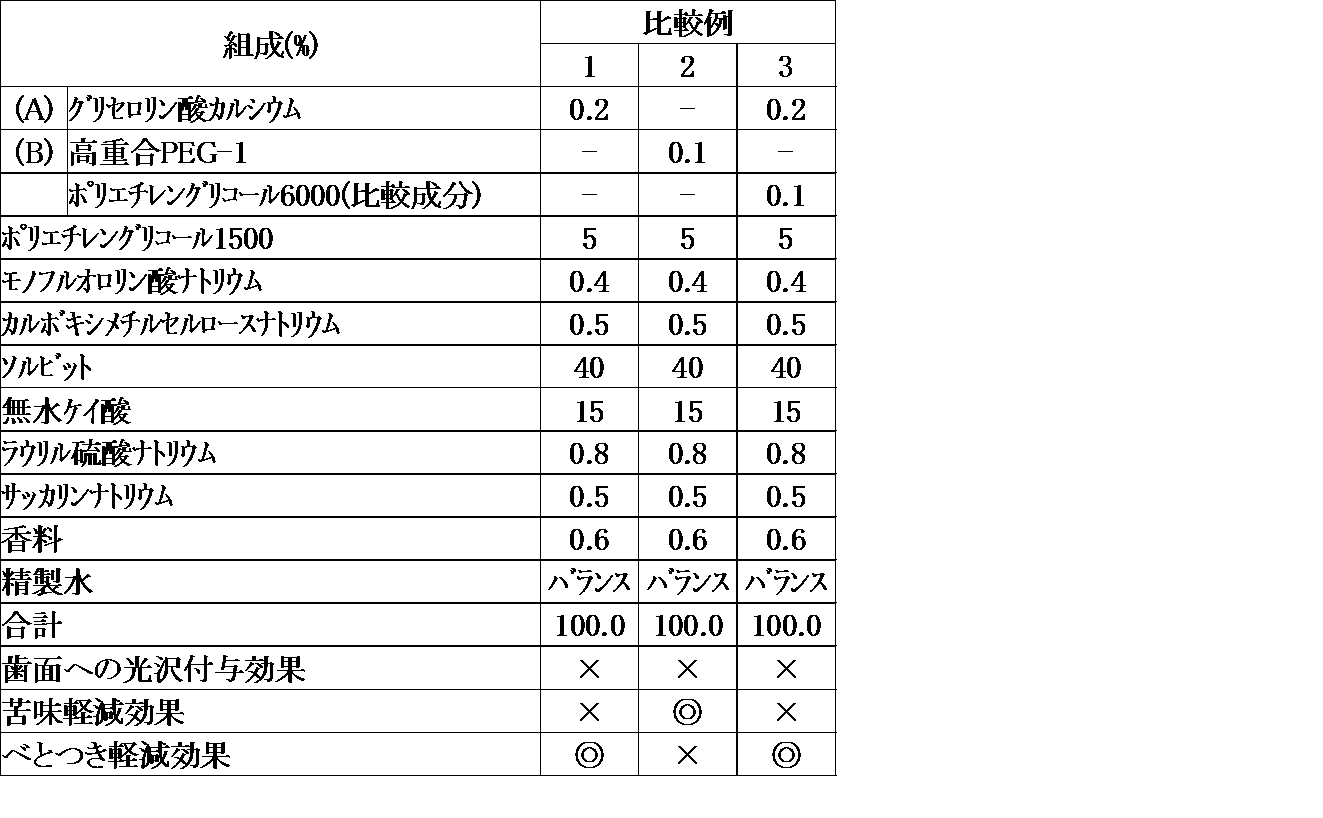
更に、下記に処方例を示す。なお、使用原料の詳細は上記と同様である。
[処方例] 練歯磨剤
(A)グリセロリン酸カルシウム 0.2%
(B)高重合PEG-1 0.1
ポリエチレングリコール1500 5
モノフルオロリン酸ナトリウム 0.76
カルボキシメチルセルロースナトリウム 0.5
ソルビット 40
無水ケイ酸 15
ラウリル硫酸ナトリウム 0.8
キシリット 0.5
ステビア 0.3
香料 0.6
精製水 バランス
合計 100.0%
(A)/(B)の質量比 2
歯面への光沢付与効果 ◎
苦味軽減効果 ◎
べとつき軽減効果 ◎
[処方例] 練歯磨剤
(A)グリセロリン酸カルシウム 0.2%
(B)高重合PEG-1 0.1
ポリエチレングリコール1500 5
モノフルオロリン酸ナトリウム 0.76
カルボキシメチルセルロースナトリウム 0.5
ソルビット 40
無水ケイ酸 15
ラウリル硫酸ナトリウム 0.8
キシリット 0.5
ステビア 0.3
香料 0.6
精製水 バランス
合計 100.0%
(A)/(B)の質量比 2
歯面への光沢付与効果 ◎
苦味軽減効果 ◎
べとつき軽減効果 ◎
Claims (8)
- (A)グリセロリン酸カルシウムと(B)高重合ポリエチレングリコールとを含有してなることを特徴とする口腔用組成物。
- (B)成分の高重合ポリエチレングリコールが、ブルックフィールド型粘度計で測定した25℃における5W/V%水溶液の粘度が10mPa・s以上であり、かつ前記粘度計で測定した25℃における2W/V%水溶液の粘度が800mPa・s以下のものである請求項1記載の口腔用組成物。
- (A)成分を0.005~1質量%。(B)成分を0.01~0.5質量%含有する請求項1又は2記載の口腔用組成物。
- (A)成分/(B)成分が質量比として0.05~20である請求項1、2又は3記載の口腔用組成物。
- 練歯磨剤組成物である請求項1乃至4のいずれか1項記載の口腔用組成物。
- (A)グリセロリン酸カルシウムと(B)高重合ポリエチレングリコールとからなる歯面への光沢付与剤。
- (B)成分の高重合ポリエチレングリコールが、ブルックフィールド型粘度計で測定した25℃における5W/V%水溶液の粘度が10mPa・s以上であり、かつ前記粘度計で測定した25℃における2W/V%水溶液の粘度が800mPa・s以下のものである請求項6記載の歯面への光沢付与剤。
- (A)成分/(B)成分が質量比として0.05~20である請求項6又は7記載の歯面への光沢付与剤。
Applications Claiming Priority (2)
| Application Number | Priority Date | Filing Date | Title |
|---|---|---|---|
| JP2014-048350 | 2014-03-12 | ||
| JP2014048350 | 2014-03-12 |
Publications (1)
| Publication Number | Publication Date |
|---|---|
| WO2015137302A1 true WO2015137302A1 (ja) | 2015-09-17 |
Family
ID=54071746
Family Applications (1)
| Application Number | Title | Priority Date | Filing Date |
|---|---|---|---|
| PCT/JP2015/056927 Ceased WO2015137302A1 (ja) | 2014-03-12 | 2015-03-10 | 口腔用組成物及び歯面への光沢付与剤 |
Country Status (1)
| Country | Link |
|---|---|
| WO (1) | WO2015137302A1 (ja) |
Citations (1)
| Publication number | Priority date | Publication date | Assignee | Title |
|---|---|---|---|---|
| JP2011140454A (ja) * | 2010-01-06 | 2011-07-21 | Sunstar Inc | 口腔用組成物 |
-
2015
- 2015-03-10 WO PCT/JP2015/056927 patent/WO2015137302A1/ja not_active Ceased
Patent Citations (1)
| Publication number | Priority date | Publication date | Assignee | Title |
|---|---|---|---|---|
| JP2011140454A (ja) * | 2010-01-06 | 2011-07-21 | Sunstar Inc | 口腔用組成物 |
Non-Patent Citations (2)
| Title |
|---|
| FLUORIDE TOOTHPASTE, (ID#):877301, March 2008 (2008-03-01) * |
| OXYGEN + WHITE TOOTHPASTE, (ID#):680483, March 2007 (2007-03-01) * |
Similar Documents
| Publication | Publication Date | Title |
|---|---|---|
| JP5526619B2 (ja) | 練歯磨剤組成物 | |
| JP5625647B2 (ja) | 歯磨組成物 | |
| JP7236623B2 (ja) | 口腔用組成物 | |
| JPWO2018194111A1 (ja) | 口腔バイオフィルム除去剤及び口腔用組成物 | |
| KR20170094133A (ko) | 구강용 조성물 | |
| JP5310556B2 (ja) | 口腔用組成物及び口腔用組成物の収斂性向上方法 | |
| CN102264342B (zh) | 洁齿剂组合物 | |
| JP5168465B2 (ja) | 歯磨剤組成物 | |
| WO2007066497A1 (ja) | 歯磨組成物 | |
| WO2017209088A1 (ja) | 口腔用組成物 | |
| JP2015117215A (ja) | 歯磨剤組成物 | |
| CN116806140A (zh) | 口腔用组合物 | |
| JPWO2018151076A1 (ja) | ジェル状歯磨剤組成物及びそのべたつき抑制剤 | |
| JP6409618B2 (ja) | 歯磨組成物 | |
| WO2015133358A1 (ja) | 練歯磨組成物 | |
| KR101773227B1 (ko) | 치마제 조성물 | |
| TW201902455A (zh) | 口腔用組成物 | |
| JP2010143842A (ja) | 歯磨剤組成物 | |
| WO2022145167A1 (ja) | 口腔用組成物 | |
| JP6693504B2 (ja) | 歯磨剤組成物 | |
| JP5625704B2 (ja) | 歯磨剤組成物 | |
| JP2016141661A (ja) | 口腔用組成物 | |
| JP7830898B2 (ja) | 口腔用組成物 | |
| JP5552760B2 (ja) | 練歯磨組成物 | |
| JP2007161613A (ja) | 歯磨剤組成物 |
Legal Events
| Date | Code | Title | Description |
|---|---|---|---|
| 121 | Ep: the epo has been informed by wipo that ep was designated in this application |
Ref document number: 15760714 Country of ref document: EP Kind code of ref document: A1 |
|
| NENP | Non-entry into the national phase |
Ref country code: DE |
|
| 122 | Ep: pct application non-entry in european phase |
Ref document number: 15760714 Country of ref document: EP Kind code of ref document: A1 |
|
| NENP | Non-entry into the national phase |
Ref country code: JP |