WO2015137173A1 - ビニルシクロプロパン、モノマー組成物、ポリマー、ポリマー組成物、及び物品 - Google Patents
ビニルシクロプロパン、モノマー組成物、ポリマー、ポリマー組成物、及び物品 Download PDFInfo
- Publication number
- WO2015137173A1 WO2015137173A1 PCT/JP2015/056017 JP2015056017W WO2015137173A1 WO 2015137173 A1 WO2015137173 A1 WO 2015137173A1 JP 2015056017 W JP2015056017 W JP 2015056017W WO 2015137173 A1 WO2015137173 A1 WO 2015137173A1
- Authority
- WO
- WIPO (PCT)
- Prior art keywords
- polymer
- vinylcyclopropane
- monomer
- carbon atoms
- ppm
- Prior art date
- Legal status (The legal status is an assumption and is not a legal conclusion. Google has not performed a legal analysis and makes no representation as to the accuracy of the status listed.)
- Ceased
Links
Images





Classifications
-
- C—CHEMISTRY; METALLURGY
- C08—ORGANIC MACROMOLECULAR COMPOUNDS; THEIR PREPARATION OR CHEMICAL WORKING-UP; COMPOSITIONS BASED THEREON
- C08F—MACROMOLECULAR COMPOUNDS OBTAINED BY REACTIONS ONLY INVOLVING CARBON-TO-CARBON UNSATURATED BONDS
- C08F22/00—Homopolymers and copolymers of compounds having one or more unsaturated aliphatic radicals each having only one carbon-to-carbon double bond, and at least one being terminated by a carboxyl radical and containing at least one other carboxyl radical in the molecule; Salts, anhydrides, esters, amides, imides or nitriles thereof
- C08F22/10—Esters
- C08F22/12—Esters of phenols or saturated alcohols
- C08F22/14—Esters having no free carboxylic acid groups
-
- C—CHEMISTRY; METALLURGY
- C08—ORGANIC MACROMOLECULAR COMPOUNDS; THEIR PREPARATION OR CHEMICAL WORKING-UP; COMPOSITIONS BASED THEREON
- C08F—MACROMOLECULAR COMPOUNDS OBTAINED BY REACTIONS ONLY INVOLVING CARBON-TO-CARBON UNSATURATED BONDS
- C08F22/00—Homopolymers and copolymers of compounds having one or more unsaturated aliphatic radicals each having only one carbon-to-carbon double bond, and at least one being terminated by a carboxyl radical and containing at least one other carboxyl radical in the molecule; Salts, anhydrides, esters, amides, imides or nitriles thereof
- C08F22/10—Esters
-
- C—CHEMISTRY; METALLURGY
- C07—ORGANIC CHEMISTRY
- C07C—ACYCLIC OR CARBOCYCLIC COMPOUNDS
- C07C69/00—Esters of carboxylic acids; Esters of carbonic or haloformic acids
- C07C69/74—Esters of carboxylic acids having an esterified carboxyl group bound to a carbon atom of a ring other than a six-membered aromatic ring
- C07C69/743—Esters of carboxylic acids having an esterified carboxyl group bound to a carbon atom of a ring other than a six-membered aromatic ring of acids with a three-membered ring and with unsaturation outside the ring
-
- C—CHEMISTRY; METALLURGY
- C07—ORGANIC CHEMISTRY
- C07C—ACYCLIC OR CARBOCYCLIC COMPOUNDS
- C07C69/00—Esters of carboxylic acids; Esters of carbonic or haloformic acids
- C07C69/74—Esters of carboxylic acids having an esterified carboxyl group bound to a carbon atom of a ring other than a six-membered aromatic ring
- C07C69/753—Esters of carboxylic acids having an esterified carboxyl group bound to a carbon atom of a ring other than a six-membered aromatic ring of polycyclic acids
-
- C—CHEMISTRY; METALLURGY
- C08—ORGANIC MACROMOLECULAR COMPOUNDS; THEIR PREPARATION OR CHEMICAL WORKING-UP; COMPOSITIONS BASED THEREON
- C08G—MACROMOLECULAR COMPOUNDS OBTAINED OTHERWISE THAN BY REACTIONS ONLY INVOLVING UNSATURATED CARBON-TO-CARBON BONDS
- C08G61/00—Macromolecular compounds obtained by reactions forming a carbon-to-carbon link in the main chain of the macromolecule
- C08G61/02—Macromolecular compounds containing only carbon atoms in the main chain of the macromolecule, e.g. polyxylylenes
- C08G61/04—Macromolecular compounds containing only carbon atoms in the main chain of the macromolecule, e.g. polyxylylenes only aliphatic carbon atoms
- C08G61/06—Macromolecular compounds containing only carbon atoms in the main chain of the macromolecule, e.g. polyxylylenes only aliphatic carbon atoms prepared by ring-opening of carbocyclic compounds
-
- C—CHEMISTRY; METALLURGY
- C07—ORGANIC CHEMISTRY
- C07C—ACYCLIC OR CARBOCYCLIC COMPOUNDS
- C07C2601/00—Systems containing only non-condensed rings
- C07C2601/02—Systems containing only non-condensed rings with a three-membered ring
-
- C—CHEMISTRY; METALLURGY
- C07—ORGANIC CHEMISTRY
- C07C—ACYCLIC OR CARBOCYCLIC COMPOUNDS
- C07C2603/00—Systems containing at least three condensed rings
- C07C2603/56—Ring systems containing bridged rings
- C07C2603/58—Ring systems containing bridged rings containing three rings
- C07C2603/70—Ring systems containing bridged rings containing three rings containing only six-membered rings
- C07C2603/74—Adamantanes
-
- C—CHEMISTRY; METALLURGY
- C08—ORGANIC MACROMOLECULAR COMPOUNDS; THEIR PREPARATION OR CHEMICAL WORKING-UP; COMPOSITIONS BASED THEREON
- C08G—MACROMOLECULAR COMPOUNDS OBTAINED OTHERWISE THAN BY REACTIONS ONLY INVOLVING UNSATURATED CARBON-TO-CARBON BONDS
- C08G2261/00—Macromolecular compounds obtained by reactions forming a carbon-to-carbon link in the main chain of the macromolecule
- C08G2261/10—Definition of the polymer structure
- C08G2261/13—Morphological aspects
- C08G2261/135—Cross-linked structures
-
- C—CHEMISTRY; METALLURGY
- C08—ORGANIC MACROMOLECULAR COMPOUNDS; THEIR PREPARATION OR CHEMICAL WORKING-UP; COMPOSITIONS BASED THEREON
- C08G—MACROMOLECULAR COMPOUNDS OBTAINED OTHERWISE THAN BY REACTIONS ONLY INVOLVING UNSATURATED CARBON-TO-CARBON BONDS
- C08G2261/00—Macromolecular compounds obtained by reactions forming a carbon-to-carbon link in the main chain of the macromolecule
- C08G2261/30—Monomer units or repeat units incorporating structural elements in the main chain
- C08G2261/33—Monomer units or repeat units incorporating structural elements in the main chain incorporating non-aromatic structural elements in the main chain
- C08G2261/332—Monomer units or repeat units incorporating structural elements in the main chain incorporating non-aromatic structural elements in the main chain containing only carbon atoms
-
- C—CHEMISTRY; METALLURGY
- C08—ORGANIC MACROMOLECULAR COMPOUNDS; THEIR PREPARATION OR CHEMICAL WORKING-UP; COMPOSITIONS BASED THEREON
- C08G—MACROMOLECULAR COMPOUNDS OBTAINED OTHERWISE THAN BY REACTIONS ONLY INVOLVING UNSATURATED CARBON-TO-CARBON BONDS
- C08G2261/00—Macromolecular compounds obtained by reactions forming a carbon-to-carbon link in the main chain of the macromolecule
- C08G2261/30—Monomer units or repeat units incorporating structural elements in the main chain
- C08G2261/33—Monomer units or repeat units incorporating structural elements in the main chain incorporating non-aromatic structural elements in the main chain
- C08G2261/332—Monomer units or repeat units incorporating structural elements in the main chain incorporating non-aromatic structural elements in the main chain containing only carbon atoms
- C08G2261/3323—Monomer units or repeat units incorporating structural elements in the main chain incorporating non-aromatic structural elements in the main chain containing only carbon atoms derived from other monocyclic systems
Definitions
- the present invention relates to vinylcyclopropane, a monomer composition, a polymer, a polymer composition, and an article, and in particular, vinylcyclopropane, a monomer composition containing the vinylcyclopropane, a polymer that is a polymer of the vinylcyclopropane,
- the present invention relates to a polymer composition containing a polymer, and an article obtained by curing the monomer composition.
- vinyl monomers such as acrylic materials
- thermosetting resins such as epoxy resins and phenol resins
- adhesive materials Conventionally, vinyl monomers and thermosetting resins have a problem in that volume shrinkage occurs during polymerization, so that internal stress remains, cracks occur, and adhesive strength decreases.
- Cyclic monomers are known to have lower polymerization shrinkage than vinyl monomers of the same molecular weight.
- Such cyclic monomers include, for example, vinylcyclopropane, vinyloxirane, 4-methylene-1,3-dioxolane, cyclic ketene acetal, benzocyclobutene, spiroorthocarbonate, spiroorthoester, vinylcyclopropane cyclic acetal, and cyclic allyl.
- Sulfides, cyclic vinyl sulfones, and the like are known.
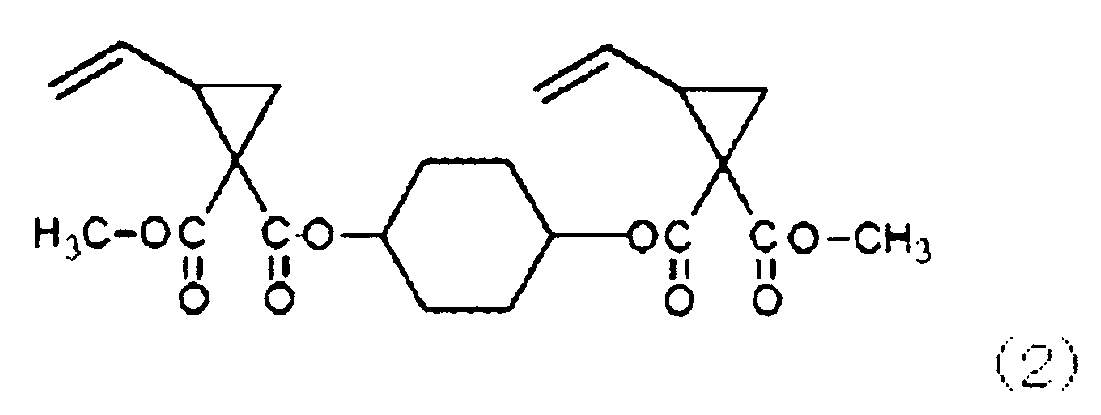
- a technique in which a polymer (homopolymer or copolymer) of a polyfunctional vinylcyclopropane monomer (the following structural formula (1)) is used as a dental material has been studied (for example, see Patent Document 1).
- a copolymer of urethane dimethacrylate as a vinyl monomer and bis (vinylcyclopropane) as a polyfunctional vinylcyclopropane is a copolymer of urethane dimethacrylate and dodecanediol dimethacrylate and urethane dimethacrylate. It has been disclosed that mechanical properties and polymerization shrinkage are improved over copolymers of methacrylate and 1,1-bis (phenoxycarbonyl) -2-vinylcyclopropane.
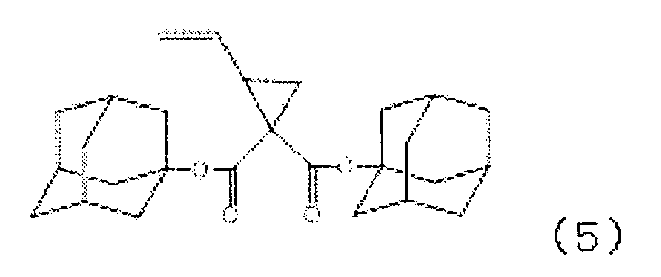
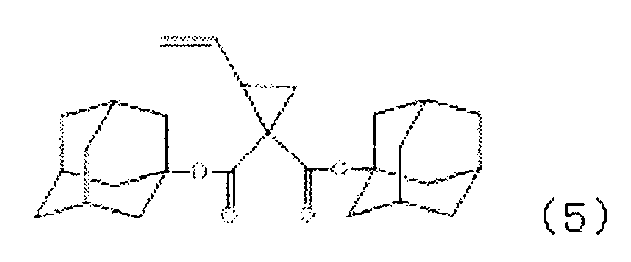
- a monofunctional vinylcyclopropane having an adamantyl group represented by the following structural formula (5) is known as a monofunctional vinylcyclopropane having a bulky substituent and having an excellent volume expansion property (for example, Non-Patent Document 3).
- the problem is that the compound represented by the structural formula (5) is difficult to dissolve in a solvent such as acetone. Therefore, in order to obtain a polymer, a complicated process is required in production, which is disadvantageous in terms of convenience of the monomer.
- Patent Documents 2 and 3 Furthermore, monofunctional vinylcyclopropane introduced with an alicyclic compound as a bulky substituent is known, and verification with increasing or decreasing the number of ring members has been made (for example, see Patent Documents 2 and 3). Although the monomers described in Patent Documents 2 and 3 have improved polymerization shrinkage, there is a problem that they do not exhibit volume expansion during homopolymerization.
- This invention makes it a subject to solve the said various problems in the past and to achieve the following objectives. That is, vinyl cyclopropane that exhibits volume expansion during homopolymerization and improved solubility in a solvent, a monomer composition containing the vinyl cyclopropane, a polymer that is a polymer of the vinyl cyclopropane, It is an object of the present invention to provide a polymer composition containing the product and an article obtained by curing the monomer composition.
- R 1 is —H, —OH, —NH 2 , —NO 2 , —COOR, —CN, ⁇ O, —OCOCH ⁇ CH 2 , —OCO (CH 3 ) C ⁇ CH 2 , halogen, and one carbon atom.
- a cycloalkylene group having 3 to 20 carbon atoms or an arylene group having 6 to 14 carbon atoms X 1 represents CO, CO—O, O—CO, CO—S, S—CO, CO—NR, NR—CO, O, S, SO 2 , or a single bond
- X 2 represents CO, CO—O, O—CO, CO—S, S—CO, CO—NR, NR—CO, O, S, SO 2 , or a single bond
- R 1 , X 1 and X 2 R is H, an alkyl group having 1 to 6 carbon atoms, a cycloalkylene group having 3 to 6 carbon atoms, an aryl group having 6 to 14 carbon atom
- the compound represented by the general formula (I) exhibits volume expansion during homopolymerization and can improve solubility in a solvent.
- X 1 and X 2 are esters.
- ⁇ 3> The vinylcyclopropane according to any one of ⁇ 1> to ⁇ 2>, wherein k is 2.
- ⁇ 4> A monomer composition comprising the vinylcyclopropane according to any one of ⁇ 1> to ⁇ 3>.
- ⁇ 5> A polymer characterized by being a polymer of vinylcyclopropane according to any one of ⁇ 1> to ⁇ 3>.
- ⁇ 6> The polymer according to ⁇ 5>, wherein the volume change of the vinylcyclopropane with respect to the monomer volume is + 5.0% or more.
- ⁇ 7> The polymer according to ⁇ 5>, wherein the polymer is a copolymer of the vinylcyclopropane and a polymerizable compound other than the vinylcyclopropane.
- ⁇ 8> A polymer composition comprising the polymer according to any one of ⁇ 5> to ⁇ 7>.
- ⁇ 9> An article obtained by curing the monomer composition according to ⁇ 4>.
- vinylcyclopropane that can solve the above-mentioned problems and can achieve the above-mentioned object, exhibits volume expansion during homopolymerization, and can improve solubility in a solvent.
- FIG. 1 is a 1 H-NMR chart of O-adamantylmalonic acid (Ad-COOH) in Example 1.
- FIG. 2 is a 13 C-NMR chart of O-adamantylmalonic acid (Ad-COOH) in Example 1.
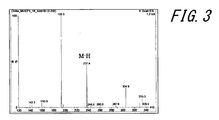
- FIG. 3 is a liquid chromatography / mass spectrometry (LC-MS) chart of O-adamantylmalonic acid (Ad-COOH) in Example 1.
- FIG. 4 is a 1 H-NMR chart of 1,3-bis [(1-adamantyloxy) carbonyloxy] adamantane (Ad3) in Example 1.
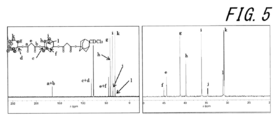
- FIG. 5 is a 13 C-NMR chart of 1,3-bis [(1-adamantyloxy) carbonyloxy] adamantane (Ad3) in Example 1.
- FIG. 6 is an LC-MS chart of 1,3-bis [(1-adamantyloxy) carbonyloxy] adamantane (Ad3) in Example 1.
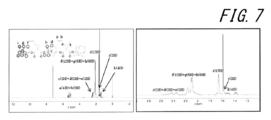
- FIG. 7 is a 1 H-NMR chart of 1,3-bis [(1-adamantyloxycarbonyl-2-vinylcyclopropan-1-yl) carbonyloxy] adamantane (Ad-MVCP) in Example 1.
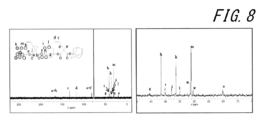
- FIG. 8 is a 13 C-NMR chart of 1,3-bis [(1-adamantyloxycarbonyl-2-vinylcyclopropan-1-yl) carbonyloxy] adamantane (Ad-MVCP) in Example 1.
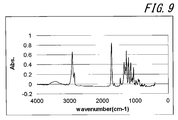
- FIG. 9 shows the Fourier transform infrared spectrophotometer (FT) of 1,3-bis [(1-adamantyloxycarbonyl-2-vinylcyclopropan-1-yl) carbonyloxy] adamantane (Ad-MVCP) in Example 1.
- FIG. -IR chart.
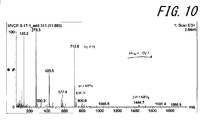
- FIG. 10 is an LC-MS chart of 1,3-bis [(1-adamantyloxycarbonyl-2-vinylcyclopropan-1-yl) carbonyloxy] adamantane (Ad-MVCP) in Example 1.
- FIG. FIG. 11 shows the constitution of 1,3-bis [(1-adamantyloxycarbonyl-2-vinylcyclopropan-1-yl) carbonyloxy] adamantane (Ad-MVCP) monomer in Example 1 and the obtained monomer. It is a cross polarization magic angle spinning method (CP-MAS) chart of the polymer used as a component.
- CP-MAS cross polarization magic angle spinning method
- vinylcyclopropane The vinylcyclopropane of the present invention is a compound represented by the following general formula (I).
- R 1 examples include —H, —OH, —NH 2 , —NO 2 , —COOR, —CN, ⁇ O, —OCOCH ⁇ CH 2 , —OCO (CH 3 ) C ⁇ CH 2 , halogen, and carbon number.
- a group, a cycloalkylene group having 3 to 20 carbon atoms, or an arylene group having 6 to 14 carbon atoms it is not particularly limited and can be appropriately selected according to the purpose.
- R is H, an alkyl group having 1 to 6 carbon atoms, a cycloalkylene group having 3 to 6 carbon atoms, an aryl group having 6 to 14 carbon atoms, or a heterocyclic group having 6 to 14 carbon atoms
- R is H, an alkyl group having 1 to 6 carbon atoms, a cycloalkylene group having 3 to 6 carbon atoms, an aryl group having 6 to 14 carbon atoms, or a heterocyclic group having 6 to 14 carbon atoms
- X 1 represents CO, CO—O, O—CO, CO—S, S—CO, CO—NR, NR—CO, O, S, SO 2 , or a single bond
- R is H
- ester CO-O, O-CO
- X 2 represents CO, CO—O, O—CO, CO—S, S—CO, CO—NR, NR—CO, O, S, SO 2 , or a single bond
- R is H
- ester CO-O, O-CO
- the k is not particularly limited as long as it is an integer of 2 to 4, and can be appropriately selected according to the purpose, but 2 is preferable.
- k is 1, solubility in a solvent is low, and when k is 2 or more, it is advantageous in terms of solubility. However, if k exceeds 4, a complicated process is required for synthesis.
- the l is not particularly limited as long as it is an integer of 1 to 9, and can be appropriately selected according to the purpose.
- the m is not particularly limited as long as it is an integer of 1 to 8, and can be appropriately selected according to the purpose.
- Ad represents an adamantyl group.
- the adamantyl group is a functional group of adamantane. Since the vinylcyclopropane of the present invention has an adamantyl group introduced, it is less susceptible to polymerization conditions and has the advantage that ring-opening polymerization occurs at a high conversion rate.
- vinylcyclopropane are not particularly limited as long as they are compounds represented by the general formula (I), and can be appropriately selected according to the purpose.
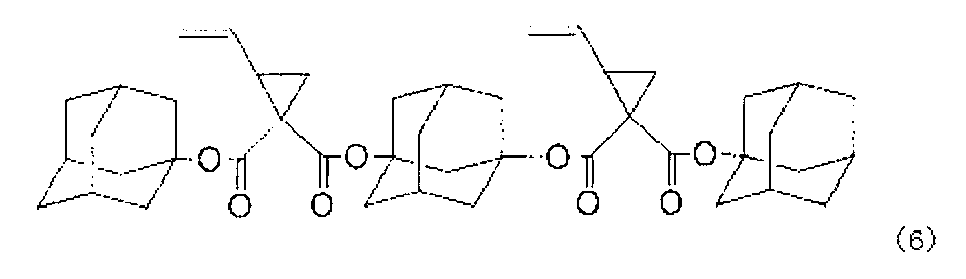
- 1,3-bis [( 1-adamantyloxycarbonyl-2-vinylcyclopropan-1-yl) carbonyloxy] adamantane Ad-MVCP (a compound represented by the following structural formula (6)), 1,3,5-tris [(1- Adamantyloxycarbonyl-2-vinylcyclopropan-1-yl) carbonyloxy] adamantane, 1,3,5,7-tetra [(1-adamantyloxycarbonyl-2-vinylcyclopropan-1-yl) carbonyloxy] adamantane , Etc.
- the monomer composition of the present invention contains at least the vinylcyclopropane, and further contains other components as necessary.
- the other components are not particularly limited and may be appropriately selected depending on the purpose.
- polymeric compounds other than the said vinylcyclopropane there is no restriction
- the vinyl compound is not particularly limited and may be appropriately selected depending on the intended purpose.
- diene type compound there is no restriction
- natural rubber IR
- BR butadiene rubber
- SBR styrene butadiene rubber
- CR chloroprene rubber
- ABR acrylonitrile butadiene rubber
- ABS resin acrylonitrile butadiene styrene resin
- the solvent is not particularly limited and may be appropriately selected depending on the intended purpose.
- lower alcohols aromatic hydrocarbons, alicyclic hydrocarbons, aliphatic hydrocarbons, esters, ketones, amides , Ethers, and the like. These may be used individually by 1 type and may use 2 or more types together. Among these, aromatic hydrocarbons are preferable in that the conversion rate is good.
- -Polymerization initiator- There is no restriction
- Organic peroxide-- The organic peroxide is not particularly limited and may be appropriately selected depending on the intended purpose. Examples thereof include benzoyl peroxide, dilauroyl peroxide, tert-butyl peroxide, benzopinacol, and 2,2′-dialkylbenzoic acid. Pinacol, etc.
- the photoinitiator is not particularly limited as long as it is suitable for UV or visible light, and can be appropriately selected according to the purpose.
- examples include acylphosphine oxide, ⁇ -diketone (eg, 9,10-phenanthraquinone), diacetyl, furyl, anisyl, 4,4′-dichlorobenzyl, 4,4′-dialkoxybenzyl, camphorquinone, and the like.
- the polymerization initiators may be used alone or in combination of two or more.
- organic peroxides eg, benzoyl peroxide, lauroyl peroxide
- ⁇ -diketones eg, camphorquinone
- aromatic amines eg, N, N′-dimethyl- It is preferable to use a combination of p-toluidine, N, N′-dihydroxyethyl-p-toluidine, p-dimethylaminobenzoic acid ethyl ester or a derivative thereof.
- a reducing agent For example, ascorbic acid, a barthrate, sulfinic acid
- the filler is for improving mechanical properties.
- an inorganic particle filler for example, amorphous spherical substance based on an oxide
- a fine filler for example, pyrolysis silica) , Precipitated silica
- macro or mini filler eg quartz powder, glass ceramic powder or glass powder having an average particle size of 0.01 ⁇ m to 5 ⁇ m
- radiopaque filler eg ytterbium trifluoride
- glass fiber, polyamide fiber, and carbon fiber may be used individually by 1 type and may use 2 or more types together.
- HQ hydroquinone
- HQME Hydroquinone monomethyl ether
- TBC 4-tert-butylcatechol
- Adekastab LA62 Adekastab Hindered amine light stabilizers such as LA67 (manufactured by ADEKA, Inc.); hindered amine light stabilizers such as tinuvin 765, tinuvin 144, tinuvin 770, tinuvin 622 (manufactured by BASF Japan Ltd.); tinuvin B75, tinuvin PUR866 Blended light stabilizers such as (manufactured by BASF Japan Ltd.) and the like. These may be used individually by 1 type and may use 2 or more types together.
- UV absorber- There is no restriction
- the polymer of the present invention is a polymer of vinylcyclopropane of the present invention.
- the polymer may be either a homopolymer of the vinylcyclopropane (homopolymer) or a copolymer (copolymer) of the vinylcyclopropane and a polymerizable compound other than the vinylcyclopropane.
- the polymer of the present invention is a copolymer (copolymer) of the vinylcyclopropane and a polymerizable compound other than the vinylcyclopropane
- the polymerizable compound other than the vinylcyclopropane is the same as described above. .
- the volume change with respect to the monomer volume is a volume change of the polymer with respect to the monomer volume which is a constituent component of the polymer.
- the density of the monomer before polymerization at 25 ° C. (monomer density) and the density of the polymer after polymerization at 25 ° C. (polymer Density) was measured and determined by the following formula. ((Monomer density)-(polymer density)) / (monomer density) ⁇ 100 (%) If the volume change (%) obtained is a positive value, volume expansion occurs during polymerization (shows volume expansion in polymerization).
- volume shrinkage occurs during polymerization (volume shrinkage is exhibited in the polymerization).
- the volume change with respect to the monomer volume when the polymer is the vinylcyclopropane homopolymer (homopolymer) is not particularly limited and may be appropriately selected depending on the intended purpose. Is preferred. If the volume change with respect to the volume of the monomer is less than + 5.0%, the volume shrinkage may be large when the polymer is a copolymer.
- the vinylcyclopropane is copolymerized with a highly shrinkable polymerizable compound such as a vinyl compound. This is advantageous in that it is easy to adjust the volume change rate to a desired range.
- the polymer composition of the present invention contains at least the polymer of the present invention, and further contains other components as necessary.
- the other components are not particularly limited and may be appropriately selected depending on the purpose.
- the article of the present invention is obtained by curing the monomer composition of the present invention.
- the article is not particularly limited as long as it is obtained by curing the monomer composition of the present invention, and can be appropriately selected according to the purpose.
- optical articles, molding materials, composite materials, Examples thereof include mold materials, sealing materials, medical materials, dental materials, recording materials, cement, paints, adhesives, and materials for hologram optical recording media.
- thermosetting thermosetting, photocuring, etc. are mentioned. These may be used individually by 1 type and may use 2 or more types together.
- thermosetting There is no restriction
- Example 1 Synthesis of 1,3-bis [(1-adamantyloxycarbonyl-2-vinylcyclopropan-1-yl) carbonyloxy] adamantane (Ad-MVCP)> As shown in the following reaction scheme, a compound represented by the following structural formula (6) was produced through a first stage reaction, a second stage reaction, and a third stage reaction.
- the three-necked flask was dissolved in 1,3-adamantanediol, and then placed in an ice bath for 10 minutes, while stirring for 21 minutes while holding the ice bath, N, N'-dicyclohexylcarbodiimide prepared in a separately degassed and dried container
- a solution of 10.40 g (50.41 mmol) of (DCC) in THF (120 mL) was dropped from the dropping funnel. After the dropwise addition, the ice bath was removed, and the reaction was carried out by stirring at room temperature for 3 hours. The reaction was monitored using thin layer chromatography (TLC) and LC / MS.
- the solution was recovered by filtration.
- the collected solution was completely distilled off using an evaporator and a vacuum pump.
- the obtained crude product was purified by column chromatography (silica gel).
- the column was an open column using a 90 cm diameter column tube.
- the crude product was dissolved in 80 ml of developing solvent.
- the column flow rate was 100 ml / 30 minutes.
- the solution was checked for product by TLC.
- a gas collection bag (or balloon) filled with nitrogen was connected to a three-way cock, and nitrogen was introduced into the reactor. Thereafter, 3.848 g (NaH amount: 2.336 g, 97.36 mmol) of NaH (dispersed in liquid paraffin) was charged from the side tube. At that time, since it was temporarily opened, the gas collection bag into which nitrogen was introduced was pushed in and introduced while flowing nitrogen to prevent air from entering. After the addition, decantation was performed to remove NaH liquid paraffin. In the method, 480 mL of n-hexane (ultra-dehydrated) was added to the flask and stirred for 30 minutes.
- the reaction mixture was cooled to room temperature, and 360 mL of water was added little by little to deactivate excess sodium hydride. At this time, a large amount of hydrogen gas was generated, and further heat generation occurred and it was very dangerous. Therefore, the operation was performed in the open air and in an ice bath. After filtration, only THF was distilled off with an evaporator, 360 mL of diethyl ether was added, and the mixture was transferred to a separatory funnel (1000 mL) for extraction. First, the aqueous layer was removed, and extraction was performed 3 times with 400 mL of a saturated aqueous solution of sodium bicarbonate and 4 times with 400 mL of a saturated aqueous solution of sodium chloride.
- the organic layer was recovered, dried over magnesium sulfate (anhydrous) for 30 minutes, filtered, and then the solvent was distilled off with an evaporator and a vacuum pump to obtain a crude product solid.
- the crude product was dissolved in 30 mL of developing solvent. A double ball was used for pressurization. The solution was checked for product by TLC.
- the prepared cured product is mounted, and the temperature rise rate is 10.0 ° C./min.
- the storage elastic modulus (E ′) in the temperature range of 30 ° C. to 300 ° C. was measured.
- the temperature at the maximum point of tan ⁇ (loss elastic modulus / storage elastic modulus) obtained under the measurement condition with a frequency of 11.0 Hz was defined as the glass transition temperature (Tg).
- thermogravimetric analyzer manufactured by the evaluation of the volume change at the time of superposition
- thermogravimetric change of the obtained polymer (polymer) was measured to determine the temperature at which the weight was reduced by 10%, and the 10% weight loss temperature was defined as the thermal decomposition temperature (Td 10 ).
- Comparative Example 1 the obtained polymer (polymer) was dissolved in 20 mL of dichloromethane, poured into 200 mL of methanol to form a precipitate, and the generated white polymer was purified by three reprecipitation operations at 100 ° C. While heating, vacuum drying was performed for 48 hours to recover a white solid polymer. The collected polymer was used as an evaluation sample.
- Ad-VCP is based on Ueda et al. , Macromolecules, 27, 5543 (1994).
- the obtained polymer (polymer) was dissolved in 20 mL of dichloromethane, poured into 200 mL of methanol to form a precipitate, and the generated white polymer was purified by three reprecipitation operations at 100 ° C. While heating, vacuum drying was performed for 48 hours to recover a white solid polymer. The collected polymer was used as an evaluation sample.
- Example 3 instead of using the synthesized (1,3-bis [(1-adamantyloxycarbonyl-2-vinylcyclopropan-1-yl) carbonyloxy] adamantane (Ad-MVCP) in Example 1, the following structural formula (1 In the same manner as in Example 1 except that 1,3-bis [(1-methoxycarbonyl-2-vinylcyclopropan-1-yl) carboxy] benzene (Me-MVCP) represented by ( i) Volume change during polymerization was evaluated, and the evaluation results are shown in Table 1 below.
- Me-MVCP is N.M. Moszner et al. , Journal of Applied Polymer Science, 72, 1775 (1999).
- Ad-MVCP (1,3-bis [(1-adamantyloxycarbonyl-2-vinylcyclopropan-1-yl) carbonyloxy] adamantane
- Ad-MVCP Example 2 except that two equivalents (mmol) of tricyclodecane dimethanol dimethacrylate (DCP) (manufacturer name: Shin-Nakamura Chemical Co., Ltd., trade name: NK ester DCP) were used.
- DCP tricyclodecane dimethanol dimethacrylate
- NK ester DCP volume change during polymerization was evaluated in the same manner as in 1. The evaluation results are shown in Table 2 below.
- Example 2 0.159 g (0.479 mmol) of DCP, 0.341 g (0.479 mmol) of Ad-MVCP, 0.2 mL of toluene (dehydrated), and a stir bar were placed in an ampule tube and heated to 70 ° C., Stir to make uniform. After cooling to room temperature, a diluted solution of AIBN (6.3 mg of AIBN dissolved in 0.28 mL of toluene (dehydrated) (0.038 mmol)) was put into an ampule tube, freeze-degassed, and the ampule tube was sealed with a gas burner. It was. The ampule tube was immersed in an oil bath and reacted at 60 ° C. for 48 hours.
- AIBN 6.3 mg of AIBN dissolved in 0.28 mL of toluene (dehydrated) (0.038 mmol)
- Example 2 a monomer density evaluation sample was produced as shown below.
- Example 3 In Example 2, instead of using DCP and Ad-MVCP monomers in equal amounts, the same as in Example 2 except that the monomer ratio of DCP and Ad-MVCP was 1: 2, (i) The volume change during the polymerization was evaluated. The evaluation results are shown in Table 2 below.
- Example 4 In Example 2, instead of using DCP and Ad-MVCP monomers in equal amounts, the same as in Example 2 except that the monomer ratio of DCP and Ad-MVCP was 1: 3 (i) The volume change during the polymerization was evaluated. The evaluation results are shown in Table 2 below.
- Table 1 shows the evaluation results of volume changes due to homopolymerization in Comparative Examples 1 to 3 and Example 1.
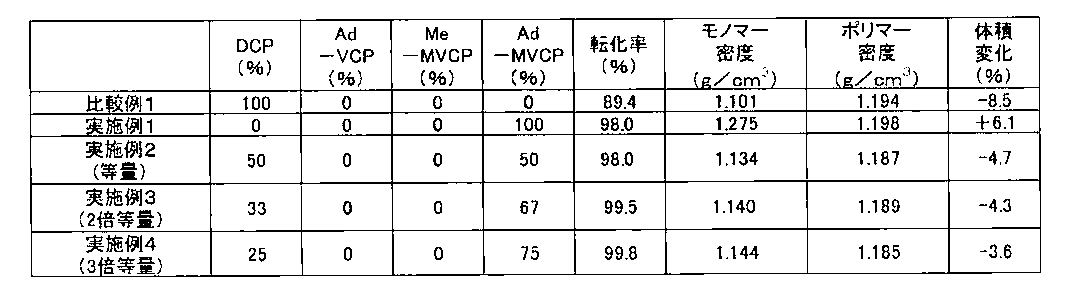
- Example 1 The volume change in the homopolymerization of DCP of Comparative Example 1 is ⁇ 8.5% and shows shrinkage, whereas the volume change in the homopolymerization of vinylcyclopropane (Ad-MVCP) in Example 1 is + 6.1%. And was confirmed to exhibit volume expansibility.
- Ad-MVCP vinylcyclopropane
- the monofunctional vinylcyclopropane Ad-VCP having adamantyl group as a substituent in Comparative Example 2 showed a volume change in homopolymerization of + 4.3% and exhibited volume expansion.
- Example 1 of the functionalized structure showed + 6.1% above that.
- the polyfunctional vinylcyclopropane which shows a large volume expansion property like Example 1 is not well-known.
- Example 1 Since it was confirmed that Example 1 exhibited a volume expansion of + 6.1%, Example 1 was equivalent to 1 to 3 times the amount of DCP (-8.5%) of Comparative Example 1 showing contractility.
- the vinylcyclopropane (Ad-MVCP) of Example 1 was included as a constituent of the copolymer. It was confirmed whether or not relaxation of the contraction was recognized.
- the results of volume change due to copolymerization in Comparative Example 1 and Examples 1 to 4 are shown in Table 2.
- Table 3 shows the results of dynamic viscoelasticity of the polymers of Example 1 and Comparative Examples 1 and 2.
- the homopolymer of vinylcyclopropane (Ad-MVCP) of Example 1 exhibits the same characteristics as the homopolymer of DCP of Comparative Example 1 near room temperature, and the homopolymer of DCP of Comparative Example 1 under high temperature conditions. It showed better properties. From this, it was found that the homopolymer of vinylcyclopropane (Ad-MVCP) of Example 1 can be used for the purpose of relaxation of shrinkage as an alternative or additive material for the acrylic compound exhibiting polymerization shrinkage.
- Table 4 shows the evaluation results of the monomer solubility of the monomer compounds having an adamantyl group (Comparative Example 2 and Example 1).
- Ad-MVCP vinyl cyclopropane (polyfunctional monomer) of Example 1 showed excellent monomer solubility with respect to the solvent that did not dissolve in Ad-VCP (monofunctional monomer) of Comparative Example 2.
- the vinylcyclopropane of the present invention is, for example, an optical material, a molding material, a composite material, a casting material, a sealing material, a medical material, a dental material, a recording material, a cement, a paint, an adhesive, a hologram optical recording medium material, It can use suitably for manufacture.
Landscapes
- Chemical & Material Sciences (AREA)
- Organic Chemistry (AREA)
- Health & Medical Sciences (AREA)
- Chemical Kinetics & Catalysis (AREA)
- Medicinal Chemistry (AREA)
- Polymers & Plastics (AREA)
- Organic Low-Molecular-Weight Compounds And Preparation Thereof (AREA)
- Addition Polymer Or Copolymer, Post-Treatments, Or Chemical Modifications (AREA)
Abstract
Description
しかしながら、これらのビニルモノマー、熱硬化性樹脂は、重合の際に体積収縮が生じるため、内部応力が残存して、クラックが発生し、さらに、接着力が低下するという問題がある。

下記構造式(2)で表わされる化合物(単独重合時における体積変化:−2.8%)及び下記構造式(4)で表わされる化合物(単独重合時における体積変化:−3.8%)は、嵩高い置換基で置換されており、下記構造式(3)で表わされる化合物(単独重合時における体積変化:−7.0%)と比べて、重合収縮性が低くなる。
しかしながら、これらの下記構造式(2)で表わされる化合物及び下記構造式(4)で表わされる化合物は、単独重合時において体積膨張性を示さないという問題がある。
これまでに、多官能構造であって、比較的大きな膨張性を示すビニルシクロプロパンは公知ではない。


特許文献2、3に記載されたモノマーは、重合収縮性が改善されるものの、単独重合時において体積膨張性を示さないという問題がある。
<1> 下記一般式(I)で表されることを特徴とするビニルシクロプロパンである。
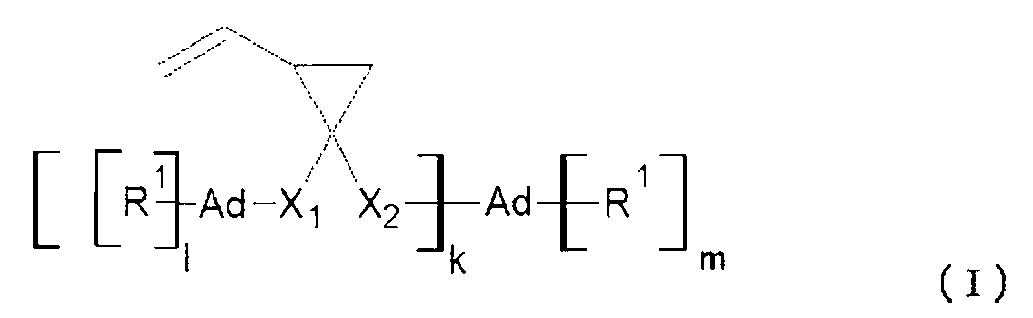
R1は、−H、−OH、−NH2、−NO2、−COOR、−CN、=O、−OCOCH=CH2、−OCO(CH3)C=CH2、ハロゲン、炭素数が1~20のアルキレン基、炭素数が3~20のシクロアルキレン基若しくは炭素数が6~14のアリーレン基、又は、O、S、N若しくはNHにより介在される、炭素数が1~20のアルキレン基、炭素数が3~20のシクロアルキレン基若しくは炭素数が6~14のアリーレン基を表し、
X1は、CO、CO−O、O−CO、CO−S、S−CO、CO−NR、NR−CO、O、S、SO2、又は単結合を表し、
X2は、CO、CO−O、O−CO、CO−S、S−CO、CO−NR、NR−CO、O、S、SO2、又は単結合を表し、
R1、X1及びX2において、Rは、H、炭素数が1~6のアルキル基、炭素数が3~6のシクロアルキレン基、炭素数が6~14のアリール基、又は炭素数が6~14のヘテロ環基を表し、
kは、2~4のいずれかの整数を表し、
lは、1~9のいずれかの整数を表し、
mは、1~8のいずれかの整数を表し、
Adは、アダマンチル基を表す。]
該<1>に記載のビニルシクロプロパンにおいて、前記一般式(I)で表される化合物は、単独重合時において体積膨張性を示し、且つ、溶媒への溶解性を向上させることができる。
<2> 前記X1及びX2が、エステルである前記<1>に記載のビニルシクロプロパンである。
<3> 前記kが2である前記<1>から<2>のいずれかに記載のビニルシクロプロパンである。
<4> 前記<1>から<3>のいずれかに記載のビニルシクロプロパンを含むことを特徴とするモノマー組成物である。
<5> 前記<1>から<3>のいずれかに記載のビニルシクロプロパンの重合体であることを特徴とするポリマーである。
<6> 前記ビニルシクロプロパンのモノマー体積に対する体積変化が、+5.0%以上である前記<5>に記載のポリマーである。
<7> 前記重合体が、前記ビニルシクロプロパンと該ビニルシクロプロパン以外の重合性化合物との共重合体である前記<5>に記載のポリマーである。
<8> 前記<5>から<7>のいずれかに記載のポリマーを含むことを特徴とするポリマー組成物である。
<9> 前記<4>に記載のモノマー組成物を硬化させてなることを特徴とする物品である。
本発明のビニルシクロプロパンは、下記一般式(I)で表される化合物である。
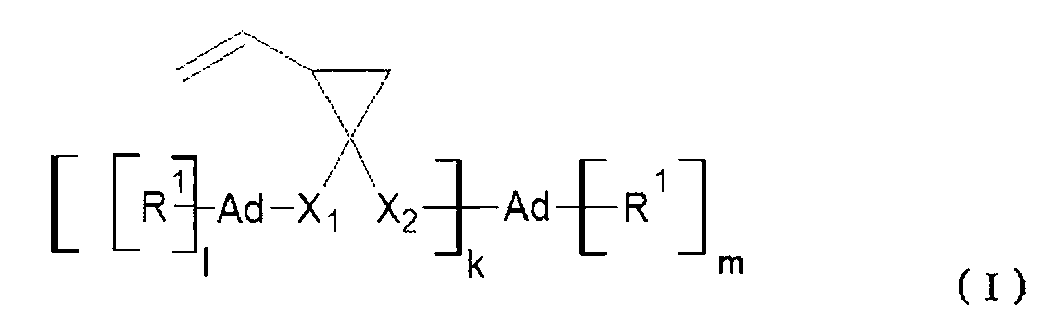
前記R1としては、−H、−OH、−NH2、−NO2、−COOR、−CN、=O、−OCOCH=CH2、−OCO(CH3)C=CH2、ハロゲン、炭素数が1~20のアルキレン基、炭素数が3~20のシクロアルキレン基若しくは炭素数が6~14のアリーレン基、又は、O、S、N若しくはNHにより介在される、炭素数が1~20のアルキレン基、炭素数が3~20のシクロアルキレン基若しくは炭素数が6~14のアリーレン基である限り、特に制限はなく、目的に応じて適宜選択することができる。Rが、H、炭素数が1~6のアルキル基、炭素数が3~6のシクロアルキレン基、炭素数が6~14のアリール基、又は炭素数が6~14のヘテロ環基であれば、特に制限はなく、目的に応じて適宜選択することができる。
前記X1としては、CO、CO−O、O−CO、CO−S、S−CO、CO−NR、NR−CO、O、S、SO2、又は単結合を表し、Rが、H、炭素数が1~6のアルキル基、炭素数が3~6のシクロアルキレン基、炭素数が6~14のアリール基、又は炭素数が6~14のヘテロ環基であれば、特に制限はなく、目的に応じて適宜選択することができる。
これらの中でも、エステル(CO−O、O−CO)が好ましい。
前記X2としては、CO、CO−O、O−CO、CO−S、S−CO、CO−NR、NR−CO、O、S、SO2、又は単結合を表し、Rが、H、炭素数が1~6のアルキル基、炭素数が3~6のシクロアルキレン基、炭素数が6~14のアリール基、又は炭素数が6~14のヘテロ環基であれば、特に制限はなく、目的に応じて適宜選択することができる。
これらの中でも、エステル(CO−O、O−CO)が好ましい。
前記kとしては、2~4のいずれかの整数である限り、特に制限はなく、目的に応じて適宜選択することができるが、2が好ましい。
前記kが、1であると、溶媒に対する溶解性が低く、前記kが2以上であると溶解性の点で有利である。しかし、kが4を超えると合成上、煩雑な工程が必要となる。
前記lとしては、1~9のいずれかの整数である限り、特に制限はなく、目的に応じて適宜選択することができる。
前記mとしては、1~8のいずれかの整数である限り、特に制限はなく、目的に応じて適宜選択することができる。
前記Adは、アダマンチル基を表わす。前記アダマンチル基は、アダマンタンの官能基である。
本発明のビニルシクロプロパンは、アダマンチル基が導入されているため、重合条件に左右されにくく、高転化率で開環重合がおこるという利点がある。

本発明のモノマー組成物は、少なくとも、前記ビニルシクロプロパンを含み、さらに、必要に応じて、その他の成分を含む。
前記その他の成分としては、特に制限はなく、目的に応じて適宜選択することができ、例えば、ビニルシクロプロパン以外の重合性化合物、溶媒、重合開始剤、フィラー、安定剤、UV吸収剤、難燃剤、可塑剤、染料、顔料、などが挙げられる。これらは、1種単独で使用してもよいし、2種以上を併用してもよい。
前記ビニルシクロプロパン以外の重合性化合物としては、特に制限はなく、目的に応じて適宜選択することができ、例えば、ビニル系化合物、ジエン系化合物、非ビニル系化合物、などが挙げられる。これらは、1種単独で使用してもよいし、2種以上を併用してもよい。
前記ビニル系化合物としては、特に制限はなく、目的に応じて適宜選択することができ、例えば、(メタ)アクリル酸メチル、(メタ)アクリル酸エチル、(メタ)アクリル酸ブチル、(メタ)アクリル酸ベンジル、(メタ)アクリル酸フルフリル、(メタ)アクリル酸フェニル、(メタ)アクリル酸2−ヒドロキシエチル、(メタ)アクリル酸プロピル、メタクリル酸メシチル、2−(メトキシメチル)アクリル酸、2−(エトキシメチル)アクリル酸、2−(ヒドロキシメチル)アクリル酸、N−エチルアクリルアミド、N,N’−ジメタクリルアミド、N−(2−ヒドロキシエチル)アクリルアミド、N−メチル−N−(2−ヒドロキシエチル)アクリルアミド、N−エチルメタクリルアミド、N−エチルメタクリルアミド、N−(2−ヒドロキシエチル)メタクリルアミド、N−ビニルピロリドン、アリルエーテル、ビスフェノール−A−ジ(メタ)アクリレート、ビス−GMA(メタクリル酸とビスフェノール−A−ジグリシジルエーテルとの付加生成物)、UDMA(メタクリル酸2−ヒドロキシエチルと2,2,4−トリメチルヘキサメチレンジイソシアナートとの付加生成物)、ジエチレングリコールジ(メタ)アクリレート、トリエチレングリコールジ(メタ)アクリレート、テトラエチレングリコールジ(メタ)アクリレート、トリメチロールプロパントリ(メタ)アクリレート、ペンタエリトリトールテトラ(メタ)アクリレート、ブタンジオールジ(メタ)アクリレート、1,10−デカンジオールジ(メタ)アクリレート、1,12−ドデカンジオールジ(メタ)アクリレート、トリシクロデカンジメタノールジメタクリレート、トリス(2−ヒドロキシエチル)イソシアヌル酸又はアクリル酸エステル、9,9−ビス[4−(2−アクリロイルエトキシ)フェニル]フルオレン、N−(2−ヒドロキシエチル)アクリルアミド、エチレン、スチレン、塩化ビニル、ブタジエン、酢酸ビニル、アリルアルコール、アリルアミン臭化アリル、塩化アリル、アリルエーテル、硫化アリル、アリシン、二硫化アリル、アリルイソチオシアネート、アリルアルコール、アリルアミン、臭化アリル、塩化アリル、アリルエーテル、硫化アリル、アリシン、二硫化アリル、アリルイソチオシアネート、などが挙げられる。これらは、1種単独で使用してもよいし、2種以上を併用してもよい。
前記ジエン系化合物としては、特に制限はなく、目的に応じて適宜選択することができ、例えば、天然ゴム(NR)、イソプレンゴム(IR)、ブタジエンゴム(BR)、スチレンブタジエンゴム(SBR)、クロロプレンゴム(CR)、アクリルニトリルブタジエンゴム(ABR)、ブタジエン系ラテックス、アクリロニトリルブタジエンスチレン樹脂(ABS樹脂)、などが挙げられる。これらは、1種単独で使用してもよいし、2種以上を併用してもよい。
前記溶媒としては、特に制限はなく、目的に応じて適宜選択することができ、例えば、低級アルコール、芳香族炭化水素、脂環式炭化水素、脂肪族炭化水素、エステル類、ケトン類、アミド類、エーテル類、などが挙げられる。これらは、1種単独で使用してもよいし、2種以上を併用してもよい。
これらの中でも、芳香族炭化水素が、転化率が良好である点で、好ましい。
前記重合開始剤としては、特に制限はなく、目的に応じて適宜選択することができ、例えば、アゾ系化合物、有機過酸化物、光開始剤などが挙げられる。これらは、1種単独で使用してもよいし、2種以上を併用してもよい。
前記アゾ系化合物としては、特に制限はなく、目的に応じて適宜選択することができ、例えば、アゾビス(イソブチロニトリル)(AIBN)、アゾビス(4−シアノ吉草酸)、などが挙げられる。
前記有機過酸化物としては、特に制限はなく、目的に応じて適宜選択することができ、例えば、過酸化ベンゾイル、過酸化ジラウロイル、tert−ブチルパーオキシド、ベンゾピナコール、2,2’−ジアルキルベンゾピナコール、などが挙げられる。
前記光開始剤としては、UVもしくは可視領域光に適している限り、特に制限はなく、目的に応じて適宜選択することができ、例えば、ベンゾインエーテル、ジアルキルベンゼンケタール、ジアルコキシアセトフェノン、アシルもしくはビスアシルホスフィンオキシド、α−ジケトン(例えば、9,10−フェナントラキノン)、ジアセチル、フリル、アニシル、4,4’−ジクロロベンジル、4,4’−ジアルコキシベンジル、カンファーキノン、などが挙げられる。
前記フィラーは、機械的特性を改良するためのものである。
前記フィラーとしては、特に制限はなく、目的に応じて適宜選択することができ、例えば、無機粒子フィラー(例えば、酸化物をベースにした非晶質球状物質)、微細フィラー(例えば、熱分解シリカ、沈降シリカ)、マクロまたはミニフィラー(例えば、0.01μm~5μmの平均粒子サイズを有する石英粉末、ガラスセラミック粉末、またはガラス粉末)、X線不透過性フィラー(例えば、三フッ化イッテルビウム)、ガラス繊維、ポリアミド繊維、炭素繊維、などが挙げられる。これらは、1種単独で使用してもよいし、2種以上を併用してもよい。
前記安定剤としては、特に制限はなく、目的に応じて適宜選択することができ、例えば、ヒドロキノン(HQ);ヒドロキノンモノメチルエーテル(HQME);4−tert−ブチルカテコール(TBC);アデカスタブLA62、アデカスタブLA67(以上、株式会社ADEKA製)等のヒンダードアミン系光安定剤;チヌビン765、チヌビン144、チヌビン770、チヌビン622(以上、BASFジャパン株式会社製)等のヒンダードアミン系光安定剤;チヌビンB75、チヌビンPUR866(以上、BASFジャパン株式会社製)等のブレンド系光安定剤;などが挙げられる。これらは、1種単独で使用してもよいし、2種以上を併用してもよい。
前記UV吸収剤としては、特に制限はなく、目的に応じて適宜選択することができ、例えば、ベンゾフェノン系UV吸収剤;ベンゾトリアゾール系UV吸収剤;トリアジン系UV吸収剤;シアノアクリレート系UV吸収剤;チヌビン213、チヌビン234、チヌビン326、チヌビン571等(以上、BASFジャパン株式会社製);アデカスタブLA29、アデカスタブLA31、LA31RG、LA31G、LA−32、LA36、LA36RG、LA−46、1413、LA−F70等(以上、アデカ・アーガス化学株式会社製);などが挙げられる。これらは、1種単独で使用してもよいし、2種以上を併用してもよい。
前記その他の成分としては、特に制限はなく、目的に応じて適宜選択することができ、例えば、難燃剤、可塑剤、染料、顔料、などが挙げられる。これらは、1種単独で使用してもよいし、2種以上を併用してもよい。
本発明のポリマーは、本発明のビニルシクロプロパンの重合体である。
前記重合体としては、前記ビニルシクロプロパンの単独重合体(ホモポリマー)、前記ビニルシクロプロパンと該ビニルシクロプロパン以外の重合性化合物との共重合体(コポリマー)のいずれであってもよい。
本発明のポリマーが前記ビニルシクロプロパンと該ビニルシクロプロパン以外の重合性化合物との共重合体(コポリマー)である場合において、前記ビニルシクロプロパン以外の重合性化合物は、前述したものと同様である。
前記モノマー体積に対する体積変化は、ポリマーの構成成分であるモノマー体積に対するポリマーの体積変化であり、重合前のモノマーの25℃における密度(モノマー密度)と、重合後のポリマーの25℃における密度(ポリマー密度)をそれぞれ測定し、下記式により求めたものである。
((モノマー密度)−(ポリマー密度))/(モノマー密度)×100(%)
得られた体積変化(%)の値が正の値であれば、重合に伴い体積膨張が生じる(重合において体積膨張性を示す)。一方、得られた体積変化(%)の値が負の値であれば、重合に伴い体積収縮が生じる(重合において体積収縮性を示す)。
前記ポリマーが前記ビニルシクロプロパンの単独重合体(ホモポリマー)である場合における前記モノマー体積に対する体積変化としては、特に制限はなく、目的に応じて適宜選択することができるが、+5.0%以上が好ましい。
前記モノマーの体積に対する体積変化が、+5.0%未満であると、前記ポリマーが共重合体(コポリマー)である場合に体積収縮が大きいことがある。一方、前記モノマーの体積に対する体積変化が、前記より好ましい範囲内又は前記特に好ましい範囲内であると、前記ビニルシクロプロパンとビニル系化合物等のような体積収縮性の高い重合性化合物とを共重合することにより、体積変化率を所望の範囲に調整することが容易となる点で有利である。
本発明のポリマー組成物は、少なくとも、本発明のポリマーを含み、さらに、必要に応じて、その他の成分を含む。
前記その他の成分としては、特に制限はなく、目的に応じて適宜選択することができ、例えば、ビニルシクロプロパン以外の重合性化合物、溶媒、重合開始剤、フィラー、安定剤、UV吸収剤、難燃剤、可塑剤、染料、顔料、などが挙げられる。これらは、1種単独で使用してもよいし、2種以上を併用してもよい。
本発明の物品は、本発明のモノマー組成物を硬化させて得られるものである。
前記物品としては、本発明のモノマー組成物を硬化させて得られるものである限り、特に制限はなく、目的に応じて適宜選択することができ、例えば、光学材料、成形材料、複合材料、注型材料、封止材料、医用材料、歯科材料、記録材料、セメント、塗料、接着剤、ホログラム光記録媒体の材料、などが挙げられる。
前記硬化としては、特に制限はなく、目的に応じて適宜選択することができ、例えば、熱硬化、光硬化、などが挙げられる。これらは、1種単独で使用してもよいし、2種以上を併用してもよい。
前記熱硬化における加熱温度としては、特に制限はなく、目的に応じて適宜選択することができるが、60℃~180℃が好ましい。前記加熱温度が、60℃未満であると、転化率が低いことがあり、180℃を超えると、徐々に熱分解が生じうる。前記熱硬化における加熱時間としては、特に制限はなく、目的に応じて適宜選択することができる。
<1,3−ビス[(1−アダマンチルオキシカルボニル−2−ビニルシクロプロパン−1−イル)カルボニルオキシ]アダマンタン(Ad−MVCP)の合成>
下記構造式(6)で表わされる化合物を、以下の反応スキームに示すように、第一段階反応、第二段階反応、及び第三段階反応を経て製造した。
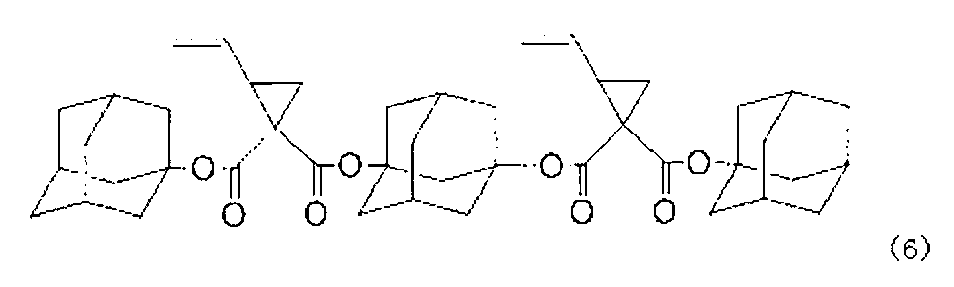

<<第一段階反応(O−アダマンチルマロン酸(Ad−COOH)の合成)>>
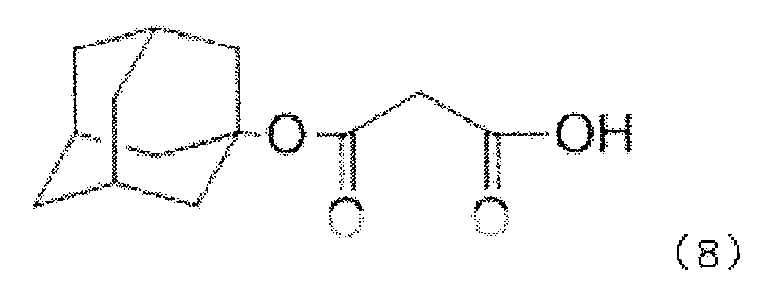
主管に三方コックを取り付けたジムロート冷却管を備え、側管をラバーセプタムキャップで封をし、内部に攪拌子を入れた二口フラスコ(100mL)をヒートガンで加熱しながら、真空ポンプで脱気乾燥を行い器具表面に付着している水分を完全に除去した。その後、窒素を封入したガス捕集袋(または風船)を三方コックに繋ぎ、反応器内に窒素を導入した。その後、側管から、1−アダマンタノール9.14g(60mmol)と、メルドラム酸8.65g(60mmol)を投入した。その際、一時的に開封状態となるため、窒素を導入したガス捕集袋を押して窒素を流しながら投入し空気の混入を防いだ。投入後、再びラバーセプタムで密封し、トルエン(脱水)60mLを加え、スターラーで攪拌を行いながらオイルバスを120℃まで昇温した。トルエンの還流が確認できた時点から4時間保持し反応を行った。反応後は室温まで冷却し、抽出を行うため分液ロートに移した。そこへ炭酸水素ナトリウム飽和水溶液600mLを加え、分液操作を行った。分液後、生成物はNa塩となるため水層側に存在する。この水層を1Nの塩酸900mLに滴下した。生成物のNa塩を塩酸へ投入することで末端をカルボン酸ナトリウム塩からカルボン酸にした。この際、炭酸ガスが発生するため、ガスの発生が落ち着くまで1時間ほど静置する。この溶液は1500mLと大容量になるため、500mLずつ分液ロートに移しジクロロメタン200mLで3回抽出を行い、有機層を三角フラスコに回収した。得られた有機層1200mLは硫酸マグネシウム(無水)で30分間乾燥し、ろ過後、エバポレーターで溶媒を留去した。その後、真空ポンプを用いて溶媒を完全に留去、冷蔵庫で冷却することで白色固体として生成物(O−アダマンチルマロン酸(Ad−COOH);下記構造式(8)で表わされる化合物)を得た。生成物はNMR(図1及び2)、液体クロマトグラフィー/質量分析法(LC/MS)(図3)で構造を評価し、LC/MSの面積比より純度を求めた(収率93.7%、純度100.0%)。
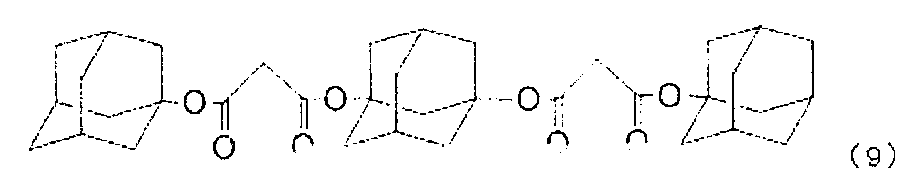
主管に上部をラバーセプタムで蓋をした滴下ロート、側管に三方コックを備えたジムロート冷却管、もう一方の側管をラバーセプタムで蓋をし、内部に攪拌子を備えた三口フラスコ(1000mL)をヒートガンで加熱しながら、真空ポンプで脱気乾燥を行い器具表面に付着している水分を完全に除去した。その後、窒素を封入したガス捕集袋(または風船)を三方コックに繋ぎ、反応器内に窒素を導入した。その後、側管からAdCOOH12.0g(50.39mmol)、1,3−アダマンタンジオール4.236g(25.18mmol)を投入した。その際、一時的に開封状態となるため、窒素を導入したガス捕集袋を押して窒素を流しながら投入し空気の混入を防いだ。投入後、再びラバーセプタムで密封し、テトラヒドロフラン(THF)(超脱水)を540mL加え、室温下で2時間、強く攪拌した。攪拌の際、1,3−アダマンタンジオールが非常に溶解しにくいため、目視で溶解したか確認し、溶解していなければ溶解するまで攪拌を行った。三口フラスコは1,3−アダマンタンジオール溶解後、10分間氷浴を行い、氷浴を保持したまま21分間かけて攪拌しながら、別途脱気乾燥した容器内で調製したN,N´−ジシクロヘキシルカルボジイミド(DCC)10.40g(50.41mmol)のTHF(120mL)溶液を滴下ロートから滴下した。滴下後、氷浴をはずし、室温下で3時間攪拌し反応を行った。反応は薄層クロマトグラフィー(TLC)およびLC/MSを用いて反応追跡を行った。反応後、フラスコ内には大量に析出したウレア体が存在するため、ろ過を行って溶液を回収した。回収した溶液はエバポレーターおよび真空ポンプを用いて完全に溶媒を留去した。得られた粗生成物はカラムクロマトグラフィー(シリカゲル)を行い精製した。カラムは直径90cmのカラム管を用いオープンカラムで行った。シリカゲルの高さを300mm(シリカゲル質量約1200g)とし、展開溶媒にはトルエン:ジエチルエーテル=9:1を用いた。粗生成物は展開溶媒80mlで溶解した。カラムの流速100ml/30分間で行った。溶液はTLCで生成物の有無を確認した。カラム後の溶液は、エバポレーターおよび真空ポンプを用いて完全に溶媒を留去し、冷蔵庫で冷却することで生成物の白色固体を得た。生成物(1,3−ビス[(1−アダマンチルオキシ)カルボニルオキシ]アダマンタン(Ad3);下記構造式(9)で表わされる化合物)はNMR(図4及び5)、LC/MS(図6)で構造を評価し、LC/MSの面積比より純度を求めた(収率56.7%、純度100.0%)。
主管に上部をラバーセプタムで蓋をした滴下ロート、側管に三方コックを備えたジムロート冷却管、もう一方の側管をラバーセプタムで蓋をし、内部に攪拌子を備えた三口フラスコ(1000mL)をヒートガンで加熱しながら、真空ポンプで脱気乾燥を行い器具表面に付着している水分を完全に除去した。その後、窒素を封入したガス捕集袋(または風船)を三方コックに繋ぎ、反応器内に窒素を導入した。その後、側管からNaH(流動パラフィンに分散)を3.848g(NaH量2.336g、97.36mmol)投入した。その際、一時的に開封状態となるため、窒素を導入したガス捕集袋を押して窒素を流しながら投入し空気の混入を防いだ。投入後、NaHの流動パラフィンを除去するためデカンテーションを行った。方法はフラスコへn−ヘキサン(超脱水)480mLを加え、30分間攪拌した。その後、5分間静置することで流動パラフィンが洗浄されたNaHが沈殿するので、その上澄みをシリンジで除去した。この洗浄操作を3回繰り返した。続いて、真空ポンプで減圧下NaHを乾燥させた。デカンテーション後、trans−1,4−ジブロモ−2−ブテンを5.624g(26.29mmol)、THF(超脱水)240mLを加え30分間攪拌した。その後、攪拌したまま氷浴を15分間行い十分に冷却した。続いて氷浴を保持しながら200分間かけて、別途脱気乾燥した容器内で調製した1,3−ビス[(1−アダマンチルオキシ)カルボニルオキシ]アダマンタン(Ad3)8.0g(13.14mmol)のTHF(120mL)溶液を滴下ロートから滴下した。(注:滴下時間は仕込み量に比例する。例:1,3−ビス[(1−アダマンチルオキシ)カルボニルオキシ]アダマンタン(Ad3)1.0gなら25分間)。滴下後、氷浴をはずし、70℃で3時間攪拌を行い反応させた。反応はTLCおよびLC/MSを用いて反応追跡を行った。反応後、室温まで冷却し、水360mLを少量ずつ加え過剰の水素化ナトリウムを失活させた。この際、水素ガスが多量に発生し、さらに発熱が起こり非常に危険であるため大気開放および氷浴下で操作を行った。ろ過後、エバポレーターでTHFのみを留去し、ジエチルエーテル360mLを加え、分液ロート(1000mL)へ移して抽出を行った。はじめに水層を除去し、炭酸水素ナトリウム飽和水溶液400mLで3回、塩化ナトリウム飽和水溶液400mLで4回抽出操作を行った。有機層は回収し、硫酸マグネシウム(無水)で30分間乾燥し、ろ過後、エバポレーター、真空ポンプで溶媒を留去し粗生成物の固体を得た。得られた粗生成物はカラムクロマトグラフィー(シリカゲル)を行い精製した。カラムは直径90cmのカラム管を用いフラッシュカラムで行った。シリカゲルの高さを250mm(シリカゲル質量約900g)、展開溶媒にはn−ヘキサン:酢酸エチル=10:1を用いた。粗生成物は展開溶媒30mLで溶解した。加圧には二連球を用いた。溶液はTLCで生成物の有無を確認した。カラム後の溶液は、エバポレーターおよび真空ポンプを用いて完全に溶媒を留去し、白色固体として生成物(1,3−ビス[(1−アダマンチルオキシカルボニル−2−ビニルシクロプロパン−1−イル)カルボニルオキシ]アダマンタン(Ad−MVCP);下記構造式(6)で表わされる化合物)を得た。生成物はNMR(図7及び8)、フーリエ変換赤外分光光度計(FT−IR)(図9)、LC/MS(図10)で構造を評価し、LC/MSの面積比より純度を求めた(収率49.6%、純度100.0%)。
まず、得られたモノマー(構造式(6)の化合物)の重合を下記のように行った。
凍結アンプル管(20mL)にAIBN4.03mg(4mol%)、Ad−MVCP440.2mg(0.61mmol)、トルエン0.267g(0.31ml)を投入し、モノマーを溶解させた。その後、凍結乾燥を3回行い溶存酸素の除去を行った。凍結アンプル管をオイルバスに浸し、60℃、48時間加熱し、モノマーの重合を行った。重合後、液体窒素で冷却し、ラジカルを失活させた。そこへトルエン50mLを加え、ポリマー以外の不溶成分を溶解させ、吸引ろ過を行った。ろ紙上のポリマーはトルエン、アセトンで洗浄し、100℃、48時間、真空乾燥させ、白色固体のポリマーを回収した。回収したポリマーを評価サンプルとした。
前記重合体(ポリマー)はネットワークを形成しており溶媒に溶けない。このため前記ポリマーが1,5−開環構造であるかの判断は、13C NMR(CP−MAS)により確認した(図11)。
前記の操作で作製した各サンプルのモノマー密度及びポリマー密度を乾式自動密度計(アキュピックII1340、株式会社島津製作所製)を用いて測定し、下記式を用いて、重合時における体積変化を算出した。
((モノマー密度)−(ポリマー密度))/(モノマー密度)×100(%)
得られた値が、正の値であれば体積膨張を示し、負の値であれば体積収縮を示す。
得られたモノマーに、パーヘキサHC0.5質量部(製造会社名:日油株式会社)、及びアセトン0.2mLを添加し、均一にした後、アルミ板上に作製した10mm×40mm×0.5mmのシリコンゴムシートの型に流し、真空オーブン内に移動させた。室温で20~40cmHgに保ち、アセトン溶媒を気化させた後、常圧状態に戻し、140℃で5時間硬化させ、硬化物を作製した。作製した硬化物は、動的粘弾性測定装置(DMA)の引っ張りモードで下記に示すように測定し、評価した。
得られたモノマー40mgの各種溶剤(メチルエチルケトン(MEK)、アセトン、プロピレングリコールモノメチルエーテルアセテート(PGMEA)、シクロヘキサノン)1.0mLに対する溶解性を評価した。
前記(i)重合時における体積変化の評価で用いた重合体(ポリマー)について、熱重量分析装置(製造会社名:セイコーインスツルメント株式会社、商品名:EXSTAR6000)を用いて、耐熱性評価を行った。さらに、前記得られた重合体(ポリマー)の熱重量変化を測定し、重量が10%減少した温度を求め、10%重量損失温度を熱分解温度(Td10)とした。
実施例1において、合成した(1,3−ビス[(1−アダマンチルオキシカルボニル−2−ビニルシクロプロパン−1−イル)カルボニルオキシ]アダマンタン(Ad−MVCP)を用いる代わりに、下記構造式(10)で表されるトリシクロデカンジメタノールジメタクリレート(製造会社名:新中村化学工業株式会社、商品名:NKエステルDCP)を用いたこと以外は、実施例1と同様にして、(i)重合時における体積変化及び(ii)重合体の動的粘弾性を評価した。評価結果を下記表1~表3に示す。

実施例1において、合成した(1,3−ビス[(1−アダマンチルオキシカルボニル−2−ビニルシクロプロパン−1−イル)カルボニルオキシ]アダマンタン(Ad−MVCP)を用いる代わりに、下記構造式(5)で表わされる1,1−ビス[(1−アダマンチルオキシ)カルボニル]−2−ビニルシクロプロパン(Ad−VCP)を用いたこと以外は、実施例1と同様にして、(i)重合時における体積変化、(ii)重合体の動的粘弾性、(iii)モノマーの溶解性、及び(iv)重合体の耐熱性を、評価した。評価結果を下記表1、3、及び4に示す。
ここで、Ad−VCPは、Ueda et al., Macromolecules,27,5543(1994)の記載に基づいて合成した。
なお、比較例2では、得られた重合体(ポリマー)をジクロロメタン20mLに溶解させ、メタノール200mLに注いで沈殿を生成させ、生成した白色ポリマーを3回の再沈殿操作によって精製し、100℃で加熱しながら48時間真空乾燥を行い、白色固体のポリマーを回収した。回収したポリマーを評価サンプルとした。
実施例1において、合成した(1,3−ビス[(1−アダマンチルオキシカルボニル−2−ビニルシクロプロパン−1−イル)カルボニルオキシ]アダマンタン(Ad−MVCP)を用いる代わりに、下記構造式(1)で表される1,3−ビス[(1−メトキシカルボニル−2−ビニルシクロプロパン−1−イル)カルボキシ]ベンゼン(Me−MVCP)を用いた以外は、実施例1と同様にして、(i)重合時における体積変化を評価した。評価結果を下記表1に示す。
ここで、Me−MVCPは、N. Moszner et al., Journal of Applied Polymer Science, 72, 1775 (1999)の記載に基づいて合成した。
なお、比較例3では、モノマーの重合は上記文献に基づき、バルク重合でおこなった。凍結アンプル管(20mL)にAIBN15.8mg(0.096mmol)、Me−MVCP1.000g(2.41mmol)を投入し、モノマーを溶解させた。その後、凍結乾燥を3回行い溶存酸素の除去を行った。凍結アンプル管をオイルバスに浸し、60℃、48時間加熱し、モノマーの重合を行った。重合後、液体窒素で冷却し、ラジカルを失活させた。そこへトルエン50mLを加え、ポリマー以外の不溶成分を溶解させ、吸引ろ過を行った。ろ紙上のポリマーはトルエン、アセトンを用いて十分に洗浄し、100℃で加熱しながら48時間真空乾燥を行い、白色固体のポリマーを回収した。回収したポリマーを評価サンプルとした。

実施例1において、合成した(1,3−ビス[(1−アダマンチルオキシカルボニル−2−ビニルシクロプロパン−1−イル)カルボニルオキシ]アダマンタン(Ad−MVCP)を単独で用いる代わりに、Ad−MVCPとトリシクロデカンジメタノールジメタクリレート(DCP)(製造会社名:新中村化学工業株式会社、商品名:NKエステルDCP)との2種類のモノマーを等量(mmol)用いたこと以外は、実施例1と同様にして、(i)重合時における体積変化を評価した。評価結果を下記表2に示す。
なお、実施例2では、DCP0.159g(0.479mmol)、Ad−MVCP0.341g(0.479mmol)、トルエン(脱水)0.2mL、及び攪拌子をアンプル管に入れて70℃に加熱し、攪拌して均一にさせた。室温まで冷却させた後、AIBNの希釈溶液(AIBN6.3mgをトルエン(脱水)0.28mLに溶解(0.038mmol))をアンプル管に入れ、凍結脱気後、ガスバーナでアンプル管を封管させた。アンプル管をオイルバスに浸し、60℃、48時間反応させた。反応後、アンプル管を液体窒素に浸し、重合体(ポリマー)を回収した。得られた重合体(ポリマー)はトルエンおよびアセトンで十分洗浄し、100℃で加熱しながら48時間真空乾燥を行い、白色固体のポリマーを回収した。回収したポリマーを評価サンプルとした。
また、実施例2では、下記に示すように、モノマー密度評価サンプルを作製した。
Ad−MVCP0.153g(0.215mmol)とDCP0.072g(0.216mmol)をアセトン0.3mLに溶解し、均一にした。アセトンを除去後、室温で72時間、真空乾燥させ、得られたモノマーを密度評価サンプルとした。
実施例2において、DCPとAd−MVCPのモノマーを等量で用いる代わりに、DCPとAd−MVCPとのモノマー比を1:2としたこと以外は、実施例2と同様にして、(i)重合時における体積変化を評価した。評価結果を下記表2に示す。
実施例2において、DCPとAd−MVCPのモノマーを等量で用いる代わりに、DCPとAd−MVCPとのモノマー比を1:3としたこと以外は、実施例2と同様にして、(i)重合時における体積変化を評価した。評価結果を下記表2に示す。
比較例1~3、実施例1の単独重合による体積変化の評価結果を表1に示す。

実施例1は+6.1%の体積膨張性を発現することが確認できたため、収縮性を示す比較例1のDCP(−8.5%)に対して1~3倍等量の実施例1のビニルシクロプロパン(Ad−MVCP)を共重合させて得た実施例2~4の共重合体において、実施例1のビニルシクロプロパン(Ad−MVCP)を共重合体の構成成分として含むことで、収縮の緩和を認めるかを確認した。比較例1及び実施例1~4の共重合による体積変化の結果を表2に示す。
実施例1と比較例1、2の重合体の動的粘弾性の結果を表3に示す。

アダマンチル基を有するモノマー化合物(比較例2及び実施例1)のモノマー溶解性の評価結果を表4に示す。

比較例2及び実施例1の重合体について耐熱性を評価したところ、比較例2のAd−VCPの単独重合体のTd10が361℃であるのに対し、実施例1のビニルシクロプロパン(Ad−MVCP)の単独重合体のTd10は399℃を示し、実施例1のビニルシクロプロパン(Ad−MVCP)の単独重合体は、比較例2のAd−VCPの単独重合体よりも耐熱性が優れることが分かった。実施例1のビニルシクロプロパン(Ad−MVCP)の単独重合体は、アダマンチル基とネットワーク構造形成による効果で耐熱性が向上したものと考えられる。
1H−NMR(CDCl3)d1.66ppm(m,6H,adamantyl),2.10−2.20ppm(m,9H,adamantyl),3.50ppm(s,2H,−OOCCH2COO−),11.34ppm(s,1H,−COOH).
13C−NMR(CDCl3)d30.77ppm(C−f),35.90ppm(C−g),40.95ppm(C−e),42.03ppm(C−d),82.85ppm(C−c),165.77ppm(C−b),171.94ppm(C−a).
m/z−237.4(M−H)
1H−NMR(CDCl3)d1.57ppm(s,2H,adamantyl),1.60−1.70ppm(m,12H,adamantyl),2.00−2.20ppm(m,26H,adamantyl),2.36ppm(s,2H,adamantyl),2.48ppm(s,2H,adamantyl),3.18ppm(s,−OOCCH2COO−,4H).
13C−NMR(CDCl3)d30.08ppm(C−k),31.10(C−l),34.64ppm(C−j),36.08ppm(C−i),39.77ppm(C−h),41.13ppm(C−g),44.32ppm(C−e),45.01ppm(C−f),81.77 and 81.85ppm(C−c/d),165.07ppm(C−a/b).
m/z−1234.9(2M+NH4),625.5(M+NH4).
1H−NMR(CDCl3)d1.35−1.54ppm(m,HCH<ofcyclopropane,4H),1.57ppm(s,2H,adamantly),1.60−1.70ppm(m,adamantly,12H), 2.00−2.20ppm(m,adamantly and CH< of cyclopropane,6H+12H+8H),5.08−5.50ppm(m,HCH=CH 及び CH2=CH,6H).
13C−NMR(CDCl3)d20.09ppm(C−o),30.02ppm(C−p),30.95ppm(C−m),31.27ppm(C−n),34.90ppm(C−l),36.28ppm(C−k),37.80ppm(C−j),40.09ppm(C−i),41.41ppm(C−h),45.36ppm(C−g),81.71及び82.02ppm(C−e/f),117.95ppm(C−d),133.62ppm(C−c),166.57及び168.89ppm(C−a/b).
FT−IR(KBr):1702cm−1(C=O),1639cm−1(C=C).
m/z−1444.7(2M+NH4),730.4(M+NH4),713.6(M+H).
モノマー:14.34−24.78ppm,24.78−52.03ppm,78.60−85.24ppm,113.83−123.61ppm,130.80−139.54ppm,162.51−170.0ppm.
ポリマー:17.77−24.02ppm,24.02−50.98ppm,56.10−64.84ppm,77.54−84.96ppm,114.45−139.06ppm,164.84−173.44ppm.
Claims (15)
- 下記一般式(I)で表されることを特徴とするビニルシクロプロパン。

R1は、−H、−OH、−NH2、−NO2、−COOR、−CN、=O、−OCOCH=CH2、−OCO(CH3)C=CH2、ハロゲン、炭素数が1~20のアルキレン基、炭素数が3~20のシクロアルキレン基若しくは炭素数が6~14のアリーレン基、又は、O、S、N若しくはNHにより介在される、炭素数が1~20のアルキレン基、炭素数が3~20のシクロアルキレン基若しくは炭素数が6~14のアリーレン基を表し、
X1は、CO、CO−O、O−CO、CO−S、S−CO、CO−NR、NR−CO、O、S、SO2、又は単結合を表し、
X2は、CO、CO−O、O−CO、CO−S、S−CO、CO−NR、NR−CO、O、S、SO2、又は単結合を表し、
R1、X1及びX2において、Rは、H、炭素数が1~6のアルキル基、炭素数が3~6のシクロアルキレン基、炭素数が6~14のアリール基、又は炭素数が6~14のヘテロ環基を表し、
kは、2~4のいずれかの整数を表し、
lは、1~9のいずれかの整数を表し、
mは、1~8のいずれかの整数を表し、
Adは、アダマンチル基
を表す。] - 前記X1及びX2が、エステルである請求項1に記載のビニルシクロプロパン。
- 前記kが2である請求項1から2のいずれかに記載のビニルシクロプロパン。
- 請求項1から2のいずれかに記載のビニルシクロプロパンを含むことを特徴とするモノマー組成物。
- 請求項3に記載のビニルシクロプロパンを含むことを特徴とするモノマー組成物。
- 請求項1から2のいずれかに記載のビニルシクロプロパンの重合体であることを特徴とするポリマー。
- 請求項3に記載のビニルシクロプロパンの重合体であることを特徴とするポリマー。
- 前記ビニルシクロプロパンのモノマー体積に対する体積変化が、+5.0%以上である請求項6に記載のポリマー。
- 前記重合体が、前記ビニルシクロプロパンと該ビニルシクロプロパン以外の重合性化合物との共重合体である請求項6に記載のポリマー。
- 請求項6に記載のポリマーを含むことを特徴とするポリマー組成物。
- 請求項7に記載のポリマーを含むことを特徴とするポリマー組成物。
- 請求項8に記載のポリマーを含むことを特徴とするポリマー組成物。
- 請求項9に記載のポリマーを含むことを特徴とするポリマー組成物。
- 請求項4に記載のモノマー組成物を硬化させてなることを特徴とする物品。
- 請求項5に記載のモノマー組成物を硬化させてなることを特徴とする物品。
Priority Applications (3)
| Application Number | Priority Date | Filing Date | Title |
|---|---|---|---|
| KR1020167025147A KR20160148516A (ko) | 2014-03-11 | 2015-02-24 | 비닐시클로프로판, 모노머 조성물, 폴리머, 폴리머 조성물, 및 물품 |
| US15/124,798 US9580524B2 (en) | 2014-03-11 | 2015-02-24 | Vinylcyclopropane, monomer composition, polymer, polymer composition, and article |
| CN201580013081.1A CN106103504A (zh) | 2014-03-11 | 2015-02-24 | 乙烯基环丙烷、单体组合物、聚合物、聚合物组合物及物品 |
Applications Claiming Priority (2)
| Application Number | Priority Date | Filing Date | Title |
|---|---|---|---|
| JP2014048153A JP6315781B2 (ja) | 2014-03-11 | 2014-03-11 | ビニルシクロプロパン、モノマー組成物、ポリマー、ポリマー組成物、及び物品 |
| JP2014-048153 | 2014-03-11 |
Publications (1)
| Publication Number | Publication Date |
|---|---|
| WO2015137173A1 true WO2015137173A1 (ja) | 2015-09-17 |
Family
ID=54071621
Family Applications (1)
| Application Number | Title | Priority Date | Filing Date |
|---|---|---|---|
| PCT/JP2015/056017 Ceased WO2015137173A1 (ja) | 2014-03-11 | 2015-02-24 | ビニルシクロプロパン、モノマー組成物、ポリマー、ポリマー組成物、及び物品 |
Country Status (5)
| Country | Link |
|---|---|
| US (1) | US9580524B2 (ja) |
| JP (1) | JP6315781B2 (ja) |
| KR (1) | KR20160148516A (ja) |
| CN (1) | CN106103504A (ja) |
| WO (1) | WO2015137173A1 (ja) |
Families Citing this family (3)
| Publication number | Priority date | Publication date | Assignee | Title |
|---|---|---|---|---|
| ES2718766T3 (es) * | 2016-08-03 | 2019-07-04 | Ivoclar Vivadent Ag | Materiales dentales a base de derivados de vinilciclopropano que contienen grupos uretano |
| JP7556879B2 (ja) | 2019-04-15 | 2024-09-26 | デンツプライ シロナ インコーポレイテッド | 歯科用組成物 |
| JP2026084453A (ja) * | 2024-11-11 | 2026-05-21 | 日東電工株式会社 | 光学積層体および光学部材の製造方法 |
Citations (4)
| Publication number | Priority date | Publication date | Assignee | Title |
|---|---|---|---|---|
| US4391823A (en) * | 1980-02-19 | 1983-07-05 | Rhone-Poulenc Agrochimie | Novel polycyclic insecticidal esters |
| JPH1045661A (ja) * | 1996-03-18 | 1998-02-17 | Ivoclar Ag | 多官能性ビニルシクロプロパン誘導体 |
| JP2010260946A (ja) * | 2009-05-01 | 2010-11-18 | Univ Of Electro-Communications | ビニルシクロプロパン化合物を含む感光性組成物 |
| JP2010260945A (ja) * | 2009-05-01 | 2010-11-18 | Nissan Chem Ind Ltd | 低重合収縮性ビニルシクロプロパン化合物及びその重合方法 |
-
2014
- 2014-03-11 JP JP2014048153A patent/JP6315781B2/ja active Active
-
2015
- 2015-02-24 US US15/124,798 patent/US9580524B2/en active Active
- 2015-02-24 KR KR1020167025147A patent/KR20160148516A/ko not_active Withdrawn
- 2015-02-24 CN CN201580013081.1A patent/CN106103504A/zh active Pending
- 2015-02-24 WO PCT/JP2015/056017 patent/WO2015137173A1/ja not_active Ceased
Patent Citations (4)
| Publication number | Priority date | Publication date | Assignee | Title |
|---|---|---|---|---|
| US4391823A (en) * | 1980-02-19 | 1983-07-05 | Rhone-Poulenc Agrochimie | Novel polycyclic insecticidal esters |
| JPH1045661A (ja) * | 1996-03-18 | 1998-02-17 | Ivoclar Ag | 多官能性ビニルシクロプロパン誘導体 |
| JP2010260946A (ja) * | 2009-05-01 | 2010-11-18 | Univ Of Electro-Communications | ビニルシクロプロパン化合物を含む感光性組成物 |
| JP2010260945A (ja) * | 2009-05-01 | 2010-11-18 | Nissan Chem Ind Ltd | 低重合収縮性ビニルシクロプロパン化合物及びその重合方法 |
Non-Patent Citations (2)
| Title |
|---|
| JUN-ICHI SUGIYAMA ET AL.: "Free Radical Ring- Opening Polymerization of 1,1-Bis[(1- adamantyloxy)carbonyl]-2-vinylcyclopropane", MACROMOLECULES, vol. 29, no. 6, 1996, pages 1943 - 1950, XP000554349 * |
| NORBERT MOSZNER ET AL.: "Polymerization of Cyclic Monomers. VII. Synthesis and Radical Polymerization of 1,3-Bis[(1-alkoxycarbonyl-2- vinylcyclopropane-1-yl)carboxy]benzenes", JOURNAL OF APPLIED POLYMER SCIENCE, vol. 72, no. 13, 1999, pages 1775 - 1782, XP055224434, ISSN: 0021-8995 * |
Also Published As
| Publication number | Publication date |
|---|---|
| US9580524B2 (en) | 2017-02-28 |
| JP6315781B2 (ja) | 2018-04-25 |
| KR20160148516A (ko) | 2016-12-26 |
| JP2015172133A (ja) | 2015-10-01 |
| US20170022302A1 (en) | 2017-01-26 |
| CN106103504A (zh) | 2016-11-09 |
Similar Documents
| Publication | Publication Date | Title |
|---|---|---|
| JP6750657B2 (ja) | 重合性化合物、重合性組成物、高分子、及び光学異方体 | |
| JP5187825B2 (ja) | ハイパーブランチポリマー及びその製造方法 | |
| Li et al. | Photoinitiators with low migration capability based on benzophenone | |
| JP6315781B2 (ja) | ビニルシクロプロパン、モノマー組成物、ポリマー、ポリマー組成物、及び物品 | |
| JP2015129210A (ja) | ブロックカルボン酸型光配向材料 | |
| Kim et al. | Preparation and properties of UV-curable di-functional sulfur-containing thioacrylate and thiourethane acrylate monomers with high refractive indices | |
| JP4957497B2 (ja) | ポリヘミアセタールエステル、硬化樹脂用組成物及び硬化樹脂の分解方法 | |
| KR102217181B1 (ko) | 공중합체의 제조 방법 | |
| JPWO2017170701A1 (ja) | 重合性組成物、硬化物及びディスプレイ用光学フィルム並びに硬化物を製造する方法 | |
| JP6389246B2 (ja) | 少なくとも3つのモノマーから作製される無糖の統計的コポリマー | |
| JP5877507B2 (ja) | 耐硬化収縮性の硬化性組成物、当該硬化性組成物を硬化させた硬化物、及び方法 | |
| JP3002152B2 (ja) | 多官能性ビニルシクロプロパン誘導体 | |
| JP2015172133A5 (ja) | ||
| JP7047834B2 (ja) | 重合体およびポジ型レジスト組成物 | |
| Pasupuleti et al. | Ultrasonic degradation of poly (styrene-co-alkyl methacrylate) copolymers | |
| JP7840534B2 (ja) | 高分子複合材料及びその製造方法並びに高分子組成物 | |
| Coreño Alonso et al. | Synthesis of two PET waste derived bisacrylic and bisallylic monomers and their potential use as crosslinking agents and dental resin composites | |
| JP5085263B2 (ja) | フォトレジスト用高分子化合物及びフォトレジスト組成物 | |
| TW201840527A (zh) | 單體、聚合物及正光阻劑組成物 | |
| WO2012017879A1 (ja) | 硬化性樹脂組成物および成形体 | |
| WO2004041877A1 (ja) | 含フッ素ポリマー | |
| Mathias et al. | Superfast Methacrylate Photomonomers: Ester Derivatives of Ethyl. alpha.-Hydroxymethacrylates | |
| JP2022044150A (ja) | 圧電材料用組成物及び圧電材料 | |
| Moszner et al. | Synthesis, characterization and polymerization of waxy monomers | |
| JP2013139500A (ja) | 星型ポリマー及び原子移動ラジカル重合開始剤 |
Legal Events
| Date | Code | Title | Description |
|---|---|---|---|
| 121 | Ep: the epo has been informed by wipo that ep was designated in this application |
Ref document number: 15761422 Country of ref document: EP Kind code of ref document: A1 |
|
| ENP | Entry into the national phase |
Ref document number: 20167025147 Country of ref document: KR Kind code of ref document: A |
|
| WWE | Wipo information: entry into national phase |
Ref document number: 15124798 Country of ref document: US |
|
| NENP | Non-entry into the national phase |
Ref country code: DE |
|
| 122 | Ep: pct application non-entry in european phase |
Ref document number: 15761422 Country of ref document: EP Kind code of ref document: A1 |