WO2015129263A1 - スフェロイド作製用デバイス、スフェロイドの回収方法及び製造方法 - Google Patents
スフェロイド作製用デバイス、スフェロイドの回収方法及び製造方法 Download PDFInfo
- Publication number
- WO2015129263A1 WO2015129263A1 PCT/JP2015/000950 JP2015000950W WO2015129263A1 WO 2015129263 A1 WO2015129263 A1 WO 2015129263A1 JP 2015000950 W JP2015000950 W JP 2015000950W WO 2015129263 A1 WO2015129263 A1 WO 2015129263A1
- Authority
- WO
- WIPO (PCT)
- Prior art keywords
- spheroid
- producing device
- opening
- medium
- producing
- Prior art date
- Legal status (The legal status is an assumption and is not a legal conclusion. Google has not performed a legal analysis and makes no representation as to the accuracy of the status listed.)
- Ceased
Links
Images











Classifications
-
- C—CHEMISTRY; METALLURGY
- C12—BIOCHEMISTRY; BEER; SPIRITS; WINE; VINEGAR; MICROBIOLOGY; ENZYMOLOGY; MUTATION OR GENETIC ENGINEERING
- C12M—APPARATUS FOR ENZYMOLOGY OR MICROBIOLOGY; APPARATUS FOR CULTURING MICROORGANISMS FOR PRODUCING BIOMASS, FOR GROWING CELLS OR FOR OBTAINING FERMENTATION OR METABOLIC PRODUCTS, i.e. BIOREACTORS OR FERMENTERS
- C12M25/00—Means for supporting, enclosing or fixing the microorganisms, e.g. immunocoatings
- C12M25/01—Drops
-
- C—CHEMISTRY; METALLURGY
- C12—BIOCHEMISTRY; BEER; SPIRITS; WINE; VINEGAR; MICROBIOLOGY; ENZYMOLOGY; MUTATION OR GENETIC ENGINEERING
- C12M—APPARATUS FOR ENZYMOLOGY OR MICROBIOLOGY; APPARATUS FOR CULTURING MICROORGANISMS FOR PRODUCING BIOMASS, FOR GROWING CELLS OR FOR OBTAINING FERMENTATION OR METABOLIC PRODUCTS, i.e. BIOREACTORS OR FERMENTERS
- C12M47/00—Means for after-treatment of the produced biomass or of the fermentation or metabolic products, e.g. storage of biomass
- C12M47/02—Separating microorganisms from the culture medium; Concentration of biomass
-
- C—CHEMISTRY; METALLURGY
- C12—BIOCHEMISTRY; BEER; SPIRITS; WINE; VINEGAR; MICROBIOLOGY; ENZYMOLOGY; MUTATION OR GENETIC ENGINEERING
- C12N—MICROORGANISMS OR ENZYMES; COMPOSITIONS THEREOF; PROPAGATING, PRESERVING, OR MAINTAINING MICROORGANISMS; MUTATION OR GENETIC ENGINEERING; CULTURE MEDIA
- C12N5/00—Undifferentiated human, animal or plant cells, e.g. cell lines; Tissues; Cultivation or maintenance thereof; Culture media therefor
-
- C—CHEMISTRY; METALLURGY
- C12—BIOCHEMISTRY; BEER; SPIRITS; WINE; VINEGAR; MICROBIOLOGY; ENZYMOLOGY; MUTATION OR GENETIC ENGINEERING
- C12N—MICROORGANISMS OR ENZYMES; COMPOSITIONS THEREOF; PROPAGATING, PRESERVING, OR MAINTAINING MICROORGANISMS; MUTATION OR GENETIC ENGINEERING; CULTURE MEDIA
- C12N5/00—Undifferentiated human, animal or plant cells, e.g. cell lines; Tissues; Cultivation or maintenance thereof; Culture media therefor
- C12N5/0062—General methods for three-dimensional culture
-
- C—CHEMISTRY; METALLURGY
- C12—BIOCHEMISTRY; BEER; SPIRITS; WINE; VINEGAR; MICROBIOLOGY; ENZYMOLOGY; MUTATION OR GENETIC ENGINEERING
- C12N—MICROORGANISMS OR ENZYMES; COMPOSITIONS THEREOF; PROPAGATING, PRESERVING, OR MAINTAINING MICROORGANISMS; MUTATION OR GENETIC ENGINEERING; CULTURE MEDIA
- C12N2511/00—Cells for large scale production
-
- C—CHEMISTRY; METALLURGY
- C12—BIOCHEMISTRY; BEER; SPIRITS; WINE; VINEGAR; MICROBIOLOGY; ENZYMOLOGY; MUTATION OR GENETIC ENGINEERING
- C12N—MICROORGANISMS OR ENZYMES; COMPOSITIONS THEREOF; PROPAGATING, PRESERVING, OR MAINTAINING MICROORGANISMS; MUTATION OR GENETIC ENGINEERING; CULTURE MEDIA
- C12N2513/00—3D culture
-
- C—CHEMISTRY; METALLURGY
- C12—BIOCHEMISTRY; BEER; SPIRITS; WINE; VINEGAR; MICROBIOLOGY; ENZYMOLOGY; MUTATION OR GENETIC ENGINEERING
- C12N—MICROORGANISMS OR ENZYMES; COMPOSITIONS THEREOF; PROPAGATING, PRESERVING, OR MAINTAINING MICROORGANISMS; MUTATION OR GENETIC ENGINEERING; CULTURE MEDIA
- C12N2535/00—Supports or coatings for cell culture characterised by topography
Definitions
- the present invention relates to a device suitable for culturing large-size and high-density spheroids of uniform size, and a method using the same.
- Non-Patent Document 1 shows that the three-dimensional culture method can imitate the function of a living tissue more accurately than the two-dimensional culture method. Furthermore, Non-Patent Document 1 shows that the three-dimensional culture method is useful as one of methods for efficiently differentiating pluripotent stem cells and iPS cells. Attempts have been made to reconstruct / complement lost functions by returning a three-dimensionally cultured artificial tissue to the body using such a technique. Attempts have also been made to apply it to regenerative medicine that helps repair damaged tissue. Attempts have also been made to use it for drug toxicity and testing. In particular, for regenerative medicine and its research, it is necessary to produce a large amount of cell clusters having a uniform size and shape. In addition, a simpler and lower cost method than the current method is required.
- Non-Patent Document 3 reports that the direction of differentiation changes depending on the size of the cell mass.
- Non-Patent Document 4 discloses a method of culturing in a droplet called a hanging drop method. Also disclosed is a low adhesion plate with a U-shaped or V-shaped bottom. Furthermore, a mass culture method using a bioreactor is disclosed. The hanging drop method and the U-shaped plate are suitable for producing a cell mass having a uniform size and shape. On the other hand, even if these are used, only one cell mass can be produced per well, so that it is not suitable for mass culture. Although the hanging drop method is widely applied to research, it is not suitable for large-scale culture in which hundreds or thousands of cell masses are produced at a time.
- Non-Patent Document 4 shows a method of using a low adhesion container.
- a method using roller bottles has also been developed.
- a method of suspension culture by immobilizing on a gel or bead has been developed.
- these methods can produce several thousand cell clusters at high density, there is a problem that the prepared cell clusters become heterogeneous.
- a low-rotation roller bottle that can produce a large amount of a relatively homogeneous cell mass has been developed.
- both methods require complicated and large-scale devices.
- even if the rotational speed of a roller bottle or the like is strictly controlled, arbitrary adjacent cells and cell masses may irregularly associate in the solution to form new cell masses. For this reason, it is difficult to obtain a cell cluster having a uniform size.
- Patent Document 1 discloses an example of a method for producing a mass of cell clusters easily in large quantities. In such a population, the size and shape of the cell mass and the extracellular properties are uniform.
- a culture solution containing cells is injected into a cavity of a structure having a cavity that is open at least at the lower end. At this time, a part of the culture solution is projected downward from the open end.
- cells are cultured in the protruding portion of the culture solution.
- This method has a problem of injecting the culture solution into the cavity when the upper end is closed.
- there is a problem that the process of forming the protruding portion of the culture solution is complicated.
- Patent Document 2 discloses a suspension plate that allows easier injection of a culture solution than Patent Document 1.
- Patent Document 2 discloses a structure in which a culture solution communicates from a first surface to a second surface.
- the number of injection operations increases in proportion to the number of cell clusters to be created. For this reason, the problem of the complexity of a process is inevitable.
- the conventional culture method using the hanging drop container and the culture method using the rotary bottle have advantages and disadvantages. For this reason, it was difficult to produce a large amount of cell clusters having a uniform shape and size. In addition, it has been particularly difficult to produce such cell masses easily and in large quantities on the order of hundreds or thousands.
- the present invention has been invented in view of such problems.
- the inventors examined a physical phenomenon that occurs between a device for culturing cells and a medium. As a result, a device for producing spheroids by a simple technique was realized.
- One aspect of the spheroid-producing device includes at least a first surface, a second surface, and a plurality of wall surfaces.
- the second surface is a surface that is the back surface of the first surface.
- Each wall surface forms a plurality of holes penetrating between the first surface and the second surface.
- the equivalent diameter of the inscribed circle of the opening on the first surface is larger than the equivalent diameter of the inscribed circle of the opening on the second surface.
- the operation of the cell seeding process and the cell culture process becomes easy. Therefore, the time required for these operations can be reduced.
- the equivalent diameter of the inscribed circle of the opening formed by each hole is not less than the length of the equivalent diameter of the inscribed circle of the opening of the second surface.
- the equivalent diameter of the inscribed circle of the opening on the second surface is preferably in the range of 200 micrometers to 1 centimeter.
- At least a portion of each wall surface preferably has an inclination of an angle greater than 1 degree and less than 90 degrees with respect to the second surface.
- a hydrophobic material it is possible to determine the equivalent radius of the circumcircle of the opening on the second surface (half the equivalent diameter) in consideration of the contact angle between the device material and the medium. preferable.
- a hydrophilic material it is preferable to determine the equivalent radius of the inscribed circle of the opening on the second surface in consideration of the contact angle between the device material and the culture medium.
- the second surface of the spheroid production device is a solution selected from one of water, a medium, and a buffer solution. It is a method of collecting spheroids by contact. Or it is the method of collect
- a medium containing cells in each hole is injected from the first surface, droplets are formed in each hole, and cells are formed in the droplets.
- a method for producing spheroids In order to recover the spheroids produced by such a method, it is preferable to use the recovery method described above.
- a spheroid production device suitable for producing a large amount of uniform spheroids in a simple manner, and a spheroid recovery method and a spheroid production method, which produce a large amount of uniform spheroids It is possible to provide a simple method suitable for doing this.
- FIG. 2 is a cross-sectional view taken along line II-II of the spheroid-producing device shown in FIG. It is a figure explaining the detail of the device for spheroid production. It is a figure which shows an example of the cell culture container using the device for spheroid production of one Embodiment. It is a figure explaining the force concerning a droplet. It is a figure explaining the contact angle of the material of a wall surface, and a culture medium. It is a figure explaining angle (theta) 0.
- FIG. It is a figure explaining the relationship between a liquid level and water pressure.
- FIG. 28 is a cross-sectional view taken along line XXVIII-XXVIII in FIG. 27. It is a figure explaining the structure of the cell culture container used in an Example.
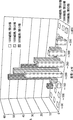
- FIG. 30 is a cross-sectional view taken along line XXX-XXX in FIG. 29. It is a photograph of the culture surface before spheroid collection of Example 1. It is the photograph which expanded FIG. It is a microscope picture of the spheroid after collection about Example 1 and Comparative Example 1. It is a photograph of the device surface after spheroid collection about Example 1. 2 is a photograph of a spheroid of Comparative Example 1. 3 is a graph showing the particle diameter distribution of Example 1 and Comparative Example 1. 4 is a graph showing a particle diameter distribution when the number of cells in Example 1 is changed.
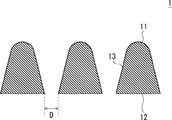
- FIG. 1 shows an example of a spheroid production device according to an embodiment.
- FIG. 2 is a cross-sectional view taken along the line II-II of the spheroid-producing device shown in FIG.
- the spheroid-producing device 1 is a device that produces spheroids obtained by aggregating cells by culturing the cells in a medium formed in a droplet shape.
- a spheroid is a three-dimensional aggregate of many cells.
- the spheroid-producing device 1 includes at least a first surface 11, a second surface 12, and a wall surface 13.
- FIG. 1 shows a view of the spheroid-producing device 1 viewed from the first surface 11 side.
- the first surface 11 is an upper surface of the spheroid-producing device 1 and is an upper surface into which a medium or the like is injected when cells are cultured.
- the second surface 12 is a surface facing the first surface 11.
- the second surface 12 forms the bottom (bottom surface) of the spheroid-producing device 1 and is the back surface with respect to the top surface (first surface 11).
- the wall surface 13 forms a hole (through hole) penetrating the first surface 11 and the second surface 12. Further, the wall surface 13 forms an opening in the first surface 11 and the second surface 12 and functions to communicate the first surface 11 and the second surface 12.
- the hole formed by the wall surface 13 is formed closer to the second surface 12 than the opening formed closer to the first surface 11.
- the opening is designed to be small. The size of the opening is compared using the equivalent diameter.
- “Equivalent diameter” is used as a general term for the equivalent diameter of the inscribed circle and the equivalent diameter of the circumscribed circle.
- the “equivalent diameter of the circumscribed circle” is the diameter of the circle circumscribing the opening, and is used as the diameter of the circumscribed circle drawn on a plane parallel to the second surface 12.
- the equivalent diameter of the opening of the hole formed between the first surface 11 and the second surface 12 is the diameter when a circumscribed circle is drawn on a plane parallel to the second surface 12.
- the “equivalent diameter of the inscribed circle” is the diameter of the circle inscribed in the opening, and means the diameter of the inscribed circle drawn on a plane parallel to the second surface 12.
- the equivalent diameter of the opening of the hole formed between the first surface 11 and the second surface 12 the diameter when an inscribed circle is drawn on a plane parallel to the second surface 12 is used.
- the length indicated by the symbol “D” is either the equivalent diameter Dout of the circumscribed circle or the equivalent diameter Din of the inscribed circle, and Dout and Din are shown without being strictly distinguished.
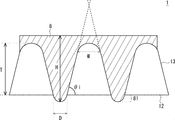
- FIG. 3 is a diagram illustrating details of the spheroid-producing device.
- FIG. 3 the cross-sectional view shown in FIG. 2 is used, but hatching indicating the cross-section is omitted for ease of explanation.
- the spheroid-producing device 1 includes an angle ⁇ i, an equivalent diameter Dout of a circumscribed circle of the opening of the second surface 12, or a diameter Din of an inscribed circle of the opening of the second surface 12, the material used for the device, and cell culture It is designed in consideration of at least the medium 8 used in the above. In addition, it is preferable to consider the thickness T, the width W of the upper surface, and the like.
- the angle ⁇ i is an angle formed by the slope of the wall surface 13 with respect to the second surface 12.
- the entire wall surface 13 forming the hole may not be a slope having a uniform angle ⁇ i.
- the angle ⁇ i is preferably larger than 1 degree and smaller than 90 degrees, and more preferably in the range of 30 degrees to 80 degrees. This is to make it easier for the culture medium 8 to enter the hole.
- all of the seeded cells do not stay on the wall surface 13 but settle down to the lower part of the droplet under their own weight. Thereby, a cell can be cultured efficiently.
- the thickness T is the thickness of the spheroid-producing device 1 from the first surface 11 to the second surface 12.
- the thickness T may be any thickness that can withstand the weight of the culture medium 8.
- the equivalent diameter Dout of the circumscribed circle of the opening on the second surface 12 is the diameter of the circumscribed circle circumscribing the opening formed on the second surface 12.
- the equivalent diameter Din of the inscribed circle of the opening on the second surface 12 is the diameter of the circle inscribed in the opening formed on the second surface 12.
- the equivalent radius Rout of the circumscribed circle is half the length of the equivalent diameter Dout of the circumscribed circle.
- the equivalent radius Rin of the inscribed circle is half the equivalent diameter Din of the inscribed circle.
- the equivalent diameter of the inscribed circle of the opening of the first surface 11 is designed to be larger than the equivalent diameter Din of the inscribed circle of the opening of the second surface 12.
- the equivalent diameter Din of the inscribed circle in the opening of the second surface 12 is preferably 1 to 10 times the size of the desired spheroid (eg, 200 ⁇ m to 1 cm).
- the diameter is 1 to 2 times the diameter of the desired cell mass.
- the width W of the upper surface is a width between the wall surface 13 forming one hole and the wall surface 13 forming another adjacent hole.
- the upper surface width W is the width at which the wall surface 13 forming the angle ⁇ i ends with respect to the second surface 12.
- the two wall surfaces 13 that form adjacent holes have slopes from the second surface 12 to the first surface 11, where the width W of the top surface is the end that allows such slopes to have an angle ⁇ i. It can be said that it is the width of.
- FIG. 3 shows that from the first surface 11 (from the opening of the first surface 11) until the height (depth) of the medium 8 reaches the height (depth) H, the holes and the upper part of the spheroid-producing device 1 are shown.
- a state in which the culture medium 8 is injected into the space is schematically shown. As shown in FIG. 4, this space corresponds to the space in the well container 91.
- the medium 8 is injected so that the medium 8 protrudes from the opening of the second surface 12.
- a portion protruding from the second surface 12 is a droplet 81.
- the culture medium 8 is injected into the spheroid-producing device 1 so that the droplet 81 is formed.
- the droplet 81 functions as a three-dimensional cell culture vessel when cells are cultured to form spheroids.
- the downward liquid surface of the droplet 81 is formed as a curved surface having a predetermined radius of curvature.
- ⁇ L is the surface tension [g / cm] of the liquid
- r1 and r2 are the curvature radii orthogonal to each other.
- r1 r2. Since the curved surface is convex downward, a droplet 81 is formed.
- the height (depth) H of the culture medium 8 is higher than the above-described height (depth).
- the injection can be adjusted to be lower.
- the culture medium 8 stays in the middle of the slope (wall surface 13) connecting the opening of the second surface 12 to the opening of the first surface 11.
- FIG. 14 which will be described later, schematically shows a state in which cells are cultured while the medium 8 is stopped in the middle of the slope.
- the wall surface 13 is a surface that maintains the angle ⁇ i with respect to the second surface 12. Further, the slope between the first surface 11 and the wall surface 13 is sometimes referred to as the upper surface.
- the first surface 11 may be broadly expressed, and the first surface 11 may be represented to include a surface (upper surface) that is not parallel to the second surface 12. If these are not essential features of one embodiment of the present invention, they are not strictly distinguished.
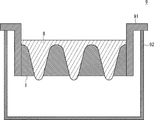
- FIG. 4 shows an example of a cell culture container using the spheroid production device of one embodiment.
- the cell culture container 9 is an example of the basic structure of the cell culture container.
- the spheroid-producing device 1 is attached to the well container 91.
- a petri dish 92 is disposed outside the well container 91.
- the spheroid production device 1 and the well container 91 may be made of the same material or different materials. Since the well container 91 provides a space for containing the culture medium 8, any material may be used as long as it is not toxic to the cells. On the other hand, the petri dish 92 may have a shape that does not come into contact with the second surface 12 or the droplet 81 of the spheroid-producing device 1.
- the container to which the spheroid-producing device 1 is attached is not limited to the structure shown in FIG.
- the spheroid-producing device 1 may be mounted on a multiwell plate or a petri dish.
- the spheroid-producing device 1 may be used by any method as long as the second surface 12 (bottom surface) and the droplet 81 do not contact the multiwell plate or the petri dish.
- the details of the design of the spheroid production device will be described below.
- the material and surface of the spheroid-producing device 1 and the equivalent diameter Din of the inscribed circle of the opening of the second surface 12 or the equivalent diameter Dout of the circumscribed circle the following physical phenomena should be taken into consideration. Is preferred.
- the design of the spheroid-producing device 1 corresponding to the physical phenomenon related to the contact angle ⁇ c will be considered. Thereafter, other elements will be described.
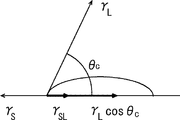
- FIG. 6 is a schematic diagram for explaining the contact angle ⁇ c between the material of the material appearing on the wall surface 13 and the culture medium 8.
- the contact angle ⁇ c is the contact angle of the liquid with respect to the solid.
- the contact angle ⁇ c is determined from the properties of the solid and liquid.
- ⁇ S is the solid surface tension [g / cm]
- ⁇ SL is the solid-liquid surface tension [g / cm]
- ⁇ L is the liquid surface tension [g / cm].
- the contact angle ⁇ c is determined from the properties of the solid and the liquid. Specifically, it is determined by the material used for the spheroid-producing device 1 (the material of the material appearing on the wall surface 13) and the properties of the culture medium 8.
- the size of the droplet is not affected by the contact angle.
- the angle ⁇ 0 90 degrees is an allowable range.
- the spheroid-producing device 1 is a hydrophobic material.
- the diameter Din of the inscribed circle of the opening of the second surface 12 is smaller than the diameter of the inscribed circle of the opening of the first surface 11.
- the size of the equivalent diameter Dout of the circumscribed circle is important.
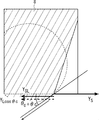
- FIG. 5 shows a diagram for explaining the force applied to the droplet 81.
- the shape of the droplet 81 is a hemisphere.
- the second surface is assumed to be placed horizontally.
- the droplet 81 is a continuous liquid that does not actually have a boundary with the culture medium 8.
- the range that is defined as the droplet 81 is described using oblique lines that are different from the medium 8.
- F0 to F2 exist as forces acting on the droplet 81 and working in parallel with gravity.
- F0 is the force of gravity applied to the droplet 81 and is calculated by the following equation.
- F1 is a force derived from the water pressure that the droplet 81 receives from the liquid (medium 8), and is calculated by the following equation.
- F2 is a force derived from the surface tension of the liquid generated at the edge of the liquid surface, and is calculated by the following equation.
- the surface tension ⁇ L of the liquid can be measured by various methods such as the Wilhelmy method. Or it is possible to obtain information from a vendor. Furthermore, the contact angle ⁇ c can be measured by using a liquid method or a gas-liquid method for the liquid (medium or buffer solution) and material to be used.
- ⁇ SL is also involved in the condition for the water surface to stop at the wall surface.
- ⁇ SL is not involved in the condition for holding the droplet in the case shown in FIG. At this time, ⁇ SL is assumed in the direction of the second surface.
- the volume V is the volume [cm 3 ] of the droplet 81
- the specific gravity ⁇ is the specific gravity of the medium 8
- the height H is a height equal to the depth [cm] from the upper surface of the medium 8 to the lower end of the droplet 81.
- the density ⁇ is the density [g / cm] of the medium 8.
- the area S is the size of the area of the opening at the position where the droplet 81 is generated (position where the droplet is formed in the hole).
- the area S is the area [cm 2 ] of the boundary in contact with the second surface 12, and is the same as the area of the opening of the second surface 12.
- the water pressure p is the water pressure [g / cm 2 ] at the opening of the second surface 12.
- the outer peripheral length L is the length [cm] of the boundary where the droplet contacts the second surface 12. L corresponds to the perimeter of the opening on the second surface.
- the solid-liquid surface tension ⁇ SL is the surface tension (interface tension) [g / cm] between the wall surface 13 and the culture medium 8.
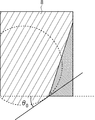
- the angle ⁇ 0 is an angle formed by the tangent surface at the edge where the droplet 81 is in contact with the horizontal plane.
- the angle ⁇ 0 is an angle formed by the tangent surface and the second surface 12 placed horizontally.
- FIG. 7 is a diagram for explaining the angle ⁇ 0 .
- F2 L ⁇ SL sin ⁇ i + L ⁇ L sin ⁇ 0 ( ⁇ i is the inclination angle of the wall surface.)
- Formula 1 (F0 + F1 ⁇ F2) can be expressed by Formula 2 as follows. V ⁇ + pS ⁇ L ⁇ SL sin ⁇ i + L ⁇ L sin ⁇ 0 ... Formula 2
- F2 L ⁇ L sin ⁇ 0
- Formula 1 (F0 + F1 ⁇ F2) can be expressed by Formula 3 as follows.
- Formula 2-2
- the medium 8 is put to a height H using a material having a certain contact angle ⁇ c.
- the droplet 81 starts to constrict, for example, it starts to protrude outward from the second surface 12.
- F0 + F1 F2.
- the volume of the droplet 81 is V
- the equivalent radius of the circumscribed circle of the opening of the second surface 12 is Rout
- the specific gravity is ⁇
- F0 ((4/3) ⁇ Rout 3 ⁇ 2)
- ⁇ ⁇ (2/3) ⁇ R 3 ⁇ ⁇
- the volume V is [(sphere volume) / 2].
- the equivalent radius Rout of the circumscribed circle of Formula 3 is the maximum equivalent radius of the opening of the second surface 12. Moreover, it is preferable to set the diameter of the opening part of the 2nd surface 12 to 2 Rout or less. It is more preferable to design in consideration of the force (Fc) that the cell mass receives from gravity.
- the circumscribed circle of the opening of the second surface 12 Is preferably set to be equal to or less than twice the equivalent radius of the circumscribed circle calculated by Expression 3. According to this aspect, it is possible to maintain droplets on the spheroid-producing device 1.
- the spheroid-producing device 1 is a hydrophilic material.
- the equivalent diameter of the inscribed circle is used.
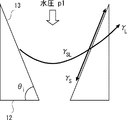
- FIG. 9 shows a case where the water pressure p2 is larger than that in FIG. 8 (p1 ⁇ p2).
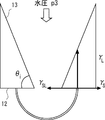
- FIG. 10 shows a case where the water pressure is higher than that in FIGS. 8 and 9 (p1 ⁇ p2 ⁇ p3).
- FIG. 8 shows a state where the magnitude of the water pressure p1 is balanced with the liquid level, and the liquid stops without dropping.
- FIG. 9 shows a state in which the liquid level is closer to the second surface 12 because the water pressure p2 is greater than the water pressure p1.
- a balance is established between the magnitude of the water pressure p2 and the liquid level.
- FIG. 12 is a diagram for explaining the surface tension at the opening of the second surface 12 when the liquid surface and the water pressure are balanced.
- FIG. 11 shows a case where adjustment is made so that the state of FIG. 9 is obtained.
- FIG. 6 is a schematic diagram for explaining the contact angle ⁇ c between the material of the wall surface 13 and the culture medium 8.
- the contact angle ⁇ c is the contact angle of the liquid with respect to the solid, and is determined by the properties of the solid / liquid.
- ⁇ S is the solid surface tension [g / cm]
- ⁇ SL is the solid-liquid surface tension [g / cm]
- ⁇ L is the liquid surface tension [g / cm].
- the contact angle ⁇ c is determined by the properties of the solid and the liquid. Specifically, the contact angle ⁇ c is determined by the material of the spheroid-producing device 1 (the material of the second surface 12 and the wall surface 13) and the property of the culture medium 8.
- the surface tension ⁇ SL of a solid can be obtained, for example, as information on the Internet (http://www.surface-tension.de/solid-surface-energy.htm etc.) or information obtained from the purchaser. preferable. Alternatively, it may be calculated using the Zisman method.
- the surface tension ⁇ L of the liquid can be measured by various methods such as the Wilhelmy method. Or it is possible to obtain information from a vendor.
- Equation 5 is expressed as ⁇ S ⁇ ⁇ L cos ⁇ c ⁇ S + ⁇ L cos ⁇ c.
- ⁇ L is the surface tension [g / cm] of the liquid
- r1 [cm] and r2 [cm] are the curvature radii orthogonal to each other at one point on the surface.
- the diameter of the inscribed circle is smaller than this value.
- the size of the opening of the second surface 12 is preferably set to a value of 20-80% of the maximum value of the derived equivalent radius R.
- the amount of the medium can be adjusted by adjusting the height H of the medium 8 so that the water pressure derived from the height H of the medium 8 is in the range of 50-80% of the maximum water pressure p derived. More preferred.
- the spheroid-producing device 1 can be designed and produced according to the material used for the spheroid-producing device 1 and the properties of the medium 8 used for cell culture.
- the spheroid production device 1 is used to efficiently produce a large amount of spheroids.
- the spheroid production device 1 is used to efficiently produce a large amount of spheroids.
- the calculation formula used when designing the spheroid-producing device 1 according to the range of the contact angle ⁇ c is presented. This is because it is preferable to test a plurality of design methods according to the material of the spheroid-producing device 1 or the properties of the culture medium 8. This is because the spheroid-producing device 1 is designed and manufactured using a preferable calculation formula as appropriate.
- the width W of the upper surface of the wall that partitions the space is preferably 5 mm or less. Moreover, 2 mm or less is more preferable in order to prevent cells from staying or standing on the upper surface (first surface 11 and its vicinity). In addition to the width W of the upper surface, it is preferable to consider the shape of the upper surface (the shape of the upper part from the first surface 11 to the width of the upper surface). This will be described later with reference to FIGS.
- the spheroid-producing device 1 is an acrylic resin, polylactic acid, polyglycolic acid, styrene resin, acrylic / styrene copolymer resin, polycarbonate resin, polyester resin, polyvinyl alcohol resin, ethylene / vinyl alcohol copolymer.
- a resin molded article made of one of a resin, a thermoplastic elastomer vinyl chloride resin, a silicone resin and a silicone resin, or a combination thereof is preferable. This is because a resin that can be molded is used in order to manufacture devices in large quantities at low cost.
- the spheroid-producing device 1 is the resin molded product described above, at least the wall surface 13 is functionalized by a surface modification treatment method comprising one of plasma treatment, corona discharge, UV ozone treatment, or a combination thereof. It is preferable to form a group.
- a functional group may be formed on the entire spheroid-producing device 1. This is because when the hydrophobicity is too high or the opening is small, the medium can be smoothly introduced into the opening by imparting hydrophilicity.
- the wall surface 13 is made of one of inorganic materials, metals, synthetic polymers, dimers, trimers, tetramers, biopolymers, or a combination thereof. Is preferably coated with a material. Moreover, you may coat
- the spheroid-producing device 1 is a molded product made of one of inorganic materials such as metal and glass, or a combination thereof.
- the surface is modified on at least the wall surface 13 by a surface modification treatment method comprising one of plasma treatment, corona discharge, UV ozone treatment, or a combination thereof. It is preferable to do.
- the entire surface of the spheroid-producing device 1 may be modified. This is for the same reason as above.
- it is very effective to create a more hydrophobic surface by coating the surface with the materials described above. This is because even if the device has the same equivalent diameter of pores, when using a medium with low surface tension, the hydrophobic surface is more effective than the hydrophilic surface. is there.
- the wall surface 13 is coated with a substance made of one of an inorganic substance, a metal, a polymer, a dimer, a trimer, and a tetramer, or a combination thereof. It is preferable. These materials may be coated on the entire spheroid-producing device 1. This is for the same reason as above. In addition, it is very effective to create a more hydrophobic surface by coating the surface with the materials described above. This is because even if the device has the same equivalent diameter of pores, when using a medium with low surface tension, the hydrophobic surface is more effective than the hydrophilic surface. is there.
- At least the surface of the wall surface 13 or the spheroid-producing device 1 has a fine structure on the order of nanometers.
- the fine structure is, for example, a structure in which the surface is processed into irregularities.
- Material surface properties are not defined by the device material, but by the material surface properties. For this reason, any material can be used as the material of the device because the hydrophilicity / hydrophobicity of the surface can be controlled by post-treatment even with the same material.
- ⁇ Spheroid collection method> An outline of a method for producing a spheroid using the above-described spheroid-producing device 1 and a method for collecting the produced spheroid will be described.
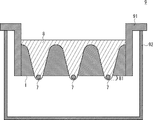
- FIG. 13 shows a diagram for explaining a process of producing a spheroid using the cell culture container 9 shown in FIG.
- a medium 8 containing cells is injected into each hole of the spheroid-producing device 1 from the first surface 11 side.
- the culture medium 8 protrudes from the bottom (opening portion of the second surface) of the spheroid-producing device 1, and thus a medium droplet can be formed.
- Cells contained in the medium 8 aggregate at the droplet portion to form spheroids 7.
- the supernatant of the medium 8 is taken out and the medium 8 is replaced with a new medium.
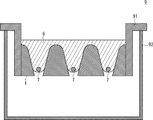
- FIG. 14 shows a diagram for explaining another example of the process of producing spheroids using the cell culture container 9 shown in FIG.
- FIG. 14 is a diagram illustrating a state where the liquid droplet does not reach the opening of the second surface 12 and stops halfway.
- a phenomenon occurs when a medium is added to a height lower than the design height H to the spheroid production device 1 appropriately designed as described above. Even in such a case, the cells contained in the culture medium 8 are aggregated to form spheroids 7 in the droplet portion.
- the supernatant of the medium 8 can be taken out and replenished with a new medium to replace the medium 8.
- the medium is added from the first surface 11 side to increase H, or by increasing the pressure on the first surface side, for example, the state shown in FIG. Thus, it can be collected by the method shown in FIG.
- the produced spheroid 7 is collected by the method shown in FIGS. According to the method described below, the spheroid 7 can be recovered without being damaged.
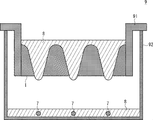
- FIG. 15 shows a method of collecting the spheroid 7 by putting the collection solution into the petri dish 92 and bringing it into contact with the second surface.
- the solution for recovery can be selected from, for example, any one of the culture medium 8, water, and a buffer solution.
- the spheroid 7 produced by culturing cells using the spheroid production device 1 is taken out by such a technique.
- a preferred embodiment of such a technique is to collect spheroids by moving droplets to the collection solution side. When the droplet is moved, it is particularly preferable that the droplet formed on the second surface 12 side is brought into contact with the recovery solution.
- FIG. 16 shows a method for recovering the spheroid 7 by applying pressure from the first surface 11 side after the cell culture vessel 9 is closed with the lid 93.
- pressure is applied from the first surface 11 side
- the droplet is broken.
- the spheroid 7 can be collected by the medium 8 flowing out into the petri dish 92.
- pressure may be applied from the first surface 11 side by any method.
- the medium 8 may be added until the droplet breaks.
- poured gas, and pressurized may be used.
- the spheroid-producing device 1 of the present embodiment it is possible to produce spheroids by generating droplets in a plurality of holes, so that spheroids can be produced efficiently and in large quantities. .
- a uniform spheroid can be produced by making the size of the plurality of holes the same.
- the medium can be injected into the spheroid-producing device 1 from the first surface 11 (upper side). Furthermore, the medium can be exchanged from the first surface 11 side. For this reason, the operation of the spheroid-producing device 1 is easy.
- the spheroid-producing device 1 based on a physical phenomenon, the structure can be simplified. Thereby, for example, compared with the suspension plate described in Patent Document 2, the spheroid-producing device 1 itself can be easily manufactured. As a result, the cost and work time for producing spheroids can be greatly reduced.
- Embodiment 1 has described the spheroid-producing device 1 having a hole shape as shown in FIGS. 1 and 2, but the hole shape is not limited to this.
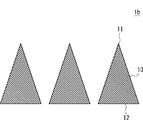
- the spheroid-producing devices 1a to 1f having the cross section shown in FIGS. 17 to 22 instead of the cross section shown in FIG. 2 may be used.
- the spheroid-producing devices 1a to 1c are examples in which the wall surface 13 is composed of a slope having an angle ⁇ i from the boundary with the second surface 12, as in FIG.
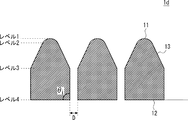
- the spheroid-producing device 1 d shown in FIG. 20 is an example in which an inclined surface having an angle is formed in the middle of the wall surface 13.
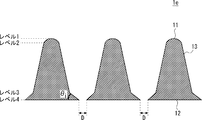
- the shape of the upper surface may be a shape of a part of a sphere (FIGS. 2, 20 to 22) or a flat shape (FIG. 19), as shown in FIGS. 2 and 17 to 22 as an example.
- the shape of the upper surface may be a shape like a vertex of a cone or a polygonal pyramid (FIGS. 17 and 18).
- the shape of the upper surface in order to prevent cells from staying or standing on the upper surface, is more preferably a spherical shape, a cone shape or a vertex shape of a polygonal pyramid.
- the shape of the entrance from the opening portion of the first surface 11 to the hole may be vertical and inclined only around the opening portion of the second direction 12.
- the equivalent diameter D and the angle ⁇ i are the equivalent diameter and angle at the position where the medium comes into contact with the medium at the opening of the second surface 12 of the device.
- the shape of the device may be the shape of the device as shown in FIG. 20, FIG. 21, or FIG.
- FIG. 20 is a diagram illustrating a case where the wall surface 13 from level 2 to level 3 has an angle.
- the equivalent diameter of the inscribed circle of the level 3 opening is the same as the equivalent diameter of the level 4 inscribed circle.
- the level 4 position is a reference for the equivalent diameter Din and the angle ⁇ i of the inscribed circle.
- 21 is a diagram illustrating an example of the case where the wall surface 13 from level 3 to level 4 has an angle.
- the equivalent diameter of the inscribed circle of the level 3 opening is larger than the equivalent diameter D of the level 4 inscribed circle.
- the level 4 position is a reference for the equivalent diameter Din and the angle ⁇ i of the inscribed circle.
- the inclination of the wall surface 13 from level 3 to level 4 that is, the angle ⁇ i is preferably smaller than the inclination of the wall surface 13 from level 2 to level 3.
- the wall surface 13 from level 2 to level 3 may have an angle.
- the equivalent diameter of the inscribed circle of the level 4 opening is larger than the equivalent diameter of the inscribed circle of the level 3 opening.
- the lowest level touched by the medium in the wall surface 13 is level 3. Therefore, the inclination from level 2 to level 3 is the angle ⁇ i, and the position of level 3 is the equivalent diameter Din of the inscribed circle.
- the angle ⁇ i is an opening at the second surface (lower surface) or the second surface side and is a position at which the liquid level comes into contact.
- Embodiment 1 has described the case where the openings formed in the first surface 11 and the second surface 12 as shown in FIGS.
- the shape of the opening is not limited to this.
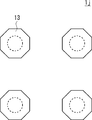
- the spheroid-producing devices 1g to 1j having openings as shown in FIGS. 23 to 26 may be used.
- the spheroid-producing device 1 includes a first surface 11 (upper surface), an opening of the first surface 11, and a second surface 12 (lower surface) as portions that contact the culture medium. It is preferable to provide an opening.
- the equivalent diameter of the inscribed circle of the opening of the first surface 11 is larger than the equivalent diameter Din of the inscribed circle of the opening of the second surface 12.
- the shape of the hole may be a circle or a polygon such as a square or an octagon. Furthermore, the shape of the opening on the first surface 11 and the shape of the opening on the second surface 12 may be different. In each of FIGS. 23 to 26, the opening of the first surface 11 (or the shape of the opening at the position of the width W on the upper surface) is represented by a solid line. Moreover, the opening part of the 2nd surface is represented by the dotted line. These openings are represented as four holes when the spheroid-producing devices 1g to 1j are viewed from the first surface 11 side.
- a thin sheet-like film may be punched with a punch, or a mold may be produced and a resin may be poured and molded.
- the equivalent diameter of the inscribed circle of the opening on the upper surface is set to be larger than the equivalent diameter Din of the inscribed circle of the opening on the lower surface.
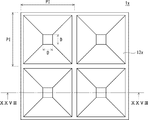
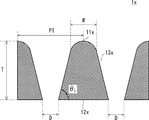
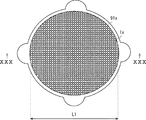
- a test for producing spheroids was conducted. First, a spheroid-producing device 1x having the shape shown in FIGS. 27 and 28 was designed and manufactured. Next, the spheroid-producing device 1x was attached to a well container 91x shown in FIGS. A well container 91x shown in FIGS. 29 and 30 equipped with the spheroid-producing device 1x was attached to a 6-well plate (not shown). At this time, it was confirmed that the droplet 81 and the second surface 12 did not contact the bottom of the well plate.
- FIG. 27 shows a view from the first surface.
- FIG. 28 is a sectional view taken along line XXVIII-XXVIII in FIG.
- FIG. 30 is a sectional view taken along line XXX-XXX in FIG.
- the spheroid-producing device 1x was produced with a pitch PI of 1.00 mm and the following size.
- Equivalent diameter D of second surface 12x 0.25 mm
- Angle ⁇ i 67.5 degrees
- Thickness T 0.74 mm
- Upper surface width W 0.184 mm
- the size of the well container 91x was as follows. Diameter of inner circumference of well container L1: 31mm Well container height L3: 1.5 cm
- a material having a contact angle ⁇ c in the range of ⁇ 1 ⁇ cos ⁇ c ⁇ 0 was used.
- Silicone manufactured by KCC, grade: SL7260
- As the medium DMEM / F12 supplemented with 10% FBS was used. Hereinafter, it is referred to as medium A.
- the surface tension ⁇ L of the liquid in the medium A can be measured by various methods such as the Wilhelmy method. Or it is possible to obtain information from a vendor.
- the height H of the medium is designed to be within 1 cm.
- the equivalent diameter Dout of the circumscribed circle was 285 ⁇ m, 23% of the calculated value. At this time, the reduction in hydrophobicity due to protein adsorption and the force received from the gravity of spheroids and the possibility that the liquid suitability could not be maintained due to vibration during medium exchange or transportation were considered.
- the angle ⁇ i was 67.5 degrees.
- the opening was set to 1 mm. As shown in FIG. 14, the device was designed so that the device could hold the droplet reliably by stopping the droplet in the middle of the side surface of the device.
- the diameter of 91x in FIG. 30 was set to 31 mm.
- the low-adhesion container used was a silicone resin (KE-1603 (A / B) manufactured by Shin-Etsu Chemical Co., Ltd.) attached to the bottom of a glass petri dish with a diameter of 5 cm.
- a cell suspension adjusted to contain 2.5 million mouse ES cells in 10 mL of the medium was added to the wells shown in FIG. Such cells were cultured for 2 days.
- This cell suspension was used in both examples and comparative examples. By using this cell suspension, the number of cells that can be placed in one opening is 1250 / opening.
- a cell suspension was prepared in which the number of cells entering one opening was adjusted to 1500, 1000, 500. In these examples, the culture was also performed for 2 days.
- the second surface 12 was brought into contact with the culture medium, and the collected spheroids were observed.
- the cell suspension was not transferred to another container, and the spheroids were observed using the cultured container.
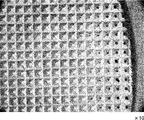
- FIGS. 31 and 32 show the microphotographs of the device and cells before recovery of spheroids in Example 1.
- FIG. FIG. 32 is an enlarged view of FIG. In Example 1, spheroids were formed in each opening.
- FIG. 33 shows micrographs of the recovered spheroids for Example 1 and Comparative Example 1.
- FIG. 34 shows a photograph of the device surface after spheroid recovery for Example 1. Almost all of the spheroids seen in FIG. 31 were recovered. However, some of the edges remained. The recovery rate was 95% or more. The recovery rate was determined by the formula (number of openings where no cells remained / total number of openings) ⁇ 100).
- FIG. 35 shows a photograph of the spheroid of Comparative Example 1.
- FIG. 36 shows a graph showing the particle diameter distribution of Example 1 and Comparative Example 1.
- the spheroid image was captured by taking the x75 lens of FIG. 33 (the photo of Example 1 on the left, the photo of Comparative Example 1 on the right).
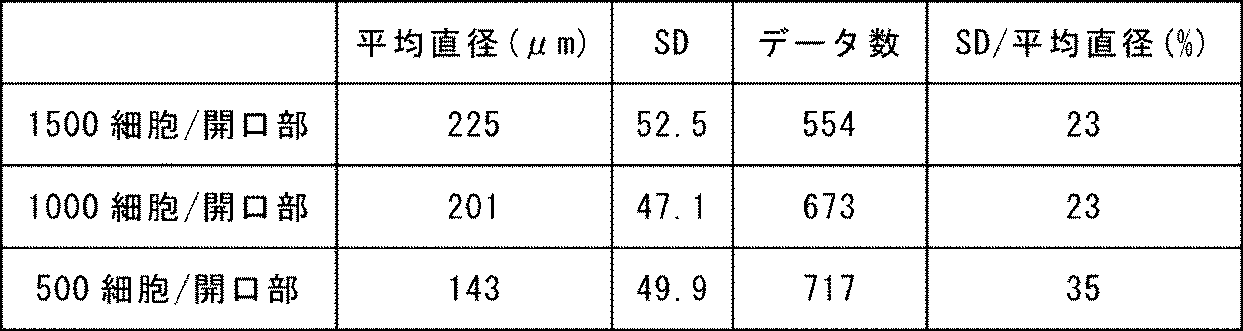
- the captured images were arbitrarily selected by the number of data shown in Table 1 below, and the diameter of each spheroid was measured.
- Table 1 shows the average value ( ⁇ m) of the cell mass diameter, the sample standard deviation (SD), and the variation (defined by dividing SD by the average value of the diameter). As can be seen from the value of SD / average diameter, the variation of Example 1 was 1/3 or less of the variation of Comparative Example 1.
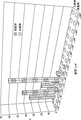
- FIG. 37 shows the particle diameter distribution when the number of cells in Example 1 is changed.
- 1x device for producing spheroid 7 spheroid 8 medium 9 cell culture vessel 11, 11x first surface 12, 12x second surface 13, 13x wall surface 9 cell culture vessel 91, 91x well vessel 92 petri dish 93 lid
Landscapes
- Health & Medical Sciences (AREA)
- Life Sciences & Earth Sciences (AREA)
- Engineering & Computer Science (AREA)
- Organic Chemistry (AREA)
- Chemical & Material Sciences (AREA)
- Bioinformatics & Cheminformatics (AREA)
- Wood Science & Technology (AREA)
- Zoology (AREA)
- Biotechnology (AREA)
- Biomedical Technology (AREA)
- Genetics & Genomics (AREA)
- Biochemistry (AREA)
- Microbiology (AREA)
- General Engineering & Computer Science (AREA)
- General Health & Medical Sciences (AREA)
- Sustainable Development (AREA)
- Cell Biology (AREA)
- Immunology (AREA)
- Apparatus Associated With Microorganisms And Enzymes (AREA)
- Micro-Organisms Or Cultivation Processes Thereof (AREA)
- Knitting Of Fabric (AREA)
- Polishing Bodies And Polishing Tools (AREA)
Abstract
Description
F0=体積×比重
=V・α
F1=水圧×面積=pS
大気圧の場合は
F1=液上面から液滴までの深さ×液体の密度×面積
=HρS
F2=外周×液体表面張力×角度
=LγLsinθ0
F0+F1<F2・・・・式1
F2=LγSLsinθi+LγLsinθ0
(θiは壁面の傾斜角である。)
Vα+pS<LγSLsinθi+LγLsinθ0・・・式2
F2=LγLsinθ0
Vα+pS<LγLsinθ0 ・・・式2-2
F0=((4/3)πRout3÷2)×α=(2/3)πR3・α
ただし、液滴81が半球であるとして、体積Vを[(球の体積)÷2]とする。
S=πRout2、L=2πRout
(2/3)πRout3・α+pπRout2
=2πRoutLγLsin90
ただし、sin90=1。
(2/3)αRout2+pRout=2γL・・・式3
γS≦γSL+γLcosθ0・・・式5
γS≦γLcosθc-γS+γLcosθc
ΔP = p=γL(1/r1+1/r2)・・・式7
ただし大気圧の場合は
ΔP=Hρ=γL(1/r1+1/r2)・・・式7-2
の関係式で表され、曲面を形成して下に凸になり、液滴を形成する。ここでγLは液体の表面張力[g/cm]、r1[cm],r2[cm]は表面の1点で直交する曲率半径である。
p=γL×(2/r)・・・式8
大気圧の場合は
Hρ=γL×(2/r)・・・式8-2
式6からcosθc>γS/γLを満たす材質を選択する。
Din=2r・sinθ0
Din=4・γL・sinθ0/Hρ・・・式9
Din(max)=4・γL・sinθc/Hρ・・・式9-2
となる。
上述したスフェロイド作製用デバイス1を用いてスフェロイドを作製する方法の概略及び作製したスフェロイドの回収方法について説明する。
第二表面12xの相当直径D:0.25mm
角度θi:67.5度
厚みT:0.74mm
上面の幅W:0.184mm
ウェル容器の内周の直径L1:31mm
ウェル容器の高さL3:1.5cm
(2/3)αR2+pR=2γL・・・式3
・純水の密度及び比重:1.00(文献値)
・液体の表面張力γL:7×10⁻²[g/cm]
(2/3)×1.00×R2+1×1.00×R=2×7×10-2
R=0.123、-1.629
R=0.123cm=1230μm

7 スフェロイド
8 培地
9 細胞培養容器
11、11x 第一表面
12、12x 第二表面
13、13x壁面
9 細胞培養容器
91、91x ウェル容器
92 シャーレ
93 蓋
Claims (19)
- 第一表面と、
前記第一表面の裏面となる第二表面と、
前記第一表面と前記第二表面との間を貫通する複数の孔を形成する複数の壁面と、を備え、
前記第一表面の開口部の内接円の相当直径が前記第二表面の開口部の内接円の相当直径より大きい、
スフェロイド作製用デバイス。 - 前記第二表面の内接円の開口部の相当直径が200マイクロメートルから1センチメートルの範囲である請求項1記載のスフェロイド作製用デバイス。
- 各壁面の少なくとも一部分は、前記第二表面に対して1度より大きく、90度より小さい角度の傾斜を有する請求項1または2記載のスフェロイド作製用デバイス。
- 前記各孔には前記第一表面から培地が注入され、
前記各壁面を構成する材質の表面と前記培地との接触角θcが、-1<cosθc≦0の範囲であるとき、前記第二表面の外接円の開口部の相当直径の半分である外接円の相当半径Rout(cm)が、
計算式 (2/3)αX2+pX=2γL、
ただし、pは前記第二表面の開口部での水圧[g/cm2]、αは前記培地の比重、γLは液体の表面張力[g/cm]、
で定義される変数Xの値以下である請求項1乃至3のいずれか一項に記載のスフェロイド作製用デバイス。 - 前記各孔には前記第一表面から培地が注入され、
前記各壁面を構成する材質の表面と培地の接触角θcが0<cosθc<1の範囲であるとき
計算式 γLcosθc-γS>0
であって、かつp=γL×(2/r)、
ただし、pは前記第二表面の開口部での水圧[g/cm2]、γLは液体の表面張力[g/cm]、rは曲率半径[cm]、γLは液体の表面張力[g/cm]、
をみたすように内接円の相当直径を設計することを特徴とする請求項1乃至3のいずれか一項に記載のスフェロイド作製用デバイス。 - 一つの孔を形成する壁面と、隣接する別の孔を形成する壁面との間の幅であって、二つの壁面が前記第二表面に対して前記角度θiの傾斜を有する前記第一表面に近い端部の幅が5ミリメートル以下である請求項3記載のスフェロイド作製用デバイス。
- 前記スフェロイド作製用デバイスが、アクリル系樹脂、ポリ乳酸、ポリグリコール酸、スチレン系樹脂、アクリル・スチレン系共重合樹脂、ポリカーボネート系樹脂、ポリエステル系樹脂、ポリビニルアルコール系樹脂、エチレン・ビニルアルコール系共重合樹脂、熱可塑性エラストマ塩化ビニル系樹脂、シリコーン樹脂及びシリコン樹脂のうちの1つ、またはこれらの組み合わせからなる樹脂成形品である請求項1乃至6のいずれか一項に記載のスフェロイド作製用デバイス。
- 前記複数の壁面に、プラズマ処理、コロナ放電、UVオゾン処理のうちの1つ、またはこれら組み合わせからなる表面改質処理方法により官能基を形成させた請求項7記載のスフェロイド作製用デバイス。
- 前記複数の壁面に、無機物、金属、合成ポリマー、ダイマー、トリマー、テトラマー、生体由来ポリマーのうちの1つ、またはこれらの組合せからなる物質が被覆されている請求項7記載のスフェロイド作製用デバイス。
- 前記複数の壁面の表面に、ナノメートルオーダの微細構造を有する請求項8乃至9のいずれか一項に記載のスフェロイド作製用デバイス。
- 前記スフェロイド作製用デバイスが、金属、ガラスなどの無機物のうちの1つ、またはこれらの組み合わせからなる成形品である請求項1乃至6のいずれか一項に記載のスフェロイド作製用デバイス。
- 前記複数の壁面に、プラズマ処理、コロナ放電、UVオゾン処理のうちの1つ、またはこれら組み合わせからなる表面改質処理方法により表面を改質した請求項11記載のスフェロイド作製用デバイス。
- 前記複数の壁面に、無機物、金属、ポリマー、ダイマー、トリマー、テトラマーのうちの1つ、またはこれら組合せからなる物質が被覆されている請求項11または12に記載のスフェロイド作製用デバイス。
- 前記複数の壁面の表面に、ナノメートルオーダの微細構造を有する請求項11乃至13のいずれか一項に記載のスフェロイド作製用デバイス。
- 請求項1乃至14のいずれか一項に記載のスフェロイド作製用デバイスの前記第二表面を水、培地及び緩衝液のうちの1つから選択される溶液と接触させてスフェロイドを回収する、スフェロイド回収方法。
- 請求項1乃至14のいずれか一項に記載のスフェロイド作製用デバイスの前記第一表面から圧力を加えることによってスフェロイドを前記第二表面の開口部から流し出すスフェロイド回収方法。
- 請求項1乃至14のいずれか一項に記載のスフェロイド作製用デバイスを用いるスフェロイド製造方法であって、
前記各孔に細胞を含む培地を、前記第一表面から注入し、
前記各孔で液滴を形成させ、
前記液滴の部分で前記細胞を培養し、スフェロイドを作製するスフェロイド製造方法。 - 前記第二表面を水、培地及び緩衝液のうちの1つから選択される溶液と接触させてスフェロイドを回収する、請求項17記載のスフェロイド製造方法。
- 前記第一表面から圧力を加えることによって、前記液滴を破壊してスフェロイドを前記第二表面の開口部から流し出す、請求項17記載のスフェロイド製造方法。
Priority Applications (10)
| Application Number | Priority Date | Filing Date | Title |
|---|---|---|---|
| MX2016011006A MX2016011006A (es) | 2014-02-25 | 2015-02-25 | Dispositivo productor de esferoide, metodo para la recuperacion de esferoides y metodo para la produccion de esferoides. |
| AU2015221599A AU2015221599B2 (en) | 2014-02-25 | 2015-02-25 | Device for fabricating spheroid, and spheroid recovery method and manufacturing method |
| KR1020167025237A KR20160125997A (ko) | 2014-02-25 | 2015-02-25 | 스페로이드 제작용 디바이스, 스페로이드의 회수 방법 및 제조 방법 |
| CN201580010448.4A CN106029862A (zh) | 2014-02-25 | 2015-02-25 | 球状体制造装置、球状体的回收方法及制造方法 |
| US15/121,322 US10683477B2 (en) | 2014-02-25 | 2015-02-25 | Spheroid-producing device, method for recovering spheroids, and method for producing spheroids |
| EP15755340.5A EP3112449A4 (en) | 2014-02-25 | 2015-02-25 | Device for fabricating spheroid, and spheroid recovery method and manufacturing method |
| CA2939884A CA2939884A1 (en) | 2014-02-25 | 2015-02-25 | Spheroid-producing device, method for recovering spheroids, and method for producing spheroids |
| JP2016505070A JP6534380B2 (ja) | 2014-02-25 | 2015-02-25 | スフェロイド作製用デバイス、スフェロイドの回収方法及び製造方法 |
| SG11201606992PA SG11201606992PA (en) | 2014-02-25 | 2015-02-25 | Device for fabricating spheroid, and spheroid recovery method and manufacturing method |
| US16/864,446 US11208625B2 (en) | 2014-02-25 | 2020-05-01 | Spheroid-producing device, method for recovering spheroids, and method for producing spheroids |
Applications Claiming Priority (2)
| Application Number | Priority Date | Filing Date | Title |
|---|---|---|---|
| JP2014034577 | 2014-02-25 | ||
| JP2014-034577 | 2014-02-25 |
Related Child Applications (2)
| Application Number | Title | Priority Date | Filing Date |
|---|---|---|---|
| US15/121,322 A-371-Of-International US10683477B2 (en) | 2014-02-25 | 2015-02-25 | Spheroid-producing device, method for recovering spheroids, and method for producing spheroids |
| US16/864,446 Continuation US11208625B2 (en) | 2014-02-25 | 2020-05-01 | Spheroid-producing device, method for recovering spheroids, and method for producing spheroids |
Publications (1)
| Publication Number | Publication Date |
|---|---|
| WO2015129263A1 true WO2015129263A1 (ja) | 2015-09-03 |
Family
ID=54008597
Family Applications (1)
| Application Number | Title | Priority Date | Filing Date |
|---|---|---|---|
| PCT/JP2015/000950 Ceased WO2015129263A1 (ja) | 2014-02-25 | 2015-02-25 | スフェロイド作製用デバイス、スフェロイドの回収方法及び製造方法 |
Country Status (10)
| Country | Link |
|---|---|
| US (2) | US10683477B2 (ja) |
| EP (1) | EP3112449A4 (ja) |
| JP (1) | JP6534380B2 (ja) |
| KR (1) | KR20160125997A (ja) |
| CN (2) | CN113046237A (ja) |
| AU (1) | AU2015221599B2 (ja) |
| CA (1) | CA2939884A1 (ja) |
| MX (1) | MX2016011006A (ja) |
| SG (2) | SG10202003061SA (ja) |
| WO (1) | WO2015129263A1 (ja) |
Cited By (10)
| Publication number | Priority date | Publication date | Assignee | Title |
|---|---|---|---|---|
| WO2017115865A1 (ja) * | 2015-12-29 | 2017-07-06 | 株式会社クラレ | 幹細胞の凝集塊の集団の調製方法 |
| JP2019062832A (ja) * | 2017-10-02 | 2019-04-25 | 国立大学法人京都大学 | スフェロイドを製造するためのデバイス、スフェロイドの製造及び回収方法 |
| WO2020080453A1 (ja) | 2018-10-20 | 2020-04-23 | 東洋製罐グループホールディングス株式会社 | スフェア培養部材、培養容器、穴開き部材の加工方法、及び洗浄容器 |
| US11254681B2 (en) | 2014-08-04 | 2022-02-22 | Nuevolution A/S | Optionally fused heterocyclyl-substituted derivatives of pyrimidine useful for the treatment of inflammatory, metabolic, oncologic and autoimmune diseases |
| US11447479B2 (en) | 2019-12-20 | 2022-09-20 | Nuevolution A/S | Compounds active towards nuclear receptors |
| US11613532B2 (en) | 2020-03-31 | 2023-03-28 | Nuevolution A/S | Compounds active towards nuclear receptors |
| US11780843B2 (en) | 2020-03-31 | 2023-10-10 | Nuevolution A/S | Compounds active towards nuclear receptors |
| WO2024034559A1 (ja) | 2022-08-08 | 2024-02-15 | 株式会社ヘリオス | 細胞凝集塊の製造方法 |
| JP2024513007A (ja) * | 2021-04-09 | 2024-03-21 | セルアートジェン インコーポレイテッド | 細胞集合体の培養のための微細流体の懸滴培養デバイス |
| US12441704B2 (en) | 2019-12-20 | 2025-10-14 | Nuevolution A/S | Compounds active towards nuclear receptors |
Families Citing this family (5)
| Publication number | Priority date | Publication date | Assignee | Title |
|---|---|---|---|---|
| US20170253844A1 (en) * | 2016-03-04 | 2017-09-07 | Corning Incorporated | Bowl shaped microwell |
| WO2021075810A1 (ko) * | 2019-10-14 | 2021-04-22 | 연세대학교 산학협력단 | 웰 플레이트유닛 및 이를 이용한 멀티 레이어 스페로이드 배양장치 |
| TWI760120B (zh) * | 2021-02-25 | 2022-04-01 | 國立清華大學 | 懸滴裝置、形成懸滴之方法以及利用懸滴培養細胞之方法 |
| KR102582690B1 (ko) * | 2021-08-10 | 2023-09-25 | 인제대학교 산학협력단 | 3d 형태의 오가노이드 배양 장치 및 이를 이용한 오가노이드 배양 방법 |
| US20250075177A1 (en) | 2023-08-31 | 2025-03-06 | Lech Kiedrowski | Device for culturing and microcopic observations of cryopreserved cells |
Citations (3)
| Publication number | Priority date | Publication date | Assignee | Title |
|---|---|---|---|---|
| WO2007114351A1 (ja) * | 2006-03-31 | 2007-10-11 | Asubio Pharma Co., Ltd. | 新規細胞培養方法、およびその方法を用いた細胞塊の生産および回収方法 |
| JP2012502636A (ja) * | 2008-09-22 | 2012-02-02 | ウニヴェルジテート チューリッヒ プロレクトラート エムエヌヴェー | 懸滴プレート |
| JP2013517809A (ja) * | 2010-01-28 | 2013-05-20 | ザ リージェンツ オブ ザ ユニバーシティ オブ ミシガン | 懸滴装置、懸滴システム、および/または懸滴方法 |
Family Cites Families (12)
| Publication number | Priority date | Publication date | Assignee | Title |
|---|---|---|---|---|
| US6027695A (en) * | 1998-04-01 | 2000-02-22 | Dupont Pharmaceuticals Company | Apparatus for holding small volumes of liquids |
| US20030235519A1 (en) * | 2002-06-24 | 2003-12-25 | Corning Incorporated | Protein crystallography hanging drop lid that individually covers each of the wells in a microplate |
| EP2479277B1 (en) | 2004-07-22 | 2015-09-02 | Five Prime Therapeutics, Inc. | Use of MGD-CSF in a method of treatment of Alzheimer's disease. |
| JP4918755B2 (ja) * | 2005-05-30 | 2012-04-18 | 株式会社日立製作所 | 細胞培養容器,細胞培養容器の製造方法、及び培養細胞 |
| KR100785049B1 (ko) * | 2006-01-11 | 2007-12-12 | 한국과학기술연구원 | 줄기세포로부터 배아체를 형성 및 성장시키는 방법 및 장치 |
| KR100836827B1 (ko) * | 2007-04-09 | 2008-06-10 | 전남대학교산학협력단 | 배아줄기세포의 배상체 형성용 배양용기 |
| JP5578779B2 (ja) * | 2008-10-08 | 2014-08-27 | 国立大学法人東北大学 | スフェロイド培養方法及びスフェロイド培養容器 |
| JP5921437B2 (ja) | 2010-09-14 | 2016-05-24 | Agcテクノグラス株式会社 | 培養基材 |
| KR101412155B1 (ko) | 2011-09-27 | 2014-06-27 | 동국대학교 산학협력단 | 3차원 세포 배양 용구 및 이를 이용한 세포의 3차원 배양 방법 |
| WO2013047974A1 (ko) * | 2011-09-27 | 2013-04-04 | 서울대학교 산학협력단 | 3차원 세포 배양 용구 및 이를 이용한 세포의 3차원 배양 방법 |
| CN102363764A (zh) * | 2011-11-04 | 2012-02-29 | 中国医学科学院血液病医院(血液学研究所) | 一种培养胰腺干/祖细胞的方法 |
| WO2014165273A1 (en) * | 2013-03-13 | 2014-10-09 | Innovative Surface Technologies, Inc. | Conical devices for three-dimensional aggregate (s) of eukaryotic cells |
-
2015
- 2015-02-25 SG SG10202003061SA patent/SG10202003061SA/en unknown
- 2015-02-25 CN CN202110286377.8A patent/CN113046237A/zh active Pending
- 2015-02-25 CN CN201580010448.4A patent/CN106029862A/zh active Pending
- 2015-02-25 KR KR1020167025237A patent/KR20160125997A/ko not_active Withdrawn
- 2015-02-25 EP EP15755340.5A patent/EP3112449A4/en active Pending
- 2015-02-25 CA CA2939884A patent/CA2939884A1/en not_active Abandoned
- 2015-02-25 WO PCT/JP2015/000950 patent/WO2015129263A1/ja not_active Ceased
- 2015-02-25 MX MX2016011006A patent/MX2016011006A/es unknown
- 2015-02-25 JP JP2016505070A patent/JP6534380B2/ja active Active
- 2015-02-25 US US15/121,322 patent/US10683477B2/en active Active
- 2015-02-25 AU AU2015221599A patent/AU2015221599B2/en not_active Ceased
- 2015-02-25 SG SG11201606992PA patent/SG11201606992PA/en unknown
-
2020
- 2020-05-01 US US16/864,446 patent/US11208625B2/en active Active
Patent Citations (3)
| Publication number | Priority date | Publication date | Assignee | Title |
|---|---|---|---|---|
| WO2007114351A1 (ja) * | 2006-03-31 | 2007-10-11 | Asubio Pharma Co., Ltd. | 新規細胞培養方法、およびその方法を用いた細胞塊の生産および回収方法 |
| JP2012502636A (ja) * | 2008-09-22 | 2012-02-02 | ウニヴェルジテート チューリッヒ プロレクトラート エムエヌヴェー | 懸滴プレート |
| JP2013517809A (ja) * | 2010-01-28 | 2013-05-20 | ザ リージェンツ オブ ザ ユニバーシティ オブ ミシガン | 懸滴装置、懸滴システム、および/または懸滴方法 |
Non-Patent Citations (3)
| Title |
|---|
| HORMAN SHANE R. ET AL.: "3D High-Content Analysis of Spheroids, Tutorials", GENETIC ENGINEERING & BIOTECHNOLOGY NEWS, vol. 33, no. 16, 15 September 2013 (2013-09-15), XP055358155, Retrieved from the Internet <URL:http://www.genengnews.com/gen-articles/3d-high-content-analysis-of-spheroids/4983> [retrieved on 20150514] * |
| See also references of EP3112449A4 * |
| SHOICHIRO SUMI ET AL.: "Kohinshitsu Saibokai o Koritsuteki ni Sakusei suru Shinki Baiyo Kizai - Zenmen Takoshiki Baiyomen no Kaihatsu", REGENERATIVE MEDICINE, vol. 14, 1 February 2015 (2015-02-01), pages 262, XP008184910 * |
Cited By (15)
| Publication number | Priority date | Publication date | Assignee | Title |
|---|---|---|---|---|
| US11254681B2 (en) | 2014-08-04 | 2022-02-22 | Nuevolution A/S | Optionally fused heterocyclyl-substituted derivatives of pyrimidine useful for the treatment of inflammatory, metabolic, oncologic and autoimmune diseases |
| CN108699518A (zh) * | 2015-12-29 | 2018-10-23 | 株式会社可乐丽 | 干细胞聚集体的群体的制备方法 |
| JPWO2017115865A1 (ja) * | 2015-12-29 | 2018-11-08 | 株式会社クラレ | 幹細胞の凝集塊の集団の調製方法 |
| WO2017115865A1 (ja) * | 2015-12-29 | 2017-07-06 | 株式会社クラレ | 幹細胞の凝集塊の集団の調製方法 |
| JP2019062832A (ja) * | 2017-10-02 | 2019-04-25 | 国立大学法人京都大学 | スフェロイドを製造するためのデバイス、スフェロイドの製造及び回収方法 |
| JP2020065444A (ja) * | 2018-10-20 | 2020-04-30 | 東洋製罐グループホールディングス株式会社 | スフェア培養部材、培養容器、穴開き部材の加工方法、及び洗浄容器 |
| WO2020080453A1 (ja) | 2018-10-20 | 2020-04-23 | 東洋製罐グループホールディングス株式会社 | スフェア培養部材、培養容器、穴開き部材の加工方法、及び洗浄容器 |
| JP7271903B2 (ja) | 2018-10-20 | 2023-05-12 | 東洋製罐グループホールディングス株式会社 | スフェア培養部材、培養容器、穴開き部材の加工方法、及び洗浄容器 |
| US12391910B2 (en) | 2018-10-20 | 2025-08-19 | Toyo Seikan Group Holdings, Ltd. | Sphere culture member, culture container, method for processing perforated member, and cleaning container |
| US11447479B2 (en) | 2019-12-20 | 2022-09-20 | Nuevolution A/S | Compounds active towards nuclear receptors |
| US12441704B2 (en) | 2019-12-20 | 2025-10-14 | Nuevolution A/S | Compounds active towards nuclear receptors |
| US11613532B2 (en) | 2020-03-31 | 2023-03-28 | Nuevolution A/S | Compounds active towards nuclear receptors |
| US11780843B2 (en) | 2020-03-31 | 2023-10-10 | Nuevolution A/S | Compounds active towards nuclear receptors |
| JP2024513007A (ja) * | 2021-04-09 | 2024-03-21 | セルアートジェン インコーポレイテッド | 細胞集合体の培養のための微細流体の懸滴培養デバイス |
| WO2024034559A1 (ja) | 2022-08-08 | 2024-02-15 | 株式会社ヘリオス | 細胞凝集塊の製造方法 |
Also Published As
| Publication number | Publication date |
|---|---|
| AU2015221599B2 (en) | 2019-11-28 |
| US10683477B2 (en) | 2020-06-16 |
| EP3112449A4 (en) | 2017-11-15 |
| EP3112449A1 (en) | 2017-01-04 |
| US20200255782A1 (en) | 2020-08-13 |
| AU2015221599A1 (en) | 2016-09-15 |
| JP6534380B2 (ja) | 2019-06-26 |
| CA2939884A1 (en) | 2015-09-03 |
| JPWO2015129263A1 (ja) | 2017-03-30 |
| SG11201606992PA (en) | 2016-09-29 |
| CN106029862A (zh) | 2016-10-12 |
| US11208625B2 (en) | 2021-12-28 |
| SG10202003061SA (en) | 2020-05-28 |
| US20170015966A1 (en) | 2017-01-19 |
| KR20160125997A (ko) | 2016-11-01 |
| CN113046237A (zh) | 2021-06-29 |
| MX2016011006A (es) | 2016-11-30 |
Similar Documents
| Publication | Publication Date | Title |
|---|---|---|
| JP6534380B2 (ja) | スフェロイド作製用デバイス、スフェロイドの回収方法及び製造方法 | |
| Baptista et al. | Overlooked? Underestimated? Effects of substrate curvature on cell behavior | |
| JP6892486B2 (ja) | 培養方法 | |
| Wang et al. | Microfluidic generation of porous microcarriers for three-dimensional cell culture | |
| Shen et al. | Recent advances in three-dimensional multicellular spheroid culture and future development | |
| Lin et al. | Dielectrophoresis based‐cell patterning for tissue engineering | |
| US20110004304A1 (en) | Culturing retinal cells and tissues | |
| WO2014165273A1 (en) | Conical devices for three-dimensional aggregate (s) of eukaryotic cells | |
| CN103814125A (zh) | 粘附性细胞的培养方法 | |
| JP6021802B2 (ja) | 培養方法及び薬物スクリーニング方法 | |
| US20130029422A1 (en) | Composite Substrate for 3D Cell Culture | |
| Wang et al. | Engineering biological tissues from the bottom-up: Recent advances and future prospects | |
| JPWO2016021498A1 (ja) | 繊維状タンパク質材料の作製方法、および細胞培養方法 | |
| CN104630148A (zh) | 一种基于水凝胶微孔板的细胞球原位制备方法 | |
| JPWO2008130025A1 (ja) | 肝細胞培養容器及び肝細胞培養方法 | |
| Wong et al. | Flicking technique for microencapsulation of cells in calcium alginate leading to the microtissue formation | |
| Zhu et al. | Preparation of anisotropic micro-hydrogels with tunable structural and topographic features by compound interfacial shearing | |
| DE102018115360A1 (de) | Verfahren und zusammensetzungen zum ablösen adhärenter zellen | |
| Wu et al. | Advancements in polymer biomaterials as scaffolds for corneal endothelium tissue engineering | |
| KR102932431B1 (ko) | 하단유동을 포함하는 3차원 세포의 배양 장치 및 이를 이용한 3차원 세포의 배양 방법 | |
| Walter et al. | Cell interactions with size-controlled colloidal monolayers: toward improved coatings in bone tissue engineering | |
| Kadlečková et al. | Hierarchically structured surfaces prepared by phase separation: tissue mimicking culture substrate | |
| Chang et al. | Organ printing | |
| Baptista | Breathing life into in vitro models: Exploring the respiratory landscape of bioinspired culture substrates for pulmonary research | |
| US20260062659A1 (en) | Dynamic surface tension supported 3-d cell culture technology (float layer cell culture devices) |
Legal Events
| Date | Code | Title | Description |
|---|---|---|---|
| 121 | Ep: the epo has been informed by wipo that ep was designated in this application |
Ref document number: 15755340 Country of ref document: EP Kind code of ref document: A1 |
|
| ENP | Entry into the national phase |
Ref document number: 2016505070 Country of ref document: JP Kind code of ref document: A |
|
| ENP | Entry into the national phase |
Ref document number: 2939884 Country of ref document: CA |
|
| WWE | Wipo information: entry into national phase |
Ref document number: 15121322 Country of ref document: US Ref document number: MX/A/2016/011006 Country of ref document: MX |
|
| NENP | Non-entry into the national phase |
Ref country code: DE |
|
| REG | Reference to national code |
Ref country code: BR Ref legal event code: B01A Ref document number: 112016018772 Country of ref document: BR |
|
| REEP | Request for entry into the european phase |
Ref document number: 2015755340 Country of ref document: EP |
|
| WWE | Wipo information: entry into national phase |
Ref document number: 2015755340 Country of ref document: EP |
|
| ENP | Entry into the national phase |
Ref document number: 20167025237 Country of ref document: KR Kind code of ref document: A |
|
| ENP | Entry into the national phase |
Ref document number: 2015221599 Country of ref document: AU Date of ref document: 20150225 Kind code of ref document: A |
|
| ENP | Entry into the national phase |
Ref document number: 112016018772 Country of ref document: BR Kind code of ref document: A2 Effective date: 20160815 |