WO2015114697A1 - 表示装置、表示方法および表示プログラムを格納した非一時的なコンピュータ可読媒体 - Google Patents
表示装置、表示方法および表示プログラムを格納した非一時的なコンピュータ可読媒体 Download PDFInfo
- Publication number
- WO2015114697A1 WO2015114697A1 PCT/JP2014/005127 JP2014005127W WO2015114697A1 WO 2015114697 A1 WO2015114697 A1 WO 2015114697A1 JP 2014005127 W JP2014005127 W JP 2014005127W WO 2015114697 A1 WO2015114697 A1 WO 2015114697A1
- Authority
- WO
- WIPO (PCT)
- Prior art keywords
- display
- notification
- unit
- volume
- information
- Prior art date
- Legal status (The legal status is an assumption and is not a legal conclusion. Google has not performed a legal analysis and makes no representation as to the accuracy of the status listed.)
- Ceased
Links
Images




Classifications
-
- G—PHYSICS
- G02—OPTICS
- G02B—OPTICAL ELEMENTS, SYSTEMS OR APPARATUS
- G02B27/00—Optical systems or apparatus not provided for by any of the groups G02B1/00 - G02B26/00, G02B30/00
- G02B27/01—Head-up displays
- G02B27/017—Head mounted
-
- B—PERFORMING OPERATIONS; TRANSPORTING
- B60—VEHICLES IN GENERAL
- B60K—ARRANGEMENT OR MOUNTING OF PROPULSION UNITS OR OF TRANSMISSIONS IN VEHICLES; ARRANGEMENT OR MOUNTING OF PLURAL DIVERSE PRIME-MOVERS IN VEHICLES; AUXILIARY DRIVES FOR VEHICLES; INSTRUMENTATION OR DASHBOARDS FOR VEHICLES; ARRANGEMENTS IN CONNECTION WITH COOLING, AIR INTAKE, GAS EXHAUST OR FUEL SUPPLY OF PROPULSION UNITS IN VEHICLES
- B60K35/00—Instruments specially adapted for vehicles; Arrangement of instruments in or on vehicles
- B60K35/10—Input arrangements, i.e. from user to vehicle, associated with vehicle functions or specially adapted therefor
-
- B—PERFORMING OPERATIONS; TRANSPORTING
- B60—VEHICLES IN GENERAL
- B60K—ARRANGEMENT OR MOUNTING OF PROPULSION UNITS OR OF TRANSMISSIONS IN VEHICLES; ARRANGEMENT OR MOUNTING OF PLURAL DIVERSE PRIME-MOVERS IN VEHICLES; AUXILIARY DRIVES FOR VEHICLES; INSTRUMENTATION OR DASHBOARDS FOR VEHICLES; ARRANGEMENTS IN CONNECTION WITH COOLING, AIR INTAKE, GAS EXHAUST OR FUEL SUPPLY OF PROPULSION UNITS IN VEHICLES
- B60K35/00—Instruments specially adapted for vehicles; Arrangement of instruments in or on vehicles
- B60K35/20—Output arrangements, i.e. from vehicle to user, associated with vehicle functions or specially adapted therefor
- B60K35/21—Output arrangements, i.e. from vehicle to user, associated with vehicle functions or specially adapted therefor using visual output, e.g. blinking lights or matrix displays
- B60K35/22—Display screens
-
- B—PERFORMING OPERATIONS; TRANSPORTING
- B60—VEHICLES IN GENERAL
- B60K—ARRANGEMENT OR MOUNTING OF PROPULSION UNITS OR OF TRANSMISSIONS IN VEHICLES; ARRANGEMENT OR MOUNTING OF PLURAL DIVERSE PRIME-MOVERS IN VEHICLES; AUXILIARY DRIVES FOR VEHICLES; INSTRUMENTATION OR DASHBOARDS FOR VEHICLES; ARRANGEMENTS IN CONNECTION WITH COOLING, AIR INTAKE, GAS EXHAUST OR FUEL SUPPLY OF PROPULSION UNITS IN VEHICLES
- B60K35/00—Instruments specially adapted for vehicles; Arrangement of instruments in or on vehicles
- B60K35/20—Output arrangements, i.e. from vehicle to user, associated with vehicle functions or specially adapted therefor
- B60K35/28—Output arrangements, i.e. from vehicle to user, associated with vehicle functions or specially adapted therefor characterised by the type of the output information, e.g. video entertainment or vehicle dynamics information; characterised by the purpose of the output information, e.g. for attracting the attention of the driver
-
- G—PHYSICS
- G01—MEASURING; TESTING
- G01C—MEASURING DISTANCES, LEVELS OR BEARINGS; SURVEYING; NAVIGATION; GYROSCOPIC INSTRUMENTS; PHOTOGRAMMETRY OR VIDEOGRAMMETRY
- G01C21/00—Navigation; Navigational instruments not provided for in groups G01C1/00 - G01C19/00
- G01C21/26—Navigation; Navigational instruments not provided for in groups G01C1/00 - G01C19/00 specially adapted for navigation in a road network
- G01C21/34—Route searching; Route guidance
- G01C21/36—Input/output arrangements for on-board computers
- G01C21/3697—Output of additional, non-guidance related information, e.g. low fuel level
-
- G—PHYSICS
- G02—OPTICS
- G02B—OPTICAL ELEMENTS, SYSTEMS OR APPARATUS
- G02B27/00—Optical systems or apparatus not provided for by any of the groups G02B1/00 - G02B26/00, G02B30/00
- G02B27/01—Head-up displays
-
- G—PHYSICS
- G02—OPTICS
- G02B—OPTICAL ELEMENTS, SYSTEMS OR APPARATUS
- G02B27/00—Optical systems or apparatus not provided for by any of the groups G02B1/00 - G02B26/00, G02B30/00
- G02B27/02—Viewing or reading apparatus
-
- G—PHYSICS
- G06—COMPUTING OR CALCULATING; COUNTING
- G06F—ELECTRIC DIGITAL DATA PROCESSING
- G06F3/00—Input arrangements for transferring data to be processed into a form capable of being handled by the computer; Output arrangements for transferring data from processing unit to output unit, e.g. interface arrangements
- G06F3/16—Sound input; Sound output
- G06F3/165—Management of the audio stream, e.g. setting of volume, audio stream path
-
- G—PHYSICS
- G08—SIGNALLING
- G08G—TRAFFIC CONTROL SYSTEMS
- G08G1/00—Traffic control systems for road vehicles
- G08G1/09—Arrangements for giving variable traffic instructions
- G08G1/0962—Arrangements for giving variable traffic instructions having an indicator mounted inside the vehicle, e.g. giving voice messages
-
- G—PHYSICS
- G09—EDUCATION; CRYPTOGRAPHY; DISPLAY; ADVERTISING; SEALS
- G09G—ARRANGEMENTS OR CIRCUITS FOR CONTROL OF INDICATING DEVICES USING STATIC MEANS TO PRESENT VARIABLE INFORMATION
- G09G5/00—Control arrangements or circuits for visual indicators common to cathode-ray tube indicators and other visual indicators
- G09G5/003—Details of a display terminal, the details relating to the control arrangement of the display terminal and to the interfaces thereto
- G09G5/005—Adapting incoming signals to the display format of the display terminal
-
- H—ELECTRICITY
- H03—ELECTRONIC CIRCUITRY
- H03G—CONTROL OF AMPLIFICATION
- H03G3/00—Gain control in amplifiers or frequency changers
- H03G3/02—Manually-operated control
- H03G3/04—Manually-operated control in untuned amplifiers
-
- H—ELECTRICITY
- H04—ELECTRIC COMMUNICATION TECHNIQUE
- H04R—LOUDSPEAKERS, MICROPHONES, GRAMOPHONE PICK-UPS OR LIKE ACOUSTIC ELECTROMECHANICAL TRANSDUCERS; ELECTRIC HEARING AIDS; PUBLIC ADDRESS SYSTEMS
- H04R29/00—Monitoring arrangements; Testing arrangements
- H04R29/008—Visual indication of individual signal levels
-
- G—PHYSICS
- G02—OPTICS
- G02B—OPTICAL ELEMENTS, SYSTEMS OR APPARATUS
- G02B27/00—Optical systems or apparatus not provided for by any of the groups G02B1/00 - G02B26/00, G02B30/00
- G02B27/01—Head-up displays
- G02B27/0101—Head-up displays characterised by optical features
- G02B2027/014—Head-up displays characterised by optical features comprising information/image processing systems
-
- G—PHYSICS
- G02—OPTICS
- G02B—OPTICAL ELEMENTS, SYSTEMS OR APPARATUS
- G02B27/00—Optical systems or apparatus not provided for by any of the groups G02B1/00 - G02B26/00, G02B30/00
- G02B27/01—Head-up displays
- G02B27/0101—Head-up displays characterised by optical features
- G02B2027/0141—Head-up displays characterised by optical features characterised by the informative content of the display
-
- G—PHYSICS
- G09—EDUCATION; CRYPTOGRAPHY; DISPLAY; ADVERTISING; SEALS
- G09G—ARRANGEMENTS OR CIRCUITS FOR CONTROL OF INDICATING DEVICES USING STATIC MEANS TO PRESENT VARIABLE INFORMATION
- G09G2320/00—Control of display operating conditions
- G09G2320/06—Adjustment of display parameters
- G09G2320/0613—The adjustment depending on the type of the information to be displayed
-
- G—PHYSICS
- G09—EDUCATION; CRYPTOGRAPHY; DISPLAY; ADVERTISING; SEALS
- G09G—ARRANGEMENTS OR CIRCUITS FOR CONTROL OF INDICATING DEVICES USING STATIC MEANS TO PRESENT VARIABLE INFORMATION
- G09G2380/00—Specific applications
- G09G2380/10—Automotive applications
-
- H—ELECTRICITY
- H04—ELECTRIC COMMUNICATION TECHNIQUE
- H04R—LOUDSPEAKERS, MICROPHONES, GRAMOPHONE PICK-UPS OR LIKE ACOUSTIC ELECTROMECHANICAL TRANSDUCERS; ELECTRIC HEARING AIDS; PUBLIC ADDRESS SYSTEMS
- H04R2499/00—Aspects covered by H04R or H04S not otherwise provided for in their subgroups
- H04R2499/10—General applications
- H04R2499/13—Acoustic transducers and sound field adaptation in vehicles
Definitions
- the present invention relates to a non-transitory computer-readable medium storing a display device, a display method, and a display program for displaying various information and presenting information to a user.
- a head-up display (hereinafter referred to as HUD) that displays information through a windshield and presents it to a driver of an automobile or the like has been put into practical use.
- a head-mounted display (hereinafter referred to as “HMD”) that uses a display screen that can be attached to the head and can be visually observed from the outside has been put into practical use, and the use during movement by walking etc. will increase. Is assumed.
- Patent Document 1 and Patent Document 2 disclose HUDs and HMDs that display a warning or the like according to a desired purpose.
- Such HUD and HMD may be used in combination with a display application such as a media playback device with audio output or a media playback device depending on the purpose of use.
- a HUD used in an automobile is used together with a navigation apparatus and an in-vehicle audio apparatus.
- the HMD is used by being connected to a media playback device that is integral with or connected to the media playback device.
- the present invention has been made in view of such problems, and an object of the present invention is to provide a display device, a display method, and a display program capable of appropriately displaying a notification to a user.
- a display device (100) includes a volume information acquisition unit (120) that acquires volume change information for audio output, and a notification information acquisition unit (130) that acquires notification information for a user.
- a notification form is displayed to the user based on the notification information acquired by the notification information acquisition unit (130), and the notification display is conspicuous based on the volume change information acquired by the volume information acquisition unit (120).
- the display method according to the present invention provides a user with a volume information acquisition step for acquiring volume change information for audio output, a notification information acquisition step for acquiring notification information for the user, and a notification information acquired in the notification information acquisition step. And a display change step of changing a display form for a predetermined time so that the notification display is conspicuous based on the volume change information acquired in the volume information acquisition step.
- the display program acquires a volume information acquisition step for acquiring volume change information for audio output in a computer that operates a display device (100) that displays information in the user's field of view, and acquires notification information for the user.
- a display change step for changing for a predetermined time is executed.
- FIG. 1 is a block diagram conceptually showing a display device according to the present invention. It is the figure which showed typically the inside of the motor vehicle in which the display apparatus which concerns on 1st Embodiment was installed.
- 1 is a configuration block diagram of a HUD device constituting a display device according to a first embodiment.
- 1 is a configuration block diagram of a media playback device that constitutes a display device according to a first embodiment.
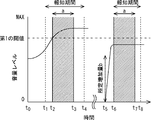
- FIG. 3 is a flowchart illustrating an operation example of the display device according to the first embodiment. It is an example of a display screen of the display apparatus which concerns on 1st Embodiment. It is the figure which showed the example of timing of volume change information and alerting
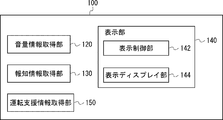
- FIG. 1 is a configuration block diagram conceptually showing a display device 100 according to the present invention, which is a configuration common to each embodiment described below.
- the display device 100 includes a volume information acquisition unit 120, a notification information acquisition unit 130, and a display unit 140.
- the display unit 140 includes a display display unit 144 that presents video to the user and a display control unit 142 that controls the video displayed on the display display unit 144. Specific examples of each component will be described in each embodiment.
- the display device 100 according to the first embodiment is configured using a HUD device 200 that projects and displays various types of information as virtual images in a vehicle, and a media playback device 400.
- the media playback device 400 according to the first embodiment targets various devices such as an in-vehicle navigation device, an in-vehicle audio device, various portable terminals such as a portable navigation device and an audio device.
- the display unit 140 is not limited to the HUD device 200 but may be a display unit included in a navigation device or the like.
- the HUD device 200 is installed on a dashboard 530 or the like of an automobile as shown in FIG. 2, and projects various kinds of information mainly on a position where the driver of the automobile can see as a virtual image 220.
- the virtual image 220 is projected on a windshield 510 or a combiner of an automobile.
- the HUD device 200 may be installed on the dashboard 530 or may be built in the dashboard 530. Further, the HUD device 200 may be installed on the ceiling or rear view mirror of an automobile.
- the media playback device 400 is installed on an automobile dashboard 530 as an example, and includes an operation input unit 405 that adjusts the playback volume when playing back content including audio.
- the operation input unit 405 is an interface that allows the user to arbitrarily control the playback volume, and is realized by various switches, a touch panel, a voice operation, and the like. Moreover, the operation input part 405 may be provided in the steering wheel 520 of the motor vehicle.
- the audio signal from the media playback device 400 is output by the speaker 550 after the playback volume is adjusted by the operation of the operation input unit 405.
- the left speaker 550L and the right speaker 550R are shown as examples of the speaker 550, but the configuration is arbitrary.
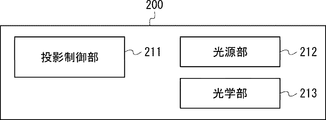
- the HUD device 200 includes a projection control unit 211, a light source unit 212, and an optical unit 213, as shown in FIG.
- the projection control unit 211 is configured by a CPU (Central Processing Unit) or the like, and controls input / output of the HUD device 200 and operation of components. Specifically, the light amount, color tone, display mode, and the like of the light source unit 212 are controlled based on the projection target video data input to the HUD device 200.
- the optical unit 213 includes a configuration in which a projection image is generated by scanning light with a MEMS (Micro Electro Mechanical Systems) mirror, the projection control unit 211 controls the swing of the MEMS mirror.
- MEMS Micro Electro Mechanical Systems
- the light source unit 212 optically forms an image projected by the HUD device 200.
- a laser diode as a light source and a MEMS mirror that scans light from the laser diode are included.
- the light source unit 212 uses a liquid crystal display device, an LED (Light Emitting Diode) as a light source, a reflective or transmissive liquid crystal panel, a polarizing plate, and the like are included.
- the optical unit 213 includes an optical element for projecting the projected image generated by the light source unit 212 as a virtual image 220, and includes various lenses such as a projection lens, an intermediate image filter, a reflecting mirror, and the like.
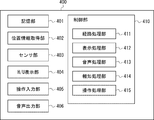
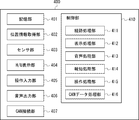
- the media playback device 400 includes a storage unit 401, a position information acquisition unit 402, a sensor unit 403, an H / U display unit 404, an operation input unit 405, an audio output unit 406, and a control unit 410. Is done.
- the storage unit 401 stores various types of information used for route guidance such as audio content, video content, map information, and display information, and the control unit 410 controls reading and writing of various types of information from the storage unit 401.
- the storage unit 401 may be various storage media provided in the media playback device 400, an external storage medium that can be used using various connections or communication, and an external storage device.
- the location information acquisition unit 402 is a GPS (Global Positioning System) receiver that acquires media location information in order for the media playback device 400 as a navigation device to grasp the route guidance purpose and the location relative to the peripheral equipment of the vehicle.
- the control unit 410 to be described later calculates the current position as latitude / longitude information based on GPS data from the position information acquisition unit 402 and uses it for route processing and the like.
- the sensor unit 403 includes various sensors such as an acceleration sensor and an inclination sensor for improving the accuracy of the current position information acquired from the position information acquisition unit 402.
- the value output by the sensor unit 403 is acquired by the control unit 410 and used for various processes.
- the sensor unit 403 includes a sensor that acquires surrounding information of the vehicle in which the media playback device 400 as a navigation device is provided. Specific examples include a camera that captures the surroundings of the vehicle, and a sensor such as millimeter wave and infrared that detects obstacles around the vehicle.
- An H / U (Head Unit) display unit 404 is a display device such as a liquid crystal display device provided in a navigation device used as a head unit. Information on route guidance and its surroundings is controlled by a display processing unit 412 described later. Displays facility information, various setting screens, audio content and video content playback screens, and the like.
- the operation input unit 405 is a user interface for the user to operate the media playback device 400, and can be input by various switches, a touch panel provided in the H / U display unit 404, and voice.
- the operation signal input from the operation input unit 405 is executed by the operation processing unit 415 described later in association with the input operation and processing.
- the operation input unit 405 accepts an operation of the playback volume of audio content or video content.
- the audio output unit 406 outputs audio of various contents played back by the media playback device 400.
- the audio output unit 406 transmits an audio signal that has been subjected to processing such as decoding by the processing of the audio processing unit 413 described later to the speaker 550 illustrated in FIG. Output.
- the audio output unit 406 may include an audio signal output amplification function and a D / A (Digital-to-Analog) conversion function.
- Examples of content played by the media playback device 400 include audio content and video content stored in the storage unit 401 and a disk drive (not shown), radio broadcast audio and television broadcast video received by a broadcast receiver (not shown), and the like. Voice, various contents via a network received by a communication unit (not shown), and the like.
- the control unit 410 includes a CPU, a DSP (Digital Signal Processor), a RAM, a ROM, and the like used for their operation.
- Various programs for operating the media playback device 400 are stored in the ROM and the storage unit 401 of the control unit 410.
- the control unit 410 realizes a route processing unit 411, a display processing unit 412, a voice processing unit 413, a notification processing unit 414, and an operation processing unit 415 as functions operated by these programs.
- the route processing unit 411 determines the current position based on the map information stored in the storage unit 401, the destination information specified by the operation input unit 405, the current position information based on the signal received by the position information acquisition unit 402, and the like. A process for generating a route to the destination is executed. The route generated by the route processing unit 411 is output to the H / U display unit 404 and the HUD device 200 and displayed. In addition, the route processing unit 411 generates instruction information such as a traveling direction such as the nearest intersection in the route, and is output and displayed on the H / U display unit 404 and the HUD device 200.
- the display processing unit 412 controls display of information to be output to the H / U display unit 404 and the HUD device 200.
- the configuration of information to be displayed on the H / U display unit 404 and the HUD device 200, display contents, display color and display brightness, display timing, and the like are controlled.
- the display processing unit 412 displays various GUIs (Graphical User Interface) that are linked to the touch operation.
- the audio processing unit 413 processes audio to be output by the media playback device 400. Specific examples include decoding processing of audio data included in various contents reproduced by the media playback device 400, sound quality changing processing, volume changing processing, and the like.
- the notification processing unit 414 performs a process of notifying information to be notified to the user.
- the output of a camera that captures the surroundings of the vehicle provided as the sensor unit 403 or a sensor such as a millimeter wave or infrared ray that detects obstacles around the vehicle is analyzed and is present around the vehicle.
- a notification display instruction is issued to 412.
- a notification display instruction is given to the display processing unit 412 so that the notification display by the H / U display unit 404 or the HUD device 200 is performed.
- the notification processing unit 414 may acquire information to be notified from a roadside device for ITS (Intelligent Transport System) using a communication unit (not shown).
- ITS Intelligent Transport System
- the notification processing unit 414 may notify the above-described notification instruction by sound output from the speaker 550. Or, in addition to the notification display, voice notification may be used in combination. In these cases, the sound processing unit 413 is instructed to output a notification sound so that a sound notification is performed.
- the operation processing unit 415 performs a process of accepting an operation of the operation input unit 405.
- the operation processing unit 415 receives signals based on the operation results and passes them to the corresponding operation processing.
- the operation input unit 405 is a voice input
- a voice signal from a microphone included in the operation input unit 405 is D / A converted, phoneme analysis is performed, and the result is transferred to a corresponding operation process.
- the operation playback unit 405 performs an operation for changing the playback volume while the media playback device 400 plays back audio content or video content including audio
- the volume operation by the operation processing unit 415 is performed. Based on the determination that the processing has been performed and the operation amount, the audio processing unit 413 changes the reproduction volume according to the operation.
- the operation input unit 405 and the operation processing unit 415 function as the volume information acquisition unit 120.
- the sensor unit 403 and the notification processing unit 414 function as the notification information acquisition unit 130.
- the display control unit 142 constituting the display unit 140 corresponds to the display processing unit 412, and the display display unit 144 corresponds to the H / U display unit 404 and the HUD device 200.
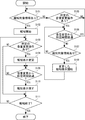
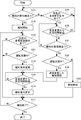
- the operation example shown in FIG. 5 is based on the assumption that the vehicle equipped with the display device 100 is operating and that the media playback device 400 constituting the display device 100 is playing back content including audio information. To do.
- the notification processing unit 414 sequentially detects conditions to be notified.
- the audio processing unit 413 sequentially receives volume operations by the operation input unit 405.
- the notification processing unit 414 determines that there is notification target information (step S101: Yes)
- the notification processing unit 414 starts the notification process (step S102).
- the notification process executed here is a notification of a surrounding situation or a vehicle situation that is dangerous to the driver who is a user by video or audio.
- the H / U display unit 404 or the HUD device 200 is displayed indicating that it is dangerous.
- the traveling vehicle suddenly approaches the center line or exceeds the center line
- the H / U display unit 404 or the HUD device 200 is displayed indicating that it is dangerous, and by voice Notify that it is dangerous.
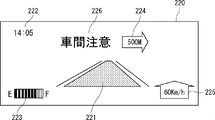
- FIG. 6 is an example of notification executed in step S102, and is an example of notification display on the virtual image 220 projected by the HUD device 200.
- the display content of the virtual image 220 is different from the display content of the H / U display unit 404, and the user can visually recognize the virtual image 220 by moving the line of sight with respect to forward viewing. Some information is displayed.
- the travel path display unit 221 indicates the form of the road on which the vehicle is actually traveling, and presents the road width, the form of the curve, and the like to the user.
- the display of the travel path display unit 221 is displayed using the current position information acquired from the position information acquisition unit 402 and the map information stored in the storage unit 401.
- the time display unit 222 displays the current time.
- the fuel display unit 223 displays the remaining amount of fuel and the charged amount.
- the planned traveling direction display unit 224 displays the distance to the intersection and the traveling direction that are appropriate to bend.
- the speed display unit 225 displays the current traveling speed.
- the notification display unit 226 is displayed on the virtual image 220.
- the notification display unit 226 indicates that there is a danger that the distance between other vehicles ahead and behind other vehicles becomes narrow.
- the voice processing unit 413 determines whether or not a predetermined volume change operation has been received by the operation input unit 405 (step S102). S103).
- the predetermined volume changing operation here is a case where an operation for raising the volume from a volume lower than a predetermined first threshold to a volume higher than the first threshold is performed.
- the predetermined volume changing operation when the first volume difference from the volume before the volume changing operation to the volume after the volume changing operation is a volume increase equal to or higher than the predetermined volume difference It is.
- volume changes that cause the user to focus on the sound whose volume has been changed and distract attention to the notification display are not limited to increasing the volume, but when the volume is decreased. Is the same.
- the predetermined volume change operation in this case is a case where an operation for lowering the volume from a volume equal to or higher than a predetermined second threshold to a volume lower than the second threshold is performed.
- the predetermined volume change operation when the second volume difference from the volume before the volume change operation to the volume after the volume change operation is performed is a volume decrease that is equal to or greater than the predetermined volume difference. It is.
- the volume set as the first threshold is set to be larger than the volume set as the second threshold.
- the first volume difference and the second volume difference may be the same volume difference or different volume differences.
- step S103 When it is determined in step S103 that a predetermined volume change operation has been accepted (step S103: Yes), the display processing unit 412 displays the display of the notification display unit 226 displayed in the notification process of step S102 to the user's eyes. The display is changed to a conspicuous display so as to be easy (step S104).
- various display forms such as displaying the display size of the notification display unit 226 large, displaying it in a conspicuous color tone, and blinking are applicable.
- step S103 when it is determined that a predetermined volume change operation has not been received (step S103: No), the notification processing unit 414 determines whether or not to end the notification processing (step S111).
- a specific example of the notification end timing determined in step S111 is a timing at which the notification is no longer a dangerous state.
- step S111 when it is determined that the notification is finished (step S111: Yes), this process is terminated. When it is determined not to end the notification (step S111: No), the process returns to step S103.
- step S101 to step S104 is processing when a volume change operation is accepted during execution of the notification processing.
- Another execution timing is when the notification process is started during a predetermined time during the volume change operation or after the volume change operation.
- the voice processing unit 413 determines whether or not a predetermined volume changing operation has been accepted by the operation input unit 405. (Step S105).
- step S105 If it is determined in step S105 that a predetermined volume change operation has been accepted (step S105: Yes), the audio processing unit 413 determines whether a predetermined time has elapsed since the volume change operation in step S105 (step S105). S106).
- the predetermined time here is appropriately about 5 to 10 seconds as a specific example, and preferably includes a length of time during which the user is conscious of the sound whose volume has been changed.
- step S105 If it is determined in step S105 that a predetermined volume change operation has not been accepted (step S105: No), the process returns to step S101.
- step S106 when it is determined that the predetermined time has not elapsed since the volume change operation (step S106: No), the notification processing unit 414 determines whether there is notification target information (step S107). In other words, in the state where the presence / absence determination of the notification target information is sequentially performed, a case is detected in which the notification target information is generated within a predetermined time from a predetermined volume change operation. If it is determined in step S106 that a predetermined time has elapsed since the sound volume change operation (step S106: Yes), the process returns to step S101.
- step S107 when it is determined that there is notification target information (step S107: Yes), the notification processing unit 414 starts notification processing (step S108). At this time, the display processing unit 412 displays the display of the notification display unit 226 as a conspicuous display so as to be easily noticed by the user. If it is determined in step S107 that there is no notification target information (step S107: No), the process returns to step S106.
- step S109 determines whether or not a predetermined time has elapsed since the volume change operation of step S103 or step S105 (step S109).
- the predetermined time determined here is the same as the predetermined time determined in step S106. If it is determined in step S109 that a predetermined time has elapsed since the volume change (step S109: Yes), the notification display changed in the notification process started in step S104 or step S108 is returned to the normal display (step S110). . If it is determined in step S109 that the predetermined time has not elapsed since the volume change (step S109: No), the process returns to step S109.
- the horizontal axis is the time axis.
- the notification processing unit 414 determines that there is notification target information (step S101: Yes), starts broadcast display from time t 1 (step S102). If the volume at time t 2 while the notification display is continued exceeds a first threshold value (step S103: Yes), during the period a of the display processing unit 412 from the time t 2 to time t 3, the user The notice display is changed to a conspicuous display so as to be easily noticeable (steps S104, S109, and S110).
- the display processing unit 412 returns the display on the notification display unit 226 to the normal display (step S110). Even if the volume level at this time is equal to or higher than the first threshold value, the purpose of drawing the user's attention to the notification display unit 226 is achieved when the user is distracted by the change in volume. .
- step S 111 exit the notification display at time t 4 after the notification display is returned (step S 111: Yes) If the notification display before the end of the period a is ended, the broadcast display is changed Even in the state, the notification display ends at the end timing of the notification display.
- the user operates the operation input section 405 as another example, when increasing the volume at a predetermined or higher volume increment from time t 5 (step S105: Yes), if the volume change within the predetermined time period (step S106: No), S107 if (step it is determined that the notification target information at time t 6: Yes), the display processing unit 412 time t 6 with the notification processing unit 414 starts notification processing until time t 7 During the period a, the notice display is changed to a conspicuous display so as to be easily noticeable by the user (step S108, step S109, step S110).
- the predetermined volume increase amount in this case is a predetermined volume increase performed within a predetermined time. For example, if the volume MAX is set to 100% from 0 in one second as a unit time, the volume increase is 50% or more. For example.
- the notification display is changed even if the increased volume is less than the first threshold as shown in FIG. Or it is good also as a condition which changes alerting
- step S103 and step S105 correspond to a volume information acquisition step.
- Steps S101 and S107 correspond to a notification information acquisition step.
- Steps S104 to S110 and steps S108 to S110 correspond to the display change step.
- the display device 100 changes the display form so that the user can easily notice the display based on the volume change information. For this reason, the user can notice the notification display even when the user's consciousness is concentrated on the sound output whose volume has been changed.
- the display device 100 according to the second embodiment is configured using the HUD device 200 that projects and displays various types of information as virtual images in the automobile, and the media playback device 400.
- the display device 100 is provided with a driving support information acquisition unit 150.
- the driving support information acquisition unit 150 acquires information as to whether or not driving support is being executed when the vehicle provided with the display device 100 has a driving support function.
- the driving assistance here refers to both assistance that is limited to the user's driving operation and assistance that is performed entirely.
- An example of the driving assistance that is partially performed is an auto-cruise function or the like, and an example of driving assistance that is entirely performed is automatic driving or the like.
- the driving support information acquisition unit 150 acquires information related to driving support from, for example, a CAN (Controller Area Network) that is an in-vehicle network. Therefore, the configuration of the media playback device 400 corresponds to a CAN data processing unit 416 as a function of the CAN connection unit 407 and the control unit 410, as shown in FIG.
- CAN Controller Area Network
- the CAN connection unit 407 is an interface for connecting to the CAN.
- the CAN data processing unit 416 performs processing for acquiring and using CAN information according to the purpose through the CAN connection unit 407. Further, the CAN data processing unit 416 determines whether or not driving assistance is being executed based on the acquired CAN data.
- step S103 when it is determined in step S103 that a predetermined volume change operation has been accepted (step S103: Yes), the CAN data processing unit 416 determines whether or not driving assistance is being executed. (Step S201).
- step S201 when it is determined that driving assistance is being executed (step S201: Yes), the display processing unit 412 easily recognizes the display of the notification display unit 226 displayed in the notification process of step S102. Thus, the display is changed to a conspicuous display (step S104).
- step S101 when it is determined that driving assistance is not being executed (step S201: No), the process of step S111 is executed.
- step S107 determines whether or not driving assistance is being executed (step S202).
- step S202 determines whether or not driving assistance is being executed (step S202: Yes).
- the notification processing unit 414 starts notification processing (step S108).
- the display processing unit 412 displays the display of the notification display unit 226 as a conspicuous display so as to be easily noticed by the user.
- step S203 the notification processing unit 414 starts notification processing (step S203). At this time, the display processing unit 412 displays the display of the notification display unit 226 as a normal display form.
- the display device 100 changes the display form so that the user can easily notice the notification display based on the volume change information during driving support. For this reason, the user notices the notification display even when the user's consciousness concentrates more on the sound output due to the change of the volume at the time of driving support in which the consciousness is more concentrated on the sound output of the content than during normal driving. be able to.
- the display device 100 of the present invention has been described as a device used in an automobile. However, the present invention is not limited to a display device used in an automobile but is useful.
- a third embodiment of the display device 100 according to the present invention will be described with reference to FIGS. In the description of the display device 100 according to the third embodiment, the description of the parts common to the description of the display device 100 according to the first embodiment is omitted.
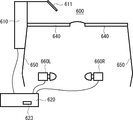
- FIG. 11 is a diagram schematically showing the HMD device 600 and the media playback device 620 constituting the display device 100 of the present invention.
- the HMD device 600 is a glasses-type device or a goggle-type device worn on the user's head
- the media playback device 620 is a portable or HMD device as long as it can output various types of information to the HMD device 600. Any form such as an integral type with 600 may be used.
- the HMD device 600 includes an HMD projection unit 610, a half mirror 611, a spectacle lens unit 640, a spectacle temple unit 650, and the like.
- the media playback device 620 includes an operation input unit 624, and is connected to an earphone 660 (left earphone 660L, right earphone 660R) for outputting an audio signal to the user.
- Earphone 660 may be any headphone connected to media playback device 620 or a small speaker.
- the HMD device 600 may be integrated.
- the media playback device 620 outputs an audio signal to the earphone 660 if the content to be played back includes an audio signal, and outputs a video to the HMD projection unit 610 if the content to be played back includes a video signal. Output a signal.
- the HMD projection unit 610 projects video light based on the input video signal onto the half mirror 611, and the user wearing the HMD device 600 views the video reflected by the half mirror 611 via the spectacle lens unit 640. be able to.
- FIG. 12 is a configuration block diagram of the HMD projection unit 610.
- the HMD projection unit 610 includes a light source unit 612, an optical unit 613, and a sensor unit 614.
- the light source unit 612 generates image light to be presented to the user.
- it is comprised by the liquid crystal panel which comprises the image
- the optical unit 613 is an optical component that generates an optical path for guiding the image light generated by the light source unit 612 to the half mirror 611, and includes a lens that enlarges or reduces the image light, a reflecting mirror, and the like.
- the sensor unit 614 includes one or a plurality of sensors. Specifically, a GPS receiving unit that acquires current position information, an acceleration sensor that detects the direction and moving direction of the HMD device 600, and a direction sensor are provided.
- the sensor unit 614 may be a camera that captures the front of the user wearing the HMD device 600 and the like.
- the media playback device is of a portable type or an integrated type with the HMD device 600, and includes a storage unit 621, an operation input unit 623, an audio output unit 624, and a control unit 630 as shown in FIG. Consists of.
- the storage unit 621 has the same configuration as the storage unit 401 and stores audio content and video content.
- the operation input unit 623 has the same configuration as the operation input unit 405, and accepts an operation for adjusting the playback volume of the content played back by the media playback device 620.
- the audio output unit 624 has the same configuration as the audio output unit 406, and outputs audio of various contents reproduced by the media playback device 620.
- the audio output unit 624 outputs an audio signal that has been subjected to processing such as decoding by the processing of the audio processing unit 632 described later to the earphone 660 shown in FIG.
- the control unit 630 has the same configuration as that of the control unit 410, and realizes a display processing unit 631, a voice processing unit 632, a notification processing unit 633, and an operation processing unit 634 as functions operated by a program stored in a RAM or the like. To do.
- the display processing unit 631 has the same function as the display processing unit 412 and controls display of information to be output to the HMD projection unit 610.
- the voice processing unit 632 has the same functions as the voice processing unit 413.
- the notification processing unit 633 has the same function as the notification processing unit 414.
- a notification display instruction is given to the display processing unit 631.
- the presence of a notification target is detected by analyzing an image captured by a camera as the sensor unit 614, and a notification display instruction is issued to the display processing unit 631.
- the notification target include a staircase in a traveling direction, a construction section, a vehicle approaching the user, and the like.
- the operation processing unit 634 has a function similar to that of the operation processing unit 415, and performs a process of accepting an operation of the operation input unit 624.
- the operation input unit 624 is operated to change the playback volume
- volume operation by the operation processing unit 634 is performed.
- the audio processing unit 632 changes the playback volume according to the operation.
- the operation input unit 623 and the operation processing unit 634 function as the volume information acquisition unit 120.
- the sensor unit 614 and the notification processing unit 633 function as the notification information acquisition unit 130.
- the display control unit 142 constituting the display unit 140 corresponds to the display processing unit 631, and the display display unit 144 corresponds to the HMD device 600.
- the operation example of the display device 100 according to the third embodiment is the same as the operation example of the display device 100 according to the first embodiment shown in FIG.
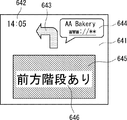
- FIG. 14 is an example of notification executed in step S102, and is an example of notification display on a virtual image 641 projected by the HMD device 600.
- a time display unit 642, a destination display unit 643, a facility information display unit 644, and a content display unit 645 are displayed in the virtual image 641.
- a notification display unit 646 is displayed.
- the time display unit 642 displays the current time and the like.
- the destination display unit 643 is based on the map information stored in the storage unit 621 and can be visually recognized through the spectacle lens unit 640.
- An arrow indicating the destination is displayed above or on the intersection.
- the destination display unit 643 displays the actual scenery on the road viewed through the spectacle lens unit 640 based on the map information when the destination is not set or when the destination setting function is not provided. And an arrow indicating the direction of travel on the intersection.
- the facility information display unit 644 displays information related to the facility with respect to the facility of the real scenery visually recognized through the spectacle lens unit 640. Specifically, a store name, a store URL, word-of-mouth information, and the like.
- the content display unit 645 displays a playback screen for content played by the media playback device 620.
- the content display unit 645 may be a Web screen based on the URL or the like of the facility information display unit 644.
- the notification display unit 646 is displayed according to an instruction from the notification processing unit 633.
- the display processing unit 631 When the notification display unit 646 is displayed, when the notification display is changed based on the volume change as in step S104 or step S108, the display processing unit 631 easily displays the notification display unit 646 on the user's eyes. Change to a conspicuous display.
- the display position of the notification display unit 646 may be displayed at a position superimposed on the content display unit 645 as shown in FIG.
- the notification display unit 646 is displayed at a position not superimposed on the content display unit 645 during normal notification, and the notification display unit 646 is displayed at a position superimposed on the content display unit 645 when the notification display based on the volume change is changed. May be.
- the display device 100 changes the display form so that the user can easily notice the display based on the volume change information. For this reason, the user can notice the notification display even when consciousness is concentrated on the sound output due to the volume change when the HMD device 600 is worn.
- Display device 120 Volume information acquisition unit 130 Notification information acquisition unit 140 Display unit 142 Display control unit 144 Display display unit 150 Driving support information acquisition unit 200 HUD device 211 Projection control unit 212 Light source unit 213 Optical unit 214 Optical unit 220 Virtual image 221 Traveling Road display unit 222 Time display unit 223 Fuel display unit 224 Scheduled traveling direction display unit 225 Speed display unit 226 Notification display unit 400 Media playback device 401 Storage unit 402 Position information acquisition unit 403 Sensor unit 404 H / U display unit 405 Operation input unit 406 Audio output unit 407 CAN connection unit 410 Control unit 411 Path processing unit 412 Display processing unit 413 Audio processing unit 414 Notification processing unit 415 Operation processing unit 416 CAN data processing unit 510 Windshield 520 Steering wheel 530 Dashboard 550L Left speaker 550R Right speaker 600 HMD device 610 HMD projection unit 611 Half mirror 612 Light source unit 613 Optical unit 614 Sensor unit 620 Media playback device 621 Storage unit 623 Operation input unit 624 Audio
Landscapes
- Engineering & Computer Science (AREA)
- Physics & Mathematics (AREA)
- General Physics & Mathematics (AREA)
- Optics & Photonics (AREA)
- Chemical & Material Sciences (AREA)
- Mechanical Engineering (AREA)
- Transportation (AREA)
- Combustion & Propulsion (AREA)
- Radar, Positioning & Navigation (AREA)
- Remote Sensing (AREA)
- Theoretical Computer Science (AREA)
- Health & Medical Sciences (AREA)
- General Health & Medical Sciences (AREA)
- Automation & Control Theory (AREA)
- Multimedia (AREA)
- Audiology, Speech & Language Pathology (AREA)
- Human Computer Interaction (AREA)
- General Engineering & Computer Science (AREA)
- Signal Processing (AREA)
- Acoustics & Sound (AREA)
- Otolaryngology (AREA)
- Computer Hardware Design (AREA)
- Instrument Panels (AREA)
- Traffic Control Systems (AREA)
- Controls And Circuits For Display Device (AREA)
- Navigation (AREA)
Priority Applications (1)
| Application Number | Priority Date | Filing Date | Title |
|---|---|---|---|
| US15/221,484 US20160334623A1 (en) | 2014-01-28 | 2016-07-27 | Display device, display method, and non-transitory computer readable medium storing display program |
Applications Claiming Priority (2)
| Application Number | Priority Date | Filing Date | Title |
|---|---|---|---|
| JP2014-013099 | 2014-01-28 | ||
| JP2014013099A JP6349744B2 (ja) | 2014-01-28 | 2014-01-28 | 表示装置、表示方法および表示プログラム |
Related Child Applications (1)
| Application Number | Title | Priority Date | Filing Date |
|---|---|---|---|
| US15/221,484 Continuation US20160334623A1 (en) | 2014-01-28 | 2016-07-27 | Display device, display method, and non-transitory computer readable medium storing display program |
Publications (1)
| Publication Number | Publication Date |
|---|---|
| WO2015114697A1 true WO2015114697A1 (ja) | 2015-08-06 |
Family
ID=53756323
Family Applications (1)
| Application Number | Title | Priority Date | Filing Date |
|---|---|---|---|
| PCT/JP2014/005127 Ceased WO2015114697A1 (ja) | 2014-01-28 | 2014-10-08 | 表示装置、表示方法および表示プログラムを格納した非一時的なコンピュータ可読媒体 |
Country Status (3)
| Country | Link |
|---|---|
| US (1) | US20160334623A1 (enExample) |
| JP (1) | JP6349744B2 (enExample) |
| WO (1) | WO2015114697A1 (enExample) |
Cited By (1)
| Publication number | Priority date | Publication date | Assignee | Title |
|---|---|---|---|---|
| EP3231668A1 (de) * | 2016-04-14 | 2017-10-18 | MAN Truck & Bus AG | Fahrzeug, insbesondere nutzfahrzeug, mit einem spiegelersatzsystem |
Families Citing this family (15)
| Publication number | Priority date | Publication date | Assignee | Title |
|---|---|---|---|---|
| EP3693203B1 (en) | 2014-12-10 | 2022-05-18 | Ricoh Company, Ltd. | Controller, display, method and carrier means for information provision |
| US9702121B2 (en) * | 2014-12-26 | 2017-07-11 | Komatsu Ltd. | State information display for work machine, caution-sign displaying method for work machine, and caution-sign displaying program for work machine |
| CN111752046B (zh) * | 2015-10-15 | 2023-06-02 | 麦克赛尔株式会社 | 平视显示装置 |
| US10118337B2 (en) * | 2016-06-06 | 2018-11-06 | Xerox Corporation | Electrostatic 3-D printer controlling layer topography using aerosol applicator |
| KR102463699B1 (ko) * | 2016-12-14 | 2022-11-07 | 현대자동차주식회사 | 차량의 디스플레이 관리 장치 |
| CN108109210B (zh) * | 2017-12-15 | 2019-04-16 | 广州德科投资咨询有限公司 | 一种用于自动驾驶车辆的场景生成方法及智能眼镜 |
| JP6968689B2 (ja) * | 2017-12-27 | 2021-11-17 | Dynabook株式会社 | 電子機器、ウェアラブル機器及び表示制御方法 |
| JP6876277B2 (ja) * | 2019-03-29 | 2021-05-26 | 株式会社リコー | 制御装置、表示装置、表示方法及びプログラム |
| WO2021056556A1 (zh) * | 2019-09-29 | 2021-04-01 | 驭势科技(北京)有限公司 | 一种车载自动驾驶测试系统及测试方法 |
| JP7355052B2 (ja) * | 2021-03-15 | 2023-10-03 | 株式会社デンソー | 車両制御装置 |
| US12272366B2 (en) | 2021-04-29 | 2025-04-08 | Adeia Guides Inc. | Systems and methods to alter voice interactions |
| US11984112B2 (en) * | 2021-04-29 | 2024-05-14 | Rovi Guides, Inc. | Systems and methods to alter voice interactions |
| JP7767738B2 (ja) * | 2021-06-01 | 2025-11-12 | マツダ株式会社 | ヘッドアップディスプレイ装置 |
| US11702096B1 (en) * | 2022-03-25 | 2023-07-18 | GM Global Technology Operations LLC | Systems and methods for providing a graphical representation of following distances to an augmented reality vehicle heads-up display system |
| US12630018B2 (en) * | 2024-06-18 | 2026-05-19 | Qualcomm Incorporated | Guidance data for vehicles driving relative to a curve using augmented reality (AR) |
Citations (6)
| Publication number | Priority date | Publication date | Assignee | Title |
|---|---|---|---|---|
| JP2003323700A (ja) * | 2002-03-08 | 2003-11-14 | Robert Bosch Gmbh | 運転者警告のための方法および装置 |
| JP2007140978A (ja) * | 2005-11-18 | 2007-06-07 | Toyota Motor Corp | 走行支援装置 |
| JP2009043003A (ja) * | 2007-08-08 | 2009-02-26 | Denso Corp | 運転支援装置 |
| JP2010026619A (ja) * | 2008-07-16 | 2010-02-04 | Hitachi Automotive Systems Ltd | 車両運転支援装置 |
| JP2010211623A (ja) * | 2009-03-11 | 2010-09-24 | Brother Ind Ltd | 作業支援システム |
| JP2013203103A (ja) * | 2012-03-27 | 2013-10-07 | Denso It Laboratory Inc | 車両用表示装置、その制御方法及びプログラム |
Family Cites Families (6)
| Publication number | Priority date | Publication date | Assignee | Title |
|---|---|---|---|---|
| JPH05297846A (ja) * | 1992-04-15 | 1993-11-12 | Nec Corp | 自律型最適表示端末 |
| JP2008228005A (ja) * | 2007-03-14 | 2008-09-25 | Seiko Epson Corp | 映像音声処理装置、映像音声再生システム、映像音声処理方法、及び、映像音声処理プログラム |
| JP5522466B2 (ja) * | 2010-07-30 | 2014-06-18 | 日本精機株式会社 | 車両用表示装置 |
| JP2012116439A (ja) * | 2010-12-03 | 2012-06-21 | Toyota Motor Corp | 運転支援用表示装置 |
| US9412273B2 (en) * | 2012-03-14 | 2016-08-09 | Autoconnect Holdings Llc | Radar sensing and emergency response vehicle detection |
| US20140005886A1 (en) * | 2012-06-29 | 2014-01-02 | Microsoft Corporation | Controlling automotive functionality using internal- and external-facing sensors |
-
2014
- 2014-01-28 JP JP2014013099A patent/JP6349744B2/ja active Active
- 2014-10-08 WO PCT/JP2014/005127 patent/WO2015114697A1/ja not_active Ceased
-
2016
- 2016-07-27 US US15/221,484 patent/US20160334623A1/en not_active Abandoned
Patent Citations (6)
| Publication number | Priority date | Publication date | Assignee | Title |
|---|---|---|---|---|
| JP2003323700A (ja) * | 2002-03-08 | 2003-11-14 | Robert Bosch Gmbh | 運転者警告のための方法および装置 |
| JP2007140978A (ja) * | 2005-11-18 | 2007-06-07 | Toyota Motor Corp | 走行支援装置 |
| JP2009043003A (ja) * | 2007-08-08 | 2009-02-26 | Denso Corp | 運転支援装置 |
| JP2010026619A (ja) * | 2008-07-16 | 2010-02-04 | Hitachi Automotive Systems Ltd | 車両運転支援装置 |
| JP2010211623A (ja) * | 2009-03-11 | 2010-09-24 | Brother Ind Ltd | 作業支援システム |
| JP2013203103A (ja) * | 2012-03-27 | 2013-10-07 | Denso It Laboratory Inc | 車両用表示装置、その制御方法及びプログラム |
Cited By (1)
| Publication number | Priority date | Publication date | Assignee | Title |
|---|---|---|---|---|
| EP3231668A1 (de) * | 2016-04-14 | 2017-10-18 | MAN Truck & Bus AG | Fahrzeug, insbesondere nutzfahrzeug, mit einem spiegelersatzsystem |
Also Published As
| Publication number | Publication date |
|---|---|
| JP2015140061A (ja) | 2015-08-03 |
| JP6349744B2 (ja) | 2018-07-04 |
| US20160334623A1 (en) | 2016-11-17 |
Similar Documents
| Publication | Publication Date | Title |
|---|---|---|
| JP6349744B2 (ja) | 表示装置、表示方法および表示プログラム | |
| US20250095326A1 (en) | Display system and display method | |
| US9819920B2 (en) | Head-up display device | |
| US9946078B2 (en) | Head-up display device | |
| US10250860B2 (en) | Electronic apparatus and image display method | |
| WO2018070193A1 (ja) | ヘッドアップディスプレイ装置 | |
| JP2019113809A (ja) | ヘッドアップディスプレイ装置 | |
| JP6825433B2 (ja) | 虚像表示装置及びコンピュータプログラム | |
| JP7147370B2 (ja) | 表示装置 | |
| JP2017094882A (ja) | 虚像生成システム、虚像生成方法及びコンピュータプログラム | |
| JP2019132968A (ja) | 表示装置 | |
| JP2015179152A (ja) | ヘッドアップディスプレイ装置 | |
| WO2019130860A1 (ja) | ヘッドアップディスプレイ装置、および制御プログラム | |
| JP6300949B2 (ja) | 表示制御装置 | |
| JP6196840B2 (ja) | ヘッドアップディスプレイ装置 | |
| JP2015161565A (ja) | ナビゲーション装置、ナビゲーション方法およびプログラム | |
| WO2021131529A1 (ja) | ヘッドアップディスプレイ装置 | |
| JP7397918B2 (ja) | 映像装置 | |
| JP2019056884A (ja) | 重畳画像表示装置 | |
| JP2025013437A (ja) | 制御装置、制御方法、プログラムおよび記録媒体 | |
| JP2014223824A (ja) | 表示装置、表示方法および表示プログラム | |
| JP6102628B2 (ja) | ヘッドアップディスプレイ装置 | |
| JP2015136953A (ja) | 二輪車両情報提供装置 | |
| JP2020045019A (ja) | 車両用表示装置 | |
| JPH04267288A (ja) | 車両用情報視聴覚装置 |
Legal Events
| Date | Code | Title | Description |
|---|---|---|---|
| 121 | Ep: the epo has been informed by wipo that ep was designated in this application |
Ref document number: 14880398 Country of ref document: EP Kind code of ref document: A1 |
|
| NENP | Non-entry into the national phase |
Ref country code: DE |
|
| 122 | Ep: pct application non-entry in european phase |
Ref document number: 14880398 Country of ref document: EP Kind code of ref document: A1 |