WO2015098394A1 - 二軸延伸積層ポリエステルフィルム - Google Patents
二軸延伸積層ポリエステルフィルム Download PDFInfo
- Publication number
- WO2015098394A1 WO2015098394A1 PCT/JP2014/081030 JP2014081030W WO2015098394A1 WO 2015098394 A1 WO2015098394 A1 WO 2015098394A1 JP 2014081030 W JP2014081030 W JP 2014081030W WO 2015098394 A1 WO2015098394 A1 WO 2015098394A1
- Authority
- WO
- WIPO (PCT)
- Prior art keywords
- layer
- film
- polyester
- coating layer
- polyester film
- Prior art date
- Legal status (The legal status is an assumption and is not a legal conclusion. Google has not performed a legal analysis and makes no representation as to the accuracy of the status listed.)
- Ceased
Links
Classifications
-
- B—PERFORMING OPERATIONS; TRANSPORTING
- B32—LAYERED PRODUCTS
- B32B—LAYERED PRODUCTS, i.e. PRODUCTS BUILT-UP OF STRATA OF FLAT OR NON-FLAT, e.g. CELLULAR OR HONEYCOMB, FORM
- B32B27/00—Layered products comprising a layer of synthetic resin
- B32B27/36—Layered products comprising a layer of synthetic resin comprising polyesters
-
- B—PERFORMING OPERATIONS; TRANSPORTING
- B32—LAYERED PRODUCTS
- B32B—LAYERED PRODUCTS, i.e. PRODUCTS BUILT-UP OF STRATA OF FLAT OR NON-FLAT, e.g. CELLULAR OR HONEYCOMB, FORM
- B32B27/00—Layered products comprising a layer of synthetic resin
- B32B27/06—Layered products comprising a layer of synthetic resin as the main or only constituent of a layer, which is next to another layer of the same or of a different material
- B32B27/08—Layered products comprising a layer of synthetic resin as the main or only constituent of a layer, which is next to another layer of the same or of a different material of synthetic resin
-
- B—PERFORMING OPERATIONS; TRANSPORTING
- B32—LAYERED PRODUCTS
- B32B—LAYERED PRODUCTS, i.e. PRODUCTS BUILT-UP OF STRATA OF FLAT OR NON-FLAT, e.g. CELLULAR OR HONEYCOMB, FORM
- B32B27/00—Layered products comprising a layer of synthetic resin
- B32B27/18—Layered products comprising a layer of synthetic resin characterised by the use of special additives
- B32B27/20—Layered products comprising a layer of synthetic resin characterised by the use of special additives using fillers, pigments, thixotroping agents
-
- B—PERFORMING OPERATIONS; TRANSPORTING
- B32—LAYERED PRODUCTS
- B32B—LAYERED PRODUCTS, i.e. PRODUCTS BUILT-UP OF STRATA OF FLAT OR NON-FLAT, e.g. CELLULAR OR HONEYCOMB, FORM
- B32B7/00—Layered products characterised by the relation between layers; Layered products characterised by the relative orientation of features between layers, or by the relative values of a measurable parameter between layers, i.e. products comprising layers having different physical, chemical or physicochemical properties; Layered products characterised by the interconnection of layers
- B32B7/04—Interconnection of layers
- B32B7/12—Interconnection of layers using interposed adhesives or interposed materials with bonding properties
-
- B—PERFORMING OPERATIONS; TRANSPORTING
- B32—LAYERED PRODUCTS
- B32B—LAYERED PRODUCTS, i.e. PRODUCTS BUILT-UP OF STRATA OF FLAT OR NON-FLAT, e.g. CELLULAR OR HONEYCOMB, FORM
- B32B2250/00—Layers arrangement
- B32B2250/03—3 layers
-
- B—PERFORMING OPERATIONS; TRANSPORTING
- B32—LAYERED PRODUCTS
- B32B—LAYERED PRODUCTS, i.e. PRODUCTS BUILT-UP OF STRATA OF FLAT OR NON-FLAT, e.g. CELLULAR OR HONEYCOMB, FORM
- B32B2250/00—Layers arrangement
- B32B2250/24—All layers being polymeric
- B32B2250/244—All polymers belonging to those covered by group B32B27/36
-
- B—PERFORMING OPERATIONS; TRANSPORTING
- B32—LAYERED PRODUCTS
- B32B—LAYERED PRODUCTS, i.e. PRODUCTS BUILT-UP OF STRATA OF FLAT OR NON-FLAT, e.g. CELLULAR OR HONEYCOMB, FORM
- B32B2255/00—Coating on the layer surface
- B32B2255/10—Coating on the layer surface on synthetic resin layer or on natural or synthetic rubber layer
-
- B—PERFORMING OPERATIONS; TRANSPORTING
- B32—LAYERED PRODUCTS
- B32B—LAYERED PRODUCTS, i.e. PRODUCTS BUILT-UP OF STRATA OF FLAT OR NON-FLAT, e.g. CELLULAR OR HONEYCOMB, FORM
- B32B2255/00—Coating on the layer surface
- B32B2255/26—Polymeric coating
-
- B—PERFORMING OPERATIONS; TRANSPORTING
- B32—LAYERED PRODUCTS
- B32B—LAYERED PRODUCTS, i.e. PRODUCTS BUILT-UP OF STRATA OF FLAT OR NON-FLAT, e.g. CELLULAR OR HONEYCOMB, FORM
- B32B2264/00—Composition or properties of particles which form a particulate layer or are present as additives
- B32B2264/02—Synthetic macromolecular particles
-
- B—PERFORMING OPERATIONS; TRANSPORTING
- B32—LAYERED PRODUCTS
- B32B—LAYERED PRODUCTS, i.e. PRODUCTS BUILT-UP OF STRATA OF FLAT OR NON-FLAT, e.g. CELLULAR OR HONEYCOMB, FORM
- B32B2307/00—Properties of the layers or laminate
- B32B2307/20—Properties of the layers or laminate having particular electrical or magnetic properties, e.g. piezoelectric
- B32B2307/21—Anti-static
-
- B—PERFORMING OPERATIONS; TRANSPORTING
- B32—LAYERED PRODUCTS
- B32B—LAYERED PRODUCTS, i.e. PRODUCTS BUILT-UP OF STRATA OF FLAT OR NON-FLAT, e.g. CELLULAR OR HONEYCOMB, FORM
- B32B2307/00—Properties of the layers or laminate
- B32B2307/50—Properties of the layers or laminate having particular mechanical properties
- B32B2307/514—Oriented
- B32B2307/518—Oriented bi-axially
-
- B—PERFORMING OPERATIONS; TRANSPORTING
- B32—LAYERED PRODUCTS
- B32B—LAYERED PRODUCTS, i.e. PRODUCTS BUILT-UP OF STRATA OF FLAT OR NON-FLAT, e.g. CELLULAR OR HONEYCOMB, FORM
- B32B2457/00—Electrical equipment
- B32B2457/20—Displays, e.g. liquid crystal displays, plasma displays
- B32B2457/202—LCD, i.e. liquid crystal displays
Definitions
- the present invention relates to an optical polyester film, and more specifically, a biaxial material used as a base material for a microlens sheet or a prism sheet used as an optical sheet for a backlight of a liquid crystal display (hereinafter abbreviated as LCD). It relates to stretch lamination.
- a biaxial material used as a base material for a microlens sheet or a prism sheet used as an optical sheet for a backlight of a liquid crystal display (hereinafter abbreviated as LCD). It relates to stretch lamination.
- LCD liquid crystal display
- polyester films especially biaxially stretched films of polyethylene terephthalate and polyethylene naphthalate, have excellent mechanical properties, heat resistance, and chemical resistance.
- Magnetic tape, ferromagnetic thin film tape, photographic film, packaging It is widely used as a material for films, films for electronic parts, electrical insulation films, metal laminate films, films to be attached to glass surfaces such as glass displays, and protective films for various members.
- polyester films have been widely used for various optical sheets in particular.
- Base films and reflective films for ITO-based hard coat films such as diffusion sheets for LCD members, microlens sheets, prism sheets, composite sheets, reflectors, and touch panels. It is used in various applications such as a base film for prevention, a base film for explosion-proof display, and a film for PDP filter.
- microlens sheets and prism sheets used as LCD backlights are processed on the front side with functions such as microlenses and prisms on one side, and each sheet is attached to the opposite side.
- Antistatic, wear (slippery), shielding, etc. for the purpose of preventing sticking, preventing damage to other members, and shielding the image of the lamp that is the light source of the backlight unit
- the conventional backcoat processing process has been eliminated and the backcoat function has been applied to the polyester film as the base material. It is requested to do.
- a generally used method is a method of increasing the haze of the base film.
- inorganic particles such as silica, calcium carbonate, magnesium carbonate, barium carbonate, calcium sulfate, calcium phosphate, magnesium phosphate silicon oxide, kaolin, aluminum oxide, titanium oxide into the film.
- High haze to shield the image of the image requires a large amount of particles, so the filter pressure rises frequently in the film forming process, and it is necessary to change the filter frequently, and the film tends to break and productivity In terms of cost, the need for a large amount of particles There is a problem such as a high.
- the present invention has been made in view of the above circumstances, and the problem to be solved is that it is a member of an optical product, particularly when it is used as a microlens for a backlight for an LCD, or as a base film for a prism, without performing backcoat processing.
- the backcoat has antistatic performance, wear performance, and shielding performance, maintains high brightness, and provides clear and high-quality images. To provide a film.
- the gist of the present invention is a biaxially stretched laminated polyester film comprising a three-layer structure of a polyester layer (A) and a polyester layer (C) constituting the surface layer and a polyester layer (B) constituting the intermediate layer,
- the layer (A) has an easy adhesion coating layer
- the layer (C) has an antistatic coating layer
- inert organic particles having an average particle size of 3.0 to 7.0 ⁇ m are contained in the layer (C).
- the present invention resides in a biaxially stretched laminated polyester film characterized by containing 0.05 to 1.5% by weight.
- the film of the present invention does not require back coating when used as a base film for each of the microlens and prism sheets of an LCD backlight optical sheet for which there is a demand for cost reduction in recent years. This eliminates the problem that the image of the image appears in the image and makes it impossible to obtain a clear and high-definition image, and the problem of scratching other members and sticking between sheets without reducing the brightness. -Industrial value is extremely high because it can contribute to cost response.
- the polyester used for the polyester film refers to one obtained by polycondensation of an aromatic dicarboxylic acid and an aliphatic glycol.
- Aromatic dicarboxylic acids include terephthalic acid, isophthalic acid, 2,6-naphthalenedicarboxylic acid, and aliphatic glycols include ethylene glycol, diethylene glycol, trimethylene glycol, tetramethylene glycol, neopentyl glycol, 1, 4-cyclohexanedimethanol and the like can be mentioned.
- Typical polyesters include polyethylene terephthalate (PET), polyethylene-2,6-naphthalenedicarboxylate (PEN), polybutylene terephthalate, and the like.
- Such a polyester may be a homopolymer that is not copolymerized, 20 mol% or less of the dicarboxylic acid component is a dicarboxylic acid component other than the main component, and / or 20 mol% or less of the diol component is other than the main component. It may be a copolyester that is a diol component. Moreover, those mixtures may be sufficient.
- the polyester in the present invention is a conventionally known method, for example, a method of directly obtaining a low-polymerization degree polyester by reaction of a dicarboxylic acid and a diol, or a lower alkyl ester of a dicarboxylic acid and a diol reacted with a conventionally known transesterification catalyst. Then, it can obtain by the method of performing a polymerization reaction in presence of a polymerization catalyst.
- a known catalyst such as an antimony compound, a germanium compound, or a titanium compound may be used.
- the amount of the antimony compound is zero or 100% or less as antimony to reduce the dullness of the film. .
- the polyester may be chipped after melt polymerization, and further subjected to solid phase polymerization as necessary under heating and reduced pressure or in an inert gas stream such as nitrogen.
- the intrinsic viscosity of the obtained polyester is preferably 0.50 dl / g or more, and preferably 0.50 to 0.90 dl / g.
- the layer (A) constituting the surface layer of the polyester film subjected to the processing of a solvent-free UV curable resin such as a microlens or a prism for backlight is used to prevent damage to the film, master
- a solvent-free UV curable resin such as a microlens or a prism for backlight
- particles may be blended mainly for the purpose of imparting slipperiness.
- the blending may not be performed.
- the kind of the particle to be blended is not particularly limited as long as it is a particle capable of imparting slipperiness.
- Specific examples thereof include silica, calcium carbonate, magnesium carbonate, barium carbonate, calcium sulfate, calcium phosphate, and phosphoric acid.
- examples thereof include particles of magnesium silicon oxide, kaolin, aluminum oxide, titanium oxide and the like.
- the heat-resistant organic particles described in JP-B-59-5216, JP-A-59-217755 and the like may be used.
- examples of other heat-resistant organic particles include thermosetting urea resins, thermosetting phenol resins, thermosetting epoxy resins, benzoguanamine resins, and the like.
- precipitated particles obtained by precipitating and finely dispersing a part of a metal compound such as a catalyst during the polyester production process can also be used.
- the shape of the particles to be used is not particularly limited, and any of a spherical shape, a block shape, a rod shape, a flat shape, and the like may be used. Moreover, there is no restriction
- the average particle size of the particles used is usually preferably 0.01 to 3 ⁇ m.
- the average particle size is less than 0.01 ⁇ m, the particles tend to aggregate and the dispersibility may be insufficient.
- the average particle size exceeds 3 ⁇ m, the surface roughness of the film becomes too coarse, Lens processing and prism processing cannot be performed uniformly, and problems such as inferior optical performance of microlenses and prisms occur.
- the particle content is usually 0.2% by weight or less, preferably 0.15% by weight or less based on the layer (A).
- the particle content is usually 0.2% by weight or less, preferably 0.15% by weight or less based on the layer (A).
- the surface roughness of the film becomes too rough, the microlenses and prisms cannot be processed uniformly, and the optical characteristics may be inferior.
- the layer (C) has functions of shielding for shielding an image of a lamp as a light source and wear resistance for preventing damage to other members while maintaining high luminance characteristics.
- inert organic particles are blended.
- the average particle diameter of the inert organic particles used in the present invention is in the range of 3 to 7 ⁇ m. If the average particle size is less than 3 ⁇ m, a large amount of particles are required to achieve the desired shielding properties, and there is no merit in terms of cost. Further, the light transmittance is lowered, and the luminance is lowered.
- the content of the inert organic particles with respect to the layer (C) constituting the surface layer of the present invention is 0.05 to 1.5% by weight, preferably 0.1 to 1.3% by weight.
- the content of the inert organic particles in the C layer is less than 0.05%, the shielding property for shielding the light image of the light source intended by the present invention cannot be obtained.
- it exceeds 1.5% by weight the luminance is remarkably lowered, and the surface roughness becomes too rough, so that the scratching property to other members is remarkably deteriorated. .
- the inert organic particles used in the present invention have a 5% pyrolysis temperature of 300 ° C. or higher, preferably 310 ° C. or higher, as measured under an inert atmosphere using a thermogravimetric analyzer.
- the thermal decomposition temperature is less than 300 ° C., the transmitted light of the film is yellowish due to the generation of a thermally deteriorated product, and the luminance and appearance quality may be deteriorated.
- the inert organic particles used in the present invention may be a single component, or two or more components may be used simultaneously.
- organic particles include organic particles such as melamine resin, polystyrene, organic silicone resin, and acrylic-styrene copolymer.
- the thickness of the polyester film of the present invention is not particularly limited as long as it can be formed as a film, but is usually in the range of 75 to 300 ⁇ m.
- the total light transmittance of the film of the present invention is preferably 88% or more, more preferably 89% or more.
- the film of the present invention can be used for optical applications because it has high light transmittance while having high haze. If the total light transmittance is less than 88%, it may be inappropriate for optical use.
- the haze of the film of the present invention is usually 6.0 to 30.0%, preferably 6.0 to 20.0%.
- the haze exceeds 30.0%, the total light transmittance is lowered and the luminance becomes insufficient, which may be inappropriate for optical use. Moreover, the damage property to other members may also deteriorate.
- it is less than 6.0%, the image of the lamp of the target light source may not be shielded.
- the film of the present invention has a film longitudinal direction (MD) of usually 1.8% or less, preferably 1.5% or less with respect to the heat shrinkage at 150 ° C. for 30 minutes.
- the film width direction (TD) is usually 1.0% or less, preferably 0.8%, more preferably 0.5% or less.
- the lamp of the light source of the backlight or the heat generation of peripheral parts Due to the influence, the dimensional stability of the film forming the sheet is impaired, especially in the edge portion of the sheet, a waviness phenomenon may occur, and the image quality is deteriorated due to distortion and unevenness in the image. It can be a cause.
- the polyester film of the present invention preferably has a color reflection method y value of 0.3230 or less when a plurality of sheets are stacked in the range of 900 ⁇ m to 1000 ⁇ m so that the total thickness at the time of measurement is close to 1000 ⁇ m.
- Color reflection method When the y value exceeds 0.3230, the film has a strong yellowish color, and when used as a display, the color tone of the image becomes inferior and the brightness is lowered. May be appropriate.
- the LED light source color tends to be strongly yellowish, and the yellowish color increases, resulting in a yellow image. Therefore, these sheets may not be used in LED-compatible backlights.
- the catalyst and auxiliary agent for producing the raw material polyester are selected, the amount of the catalyst is reduced as much as possible, and the temperature of the polyester becomes higher than necessary during polymerization and film formation. To avoid long melting time.
- the intermediate layer in the range of the haze and color tone set for the regenerated product from the ear part, the master roll ear part, the master roll lower winding part, and the like generated during film production
- B the intermediate layer
- the use of the recycled product in the layer (B) is because the inert organic particles blended in the layer (C) are mixed into the B layer. Therefore, the compounding of the inert organic particles can be suppressed, and the cost merit is great.
- the use of the recycled product in the layer (B) is preferably 60% by weight or less based on the layer (B) from the viewpoint of film formation stability due to a decrease in intrinsic viscosity in addition to haze and color tone regulation.
- the polyester film of the present invention preferably has a degree of plane orientation ( ⁇ P) of 0.161 or more.
- ⁇ P degree of plane orientation
- the plane orientation degree is 0.160 or less, the thickness fluctuation when the biaxially stretched polyester film is increased, the film flatness is deteriorated, and the microlens processing and the prism processing cannot be uniformly processed. Unevenness in the optical performance of lenses and prisms, resulting in areas with low brightness and image unevenness, unevenness in the shielding performance of the light source light, and damage to other components May cause unevenness.
- the sum of the front and back surfaces of the oligomer (cyclic trimer) deposited on the film surface after heat treatment at 180 ° C. for 10 minutes is preferably 15 mg / m 2 or less, more preferably It is 10.0 mg / m 2 or less, particularly preferably 8.0 mg / m 2 or less.
- the amount of oligomer precipitation on the film surface exceeds 15 mg / m 2 , the oligomer may crystallize on the surface and dissolve into a functional layer provided on the film, which may cause problems such as affecting properties.
- polyester low oligomer content
- the oligomer precipitation amount on the film surface after the heat treatment can be within the above range.
- the film of the present invention has a laminated structure using a coextrusion method.
- the thickness of the layer (A) and the layer (C) constituting the surface layer is usually 2.0 to 20.0 ⁇ m.
- the oligomer (cyclic trimer) contained in the inner layer is deposited on the film surface due to the heat history during processing, etc., and the production line is contaminated and the amount of foreign matter on the film surface is increased. May be seen. On the other hand, if it exceeds 20.0, the film tends to curl easily.
- additives such as ultraviolet absorbers and dyes are added, they can be blended in the B layer constituting the intermediate layer of the film.
- the method for producing a polyester film of the present invention will be specifically described, but the present invention is not particularly limited to the following examples as long as the gist of the present invention is satisfied.
- a dried or undried polyester chip by a known method is supplied to a melt extrusion apparatus and heated to a temperature equal to or higher than the melting point of each polymer to melt.
- the molten polymer is extruded from a die and rapidly cooled and solidified on a rotary cooling drum so that the temperature is equal to or lower than the glass transition temperature to obtain a substantially amorphous unoriented sheet.
- an electrostatic application adhesion method and / or a liquid application adhesion method is preferably employed.
- the sheet thus obtained is stretched biaxially to form a film.
- the unstretched sheet is preferably stretched 2.7 to 5 times in the machine direction at 70 to 145 ° C. to form a uniaxially stretched film, and then 90 to 160 in the transverse direction.
- the film is preferably stretched 3 to 5 times at a temperature of 10 ° C. and heat-treated at a temperature of 210 to 240 ° C. for 10 to 600 seconds. Further, at this time, a method of relaxing 2 to 20% in the longitudinal direction and / or the transverse direction in the maximum temperature zone of the heat treatment and / or the cooling zone at the outlet of the heat treatment is preferable. Further, it is possible to add re-longitudinal stretching and re-lateral stretching as necessary.
- a three-layer laminated film can be formed by a so-called coextrusion method using three polyester melt extruders.
- As a structure of a layer it can be set as the film of A / B / C structure using the raw material A, the raw material B, and the raw material C.
- the film of the present invention is used for each sheet of a microlens and a prism used as an optical sheet of an LCD backlight, and therefore is used with a solvent-free UV curable resin such as a resin for a microlens and a resin for a prism.
- a solvent-free UV curable resin such as a resin for a microlens and a resin for a prism.
- the antistatic coating layer will be described.
- the coating layer it may be provided by in-line coating which treats the film surface during the process of forming a polyester film, or offline coating which is applied outside the system on a once produced film may be adopted. More preferably, it is formed by in-line coating.
- In-line coating is a method of coating in the process of manufacturing a polyester film, and specifically, a method of coating at an arbitrary stage from melt-extrusion of polyester to heat-fixing and winding after stretching. Usually, it is coated on any of an unstretched sheet obtained by melting and quenching, a stretched uniaxially stretched film, a biaxially stretched film before heat setting, and a film after heat setting and before winding.
- an unstretched sheet obtained by melting and quenching, a stretched uniaxially stretched film, a biaxially stretched film before heat setting, and a film after heat setting and before winding.
- a method of stretching in the transverse direction after coating a uniaxially stretched film stretched in the longitudinal direction (longitudinal direction) is particularly excellent. According to such a method, film formation and coating layer formation can be performed at the same time, so there is an advantage in manufacturing cost.
- the thickness of the coating layer can be changed by the stretching ratio. Compared to offline coating, thin film coating can be performed more easily. Further, by providing the coating layer on the film before stretching, the coating layer can be stretched together with the base film, whereby the coating layer can be firmly adhered to the base film. Furthermore, in the production of a biaxially stretched polyester film, the film can be restrained in the longitudinal and lateral directions by stretching while gripping the film end with a clip, etc. High temperature can be applied while maintaining the properties. Therefore, since the heat treatment performed after coating can be performed at a high temperature that cannot be achieved by other methods, the film forming property of the coating layer can be improved, and the coating layer and the base film can be more firmly adhered to each other. Furthermore, it can be set as a firm coating layer, and performances such as adhesion to various functional layers that can be formed on the coating layer and wet heat resistance can be improved.
- the easy-adhesion coating layer it is an essential requirement to have an easy-adhesion coating layer on the layer (A) side of the laminated polyester film.
- the easy-adhesion coating layer various conventionally known polymers can be used. it can.
- the polymer examples include urethane resin, polyester resin, acrylic resin, polyvinyl (polyvinyl alcohol, polyvinyl chloride, vinyl chloride vinyl acetate copolymer, etc.), polyalkylene glycol, polyalkyleneimine, methylcellulose, hydroxycellulose, and starches. Etc.
- urethane resin, acrylic resin, and polyester resin are preferable, urethane resin and acrylic resin are more preferable, and prism layer and macro lens are particularly preferable in terms of improving adhesion with the functional layer provided on the easy-adhesion coating layer.
- a urethane resin is more preferably used from the viewpoint of improving adhesion to a solventless UV curable resin layer such as a layer.
- Urethane resin is a polymer compound having a urethane bond in the molecule.
- urethane resin is prepared by reaction of polyol and isocyanate.
- the polyol include polycarbonate polyols, polyester polyols, polyether polyols, polyolefin polyols, and acrylic polyols. These compounds may be used alone or in combination.
- Polycarbonate polyols are obtained from a polyhydric alcohol and a carbonate compound by a dealcoholization reaction.
- Polyhydric alcohols include ethylene glycol, 1,2-propylene glycol, 1,3-propylene glycol, 1,2-butanediol, 1,3-butanediol, 1,4-butanediol, 1,5-pentane Diol, 1,6-hexanediol, 1,4-cyclohexanediol, 1,4-cyclohexanedimethanol, 1,7-heptanediol, 1,8-octanediol, 1,9-nonanediol, 1,10-decane Examples thereof include diol, neopentyl glycol, 3-methyl-1,5-pentanediol, and 3,3-dimethylol heptane.
- Examples of the carbonate compound include dimethyl carbonate, diethyl carbonate, diphenyl carbonate, and ethylene carbonate.
- Examples of the polycarbonate-based polyols obtained from these reactions include poly (1,6-hexylene) carbonate, poly (3- And methyl-1,5-pentylene) carbonate.
- Polyester polyols include polycarboxylic acids (malonic acid, succinic acid, glutaric acid, adipic acid, pimelic acid, suberic acid, sebacic acid, fumaric acid, maleic acid, terephthalic acid, isophthalic acid, etc.) or their acid anhydrides.
- polycarboxylic acids malonic acid, succinic acid, glutaric acid, adipic acid, pimelic acid, suberic acid, sebacic acid, fumaric acid, maleic acid, terephthalic acid, isophthalic acid, etc.
- polyhydric alcohol ethylene glycol, diethylene glycol, triethylene glycol, propylene glycol, dipropylene glycol, tripropylene glycol, butanediol, 1,3-butanediol, 1,4-butanediol, 2,3-butanediol, 2-methyl-1,3-propanediol, 1,5-pentanediol, neopentyl glycol, 1,6-hexanediol, 3-methyl-1,5-pentanediol, 2-methyl-2,4-pentanediol 2-methyl-2-propyl- , 3-propanediol, 1,8-octanediol, 2,2,4-trimethyl-1,3-pentanediol, 2-ethyl-1,3-hexanediol, 2,5-dimethyl-2,5-hexane Diol, 1,9-nonanediol
- polyether polyols examples include polyethylene glycol, polypropylene glycol, polyethylene propylene glycol, polytetramethylene ether glycol, polyhexamethylene ether glycol and the like.
- polycarbonate polyols and polyester polyols are more preferably used in order to improve adhesion with the functional layer.
- polyisocyanate compound used for obtaining the urethane resin examples include aromatic diisocyanates such as tolylene diisocyanate, xylylene diisocyanate, methylene diphenyl diisocyanate, phenylene diisocyanate, naphthalene diisocyanate, and tolidine diisocyanate, ⁇ , ⁇ , ⁇ ′, ⁇ ′.
- aromatic diisocyanates such as tolylene diisocyanate, xylylene diisocyanate, methylene diphenyl diisocyanate, phenylene diisocyanate, naphthalene diisocyanate, and tolidine diisocyanate, ⁇ , ⁇ , ⁇ ′, ⁇ ′.
- -Aliphatic diisocyanates having aromatic rings such as tetramethylxylylene diisocyanate, aliphatic diisocyanates such as methylene diisocyanate, propylene diisocyanate, trimethylhexamethylene diisocyanate, hexamethylene diisocyanate, cyclohexane diisocyanate, methylcyclohexane diisocyanate, isophorone diisocyanate, dicyclohexyl Methanzi Isocyanate, alicyclic diisocyanates such as isopropylidene dicyclohexyl diisocyanates. These may be used alone or in combination.
- a chain extender may be used when synthesizing the urethane resin, and the chain extender is not particularly limited as long as it has two or more active groups that react with an isocyanate group. Alternatively, a chain extender having two amino groups can be mainly used.
- chain extender having two hydroxyl groups examples include aliphatic glycols such as ethylene glycol, propylene glycol and butanediol, aromatic glycols such as xylylene glycol and bishydroxyethoxybenzene, and esters such as neopentyl glycol hydroxypivalate. And glycols such as glycols.
- chain extender having two amino groups examples include aromatic diamines such as tolylenediamine, xylylenediamine, diphenylmethanediamine, ethylenediamine, propylenediamine, hexanediamine, 2,2-dimethyl-1,3- Propanediamine, 2-methyl-1,5-pentanediamine, trimethylhexanediamine, 2-butyl-2-ethyl-1,5-pentanediamine, 1,8-octanediamine, 1,9-nonanediamine, 1,10- Aliphatic diamines such as decane diamine, 1-amino-3-aminomethyl-3,5,5-trimethylcyclohexane, dicyclohexylmethanediamine, isopropylidine cyclohexyl-4,4′-diamine, 1,4-diaminocyclohexane, 1 , 3-Bisaminomethylcyclohexane Alicyclic diamines, and the like of.
- the urethane resin in the present invention may be one using a solvent as a medium, but is preferably one containing water as a medium.
- a forced emulsification type using an emulsifier there are a forced emulsification type using an emulsifier, a self-emulsification type in which a hydrophilic group is introduced into the urethane resin, and a water-soluble type.
- a self-emulsification type in which an ionic group is introduced into the structure of a urethane resin to form an ionomer is preferable because of excellent storage stability of the liquid and water resistance, transparency, and adhesion of the resulting coating layer.
- examples of the ionic group to be introduced include various groups such as a carboxyl group, a sulfonic acid, a phosphoric acid, a phosphonic acid, a quaternary ammonium salt, and the carboxyl group is preferable.
- a method for introducing a carboxyl group into a urethane resin various methods can be taken in each stage of the polymerization reaction. For example, there are a method of using a carboxyl group-containing resin as a copolymer component during prepolymer synthesis, and a method of using a component having a carboxyl group as one component such as polyol, polyisocyanate, and chain extender.
- a method in which a desired amount of carboxyl groups is introduced using a carboxyl group-containing diol depending on the amount of this component charged is preferred.
- dimethylolpropionic acid, dimethylolbutanoic acid, bis- (2-hydroxyethyl) propionic acid, bis- (2-hydroxyethyl) butanoic acid, and the like are copolymerized with a diol used for polymerization of a urethane resin.
- the carboxyl group is preferably in the form of a salt neutralized with ammonia, amine, alkali metal, inorganic alkali or the like. Particularly preferred are ammonia, trimethylamine and triethylamine.
- a carboxyl group from which a neutralizing agent is removed in a drying step after coating can be used as a crosslinking reaction point by another crosslinking agent.
- another crosslinking agent it is possible to further improve the durability, solvent resistance, water resistance, blocking resistance, and the like of the obtained coating layer, as well as excellent stability in a liquid state before coating.
- An acrylic resin is a polymer composed of a polymerizable monomer having a carbon-carbon double bond, as typified by acrylic and methacrylic monomers. These may be either a homopolymer or a copolymer. Moreover, the copolymer of these polymers and other polymers (for example, polyester, polyurethane, etc.) is also included. For example, a block copolymer or a graft copolymer. Alternatively, a polymer (possibly a mixture of polymers) obtained by polymerizing a polymerizable monomer having a carbon-carbon double bond in a polyester solution or a polyester dispersion is also included.
- a polymer (in some cases, a mixture of polymers) obtained by polymerizing a polymerizable monomer having a carbon-carbon double bond in a polyurethane solution or polyurethane dispersion is also included.
- a polymer (in some cases, a polymer mixture) obtained by polymerizing a polymerizable monomer having a carbon-carbon double bond in another polymer solution or dispersion is also included.
- the polymerizable monomer having a carbon-carbon double bond is not particularly limited, but particularly representative compounds include, for example, acrylic acid, methacrylic acid, crotonic acid, itaconic acid, fumaric acid, maleic acid, citracone Various carboxyl group-containing monomers such as acids, and salts thereof; 2-hydroxyethyl (meth) acrylate, 2-hydroxypropyl (meth) acrylate, 4-hydroxybutyl (meth) acrylate, monobutyl hydroxyl fumarate, Various hydroxyl group-containing monomers such as monobutylhydroxy itaconate; various monomers such as methyl (meth) acrylate, ethyl (meth) acrylate, propyl (meth) acrylate, butyl (meth) acrylate, lauryl (meth) acrylate ( (Meth) acrylic acid esters Various nitrogen-containing compounds such as (meth) acrylamide, diacetone acrylamide, N-methylolacrylamide or
- the polyester resin includes, for example, those composed of the following polyvalent carboxylic acid and polyvalent hydroxy compound as main constituent components. That is, as the polyvalent carboxylic acid, terephthalic acid, isophthalic acid, orthophthalic acid, phthalic acid, 4,4′-diphenyldicarboxylic acid, 2,5-naphthalenedicarboxylic acid, 1,5-naphthalenedicarboxylic acid, and 2,6 -Naphthalenedicarboxylic acid, 2,7-naphthalenedicarboxylic acid, 1,4-cyclohexanedicarboxylic acid, 2-potassium sulfoterephthalic acid, 5-sodium sulfoisophthalic acid, adipic acid, azelaic acid, sebacic acid, dodecanedicarboxylic acid, glutar Acid, succinic acid, trimellitic acid, trimesic acid, pyromellitic acid, trimellitic anhydride, phthalic anhydride,
- ethylene As the polyvalent hydroxy compound, ethylene Recall, 1,2-propylene glycol, 1,3-propylene glycol, 1,3-propanediol, 1,4-butanediol, 1,6-hexanediol, 2-methyl-1,5-pentanediol , Neopentyl glycol, 1,4-cyclohexanedimethanol, p-xylylene glycol, bisphenol A-ethylene glycol adduct, diethylene glycol, triethylene glycol, polyethylene glycol, polypropylene glycol Polytetramethylene glycol, polytetramethylene oxide glycol, dimethylolpropionic acid, glycerin, trimethylolpropane, sodium dimethylolethylsulfonate, potassium dimethylolpropionate, and the like can be used. One or more compounds may be appropriately selected from these compounds, and a polyester resin may be synthesized by a conventional polycondensation reaction.
- a carbon-carbon double bond is contained in the easy-adhesion coating layer, and the double bond is reacted with a carbon-carbon double bond of a compound used for forming a prism layer or a microlens layer at the time of ultraviolet irradiation to form a covalent bond. Thereby improving adhesion.
- any of the above-mentioned polymers may be used.
- urethane resin, acrylic resin, and polyester resin are preferable from the viewpoint of adhesion, and the most preferable form is carbon to urethane resin.
- a urethane resin containing a carbon-carbon double bond is a resin having a carbon-carbon double bond in a urethane resin, and is contained in a compound forming a prism layer or a microlens layer.
- Conventionally known materials can be used as long as they react with the bond. For example, introduction into a urethane resin in the form of an acrylate group, a methacrylate group, a vinyl group, an allyl group or the like can be mentioned.
- substituents can be introduced into the carbon-carbon double bond, such as an alkyl group such as a methyl group or an ethyl group, a phenyl group, a halogen group, an ester group, an amide group, or the like, or a conjugated double bond. You may have such a structure. Further, the amount of the substituent is not particularly limited, and any of a 1-substituted product, a 2-substituted product, a 3-substituted product, or a 4-substituted product can be used. A 2-substituted product is preferable, and a 1-substituted product is more preferable.
- an acrylate group or a methacrylate group is preferable, and an acrylate having no substituent A group or a methacrylate group is more preferable, and an acrylate group having no substituent is particularly preferable.
- the ratio of the carbon-carbon double bond portion to the entire resin is 0.5% by weight or more, it is effective to adhere to the prism resin or the microlens resin, particularly high luminance, considering the high brightness. Adhesion is improved.
- a cross-linking agent is used in order to strengthen the coating film of the coating layer and improve sufficient adhesion and heat-and-moisture resistance properties with the prism layer and the microlens layer. It is preferable to use together.
- crosslinking agent examples include oxazoline compounds, epoxy compounds, melamine compounds, isocyanate compounds, carbodiimide compounds, silane coupling compounds, and the like.
- oxazoline compounds, epoxy compounds, isocyanate compounds, and carbodiimide compounds are preferable, and it is more preferable to use two or more of these crosslinking agents in combination, and particularly when an oxazoline compound and an epoxy compound are used in combination. It is preferable because adhesion is improved.
- the oxazoline compound is a compound having an oxazoline group in the molecule, and is particularly preferably a polymer containing an oxazoline group, and can be prepared by polymerization of an addition polymerizable oxazoline group-containing monomer alone or with another monomer.
- Addition-polymerizable oxazoline group-containing monomers include 2-vinyl-2-oxazoline, 2-vinyl-4-methyl-2-oxazoline, 2-vinyl-5-methyl-2-oxazoline, 2-isopropenyl-2-oxazoline, Examples thereof include 2-isopropenyl-4-methyl-2-oxazoline, 2-isopropenyl-5-ethyl-2-oxazoline, and the like, and one or a mixture of two or more thereof can be used. Of these, 2-isopropenyl-2-oxazoline is preferred because it is easily available industrially.
- the other monomer is not particularly limited as long as it is a monomer copolymerizable with an addition polymerizable oxazoline group-containing monomer.
- alkyl (meth) acrylate (alkyl groups include methyl, ethyl, n-propyl, isopropyl, (Meth) acrylic acid esters such as n-butyl group, isobutyl group, t-butyl group, 2-ethylhexyl group, cyclohexyl group); acrylic acid, methacrylic acid, itaconic acid, maleic acid, fumaric acid, crotonic acid, styrene
- Unsaturated carboxylic acids such as sulfonic acid and its salts (sodium salt, potassium salt, ammonium salt, tertiary amine salt, etc.); Unsaturated nitriles such as acrylonitrile, methacrylonitrile; (meth) acrylamide, N-alky
- the content of the oxazoline group contained in the oxazoline compound is usually 0.5 to 10 mmol / g, preferably 1 to 10 mmol / g, more preferably 2 to 8 mmol / g, still more preferably 3 to 7 mmol in terms of the amount of the oxazoline group. / G. Use in the above range is preferable from the viewpoint of improving adhesion.
- the epoxy compound is a compound having an epoxy group in the molecule, and examples thereof include condensates of epichlorohydrin with ethylene glycol, polyethylene glycol, glycerin, polyglycerin, bisphenol A and the like hydroxyl groups and amino groups, There are polyepoxy compounds, diepoxy compounds, monoepoxy compounds, glycidylamine compounds, and the like.
- polyepoxy compound examples include sorbitol polyglycidyl ether, polyglycerol polyglycidyl ether, pentaerythritol polyglycidyl ether, diglycerol polyglycidyl ether, triglycidyl tris (2-hydroxyethyl) isocyanate, glycerol polyglycidyl ether, trimethylolpropane.
- polyglycidyl ether and diepoxy compound examples include neopentyl glycol diglycidyl ether, 1,6-hexanediol diglycidyl ether, resorcin diglycidyl ether, ethylene glycol diglycidyl ether, polyethylene glycol diglycidyl ether, and propylene glycol diglycidyl ether.
- Polypropylene glycol diglycidyl ether polypropylene glycol diglycidyl ether, poly Examples of tetramethylene glycol diglycidyl ether and monoepoxy compounds include allyl glycidyl ether, 2-ethylhexyl glycidyl ether, phenyl glycidyl ether, and glycidyl amine compounds such as N, N, N ′, N′-tetraglycidyl-m-xylyl. Examples include range amine and 1,3-bis (N, N-diglycidylamino) cyclohexane.
- the isocyanate compound is a compound having an isocyanate derivative structure typified by isocyanate or blocked isocyanate.
- isocyanates include aromatic isocyanates such as tolylene diisocyanate, xylylene diisocyanate, methylene diphenyl diisocyanate, phenylene diisocyanate, and naphthalene diisocyanate, and aromatic rings such as ⁇ , ⁇ , ⁇ ′, ⁇ ′-tetramethylxylylene diisocyanate.
- Aliphatic isocyanates such as aliphatic isocyanate, methylene diisocyanate, propylene diisocyanate, lysine diisocyanate, trimethylhexamethylene diisocyanate, hexamethylene diisocyanate, cyclohexane diisocyanate, methylcyclohexane diisocyanate, isophorone diisocyanate, methylene bis (4-cyclohexyl isocyanate), isopropylidene dicyclohexyl diisocyanate
- Alicyclic isocyanates such as bets are exemplified.
- polymers and derivatives such as burettes, isocyanurates, uretdiones, and carbodiimide modified products of these isocyanates are also included. These may be used alone or in combination.
- isocyanates aliphatic isocyanates or alicyclic isocyanates are more preferable than aromatic isocyanates in order to avoid yellowing due to ultraviolet rays.
- the blocking agent When used in the state of blocked isocyanate, the blocking agent includes, for example, bisulfites, phenolic compounds such as phenol, cresol, and ethylphenol, and alcohols such as propylene glycol monomethyl ether, ethylene glycol, benzyl alcohol, methanol, and ethanol.
- active methylene compounds such as dimethyl malonate, diethyl malonate, methyl acetoacetate, ethyl acetoacetate and acetylacetone, mercaptan compounds such as butyl mercaptan and dodecyl mercaptan, lactam compounds such as ⁇ -caprolactam and ⁇ -valerolactam , Amine compounds such as diphenylaniline, aniline, ethyleneimine, acetanilide, acid amide compounds of acetic acid amide, formaldehyde, acetal Examples include oxime compounds such as dooxime, acetone oxime, methyl ethyl ketone oxime, and cyclohexanone oxime, and these may be used alone or in combination of two or more.
- the isocyanate compound in the present invention may be used alone or as a mixture or combination with various polymers.
- a carbodiimide-based compound is a compound having a carbodiimide structure, and is a compound having one or more carbodiimide structures in the molecule, but for better adhesion, etc., the polycarbodiimide having two or more in the molecule More preferred are system compounds.
- the carbodiimide compound can be synthesized by a conventionally known technique, and generally a condensation reaction of a diisocyanate compound is used.
- the diisocyanate compound is not particularly limited, and any of aromatic and aliphatic compounds can be used.
- tolylene diisocyanate, xylene diisocyanate, diphenylmethane diisocyanate, phenylene diisocyanate, naphthalene diisocyanate, hexa examples include methylene diisocyanate, trimethylhexamethylene diisocyanate, cyclohexane diisocyanate, methylcyclohexane diisocyanate, isophorone diisocyanate, dicyclohexyl diisocyanate, and dicyclohexylmethane diisocyanate.
- the content of the carbodiimide group contained in the carbodiimide-based compound is a carbodiimide equivalent (weight of the carbodiimide compound to give 1 mol of carbodiimide group [g]), and is usually 100 to 1000, preferably 250 to 800, more preferably 300. It is in the range of ⁇ 700. Use within the above range is preferable for preventing precipitation of the ester cyclic trimer.
- the melamine compound is a compound having a melamine skeleton in the compound.
- an alkylolized melamine derivative, a compound partially or completely etherified by reacting an alcohol with an alkylolated melamine derivative, and these Mixtures can be used.
- it preferably has more crosslinkable reactive groups such as hydroxyl groups, and more preferably has 4 or more.
- alcohol used for etherification methyl alcohol, ethyl alcohol, isopropyl alcohol, n-butanol, isobutanol and the like are preferably used.
- a melamine compound either a monomer or a multimer more than a dimer may be sufficient, or a mixture thereof may be used. Furthermore, what co-condensed urea etc. to a part of melamine can also be used.
- cross-linking agents are used in a design that improves the performance of the easy-adhesion coating layer by reacting in the drying process or film forming process. In the obtained coating layer, it can be estimated that the unreacted product of these crosslinking agents, the compound after the reaction, or a mixture thereof is present.
- the present invention it is an essential requirement to have an antistatic coating layer on the layer (C) side of the laminated polyester film.
- various conventionally known antistatic agents are used. Can be used.
- the polymer type antistatic agent is preferable because of its good heat resistance and moist heat resistance. Examples of the polymer type antistatic agent include ammonium salt compounds, polyether compounds, sulfonic acid compounds, betaine compounds, and conductive polymers.
- An ammonium salt compound is a compound containing an ammonium salt in the molecule.
- a pyrrolidinium ring, an alkylamine quaternized product, an alkylamine tertiary product, and these are copolymerized with acrylic acid or methacrylic acid.
- quaternized or tertiary compounds of N-alkylaminoacrylamide, vinylbenzyltrimethylammonium salt, 2-hydroxy-3-methacryloxypropyltrimethylammonium salt, and the like may be combined or copolymerized with other resins.
- anions that serve as counter ions for these ammonium salts include ions such as halogen ions, sulfonates, phosphates, nitrates, alkyl sulfonates, and carboxylates.
- a compound having a pyrrolidinium ring is more preferable in terms of excellent antistatic properties and heat stability.
- the compound having a pyrrolidinium ring is, for example, a polymer having a structure of the following formula (1).
- each R 1, R 2 are independently an alkyl group, a phenyl group, these alkyl groups, a phenyl group may be substituted by the following groups.
- Substitutable groups are, for example, hydroxyl group, amide group, ester group, alkoxy group, phenoxy group, naphthoxy group, thioalkoxy, thiophenoxy group, cycloalkyl group, trialkylammonium alkyl group, cyano group, and halogen.
- X ⁇ in the formula represents a halogen ion, sulfonate, phosphate, nitrate, alkyl sulfonate, carboxylate or the like.
- the polymer of the above formula (1) is obtained by cyclopolymerizing a compound represented by the following formula (2) using a radical polymerization catalyst.
- the polymerization is carried out by using a polymerization initiator such as hydrogen peroxide, benzoyl peroxide, tertiary butyl peroxide in a polar solvent such as water or methanol, ethanol, isopropanol, formamide, dimethylformamide, dioxane, acetonitrile as a solvent.
- a polymerization initiator such as hydrogen peroxide, benzoyl peroxide, tertiary butyl peroxide in a polar solvent such as water or methanol, ethanol, isopropanol, formamide, dimethylformamide, dioxane, acetonitrile as a solvent.
- a compound having a polymerizable carbon-carbon unsaturated bond may be used as a copolymerization component.
- the number average molecular weight of the quaternary ammonium salt compound is usually 1000 to 500,000, preferably 2000 to 100,000, and more preferably 5000 to 50,000.
- the molecular weight is less than 1000, the strength of the coating film may be weak or the heat resistance stability may be poor.
- the molecular weight exceeds 500,000, the viscosity of the coating solution increases, and the handleability and applicability may deteriorate.
- polyether compounds include polyethylene oxide, polyether ester amide, acrylic resin having polyethylene glycol in the side chain, and the like.
- the sulfonic acid compounds are compounds containing sulfonic acid or sulfonate in the molecule, and examples thereof include polystyrene sulfonic acid.
- the conductive polymer examples include polythiophene-based, polyaniline-based, polypyrrole-based, and polyacetylene-based polymers.
- polythiophene-based polymers using poly (3,4-ethylenedioxythiophene) in combination with polystyrene sulfonic acid are preferably used.
- an ammonium salt compound is more preferable in consideration of both transparency of the coating layer and antistatic performance.
- the antistatic coating layer of the film of the present invention in order to improve the coating appearance and transparency, and to improve the adhesion when various surface functional layers are provided on the antistatic coating layer, it is possible to use a polymer and a crosslinking agent used together in the formation of the easy-adhesion coating layer.
- a polymer and a crosslinking agent used together in the formation of the easy-adhesion coating layer.
- an acrylic resin in combination, and it is also preferable to use a melamine compound or an oxazoline compound in order to enhance the coating film strength.
- a mold release agent can be used in combination with the antistatic coating layer in order to improve scratch resistance and slipperiness.
- the release agent include waxes, fluorine compounds, long chain alkyl compounds, silicone compounds, and the like. The combined use of the release agent can be suitably used particularly for applications in which various functional layers are not provided on the antistatic coating layer.
- the wax is a wax selected from natural waxes, synthetic waxes, and blended waxes.
- Natural waxes are plant waxes, animal waxes, mineral waxes, and petroleum waxes. Examples of plant waxes include candelilla wax, carnauba wax, rice wax, wood wax, and jojoba oil. Animal waxes include beeswax, lanolin, and whale wax. Examples of the mineral wax include montan wax, ozokerite, and ceresin. Examples of petroleum wax include paraffin wax, microcrystalline wax, and petrolatum.
- Synthetic waxes include synthetic hydrocarbons, modified waxes, hydrogenated waxes, fatty acids, acid amides, amines, imides, esters, and ketones.
- Fischer-Tropsch wax also known as Sazoir wax
- polyethylene wax are famous, but in addition to this, low molecular weight polymers (specifically, polymers having a viscosity number average molecular weight of 500 to 20000)
- polypropylene ethylene / acrylic acid copolymer
- polyethylene glycol polypropylene glycol
- polyethylene glycol polyethylene glycol
- polypropylene glycol polyethylene glycol
- polypropylene glycol block or graft conjugate examples of the modified wax include montan wax derivatives, paraffin wax derivatives, and microcrystalline wax derivatives.
- the derivative herein is a compound obtained by any of purification, oxidation, esterification, saponification treatment, or a combination thereof.
- Hydrogenated waxes include hardened castor oil and hardened castor oil derivatives.
- the fluorine compound a compound containing a fluorine atom in the compound is preferable.
- An organic fluorine compound is suitably used in terms of the coated surface, and examples thereof include perfluoroalkyl group-containing compounds, polymers of olefin compounds containing fluorine atoms, and aromatic fluorine compounds such as fluorobenzene. In view of heat resistance and contamination, a polymer compound is preferable.
- the long-chain alkyl compound is a compound having a linear or branched alkyl group having 6 or more carbon atoms, particularly preferably 8 or more.
- Specific examples include, but are not limited to, long-chain alkyl group-containing polyvinyl resins, long-chain alkyl group-containing acrylic resins, long-chain alkyl group-containing polyester resins, long-chain alkyl group-containing amine compounds, long-chain alkyl groups.
- a polymer compound is preferable.
- Silicone is a compound having a silicone structure in the molecule, and examples thereof include silicone emulsion, acrylic graft silicone, silicone graft acrylic, amino-modified silicone, perfluoroalkyl-modified silicone, and alkyl-modified silicone. In view of heat resistance and contamination, it is preferable to contain a curable silicone resin.
- release agents may be used alone or in combination.
- a wax is more preferably used because good slipperiness can be imparted with a small amount.
- the average particle diameter of the particles is preferably 1.0 ⁇ m or less, more preferably 0.5 ⁇ m or less, and particularly preferably 0.2 ⁇ m or less from the viewpoint of film transparency.
- the particles to be used include inorganic particles such as silica, alumina, and metal oxide, or organic particles such as crosslinked polymer particles.
- silica particles are preferred from the viewpoint of dispersibility in the coating layer and transparency of the resulting coating film.
- an antifoaming agent a coating property improving agent, a thickening agent, an ultraviolet absorber, an antioxidant, a foaming agent, a pigment, a dye, etc. are optionally formed for forming the coating layer. You may use together.
- the polymer is usually 20 to 90% by weight, preferably 30 to 85% by weight, more preferably 45 to 80% by weight. It is a range. When it is out of the above range, the adhesion with the prism layer or the microlens layer may not be sufficient.
- the crosslinking agent is usually 80% by weight or less, preferably 10 to 60% by weight, more preferably 15 to 50% by weight. % Range. By using it in the above range, the heat and moisture resistance and adhesion are sufficient.
- the particles cannot be said unconditionally because the slipperiness and blocking characteristics vary depending on the particle size and the characteristics of the polyester film.
- the range is preferably 25% or less, more preferably 3 to 15%, and still more preferably 5 to 10%. When it exceeds 25%, the transparency of the coating layer may be lowered or the adhesion may be lowered.
- the ratio of the antistatic agent is usually 0.1 to 90% by weight, preferably 10 to 70% by weight, more preferably 15 to 15% as a ratio to the total nonvolatile components in the coating solution for forming the antistatic coating layer in the film of the present invention. It is in the range of 50% by weight. When the amount is less than 0.1% by weight, the antistatic property is not sufficient, and dust may be attached or the handling property may deteriorate due to sticking between sheets. On the other hand, when it exceeds 90% by weight, a sufficient coating appearance and transparency may not be obtained.
- the ratio of the polymer to the total nonvolatile components in the coating solution for forming the antistatic coating layer in the film of the present invention is preferably 90% by weight or less, more preferably 10 to 80% by weight, still more preferably 20 to 80% by weight. Range. By using in the said range, the external appearance of a coating layer improves.
- the ratio of the crosslinking agent to the total nonvolatile components in the coating solution for forming the antistatic coating layer in the film of the present invention is preferably 90% by weight or less, more preferably 5 to 50% by weight, and still more preferably 8 to 40% by weight. % Range. By using in the said range, the intensity
- the ratio of the release agent to the total nonvolatile components in the coating solution for forming the antistatic coating layer in the film of the present invention is preferably 50% by weight or less, more preferably 1 to 30% by weight, and still more preferably 1 to 10%. It is in the range of wt%. By using in the above range, slipperiness is improved.
- the particles cannot be said unconditionally because the slipperiness and blocking characteristics vary depending on the particle size and the characteristics of the polyester film.
- the range is preferably 50% or less, more preferably 1 to 30%, and still more preferably 1 to 10%. By using in the above range, slipperiness is improved.
- the analysis of the components in the coating layer can be performed, for example, by analysis such as TOF-SIMS, ESCA, fluorescent X-ray, and NMR.
- a coating layer When providing a coating layer by in-line coating, apply the above-mentioned series of compounds as an aqueous solution or water dispersion on a polyester film with a coating solution adjusted to a solid content concentration of about 0.1 to 50% by weight. It is preferable to produce a laminated polyester film. Moreover, in the range which does not impair the main point of this invention, a small amount of organic solvents may be contained in the coating liquid for the purpose of improving dispersibility in water, improving film-forming properties, and the like. Only one type of organic solvent may be used, or two or more types may be used as appropriate.
- the film thickness of the easy adhesion coating layer provided on the polyester film is usually 0.002 to 1.0 ⁇ m, preferably 0.005 to 0.5 ⁇ m, more preferably 0.01 to 0.00. It is 2 ⁇ m, particularly preferably in the range of 0.01 to 0.1 ⁇ m. When the film thickness is out of the above range, adhesion, coating appearance, and blocking characteristics may be deteriorated.
- the film thickness of the antistatic coating layer provided on the polyester film is usually 0.002 to 1.0 ⁇ m, preferably 0.01 to 0.5 ⁇ m, more preferably 0.03 to 0.00.
- the range is 3 ⁇ m.
- the thickness of the coating layer is adjusted in the range of 0.04 to 0.2 ⁇ m. In particular, it is most preferable to adjust to a range of 0.05 to 0.15 ⁇ m.
- the coating layer for example, gravure coating, reverse roll coating, die coating, air doctor coating, blade coating, rod coating, bar coating, curtain coating, knife coating, transfer roll coating, squeeze Conventionally known coating methods such as coating, impregnation coating, kiss coating, spray coating, calendar coating, extrusion coating, etc. can be used.
- the drying and curing conditions for forming the coating layer on the polyester film are not particularly limited.
- the coating layer is provided by off-line coating, it is usually 3 to 40 at 80 to 200 ° C.
- the heat treatment should be performed for a second, preferably 100 to 180 ° C. for 3 to 40 seconds.
- the coating layer is provided by in-line coating, it is usually preferable to perform heat treatment at 70 to 280 ° C. for 3 to 200 seconds as a guide.
- surface treatment such as corona treatment or plasma treatment may be performed as necessary.
- the surface resistance value of the antistatic coating layer in the film of the present invention is preferably in the range of 1 ⁇ 10 12 ⁇ or less, more preferably in the range of 1 ⁇ 10 11 ⁇ or less, and still more preferably in the range of 1 ⁇ 10 10 ⁇ or less. is there.
- the surface resistance value exceeds 1 ⁇ 10 12 ⁇ , the sheet is not sufficiently static-proof, so that sticking between sheets or adhesion of dust may occur.
- the refractive index of the polyester film is preferably about 1.65. .57 to 1.65, more preferably 1.58 to 1.64, and particularly preferably 1.59 to 1.63. By using in the above range, high luminance can be obtained.
- Examples of the shape of the prism layer include those having a triangular section with a thickness of 10 to 500 ⁇ m, a pitch of prism rows of 10 to 500 ⁇ m, and an apex angle of 40 ° to 100 °.
- the material used for the prism layer conventionally known materials can be used, and examples thereof include materials made of an active energy ray-curable resin, and (meth) acrylate-based resins are typical examples.
- a constituent compound of the resin generally, for example, it has a polyhydric alcohol component such as ethylene glycol, propylene glycol, tetramethylene glycol, hexamethylene glycol, bisphenol A structure, urethane structure, polyester structure, epoxy structure and the like ( Examples include meth) acrylate compounds.
- a polyhydric alcohol component such as ethylene glycol, propylene glycol, tetramethylene glycol, hexamethylene glycol, bisphenol A structure, urethane structure, polyester structure, epoxy structure and the like ( Examples include meth) acrylate compounds.
- the prescription for increasing the refractive index for increasing the brightness includes a method using a compound having a large aromatic structure, a sulfur atom, a halogen atom, and a metal compound in addition to the above general compound.
- a method using a compound having a large aromatic structure or a sulfur atom is particularly preferable from the viewpoint of the environment because the refractive index of the prism layer and the microlens layer can be made uniform.
- Examples of the compound having a large aromatic structure include condensed polycyclic aromatic structures such as naphthalene, anthracene, phenanthrene, naphthacene, benzo [a] anthracene, benzo [a] phenanthrene, pyrene, benzo [c] phenanthrene, and perylene. , A compound having a biphenyl structure, a compound having a fluorene structure, and the like.
- the shape of the microlens layer is, for example, a hemispherical shape having a thickness of 10 to 500 ⁇ m and a diameter of 10 to 500 ⁇ m, but it may be shaped like a cone or a polygonal pyramid.
- a material used for the microlens layer a conventionally known material can be used as in the prism layer.
- the polyester film of the present invention exerts particularly excellent effects when used as an optical material, but as a specific member thereof, it is used as a backlight optical sheet for LCDs that have been demanded for cost reductions in recent years.
- the microlens sheet and the prism sheet are used particularly effectively as a base material that requires high optical performance and cost response.
- the measuring method used in the present invention is as follows.
- Particle average particle diameter The maximum and minimum diameters were determined by observing the particles using an electron microscope, and the average was taken as the particle size of one particle. This is done for at least 100 particles in the film. The average particle diameter of the particle group is the weight average of these.
- Total light transmittance, haze The total light transmittance was measured with an integrating sphere turbidimeter “NDH2000” manufactured by Nippon Denshoku Industries Co., Ltd. according to JIS-K-7361, and the total light transmittance was measured according to JIS-K-7136.
- Color tone reflection method y value The y value of the color reflection method was measured with a spectrocolorimeter “CM-3700d” manufactured by Minolta according to JIS-Z-5722. In addition, the measurement is performed in the range of 900 ⁇ m to 1000 ⁇ m so that the total thickness is close to 1000 ⁇ m, for example, 10 sheets are stacked when the film thickness is 100 ⁇ m, 5 sheets are stacked when the film thickness is 188 ⁇ m, and 4 sheets are stacked when 250 ⁇ m. The measurement was performed with a plurality of sheets stacked together.
- Luminance level Evaluated using a luminance meter and compared with the case where the film of Example 4 was used. A: Improved luminance and improved B: No decrease in luminance was observed. C: Lowered luminance. did
- Optimum optical member (wear resistance) The prism sheet obtained in (8) above is cut into a size of 150 mm in the longitudinal direction (MD) and 50 mm in the width direction (TD) of the polyester film as the base material, and prism processed on the acrylic plate. Acrylic when the surface opposite to the surface is the acrylic surface, a weight of 500 g is placed on the prism sheet, and the prism sheet is moved 5 times 100 mm at a speed of 3.0 m / min. The damage to the plate was evaluated from the following viewpoints. A: Scratch was not confirmed and improvement was observed B: Scratch was partially thinned C: Scratch was clearly confirmed overall
- the film was peeled off from the mold member to obtain a film on which a prism layer was formed.
- the obtained film was treated in an environment of 60 ° C. and 90% RH for 24 hours, and then the prism layer was subjected to 10 ⁇ 10 cross-cut, and then a 18 mm wide tape (cello tape manufactured by Nichiban Co., Ltd.) (Registered trademark) CT-18) is attached, and the peeled surface is observed after abrupt peeling at a 180 degree peel angle.
- A if the peel area is less than 5%
- B if less than 20%. If it is 20% or more and less than 50%, it is C.
- the temperature was gradually raised from 230 ° C. to 280 ° C.
- the pressure was gradually reduced from normal pressure, and finally 0.3 mmHg.
- the reaction was stopped at a time corresponding to an intrinsic viscosity of 0.67 due to a change in stirring power of the reaction vessel, and the polymer was discharged under nitrogen pressure.
- the intrinsic viscosity of the obtained polyester (a) was 0.67.
- polyester (b) ⁇ Method for producing polyester (b)>
- 0.04 part of ethyl acid phosphate was added, 10 parts of crosslinked styrene-acrylic organic particles having an average particle diameter of 3.8 ⁇ m dispersed in ethylene glycol, and 0.03 of antimony trioxide.
- the polyester (b) was obtained using the method similar to the manufacturing method of polyester (a).
- the obtained polyester (b) had an intrinsic viscosity of 0.65.
- polyester (c) is obtained using the same method as the polyester (b), except that the polyester (b) is made of 10 parts of crosslinked styrene-acrylic organic particles having an average particle size of 6.1 ⁇ m. It was. The obtained polyester (c) had an intrinsic viscosity of 0.65.
- polyester (d) is obtained by using the same method as the polyester (b), except that the polyester (b) is made of 10 parts of crosslinked styrene-acrylic organic particles having an average particle size of 1.2 ⁇ m. It was. The obtained polyester (d) had an intrinsic viscosity of 0.64.
- polyester (e) was obtained using the same method as the production method of polyester (b) except that 10 parts of crosslinked styrene-acrylic organic particles having an average particle size of 9.1 ⁇ m were used. It was. The obtained polyester (e) had an intrinsic viscosity of 0.65.
- polyester (f) ⁇ Method for producing polyester (f)>
- the method for producing polyester (a) after adding 0.04 part of ethyl acid phosphate, 0.4 part of silica particles having an average particle diameter of 1.9 ⁇ m dispersed in ethylene glycol and 0.03 part of antimony trioxide are added.
- polyester (f) was obtained using the same method as the production method of polyester (a) except that the polycondensation reaction was stopped at the time corresponding to the intrinsic viscosity of 0.66.
- the obtained polyester (f) had an intrinsic viscosity of 0.66.
- polyester (g) was obtained using the same method as the method for producing polyester (f) except that 5 parts of silica particles having an average particle size of 3.5 ⁇ m were used.
- the obtained polyester (g) had an intrinsic viscosity of 0.64.
- the starting material is 100 parts by weight of dimethyl terephthalate, 60 parts by weight of ethylene glycol and 2 parts by weight of diethylene glycol, and the method for producing polyester (a) is used except that germanium oxide is used as a polymerization catalyst.
- a polyester (h) was obtained using the same method as described above.
- the intrinsic viscosity of the obtained polyester (h) was 0.69.
- Urethane resin without carbon-carbon double bond (IB) 80 parts by weight of a polycarbonate polyol having a number average molecular weight of 2000 consisting of 1,6-hexanediol and diethyl carbonate, 4 parts by weight of polyethylene glycol having a number average molecular weight of 400, 12 parts by weight of methylenebis (4-cyclohexylisocyanate), dimethylolbutanoic acid 4 An aqueous dispersion obtained by neutralizing a urethane resin consisting of parts by weight with triethylamine.
- Epoxy compounds (IIB) Polyglycerol polyglycidyl ether.
- Melamine compounds (IIC) Hexamethoxymethylolmelamine
- Example 1 A mixed raw material obtained by mixing the above-mentioned polyesters (h) and (f) at a ratio of 90% and 10%, respectively, is used as a raw material for the layer (A), and a raw material for the layer (B) is 100% polyester (h) and polyester (h ) And (b) were mixed at a ratio of 95% and 5%, respectively, and the raw materials for the layer (C) were each fed to three vented twin-screw extruders and melted at 285 ° C., respectively.
- Layer (A), layer (C) is the outermost layer (surface layer), and layer (B) is a three-layered three-layer (A / B / C) layer structure (A / B / C), and is extruded from the die and electrostatically applied.
- layer (B) is a three-layered three-layer (A / B / C) layer structure (A / B / C), and is extruded from the die and electrostatically applied.
- it was cooled and solidified on a cooling roll having a surface temperature set to 40 ° C. to obtain an unstretched sheet.
- the film was stretched 3.0 times in the longitudinal direction at a film temperature of 85 ° C. using the roll peripheral speed difference, and then the aqueous coating solution A1 shown in Table 2 below was applied to the (A) layer surface side of the longitudinally stretched film.
- Example 2 A mixed raw material in which polyesters (h) and (b) are mixed at a ratio of 96.5% and 3.5%, respectively, is a raw material of layer (C), and a raw material of layer (B) is 75% of polyester (h).
- the layer structure was the same as in Example 1 except that the recycled material from the ear part, the master roll ear part, and the master roll lower winding part generated during the production of polyester 1 was mixed at a ratio of 25%.
- a polyester film having three layers and three layers (A / B / C) and a thickness of 10/230/10 ⁇ m for each layer having a thickness of 250 ⁇ m was obtained.
- the structure of the obtained film 2 is shown in Table 1.
- Example 3 The layer constitution is three types and three layers in the same manner as in Example 1 except that a mixed raw material in which polyesters (h) and (c) are mixed at a ratio of 95% and 5%, respectively, is used as a raw material for the layer (C). A / B / C), and a polyester film having a thickness of 250 ⁇ m and a thickness of 10/230/10 ⁇ m was obtained. The composition of the obtained film 3 is shown in Table 1.
- Example 4 A mixed raw material in which polyester (a) and (f) are mixed at a ratio of 90% and 10%, respectively, is a layer (the raw material of A (the raw material of layer (B) is 100% of polyester (a), polyester (a), The layer structure is three types and three layers (A / B / A) in the same manner as in Example 1 except that a mixed raw material obtained by mixing (b) at a ratio of 95% and 5% is used as a raw material for the layer (C). C), and a polyester film having a thickness of 10/230/10 ⁇ m was obtained for each layer having a thickness of 250 ⁇ m, and the structure of the obtained film 4 is shown in Table 1.
- Example 5 The polyester (h) and (b) were mixed at a ratio of 96% and 4%, respectively, and the mixed raw material was the raw material for the layer (C), the raw material for the layer (B) was 35% for the polyester (h), and the polyester of Example 1 was produced. Similar to Example 1, except that the regenerated product from the ear part, the master roll ear part, and the master roll lower winding part that were occasionally generated was mixed at a ratio of 65%, the layer configuration was three kinds 3 A polyester film having a layer (A / B / C) and a thickness of 10/230/10 ⁇ m was obtained for each layer having a thickness of 250 ⁇ m. The structure of the obtained film 5 is shown in Table 1.
- Example 6 The layer constitution is three types and three layers in the same manner as in Example 1 except that a mixed raw material in which the polyesters (h) and (f) are mixed in proportions of 25% and 75%, respectively, is used as the raw material of the layer (A).
- the composition of the obtained film 6 is shown in Table 1.
- Example 7 The film was stretched 2.5 times in the machine direction at a film temperature of 82 ° C. using the roll peripheral speed difference, stretched 3.4 times at 120 ° C. in the transverse direction with a tenter, heat-treated at 208 ° C., and then in the transverse direction.
- a polyester film having a layer configuration of 3 types and 3 layers (A / B / C), a thickness of 250 ⁇ m and a thickness of 10/230/10 ⁇ m was obtained in the same manner as in Example 1 except that it was relaxed by 25%.
- the composition of the obtained film 7 is shown in Table 1.
- Examples 8-18 A polyester film was obtained in the same manner as in Example 1 except that the coating composition was changed to the coating composition shown in Table 2 or Table 3 in Example 1. As shown in Table 5, the finished polyester film had good adhesion and dust adhesion levels of the coating layer.
- Comparative Example 1 The layer structure is three types and three layers in the same manner as in Example 1 except that a mixed raw material obtained by mixing polyester (h) and (d) at a ratio of 81% and 19%, respectively, is used as the raw material of the layer (C). (A / B / C), and a polyester film having a thickness of 10/230/10 ⁇ m was obtained for each layer having a thickness of 250 ⁇ m. Table 1 shows the composition of 8 of the obtained film.
- Comparative Example 2 The layer constitution is three types and three layers in the same manner as in Example 1 except that a mixed raw material in which polyesters (h) and (e) are mixed at a ratio of 98% and 3%, respectively, is used as a raw material for the layer (C).
- the structure of the obtained film 9 is shown in Table 1.
- Comparative Example 3 The layer constitution is three types and three layers in the same manner as in Example 1 except that a mixed raw material in which polyesters (h) and (b) are mixed at a ratio of 70% and 30%, respectively, is used as the raw material of the layer (C). (A / B / C), and a polyester film having a thickness of 250 ⁇ m and a thickness of 2/246/2 ⁇ m was obtained. The structure of the obtained film 10 is shown in Table 1.
- Comparative Example 4 The layer configuration is 3 types and 3 layers in the same manner as in Example 1 except that the mixed raw material in which the polyesters (h) and (g) are mixed in proportions of 92% and 8%, respectively, is used as the raw material of the layer (C).
- the structure of the obtained film 11 is shown in Table 1.
- Comparative Example 5 The layer constitution is 3 types and 3 layers in the same manner as in Example 1 except that the mixed raw material in which the polyesters (h) and (b) are mixed at a ratio of 60% and 40%, respectively, is used as the raw material of the layer (C).
- the composition of the obtained film 12 is shown in Table 1.
- Comparative Example 6 In Example 1, it manufactured like Example 1 except not having provided an easy-adhesion coating layer, and obtained the polyester film.
- Comparative Example 7 A polyester film was obtained in the same manner as in Example 1 except that the antistatic coating layer was not provided.
- composition of the film obtained is summarized in Table 1, the characteristics of the coating layer and the physical properties of the film are summarized in Tables 4 and 5, and the suitability of the optical member is summarized in Table 6. It can be seen that a film satisfying the requirements of the present invention has high suitability for optical use.
- the film of the present invention can be suitably used as a base film for each of the microlens and prism sheets of the backlight for LCDs, which has recently been severely demanded for cost reduction.
Landscapes
- Laminated Bodies (AREA)
- Optical Elements Other Than Lenses (AREA)
- Coating Of Shaped Articles Made Of Macromolecular Substances (AREA)
Abstract
光学製品の部材で、特にLCD用バックライトのマイクロレンズ、プリズムのベースフィルムとして使用する際、バックコート加工を行わなくてもバックコートが有する帯電防止性能、摩耗性能、遮蔽性能の各機能を有し、高い輝度を維持し、鮮明で高品質な画像を与えることができる、光学的性能とコスト対応に極めて優れたポリエステルフィルムを提供する。 表層を構成するポリエステル層(A)およびポリエステル層(C)と中間層を構成するポリエステル層(B)との3層構造からなる二軸延伸積層ポリエステルフィルムであり、層(A)上に易接着塗布層を有し、層(C)上に帯電防止塗布層を有し、層(C)中に、平均粒子径3.0~7.0μmの不活性有機粒子を0.05~1.5重量%含有する二軸延伸積層ポリエステルフィルム。
Description
本発明は光学用ポリエステルフィルムに関するものであり、詳しくは液晶ディスプレイ(以下、LCDと略記する場合あり)のバックライトの光学シートとして使用されるマイクロレンズシートやプリズムシートの基材に用いられる二軸延伸積層に関するものである。
従来、ポリエステルフィルム、特にポリエチレンテレフタレートやポリエチレンナフタレートの二軸延伸フィルムは、優れた機械的性質、耐熱性、耐薬品性を有しており、磁気テープ、強磁性薄膜テープ、写真フィルム、包装用フィルム、電子部品用フィルム、電気絶縁フィルム、金属ラミネートフィルム、ガラスディスプレイ等のガラス表面に貼るフィルム、各種部材の保護用フィルム等の素材として広く用いられている。
ポリエステルフィルムは、近年、特に各種光学用シートに多く使用され、LCDの部材の拡散シート、マイクロレンズシート、プリズムシート、複合シート、反射板、タッチパネル等のITO基材ハードコートフィルムのベースフィルムや反射防止用ベースフィルム、ディスプレイの防爆用ベースフィルム、PDPフィルター用フィルム等の各種用途に用いられている。
これら光学用シートの中でも、LCDのバックライトとして使用されるマイクロレンズシート、プリズムシートなどは、片面に、マイクロレンズ、プリズムなどの機能を有するフロント加工、その反対面側に、各シート同士の貼り付きを防止したり、他部材への傷付きを防止したり、バックライトユニットの光源であるランプの像を遮蔽することなどを目的として、帯電防止性、摩耗性(滑り性)、遮蔽性などの機能を有するバックコート加工が行われるが、近年、激しいコストダウン要請が背景にあることから、従来行われて来たバックコート加工工程をなくし、バックコート機能を基材であるポリエステルフィルムに付与することが求められている。
しかしながら、例えば、バックライトユニットの光源であるランプの像を遮蔽する性能を持たせるために、一般的に用いられる方法としては、ベースとなるフィルムのヘーズを高める方法があり、その具体的方法としては、シリカ、炭酸カルシウム、炭酸マグネシウム、炭酸バリウム、硫酸カルシウム、リン酸カルシウム、リン酸マグネシウム酸化珪素、カオリン、酸化アルミニウム、酸化チタン等の無機粒子をフィルム中に入れる方法があるが、この方法では、ランプの像を遮蔽するための高ヘーズ化には大量の粒子を必要とするため、フィルム製膜工程においてフィルターの圧力が上昇し頻繁にフィルター交換が必要になったり、フィルムが破断しやすくなり生産性の悪化が発生したり、大量の粒子を必要とすること、コスト面において高くなるといった問題がある。
また、フィルム内部の大量の粒子による光の反射、散乱、吸収などの影響により、本来ベースフィルムとして必要とする光線透過率が低下し、その結果、輝度が低下して、鮮明で高精細かつ高品質な画像を得られなくなるという問題がある。
フィルム内部の粒子による光線透過率の低下、すなわち輝度の低下を回避するため、フィルムの構成を多層系にし、表層部のみに粒子を入れる方法も考えられるが、この場合、片面側がマイクロレンズ、プリズムの各加工が施されるため、加工されない反対面側のみで光源であるランプを遮蔽するための高いヘーズを達成する必要があるが、粒子を多量に入れても、目的とする遮蔽性を達成することが難しく、また、粒子を多量に用いることにより、フィルムの表面粗度が粗くなりすぎて他部材との傷付き性が劣るという問題がある。
本発明は上記実情に鑑みなされたものであって、その解決課題は、光学製品の部材で、特にLCD用バックライトのマイクロレンズ、プリズムのベースフィルムとして使用する際、バックコート加工を行わなくてもバックコートが有する帯電防止性能、摩耗性能、遮蔽性能の各機能を有し、高い輝度を維持し、鮮明で高品質な画像を与えることができる、光学的性能とコスト対応に極めて優れたポリエステルフィルムを提供することにある。
本発明者らは、上記課題に鑑み鋭意検討した結果、特定の構成を有するフィルムによれば、上記課題を容易に解決できることを見いだし、本発明を完成するに至った。
すなわち、本発明の要旨は、表層を構成するポリエステル層(A)及びポリエステル層(C)と中間層を構成するポリエステル層(B)との3層構造からなる二軸延伸積層ポリエステルフィルムであり、層(A)上に易接着塗布層を有し、層(C)上に帯電防止塗布層を有し、層(C)中に平均粒子径3.0~7.0μmの不活性有機粒子を0.05~1.5重量%含有することを特徴とする二軸延伸積層ポリエステルフィルムに存する。
本発明のフィルムは、近年の激しいコストダウン対応要請があるLCD用バックライト光学シートの、マイクロレンズ、プリズムの各シートのベースフィルムとして用いた場合に、バックコート加工が不要で、光源であるランプの像が画像に現れて鮮明で高精細な画像を得られなくなるという問題や、他部材への傷付き性およびシート同士の貼り付きなどの問題を、輝度を低下させることなく解決し、高品質・コスト対応に寄与することができることとなるため、工業的価値は極めて高い。
本発明においてポリエステルフィルムに使用するポリエステルは、芳香族ジカルボン酸と脂肪族グリコールとを重縮合させて得られるものを指す。芳香族ジカルボン酸としては、テレフタル酸、イソフタル酸、2,6-ナフタレンジカルボン酸などが挙げられ、脂肪族グリコールとしては、エチレングリコール、ジエチレングリコール、トリメチレングリコール、テトラメチレングリコール、ネオペンチルグリコール、1,4-シクロヘキサンジメタノール等が挙げられる。代表的なポリエステルとしては、ポリエチレンテレフタレート(PET)、ポリエチレン-2,6-ナフタレンジカルボキシレート(PEN)、ポリブチレンテレフタレート等が例示される。かかるポリエステルは、共重合されないホモポリマーであってもよく、またジカルボン酸成分の20モル%以下が主成分以外のジカルボン酸成分であり、および/またはジオール成分の20モル%以下が主成分以外のジオール成分であるような共重合ポリエステルであってもよい。またそれらの混合物であってもよい。
本発明におけるポリエステルは、従来公知の方法で、例えばジカルボン酸とジオールの反応で直接低重合度ポリエステルを得る方法や、ジカルボン酸の低級アルキルエステルとジオールとを従来公知のエステル交換触媒で反応させた後、重合触媒の存在下で重合反応を行う方法で得ることができる。重合触媒としては、アンチモン化合物、ゲルマニウム化合物、チタン化合物等公知の触媒を使用して良いが、好ましくはアンチモン化合物の量を零またはアンチモンとして100ppm以下にすることによりフィルムのくすみを低減したものが好ましい。
なおポリエステルは、溶融重合後これをチップ化し、加熱減圧下または窒素等不活性気流中に必要に応じて更に固相重合を施しても良い。得られるポリエステルの固有粘度は0.50dl/g以上であることが好ましく、0.50~0.90dl/gであることが好ましい。
本発明における、バックライト用のマイクロレンズあるいはプリズムなどの無溶剤系UV硬化型樹脂の加工が施されるポリエステルフィルムの表層を構成する層(A)には、フィルムへの傷付き防止性、マスターロールから製品をスリットする際の巻き特性などの面から、易滑性付与を主たる目的として粒子を配合してもよい。しかしながら、製膜ラインにおけるロールの材質、ロールの温度調整、ロールへの付着物の除去などの対策によりフィルムへの傷付き防止や、製品をスリットする際の巻き特性などの面において特に問題がなければ、配合を行わなくてもよい。
配合する粒子の種類は、易滑性付与可能な粒子であれば特に限定されるものではなく、具体例としては、例えば、シリカ、炭酸カルシウム、炭酸マグネシウム、炭酸バリウム、硫酸カルシウム、リン酸カルシウム、リン酸マグネシウム酸化珪素、カオリン、酸化アルミニウム、酸化チタン等の粒子が挙げられる。また、特公昭59-5216号公報、特開昭59-217755号公報等に記載されている耐熱性有機粒子を用いてもよい。この他の耐熱性有機粒子の例として、熱硬化性尿素樹脂、熱硬化性フェノール樹脂、熱硬化性エポキシ樹脂、ベンゾグアナミン樹脂等が挙げられる。さらに、ポリエステル製造工程中、触媒等の金属化合物の一部を沈殿、微分散させた析出粒子を用いることもできる。
一方、使用する粒子の形状に関しても特に限定されるわけではなく、球状、塊状、棒状、扁平状等のいずれを用いてもよい。また、その硬度、比重、色等についても特に制限はない。これら一連の粒子は、必要に応じて2種類以上を併用してもよい。
また、用いる粒子の平均粒径は、通常0.01~3μmが好ましい。平均粒径が0.01μm未満の場合には、粒子が凝集しやすく、分散性が不十分な場合があり、一方、3μmを超える場合には、フィルムの表面粗度が粗くなりすぎて、マイクロレンズ加工、プリズム加工を均一に加工することができず、マイクロレンズ、プリズムの各光学性能が劣る、などの不具合が発生するようになる。
さらに、粒子含有量は、層(A)に対して、通常0.2重量%以下、好ましくは0.15重量%以下である。0.2重量%を超えて添加する場合には、フィルムの表面粗度が粗くなりすぎ、マイクロレンズ、プリズムの各加工が均一に加工することができず、光学特性が劣る場合がある。
一方、層(C)には、高い輝度の特性を維持しながら、光源であるランプの像を遮蔽するための遮蔽性と、他部材への傷付き防止のための耐摩耗性の各機能を持たせるため、不活性有機粒子を配合する。本発明で用いる不活性有機粒子の平均粒子径は、3~7μmの範囲である。平均粒子径が3μm未満では、目的とする遮蔽性を達成するために多量の粒子が必要となり、コスト面においてメリットがない。また、光線透過率が低下し、輝度が低下するようになる。一方、平均粒子径が7μmを超える場合は、フィルム製膜工程においてフィルターの圧力上昇が大きくなり、生産性を悪化させ、フィルムの破断が起こりやすくなる。この場合、フィルターの目を大きくすることも考えられるが、そうするとフィルム中の異物が増加することとなり、高品質な画像を得られにくくなるといった問題が発生する。
本発明の表層を構成する層(C)に対する不活性有機粒子の含有量は、0.05~1.5重量%、好ましくは0.1~1.3重量%の範囲である。C層に対する不活性有機粒子の含有量が0.05%未満では、本発明が目的とする光源のライトの像を遮蔽するための遮蔽性を得ることができない。一方、1.5重量%を超える場合は、輝度が著しく低下するようになり、また、表面粗度が粗くなりすぎて、他部材への傷付き性が著しく悪化するようになるため、好ましくない。
本発明で使用する不活性有機粒子は、熱重量分析計を使用して不活性雰囲気下で測定される5%熱分解温度が通常300℃以上であり、好ましくは310℃以上である。熱分解温度が300℃未満では、熱劣化物の発生によってフィルムの透過光が黄色味を帯びて輝度、外観品質の低下が起こることがある。
本発明で使用する不活性有機粒子は、単成分でもよく、また、2成分以上を同時に用いてもよい。具体的な有機粒子の例としては、メラミン樹脂、ポリスチレン、有機シリコーン樹脂、アクリル-スチレン共重合体等の有機粒子が挙げられる。
本発明のポリエステルフィルムの厚みは、フィルムとして製膜可能な範囲であれば特に限定されるものではないが、通常75~300μmの範囲である。
本発明のフィルムの全光線透過率は、88%以上が好ましく、さらに好ましくは89%以上である。本発明のフィルムは、高いヘーズを有しながらその優れた光透過性を有するため、光学用途に用いることが可能である。全光線透過率が88%未満の場合には、光学用としては不適当となることがある。
本発明のフィルムのヘーズは、通常6.0~30.0%、好ましくは6.0~20.0%である。本発明においては、ヘーズが30.0%を超える場合には、全光線透過率が低下して輝度が不十分となり光学用としては不適当となることがある。また、他部材への傷付き性も悪化することがある。一方、6.0%未満では、目的とする光源のランプの像を遮蔽することができなくなることがある。
本発明のフィルムは、150℃、30分における加熱収縮率に関して、フィルム長手方向(MD)が通常1.8%以下、好ましくは1.5%以下である。また、フィルム幅方向(TD)が通常1.0%以下、好ましくは0.8%、さらに好ましくは0.5%以下である。フィルム長手方向(MD)が1.8%、幅方向(TD)が1.0%を超えて大きくなると、ディスプレイ製品の部材として使用した場合に、バックライトの光源のランプや周辺部品の発熱の影響により、シートを形成しているフィルムの寸法安定性が損なわれ、特にシートの縁の部分においては、うねり現象が発生することがあり、画像に歪みやムラが発生して画像品質の劣化の原因となることがある。
本発明のポリエステルフィルムは、測定時の総厚みが1000μmに近くなるよう、900μmから1000μmの範囲で複数枚重ね合わせた時の色調 反射法 y値が0.3230以下の範囲であることが好ましい。色調 反射法 y値が0.3230を超える場合には、フィルムの黄色みが強く、ディスプレイ用として使用した場合、画像の色調が劣るようになったり、輝度が低下したりするなどの点で不適切となることがある。また、各シート間で色調差が発生し、バックライトユニットに各シートを組み込んだ際に、光源側のバックライトの色調調整が都度必要になったり、近年の光源がLED対応のバックライトにおいては、LEDの光源色が黄色みが強い傾向にあり、さらに黄色みが増すこととなって画像が黄色くなるため、LED対応のバックライトにおいてはこれらシートを使用できなかったりすることがある。
かかる色調のフィルムとするためには、原料のポリエステルを製造する際の触媒、助剤を選択し、なるべく触媒の量を少なくすることや、重合および製膜時にポリエステルが必要以上に高温度になったり、溶融時間が長くなったりしないようにする。
本発明においては、コストダウン対応のため、フィルム製造時に発生する耳部、マスターロール耳部およびマスターロール下巻き部などからの再生品について、設定を行ったヘーズおよび色調の範囲で、中間層(B)に使用することができる。層(B)への再生品の使用は、層(C)に配合している不活性有機粒子がB層に混入されることになるため、耐摩耗性を維持した範囲で層(C)への不活性有機粒子の配合を抑えることができることとなり、コストメリットが大きい。
ただし、層(B)における再生品の使用は、ヘーズおよび色調規制の他に、極限粘度低下による製膜安定性の面から、層(B)に対して60重量%以下とすることが好ましい。
本発明のポリエステルフィルムは、面配向度(ΔP)が0.161以上であることが好ましい。面配向度が0.160以下では、二軸延伸ポリエステルフィルムとしたときの厚みふれが大きくなり、フィルム平面性が悪化して、マイクロレンズ加工、プリズム加工を均一に加工することができず、マイクロレンズ、プリズムの各光学性能にムラが発生して部分的に輝度が低い箇所や画像ムラが発生したり、光源のライトの像の遮蔽性能においてムラが発生したり、他部材との傷付き性にムラが発生したりすることがある。
また、本発明のフィルムは、180℃で10分間熱処理後のフィルム表面へのオリゴマー(環状三量体)析出量の表裏面の総和が、15mg/m2以下であることが好ましく、さらに好ましくは10.0mg/m2以下、特に好ましくは8.0mg/m2以下である。フィルム表面へのオリゴマー析出量が15mg/m2を超える場合には、表面でオリゴマーが結晶化してフィルム上に設ける機能層に溶け込んで特性に影響を及ぼす等の問題を引き起こすことがある。
熱処理によるフィルム表面へのオリゴマー析出量を上記の範囲とするためには、表層を構成する層(A)と層(C)にオリゴマー含有量の少ないポリエステルを用いたり、インライン/オフラインで塗布層を設けたりすることによりフィルム表面にオリゴマーが析出するのを押えることで、熱処理後のフィルム表面へのオリゴマー析出量を上記範囲とすることができる。
本発明のフィルムは、共押出法を用いて積層構造とするが、その際、表層を構成する層(A)および層(C)の厚みは、通常2.0~20.0μmである。かかる厚みが2.0μm未満では、加工中の熱履歴等により、内層に含有されているオリゴマー(環状三量体)がフィルム表面に析出し、生産ラインの汚染やフィルム表面の異物量の増加が見られる可能性がある。一方、20.0を超えるとフィルムがカールしやすくなる傾向がある。
また紫外線吸収剤、染料等の添加剤を添加する場合にはフィルムの中間層を構成するB層に配合することができる。
以下、本発明のポリエステルフィルムの製造方法に関して具体的に説明するが、本発明の要旨を満足する限り、本発明は以下の例示に特に限定されるものではない。
まず、公知の手法により乾燥した、または未乾燥のポリエステルチップを溶融押出装置に供給し、それぞれのポリマーの融点以上である温度に加熱し溶融する。次いで、溶融したポリマーをダイから押出し、回転冷却ドラム上でガラス転移温度以下の温度になるように急冷固化し、実質的に非晶状態の未配向シートを得る。この場合、シートの平面性を向上させるため、シートと回転冷却ドラムとの密着性を高めることが好ましく、本発明においては静電印加密着法および/または液体塗布密着法が好ましく採用される。
本発明においては、このようにして得られたシートを2軸方向に延伸してフィルム化する。延伸条件について具体的に述べると、前記未延伸シートを、好ましくは縦方向に70~145℃で2.7~5倍に延伸し、縦1軸延伸フィルムとした後、横方向に90~160℃で3~5倍延伸を行い、210~240℃で10~600秒間熱処理を行うことが好ましい。さらにこの際、熱処理の最高温度ゾーンおよび/または熱処理出口のクーリングゾーンにおいて、縦方向および/または横方向に2~20%弛緩する方法が好ましい。また、必要に応じて再縦延伸、再横延伸を付加することも可能である。
本発明においては、前記のとおりポリエステルの溶融押出機を3台用いて、いわゆる共押出法により3層の積層フィルムとすることができる。層の構成としては、原料Aと原料Bと原料Cを用いてA/B/C構成のフィルムとすることができる。
特に本発明のフィルムは、LCD用バックライトの光学シートとして使用されるマイクロレンズ、プリズムの各シートに用いるため、マイクロレンズ用のレジン、プリズム用のレジンなどの無溶剤系UV硬化型樹脂との密着性を向上することを目的として、層(A)上に下引き層としての易接着塗布層を設けることが必要である。また、その反対面側である層(C)上に帯電防止塗布層を設けることが必要である。
帯電防止塗布層の形成について説明する。塗布層に関しては、ポリエステルフィルムの製膜工程中にフィルム表面を処理する、インラインコーティングにより設けられてもよく、一旦製造したフィルム上に系外で塗布する、オフラインコーティングを採用してもよい。より好ましくはインラインコーティングにより形成されるものである。
インラインコーティングは、ポリエステルフィルム製造の工程内でコーティングを行う方法であり、具体的には、ポリエステルを溶融押出ししてから延伸後熱固定して巻き上げるまでの任意の段階でコーティングを行う方法である。通常は、溶融、急冷して得られる未延伸シート、延伸された一軸延伸フィルム、熱固定前の二軸延伸フィルム、熱固定後で巻上前のフィルムの何れかにコーティングする。以下に限定するものではないが、例えば逐次二軸延伸においては、特に長手方向(縦方向)に延伸された一軸延伸フィルムにコーティングした後に横方向に延伸する方法が優れている。かかる方法によれば、製膜と塗布層形成を同時に行うことができるため製造コスト上のメリットがあり、また、コーティング後に延伸を行うために、塗布層の厚みを延伸倍率により変化させることもでき、オフラインコーティングに比べ、薄膜コーティングをより容易に行うことができる。また、延伸前にフィルム上に塗布層を設けることにより、塗布層を基材フィルムと共に延伸することができ、それにより塗布層を基材フィルムに強固に密着させることができる。さらに、二軸延伸ポリエステルフィルムの製造において、クリップ等によりフィルム端部を把持しつつ延伸することで、フィルムを縦および横方向に拘束することができ、熱固定工程において、しわ等が入らず平面性を維持したまま高温をかけることができる。それゆえ、塗布後に施される熱処理が他の方法では達成されない高温とすることができるために、塗布層の造膜性が向上し、塗布層と基材フィルムをより強固に密着させることができ、さらには、強固な塗布層とすることができ、塗布層上に形成され得る各種の機能層との密着性や耐湿熱性等の性能を向上させることができる。
本発明においては、積層ポリエステルフィルムの層(A)側に易接着塗布層を有することを必須の要件とするものであり、易接着塗布層としては、従来公知の各種のポリマーを使用することができる。
ポリマーの具体例としては、ウレタン樹脂、ポリエステル樹脂、アクリル樹脂、ポリビニル(ポリビニルアルコール、ポリ塩化ビニル、塩化ビニル酢酸ビニル共重合体等)、ポリアルキレングリコール、ポリアルキレンイミン、メチルセルロース、ヒドロキシセルロース、でんぷん類等が挙げられる。これらの中でも易接着塗布層上に設けられる機能層との密着性が向上するという観点において、ウレタン樹脂、アクリル樹脂、ポリエステル樹脂が好ましく、ウレタン樹脂、アクリル樹脂がさらに好ましく、特にプリズム層やマクロレンズ層等の無溶剤系UV硬化型樹脂層との密着性が向上するという観点においてウレタン樹脂がより好ましく用いられる。
ウレタン樹脂とは、ウレタン結合を分子内に有する高分子化合物のことである。通常ウレタン樹脂はポリオールとイソシアネートの反応により作成される。ポリオールとしては、ポリカーボネートポリオール類、ポリエステルポリオール類、ポリエーテルポリオール類、ポリオレフィンポリオール類、アクリルポリオール類が挙げられ、これらの化合物は単独で用いても、複数種用いてもよい。
ポリカーボネートポリオール類は、多価アルコール類とカーボネート化合物とから、脱アルコール反応によって得られる。多価アルコール類としては、エチレングリコール、1,2-プロピレングリコール、1,3-プロピレングリコール、1,2-ブタンジオール、1,3-ブタンジオール、1,4-ブタンジオール、1,5-ペンタンジオール、1,6-ヘキサンジオール、1,4-シクロヘキサンジオール、1,4-シクロヘキサンジメタノール、1,7-ヘプタンジオール、1,8-オクタンジオール、1,9-ノナンジオール、1,10-デカンジオール、ネオペンチルグリコール、3-メチル-1,5-ペンタンジオール、3,3-ジメチロールヘプタン等が挙げられる。カーボネート化合物としては、ジメチルカーボネート、ジエチルカーボネート、ジフェニルカーボネート、エチレンカーボネート等が挙げられ、これらの反応から得られるポリカーボネート系ポリオール類としては、例えば、ポリ(1,6-ヘキシレン)カーボネート、ポリ(3-メチル-1,5-ペンチレン)カーボネート等が挙げられる。
ポリエステルポリオール類としては、多価カルボン酸(マロン酸、コハク酸、グルタル酸、アジピン酸、ピメリン酸、スベリン酸、セバシン酸、フマル酸、マレイン酸、テレフタル酸、イソフタル酸等)またはそれらの酸無水物と多価アルコール(エチレングリコール、ジエチレングリコール、トリエチレングリコール、プロピレングリコール、ジプロピレングリコール、トリプロピレングリコール、ブタンジオール、1,3-ブタンジオール、1,4-ブタンジオール、2,3-ブタンジオール、2-メチル-1,3-プロパンジオール、1,5-ペンタンジオール、ネオペンチルグリコール、1,6-ヘキサンジオール、3-メチル-1,5-ペンタンジオール、2-メチル-2,4-ペンタンジオール、2-メチル-2-プロピル-1,3-プロパンジオール、1,8-オクタンジオール、2,2,4-トリメチル-1,3-ペンタンジオール、2-エチル-1,3-ヘキサンジオール、2,5-ジメチル-2,5-ヘキサンジオール、1,9-ノナンジオール、2-メチル-1,8-オクタンジオール、2-ブチル-2-エチル-1,3-プロパンジオール、2-ブチル-2-ヘキシル-1,3-プロパンジオール、シクロヘキサンジオール、ビスヒドロキシメチルシクロヘキサン、ジメタノールベンゼン、ビスヒドロキシエトキシベンゼン、アルキルジアルカノールアミン、ラクトンジオール等)の反応から得られるものが挙げられる。
ポリエーテルポリオール類としては、ポリエチレングリコール、ポリプロピレングリコール、ポリエチレンプロピレングリコール、ポリテトラメチレンエーテルグリコール、ポリヘキサメチレンエーテルグリコール等が挙げられる。
機能層との密着性を向上させるために、上記ポリオール類の中でもポリカーボネートポリオール類およびポリエステルポリオール類がより好適に用いられる。
ウレタン樹脂を得るために使用されるポリイソシアネート化合物としては、トリレンジイソシアネート、キシリレンジイソシアネート、メチレンジフェニルジイソシアネート、フェニレンジイソシアネート、ナフタレンジイソシアネート、トリジンジイソシアネート等の芳香族ジイソシアネート、α,α,α’,α’-テトラメチルキシリレンジイソシアネート等の芳香環を有する脂肪族ジイソシアネート、メチレンジイソシアネート、プロピレンジイソシアネート、リジンジイソシアネート、トリメチルヘキサメチレンジイソシアネート、ヘキサメチレンジイソシアネート等の脂肪族ジイソシアネート、シクロヘキサンジイソシアネート、メチルシクロヘキサンジイソシアネート、イソホロンジイソシアネート、ジシクロヘキシルメタンジイソシアネート、イソプロピリデンジシクロヘキシルジイソシアネート等の脂環族ジイソシアネート等が例示される。これらは単独で用いても、複数種併用してもよい。
ウレタン樹脂を合成する際に鎖延長剤を使用しても良く、鎖延長剤としては、イソシアネート基と反応する活性基を2個以上有するものであれば特に制限はなく、一般的には、水酸基またはアミノ基を2個有する鎖延長剤を主に用いることができる。
水酸基を2個有する鎖延長剤としては、例えば、エチレングリコール、プロピレングリコール、ブタンジオール等の脂肪族グリコール、キシリレングリコール、ビスヒドロキシエトキシベンゼン等の芳香族グリコール、ネオペンチルグリコールヒドロキシピバレート等のエステルグリコールといったグリコール類を挙げることができる。また、アミノ基を2個有する鎖延長剤としては、例えば、トリレンジアミン、キシリレンジアミン、ジフェニルメタンジアミン等の芳香族ジアミン、エチレンジアミン、プロピレンジアミン、ヘキサンジアミン、2,2-ジメチル-1,3-プロパンジアミン、2-メチル-1,5-ペンタンジアミン、トリメチルヘキサンジアミン、2-ブチル-2-エチル-1,5-ペンタンジアミン、1,8-オクタンジアミン、1,9-ノナンジアミン、1,10-デカンジアミン等の脂肪族ジアミン、1-アミノ-3-アミノメチル-3,5,5-トリメチルシクロヘキサン、ジシクロヘキシルメタンジアミン、イソプロビリチンシクロヘキシル-4,4’-ジアミン、1,4-ジアミノシクロヘキサン、1,3-ビスアミノメチルシクロヘキサン等の脂環族ジアミン等が挙げられる。
本発明におけるウレタン樹脂は、溶剤を媒体とするものであってもよいが、好ましくは水を媒体とするものである。ウレタン樹脂を水に分散または溶解させるには、乳化剤を用いる強制乳化型、ウレタン樹脂中に親水性基を導入する自己乳化型あるいは水溶型等がある。特に、ウレタン樹脂の構造中にイオン基を導入しアイオノマー化した自己乳化タイプが、液の貯蔵安定性や得られる塗布層の耐水性、透明性、密着性に優れており好ましい。
また、導入するイオン基としては、カルボキシル基、スルホン酸、リン酸、ホスホン酸、第4級アンモニウム塩等、種々のものが挙げられるが、カルボキシル基が好ましい。ウレタン樹脂にカルボキシル基を導入する方法としては、重合反応の各段階の中で種々の方法が取り得る。例えば、プレポリマー合成時に、カルボキシル基を持つ樹脂を共重合成分として用いる方法や、ポリオールやポリイソシアネート、鎖延長剤などの一成分としてカルボキシル基を持つ成分を用いる方法がある。特に、カルボキシル基含有ジオールを用いて、この成分の仕込み量によって所望の量のカルボキシル基を導入する方法が好ましい。例えば、ウレタン樹脂の重合に用いるジオールに対して、ジメチロールプロピオン酸、ジメチロールブタン酸、ビス-(2-ヒドロキシエチル)プロピオン酸、ビス-(2-ヒドロキシエチル)ブタン酸等を共重合させることができる。またこのカルボキシル基はアンモニア、アミン、アルカリ金属類、無機アルカリ類等で中和した塩の形にするのが好ましい。特に好ましいものは、アンモニア、トリメチルアミン、トリエチルアミンである。かかるポリウレタン樹脂は、塗布後の乾燥工程において中和剤が外れたカルボキシル基を、他の架橋剤による架橋反応点として用いることができる。これにより、塗布前の液の状態での安定性に優れる上、得られる塗布層の耐久性、耐溶剤性、耐水性、耐ブロッキング性等をさらに改善することが可能となる。
アクリル樹脂とは、アクリル系、メタアクリル系のモノマーに代表されるような、炭素-炭素二重結合を持つ重合性モノマーからなる重合体である。これらは、単独重合体あるいは共重合体いずれでも差し支えない。また、それら重合体と他のポリマー(例えばポリエステル、ポリウレタン等)との共重合体も含まれる。例えば、ブロック共重合体、グラフト共重合体である。あるいは、ポリエステル溶液、またはポリエステル分散液中で炭素-炭素二重結合を持つ重合性モノマーを重合して得られたポリマー(場合によってはポリマーの混合物)も含まれる。同様にポリウレタン溶液、ポリウレタン分散液中で炭素-炭素二重結合を持つ重合性モノマーを重合して得られたポリマー(場合によってはポリマーの混合物)も含まれる。同様にして他のポリマー溶液、または分散液中で炭素-炭素二重結合を持つ重合性モノマーを重合して得られたポリマー(場合によってはポリマー混合物)も含まれる。また、接着性をより向上させるために、ヒドロキシル基、アミノ基を含有することも可能である。
上記炭素-炭素二重結合を持つ重合性モノマーとしては、特に限定はしないが、特に代表的な化合物としては、例えば、アクリル酸、メタクリル酸、クロトン酸、イタコン酸、フマル酸、マレイン酸、シトラコン酸のような各種カルボキシル基含有モノマー類、およびそれらの塩;2-ヒドロキシエチル(メタ)アクリレート、2-ヒドロキシプロピル(メタ)アクリレート、4-ヒドロキシブチル(メタ)アクリレート、モノブチルヒドロキルフマレート、モノブチルヒドロキシイタコネートのような各種の水酸基含有モノマー類;メチル(メタ)アクリレート、エチル(メタ)アクリレート、プロピル(メタ)アクリレート、ブチル(メタ)アクリレート、ラウリル(メタ)アクリレートのような各種の(メタ)アクリル酸エステル類;(メタ)アクリルアミド、ジアセトンアクリルアミド、N-メチロールアクリルアミドまたは(メタ)アクリロニトリル等のような種々の窒素含有化合物;スチレン、α-メチルスチレン、ジビニルベンゼン、ビニルトルエンのような各種スチレン誘導体、プロピオン酸ビニルのような各種のビニルエステル類;γ-メタクリロキシプロピルトリメトキシシラン、ビニルトリメトキシシラン等のような種々の珪素含有重合性モノマー類;燐含有ビニル系モノマー類;塩化ビニル、塩化ビリデンのような各種のハロゲン化ビニル類;ブタジエンのような各種共役ジエン類が挙げられる。
ポリエステル樹脂とは、主な構成成分として例えば、下記のような多価カルボン酸および多価ヒドロキシ化合物からなるものが挙げられる。すなわち、多価カルボン酸としては、テレフタル酸、イソフタル酸、オルトフタル酸、フタル酸、4,4’-ジフェニルジカルボン酸、2,5-ナフタレンジカルボン酸、1,5-ナフタレンジカルボン酸および、2,6-ナフタレンジカルボン酸、2,7-ナフタレンジカルボン酸、1,4-シクロヘキサンジカルボン酸、2-カリウムスルホテレフタル酸、5-ソジウムスルホイソフタル酸、アジピン酸、アゼライン酸、セバシン酸、ドデカンジカルボン酸、グルタル酸、コハク酸、トリメリット酸、トリメシン酸、ピロメリット酸、無水トリメリット酸、無水フタル酸、p-ヒドロキシ安息香酸、トリメリット酸モノカリウム塩およびそれらのエステル形成性誘導体などを用いることができ、多価ヒドロキシ化合物としては、エチレングリコール、1,2-プロピレングリコール、1,3-プロピレングリコール、1,3-プロパンジオ-ル、1,4-ブタンジオール、1,6-ヘキサンジオ-ル、2-メチル-1,5-ペンタンジオ-ル、ネオペンチルグリコール、1,4-シクロヘキサンジメタノ-ル、p-キシリレングリコ-ル、ビスフェノ-ルA-エチレングリコ-ル付加物、ジエチレングリコール、トリエチレングリコール、ポリエチレングリコ-ル、ポリプロピレングリコ-ル、ポリテトラメチレングリコ-ル、ポリテトラメチレンオキシドグリコ-ル、ジメチロ-ルプロピオン酸、グリセリン、トリメチロ-ルプロパン、ジメチロ-ルエチルスルホン酸ナトリウム、ジメチロ-ルプロピオン酸カリウムなどを用いることができる。これらの化合物の中から、それぞれ適宜1つ以上を選択し、常法の重縮合反応によりポリエステル樹脂を合成すればよい。
また上述のポリマーには、近年のプリズム層やマイクロレンズ層の高輝度化の傾向を考慮すると、通常の樹脂では密着性を確保しにくくなるため、より密着性を向上させることが好ましく、そのために炭素-炭素二重結合を導入することが好ましい。易接着塗布層に炭素-炭素二重結合を含有させ、当該二重結合と、プリズム層やマイクロレンズ層の形成に用いられる化合物の炭素-炭素二重結合とを紫外線照射時に反応させ、共有結合を形成し、それにより密着を向上させることができる。
炭素-炭素二重結合の導入に用いられるポリマーとしては、上述のいずれのポリマーでも良いが、特にウレタン樹脂、アクリル樹脂、ポリエステル樹脂が密着性の観点から好ましく、最も好ましい形態は、ウレタン樹脂に炭素-炭素二重結合を含有させることである。
炭素-炭素二重結合を含有するウレタン樹脂とは、ウレタン樹脂の中に炭素-炭素二重結合を有するものであり、プリズム層やマイクロレンズ層を形成する化合物中に含有する炭素-炭素二重結合と反応するものであれば従来公知の材料を使用することができる。例えば、ウレタン樹脂にアクリレート基、メタクリレート基、ビニル基、アリル基等の形で導入することが挙げられる。
炭素-炭素二重結合には各種の置換基を導入することができ、例えば、メチル基やエチル基等のアルキル基、フェニル基、ハロゲン基、エステル基、アミド基等やあるいは共役二重結合のような構造を有していても良い。また、置換基の量としては、特に制限はなく、1置換体、2置換体、3置換体、あるいは4置換体いずれも使用することが可能であり、反応性を考慮すると1置換体、あるいは2置換体が好ましく、さらには1置換体がより好ましい。
ウレタン樹脂への導入の容易さとプリズム層やマイクロレンズ層を形成する化合物中に含有する炭素-炭素二重結合との反応性を考慮すると、アクリレート基やメタクリレート基が好ましく、また置換基がないアクリレート基やメタクリレート基がより好ましく、特に置換基がないアクリレート基がより好ましい。
また、炭素-炭素二重結合部(C=C部分であり、分子量24)のウレタン樹脂全体に対する割合は好ましくは0.5重量%以上、より好ましくは1.0重量%以上、さらに好ましくは1.5重量%以上である。炭素-炭素二重結合部の樹脂全体に対する割合が0.5重量%以上であると効果的にプリズム樹脂やマイクロレンズ樹脂への密着性、特に高輝度を考慮した、屈折率が高い樹脂への密着性が向上する。
また、本発明のフィルムにおける易接着塗布層の形成には、塗布層の塗膜を強固にし、プリズム層やマイクロレンズ層等と十分な密着性、耐湿熱特性を向上させるために、架橋剤を併用することが好ましい。
架橋剤としては、例えば、オキサゾリン化合物、エポキシ化合物、メラミン化合物、イソシアネート系化合物、カルボジイミド系化合物、シランカップリング化合物等が挙げられる。その中でも密着性向上の観点からオキサゾリン化合物、エポキシ化合物、イソシアネート系化合物、カルボジイミド系化合物が好ましく、これらの架橋剤を2種以上併用することがより好ましく、特にオキサゾリン化合物とエポキシ化合物を併用すると格段に密着性が向上するために好ましい。
オキサゾリン化合物とは、分子内にオキサゾリン基を有する化合物であり、特にオキサゾリン基を含有する重合体が好ましく、付加重合性オキサゾリン基含有モノマー単独もしくは他のモノマーとの重合によって作成できる。付加重合性オキサゾリン基含有モノマーは、2-ビニル-2-オキサゾリン、2-ビニル-4-メチル-2-オキサゾリン、2-ビニル-5-メチル-2-オキサゾリン、2-イソプロペニル-2-オキサゾリン、2-イソプロペニル-4-メチル-2-オキサゾリン、2-イソプロペニル-5-エチル-2-オキサゾリン等を挙げることができ、これらの1種または2種以上の混合物を使用することができる。これらの中でも2-イソプロペニル-2-オキサゾリンが工業的にも入手しやすく好適である。他のモノマーは、付加重合性オキサゾリン基含有モノマーと共重合可能なモノマーであれば制限なく、例えばアルキル(メタ)アクリレート(アルキル基としては、メチル基、エチル基、n-プロピル基、イソプロピル基、n-ブチル基、イソブチル基、t-ブチル基、2-エチルヘキシル基、シクロヘキシル基)等の(メタ)アクリル酸エステル類;アクリル酸、メタクリル酸、イタコン酸、マレイン酸、フマール酸、クロトン酸、スチレンスルホン酸およびその塩(ナトリウム塩、カリウム塩、アンモニウム塩、第三級アミン塩等)等の不飽和カルボン酸類;アクリロニトリル、メタクリロニトリル等の不飽和ニトリル類;(メタ)アクリルアミド、N-アルキル(メタ)アクリルアミド、N,N-ジアルキル(メタ)アクリルアミド、(アルキル基としては、メチル基、エチル基、n-プロピル基、イソプロピル基、n-ブチル基、イソブチル基、t-ブチル基、2-エチルヘキシル基、シクロヘキシル基等)等の不飽和アミド類;酢酸ビニル、プロピオン酸ビニル等のビニルエステル類;メチルビニルエーテル、エチルビニルエーテル等のビニルエーテル類;エチレン、プロピレン等のα-オレフィン類;塩化ビニル、塩化ビニリデン、フッ化ビニル等の含ハロゲンα,β-不飽和モノマー類;スチレン、α-メチルスチレン、等のα,β-不飽和芳香族モノマー等を挙げることができ、これらの1種または2種以上のモノマーを使用することができる。
オキサゾリン化合物に含有されるオキサゾリン基の含有量は、オキサゾリン基量で、通常0.5~10mmol/g、好ましくは1~10mmol/g、より好ましくは2~8mmol/g、さらに好ましくは3~7mmol/gの範囲である。上記範囲での使用が、密着性向上の観点から好ましい。
エポキシ化合物とは、分子内にエポキシ基を有する化合物であり、例えば、エピクロロヒドリンとエチレングリコール、ポリエチレングリコール、グリセリン、ポリグリセリン、ビスフェノールA等の水酸基やアミノ基との縮合物が挙げられ、ポリエポキシ化合物、ジエポキシ化合物、モノエポキシ化合物、グリシジルアミン化合物等がある。ポリエポキシ化合物としては、例えば、ソルビトールポリグリシジルエーテル、ポリグリセロールポリグリシジルエーテル、ペンタエリスリトールポリグリシジルエーテル、ジグリセロールポリグリシジルエーテル、トリグリシジルトリス(2-ヒドロキシエチル)イソシアネート、グリセロールポリグリシジルエーテル、トリメチロールプロパンポリグリシジルエーテル、ジエポキシ化合物としては、例えば、ネオペンチルグリコールジグリシジルエーテル、1,6-ヘキサンジオールジグリシジルエーテル、レゾルシンジグリシジルエーテル、エチレングリコールジグリシジルエーテル、ポリエチレングリコールジグリシジルエーテル、プロピレングリコールジグリシジルエーテル、ポリプロピレングリコールジグリシジルエーテル、ポリテトラメチレングリコールジグリシジルエーテル、モノエポキシ化合物としては、例えば、アリルグリシジルエーテル、2-エチルヘキシルグリシジルエーテル、フェニルグリシジルエーテル、グリシジルアミン化合物としてはN,N,N’,N’-テトラグリシジル-m-キシリレンジアミン、1,3-ビス(N,N-ジグリシジルアミノ)シクロヘキサン等が挙げられる。
イソシアネート系化合物とは、イソシアネート、あるいはブロックイソシアネートに代表されるイソシアネート誘導体構造を有する化合物のことである。イソシアネートとしては、例えば、トリレンジイソシアネート、キシリレンジイソシアネート、メチレンジフェニルジイソシアネート、フェニレンジイソシアネート、ナフタレンジイソシアネート等の芳香族イソシアネート、α,α,α’,α’-テトラメチルキシリレンジイソシアネート等の芳香環を有する脂肪族イソシアネート、メチレンジイソシアネート、プロピレンジイソシアネート、リジンジイソシアネート、トリメチルヘキサメチレンジイソシアネート、ヘキサメチレンジイソシアネート等の脂肪族イソシアネート、シクロヘキサンジイソシアネート、メチルシクロヘキサンジイソシアネート、イソホロンジイソシアネート、メチレンビス(4-シクロヘキシルイソシアネート)、イソプロピリデンジシクロヘキシルジイソシアネート等の脂環族イソシアネート等が例示される。また、これらイソシアネートのビュレット化物、イソシアヌレート化物、ウレトジオン化物、カルボジイミド変性体等の重合体や誘導体も挙げられる。これらは単独で用いても、複数種併用してもよい。上記イソシアネートの中でも、紫外線による黄変を避けるために、芳香族イソシアネートよりも脂肪族イソシアネートまたは脂環族イソシアネートがより好ましい。
ブロックイソシアネートの状態で使用する場合、そのブロック剤としては、例えば重亜硫酸塩類、フェノール、クレゾール、エチルフェノールなどのフェノール系化合物、プロピレングリコールモノメチルエーテル、エチレングリコール、ベンジルアルコール、メタノール、エタノールなどのアルコール系化合物、マロン酸ジメチル、マロン酸ジエチル、アセト酢酸メチル、アセト酢酸エチル、アセチルアセトンなどの活性メチレン系化合物、ブチルメルカプタン、ドデシルメルカプタンなどのメルカプタン系化合物、ε‐カプロラクタム、δ‐バレロラクタムなどのラクタム系化合物、ジフェニルアニリン、アニリン、エチレンイミンなどのアミン系化合物、アセトアニリド、酢酸アミドの酸アミド化合物、ホルムアルデヒド、アセトアルドオキシム、アセトンオキシム、メチルエチルケトンオキシム、シクロヘキサノンオキシムなどのオキシム系化合物が挙げられ、これらは単独でも2種以上の併用であってもよい。
また、本発明におけるイソシアネート系化合物は単体で用いてもよいし、各種ポリマーとの混合物や結合物として用いてもよい。イソシアネート系化合物の分散性や架橋性を向上させるという意味において、ポリエステル樹脂やウレタン樹脂との混合物や結合物を使用することも可能である。
カルボジイミド系化合物とは、カルボジイミド構造を有する化合物のことであり、分子内にカルボジイミド構造を1つ以上有する化合物であるが、より良好な密着性等のために、分子内に2つ以上有するポリカルボジイミド系化合物がより好ましい。
カルボジイミド系化合物は従来公知の技術で合成することができ、一般的には、ジイソシアネート化合物の縮合反応が用いられる。ジイソシアネート化合物としては、特に限定されるものではなく、芳香族系、脂肪族系いずれも使用することができ、具体的には、トリレンジイソシアネート、キシレンジイソシアネート、ジフェニルメタンジイソシアネート、フェニレンジイソシアネート、ナフタレンジイソシアネート、ヘキサメチレンジイソシアネート、トリメチルヘキサメチレンジイソシアネート、シクロヘキサンジイソシアネート、メチルシクロヘキサンジイソシアネート、イソホロンジイソシアネート、ジシクロヘキシルジイソシアネート、ジシクロヘキシルメタンジイソシアネートなどが挙げられる。
さらに本発明の効果を消失させない範囲において、ポリカルボジイミド系化合物の水溶性や水分散性を向上させるために、界面活性剤を添加することや、ポリアルキレンオキシド、ジアルキルアミノアルコールの四級アンモニウム塩、ヒドロキシアルキルスルホン酸塩などの親水性モノマーを添加して用いてもよい。
カルボジイミド系化合物に含有されるカルボジイミド基の含有量は、カルボジイミド当量(カルボジイミド基1molを与えるためのカルボジイミド化合物の重さ[g])で、通常100~1000、好ましくは250~800、より好ましくは300~700の範囲である。上記範囲での使用が、エステル環状三量体の析出防止に好ましい。
メラミン化合物とは、化合物中にメラミン骨格を有する化合物のことであり、例えば、アルキロール化メラミン誘導体、アルキロール化メラミン誘導体にアルコールを反応させて部分的あるいは完全にエーテル化した化合物、およびこれらの混合物を用いることができる。エステル環状三量体の析出防止の観点から、より多くの水酸基等の架橋性反応基を有することが好ましく、4つ以上有することがより好ましい。エーテル化に用いるアルコールとしては、メチルアルコール、エチルアルコール、イソプロピルアルコール、n-ブタノール、イソブタノール等が好適に用いられる。また、メラミン化合物としては、単量体、あるいは2量体以上の多量体のいずれであってもよく、あるいはこれらの混合物を用いてもよい。さらに、メラミンの一部に尿素等を共縮合したものも使用することができる。
なお、これら架橋剤は、乾燥過程や、製膜過程において、反応させて易接着塗布層の性能を向上させる設計で用いている。得られた塗布層中には、これら架橋剤の未反応物、反応後の化合物、あるいはそれらの混合物が存在しているものと推測できる。
本発明においては、積層ポリエステルフィルムの層(C)側に帯電防止塗布層を有することを必須の要件とするものであり、帯電防止性能を付与するために、従来公知の各種の帯電防止剤を使用することができる。特に、耐熱性、耐湿熱性が良好であることから、高分子タイプの帯電防止剤であることが好ましい。高分子タイプの帯電防止剤としては、例えば、アンモニウム塩化合物、ポリエーテル化合物、スルホン酸化合物類、ベタイン化合物、導電ポリマー等が挙げられる。
アンモニウム塩化合物とは、分子内にアンモニウム塩を含有する化合物のことであり、例えば、ピロリジニウム環、アルキルアミンの4級化物、アルキルアミンの3級化物さらにこれらをアクリル酸やメタクリル酸と共重合したもの、N-アルキルアミノアクリルアミドの4級化物または3級化物、ビニルベンジルトリメチルアンモニウム塩、2-ヒドロキシ-3-メタクリルオキシプロピルトリメチルアンモニウム塩等を挙げることができる。さらに、これらを組み合わせて、あるいは他の樹脂と共重合させたものでも構わない。また、これらのアンモニウム塩の対イオンとなるアニオンとしては例えば、ハロゲンイオン、スルホナート、ホスファート、ニトラート、アルキルスルホナート、カルボキシラート等のイオンが挙げられる。
上記アンモニウム塩化合物の中でも帯電防止性、耐熱安定性が優れているという点で、ピロリジニウム環を有する化合物がより好ましい。
ピロリジニウム環を有する化合物としては、例えば下記式(1)の構造を有するポリマーである。

上記式(1)中、R1、R2はそれぞれ独立してアルキル基、フェニル基等であり、これらのアルキル基、フェニル基が以下に示す基で置換されていてもよい。置換可能な基は、例えば、ヒドロキシル基、アミド基、エステル基、アルコキシ基、フェノキシ基、ナフトキシ基、チオアルコキシ、チオフェノキシ基、シクロアルキル基、トリアルキルアンモニウムアルキル基、シアノ基、ハロゲンである。また、R1およびR2は化学的に結合していてもよく、例えば、-(CH2)m-(m=2~5の整数)、-CH(CH3)CH(CH3)-、-CH=CH-CH=CH-、-CH=CH-CH=N-、-CH=CH-N=C-、-CH2OCH2-、-(CH2)2O(CH2)2-などが挙げられる。式中のX-は、ハロゲンイオン、スルホナート、ホスファート、ニトラート、アルキルスルホナート、カルボキシラート等を示す。
本発明において、上記(1)式のポリマーは、下記式(2)で表される化合物を、ラジカル重合触媒を用いて環化重合させることにより得られる。重合は、溶媒として水あるいはメタノール、エタノール、イソプロパノール、ホルムアミド、ジメチルホルムアミド、ジオキサン、アセトニトリルなどの極性溶媒中で過酸化水素、ベンゾイルパーオキサイド、第3級ブチルパーオキサイド等の重合開始剤により、公知の方法で実施できるが、これらに限定するものではない。本発明においては、(2)式の化合物と重合性のある炭素―炭素不飽和結合を有する化合物を共重合成分としてもよい。

また4級アンモニウム塩化合物の数平均分子量は通常は1000~500000、好ましくは2000~100000、さらに好ましくは5000~50000である。分子量が1000未満の場合は塗膜の強度が弱かったり、耐熱安定性に劣ったりする場合がある。また分子量が500000を超える場合は、塗布液の粘度が高くなり、取扱い性や塗布性が悪化する場合がある。
ポリエーテル化合物としては、例えば、ポリエチレンオキシド、ポリエーテルエステルアミド、ポリエチレングリコールを側鎖に有するアクリル樹脂等が挙げられる。
スルホン酸化合物類とは、分子内にスルホン酸あるいはスルホン酸塩を含有する化合物のことであり、例えば、ポリスチレンスルホン酸等が挙げられる。
導電ポリマーとしては、例えば、ポリチオフェン系、ポリアニリン系、ポリピロール系、ポリアセチレン系等が挙げられ、その中でも例えば、ポリ(3,4-エチレンジオキシチオフェン)をポリスチレンスルホン酸と併用するような、ポリチオフェン系が好適に用いられる。
本発明においては、塗布層の透明性、帯電防止の性能の両面を考慮すると、アンモニウム塩化合物がより好ましい。
本発明のフィルムの帯電防止塗布層の形成には、塗布外観や透明性の向上、また、帯電防止塗布層上に各種の表面機能層を設ける場合に密着性を向上させる等のために、前述の易接着塗布層の形成に用いられるようなポリマーや架橋剤を併用することが可能である。特に塗布外観や透明性の向上という観点から、アクリル樹脂を併用することが好ましく、さらに、塗膜強度を強化するためにメラミン化合物やオキサゾリン化合物を併用することが好ましい。
また、帯電防止塗布層の形成には、耐擦傷性や滑り性向上のために離型剤を併用することも可能である。離型剤としては、例えば、ワックス、フッ素化合物、長鎖アルキル化合物、シリコーン化合物等が挙げられる。離型剤の併用は、特に帯電防止塗布層上に各種の機能層を設けない用途に好適に使用できる。
ワックスとは、天然ワックス、合成ワックス、それらの配合したワックスの中から選ばれたワックスである。天然ワックスとは、植物系ワックス、動物系ワックス、鉱物系ワックス、石油ワックスである。植物系ワックスとしては、キャンデリラワックス、カルナウバワックス、ライスワックス、木ロウ、ホホバ油が挙げられる。動物系ワックスとしては、みつろう、ラノリン、鯨ロウが挙げられる。鉱物系ワックスとしてはモンタンワックス、オゾケライト、セレシンが挙げられる。石油ワックスとしてはパラフィンワックス、マイクロクリスタリンワックス、ペトロラタムが挙げられる。合成ワックスとしては、合成炭化水素、変性ワックス、水素化ワックス、脂肪酸、酸アミド、アミン、イミド、エステル、ケトンが挙げられる。合成炭化水素としては、フィッシャー・トロプシュワックス(別名サゾワールワックス)、ポリエチレンワックスが有名であるが、このほかに低分子量の高分子(具体的には粘度数平均分子量500から20000の高分子)である以下のポリマーも含まれる。すなわち、ポリプロピレン、エチレン・アクリル酸共重合体、ポリエチレングリコール、ポリプロピレングリコール、ポリエチレングリコールとポリプロピレングリコールのブロックまたはグラフト結合体がある。変性ワックスとしてはモンタンワックス誘導体、パラフィンワックス誘導体、マイクロクリスタリンワックス誘導体が挙げられる。ここでの誘導体とは、精製、酸化、エステル化、ケン化のいずれかの処理、またはそれらの組み合わせによって得られる化合物である。水素化ワックスとしては硬化ひまし油、および硬化ひまし油誘導体が挙げられる。
フッ素化合物としては、化合物中にフッ素原子を含有している化合物が好ましい。塗布面状の点で有機系フッ素化合物が好適に用いられ、例えば、パーフルオロアルキル基含有化合物、フッ素原子を含有するオレフィン化合物の重合体、フルオロベンゼン等の芳香族フッ素化合物等が挙げられる。耐熱性、汚染性を考慮すると高分子化合物であることが好ましい。
長鎖アルキル化合物とは、炭素数が6以上、特に好ましくは8以上の直鎖または分岐のアルキル基を有する化合物のことである。具体例としては、特に限定されるものではないが、長鎖アルキル基含有ポリビニル樹脂、長鎖アルキル基含有アクリル樹脂、長鎖アルキル基含有ポリエステル樹脂、長鎖アルキル基含有アミン化合物、長鎖アルキル基含有エーテル化合物、長鎖アルキル基含有四級アンモニウム塩等が挙げられる。耐熱性、汚染性を考慮すると高分子化合物であることが好ましい。
シリコーンとは分子内にシリコーン構造を有する化合物のことであり、シリコーンエマルション、アクリルグラフトシリコーン、シリコーングラフトアクリル、アミノ変性シリコーン、パーフルオロアルキル変性シリコーン、アルキル変性シリコーン等が挙げられる。耐熱性、汚染性を考慮し、硬化型シリコーン樹脂を含有することが好ましい。
これらの離型剤は単独で用いてもよいし、複数使用してもよい。また、これらの離型剤の中では少量で良好な滑り性が付与できることからワックスがより好適に用いられる。
また、易接着塗布層、帯電防止塗布層のいずれにおいても、滑り性やブロッキングを改良するために、塗布層の形成に粒子を併用することが好ましい。
粒子の平均粒径はフィルムの透明性の観点から好ましくは1.0μm以下の範囲であり、さらに好ましくは0.5μm以下、特に好ましくは0.2μm以下の範囲である。
使用する粒子としては、例えば、シリカ、アルミナ、酸化金属等の無機粒子、あるいは架橋高分子粒子等の有機粒子等を挙げることができる。特に、塗布層への分散性や得られる塗膜の透明性の観点からは、シリカ粒子が好適である。
さらに本発明の主旨を損なわない範囲において、塗布層の形成には必要に応じて消泡剤、塗布性改良剤、増粘剤、紫外線吸収剤、酸化防止剤、発泡剤、顔料、染料等を併用してもよい。
本発明のフィルムにおける易接着塗布層を形成する塗布液中の全不揮発成分に対する割合として、ポリマーは、通常20~90重量%、好ましくは30~85重量%、より好ましくは45~80重量%の範囲である。上記の範囲を外れる場合は、プリズム層やマイクロレンズ層との密着性が十分でない場合がある。
また、本発明のフィルムにおける易接着塗布層を形成する塗布液中の全不揮発成分に対する割合として、架橋剤は、通常80重量%以下、好ましくは10~60重量%、より好ましくは15~50重量%の範囲である。上記範囲で使用することにより、耐湿熱性や密着性が十分となる。
本発明のフィルムにおける易接着塗布層を形成する塗布液中の全不揮発成分に対する割合として、粒子は、粒径やポリエステルフィルムの特性によっても滑り性やブロッキング特性は変化するので一概には言えないが、好ましくは25%以下、より好ましくは3~15%、さらに好ましくは5~10%の範囲である。25%を超える場合は塗布層の透明性が低下する場合や密着性が低下する場合がある。
本発明のフィルムにおける帯電防止塗布層を形成する塗布液中の全不揮発成分に対する割合として、帯電防止剤は、通常0.1~90重量%、好ましくは10~70重量%、より好ましくは15~50重量%の範囲である。0.1重量%未満の場合は帯電防止性が十分でなく、塵埃の付着が発生する場合や、シート同士の貼り付きにより取り扱い性が悪くなる場合がある。一方、90重量%を越える場合は、十分な塗布外観や透明性が得られない場合がある。
本発明のフィルムにおける帯電防止塗布層を形成する塗布液中の全不揮発成分に対する割合として、ポリマーは、好ましくは90重量%以下、より好ましくは10~80重量%、さらに好ましくは20~80重量%の範囲である。上記範囲で使用することにより、塗布層の外観が向上する。
本発明のフィルムにおける帯電防止塗布層を形成する塗布液中の全不揮発成分に対する割合として、架橋剤は、好ましくは90重量%以下、より好ましくは5~50重量%、さらに好ましくは8~40重量%の範囲である。上記範囲で使用することにより、塗布層の強度が向上し、耐擦傷性が向上する。
本発明のフィルムにおける帯電防止塗布層を形成する塗布液中の全不揮発成分に対する割合として、離型剤は、好ましくは50重量%以下、より好ましくは1~30重量%、さらに好ましくは1~10重量%の範囲である。上記範囲で使用することにより、滑り性が向上する。
本発明のフィルムにおける帯電防止塗布層を形成する塗布液中の全不揮発成分に対する割合として、粒子は、粒径やポリエステルフィルムの特性によっても滑り性やブロッキング特性は変化するので一概には言えないが、好ましくは50%以下、より好ましくは1~30%、さらに好ましくは1~10%の範囲である。上記範囲で使用することにより、滑り性が向上する。
塗布層中の成分の分析は、例えば、TOF-SIMS、ESCA、蛍光X線、NMR等の分析によって行うことができる。
インラインコーティングによって塗布層を設ける場合は、上述の一連の化合物を水溶液または水分散体として、固形分濃度が0.1~50重量%程度を目安に調整した塗布液をポリエステルフィルム上に塗布する要領にて積層ポリエステルフィルムを製造するのが好ましい。また、本発明の主旨を損なわない範囲において、水への分散性改良、造膜性改良等を目的として、塗布液中には少量の有機溶剤を含有していてもよい。有機溶剤は1種類のみでもよく、適宜、2種類以上を使用してもよい。
本発明におけるポリエステルフィルムに関して、ポリエステルフィルム上に設けられる易接着塗布層の膜厚は、通常0.002~1.0μm、好ましくは0.005~0.5μm、より好ましくは0.01~0.2μm、特に好ましくは0.01~0.1μmの範囲である。膜厚が上記範囲より外れる場合は、密着性、塗布外観、ブロッキング特性が悪化する場合がある。
本発明におけるポリエステルフィルムに関して、ポリエステルフィルム上に設けられる帯電防止塗布層の膜厚は、通常0.002~1.0μm、好ましくは0.01~0.5μm、より好ましくは0.03~0.3μmの範囲である。膜厚が上記範囲より外れる場合は、帯電防止性、塗布外観、ブロッキング特性が悪化する場合がある。また、易接着塗布層上にプリズム層やマイクロレンズ層等が設けられた後の輝度を向上させる特性も必要な場合は、塗布層の膜厚を0.04~0.2μmの範囲に調整することが好ましく、特に0.05~0.15μmの範囲に調整することが最も好ましい。
本発明のフィルムにおいて、塗布層を形成する方法としては、例えば、グラビアコート、リバースロールコート、ダイコート、エアドクターコート、ブレードコート、ロッドコート、バーコート、カーテンコート、ナイフコート、トランスファロールコート、スクイズコート、含浸コート、キスコート、スプレーコート、カレンダコート、押出コート等、従来公知の塗工方式を用いることができる。
本発明において、ポリエステルフィルム上に塗布層を形成する際の乾燥および硬化条件に関しては特に限定されるわけではなく、例えば、オフラインコーティングにより塗布層を設ける場合、通常、80~200℃で3~40秒間、好ましくは100~180℃で3~40秒間を目安として熱処理を行うのが良い。
一方、インラインコーティングにより塗布層を設ける場合、通常、70~280℃で3~200秒間を目安として熱処理を行うのが良い。
また、フィルムに塗布層を形成する際に、必要に応じてコロナ処理、プラズマ処理等の表面処理を施してもよい。
本発明のフィルムにおける帯電防止塗布層の表面抵抗値は、好ましくは1×10¹²Ω以下の範囲、より好ましくは1×10¹¹Ω以下の範囲、さらに好ましくは1×10¹⁰Ω以下の範囲である。表面抵抗値が1×10¹²Ωを超える場合、十分に静防性がないために、シート同士の貼りつきや塵埃の付着が起こる場合がある。
本発明の積層ポリエステルフィルムの易接着塗布層上には、輝度を向上させるため、プリズム層やマイクロレンズ層等を設けるものが一般的である。特に近年では、高輝度化のために屈折率の高い樹脂層を設ける場合も多い。
プリズム層やマイクロレンズ層等の屈折率は、高い方が輝度が向上する傾向にあるため好ましく、また、一般的にポリエステルフィルムの屈折率が1.65付近であることを考慮すると、好ましくは1.57~1.65、より好ましくは1.58~1.64、特に好ましくは1.59~1.63の範囲である。上記の範囲で使用することにより、高い輝度を得ることができる。
プリズム層は、近年、輝度を効率的に向上させるため、各種の形状が提案されているが、一般的には、断面三角形状のプリズム列を並列させたものである。また、マイクロレンズ層も同様に各種の形状が提案されているが、一般的には、多数の半球状凸レンズをフィルム上に設けたものである。いずれの層も従来公知の形状のものを設けることができる。
プリズム層の形状としては、例えば、厚さ10~500μm、プリズム列のピッチ10~500μm、頂角40°~100°の断面三角形状のものが挙げられる。プリズム層に使用される材料としては、従来公知のものを使用することができ、例えば、活性エネルギー線硬化性樹脂からなるものが挙げられ、(メタ)アクリレート系樹脂が代表例である。樹脂の構成化合物としては、一般的には、例えば、エチレングリコール、プロピレングリコール、テトラメチレングリコール、ヘキサメチレングリコール等の多価アルコール成分、ビスフェノールA構造、ウレタン構造、ポリエステル構造、エポキシ構造等を有する(メタ)アクリレート系化合物が挙げられる。
高輝度化のための高屈折率化の処方としては、上記の一般的な化合物に加え、芳香族構造を多く有する化合物、硫黄原子、ハロゲン原子、金属化合物を使用する方法が挙げられる。その中でも特に、プリズム層やマイクロレンズ層の屈折率が均一化でき、環境上の観点から、芳香族構造を多く有する化合物や硫黄原子を用いる方法が好ましい。
芳香族構造を多く有する化合物としては、例えば、ナフタレン、アントラセン、フェナントレン、ナフタセン、ベンゾ[a]アントラセン、ベンゾ[a]フェナントレン、ピレン、ベンゾ[c]フェナントレン、ペリレン等の縮合多環式芳香族構造を有する化合物、ビフェニル構造を有する化合物、フルオレン構造を有する化合物等が挙げられる。
マイクロレンズ層の形状としては、例えば、厚さ10~500μm、直径10~500μmの半球状のものが挙げられるが、円錐、多角錘のような形状をしていても良い。マイクロレンズ層に使用される材料としては、プリズム層と同様、従来公知のものを使用することができる。
本発明のポリエステルフィルムは、光学用として使用されたときに特にその優れた効果を発揮するが、その具体的な部材としては、近年の激しいコストダウン対応要請があるLCD用バックライト光学シートとして使用されるマイクロレンズシート、プリズムシートであり、高度な光学的性能とコスト対応が求められる基材として特に有効に使用される。
以下、本発明を実施例によりさらに詳細に説明するが、本発明はその要旨を越えない限り、以下の実施例に限定されるものではない。また、本発明で用いた測定法は次のとおりである。
(1)ポリエステルの固有粘度の測定:
ポリエステル1gを精秤し、フェノール/テトラクロロエタン=50/50(重量比)の混合溶媒100mlを加えて溶解させ、30℃で測定した。
ポリエステル1gを精秤し、フェノール/テトラクロロエタン=50/50(重量比)の混合溶媒100mlを加えて溶解させ、30℃で測定した。
(2)第三成分(共重合成分)含有量の測定:
樹脂試料を重水化クロロホルム/ヘキサフルオロイソプロパノール(重量比7/3)の混合溶媒に濃度3重量%となるように溶解させた溶液について、核磁気共鳴装置(日本電子社製「JNM-EX270型」)を用いて、1H-NMRを測定して各ピークを帰属し、ピークの積分値から共重合成分の含有量を算出した。
樹脂試料を重水化クロロホルム/ヘキサフルオロイソプロパノール(重量比7/3)の混合溶媒に濃度3重量%となるように溶解させた溶液について、核磁気共鳴装置(日本電子社製「JNM-EX270型」)を用いて、1H-NMRを測定して各ピークを帰属し、ピークの積分値から共重合成分の含有量を算出した。
(3)粒子平均粒子径:
電子顕微鏡を用いて粒子を観察して最大径と最小径を求め、その平均を粒子1個の粒径とした。フィルム中の少なくとも100個の粒子についてこれを行う。粒子群の平均粒子径は、これらの重量平均とする。
電子顕微鏡を用いて粒子を観察して最大径と最小径を求め、その平均を粒子1個の粒径とした。フィルム中の少なくとも100個の粒子についてこれを行う。粒子群の平均粒子径は、これらの重量平均とする。
(4)全光線透過率、ヘーズ:
全光線透過率はJIS-K-7361、ヘーズはJIS-K-7136に準じて日本電色工業社製積分球式濁度計「NDH2000」により、全光線透過率、ヘーズを測定した。
全光線透過率はJIS-K-7361、ヘーズはJIS-K-7136に準じて日本電色工業社製積分球式濁度計「NDH2000」により、全光線透過率、ヘーズを測定した。
(5)加熱収縮率:
試料を無張力状態で150℃に保ったオーブン中、30分間処理し、その前後の試料の長さを測定して次式にて加熱収縮率を算出した。
加熱収縮率(%)={(L0-L1)/L0}×100
(上記式中、L0は加熱処理前のサンプル長、L1は加熱処理後のサンプル長)
フィルム長手方向(MD)と幅方向(TD)に5点ずつ測定し、それぞれについて平均値を求めた。
試料を無張力状態で150℃に保ったオーブン中、30分間処理し、その前後の試料の長さを測定して次式にて加熱収縮率を算出した。
加熱収縮率(%)={(L0-L1)/L0}×100
(上記式中、L0は加熱処理前のサンプル長、L1は加熱処理後のサンプル長)
フィルム長手方向(MD)と幅方向(TD)に5点ずつ測定し、それぞれについて平均値を求めた。
(6)色調 反射法 y値:
JIS-Z-5722に準じたミノルタ製分光測色計「CM-3700d」により、色調 反射法 y値を測定した。また、測定は、例えば、フィルムの厚みが100μmの時は10枚重ね、188μmの時は5枚重ね、250μmの時は4枚重ねとして、総厚みが1000μmに近くなるよう、900μmから1000μmの範囲で複数枚重ね合わせて測定した。
JIS-Z-5722に準じたミノルタ製分光測色計「CM-3700d」により、色調 反射法 y値を測定した。また、測定は、例えば、フィルムの厚みが100μmの時は10枚重ね、188μmの時は5枚重ね、250μmの時は4枚重ねとして、総厚みが1000μmに近くなるよう、900μmから1000μmの範囲で複数枚重ね合わせて測定した。
(7)面配向度(ΔP):
アタゴ光学社製アッベ式屈折計を用い、フィルム面内の屈折率の最大値nγ、それに直角の方向の屈折率nβ、およびフィルムの厚さ方向の屈折率nαを測定し、次式より面配向度を算出した。尚、屈折率の測定は、ナトリウムD線を用い、23℃で行なった。また、測定は、各サンプルに対しフィルム両面でn=3について行い、その平均値を求めた。
面配向度(ΔP)={(nγ+nβ)/2}-nα
アタゴ光学社製アッベ式屈折計を用い、フィルム面内の屈折率の最大値nγ、それに直角の方向の屈折率nβ、およびフィルムの厚さ方向の屈折率nαを測定し、次式より面配向度を算出した。尚、屈折率の測定は、ナトリウムD線を用い、23℃で行なった。また、測定は、各サンプルに対しフィルム両面でn=3について行い、その平均値を求めた。
面配向度(ΔP)={(nγ+nβ)/2}-nα
(8)光学部材適性(輝度):
光学用部材として、プリズムシートとして使用した場合の特性を評価した。すなわちフィルムのA層面側に、アクリル系バインダーを塗布してプリズム層を形成し、得られたプリズムシート、1枚を光源であるライトがLEDエッジタイプ構成のバックライトユニットに組み込んで、得られる面状発光の品質を以下の観点で評価した。輝度レベル:輝度計を用いて評価し、実施例4のフィルムを使用した場合と比較した
A:輝度が向上し、改良が見られた
B:輝度の低下は確認できなかった
C:輝度が低下した
光学用部材として、プリズムシートとして使用した場合の特性を評価した。すなわちフィルムのA層面側に、アクリル系バインダーを塗布してプリズム層を形成し、得られたプリズムシート、1枚を光源であるライトがLEDエッジタイプ構成のバックライトユニットに組み込んで、得られる面状発光の品質を以下の観点で評価した。輝度レベル:輝度計を用いて評価し、実施例4のフィルムを使用した場合と比較した
A:輝度が向上し、改良が見られた
B:輝度の低下は確認できなかった
C:輝度が低下した
(9)光学部材適性(遮蔽性):
上記(8)にて得られたプリズムシート2枚を、光源であるライトがLEエッジタイプ構成のバックライトユニットに組み込んで、得られる面状発光の画像品質を以下の観点で評価した。
A:ライトの像が現れず、改良が見られた
B:ライトの像が画面状において部分的に薄く現れた
C:ライトの像が画面状において全体的にはっきりと現れた
上記(8)にて得られたプリズムシート2枚を、光源であるライトがLEエッジタイプ構成のバックライトユニットに組み込んで、得られる面状発光の画像品質を以下の観点で評価した。
A:ライトの像が現れず、改良が見られた
B:ライトの像が画面状において部分的に薄く現れた
C:ライトの像が画面状において全体的にはっきりと現れた
(10)光学部材適正(耐摩耗性):
上記(8)にて得られたプリズムシートについて、基材であるポリエステルフィルムの長手方向(MD)に150mm、幅方向(TD)に50mmの各サイズにてカットし、アクリル板の上にプリズム加工面とは反対面側がアクリル面側となるように設置し、プリズムシートの上に重さ500gの重りを載せ、プリズムシートを3.0m/minの速度で100mm移動を5回行った時のアクリル板への傷付き性について、以下の観点で評価した。
A:傷が確認されず、改良が見られた
B:傷が部分的に薄く確認された
C:傷が全体的にはっきりと確認された
上記(8)にて得られたプリズムシートについて、基材であるポリエステルフィルムの長手方向(MD)に150mm、幅方向(TD)に50mmの各サイズにてカットし、アクリル板の上にプリズム加工面とは反対面側がアクリル面側となるように設置し、プリズムシートの上に重さ500gの重りを載せ、プリズムシートを3.0m/minの速度で100mm移動を5回行った時のアクリル板への傷付き性について、以下の観点で評価した。
A:傷が確認されず、改良が見られた
B:傷が部分的に薄く確認された
C:傷が全体的にはっきりと確認された
(11)塗布層の膜厚測定方法:
塗布層の表面をRuO4で染色し、エポキシ樹脂中に包埋した。その後、超薄切片法により作成した切片をRuO4で染色し、塗布層断面をTEM(株式会社日立ハイテクノロジーズ製 H-7650、加速電圧100V)を用いて測定し、10箇所の平均値を塗布層の膜厚とした。
塗布層の表面をRuO4で染色し、エポキシ樹脂中に包埋した。その後、超薄切片法により作成した切片をRuO4で染色し、塗布層断面をTEM(株式会社日立ハイテクノロジーズ製 H-7650、加速電圧100V)を用いて測定し、10箇所の平均値を塗布層の膜厚とした。
(12)ポリウレタン樹脂中の炭素-炭素結合部の重量:
ポリウレタン樹脂を減圧乾燥後、NMR(Bruker Biospin社製 AVANCEIII600)を用いて、1Hと13Cの各ピークを帰属し、計算により求めた。
ポリウレタン樹脂を減圧乾燥後、NMR(Bruker Biospin社製 AVANCEIII600)を用いて、1Hと13Cの各ピークを帰属し、計算により求めた。
(13)樹脂層の屈折率の測定方法:
塗布層側に紫外線硬化性樹脂化合物を膜厚10μmで平坦に配置し、紫外線で硬化させ、平坦な紫外線硬化性樹脂層を形成した。紫外線硬化性樹脂層側の屈折率を屈折計(株式会社アタゴ製 SL-NA-B)を用いて測定した。
塗布層側に紫外線硬化性樹脂化合物を膜厚10μmで平坦に配置し、紫外線で硬化させ、平坦な紫外線硬化性樹脂層を形成した。紫外線硬化性樹脂層側の屈折率を屈折計(株式会社アタゴ製 SL-NA-B)を用いて測定した。
(14)密着性の評価方法:
プリズム層形成のために、ピッチ50μm、頂角65°のプリズム列が多数並列している型部材に、エチレングリコール変性ビスフェノールAアクリレート(エチレングリコール鎖=8)50重量部、4,4’-(9-フルオレニリデン)ビス(2-フェノキシエチルアクリレート)27重量部、2-ビフェノキシエチルアクリレート20重量部、ジフェニル(2,4,6-トリメチルベンゾイル)ホスフィンオキサイド3重量部からなる組成物を配置し、その上から易接着塗布層が樹脂と接触する向きに積層ポリエステルフィルムを重ね、ローラーにより組成物を均一に引き伸ばし、紫外線照射装置から紫外線を照射し、樹脂を硬化させた(樹脂層の屈折率は1.60)。次いで、フィルムを型部材から剥がし、プリズム層が形成されたフィルムを得た。得られたフィルムに対して、60℃、90%RHの環境下で24時間処理した後、プリズム層に10×10のクロスカットをして、その上に18mm幅のテープ(ニチバン株式会社製セロテープ(登録商標)CT-18)を貼り付け、180度の剥離角度で急激にはがした後の剥離面を観察し、剥離面積が5%未満ならばA、5%以上20%未満ならB、20%以上50%未満ならC、50%以上ならばDとした。
プリズム層形成のために、ピッチ50μm、頂角65°のプリズム列が多数並列している型部材に、エチレングリコール変性ビスフェノールAアクリレート(エチレングリコール鎖=8)50重量部、4,4’-(9-フルオレニリデン)ビス(2-フェノキシエチルアクリレート)27重量部、2-ビフェノキシエチルアクリレート20重量部、ジフェニル(2,4,6-トリメチルベンゾイル)ホスフィンオキサイド3重量部からなる組成物を配置し、その上から易接着塗布層が樹脂と接触する向きに積層ポリエステルフィルムを重ね、ローラーにより組成物を均一に引き伸ばし、紫外線照射装置から紫外線を照射し、樹脂を硬化させた(樹脂層の屈折率は1.60)。次いで、フィルムを型部材から剥がし、プリズム層が形成されたフィルムを得た。得られたフィルムに対して、60℃、90%RHの環境下で24時間処理した後、プリズム層に10×10のクロスカットをして、その上に18mm幅のテープ(ニチバン株式会社製セロテープ(登録商標)CT-18)を貼り付け、180度の剥離角度で急激にはがした後の剥離面を観察し、剥離面積が5%未満ならばA、5%以上20%未満ならB、20%以上50%未満ならC、50%以上ならばDとした。
(15)表面抵抗値の測定方法:
日本ヒューレット・パッカード社製高抵抗測定器:HP4339Bおよび測定電極:HP16008Bを使用し、23℃、50%RHの測定雰囲気下でポリエステルフィルムを十分調湿後、印可電圧100Vで1分後の帯電防止塗布層の表面抵抗値を測定した。
日本ヒューレット・パッカード社製高抵抗測定器:HP4339Bおよび測定電極:HP16008Bを使用し、23℃、50%RHの測定雰囲気下でポリエステルフィルムを十分調湿後、印可電圧100Vで1分後の帯電防止塗布層の表面抵抗値を測定した。
(16)帯電防止塗布層の塵埃付着性評価方法:
23℃、50%RHの測定雰囲気下でポリエステルフィルムを十分調湿後、第2塗布層を綿布で10往復こする。これを、細かく砕いた煙草の灰の上に静かに近づけ、灰の付着状況を以下の基準で評価した。
A:フィルムを灰に接触させても付着しない
B:フィルムを灰に接触させると少し付着する
C:フィルムを灰に近づけただけで多量に付着する
23℃、50%RHの測定雰囲気下でポリエステルフィルムを十分調湿後、第2塗布層を綿布で10往復こする。これを、細かく砕いた煙草の灰の上に静かに近づけ、灰の付着状況を以下の基準で評価した。
A:フィルムを灰に接触させても付着しない
B:フィルムを灰に接触させると少し付着する
C:フィルムを灰に近づけただけで多量に付着する
以下に実施例/比較例を示すが、これに用いたポリエステルの製造方法は次のとおりである。
〈ポリエステルの製造〉
<ポリエステル(a)の製造方法>
テレフタル酸ジメチル100重量部とエチレングリコール60重量部とを出発原料とし、触媒として酢酸マグネシウム・四水塩0.09重量部を反応器にとり、反応開始温度を150℃とし、メタノールの留去とともに徐々に反応温度を上昇させ、3時間後に230℃とした。4時間後、実質的にエステル交換反応を終了させた。この反応混合物にエチルアシッドフォスフェート0.04部を添加した後、三酸化アンチモン0.03部を加えて、4時間重縮合反応を行った。すなわち、温度を230℃から徐々に昇温し280℃とした。一方、圧力は常圧より徐々に減じ、最終的には0.3mmHgとした。反応開始後、反応槽の攪拌動力の変化により、極限粘度0.67に相当する時点で反応を停止し、窒素加圧下ポリマーを吐出させた。得られたポリエステル(a)の極限粘度は0.67であった。
<ポリエステル(a)の製造方法>
テレフタル酸ジメチル100重量部とエチレングリコール60重量部とを出発原料とし、触媒として酢酸マグネシウム・四水塩0.09重量部を反応器にとり、反応開始温度を150℃とし、メタノールの留去とともに徐々に反応温度を上昇させ、3時間後に230℃とした。4時間後、実質的にエステル交換反応を終了させた。この反応混合物にエチルアシッドフォスフェート0.04部を添加した後、三酸化アンチモン0.03部を加えて、4時間重縮合反応を行った。すなわち、温度を230℃から徐々に昇温し280℃とした。一方、圧力は常圧より徐々に減じ、最終的には0.3mmHgとした。反応開始後、反応槽の攪拌動力の変化により、極限粘度0.67に相当する時点で反応を停止し、窒素加圧下ポリマーを吐出させた。得られたポリエステル(a)の極限粘度は0.67であった。
<ポリエステル(b)の製造方法>
ポリエステル(a)の製造方法において、エチルアシッドフォスフェート0.04部を添加後、エチレングリコールに分散させた平均粒子径3.8μmの架橋スチレン-アクリル有機粒子を10部、三酸化アンチモン0.03部を加えて、ポリエステル(a)の製造方法と同様の方法を用いてポリエステル(b)を得た。得られたポリエステル(b)は、極限粘度0.65であった。
ポリエステル(a)の製造方法において、エチルアシッドフォスフェート0.04部を添加後、エチレングリコールに分散させた平均粒子径3.8μmの架橋スチレン-アクリル有機粒子を10部、三酸化アンチモン0.03部を加えて、ポリエステル(a)の製造方法と同様の方法を用いてポリエステル(b)を得た。得られたポリエステル(b)は、極限粘度0.65であった。
<ポリエステル(c)の製造方法>
ポリエステル(b)の製造方法において、平均粒子径6.1μmの架橋スチレン-アクリル有機粒子を10部としたこと以外はポリエステル(b)の製造方法と同様の方法を用いてポリエステル(c)を得た。得られたポリエステル(c)は、極限粘度0.65であった。
ポリエステル(b)の製造方法において、平均粒子径6.1μmの架橋スチレン-アクリル有機粒子を10部としたこと以外はポリエステル(b)の製造方法と同様の方法を用いてポリエステル(c)を得た。得られたポリエステル(c)は、極限粘度0.65であった。
<ポリエステル(d)の製造方法>
ポリエステル(b)の製造方法において、平均粒子径1.2μmの架橋スチレン-アクリル有機粒子を10部としたこと以外はポリエステル(b)の製造方法と同様の方法を用いてポリエステル(d)を得た。得られたポリエステル(d)は、極限粘度0.64であった。
ポリエステル(b)の製造方法において、平均粒子径1.2μmの架橋スチレン-アクリル有機粒子を10部としたこと以外はポリエステル(b)の製造方法と同様の方法を用いてポリエステル(d)を得た。得られたポリエステル(d)は、極限粘度0.64であった。
<ポリエステル(e)の製造方法>
ポリエステル(b)の製造方法において、平均粒子径9.1μmの架橋スチレン-アクリル有機粒子を10部としたこと以外はポリエステル(b)の製造方法と同様の方法を用いてポリエステル(e)を得た。得られたポリエステル(e)は、極限粘度0.65であった。
ポリエステル(b)の製造方法において、平均粒子径9.1μmの架橋スチレン-アクリル有機粒子を10部としたこと以外はポリエステル(b)の製造方法と同様の方法を用いてポリエステル(e)を得た。得られたポリエステル(e)は、極限粘度0.65であった。
<ポリエステル(f)の製造方法>
ポリエステル(a)の製造方法において、エチルアシッドフォスフェート0.04部を添加後、エチレングリコールに分散させた平均粒子径1.9μmのシリカ粒子を0.4部、三酸化アンチモン0.03部を加えて、極限粘度0.66に相当する時点で重縮合反応を停止した以外は、ポリエステル(a)の製造方法と同様の方法を用いてポリエステル(f)を得た。得られたポリエステル(f)は、極限粘度0.66であった。
ポリエステル(a)の製造方法において、エチルアシッドフォスフェート0.04部を添加後、エチレングリコールに分散させた平均粒子径1.9μmのシリカ粒子を0.4部、三酸化アンチモン0.03部を加えて、極限粘度0.66に相当する時点で重縮合反応を停止した以外は、ポリエステル(a)の製造方法と同様の方法を用いてポリエステル(f)を得た。得られたポリエステル(f)は、極限粘度0.66であった。
<ポリエステル(g)の製造方法>
ポリエステル(f)の製造方法において、平均粒子径3.5μmのシリカ粒子を5部としたこと以外はポリエステル(f)の製造方法と同様の方法を用いてポリエステル(g)を得た。得られたポリエステル(g)は、極限粘度0.64であった。
ポリエステル(f)の製造方法において、平均粒子径3.5μmのシリカ粒子を5部としたこと以外はポリエステル(f)の製造方法と同様の方法を用いてポリエステル(g)を得た。得られたポリエステル(g)は、極限粘度0.64であった。
<ポリエステル(h)の製造方法>
ポリエステル(a)の製造方法において、出発原料をテレフタル酸ジメチル100重量部とエチレングリコール60重量部とジエチレングリコール2重量部とし、重合触媒として酸化ゲルマニウムを使用したこと以外は、ポリエステル(a)の製造方法と同様な方法を用いてポリエステル(h)を得た。なお、酸化ゲルマニウムの添加方法は公知の方法を採用し、その添加量はゲルマニウムとして原料重量に対して100ppmとした。得られたポリエステル(h)の固有粘度は0.69であった。
ポリエステル(a)の製造方法において、出発原料をテレフタル酸ジメチル100重量部とエチレングリコール60重量部とジエチレングリコール2重量部とし、重合触媒として酸化ゲルマニウムを使用したこと以外は、ポリエステル(a)の製造方法と同様な方法を用いてポリエステル(h)を得た。なお、酸化ゲルマニウムの添加方法は公知の方法を採用し、その添加量はゲルマニウムとして原料重量に対して100ppmとした。得られたポリエステル(h)の固有粘度は0.69であった。
塗布層を構成する化合物例は以下のとおりである。
(化合物例)
・炭素-炭素二重結合を有するウレタン樹脂:(IA)
ヒドロキシエチルアクリレートユニット:ジシクロヘキシルメタンジイソシアネートユニット:ヘキサメチレンジイソシアネート3量体ユニット:カプロラクトンユニット:エチレングリコールユニット:ジメチロールプロパン酸ユニット=18:12:22:26:18:4(mol%)から形成される炭素-炭素二重結合部の重量が2.0重量%であるウレタン樹脂。
(化合物例)
・炭素-炭素二重結合を有するウレタン樹脂:(IA)
ヒドロキシエチルアクリレートユニット:ジシクロヘキシルメタンジイソシアネートユニット:ヘキサメチレンジイソシアネート3量体ユニット:カプロラクトンユニット:エチレングリコールユニット:ジメチロールプロパン酸ユニット=18:12:22:26:18:4(mol%)から形成される炭素-炭素二重結合部の重量が2.0重量%であるウレタン樹脂。
・炭素-炭素二重結合部を有しないウレタン樹脂:(IB)
1,6-ヘキサンジオールとジエチルカーボネートからなる数平均分子量が2000のポリカーボネートポリオール80重量部、数平均分子量400のポリエチレングリコール4重量部、メチレンビス(4-シクロヘキシルイソシアネート)12重量部、ジメチロールブタン酸4重量部からなるウレタン樹脂をトリエチルアミンで中和した水分散体。
・アクリル樹脂:(IC)
エチルアクリレート/n-ブチルアクリレート/N-メチロールアクリルアミド/アクリル酸=88/10/1/1(重量%)の乳化重合体(乳化剤:ノニオン系界面活性剤)
1,6-ヘキサンジオールとジエチルカーボネートからなる数平均分子量が2000のポリカーボネートポリオール80重量部、数平均分子量400のポリエチレングリコール4重量部、メチレンビス(4-シクロヘキシルイソシアネート)12重量部、ジメチロールブタン酸4重量部からなるウレタン樹脂をトリエチルアミンで中和した水分散体。
・アクリル樹脂:(IC)
エチルアクリレート/n-ブチルアクリレート/N-メチロールアクリルアミド/アクリル酸=88/10/1/1(重量%)の乳化重合体(乳化剤:ノニオン系界面活性剤)
・オキサゾリン化合物:(IIA)
オキサゾリン基およびポリアルキレンオキシド鎖を有するアクリルポリマー エポクロス(オキサゾリン基量=4.5mmol/g、株式会社日本触媒製)
オキサゾリン基およびポリアルキレンオキシド鎖を有するアクリルポリマー エポクロス(オキサゾリン基量=4.5mmol/g、株式会社日本触媒製)
・エポキシ化合物:(IIB)
ポリグリセロールポリグリシジルエーテル。
・メラミン化合物:(IIC)
ヘキサメトキシメチロールメラミン
ポリグリセロールポリグリシジルエーテル。
・メラミン化合物:(IIC)
ヘキサメトキシメチロールメラミン
・帯電防止剤(アンモニウム塩化合物):(III)
主鎖にピロリジニウム環を有する下記組成で重合したポリマー
/ジメチルアクリルアミド/N-メチロールアクリルアミド=90/5/5(mol%)。数平均分子量約30000。
主鎖にピロリジニウム環を有する下記組成で重合したポリマー
/ジメチルアクリルアミド/N-メチロールアクリルアミド=90/5/5(mol%)。数平均分子量約30000。
・離型剤:(IV)
攪拌機、温度計、温度コントローラーを備えた内容量1.5Lの乳化設備に融点105℃、酸価16mgKOH/g、密度0.93g/mL、平均分子量5000の酸化ポリエチレンワックス300g、イオン交換水650gとデカグリセリンモノオレエート界面活性剤を50g、48%水酸化カリウム水溶液10gを加え窒素で置換後、密封し150℃で1時間高速攪拌した後130℃に冷却し、高圧ホモジナイザーを400気圧下で通過させ40℃に冷却したワックスエマルション。
攪拌機、温度計、温度コントローラーを備えた内容量1.5Lの乳化設備に融点105℃、酸価16mgKOH/g、密度0.93g/mL、平均分子量5000の酸化ポリエチレンワックス300g、イオン交換水650gとデカグリセリンモノオレエート界面活性剤を50g、48%水酸化カリウム水溶液10gを加え窒素で置換後、密封し150℃で1時間高速攪拌した後130℃に冷却し、高圧ホモジナイザーを400気圧下で通過させ40℃に冷却したワックスエマルション。
・粒子:(V)
平均粒径0.07μmのシリカゾル
平均粒径0.07μmのシリカゾル
実施例1:
前述のポリエステル(h)、(f)をそれぞれ90%、10%の割合で混合した混合原料を層(A)の原料とし、層(B)の原料をポリエステル(h)100%、ポリエステル(h)、(b)をそれぞれ95%、5%の割合で混合した混合原料を層(C)の原料として、3台のベント式二軸押出機に各々を供給し、それぞれ285℃で溶融し、層(A)、層(C)を最外層(表層)、層(B)を中間層とする3種3層(A/B/C)の層構成で共押出して口金から押出し静電印加密着法を用いて表面温度を40℃に設定した冷却ロール上で冷却固化して未延伸シートを得た。次いで、ロール周速差を利用してフィルム温度85℃で縦方向に3.0倍延伸した後、この縦延伸フィルムの(A)層面側に、下記表2に示す水系の塗布液A1を塗布し(易接着塗布層の形成)、層(C)面側に下記表3に示す水系の塗布液B1を塗布し(帯電防止塗布層の形成)、テンターに導き、横方向に120℃で4.1倍延伸し、225℃で熱処理を行った後、横方向に2%弛緩し、塗布層の膜厚(乾燥後)が0.03μmの易接着塗布層、0.06μmの帯電防止塗布層を有する厚さ250μmの、各層の厚みが10/230/10μmの積層ポリエステルフィルムを得た。得られたフィルム1の構成を表1に示す。得られたポリエステルフィルムの光学部材適正は良好で、易接着塗布層の密着性も良好で、帯電防止塗布層の表面抵抗は低く良好であった。このフィルムの特性を下記表5に示す。
前述のポリエステル(h)、(f)をそれぞれ90%、10%の割合で混合した混合原料を層(A)の原料とし、層(B)の原料をポリエステル(h)100%、ポリエステル(h)、(b)をそれぞれ95%、5%の割合で混合した混合原料を層(C)の原料として、3台のベント式二軸押出機に各々を供給し、それぞれ285℃で溶融し、層(A)、層(C)を最外層(表層)、層(B)を中間層とする3種3層(A/B/C)の層構成で共押出して口金から押出し静電印加密着法を用いて表面温度を40℃に設定した冷却ロール上で冷却固化して未延伸シートを得た。次いで、ロール周速差を利用してフィルム温度85℃で縦方向に3.0倍延伸した後、この縦延伸フィルムの(A)層面側に、下記表2に示す水系の塗布液A1を塗布し(易接着塗布層の形成)、層(C)面側に下記表3に示す水系の塗布液B1を塗布し(帯電防止塗布層の形成)、テンターに導き、横方向に120℃で4.1倍延伸し、225℃で熱処理を行った後、横方向に2%弛緩し、塗布層の膜厚(乾燥後)が0.03μmの易接着塗布層、0.06μmの帯電防止塗布層を有する厚さ250μmの、各層の厚みが10/230/10μmの積層ポリエステルフィルムを得た。得られたフィルム1の構成を表1に示す。得られたポリエステルフィルムの光学部材適正は良好で、易接着塗布層の密着性も良好で、帯電防止塗布層の表面抵抗は低く良好であった。このフィルムの特性を下記表5に示す。
実施例2:
ポリエステル(h)、(b)をそれぞれ96.5%、3.5%の割合で混合した混合原料を層(C)の原料、層(B)の原料をポリエステル(h)75%、実施例1のポリエステル製造時に発生した耳部、マスターロール耳部およびマスターロール下巻き部からの再生品を25%の割合で混合した混合原料としたこと以外は実施例1と同様にして、層構成が3種3層(A/B/C)であり、厚み250μmの各層の厚みが10/230/10μmのポリエステルフィルムを得た。得られたフィルム2の構成を表1に示す。
ポリエステル(h)、(b)をそれぞれ96.5%、3.5%の割合で混合した混合原料を層(C)の原料、層(B)の原料をポリエステル(h)75%、実施例1のポリエステル製造時に発生した耳部、マスターロール耳部およびマスターロール下巻き部からの再生品を25%の割合で混合した混合原料としたこと以外は実施例1と同様にして、層構成が3種3層(A/B/C)であり、厚み250μmの各層の厚みが10/230/10μmのポリエステルフィルムを得た。得られたフィルム2の構成を表1に示す。
実施例3:
ポリエステル(h)、(c)をそれぞれ95%、5%の割合で混合した混合原料を層(C)の原料としたこと以外は実施例1と同様にして、層構成が3種3層(A/B/C)であり、厚み250μmの厚みが10/230/10μmのポリエステルフィルムを得た。得られたフィルム3の構成を表1に示す。
ポリエステル(h)、(c)をそれぞれ95%、5%の割合で混合した混合原料を層(C)の原料としたこと以外は実施例1と同様にして、層構成が3種3層(A/B/C)であり、厚み250μmの厚みが10/230/10μmのポリエステルフィルムを得た。得られたフィルム3の構成を表1に示す。
実施例4:
ポリエステル(a)、(f)をそれぞれ90%、10%の割合で混合した混合原料を層(A(の原料とし、層(B)の原料をポリエステル(a)100%、ポリエステル(a)、(b)をそれぞれ95%、5%の割合で混合した混合原料を層(C)の原料としたこと以外は、実施例1と同様にして、層構成が3種3層(A/B/C)であり、厚み250μmの各層の厚みが10/230/10μmのポリエステルフィルムを得た。得られたフィルム4の構成を表1に示す。
ポリエステル(a)、(f)をそれぞれ90%、10%の割合で混合した混合原料を層(A(の原料とし、層(B)の原料をポリエステル(a)100%、ポリエステル(a)、(b)をそれぞれ95%、5%の割合で混合した混合原料を層(C)の原料としたこと以外は、実施例1と同様にして、層構成が3種3層(A/B/C)であり、厚み250μmの各層の厚みが10/230/10μmのポリエステルフィルムを得た。得られたフィルム4の構成を表1に示す。
実施例5:
ポリエステル(h)、(b)をそれぞれ96%、4%の割合で混合した混合原料を層(C)の原料、層(B)の原料をポリエステル(h)35%、実施例1のポリエステル製造時に発生した耳部、マスターロール耳部およびマスターロール下巻き部からの再生品を65%の割合で混合した混合原料としたこと以外は、実施例1と同様にして、層構成が3種3層(A/B/C)であり、厚み250μmの各層の厚みが10/230/10μmのポリエステルフィルムを得た。得られたフィルム5の構成を表1に示す。
ポリエステル(h)、(b)をそれぞれ96%、4%の割合で混合した混合原料を層(C)の原料、層(B)の原料をポリエステル(h)35%、実施例1のポリエステル製造時に発生した耳部、マスターロール耳部およびマスターロール下巻き部からの再生品を65%の割合で混合した混合原料としたこと以外は、実施例1と同様にして、層構成が3種3層(A/B/C)であり、厚み250μmの各層の厚みが10/230/10μmのポリエステルフィルムを得た。得られたフィルム5の構成を表1に示す。
実施例6:
ポリエステル(h)、(f)をそれぞれ25%、75%の割合で混合した混合原料を層(A)の原料としたこと以外は、実施例1と同様にして、層構成が3種3層(A/B/C)であり、厚み250μmの厚みが10/230/10μmのポリエステルフィルムを得た。得られたフィルム6の構成を表1に示す。
ポリエステル(h)、(f)をそれぞれ25%、75%の割合で混合した混合原料を層(A)の原料としたこと以外は、実施例1と同様にして、層構成が3種3層(A/B/C)であり、厚み250μmの厚みが10/230/10μmのポリエステルフィルムを得た。得られたフィルム6の構成を表1に示す。
実施例7:
ロール周速差を利用してフィルム温度82℃で縦方向に2.5倍延伸し、テンターで横方向に120℃で3.4倍延伸し、208℃で熱処理を行った後、横方向に25%弛緩したこと以外は、実施例1と同様にして、層構成が3種3層(A/B/C)であり、厚み250μmの厚みが10/230/10μmのポリエステルフィルムを得た。得られたフィルム7の構成を表1に示す。
ロール周速差を利用してフィルム温度82℃で縦方向に2.5倍延伸し、テンターで横方向に120℃で3.4倍延伸し、208℃で熱処理を行った後、横方向に25%弛緩したこと以外は、実施例1と同様にして、層構成が3種3層(A/B/C)であり、厚み250μmの厚みが10/230/10μmのポリエステルフィルムを得た。得られたフィルム7の構成を表1に示す。
実施例8~18:
実施例1において、塗布剤組成を表2または表3に示す塗布剤組成に変更する以外は実施例1と同様にして製造し、ポリエステルフィルムを得た。でき上がったポリエステルフィルムは表5に示すとおり、塗布層の密着性、塵埃付着性レベルは良好であった。
実施例1において、塗布剤組成を表2または表3に示す塗布剤組成に変更する以外は実施例1と同様にして製造し、ポリエステルフィルムを得た。でき上がったポリエステルフィルムは表5に示すとおり、塗布層の密着性、塵埃付着性レベルは良好であった。
比較例1:
ポリエステル(h)、(d)をそれぞれ81%、19%の割合で混合した混合原料を層(C)の原料としたこと以外は、実施例1と同様にして、層構成が3種3層(A/B/C)であり、厚み250μmの各層の厚みが10/230/10μmのポリエステルフィルムを得た。得られたフィルムの8の構成を表1に示す。
ポリエステル(h)、(d)をそれぞれ81%、19%の割合で混合した混合原料を層(C)の原料としたこと以外は、実施例1と同様にして、層構成が3種3層(A/B/C)であり、厚み250μmの各層の厚みが10/230/10μmのポリエステルフィルムを得た。得られたフィルムの8の構成を表1に示す。
比較例2:
ポリエステル(h)、(e)をそれぞれ98%、3%の割合で混合した混合原料を層(C)の原料としたこと以外は、実施例1と同様にして、層構成が3種3層(A/B/C)であり、厚み250μmの厚みが10/230/10μmのポリエステルフィルムを得た。得られたフィルム9の構成を表1に示す。
ポリエステル(h)、(e)をそれぞれ98%、3%の割合で混合した混合原料を層(C)の原料としたこと以外は、実施例1と同様にして、層構成が3種3層(A/B/C)であり、厚み250μmの厚みが10/230/10μmのポリエステルフィルムを得た。得られたフィルム9の構成を表1に示す。
比較例3:
ポリエステル(h)、(b)をそれぞれ70%、30%の割合で混合した混合原料を層(C)の原料としたこと以外は、実施例1と同様にして、層構成が3種3層(A/B/C)であり、厚み250μmの厚みが2/246/2μmのポリエステルフィルムを得た。得られたフィルム10の構成を表1に示す。
ポリエステル(h)、(b)をそれぞれ70%、30%の割合で混合した混合原料を層(C)の原料としたこと以外は、実施例1と同様にして、層構成が3種3層(A/B/C)であり、厚み250μmの厚みが2/246/2μmのポリエステルフィルムを得た。得られたフィルム10の構成を表1に示す。
比較例4:
ポリエステル(h)、(g)をそれぞれ92%、8%の割合で混合した混合原料を層(C)の原料としたこと以外は、実施例1と同様にして、層構成が3種3層(A/B/C)であり、厚み250μmの厚みが10/230/10μmのポリエステルフィルムを得た。得られたフィルム11の構成を表1に示す。
ポリエステル(h)、(g)をそれぞれ92%、8%の割合で混合した混合原料を層(C)の原料としたこと以外は、実施例1と同様にして、層構成が3種3層(A/B/C)であり、厚み250μmの厚みが10/230/10μmのポリエステルフィルムを得た。得られたフィルム11の構成を表1に示す。
比較例5:
ポリエステル(h)、(b)をそれぞれ60%、40%の割合で混合した混合原料を層(C)の原料としたこと以外は、実施例1と同様にして、層構成が3種3層(A/B/C)であり、厚み250μmの厚みが10/230/10μのポリエステルフィルムを得た。得られたフィルム12の構成を表1に示す。
比較例6:
実施例1において、易接着塗布層を設けなかったこと以外は実施例1と同様にして製造し、ポリエステルフィルムを得た。
ポリエステル(h)、(b)をそれぞれ60%、40%の割合で混合した混合原料を層(C)の原料としたこと以外は、実施例1と同様にして、層構成が3種3層(A/B/C)であり、厚み250μmの厚みが10/230/10μのポリエステルフィルムを得た。得られたフィルム12の構成を表1に示す。
比較例6:
実施例1において、易接着塗布層を設けなかったこと以外は実施例1と同様にして製造し、ポリエステルフィルムを得た。
比較例7:
実施例1において、帯電防止塗布層を設けなかったこと以外は実施例1と同様にして製造し、ポリエステルフィルムを得た。
実施例1において、帯電防止塗布層を設けなかったこと以外は実施例1と同様にして製造し、ポリエステルフィルムを得た。
得られたフィルムの構成を表1に、フィルムの塗布層の特性およびフィルムの物性値を表4および5に、光学部材適性について表6にまとめた。本発明の要件を満たすフィルムは、光学用としての適性が高いことがわかる。
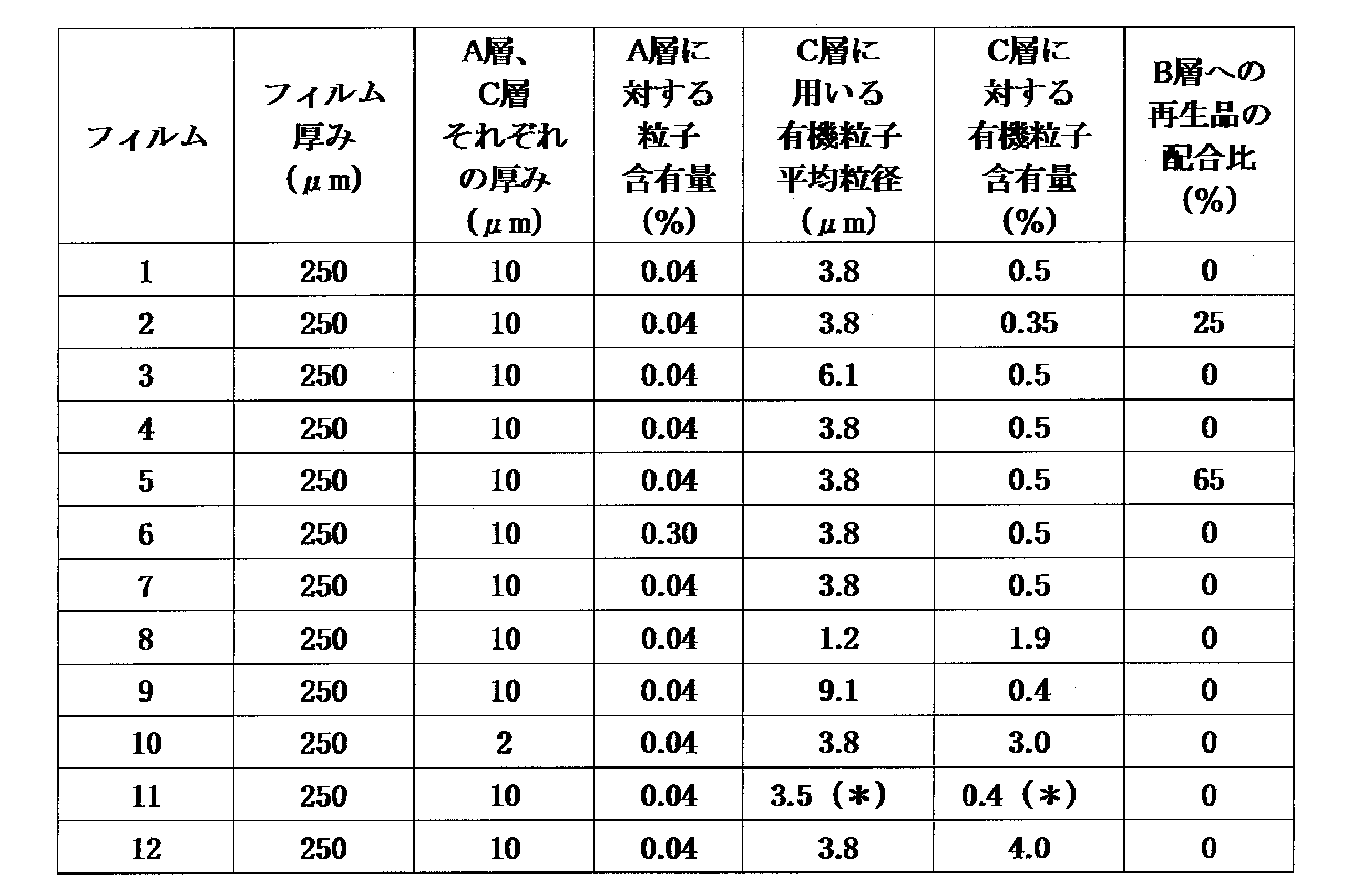
上記表1中の*は、シリカ粒子であることを意味する。
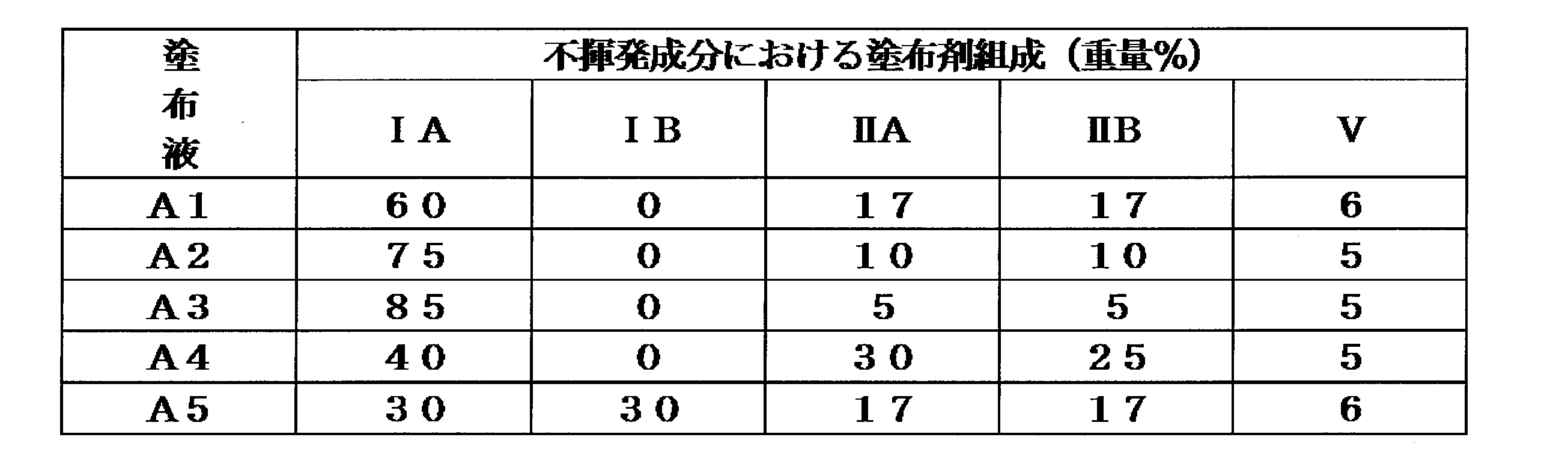

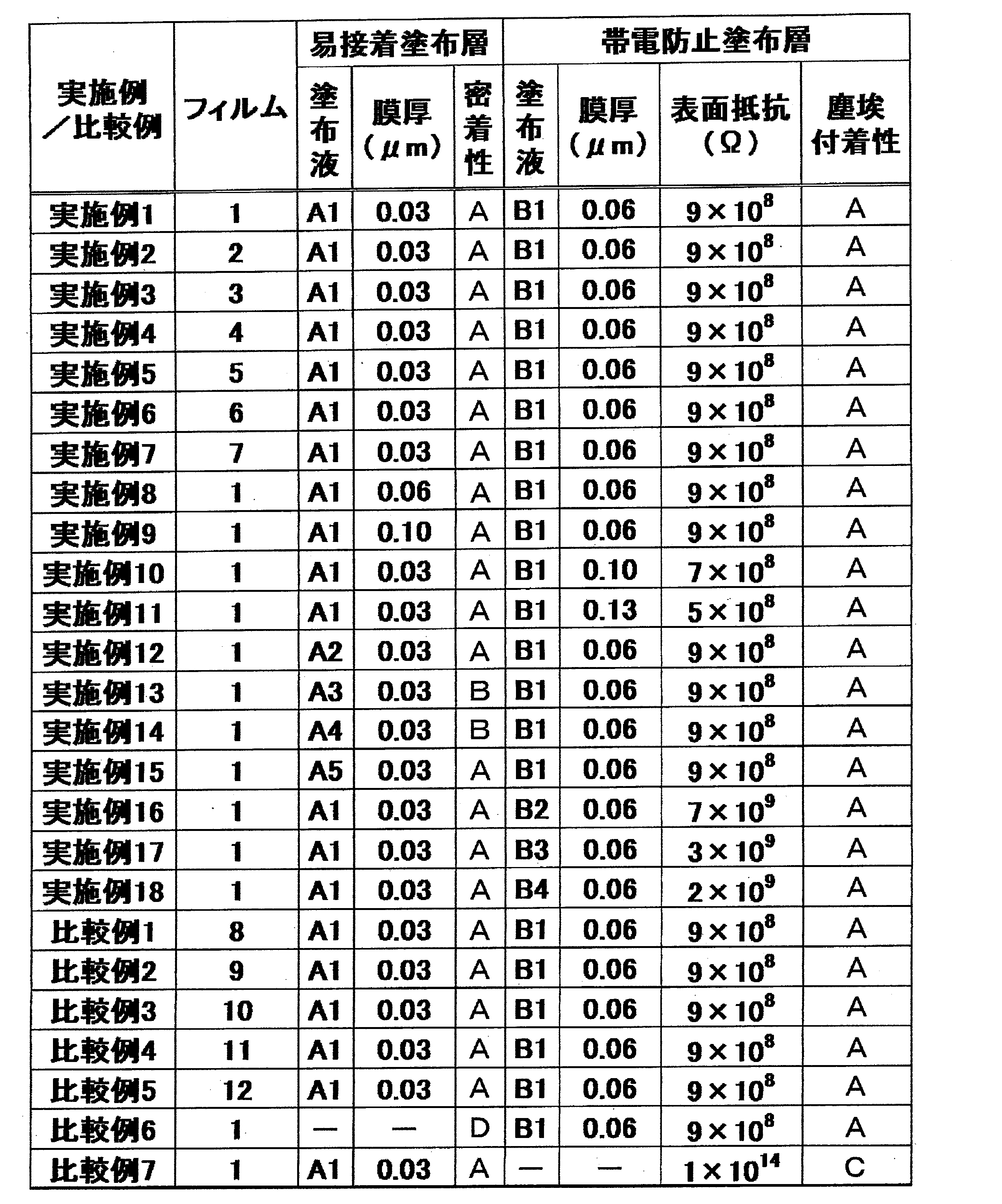
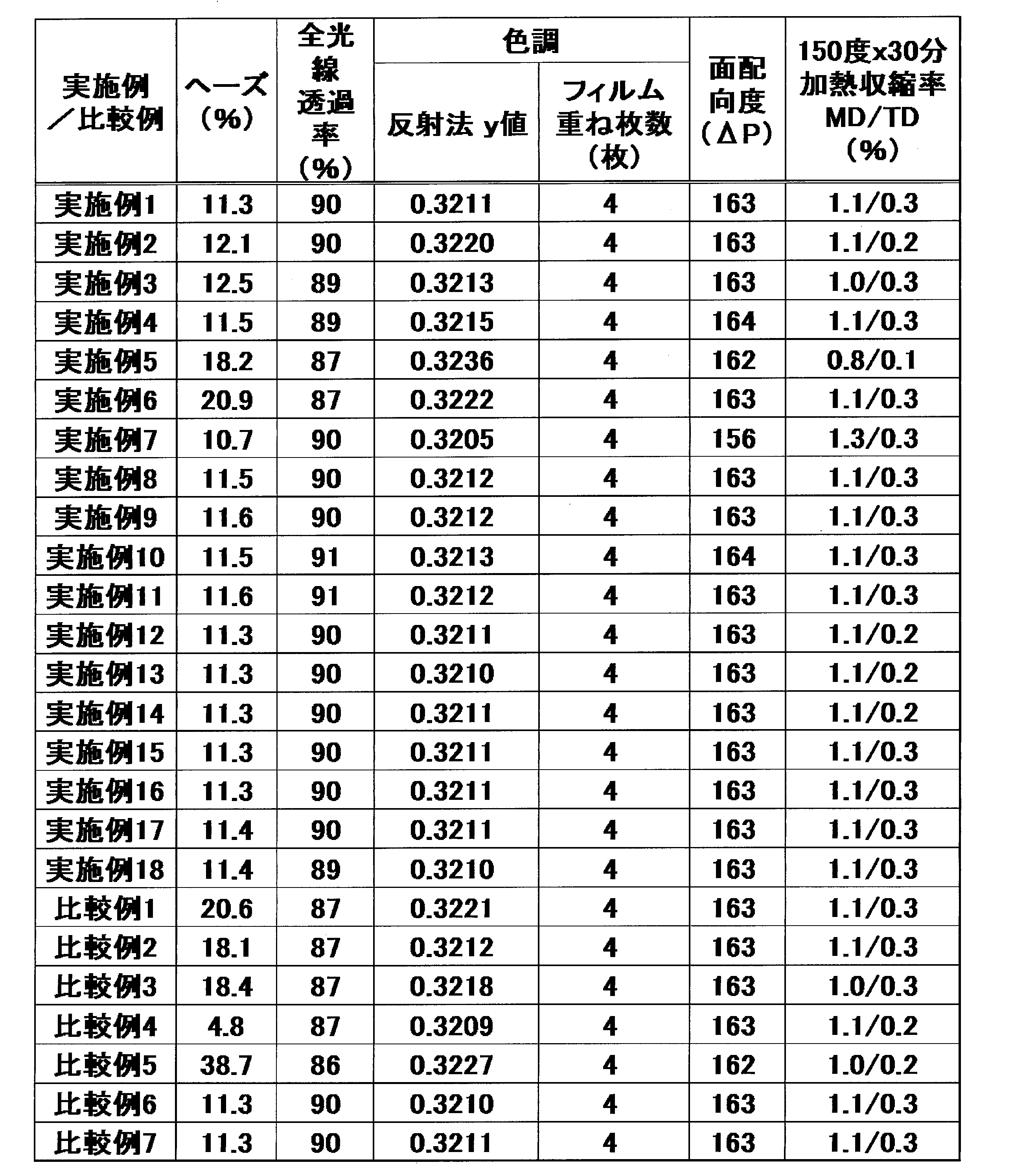

本発明のフィルムは、近年の激しいコストダウン要請があるLCD用バックライトのマイクロレンズ、プリズムの各シートのベースフィルムとして好適に利用することができる。
Claims (7)
- 表層を構成するポリエステル層(A)及びポリエステル層(C)と中間層を構成するポリエステル層(B)との3層構造からなる二軸延伸積層ポリエステルフィルムであり、層(A)上に易接着塗布層を有し、層(C)上に帯電防止塗布層を有し、層(C)中に平均粒子径3.0~7.0μmの不活性有機粒子を0.05~1.5重量%含有することを特徴とする二軸延伸積層ポリエステルフィルム。
- 熱重量分析計を使用して不活性雰囲気下で測定される不活性有機粒子の5%熱分解温度が300℃以上である請求項1に記載の二軸延伸積層ポリエステルフィルム。
- 易接着塗布層が炭素-炭素二重結合部を有するポリウレタン樹脂を含有する塗布液から形成された塗布層である請求項1又は2に記載の二軸延伸積層ポリエステルフィルム。
- 炭素-炭素二重結合部が、アクリレート基、メタクリレート基、ビニル基、アリル基の群から選択された何れかである請求項3に記載の二軸延伸積層ポリエステルフィルム。
- 易接着塗布層が、オキサゾリン化合物、エポキシ化合物、イソシアネート系化合物、カルボジイミド系化合物の群から選択された1種又は2種以上の架橋剤を併用して形成された塗布層である請求項1~4の何れかに記載の二軸延伸積層ポリエステルフィルム。
- 架橋剤がオキサゾリン化合物とエポキシ化合物とを含有する請求項5に記載の二軸延伸積層ポリエステルフィルム。
- 帯電防止塗布層が主鎖にピロリジニウム環を有するポリマーを含有する請求項1~5に記載の二軸延伸積層ポリエステルフィルム。
Priority Applications (2)
| Application Number | Priority Date | Filing Date | Title |
|---|---|---|---|
| KR1020167017148A KR101855881B1 (ko) | 2013-12-29 | 2014-11-25 | 2축 연신 적층 폴리에스테르 필름 |
| CN201480071200.4A CN105848897B (zh) | 2013-12-29 | 2014-11-25 | 双轴拉伸叠层聚酯膜 |
Applications Claiming Priority (2)
| Application Number | Priority Date | Filing Date | Title |
|---|---|---|---|
| JP2013273710A JP6326816B2 (ja) | 2013-12-29 | 2013-12-29 | 二軸延伸積層ポリエステルフィルム |
| JP2013-273710 | 2013-12-29 |
Publications (1)
| Publication Number | Publication Date |
|---|---|
| WO2015098394A1 true WO2015098394A1 (ja) | 2015-07-02 |
Family
ID=53478265
Family Applications (1)
| Application Number | Title | Priority Date | Filing Date |
|---|---|---|---|
| PCT/JP2014/081030 Ceased WO2015098394A1 (ja) | 2013-12-29 | 2014-11-25 | 二軸延伸積層ポリエステルフィルム |
Country Status (4)
| Country | Link |
|---|---|
| JP (1) | JP6326816B2 (ja) |
| KR (1) | KR101855881B1 (ja) |
| CN (1) | CN105848897B (ja) |
| WO (1) | WO2015098394A1 (ja) |
Cited By (2)
| Publication number | Priority date | Publication date | Assignee | Title |
|---|---|---|---|---|
| JP2018053198A (ja) * | 2016-09-30 | 2018-04-05 | ユニチカ株式会社 | ポリエステルフィルム |
| CN113365743A (zh) * | 2019-01-31 | 2021-09-07 | 东洋纺株式会社 | 易粘聚酯膜及其制备方法 |
Families Citing this family (6)
| Publication number | Priority date | Publication date | Assignee | Title |
|---|---|---|---|---|
| KR102296195B1 (ko) * | 2016-06-30 | 2021-08-31 | 코오롱인더스트리 주식회사 | 폴리에스테르 다층필름 |
| WO2018159811A1 (ja) * | 2017-03-02 | 2018-09-07 | 三菱ケミカル株式会社 | 積層白色フィルムおよび被記録材 |
| CN111993738B (zh) * | 2019-05-27 | 2023-11-07 | 宁波长阳科技股份有限公司 | 一种多层共挤光学增透薄膜及其制备方法 |
| JP7845177B2 (ja) * | 2020-03-31 | 2026-04-14 | 大日本印刷株式会社 | 光学積層体、並びに、これを備える偏光板、表面板及び画像表示装置 |
| CN112430344A (zh) * | 2020-11-18 | 2021-03-02 | 乐凯医疗科技有限公司 | 一种可回收信息记录支持体 |
| CN116072886B (zh) * | 2023-04-06 | 2023-07-28 | 宁德新能源科技有限公司 | 一种集流体及其制备方法、极片、电化学装置、电子设备 |
Citations (5)
| Publication number | Priority date | Publication date | Assignee | Title |
|---|---|---|---|---|
| JPH10226031A (ja) * | 1997-02-17 | 1998-08-25 | Kanebo Ltd | 滑り性、制電性に優れるポリエステル多層シート及び成形品 |
| JP2006051712A (ja) * | 2004-08-12 | 2006-02-23 | Mitsubishi Polyester Film Copp | 共押出し積層ポリエテルフィルム |
| JP2008188897A (ja) * | 2007-02-06 | 2008-08-21 | Teijin Dupont Films Japan Ltd | 反射板用白色ポリエステルフィルム |
| JP2009210911A (ja) * | 2008-03-05 | 2009-09-17 | Fujifilm Corp | 光学用積層シート及び画像表示装置 |
| JP2009214360A (ja) * | 2008-03-09 | 2009-09-24 | Mitsubishi Plastics Inc | 光学用積層ポリエステルフィルム |
Family Cites Families (8)
| Publication number | Priority date | Publication date | Assignee | Title |
|---|---|---|---|---|
| KR101653616B1 (ko) * | 2008-10-06 | 2016-09-02 | 미쓰비시 쥬시 가부시끼가이샤 | 적층 폴리에스테르 필름 |
| JP5366569B2 (ja) * | 2009-01-27 | 2013-12-11 | 三菱樹脂株式会社 | 二軸延伸積層ポリエステルフィルム |
| JP5557463B2 (ja) | 2009-04-20 | 2014-07-23 | 三菱樹脂株式会社 | 積層ポリエステルフィルムの製造方法 |
| JP5271204B2 (ja) * | 2009-05-25 | 2013-08-21 | 三菱樹脂株式会社 | 積層ポリエステルフィルム |
| JP5553627B2 (ja) * | 2010-02-07 | 2014-07-16 | 三菱樹脂株式会社 | 積層ポリエステルフィルム |
| US20130017397A1 (en) * | 2010-03-30 | 2013-01-17 | Mitsubishi Plastics, Inc. | Polyester film |
| JP5732786B2 (ja) | 2010-03-30 | 2015-06-10 | 東レ株式会社 | 光学用ポリエステルフィルムの製造方法 |
| JP5937847B2 (ja) * | 2012-02-25 | 2016-06-22 | 三菱樹脂株式会社 | 積層ポリエステルフィルム |
-
2013
- 2013-12-29 JP JP2013273710A patent/JP6326816B2/ja active Active
-
2014
- 2014-11-25 CN CN201480071200.4A patent/CN105848897B/zh active Active
- 2014-11-25 KR KR1020167017148A patent/KR101855881B1/ko active Active
- 2014-11-25 WO PCT/JP2014/081030 patent/WO2015098394A1/ja not_active Ceased
Patent Citations (5)
| Publication number | Priority date | Publication date | Assignee | Title |
|---|---|---|---|---|
| JPH10226031A (ja) * | 1997-02-17 | 1998-08-25 | Kanebo Ltd | 滑り性、制電性に優れるポリエステル多層シート及び成形品 |
| JP2006051712A (ja) * | 2004-08-12 | 2006-02-23 | Mitsubishi Polyester Film Copp | 共押出し積層ポリエテルフィルム |
| JP2008188897A (ja) * | 2007-02-06 | 2008-08-21 | Teijin Dupont Films Japan Ltd | 反射板用白色ポリエステルフィルム |
| JP2009210911A (ja) * | 2008-03-05 | 2009-09-17 | Fujifilm Corp | 光学用積層シート及び画像表示装置 |
| JP2009214360A (ja) * | 2008-03-09 | 2009-09-24 | Mitsubishi Plastics Inc | 光学用積層ポリエステルフィルム |
Cited By (3)
| Publication number | Priority date | Publication date | Assignee | Title |
|---|---|---|---|---|
| JP2018053198A (ja) * | 2016-09-30 | 2018-04-05 | ユニチカ株式会社 | ポリエステルフィルム |
| JP7116976B2 (ja) | 2016-09-30 | 2022-08-12 | ユニチカ株式会社 | 離型フィルム |
| CN113365743A (zh) * | 2019-01-31 | 2021-09-07 | 东洋纺株式会社 | 易粘聚酯膜及其制备方法 |
Also Published As
| Publication number | Publication date |
|---|---|
| JP6326816B2 (ja) | 2018-05-23 |
| CN105848897A (zh) | 2016-08-10 |
| JP2015127134A (ja) | 2015-07-09 |
| KR20160090891A (ko) | 2016-08-01 |
| KR101855881B1 (ko) | 2018-05-09 |
| CN105848897B (zh) | 2020-01-10 |
Similar Documents
| Publication | Publication Date | Title |
|---|---|---|
| JP6326816B2 (ja) | 二軸延伸積層ポリエステルフィルム | |
| WO2011096493A1 (ja) | 積層ポリエステルフィルム | |
| WO2011096494A1 (ja) | 積層ポリエステルフィルム | |
| WO2013058164A1 (ja) | ポリエステルフィルム | |
| WO2013125288A1 (ja) | 塗布フィルム | |
| JP2014133401A (ja) | 積層ポリエステルフィルム | |
| JP5520274B2 (ja) | 積層ポリエステルフィルム | |
| WO2013058212A1 (ja) | 塗布フィルム | |
| JP5793552B2 (ja) | 積層ポリエステルフィルム | |
| JP5723509B2 (ja) | 積層ポリエステルフィルム | |
| JP2016210066A (ja) | 積層ポリエステルフィルム | |
| JP5520275B2 (ja) | 積層ポリエステルフィルム | |
| JP6109212B2 (ja) | 二軸延伸積層ポリエステルフィルム | |
| JP5878153B2 (ja) | 積層ポリエステルフィルム | |
| JP5726925B2 (ja) | 積層ポリエステルフィルム | |
| JP2013086498A (ja) | 積層ポリエステルフィルム | |
| JP2015202682A (ja) | 二軸延伸積層ポリエステルフィルム | |
| WO2014097715A1 (ja) | 塗布フィルム | |
| JP5889352B2 (ja) | 積層ポリエステルフィルム | |
| JP2014210422A (ja) | 積層ポリエステルフィルム | |
| JP2013086493A (ja) | 積層ポリエステルフィルム | |
| JP5877994B2 (ja) | 積層ポリエステルフィルム | |
| JP5818253B2 (ja) | 積層ポリエステルフィルム | |
| JP5764276B2 (ja) | 積層ポリエステルフィルム | |
| JP5679947B2 (ja) | 積層ポリエステルフィルム |
Legal Events
| Date | Code | Title | Description |
|---|---|---|---|
| 121 | Ep: the epo has been informed by wipo that ep was designated in this application |
Ref document number: 14873775 Country of ref document: EP Kind code of ref document: A1 |
|
| ENP | Entry into the national phase |
Ref document number: 20167017148 Country of ref document: KR Kind code of ref document: A |
|
| NENP | Non-entry into the national phase |
Ref country code: DE |
|
| 122 | Ep: pct application non-entry in european phase |
Ref document number: 14873775 Country of ref document: EP Kind code of ref document: A1 |