WO2015072156A1 - ペットフード及びペットフードの製造方法 - Google Patents
ペットフード及びペットフードの製造方法 Download PDFInfo
- Publication number
- WO2015072156A1 WO2015072156A1 PCT/JP2014/051379 JP2014051379W WO2015072156A1 WO 2015072156 A1 WO2015072156 A1 WO 2015072156A1 JP 2014051379 W JP2014051379 W JP 2014051379W WO 2015072156 A1 WO2015072156 A1 WO 2015072156A1
- Authority
- WO
- WIPO (PCT)
- Prior art keywords
- pet food
- raw material
- starch
- pet
- barrel
- Prior art date
- Legal status (The legal status is an assumption and is not a legal conclusion. Google has not performed a legal analysis and makes no representation as to the accuracy of the status listed.)
- Ceased
Links
Images

Classifications
-
- A—HUMAN NECESSITIES
- A23—FOODS OR FOODSTUFFS; TREATMENT THEREOF, NOT COVERED BY OTHER CLASSES
- A23K—FODDER
- A23K40/00—Shaping or working-up of animal feeding-stuffs
- A23K40/25—Shaping or working-up of animal feeding-stuffs by extrusion
-
- A—HUMAN NECESSITIES
- A23—FOODS OR FOODSTUFFS; TREATMENT THEREOF, NOT COVERED BY OTHER CLASSES
- A23K—FODDER
- A23K40/00—Shaping or working-up of animal feeding-stuffs
- A23K40/20—Shaping or working-up of animal feeding-stuffs by moulding, e.g. making cakes or briquettes
-
- A—HUMAN NECESSITIES
- A23—FOODS OR FOODSTUFFS; TREATMENT THEREOF, NOT COVERED BY OTHER CLASSES
- A23K—FODDER
- A23K50/00—Feeding-stuffs specially adapted for particular animals
- A23K50/40—Feeding-stuffs specially adapted for particular animals for carnivorous animals, e.g. cats or dogs
- A23K50/42—Dry feed
Definitions
- the present invention relates to a pet food. More specifically, the present invention relates to pet food that is easy to eat and has high palatability.
- This application claims priority based on Japanese Patent Application No. 2013-273329 filed in Japan on December 27, 2013, the contents of which are incorporated herein by reference.
- Extrusion molding is an excellent method for producing a pet food with a uniform shape with high production efficiency.
- an extruder extruder
- an extruder having a mixer part, a barrel part, and a knife as one body is known.
- the mixer part is mainly used for mixing raw materials.
- the barrel portion has a function of mixing and heating the raw material of the pet food to be extruded, in addition to the function of holding the raw material of the pet food to be extruded.
- the raw material of the pet food mixed and heat-treated in the barrel portion is finally discharged in a predetermined shape from a die attached to the end of the extruder, cut by a knife, and molded.
- the present invention has been made in view of the above circumstances, and is a dry-type pet food, manufactured by extrusion molding, and providing an unprecedented pet food excellent in pet biting, and a method for manufacturing the pet food And
- the pet food is too hard as a factor that reduces pet biting.
- small pets such as small dogs that are often bred in recent years, it is considered that the tendency to dislike the fact that pet food is hard because the biting force is weak.
- the pet food manufactured by the conventional extrusion molding may be too hard and the palatability may be reduced.
- the present inventors have found that a pet food excellent in pet bite can be obtained by controlling the hardness of a pet food obtained by extrusion molding, which is a dry type pet food, and completed the present invention. I let you. That is, the present invention is as follows.
- the starch source is a raw material having a gelatinization temperature of 65 ° C. or higher.
- the present invention is a dry-type pet food, and although it is manufactured by extrusion molding, it can provide a pet food with a low degree of hardness and excellent pet biting.
- the pet food of the present invention is a pet food obtained by granulating raw materials by extrusion molding, having a water content of 12% by weight or less and a hardness of 24.5N or less.
- Extrusion molding can be performed using a known extruder (extruder).
- the base can be formed into the shape of the base by attaching the base to the tip of the extruder and extruding the raw material from the base.
- “Granulation” means forming into a shape that a pet can eat.
- the shape of the hood grain to be molded is not particularly limited as long as it is a shape that can be eaten by a pet.
- the size of the hood grain to be molded may be a small grain shape that allows a pet to cheek with a bite, or a large grain shape that allows a pet to bite multiple times.
- the shape of the hood grain is not particularly limited, and when the hood grain placed on the horizontal table is viewed from above, the short length and the long diameter are 3 to 25 mm, from the lower surface (lower end) to the upper surface (upper end) of the food particle on the horizontal platform. It is preferably in the form of a pellet (granular or massive) having a thickness of 3 to 20 mm, more preferably a pellet having a short diameter and a long diameter of 3 to 11 mm and a thickness of 3 to 9 mm, and a short diameter and a long diameter of 5 More preferably, it is in the form of a pellet having a thickness of ⁇ 9 mm and a thickness of 5-8 mm. With this shape, the hardness when adjusted to a predetermined moisture content can be easily adjusted to a preferred range in the subsequent heat treatment and drying treatment.
- the water content of the pet food of the present invention may be 12% by weight or less, which is a normal value as a dry type pet food, preferably 11.0% by weight or less, and 10% by weight or less. Is more preferable. Although it does not restrict
- the moisture content (% by weight) of the pet food can be obtained by a normal pressure heating drying method.
- the pet food of the present invention may have a hardness of 24.5 N or less.
- the pet food preferably has a hardness of 19.6 N or less, more preferably a pet food with a hardness of 14.7 N or less, particularly a pet food with a hardness of 9.8 N or less. preferable.
- the lower limit of the hardness is 0.0 N (measurement accuracy or less).
- the measurement of the hardness of a pet food grain is calculated
- the shape of the plunger is shown in FIG. Value display: Fixed display ⁇ Measurement method> Put the pet food on a hard dish at the bottom. At this time, it is preferable to use a pet food having a shape that can be placed upright because it is easy to measure.
- channel like a mortar for example.
- the numerical value unit of hardness is converted into Newton (N) by multiplying (multiplying) the numerical value of hardness (kgw) measured by the digital force gauge (model number: FGN-5B) by 9.8. be able to.
- the hardness of the pet food according to the present invention is the same as or compatible with the measurement conditions even when a physical property measuring device other than the digital force gauge (model number: FGN-5B) is used. It can obtain
- the method for obtaining the hardness described in the present specification is based on the texture profile of Szesniak (Szczesniak, AS: J. Food Sci., 28, 385 (1963)). Cessniak organized and systematized terms related to textures at General Foods, USA, and showed a correlation between texturometer measurements and human sensory evaluation values (Szczesniak, AS, Brandt, MA & Freidman, H. H .: J. Food Sci., 28, 397 (1963)).
- the pet food of the present invention can be fed to any pet including dogs and cats. Of these, dogs tend to prefer pet foods with low hardness values, and are more preferably given to dogs.
- the hardness of the pet food of the present invention is not particularly limited as long as it is 24.5 N or less, but suitable hardness can be exemplified in consideration of the weight, age, etc. of the pet.
- suitable pet food hardness is 19.6 N or less, 14.7 N or less.
- particularly preferred pet food hardness include 9.8 N or less.
- the pet food having the above hardness can be easily eaten even by a small dog having a relatively weak biting force, and can further enhance the preference for the present invention. This is also applicable to pets having the same or equivalent biting force as small dogs, such as young pets, old pets, cats, and other small pets.
- the raw material (animal raw material) which comprises the said pet food is not restrict
- meat derived from livestock such as cows, pigs and chickens and various fishes can be used.
- cereals that contain a large amount of carbohydrate components normally required by pets and plant foods that contain a large amount of dietary fiber may be used.
- the raw material of the pet food may contain a starch source.
- a starch source any raw material containing starch can be used.
- the starch source includes cereals containing a large amount of starch, potatoes, beans, plant roots, plant roots, etc. Can be mentioned.
- a starch source as a raw material for pet food, the nutritional value of pet food can be increased in a balanced manner. Moreover, the palatability of pet food can be improved.
- the said starch source may be used individually by 1 type, and may be used in combination of 2 or more type.
- Starch gelatinization is a series of phenomena in which starch granules absorb water, swell, disintegrate and disperse.
- the gelatinized starch turns into a paste with increased viscosity, which binds the entire raw material containing the gelatinized starch and makes the pet food hard.
- the starch gelatinization degree of the pet food of the present invention is preferably 18% to 90%, preferably 30% More preferably, it is ⁇ 80%, more preferably 40% to 70%.
- the “degree of gelatinization of starch” of pet food is the degree of gelatinization of starch contained in the manufactured pet food grain. Pet foods with low starch gelatinization values tend to have a low degree of hardness. Therefore, the palatability of the pet food can be further enhanced by setting the gelatinization degree of starch within the range of 18 to 90%.
- the degree of gelatinization of pet food is determined by the second method of glucoamylase (see Customs Central Analysis Bulletin No. 51, “Examination of Method for Measuring Starch Alphalation by HPLC Method”).
- the gelatinization temperature is a temperature at which gelatinization is maximized.
- the starch source is preferably a raw material having a gelatinization temperature of 65 ° C. or higher, more preferably a raw material having a gelatinization temperature of 75 ° C. or higher, and a raw material having a gelatinization temperature of 80 ° C. or higher. Is more preferable. That is, the starch source preferably has a gelatinization temperature of 65 ° C or higher, more preferably 75 ° C or higher, and a gelatinization temperature of 80 ° C or higher. More preferably it is. When heat treatment is performed in the production of pet food, the gelatinization temperature of starch is 65 ° C. or higher, so that the degree to which gelatinization of starch occurs during the production of pet food can be suppressed.
- starch As starch whose gelatinization temperature is 65 ° C. or higher, there is cereal starch.
- the gelatinization temperature of starch tends to be high for cereal starches and low for potato starches.
- the gelatinization temperature of wheat starch which is a cereal starch
- the gelatinization temperature of corn starch which is also a cereal starch
- the gelatinization temperature of potato starch is 60 ° C to 65 ° C.
- cereal starches include wheat-derived starches such as wheat starch, and rice-derived starches such as corn starch and glutinous rice starch.
- tapioca starch, mung bean starch, etc. can be mentioned as starch whose other gelatinization temperature is 65 degreeC or more.
- flour As the starch source.
- wheat flour it is difficult to gelatinize starch during the production of pet food, the degree of hardness of the pet food can be reduced, and the preference for the present invention can be further enhanced.
- the starch is gelatinized during the manufacture of pet food, which increases the hardness of the pet food.
- a material with a high degree of gelatinization as a raw material starch source increases the hardness of the pet food. It may be avoided.
- the material having a high degree of gelatinization include those whose raw material starch has a degree of gelatinization of 60% or more.
- a starch source having a high degree of gelatinization a processed product whose degree of gelatinization has been increased in advance may be used. Examples of such a starch source include bread crumbs, confectionery powder, and roasted wheat flour.
- a raw material having a starch gelatinization degree of 60% or more as a starch source it is possible to suppress the degree of hardness of the pet food while increasing the gelatinization degree of the starch of the pet food. Can be improved.
- the ratio of wheat flour or bread crumb to the total raw material of pet food is preferably 40 to 70% by weight, more preferably 45 to 65% by weight, and further preferably 50 to 60% by weight.
- the weight ratio of flour to bread crumb used is preferably 75:25 to 25:75, more preferably 65:35 to 35:65, and 55:45 to 45. : 55 is more preferable.
- the type of wheat flour is not particularly limited, and any of strong flour, medium flour, and weak flour may be used. Moreover, the refinement
- gluten is formed during the production of pet food.
- grains such as wheat flour are used as a raw material for pet food
- gluten may be formed from gliadin and glutenin contained in grain seeds. Therefore, in order to reduce the amount of gluten formed, it is more preferable to use wheat flour with a relatively low protein content derived from gluten, and among wheat flour, use flour, medium flour, and flour. Is most preferred.
- the pet food can be prevented from hardening by using a raw material such as bread crumb in which gluten, which is a protein, is heat-denatured in advance.
- the type of pet that provides the pet food of the present invention is not particularly limited, but to inform the pet owner that the pet food is suitable for feeding to a specific type of pet of a specific size, specific age, etc.
- the fact that the pet food is suitable for giving to a specific pet can be displayed on the package and sold.
- it can be displayed on the packaging and sold as pet food suitable for small dogs.
- pet means an animal kept by a person. In a narrower sense, pets are animals petted by their owners.
- Pet food refers to pet feed. The pet food of the present invention can be produced and sold as “animal feed” or “animal food”.
- the method for producing a pet food according to the present invention granulates a raw material by extrusion molding.
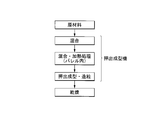
- An example of the method for producing a pet food according to the present invention will be described below with reference to the production flow shown in FIGS.
- raw materials separately ground with a grinder or the like are mixed using a mixer or the like.
- water may be further added to the raw material and mixed.
- the mixer may be an apparatus different from the extrusion molding machine or may be an integral one. However, in FIG. 1, the mixer is integrated with the extrusion molding machine. Show. Next, the obtained mixture of raw materials is fed into the barrel of the extruder, and heat treatment and mixing are performed in the barrel.
- the heat treatment and mixing of the raw materials may be performed simultaneously.
- the pet food is then granulated by extruding the heat-treated and mixed raw materials.
- the pet food of this embodiment can be obtained by drying at, for example, 100 to 140 ° C. until the moisture content in the food grains is 12% by weight or less and reaches the above-mentioned hardness.
- the pet food of the present invention may be coated with a coating agent further containing seasonings such as fats and oils, animal extracts and amino acids, or fragrances.
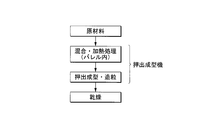
- FIG. 2 is a modification of the embodiment shown in FIG. 1 in which the raw materials are mixed and heat treated in the barrel of an extruder to obtain a heat treated raw material mixture, before which This method does not mix raw materials.
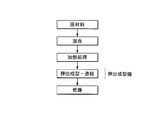
- the embodiment shown in FIG. 3 is a modification of the embodiment shown in FIG. 1, and the raw materials are not mixed and heated by using an extruder, but only by extrusion using an extruder. Is the method.
- Proteins and carbohydrates are important nutrients contained in the raw materials.
- the protein include plant-derived proteins, animal-derived proteins, and mixtures thereof.
- examples of the plant-derived protein include gluten, wheat protein, soybean protein, rice protein, and corn protein.
- examples of the animal-derived protein include proteins such as muscles and organs of cows, pigs, chickens and seafood, proteins of milk, and mixtures thereof. These proteins can contain fat, vitamins, iron, etc., and can be used as a nutrient source.
- preferred carbohydrates include carbohydrates of grains such as corn, wheat, barley, oats, rice, and soybeans.
- These cereals can contain proteins, ash, minerals, vitamins and the like in addition to carbohydrates, and can therefore be used as a nutrient source.
- As the raw material in addition to the protein and the carbohydrate, fats and oils, vitamins and minerals, seasonings, animal protein extracts (extracts), dietary fiber, and the like may be added as raw materials.
- the mixture in which the raw materials are mixed is obtained by mixing the raw materials at a desired blending ratio.
- a known method in which raw materials are mixed while being pulverized with a mixer or the like can be applied.
- mixing the raw materials containing the starch source and fats and oils may be performed.
- the fats and oils can weaken the binding of the raw materials and reduce the hardness of the pet food.
- fatty acid forms a complex with the amylose of starch by containing fats and oils in addition to a starch source in a raw material, and can reduce the hardness grade of pet food.
- the fats and oils contained in the raw material may be fats and oils that are contained in advance in meat, cereals, etc., but by dispersing quickly when mixing the raw materials, the effect of weakening the binding of the raw materials and suppressing gelatinization is increased. Therefore, it is preferable to add and use fats and oils as raw materials separately from the fats and oils contained in other raw materials.
- the fats and oils to be added include animal fats and oils and vegetable fats and oils. Examples of animal fats include beef tallow.
- the raw materials used in the present invention include grains such as corn, wheat flour, soybeans, bread crumbs or processed cereals, meat such as chicken meal and chicken extract, and fish and shellfish such as fish meal. Can be blended. Vitamins, minerals, seasonings, dietary fibers, and the like can be further added to the raw materials.
- the moisture content of the whole raw material to be heat-treated in the barrel of the extruder is set low. It is preferable. This is because sufficient moisture is required for swelling of the starch granules. Accordingly, the moisture content in the mixture is not particularly limited, but the moisture content of the entire raw material before being heat-treated in the barrel of the extruder is preferably a composition containing moisture at 20% by weight or less. Therefore, it can be said that the composition contained at 18% by weight or less is more preferable, and the composition contained at 16% by weight or less is more preferable.
- water may be added to the raw material to be heat-treated in the barrel of the extruder.
- the amount of water added is preferably 10% by weight or less, more preferably 8% by weight or less, and still more preferably 6% by weight or less based on the raw material to be heat-treated.
- the temperature at which the heat treatment is performed in the barrel of the extruder means the set temperature of the machine used for the heat treatment.
- the starch in the mixture can be appropriately gelatinized.
- gelatinizing the effect of improving the flavor and texture of the obtained food grains can be obtained.
- the heat treatment may be performed in a plurality of times.
- the apparatus used for the heat treatment is not particularly limited.
- the water may be added simultaneously with the heat treatment.
- the method of performing by adding warm water and steam to a raw material using a mixer is mentioned.
- the hot water or steam may be treated as “water” for “adding water to the raw material to be heat-treated in the barrel of the extruder”, and the amount of hot water or steam added to the raw material Is preferably the above-mentioned preferable amount of water added.
- the raw material is preferably heat-treated in the barrel of the extruder within the range of 60 ° C to 140 ° C.
- the range of 60 ° C to 140 ° C is more preferably 60 ° C to 130 ° C, and further preferably 60 ° C to 120 ° C.
- the heat treatment may be performed a plurality of times, and each heat treatment may be performed at different heat treatment temperatures.
- the heat treatment may be performed for a certain period of time in the range of 100 ° C. to 140 ° C. after the heat treatment for a certain period of time in the range of 60 ° C. to 100 ° C.
- the range of 100 ° C. to 140 ° C. is more preferably 100 ° C.
- the ratio of the heat treatment time in the range of 60 ° C. to 100 ° C. and the heat treatment time in the range of 100 ° C. to 140 ° C. with respect to the total time of the heat treatment performed in the barrel of the extruder is particularly limited. For example, 60 ° C. to 100 ° C .: 100 ° C.
- the total time of the heat treatment performed in the barrel of the extruder is preferably in the range of 5 to 30 seconds, more preferably in the range of 5 to 20 seconds, and in the range of 5 to 15 seconds. More preferably.
- the heat treatment may be performed by setting the heating temperature to a different value for each portion.
- different heating temperatures within the range of 60 ° C. to 100 ° C. and within the range of 100 ° C. to 140 ° C. may be set as described above.
- the barrel temperature in the central part of the extruder is increased, and the set temperatures of the barrels near the raw material inlet and outlet are set at the central barrel.
- the temperature is lower than the set temperature.
- the temperature in the vicinity of the raw material inlet of a series of barrels is too high, the water vapor pressure in the barrel will increase and pressure will also be applied in the direction of the raw material inlet, which may prevent raw materials from being introduced into the barrel. Further, if the temperature in the vicinity of the barrel outlet is too high, swelling may be significant and the grains may be difficult to mold. Therefore, in order to efficiently heat in a short time, it is preferable to change the temperature of a plurality of barrels and to heat at the maximum temperature in the central portion. For example, there is a method in which first, heat treatment is performed within a range of 60 ° C. to 100 ° C., then, heat treatment is performed within a range of 100 ° C. to 140 ° C., and then heat treatment is performed within a range of 60 ° C. to 100 ° C. Can be mentioned.
- the raw material when at least a part of the heat treatment is performed in the barrel of the extruder, the raw material is heat-treated within the range of 100 ° C. to 140 ° C. using the extruder.
- the heat treatment time is preferably from 1 second to 10 seconds, more preferably from 1 second to 7 seconds, and more preferably from 1 second to 5 seconds. Is more preferable.
- the screw that can be used in the barrel in the production of the pet food of the present invention is not particularly limited, but it is preferable to use a conveying screw used for the purpose of conveying raw materials, and it is preferable to use an uncut screw.
- an uncut screw By using an uncut screw, the raw material is prevented from being excessively kneaded, and a pet food having the above hardness can be easily obtained.
- grains such as wheat flour are used as a raw material for pet food, gluten may be formed, which is considered to be a factor for increasing the degree of hardness of pet food. Since formation of gluten is promoted by kneading, it is preferable to use an uncut screw from the viewpoint of suppressing the amount of gluten formed.
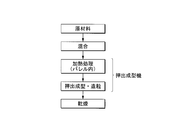
- FIG. 4 is a flowchart showing an example of a pet food manufacturing method when the mixing is not performed in the barrel.
- the method for drying the pet food obtained after heating is not particularly limited, and is a known method such as a method of drying naturally, a method of drying by blowing warm air, a method of drying under reduced pressure, or a method of drying by freeze drying.
- the method is applicable.
- the method of drying by blowing warm air is preferable because the flavor of the pet food is improved.
- the temperature of the warm air blown onto the food grains is not particularly limited, but the temperature of the warm air is preferably 150 ° C. or less.
- the lower limit of the temperature of the warm air is not particularly limited, and is usually a temperature exceeding room temperature (20 ° C.), preferably 30 ° C. or more. When it is at least the lower limit value of the above temperature range and time range, the food grains can be dried in a relatively short time. When the temperature is not more than the upper limit of the temperature range, the hood grains can be prevented from being excessively heated.
- the pet food of the present invention may be coated with a coating agent further containing crude beef tallow, seasoning or flavor.
- the coating method is not particularly limited, and can be performed by, for example, a vacuum coating method.
- the vacuum coating method is a method of reducing the pressure in a state where the heated hood grains and the coating agent are in contact with or adhering to each other, and then slowly releasing into the atmosphere.
- the coating agent may be liquid or powder. Pet's palatability (bite) can be improved by the coating. It is preferable that the obtained pet food has the said hardness irrespective of the presence or absence of a coating.
- the raw materials were mixed for each formulation using a preconditioner (mixer) and heat-treated at 80 to 110 ° C. for 1 to 2 minutes. At this time, water was added to the raw material before the heat treatment in the barrel immediately after. The amount of water added in each Example is shown in the column of added water in Table 3 below.
- a plurality of barrels of the extruder were connected in series as barrel numbers 1 to 6, and the raw materials were sequentially passed from the barrel 1 using screws in each barrel to perform heat treatment or heat treatment and mixing. .
- a barrel having an inner diameter of 83 mm and a screw length of 1040 mm was used, and the passage time of the raw material from barrel 1 to barrel 6 was set to about 10 seconds. The passing speed of the raw material in each barrel is constant.
- Table 3 shows the shapes of the screws used in the production of each example, reference example, and comparative example.
- the raw material that passed through the barrel 6 was extruded from the die and extruded, and granulated so as to form a substantially cylindrical hood particle having a diameter of 8 mm and a height of 8 mm. Thereafter, the obtained food granules were dried by a dryer at about 100 to 120 ° C. for about 20 minutes to obtain a pet food according to the present invention.
- the salary was 250 g for beagle and 100 g for small dogs.
- the amount of food eaten by the dog was measured 20 minutes after feeding the pet food, and in the case of a small dog, 60 minutes after feeding the pet food.
- the intake amount of the pet food of the test example and the intake amount of the pet food of the comparative example were determined in percentage. The percentages obtained from 10 or 20 dogs that were monitors were averaged to give the results on the first day.
- 40 g of each group of pet food was fed simultaneously from the right and the other from the left to one dog, and the amount eaten by the dog was measured after 1 hour.
- the intake amount of the pet food of the test example and the intake amount of the pet food of the comparative example were determined in percentage.
- the percentages obtained from the 20 dogs that were monitors were averaged to give the results on the second day.
- the results of the first day and the second day were averaged to determine the ratio of food intake (preference) which is the final result.
- the higher the preference value the more the dog that is the monitor likes to eat.
- the pet food of Examples 1 to 5 and Example 7 having a hardness of 24.5 N or less is the conventional pet food of Comparative Example 1 having a hardness of more than 24.5 N and a reference example. It is clear that the palatability is higher than that of 1-2 pet foods. Moreover, it turns out that the preference with respect to pet food improves, so that the grade of the hardness of pet food is low. This is also apparent from a comparison of the palatability test results of Reference Example 1 and Example 1 that were manufactured from the raw materials of the same formulation 1 and both used a medium-sized dog as a monitor.
- Example 3 having the smallest degree of hardness was used. Pet food had the highest palatability.
- the hardness of the pet food can be lowered by using the weak flour among the flours.
- the pet food of Example 3 manufactured using thin flour instead of the third grade powder has a lower degree of hardness and higher palatability. .
- Example 7 In mixing raw materials, mixing raw materials containing starch sources and fats and oils also has the effect of reducing the degree of hardness of pet food. From a comparison between Example 7 and Example 8, the pet food of Example 8 produced by mixing 3% less beef tallow from the raw materials to be mixed was more rigid than the pet food of Example 7. It can be seen that the degree is high.
- the pet food according to the present invention is a dry-type pet food, and although it is manufactured by extrusion molding, it can provide a pet food that has a low degree of hardness and is excellent in pet biting. Widely applicable.
Landscapes
- Life Sciences & Earth Sciences (AREA)
- Chemical & Material Sciences (AREA)
- Polymers & Plastics (AREA)
- Zoology (AREA)
- Engineering & Computer Science (AREA)
- Food Science & Technology (AREA)
- Animal Husbandry (AREA)
- Birds (AREA)
- Fodder In General (AREA)
- Feed For Specific Animals (AREA)
Abstract
原材料を押出成形することにより造粒して得られ、水分含量が12重量%以下であり、硬さが24.5N以下であることを特徴とするペットフード。
Description
本発明はペットフードに関する。より詳しくは、食べやすく嗜好性の高いペットフードに関する。
本願は、2013年12月27日に、日本に出願された特願2013-273329号に基づき優先権を主張し、その内容をここに援用する。
本願は、2013年12月27日に、日本に出願された特願2013-273329号に基づき優先権を主張し、その内容をここに援用する。
近年、ペットフードにおいても健康志向が高まっており、ペットの健康に良く、且つペットの嗜好性に優れたペットフードが望まれている。また、入手や保管が容易であることなどから、ドライタイプのペットフードを求める需要が高い。
ペットフードの成形方法の一つとして、押出成形が挙げられる。押出成形は、均一な形状のペットフードを高い生産効率で製造できる方法として優れている。
ペットフードを押出成形する場合、通常、押出成形機(エクストルーダ)が用いられる。押出成形機の構成の一例として、ミキサー部分、バレル部分、ナイフを一体として有している押出成形機が知られている。ミキサー部分は主に原材料の混合に用いられる。バレル部分は、押出成形されるペットフードの原材料を保持する機能の他、押出成形されるペットフードの原材料の混合及び加熱処理の機能を有しているものが一般的である。バレル部分で混合され、加熱処理されたペットフードの原材料は、最終的に押出成形機の端に取り付けられた金口から所定の形状で放出され、ナイフにより切断され、成形される。
押出成形機を使用して、複数種類の原材料を混合し、板状に成型するペットフードの製造方法が開示されている(特許文献1)。
ドライタイプのペットフードよりも水分量の多いウェットタイプ及びセミモイストタイプ(半生タイプ)のペットフードでは、水分量を多く調製することで硬さの程度が低く抑えられる傾向あり、ペットフードの硬さの制御はより容易である。また、押出成形されたドライタイプのペットフードは、十分に糊化した澱粉を乾燥するため、硬くなりやすい傾向があった。
本発明は上記事情に鑑みてなされたものであり、ドライタイプのペットフードであり、押出成形により製造され、ペットの食いつきが優れる従来にないペットフード、及びそのペットフードの製造方法の提供を課題とする。
本発明は上記事情に鑑みてなされたものであり、ドライタイプのペットフードであり、押出成形により製造され、ペットの食いつきが優れる従来にないペットフード、及びそのペットフードの製造方法の提供を課題とする。
ペットの食いつきを低下させる要因として、ペットフードが硬すぎることが考えられる。特に、近年飼育されることの多い小型犬などの小型のペットにとっては、噛む力が弱いため、ペットフードが硬いことを嫌う傾向がより強いと考えられる。この点、従来の押出成形によって製造されたペットフードでは、ペットフードが硬くなりすぎており、嗜好性が低下している場合があるのではないかと考えられた。
本発明者らは、ドライタイプのペットフードであって、押出成形により得られたペットフードの硬さを制御することにより、ペットの食いつきが優れるペットフードが得られることを見出し、本発明を完成させた。すなわち、本発明は以下の通りである。
本発明者らは、ドライタイプのペットフードであって、押出成形により得られたペットフードの硬さを制御することにより、ペットの食いつきが優れるペットフードが得られることを見出し、本発明を完成させた。すなわち、本発明は以下の通りである。
(1)原材料を押出成形することにより造粒して得られ、水分含量が12重量%以下であり、硬さが24.5N以下であることを特徴とするペットフード。
(2)前記原材料が、デンプン源を含むことを特徴とする前記(1)に記載のペットフード。
(3)デンプンの糊化度が18%~90%であることを特徴とする前記(2)に記載のペットフード。
(4)前記デンプン源は、糊化温度が65℃以上の原料であることを特徴とする前記(2)又は(3)に記載のペットフード。
(5)前記デンプン源として、小麦粉を用いることを特徴とする前記(2)~(4)のいずれか一つに記載のペットフード。
(6)前記デンプン源として、パン粉を用いることを特徴とする前記(2)~(5)のいずれか一つに記載のペットフード。
(2)前記原材料が、デンプン源を含むことを特徴とする前記(1)に記載のペットフード。
(3)デンプンの糊化度が18%~90%であることを特徴とする前記(2)に記載のペットフード。
(4)前記デンプン源は、糊化温度が65℃以上の原料であることを特徴とする前記(2)又は(3)に記載のペットフード。
(5)前記デンプン源として、小麦粉を用いることを特徴とする前記(2)~(4)のいずれか一つに記載のペットフード。
(6)前記デンプン源として、パン粉を用いることを特徴とする前記(2)~(5)のいずれか一つに記載のペットフード。
(7)原材料を押出成形することにより造粒することを特徴とする前記(1)~(6)のいずれか一つに記載のペットフードの製造方法。
(8)前記デンプン源及び油脂が含まれる原材料を混合することを特徴とする前記(7)に記載のペットフードの製造方法。
(9)前記原材料を60℃~140℃の範囲内において押出成形機のバレル内にて加熱処理することを特徴とする前記(7)又は(8)に記載のペットフードの製造方法。
(10)前記原材料を、100℃~140℃の範囲内において押出成形機のバレル内にて加熱処理し、該加熱処理時間として、押出成形機のバレル内の上記温度範囲の通過時間が1秒以上10秒以下であることを特徴とする前記(9)に記載のペットフードの製造方法。
(11)前記押出成形機のバレル内にて加熱処理される原材料に対して水を添加し、前記水の添加量が、前記押出成形機のバレル内にて加熱処理される原材料に対して10重量%以下であることを特徴とする前記(9)又は(10)に記載のペットフードの製造方法。
本発明によれば、ドライタイプのペットフードであり、押出成形により製造されながらも、硬さの程度が低く、ペットの食いつきに優れたペットフードを提供できる。
《ペットフード》
本発明のペットフードは、原材料を押出成形することにより造粒して得られ、水分含量が12重量%以下であり、硬さが24.5N以下のペットフードである。
押出成形は、公知の押出成形機(エクストルーダ)を用いて行うことができる。例えば、押出成形機の先端に口金を取り付け、原材料を口金から押し出すことで、口金の形状に成形することができる。押出成形機を用いることで、ペットフードの生産性を飛躍的に向上させることができる。
「造粒」とは、ペットが食することができる形状に成形することを意味する。本発明において、成形するフード粒の形状は、ペットが食せる形状であれば特に制限されず、例えば球状、多角体状、柱状、ドーナッツ状、板状、碁石状(curved, circular tablet)等、あらゆる形状が適用可能である。また、成形するフード粒の大きさは、ペットが一口で頬張れる小粒形状であってもよいし、ペットが複数回にわたって噛り付くことができる大粒形状であってもよい。
フード粒の形状は特に制限されず、水平台に置いたフード粒を上方から見た場合の短経および長径が3~25mm、水平台上のフード粒の下面(下端)から上面(上端)までの厚みが3~20mmのペレット状(粒状又は塊状)であることが好ましく、短経および長径が3~11mm、厚みが3~9mmのペレット状であることがより好ましく、短径および長径が5~9mm、厚み5~8mmのペレット状であることがさらに好ましい。この形状であると、後段の加熱処理および乾燥処理において、所定の水分含有率に調整した際の硬さを容易に好ましい範囲に調整することができる。
本発明のペットフードの水分含量は、ドライタイプのペットフードとしての通常の値である12重量%以下であればよく、11.0重量%以下であることが好ましく、10重量%以下であることがより好ましい。水分含量の下限値としては、特に制限されないが、5重量%以上であることが好ましく、6重量%以上であることがより好ましく、7重量%以上であることがさらに好ましい。具体的には、通常のドライタイプのペットフードと同様の水分含有率7.0~10.0重量%又はこれに近い範囲8.0~10.0重量%であることが適当である。
<水分含有量の測定>
前記ペットフードの水分含有率(重量%)は常圧加熱乾燥法で求められる。
《常圧加熱乾燥法》
アルミ秤量缶の重量(W1グラム)を恒量値として予め測定する。このアルミ秤量缶に試料を入れて重量(W2グラム)を秤量する。つぎに強制循環式の温風乾燥器を使用して、135℃、2時間の条件で試料を乾燥させる。乾燥雰囲気中(シリカゲルデシケーター中)で放冷した後、重量(W3グラム)を秤量する。得られた各重量から下記式を用いて水分含量を求める。
水分(%)=(W2-W3)÷(W2-W1)×100
前記ペットフードの水分含有率(重量%)は常圧加熱乾燥法で求められる。
《常圧加熱乾燥法》
アルミ秤量缶の重量(W1グラム)を恒量値として予め測定する。このアルミ秤量缶に試料を入れて重量(W2グラム)を秤量する。つぎに強制循環式の温風乾燥器を使用して、135℃、2時間の条件で試料を乾燥させる。乾燥雰囲気中(シリカゲルデシケーター中)で放冷した後、重量(W3グラム)を秤量する。得られた各重量から下記式を用いて水分含量を求める。
水分(%)=(W2-W3)÷(W2-W1)×100
本発明のペットフードは、硬さが24.5N以下であればよい。また、前記ペットフードは、前記硬さが19.6N以下であることが好ましく、硬さが14.7N以下のペットフードであることがより好ましく、硬さが9.8N以下のペットフードが特に好ましい。なお、前記硬さの下限値は0.0N(測定精度以下)である。
ペットフードの硬さが24.5N以下であることにより、ペットフードをペットが食べやすい物性とすることができる。また、ペットフードの硬さが24.5N以下であることにより、ペットフードの嗜好性を高めることができる。
ペットフードの硬さが24.5N以下であることにより、ペットフードをペットが食べやすい物性とすることができる。また、ペットフードの硬さが24.5N以下であることにより、ペットフードの嗜好性を高めることができる。
ペットフード粒の硬さの測定は、下記の物性測定器を用いて、下記の測定条件により測定して求められる。
<物性測定器>
製造会社:日本電産シンポ社
機器名:デジタル・フォース・ゲージ(型番:FGN-5B)
<測定条件>
プランジャー:犬歯型(付属品、円錐状)
上記プランジャーの形状を図5に示す。
値表示:固定表示
<測定方法>
底の硬い皿の上にペットフードを置く。このとき、ペットフードの粒は直立させて置くことのできる形状のものを用いると、測りやすいために好ましい。また、前記皿の形状は、測定時の粒のすべりを抑えるために、例えば、すり鉢のように細かい溝を掘った容器を用いると良い。測定対象のペットフードを1粒置き、粒の真上から垂直に上記プランジャーを押し付けて、負荷をかけ、ペットフード粒が割れるまで負荷をかける。この際、ペットフード粒が割れた後に、容器表面にプランジャーが接触しないようにする。ピーク値を読み取る。N=10以上を測定し、得られた値の平均値を硬さデータとする。
前記デジタル・フォース・ゲージ(型番:FGN-5B)で測定される硬さ(kgw)の数値に9.8を掛け算する(乗じる)ことによって、硬さの数値単位をニュートン(N)に変換することができる。
本発明にかかるペットフードの硬さは、前記デジタル・フォース・ゲージ(型番:FGN-5B)以外の物性測定機器を用いた場合にも、前記測定条件と同一の条件又は互換性のある条件で測定することにより得られた咀嚼波形に基づいて求めることができる。
本明細書で説明した前記硬さを求める方法は、ツェスニアクのテクスチャープロファイル(Szczesniak,A.S.:J.Food Sci.,28,385(1963))に準拠している。ツェスニアクはアメリカのゼネラルフーズ社でテクスチャーに関する用語を整理・体系化し、テクスチュロメーターによる測定値とヒトの官能評価値の相関を示した(Szczesniak,A.S.,Blandt,M.A.&Freidman,H.H.:J.Food Sci.,28,397(1963))。
本発明のペットフードは、イヌ及びネコを含むいかなるペットに対しても給餌することができる。なかでも犬は、硬さの値が低いペットフードを好む傾向がみられるため、イヌに与えることがより好ましい。
本発明のペットフードの硬さは、24.5N以下であれば特に制限されないが、ペットの体重、年齢等を考慮して好適な硬さを例示できる。
例えば、ペットフードを与える対象がイヌであり、一般的に小型犬と呼ばれる大きさ(体重が1kg~14kg)の場合、好適なペットフードの硬さとして、19.6N以下、14.7N以下を例示でき、特に好適なペットフードの硬さとして、9.8N以下のものを例示できる。
上記の硬さを有するペットフードは、比較的噛む力の弱い小型犬にとっても食べやすいものとすることができ、また、本発明に対する嗜好性をより高めることができる。このことは、幼いペット、年老いたペット、ネコ、その他小型のペット等、小型犬と同じ又は同等の噛む力を有するペットに対しても適応可能である。
例えば、ペットフードを与える対象がイヌであり、一般的に小型犬と呼ばれる大きさ(体重が1kg~14kg)の場合、好適なペットフードの硬さとして、19.6N以下、14.7N以下を例示でき、特に好適なペットフードの硬さとして、9.8N以下のものを例示できる。
上記の硬さを有するペットフードは、比較的噛む力の弱い小型犬にとっても食べやすいものとすることができ、また、本発明に対する嗜好性をより高めることができる。このことは、幼いペット、年老いたペット、ネコ、その他小型のペット等、小型犬と同じ又は同等の噛む力を有するペットに対しても適応可能である。
<原材料>
前記ペットフードを構成する原材料(動物性原料)は特に制限されず、従来のペットフードに使用されている原材料を適用することができる。例えば、牛、豚、鶏等の家畜および種々の魚等に由来する肉を使用することができる。これらのタンパク質を主成分とする原材料に加えて、ペットが通常必要とする炭水化物成分を多く含む穀類や、食物繊維を多く含む植物性の食材を使用してもよい。
前記ペットフードを構成する原材料(動物性原料)は特に制限されず、従来のペットフードに使用されている原材料を適用することができる。例えば、牛、豚、鶏等の家畜および種々の魚等に由来する肉を使用することができる。これらのタンパク質を主成分とする原材料に加えて、ペットが通常必要とする炭水化物成分を多く含む穀類や、食物繊維を多く含む植物性の食材を使用してもよい。
前記ペットフードの原材料には、デンプン源が含まれていてもよい。デンプン源とはデンプンを含有する原材料であればいかなるものも用いることができ、例えば、デンプン源となる原材料としては、デンプンを多く含む穀類、イモ類、豆類、植物の根、植物の地下茎等が挙げられる。
ペットフードの原材料に、デンプン源を用いることにより、ペットフードの栄養価をバランスよく高めることができる。またペットフードの嗜好性を高めることができる。前記デンプン源は1種を単独で用いてもよいし、2種以上を組み合わせて使用してもよい。
ペットフードの原材料に、デンプン源を用いることにより、ペットフードの栄養価をバランスよく高めることができる。またペットフードの嗜好性を高めることができる。前記デンプン源は1種を単独で用いてもよいし、2種以上を組み合わせて使用してもよい。
デンプンの糊化は、デンプン粒が吸水し、膨潤し、崩壊し、分散する一連の現象である。糊化したデンプンは粘性を増した糊(のり)となって、糊化したデンプンを含有する原材料全体を結着させ、ペットフードを硬くさせる要因となる。
ペットフードの製造時にデンプンの糊化が生じると、ペットフードの硬さが増してしまうことから、本発明のペットフードのデンプンの糊化度が18%~90%であることが好ましく、30%~80%であることがより好ましく、40%~70%であることがさらに好ましい。ここで、ペットフードの「デンプンの糊化度」とは、製造されたペットフード粒に含有されるデンプンに対する糊化度である。デンプンの糊化度の値が小さいペットフードは、硬さの程度が小さい傾向にある。したがって、デンプンの糊化度を18~90%の範囲とすることで、ペットフードの嗜好性をより高めることができる。
ペットフードの糊化度は、グルコアミラーゼ第二法(関税中央分析所報、第51号「HPLC法による澱粉アルファ化度測定法の検討」参照)により求められる。
以下に、ペットフードの製造時にデンプンの糊化が生じること回避させる手段を説明する。
まず、糊化温度が高いデンプンを含有する原材料をデンプン源として用い、デンプンの糊化が生じる程度を抑えることで、ペットフードの硬さの度合いを小さくすることができる。糊化温度とは、糊化が最大になる温度である。
すなわち、前記デンプン源は、糊化温度が65℃以上の原料であることが好ましく、糊化温度が75℃以上の原料であることがより好ましく、糊化温度が80℃以上の原料であることがさらに好ましい。すなわち、前記デンプン源は、デンプン源に含有されるデンプンの糊化温度が65℃以上であることが好ましく、糊化温度が75℃以上であることがより好ましく、糊化温度が80℃以上であることがさらに好ましい。ペットフードの製造において加熱処理が行われた場合、デンプンの糊化温度が65℃以上であることにより、ペットフードの製造時にデンプンの糊化が生じる程度を抑えることができる。
糊化温度が65℃以上であるデンプンとしては、穀類デンプンがある。デンプンの糊化温度は、穀類デンプンで高く、イモ類デンプンで低い傾向にある。例えば、穀類デンプンである小麦デンプンの糊化温度は80℃~85℃であり、同じく穀類デンプンであるコーンスターチでの糊化温度は75℃~80℃である。対して、イモ類デンプンである馬鈴薯デンプンの糊化温度は60℃~65℃である。
穀類デンプンとしては、前記小麦デンプン等の麦由来のデンプン、コーンスターチ、粳米デンプン等のイネ由来のデンプンが挙げられる。
また、穀類デンプンの他の糊化温度が65℃以上であるデンプンとして、タピオカデンプン、緑豆デンプン等を挙げることができる。
穀類デンプンとしては、前記小麦デンプン等の麦由来のデンプン、コーンスターチ、粳米デンプン等のイネ由来のデンプンが挙げられる。
また、穀類デンプンの他の糊化温度が65℃以上であるデンプンとして、タピオカデンプン、緑豆デンプン等を挙げることができる。
なかでも、前記デンプン源としては小麦粉を用いることが好ましい。小麦粉を用いることで、ペットフードの製造時にデンプンの糊化が生にくく、ペットフードの硬さの度合いを小さくすることができ、且つ本発明に対する嗜好性をより高めることができる。
一方、ペットフードの製造時にデンプンが糊化することでペットフードの硬さが増してしまうが、原材料のデンプン源として、糊化度の高いものを用いることにより、ペットフードの硬さが増してしまうことを回避してもよい。糊化度の高いものとは、例えば原材料のデンプンの糊化度が60%以上のものが挙げられる。そのような糊化度が高いデンプン源とは、予め糊化の度合いが高められた加工品を用いてもよく、このようなデンプン源として、パン粉、菓子粉、焙焼小麦粉等を例示できる。また、パン粉等の糊化度が60%以上の原材料と小麦粉の両方を、ペットフードの原材料として用いてもよい。デンプン源として、デンプンの糊化度が60%以上の原材料を用いることで、ペットフードのデンプンの糊化度を高めつつペットフードの硬さの度合いを抑えることができ、さらにはペットフードの消化性を向上させることができる。
デンプン源として小麦粉又はパン粉が用いられる場合、ペットフードの全原材料に対する小麦粉又はパン粉の割合は、40~70重量%が好ましく、45~65重量%がより好ましく、50~60重量%がさらに好ましい。また、用いられる小麦粉とパン粉の重量比としては、小麦粉:パン粉が、75:25~25:75であることが好ましく、65:35~35:65であることがより好ましく、55:45~45:55であることがさらに好ましい。小麦粉とパン粉の両方を用いることで、小麦粉を用いたことによる高い嗜好性と、パン粉を用いたことによるペットフードのデンプンの糊化度の向上、の両方の効果が得られる。
上記小麦粉の種類としては、特に制限されず、強力粉、中力粉、薄力粉のいずれを用いてもよい。また、小麦粉の精製度合も特に制限されず、全粒粉、末粉、三等粉、二等粉、一等粉のいずれも用いることができる。
ただし、デンプンの糊化以外でペットフードの硬さが増してしまう別の要因として、ペットフードの製造時にグルテンが形成されてしまうことが挙げられる。ペットフードの原材料として小麦粉等の穀物を用いる場合、穀物の種子に含まれるグリアジンとグルテニンを由来として、グルテンが形成されてしまうことがある。したがって、グルテンの形成量を抑えるため、グルテンの由来となるタンパク質の含有量が比較的少ない小麦粉を用いることがより好ましく、小麦粉のうち、強力粉、中力粉、薄力粉のなかでは、薄力粉を用いることが最も好ましい。さらに、タンパク質であるグルテンを予め加熱変性させたパン粉等の原材料を用いることでペットフードの硬化を防ぐことができる。
本発明のペットフードを与えるペットの種類は特に制限されないが、特定の大きさ、特定の年齢等の特定の種類のペットに与えることに適したペットフードであることをペットの飼い主に伝えるために、本発明のペットフードを包装して販売する際に、特定のペットに与えることに適したペットフードである旨を前記包装に表示して販売することができる。例えば、ペットフードが小型犬に与えることに適したペットフードであることをペットの飼い主に伝えるために、小型犬に適したペットフードである旨を前記包装に表示して販売することができる。
本明細書および請求の範囲において、「ペット」とは人に飼育されている動物をいう。より狭義の意味では、ペットは飼い主に愛玩される動物である。また、「ペットフード」とは、ペット用の飼料をいう。本発明のペットフードを「動物用飼料」又は「動物の餌」として製造および販売することが可能である。
《ペットフードの製造方法》
本発明のペットフードの製造方法は、原材料を押出成形することにより造粒するものである。本発明のペットフードの製造方法の一例を、図1~図3に示す製造フローを参照して、以下に説明する。
図1に示す実施形態では、ミキサー等を使用して、別途グラインダー等で粉砕した原材料を混合する。この際、前記原材料にさらに水を添加して混合してもよい。ミキサーは押出成形機とは別の装置のものを用いてもよく、一体となっているものを用いてもよいが、図1では、ミキサーが押出成形機と一体となったミキサーを用いる場合を示している。次いで、得られた原材料の混合物を押出成形機のバレル内に送り、バレル内で加熱処理及び混合を行う。このように、原材料の加熱処理と混合は同時に行われてもよい。次いで、加熱処理及び混合された原材料を押出成形することにより、ペットフードを造粒する。その後、フード粒中の水分含量が12重量%以下、且つ、前述した硬さになるまで、例えば100~140℃で乾燥させることにより、本実施形態のペットフードを得ることができる。
乾燥後に、さらに油脂、動物性エキスやアミノ酸等の調味料又は香料等を含むコーティング剤で、本発明のペットフードをコーティングしてもよい。
図2に示す実施形態は、図1に示す実施形態の変形であって、原材料を押出成形機のバレル内で混合及び加熱処理し加熱処理された原材料の混合物を得て、それより前には原材料の混合を行わない方法である。
図3に示す実施形態は、図1に示す実施形態の変形であって、原材料の混合、加熱処理を押出成形機を用いては行わず、押出成形することのみを押出成形機を用いて行う方法である。
<原材料>
前記原材料としては、ペットフードの原材料として一般的に使用されるものが適用できる。前記原材料に含まれる重要な栄養素として、蛋白質及び炭水化物がある。
前記蛋白質としては、植物由来の蛋白質、動物由来の蛋白質又はこれらの混合物が例示できる。具体的には、前記植物由来の蛋白質は、例えばグルテン、小麦蛋白質、大豆蛋白質、米蛋白質、とうもろこし蛋白質等が挙げられる。前記動物由来の蛋白質としては、例えば牛、豚、鶏及び魚介類の筋肉、臓器などの蛋白質、乳の蛋白質又はこれらの混合物が例示できる。これらの蛋白質には、脂肪、ビタミン、鉄分等が含まれうるので、栄養源として使用できる。
前記炭水化物としては、とうもろこし、小麦、大麦、オート麦、米、大豆等の穀物類の炭水化物が好ましいものとして例示できる。これらの穀物類には、炭水化物の他に、蛋白質、灰分、ミネラル、ビタミン等が含まれうるので、栄養源として使用できる。
前記原材料として、前記蛋白質及び前記炭水化物の他に、油脂、ビタミン・ミネラル類、調味料、動物蛋白質のエキス(抽出物)、食物繊維等を原材料として添加してもよい。
<混合・加熱処理>
前記原材料を混合した混合物は、前記原材料を所望の配合率で混合して得られる。前記混合物を得る方法としては、ミキサー等で原材料を粉砕しつつ混合する公知の方法が適用できる。
前記原材料を混合した混合物は、前記原材料を所望の配合率で混合して得られる。前記混合物を得る方法としては、ミキサー等で原材料を粉砕しつつ混合する公知の方法が適用できる。
本発明のペットフードの製造方法では、前記デンプン源及び油脂が含まれる原材料を混合することが行われてもよい。原材料にデンプン源の他に油脂が含まれることで、油脂が原材料の結着を弱め、ペットフードの硬さ程度を小さくすることが出来る。
また、原材料にデンプン源の他に油脂が含まれることで、脂肪酸がデンプンのアミロースと複合体を形成して糊化を抑制すると考えられ、ペットフードの硬さ程度を小さくすることが出来る。
原材料に含まれる前記油脂とは、肉や穀類等にあらかじめ含まれている油脂でもよいが、原材料の混合時に速やかに分散することで、原材料の結着を弱め、糊化を抑制する効果が高まると期待されることから、他の原材料に含まれる油脂とは別に、原材料として油脂を添加し用いることが好ましい。
添加される油脂とは、動物性油脂、植物性油脂が挙げられる。動物油脂としては、例えば牛脂が好ましいものとして挙げられる。
また、原材料にデンプン源の他に油脂が含まれることで、脂肪酸がデンプンのアミロースと複合体を形成して糊化を抑制すると考えられ、ペットフードの硬さ程度を小さくすることが出来る。
原材料に含まれる前記油脂とは、肉や穀類等にあらかじめ含まれている油脂でもよいが、原材料の混合時に速やかに分散することで、原材料の結着を弱め、糊化を抑制する効果が高まると期待されることから、他の原材料に含まれる油脂とは別に、原材料として油脂を添加し用いることが好ましい。
添加される油脂とは、動物性油脂、植物性油脂が挙げられる。動物油脂としては、例えば牛脂が好ましいものとして挙げられる。
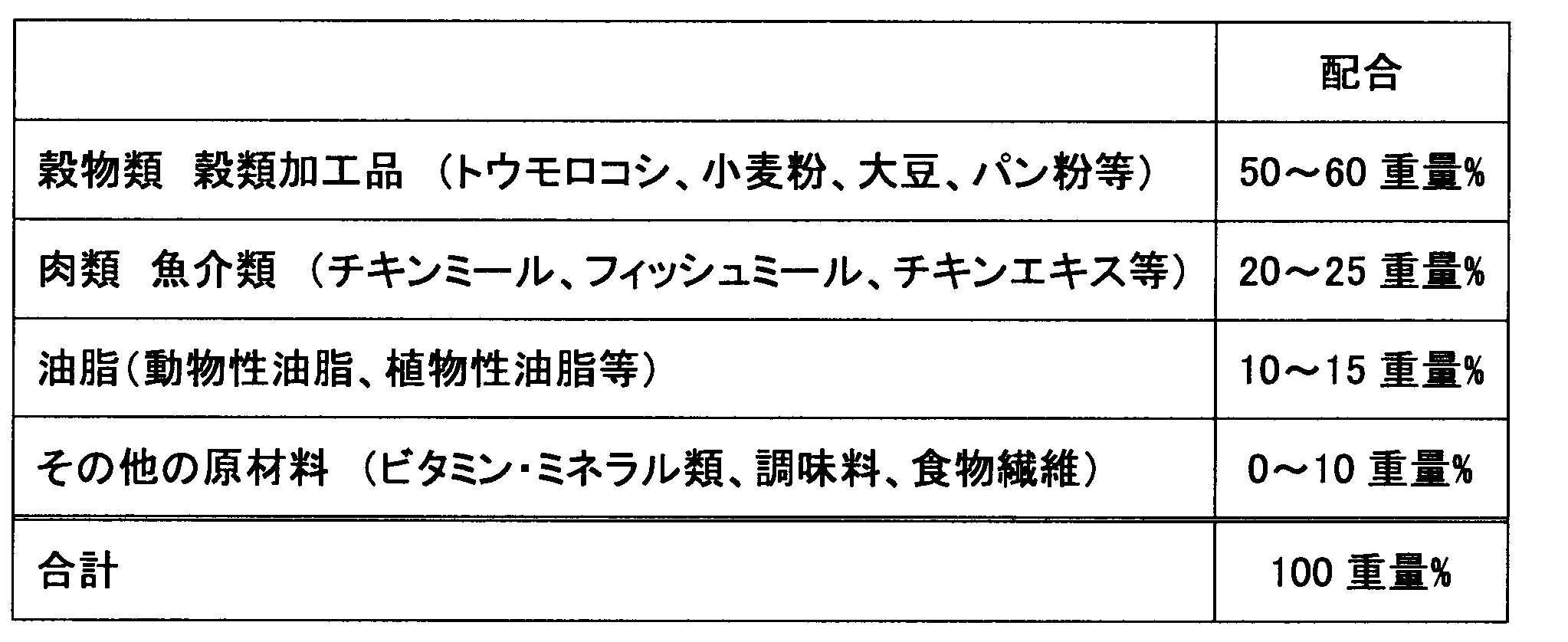
例えば表1に示す配合(重量%)で原材料を混合することが例示できる。
すなわち、本発明で用いる原材料としては、とうもろこし、小麦粉、大豆、パン粉等の穀物類もしくは穀類加工品、チキンミール、チキンエキス等の肉類、フィッシュミール等の魚介類が挙げられ、これらから適宜選択して配合することができる。前記原材料には、更に、ビタミン、ミネラル、調味料、食物繊維等を添加することができる。
すなわち、本発明で用いる原材料としては、とうもろこし、小麦粉、大豆、パン粉等の穀物類もしくは穀類加工品、チキンミール、チキンエキス等の肉類、フィッシュミール等の魚介類が挙げられ、これらから適宜選択して配合することができる。前記原材料には、更に、ビタミン、ミネラル、調味料、食物繊維等を添加することができる。
本発明のペットフードの製造方法において、原材料が押出成形機のバレル内にて加熱処理される場合には、押出成形機のバレル内にて加熱処理される原材料全体の水分含有量を低く設定することが好ましい。これは、デンプン粒の膨潤には、十分な水分が必要なためである。
したがって、前記混合物中の水分の含有量は特に制限されないが、押出成形機のバレル内にて加熱処理される前の原材料全体の水分含量は、水分が20重量%以下で含有された組成が好ましく、18重量%以下で含有された組成がより好ましく、16重量%以下で含有された組成がさらに好ましいといえる。
したがって、前記混合物中の水分の含有量は特に制限されないが、押出成形機のバレル内にて加熱処理される前の原材料全体の水分含量は、水分が20重量%以下で含有された組成が好ましく、18重量%以下で含有された組成がより好ましく、16重量%以下で含有された組成がさらに好ましいといえる。
加熱処理される原材料全体の水分含有量を調節するために、押出成形機のバレル内にて加熱処理される原材料に対して水を添加してもよい。前記水の添加量は、加熱処理される原材料に対して10重量%以下であることが好ましく、8重量%以下であることがより好ましく、6重量%以下であることがさらに好ましい。
本明細書中において、押出成形機のバレル内にて加熱処理が行われる温度とは、当該加熱処理に用いる機械の設定温度のことを指す。加熱処理を行うことにより、混合物中のデンプンを適度に糊化することができる。糊化することにより、得られるフード粒の風味及び食感が向上する効果が得られる。
前記加熱処理は複数回に分けて行ってもよい。また、加熱処理に用いられる装置も特に制限されない。なお、加熱処理と同時に前記の水の添加を行ってもよい。例えば、ミキサーを用いて温水やスチームを原材料に加えることで行う方法が挙げられる。なお、この場合の温水やスチームは、前記「押出成形機のバレル内にて加熱処理される原材料に対して水を添加」する「水」として扱ってもよく、温水又はスチームの原材料に対する添加量を、上記の好ましい水の添加量とすることが好ましい。また、当該水は、他の物質を溶解した水溶液の状態で添加してもよい。例えば、嗜好性を向上させる各種抽出液(エキス)としてや、グリセリン等の吸水剤を含む状態で添加してもよい。
本発明のペットフードの製造方法においては、原材料を60℃~140℃の範囲内において押出成形機のバレル内にて加熱処理することが好ましい。60℃~140℃の範囲としては、60℃~130℃がより好ましく、60℃~120℃がさらに好ましい。
当該加熱処理は、複数回行われてもよく、それぞれの加熱処理が異なる加熱処理温度において行われてもよい。例えば、60℃~100℃の範囲内において一定時間加熱処理をした後に、100℃~140℃の範囲内において一定時間加熱処理をしてもよい。100℃~140℃の範囲としては、100℃~130℃がより好ましく、100℃~120℃がさらに好ましい。
このように60℃~100℃という比較的低い温度により加熱処理を行う段階を設けることで、ペットフードの原材料に含有されるデンプンが糊化することが抑制され、硬さの程度を小さくすることができる。
押出成形機のバレル内にて行われる加熱処理の延べ時間に対する60℃~100℃の範囲内の加熱処理時間と、100℃~140℃の範囲内の加熱処理時間との比は、特に制限されるものではないが、例えば、60℃~100℃:100℃~140℃として、0.1:0.9~0.9~0.1であることが好ましく、0.25:0.75~0.9:0.1であることがより好ましく、0.5:0.5~0.9:0.1であることがさらに好ましく、0.7:0.3~0.8:0.2であること特に好ましい。
押出成形機のバレル内にて行われる加熱処理の延べ時間は5~30秒の範囲内であることが好ましく、5~20秒の範囲内であることがより好ましく、5~15秒の範囲内であることがさらに好ましい。
加熱処理に押出成形機が用いられる場合、原材料が通過する一続きのバレルを複数の部分に分けた時、該部分ごとに加熱温度を異なる値に設定して加熱処理を行ってもよい。一例として、一続きのバレルにおいて、上記のように60℃~100℃の範囲内と、100℃~140℃の範囲内の異なる加熱温度を設定してもよい。
一続きの複数バレルにおける加熱処理方法として、より具体的には、押出成形機の中央部のバレル温度を高温にして、原材料投入口付近と排出口付近のバレルの設定温度は、中央部のバレルの設定温度よりも低めの温度とすることが好ましい。一続きのバレルの原料投入口付近の温度が高すぎるとバレル内の水蒸気圧が高くなって原料投入口方向にも圧力がかかり、原材料がバレル内へ投入できない恐れがある。また、バレルの排出口付近の温度が高すぎると、膨化が著しくなり、粒が成形しにくい場合がある。したがって、短時間で効率的に加熱するために、複数バレルの温度を変えて、中央部において最高温度で加熱することが好ましい。
例えば、まず、60℃~100℃の範囲内で加熱処理を行い、次いで、100℃~140℃の範囲内で加熱処理を行い、その後60℃~100℃の範囲内で加熱処理を行う方法が挙げられる。
本発明のペットフードの製造方法において、加熱処理の少なくとも一部を、押出成形機のバレル内において行う場合、前記原材料を、100℃~140℃の範囲内において押出成形機を用いて加熱処理し、該加熱処理時間として、押出成形機のバレルの通過時間が1秒以上10秒以下であることが好ましく、1秒以上7秒以下であることがより好ましく、1秒以上5秒以下であることがさらに好ましい。
なお、押出成形機を用いずに行われる加熱処理の有無にかかわらず、本発明のペットフードが前記硬さを有するよう、上記の加熱処理条件を設定することが好ましい。
ところで、押出成形機のバレル内には通常、スクリューが取り付けられており、バレル内へと投入された原材料はスクリューにて前方に送られる。スクリューには原材料の搬送を目的として使用される搬送スクリュー、原材料の撹拌を目的として使用される混練スクリュー、原材料の効率的な加熱処理を目的として使用されるクッキングスクリュー等に分類される。また、スクリューに溝切り(スクリュー羽根の切れ込み)を有するか否かにより、カットスクリュー、切れ込みの無いアンカットスクリューに大別される。このうち、カットスクリューは、スクリューの溝切りされた部分で現材料の搬送が行われないため、溝切りされていない部分との撹拌が生じ、混練スクリューとして好適に用いられる。
このように、原材料の撹拌を目的として使用されるスクリューが用いられた場合、バレル内において前記混合が行われることとなる。
このように、原材料の撹拌を目的として使用されるスクリューが用いられた場合、バレル内において前記混合が行われることとなる。
本発明のペットフードの製造においてバレル内で用いられ得るスクリューは特に制限されないが、原材料の搬送を目的として使用される搬送スクリューを用いることが好ましく、アンカットスクリューを用いることが好ましい。アンカットスクリューを用いることで原材料が過度に混練されることを防ぎ、上記硬さのペットフードを容易に得られやすくなる。
特に、ペットフードの原材料として小麦粉等の穀物を用いる場合、グルテンが形成されてしまうことがあり、ペットフードの硬さの程度を高める要因となると考えられる。グルテンは混練によって形成が促進されるため、グルテンの形成量を抑えるとの観点からもアンカットスクリューを用いることが好ましい。
このように、原材料の撹拌を目的として使用されるスクリューが用いられない場合、それが用いられる場合と比較して、バレル内における前記混合が行われないこととなる。すなわち、本発明のペットフードの製造においては、バレル内において前記混合が行われないことが好ましい。バレル内において前記混合が行われない場合のペットフードの製造方法の一例を示すフローチャートを図4に示す。
<乾燥処理>
加熱後に得られた前記ペットフードを乾燥させる方法は特に制限されず、自然に乾燥させる方法、温風を吹き付けて乾燥させる方法、減圧して乾燥させる方法、フリーズドライで乾燥させる方法等の公知の方法が適用可能である。これらの乾燥方法の中でも、温風を吹き付けて乾燥させる方法が、ペットフードの風味を向上させるので好ましい。
加熱後に得られた前記ペットフードを乾燥させる方法は特に制限されず、自然に乾燥させる方法、温風を吹き付けて乾燥させる方法、減圧して乾燥させる方法、フリーズドライで乾燥させる方法等の公知の方法が適用可能である。これらの乾燥方法の中でも、温風を吹き付けて乾燥させる方法が、ペットフードの風味を向上させるので好ましい。
前記フード粒に吹き付ける温風の温度は特に制限されないが、前記温風の温度としては、150℃以下が好ましい。前記温風の温度の下限値は特に制限されず、通常は室温(20℃)を超える温度であり、30℃以上であることが好ましい。上記温度範囲及び時間範囲の下限値以上であると、比較的短時間でフード粒を乾燥させることができる。上記温度範囲の上限値以下であると、フード粒が過度に加熱されることを防げる。
また、高温で短時間の乾燥により、より容易にペットフードの硬さの程度を低く保ちつつ乾燥を行うことができるという観点から、乾燥処理時間は90~140℃がより好ましく、100~110℃がさらに好ましい、当該加熱処理の時間は1分~120分が好ましく、5分~60分がより好ましく、10分~30分がさらに好ましい。
前記加熱処理の温度と、乾燥処理の温度とは同じであっても異なっていてもよい。前記乾燥処理により、フード粒の水分含有率および硬さを所定値に調整することができる。
また、高温で短時間の乾燥により、より容易にペットフードの硬さの程度を低く保ちつつ乾燥を行うことができるという観点から、乾燥処理時間は90~140℃がより好ましく、100~110℃がさらに好ましい、当該加熱処理の時間は1分~120分が好ましく、5分~60分がより好ましく、10分~30分がさらに好ましい。
前記加熱処理の温度と、乾燥処理の温度とは同じであっても異なっていてもよい。前記乾燥処理により、フード粒の水分含有率および硬さを所定値に調整することができる。
乾燥後に、さらに粗牛脂、調味料又は香料等を含むコーティング剤で、本発明のペットフードをコーティングしてもよい。
コーティング方法は特に制限されず、例えば真空コート法により行うことができる。
前記真空コート法は、加温したフード粒と前記コート剤を接触又は付着させた状態で、減圧し、その後ゆっくりと大気開放する方法である。前記コート剤は、液状であっても粉末状であってもよい。前記コーティングによりペットの嗜好性(食いつき)を向上させることができる。得られたペットフードは、コーティングの有無に関わらず、前記硬さを有することが好ましい。
コーティング方法は特に制限されず、例えば真空コート法により行うことができる。
前記真空コート法は、加温したフード粒と前記コート剤を接触又は付着させた状態で、減圧し、その後ゆっくりと大気開放する方法である。前記コート剤は、液状であっても粉末状であってもよい。前記コーティングによりペットの嗜好性(食いつき)を向上させることができる。得られたペットフードは、コーティングの有無に関わらず、前記硬さを有することが好ましい。
次に実施例を示して本発明をさらに詳細に説明するが、本発明は以下の実施例に限定されるものではない。以下、実施例中の%表示は重量%を示す。
以下、実施例1~9、参考例1~2及び比較例1のペットフードの製造方法について説明する。
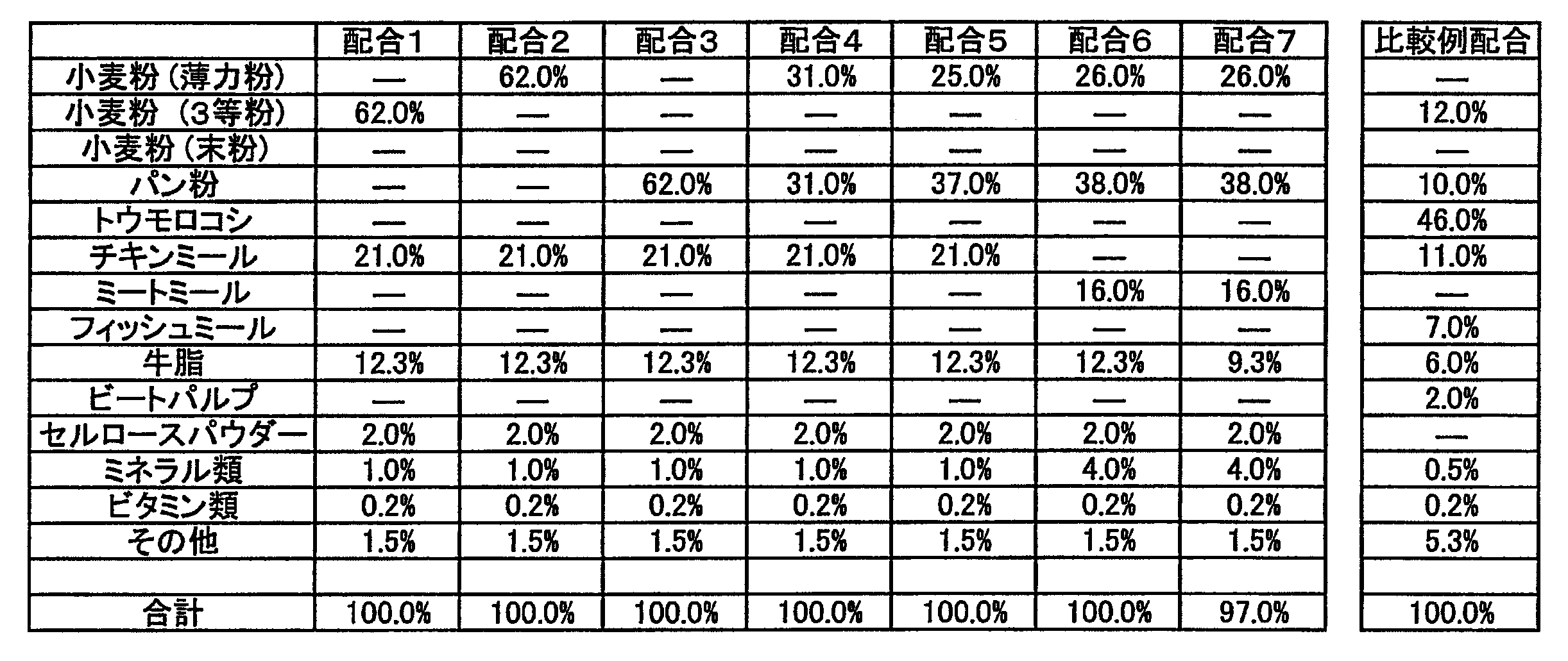
まず、表2に示す配合1~配合7の配合率(重量%)で、実施例1~9及び参考例1~2のペットフードの製造に用いた各原材料を用意した。同じく、表2に示す比較例配合の配合率で、比較例1のペットフードの製造に用いた各原材料を用意した。
以下、実施例1~9、参考例1~2及び比較例1のペットフードの製造方法について説明する。
まず、表2に示す配合1~配合7の配合率(重量%)で、実施例1~9及び参考例1~2のペットフードの製造に用いた各原材料を用意した。同じく、表2に示す比較例配合の配合率で、比較例1のペットフードの製造に用いた各原材料を用意した。
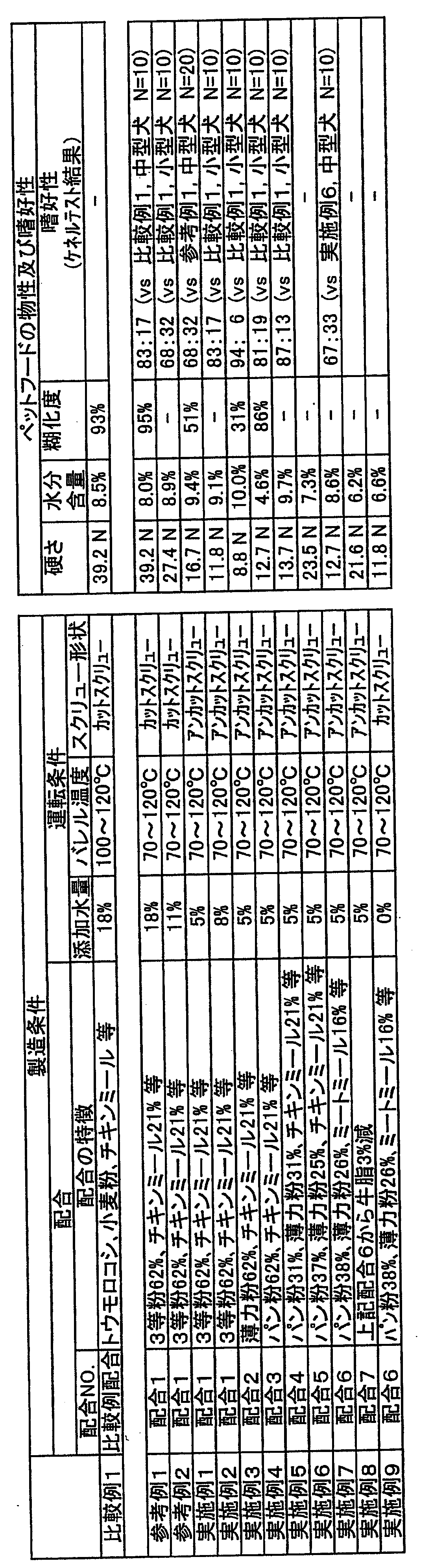
原材料を、プレコンディショナー(ミキサー)を用いて配合ごとに混合し、80~110℃で1~2分間加熱処理した。この際、直後のバレル内での加熱処理の前に、当該原材料に対して水を添加した。当該水の各実施例における添加量を、下記表3中の添加水の欄に示す。次いで、押出成形機の複数のバレルをバレルナンバー1~6として一続きに連結し、原材料を各バレル内にてスクリューを用いてバレル1から順次通過させ、加熱処理若しくは加熱処理及び混合を行った。バレルは内径83mm、スクリュー長さは1040mmのものを用い、原材料のバレル1~バレル6までの通過時間を10秒程度とした。原材料の各バレル内の通過速度は一定である。各実施例、参考例、比較例の製造に用いたスクリューの形状を表3に示す。
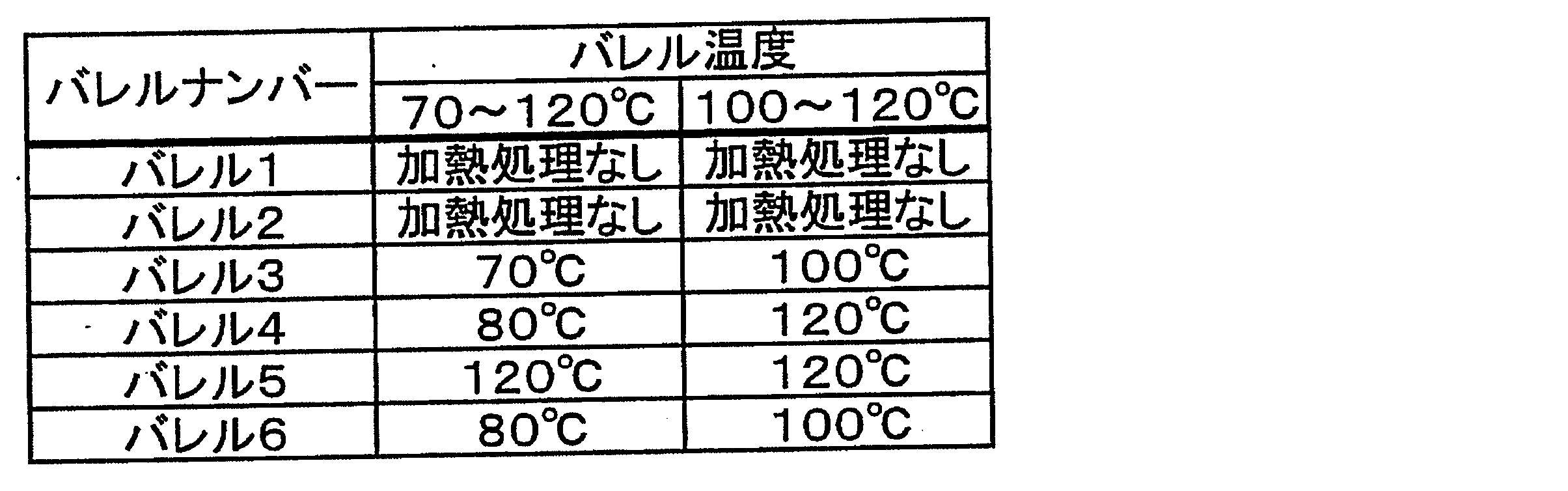
上記のバレル1~6における加熱処理の条件を下記表4に示す。
次いで、バレル6までを通過した原材料を口金から押し出して押出成形し、直径8mm、高さ8mmの略円柱状のフード粒となるように造粒した。その後、得られたフード粒を乾燥機によって約100~120℃で約20分間乾燥し、本発明に係るペットフードを得た。
得られたペットフードの硬さは、前述した物性測定機のデジタル・フォース・ゲージにより円錐状のプランジャーを用いて測定した。これらの結果を表3に示す。
ペットフードの水分含有率は、前述した常圧加熱乾燥法により測定した。これらの結果を表3に併記する。
参考例1、実施例1、実施例3、実施例4及び比較例1のペットフードの糊化度は、前述したグルコアミラーゼ第二法により測定した。測定は財団法人日本食品分析センターに委託して行った。これらの結果を表3に併記する。糊化度の測定は、1.25gの試料を用いて行った。糊化度の値は2検体の分析値の平均である。
ペットフードの水分含有率は、前述した常圧加熱乾燥法により測定した。これらの結果を表3に併記する。
参考例1、実施例1、実施例3、実施例4及び比較例1のペットフードの糊化度は、前述したグルコアミラーゼ第二法により測定した。測定は財団法人日本食品分析センターに委託して行った。これらの結果を表3に併記する。糊化度の測定は、1.25gの試料を用いて行った。糊化度の値は2検体の分析値の平均である。
[嗜好性の評価]
製造した各ペットフードの犬に対する嗜好性を以下の方法により評価した。
結果を表3に併記する。表3中、「数値A:数値B」の表記は、数値Aが各試験対象のペットフードに対する嗜好性の高さ(程度)を示し、数値Bが比較対象のペットフードに対する嗜好性の高さ(程度)を表す。数値A+数値B=100である。例えば、実施例1の嗜好性結果は「83:17」である。これは、実施例1のペットフードに対する嗜好性の高さが83であり、比較対象の比較例1のペットフードに対する嗜好性の高さが17であったことを示す。
製造した各ペットフードの犬に対する嗜好性を以下の方法により評価した。
結果を表3に併記する。表3中、「数値A:数値B」の表記は、数値Aが各試験対象のペットフードに対する嗜好性の高さ(程度)を示し、数値Bが比較対象のペットフードに対する嗜好性の高さ(程度)を表す。数値A+数値B=100である。例えば、実施例1の嗜好性結果は「83:17」である。これは、実施例1のペットフードに対する嗜好性の高さが83であり、比較対象の比較例1のペットフードに対する嗜好性の高さが17であったことを示す。
嗜好性の評価方法は次の通りである。
まず、試験対象のペットフードである参考例1~2、実施例1~5、及び実施例7のペットフードと各比較対象のペットフード(比較例1、参考例1、実施例6のいずれか)とを組み合わせた、合計8組のペットフードを準備した。各組について、10頭又は20頭の犬をモニターとして2日間でテストした。表3中、中型犬を対象とした試験ではビーグル犬が、小型犬を対象とした試験ではダックスフンド、ポメラニアン、トイプードル、ヨークシャーテリア、パピヨン等がモニターである。
第1日は、各組のペットフードのうち、一方を左から、他方を右から、犬1頭に対して、所定量を同時に給与し、犬が食べた量を所定の時間経過後に測定した。給与量は、ビーグルの場合は250g、小型犬の場合は100gを与えた。犬が食べた量の測定は、ビーグルの場合はペットフードを給与してから20分後、小型犬の場合はペットフードを給与してから60分後に行った。
当該犬1頭が第1日に食べた合計のペットフードの重量のうち、試験例のペットフードの摂食量と比較例のペットフードの摂食量を百分率で求めた。モニターである10頭又は20頭の犬から得られた百分率を平均して、第1日の結果とした。
第2日は、各組のペットフードのうち、一方を右から、他方を左から、犬1頭に対して40gずつ同時に給与し、犬が食べた量を1時間後に測定した。
当該犬1頭が第2日に食べた合計のペットフードの重量のうち、試験例のペットフードの摂食量と比較例のペットフードの摂食量を百分率で求めた。モニターである20頭の犬から得られた百分率を平均して、第2日の結果とした。
最後に、第1日と第2日の結果を平均して、最終結果である摂食量の比(嗜好性)を求めた。この嗜好性の数値が高い程、モニターである犬が好んで摂食したことを示す。
表3に示される結果から、実施例1~5及び実施例7の硬さが24.5N以下のペットフードは、従来の、硬さが24.5Nより大きい比較例1のペットフード及び参考例1~2のペットフードよりも嗜好性が高いことが明らかである。
また、ペットフードの硬さの程度が低いほどペットフードに対する嗜好性が向上することも分かる。このことは、同じ配合1の原材料から製造され、ともに中型犬をモニターとした参考例1と実施例1の嗜好性試験結果の比較からも明らかである。参考例1のペットフードよりも硬さの程度が小さく、参考例1のペットフードを比較対象として行った嗜好性試験で、実施例1のペットフードは、参考例1のペットフードよりも高い嗜好性を有していた。同様のことは、同じ配合1の原材料から製造され、ともに小型犬をモニターとした参考例2と実施例2の嗜好性試験結果の比較からも明らかである。参考例2のペットフードよりも硬さの程度が低く、ともに比較例1を比較対象として行った嗜好性試験で、実施例2のペットフードは、参考例2のペットフードよりも高い嗜好性を有していた。更には、ともに小型犬をモニターとして、比較例1を比較対象として行った嗜好性試験(参考例2、実施例2~実施例5)のなかで、最も硬さの程度が小さい実施例3のペットフードが、最も高い嗜好性を有していた。
また、ペットフードの硬さの程度が低いほどペットフードに対する嗜好性が向上することも分かる。このことは、同じ配合1の原材料から製造され、ともに中型犬をモニターとした参考例1と実施例1の嗜好性試験結果の比較からも明らかである。参考例1のペットフードよりも硬さの程度が小さく、参考例1のペットフードを比較対象として行った嗜好性試験で、実施例1のペットフードは、参考例1のペットフードよりも高い嗜好性を有していた。同様のことは、同じ配合1の原材料から製造され、ともに小型犬をモニターとした参考例2と実施例2の嗜好性試験結果の比較からも明らかである。参考例2のペットフードよりも硬さの程度が低く、ともに比較例1を比較対象として行った嗜好性試験で、実施例2のペットフードは、参考例2のペットフードよりも高い嗜好性を有していた。更には、ともに小型犬をモニターとして、比較例1を比較対象として行った嗜好性試験(参考例2、実施例2~実施例5)のなかで、最も硬さの程度が小さい実施例3のペットフードが、最も高い嗜好性を有していた。
また、表3に示される結果から、ペットフードのデンプンの糊化度が低いほど、ペットフードの硬さの度合いが低いことがわかる。これはともに原材料として小麦粉を62%用いて製造された参考例1、実施例1、実施例3のペットフードの糊化度の比較から把握される。これら3例のペットフードにおいて、糊化度の値が低いほど、硬さの程度が低いペットフードであることがわかる。
一方、原材料として、パン粉を62%用いて製造された実施例4のペットフードでは、小麦粉に代えてパン粉を用いることで、硬さの度合いを低く抑えつつも、ペットフードの糊化度が高められたことが分かる。
一方、原材料として、パン粉を62%用いて製造された実施例4のペットフードでは、小麦粉に代えてパン粉を用いることで、硬さの度合いを低く抑えつつも、ペットフードの糊化度が高められたことが分かる。
また、小麦粉のなかでも特に薄力粉を用いることで、ペットフードの硬さの程度を低くすることが可能であることが分かる。実施例1と実施例3との比較によれば、3等粉に代えて薄力粉を用いて製造された実施例3のペットフードの方が硬さの程度が低く、嗜好性も高いことが分かる。
原材料の混合にあたって、デンプン源及び油脂が含まれる原材料を混合することも、ペットフードの硬さの程度を低くする効果がある。実施例7と実施例8との比較から、混合される原材料から牛脂を3%減らした配合により製造された実施例8のペットフードは、実施例7のペットフードと比較して、硬さの程度が高いことがわかる。
また、押出成形機のバレル内にて加熱処理される原材料に対して水を添加し、前記水の添加量が、加熱処理される原材料に対して10重量%以下の条件で製造したペットフードは、前記水の添加量が11重量%より多い条件で製造されたペットフードと比べ、硬さの程度が低いことが分かる。
以上で説明した各実施形態における各構成及びそれらの組み合わせ等は一例であり、本発明の趣旨を逸脱しない範囲で、構成の付加、省略、置換、およびその他の変更が可能である。また、本発明は各実施形態によって限定されることはなく、請求項(クレーム)の範囲によってのみ限定される。
本発明にかかるペットフードは、ドライタイプのペットフードであり、押出成形により製造されながらも、硬さの程度が低く、ペットの食いつきに優れたペットフードを提供でき、愛玩動物の飼料の分野に広く適用可能である。
Claims (11)
- 原材料を押出成形することにより造粒して得られ、水分含量が12重量%以下であり、硬さが24.5N以下であることを特徴とするペットフード。
- 前記原材料が、デンプン源を含むことを特徴とする請求項1に記載のペットフード。
- デンプンの糊化度が18%~90%であることを特徴とする請求項2に記載のペットフード。
- 前記デンプン源は、糊化温度が65℃以上の原料であることを特徴とする請求項2又は3に記載のペットフード。
- 前記デンプン源として、小麦粉を用いることを特徴とする請求項2~4のいずれか一項に記載のペットフード。
- 前記デンプン源として、パン粉を用いることを特徴とする請求項2~5のいずれか一項に記載のペットフード。
- 原材料を押出成形することにより造粒することを特徴とする請求項1~6のいずれか一項に記載のペットフードの製造方法。
- 前記デンプン源及び油脂が含まれる原材料を混合することを特徴とする請求項7に記載のペットフードの製造方法。
- 前記原材料を60℃~140℃の範囲内において押出成形機のバレル内にて加熱処理することを特徴とする請求項7又は8に記載のペットフードの製造方法。
- 前記原材料を、100℃~140℃の範囲内において押出成形機のバレル内にて加熱処理し、該加熱処理時間として、押出成形機のバレル内の上記温度範囲の通過時間が1秒以上10秒以下であることを特徴とする請求項9に記載のペットフードの製造方法。
- 前記押出成形機のバレル内にて加熱処理される原材料に対して水を添加し、前記水の添加量が、前記押出成形機のバレル内にて加熱処理される原材料に対して10重量%以下であることを特徴とする請求項9又は10に記載のペットフードの製造方法。
Applications Claiming Priority (2)
| Application Number | Priority Date | Filing Date | Title |
|---|---|---|---|
| JP2013273329A JP5717153B1 (ja) | 2013-12-27 | 2013-12-27 | ペットフードの製造方法 |
| JP2013-273329 | 2013-12-27 |
Publications (1)
| Publication Number | Publication Date |
|---|---|
| WO2015072156A1 true WO2015072156A1 (ja) | 2015-05-21 |
Family
ID=53057105
Family Applications (1)
| Application Number | Title | Priority Date | Filing Date |
|---|---|---|---|
| PCT/JP2014/051379 Ceased WO2015072156A1 (ja) | 2013-12-27 | 2014-01-23 | ペットフード及びペットフードの製造方法 |
Country Status (3)
| Country | Link |
|---|---|
| JP (1) | JP5717153B1 (ja) |
| TW (1) | TWI657744B (ja) |
| WO (1) | WO2015072156A1 (ja) |
Cited By (4)
| Publication number | Priority date | Publication date | Assignee | Title |
|---|---|---|---|---|
| CN108024555A (zh) * | 2015-08-03 | 2018-05-11 | 尤妮佳股份有限公司 | 宠物食品及其制造方法 |
| WO2020095726A1 (ja) * | 2018-11-06 | 2020-05-14 | ユニ・チャーム株式会社 | ペットフード |
| JP2020074746A (ja) * | 2018-11-06 | 2020-05-21 | ユニ・チャーム株式会社 | ペットフード |
| CN115087360A (zh) * | 2020-02-10 | 2022-09-20 | 马斯公司 | 低水分挤出方法 |
Families Citing this family (4)
| Publication number | Priority date | Publication date | Assignee | Title |
|---|---|---|---|---|
| JP6021037B1 (ja) * | 2015-12-28 | 2016-11-02 | ユニ・チャーム株式会社 | ペットフード用組成物、ペットフード用フード粒、ペットフード、およびペットフード包装体 |
| KR102220535B1 (ko) * | 2019-01-28 | 2021-02-24 | 심근훈 | 반려견의 자연식 건조 사료 조성물의 제조방법 및 이에 따라 제조된 사료 조성물 |
| KR102535324B1 (ko) * | 2020-01-29 | 2023-05-22 | 박기원 | 반려동물 동결건조 사료 제조방법 및 그 방법에 따라 제조된 반려동물 동결건조 사료 |
| EP4248760A4 (en) * | 2020-12-28 | 2024-05-08 | Unicharm Corporation | PET FOOD |
Citations (5)
| Publication number | Priority date | Publication date | Assignee | Title |
|---|---|---|---|---|
| US4039689A (en) * | 1976-02-03 | 1977-08-02 | The Quaker Oats Company | Soft dry pet food product and process |
| JP2011160808A (ja) * | 2011-04-18 | 2011-08-25 | Unicharm Corp | ペットフード |
| JP2012217381A (ja) * | 2011-04-08 | 2012-11-12 | Nisshin Pet Food Kk | ドライペットフード |
| JP2012529900A (ja) * | 2009-06-19 | 2012-11-29 | スペスィアリテ、ペット、フード | 嗜好性の高いドライキャットフードの製造方法 |
| WO2014007251A1 (ja) * | 2012-07-02 | 2014-01-09 | ユニ・チャーム株式会社 | ペットフード及びペットフードの製造方法 |
-
2013
- 2013-12-27 JP JP2013273329A patent/JP5717153B1/ja active Active
-
2014
- 2014-01-23 WO PCT/JP2014/051379 patent/WO2015072156A1/ja not_active Ceased
- 2014-11-17 TW TW103139782A patent/TWI657744B/zh active
Patent Citations (5)
| Publication number | Priority date | Publication date | Assignee | Title |
|---|---|---|---|---|
| US4039689A (en) * | 1976-02-03 | 1977-08-02 | The Quaker Oats Company | Soft dry pet food product and process |
| JP2012529900A (ja) * | 2009-06-19 | 2012-11-29 | スペスィアリテ、ペット、フード | 嗜好性の高いドライキャットフードの製造方法 |
| JP2012217381A (ja) * | 2011-04-08 | 2012-11-12 | Nisshin Pet Food Kk | ドライペットフード |
| JP2011160808A (ja) * | 2011-04-18 | 2011-08-25 | Unicharm Corp | ペットフード |
| WO2014007251A1 (ja) * | 2012-07-02 | 2014-01-09 | ユニ・チャーム株式会社 | ペットフード及びペットフードの製造方法 |
Cited By (8)
| Publication number | Priority date | Publication date | Assignee | Title |
|---|---|---|---|---|
| CN108024555A (zh) * | 2015-08-03 | 2018-05-11 | 尤妮佳股份有限公司 | 宠物食品及其制造方法 |
| US20180213822A1 (en) * | 2015-08-03 | 2018-08-02 | Unicharm Corporation | Pet food and method for preparing same |
| WO2020095726A1 (ja) * | 2018-11-06 | 2020-05-14 | ユニ・チャーム株式会社 | ペットフード |
| JP2020074746A (ja) * | 2018-11-06 | 2020-05-21 | ユニ・チャーム株式会社 | ペットフード |
| CN112867402A (zh) * | 2018-11-06 | 2021-05-28 | 尤妮佳股份有限公司 | 宠物食品 |
| US12137707B2 (en) | 2018-11-06 | 2024-11-12 | Unicharm Corporation | Pet food |
| CN115087360A (zh) * | 2020-02-10 | 2022-09-20 | 马斯公司 | 低水分挤出方法 |
| JP2023513874A (ja) * | 2020-02-10 | 2023-04-04 | マース インコーポレーテッド | 低水分押出方法 |
Also Published As
| Publication number | Publication date |
|---|---|
| JP2015126715A (ja) | 2015-07-09 |
| JP5717153B1 (ja) | 2015-05-13 |
| TW201531230A (zh) | 2015-08-16 |
| TWI657744B (zh) | 2019-05-01 |
Similar Documents
| Publication | Publication Date | Title |
|---|---|---|
| JP5717153B1 (ja) | ペットフードの製造方法 | |
| JP6643794B2 (ja) | ペットフード用粒体およびペットフード | |
| JP6004167B2 (ja) | ペットフード及びペットフードの製造方法 | |
| JP5813688B2 (ja) | ネコ用ペットフード | |
| EP3045050B1 (en) | Pet food production method and pet food | |
| TWI767940B (zh) | 寵物食品粒體、其製造方法與製造裝置、以及寵物食品 | |
| JP6257567B2 (ja) | ペットフード | |
| CN105611843A (zh) | 宠物食品 | |
| WO2018147737A1 (en) | Pelleting process for making an animal feed pellet | |
| CN105848494B (zh) | 宠物食品 | |
| WO2024116422A1 (ja) | ドライペットフード | |
| JP6706360B2 (ja) | ペットフード | |
| NL2024270B1 (en) | Process for making animal feed mash agglomerates | |
| WO2023234249A1 (ja) | ドライペットフード | |
| WO2025105161A1 (ja) | 小型犬・中型犬用ペットフード製品 | |
| WO2025004396A1 (ja) | ペットフード製品 | |
| WO2020095726A1 (ja) | ペットフード |
Legal Events
| Date | Code | Title | Description |
|---|---|---|---|
| 121 | Ep: the epo has been informed by wipo that ep was designated in this application |
Ref document number: 14862113 Country of ref document: EP Kind code of ref document: A1 |
|
| NENP | Non-entry into the national phase |
Ref country code: DE |
|
| 122 | Ep: pct application non-entry in european phase |
Ref document number: 14862113 Country of ref document: EP Kind code of ref document: A1 |