WO2015068532A1 - ペプチドヒドラジド、ペプチドアミド及びペプチドチオエステルの製造方法 - Google Patents
ペプチドヒドラジド、ペプチドアミド及びペプチドチオエステルの製造方法 Download PDFInfo
- Publication number
- WO2015068532A1 WO2015068532A1 PCT/JP2014/077271 JP2014077271W WO2015068532A1 WO 2015068532 A1 WO2015068532 A1 WO 2015068532A1 JP 2014077271 W JP2014077271 W JP 2014077271W WO 2015068532 A1 WO2015068532 A1 WO 2015068532A1
- Authority
- WO
- WIPO (PCT)
- Prior art keywords
- compound
- peptide
- group
- general formula
- compound represented
- Prior art date
- Legal status (The legal status is an assumption and is not a legal conclusion. Google has not performed a legal analysis and makes no representation as to the accuracy of the status listed.)
- Ceased
Links
- 0 *C(C(CS)NC(I*)=O)=O Chemical compound *C(C(CS)NC(I*)=O)=O 0.000 description 5
- OATKEZJBDPPTFZ-KXFIGUGUSA-N CC(C/C=C(/CC(O)=O)\CS)(N)S Chemical compound CC(C/C=C(/CC(O)=O)\CS)(N)S OATKEZJBDPPTFZ-KXFIGUGUSA-N 0.000 description 1
- YOHYEFYKYFHEDF-ARJAWSKDSA-N CC(C/C=C\CCC(NN)OC)S Chemical compound CC(C/C=C\CCC(NN)OC)S YOHYEFYKYFHEDF-ARJAWSKDSA-N 0.000 description 1
- UDFFMWPAUNCHDZ-UHFFFAOYSA-N CCC(CCCC(C)(N)SP)SC#N Chemical compound CCC(CCCC(C)(N)SP)SC#N UDFFMWPAUNCHDZ-UHFFFAOYSA-N 0.000 description 1
- HEEMPVGOSUOKFN-YVMONPNESA-N CO/C(/NN)=C\CCCC(CN)SP Chemical compound CO/C(/NN)=C\CCCC(CN)SP HEEMPVGOSUOKFN-YVMONPNESA-N 0.000 description 1
Classifications
-
- C—CHEMISTRY; METALLURGY
- C07—ORGANIC CHEMISTRY
- C07K—PEPTIDES
- C07K7/00—Peptides having 5 to 20 amino acids in a fully defined sequence; Derivatives thereof
- C07K7/04—Linear peptides containing only normal peptide links
- C07K7/06—Linear peptides containing only normal peptide links having 5 to 11 amino acids
-
- C—CHEMISTRY; METALLURGY
- C07—ORGANIC CHEMISTRY
- C07K—PEPTIDES
- C07K1/00—General methods for the preparation of peptides, i.e. processes for the organic chemical preparation of peptides or proteins of any length
- C07K1/107—General methods for the preparation of peptides, i.e. processes for the organic chemical preparation of peptides or proteins of any length by chemical modification of precursor peptides
-
- C—CHEMISTRY; METALLURGY
- C07—ORGANIC CHEMISTRY
- C07D—HETEROCYCLIC COMPOUNDS
- C07D249/00—Heterocyclic compounds containing five-membered rings having three nitrogen atoms as the only ring hetero atoms
-
- C—CHEMISTRY; METALLURGY
- C07—ORGANIC CHEMISTRY
- C07K—PEPTIDES
- C07K1/00—General methods for the preparation of peptides, i.e. processes for the organic chemical preparation of peptides or proteins of any length
- C07K1/003—General methods for the preparation of peptides, i.e. processes for the organic chemical preparation of peptides or proteins of any length by transforming the C-terminal amino acid to amides
-
- C—CHEMISTRY; METALLURGY
- C07—ORGANIC CHEMISTRY
- C07K—PEPTIDES
- C07K1/00—General methods for the preparation of peptides, i.e. processes for the organic chemical preparation of peptides or proteins of any length
- C07K1/13—Labelling of peptides
Definitions
- the present invention relates to a method for producing peptide hydrazide, peptide amide and peptide thioester.
- Peptide thioesters are important compounds in protein chemistry and are widely used for peptide synthesis.
- a solid phase peptide synthesis method is known as a peptide synthesis method, but if each condensation reaction does not proceed at almost 100%, a highly pure product cannot be obtained.
- the degree of group is the limit of application of solid phase peptide synthesis.
- NCL natural chemical ligation
- the intermediate produced in the first step spontaneously undergoes an intramolecular S—N acyl rearrangement reaction to give a natural amide bond to the linking site, while regenerating the cysteine side chain thiol.
- This method can selectively link one peptide C-terminus and the other peptide N-terminus even in the reaction of compounds having many functional groups such as peptides.
- this method is a technique in which two peptide chains can be linked via peptide bonds simply by mixing in a buffer solution using a starting peptide without a protecting group.
- this method does not require a deprotection step because the obtained peptide does not have a protecting group, and is widely used as a first option for peptide synthesis that has been greatly simplified (Non-patent Document 1).
- Non-Patent Document 1 a method for producing a peptide thioester by solid-phase synthesis with a thioester-type bond is known, but it has a disadvantage that the thioester bond is decomposed by the base treatment in the deprotection step and the C-terminal amino acid is easily racemized.
- Non-Patent Document 1 there was no convenient methodology for chemically synthesizing peptide thioesters from peptides containing the native sequence.
- peptide amides in which the C-terminal is amidated are important for the expression of physiological functions and the stability of the peptides themselves, and many have been marketed as peptide drugs to date.
- An object of the present invention is to provide a new method for producing a peptide thioester compound which is an important compound in protein chemistry.
- Another object of the present invention is to provide a method for producing a peptide hydrazide compound which is an intermediate for producing a peptide thioester compound. Furthermore, the other subject of this invention is providing the manufacturing method of a peptide amide compound.
- the present inventors have conducted intensive research to solve the above problems. In the course of their research, they found a new method for producing peptide thioester compounds. The present inventors have also found a method for producing a peptide hydrazide compound for producing a peptide ester compound and a method for producing a peptide amide compound.
- R 1 represents an amino acid residue or a derivative thereof, or a peptide residue or a derivative thereof.
- R 1 is the same as defined above.
- R 2 represents a hydrogen atom or an alkyl group.
- R 3 represents a hydroxyl group, an amino group, a hydrazino group or an organic group.
- X represents an oxygen atom or a sulfur atom.
- a hydrazine compound is used as a reaction reagent. A method for producing the peptide hydrazide compound.
- R 1 and R 2 are the same as described above.
- R 4 represents an arginine side chain, a lysine side chain or a histidine side chain.
- R 5 represents a histidine side chain.
- R 6 represents a leucine side chain, isoleucine side chain, tyrosine side chain, phenylalanine side chain, arginine side chain or tryptophan side chain.
- R 7 represents a hydroxyl group, an amino group, a hydrazino group or an organic group.
- R 1 is the same as defined above.
- R 8 represents an alkyl group.
- item 1 including the process with which the ester compound represented by these, and a hydrazine compound are made to react.
- Item 3 The method for producing a peptide hydrazide compound according to Item 2, wherein the alcohol compound used in the step (A) is at least one selected from the group consisting of methanol, ethanol and dithiodiethanol.
- Item 4. The method for producing a peptide hydrazide compound according to Item 2 or 3, wherein the reaction in the step (A) is performed in the presence of a transition metal compound.
- Item 5 The method for producing a peptide hydrazide compound according to Item 4, wherein the transition metal compound is a nickel compound.
- Item 6 The method for producing a peptide hydrazide compound according to Item 5, wherein the nickel compound is at least one selected from the group consisting of nickel chloride, nickel bromide, nickel iodide and hydrates thereof.
- Item 7. The compound according to any one of Items 2 to 6, wherein the compound represented by the general formula (2a) is selected from the group consisting of compounds represented by the following general formulas (2a-1) to (2a-7) A method for producing a peptide hydrazide compound.
- Step (C) a step of reacting the compound represented by the general formula (2b) with a nitrifying agent, and step (D): the general formula (4) obtained in the step (C).
- Item 2 A method for producing a peptide hydrazide compound according to Item 1, comprising a step of reacting a thiocyanate compound represented by the formula: and a hydrazine compound.
- the nitrating agent used in the step (C) is 1-cyano-4- (dimethylamino) pyridinium tetrafluoroborate (CDAP) and / or 2-nitro-5-thiocyanobenzoic acid.
- CDAP 1-cyano-4- (dimethylamino) pyridinium tetrafluoroborate
- 2-nitro-5-thiocyanobenzoic acid A method for producing a peptide hydrazide compound.
- Item 10 A method for producing a peptide hydrazide compound according to any one of Items 1 to 9, wherein the starting compound is a general formula (2), (2a), (2a-1) to (2a-7) and / or Or the manufacturing method of the said peptide hydrazide compound which prepares the compound represented by (2b) using the biological synthesis method.
- R 1 represents an amino acid residue or a derivative thereof, or a peptide residue or a derivative thereof.
- R 10 represents an alkyl group which may have a substituent or an aryl group which may have a substituent.
- R 1 is the same as defined above.
- the manufacturing method of the said peptide thioester compound including the process with which the acyl azide compound represented by these and a thiol compound are made to react.
- R 1 represents an amino acid residue or a derivative thereof, or a peptide residue or a derivative thereof.
- R 10 represents an alkyl group which may have a substituent or an aryl group which may have a substituent.
- R 1 is the same as defined above.
- R 2 represents a hydrogen atom or an alkyl group.
- R 3 represents a hydroxyl group, an amino group, a hydrazino group or an organic group.
- X represents an oxygen atom or a sulfur atom.
- step (E) A step of allowing nitrite to act on the peptide hydrazide compound represented by formula (6), and step (F): general formula (6) obtained in step (E)
- R 1 is the same as defined above.
- the manufacturing method of the said peptide thioester compound including the process with which the acyl azide compound represented by these and a thiol compound are made to react.
- Item 13 The method for producing a peptide thioester compound according to Item 11 or 12, wherein the starting material is a general formula (2), (2a), (2a-1) to (2a-7) and / or (2b) A method for producing the peptide thioester compound, wherein the compound represented is prepared using a biological synthesis method.
- R 1 represents an amino acid residue or a derivative thereof, or a peptide residue or a derivative thereof.
- R 1 is the same as defined above.
- R 2 represents a hydrogen atom or an alkyl group.
- R 3 represents a hydroxyl group, an amino group, a hydrazino group or an organic group.
- X represents an oxygen atom or a sulfur atom.
- R 1 represents an amino acid residue or a derivative thereof, or a peptide residue or a derivative thereof.
- R 10 represents an alkyl group which may have a substituent or an aryl group which may have a substituent.
- R 1 is the same as defined above.
- R 2 represents a hydrogen atom or an alkyl group.
- R 3 represents a hydroxyl group, an amino group, a hydrazino group or an organic group.
- X represents an oxygen atom or a sulfur atom.
- step (E) A step of allowing nitrite to act on the peptide hydrazide compound represented by formula (6), and step (F): general formula (6) obtained in step (E)
- R 1 is the same as defined above.
- the manufacturing method of the said peptide thioester compound including the process with which the acyl azide compound represented by these and a thiol compound are made to react.
- step (F) A step of allowing nitrite to act on the peptide hydrazide compound represented by formula (6), and step (F): general formula (6) obtained in step (E) [Wherein, R 1 is the same as defined above. ]
- the manufacturing method of the said peptide thioester compound including the process with which the acyl azide compound represented by these and a thiol compound are made to react.
- R 2 represents a hydrogen atom or an alkyl group.
- R 3 represents a hydroxyl group, an amino group, a hydrazino group or an organic group.
- X represents an oxygen atom or a sulfur atom.
- R 8a represents an alkyl group having a triple bond.
- a step of reacting an ester compound represented by A method for producing a compound having a triazole ring Item 20.
- the alcohol compound having a triple bond is at least one selected from the group consisting of 3-butyn-1-ol, cyclooctyne-1-ol, dibenzocyclooctyne-1-ol and dibenzocyclooctyne- (polyethylene glycol) -alcohol.
- Item 20. A method for producing a compound having a triazole ring according to Item 19.
- a peptide hydrazide compound which is an intermediate for producing a peptide thioester
- a simple method a peptide thioester compound can be chemically produced from the peptide hydrazide compound by a simple operation. Since the production method of the present invention does not use solid phase synthesis, a peptide thioester can be produced without the thioester bond being decomposed and the C-terminal amino acid being racemized, and thus an excellent method as an industrially advantageous production method It is. Furthermore, the present invention can easily and efficiently produce a peptide amide in which the C-terminal is amidated by a chemical synthesis method.
- R 1 , R 1 , R 3 and X are the same as above.
- Examples of the compound represented by the general formula (2) include: General formula (2a)
- R 1 , R 2 , R 7 and X are the same as described above.
- Y represents an amino acid residue or a derivative thereof.
- N is an integer of 1 to 10. When n is 2 or more, Y is May be the same or different.
- the compound etc. which are represented by these are preferable.
- the compound represented by the general formula (2a) is more preferably a compound selected from the group consisting of compounds represented by the following general formulas (2a-1) to (2a-7).
- R 1 , R 2 and R 7 are the same as described above.
- Y 1 , Y 2 and Y 3 each represent an amino acid residue or a derivative thereof.
- R 1 , R 2 , R 4 , R 5 , R 6 , R 7 and R 8 are the same as described above.
- Step (A) is a step of reacting the compound represented by the general formula (2a) with an alcohol compound.
- Step (B) is a step of reacting the ester compound represented by the general formula (3) obtained in Step (A) with a hydrazine compound.
- Step (C) is a step of reacting the compound represented by the general formula (2b) with a nitrifying agent.
- Step (D) is a step of reacting the thiocyanate compound represented by the general formula (4) obtained in Step (C) with a hydrazine compound.
- a peptide compound having a structure of cysteine--cysteine--histidine--histidine residue (zinc finger sequence) at the C-terminus (here, the symbol represented by-is: Means that one or more other amino acid residues may be included.) Is known to act with zinc compounds to form zinc fingers (eg, Biochemistry 2011, 50 , pp. 6266-6272; Chem. Commun. 2014, 50, pp. 2258-2260).
- a specific hydrazide compound can be produced even when using a starting peptide compound having two or more thiol groups.
- Step II-B1 a step of reacting the compound represented by the general formula (2b) (peptide compound) with a zinc compound to form a zinc finger
- Step II-B2 a step of protecting the remaining cysteine groups that do not form zinc fingers in the compound obtained in Step (III-B1)
- Step II-B3 Step of removing zinc from the compound obtained in Step (III-B2)
- Step II-B4 a step of cyanating a cysteine group in the compound obtained in Step (III-B3)
- Step II-B5 a compound obtained in Step (III-B4) and a hydrazine compound
- amino acid residue or derivative thereof or peptide residue or derivative thereof is not particularly limited as described below.
- the amino acid residue in R 1 means a group obtained by removing a carboxyl group (COOH) from the C terminus of an amino acid.
- the peptide residue in R 1 means a group obtained by removing a carboxyl group (COOH) from the C-terminus of the peptide.
- the “amino acid” in the amino acid residue or the “amino acid” in the peptide residue may be a natural amino acid, a non-natural amino acid, or a derivative thereof. That is, the amino acid in the amino acid residue or the amino acid in the peptide residue may be an L-amino acid, a D-amino acid, or a mixture thereof.
- the type of amino acid is not particularly limited as long as it is a compound having an amino group and a carboxyl group. Examples include ⁇ -amino acids, ⁇ -amino acids, ⁇ -amino acids, and ⁇ -amino acids, with ⁇ -amino acids being natural amino acids being preferred.
- Natural amino acids include glycine, L-alanine, L-valine, L-leucine, L-isoleucine, L-serine, L-threonine, L-aspartic acid, L-glutamic acid, L-asparagine, L-glutamine, L -Lysine, L-arginine, L-cystine, L-methionine, L-phenylalanine, L-tyrosine, L-tryptophan, L-histidine, L-proline and the like.
- Non-natural amino acids mean all amino acids other than the 20 types of natural amino acids that constitute natural proteins. Specifically, (1) an unnatural amino acid obtained by substituting an atom in a natural amino acid with another substance, (2) an optical isomer of a side chain of the natural amino acid, (3) a side chain of the natural amino acid Non-natural amino acid introduced with a substituent, (4) Non-natural amino acid in which the side chain of the natural amino acid is substituted to change hydrophobicity, reactivity, charged state, molecular size, hydrogen bonding ability, etc. Is mentioned.
- the peptide residue may be a residue of a compound composed of two or more amino acids, such as a dipeptide residue, a tripeptide residue, an oligopeptide residue, a polypeptide residue, etc. Can be mentioned.
- the amino acid in the peptide residue as used herein is the same as the definition of the amino acid described above.
- “Derivatives” of amino acid residues and “derivatives” of peptide residues refer to amino acid derivatives or peptide residue derivatives that have undergone chemical modification, biological modification, or the like. Examples of modifications include, for example, alkylation, acylation (more specifically, acetylation, etc.), esterification, halogenation, amination, amidation, functional group introduction, oxidation, reduction, addition, elimination. Examples include functional group conversion, etc., introduction of sugar compounds (monosaccharides, disaccharides, oligosaccharides or polysaccharides) or lipid compounds, phosphorylation, biotinylation, etc., but are not limited thereto. .
- amino acids present in various amino acid sequences listed in the present specification are specified by known three letter or one letter abbreviations (see Table 1).
- the amino acid side chain means a side chain (R ′ group herein) derived from an amino acid (H 2 N—CHR′—COOH).
- the amino acid side chain include — (CH 2 ) 3 —NH—C (NH 2 ) ( ⁇ NH) (arginine side chain), — (CH 2 ) 4 NH 2 (lysine side chain), —CH 2 OH (serine side chain), —CHOHCH 3 (threonine side chain), —CH 2 —C 6 H 4 p—OH (tyrosine side chain), —CH 2 CONH 2 (asparagine side chain), —CH 2 COOH (asparagine) Acid side chain), — (CH 2 ) 2 CONH 2 (glutamine side chain), — (CH 2 ) 2 COOH (glutamic acid side chain), —CH 2 SH (cysteine side chain), —H (glycine side chain), —CH 3 (alanine side chain), —CH 2 C (C
- the organic group in R 3 , R 7 and R 9 is not particularly limited as long as it is a group containing a carbon atom.
- an alkyl group, an aryl group, an alkoxy group, an aryloxy group, an amino acid residue or a derivative thereof, a peptide residue or a peptide residue derivative thereof can be exemplified. These groups may further have a substituent.
- the amino acid residue exemplified as an example of the organic group for R 3 , R 7 and R 9 means a group in which one hydrogen atom has been removed from the N-terminus of the amino acid.
- the derivative of an amino acid residue exemplified as an example of the organic group for R 3 , R 7 and R 9 means a group in which one hydrogen atom has been removed from the N-terminus of the amino acid derivative.
- the peptide residue exemplified as an example of the organic group in R 3 , R 7 and R 9 means a group obtained by removing one hydrogen atom from the N-terminus of the peptide.
- the peptide residue derivative exemplified as an example of the organic group in R 3 , R 7 and R 9 means a group obtained by removing one hydrogen atom from the N-terminus of the peptide derivative.
- the amino acid residue in Y, Y 1 , Y 2 and Y 3 means a group in which one hydrogen atom is removed from the N terminus of the amino acid and a hydroxyl group (OH group) is removed from the C terminus of the amino acid.
- Derivatives of amino acid residues in Y, Y 1 , Y 2 and Y 3 mean groups in which one hydrogen atom has been removed from the N-terminus of the amino acid derivative and the hydroxyl group (OH group) has been removed from the C-terminus of the amino acid derivative. To do.
- Y 1 is arginine, lysine, histidine, tryptophan, methionine, phenylalanine
- Y 2 is histidine
- Y 3 is leucine, isoleucine, tyrosine, phenylalanine, Arginine, tryptophan, valine, histidine
- Y 1 is arginine, lysine, histidine, tryptophan, methionine
- Y 2 is histidine
- Y 3 is leucine, isoleucine, tyrosine, phenylalanine, arginine, tryptophan, valine.
- the alkyl group in the present specification is not particularly limited, and examples thereof include a substituted or unsubstituted alkyl group.
- the unsubstituted alkyl group include linear or branched alkyl groups having 1 to 6 carbon atoms. More specifically, methyl, ethyl, n-propyl, isopropyl, n-butyl, isobutyl, t-butyl, s-butyl, n-pentyl, 1-ethylpropyl, isopentyl Group, neopentyl group, n-hexyl group, 1,2,2-trimethylpropyl group and the like. Among these, a linear alkyl group is preferable.
- substituents in the present specification include a halogen atom, an alkyl group, an alkoxy group, an alkenyl group, an amino group, a hydrazine group, a cyano group, a nitro group, a carboxyl group, an ester group, an acyl group, an aryl group, and an aryloxy group. And hydroxyalkyldithio groups.
- substituents may be substituted. The number of substituents is usually 1 to 5, preferably 1 to 3.
- halogen atom examples include a fluorine atom, a chlorine atom, a bromine atom, and an iodine atom.
- alkoxy group examples include an alkoxy group having 1 to 30 carbon atoms, and specific examples include a methoxy group, an ethoxy group, an isopropoxy group, a t-butoxy group, and an n-octyloxy group.
- ester group examples include a —C (O) OQ 1 group and a —OC (O) Q 1 group.
- examples of Q 1 include an alkyl group, an alkenyl group, and an aryl group.
- acyl group examples include formyl group, acetyl group, propionyl group, butyryl group, isobutyryl group, valeryl group, isovaleryl group, and benzoyl group.
- alkenyl group examples include groups having one or more double bonds having 2 to 30 carbon atoms, and specific examples include a vinyl group, a propenyl group, and a butenyl group.
- aryl group examples include aryl groups having 6 to 30 carbon atoms, and specific examples include a phenyl group and a naphthyl group.
- aryloxy group examples include an aryloxy group having 6 to 30 carbon atoms, and specific examples include a phenoxy group and a biphenyloxy group.
- the general formulas (2), (2a), (2b), (2c), (2a-1) to (2a-7) and (2c-1), which are the starting material compounds of the present invention, are known to those skilled in the art.
- the solid phase synthesis method and the liquid phase synthesis method can be applied to the synthesis. That is, when the amino acid capable of constituting a peptide is condensed with the remaining portion and the product has a protecting group, the target peptide can be chemically synthesized by removing the protecting group.
- a gene encoding the amino acid sequence of the peptide of the present invention is used as a recombinant protein (peptide) in a host such as a microbial cell, plant cell, or animal cell by genetic engineering techniques. Biological synthesis methods to produce are mentioned.
- the obtained recombinant peptide can be purified using means commonly used for protein or peptide purification, such as gel filtration, reverse phase HPLC, and ion exchange column purification.
- a method for producing a recombinant protein the method described in WO2013 / 065772 pamphlet can be referred to.
- Step (A) is a step of reacting the compound represented by the general formula (2a) with an alcohol compound.
- alcohol compound in a process (A) there is no limitation in particular as an alcohol compound in a process (A), Various alcohol compounds can be used, for example, water-soluble alcohol can be used.
- Examples of the alcohol compound include aliphatic alcohols and aromatic alcohols.
- the alcohol compound may have a substituent, and may contain oxygen, sulfur, or nitrogen in the molecule of the alcohol compound.
- the alcohol compound can be used alone or in combination of two or more.
- the aliphatic alcohol and aromatic alcohol may be an alcohol containing a double bond or a triple bond in the molecule.
- the ester compound (4) obtained by using an alcohol containing a triple bond in the molecule can be used for a click chemistry reaction as described later.
- the substituent of the alcohol compound is not particularly limited, and examples thereof include a halogen atom (eg, fluorine, chlorine, bromine, etc.), an alkyl group having 1 to 6 carbon atoms, an alkoxy group having 1 to 6 carbon atoms, a nitro group, and the like.
- the alcohol compound may have 1 to 5, preferably 1 to 3 of these substituents.
- an aliphatic alcohol having 1 to 10 carbon atoms is preferable, an aliphatic alcohol having 1 to 5 carbon atoms is more preferable, and an alcohol having 1 to 3 carbon atoms is particularly preferable.
- Specific examples of the aliphatic alcohol include, for example, methanol, ethanol, n-propyl alcohol, benzyl alcohol, diphenylmethanol, 2,2,2-trifluoroethanol (TFE), 2-chloroethanol, 12,12-difluoro.
- -11,11-dodecanol trifluoromethanol, dichloromethyl alcohol, trichloromethanol, 4-chlorobutanol, 4-bromobutanol, 2-cyanoethanol, 2-hydroxy- ⁇ -butyrolactone, 1-methoxyethanol, 2-ethoxy Monovalent aliphatic alcohols such as ethanol and acetoxyethanol; 1,2-propylene glycol, 1,2-ethylene glycol, dithiodiethanol (DTDE) 1,2-ethanediol, 1,3-propanediol, 1,9- Nona Include a divalent aliphatic alcohols diol.
- Aromatic alcohols include phenol, 4-methylphenol, 3-methylphenol, 2-methylphenol, 4-chlorophenol and the like.
- the amount of the alcohol compound used include 4 to 310 parts by weight, preferably 40 to 230 parts by weight, based on 100 parts by weight of the compound represented by the general formula (2a). The amount is preferably 120 to 200 parts by weight.
- the reaction temperature of the reaction in the step (A) is usually in the range of 0 to 50 ° C, preferably in the range of room temperature to 40 ° C, more preferably in the range of 35 to 39 ° C.
- the reaction time of the reaction in the step (A) varies depending on the substrate used, the alcohol compound and the reaction conditions, and cannot be generally specified, but is usually about 1 minute to 100 hours, preferably about 5 minutes to 24 hours.
- step (A) in addition to the alcohol compound, a solvent that does not react with the alcohol compound may be added.
- a buffer solution can be added to the reaction in the step (A).
- the buffer examples include Tris-HCl buffer, Tris-acetate buffer, phosphate buffer, borate buffer, N-2-hydroxyethylpiperazine-N'-2-ethanesulfonic acid (HEPES), and the like. Can be mentioned.
- the alcohol compound which is a reaction reagent can also be used as a reaction solvent.
- a denaturing agent such as guanidine hydrochloride or urea may be present in the reaction solution.
- the pH of the reaction solution for the reaction in step (A) is not particularly limited, but is preferably pH 6 to 10, more preferably pH 7 to 9, and particularly preferably 7.8 to 8.6.
- the reaction in the step (A) can be performed in the presence of a transition metal compound.
- the transition metal compound is not particularly limited, and known transition metal compounds can be widely used.
- a transition metal compound a nickel compound, an iron compound and / or a palladium compound are particularly preferable, and a nickel compound is more preferable.
- a nickel compound is more preferable.
- One or two or more of these can be used as the transition metal compound.
- the nickel compound is not particularly limited, and known nickel compounds can be widely used.
- a nickel compound an inorganic or organic nickel compound can be used.
- Examples of the inorganic nickel compound include nickel powder, nickel sulfate, nickel nitrate, nickel chloride, nickel bromide, nickel iodide, nickel perchlorate, nickel hydroxide, nickel carbonate, nickel hypophosphite or these Hydrates are mentioned. Among these, nickel chloride is preferable, and nickel chloride hexahydrate is more preferable.
- organic nickel compound examples include nickel acetate, nickel acetylacetone, nickel tetracarbonyl, nickel dicarbonyl, nickel dicarbonylbistriphenylphosphine, and tetramethylammonium nickel iodide.
- iron compound there is no limitation in particular as an iron compound, A well-known iron compound can be used widely.
- iron compounds include iron salts such as iron oxide, iron oxide, iron acetate, iron fluoride, iron chloride, iron bromide and iron iodide; pentacarbonyl iron, tetracarbonyl (triphenylphosphine) iron And iron complexes.
- Iron compounds also include these solvates, such as hydrates.
- the palladium compound is not particularly limited, and known palladium compounds can be widely used. Examples of such palladium compounds include Pd (II) compounds and Pd (0) compounds. Specifically, divalent palladium compounds such as palladium (II) chloride, palladium (II) bromide, palladium (II) iodide, palladium (II) nitrate, palladium (II) sulfate, palladium (II) acetate; Zero-valent palladium compounds such as tris (dibenzylideneacetone) dipalladium (0), bis (dibenzylideneacetone) palladium (0), dipalladium (0) tris (dibenzylideneacetonechloroform); palladium phosphine complexes, etc. .
- the palladium compound may be used after being molded, may be used by being supported on a carrier, or may be used by being immobilized on a polymer compound.
- the amount of the transition metal compound used in the reaction of the step (A) is preferably 1 to 100 mol, more preferably 5 to 50 mol, per 1 mol of the compound represented by the general formula (2).
- the order of addition of the raw material compound and the reagent in the step (A) is not particularly limited, but the compound represented by the general formula (2) and the alcohol compound as the raw material compound are first put in the reaction vessel, and then nickel is added. It is preferred to add the compound.
- the ester compound represented by the general formula (4) obtained in the step (A) can be used for the next step (B) without any particular purification, but here, for example, the usual purification described later After purifying the ester compound represented by the general formula (4) by the method, it is preferably used in the next step (B).
- an ester compound having a triple bond can be used for the click chemistry reaction.
- click chemistry examples include a reaction using a copper catalyst such as a Huisegen reaction, a reaction using a compound having an alkyne bond in a ring structure such as cyclooctyne instead of the copper catalyst (copper-free click chemistry reaction), and the like.
- the Huisegen reaction is a reaction in which a terminal alkyne and an azide react to form a triazole ring.
- 1,4-disubstituted-1,2,3-triazole can be selectively and efficiently formed under mild conditions by using copper as a catalyst.
- the reaction does not need to protect the functional group and only the terminal alkyne and azide react with high selectivity.
- This reaction is one of very useful reactions because it often reacts in water and does not require purification after completion of the reaction (Angew. Chem. Int. Ed., 2002, Vol.41, p.2596-2599).
- R ′ and R ′′ each represents an organic group.
- the copper-free click chemistry reaction for example, a compound having an 8-carbon ring structure containing an alkyne bond in the ring structure, such as dibenzocyclooctyne-PEG4-alcohol or cyclooctyne, can be used. Since such a ring structure has a considerable bond angle deformation in the alkyne bond, the triple bond and the azide group selectively react to form a triazole. As described above, the compound obtained by the click chemistry reaction is a compound having a triazole ring structure.
- R ′′ ′′ and R ′′ each represents an organic group.
- the manufacturing method (click chemistry reaction) of the compound (10) having the triazole ring includes the following step (A ′) and step (H). (In the formula, R 1 , R 2 , R 3 and R 8a are the same as described above.)
- Step (A ′) is a step of reacting the compound represented by the general formula (2) with an alcohol compound having a triple bond.
- Step (H) is a step of reacting the ester compound represented by formula (3a) obtained in step (A ′) with an azide compound.
- Step (A ′) is a step of reacting the compound represented by the general formula (2) with an alcohol compound having a triple bond.
- the compound (2) which is the same raw material compound as the step (A) can be used, and the reaction can be performed under the same reaction conditions as in the step (A).
- an alcohol compound having a triple bond can be used as the alcohol compound used in the step (A ′).
- the alcohol compound having a triple bond is not particularly limited as long as it is an organic compound having a triple bond.
- 3-butyn-1-ol, cyclooctin-1-ol, dibenzocyclooct-1-ol, dibenzocyclo Examples include octyne- (polyethylene glycol) -alcohol. These can be used alone or in combination of two or more.
- Step (H) is a step of reacting the ester compound represented by the general formula (3a) obtained in step (A ′) with an azide compound.
- any known azide compound can be used without particular limitation as long as it is an organic compound having an azide group.
- reaction conditions for the reaction in the step (H) can be referred to the above-mentioned click chemistry reaction documents.
- compounds having various triazole rings can be selectively and efficiently produced under mild conditions.
- Step (B) is a step of reacting the ester compound represented by formula (3) obtained in step (A) with a hydrazine compound.
- the hydrazine compound is not particularly limited as long as it is conventionally known, and examples thereof include hydrazine, hydrates thereof, and acid addition salts thereof. Among these, hydrazine monohydrate, hydrazine hydrochloride, hydrazine hydrobromide, hydrazine sulfate, and the like are preferable, and hydrazine monohydrate is more preferable.
- One or two or more hydrazine compounds can be used.
- the hydrazine compound can be used as it is or diluted with water.
- the concentration of the hydrazine compound used in the reaction in the step (B) is usually 1 to 100% by weight, preferably about 1 to 10% by weight.
- reaction solvent (reaction solution) used in the reaction of step (B) the reaction solvent used in the reaction of step (A) may be used as it is.
- reaction solvent (reaction solution) used in the reaction of step (A) may be used as it is.
- reaction solvent (reaction solution) used in the reaction of step (A) may be used as it is.
- it when making a hydrazine compound react with the ester compound represented by General formula (3), if it is a solvent which does not prevent reaction, it can be especially used without a restriction
- reaction solvent (reaction solution) used in the reaction of step (B) is not particularly limited as long as it does not react with the hydrazine compound.
- a buffer solution may be used.
- buffer examples include Tris-HCl buffer, Tris-acetate buffer, phosphate buffer, borate buffer, N-2-hydroxyethylpiperazine-N'-2-ethanesulfonic acid (HEPES), and the like. Can be mentioned. These can be used alone or in combination of two or more.
- a hydrazine compound as a reaction reagent can be used as a reaction solvent.
- the alcohol compound may contain water.
- a denaturing agent such as guanidine hydrochloride or urea may be present in the reaction solution.
- the pH of the reaction solution in the reaction in the step (B) is not particularly limited, but among them, pH 6 to 11 is preferable, pH 7 to 11 is more preferable, and 9 to 11 is particularly preferable.
- the amount of the hydrazine compound to be used is not particularly limited, and is 0.8 mol or more, preferably 1 mol or more, based on 1 mol of the ester compound represented by the formula (3). Therefore, it is preferable to use a large excess amount, preferably 1 to 10000 parts by weight, more preferably 100 to 5000 parts by weight with respect to 1 part by weight of the ester compound represented by the formula (3).
- the reaction temperature of the reaction in the step (B) is usually in the range of 0 to 50 ° C., preferably in the range of 15 to 40 ° C., more preferably in the range of room temperature to 37 ° C.
- the reaction time of the reaction in the step (B) varies depending on the substrate, alcohol compound and reaction conditions to be used and cannot be generally specified, but is usually about 1 minute to 100 hours, preferably about 5 minutes to 24 hours.
- the peptide hydrazide compound represented by the general formula (1) obtained in the step (B) can be used in the next step (E) without any particular purification.
- a usual purification method is used. It is preferable to purify the peptide hydrazide compound represented by the general formula (1) by the following step (E).
- Step (C) is a step of reacting the compound represented by the general formula (2b) with a nitrating agent.
- the nitrifying agent used in step (C) is not particularly limited as long as it is a reagent capable of converting a thiol group (SH group) into an S-cyano (S-CN) group.
- a reagent capable of converting a thiol group (SH group) into an S-cyano (S-CN) group for example, 1-cyano-4- (dimethyl Amino) pyridinium tetrafluoroborate (CDAP), 1-cyano-4-dimethylaminopyridinium salt (DMAP-CN), 2-nitro-5-thiocyanobenzoic acid (NTCB), CN - ion and the like. These can be used alone or in combination of two or more.
- the amount of the nitrating agent to be used is not particularly limited as long as S-cyanation proceeds, but it is 1 to 10,000 parts by weight, preferably 100 parts by weight based on 100 parts by weight of the compound represented by the general formula (2b). The amount is preferably ⁇ 5000 parts by weight.
- the reaction in step (C) can be performed in the presence of an acid.
- Examples of the acid include organic acids such as acetic acid and trifluoroacetic acid, and inorganic acids such as hydrochloric acid and sulfuric acid, and these can be used alone or in combination.
- a preferred acid is acetic acid.
- the amount of the acid to be used is generally 0.8 mol or more, preferably in the range of 1 mol to 50 mol, more preferably 20 mol to 30 mol, relative to 1 mol of the compound represented by the general formula (2b). The range of moles.
- the reaction temperature of the reaction in step (C) is usually in the range of about 0 to 50 ° C., more preferably in the range of room temperature to 37 ° C.
- the reaction time of the reaction in the step (C) varies depending on the substrate, reagent and reaction conditions to be used and cannot be generally specified, but is preferably about 1 to 60 minutes, and preferably about 15 to 30 minutes.
- the reaction solvent used in the reaction of step (C) is not particularly limited as long as it does not react with the nitrating agent.
- a buffer solution can be used.
- an organic solvent may be used.
- the buffer examples include Tris-HCl buffer, Tris-acetate buffer, phosphate buffer, borate buffer, N-2-hydroxyethylpiperazine-N'-2-ethanesulfonic acid (HEPES), and the like. Can be mentioned. These can be used alone or in combination of two or more.
- a denaturing agent such as guanidine hydrochloride or urea may be present.
- the pH of the reaction solution in step (C) is not particularly limited, but is preferably 2 to 8, more preferably 2 to 7, and particularly preferably 2.5 to 3.5.
- the thiocyanate compound represented by the general formula (4) obtained in the step (C) can be used in the next step (D) without any particular purification, but here, for example, a normal purification described later is used. After the thiocyanate compound represented by the general formula (4) is purified by the method, it is preferably used in the next step (D).
- Step (D) is a step of reacting the thiocyanate compound represented by the general formula (4) obtained in step (C) with a hydrazine compound.
- step (D) the hydrazine compound and the amount used thereof are the same as the hydrazine compound described in step (B) and the amount used.
- the reaction temperature of the reaction in the step (D) is usually in the range of about 0 to 80 ° C, more preferably in the range of 0 to 50 ° C.
- the reaction time of the reaction in the step (D) varies depending on the substrate, reagent and reaction conditions used, and cannot be generally specified, but is preferably about 1 to 60 minutes, more preferably about 15 to 30 minutes.
- the reaction solvent used in the reaction of step (D) is not particularly limited as long as it does not react with the hydrazine compound.
- a buffer solution can be used.
- an organic solvent may be present.
- the buffer examples include Tris-HCl buffer, Tris-acetate buffer, phosphate buffer, borate buffer, N-2-hydroxyethylpiperazine-N'-2-ethanesulfonic acid (HEPES), and the like. Can be mentioned. These can be used alone or in combination of two or more.
- a denaturing agent such as guanidine hydrochloride or urea may be present.
- the peptide hydrazide compound represented by the general formula (1) obtained in the step (D) can be used for the next step (E) without any particular purification. After purifying the peptide hydrazide compound represented by the general formula (1) by a purification method, it is preferably used in the next step (E).
- Step (II-B1) is a step of forming a zinc finger by reacting the compound represented by the general formula (2b) (peptide compound) with a zinc compound.
- step (II-B1) known methods for forming zinc fingers such as Biochemistry 2011, 50, pp.6266-6272; Chem. Commun. 2014, 50, pp.2258-2260 can be referred to. .
- the compound represented by the general formula (2b) used in the step (II-B1) has two or more thiol groups in the compound represented by the general formula (2b) which is a starting material compound.
- a compound is usually used, and examples thereof include a peptide compound having a structure of cysteine-cysteine-histidine-histidine residue (zinc finger sequence) at the C-terminus.
- the zinc compound used in the step (II-B1) is not particularly limited as long as it is a compound capable of supplying zinc ions, and examples thereof include zinc chloride, zinc sulfate, zinc acetate, zinc citrate, zinc lactate, and zinc gluconate. .
- zinc chloride, zinc sulfate, zinc acetate, and zinc citrate are preferable, and zinc chloride and zinc sulfate are more preferable.
- These zinc compounds can be used singly or in combination of two or more.
- the amount of the zinc compound used is not particularly limited and is usually 1 mol or more, preferably 1.1 to 2 mol, per 1 mol of the compound represented by the general formula (2b).
- the reaction temperature in the reaction of step (II-B1) is usually in the range of about 0 to 80 ° C., and more preferably in the range of 0 to 50 ° C.
- the reaction time in the reaction of the step (II-B1) varies depending on the substrate, reagent and reaction conditions to be used and cannot be generally specified, but is preferably about 1 to 60 minutes, and preferably about 15 to 30 minutes.
- the reaction solvent used in the reaction of step (II-B1) is not particularly limited, and for example, a buffer solution can be used. Furthermore, an organic solvent may be used.
- the same compound as in step (D) can be used.
- the compound obtained in the step (II-B1) can be used for the next step ( II-B2 ) without any particular purification.
- Step (II-B2) is a step of protecting the remaining cysteine groups (thiol groups) that do not form zinc fingers in the compound obtained in step (III-B1).
- Examples of the protecting group for the cysteine group include 4,5-dimethoxy-2-nitrobenzyl group, sulfonic acid group (SO 3 H), tert-butylthio group (S t Bu) and the like.
- the reaction can be performed under conditions in which the protecting group is generally used according to the type of the protecting group.
- Step (II-B3) is a step of removing zinc from the compound obtained in step (III-B2).
- the process step (II-B3) may be reaction conditions that are generally known as a method for removing zinc fingers. For example, zinc may be removed by adding water containing 0.1% trifluoroacetic acid. Can do.
- Step (II-B4) is a step of cyanating the cysteine group in the compound obtained in step (III-B3).
- the cyanation is the same as the reaction conditions described in the above step (C).
- Step (II-B5) is a step of reacting the compound obtained in Step (III-B4) with the hydrazine compound. This step is the same as the reaction conditions described in the above step (D).
- the peptide thioester compound represented by the general formula (5) is produced through steps (G), (E) and (F) (reaction IV below).
- Step (G) is a step of using the compound represented by the general formula (2) as a starting material compound and using a hydrazine compound as a reaction reagent.
- Step (E) is a step of allowing nitrite to act on the peptide hydrazide compound represented by the general formula (1).
- Step (F) is a step of reacting the acyl azide compound represented by the general formula (6) obtained in Step (E) with a thiol compound.
- Step (E) is a step of allowing nitrite to act on the peptide hydrazide compound represented by the general formula (1).
- the nitrite used in the step (E) is not particularly limited, and examples thereof include alkali metal, alkaline earth metal or ammonium nitrite. Among these, alkali metal nitrites are preferable, sodium nitrite and potassium nitrite are more preferable, and sodium nitrite is particularly preferable. One or more nitrites can be used.
- the amount of nitrite used is preferably 1 to 2000 mol, more preferably 5 to 30 mol, per 1 mol of the peptide hydrazide compound represented by the general formula (1).
- Step (E) is usually performed using nitrite in a solvent in the presence of an acid under cooling or at room temperature.
- reaction solvent used in the reaction of step (E) examples include water, ethyl acetate, diethyl ether, tetrahydrofuran, benzene, toluene, and a mixed solvent thereof.
- acids used in this reaction include inorganic acids such as hydrochloric acid, sulfuric acid, and phosphoric acid.
- the reaction temperature of the reaction in step (E) is usually in the range of ⁇ 20 ° C. to room temperature, preferably ⁇ 15 ° C. to 5 ° C.
- the reaction time of the reaction in the step (E) varies depending on the substrate, reagent and reaction conditions to be used and cannot be generally specified, but is usually 1 minute to 12 hours, preferably 30 minutes to 1 hour.
- the acyl azide compound represented by the general formula (6) obtained in the step (E) can be used for the next step (F) without any particular purification.
- Step (F) is a step of producing a thioester compound represented by the general formula (5) by allowing a thiol compound to act on the acyl azide compound obtained in step (E).
- Thiol compounds as used herein means a compound represented by the HSR 10.
- R 10 include a hydrogen atom, an alkyl group which may have a substituent, and an aryl group which may have a substituent.
- the substituent include a carboxyl group and a carboxylalkyl group. These can be used alone or in combination of two or more.
- Specific examples of the thiol compound include mercaptocarboxylic acid or a mixture of mercaptan and carboxylic acid.
- HSCH 2 CH 2 COOH (MPA), HSC 6 H 4 CH 2 COOH (MPAA), or a mixture of thiophenol and acetic acid can be used.
- the amount of the thiol compound used is preferably 0.1 to 10000 mol, more preferably 1 to 100 mol, with respect to 1 mol of the acyl azide compound represented by the general formula (6).
- reaction solvent used in the reaction of step (F) examples include water, ethyl acetate, diethyl ether, tetrahydrofuran, benzene, toluene, and a mixed solvent thereof.
- acids used in this reaction include inorganic acids such as hydrochloric acid, sulfuric acid, and phosphoric acid. These can be used alone or in combination of two or more.
- the reaction temperature of the reaction in the step (F) is usually in the range of 0 ° C. to 50 ° C., preferably 25 ° C. to 40 ° C.
- the reaction time of the reaction in the step (F) varies depending on the substrate, reagent and reaction conditions to be used and cannot be generally specified, but is usually 1 minute to 12 hours, preferably 30 minutes to 1 hour.
- the thioester compound represented by the general formula (5) obtained in the step (F) can be used for the next NCL without any particular purification. After the peptide thioester compound represented by the formula (5) is purified, it is preferably used for the next NCL.
- R 10 of the thiol compound (HSR 10 ) is a hydrogen atom
- the compound obtained in the step (F) is represented by the following general formula (7)
- R 1 is the same as above.
- the thioester compound represented by the general formula (5) can also be produced by reacting the thiocarboxylic acid of the general formula (7) with an alkylating agent in the presence of a base (reaction V).
- alkylating agent examples include methyl iodide, methyl bromide, ethyl bromide, ethyl iodide, 1-bromopropane, 2-bromopropane, 2-iodopropane, 2-chloro-2-methylpropane, benzyl chloride.
- Alkyl halides such as benzyl bromide, methoxymethyl chloride, methoxyethoxymethyl chloride, bromoacetic acid and ethyl bromoacetate; sulfonic acid esters such as ethyl methanesulfonate and ethyl p-toluenesulfonate; dialkyl such as dimethylsulfate and diethylsulfate A sulfuric acid etc. are mentioned, Among these, an alkyl halide is preferable. One or two or more alkylating agents can be used.
- the amount of the alkylating agent to be used may be appropriately selected from the range of 0.8 to 10 mol, preferably 1 to 4 mol, relative to 1 mol of the thiocarboxylic acid represented by the general formula (7).
- the base examples include inorganic bases such as potassium carbonate, sodium hydride and sodium hydroxide, and organic bases such as 1,8-diazabicyclo [5.4.0] undec-7-ene (DBU). These can be used alone or in combination of two or more.
- inorganic bases such as potassium carbonate, sodium hydride and sodium hydroxide
- organic bases such as 1,8-diazabicyclo [5.4.0] undec-7-ene (DBU). These can be used alone or in combination of two or more.
- DBU 1,8-diazabicyclo [5.4.0] undec-7-ene
- the amount of the base used may be appropriately selected from the range of 0.8 to 10 mol, preferably 1 to 4 mol, with respect to 1 mol of the thiocarboxylic acid represented by the general formula (7).
- Usable reaction solvents include, for example, alcohols such as methanol and ethanol, ethers such as diethyl ether and tetrahydrofuran, ketones such as acetone and methyl isobutyl ketone, N, N-dimethylformamide, N, N-dimethylacetamide and the like.
- examples thereof include amides, sulfur compounds such as dimethyl sulfoxide and sulfolane, acetonitrile, water, and mixtures thereof. These can be used alone or in combination of two or more.
- the amount of the reaction solvent to be used is not particularly limited, but may be appropriately selected from the range of 1 to 10 mol per 1 mol of the thiocarboxylic acid represented by the general formula (7).
- the reaction temperature is usually in the range of about 0 to 100 ° C., preferably about 0 ° C. to room temperature.
- the reaction time varies depending on the substrate used, the reagent, and the reaction conditions, and cannot be generally specified, but is usually 1 to 24 hours.
- Step (G) is a step of using the compound represented by the general formula (2) as a starting material compound and using a hydrazine compound as a reaction reagent.
- the step (G) includes the steps (A) to (D) described above.
- reaction in each step described above can be performed under normal pressure, in an inert gas atmosphere such as nitrogen or argon, or under pressure.
- the obtained peptide thioester compound can be used in the natural chemical ligation method (Native Chemical Ligation method, NCL method) (for example, described in JP-T-11-508874).
- NCL method Native Chemical Ligation method
- the peptide thioester compound applies not only the above NCL method but also the above-mentioned natural chemical ligation method for peptides containing unnatural amino acids and amino acid derivatives (for example, threonine derivatives, protected methionine, glycosylated amino acids, etc.). You can also. Therefore, the peptide thioester compound can produce a peptide having a natural amide bond (peptide bond) at the linking site by the ligation method.
- Examples of the compound represented by the general formula (2) include the general formulas (2), (2a), (2b), (2c), (2a-1) to (2a-7) and (2c-1) described above. It is the same as the compound represented by.
- Step (A) is a step of reacting the compound represented by the general formula (2a) with an alcohol compound.
- Step (H) is a step of reacting the ester compound represented by the general formula (3) obtained in Step (A) with an ammonia compound.
- Step (C) is a step of reacting the compound represented by the general formula (2b) with a nitrifying agent.
- Step (I) is a step of reacting the compound obtained in Step (C) with an ammonia compound.
- Process (A) and (C) are the same as the process (A) and (C) in the manufacturing method of the hydrazide compound represented by the general formula (1) described above.
- ammonia compound used in the steps (H) and (I) examples include ammonia water; ammonium salts such as ammonium acetate, ammonium carbonate, and ammonium phosphate.
- Ammonia water is preferably used.
- One or two or more ammonia compounds can be used.
- the amount of the ammonia compound used is not particularly limited, and is 0.8 mol or more, preferably 1 with respect to 1 mol of the ester compound represented by the general formula (3) or the thiocyanate represented by the general formula (4). Although it is more than a mole, it is preferable to use a large excess because it is usually used also as a solvent. In 1 part by weight of the ester compound represented by the general formula (3) or the thiocyanate represented by the general formula (4) On the other hand, it is preferably 1 to 10,000 parts by weight, and more preferably 100 to 5000 parts by weight.
- reaction solvent (reaction solution) used in the reaction in steps (H) and (I) the reaction solvent used in the reaction in steps (A) and (C) may be used as it is.
- the ammonia compound is reacted with the ester compound represented by the general formula (3) or the thiocyanate represented by the general formula (4), any solvent that does not hinder the reaction can be used without particular limitation. Or a buffer solution.
- buffer examples include Tris-HCl buffer, Tris-acetate buffer, phosphate buffer, borate buffer, N-2-hydroxyethylpiperazine-N'-2-ethanesulfonic acid (HEPES), and the like. Can be mentioned. These can be used alone or in combination of two or more.
- an ammonia compound as a reaction reagent can be used as a reaction solvent.
- a denaturing agent such as guanidine hydrochloride or urea may be present in the reaction solution.
- the reaction temperature in the reaction in the steps (H) and (I) is usually in the range of about 0 to 80 ° C, preferably about 0 to 50 ° C.
- the reaction time in the reaction of the steps (H) and (I) varies depending on the substrate, reagent and reaction conditions to be used and cannot be generally specified, but is usually about 1 minute to 100 hours, preferably about 5 minutes to 24 hours. is there.
- reaction in each step described above can be performed under normal pressure, in an inert gas atmosphere such as nitrogen or argon, or under pressure.
- the compound represented by the general formula (2) used as the starting material compound can be produced by a known production method.
- a production method by a solid phase synthesis reaction disclosed in Bioorganic & Medicinal Chemistry, 17, 2009, pp.7487-7492 can be employed.
- a peptide chain was extended using an Fmoc amino acid on a resin for Fmoc solid phase synthesis to construct a protected peptide resin.
- deprotection was performed using trifluoroacetic acid, and chromatographic purification such as HPLC was performed to obtain various starting material compounds.
- polypeptides and proteins used in the present invention are organisms that are produced as recombinant proteins (peptides) in a host such as a microbial cell, plant cell, or animal cell by a genetic engineering technique using a gene encoding the amino acid sequence of the peptide. It can also be prepared by synthetic methods. Examples of biological synthesis methods are described in Reference Examples 2 to 4 below.
- Reference Example 2 Antibody Fab Fragment Expression and Purification by Corynebacterium glutamicum Corynebacterium glutamicum Heavy chain variable region (GenBank Accession No. AY513484) and L chain variable region (GenBank Accession No. AY513485) specific for breast cancer cells
- the gene sequence has already been determined. DNA is synthesized in consideration of the codon usage of Corynebacterium glutamicum with reference to these sequences and the sequences of the non-variable regions of general antibody H and L chains.
- a promoter derived from the PS gene of C. glutamicum ATCC13869, and a region encoding a signal peptide derived from SlpA of C. ammoniagenes ATCC6872 linked to be expressed downstream of the promoter are included.
- These sequences are sequentially ligated to the plasmid pPK4 (C. amicglutamicum and E. coli shuttle vector) described in JP-A-9-322774 to construct an expression plasmid for the Fab region of trastuzumab.
- plasmid pPKStrast-FabH (1-229C) + L constructed according to the method described in WO2013 / 065772 pamphlet can be used. Determine the base sequence of each inserted fragment and confirm that the expected gene has been constructed.
- the nucleotide sequence can be determined using BigDyeTerminator v3.1 Cycle Sequencing Kit (Applied Biosystems) and 3130 Genetic Analyzer (Applied Biosystems).
- the C. ⁇ glutamicumKYDK010 ⁇ PBP1a strain described in the pamphlet of WO2013 / 065772 is transformed with the secreted expression plasmid pPKStrast-FabH (1-229C) + L of the Fab (H & L) fragment of each antibody ⁇ lastuzumab constructed.
- Each transformant obtained was MM liquid medium (glucose 120 g, magnesium sulfate heptahydrate 3 g, ammonium sulfate 30 g, potassium dihydrogen phosphate 1.5 g containing 5 mg / L chloramphenicol and 25 mg / L force namycin.
- Iron sulfate heptahydrate 0.03 g, manganese sulfate pentahydrate 0.03 g, thiamine hydrochloride 450 ⁇ g, biotin 450 ⁇ g, DL-methionine 0.15 g, and calcium carbonate 50 g were added to water to a total volume of 1 L, pH 7. Incubate at 30 ° C for 96 hours.
- each culture solution is centrifuged, and the obtained culture supernatant is subjected to non-reducing SDS-PAGE, followed by staining with SYPRO Orange (manufactured by Invitrogen), and the antibody ⁇ Rastuzumab Fab (H & L ) The secretory expression of the fragment can be confirmed.
- the obtained elution fraction is fractionated by 1 ml and neutralized by mixing with 40 ⁇ l of 2M Tris-HCl (pH 8.5) previously added to each fraction. A part of the obtained elution fraction is subjected to SDS-PAGE, and the fraction containing the target protein is confirmed and collected.
- Reference Example 3 (Biological synthesis method) Expression and purification of exenatide-SRHWKFL peptide by Corynebacterium glutamicum
- the preparation method of the hydrazine derivative in the present invention is applied to the recombinant peptide to prepare Exenatide, a type II diabetes drug.
- the DNA sequence described in SEQ ID NO: 22 is synthesized as DNA for expressing a peptide to which the SRHWKFL peptide is added to the C-terminal part of Exenatide (39 amino acid residues).
- the desired exenatide-SRHWKFL peptide can be expressed in the culture supernatant. Purify from the obtained culture supernatant using one or more of various types of chromatography such as anion exchange chromatography, cation exchange chromatography, gel filtration chromatography, and hydroxyapatite chromatography. Thus, the target peptide can be produced.
- the amino acid sequence of exenatide-SRHWKFL obtained here is HGEGTFTSDLSKQMEEEAVRLFIEWLKNGGPSSGAPPPSSRHWKFL (SEQ ID NO: 21).
- Heavy chain Fab domain (SEQ ID NO: 23): MEVQLVESGGGLVQPGRSLRLSCAASGFTFDDYAMHWVRQAPGKGLEWVSAITWNSGHIDYADSVEGRFTISRDNAKNSLYLQMNSLRAEDTAVYYCAKVSYLSTASSLDYWGQGTLVTVVSGTYTY
- Each of the collected cells was suspended in 20 ml of a solution (20 mM Tris hydrochloride, 30 mM NaCl, 5 mM EDTA, pH 7.5), and then subjected to ultrasonic crushing at 40 kg for 1 minute under ice cooling. After crushing, cooling on ice was performed for 2 minutes, and crushing and cooling were repeated 5 times.
- the obtained bacterial cell disruption solution is subjected to centrifugation at 5400C for 4400 g for 10 minutes, and the resulting precipitate (20mM Tris hydrochloride, 30 mM NaCl, 5 mM EDTA, pH 7.5) to 20 ml Suspended again.
- Insoluble granules were obtained by centrifugation at 6500 6g for 10 minutes at 5 ° C.
- the wet weight of heavy chain Fab domain insoluble granules was 0.198 g.
- the production host for the light chain was cultured (the amount of liquid per Sakaguchi flask was 50, 20 tubes were used), insoluble granules were prepared, and light chain insoluble granules having a wet weight of 1.493 were obtained.
- the total amount of heavy chain Fab domain insoluble granules and light chain insoluble granules were solubilized in 10 ⁇ mM sodium phosphate buffer containing 1.5% and 15% ml of 2.5% acylglutamate, respectively, adjusted to pH 9 and then at 37 ° C. Heated for 30 minutes. Centrifugation was performed at 18000 g for 10 minutes to obtain 1.45 ml of heavy chain Fab domain extract and 14.1 ml of light chain extract. The respective protein concentrations were determined by SDS-PAGE using a 4-20% gradient gel, and the heavy chain Fab domain extract was 11 mg / ml and the light chain extract was 11 mg / ml.
- This Fab solution was concentrated to 21 ml at 5 ° C using an ultrafiltration membrane (Pericon XL, Merck Millipore) having a molecular weight fraction of 10 kDa.
- This solution is diluted 10-fold with 210 mM Tris-HCl buffer containing 0.15 mM NaCl (210 ml) and HiTrap QQ HP column (5 ml, GE Healthcare Japan) was loaded with 70 ml of the diluted solution at 4 ml / min, and the Fab from which the aggregates had been removed was collected in a flow-through fraction, 75 ml. This operation was repeated three times to obtain a total of 225 ml of Fab solution.
- This Fab solution was applied to an ultrafiltration membrane having a molecular weight fraction of 10 kDa (Pericon XL and Amicon Ultra 15, both Merck Millipore), and finally 6 liter of Fab solution was obtained.
- This 3 ml was loaded at 0.8 ml / min into Superdex 200 pg 16x60 (GE Healthcare Japan) equilibrated with PBS at 23 °C, and the monomer fraction was collected using UV absorption at 280 nm as an index. As a result, 12.5 ml of purified Fab solution was obtained.
- the starting material compound Ac-LYRAASRHWKFL-NH 2 2aa (0.2 mg, 0.1 ⁇ mol; SEQ ID NO: 1) was dissolved in a 10% aqueous methanol solution (0.1 mL) at room temperature. Next, 0.2 M HEPES buffer was added to the solution at room temperature to adjust the pH to 8.2. 10 mM NiCl 2 (0.24 mg, 1 ⁇ mol) was added to the solution at room temperature, and the methanol and compound 2aa were reacted at 37 ° C. for 12 hours.
- step A An ester compound represented by the general formula (3) was produced in the same manner as in Example 1 except that the conditions and the alcohol compounds described in Table 2 were used.
- the starting material compound 2aa (0.2 mg, 0.1 ⁇ mol) in the case where the amino acid residue Xaa of the compound 2aA is an alanine residue was dissolved in a 50% aqueous methanol solution (0.1 mL) at room temperature. Thereafter, 0.2 M HEPES buffer was added to the solution at room temperature to adjust the pH to 8.2. 10 mM NiCl 2 (0.24 mg, 1 ⁇ mol) was added to the solution at room temperature, and the above methanol and compound 2aA were reacted at 37 ° C. for 12 hours to obtain a compound represented by Ac-LYRAA-OMe. It was.
- Examples 12 to 27 Production of peptide hydrazide compounds (steps A and B) In the same manner as in Example 11, except that the starting material compound 2aA having the following Xaa group was used and the methanol reaction time was changed to 24 hours and the hydrazine monohydrate reaction time was changed to 3 hours. Peptide hydrazide compounds represented by the formula (1) were produced (Table 3). The conversion rate in Table 3 below means (product) / (unreacted raw material + decomposed product + product).
- Example 28 (Use of 43-residue starting compound) (Reaction I) Production of peptide hydrazide compounds (steps A and B) A target peptide hydrazide compound was produced in the same manner as in Example 12 using a synthetic peptide having 43 residues obtained by solid phase synthesis as a starting material compound. Specifically, a peptide compound (6.7 mg, 1 ⁇ mol; SEQ ID NO: 17) having the sequence (7 residues) of CNP 53 (1-36 residues) and SRHW-KFL-NH 2 was mixed with 50% methanol at room temperature. Dissolved in aqueous solution (1 mL). Thereafter, 0.2 M HEPES buffer was added to the solution at room temperature to adjust the pH to 8.2.
- Example 29 (Use of starting material compound of 514 residues) (Reaction I) Production of peptide hydrazide compound represented by general formula (1) (steps A and B) The target peptide hydrazide compound was produced in the same manner as in Example 28 using a protein (polypeptide) having 514 residues as a starting material. Specifically, a protein having T-SRHY sequence and L-TRHR sequence 56 ⁇ g (0.001 ⁇ mol) (Hex B; SEQ ID NO: 18; Hex B is described in Molecular Therapy, 19, 1017-1024 (2011). The same protein was utilized.) was dissolved in 30% aqueous methanol (0.1 mL) at room temperature.
- buffer (6 M guanidine hydrochloride, 0.2 M HEPES) was added at room temperature to adjust the pH to 8.2.
- 10 mM NiCl 2 (0.24 mg, 1 ⁇ mol) was added at room temperature and reacted at 37 ° C. for 24 hours to obtain a methyl ester fragment obtained from Hex B.
- hydrazine monohydrate was added to the reaction solution at room temperature, and the mixture was reacted for 3 hours.
- a peptide hydrazide fragment obtained from Hex B was obtained.
- the hydrazide fragment was converted into a peptide thioester via a peptide azide according to a conventional method.
- Biotinylated peptide H-CYRANK (Biotin) -NH 2 : can be easily synthesized by solid phase synthesis using commercially available raw materials
- H-CYRANK Biotin
- NCL NCL method
- HRP horseradish peroxidase
- Compound 2ba (6.54 mg, 4 ⁇ mol; SEQ ID NO: 19) was dissolved in 0.1 M aqueous acetic acid solution (654 ⁇ L) at room temperature.
- CDAP® (10 mg / mL solution in 0.1 ⁇ N acetic acid, 282 mL (corresponding to 2.82 mg, 12 ⁇ mol)) was added at room temperature, and then reacted at room temperature for 1 hour. After completion of the reaction, the product was purified by HPLC to obtain the following nitrified compound 4ba (6.12 mg, 3.74 ⁇ mol: 93.5% yield).
- reaction solution was diluted 10 times with a mixed solution (9: 1) of 0.1% trifluoroacetic acid aqueous solution and acetonitrile, purified by HPLC, and peptide hydrazide (Ac-Leu-Tyr) -Arg-Ala-Ala-NHNH 2 1aa) 1.1 mg was obtained (1.25 ⁇ mol: 63% yield).
- Example 31 (Reaction III) Method for producing peptide thioester (steps E and F) Peptide hydrazide Ac-Leu-Tyr-Arg-Ala-Ala-NHNH 2 (0.1 ⁇ mol; SEQ ID NO: 20) was dissolved in buffer (6 M guanidine hydrochloride-0.2 M Na phosphate, pH 3.0, 30 ⁇ L) at room temperature. Thereafter, 0.2 M NaNO 2 (3.3 ⁇ L) was added and reacted at ⁇ 10 ° C. for 1 hour to obtain an acyl azide compound.
- NCL reaction N-terminal Cys peptide (H-Cys-Tyr-Arg-Ala-Asn-Lys-NH 2 ) 0.1 mg, 0.1 ⁇ mol was added at room temperature, and NCL reaction was performed. It was confirmed that NCL progressed.
- step (II-B2) the reaction solution obtained in step (II-B1) was added to a solution containing sodium sulfite (171.4 ⁇ mol, 245 equiv) and sodium tetrathionate (32.0 ⁇ mol, 360 ⁇ L of 476 mM sodium sulfite and 89 mM sodium tetrathionate dehydrate solution in 20 mM HEPPS buffer, pH 7.0) was added, and the reaction mixture was shaken at room temperature under an argon atmosphere.
- the method for preparing a hydrazine derivative in the present invention is applied to a recombinant peptide.
- a recombinant peptide Exenatide, a type II diabetes drug, was selected as a model peptide.
- An expression plasmid for expressing a peptide (Exe-SRHWKFL) in which SRHWKFL peptide is added to the C-terminal part of Exenatide (39 amino acid residues) can be constructed by the following method. First, the DNA described in SEQ ID NO: 22 was synthesized. The DNA fragment described in SEQ ID NO: 22 is treated with restriction enzyme with BamHI and then blunt-ended.
- the obtained DNA fragment is subjected to restriction enzyme treatment with KpnI, and ligated with pPK4 (plasmid described in JP-A-9-322774, a shuttle vector of C. glutamicum and E. coli) described above.
- E. coli JM109 is transformed with this ligation solution, the target plasmid is extracted from the kanamycin resistant strain, and this plasmid is named pPK4-Exe-SRHWKFL.
- Exe-SRHWKFL is expressed from this plasmid.
- C. glutamicum YDK010 ⁇ PBP1a strain described in WO2013 / 065772 pamphlet is transformed with pPK4-Exe-SRHWKFL.
- CM2G liquid medium containing 25 mg / L of force namycin, and cultured with shaking at 30 ° C. and 118 rpm overnight using a test tube.
- the composition of CM2G medium is as follows.
- CM2G Glucose 5 g / L Polypeptone 10 g / L Yeast extract 10 g / L NaCl 5 g / L Adjust to pH 7.0 with KOH
- MMTG medium containing 25 ⁇ mg / L of kanamycin, and cultured with shaking in a test tube at 30 ° C. and 118 rpm for 96 hours.
- the composition of the MMTG medium is as follows. Component A, B, and C are sterilized separately and mixed before use.
- Component A Glucose 120 g / L MgSO 4 ⁇ 7H 2 O 3 g / L FeSO 4 ⁇ 7H 2 O 0.03 g / L MnSO 4 ⁇ 5H 2 O 0.03 g / L
- ComponentB (NH 4 ) 2 SO 4 30 g / L KH 2 PO 4 1.5 g / L Bean filtrate (TN) 0.2 g / L Thiamine hydrochloride 450 ⁇ g / L Biotin 450 ⁇ g / L DL-methionine 0.15 g / L
- ComponentC CaCO 3 50 g / L After completion of the culture, the obtained culture solution is centrifuged at 8,000 rpm, and the culture supernatant is collected.
- Example 43 (biological synthesis method) Purification of Exenatide-SRHWKFL peptide
- the culture supernatant (Reference Example 6) in which Exe-SRHWKFL was secreted and expressed was buffer-substituted with 20 mM Tris-HCl (pH 8.0) and equilibrated with 20 mM Tris-HCl (pH 8.0).
- the collected fractions were concentrated using Amicon Ultra-15 mL 3 kDa (Merck Millipore), ultrafiltered and replaced with 20 mM Tris-HCl (pH 7.6). This solution was centrifuged at 14000 rpm for 15 minutes, and the supernatant was recovered and subjected to HPLC purification.
- the conditions for HPLC purification are as follows.
- Exe-SRHWKFL solution The amino acid sequence of Exe-SRHWKFL obtained in this example is HGEGTFTSDLSKQMEEEAVRLFIEWLKNGGPSSGAPPPSSRHW KFL (SEQ ID NO: 21).
- Example 44 (Biological synthesis method) Preparation reaction of peptide hydrazide compound using Exenatide-SRHWKFL peptide (100 g / mL Exe-SRHWKFL solution, 100 mM HEPES buffer (pH 8.2), 1 mM NiSO 4 , 50% methanol) The reaction was performed overnight to obtain a methyl ester compound. 21 ⁇ L of hydrazine monohydrate was added to the reaction solution (final concentration of hydrazine monohydrate in the reaction solution was 5%), and the mixture was reacted at 25 ° C. for 3 hours to obtain a hydrazide compound.
- reaction solution was ultrafiltered with Amicon Ultra-0.5 mL 3 kDa (Merck Millipore), replaced with 20 mM sodium phosphate buffer (pH 7), and concentrated to 25 ⁇ L.
- 250 ⁇ L of a reaction solution 200 mM NaH 2 PO 4 , 6M guanidine hydrochloride, 20 mM NaNO 2 , pH 3) containing 25 ⁇ L of the concentrated solution was prepared and reacted on ice for 1 hour.
- Example 45 (Biological synthesis method) Preparation reaction of peptide amide compound using Exenatide-SRHWKFL peptide (500 ⁇ g / mL Exe-SRHWKFL solution, 100 mM HEPES buffer (pH 8.2), 10 mM NiSO 4 , 30% methanol) The reaction was carried out overnight at 0 ° C. to obtain a methyl ester compound. To the reaction solution, 25 ⁇ L of aqueous ammonia was added and reacted at 37 ° C. for 4 hours to obtain an amide compound.
- the production confirmation of the Exenatide amide was performed using an Agilent Technologies 6130 Quadruplse LC / MS system. The supernatant obtained by centrifuging the reaction solution at 14,000 rpm for 15 minutes was subjected to LC-MS.
- 0.2 M HEPES buffer (10 mM NiCl 2 , 30% (v / v) 3-butyn-1-ol with respect to the starting material compound Ac-LYRAASRHWKFL-NH 2 2aa (2.0 ⁇ mol, 4.1 mg; SEQ ID NO: 1) , PH 8.2, peptide concentration 1 mM).
- 0.2 M HEPES buffer was added to the solution at room temperature, and the mixture was incubated at 37 ° C. for 12 hours. After completion of the reaction, 4 mL of 0.1% TFA aq. was added and purified using a semi-preparative column to obtain the isolated yield of ester compound 3aa (1.1 ⁇ mol, 0.88 mg) into which alkyne was introduced. Obtained at 55%.
- Ester compound 3aa (0.1 ⁇ mol, 0.08 ⁇ mg) and azide compound 9aa (0.1 ⁇ mol, 0.057 mg) were dissolved in 100 ⁇ L of milliQ (registered trademark) water, then 1 M aqueous solution of copper sulfate (5 ⁇ L), 1 ⁇ M ascorbic acid Sodium salt aqueous solution (5 ⁇ L) was sequentially added, and the mixture was allowed to stand at room temperature for 1 hour. Thereafter, the reaction was monitored by HPLC, and it was confirmed that compound 10aa having a triazole ring was produced.
- milliQ registered trademark
Landscapes
- Chemical & Material Sciences (AREA)
- Organic Chemistry (AREA)
- Medicinal Chemistry (AREA)
- Molecular Biology (AREA)
- Biochemistry (AREA)
- Biophysics (AREA)
- General Health & Medical Sciences (AREA)
- Genetics & Genomics (AREA)
- Health & Medical Sciences (AREA)
- Life Sciences & Earth Sciences (AREA)
- Proteomics, Peptides & Aminoacids (AREA)
- Analytical Chemistry (AREA)
- Chemical Kinetics & Catalysis (AREA)
- General Chemical & Material Sciences (AREA)
- Peptides Or Proteins (AREA)
- Organic Low-Molecular-Weight Compounds And Preparation Thereof (AREA)
Abstract
本発明は、ペプチドチオエステル化合物、ペプチドヒドラジド化合物、及びペプチドアミド化合物の製造方法を提供することを課題とする。本発明は、一般式(2)[式中、R1、R2、R3及びXは、明細書に定義されるとおりである。]で表される化合物を出発原料化合物に使用し、且つヒドラジン化合物又はアンモニア化合物を反応試薬に使用することで、ペプチドヒドラジド化合物又はペプチドアミド化合物を製造する方法を提供する。また、この他に、本発明は、該ペプチドヒドラジド化合物からペプチドチオエステル化合物を製造する方法を提供する。
Description
本発明は、ペプチドヒドラジド、ペプチドアミド及びペプチドチオエステルの製造方法に関する。
ペプチドチオエステルは、タンパク質化学において重要な化合物であり、ペプチド合成に広く利用されている。
従来から、ペプチドの合成法としては、固相ペプチド合成法が知られているが、各縮合反応がほぼ100%で進行しないと、純度の高い生成物を得ることができないため、20~50残基程度が固相ペプチド合成法の適用限界である。
従来から、ペプチドの合成法としては、固相ペプチド合成法が知られているが、各縮合反応がほぼ100%で進行しないと、純度の高い生成物を得ることができないため、20~50残基程度が固相ペプチド合成法の適用限界である。
そこで、100残基以上のペプチドを合成するために、ペプチドチオエステルを利用する天然型化学的ライゲーション(Native Chemical Ligation、NCL)法が開発されている。その手法は、例えば、下記二つの工程からなる。まず、第1番目の工程では、C末端にチオエステル部分を有する第一のペプチドと、N末端にシステインを有する第二のペプチドとが分子間で化学選択的に反応し、チオール基(SH基)がチオエステルのカルボニル炭素を選択的に反応するチオール交換反応(S-Sアシル転位)により、S-アシルイソペプチド中間体が生成する。次いで、第2番目の工程では、第1工程で生成する中間体が、自発的に分子内S-Nアシル転位反応して、連結部位に天然アミド結合を与え、一方、システイン側鎖チオールを再生させる。この方法は、ペプチドのように数多くの官能基を有した化合物同士の反応であっても、選択的に一方のペプチドC末端と他方のペプチドN末端を連結することができる。しかもこの方法は、保護基のない原料ペプチドを用いて、緩衝溶液中で混合するのみで、ペプチド結合を介して二つのペプチド鎖を連結することのできる手法である。さらにこの方法は、得られるペプチドは保護基を有していないため、脱保護工程を必要とせず、格段に簡素化されたペプチド合成の第一選択肢として汎用されている(非特許文献1)。
しかしながら、上記ペプチドチオエステルをどのように製造するかが今日の問題となっている。
一般に、チオエステル型結合で固相合成によりペプチドチオエステルを製造する方法が知られているが、脱保護工程における塩基処理によって、チオエステル結合が分解し、容易にC末端アミノ酸がラセミ化するという欠点を有している(非特許文献1)。
特に、天然配列を含むペプチドからペプチドチオエステルを化学的に合成する簡便な方法論は存在しなかった。
特に、天然配列を含むペプチドからペプチドチオエステルを化学的に合成する簡便な方法論は存在しなかった。
このような現状から、化学合成的手法によるペプチドチオエステルの新しい製造方法の開発が切望されている。
また、C末端がアミド化されているペプチドアミドは、生理機能の発現及びペプチド自身の安定性に重要であり、現在までにペプチド医薬品として多く上市されている。
そこで、化学合成法又は直接的遺伝子工学的方法によるペプチドアミドの新しい製造方法の開発にも関心が持たれている。
有機合成化学協会誌, Vol. 70, No.10, 2012, PP.1504-1068
本発明の課題は、タンパク質化学において重要な化合物であるペプチドチオエステル化合物の新たな製造方法を提供することである。
本発明の他の課題は、ペプチドチオエステル化合物を製造するための中間体であるペプチドヒドラジド化合物の製造方法を提供することである。
さらに、本発明の他の課題は、ペプチドアミド化合物の製造方法を提供することである。
さらに、本発明の他の課題は、ペプチドアミド化合物の製造方法を提供することである。
本発明者等は、上記課題を解決するために鋭意研究を重ねてきた。その研究過程において、新しいペプチドチオエステル化合物の製造方法を見出した。また、本発明者等は、ペプチドエステル化合物を製造するためのペプチドヒドラジド化合物を製造する方法、及びペプチドアミド化合物を製造する方法をも見出した。
即ち、本発明は、下記の態様を包含する。
項1.
一般式(1)
項1.
一般式(1)

[式中、R1は、アミノ酸残基若しくはその誘導体、又はペプチド残基若しくはその誘導体を示す。]
で表されるペプチドヒドラジド化合物の製造方法であって、
一般式(2)
で表されるペプチドヒドラジド化合物の製造方法であって、
一般式(2)

[式中、R1は、前記と同じ。
R2は、水素原子又はアルキル基を示す。
R3は、ヒドロキシル基、アミノ基、ヒドラジノ基又は有機基を示す。
Xは、酸素原子又は硫黄原子を示す。]
で表される化合物を出発原料化合物に使用し、且つ
ヒドラジン化合物を反応試薬に使用する、
前記ペプチドヒドラジド化合物の製造方法。
R2は、水素原子又はアルキル基を示す。
R3は、ヒドロキシル基、アミノ基、ヒドラジノ基又は有機基を示す。
Xは、酸素原子又は硫黄原子を示す。]
で表される化合物を出発原料化合物に使用し、且つ
ヒドラジン化合物を反応試薬に使用する、
前記ペプチドヒドラジド化合物の製造方法。
項2.
一般式(2)で表される出発原料化合物が、
一般式(2a)
一般式(2)で表される出発原料化合物が、
一般式(2a)

[式中、R1及びR2は、前記と同じ。
R4は、アルギニン側鎖、リシン側鎖又はヒスチジン側鎖を示す。
R5は、ヒスチジン側鎖を示す。
R6は、ロイシン側鎖、イソロイシン側鎖、チロシン側鎖、フェニルアラニン側鎖、アルギニン側鎖又はトリプトファン側鎖を示す。
R7は、ヒドロキシル基、アミノ基、ヒドラジノ基又は有機基を示す。]
で表される化合物であり、
工程(A):上記一般式(2a)で表される化合物とアルコール化合物とを反応させる工程、及び
工程(B):工程(A)で得られる一般式(3)
R4は、アルギニン側鎖、リシン側鎖又はヒスチジン側鎖を示す。
R5は、ヒスチジン側鎖を示す。
R6は、ロイシン側鎖、イソロイシン側鎖、チロシン側鎖、フェニルアラニン側鎖、アルギニン側鎖又はトリプトファン側鎖を示す。
R7は、ヒドロキシル基、アミノ基、ヒドラジノ基又は有機基を示す。]
で表される化合物であり、
工程(A):上記一般式(2a)で表される化合物とアルコール化合物とを反応させる工程、及び
工程(B):工程(A)で得られる一般式(3)

[式中、R1は、前記と同じ。R8は、アルキル基を示す。]
で表されるエステル化合物とヒドラジン化合物とを反応させる工程
を含む、項1に記載のペプチドヒドラジド化合物の製造方法。
で表されるエステル化合物とヒドラジン化合物とを反応させる工程
を含む、項1に記載のペプチドヒドラジド化合物の製造方法。
項3.
工程(A)で用いられるアルコール化合物が、メタノール、エタノール及びジチオジエタノールからなる群より選ばれる少なくとも一種である、項2に記載のペプチドヒドラジド化合物の製造方法。
工程(A)で用いられるアルコール化合物が、メタノール、エタノール及びジチオジエタノールからなる群より選ばれる少なくとも一種である、項2に記載のペプチドヒドラジド化合物の製造方法。
項4.
工程(A)の反応を、遷移金属化合物の存在下で行う、項2又は3に記載のペプチドヒドラジド化合物の製造方法。
工程(A)の反応を、遷移金属化合物の存在下で行う、項2又は3に記載のペプチドヒドラジド化合物の製造方法。
項5.
遷移金属化合物が、ニッケル化合物である、項4に記載のペプチドヒドラジド化合物の製造方法。
遷移金属化合物が、ニッケル化合物である、項4に記載のペプチドヒドラジド化合物の製造方法。
項6.
ニッケル化合物が、塩化ニッケル、臭化ニッケル、ヨウ化ニッケル及びこれらの水和物からなる群より選ばれる少なくとも一種である、項5に記載のペプチドヒドラジド化合物の製造方法。
ニッケル化合物が、塩化ニッケル、臭化ニッケル、ヨウ化ニッケル及びこれらの水和物からなる群より選ばれる少なくとも一種である、項5に記載のペプチドヒドラジド化合物の製造方法。
項7.
一般式(2a)で表される化合物が、下記一般式(2a-1)~(2a-7)で表される化合物からなる群より選ばれる、項2~6の何れか一項に記載のペプチドヒドラジド化合物の製造方法。
一般式(2a)で表される化合物が、下記一般式(2a-1)~(2a-7)で表される化合物からなる群より選ばれる、項2~6の何れか一項に記載のペプチドヒドラジド化合物の製造方法。

[式中、R1及びR7は、前記と同じ。]
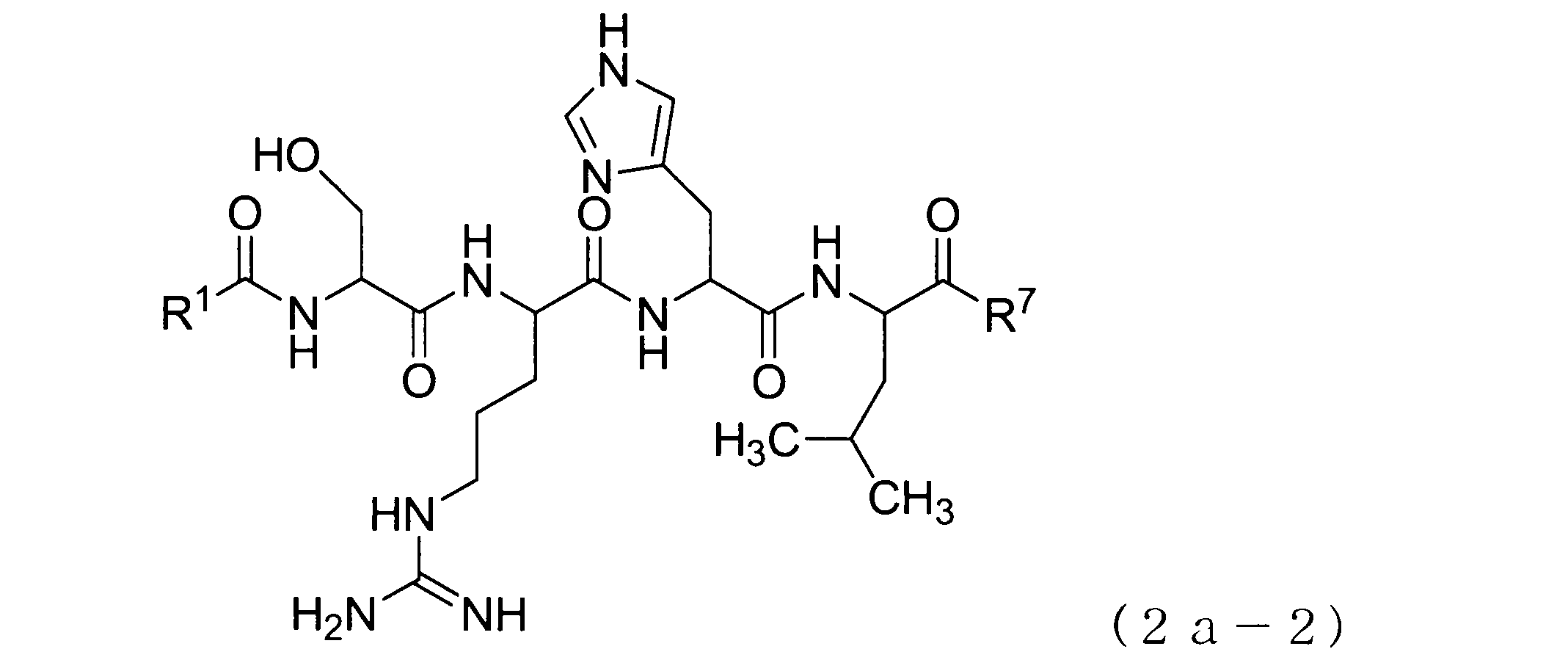
[式中、R1及びR7は、前記と同じ。]

[式中、R1及びR7は、前記と同じ。]
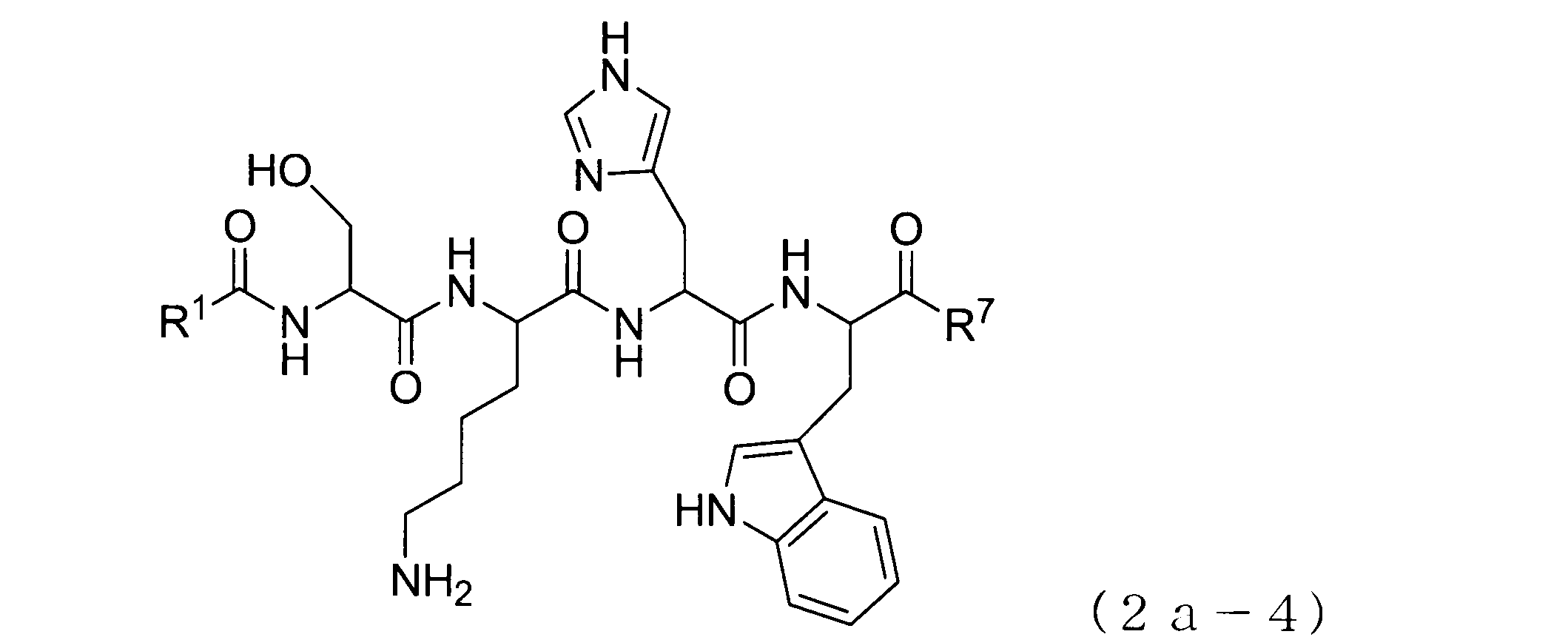
[式中、R1及びR7は、前記と同じ。]

[式中、R1及びR7は、前記と同じ。]

[式中、R1及びR7は、前記と同じ。]
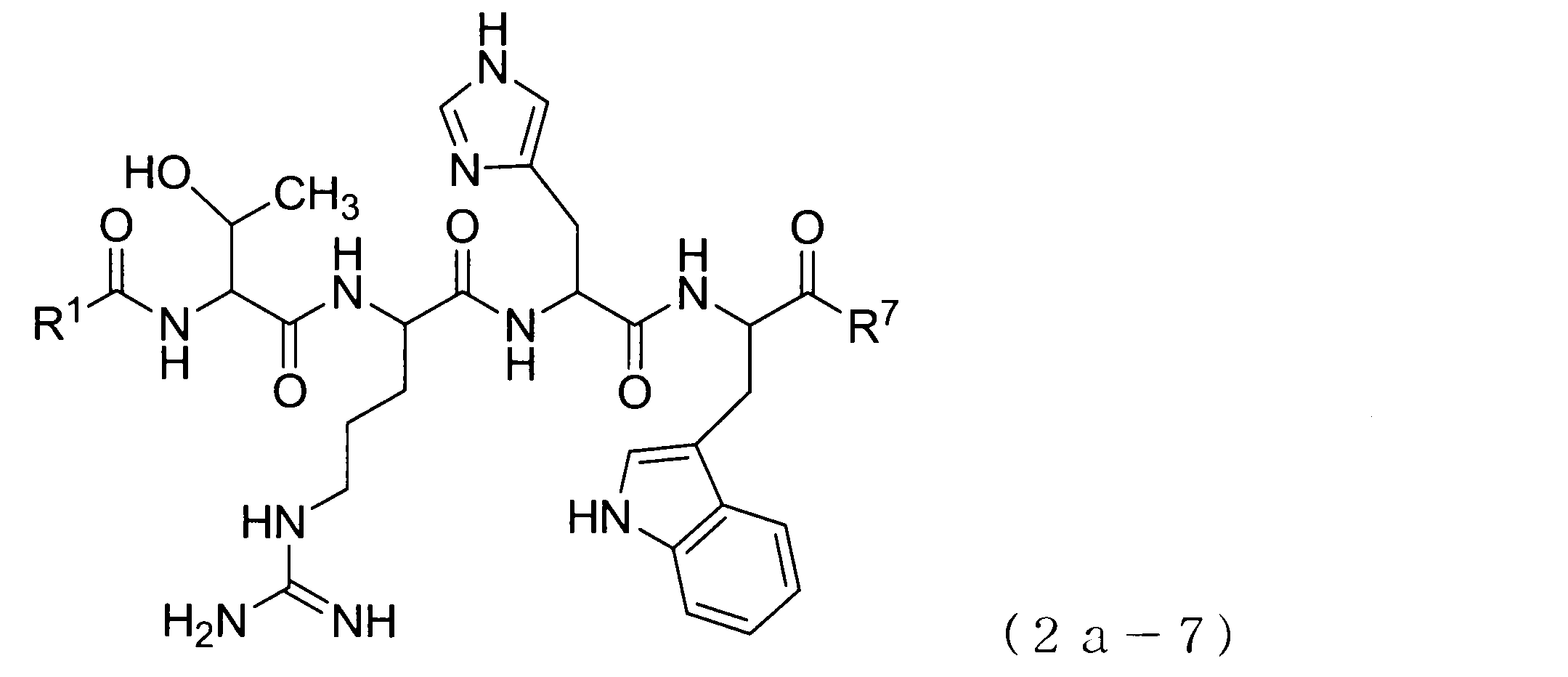
[式中、R1及びR7は、前記と同じ。]
項8.
一般式(2)で表される出発原料化合物が、
一般式(2b)
一般式(2)で表される出発原料化合物が、
一般式(2b)
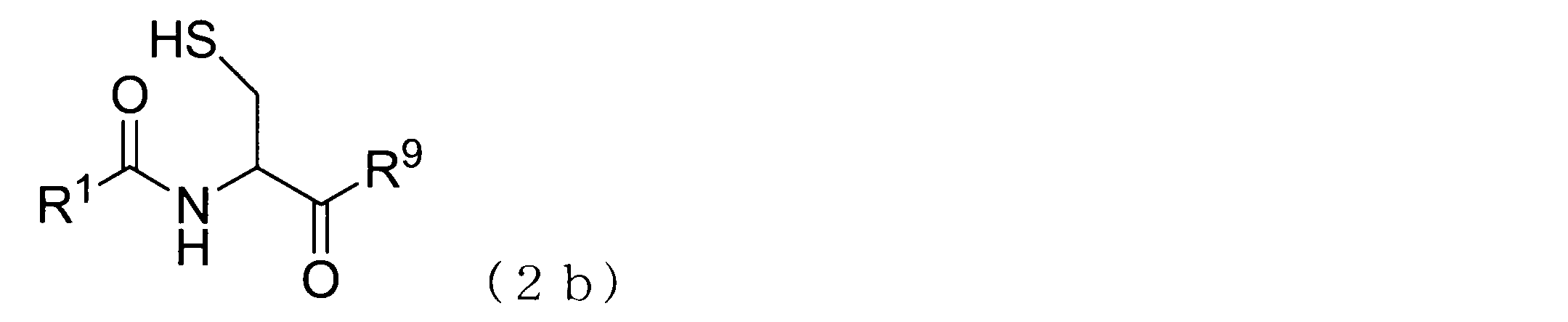
[式中、R1は、前記と同じ。
R9は、ヒドロキシル基、アミノ基、ヒドラジノ基又は有機基を示す。]
で表される化合物であり、
工程(C):上記一般式(2b)で表される化合物とニトリル化剤とを反応させる工程、及び
工程(D):工程(C)で得られる一般式(4)
R9は、ヒドロキシル基、アミノ基、ヒドラジノ基又は有機基を示す。]
で表される化合物であり、
工程(C):上記一般式(2b)で表される化合物とニトリル化剤とを反応させる工程、及び
工程(D):工程(C)で得られる一般式(4)

[式中、R1及びR9は、前記と同じ。]
で表されるチオシアナート化合物と、ヒドラジン化合物とを反応させる工程
を含む、項1に記載のペプチドヒドラジド化合物の製造方法。
で表されるチオシアナート化合物と、ヒドラジン化合物とを反応させる工程
を含む、項1に記載のペプチドヒドラジド化合物の製造方法。
項9.
工程(C)で用いられるニトリル化剤が、1-シアノ-4-(ジメチルアミノ)ピリジニウムテトラフルオロボレイト(CDAP)及び/又は2-ニトロ-5-チオシアノ安息香酸である、項8に記載のペプチドヒドラジド化合物の製造方法。
工程(C)で用いられるニトリル化剤が、1-シアノ-4-(ジメチルアミノ)ピリジニウムテトラフルオロボレイト(CDAP)及び/又は2-ニトロ-5-チオシアノ安息香酸である、項8に記載のペプチドヒドラジド化合物の製造方法。
項10.
項1~9の何れか一項に記載のペプチドヒドラジド化合物の製造方法であって、出発原料化合物である一般式(2)、(2a)、(2a-1)~(2a-7)及び/又は(2b)で表される化合物を、生物学的合成方法を用いて調製する、前記ペプチドヒドラジド化合物の製造方法。
項1~9の何れか一項に記載のペプチドヒドラジド化合物の製造方法であって、出発原料化合物である一般式(2)、(2a)、(2a-1)~(2a-7)及び/又は(2b)で表される化合物を、生物学的合成方法を用いて調製する、前記ペプチドヒドラジド化合物の製造方法。
項11.
一般式(5)
一般式(5)

[式中、R1は、アミノ酸残基若しくはその誘導体、又は、ペプチド残基若しくはその誘導体を示す。R10は、置換基を有していてもよいアルキル基又は置換基を有していてもよいアリール基を示す。]
で表されるペプチドチオエステル化合物の製造方法であって、
工程(E):項1~10の何れか一項に記載の製造方法によって得られる一般式(1)で表されるペプチドヒドラジド化合物に亜硝酸塩を作用させる工程、及び
工程(F):工程(E)で得られる一般式(6)
で表されるペプチドチオエステル化合物の製造方法であって、
工程(E):項1~10の何れか一項に記載の製造方法によって得られる一般式(1)で表されるペプチドヒドラジド化合物に亜硝酸塩を作用させる工程、及び
工程(F):工程(E)で得られる一般式(6)

[式中、R1は、前記と同じ。]
で表されるアシルアジド化合物とチオール化合物とを反応させる工程
を含む、前記ペプチドチオエステル化合物の製造方法。
で表されるアシルアジド化合物とチオール化合物とを反応させる工程
を含む、前記ペプチドチオエステル化合物の製造方法。
項12.
一般式(5)
一般式(5)

[式中、R1は、アミノ酸残基若しくはその誘導体、又は、ペプチド残基若しくはその誘導体を示す。R10は、置換基を有していてもよいアルキル基又は置換基を有していてもよいアリール基を示す。]
で表されるペプチドチオエステル化合物の製造方法であって、
工程(G):一般式(2)
で表されるペプチドチオエステル化合物の製造方法であって、
工程(G):一般式(2)

[式中、R1は、前記と同じ。
R2は、水素原子又はアルキル基を示す。
R3は、ヒドロキシル基、アミノ基、ヒドラジノ基又は有機基を示す。
Xは、酸素原子又は硫黄原子を示す。]
で表される化合物を出発原料化合物に使用し、且つ
ヒドラジン化合物を反応試薬に使用する工程、
工程(E):工程(G)で得られる
一般式(1)
R2は、水素原子又はアルキル基を示す。
R3は、ヒドロキシル基、アミノ基、ヒドラジノ基又は有機基を示す。
Xは、酸素原子又は硫黄原子を示す。]
で表される化合物を出発原料化合物に使用し、且つ
ヒドラジン化合物を反応試薬に使用する工程、
工程(E):工程(G)で得られる
一般式(1)

[式中、R1は、前記と同じ。]
で表されるペプチドヒドラジド化合物に亜硝酸塩を作用させる工程、及び
工程(F):工程(E)で得られる一般式(6)
で表されるペプチドヒドラジド化合物に亜硝酸塩を作用させる工程、及び
工程(F):工程(E)で得られる一般式(6)

[式中、R1は、前記と同じ。]
で表されるアシルアジド化合物とチオール化合物とを反応させる工程
を含む、前記ペプチドチオエステル化合物の製造方法。
で表されるアシルアジド化合物とチオール化合物とを反応させる工程
を含む、前記ペプチドチオエステル化合物の製造方法。
項13.
項11又は12に記載のペプチドチオエステル化合物の製造方法であって、出発原料化合物である一般式(2)、(2a)、(2a-1)~(2a-7)及び/又は(2b)で表される化合物を、生物学的合成方法を用いて調製する、前記ペプチドチオエステル化合物の製造方法。
項11又は12に記載のペプチドチオエステル化合物の製造方法であって、出発原料化合物である一般式(2)、(2a)、(2a-1)~(2a-7)及び/又は(2b)で表される化合物を、生物学的合成方法を用いて調製する、前記ペプチドチオエステル化合物の製造方法。
項14.
一般式(1)
一般式(1)

[式中、R1は、アミノ酸残基若しくはその誘導体、又はペプチド残基若しくはその誘導体を示す。]
で表されるペプチドヒドラジド化合物の製造方法であって、
工程(H):生物学的手法により、出発原料化合物である一般式(2)
で表されるペプチドヒドラジド化合物の製造方法であって、
工程(H):生物学的手法により、出発原料化合物である一般式(2)

[式中、R1は、前記と同じ。
R2は、水素原子又はアルキル基を示す。
R3は、ヒドロキシル基、アミノ基、ヒドラジノ基又は有機基を示す。
Xは、酸素原子又は硫黄原子を示す。]
表される化合物を得る工程、及び
工程(G):工程(H)によって得られる一般式(2)で表される化合物を出発原料化合物に使用し、且つ
ヒドラジン化合物を反応試薬として使用する工程、
を含む、前記ペプチドヒドラジド化合物の製造方法。
R2は、水素原子又はアルキル基を示す。
R3は、ヒドロキシル基、アミノ基、ヒドラジノ基又は有機基を示す。
Xは、酸素原子又は硫黄原子を示す。]
表される化合物を得る工程、及び
工程(G):工程(H)によって得られる一般式(2)で表される化合物を出発原料化合物に使用し、且つ
ヒドラジン化合物を反応試薬として使用する工程、
を含む、前記ペプチドヒドラジド化合物の製造方法。
項15.
一般式(5)
一般式(5)

[式中、R1は、アミノ酸残基若しくはその誘導体、又は、ペプチド残基若しくはその誘導体を示す。R10は、置換基を有していてもよいアルキル基又は置換基を有していてもよいアリール基を示す。]
で表されるペプチドチオエステル化合物の製造方法であって、
工程(H):生物学的手法により、出発原料化合物である一般式(2)
で表されるペプチドチオエステル化合物の製造方法であって、
工程(H):生物学的手法により、出発原料化合物である一般式(2)

[式中、R1は、前記と同じ。
R2は、水素原子又はアルキル基を示す。
R3は、ヒドロキシル基、アミノ基、ヒドラジノ基又は有機基を示す。
Xは、酸素原子又は硫黄原子を示す。]
表される化合物を得る工程、
工程(G):工程(H)によって得られる一般式(2)で表される化合物を出発原料化合物に使用し、且つ
ヒドラジン化合物を反応試薬として使用する工程、
工程(E):工程(G)で得られる
一般式(1)
R2は、水素原子又はアルキル基を示す。
R3は、ヒドロキシル基、アミノ基、ヒドラジノ基又は有機基を示す。
Xは、酸素原子又は硫黄原子を示す。]
表される化合物を得る工程、
工程(G):工程(H)によって得られる一般式(2)で表される化合物を出発原料化合物に使用し、且つ
ヒドラジン化合物を反応試薬として使用する工程、
工程(E):工程(G)で得られる
一般式(1)

[式中、R1は、前記と同じ。]
で表されるペプチドヒドラジド化合物に亜硝酸塩を作用させる工程、及び
工程(F):工程(E)で得られる一般式(6)
で表されるペプチドヒドラジド化合物に亜硝酸塩を作用させる工程、及び
工程(F):工程(E)で得られる一般式(6)

[式中、R1は、前記と同じ。]
で表されるアシルアジド化合物とチオール化合物とを反応させる工程
を含む、前記ペプチドチオエステル化合物の製造方法。
で表されるアシルアジド化合物とチオール化合物とを反応させる工程
を含む、前記ペプチドチオエステル化合物の製造方法。
項16.
一般式(1)

[式中、R1は、アミノ酸残基若しくはその誘導体、又はペプチド残基若しくはその誘導体を示す。]
で表されるペプチドヒドラジド化合物の製造方法であって、
工程(D):一般式(4)

[式中、R1は、前記と同じ。
R9は、ヒドロキシル基、アミノ基、ヒドラジノ基又は有機基を示す。]
で表されるチオシアナート化合物とヒドラジン化合物とを反応させる工程
を含む、前記ペプチドヒドラジド化合物の製造方法。
一般式(1)
で表されるペプチドヒドラジド化合物の製造方法であって、
工程(D):一般式(4)
R9は、ヒドロキシル基、アミノ基、ヒドラジノ基又は有機基を示す。]
で表されるチオシアナート化合物とヒドラジン化合物とを反応させる工程
を含む、前記ペプチドヒドラジド化合物の製造方法。
項17.
一般式(5)

[式中、R1は、アミノ酸残基若しくはその誘導体、又は、ペプチド残基若しくはその誘導体を示す。
R10は、置換基を有していてもよいアルキル基又は置換基を有していてもよいアリール基を示す。]
で表されるペプチドチオエステル化合物の製造方法であって、
工程(D):一般式(4)

[式中、R1は、前記と同じ。
R9は、ヒドロキシル基、アミノ基、ヒドラジノ基又は有機基を示す。]
で表されるチオシアナート化合物とヒドラジン化合物とを反応させる工程、
工程(E):工程(D)によって得られる一般式(1)

[式中、R1は、前記と同じ。]
で表されるペプチドヒドラジド化合物に亜硝酸塩を作用させる工程、及び
工程(F):工程(E)で得られる一般式(6)

[式中、R1は、前記と同じ。]
で表されるアシルアジド化合物とチオール化合物とを反応させる工程
を含む、前記ペプチドチオエステル化合物の製造方法。
一般式(5)
R10は、置換基を有していてもよいアルキル基又は置換基を有していてもよいアリール基を示す。]
で表されるペプチドチオエステル化合物の製造方法であって、
工程(D):一般式(4)
R9は、ヒドロキシル基、アミノ基、ヒドラジノ基又は有機基を示す。]
で表されるチオシアナート化合物とヒドラジン化合物とを反応させる工程、
工程(E):工程(D)によって得られる一般式(1)
で表されるペプチドヒドラジド化合物に亜硝酸塩を作用させる工程、及び
工程(F):工程(E)で得られる一般式(6)
で表されるアシルアジド化合物とチオール化合物とを反応させる工程
を含む、前記ペプチドチオエステル化合物の製造方法。
項18.
一般式(8)

[式中、R1は、アミノ酸残基若しくはその誘導体、又はペプチド残基若しくはその誘導体を示す。]
で表されるペプチドアミド化合物の製造方法であって、
一般式(2)

[式中、R1は、前記と同じ。
R2は、水素原子又はアルキル基を示す。
R3は、ヒドロキシル基、アミノ基、ヒドラジノ基又は有機基を示す。
Xは、酸素原子又は硫黄原子を示す。]
で表される化合物を出発原料化合物に使用し、且つ
アンモニア化合物を反応試薬に使用する、
前記ペプチドアミド化合物の製造方法。
一般式(8)
で表されるペプチドアミド化合物の製造方法であって、
一般式(2)
R2は、水素原子又はアルキル基を示す。
R3は、ヒドロキシル基、アミノ基、ヒドラジノ基又は有機基を示す。
Xは、酸素原子又は硫黄原子を示す。]
で表される化合物を出発原料化合物に使用し、且つ
アンモニア化合物を反応試薬に使用する、
前記ペプチドアミド化合物の製造方法。
項19.
トリアゾール環を有する化合物の製造方法であって、
工程(A’):一般式(2)

[式中、R1は、アミノ酸残基若しくはその誘導体、又はペプチド残基若しくはその誘導体を示す。
R2は、水素原子又はアルキル基を示す。
R3は、ヒドロキシル基、アミノ基、ヒドラジノ基又は有機基を示す。
Xは、酸素原子又は硫黄原子を示す。]
で表される化合物と三重結合を有するアルコール化合物とを反応させる工程、及び
工程(H):工程(A’)で得られる一般式(3a)

[式中、R1は、前記と同じ。
R8aは、三重結合を有するアルキル基を示す。]
で表されるエステル化合物と、アジド化合物とを反応させる工程を含む、
前記トリアゾール環を有する化合物の製造方法。
項20.
三重結合を有するアルコール化合物が、3-ブチン-1-オール、シクロオクチン-1-オール、ジベンゾシクロオクチン-1-オール及びジベンゾシクロオクチン-(ポリエチレングリコール)-アルコールからなる群より選ばれる少なくとも一種である、項19に記載のトリアゾール環を有する化合物の製造方法。
トリアゾール環を有する化合物の製造方法であって、
工程(A’):一般式(2)
R2は、水素原子又はアルキル基を示す。
R3は、ヒドロキシル基、アミノ基、ヒドラジノ基又は有機基を示す。
Xは、酸素原子又は硫黄原子を示す。]
で表される化合物と三重結合を有するアルコール化合物とを反応させる工程、及び
工程(H):工程(A’)で得られる一般式(3a)
R8aは、三重結合を有するアルキル基を示す。]
で表されるエステル化合物と、アジド化合物とを反応させる工程を含む、
前記トリアゾール環を有する化合物の製造方法。
項20.
三重結合を有するアルコール化合物が、3-ブチン-1-オール、シクロオクチン-1-オール、ジベンゾシクロオクチン-1-オール及びジベンゾシクロオクチン-(ポリエチレングリコール)-アルコールからなる群より選ばれる少なくとも一種である、項19に記載のトリアゾール環を有する化合物の製造方法。
本発明の製造方法によれば、ペプチドチオエステルを製造するための中間体である、ペプチドヒドラジド化合物を簡単な方法により製造することができる。また、当該ペプチドヒドラジド化合物から、ペプチドチオエステル化合物を簡易な操作により化学的に製造することができる。本発明の製造方法は、固相合成を使用しないため、チオエステル結合が分解して、C末端アミノ酸がラセミ化することなく、ペプチドチオエステルを製造できるので、工業的に有利な製造方法として優れた方法である。
また、本発明は、C末端がアミド化されているペプチドアミドを、化学合成法により簡便かつ効率的に製造することができる。
また、本発明は、C末端がアミド化されているペプチドアミドを、化学合成法により簡便かつ効率的に製造することができる。
以下、本発明を詳細に説明する。
1.本発明のぺプチドヒドラジド化合物の製造方法
一般式(1):
一般式(1):

(式中、R1は、前記と同じ。)
で表されるペプチドヒドラジド化合物は、
一般式(2)
で表されるペプチドヒドラジド化合物は、
一般式(2)

(式中、R1、R1、R3及びXは、前記と同じ。)
で表される化合物を出発原料化合物に使用し、且つヒドラジン化合物を反応試薬に使用することで製造される。
で表される化合物を出発原料化合物に使用し、且つヒドラジン化合物を反応試薬に使用することで製造される。
一般式(2)で表される化合物としては、例えば、
一般式(2a)
一般式(2a)

(式中、R1、R2、R4、R5、R6及びR7は、前記と同じ。)
で表される化合物、
一般式(2b)
で表される化合物、
一般式(2b)

(式中、R1及びR9は、前記と同じ。)
で表される化合物、
一般式(2c)
で表される化合物、
一般式(2c)

(式中、R1、R2、R7及びXは、前記と同じ。Yはアミノ酸残基又はその誘導体を示す。nは1~10の整数である。nが2以上の場合は、Yは同一又は異なっていてもよい。)
で表される化合物等が好ましい。
で表される化合物等が好ましい。
一般式(2a)で表される化合物としては、下記一般式(2a-1)~(2a-7)で表される化合物からなる群より選ばれる化合物がより好ましい。

(式中、R1及びR7は、前記と同じ。)
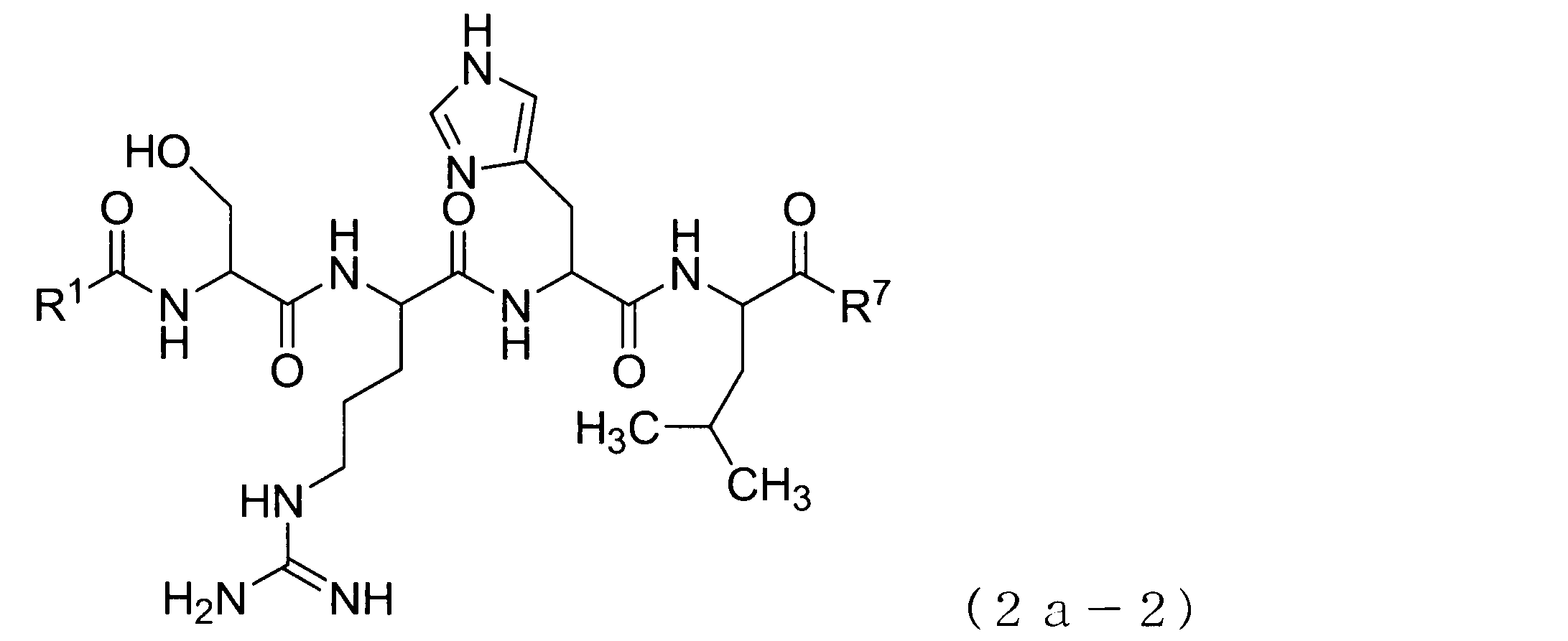
(式中、R1及びR7は、前記と同じ。)

(式中、R1及びR7は、前記と同じ。)

(式中、R1及びR7は、前記と同じ。)
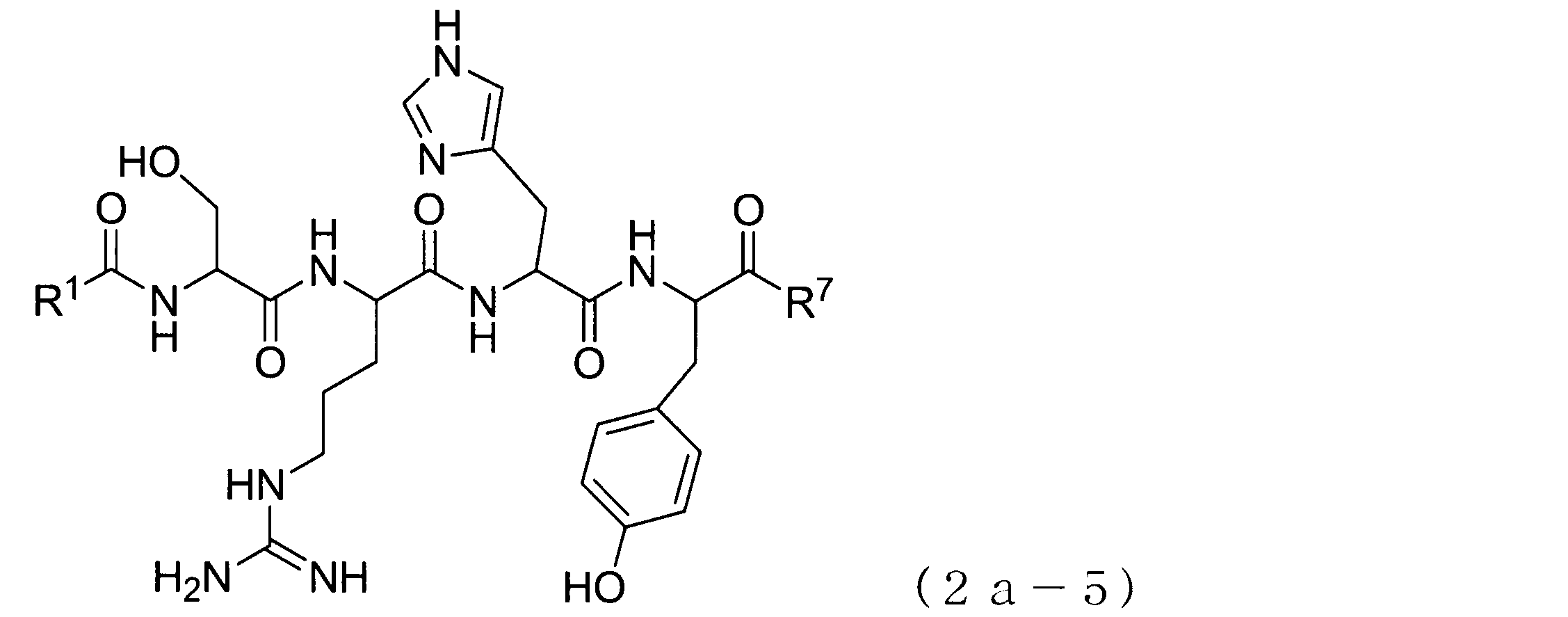
(式中、R1及びR7は、前記と同じ。)

(式中、R1及びR7は、前記と同じ。)

(式中、R1及びR7は、前記と同じ。)。
一般式(2c)で表される化合物としては、下記一般式(2c-1)で表される化合物がより好ましい。
一般式(2c)で表される化合物としては、下記一般式(2c-1)で表される化合物がより好ましい。

(式中、R1、R2及びR7は、前記と同じ。Y1、Y2及びY3は、各々アミノ酸残基又はその誘導体を示す。)
1-1.[反応I]エステル化合物(3)を経由するペプチドヒドラジド化合物の製造方法
出発原料化合物である一般式(2)で表される化合物が、一般式(2a)で表される化合物である場合、一般式(1)で表されるペプチドヒドラジド化合物は、下記工程(A)及び(B)を経て製造される。
出発原料化合物である一般式(2)で表される化合物が、一般式(2a)で表される化合物である場合、一般式(1)で表されるペプチドヒドラジド化合物は、下記工程(A)及び(B)を経て製造される。

(式中、R1、R2、R4、R5、R6、R7及びR8は、前記と同じ。)
工程(A)は、上記一般式(2a)で表される化合物とアルコール化合物とを反応させる工程である。
工程(B)は、工程(A)で得られた一般式(3)で表されるエステル化合物とヒドラジン化合物とを反応させる工程である。
1-2.[反応II-A]チオシアナート化合物(4)を経由するペプチドヒドラジド化合物の製造方法(方法X)
出発原料化合物である一般式(2)で表される化合物が、一般式(2b)で表される化合物である場合、一般式(1)で表されるペプチドヒドラジド化合物は、下記工程(C)及び(D)を経て製造される。
出発原料化合物である一般式(2)で表される化合物が、一般式(2b)で表される化合物である場合、一般式(1)で表されるペプチドヒドラジド化合物は、下記工程(C)及び(D)を経て製造される。
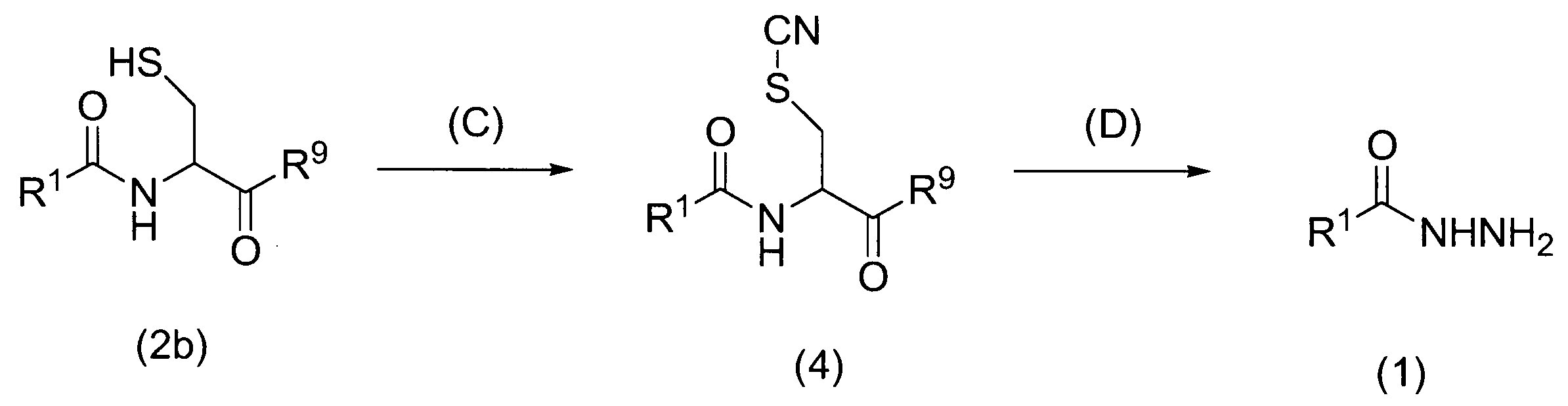
(式中、R1及びR9は、前記と同じ。)
工程(C)は、上記一般式(2b)で表される化合物とニトリル化剤とを反応させる工程である。
工程(C)は、上記一般式(2b)で表される化合物とニトリル化剤とを反応させる工程である。
工程(D)は、工程(C)で得られた一般式(4)で表されるチオシアナート化合物とヒドラジン化合物とを反応させる工程である。
1-3.[反応II-B]チオシアナート化合物(4)を経由するペプチドヒドラジド化合物の製造方法(方法Y:ジンクフィンガー法)
出発原料化合物である上記一般式(2b)で表される化合物中に、チオール基が2つ以上有している場合は、上記工程(C)からは、全てのチオール基がニトリル化することになり、特定の位置でのヒドラジド化が困難となる。例えば、下記に示すスキーム1のように、2つのチオール基a及びbをニトリル化した場合、右側のチオシアナート基部分bでヒドラジド化した化合物を選択的に製造することができない。
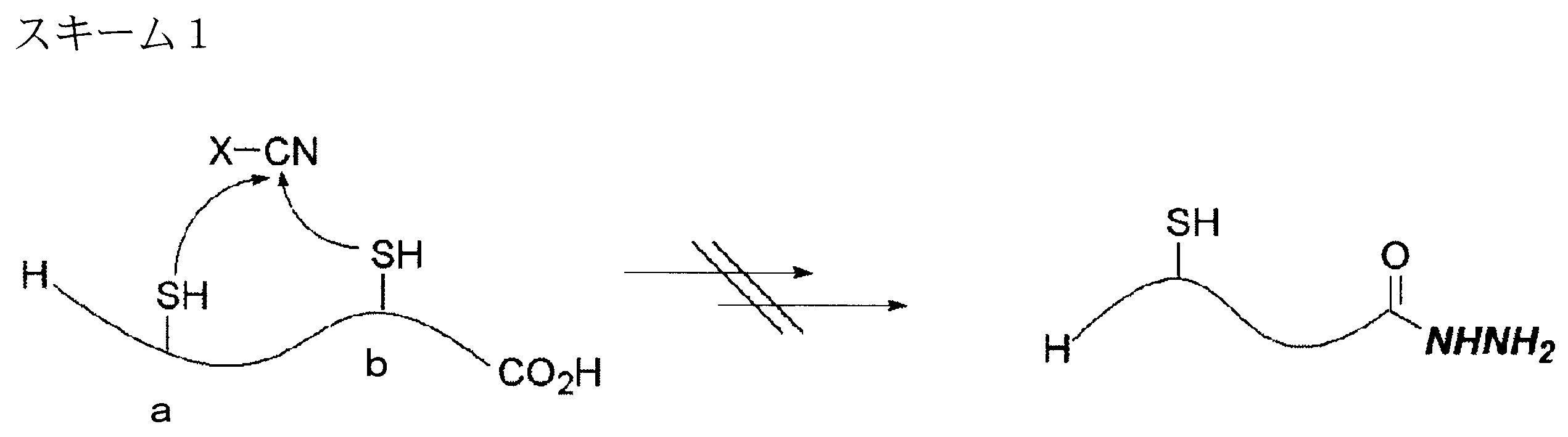
そこで、下記スキーム2に示すように、特定のチオール基のみを保護し、その後、残りのチオール基のみをニトリル化することで、目的とするヒドラジド化合物を高収率且つ高純度で製造することができる。
出発原料化合物である上記一般式(2b)で表される化合物中に、チオール基が2つ以上有している場合は、上記工程(C)からは、全てのチオール基がニトリル化することになり、特定の位置でのヒドラジド化が困難となる。例えば、下記に示すスキーム1のように、2つのチオール基a及びbをニトリル化した場合、右側のチオシアナート基部分bでヒドラジド化した化合物を選択的に製造することができない。

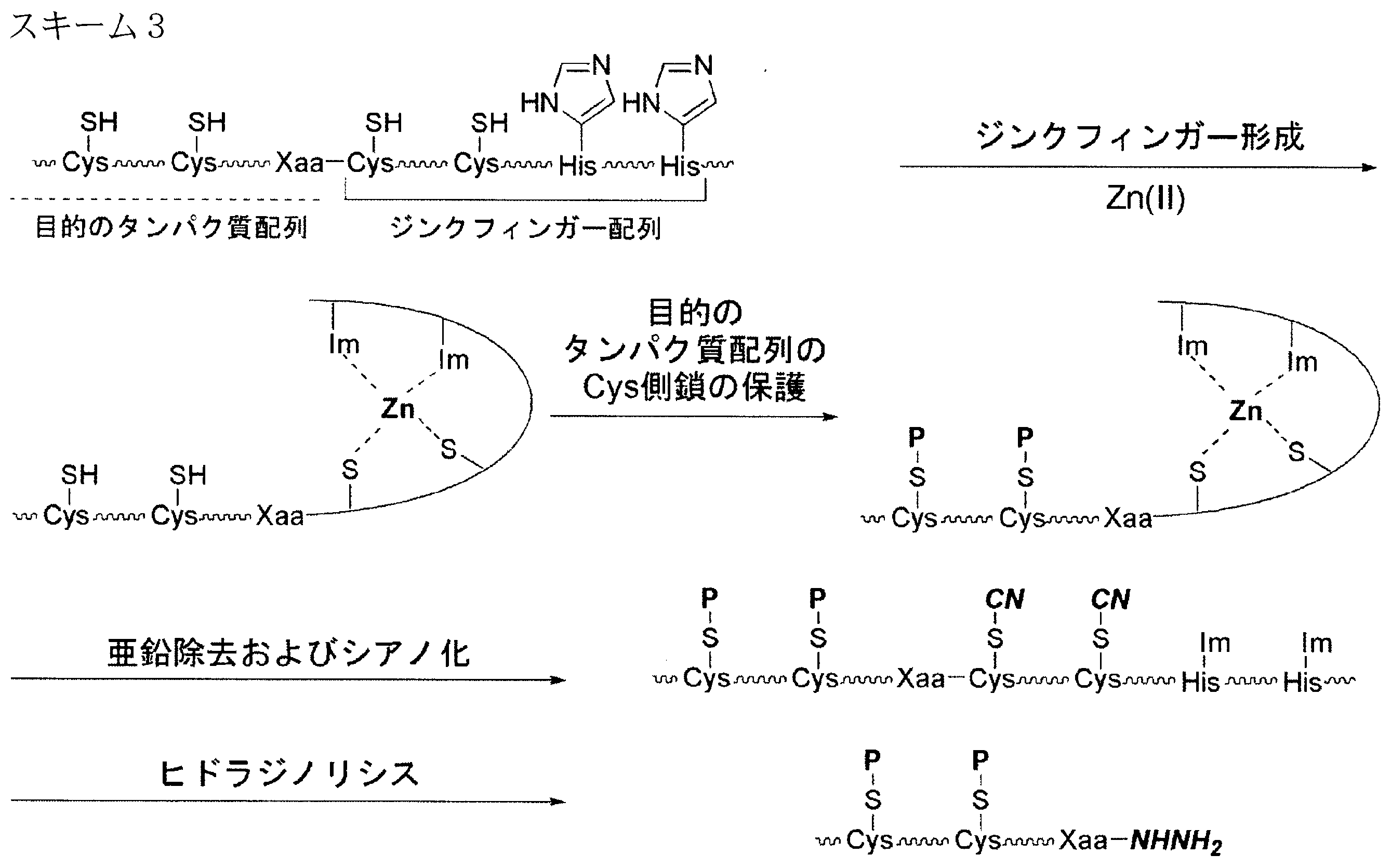
そこで、本発明では、以下の工程を含むことによって、2つ以上のチオール基を有する場合の原料ペプチド化合物を用いても、特定のヒドラジド化合物を製造することができる。
(工程II-B1):一般式(2b)で表される化合物(ペプチド化合物)と亜鉛化合物とを反応させて、ジンクフィンガーを形成する工程、
(工程II-B2):工程(III-B1)で得られた化合物中のジンクフィンガーを形成していない残りのシステイン基を保護する工程、
(工程II-B3):工程(III-B2)で得られた化合物から亜鉛を取り除く工程、
(工程II-B4):工程(III-B3)で得られた化合物中のシステイン基をシアノ化する工程、及び
(工程II-B5):工程(III-B4)で得られた化合物とヒドラジン化合物とを反応させる工程
(工程II-B2):工程(III-B1)で得られた化合物中のジンクフィンガーを形成していない残りのシステイン基を保護する工程、
(工程II-B3):工程(III-B2)で得られた化合物から亜鉛を取り除く工程、
(工程II-B4):工程(III-B3)で得られた化合物中のシステイン基をシアノ化する工程、及び
(工程II-B5):工程(III-B4)で得られた化合物とヒドラジン化合物とを反応させる工程
2.用語の定義
本発明の製造方法で用いられる原料化合物、中間体及び生成化合物の置換基は上述したとおりである。以下、用語の定義を示す。
本発明の製造方法で用いられる原料化合物、中間体及び生成化合物の置換基は上述したとおりである。以下、用語の定義を示す。
アミノ酸残基若しくはその誘導体、又はペプチド残基若しくはその誘導体の種類は、下記のとおり特に限定されない。
R1におけるアミノ酸残基とは、アミノ酸のC末端からカルボキシル基(COOH)を除いた基を意味する。
R1におけるペプチド残基とは、ペプチドのC末端からカルボキシル基(COOH)を除いた基を意味する。
本明細書でいうアミノ酸残基における「アミノ酸」又はペプチド残基における「アミノ酸」は、天然型アミノ酸、非天然型アミノ酸、又はそれらの誘導体の何れでもよい。即ち、アミノ酸残基におけるアミノ酸又はペプチド残基におけるアミノ酸としては、L-アミノ酸であってもよいし、D-アミノ酸であってもよいし、これらの混合物でもよい。また、アミノ酸の種類としては、アミノ基とカルボキシル基を有する化合物であれば特に限定はない。例えば、α-アミノ酸、β-アミノ酸、γ-アミノ酸、δ-アミノ酸が挙げられるが、天然型アミノ酸であるα-アミノ酸が好ましい。
天然型アミノ酸としては、グリシン、L-アラニン、L-バリン、L-ロイシン、L-イソロイシン、L-セリン、L-トレオニン、L-アスパラギン酸、L-グルタミン酸、L-アスパラギン、L-グルタミン、L-リシン、L-アルギニン、L-シスチン、L-メチオニン、L-フェニルアラニン、L-チロシン、L-トリプトファン、L-ヒスチジン、L-プロリン等が挙げられる。
非天然型アミノ酸としては、天然型タンパク質を構成する上記天然型アミノ酸20種類以外の全てのアミノ酸を意味する。具体的には、(1)天然型アミノ酸中の原子を他の物質で置換した非天然型アミノ酸、(2)天然型アミノ酸の側鎖の光学異性体、(3)天然型アミノ酸の側鎖に置換基を導入した非天然型アミノ酸、(4)天然型アミノ酸の側鎖を置換して疎水性、反応性、荷電状態、分子の大きさ、水素結合能等を変化させた非天然型アミノ酸等が挙げられる。
ペプチド残基としては、二つ以上のアミノ酸から構成される化合物の残基であればよく、例えば、ジペプチドの残基、トリペプチドの残基、オリゴペプチドの残基、ポリペプチドの残基等が挙げられる。本明細書でいうペプチド残基におけるアミノ酸は、上記のアミノ酸の定義と同じである。
アミノ酸残基の「誘導体」及びペプチド残基の「誘導体」とは、化学的修飾、生物学的修飾等を受けたアミノ酸の誘導体又はペプチド残基の誘導体のことをいう。修飾の例としては、例えば、アルキル化、アシル化(より具体的には、アセチル化等)、エステル化、ハロゲン化、アミノ化、アミド化等の官能基導入、酸化、還元、付加、脱離等による官能基変換、糖化合物(単糖、二糖、オリゴ糖、若しくは多糖)又は脂質化合物等の導入、リン酸化、或いはビオチン化等を挙げることができるが、これらに限定されることはない。
本明細書におけるアミノ酸、ペプチド等の略号による表示は、IUPAC-IUBの規定〔IUPAC-IUB communication on Biological Nomenclature, Eur. J.Biochem., 138; 9 (1984)〕、「塩基配列又はアミノ酸配列を含む明細書等の作製のためのガイドライン」(特許庁編)及び当該分野における慣用記号に従うものとする。また、アミノ酸等に関し光学異性体があり有る場合は、特に明示しなければL体を示すものとする。
本明細書において、本明細書に挙げる種々のアミノ酸配列中に存在する「アミノ酸」は、公知の三文字又は一文字略語によって特定される(表1参照)。

本明細書において、アミノ酸側鎖とは、アミノ酸(H2N-CHR’-COOH)由来の側鎖(ここでいうR’基)を意味している。該アミノ酸側鎖としては、例えば、-(CH2)3-NH-C(NH2)(=NH)(アルギニン側鎖)、-(CH2)4NH2(リシン側鎖)、-CH2OH(セリン側鎖)、-CHOHCH3(スレオニン側鎖)、-CH2-C6H4p-OH(チロシン側鎖)、-CH2CONH2(アスパラギン側鎖)、-CH2COOH(アスパラギン酸側鎖)、-(CH2)2CONH2(グルタミン側鎖)、-(CH2)2COOH(グルタミン酸側鎖)、-CH2SH(システイン側鎖)、-H(グリシン側鎖)、-CH3(アラニン側鎖)、-CH2C(C=CH-N=CH-NH-)(ヒスチジン側鎖)、-CH(CH3)CH2CH3(イソロイシン側鎖)、-CH2CH(CH3)2(ロイシン側鎖)、-(CH2)2SCH3(メチオニン側鎖)、-CH2C6H5(フェニルアラニン側鎖)、-CH2-C(C=CH-NH-Ph-)(トリプトファン側鎖)、-CH(CH3)2(バリン側鎖)等が挙げられる。
R3、R7及びR9における有機基としては、炭素原子を含む基であれば特に限定されない。例えば、アルキル基、アリール基、アルコキシ基、アリールオキシ基、アミノ酸残基若しくはその誘導体、ペプチド残基若しくはそのペプチド残基誘導体等を挙げることができる。これらの基はさらに置換基を有していてもよい。
R3、R7及びR9における有機基の一例として例示されるアミノ酸残基とは、アミノ酸のN末端から水素原子を1つ除いた基を意味する。
R3、R7及びR9における有機基の一例として例示されるアミノ酸残基の誘導体とは、アミノ酸誘導体のN末端から水素原子を1つ除いた基を意味する。
R3、R7及びR9における有機基の一例として例示されるペプチド残基とは、ペプチドのN末端から水素原子を1つ除いた基を意味する。
R3、R7及びR9における有機基の一例として例示されるペプチド残基の誘導体とは、ペプチド誘導体のN末端から水素原子を1つ除いた基を意味する。
Y、Y1、Y2及びY3におけるアミノ酸残基とは、アミノ酸のN末端から水素原子を1つ、及びアミノ酸のC末端からヒドロキシル基(OH基)を除いた基を意味する。
Y、Y1、Y2及びY3におけるアミノ酸残基の誘導体とは、アミノ酸誘導体のN末端から水素原子を1つ、及びアミノ酸誘導体のC末端からヒドロキシル基(OH基)を除いた基を意味する。
上記Y、Y1、Y2及びY3の組合せとしては、好ましくは、Y1はアルギニン、リシン、ヒスチジン、トリプトファン、メチオニン、フェニルアラニン、Y2はヒスチジン、Y3はロイシン、イソロイシン、チロシン、フェニルアラニン、アルギニン、トリプトファン、バリン、ヒスチジン、より好ましくは、Y1はアルギニン、リシン、ヒスチジン、トリプトファン、メチオニン、Y2はヒスチジン、Y3はロイシン、イソロイシン、チロシン、フェニルアラニン、アルギニン、トリプトファン、バリンである。
本明細書におけるアルキル基としては、特に限定はなく、置換又は無置換のアルキル基が挙げられる。無置換のアルキル基としては、例えば、炭素数1~6の直鎖状又は分岐鎖状のアルキル基を挙げることができる。より具体的には、メチル基、エチル基、n-プロピル基、イソプロピル基、n-ブチル基、イソブチル基、t-ブチル基、s-ブチル基、n-ペンチル基、1-エチルプロピル基、イソペンチル基、ネオペンチル基、n-ヘキシル基、1,2,2-トリメチルプロピル基等が挙げられる。これらの中でも、直鎖状のアルキル基が好ましい。
本明細書における置換基としては、例えば、ハロゲン原子、アルキル基、アルコキシ基、アルケニル基、アミノ基、ヒドラジン基、シアノ基、ニトロ基、カルボキシル基、エステル基、アシル基、アリール基、アリールオキシ基、ヒドロキシアルキルジチオ基等が挙げられる。置換基は、一種又は二種以上置換していてもよい。置換基の数は、通常、1~5個、好ましくは1~3個である。
ハロゲン原子としては、例えば、フッ素原子、塩素原子、臭素原子、ヨウ素原子等が挙げられる。
アルコキシ基としては、例えば、炭素数1~30のアルコキシ基が挙げられ、具体的には、メトキシ基、エトキシ基、イソプロポキシ基、t-ブトキシ基、n-オクチルオキシ基等が挙げられる。
エステル基としては、-C(O)OQ1基、-OC(O)Q1基が挙げられる。
ここで、上記Q1は、アルキル基、アルケニル基、アリール基等が挙げられる。
アシル基としては、ホルミル基、アセチル基、プロピオニル基、ブチリル基、イソブチリル基、バレリル基、イソバレリル基、ベンゾイル基等が挙げられる。
アルケニル基としては、例えば、炭素数2~30の二重結合を1個以上有する基が挙げられ、具体的には、ビニル基、プロペニル基、ブテニル基等が挙げられる。
アリール基としては、例えば、炭素数6~30のアリール基が挙げられ、具体的にはフェニル基、ナフチル基が挙げられる。
アリールオキシ基としては、例えば、炭素数6~30のアリールオキシ基が挙げられ、具体的にはフェノキシ基、ビフェニルオキシ基が挙げられる。
本発明の出発原料化合物である一般式(2)、(2a)、(2b)、(2c)、(2a-1)~(2a-7)及び(2c-1)は、当業者に常法によって合成できる。例えば、アジド法、酸クロライド法、酸無水物法、混合酸無水物法、DCC 法、活性エステル法、カルボイミダゾール法、酸化還元法等が挙げられる。また、その合成は、固相合成法及び液相合成法のいずれをも適用することができる。即ち、ペプチドを構成し得るアミノ酸と残余部分とを縮合させ、生成物が保護基を有する場合は保護基を脱離することにより目的とするペプチドを化学的に合成できる。縮合方法及び保護基の脱離としては、公知のいずれの手法を用いてもよい[例えば、Bodanszky, M and M.A. Ondetti, PeptideSynthesis, Interscience Publishers, New York (1966);Schroeder and Luebke, The Peptide, Academic Press, New York (1965)、泉屋信夫他, ペプチド合成の基礎と実験, 丸善(1975)等を参照]。
本発明ペプチドの他の製造方法としては、本発明のペプチドのアミノ酸配列をコードする遺伝子を利用して、遺伝子工学的手法により微生物細胞、植物細胞、動物細胞等の宿主において組み換えタンパク質(ペプチド)として生産する生物学的な合成方法が挙げられる。得られた組み換えペプチドは、ゲル濾過、逆相HPLC、イオン交換カラム精製等の通常のタンパク質又はペプチド精製に用いられる手段を用いて精製することが可能である。組み換えタンパク質の製造方法として、一例を挙げるとWO2013/065772号パンフレット記載の方法を参照することもできる。
3.各工程
以下に、各工程を詳しく説明する。
3-1.[反応I]
工程(A)
工程(A)は、一般式(2a)で表される化合物とアルコール化合物とを反応させる工程である。
以下に、各工程を詳しく説明する。
3-1.[反応I]
工程(A)
工程(A)は、一般式(2a)で表される化合物とアルコール化合物とを反応させる工程である。
工程(A)におけるアルコール化合物としては、特に限定はなく、各種のアルコール化合物が使用でき、例えば、水溶性のアルコールを用いることができる。
該アルコール化合物としては、例えば、脂肪族アルコール、芳香族アルコール等が挙げられる。該アルコール化合物は、置換基を有していてもよく、また、該アルコール化合物の分子内に酸素、硫黄又は窒素を含んでいてもよい。該アルコール化合物は、1種又は2種以上使用することができる。
該脂肪族アルコール及び芳香族アルコールは、分子内に、二重結合又は三重結合を含むアルコールであってもよい。特に、分子内に三重結合を含むアルコールを用いて得られたエステル化合物(4)は、後述するように、クリックケミストリー反応に用いることができる。
該アルコール化合物の置換基としては、特に制限はなく、例えば、ハロゲン原子(例えば、フッ素、塩素、臭素等)、炭素数1~6のアルキル基、炭素数1~6のアルコキシ基、ニトロ基等が挙げられ、該アルコール化合物は、これらの置換基を1~5個、好ましくは1~3個有していてもよい。
脂肪族アルコールとしては、炭素数1~10の脂肪族アルコールが好ましく、炭素数1~5の脂肪族アルコールがより好ましく、炭素数1~3のアルコールが特に好ましい。該脂肪族アルコールの具体例としては、例えば、メタノール、エタノール、n-プロピルアルコール、ベンジルアルコール、ジフェニルメタノール、2,2,2-トリフルオロエタノール(TFE)、2-クロロエタノール,12,12-ジフルオロ-11,11-ドデカノール、トリフルオロメタノール、ジクロロメチルアルコール、トリクロロメタノール、4-クロロブチルタノール、4-ブロモブタノール、2-シアノエタノール、2-ヒドロキシ-γ-ブチロラクトン、1-メトキシエタノール、2-エトキシエタノール、アセトキシエタノール等の1価の脂肪族アルコール;1,2-プロピレングリコール、1,2-エチレングリコール、ジチオジエタノール(DTDE)1,2-エタンジオール、1,3-プロパンジオール、1,9-ノナンジオール等の2価の脂肪族アルコールが挙げられる。
芳香族アルコールとしては、フェノール、4-メチルフェノール、3-メチルフェノール、2-メチルフェノール、4-クロロフェノール等が挙げられる。
芳香族アルコールとしては、フェノール、4-メチルフェノール、3-メチルフェノール、2-メチルフェノール、4-クロロフェノール等が挙げられる。
アルコール化合物の使用量としては、特に制限はなく、アルコール化合物が反応できる量であればよい。このようなアルコール化合物の使用量としては、例えば、一般式(2a)で表される化合物100重量部に対して、4~310重量部が挙げられ、好ましくは40~230重量部であり、より好ましくは120~200重量部である。
工程(A)における反応の反応温度は、通常0~50℃の範囲であり、室温~40℃の範囲が好ましく、35~39℃がより好ましい。
工程(A)における反応の反応時間は、用いる基質、アルコール化合物及び反応条件により異なり一概には言えないが、通常1分~100時間程度であり、好ましくは5分~24時間程度である。
工程(A)は、上記アルコール化合物以外にも、アルコール化合物と反応しない溶媒を加えてもよい。該工程(A)の反応には、例えば、緩衝液を加えることができる。
緩衝液としては、例えば、トリス-塩酸緩衝液、トリス-酢酸緩衝液、リン酸緩衝液、ホウ酸緩衝液、N-2-ヒドロキシエチルピペラジン-N'-2-エタンスルホン酸(HEPES)等が挙げられる。
また、反応試薬であるアルコール化合物を反応溶媒として兼用することもできる。反応液中には、グアニジン塩酸塩、尿素等の変性剤が存在していてもよい。
また、反応試薬であるアルコール化合物を反応溶媒として兼用することもできる。反応液中には、グアニジン塩酸塩、尿素等の変性剤が存在していてもよい。
工程(A)の反応の反応溶液のpHは特に制限はないが、pH6~10が好ましく、pH7~9がより好ましく、7.8~8.6が特に好ましい。
工程(A)の反応は、遷移金属化合物の存在下で行うことができる。
遷移金属化合物としては、特に限定はなく、公知の遷移金属化合物を広く使用できる。このような遷移金属化合物としては、特に、ニッケル化合物、鉄化合物及び/又はパラジウム化合物が好ましく、ニッケル化合物がさらに好ましい。これらの一種又は二種以上を遷移金属化合物として使用することができる。
ニッケル化合物としては、特に限定はなく、公知のニッケル化合物を広く使用できる。このようなニッケル化合物としては、無機又は有機のニッケル化合物が使用できる。
該無機のニッケル化合物としては、例えば、ニッケル粉末、硫酸ニッケル、硝酸ニッケル、塩化ニッケル、臭化ニッケル、ヨウ化ニッケル、過塩素酸ニッケル、水酸化ニッケル、炭酸ニッケル、次亜リン酸ニッケル又はこれらの水和物が挙げられる。これらの中でも、塩化ニッケルが好ましく、塩化ニッケル六水和物がより好ましい。
該有機のニッケル化合物としては、酢酸ニッケル、ニッケルアセチルアセトン、ニッケルテトラカルボニル、ニッケルジカルボニル、ニッケルジカルボニルビストリフェニルホスフィン、テトラメチルアンモニウムヨウ化ニッケル等が挙げられる。
鉄化合物としては、特に限定はなく、公知の鉄化合物を広く使用できる。このような鉄化合物としては、例えば、酸化鉄、酸化鉄、酢酸鉄、フッ化鉄、塩化鉄、臭化鉄、ヨウ化鉄等の鉄塩類;ペンタカルボニル鉄、テトラカルボニル(トリフェニルホスフィン)鉄等の鉄錯体等が挙げられる。鉄化合物には、これらの溶媒和物、例えば水和物も包含される。
パラジウム化合物としては、特に限定はなく、公知のパラジウム化合物を広く使用できる。このようなパラジウム化合物としては、例えば、Pd(II)化合物、Pd(0)化合物等が挙げられる。具体的には、塩化パラジウム(II)、臭化パラジウム(II)、ヨウ化パラジウム(II)、硝酸パラジウム(II)、硫酸パラジウム(II)、酢酸パラジウム(II)のような2価パラジウム化合物;トリス(ジベンジリデンアセトン)ジパラジウム(0)、ビス(ジベンジリデンアセトン)パラジウム(0)、ジパラジウム(0)トリス(ジベンジリデンアセトンクロロホルム)のような0価パラジウム化合物;パラジウムホスフィン錯体等が挙げられる。なお、パラジウム化合物は、成形して使用してもよいし、担体に担持して使用してもよいし、高分子化合物に固定化して使用してもよい。
工程(A)の反応における遷移金属化合物の使用量は、一般式(2)で表される化合物1モルに対して、1~100モルが好ましく、5~50モルがより好ましい。
工程(A)における原料化合物及び試薬の添加順序は、特に制限はないが、反応容器に原料化合物である一般式(2)で表される化合物及びアルコール化合物とを先に入れて、その後でニッケル化合物を加える方が好ましい。
工程(A)において得られた一般式(4)で表されるエステル化合物は、特に精製することなく、次の工程(B)に用いることができるが、ここでは、例えば、後述する通常の精製方法によって一般式(4)で表されるエステル化合物を精製した後、次の工程(B)に用いることが好ましい。
工程(A)によって得られたエステル化合物のうち、三重結合を有するエステル化合物は、クリックケミストリー反応に用いることができる。
クリックケミストリーとしては、例えば、Huisegen反応等の銅触媒を用いる反応、銅触媒の代わりにシクロオクチン等の環構造内にアルキン結合を有する化合物を用いる反応(銅フリークリックケミストリー反応)などが挙げられる。
上記Huisegen反応は、末端アルキンとアジドとが反応して、トリアゾール環を形成する反応である。該反応は、銅を触媒を用いることで、1,4-二置換-1,2,3-トリアゾールを穏やかな条件で、選択的かつ効率的に形成することができる。また、該反応は、官能基を保護する必要がなく、末端アルキンとアジドだけが高い選択性を反応する。そして、該反応は多くの場合、水中でも反応し、反応終了後の精製も必要ないことから非常に有用な反応の1つである(Angew. Chem. Int. Ed., 2002、Vol.41,p.2596-2599)。
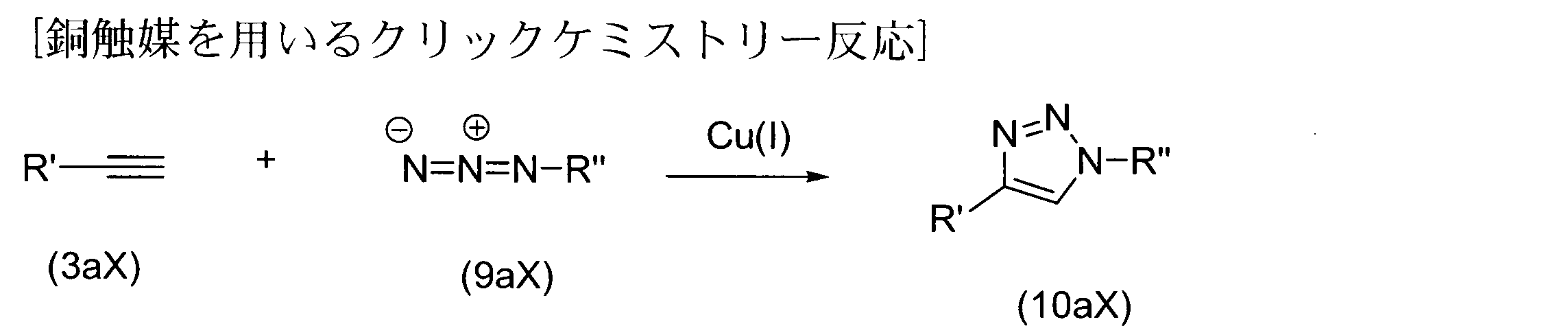
(式中、R’及びR’’は、それぞれ有機基を示す。)
この様な銅触媒を用いるクリックケミストリー反応は、銅触媒が細胞、タンパク質等に影響を与えるため、生体内での応用に制限がある。そこで、銅触媒を用いないクリックケミストリー反応(銅フリークリックケミストリー反応)が、近年注目されている(例えば、Chem Soc Rev. 39, 1272-1279参照)。
銅フリークリックケミストリー反応としては、例えば、ジベンゾシクロオクチン-PEG4-アルコール、シクロオクチン等、環構造中にアルキン結合を含む8-炭素環構造の化合物を用いることができる。この様な環構造は、アルキン結合にかなりの結合角度の変形を有していることから、該三重結合と、アジド基とが選択的に反応し、トリアゾールを形成する。以上のようにクリックケミストリー反応によって得られる化合物は、トリアゾール環構造を有する化合物である。

(式中、R’’’’及びR’’は、それぞれ有機基を示す。)
該トリアゾール環を有する化合物(10)の製造方法(クリックケミストリー反応)は、下記の工程(A’)及び工程(H)を含む。

(式中、R1、R2、R3及びR8aは、前記と同じ。)
(式中、R1、R2、R3及びR8aは、前記と同じ。)
工程(A’)は、上記一般式(2)で表される化合物と三重結合を有するアルコール化合物とを反応させる工程である。
工程(H)は、工程(A’)で得られる上記一般式(3a)で表されるエステル化合物と、アジド化合物とを反応させる工程である。
工程(H)は、工程(A’)で得られる上記一般式(3a)で表されるエステル化合物と、アジド化合物とを反応させる工程である。
工程(A’)
工程(A’)は、上記一般式(2)で表される化合物と三重結合を有するアルコール化合物とを反応させる工程である。
工程(A’)は、上記工程(A)と同じ原料化合物である上記化合物(2)を用いることができ、工程(A)と同様の反応条件で反応を行うことができる。
工程(A’)は、上記一般式(2)で表される化合物と三重結合を有するアルコール化合物とを反応させる工程である。
工程(A’)は、上記工程(A)と同じ原料化合物である上記化合物(2)を用いることができ、工程(A)と同様の反応条件で反応を行うことができる。
工程(A’)で用いるアルコール化合物としては、三重結合を有するアルコール化合物を用いることができる。
該三重結合を有するアルコール化合物としては、三重結合を有する有機化合物であれば特に制限なく、例えば、3-ブチン-1-オール、シクロオクチン-1-オール、ジベンゾシクロオクチン-1-オール、ジベンゾシクロオクチン-(ポリエチレングリコール)-アルコール等を挙げることができる。これらは1種又は2種以上使用することができる。
工程(H)
工程(H)は、工程(A’)で得られる一般式(3a)で表されるエステル化合物と、アジド化合物とを反応させる工程である。
工程(H)は、工程(A’)で得られる一般式(3a)で表されるエステル化合物と、アジド化合物とを反応させる工程である。
工程(H)におけるアジド化合物としては、アジド基を有する有機化合物であれば特に制限なく、公知のアジド化合物を用いることができる。
工程(H)の反応の反応条件は、上述したクリックケミストリー反応の文献等を参考にすることができる。工程(H)によって、各種のトリアゾール環を有する化合物を穏やかな条件で、選択的かつ効率的に製造できる。
工程(B)
工程(B)は、工程(A)で得られる一般式(3)で表されるエステル化合物とヒドラジン化合物とを反応させる工程である。
工程(B)は、工程(A)で得られる一般式(3)で表されるエステル化合物とヒドラジン化合物とを反応させる工程である。
該ヒドラジン化合物としては、従来より広く知られているのものであれば特に限定はなく、例えば、ヒドラジン、その水和物、その酸付加塩等が挙げられる。これらの中でも、ヒドラジン一水和物、ヒドラジン塩酸塩、ヒドラジン臭化水素塩、ヒドラジン硫酸塩等が好ましく、ヒドラジン一水和物がより好ましい。ヒドラジン化合物は1種又は2種以上使用することができる。
該ヒドラジン化合物は、そのまま又は水で希釈して使用することができる。工程(B)の反応で用いる該ヒドラジン化合物の濃度としては、通常1~100重量%、好ましくは1~10重量%程度とすればよい。
工程(B)の反応で用いる反応溶媒(反応溶液)は、工程(A)の反応で用いられる反応溶媒をそのまま使用してもよい。また、ヒドラジン化合物を一般式(3)で表されるエステル化合物と反応させる際、反応を妨げない溶媒であれば、特に制限なく用いることができる。
工程(B)の反応で用いる反応溶媒(反応溶液)は、ヒドラジン化合物と反応しないものであれば、特に制限はなく、例えば、緩衝液でもよい。
緩衝液としては、例えば、トリス-塩酸緩衝液、トリス-酢酸緩衝液、リン酸緩衝液、ホウ酸緩衝液、N-2-ヒドロキシエチルピペラジン-N'-2-エタンスルホン酸(HEPES)等が挙げられる。これらは1種又は2種以上使用することができる。
また、反応試薬であるヒドラジン化合物を反応溶媒として兼用することもできる。該アルコール化合物は、水を含んでいてもよい。反応液中には、グアニジン塩酸塩、尿素等の変性剤が存在していてもよい。
工程(B)の反応における反応溶液のpHは特に制限はないが、中でもpH6~11が好ましく、pH7~11がより好ましく、9~11が特に好ましい。
ヒドラジン化合物の使用量としては、特に制限されず、式(3)で表されるエステル化合物1モルに対して0.8モル以上、好ましくは1モル以上であるが、通常溶媒を兼ねて使用するため大過剰量を使用するのがよく、式(3)で表されるエステル化合物1重量部に対して1~10000重量部が好ましく、100~5000重量部とするのが好ましい。
工程(B)における反応の反応温度は、通常0~50℃の範囲であり、15~40℃の範囲が好ましく、室温~37℃がより好ましい。
工程(B)における反応の反応時間は、用いる基質、アルコール化合物及び反応条件により異なり一概には言えないが、通常1分~100時間程度であり、好ましくは5分~24時間程度である。
工程(B)において得られた一般式(1)で表されるペプチドヒドラジド化合物は、特に精製することなく、次の工程(E)に用いることができるが、ここでは、例えば、通常の精製方法によって一般式(1)で表されるペプチドヒドラジド化合物を精製した後、次の工程(E)に用いることが好ましい。
3-2.[反応II-A]
工程(C)
工程(C)は、一般式(2b)で表される化合物とニトリル化剤とを反応させる工程である。
工程(C)
工程(C)は、一般式(2b)で表される化合物とニトリル化剤とを反応させる工程である。
工程(C)で用いるニトリル化剤としては、チオール基(SH基)をS―シアノ(S-CN)基に変換できる試薬であれば特に限定はなく、例えば、1-シアノ-4-(ジメチルアミノ)ピリジニウムテトラフルオロボレイト(CDAP)、1-シアノ-4-ジメチルアミノピリジウム塩(DMAP-CN)、2-ニトロ-5-チオシアノ安息香酸(NTCB)、CN-イオン等が挙げられる。これらは1種又は2種以上使用することができる。
該ニトリル化剤の使用量は、S-シアノ化が進行する量であれば特に制限されないが、一般式(2b)で表される化合物100重量部に対して1~10000重量部、好ましくは100~5000重量部とするのが好ましい。
工程(C)の反応は、酸の存在下で行うことができる。
酸としては、酢酸、トリフルオロ酢酸等の有機酸、及び塩酸、硫酸等の無機酸が挙げられ、これらは1種又は2種以上使用することができる。好ましい酸としては酢酸である。
酸の使用量としては、一般式(2b)で表される化合物1モルに対して、通常0.8モル以上、好ましくは1モル~50モルの範囲であり、より好ましくは、20モル~30モルの範囲である。
工程(C)における反応の反応温度は、通常0~50℃程度の範囲であればよく、室温~37℃の範囲がより好ましい。
工程(C)における反応の反応時間は、用いる基質、試薬及び反応条件により異なり一概には言えないが、1~60分程度が好ましく、15~30分程度が好ましい。
工程(C)の反応で用いる反応溶媒としては、ニトリル化剤と反応しないものであれば、特に制限はない。例えば、緩衝液が使用できる。さらに、有機溶媒を使用していてもよい。
緩衝液としては、例えば、トリス-塩酸緩衝液、トリス-酢酸緩衝液、リン酸緩衝液、ホウ酸緩衝液、N-2-ヒドロキシエチルピペラジン-N'-2-エタンスルホン酸(HEPES)等が挙げられる。これらは1種又は2種以上使用することができる。
また、反応液中には、グアニジン塩酸塩、尿素等の変性剤が存在していてもよい。
また、反応液中には、グアニジン塩酸塩、尿素等の変性剤が存在していてもよい。
工程(C)の反応溶液のpHは特に制限はないが、pH2~8が好ましく、pH2~7がより好ましく、2.5~3.5が特に好ましい。
工程(C)において得られた一般式(4)で表されるチオシアナート化合物は、特に精製することなく、次の工程(D)に用いることができるが、ここでは、例えば、後述する通常の精製方法によって一般式(4)で表されるチオシアナート化合物を精製した後、次の工程(D)に用いることが好ましい。
工程(D)
工程(D)は、工程(C)で得られる一般式(4)で表されるチオシアナート化合物とヒドラジン化合物とを反応させる工程である。
工程(D)は、工程(C)で得られる一般式(4)で表されるチオシアナート化合物とヒドラジン化合物とを反応させる工程である。
工程(D)におけるヒドラジン化合物及びその使用量は、前記工程(B)に記載したヒドラジン化合物及びその使用量と同じである。
工程(D)における反応の反応温度は、通常0~80℃程度の範囲であればよく、0~50℃の範囲がより好ましい。
工程(D)における反応の反応時間は、用いる基質、試薬及び反応条件により異なり一概には言えないが、1~60分程度が好ましく、15~30分程度がより好ましい。
工程(D)の反応で用いる反応溶媒としては、ヒドラジン化合物と反応しないものであれば、特に制限はない。例えば、緩衝液を使用できる。さらに、有機溶媒を存在していてもよい。
緩衝液としては、例えば、トリス-塩酸緩衝液、トリス-酢酸緩衝液、リン酸緩衝液、ホウ酸緩衝液、N-2-ヒドロキシエチルピペラジン-N'-2-エタンスルホン酸(HEPES)等が挙げられる。これらは1種又は2種以上使用することができる。また、反応液中には、グアニジン塩酸塩、尿素等の変性剤が存在していてもよい。
工程(D)において得られた一般式(1)で表されるペプチドヒドラジド化合物は、特に精製することなく、次の工程(E)に用いることができるが、ここでは、例えば、後述する通常の精製方法によって一般式(1)で表されるペプチドヒドラジド化合物を精製した後、次の工程(E)に用いることが好ましい。
3-3.[反応II-B]
工程(II-B1)
工程(II-B1)は、一般式(2b)で表される化合物(ペプチド化合物)と亜鉛化合物とを反応させて、ジンクフィンガーを形成する工程である。
工程(II-B1)
工程(II-B1)は、一般式(2b)で表される化合物(ペプチド化合物)と亜鉛化合物とを反応させて、ジンクフィンガーを形成する工程である。
該工程(II-B1)は、Biochemistry 2011, 50, pp.6266-6272;Chem. Commun. 2014, 50, pp.2258-2260等のジンクフィンガーを形成する公知の方法を参考にすることができる。
工程(II-B1)で用いる一般式(2b)で表される化合物としては、出発原料化合物である上記一般式(2b)で表される化合物中に、チオール基が2つ以上有している化合物が通常用いられ、例えば、C末端に、システイン--システイン--ヒスチジン--ヒスチジン残基の構造(ジンクフィンガー配列)を有するペプチド化合物等が挙げられる。
工程(II-B1)で用いる亜鉛化合物としては、亜鉛イオンを供給できる化合物であれば特に制限はなく、塩化亜鉛、硫酸亜鉛、酢酸亜鉛、クエン酸亜鉛、乳酸亜鉛、グルコン酸亜鉛等が挙げられる。これらの中でも、塩化亜鉛、硫酸亜鉛、酢酸亜鉛、及びクエン酸亜鉛が好ましく、中でも塩化亜鉛、及び硫酸亜鉛がさらに好ましい。該亜鉛化合物は、一種で又は2種以上を組み合わせて用いることができる。
該亜鉛化合物の使用量は、特に制限なく、一般式(2b)で表される化合物1モルに対して、通常1モル以上、好ましくは1.1~2モルである。
工程(II-B1)の反応における反応温度は、通常0~80℃程度の範囲であればよく、0~50℃の範囲がより好ましい。
工程(II-B1)の反応における反応時間は、用いる基質、試薬及び反応条件により異なり一概には言えないが、1~60分程度が好ましく、15~30分程度が好ましい。
工程(II-B1)の反応で用いる反応溶媒としては、特に制限はなく、例えば、緩衝液が使用できる。さらに、有機溶媒を使用していてもよい。
緩衝液としては、工程(D)と同様の化合物を使用できる。
工程(II-B1)において得られた化合物は、特に精製することなく、次の工程(II-B2)に用いることができる。
工程(II-B2)
工程(II-B2)は、工程(III-B1)で得られた化合物中のジンクフィンガーを形成していない残りのシステイン基(チオール基)を保護する工程である。
工程(II-B2)は、工程(III-B1)で得られた化合物中のジンクフィンガーを形成していない残りのシステイン基(チオール基)を保護する工程である。
該システイン基(チオール基)の保護基としては、4,5-ジメトキシ-2-ニトロベンジル基、スルホン酸基(SO3H)、tert-ブチルチオ基(StBu)等を挙げることができる。
反応条件は、保護基の種類に合わせて、その保護基が一般的に用いられている条件下で反応を行うことができる。
工程(II-B3)
工程(II-B3)は、工程(III-B2)で得られた化合物から亜鉛を取り除く工程である。
該工程工程(II-B3)は、一般的にジンクフィンガーを除く方法として知られている反応条件であればよく、例えば、0.1%トリフルオロ酢酸含有の水を加えることで、亜鉛を除去することができる。
工程(II-B3)は、工程(III-B2)で得られた化合物から亜鉛を取り除く工程である。
該工程工程(II-B3)は、一般的にジンクフィンガーを除く方法として知られている反応条件であればよく、例えば、0.1%トリフルオロ酢酸含有の水を加えることで、亜鉛を除去することができる。
工程(II-B4)
工程(II-B4)は、工程(III-B3)で得られた化合物中のシステイン基をシアノ化する工程である。
該シアノ化は、上記工程(C)に記載した反応条件と同じである。
工程(II-B4)は、工程(III-B3)で得られた化合物中のシステイン基をシアノ化する工程である。
該シアノ化は、上記工程(C)に記載した反応条件と同じである。
工程(II-B5)
工程(II-B5)は、工程(III-B4)で得られた化合物とヒドラジン化合物とを反応させる工程である。
該工程は、上記工程(D)に記載した反応条件と同じである。
工程(II-B5)は、工程(III-B4)で得られた化合物とヒドラジン化合物とを反応させる工程である。
該工程は、上記工程(D)に記載した反応条件と同じである。
4.本発明のペプチドチオエステル化合物の製造方法
一般式(5)
一般式(5)

(式中、R1及びR10は、前記に同じ。)
で表されるペプチドチオエステル化合物は、下記工程(E)及び(F)を経て製造される(下記反応III)。
で表されるペプチドチオエステル化合物は、下記工程(E)及び(F)を経て製造される(下記反応III)。
4-1.[反応III]

(式中、R1及びR10は、前記と同じ。)。
また、一般式(5)で表されるペプチドチオエステル化合物は、工程(G)、(E)及び(F)を経て製造される(下記反応IV)。
4-2.[反応IV]

(式中、R1、R2、R3、R10及びXは、前記と同じ。)。
工程(G)は、一般式(2)で表される化合物を出発原料化合物に使用し、且つヒドラジン化合物を反応試薬に使用する工程である。
工程(E)は、一般式(1)で表されるペプチドヒドラジド化合物に亜硝酸塩を作用させる工程である。
工程(E)は、一般式(1)で表されるペプチドヒドラジド化合物に亜硝酸塩を作用させる工程である。
工程(F)は、工程(E)で得られる一般式(6)で表されるアシルアジド化合物とチオール化合物とを反応させる工程である。
工程(E)
工程(E)は、一般式(1)で表されるペプチドヒドラジド化合物に亜硝酸塩を作用させる工程である。
工程(E)は、一般式(1)で表されるペプチドヒドラジド化合物に亜硝酸塩を作用させる工程である。
工程(E)において使用する亜硝酸塩としては、特に限定はないが、アルカリ金属、アルカリ土類金属又はアンモニウムの亜硝酸塩が挙げられる。中でも、アルカリ金属亜硝酸塩が好ましく、亜硝酸ナトリウム及び亜硝酸カリウムがより好ましく、亜硝酸ナトリウムが特に好ましい。亜硝酸塩は1種又は2種以上使用することができる。
亜硝酸塩の使用量は、一般式(1)で表されるペプチドヒドラジド化合物1モルに対して、好ましくは1~2000モル、更に好ましくは5~30モルである。
工程(E)は、通常、溶媒中で酸の存在下に、冷却下又は室温下で亜硝酸塩を用いて行われる。
工程(E)の反応で用いる反応溶媒としては、水、酢酸エチル、ジエチルエーテル、テトラヒドロフラン、ベンゼン、トルエン及びこれらの混合溶媒が挙げられる。
この反応で用いられる酸としては、塩酸、硫酸、リン酸等の無機酸が挙げられる。
工程(E)における反応の反応温度は、通常-20℃~室温の範囲であり、好ましくは-15℃~5℃である。
工程(E)における反応の反応時間は、用いる基質、試薬及び反応条件により異なり一概には言えないが、通常、1分~12時間であり、好ましくは30分~1時間である。
工程(E)において得られた一般式(6)で表されるアシルアジド化合物は、特に精製することなく、次の工程(F)に用いることができる。
工程(F)
工程(F)は、工程(E)で得られるアシルアジド化合物にチオール化合物を作用させて、一般式(5)で表されるチオエステル化合物を製造する工程である。
工程(F)は、工程(E)で得られるアシルアジド化合物にチオール化合物を作用させて、一般式(5)で表されるチオエステル化合物を製造する工程である。
ここで用いるチオール化合物は、HSR10で表される化合物を意味する。R10としては、水素原子、置換基を有していてもよいアルキル基、置換基を有していてもよいアリール基等が挙げられる。該置換基としては、カルボキシル基、カルボキシルアルキル基等が挙げられる。これらは1種又は2種以上使用することができる。チオール化合物の具体例としては、メルカプトカルボン酸、又はメルカプタンとカルボン酸の混合物を挙げることができる。好ましくは、HSCH2CH2COOH(MPA)、又はHSC6H4CH2COOH(MPAA)、或いはチオフェノールと酢酸の混合物を用いることができる。
チオール化合物の使用量は、一般式(6)で表されるアシルアジド化合物1モルに対して、好ましくは0.1~10000モル、より好ましくは1~100モルである。
工程(F)の反応で用いる反応溶媒としては、水、酢酸エチル、ジエチルエーテル、テトラヒドロフラン、ベンゼン、トルエン及びこれらの混合溶媒が挙げられる。
この反応で用いられる酸としては、塩酸、硫酸、リン酸等の無機酸が挙げられる。これらは1種又は2種以上使用することができる。
工程(F)における反応の反応温度は、通常0℃~50℃の範囲であり、好ましくは25℃~40℃である。
工程(F)における反応の反応時間は、用いる基質、試薬及び反応条件により異なり一概には言えないが、通常、1分~12時間であり、好ましくは30分~1時間である。
工程(F)において得られた一般式(5)で表されるチオエステル化合物は、特に精製することなく、次のNCLに用いることができるが、ここでは、例えば、後述する通常の精製方法によって一般式(5)で表されるペプチドチオエステル化合物を精製した後、次のNCLに用いることが好ましい。
チオール化合物(HSR10)のR10が水素原子である場合、工程(F)で得られる化合物は、下記一般式(7)

(式中、R1は、前記と同じ。)
で表されるチオカルボン酸である。一般式(5)で表されるチオエステル化合物は、該一般式(7)チオカルボン酸とアルキル化剤とを塩基の存在下で反応させて製造することもできる(反応V)。
で表されるチオカルボン酸である。一般式(5)で表されるチオエステル化合物は、該一般式(7)チオカルボン酸とアルキル化剤とを塩基の存在下で反応させて製造することもできる(反応V)。
4-3.[反応V]

(式中、R1及びR10は、前記と同じ。)。
アルキル化剤としては、例えば、ヨウ化メチル、臭化メチル、臭化エチル、ヨウ化エチル、1-ブロモプロパン、2-ブロモプロパン、2-ヨードプロパン、2-クロロ-2-メチルプロパン、ベンジルクロリド、ベンジルブロミド、メトキシメチルクロリド、メトキシエトキシメチルクロリド、ブロモ酢酸、ブロモ酢酸エチル等のハロゲン化アルキル;メタンスルホン酸エチル、p-トルエンスルホン酸エチル等のスルホン酸エステル;ジメチル硫酸、ジエチル硫酸等のジアルキル硫酸等が挙げられ、これらの中でもハロゲン化アルキルが好ましい。アルキル化剤は1種又は2種以上使用することができる。
アルキル化剤としては、例えば、ヨウ化メチル、臭化メチル、臭化エチル、ヨウ化エチル、1-ブロモプロパン、2-ブロモプロパン、2-ヨードプロパン、2-クロロ-2-メチルプロパン、ベンジルクロリド、ベンジルブロミド、メトキシメチルクロリド、メトキシエトキシメチルクロリド、ブロモ酢酸、ブロモ酢酸エチル等のハロゲン化アルキル;メタンスルホン酸エチル、p-トルエンスルホン酸エチル等のスルホン酸エステル;ジメチル硫酸、ジエチル硫酸等のジアルキル硫酸等が挙げられ、これらの中でもハロゲン化アルキルが好ましい。アルキル化剤は1種又は2種以上使用することができる。
アルキル化剤の使用量は、一般式(7)で表されるチオカルボン酸1モルに対して、0.8~10モルの範囲から適宜選択すればよく、好ましくは、1~4モルである。
塩基としては、例えば、炭酸カリウム、水素化ナトリウム、水酸化ナトリウム等の無機塩基、及び1,8-ジアザビシクロ[5.4.0]ウンデカ-7-エン(DBU)等の有機塩基が挙げられる。これらは1種又は2種以上使用することができる。
塩基の使用量は、一般式(7)で表されるチオカルボン酸1モルに対して、0.8~10モルの範囲から適宜選択すればよく、好ましくは、1~4モルである。
使用できる反応溶媒は、例えば、メタノール、エタノール等のアルコール類、ジエチルエーテル、テトラヒドロフラン等のエーテル類、アセトン、メチルイソブチルケトン等のケトン類、N,N-ジメチルホルムアミド、N,N-ジメチルアセトアミド等のアミド類、ジメチルスルホキシド、スルホラン等の硫黄化合物、アセトニトリル、水或いはそれらの混合物が挙げられる。これらは1種又は2種以上使用することができる。
反応溶媒の使用量は、特に制限はないが、一般式(7)で表されるチオカルボン酸1モルに対して、1~10モルの範囲から適宜選択すればよい。
反応温度は、通常0~100℃程度の範囲であり、好ましくは、0℃~室温程度である。
反応時間は、用いる基質、試薬及び反応条件により異なり一概には言えないが、通常1~24時間である。
工程(G)
工程(G)は、一般式(2)で表される化合物を出発原料化合物に使用し、且つヒドラジン化合物を反応試薬に使用する工程である。当該工程(G)は、上述した工程(A)~(D)が包含される。
工程(G)は、一般式(2)で表される化合物を出発原料化合物に使用し、且つヒドラジン化合物を反応試薬に使用する工程である。当該工程(G)は、上述した工程(A)~(D)が包含される。
上述した各工程の反応は、常圧下、窒素、アルゴン等の不活性ガス雰囲気下で行なうことができ、また加圧下でも行なうことができる。
各工程における反応後には、通常の精製法、例えば溶媒抽出、蒸留、再結晶、カラムクロマトグラフィー、液体クロマトグラフィー、ゲル濾過法、イオン交換クロマトグラフィー、高速液体クロマトグラフィー、アフィニティークロマトグラフィー、疎水クロマトグラフィー、薄層クロマトグラフィー、電気泳動等を適宜組み合せて行うことができる。
得られたペプチドチオエステル化合物は、天然型化学的ライゲーション法(Native Chemical Ligation法、NCL法)に使用できる(例えば、特表平11-508874号公報に記載されている。)。また、ペプチドチオエステル化合物は、上記NCL法のみならず、非天然アミノ酸、アミノ酸誘導体(例えば、トレオニン誘導体、保護メチオニン、糖鎖付加アミノ酸等)を含むペプチドについて、上記天然型化学的ライゲーション法を応用することもできる。従って、ペプチドチオエステル化合物は、ライゲーション法により、連結部位に天然アミド結合(ペプチド結合)を有するペプチドを製造することができる。
5.本発明のぺプチドアミド化合物の製造方法
一般式(8)

(式中、R1は、前記と同じ。)
で表されるペプチドアミド化合物は、
一般式(2)

(式中、R1、R1、R3及びXは、前記と同じ。)
で表される化合物を出発原料化合物に使用し、且つアンモニア化合物を反応試薬に使用することで製造される。
一般式(8)
で表されるペプチドアミド化合物は、
一般式(2)
で表される化合物を出発原料化合物に使用し、且つアンモニア化合物を反応試薬に使用することで製造される。
一般式(2)で表される化合物としては、上述した一般式(2)、(2a)、(2b)、(2c)、(2a-1)~(2a-7)及び(2c-1)で表される化合物と同じである。
5-1.[反応VI]エステル化合物(3)を経由するペプチドアミド化合物の製造方法
出発原料化合物である一般式(2)で表される化合物が、一般式(2a)で表される化合物である場合、一般式(8)で表されるペプチドアミド化合物は、下記工程(A)及び(H)を経て製造される。

(式中、R1、R2、R4、R5、R6、R7及びR8は、前記と同じ。)
工程(A)は、上記一般式(2a)で表される化合物とアルコール化合物とを反応させる工程である。
出発原料化合物である一般式(2)で表される化合物が、一般式(2a)で表される化合物である場合、一般式(8)で表されるペプチドアミド化合物は、下記工程(A)及び(H)を経て製造される。
工程(A)は、上記一般式(2a)で表される化合物とアルコール化合物とを反応させる工程である。
工程(H)は、工程(A)で得られた一般式(3)で表されるエステル化合物とアンモニア化合物とを反応させる工程である。
5-2.[反応VII] チオシアナート化合物(4)を経由するペプチドアミド化合物の製造方法(方法X’)
出発原料化合物である一般式(2)で表される化合物が、一般式(2b)で表される化合物である場合、一般式(8)で表されるペプチドアミド化合物は、下記工程(C)及び(I)を経て製造される。
出発原料化合物である一般式(2)で表される化合物が、一般式(2b)で表される化合物である場合、一般式(8)で表されるペプチドアミド化合物は、下記工程(C)及び(I)を経て製造される。
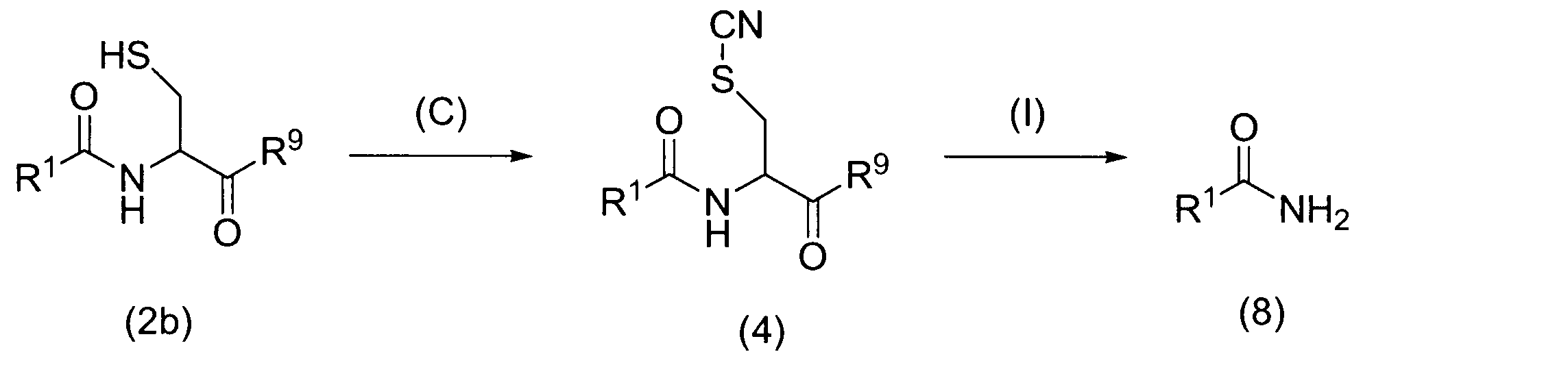
工程(C)は、上記一般式(2b)で表される化合物とニトリル化剤とを反応させる工程である。
工程(I)は、工程(C)で得られた化合物とアンモニア化合物とを反応させる工程である。
工程(A)及び(C)は、上述した一般式(1)で表されるヒドラジド化合物の製造方法における工程(A)及び(C)と同じである。
工程(H)及び(I)で用いるアンモニア化合物としては、アンモニア水;酢酸アンモニウム、炭酸アンモニウム、リン酸アンモニウム等のアンモニウム塩等が挙げられるが、好ましくはアンモニア水が用いられる。アンモニア化合物は1種又は2種以上使用することができる。
アンモニア化合物の使用量としては、特に制限されず、一般式(3)で表されるエステル化合物又は一般式(4)で表されるチオシアナート1モルに対して、0.8モル以上、好ましくは1モル以上であるが、通常溶媒を兼ねて使用するため大過剰量を使用するのがよく、一般式(3)で表されるエステル化合物又は一般式(4)で表されるチオシアナート1重量部に対して1~10000重量部が好ましく、100~5000重量部とするのが好ましい。
工程(H)及び(I)の反応で用いる反応溶媒(反応溶液)は、工程(A)及び(C)の反応で用いられる反応溶媒をそのまま使用してもよい。また、アンモニア化合物を一般式(3)で表されるエステル化合物又は一般式(4)で表されるチオシアナートと反応させる際、反応を妨げない溶媒であれば、特に制限なく用いることができ、例えば、緩衝液でもよい。
緩衝液としては、例えば、トリス-塩酸緩衝液、トリス-酢酸緩衝液、リン酸緩衝液、ホウ酸緩衝液、N-2-ヒドロキシエチルピペラジン-N'-2-エタンスルホン酸(HEPES)等が挙げられる。これらは1種又は2種以上使用することができる。
また、反応試薬であるアンモニア化合物を反応溶媒として兼用することもできる。反応液中には、グアニジン塩酸塩、尿素等の変性剤が存在していてもよい。
工程(H)及び(I)の反応における反応温度は、通常0~80℃程度の範囲で行うのがよいが、好ましくは、0℃~50℃程度である。
工程(H)及び(I)の反応における反応時間は、用いる基質、試薬及び反応条件により異なり一概には言えないが、通常1分~100時間程度であり、好ましくは5分~24時間程度である。
上述した各工程の反応は、常圧下、窒素、アルゴン等の不活性ガス雰囲気下で行なうことができ、また加圧下でも行なうことができる。
各工程における反応後には、通常の精製法、例えば溶媒抽出、蒸留、再結晶、カラムクロマトグラフィー、液体クロマトグラフィー、ゲル濾過法、イオン交換クロマトグラフィー、高速液体クロマトグラフィー、アフィニティークロマトグラフィー、疎水クロマトグラフィー、薄層クロマトグラフィー、電気泳動等を適宜組み合せて行うことができる。
5-3.[反応II-B]チオシアナート化合物(4)を経由するペプチドアミド化合物の製造方法(方法Y’:ジンクフィンガー法)
出発原料化合物である上記一般式(2b)で表される化合物中に、チオール基が2つ以上有している場合は、上記1-3に記載したジンクフィンガー法に従い、目的とする一般式(8)で表されるペプチドアミド化合物を製造することができる。
出発原料化合物である上記一般式(2b)で表される化合物中に、チオール基が2つ以上有している場合は、上記1-3に記載したジンクフィンガー法に従い、目的とする一般式(8)で表されるペプチドアミド化合物を製造することができる。
以下に、実施例及び参考例を掲げて、本発明をより一層明らかにする。本発明はこれらの実施例によって限定されるものではない。なお、本明細書中の実施例及び参考例における略号の意味は以下のとおりである。
Ac:アセチル基
Me:メチル基
OMe:メトキシ基
Boc:ターシャリーブトキシカルボニル基
TFA:トリフルオロ酢酸
ClZ:クロロギ酸ベンジル
Trt:トリチル基
Biot:ビオチン
WSCD:水溶性カルボジイミド
HOBt:1-ヒドロキシベンゾトリアゾール
CDAP:1-シアノ-4-(ジメチルアミノ)ピリジニウム テトラフルオロボレート
Ac:アセチル基
Me:メチル基
OMe:メトキシ基
Boc:ターシャリーブトキシカルボニル基
TFA:トリフルオロ酢酸
ClZ:クロロギ酸ベンジル
Trt:トリチル基
Biot:ビオチン
WSCD:水溶性カルボジイミド
HOBt:1-ヒドロキシベンゾトリアゾール
CDAP:1-シアノ-4-(ジメチルアミノ)ピリジニウム テトラフルオロボレート
参考例1(化学的合成方法)
出発原料化合物として用いられる一般式(2)で表される化合物は、公知の製造方法によって製造することができる。例えば、Bioorganic & Medicinal Chemistry, 17, 2009, pp.7487-7492に開示される固相合成反応による製造方法を採用することができる。具体的には、Fmoc固相合成用の樹脂上で、Fmocアミノ酸を利用してペプチド鎖を伸長し、保護ペプチド樹脂を構築した。反応終了後は、トリフルオロ酢酸を用いて脱保護し、HPLC等のクロマト精製を行って、各種出発原料化合物を得た。
出発原料化合物として用いられる一般式(2)で表される化合物は、公知の製造方法によって製造することができる。例えば、Bioorganic & Medicinal Chemistry, 17, 2009, pp.7487-7492に開示される固相合成反応による製造方法を採用することができる。具体的には、Fmoc固相合成用の樹脂上で、Fmocアミノ酸を利用してペプチド鎖を伸長し、保護ペプチド樹脂を構築した。反応終了後は、トリフルオロ酢酸を用いて脱保護し、HPLC等のクロマト精製を行って、各種出発原料化合物を得た。
本発明において用いられるポリペプチド及びタンパク質は、ペプチドのアミノ酸配列をコードする遺伝子を利用して、遺伝子工学的手法により微生物細胞、植物細胞、動物細胞等の宿主において組み換えタンパク質(ペプチド)として生産する生物学的に合成方法により調製することも可能である。以下参考例2~4に、生物学的合成方法の例を記載する。
参考例2(生物学的合成方法)
コリネバクテリウム・グルタミカム(Corynebacterium glutamicum)による抗体Fab断片の発現及び精製
乳がん細胞特異的な抗体トラスツマブのH鎖の可変領域(GenBank Accession No. AY513484)及びL鎖の可変領域(GenBank Accession No. AY513485)の遺伝子配列は既に決定されている。これら配列と一般的な抗体H鎖及びL鎖の不可変領域の配列を参考にし、Corynebacterium glutamicumのコドン使用頻度を考慮してDNAを合成する。
コリネバクテリウム・グルタミカム(Corynebacterium glutamicum)による抗体Fab断片の発現及び精製
乳がん細胞特異的な抗体トラスツマブのH鎖の可変領域(GenBank Accession No. AY513484)及びL鎖の可変領域(GenBank Accession No. AY513485)の遺伝子配列は既に決定されている。これら配列と一般的な抗体H鎖及びL鎖の不可変領域の配列を参考にし、Corynebacterium glutamicumのコドン使用頻度を考慮してDNAを合成する。
また、分泌発現に必要な配列として、C. glutamicum ATCC13869株のPS遺伝子由来のプロモーター、同プロモーターの下流に発現可能に連結されたC. ammoniagenes ATCC6872株のSlpA由来のシグナルペプチドをコードする領域を含むDNAを調製する。これらの配列を順次、特開平9-322774に記載のプラスミドpPK4(C. glutamicumとE. coliのシャトルベクター)に連結し、トラスツマブのFab領域の発現プラスミドを構築する。具体的には、WO2013/065772号パンフレット記載の方法に従って構築したプラスミドpPKStrast-FabH(1-229C)+Lを使用することが出来る。それぞれの挿入断片の塩基配列を決定し、予想通りの遺伝子が構築されていることを確認する。
塩基配列の決定はBigDyeTerminator v3.1 Cycle Sequencing Kit (アプライドバイオシステムズ社製)と3130 ジェネティックアナライザ(アプライドバイオシステムズ社製)を用いて行うことができる。
構築した各抗体卜ラスツズマブのFab(H&L)断片の分泌発現プラスミドpPKStrast-FabH (1-229C)+Lを用いて、WO2013/065772号パンフレット記載のC. glutamicum YDK010 ΔPBP1a株を形質転換する。得られる各形質転換体を、5mg/Lのクロラムフエニコール及び25mg/Lの力ナマイシンを含むMM液体培地(グルコース120g、硫酸マグネシウム七水和物3g、硫酸アンモニウム30g、リン酸二水素カリウム1.5 g、硫酸鉄七水和物0.03g、硫酸マンガン五水和物0.03g、チアミン塩酸塩450μg、ビオチン450μg、DL-メチオニン0.15 g、及び炭酸カルシウム50gを、水に加えて総量を1LにしてpH7.0に調整)でそれぞれ30℃、96時間培養する。培養終了後、各培養液を遠心分離し、得られた培養上清を非還元SDS-PAGEに供してからSYPRO Orange (インビ卜ロジェン社製)にて染色を行い、抗体卜ラスツズマブのFab(H&L)断片の分泌発現を確認することができる。
調製した培養ブロス約190mlを遠心分離して培養上清を得る。得られた培養上清を2回に分けてProtein Gカラムクロマトグラフィーにかける。20mM Tris-HCl(pH8.0)で平衡化したProtein GカラムHiTrap Protein G(GEヘルスケアバイオサイエンス製、CV=1ml)に供して担体に吸着させる。担体に吸着しなかったタンパク質(非吸着タンパク質)を20mM Tris-HCl(pH8.0)を用いて洗い流した後、pHグラディエントにより溶出させることができる。0.1M Glycine(pH2.7)を10CVかけて100%とする直線グラディエントをかけて溶出させる。得られた溶出画分は1mlずつ分画し、予め各フラクションに添加しておいた40μlの2M Tris-HCl(pH8.5)と混合せしめることにより、中和する。得られた溶出フラクションの一部をSDS-PAGEに供して、目的とするタンパク質を含むフラクションを確認し、回収する。
上記のタンパク質を含むフラクションに対して7倍容の水を加えて希釈し、さらに50%酢酸水溶液を用いてpHを5.0まで低下させる。このサンプルを、予め20mM NaOAc(pH5.0)で平衡化した陽イオン交換クロマトグラフィーカラムResource S(GEヘルスケアバイオサイエンス製、CV=6ml)に供して担体に吸着させる。担体に吸着しなかったタンパク質(非吸着タンパク質)を20mM NaOAc(pH5.0)を用いて洗い流した後、20mM NaPi(pH6.0)を用いて10CV流して溶出させる。その後、pHグラディエントにより溶出させる。20mM NaPi(pH8.0)を20CVかけて100%とする直線グラディエントをかけて溶出させる。得られた溶出フラクションの一部をSDS-PAGEに供して、目的とするタンパク質を含むフラクションを確認し、回収する。
参考例3(生物学的合成方法)
コリネバクテリウム・グルタミカム(Corynebacterium glutamicum)によるexenatide-SRHWKFLペプチドの発現及び精製
本発明におけるヒドラジン誘導体の調製法をリコンビナントペプチドに応用し、II型糖尿病薬であるExenatideの調製を行う。Exenatide(39アミノ酸残基)のC末部分にSRHWKFLペプチドを付加させるペプチドを発現させるためのDNAとして配列番号22に記載のDNA配列を合成する。合成したDNAをKpnI/NotI処理して得られた断片(NotI側は制限酵素切断後に平滑末端化)を特開平9-322774号公報に記載のプラスミドpPK4のKpnI/BamHIサイト(BamHI側は制限酵素切断後に平滑末端化)に挿入することにより、exenatide-SRHWKFLペプチドの発現プラスミドpPK-Ex-SRHWKFLを構築する。得られた発現プラスミドを用いて、WO2013/065772号パンフレット記載のC. glutamicum YDK010 ΔPBP1a株を形質転換する。得られた形質転換体を実施例1に記載の方法と同様に培養することにより、培養液上清に目的とするexenatide-SRHWKFLペプチドを発現させることができる。得られる培養上清液から、陰イオン交換クロマトグラフィー、陽イオン交換クロマトグラフィー、ゲル濾過クロマトグラフィー、ハイドロキシアパタイトクロマトグラフィー等の各種クロマトグラフィーのうちから一つないし複数のクロマトグラフィーを用いて精製することにより、目的とするペプチドを製造することができる。ここで得られるexenatide-SRHWKFLのアミノ酸配列は、HGEGTFTSDLSKQMEEEAVRLFIEWLKNGGPSSGAPPPSSRHWKFLである(配列番号21)
コリネバクテリウム・グルタミカム(Corynebacterium glutamicum)によるexenatide-SRHWKFLペプチドの発現及び精製
本発明におけるヒドラジン誘導体の調製法をリコンビナントペプチドに応用し、II型糖尿病薬であるExenatideの調製を行う。Exenatide(39アミノ酸残基)のC末部分にSRHWKFLペプチドを付加させるペプチドを発現させるためのDNAとして配列番号22に記載のDNA配列を合成する。合成したDNAをKpnI/NotI処理して得られた断片(NotI側は制限酵素切断後に平滑末端化)を特開平9-322774号公報に記載のプラスミドpPK4のKpnI/BamHIサイト(BamHI側は制限酵素切断後に平滑末端化)に挿入することにより、exenatide-SRHWKFLペプチドの発現プラスミドpPK-Ex-SRHWKFLを構築する。得られた発現プラスミドを用いて、WO2013/065772号パンフレット記載のC. glutamicum YDK010 ΔPBP1a株を形質転換する。得られた形質転換体を実施例1に記載の方法と同様に培養することにより、培養液上清に目的とするexenatide-SRHWKFLペプチドを発現させることができる。得られる培養上清液から、陰イオン交換クロマトグラフィー、陽イオン交換クロマトグラフィー、ゲル濾過クロマトグラフィー、ハイドロキシアパタイトクロマトグラフィー等の各種クロマトグラフィーのうちから一つないし複数のクロマトグラフィーを用いて精製することにより、目的とするペプチドを製造することができる。ここで得られるexenatide-SRHWKFLのアミノ酸配列は、HGEGTFTSDLSKQMEEEAVRLFIEWLKNGGPSSGAPPPSSRHWKFLである(配列番号21)
配列表:Exenatide-SRHWKFL発現用挿入配列(配列番号22)
GGTACCCAAATTCCTGTGAAGTAGCTGATTTAGTACTTTTCGGAGGTGTCTATTCTTACCAAATCGTCAAGTTGTGGGTAGAGTCACCTGAATATTAATTGCACCGCACGGGTGATATATGCTTATTTGCTCAAGTAGTTCGAGGTTAAGTGTATTTTAGGTGAACAAATTTCAGCTTCGGGTAGAAGACTTTCGATGCGCTTCAGAGCTTCTATTGGGAAATCTGACACCACTTGATTAAATAGCCTACCCCCGAATTGGGGGATTGGTCATTTTTTGCTGTGAAGGTAGTTTTGATGCATATGACCTGCGTTTATAAAGAAATGTAAACGTGATCAGATCGATATAAAAGAAACAGTTTGTACTCAGGTTTGAAGCATTTTCTCCGATTCGCCTGGCAAAAATCTCAATTGTCGCTTACAGTTTTTCTCAACGACAGGCTGCTAAGCTGCTAGTTCGGTGGCCTAGTGAGTGGCGTTTACTTGGATAAAAGTAATCCCATGTCGTGATCAGCCATTTTGGGTTGTTTCCATAGCAATCCAAAGGTTTCGTCTTTCGATACCTATTCAAGGAGCCTTCGCCTCTATGAAACGCATGAAATCGCTGGCTGCGGCGCTCACCGTCGCTGGGGCCATGCTGGCCGCACCTGTGGCAACGGCACACGGCGAGGGAACCTTCACGTCTGATCTGTCTAAGCAGATGGAGGAAGAGGCAGTTCGCCTGTTCATTGAGTGGCTGAAAAATGGCGGTCCTTCTAGCGGTGCACCTCCCCCCTCCTCCCGCCACTGGAAGTTCCTCTAAGCGGCCGCATC
GGTACCCAAATTCCTGTGAAGTAGCTGATTTAGTACTTTTCGGAGGTGTCTATTCTTACCAAATCGTCAAGTTGTGGGTAGAGTCACCTGAATATTAATTGCACCGCACGGGTGATATATGCTTATTTGCTCAAGTAGTTCGAGGTTAAGTGTATTTTAGGTGAACAAATTTCAGCTTCGGGTAGAAGACTTTCGATGCGCTTCAGAGCTTCTATTGGGAAATCTGACACCACTTGATTAAATAGCCTACCCCCGAATTGGGGGATTGGTCATTTTTTGCTGTGAAGGTAGTTTTGATGCATATGACCTGCGTTTATAAAGAAATGTAAACGTGATCAGATCGATATAAAAGAAACAGTTTGTACTCAGGTTTGAAGCATTTTCTCCGATTCGCCTGGCAAAAATCTCAATTGTCGCTTACAGTTTTTCTCAACGACAGGCTGCTAAGCTGCTAGTTCGGTGGCCTAGTGAGTGGCGTTTACTTGGATAAAAGTAATCCCATGTCGTGATCAGCCATTTTGGGTTGTTTCCATAGCAATCCAAAGGTTTCGTCTTTCGATACCTATTCAAGGAGCCTTCGCCTCTATGAAACGCATGAAATCGCTGGCTGCGGCGCTCACCGTCGCTGGGGCCATGCTGGCCGCACCTGTGGCAACGGCACACGGCGAGGGAACCTTCACGTCTGATCTGTCTAAGCAGATGGAGGAAGAGGCAGTTCGCCTGTTCATTGAGTGGCTGAAAAATGGCGGTCCTTCTAGCGGTGCACCTCCCCCCTCCTCCCGCCACTGGAAGTTCCTCTAAGCGGCCGCATC
参考例4(生物学的合成方法)
E. coliによる抗体Fab断片の発現と調製
大腸菌BL21株(DE3)を生産宿主とした、ヒト型の抗ヒトTNF抗体(アダリムマブ)の重鎖可変領域と定常領域CH1ドメイン(C末端にCysを付加)を連続した重鎖Fabドメイン発現系を構築した。アミノ酸配列は独立行政法人医薬品医療機器総合機構が開示した審査報告書(平成20年2月14日、http://www.info.pmda.go.jp/shinyaku/P200800019/10015900_22000AMX01598_A100_3.pdf)に基づいた。同様に、本抗体の軽鎖配列の発現系を構築した。下に、重鎖Fabドメインと軽鎖のアミノ酸配列を一文字表記法で示した。それぞれのN末端部分には開始コドン由来のMet(M)が残った。
E. coliによる抗体Fab断片の発現と調製
大腸菌BL21株(DE3)を生産宿主とした、ヒト型の抗ヒトTNF抗体(アダリムマブ)の重鎖可変領域と定常領域CH1ドメイン(C末端にCysを付加)を連続した重鎖Fabドメイン発現系を構築した。アミノ酸配列は独立行政法人医薬品医療機器総合機構が開示した審査報告書(平成20年2月14日、http://www.info.pmda.go.jp/shinyaku/P200800019/10015900_22000AMX01598_A100_3.pdf)に基づいた。同様に、本抗体の軽鎖配列の発現系を構築した。下に、重鎖Fabドメインと軽鎖のアミノ酸配列を一文字表記法で示した。それぞれのN末端部分には開始コドン由来のMet(M)が残った。
重鎖Fabドメイン(配列番号23):MEVQLVESGGGLVQPGRSLRLSCAASGFTFDDYAMHWVRQAPGKGLEWVSAITWNSGHIDYADSVEGRFTISRDNAKNSLYLQMNSLRAEDTAVYYCAKVSYLSTASSLDYWGQGTLVTVSSASTKGPSVFPLAPSSKSTSGGTAALGCLVKDYFPEPVTVSWNSGALTSGVHTFPAVLQSSGLYSLSSVVTVPSSSLGTQTYICNVNHKPSNTKVDKKVEPKSCDKTHTC
軽鎖(配列番号24):MDIQMTQSPSSLSASVGDRVTITCRASQGIRNYLAWYQQKPGKAPKLLIYAASTLQSGVPSRFSGSGSGTDFTLTISSLQPEDVATYYCQRYNRAPYTFGQGTKVEIKRTVAAPSVFIFPPSDEQLKSGTASVVCLLNNFYPREAKVQWKVDNALQSGNSQESVTEQDSKDSTYSLSSTLTLSKADYEKHKVYACEVTHQGLSSPVTKSFNRGEC
LB寒天培地(アンピシリン50 μg/ml含有)において37℃終夜培養した重鎖Fabドメイン用生産宿主を、OD(660 nm)、0.05でLB培地に植菌し、500 ml容の坂口フラスコを3本用いて、1本当たりの液量50 mlで培養した。37℃で約2時間、ODが0.8-1.0に達するまで培養し、IPTGを1 mMになるように添加して約5時間培養を継続し、遠心分離にて菌体を回収した。回収したそれぞれの菌体を溶液(20 mMトリス塩酸塩、30 mM NaCl、5 mM EDTA、pH 7.5)20 mlに懸濁後、氷冷下で40 W、1分間の超音波破砕に供した。破砕後に氷冷下での冷却を2分間行い、破砕と冷却を5回繰り返した。得られた菌体破砕液を、5℃下、4400 g、10分間の遠心分離に供し、得られた沈殿物を(20mMトリス塩酸塩、30 mM NaCl、5 mM EDTA、pH 7.5)20 mlに再び懸濁した。5℃下、6500 g、10分間の遠心分離に供し、不溶性顆粒を得た。重鎖Fabドメイン不溶性顆粒の湿重量は0.198 gであった。同様に、軽鎖用生産宿主を培養(坂口フラスコ1本あたりの液量は50 ml、20本を使用)、不溶性顆粒を調製し、湿重量1.493 gの軽鎖不溶性顆粒を得た。
重鎖Fabドメイン不溶性顆粒、軽鎖不溶性顆粒の全量を、それぞれ1.5 ml、15 mlの2.5%アシルグルタミン酸を含む10 mMリン酸ナトリウム緩衝液中で可溶化し、pH 9に調整後、37℃で30分間加熱した。18000 g、10分間の遠心分離に供し、重鎖Fabドメイン抽出物の1.45 ml、軽鎖抽出物14.1 mlを得た。それぞれのタンパク質濃度を4-20%のグラジエントゲルを用いるSDS-PAGEで求め、重鎖Fabドメイン抽出物は11 mg/ml、軽鎖抽出物は11 mg/mlを得た。
重鎖Fabドメイン抽出物の10 mg(0.91 ml)、軽鎖抽出物の10 mg(0.91 ml)のそれぞれに最終濃度で5 mMのDTTを添加し、37℃で1時間加熱して分子内、分子間のジスルフィド結合を還元、切断した。還元反応後の重鎖Fabドメイン抽出物と軽鎖抽出物の全量を(6 M塩酸グアニジンを含む10 mMリン酸ナトリウム緩衝器、pH 8.5)50 ml中で混合し、37℃で15分間加熱した。続けて5℃下で2時間保持した。ここに溶液(20 mMリン酸ナトリウム、pH 8)50 mlを加えて100 mlに調製し、還元型グルタチオンと酸化型グルタチオンの最終濃度をそれぞれ0.2 mM、2 mMに調整後、5℃で15時間保持した。この全量を分子量分画3500 Daの透析膜(スペクトロポア3、フナコシ)に封入し、溶液(2 M塩酸グアニジンを含む20 mMリン酸ナトリウム、0.3 mM システイン、及び1 mMシスタミン、pH 8)5 Lに対して5℃で15時間透析した。続いて、溶液(1 M塩酸グアニジンを含む20 mMリン酸ナトリウム、0.3 mM システイン、1 mMシスタミン、pH 8)5 Lに対して5℃で8時間透析した。更に、溶液(0.5 M塩酸グアニジンを含む10 mMリン酸ナトリウム、0.3 mM システイン、1 mMシスタミン、pH 8)5 Lに対して5℃下で15時間透析した。最後に、溶液(20 mMリン酸ナトリウム、pH 8)5 Lに対して5℃下で24時間透析し、得られた透析内液を6000 g、15分間の遠心分離に供し、110 mlのFab溶液を得た。このFab溶液を5℃下、分子量分画10 kDaの限外ろ過膜(ペリコンXL、メルク・ミリポア)を用いて21 mlに濃縮した。この全量を0.15 M NaClを含む20 mM トリス塩酸緩衝液で10倍に希釈し(210 ml)、5℃下、同緩衝液で予め平衡化されたHiTrap Q HPカラム(5 ml、GEヘルスケア・ジャパン)に希釈液の70 mlを4 ml/minで負荷し、凝集体の除去されたFabを素通り画分、75 mlに回収した。この操作を3回繰り返し、合計で225 mlのFab溶液を得た。このFab溶液を分子量分画10 kDaの限外ろ過膜(ペリコンXL、ならびにアミコンウルトラ15、共にメルク・ミリポア)に供し、最終的に6 mlのFab溶液を得た。この3 mlを23℃下、PBSで平衡化されたSuperdex 200 pg 16x60(GEヘルスケア・ジャパン)に0.8 ml/minで負荷し、280 nmの紫外吸収を指標に単量体画分を回収して、精製Fab溶液、12.5 mlを得た。この操作を2回繰り返し、得られたFab溶液を分子量分画10 kDaの限外ろ過膜(アミコンウルトラ4、メルク・ミリポア))を用いて4 mlに濃縮し、4.1 mgの精製Fab溶液を得た。ゲルろ過HPLC、SDS-PAGEで95%以上のタンパク質純度を確認後、反応に供するまで5℃に保管した。
実施例1(反応I)
一般式(3)で表されるエステル化合物の製造(工程A)
一般式(3)で表されるエステル化合物の製造(工程A)

上記出発原料化合物Ac-LYRAASRHWKFL-NH2 2aa(0.2mg、0.1μmol;配列番号1)を、室温下で10%メタノール水溶液(0.1mL)に溶解させた。次いで、当該溶液に、室温下で0.2M HEPES bufferを加えて、pHを8.2に調整した。その溶液中に室温下で、10mM NiCl2(0.24mg、1μmol)を添加して、37℃で12時間、上記メタノールと化合物2aaとを反応させた。反応終了後、得られた反応液をHPLCで確認した結果、エステル化合物(Ac-LYRAA-OMe)が得られた(下記表2の転換率は、(生成物)/(未反応原料+分解物+生成物)を意味する。生成物、未反応原料及び分解物について、HPLCにおける面積百分率の比率から上記転換率を求めた。)。
実施例2~10(反応I)
一般式(3)で表されるエステル化合物の製造(工程A)
表2に記載の条件及びアルコール化合物にする以外は、実施例1と同様の方法で一般式(3)で表されるエステル化合物を製造した。
一般式(3)で表されるエステル化合物の製造(工程A)
表2に記載の条件及びアルコール化合物にする以外は、実施例1と同様の方法で一般式(3)で表されるエステル化合物を製造した。

表2の結果のとおり、実施例1~10では、一般式(3)で表されるエステル化合物を製造できたことが確認できた。
実施例11(反応I)
ペプチドヒドラジド化合物の製造(工程A及びB)
ペプチドヒドラジド化合物の製造(工程A及びB)

上記化合物2aAのアミノ酸残基Xaaがアラニン残基である場合の出発原料化合物2aa(0.2mg、0.1μmol)を、室温下で、50%メタノール水溶液(0.1mL)に溶解させた。その後、室温下で、当該溶液中に、0.2M HEPES bufferを加え、pHを8.2に調整した。その溶液中へ、室温下で、10mM NiCl2(0.24mg、1μmol)を添加し、上記メタノールと化合物2aAとを37℃で12時間反応させて、Ac-LYRAA-OMeで表される化合物を得た。次いで、その反応液に、室温下で、ヒドラジン一水和物を加え、25℃で1時間反応させた。その反応液に0.1% TFA/水(4.0mL)を加え、ODSカラム(10x250mm)を用いてHPLCにより精製し(溶離液A=0.1%TFA/水,B=0.1%TFA/アセトニトリル,溶出勾配A:B=90:10から70:30まで30分の直線勾配)、ペプチドヒドラジド化合物(Ac-LYRAA-NHNH2)1aaを得た(単離収率80%)。
実施例12~27(反応I)
ペプチドヒドラジド化合物の製造(工程A及びB)
下記のXaa基を有する出発原料化合物2aAを用いて、メタノールを反応させる時間を24時間、ヒドラジン一水和物を反応させる時間を3時間に代えた以外は、実施例11と同様の方法で一般式(1)で表されるペプチドヒドラジド化合物を製造した(表3)。下記表3の転換率は、(生成物)/(未反応原料+分解物+生成物)を意味する。
ペプチドヒドラジド化合物の製造(工程A及びB)
下記のXaa基を有する出発原料化合物2aAを用いて、メタノールを反応させる時間を24時間、ヒドラジン一水和物を反応させる時間を3時間に代えた以外は、実施例11と同様の方法で一般式(1)で表されるペプチドヒドラジド化合物を製造した(表3)。下記表3の転換率は、(生成物)/(未反応原料+分解物+生成物)を意味する。
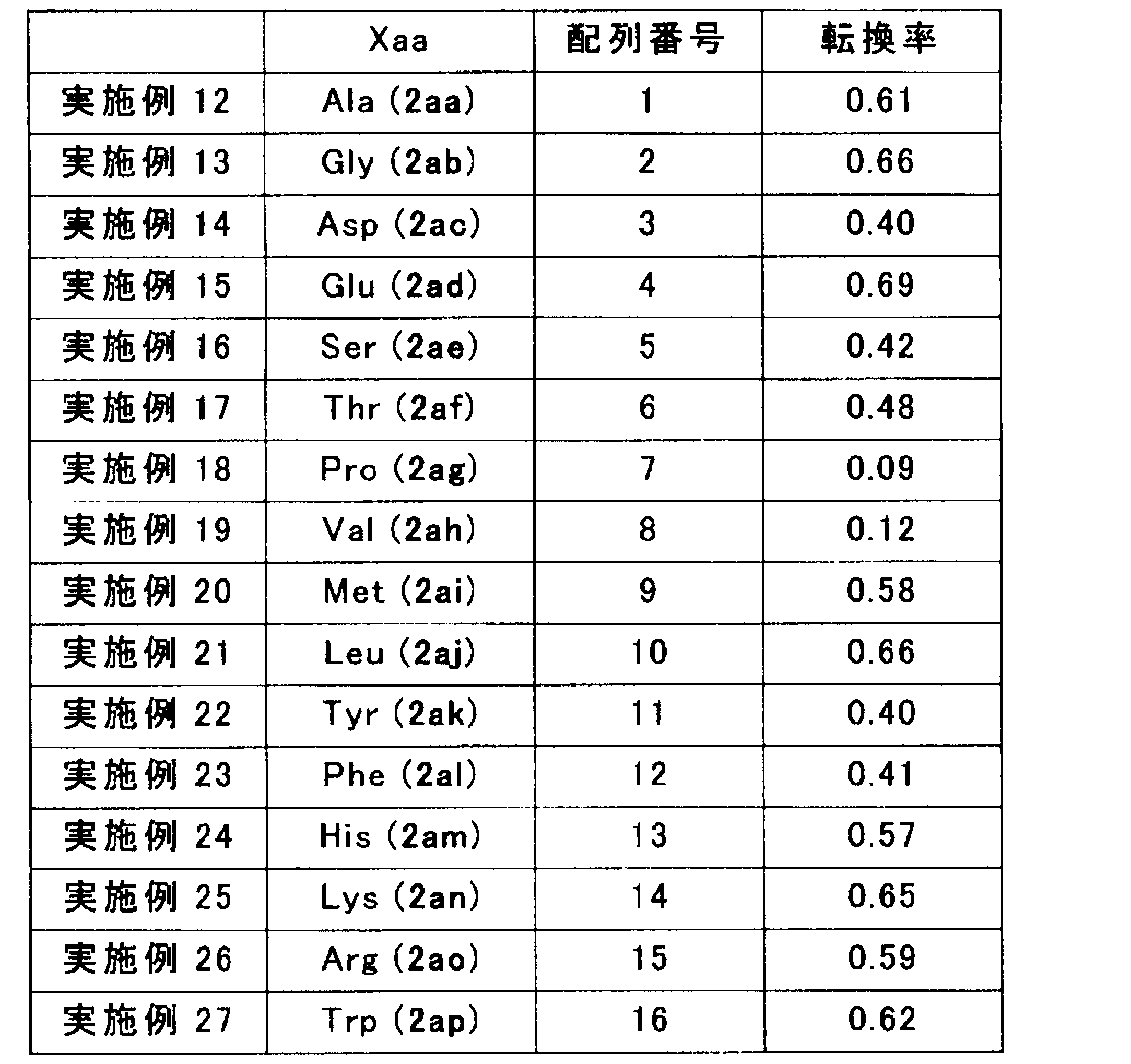
表3の結果のとおり、実施例12~27では、セリン残基のN末端にどのようなアミノ酸残基が置換していても、一般式(1)で表されるペプチドヒドラジド化合物を製造できたことを確認した。
実施例28(43残基の出発原料化合物の使用)(反応I)
ペプチドヒドラジド化合物の製造(工程A及びB)
固相合成により得られた43残基を有する合成ペプチドを出発原料化合物として使用し、実施例12と同様の方法によって、目的とするペプチドヒドラジド化合物を製造した。具体的には、CNP 53 (1-36残基)とSRHW-KFL-NH2の配列(7残基)を有するペプチド化合物(6.7mg、1μmol;配列番号17)を、室温下で50%メタノール水溶液(1mL)に溶解させた。その後、室温下で、その溶液中に、0.2M HEPES bufferを加え、pHを8.2に調整した。そして、その溶液へ、室温下で、10mM NiCl2(2.4mg、10μmol)を添加して、上記メタノールと43残基を有する合成ペプチドとを37℃で6時間反応させて、CNP 53-OMeで表される化合物を得た。次いで、その反応溶液へ、室温下でヒドラジン一水和物を加えて、25℃で1時間反応させた後、ペプチドヒドラジド化合物(CNP 53-NHNH2;単離収率69%)を得た。
ペプチドヒドラジド化合物の製造(工程A及びB)
固相合成により得られた43残基を有する合成ペプチドを出発原料化合物として使用し、実施例12と同様の方法によって、目的とするペプチドヒドラジド化合物を製造した。具体的には、CNP 53 (1-36残基)とSRHW-KFL-NH2の配列(7残基)を有するペプチド化合物(6.7mg、1μmol;配列番号17)を、室温下で50%メタノール水溶液(1mL)に溶解させた。その後、室温下で、その溶液中に、0.2M HEPES bufferを加え、pHを8.2に調整した。そして、その溶液へ、室温下で、10mM NiCl2(2.4mg、10μmol)を添加して、上記メタノールと43残基を有する合成ペプチドとを37℃で6時間反応させて、CNP 53-OMeで表される化合物を得た。次いで、その反応溶液へ、室温下でヒドラジン一水和物を加えて、25℃で1時間反応させた後、ペプチドヒドラジド化合物(CNP 53-NHNH2;単離収率69%)を得た。
実施例29(514残基の出発原料化合物の使用)(反応I)
一般式(1)で表されるペプチドヒドラジド化合物の製造(工程A及びB)
514残基を有するタンパク質(ポリペプチド)を出発原料として使用し、実施例28と同様の方法により、目的とするペプチドヒドラジド化合物を製造した。具体的には、T-SRHY配列とL-TRHR配列を有するタンパク質56μg(0.001μmol)(Hex B;配列番号18;Hex B は、Molecular Therapy, 19, 1017-1024 (2011)に記載されている同様のタンパク質を利用した。)を、室温下で30%メタノール水溶液(0.1mL)に溶解させた。その後、室温下でbuffer(6M塩酸グアニジン、0.2 M HEPES)を加えて、pHを8.2に調整した。その溶液へ、室温下で、10 mM NiCl2(0.24 mg, 1 μmol)を添加し、37℃で24時間反応させて、Hex Bから得られるメチルエステルフラグメントを得た。次いで、その反応液へ、室温下でヒドラジン一水和物を加え、3時間反応させた後、Hex Bから得られるペプチドヒドラジドフラグメントを得た。該ヒドラジドフラグメントを常法に従い、ペプチドアジド経由でペプチドチオエステルへ変換した。これにビオチン化ペプチド(H-CYRANK(Biotin)-NH2: 市販原料を使い、固相合成法で容易に合成できる)をNCL法で縮合し、ビオチン化Hex Bフラグメントとした。次いで、電気泳動後、ウエスタンブロッティングによる西洋ワサビパーオキシダーゼ(HRP)標識ストレプトアビジンによってヒドラジドフラグメントの生成を確認した。
一般式(1)で表されるペプチドヒドラジド化合物の製造(工程A及びB)
514残基を有するタンパク質(ポリペプチド)を出発原料として使用し、実施例28と同様の方法により、目的とするペプチドヒドラジド化合物を製造した。具体的には、T-SRHY配列とL-TRHR配列を有するタンパク質56μg(0.001μmol)(Hex B;配列番号18;Hex B は、Molecular Therapy, 19, 1017-1024 (2011)に記載されている同様のタンパク質を利用した。)を、室温下で30%メタノール水溶液(0.1mL)に溶解させた。その後、室温下でbuffer(6M塩酸グアニジン、0.2 M HEPES)を加えて、pHを8.2に調整した。その溶液へ、室温下で、10 mM NiCl2(0.24 mg, 1 μmol)を添加し、37℃で24時間反応させて、Hex Bから得られるメチルエステルフラグメントを得た。次いで、その反応液へ、室温下でヒドラジン一水和物を加え、3時間反応させた後、Hex Bから得られるペプチドヒドラジドフラグメントを得た。該ヒドラジドフラグメントを常法に従い、ペプチドアジド経由でペプチドチオエステルへ変換した。これにビオチン化ペプチド(H-CYRANK(Biotin)-NH2: 市販原料を使い、固相合成法で容易に合成できる)をNCL法で縮合し、ビオチン化Hex Bフラグメントとした。次いで、電気泳動後、ウエスタンブロッティングによる西洋ワサビパーオキシダーゼ(HRP)標識ストレプトアビジンによってヒドラジドフラグメントの生成を確認した。
実施例30(反応II-A)
ペプチドヒドラジド化合物の製造(方法X)
(工程C)
ペプチドヒドラジド化合物の製造(方法X)
(工程C)

上記化合物2ba (6.54 mg, 4μmol;配列番号19) を、室温下で0.1 M 酢酸水溶液(654μL)に溶解した。当該溶液へ、室温下でCDAP (10 mg/mL solution in 0.1 N酢酸, 282 mL (2.82 mg相当、12μmol))を添加し、その後室温下で1時間反応させた。反応終了後、HPLCにて精製し、下記ニトリル化化合物4ba(6.12 mg, 3.74μmol: 収率93.5%)を得た。
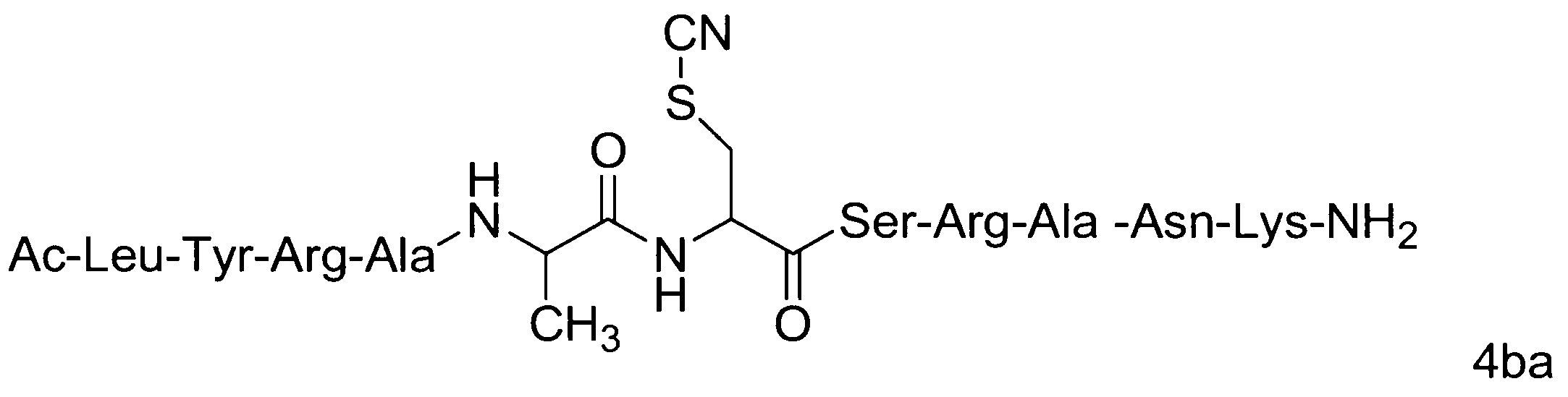
(工程D)
化合物4ba (2 μmol)を水(1.705 mL)に溶解後、氷冷下で、冷ヒドラジン一水和物(295 μL, 6 mmol)を添加し(反応液は3 M NH2NH2溶液)、当該反応液を室温下で12時間静置した。反応の完結をHPLCで確認後、反応液を0.1% トリフルオロ酢酸水溶液とアセトニトリルとの混合溶液(9:1)で10倍に希釈し、HPLCにて精製し、ペプチドヒドラジド(Ac-Leu-Tyr-Arg-Ala-Ala-NHNH21aa) 1.1 mgを得た(1.25μmol: 収率63%)。
化合物4ba (2 μmol)を水(1.705 mL)に溶解後、氷冷下で、冷ヒドラジン一水和物(295 μL, 6 mmol)を添加し(反応液は3 M NH2NH2溶液)、当該反応液を室温下で12時間静置した。反応の完結をHPLCで確認後、反応液を0.1% トリフルオロ酢酸水溶液とアセトニトリルとの混合溶液(9:1)で10倍に希釈し、HPLCにて精製し、ペプチドヒドラジド(Ac-Leu-Tyr-Arg-Ala-Ala-NHNH21aa) 1.1 mgを得た(1.25μmol: 収率63%)。
実施例31(反応III)
ペプチドチオエステルの製造方法(工程E及びF)
室温下、ペプチドヒドラジドAc-Leu-Tyr-Arg-Ala-Ala-NHNH2(0.1μmol;配列番号20)を、buffer (6 M グアニジン塩酸塩-0.2 M Na phosphate, pH 3.0, 30μL)に溶解した後、0.2 M NaNO2(3.3 μL)を加え、-10℃で1時間反応させて、アシルアジド化合物を得た。次いで、反応後のアシルアジド化合物を含む溶液に、200 mM HSC6H4CH2COOH (MPAA)と6 M グアニジン塩酸塩-0.2 M Na2HPO3 33μLを加え、pHを中性に調整した。その後、室温下で30分反応させて、ペプチドチオエステル化合物を得たことをHPLCで確認した。
ペプチドチオエステルの製造方法(工程E及びF)
室温下、ペプチドヒドラジドAc-Leu-Tyr-Arg-Ala-Ala-NHNH2(0.1μmol;配列番号20)を、buffer (6 M グアニジン塩酸塩-0.2 M Na phosphate, pH 3.0, 30μL)に溶解した後、0.2 M NaNO2(3.3 μL)を加え、-10℃で1時間反応させて、アシルアジド化合物を得た。次いで、反応後のアシルアジド化合物を含む溶液に、200 mM HSC6H4CH2COOH (MPAA)と6 M グアニジン塩酸塩-0.2 M Na2HPO3 33μLを加え、pHを中性に調整した。その後、室温下で30分反応させて、ペプチドチオエステル化合物を得たことをHPLCで確認した。
参考例5(NCL反応)
得られたペプチドチオエステル化合物の反応液中に、室温で、N末端Cys ペプチド(H-Cys-Tyr-Arg-Ala-Asn-Lys-NH2)0.1mg、0.1μmolを加え、NCL反応を行い、NCLが進行することを確認した。
得られたペプチドチオエステル化合物の反応液中に、室温で、N末端Cys ペプチド(H-Cys-Tyr-Arg-Ala-Asn-Lys-NH2)0.1mg、0.1μmolを加え、NCL反応を行い、NCLが進行することを確認した。
実施例32~40(反応II-A)
ペプチドヒドラジド化合物の製造(方法X)

ペプチドヒドラジド化合物の製造(方法X)
(工程D)
下記のXaa基を有する出発原料化合物4bA (2 μmol)を水(1.705 mL)に溶解後、氷冷下で、冷ヒドラジン一水和物(295 μL, 6 mmol)を添加し(反応液は3 M NH2NH2溶液)、当該反応液を室温下で1時間静置した。反応の完結をHPLCで確認後、反応液を0.1% トリフルオロ酢酸水溶液とアセトニトリルとの混合溶液(9:1)で10倍に希釈し、HPLCにて精製し、ペプチドヒドラジドをそれぞれ得た。

下記のXaa基を有する出発原料化合物4bA (2 μmol)を水(1.705 mL)に溶解後、氷冷下で、冷ヒドラジン一水和物(295 μL, 6 mmol)を添加し(反応液は3 M NH2NH2溶液)、当該反応液を室温下で1時間静置した。反応の完結をHPLCで確認後、反応液を0.1% トリフルオロ酢酸水溶液とアセトニトリルとの混合溶液(9:1)で10倍に希釈し、HPLCにて精製し、ペプチドヒドラジドをそれぞれ得た。
実施例41(反応II-B)
ペプチドヒドラジド化合物の製造(方法Y:ジンクフィンガー法)

ペプチドヒドラジド化合物の製造(方法Y:ジンクフィンガー法)
工程(II-B1)
ペプチド 2b-y1(0.70 μmol、配列番号34)を塩化亜鉛溶液(3.5 μmol, 340 μL of 10.3 mM ZnCl2 solution in 20 mM HEPPS buffer, 5.0 equiv., pH 7.0)に溶かし、反応液をアルゴン雰囲気下15分間室温で振とうした。
ペプチド 2b-y1(0.70 μmol、配列番号34)を塩化亜鉛溶液(3.5 μmol, 340 μL of 10.3 mM ZnCl2 solution in 20 mM HEPPS buffer, 5.0 equiv., pH 7.0)に溶かし、反応液をアルゴン雰囲気下15分間室温で振とうした。
工程(II-B2及びII-B3)
次に、工程(II-B1)で得られた反応液に、亜硫酸ナトリウム(171.4 μmol, 245 equiv)及びテトラチオン酸ナトリウムを含む溶液(32.0 μmol, 360μL of 476 mM sodium sulfite and 89mM sodium tetrathionate dehydrate solution in 20 mM HEPPS buffer, pH 7.0)を添加し、反応液をアルゴン雰囲気下室温で振とうした。13時間後、ペプチド 2b-y2の生成をHPLCにて確認した後、ゲルろ過により亜鉛を除去し、セミ分取カラム(溶離液A=0.1%TFA/水,B=0.1%TFA/アセトニトリル,溶出勾配A:B=85:15から70:30まで30分の直線勾配)を用いて精製することでペプチド 2b-y2を含む溶液を得た。
次に、工程(II-B1)で得られた反応液に、亜硫酸ナトリウム(171.4 μmol, 245 equiv)及びテトラチオン酸ナトリウムを含む溶液(32.0 μmol, 360μL of 476 mM sodium sulfite and 89mM sodium tetrathionate dehydrate solution in 20 mM HEPPS buffer, pH 7.0)を添加し、反応液をアルゴン雰囲気下室温で振とうした。13時間後、ペプチド 2b-y2の生成をHPLCにて確認した後、ゲルろ過により亜鉛を除去し、セミ分取カラム(溶離液A=0.1%TFA/水,B=0.1%TFA/アセトニトリル,溶出勾配A:B=85:15から70:30まで30分の直線勾配)を用いて精製することでペプチド 2b-y2を含む溶液を得た。
工程(II-B4)
工程(II-B3)で得られた溶液に、1-シアノ-4-(ジメチルアミノ)ピリジニウム テトラフルオロボレート(42.6 μmol, 1 mL of 10 mg/mL solution in 0.1 N AcOH, 61 equiv)を添加し、反応液を室温で振とうした。18 時間後、ペプチド 4b-y1の生成をHPLCにて確認した後、セミ分取カラム(溶離液A=0.1%TFA/水,B=0.1%TFA/アセトニトリル,溶出勾配A:B=80:20から60:40まで30分の直線勾配)を用いて精製することでペプチド 4b-y1を単離収率33%で得た。
工程(II-B3)で得られた溶液に、1-シアノ-4-(ジメチルアミノ)ピリジニウム テトラフルオロボレート(42.6 μmol, 1 mL of 10 mg/mL solution in 0.1 N AcOH, 61 equiv)を添加し、反応液を室温で振とうした。18 時間後、ペプチド 4b-y1の生成をHPLCにて確認した後、セミ分取カラム(溶離液A=0.1%TFA/水,B=0.1%TFA/アセトニトリル,溶出勾配A:B=80:20から60:40まで30分の直線勾配)を用いて精製することでペプチド 4b-y1を単離収率33%で得た。
工程(II-B5)
工程(II-B4)で得られたペプチド 4b-y1(0.05μmol)を水(42.7 μL)に溶かした。続いて、反応液を0 ℃に冷やしながら、ヒドラジン一水和物(N2H4・H2O、7.4μL)を添加した(ペプチド 4b-y1:1.0 mM, N2H4 aq.:3 M)。1時間後にペプチドヒドラジド 1b-y1(配列番号35)の生成をHPLCにて確認した。
工程(II-B4)で得られたペプチド 4b-y1(0.05μmol)を水(42.7 μL)に溶かした。続いて、反応液を0 ℃に冷やしながら、ヒドラジン一水和物(N2H4・H2O、7.4μL)を添加した(ペプチド 4b-y1:1.0 mM, N2H4 aq.:3 M)。1時間後にペプチドヒドラジド 1b-y1(配列番号35)の生成をHPLCにて確認した。
実施例42(反応II-B)
ペプチドヒドラジド化合物の製造(方法Y:ジンクフィンガー法)

ペプチドヒドラジド化合物の製造(方法Y:ジンクフィンガー法)
工程(II-B1)
ペプチド 2b-y1(0.84 μmol)をリン酸緩衝液(3.65 mL, 10 mM, pH 7.5)に溶かした。続いて、この溶液に、硫酸亜鉛溶液(1.26 μmol, 252 μL of 5 mM ZnSO4 solution in Milli-Q water, 1.5 equiv.)を加えて、反応液をアルゴン雰囲気下10分間室温で振とうした。
ペプチド 2b-y1(0.84 μmol)をリン酸緩衝液(3.65 mL, 10 mM, pH 7.5)に溶かした。続いて、この溶液に、硫酸亜鉛溶液(1.26 μmol, 252 μL of 5 mM ZnSO4 solution in Milli-Q water, 1.5 equiv.)を加えて、反応液をアルゴン雰囲気下10分間室温で振とうした。
工程(II-B2及びII-B3)
次に、工程(II-B1)で得られた反応液に、4, 5-ジメトキシ-2-ニトロベンジルブロマイド (2.52 μmol, 303 μL of 8.33 mM solution in MeCN, 3.0 equiv)を添加し、反応液をアルゴン雰囲気下室温で振とうした。2時間後、ペプチド 2b-y3の生成をHPLCにて確認した。
次に、工程(II-B1)で得られた反応液に、4, 5-ジメトキシ-2-ニトロベンジルブロマイド (2.52 μmol, 303 μL of 8.33 mM solution in MeCN, 3.0 equiv)を添加し、反応液をアルゴン雰囲気下室温で振とうした。2時間後、ペプチド 2b-y3の生成をHPLCにて確認した。
工程(II-B4)
工程(II-B3)で得られた反応液に、水(0.1% TFA含有、1.0 mL)、1-シアノ-4-(ジメチルアミノ)ピリジニウム テトラフルオロボレート(40.3 μmol, 950 μL of 10 mg/mL solution in 0.1 N AcOH, 48 equiv)を順次添加し、反応液を室温で振とうした。1.5 時間後、ペプチド 4b-y2の生成をHPLCにて確認した後、セミ分取カラム(溶離液A=0.1%TFA/水,B=0.1%TFA/アセトニトリル,溶出勾配A:B=80:20から65:35まで30分の直線勾配)を用いて精製することでペプチド 4b-y2を単離収率44%で得た。
工程(II-B3)で得られた反応液に、水(0.1% TFA含有、1.0 mL)、1-シアノ-4-(ジメチルアミノ)ピリジニウム テトラフルオロボレート(40.3 μmol, 950 μL of 10 mg/mL solution in 0.1 N AcOH, 48 equiv)を順次添加し、反応液を室温で振とうした。1.5 時間後、ペプチド 4b-y2の生成をHPLCにて確認した後、セミ分取カラム(溶離液A=0.1%TFA/水,B=0.1%TFA/アセトニトリル,溶出勾配A:B=80:20から65:35まで30分の直線勾配)を用いて精製することでペプチド 4b-y2を単離収率44%で得た。
工程(II-B5)
ペプチド 4b-y2(0.03μmol)を水(25.5 μL)に溶かした。続いて、反応液を0℃に冷やしながら、ヒドラジン一水和物(N2H4・H2O、4.5 μL)を添加した(ペプチド 4b-y2:1.0 mM, N2H4 aq.:3 M)。2時間後に、ペプチドヒドラジド 1b-y2の生成をHPLCにて確認した。
ペプチド 4b-y2(0.03μmol)を水(25.5 μL)に溶かした。続いて、反応液を0℃に冷やしながら、ヒドラジン一水和物(N2H4・H2O、4.5 μL)を添加した(ペプチド 4b-y2:1.0 mM, N2H4 aq.:3 M)。2時間後に、ペプチドヒドラジド 1b-y2の生成をHPLCにて確認した。
参考例6(生物学的合成方法)
コリネバクテリウム・グルタミカム(Corynebacterium glutamicum)によるExenatide-SRHWKFLペプチドの発現
コリネバクテリウム・グルタミカム(Corynebacterium glutamicum)によるExenatide-SRHWKFLペプチドの発現
本発明におけるヒドラジン誘導体の調製法をリコンビナントペプチドに応用する。リコンビナントペプチドとして、II型糖尿病薬であるExenatideをモデルペプチドとして選んだ。Exenatide(39アミノ酸残基)のC末部分にSRHWKFLペプチドを付加させたペプチド(Exe-SRHWKFL)を発現させるための発現プラスミドは以下の方法で構築できる。まず、配列番号22記載のDNAを合成した。配列番号22記載のDNA断片をBamHIで制限酵素処理した後、平滑末端化する。得られたDNA断片をKpnIで制限酵素処理し、KpnIで制限酵素処理したpPK4(特開平9-322774に記載のプラスミド、C. glutamicumとE. coliのシャトルベクター)とライゲーションする。このライゲーション溶液でE.coli JM109を形質転換し、カナマイシン耐性株の中から目的のプラスミドを抽出し、このプラスミドをpPK4-Exe-SRHWKFLと命名する。このプラスミドからはExe-SRHWKFLが発現する。pPK4-Exe-SRHWKFLでWO2013/065772号パンフレット記載のC. glutamicum YDK010 ΔPBP1a株を形質転換する。得られた形質転換体を、力ナマイシン25mg/Lを含むCM2G液体培地3mLに植菌し、30℃、118rpmで一晩、試験管を用いて振とう培養を行う。CM2G培地の組成は下記のとおりである。
CM2G:
Glucose 5 g/L
Polypeptone 10 g/L
Yeast extract 10 g/L
NaCl 5 g/L
KOHでpH7.0に調整
Glucose 5 g/L
Polypeptone 10 g/L
Yeast extract 10 g/L
NaCl 5 g/L
KOHでpH7.0に調整
得られた培養液200 μlをカナマイシン25 mg/Lを含むMMTG培地4 mlに植菌し、30℃、118rpmで96時間、試験管を用いて振とう培養を行った。MMTG培地の組成は下記のとおりである。Component A、B、及びCは別々に殺菌後、培養直前に混ぜて使用する。
Component A:
Glucose 120 g/L
MgSO4・7H2O 3 g/L
FeSO4・7H2O 0.03 g/L
MnSO4・5H2O 0.03 g/L
ComponentB:
(NH4)2SO4 30 g/L
KH2PO4 1.5 g/L
豆ろ液 (TN) 0.2 g/L
Thiamine hydrochloride 450 μg/L
Biotin 450 μg/L
DL-methionine 0.15 g/L
ComponentC:
CaCO3 50 g/L
培養終了後、得られた培養液を8,000rpmで遠心分離し、培養上清を回収する。
Glucose 120 g/L
MgSO4・7H2O 3 g/L
FeSO4・7H2O 0.03 g/L
MnSO4・5H2O 0.03 g/L
ComponentB:
(NH4)2SO4 30 g/L
KH2PO4 1.5 g/L
豆ろ液 (TN) 0.2 g/L
Thiamine hydrochloride 450 μg/L
Biotin 450 μg/L
DL-methionine 0.15 g/L
ComponentC:
CaCO3 50 g/L
培養終了後、得られた培養液を8,000rpmで遠心分離し、培養上清を回収する。
実施例43(生物学的合成方法)
Exenatide-SRHWKFLペプチドの精製
Exe-SRHWKFLを分泌発現させた培養上清(参考例6)を20mM Tris-HCl(pH8.0)でバッファー置換し、20mM Tris-HCl(pH8.0)で平衡化したHi TrapQカラム(GEヘルスケア製、CV=5mL)に吸着させた。培養上清量に応じて、カラムの連結数を変えて精製を行った。担体に吸着しなかったタンパク質(非吸着タンパク質)を20mM Tris-HCl(pH8.0)を用いて洗い流した後、20mM Tris-HCl (pH8.0)、1M NaClを20CVかけて0から100%まで直線的に濃度を変化させて、吸着したタンパク質の溶出を行った。得られた各溶出画分をHPLC解析し、目的とするペプチドが含まれる画分を回収した。HPLC解析の条件は下記の通りである。
Exenatide-SRHWKFLペプチドの精製
Exe-SRHWKFLを分泌発現させた培養上清(参考例6)を20mM Tris-HCl(pH8.0)でバッファー置換し、20mM Tris-HCl(pH8.0)で平衡化したHi TrapQカラム(GEヘルスケア製、CV=5mL)に吸着させた。培養上清量に応じて、カラムの連結数を変えて精製を行った。担体に吸着しなかったタンパク質(非吸着タンパク質)を20mM Tris-HCl(pH8.0)を用いて洗い流した後、20mM Tris-HCl (pH8.0)、1M NaClを20CVかけて0から100%まで直線的に濃度を変化させて、吸着したタンパク質の溶出を行った。得られた各溶出画分をHPLC解析し、目的とするペプチドが含まれる画分を回収した。HPLC解析の条件は下記の通りである。
HPLC解析条件
カラム:YMC-Pack C8、5μm、30nm、4.6×100mm
カラム温度:40℃
検出:UV 220nm
注入量:50 μL
移動相A:0.1% TFA
移動相B:0.1% TFA、80% アセトニトリル
流速:1mL/min
溶出勾配:A:B=100:0から0:100まで100分の直線勾配
カラム:YMC-Pack C8、5μm、30nm、4.6×100mm
カラム温度:40℃
検出:UV 220nm
注入量:50 μL
移動相A:0.1% TFA
移動相B:0.1% TFA、80% アセトニトリル
流速:1mL/min
溶出勾配:A:B=100:0から0:100まで100分の直線勾配
回収した画分をアミコンウルトラ-15mL 3kDa(メルクミリポア)を用いて濃縮、限外ろ過して20mM Tris-HCl(pH7.6)に置換した。この溶液を14000rpmで15分遠心し、上清を回収してHPLC精製に供した。HPLC精製の条件は下記の通りである。
HPLC精製条件
カラム:YMC-Pack C8、5μm、30nm、4.6×100mm
カラム温度:40℃
検出:UV 220nm
注入量:50 μL
移動相A:0.1% TFA
移動相B:0.1% TFA、80% アセトニトリル
流速:1mL/min
溶出勾配:A:B=100:0から50:50まで50分の直線勾配
カラム:YMC-Pack C8、5μm、30nm、4.6×100mm
カラム温度:40℃
検出:UV 220nm
注入量:50 μL
移動相A:0.1% TFA
移動相B:0.1% TFA、80% アセトニトリル
流速:1mL/min
溶出勾配:A:B=100:0から50:50まで50分の直線勾配
目的とするペプチドが含まれる溶出液を回収し、pH調整のために1M Tris-HCl (pH8.0)を回収液量の10分の1量加えた。20mM Tris-HCl (pH7.6)で5倍に希釈し、アミコンウルトラ-15mL 3kDa(メルクミリポア)を用いて濃縮、限外ろ過して20mM Tris-HCl(pH7.6)に置換した。この溶液の一部をHPLC解析して目的のペプチドが含まれていることを確認した。この溶液を、Exe-SRHWKFL溶液とした。本実施例において得られるExe-SRHWKFLのアミノ酸配列は、HGEGTFTSDLSKQMEEEAVRLFIEWLKNGGPSSGAPPPSSRHW
KFLである(配列番号21)。
KFLである(配列番号21)。
実施例44(生物学的合成方法)
Exenatide-SRHWKFLペプチドを用いたペプチドヒドラジド化合物の製造
反応液(100 g/mL Exe-SRHWKFL溶液、100mM HEPESバッファー(pH8.2)、1mM NiSO4、50% メタノール)を500μL調製し、37℃で一晩反応させてメチルエステル化合物を得た。その反応液にヒドラジン一水和物21μLを添加し(反応液中のヒドラジン一水和物終濃度は5%)、25℃で3時間反応させてヒドラジド化合物を得た。その反応液をアミコンウルトラ-0.5mL 3kDa(メルクミリポア)で限外ろ過して20mM リン酸ナトリウムバッファー(pH7)に置換し、25μLに濃縮した。その濃縮液25μLを含む反応液(200mM NaH2PO4、6M グアニジン塩酸塩、20mM NaNO2、pH3)を250μL調製し、氷上で1時間反応させた。その反応液125μLに反応液(200mM Na2HPO4、6M グアニジン塩酸塩、200mM MPAA、10mM Cys-Lys(Biotin))を125μL加え、pH7、25℃で一晩反応させて、ExenatideにCys-Lys(Biotin)が付加した化合物を得た。生成物の確認は、MALDI-TOF MS(島津製作所製、レーザイオン化飛行時間型質量分析装置AXIMA(登録商標)-TOF2)による分子量解析により行った。
Exenatide-SRHWKFLペプチドを用いたペプチドヒドラジド化合物の製造
反応液(100 g/mL Exe-SRHWKFL溶液、100mM HEPESバッファー(pH8.2)、1mM NiSO4、50% メタノール)を500μL調製し、37℃で一晩反応させてメチルエステル化合物を得た。その反応液にヒドラジン一水和物21μLを添加し(反応液中のヒドラジン一水和物終濃度は5%)、25℃で3時間反応させてヒドラジド化合物を得た。その反応液をアミコンウルトラ-0.5mL 3kDa(メルクミリポア)で限外ろ過して20mM リン酸ナトリウムバッファー(pH7)に置換し、25μLに濃縮した。その濃縮液25μLを含む反応液(200mM NaH2PO4、6M グアニジン塩酸塩、20mM NaNO2、pH3)を250μL調製し、氷上で1時間反応させた。その反応液125μLに反応液(200mM Na2HPO4、6M グアニジン塩酸塩、200mM MPAA、10mM Cys-Lys(Biotin))を125μL加え、pH7、25℃で一晩反応させて、ExenatideにCys-Lys(Biotin)が付加した化合物を得た。生成物の確認は、MALDI-TOF MS(島津製作所製、レーザイオン化飛行時間型質量分析装置AXIMA(登録商標)-TOF2)による分子量解析により行った。
参考例7
Cys-Lys(Biotin)の合成
ビオチン標識ペプチドCys-Lys(Biotin) は下記示すような方法で化学的に合成される。
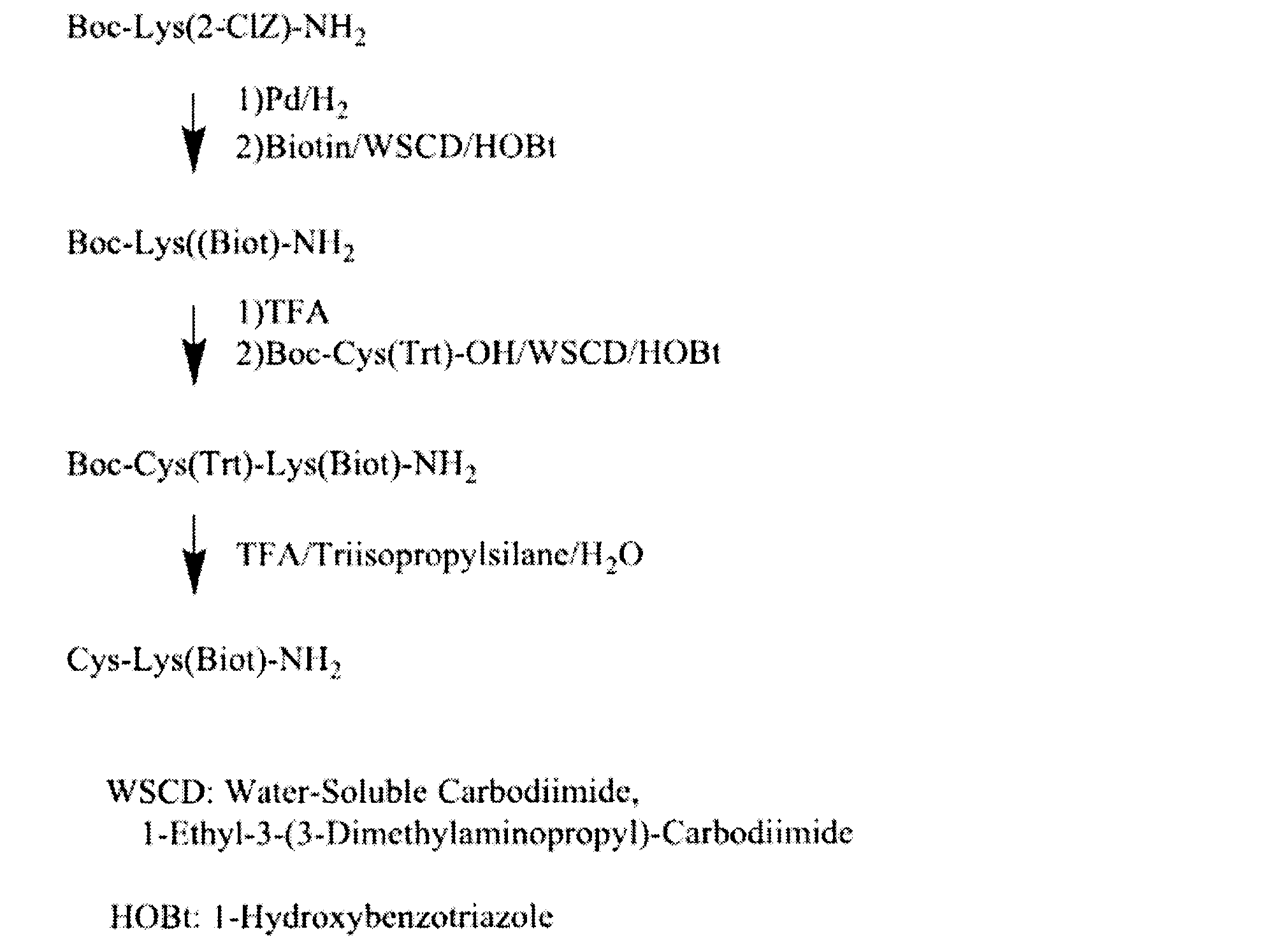
Cys-Lys(Biotin)の合成
ビオチン標識ペプチドCys-Lys(Biotin) は下記示すような方法で化学的に合成される。
実施例45(生物学的合成方法)
Exenatide-SRHWKFLペプチドを用いたペプチドアミド化合物の製造
反応液(500 μg/mL Exe-SRHWKFL溶液、100 mM HEPESバッファー(pH8.2)、10 mM NiSO4、30% メタノール)を200 μL調製し、37℃で一晩反応させてメチルエステル化合物を得た。その反応液にアンモニア水25 μLを添加し、37℃で4時間反応させてアミド体化合物を得た。
Exenatide-SRHWKFLペプチドを用いたペプチドアミド化合物の製造
反応液(500 μg/mL Exe-SRHWKFL溶液、100 mM HEPESバッファー(pH8.2)、10 mM NiSO4、30% メタノール)を200 μL調製し、37℃で一晩反応させてメチルエステル化合物を得た。その反応液にアンモニア水25 μLを添加し、37℃で4時間反応させてアミド体化合物を得た。
Exenatideアミド体の生成確認は、Agilent Technologies社製6130 Quadruplse LC/MSシステムを用いて行った。反応液を14,000 rpmで15分間遠心分離して得られた上清を、LC-MSに供した。
カラム: Inertsil(R) ODS-3 (S-2um, 2.1×75mm, ジーエルサイエンス社製)
移動相: A) 0.05% TFA H2O
B) 0.05% TFA MeCN
温度: 40℃, 流速: 0.2 mL/min, 波長: 220nm, 注入量: 20μL
グラディエント: 15%B(0.00min)→40%B(25.00min)
40%B(25.00min-30.00min)
15%B(30.10min-40.00min)
移動相: A) 0.05% TFA H2O
B) 0.05% TFA MeCN
温度: 40℃, 流速: 0.2 mL/min, 波長: 220nm, 注入量: 20μL
グラディエント: 15%B(0.00min)→40%B(25.00min)
40%B(25.00min-30.00min)
15%B(30.10min-40.00min)
保持時間20.1分の溶出位置に、m/z=+4186に相当するMSを与えるピークを検出し、Exenatide-NH2体の生成を確認することが出来た。
実施例46(アルキンの導入)

上記出発原料化合物Ac-LYRAASRHWKFL-NH2 2aa(2.0 μmol, 4.1 mg;配列番号1)に対して、0.2 M HEPES buffer (10 mM NiCl2、 30% (v/v) 3-ブチン-1-オール、pH 8.2、ペプチド濃度 1 mM) を2 mL加え。次いで、当該溶液に、室温下で0.2M HEPES bufferを加えて、37℃で12時間インキュベートした。反応終了後、4 mLの0.1% TFA aq. を加え、半分取カラム(semi-preparative column)を用いて精製することでアルキンを導入したエステル化合物3aa(1.1μmol, 0.88 mg) を単離収率55%で得た。
実施例47(クリックケミストリー反応)

エステル化合物3aa(0.1 μmol, 0.08 mg)及びアジド化合物9aa(0.1 μmol, 0.057 mg) を100 μLのmilliQ(登録商標)水に溶かした後、1 M 硫酸銅水溶液 (5 μL), 1 M アスコルビン酸ナトリウム塩水溶液 (5 μL)を順次加え、室温にて1時間静置した。その後、HPLCにて反応を追跡し、トリアゾール環を有する化合物10aaが生成していることを確認した。
Claims (18)
- 一般式(1)

[式中、R1は、アミノ酸残基若しくはその誘導体、又はペプチド残基若しくはその誘導体を示す。]
で表されるペプチドヒドラジド化合物の製造方法であって、
一般式(2)

[式中、R1は、前記と同じ。
R2は、水素原子又はアルキル基を示す。
R3は、ヒドロキシル基、アミノ基、ヒドラジノ基又は有機基を示す。
Xは、酸素原子又は硫黄原子を示す。]
で表される化合物を出発原料化合物に使用し、且つ
ヒドラジン化合物を反応試薬に使用する、
前記ペプチドヒドラジド化合物の製造方法。 - 一般式(2)で表される出発原料化合物が、
一般式(2a)

[式中、R1及びR2は、前記と同じ。
R4は、アルギニン側鎖、リシン側鎖又はヒスチジン側鎖を示す。
R5は、ヒスチジン側鎖を示す。
R6は、ロイシン側鎖、イソロイシン側鎖、チロシン側鎖、フェニルアラニン側鎖、アルギニン側鎖又はトリプトファン側鎖を示す。
R7は、ヒドロキシル基、アミノ基、ヒドラジノ基又は有機基を示す。]
で表される化合物であり、
工程(A):上記一般式(2a)で表される化合物とアルコール化合物とを反応させる工程、及び
工程(B):工程(A)で得られる一般式(3)

[式中、R1は、前記と同じ。R8は、アルキル基を示す。]
で表されるエステル化合物とヒドラジン化合物とを反応させる工程
を含む、請求項1に記載のペプチドヒドラジド化合物の製造方法。 - 工程(A)で用いられるアルコール化合物が、メタノール、エタノール及びジチオジエタノールからなる群より選ばれる少なくとも一種である、請求項2に記載のペプチドヒドラジド化合物の製造方法。
- 工程(A)の反応を、遷移金属化合物の存在下で行う、請求項2又は3に記載のペプチドヒドラジド化合物の製造方法。
- 遷移金属化合物が、ニッケル化合物である、請求項4に記載のペプチドヒドラジド化合物の製造方法。
- ニッケル化合物が、塩化ニッケル、臭化ニッケル、ヨウ化ニッケル及びこれらの水和物からなる群より選ばれる少なくとも一種である、請求項5に記載のペプチドヒドラジド化合物の製造方法。
- 一般式(2a)で表される化合物が、下記一般式(2a-1)~(2a-7)で表される化合物からなる群より選ばれる、請求項2~6の何れか一項に記載のペプチドヒドラジド化合物の製造方法。
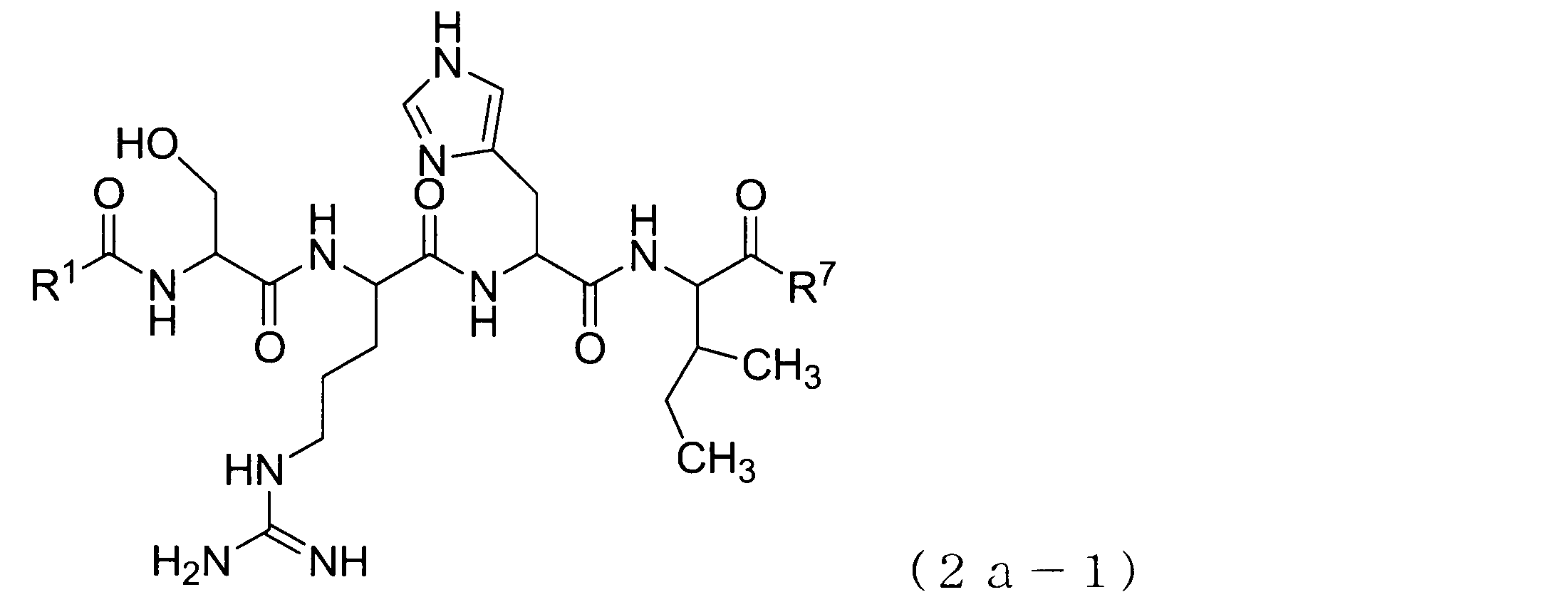
[式中、R1及びR7は、前記と同じ。]
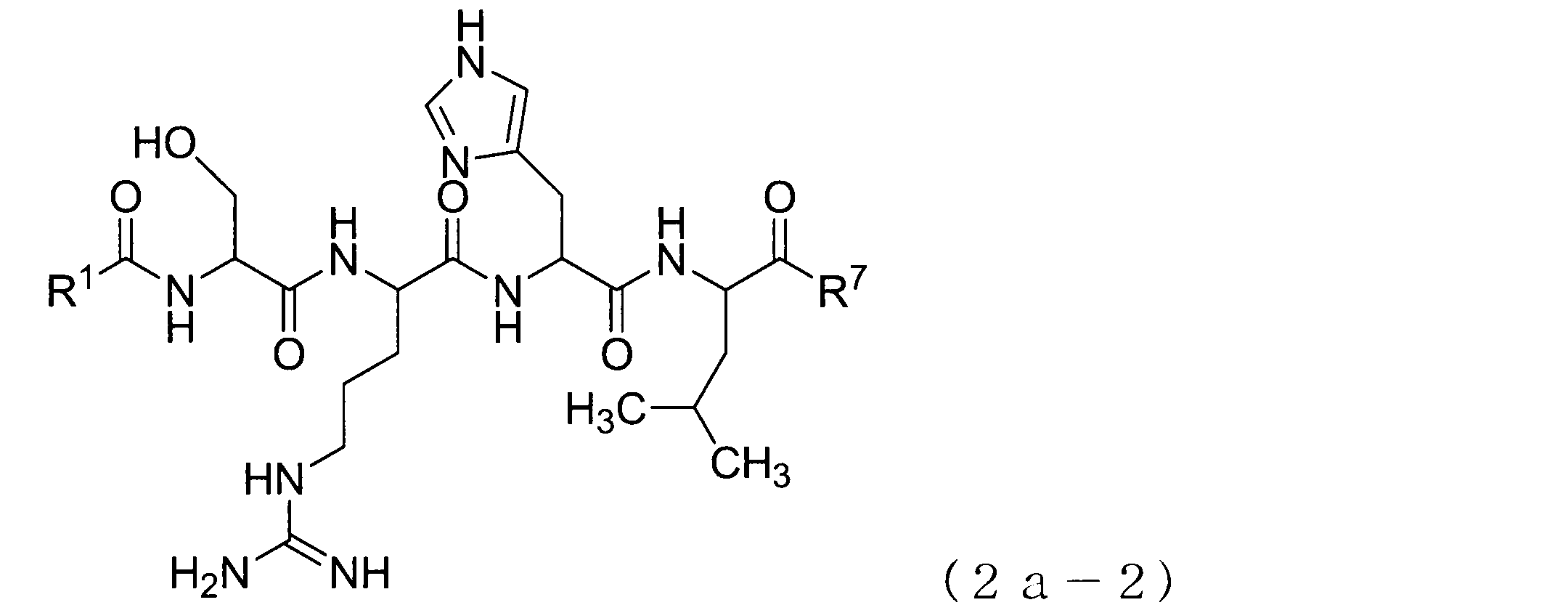
[式中、R1及びR7は、前記と同じ。]

[式中、R1及びR7は、前記と同じ。]
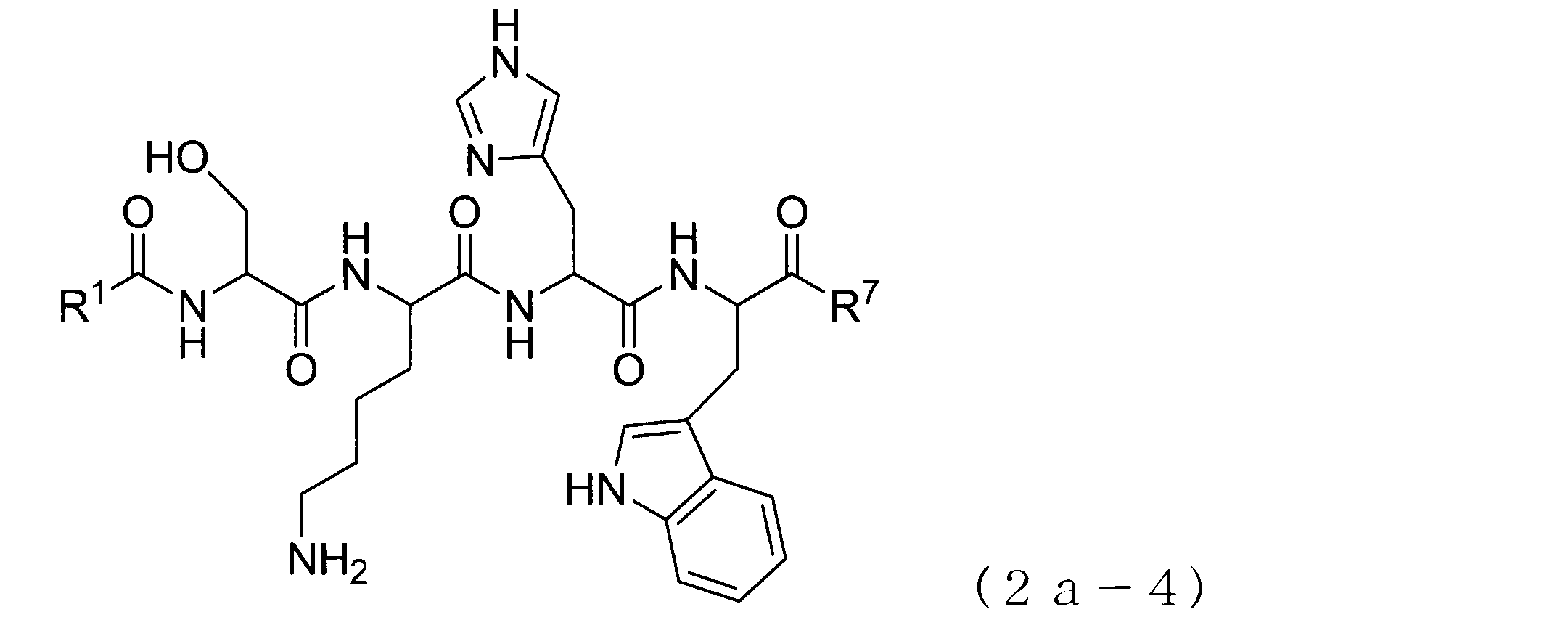
[式中、R1及びR7は、前記と同じ。]
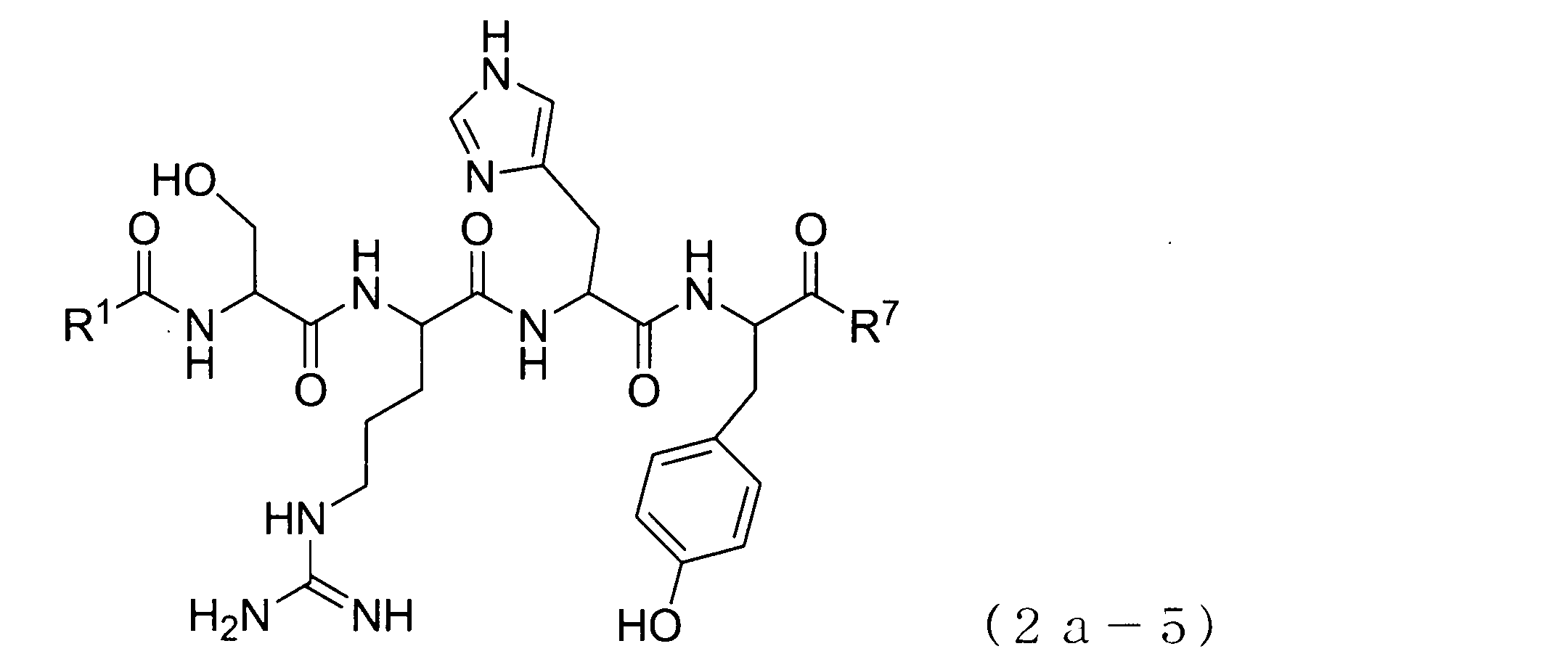
[式中、R1及びR7は、前記と同じ。]
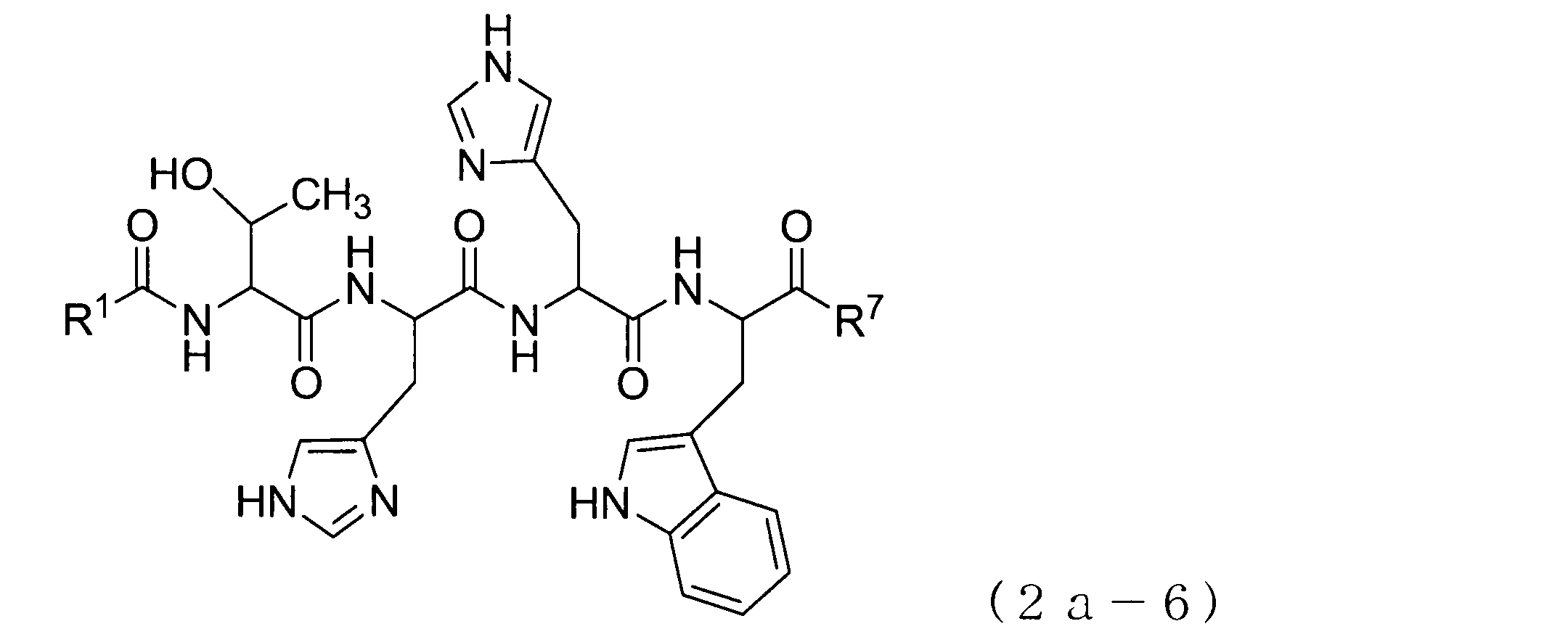
[式中、R1及びR7は、前記と同じ。]
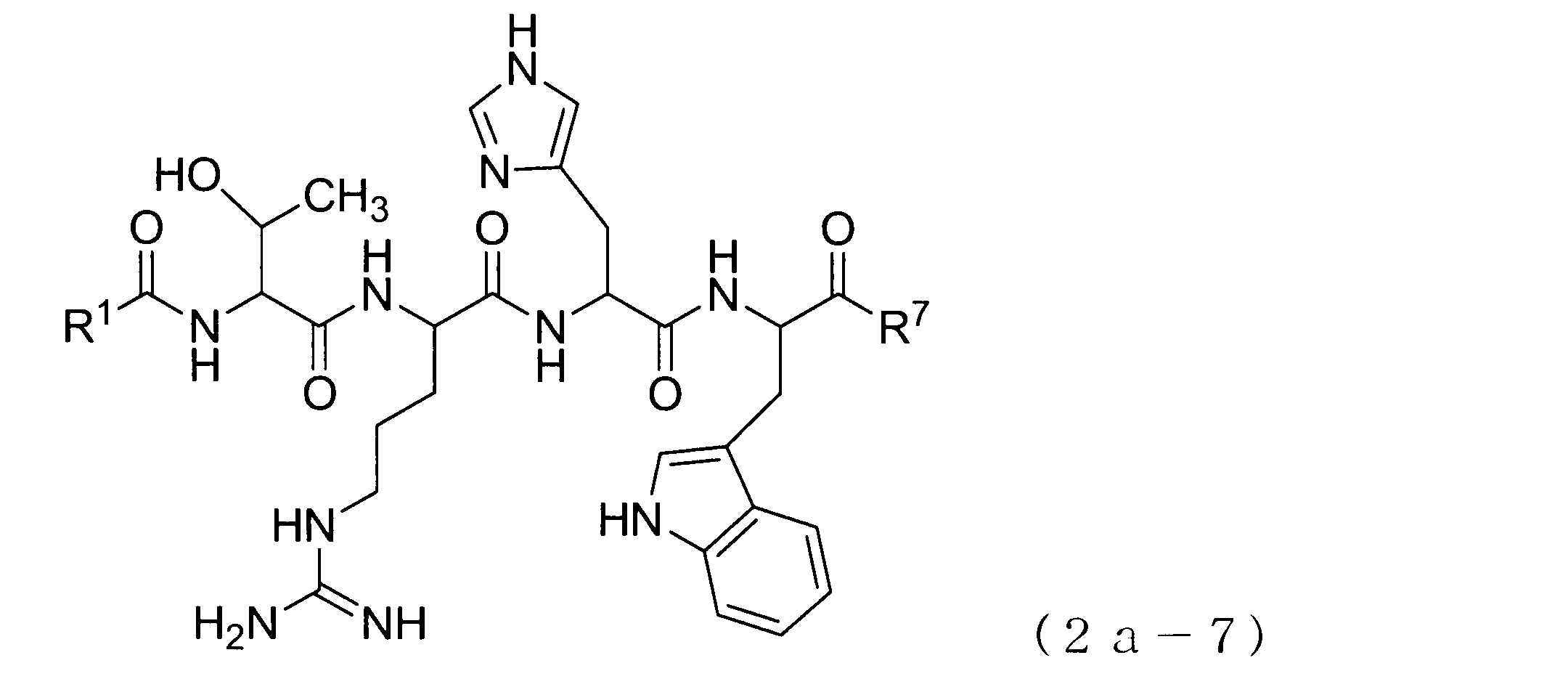
[式中、R1及びR7は、前記と同じ。] - 一般式(2)で表される出発原料化合物が、
一般式(2b)
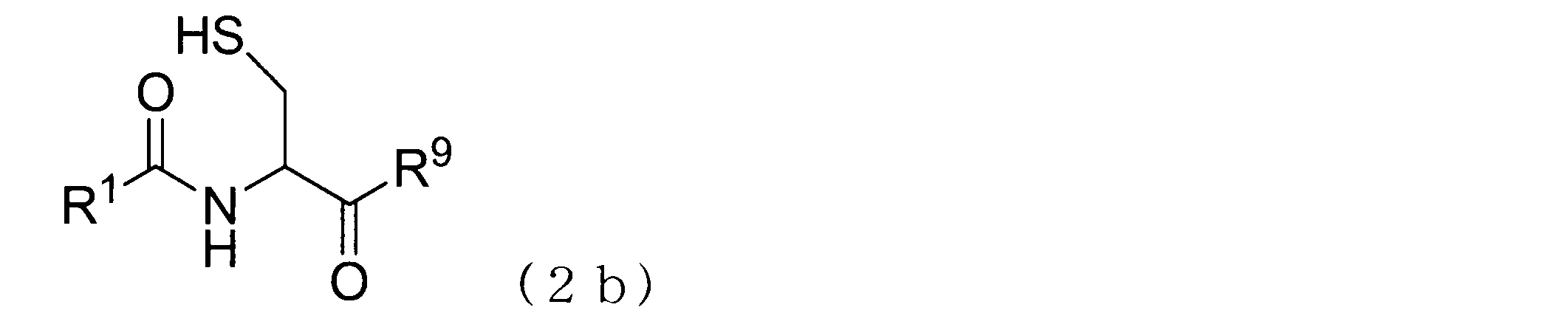
[式中、R1は、前記と同じ。
R9は、ヒドロキシル基、アミノ基、ヒドラジノ基又は有機基を示す。]
で表される化合物であり、
工程(C):上記一般式(2b)で表される化合物とニトリル化剤とを反応させる工程、及び
工程(D):工程(C)で得られる一般式(4)
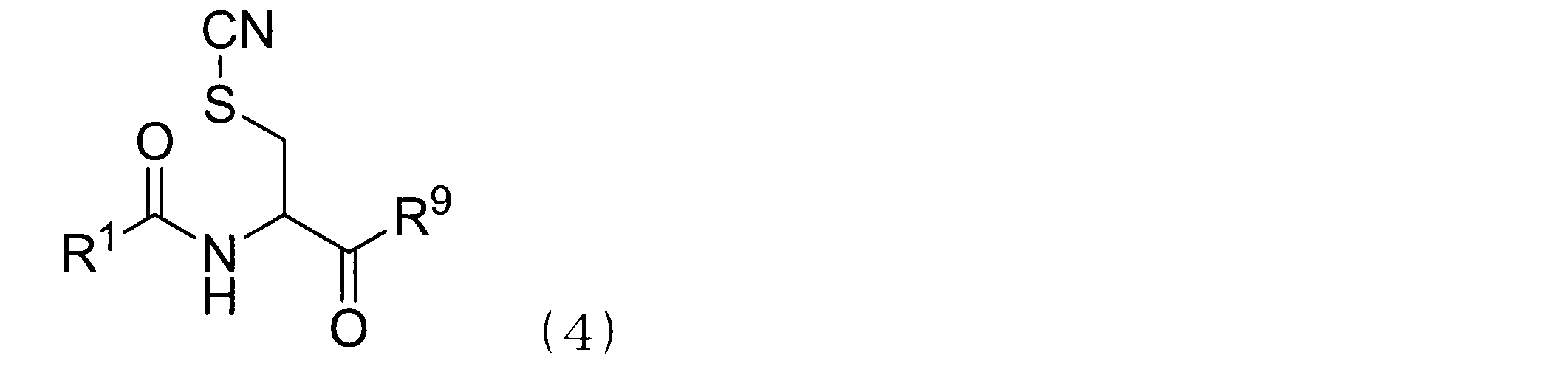
[式中、R1及びR9は、前記と同じ。]
で表されるチオシアナート化合物とヒドラジン化合物とを反応させる工程
を含む、請求項1に記載のペプチドヒドラジド化合物の製造方法。 - 工程(C)で用いられるニトリル化剤が、1-シアノ-4-(ジメチルアミノ)ピリジニウムテトラフルオロボレイト(CDAP)又は2-ニトロ-5-チオシアノ安息香酸である、請求項8に記載のペプチドヒドラジド化合物の製造方法。
- 請求項1~9に記載のペプチドヒドラジド化合物の製造方法であって、出発原料化合物である一般式(2)、(2a)、(2a-1)~(2a-7)及び/又は(2b)で表される化合物を、生物学的合成方法を用いて調製する、前記ペプチドヒドラジド化合物の製造方法。
- 一般式(5)

[式中、R1は、アミノ酸残基若しくはその誘導体、又は、ペプチド残基若しくはその誘導体を示す。R10は、置換基を有していてもよいアルキル基又は置換基を有していてもよいアリール基を示す。]
で表されるペプチドチオエステル化合物の製造方法であって、
工程(E):請求項1~10の何れか一項に記載の製造方法によって得られる一般式(1)で表されるペプチドヒドラジド化合物に亜硝酸塩を作用させる工程、及び
工程(F):工程(E)で得られる一般式(6)

[式中、R1は、前記と同じ。]
で表されるアシルアジド化合物とチオール化合物とを反応させる工程
を含む、前記ペプチドチオエステル化合物の製造方法。 - 一般式(5)

[式中、R1は、アミノ酸残基若しくはその誘導体、又は、ペプチド残基若しくはその誘導体を示す。R10は、置換基を有していてもよいアルキル基又は置換基を有していてもよいアリール基を示す。]
で表されるペプチドチオエステル化合物の製造方法であって、
工程(G):一般式(2)

[式中、R1は、前記と同じ。
R2は、水素原子又はアルキル基を示す。
R3は、ヒドロキシル基、アミノ基、ヒドラジノ基又は有機基を示す。
Xは、酸素原子又は硫黄原子を示す。]
で表される化合物を出発原料化合物に使用し、且つ
ヒドラジン化合物を反応試薬に使用する工程、
工程(E):工程(G)で得られる
一般式(1)

[式中、R1は、前記と同じ。]
で表されるペプチドヒドラジド化合物に亜硝酸塩を作用させる工程、及び
工程(F):工程(E)で得られる一般式(6)

[式中、R1は、前記と同じ。]
で表されるアシルアジド化合物とチオール化合物とを反応させる工程
を含む、前記ペプチドチオエステル化合物の製造方法。 - 請求項11又は12に記載のペプチドチオエステル化合物の製造方法であって、出発原料化合物である一般式(2)、(2a)、(2a-1)~(2a-7)及び/又は(2b)で表される化合物を、生物学的合成方法を用いて調製する、前記ペプチドチオエステル化合物の製造方法。
- 一般式(1)

[式中、R1は、アミノ酸残基若しくはその誘導体、又はペプチド残基若しくはその誘導体を示す。]
で表されるペプチドヒドラジド化合物の製造方法であって、
工程(D):一般式(4)
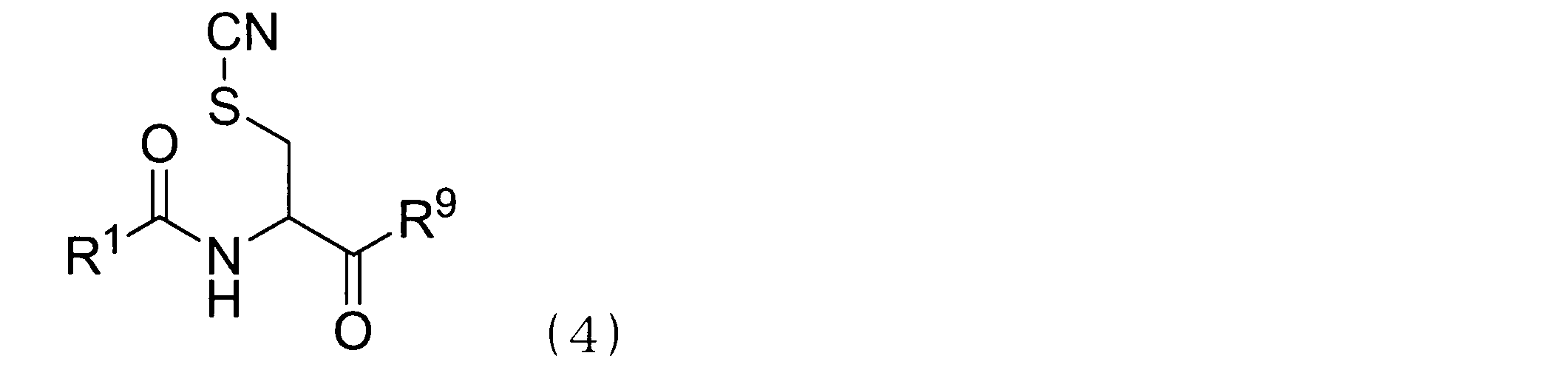
[式中、R1は、前記と同じ。
R9は、ヒドロキシル基、アミノ基、ヒドラジノ基又は有機基を示す。]
で表されるチオシアナート化合物とヒドラジン化合物とを反応させる工程
を含む、前記ペプチドヒドラジド化合物の製造方法。 - 一般式(5)

[式中、R1は、アミノ酸残基若しくはその誘導体、又は、ペプチド残基若しくはその誘導体を示す。
R10は、置換基を有していてもよいアルキル基又は置換基を有していてもよいアリール基を示す。]
で表されるペプチドチオエステル化合物の製造方法であって、
工程(D):一般式(4)
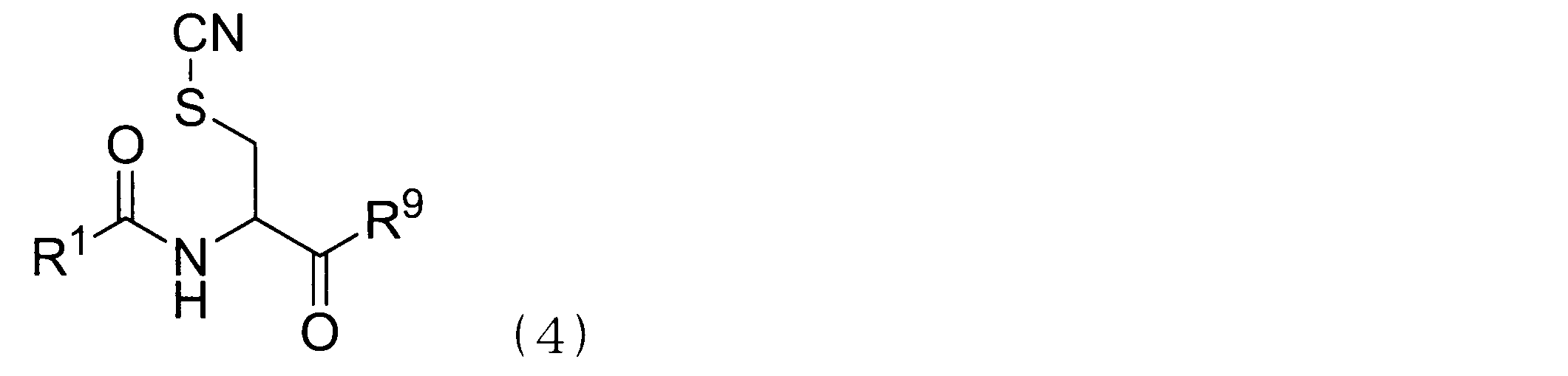
[式中、R1は、前記と同じ。
R9は、ヒドロキシル基、アミノ基、ヒドラジノ基又は有機基を示す。]
で表されるチオシアナート化合物とヒドラジン化合物とを反応させる工程、
工程(E):工程(D)によって得られる一般式(1)

[式中、R1は、前記と同じ。]
で表されるペプチドヒドラジド化合物に亜硝酸塩を作用させる工程、及び
工程(F):工程(E)で得られる一般式(6)

[式中、R1は、前記と同じ。]
で表されるアシルアジド化合物とチオール化合物とを反応させる工程
を含む、前記ペプチドチオエステル化合物の製造方法。 - 一般式(1)

[式中、R1は、アミノ酸残基若しくはその誘導体、又はペプチド残基若しくはその誘導体を示す。]
で表されるペプチドアミド化合物の製造方法であって、
一般式(2)

[式中、R1は、前記と同じ。
R2は、水素原子又はアルキル基を示す。
R3は、ヒドロキシル基、アミノ基、ヒドラジノ基又は有機基を示す。
Xは、酸素原子又は硫黄原子を示す。]
で表される化合物を出発原料化合物に使用し、且つ
アンモニア化合物を反応試薬に使用する、前記ペプチドアミド化合物の製造方法。 - トリアゾール環を有する化合物の製造方法であって、
工程(A’):一般式(2)
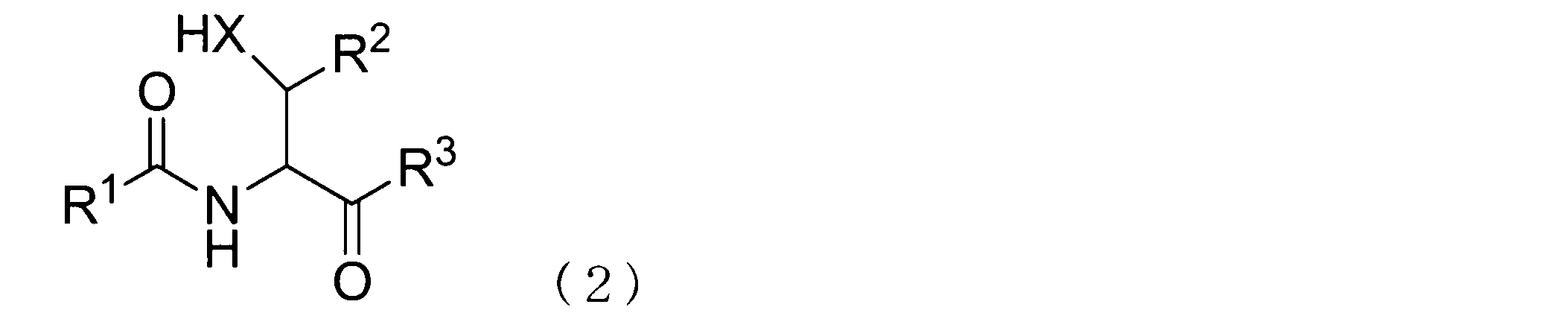
[式中、R1は、アミノ酸残基若しくはその誘導体、又はペプチド残基若しくはその誘導体を示す。
R2は、水素原子又はアルキル基を示す。
R3は、ヒドロキシル基、アミノ基、ヒドラジノ基又は有機基を示す。
Xは、酸素原子又は硫黄原子を示す。]
で表される化合物と三重結合を有するアルコール化合物とを反応させる工程、及び
工程(H):工程(A’)で得られる一般式(3a)

[式中、R1は、前記と同じ。
R8aは、三重結合を有するアルキル基を示す。]
で表されるエステル化合物と、アジド化合物とを反応させる工程を含む、
前記トリアゾール環を有する化合物の製造方法。 - 三重結合を有するアルコール化合物が、3-ブチン-1-オール、シクロオクチン-1-オール、ジベンゾシクロオクチン-1-オール及びジベンゾシクロオクチン-(ポリエチレングリコール)-アルコールからなる群より選ばれる少なくとも一種である、請求項17に記載のトリアゾール環を有する化合物の製造方法。
Priority Applications (2)
| Application Number | Priority Date | Filing Date | Title |
|---|---|---|---|
| JP2015546572A JP6493216B2 (ja) | 2013-11-05 | 2014-10-10 | ペプチドヒドラジド、ペプチドアミド及びペプチドチオエステルの製造方法 |
| US15/146,589 US10053491B2 (en) | 2013-11-05 | 2016-05-04 | Method for producing peptide hydrazide, peptide amide, and peptide thioester |
Applications Claiming Priority (2)
| Application Number | Priority Date | Filing Date | Title |
|---|---|---|---|
| JP2013229717 | 2013-11-05 | ||
| JP2013-229717 | 2013-11-05 |
Related Child Applications (1)
| Application Number | Title | Priority Date | Filing Date |
|---|---|---|---|
| US15/146,589 Continuation US10053491B2 (en) | 2013-11-05 | 2016-05-04 | Method for producing peptide hydrazide, peptide amide, and peptide thioester |
Publications (1)
| Publication Number | Publication Date |
|---|---|
| WO2015068532A1 true WO2015068532A1 (ja) | 2015-05-14 |
Family
ID=53041315
Family Applications (1)
| Application Number | Title | Priority Date | Filing Date |
|---|---|---|---|
| PCT/JP2014/077271 Ceased WO2015068532A1 (ja) | 2013-11-05 | 2014-10-10 | ペプチドヒドラジド、ペプチドアミド及びペプチドチオエステルの製造方法 |
Country Status (3)
| Country | Link |
|---|---|
| US (1) | US10053491B2 (ja) |
| JP (1) | JP6493216B2 (ja) |
| WO (1) | WO2015068532A1 (ja) |
Cited By (1)
| Publication number | Priority date | Publication date | Assignee | Title |
|---|---|---|---|---|
| US10758623B2 (en) | 2013-12-09 | 2020-09-01 | Durect Corporation | Pharmaceutically active agent complexes, polymer complexes, and compositions and methods involving the same |
Families Citing this family (4)
| Publication number | Priority date | Publication date | Assignee | Title |
|---|---|---|---|---|
| CN112521483A (zh) * | 2019-09-19 | 2021-03-19 | 深圳翰宇药业股份有限公司 | 一种乌拉立肽的制备方法 |
| CN113735940B (zh) * | 2020-05-31 | 2023-08-29 | 深圳市健元医药科技有限公司 | 一种肽的固相合成方法 |
| EP4737471A1 (en) * | 2024-10-29 | 2026-05-06 | NUMAFERM GmbH | Methods for the c-terminal modification of (poly)peptides |
| WO2025247862A1 (en) * | 2024-05-27 | 2025-12-04 | Numaferm Gmbh | Methods for the c-terminal modification of (poly)peptides |
Citations (5)
| Publication number | Priority date | Publication date | Assignee | Title |
|---|---|---|---|---|
| JPH06504676A (ja) * | 1991-03-01 | 1994-06-02 | カールバイオテック リミテッド アクティーゼルスカブ | C末端から2番目にプロリン残基を有するペプチドのc−末端の修飾方法 |
| JPH1171396A (ja) * | 1997-06-27 | 1999-03-16 | Takeda Chem Ind Ltd | 19p2リガンドの製造法 |
| WO1999065931A1 (en) * | 1998-06-17 | 1999-12-23 | Magainin Pharmaceuticals, Inc. | Non-enzymatic chemical amidation process |
| JP2005536470A (ja) * | 2002-05-24 | 2005-12-02 | リストレイジェン・インコーポレイテッド | ペプチドアミド化方法 |
| CN102199214A (zh) * | 2011-03-15 | 2011-09-28 | 清华大学 | 制备蛋白质的方法 |
Family Cites Families (3)
| Publication number | Priority date | Publication date | Assignee | Title |
|---|---|---|---|---|
| EP0887417A3 (en) | 1997-06-27 | 1999-01-13 | Takeda Chemical Industries, Ltd. | Method of producing a 19P2 ligand by cleavage of a fusion protein containing it |
| SE0201863D0 (en) * | 2002-06-18 | 2002-06-18 | Cepep Ab | Cell penetrating peptides |
| ES2323706T3 (es) * | 2003-08-05 | 2009-07-23 | Almac Sciences (Scotland) Limited | Metodo de ligacion. |
-
2014
- 2014-10-10 WO PCT/JP2014/077271 patent/WO2015068532A1/ja not_active Ceased
- 2014-10-10 JP JP2015546572A patent/JP6493216B2/ja not_active Expired - Fee Related
-
2016
- 2016-05-04 US US15/146,589 patent/US10053491B2/en not_active Expired - Fee Related
Patent Citations (5)
| Publication number | Priority date | Publication date | Assignee | Title |
|---|---|---|---|---|
| JPH06504676A (ja) * | 1991-03-01 | 1994-06-02 | カールバイオテック リミテッド アクティーゼルスカブ | C末端から2番目にプロリン残基を有するペプチドのc−末端の修飾方法 |
| JPH1171396A (ja) * | 1997-06-27 | 1999-03-16 | Takeda Chem Ind Ltd | 19p2リガンドの製造法 |
| WO1999065931A1 (en) * | 1998-06-17 | 1999-12-23 | Magainin Pharmaceuticals, Inc. | Non-enzymatic chemical amidation process |
| JP2005536470A (ja) * | 2002-05-24 | 2005-12-02 | リストレイジェン・インコーポレイテッド | ペプチドアミド化方法 |
| CN102199214A (zh) * | 2011-03-15 | 2011-09-28 | 清华大学 | 制备蛋白质的方法 |
Non-Patent Citations (6)
| Title |
|---|
| ADAMS, AL. ET AL.: "Cysteine promoted C- terminal hydrazinolysis of native peptides and proteins", ANGEW. CHEM. INT. ED. ENGL., vol. 52, no. 49, October 2013 (2013-10-01), pages 13062 - 13066 * |
| AKIRA SHIGENAGA ET AL.: "Recent Progress in the Synthetic Methodologies of Peptide Thioesters", JOURNAL OF SYNTHETIC ORGANIC CHEMISTRY, vol. 68, no. 9, 2010, JAPAN, pages 911 - 919 * |
| CHANDRUDU, S. ET AL.: "Chemical methods for peptide and protein production", MOLECULES, vol. 18, no. 4, April 2013 (2013-04-01), pages 4373 - 4388 * |
| FANG, GM. ET AL.: "Protein chemical synthesis by ligation of peptide hydrazides", ANGEW. CHEM. INT. ED. ENGL., vol. 50, no. 33, 2011, pages 7645 - 7649 * |
| STEMMLER EA . ET AL.: "C-terminal methylation of truncated neuropeptides: an enzyme-assisted extraction artifact involving methanol", PEPTIDES, vol. 46, 2013, pages 108 - 125 * |
| YURIE KANEMITSU ET AL.: "S-cyanyl Cysteine Zanki Bui deno Sentakuteki Hydrazide-ka Hanno o Riyo shita Shinki Peptide Thioester Goseiho no Kaihatsu Kenkyu", 94TH ANNUAL MEETING OF THE CHEMICAL SOCIETY OF JAPAN IN SPRING (2014) KOEN YOSHISHU IV, March 2014 (2014-03-01), pages 1472 * |
Cited By (2)
| Publication number | Priority date | Publication date | Assignee | Title |
|---|---|---|---|---|
| US10758623B2 (en) | 2013-12-09 | 2020-09-01 | Durect Corporation | Pharmaceutically active agent complexes, polymer complexes, and compositions and methods involving the same |
| US11529420B2 (en) | 2013-12-09 | 2022-12-20 | Durect Corporation | Pharmaceutically active agent complexes, polymer complexes, and compositions and methods involving the same |
Also Published As
| Publication number | Publication date |
|---|---|
| JP6493216B2 (ja) | 2019-04-03 |
| US20160264626A1 (en) | 2016-09-15 |
| US10053491B2 (en) | 2018-08-21 |
| JPWO2015068532A1 (ja) | 2017-03-09 |
Similar Documents
| Publication | Publication Date | Title |
|---|---|---|
| JP4857279B2 (ja) | カルボキシ末端をアミド化したペプチドの製造方法 | |
| Huang et al. | Chemical synthesis of proteins using hydrazide intermediates | |
| Malins et al. | Peptide ligation chemistry at selenol amino acids | |
| JP6493216B2 (ja) | ペプチドヒドラジド、ペプチドアミド及びペプチドチオエステルの製造方法 | |
| Raibaut et al. | Accelerating chemoselective peptide bond formation using bis (2-selenylethyl) amido peptide selenoester surrogates | |
| JP5352234B2 (ja) | 特定のエンドプロテアーゼによって塩基性アミノ酸のc末端を用いてポリペプチドをアミド化する方法 | |
| CN112739823A (zh) | 吡咯赖氨酰-tRNA合成酶 | |
| Kamo et al. | Efficient peptide ligation between allyl-protected Asp and Cys followed by palladium-mediated deprotection | |
| Reimann et al. | Native chemical ligation between asparagine and valine: application and limitations for the synthesis of tri-phosphorylated C-terminal tau | |
| CA2242086A1 (en) | Method of producing a 19p2 ligand | |
| EP1651664B1 (en) | Ligation method | |
| WO2016170447A1 (en) | Recombinant microbial transglutaminases | |
| CN114480534B (zh) | 基于转肽酶的化学酶法的蛋白质半合成 | |
| Hwang et al. | Enzyme-catalyzed peptide segment condensation using 5 (4H)-oxazolones as acyl donors | |
| JP5730197B2 (ja) | ペプチドチオエステル体の製造方法 | |
| KR102537988B1 (ko) | 흐름에서 천연 화학적 라이게이션을 이용한 신규 합성 방법 | |
| WO2013047372A1 (ja) | Ncl法に適した、ポリペプチド断片の効率的な製造方法 | |
| Forbes et al. | Native Chemical Ligation at Phenylalanine via 2-Mercaptophenylalanine | |
| WO2023048262A1 (ja) | 酵素を用いたペプチドライゲーション | |
| JP2011239686A (ja) | ペプチド及びペプチド誘導体の製造方法 | |
| Dardashti et al. | Chemical Synthesis of Selenoproteins | |
| Zhu et al. | Facile Synthesis of Boc-Protected Selenocystine and its Compatibility with Late-Stage Farnesylation at Cysteine Site | |
| 津田雄介 et al. | Development of novel methodologies for the preparation of peptide/protein thioesters applicable to naturally occurring sequences | |
| Qiao | Site-Specific Protein Functionalization Using Activated Cysteine Based Chemical Biology Methods | |
| Vinogradov | New methods for synthesis and modification of peptides and proteins |
Legal Events
| Date | Code | Title | Description |
|---|---|---|---|
| 121 | Ep: the epo has been informed by wipo that ep was designated in this application |
Ref document number: 14860203 Country of ref document: EP Kind code of ref document: A1 |
|
| ENP | Entry into the national phase |
Ref document number: 2015546572 Country of ref document: JP Kind code of ref document: A |
|
| NENP | Non-entry into the national phase |
Ref country code: DE |
|
| 122 | Ep: pct application non-entry in european phase |
Ref document number: 14860203 Country of ref document: EP Kind code of ref document: A1 |