WO2015064343A1 - チタン合金および人工骨 - Google Patents
チタン合金および人工骨 Download PDFInfo
- Publication number
- WO2015064343A1 WO2015064343A1 PCT/JP2014/077190 JP2014077190W WO2015064343A1 WO 2015064343 A1 WO2015064343 A1 WO 2015064343A1 JP 2014077190 W JP2014077190 W JP 2014077190W WO 2015064343 A1 WO2015064343 A1 WO 2015064343A1
- Authority
- WO
- WIPO (PCT)
- Prior art keywords
- modulus
- alloy
- young
- titanium alloy
- titanium
- Prior art date
- Legal status (The legal status is an assumption and is not a legal conclusion. Google has not performed a legal analysis and makes no representation as to the accuracy of the status listed.)
- Ceased
Links
Images

Classifications
-
- C—CHEMISTRY; METALLURGY
- C22—METALLURGY; FERROUS OR NON-FERROUS ALLOYS; TREATMENT OF ALLOYS OR NON-FERROUS METALS
- C22C—ALLOYS
- C22C14/00—Alloys based on titanium
-
- A—HUMAN NECESSITIES
- A61—MEDICAL OR VETERINARY SCIENCE; HYGIENE
- A61L—METHODS OR APPARATUS FOR STERILISING MATERIALS OR OBJECTS IN GENERAL; DISINFECTION, STERILISATION OR DEODORISATION OF AIR; CHEMICAL ASPECTS OF BANDAGES, DRESSINGS, ABSORBENT PADS OR SURGICAL ARTICLES; MATERIALS FOR BANDAGES, DRESSINGS, ABSORBENT PADS OR SURGICAL ARTICLES
- A61L27/00—Materials for grafts or prostheses or for coating grafts or prostheses
- A61L27/02—Inorganic materials
- A61L27/04—Metals or alloys
- A61L27/06—Titanium or titanium alloys
-
- A—HUMAN NECESSITIES
- A61—MEDICAL OR VETERINARY SCIENCE; HYGIENE
- A61L—METHODS OR APPARATUS FOR STERILISING MATERIALS OR OBJECTS IN GENERAL; DISINFECTION, STERILISATION OR DEODORISATION OF AIR; CHEMICAL ASPECTS OF BANDAGES, DRESSINGS, ABSORBENT PADS OR SURGICAL ARTICLES; MATERIALS FOR BANDAGES, DRESSINGS, ABSORBENT PADS OR SURGICAL ARTICLES
- A61L2430/00—Materials or treatment for tissue regeneration
- A61L2430/02—Materials or treatment for tissue regeneration for reconstruction of bones; weight-bearing implants
Definitions
- the present invention relates to a titanium alloy and an artificial bone using the titanium alloy, and particularly to a titanium alloy and an artificial bone having a low Young's modulus and a high strength.
- Titanium alloys are known to have good biocompatibility (rejection reaction etc. are difficult to occur even when used in a living body) and have been used as biomaterials.
- a titanium alloy when used as an implant material in the treatment of a fracture site or the like, it is preferable to use a material close to bone characteristics (elastic modulus and strength). Since the elastic modulus (Young's modulus) of bone is about 10 to 40 [GPa], an alloy having a Young's modulus of 50 [GPa] or less is desired.
- Patent Documents 1 to 10 For titanium alloys having a Young's modulus lower than that of pure titanium, techniques described in Patent Documents 1 to 10 below are known.
- Japanese Patent No. 5143704 as Patent Document 1 contains 13 to 28 atom% (at%) of Nb and 0.1 to 10 at% of Sn, and any one of V, W, Zr and Al.
- a Ti—Nb—Sn based alloy containing 0.1 to 5 at% of one kind is described.
- the Ti—Nb—Sn alloy of Patent Document 1 has a Young's modulus measured by a resonance method of 54.2 GPa or more.
- Patent Document 2 describes Ti— (25 wt% -40 wt%) Nb— (0-10 wt%) Sn alloy, Ti— (10 wt% —16 wt%) V— (0-8 wt%). ) A Sn alloy is described.
- the Young's modulus measured by the resonance method is less than 50 [GPa] after 89% cold rolling, but it is 50 after heat treatment. [GPa] is exceeded. If it is only cold-rolled and not heat-treated, there is a problem that ductility is poor and uniform elongation is very small. Note that in a Ti—V—Sn titanium alloy, the Young's modulus measured by the resonance method is 59 [GPa] or more.
- Patent Document 3 discloses a titanium alloy containing 13 to 28 atom% (at%) Nb and 0.1 to 10 at% Sn, or 13 to 28 atom% (at%). Ti—Nb—Sn containing 0.1 to 5 at% of any one or more of V, Mo, W, Zr and Al in addition to Nb of 0.1 to 10 to 10 at% of Sn Alloys are described. Each alloy of Patent Document 3 has a Young's modulus measured by a resonance method of 50.4 GPa or more.
- Japanese Patent No. 4152050 as Patent Document 4 25-50 mass% (wt%) Ti, 25-60 mass% Zr, 10-20 mass% Nb, and 5-40 mass% Ta, Zr / Ta is 0.5 to 1.5, Nb / Ta is 0.125 to 1.5, tensile strength / Young's modulus is 0.016 or more, and Young's modulus is 70 GPa.
- the following titanium alloys are described. In the titanium alloy described in Patent Document 4, the Young's modulus measured using an Instron tensile tester is 53.0 [GPa] or more.
- Patent Document 5 contains 10.5 to 25% by mass (wt%) of Nb and 0.1 to 8% by mass of Sn. Containing at least one kind of Mo% by mass, 0.1-6.4% by mass Cr, 0.1-4.7% by mass Mn, and 0.1-3.2% by mass Fe
- a titanium alloy in which molybdenum equivalents of Mo, Cr, Mn, and Fe are 2 to 8 and (mass% of Nb / 3.5) + (molybdenum equivalent) is 9 to 11 is described.
- the Young's modulus measured by the resonance method is 67.1 [GPa] or more.
- Japanese Patent No. 3375083 as Patent Document 6 describes a titanium alloy containing 30 to 60% by mass (wt%) of a Va group element (V, Nb, Ta).
- the average Young's modulus is measured from a stress-strain diagram measured by an Instron tensile tester, and the average Young's modulus is 46 [GPa] or more.
- the average Young's modulus is an index different from the general Young's modulus as described in paragraph No. “0006” of Patent Document 4, and is a lower value than the general Young's modulus. Therefore, it is unlikely that the general Young's modulus of the titanium alloy described in Patent Document 6 is 50 [GPa] or less even if the sweetness is estimated.
- Patent Document 7 describes a titanium alloy containing 10 to 35 mass% (wt%) of Zr and 8 to 14 mass% of Cr.
- the Young's modulus measured by the resonance method is 72 [GPa] or more.
- Patent Document 8 contains 0.3 to 3% by mass (wt%) of one or more of oxygen, nitrogen and carbon and 1.8% by mass or less of Al.
- a titanium alloy having a value obtained by subtracting the mass% of Al from the molybdenum equivalent of Mo, V, W, Nb, Ta, Fe, Cr, Ni, Co, and Cu is 3 to 11 mass% is described. Yes.
- the Young's modulus derived from the stress-strain diagram is 50 [GPa] or more.
- Patent Document 9 describes 3.5 to 7.0 mass% (wt%) Al, 1.4 to 3.6 mass% Fe, and 2.0 to 10 mass%. And a titanium alloy containing 0.0% by mass of Mo and having a molybdenum equivalent weight of 6.0 to 14.0% by mass. In the titanium alloy described in Patent Document 9, the Young's modulus measured by the resonance method is 65 [GPa] or more.
- Patent Document 10 describes 12 to 30 wt% (wt%) of Nb, 12 to 30 wt% of Zr, 1 to 6 wt% of Al, and 1 to 8 wt%. Titanium alloys containing 1% Cr and 1-8% by weight Sn are described. In the titanium alloy described in Patent Document 10, the Young's modulus measured based on JIS using a tensile tester is 80 [GPa] or more.
- Japanese Patent No. 5143704 ("0026") Japanese Patent No. 5005889 (“0032” to “0042”, FIG. 2) JP 2005-113227 A (“0026” to “0027”) Japanese Patent No. 4152050 (“0049”, “0053”) JP 2010-1503 (“0028” to “0030") Japanese Patent No. 3375083 ("0114” to “0122”) JP 2004-353039 A (“0013” to “0015”) JP 2004-162171 A (“0045” to “0051”) JP 2010-216011 (“0030” to “0032”) JP 2008-101234 A (“0037”, FIG. 1)
- the technical problem of the present invention is to provide a titanium alloy having a low Young's modulus and a high strength.
- the titanium alloy of the invention according to claim 1 1 to 15 at% niobium, 2at% or more and 5at% or less of iron, Aluminum of 2 at% or more and 12 at% or less, The remaining titanium, With inevitable impurities, It is characterized by comprising.
- a titanium alloy according to claim 1 is used.
- the first and second aspects of the invention it is possible to provide a titanium alloy having a low Young's modulus and a high strength as compared with the conventional configuration.
- iron and aluminum since iron and aluminum are used, raw material costs can be reduced and the melting point can be lowered as compared with the case of using rare metals.
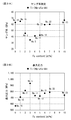
- FIG. 1 shows the results of evaluating changes in the properties of the alloy when the concentration of aluminum is changed.
- FIG. 1A is a graph in which the horizontal axis indicates the aluminum content and the vertical axis indicates the Young's modulus.
- FIG. It is the graph which took the content of aluminum on the axis
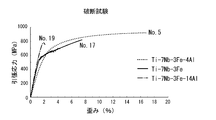
- FIG. 2 is an explanatory diagram comparing the concentration dependence of aluminum, and is a graph of stress-strain curves of alloys 5, 17 and 19, with the horizontal axis representing strain and the vertical axis representing stress. .
- FIG. 3 is a result of evaluating the change in the characteristics of the alloy when the iron concentration is changed.
- FIG. 1A is a graph in which the horizontal axis indicates the aluminum content and the vertical axis indicates the Young's modulus.
- FIG. It is the graph which took the content of aluminum on the axis
- FIG. 2 is an explanatory diagram
- FIG. 3A is a graph in which the horizontal axis indicates the iron content and the vertical axis indicates the Young's modulus.
- FIG. It is the graph which took iron content on the axis
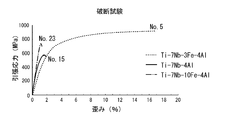
- FIG. 4 is an explanatory diagram comparing the concentration dependence of iron, and is a graph of stress-strain curves of alloys 5, 15, and 23, with the horizontal axis representing strain and the vertical axis representing stress. .
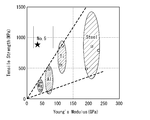
- FIG. 5 is an explanatory diagram for comparison between the existing alloy and the alloy of the example, and is a graph in which Young's modulus is taken on the horizontal axis and tensile strength is taken on the vertical axis.
- Test specimens of Alloy 1 to Alloy 13 having the alloy compositions shown in Table 1 below, which are examples of the present invention, and Alloy 14 to Alloy 24 as comparative examples were prepared and tested.
- the test pieces used in the experiment were produced by the following methods (1) to (3).
- (1) At% of each metal element is measured and melted by an arc melting method to produce an alloy ingot. That is, Alloy 1 (Ti-13Nb-2Fe-4Al) is an alloy having an alloy composition of 13 at% Nb, 2 at% Fe, 4 at% Al, and the balance (81 at%) of Ti.
- Ti-7Nb-3Fe-2Al is an alloy having an alloy composition of 7 at% Nb, 3 at% Fe, 2 at% Al, and the balance (88 at%) of Ti.
- the produced alloy ingot is cold-rolled at a rolling rate of 80% to 95% with a cold rolling mill to produce a plate material.
- a test specimen for measurement is cut out from the plate material by an electric discharge machine.
- the test piece for measuring Young's modulus has a length of 30 mm, a width of 6 mm, and a thickness of 0.2 mm.
- the specimen for the tensile test has a gauge length of 20 mm, a width of 1.5 mm, and a thickness of 0.2 mm.
- the cut specimen is subjected to heat treatment at 900 ° C. for 30 minutes in an argon atmosphere.
- the quaternary alloy with Nb of 1 to 15 at%, Fe of 2 to 5 at%, and Al of 2 to 12 at% has a Young's modulus of less than 50 [GPa] and a maximum stress of 600 [MPa] or more.
- Alloys 5 to 10 and 13 have a Young's modulus of 30 [GPa], close to the Young's modulus of human bone, and can be suitably used as a material for artificial bones.
- the Young's modulus and the maximum stress cannot be measured, and the cold workability is very bad.
- there is more niobium than 16 at% as shown in the alloy 14, there is a problem that the maximum stress (strength) becomes low and the Young's modulus exceeds 50 [GPa].
- FIG. 1 shows the results of evaluating changes in the properties of the alloy when the concentration of aluminum is changed.
- FIG. 1A is a graph in which the horizontal axis indicates the aluminum content and the vertical axis indicates the Young's modulus.
- FIG. It is the graph which took the content of aluminum on the axis
- FIG. 2 is an explanatory diagram comparing the concentration dependence of aluminum, and is a graph of stress-strain curves of alloys 5, 17 and 19, with the horizontal axis representing strain and the vertical axis representing stress. .
- FIG. 1A is a graph in which the horizontal axis indicates the aluminum content and the vertical axis indicates the Young's modulus.
- FIG. It is the graph which took the content of aluminum on the axis
- FIG. 2 is an explanatory diagram comparing the concentration dependence of aluminum, and is a graph of stress-strain curves
- FIG. 3 is a result of evaluating the change in the characteristics of the alloy when the iron concentration is changed.
- FIG. 3A is a graph in which the horizontal axis indicates the iron content and the vertical axis indicates the Young's modulus.
- FIG. It is the graph which took iron content on the axis
- FIG. 4 is an explanatory diagram comparing the concentration dependence of iron, and is a graph of stress-strain curves of alloys 5, 15, and 23, with the horizontal axis representing strain and the vertical axis representing stress. .
- FIG. 3A is a graph in which the horizontal axis indicates the iron content and the vertical axis indicates the Young's modulus.
- FIG. It is the graph which took iron content on the axis
- FIG. 4 is an explanatory diagram comparing the concentration dependence of iron, and is a graph of stress-strain curves of alloys
- FIG. 5 is an explanatory diagram for comparison between the existing alloy and the alloy of the example, and is a graph in which Young's modulus is taken on the horizontal axis and tensile strength is taken on the vertical axis. Therefore, in the alloys of Examples, Patent Documents 1 to 10 are made of titanium alloys containing 1 at% or more and 5 at% or less of niobium, 2 at% or more and 5 at% or less of iron, and 2 at% or more and 12 at% or less of aluminum. Compared with the alloy shown in FIG. 1, an alloy having a Young's modulus of less than 50 [GPa] and a strength of 600 [MPa] or more and good workability can be provided. As shown in FIG.
- the strength increases as the Young's modulus increases, and the strength tends to decrease as the Young's modulus decreases.
- the alloy of the example can realize a high strength titanium alloy while realizing a low Young's modulus of less than 50 [GPa]. Therefore, a titanium alloy having a low Young's modulus, high strength, good workability, and high biocompatibility can be provided.
- Nb is 15 at% or less, and since relatively inexpensive elements such as Fe and Al are used, so-called rare metals such as V, Zr, Mo, and W are used. Compared to conventional alloys, the manufacturing cost can also be reduced.
- titanium alloys other than Ti—Ni alloys have a high melting point, and there is a problem that a large-scale facility is required for melting, manufacturing and processing.
- Fe and Al are added, the melting point of the alloy tends to be lowered. Therefore, it is possible to manufacture without increasing the temperature, and it can be expected to reduce the manufacturing cost.
- Example of this invention was explained in full detail, this invention is not limited to the said Example, A various change is performed within the range of the summary of this invention described in the claim. It is possible. For example, using high biocompatibility, it can be suitably used for a living body / medical member used in an operation or treatment such as an artificial bone, an implant, or an orthodontic wire, but is not limited thereto. For example, using low Young's modulus (high flexibility) and high strength, it can be suitably applied to glasses frames, golf clubs, automobiles such as suspensions and springs, motorcycle parts, and leisure goods such as tent poles. It is.
Landscapes
- Chemical & Material Sciences (AREA)
- Health & Medical Sciences (AREA)
- Oral & Maxillofacial Surgery (AREA)
- Transplantation (AREA)
- Metallurgy (AREA)
- Organic Chemistry (AREA)
- Inorganic Chemistry (AREA)
- Materials Engineering (AREA)
- Dermatology (AREA)
- Medicinal Chemistry (AREA)
- Engineering & Computer Science (AREA)
- Mechanical Engineering (AREA)
- Epidemiology (AREA)
- Life Sciences & Earth Sciences (AREA)
- Animal Behavior & Ethology (AREA)
- General Health & Medical Sciences (AREA)
- Public Health (AREA)
- Veterinary Medicine (AREA)
- Materials For Medical Uses (AREA)
- Prostheses (AREA)
Abstract
1at%以上15at%以下のニオブと、2at%以上5at%以下の鉄と、2at%以上12at%以下のアルミニウムと、残部のチタンと、不可避的不純物と、からなることを特徴とするチタン合金により、低ヤング率で高強度のチタン合金を提供する。
Description
本発明は、チタン合金および前記チタン合金が使用された人工骨に関し、特に、低ヤング率で高強度のチタン合金および人工骨に関する。
チタン合金は、生体適合性がよい(生体に使用しても拒絶反応等がでにくい)ことが知られており、従来から生体材料として使用されてきた。特に、骨折の部位の治療等において、インプラント材としてチタン合金を使用する場合には、骨の特性(弾性率や強度)に近い材料を使用することが好ましい。骨の弾性率(ヤング率)は、10~40[GPa]程度であるため、ヤング率が50[GPa]以下の合金が望まれている。
ヤング率が純チタンよりも低くしたチタン合金について、下記の特許文献1~10に記載の技術が公知である。
特許文献1としての特許第5143704号公報には、13~28atom%(at%)のNbと0.1~10at%のSnとを含有し、さらに、V,W,ZrおよびAlのうちのいずれか1種を0.1~5at%含有するTi-Nb-Sn系合金が記載されている。特許文献1のTi-Nb-Sn合金は、共振法で測定されたヤング率が、54.2GPa以上となっている。
特許文献1としての特許第5143704号公報には、13~28atom%(at%)のNbと0.1~10at%のSnとを含有し、さらに、V,W,ZrおよびAlのうちのいずれか1種を0.1~5at%含有するTi-Nb-Sn系合金が記載されている。特許文献1のTi-Nb-Sn合金は、共振法で測定されたヤング率が、54.2GPa以上となっている。
特許文献2としての特許第5005889号公報には、Ti-(25wt%-40wt%)Nb-(0-10wt%)Sn合金や、Ti-(10wt%-16wt%)V-(0-8wt%)Sn合金が記載されている。特許文献2のTi-Nb-Sn系のチタン合金では、共振法で測定されたヤング率が、89%冷間圧延後は50[GPa]未満となっているが、熱処理を行った後は50[GPa]を超えている。冷間圧延しただけで、熱処理をしないと、延性に乏しく均一伸びが非常に小さい問題がある。なお、Ti-V-Sn系のチタン合金では、共振法で測定されたヤング率は、59[GPa]以上となっている。
特許文献3としての特開2005-113227号公報には、13~28atom%(at%)のNbと0.1~10at%のSnとを含有するチタン合金や、13~28atom%(at%)のNbと0.1~10at%のSnとに加え、V,Mo,W,ZrおよびAlのうちのいずれか1種または2種以上を0.1~5at%含有するTi-Nb-Sn系合金が記載されている。特許文献3の各合金は、共振法で測定されたヤング率が、50.4GPa以上となっている。
特許文献4としての特許第4152050号公報には、25~50質量%(wt%)のTiと、25~60質量%のZrと、10~20質量%のNbと、5~40質量%のTaと、を含有し、Zr/Taが0.5~1.5であり、且つ、Nb/Taが0.125~1.5、引っ張り強度/ヤング率が0.016以上、ヤング率が70GPa以下のチタン合金が記載されている。特許文献4に記載のチタン合金では、インストロン引張り試験機を使用して測定されたヤング率が53.0[GPa]以上となっている。
特許文献5としての特開2010-1503号公報には、10.5~25質量%(wt%)のNbと、0.1~8質量%のSnと、を含有し、0.1~8質量%のMoと、0.1~6.4質量%のCrと、0.1~4.7質量%のMnと、0.1~3.2質量%のFeと、を少なくとも1種類含有し、Mo、Cr、Mn、Feのモリブデン当量が2~8、且つ、(Nbの質量%/3.5)+(モリブデン当量)が9~11であるチタン合金が記載されている。特許文献5に記載のチタン合金では、共振法により測定されたヤング率は、67.1[GPa]以上となっている。
特許文献6としての特許第3375083号公報には、30~60質量%(wt%)のVa族元素(V,Nb,Ta)と、を含有するチタン合金が記載されている。特許文献6に記載のチタン合金では、インストロン引張り試験機により測定された応力-歪み線図から、平均ヤング率を測定しており、平均ヤング率が46[GPa]以上となっている。なお、平均ヤング率に関しては、特許文献4の段落番号「0006」に記載されているように、一般のヤング率とは異なる指標であり、一般のヤング率に比べて、低い値となる。したがって、特許文献6に記載されたチタン合金における一般のヤング率は、甘めに見積もっても50[GPa]以下を実現しているとは考えにくい。
特許文献7としての特開2004-353039号公報には、10~35質量%(wt%)のZrと、8~14質量%のCrと、を含有するチタン合金が記載されている。特許文献7に記載のチタン合金では、共振法により測定されたヤング率は、72[GPa]以上となっている。
特許文献8としての特開2004-162171号公報には、0.3~3質量%(wt%)の酸素、窒素、炭素の1種類以上と、1.8質量%以下のAlと、を含有するチタン合金において、Mo、V、W、Nb、Ta、Fe、Cr、Ni、Co、Cuのモリブデン当量からAlの質量%を減算した値が3~11質量%であるチタン合金が記載されている。特許文献8に記載のチタン合金では、応力-歪み線図から導出されたヤング率は、50[GPa]以上となっている。
特許文献9としての特開2010-216011号公報には、3.5~7.0質量%(wt%)のAlと、1.4~3.6質量%のFeと、2.0~10.0質量%のMoと、を含有し、モリブデン当量が6.0~14.0質量%であるチタン合金が記載されている。特許文献9に記載のチタン合金では、共振法により測定されたヤング率は、65[GPa]以上となっている。
特許文献10としての特開2008-101234号公報には、12~30重量%(wt%)のNbと、12~30重量%のZrと、1~6重量%のAlと、1~8重量%のCrと、1~8重量%のSnと、を含有するチタン合金が記載されている。特許文献10に記載のチタン合金では、引張り試験機を使用してJISに基づいて測定されたヤング率は、80[GPa]以上となっている。
(従来技術の問題点)
前述のように、従来のチタン合金では、50[GPa]未満のものはほとんど存在せず、骨のヤング率に近い20~40[GPa]のチタン合金は得られていない。骨のインプラントとして、骨よりもヤング率の高い材料を使用した場合、荷重が骨にかからず、インプラントにかかってしまい、かえって骨が弱くなってしまう問題がある。
また、従来の低ヤング率チタン合金はZr、Taなど高価で重いレアメタルを多く含んでいる。
一方で、一般的に、合金では、ヤング率を低くすると、引っ張り強度も低下する傾向にあり、強度が低下すると、永久歪みが入り易く耐久性に乏しい。
前述のように、従来のチタン合金では、50[GPa]未満のものはほとんど存在せず、骨のヤング率に近い20~40[GPa]のチタン合金は得られていない。骨のインプラントとして、骨よりもヤング率の高い材料を使用した場合、荷重が骨にかからず、インプラントにかかってしまい、かえって骨が弱くなってしまう問題がある。
また、従来の低ヤング率チタン合金はZr、Taなど高価で重いレアメタルを多く含んでいる。
一方で、一般的に、合金では、ヤング率を低くすると、引っ張り強度も低下する傾向にあり、強度が低下すると、永久歪みが入り易く耐久性に乏しい。
本発明は、低ヤング率で高強度のチタン合金を提供することを技術的課題とする。
前記技術的課題を解決するために、請求項1に記載の発明のチタン合金は、
1at%以上15at%以下のニオブと、
2at%以上5at%以下の鉄と、
2at%以上12at%以下のアルミニウムと、
残部のチタンと、
不可避的不純物と、
からなることを特徴とする。
1at%以上15at%以下のニオブと、
2at%以上5at%以下の鉄と、
2at%以上12at%以下のアルミニウムと、
残部のチタンと、
不可避的不純物と、
からなることを特徴とする。
前記技術的課題を解決するために、請求項2に記載の発明の人工骨は、
請求項1に記載のチタン合金により構成されたことを特徴とする。
請求項1に記載のチタン合金により構成されたことを特徴とする。
請求項1、2に記載の発明によれば、従来の構成に比べて、低ヤング率で高強度のチタン合金を提供することができる。また、鉄とアルミニウムを使用しており、レアメタルを使用する場合に比べて、原材料費を低減できると共に、融点を低下させることができる。
次に実施例を使用して、本発明を詳細に説明する。
本発明の実施例である下記表1に示す合金組成の合金1~合金13および比較例としての合金14~合金24の試験片を作製して、実験を行った。実験に使用した試験片は、下記の方法(1)~(3)により作製された。
(1)各金属元素のat%を計測してアーク溶解法により溶融して合金インゴットを作製する。すなわち、合金1(Ti-13Nb-2Fe-4Al)は、13at%のNbと、2at%のFeと、4at%のAlと、残部(81at%)のTiの合金組成の合金であり、合金2(Ti-7Nb-3Fe-2Al)は7at%のNbと、3at%のFeと、2at%のAlと、残部(88at%)のTiの合金組成の合金である。
(2)作成された合金インゴットを冷間圧延機で80%~95%の圧延率で冷間圧延して、板材を作製する。
(3)板材から測定用の試験片を放電加工機により切り出す。ヤング率測定用の試験片は長さ30mm、幅6mm、厚さ0.2mmである。引張試験の試験片はゲージ長20mm、幅1.5mm、厚さ0.2mmである。
(4)切り出した試験片に、アルゴン雰囲気で900℃、30分の熱処理を施す。
(1)各金属元素のat%を計測してアーク溶解法により溶融して合金インゴットを作製する。すなわち、合金1(Ti-13Nb-2Fe-4Al)は、13at%のNbと、2at%のFeと、4at%のAlと、残部(81at%)のTiの合金組成の合金であり、合金2(Ti-7Nb-3Fe-2Al)は7at%のNbと、3at%のFeと、2at%のAlと、残部(88at%)のTiの合金組成の合金である。
(2)作成された合金インゴットを冷間圧延機で80%~95%の圧延率で冷間圧延して、板材を作製する。
(3)板材から測定用の試験片を放電加工機により切り出す。ヤング率測定用の試験片は長さ30mm、幅6mm、厚さ0.2mmである。引張試験の試験片はゲージ長20mm、幅1.5mm、厚さ0.2mmである。
(4)切り出した試験片に、アルゴン雰囲気で900℃、30分の熱処理を施す。
(合金特性の測定試験)
前記作製方法で作製された合金のヤング率は片持ち共振法により、最大強度は引張試験により測定した。冷間圧延機で80%の圧延が出来ず、試験片が得られなかった場合には、「-」で表記した。
また、95%冷間圧延が可能な場合は加工性が良好な「○」、95%冷間圧延が不能であったが90%冷間圧延が可能な場合は「△」、90%冷間圧延が不能な場合は「×」と評価した。
結果を表1に示す。
前記作製方法で作製された合金のヤング率は片持ち共振法により、最大強度は引張試験により測定した。冷間圧延機で80%の圧延が出来ず、試験片が得られなかった場合には、「-」で表記した。
また、95%冷間圧延が可能な場合は加工性が良好な「○」、95%冷間圧延が不能であったが90%冷間圧延が可能な場合は「△」、90%冷間圧延が不能な場合は「×」と評価した。
結果を表1に示す。

前記実験結果から、Nbが1~15at%、Feが2~5at%、Alが2~12at%の四元合金では、ヤング率が50[GPa]未満且つ、最大応力が600[MPa]以上であると共に、少なくとも90%冷間加工性が可能な良好な加工性を有することが確認された。特に、合金5~10、13は、ヤング率が30[GPa]台を実現しており、人間の骨のヤング率に近く、人工骨の材料として好適に使用可能である。
前記実験結果から、ニオブが添加されない場合、合金24に示すように、ヤング率や最大応力が測定できず、冷間加工性が非常に悪い問題がある。一方で、ニオブが16at%より多い場合、合金14に示すように、最大応力(強度)が低くなり、ヤング率が50[GPa]を超える問題がある。
前記実験結果から、ニオブが添加されない場合、合金24に示すように、ヤング率や最大応力が測定できず、冷間加工性が非常に悪い問題がある。一方で、ニオブが16at%より多い場合、合金14に示すように、最大応力(強度)が低くなり、ヤング率が50[GPa]を超える問題がある。
図1はアルミニウムの濃度を変化させた場合の合金の特性の変化を評価した結果であり、図1Aは横軸にアルミニウムの含有量を取り縦軸にヤング率を取ったグラフ、図1Bは横軸にアルミニウムの含有量を取り縦軸に最大応力を取ったグラフである。
図2はアルミニウムの濃度依存性を対比する説明図であり、合金5,17,19の応力-歪み曲線のグラフであって、横軸にひずみを取り、縦軸に応力を取ったグラフである。
図1において、ニオブ(Nb)、鉄(Fe)の含有量を固定して、アルミニウム(Al)の含有量(濃度)を変化させた場合に、どのような特性の変化が起こるか確認をした。具体的には、合金3~10、17~19について、ヤング率と最大応力をグラフ状にプロットした。したがって、図1Aに示すように、さらに、アルミニウムが2at%未満の場合、合金17,18に示すように、ヤング率が高くなりすぎる問題がある。一方で、アルミニウムが、14at%以上になると、合金19(および合金20)に示すように、ヤング率が再び高くなり且つ加工性も悪化する問題がある。
図2に示すように、応力-歪み曲線の立ち上がりの角度が、ヤング率に相当するが、合金17,19は、角度が高い(=ヤング率が高い)が、合金5では、角度が低く(ヤング率が低く)なっている。
図2はアルミニウムの濃度依存性を対比する説明図であり、合金5,17,19の応力-歪み曲線のグラフであって、横軸にひずみを取り、縦軸に応力を取ったグラフである。
図1において、ニオブ(Nb)、鉄(Fe)の含有量を固定して、アルミニウム(Al)の含有量(濃度)を変化させた場合に、どのような特性の変化が起こるか確認をした。具体的には、合金3~10、17~19について、ヤング率と最大応力をグラフ状にプロットした。したがって、図1Aに示すように、さらに、アルミニウムが2at%未満の場合、合金17,18に示すように、ヤング率が高くなりすぎる問題がある。一方で、アルミニウムが、14at%以上になると、合金19(および合金20)に示すように、ヤング率が再び高くなり且つ加工性も悪化する問題がある。
図2に示すように、応力-歪み曲線の立ち上がりの角度が、ヤング率に相当するが、合金17,19は、角度が高い(=ヤング率が高い)が、合金5では、角度が低く(ヤング率が低く)なっている。
図3は鉄の濃度を変化させた場合の合金の特性の変化を評価した結果であり、図3Aは横軸に鉄の含有量を取り縦軸にヤング率を取ったグラフ、図3Bは横軸に鉄の含有量を取り縦軸に最大応力を取ったグラフである。
図4は鉄の濃度依存性を対比する説明図であり、合金5,15,23の応力-歪み曲線のグラフであって、横軸にひずみを取り、縦軸に応力を取ったグラフである。
図3において、ニオブ(Nb)、アルミニウム(Al)の含有量を固定して、鉄(Fe)の含有量(濃度)を変化させた場合に、どのような特性の変化が起こるか確認をした。具体的には、合金2,5,11,12,15,16,21~23について、ヤング率と最大応力をグラフ状にプロットした。したがって、図3、図4からわかるように、鉄が2at%未満の場合、合金15,16に示すように、最大応力(強度)が低くなる問題がある。一方で、鉄が6at%以上の場合には、合金21~23に示すように、ヤング率が高くなりすぎる問題がある。
図4は鉄の濃度依存性を対比する説明図であり、合金5,15,23の応力-歪み曲線のグラフであって、横軸にひずみを取り、縦軸に応力を取ったグラフである。
図3において、ニオブ(Nb)、アルミニウム(Al)の含有量を固定して、鉄(Fe)の含有量(濃度)を変化させた場合に、どのような特性の変化が起こるか確認をした。具体的には、合金2,5,11,12,15,16,21~23について、ヤング率と最大応力をグラフ状にプロットした。したがって、図3、図4からわかるように、鉄が2at%未満の場合、合金15,16に示すように、最大応力(強度)が低くなる問題がある。一方で、鉄が6at%以上の場合には、合金21~23に示すように、ヤング率が高くなりすぎる問題がある。
図5は既存の合金と実施例の合金との対比説明図であり、横軸にヤング率を取り縦軸に引っ張り強さを取ったグラフである。
よって、実施例の合金では、1at%以上5at%以下のニオブと、2at%以上5at%以下の鉄と、2at%以上12at%以下のアルミニウムと、を含有するチタン合金により、特許文献1~10に示す合金に比べて、ヤング率が50[GPa]未満、且つ、強度が600[MPa]以上であると共に、加工性がよい合金を提供することができる。
図5に示すように、一般の鉄系の合金やチタン合金、アルミ合金、マグネシウム合金では、ヤング率が高くなると強度が高くなり、ヤング率が低くなると強度が低くなる傾向がある。これらに対して、合金5に示すように実施例の合金では、50[GPa]未満の低ヤング率を実現しつつ、高強度のチタン合金を実現できる。したがって、低ヤング率、高強度で、加工性もよく、生体適合性の高いチタン合金を提供することができる。
よって、実施例の合金では、1at%以上5at%以下のニオブと、2at%以上5at%以下の鉄と、2at%以上12at%以下のアルミニウムと、を含有するチタン合金により、特許文献1~10に示す合金に比べて、ヤング率が50[GPa]未満、且つ、強度が600[MPa]以上であると共に、加工性がよい合金を提供することができる。
図5に示すように、一般の鉄系の合金やチタン合金、アルミ合金、マグネシウム合金では、ヤング率が高くなると強度が高くなり、ヤング率が低くなると強度が低くなる傾向がある。これらに対して、合金5に示すように実施例の合金では、50[GPa]未満の低ヤング率を実現しつつ、高強度のチタン合金を実現できる。したがって、低ヤング率、高強度で、加工性もよく、生体適合性の高いチタン合金を提供することができる。
また、実施例の合金では、Nbが15at%以下であると共に、FeとAlという比較的価格の安い元素を使用しているため、VやZr、Mo、Wのような、いわゆるレアメタルを使用する従来の合金に比べて、製造コストも低減することができる。
また、一般に、チタン合金では、Ti-Ni合金以外のチタン系の合金は、融点が高く、溶かして製造、加工等をするために、大がかりな施設が必要になる問題がある。これに対して、実施例の合金では、FeやAlが添加されているため、合金の融点が下がりやすい。したがって、高温にしなくても製造等が可能であり、製造コストも低減することが期待できる。
また、一般に、チタン合金では、Ti-Ni合金以外のチタン系の合金は、融点が高く、溶かして製造、加工等をするために、大がかりな施設が必要になる問題がある。これに対して、実施例の合金では、FeやAlが添加されているため、合金の融点が下がりやすい。したがって、高温にしなくても製造等が可能であり、製造コストも低減することが期待できる。
以上、本発明の実施例を詳述したが、本発明は、前記実施例に限定されるものではなく、特許請求の範囲に記載された本発明の要旨の範囲内で、種々の変更を行うことが可能である。
例えば、高い生体適合性を利用して、人工骨やインプラント、歯列矯正ワイヤ等の手術や治療等で使用される生体・医療部材に好適に利用可能であるが、これに限定されない。例えば、低ヤング率(高柔軟性)、高強度を利用して、眼鏡のフレームやゴルフクラブ、サスペンションやスプリング等の自動車、二輪車用部品、テントのポール等のレジャー用品等にも好適に適用可能である。
例えば、高い生体適合性を利用して、人工骨やインプラント、歯列矯正ワイヤ等の手術や治療等で使用される生体・医療部材に好適に利用可能であるが、これに限定されない。例えば、低ヤング率(高柔軟性)、高強度を利用して、眼鏡のフレームやゴルフクラブ、サスペンションやスプリング等の自動車、二輪車用部品、テントのポール等のレジャー用品等にも好適に適用可能である。
Claims (2)
- 1at%以上15at%以下のニオブと、
2at%以上5at%以下の鉄と、
2at%以上12at%以下のアルミニウムと、
残部のチタンと、
不可避的不純物と、
からなることを特徴とするチタン合金。 - 請求項1に記載のチタン合金により構成されたことを特徴とする人工骨。
Applications Claiming Priority (2)
| Application Number | Priority Date | Filing Date | Title |
|---|---|---|---|
| JP2013-227906 | 2013-11-01 | ||
| JP2013227906A JP2015086456A (ja) | 2013-11-01 | 2013-11-01 | チタン合金および人工骨 |
Publications (1)
| Publication Number | Publication Date |
|---|---|
| WO2015064343A1 true WO2015064343A1 (ja) | 2015-05-07 |
Family
ID=53003953
Family Applications (1)
| Application Number | Title | Priority Date | Filing Date |
|---|---|---|---|
| PCT/JP2014/077190 Ceased WO2015064343A1 (ja) | 2013-11-01 | 2014-10-10 | チタン合金および人工骨 |
Country Status (2)
| Country | Link |
|---|---|
| JP (1) | JP2015086456A (ja) |
| WO (1) | WO2015064343A1 (ja) |
Families Citing this family (2)
| Publication number | Priority date | Publication date | Assignee | Title |
|---|---|---|---|---|
| CN108285990A (zh) * | 2018-01-30 | 2018-07-17 | 宝鸡文理学院 | 一种新型骨植入用钛合金及其制备方法 |
| CN109079147B (zh) * | 2018-10-11 | 2021-09-24 | 宝鸡文理学院 | 一种钛基生物合金材料的制备方法 |
Citations (4)
| Publication number | Priority date | Publication date | Assignee | Title |
|---|---|---|---|---|
| JPH07278704A (ja) * | 1994-04-14 | 1995-10-24 | Nippon Steel Corp | 高強度チタン合金 |
| JP2008006445A (ja) * | 2006-06-27 | 2008-01-17 | Tohoku Univ | チタン合金とアルミニウム材料の接合方法 |
| JP2008196044A (ja) * | 2006-04-04 | 2008-08-28 | Daido Steel Co Ltd | ベータ型チタン合金とその製品 |
| JP2012052219A (ja) * | 2010-08-03 | 2012-03-15 | Kobe Steel Ltd | 疲労強度に優れたα−β型チタン合金押出材およびそのα−β型チタン合金押出材の製造方法 |
-
2013
- 2013-11-01 JP JP2013227906A patent/JP2015086456A/ja active Pending
-
2014
- 2014-10-10 WO PCT/JP2014/077190 patent/WO2015064343A1/ja not_active Ceased
Patent Citations (4)
| Publication number | Priority date | Publication date | Assignee | Title |
|---|---|---|---|---|
| JPH07278704A (ja) * | 1994-04-14 | 1995-10-24 | Nippon Steel Corp | 高強度チタン合金 |
| JP2008196044A (ja) * | 2006-04-04 | 2008-08-28 | Daido Steel Co Ltd | ベータ型チタン合金とその製品 |
| JP2008006445A (ja) * | 2006-06-27 | 2008-01-17 | Tohoku Univ | チタン合金とアルミニウム材料の接合方法 |
| JP2012052219A (ja) * | 2010-08-03 | 2012-03-15 | Kobe Steel Ltd | 疲労強度に優れたα−β型チタン合金押出材およびそのα−β型チタン合金押出材の製造方法 |
Also Published As
| Publication number | Publication date |
|---|---|
| JP2015086456A (ja) | 2015-05-07 |
Similar Documents
| Publication | Publication Date | Title |
|---|---|---|
| US7722805B2 (en) | Titanium alloy with extra-low modulus and superelasticity and its producing method and processing thereof | |
| JP5272532B2 (ja) | β型チタン合金 | |
| KR101536402B1 (ko) | 고강도이면서 냉간 압연성이 우수한 타이타늄 합금재 | |
| EP2814995A1 (en) | Titanium alloys | |
| KR20130134014A (ko) | 저탄성 고강도 베타형 타이타늄 합금 | |
| CN106435271B (zh) | 一种低模量医用钛合金及其制备方法 | |
| JP2021510771A (ja) | 高温チタン合金 | |
| JP2010275606A (ja) | チタン合金 | |
| US20040241037A1 (en) | Beta titanium compositions and methods of manufacture thereof | |
| US20040168751A1 (en) | Beta titanium compositions and methods of manufacture thereof | |
| JP2009024223A (ja) | 歯科用ワイヤーとその製造方法 | |
| JP5272533B2 (ja) | β型チタン合金 | |
| WO2015064343A1 (ja) | チタン合金および人工骨 | |
| JP4528109B2 (ja) | 弾性率65GPa以下の低弾性βチタン合金およびその製造方法 | |
| JP5228708B2 (ja) | 耐クリープ性および高温疲労強度に優れた耐熱部材用チタン合金 | |
| KR101837872B1 (ko) | 초탄성 합금 | |
| JP7804080B2 (ja) | フェロクロムを用いた高強度チタン合金の製造方法及び高強度チタン合金 | |
| US20250129454A1 (en) | High-strength, high-formability titanium alloy using molybdenum and ferrochrome and method for manufacturing same | |
| JP2009270163A (ja) | チタン合金 | |
| JP4477297B2 (ja) | Ti−Mo基合金ばね材 | |
| JP4554250B2 (ja) | Ti基合金形状記憶素子 | |
| US11268168B2 (en) | Artifactless superelastic alloy | |
| JP5533352B2 (ja) | β型チタン合金 | |
| Omiya et al. | Microstructure and Mechanical Properties of an α+ β Type Ti-4V-0.6 O Alloy | |
| US20070044868A1 (en) | Ti-based shape memory alloy article |
Legal Events
| Date | Code | Title | Description |
|---|---|---|---|
| 121 | Ep: the epo has been informed by wipo that ep was designated in this application |
Ref document number: 14858609 Country of ref document: EP Kind code of ref document: A1 |
|
| NENP | Non-entry into the national phase |
Ref country code: DE |
|
| 122 | Ep: pct application non-entry in european phase |
Ref document number: 14858609 Country of ref document: EP Kind code of ref document: A1 |