WO2015064290A1 - 缶エンド用アルミニウム合金板及びその製造方法 - Google Patents
缶エンド用アルミニウム合金板及びその製造方法 Download PDFInfo
- Publication number
- WO2015064290A1 WO2015064290A1 PCT/JP2014/076367 JP2014076367W WO2015064290A1 WO 2015064290 A1 WO2015064290 A1 WO 2015064290A1 JP 2014076367 W JP2014076367 W JP 2014076367W WO 2015064290 A1 WO2015064290 A1 WO 2015064290A1
- Authority
- WO
- WIPO (PCT)
- Prior art keywords
- less
- aluminum alloy
- rolling
- hot
- ear
- Prior art date
- Legal status (The legal status is an assumption and is not a legal conclusion. Google has not performed a legal analysis and makes no representation as to the accuracy of the status listed.)
- Ceased
Links
Classifications
-
- C—CHEMISTRY; METALLURGY
- C22—METALLURGY; FERROUS OR NON-FERROUS ALLOYS; TREATMENT OF ALLOYS OR NON-FERROUS METALS
- C22C—ALLOYS
- C22C21/00—Alloys based on aluminium
- C22C21/06—Alloys based on aluminium with magnesium as the next major constituent
-
- B—PERFORMING OPERATIONS; TRANSPORTING
- B21—MECHANICAL METAL-WORKING WITHOUT ESSENTIALLY REMOVING MATERIAL; PUNCHING METAL
- B21B—ROLLING OF METAL
- B21B3/00—Rolling materials of special alloys so far as the composition of the alloy requires or permits special rolling methods or sequences ; Rolling of aluminium, copper, zinc or other non-ferrous metals
- B21B2003/001—Aluminium or its alloys
-
- B—PERFORMING OPERATIONS; TRANSPORTING
- B21—MECHANICAL METAL-WORKING WITHOUT ESSENTIALLY REMOVING MATERIAL; PUNCHING METAL
- B21B—ROLLING OF METAL
- B21B2265/00—Forming parameters
- B21B2265/14—Reduction rate
Definitions
- the present invention relates to an aluminum alloy plate used for a can end such as a beverage can and a method for producing the same.
- JIS5082 alloy Al-4.5Mg alloy
- 5182 alloy Al-4.5Mg-0.35Mn alloy
- 5052 alloy Al- Al-Mg alloys such as 2.5 Mg-0.25Cr alloy
- a can end material of a can to which an internal pressure (positive internal pressure: so-called positive pressure) such as a beer can or a carbonated beverage can is applied among these, a 5182 alloy material having particularly strong strength is often used. Has been.
- This can end is manufactured by punching a circular can end base plate from a predetermined aluminum alloy plate for the can end and molding it.
- an aluminum alloy plate for can ends is obtained by homogenizing an ingot of a predetermined alloy composition, and subjecting the ingot to a thickness of 0.2 after going through hot rolling, cold rolling, intermediate annealing, and final cold rolling.
- An Al alloy plate having a thickness of 0.3 mm is formed, and this plate is further baked to form a baked coating coil.
- the can end is formed by using the above-mentioned baking coating coil, shell process (punching from the baking coating plate coil into the shape of the end, forming the outer peripheral portion), curling step (bending the edge of the outer peripheral portion inward),
- the final can end is obtained through a conversion press process (processing the concave and convex portions, scores, rivets and the like on the inner panel).
- the aluminum alloy plate for can ends is required to have as low an ear rate as possible.
- aluminum alloy plates for can ends have been made thinner due to the need for cost reduction of beverage cans, and it is desired to increase the strength of the aluminum alloy plates.
- the properties further required as an aluminum alloy plate for can ends include a low ear ratio and anisotropy of strength, for example, 0 °, 45 °, 90 ° with respect to the rolling direction.
- the difference between the maximum value and the minimum value of the tensile strength in each direction of ° is small.
- the manufacturing process of the can end is as described above. Among them, the rivet molding is a severe process compared with other molding processes applied in the manufacturing process of the can end, and the strength anisotropy is large.
- the deformation of the material accompanying the processing is not uniform in the circumferential direction, which causes a problem that a crack occurs due to local deformation. Even if cracking does not occur, the dimension of the rivet part after processing is not uniform in the circumferential direction, and when fixing the tab to the rivet part later, it is not fixed correctly, resulting in poor opening of the can. In some cases, it may lead to problems such as being connected.
- the process of omitting the intermediate annealing is advantageous in terms of cost reduction and environmental load reduction as compared with the process of performing the intermediate annealing, and it is easy to set the cold rolling rate high, so that the strength can be increased. is there. For this reason, in the can end material outside Japan, a process in which intermediate annealing is omitted is frequently used.
- the ear control by changing the heat treatment conditions (temperature, time) of the intermediate annealing, the cold rolling rate before the intermediate annealing, the cold rolling rate after the intermediate annealing, etc. cannot be applied. Control of the ear rate will be limited.
- Patent Documents 1 and 2 have proposed aluminum alloy plates for can ends that omit such an intermediate annealing step. Further, as an aluminum alloy plate for a can body that omits the intermediate annealing step, for example, the one shown in Patent Document 3 has been proposed.
- Patent Document 1 proposes an aluminum alloy plate that is excellent in rivet formability, score processability, and blow-up resistance by optimizing the alloy composition and manufacturing conditions.
- the proof stress of the example is 318 N / mm 2 at the maximum, which is not sufficient as the strength of the can end material that can meet the demand for thinning. Also, no consideration is given to the control of the ear rate.
- Patent Document 2 proposes an aluminum alloy sheet for can ends that defines the alloy composition, ear ratio, strength, production conditions, and the like.
- the rolling rate for each pass in the rough hot rolling process The conditions concerning the rolling temperature and time, the finishing temperature of the hot finish rolling process, and the cooling rate are described. However, there is no description about the rolling reduction and strain rate in the hot finish rolling process, and there is still room for improvement from the viewpoint of ear control.
- Patent Document 3 relates to an aluminum alloy plate used for a bottle-shaped beverage can, although there is a description of the rolling reduction and strain rate in the hot finish rolling process. Therefore, since the alloy composition and the homogenization treatment conditions are different from those of the aluminum alloy plate for can end, it is difficult to immediately apply this to the aluminum alloy plate for can end as it is.
- the present invention has been made in view of the above problems.
- an aluminum alloy material suitable for a can end an aluminum alloy plate for a can end having high strength, low strength anisotropy, and low ear ratio, It aims at providing the method of manufacturing an aluminum alloy plate at low cost.
- the present inventors have intensively studied ear control in a process in which intermediate annealing is omitted in order to provide an aluminum alloy plate for can ends having high strength, low strength anisotropy, and low ear ratio at low cost. As a result, it was found that when the composition of the aluminum alloy is appropriately adjusted, the ear ratio and strength anisotropy of the final plate tend to decrease. Further, it has been found that the ear ratio and strength anisotropy of the final plate can be easily controlled by appropriately adjusting the conditions of the hot finish rolling step in the hot rolling step. Based on this finding, the present inventors have completed the present invention suitable for can ends.
- the aluminum alloy plate for can ends of the present invention is mass%, Si: 0.01% to 0.2%, Fe: 0.01% to 0.35%, Cu: 0.01% or more 0.15% or less, Mn: 0.2% or more and less than 0.5%, Mg: 4.0% or more and less than 5.5%, composed of an aluminum alloy composed of the balance Al and unavoidable impurities, painted after baking, 0 ° to the rolling direction, 45 °, 90 the minimum value of the yield strength when the ° direction tensile test 320N / mm 2 or more 370N / mm 2 or less, and the maximum value of the tensile strength and The difference between the minimum values is 25 N / mm 2 or less, and the ear rate is less than 7%.
- the manufacturing method of the aluminum alloy plate for can ends of the present invention is mass%, Si: 0.01% to 0.2%, Fe: 0.01% to 0.35%, Cu: 0.00.
- the total rolling reduction of hot finish rolling is 88% or higher and 94% or lower
- the final pass the strain rate 60 sec -1 or more 130Sec -1 the following performs termination temperature such that 310 ° C.
- the aluminum alloy plate which concerns on this invention it becomes possible to provide the aluminum alloy plate for can ends with a high intensity
- the manufacturing method which concerns on this invention even if an intermediate annealing process is abbreviate
- the aluminum alloy plate for can ends of the present invention has a predetermined alloy composition, proof strength after painting and baking, and ear rate. Below, these are demonstrated in order.
- A-1. Composition of aluminum alloy The aluminum alloy is mass%, Si: 0.01% to 0.2%, Fe: 0.01% to 0.35, Cu: 0.01% to 0.15%, Mn: 0.00%. It contains 2% or more and less than 0.5%, Mg: 4.0% or more and less than 5.5%, and is composed of the balance Al and inevitable impurities. Below, the reason for limitation of each component is demonstrated.
- Si is an unavoidable impurity component present in the aluminum raw material before refining, and affects the formation of second phase particles such as Al (Fe, Mn) Si-based compounds and Mg 2 Si. If the amount of Si is less than 0.01%, the production cost of the aluminum raw material becomes excessive. On the other hand, if it exceeds 0.2%, the generation and coarsening of the above-mentioned second phase particles occur, and the cubic orientation growth in the hot rolling process occurs. There is a possibility that deterioration of formability such as deterioration of the ear rate and cracking during rivet molding may be caused. Therefore, the Si amount is set in the range of 0.01% to 0.2%. Preferably, it is in the range of 0.05% or more and 0.2% or less.
- Fe 0.01% or more and 0.35% or less
- Fe is an inevitable impurity component present in the raw aluminum material before refining, and affects the formation of second phase particles such as Al (Fe, Mn) Si-based compounds. If the Fe content is less than 0.01%, the production cost of the aluminum raw material becomes excessive. On the other hand, if it exceeds 0.35%, the above-mentioned second phase particles are generated and coarsened, and the cube orientation grows in the hot rolling process. There is a possibility that deterioration of formability such as deterioration of the ear rate and cracking during rivet molding may be caused. Therefore, the amount of Fe is set in the range of 0.01% to 0.35%. Preferably, it is in the range of 0.05% or more and 0.35% or less.
- Cu 0.01% or more and 0.15% or less
- Cu is an effective element for improving strength and suppressing material softening during heat treatment. If the amount of Cu is less than 0.01%, a sufficient effect cannot be obtained. On the other hand, if it exceeds 0.15%, the strength becomes too high, and there is a risk of causing a decrease such as cracking during rivet molding. Therefore, the amount of Cu is set within a range of 0.01% to 0.15%. Preferably, it is in the range of 0.03% to 0.15%.
- Mn is an element effective for improving strength and suppressing material softening during heat treatment, and affects the formation of second phase particles such as Al (Fe, Mn) Si-based compounds.
- the amount of Mn is less than 0.2%, a sufficient effect cannot be obtained.
- the amount is 0.5% or more, the above-mentioned second phase particles are generated and coarsened, and the growth of the cube orientation is suppressed in the hot rolling process.
- the amount of Mn is set in the range of 0.2% or more and less than 0.5%.
- it is in the range of 0.3% or more and less than 0.5%.
- Mg 4.0% or more and less than 5.5%
- Mg not only is effective in improving the strength by solid solution hardening of itself, but also affects the formation of second phase particles such as Mg 2 Si together with Si.
- strength improvement by work hardening based on the interaction with dislocations introduced during cold rolling can be expected. Therefore, Mg is an indispensable element for imparting the necessary strength as an aluminum alloy for can ends. . If the amount of Mg is less than 4.0%, the effect cannot be obtained sufficiently. On the other hand, if it exceeds 5.5%, the hot workability deteriorates, resulting in a decrease in productivity, and the strength becomes too high and the rivet is too high. There is a risk of causing a decrease in moldability such as cracking during molding.
- the amount of Mg is set within a range of 4.0% or more and less than 5.5%. Preferably, it is in the range of 4.2% to 5.2%.
- Al and inevitable impurities may be used, but other elements usually added to the aluminum alloy are allowed within a range that does not greatly affect the characteristics.
- Ti or B added as a finening agent during casting may be 0.1% or less when Ti is used alone, or 0.1% or less and 0.01% or less when Ti and B are added simultaneously. If Cr, V, and Zr, which may be added to improve strength, are each 0.1% or less and Zn is 0.4% or less, there is no particular problem.
- the yield strength and tensile strength after paint baking affect the pressure strength and rivet formability when an aluminum alloy plate is used as a can end.
- the rolled material has strength anisotropy, that is, there is a difference in strength in each direction when a tensile test is performed in each direction of 0 °, 45 °, and 90 ° with respect to the rolling direction. Also in the aluminum alloy plate for can ends, the strength in the 90 ° direction is the highest with respect to the rolling direction (0 ° direction), and the strength in the 0 ° direction and the 45 ° direction is often the lowest.
- the yield strength when tensile stress is applied in the 0 °, 45 °, and 90 ° directions with respect to the rolling direction after coating baking from the viewpoint of satisfying the pressure resistance.
- the difference between the maximum value and the minimum value of the tensile strength when tensile stress is applied in the 0 °, 45 °, and 90 ° directions with respect to the rolling direction from the viewpoint of defining the minimum value and satisfying the rivet formability. is specified.
- the difference between the maximum value and the minimum value of the tensile strength after baking is set to 25 N / mm 2 or less.
- the aluminum alloy plate for can ends is required to have as low an ear rate as possible.
- This ear ratio is calculated from the following equation (1) by measuring the cup height in the rolling direction after forming the drawn cup from the aluminum alloy plate.
- Ear rate (%) [ ⁇ (average value of 45 ° ear) ⁇ (average value of 0 ° ⁇ 90 ° ear) ⁇ / (minimum value of average value of 45 ° ear and 0 ° ⁇ 90 ° ear)] ⁇ 100 ...
- the 45 ° ear is the ear height at the 45 ° position, the 135 ° position, the 225 ° position, and the 315 ° position
- the 0 ° -90 ° ear is the 0 ° position
- the It means the ear height at 270 ° position
- 0 °, 90 ° position and 45 ° position are compared and 0 °, 90 ° position is high when minus, and 45 ° position is high when plus.
- the ear rate is 7% or more, there is a possibility that a winding failure may occur in the winding process with the can body. Therefore, in the aluminum alloy plate for can ends according to the present invention, the ear rate is defined as less than 7%.
- the aluminum alloy plate for can ends of the present invention is manufactured by a casting process, a homogenization process, a hot rolling process, and a cold rolling process. Hereinafter, it explains in full detail for every manufacturing process.
- a molten aluminum alloy having the above-described alloy composition is DC cast (semi-continuous casting) according to a conventional method.
- the casting speed is not particularly specified, but there is no particular problem as long as it is within the range of 30 mm / min to 60 mm / min.
- the 45 ° ears of the final plate become too strong, and the strength anisotropy of the final plate may become too large.
- it exceeds 530 ° C. local melting occurs and the surface quality deteriorates, and a coarse intermetallic compound is generated and grown, so that formability such as cracking during rivet molding occurs.
- the retention time of the homogenization treatment is less than 0.5 hours, the effect of the homogenization treatment cannot be obtained with certainty.
- the retention time exceeds 15 hours, an intermetallic compound grows, so that cracking occurs during rivet forming. There is a possibility that the moldability such as the above may be lowered.
- Hot-rolling process (94% 88% or more of the total rolling reduction of hot finish rolling below, and the strain rate at the final pass 60 sec -1 or more 130Sec -1 or less, 370 ° C. or less end temperature 310 ° C. or higher)
- hot rolling is started immediately or once after cooling and reheating.
- hot rough rolling is performed using a reverse hot rough rolling mill
- hot finish rolling is performed using a three-stage or four-stage tandem hot finish rolling mill.
- hot rough rolling is performed by using a reverse hot rough rolling machine, as described above, to reduce material temperature, further nucleation of intermetallic compounds due to high temperature holding, and to suppress growth, It is desirable to perform rolling in as short a time as possible and shift to hot finish rolling as the next step.
- the starting temperature of this hot rough rolling is not particularly limited, there is no particular problem as long as it is usually in the range of 430 ° C. or higher and 530 ° C. or lower in relation to the homogenization temperature (460 ° C. or higher and 530 ° C. or lower).
- the hot rough rolling end temperature is not particularly problematic as long as it is within the range of 400 ° C. or higher and 480 ° C. or lower in relation to the end temperature of the next hot finish rolling (310 ° C. or higher and 370 ° C. or lower).
- Hot finish rolling uses a three- or four-stage tandem hot finish rolling mill on a hot rough rolled sheet, with a total rolling reduction of 88% to 94% and a strain rate in the final pass of 60 sec ⁇ 1. More than 130 sec ⁇ 1 and the end temperature is 310 ° C. or higher and 370 ° C. or lower.
- Hot finish rolling is performed using a three- or four-stage tandem mill because the residence time between passes is short, so that material recovery and recrystallization between passes are suppressed, so that after hot finish rolling This is because the S orientation serving as the base of the cubic orientation recrystallization nucleus can be appropriately developed in this state, and the generation of the cubic orientation in the subsequent recrystallization is promoted.
- a reverse type rolling mill since the residence time between passes is long, material recovery and recrystallization between passes are promoted, and the development of the S orientation is insufficient in the state after hot finish rolling. The generation of the cubic orientation in the crystal is suppressed, and the 45 ° ear is too strong in the final plate, and the strength anisotropy of the final plate may be excessively increased.
- the total rolling reduction of hot finish rolling is less than 88%, recrystallization of the material after hot finish rolling is hindered due to insufficient strain introduction into the material due to insufficient rolling reduction and insufficient heat generation during processing. There is a risk. Furthermore, the development of the S orientation after hot finish rolling is insufficient, the generation of cube orientation in subsequent recrystallization is suppressed, and the 45 ° ear becomes too strong in the final plate. In addition, the strength anisotropy of the final plate may be excessively increased.
- the total rolling reduction exceeds 94%, the generation of a recrystallized structure having a relatively random orientation from the periphery of a coarse intermetallic compound is promoted, and the generation of a cubic orientation is relatively suppressed, and the final plate There is a possibility that the 45 ° ear becomes too strong and the strength anisotropy of the final plate becomes too large. Furthermore, the processing heat generation becomes excessive and the material temperature becomes too high, causing adhesion between the rolling roll and the material, which may deteriorate the material surface.
- the strain rate in the final pass is less than 60 sec ⁇ 1 , the development of cube orientation in the recrystallization after hot finish rolling becomes insufficient, and the 45 ° ear becomes too strong in the final plate, along with the strength of the final plate. There is a possibility that the anisotropy becomes too large.
- the strain rate in the final pass exceeds 130 sec ⁇ 1 , the cubic orientation is not sufficiently developed as in the case where the total rolling reduction is too high, and the 45 ° ear becomes too strong in the final plate. At the same time, the strength anisotropy of the final plate may become too large.
- finish temperature of hot finish rolling is less than 310 ° C.
- the entire material is not sufficiently recrystallized after the finish of hot finish rolling, and the final plate has an excessively high 45 ° ear and the strength anisotropy of the final plate is increased.
- the strength will be excessive, leading to a decrease in moldability such as cracking during rivet molding.
- edge cracks may occur in the cold rolling process.
- finish temperature of hot finish rolling exceeds 370 ° C., adhesion occurs between the rolling roll and the material, which may cause deterioration of the surface quality.
- the annealing treatment has the aim of controlling the ear ratio and adjusting the strength, and improving the rolling processability and ensuring the formability of the product by recovering and recrystallizing the rolled material.
- the cold rolling rate is less than 84%, sufficient work hardening cannot be obtained, and the strength required as an aluminum alloy end material to which internal pressure is applied cannot be obtained.
- the cold rolling rate exceeds 94%, the rolling texture that is the 45 ° ear component develops too much, the 45 ° ear becomes too strong, and the strength anisotropy of the final plate becomes too large. There is a fear. Further, the dislocation density introduced into the material becomes excessive, and there is a risk that cracks frequently occur when the can end is formed, particularly when the rivet portion is formed. Furthermore, when the sink portion of the can end is reversed by the internal pressure, cracking may easily occur.
- the heat treatment temperature is preferably about 180 to 280 ° C. and the heat treatment time is preferably about 1 to 60 seconds.
- the material strength of the coated plate it is possible to adjust the material strength of the coated plate by adjusting the material composition and the cold rolling rate according to the heat treatment conditions that are optimal for the type of paint and coating used. in short finally it may be the coated plate of 320N / mm 2 or more 370N / mm 2 or less of yield strength.
- Example 1 Invention Examples 1 to 17 and Comparative Examples 1 to 7
- An aluminum alloy having the composition shown in Table 1 was cast by a DC casting method, and the resulting ingot was homogenized at 490 ° C. for 1 hour, and then hot rough rolled by a reverse hot rough rolling machine. Further, hot finish rolling was performed by a four-stage tandem hot finish rolling mill. Hot rough rolling was performed at a starting temperature of 485 ° C. The hot finish rolling is started at a material temperature of 440 ° C. ( ⁇ 5 ° C.) and is performed at a total rolling reduction of 90.7% and a rolling speed of the final finishing pass of 90 sec ⁇ 1. ( ⁇ 5 ° C.).
- alloys indicated by symbols A to Q in Table 1 are those within the component composition range of the present invention, and symbols R to X are alloys of comparative examples that are outside the component composition range of the present invention.
- Ear rate [ ⁇ (average value of 45 ° ear) ⁇ (average value of 0 ° ⁇ 90 ° ear) ⁇ / (minimum value of average value of 45 ° ear and 0 ° ⁇ 90 ° ear)] ⁇ 100 ...
- the 45 ° ear means the ear height at the 45 ° position, the 135 ° position, the 225 ° position, and the 315 ° position
- the 0 ° -90 ° ear means the 0 ° position, the 90 ° position, and the 180 ° position. It means the ear height at the ° position and 270 ° position, respectively.
- the 45 ° ear is represented by plus (+)
- the 0-90 ° ear is represented by minus ( ⁇ ). Ear ratios of ⁇ 7% or more and + 7% or less were judged as acceptable ( ⁇ ), and those with less than ⁇ 7% or exceeding + 7% were judged as unacceptable ( ⁇ ).
- Comparative Example 1 since the Si content of the aluminum alloy plate was too large, the anisotropy, ear rate, winding property, and rivet formability were unacceptable.
- Example 2 Invention Examples 18 to 26 and Comparative Examples 8 to 18
- Alloys M, K, and O corresponding to the present invention in Table 1 were cast by DC casting, and the obtained ingots were subjected to homogenization treatment, hot rolling, according to the production conditions shown in Table 3. Cold-rolling was performed, and then an epoxy-based paint was applied, followed by baking at 260 ° C. ⁇ 20 sec.
- the comparative example 15 of Table 3 is a comparative example which performed hot finish rolling with the reverse type rolling mill
- the comparative example 17 is a continuous heating and rapid cooling of the intermediate annealing after the hot rolling. It is a comparative example performed by annealing (CAL).
- Example 2 About the aluminum alloy plate for can ends obtained as described above, in the same manner as in Example 1, the proof stress after painting and baking and the ear rate were evaluated. In addition, a full-form lid was produced using an aluminum alloy plate, and the tightening property and rivet formability were evaluated. And surface quality was evaluated by appearance observation. Table 4 shows the results.
- the aluminum alloy plate for can end according to the present invention and the manufacturing method thereof provide an aluminum alloy plate for can end with high strength, low anisotropy and low ear ratio by a method in which the intermediate annealing step is omitted.
Landscapes
- Chemical & Material Sciences (AREA)
- Engineering & Computer Science (AREA)
- Materials Engineering (AREA)
- Mechanical Engineering (AREA)
- Metallurgy (AREA)
- Organic Chemistry (AREA)
- Metal Rolling (AREA)
Abstract
缶エンドに適したアルミニウム合金材として、高強度で且つ強度の異方性が小さく、低い耳率を有する缶エンド用アルミニウム合金板、及び該アルミニウム合金板を低コストで製造する方法を提供する。mass%で、Si:0.01%以上0.2%以下、Fe:0.01%以上0.35%以下、Cu:0.01%以上0.15%以下、Mn:0.2%以上0.5%未満、Mg:4.0%以上5.5%未満を含有し、残部Al及び不可避的不純物からなる合金鋳塊に450℃以上530℃以下で0.5時間以上15時間以内の均質化処理を施した後、熱間圧延を施すにあたり、熱間仕上げ圧延の総圧下率が88%以上94%以下、かつ最終パスでの歪み速度を60sec-1以上130sec-1以下、終了温度を310℃以上370℃以下となるように行い、その後、最終板厚まで焼鈍を施すことなく、84%以上94%以下の冷間圧延率にて最終板厚とする。
Description
本発明は、飲料缶等の缶エンドに使用されるアルミニウム合金板及びその製造方法に関するものである。
缶エンド用アルミニウム合金としては、強度や成形性の観点から、従来よりJIS5082合金(Al-4.5Mg合金)、5182合金(Al-4.5Mg-0.35Mn合金)、或いは5052合金(Al-2.5Mg-0.25Cr合金)などのAl-Mg系合金が広く用いられている。そして、ビール缶や炭酸飲料缶などの内圧(正の内圧:いわゆる陽圧)の加わる缶の缶エンド材としては、耐圧強度の観点から、これらのうちでも、特に強度を有する5182合金材が多用されている。
この缶エンドの製造は、所定の缶エンド用アルミニウム合金板から円形の缶エンド素板を打ち抜き、これを成形して作られる。まず、缶エンド用アルミニウム合金板は、所定の合金組成の鋳塊を均質化処理し、これを熱間圧延、冷間圧延、中間焼鈍、最終冷間圧延の工程を経て、厚さ0.2~0.3mmのAl合金板とし、更にこの板を塗装焼付して焼付塗装コイルとする。次に、缶エンドの成形は、前記の焼付塗装コイルを用いてシェル工程(焼付塗装板コイルからエンドの形に打ち抜き、外周部を形成)、カーリング工程(外周部の縁を内側に曲げる)、コンバージョンプレス工程(内側パネルに凹凸部、スコア、リベット等の加工を行う)を経て、最終の缶エンドとされる。
缶エンドを缶ボディに取り付けるにあたっては、缶ボディの縁部に缶エンドを巻き締め加工する必要があるが、缶エンド材の深絞り耳率が高い場合、この巻き締め加工において、巻き締め不良が生じるおそれがある。具体的には、アルミニウム合金板の耳率が高い場合、成形された缶エンド体のカール部の高さ(カールハイト)が円周方向にて均一とはならない。カールハイトが円周方向で不均一になってしまうと、缶ボディとの巻き締める際に、カールハイトが部分的に高い箇所にて缶ボディ体と点接触してしまい、カールハイトが低い箇所では、十分な巻き締めがなされない不具合が生じてしまう。そのため、缶エンド用アルミニウム合金板には、出来るだけ耳率の低いことが要求されている。
近年、飲料缶のコストダウンの必要性から缶エンド用アルミニウム合金板については、薄肉化が進んでおり、前記アルミニウム合金板の高強度化が望まれている。高強度化に伴い、缶エンド用アルミニウム合金板として更に要求される特性としては、前記の耳率の低いこと、及び、強度の異方性、例えば圧延方向に対して0°、45°、90°の各方向の引張強さの最大値と最小値の差が小さいことが挙げられる。缶エンドの製造工程は前記の通りであるが、この中でもリベット成形は、前記缶エンドの製造工程で適用されるその他の成形加工と比較して過酷な加工であり、強度の異方性が大きい場合、加工に伴う材料の変形が円周方向にて均一とはならず、局所的な変形により割れが生じる不具合を招く。仮に割れが生じなかったとしても加工後のリベット部の寸法が円周方向にて均一とはならず、後にタブをリベット部に固定する際に、正しく固定されず、その結果、開缶不良に繋がる等の不具合を招く場合がある。
一方、上記の特性を有する缶エンド用アルミニウム合金板の製造方法としては、環境負荷軽減の要求も高まる中で、中間焼鈍工程の省略も望まれており、その検討もなされている。中間焼鈍を省略する工程は、中間焼鈍を施す工程に比べると、前記のコストダウンや環境負荷軽減の観点で有利であるとともに、冷間圧延率を高く設定しやすいため、高強度化が可能である。このため、日本国外の缶エンド材では、中間焼鈍を省略した工程が多用されている。しかしながら、中間焼鈍を省略した工程の場合、中間焼鈍の熱処理条件(温度、時間)や中間焼鈍前までの冷間圧延率、中間焼鈍後の冷間圧延率の変更等による耳制御は適用できないため、耳率の制御が制限されてしまう。
このような中間焼鈍工程を省略した缶エンド用アルミニウム合金板としては、例えば特許文献1、2に示されるようなものが提案されている。また、中間焼鈍工程を省略した缶ボディ用アルミニウム合金板としては、例えば特許文献3に示されるようなものが提案されている。
特許文献1においては、合金組成と製造条件の最適化とにより、リベット成形性やスコア加工性、耐ブローアップ性に優れるアルミニウム合金板が提案されている。しかし、実施例の耐力は最大で318N/mm2であり、薄肉化の要求に応えるだけの缶エンド材の強度としては十分ではない。また、耳率の制御に関しても全く配慮されていない。
特許文献2においては、合金組成と耳率、強度、製造条件等を規定した缶エンド用アルミニウム合金板が提案されており、熱間圧延工程に関しては、粗熱間圧延工程におけるパス毎の圧延率、圧延温度と時間、熱間仕上げ圧延工程の終了温度、冷却速度についての条件は記載されている。しかし、熱間仕上げ圧延工程における圧下率や歪み速度については全く記載がなく、耳制御の観点では未だ改善の余地を残していた。
一方、特許文献3においては、熱間仕上げ圧延工程における圧下率や歪み速度についての記載はあるものの、ボトル形状の飲料缶に用いられるアルミニウム合金板に関するものである。従って、缶エンド用のアルミニウム合金板とは合金組成、均質化処理条件も異なるため、これをそのまま缶エンド用アルミニウム合金板に直ちに適用することは困難である。
本発明は前記課題に鑑みてなされたものであり、缶エンドに適したアルミニウム合金材として、高強度で且つ強度の異方性が小さく、低い耳率を有する缶エンド用アルミニウム合金板、及び該アルミニウム合金板を低コストで製造する方法を提供することを目的とする。
本発明者らは、高強度で且つ強度の異方性が小さく、低い耳率を有する缶エンド用アルミニウム合金板を低コストで提供すべく、中間焼鈍を省略した工程における耳制御に関して鋭意研究した結果、アルミニウム合金の組成を適切に調整すると、最終板の耳率及び強度の異方性が低下傾向になることを見出した。また、熱間圧延工程における熱間仕上げ圧延工程の条件を適正に調整することで、最終板の耳率及び強度の異方性を容易に制御できることを見出した。本発明者らは、本知見を下に、缶エンド用として好適な本発明を完成させるに至った。
すなわち、 本発明の缶エンド用アルミニウム合金板は、mass%で、Si:0.01%以上0.2%以下、Fe:0.01%以上0.35%以下、Cu:0.01%以上0.15%以下、Mn:0.2%以上0.5%未満、Mg:4.0%以上5.5%未満を含有し、残部Al及び不可避的不純物からなるアルミニウム合金から構成され、塗装焼付け後において、圧延方向に対して0°、45°、90°方向に引張試験をしたときの耐力の最小値が320N/mm2以上370N/mm2以下、かつ、引張強さの最大値と最小値の差が25N/mm2以下であって、耳率が7%未満であることを特徴とする。
また、本発明の缶エンド用アルミニウム合金板の製造方法は、mass%で、Si:0.01%以上0.2%以下、Fe:0.01%以上0.35%以下、Cu:0.01%以上0.15%以下、Mn:0.2%以上0.5%未満、Mg:4.0%以上5.5%未満を含有し、残部Al及び不可避的不純物からなる合金鋳塊に450℃以上530℃以下で0.5時間以上15時間以内の均質化処理を施した後、熱間圧延を施すにあたり、熱間仕上げ圧延の総圧下率が88%以上94%以下、かつ最終パスでの歪み速度を60sec-1以上130sec-1以下、終了温度を310℃以上370℃以下となるように行い、その後、最終板厚まで焼鈍を施すことなく、84%以上94%以下の冷間圧延率にて最終板厚とすることにより、塗装焼付け後において、圧延方向に対して0°、45°、90°方向に引張試験をしたときの耐力の最小値が320N/mm2以上370N/mm2以下、かつ、引張強さの最大値と最小値の差が25N/mm2以下であって、耳率が7%未満である合金板を製造することを特徴とする。
本発明に係るアルミニウム合金板によれば、中間焼鈍工程を省略したにもかかわらず、高強度で且つ異方性が小さく、耳率の低い缶エンド用アルミニウム合金板を提供することが可能になる。また、本発明に係る製造方法によれば、中間焼鈍工程を省略しても、アルミニウム合金板の強度、異方性及び耳率を容易に制御することが可能になる。
以下、本発明の缶エンド用アルミニウム合金板及びその製造方法について詳細に説明する。
[A.缶エンド用アルミニウム合金板]
本発明の缶エンド用アルミニウム合金板は、所定の合金組成、塗装焼付け後の耐力及び耳率を有する。以下に、これらについて順に説明する。
[A.缶エンド用アルミニウム合金板]
本発明の缶エンド用アルミニウム合金板は、所定の合金組成、塗装焼付け後の耐力及び耳率を有する。以下に、これらについて順に説明する。
[A-1.アルミニウム合金の組成]
アルミニウム合金は、mass%で、Si:0.01%以上0.2%以下、Fe:0.01%以上0.35以下、Cu:0.01%以上0.15%以下、Mn:0.2%以上0.5%未満、Mg:4.0%以上5.5%未満を含有し、残部Al及び不可避的不純物から構成される。以下において、各成分の限定理由について説明する。
アルミニウム合金は、mass%で、Si:0.01%以上0.2%以下、Fe:0.01%以上0.35以下、Cu:0.01%以上0.15%以下、Mn:0.2%以上0.5%未満、Mg:4.0%以上5.5%未満を含有し、残部Al及び不可避的不純物から構成される。以下において、各成分の限定理由について説明する。
(Si:0.01%以上0.2%以下)
Siは精錬前のアルミ原材料中から存在する不可避的不純物成分であり、Al(Fe、Mn)Si系化合物、Mg2Si等の第2相粒子形成に影響を及ぼす。Si量が0.01%未満ではアルミ原材料の製造コストが過大となり、一方0.2%を超えれば、上記の第2相粒子の生成と粗大化が生じ、熱間圧延工程における立方体方位の成長を抑制し耳率の悪化や、リベット成形時に割れが生じる等の成形性の低下を招くおそれがある。そこで、Si量は0.01%以上0.2%以下の範囲内とした。好ましくは、0.05%以上0.2%以下の範囲内である。
Siは精錬前のアルミ原材料中から存在する不可避的不純物成分であり、Al(Fe、Mn)Si系化合物、Mg2Si等の第2相粒子形成に影響を及ぼす。Si量が0.01%未満ではアルミ原材料の製造コストが過大となり、一方0.2%を超えれば、上記の第2相粒子の生成と粗大化が生じ、熱間圧延工程における立方体方位の成長を抑制し耳率の悪化や、リベット成形時に割れが生じる等の成形性の低下を招くおそれがある。そこで、Si量は0.01%以上0.2%以下の範囲内とした。好ましくは、0.05%以上0.2%以下の範囲内である。
(Fe:0.01%以上0.35%以下)
FeはSiと同様に精錬前のアルミ原材料中から存在する不可避的不純物成分であり、Al(Fe、Mn)Si系化合物等の第2相粒子形成に影響を及ぼす。Fe量が0.01%未満ではアルミ原材料の製造コストが過大となり、一方0.35%を超えれば、上記の第2相粒子の生成と粗大化が生じ、熱間圧延工程における立方体方位の成長を抑制し耳率の悪化や、リベット成形時に割れが生じる等の成形性の低下を招くおそれがある。そこで、Fe量は0.01%以上0.35%以下の範囲内とした。好ましくは、0.05%以上0.35%以下の範囲内である。
FeはSiと同様に精錬前のアルミ原材料中から存在する不可避的不純物成分であり、Al(Fe、Mn)Si系化合物等の第2相粒子形成に影響を及ぼす。Fe量が0.01%未満ではアルミ原材料の製造コストが過大となり、一方0.35%を超えれば、上記の第2相粒子の生成と粗大化が生じ、熱間圧延工程における立方体方位の成長を抑制し耳率の悪化や、リベット成形時に割れが生じる等の成形性の低下を招くおそれがある。そこで、Fe量は0.01%以上0.35%以下の範囲内とした。好ましくは、0.05%以上0.35%以下の範囲内である。
(Cu:0.01%以上0.15%以下)
Cuは強度向上と熱処理時の材料軟化を抑制するために有効な元素である。Cu量が0.01%未満では十分な効果が得られず、一方0.15%を超えれば、強度が高くなり過ぎてリベット成形時に割れが生じる等の低下を招くおそれがある。そこで、Cu量は0.01%以上0.15%以下の範囲内とした。好ましくは、0.03%以上0.15%以下の範囲内である。
Cuは強度向上と熱処理時の材料軟化を抑制するために有効な元素である。Cu量が0.01%未満では十分な効果が得られず、一方0.15%を超えれば、強度が高くなり過ぎてリベット成形時に割れが生じる等の低下を招くおそれがある。そこで、Cu量は0.01%以上0.15%以下の範囲内とした。好ましくは、0.03%以上0.15%以下の範囲内である。
(Mn:0.2%以上0.5%未満)
Mnは強度向上と熱処理時の材料軟化を抑制するために有効な元素であり、Al(Fe、Mn)Si系化合物等の第2相粒子形成に影響を及ぼす。Mn量が0.2%未満では十分な効果が得られず、一方0.5%以上では、上記の第2相粒子の生成と粗大化が生じ、熱間圧延工程における立方体方位の成長を抑制し耳率の悪化や、強度が高くなり過ぎてリベット成形時に割れが生じる等の成形性の低下を招くおそれがある。そこで、Mn量は0.2%以上0.5%未満の範囲内とした。好ましくは、0.3%以上0.5%未満の範囲内である。
Mnは強度向上と熱処理時の材料軟化を抑制するために有効な元素であり、Al(Fe、Mn)Si系化合物等の第2相粒子形成に影響を及ぼす。Mn量が0.2%未満では十分な効果が得られず、一方0.5%以上では、上記の第2相粒子の生成と粗大化が生じ、熱間圧延工程における立方体方位の成長を抑制し耳率の悪化や、強度が高くなり過ぎてリベット成形時に割れが生じる等の成形性の低下を招くおそれがある。そこで、Mn量は0.2%以上0.5%未満の範囲内とした。好ましくは、0.3%以上0.5%未満の範囲内である。
(Mg:4.0%以上5.5%未満)
Mgはそれ自体の固溶硬化による強度向上に有効であるばかりでなく、Siと共にMg2Si等の第2相粒子形成に影響を及ぼす。また、冷間圧延時に導入される転位との相互作用に基づく加工硬化による強度向上を期待することができ、従ってMgは缶エンド用アルミニウム合金として必要な強度を付与するために不可欠な元素である。Mg量が4.0%未満ではその効果が十分に得られず、一方5.5%以上では、熱間加工性が悪くなるため生産性の低下を招き、また、強度が高くなり過ぎてリベット成形時に割れ生じる等の成形性の低下を招くおそれがある。更には、熱間圧延工程における立方体方位の成長を抑制し耳率の悪化を招くおそれがある。そこで、Mg量は4.0%以上5.5%未満の範囲内とした。好ましくは、4.2%以上5.2%以下の範囲内である。
Mgはそれ自体の固溶硬化による強度向上に有効であるばかりでなく、Siと共にMg2Si等の第2相粒子形成に影響を及ぼす。また、冷間圧延時に導入される転位との相互作用に基づく加工硬化による強度向上を期待することができ、従ってMgは缶エンド用アルミニウム合金として必要な強度を付与するために不可欠な元素である。Mg量が4.0%未満ではその効果が十分に得られず、一方5.5%以上では、熱間加工性が悪くなるため生産性の低下を招き、また、強度が高くなり過ぎてリベット成形時に割れ生じる等の成形性の低下を招くおそれがある。更には、熱間圧延工程における立方体方位の成長を抑制し耳率の悪化を招くおそれがある。そこで、Mg量は4.0%以上5.5%未満の範囲内とした。好ましくは、4.2%以上5.2%以下の範囲内である。
(他の元素)
以上の各元素の他は、基本的にはAlおよび不可避的不純物とすれば良いが、通常アルミニウム合金に添加される上記以外の元素も、特性に大きな影響を与えない範囲内で許容される。例えば、鋳造時の微細化剤として添加されるTiやBは、Ti単独では0.1%以下、またTiとBを同時に添加する場合はそれぞれ0.1%以下、0.01%以下であれば支障はなく、また強度向上のために添加されることがあるCrやV、Zrは、それぞれ0.1%以下、Znは0.4%以下であれば特に問題はない。
以上の各元素の他は、基本的にはAlおよび不可避的不純物とすれば良いが、通常アルミニウム合金に添加される上記以外の元素も、特性に大きな影響を与えない範囲内で許容される。例えば、鋳造時の微細化剤として添加されるTiやBは、Ti単独では0.1%以下、またTiとBを同時に添加する場合はそれぞれ0.1%以下、0.01%以下であれば支障はなく、また強度向上のために添加されることがあるCrやV、Zrは、それぞれ0.1%以下、Znは0.4%以下であれば特に問題はない。
[A-2.耐力及び引張強さ]
塗装焼付け後の耐力及び引張強さは、アルミニウム合金板を缶エンドとして使用する際、耐圧強度及びリベット成形性に影響する。圧延された材料には強度異方性、即ち、圧延方向に対して0°、45°、90°方向の各方向に引張試験をしたときの各方向の強度には差があり、本発明における缶エンド用アルミニウム合金板においても、圧延方向(0°方向)に対して90°方向の強度が最も高く、次いで0°方向、45°方向の強度が最も低くなる事が多い。このような強度異方性を持つアルミニウム合金板を缶エンドに適用した場合、缶エンドに内圧が加わったときには強度の低い方向から優先的に変形し、バックリングに至る場合が多い。また、強度異方性が大きい場合には、リベット成形時の加工に伴う材料の変形が円周方向にて均一とはならず、局所的な変形により割れが生じる不具合を招く。仮に割れが生じなかったとしても加工後のリベット部の寸法が円周方向にて均一とはならず、後にタブをリベット部に固定する際に、正しく固定されず、その結果、開缶不良に繋がる等の不具合を招く場合がある。従って、本発明における缶エンド用アルミニウム合金板においては、耐圧強度を満足する観点より、塗装焼付け後の圧延方向に対して0°、45°、90°方向に引張応力を加えた際の耐力の最小値を規定し、また、リベット成形性を満足する観点より、圧延方向に対して0°、45°、90°方向に引張応力を加えた際の引張強さの最大値と最小値の差を規定する。
塗装焼付け後の耐力及び引張強さは、アルミニウム合金板を缶エンドとして使用する際、耐圧強度及びリベット成形性に影響する。圧延された材料には強度異方性、即ち、圧延方向に対して0°、45°、90°方向の各方向に引張試験をしたときの各方向の強度には差があり、本発明における缶エンド用アルミニウム合金板においても、圧延方向(0°方向)に対して90°方向の強度が最も高く、次いで0°方向、45°方向の強度が最も低くなる事が多い。このような強度異方性を持つアルミニウム合金板を缶エンドに適用した場合、缶エンドに内圧が加わったときには強度の低い方向から優先的に変形し、バックリングに至る場合が多い。また、強度異方性が大きい場合には、リベット成形時の加工に伴う材料の変形が円周方向にて均一とはならず、局所的な変形により割れが生じる不具合を招く。仮に割れが生じなかったとしても加工後のリベット部の寸法が円周方向にて均一とはならず、後にタブをリベット部に固定する際に、正しく固定されず、その結果、開缶不良に繋がる等の不具合を招く場合がある。従って、本発明における缶エンド用アルミニウム合金板においては、耐圧強度を満足する観点より、塗装焼付け後の圧延方向に対して0°、45°、90°方向に引張応力を加えた際の耐力の最小値を規定し、また、リベット成形性を満足する観点より、圧延方向に対して0°、45°、90°方向に引張応力を加えた際の引張強さの最大値と最小値の差を規定する。
(塗装焼付け後における圧延方向に対して0°、45°、90°方向に引張応力を加えた際の耐力(320N/mm2以上370N/mm2以下))
塗装焼付け後の耐力の最小値が320N/mm2未満では、内圧が加わる陽圧缶用缶エンドに適用した場合に、要求される耐圧強度を満たし得ない場合があり、特に缶エンドを従来よりも薄肉化した場合には、缶エンドが内圧に耐えられなくなってしまうおそれがある。一方、塗装焼付け後の耐力が370N/mm2を超えれば、缶エンドの成形時、特にリベット部の成形時に割れが多発してしまうおそれがある。更には、缶エンドのシンク部が内圧により反転した際に割れが生じ易くなってしまう場合もある。そこで、塗装焼付け後の耐力は320N/mm2以上370N/mm2以下の範囲内とした。
塗装焼付け後の耐力の最小値が320N/mm2未満では、内圧が加わる陽圧缶用缶エンドに適用した場合に、要求される耐圧強度を満たし得ない場合があり、特に缶エンドを従来よりも薄肉化した場合には、缶エンドが内圧に耐えられなくなってしまうおそれがある。一方、塗装焼付け後の耐力が370N/mm2を超えれば、缶エンドの成形時、特にリベット部の成形時に割れが多発してしまうおそれがある。更には、缶エンドのシンク部が内圧により反転した際に割れが生じ易くなってしまう場合もある。そこで、塗装焼付け後の耐力は320N/mm2以上370N/mm2以下の範囲内とした。
(塗装焼付け後における圧延方向に対して0°、45°、90°方向に引張応力を加えた際の引張強さの最大値と最小値の差(25N/mm2以下))
塗装焼付け後の引張強さの最大値と最小値の差は、アルミニウム合金板を缶エンドとして使用する際、リベット成形性に影響する。塗装焼付け後の引張強さの最大値と最小値の差が25N/mm2を超えれば、リベット成形時、加工に伴う材料の変形が円周方向にて均一とはならず、局所的な変形により割れが生じる不具合を招く。仮に割れが生じなかったとしても加工後のリベット部の寸法が円周方向にて均一とはならず、後にタブをリベット部に固定する際に、正しく固定されず、その結果、開缶不良に繋がる等の不具合を招く場合がある。そこで、塗装焼付け後の引張強さの最大値と最小値の差は、25N/mm2以下とした。
塗装焼付け後の引張強さの最大値と最小値の差は、アルミニウム合金板を缶エンドとして使用する際、リベット成形性に影響する。塗装焼付け後の引張強さの最大値と最小値の差が25N/mm2を超えれば、リベット成形時、加工に伴う材料の変形が円周方向にて均一とはならず、局所的な変形により割れが生じる不具合を招く。仮に割れが生じなかったとしても加工後のリベット部の寸法が円周方向にて均一とはならず、後にタブをリベット部に固定する際に、正しく固定されず、その結果、開缶不良に繋がる等の不具合を招く場合がある。そこで、塗装焼付け後の引張強さの最大値と最小値の差は、25N/mm2以下とした。
[A-3.耳率(7%未満)]
耳の発生は、缶エンドと缶ボディとの巻き締め性に影響する。前述の通り、缶エンドを缶ボディに取り付けるにあたっては、缶ボディの縁部に缶エンドを巻き締め加工する必要があるが、缶エンド材の深絞り耳率が高い場合、この巻き締め加工において、巻き締め不良が生じるおそれがある。具体的には、アルミニウム合金板の耳率が高い場合、成形された缶エンド体のカール部の高さ(カールハイト)が円周方向にて均一とはならない。カールハイトが円周方向で不均一になってしまうと、缶ボディ体との巻き締める際に、カールハイトが部分的に高い箇所にて缶ボディ体と点接触してしまうため、カールハイトが低い箇所では、十分な巻き締めがなされない不具合が生じてしまう。そのため、缶エンド用アルミニウム合金板には、出来るだけ耳率の低いことが要求されている。この耳率は、アルミニウム合金板を絞りカップを成形した後、圧延方向に対してカップ高さを測定し、次式(1)より算出したものである。
耳率(%)=[{(45°耳の平均値)-(0°-90°耳の平均値)}/(45°耳及び0°-90°耳の平均値の最小値)]×100・・・(1)
耳の発生は、缶エンドと缶ボディとの巻き締め性に影響する。前述の通り、缶エンドを缶ボディに取り付けるにあたっては、缶ボディの縁部に缶エンドを巻き締め加工する必要があるが、缶エンド材の深絞り耳率が高い場合、この巻き締め加工において、巻き締め不良が生じるおそれがある。具体的には、アルミニウム合金板の耳率が高い場合、成形された缶エンド体のカール部の高さ(カールハイト)が円周方向にて均一とはならない。カールハイトが円周方向で不均一になってしまうと、缶ボディ体との巻き締める際に、カールハイトが部分的に高い箇所にて缶ボディ体と点接触してしまうため、カールハイトが低い箇所では、十分な巻き締めがなされない不具合が生じてしまう。そのため、缶エンド用アルミニウム合金板には、出来るだけ耳率の低いことが要求されている。この耳率は、アルミニウム合金板を絞りカップを成形した後、圧延方向に対してカップ高さを測定し、次式(1)より算出したものである。
耳率(%)=[{(45°耳の平均値)-(0°-90°耳の平均値)}/(45°耳及び0°-90°耳の平均値の最小値)]×100・・・(1)
ここで、45°耳とは、45°位置、135°位置、225°位置及び315°位置の耳高さ、0°-90°耳とは、0°位置、90°位置、180°位置及び270°位置の耳高さをそれぞれ意味し、0°、90°位置と45°位置を比較して0°、90°位置が高い場合をマイナス、45°位置が高い場合をプラスで表すものとする。
耳率が7%以上では、缶ボディとの巻き締め加工において巻き締め不良が生じるおそれがある。従って、本発明に係る缶エンド用アルミニウム合金板では、耳率を7%未満と規定する。
[B.缶エンド用アルミニウム合金板の製造方法]
次に、本発明の缶エンド用アルミニウム合金板の製造方法について詳述する。本発明の缶エンド用アルミニウム合金板は、鋳造工程、均質化処理工程、熱間圧延工程、及び冷間圧延工程によって製造される。以下、製造工程毎に詳述する。
次に、本発明の缶エンド用アルミニウム合金板の製造方法について詳述する。本発明の缶エンド用アルミニウム合金板は、鋳造工程、均質化処理工程、熱間圧延工程、及び冷間圧延工程によって製造される。以下、製造工程毎に詳述する。
[B-1.鋳造工程]
まず、上述の合金組成を有するアルミニウム合金溶湯は、常法に従ってDC鋳造(半連続鋳造)される。鋳造速度は、特に規定するものではないが、30mm/min以上60mm/minの範囲内であれば特に問題はない。
まず、上述の合金組成を有するアルミニウム合金溶湯は、常法に従ってDC鋳造(半連続鋳造)される。鋳造速度は、特に規定するものではないが、30mm/min以上60mm/minの範囲内であれば特に問題はない。
[B-2.均質化処理工程(450℃以上530℃以下で0.5時間以上15時間以内の均質化処理)]
DC鋳造により得られた鋳塊は、均質化処理が施される。均質化処理は、鋳塊の偏析を均質化する目的で行なわれるとともに、後の熱間圧延工程での再結晶挙動に影響する。均質化処理の温度が450℃未満では、十分な均質化の効果が得られず、また、金属間化合物の分布状態が微細で密となり、後の熱間圧延工程での再結晶を阻害するとともに、熱間仕上げ圧延後の材料の再結晶化に必要な温度の確保が困難となってしまう。その結果、最終板の45°耳が強くなり過ぎてしまい、それと共に最終板の強度異方性が大きくなり過ぎてしまうおそれがある。一方、530℃を超えれば、局所的な溶融が発生して表面品質が低下してしまい、また、粗大な金属間化合物を生成、成長させてしまうため、リベット成形時に割れが生じる等の成形性の低下を招くおそれがある。均質化処理の保持時間が0.5時間未満では、均質化処理の効果を確実に得ることが出来ず、15時間を超えれば、金属間化合物を成長させてしまうため、リベット成形時に割れが生じる等の成形性の低下を招くおそれがある。
DC鋳造により得られた鋳塊は、均質化処理が施される。均質化処理は、鋳塊の偏析を均質化する目的で行なわれるとともに、後の熱間圧延工程での再結晶挙動に影響する。均質化処理の温度が450℃未満では、十分な均質化の効果が得られず、また、金属間化合物の分布状態が微細で密となり、後の熱間圧延工程での再結晶を阻害するとともに、熱間仕上げ圧延後の材料の再結晶化に必要な温度の確保が困難となってしまう。その結果、最終板の45°耳が強くなり過ぎてしまい、それと共に最終板の強度異方性が大きくなり過ぎてしまうおそれがある。一方、530℃を超えれば、局所的な溶融が発生して表面品質が低下してしまい、また、粗大な金属間化合物を生成、成長させてしまうため、リベット成形時に割れが生じる等の成形性の低下を招くおそれがある。均質化処理の保持時間が0.5時間未満では、均質化処理の効果を確実に得ることが出来ず、15時間を超えれば、金属間化合物を成長させてしまうため、リベット成形時に割れが生じる等の成形性の低下を招くおそれがある。
[B-3.熱間圧延工程(熱間仕上げ圧延の総圧下率を88%以上94%以下、且つ最終パスでの歪み速度を60sec-1以上130sec-1以下、終了温度を310℃以上370℃以下)]
均質化処理後には、直ちに、或いは一旦冷却後に再加熱して、熱間圧延を開始する。熱間圧延においては、リバース式熱間粗圧延機を用いて熱間粗圧延を行った後、3段または4段のタンデム式熱間仕上げ圧延機を用いて熱間仕上げ圧延を行う。
均質化処理後には、直ちに、或いは一旦冷却後に再加熱して、熱間圧延を開始する。熱間圧延においては、リバース式熱間粗圧延機を用いて熱間粗圧延を行った後、3段または4段のタンデム式熱間仕上げ圧延機を用いて熱間仕上げ圧延を行う。
熱間粗圧延は、前述のようにリバース式熱間粗圧延機を用いて熱間粗圧延を施すが、材料温度の低下、高温保持による更なる金属間化合物の核生成、成長を抑えるため、できるだけ短時間に圧延を施し、次工程となる熱間仕上げ圧延に移行させることが望ましい。この熱間粗圧延の開始温度は特に限定しないが、前記均質化処理温度(460℃以上530℃以下)との関係から、通常は430℃以上530℃以下の範囲内であれば特に問題はない。また、熱間粗圧延終了温度は、次の熱間仕上げ圧延の終了温度(310℃以上370℃以下)との関係から、400℃以上480℃以下の範囲内であれば特に問題はない。
熱間仕上げ圧延は、熱間粗圧延板に3段または4段のタンデム式熱間仕上げ圧延機を用いて、総圧下率88%以上94%以下、且つ最終パスでの歪み速度を60sec-1以上130sec-1以下、終了温度を310℃以上370℃以下となるように施す。
熱間仕上げ圧延を3段または4段のタンデム圧延機を用いて行うのは、パス間の滞留時間が短いため、パス間の材料回復及び再結晶が抑制されることによって、熱間仕上げ圧延後の状態で、立方体方位再結晶核のベースとなるS方位を適度に発達させることができるためであり、その後の再結晶における立方体方位の生成を促進させるためである。一方、リバース式圧延機の場合では、パス間の滞留時間が長いため、パス間の材料回復及び再結晶が促進し、熱間仕上げ圧延後の状態でS方位の発達が不足し、その後の再結晶における立方体方位の生成が抑制され、最終板で45°耳が強くなり過ぎてしまい、それと共に最終板の強度異方性が大きくなり過ぎてしまうおそれがある。
また、熱間仕上げ圧延の総圧下率が88%未満では、圧下量の不足による材料への歪み導入量の過小、加工発熱の不足によって、熱間仕上げ圧延終了後の材料の再結晶化を阻害するおそれがある。更に、熱間仕上げ圧延後のS方位の発達が不足し、その後の再結晶における立方体方位の生成が抑制され、最終板で45°耳が強くなり過ぎてしまう。また、それと共に最終板の強度異方性が大きくなり過ぎてしまうおそれがある。一方、総圧下率が94%を超えれば、粗大な金属間化合物の周囲からの比較的ランダムな方位の再結晶組織の生成が促進され、相対的に立方体方位の生成が抑制され、最終板で45°耳が強くなり過ぎてしまい、それと共に最終板の強度異方性が大きくなり過ぎてしまうおそれがある。更には、加工発熱が過大となり材料温度が高くなり過ぎて、圧延ロールと材料との間で凝着が生じ、材料表面が劣化してしまうおそれがある。
最終パスでの歪み速度が60sec-1未満では、熱間仕上げ圧延後の再結晶における立方体方位の発達が不十分となり、最終板で45°耳が強くなり過ぎてしまい、それと共に最終板の強度異方性が大きくなり過ぎてしまうおそれがある。一方、最終パスでの歪み速度が130sec-1を超えれば、総圧下率が高すぎた場合と同様に、やはり立方体方位の発達が不十分となり、最終板で45°耳が強くなり過ぎてしまい、それと共に最終板の強度異方性が大きくなり過ぎてしまうおそれがある。
熱間仕上げ圧延の終了温度が310℃未満では、熱間仕上げ圧延終了後に材料全体に再結晶化が十分になされず、最終板で45°耳が高くなり過ぎると共に最終板の強度異方性が大きくなり過ぎてしまうおそれがあり、更には、強度が過剰となり、リベット成形時に割れが生じる等の成形性の低下を招く。加えて、冷間圧延工程においてエッジ割れが発生する場合もある。一方、熱間仕上げ圧延の終了温度が370℃を超えれば、圧延ロールと材料との間で凝着が生じ、表面品質の劣化を招くおそれがある。
[B-4.冷間圧延工程(84%以上94%以下)]
以上のようにして熱間仕上げ圧延を行った後には、その後の巻き取りから冷却の過程において板の保有熱により再結晶(自己再結晶)が生起される。このように再結晶が生起された熱間仕上げ圧延板に対しては、その後、製品となる最終板厚まで冷間圧延を施すが、その間には焼鈍処理を一切施さない。
以上のようにして熱間仕上げ圧延を行った後には、その後の巻き取りから冷却の過程において板の保有熱により再結晶(自己再結晶)が生起される。このように再結晶が生起された熱間仕上げ圧延板に対しては、その後、製品となる最終板厚まで冷間圧延を施すが、その間には焼鈍処理を一切施さない。
一般に焼鈍処理の実施は、耳率の制御や強度の調整、また、圧延された材料の回復や再結晶化により圧延加工性の向上、製品の成形性を確保する狙いがあるが、本発明のように成分や製造方法を適切に規定することにより、熱間圧延後、冷間圧延終了までの間の焼鈍工程を省略することが可能となる。
冷間圧延率が84%未満では、十分な加工硬化が得られず、内圧が加わるアルミニウム合金エンド材として必要な強度を得ることができない。一方、冷間圧延率が94%を超えれば、45°耳成分である圧延集合組織が発達し過ぎて45°耳が強くなり過ぎ、それと共に最終板の強度異方性が大きくなり過ぎてしまうおそれがある。また、材料に導入される転位密度が過剰になって、缶エンドの成形時、特にリベット部の成形時に割れが多発してしまうおそれがある。更には、缶エンドのシンク部が内圧により反転した際に割れが生じ易くなってしまう場合もある。
冷間圧延により所定の製品厚みまで圧延されたアルミニウム合金冷延板については、その後に表面(片面もしくは両面)にエポキシ系或いはビニル系の塗料やPET等の樹脂フィルムを塗膜し、塗料の焼付けやフィルムの熱融着のための熱処理(塗膜形成処理)を施して、最終的に缶エンド用アルミニウム合金塗装板とする。ここで、塗膜形成処理の最適な熱処理条件は、塗料や塗膜の種類によって異なるが、熱処理温度は180~280℃程度、熱処理時間は1~60秒程度とすることが好ましい。なお、実際上は、使用する塗料や塗膜の種類に最適な熱処理条件に応じて、材料の組成や冷間圧延率を調整することにより、塗装板の材料強度を調節することが可能であり、要は最終的に320N/mm2以上370N/mm2以下の耐力の塗装板とすれば良い。
次に、本発明を実施例に基づいてさらに詳細に説明するが、本発明はこれらに制限されるものではない。
[実施例1:発明例1~17及び比較例1~7]
表1に示す組成のアルミニウム合金をDC鋳造法により鋳造し、得られた鋳塊に対して490℃×1時間の均質化処理を施した後、リバース式熱間粗圧延機により熱間粗圧延を行い、さらに4段のタンデム式熱間仕上げ圧延機により熱間仕上げ圧延を施した。熱間粗圧延は、開始温度485℃で行った。また、熱間仕上げ圧延は、材料温度440℃(±5℃)で開始し、総圧下率90.7%、最終仕上げパスの圧延速度90sec-1で行い、材料の出側コイル温度を345℃(±5℃)に制御した。その後、最終冷延率90%にて冷間圧延し、エポキシ系の塗料で塗装し、260℃×20secで焼付け処理を施した。なお、表1の記号A~Qの合金は、本発明の成分組成範囲内のものであり、記号R~Xは本発明の成分組成範囲から外れている比較例の合金である。

表1に示す組成のアルミニウム合金をDC鋳造法により鋳造し、得られた鋳塊に対して490℃×1時間の均質化処理を施した後、リバース式熱間粗圧延機により熱間粗圧延を行い、さらに4段のタンデム式熱間仕上げ圧延機により熱間仕上げ圧延を施した。熱間粗圧延は、開始温度485℃で行った。また、熱間仕上げ圧延は、材料温度440℃(±5℃)で開始し、総圧下率90.7%、最終仕上げパスの圧延速度90sec-1で行い、材料の出側コイル温度を345℃(±5℃)に制御した。その後、最終冷延率90%にて冷間圧延し、エポキシ系の塗料で塗装し、260℃×20secで焼付け処理を施した。なお、表1の記号A~Qの合金は、本発明の成分組成範囲内のものであり、記号R~Xは本発明の成分組成範囲から外れている比較例の合金である。
上記のようにして得られた缶エンド用アルミニウム合金板について、塗装焼付け後の耐力、耳率を評価した。また、上記製法により製作されたアルミニウム合金板を用いてフルフォーム形状の蓋を作製し、巻き締め性とリベット成形性を評価した。そして、外観観察により表面品質について評価した。表2に結果を示す。
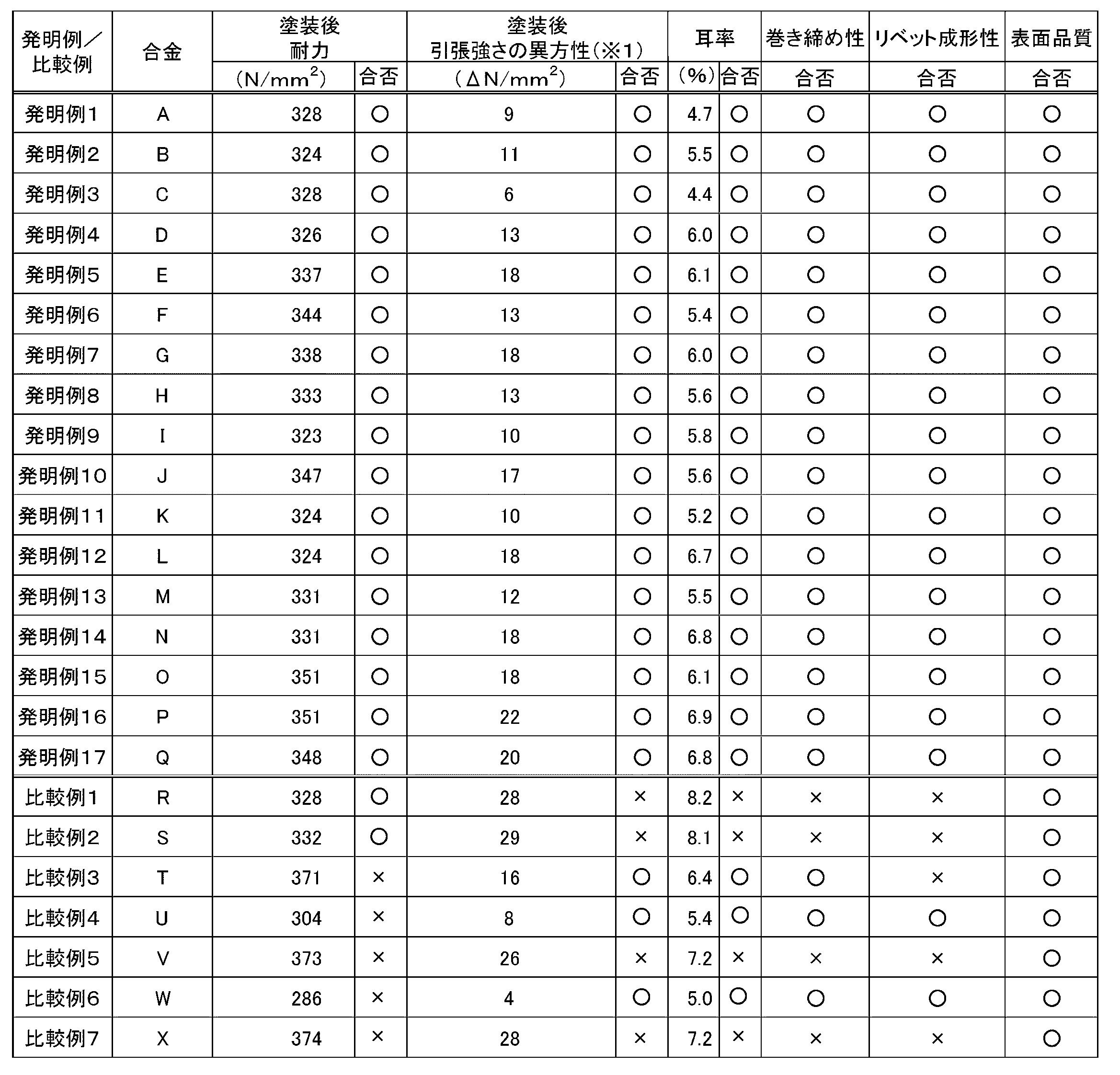
(※1)異方性は、圧延方向に対して、0°、45°、90°方向における最大値と最小値の差を示す。
以下に評価方法について説明する。
(塗装後強度)
JIS5号試験片を使用して、圧延方向に対して0°、45°、90°方向で引張試験を実施し、0°、45°、90°方向における耐力を測定した。耐力の最小値が320N/mm2以上370N/mm2以下を合格(○)とし、320N/mm2未満或いは370N/mm2を超えるものを不合格(×)とした。なお、以下において、「耐力の最小値」を単に「塗装後耐力」と記す。
JIS5号試験片を使用して、圧延方向に対して0°、45°、90°方向で引張試験を実施し、0°、45°、90°方向における耐力を測定した。耐力の最小値が320N/mm2以上370N/mm2以下を合格(○)とし、320N/mm2未満或いは370N/mm2を超えるものを不合格(×)とした。なお、以下において、「耐力の最小値」を単に「塗装後耐力」と記す。
JIS5号試験片を使用して、圧延方向に対して0°、45°、90°方向で引張試験を実施し、0°、45°、90°方向における引張強さの最大値と最小値の差を測定した。0°、45°、90°方向の最大値と最小値の差が25N/mm2以下を合格(○)とし、25N/mm2を超えるものと不合格(×)とした。なお、以下において、「最大値と最小値の差」を単に「異方性」と記す。
(耳率)
パンチ径33mm、パンチ肩R1.5mm、ブランク径57mm、しわ押さえ400kgfで絞りカップを成形した後、圧延方向に対してカップ高さを測定し、次式(2)より耳率を算出した。
耳率(%)=[{(45°耳の平均値)-(0°-90°耳の平均値)}/(45°耳及び0°-90°耳の平均値の最小値)]×100・・・(2)
パンチ径33mm、パンチ肩R1.5mm、ブランク径57mm、しわ押さえ400kgfで絞りカップを成形した後、圧延方向に対してカップ高さを測定し、次式(2)より耳率を算出した。
耳率(%)=[{(45°耳の平均値)-(0°-90°耳の平均値)}/(45°耳及び0°-90°耳の平均値の最小値)]×100・・・(2)
ここで、45°耳とは、45°位置、135°位置、225°位置及び315°位置の耳高さを意味し、0°-90°耳とは、0°位置、90°位置、180°位置及び270°位置の耳高さをそれぞれ意味する。また、上記計算式では、45°耳の場合はプラス(+)、0-90°耳の場合はマイナス(-)で表記した。耳率が-7%以上+7%以下を合格(○)とし、-7%未満或いは+7%を超えるものを不合格(×)とした。
(巻き締め性)
全10個の蓋を内圧付与により反転させた際に、缶エンドと缶ボディとの巻き締め部外れが生じなかった場合を合格(○)とし、巻き締め外れが一つでも生じた場合を不合格(×)とした。
全10個の蓋を内圧付与により反転させた際に、缶エンドと缶ボディとの巻き締め部外れが生じなかった場合を合格(○)とし、巻き締め外れが一つでも生じた場合を不合格(×)とした。
(リベット成形性)
全20個の蓋を成形後、目視によりリベット部の割れの有無を調べ、割れが無い場合を合格(○)とし、割れが有る場合を不合格(×)とした。
全20個の蓋を成形後、目視によりリベット部の割れの有無を調べ、割れが無い場合を合格(○)とし、割れが有る場合を不合格(×)とした。
(表面品質)
塗装後或いは蓋成形後、目視にて特に問題がないものを良好と判定して合格(○)とし、スジ等の表面欠が生じたものは不良として不合格(×)とした。
塗装後或いは蓋成形後、目視にて特に問題がないものを良好と判定して合格(○)とし、スジ等の表面欠が生じたものは不良として不合格(×)とした。
表2から明らかなように、発明例1~17では、アルミニウム合金板の塗装後耐力、異方性、耳率、巻き締め性、リベット成形性、表面品質の全てが合格であった。
これに対して、比較例1では、アルミニウム合金板のSi含有量が多過ぎたため、異方性、耳率、巻き締め性、リベット成形性が不合格であった。
比較例2では、アルミニウム合金板のFe含有量が多過ぎたため、異方性、耳率、巻き締め性、リベット成形性が不合格であった。
比較例3では、アルミニウム合金板のCu含有量が多過ぎたため、塗装後耐力、リベット成形性が不合格であった。
比較例4では、アルミニウム合金板のMn含有量が少な過ぎたため、塗装後耐力が不合格であった。
比較例5では、アルミニウム合金板のMn含有量が多過ぎたため、塗装後耐力、異方性、耳率、巻き締め性、リベット成形性が不合格であった。
比較例6では、アルミニウム合金板のMg含有量が少な過ぎたため、塗装後耐力が不合格であった。
比較例7では、アルミニウム合金板のMg含有量が多過ぎたため、塗装後耐力、異方性、耳率、巻き締め性、リベット成形性が不合格であった。
[実施例2:発明例18~26及び比較例8~18]
表1中の本発明に相当する合金M、K、Oのアルミニウム合金をDC鋳造により鋳造し、得られた鋳塊に対して、表3に示す製造条件により、均質化処理、熱間圧延、冷間圧延を施し、その後エポキシ系の塗料で塗装し、260℃×20secで焼付け処理を施した。なお、表3の比較例15は、熱間仕上げ圧延をリバース式圧延機にて行った比較例であり、また、比較例17は、熱間圧延後、中間焼鈍を急速加熱、急速冷却する連続焼鈍(CAL)にて行った比較例である。

表1中の本発明に相当する合金M、K、Oのアルミニウム合金をDC鋳造により鋳造し、得られた鋳塊に対して、表3に示す製造条件により、均質化処理、熱間圧延、冷間圧延を施し、その後エポキシ系の塗料で塗装し、260℃×20secで焼付け処理を施した。なお、表3の比較例15は、熱間仕上げ圧延をリバース式圧延機にて行った比較例であり、また、比較例17は、熱間圧延後、中間焼鈍を急速加熱、急速冷却する連続焼鈍(CAL)にて行った比較例である。
上記のようにして得られた缶エンド用アルミニウム合金板について、前記実施例1と同様に、塗装焼付け後の耐力、耳率を評価した。また、アルミニウム合金板を用いてフルフォーム形状の蓋を作製し、巻き締め性とリベット成形性を評価した。そして、外観観察により表面品質について評価した。表4に結果を示す。
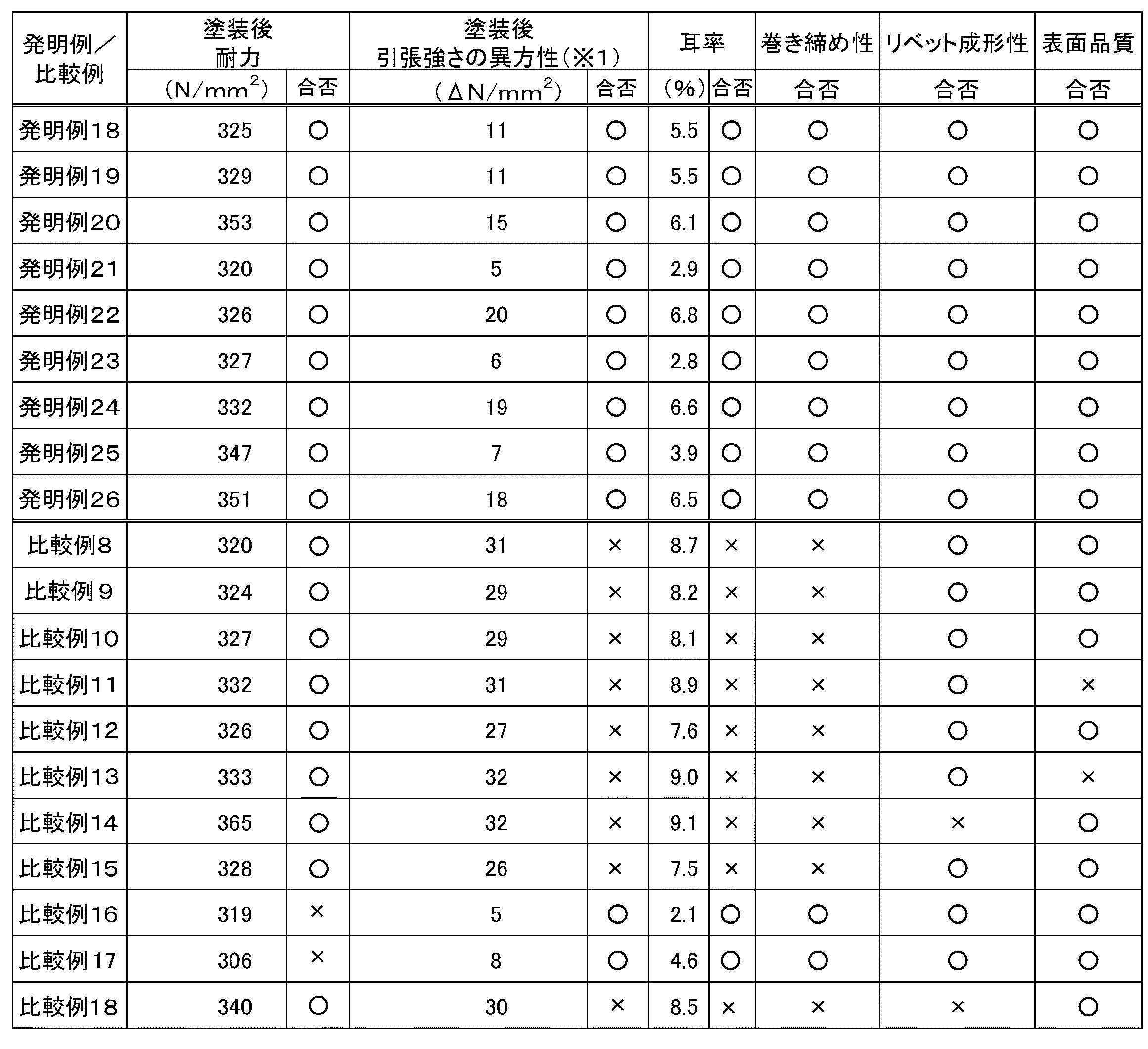
表4から明らかなように、発明例18~26では、アルミニウム合金板の塗装焼付け後の耐力、異方性、耳率、巻き締め性、リベット成形性、表面品質の全てが合格であった。
比較例8では、均質化処理温度が低過ぎたため、異方性、耳率、巻き締め性が不合格であった。
比較例9では、均質化処理時間が短過ぎたため、異方性、耳率、巻き締め性が不合格であった。
比較例10では、熱間仕上げ圧延総圧下率が低過ぎたため、異方性、耳率、巻き締め性が不合格であった。
比較例11では、熱間仕上げ圧延総圧下率が高過ぎたため、異方性、耳率、巻き締め性、表面品質が不合格であった。
比較例12では、熱間仕上げ圧延最終パス歪み速度が遅過ぎたため、異方性、耳率、巻き締め性が不合格であった。
比較例13では、熱間仕上げ圧延最終パス歪み速度が速過ぎたため、異方性、耳率、巻き締め性、表面品質が不合格であった。
比較例14では、熱間仕上げ圧延終了温度が低過ぎたため、異方性、耳率、巻き締め性、リベット性形成が不合格であった。
比較例15では、熱間仕上げ圧延をリバース式圧延機で行ったため、異方性、耳率、巻き締め性が不合格であった。
比較例16では、最終冷延率が低過ぎたため、塗装後耐力が不合格であった。
比較例17では、中間焼鈍を施し最終冷延率が低過ぎたため、塗装後耐力が不合格であった。
比較例18では、最終冷延率が高過ぎたため、異方性、耳率、巻き締め性、リベット成形性が不合格であった。
本発明に係る缶エンド用アルミニウム合金板及びその製造方法により、中間焼鈍工程を省略した方法で、高強度で且つ異方性が小さく、耳率の低い缶エンド用アルミニウム合金板が提供される。
Claims (5)
- mass%で、Si:0.01%以上0.2%以下、Fe:0.01%以上0.35%以下、Cu:0.01%以上0.15%以下、Mn:0.2%以上0.5%未満、Mg:4.0%以上5.5%未満を含有し、残部Al及び不可避的不純物からなるアルミニウム合金から構成され、塗装焼付け後において、圧延方向に対して0°、45°、90°方向に引張試験をしたときの耐力の最小値が320N/mm2以上370N/mm2以下、かつ、引張強さの最大値と最小値の差が25N/mm2以下であって、耳率が7%未満であることを特徴とする缶エンド用アルミニウム合金板。
- 前記アルミニウム合金の鋳塊に450℃以上530℃以下で0.5時間以上15時間以内の均質化処理を施した後、熱間圧延を施すにあたり、熱間仕上げ圧延の総圧下率が88%以上94%以下、かつ最終パスでの歪み速度を60sec-1以上130sec-1以下、終了温度を310℃以上370℃以下となるように行い、その後、最終板厚まで焼鈍を施すことなく、84%以上94%以下の冷間圧延率にて最終板厚とすることを特徴とする請求項1記載の缶エンド用アルミニウム合金板。
- タンデム式熱間仕上げ圧延機により前記熱間仕上げ圧延を施すことを特徴とする請求項1又は2記載の缶エンドアルミニウム合金板。
- mass%で、Si:0.01%以上0.2%以下、Fe:0.01%以上0.35%以下、Cu:0.01%以上0.15%以下、Mn:0.2%以上0.5%未満、Mg:4.0%以上5.5%未満を含有し、残部Al及び不可避的不純物からなる合金鋳塊に450℃以上530℃以下で0.5時間以上15時間以内の均質化処理を施した後、熱間圧延を施すにあたり、熱間仕上げ圧延の総圧下率が88%以上94%以下、かつ最終パスでの歪み速度を60sec-1以上130sec-1以下、終了温度を310℃以上370℃以下となるように行い、その後、最終板厚まで焼鈍を施すことなく、84%以上94%以下の冷間圧延率にて最終板厚とすることにより、塗装焼付け後において、圧延方向に対して0°、45°、90°方向に引張試験をしたときの耐力の最小値が320N/mm2以上370N/mm2以下、かつ、引張強さの最大値と最小値の差が25N/mm2以下であって、耳率が7%未満である合金板を製造することを特徴とする缶エンド用アルミニウム合金板の製造方法。
- タンデム式熱間仕上げ圧延機により前記熱間仕上げ圧延を施すことを特徴とする請求項4記載の缶エンドアルミニウム合金板の製造方法。
Priority Applications (2)
| Application Number | Priority Date | Filing Date | Title |
|---|---|---|---|
| CN201480057614.1A CN105658827B (zh) | 2013-10-30 | 2014-10-02 | 罐盖用铝合金板及其制造方法 |
| JP2015544889A JP6435268B2 (ja) | 2013-10-30 | 2014-10-02 | 缶エンド用アルミニウム合金板及びその製造方法 |
Applications Claiming Priority (2)
| Application Number | Priority Date | Filing Date | Title |
|---|---|---|---|
| JP2013-225381 | 2013-10-30 | ||
| JP2013225381 | 2013-10-30 |
Publications (1)
| Publication Number | Publication Date |
|---|---|
| WO2015064290A1 true WO2015064290A1 (ja) | 2015-05-07 |
Family
ID=53003903
Family Applications (1)
| Application Number | Title | Priority Date | Filing Date |
|---|---|---|---|
| PCT/JP2014/076367 Ceased WO2015064290A1 (ja) | 2013-10-30 | 2014-10-02 | 缶エンド用アルミニウム合金板及びその製造方法 |
Country Status (3)
| Country | Link |
|---|---|
| JP (1) | JP6435268B2 (ja) |
| CN (1) | CN105658827B (ja) |
| WO (1) | WO2015064290A1 (ja) |
Cited By (1)
| Publication number | Priority date | Publication date | Assignee | Title |
|---|---|---|---|---|
| CN118843706A (zh) * | 2022-03-09 | 2024-10-25 | 株式会社Uacj | 罐盖用铝合金板 |
Families Citing this family (2)
| Publication number | Priority date | Publication date | Assignee | Title |
|---|---|---|---|---|
| CN108385044A (zh) * | 2018-03-06 | 2018-08-10 | 东北大学 | 一种汽车车身用5182铝合金板材的制备方法 |
| EP3741875A1 (en) * | 2019-05-24 | 2020-11-25 | Constellium Rolled Products Singen GmbH & Co.KG | Aluminium alloy sheet product with improved surface aspect |
Citations (7)
| Publication number | Priority date | Publication date | Assignee | Title |
|---|---|---|---|---|
| JP2005200754A (ja) * | 2004-01-19 | 2005-07-28 | Kobe Steel Ltd | 包装容器タブ用アルミニウム合金板およびその製造方法 |
| JP2007023340A (ja) * | 2005-07-15 | 2007-02-01 | Sumitomo Light Metal Ind Ltd | 陽圧缶蓋用アルミニウム合金板及びその製造方法 |
| JP2008019467A (ja) * | 2006-07-11 | 2008-01-31 | Furukawa Sky Kk | クロメート処理後の表面品質が優れた缶蓋用アルミニウム合金板およびその製造方法 |
| JP2009013455A (ja) * | 2007-07-03 | 2009-01-22 | Furukawa Sky Kk | 開栓性、耳率に優れた高強度キャップ用アルミニウム合金板およびその製造方法 |
| JP2011080155A (ja) * | 2010-11-22 | 2011-04-21 | Furukawa-Sky Aluminum Corp | ボトムしわ性が良好なキャンボディ用アルミニウム合金板 |
| JP2011225977A (ja) * | 2010-03-31 | 2011-11-10 | Kobe Steel Ltd | タブ用アルミニウム合金板およびその製造方法 |
| JP2012112007A (ja) * | 2010-11-26 | 2012-06-14 | Sumitomo Light Metal Ind Ltd | 陽圧缶蓋用アルミニウム合金塗装板およびその製造方法 |
Family Cites Families (7)
| Publication number | Priority date | Publication date | Assignee | Title |
|---|---|---|---|---|
| JP2001073058A (ja) * | 1999-07-01 | 2001-03-21 | Mitsubishi Alum Co Ltd | 耐ブローアップ性に優れた缶エンド用アルミニウム合金板およびその製造方法 |
| JP3694859B2 (ja) * | 2000-09-29 | 2005-09-14 | 古河スカイ株式会社 | 缶蓋用アルミニウム合金硬質板およびその製造方法 |
| JP4915068B2 (ja) * | 2005-09-09 | 2012-04-11 | 東洋製罐株式会社 | 耐食性、密着性に優れるアルミニウム合金缶蓋及びその製造方法 |
| JP2009221567A (ja) * | 2008-03-18 | 2009-10-01 | Furukawa-Sky Aluminum Corp | 陽圧塗装缶蓋用アルミニウム合金板およびその製造方法 |
| JP2010053367A (ja) * | 2008-08-26 | 2010-03-11 | Sumitomo Light Metal Ind Ltd | 缶エンド用アルミニウム合金板およびその製造方法 |
| US20120237694A1 (en) * | 2011-01-19 | 2012-09-20 | Golden Aluminum, Inc. | Aluminum alloy coating process and method |
| CN103014445B (zh) * | 2012-12-27 | 2014-11-26 | 亚洲铝业(中国)有限公司 | 5052铝合金罐盖料基材及其生产方法 |
-
2014
- 2014-10-02 JP JP2015544889A patent/JP6435268B2/ja active Active
- 2014-10-02 WO PCT/JP2014/076367 patent/WO2015064290A1/ja not_active Ceased
- 2014-10-02 CN CN201480057614.1A patent/CN105658827B/zh active Active
Patent Citations (7)
| Publication number | Priority date | Publication date | Assignee | Title |
|---|---|---|---|---|
| JP2005200754A (ja) * | 2004-01-19 | 2005-07-28 | Kobe Steel Ltd | 包装容器タブ用アルミニウム合金板およびその製造方法 |
| JP2007023340A (ja) * | 2005-07-15 | 2007-02-01 | Sumitomo Light Metal Ind Ltd | 陽圧缶蓋用アルミニウム合金板及びその製造方法 |
| JP2008019467A (ja) * | 2006-07-11 | 2008-01-31 | Furukawa Sky Kk | クロメート処理後の表面品質が優れた缶蓋用アルミニウム合金板およびその製造方法 |
| JP2009013455A (ja) * | 2007-07-03 | 2009-01-22 | Furukawa Sky Kk | 開栓性、耳率に優れた高強度キャップ用アルミニウム合金板およびその製造方法 |
| JP2011225977A (ja) * | 2010-03-31 | 2011-11-10 | Kobe Steel Ltd | タブ用アルミニウム合金板およびその製造方法 |
| JP2011080155A (ja) * | 2010-11-22 | 2011-04-21 | Furukawa-Sky Aluminum Corp | ボトムしわ性が良好なキャンボディ用アルミニウム合金板 |
| JP2012112007A (ja) * | 2010-11-26 | 2012-06-14 | Sumitomo Light Metal Ind Ltd | 陽圧缶蓋用アルミニウム合金塗装板およびその製造方法 |
Cited By (1)
| Publication number | Priority date | Publication date | Assignee | Title |
|---|---|---|---|---|
| CN118843706A (zh) * | 2022-03-09 | 2024-10-25 | 株式会社Uacj | 罐盖用铝合金板 |
Also Published As
| Publication number | Publication date |
|---|---|
| CN105658827A (zh) | 2016-06-08 |
| CN105658827B (zh) | 2017-11-21 |
| JPWO2015064290A1 (ja) | 2017-03-09 |
| JP6435268B2 (ja) | 2018-12-05 |
Similar Documents
| Publication | Publication Date | Title |
|---|---|---|
| US9574258B2 (en) | Aluminum-alloy sheet and method for producing the same | |
| JP4019082B2 (ja) | 高温特性に優れたボトル缶用アルミニウム合金板 | |
| CN111108223B (zh) | 瓶罐体用铝合金板及其制造方法 | |
| US9546411B2 (en) | Aluminum-alloy sheet and method for producing the same | |
| JP2009221567A (ja) | 陽圧塗装缶蓋用アルミニウム合金板およびその製造方法 | |
| JP5568031B2 (ja) | ボトル缶用アルミニウム合金冷延板 | |
| US20170314112A1 (en) | Aluminum alloys with enhanced formability and associated methods | |
| WO2015140833A1 (ja) | Dr缶ボディ用アルミニウム合金板及びその製造方法 | |
| WO2014129385A1 (ja) | 缶ボディ用アルミニウム合金板及びその製造方法 | |
| JP5356359B2 (ja) | 陽圧缶蓋用アルミニウム合金塗装板およびその製造方法 | |
| JP6435268B2 (ja) | 缶エンド用アルミニウム合金板及びその製造方法 | |
| JP4019083B2 (ja) | 高温特性に優れたボトル缶用アルミニウム合金冷延板 | |
| JP2016141886A (ja) | 缶蓋用アルミニウム合金板 | |
| JP3871462B2 (ja) | 缶胴用アルミニウム合金板の製造方法 | |
| JPH10330897A (ja) | 深絞り成形用アルミニウム基合金板の製造方法 | |
| JP2006291326A (ja) | 飲料缶胴用アルミニウム合金板およびその製造方法 | |
| JP2011202240A (ja) | Ppキャップ用アルミニウム合金板およびその製造方法 | |
| JP6684568B2 (ja) | 異方性とネック成形性に優れた飲料缶ボディ用または飲料ボトル缶ボディ用アルミニウム合金板の製造方法 | |
| JP2007277694A (ja) | 陽圧缶蓋用アルミニウム合金塗装板およびその製造方法 | |
| JP2005076041A (ja) | 缶胴用アルミニウム合金硬質板の製造方法 | |
| JP4771726B2 (ja) | 飲料缶胴用アルミニウム合金板およびその製造方法 | |
| JP2006283113A (ja) | 飲料缶胴用アルミニウム合金板およびその製造方法 | |
| JP3850542B2 (ja) | カーリング性及び巻き締め性が優れたアルミニウム合金板及びその製造方法 | |
| JP4467443B2 (ja) | アルミニウム合金板の製造方法 | |
| JP5091415B2 (ja) | ボトル缶用アルミニウム合金板の製造方法 |
Legal Events
| Date | Code | Title | Description |
|---|---|---|---|
| 121 | Ep: the epo has been informed by wipo that ep was designated in this application |
Ref document number: 14858094 Country of ref document: EP Kind code of ref document: A1 |
|
| ENP | Entry into the national phase |
Ref document number: 2015544889 Country of ref document: JP Kind code of ref document: A |
|
| NENP | Non-entry into the national phase |
Ref country code: DE |
|
| 122 | Ep: pct application non-entry in european phase |
Ref document number: 14858094 Country of ref document: EP Kind code of ref document: A1 |