WO2015053292A1 - イリジウム錯体 - Google Patents
イリジウム錯体 Download PDFInfo
- Publication number
- WO2015053292A1 WO2015053292A1 PCT/JP2014/076862 JP2014076862W WO2015053292A1 WO 2015053292 A1 WO2015053292 A1 WO 2015053292A1 JP 2014076862 W JP2014076862 W JP 2014076862W WO 2015053292 A1 WO2015053292 A1 WO 2015053292A1
- Authority
- WO
- WIPO (PCT)
- Prior art keywords
- group
- carbon atoms
- formula
- alkyl group
- represented
- Prior art date
- Legal status (The legal status is an assumption and is not a legal conclusion. Google has not performed a legal analysis and makes no representation as to the accuracy of the status listed.)
- Ceased
Links
- 0 CCCC*(C)C(CCC(*(C)(C)C(CCCCCOc1cc(-c(cccc2)*2-c(cccc2)c2-c2c(cccc3)c3cc*2C2(c3ccccc3-3)*4c-3c(cccc3)c3cc4)c2cc1)=O)C(*(C)(C)CCCC)=O)=O Chemical compound CCCC*(C)C(CCC(*(C)(C)C(CCCCCOc1cc(-c(cccc2)*2-c(cccc2)c2-c2c(cccc3)c3cc*2C2(c3ccccc3-3)*4c-3c(cccc3)c3cc4)c2cc1)=O)C(*(C)(C)CCCC)=O)=O 0.000 description 3
- JLAUIBFZZUVOBB-UHFFFAOYSA-N CCC(C)CCN Chemical compound CCC(C)CCN JLAUIBFZZUVOBB-UHFFFAOYSA-N 0.000 description 1
- QRZVWLJSRKYHJF-UHFFFAOYSA-N Cc(c(cccc1)c1cc1)c1-c1ncc[s]1 Chemical compound Cc(c(cccc1)c1cc1)c1-c1ncc[s]1 QRZVWLJSRKYHJF-UHFFFAOYSA-N 0.000 description 1
Classifications
-
- C—CHEMISTRY; METALLURGY
- C09—DYES; PAINTS; POLISHES; NATURAL RESINS; ADHESIVES; COMPOSITIONS NOT OTHERWISE PROVIDED FOR; APPLICATIONS OF MATERIALS NOT OTHERWISE PROVIDED FOR
- C09K—MATERIALS FOR MISCELLANEOUS APPLICATIONS, NOT PROVIDED FOR ELSEWHERE
- C09K11/00—Luminescent materials, e.g. electroluminescent or chemiluminescent
- C09K11/06—Luminescent materials, e.g. electroluminescent or chemiluminescent containing organic luminescent materials
-
- H—ELECTRICITY
- H10—SEMICONDUCTOR DEVICES; ELECTRIC SOLID-STATE DEVICES NOT OTHERWISE PROVIDED FOR
- H10K—ORGANIC ELECTRIC SOLID-STATE DEVICES
- H10K71/00—Manufacture or treatment specially adapted for the organic devices covered by this subclass
- H10K71/10—Deposition of organic active material
- H10K71/12—Deposition of organic active material using liquid deposition, e.g. spin coating
-
- H—ELECTRICITY
- H10—SEMICONDUCTOR DEVICES; ELECTRIC SOLID-STATE DEVICES NOT OTHERWISE PROVIDED FOR
- H10K—ORGANIC ELECTRIC SOLID-STATE DEVICES
- H10K85/00—Organic materials used in the body or electrodes of devices covered by this subclass
- H10K85/30—Coordination compounds
- H10K85/341—Transition metal complexes, e.g. Ru(II)polypyridine complexes
- H10K85/342—Transition metal complexes, e.g. Ru(II)polypyridine complexes comprising iridium
-
- C—CHEMISTRY; METALLURGY
- C09—DYES; PAINTS; POLISHES; NATURAL RESINS; ADHESIVES; COMPOSITIONS NOT OTHERWISE PROVIDED FOR; APPLICATIONS OF MATERIALS NOT OTHERWISE PROVIDED FOR
- C09K—MATERIALS FOR MISCELLANEOUS APPLICATIONS, NOT PROVIDED FOR ELSEWHERE
- C09K2211/00—Chemical nature of organic luminescent or tenebrescent compounds
- C09K2211/10—Non-macromolecular compounds
- C09K2211/1018—Heterocyclic compounds
- C09K2211/1025—Heterocyclic compounds characterised by ligands
- C09K2211/1029—Heterocyclic compounds characterised by ligands containing one nitrogen atom as the heteroatom
-
- C—CHEMISTRY; METALLURGY
- C09—DYES; PAINTS; POLISHES; NATURAL RESINS; ADHESIVES; COMPOSITIONS NOT OTHERWISE PROVIDED FOR; APPLICATIONS OF MATERIALS NOT OTHERWISE PROVIDED FOR
- C09K—MATERIALS FOR MISCELLANEOUS APPLICATIONS, NOT PROVIDED FOR ELSEWHERE
- C09K2211/00—Chemical nature of organic luminescent or tenebrescent compounds
- C09K2211/10—Non-macromolecular compounds
- C09K2211/1018—Heterocyclic compounds
- C09K2211/1025—Heterocyclic compounds characterised by ligands
- C09K2211/1029—Heterocyclic compounds characterised by ligands containing one nitrogen atom as the heteroatom
- C09K2211/1033—Heterocyclic compounds characterised by ligands containing one nitrogen atom as the heteroatom with oxygen
-
- C—CHEMISTRY; METALLURGY
- C09—DYES; PAINTS; POLISHES; NATURAL RESINS; ADHESIVES; COMPOSITIONS NOT OTHERWISE PROVIDED FOR; APPLICATIONS OF MATERIALS NOT OTHERWISE PROVIDED FOR
- C09K—MATERIALS FOR MISCELLANEOUS APPLICATIONS, NOT PROVIDED FOR ELSEWHERE
- C09K2211/00—Chemical nature of organic luminescent or tenebrescent compounds
- C09K2211/10—Non-macromolecular compounds
- C09K2211/1018—Heterocyclic compounds
- C09K2211/1025—Heterocyclic compounds characterised by ligands
- C09K2211/1029—Heterocyclic compounds characterised by ligands containing one nitrogen atom as the heteroatom
- C09K2211/1037—Heterocyclic compounds characterised by ligands containing one nitrogen atom as the heteroatom with sulfur
-
- C—CHEMISTRY; METALLURGY
- C09—DYES; PAINTS; POLISHES; NATURAL RESINS; ADHESIVES; COMPOSITIONS NOT OTHERWISE PROVIDED FOR; APPLICATIONS OF MATERIALS NOT OTHERWISE PROVIDED FOR
- C09K—MATERIALS FOR MISCELLANEOUS APPLICATIONS, NOT PROVIDED FOR ELSEWHERE
- C09K2211/00—Chemical nature of organic luminescent or tenebrescent compounds
- C09K2211/10—Non-macromolecular compounds
- C09K2211/1018—Heterocyclic compounds
- C09K2211/1025—Heterocyclic compounds characterised by ligands
- C09K2211/1044—Heterocyclic compounds characterised by ligands containing two nitrogen atoms as heteroatoms
-
- C—CHEMISTRY; METALLURGY
- C09—DYES; PAINTS; POLISHES; NATURAL RESINS; ADHESIVES; COMPOSITIONS NOT OTHERWISE PROVIDED FOR; APPLICATIONS OF MATERIALS NOT OTHERWISE PROVIDED FOR
- C09K—MATERIALS FOR MISCELLANEOUS APPLICATIONS, NOT PROVIDED FOR ELSEWHERE
- C09K2211/00—Chemical nature of organic luminescent or tenebrescent compounds
- C09K2211/10—Non-macromolecular compounds
- C09K2211/1018—Heterocyclic compounds
- C09K2211/1025—Heterocyclic compounds characterised by ligands
- C09K2211/1092—Heterocyclic compounds characterised by ligands containing sulfur as the only heteroatom
-
- C—CHEMISTRY; METALLURGY
- C09—DYES; PAINTS; POLISHES; NATURAL RESINS; ADHESIVES; COMPOSITIONS NOT OTHERWISE PROVIDED FOR; APPLICATIONS OF MATERIALS NOT OTHERWISE PROVIDED FOR
- C09K—MATERIALS FOR MISCELLANEOUS APPLICATIONS, NOT PROVIDED FOR ELSEWHERE
- C09K2211/00—Chemical nature of organic luminescent or tenebrescent compounds
- C09K2211/18—Metal complexes
- C09K2211/185—Metal complexes of the platinum group, i.e. Os, Ir, Pt, Ru, Rh or Pd
-
- H—ELECTRICITY
- H10—SEMICONDUCTOR DEVICES; ELECTRIC SOLID-STATE DEVICES NOT OTHERWISE PROVIDED FOR
- H10K—ORGANIC ELECTRIC SOLID-STATE DEVICES
- H10K2101/00—Properties of the organic materials covered by group H10K85/00
- H10K2101/10—Triplet emission
-
- H—ELECTRICITY
- H10—SEMICONDUCTOR DEVICES; ELECTRIC SOLID-STATE DEVICES NOT OTHERWISE PROVIDED FOR
- H10K—ORGANIC ELECTRIC SOLID-STATE DEVICES
- H10K50/00—Organic light-emitting devices
- H10K50/10—OLEDs or polymer light-emitting diodes [PLED]
- H10K50/11—OLEDs or polymer light-emitting diodes [PLED] characterised by the electroluminescent [EL] layers
Definitions
- the present invention relates to an iridium complex.
- the phosphorescent light emission by the organometallic complex can achieve a theoretically higher quantum efficiency than the fluorescent light emission in organic EL (electroluminescence).
- the said organometallic complex is anticipated as a material of functional elements, such as an organic light emitting element which is a next generation technique, specifically, a material of an organic EL display, etc.
- Non-Patent Document 1 a compound that generates phosphorescent light is easily quenched in a high concentration solution or a solid state.
- a compound represented by the following formula (X) generates strong phosphorescent light emission in a solution state (quantum yield 97%), but quenches in an amorphous solid state (quantum yield 0.6%). It is known (for example, Non-Patent Document 1).
- Non-Patent Documents 2 and 3 Recently, phosphorescent gold complexes having gelling ability (see, for example, Non-Patent Documents 2 and 3) and platinum complexes (for example, see Non-Patent Documents 4 to 7) have been reported.
- these gold complexes and platinum complexes have a gelling ability as a whole compound by containing a structure having a gelling ability in the complex itself.
- an object of the present invention is to provide a luminescent material having improved luminescence intensity in a gel state than in a solution state.
- the present invention is an iridium complex represented by the formula (I).
- Any one of hydrogens in the group represented by any one of the formulas (1) to (10) is substituted with a group represented by the formula —OX; and Any one or more of the remaining hydrogens in the group represented by any one of the formulas (1) to (10) is optionally a halogen atom, an alkyl group having 1 to 12 carbon atoms, or an alkyl group having 2 to 12 carbon atoms.
- R 100 is a hydrogen atom or an alkyl group having 1 to 12 carbon atoms
- M is 2 to 1,000
- phenyl group, phenoxy group, nitrile group, nitro group, or thiol group substituent R may be substituted
- X is a group represented by the formula (a)
- n1, n2, n3 and n4 are each independently 1 to 20, R 1 and R 2 are each independently a hydrogen atom, a halogen atom, an alkenyl group having 2 to 12 carbon atoms, an alkynyl group having 2 to 12 carbon atoms, an alkoxy group having 1 to 12 carbon atoms, — (OCH 2 CH 2 ) m —OR 100 (R 100 is a hydrogen atom or an alkyl group having 1 to 12 carbon atoms, m is 2 to 1,000), —NH 2 , —N (alkyl having 1 to 6 carbon atoms) Group) 2 , —OH, —COOH, —C ( ⁇ O) O— (alkyl group having 1 to 6 carbon atoms), phenyl group, phenoxy group, nitrile group, nitro group, or thiol group, Two
- Any one or more of hydrogens in the group represented by any one of the formulas (11) to (74) is optionally a halogen atom, an alkyl group having 1 to 12 carbon atoms, or an alkenyl group having 2 to 12 carbon atoms.
- R 100 is a hydrogen atom or an alkyl group having 1 to 12 carbon atoms, m Is 2 to 1,000), —NH 2 , —N (alkyl group having 1 to 6 carbon atoms) 2 , —OH, —COOH, —C ( ⁇ O) O— (alkyl having 1 to 6 carbon atoms) Group), phenyl group, phenoxy group, nitrile group, nitro group, or thiol group substituent R ′.
- the present invention also provides the iridium complex, It is a composition for luminescent materials containing a supramolecular gelling agent.
- the present invention is a gel-like luminescent material obtained from the luminescent material composition. Moreover, this invention is a luminescent material containing a supramolecular gel and the iridium complex of this invention covalently bonded to the said supramolecular gel.
- the gel-like luminescent material obtained from the composition for luminescent material containing the iridium complex of the present invention and the supramolecular gelling agent has an advantage that the luminescence intensity is improved in the gel state as compared with the solution state.
- the inventors of the present invention have provided a novel iridium complex (I) in which an amino acid side chain moiety represented by the formula (a) is bound to an iridium compound known to have phosphorescence emission performance, and a supramolecular gelling agent. It was unexpectedly found that the gel-like material obtained from the above showed stronger emission intensity than the solution state of the novel iridium complex (I) alone. On the other hand, the iridium compound represented by the following formula (IV) having no amino acid side chain moiety represented by the formula (a) was obtained from a supramolecular gelling agent even in a single solution state. It has also been found that there is almost no change in emission intensity even in the state of a gel material. Based on these findings, the present inventors have completed the present invention.
- Any one of hydrogens in the group represented by any one of the formulas (1) to (10) is substituted with a group represented by the formula —O— (CH 2 ) n1 —COOR 21 (R 21 is an alkyl group having 1 to 12 carbon atoms), and Any one or more of the remaining hydrogens in the group represented by any one of the formulas (1) to (10) is optionally a halogen atom, an alkyl group having 1 to 12 carbon atoms, or an alkyl group having 2 to 12 carbon atoms.
- An alkenyl group, an alkynyl group having 2 to 12 carbon atoms, an alkoxy group having 1 to 12 carbon atoms, — (OCH 2 CH 2 ) m —OR 100 (R 100 is a hydrogen atom or an alkyl group having 1 to 12 carbon atoms) , M is 2 to 1,000), —NH 2 , —N (alkyl group having 1 to 6 carbon atoms) 2 , —OH, —COOH, —C ( ⁇ O) O— (1 to 6 carbon atoms) Alkyl group), phenyl group, phenoxy group, nitrile group, nitro group, or thiol group.
- n1 are as defined in formula (I).
- the iridium platinum complex of the present invention is represented by the following formula (I).
- Any one of hydrogens in the group represented by any one of the formulas (1) to (10) is substituted with a group represented by the formula —OX; and Any one or more of the remaining hydrogens in the group represented by any one of the formulas (1) to (10) is optionally a halogen atom, an alkyl group having 1 to 12 carbon atoms, or an alkyl group having 2 to 12 carbon atoms.
- R 100 is a hydrogen atom or an alkyl group having 1 to 12 carbon atoms
- M is 2 to 1,000
- phenyl group, phenoxy group, nitrile group, nitro group, or thiol group substituent R may be substituted
- X is a group represented by the formula (a)
- n1, n2, n3 and n4 are each independently 1 to 20, R 1 and R 2 are each independently a hydrogen atom, a halogen atom, an alkenyl group having 2 to 12 carbon atoms, an alkynyl group having 2 to 12 carbon atoms, an alkoxy group having 1 to 12 carbon atoms, — (OCH 2 CH 2 ) m —OR 100 (R 100 is a hydrogen atom or an alkyl group having 1 to 12 carbon atoms, m is 2 to 1,000), —NH 2 , —N (alkyl having 1 to 6 carbon atoms) Group) 2 , —OH, —COOH, —C ( ⁇ O) O— (alkyl group having 1 to 6 carbon atoms), phenyl group, phenoxy group, nitrile group, nitro group, or thiol group, Two
- Any one or more of hydrogens in the group represented by any one of the formulas (11) to (74) is optionally a halogen atom, an alkyl group having 1 to 12 carbon atoms, or an alkenyl group having 2 to 12 carbon atoms.
- R 100 is a hydrogen atom or an alkyl group having 1 to 12 carbon atoms, m Is 2 to 1,000), —NH 2 , —N (alkyl group having 1 to 6 carbon atoms) 2 , —OH, —COOH, —C ( ⁇ O) O— (alkyl having 1 to 6 carbon atoms) Group), phenyl group, phenoxy group, nitrile group, nitro group, or thiol group substituent R ′.
- any one or more of the remaining hydrogens in the group represented by any one of the formulas (1) to (10) is optionally a halogen atom, an alkyl group having 1 to 12 carbon atoms, or 2 to 2 carbon atoms.
- any one or more of the hydrogen atoms in the group represented by any one of the above formulas (11) to (74) is optionally a halogen atom, an alkyl group having 1 to 12 carbon atoms, or 2 to 12 carbon atoms.
- An alkenyl group having 2 to 12 carbon atoms, an alkoxy group having 1 to 12 carbon atoms, — (OCH 2 CH 2 ) m —OR 100 (R 100 is a hydrogen atom or an alkyl group having 1 to 12 carbon atoms) M is from 2 to 1,000), —NH 2 , —N (alkyl group having 1 to 6 carbon atoms) 2 , —OH, —COOH, —C ( ⁇ O) O— (from 1 to carbon atoms) 6 alkyl group), a phenyl group, a phenoxy group, a nitrile group, a nitro group, or a substituent group R ′ of a thiol group, which is represented by any one of the formulas (11) to (74). Any two or more of the hydrogens in the group are replaced by the substituent R ′ If it is, even though each of the substituents R 'are different, may be identical.
- N1, n2, n3 and n4 are each independently 1 to 20.
- the n1 is preferably 1 to 10, and more preferably 3 to 8.
- the n2 is preferably 1 to 10, and more preferably 1 to 5.
- N3 is preferably 5 to 20, and more preferably 5 to 10.
- the n4 is preferably 5 to 20, and more preferably 5 to 10.
- the iridium complex of the present invention is
- N1, n2, n3 and n4 in formula (a) are each independently 1 to 6, R 1 and R 2 are hydrogen atoms, Two
- Any one or more of hydrogens in the group represented by any one of the formulas (11), (15), and (27) may be optionally replaced with a halogen atom.
- the iridium complex of the present invention is
- N1, n2, n3 and n4 in formula (a) are each independently 1 to 6, R 1 and R 2 are hydrogen atoms, Two
- Any one or more of hydrogens in the group represented by the formula (11) or (27) may be optionally replaced with a halogen atom.
- the iridium complex of the present invention is more preferably a compound represented by formula (I-1), formula (I-2), or formula (I-3).
- the present invention is also a composition for a luminescent material comprising the iridium complex of the present invention and a supramolecular gelling agent.
- the supramolecular gelling agent is preferably a gelling agent that causes gelation by hydrogen bonding, and more preferably a gelling agent that is soluble in an organic solvent.
- Examples of the supramolecular gelling agent include compounds represented by the following formula (XI).
- n12, n13 and n14 are each independently 0 to 20, n11 is 6 to 20, R 11 , R 12 and R 13 are each independently a hydrogen atom, a halogen atom, an alkenyl group having 2 to 12 carbon atoms, an alkynyl group having 2 to 12 carbon atoms, an alkoxy group having 1 to 12 carbon atoms,-( OCH 2 CH 2 ) m —OR 100 (R 100 is a hydrogen atom or an alkyl group having 1 to 12 carbon atoms, m is 2 to 1,000), —NH 2 , —N (1 to 6 alkyl group) 2 , —OH, —COOH, —C ( ⁇ O) O— (alkyl group having 1 to 6 carbon atoms), phenyl group, phenoxy group, nitrile group, nitro group, or thiol group.
- n12, n13 and n14 are each independently 1 to 6, n11 is 6 to 15, R11, R12 and R13 are preferably hydrogen atoms.
- the compound represented by the formula (XI) is, for example, a compound represented by the formula (XI-1).
- a compound represented by the formula (XII) and a compound represented by the formula (XIII) can be used.
- the compound represented by the formula (XII) see Hanabusa et al., Angew. Chem. Int. Ed., 1996, 35, p.1949-1951.
- the compound represented by the formula (XIII) see Suzuki et al., Langumuir, 2003, 19, p.8623-8624.
- alkyl group having 1 to 12 carbon atoms includes, for example, methyl, ethyl, propyl, butyl, pentyl, hexyl, heptyl, octyl, nonyl, decyl, undecyl, dodecyl and the like.
- the alkyl group may be linear or branched.
- the alkyl group having 1 to 12 carbon atoms is, for example, an alkyl group having 1 to 10 carbon atoms, preferably 5 to 10 carbon atoms, and more preferably 5 to 8 carbon atoms.
- C2-C12 alkenyl group includes, for example, ethylenyl, propylenyl, butenyl, pentenyl, hexenyl and the like.
- the alkenyl group may be linear or branched.
- Examples of the alkenyl group having 2 to 12 carbon atoms include alkenyl groups having 2 to 10 carbon atoms, preferably 5 to 10 carbon atoms, and more preferably 5 to 8 carbon atoms.
- alkynyl group having 2 to 12 carbon atoms includes, for example, acetylenyl, propenyl and the like.
- the alkynyl group may be linear or branched.
- the alkynyl group having 2 to 12 carbon atoms is, for example, an alkynyl group having 2 to 10 carbon atoms, preferably 5 to 10 carbon atoms, more preferably 5 to 8 carbon atoms.
- alkoxy group having 1 to 12 carbon atoms is an alkyloxy group.
- the alkyl part of the alkyloxy group is the same as the alkyl group having 1 to 12 carbon atoms.
- Examples of the alkoxyl group include methoxy, ethoxy, propyloxy, butyloxy, pentyloxy, hexyloxy, heptyloxy, octyloxy, nonyloxy, decyloxy, undecyloxy, dodecyloxy and the like.
- the alkoxy group having 1 to 12 carbon atoms is, for example, an alkoxy group having 1 to 10 carbon atoms, preferably 5 to 10 carbon atoms, and more preferably 5 to 8 carbon atoms.
- the alkyl group moiety of the term “—N (C 1-6 alkyl group) 2 ” is, for example, methyl, ethyl, propyl, butyl, pentyl, hexyl and the like.
- the alkyl moieties may be the same as or different from each other.
- Examples of —N (C 1-6 alkyl group) 2 include dimethylamino, diethylamino, methylethylamino, dipropylamino, dibutylamino, dipentylamino, dihexylamino and the like.
- the alkyl group moiety may be linear or branched.
- —N (alkyl group having 1 to 6 carbon atoms) 2 is, for example, —N (alkyl group having 1 to 5 carbon atoms) 2 , preferably —N (alkyl group having 1 to 4 carbon atoms) 2 , more preferably Is —N (an alkyl group having 1 to 3 carbon atoms) 2 .
- the alkyl group moiety of the term “—C ( ⁇ O) O— (C 1-6 alkyl group)” is, for example, methyl, ethyl, propyl, butyl, pentyl, hexyl and the like.
- Examples of —C ( ⁇ O) O— (an alkyl group having 1 to 6 carbon atoms) include —C ( ⁇ O) O-methyl, —C ( ⁇ O) O-ethyl, —C ( ⁇ O) O.
- Examples of —C ( ⁇ O) O— include —C ( ⁇ O) O— (alkyl group having 1 to 5 carbon atoms), preferably —C ( ⁇ O).
- O— an alkyl group having 1 to 4 carbon atoms
- more preferably —C ( ⁇ O) O— an alkyl group having 1 to 3 carbon atoms.
- the iridium complex of the present invention can be produced, for example, as follows.
- Any one of hydrogens in the group represented by any one of the formulas (1) to (10) is substituted with a group represented by the formula —O— (CH 2 ) n1 —COOH; and Any one or more of the remaining hydrogens in the group represented by any one of the formulas (1) to (10) is optionally a halogen atom, an alkyl group having 1 to 12 carbon atoms, or an alkyl group having 2 to 12 carbon atoms.
- An alkenyl group, an alkynyl group having 2 to 12 carbon atoms, an alkoxy group having 1 to 12 carbon atoms, — (OCH 2 CH 2 ) m —OR 100 (R 100 is a hydrogen atom or an alkyl group having 1 to 12 carbon atoms) , M is 2 to 1,000), —NH 2 , —N (alkyl group having 1 to 6 carbon atoms) 2 , —OH, —COOH, —C ( ⁇ O) O— (1 to 6 carbon atoms) Alkyl group), phenyl group, phenoxy group, nitrile group, nitro group, or thiol group.
- n1 is the same as defined in formula (I).
- n2, n3, n4, R 1 and R 2 are the same as defined in the formula (I).
- the compound of formula (I) is reacted with the compound of formula (III) in the presence of a condensing agent to obtain a compound of formula (I).
- a condensing agent examples include EDCI (1-ethyl-3- (3-dimethylaminopropyl) carbodiimide hydrochloride), DCC (dicyclohexylcarbodiimide) and the like.
- DMAP dimethylaminopropylcarbodiimide
- DMAP dimethylaminopropylcarbodiimide
- This reaction is performed, for example, at room temperature to 100 ° C. for 3 hours to 24 hours.
- the solvent for this reaction is not limited, and for example, 1,2-dichloroethane, 1, 1? And dichloromethane.
- the compound represented by the formula (II) and the compound represented by the formula (III) may be obtained commercially, or may be made in-house with reference to known literatures.
- the compound represented by the formula (II) can be produced, for example, as follows.
- Any one of hydrogens in the group represented by any one of the formulas (101) to (110) is substituted with a group represented by the formula —O— (CH 2 ) n1 —COOR 21 (R 21 is an alkyl group having 1 to 12 carbon atoms), and Any one or more of the remaining hydrogens in the group represented by any one of the formulas (101) to (110) is optionally a halogen atom, an alkyl group having 1 to 12 carbon atoms, or an alkyl group having 2 to 12 carbon atoms.
- An alkenyl group, an alkynyl group having 2 to 12 carbon atoms, an alkoxy group having 1 to 12 carbon atoms, — (OCH 2 CH 2 ) m —OR 100 (R 100 is a hydrogen atom or an alkyl group having 1 to 12 carbon atoms) , M is 2 to 1,000), —NH 2 , —N (alkyl group having 1 to 6 carbon atoms) 2 , —OH, —COOH, —C ( ⁇ O) O— (1 to 6 carbon atoms) Alkyl group), phenyl group, phenoxy group, nitrile group, nitro group, or thiol group.
- Any one of hydrogens in the group represented by any one of the formulas (1) to (10) is substituted with a group represented by the formula —O— (CH 2 ) n1 —COOR 21 (R 21 is an alkyl group having 1 to 12 carbon atoms), and Any one or more of the remaining hydrogens in the group represented by any one of the formulas (1) to (10) is optionally a halogen atom, an alkyl group having 1 to 12 carbon atoms, or an alkyl group having 2 to 12 carbon atoms.
- An alkenyl group, an alkynyl group having 2 to 12 carbon atoms, an alkoxy group having 1 to 12 carbon atoms, — (OCH 2 CH 2 ) m —OR 100 (R 100 is a hydrogen atom or an alkyl group having 1 to 12 carbon atoms) , M is 2 to 1,000), —NH 2 , —N (alkyl group having 1 to 6 carbon atoms) 2 , —OH, —COOH, —C ( ⁇ O) O— (1 to 6 carbon atoms) Alkyl group), phenyl group, phenoxy group, nitrile group, nitro group, or thiol group.
- the compound represented by the formula (IV) is obtained by heating the compound of the formula (V) and the compound of the formula (VI) in a solvent.
- This reaction may be performed in the presence of silver trifluoromethanesulfonate, silver trifluoroacetate, or the like.
- This reaction is performed, for example, at the reflux temperature of the solvent for the necessary time.
- a solvent of this reaction For example, toluene, benzene, etc. are mentioned.
- the compound of formula (II) can be obtained by subjecting the obtained compound of formula (IV) to ester decomposition by heating in the presence of an alkali.
- the alkali in the ester decomposition include lithium hydroxide.
- This ester decomposition is performed, for example, at a reflux temperature of the solvent for a necessary time.
- the ester decomposition solvent include, but are not limited to, THF, methanol, water, a mixture thereof, and the like.
- the luminescent material of the present invention is a gel luminescent material obtained from the composition for luminescent material of the present invention. Specifically, for example, an iridium complex solution and a supramolecular gelling agent solution included in the composition for a luminescent material of the present invention are prepared, mixed, heated, and then cooled to room temperature. By doing so, a gel-like luminescent material can be obtained.
- the heating temperature is, for example, 40 to 100 ° C., preferably 80 to 100 ° C.
- the concentration of the iridium complex solution is, for example, 1.0 ⁇ 10 ⁇ 5 to 4.0 ⁇ 10 ⁇ 4 mol / L, preferably 1.0 ⁇ 10 ⁇ 4 to 2.0 ⁇ 10 ⁇ 4 mol / L.
- the concentration of the supramolecular gelling agent solution is, for example, 2.0 ⁇ 10 ⁇ 2 to 2.0 ⁇ 10 ⁇ 1 mol / L, preferably 2.0 ⁇ 10 ⁇ 2 to 5.0 ⁇ 10 ⁇ 2 mol / L. .
- the luminescent material of the present invention is a luminescent material containing a supramolecular gel and the iridium complex of the present invention covalently bonded to the supramolecular gel.
- the supramolecular gel is produced from the supramolecular gelling agent.
- the luminescent material of the present invention has an effect that the emission intensity is improved in the gel state than in the solution state. Therefore, the light-emitting material of the present invention can be used as a high-luminance light-emitting material and a light-emitting material of an organic EL element, specifically, a material of a light-emitting layer.
- an organic EL element for example, a substrate, an anode, a hole transport layer, a light emitting layer containing the light emitting material of the present invention, an electron transport layer, and a cathode are laminated in this order.
- the substrate, the anode, the hole transport layer, the electron transport layer, and the cathode may be formed by a conventionally known manufacturing method using a conventionally known material.
- the light emitting layer may contain a host material in addition to the light emitting material of the present invention.
- the host material include those having a diarylamine skeleton, those having a pyridine skeleton, those having a pyrazine skeleton, those having a triazine skeleton, and those having an arylsilane skeleton.
- Mass spectrometry was measured using a mass spectrometer (model number JMS-DX303HF) manufactured by JEOL Ltd.
- the IR analysis was performed using a Fourier transform infrared spectrophotometer (model number FTIR-4100) manufactured by JASCO Corporation.
- the melting point was measured using a melting point measuring device (model MP-21) manufactured by Yamato Scientific Co., Ltd.
- the quantum yield was measured using a fluorometer FP-6500N, a low-temperature medium integrating sphere system INK-533 for phosphorescence measurement, and a liquid sample cell LPH-120 (all manufactured by JASCO Corporation).
- EDCI 1-ethyl-3- (3-dimethylaminopropyl) carbodiimide hydrochloride
- DMAP N, N-dimethyl-4-aminopyridine
- the emission quantum yield ⁇ (%) of the compound (I-1) and the compound (IV-1) in a solution state (296K) was measured. Specifically, a 2-MeTHF solution (2.0 ⁇ 10 ⁇ 4 M) of each compound was obtained by an absolute method. The measuring method is as follows.
- each sample was measured in an argon atmosphere as it was by removing the oxygen by passing an argon stream through the solution for 1 minute. All emission spectra were corrected by using a standard light source. The measurement results are shown in Table 1.
- novel iridium complex (I) of the present invention exhibits the effects as described above is unclear, the present inventors presume the following mechanism.
- the novel iridium complex (I) of the present invention is considered to be incorporated and immobilized in the gel fiber formed by the supramolecular gelling agent. In that case, the possibility of interaction between iridiums is reduced, and quenching is suppressed. Therefore, it is conceivable that the novel iridium complex (I) of the present invention exhibits a stronger luminescence intensity in a gel material obtained from a supramolecular gelling agent than in a single solution state.
- the iridium compound of the formula (IV) is not incorporated into the gel fiber but only confined between the gel fibers in the gel material from the supramolecular gelling agent. In that case, the possibility of interaction between iridium is equivalent to that in the solution state, and therefore, it is considered that there is no significant change in the emission intensity.
- the luminescent material of the present invention Since the luminescent material of the present invention has a higher emission intensity in the gel state than in the solution state, the emission intensity sufficient for practical use can be obtained. Therefore, the luminescent material of the present invention is useful as a material for an organic light-emitting device or the like that is a next-generation technology. Moreover, the luminescent material of the present invention is excellent in coatability and can emit light under UV light. Therefore, the luminescent material of the present invention is useful as a material for a luminescent paint sensitive to UV light.
Landscapes
- Chemical & Material Sciences (AREA)
- Engineering & Computer Science (AREA)
- Materials Engineering (AREA)
- Manufacturing & Machinery (AREA)
- Organic Chemistry (AREA)
- Crystallography & Structural Chemistry (AREA)
- Inorganic Chemistry (AREA)
- Electroluminescent Light Sources (AREA)
Abstract
溶液状態よりもゲル状態において発光強度が向上した発光性材料を提供することを目的とすることを課題とする。式(I)で表されるイリジウム錯体と超分子ゲル化剤とを含む発光性材料用組成物から得られたゲル状発光性材料。 前記式中、 AA は、式(1)~(10)に示す基および式(11)~(74)に示す基のそれぞれである。
Description
本発明は、イリジウム錯体に関する。
有機金属錯体による燐光性の発光は、有機EL(エレクトロルミネッセンス)において蛍光性の発光よりも理論的に高い量子効率を達成することが可能である。このため、当該有機金属錯体は、例えば次世代技術である有機発光素子等の機能素子の材料、具体的には有機ELディスプレイの材料等として期待されている。
一般に燐光性の発光を生じる化合物は、高濃度溶液や固体の状態では容易に消光することが知られている。例えば、下記式(X)で示す化合物は、溶液の状態で強い燐光性の発光を生じる(量子収率97%)が、アモルファス固体の状態では消光する(量子収率0.6%)ことが知られている(例えば、非特許文献1)。
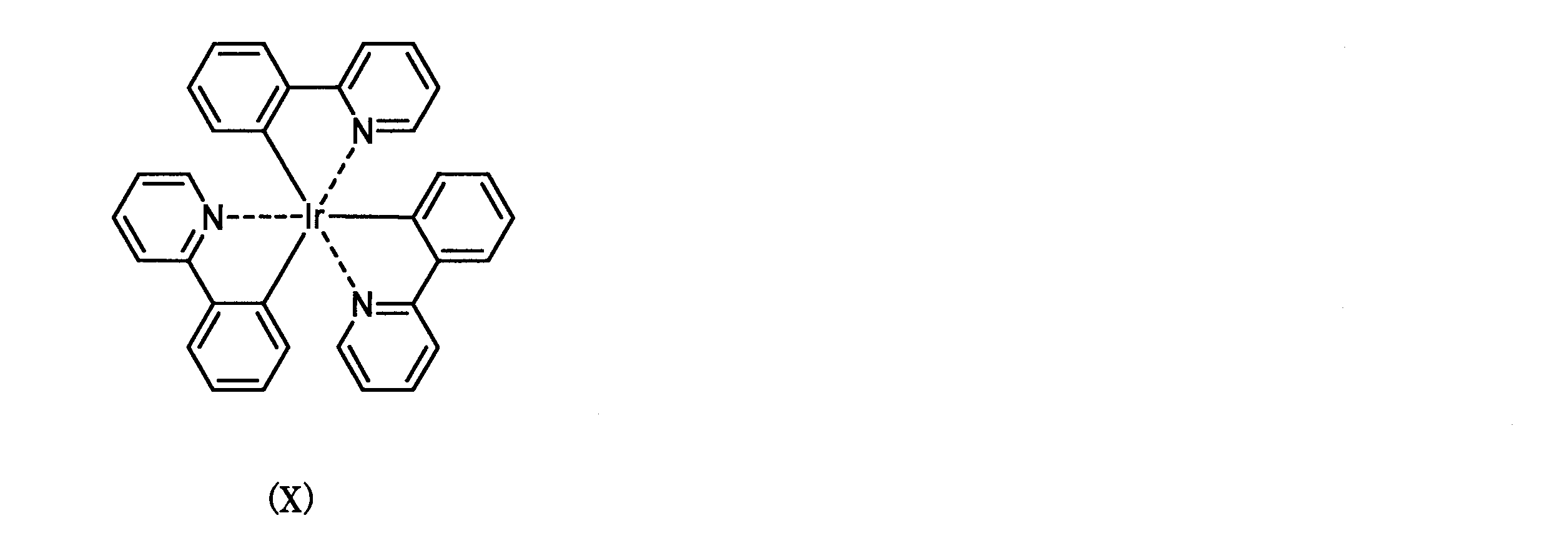
しかしながら、有機EL等の薄膜デバイスにおいて利用するためには、固体状態において効率のよい発光を生じる化合物が求められている。
近年、ゲル化能を有する燐光発光性の金錯体(例えば、非特許文献2、3参照)および白金錯体(例えば、非特許文献4~7参照)が報告されている。
しかし、これらの金錯体および白金錯体は、錯体自体にゲル化能を有する構造を含有することにより、化合物全体として、ゲル化能を有する。
Thompson, M.E.ら、Journal of American Chemical Society, 2003年、125巻、p.7377
Kishimura, A.ら、Journal of American Chemical Society, 2005年、127巻、p.179-183
Gavara, Aら、Chem Communication, 2013年、49巻、p.72-74
Shirakawa,M.ら、Chem Communication, 2005年、p.4149-4151
Shirawaka, M.ら、Chem.Eur.J.、2007年、13巻、p.4155-4162
Yiu-Yan, A.ら、Journal of American Chemical Society, 2009年、131巻、p.6253-6260
Strassert, C.A.ら、Angew.Chem.Int.Ed., 2011年、50巻、p.946-950
そこで、本発明は、溶液状態よりもゲル状態において発光強度が向上した発光性材料を提供することを目的とする。
本発明は、式(I)で表されるイリジウム錯体である。

前記式中、

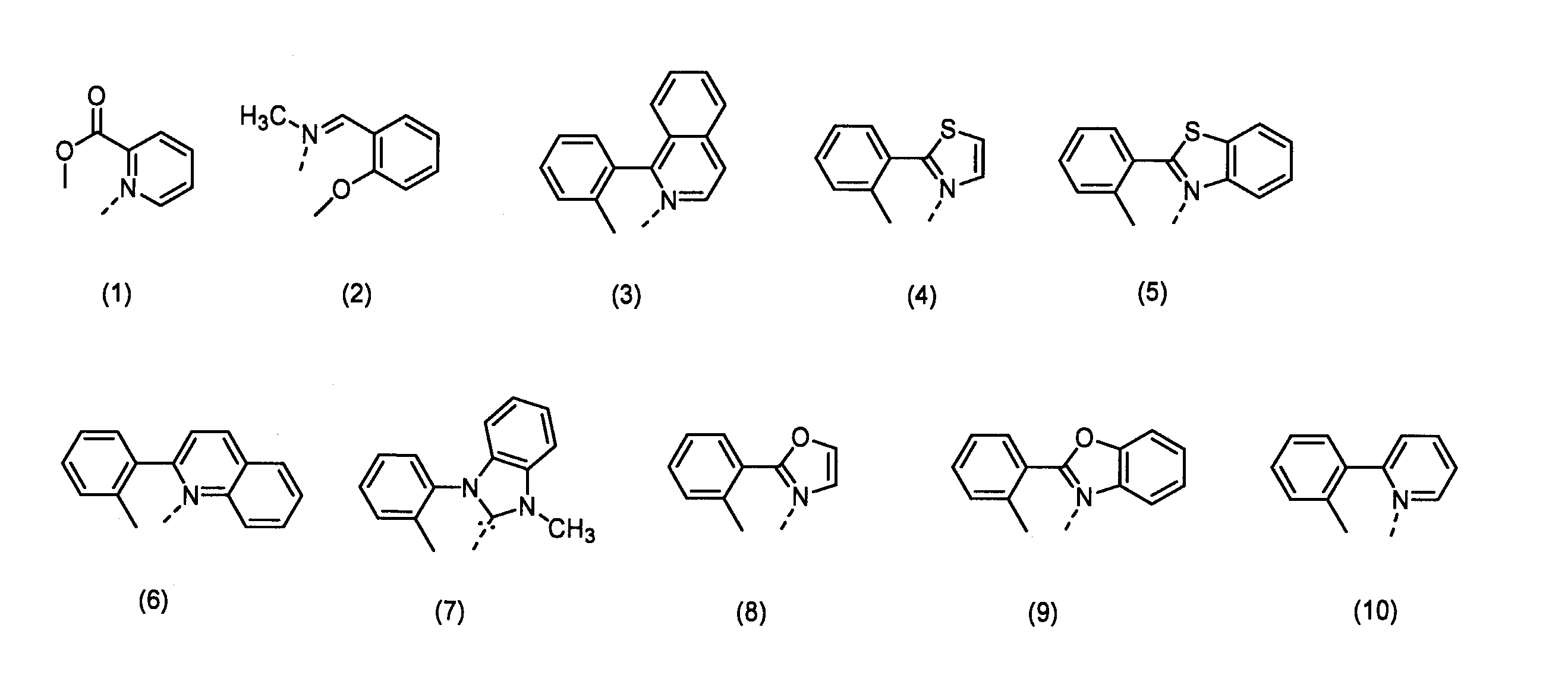
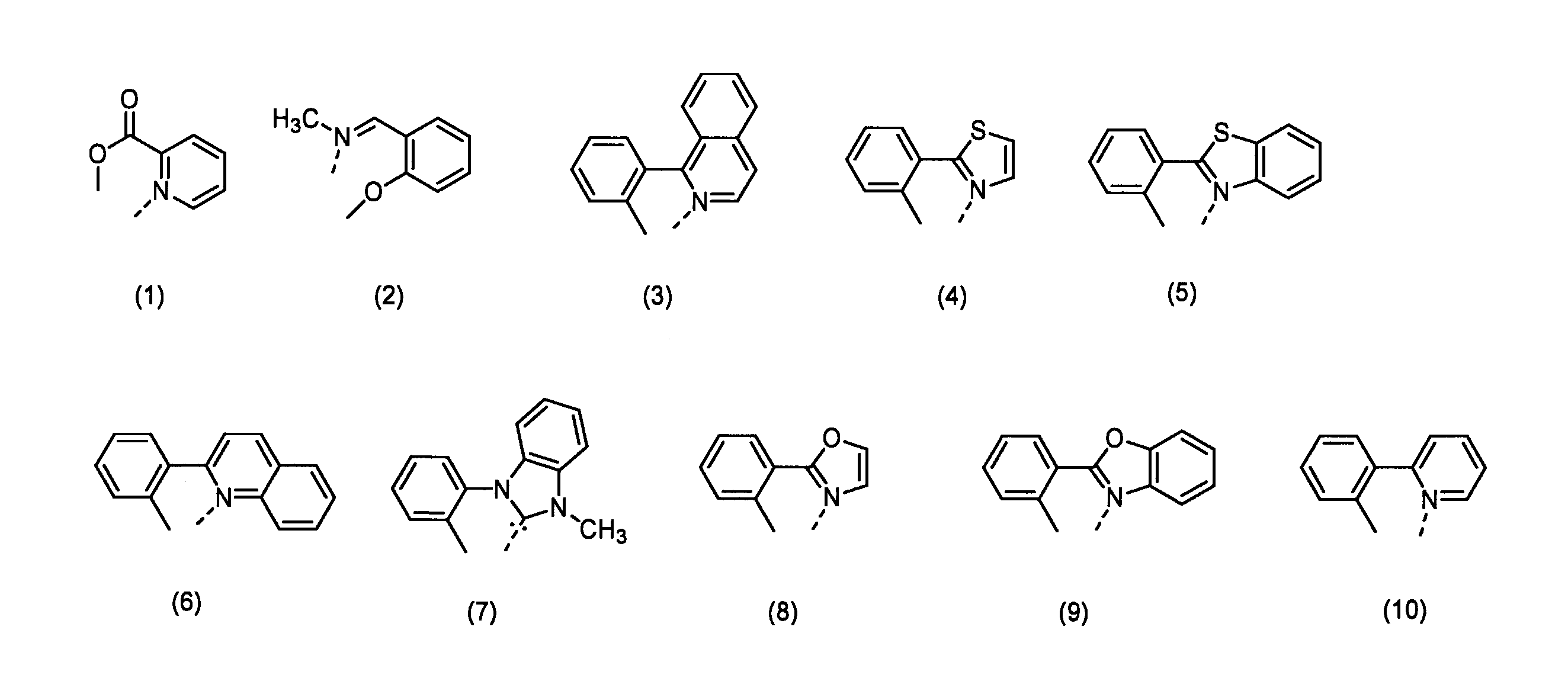
は、下記式(1)~(10)のいずれかで表される基であり、
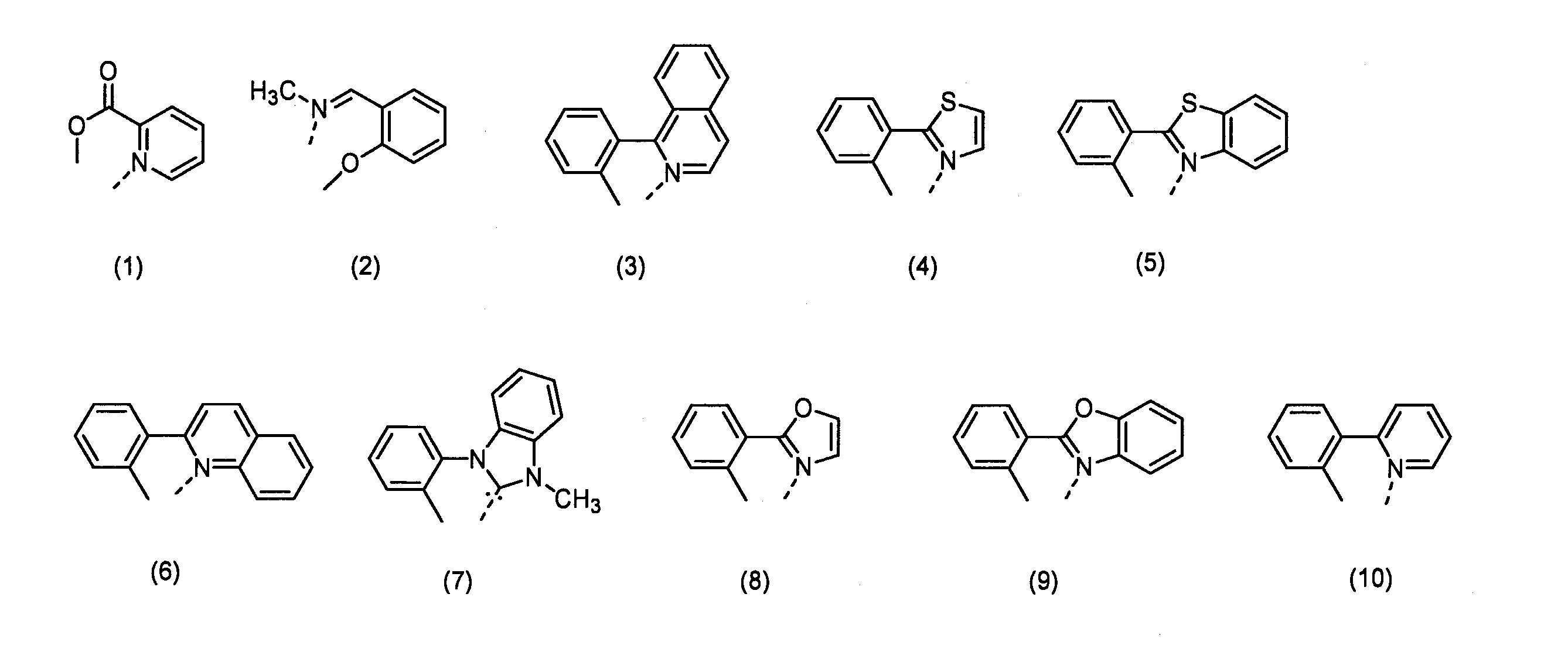
前記式(1)~(10)のいずれかで表される基における水素のいずれか1つは、式-OXで表される基で置換されており、かつ、
前記式(1)~(10)のいずれかで表される基における残りの水素のいずれか1つ以上は、任意に、ハロゲン原子、炭素数1~12のアルキル基、炭素数2~12のアルケニル基、炭素数2~12のアルキニル基、炭素数1~12のアルコキシ基、-(OCH2CH2)m-OR100(R100は、水素原子または炭素数1~12のアルキル基であり、mは2~1,000である)、-NH2、-N(炭素数1~6のアルキル基)2、-OH、-COOH、-C(=O)O-(炭素数1~6のアルキル基)、フェニル基、フェノキシ基、ニトリル基、ニトロ基、またはチオール基の置換基Rで置き換えられていてもよく、
前記Xは、式(a)で表される基であり、
前記式(1)~(10)のいずれかで表される基における残りの水素のいずれか1つ以上は、任意に、ハロゲン原子、炭素数1~12のアルキル基、炭素数2~12のアルケニル基、炭素数2~12のアルキニル基、炭素数1~12のアルコキシ基、-(OCH2CH2)m-OR100(R100は、水素原子または炭素数1~12のアルキル基であり、mは2~1,000である)、-NH2、-N(炭素数1~6のアルキル基)2、-OH、-COOH、-C(=O)O-(炭素数1~6のアルキル基)、フェニル基、フェノキシ基、ニトリル基、ニトロ基、またはチオール基の置換基Rで置き換えられていてもよく、
前記Xは、式(a)で表される基であり、

式(a)において、n1、n2、n3およびn4はそれぞれ独立して、1~20であり、
R1およびR2は、それぞれ独立して、水素原子、ハロゲン原子、炭素数2~12のアルケニル基、炭素数2~12のアルキニル基、炭素数1~12のアルコキシ基、-(OCH2CH2)m-OR100(R100は、水素原子または炭素数1~12のアルキル基であり、mは2~1,000である)、-NH2、-N(炭素数1~6のアルキル基)2、-OH、-COOH、-C(=O)O-(炭素数1~6のアルキル基)、フェニル基、フェノキシ基、ニトリル基、ニトロ基、またはチオール基であり、
2つの
R1およびR2は、それぞれ独立して、水素原子、ハロゲン原子、炭素数2~12のアルケニル基、炭素数2~12のアルキニル基、炭素数1~12のアルコキシ基、-(OCH2CH2)m-OR100(R100は、水素原子または炭素数1~12のアルキル基であり、mは2~1,000である)、-NH2、-N(炭素数1~6のアルキル基)2、-OH、-COOH、-C(=O)O-(炭素数1~6のアルキル基)、フェニル基、フェノキシ基、ニトリル基、ニトロ基、またはチオール基であり、
2つの

は、互いに同一であっても異なっていてもよく、下記式(11)~(74)のいずれかで表される基であり、かつ、
前記式(11)~(74)のいずれかで表される基における水素のいずれか1つ以上は、任意に、ハロゲン原子、炭素数1~12のアルキル基、炭素数2~12のアルケニル基、炭素数2~12のアルキニル基、炭素数1~12のアルコキシ基、-(OCH2CH2)m-OR100(R100は、水素原子または炭素数1~12のアルキル基であり、mは2~1,000である)、-NH2、-N(炭素数1~6のアルキル基)2、-OH、-COOH、-C(=O)O-(炭素数1~6のアルキル基)、フェニル基、フェノキシ基、ニトリル基、ニトロ基、またはチオール基の置換基R’で置き換えられていてもよい。
前記式(11)~(74)のいずれかで表される基における水素のいずれか1つ以上は、任意に、ハロゲン原子、炭素数1~12のアルキル基、炭素数2~12のアルケニル基、炭素数2~12のアルキニル基、炭素数1~12のアルコキシ基、-(OCH2CH2)m-OR100(R100は、水素原子または炭素数1~12のアルキル基であり、mは2~1,000である)、-NH2、-N(炭素数1~6のアルキル基)2、-OH、-COOH、-C(=O)O-(炭素数1~6のアルキル基)、フェニル基、フェノキシ基、ニトリル基、ニトロ基、またはチオール基の置換基R’で置き換えられていてもよい。


また、本発明は、前記イリジウム錯体と、
超分子ゲル化剤とを含む発光性材料用組成物である。
超分子ゲル化剤とを含む発光性材料用組成物である。
また、本発明は、前記発光性材料用組成物から得られたゲル状発光性材料である。また、本発明は、超分子ゲルと、前記超分子ゲルに共有結合した本発明のイリジウム錯体とを含む発光性材料である。
本発明のイリジウム錯体と、超分子ゲル化剤とを含む発光性材料用組成物から得られるゲル状発光性材料は、溶液状態よりもゲル状態において発光強度が向上したという利点がある。
本発明者らは、燐光発光性能を有することが知られているイリジウム化合物に、式(a)で表されるアミノ酸側鎖部分を結合させた新規イリジウム錯体(I)と、超分子ゲル化剤とから得られたゲル状材料が、新規イリジウム錯体(I)単独の溶液状態よりも、より強い発光強度を示すことを予想外に見出した。一方、式(a)で表されるアミノ酸側鎖部分を有さない下記式(IV)で表されるイリジウム化合物は、単独の溶液状態であっても、超分子ゲル化剤とから得られたゲル状材料の状態であっても、発光強度にほとんど変化がないことも見出した。これらの知見に基づき、本発明者らは、本発明を完成した。

前記式(IV)中、

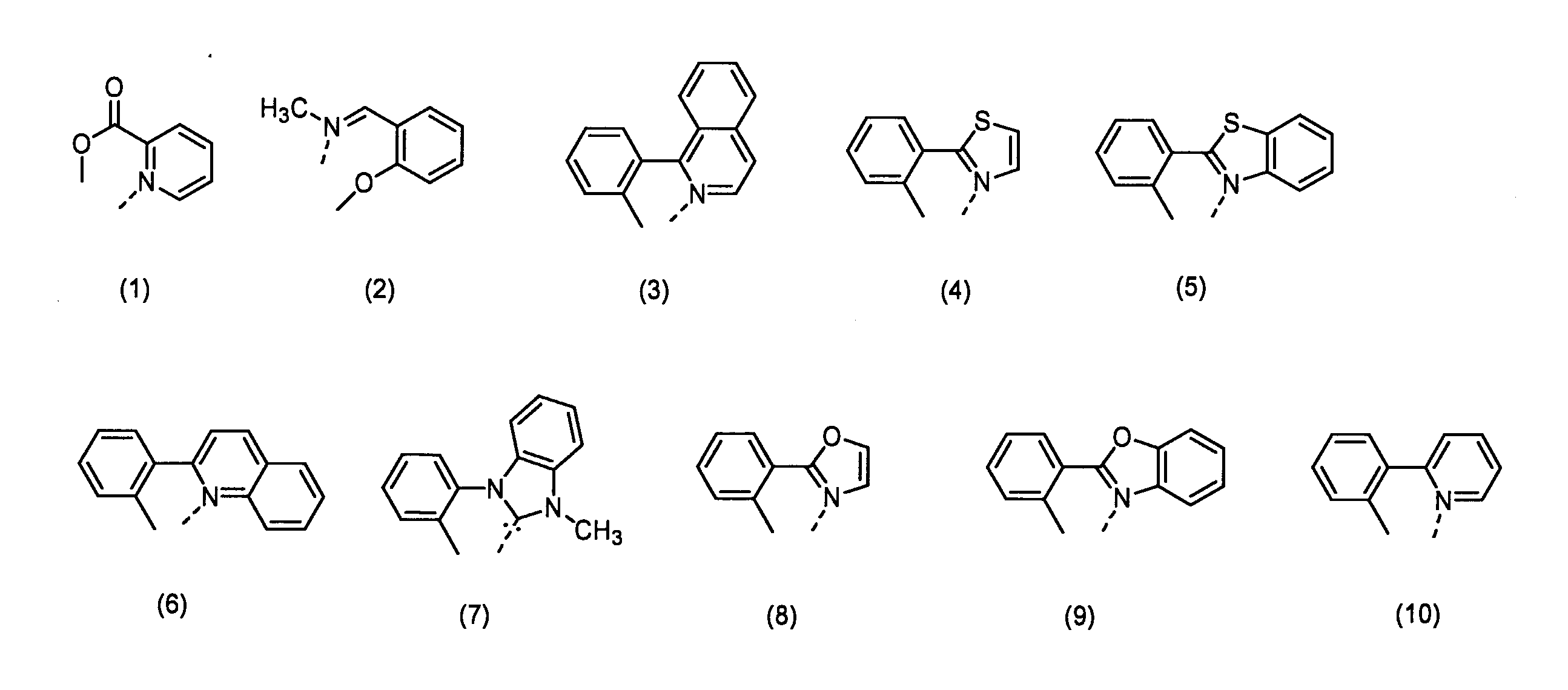
前記式(1)~(10)のいずれかで表される基における水素のいずれか1つは、式-O-(CH2)n1-COOR21で表される基で置換されており(R21は、炭素数1~12のアルキル基である)、かつ、
前記式(1)~(10)のいずれかで表される基における残りの水素のいずれか1つ以上は、任意に、ハロゲン原子、炭素数1~12のアルキル基、炭素数2~12のアルケニル基、炭素数2~12のアルキニル基、炭素数1~12のアルコキシ基、-(OCH2CH2)m-OR100(R100は、水素原子または炭素数1~12のアルキル基であり、mは2~1,000である)、-NH2、-N(炭素数1~6のアルキル基)2、-OH、-COOH、-C(=O)O-(炭素数1~6のアルキル基)、フェニル基、フェノキシ基、ニトリル基、ニトロ基、またはチオール基で置き換えられていてもよい。
前記式(1)~(10)のいずれかで表される基における残りの水素のいずれか1つ以上は、任意に、ハロゲン原子、炭素数1~12のアルキル基、炭素数2~12のアルケニル基、炭素数2~12のアルキニル基、炭素数1~12のアルコキシ基、-(OCH2CH2)m-OR100(R100は、水素原子または炭素数1~12のアルキル基であり、mは2~1,000である)、-NH2、-N(炭素数1~6のアルキル基)2、-OH、-COOH、-C(=O)O-(炭素数1~6のアルキル基)、フェニル基、フェノキシ基、ニトリル基、ニトロ基、またはチオール基で置き換えられていてもよい。
前記式(IV)中、

およびn1は、式(I)における定義と同様である。
本発明のイリジウム白金錯体は、以下の式(I)で表される。

前記式中、

は、下記式(1)~(10)のいずれかで表される基であり、
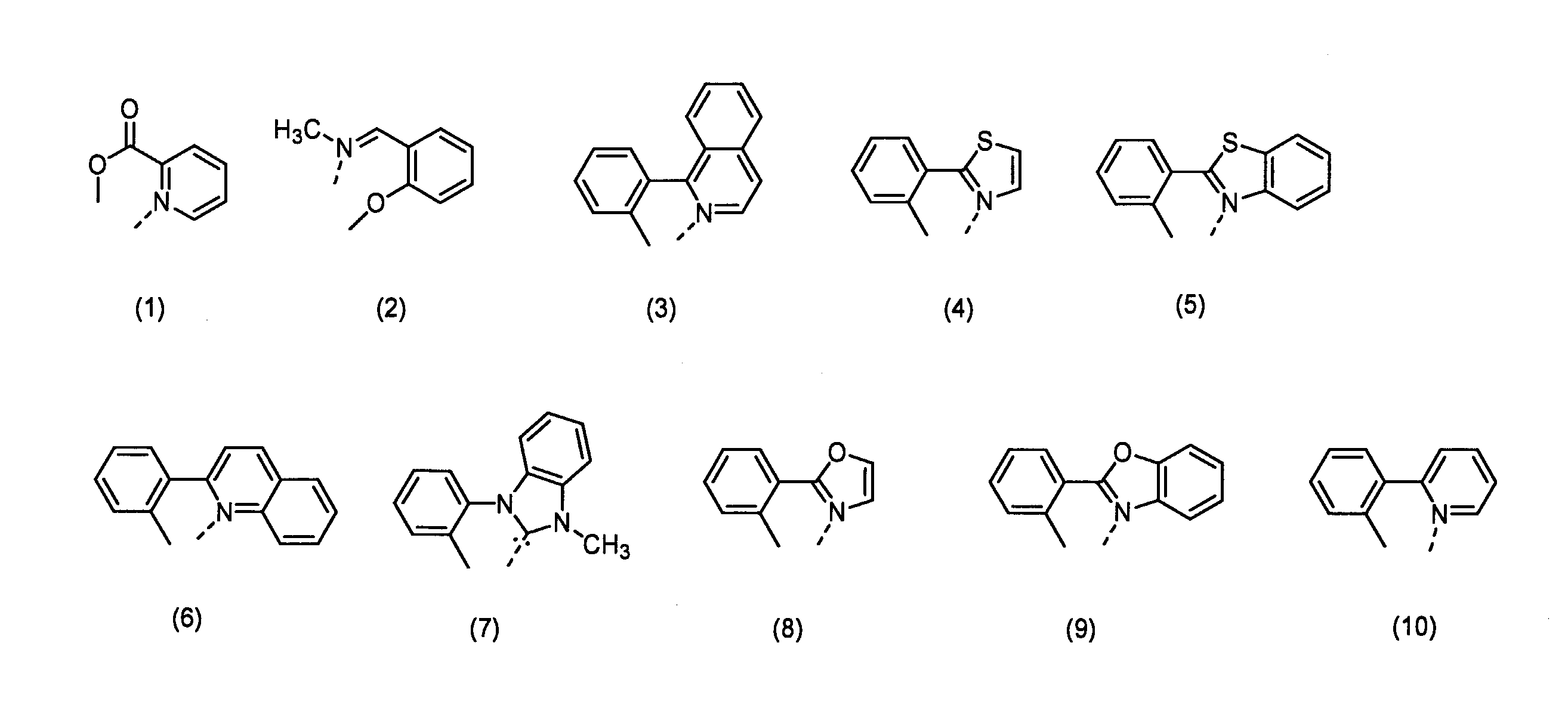
前記式(1)~(10)のいずれかで表される基における水素のいずれか1つは、式-OXで表される基で置換されており、かつ、
前記式(1)~(10)のいずれかで表される基における残りの水素のいずれか1つ以上は、任意に、ハロゲン原子、炭素数1~12のアルキル基、炭素数2~12のアルケニル基、炭素数2~12のアルキニル基、炭素数1~12のアルコキシ基、-(OCH2CH2)m-OR100(R100は、水素原子または炭素数1~12のアルキル基であり、mは2~1,000である)、-NH2、-N(炭素数1~6のアルキル基)2、-OH、-COOH、-C(=O)O-(炭素数1~6のアルキル基)、フェニル基、フェノキシ基、ニトリル基、ニトロ基、またはチオール基の置換基Rで置き換えられていてもよく、
前記Xは、式(a)で表される基であり、
前記式(1)~(10)のいずれかで表される基における残りの水素のいずれか1つ以上は、任意に、ハロゲン原子、炭素数1~12のアルキル基、炭素数2~12のアルケニル基、炭素数2~12のアルキニル基、炭素数1~12のアルコキシ基、-(OCH2CH2)m-OR100(R100は、水素原子または炭素数1~12のアルキル基であり、mは2~1,000である)、-NH2、-N(炭素数1~6のアルキル基)2、-OH、-COOH、-C(=O)O-(炭素数1~6のアルキル基)、フェニル基、フェノキシ基、ニトリル基、ニトロ基、またはチオール基の置換基Rで置き換えられていてもよく、
前記Xは、式(a)で表される基であり、

式(a)において、n1、n2、n3およびn4はそれぞれ独立して、1~20であり、
R1およびR2は、それぞれ独立して、水素原子、ハロゲン原子、炭素数2~12のアルケニル基、炭素数2~12のアルキニル基、炭素数1~12のアルコキシ基、-(OCH2CH2)m-OR100(R100は、水素原子または炭素数1~12のアルキル基であり、mは2~1,000である)、-NH2、-N(炭素数1~6のアルキル基)2、-OH、-COOH、-C(=O)O-(炭素数1~6のアルキル基)、フェニル基、フェノキシ基、ニトリル基、ニトロ基、またはチオール基であり、
2つの
R1およびR2は、それぞれ独立して、水素原子、ハロゲン原子、炭素数2~12のアルケニル基、炭素数2~12のアルキニル基、炭素数1~12のアルコキシ基、-(OCH2CH2)m-OR100(R100は、水素原子または炭素数1~12のアルキル基であり、mは2~1,000である)、-NH2、-N(炭素数1~6のアルキル基)2、-OH、-COOH、-C(=O)O-(炭素数1~6のアルキル基)、フェニル基、フェノキシ基、ニトリル基、ニトロ基、またはチオール基であり、
2つの

は、互いに同一であっても異なっていてもよく、下記式(11)~(74)のいずれかで表される基であり、かつ、
前記式(11)~(74)のいずれかで表される基における水素のいずれか1つ以上は、任意に、ハロゲン原子、炭素数1~12のアルキル基、炭素数2~12のアルケニル基、炭素数2~12のアルキニル基、炭素数1~12のアルコキシ基、-(OCH2CH2)m-OR100(R100は、水素原子または炭素数1~12のアルキル基であり、mは2~1,000である)、-NH2、-N(炭素数1~6のアルキル基)2、-OH、-COOH、-C(=O)O-(炭素数1~6のアルキル基)、フェニル基、フェノキシ基、ニトリル基、ニトロ基、またはチオール基の置換基R’で置き換えられていてもよい。
前記式(11)~(74)のいずれかで表される基における水素のいずれか1つ以上は、任意に、ハロゲン原子、炭素数1~12のアルキル基、炭素数2~12のアルケニル基、炭素数2~12のアルキニル基、炭素数1~12のアルコキシ基、-(OCH2CH2)m-OR100(R100は、水素原子または炭素数1~12のアルキル基であり、mは2~1,000である)、-NH2、-N(炭素数1~6のアルキル基)2、-OH、-COOH、-C(=O)O-(炭素数1~6のアルキル基)、フェニル基、フェノキシ基、ニトリル基、ニトロ基、またはチオール基の置換基R’で置き換えられていてもよい。


なお、前記式(1)~(10)のいずれかで表される基における残りの水素のいずれか1つ以上は、任意に、ハロゲン原子、炭素数1~12のアルキル基、炭素数2~12のアルケニル基、炭素数2~12のアルキニル基、炭素数1~12のアルコキシ基、-(OCH2CH2)m-OR100(R100は、水素原子または炭素数1~12のアルキル基であり、mは2~1,000である)、-NH2、-N(炭素数1~6のアルキル基)2、-OH、-COOH、-C(=O)O-(炭素数1~6のアルキル基)、フェニル基、フェノキシ基、ニトリル基、ニトロ基、またはチオール基の置換基Rで置き換えられていてもよいが、前記式(1)~(10)のいずれかで表される基における残りの水素のいずれか2つ以上の水素原子が、前記置換基Rで置き換えられている場合、それぞれの置換基Rは異なっていても、同一であってもよい。
同様に、前記式(11)~(74)のいずれかで表される基における水素のいずれか1つ以上は、任意に、ハロゲン原子、炭素数1~12のアルキル基、炭素数2~12のアルケニル基、炭素数2~12のアルキニル基、炭素数1~12のアルコキシ基、-(OCH2CH2)m-OR100(R100は、水素原子または炭素数1~12のアルキル基であり、mは2~1,000である)、-NH2、-N(炭素数1~6のアルキル基)2、-OH、-COOH、-C(=O)O-(炭素数1~6のアルキル基)、フェニル基、フェノキシ基、ニトリル基、ニトロ基、またはチオール基の置換基R’で置き換えられていてもよいが、前記式(11)~(74)のいずれかで表される基における水素のいずれか2つ以上が、前記置換基R’で置き換えられている場合、それぞれの置換基R’は異なっていても、同一であってもよい。
前記n1、n2、n3およびn4は、それぞれ独立して、1~20である。前記n1は、1~10が好ましく、3~8がより好ましい。前記n2は、1~10が好ましく、1~5がより好ましい。前記n3は、5~20が好ましく、5~10がより好ましい。前記n4は、5~20が好ましく、5~10がより好ましい。
また、本発明のイリジウム錯体は、

は、式(10)で表される基であり、
式(a)におけるn1、n2、n3およびn4は、それぞれ独立して、1~6であり、R1およびR2は、水素原子であり、
2つの
式(a)におけるn1、n2、n3およびn4は、それぞれ独立して、1~6であり、R1およびR2は、水素原子であり、
2つの

は、互いに独立して、式(11)、(15)または(27)で表される基であるのが好ましい。
前記式(11)、(15)または(27)のいずれかで表される基における水素のいずれか1つ以上は、任意に、ハロゲン原子で置き換えられていてもよい。
また、本発明のイリジウム錯体は、

は、式(10)で表される基であり、
式(a)におけるn1、n2、n3およびn4は、それぞれ独立して、1~6であり、R1およびR2は、水素原子であり、
2つの
式(a)におけるn1、n2、n3およびn4は、それぞれ独立して、1~6であり、R1およびR2は、水素原子であり、
2つの

は、式(11)または(27)で表される基であるのが、より好ましい。
前記式(11)または(27)のいずれかで表される基における水素のいずれか1つ以上は、任意に、ハロゲン原子で置き換えられていてもよい。
また、本発明のイリジウム錯体は、式(I-1)、式(I-2)および式(I-3)で表される化合物がより好ましい。

また、本発明は、本発明のイリジウム錯体と、超分子ゲル化剤とを含む発光性材料用組成物である。前記超分子ゲル化剤は、水素結合によりゲル化を生じるゲル化剤であるのが好ましく、有機溶媒に溶解性であるゲル化剤であるのがより好ましい。
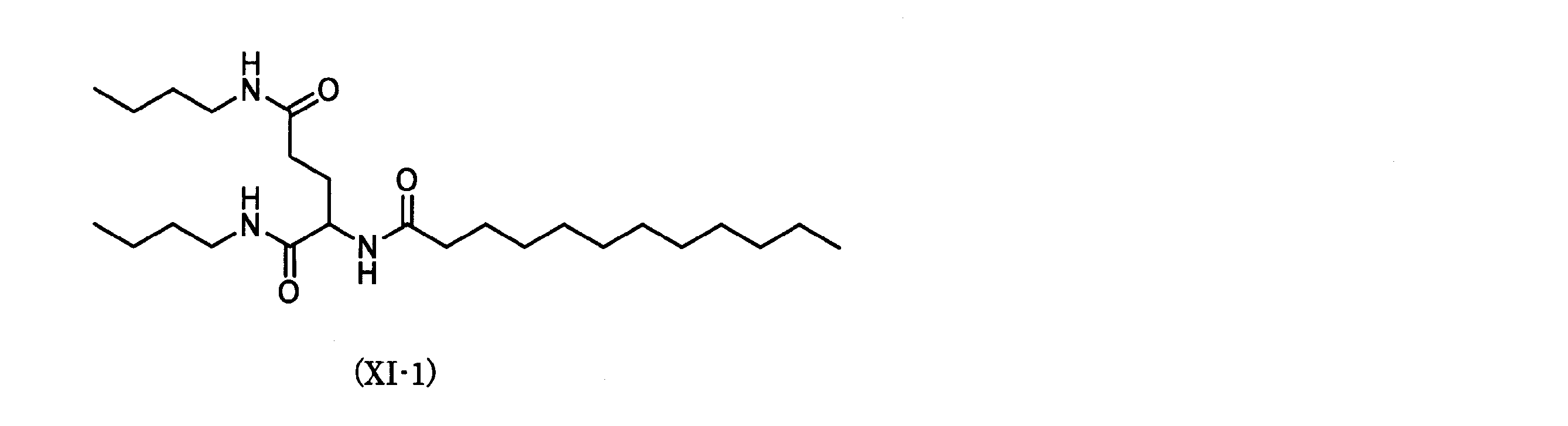
前記超分子ゲル化剤としては、例えば、以下の式(XI)で表される化合物が挙げられる。

式(XI)中、n12、n13およびn14はそれぞれ独立して、0~20であり、
n11は、6~20であり、
R11、R12およびR13は、それぞれ独立して、水素原子、ハロゲン原子、炭素数2~12のアルケニル基、炭素数2~12のアルキニル基、炭素数1~12のアルコキシ基、-(OCH2CH2)m-OR100(R100は、水素原子または炭素数1~12のアルキル基であり、mは2~1,000である)、-NH2、-N(炭素数1~6のアルキル基)2、-OH、-COOH、-C(=O)O-(炭素数1~6のアルキル基)、フェニル基、フェノキシ基、ニトリル基、ニトロ基、またはチオール基である。
n11は、6~20であり、
R11、R12およびR13は、それぞれ独立して、水素原子、ハロゲン原子、炭素数2~12のアルケニル基、炭素数2~12のアルキニル基、炭素数1~12のアルコキシ基、-(OCH2CH2)m-OR100(R100は、水素原子または炭素数1~12のアルキル基であり、mは2~1,000である)、-NH2、-N(炭素数1~6のアルキル基)2、-OH、-COOH、-C(=O)O-(炭素数1~6のアルキル基)、フェニル基、フェノキシ基、ニトリル基、ニトロ基、またはチオール基である。
前記式(XI)中、
n12、n13およびn14は、それぞれ独立して、1~6であり、
n11は、6~15であり、
R11、R12およびR13は、水素原子であるのが好ましい。
n12、n13およびn14は、それぞれ独立して、1~6であり、
n11は、6~15であり、
R11、R12およびR13は、水素原子であるのが好ましい。
前記式(XI)で表される化合物は、例えば、式(XI-1)で表される化合物である。

また、前記超分子ゲル化剤としては、例えば、式(XII)で表される化合物および式(XIII)で表される化合物を用いることができる。式(XII)で表される化合物は、Hanabusaら、Angew.Chem.Int.Ed., 1996年、35巻、p.1949-1951参照。式(XIII)で表される化合物は、Suzukiら、Langumuir、2003年、19巻、p.8623-8624参照。

本発明において、用語「炭素数1~12のアルキル基」とは、例えば、メチル、エチル、プロピル、ブチル、ペンチル、ヘキシル、ヘプチル、オクチル、ノニル、デシル、ウンデシル、ドデシル等が挙げられる。アルキル基としては、直鎖状または分岐状であってもよい。炭素数1~12のアルキル基としては、例えば、炭素数1~10、好ましくは炭素数5~10、より好ましくは炭素数5~8のアルキル基である。
本発明において、用語「炭素数2~12のアルケニル基」とは、例えば、エチレニル、プロピレニル、ブテニル、ペンテニル、ヘキセニル等が挙げられる。アルケニル基としては、直鎖状または分岐状であってもよい。炭素数2~12のアルケニル基としては、例えば、炭素数2~10、好ましくは炭素数5~10、より好ましくは炭素数5~8のアルケニル基である。
本発明において、用語「炭素数2~12のアルキニル基」とは、例えば、アセチレニル、プロペニル等が挙げられる。アルキニル基としては、直鎖状または分岐状であってもよい。炭素数2~12のアルキニル基としては、例えば、炭素数2~10、好ましくは炭素数5~10、より好ましくは炭素数5~8のアルキニル基である。
本発明において、用語「炭素数1~12のアルコキシ基」とは、アルキルオキシ基である。このアルキルオキシ基のアルキル部分は、前記炭素数1~12のアルキル基と同様である。アルコキシル基としては、例えば、メトキシ、エトキシ、プロピルオキシ、ブチルオキシ、ペンチルオキシ、ヘキシルオキシ、ヘプチルオキシ、オクチルオキシ、ノニルオキシ、デシルオキシ、ウンデシルオキシ、ドデシルオキシ等が挙げられる。炭素数1~12のアルコキシ基としては、例えば、炭素数1~10、好ましくは炭素数5~10、より好ましくは炭素数5~8のアルコキシ基である。
本発明において、用語「-N(炭素数1~6のアルキル基)2」のアルキル基部分は、例えば、メチル、エチル、プロピル、ブチル、ペンチル、ヘキシル等である。また、このアルキル部分は、互いに同一であっても、異なっていてもよい。-N(炭素数1~6のアルキル基)2としては、例えば、ジメチルアミノ、ジエチルアミノ、メチルエチルアミノ、ジプロピルアミノ、ジブチルアミノ、ジペンチルアミノ、ジヘキシルアミノ等が挙げられる。アルキル基部分としては、直鎖状または分岐状であってもよい。-N(炭素数1~6のアルキル基)2としては、例えば、-N(炭素数1~5のアルキル基)2、好ましくは-N(炭素数1~4のアルキル基)2、より好ましくは-N(炭素数1~3のアルキル基)2である。
本発明において、用語「-C(=O)O-(炭素数1~6のアルキル基)」のアルキル基部分は、例えば、メチル、エチル、プロピル、ブチル、ペンチル、ヘキシル等である。-C(=O)O-(炭素数1~6のアルキル基)としては、例えば、-C(=O)O-メチル、-C(=O)O-エチル、-C(=O)O-プロピル、-C(=O)O-ブチル、-C(=O)O-ペンチル、-C(=O)O-ヘキシル等が挙げられる。-C(=O)O-(炭素数1~6のアルキル基)としては、例えば、-C(=O)O-(炭素数1~5のアルキル基)、好ましくは-C(=O)O-(炭素数1~4のアルキル基)、より好ましくは-C(=O)O-(炭素数1~3のアルキル基)である。
本発明のイリジウム錯体は、例えば、以下のようにして製造することができる。

前記式(II)中、

は、式(1)~(10)のいずれかで表される基であり、
前記式(1)~(10)のいずれかで表される基における水素のいずれか1つは、式-O-(CH2)n1-COOHで表される基で置換されており、かつ、
前記式(1)~(10)のいずれかで表される基における残りの水素のいずれか1つ以上は、任意に、ハロゲン原子、炭素数1~12のアルキル基、炭素数2~12のアルケニル基、炭素数2~12のアルキニル基、炭素数1~12のアルコキシ基、-(OCH2CH2)m-OR100(R100は、水素原子または炭素数1~12のアルキル基であり、mは2~1,000である)、-NH2、-N(炭素数1~6のアルキル基)2、-OH、-COOH、-C(=O)O-(炭素数1~6のアルキル基)、フェニル基、フェノキシ基、ニトリル基、ニトロ基、またはチオール基で置き換えられていてもよい。
前記式(1)~(10)のいずれかで表される基における残りの水素のいずれか1つ以上は、任意に、ハロゲン原子、炭素数1~12のアルキル基、炭素数2~12のアルケニル基、炭素数2~12のアルキニル基、炭素数1~12のアルコキシ基、-(OCH2CH2)m-OR100(R100は、水素原子または炭素数1~12のアルキル基であり、mは2~1,000である)、-NH2、-N(炭素数1~6のアルキル基)2、-OH、-COOH、-C(=O)O-(炭素数1~6のアルキル基)、フェニル基、フェノキシ基、ニトリル基、ニトロ基、またはチオール基で置き換えられていてもよい。
前記式(II)中、

n1は、式(I)における定義と同様である。
前記式(III)中、n2、n3、n4、R1およびR2は、式(I)における定義と同様である。
式(II)の化合物と式(III)の化合物とを縮合剤の存在下、反応させて式(I)の化合物を得る。この縮合剤としては、例えば、EDCI(1-エチル-3-(3-ジメチルアミノイプロピル)カルボジイミド塩酸塩)、DCC(ジシクロヘキシルカルボジイミド)等が挙げられる。また、縮合剤に加えて、触媒として、例えば、DMAP等を加えてもよい。この反応は、例えば室温~100℃で、3時間~24時間、行う。この反応の溶媒としては、限定されないが、例えば、1,2-ジクロロエタン、1、1?ジクロロメタン等が挙げられる。
前記製造方法において、前記式(II)で表される化合物および式(III)で表される化合物は、市販で入手してもよいし、公知文献を参照して自家製造してもよい。式(II)で表される化合物は、例えば、以下のようにして製造することができる。
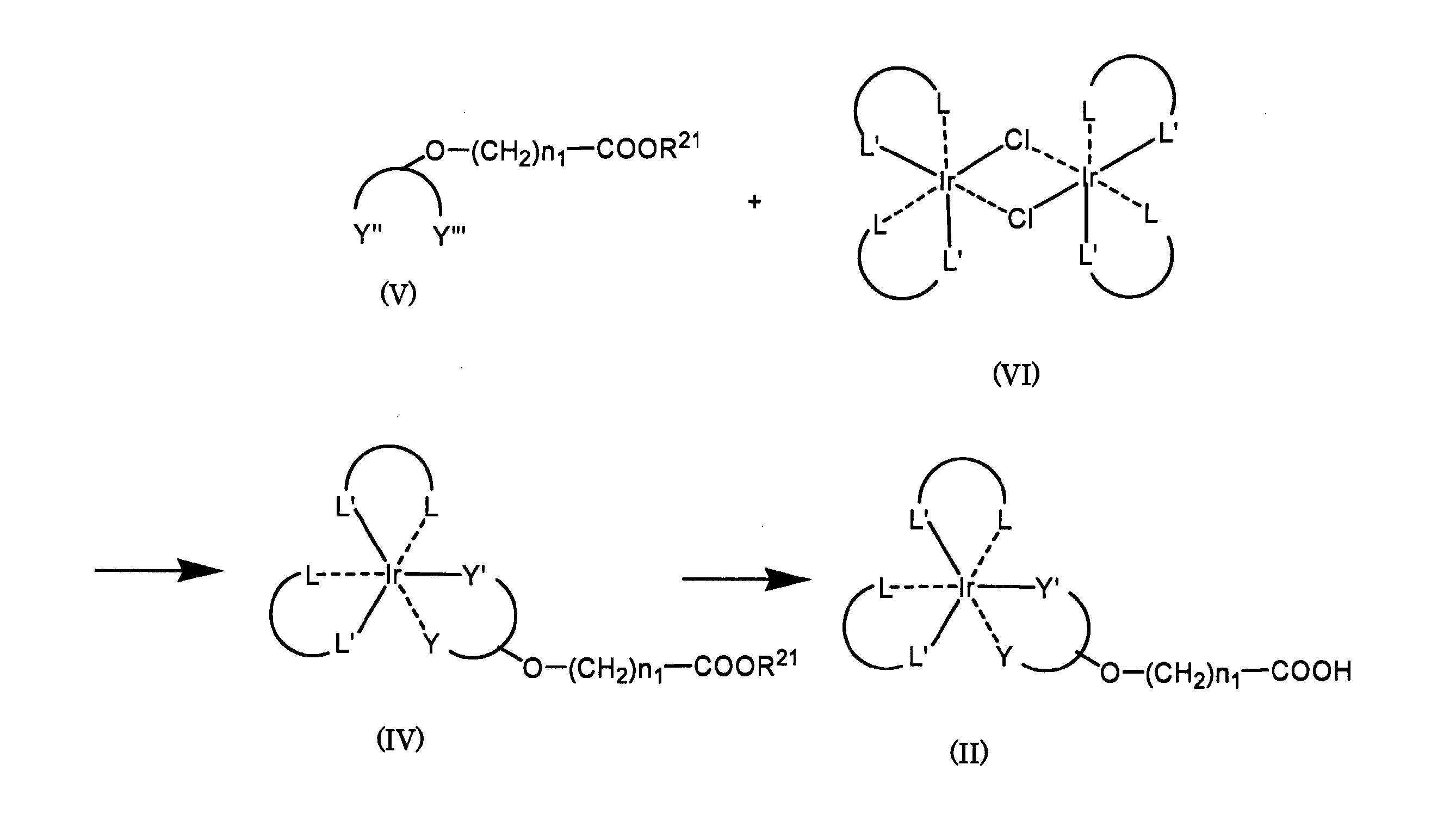
前記式(V)中、

は、式(101)~(110)のいずれかで表される基であり、

前記式(101)~(110)のいずれかで表される基における水素のいずれか1つは、式-O-(CH2)n1-COOR21で表される基で置換されており(R21は、炭素数1~12のアルキル基である)、かつ、
前記式(101)~(110)のいずれかで表される基における残りの水素のいずれか1つ以上は、任意に、ハロゲン原子、炭素数1~12のアルキル基、炭素数2~12のアルケニル基、炭素数2~12のアルキニル基、炭素数1~12のアルコキシ基、-(OCH2CH2)m-OR100(R100は、水素原子または炭素数1~12のアルキル基であり、mは2~1,000である)、-NH2、-N(炭素数1~6のアルキル基)2、-OH、-COOH、-C(=O)O-(炭素数1~6のアルキル基)、フェニル基、フェノキシ基、ニトリル基、ニトロ基、またはチオール基で置き換えられていてもよい。
前記式(101)~(110)のいずれかで表される基における残りの水素のいずれか1つ以上は、任意に、ハロゲン原子、炭素数1~12のアルキル基、炭素数2~12のアルケニル基、炭素数2~12のアルキニル基、炭素数1~12のアルコキシ基、-(OCH2CH2)m-OR100(R100は、水素原子または炭素数1~12のアルキル基であり、mは2~1,000である)、-NH2、-N(炭素数1~6のアルキル基)2、-OH、-COOH、-C(=O)O-(炭素数1~6のアルキル基)、フェニル基、フェノキシ基、ニトリル基、ニトロ基、またはチオール基で置き換えられていてもよい。
前記式(IV)中、

は、式(1)~(10)のいずれかで表される基であり、

前記式(1)~(10)のいずれかで表される基における水素のいずれか1つは、式-O-(CH2)n1-COOR21で表される基で置換されており(R21は、炭素数1~12のアルキル基である)、かつ、
前記式(1)~(10)のいずれかで表される基における残りの水素のいずれか1つ以上は、任意に、ハロゲン原子、炭素数1~12のアルキル基、炭素数2~12のアルケニル基、炭素数2~12のアルキニル基、炭素数1~12のアルコキシ基、-(OCH2CH2)m-OR100(R100は、水素原子または炭素数1~12のアルキル基であり、mは2~1,000である)、-NH2、-N(炭素数1~6のアルキル基)2、-OH、-COOH、-C(=O)O-(炭素数1~6のアルキル基)、フェニル基、フェノキシ基、ニトリル基、ニトロ基、またはチオール基で置き換えられていてもよい。
前記式(1)~(10)のいずれかで表される基における残りの水素のいずれか1つ以上は、任意に、ハロゲン原子、炭素数1~12のアルキル基、炭素数2~12のアルケニル基、炭素数2~12のアルキニル基、炭素数1~12のアルコキシ基、-(OCH2CH2)m-OR100(R100は、水素原子または炭素数1~12のアルキル基であり、mは2~1,000である)、-NH2、-N(炭素数1~6のアルキル基)2、-OH、-COOH、-C(=O)O-(炭素数1~6のアルキル基)、フェニル基、フェノキシ基、ニトリル基、ニトロ基、またはチオール基で置き換えられていてもよい。
前記式(IV)および(VI)中、

は、式(I)における定義と同様である。
式(V)の化合物と式(VI)の化合物とを、溶媒中で加熱して式(IV)で表される化合物を得る。この反応は、例えば、トリフルオロメタンスルホン酸銀、トリフルオロ酢酸銀等の存在下で行ってもよい。この反応は、例えば、溶媒の還流加熱温度で、必要な時間、行う。この反応の溶媒としては、限定されないが、例えば、トルエン、ベンゼン等が挙げられる。得られた式(IV)の化合物をアルカリ存在下で加熱してエステル分解することにより、式(II)の化合物を得ることができる。このエステル分解におけるアルカリとしては、水酸化リチウム等が挙げられる。このエステル分解は、例えば、溶媒の還流加熱温度で、必要な時間、行う。このエステル分解の溶媒としては、限定されないが、例えば、THF、メタノール、水、これらの混合物等が挙げられる。
また、本発明の発光性材料は、本発明の発光性材料用組成物から得られたゲル状発光性材料である。具体的には、例えば、本発明の発光性材料用組成物に含まれるイリジウム錯体の溶液と、超分子ゲル化剤の溶液をそれぞれ調製し、両者を混合した後、加熱した後、室温に冷却することによりゲル状発光性材料を得ることができる。前記加熱温度としては、例えば、40~100℃、好ましくは80~100℃である。また、前記イリジウム錯体の溶液の濃度としては、例えば、1.0x10⁻⁵~4.0x10⁻⁴モル/L、好ましくは1.0x10-4~2.0x10-4モル/Lである。また、前記超分子ゲル化剤の溶液の濃度としては、例えば、2.0x10-2~2.0x10-1モル/L、好ましくは2.0x10-2~5.0x10-2モル/Lである。
また、本発明の発光性材料は、超分子ゲルと、前記超分子ゲルに共有結合した本発明のイリジウム錯体とを含む発光性材料である。前記超分子ゲルは、前記超分子ゲル化剤から製造される。
本発明の発光性材料は、溶液状態よりもゲル状態において発光強度が向上したという効果を奏する。従って、本発明の発光性材料は、高輝度発光性材料、および有機EL素子の発光性材料、具体的には発光層の材料として用いることができる。そのような有機EL素子としては、例えば、基板、陽極、正孔輸送層、本発明の発光性材料を含む発光層、電子輸送層、および陰極をこの順に積層して構成される。前記基板、陽極、正孔輸送層、電子輸送層、および陰極については、従来公知の材料を用い、従来公知の製造方法により形成されていてもよい。
前記発光層は、本発明の発光性材料のほかに、ホスト材料を含んでいてもよい。このホスト材料としては、例えば、ジアリールアミン骨格を有するもの、ピリジン骨格を有するもの、ピラジン骨格を有するもの、トリアジン骨格を有するもの、アリールシラン骨格を有するものが挙げられる。
以下に本発明を実施例によりさらに具体的に説明するが、本発明の範囲は、以下の実施例により限定されない。
種々のスペクトルは、以下の機器を用いて測定した。
核磁気共鳴(NMR)スペクトルはバリアン社製UNITY-INOVA核磁気共鳴装置(500MHz)を用いて測定し、測定溶媒の残存シグナルを内部基準として使用した。
核磁気共鳴(NMR)スペクトルはバリアン社製UNITY-INOVA核磁気共鳴装置(500MHz)を用いて測定し、測定溶媒の残存シグナルを内部基準として使用した。
質量分析は、日本電子株式会社製の質量分析装置(型番JMS-DX303HF)を用いて測定した。
IR分析は、日本分光株式会社製のフーリエ変換赤外分光光度計(型番FTIR-4100)を用いて測定した。
融点は、ヤマト科学株式会社製の融点測定器(型式MP-21)を用いて測定した。
IR分析は、日本分光株式会社製のフーリエ変換赤外分光光度計(型番FTIR-4100)を用いて測定した。
融点は、ヤマト科学株式会社製の融点測定器(型式MP-21)を用いて測定した。
量子収率は、蛍光光度計FP-6500N、燐光測定対応低温中積分球システムINK-533、および、液体試料用セルLPH-120(全て日本分光株式会社製)を用いて測定した。
本明細書の記載において、以下の略語を使用する。
THF:テトラヒドロフラン
2-MeTHF:2-メチルテトラヒドロフラン
EDCI:1-エチル-3-(3-ジメチルアミノイプロピル)カルボジイミド塩酸塩
DMAP:N,N-ジメチル-4-アミノピリジン
THF:テトラヒドロフラン
2-MeTHF:2-メチルテトラヒドロフラン
EDCI:1-エチル-3-(3-ジメチルアミノイプロピル)カルボジイミド塩酸塩
DMAP:N,N-ジメチル-4-アミノピリジン
[実施例1]
(1)エチル6-[3-(ピリジン-2-イル)フェノキシ]ヘキサノエート(V-1)の合成
(1)エチル6-[3-(ピリジン-2-イル)フェノキシ]ヘキサノエート(V-1)の合成

化合物(V-1)をスキーム1に従い、合成した。2-(3-ヒドロキシフェニル)ピリジン(VII-1)(1.8g)、6-ブロモヘキサン酸エチル(VIII-1)(4.7g)および炭酸セシウム(16.3g)をTHF(30mL)中、26時間加熱還流させた。得られた反応混合物へ水30mLを加え、EtOAc(20mLx3)で抽出した。有機層をMgSO4で乾燥させた後、濾過によりMgSO4をろ別した。ろ液を濃縮後、得られた残渣をシリカゲルカラムクロマトグラフィー(溶出液は、n-ヘキサン:EtOAc)にて精製することで、化合物(V-1)を得た(無色液体、2.7g、81%)。
1H NMR (500 MHz, CDCl3) δ 1.26 (t, J = 7.2 Hz, 3H), 1.54 (tt, J = 7.6, 7.6 Hz, 2H), 1.72 (tt, J = 7.6, 7.6 Hz, 2H), 1.84 (tt, J = 7.6, 6.5 Hz, 2H), 2.34 (t, J = 7.6 Hz, 2H), 4.07 (t, J = 6.5 Hz, 2H), 4.13 (q, J = 7.2 Hz, 2H), 6.96 (dd, J = 8.1, 1.9 Hz, 1H), 7.25 (d, J = 4.8 Hz, 1H), 7.37 (dd, J = 8.1, 8.1 Hz, 1H), 7.54 (d, J = 8.1 Hz, 1H), 7.58 (dd, J = 1.9, 1.9 Hz, 1H), 7.71-7.80 (m, 2H), 8.70 (d, J = 4.8 Hz, 1H).
13C NMR (125 MHz, CDCl3) δ 14.2, 24.7, 25.6, 29.0, 34.2, 60.2, 67.7, 112.6, 115.5, 119.1, 120.7, 122.2, 129.6, 136.8, 140.6, 149.4, 157.1, 159.5, 173.6.
HRMS (EI+): m/z [M]+ C19H23NO3について計算値:313.1678,測定値: 313.1694。
13C NMR (125 MHz, CDCl3) δ 14.2, 24.7, 25.6, 29.0, 34.2, 60.2, 67.7, 112.6, 115.5, 119.1, 120.7, 122.2, 129.6, 136.8, 140.6, 149.4, 157.1, 159.5, 173.6.
HRMS (EI+): m/z [M]+ C19H23NO3について計算値:313.1678,測定値: 313.1694。
(2)ビス(2-フェニルピリジナト-C2,N){5-[(6-エトキシ-6-オキシヘキシル)オキシ]フェニルピリジナト-C2,N}イリジウム(III)(IV-1)の合成
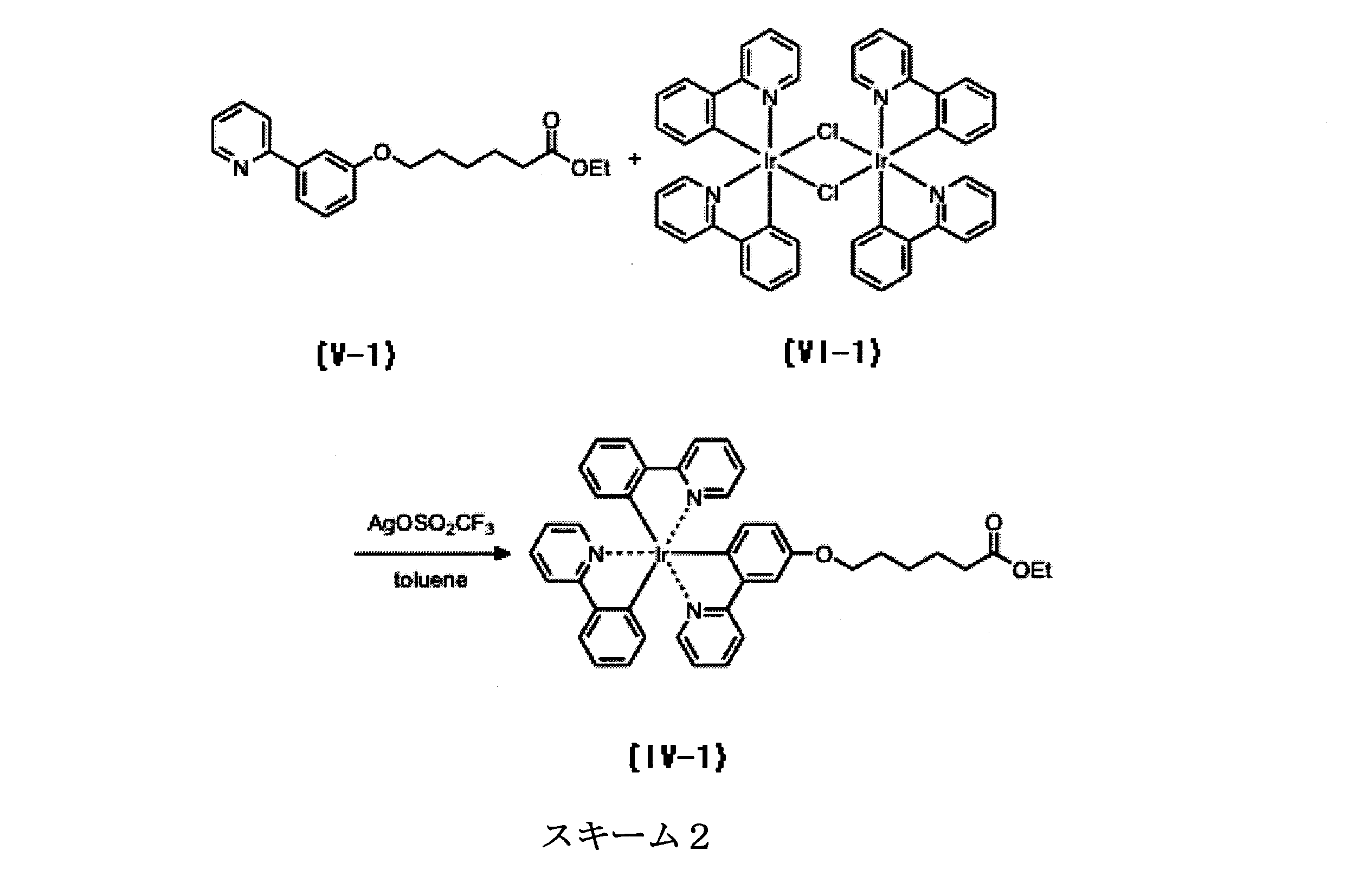
化合物(IV-1)をスキーム2に従い、合成した。アルゴン雰囲気下、2.1gの化合物(V-1)に対してトリフルオロメタンスルホン酸銀(870mg)とビス(μ-クロロ)テトラキス(2-フェニルピリジナト)ジイリジウム(III)(VI-1)(1.8g)をトルエン(10mL)中で24時間加熱還流させた。得られた反応混合物へ水30mLを加え、CHCl3(20mLx3)で抽出した。有機層をMgSO4で乾燥させた後、濾過によりMgSO4をろ別した。ろ液を濃縮後、得られた残渣をシリカゲルカラムクロマトグラフィー(溶出液はCHCl3:MeOH)にて精製することで、化合物(IV-1)を得た(オレンジ色固体、1.5g、53%)。
1H NMR (500 MHz,CDCl3) δ 1.24 (t, J = 7.1 Hz, 3H), 1.49 (tt, J = 7.5, 7.1 Hz, 2H), 1.69 (tt, J =7.5, 7.5 Hz, 2H), 1.76 (tt, J = 7.1, 6.4 Hz, 2H), 2.32 (t, J = 7.5 Hz, 2H), 3.91 (t, J = 6.4 Hz, 2H), 4.12 (q, J = 7.1 Hz, 2H), 6.55 (dd, J = 8.2, 2.5 Hz, 1H), 6.68 (d, J = 8.2 Hz, 1H), 6.81-6.92 (m, 9H), 7.23 (d, J = 2.5 Hz, 1H), 7.50-7.54 (m, 3H), 7.54-7.59 (m, 3H), 7.64 (d, J = 7.8 Hz, 2H), 7.81 (d, J = 8.0 Hz, 1H), 7.855 (d, J = 8.0 Hz, 1H), 7.861 (d, J = 8.0 Hz, 1H).
13C NMR (125 MHz, CDCl3) δ 14.3, 24.8, 25.8, 29.3, 34.3, 60.2, 67.6, 110.4, 117.4, 118.7, 118.9, 119.7, 121.9, 122.0, 123.8, 123.9, 129.8, 135.8, 135.9, 137.1, 137.2, 143.6, 143.7, 143.8, 147.0, 147.1, 150.4, 153.8, 161.3, 161.4, 166.6, 166.7, 166.9, 173.7.
HRMS (FAB+): m/z [M]+ C41H38IrN3O3について計算値: 813.2543, 測定値: 813.2545.
IR (KBr) 3037, 1731, 1599, 1773, 1262, 1032, 784 cm-1.
M.p. >300 ℃.
Rf = 0.74 (SiO2, CHCl3:CH3OH = 30:1)。
13C NMR (125 MHz, CDCl3) δ 14.3, 24.8, 25.8, 29.3, 34.3, 60.2, 67.6, 110.4, 117.4, 118.7, 118.9, 119.7, 121.9, 122.0, 123.8, 123.9, 129.8, 135.8, 135.9, 137.1, 137.2, 143.6, 143.7, 143.8, 147.0, 147.1, 150.4, 153.8, 161.3, 161.4, 166.6, 166.7, 166.9, 173.7.
HRMS (FAB+): m/z [M]+ C41H38IrN3O3について計算値: 813.2543, 測定値: 813.2545.
IR (KBr) 3037, 1731, 1599, 1773, 1262, 1032, 784 cm-1.
M.p. >300 ℃.
Rf = 0.74 (SiO2, CHCl3:CH3OH = 30:1)。
(3)ビス(2-フェニルピリジナト-C2,N){5-[(6-ヒドロキシ-6-オキシヘキシル)オキシ]フェニルピリジナト-C2,N}イリジウム(III)(II-1)の合成

化合物(II-1)をスキーム3に従い、合成した。620mgの化合物(IV-1)に対して水酸化リチウム(182mg)をTHF、メタノールおよび水(各50mL)の混合物中で3時間加熱還流させた。得られた反応混合物を塩酸で中和し、次いでCHCl3(40mLx3)で抽出した。有機層をMgSO4で乾燥させた後、濾過によりMgSO4をろ別した。ろ液を濃縮することで化合物(II-1)を得た(黄色固体,572mg,96%)。化合物(II-1)はそれ以上の精製を行わず、次の反応に用いた。
(4)ビス(2-フェニルピリジナト-C2,N){[5-({6-[1,5-ビス(ブチルアミノ)-1,5-ジオキソペンタン-2-イル]}アミノ-6-オキシヘキシル)オキシ]フェニルピリジナト-C2,N}イリジウム(III)(I-1)の合成

化合物(I-1)をスキーム4に従い、合成した。240mgの化合物(II-1)に対してグルタミン酸から誘導した化合物(III-1)(127mg)へ、縮合剤であるEDCI(85mg)およびDMAP(53mg)を加えて、1,2-ジクロロエタン(100mL)中で90℃で加熱した。15時間後、反応混合物へ水(100mL)を加えCHCl3(100mLx3)で抽出した。有機層をMgSO4で乾燥させた後、濾過によりMgSO4をろ別した。ろ液を濃縮し、得られた残渣をシリカゲルカラムクロマトグラフィー(溶出液はクロロホルム:メタノール=9:1)にて精製することで、化合物(I-1)を得た(黄色固体、182mg、58%)。
1H NMR (500 MHz, CDCl3) δ 0.91 (t, J = 7.3 Hz, 6H), 1.23-1.39 (m, 4H) 1.41-1.56 (m, 6H), 1.67-1.82 (m, 4H), 1.88-1.99 (m, 1H), 2.04 (ddd, J = 13.9, 9.2, 4.6 Hz, 1H), 2.16-2.29 (m, 3H), 2.31-2.41 (m, 1H), 3.16-3.32 (m, 4H), 3.92 (t, J = 6.3 Hz, 2H), 4.29-4.36 (m, 1H), 5.97 (t, J = 5.0 Hz, 1H), 6.55 (dt, J = 8.0, 2.0 Hz, 1H), 6.68 (d, J = 8.2 Hz, 1H), 6.74-6.94 (m, 10H), 7.05 (dd, J = 18.0, 7.0 Hz, 1H), 7.24 (d, J = 2.3 Hz, 1H), 7.53 (t, J = 5.5 Hz, 1H), 7.54 (t, J = 5.5 Hz, 1H), 7.53 (t, J = 5.5 Hz, 1H), 7.58 (t, J = 7.7 Hz, 1H), 7.58 (t, J = 7.7 Hz, 1H), 7.58 (t, J = 7.7 Hz, 1H), 7.65 (d, J = 7.5 Hz, 1H), 7.65 (d, J = 7.5 Hz, 1H), 7.83 (d, J = 8.2 Hz, 1H), 7.87 (d, J = 8.2 Hz, 1H), 7.87 (d, J = 8.2 Hz, 1H).
13C NMR (125 MHz, CDCl3) δ 13.7, 20.03, 20.07, 25.4, 25.9, 29.3, 31.5, 32.9, 36.6, 39.3, 39.5, 52.5, 67.7, 70.0, 110.40, 110.45, 117.35, 117.44, 118.7, 118.9, 119.7, 121.9, 122.0, 123.9, 129.79, 129.83, 135.8, 135.9, 137.1, 137.2, 143.62, 143.72, 143.9, 147.0, 147.1, 150.47, 150.51, 153.8, 161.27, 161.31, 166.5, 166.7, 166.9, 171.2, 173.0, 173.55, 173.60.
13C NMR (125 MHz, CDCl3) δ 13.7, 20.03, 20.07, 25.4, 25.9, 29.3, 31.5, 32.9, 36.6, 39.3, 39.5, 52.5, 67.7, 70.0, 110.40, 110.45, 117.35, 117.44, 118.7, 118.9, 119.7, 121.9, 122.0, 123.9, 129.79, 129.83, 135.8, 135.9, 137.1, 137.2, 143.62, 143.72, 143.9, 147.0, 147.1, 150.47, 150.51, 153.8, 161.27, 161.31, 166.5, 166.7, 166.9, 171.2, 173.0, 173.55, 173.60.
[実施例2]
(1)ビス[2-(4,6-ジフルオロフェニル)ピリジナト-C2,N]{5-[(6-エトキシ-6-オキシヘキシル)オキシ]フェニルピリジナト-C2,N}イリジウム(III)(IV-2)の合成
(1)ビス[2-(4,6-ジフルオロフェニル)ピリジナト-C2,N]{5-[(6-エトキシ-6-オキシヘキシル)オキシ]フェニルピリジナト-C2,N}イリジウム(III)(IV-2)の合成
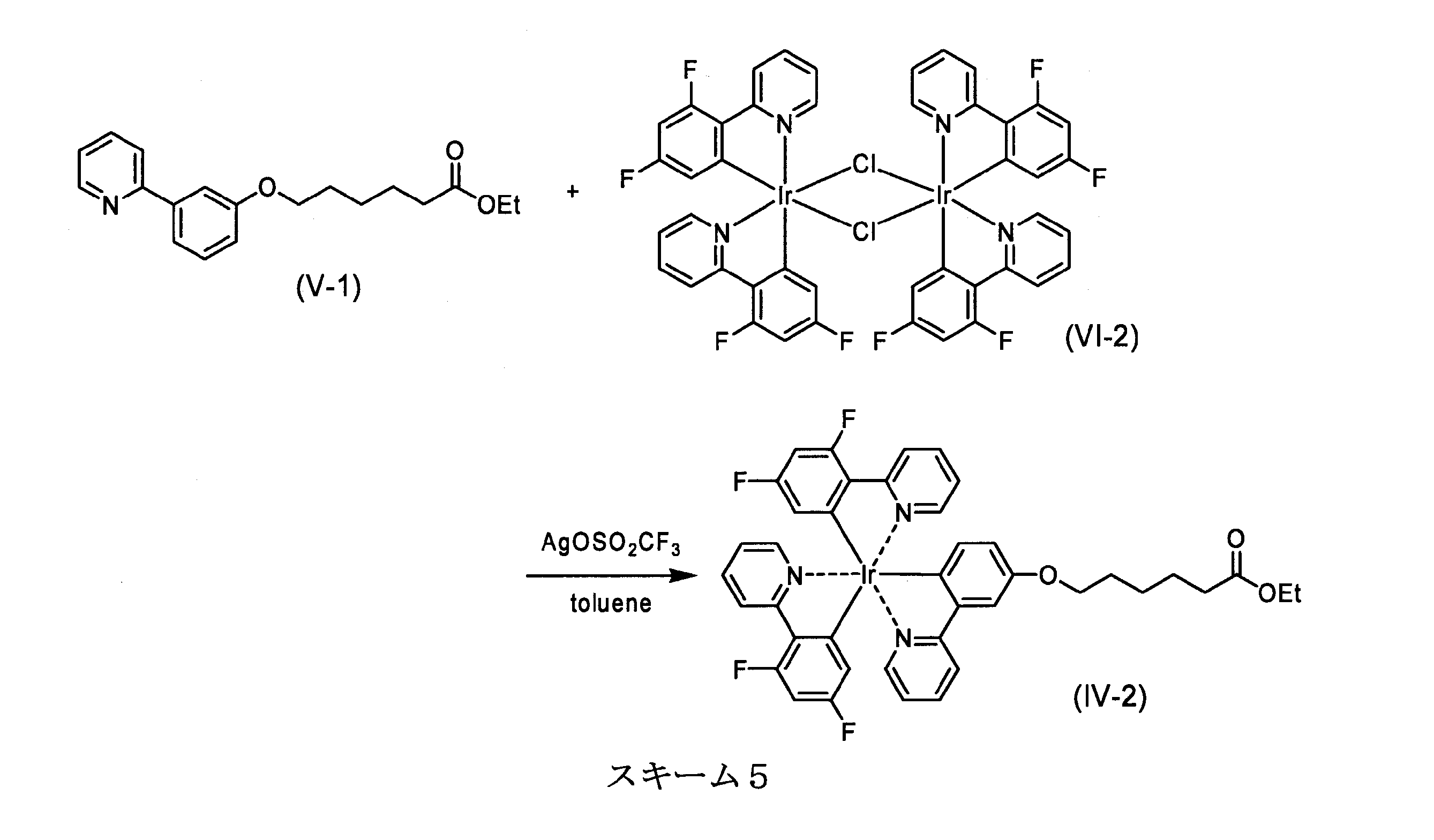
化合物(IV-2)をスキーム5に従い、合成した。980mgの化合物(V-1)に対してトリフルオロメタンスルホン酸銀(410mg)とビス(μ-クロロ)テトラキス[2-(2,4-ジフルオロフェニル)ピリジナト]ジイリジウム(III)(VI-2)(970mg)をトルエン(10mL)中で18時間加熱還流させた。得られた反応混合物をろ過により沈殿を濾別した後、ろ液を濃縮した。得られた残渣をシリカゲルカラムクロマトグラフィー(溶出液はCHCl3:MeOH)にて精製することで、化合物(IV-2)を得た(黄色固体、1.1g、79%)。
1H NMR (500 MHz,CDCl3) δ 1.24 (t, J = 7.1 Hz, 3 H), 1.50 (tt, J = 7.8, 7.5 Hz, 2 H), 1.70 (tt, J = 7.8, 7.5 Hz, 2 H), 1.78 (tt, J = 7.5, 6.4 Hz, 2 H), 2.32 (t, J = 7.5 Hz, 2 H), 3.92 (t, J = 6.4 Hz, 2 H), 4.12 (q, J = 7.1 Hz, 2 H), 6.28 (dd, J = 9.0, 2.5 Hz, 1 H), 6.30 (dd, J = 9.0, 2.5 Hz, 1 H), 6.35 (ddd, J = 9.5, 7.5, 2.5 Hz, 1 H), 6.38 (ddd, J = 9.5, 7.5, 2.5 Hz, 1 H), 6.58 (dd, J = 8.3, 2.3 Hz, 1 H), 6.62 (d, J = 8.3 Hz, 1 H), 6.86-6.92 (m, 3 H), 7.23 (d, J = 2.3 Hz, 1 H), 7.43 (d, J = 4.8 Hz, 1 H), 7.50 (d, J = 5.0 Hz, 2 H), 7.60-7.67 (m, 3 H), 7.85 (d, J = 8.0 Hz, 1 H), 8.26 (d, J = 7.5 Hz, 1 H), 8.28 (d, J = 7.5 Hz, 1 H).
HRMS (FAB+): m/z [M]+ C41H34IrF4N3O3について計算値: 885.2166, 測定値: 865.2166.
M.p. 214℃ (decomp)
HRMS (FAB+): m/z [M]+ C41H34IrF4N3O3について計算値: 885.2166, 測定値: 865.2166.
M.p. 214℃ (decomp)
(2)ビス[2-(4,6-ジフルオロフェニル)ピリジナト-C2,N]{5-[(6-ヒドロキシ-6-オキシヘキシル)オキシ]フェニルピリジナト-C2,N}イリジウム(III)(II-2)の合成

化合物(II-2)をスキーム6に従い、合成した。408mgの化合物(IV-2)に対して水酸化リチウム(242mg)をTHF、メタノール(各20mL)および水(30mL)の混合物中で16時間加熱還流させた。得られた反応混合物を塩酸で中和し、得た固体を濾別することで化合物(II-2)を得た(黄色固体,244mg,62%)。化合物(II-2)はそれ以上の精製を行わず、次の反応に用いた。
(3)ビス[2-(4,6-ジフルオロフェニル)ピリジナト-C2,N]{[5-({6-[1,5-ビス(ブチルアミノ)-1,5-ジオキソペンタン-2-イル]}アミノ-6-オキシヘキシル)オキシ]フェニルピリジナト-C2,N}イリジウム(III)(I-2)の合成
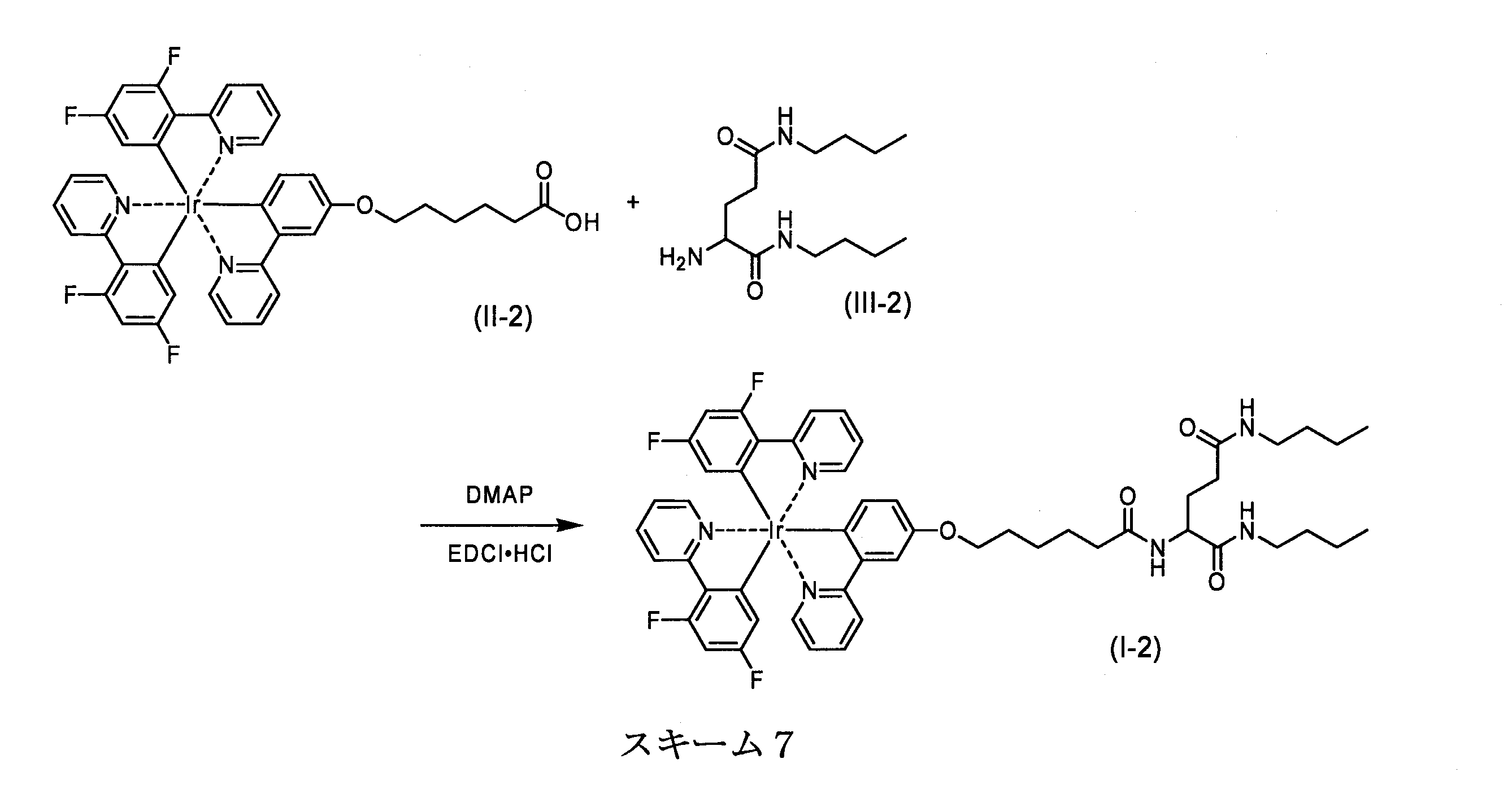
化合物(I-2)をスキーム7に従い、合成した。103mgの化合物(II-2)に対してグルタミン酸から誘導した化合物(III-1)(53mg)へ、縮合剤であるEDCI(50mg)およびDMAP(27mg)を加えて、ジクロロメタン(100mL)中で室温で撹拌した。26時間後、反応混合物へ塩化アンモニウム水溶液を加えで抽出した。有機層をMgSO4で乾燥させた後、濾過によりMgSO4をろ別した。ろ液を濃縮し、得られた残渣をシリカゲルカラムクロマトグラフィー(溶出液はクロロホルム:メタノール=100:1)にて精製することで、化合物(I-2)を得た(黄色固体、23mg、18%)。
1H NMR (500 MHz, CDCl3) δ 0.91 (t, J = 7.3 Hz, 6 H), 1.33 (qt, J = 7.3 Hz, 4 H), 1.43-1.55 (m, 6 H), 1.72 (tt, J = 7.3, 7.0 Hz, 2 H), 1.79 (tt, J = 7.0, 6.3 Hz, 2 H), 1.90-2.00 (m, 1 H), 2.01-2.10 (m, 1 H), 2.21-2.30 (m, 1 H) 2.27 (t, J = 7.3 Hz, 2 H), 2.34-2.45 (m, 1 H), 3.23 (td, J = 7.2, 5.5 Hz, 2 H), 3.25 (td, J = 7.2, 5.5 Hz, 2 H), 3.93 (t, J = 6.3 Hz, 2 H), 4.33 (dt, J = 8.4, 5.5 Hz, 1 H), 5.93 (dt, J = 7.0, 4.1 Hz, 1 H), 6.28 (dd, J = 9.0, 2.5 Hz, 1 H), 6.31 (dd, J = 9.0, 2.5 Hz, 1 H), 6.36 (ddd, J = 9.5, 7.5, 2.5 Hz, 1 H), 6.39 (ddd, J = 9.5, 7.5, 2.5 Hz, 1 H), 6.58 (dd, J = 8.2, 2.3 Hz, 1 H), 6.63 (d, J = 8.2 Hz, 1 H), 6.76 (t, J = 5.5 Hz, 1 H), 6.86-6.96 (m, 3 H), 7.06 (t, J = 8.4 Hz, 1 H), 7.24 (d, J = 2.3 Hz, 1 H), 7.44 (d, J = 5.0 Hz, 1 H), 7.51 (d, J = 5.0 Hz, 2 H), 7.60-7.70 (m, 3 H), 7.88 (d, J = 8.2 Hz, 1 H), 8.28 (d, J = 8.0 Hz, 1 H), 8.30 (d, J = 8.0 Hz, 1 H)
IR (KBr) 3300, 3067, 2934, 1647, 1599, 1066 cm-1
M.p. 219 ℃ (decomp)
HRMS (FAB+): m/z [M]+ C52H55IrF4N6O4について計算値:1096.3850, 測定値: 1096.3854.
IR (KBr) 3300, 3067, 2934, 1647, 1599, 1066 cm-1
M.p. 219 ℃ (decomp)
HRMS (FAB+): m/z [M]+ C52H55IrF4N6O4について計算値:1096.3850, 測定値: 1096.3854.
[実施例3]
(1)ビス(2-フェニルイソキノラト-C2,N){5-[(6-エトキシ-6-オキシヘキシル)オキシ]フェニルピリジナト-C2,N}イリジウム(III)(IV-3)の合成
(1)ビス(2-フェニルイソキノラト-C2,N){5-[(6-エトキシ-6-オキシヘキシル)オキシ]フェニルピリジナト-C2,N}イリジウム(III)(IV-3)の合成

化合物(IV-3)をスキーム8に従い、合成した。1.0gの化合物(V-1)に対してトリフルオロメタンスルホン酸銀(417mg)とビス(μ-クロロ)テトラキス(2-フェニルイソキノラト)ジイリジウム(III)(VI-3)(1.0g)をトルエン(10mL)中で16時間加熱還流させた。得られた反応混合物をろ過により沈殿を濾別した後、ろ液を濃縮した。得られた残渣をシリカゲルカラムクロマトグラフィー(溶出液はCHCl3:MeOH)にて精製することで、化合物(IV-3)を得た(赤色固体、103mg、7%)。
1H NMR (500 MHz,CDCl3) δ 1.23 (t, J = 7.1 Hz, 3 H), 1.47 (q, J = 7.7 Hz, 2 H). 1.67 (tt, J = 7.7, 7.7 Hz, 2 H), 1.75 (tt, J = 7.7, 6.4 Hz, 2 H), 2.30 (t, J = 7.7 Hz, 2 H), 3.90 (t, J = 6.4 Hz, 2 H), 4.11 (q, J = 7.1 Hz, 2 H), 6.54 (dd, J = 8.0, 2.5 Hz, 1 H), 6.59 (d, J = 8.0 Hz, 1 H), 6.76 (dd, J = 6.2, 6.2 Hz, 1 H), 6.85 (d, J = 7.0 Hz, 1 H), 6.91 (dd, J = 7.0, 7.0 Hz, 1 H), 6.95 (d, J = 7.3 Hz, 2 H), 6.98 (dd, J = 4.9, 1.3 Hz, 1 H), 7.00 (ddd, J =7.0, 7.0, 1.5 Hz, 1 H), 7.08 (dd, J = 6.6 Hz, 2 H), 7.19 (d, J = 6.2 Hz, 1 H), 7.24 (d, J = 2.5 Hz, 1 H), 7.30 (d, J = 6.2 Hz, 1 H), 7.35 (d, J = 5.0 Hz, 1 H), 7.43 (d, J = 6.2 Hz, 1 H), 7.56 (t, J = 7.5 Hz, 1 H), 7.60-7.66 (m, 4 H), 7.68-7.73 (m, 1 H), 7.75 (m, 1 H), 7.83 (d, J = 8.2 Hz, 1 H), 8.18 (d, J = 5.7, 1 H), 8.19 (d, J = 5.7, 1 H), 8.95 (d, J = 7.0 Hz, 1 H), 8.96 (d, J = 7.0 Hz, 1 H).
M.p. >300 ℃.
M.p. >300 ℃.
(2)ビス(2-フェニルイソキノラト-C2,N){5-[(6-ヒドロキシ-6-オキシヘキシル)オキシ]フェニルピリジナト-C2,N}イリジウム(III)(II-3)の合成

化合物(II-3)をスキーム9に従い、合成した。133mgの化合物(IV-3)に対して水酸化リチウム(100mg)をTHF、メタノールおよび水(各50mL)の混合物中で3時間加熱還流させた。得られた反応混合物を塩酸で中和し、得た固体を濾別することで化合物(II-3)を得た(赤色固体,71mg,55%)。化合物(II-3)はそれ以上の精製を行わず、次の反応に用いた。
(3)ビス(2-フェニルイソキノラト-C2,N){[5-({6-[1,5-ビス(ブチルアミノ)-1,5-ジオキソペンタン-2-イル]}アミノ-6-オキシヘキシル)オキシ]フェニルピリジナト-C2,N}イリジウム(III)(I-3)の合成

化合物(I-3)をスキーム10に従い、合成した。49mgの化合物(II-3)に対してグルタミン酸から誘導した化合物(III-1)(45mg)へ、縮合剤であるEDCI(21mg)およびDMAP(14mg)を加えて、ジクロロメタン(20mL)中で室温で撹拌した。13時間後、反応混合物を炭酸水素ナトリウム水溶液、および塩化アンモニウム水溶液で抽出した。有機層をMgSO4で乾燥させた後、濾過によりMgSO4をろ別した。ろ液を濃縮し、得られた残渣をシリカゲルカラムクロマトグラフィー(溶出液はクロロホルム:メタノール=99:1)にて精製することで、化合物(I-3)を得た(赤色固体、19mg、31%)。
1H NMR (500 MHz, CDCl3) δ 0.83-1.00 (m, 6 H), 1.24-1.40 (m, 4 H), 1.41-1.54 (m, 6 H), 1.69 (tt, J = 7.5, 7.5 Hz, 2 H), 1.76 (tt, J = 7.0, 6.2 Hz, 2 H), 1.87-2.12 (m, 2 H), 2.16-2.29 (m, 3 H), 2.32-2.43 (m, 1 H), 3.16-3.33 (m, 4 H), 3.91 (t, J = 6.2 Hz, 2 H), 4.31 (ddd, J = 7.8, 7.2, 6.0 Hz, 1 H), 5.87 (br. s., 1 H), 6.54 (dd, J = 8.0, 2.3 Hz, 1 H), 6.60 (d, J = 8.0 Hz, 1 H), 6.73 (br. s., 1 H), 6.79 (dd, J = 6.2, 6.2 Hz, 1 H), 6.89 (dd, J = 6.2, 6.2, 1 H), 6.91 (dd, J=7.0, 7.0 Hz, 1 H), 6.96 (d, J = 7.3 Hz, 2 H), 6.98-7.07 (m, 2 H), 7.10 (d, J = 6.6 Hz, 2 H), 7.21 (d, J = 6.2 Hz, 1 H), 7.25 (d, J = 2.3 Hz, 1 H), 7.31 (d, J = 6.2 Hz, 1 H), 7.36 (d, J = 5.3 Hz, 1 H), 7.44 (d, J = 6.2 Hz, 1 H), 7.59 (dd, J = 7.5, 7.5 Hz, 1 H), 7.62-7.68 (m, 4 H), 7.73 (dd, J = 7.5, 2.7 Hz, 1 H), 7.78 (dd, J = 7.5, 2.7 Hz, 1 H), 7.86 (d, J = 8.0 Hz, 1 H), 8.20 (dd, J = 6.8, 6.8 Hz, 2 H), 8.97 (d, J = 7.0 Hz, 1 H), 8.97 (d, J = 7.0 Hz, 1 H).
HRMS (FAB+): m/z [M]+ C60H63IrN6O4について計算値:1124.4540, 測定値: 1124.4534。
HRMS (FAB+): m/z [M]+ C60H63IrN6O4について計算値:1124.4540, 測定値: 1124.4534。
[溶液状態の発光量子収率の測定]
化合物(I-1)および化合物(IV-1)の溶液状態(296K)での発光量子収率Φ(%)を測定した。具体的には、それぞれの化合物の2-MeTHF溶液(2.0x10⁻⁴M)を絶対法によって求めた。測定法は以下の通りである。
化合物(I-1)および化合物(IV-1)の溶液状態(296K)での発光量子収率Φ(%)を測定した。具体的には、それぞれの化合物の2-MeTHF溶液(2.0x10⁻⁴M)を絶対法によって求めた。測定法は以下の通りである。
測定の際、酸素の影響を除くため、各サンプルはアルゴン気流を1分間溶液中に通気することで酸素を除き、そのままアルゴン雰囲気下で測定した。すべての発光スペクトルは、標準光源を利用することにより補正を行った。測定結果を表1に示す。
[ゲル状態の発光量子収率の測定]
化合物(I-1)および比較例として化合物(IV-1)にゲル化剤である化合物(XI-1)をそれぞれ添加し、ゲル状態の光量子収率Φ(%)を測定した。具体的には、それぞれの化合物の2-MeTHF溶液(2.0x10⁻⁴モル/L)を調製し、ゲル化剤である化合物(XI-1)を0.022モル/Lの濃度になる様に加えた後、酸素の影響を除くため、アルゴン気流を1分間通気した。その後、ゲル化剤を100℃で加熱することで完全に溶解させた後、室温で静置することによって透明ゲルを形成させた。その後、絶対法によって発光量子収率を求めた。すべての発光スペクトルは、標準光源を利用することにより補正を行った。測定結果を表1に示す。
化合物(I-1)および比較例として化合物(IV-1)にゲル化剤である化合物(XI-1)をそれぞれ添加し、ゲル状態の光量子収率Φ(%)を測定した。具体的には、それぞれの化合物の2-MeTHF溶液(2.0x10⁻⁴モル/L)を調製し、ゲル化剤である化合物(XI-1)を0.022モル/Lの濃度になる様に加えた後、酸素の影響を除くため、アルゴン気流を1分間通気した。その後、ゲル化剤を100℃で加熱することで完全に溶解させた後、室温で静置することによって透明ゲルを形成させた。その後、絶対法によって発光量子収率を求めた。すべての発光スペクトルは、標準光源を利用することにより補正を行った。測定結果を表1に示す。

前記表1に示すように、実施例1の化合物(I-1)は、溶液状態(エントリ-1)における発光性より、ゲル状態(エントリー2)における発光性が向上することが確認できた。一方、化合物(IV)は、溶液状態(エントリ-3)およびゲル状体(エントリー4)における発光性に相違がほとんどなかった。従って、アミノ酸側鎖部分を有する本発明の化合物(I)は、アミノ酸側鎖部分を有さない化合物(IV)とは異なり、ゲル化により発光性の向上が確認できた。
本発明の新規イリジウム錯体(I)が、前記のような効果を奏するメカニズムについては不明であるが、本発明者らは、以下のようなメカニズムを推察している。本発明の新規イリジウム錯体(I)は、超分子ゲル化剤が形成するゲル繊維中に組み込まれ、固定化されると考えられる。その場合、イリジウム同士が相互作用を起こす可能性が低くなり、消光が抑制される。従って、本発明の新規イリジウム錯体(I)は、単独の溶液状態よりも、超分子ゲル化剤とから得られたゲル状材料において、より強い発光強度を示すことが考えられる。一方、式(IV)のイリジウム化合物は、超分子ゲル化剤とからゲル状材料において、ゲル繊維中には組み込まれず、ゲル繊維間に閉じ込められるのみであると考えられる。その場合、イリジウム同士が相互作用を起こす可能性は溶液状態と同等であり、従って、発光強度に大きな変化はないと考えられる。
本発明の発光性材料は、溶液状態よりもゲル状態において発光強度が向上するため、実用に足る発光強度を得ることができる。従って、本発明の発光性材料は、次世代技術である有機発光素子等の材料として有用である。また、本発明の発光性材料は、塗布性に優れ、UV光のもと発光し得る。従って、本発明の発光性材料は、UV光に感受性の発光性塗料の材料として有用である。
Claims (7)
- 式(I)で表されるイリジウム錯体。


前記式(1)~(10)のいずれかで表される基における残りの水素のいずれか1つ以上は、任意に、ハロゲン原子、炭素数1~12のアルキル基、炭素数2~12のアルケニル基、炭素数2~12のアルキニル基、炭素数1~12のアルコキシ基、-(OCH2CH2)m-OR100(R100は、水素原子または炭素数1~12のアルキル基であり、mは2~1,000である)、-NH2、-N(炭素数1~6のアルキル基)2、-OH、-COOH、-C(=O)O-(炭素数1~6のアルキル基)、フェニル基、フェノキシ基、ニトリル基、ニトロ基、またはチオール基の置換基Rで置き換えられていてもよく、
前記Xは、式(a)で表される基であり、

R1およびR2は、それぞれ独立して、水素原子、ハロゲン原子、炭素数2~12のアルケニル基、炭素数2~12のアルキニル基、炭素数1~12のアルコキシ基、-(OCH2CH2)m-OR100(R100は、水素原子または炭素数1~12のアルキル基であり、mは2~1,000である)、-NH2、-N(炭素数1~6のアルキル基)2、-OH、-COOH、-C(=O)O-(炭素数1~6のアルキル基)、フェニル基、フェノキシ基、ニトリル基、ニトロ基、またはチオール基であり、
2つの

前記式(11)~(74)のいずれかで表される基における水素のいずれか1つ以上は、任意に、ハロゲン原子、炭素数1~12のアルキル基、炭素数2~12のアルケニル基、炭素数2~12のアルキニル基、炭素数1~12のアルコキシ基、-(OCH2CH2)m-OR100(R100は、水素原子または炭素数1~12のアルキル基であり、mは2~1,000である)、-NH2、-N(炭素数1~6のアルキル基)2、-OH、-COOH、-C(=O)O-(炭素数1~6のアルキル基)、フェニル基、フェノキシ基、ニトリル基、ニトロ基、またはチオール基の置換基R’で置き換えられていてもよい。


-

式(a)におけるn1、n2、n3およびn4は、それぞれ独立して、1~6であり、R1およびR2は、水素原子であり、
2つの

- 請求項1または2に記載のイリジウム錯体と、
超分子ゲル化剤とを含む発光性材料用組成物。 - 前記超分子ゲル化剤が、水素結合によりゲル化を生じるゲル化剤である請求項3に記載の発光性材料用組成物。
- 前記超分子ゲル化剤が、有機溶媒に溶解性である請求項3または4に記載の発光性材料用組成物。
- 請求項3~5のいずれか一項に記載の発光性材料用組成物から得られたゲル状発光性材料。
- 超分子ゲルと、前記超分子ゲルに共有結合した請求項1または2に記載のイリジウム錯体とを含む発光性材料。
Priority Applications (1)
| Application Number | Priority Date | Filing Date | Title |
|---|---|---|---|
| JP2015541600A JPWO2015053292A1 (ja) | 2013-10-11 | 2014-10-07 | イリジウム錯体 |
Applications Claiming Priority (2)
| Application Number | Priority Date | Filing Date | Title |
|---|---|---|---|
| JP2013-213981 | 2013-10-11 | ||
| JP2013213981 | 2013-10-11 |
Publications (1)
| Publication Number | Publication Date |
|---|---|
| WO2015053292A1 true WO2015053292A1 (ja) | 2015-04-16 |
Family
ID=52813108
Family Applications (1)
| Application Number | Title | Priority Date | Filing Date |
|---|---|---|---|
| PCT/JP2014/076862 Ceased WO2015053292A1 (ja) | 2013-10-11 | 2014-10-07 | イリジウム錯体 |
Country Status (2)
| Country | Link |
|---|---|
| JP (1) | JPWO2015053292A1 (ja) |
| WO (1) | WO2015053292A1 (ja) |
Cited By (2)
| Publication number | Priority date | Publication date | Assignee | Title |
|---|---|---|---|---|
| WO2018079568A3 (ja) * | 2016-10-24 | 2018-06-14 | 味の素株式会社 | ゲル状組成物 |
| CN110862547A (zh) * | 2019-11-13 | 2020-03-06 | 华中科技大学 | 一种稀土超分子凝胶发光材料、其制备和应用 |
Families Citing this family (1)
| Publication number | Priority date | Publication date | Assignee | Title |
|---|---|---|---|---|
| CN112410021B (zh) * | 2019-08-23 | 2023-08-08 | 西北民族大学 | 一种能单一性选择性荧光识别亚砷酸根离子的超分子凝胶及其制备和应用 |
Citations (3)
| Publication number | Priority date | Publication date | Assignee | Title |
|---|---|---|---|---|
| WO2009078000A2 (en) * | 2007-12-19 | 2009-06-25 | Dublin City University | Imaging dyes and use thereof |
| CN101750486A (zh) * | 2008-12-19 | 2010-06-23 | 苏州纳凯科技有限公司 | 用一类基于与组氨酸结合生成荧光基团的铱配合物标记抗体 |
| CN102336995A (zh) * | 2011-07-08 | 2012-02-01 | 西安交通大学 | 一种新型发光高分子水凝胶的制备方法 |
-
2014
- 2014-10-07 WO PCT/JP2014/076862 patent/WO2015053292A1/ja not_active Ceased
- 2014-10-07 JP JP2015541600A patent/JPWO2015053292A1/ja active Pending
Patent Citations (3)
| Publication number | Priority date | Publication date | Assignee | Title |
|---|---|---|---|---|
| WO2009078000A2 (en) * | 2007-12-19 | 2009-06-25 | Dublin City University | Imaging dyes and use thereof |
| CN101750486A (zh) * | 2008-12-19 | 2010-06-23 | 苏州纳凯科技有限公司 | 用一类基于与组氨酸结合生成荧光基团的铱配合物标记抗体 |
| CN102336995A (zh) * | 2011-07-08 | 2012-02-01 | 西安交通大学 | 一种新型发光高分子水凝胶的制备方法 |
Non-Patent Citations (4)
| Title |
|---|
| KYOHEI OTSUKI ET AL.: "Glutamide Bui o Yusuru Cyclometalated Iridium Sakutai no Gosei to Hakko Tokusei", JAPAN SOCIETY OF COORDINATION CHEMISTRY TORONKAI KOEN YOSHISHU, vol. 63, 15 October 2013 (2013-10-15), pages 428 * |
| KYOHEI OTSUKI ET AL.: "Glutamide Bui o Yusuru Iridium Sakutai no Gel-chu deno Hakko Tokusei", CSJ: THE CHEMICAL SOCIETY OF JAPAN KOEN YOKOSHU, vol. 94, no. 2, 12 March 2014 (2014-03-12), pages 461 * |
| X.CAO ET AL.: "Iridium complex triggered white- light-emitting gel and its response to cysteine", JOURNAL OF MATERIAL CHEMISTRY, vol. 22, no. 6, 2012, pages 2650 - 2657 * |
| Z.LI ET AL.: "Novel Phosphorescent Hydrogels Based on an IrIII Metal Complex", MARCROMOLECULAR RAPID COMMUNICATIONS, vol. 33, no. 14, 2012, pages 1191 - 1196 * |
Cited By (2)
| Publication number | Priority date | Publication date | Assignee | Title |
|---|---|---|---|---|
| WO2018079568A3 (ja) * | 2016-10-24 | 2018-06-14 | 味の素株式会社 | ゲル状組成物 |
| CN110862547A (zh) * | 2019-11-13 | 2020-03-06 | 华中科技大学 | 一种稀土超分子凝胶发光材料、其制备和应用 |
Also Published As
| Publication number | Publication date |
|---|---|
| JPWO2015053292A1 (ja) | 2017-03-09 |
Similar Documents
| Publication | Publication Date | Title |
|---|---|---|
| Singh et al. | Versatile luminescent europium (III)− β-diketonate-imidazo-bipyridyl complexes intended for white LEDs: a detailed photophysical and theoretical study | |
| JP5522447B2 (ja) | アゾ−ホウ素錯体化合物およびその製造方法 | |
| WO2013108699A1 (ja) | 金属錯体及び該金属錯体を含む発光素子 | |
| CN103619859B (zh) | 磷光材料的制备及其应用 | |
| EP2977374A1 (en) | Molecules presenting dual emission properties | |
| Luo et al. | Synthesis, characterization and fluorescence properties of Eu (III) and Tb (III) complexes with novel mono-substituted β-diketone ligands and 1, 10-phenanthroline | |
| Hongfang et al. | Fluorescence enhancement of Tb (III) complex with a new β-diketone ligand by 1, 10-phenanthroline | |
| JPWO2015053292A1 (ja) | イリジウム錯体 | |
| EP3569599B1 (en) | Dicyano n-heterocyclic compound, light-emitting material, and light-emitting element in which same is used | |
| KR101418996B1 (ko) | 발광성 유기백금 착물, 이를 포함하는 발광성 재료 및 기능 소자 | |
| CN113583056A (zh) | 基于螺芴-螺芴结构的6/5/6四齿环金属铂或钯配合物的发光材料及其应用 | |
| Liu et al. | Luminescent lanthanide (III)-cored complexes based on the combination of 2-(5-bromothiophen) imidazo [4, 5-f][1, 10] phenanthroline and 2-thenoyltrifluoroacetonate ligands | |
| Bao et al. | Synthesis and fluorescence properties of Tb (III) complex with a novel aromatic carboxylic acid (L) as well as spectroscopic studies on the interaction between Tb (III) complex and bovine serum albumin | |
| JP6319888B2 (ja) | 白金錯体およびそれを含む発光材料 | |
| Gudeika et al. | Hydrazones containing electron-accepting and electron-donating moieties | |
| WO2015053291A1 (ja) | 白金錯体を含む発光材料 | |
| CN118388540B (zh) | 一种并环咔唑四齿金属铂(ii)配合物及其应用 | |
| CN103087113B (zh) | 一类含硼异核铱配合物及其制备方法和应用 | |
| KR101165225B1 (ko) | 포스파페난트렌-카바졸계 유기발광 화합물 및 이를 포함하는 유기발광소자 | |
| JP6316206B2 (ja) | 発光材料 | |
| WO2013035359A1 (ja) | 白金錯体 | |
| JP2020164476A (ja) | 青色固体発光材料、青色固体発光材料の製造方法及び有機発光素子 | |
| CN113501817A (zh) | 一种含有芳胺基团的喹啉酮类衍生物及其制备和应用 | |
| Accorsi et al. | Synthesis and photoluminescence properties of heteroleptic Eu3+, Tb3+ and Tm3+ complexes | |
| KR20220057913A (ko) | 인광 호스트 화합물 및 이를 이용한 유기전계발광소자 |
Legal Events
| Date | Code | Title | Description |
|---|---|---|---|
| 121 | Ep: the epo has been informed by wipo that ep was designated in this application |
Ref document number: 14852060 Country of ref document: EP Kind code of ref document: A1 |
|
| ENP | Entry into the national phase |
Ref document number: 2015541600 Country of ref document: JP Kind code of ref document: A |
|
| NENP | Non-entry into the national phase |
Ref country code: DE |
|
| 122 | Ep: pct application non-entry in european phase |
Ref document number: 14852060 Country of ref document: EP Kind code of ref document: A1 |