WO2015046993A1 - 기재 필름, 이를 포함하는 적층 구조 및 디스플레이 소자 - Google Patents
기재 필름, 이를 포함하는 적층 구조 및 디스플레이 소자 Download PDFInfo
- Publication number
- WO2015046993A1 WO2015046993A1 PCT/KR2014/009116 KR2014009116W WO2015046993A1 WO 2015046993 A1 WO2015046993 A1 WO 2015046993A1 KR 2014009116 W KR2014009116 W KR 2014009116W WO 2015046993 A1 WO2015046993 A1 WO 2015046993A1
- Authority
- WO
- WIPO (PCT)
- Prior art keywords
- maleimide
- carbon atoms
- base film
- substituted
- repeating unit
- Prior art date
- Legal status (The legal status is an assumption and is not a legal conclusion. Google has not performed a legal analysis and makes no representation as to the accuracy of the status listed.)
- Ceased
Links
Classifications
-
- B—PERFORMING OPERATIONS; TRANSPORTING
- B32—LAYERED PRODUCTS
- B32B—LAYERED PRODUCTS, i.e. PRODUCTS BUILT-UP OF STRATA OF FLAT OR NON-FLAT, e.g. CELLULAR OR HONEYCOMB, FORM
- B32B27/00—Layered products comprising a layer of synthetic resin
- B32B27/06—Layered products comprising a layer of synthetic resin as the main or only constituent of a layer, which is next to another layer of the same or of a different material
- B32B27/08—Layered products comprising a layer of synthetic resin as the main or only constituent of a layer, which is next to another layer of the same or of a different material of synthetic resin
-
- B—PERFORMING OPERATIONS; TRANSPORTING
- B32—LAYERED PRODUCTS
- B32B—LAYERED PRODUCTS, i.e. PRODUCTS BUILT-UP OF STRATA OF FLAT OR NON-FLAT, e.g. CELLULAR OR HONEYCOMB, FORM
- B32B2255/00—Coating on the layer surface
- B32B2255/10—Coating on the layer surface on synthetic resin layer or on natural or synthetic rubber layer
-
- B—PERFORMING OPERATIONS; TRANSPORTING
- B32—LAYERED PRODUCTS
- B32B—LAYERED PRODUCTS, i.e. PRODUCTS BUILT-UP OF STRATA OF FLAT OR NON-FLAT, e.g. CELLULAR OR HONEYCOMB, FORM
- B32B2255/00—Coating on the layer surface
- B32B2255/20—Inorganic coating
-
- B—PERFORMING OPERATIONS; TRANSPORTING
- B32—LAYERED PRODUCTS
- B32B—LAYERED PRODUCTS, i.e. PRODUCTS BUILT-UP OF STRATA OF FLAT OR NON-FLAT, e.g. CELLULAR OR HONEYCOMB, FORM
- B32B2255/00—Coating on the layer surface
- B32B2255/28—Multiple coating on one surface
-
- B—PERFORMING OPERATIONS; TRANSPORTING
- B32—LAYERED PRODUCTS
- B32B—LAYERED PRODUCTS, i.e. PRODUCTS BUILT-UP OF STRATA OF FLAT OR NON-FLAT, e.g. CELLULAR OR HONEYCOMB, FORM
- B32B2307/00—Properties of the layers or laminate
- B32B2307/30—Properties of the layers or laminate having particular thermal properties
- B32B2307/306—Resistant to heat
-
- B—PERFORMING OPERATIONS; TRANSPORTING
- B32—LAYERED PRODUCTS
- B32B—LAYERED PRODUCTS, i.e. PRODUCTS BUILT-UP OF STRATA OF FLAT OR NON-FLAT, e.g. CELLULAR OR HONEYCOMB, FORM
- B32B2307/00—Properties of the layers or laminate
- B32B2307/40—Properties of the layers or laminate having particular optical properties
- B32B2307/412—Transparent
-
- B—PERFORMING OPERATIONS; TRANSPORTING
- B32—LAYERED PRODUCTS
- B32B—LAYERED PRODUCTS, i.e. PRODUCTS BUILT-UP OF STRATA OF FLAT OR NON-FLAT, e.g. CELLULAR OR HONEYCOMB, FORM
- B32B2457/00—Electrical equipment
- B32B2457/20—Displays, e.g. liquid crystal displays, plasma displays
-
- B—PERFORMING OPERATIONS; TRANSPORTING
- B32—LAYERED PRODUCTS
- B32B—LAYERED PRODUCTS, i.e. PRODUCTS BUILT-UP OF STRATA OF FLAT OR NON-FLAT, e.g. CELLULAR OR HONEYCOMB, FORM
- B32B27/00—Layered products comprising a layer of synthetic resin
- B32B27/32—Layered products comprising a layer of synthetic resin comprising polyolefins
- B32B27/325—Layered products comprising a layer of synthetic resin comprising polyolefins comprising polycycloolefins
Definitions
- Base film, laminated structure and display element comprising the same
- the present invention relates to a base film, a laminated structure and a display device including the same, and more particularly, exhibits a high glass transition temperature and is excellent in heat resistance, and has a high light transmittance and a transparent base film, a laminated structure and a display device including the same. It is about.
- the touch panel is mounted on the surface of the display device and converts a physical contact such as a user's finger or touch pen into an electrical signal and outputs the electrical signal.
- the liquid crystal display and the plasma display panel are used.
- EL (Electro-lummescence) devices Such a touch panel has a transparent electrode type using a contact type of an optical type using infrared rays, a transparent conductive film coated with a metal oxide on a polymer base film, a capacitive type detecting a change in capacitance, and the panel Background Art
- a method of sensing the position from the distribution of the force with respect to the pressure sensor arranged around the panel with the pressure of the fingertip has been put into practical use.
- the transparent electrode type requires a transparent metal oxide-based conductive film.
- the ITO film coated with indium tin oxide (ITO) on the polymer base film is transparent and has excellent conductivity. It is used.
- such a metal oxide-based conductive film can be produced using a method of vacuum depositing or sputtering a metal oxide on a polymer substrate film or a glass plate. Therefore, the polymer substrate film is at a high temperature Since a process such as vacuum deposition, sputtering, etc. to be performed is performed, heat resistance is one of essential characteristics of the base film.
- heat resistance can be evaluated by glass transition temperature, and sputtering at a temperature of about 150 ° C. or higher, preferably 200 ° C. or higher is required to obtain a base film on which an optically excellent transparent metal oxide-based conductive film is formed. Therefore, the base film requires high glass transition temperature and high mechanical properties above the sputtering temperature.
- such a base film is required not only for the high glass transition temperature described above but also for transparency in the visible light region in order to be processed and applied to a display element or the like, and also requires a light transmittance of 90% or more.
- polymer films such as Polyethylene Terephthalate (PET), Polyethylene Naphthalate (PEN), and Polycarbonate (PC), which are conventionally used as base films, have a low glass transition temperature of 120 ° C. or less in the process of forming a transparent metal oxide-based conductive film.
- PET Polyethylene Terephthalate
- PEN Polyethylene Naphthalate
- PC Polycarbonate
- PI Polyimide
- the polymer film such as polyethylene terephthalate (PET) has a large phase difference value, can be used as an external base film, there was a limit that can not be used as an internal base film.
- PET polyethylene terephthalate
- the present invention is to provide a transparent base film having high glass transition silver and excellent heat resistance and high light transmittance.
- the present invention is to provide a laminated structure including the base film.
- the present invention is to provide a display device including the laminated structure.
- the present invention provides a polymer having a cyclic olefin repeat unit; And a copolymer comprising a styrene-based repeating unit and a maleimide-based repeating unit, wherein the exo-isomer content in the cyclic olefin-based repeating unit is 50 mol% or more, and is a transparent metal oxide on the base film.
- the present invention provides a laminated structure including the base film and a transparent metal oxide-based conductive film formed on the base film.
- the present invention provides a display device including the laminated structure.
- a substrate film according to a specific embodiment of the present invention a laminated structure including the same, and a display device will be described in more detail.
- a base film on which the conductive film is formed may be provided.
- the cyclic olefin-based repeating unit may be represented by the following Formula 1, and the polymer having the cyclic olefinic repeating unit is a homopolymer prepared by addition polymerization of a norbornene-based monomer represented by Formula 2 below. It may include a polymer or a copolymer prepared by addition copolymerization of two or more kinds.
- q is an integer of 0 to 4,
- m 50 to 5000
- R1 to R4 are each independently a polar functional group or a nonpolar functional group
- R1 and R2 are connected to each other to form an alkylidene group having 1 to 10 carbon atoms, or R1 or R2 is connected to any one of R3 and R4 to have 4 to 12 carbon atoms It may form a saturated or unsaturated aliphatic ring or an aromatic ring having 6 to 24 carbon atoms.
- the inventors of the present invention have characteristics such as high glass transition temperature, heat resistance, transparency, and research on a base film that can be applied to the display field, in particular, a base film on which a transparent metal oxide-based conductive film is formed.
- a polymer having an olefinic repeating unit, and a copolymer comprising a styrene repeating unit and a maleimide repeating unit, wherein the cyclic When the liquid isomer content in the olefin repeat unit is 50 mol% or more, it was confirmed through experiments that a film having a high glass transition silver and showing a high light transmittance in the visible light region was completed through experiments.
- the base film exhibits a high glass transition temperature, including a polymer having a cyclic olefin repeat unit, for example, a norbornene repeat unit, and includes at least 50 mol% of an isomeric isomer in the cyclic olefin repeat unit. It can exhibit high light transmittance and transparency.
- the base film may include a copolymer including a styrene-based repeating unit and a maleimide-based repeating unit together with a polymer having the cyclic olefin-based repeating unit to lower the phase difference value in the thickness direction.
- the base film of the embodiment may have an exo isomer content of 50 mol% or more in the cyclic olefin repeat unit, or 50 to 100 mol%.
- the cyclic eulre pingye repeating unit aekso isomer it is characterized by easy polymerization molecular weight and the yield is increased, and the removal of the after reaction catalyst, in particular, less the residual catalyst, and excellent heat resistance, high solubility in a solvent,
- the base film containing an excess of the xo isomer compared to the endo isomer may exhibit high heat resistance and high transparency.
- the polymer having a cyclic olefinic repeat unit may have a weight average molecular weight of about 10,000 to 1,000,000, preferably about 200,000 to 500,000.
- the repeating unit of Formula 1 constituting the polymer having a cyclic olefin-based repeating unit may have a degree of polymerization of about 30 to 5,000, preferably about 300 to 1,500.
- the base film of the embodiment is a styrene-based repeat. It may include a copolymer comprising a unit and a maleimide repeat unit, the styrene repeat unit in the copolymer may comprise 1 to 50% by weight, preferably 5 to 20% by weight.
- the copolymer including the styrene-based repeating unit and the maleimide-based repeating unit may suppress the stacking of molecules in the thickness direction, thereby maintaining the plane retardation value and lowering the retardation value in the thickness direction.
- the styrene-based repeating unit in the copolymer serves to control the phase difference value of the copolymer described above. If the content of the styrene-based repeat unit in the co-polymer is too small, it may not be able to fully exert the above-described effect.
- the copolymer including the styrene repeating unit and the maleimide repeating unit may have a weight average molecular weight of about 500 to 1,000,000.
- the copolymer including the cyclic olefin-based repeating unit, the styrene-based repeating unit, and the copolymer containing the maleimide-based repeating unit has an increase ratio of 99: 1 to 50:50, preferably 90:10 to 70. Can be combined in a weight ratio of 30.
- the non-polar functional group which may be substituted with R1 to R4 may be hydrogen; halogen; Substituted or unsubstituted linear or branched alkyl having 1 to 20 carbon atoms; Substituted or unsubstituted linear or branched alkenyl having 2 to 20 carbon atoms; Substituted or unsubstituted linear or branched alkynyl having 2 to 20 carbon atoms; Substituted or unsubstituted cycloalkyl having 3 to 12 carbon atoms; Aryl having 6 to 40 carbon atoms; And it may be selected from the group consisting of substituted or unsubstituted aralkyl having 7 to 15 carbon atoms.
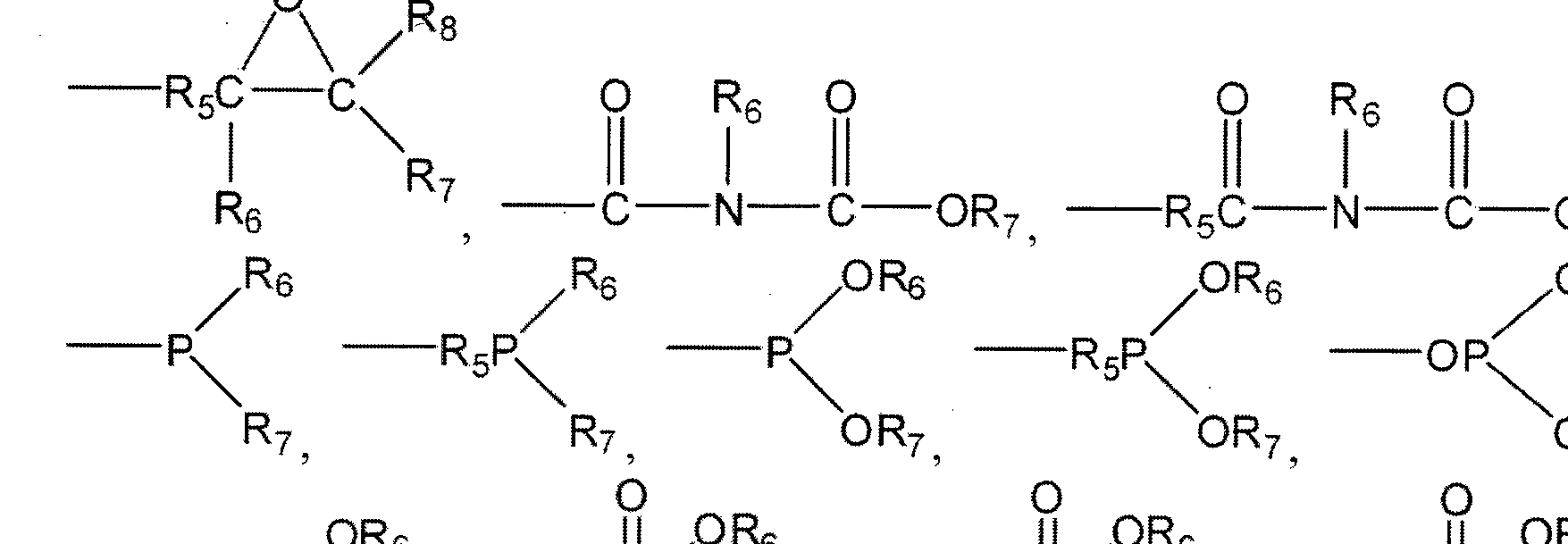
- the polar functional group which may be substituted in the R1 to R4 and the like includes one or more elements selected from the group consisting of oxygen, nitrogen, phosphorus, sulfur, silicon, and boron, specifically, the group consisting of the functional groups listed below Can be chosen from:
- p is each independently an integer of 1 to 10
- R5 is substituted or unsubstituted.
- Linear or branched alkylene having 1 to 20 carbon atoms; Substituted or unsubstituted linear or branched alkenylene having 2 to 20 carbon atoms; Substituted or unsubstituted linear or branched alkynylene having 2 to 20 carbon atoms; Substituted or unsubstituted cycloalkylene having 3 to 12 carbon atoms; Substituted or unsubstituted arylene having 6 to 40 carbon atoms; Substituted or unsubstituted aralkylene having 7 to 15 carbon atoms; Substituted or unsubstituted alkoxylene having 1 to 20 carbon atoms, and substituted or unsubstituted carbonyloxyylene having 1 to 20 carbon atoms; and R 6, R 7 and R 8 are each independently hydrogen; halogen;
- alkyl means a linear or branched saturated monovalent hydrocarbon moiety of 1 to 20, preferably 1 to 10 carbon atoms.
- the alkyl group may encompass not only unsubstituted but also further substituted by a certain substituent described below.
- Examples of the alkyl group include methyl, ethyl, propyl, 2-propyl, ⁇ -butyl, iso-butyl, tert-butyl, pentyl, nucleus, dodecyl, fluoromethyl, difluoromethyl, Trifluoromethyl, chloromethyl, dichloromethyl, trichloromethyl, iodomethyl, bromomethyl and the like.
- Alkenyl means a linear or branched monovalent hydrocarbon moiety of 2 to 20, preferably 2 to 10 carbon atoms, comprising at least one carbon-carbon double bond. Alkenyl groups are through carbon atoms containing carbon-carbon double bonds or through saturated carbon atoms. Can be combined. Alkenyl groups may be broadly referred to as unsubstituted as well as those further substituted by the following substituents. Examples of the alkenyl group include ethenyl, 1-propenyl, 2-propenyl, 2-butenyl, 3-butenyl, pentenyl, 5-nuxenyl, dodecenyl, and the like.
- Cycloalkyl means a saturated ⁇ of an unsaturated non-aromatic monovalent monocyclic, bicyclic or tricyclic hydrocarbon moiety of 3 to 20 ring hydrocarbons, including those further substituted by certain substituents described below. May be referred to. For example, cyclopropyl, cyclobutyl, cyclo3 ⁇ 4yl, cyclopentenyl, cyclonucleus, cyclonuxenyl, cycloheptyl, cyclooctyl, decahydronaphthalenyl, adamantanyl, norbornyl (i.e., bicyclo [2,2 , 1] hept-5-enyl), and the like.
- Aryl means i having 6 to 40, preferably 6 to 12 ring atoms, monocyclic, bicyclic or tricyclic aromatic hydrocarbon moiety, encompassing those further substituted by certain substituents described below May be referred to.
- Examples of the aryl group include phenyl, naphthalenyl, fluorenyl and the like.
- Alkoxyaryl means that at least one hydrogen atom of the aryl group as defined above is substituted with an alkoxy group.
- alkoxyaryl group examples include methoxyphenyl, ethoxyphenyl, propoxyphenyl, appendoxyphenyl, phenoxyphenyl, hexoxyphenyl, hepoxy, octoxy, nanoxy, methoxybiphenyl, methoxynaphthalenyl, Methoxyfluorenyl black etc. can be mentioned methoxycyanracenyl.
- Alkyl means that at least one hydrogen atom of the alkyl group as defined above is substituted with an aryl group, and may be referred to collectively further substituted by a specific substituent described below.
- benzyl, benzhydryl, trityl, etc. are mentioned.
- Alkynyl means a straight or branched chain monovalent hydrocarbon site of 2 to 20 carbon atoms, preferably 2 to 10, more preferably 2 to 6 carbon atoms, which contain at least one carbon-carbon triple bond. do.
- Alkynyl groups may be bonded through a carbon atom containing a carbon ⁇ carbon tritiated bond or through a saturated carbon atom.
- Alkynyl groups may also be referred to collectively further substituted by certain substituents described below. For example, ethynyl, propynyl, etc. are mentioned.
- Alkylene means a straight or branched chain saturated divalent hydrocarbon moiety of 1 to 20, preferably 1 to 10, more preferably 1 to 6 carbon atoms. Alkylene groups may be optionally substituted by one or more halogen substituents. As an example of an alkyl group, methylene, ethylene, propylene, butylene, nuylene and the like can be given.
- Alkenylene means a straight or branched chain divalent hydrocarbon moiety of 2 to 20, preferably 2 to 10, more preferably 2 to 6 carbon atoms containing at least one carbon-carbon backbone bond. do. Alkenylene groups may be bonded through a carbon atom comprising a carbon-carbon double bond and / or through a saturated carbon atom. Alkenylene groups may also be referred to collectively substituted by certain substituents described below.
- Cycloalkylene means a saturated or unsaturated non-aromatic divalent monocyclic, bicyclic or tricyclic hydrocarbon moiety of 3 to 12 ring carbons, including those further substituted by certain substituents described below. May be referred to. For example, cyclopropylene, cyclobutylene, etc. are mentioned.
- Arylene means a divalent monocyclic, bicyclic or tricyclic aromatic hydrocarbon moiety having 6 to 20, preferably 6 to 12 ring atoms, as described below. Further substitution by certain substituents may also refer to.
- the aromatic moiety contains only carbon atoms. Phenylene etc. are mentioned as an example of an arylene group.
- Alkylene means a divalent moiety in which at least one hydrogen atom of the alkyl group as defined above is substituted with an aryl group, It may also refer to further substituted by. For example, benzylene etc. can be mentioned.
- Alkynylene means a linear or branched divalent hydrocarbon site of 2 to 20 carbon atoms, preferably 2 to 10, more preferably 2 to 6 carbon atoms, which contain at least one carbon-carbon tricyclic bond. do. Alkynylene groups are carbon may be 'bonded via a carbon atom or via a saturated carbon atoms containing a carbon triple bond. Alkynylene groups can also be referred to collectively further substituted by certain substituents described below. For example, ethynylene, propynylene, etc. are mentioned.
- R 1 and R 2 may each independently be a hydrocarbon group, and specifically, may be the aforementioned nonpolar functional group or polar functional group.
- Substituent described above "substituted or unsubstituted” is meant to encompass not only each of these substituents themselves, but also those further substituted by a certain substituent.
- substituents that may be further substituted with each substituent include halogen, alkyl, alkenyl, alkynyl, haloalkyl, haloalkenyl, haloalkynyl, aryl, haloaryl, Aralkyl, haloaralkyl, alkoxy, haloalkoxy, carbonyloxy, halocarbonyloxy, aryloxy, haloaryloxy, silyl, siloxy or "oxygen, nitrogen, phosphorus, sulfur, silicon or boron as previously described.
- polar functional groups containing the like are examples of the substituent that may be further substituted with each substituent.
- the polymer having the cyclic olefinic repeating unit may include only the cyclic olefinic repeating unit, but may also be a copolymer that further includes not only the cyclic olefinic repeating unit but also other types of repeating units together. .
- arbitrary olefin repeating units, an acrylate repeating unit, a cyclic olefin repeating unit, etc. are mentioned.
- the norbornene-based monomer represented by Formula 2 is preferably a monomer containing a carboxylic acid alkyl ester functional group; Monomers comprising polar functional groups; Containing acetate groups Monomers; Monomers containing alkyl groups; And it may include one or more monomers selected from the group consisting of monomers containing aryl groups.
- examples of the monomer including the carboxylic acid alkyl ester functional group include 5-norbornene-2-carboxylic acid methyl ester, 5-norbornene-2-carboxylic acid ethyl ester, and 5-norbornene-2.
- examples of the monomer containing the polar functional group include 5-norbornene-2-carboxylic acid hydroxy ethyl ester and the like.
- examples of the monomer include 5-norbornene-2-methyl acetate rounds.
- examples of the monomer including the alkyl group include 5-butyl-2-norbornene and the like
- examples of the monomer including the aryl group include 5-phenyl-2-norbornene and the like.
- the monomers may include an electron withdrawing group (EWG). Accordingly, the base film of the embodiment including the norbornene-based monomer may exhibit a feature / effect excellent in adhesion with other films, in particular ITO film.
- EWG electron withdrawing group
- the styrene repeating unit of the copolymer comprising the styrene repeating unit and the maleimide repeating unit is styrene, ⁇ -methylstyrene, 3-methylstyrene, 4-methylstyrene, 2,4-dimethylstyrene, 2, 5-dimethylstyrene, 2-methyl-4-chlorostyrene, 2,4,6-trimethylstyrene, cis- ⁇ -methylstyrene, trans- ⁇ -methylstyrene, 4-methyl- ⁇ -methylstyrene, 4-fluorine ⁇ -methylstyrene, 4-chloro- ⁇ -methylstyrene, 4-bromo- ⁇ -methylstyrene, 4-t-butylstyrene, 2-fluorostyrene, 3-fluorostyrene, 4—fluorostyrene, 2,4 -Difluorostyrene, 2,3,
- the maleimide repeat unit is (R)-(+)-N— (1-phenylethyl) maleimide ((R)-(+)-N- (l-phenylethyl) maleimide), (S)- (-) -N- (l- Phenylethyl) maleimide ((S)-(-)-N- (l-phenylethyl) maleimide), 1, 1'- (methylenedi-4,1-phenylene) bis-maleimide (l, r- ( methylenedi-4, l-phenylene) bis-maleiinide), 1— (2-methoxy-5-methylphenyl) maleimide (l- (2-methoxy-5-methylplienyl) raaleimide), 2,3-dibromo- N-methylmaleimide (2,3-dibronio-N-methylmaleimide), 2,3-dibromomaleimide, 2,3-dichloro-N-phenylmaleimi
- Bisdolylmaleimide W bisdolylmaleimicle VI, acetate, acedolylmaleimide X, hydrochloride, bisdolylmaleimide
- Bisindolylmaleimide XI fluorescein diacetate 5-maleimide, maleimide, ⁇ , ⁇ '- ( ⁇ -phenylene) dimaleimide (N, N '-(o -phenylene) dimaleimide), N, N '-(p-phenylene) dimaleimide (N, N'-(p-phenylene) dimaleimide),.
- N, N'-1, 2-phenylenedimaleimide ( ⁇ , ⁇ '-1, 2-phenylenedimaleimide), ⁇ , ⁇ '-1,3-phenylenedimalimide ( ⁇ , ⁇ '-1, 3-phenylenedimaleimide ), ⁇ , ⁇ '-1,4- phenylenedimaleimide (N, N'-1,4-phenylenedimaleimide), 1 (1-naphthyl) -maleimide (N- (l-naphthyl) -maleimide), N- (l-pyrenyl) -maleimide (N- (l-pyrenyl) maleimide), N- (2,3-xylyl) maleimide (N- (2,3-xylyl) maleimide), N- ( 2-aminoethyl) maleimide trifluoroacetate salt (N- (2-aminoethyl) maleimide trifluoroacetate salt), N- (2-e
- the polymer having a cyclic olefin repeat unit of the embodiment and a co-polymer comprising a styrene repeating unit and a maleimide repeating unit; and a glass transition temperature (Tg) of the base film including about 250t or more, or about 250 to about 45 (C, or about 250 to 400 ° C Or, from about 300 to about 350 ° C.
- Tg glass transition temperature
- the base film is structurally rigid with an amorphous polymer having a rigid and stericly bulky ring structure in all the main chain monomer units, and the cyclic olefinic repeat unit Containing at least 50 mol% of a liquid isomer, a glass transition temperature of about 250 ° C or higher, preferably a high glass transition silver of about 250 to 450 ° C.
- a glass transition temperature of about 250 ° C or higher, preferably a high glass transition silver of about 250 to 450 ° C.
- PET polyethylene terephthalate
- PEN polyethylene naphthalate
- PC polycarbonate
- the base film may have a light transmittance of 90% or more in the wavelength region of about 400 to 800nm. Since the base film of the embodiment has a hard and three-dimensional bulky ring structure in all monomers of the main chain, including the cyclic olefin-based polymer obtained by addition polymerization using a homogeneous system ⁇ catalyst, light loss due to scattering . There is no light absorption in the visible light region due to pi-conjugation, and thus high light transmittance may be exhibited.
- the base film has a low dielectric constant, an excellent electrical isotropy, and has a low phase difference value (R th ) in the thickness direction, and thus, when used as a display device, the base film can be applied not only to the outside but also to the inside base film. Do.
- the base film may have a thickness of 20 to 200 mm 3, and preferably 20 to 60 mm.
- the transparent metal oxide-based 5 conductive film formed on the base film of the embodiment is an ITO film, ATO film, IZO (Indium zinc oxide) film, indium film, tin oxide film, zinc oxide (zinc) ) Film, titanium oxide film, or antimony oxide film.
- the transparent metal oxide-based conductive film may be formed by, for example, a sputtering method at a high temperature, but the type and manufacturing method thereof are not limited thereto.
- the base film may be used as a base material of a ⁇ film for a touch panel or a base of a display element.
- the base film includes a polymer having the above-described cyclic olefin repeat unit and a copolymer comprising a styrene repeat unit and a maleimide repeat unit, the components known in the general film production method and It can be prepared using the method.
- the base film can be prepared by drying the solvent.
- the drying temperature of the solvent can be selected according to the type of the solvent to be used, the surface temperature of the substrate, such as metal, glass, polished in the mirror state is preferably below room temperature.
- the solvent is not particularly limited, and examples thereof include cyclic saturated hydrocarbons such as cyclonucleic acid, cycloheptane and cyclooctane, aromatic hydrocarbons such as benzene, toluene, xylene, ethylbenzene and cumene, chlorobutane, bromonic acid and chloride Halogenated alkanes such as methylene, dichloroethane, chlorobenzene, chloroform and ethyl tetrachloride or saturated carboxylic acid esters such as aryl halide, ethyl acetate, n-butyl acetate and methyl propionate, ethers such as dibutyl ether and tetrahydrofuran, Alcohols, such as methanol and ethanol, etc. are mentioned, These can be used individually or in mixture.
- alkanes such as pentane, nucleic acid, octane, nonane, and
- the above-described base film On the other hand, according to another embodiment of the invention, the above-described base film; And a transparent metal oxide-based conductive film formed on the base film.
- the base film is a cyclic eulre pingye repeating polymer and styrene-based repeating unit and the maleimide-based repeating unit copolymer contains, and aekso isomers in the cyclic olefin-based repeating unit, a containing having a unit as described above, 50 high in mole 0/0, the glass transition Ndo, including more, it can exhibit high light transmittance in the visible light range, the layered structure including the base film and transparent metal oxide-based conductive film can exhibit excellent heat resistance and transparency It can be applied to a display element and the like.
- the content of the base film and the transparent metal oxide-based conductive film formed on the base film may be applied without limitation to what is described in the base film of the above-described embodiment.
- a display device including the above-described stacked structure may be provided.
- the laminated structure including the base film and the transparent metal oxide-based conductive film includes a polymer having a specific repeating unit, a copolymer including a styrene repeating unit and a maleimide repeating unit, 50 mol% or more of the isomeric isomers can be included in a specific half unit to exhibit excellent heat resistance and transparency, which is suitable for application to display devices.
- the construction of the display device is a conventional device, except that it includes a base film comprising a polymer having a cyclic olefin repeat unit and a copolymer comprising a styrene repeat unit and a maleimide repeat unit. Since according to the configuration, further detailed description thereof will be omitted.
- the present invention it is possible to provide a transparent base film having a high glass transition temperature and excellent heat resistance, high light transmittance, and a laminated structure and a display device including the same.
- Example 1 is a photograph showing the results of evaluating the adhesive force for the base film prepared according to Example 1.
- Figure 2 is a photograph showing the results of evaluating the adhesive force for the base film prepared according to Comparative Example 1.
- Styrene having 80% by weight copolymer of 5-norbornene-2-carboxylic acid butyl ester obtained in the above (1), 5-norbornene-2-carboxylic acid methyl ester and 15% by weight of maleimide monomer- maleimide were combined wave the copolymer increased 20 0/0, and such that the solid content is dissolved in methylene chloride (MC) the solvent is increased 20 0/0.
- MC methylene chloride
- the solution was then filtered neatly using a filter having 0.45 pores to prepare a coating solution.
- the coating solution was cast on a glass substrate using a knife coater or a bar coater, and then dried at room temperature for 1 hour, and then dried at 100 ° C. for 1 hour under nitrogen atmosphere. After laying, the film on the glass substrate was peeled off to obtain a transparent film of uniform thickness with a thickness variation of less than 2%.
- the thickness, light transmittance at 400 to 800 nm, and glass transition temperature for the prepared film are shown in Table 2 below.
- Example 5 and 5 norbornene-2-carboxylic acid butyl ester and 5-norbornene-2-carboxylic acid methyl ester in the same manner as in Example 1 except that the content and the liquid ratio of the A copolymer of norbornene-2-carboxylic acid butyl ester and 5-norbornene-2-carboxylic acid methyl ester was prepared.
- 5-norbornene-2-5-norbornene-2-ha o maleimide carboxylic acid carboxylic acid (weight%) copolymer methyl ester butyl ester (weight%) content (g) liquefied (mol%) content (g) liquid (molar%)
- the retardation value of each base film obtained in the above Example was measured using Axoscan of Axomatrix, and the thickness of the film was measured together.
- the in-plane retardation value is Re
- the retardation value when the incident light and the film plane is 50 °
- the retardation value between the film thickness direction and the in-plane high-speed y-axis is represented by R th . It was.
- Equation 1 is a phase difference value in the thickness direction, and e f is an internal angle.
- the refractive index of each base film obtained in the said Example was measured using the Prism coupler.
- the glass transition temperature of each base film obtained by the said Example and the comparative example was measured using TMA (Thermal mechanical analyzer). At this time, the on-set point of the film according to the temperature was confirmed.
- Examples 1 to 4 including a polymerizer having a cyclic olefin repeat unit having an exo isomer content of 50% or more shows a light transmittance of 90% or more
- the content of the exo isomer is a base film prepared in Comparative example was less the film solubility in the solvent less opaque, the extremely low light transmittance of 30% or less than the "example Indicated.
- the retardation value and the refractive index could not be measured because the transparency of the film was too low.
- the base film produced in the above embodiment is low in the retardation value (R th ) in the thickness direction per unit, when used in a display element, can be applied to the base film as well as the outside as well.
- FIGS. 1 and 2 Photographs of the base film after the adhesion test to the base film of Example 1 and Comparative Example 1 are shown in FIGS. 1 and 2, respectively.
- a base film including a polymer having a cyclic olefin-based repeat unit having an iso isomer content of 50 mol% or more according to an embodiment of the present invention is hardly peeled off in the adhesion test as described above, thereby providing good adhesion.
Landscapes
- Laminated Bodies (AREA)
- Addition Polymer Or Copolymer, Post-Treatments, Or Chemical Modifications (AREA)
Abstract
Description


Claims




Priority Applications (3)
| Application Number | Priority Date | Filing Date | Title |
|---|---|---|---|
| JP2015552601A JP6185603B2 (ja) | 2013-09-30 | 2014-09-29 | 基材フィルム、これを含む積層構造およびディスプレイ素子 |
| US14/443,330 US10453420B2 (en) | 2013-09-30 | 2014-09-29 | Base film, laminated structure including the same, and display device |
| CN201480003545.6A CN104871118B (zh) | 2013-09-30 | 2014-09-29 | 基膜、包括该基膜的层压结构以及显示装置 |
Applications Claiming Priority (4)
| Application Number | Priority Date | Filing Date | Title |
|---|---|---|---|
| KR20130116560 | 2013-09-30 | ||
| KR10-2013-0116560 | 2013-09-30 | ||
| KR10-2014-0129369 | 2014-09-26 | ||
| KR1020140129369A KR101667794B1 (ko) | 2013-09-30 | 2014-09-26 | 기재 필름, 이를 포함하는 적층 구조 및 디스플레이 소자 |
Publications (1)
| Publication Number | Publication Date |
|---|---|
| WO2015046993A1 true WO2015046993A1 (ko) | 2015-04-02 |
Family
ID=52743996
Family Applications (1)
| Application Number | Title | Priority Date | Filing Date |
|---|---|---|---|
| PCT/KR2014/009116 Ceased WO2015046993A1 (ko) | 2013-09-30 | 2014-09-29 | 기재 필름, 이를 포함하는 적층 구조 및 디스플레이 소자 |
Country Status (1)
| Country | Link |
|---|---|
| WO (1) | WO2015046993A1 (ko) |
Citations (5)
| Publication number | Priority date | Publication date | Assignee | Title |
|---|---|---|---|---|
| KR20060049922A (ko) * | 2004-07-07 | 2006-05-19 | 주식회사 엘지화학 | 극성 작용기를 갖는 고리형 올레핀 중합체 제조용 촉매시스템, 이를 이용한 중합체 제조방법과 이 방법에 의해제조된 올레핀 중합체 및 상기 중합체를 포함하는 광학이방성 필름 |
| KR20100017796A (ko) * | 2005-02-08 | 2010-02-16 | 에보니크 룀 게엠베하 | 우수한 내후성, 높은 일사열 투과성, 지구 방출 복사열의 효과적인 보존 및 높은 기계적 강도를 갖는 필름막 및 그의 제조 방법 |
| WO2011021805A2 (ko) * | 2009-08-18 | 2011-02-24 | 주식회사 엘지화학 | 신규한 화합물, 이를 포함하는 촉매 조성물 및 이를 이용한 고리형 올레핀계 중합체의 제조방법 |
| KR20120005394A (ko) * | 2010-07-08 | 2012-01-16 | 산·톡스 가부시키가이샤 | 보호 필름 및 그의 제조 방법 |
| JP2013054517A (ja) * | 2011-09-02 | 2013-03-21 | Nitto Denko Corp | 粘着剤層付き透明導電性フィルム、その製造方法及びタッチパネル |
-
2014
- 2014-09-29 WO PCT/KR2014/009116 patent/WO2015046993A1/ko not_active Ceased
Patent Citations (5)
| Publication number | Priority date | Publication date | Assignee | Title |
|---|---|---|---|---|
| KR20060049922A (ko) * | 2004-07-07 | 2006-05-19 | 주식회사 엘지화학 | 극성 작용기를 갖는 고리형 올레핀 중합체 제조용 촉매시스템, 이를 이용한 중합체 제조방법과 이 방법에 의해제조된 올레핀 중합체 및 상기 중합체를 포함하는 광학이방성 필름 |
| KR20100017796A (ko) * | 2005-02-08 | 2010-02-16 | 에보니크 룀 게엠베하 | 우수한 내후성, 높은 일사열 투과성, 지구 방출 복사열의 효과적인 보존 및 높은 기계적 강도를 갖는 필름막 및 그의 제조 방법 |
| WO2011021805A2 (ko) * | 2009-08-18 | 2011-02-24 | 주식회사 엘지화학 | 신규한 화합물, 이를 포함하는 촉매 조성물 및 이를 이용한 고리형 올레핀계 중합체의 제조방법 |
| KR20120005394A (ko) * | 2010-07-08 | 2012-01-16 | 산·톡스 가부시키가이샤 | 보호 필름 및 그의 제조 방법 |
| JP2013054517A (ja) * | 2011-09-02 | 2013-03-21 | Nitto Denko Corp | 粘着剤層付き透明導電性フィルム、その製造方法及びタッチパネル |
Similar Documents
| Publication | Publication Date | Title |
|---|---|---|
| JP5744188B2 (ja) | 光反応性作用基を有する化合物、光反応性重合体及びこれを含む配向膜 | |
| JP5759542B2 (ja) | 光反応性ノルボルネン系共重合体、その製造方法及びそれを含む配向膜 | |
| Arrington et al. | Precision polyketones by ring-opening metathesis polymerization: effects of regular and irregular ketone spacing | |
| CN101056905B (zh) | 聚合环烯烃和乙烯基烯烃的方法、由该方法制备的共聚物及包含该共聚物的光学各向异性膜 | |
| Beppu et al. | Design and synthesis of zero–zero‐birefringence polymers using N‐methylmaleimide | |
| CN104583848B (zh) | 光学各向异性膜 | |
| Lou et al. | Copolymers of methyl methacrylate with N‐trifluorophenyl maleimides: High glass transition temperature and low birefringence polymers | |
| CN101236333A (zh) | 液晶取向剂及液晶显示元件 | |
| JP6185603B2 (ja) | 基材フィルム、これを含む積層構造およびディスプレイ素子 | |
| WO2015046993A1 (ko) | 기재 필름, 이를 포함하는 적층 구조 및 디스플레이 소자 | |
| Ban et al. | Highly thermostable and low birefringent norbornene‐styrene copolymers with advanced optical properties: A potential plastic substrate for flexible displays | |
| KR101721195B1 (ko) | 광학 필름용 조성물, 광학 필름, 이를 포함하는 플렉서블 디스플레이 소자 및 플렉서블 태양전지 소자 | |
| JP6090880B2 (ja) | 基材フィルム、これを含む積層構造体およびディスプレイ素子 | |
| US10131843B2 (en) | Vertical alignment layer comprising cyclic olefin copolymer | |
| WO2007026527A1 (ja) | 環状オレフィン付加重合体、その複合体及び成形品、並びに光学材料 | |
| WO2015046966A1 (ko) | 광반응기를 갖는 고리형 올레핀 화합물 및 광반응성 중합체 | |
| TWI313272B (en) | Method of polymerizing cyclic olefins and vinyl olefins, copolymer produced by the method and optical anisotropic film comprising the same | |
| US20190248974A1 (en) | Conductive film and method for producing same | |
| US9598570B2 (en) | Composition for optical film and optical film prepared by using the same | |
| KR101761393B1 (ko) | 광학 필름용 조성물 및 이로 제조되는 광학 필름 | |
| KR20160121043A (ko) | 광학 필름용 조성물, 광학 필름, 이를 포함하는 플렉서블 디스플레이 소자 및 플렉서블 태양전지 소자 | |
| WO2016099177A1 (ko) | 고리형 올레핀 화합물의 (공)중합체를 포함하는 수직 배향막 | |
| WO2016099178A1 (ko) | 고리형 올레핀 화합물 공중합체를 포함하는 수직 배향막 | |
| KR20150071638A (ko) | 역 파장 분산을 갖는 광학 필름 및 이를 포함하는 표시 장치 | |
| KR20160069249A (ko) | 광학 필름용 조성물 및 이로 제조되는 광학 필름 |
Legal Events
| Date | Code | Title | Description |
|---|---|---|---|
| WWE | Wipo information: entry into national phase |
Ref document number: 14443330 Country of ref document: US |
|
| 121 | Ep: the epo has been informed by wipo that ep was designated in this application |
Ref document number: 14848842 Country of ref document: EP Kind code of ref document: A1 |
|
| ENP | Entry into the national phase |
Ref document number: 2015552601 Country of ref document: JP Kind code of ref document: A |
|
| NENP | Non-entry into the national phase |
Ref country code: DE |
|
| 122 | Ep: pct application non-entry in european phase |
Ref document number: 14848842 Country of ref document: EP Kind code of ref document: A1 |