WO2015046218A1 - フッ素含有電解液の処理方法 - Google Patents
フッ素含有電解液の処理方法 Download PDFInfo
- Publication number
- WO2015046218A1 WO2015046218A1 PCT/JP2014/075227 JP2014075227W WO2015046218A1 WO 2015046218 A1 WO2015046218 A1 WO 2015046218A1 JP 2014075227 W JP2014075227 W JP 2014075227W WO 2015046218 A1 WO2015046218 A1 WO 2015046218A1
- Authority
- WO
- WIPO (PCT)
- Prior art keywords
- fluorine
- vaporization
- vaporized gas
- containing electrolyte
- waste battery
- Prior art date
- Legal status (The legal status is an assumption and is not a legal conclusion. Google has not performed a legal analysis and makes no representation as to the accuracy of the status listed.)
- Ceased
Links
Images

Classifications
-
- H—ELECTRICITY
- H01—ELECTRIC ELEMENTS
- H01M—PROCESSES OR MEANS, e.g. BATTERIES, FOR THE DIRECT CONVERSION OF CHEMICAL ENERGY INTO ELECTRICAL ENERGY
- H01M10/00—Secondary cells; Manufacture thereof
- H01M10/05—Accumulators with non-aqueous electrolyte
- H01M10/056—Accumulators with non-aqueous electrolyte characterised by the materials used as electrolytes, e.g. mixed inorganic/organic electrolytes
- H01M10/0564—Accumulators with non-aqueous electrolyte characterised by the materials used as electrolytes, e.g. mixed inorganic/organic electrolytes the electrolyte being constituted of organic materials only
- H01M10/0566—Liquid materials
-
- H—ELECTRICITY
- H01—ELECTRIC ELEMENTS
- H01M—PROCESSES OR MEANS, e.g. BATTERIES, FOR THE DIRECT CONVERSION OF CHEMICAL ENERGY INTO ELECTRICAL ENERGY
- H01M10/00—Secondary cells; Manufacture thereof
- H01M10/05—Accumulators with non-aqueous electrolyte
- H01M10/052—Li-accumulators
-
- H—ELECTRICITY
- H01—ELECTRIC ELEMENTS
- H01M—PROCESSES OR MEANS, e.g. BATTERIES, FOR THE DIRECT CONVERSION OF CHEMICAL ENERGY INTO ELECTRICAL ENERGY
- H01M2300/00—Electrolytes
- H01M2300/0017—Non-aqueous electrolytes
- H01M2300/0025—Organic electrolyte
- H01M2300/0028—Organic electrolyte characterised by the solvent
- H01M2300/0034—Fluorinated solvents
-
- Y—GENERAL TAGGING OF NEW TECHNOLOGICAL DEVELOPMENTS; GENERAL TAGGING OF CROSS-SECTIONAL TECHNOLOGIES SPANNING OVER SEVERAL SECTIONS OF THE IPC; TECHNICAL SUBJECTS COVERED BY FORMER USPC CROSS-REFERENCE ART COLLECTIONS [XRACs] AND DIGESTS
- Y02—TECHNOLOGIES OR APPLICATIONS FOR MITIGATION OR ADAPTATION AGAINST CLIMATE CHANGE
- Y02E—REDUCTION OF GREENHOUSE GAS [GHG] EMISSIONS, RELATED TO ENERGY GENERATION, TRANSMISSION OR DISTRIBUTION
- Y02E60/00—Enabling technologies; Technologies with a potential or indirect contribution to GHG emissions mitigation
- Y02E60/10—Energy storage using batteries
-
- Y—GENERAL TAGGING OF NEW TECHNOLOGICAL DEVELOPMENTS; GENERAL TAGGING OF CROSS-SECTIONAL TECHNOLOGIES SPANNING OVER SEVERAL SECTIONS OF THE IPC; TECHNICAL SUBJECTS COVERED BY FORMER USPC CROSS-REFERENCE ART COLLECTIONS [XRACs] AND DIGESTS
- Y02—TECHNOLOGIES OR APPLICATIONS FOR MITIGATION OR ADAPTATION AGAINST CLIMATE CHANGE
- Y02W—CLIMATE CHANGE MITIGATION TECHNOLOGIES RELATED TO WASTEWATER TREATMENT OR WASTE MANAGEMENT
- Y02W30/00—Technologies for solid waste management
- Y02W30/50—Reuse, recycling or recovery technologies
- Y02W30/84—Recycling of batteries or fuel cells
Definitions
- the present invention relates to a safe processing method for a fluorine-containing electrolytic solution used in a lithium ion battery or the like.
- This application claims priority on September 30, 2013 based on Japanese Patent Application No. 2013-204126 for which it applied to Japan, and uses the content here.
- Electrolytic solutions used in lithium ion batteries and the like contain fluorine compounds (LiPF 6 , LiBF 4, etc.) that serve as electrolytes and volatile organic solvents, which are mainly carbonates. It is a flammable substance. Moreover, when LiPF 6 reacts with water, it hydrolyzes to generate toxic hydrogen fluoride. For this reason, a safe processing method is required.
- fluorine compounds LiPF 6 , LiBF 4, etc.
- the following treatment methods are known as a treatment method for a lithium ion battery and its electrolytic solution.
- Patent Document 1 Processing method to separate (Patent Document 1), (B) Battered used lithium battery, crushing the baked product and separating it into a magnetic material and a non-magnetic material, with a large amount of useful metals such as aluminum and copper Treatment method (Patent Document 2), (C) a lithium battery is opened with ultra-high pressure water, and an electrolytic solution is recovered using an organic solvent (Patent Document 3), (D) used battery is crushed Then, after washing with water, the positive electrode is peeled off to recover Al, Cu, Ni and Co, and Li is extracted from the remaining liquid by solvent extraction (Patent Document 4), (E) used batteries are crushed , washed with water to elute the LiPF 6, cobalt oxide lithium is peeled off cathode While recovering, the washing solution after the addition of hot acid decomposes LiPF 6 phosphate and fluorine, this was added slaked lime, processing method of recovering a mixture of fluoride Ca and phosphate Ca (JP 5).
- Patent Document 2
- the said processing method (A) requires a freezing equipment in order to disassemble and crush a lithium battery under freezing, it is difficult to implement.
- a fluorine is processed as a combustion gas in the roasting process of a lithium battery, a highly pure fluorine component cannot be collect
- recovered electrolyte solution becomes a problem.
- the electrolyte solution contains a flammable organic solvent, and the fluorine compound in the electrolyte solution reacts with water to generate toxic hydrogen fluoride, so that safe treatment is required.
- cleaning containing an organic solvent becomes a problem.
- the present invention solves the above-mentioned problems in conventional processing methods, and an object thereof is to provide a method for safely processing an electrolytic solution containing a volatile fluorine compound (LiPF 6 or the like) and an organic solvent. .
- the present invention is a method for treating a fluorine-containing electrolytic solution having the following constitution.
- First vaporization in which water is added to a fluorine-containing electrolyte solution, the fluorine-containing electrolyte solution is heated to vaporize a volatile component contained in the fluorine-containing electrolyte solution, and a vaporized gas from which the volatile component is vaporized is recovered.
- heating gas is fed while heating the residual liquid of the first vaporization step to vaporize volatile components contained in the residual liquid and recover the vaporized gas from which the volatile components have vaporized A second vaporization step, and the fluorine contained in the vaporized gas or a vaporized gas condensate obtained by condensing the vaporized gas is reacted with calcium and fixed as calcium fluoride, and further the organic solvent contained in the vaporized gas A method for treating a fluorine-containing electrolyte for recovering components.
- fluorine-containing electrolyte is an electrolyte in a waste battery, an electrolyte in a state where the waste battery is cut or crushed, an electrolyte before use, or an electrolyte extracted from the waste battery
- the fluorine-containing electrolytic solution is an electrolytic solution in a waste battery, and after the alkali is injected into the waste battery or the waste battery is immersed in the alkaline solution, the waste battery is heated and the first battery is heated.
- the fluorine-containing electrolytic solution is an electrolytic solution in a waste battery, and after cutting or crushing the waste battery and adding a powdered alkali or an alkaline solution, the waste battery is heated to perform the first vaporization step.
- a second vaporization step of feeding a heated gas is performed after the first vaporization step performed by adding moisture to the fluorine-containing electrolyte.
- This two-stage vaporization treatment can increase the fluorine recovery rate. Specifically, in the normal first vaporization step, the fluorine recovery rate is around 70%, but the fluorine recovery rate can be increased to about 75% to 85% by the two-stage vaporization treatment.
- fluorine can be recovered from the vaporized gas as calcium fluoride having high purity.
- calcium fluoride having a purity of 80% or more can be obtained.
- This calcium fluoride can be reused as a raw material for producing hydrofluoric acid or as a raw material for cement.
- the recovered organic solvent component can be used as a fuel or an alternative fuel. Since the organic solvent component recovered by the treatment method of the present invention is separated from fluorine, no harmful substances such as hydrogen fluoride are generated when used as a fuel and can be used safely.
- the electrolytic solution is vaporized and taken out, so that the battery can be treated safely without being frozen or burned at a high temperature.
- Electrolytic solutions used in lithium ion batteries and the like contain an electrolyte fluorine compound and an organic solvent.
- the fluorine compound is mainly lithium hexafluorophosphate (LiPF 6 )
- the organic solvent is dimethyl carbonate (DMC), ethyl methyl carbonate (EMC), diethyl carbonate (DEC), propylene carbonate (PC), ethylene carbonate (EC).
- DMC, EMC and DEC are flammable substances.
- the treatment method of the present embodiment is such a fluorine-containing electrolyte solution, which is an electrolyte solution in a waste battery, an electrolyte solution obtained by cutting or crushing a waste battery, an electrolyte solution before use, or a waste battery.
- This is a method for treating the electrolyte extracted from the liquid.
- step S1 After adding water to the fluorine-containing electrolyte, a vaporization process is performed to heat the fluorine-containing electrolyte and vaporize volatile components contained in the electrolyte.
- water may be either liquid or gas (water vapor). It is preferable to perform vaporization treatment by adding water of 1 to 30% by mass of the electrolytic solution amount to the electrolytic solution and heating the electrolytic solution until the electrolytic solution temperature becomes 130 ° C. or higher.
- DMC, EMC, and DEC are vaporized by heating so that the temperature of the electrolytic solution is 130 ° C. or higher.
- the boiling point of EC is 244 ° C., when EC is vaporized, it is preferable to heat it to about 250 ° C. In addition, it is preferable that heating temperature is 280 degrees C or less.
- the first vaporization process is completed when the electrolyte temperature has passed 130 ° C or has passed 250 ° C.
- Gas that vaporizes volatile components (vaporized gas) is guided to the recovery process (steps S3 and S4), and the fluorine contained in the vaporized gas or the vaporized gas condensate condensed with vaporized gas is reacted with calcium and fixed as calcium fluoride. (Step S3). Further, the organic solvent component contained in the vaporized gas is recovered (step S4).
- a vaporized residual liquid (hereinafter referred to as “residual liquid in the first vaporization step”) that is a fluorine-containing electrolyte solution that has undergone the first vaporization step after the first vaporization step (step S1).
- a heating gas is sent in while heating, and a vaporization process is performed to further vaporize the volatile components of the residual liquid.
- the heating gas water vapor of about 80 ° C. to about 110 ° C., vapor of an organic solvent, or heated air is used.
- DMC or EMC vapor can be used as the vapor of the organic solvent.
- the heated gas is preferably sent while bubbling into the residual liquid in the first vaporization step.
- the amount of the heated gas may be 50 to 500% by mass of the residual liquid in the first vaporization step. Preferably, it is 100 to 300% by mass.
- the vaporized gas obtained by the second vaporization step (the gas from which the volatile components have been vaporized) is guided to the recovery step (steps S3 and S4) in the same manner as the first vaporization step.
- the heating in the second vaporization step may be performed at the same heating temperature as in the first vaporization step. Since the second vaporization step is performed after the first vaporization step, the first and second vaporization steps can be performed by providing a two-stage vaporization facility. Alternatively, the second vaporization step can be performed after the first vaporization step using one vaporization facility.
- the vaporization of fluorine contained in the residual liquid in the first vaporization process is promoted by feeding a heated gas such as water vapor, organic solvent vapor, or heated air into the residual liquid in the first vaporization process.
- the vaporization treatment may be repeated until the fluorine concentration in the vaporized gas is 1000 mg / L or less. Alternatively, the vaporization treatment may be continued until the fluorine concentration in the vaporized gas becomes 1000 mg / L or less.
- Such a second vaporization step can increase the amount of fluorine recovered.
- About 70% of the fluorine contained in the electrolytic solution is recovered by the first vaporization step, about 5 to 15% is further recovered by the second vaporization step, and finally about 75 to 85% of fluorine is recovered. be able to.
- the used waste battery is heated after being discharged, and the volatile components contained in the electrolyte solution are first and second vaporization steps. Vaporize by.
- a safety valve is provided in a battery to lower an excessive internal pressure, the safety valve is opened to connect a pipe, and the waste battery is heated to vaporize volatile components contained in the electrolyte.
- the cut or crushed waste battery is in a state where the electrolyte inside the battery is exposed to the outside together with the electrode material, so that the electrolyte can be processed. Cutting or crushing the waste battery may be performed in an inert gas atmosphere so that the electrolyte does not ignite.
- the internal temperature becomes high, so that volatile components are easily vaporized.
- the atmospheric pressure conversion temperature becomes 170 ° C. to 251 ° C.
- the pressure may be reduced to 1 kPa to 0.1 kPa and heated to 80 ° C. to 120 ° C.
- the volatile component may be vaporized by heating the container as it is.
- the waste battery which passed through the 1st and 2nd vaporization process is cut
- the crushed material obtained as a result is separated and recycled according to the raw material.
- the first and second vaporization steps may be performed on the cut or crushed waste battery, and the obtained crushed material may be separated and recycled.
- the vaporized gas obtained in the first vaporization step and the vaporized gas obtained in the second vaporization step may be combined and guided to the recovery step, and the vaporized gas obtained in the first vaporization step and the second vaporization step may be processed.
- the vaporized gas obtained in step 1 may be separately led to the recovery step.
- the fluorine and the organic solvent contained in the vaporized gas can be recovered, for example, by any of the following steps (A) to (C).
- B) A calcium compound is added to the vaporized gas condensate to precipitate calcium fluoride for solid-liquid separation, and then the organic solvent component is recovered from the separated liquid.
- C) The vaporized gas is passed through the calcium packed bed to generate calcium fluoride, and the organic solvent component is recovered from the condensate obtained by condensing the gas that has passed through the packed bed.
- the vaporized gas is introduced into a water-cooled trap, and the organic solvent and hydrogen fluoride in the vaporized gas are condensed and collected. These are separated into two layers, an aqueous phase and an organic phase.
- the aqueous phase contains a fluorine component in the vaporized gas and is generally acidic with a pH of 2 or less.
- a calcium compound (calcium carbonate, slaked lime, quicklime, etc.) is added to the aqueous phase (fluorine-containing water) to neutralize it, and the fluorine and calcium in the liquid are reacted to precipitate calcium fluoride.
- the calcium fluoride is recovered by solid-liquid separation.
- the fluorine concentration was analyzed by the fluoride ion electrode method. Specifically, 5 ml of an ionic strength adjusting agent (TISAB (A total ionic strength adjustment buffer) manufactured by Kanto Chemical Co., Inc.) was added to 100 mL of the measurement target solution, and the fluorine concentration was measured at a liquid temperature of 20 ° C. A fluoride ion electrode 6561-10C manufactured by Horiba was used as the fluoride ion electrode.
- TISAB Total ionic strength adjustment buffer
- a fluoride ion electrode 6561-10C manufactured by Horiba was used as the fluoride ion electrode.
- Example 1 A two-stage vaporization process was performed on the lithium ion waste battery. After discharging the lithium ion waste battery (containing 100 mL of electrolyte), remove the safety valve of the lithium battery, connect the conduit to the safety valve, and add additives (water, water vapor, organic solvent vapor, heated air) through the conduit. It was introduced inside the battery. Further, the vaporized gas was led to the outside through the pipe line. As the first vaporization step, 20 g of water was added to the waste battery and heated to 120 ° C. under a reduced pressure of 20 kPa to perform vaporization treatment for 2 hours.
- additives water, water vapor, organic solvent vapor, heated air
- Table 2 shows the fluorine concentration of the recovered liquid according to the number of treatments in the second vaporization step of Example 1.
- the collected liquid was sampled in 5 portions every 10 minutes from the start of the treatment. Since the fluorine concentration in the fifth sampling solution was below 1000 ppm, the second vaporization step was completed.
- Example 2 A two-stage vaporization treatment was performed on a commercially available electrolytic solution (100 mL, 120.1 g in weight).
- As the first vaporization step 20.0 g of water was added to the electrolytic solution, heated to 120 ° C. under a reduced pressure of 20 kPa, and vaporized for 2 hours. 70.1% of fluorine was recovered from the liquid (recovered liquid) condensed by cooling the vaporized gas to 2 ° C.
- the residual liquid in the first vaporization step was 41.2 g, and the fluorine concentration was 82000 ppm.
- As the second vaporization step heating was performed at 120 ° C. while continuously feeding EMC vapor to the residual liquid in the first vaporization step.
- the fluorine concentration of the cooling liquid was 950 ppm
- the second vaporization step was completed. 10.7% of the electrolyte was recovered from the recovered liquid in the second vaporization step.
- the residual liquid in the second vaporization step was 35.9 g, and the fluorine concentration was 49000 ppm.
- the total fluorine recovery rate was 80.8%. This two-step process reduced the residual liquid weight by 5.3 g.
- Table 3 the charge amount in the first vaporization step is the amount of the electrolytic solution
- the charge amount in the second vaporization step is the weight of the residual liquid in the first vaporization step.
- the fluorine recovery rate is a ratio with respect to the amount of fluorine in the electrolytic solution.
- Example 3 A two-stage vaporization treatment was performed on a commercially available electrolytic solution (100 mL, 120.6 g in weight). In the second vaporization step, the same treatment as in Example 2 was performed except that dimethyl carbonate (DMC) vapor was fed into the residual liquid in the first vaporization step. The first vaporization step recovered 69.8% of the fluorine, and the second vaporization step recovered 10.2% of the fluorine (total recovery rate of 80%). The fluorine concentration of the recovered liquid at the end of the second vaporization step was 720 ppm. This two-stage process reduced the residual liquid weight by 5.3 g. The results are shown in Table 4.
- DMC dimethyl carbonate
- the amount charged in the first vaporization step is the amount of the electrolytic solution
- the amount charged in the second vaporization step is the weight of the residual liquid in the first vaporization step.
- the fluorine recovery rate is a ratio with respect to the amount of fluorine in the electrolytic solution.
- Example 4 A two-stage vaporization treatment was performed on a commercially available electrolytic solution (100 mL, weight of 120.4 g). In the 2nd vaporization process, it processed like Example 2 except sending water vapor
- the amount charged in the first vaporization step is the amount of the electrolytic solution
- the amount charged in the second vaporization step is the weight of the residual liquid in the first vaporization step.
- the fluorine recovery rate is a ratio with respect to the amount of fluorine in the electrolytic solution.
- Example 5 A two-stage vaporization treatment was performed on a commercially available electrolytic solution (100 mL, weight of 120.4 g). In the 2nd vaporization process, it processed like Example 2 except sending heated air (80 degreeC) into the residual liquid of a 1st vaporization process. In the first vaporization step, 70.5% of the fluorine was recovered, and in the second vaporization step, 4.5% of the fluorine was recovered (total recovery rate of 75%). This two-step process reduced the residual liquid weight by 4.6 g. The results are shown in Table 6. In Table 6, the amount charged in the first vaporization step is the amount of the electrolytic solution, and the amount charged in the second vaporization step is the weight of the residual liquid in the first vaporization step. The fluorine recovery rate is a ratio with respect to the amount of fluorine in the electrolytic solution.
- an electrolyte containing a fluorine compound and an organic solvent can be safely treated.
- the lithium battery containing a fluorine-containing electrolyte solution can be processed safely.
Landscapes
- Chemical & Material Sciences (AREA)
- Engineering & Computer Science (AREA)
- Manufacturing & Machinery (AREA)
- Chemical Kinetics & Catalysis (AREA)
- Electrochemistry (AREA)
- General Chemical & Material Sciences (AREA)
- Physics & Mathematics (AREA)
- Condensed Matter Physics & Semiconductors (AREA)
- General Physics & Mathematics (AREA)
- Inorganic Chemistry (AREA)
- Secondary Cells (AREA)
Abstract
本発明のフッ素含有電解液の処理方法では、フッ素含有電解液に水を添加した後に前記フッ素含有電解液を加熱して前記フッ素含有電解液に含まれる揮発成分を気化し、前記揮発成分が気化した気化ガスを回収する第一気化工程と、前記第一気化工程の後に前記第一気化工程の残留液を加熱しながら加熱ガスを送り込んで前記残留液に含まれる揮発成分を気化し、前記揮発成分が気化した気化ガスを回収する第二気化工程と、を行い、前記気化ガスまたは前記気化ガスを凝縮した気化ガス凝縮液に含まれるフッ素を、カルシウムと反応させてフッ化カルシウムとして固定し、さらに前記気化ガスに含まれる有機溶媒成分を回収する。
Description
本発明は、リチウムイオン電池などに使用されているフッ素含有電解液の安全な処理方法に関する。
本願は、2013年9月30日に、日本に出願された特願2013-204126号に基づき優先権を主張し、その内容をここに援用する。
本願は、2013年9月30日に、日本に出願された特願2013-204126号に基づき優先権を主張し、その内容をここに援用する。
電気自動車や電子機器には高容量の電気を供給するために大型のリチウムイオン電池が多く使用されており、電気自動車や電子機器の普及によって大量に生じる使用済み大型電池の処理が問題になりつつある。
リチウムイオン電池などに使用されている電解液には、電解質となるフッ素化合物(LiPF6、LiBF4等)および揮発性の有機溶媒が含まれており、有機溶媒は主に炭酸エステル類であって引火性の物質である。また、LiPF6は水と反応すると加水分解して有毒なフッ化水素を発生する。このため、安全な処理方法が求められている。
リチウムイオン電池やその電解液の処理方法として、従来、以下のような処理方法が知られている。(A)リチウムイオン電池などを電解液の融点以下に冷凍して電池を解体破砕し、破砕体を有機溶媒中で電解液を分離し、抽出された電解液を蒸留して電解質と有機溶媒に分離する処理方法(特許文献1)、(B)使用済みリチウム電池を焙焼し、その焙焼物を破砕して磁性物と非磁性物に分別し、アルミニウムや銅などの有用金属量の多いものを回収する処理方法(特許文献2)、(C)リチウム電池を超高圧水で開口し、有機溶媒を用いて電解液を回収する処理方法(特許文献3)、(D)使用済電池を破砕し、水洗浄後、正極を剥離してAl,Cu,Ni,Coを回収し、残液からLiを溶媒抽出して回収する処理方法(特許文献4)、(E)使用済電池を破砕し、水洗浄してLiPF6を溶出させ、正極を剥離してコバルト酸リチウムを回収する一方、洗浄後液に高温の酸を添加してLiPF6をリン酸とフッ素に分解し、これに消石灰を加え、フッ化Caとリン酸Caの混合物を回収する処理方法(特許文献5)。
上記処理方法(A)は、リチウム電池を冷凍下で解体破砕するために冷凍設備を必要とするので実施し難い。上記処理方法(B)ではリチウム電池の焙焼工程においてフッ素が燃焼ガスとして処理されるので、純度の高いフッ素成分を回収できずフッ素を再利用することができない。上記処理方法(C)では、回収された電解液の処理が問題になる。電解液には引火性の有機溶媒が含まれており、また電解液中のフッ素化合物は水と反応して有毒なフッ化水素を発生させるので、安全な処理が求められる。上記処理方法(D)では有機溶媒が含まれる洗浄後液の処理が問題になる。上記処理方法(E)では、洗浄後液に高温の酸を添加してLiPF6をリン酸とフッ素に分解し、これに消石灰を加えてフッ化Caとリン酸Caを生成させているが、生成される固形分はフッ化Caとリン酸Caの混合物であるので再利用が難しい。
本発明は、従来の処理方法における上記問題を解決したものであり、揮発性を有するフッ素化合物(LiPF6等)および有機溶媒を含む電解液を安全に処理する方法を提供することを目的とする。
本発明は以下の構成からなるフッ素含有電解液の処理方法である。
〔1〕フッ素含有電解液に水を添加した後に前記フッ素含有電解液を加熱して前記フッ素含有電解液に含まれる揮発成分を気化し、前記揮発成分が気化した気化ガスを回収する第一気化工程と、前記第一気化工程の後に前記第一気化工程の残留液を加熱しながら加熱ガスを送り込んで前記残留液に含まれる揮発成分を気化し、前記揮発成分が気化した気化ガスを回収する第二気化工程と、を行い、前記気化ガスまたは前記気化ガスを凝縮した気化ガス凝縮液に含まれるフッ素を、カルシウムと反応させてフッ化カルシウムとして固定し、さらに前記気化ガスに含まれる有機溶媒成分を回収するフッ素含有電解液の処理方法。
〔2〕前記フッ素含有電解液が、廃電池中の電解液、廃電池を切断ないし破砕した状態の電解液、使用前の電解液、廃電池から抜き出された電解液である上記[1]に記載のフッ素含有電解液の処理方法。
〔3〕前記フッ素含有電解液が廃電池中の電解液であって、前記廃電池にアルカリを注入し、あるいは前記廃電池をアルカリ溶液に浸漬した後に、前記廃電池を加熱して前記第一気化工程を行う上記[1]に記載のフッ素含有電解液の処理方法。
〔4〕前記フッ素含有電解液が廃電池中の電解液であって、前記廃電池を切断または破砕して粉末アルカリあるいはアルカリ溶液を加えた後に、前記廃電池を加熱して前記第一気化工程を行う上記[1]に記載のフッ素含有電解液の処理方法。
〔5〕前記第一気化工程において、前記フッ素含有電解液の温度が130℃以上になるまで加熱して気化処理を行う上記[1]~上記[4]の何れかに記載のフッ素含有電解液の処理方法。
〔6〕前記第二気化工程において、前記気化ガス中のフッ素濃度が1000mg/L以下になるまで、繰り返し気化処理を行う上記[1]~上記[5]の何れかに記載のフッ素含有電解液の処理方法。
〔7〕前記フッ素含有電解液を減圧下で加熱して、前記揮発成分を気化させる上記[1]~上記[6]の何れかに記載のフッ素含有電解液の処理方法。
〔8〕前記気化ガス凝縮液を油水分離して前記有機溶媒成分を回収した後に、前記気化凝縮液の水相にカルシウム化合物を添加してフッ化カルシウムを沈殿させて固液分離する上記[1]~上記[7]の何れかに記載のフッ素含有電解液の処理方法。
〔9〕前記気化ガス凝縮液にカルシウム化合物を添加してフッ化カルシウムを沈殿させて固液分離した後に、前記有機溶媒成分を回収する上記[1]~上記[7]の何れかに記載のフッ素含有電解液の処理方法。
〔10〕前記気化ガスをカルシウム充填層に通してフッ化カルシウムを生成させ、前記充填層を通過した前記気化ガスを凝縮して前記有機溶媒成分を回収する上記[1]~上記[7]の何れかに記載のフッ素含有電解液の処理方法。
〔1〕フッ素含有電解液に水を添加した後に前記フッ素含有電解液を加熱して前記フッ素含有電解液に含まれる揮発成分を気化し、前記揮発成分が気化した気化ガスを回収する第一気化工程と、前記第一気化工程の後に前記第一気化工程の残留液を加熱しながら加熱ガスを送り込んで前記残留液に含まれる揮発成分を気化し、前記揮発成分が気化した気化ガスを回収する第二気化工程と、を行い、前記気化ガスまたは前記気化ガスを凝縮した気化ガス凝縮液に含まれるフッ素を、カルシウムと反応させてフッ化カルシウムとして固定し、さらに前記気化ガスに含まれる有機溶媒成分を回収するフッ素含有電解液の処理方法。
〔2〕前記フッ素含有電解液が、廃電池中の電解液、廃電池を切断ないし破砕した状態の電解液、使用前の電解液、廃電池から抜き出された電解液である上記[1]に記載のフッ素含有電解液の処理方法。
〔3〕前記フッ素含有電解液が廃電池中の電解液であって、前記廃電池にアルカリを注入し、あるいは前記廃電池をアルカリ溶液に浸漬した後に、前記廃電池を加熱して前記第一気化工程を行う上記[1]に記載のフッ素含有電解液の処理方法。
〔4〕前記フッ素含有電解液が廃電池中の電解液であって、前記廃電池を切断または破砕して粉末アルカリあるいはアルカリ溶液を加えた後に、前記廃電池を加熱して前記第一気化工程を行う上記[1]に記載のフッ素含有電解液の処理方法。
〔5〕前記第一気化工程において、前記フッ素含有電解液の温度が130℃以上になるまで加熱して気化処理を行う上記[1]~上記[4]の何れかに記載のフッ素含有電解液の処理方法。
〔6〕前記第二気化工程において、前記気化ガス中のフッ素濃度が1000mg/L以下になるまで、繰り返し気化処理を行う上記[1]~上記[5]の何れかに記載のフッ素含有電解液の処理方法。
〔7〕前記フッ素含有電解液を減圧下で加熱して、前記揮発成分を気化させる上記[1]~上記[6]の何れかに記載のフッ素含有電解液の処理方法。
〔8〕前記気化ガス凝縮液を油水分離して前記有機溶媒成分を回収した後に、前記気化凝縮液の水相にカルシウム化合物を添加してフッ化カルシウムを沈殿させて固液分離する上記[1]~上記[7]の何れかに記載のフッ素含有電解液の処理方法。
〔9〕前記気化ガス凝縮液にカルシウム化合物を添加してフッ化カルシウムを沈殿させて固液分離した後に、前記有機溶媒成分を回収する上記[1]~上記[7]の何れかに記載のフッ素含有電解液の処理方法。
〔10〕前記気化ガスをカルシウム充填層に通してフッ化カルシウムを生成させ、前記充填層を通過した前記気化ガスを凝縮して前記有機溶媒成分を回収する上記[1]~上記[7]の何れかに記載のフッ素含有電解液の処理方法。
本発明の処理方法では、フッ素含有電解液に水分を加えて行われる第一気化工程の後に、加熱ガスを送り込む第二気化工程を行う。この二段階の気化処理によってフッ素の回収率を高めることができる。具体的には、通常の第一気化工程ではフッ素の回収率は70%前後であるが、二段階の気化処理によってフッ素の回収率を約75%~85%に高めることができる。
また、本発明の処理方法によれば、気化ガスからフッ素を純度の高いフッ化カルシウムとして回収することができる。例えば、純度80%以上のフッ化カルシウムを得ることができる。このフッ化カルシウムは、フッ酸製造の原料またはセメント原料として再利用することができる。
また、回収された有機溶媒成分は、燃料または代替燃料として利用することができる。本発明の処理方法によって回収された有機溶媒成分は、フッ素が分離されているので、燃料として使用したときにフッ化水素などの有害物質が発生せず、安全に使用することができる。
さらに、本発明の処理方法では、電解液を気化させて取り出すので、電池を冷凍ないし高温で燃焼することなく安全に処理することができる。
また、回収された有機溶媒成分は、燃料または代替燃料として利用することができる。本発明の処理方法によって回収された有機溶媒成分は、フッ素が分離されているので、燃料として使用したときにフッ化水素などの有害物質が発生せず、安全に使用することができる。
さらに、本発明の処理方法では、電解液を気化させて取り出すので、電池を冷凍ないし高温で燃焼することなく安全に処理することができる。
〔具体的な説明〕
以下、本発明の一実施形態を具体的に説明する。なお、%は特に説明がない限り質量%を表し、ppmは質量ppmを表す。
本実施形態の処理方法では、フッ素含有電解液(以下、単に「電解液」ともいう。)に水を添加した後に前記フッ素含有電解液を加熱して前記フッ素含有電解液に含まれる揮発成分を気化し、前記揮発成分が気化した気化ガスを回収する第一気化工程と、前記第一気化工程の後に前記第一気化工程の残留液を加熱しながら加熱ガスを送り込んで前記残留液に含まれる揮発成分を気化し、前記揮発成分が気化した気化ガスを回収する第二気化工程と、を行い、前記気化ガスまたは前記気化ガスを凝縮した気化ガス凝縮液に含まれるフッ素を、カルシウムと反応させてフッ化カルシウムとして固定し、さらに前記気化ガスに含まれる有機溶媒成分を回収する。
本実施形態の処理方法の工程図を図1に示す。
以下、本発明の一実施形態を具体的に説明する。なお、%は特に説明がない限り質量%を表し、ppmは質量ppmを表す。
本実施形態の処理方法では、フッ素含有電解液(以下、単に「電解液」ともいう。)に水を添加した後に前記フッ素含有電解液を加熱して前記フッ素含有電解液に含まれる揮発成分を気化し、前記揮発成分が気化した気化ガスを回収する第一気化工程と、前記第一気化工程の後に前記第一気化工程の残留液を加熱しながら加熱ガスを送り込んで前記残留液に含まれる揮発成分を気化し、前記揮発成分が気化した気化ガスを回収する第二気化工程と、を行い、前記気化ガスまたは前記気化ガスを凝縮した気化ガス凝縮液に含まれるフッ素を、カルシウムと反応させてフッ化カルシウムとして固定し、さらに前記気化ガスに含まれる有機溶媒成分を回収する。
本実施形態の処理方法の工程図を図1に示す。
本実施形態の処理方法は、リチウム電池などに使用されている電解液に適用できる。リチウムイオン電池などに使用されている電解液には、電解質のフッ素化合物と有機溶媒とが含まれている。フッ素化合物は主にヘキサフルオロリン酸リチウム(LiPF6)であり、有機溶媒はジメチルカーボネート(DMC)、エチルメチルカーボネート(EMC)、ジエチルカーボネート(DEC)、プロピレンカーボネート(PC)、エチレンカーボネート(EC)などの炭酸エステル類である。DMC、EMC、DECは引火性物質である。
また、本実施形態の処理方法は、このようなフッ素含有電解液であって、廃電池中の電解液、廃電池を切断ないし破砕して得られる電解液、使用前の電解液、または廃電池から抜き出された電解液などを処理する方法である。
〔第一気化工程〕
第一気化工程(ステップS1)では、フッ素含有電解液に水を添加した後に、フッ素含有電解液を加熱して電解液に含まれる揮発成分を気化させる気化処理を行う。ここで水は液体または気体(水蒸気)のどちらでもよい。電解液量の1~30質量%の水を電解液に添加し、電解液温度が130℃以上になるまで加熱して、気化処理を行うとよい。
DMC、EMC、DECの沸点はおのおの90℃、109℃、127℃であるので、電解液の温度が130℃以上になるように加熱することによってDMC、EMC、DECが気化する。また、ECの沸点は244℃であるので、ECを気化させる場合には250℃程度になるように加熱するとよい。なお、加熱温度は280℃以下であることが好ましい。
第一気化工程(ステップS1)では、フッ素含有電解液に水を添加した後に、フッ素含有電解液を加熱して電解液に含まれる揮発成分を気化させる気化処理を行う。ここで水は液体または気体(水蒸気)のどちらでもよい。電解液量の1~30質量%の水を電解液に添加し、電解液温度が130℃以上になるまで加熱して、気化処理を行うとよい。
DMC、EMC、DECの沸点はおのおの90℃、109℃、127℃であるので、電解液の温度が130℃以上になるように加熱することによってDMC、EMC、DECが気化する。また、ECの沸点は244℃であるので、ECを気化させる場合には250℃程度になるように加熱するとよい。なお、加熱温度は280℃以下であることが好ましい。
電解液温度が130℃を過ぎた段階、あるいは250℃を過ぎた段階で第一気化工程を終える。揮発成分が気化したガス(気化ガス)を回収工程(ステップS3、S4)に導き、気化ガスまたは気化ガスを凝縮した気化ガス凝縮液に含まれるフッ素を、カルシウムと反応させてフッ化カルシウムとして固定する(ステップS3)。さらに気化ガスに含まれる有機溶媒成分を回収する(ステップS4)。
〔第二気化工程〕
第二気化工程(ステップS2)では、第一気化工程(ステップS1)の後に、第一気化工程を経たフッ素含有電解液である気化残留液(以下、「第一気化工程の残留液」という)を加熱しつつ加熱ガスを送り込んで、残留液の揮発成分をさらに気化させる気化処理を行う。加熱ガスとして、約80℃~約110℃の水蒸気、有機溶媒の蒸気、または加熱空気が用いられる。有機溶媒の蒸気として、例えばDMC、EMCの蒸気を用いることができる。この有機溶媒には、本実施形態の処理方法によって回収したものを再利用することができる。加熱ガスは第一気化工程の残留液内にバブリングしながら送り込むのが好ましい。
加熱ガス量は第一気化工程の残留液の50~500質量%であればよい。好ましくは、100~300質量%がよい。
第二気化工程によって得られた気化ガス(揮発成分が気化したガス)は、第一気化工程と同様に、回収工程(ステップS3、S4)に導かれる。
第二気化工程(ステップS2)では、第一気化工程(ステップS1)の後に、第一気化工程を経たフッ素含有電解液である気化残留液(以下、「第一気化工程の残留液」という)を加熱しつつ加熱ガスを送り込んで、残留液の揮発成分をさらに気化させる気化処理を行う。加熱ガスとして、約80℃~約110℃の水蒸気、有機溶媒の蒸気、または加熱空気が用いられる。有機溶媒の蒸気として、例えばDMC、EMCの蒸気を用いることができる。この有機溶媒には、本実施形態の処理方法によって回収したものを再利用することができる。加熱ガスは第一気化工程の残留液内にバブリングしながら送り込むのが好ましい。
加熱ガス量は第一気化工程の残留液の50~500質量%であればよい。好ましくは、100~300質量%がよい。
第二気化工程によって得られた気化ガス(揮発成分が気化したガス)は、第一気化工程と同様に、回収工程(ステップS3、S4)に導かれる。
第二気化工程の加熱は、第一気化工程と同様の加熱温度で行えばよい。第二気化工程は第一気化工程の後に行われるので、二段の気化設備を設けて第一および第二気化工程を実施することができる。または、一つの気化設備を使い、第一気化工程の後に引き続き第二気化工程を行うことができる。
第一気化工程の残留液に、水蒸気、有機溶媒蒸気、加熱空気などの加熱ガスを送り込むことによって、第一気化工程の残留液に含まれるフッ素の気化が促進される。気化ガス中のフッ素濃度が1000mg/L以下になるまで繰り返し気化処理を行うとよい。若しくは、気化ガス中のフッ素濃度が1000mg/L以下になるまで気化処理を継続して行ってもよい。
このような第二気化工程によって、フッ素の回収量を高めることができる。電解液に含まれるフッ素は、第一気化工程によって約70%程度が回収され、第二気化工程によってさらに5~15%程度が回収され、最終的に約75~85%程度のフッ素を回収することができる。
なお、第一および第二気化工程において、廃電池中の電解液を処理する場合、使用済みの廃電池を放電した後に加熱して、電解液に含まれる揮発成分を第一および第二気化工程によって気化させる。一般に、電池には過剰な内部圧を下げるために安全弁が設けられているので、この安全弁を開口して管路を接続し、該廃電池を加熱して電解液に含まれる揮発成分を気化させるとよい。
または、廃電池を切断ないし破砕して得られた電解液を処理してもよい。この場合、切断ないし破砕された廃電池は、電池内部の電解液が電極材料と共に外部に露出された状態になるので、電解液を処理することができる。廃電池の切断または破砕は電解液に引火しないよう不活性ガス雰囲気で行うとよい。
または、廃電池を切断ないし破砕して得られた電解液を処理してもよい。この場合、切断ないし破砕された廃電池は、電池内部の電解液が電極材料と共に外部に露出された状態になるので、電解液を処理することができる。廃電池の切断または破砕は電解液に引火しないよう不活性ガス雰囲気で行うとよい。
安全弁を開口して管路を接続する場合、電池内部を減圧して加熱すれば、内部温度が高くなるので揮発成分が気化しやすくなる。例えば、電池内部を5kPaに減圧して80℃~150℃に加熱すると、大気圧換算温度は170℃~251℃の状態になる。1kPa~0.1kPaに減圧して80℃~120℃に加熱しても良い。
廃電池を不活性ガス雰囲気の容器内で切断または破砕した場合は、該容器のまま加熱して揮発成分を気化させればよい。
なお、第一および第二気化工程を経た廃電池は、切断または破砕される。その結果得られた破砕物は、その原料に応じて分別されて再資源化される。また、切断または破砕された廃電池に対し第一および第二気化工程を行って、得られた破砕物を分別し、再資源化しても良い。
廃電池を不活性ガス雰囲気の容器内で切断または破砕した場合は、該容器のまま加熱して揮発成分を気化させればよい。
なお、第一および第二気化工程を経た廃電池は、切断または破砕される。その結果得られた破砕物は、その原料に応じて分別されて再資源化される。また、切断または破砕された廃電池に対し第一および第二気化工程を行って、得られた破砕物を分別し、再資源化しても良い。
〔回収工程〕
第一気化工程(ステップS1)および第二気化工程(ステップS2)で発生した気化ガスを回収工程(ステップS3、S4)に導き、気化ガスまたは気化ガスを凝縮した気化ガス凝縮液にカルシウムを添加する。これにより、気化ガス凝縮液に含まれるフッ素をカルシウムと反応させて、フッ化カルシウムとして固定する(ステップS3)。さらに、気化ガスに含まれる有機溶媒成分を回収する(ステップS4)。第一気化工程で得られた気化ガスと第二気化工程で得られた気化ガスを合わせて回収工程に導いて処理してもよく、第一気化工程で得られた気化ガスと第二気化工程で得られた気化ガスとを別々に回収工程に導いてもよい。
第一気化工程(ステップS1)および第二気化工程(ステップS2)で発生した気化ガスを回収工程(ステップS3、S4)に導き、気化ガスまたは気化ガスを凝縮した気化ガス凝縮液にカルシウムを添加する。これにより、気化ガス凝縮液に含まれるフッ素をカルシウムと反応させて、フッ化カルシウムとして固定する(ステップS3)。さらに、気化ガスに含まれる有機溶媒成分を回収する(ステップS4)。第一気化工程で得られた気化ガスと第二気化工程で得られた気化ガスを合わせて回収工程に導いて処理してもよく、第一気化工程で得られた気化ガスと第二気化工程で得られた気化ガスとを別々に回収工程に導いてもよい。
気化ガスに含まれるフッ素と有機溶媒は、例えば以下の工程(A)~(C)の何れかによって回収することができる。
(A)気化ガスを冷却した気化ガス凝縮液を油水分離して有機溶媒成分を回収した後に、気化ガス凝縮液の水相にカルシウム化合物を添加して、フッ化カルシウムを沈殿させて固液分離する。
(B)気化ガス凝縮液にカルシウム化合物を添加してフッ化カルシウムを沈殿させて固液分離した後に、分離された液体から有機溶媒成分を回収する。
(C)気化ガスをカルシウム充填層に通してフッ化カルシウムを生成させ、該充填層を通過したガスを凝縮して得られた凝縮液から有機溶媒成分を回収する。
(A)気化ガスを冷却した気化ガス凝縮液を油水分離して有機溶媒成分を回収した後に、気化ガス凝縮液の水相にカルシウム化合物を添加して、フッ化カルシウムを沈殿させて固液分離する。
(B)気化ガス凝縮液にカルシウム化合物を添加してフッ化カルシウムを沈殿させて固液分離した後に、分離された液体から有機溶媒成分を回収する。
(C)気化ガスをカルシウム充填層に通してフッ化カルシウムを生成させ、該充填層を通過したガスを凝縮して得られた凝縮液から有機溶媒成分を回収する。
具体的には、例えば上記(A)の場合、気化したガスを水冷トラップに導入して、気化ガス中の有機溶媒とフッ化水素とを凝縮して捕集する。これらは水相と有機相の2層に分離する。水相には気化ガス中のフッ素成分が含まれており、概ねpH2以下の酸性である。この水相(フッ素含有水)にカルシウム化合物(炭酸カルシウム、消石灰、生石灰など)を添加して中和し、液中のフッ素とカルシウムを反応させてフッ化カルシウムを沈澱させる。このフッ化カルシウムを固液分離して回収する。
気化した有機溶媒に比べて水(フッ素含有水)が微量のときには、有機溶媒と水とが相互溶解して有機相のみとなる。この場合、上記(B)のように、この有機相にカルシウム化合物を添加してもよく、生じたフッ化カルシウムを固液分離することで、フッ素を除去した有機相を回収できる。また、上記(C)のように、気化ガスをカルシウム充填層に導入してフッ化カルシウムを生成させ、該充填層を通過したガスを冷却し凝縮液にして有機溶媒を回収してもよい。
本発明の実施形態に係る実施例と比較例を以下に示す。各例において、フッ素濃度はフッ化物イオン電極法によって分析した。具体的には、測定対象液100mLにイオン強度調整剤(関東化学社製TISAB(A total ionic strength adjustment buffer))を5ml添加し、液温20℃でフッ素濃度を測定した。フッ化物イオン電極としてHoriba製のフッ化物イオン電極6561-10Cを使用した。
〔実施例1〕
リチウムイオン廃電池について二段階の気化処理を実施した。
リチウムイオン廃電池(電解液を100mL含有)を放電した後にリチウム電池の安全弁を外して、安全弁に管路を接続し、該管路を通じて添加剤(水、水蒸気、有機溶媒蒸気、加熱空気)を電池内部に導入した。また該管路を通じて気化ガスを外部に導いた。
第一気化工程として、廃電池に水20gを添加し、20kPaの減圧下で120℃に加熱し、2時間、気化処理を行った。この気化ガスを2℃に冷却して凝縮した液(回収液)から2.51gのフッ素を回収した。次に、第二気化工程として、第一気化工程後の廃電池を20℃に冷却し、その後エチルメチルカーボネート(EMC)の蒸気を5分間送り込んだ。これにより、EMCを電池内部に行き渡らせた。この時、EMCの一部は液体となり、液体となったEMCの少なくとも一部は電極等に付着した。その後、85kPaの減圧下で廃電池を120℃まで加熱して、10分間保持した。これにより、気化したEMCを回収すると同時に、気化したフッ素を回収した。そして、廃電池を冷却した。この一連の操作を5回繰り返した。この第二気化工程の気化ガスの冷却液(回収液)から0.87gのフッ素を回収し、合計3.86gのフッ素を回収した(回収率80%)。結果を表1に示す。なお、表1の処理前重量と処理後重量はそれぞれ処理前及び処理後の電池重量である。
リチウムイオン廃電池について二段階の気化処理を実施した。
リチウムイオン廃電池(電解液を100mL含有)を放電した後にリチウム電池の安全弁を外して、安全弁に管路を接続し、該管路を通じて添加剤(水、水蒸気、有機溶媒蒸気、加熱空気)を電池内部に導入した。また該管路を通じて気化ガスを外部に導いた。
第一気化工程として、廃電池に水20gを添加し、20kPaの減圧下で120℃に加熱し、2時間、気化処理を行った。この気化ガスを2℃に冷却して凝縮した液(回収液)から2.51gのフッ素を回収した。次に、第二気化工程として、第一気化工程後の廃電池を20℃に冷却し、その後エチルメチルカーボネート(EMC)の蒸気を5分間送り込んだ。これにより、EMCを電池内部に行き渡らせた。この時、EMCの一部は液体となり、液体となったEMCの少なくとも一部は電極等に付着した。その後、85kPaの減圧下で廃電池を120℃まで加熱して、10分間保持した。これにより、気化したEMCを回収すると同時に、気化したフッ素を回収した。そして、廃電池を冷却した。この一連の操作を5回繰り返した。この第二気化工程の気化ガスの冷却液(回収液)から0.87gのフッ素を回収し、合計3.86gのフッ素を回収した(回収率80%)。結果を表1に示す。なお、表1の処理前重量と処理後重量はそれぞれ処理前及び処理後の電池重量である。
実施例1の第二気化工程において、処理回数に応じた回収液のフッ素濃度を表2に示す。回収液を、処理開始から10分毎に5回に分けてサンプリングした。5回目のサンプリング液のフッ素濃度が1000ppmを下回ったので、第二気化工程を終了した。


〔実施例2〕
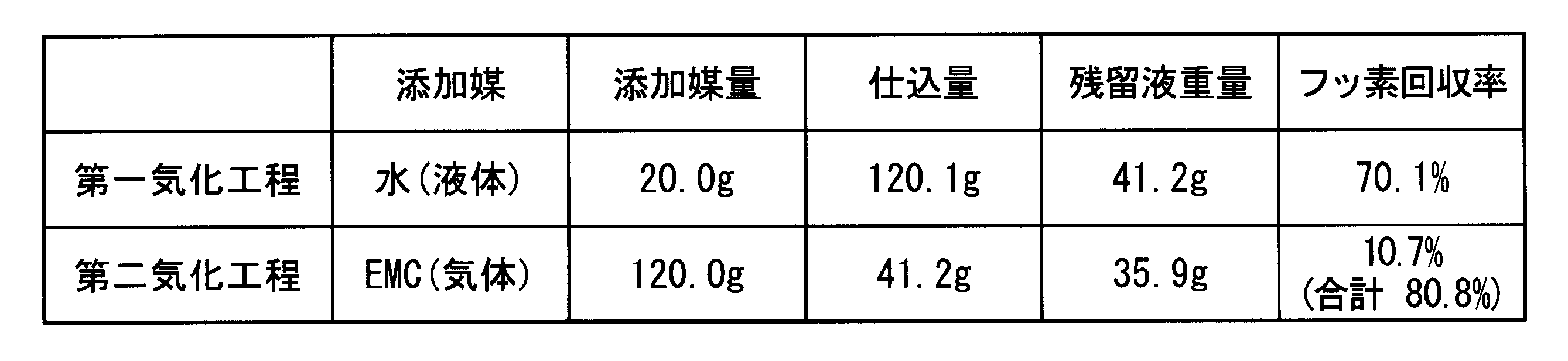
市販の電解液(100mL、重量として120.1g)について二段階の気化処理を実施した。第一気化工程として、電解液に水20.0gを添加し、20kPaの減圧下で120℃に加熱し、2時間、気化処理を行った。この気化ガスを2℃に冷却して凝縮した液(回収液)から70.1%のフッ素を回収した。第一気化工程の残留液は41.2gであり、そのフッ素濃度は、82000ppmであった。
第二気化工程として、第一気化工程の残留液に、EMCの蒸気を連続的に送り込みながら120℃で加熱した。1時間経過後に冷却液(回収液)のフッ素濃度が950ppmになったことを確認し、第二気化工程を終了した。この第二気化工程の回収液から電解液の10.7%のフッ素を回収した。第二気化工程の残留液は35.9gであり、そのフッ素濃度は49000ppmであった。フッ素回収率の合計は80.8%であった。この二段階処理によって、残留液重量は5.3g減少した。結果を表3に示す。なお、表3において、第一気化工程の仕込量は電解液量であり、第二気化工程の仕込量は第一気化工程における残留液重量である。また、フッ素回収率は電解液中のフッ素量に対する割合である。
市販の電解液(100mL、重量として120.1g)について二段階の気化処理を実施した。第一気化工程として、電解液に水20.0gを添加し、20kPaの減圧下で120℃に加熱し、2時間、気化処理を行った。この気化ガスを2℃に冷却して凝縮した液(回収液)から70.1%のフッ素を回収した。第一気化工程の残留液は41.2gであり、そのフッ素濃度は、82000ppmであった。
第二気化工程として、第一気化工程の残留液に、EMCの蒸気を連続的に送り込みながら120℃で加熱した。1時間経過後に冷却液(回収液)のフッ素濃度が950ppmになったことを確認し、第二気化工程を終了した。この第二気化工程の回収液から電解液の10.7%のフッ素を回収した。第二気化工程の残留液は35.9gであり、そのフッ素濃度は49000ppmであった。フッ素回収率の合計は80.8%であった。この二段階処理によって、残留液重量は5.3g減少した。結果を表3に示す。なお、表3において、第一気化工程の仕込量は電解液量であり、第二気化工程の仕込量は第一気化工程における残留液重量である。また、フッ素回収率は電解液中のフッ素量に対する割合である。
〔実施例3〕
市販の電解液(100mL、重量として120.6g)について二段階の気化処理を実施した。第二気化工程において、第一気化工程の残留液にジメチルカーボネート(DMC)の蒸気を送り込む以外は実施例2と同様に処理した。第一気化工程によってフッ素の69.8%を回収し、第二気化工程によってフッ素の10.2%を回収した(回収率の合計80%)。第二気化工程の終了時における回収液のフッ素濃度は720ppmであった。この二段階処理によって、残留液重量は5.3g減少した。結果を表4に示す。なお、表4において、第一気化工程の仕込量は電解液量であり、第二気化工程の仕込量は第一気化工程における残留液重量である。また、フッ素回収率は電解液中のフッ素量に対する割合である。
市販の電解液(100mL、重量として120.6g)について二段階の気化処理を実施した。第二気化工程において、第一気化工程の残留液にジメチルカーボネート(DMC)の蒸気を送り込む以外は実施例2と同様に処理した。第一気化工程によってフッ素の69.8%を回収し、第二気化工程によってフッ素の10.2%を回収した(回収率の合計80%)。第二気化工程の終了時における回収液のフッ素濃度は720ppmであった。この二段階処理によって、残留液重量は5.3g減少した。結果を表4に示す。なお、表4において、第一気化工程の仕込量は電解液量であり、第二気化工程の仕込量は第一気化工程における残留液重量である。また、フッ素回収率は電解液中のフッ素量に対する割合である。

〔実施例4〕
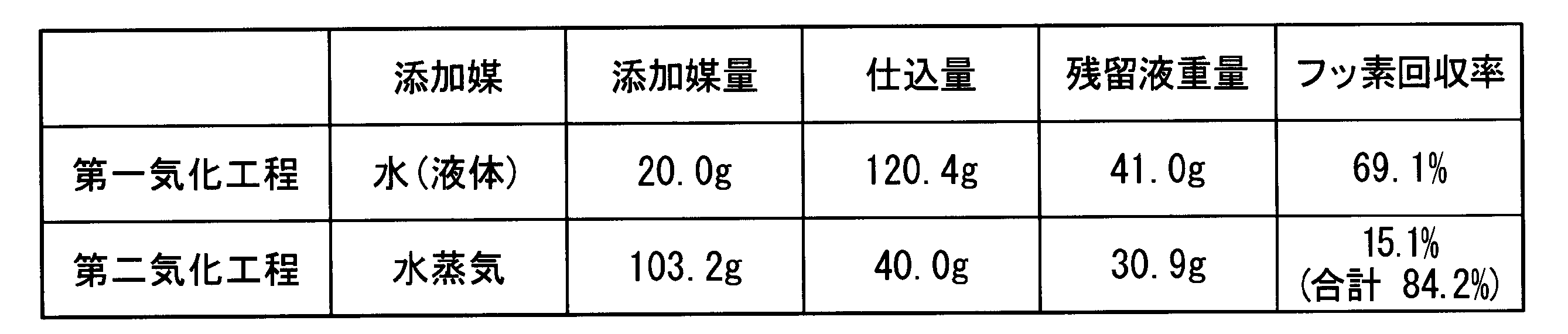
市販の電解液(100mL、重量として120.4g)について二段階の気化処理を実施した。第二気化工程において、第一気化工程の残留液に水蒸気を送り込む以外は実施例2と同様に処理した。第一気化工程によってフッ素の69.1%を回収し、第二気化工程によってフッ素の15.1%を回収した(回収率の合計84.2%)。第二気化工程の終了時における回収液のフッ素濃度は880ppmであった。この二段階処理によって、残留液重量は10.1g減少した。結果を表5に示す。なお、表5において、第一気化工程の仕込量は電解液量であり、第二気化工程の仕込量は第一気化工程における残留液重量である。また、フッ素回収率は電解液中のフッ素量に対する割合である。
市販の電解液(100mL、重量として120.4g)について二段階の気化処理を実施した。第二気化工程において、第一気化工程の残留液に水蒸気を送り込む以外は実施例2と同様に処理した。第一気化工程によってフッ素の69.1%を回収し、第二気化工程によってフッ素の15.1%を回収した(回収率の合計84.2%)。第二気化工程の終了時における回収液のフッ素濃度は880ppmであった。この二段階処理によって、残留液重量は10.1g減少した。結果を表5に示す。なお、表5において、第一気化工程の仕込量は電解液量であり、第二気化工程の仕込量は第一気化工程における残留液重量である。また、フッ素回収率は電解液中のフッ素量に対する割合である。
〔実施例5〕
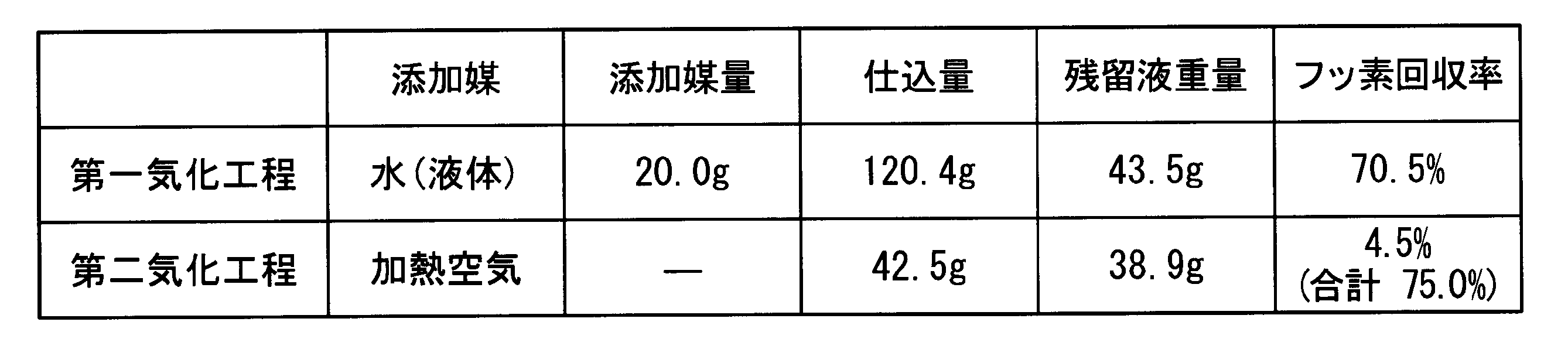
市販の電解液(100mL、重量として120.4g)について二段階の気化処理を実施した。第二気化工程において、第一気化工程の残留液に加熱した空気(80℃)を送り込む以外は実施例2と同様に処理した。第一気化工程によってフッ素の70.5%を回収し、第二気化工程によってフッ素の4.5%を回収した(回収率の合計75%)。この二段階処理によって、残留液重量は4.6g減少した。結果を表6に示す。なお、表6において、第一気化工程の仕込量は電解液量であり、第二気化工程の仕込量は第一気化工程における残留液重量である。また、フッ素回収率は電解液中のフッ素量に対する割合である。
市販の電解液(100mL、重量として120.4g)について二段階の気化処理を実施した。第二気化工程において、第一気化工程の残留液に加熱した空気(80℃)を送り込む以外は実施例2と同様に処理した。第一気化工程によってフッ素の70.5%を回収し、第二気化工程によってフッ素の4.5%を回収した(回収率の合計75%)。この二段階処理によって、残留液重量は4.6g減少した。結果を表6に示す。なお、表6において、第一気化工程の仕込量は電解液量であり、第二気化工程の仕込量は第一気化工程における残留液重量である。また、フッ素回収率は電解液中のフッ素量に対する割合である。
以上、本発明の好ましい実施例を説明したが、本発明はこの実施例に限定されることはない。本発明の趣旨を逸脱しない範囲で、構成の付加、省略、置換、およびその他の変更が可能である。本発明は前述した説明によって限定されることはなく、添付の請求の範囲によってのみ限定される。
本発明のフッ素含有電解液の処理方法によれば、フッ素化合物および有機溶媒を含む電解液を安全に処理できる。これにより、フッ素含有電解液を含むリチウム電池を安全に処理できる。
S1 第一気化工程
S2 第二気化工程
S3 フッ素固定工程
S4 有機溶媒成分回収
S2 第二気化工程
S3 フッ素固定工程
S4 有機溶媒成分回収
Claims (10)
- フッ素含有電解液に水を添加した後に前記フッ素含有電解液を加熱して前記フッ素含有電解液に含まれる揮発成分を気化し、前記揮発成分が気化した気化ガスを回収する第一気化工程と、
前記第一気化工程の後に前記第一気化工程の残留液を加熱しながら加熱ガスを送り込んで前記残留液に含まれる揮発成分を気化し、前記揮発成分が気化した気化ガスを回収する第二気化工程と、を行い、
前記気化ガスまたは前記気化ガスを凝縮した気化ガス凝縮液に含まれるフッ素を、カルシウムと反応させてフッ化カルシウムとして固定し、
さらに前記気化ガスに含まれる有機溶媒成分を回収するフッ素含有電解液の処理方法。 - 前記フッ素含有電解液が、廃電池中の電解液、廃電池を切断ないし破砕した状態の電解液、使用前の電解液、または廃電池から抜き出された電解液である請求項1に記載のフッ素含有電解液の処理方法。
- 前記フッ素含有電解液が廃電池中の電解液であって、
前記廃電池にアルカリを注入し、あるいは前記廃電池をアルカリ溶液に浸漬した後に、前記廃電池を加熱して前記第一気化工程を行う請求項1に記載のフッ素含有電解液の処理方法。 - 前記フッ素含有電解液が廃電池中の電解液であって、
前記廃電池を切断または破砕して粉末アルカリあるいはアルカリ溶液を加えた後に、前記廃電池を加熱して前記第一気化工程を行う請求項1に記載のフッ素含有電解液の処理方法。 - 前記第一気化工程において、前記フッ素含有電解液の温度が130℃以上になるまで加熱して気化処理を行う請求項1~請求項4の何れかに記載のフッ素含有電解液の処理方法。
- 前記第二気化工程において、前記気化ガス中のフッ素濃度が1000mg/L以下になるまで、繰り返し気化処理を行う請求項1~請求項5の何れかに記載のフッ素含有電解液の処理方法。
- 前記フッ素含有電解液を減圧下で加熱して、前記揮発成分を気化させる請求項1~請求項6の何れかに記載のフッ素含有電解液の処理方法。
- 前記気化ガス凝縮液を油水分離して前記有機溶媒成分を回収した後に、前記気化凝縮液の水相にカルシウム化合物を添加してフッ化カルシウムを沈殿させて固液分離する請求項1~請求項7の何れかに記載のフッ素含有電解液の処理方法。
- 前記気化ガス凝縮液にカルシウム化合物を添加してフッ化カルシウムを沈殿させて固液分離した後に、前記有機溶媒成分を回収する請求項1~請求項7の何れかに記載のフッ素含有電解液の処理方法。
- 前記気化ガスをカルシウム充填層に通してフッ化カルシウムを生成させ、前記充填層を通過した前記気化ガスを凝縮して前記有機溶媒成分を回収する請求項1~請求項7の何れかに記載のフッ素含有電解液の処理方法。
Applications Claiming Priority (2)
| Application Number | Priority Date | Filing Date | Title |
|---|---|---|---|
| JP2013-204126 | 2013-09-30 | ||
| JP2013204126 | 2013-09-30 |
Publications (1)
| Publication Number | Publication Date |
|---|---|
| WO2015046218A1 true WO2015046218A1 (ja) | 2015-04-02 |
Family
ID=52743354
Family Applications (1)
| Application Number | Title | Priority Date | Filing Date |
|---|---|---|---|
| PCT/JP2014/075227 Ceased WO2015046218A1 (ja) | 2013-09-30 | 2014-09-24 | フッ素含有電解液の処理方法 |
Country Status (2)
| Country | Link |
|---|---|
| JP (1) | JP6311882B2 (ja) |
| WO (1) | WO2015046218A1 (ja) |
Cited By (2)
| Publication number | Priority date | Publication date | Assignee | Title |
|---|---|---|---|---|
| US20210143489A1 (en) * | 2019-11-12 | 2021-05-13 | Hulico LLC | Battery deactivation |
| JP2024174186A (ja) * | 2022-05-17 | 2024-12-13 | トヨタ自動車株式会社 | 電池処理方法 |
Families Citing this family (1)
| Publication number | Priority date | Publication date | Assignee | Title |
|---|---|---|---|---|
| JP6562212B2 (ja) * | 2015-12-19 | 2019-08-21 | 三菱マテリアル株式会社 | リチウムイオン電池の熱分解処理方法および処理装置 |
Citations (4)
| Publication number | Priority date | Publication date | Assignee | Title |
|---|---|---|---|---|
| JP2000030741A (ja) * | 1998-07-09 | 2000-01-28 | Morita Kagaku Kogyo Kk | 六フッ化リン酸リチウムを含有する有機電解液の処理方 法 |
| JP2005026089A (ja) * | 2003-07-02 | 2005-01-27 | Toyota Motor Corp | リチウム電池、その製造方法ならびに処理方法 |
| JP2012186150A (ja) * | 2011-02-15 | 2012-09-27 | Sumitomo Chemical Co Ltd | 電池廃材からの活物質の回収方法 |
| JP2012204000A (ja) * | 2011-03-23 | 2012-10-22 | Toyota Motor Corp | 電池パックのリサイクル方法及び処理装置 |
Family Cites Families (2)
| Publication number | Priority date | Publication date | Assignee | Title |
|---|---|---|---|---|
| JP5074454B2 (ja) * | 2009-05-29 | 2012-11-14 | Jx日鉱日石金属株式会社 | 金属の回収方法 |
| DE102011110083B4 (de) * | 2011-08-12 | 2016-09-01 | Technische Universität Braunschweig Carolo-Wilhelmina | Verfahren zum Wiedergewinnen von Aktivmaterial aus einer galvanischen Zelle und Aktivmaterial-Separationsanlage, insbesondere Aktivmetall-Separationsanlage |
-
2014
- 2014-09-24 WO PCT/JP2014/075227 patent/WO2015046218A1/ja not_active Ceased
- 2014-09-27 JP JP2014197665A patent/JP6311882B2/ja active Active
Patent Citations (4)
| Publication number | Priority date | Publication date | Assignee | Title |
|---|---|---|---|---|
| JP2000030741A (ja) * | 1998-07-09 | 2000-01-28 | Morita Kagaku Kogyo Kk | 六フッ化リン酸リチウムを含有する有機電解液の処理方 法 |
| JP2005026089A (ja) * | 2003-07-02 | 2005-01-27 | Toyota Motor Corp | リチウム電池、その製造方法ならびに処理方法 |
| JP2012186150A (ja) * | 2011-02-15 | 2012-09-27 | Sumitomo Chemical Co Ltd | 電池廃材からの活物質の回収方法 |
| JP2012204000A (ja) * | 2011-03-23 | 2012-10-22 | Toyota Motor Corp | 電池パックのリサイクル方法及び処理装置 |
Cited By (3)
| Publication number | Priority date | Publication date | Assignee | Title |
|---|---|---|---|---|
| US20210143489A1 (en) * | 2019-11-12 | 2021-05-13 | Hulico LLC | Battery deactivation |
| US12021202B2 (en) * | 2019-11-12 | 2024-06-25 | Hulico LLC | Battery deactivation |
| JP2024174186A (ja) * | 2022-05-17 | 2024-12-13 | トヨタ自動車株式会社 | 電池処理方法 |
Also Published As
| Publication number | Publication date |
|---|---|
| JP6311882B2 (ja) | 2018-04-18 |
| JP2015092467A (ja) | 2015-05-14 |
Similar Documents
| Publication | Publication Date | Title |
|---|---|---|
| JP6315198B2 (ja) | フッ素含有電解液の処理方法 | |
| JP6311877B2 (ja) | フッ素含有電解液の処理方法 | |
| CN105144464B (zh) | 含氟电解液的处理方法 | |
| JP6124001B2 (ja) | フッ素含有電解液の処理方法 | |
| WO2015046232A1 (ja) | フッ素含有電解液の処理方法 | |
| US12365596B2 (en) | System for and method of processing waste lithium-ion battery | |
| KR102043711B1 (ko) | 리튬이온 2차전지의 폐 양극재를 이용한 수산화리튬 일수화물의 제조방법 | |
| US20220017991A1 (en) | Method of producing lithium hydroxide from lithium concentrate through sodium sulfate addition and roasting | |
| Mao et al. | Recycling of electrolyte from spent lithium-ion batteries | |
| JP2005197149A (ja) | リチウム電池処理方法 | |
| JP5459146B2 (ja) | リチウムの回収方法 | |
| JP6562212B2 (ja) | リチウムイオン電池の熱分解処理方法および処理装置 | |
| JP6311882B2 (ja) | フッ素含有電解液の処理方法 | |
| WO2014097861A1 (ja) | リチウム電池及び/又はリチウムイオン電池の電解質用リチウム塩の製造方法及び製造装置 | |
| Chandrasekhar et al. | Plasma‐Assisted Sustainable Recovery of Critical Minerals from Li‐Ion Battery Waste | |
| JP2022118636A (ja) | マンガン化合物水溶液の回収方法 | |
| Iizuka et al. | Mass spectrometric study on volatilization behavior of electrolyte solvents of lithium-ion batteries | |
| KR20200071987A (ko) | 리튬이온 2차전지의 폐양극재로부터 수산화리튬의 분리추출방법 | |
| CN116514148A (zh) | 一种废旧磷酸铁锂正极材料的回收方法 | |
| US20220194806A1 (en) | Lithium oxide recovery method from lithium manganese oxide (lmo) | |
| TW202349783A (zh) | 一種廢棄鋰離子電池的電解質的去除及安全處置方法 | |
| Mao et al. | Next Sustainability |
Legal Events
| Date | Code | Title | Description |
|---|---|---|---|
| 121 | Ep: the epo has been informed by wipo that ep was designated in this application |
Ref document number: 14848393 Country of ref document: EP Kind code of ref document: A1 |
|
| NENP | Non-entry into the national phase |
Ref country code: DE |
|
| 122 | Ep: pct application non-entry in european phase |
Ref document number: 14848393 Country of ref document: EP Kind code of ref document: A1 |