WO2015045536A1 - クレンブテロールに結合する核酸分子およびその用途 - Google Patents
クレンブテロールに結合する核酸分子およびその用途 Download PDFInfo
- Publication number
- WO2015045536A1 WO2015045536A1 PCT/JP2014/067058 JP2014067058W WO2015045536A1 WO 2015045536 A1 WO2015045536 A1 WO 2015045536A1 JP 2014067058 W JP2014067058 W JP 2014067058W WO 2015045536 A1 WO2015045536 A1 WO 2015045536A1
- Authority
- WO
- WIPO (PCT)
- Prior art keywords
- modified
- nucleic acid
- polynucleotide
- clenbuterol
- acid molecule
- Prior art date
- Legal status (The legal status is an assumption and is not a legal conclusion. Google has not performed a legal analysis and makes no representation as to the accuracy of the status listed.)
- Ceased
Links
Images
Classifications
-
- C—CHEMISTRY; METALLURGY
- C12—BIOCHEMISTRY; BEER; SPIRITS; WINE; VINEGAR; MICROBIOLOGY; ENZYMOLOGY; MUTATION OR GENETIC ENGINEERING
- C12N—MICROORGANISMS OR ENZYMES; COMPOSITIONS THEREOF; PROPAGATING, PRESERVING, OR MAINTAINING MICROORGANISMS; MUTATION OR GENETIC ENGINEERING; CULTURE MEDIA
- C12N15/00—Mutation or genetic engineering; DNA or RNA concerning genetic engineering, vectors, e.g. plasmids, or their isolation, preparation or purification; Use of hosts therefor
- C12N15/09—Recombinant DNA-technology
- C12N15/11—DNA or RNA fragments; Modified forms thereof; Non-coding nucleic acids having a biological activity
- C12N15/115—Aptamers, i.e. nucleic acids binding a target molecule specifically and with high affinity without hybridising therewith ; Nucleic acids binding to non-nucleic acids, e.g. aptamers
-
- G—PHYSICS
- G01—MEASURING; TESTING
- G01N—INVESTIGATING OR ANALYSING MATERIALS BY DETERMINING THEIR CHEMICAL OR PHYSICAL PROPERTIES
- G01N33/00—Investigating or analysing materials by specific methods not covered by groups G01N1/00 - G01N31/00
- G01N33/48—Biological material, e.g. blood, urine; Haemocytometers
- G01N33/50—Chemical analysis of biological material, e.g. blood, urine; Testing involving biospecific ligand binding methods; Immunological testing
- G01N33/94—Chemical analysis of biological material, e.g. blood, urine; Testing involving biospecific ligand binding methods; Immunological testing involving narcotics or drugs or pharmaceuticals, neurotransmitters or associated receptors
-
- C—CHEMISTRY; METALLURGY
- C12—BIOCHEMISTRY; BEER; SPIRITS; WINE; VINEGAR; MICROBIOLOGY; ENZYMOLOGY; MUTATION OR GENETIC ENGINEERING
- C12N—MICROORGANISMS OR ENZYMES; COMPOSITIONS THEREOF; PROPAGATING, PRESERVING, OR MAINTAINING MICROORGANISMS; MUTATION OR GENETIC ENGINEERING; CULTURE MEDIA
- C12N2310/00—Structure or type of the nucleic acid
- C12N2310/10—Type of nucleic acid
- C12N2310/16—Aptamers
Definitions
- the present invention relates to a nucleic acid molecule that binds to clenbuterol and its use.
- Clenbuterol is an agonist for ⁇ 2 adrenergic receptors and has been approved as a therapeutic agent for animal respiratory diseases and a uterine muscle relaxant because it has a smooth muscle relaxing action.
- clenbuterol can increase the amount of meat when administered to livestock, it may be illegally used in raising livestock. In this case, since the administered clenbuterol is accumulated in the meat and viscera of the livestock, it has been reported that humans who have ingested the meat and viscera of the livestock cause poisoning symptoms due to clenbuterol.
- Non-patent Document 1 the method using a liquid chromatograph mass spectrometer is known for the detection of Clenbuterol (Non-patent Document 1), for example, it is necessary to perform a pretreatment on a sample collected from livestock, which is troublesome. There's a problem.
- the method of detecting a clenbuterol using an antibody is also considered, since a clenbuterol is a low molecular compound, there exists a problem that acquisition of an antibody is difficult. Even if the antibody can be obtained, it is difficult to use the antibody for a simple test method at a low cost because the antibody is a protein and has a problem in stability (Patent Document 1).
- nucleic acid molecules that specifically bind to antigens have recently attracted attention in place of antibodies.
- nucleic acid molecule for clenbuterol since no nucleic acid molecule for clenbuterol has been reported so far, provision of a nucleic acid molecule that can be used for detection of clenbuterol is desired.
- an object of the present invention is to provide a nucleic acid molecule that can be used for the detection of clenbuterol.
- the nucleic acid molecule of the present invention comprises at least one polynucleotide selected from the group consisting of the following (a) to (c), and the polynucleotide comprises at least one modified base. It is characterized by including.
- A a polynucleotide comprising at least one of the nucleotide sequences of SEQ ID NOs: 1 to 5
- b comprising a nucleotide sequence having 80% or more identity to the nucleotide sequence of (a)
- a polynucleotide that binds to clenbuterol a polynucleotide that binds to clenbuterol, comprising a base sequence complementary to a polynucleotide that hybridizes under stringent conditions to the polynucleotide comprising the base sequence of (a) above
- the Clenbuterol detection reagent of the present invention includes the nucleic acid molecule of the present invention.
- the Clenbuterol detection kit of the present invention includes the nucleic acid molecule of the present invention.
- the method for detecting clenbuterol of the present invention includes a step of bringing the nucleic acid molecule of the present invention into contact with a sample to form a complex of clenbuterol and the nucleic acid molecule in the sample, and a step of detecting the complex. It is characterized by that.
- the nucleic acid molecule of the present invention can bind to clenbuterol. For this reason, according to the nucleic acid molecule of the present invention, for example, clenbuterol can be detected based on the presence or absence of binding to clenbuterol. Therefore, the nucleic acid molecule of the present invention can be said to be an extremely useful tool for detection of clenbuterol in fields such as food management and public health.
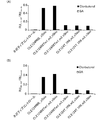
- FIG. 1 is a graph showing the binding ability between aptamer and clenbuterol in Example 1 of the present invention.
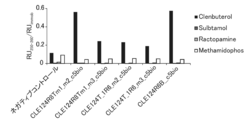
- FIG. 2 is a graph showing the ability of aptamers to bind to clenbuterol, salbutamol, ractopamine and methamidophos in Example 2 of the present invention.
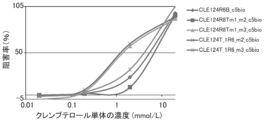
- FIG. 3 is a graph showing the inhibition rate by clenbuterol in Example 3 of the present invention.
- nucleic acid molecule of the present invention for example, in the polynucleotide, at least one thymine is the modified base, and the modified base is at least one of modified thymine and modified uracil.
- the modified base in the total number of bases of thymine, 1/20 or more is the modified base, and the modified base is at least one of modified thymine and modified uracil. .
- nucleic acid molecule of the present invention for example, in the polynucleotide, all thymines are the modified bases, and the modified base is at least one of modified thymine and modified uracil.
- the modified base is a modified cytosine.
- nucleic acid molecule of the present invention for example, in the polynucleotide, more than 1/20 of the total number of bases of cytosine is the modified base, and the modified base is a modified cytosine.
- all cytosines are the modified bases, and the modified base is a modified cytosine.
- the polynucleotide is DNA.
- nucleic acid molecule of the present invention contains at least one polynucleotide selected from the group consisting of the following (a) to (c), and the polynucleotide contains at least one modified base. It is a nucleic acid molecule that binds to the characteristic clenbuterol.
- A a polynucleotide comprising at least one of the nucleotide sequences of SEQ ID NOs: 1 to 5
- b comprising a nucleotide sequence having 80% or more identity to the nucleotide sequence of (a)
- a polynucleotide that binds to clenbuterol a polynucleotide that binds to clenbuterol, comprising a base sequence complementary to a polynucleotide that hybridizes under stringent conditions to the polynucleotide comprising the base sequence of (a) above
- binding to clenbuterol means, for example, having a binding ability to the clenbuterol or having a binding activity to the clenbuterol.
- the binding between the nucleic acid molecule of the present invention and the clenbuterol can be determined by, for example, surface plasmon resonance molecular interaction (SPR) analysis.
- SPR surface plasmon resonance molecular interaction
- ProteON trade name, BioRad
- Clenbuterol is represented by the following formula (1).
- the clenbuterol may be, for example, a derivative such as an isomer, a salt, a hydrate, or a solvate.
- the description regarding the said clenbuterol can be used for the said derivative
- the structural units of the polynucleotides (a) to (c) are, for example, nucleotide residues, and examples include deoxyribonucleotide residues and ribonucleotide residues.
- the polynucleotide is, for example, DNA composed of deoxyribonucleotide residues, DNA containing deoxyribonucleotide residues and ribonucleotide residues, and may further contain non-nucleotide residues.
- the nucleic acid molecule of the present invention is hereinafter also referred to as a DNA aptamer, for example.
- the nucleic acid molecule of the present invention may be, for example, a molecule composed of any of the polynucleotides (a) to (c) or a molecule containing the polynucleotide.
- the nucleic acid molecule of the present invention may contain, for example, two or more of any of the polynucleotides (a) to (c) as described later.
- the two or more polynucleotides may have the same sequence or different sequences.
- the nucleic acid molecule of the present invention may further have, for example, a linker and / or an additional sequence.
- the polynucleotide (a) is a polynucleotide comprising at least one of the nucleotide sequences of SEQ ID NOs: 1 to 5.
- SEQ ID NOs: 4 and 5 for example, the base sequence of SEQ ID NO: 6 below is a conserved region.
- identity may be, for example, within a range in which the polynucleotide of (b) binds to clenbuterol.
- the identity is, for example, 80% or more, 85% or more, 90% or more, 95% or more, 96% or more, 97% or more, 98% or more, 99% or more.
- the identity can be calculated with default parameters using analysis software such as BLAST and FASTA (hereinafter the same).
- the “hybridizable polynucleotide” is, for example, a polynucleotide that is completely or partially complementary to the polynucleotide of (a).
- the hybridization can be detected by, for example, various hybridization assays.
- the hybridization assay is not particularly limited, for example, Zanburuku (Sambrook) et al., Eds., "Molecular Cloning: A Laboratory Manual 2nd Edition (Molecular Cloning:. A Laboratory Manual 2 nd Ed) " [(Cold Spring Harbor Laboratory Press (1989)] and the like can also be employed.
- the “stringent conditions” may be, for example, any of low stringent conditions, medium stringent conditions, and high stringent conditions.
- Low stringent conditions are, for example, conditions of 5 ⁇ SSC, 5 ⁇ Denhardt's solution, 0.5% SDS, 50% formamide, and 32 ° C.
- Medium stringent conditions are, for example, 5 ⁇ SSC, 5 ⁇ Denhardt's solution, 0.5% SDS, 50% formamide, 42 ° C.
- “High stringent conditions” are, for example, conditions of 5 ⁇ SSC, 5 ⁇ Denhardt's solution, 0.5% SDS, 50% formamide, 50 ° C.
- the degree of stringency can be set by those skilled in the art by appropriately selecting conditions such as temperature, salt concentration, probe concentration and length, ionic strength, time, and the like.
- “Stringent conditions” are, for example, Zanburuku previously described (Sambrook) et al., Eds., "Molecular Cloning: A Laboratory Manual 2nd Edition (Molecular Cloning:. A Laboratory Manual 2 nd Ed) " [(Cold Spring Harbor Laboratory Press (1989)] and the like can also be employed.
- the nucleic acid molecule of the present invention may be, for example, a nucleic acid molecule that binds to clenbuterol, including the following polynucleotide (d), wherein the polynucleotide includes at least one modified base.
- d polynucleotide
- D a polynucleotide comprising a base sequence in which one or several bases are deleted, substituted, inserted and / or added in the base sequence of (a), and which binds to clenbuterol
- one or several may be, for example, within a range in which the polynucleotide of (d) binds to clenbuterol.
- the “one or several” is, for example, 1 to 10, 1 to 7, 1 to 5, 1 to 3, 1, or 2 in any one of the base sequences of (a). .
- the structural unit of the polynucleotide (d) is, for example, the same as the other polynucleotides described above.
- the polynucleotides (b), (c) and (d) preferably have, for example, the conserved region.
- the nucleic acid molecule of the present invention may include, for example, one of the polynucleotide sequences (a) to (d) or a plurality of the polynucleotide sequences. In the latter case, it is preferable that a plurality of polynucleotide sequences are linked to form a single-stranded polynucleotide.
- the sequences of the plurality of polynucleotides may be directly linked to each other or indirectly linked via a linker.
- the polynucleotide sequences are preferably linked directly or indirectly at the respective ends.
- the sequences of the plurality of polynucleotides may be the same or different, for example.
- sequences of the plurality of polynucleotides are preferably the same, for example.
- the number of the sequences is not particularly limited, and is, for example, 2 or more, specifically, for example, 2 to 20, 2 to 10, 2 or 3.
- the linker is not particularly limited.
- the length of the linker is not particularly limited, and is, for example, 1 to 200 bases long, 1 to 20 bases long, 3 to 12 bases long, and 5 to 9 bases long.
- the structural unit of the linker is, for example, a nucleotide residue, and examples thereof include a deoxyribonucleotide residue and a ribonucleotide residue.
- the linker is not particularly limited, and examples thereof include polynucleotides such as DNA consisting of deoxyribonucleotide residues and DNA containing ribonucleotide residues.
- linker examples include polydeoxythymine (poly dT), polydeoxyadenine (poly dA), poly dAdT which is a repeating sequence of A and T, and preferably poly dT and poly dAdT.
- the polynucleotide is preferably a single-stranded polynucleotide.
- the single-stranded polynucleotide is preferably capable of forming a stem structure and a loop structure by, for example, self-annealing.
- the polynucleotide is preferably capable of forming a stem loop structure, an internal loop structure, and / or a bulge structure, for example.
- the nucleic acid molecule of the present invention may be, for example, double stranded.
- one single-stranded polynucleotide includes any of the polynucleotides (a) to (d), and the other single-stranded polynucleotide is not limited.
- the other single-stranded polynucleotide include a polynucleotide comprising a base sequence complementary to any one of the polynucleotides (a) to (d).
- the nucleic acid molecule of the present invention is double-stranded, it is preferably dissociated into a single-stranded polynucleotide by denaturation or the like prior to use.
- the dissociated single-stranded polynucleotide of any one of (a) to (d) preferably has, for example, a stem structure and a loop structure as described above.
- the stem structure and the loop structure can be formed means, for example, that the stem structure and the loop structure are actually formed, and even if the stem structure and the loop structure are not formed, the stem structure depending on the conditions. And the ability to form a loop structure.
- a stem structure and a loop structure can be formed includes, for example, both experimental confirmation and prediction by a computer simulation.
- the structural unit of the nucleic acid molecule of the present invention is, for example, a nucleotide residue.
- the length of the nucleic acid molecule is not particularly limited, and the lower limit thereof is, for example, 15 base length, 73 base length or 78 base length, and the upper limit thereof is, for example, 91 base length, 73 base length or 78 base length. It is.
- nucleotide residue examples include deoxyribonucleotide residue and ribonucleotide residue.
- nucleic acid molecule of the present invention examples include DNA composed only of deoxyribonucleotide residues, DNA containing one or several ribonucleotide residues, and the like. In the latter case, “one or several” is not particularly limited.
- the numerical range of numbers such as the number of bases and the number of sequences, for example, discloses all positive integers belonging to the range. That is, for example, the description “1 to 5 bases” means all disclosures of “1, 2, 3, 4, 5 bases” (the same applies hereinafter).
- the polynucleotide includes at least one modified base.
- the modified base is not particularly limited, and examples thereof include a base modified with a natural base (non-artificial base), and preferably has the same function as the natural base.
- the natural base is not particularly limited, and examples thereof include a purine base having a purine skeleton and a pyrimidine base having a pyrimidine skeleton.
- the purine base is not particularly limited, and examples thereof include adenine (a) and guanine (g).
- the pyrimidine base is not particularly limited, and examples thereof include cytosine (c), thymine (t), uracil (u) and the like.
- the base modification site is not particularly limited.
- examples of the purine base modification site include the 7th and 8th positions of the purine skeleton.
- examples of the modification site of the pyrimidine base include the 5th and 6th positions of the pyrimidine skeleton.
- modified uracil or modified thymine when “ ⁇ O” is bonded to carbon at position 4 and a group other than “—CH 3 ” or “—H” is bonded to carbon at position 5, it is called modified uracil or modified thymine. Can do.
- the modifying group of the modifying base is not particularly limited, and examples thereof include a methyl group, a fluoro group, an amino group, a thio group, a benzylaminocarbonyl group represented by the following formula (2), and a tryptaminocarbonyl represented by the following formula (3).
- the modified base is not particularly limited.
- modified adenine modified with adenine, modified thymine modified with thymine, modified guanine modified with guanine, modified cytosine modified with cytosine and modified modified with uracil examples include uracil and the like, and the modified thymine, the modified uracil and the modified cytosine are preferable.
- modified adenine examples include 7'-deazaadenine and the like.
- modified guanine examples include, for example, 7'-deazaguanine.
- modified cytosine examples include 5'-methylcytosine.
- modified thymine examples include 5'-benzylaminocarbonylthymine, 5'-tryptaminocarbonylthymine, 5'-isobutylaminocarbonylthymine and the like.
- modified uracil examples include 5'-benzylaminocarbonyluracil (BndU), 5'-tryptaminocarbonyluracil (TrpdU), 5'-isobutylaminocarbonyluracil and the like.
- the polynucleotide is not particularly limited, and may include, for example, only one type of the modified base, or may include two or more types of the modified base.
- the number of the modified base is not particularly limited.
- the number of the modified bases may be one or more, and the upper limit is not particularly limited.
- the modified base is, for example, 1 to 91, 1 to 78, or 1 to 73, 1 to 70, 1 to 40, 1 to 30, 1 to 20, or 20 in the polynucleotide. Yes, and all the bases may be the modified bases.
- the number of the modified bases may be, for example, the number of any one of the modified bases or the total number of the two or more modified bases.
- the modified base in the entire length of the nucleic acid molecule containing the polynucleotide is not particularly limited, and is, for example, 1 to 91, 1 to 78, or 1 to 73. This is the same as the range.
- the ratio of the modified base is not particularly limited.
- the ratio of the modified base is, for example, 1/100 or more, 1/40 or more, 1/20 or more, 1/10 or more, 1/4 or more, or 1/3 or more of the total number of bases of the polynucleotide.
- the ratio of the modified base in the entire length of the nucleic acid molecule containing the polynucleotide is not particularly limited, and is the same as the above range.
- the total number of bases is, for example, the total number of natural bases and modified bases in the polynucleotide.
- the ratio of the modified base is expressed as a fraction, and the total number of bases and the number of modified bases that satisfy this are positive integers.
- the number of the modified thymine is not particularly limited.
- natural thymine can be substituted for the modified thymine.
- the number of the modified thymines may be one or more, and the upper limit is not particularly limited.
- the modified thymine is, for example, 1 to 40, 5 to 35, 8 to 30, 10 to 25, 13 to 22, or 17 in the polynucleotide. It may be a modified thymine.
- the ratio of the modified thymine is not particularly limited.
- the ratio of the modified thymine is, for example, 1/100 or more, 1/40 or more, 1/20 or more, 1/10 or more, 1/4 or more of the total number of the natural thymine and the modified thymine. 1/3 or more.
- the number of the modified uracil is not particularly limited.
- natural thymine can be substituted for the modified uracil.
- the number of the modified uracils may be one or more, and the upper limit is not particularly limited.
- the modified uracil is, for example, 1 to 40, 5 to 35, 8 to 30, 10 to 25, 13 to 22, or 17 in the polynucleotide. Modified uracil may also be used.
- the ratio of the modified uracil is not particularly limited.
- the ratio of the modified uracil is, for example, 1/100 or more, 1/40 or more, 1/20 or more 1/10 or more, 1/4 or more of the total number of the natural thymines and the number of the modified uracils, 1/3 or more.
- Examples of the number of the modified thymine and the modified uracil may be, for example, the total number of both.
- the number of the modified cytosines is not particularly limited.
- natural cytosine can be substituted for the modified cytosine.
- the number of the modified cytosine may be one or more, and the upper limit is not particularly limited.
- the modified cytosine is, for example, 1 to 40, 5 to 30, 5 to 20, 8 to 19, 8 to 13, or 12 in the polynucleotide. It may be a modified cytosine.
- the ratio of the modified cytosine is not particularly limited.
- the ratio of the modified cytosine is, for example, 1/100 or more, 1/40 or more, 1/20 or more, 1/10 or more, 1/4 or more of the total number of the natural cytosine and the modified cytosine. 1/3 or more.
- the modified base is the modified adenine or the modified guanine
- cytosine and modified cytosine are referred to as “adenine” and “modified adenine” or “guanine” and It can be read as “modified guanine”.
- natural adenine can be substituted with the modified adenine
- natural guanine can be substituted with the modified guanine.
- the nucleic acid molecule of the present invention may contain a modified nucleotide.
- the modified nucleotide may be a nucleotide having the modified base described above, a nucleotide having a modified sugar in which a sugar residue is modified, or the modified base. And a nucleotide having the modified sugar.
- the sugar residue is not particularly limited, and examples thereof include deoxyribose residue or ribose residue.
- the modification site in the sugar residue is not particularly limited, and examples thereof include the 2'-position and the 4'-position of the sugar residue, and both of them may be modified.
- Examples of the modifying group of the modified sugar include a methyl group, a fluoro group, an amino group, and a thio group.
- the base when the base is a pyrimidine base, for example, the 2'-position and / or the 4'-position of the sugar residue is preferably modified.
- Specific examples of the modified nucleotide residue include, for example, a 2′-methylated-uracil nucleotide residue and a 2′-methylated-cytosine nucleotide residue in which the deoxyribose residue or the 2 ′ position of the ribose residue is modified.
- the number of the modified nucleotides is not particularly limited.
- the polynucleotide for example, 1 to 91, 1 to 78, or 1 to 73, 1 to 80, 1 to 60, and 1 to 50 are used. 1 to 40 and 1 to 30.
- the modified nucleotides in the full length of the nucleic acid molecule including the polynucleotide are not particularly limited, and are, for example, 1 to 91, 1 to 78, or 1 to 73, specifically, for example, within the above-mentioned range. It is the same.
- the nucleic acid molecule of the present invention may contain, for example, one or several artificial nucleic acid monomer residues.
- the “one or several” is not particularly limited, and for example, in the polynucleotide, for example, 1 to 91, 1 to 78, or 1 to 73, preferably 1 to 80, more preferably 1 to 60, more preferably 1 to 50, particularly preferably 1 to 40, and most preferably 1 to 30.
- the artificial nucleic acid monomer residue include PNA (peptide nucleic acid), LNA (Locked Nucleic Acid), ENA (2'-O, 4'-C-Ethylenebridged Nucleic Acids) and the like.
- the nucleic acid in the monomer residue is the same as described above, for example.
- the artificial nucleic acid monomer residue in the entire length of the nucleic acid molecule containing the polynucleotide is not particularly limited, and is, for example, 1 to 91, 1 to 78, or 1 to 73, specifically, for example, This is the same as the range described above.
- the nucleic acid molecule of the present invention is preferably nuclease resistant, for example.
- the nucleic acid molecule of the present invention preferably has, for example, the modified nucleotide residue and / or the artificial nucleic acid monomer residue for nuclease resistance. Since the nucleic acid molecule of the present invention is nuclease resistant, for example, tens of kDa PEG (polyethylene glycol) or deoxythymidine may be bound to the 5 'end or 3' end.
- the nucleic acid molecule of the present invention may further have an additional sequence, for example.
- the additional sequence is preferably bound to, for example, at least one of the 5 'end and the 3' end of the nucleic acid molecule, and more preferably the 3 'end.
- the additional sequence is not particularly limited.
- the length of the additional sequence is not particularly limited, and is, for example, 1 to 200 bases long, 1 to 50 bases long, 1 to 25 bases long, or 18 to 24 bases long.
- the structural unit of the additional sequence is, for example, a nucleotide residue, and examples thereof include a deoxyribonucleotide residue and a ribonucleotide residue.
- the additional sequence is not particularly limited, and examples thereof include polynucleotides such as DNA consisting of deoxyribonucleotide residues and DNA containing ribonucleotide residues. Specific examples of the additional sequence include poly dT and poly dA.
- the nucleic acid molecule of the present invention can be used, for example, immobilized on a carrier.
- a carrier for example, either the 5 'end or the 3' end is preferably immobilized, and more preferably the 3 'end.
- the nucleic acid molecule may be immobilized directly or indirectly on the carrier. In the latter case, for example, it is preferable to immobilize via the additional sequence.
- the method for producing the nucleic acid molecule of the present invention is not particularly limited, and can be synthesized by, for example, a genetic engineering technique such as a nucleic acid synthesis method using chemical synthesis or a known method.
- the nucleic acid molecule of the present invention exhibits binding properties to the clenbuterol.
- the use of the nucleic acid molecule of the present invention is not particularly limited as long as it uses the binding property to the clenbuterol.
- the nucleic acid molecule of the present invention can be used in various methods in place of, for example, the antibody against clenbuterol.
- the clenbuterol can be detected.
- the method for detecting clenbuterol is not particularly limited, and can be performed by detecting the binding between the clenbuterol and the nucleic acid molecule.
- the method for detecting clenbuterol of the present invention includes a step of bringing the nucleic acid molecule of the present invention into contact with a sample to form a complex of clenbuterol and the nucleic acid molecule in the sample, and a step of detecting the complex. It is characterized by that.
- the detection method of the present invention is characterized by using the nucleic acid molecule of the present invention, and other steps and conditions are not particularly limited.
- the nucleic acid molecule of the present invention specifically binds to clenbuterol, for example, by detecting the binding between clenbuterol and the nucleic acid molecule, it is possible to specifically detect clenbuterol in a sample. It is. Specifically, for example, since the amount of clenbuterol in a sample can be analyzed, it can be said that qualitative or quantitative determination is also possible.
- the sample is not particularly limited.
- the sample include samples derived from living organisms, food and drink, and environment.
- the living body is not particularly limited, and examples thereof include non-human mammals such as humans, cows, pigs, sheep, mice, rats, rabbits, horses, and animals such as birds and fish.
- the biological sample include excrement, body fluid, skin, meat, mucous membrane, body hair and the like.
- Examples of the sample derived from food and drink include beverages, foods, and food ingredients.
- Examples of the environment-derived sample include living organisms, water, soil, air, and the like.
- Examples of the water sample include groundwater, river water, seawater, domestic wastewater, and the like.
- the sample derived from the environment includes, for example, deposits in food processing shops, cooking places, and the like.
- the sample may be, for example, a liquid sample or a solid sample.
- the solid sample for example, it is preferable to use it as a liquid sample by mixing it with a liquid because it is easy to contact with the nucleic acid molecule and is easy to handle.
- the liquid is not particularly limited, and examples thereof include water, physiological saline, buffer solution, medium, and the like.
- the detection step includes, for example, a contact step in which the sample and the nucleic acid molecule are brought into contact with each other to bind the clenbuterol in the sample and the nucleic acid molecule, and a binding detection in which the binding between the clenbuterol and the nucleic acid molecule is detected Process.
- the detection step further includes, for example, a step of analyzing the presence or amount of clenbuterol in the sample based on the result of the binding detection step.
- the method for contacting the sample and the nucleic acid molecule is not particularly limited.
- the contact between the sample and the nucleic acid molecule is preferably performed in a liquid, for example.
- the liquid is not particularly limited, and examples thereof include water, physiological saline, and buffer solution.
- the contact condition between the sample and the nucleic acid molecule is not particularly limited.
- the contact temperature is, for example, 4 to 37 ° C., preferably 18 to 25 ° C.
- the contact time is, for example, 10 to 120 minutes, preferably 30 to 60 minutes.
- the nucleic acid molecule may be, for example, an immobilized nucleic acid molecule immobilized on a carrier or an unfixed free nucleic acid molecule.
- the sample is contacted in a container.
- the nucleic acid molecule is preferably, for example, the immobilized nucleic acid molecule because of its excellent handleability.
- the carrier is not particularly limited, and examples thereof include a substrate, a bead, and a container. Examples of the container include a microplate and a tube.
- the nucleic acid molecule is immobilized as described above, for example.
- the binding detection step is a step of detecting the binding between clenbuterol in the sample and the nucleic acid molecule as described above.
- detecting the presence or absence of binding between the two for example, the presence or absence of clenbuterol in the sample can be analyzed (qualitative), and by detecting the degree of binding (binding amount) between the two, for example, the sample
- the amount of clenbuterol in it can be analyzed (quantified).
- the method for detecting the binding between the clenbuterol and the nucleic acid molecule is not particularly limited.
- a conventionally known method for detecting binding between substances can be adopted, and specific examples thereof include the SPR described above.
- the binding between the clenbuterol and the nucleic acid molecule cannot be detected, it can be determined that no clenbuterol is present in the sample, and when the binding is detected, it can be determined that clenbuterol is present in the sample. . Further, a correlation between the concentration of clenbuterol and the binding amount can be obtained in advance, and the concentration of clenbuterol in the sample can be analyzed from the binding amount based on the correlation.
- the detection reagent of the present invention is a clenbuterol detection reagent, and includes the nucleic acid molecule of the present invention.
- the detection reagent of this invention should just contain the nucleic acid molecule of the said this invention, and another structure is not restrict
- the detection kit of the present invention is a clenbuterol detection kit and includes the nucleic acid molecule of the present invention.
- the detection kit of the present invention is not limited as long as it contains the nucleic acid molecule of the present invention. If the detection kit of the present invention is used, for example, the detection of the clenbuterol can be easily performed as described above.
- the detection kit of the present invention may contain other components in addition to the nucleic acid molecule of the present invention, for example.
- the component include the carrier, buffer solution, and instruction manual.
- the description of the nucleic acid molecule of the present invention can be used, and the nucleic acid molecule of the present invention and the detection method of the present invention can also be used for the method of use.
- the detection device of the present invention is a Clenbuterol detection device, and includes the nucleic acid molecule of the present invention.
- the detection device of the present invention is not limited as long as it contains the nucleic acid molecule of the present invention. If the detection device of the present invention is used, for example, the above-mentioned Clenbuterol can be detected as described above.
- the detection device of the present invention further includes, for example, a carrier, and the nucleic acid molecule is arranged on the carrier.
- the nucleic acid molecule is preferably immobilized on the carrier.
- the type of the carrier and the immobilization of the nucleic acid molecule are as described above, for example.
- the method for using the detection device of the present invention is not particularly limited, and the nucleic acid molecule of the present invention and the detection method of the present invention can be used.
- aptamer 1-5 underlined regions use deoxyribonucleotide residues having 5′-methylcytosine methylated at the 5-position of cytosine instead of natural cytosine (C).
- aptamer 1 is a deoxyribonucleotide residue having 5′-benzylaminocarbonyluracil (BndU) substituted at the 5-position of thymine instead of natural thymine (T)
- aptamer 2-5 is Instead of natural thymine (T)
- deoxyribonucleotide residues having 5′-tryptaminocarbonyluracil (TrpdU) substituted at the 5-position of thymine were used and synthesized.
- CLE124R6B__c5bio (SEQ ID NO: 1) 5'-GGTAAGTAGCCCTCCCTGAAATG ACAGAAAGTGTGGATTTTATTTGGATCATA CACTAGCACGGCAATCTGGTTTAAG-3 '
- Aptamer 2 CLE124R8Tm1_m2_c5bio (SEQ ID NO: 2) 5'-GGTAAGTAGCCCTCCCTGAAATG TGACAGCACATCATTTGAGTTGGCATGTCT CACTAGCACGGCAATCTGGTTTAAG-3 ' Aptamer 3: CLE124R8Tm1_m3_c5bio (SEQ ID NO: 3) 5'-GGTAAGTAGCCCTCCCTGAAATG TATGCCGGTCAAAGCATATTTCCATATTTG CACTAGCACGGCAATCTGGTTTAAG-3 '
- Aptamer 4 CLE124T_1R6_m2_c5bio (SEQ ID NO: 4) 5'-GGTAAGTAGCCCTCTCCCCT
- a DNA library containing a plurality of DNAs composed of the oligonucleotide represented by SEQ ID NO: 7 containing a 40 base long random sequence (N) 40 was used as a negative control.
- N is a deoxyribonucleotide residue
- the nucleic acid was adenine, guanine, cytosine and / or thymine.
- Negative control (SEQ ID NO: 7) CCTGCACCCAGTGTCCC- (N) 40 -GACGGAGAGGAGGACGG
- the aptamer was added with polydeoxyadenine (poly dA) having a length of 24 bases at the 3 'end and used as a poly dA added aptamer in SPR described later.
- poly dA polydeoxyadenine
- a chip product name: ProteOn NLC Sensor Chip, BioRad
- streptavidin was immobilized
- 5 ⁇ mol / L of biotinylated poly dT was injected into the flow cell of the sensor chip using ultrapure water (DDW), and was bound until the signal intensity (RU: Resonance Unit) was about 900 RU.
- the biotinylated poly dT was prepared by biotinylating the 5 'end of deoxythymidine having a length of 24 bases.
- the composition of the SPR buffer was 40 mmol / L HEPES, 125 mmol / L NaCl, 5 mmol / L KCl, 1 mmol / L MgCl 2 and 0.05% Tween (registered trademark) 20, and the pH was 7.5.
- the injection start of the sample was determined 115 seconds to the average value of the RU in 125 seconds and (RU 115-225), the average value of the RU in 355-365 seconds and (RU 355-365). Further, the ratio of RU value (RU immob ) to RU 115-225 (RU 115-225 / RU immob ) or RU immob and RU 355-365 when the poly dA-added aptamer is bound to the biotinylated poly dT. (RU 355-365 / RU immob ).
- RU 115-225 / RU immob and RU 355-365 / RU immob were obtained in the same manner except that 500 nmol / L of SA was injected instead of the sample.
- the dissociation constant (KD) was determined by response curve fitting from RU 115-225 / RU immob and RU 355-365 / RU immob .
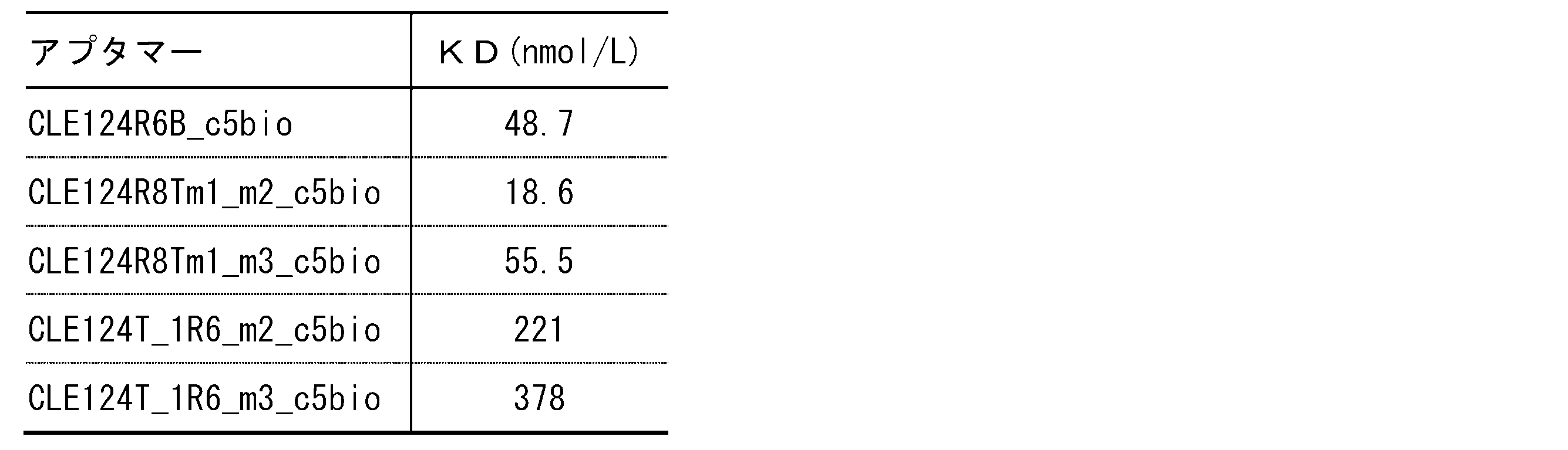
- FIGS. 1A and 1B The results of RU 115-225 / RU immob and RU 355-365 / RU immob are shown in FIGS. 1A and 1B, and the results of dissociation constants are shown in Table 1.
- FIG. 1A is a graph showing RU 115-225 / RU immob , the horizontal axis shows the aptamer type, and the vertical axis shows RU 115-225 / RU immob .
- FIG. 1B is a graph showing RU 355-365 / RU immob , the horizontal axis shows the aptamer type, and the vertical axis shows RU 355-365 / RU immob .
- the amino groups of clenbuterol, salbutamol, ractopamine and methamidophos were respectively biotinylated to produce biotinylated clenbuterol, biotinylated salbutamol, biotinylated ractopamine and biotinylated methamidophos.
- the biotinylated clenbuterol, the biotinylated salbutamol, the biotinylated ractopamine or the biotinylated methamidophos combined with the SA was used as a sample, SPR buffer was injected at 25 ⁇ L / min, and RU at 250 to 260 seconds.
- RU 250-260 / RU immob in each sample was determined in the same manner as in Example 1 except that the average value (RU 250-260 ) was determined.
- FIG. 2 is a graph showing RU 250-260 / RU immob , where the horizontal axis shows the aptamer type and the vertical axis shows RU 250-260 / RU immob .
- Example 3 When an unmodified clenbuterol simple substance is added to the biotinylated clenbuterol complex and the aptamer binds to the clenbuterol simple substance, the binding between the aptamer and the complex is inhibited by competition. . Then, about each aptamer, the binding ability with respect to the said clenbuterol single-piece
- Example 2 In the same manner as in Example 1, the biotinylated clenbuterol was bound to the SA. After the bonding, 250 to 260 seconds were carried out in the same manner as in Example 1 except that the Clenbuterol simple substance was added so as to be 0, 0.02, 0.2, 2 or 20 mmol / L and used as a sample. The average value of RU (RU 250-260 ) was calculated, and RU 250-260 / RU immob was calculated.
- RU 250-260 / RU immob of the sample containing 0 mmol / L of the clenbuterol simple substance is defined as 100%, and the reduction rate of RU 250-260 / RU immob at the concentration of each clenbuterol simple substance is obtained, and this is expressed as an inhibition rate ( %). Further, based on the concentration of the clenbuterol alone and the inhibition rate, IC50 (CLE IC50) of the inhibition rate of clenbuterol for each aptamer was obtained.
- FIG. 3 is a graph showing the inhibition rate.
- the horizontal axis represents the concentration of clenbuterol alone, and the vertical axis represents the inhibition rate (%).
- the inhibition rate of any aptamer of the example increased with an increase in the concentration of the clenbuterol alone in the sample.
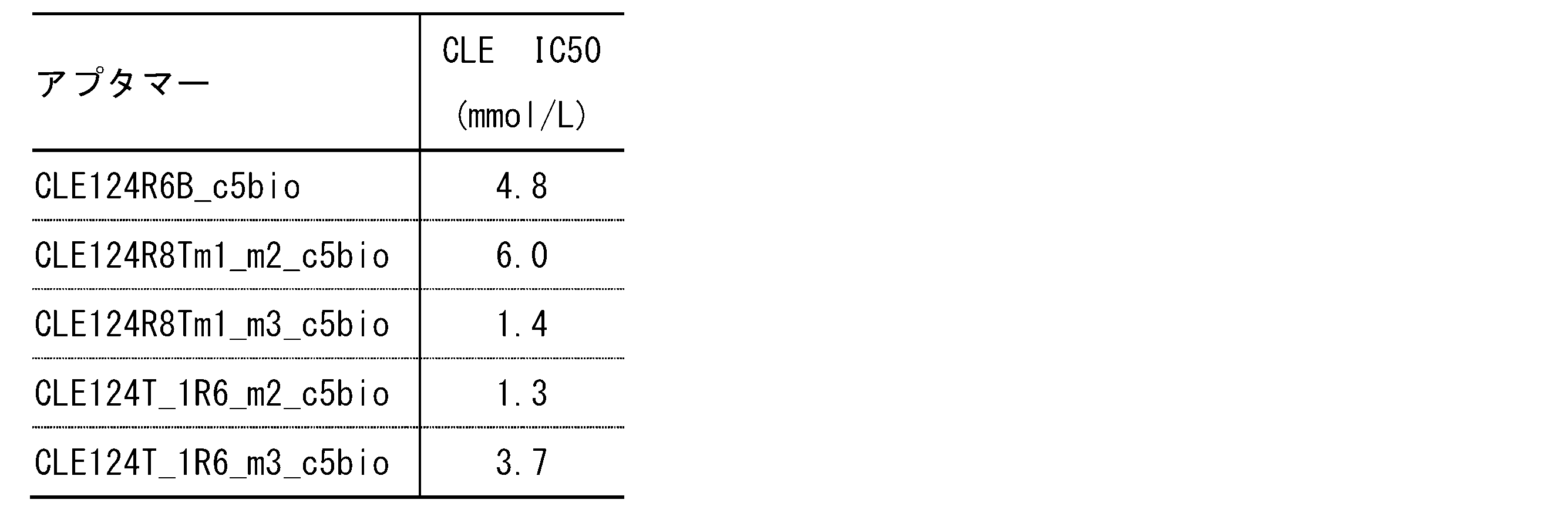
- the IC50 of the inhibition rate of clenbuterol for each aptamer of the example was in the range of 1.3-6 mmol / L.
- the nucleic acid molecule of the present invention can bind to clenbuterol. For this reason, according to the nucleic acid molecule of the present invention, for example, clenbuterol can be detected by binding to clenbuterol. For this reason, the nucleic acid molecule of the present invention is an extremely useful tool for detection of clenbuterol in the fields of food management, public health, and the like.
Landscapes
- Health & Medical Sciences (AREA)
- Life Sciences & Earth Sciences (AREA)
- Engineering & Computer Science (AREA)
- Biomedical Technology (AREA)
- Molecular Biology (AREA)
- Genetics & Genomics (AREA)
- Chemical & Material Sciences (AREA)
- Bioinformatics & Cheminformatics (AREA)
- Biotechnology (AREA)
- Hematology (AREA)
- Physics & Mathematics (AREA)
- General Engineering & Computer Science (AREA)
- Microbiology (AREA)
- Wood Science & Technology (AREA)
- Zoology (AREA)
- Urology & Nephrology (AREA)
- Biochemistry (AREA)
- General Health & Medical Sciences (AREA)
- Organic Chemistry (AREA)
- Immunology (AREA)
- Cell Biology (AREA)
- Plant Pathology (AREA)
- Pharmacology & Pharmacy (AREA)
- Biophysics (AREA)
- Food Science & Technology (AREA)
- Medicinal Chemistry (AREA)
- Analytical Chemistry (AREA)
- General Physics & Mathematics (AREA)
- Pathology (AREA)
- Measuring Or Testing Involving Enzymes Or Micro-Organisms (AREA)
Abstract
クレンブテロールの検出に利用可能な核酸分子を提供する。 下記(a)~(c)からなる群から選択された少なくとも一つのポリヌクレオチドを含み、前記ポリヌクレオチドが、少なくとも1つの修飾塩基を含む核酸分子を、クレンブテロールに結合する核酸分子とする。 (a)配列番号1~5の塩基配列の少なくともいずれか1つの塩基配列からなるポリヌクレオチド (b)前記(a)の塩基配列に対して、80%以上の同一性を有する塩基配列からなり、クレンブテロールに結合するポリヌクレオチド (c)前記(a)の塩基配列からなるポリヌクレオチドに対してストリンジェントな条件下でハイブリダイズするポリヌクレオチドに相補的な塩基配列からなり、クレンブテロールに結合するポリヌクレオチド
Description
本発明は、クレンブテロールに結合する核酸分子およびその用途に関する。
クレンブテロールは、β2アドレナリン受容体に対する作動薬であり、平滑筋の弛緩作用があることから、動物の呼吸器疾患の治療薬および子宮筋弛緩薬として承認されている。他方、クレンブテロールは、家畜に投与することで肉量を増やせることから、家畜の飼育において、違法に使用されることがある。この場合、投与されたクレンブテロールは、前記家畜の肉や内臓等に蓄積されるため、前記家畜の肉や内臓等を摂取したヒトが、クレンブテロールによる中毒症状を起こすことが報告されている。
クレンブテロールの検出には、液体クロマトグラフ質量分析機を用いた方法が知られているが(非特許文献1)、例えば、家畜から採取したサンプルについて前処理を行う必要があるため、手間がかかるという問題がある。また、抗体を用いてクレンブテロールを検出する方法も考えられるが、クレンブテロールは低分子化合物であるため、抗体の取得が困難という問題がある。また、抗体が取得できても、抗体はタンパク質であり、安定性に問題があるため、低コストで簡易な検査法に抗体を用いることが難しい(特許文献1)。
このような問題から、近年、抗体に代えて、抗原と特異的に結合する核酸分子が注目されている。しかしながら、これまでにクレンブテロールに対する核酸分子は報告されていないことから、クレンブテロールの検出に利用可能な核酸分子の提供が求められている。
C. Crescenzi, S. Bayoudh, P. A. G. Cormack, T. Klein, and K. Ensing、「Determination of Clenbuterol in Bovine Liver by Combining Matrix Solid-Phase Dispersion and Molecularly Imprinted Solid-Phase Extraction Followed by Liquid Chromatography/Electrospray Ion Trap Multiple-Stage Mass Spectrometry」、Anal. Chem.、 2001、 73、2171-2177頁
そこで、本発明の目的は、クレンブテロールの検出に利用可能な核酸分子を提供することにある。
前記課題を解決するために、本発明の核酸分子は、下記(a)~(c)からなる群から選択された少なくとも一つのポリヌクレオチドを含み、前記ポリヌクレオチドが、少なくとも1個の修飾塩基を含むことを特徴とする。
(a)配列番号1~5の塩基配列の少なくともいずれか1つの塩基配列からなるポリヌクレオチド
(b)前記(a)の塩基配列に対して、80%以上の同一性を有する塩基配列からなり、クレンブテロールに結合するポリヌクレオチド
(c)前記(a)の塩基配列からなるポリヌクレオチドに対してストリンジェントな条件下でハイブリダイズするポリヌクレオチドに相補的な塩基配列からなり、クレンブテロールに結合するポリヌクレオチド
(a)配列番号1~5の塩基配列の少なくともいずれか1つの塩基配列からなるポリヌクレオチド
(b)前記(a)の塩基配列に対して、80%以上の同一性を有する塩基配列からなり、クレンブテロールに結合するポリヌクレオチド
(c)前記(a)の塩基配列からなるポリヌクレオチドに対してストリンジェントな条件下でハイブリダイズするポリヌクレオチドに相補的な塩基配列からなり、クレンブテロールに結合するポリヌクレオチド
本発明のクレンブテロール検出試薬は、前記本発明の核酸分子を含むことを特徴とする。
本発明のクレンブテロール検出キットは、前記本発明の核酸分子を含むことを特徴とする。
本発明のクレンブテロール検出方法は、前記本発明の核酸分子とサンプルとを接触させ、前記サンプル中のクレンブテロールと前記核酸分子との複合体を形成させる工程、および、前記複合体を検出する工程を含むことを特徴とする。
本発明の核酸分子は、クレンブテロールに結合可能である。このため、本発明の核酸分子によれば、例えば、クレンブテロールとの結合の有無によって、クレンブテロールを検出できる。したがって、本発明の核酸分子は、例えば、食品管理、公衆衛生等の分野におけるクレンブテロールの検出に、極めて有用なツールといえる。
本発明の核酸分子は、例えば、前記ポリヌクレオチドにおいて、少なくとも1個のチミンが、前記修飾塩基であり、前記修飾塩基が、修飾チミンおよび修飾ウラシルの少なくとも一方である。
本発明の核酸分子は、例えば、前記ポリヌクレオチドにおいて、チミンの全塩基数のうち、20分の1以上が、前記修飾塩基であり、前記修飾塩基が、修飾チミンおよび修飾ウラシルの少なくとも一方である。
本発明の核酸分子は、例えば、前記ポリヌクレオチドにおいて、全チミンが、前記修飾塩基であり、前記修飾塩基が、修飾チミンおよび修飾ウラシルの少なくとも一方である。
本発明の核酸分子は、例えば、前記ポリヌクレオチドにおいて、少なくとも1個のシトシンが、前記修飾塩基であり、前記修飾塩基が、修飾シトシンである。
本発明の核酸分子は、例えば、前記ポリヌクレオチドにおいて、シトシンの全塩基数のうち、20分の1以上が、前記修飾塩基であり、前記修飾塩基が、修飾シトシンである。
本発明の核酸分子は、例えば、前記ポリヌクレオチドにおいて、全シトシンが、前記修飾塩基であり、前記修飾塩基が、修飾シトシンである。
本発明の核酸分子は、例えば、前記ポリヌクレオチドが、DNAである。
<核酸分子>
本発明の核酸分子は、前述のように、下記(a)~(c)からなる群から選択された少なくとも一つのポリヌクレオチドを含み、前記ポリヌクレオチドが、少なくとも1個の修飾塩基を含むことを特徴とするクレンブテロールに結合する核酸分子である。
(a)配列番号1~5の塩基配列の少なくともいずれか1つの塩基配列からなるポリヌクレオチド
(b)前記(a)の塩基配列に対して、80%以上の同一性を有する塩基配列からなり、クレンブテロールに結合するポリヌクレオチド
(c)前記(a)の塩基配列からなるポリヌクレオチドに対してストリンジェントな条件下でハイブリダイズするポリヌクレオチドに相補的な塩基配列からなり、クレンブテロールに結合するポリヌクレオチド
本発明の核酸分子は、前述のように、下記(a)~(c)からなる群から選択された少なくとも一つのポリヌクレオチドを含み、前記ポリヌクレオチドが、少なくとも1個の修飾塩基を含むことを特徴とするクレンブテロールに結合する核酸分子である。
(a)配列番号1~5の塩基配列の少なくともいずれか1つの塩基配列からなるポリヌクレオチド
(b)前記(a)の塩基配列に対して、80%以上の同一性を有する塩基配列からなり、クレンブテロールに結合するポリヌクレオチド
(c)前記(a)の塩基配列からなるポリヌクレオチドに対してストリンジェントな条件下でハイブリダイズするポリヌクレオチドに相補的な塩基配列からなり、クレンブテロールに結合するポリヌクレオチド
本発明において、「クレンブテロールに結合する」とは、例えば、前記クレンブテロールに対する結合能を有している、または、前記クレンブテロールに対する結合活性を有しているともいう。本発明の核酸分子と前記クレンブテロールとの結合は、例えば、表面プラズモン共鳴分子相互作用(SPR;Surface Plasmon resonance)解析等により決定できる。前記解析は、例えば、ProteON(商品名 BioRad社)が使用できる。
クレンブテロールは、下記式(1)で表わされる。前記クレンブテロールは、例えば、異性体、塩、水和物、溶媒和物等の誘導体でもよい。以下、前記クレンブテロールに関する記載は、前記誘導体に援用できる。

本発明の核酸分子において、前記(a)~(c)のポリヌクレオチドの構成単位は、例えば、ヌクレオチド残基であり、デオキシリボヌクレオチド残基およびリボヌクレオチド残基があげられる。前記ポリヌクレオチドは、後述するように、例えば、デオキシリボヌクレオチド残基からなるDNA、デオキシリボヌクレオチド残基およびリボヌクレオチド残基を含むDNAであり、さらに、非ヌクレオチド残基を含んでもよい。本発明の核酸分子は、例えば、以下、DNAアプタマーともいう。
本発明の核酸分子は、例えば、前記(a)~(c)のいずれかのポリヌクレオチドからなる分子でもよいし、前記ポリヌクレオチドを含む分子でもよい。後者の場合、本発明の核酸分子は、例えば、後述するように、前記(a)~(c)のいずれかのポリヌクレオチドを2つ以上含んでもよい。前記2つ以上のポリヌクレオチドは、同じ配列でもよいし、異なる配列でもよい。また、後者の場合、本発明の核酸分子は、例えば、さらに、リンカーおよび/または付加配列等を有してもよい。
前記(a)のポリヌクレオチドは、前記配列番号1~5の塩基配列の少なくともいずれか1つの塩基配列からなるポリヌクレオチドである。
配列番号1
5’-GGTAAGTAGCCCTCCCTGAAATGACAGAAAGTGTGGATTTTATTTGGATCATACACTAGCACGGCAATCTGGTTTAAG-3’
配列番号2
5’-GGTAAGTAGCCCTCCCTGAAATGTGACAGCACATCATTTGAGTTGGCATGTCTCACTAGCACGGCAATCTGGTTTAAG-3’
配列番号3
5’-GGTAAGTAGCCCTCCCTGAAATGTATGCCGGTCAAAGCATATTTCCATATTTGCACTAGCACGGCAATCTGGTTTAAG-3’
配列番号4
5’-GGTAAGTAGCCCTCCCTGAAATGGGACGCACTCTATTCTAATATCCAGCACTAGCACGGCAATCTGGTTTAAG-3’
配列番号5
5’-GGTAAGTAGCCCTCCCTGAAATGGCAGGTAGCAACTCTATTCTAATATACAGACACTAGCACGGCAATCTGGTTTAAG-3’
5’-GGTAAGTAGCCCTCCCTGAAATGACAGAAAGTGTGGATTTTATTTGGATCATACACTAGCACGGCAATCTGGTTTAAG-3’
配列番号2
5’-GGTAAGTAGCCCTCCCTGAAATGTGACAGCACATCATTTGAGTTGGCATGTCTCACTAGCACGGCAATCTGGTTTAAG-3’
配列番号3
5’-GGTAAGTAGCCCTCCCTGAAATGTATGCCGGTCAAAGCATATTTCCATATTTGCACTAGCACGGCAATCTGGTTTAAG-3’
配列番号4
5’-GGTAAGTAGCCCTCCCTGAAATGGGACGCACTCTATTCTAATATCCAGCACTAGCACGGCAATCTGGTTTAAG-3’
配列番号5
5’-GGTAAGTAGCCCTCCCTGAAATGGCAGGTAGCAACTCTATTCTAATATACAGACACTAGCACGGCAATCTGGTTTAAG-3’
配列番号4および5において、例えば、下記配列番号6の塩基配列が、保存領域である。
配列番号6
5’-ctctattctaatat-3’
5’-ctctattctaatat-3’
前記(b)において、「同一性」は、例えば、前記(b)のポリヌクレオチドが、クレンブテロールに結合する範囲であればよい。前記同一性は、例えば、80%以上、85%以上、90%以上、95%以上、96%以上、97%以上、98%以上、99%以上である。前記同一性は、例えば、BLAST、FASTA等の解析ソフトウェアを用いて、デフォルトのパラメータにより算出できる(以下、同様)。
前記(c)において、「ハイブリダイズ可能なポリヌクレオチド」は、例えば、前記(a)のポリヌクレオチドに対して、完全または部分的に相補的なポリヌクレオチドである。前記ハイブリダイズは、例えば、各種ハイブリダイゼーションアッセイにより検出できる。前記ハイブリダイゼーションアッセイは、特に制限されず、例えば、ザンブルーク(Sambrook)ら編「モレキュラー・クローニング:ア・ラボラトリーマニュアル第2版(Molecular Cloning: A Laboratory Manual 2nd Ed.)」〔(Cold Spring Harbor Laboratory Press (1989)〕等に記載されている方法を採用することもできる。
前記(c)において、「ストリンジェントな条件」は、例えば、低ストリンジェントな条件、中ストリンジェントな条件、高ストリンジェントな条件のいずれでもよい。「低ストリンジェントな条件」は、例えば、5×SSC、5×デンハルト溶液、0.5%SDS、50%ホルムアミド、32℃の条件である。「中ストリンジェントな条件」は、例えば、5×SSC、5×デンハルト溶液、0.5%SDS、50%ホルムアミド、42℃の条件である。「高ストリンジェントな条件」は、例えば、5×SSC、5×デンハルト溶液、0.5%SDS、50%ホルムアミド、50℃の条件である。ストリンジェンシーの程度は、当業者であれば、例えば、温度、塩濃度、プローブの濃度および長さ、イオン強度、時間等の条件を適宜選択することで、設定可能である。「ストリンジェントな条件」は、例えば、前述したザンブルーク(Sambrook)ら編「モレキュラー・クローニング:ア・ラボラトリーマニュアル第2版(Molecular Cloning: A Laboratory Manual 2nd Ed.)」〔(Cold Spring Harbor Laboratory Press (1989)〕等に記載の条件を採用することもできる。
本発明の核酸分子は、例えば、下記(d)のポリヌクレオチドを含み、前記ポリヌクレオチドが、少なくとも1個の修飾塩基を含む、クレンブテロールに結合する核酸分子でもよい。
(d)前記(a)の塩基配列において、1もしくは数個の塩基が欠失、置換、挿入および/または付加された塩基配列からなり、クレンブテロールに結合するポリヌクレオチド
(d)前記(a)の塩基配列において、1もしくは数個の塩基が欠失、置換、挿入および/または付加された塩基配列からなり、クレンブテロールに結合するポリヌクレオチド
前記(d)において、「1もしくは数個」は、例えば、前記(d)のポリヌクレオチドが、クレンブテロールに結合する範囲であればよい。前記「1もしくは数個」は、前記(a)のいずれかの塩基配列において、例えば、1~10個、1~7個、1~5個、1~3個、1個または2個である。前記(d)のポリヌクレオチドの構成単位は、例えば、前述した他のポリヌクレオチドを同じである。
前記(b)、(c)および(d)のポリヌクレオチドは、例えば、前記保存領域を有することが好ましい。
本発明の核酸分子は、例えば、前記(a)~(d)のいずれかのポリヌクレオチドの配列を1つ含んでもよいし、前記ポリヌクレオチドの配列を複数含んでもよい。後者の場合、複数のポリヌクレオチドの配列が連結して、一本鎖のポリヌクレオチドを形成していることが好ましい。前記複数のポリヌクレオチドの配列は、例えば、それぞれが直接的に連結してもよいし、リンカーを介して、それぞれが間接的に連結してもよい。前記ポリヌクレオチドの配列は、それぞれの末端において、直接的または間接的に連結していることが好ましい。前記複数のポリヌクレオチドの配列は、例えば、同じでもよいし、異なってもよい。前記複数のポリヌクレオチドの配列は、例えば、同じであることが好ましい。前記ポリヌクレオチドの配列を複数含む場合、前記配列の数は、特に制限されず、例えば、2以上、具体的には、例えば、2~20、2~10、2または3である。
前記リンカーは、特に制限されない。前記リンカーの長さは、特に制限されず、例えば、1~200塩基長、1~20塩基長、3~12塩基長、5~9塩基長である。前記リンカーの構成単位は、例えば、ヌクレオチド残基であり、デオキシリボヌクレオチド残基およびリボヌクレオチド残基等があげられる。前記リンカーは、特に制限されず、例えば、デオキシリボヌクレオチド残基からなるDNA、リボヌクレオチド残基を含むDNA等のポリヌクレオチドがあげられる。前記リンカーの具体例として、例えば、ポリデオキシチミン(ポリdT)、ポリデオキシアデニン(ポリdA)、AとTの繰り返し配列であるポリdAdT等があげられ、好ましくはポリdT、ポリdAdTである。
本発明の核酸分子において、前記ポリヌクレオチドは、一本鎖ポリヌクレオチドであることが好ましい。前記一本鎖ポリヌクレオチドは、例えば、自己アニーリングによりステム構造およびループ構造を形成可能であることが好ましい。前記ポリヌクレオチドは、例えば、ステムループ構造、インターナルループ構造および/またはバルジ構造等を形成可能であることが好ましい。
本発明の核酸分子は、例えば、二本鎖でもよい。二本鎖の場合、例えば、一方の一本鎖ポリヌクレオチドは、前記(a)~(d)のいずれかのポリヌクレオチドを含み、他方の一本鎖ポリヌクレオチドは、制限されない。前記他方の一本鎖ポリヌクレオチドは、例えば、前記(a)~(d)のいずれかのポリヌクレオチドに相補的な塩基配列を含むポリヌクレオチドがあげられる。本発明の核酸分子が二本鎖の場合、例えば、使用に先立って、変性等により、一本鎖ポリヌクレオチドに解離させることが好ましい。また、解離した前記(a)~(d)のいずれかの一本鎖ポリヌクレオチドは、例えば、前述のように、ステム構造およびループ構造を形成していることが好ましい。
本発明において、「ステム構造およびループ構造を形成可能」とは、例えば、実際にステム構造およびループ構造を形成すること、ならびに、ステム構造およびループ構造が形成されていなくても、条件によってステム構造およびループ構造を形成可能なことも含む。「ステム構造およびループ構造を形成可能」とは、例えば、実験的に確認した場合、および、コンピュータ等のシミュレーションで予測した場合の双方を含む。
本発明の核酸分子の構成単位は、例えば、ヌクレオチド残基である。前記核酸分子の長さは、特に制限されず、その下限は、例えば、15塩基長、73塩基長または78塩基長であり、その上限は、例えば、91塩基長、73塩基長または78塩基長である。
前記ヌクレオチド残基は、例えば、デオキシリボヌクレオチド残基およびリボヌクレオチド残基があげられる。本発明の核酸分子は、例えば、デオキシリボヌクレオチド残基のみから構成されるDNA、1もしくは数個のリボヌクレオチド残基を含むDNA等があげられる。後者の場合、「1もしくは数個」は、特に制限されず、例えば、前記ポリヌクレオチドにおいて、例えば、1~91個、1~78個または1~73個、1~30個、1~15個、1~7個、1~3個、1~2個である。本発明において、塩基数および配列数等の個数の数値範囲は、例えば、その範囲に属する正の整数を全て開示するものである。つまり、例えば、「1~5塩基」との記載は、「1、2、3、4、5塩基」の全ての開示を意味する(以下、同様)。
前記ポリヌクレオチドは、少なくとも1個の修飾塩基を含む。前記修飾塩基は、特に制限されず、例えば、天然塩基(非人工塩基)が修飾された塩基があげられ、前記天然塩基と同様の機能を有することが好ましい。前記天然塩基は、特に制限されず、例えば、プリン骨格を有するプリン塩基、ピリミジン骨格を有するピリミジン塩基等があげられる。前記プリン塩基は、特に制限されず、例えば、アデニン(a)、グアニン(g)があげられる。前記ピリミジン塩基は、特に制限されず、例えば、シトシン(c)、チミン(t)、ウラシル(u)等があげられる。前記塩基の修飾部位は、特に制限されない。前記塩基がプリン塩基の場合、前記プリン塩基の修飾部位は、例えば、前記プリン骨格の7位および8位があげられる。前記塩基がピリミジン塩基の場合、前記ピリミジン塩基の修飾部位は、例えば、前記ピリミジン骨格の5位および6位があげられる。前記ピリミジン骨格において、4位の炭素に「=O」が結合し、5位の炭素に「-CH3」または「-H」以外の基が結合している場合、修飾ウラシルまたは修飾チミンということができる。
前記修飾塩基の修飾基は、特に制限されず、例えば、メチル基、フルオロ基、アミノ基、チオ基、下記式(2)のベンジルアミノカルボニル基(benzylaminocarbonyl)、下記式(3)のトリプタミノカルボニル基(tryptaminocarbonyl)およびイソブチルアミノカルボニル基(isobutylaminocarbonyl)等があげられる。


前記修飾塩基は、特に制限されず、例えば、アデニンが修飾された修飾アデニン、チミンが修飾された修飾チミン、グアニンが修飾された修飾グアニン、シトシンが修飾された修飾シトシンおよびウラシルが修飾された修飾ウラシル等があげられ、前記修飾チミン、前記修飾ウラシルおよび前記修飾シトシンが好ましい。
前記修飾アデニンの具体例としては、例えば、7’-デアザアデニン等があげられる。
前記修飾グアニンの具体例としては、例えば、7’-デアザグアニン等があげられる。
前記修飾シトシンの具体例としては、例えば、5’-メチルシトシン等があげられる。
前記修飾チミンの具体例としては、例えば、5’-ベンジルアミノカルボニルチミン、5’-トリプタミノカルボニルチミン、5’-イソブチルアミノカルボニルチミン等があげられる。
前記修飾ウラシルの具体例としては、例えば、5’-ベンジルアミノカルボニルウラシル(BndU)、5’-トリプタミノカルボニルウラシル(TrpdU)および5’-イソブチルアミノカルボニルウラシル等があげられる。
前記ポリヌクレオチドは、特に制限されず、例えば、いずれか1種類の前記修飾塩基のみを含んでもよいし、2種類以上の前記修飾塩基を含んでもよい。
前記修飾塩基の個数は、特に制限されない。前記ポリヌクレオチドにおいて、前記修飾塩基の個数は、1個以上であればよく、その上限は、特に制限されない。前記修飾塩基は、前記ポリヌクレオチドにおいて、例えば、1~91個、1~78個または1~73個、1~70個、1~40個、1~30個、1~20個、20個であり、また、全ての塩基が、前記修飾塩基でもよい。前記修飾塩基の個数は、例えば、いずれか1種類の前記修飾塩基の個数であってもよいし、2種類以上の前記修飾塩基の個数の合計であってもよい。また、前記ポリヌクレオチドを含む前記核酸分子の全長における前記修飾塩基も、特に制限されず、例えば、1~91個、1~78個または1~73個であり、具体的には、例えば、前述の範囲と同様である。
前記ポリヌクレオチドにおいて、前記修飾塩基の割合は、特に制限されない。前記修飾塩基の割合は、前記ポリヌクレオチドの全塩基数のうち、例えば、1/100以上、1/40以上、1/20以上、1/10以上、1/4以上、1/3以上である。また、前記ポリヌクレオチドを含む前記核酸分子の全長における前記修飾塩基の割合も、特に制限されず、前述の範囲と同様である。ここで、前記全塩基数は、例えば、前記ポリヌクレオチドにおける天然塩基の個数と前記修飾塩基の個数の合計である。前記修飾塩基の割合を分数で示すが、これを満たす全塩基数と修飾塩基数とは、それぞれ正の整数である。
前記ポリヌクレオチドにおける前記修飾塩基が、前記修飾チミンの場合、前記修飾チミンの個数は、特に制限されない。前記ポリヌクレオチドにおいて、例えば、天然チミンは、前記修飾チミンに置換できる。前記ポリヌクレオチドにおいて、前記修飾チミンの個数は、1個以上であればよく、その上限は、特に制限されない。前記修飾チミンは、前記ポリヌクレオチドにおいて、例えば、1~40個、5~35個、8~30個、10~25個、13~22個、17個であり、また、全てのチミンが、前記修飾チミンでもよい。
前記ポリヌクレオチドにおいて、前記修飾チミンの割合は、特に制限されない。前記修飾チミンの割合は、前記天然チミンの個数と前記修飾チミンの個数との合計のうち、例えば、1/100以上、1/40以上、1/20以上、1/10以上、1/4以上、1/3以上である。
前記ポリヌクレオチドにおける前記修飾塩基が、前記修飾ウラシルの場合、前記修飾ウラシルの個数は、特に制限されない。前記ポリヌクレオチドにおいて、例えば、天然チミンは、前記修飾ウラシルに置換できる。前記ポリヌクレオチドにおいて、前記修飾ウラシルの個数は、1個以上であればよく、その上限は、特に制限されない。前記修飾ウラシルは、前記ポリヌクレオチドにおいて、例えば、1~40個、5~35個、8~30個、10~25個、13~22個、17個であり、また、全てのチミンが、前記修飾ウラシルでもよい。
前記ポリヌクレオチドにおいて、前記修飾ウラシルの割合は、特に制限されない。前記修飾ウラシルの割合は、前記天然チミンの個数と前記修飾ウラシルの個数との合計のうち、例えば、1/100以上、1/40以上、1/20以上1/10以上、1/4以上、1/3以上である。
前記修飾チミンと前記修飾ウラシルの個数の例示は、例えば、両者をあわせた個数であってもよい。
前記ポリヌクレオチドにおける前記修飾塩基が、前記修飾シトシンの場合、前記修飾シトシンの個数は、特に制限されない。前記ポリヌクレオチドにおいて、例えば、天然シトシンは、前記修飾シトシンに置換できる。前記ポリヌクレオチドにおいて、前記修飾シトシンの個数は、1個以上であればよく、その上限は、特に制限されない。前記修飾シトシンは、前記ポリヌクレオチドにおいて、例えば、1~40個、5~30個、5~20個、8~19個、8~13個、12個であり、また、全てのシトシンが、前記修飾シトシンでもよい。
前記ポリヌクレオチドにおいて、前記修飾シトシンの割合は、特に制限されない。前記修飾シトシンの割合は、前記天然シトシンの個数と前記修飾シトシンの個数との合計のうち、例えば、1/100以上、1/40以上、1/20以上、1/10以上、1/4以上、1/3以上である。
前記修飾塩基が、前記修飾アデニンまたは前記修飾グアニンの場合、前記修飾シトシンの個数および割合の説明において、「シトシン」および「修飾シトシン」を、それぞれ「アデニン」および「修飾アデニン」または「グアニン」および「修飾グアニン」に読み替えて援用できる。前記ポリヌクレオチドにおいて、例えば、天然アデニンは、前記修飾アデニンに置換でき、例えば、天然グアニンは、前記修飾グアニンに置換できる。
本発明の核酸分子は、修飾ヌクレオチドを含んでもよい、前記修飾ヌクレオチドは、前述の前記修飾塩基を有するヌクレオチドでもよいし、糖残基が修飾された修飾糖を有するヌクレオチドでもよいし、前記修飾塩基および前記修飾糖を有するヌクレオチドでもよい。
前記糖残基は、特に制限されず、例えば、デオキシリボース残基またはリボース残基があげられる。前記糖残基における修飾部位は、特に制限されず、例えば、前記糖残基の2’位または4’位があげられ、いずれか一方でも両方が修飾されてもよい。前記修飾糖の修飾基は、例えば、メチル基、フルオロ基、アミノ基、チオ基等があげられる。
前記修飾ヌクレオチド残基において、塩基がピリミジン塩基の場合、例えば、前記糖残基の2’位および/または4’位が修飾されていることが好ましい。前記修飾ヌクレオチド残基の具体例は、例えば、デオキシリボース残基またはリボース残基の2’位が修飾された、2’-メチル化-ウラシルヌクレオチド残基、2’-メチル化-シトシンヌクレオチド残基、2’-フルオロ化-ウラシルヌクレオチド残基、2’-フルオロ化-シトシンヌクレオチド残基、2’-アミノ化-ウラシルヌクレオチド残基、2’-アミノ化-シトシンヌクレオチド残基、2’-チオ化-ウラシルヌクレオチド残基、2’-チオ化-シトシンヌクレオチド残基等があげられる。
前記修飾ヌクレオチドの個数は、特に制限されず、例えば、前記ポリヌクレオチドにおいて、例えば、1~91個、1~78個または1~73個、1~80個、1~60個、1~50個、1~40個、1~30個である。また、前記ポリヌクレオチドを含む前記核酸分子の全長における前記修飾ヌクレオチドも、特に制限されず、例えば、1~91個、1~78個または1~73個、具体的には、例えば、前述の範囲と同様である。
本発明の核酸分子は、例えば、1もしくは数個の人工核酸モノマー残基を含んでもよい。前記「1もしくは数個」は、特に制限されず、例えば、前記ポリヌクレオチドにおいて、例えば、1~91個、1~78個または1~73個、好ましくは1~80個、より好ましくは1~60個、さらに好ましくは1~50個、特に好ましくは1~40個、最も好ましくは1~30個である。前記人工核酸モノマー残基は、例えば、PNA(ペプチド核酸)、LNA(Locked Nucleic Acid)、ENA(2’-O,4’-C-Ethylenebridged Nucleic Acids)等があげられる。前記モノマー残基における核酸は、例えば、前述と同様である。また、前記ポリヌクレオチドを含む前記核酸分子の全長における前記人工核酸モノマー残基も、特に制限されず、例えば、1~91個、1~78個または1~73個、具体的には、例えば、前述の範囲と同様である。
本発明の核酸分子は、例えば、ヌクレアーゼ耐性であることが好ましい。本発明の核酸分子は、ヌクレアーゼ耐性のため、例えば、前記修飾化ヌクレオチド残基および/または前記人工核酸モノマー残基を有することが好ましい。本発明の核酸分子は、ヌクレアーゼ耐性のため、例えば、5’末端または3’末端に、数10kDaのPEG(ポリエチレングリコール)またはデオキシチミジン等が結合してもよい。
本発明の核酸分子は、例えば、さらに付加配列を有してもよい。前記付加配列は、例えば、前記核酸分子の5’末端および3’末端の少なくとも一方に結合していることが好ましく、より好ましくは3’末端である。前記付加配列は、特に制限されない。前記付加配列の長さは、特に制限されず、例えば、1~200塩基長、1~50塩基長、1~25塩基長、18~24塩基長である。前記付加配列の構成単位は、例えば、ヌクレオチド残基であり、デオキシリボヌクレオチド残基およびリボヌクレオチド残基等があげられる。前記付加配列は、特に制限されず、例えば、デオキシリボヌクレオチド残基からなるDNA、リボヌクレオチド残基を含むDNA等のポリヌクレオチドがあげられる。前記付加配列の具体例として、例えば、ポリdT、ポリdA等があげられる。
本発明の核酸分子は、例えば、担体に固定化して使用できる。前記本発明の核酸分子は、例えば、5’末端および3’末端のいずれかを固定化することが好ましく、より好ましくは3’末端である。本発明の核酸分子を固定化する場合、例えば、前記核酸分子は、前記担体に、直接的に固定化してもよいし、間接的に固定化してもよい。後者の場合、例えば、前記付加配列を介して固定化することが好ましい。
本発明の核酸分子の製造方法は、特に制限されず、例えば、化学合成を利用した核酸合成方法等、遺伝子工学的手法、公知の方法により合成できる。
本発明の核酸分子は、前述のように、前記クレンブテロールに結合性を示す。このため、本発明の核酸分子の用途は、前記クレンブテロールへの結合性を利用する用途であれば、特に制限されない。本発明の核酸分子は、例えば、前記クレンブテロールに対する抗体に代えて、種々の方法に使用できる。
本発明の核酸分子によれば、例えば、前記クレンブテロールを検出できる。前記クレンブテロールの検出方法は、特に制限されず、前記クレンブテロールと前記核酸分子との結合を検出することによって、行える。
<検出方法>
本発明のクレンブテロール検出方法は、前記本発明の核酸分子とサンプルとを接触させ、前記サンプル中のクレンブテロールと前記核酸分子との複合体を形成させる工程、および、前記複合体を検出する工程を含むことを特徴とする。本発明の検出方法は、前記本発明の核酸分子を使用することが特徴であって、その他の工程および条件等は、特に制限されない。
本発明のクレンブテロール検出方法は、前記本発明の核酸分子とサンプルとを接触させ、前記サンプル中のクレンブテロールと前記核酸分子との複合体を形成させる工程、および、前記複合体を検出する工程を含むことを特徴とする。本発明の検出方法は、前記本発明の核酸分子を使用することが特徴であって、その他の工程および条件等は、特に制限されない。
本発明によれば、前記本発明の核酸分子が、クレンブテロールに特異的に結合することから、例えば、クレンブテロールと前記核酸分子との結合を検出することによって、サンプル中のクレンブテロールを特異的に検出可能である。具体的には、例えば、サンプル中のクレンブテロールの量を分析可能であることから、定性または定量も可能といえる。
本発明において、前記サンプルは、特に制限されない。前記サンプルは、例えば、生体由来、飲食品由来、環境由来等のサンプルがあげられる。前記生体は、特に制限されず、例えば、ヒト、ウシ、ブタ、ヒツジ、マウス、ラット、ウサギ、ウマ等の非ヒト哺乳類、鳥類、魚類等の動物の生体があげられる。前記生体由来のサンプルは、例えば、排泄物、体液、皮膚、肉、粘膜、体毛等があげられる。前記飲食品由来のサンプルは、例えば、飲料、食品、食品原料等があげられる。前記環境由来のサンプルは、例えば、生物、水、土壌、大気等があげられる。前記水サンプルは、例えば、地下水、河川水、海水、生活排水等があげられる。また、前記環境由来のサンプルは、例えば、食品加工場、調理場等における付着物があげられる。
前記サンプルは、例えば、液体サンプルでもよいし、固体サンプルでもよい。前記固体サンプルの場合、例えば、前記核酸分子と接触させ易く、取扱いが簡便であることから、液体と混合して、液体サンプルとして使用することが好ましい。前記液体は、特に制限されず、例えば、水、生理食塩水、緩衝液、培地等があげられる。
前記検出工程は、例えば、前記サンプルと前記核酸分子とを接触させて、前記サンプル中のクレンブテロールと前記核酸分子とを結合させる接触工程と、前記クレンブテロールと前記核酸分子との結合を検出する結合検出工程とを含む。また、前記検出工程は、例えば、さらに、前記結合検出工程の結果に基づいて、前記サンプル中のクレンブテロールの有無または量を分析する工程を含む。
前記接触工程において、前記サンプルと前記核酸分子との接触方法は、特に制限されない。前記サンプルと前記核酸分子との接触は、例えば、液体中で行われることが好ましい。前記液体は、特に制限されず、例えば、水、生理食塩水、緩衝液等があげられる。
前記接触工程において、前記サンプルと前記核酸分子との接触条件は、特に制限されない。接触温度は、例えば、4~37℃であり、好ましくは18~25℃であり、接触時間は、例えば、10~120分であり、好ましくは30~60分である。
前記接触工程において、前記核酸分子は、例えば、担体に固定化された固定化核酸分子でもよいし、未固定の遊離した核酸分子でもよい。後者の場合、例えば、容器内で、前記サンプルと接触させる。前記核酸分子は、例えば、取扱性に優れることから、前記固定化核酸分子が好ましい。前記担体は、特に制限されず、例えば、基板、ビーズ、容器等があげられ、前記容器は、例えば、マイクロプレート、チューブ等があげられる。前記核酸分子の固定化は、例えば、前述の通りである。
前記結合検出工程は、前述のように、前記サンプル中のクレンブテロールと前記核酸分子との結合を検出する工程である。前記両者の結合の有無を検出することによって、例えば、前記サンプル中のクレンブテロールの有無を分析(定性)でき、また、前記両者の結合の程度(結合量)を検出することによって、例えば、前記サンプル中のクレンブテロールの量を分析(定量)できる。
前記クレンブテロールと前記核酸分子との結合の検出方法は、特に制限されない。前記方法は、例えば、物質間の結合を検出する従来公知の方法が採用でき、具体例として、前述のSPR等があげられる。
そして、前記クレンブテロールと前記核酸分子との結合が検出できなかった場合は、前記サンプル中にクレンブテロールは存在しないと判断でき、前記結合が検出された場合は、前記サンプル中にクレンブテロールが存在すると判断できる。また、予め、クレンブテロールの濃度と、結合量との相関関係を求めておき、前記相関関係に基づいて、前記結合量から、前記サンプル中のクレンブテロールの濃度を分析することもできる。
<検出試薬およびキット>
本発明の検出試薬は、前述のように、クレンブテロール検出試薬であって、前記本発明の核酸分子を含むことを特徴とする。本発明の検出試薬は、前記本発明の核酸分子を含んでいればよく、その他の構成は何ら制限されない。本発明の検出試薬を使用すれば、前述のように、例えば、前記クレンブテロールの検出等を行うことができる。
本発明の検出試薬は、前述のように、クレンブテロール検出試薬であって、前記本発明の核酸分子を含むことを特徴とする。本発明の検出試薬は、前記本発明の核酸分子を含んでいればよく、その他の構成は何ら制限されない。本発明の検出試薬を使用すれば、前述のように、例えば、前記クレンブテロールの検出等を行うことができる。
本発明の検出キットは、前述のように、クレンブテロール検出キットであって、前記本発明の核酸分子を含むことを特徴とする。本発明の検出キットは、前記本発明の核酸分子を含んでいればよく、その他の構成は何ら制限されない。本発明の検出キットを使用すれば、前述のように、例えば、前記クレンブテロールの検出等を容易に行うことができる。
本発明の検出キットは、例えば、前記本発明の核酸分子の他に、その他の構成要素を含んでもよい。前記構成要素は、例えば、前記担体、緩衝液、使用説明書等があげられる。
本発明の検出試薬および検出キットは、例えば、前記本発明の核酸分子の説明を援用でき、また、その使用方法についても、前記本発明の核酸分子および前記本発明の検出方法を援用できる。
<検出デバイス>
本発明の検出デバイスは、クレンブテロールの検出デバイスであって、前記本発明の核酸分子を含むことを特徴とする。本発明の検出デバイスは、前記本発明の核酸分子を含んでいればよく、その他の構成は何ら制限されない。本発明の検出デバイスを使用すれば、前述のように、例えば、前記クレンブテロールの検出等を行うことができる。
本発明の検出デバイスは、クレンブテロールの検出デバイスであって、前記本発明の核酸分子を含むことを特徴とする。本発明の検出デバイスは、前記本発明の核酸分子を含んでいればよく、その他の構成は何ら制限されない。本発明の検出デバイスを使用すれば、前述のように、例えば、前記クレンブテロールの検出等を行うことができる。
本発明の検出デバイスは、例えば、さらに担体を有し、前記担体に前記核酸分子が配置されている。前記核酸分子は、前記担体に固定化されていることが好ましい。前記担体の種類および前記核酸分子の固定化は、例えば、前述の通りである。本発明の検出デバイスの使用方法は、特に制限されず、前記本発明の核酸分子および前記本発明の検出方法を援用できる。
つぎに、本発明の実施例について説明する。ただし、本発明は、下記実施例により制限されない。市販の試薬は、特に示さない限り、それらのプロトコールに基づいて使用した。
[実施例1]
各アプタマーについて、クレンブテロールに対する結合能を間接的に確認した。
各アプタマーについて、クレンブテロールに対する結合能を間接的に確認した。
(1)アプタマー
下記ポリヌクレオチドを合成し、実施例のアプタマーとした。下記ポリヌクレオチドの合成において、アプタマー1-5の下線を付した領域は、天然シトシン(C)に代えて、シトシンの5位がメチル化された5’-メチルシトシンを有するデオキシリボヌクレオチド残基を使用し、また、アプタマー1は、天然チミン(T)に代えて、チミンの5位が置換された5’-ベンジルアミノカルボニルウラシル(BndU)を有するデオキシリボヌクレオチド残基を、さらに、アプタマー2-5は、天然チミン(T)に代えて、チミンの5位が置換された5’-トリプタミノカルボニルウラシル(TrpdU)を有するデオキシリボヌクレオチド残基を使用し、合成した。
アプタマー1:CLE124R6B__c5bio (配列番号1)
5’-GGTAAGTAGCCCTCCCTGAAATGACAGAAAGTGTGGATTTTATTTGGATCATACACTAGCACGGCAATCTGGTTTAAG-3’
アプタマー2:CLE124R8Tm1_m2_c5bio (配列番号2)
5’-GGTAAGTAGCCCTCCCTGAAATGTGACAGCACATCATTTGAGTTGGCATGTCTCACTAGCACGGCAATCTGGTTTAAG-3’
アプタマー3:CLE124R8Tm1_m3_c5bio (配列番号3)
5’-GGTAAGTAGCCCTCCCTGAAATGTATGCCGGTCAAAGCATATTTCCATATTTGCACTAGCACGGCAATCTGGTTTAAG-3’
アプタマー4:CLE124T_1R6_m2_c5bio (配列番号4)
5’-GGTAAGTAGCCCTCCCTGAAATGGGACGCACTCTATTCTAATATCCAGCACTAGCACGGCAATCTGGTTTAAG-3’
アプタマー5:CLE124T_1R6_m3_c5bio (配列番号5)
5’-GGTAAGTAGCCCTCCCTGAAATGGCAGGTAGCAACTCTATTCTAATATACAGACACTAGCACGGCAATCTGGTTTAAG-3’
下記ポリヌクレオチドを合成し、実施例のアプタマーとした。下記ポリヌクレオチドの合成において、アプタマー1-5の下線を付した領域は、天然シトシン(C)に代えて、シトシンの5位がメチル化された5’-メチルシトシンを有するデオキシリボヌクレオチド残基を使用し、また、アプタマー1は、天然チミン(T)に代えて、チミンの5位が置換された5’-ベンジルアミノカルボニルウラシル(BndU)を有するデオキシリボヌクレオチド残基を、さらに、アプタマー2-5は、天然チミン(T)に代えて、チミンの5位が置換された5’-トリプタミノカルボニルウラシル(TrpdU)を有するデオキシリボヌクレオチド残基を使用し、合成した。
アプタマー1:CLE124R6B__c5bio (配列番号1)
5’-GGTAAGTAGCCCTCCCTGAAATGACAGAAAGTGTGGATTTTATTTGGATCATACACTAGCACGGCAATCTGGTTTAAG-3’
アプタマー2:CLE124R8Tm1_m2_c5bio (配列番号2)
5’-GGTAAGTAGCCCTCCCTGAAATGTGACAGCACATCATTTGAGTTGGCATGTCTCACTAGCACGGCAATCTGGTTTAAG-3’
アプタマー3:CLE124R8Tm1_m3_c5bio (配列番号3)
5’-GGTAAGTAGCCCTCCCTGAAATGTATGCCGGTCAAAGCATATTTCCATATTTGCACTAGCACGGCAATCTGGTTTAAG-3’
アプタマー4:CLE124T_1R6_m2_c5bio (配列番号4)
5’-GGTAAGTAGCCCTCCCTGAAATGGGACGCACTCTATTCTAATATCCAGCACTAGCACGGCAATCTGGTTTAAG-3’
アプタマー5:CLE124T_1R6_m3_c5bio (配列番号5)
5’-GGTAAGTAGCCCTCCCTGAAATGGCAGGTAGCAACTCTATTCTAATATACAGACACTAGCACGGCAATCTGGTTTAAG-3’
また、40塩基長のランダム配列(N)40を含む配列番号7で表わされるオリゴヌクレオチドからなるDNAを複数含むDNAライブラリーを、ネガティブコントロールとした。下記配列において、「N」は、デオキシリボヌクレオチド残基であり、その核酸は、アデニン、グアニン、シトシンおよび/またはチミンとした。
ネガティブコントロール(配列番号7)
CCTGCACCCAGTGTCCC-(N)40-GACGGAGAGGAGGACGG
ネガティブコントロール(配列番号7)
CCTGCACCCAGTGTCCC-(N)40-GACGGAGAGGAGGACGG
前記アプタマーは、その3’末端に、24塩基長のポリデオキシアデニン(ポリdA)を付加し、ポリdA付加アプタマーとして、後述するSPRに使用した。
(2)クレンブテロール試料
クレンブテロールのアミノ基をビオチン化し、ビオチン化クレンブテロールを作製した。40mmol/LのHEPES緩衝液中で、2μmol/Lの前記ビオチン化クレンブテロールと500nmol/Lのストレプトアビジン(SA、シグマ社製)とを混合し、ビオチン化クレンブテロールのビオチンとSAとを結合させたものを試料とした。この試料を以下のSPRに使用した。
クレンブテロールのアミノ基をビオチン化し、ビオチン化クレンブテロールを作製した。40mmol/LのHEPES緩衝液中で、2μmol/Lの前記ビオチン化クレンブテロールと500nmol/Lのストレプトアビジン(SA、シグマ社製)とを混合し、ビオチン化クレンブテロールのビオチンとSAとを結合させたものを試料とした。この試料を以下のSPRに使用した。
(3)SPRによる結合能の解析
結合能の解析には、ProteON XPR36(BioRad社)を、その使用説明書にしたがって使用した。
結合能の解析には、ProteON XPR36(BioRad社)を、その使用説明書にしたがって使用した。
まず、前記ProteON専用のセンサーチップとして、ストレプトアビジンが固定化されたチップ(商品名 ProteOn NLC Sensor Chip、BioRad社)を、前記ProteON XPR36にセットした。前記センサーチップのフローセルに、超純水(DDW)を用いて、5μmol/Lのビオチン化ポリdTをインジェクションし、シグナル強度(RU:Resonance Unit)が約900RUになるまで結合させた。前記ビオチン化ポリdTは、24塩基長のデオキシチミジンの5’末端をビオチン化して調製した。そして、前記チップの前記フローセルに、SPRバッファーを用いて、1μmol/Lの前記ポリdA付加アプタマーを、流速25μL/minで80秒間インジェクションし、シグナル強度が約800RUになるまで結合させた。続いて、前記試料を、SPRバッファーを用いて、流速50μL/minで120秒間インジェクションし、引き続き、同じ条件で、SPRバッファーを流して洗浄を行った。前記希釈試料のインジェクションおよび前記SPRバッファーによる洗浄に並行して、シグナル強度の測定を行った。
前記SPRバッファーの組成は、40mmol/L HEPES、125mmol/L NaCl、5mmol/L KCl、1mmol/L MgCl2および0.05% Tween(登録商標)20とし、pHは、7.5とした。
そして、前記試料のインジェクション開始を0秒として、115秒~125秒におけるRUの平均値(RU115-225)と、355~365秒におけるRUの平均値(RU355-365)とを求めた。また、前記ビオチン化ポリdTに前記ポリdA付加アプタマーを結合させた時におけるRU値(RUimmob)とRU115-225との比(RU115-225/RUimmob)またはRUimmobとRU355-365との比(RU355-365/RUimmob)を求めた。コントロールは、前記試料に代え、500nmol/Lの前記SAをインジェクションした以外は、同様にして、RU115-225/RUimmobおよびRU355-365/RUimmobを求めた。また、RU115-225/RUimmobおよびRU355-365/RUimmobから、レスポンスカーブフィッティングにより解離定数(KD)を求めた。
RU115-225/RUimmobおよびRU355-365/RUimmobの結果を図1(A)および(B)に示し、解離定数の結果を表1に示す。図1(A)は、RU115-225/RUimmobを示すグラフであり、横軸は、アプタマーの種類を示し、縦軸は、RU115-225/RUimmobを示す。図1(B)は、RU355-365/RUimmobを示すグラフであり、横軸は、アプタマーの種類を示し、縦軸は、RU355-365/RUimmobを示す。
図1(A)に示すように、実施例のいずれのアプタマーも、コントロール(SA)に対しては結合能を示さないのに対し、クレンブテロールに対して高いRU115-225/RUimmobを示し、クレンブテロールへの優れた結合能が確認された。また、図1(B)に示すように、いずれのアプタマーも図1(A)の結果と比較して著しい低下はみられず、洗浄後も結合が維持されることがわかった。これに対して、ネガティブコントロールは、クレンブテロールに結合しなかった。また、表1に示すように、実施例のアプタマーとビオチン化クレンブテロール-SA複合体との解離定数は、18.6-378nmol/Lの範囲であった。これらの結果から、実施例のアプタマーは、優れた結合能でクレンブテロールに結合できることがわかった。
[実施例2]
各アプタマーについて、クレンブテロールに対する特異性を間接的に確認した。
各アプタマーについて、クレンブテロールに対する特異性を間接的に確認した。
クレンブテロール、サルブタモール、ラクトパミンおよびメタミドホスのアミノ基をそれぞれビオチン化し、ビオチン化クレンブテロール、ビオチン化サルブタモール、ビオチン化ラクトパミンおよびビオチン化メタミドホスを作製した。前記ビオチン化クレンブテロール、前記ビオチン化サルブタモール、前記ビオチン化ラクトパミンまたは前記ビオチン化メタミドホスと前記SAとを結合させたものを試料として使用し、SPRバッファーを25μL/minでインジェクションし、250~260秒におけるRUの平均値(RU250-260)を求めた以外は、前記実施例1と同様にして、各サンプルにおけるRU250-260/RUimmobを求めた。
この結果を図2に示す。図2は、RU250-260/RUimmobを示すグラフであり、横軸は、アプタマーの種類を示し、縦軸は、RU250-260/RUimmobを示す。
図2に示すように、実施例のいずれのアプタマーも、サルブタモール、ラクトパミンおよびメタミドホスに対して、ネガティブコントロールより低いRU250-260/RUimmobを示し、これらに結合しないことがわかった。これに対して、実施例のいずれのアプタマーも、クレンブテロールに対して優れた結合能を示した。これらの結果から、実施例のアプタマーは、優れた結合能でかつ特異的にクレンブテロールに結合できることがわかった。
[実施例3]
前記ビオチン化クレンブテロールと前記SAとの複合体に、未修飾のクレンブテロール単体を添加した場合、アプタマーが、前記クレンブテロール単体に結合するならば、アプタマーと前記複合体との結合は、競合により阻害される。そこで、各アプタマーについて、前記クレンブテロール単体に対する結合能を競合法により確認した。
前記ビオチン化クレンブテロールと前記SAとの複合体に、未修飾のクレンブテロール単体を添加した場合、アプタマーが、前記クレンブテロール単体に結合するならば、アプタマーと前記複合体との結合は、競合により阻害される。そこで、各アプタマーについて、前記クレンブテロール単体に対する結合能を競合法により確認した。
前記実施例1と同様にして、前記ビオチン化クレンブテロールと前記SAとを結合させた。前記結合後、さらに0、0.02、0.2、2または20mmol/Lとなるように前記クレンブテロール単体を添加し、試料とした以外は、前記実施例1と同様にして、250~260秒におけるRUの平均値(RU250-260)を求め、RU250-260/RUimmobを算出した。そして、0mmol/Lの前記クレンブテロール単体を含む前記試料のRU250-260/RUimmobを100%とし、各クレンブテロール単体の濃度におけるRU250-260/RUimmobの減少率を求め、これを阻害率(%)とした。また、前記クレンブテロール単体の濃度および前記阻害率に基づき、各アプタマーに対するクレンブテロールの阻害率のIC50(CLE IC50)を求めた。
阻害率(%)の結果を図3に示し、阻害率のIC50の結果を表2に示す。図3は、阻害率を示すグラフであり、横軸は、クレンブテロール単体の濃度を示し、縦軸は、阻害率(%)を示す。図3に示すように、実施例のいずれのアプタマーも、前記試料中の前記クレンブテロール単体の濃度の上昇に伴い阻害率が上昇した。また、表2に示すように、実施例の各アプタマーに対するクレンブテロールの阻害率のIC50は、1.3-6mmol/Lの範囲であった。これらの結果は、前記複合体に前記クレンブテロール単体を添加することで、実施例のアプタマーと前記複合体との結合が、前記クレンブテロール単体の競合により阻害されることを示している。このことから、実施例のアプタマーは、前記クレンブテロール単体に結合できることがわかった。
以上、実施形態および実施例を参照して本願発明を説明したが、本願発明は、上記実施形態および実施例に限定されるものではない。本願発明の構成や詳細には、本願発明のスコープ内で当業者が理解しうる様々な変更をできる。
この出願は、2013年9月25日に出願された日本出願特願2013-197906を基礎とする優先権を主張し、その開示のすべてをここに取り込む。
本発明の核酸分子は、クレンブテロールに結合可能である。このため、本発明の核酸分子によれば、例えば、クレンブテロールとの結合によって、クレンブテロールを検出できる。このため、本発明の核酸分子は、例えば、食品管理、公衆衛生等の分野におけるクレンブテロールの検出に、極めて有用なツールとなる。
Claims (11)
- 下記(a)~(c)からなる群から選択された少なくとも一つのポリヌクレオチドを含み、前記ポリヌクレオチドが、少なくとも1個の修飾塩基を含むことを特徴とする、クレンブテロールに結合する核酸分子。
(a)配列番号1~5の塩基配列の少なくともいずれか1つの塩基配列からなるポリヌクレオチド
(b)前記(a)の塩基配列に対して、80%以上の同一性を有する塩基配列からなり、クレンブテロールに結合するポリヌクレオチド
(c)前記(a)の塩基配列からなるポリヌクレオチドに対してストリンジェントな条件下でハイブリダイズするポリヌクレオチドに相補的な塩基配列からなり、クレンブテロールに結合するポリヌクレオチド - 前記ポリヌクレオチドにおいて、少なくとも1個のチミンが、前記修飾塩基であり、前記修飾塩基が、修飾チミンおよび修飾ウラシルの少なくとも一方である、請求項1記載の核酸分子。
- 前記ポリヌクレオチドにおいて、チミンの全塩基数のうち、20分の1以上が、前記修飾塩基であり、前記修飾塩基が、修飾チミンおよび修飾ウラシルの少なくとも一方である、請求項1または2記載の核酸分子。
- 前記ポリヌクレオチドにおいて、全チミンが、前記修飾塩基であり、前記修飾塩基が、修飾チミンおよび修飾ウラシルの少なくとも一方である、請求項1から3のいずれか一項に記載の核酸分子。
- 前記ポリヌクレオチドにおいて、少なくとも1個のシトシンが、前記修飾塩基であり、前記修飾塩基が、修飾シトシンである、請求項1から4のいずれか一項に記載の核酸分子。
- 前記ポリヌクレオチドにおいて、シトシンの全塩基数のうち、20分の1以上が、前記修飾塩基であり、前記修飾塩基が、修飾シトシンである、請求項1から5のいずれか一項に記載の核酸分子。
- 前記ポリヌクレオチドにおいて、全シトシンが、前記修飾塩基であり、前記修飾塩基が、修飾シトシンである、請求項1から6のいずれか一項に記載の核酸分子。
- 前記ポリヌクレオチドが、DNAである、請求項1から7のいずれか一項に記載の核酸分子。
- 請求項1から8のいずれか一項に記載の核酸分子を含むことを特徴とする、クレンブテロール検出試薬。
- 請求項1から8のいずれか一項に記載の核酸分子を含むことを特徴とする、クレンブテロール検出キット。
- 請求項1から8のいずれか一項に記載の核酸分子とサンプルとを接触させ、前記サンプル中のクレンブテロールと前記核酸分子との複合体を形成させる工程、および、
前記複合体を検出する工程を含むことを特徴とするクレンブテロール検出方法。
Applications Claiming Priority (2)
| Application Number | Priority Date | Filing Date | Title |
|---|---|---|---|
| JP2013-197906 | 2013-09-25 | ||
| JP2013197906A JP2015062364A (ja) | 2013-09-25 | 2013-09-25 | クレンブテロールに結合する核酸分子およびその用途 |
Publications (1)
| Publication Number | Publication Date |
|---|---|
| WO2015045536A1 true WO2015045536A1 (ja) | 2015-04-02 |
Family
ID=52742694
Family Applications (1)
| Application Number | Title | Priority Date | Filing Date |
|---|---|---|---|
| PCT/JP2014/067058 Ceased WO2015045536A1 (ja) | 2013-09-25 | 2014-06-26 | クレンブテロールに結合する核酸分子およびその用途 |
Country Status (2)
| Country | Link |
|---|---|
| JP (1) | JP2015062364A (ja) |
| WO (1) | WO2015045536A1 (ja) |
Cited By (2)
| Publication number | Priority date | Publication date | Assignee | Title |
|---|---|---|---|---|
| WO2018097220A1 (ja) * | 2016-11-24 | 2018-05-31 | Necソリューションイノベータ株式会社 | 核酸分子およびその用途 |
| CN108977448A (zh) * | 2018-08-03 | 2018-12-11 | 湖北师范大学 | 用于检测盐酸克伦特罗的核酸适配体及其筛选方法与应用 |
Citations (2)
| Publication number | Priority date | Publication date | Assignee | Title |
|---|---|---|---|---|
| WO2013065314A1 (ja) * | 2011-11-02 | 2013-05-10 | ウシオ電機株式会社 | 蛍光標識抗体可変領域含有ポリペプチド複合体を用いた蛍光免疫測定方法 |
| JP2013523177A (ja) * | 2010-04-12 | 2013-06-17 | ソマロジック,インコーポレイテッド | β−NGFに対するアプタマー及びβ−NGF介在疾患及び障害の治療におけるその使用 |
-
2013
- 2013-09-25 JP JP2013197906A patent/JP2015062364A/ja active Pending
-
2014
- 2014-06-26 WO PCT/JP2014/067058 patent/WO2015045536A1/ja not_active Ceased
Patent Citations (2)
| Publication number | Priority date | Publication date | Assignee | Title |
|---|---|---|---|---|
| JP2013523177A (ja) * | 2010-04-12 | 2013-06-17 | ソマロジック,インコーポレイテッド | β−NGFに対するアプタマー及びβ−NGF介在疾患及び障害の治療におけるその使用 |
| WO2013065314A1 (ja) * | 2011-11-02 | 2013-05-10 | ウシオ電機株式会社 | 蛍光標識抗体可変領域含有ポリペプチド複合体を用いた蛍光免疫測定方法 |
Non-Patent Citations (5)
| Title |
|---|
| CRESCENZI, C. ET AL.: "Determination of Clenbuterol in Bovine Liver by Combining Matrix Solid-Phase Dispersion and Molecularly Imprinted Solid-Phase Extraction Followed by Liquid Chromatography/Electrospray Ion Trap Multiple-Stage Mass Spectrometry", ANAL. CHEM., vol. 73, 2001, pages 2171 - 2177 * |
| FUNAKOSHI CO., LTD. ET AL.: "Aptamer Tansaku Gosei Jutaku Service", APTAMER SCIENCES / APTAMER SCIENCES INC., 16 January 2013 (2013-01-16), Retrieved from the Internet <URL:http://www.funakoshi.co.jp/contents/7139> [retrieved on 20140908] * |
| IMAIZUMI, Y. ET AL.: "Efficacy of Base- Modification on Target Binding of Small Molecule DNA Aptamers", J. AM. CHEM. SOC., vol. 135, pages 9412 - 9419 * |
| QIN, Z. ET AL.: "Simultaneous Screening for Five Veterinary Drug Residues by a Developed Multiplexed Luminex Assay", ANAL. LETT., vol. 42, 2009, pages 255 - 264 * |
| TOMOKO MURATA ET AL.: "Clenbuterol o Ninshiki suru DNA Aptamer no Kaihatsu", ANNUAL MEETING OF THE MOLECULAR BIOLOGY SOCIETY OF JAPAN PROGRAM YOSHISHU (WEB, 20 November 2013 (2013-11-20), pages 3P-0941 * |
Cited By (4)
| Publication number | Priority date | Publication date | Assignee | Title |
|---|---|---|---|---|
| WO2018097220A1 (ja) * | 2016-11-24 | 2018-05-31 | Necソリューションイノベータ株式会社 | 核酸分子およびその用途 |
| JPWO2018097220A1 (ja) * | 2016-11-24 | 2019-06-27 | Necソリューションイノベータ株式会社 | 核酸分子およびその用途 |
| CN108977448A (zh) * | 2018-08-03 | 2018-12-11 | 湖北师范大学 | 用于检测盐酸克伦特罗的核酸适配体及其筛选方法与应用 |
| CN108977448B (zh) * | 2018-08-03 | 2021-10-01 | 湖北师范大学 | 用于检测盐酸克伦特罗的核酸适配体及其筛选方法与应用 |
Also Published As
| Publication number | Publication date |
|---|---|
| JP2015062364A (ja) | 2015-04-09 |
Similar Documents
| Publication | Publication Date | Title |
|---|---|---|
| US10415034B2 (en) | Method for the selection of aptamers for unbound targets | |
| EP2812453B1 (en) | Nucleic acid aptamers against plasmodium lactate dehydrogenase and histidine-rich protein ii and uses thereof for malaria diagnosis | |
| KR20150030655A (ko) | 압타머-기반 다중 검정법 | |
| JP2012198225A (ja) | 標的分子の検出法 | |
| JP2011528903A5 (ja) | ||
| WO2012154689A2 (en) | Molecular constructs for differentiating a target molecule from a off-target molecule | |
| KR101535892B1 (ko) | 살모넬라 티피뮤리움 균주의 ompC단백질에 대해 결합하는 RNA 앱타머 | |
| WO2017081926A1 (ja) | α-アミラーゼに結合する核酸分子およびその用途 | |
| WO2015045536A1 (ja) | クレンブテロールに結合する核酸分子およびその用途 | |
| JP6012085B2 (ja) | サルモネラに結合する核酸分子およびその用途 | |
| WO2015045535A1 (ja) | ラクトパミンに結合する核酸分子およびその用途 | |
| JP6399611B2 (ja) | エビアレルゲンに結合する核酸分子およびその用途 | |
| JP6414907B2 (ja) | そばアレルゲンに結合する核酸分子およびその用途 | |
| JP6347498B2 (ja) | 卵アレルゲンに結合する核酸分子およびその用途 | |
| JP5419138B2 (ja) | 検出対象物の検出方法およびそれに用いる検出用キット | |
| KR101216906B1 (ko) | 항생제 다노플록사신에 특이적으로 결합하는 rna 앱타머 및 이의 용도 | |
| CN108949765A (zh) | 与节球藻毒素-r特异性结合的适配体及其应用 | |
| JP6598315B2 (ja) | 小麦アレルゲンに結合する核酸分子およびその用途 | |
| KR101301254B1 (ko) | 퍼플루오로옥탄산염 특이적 노출 여부 확인용 바이오마커 및 이를 이용한 확인 방법 | |
| Murray | The generation and evolutionary study of novel aptamers for environmental contaminants | |
| JP7405400B2 (ja) | 核酸分子およびその用途 | |
| CN104313022B (zh) | 一种鉴别饲料中羊乳成分和羊肉骨粉成分的核苷酸序列和方法 | |
| JPWO2018092915A1 (ja) | 核酸分子およびその用途 | |
| JPWO2018097220A1 (ja) | 核酸分子およびその用途 | |
| Soh et al. | Ready-to-use Aptamer Biosensors for DNT and RDX |
Legal Events
| Date | Code | Title | Description |
|---|---|---|---|
| 121 | Ep: the epo has been informed by wipo that ep was designated in this application |
Ref document number: 14850089 Country of ref document: EP Kind code of ref document: A1 |
|
| NENP | Non-entry into the national phase |
Ref country code: DE |
|
| 122 | Ep: pct application non-entry in european phase |
Ref document number: 14850089 Country of ref document: EP Kind code of ref document: A1 |