WO2015029902A1 - 情報記録媒体用ガラス基板 - Google Patents
情報記録媒体用ガラス基板 Download PDFInfo
- Publication number
- WO2015029902A1 WO2015029902A1 PCT/JP2014/072008 JP2014072008W WO2015029902A1 WO 2015029902 A1 WO2015029902 A1 WO 2015029902A1 JP 2014072008 W JP2014072008 W JP 2014072008W WO 2015029902 A1 WO2015029902 A1 WO 2015029902A1
- Authority
- WO
- WIPO (PCT)
- Prior art keywords
- information recording
- glass substrate
- recording medium
- sio
- mgo
- Prior art date
- Legal status (The legal status is an assumption and is not a legal conclusion. Google has not performed a legal analysis and makes no representation as to the accuracy of the status listed.)
- Ceased
Links
Classifications
-
- C—CHEMISTRY; METALLURGY
- C03—GLASS; MINERAL OR SLAG WOOL
- C03C—CHEMICAL COMPOSITION OF GLASSES, GLAZES OR VITREOUS ENAMELS; SURFACE TREATMENT OF GLASS; SURFACE TREATMENT OF FIBRES OR FILAMENTS MADE FROM GLASS, MINERALS OR SLAGS; JOINING GLASS TO GLASS OR OTHER MATERIALS
- C03C3/00—Glass compositions
- C03C3/04—Glass compositions containing silica
- C03C3/076—Glass compositions containing silica with 40% to 90% silica, by weight
- C03C3/095—Glass compositions containing silica with 40% to 90% silica, by weight containing rare earths
-
- G—PHYSICS
- G11—INFORMATION STORAGE
- G11B—INFORMATION STORAGE BASED ON RELATIVE MOVEMENT BETWEEN RECORD CARRIER AND TRANSDUCER
- G11B5/00—Recording by magnetisation or demagnetisation of a record carrier; Reproducing by magnetic means; Record carriers therefor
- G11B5/62—Record carriers characterised by the selection of the material
- G11B5/73—Base layers, i.e. all non-magnetic layers lying under a lowermost magnetic recording layer, e.g. including any non-magnetic layer in between a first magnetic recording layer and either an underlying substrate or a soft magnetic underlayer
- G11B5/739—Magnetic recording media substrates
- G11B5/73911—Inorganic substrates
- G11B5/73921—Glass or ceramic substrates
Definitions
- the present invention relates to a glass substrate for an information recording medium.
- Information recording apparatuses that record information on a recording medium by using magnetism, light, or magnetomagnetism are known.
- a typical example of such an information recording apparatus is a hard disk drive (HDD) apparatus.
- the recording density has been increased. For example, a recording density of 600 Gbit / inch 2 or more is being achieved with one glass substrate as an information recording medium (media). Also, in order to increase the capacity of the hard disk drive device, a large number of information recording medium glass substrates (hereinafter sometimes simply referred to as “glass substrates”) can be mounted, or information recording medium glass can be mounted. Developments such as increasing the diameter of the substrate itself are also underway.
- the fluttering characteristic means an amplitude amount (surface runout) when the information recording medium is rotated at a high speed. When the fluttering characteristic is deteriorated, the amplitude amount is increased.
- the fluttering characteristic (amplitude amount) is expressed by the following theoretical formula, it is necessary to improve the Young's modulus of the glass substrate in order to improve the fluttering characteristic (that is, reduce the amplitude amount).
- a is the outer radius of the information recording medium (glass substrate)
- ⁇ is the Poisson's ratio
- E is the Young's modulus
- ⁇ is the attenuation coefficient
- h is the information recording medium (glass substrate). It is the thickness, and ⁇ is a variable depending on the natural vibration mode. In this case, if the outer radius and thickness of the glass substrate are made constant, the Poisson's ratio does not vary greatly depending on the chemical composition, and the fluttering characteristic is related to the rightmost side.
- the signal-to-noise ratio (signal to noise ratio (SNR)) of the glass substrate is also reduced. There is a problem that it is reduced. For this reason, in order to achieve a high recording density, it is necessary to improve the alkali durability of the glass substrate.
- the present invention has been made in order to solve the above-described problems.
- the object of the present invention is to provide a glass for an information recording medium having a high Young's modulus, a small specific gravity, and an excellent alkali durability. It is to provide a substrate.
- the glass substrate for information recording medium of the present invention is In mol% display SiO 2 : 63 to 70% Al 2 O 3 : 4 to 10% B 2 O 3 : 0 to 2% Li 2 O: 3.5 to 10% Na 2 O: 3-8% K 2 O: 0-2% MgO: 10-20% CaO: 0-2% SrO: 0-2% BaO: 0-2% ZnO: 0-2% TiO 2 : 0.1-3% Satisfying the content range and in terms of mol%, SiO 2 + Al 2 O 3 + B 2 O 3 : 67 to 82% Li 2 O + Na 2 O + K 2 O: 8-20% MgO + CaO + SrO + BaO + ZnO: 10 to 28% And 0.85 ⁇ SiO 2 / (SiO 2 + Al 2 O 3 + B 2 O 3 ) ⁇ 0.95, 0.3 ⁇ Li 2 O / (Li 2 O + Na 2 O + K 2 O) ⁇ 0.7 and 0.8 ⁇ MgO / (MgO
- the glass substrate for information recording medium preferably has a recording density of 600 Gbit / inch 2 or more, and a thickness of 0.635 mm or less.
- the Si elution amount is preferably 150 ppb or less, and the pH 11 NaOH aqueous solution at 40 ° C.
- the amount of change in arithmetic average roughness Ra before and after the immersion is preferably 0.5% or less, and the rate of change in arithmetic average roughness Ra is preferably 30% or less.
- the glass substrate for information recording medium preferably has a Young's modulus of 86 GPa or more and a specific gravity of 2.55 or less.
- the glass substrate for an information recording medium of the present invention has an excellent effect of having a high Young's modulus, a small specific gravity, and excellent alkali durability. For this reason, since the glass substrate for information recording media of the present invention has good fluttering characteristics, it can be thinned and increased in diameter, and coupled with its low specific gravity, such as a hard disk drive device. This is particularly suitable when a large number of information recording apparatuses are mounted. Further, the glass substrate for information recording medium of the present invention is excellent in alkali durability, so that it is possible to achieve a high recording density.
- the glass substrate for an information recording medium of the present embodiment is used as a substrate for an information recording medium in an information recording device such as a hard disk drive device.
- % display indicates “mol%” (“mol%”) unless otherwise specified regarding the glass composition.
- An addition notation of a chemical formula such as “SiO 2 + Al 2 O 3 + B 2 O 3 ” indicates the total amount of components represented by such chemical formula.
- SiO 2 + Al 2 O 3 + B 2 O 3 indicates the total amount of SiO 2 , Al 2 O 3 and B 2 O 3, and in the above case, the total amount is 67 to 82 mol%. Indicates.
- SiO 2 , Al 2 O 3 , and B 2 O 3 are referred to as “skeleton components”
- Li 2 O, Na 2 O, and K 2 O are referred to as “alkali components”
- MgO, CaO, SrO, BaO and ZnO are referred to as “divalent metal component”
- TiO 2 is referred to as “titanium component”.
- the glass composition of the present embodiment can contain other optional components as long as such a “skeleton component”, “alkali component”, “divalent metal component”, and “titanium component” are included.
- the glass substrate for an information recording medium of the present embodiment has the above-described configuration, and thus has an excellent effect of having a high Young's modulus, a small specific gravity, and excellent alkali durability. For this reason, since the glass substrate for information recording media of the present invention has good fluttering characteristics, it can be thinned and increased in diameter, and coupled with its low specific gravity, such as a hard disk drive device. This is particularly suitable when a large number of information recording apparatuses are mounted. Further, the glass substrate for information recording medium of the present invention is excellent in alkali durability, so that it is possible to achieve a high recording density.
- the glass substrate for information recording medium of the present embodiment preferably has a disc shape, which makes it suitable for being assembled in an information recording apparatus such as a hard disk drive apparatus.
- the size is not particularly limited.
- the outer diameter is 0.8 inch, 1 inch, 1.8 inch, 2.5 inch, 3.5 inch, or more.
- the thickness of the glass substrate for information recording medium of the present embodiment is preferably 0.635 mm or less. This is because it becomes easy to mount a large number of information recording devices such as a hard disk drive device. From the viewpoint of fluttering characteristics, the lower limit of the thickness is preferably 0.4 mm or more.
- ⁇ Skeleton component> The glass composition of the present embodiment, a SiO 2 63 ⁇ 70% as a framework component, the Al 2 O 3 4 ⁇ 10% , the B 2 O 3 has 0-2%, and SiO 2 and Al 2 O 3 And the total amount of B 2 O 3 are required to be 67 to 82%.
- the notation “SiO 2 + Al 2 O 3 + B 2 O 3 : 67 to 82%” means that the total amount of SiO 2 , Al 2 O 3 and B 2 O 3 is 67 to 82%. This is shown (hereinafter the same notation is agreed).
- the mol% display is indicated by a range such as “63 to 70%”, for example, this range includes the upper and lower limit values, and in the above case, “63% or more and 70% or less”. Shall.
- SiO 2 is a component that forms a glass skeleton (matrix). If the content is less than 63%, the glass structure becomes unstable and the chemical durability deteriorates, and the viscosity characteristic at the time of melting deteriorates, which impairs the moldability. On the other hand, if the content exceeds 70%, the meltability is deteriorated, the productivity is lowered, and sufficient rigidity cannot be obtained. Therefore, the content is made 63 to 70%. A more preferred range is 64 to 70%, and a further preferred range is 65 to 69%.
- Al 2 O 3 is also a component that forms a glass skeleton, and contributes to improving the durability and strength and surface hardness of the glass.
- the content needs to be 4 to 10%, preferably 5 to 9% or less.
- B 2 O 3 has the effect of improving meltability and improving productivity, stabilizing the glass structure by entering the glass skeleton, and improving chemical durability.
- B 2 O 3 tends to volatilize when melted, and the glass component ratio tends to become unstable.
- the strength is lowered, the hardness is lowered, the glass substrate is easily damaged, the fracture toughness value is reduced, and the substrate tends to be damaged.
- the content of B 2 O 3 needs to be 2% or less, and preferably 1% or less. It is also possible to compositions containing no B 2 O 3.
- 0% in the content of B 2 O 3 of 0 to 2% means that an embodiment not containing B 2 O 3 can be included.
- the notation of “0%” in the glass composition of the present embodiment is in agreement with this, and means that an aspect not including the component may be included.
- the total amount of SiO 2 , Al 2 O 3 and B 2 O 3 is 67 to 82%. This is to stabilize the glass structure. If the total amount is less than 67%, the glass structure becomes unstable, and if it exceeds 82%, the viscosity characteristics at the time of melting deteriorate and the productivity decreases. A more preferred total amount is in the range of 70 to 80%, and a further preferred range is 72 to 77%.
- the ratio of SiO 2 in the skeletal component is 0.85 to 0, such that 0.85 ⁇ SiO 2 / (SiO 2 + Al 2 O 3 + B 2 O 3 ) ⁇ 0.95. .95 in the range.
- a high Young's modulus and a low specific gravity can be realized, and in particular, excellent chemical durability (alkali durability) can be realized. If this ratio is not satisfied, one or more of chemical durability (alkali durability), high Young's modulus, and low specific gravity are insufficient.
- a more preferable ratio of SiO 2 is 0.87 to 0.95 (0.87 ⁇ SiO 2 / (SiO 2 + Al 2 O 3 + B 2 O 3 ) ⁇ 0.95), more preferably 0.87 to 0. .94 (0.87 ⁇ SiO 2 / (SiO 2 + Al 2 O 3 + B 2 O 3 ) ⁇ 0.94).
- the notation such as “SiO 2 / (SiO 2 + Al 2 O 3 + B 2 O 3 )” is a component represented by a numerator in a component represented by a denominator.
- Glass composition of the present embodiment is 3.5 to 10% Li 2 O as alkali components, the Na 2 O 3 ⁇ 8% of K 2 O has 0-2%, and Li 2 O and Na 2 It is necessary that the total amount of O and K 2 O is 8 to 20%.
- Li 2 O has the effect of improving the Young's modulus, lowering the melting temperature of the glass, and further increasing the linear expansion coefficient. If the content is less than 3.5%, the Young's modulus cannot be sufficiently improved. If the content exceeds 10%, the elution amount increases and adversely affects the recording layer. A more preferred content is 4 to 9.5%, and even more preferred is 4.5 to 9%.
- Na 2 O has the same effect as Li 2 O, and if its content is less than 3%, the melting temperature cannot be lowered sufficiently, and if it exceeds 8%, its elution amount increases. It adversely affects the recording layer.
- a more preferable content is 3.5 to 7%, still more preferably 3.5 to 6%.
- K 2 O has the same effect as Li 2 O.
- the content exceeds 2%, the amount of elution increases and adversely affects the recording layer.
- a more preferable content is 0.1 to 1.5%, but a composition containing no K 2 O can also be used.
- the total amount of Li 2 O, Na 2 O and K 2 O needs to be 8 to 20%. If the content is less than 8%, the melting temperature cannot be lowered sufficiently. If the content exceeds 20%, the elution amount increases and adversely affects the recording layer.
- a more preferable content is 8.5 to 18%, and further preferably 9 to 15%.
- the ratio of Li 2 O in the alkali component is 0.3 to 0. 0, such that 0.3 ⁇ Li 2 O / (Li 2 O + Na 2 O + K 2 O) ⁇ 0.7. It is characterized by being in the range of 7. As a result, a high Young's modulus and a low specific gravity can be realized. If this ratio is not satisfied, one or more of the characteristics of high Young's modulus or low specific gravity will be insufficient.
- the ratio of Li 2 O is more preferably 0.35 to 0.65 (0.35 ⁇ Li 2 O / (Li 2 O + Na 2 O + K 2 O) ⁇ 0.65), and further preferably 0.40 to 0.00. 64 (0.40 ⁇ Li 2 O / (Li 2 O + Na 2 O + K 2 O) ⁇ 0.64).
- the glass composition of the present embodiment has 10-20% MgO, 0-2% CaO, 0-2% SrO, 0-2% BaO, 0-2% ZnO as divalent metal components.
- the total amount of MgO, CaO, SrO, BaO and ZnO needs to be 10 to 28%.
- MgO has the effect of increasing the rigidity and improving the meltability. If the content is less than 10%, sufficient effects cannot be obtained for improvement of rigidity and improvement of meltability. On the other hand, if the content exceeds 20%, the glass structure becomes unstable, and the melt productivity is lowered and the chemical durability is lowered. A more preferred range is 10.5 to 18%, and even more preferred is 11 to 16%.
- CaO, SrO, BaO, and ZnO each have the effect of mainly improving the meltability, but if contained in a large amount, the glass structure is destabilized. For this reason, the content of each needs to be 2% or less, more preferably 1.5% or less. It is also possible to have a composition that does not contain these.
- the total amount of MgO, CaO, SrO, BaO and ZnO needs to be 10 to 28%. If the total amount is less than 10%, the effect of increasing the rigidity and improving the meltability is insufficient, and if it exceeds 28%, the glass structure becomes unstable and the melt productivity is lowered and the chemical durability is lowered. It is. A more preferred total amount is 11 to 25%.
- the ratio of MgO in the divalent metal component is in the range of 0.8 to 0.99, such that 0.8 ⁇ MgO / (MgO + CaO + SrO + BaO + ZnO) ⁇ 0.99. It is said. As a result, a high Young's modulus and a low specific gravity can be realized. If this ratio is not satisfied, one or more of the characteristics of high Young's modulus or low specific gravity will be insufficient.
- a more preferable MgO ratio is 0.85 to 0.99 (0.85 ⁇ MgO / (MgO + CaO + SrO + BaO + ZnO) ⁇ 0.99), and more preferably 0.88 to 0.98 (0.88 ⁇ MgO / (MgO + CaO + SrO + BaO + ZnO). ) ⁇ 0.98).
- the glass composition of the present embodiment contains 0.1 to 3% of TiO 2 as a titanium component.
- TiO 2 has the effect of strengthening the glass structure and improving the rigidity while improving the chemical durability. If the content is less than 0.1%, sufficient effects cannot be obtained for improvement of rigidity and improvement of chemical durability. On the other hand, if the content exceeds 3%, the meltability is lowered and the productivity cannot be improved. A more preferred range is 0.5 to 2.5%, and even more preferred is 1 to 2%.
- the glass composition of the present embodiment is expressed in mol%, Y 2 O 3 : 0 to 1% ZrO 2 : 0 to 2% La 2 O 3 : 0 to 1% Nb 2 O 5 : 0 to 1% Ta 2 O 5 : 0 to 1% CeO 2 : 0 to 1% SnO 2 : 0 to 1% Can be included.
- These optional components mainly have the effect of improving the rigidity by making the glass structure firm.
- These optional components can be used alone or in combination of two or more, but when two or more are used, there is no particular limitation, but the total amount is preferably 5.4% or less. . If it exceeds 5.4%, the surface hardness increases, it becomes difficult to reduce the surface roughness Ra, and there is a possibility that the liquid phase temperature is increased at the time of glass melting. .
- the glass substrate for information recording medium of the present embodiment preferably has the following characteristics.
- the glass substrate for information recording medium of the present embodiment preferably has a recording density of 600 Gbit / inch 2 or more.
- the high recording density was made possible because of the alkali durability of the glass substrate for information recording medium of the present embodiment as described above. This is due to the improvement.
- the Si elution amount is more preferably 130 ppb or less, and the lower the value, the better the alkali durability. Therefore, it is not necessary to define the lower limit value, and it is ideally 0.
- the amount of Si elution can be measured by an inductively coupled plasma emission spectrometer (ICP-AES) or the like. This measurement method is common in this specification.
- ICP-AES inductively coupled plasma emission spectrometer
- ⁇ Change in arithmetic mean roughness Ra> When the glass substrate for information recording medium of this embodiment is immersed in an aqueous NaOH solution having a pH of 11 at 40 ° C. for 30 minutes, the amount of change in the arithmetic average roughness Ra before and after the immersion is 0.5 mm or less, and The change rate of the arithmetic average roughness Ra is preferably 30% or less.
- the arithmetic average roughness Ra indicates the centerline average roughness defined by JIS B0601: 2001, and can be measured by an atomic force microscope (AFM) or the like.
- the change rate of arithmetic average roughness Ra means the numerical value (%) which remove
- the change amount of the arithmetic average roughness Ra is more preferably 0.3 mm or less, and the lower the value, the better the alkali durability. Therefore, it is not necessary to stipulate the lower limit value, and ideally Is 0.
- the rate of change of the arithmetic average roughness Ra is more preferably 20% or less, and the lower the value, the better the alkali durability. Is 0.
- the glass substrate for an information recording medium of the present embodiment preferably has a Young's modulus of 86 GPa or more and a specific gravity of 2.55 or less.
- a motor spindle motor for rotating the glass substrate in the information recording apparatus can be used. The load can be reduced.
- the Young's modulus is more preferably 88 GPa or more, and the larger the value, the better the fluttering characteristics. Therefore, there is no need to define the upper limit, but productivity (polishing processability) Therefore, the upper limit value is preferably 150 GPa or less.
- the specific gravity is more preferably 2.5 or less, and the lower the value, the more the motor load can be reduced. Therefore, there is no need to define the lower limit value, but there is a trade-off between Young's modulus and trade-off.
- the lower limit is preferably 2 or more because of the relationship.
- the Young's modulus can be measured in accordance with the dynamic elastic modulus test method of the elastic test method of JIS R 1602 fine ceramics, and the specific gravity can be measured by Archimedes method.
- the manufacturing method of the glass substrate for information recording media of this Embodiment does not have limitation in particular, A conventionally well-known manufacturing method can be used. For example, corresponding oxides, carbonates, nitrates, hydroxides, etc. are used as raw materials for each component of the glass composition constituting the glass substrate for information recording media, weighed to a desired ratio, and mixed well with powder And used as a blended raw material.
- this prepared raw material is put into, for example, a platinum crucible in an electric furnace heated to 1300 to 1550 ° C., melted and refined, stirred and homogenized, cast into a preheated mold, and gradually cooled to glass It is considered as a block.
- slow cooling is performed to remove strain.
- the obtained glass block is sliced into a disk shape, and is cut out using a core drill with concentric inner and outer circumferences.
- the molten glass is press-molded and formed into a disk shape.
- the disk-shaped glass substrate thus obtained is further subjected to rough polishing and precision polishing on both sides, and then washed with at least one liquid of water, acid, and alkali to be used for a final information recording medium.
- a glass substrate is used.
- the glass substrate for information recording media of this Embodiment can also perform chemical strengthening with respect to the surface by replacement
- chemical strengthening is performed, an ion exchange layer may remain on the surface portion, but the glass composition of the present embodiment is based on a portion other than the ion exchange layer.
- the glass substrate for information recording medium of the present embodiment is manufactured by the manufacturing method as described above, and then a magnetic layer (magnetic film) as a recording layer is formed, and the information recording medium (magnetic recording medium) and Is done.
- This information recording medium can be used by being incorporated in an information recording device such as a hard disk drive device.
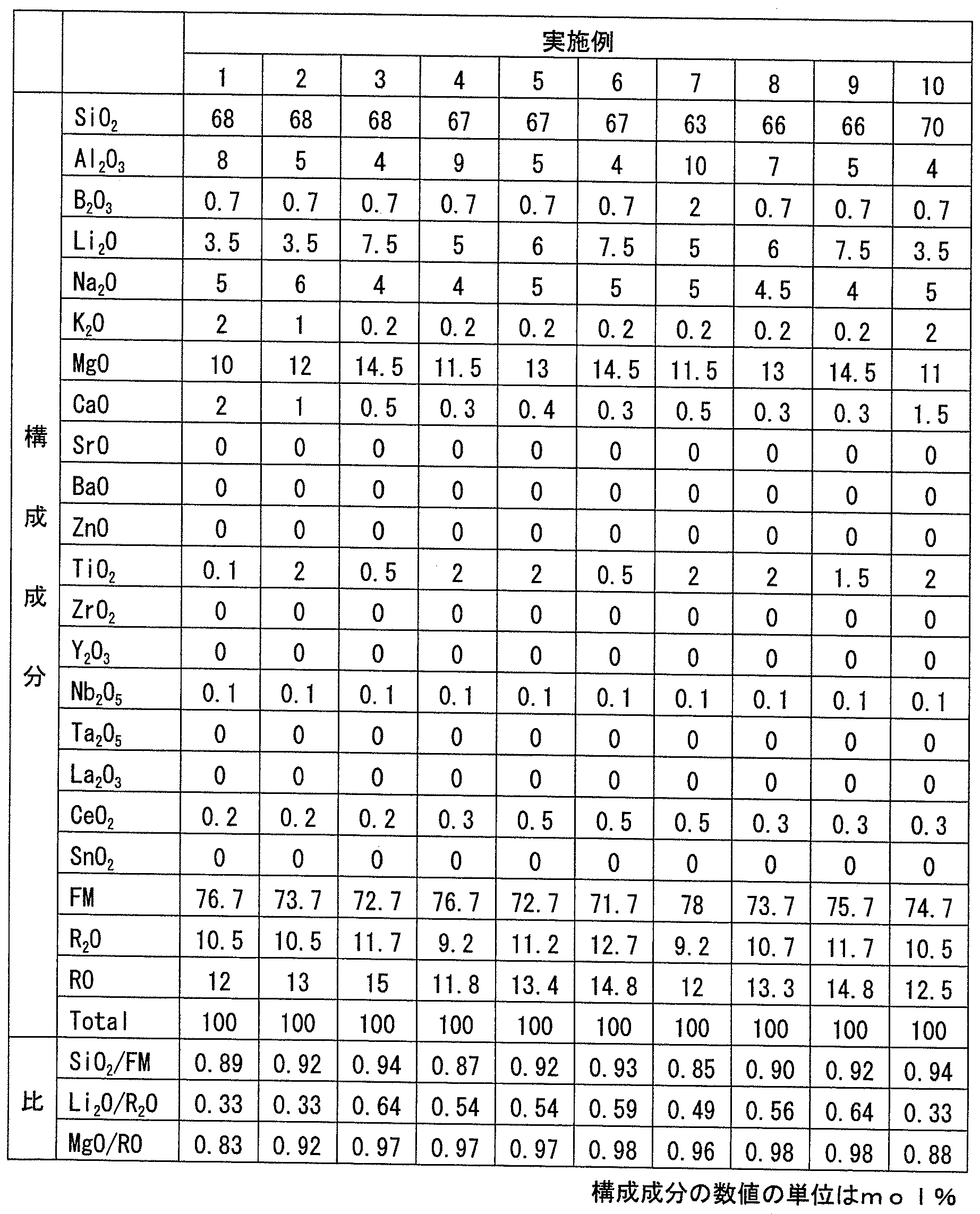
- Examples 1 to 10 and Comparative Examples 1 to 5 A predetermined amount of raw material powder was weighed into a platinum crucible so as to have the glass composition (components and ratios) shown in Tables 1 and 2, mixed, and then melted at 1550 ° C. in an electric furnace. After the raw materials were sufficiently dissolved, a platinum stirring blade was inserted into the glass melt and stirred for 1 hour. Thereafter, the stirring blade was taken out and allowed to stand for 30 minutes, and then the melt was poured into a jig to obtain a glass block. Thereafter, the glass block was held in the vicinity of the glass transition point of each glass for 2 hours, and then slowly cooled to remove strain.
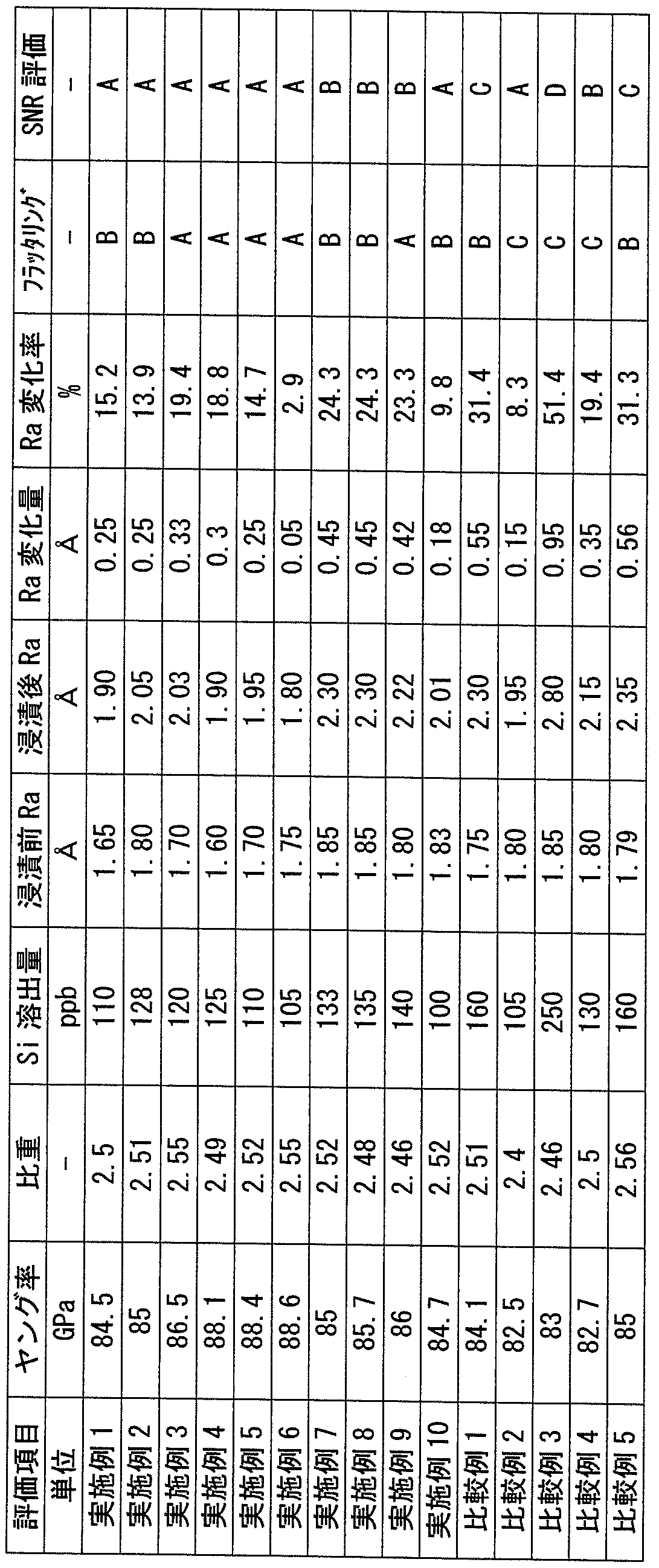
- the obtained glass block was sliced into a 2.5-inch disk shape having a thickness of 0.635 mm, and the inner and outer circumferences were concentrically cut out using a cutter. Then, both surfaces were subjected to rough polishing and precision polishing, followed by cleaning, thereby producing glass substrates for information recording media of Examples and Comparative Examples having the glass compositions shown in Tables 1 and 2. The following physical property evaluation was performed on the glass substrate for information recording medium thus produced. The results are shown in Table 3.
- the Young's modulus of the glass substrate for information recording media of each Example and each Comparative Example was measured according to the dynamic elastic modulus test method of the elastic test method of JIS R 1602 fine ceramics.
- the fluttering characteristics were correlated with the Young's modulus, and the fluttering characteristics improved when the Young's modulus was improved.
- Si elution amount The glass substrates for information recording media of each Example and each Comparative Example were immersed for 30 minutes in 50 ml of a pH 11 NaOH aqueous solution at 40 ° C., and then an inductively coupled plasma emission spectrometer (ICP-AES) (trade name: “ The amount of Si elution in the eluate was measured using “SPS3520UV” manufactured by SII Nano Technology Co., Ltd. The smaller the Si elution amount, the better the alkali durability.
- ICP-AES inductively coupled plasma emission spectrometer
- ⁇ Amount of change and rate of change of arithmetic average roughness Ra> For the glass substrates for information recording media of each Example and each Comparative Example, the arithmetic average roughness Ra before and after being immersed in an aqueous NaOH solution at pH 11 of 40 ° C. for 30 minutes was measured, and the amount of change and the rate of change of Ra were measured.
- the arithmetic average roughness Ra was measured with an atomic force microscope (AFM) (trade name: “Dimension 3100”, manufactured by Veeco) based on JIS B0601: 2001.
- AFM atomic force microscope
- Ra before immersion indicates the arithmetic average roughness Ra before immersion
- Ra after immersion indicates the arithmetic average roughness Ra after immersion
- Ra variation The amount of change in arithmetic average roughness Ra before and after immersion is shown
- Ra change rate indicates the change rate of arithmetic average roughness Ra at that time. It shows that it is excellent in alkali durability, so that the rate of change is small.
- the case where the amplitude at 5400 rpm is 12 nm or less is “A”
- the case where the amplitude exceeds 12 nm and less than 16 nm is “B”
- the case where the amplitude is 16 nm or more is “C”.
- each information recording medium glass substrate was washed with a three-tank continuous washing machine containing one tank containing pH 11 NaOH, and then 0.05 ⁇ m thick Ni and Cr were added by a sputtering method.
- An information recording medium was obtained by forming a magnetic layer made of a Co-based alloy.
- SNR signal noise ratio
- the signal-to-noise ratio was measured by evaluating the ground level strength of the signal of each information recording medium using a magnetic head having a thermal flying height variable element formed on the slider of the head. Specifically, the following conditions are adopted, and the signal ground level from the magnetic head is lower until just before the magnetic head contacts the surface of the information recording medium, and the higher the SNR (signal-to-noise ratio), the better the electromagnetic conversion characteristics.
- SNR signal-to-noise ratio
- the difference between this reference value and each SNR (signal-to-noise ratio) obtained above is “A” when ⁇ 0.1 db or more (including 0 or more), and less than ⁇ 0.1 db and ⁇ 0.3 db or more. “B”, less than ⁇ 0.3 db, ⁇ 0.5 db or more were evaluated as “C”, and less than ⁇ 0.5 db were evaluated as “D”. The evaluation shows that the variation in SNR (signal-to-noise ratio) is large in the order of “A”, “B”, “C”, “D”.
- the glass substrate for information recording media of the present invention has an excellent effect of having a high Young's modulus, a low specific gravity, and excellent alkali durability. For this reason, since the glass substrate for information recording media of the present invention has good fluttering characteristics, it can be thinned and increased in diameter, and coupled with its low specific gravity, such as a hard disk drive device. It is apparent that the present invention is particularly suitable when a large number of information recording apparatuses are mounted, and that it is possible to achieve a high recording density because of excellent alkali durability.
Landscapes
- Chemical & Material Sciences (AREA)
- Engineering & Computer Science (AREA)
- Life Sciences & Earth Sciences (AREA)
- Chemical Kinetics & Catalysis (AREA)
- General Chemical & Material Sciences (AREA)
- Geochemistry & Mineralogy (AREA)
- Materials Engineering (AREA)
- Organic Chemistry (AREA)
- Ceramic Engineering (AREA)
- Inorganic Chemistry (AREA)
- Glass Compositions (AREA)
- Magnetic Record Carriers (AREA)
Abstract
Description

mol%表示で、
SiO2:63~70%
Al2O3:4~10%
B2O3:0~2%
Li2O:3.5~10%
Na2O:3~8%
K2O:0~2%
MgO:10~20%
CaO:0~2%
SrO:0~2%
BaO:0~2%
ZnO:0~2%
TiO2:0.1~3%
となる含有範囲を満たし、かつ
mol%表示で、
SiO2+Al2O3+B2O3:67~82%
Li2O+Na2O+K2O:8~20%
MgO+CaO+SrO+BaO+ZnO:10~28%
となる条件を満たし、かつ
0.85≦SiO2/(SiO2+Al2O3+B2O3)≦0.95、
0.3≦Li2O/(Li2O+Na2O+K2O)≦0.7、および
0.8≦MgO/(MgO+CaO+SrO+BaO+ZnO)≦0.99
という比(「モル比率」を示す)を満たす、ガラス組成からなることを特徴とする。
0.87≦SiO2/(SiO2+Al2O3+B2O3)≦0.95、
0.35≦Li2O/(Li2O+Na2O+K2O)≦0.65、および
0.85≦MgO/(MgO+CaO+SrO+BaO+ZnO)≦0.99
であることが好ましい。
<情報記録媒体用ガラス基板>
本実施の形態の情報記録媒体用ガラス基板は、ハードディスクドライブ装置等の情報記録装置における情報記録媒体用の基板として用いられるものであり、mol%表示で、
SiO2:63~70%
Al2O3:4~10%
B2O3:0~2%
Li2O:3.5~10%
Na2O:3~8%
K2O:0~2%
MgO:10~20%
CaO:0~2%
SrO:0~2%
BaO:0~2%
ZnO:0~2%
TiO2:0.1~3%
となる含有範囲を満たし、かつ
mol%表示で、
SiO2+Al2O3+B2O3:67~82%
Li2O+Na2O+K2O:8~20%
MgO+CaO+SrO+BaO+ZnO:10~28%
となる条件を満たし、かつ
0.85≦SiO2/(SiO2+Al2O3+B2O3)≦0.95、
0.3≦Li2O/(Li2O+Na2O+K2O)≦0.7、および
0.8≦MgO/(MgO+CaO+SrO+BaO+ZnO)≦0.99
という比を満たす、ガラス組成からなることを特徴とする。
本実施の形態のガラス組成を構成する各構成成分について以下説明する。
本実施の形態のガラス組成は、骨格成分としてSiO2を63~70%、Al2O3を4~10%、B2O3を0~2%有し、かつSiO2とAl2O3とB2O3との合計量が67~82%であることを要する。なお、前述の通り、「SiO2+Al2O3+B2O3:67~82%」との表記は、SiO2とAl2O3とB2O3との合計量が67~82%であることを示す(以下、同様の表記において同意とする)。また、mol%表示を、たとえば「63~70%」というように範囲で示す場合、この範囲は上限および下限の数値を含むものとし、上記の場合「63%以上70%以下」であることを示すものとする。
本実施の形態のガラス組成は、アルカリ成分としてLi2Oを3.5~10%、Na2Oを3~8%、K2Oを0~2%有し、かつLi2OとNa2OとK2Oとの合計量が8~20%であることを要する。
本実施の形態のガラス組成は、2価金属成分として、MgOを10~20%、CaOを0~2%、SrOを0~2%、BaOを0~2%、ZnOを0~2%有し、かつMgOとCaOとSrOとBaOとZnOとの合計量が10~28%であることを要する。
本実施の形態のガラス組成は、チタン成分としてTiO2を0.1~3%含有する。TiO2は、ガラスの構造を強固にし剛性を向上させるとともに化学的耐久性を向上させる効果を奏する。その含有量が0.1%未満では剛性の向上および化学的耐久性の向上に対し十分な効果が奏されない。他方、含有量が3%を超えると溶融性が低下し生産性を向上させることができない。より好ましい範囲は0.5~2.5%であり、さらに好ましくは1~2%である。
本実施の形態のガラス組成は、mol%表示で、
Y2O3:0~1%
ZrO2:0~2%
La2O3:0~1%
Nb2O5:0~1%
Ta2O5:0~1%
CeO2:0~1%
SnO2:0~1%
となる任意成分を含むことができる。これらの任意成分は、主としてガラスの構造を堅固にし剛性を向上させる効果を奏する。これらの任意成分は、各単独であるいは2種以上のものを使用できるが、2種以上のものを使用する場合は、特に限定はされないがその合計量を5.4%以下とすることが好ましい。5.4%を超えると、表面硬度が上昇し、表面粗さRaを小さくすることが困難になり、また、ガラス溶融時における液相温度の上昇を招くという不都合を生じる場合があるからである。
本実施の形態の情報記録媒体用ガラス基板は、以下のような諸特性を有していることが好ましい。
本実施の形態の情報記録媒体用ガラス基板は、記録密度が600Gbit/inch2以上であることが好ましい。高い記録密度が要請されることに応えたものであるが、このように高い記録密度が可能となったのは、上述のように本実施の形態の情報記録媒体用ガラス基板のアルカリ耐久性が向上したことによるものである。
<Si溶出量>
本実施の形態の情報記録媒体用ガラス基板は、40℃のpH11のNaOH水溶液50ml中に30分間浸漬させた場合、Si溶出量が150ppb以下であることが好ましい。Siの溶出量をこのように規定することにより、その表面に磁性層が形成される前にアルカリ溶液を用いてガラス基板の表面がエッチングされる場合においても、表面粗さが悪化することがなく、極めて優れたアルカリ耐久性を示したものとなる。したがって、Si溶出量をこのように規定することにより、シグナルノイズ比の低下を防止することができ、高い記録密度を達成することが可能となる。
本実施の形態の情報記録媒体用ガラス基板は、40℃のpH11のNaOH水溶液に30分間浸漬させた場合、その浸漬の前後における算術平均粗さRaの変化量が0.5Å以下であり、かつ算術平均粗さRaの変化率が30%以下であることが好ましい。情報記録媒体用ガラス基板の表面の算術平均粗さRaの変化量および変化率をこのように規定することにより、その表面に磁性層が形成される前にアルカリ溶液を用いてガラス基板の表面がエッチングされる場合においても、表面粗さが悪化することがなく、極めて優れたアルカリ耐久性を示したものとなる。したがって、算術平均粗さRaの変化量および変化率をこのように規定することにより、シグナルノイズ比の低下を防止することができ、高い記録密度を達成することが可能となる。
本実施の形態の情報記録媒体用ガラス基板は、ヤング率が86GPa以上であり、かつ比重が2.55以下であることが好ましい。ヤング率をこのように規定することにより、フラッタリング特性を良好なものとすることができ、また比重をこのように規定したことにより、情報記録装置においてガラス基板を回転させるモーター(スピンドルモーター)の負荷を低減させることができる。
本実施の形態の情報記録媒体用ガラス基板の製造方法は、特に限定はなく従来公知の製造方法を用いることができる。たとえば、情報記録媒体用ガラス基板を構成するガラス組成の各成分の原料として各々相当する酸化物、炭酸塩、硝酸塩、水酸化物等が使用され、所望の割合に秤量され、粉末で充分に混合して調合原料とされる。
表1~表2に示したガラス組成(構成成分および比)となるように、所定量の原料粉末を白金るつぼに秤量して入れ、混合した後、電気炉中で1550℃で溶解した。原料が充分に溶解した後、白金製の撹拌羽をガラス融液に挿入し、1時間撹拌した。その後、撹拌羽を取り出し、30分間静置した後、治具に融液を流しこむことによってガラスブロックを得た。その後、各ガラスのガラス転移点付近でガラスブロックを2時間保持した後、徐冷して歪取りを行なった。
各実施例および各比較例の情報記録媒体用ガラス基板のヤング率は、JIS R 1602ファインセラミックスの弾性試験方法の動的弾性率試験方法に準じて測定した。フラッタリング特性はヤング率と相関がみられ、ヤング率を向上させるとフラッタリング特性は向上した。
各実施例および各比較例の情報記録媒体用ガラス基板の比重は、アルキメデス法により測定した。
各実施例および各比較例の情報記録媒体用ガラス基板を、40℃のpH11のNaOH水溶液50ml中に30分間浸漬させた後、誘導結合プラズマ発光分光分析装置(ICP-AES)(商品名:「SPS3520UV」、エスアイアイ・ナノテクノロジー株式会社製)を用いて、溶出液中のSi溶出量を測定した。Si溶出量が少ないものほど、アルカリ耐久性に優れていることを示す。
各実施例および各比較例の情報記録媒体用ガラス基板について、40℃のpH11のNaOH水溶液に30分間浸漬させる前後の算術平均粗さRaを測定し、Raの変化量および変化率を測定した。なお、算術平均粗さRaは、JIS B0601:2001に基づき、原子間力顕微鏡(AFM)(商品名:「Dimension 3100」、Veeco社製)により測定した。
各実施例および各比較例の情報記録媒体用ガラス基板を用いて、レーザードップラー振動計(商品名:「OFV552」、Polytec社製)により回転数を4200rpm~15000rpmに変えながら面振れの振幅を測定した。測定位置は、各ガラス基板の最外周から内側に1.5mm離れた地点とした。振幅が小さいものほど、フラッタリング特性が良好であることを示す。表3中の「フラッタリング」は、このフラッタリング評価を示している。理論式通り、ヤング率の高いものは、フラッタリング特性も良好であった。
上記で得た各実施例の情報記録媒体用ガラス基板および各比較例の情報記録媒体用ガラス基板に対して、同じ磁性層を以下のようにして形成した。
基板回転数:7200回転/分
測定位置:半径22.4mm
評価ヘッド:熱式浮上量可変素子内蔵型MRヘッド
ヘッド浮上高さの可変量:1nm/10mW
そして該評価は、SNR(シグナルノイズ比)の基準値に対する相対比較量の多寡で評価を行なった。ここで、基準値は以下のものとした。
基準値:以下の組成で実施例および比較例と同様の方法でガラス基板を作製し、かつ磁性層を形成することにより情報記録媒体を得た。
SiO2:67%
Al2O3:9%
MgO:4%
K2O:0.7%
Na2O:11.3%
Li2O:8%
(モル%表示)
そして、このようして作製された情報記録媒体100枚のSNR(シグナルノイズ比)を上記の条件で測定し、その平均値を基準値とした。

Claims (7)
- mol%表示で、
SiO2:63~70%
Al2O3:4~10%
B2O3:0~2%
Li2O:3.5~10%
Na2O:3~8%
K2O:0~2%
MgO:10~20%
CaO:0~2%
SrO:0~2%
BaO:0~2%
ZnO:0~2%
TiO2:0.1~3%
となる含有範囲を満たし、かつ
mol%表示で、
SiO2+Al2O3+B2O3:67~82%
Li2O+Na2O+K2O:8~20%
MgO+CaO+SrO+BaO+ZnO:10~28%
となる条件を満たし、かつ
0.85≦SiO2/(SiO2+Al2O3+B2O3)≦0.95、
0.3≦Li2O/(Li2O+Na2O+K2O)≦0.7、および
0.8≦MgO/(MgO+CaO+SrO+BaO+ZnO)≦0.99
という比を満たす、ガラス組成からなる情報記録媒体用ガラス基板。 - 前記比は、
0.87≦SiO2/(SiO2+Al2O3+B2O3)≦0.95、
0.35≦Li2O/(Li2O+Na2O+K2O)≦0.65、および
0.85≦MgO/(MgO+CaO+SrO+BaO+ZnO)≦0.99
である、請求項1に記載の情報記録媒体用ガラス基板。 - 前記情報記録媒体用ガラス基板は、記録密度が600Gbit/inch2以上である、請求項1または2に記載の情報記録媒体用ガラス基板。
- 前記情報記録媒体用ガラス基板は、その厚みが0.635mm以下である、請求項1~3のいずれかに記載の情報記録媒体用ガラス基板。
- 前記情報記録媒体用ガラス基板は、40℃のpH11のNaOH水溶液50ml中に30分間浸漬させた場合、Si溶出量が150ppb以下である、請求項1~4のいずれかに記載の情報記録媒体用ガラス基板。
- 前記情報記録媒体用ガラス基板は、40℃のpH11のNaOH水溶液に30分間浸漬させた場合、その浸漬の前後における算術平均粗さRaの変化量が0.5Å以下であり、かつ算術平均粗さRaの変化率が30%以下である、請求項1~5のいずれかに記載の情報記録媒体用ガラス基板。
- 前記情報記録媒体用ガラス基板は、ヤング率が86GPa以上であり、かつ比重が2.55以下である、請求項1~6のいずれかに記載の情報記録媒体用ガラス基板。
Priority Applications (4)
| Application Number | Priority Date | Filing Date | Title |
|---|---|---|---|
| SG11201601369TA SG11201601369TA (en) | 2013-08-30 | 2014-08-22 | Glass substrate for information recording media |
| CN201480046868.3A CN105473520B (zh) | 2013-08-30 | 2014-08-22 | 信息记录介质用玻璃基板 |
| JP2015534178A JP6052936B2 (ja) | 2013-08-30 | 2014-08-22 | 情報記録媒体用ガラス基板、情報記録媒体および情報記録装置 |
| MYPI2016700695A MY188043A (en) | 2013-08-30 | 2014-08-22 | Glass substrate for information recording medium |
Applications Claiming Priority (2)
| Application Number | Priority Date | Filing Date | Title |
|---|---|---|---|
| JP2013179975 | 2013-08-30 | ||
| JP2013-179975 | 2013-08-30 |
Publications (1)
| Publication Number | Publication Date |
|---|---|
| WO2015029902A1 true WO2015029902A1 (ja) | 2015-03-05 |
Family
ID=52586461
Family Applications (1)
| Application Number | Title | Priority Date | Filing Date |
|---|---|---|---|
| PCT/JP2014/072008 Ceased WO2015029902A1 (ja) | 2013-08-30 | 2014-08-22 | 情報記録媒体用ガラス基板 |
Country Status (5)
| Country | Link |
|---|---|
| JP (1) | JP6052936B2 (ja) |
| CN (1) | CN105473520B (ja) |
| MY (1) | MY188043A (ja) |
| SG (1) | SG11201601369TA (ja) |
| WO (1) | WO2015029902A1 (ja) |
Cited By (5)
| Publication number | Priority date | Publication date | Assignee | Title |
|---|---|---|---|---|
| WO2018225725A1 (ja) * | 2017-06-09 | 2018-12-13 | Hoya株式会社 | 情報記録媒体基板用ガラス、情報記録媒体基板、情報記録媒体および記録再生装置用ガラススペーサ |
| WO2021137950A3 (en) * | 2019-11-26 | 2021-09-02 | Corning Incorporated | Magnesium aluminosilicate glasses with high fracture toughness |
| US11951713B2 (en) | 2020-12-10 | 2024-04-09 | Corning Incorporated | Glass with unique fracture behavior for vehicle windshield |
| US12122714B2 (en) | 2020-12-10 | 2024-10-22 | Corning Incorporated | Glass with unique fracture behavior for vehicle windshield |
| EP4303197A4 (en) * | 2021-03-05 | 2025-04-09 | Hoya Corporation | GLASS FOR MAGNETIC RECORDING MEDIUM CARRIER OR FOR GLASS SPACERS, MAGNETIC RECORDING MEDIUM CARRIER, GLASS SPACERS |
Citations (5)
| Publication number | Priority date | Publication date | Assignee | Title |
|---|---|---|---|---|
| JP2002358626A (ja) * | 2001-05-31 | 2002-12-13 | Hoya Corp | 情報記録媒体用ガラス基板及びそれを用いた磁気情報記録媒体 |
| JP2004161597A (ja) * | 2002-09-27 | 2004-06-10 | Minolta Co Ltd | ガラス組成物及びガラス基板 |
| JP2007126299A (ja) * | 2005-11-01 | 2007-05-24 | Huzhou Daikyo Hari Seihin Yugenkoshi | Li2O−Al2O3−SiO2−MgO−K2O−F系結晶性ガラス及び結晶化ガラス、ならびに該結晶性ガラス及び結晶化ガラスの製造方法 |
| JP2010254549A (ja) * | 2009-04-02 | 2010-11-11 | Asahi Glass Co Ltd | 情報記録媒体基板用ガラス、情報記録媒体用ガラス基板および磁気ディスク |
| WO2012057338A1 (ja) * | 2010-10-29 | 2012-05-03 | Hoya株式会社 | 磁気記録媒体用ガラス基板、磁気記録媒体、および磁気記録媒体用ガラス基板ブランク |
Family Cites Families (3)
| Publication number | Priority date | Publication date | Assignee | Title |
|---|---|---|---|---|
| DE69902839T2 (de) * | 1998-04-28 | 2003-05-28 | Asahi Glass Co., Ltd. | Flachglas und Substratglas für die Elektronik |
| JP5613164B2 (ja) * | 2009-09-28 | 2014-10-22 | Hoya株式会社 | 情報記録媒体用ガラス基板及び情報記録媒体 |
| JP5737043B2 (ja) * | 2011-07-29 | 2015-06-17 | 旭硝子株式会社 | 基板用ガラスおよびガラス基板 |
-
2014
- 2014-08-22 MY MYPI2016700695A patent/MY188043A/en unknown
- 2014-08-22 SG SG11201601369TA patent/SG11201601369TA/en unknown
- 2014-08-22 JP JP2015534178A patent/JP6052936B2/ja active Active
- 2014-08-22 CN CN201480046868.3A patent/CN105473520B/zh active Active
- 2014-08-22 WO PCT/JP2014/072008 patent/WO2015029902A1/ja not_active Ceased
Patent Citations (5)
| Publication number | Priority date | Publication date | Assignee | Title |
|---|---|---|---|---|
| JP2002358626A (ja) * | 2001-05-31 | 2002-12-13 | Hoya Corp | 情報記録媒体用ガラス基板及びそれを用いた磁気情報記録媒体 |
| JP2004161597A (ja) * | 2002-09-27 | 2004-06-10 | Minolta Co Ltd | ガラス組成物及びガラス基板 |
| JP2007126299A (ja) * | 2005-11-01 | 2007-05-24 | Huzhou Daikyo Hari Seihin Yugenkoshi | Li2O−Al2O3−SiO2−MgO−K2O−F系結晶性ガラス及び結晶化ガラス、ならびに該結晶性ガラス及び結晶化ガラスの製造方法 |
| JP2010254549A (ja) * | 2009-04-02 | 2010-11-11 | Asahi Glass Co Ltd | 情報記録媒体基板用ガラス、情報記録媒体用ガラス基板および磁気ディスク |
| WO2012057338A1 (ja) * | 2010-10-29 | 2012-05-03 | Hoya株式会社 | 磁気記録媒体用ガラス基板、磁気記録媒体、および磁気記録媒体用ガラス基板ブランク |
Cited By (8)
| Publication number | Priority date | Publication date | Assignee | Title |
|---|---|---|---|---|
| WO2018225725A1 (ja) * | 2017-06-09 | 2018-12-13 | Hoya株式会社 | 情報記録媒体基板用ガラス、情報記録媒体基板、情報記録媒体および記録再生装置用ガラススペーサ |
| JPWO2018225725A1 (ja) * | 2017-06-09 | 2020-04-09 | Hoya株式会社 | 情報記録媒体基板用ガラス、情報記録媒体基板、情報記録媒体および記録再生装置用ガラススペーサ |
| JP7165655B2 (ja) | 2017-06-09 | 2022-11-04 | Hoya株式会社 | 情報記録媒体基板用ガラス、情報記録媒体基板、情報記録媒体および記録再生装置用ガラススペーサ |
| WO2021137950A3 (en) * | 2019-11-26 | 2021-09-02 | Corning Incorporated | Magnesium aluminosilicate glasses with high fracture toughness |
| US11827556B2 (en) | 2019-11-26 | 2023-11-28 | Corning Incorporated | Magnesium aluminosilicate glasses with high fracture toughness |
| US11951713B2 (en) | 2020-12-10 | 2024-04-09 | Corning Incorporated | Glass with unique fracture behavior for vehicle windshield |
| US12122714B2 (en) | 2020-12-10 | 2024-10-22 | Corning Incorporated | Glass with unique fracture behavior for vehicle windshield |
| EP4303197A4 (en) * | 2021-03-05 | 2025-04-09 | Hoya Corporation | GLASS FOR MAGNETIC RECORDING MEDIUM CARRIER OR FOR GLASS SPACERS, MAGNETIC RECORDING MEDIUM CARRIER, GLASS SPACERS |
Also Published As
| Publication number | Publication date |
|---|---|
| JPWO2015029902A1 (ja) | 2017-03-02 |
| MY188043A (en) | 2021-11-11 |
| JP6052936B2 (ja) | 2016-12-27 |
| SG11201601369TA (en) | 2016-03-30 |
| CN105473520B (zh) | 2018-11-06 |
| CN105473520A (zh) | 2016-04-06 |
Similar Documents
| Publication | Publication Date | Title |
|---|---|---|
| JP5982500B2 (ja) | Hdd用ガラス基板および情報記録媒体 | |
| JP5952500B2 (ja) | ガラス基板 | |
| JP5613164B2 (ja) | 情報記録媒体用ガラス基板及び情報記録媒体 | |
| JP5964921B2 (ja) | 磁気記録媒体基板用ガラス、磁気記録媒体基板およびその製造方法、ならびに磁気記録媒体 | |
| JP4815002B2 (ja) | 情報記録媒体用結晶化ガラス基板およびその製造方法 | |
| JP5542953B2 (ja) | 磁気記録媒体用ガラス基板、磁気記録媒体、および磁気記録媒体用ガラス基板ブランク | |
| CN103493133B (zh) | 磁记录介质用玻璃基板及其利用 | |
| KR100446053B1 (ko) | 정보 기억 매체용 기판 | |
| JP6052936B2 (ja) | 情報記録媒体用ガラス基板、情報記録媒体および情報記録装置 | |
| JP2010198679A (ja) | 情報記録媒体用ガラス基板およびその製造方法 | |
| JP2024170658A (ja) | 磁気記録媒体基板用ガラス、磁気記録媒体基板、磁気記録媒体、磁気記録再生装置用ガラススペーサおよび磁気記録再生装置 | |
| JP2004010430A (ja) | ガラス基板 | |
| JP4774466B1 (ja) | 情報記録媒体用結晶化ガラス基板およびその製造方法 | |
| CN107032603B (zh) | 磁盘的制造方法及信息记录介质用玻璃基板 | |
| JP7165655B2 (ja) | 情報記録媒体基板用ガラス、情報記録媒体基板、情報記録媒体および記録再生装置用ガラススペーサ | |
| JP4923556B2 (ja) | 情報記録媒体用ガラス基板 | |
| JP7488416B2 (ja) | 磁気記録媒体基板用または磁気記録再生装置用ガラススペーサ用のガラス、磁気記録媒体基板、磁気記録媒体、磁気記録再生装置用ガラススペーサおよび磁気記録再生装置 | |
| JP4619115B2 (ja) | 情報記録媒体用ガラス基板および情報記録媒体 | |
| JP5375698B2 (ja) | ガラス基板の製造方法 | |
| JP6084577B2 (ja) | Hdd用ガラス基板 | |
| JP4151440B2 (ja) | ガラス基板 | |
| JP7766206B2 (ja) | 磁気記録媒体基板用ガラス、磁気記録媒体基板および磁気記録再生装置 | |
| JP7709621B2 (ja) | 磁気記録媒体基板用または磁気記録再生装置用ガラススペーサ用のガラス、磁気記録媒体基板、磁気記録媒体、磁気記録再生装置用ガラススペーサおよび磁気記録再生装置 | |
| JPWO2013094451A1 (ja) | ガラス基板 | |
| JP2004277233A (ja) | ガラス組成物及びガラス基板 |
Legal Events
| Date | Code | Title | Description |
|---|---|---|---|
| WWE | Wipo information: entry into national phase |
Ref document number: 201480046868.3 Country of ref document: CN |
|
| 121 | Ep: the epo has been informed by wipo that ep was designated in this application |
Ref document number: 14839507 Country of ref document: EP Kind code of ref document: A1 |
|
| ENP | Entry into the national phase |
Ref document number: 2015534178 Country of ref document: JP Kind code of ref document: A |
|
| NENP | Non-entry into the national phase |
Ref country code: DE |
|
| 122 | Ep: pct application non-entry in european phase |
Ref document number: 14839507 Country of ref document: EP Kind code of ref document: A1 |