WO2015025799A1 - ペースト組成物と太陽電池素子 - Google Patents
ペースト組成物と太陽電池素子 Download PDFInfo
- Publication number
- WO2015025799A1 WO2015025799A1 PCT/JP2014/071462 JP2014071462W WO2015025799A1 WO 2015025799 A1 WO2015025799 A1 WO 2015025799A1 JP 2014071462 W JP2014071462 W JP 2014071462W WO 2015025799 A1 WO2015025799 A1 WO 2015025799A1
- Authority
- WO
- WIPO (PCT)
- Prior art keywords
- paste composition
- powder
- aluminum
- mass
- semiconductor substrate
- Prior art date
- Legal status (The legal status is an assumption and is not a legal conclusion. Google has not performed a legal analysis and makes no representation as to the accuracy of the status listed.)
- Ceased
Links
Images
Classifications
-
- H—ELECTRICITY
- H01—ELECTRIC ELEMENTS
- H01B—CABLES; CONDUCTORS; INSULATORS; SELECTION OF MATERIALS FOR THEIR CONDUCTIVE, INSULATING OR DIELECTRIC PROPERTIES
- H01B1/00—Conductors or conductive bodies characterised by the conductive materials; Selection of materials as conductors
- H01B1/20—Conductive material dispersed in non-conductive organic material
- H01B1/22—Conductive material dispersed in non-conductive organic material the conductive material comprising metals or alloys
-
- H—ELECTRICITY
- H10—SEMICONDUCTOR DEVICES; ELECTRIC SOLID-STATE DEVICES NOT OTHERWISE PROVIDED FOR
- H10F—INORGANIC SEMICONDUCTOR DEVICES SENSITIVE TO INFRARED RADIATION, LIGHT, ELECTROMAGNETIC RADIATION OF SHORTER WAVELENGTH OR CORPUSCULAR RADIATION
- H10F77/00—Constructional details of devices covered by this subclass
- H10F77/20—Electrodes
- H10F77/206—Electrodes for devices having potential barriers
- H10F77/211—Electrodes for devices having potential barriers for photovoltaic cells
-
- H—ELECTRICITY
- H10—SEMICONDUCTOR DEVICES; ELECTRIC SOLID-STATE DEVICES NOT OTHERWISE PROVIDED FOR
- H10F—INORGANIC SEMICONDUCTOR DEVICES SENSITIVE TO INFRARED RADIATION, LIGHT, ELECTROMAGNETIC RADIATION OF SHORTER WAVELENGTH OR CORPUSCULAR RADIATION
- H10F71/00—Manufacture or treatment of devices covered by this subclass
-
- H—ELECTRICITY
- H10—SEMICONDUCTOR DEVICES; ELECTRIC SOLID-STATE DEVICES NOT OTHERWISE PROVIDED FOR
- H10F—INORGANIC SEMICONDUCTOR DEVICES SENSITIVE TO INFRARED RADIATION, LIGHT, ELECTROMAGNETIC RADIATION OF SHORTER WAVELENGTH OR CORPUSCULAR RADIATION
- H10F77/00—Constructional details of devices covered by this subclass
- H10F77/10—Semiconductor bodies
- H10F77/12—Active materials
- H10F77/122—Active materials comprising only Group IV materials
-
- H—ELECTRICITY
- H10—SEMICONDUCTOR DEVICES; ELECTRIC SOLID-STATE DEVICES NOT OTHERWISE PROVIDED FOR
- H10F—INORGANIC SEMICONDUCTOR DEVICES SENSITIVE TO INFRARED RADIATION, LIGHT, ELECTROMAGNETIC RADIATION OF SHORTER WAVELENGTH OR CORPUSCULAR RADIATION
- H10F77/00—Constructional details of devices covered by this subclass
- H10F77/10—Semiconductor bodies
- H10F77/12—Active materials
- H10F77/122—Active materials comprising only Group IV materials
- H10F77/1223—Active materials comprising only Group IV materials characterised by the dopants
-
- H—ELECTRICITY
- H10—SEMICONDUCTOR DEVICES; ELECTRIC SOLID-STATE DEVICES NOT OTHERWISE PROVIDED FOR
- H10F—INORGANIC SEMICONDUCTOR DEVICES SENSITIVE TO INFRARED RADIATION, LIGHT, ELECTROMAGNETIC RADIATION OF SHORTER WAVELENGTH OR CORPUSCULAR RADIATION
- H10F77/00—Constructional details of devices covered by this subclass
- H10F77/30—Coatings
- H10F77/306—Coatings for devices having potential barriers
- H10F77/311—Coatings for devices having potential barriers for photovoltaic cells
-
- Y—GENERAL TAGGING OF NEW TECHNOLOGICAL DEVELOPMENTS; GENERAL TAGGING OF CROSS-SECTIONAL TECHNOLOGIES SPANNING OVER SEVERAL SECTIONS OF THE IPC; TECHNICAL SUBJECTS COVERED BY FORMER USPC CROSS-REFERENCE ART COLLECTIONS [XRACs] AND DIGESTS
- Y02—TECHNOLOGIES OR APPLICATIONS FOR MITIGATION OR ADAPTATION AGAINST CLIMATE CHANGE
- Y02E—REDUCTION OF GREENHOUSE GAS [GHG] EMISSIONS, RELATED TO ENERGY GENERATION, TRANSMISSION OR DISTRIBUTION
- Y02E10/00—Energy generation through renewable energy sources
- Y02E10/50—Photovoltaic [PV] energy
-
- Y—GENERAL TAGGING OF NEW TECHNOLOGICAL DEVELOPMENTS; GENERAL TAGGING OF CROSS-SECTIONAL TECHNOLOGIES SPANNING OVER SEVERAL SECTIONS OF THE IPC; TECHNICAL SUBJECTS COVERED BY FORMER USPC CROSS-REFERENCE ART COLLECTIONS [XRACs] AND DIGESTS
- Y02—TECHNOLOGIES OR APPLICATIONS FOR MITIGATION OR ADAPTATION AGAINST CLIMATE CHANGE
- Y02E—REDUCTION OF GREENHOUSE GAS [GHG] EMISSIONS, RELATED TO ENERGY GENERATION, TRANSMISSION OR DISTRIBUTION
- Y02E10/00—Energy generation through renewable energy sources
- Y02E10/50—Photovoltaic [PV] energy
- Y02E10/547—Monocrystalline silicon PV cells
Definitions
- the present invention generally relates to a paste composition and a solar cell element, and specifically, a paste composition used when forming an electrode on the back surface of a silicon semiconductor substrate constituting a crystalline silicon solar cell, and It is related with the solar cell element in which the back surface electrode was formed using it.
- Patent Document 1 Japanese Patent Application Laid-Open No. 2003-69056
- Patent Document 2 Japanese Translation of PCT International Publication No. 2009-530845
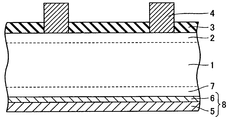
- FIG. 1 is a diagram schematically showing a general cross-sectional structure of a solar cell element.
- the solar cell element is configured using a p-type silicon semiconductor substrate 1 having a thickness of about 200 ⁇ m.
- an n + layer 2 is formed as an n-type impurity layer having a thickness of 0.3 to 0.6 ⁇ m, and an antireflection film 3 and a grid electrode 4 are formed thereon. .
- An aluminum electrode layer 5 is formed on the back side of the p-type silicon semiconductor substrate 1.
- the aluminum electrode layer 5 is formed by applying a paste composition made of aluminum powder, glass frit, and organic vehicle by screen printing or the like, drying, and baking for a short time at a temperature of 660 ° C. (melting point of aluminum) or higher. Has been.
- a paste composition made of aluminum powder, glass frit, and organic vehicle by screen printing or the like, drying, and baking for a short time at a temperature of 660 ° C. (melting point of aluminum) or higher.
- a p + layer 7 is formed as an impurity layer by atomic diffusion. Due to the presence of the p + layer 7, a BSF (Back Surface Field) effect that prevents recombination of electrons and improves the collection efficiency of generated carriers can be obtained.
- BSF Back Surface Field
- the mechanism by which the BSF layer as the p + layer 7 is formed can be roughly described as follows. First, when the p-type silicon semiconductor substrate 1 coated with the paste composition is heat-treated at a high temperature (generally 700 to 900 ° C.) higher than the temperature of the solidus of the Al—Si alloy (577 ° C.) in the phase diagram. In addition, the Al-Si alloy melt is formed by melting Al contained in the paste and cell-derived Si. Thereafter, the Al-Si melt is solidified again by rapidly cooling the p-type silicon semiconductor substrate 1 on which the Al-Si alloy melt is formed to near room temperature.
- a high temperature generally 700 to 900 ° C.
- the Al-Si alloy melt is formed by melting Al contained in the paste and cell-derived Si.
- the Al-Si melt is solidified again by rapidly cooling the p-type silicon semiconductor substrate 1 on which the Al-Si alloy melt is formed to near room temperature.
- the p + layer 7 (that is, the BSF layer) is formed as a silicon layer containing a high concentration of aluminum.
- Patent Document 1 At least one boron-containing material selected from the group consisting of boron powder, inorganic boron compounds and organic boron compounds is used as a paste composition.
- the BSF effect is improved by adding to the above.
- Patent Document 2 a paste composition containing an Al—B alloy is used in order to increase the concentration of impurities in the BSF layer.
- a method for increasing the concentration of impurities in the BSF layer by adding a boron-containing material having the same trivalent valence as aluminum to the paste composition has been conventionally studied.
- Patent Document 1 since the boron-containing material is distributed alone in the paste composition, considering the mechanism by which the BSF layer is formed, It is believed that boron atoms diffuse unevenly into the BSF layer. Then, the non-uniform diffusion of boron in the BSF layer becomes an obstacle to increasing the open circuit voltage.
- Patent Document 2 Regarding an Al-0.2 mass% B alloy containing 0.2 mass% of boron used in an example of a solar cell described in JP-T-2009-530845 (Patent Document 2), The position where the liquidus is shown is around 1000 ° C., and at the temperature at which the solar cell element is actually fired (that is, generally 700 to 900 ° C.), the intermetallic compound AlB 2 remains as boron. Since an aluminum liquid phase coexists, boron atoms cannot be diffused into the BSF layer.
- the paste composition when the paste composition is applied to the back surface of the solar cell element, if the amount of boron in the paste composition is large, an excessive concentration of impurities contained in the BSF layer may cause a decrease in light reflectance on the back surface. There is. The decrease in the light reflectance on the back surface causes a decrease in current density.
- an object of the present invention is to solve the above-described problem, and is a paste composition used for forming an electrode on the back surface of a silicon semiconductor substrate, which increases an open-circuit voltage and has a current density. It is providing the solar cell element provided with the paste composition which can suppress a reduction
- the inventors of the present invention have conducted extensive research to solve the problems of the prior art, and as a result, in order to form an electrode on the back surface of the silicon semiconductor substrate, a mixture of aluminum powder and Al—B alloy powder is used. It has been found that the above object can be achieved by using a paste composition containing a powder and containing a specific amount of boron. Based on this finding, the paste composition according to the present invention has the following characteristics.
- a paste composition according to the present invention is a paste composition used for forming an electrode on the back surface of a silicon semiconductor substrate constituting a crystalline silicon solar cell, and comprises an aluminum powder, an Al—B alloy powder, glass Contains powder and organic vehicle.
- the concentration of boron in the paste composition is 0.005% by mass or more and 0.05% by mass or less.
- the Al-B alloy powder contains 0.01 mass% or more and 0.07 mass% or less of boron.
- the solar cell element according to the present invention includes an electrode formed by applying a paste composition having any one of the above-described characteristics on the back surface of a silicon semiconductor substrate and then baking the paste composition.
- a mixed powder of aluminum powder and Al—B alloy powder is included, and a specific amount of boron is included.
- a paste composition capable of increasing an open-circuit voltage and suppressing a decrease in current density by using a paste composition to be used, and a solar cell element including a back electrode formed using the composition Can be provided.
- the present inventors have developed an aluminum powder and an Al-B alloy into a paste composition used for forming an electrode on the back surface of a silicon semiconductor substrate. It has been found that the above object can be achieved by including a powder mixed with the powder and including a specific amount of boron. Based on this finding, the paste composition according to the present invention has the following characteristics.
- a paste composition according to the present invention is a paste composition used for forming an electrode on the back surface of a silicon semiconductor substrate constituting a crystalline silicon solar cell, and comprises an aluminum powder, an Al—B alloy powder, glass Contains powder and organic vehicle.
- concentration of the boron in the paste composition of this invention is 0.005 mass% or more and 0.05 mass% or less.
- the Al—B alloy powder used in the paste composition of the present invention preferably contains 0.01% by mass or more and 0.07% by mass or less of boron.
- the paste composition according to the present invention containing an aluminum powder and an Al-B alloy powder and containing a specific amount of boron as a paste composition used for forming an electrode on the back surface of a silicon semiconductor substrate
- a p-type solar cell element as an embodiment of a solar cell element according to the present invention is configured using, for example, a p-type silicon semiconductor substrate 1 having a thickness of 180 to 250 ⁇ m. Is done.
- An n + layer 2 as an n-type impurity layer having a thickness of 0.3 to 0.6 ⁇ m is formed on the surface of the silicon semiconductor substrate 1 on the light receiving surface side, and an antireflection film (passivation film) made of, for example, a silicon nitride film is formed thereon.
- Film) 3 and grid electrode 4 are formed.
- the grid electrode 4 as the surface electrode is formed, for example, by screen-printing a silver paste and firing it.
- An aluminum electrode layer 5 is formed on the back surface of the silicon semiconductor substrate 1 opposite to the light receiving surface.
- the aluminum electrode layer 5 is formed by applying the paste composition of the present invention by screen printing or the like, drying it, and baking it at a temperature exceeding 660 ° C. (melting point of aluminum) for a short time (fire-through method). ing.
- the paste composition of the present invention includes aluminum powder, Al—B alloy powder, glass powder, and an organic vehicle. During the firing, aluminum diffuses into the silicon semiconductor substrate 1, whereby an Al—Si alloy layer 6 is formed between the aluminum electrode layer 5 and the silicon semiconductor substrate 1, and at the same time, due to the diffusion of aluminum atoms.
- a p + layer (BSF layer) 7 as an impurity layer is formed.
- the back electrode 8 composed of the aluminum electrode layer 5 and the Al—Si alloy layer 6 is formed on the back surface side of the silicon semiconductor substrate 1, and the silicon semiconductor substrate 1 facing the aluminum electrode layer 5 is further formed.
- a BSF layer 7 is formed in the region.
- the paste composition of the present invention is a paste composition that is applied to the back surface opposite to the light receiving surface of the silicon semiconductor substrate 1 in order to form the aluminum electrode layer 5 described above.
- An alloy powder is contained, and a glass powder and an organic vehicle are contained as a binder.
- the concentration of boron in the paste composition is 0.005 mass% or more and 0.05 mass% or less.
- the Al-B alloy powder used for a paste composition contains 0.01 mass% or more and 0.07 mass% or less of boron.
- the aluminum powder contained in the paste composition exhibits an effect as an electrode due to its conductivity. Also, the aluminum powder forms the Al—Si alloy layer 6 and the p + layer (BSF layer) 7 between the aluminum powder and the silicon semiconductor substrate 1 when the paste composition is baked. A + layer is obtained.
- the shape of the aluminum powder is not particularly limited.
- the shape of the aluminum powder is preferably spherical.
- the ratio of the major axis to the minor axis of the aluminum particles constituting the aluminum powder is preferably 1 or more and 1.5 or less.
- the average particle diameter of the aluminum particles constituting the aluminum powder is preferably 1 ⁇ m or more and 10 ⁇ m or less. If the average particle diameter of the aluminum particles is in the range of 1 ⁇ m or more and 10 ⁇ m or less, good dispersibility can be obtained. There exists a possibility that aluminum particles may aggregate that an average particle diameter is less than 1 micrometer. If the average particle diameter exceeds 10 ⁇ m, the dispersibility of the aluminum particles may be deteriorated.
- the aluminum purity in the aluminum powder is preferably 99.7% or more. Even if impurities are mixed in the aluminum powder, mixing of impurities is allowed if the total amount of Fe and Si in the aluminum powder is less than 0.1%.
- ⁇ Al-B alloy powder> By including the Al—B alloy powder in the paste composition of the present invention, the concentration of impurities in the BSF layer can be increased by boron. Moreover, if the content of boron in the Al—B alloy powder in the paste composition is 0.01% by mass or more and 0.07% by mass or less, a liquid phase is sufficiently formed when the solar cell element is fired. Therefore, a good BSF layer can be formed.
- the shape of the Al—B alloy powder is not particularly limited.
- the shape of the Al—B alloy powder is preferably spherical.
- the sphericity is 0.5 or more as the shape of the Al—B alloy powder, the filling performance in the aluminum electrode layer 5 can be increased, so that a decrease in electrical resistance can be suppressed.
- the sphericity referred to here can be obtained, for example, by observing spherical Al—B alloy powder particles with a scanning electron microscope (Scanning Electron Microscopy: SEM).
- SEM scanning Electron Microscopy: SEM
- the minimum diameter of each particle this diameter is determined based on the observation field in the microscope or the photograph in which the range of the field is photographed
- the shortest distance between the two line segments obtained by sandwiching the two line segments, and the maximum diameter Is the longest distance among the distances between two line segments obtained by sandwiching each particle between two parallel line segments).
- the average of the minimum diameter and the maximum diameter is calculated for each particle.
- the average value of the minimum and maximum diameters of a plurality of arbitrarily selected particles is calculated (that is, the average of the shortest and maximum diameters of a plurality of arbitrarily selected particles is added). Divide the value by the number of particles used).
- the average particle diameter of the Al—B alloy powder in the paste composition of the present invention is preferably greater than 1 ⁇ m and less than 10 ⁇ m. When the average particle size is 1 ⁇ m or less, the dispersibility in the paste is deteriorated, and when it is 10 ⁇ m or more, the reactivity is lowered.
- the glass powder is said to have an effect of assisting the reaction between the aluminum powder and the silicon semiconductor substrate and the sintering of the aluminum powder itself.
- the glass powder is selected from the group consisting of lead (Pb), bismuth (Bi), vanadium (V), boron (B), silicon (Si), tin (Sn), phosphorus (P), and zinc (Zn). You may contain 1 type, or 2 or more types.
- lead-containing glass powder or lead-free glass powder such as bismuth, vanadium, tin-phosphorus, zinc borosilicate, alkali borosilicate, or the like can be used.
- lead-free glass powder in view of the influence on the human body or environmental resistance, it is desirable to use lead-free glass powder.
- the softening point of the glass powder is preferably 750 ° C. or lower. If the glass powder has a softening point exceeding 750 ° C., the performance of the passivation film may be significantly impaired when a specific passivation film is used.
- the average particle size of the glass particles constituting the glass powder is preferably 1 ⁇ m or more and 3 ⁇ m or less.
- the content of the glass powder contained in the paste composition of the present invention is not particularly limited, but it is preferably 0.1 parts by weight or more and 15 parts by weight or less with respect to 100 parts by weight of the aluminum powder. There exists a possibility that adhesiveness with the silicon semiconductor substrate 1 may fall that content of glass powder is less than 0.1 weight part. There exists a possibility that the electrical resistance of the aluminum electrode layer 5 formed as content of glass powder is 15 weight part or more may increase.
- Organic vehicle a solvent in which various additives and a resin are dissolved as necessary is used.
- solvent known solvents can be used, and specific examples include diethylene glycol monobutyl ether, diethylene glycol monobutyl ether acetate, dipropylene glycol monomethyl ether and the like.
- additives for example, an antioxidant, a corrosion inhibitor, an antifoaming agent, a thickener, a coupling agent, an electrostatic imparting agent, a polymerization inhibitor, a thixotropic agent, an anti-settling agent and the like can be used. .
- polyethylene glycol ester compound polyethylene glycol ether compound, polyoxyethylene sorbitan ester compound, sorbitan alkyl ester compound, aliphatic polycarboxylic acid compound, phosphate ester compound, amide amine salt of polyester acid, polyethylene oxide Series compounds, fatty acid amide waxes and the like can be used.
- Known resins can be used, such as ethyl cellulose, nitrocellulose, polyvinyl butyral, phenol resin, melanin resin, urea resin, xylene resin, alkyd resin, unsaturated polyester resin, acrylic resin, polyimide resin, furan resin, Thermosetting resin such as urethane resin, isocyanate compound, cyanate compound, polyethylene, polypropylene, polystyrene, ABS resin, polymethyl methacrylate, polyvinyl chloride, polyvinylidene chloride, polyvinyl acetate, polyvinyl alcohol, polyacetal, polycarbonate, polyethylene terephthalate, Polybutylene terephthalate, polyphenylene oxide, polysulfone, polyimide, polyethersulfone, polyarylate, polyetheretherke Emissions, polytetrafluoroethylene, can be used in combination of two or more kinds of such as silicon resin.
- a resin included in the paste composition of the present invention,
- the content of the organic vehicle contained in the paste composition of the present invention is not particularly limited, but is preferably 30 parts by weight or more and 100 parts by weight or less with respect to 100 parts by weight of the aluminum powder. If the content of the organic vehicle is less than 30 parts by weight or exceeds 100 parts by weight, the printability of the paste composition may be lowered.
- Example 1 A spherical aluminum powder having a particle size of about 3 to 6 ⁇ m and an Al-0.011 mass% B alloy powder are prepared. A total of 100 parts by weight of aluminum powder and Al-0.011 mass% B alloy powder are mixed with 1.5 parts by weight of glass powder and 40 parts by weight of an organic vehicle using a known mixer, and paste An aluminum paste having a boron content of 0.005% by mass in the composition was obtained.
- Example 2 An aluminum powder having a spherical shape with a particle size of about 3 to 6 ⁇ m and an Al-0.032 mass% B alloy powder were prepared, respectively, and a total of 100 parts by weight of the aluminum powder and the Al— An aluminum paste having a boron content of 0.02 mass% in a paste composition, in which 1.5 parts by weight of glass powder and 40 parts by weight of an organic vehicle are mixed with 0.032 mass% B alloy powder.
- Example 3 An aluminum powder having a spherical shape with a particle size of about 3 to 6 ⁇ m and an Al-0.051 mass% B alloy powder were prepared, respectively, and a total of 100 parts by weight of aluminum powder and 1.5 parts by weight of glass powder and 40 parts by weight of organic vehicle are mixed with Al-0.051% by mass B alloy powder, and the boron content in the paste composition is 0.034% by mass. An aluminum paste was obtained.
- Example 4 A spherical aluminum powder having a particle size of about 3 to 6 ⁇ m and an Al-0.070 mass% B alloy powder were prepared, respectively, and a total of 100 parts by weight of aluminum was prepared by the same method as in Examples 1, 2, and 3. 1.5 parts by weight of glass powder and 40 parts by weight of organic vehicle are mixed with the powder and Al-0.070 mass% B alloy powder, and the boron content in the paste composition is 0.05 mass. % Aluminum paste was obtained.
- Example 2 A spherical aluminum powder having a particle size of about 3 to 6 ⁇ m and an Al-0.006 mass% B alloy powder are prepared. For a total of 100 parts by weight of aluminum powder and Al-0.006 mass% B alloy powder, 1.5 parts by weight of glass powder and 40 parts by weight of organic vehicle are mixed in a known mixer, An aluminum paste having a boron content of 0.002% by mass in the paste composition was obtained.
- Comparative Example 3 A spherical aluminum powder having a particle size of about 3 to 6 ⁇ m and an Al-0.083 mass% B alloy powder were prepared, respectively, and in the same manner as in Comparative Example 2, a total of 100 parts by weight of aluminum powder and Al— An aluminum paste having a boron content of 0.06 mass% in a paste composition, in which 1.5 parts by weight of glass powder and 40 parts by weight of an organic vehicle are mixed with 0.083 mass% B alloy powder. Got.
- the conversion efficiency of the solar cell element can be further improved by using the silicon semiconductor substrate 1 coated with the paste composition of the present invention (Examples 1 to 4). Recognize.
- 1 p-type silicon semiconductor substrate, 2: n-type impurity layer, 3: antireflection film, 4: grid electrode, 5: aluminum electrode layer, 6: Al—Si alloy layer, 7: p + layer, 8: back electrode .
Landscapes
- Physics & Mathematics (AREA)
- Chemical & Material Sciences (AREA)
- Dispersion Chemistry (AREA)
- Spectroscopy & Molecular Physics (AREA)
- Photovoltaic Devices (AREA)
- Life Sciences & Earth Sciences (AREA)
- Engineering & Computer Science (AREA)
- Sustainable Development (AREA)
- Sustainable Energy (AREA)
- Conductive Materials (AREA)
Abstract
Description
図1に示すように、本発明に従った太陽電池素子の一つの実施の形態としてのp型の太陽電池素子は、たとえば、厚みが180~250μmのp型のシリコン半導体基板1を用いて構成される。シリコン半導体基板1の受光面側の表面には、厚みが0.3~0.6μmのn型不純物層としてn+層2と、その上に、たとえば、窒化シリコン膜からなる反射防止膜(パッシベーション膜)3と、グリッド電極4とが形成されている。表面電極としてのグリッド電極4は、たとえば、銀ペーストをスクリーン印刷したうえで焼成することによって形成される。
本発明のペースト組成物は、上記のアルミニウム電極層5を形成するためにシリコン半導体基板1の受光面と反対側の裏面に塗工されるペースト組成物であって、アルミニウム粉末と、Al-B合金粉末とを含有し、バインダーとして、ガラス粉末と、有機ビヒクルとを含有する。ペースト組成物におけるホウ素の濃度は、0.005質量%以上0.05質量%以下である。さらに、好ましくは、ペースト組成物に用いられるAl-B合金粉末が0.01質量%以上0.07質量%以下のホウ素を含有する。
ペースト組成物に含まれるアルミニウム粉末は、その導電性から電極としての効果を発揮する。また、アルミニウム粉末は、ペースト組成物を焼成した際にシリコン半導体基板1との間にAl‐Si合金層6とp+層(BSF層)7を形成するので、上述のBSF効果または所望のp+層が得られる。
本発明のペースト組成物がAl-B合金粉末を含むことによって、BSF層における不純物の濃度をホウ素によって増加させることができる。また、ペースト組成物におけるAl-B合金粉末中のホウ素の含有量が0.01質量%以上0.07質量%以下であれば、太陽電池素子を焼成するときに液相を十分に形成することができるので、良好なBSF層を形成することができる。
ガラス粉末は、アルミニウム粉末とシリコン半導体基板との反応と、アルミニウム粉末自身の焼結とを助ける作用があるとされている。ガラス粉末は、鉛(Pb)、ビスマス(Bi)、バナジウム(V)、ホウ素(B)、シリコン(Si)、スズ(Sn)、リン(P)、亜鉛(Zn)からなる群から選択される1種または2種以上を含有していてもよい。
有機ビヒクルとしては、溶剤に、必要に応じて各種添加剤および樹脂を溶解したものが使用される。溶剤としては公知のものが使用可能であり、具体的には、ジエチレングリコールモノブチルエーテル、ジエチレングリコールモノブチルエーテルアセテート、ジプロピレングリコールモノメチルエーテル等が挙げられる。各種添加剤としては、たとえば、酸化防止剤、腐食抑制剤、消泡剤、増粘剤、カップリング剤、静電付与剤、重合禁止剤、チキソトロピー剤、沈降防止剤等を使用することができる。具体的には、たとえば、ポリエチレングリコールエステル化合物、ポリエチレングリコールエーテル化合物、ポリオキシエチレンソルビタンエステル化合物、ソルビタンアルキルエステル化合物、脂肪族多価カルボン酸化合物、燐酸エステル化合物、ポリエステル酸のアマイドアミン塩、酸化ポリエチレン系化合物、脂肪酸アマイドワックス等を使用することができる。樹脂としては公知のものが使用可能であり、エチルセルロース、ニトロセルロース、ポリビニールブチラール、フェノール樹脂、メラニン樹脂、ユリア樹脂、キシレン樹脂、アルキッド樹脂、不飽和ポリエステル樹脂、アクリル樹脂、ポリイミド樹脂、フラン樹脂、ウレタン樹脂、イソシアネート化合物、シアネート化合物等の熱硬化樹脂、ポリエチレン、ポリプロピレン、ポリスチレン、ABS樹脂、ポリメタクリル酸メチル、ポリ塩化ビニル、ポリ塩化ビニリデン、ポリ酢酸ビニル、ポリビニルアルコール、ポリアセタール、ポリカーボネート、ポリエチレンテレフタレート、ポリブチレンテレフタレート、ポリフェニレンオキサイド、ポリスルフォン、ポリイミド、ポリエーテルスルフォン、ポリアリレート、ポリエーテルエーテルケトン、ポリ4フッ化エチレン、シリコン樹脂等の二種以上を組み合わせて用いることができる。本発明のペースト組成物に含められる有機ビヒクルとして、溶剤に溶解させないで樹脂を用いてもよい。
実施例1~4と比較例1~4のペースト組成物を次のようにして準備した。
粒径が約3~6μmの球状を有するアルミニウム粉末とAl-0.011質量%B合金粉末とをそれぞれ用意する。合計で100重量部のアルミニウム粉末およびAl-0.011質量%B合金粉末に対して、1.5重量部のガラス粉末と、40重量部の有機ビヒクルとを周知の混合機で混合し、ペースト組成物におけるホウ素の含有量が0.005質量%のアルミニウムペーストを得た。
粒径が約3~6μmの球状を有するアルミニウム粉末とAl-0.032質量%B合金粉末とをそれぞれ用意し、実施例1と同様の方法によって、合計で100重量部のアルミニウム粉末およびAl-0.032質量%B合金粉末に対して、1.5重量部のガラス粉末と、40重量部の有機ビヒクルとを混合し、ペースト組成物におけるホウ素の含有量が0.02質量%のアルミニウムペーストを得た。
粒径が約3~6μmの球状を有するアルミニウム粉末とAl-0.051質量%B合金粉末とをそれぞれ用意し、実施例1,2と同様の方法によって、合計で100重量部のアルミニウム粉末およびAl-0.051質量%B合金粉末に対して、1.5重量部のガラス粉末と、40重量部の有機ビヒクルとを混合し、ペースト組成物におけるホウ素の含有量が0.034質量%のアルミニウムペーストを得た。
粒径が約3~6μmの球状を有するアルミニウム粉末とAl-0.070質量%B合金粉末とをそれぞれ用意し、実施例1,2,3と同様の方法によって、合計で100重量部のアルミニウム粉末およびAl-0.070質量%B合金粉末に対して、1.5重量部のガラス粉末と、40重量部の有機ビヒクルとを混合し、ペースト組成物におけるホウ素の含有量が0.05質量%のアルミニウムペーストを得た。
粒径が約3~6μmの球状を有するアルミニウム粉末を用意する。100重量部のアルミニウム粉末に対して、1.5重量部のガラス粉末と、40重量部の有機ビヒクルとを周知の混合機で混合することにより、アルミニウムペーストを得た。
粒径が約3~6μmの球状を有するアルミニウム粉末とAl-0.006質量%B合金粉末とをそれぞれ用意する。合計で100重量部のアルミニウム粉末およびAl-0.006質量%B合金粉末に対して、1.5重量部のガラス粉末と、40重量部の有機ビヒクルとを周知の混合機にて混合し、ペースト組成物におけるホウ素の含有量が0.002質量%のアルミニウムペーストを得た。
粒径が約3~6μmの球状を有するアルミニウム粉末とAl-0.083質量%B合金粉末とをそれぞれ用意し、比較例2と同様の方法で、合計で100重量部のアルミニウム粉末およびAl-0.083質量%B合金粉末に対して、1.5重量部のガラス粉末と、40重量部の有機ビヒクルとを混合し、ペースト組成物におけるホウ素の含有量が0.06質量%のアルミニウムペーストを得た。
粒径が約5~8μmの球状を有するアルミニウム粉末とAl-0.240質量%B合金粉末とをそれぞれ用意し、比較例2,3と同様の方法で、合計で100重量部のアルミニウム粉末およびAl-0.240質量%B合金粉末に対して、1.5重量部のガラス粉末と、40重量部の有機ビヒクルとを混合し、ペースト組成物におけるホウ素の含有量が0.2質量%のアルミニウムペーストを得た。
5インチの単結晶セルにおいて、シリコン半導体基板1の表面(受光面)に予め銀ペーストが印刷されたシリコン半導体基板1の裏面上の全体に、スクリーン印刷機を用いて、上記で得られた実施例1~4と比較例1~4のペースト組成物を厚さ40μmで塗布した。スクリーンメッシュには、250Meshを使用した。そして、各ペースト組成物が塗布されたセルのそれぞれを、100℃の温度で10分間乾燥させた後、赤外線焼成炉にて、空気雰囲気中で焼成した。焼成では、赤外線焼成炉の焼成ゾーンの温度を750~800℃に設定した。この焼成により、各セルのシリコン半導体基板1に、図1に示すようにアルミニウム電極層5が形成された。このようにして、それぞれ異なるp+層(BSF層)7を有する8種の単結晶セルを得た。
上記のようにして得られた各セルのI-V特性を、株式会社ワコム電創製のソーラシミュレータを用いて測定した。当該ソーラシミュレータをAM1.5の条件に設定した。各セルのI-V特性については、当該ソーラシミュレータに表示されたものを用いた。なお、変換効率Eff(%)は下記式によって算出する。
変換効率Eff(%)=(電流密度I×開放電圧V)×フィルファクタ値F.F.
実施例1~4と比較例1~4の評価結果を表1に示す。

Claims (3)
- 結晶系シリコン太陽電池を構成するシリコン半導体基板の裏面上に電極を形成するために用いられるペースト組成物であって、
アルミニウム粉末、Al-B合金粉末、ガラス粉末、および、有機ビヒクルを含有し、
当該ペースト組成物におけるホウ素の濃度が0.005質量%以上0.05質量%以下である、ペースト組成物。 - 前記Al-B合金粉末が0.01質量%以上0.07質量%以下のホウ素を含有する、請求項1に記載のペースト組成物。
- 請求項1または請求項2に記載のペースト組成物をシリコン半導体基板の裏面上に塗布した後、焼成することにより形成した電極を備えた、太陽電池素子。
Priority Applications (2)
| Application Number | Priority Date | Filing Date | Title |
|---|---|---|---|
| CN201480046204.7A CN105474409B (zh) | 2013-08-23 | 2014-08-15 | 糊状组合物及太阳能电池元件 |
| KR1020167004597A KR102217722B1 (ko) | 2013-08-23 | 2014-08-15 | 페이스트 조성물 및 태양 전지 소자 |
Applications Claiming Priority (2)
| Application Number | Priority Date | Filing Date | Title |
|---|---|---|---|
| JP2013172808A JP6202939B2 (ja) | 2013-08-23 | 2013-08-23 | ペースト組成物と太陽電池素子 |
| JP2013-172808 | 2013-08-23 |
Publications (1)
| Publication Number | Publication Date |
|---|---|
| WO2015025799A1 true WO2015025799A1 (ja) | 2015-02-26 |
Family
ID=52483575
Family Applications (1)
| Application Number | Title | Priority Date | Filing Date |
|---|---|---|---|
| PCT/JP2014/071462 Ceased WO2015025799A1 (ja) | 2013-08-23 | 2014-08-15 | ペースト組成物と太陽電池素子 |
Country Status (5)
| Country | Link |
|---|---|
| JP (1) | JP6202939B2 (ja) |
| KR (1) | KR102217722B1 (ja) |
| CN (1) | CN105474409B (ja) |
| TW (1) | TWI632562B (ja) |
| WO (1) | WO2015025799A1 (ja) |
Cited By (2)
| Publication number | Priority date | Publication date | Assignee | Title |
|---|---|---|---|---|
| CN104835552A (zh) * | 2015-04-28 | 2015-08-12 | 华东理工大学 | 一种n型太阳能电池金属化用掺杂浆料 |
| US10373726B2 (en) * | 2016-08-30 | 2019-08-06 | Nantong T-Sun New Energy Co., Ltd. | Highly filled back surface field aluminum paste for point contacts in PERC cells and preparation method thereof |
Citations (3)
| Publication number | Priority date | Publication date | Assignee | Title |
|---|---|---|---|---|
| EP0468382A1 (de) * | 1990-07-24 | 1992-01-29 | Nukem GmbH | Elektrisch leitfähiges Material für Solarzelle |
| JP2003069056A (ja) * | 2001-08-22 | 2003-03-07 | Toyo Aluminium Kk | ペースト組成物およびそれを用いた太陽電池 |
| JP2009530845A (ja) * | 2006-03-20 | 2009-08-27 | フエロ コーポレーション | アルミニウム−ボロン太陽電池コンタクト |
Family Cites Families (7)
| Publication number | Priority date | Publication date | Assignee | Title |
|---|---|---|---|---|
| KR100825880B1 (ko) * | 2004-07-01 | 2008-04-28 | 도요 알루미늄 가부시키가이샤 | 페이스트 조성물 및 그것을 이용한 태양 전지 소자 |
| JP4843291B2 (ja) | 2005-10-18 | 2011-12-21 | 東洋アルミニウム株式会社 | アルミニウムペースト組成物およびそれを用いた太陽電池素子 |
| KR20120002257A (ko) * | 2010-06-30 | 2012-01-05 | 동우 화인켐 주식회사 | 태양전지 후면 전극용 알루미늄 페이스트 조성물 |
| CN101937947A (zh) * | 2010-09-16 | 2011-01-05 | 浙江大学 | 一种铝硼共掺的硅太阳电池背场及其制作方法 |
| CN101944555A (zh) * | 2010-09-16 | 2011-01-12 | 浙江大学 | 铝硼共掺的硅太阳电池背场及其制作方法 |
| CN102522156A (zh) * | 2011-12-06 | 2012-06-27 | 南昌大学 | 一种晶体硅太阳能电池铝硼浆的制备方法 |
| CN102543253A (zh) * | 2012-02-17 | 2012-07-04 | 杜国平 | 铝硅硼浆料及其制备方法 |
-
2013
- 2013-08-23 JP JP2013172808A patent/JP6202939B2/ja active Active
-
2014
- 2014-08-15 CN CN201480046204.7A patent/CN105474409B/zh active Active
- 2014-08-15 KR KR1020167004597A patent/KR102217722B1/ko not_active Expired - Fee Related
- 2014-08-15 WO PCT/JP2014/071462 patent/WO2015025799A1/ja not_active Ceased
- 2014-08-22 TW TW103129037A patent/TWI632562B/zh not_active IP Right Cessation
Patent Citations (3)
| Publication number | Priority date | Publication date | Assignee | Title |
|---|---|---|---|---|
| EP0468382A1 (de) * | 1990-07-24 | 1992-01-29 | Nukem GmbH | Elektrisch leitfähiges Material für Solarzelle |
| JP2003069056A (ja) * | 2001-08-22 | 2003-03-07 | Toyo Aluminium Kk | ペースト組成物およびそれを用いた太陽電池 |
| JP2009530845A (ja) * | 2006-03-20 | 2009-08-27 | フエロ コーポレーション | アルミニウム−ボロン太陽電池コンタクト |
Non-Patent Citations (1)
| Title |
|---|
| G.DU: "Efficient Boron Doping in the Back Surface Field of Crystalline Silicon Solar Cells via Alloyed-Aluminum-Boron Paste", IEEE ELECTRON DEVICE LETTERS, vol. 33, no. 4, 2012, pages 573 - 575, XP011437289, DOI: doi:10.1109/LED.2012.2186114 * |
Cited By (2)
| Publication number | Priority date | Publication date | Assignee | Title |
|---|---|---|---|---|
| CN104835552A (zh) * | 2015-04-28 | 2015-08-12 | 华东理工大学 | 一种n型太阳能电池金属化用掺杂浆料 |
| US10373726B2 (en) * | 2016-08-30 | 2019-08-06 | Nantong T-Sun New Energy Co., Ltd. | Highly filled back surface field aluminum paste for point contacts in PERC cells and preparation method thereof |
Also Published As
| Publication number | Publication date |
|---|---|
| JP2015041713A (ja) | 2015-03-02 |
| TW201519259A (zh) | 2015-05-16 |
| JP6202939B2 (ja) | 2017-09-27 |
| KR102217722B1 (ko) | 2021-02-18 |
| KR20160045716A (ko) | 2016-04-27 |
| CN105474409A (zh) | 2016-04-06 |
| CN105474409B (zh) | 2018-02-13 |
| TWI632562B (zh) | 2018-08-11 |
Similar Documents
| Publication | Publication Date | Title |
|---|---|---|
| JP5924945B2 (ja) | ペースト組成物 | |
| WO2016178386A1 (ja) | Perc型太陽電池用アルミニウムペースト組成物 | |
| JP5542212B2 (ja) | 銀ペースト組成物及びそれを用いた太陽電池 | |
| JP6214400B2 (ja) | ペースト組成物 | |
| JP5853541B2 (ja) | 太陽電池集電電極形成用導電性組成物および太陽電池セル | |
| TWI556457B (zh) | 銀膠組合物、使用彼形成之用於太陽能電池的前電極、以及利用彼之太陽能電池 | |
| CN108022672B (zh) | 膏状组合物 | |
| TWI651289B (zh) | 用於太陽電池電極的組合物以及使用其製作的電極 | |
| CN105190780B (zh) | 导电浆料中的含Al和Ag的颗粒以及太阳能电池的制备 | |
| JP7173960B2 (ja) | 太陽電池用ペースト組成物 | |
| JP6896506B2 (ja) | 太陽電池用ペースト組成物 | |
| JP5338846B2 (ja) | 太陽電池集電電極形成方法、太陽電池セルおよび太陽電池モジュール | |
| JP6202939B2 (ja) | ペースト組成物と太陽電池素子 | |
| KR101317228B1 (ko) | 실리콘 태양전지의 저 휨 고특성 구현용 알루미늄 페이스트 조성물 | |
| JPWO2018221578A1 (ja) | 太陽電池用ペースト組成物 | |
| KR20190073210A (ko) | 태양전지 전극 형성용 조성물 및 이로부터 제조된 전극 | |
| CN105229751B (zh) | 导电浆料中的含Al、Si和Mg的颗粒以及太阳能电池的制备 | |
| JP5327069B2 (ja) | 太陽電池電極用ペーストおよび太陽電池セル | |
| JP6403963B2 (ja) | 太陽電池電極用焼成型ペースト、太陽電池および銀粉 | |
| JP2013008759A (ja) | ペースト組成物、太陽電池素子の製造方法および太陽電池素子 | |
| JP2012248790A (ja) | 太陽電池集電電極形成用導電性組成物および太陽電池セル | |
| KR20190050877A (ko) | 태양전지 전극용 도전성 페이스트 및 이를 사용하여 제조된 태양전지 | |
| KR20180018209A (ko) | 태양전지용 전면 전극 및 이를 포함하는 태양전지 | |
| KR20150108710A (ko) | 태양전지 전극 형성용 조성물 및 이로부터 제조된 전극 | |
| JP2015115400A (ja) | 導電性アルミニウムペースト |
Legal Events
| Date | Code | Title | Description |
|---|---|---|---|
| WWE | Wipo information: entry into national phase |
Ref document number: 201480046204.7 Country of ref document: CN |
|
| 121 | Ep: the epo has been informed by wipo that ep was designated in this application |
Ref document number: 14838375 Country of ref document: EP Kind code of ref document: A1 |
|
| ENP | Entry into the national phase |
Ref document number: 20167004597 Country of ref document: KR Kind code of ref document: A |
|
| NENP | Non-entry into the national phase |
Ref country code: DE |
|
| 122 | Ep: pct application non-entry in european phase |
Ref document number: 14838375 Country of ref document: EP Kind code of ref document: A1 |