WO2015016259A1 - 複合エステルポリアミド組成物、潤滑剤組成物、潤滑剤及び複合エステルポリアミド組成物の製造方法 - Google Patents
複合エステルポリアミド組成物、潤滑剤組成物、潤滑剤及び複合エステルポリアミド組成物の製造方法 Download PDFInfo
- Publication number
- WO2015016259A1 WO2015016259A1 PCT/JP2014/070057 JP2014070057W WO2015016259A1 WO 2015016259 A1 WO2015016259 A1 WO 2015016259A1 JP 2014070057 W JP2014070057 W JP 2014070057W WO 2015016259 A1 WO2015016259 A1 WO 2015016259A1
- Authority
- WO
- WIPO (PCT)
- Prior art keywords
- substituent
- group
- oil
- polyamide composition
- lubricant
- Prior art date
- Legal status (The legal status is an assumption and is not a legal conclusion. Google has not performed a legal analysis and makes no representation as to the accuracy of the status listed.)
- Ceased
Links
- CVSOWHZKXLSAMJ-UHFFFAOYSA-N CC(C)(CC[NH+]([O-])OC)O Chemical compound CC(C)(CC[NH+]([O-])OC)O CVSOWHZKXLSAMJ-UHFFFAOYSA-N 0.000 description 1
Classifications
-
- C—CHEMISTRY; METALLURGY
- C08—ORGANIC MACROMOLECULAR COMPOUNDS; THEIR PREPARATION OR CHEMICAL WORKING-UP; COMPOSITIONS BASED THEREON
- C08G—MACROMOLECULAR COMPOUNDS OBTAINED OTHERWISE THAN BY REACTIONS ONLY INVOLVING UNSATURATED CARBON-TO-CARBON BONDS
- C08G69/00—Macromolecular compounds obtained by reactions forming a carboxylic amide link in the main chain of the macromolecule
- C08G69/02—Polyamides derived from amino-carboxylic acids or from polyamines and polycarboxylic acids
- C08G69/26—Polyamides derived from amino-carboxylic acids or from polyamines and polycarboxylic acids derived from polyamines and polycarboxylic acids
-
- C—CHEMISTRY; METALLURGY
- C08—ORGANIC MACROMOLECULAR COMPOUNDS; THEIR PREPARATION OR CHEMICAL WORKING-UP; COMPOSITIONS BASED THEREON
- C08L—COMPOSITIONS OF MACROMOLECULAR COMPOUNDS
- C08L77/00—Compositions of polyamides obtained by reactions forming a carboxylic amide link in the main chain; Compositions of derivatives of such polymers
- C08L77/06—Polyamides derived from polyamines and polycarboxylic acids
-
- C—CHEMISTRY; METALLURGY
- C10—PETROLEUM, GAS OR COKE INDUSTRIES; TECHNICAL GASES CONTAINING CARBON MONOXIDE; FUELS; LUBRICANTS; PEAT
- C10M—LUBRICATING COMPOSITIONS; USE OF CHEMICAL SUBSTANCES EITHER ALONE OR AS LUBRICATING INGREDIENTS IN A LUBRICATING COMPOSITION
- C10M107/00—Lubricating compositions characterised by the base-material being a macromolecular compound
- C10M107/40—Lubricating compositions characterised by the base-material being a macromolecular compound containing nitrogen
- C10M107/44—Macromolecular compounds obtained otherwise than by reactions only involving carbon-to-carbon unsaturated bonds
-
- C—CHEMISTRY; METALLURGY
- C10—PETROLEUM, GAS OR COKE INDUSTRIES; TECHNICAL GASES CONTAINING CARBON MONOXIDE; FUELS; LUBRICANTS; PEAT
- C10M—LUBRICATING COMPOSITIONS; USE OF CHEMICAL SUBSTANCES EITHER ALONE OR AS LUBRICATING INGREDIENTS IN A LUBRICATING COMPOSITION
- C10M149/00—Lubricating compositions characterised by the additive being a macromolecular compound containing nitrogen
- C10M149/12—Macromolecular compounds obtained otherwise than by reactions only involving carbon-to-carbon unsaturated bonds
- C10M149/14—Macromolecular compounds obtained otherwise than by reactions only involving carbon-to-carbon unsaturated bonds a condensation reaction being involved
- C10M149/18—Polyamides
-
- C—CHEMISTRY; METALLURGY
- C10—PETROLEUM, GAS OR COKE INDUSTRIES; TECHNICAL GASES CONTAINING CARBON MONOXIDE; FUELS; LUBRICANTS; PEAT
- C10M—LUBRICATING COMPOSITIONS; USE OF CHEMICAL SUBSTANCES EITHER ALONE OR AS LUBRICATING INGREDIENTS IN A LUBRICATING COMPOSITION
- C10M2217/00—Organic macromolecular compounds containing nitrogen as ingredients in lubricant compositions
- C10M2217/04—Macromolecular compounds from nitrogen-containing monomers obtained otherwise than by reactions only involving carbon-to-carbon unsaturated bonds
- C10M2217/044—Polyamides
-
- C—CHEMISTRY; METALLURGY
- C10—PETROLEUM, GAS OR COKE INDUSTRIES; TECHNICAL GASES CONTAINING CARBON MONOXIDE; FUELS; LUBRICANTS; PEAT
- C10M—LUBRICATING COMPOSITIONS; USE OF CHEMICAL SUBSTANCES EITHER ALONE OR AS LUBRICATING INGREDIENTS IN A LUBRICATING COMPOSITION
- C10M2217/00—Organic macromolecular compounds containing nitrogen as ingredients in lubricant compositions
- C10M2217/04—Macromolecular compounds from nitrogen-containing monomers obtained otherwise than by reactions only involving carbon-to-carbon unsaturated bonds
- C10M2217/044—Polyamides
- C10M2217/0443—Polyamides used as base material
-
- C—CHEMISTRY; METALLURGY
- C10—PETROLEUM, GAS OR COKE INDUSTRIES; TECHNICAL GASES CONTAINING CARBON MONOXIDE; FUELS; LUBRICANTS; PEAT
- C10N—INDEXING SCHEME ASSOCIATED WITH SUBCLASS C10M RELATING TO LUBRICATING COMPOSITIONS
- C10N2030/00—Specified physical or chemical properties which is improved by the additive characterising the lubricating composition, e.g. multifunctional additives
- C10N2030/06—Oiliness; Film-strength; Anti-wear; Resistance to extreme pressure
-
- C—CHEMISTRY; METALLURGY
- C10—PETROLEUM, GAS OR COKE INDUSTRIES; TECHNICAL GASES CONTAINING CARBON MONOXIDE; FUELS; LUBRICANTS; PEAT
- C10N—INDEXING SCHEME ASSOCIATED WITH SUBCLASS C10M RELATING TO LUBRICATING COMPOSITIONS
- C10N2030/00—Specified physical or chemical properties which is improved by the additive characterising the lubricating composition, e.g. multifunctional additives
- C10N2030/26—Waterproofing or water resistance
-
- C—CHEMISTRY; METALLURGY
- C10—PETROLEUM, GAS OR COKE INDUSTRIES; TECHNICAL GASES CONTAINING CARBON MONOXIDE; FUELS; LUBRICANTS; PEAT
- C10N—INDEXING SCHEME ASSOCIATED WITH SUBCLASS C10M RELATING TO LUBRICATING COMPOSITIONS
- C10N2030/00—Specified physical or chemical properties which is improved by the additive characterising the lubricating composition, e.g. multifunctional additives
- C10N2030/66—Hydrolytic stability
Definitions
- the present invention relates to a composite ester polyamide composition and a lubricant. Specifically, the present invention relates to a composite ester polyamide composition containing a specific ester polyamide and a lubricant containing the composite ester polyamide composition.
- Lubricants generally contain base oil and various additives.
- Base oils include mineral oils obtained from crude oils, chemically synthesized ester oils, fluorine oils, polyalphaolefin oils, and the like.
- ester oils are suitably used for jet aircraft, automobile engine oils, greases and the like because of their low pour point, high viscosity index, high flash point, good lubricating performance, biodegradability, and the like.
- ester oil monoester obtained from reaction of aliphatic monocarboxylic acid and monohydric alcohol; diester obtained from reaction of aliphatic dibasic acid and monohydric alcohol; polyhydric alcohol and aliphatic carboxylic acid;
- Various esters are disclosed (Patent Documents 1 to 5), such as esters obtained from the above reaction; and complex esters obtained from reaction with polyols, polybasic acids, and aliphatic monocarboxylic acids.
- Patent Documents 6 and 7 disclose ester polyamide compositions using polyvalent amines.
- Patent Document 6 discloses an ester polyamide composition obtained from the reaction of an aliphatic dibasic acid such as dimer acid or trimer acid, diamine and methanol. Here, the obtained ester polyamide composition is used for an optical member such as a lens.
- Patent Document 7 discloses an ester polyamide composition obtained from the reaction of a polyvalent amine, an aliphatic dibasic acid, and a polyhydric alcohol, and such a composition is used as a lubricant composition. ing.
- the conventional ester composition may be hydrolyzed in the lubricant, there is a problem of promoting the deterioration of the lubricant.
- Such a deteriorated lubricant has been a problem because it causes corrosion of metals and the like. That is, the conventional lubricant does not have excellent lubrication performance and hydrolysis resistance, and a lubricant having both of these performances is required.
- the present inventors provide a lubricant capable of exhibiting excellent lubricating performance and having excellent hydrolysis resistance in order to solve such problems of the conventional technology.
- the study was advanced for the purpose.
- the present inventors have found that the lubricating performance can be improved by using a composite ester polyamide composition containing a specific ester polyamide as a lubricant.
- the specific ester polyamide is a condensation product of a polyvalent amine containing at least two primary or secondary amino groups, a polyvalent carboxylic acid containing at least two carboxyl groups, and a monohydric alcohol having 4 or more carbon atoms. It is ester polyamide obtained by this.
- the present inventors have found that a composite ester polyamide composition containing such an ester polyamide can exhibit excellent hydrolysis resistance, and have completed the present invention.
- the present invention has the following configuration.
- a composite ester polyamide composition comprising a polyamide.
- the polyvalent amine is a divalent amine containing two primary or secondary amino groups
- the polyvalent carboxylic acid is a polyvalent carboxylic acid containing three or more carboxyl groups.
- the polyvalent amine is a polyvalent amine containing three or more primary or secondary amino groups
- the polyvalent carboxylic acid is a divalent carboxylic acid containing two carboxyl groups.
- At least one of the ester polyamides is a composite ester polyamide composition according to [1] or [2] represented by the following general formula (1);
- R represents an aliphatic group having 2 to 60 carbon atoms
- R 1 represents a hydrogen atom, an alkyl group which may have a substituent, a cycloalkyl group which may have a substituent
- the aryl group which may have a substituent, the heteroaryl group which may have a substituent, or group represented by General formula (2) is represented.
- R 2 represents a linear or cyclic aliphatic linking group or aromatic linking group having a valence of (m + 1) or more
- R 3 represents an alkyl group which may have a substituent or an cycloalkyl which may have a substituent.
- n represents an integer of 2 to 4
- m represents an integer of 1 to 3.
- R 2 represents a chain or cyclic aliphatic linking group or aromatic linking group having a valence of (m + 1) or more
- R 3 represents an alkyl group which may have a substituent, or a substituent.
- the cycloalkyl group which may have, the aryl group which may have a substituent, and the heteroaryl group which may have a substituent are represented.
- m represents an integer of 1 to 3.
- R 6] The composite ester polyamide composition according to any one of [3] to [5], wherein in general formulas (1) and (2), R 2 is a dimer acid residue or a trimer acid residue.
- X a1 and X a2 each independently represent a hydrogen atom, a halogen atom or an alkyl group.
- Na1 represents an integer of 2 to 4
- na2 represents an integer of 1 to 12.
- R 2 represents a chain or cyclic aliphatic linking group or aromatic linking group having a valence of (m + 1) or more
- R 3 represents an alkyl group which may have a substituent, or a substituent.
- the cycloalkyl group which may have, the aryl group which may have a substituent, and the heteroaryl group which may have a substituent are represented.
- m represents an integer of 1 to 3.
- a lubricant composition containing one or more additives selected from a seal compatibilizer, an antifoaming agent, a rust inhibitor, a corrosion inhibitor, a friction modifier, and a thickener.
- a seal compatibilizer an antifoaming agent
- a rust inhibitor a corrosion inhibitor
- a friction modifier a friction modifier
- a thickener a thickener
- a lubricant composition comprising at least one or two or more media selected from ether oils, diphenyl ether oils, aromatic ester oils, aliphatic monoester oils, aliphatic diester oils, and polyol ester lubricating oils.
- a lubricant comprising the composite ester polyamide composition according to any one of [1] to [11], or the lubricant composition according to [12] or [13].
- Grease lubricant, release agent engine oil for internal combustion engine, oil for metal processing (cutting), oil for bearing, fuel for combustion engine, vehicle engine oil, gear oil, hydraulic oil for automobile, Aircraft lubricant, machine oil, turbine oil, bearing oil, hydraulic fluid, compressor / vacuum pump oil, refrigeration oil, metalworking lubricant, magnetic recording medium lubricant, micromachine lubricant, artificial bone
- the lubricant according to [14] which is used as a lubricant, shock absorber oil or rolling oil.
- the manufacturing method of the composite ester polyamide composition including the process to do.
- the step of obtaining a mixture is performed such that the equivalent ratio of mixing the polyvalent carboxylic acid with respect to the polyvalent amine is 1 to 3, and the equivalent ratio of mixing the monohydric alcohol is 0.5 to 3.
- the manufacturing method of the composite ester polyamide composition as described in [16] which is a process to carry out.
- the step of dehydrating condensation includes a step of adding 1 to 25% by mass of a hydrocarbon solvent having a boiling point of 110 to 160 ° C. with respect to the mixture, and allowing dehydration condensation to proceed while azeotropically distilling water. 16] or the method for producing a composite ester polyamide composition according to [17].
- a composite ester polyamide composition capable of exhibiting high lubricating performance can be obtained. Furthermore, according to the present invention, a composite ester polyamide composition having excellent hydrolysis resistance can be obtained. For this reason, the composite ester polyamide composition of the present invention does not corrode metals even when used for a long period of time, and is preferably used as a lubricant for various applications.
- a numerical range expressed using “to” means a range including numerical values described before and after “to” as a lower limit value and an upper limit value.
- the present invention relates to a composite ester polyamide composition containing a predetermined ester polyamide.
- the composite ester polyamide composition of the present invention comprises a polyvalent amine containing at least two primary or secondary amino groups, a polyvalent carboxylic acid containing at least two carboxyl groups, and a monohydric alcohol having 4 or more carbon atoms.
- An ester polyamide obtained by condensation is included.
- the composite ester polyamide composition which can exhibit high lubricating performance can be obtained by including such a specific ester polyamide.
- the composite ester polyamide composition obtained in the present invention is also characterized by having excellent hydrolysis resistance.
- the polyvalent amine used for the condensation of the ester polyamide is a compound containing at least two primary or secondary amino groups. Preferably, 2 to 4 amino groups are contained in one molecule, more preferably 2 or 3 amino groups.
- polyvalent amine In one molecule of the polyvalent amine, 2 to 4 amino groups are preferably contained, and more preferably 2 or 3 amino groups are contained.
- any one of divalent to tetravalent polyvalent amines may be used, or a plurality of types may be used.
- a mixture of a divalent amine and a trivalent amine may be used, or a mixture of a divalent amine, a trivalent amine, and a tetravalent amine may be used.
- a mixture of tetravalent amines may be used.
- numerator either one of a primary amino group and a secondary amino group may be contained, and both may be contained.
- the amino group in the molecule is linked by a chain or cyclic divalent or higher aliphatic hydrocarbon.
- the polyvalent amine preferably has 2 or more carbon atoms, more preferably 6 or more, still more preferably 7 or more, and still more preferably 8 or more. Further, the carbon number of the polyvalent amine is preferably 60 or less, more preferably 30 or less, further preferably 24 or less, and still more preferably 20 or less.
- polyvalent amine examples include ethylenediamine, hexamethylenediamine, phenylenediamine, diaminonaphthalene, diaminocyclohexane, dimer diamine, piperazine, tris (2-aminoethylamine), and adamantane diamine.
- polyvalent amine that can be used in the present invention are shown below, but the present invention is not limited thereto.
- the polyvalent carboxylic acid used for the condensation of the ester polyamide is a compound containing at least two carboxyl groups. It is preferable that 2 to 4 carboxyl groups are contained in one molecule, and more preferably 2 or 3 carboxyl groups are contained in one molecule.
- the polyvalent carboxylic acid is preferably dimer acid or trimer acid.
- any one of divalent to tetravalent polyvalent carboxylic acids may be used, or a plurality of types may be used.
- a mixture of a divalent carboxylic acid and a trivalent carboxylic acid may be used, or a mixture of a divalent carboxylic acid, a trivalent carboxylic acid, and a tetravalent carboxylic acid may be used, A mixture of a trivalent carboxylic acid and a tetravalent carboxylic acid may be used.
- the valences of the polyvalent amine and the polyvalent carboxylic acid satisfy the following condition (i) or (ii).
- the polyvalent amine is a divalent amine containing two primary or secondary amino groups
- the polyvalent carboxylic acid is a polyvalent carboxylic acid containing three or more carboxyl groups.
- the polyvalent amine is a polyvalent amine containing three or more primary or secondary amino groups
- the polyvalent carboxylic acid is a divalent carboxylic acid containing two carboxyl groups.
- the carboxyl group in the molecule is linked with a chain or cyclic divalent or higher valent aliphatic hydrocarbon or aromatic hydrocarbon.
- One or more carbon atoms not adjacent to each other of the carbon atoms of the aliphatic hydrocarbon or aromatic hydrocarbon linking group may be substituted with oxygen atoms.
- the number of carbon atoms of the polyvalent carboxylic acid is preferably 4 or more, preferably 10 or more, more preferably 18 or more, further preferably 22 or more, and particularly preferably 26 or more. preferable. Further, the carbon number of the polyvalent carboxylic acid is preferably 70 or less, more preferably 66 or less, and further preferably 59 or less. In the present invention, the carbon number of the polyvalent carboxylic acid represents the number of carbon atoms including the carbon atom constituting the carboxyl group. Thus, the lubrication performance of the composite ester polyamide composition can be further improved by setting the carbon number of the polyvalent carboxylic acid within the above range.
- polyvalent carboxylic acid examples include terephthalic acid, phthalic acid, malonic acid, succinic acid, glutaric acid, adipic acid, suberic acid, azelaic acid, sebacic acid, dodecanedioic acid, and trimellitic acid.
- the group connecting the carboxyl groups in the molecule is preferably an aliphatic hydrocarbon having 22 to 66 carbon atoms.
- a dimer acid or a trimer acid can be illustrated preferably.
- polyvalent carboxylic acids that can be used in the present invention are shown below, but the present invention is not limited thereto.
- polyhydric carboxylic acid anhydrides may be used in place of polycarboxylic acids.
- the polyhydric carboxylic acid anhydride is a product obtained by intramolecular or intermolecular dehydration condensation of two COOHs of the above polycarboxylic acid.
- the preferred form is the same as above.
- the anhydrides include succinic anhydride, glutaric anhydride, adipic anhydride, maleic anhydride, phthalic anhydride, nadoic anhydride, methyl nadic anhydride, hexahydrophthalic anhydride and mixed polybasic anhydride Things are included.
- the monohydric alcohol used for the condensation of the ester polyamide is a compound having one hydroxyl group in one molecule and having 4 or more carbon atoms.
- a monohydric alcohol is represented by R (OH).
- R is a monovalent aliphatic, alicyclic or aromatic ring group, and one or more carbon atoms which are not adjacent to each other in R may be substituted with an oxygen atom.
- R preferably has 4 or more carbon atoms, more preferably 6 or more, and even more preferably 8 or more.
- Examples of the monohydric alcohol suitable for the present invention include butanol, pentanol, propanol, hexanol, heptanol, octanol, decanol, dodecanol, hexadecanol, octadecanol, eicosadecanol, phytosterol, isostearol, stearol. Cetol, behenol, ethylene glycol monoether, polyethylene glycol monoether and the like.
- the monohydric alcohol used in the present invention is preferably one represented by the following general formula (3).
- Ra represents an alkyl group which may have a substituent, a cycloalkyl group which may have a substituent, an alkenyl group which may have a substituent, or a substituent.
- the number of carbon atoms in the alkyl group part of the alkyl group which may have a substituent represented by R a is preferably 3 to 17, more preferably 4 to 13, and 5 to 9. Is more preferable.
- the alkyl group represented by R a may be linear or branched.
- R a may be a cycloalkyl group.
- the carbon number of the alkenyl group part of the alkenyl group which may have a substituent represented by Ra is preferably 3 to 17, more preferably 4 to 13, and 5 to 9. Is more preferable.
- the alkyl group represented by R a may be linear, branched or cyclic.
- the number of carbon atoms in the aryl group part of the aryl group or heteroaryl group which may have a substituent represented by R a is preferably 6-17, and more preferably 6-12.
- Examples of the aryl group represented by Ra include a phenyl group and a naphthyl group, and among them, a phenyl group is particularly preferable.
- Examples of the heteroaryl group represented by Ra include imidazolyl, pyridyl, quinolyl, furyl, thienyl, benzoxazolyl, indolyl, benzimidazolyl, benzthiazolyl, carbazolyl, azepinyl Can be illustrated.
- the hetero atom contained in the heteroaryl group is preferably an oxygen atom, a sulfur atom, or a nitrogen atom, and more preferably an oxygen atom.
- Ra is an alkyl group which may have a substituent.
- the alkyl group may be a branched alkyl group.
- X a1 and X a2 are each independently a hydrogen atom or an alkyl group.
- na1 is more preferably an integer of 2 or 3, and more preferably 2.
- Na2 is more preferably an integer of 1 to 8, more preferably an integer of 1 to 6, and particularly preferably an integer of 1 to 3.
- the carbon number of the monohydric alcohol represented by the general formula (3) is preferably 4 or more, more preferably 6 or more, and further preferably 8 or more.
- R a may have include a substituted or unsubstituted alkyl group having 1 to 50 carbon atoms (for example, methyl, ethyl, which are both linear or branched, propyl, butyl, pentyl).
- substituents include alkoxy groups, alkoxycarbonyl groups, halogen atoms, ether groups, alkylcarbonyl groups, cyano groups.
- the composite ester polyamide composition of the present invention includes an ester polyamide obtained by mixing a polyvalent amine as described above, a polyvalent carboxylic acid, and a monohydric alcohol and condensing the mixture. At least one of the ester polyamides obtained by condensing the mixture is preferably represented by the following general formula (1).
- R represents an aliphatic group having 2 to 60 carbon atoms
- R 1 represents a hydrogen atom, an alkyl group which may have a substituent, a cycloalkyl group which may have a substituent
- the aryl group which may have a substituent, the heteroaryl group which may have a substituent, or group represented by General formula (2) is represented.
- R 2 represents a linear or cyclic aliphatic linking group or aromatic linking group having a valence of (m + 1) or more
- R 3 represents an alkyl group which may have a substituent or an cycloalkyl which may have a substituent.
- n represents an integer of 2 to 4
- m represents an integer of 1 to 3.
- R 2 represents a chain or cyclic aliphatic linking group or aromatic linking group having a valence of (m + 1) or more
- R 3 represents an alkyl group which may have a substituent, or a substituent.
- the cycloalkyl group which may have, the aryl group which may have a substituent, and the heteroaryl group which may have a substituent are represented.
- m represents an integer of 1 to 3.
- R represents an aliphatic group having 2 to 60 carbon atoms.
- the number of carbon atoms in R is preferably 6 or more, more preferably 7 or more, and still more preferably 8 or more. Further, the carbon number of R is preferably 30 or less, more preferably 24 or less, and even more preferably 20 or less.
- n represents an integer of 2 to 4, and in general formulas (1) and (2), m represents an integer of 1 to 3.
- m is particularly preferably an integer of 1 or 2. Further, when m is 3, n is preferably 2, and when m is an integer of 1 or 2, n is preferably an integer of 3 or 4.
- R 1 is a hydrogen atom, an alkyl group that may have a substituent, a cycloalkyl group that may have a substituent, an aryl group that may have a substituent, or a heteroaryl that may have a substituent.
- the group represented by group or General formula (2) is represented. That is, when the polyvalent amine used in the present invention is a polyvalent amine containing a primary amino group, R 1 represents a hydrogen atom or a group represented by the general formula (2), and the polyvalent amine used in the present invention.
- R 1 is an alkyl group that may have a substituent, a cycloalkyl group that may have a substituent, or an aryl that may have a substituent. It represents a heteroaryl group which may have a group or a substituent.
- R 2 represents a residue of a polyvalent carboxylic acid.
- the residue of the polyvalent carboxylic acid refers to a group constituting a portion obtained by removing two carboxyl groups from the polyvalent carboxylic acid.
- R 2 represents a chain or cyclic aliphatic linking group or aromatic linking group having an (m + 1) valence or higher, and is preferably a chain or cyclic aliphatic linking group having an (m + 1) valence or higher.
- One or more carbon atoms that are not adjacent to each other in the aliphatic linking group or the aromatic linking group may be substituted with an oxygen atom.
- R 2 preferably has 22 to 66 carbon atoms, more preferably 26 to 60 carbon atoms, and still more preferably 30 to 50 carbon atoms.
- R 2 is preferably a dimer acid residue or a trimer acid residue.
- R 3 represents an alkyl group which may have a substituent, a cycloalkyl group which may have a substituent, an alkenyl group which may have a substituent, an aryl group which may have a substituent, a substituent Represents a heteroaryl group which may have Specific examples of the group that R 3 can take include the group represented by R a in formula (3).
- the substituent of each group that R 3 may have is not particularly limited. As the substituent, the above substituents can be exemplified similarly.
- R 3 may have 4 or more carbon atoms, more preferably 6 or more, and still more preferably 8 or more.
- R 3 is preferably a group having an oxyalkylene structure. That is, R 3 is preferably a branched alkyl group or an alkyl group containing an ether bond in the chain. By using R 3 as such a substituent, the lubricating performance of the composite ester polyamide composition can be further enhanced.
- the equivalent ratio of mixing the polyvalent carboxylic acid with respect to the polyvalent amine is 1 to 3
- the mixing ratio is more preferably 1: 1.2 to 2.8: 0.7 to 2.8, and more preferably 1: 1.5 to 2.5: 1 to 2.5. preferable.
- the total equivalent of the polyvalent amine and the monohydric alcohol is preferably the same or larger than the equivalent of the polyvalent carboxylic acid.
- the viscosity of the composite ester polyamide composition of the present invention at 40 ° C. is preferably 50 to 1650 mPas.
- the viscosity of the composite ester polyamide composition at 40 ° C. is preferably 50 mPas or more, more preferably 70 mPas or more, and further preferably 100 mPas or more.
- the viscosity at 40 ° C. of the composite ester polyamide composition is preferably 1650 mPas or less, more preferably 1200 mPas or less, and further preferably 1000 mPas or less.
- the lubricant of the present invention has an excellent feature that the increase in the friction coefficient is small. Such an excellent effect is considered to be obtained when the ester polyamide obtained in the present invention has a three-dimensional structure in which side chains are arranged radially.
- the ester polyamide obtained in the present invention is composed of a polyvalent amine capable of radially arranging side chains, a polyvalent carboxylic acid connected to the polyamine and extending radially, and a monohydric alcohol serving as a terminal linking group for the polyvalent carboxylic acid.
- a compound composed of In the present invention a large free volume can be secured by the steric structure by having a side chain with a polyvalent amine as a central atomic group. Thereby, the raise of a friction coefficient can be suppressed.
- the lubricant of the present invention is characterized by excellent hydrolysis resistance. Such an effect is considered to be obtained by forming a polyamine with a central atomic group and forming an amide bond between the polyamine and the polycarboxylic acid.
- the change in the molecular weight of the ester polyamide can be kept small over a long period of time by forming an amide bond with a polyamine having a central atomic group. That is, in the present invention, it is possible to obtain a composite ester polyamide composition that is prevented from being decomposed over time and having a molecular weight that is not degraded, and is less likely to deteriorate over time. Thereby, the outstanding lubricating performance can be exhibited over a long period of time.
- the lubricant having excellent hydrolysis resistance does not corrode metals, it can be applied to various materials such as metals.
- a light component in addition to the predetermined ester polyamide, a light component may be further included.
- the light component refers to a component having a low molecular weight, and examples thereof include an ester component represented by the general formula (4). That is, as a light part, the ester which polyhydric carboxylic acid and monohydric alcohol reacted can be illustrated.
- R 2 represents a chain or cyclic aliphatic linking group or aromatic linking group having a valence of (m + 1) or more
- R 3 represents an alkyl group which may have a substituent, or a substituent.
- the cycloalkyl group which may have, the aryl group which may have a substituent, and the heteroaryl group which may have a substituent are represented.
- m represents an integer of 1 to 3.
- Specific groups that R 2 and R 3 can take are the same as the groups exemplified for R 2 and R 3 in the general formula (1).
- the viscosity of the composite ester polyamide composition can be further reduced by the coexistence of a low-viscosity liquid containing the light components as described above.
- lubrication performance can be improved, and high lubrication performance can be exhibited even under extreme pressure conditions.
- the ratio between the predetermined ester polyamide and the light component is not particularly limited.
- the content of light components is preferably 50% by mass or less, more preferably 45% by mass or less, and 40% by mass or less with respect to the predetermined ester polyamide. More preferably it is.
- the ratio between the predetermined ester polyamide and the light component can be achieved by controlling the charging ratio of the three raw materials in the production method described later. Moreover, it can also adjust to a preferable range by isolate
- the composition ratio between the predetermined ester polyamide and the light component containing dimer diol can be calculated by measuring gel permeation chromatography (GPC).
- GPC gel permeation chromatography
- unreacted COOH in the polyvalent carboxylic acid may remain in the side chain of the ester polyamide contained in the composite ester polyamide composition, and unreacted OH in the monohydric alcohol may remain.
- OH and COOH remain, the hydroxyl value and the acid value increase, and depending on the use (for example, the use of a lubricant), it may not be preferable.
- OH and COOH in the ester polyamide can be eliminated by separate acylation and / or esterification treatment, and the hydroxyl value and acid value can be reduced.
- a treatment of acylating at least a part thereof can be performed.
- monobasic acid R 1 COOH
- monobasic acid anhydride ((R 1 CO) 2 O) is added to ester polyamide in which OH remains, and heated to convert the remaining OH to OCOR. This is a process of converting to 1 .
- mixing with other oil-based media is preferable in terms of easy mixing.
- the proportion of unreacted OH in the ester polyamide can be determined by measuring 13 C-NMR.
- the residual ratio of OH in the ester polyamide is preferably 0 to 40%, more preferably 0 to 35%, and further preferably 0 to 30%.
- the acid value of the ester polyamide is preferably 0 to 50, more preferably 0 to 40, and 0 to 30. More preferably. However, it is not limited to this range.
- the composite ester polyamide composition of the present invention can be obtained by charging at least three raw materials of the above-described polyvalent amine, polyvalent carboxylic acid and monohydric alcohol, followed by dehydration condensation. That is, the method for producing a composite ester polyamide composition of the present invention comprises a polyvalent amine containing at least two primary or secondary amino groups, a polyvalent carboxylic acid containing at least two carboxyl groups, and a monohydric alcohol. A step of mixing to obtain a mixture and a step of dehydrating and condensing the mixture.
- two raw materials for example, a polyvalent amine and a polyvalent carboxylic acid, or a polyvalent carboxylic acid and a monohydric alcohol
- two raw materials for example, a polyvalent amine and a polyvalent carboxylic acid, or a polyvalent carboxylic acid and a monohydric alcohol
- the charging ratio (mixing ratio) of the polyvalent amine, polyvalent carboxylic acid and monohydric alcohol is determined by the equivalent amount.
- the equivalent here means the chemical equivalent of COOH, OH or NH in the reaction. If the number of NH in one molecule of the polyvalent amine is n and the number of moles is M1, the equivalent of the polyvalent amine is defined as n ⁇ M1. Similarly, when the number of COOH in one molecule of the polycarboxylic acid is m and the number of moles is M2, the equivalent of the polyvalent carboxylic acid is defined as m ⁇ M2. Since monohydric alcohol has one OH in one molecule, M3 is defined as M3. The above ratio is a ratio of these n ⁇ M1, m ⁇ M2, and M3.
- the mixing ratio is more preferably 1: 1.2 to 2.8: 0.7 to 2.8, and more preferably 1: 1.5 to 2.5: 1 to 2.5. preferable.
- the side chain of the ester polyamide is preferably end-capped, the total equivalent of the polyvalent amine and the monohydric alcohol is preferably the same or larger than the equivalent of the polyvalent carboxylic acid.
- the composite ester polyamide composition of the present invention can be obtained by subjecting the mixture charged as described above to a dehydration condensation reaction in the presence or absence of a catalyst.
- This solvent is preferably a hydrocarbon solvent having a boiling point of 100 to 200 ° C., more preferably a hydrocarbon solvent having a boiling point of 100 to 170 ° C., and most preferably a hydrocarbon solvent having a boiling point of 110 to 160 ° C.
- these solvents include toluene, xylene, mesitylene and the like. If the amount to be added is too large, the liquid temperature will be in the vicinity of the solvent, and dehydration condensation will not proceed easily.
- the addition amount is preferably 1 to 25% by mass, more preferably 2 to 20% by mass, particularly preferably 3 to 15% by mass, based on the total amount of polyvalent amine, polyvalent carboxylic acid and monohydric alcohol. ⁇ 12% by weight is also preferred.
- the reaction is carried out at a liquid temperature of 120 to 250 ° C., preferably 130 to 230 ° C., more preferably 130 to 200 ° C., particularly preferably 140 to 200 ° C.
- a solvent containing water is azeotroped, cooled at a cooling site such as Dean Stark, and becomes a liquid to separate water and the solvent. This water may be removed.
- the reaction time since the theoretically generated water amount is calculated from the number of moles charged, it is preferable to carry out the reaction until the water amount is obtained, but it is difficult to complete the reaction completely. Even when the reaction is terminated when the theoretical water generation amount is 60 to 90%, the lubricity of the composite ester polyamide composition is good.
- the reaction time is 1 to 24 hours, preferably 3 to 18 hours, more preferably 5 to 18 hours, and most preferably 6 to 15 hours.
- the remaining OH may be acylated.
- a suitable amount of monobasic acid (R 1 COOH) or monobasic acid anhydride ((R 1 CO) 2 O), preferably monobasic acid anhydride ((R 1 CO) 2 O) is added
- at least a part, preferably almost all of the remaining OH can be converted to OCOR 1 by heating at 100 ° C. or higher, more preferably 120 ° C. or higher, particularly 150 ° C. or higher. It is preferable to remove the by-product volatile matter by distillation described later.
- R 1 is an alkyl group or aryl group having 1 to 10 carbon atoms, preferably an alkyl group or aryl group having 1 to 6 carbon atoms, and is a methyl group, an ethyl group, a butyl group, or a phenyl group.
- a methyl group or a phenyl group is preferable, and a methyl group is particularly preferable.
- an esterification treatment may be performed in order to eliminate the remaining COOH.
- the esterification treatment can be performed, for example, by adding diazomethane, and at least a part, preferably almost all of COOH can be converted into a methyl ester.
- a composite ester polyamide composition containing a predetermined ester polyamide and a soft component containing at least the ester produced as described above is obtained.
- the resulting composite ester polyamide composition can be used as it is for various uses, for example, as a lubricant. Various processes may be performed depending on the application.
- the composite ester polyamide After completion of the reaction and the treatment after the reaction, it is preferable to perform filtration to remove dust and the like.
- the composite ester polyamide becomes solid, it can be melted out or taken out as a powder by reprecipitation.
- the present invention may relate to a lubricant composition containing at least a composite ester polyamide composition.
- the composite ester polyamide composition of the present invention and various additives and / or media can be added to the lubricant composition.
- additives include antiwear agents, viscosity index improvers, antioxidants, detergents, dispersants, flow agents, curing agents, corrosion inhibitors, seal conformers, antifoaming agents, rust inhibitors, and corrosion inhibitors. , One or more selected from friction modifiers and thickeners. By adding such an additive, a preferable function as a lubricant such as wear suppression can be imparted.
- the lubricant that can be used in the present invention reference can be made to the descriptions in paragraphs [0098] to [0165] of JP2011-89106A.
- the “medium” means all the media generally called “fluid liquids”. However, it is not necessary to be liquid at room temperature or the temperature used, and any form of material such as solid and gel can be used in addition to liquid. There is no restriction
- the description in paragraphs [0067] to [0096] of JP2011-89106A can be referred to.
- the lubricant composition of the present invention preferably has a viscosity at 40 ° C. of 1650 mPa ⁇ s or less, more preferably 1200 mPa ⁇ s or less, and even more preferably 1000 mPa ⁇ s or less. Viscosity needs to be adjusted to an appropriate viscosity depending on the usage environment.
- the constituent elements are preferably composed only of carbon, hydrogen, oxygen and nitrogen, and more preferably composed only of carbon, hydrogen and oxygen.
- various materials that are composed only of carbon, hydrogen, and oxygen as oil used as the oily medium By combining these, it is possible to prepare a composition whose constituent elements consist only of carbon, hydrogen, oxygen and nitrogen.
- the current lubricating oil usually contains phosphorus, sulfur and heavy metals.
- Lubricating oil used in a two-stroke engine that also burns lubricating oil together with fuel does not include phosphorus and heavy metals in consideration of environmental impact, but sulfur is included in about half of the lubricating oil used in a four-stroke engine. Yes.
- the lubricant composition of the present invention can be prepared by adding a complex ester polyamide composition in an oily medium or an aqueous medium, and dissolving and / or dispersing it. Dissolution and / or dispersion may be performed under heating.
- the addition amount of the composite ester polyamide composition is preferably 10% by mass or more with respect to the mass of the oily medium. However, it is not limited to this range, and may be outside the above range as long as the compound is an amount sufficient to exhibit a friction reducing action.
- the lubricant composition of the present invention is useful as a lubricant. That is, the present invention also relates to a lubricant including the above-described composite ester polyamide composition or a lubricant including the above-described lubricant composition.
- the lubricant of the present invention is supplied, for example, between two sliding surfaces, and can be used to reduce friction.
- the composition of the present invention can form a film on the sliding surface.
- the material of the sliding surface in steel, specifically, carbon steel for machine structure, alloy steel for structural machinery such as nickel chrome steel, nickel chrome molybdenum steel, chrome steel, chrome molybdenum steel, aluminum chrome molybdenum steel, Examples include stainless steel and multi-aged steel.
- various metals other than steel, or inorganic or organic materials other than metals are widely used.
- inorganic or organic materials other than metals include various plastics, ceramics, carbon, etc., and mixtures thereof.
- examples of the metal material other than steel include cast iron, copper / copper-lead / aluminum alloy, castings thereof, and white metal.
- the lubricant of the present invention can be used for various applications.
- Lubricant, machine oil, turbine oil, bearing oil, hydraulic fluid, compressor / vacuum pump oil, refrigerator oil, metalworking lubricant, magnetic recording medium lubricant, micromachine lubricant, artificial bone lubricant It can be used as an agent, shock absorber oil or rolling oil. It is also used for air conditioners and refrigerators with reciprocating and rotary hermetic compressors, automotive air conditioners and dehumidifiers, freezers, refrigerated warehouses, vending machines, showcases, chemical plant and other cooling devices. .
- a lubricant for metal processing that does not contain chlorine compounds, for example, when hot rolling metal materials such as steel materials and Al alloys, or when performing processing such as cutting, cold rolling oil of aluminum, cutting oil
- metal processing oil such as grinding oil, drawing oil, press processing oil and plastic processing oil of metal, especially as a deterrent for wear, breakage and surface roughness during high speed and high load processing, as well as broaching and gun drilling It is also useful as a metal working oil composition that can be applied to low speed and heavy cutting. Further, it can be used for various grease lubricants, magnetic recording medium lubricants, micromachine lubricants, artificial bone lubricants, and the like.
- the elemental composition of the composition can be a carbohydrate, for example, polyoxyethylene ether widely used in cake mix, salad dressing, shortening oil, chocolate, etc. as an emulsifying, dispersing or solubilizing agent is used.
- a high-performance lubricating oil that is completely harmless to the human body can be used for lubrication of food production line manufacturing equipment and medical equipment members.
- the composition of the present invention can be used as cutting oil or rolling oil by emulsifying and dispersing it in an aqueous system or by dispersing it in a polar solvent or a resin medium.
- the lubricant composition of the present invention can be used for various applications as a release agent.
- a release agent for example, polycarbonate resin, flame retardant polycarbonate resin, crystalline polyester resin which is the main component of image forming toner used in electrophotographic apparatus and electrostatic recording apparatus, various molding thermoplastic resin compositions and semiconductor encapsulating Used as a mold release agent for epoxy resin compositions.
- One embodiment of the release agent is an embodiment containing 0.01 to 10 parts by mass (preferably 0.1 to 5 parts by mass) of the composite ester polyamide composition with respect to 100 parts by mass of a resin such as a polycarbonate resin.
- it can also be used as an antifouling agent that promotes the removal of dirt attached to the fiber product and prevents the fiber product from being soiled by being kneaded or applied in advance to a textile product such as clothing.
- polyvalent amines used in the examples of the present invention are as follows.
- polyvalent carboxylic acids used in the examples of the present invention are as follows.
- the monohydric alcohol used in the examples of the present invention is as follows.
- Example 1 Evaluation as Lubricating Oil for Internal Combustion Engine
- a lubricant L1 containing 2.0% by mass of calcium sulfonate as a metallic detergent was prepared, and the coefficient of friction was measured.
- Lubricants L2 to L24 were prepared in the same manner as in Example 1 except that the compositions PEA2 to 24 were used instead of the composition PEA-1 of the present invention, and the friction coefficients were measured. Evaluation was made according to the following evaluation criteria as an index for evaluating the coefficient of friction. The evaluation results are shown in Table 1 below.
- the friction coefficient was determined using a vibration type friction and wear tester (manufactured by Optimol Instruments Prutechnik GmbH, trade name: SRV 4), with a vibration frequency of 100 Hz, an amplitude of 2.0 mm, a load of 30 N, a temperature of 65 ° C., and a test time of 30 minutes. Measured in In addition, the evaluation is C grade or higher.
- Rank A Friction coefficient ⁇ 0.05 B rank: 0.05 ⁇ coefficient of friction ⁇ 0.06 C rank: 0.06 ⁇ friction coefficient ⁇ 0.07
- D rank friction coefficient ⁇ 0.07
- Test Example 2 Evaluation of Hydrolysis Stability
- the hydrolysis stability of the composite ester polyamide compositions PEA-1 to PEA-1 to 24 of the present invention and the comparative example compounds were ranked according to the following evaluation criteria according to ASTM D2619.
- the test conditions and evaluation items are as follows. In addition, the evaluation is C grade or higher.
- Example 1 A lubricant was obtained in the same manner as in Example 1 except that the reaction product (PEA-25) described in Example of JP-A-9-12716 was used instead of the composite ester polyamide composition (PEA-1) of the present invention. L25 was prepared and evaluated in the same manner. The results are shown in Table 1.
- the lubricant of the present invention can be suitably used as an automotive lubricating oil such as an internal combustion engine such as an automobile engine, a gear oil, an automatic transmission fluid, and a shock absorber oil. Moreover, it turns out that all the composite ester polyamide compositions of this invention are stable to hydrolysis and have the characteristic which does not change easily.
- a composite ester polyamide composition capable of exhibiting high lubricating performance can be obtained. Furthermore, according to the present invention, a composite ester polyamide composition having excellent hydrolysis resistance can be obtained. For this reason, the composite ester polyamide composition of the present invention does not corrode metals, is preferably used as a lubricant in various applications, and has high industrial applicability.
Landscapes
- Chemical & Material Sciences (AREA)
- Chemical Kinetics & Catalysis (AREA)
- Organic Chemistry (AREA)
- General Chemical & Material Sciences (AREA)
- Oil, Petroleum & Natural Gas (AREA)
- Health & Medical Sciences (AREA)
- Medicinal Chemistry (AREA)
- Polymers & Plastics (AREA)
- Lubricants (AREA)
- Polyamides (AREA)
- Compositions Of Macromolecular Compounds (AREA)
Abstract
本発明は、優れた潤滑性能を発揮し得る潤滑剤であって、かつ、優れた耐加水分解性を有する潤滑剤を提供することを課題とする。 本発明は、少なくとも2つの1級または2級アミノ基を含む多価アミンと、少なくとも2つのカルボキシル基を含む多価カルボン酸と、炭素数4以上の1価アルコールとを縮合させることにより得られるエステルポリアミドを含む複合エステルポリアミド組成物に関する。さらに、本発明は、複合ポリエステル組成物を含む潤滑剤組成物、潤滑剤及び複合エステルポリアミド組成物の製造方法に関する。
Description
本発明は、複合エステルポリアミド組成物及び潤滑剤に関する。具体的には、本発明は、特定のエステルポリアミドを含む複合エステルポリアミド組成物と、複合エステルポリアミド組成物を含む潤滑剤に関する。
潤滑剤は、一般にベースオイルと種々の添加剤を含む。ベースオイルとしては、原油から得られる鉱物油、化学合成されるエステル系油、フッ素油、ポリαオレフィン系油などがある。これらの中でも、エステル系油は、低流動点、高粘度指数、高引火点、良好な潤滑性能、生分解性などから、ジェット機、自動車エンジン油、グリースなどに好適に用いられる。
エステル系油としては、脂肪族モノカルボン酸と一価アルコールとの反応から得られるモノエステル;脂肪族二塩基酸と一価アルコールとの反応から得られるジエステル;多価アルコールと脂肪族カルボン酸との反応から得られるエステル;及びポリオール、多塩基酸、脂肪族モノカルボン酸との反応から得られる複合エステル;等、様々なエステル類が開示されている(特許文献1~5)。
また、特許文献6及び7には、多価アミンを用いたエステルポリアミド組成物が開示されている。特許文献6には、ダイマー酸やトリマー酸等の脂肪族二塩基酸とジアミンとメタノールの反応から得られるエステルポリアミド組成物が開示されている。ここでは、得られるエステルポリアミド組成物は、レンズ等の光学部材に用いられている。また、特許文献7には、多価アミンと脂肪族二塩基酸と多価アルコールの反応から得られるエステルポリアミド組成物が開示されており、このような組成物は、潤滑剤組成物として用いられている。
近年、産業分野の多様化や高度化に伴い、潤滑剤には高い潤滑性能が求められるようになってきている。このため、低摩擦性を有し、潤滑性能に優れたポリエステル組成物の開発が求められている。
しかしながら、従来の特許文献に記載されたポリエステルやエステルアミド化合物を含む潤滑剤は、必要とされる潤滑性能を十分に発揮することができないということが本発明者らの検討により明らかとなった。このため、十分な潤滑性能を発揮するよう、さらなる改良が求められていた。
しかしながら、従来の特許文献に記載されたポリエステルやエステルアミド化合物を含む潤滑剤は、必要とされる潤滑性能を十分に発揮することができないということが本発明者らの検討により明らかとなった。このため、十分な潤滑性能を発揮するよう、さらなる改良が求められていた。
また、従来のエステル組成物は、潤滑剤中で加水分解をする場合があるため、潤滑剤の劣化を促進するという問題があった。このように劣化した潤滑剤は、金属等を腐食させる原因となるため問題となっていた。すなわち、従来の潤滑剤は、優れた潤滑性能と耐加水分解性を兼ね備えておらず、これら両方の性能を有する潤滑剤が求められている。
そこで本発明者らは、このような従来技術の課題を解決するために、優れた潤滑性能を発揮し得る潤滑剤であって、かつ、優れた耐加水分解性を有する潤滑剤を提供することを目的として検討を進めた。
上記の課題を解決するために鋭意検討を行った結果、本発明者らは、特定のエステルポリアミドを含む複合エステルポリアミド組成物を潤滑剤に用いることにより、その潤滑性能を良化させ得ることを見出した。なお、特定のエステルポリアミドとは、少なくとも2つの1級または2級アミノ基を含む多価アミンと、少なくとも2つのカルボキシル基を含む多価カルボン酸と、炭素数4以上の1価アルコールを縮合させることにより得られるエステルポリアミドである。
さらに本発明者らは、このようなエステルポリアミドを含む複合エステルポリアミド組成物は、優れた耐加水分解性を発揮し得ることを見出し、本発明を完成するに至った。
具体的に、本発明は、以下の構成を有する。
さらに本発明者らは、このようなエステルポリアミドを含む複合エステルポリアミド組成物は、優れた耐加水分解性を発揮し得ることを見出し、本発明を完成するに至った。
具体的に、本発明は、以下の構成を有する。
[1]少なくとも2つの1級または2級アミノ基を含む多価アミンと、少なくとも2つのカルボキシル基を含む多価カルボン酸と、炭素数4以上の1価アルコールとを縮合させることにより得られるエステルポリアミドを含む複合エステルポリアミド組成物。
[2]多価アミンと多価カルボン酸が下記の条件(i)又は(ii)を満たす[1]に記載の複合エステルポリアミド組成物;
(i)多価アミンが2つの1級または2級アミノ基を含む2価アミンであり、かつ多価カルボン酸が3つ以上のカルボキシル基を含む多価カルボン酸である。
(ii)多価アミンが3つ以上の1級または2級アミノ基を含む多価アミンであり、かつ多価カルボン酸が2つのカルボキシル基を含む2価カルボン酸である。
[3]エステルポリアミドの少なくとも1種は、下記一般式(1)で表される[1]又は[2]に記載の複合エステルポリアミド組成物;

一般式(1)中、Rは炭素数2~60の脂肪族基を表し、R1は水素原子、置換基を有してもよいアルキル基、置換基を有してもよいシクロアルキル基、置換基を有してもよいアリール基、置換基を有してもよいヘテロアリール基又は一般式(2)で表される基を表す。R2は(m+1)価以上の鎖状もしくは環状の脂肪族連結基又は芳香族連結基を表し、R3は置換基を有してもよいアルキル基、置換基を有してもよいシクロアルキル基、置換基を有してもよいアリール基、置換基を有してもよいヘテロアリール基を表す。nは2~4の整数を表し、mは1~3の整数を表す。

一般式(2)中、R2は(m+1)価以上の鎖状もしくは環状の脂肪族連結基又は芳香族連結基を表し、R3は置換基を有してもよいアルキル基、置換基を有してもよいシクロアルキル基、置換基を有してもよいアリール基、置換基を有してもよいヘテロアリール基を表す。mは1~3の整数を表す。
[4]一般式(1)及び(2)において、mは1又は2の整数である[3]に記載の複合エステルポリアミド組成物。
[5]一般式(1)及び(2)において、R2の炭素数は22~66である[3]又は[4]に記載の複合エステルポリアミド組成物。
[6]一般式(1)及び(2)において、R2は、ダイマー酸残基又はトリマー酸残基である[3]~[5]のいずれかに記載の複合エステルポリアミド組成物。
[7]一般式(1)及び(2)において、R3の炭素数は6以上である[3]~[6]のいずれかに記載の複合エステルポリアミド組成物。
[8]一般式(1)及び(2)において、R3は、オキシアルキレン構造を有する基である[3]~[7]のいずれかに記載の複合エステルポリアミド組成物。
[9]1価アルコールは、下記一般式(3)で表される[1]~[8]のいずれかに記載の複合エステルポリアミド組成物;

一般式(3)中、Raは置換基を有してもよいアルキル基、置換基を有してもよいシクロアルキル基、置換基を有してもよいアルケニル基、置換基を有してもよいアリール基又は置換基を有してもよいヘテロアリール基であり、Xa1及びXa2はそれぞれ独立に水素原子、ハロゲン原子又はアルキル基を表す。また、na1は2~4の整数を表し、na2は1~12の整数を表す。
[10]一般式(4)で表されるエステル成分をさらに含む[1]~[9]のいずれかに記載の複合エステルポリアミド組成物;

一般式(4)中、R2は(m+1)価以上の鎖状もしくは環状の脂肪族連結基又は芳香族連結基を表し、R3は置換基を有してもよいアルキル基、置換基を有してもよいシクロアルキル基、置換基を有してもよいアリール基、置換基を有してもよいヘテロアリール基を表す。mは1~3の整数を表す。
[11]40℃における粘度が50~1650mPasである[1]~[10]のいずれかに記載の複合エステルポリアミド組成物。
[12][1]~[11]のいずれかに記載の複合エステルポリアミド組成物と、摩耗防止剤、粘度指数向上剤、酸化防止剤、清浄剤、分散剤、流動、硬化剤、腐食防止剤、シール適合剤、消泡剤、錆防止剤、腐食防止剤、摩擦調整剤、及び増ちょう剤から選択される1種又は2種以上の添加剤とを含有する潤滑剤組成物。
[13][1]~[11]のいずれかに記載の複合エステルポリアミド組成物、又は[12]に記載の潤滑剤組成物と、鉱物油、油脂化合物、ポリオレフィン油、シリコーン油、パーフルオロポリエーテル油、ジフェニルエーテル油、芳香族エステル油、脂肪族モノエステル油、脂肪族ジエステル油、及びポリオールエステル潤滑油から選択される1種又は2種以上の媒体とを少なくとも含有する潤滑剤組成物。
[14][1]~[11]のいずれかに記載の複合エステルポリアミド組成物、又は[12]又は[13]に記載の潤滑剤組成物を含む潤滑剤。
[15]グリース用潤滑油、離型剤、内燃機関用エンジンオイル、金属加工用(切削用)オイル、軸受け用オイル、燃焼機関用燃料、車両エンジン油、ギヤ油、自動車用作動油、船舶・航空機用潤滑油、マシン油,タービン油、軸受用オイル、油圧作動油、圧縮機・真空ポンプ油、冷凍機油、金属加工用潤滑油剤、磁気記録媒体用潤滑剤、マイクロマシン用潤滑剤、人工骨用潤滑剤、ショックアブソーバ油又は圧延油として用いられる[14]に記載の潤滑剤。
[16]少なくとも2つの1級または2級アミノ基を含む多価アミンと、少なくとも2つのカルボキシル基を含む多価カルボン酸と、1価アルコールとを混合し混合物を得る工程と、混合物を脱水縮合する工程を含む複合エステルポリアミド組成物の製造方法。
[17]混合物を得る工程は、多価アミンに対して、多価カルボン酸を混合する当量比が1~3となり、1価アルコールを混合する当量比が0.5~3となるように混合する工程である[16]に記載の複合エステルポリアミド組成物の製造方法。
[18]脱水縮合する工程は、混合物に対して1~25質量%の、沸点110~160℃の炭化水素系溶剤を添加し、水を共沸させつつ、脱水縮合を進行させる工程を含む[16]又は[17]に記載の複合エステルポリアミド組成物の製造方法。
[2]多価アミンと多価カルボン酸が下記の条件(i)又は(ii)を満たす[1]に記載の複合エステルポリアミド組成物;
(i)多価アミンが2つの1級または2級アミノ基を含む2価アミンであり、かつ多価カルボン酸が3つ以上のカルボキシル基を含む多価カルボン酸である。
(ii)多価アミンが3つ以上の1級または2級アミノ基を含む多価アミンであり、かつ多価カルボン酸が2つのカルボキシル基を含む2価カルボン酸である。
[3]エステルポリアミドの少なくとも1種は、下記一般式(1)で表される[1]又は[2]に記載の複合エステルポリアミド組成物;
[4]一般式(1)及び(2)において、mは1又は2の整数である[3]に記載の複合エステルポリアミド組成物。
[5]一般式(1)及び(2)において、R2の炭素数は22~66である[3]又は[4]に記載の複合エステルポリアミド組成物。
[6]一般式(1)及び(2)において、R2は、ダイマー酸残基又はトリマー酸残基である[3]~[5]のいずれかに記載の複合エステルポリアミド組成物。
[7]一般式(1)及び(2)において、R3の炭素数は6以上である[3]~[6]のいずれかに記載の複合エステルポリアミド組成物。
[8]一般式(1)及び(2)において、R3は、オキシアルキレン構造を有する基である[3]~[7]のいずれかに記載の複合エステルポリアミド組成物。
[9]1価アルコールは、下記一般式(3)で表される[1]~[8]のいずれかに記載の複合エステルポリアミド組成物;
[10]一般式(4)で表されるエステル成分をさらに含む[1]~[9]のいずれかに記載の複合エステルポリアミド組成物;
[11]40℃における粘度が50~1650mPasである[1]~[10]のいずれかに記載の複合エステルポリアミド組成物。
[12][1]~[11]のいずれかに記載の複合エステルポリアミド組成物と、摩耗防止剤、粘度指数向上剤、酸化防止剤、清浄剤、分散剤、流動、硬化剤、腐食防止剤、シール適合剤、消泡剤、錆防止剤、腐食防止剤、摩擦調整剤、及び増ちょう剤から選択される1種又は2種以上の添加剤とを含有する潤滑剤組成物。
[13][1]~[11]のいずれかに記載の複合エステルポリアミド組成物、又は[12]に記載の潤滑剤組成物と、鉱物油、油脂化合物、ポリオレフィン油、シリコーン油、パーフルオロポリエーテル油、ジフェニルエーテル油、芳香族エステル油、脂肪族モノエステル油、脂肪族ジエステル油、及びポリオールエステル潤滑油から選択される1種又は2種以上の媒体とを少なくとも含有する潤滑剤組成物。
[14][1]~[11]のいずれかに記載の複合エステルポリアミド組成物、又は[12]又は[13]に記載の潤滑剤組成物を含む潤滑剤。
[15]グリース用潤滑油、離型剤、内燃機関用エンジンオイル、金属加工用(切削用)オイル、軸受け用オイル、燃焼機関用燃料、車両エンジン油、ギヤ油、自動車用作動油、船舶・航空機用潤滑油、マシン油,タービン油、軸受用オイル、油圧作動油、圧縮機・真空ポンプ油、冷凍機油、金属加工用潤滑油剤、磁気記録媒体用潤滑剤、マイクロマシン用潤滑剤、人工骨用潤滑剤、ショックアブソーバ油又は圧延油として用いられる[14]に記載の潤滑剤。
[16]少なくとも2つの1級または2級アミノ基を含む多価アミンと、少なくとも2つのカルボキシル基を含む多価カルボン酸と、1価アルコールとを混合し混合物を得る工程と、混合物を脱水縮合する工程を含む複合エステルポリアミド組成物の製造方法。
[17]混合物を得る工程は、多価アミンに対して、多価カルボン酸を混合する当量比が1~3となり、1価アルコールを混合する当量比が0.5~3となるように混合する工程である[16]に記載の複合エステルポリアミド組成物の製造方法。
[18]脱水縮合する工程は、混合物に対して1~25質量%の、沸点110~160℃の炭化水素系溶剤を添加し、水を共沸させつつ、脱水縮合を進行させる工程を含む[16]又は[17]に記載の複合エステルポリアミド組成物の製造方法。
本発明によれば、高い潤滑性能を発揮し得る複合エステルポリアミド組成物を得ることができる。さらに、本発明によれば、優れた耐加水分解性を有する複合エステルポリアミド組成物を得ることができる。このため、本発明の複合エステルポリアミド組成物は、長期間に亘って使用した場合であっても金属を腐食させることがなく、様々な用途の潤滑剤に好ましく用いられる。
以下において、本発明について詳細に説明する。以下に記載する構成要件の説明は、代表的な実施形態や具体例に基づいてなされることがあるが、本発明はそのような実施形態に限定されるものではない。なお、本明細書において「~」を用いて表される数値範囲は「~」前後に記載される数値を下限値及び上限値として含む範囲を意味する。
(複合エステルポリアミド組成物)
本発明は、所定のエステルポリアミドを含む複合エステルポリアミド組成物に関する。本発明の複合エステルポリアミド組成物は、少なくとも2つの1級または2級アミノ基を含む多価アミンと、少なくとも2つのカルボキシル基を含む多価カルボン酸と、炭素数4以上の1価アルコールとを縮合させることにより得られるエステルポリアミドを含む。本発明では、このような特定のエステルポリアミドを含むことにより、高い潤滑性能を発揮し得る複合エステルポリアミド組成物を得ることができる。さらに、本発明で得られる複合エステルポリアミド組成物は優れた耐加水分解性を有する点にも特徴がある。
本発明は、所定のエステルポリアミドを含む複合エステルポリアミド組成物に関する。本発明の複合エステルポリアミド組成物は、少なくとも2つの1級または2級アミノ基を含む多価アミンと、少なくとも2つのカルボキシル基を含む多価カルボン酸と、炭素数4以上の1価アルコールとを縮合させることにより得られるエステルポリアミドを含む。本発明では、このような特定のエステルポリアミドを含むことにより、高い潤滑性能を発揮し得る複合エステルポリアミド組成物を得ることができる。さらに、本発明で得られる複合エステルポリアミド組成物は優れた耐加水分解性を有する点にも特徴がある。
<多価アミン>
エステルポリアミドの縮合に用いる多価アミンは、少なくとも2つの1級または2級アミノ基を含む化合物である。アミノ基は一分子中に2~4個含まれていることが好ましく、2または3個含まれていることがより好ましい。
エステルポリアミドの縮合に用いる多価アミンは、少なくとも2つの1級または2級アミノ基を含む化合物である。アミノ基は一分子中に2~4個含まれていることが好ましく、2または3個含まれていることがより好ましい。
多価アミンの一分子中には、アミノ基は2~4個含まれていることが好ましく、2または3個含まれていることがより好ましい。本発明で用いる多価アミンは、2~4価の多価アミンのいずれか1種を用いることとしてもよく、複数種を用いることとしてもよい。例えば、2価のアミンと3価のアミンを混合したものを用いてもよく、2価のアミンと3価のアミンと4価のアミンを混合したものを用いてもよく、3価のアミンと4価のアミンを混合したものを用いてもよい。
また、分子中には、1級アミノ基と2級アミノ基のいずれか一方が含まれていてもよく、両方が含まれていてもよい。
また、分子中には、1級アミノ基と2級アミノ基のいずれか一方が含まれていてもよく、両方が含まれていてもよい。
分子中のアミノ基は、鎖状もしくは環状の2価以上の脂肪族炭化水素で連結されている。多価アミンの炭素数は2以上であることが好ましく、6以上であることがより好ましく、7以上であることがさらに好ましく、8以上であることがよりさらに好ましい。また、多価アミンの炭素数は60以下であることが好ましく、30以下であることがより好ましく、24以下であることがさらに好ましく、20以下であることがよりさらに好ましい。多価アミンの炭素数を上記範囲内とすることにより、複合エステルポリアミド組成物の粘度上昇を抑制でき、複合エステルポリアミド組成物の潤滑性能をより高めることができる。また、縮合反応時のアミド化反応率を高めることができる。
本発明で用いることができる多価アミンとして、例えば、エチレンジアミン、ヘキサメチレンジアミン、フェニレンジアミン、ジアミノナフタレン、ジアミノシクロヘキサン、ダイマージアミン、ピペラジン、トリス(2-アミノエチルアミン)、アダマンタンジアミン等を挙げることができる。
下記に本発明で用いることができる多価アミンの具体例を示すが、本発明はこれに限定されるものではない。

<多価カルボン酸>
エステルポリアミドの縮合に用いる多価カルボン酸は、少なくとも2つのカルボキシル基を含む化合物である。カルボキシル基は一分子中に2~4個含まれていることが好ましく、2または3個含まれていることがより好ましい。また、多価カルボン酸はダイマー酸又はトリマー酸であることが好ましい。
本発明で用いる多価カルボン酸は、2~4価の多価カルボン酸のいずれか1種を用いることとしてもよく、複数種を用いることとしてもよい。例えば、2価のカルボン酸と3価のカルボン酸を混合したものを用いてもよく、2価のカルボン酸と3価のカルボン酸と4価のカルボン酸を混合したものを用いてもよく、3価のカルボン酸と4価のカルボン酸を混合したものを用いてもよい。
エステルポリアミドの縮合に用いる多価カルボン酸は、少なくとも2つのカルボキシル基を含む化合物である。カルボキシル基は一分子中に2~4個含まれていることが好ましく、2または3個含まれていることがより好ましい。また、多価カルボン酸はダイマー酸又はトリマー酸であることが好ましい。
本発明で用いる多価カルボン酸は、2~4価の多価カルボン酸のいずれか1種を用いることとしてもよく、複数種を用いることとしてもよい。例えば、2価のカルボン酸と3価のカルボン酸を混合したものを用いてもよく、2価のカルボン酸と3価のカルボン酸と4価のカルボン酸を混合したものを用いてもよく、3価のカルボン酸と4価のカルボン酸を混合したものを用いてもよい。
なお、多価アミンと多価カルボン酸の価数は、下記の条件(i)又は(ii)を満たすことが好ましい。
(i)多価アミンが2つの1級または2級アミノ基を含む2価アミンであり、かつ多価カルボン酸が3つ以上のカルボキシル基を含む多価カルボン酸である。
(ii)多価アミンが3つ以上の1級または2級アミノ基を含む多価アミンであり、かつ多価カルボン酸が2つのカルボキシル基を含む2価カルボン酸である。
多価アミンと多価カルボン酸の価数が上記条件を満たすものとすることにより、流動性があり、優れた潤滑性能を発揮し得る複合エステルポリアミド組成物を得ることができる。
(i)多価アミンが2つの1級または2級アミノ基を含む2価アミンであり、かつ多価カルボン酸が3つ以上のカルボキシル基を含む多価カルボン酸である。
(ii)多価アミンが3つ以上の1級または2級アミノ基を含む多価アミンであり、かつ多価カルボン酸が2つのカルボキシル基を含む2価カルボン酸である。
多価アミンと多価カルボン酸の価数が上記条件を満たすものとすることにより、流動性があり、優れた潤滑性能を発揮し得る複合エステルポリアミド組成物を得ることができる。
分子中のカルボキシル基は、鎖状もしくは環状の2価以上の脂肪族炭化水素又は芳香族炭化水素で連結されている。脂肪族炭化水素又は芳香族炭化水素連結基の炭素原子の互いに隣接しない1以上の炭素原子は酸素原子に置換されていてもよい。
多価カルボン酸の炭素数は、4以上であることが好ましく、10以上であることが好ましく、18以上であることがより好ましく、22以上であることがさらに好ましく、26以上であることが特に好ましい。また、多価カルボン酸の炭素数は、70以下であることが好ましく、66以下であることがより好ましく、59以下であることがさらに好ましい。なお、本発明において、多価カルボン酸の炭素数とは、カルボキシル基を構成する炭素原子も含めた炭素数を表すものとする。このように多価カルボン酸の炭素数を上記範囲内とすることにより、複合エステルポリアミド組成物の潤滑性能をより高めることができる。
本発明で用いることができる多価カルボン酸としては、例えば、テレフタル酸、フタル酸、マロン酸、コハク酸、グルタル酸、アジピン酸、スベリン酸、アゼライン酸、セバシン酸、ドデカンジオン酸、トリメリット酸、ダイマー酸、及びダイマー酸の水添体、トリマー酸等を挙げることができる。中でも、ダイマー酸、及びダイマー酸の水添体、トリマー酸を用いることが好ましい。
分子中のカルボキシル基を連結する基は、炭素数は22~66の脂肪族炭化水素であることが好ましい。中でも、本発明で用いる多価カルボン酸としては、ダイマー酸又はトリマー酸を好ましく例示することができる。
下記に本発明で用いることができる多価カルボン酸の具体例を示すが、本発明はこれに限定されるものではない。
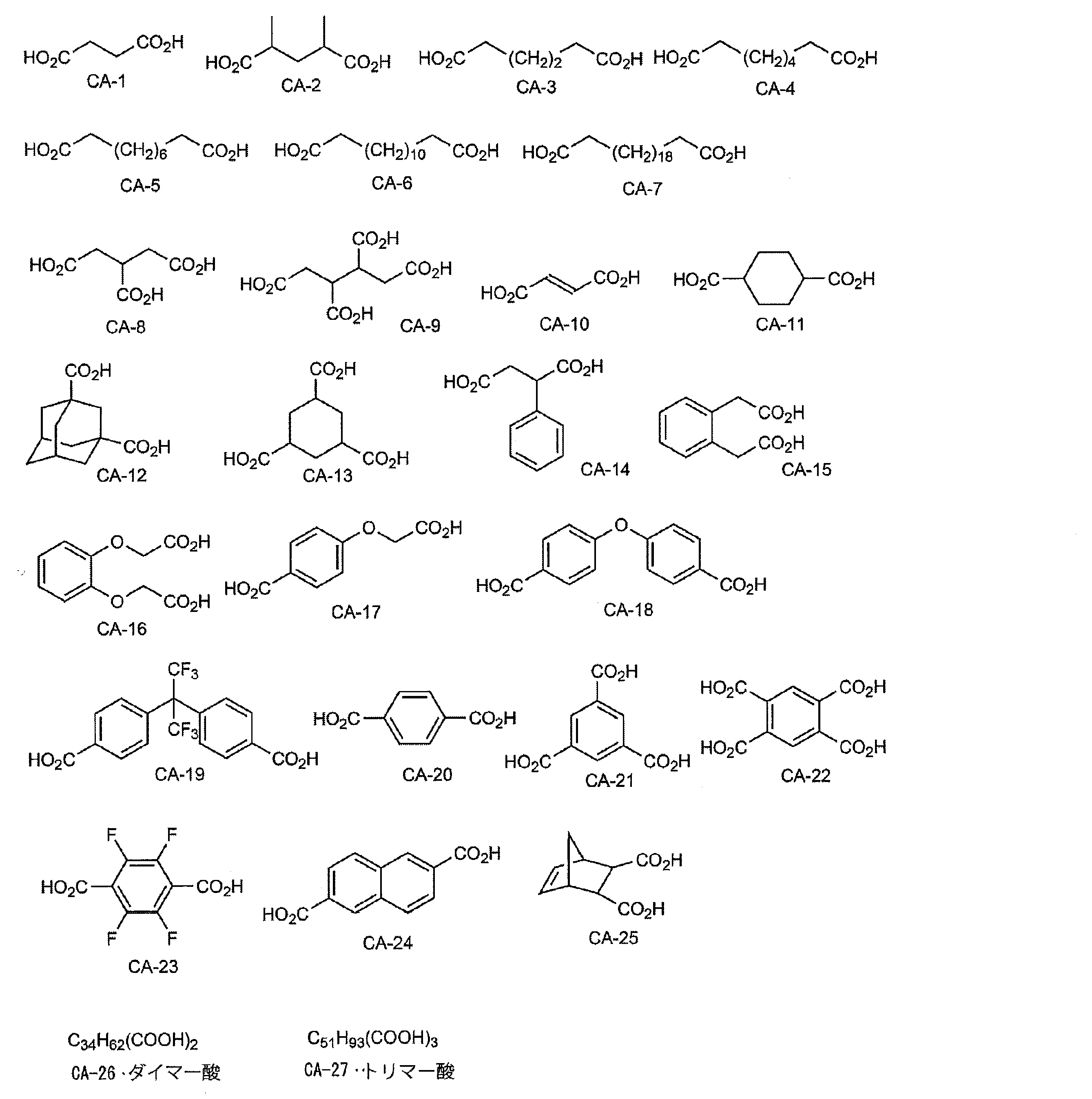
本発明では、多価カルボン酸の代わりとして、多価カルボン酸の無水物を用いることもできる。多価カルボン酸の無水物は、上記の多価カルボン酸の二つのCOOHが分子内あるいは分子間脱水縮合したものである。その好ましい形態は上記と同様である。その無水物の例には、無水コハク酸、無水グルタル酸、無水アジピン酸、無水マレイン酸、無水フタル酸、無水ナド酸、無水メチルナド酸、無水ヘキサヒドロフタル酸及び混合された多塩基酸の無水物が含まれる。
<1価アルコール>
エステルポリアミドの縮合に用いる1価アルコールは、一分子内に水酸基を1つ含む化合物であって、炭素数が4以上の化合物である。1価アルコールは、R(OH)で表される。Rは1価の脂肪族、脂環式又は芳香環基であり、R中の炭素原子の互いに隣接しない1以上の炭素原子が酸素原子に置換されていてもよい。Rの炭素数は4以上であることが好ましく、6以上であることがより好ましく、8以上であることがさらに好ましい。1価アルコールの炭素数を上記範囲内とすることにより、縮合反応時に1価アルコールが揮散することを抑制することができ、効率よくエステルポリアミドの縮合反応を進めることが可能となる。
エステルポリアミドの縮合に用いる1価アルコールは、一分子内に水酸基を1つ含む化合物であって、炭素数が4以上の化合物である。1価アルコールは、R(OH)で表される。Rは1価の脂肪族、脂環式又は芳香環基であり、R中の炭素原子の互いに隣接しない1以上の炭素原子が酸素原子に置換されていてもよい。Rの炭素数は4以上であることが好ましく、6以上であることがより好ましく、8以上であることがさらに好ましい。1価アルコールの炭素数を上記範囲内とすることにより、縮合反応時に1価アルコールが揮散することを抑制することができ、効率よくエステルポリアミドの縮合反応を進めることが可能となる。
本発明に適する1価アルコールとしては、例えば、ブタノール、ペンタノール、プロパノール、ヘキサノール、ヘプタノール、オクタノール、デカノール、ドデカノール、ヘキサデカノール、オクタデカノール、エイコサデカノール、フィトステロール、イソステアロール、ステアロール、セトール、ベヘノール、エチレングリコールモノエーテル、ポリエチレングリコールモノエーテル等が挙げられる。
下記に本発明で用いることができる1価アルコールの具体例を示すが、本発明はこれに限定されるものではない。

本発明で用いる1価アルコールは、下記一般式(3)で表されるものであることが好ましい。

ここで、一般式(3)中、Raは置換基を有してもよいアルキル基、置換基を有してもよいシクロアルキル基、置換基を有してもよいアルケニル基、置換基を有してもよいアリール基又は置換基を有してもよいヘテロアリール基であり、Xa1及びXa2はそれぞれ独立に水素原子、ハロゲン原子又はアルキル基を表す。また、na1は2~4の整数を表し、na2は1~12の整数を表す。
Raで表される置換基を有してもよいアルキル基のアルキル基部分の炭素数は、3~17であることが好ましく、4~13であることがより好ましく、5~9であることがさらに好ましい。Raが表すアルキル基は直鎖であっても分岐であってもよい。また、Raはシクロアルキル基であってもよい。
Raで表される置換基を有してもよいアルケニル基のアルケニル基部分の炭素数は、3~17であることが好ましく、4~13であることがより好ましく、5~9であることがさらに好ましい。Raが表すアルキル基は直鎖であっても分岐であっても環状であってもよい。
Raで表される置換基を有してもよいアリール基またはヘテロアリール基のアリール基部分の炭素数は、6~17であることが好ましく、6~12であることがより好ましい。Raが表すアリール基としては、フェニル基、ナフチル基などを挙げることができ、その中でもフェニル基が特に好ましい。また、Raが表すヘテロアリール基としては、例えば、イミダゾリル基、ピリジル基、キノリル基、フリル基、チエニル基、ベンズオキサゾリル基、インドリル基、ベンズイミダゾリル基、ベンズチアゾリル基、カルバゾリル基、アゼピニル基を例示することができる。ヘテロアリール基に含まれるヘテロ原子は、酸素原子、硫黄原子、窒素原子であることが好ましく、中でも、酸素原子であることが好ましい。
中でも、一般式(3)において、Raは置換基を有してもよいアルキル基であることがより好ましい。ここで、アルキル基は、分岐を有するアルキル基であってもよい。また、Xa1及びXa2はそれぞれ独立に水素原子又はアルキル基であることがより好ましい。
一般的(3)において、na1は2又は3の整数であることがより好ましく、2であることがさらに好ましい。また、na2は、1~8の整数であることがより好ましく、1~6の整数であることがさらに好ましく、1~3の整数であることが特に好ましい。
一般的(3)で表される1価アルコールの炭素数は、4以上であることが好ましく、6以上であることがより好ましく、8以上であることがさらに好ましい。このような1価アルコールを用いることにより、縮合反応時に1価アルコールが揮散することを抑制することができ、効率よくエステルポリアミドの縮合反応を進めることが可能となる。
Ra有し得る置換基の例には、置換もしくは無置換の炭素数1~50のアルキル基(例えば、メチル、エチル、以後いずれも直鎖状もしくは分枝鎖状の、プロピル、ブチル、ペンチル、ヘキシル、ヘプチル、オクチル、ノニル、デシル、ウンデシル、ドデシル、トリデシル、テトラデシル、ペンタデシル、ヘキサデシル、ヘプタデシル、オクタデシル、ノナデシル、エイコシル、ヘンエイコシル、ドコシル、トリコシル、又はテトラコシル);炭素原子数2~35のアルケニル基(例えば、プロペニル、ブテニル、ペンテニル、ヘキセニル、ヘプテニル、オクテニル、ノネニル、デセニル、ウンデセニル、ドデセニル);炭素原子数3~10のシクロアルキル基(例えば、シクロプロピル、シクロブチル、シクロペンチル、シクロヘキシル、シクロヘプチル);炭素原子数6~30の芳香族環基(例えば、フェニル、ナフチル、ビフェニル、フェナントリル、アントラセニル)、複素環基(窒素原子、酸素原子、及び硫黄原子から選ばれる少なくとも1個のヘテロ原子を含む複素環の残基であるのが好ましく、例えば、ピリジル、ピリミジル、トリアジニル、チエニル、フリル、ピロリル、ピラゾリル、イミダゾリル、トリアゾリル、チアゾリル、イミダゾリル、オキサゾリル、チアジアリル、オキサジアゾリル、キノリル、イソキノリル);又はそれらの組み合わせからなる基を表す。これらの置換基は、可能な場合はさらに1以上の置換基を有してもよく、置換基の例には、アルコキシ基、アルコキシカルボニル基、ハロゲン原子、エ-テル基、アルキルカルボニル基、シアノ基、チオエ-テル基、スルホキシド基、スルホニル基、アミド基などが挙げられる。
(その他の化合物)
なお、本発明では、多価アミン、多価カルボン酸、1価アルコールに加えて他の成分を縮合反応に用いてもよく、得られるエステルポリアミドを含む複合エステルポリアミド組成物も好ましく用いられる。
なお、本発明では、多価アミン、多価カルボン酸、1価アルコールに加えて他の成分を縮合反応に用いてもよく、得られるエステルポリアミドを含む複合エステルポリアミド組成物も好ましく用いられる。
(エステルポリアミド)
本発明の複合エステルポリアミド組成物は、上述したような多価アミンと、多価カルボン酸と、1価アルコールを混合し、この混合物を縮合させることで得られるエステルポリアミドを含む。混合物を縮合させることで得られるエステルポリアミドの少なくとも1種は、下記一般式(1)で表されることが好ましい。
本発明の複合エステルポリアミド組成物は、上述したような多価アミンと、多価カルボン酸と、1価アルコールを混合し、この混合物を縮合させることで得られるエステルポリアミドを含む。混合物を縮合させることで得られるエステルポリアミドの少なくとも1種は、下記一般式(1)で表されることが好ましい。

一般式(1)中、Rは炭素数2~60の脂肪族基を表し、R1は水素原子、置換基を有してもよいアルキル基、置換基を有してもよいシクロアルキル基、置換基を有してもよいアリール基、置換基を有してもよいヘテロアリール基又は一般式(2)で表される基を表す。R2は(m+1)価以上の鎖状もしくは環状の脂肪族連結基又は芳香族連結基を表し、R3は置換基を有してもよいアルキル基、置換基を有してもよいシクロアルキル基、置換基を有してもよいアリール基、置換基を有してもよいヘテロアリール基を表す。nは2~4の整数を表し、mは1~3の整数を表す。

一般式(2)中、R2は(m+1)価以上の鎖状もしくは環状の脂肪族連結基又は芳香族連結基を表し、R3は置換基を有してもよいアルキル基、置換基を有してもよいシクロアルキル基、置換基を有してもよいアリール基、置換基を有してもよいヘテロアリール基を表す。mは1~3の整数を表す。
上記一般式(1)において、Rは炭素数2~60の脂肪族基を表す。Rの炭素数は、6以上であることが好ましく、7以上であることがより好ましく、8以上であることがさらに好ましい。また、Rの炭素数は30以下であることが好ましく、24以下であることがより好ましく、20以下であることがさらに好ましい。
一般式(1)中、nは2~4の整数を表し、一般式(1)及び(2)中、mは1~3の整数を表す。なお、一般式(1)及び(2)において、mは1又は2の整数であることが特に好ましい。また、mが3の場合は、nは2であることが好ましく、mが1又は2の整数である場合は、nは3又は4の整数であることが好ましい。
R1は水素原子、置換基を有してもよいアルキル基、置換基を有してもよいシクロアルキル基、置換基を有してもよいアリール基、置換基を有してもよいヘテロアリール基又は一般式(2)で表される基を表す。すなわち、本発明で用いる多価アミンが1級アミノ基を含む多価アミンである場合、R1は水素原子又は一般式(2)で表される基を表すこととなり、本発明で用いる多価アミンが2級アミノ基を含む多価アミンである場合、R1は置換基を有してもよいアルキル基、置換基を有してもよいシクロアルキル基、置換基を有してもよいアリール基、置換基を有してもよいヘテロアリール基を表すこととなる。
R2は、多価カルボン酸の残基を表す。ここで、多価カルボン酸の残基とは、多価カルボン酸から2つのカルボキシル基を除いた部分を構成する基のことをいう。R2は(m+1)価以上の鎖状もしくは環状の脂肪族連結基又は芳香族連結基を表し、(m+1)価以上の鎖状もしくは環状の脂肪族連結基であることが好ましい。なお、脂肪族連結基又は芳香族連結基の炭素原子の互いに隣接しない1以上の炭素原子は酸素原子に置換されていてもよい。
R2の炭素数は22~66であることが好ましく、26~60であることがより好ましく、30~50であることがさらに好ましい。また、R2はダイマー酸残基又はトリマー酸残基であることが好ましい。R2を上記の条件とすることにより、潤滑性能の高い複合エステルポリアミド組成物を得ることができる。
R3は置換基を有してもよいアルキル基、置換基を有してもよいシクロアルキル基、置換基を有してもよいアルケニル基、置換基を有してもよいアリール基、置換基を有してもよいヘテロアリール基を表す。R3が取り得る具体的な基としては、一般式(3)中、Raで表される基を例示することができる。なお、R3が有し得る各基の置換基は特に制限されることはない。置換基としては、上記の置換基を同様に例示することができる。
R3の炭素数は4以上であればよく、6以上であることがより好ましく、8以上であることがさらに好ましい。
また、R3は、オキシアルキレン構造を有する基であることが好ましい。すなわち、R3は、分岐アルキル基、又は鎖中にエーテル結合を含むアルキル基であることが好ましい。R3をこのような置換基とすることにより、複合エステルポリアミド組成物の潤滑性能をさらに高めることができる。
多価アミン、多価カルボン酸及び1価アルコールの化合物を混合する際には、多価アミンに対して、多価カルボン酸を混合する当量比が1~3であり、多価アミンに対して、1価アルコールを混合する当量比が0.5~3であることが好ましい。すなわち、混合比率は、多価アミン:多価カルボン酸:1価アルコール=1:1~3:0.5~3となることが好ましい。これらの混合比率は、1:1.2~2.8:0.7~2.8であることがより好ましく、1:1.5~2.5:1~2.5であることがより好ましい。特に、エステルポリアミドの側鎖は、エンドキャップされることが好ましいことから、多価カルボン酸の当量より、多価アミンと1価アルコールの合計の当量が、同じか大きいことが好ましい。
本発明の複合エステルポリアミド組成物の40℃における粘度は、50~1650mPasであることが好ましい。複合エステルポリアミド組成物の40℃における粘度は、50mPas以上であることが好ましく、70mPas以上であることがより好ましく、100mPas以上であることがさらに好ましい。また、複合エステルポリアミド組成物の40℃における粘度は、1650mPas以下であることが好ましく、1200mPas以下であることがより好ましく、1000mPas以下であることがさらに好ましい。複合エステルポリアミド組成物の粘度を上記範囲内とすることにより、複合エステルポリアミド組成物の摩擦係数を低く抑えることができ、これにより潤滑性能を高めることができる。
本発明の潤滑剤は、摩擦係数の上昇が小さいという優れた特徴を有する。このような優れた効果は、本発明で得られるエステルポリアミドが放射状に側鎖を配する立体構造を有することにより得られるものと考えられる。本発明で得られるエステルポリアミドは、放射状に側鎖を配することが可能な多価アミンと、それに接続し放射状に伸びる多価カルボン酸と、多価カルボン酸の末端連結基となる1価アルコールから構成される化合物である。本発明では、多価アミンを中心原子団とし側鎖を有することで、その立体構造により大きな自由体積を確保することができる。これにより、摩擦係数の上昇を抑えることができる。
さらに、本発明の潤滑剤は、耐加水分解性に優れているという特徴を有する。このような効果は、中心原子団の多価アミンとし、多価アミンと多価カルボン酸の間にアミド結合を形成することにより得られるものと考えられる。また、本発明では、中心原子団の多価アミンとし、アミド結合を形成することにより、長期間に亘ってエステルポリアミドの分子量の変化を少なく保つことができる。すなわち、本発明では、時間経過と共にエステルポリアミドが分解され、分子量が小さくなることが抑制されており、経年劣化しにくい複合エステルポリアミド組成物を得ることができる。これにより、長期間に亘って優れた潤滑性能を発揮することができる。加えて、このように耐加水分解性に優れた潤滑剤は、金属を腐食することがないため、金属等の様々な材質に適用することができる。
本発明では、所定のエステルポリアミドに加えて、軽質分をさらに含んでもよい。ここで、軽質分とは、低分子量の成分をいい、例えば、一般式(4)で表されるエステル成分を例示することができる。すなわち、軽質分としては、多価カルボン酸と1価アルコールが反応したエステルを例示することができる。

一般式(4)中、R2は(m+1)価以上の鎖状もしくは環状の脂肪族連結基又は芳香族連結基を表し、R3は置換基を有してもよいアルキル基、置換基を有してもよいシクロアルキル基、置換基を有してもよいアリール基、置換基を有してもよいヘテロアリール基を表す。mは1~3の整数を表す。なお、R2、R3が取り得る具体的な基としては、一般式(1)のR2及びR3例示した基と同様である。
本発明では、上記のような軽質分を含む粘性の低い液体を共存させることで複合エステルポリアミド組成物の粘性をさらに低くすることができる。これにより、潤滑性能を良化することができ、さらに、極圧条件下においても、高い潤滑性能を発揮することができる。
本発明の複合エステルポリアミド組成物において、所定のエステルポリアミドと、軽質分との比率については特に制限はない。潤滑剤の用途に利用する態様では、軽質分の含有率は、所定のエステルポリアミドに対して50質量%以下であることが好ましく、45質量%以下であることがより好ましく、40質量%以下であることがさらに好ましい。なお、下限値については特に制限はないが、15質量%以上であることが好ましい。
所定のエステルポリアミドと、軽質分との比率は、後述する製法において、3つの原料の仕込み比率でコントロールすることで達成することができる。また軽質分を蒸留等で分離し、残存したエステルポリアミドと任意の比率で混合することで好ましい範囲に調整することもできる。
なお、所定のエステルポリアミドと、ダイマージオールを含む軽質分との組成比率は、ゲルパーミエーションクロマトグラフィー(GPC)を測定することで算出することができる。軽質分は、GPC分析のピークがシャープに出現し、その強度が大きいことから、判別しやすい。
所定のエステルポリアミドと、軽質分との比率は、後述する製法において、3つの原料の仕込み比率でコントロールすることで達成することができる。また軽質分を蒸留等で分離し、残存したエステルポリアミドと任意の比率で混合することで好ましい範囲に調整することもできる。
なお、所定のエステルポリアミドと、ダイマージオールを含む軽質分との組成比率は、ゲルパーミエーションクロマトグラフィー(GPC)を測定することで算出することができる。軽質分は、GPC分析のピークがシャープに出現し、その強度が大きいことから、判別しやすい。
本発明では、複合エステルポリアミド組成物中に含まれるエステルポリアミドの側鎖には、多価カルボン酸中の未反応のCOOHが残存していてもよく、また、1価アルコール中の未反応OHが存在していてもよいが、OH及びCOOHが残存すると、水酸基価と酸価が上がり、用途によっては(例えば、潤滑剤の用途等)、好ましくない場合もある。このような場合、別途アシル化、及び/又はエステル化処理により、エステルポリアミド中のOH及びCOOHを消失させ、水酸基価と酸価を低減することもできる。
エステルポリアミド中のOHを消失させるためには、側鎖にOHが残存するエステルポリアミドを一旦得た後、その少なくとも一部をアシル化する処理を行うことができる。アシル化処理は、一塩基酸(R1COOH)又は一塩基酸無水物((R1CO)2O)を、OHが残存するエステルポリアミドに添加し、加熱することで、残存のOHをOCOR1に変換させる処理である。アシル化処理により、水酸基価を低減すると、他の油性媒体と混合する場合、混合しやすくなるなどの点で好ましい。
また、エステルポリアミド中のCOOHを消失させる処理を行ってもよい。例えば、ジアゾメタンなどで処理してエステル化することができる。
また、エステルポリアミド中のCOOHを消失させる処理を行ってもよい。例えば、ジアゾメタンなどで処理してエステル化することができる。
エステルポリアミド中の未反応のOHの割合は、13C-NMRを測定することで判明する。潤滑剤の用途では、エステルポリアミドのOHの残存率は0~40%であることが好ましく、0~35%であることがより好ましく、0~30%であることがさらに好ましい。また、同用途では、エステルポリアミドの酸価(サンプル1gを中和するのに要するKOHのmg数)は、0~50であることが好ましく、0~40であることがより好ましく、0~30であることがさらに好ましい。但し、この範囲に制限されるものではない。
(複合エステルポリアミド組成物の製造方法)
本発明の複合エステルポリアミド組成物は、上述した多価アミン、多価カルボン酸及び1価アルコールの少なくとも3つの原料を仕込んで、脱水縮合させることにより得ることができる。すなわち、本発明の複合エステルポリアミド組成物の製造方法は、少なくとも2つの1級または2級アミノ基を含む多価アミンと、少なくとも2つのカルボキシル基を含む多価カルボン酸と、1価アルコールとを混合し混合物を得る工程と、混合物を脱水縮合する工程を含む。なお、製造工程では、2つの原料(例えば、多価アミンと多価カルボン酸、または多価カルボン酸と1価アルコール)を先に反応させた後に、残りの原料を反応させることとしてもよい。
本発明の複合エステルポリアミド組成物は、上述した多価アミン、多価カルボン酸及び1価アルコールの少なくとも3つの原料を仕込んで、脱水縮合させることにより得ることができる。すなわち、本発明の複合エステルポリアミド組成物の製造方法は、少なくとも2つの1級または2級アミノ基を含む多価アミンと、少なくとも2つのカルボキシル基を含む多価カルボン酸と、1価アルコールとを混合し混合物を得る工程と、混合物を脱水縮合する工程を含む。なお、製造工程では、2つの原料(例えば、多価アミンと多価カルボン酸、または多価カルボン酸と1価アルコール)を先に反応させた後に、残りの原料を反応させることとしてもよい。
多価アミン、多価カルボン酸及び1価アルコールの仕込み比率(混合比率)は、当量で決められる。ここでいう当量とは反応におけるCOOH、OHもしくはNHの化学当量をいう。多価アミン1分子中のNH数をn、モル数をM1とすると、多価アミンの当量はn×M1で定義される。同様に、多価カルボン酸1分子中のCOOH数をm、モル数をM2とすると、多価カルボン酸の当量はm×M2で定義される。1価アルコールは1分子中にOHが1個なので、モル数をM3とすると、M3で定義される。上記の比率は、これらのn×M1、m×M2、M3の比である。
本発明では、混合比率は、多価アミン:多価カルボン酸:1価アルコール=1:1~3:0.5~3となることが好ましい。これらの混合比率は、1:1.2~2.8:0.7~2.8であることがより好ましく、1:1.5~2.5:1~2.5であることがより好ましい。特に、エステルポリアミドの側鎖は、エンドキャップされることが好ましいことから、多価カルボン酸の当量より、多価アミンと1価アルコールの合計の当量が、同じか大きいことが好ましい。
上記のようにして仕込んだ混合物を、触媒存在下もしくは無触媒で、脱水縮合反応をすることで、本発明の複合エステルポリアミド組成物が得られる。
脱水縮合の際は、加熱するか、水と共沸する溶媒を適量存在させることが望ましい。これにより生成物が着色することなく、脱水もスムーズに進行する。この溶媒は沸点100~200℃の炭化水素系溶媒が好ましく、100~170℃の炭化水素系溶媒がさらに好ましく、110~160℃の炭化水素系溶媒が最も好ましい。これらの溶媒として、例えばトルエン、キシレン、メシチレンなどがあげられる。添加する量は、多すぎると液温がその溶媒付近となり、脱水縮合が進行しにくくなる。一方、少なすぎると、共沸がスムーズに行かない。したがって、添加量は、多価アミン、多価カルボン酸及び1価アルコールの全量に対し、1~25質量%が好ましく、2~20質量%がさらに好ましく、3~15質量%が特に好ましく、5~12質量%も好ましい。
触媒を用いることで、反応が加速されるが、触媒除去の後処理が煩雑であり、生成物の着色の原因となることから、用いないことが望ましい。しかし、用いる場合は、通常の触媒で通常の条件と操作が使用される。これに関しては、特表2001-501989号公報、特表2001-500549号公報、特表2001-507334号公報、及び特表2002-509563号公報中の参考文献を参照することができる。
仕込み終了後、液温120~250℃、好ましくは130~230℃、さらに好ましくは130~200℃、特に好ましくは140~200℃で反応させる。これにより水を含む溶媒が共沸され、ディーンシュタークのごとき冷却部位で冷却され、液体となることで水と溶媒が分離される。この水は除去されればよい。
反応時間は、仕込みのモル数より理論発生水量が計算されるので、この水量が得られる時点まで反応を行うことが好ましいが、完全に反応を完結させることは困難である。理論水発生量が60~90%の時点で反応を終了しても複合エステルポリアミド組成物の潤滑性は良好である。反応時間は1~24時間であり、好ましくは3~18時間、さらに好ましくは5~18時間、最も好ましくは6~15時間である。
脱水縮合と揮発分除去後、さらに残存するOHに対して、アシル化を行ってもよい。アシル化を行う場合は、一塩基酸(R1COOH)もしくは一塩基酸無水物((R1CO)2O)、好ましくは一塩基酸無水物((R1CO)2O)を適量添加し、好ましくは100℃以上、さらに好ましくは120℃以上、特に150℃以上加熱することで、残存のOHの少なくとも一部、好ましくはほぼ全てを、OCOR1に変換することができる。副生する揮発分は、後述の蒸留で除去することが好ましい。なお、R1は、炭素原子数1~10のアルキル基もしくはアリール基とされ、炭素原子数1~6のアルキル基もしくはアリール基が好ましく、炭素原子数メチル基、エチル基、ブチル基、フェニル基がさらに好ましく、メチル基もしくはフェニル基が好ましく、メチル基が特に好ましい。
また、脱水縮合と揮発分除去後、残存するCOOHを消失させるために、エステル化処理を行ってもよい。エステル化処理は、例えば、ジアゾメタンを添加して行うことができ、COOHの少なくとも一部、好ましくはほぼ全てを、メチルエステルに変換することができる。
この反応により、所定のエステルポリアミドと、上記のように生成されたエステルを少なくとも含む軟質分を含む複合エステルポリアミド組成物が得られる。脱水縮合反応後、所望によりアシル化処理及び/エステル化処理を行った後、得られた複合エステルポリアミド組成物を、そのまま種々の用途、例えば潤滑剤として、用いることができる。また、用途に応じて、種々の処理を行ってもよい。
反応及び反応後の処理が終了した後、ろ過を行い、ゴミなどを除去することが好ましい。なお、複合エステルポリアミドが固体となった場合は、溶融してとりだすか、あるいは再沈殿により粉体として取り出すこともできる。
(潤滑剤組成物)
本発明は、複合エステルポリアミド組成物を少なくとも含有する潤滑剤組成物に関するものとしてもよい。例えば、潤滑剤組成物には、本発明の複合エステルポリアミド組成物と各種添加剤及び/または媒体を添加することができる。
添加剤としては、例えば、摩耗防止剤、粘度指数向上剤、酸化防止剤、清浄剤、分散剤,流動、硬化剤、腐食防止剤、シール適合剤、消泡剤、錆防止剤、腐食防止剤、摩擦調整剤、及び増ちょう剤から選択される1種又は2種以上を挙げることができる。
このような添加剤を添加することにより、摩耗抑制等の潤滑剤としての好ましい機能を付与することができる。本発明において用いることができる潤滑剤については、特開2011-89106号公報の段落〔0098〕~〔0165〕の記載を参照することができる。
本発明は、複合エステルポリアミド組成物を少なくとも含有する潤滑剤組成物に関するものとしてもよい。例えば、潤滑剤組成物には、本発明の複合エステルポリアミド組成物と各種添加剤及び/または媒体を添加することができる。
添加剤としては、例えば、摩耗防止剤、粘度指数向上剤、酸化防止剤、清浄剤、分散剤,流動、硬化剤、腐食防止剤、シール適合剤、消泡剤、錆防止剤、腐食防止剤、摩擦調整剤、及び増ちょう剤から選択される1種又は2種以上を挙げることができる。
このような添加剤を添加することにより、摩耗抑制等の潤滑剤としての好ましい機能を付与することができる。本発明において用いることができる潤滑剤については、特開2011-89106号公報の段落〔0098〕~〔0165〕の記載を参照することができる。
また、媒体としては、鉱物油、油脂化合物、ポリオレフィン油、シリコーン油、エーテル油(好ましくはパーフルオロポリエーテル油、ジフェニルエーテル油)、エステル油(好ましくは芳香族エステル油、脂肪族モノエステル油、脂肪族ジエステル油、及びポリオールエステル潤滑油)から選択される1種又は2種以上を挙げることができる。
本発明において、「媒体」とは、一般的に「流動性液体」とよばれる媒体の全てを意味するものである。但し、室温又は使用される温度において、液状であることは必要とせず、液体以外にも固体及びゲル等のいずれの形態の材料も利用することができる。本発明において利用する媒体については特に制限はなく、用途に応じて種々の液体から選択することができる。本発明において用いることができる媒体については、特開2011-89106号公報の段落〔0067〕~〔0096〕の記載を参照することができる。
本発明において、「媒体」とは、一般的に「流動性液体」とよばれる媒体の全てを意味するものである。但し、室温又は使用される温度において、液状であることは必要とせず、液体以外にも固体及びゲル等のいずれの形態の材料も利用することができる。本発明において利用する媒体については特に制限はなく、用途に応じて種々の液体から選択することができる。本発明において用いることができる媒体については、特開2011-89106号公報の段落〔0067〕~〔0096〕の記載を参照することができる。
(潤滑剤組成物の性質)
本発明の潤滑剤組成物は、40℃での粘度が1650mPa・s以下であるのが好ましく、1200mPa・s以下であることがより好ましく、1000mPa・s以下であることがさらに好ましい。粘性は、使用環境により適正な粘性が求められるため、それに合わせることが必要である。
本発明の潤滑剤組成物は、40℃での粘度が1650mPa・s以下であるのが好ましく、1200mPa・s以下であることがより好ましく、1000mPa・s以下であることがさらに好ましい。粘性は、使用環境により適正な粘性が求められるため、それに合わせることが必要である。
本発明の潤滑剤組成物は、構成元素が、炭素、水素、酸素及び窒素だけからなることが好ましく、炭素、水素及び酸素のみからで構成することがさらに好ましい。また、油性媒体として用いる油も、炭素、水素及び酸素のみから構成される材料は種々ある。これらを組み合わせることにより、構成元素が、炭素、水素、酸素及び窒素だけからなる組成物を調製することができる。
なお、現行の潤滑油は、通常、リン、硫黄、重金属を含んでいる。燃料と共に潤滑油も燃焼する2ストロークエンジンに用いられる潤滑油は、環境負荷を配慮して、リンと重金属は含まれないが、硫黄は4ストロークエンジンに用いられる潤滑油の半分量程度含まれている。即ち、現行の潤滑技術では、最低でも硫黄分による境界潤滑膜の形成は必須であると推察されるが、硫黄元素を含んでいることによって、排気ガス浄化のための触媒への負荷は非常に大きい。この排気ガス浄化触媒には、プラチナやニッケルが使用されているが、リンや硫黄の被毒作用は大きな問題になっている。その点からも潤滑油の組成物を構成する元素が、炭素、水素、酸素及び窒素だけからなることのメリットは非常に大きい。さらに炭素、水素、酸素だけからなることはエンジンオイル以外の産業機械、特に食品製造関連機器の潤滑油には最適である。現行技術では、摩擦係数を犠牲にして環境に配慮した元素組成をとっている。これは、冷却のために大量の水を必要とする金属の切削・加工用潤滑油にも非常に好ましい技術である。
なお、現行の潤滑油は、通常、リン、硫黄、重金属を含んでいる。燃料と共に潤滑油も燃焼する2ストロークエンジンに用いられる潤滑油は、環境負荷を配慮して、リンと重金属は含まれないが、硫黄は4ストロークエンジンに用いられる潤滑油の半分量程度含まれている。即ち、現行の潤滑技術では、最低でも硫黄分による境界潤滑膜の形成は必須であると推察されるが、硫黄元素を含んでいることによって、排気ガス浄化のための触媒への負荷は非常に大きい。この排気ガス浄化触媒には、プラチナやニッケルが使用されているが、リンや硫黄の被毒作用は大きな問題になっている。その点からも潤滑油の組成物を構成する元素が、炭素、水素、酸素及び窒素だけからなることのメリットは非常に大きい。さらに炭素、水素、酸素だけからなることはエンジンオイル以外の産業機械、特に食品製造関連機器の潤滑油には最適である。現行技術では、摩擦係数を犠牲にして環境に配慮した元素組成をとっている。これは、冷却のために大量の水を必要とする金属の切削・加工用潤滑油にも非常に好ましい技術である。
(潤滑剤組成物の調製方法)
本発明の潤滑剤組成物は、複合エステルポリアミド組成物を、油性媒体中もしくは水性媒体中に添加し、溶解及び/又は分散させることで調製することができる。溶解及び/又は分散は、加温下で行ってもよい。複合エステルポリアミド組成物の添加量は、油性媒体の質量に対して、10質量%以上で添加されるのが好ましい。但し、この範囲に限定されるものではなく、上記化合物が、摩擦低減作用を示すのに充分な量であれば、上記範囲外であってもよい。
本発明の潤滑剤組成物は、複合エステルポリアミド組成物を、油性媒体中もしくは水性媒体中に添加し、溶解及び/又は分散させることで調製することができる。溶解及び/又は分散は、加温下で行ってもよい。複合エステルポリアミド組成物の添加量は、油性媒体の質量に対して、10質量%以上で添加されるのが好ましい。但し、この範囲に限定されるものではなく、上記化合物が、摩擦低減作用を示すのに充分な量であれば、上記範囲外であってもよい。
(潤滑剤組成物の用途)
本発明の潤滑剤組成物は、潤滑剤として有用である。すなわち、本発明は、上述した複合エステルポリアミド組成物を含む潤滑剤又は上述した潤滑剤組成物を含む潤滑剤に関するものでもある。
本発明の潤滑剤は、例えば、2つの摺動面間に供給され、摩擦を低減するために用いることができる。本発明の組成物は、摺動面に皮膜を形成し得る。摺動面の材質としては、鋼鉄では、具体的には、機械構造用炭素鋼、ニッケルクロム鋼材・ニッケルクロムモリブデン鋼材・クロム鋼材・クロムモリブデン鋼材・アルミニウムクロムモリブデン鋼材などの構造機械用合金鋼、ステンレス鋼、マルチエージング鋼などが挙げられる。
本発明の潤滑剤組成物は、潤滑剤として有用である。すなわち、本発明は、上述した複合エステルポリアミド組成物を含む潤滑剤又は上述した潤滑剤組成物を含む潤滑剤に関するものでもある。
本発明の潤滑剤は、例えば、2つの摺動面間に供給され、摩擦を低減するために用いることができる。本発明の組成物は、摺動面に皮膜を形成し得る。摺動面の材質としては、鋼鉄では、具体的には、機械構造用炭素鋼、ニッケルクロム鋼材・ニッケルクロムモリブデン鋼材・クロム鋼材・クロムモリブデン鋼材・アルミニウムクロムモリブデン鋼材などの構造機械用合金鋼、ステンレス鋼、マルチエージング鋼などが挙げられる。
摺動面の材質としては、鋼鉄以外の各種金属、又は金属以外の無機もしくは有機材料も広く用いられる。金属以外の無機もしくは有機材料としては、各種プラスチック、セラミック、カーボン等、及びその混合体などが挙げられる。より具体的には、鋼鉄以外の金属材料としては、鋳鉄、銅・銅-鉛・アルミニウム合金、その鋳物及びホワイトメタルが挙げられる。
なお、摺動面の材質については、特開2011-89106号公報の段落〔0168〕~〔0175〕の記載を参照することができる。
なお、摺動面の材質については、特開2011-89106号公報の段落〔0168〕~〔0175〕の記載を参照することができる。
本発明の潤滑剤は、種々の用途に利用できる。例えば、グリース用潤滑油、離型剤、内燃機関用エンジンオイル、金属加工用(切削用)オイル、軸受け用オイル、燃焼機関用燃料、車両エンジン油、ギヤ油、自動車用作動油、船舶・航空機用潤滑油、マシン油,タービン油、軸受用オイル、油圧作動油、圧縮機・真空ポンプ油、冷凍機油、金属加工用潤滑油剤、磁気記録媒体用潤滑剤、マイクロマシン用潤滑剤、人工骨用潤滑剤、ショックアブソーバ油又は圧延油として用いることができる。さらに、往復動式や回転式の密閉型圧縮機を有するエアコンや冷蔵庫、自動車用エアコンや除湿機、冷凍庫、冷凍冷蔵倉庫、自動販売機、ショーケース、化学プラント等の冷却装置などにも用いられる。
塩素系化合物を含まない金属加工用潤滑油剤として、例えば鉄鋼材料やAl合金などの金属材料を熱間圧延したり、切削等の加工を行なう際に、またアルミニウムの冷間圧延油、切削油、研削油、引き抜き加工油、プレス加工油等の金属加工油や金属の塑性加工油として、特に高速、高負荷加工時の摩耗、破損、表面あれの抑止剤として、またブローチ加工,ガンドリル加工のような低速・重切削に適用可能な金属加工油組成物としても有用である。
また各種グリース用潤滑油、磁気記録媒体用潤滑剤、マイクロマシン用潤滑剤や人工骨用潤滑剤等に利用することができる。また、組成物の元素組成を炭水化物とすることができるため、例えば、乳化、分散化、可溶化剤としてケーキミックス、サラダドレッシング、ショートニングオイル、チョコレート等に広く利用されている、ポリオキシエチレンエーテルを含むソルビタン脂肪酸エステルを食用油を基油とした組成物を潤滑油とすることで、全く人体に無害の高性能潤滑油を食品製造ラインの製造機器や医療機器部材の潤滑に用いることができる。
さらに、本発明の組成物を水系に乳化して分散したり、極性溶媒中や樹脂媒体中に分散することで、切削油や圧延油として用いることができる。
また各種グリース用潤滑油、磁気記録媒体用潤滑剤、マイクロマシン用潤滑剤や人工骨用潤滑剤等に利用することができる。また、組成物の元素組成を炭水化物とすることができるため、例えば、乳化、分散化、可溶化剤としてケーキミックス、サラダドレッシング、ショートニングオイル、チョコレート等に広く利用されている、ポリオキシエチレンエーテルを含むソルビタン脂肪酸エステルを食用油を基油とした組成物を潤滑油とすることで、全く人体に無害の高性能潤滑油を食品製造ラインの製造機器や医療機器部材の潤滑に用いることができる。
さらに、本発明の組成物を水系に乳化して分散したり、極性溶媒中や樹脂媒体中に分散することで、切削油や圧延油として用いることができる。
また、本発明の潤滑剤組成物は離型剤としても、種々の用途に利用できる。例えば、ポリカーボネート樹脂、難燃性ポリカーボネート樹脂、電子写真装置や静電記録装置などで使用される画像形成用トナーの主成分である結晶性ポリエステル樹脂、各種成形用熱可塑性樹脂組成物及び半導体封し用エポキシ樹脂組成物などの離型剤として用いられる。離型剤の一態様は、ポリカーボネート樹脂等の樹脂100質量部に対して、複合エステルポリアミド組成物を0.01~10質量部(好ましくは0.1~5質量部)含有する態様である。
また、衣料などの繊維製品に予め練り込んだり、塗布することにより、繊維製品に付着した汚れの離脱を促進して繊維製品の汚れを防止する防汚剤としても用いることができる。
また、衣料などの繊維製品に予め練り込んだり、塗布することにより、繊維製品に付着した汚れの離脱を促進して繊維製品の汚れを防止する防汚剤としても用いることができる。
以下に実施例と比較例を挙げて本発明の特徴をさらに具体的に説明する。以下の実施例に示す材料、使用量、割合、処理内容、処理手順等は、本発明の趣旨を逸脱しない限り適宜変更することができる。したがって、本発明の範囲は以下に示す具体例により限定的に解釈されるべきものではない。
(実施例1~24)
<エステルポリアミドの合成>
(合成例1)
ヘキサメチレンジアミン(PA-5)7質量部、ダイマー酸(CA-26:商品名ツノダイム395)67質量部、2-(2-エチルヘキシルオキシ)エタノール(MA-1)26質量部をディーンスターク脱水装置がついた反応容器に仕込んだ。液温160~200℃で12時間攪拌した。攪拌中に水が発生し、4質量部の水が除去された。室温まで放冷、黄色透明の液状物として96質量部の複合エステルポリアミド組成物PEA-1 を得た。
<エステルポリアミドの合成>
(合成例1)
ヘキサメチレンジアミン(PA-5)7質量部、ダイマー酸(CA-26:商品名ツノダイム395)67質量部、2-(2-エチルヘキシルオキシ)エタノール(MA-1)26質量部をディーンスターク脱水装置がついた反応容器に仕込んだ。液温160~200℃で12時間攪拌した。攪拌中に水が発生し、4質量部の水が除去された。室温まで放冷、黄色透明の液状物として96質量部の複合エステルポリアミド組成物PEA-1 を得た。
(合成例2)
トリス(2-アミノエチルアミン)(PA-21)6質量部、ダイマー酸(CA-26:商品名ツノダイム395)69質量部、2-(2-エチルヘキシルオキシ)エタノール (MA-1)25質量部をディーンスターク脱水装置がついた反応容器に仕込んだ。液温160~200℃で12時間攪拌した。攪拌中に水が発生し、4質量部の水が除去された。室温まで放冷、黄色透明の液状物として96質量部の複合エステルポリアミド組成物PEA-2 を得た。
トリス(2-アミノエチルアミン)(PA-21)6質量部、ダイマー酸(CA-26:商品名ツノダイム395)69質量部、2-(2-エチルヘキシルオキシ)エタノール (MA-1)25質量部をディーンスターク脱水装置がついた反応容器に仕込んだ。液温160~200℃で12時間攪拌した。攪拌中に水が発生し、4質量部の水が除去された。室温まで放冷、黄色透明の液状物として96質量部の複合エステルポリアミド組成物PEA-2 を得た。
表1に示す化合物を反応させ、上記と同様にして複合エステルポリアミド組成物PEA-3~PEA-24を合成した。
<多価アミン>
本発明の実施例で用いた多価アミンは下記のものである。
本発明の実施例で用いた多価アミンは下記のものである。
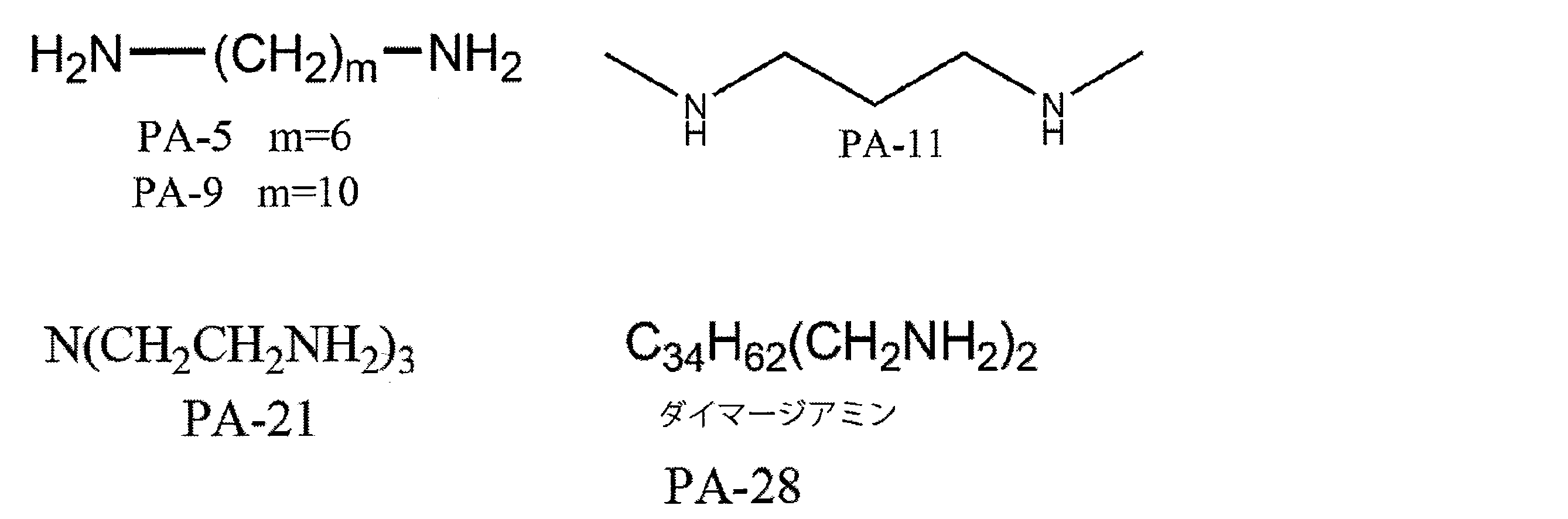
<多価カルボン酸>
また、本発明の実施例で用いた多価カルボン酸は下記のものである。
また、本発明の実施例で用いた多価カルボン酸は下記のものである。
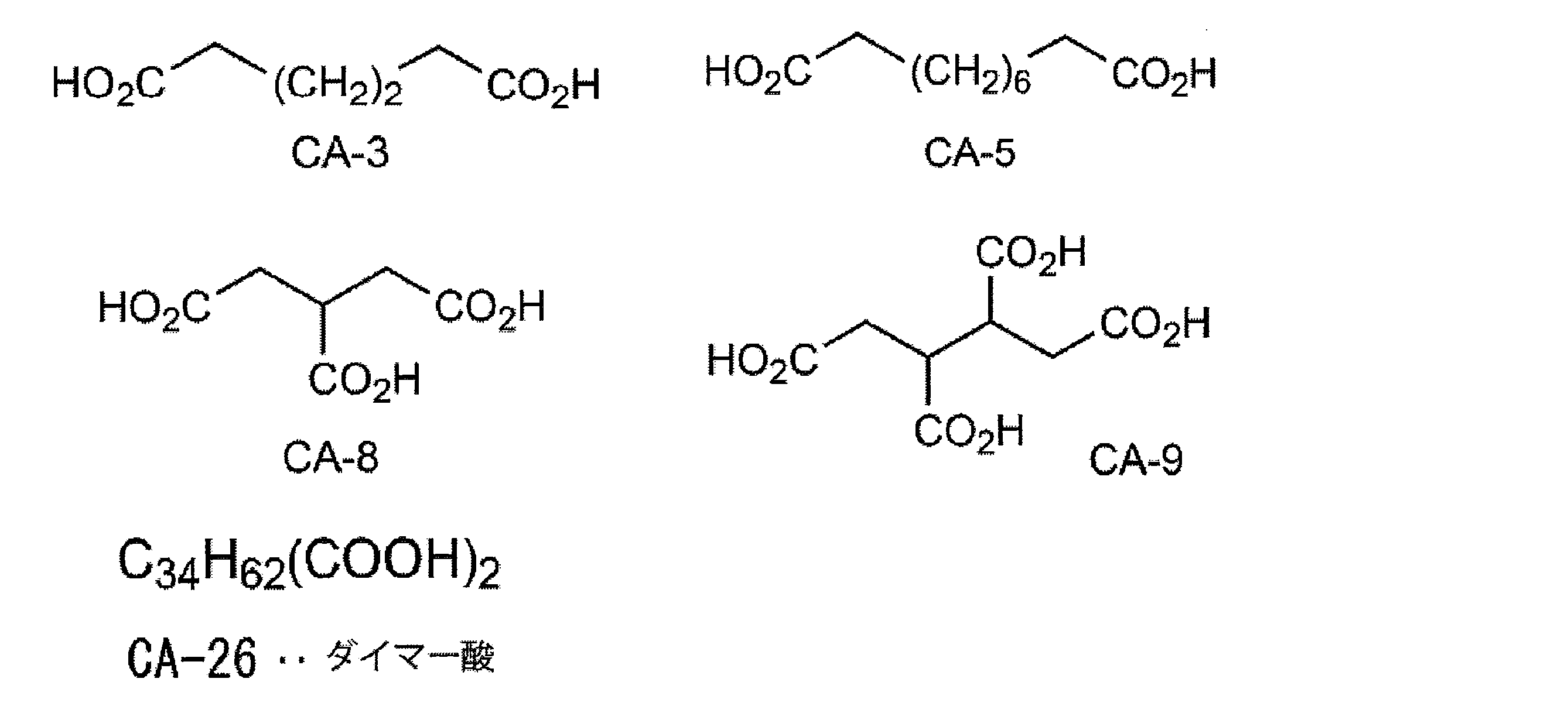
<1価アルコール>
また、本発明の実施例で用いた1価アルコールは下記のものである。
また、本発明の実施例で用いた1価アルコールは下記のものである。
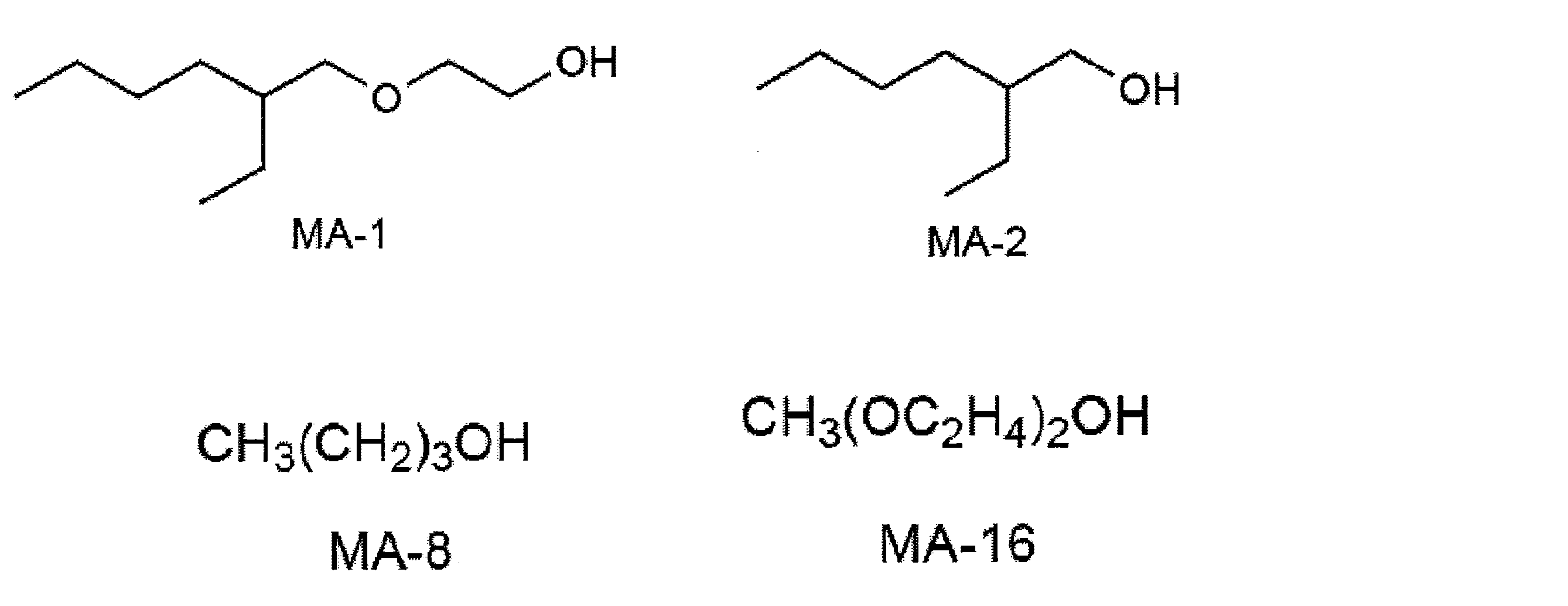
<潤滑剤の調製>
得られた複合エステルポリアミド組成物と鉱油(100ニュートラル油、100℃における粘度4.4mm/s2)とを、質量比率で、25/75で混合し、金属系清浄剤としてカルシウムスルホネート2.0質量%を含有する潤滑剤を調製した。潤滑剤の摩擦係数を下記の方法により測定した。
得られた複合エステルポリアミド組成物と鉱油(100ニュートラル油、100℃における粘度4.4mm/s2)とを、質量比率で、25/75で混合し、金属系清浄剤としてカルシウムスルホネート2.0質量%を含有する潤滑剤を調製した。潤滑剤の摩擦係数を下記の方法により測定した。
<評価>
試験例1:内燃機関用潤滑油としての評価
本発明の複合エステルポリアミド組成物PEA-1と鉱油(100ニュートラル油、100℃における粘度4.4mm/s2)とを、質量比率で、25/75で混合し、金属系清浄剤としてカルシウムスルホネート2.0質量%を含有する潤滑剤L1を調製し、摩擦係数を測定した。また、本発明の組成物PEA-1に代えて組成物PEA2~24を用いた以外は実施例1と同様にして潤滑剤L2~L24を調製し、摩擦係数を測定した。摩擦係数を評価する指標として下記評価基準にしたがって評価した。評価結果は下記表1に示す。なお、摩擦係数は、振動型摩擦摩耗試験機(Optimol Instruments Prueftechnik GmbH社製、商品名:SRV 4)を用いて、振動数100Hz、振幅2.0mm、荷重30N、温度65℃、試験時間30分において測定した。なお、評価がCランク以上のものを合格とする。
Aランク:摩擦係数<0.05
Bランク:0.05≦摩擦係数<0.06
Cランク:0.06≦摩擦係数<0.07
Dランク:摩擦係数≧0.07
試験例1:内燃機関用潤滑油としての評価
本発明の複合エステルポリアミド組成物PEA-1と鉱油(100ニュートラル油、100℃における粘度4.4mm/s2)とを、質量比率で、25/75で混合し、金属系清浄剤としてカルシウムスルホネート2.0質量%を含有する潤滑剤L1を調製し、摩擦係数を測定した。また、本発明の組成物PEA-1に代えて組成物PEA2~24を用いた以外は実施例1と同様にして潤滑剤L2~L24を調製し、摩擦係数を測定した。摩擦係数を評価する指標として下記評価基準にしたがって評価した。評価結果は下記表1に示す。なお、摩擦係数は、振動型摩擦摩耗試験機(Optimol Instruments Prueftechnik GmbH社製、商品名:SRV 4)を用いて、振動数100Hz、振幅2.0mm、荷重30N、温度65℃、試験時間30分において測定した。なお、評価がCランク以上のものを合格とする。
Aランク:摩擦係数<0.05
Bランク:0.05≦摩擦係数<0.06
Cランク:0.06≦摩擦係数<0.07
Dランク:摩擦係数≧0.07
試験例2:加水分解安定性の評価
本発明の複合エステルポリアミド組成物PEA-1~24及び比較例化合物の加水分解安定性はASTM D2619に従い、以下評価基準をもとにランク付けした。なお、試験条件や評価項目は下記の通りである。なお、評価がCランク以上のものを合格とする。
本発明の複合エステルポリアミド組成物PEA-1~24及び比較例化合物の加水分解安定性はASTM D2619に従い、以下評価基準をもとにランク付けした。なお、試験条件や評価項目は下記の通りである。なお、評価がCランク以上のものを合格とする。
<試験条件>
混合割合 試料75g、水25g、試験温度93℃,試験時間48hr,触媒材質 銅
<評価項目> 試験前酸価、試験後の酸価
<評価基準>
Aランク:試験後酸価(mgKOH/g)/試験前酸価(mgKOH/g)<=1.2
Bランク:1.2<試験後酸価(mgKOH/g)/試験前酸価(mgKOH/g)<=1.5
Cランク:1.5<試験後酸価(mgKOH/g)/試験前酸価(mgKOH/g)<=5
Dランク:5.0<試験後酸価(mgKOH/g)/試験前酸価(mgKOH/g)
混合割合 試料75g、水25g、試験温度93℃,試験時間48hr,触媒材質 銅
<評価項目> 試験前酸価、試験後の酸価
<評価基準>
Aランク:試験後酸価(mgKOH/g)/試験前酸価(mgKOH/g)<=1.2
Bランク:1.2<試験後酸価(mgKOH/g)/試験前酸価(mgKOH/g)<=1.5
Cランク:1.5<試験後酸価(mgKOH/g)/試験前酸価(mgKOH/g)<=5
Dランク:5.0<試験後酸価(mgKOH/g)/試験前酸価(mgKOH/g)
(比較例1)
本発明の複合エステルポリアミド組成物(PEA-1)に代えて、特開平9-12716実施例記載の反応生成物(PEA-25)を用いた以外は、実施例1と同様にして、潤滑剤L25を調製し、同様の評価を行った。結果を表1に示す。
本発明の複合エステルポリアミド組成物(PEA-1)に代えて、特開平9-12716実施例記載の反応生成物(PEA-25)を用いた以外は、実施例1と同様にして、潤滑剤L25を調製し、同様の評価を行った。結果を表1に示す。
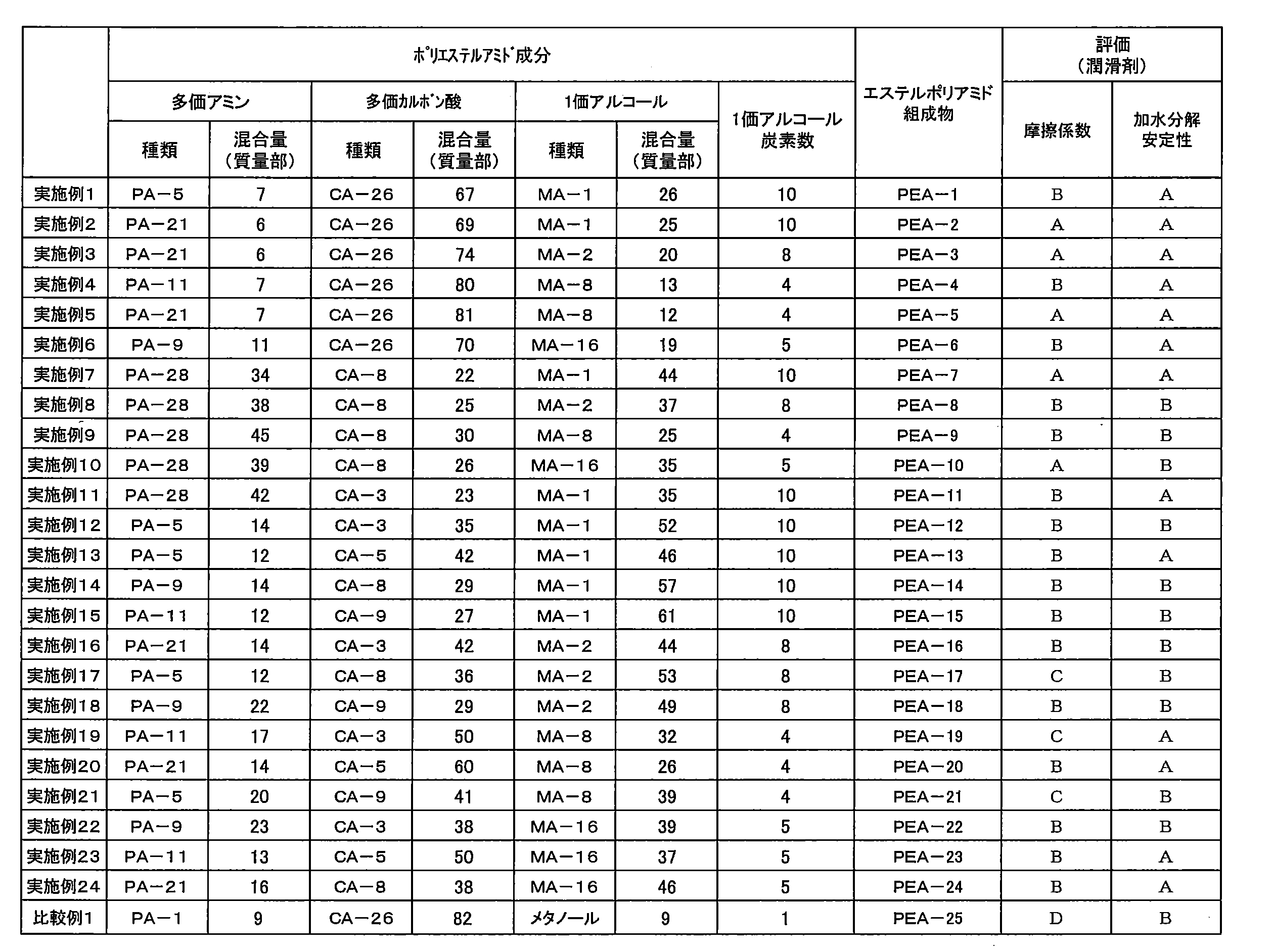
表1からわかるように、上記実施例1~24の試料の摩擦係数は、比較例の試料よりも、低いことが理解できる。従って、本発明の潤滑剤は、自動車のエンジンなどの内燃機関用、ギヤ油、自動変速機液、ショックアブソーバ油などの自動車用潤滑油として好適に用いることができる。
また、本発明の複合エステルポリアミド組成物はいずれも加水分解に対して安定であり、変質しにくい特性を有していることが分かる。
また、本発明の複合エステルポリアミド組成物はいずれも加水分解に対して安定であり、変質しにくい特性を有していることが分かる。
本発明によれば、高い潤滑性能を発揮し得る複合エステルポリアミド組成物を得ることができる。さらに、本発明によれば、優れた耐加水分解性を有する複合エステルポリアミド組成物を得ることができる。このため、本発明の複合エステルポリアミド組成物は、金属を腐食させることがなく、様々な用途において潤滑剤として好ましく用いられ、産業上の利用可能性が高い。
Claims (18)
- 少なくとも2つの1級または2級アミノ基を含む多価アミンと、少なくとも2つのカルボキシル基を含む多価カルボン酸と、炭素数4以上の1価アルコールとを縮合させることにより得られるエステルポリアミドを含むことを特徴とする複合エステルポリアミド組成物。
- 前記多価アミンと前記多価カルボン酸が下記の条件(i)又は(ii)を満たす請求項1に記載の複合エステルポリアミド組成物;
(i)多価アミンが2つの1級または2級アミノ基を含む2価アミンであり、かつ多価カルボン酸が3つ以上のカルボキシル基を含む多価カルボン酸である。
(ii)多価アミンが3つ以上の1級または2級アミノ基を含む多価アミンであり、かつ多価カルボン酸が2つのカルボキシル基を含む2価カルボン酸である。 - 前記エステルポリアミドの少なくとも1種は、下記一般式(1)で表される請求項1又は2に記載の複合エステルポリアミド組成物;


- 前記一般式(1)及び(2)において、mは1又は2の整数である請求項3に記載の複合エステルポリアミド組成物。
- 前記一般式(1)及び(2)において、R2の炭素数は22~66である請求項3又は4に記載の複合エステルポリアミド組成物。
- 前記一般式(1)及び(2)において、R2は、ダイマー酸残基又はトリマー酸残基である請求項3~5のいずれか1項に記載の複合エステルポリアミド組成物。
- 前記一般式(1)及び(2)において、R3の炭素数は6以上である請求項3~6のいずれか1項に記載の複合エステルポリアミド組成物。
- 前記一般式(1)及び(2)において、R3は、オキシアルキレン構造を有する基である請求項3~7のいずれか1項に記載の複合エステルポリアミド組成物。
- 前記1価アルコールは、下記一般式(3)で表される請求項1~8のいずれか1項に記載の複合エステルポリアミド組成物;

- 一般式(4)で表されるエステル成分をさらに含む請求項1~9のいずれか1項に記載の複合エステルポリアミド組成物;

- 40℃における粘度が50~1650mPasである請求項1~10のいずれか1項に記載の複合エステルポリアミド組成物。
- 請求項1~11のいずれか1項に記載の複合エステルポリアミド組成物と、摩耗防止剤、粘度指数向上剤、酸化防止剤、清浄剤、分散剤、流動、硬化剤、腐食防止剤、シール適合剤、消泡剤、錆防止剤、腐食防止剤、摩擦調整剤、及び増ちょう剤から選択される1種又は2種以上の添加剤とを含有する潤滑剤組成物。
- 請求項1~11のいずれか1項に記載の複合エステルポリアミド組成物、又は請求項12に記載の潤滑剤組成物と、鉱物油、油脂化合物、ポリオレフィン油、シリコーン油、パーフルオロポリエーテル油、ジフェニルエーテル油、芳香族エステル油、脂肪族モノエステル油、脂肪族ジエステル油、及びポリオールエステル潤滑油から選択される1種又は2種以上の媒体とを少なくとも含有する潤滑剤組成物。
- 請求項1~11のいずれか1項に記載の複合エステルポリアミド組成物、又は請求項12又は13に記載の潤滑剤組成物を含む潤滑剤。
- グリース用潤滑油、離型剤、内燃機関用エンジンオイル、金属加工用(切削用)オイル、軸受け用オイル、燃焼機関用燃料、車両エンジン油、ギヤ油、自動車用作動油、船舶・航空機用潤滑油、マシン油,タービン油、軸受用オイル、油圧作動油、圧縮機・真空ポンプ油、冷凍機油、金属加工用潤滑油剤、磁気記録媒体用潤滑剤、マイクロマシン用潤滑剤、人工骨用潤滑剤、ショックアブソーバ油又は圧延油として用いられる請求項14に記載の潤滑剤。
- 少なくとも2つの1級または2級アミノ基を含む多価アミンと、少なくとも2つのカルボキシル基を含む多価カルボン酸と、1価アルコールとを混合し混合物を得る工程と、前記混合物を脱水縮合する工程を含む複合エステルポリアミド組成物の製造方法。
- 前記混合物を得る工程は、前記多価アミンに対して、前記多価カルボン酸を混合する当量比が1~3となり、前記1価アルコールを混合する当量比が0.5~3となるように混合する工程である請求項16に記載の複合エステルポリアミド組成物の製造方法。
- 前記脱水縮合する工程は、前記混合物に対して1~25質量%の、沸点110~160℃の炭化水素系溶剤を添加し、水を共沸させつつ、脱水縮合を進行させる工程を含む請求項16又は17に記載の複合エステルポリアミド組成物の製造方法。
Priority Applications (1)
| Application Number | Priority Date | Filing Date | Title |
|---|---|---|---|
| JP2015529592A JPWO2015016259A1 (ja) | 2013-07-31 | 2014-07-30 | 複合エステルポリアミド組成物、潤滑剤組成物、潤滑剤及び複合エステルポリアミド組成物の製造方法 |
Applications Claiming Priority (2)
| Application Number | Priority Date | Filing Date | Title |
|---|---|---|---|
| JP2013-159831 | 2013-07-31 | ||
| JP2013159831 | 2013-07-31 |
Publications (1)
| Publication Number | Publication Date |
|---|---|
| WO2015016259A1 true WO2015016259A1 (ja) | 2015-02-05 |
Family
ID=52431789
Family Applications (1)
| Application Number | Title | Priority Date | Filing Date |
|---|---|---|---|
| PCT/JP2014/070057 Ceased WO2015016259A1 (ja) | 2013-07-31 | 2014-07-30 | 複合エステルポリアミド組成物、潤滑剤組成物、潤滑剤及び複合エステルポリアミド組成物の製造方法 |
Country Status (2)
| Country | Link |
|---|---|
| JP (1) | JPWO2015016259A1 (ja) |
| WO (1) | WO2015016259A1 (ja) |
Cited By (4)
| Publication number | Priority date | Publication date | Assignee | Title |
|---|---|---|---|---|
| CN105925345A (zh) * | 2016-05-10 | 2016-09-07 | 南京高崎电机有限公司 | 一种防腐蚀电机润滑油 |
| CN108219901A (zh) * | 2016-12-15 | 2018-06-29 | 斯凯孚公司 | 润滑脂组合物和用于制造其的方法 |
| CN108219900A (zh) * | 2016-12-15 | 2018-06-29 | 斯凯孚公司 | 润滑脂组合物和用于制造其的方法 |
| CN108456581A (zh) * | 2018-05-08 | 2018-08-28 | 四会市格鲁森润滑技术有限公司 | 一种自消泡型聚醚共聚物润滑剂及其制造方法 |
Citations (11)
| Publication number | Priority date | Publication date | Assignee | Title |
|---|---|---|---|---|
| JPS612793A (ja) * | 1984-06-14 | 1986-01-08 | Kao Corp | 燃料油の流動性改良剤 |
| JPH06145683A (ja) * | 1992-10-31 | 1994-05-27 | Tonen Corp | 自動変速機用潤滑油組成物 |
| JPH10265793A (ja) * | 1997-03-24 | 1998-10-06 | Tonen Corp | 自動変速機用潤滑油組成物 |
| JP2000072872A (ja) * | 1998-08-26 | 2000-03-07 | Nippon Zeon Co Ltd | ポリマー用改質剤、ポリマー組成物及び成形体 |
| JP2003193089A (ja) * | 2001-12-17 | 2003-07-09 | Internatl Flavors & Fragrances Inc | 透明な植物性の実質的に炭化水素を含まないろうそく製品 |
| JP2003261854A (ja) * | 2001-11-27 | 2003-09-19 | Sanyo Chem Ind Ltd | 吸湿もしくは吸放湿性付与剤 |
| JP2007045827A (ja) * | 2005-08-11 | 2007-02-22 | L'oreal Sa | 睫毛を伸長させるのに有用な化粧品用組成物 |
| JP2007204762A (ja) * | 1996-10-18 | 2007-08-16 | Union Camp Corp | 低極性液体中で透明ゲルを処方するのに有用な重合化脂肪酸のエステル末端ポリアミド |
| JP2008520795A (ja) * | 2004-11-19 | 2008-06-19 | クローダ インターナショナル パブリック リミティド カンパニー | ポリエステル分散剤を含む潤滑剤組成物 |
| WO2009139094A1 (ja) * | 2008-05-12 | 2009-11-19 | 高級アルコール工業株式会社 | 使用感と保存安定性に優れた化粧料およびその製法 |
| JP2010539189A (ja) * | 2007-09-17 | 2010-12-16 | アリゾナ・ケミカル・カンパニー・エルエルシー | ポリアミド及び皮膚軟化剤組成物、それらから製造した製品、並びにかかる組成物及び製品の製造法及び使用法 |
-
2014
- 2014-07-30 JP JP2015529592A patent/JPWO2015016259A1/ja active Pending
- 2014-07-30 WO PCT/JP2014/070057 patent/WO2015016259A1/ja not_active Ceased
Patent Citations (11)
| Publication number | Priority date | Publication date | Assignee | Title |
|---|---|---|---|---|
| JPS612793A (ja) * | 1984-06-14 | 1986-01-08 | Kao Corp | 燃料油の流動性改良剤 |
| JPH06145683A (ja) * | 1992-10-31 | 1994-05-27 | Tonen Corp | 自動変速機用潤滑油組成物 |
| JP2007204762A (ja) * | 1996-10-18 | 2007-08-16 | Union Camp Corp | 低極性液体中で透明ゲルを処方するのに有用な重合化脂肪酸のエステル末端ポリアミド |
| JPH10265793A (ja) * | 1997-03-24 | 1998-10-06 | Tonen Corp | 自動変速機用潤滑油組成物 |
| JP2000072872A (ja) * | 1998-08-26 | 2000-03-07 | Nippon Zeon Co Ltd | ポリマー用改質剤、ポリマー組成物及び成形体 |
| JP2003261854A (ja) * | 2001-11-27 | 2003-09-19 | Sanyo Chem Ind Ltd | 吸湿もしくは吸放湿性付与剤 |
| JP2003193089A (ja) * | 2001-12-17 | 2003-07-09 | Internatl Flavors & Fragrances Inc | 透明な植物性の実質的に炭化水素を含まないろうそく製品 |
| JP2008520795A (ja) * | 2004-11-19 | 2008-06-19 | クローダ インターナショナル パブリック リミティド カンパニー | ポリエステル分散剤を含む潤滑剤組成物 |
| JP2007045827A (ja) * | 2005-08-11 | 2007-02-22 | L'oreal Sa | 睫毛を伸長させるのに有用な化粧品用組成物 |
| JP2010539189A (ja) * | 2007-09-17 | 2010-12-16 | アリゾナ・ケミカル・カンパニー・エルエルシー | ポリアミド及び皮膚軟化剤組成物、それらから製造した製品、並びにかかる組成物及び製品の製造法及び使用法 |
| WO2009139094A1 (ja) * | 2008-05-12 | 2009-11-19 | 高級アルコール工業株式会社 | 使用感と保存安定性に優れた化粧料およびその製法 |
Cited By (8)
| Publication number | Priority date | Publication date | Assignee | Title |
|---|---|---|---|---|
| CN105925345A (zh) * | 2016-05-10 | 2016-09-07 | 南京高崎电机有限公司 | 一种防腐蚀电机润滑油 |
| CN108219901A (zh) * | 2016-12-15 | 2018-06-29 | 斯凯孚公司 | 润滑脂组合物和用于制造其的方法 |
| CN108219900A (zh) * | 2016-12-15 | 2018-06-29 | 斯凯孚公司 | 润滑脂组合物和用于制造其的方法 |
| US11149228B2 (en) | 2016-12-15 | 2021-10-19 | Aktiebolaget Skf | Grease compositions and method for making the same |
| CN108219900B (zh) * | 2016-12-15 | 2022-01-21 | 斯凯孚公司 | 润滑脂组合物和用于制造其的方法 |
| CN108219901B (zh) * | 2016-12-15 | 2022-01-21 | 斯凯孚公司 | 润滑脂组合物和用于制造其的方法 |
| US11629307B2 (en) | 2016-12-15 | 2023-04-18 | Aktiebolaget Skf | Grease compositions and a method for making the same |
| CN108456581A (zh) * | 2018-05-08 | 2018-08-28 | 四会市格鲁森润滑技术有限公司 | 一种自消泡型聚醚共聚物润滑剂及其制造方法 |
Also Published As
| Publication number | Publication date |
|---|---|
| JPWO2015016259A1 (ja) | 2017-03-02 |
Similar Documents
| Publication | Publication Date | Title |
|---|---|---|
| JP6113844B2 (ja) | 複合ポリエステル組成物、潤滑剤組成物、潤滑剤及び複合ポリエステル組成物の製造方法 | |
| JP6276958B2 (ja) | 複合ポリエステル組成物及び潤滑剤 | |
| US9663742B2 (en) | Production method for complex polyester composition, complex polyester composition, lubricant composition, and lubricant | |
| WO2015016259A1 (ja) | 複合エステルポリアミド組成物、潤滑剤組成物、潤滑剤及び複合エステルポリアミド組成物の製造方法 | |
| JP6676762B2 (ja) | 潤滑剤組成物の製造方法及び潤滑剤組成物 | |
| JP6155206B2 (ja) | 潤滑剤組成物 | |
| JP6218648B2 (ja) | 潤滑剤組成物および潤滑剤組成物の製造方法 | |
| JP6033138B2 (ja) | 複合ポリエステル組成物及び潤滑剤 | |
| CA3030539C (en) | Lubricant compositions comprising molybdenum compounds | |
| JP5975914B2 (ja) | 複合ポリエステルアミド組成物及び潤滑剤 | |
| JP2015071687A (ja) | 複合ポリアミドエステル組成物及び潤滑剤 | |
| JP2009007440A (ja) | 油類用添加剤およびこれを含有する潤滑油 | |
| JP6218640B2 (ja) | 潤滑剤組成物 | |
| JP2015071686A (ja) | 複合ポリエステル組成物及び潤滑剤 | |
| JP2024143834A (ja) | 摩擦低減剤及び潤滑油組成物 |
Legal Events
| Date | Code | Title | Description |
|---|---|---|---|
| 121 | Ep: the epo has been informed by wipo that ep was designated in this application |
Ref document number: 14831691 Country of ref document: EP Kind code of ref document: A1 |
|
| ENP | Entry into the national phase |
Ref document number: 2015529592 Country of ref document: JP Kind code of ref document: A |
|
| NENP | Non-entry into the national phase |
Ref country code: DE |
|
| 122 | Ep: pct application non-entry in european phase |
Ref document number: 14831691 Country of ref document: EP Kind code of ref document: A1 |