WO2014188762A1 - 感放射線性樹脂組成物、レジストパターン形成方法、酸拡散制御剤、化合物及び化合物の製造方法 - Google Patents
感放射線性樹脂組成物、レジストパターン形成方法、酸拡散制御剤、化合物及び化合物の製造方法 Download PDFInfo
- Publication number
- WO2014188762A1 WO2014188762A1 PCT/JP2014/056379 JP2014056379W WO2014188762A1 WO 2014188762 A1 WO2014188762 A1 WO 2014188762A1 JP 2014056379 W JP2014056379 W JP 2014056379W WO 2014188762 A1 WO2014188762 A1 WO 2014188762A1
- Authority
- WO
- WIPO (PCT)
- Prior art keywords
- group
- monovalent
- carbon atoms
- compound
- resin composition
- Prior art date
- Legal status (The legal status is an assumption and is not a legal conclusion. Google has not performed a legal analysis and makes no representation as to the accuracy of the status listed.)
- Ceased
Links
- 0 C*C(*)(C*(C)=C)C(O)OC(*)C(F)(F)F Chemical compound C*C(*)(C*(C)=C)C(O)OC(*)C(F)(F)F 0.000 description 1
- DNGANKYXEQAOOB-UHFFFAOYSA-N COc(cc1)ccc1S(C)(c(cc1)ccc1S(c1ccccc1)(=O)=O)c(cc1)ccc1S(c1ccccc1)(=O)=O Chemical compound COc(cc1)ccc1S(C)(c(cc1)ccc1S(c1ccccc1)(=O)=O)c(cc1)ccc1S(c1ccccc1)(=O)=O DNGANKYXEQAOOB-UHFFFAOYSA-N 0.000 description 1
- OFMNNFMSIBLBRV-UHFFFAOYSA-N O=S(C1CCCCC1)(c(cc1)ccc1S(c1ccccc1)c1ccccc1)=O Chemical compound O=S(C1CCCCC1)(c(cc1)ccc1S(c1ccccc1)c1ccccc1)=O OFMNNFMSIBLBRV-UHFFFAOYSA-N 0.000 description 1
- KYJOUMQXDYVHCR-UHFFFAOYSA-N O=S(c1ccccc1)(c(cc1)ccc1S(c1ccccc1)c(cc1)ccc1S(c1ccccc1)(=O)=O)=O Chemical compound O=S(c1ccccc1)(c(cc1)ccc1S(c1ccccc1)c(cc1)ccc1S(c1ccccc1)(=O)=O)=O KYJOUMQXDYVHCR-UHFFFAOYSA-N 0.000 description 1
- NYRGPJNHQQQXJA-UHFFFAOYSA-N O=S(c1ccccc1)(c(cc1)ccc1S(c1ccccc1)c1ccccc1)=O Chemical compound O=S(c1ccccc1)(c(cc1)ccc1S(c1ccccc1)c1ccccc1)=O NYRGPJNHQQQXJA-UHFFFAOYSA-N 0.000 description 1
- WLOQLWBIJZDHET-UHFFFAOYSA-N c(cc1)ccc1[S+](c1ccccc1)c1ccccc1 Chemical compound c(cc1)ccc1[S+](c1ccccc1)c1ccccc1 WLOQLWBIJZDHET-UHFFFAOYSA-N 0.000 description 1
Classifications
-
- G—PHYSICS
- G03—PHOTOGRAPHY; CINEMATOGRAPHY; ANALOGOUS TECHNIQUES USING WAVES OTHER THAN OPTICAL WAVES; ELECTROGRAPHY; HOLOGRAPHY
- G03F—PHOTOMECHANICAL PRODUCTION OF TEXTURED OR PATTERNED SURFACES, e.g. FOR PRINTING, FOR PROCESSING OF SEMICONDUCTOR DEVICES; MATERIALS THEREFOR; ORIGINALS THEREFOR; APPARATUS SPECIALLY ADAPTED THEREFOR
- G03F7/00—Photomechanical, e.g. photolithographic, production of textured or patterned surfaces, e.g. printing surfaces; Materials therefor, e.g. comprising photoresists; Apparatus specially adapted therefor
- G03F7/004—Photosensitive materials
- G03F7/0045—Photosensitive materials with organic non-macromolecular light-sensitive compounds not otherwise provided for, e.g. dissolution inhibitors
-
- C—CHEMISTRY; METALLURGY
- C07—ORGANIC CHEMISTRY
- C07C—ACYCLIC OR CARBOCYCLIC COMPOUNDS
- C07C327/00—Thiocarboxylic acids
- C07C327/02—Monothiocarboxylic acids
- C07C327/04—Monothiocarboxylic acids having carbon atoms of thiocarboxyl groups bound to hydrogen atoms or to acyclic carbon atoms
- C07C327/06—Monothiocarboxylic acids having carbon atoms of thiocarboxyl groups bound to hydrogen atoms or to acyclic carbon atoms to hydrogen atoms or to carbon atoms of an acyclic saturated carbon skeleton
-
- C—CHEMISTRY; METALLURGY
- C07—ORGANIC CHEMISTRY
- C07C—ACYCLIC OR CARBOCYCLIC COMPOUNDS
- C07C327/00—Thiocarboxylic acids
- C07C327/20—Esters of monothiocarboxylic acids
- C07C327/32—Esters of monothiocarboxylic acids having sulfur atoms of esterified thiocarboxyl groups bound to carbon atoms of hydrocarbon radicals substituted by carboxyl groups
-
- C—CHEMISTRY; METALLURGY
- C07—ORGANIC CHEMISTRY
- C07C—ACYCLIC OR CARBOCYCLIC COMPOUNDS
- C07C381/00—Compounds containing carbon and sulfur and having functional groups not covered by groups C07C301/00 - C07C337/00
- C07C381/12—Sulfonium compounds
-
- C—CHEMISTRY; METALLURGY
- C07—ORGANIC CHEMISTRY
- C07C—ACYCLIC OR CARBOCYCLIC COMPOUNDS
- C07C51/00—Preparation of carboxylic acids or their salts, halides or anhydrides
- C07C51/02—Preparation of carboxylic acids or their salts, halides or anhydrides from salts of carboxylic acids
-
- C—CHEMISTRY; METALLURGY
- C07—ORGANIC CHEMISTRY
- C07C—ACYCLIC OR CARBOCYCLIC COMPOUNDS
- C07C51/00—Preparation of carboxylic acids or their salts, halides or anhydrides
- C07C51/41—Preparation of salts of carboxylic acids
-
- C—CHEMISTRY; METALLURGY
- C07—ORGANIC CHEMISTRY
- C07C—ACYCLIC OR CARBOCYCLIC COMPOUNDS
- C07C59/00—Compounds having carboxyl groups bound to acyclic carbon atoms and containing any of the groups OH, O—metal, —CHO, keto, ether, groups, groups, or groups
- C07C59/185—Saturated compounds having only one carboxyl group and containing keto groups
-
- C—CHEMISTRY; METALLURGY
- C07—ORGANIC CHEMISTRY
- C07C—ACYCLIC OR CARBOCYCLIC COMPOUNDS
- C07C59/00—Compounds having carboxyl groups bound to acyclic carbon atoms and containing any of the groups OH, O—metal, —CHO, keto, ether, groups, groups, or groups
- C07C59/185—Saturated compounds having only one carboxyl group and containing keto groups
- C07C59/205—Saturated compounds having only one carboxyl group and containing keto groups containing rings
-
- C—CHEMISTRY; METALLURGY
- C07—ORGANIC CHEMISTRY
- C07C—ACYCLIC OR CARBOCYCLIC COMPOUNDS
- C07C59/00—Compounds having carboxyl groups bound to acyclic carbon atoms and containing any of the groups OH, O—metal, —CHO, keto, ether, groups, groups, or groups
- C07C59/185—Saturated compounds having only one carboxyl group and containing keto groups
- C07C59/21—Saturated compounds having only one carboxyl group and containing keto groups containing halogen
-
- C—CHEMISTRY; METALLURGY
- C07—ORGANIC CHEMISTRY
- C07C—ACYCLIC OR CARBOCYCLIC COMPOUNDS
- C07C59/00—Compounds having carboxyl groups bound to acyclic carbon atoms and containing any of the groups OH, O—metal, —CHO, keto, ether, groups, groups, or groups
- C07C59/40—Unsaturated compounds
- C07C59/76—Unsaturated compounds containing keto groups
- C07C59/84—Unsaturated compounds containing keto groups containing six membered aromatic rings
-
- C—CHEMISTRY; METALLURGY
- C07—ORGANIC CHEMISTRY
- C07C—ACYCLIC OR CARBOCYCLIC COMPOUNDS
- C07C67/00—Preparation of carboxylic acid esters
- C07C67/30—Preparation of carboxylic acid esters by modifying the acid moiety of the ester, such modification not being an introduction of an ester group
-
- C—CHEMISTRY; METALLURGY
- C07—ORGANIC CHEMISTRY
- C07C—ACYCLIC OR CARBOCYCLIC COMPOUNDS
- C07C69/00—Esters of carboxylic acids; Esters of carbonic or haloformic acids
- C07C69/34—Esters of acyclic saturated polycarboxylic acids having an esterified carboxyl group bound to an acyclic carbon atom
- C07C69/36—Oxalic acid esters
-
- C—CHEMISTRY; METALLURGY
- C07—ORGANIC CHEMISTRY
- C07C—ACYCLIC OR CARBOCYCLIC COMPOUNDS
- C07C69/00—Esters of carboxylic acids; Esters of carbonic or haloformic acids
- C07C69/62—Halogen-containing esters
- C07C69/63—Halogen-containing esters of saturated acids
-
- C—CHEMISTRY; METALLURGY
- C07—ORGANIC CHEMISTRY
- C07D—HETEROCYCLIC COMPOUNDS
- C07D307/00—Heterocyclic compounds containing five-membered rings having one oxygen atom as the only ring hetero atom
- C07D307/77—Heterocyclic compounds containing five-membered rings having one oxygen atom as the only ring hetero atom ortho- or peri-condensed with carbocyclic rings or ring systems
-
- C—CHEMISTRY; METALLURGY
- C07—ORGANIC CHEMISTRY
- C07D—HETEROCYCLIC COMPOUNDS
- C07D307/00—Heterocyclic compounds containing five-membered rings having one oxygen atom as the only ring hetero atom
- C07D307/77—Heterocyclic compounds containing five-membered rings having one oxygen atom as the only ring hetero atom ortho- or peri-condensed with carbocyclic rings or ring systems
- C07D307/93—Heterocyclic compounds containing five-membered rings having one oxygen atom as the only ring hetero atom ortho- or peri-condensed with carbocyclic rings or ring systems condensed with a ring other than six-membered
-
- C—CHEMISTRY; METALLURGY
- C07—ORGANIC CHEMISTRY
- C07D—HETEROCYCLIC COMPOUNDS
- C07D313/00—Heterocyclic compounds containing rings of more than six members having one oxygen atom as the only ring hetero atom
- C07D313/02—Seven-membered rings
- C07D313/04—Seven-membered rings not condensed with other rings
-
- C—CHEMISTRY; METALLURGY
- C07—ORGANIC CHEMISTRY
- C07D—HETEROCYCLIC COMPOUNDS
- C07D313/00—Heterocyclic compounds containing rings of more than six members having one oxygen atom as the only ring hetero atom
- C07D313/02—Seven-membered rings
- C07D313/06—Seven-membered rings condensed with carbocyclic rings or ring systems
- C07D313/10—Seven-membered rings condensed with carbocyclic rings or ring systems condensed with two six-membered rings
-
- C—CHEMISTRY; METALLURGY
- C07—ORGANIC CHEMISTRY
- C07D—HETEROCYCLIC COMPOUNDS
- C07D315/00—Heterocyclic compounds containing rings having one oxygen atom as the only ring hetero atom according to more than one of groups C07D303/00 - C07D313/00
-
- C—CHEMISTRY; METALLURGY
- C07—ORGANIC CHEMISTRY
- C07D—HETEROCYCLIC COMPOUNDS
- C07D317/00—Heterocyclic compounds containing five-membered rings having two oxygen atoms as the only ring hetero atoms
- C07D317/08—Heterocyclic compounds containing five-membered rings having two oxygen atoms as the only ring hetero atoms having the hetero atoms in positions 1 and 3
- C07D317/44—Heterocyclic compounds containing five-membered rings having two oxygen atoms as the only ring hetero atoms having the hetero atoms in positions 1 and 3 ortho- or peri-condensed with carbocyclic rings or ring systems
- C07D317/46—Heterocyclic compounds containing five-membered rings having two oxygen atoms as the only ring hetero atoms having the hetero atoms in positions 1 and 3 ortho- or peri-condensed with carbocyclic rings or ring systems condensed with one six-membered ring
-
- C—CHEMISTRY; METALLURGY
- C07—ORGANIC CHEMISTRY
- C07D—HETEROCYCLIC COMPOUNDS
- C07D317/00—Heterocyclic compounds containing five-membered rings having two oxygen atoms as the only ring hetero atoms
- C07D317/08—Heterocyclic compounds containing five-membered rings having two oxygen atoms as the only ring hetero atoms having the hetero atoms in positions 1 and 3
- C07D317/72—Heterocyclic compounds containing five-membered rings having two oxygen atoms as the only ring hetero atoms having the hetero atoms in positions 1 and 3 spiro-condensed with carbocyclic rings
-
- C—CHEMISTRY; METALLURGY
- C07—ORGANIC CHEMISTRY
- C07D—HETEROCYCLIC COMPOUNDS
- C07D327/00—Heterocyclic compounds containing rings having oxygen and sulfur atoms as the only ring hetero atoms
- C07D327/02—Heterocyclic compounds containing rings having oxygen and sulfur atoms as the only ring hetero atoms one oxygen atom and one sulfur atom
- C07D327/04—Five-membered rings
-
- C—CHEMISTRY; METALLURGY
- C08—ORGANIC MACROMOLECULAR COMPOUNDS; THEIR PREPARATION OR CHEMICAL WORKING-UP; COMPOSITIONS BASED THEREON
- C08F—MACROMOLECULAR COMPOUNDS OBTAINED BY REACTIONS ONLY INVOLVING CARBON-TO-CARBON UNSATURATED BONDS
- C08F12/00—Homopolymers and copolymers of compounds having one or more unsaturated aliphatic radicals, each having only one carbon-to-carbon double bond, and at least one being terminated by an aromatic carbocyclic ring
- C08F12/02—Monomers containing only one unsaturated aliphatic radical
- C08F12/04—Monomers containing only one unsaturated aliphatic radical containing one ring
- C08F12/14—Monomers containing only one unsaturated aliphatic radical containing one ring substituted by hetero atoms or groups containing heteroatoms
- C08F12/22—Oxygen
- C08F12/24—Phenols or alcohols
-
- C—CHEMISTRY; METALLURGY
- C08—ORGANIC MACROMOLECULAR COMPOUNDS; THEIR PREPARATION OR CHEMICAL WORKING-UP; COMPOSITIONS BASED THEREON
- C08F—MACROMOLECULAR COMPOUNDS OBTAINED BY REACTIONS ONLY INVOLVING CARBON-TO-CARBON UNSATURATED BONDS
- C08F2/00—Processes of polymerisation
- C08F2/38—Polymerisation using regulators, e.g. chain terminating agents, e.g. telomerisation
-
- C—CHEMISTRY; METALLURGY
- C08—ORGANIC MACROMOLECULAR COMPOUNDS; THEIR PREPARATION OR CHEMICAL WORKING-UP; COMPOSITIONS BASED THEREON
- C08F—MACROMOLECULAR COMPOUNDS OBTAINED BY REACTIONS ONLY INVOLVING CARBON-TO-CARBON UNSATURATED BONDS
- C08F4/00—Polymerisation catalysts
-
- G—PHYSICS
- G03—PHOTOGRAPHY; CINEMATOGRAPHY; ANALOGOUS TECHNIQUES USING WAVES OTHER THAN OPTICAL WAVES; ELECTROGRAPHY; HOLOGRAPHY
- G03F—PHOTOMECHANICAL PRODUCTION OF TEXTURED OR PATTERNED SURFACES, e.g. FOR PRINTING, FOR PROCESSING OF SEMICONDUCTOR DEVICES; MATERIALS THEREFOR; ORIGINALS THEREFOR; APPARATUS SPECIALLY ADAPTED THEREFOR
- G03F7/00—Photomechanical, e.g. photolithographic, production of textured or patterned surfaces, e.g. printing surfaces; Materials therefor, e.g. comprising photoresists; Apparatus specially adapted therefor
- G03F7/004—Photosensitive materials
-
- G—PHYSICS
- G03—PHOTOGRAPHY; CINEMATOGRAPHY; ANALOGOUS TECHNIQUES USING WAVES OTHER THAN OPTICAL WAVES; ELECTROGRAPHY; HOLOGRAPHY
- G03F—PHOTOMECHANICAL PRODUCTION OF TEXTURED OR PATTERNED SURFACES, e.g. FOR PRINTING, FOR PROCESSING OF SEMICONDUCTOR DEVICES; MATERIALS THEREFOR; ORIGINALS THEREFOR; APPARATUS SPECIALLY ADAPTED THEREFOR
- G03F7/00—Photomechanical, e.g. photolithographic, production of textured or patterned surfaces, e.g. printing surfaces; Materials therefor, e.g. comprising photoresists; Apparatus specially adapted therefor
- G03F7/004—Photosensitive materials
- G03F7/0046—Photosensitive materials with perfluoro compounds, e.g. for dry lithography
-
- G—PHYSICS
- G03—PHOTOGRAPHY; CINEMATOGRAPHY; ANALOGOUS TECHNIQUES USING WAVES OTHER THAN OPTICAL WAVES; ELECTROGRAPHY; HOLOGRAPHY
- G03F—PHOTOMECHANICAL PRODUCTION OF TEXTURED OR PATTERNED SURFACES, e.g. FOR PRINTING, FOR PROCESSING OF SEMICONDUCTOR DEVICES; MATERIALS THEREFOR; ORIGINALS THEREFOR; APPARATUS SPECIALLY ADAPTED THEREFOR
- G03F7/00—Photomechanical, e.g. photolithographic, production of textured or patterned surfaces, e.g. printing surfaces; Materials therefor, e.g. comprising photoresists; Apparatus specially adapted therefor
- G03F7/004—Photosensitive materials
- G03F7/038—Macromolecular compounds which are rendered insoluble or differentially wettable
-
- G—PHYSICS
- G03—PHOTOGRAPHY; CINEMATOGRAPHY; ANALOGOUS TECHNIQUES USING WAVES OTHER THAN OPTICAL WAVES; ELECTROGRAPHY; HOLOGRAPHY
- G03F—PHOTOMECHANICAL PRODUCTION OF TEXTURED OR PATTERNED SURFACES, e.g. FOR PRINTING, FOR PROCESSING OF SEMICONDUCTOR DEVICES; MATERIALS THEREFOR; ORIGINALS THEREFOR; APPARATUS SPECIALLY ADAPTED THEREFOR
- G03F7/00—Photomechanical, e.g. photolithographic, production of textured or patterned surfaces, e.g. printing surfaces; Materials therefor, e.g. comprising photoresists; Apparatus specially adapted therefor
- G03F7/004—Photosensitive materials
- G03F7/039—Macromolecular compounds which are photodegradable, e.g. positive electron resists
-
- G—PHYSICS
- G03—PHOTOGRAPHY; CINEMATOGRAPHY; ANALOGOUS TECHNIQUES USING WAVES OTHER THAN OPTICAL WAVES; ELECTROGRAPHY; HOLOGRAPHY
- G03F—PHOTOMECHANICAL PRODUCTION OF TEXTURED OR PATTERNED SURFACES, e.g. FOR PRINTING, FOR PROCESSING OF SEMICONDUCTOR DEVICES; MATERIALS THEREFOR; ORIGINALS THEREFOR; APPARATUS SPECIALLY ADAPTED THEREFOR
- G03F7/00—Photomechanical, e.g. photolithographic, production of textured or patterned surfaces, e.g. printing surfaces; Materials therefor, e.g. comprising photoresists; Apparatus specially adapted therefor
- G03F7/004—Photosensitive materials
- G03F7/039—Macromolecular compounds which are photodegradable, e.g. positive electron resists
- G03F7/0392—Macromolecular compounds which are photodegradable, e.g. positive electron resists the macromolecular compound being present in a chemically amplified positive photoresist composition
- G03F7/0397—Macromolecular compounds which are photodegradable, e.g. positive electron resists the macromolecular compound being present in a chemically amplified positive photoresist composition the macromolecular compound having an alicyclic moiety in a side chain
-
- G—PHYSICS
- G03—PHOTOGRAPHY; CINEMATOGRAPHY; ANALOGOUS TECHNIQUES USING WAVES OTHER THAN OPTICAL WAVES; ELECTROGRAPHY; HOLOGRAPHY
- G03F—PHOTOMECHANICAL PRODUCTION OF TEXTURED OR PATTERNED SURFACES, e.g. FOR PRINTING, FOR PROCESSING OF SEMICONDUCTOR DEVICES; MATERIALS THEREFOR; ORIGINALS THEREFOR; APPARATUS SPECIALLY ADAPTED THEREFOR
- G03F7/00—Photomechanical, e.g. photolithographic, production of textured or patterned surfaces, e.g. printing surfaces; Materials therefor, e.g. comprising photoresists; Apparatus specially adapted therefor
- G03F7/20—Exposure; Apparatus therefor
- G03F7/2041—Exposure; Apparatus therefor in the presence of a fluid, e.g. immersion; using fluid cooling means
-
- G—PHYSICS
- G03—PHOTOGRAPHY; CINEMATOGRAPHY; ANALOGOUS TECHNIQUES USING WAVES OTHER THAN OPTICAL WAVES; ELECTROGRAPHY; HOLOGRAPHY
- G03F—PHOTOMECHANICAL PRODUCTION OF TEXTURED OR PATTERNED SURFACES, e.g. FOR PRINTING, FOR PROCESSING OF SEMICONDUCTOR DEVICES; MATERIALS THEREFOR; ORIGINALS THEREFOR; APPARATUS SPECIALLY ADAPTED THEREFOR
- G03F7/00—Photomechanical, e.g. photolithographic, production of textured or patterned surfaces, e.g. printing surfaces; Materials therefor, e.g. comprising photoresists; Apparatus specially adapted therefor
- G03F7/26—Processing photosensitive materials; Apparatus therefor
- G03F7/30—Imagewise removal using liquid means
-
- G—PHYSICS
- G03—PHOTOGRAPHY; CINEMATOGRAPHY; ANALOGOUS TECHNIQUES USING WAVES OTHER THAN OPTICAL WAVES; ELECTROGRAPHY; HOLOGRAPHY
- G03F—PHOTOMECHANICAL PRODUCTION OF TEXTURED OR PATTERNED SURFACES, e.g. FOR PRINTING, FOR PROCESSING OF SEMICONDUCTOR DEVICES; MATERIALS THEREFOR; ORIGINALS THEREFOR; APPARATUS SPECIALLY ADAPTED THEREFOR
- G03F7/00—Photomechanical, e.g. photolithographic, production of textured or patterned surfaces, e.g. printing surfaces; Materials therefor, e.g. comprising photoresists; Apparatus specially adapted therefor
- G03F7/26—Processing photosensitive materials; Apparatus therefor
- G03F7/30—Imagewise removal using liquid means
- G03F7/32—Liquid compositions therefor, e.g. developers
- G03F7/322—Aqueous alkaline compositions
-
- G—PHYSICS
- G03—PHOTOGRAPHY; CINEMATOGRAPHY; ANALOGOUS TECHNIQUES USING WAVES OTHER THAN OPTICAL WAVES; ELECTROGRAPHY; HOLOGRAPHY
- G03F—PHOTOMECHANICAL PRODUCTION OF TEXTURED OR PATTERNED SURFACES, e.g. FOR PRINTING, FOR PROCESSING OF SEMICONDUCTOR DEVICES; MATERIALS THEREFOR; ORIGINALS THEREFOR; APPARATUS SPECIALLY ADAPTED THEREFOR
- G03F7/00—Photomechanical, e.g. photolithographic, production of textured or patterned surfaces, e.g. printing surfaces; Materials therefor, e.g. comprising photoresists; Apparatus specially adapted therefor
- G03F7/26—Processing photosensitive materials; Apparatus therefor
- G03F7/30—Imagewise removal using liquid means
- G03F7/32—Liquid compositions therefor, e.g. developers
- G03F7/325—Non-aqueous compositions
-
- C—CHEMISTRY; METALLURGY
- C07—ORGANIC CHEMISTRY
- C07C—ACYCLIC OR CARBOCYCLIC COMPOUNDS
- C07C2601/00—Systems containing only non-condensed rings
- C07C2601/06—Systems containing only non-condensed rings with a five-membered ring
- C07C2601/08—Systems containing only non-condensed rings with a five-membered ring the ring being saturated
-
- C—CHEMISTRY; METALLURGY
- C07—ORGANIC CHEMISTRY
- C07C—ACYCLIC OR CARBOCYCLIC COMPOUNDS
- C07C2601/00—Systems containing only non-condensed rings
- C07C2601/12—Systems containing only non-condensed rings with a six-membered ring
- C07C2601/14—The ring being saturated
-
- C—CHEMISTRY; METALLURGY
- C07—ORGANIC CHEMISTRY
- C07C—ACYCLIC OR CARBOCYCLIC COMPOUNDS
- C07C2601/00—Systems containing only non-condensed rings
- C07C2601/18—Systems containing only non-condensed rings with a ring being at least seven-membered
-
- C—CHEMISTRY; METALLURGY
- C07—ORGANIC CHEMISTRY
- C07C—ACYCLIC OR CARBOCYCLIC COMPOUNDS
- C07C2603/00—Systems containing at least three condensed rings
- C07C2603/56—Ring systems containing bridged rings
- C07C2603/58—Ring systems containing bridged rings containing three rings
- C07C2603/70—Ring systems containing bridged rings containing three rings containing only six-membered rings
- C07C2603/74—Adamantanes
-
- C—CHEMISTRY; METALLURGY
- C08—ORGANIC MACROMOLECULAR COMPOUNDS; THEIR PREPARATION OR CHEMICAL WORKING-UP; COMPOSITIONS BASED THEREON
- C08F—MACROMOLECULAR COMPOUNDS OBTAINED BY REACTIONS ONLY INVOLVING CARBON-TO-CARBON UNSATURATED BONDS
- C08F212/00—Copolymers of compounds having one or more unsaturated aliphatic radicals, each having only one carbon-to-carbon double bond, and at least one being terminated by an aromatic carbocyclic ring
- C08F212/02—Monomers containing only one unsaturated aliphatic radical
- C08F212/04—Monomers containing only one unsaturated aliphatic radical containing one ring
- C08F212/14—Monomers containing only one unsaturated aliphatic radical containing one ring substituted by heteroatoms or groups containing heteroatoms
Definitions
- the present invention relates to a radiation-sensitive resin composition, a resist pattern forming method, an acid diffusion controller, a compound and a method for producing the compound.
- the radiation-sensitive resin composition used for microfabrication by lithography is designed to irradiate the exposed area by irradiation with deep ultraviolet rays such as ArF excimer laser light and KrF excimer laser light, charged ultraviolet rays such as extreme ultraviolet rays (EUV) and electron beams.
- deep ultraviolet rays such as ArF excimer laser light and KrF excimer laser light
- charged ultraviolet rays such as extreme ultraviolet rays (EUV)
- EUV extreme ultraviolet rays
- a chemical reaction using this acid as a catalyst causes a difference in dissolution rate between the exposed portion and the unexposed portion in the developer, thereby forming a resist pattern on the substrate.
- Such a radiation-sensitive resin composition is required to improve the resolution and the rectangularity of the cross-sectional shape of the resist pattern as the processing technology becomes finer.
- the types and molecular structures of polymers, acid generators and other components used in the composition have been studied, and further their combinations have been studied in detail (Japanese Patent Application Laid-Open No. 11-125907, special features). (See Kaihei 08-146610 and JP-A 2000-298347).
- the resolution and the rectangular shape of the cross-sectional shape are not satisfactorily satisfied at present when the miniaturization of the resist pattern is progressing.
- it is required to improve the line width roughness (LWR) performance indicating the variation in the line width of the resist pattern, and to improve the depth of focus in order to improve process stability.
- LWR line width roughness
- This invention is made
- the objective is to provide the radiation sensitive resin composition which is excellent in LWR performance, resolution, rectangularity of a cross-sectional shape, and a focal depth. .
- a polymer having a structural unit containing an acid-dissociable group (hereinafter also referred to as “structural unit (I)”), and a compound represented by the following formula (1) (Hereinafter also referred to as “[B] compound”) Is a radiation-sensitive resin composition.
- structural unit (I) an acid-dissociable group
- [B] compound a compound represented by the following formula (1)
- R 1 is a monovalent organic group having 1 to 30 carbon atoms.
- L is a single bond, an oxygen atom or a sulfur atom.
- M + is a monovalent radiolytic onium. Cation.
- the resist pattern forming method of the present invention comprises: Forming a resist film; A step of exposing the resist film, and a step of developing the exposed resist film, The resist film is formed from the radiation sensitive resin composition.
- the acid diffusion controller of the present invention is It consists of a compound represented by the following formula (1).
- R 1 is a monovalent organic group having 1 to 30 carbon atoms.
- L is a single bond, an oxygen atom or a sulfur atom.
- M + is a monovalent radiolytic onium. Cation.
- R 1 is a monovalent organic group having 1 to 30 carbon atoms.
- L is a single bond, an oxygen atom or a sulfur atom.
- M + is a monovalent radiolytic onium. Cation.
- the method for producing the compound of the present invention comprises: It is a manufacturing method of the compound represented by following formula (1) which has a process with which the compound represented by following formula (1a) and the compound represented by following formula (1b) are made to react.
- R 1 is a monovalent organic group having 1 to 30 carbon atoms.
- L is a single bond, an oxygen atom or a sulfur atom.
- Q + is A monovalent alkali metal cation or a monovalent organic ammonium cation
- M + is a monovalent radiolytic onium cation
- Y ⁇ is a monovalent halogen anion or a monovalent methylsulfate anion. .
- organic group means a group containing at least one carbon atom.
- the radiation-sensitive resin composition and the resist pattern forming method of the present invention it is possible to form a resist pattern that exhibits a wide depth of focus, a low LWR, a high resolution, and an excellent cross-sectional rectangularity. it can.
- the acid diffusion controller of the present invention can be suitably used as a component of the radiation sensitive resin composition.
- the compound of the present invention can be suitably used as the acid diffusion controller.
- the method for producing a compound of the present invention the compound can be produced simply and with good yield. Therefore, these can be suitably used for manufacturing processes and the like in semiconductor devices that are expected to be further miniaturized in the future.
- the radiation sensitive resin composition contains a [A] polymer and a [B] compound. Moreover, the said radiation sensitive resin composition is an acid diffusion control agent (henceforth "[D] others which consist of compounds other than a [C] radiation sensitive acid generator and a [D] [B] compound as a suitable component.”
- the acid diffusion control agent ”, [E] fluorine atom-containing polymer (hereinafter also referred to as“ [E] polymer ”) and [F] solvent may be contained, and the effects of the present invention are not impaired.
- Other optional components may be contained within the range. Hereinafter, each component will be described.
- the polymer is a polymer having the structural unit (I).
- the acid-dissociable group of the [A] polymer in the exposed area is dissociated by irradiation with radiation, resulting in a difference in solubility in the developer between the exposed area and the unexposed area.
- a resist pattern can be formed.
- the “acid-dissociable group” refers to a group that replaces a hydrogen atom such as a carboxy group or a hydroxy group and dissociates by the action of an acid.
- the polymer is not particularly limited as long as it contains an acid-dissociable group, and may be present anywhere in the main chain, side chain, terminal and the like.
- the polymer includes, in addition to the structural unit (I), a structural unit (II) containing a non-dissociable and polar group, a structural unit (III) represented by the following formula (4), and Other structural units other than the structural units (I) to (III) may be included.
- the polymer may have one or more of each structural unit. Hereinafter, each structural unit will be described.
- the structural unit (I) is a structural unit containing an acid dissociable group.
- Examples of the structural unit (I) include a structural unit represented by the following formula (2-1) (hereinafter, also referred to as “structural unit (I-1)”), and a structural unit represented by the following formula (2-2). And a structural unit (hereinafter also referred to as “structural unit (I-2)”).
- R 2 is a hydrogen atom, a fluorine atom, a methyl group or a trifluoromethyl group.
- Y 1 is a monovalent acid dissociable group.
- R 3 is a hydrogen atom or a methyl group.
- Y 2 is a monovalent acid dissociable group.
- R 2 is preferably a hydrogen atom or a methyl group, and more preferably a methyl group, from the viewpoint of the copolymerizability of the monomer that provides the structural unit (I-1).
- the monovalent acid-dissociable group represented by Y preferably a group represented by the following formula (Y-1).
- R e1 is a monovalent hydrocarbon group having 1 to 20 carbon atoms.
- R e2 and R e3 is independently a monovalent alicyclic hydrocarbon group having a monovalent chain hydrocarbon group or a C 3 to C 20 1 to 10 carbon atoms, or R e2 and R e3 represents an alicyclic structure having 3 to 20 ring carbon atoms, which is composed of carbon atoms to which e3 is bonded to each other.
- Examples of the monovalent hydrocarbon group having 1 to 20 carbon atoms represented by R e1 include monovalent chain hydrocarbon groups having 1 to 10 carbon atoms and monovalent alicyclic rings having 3 to 20 carbon atoms. And a monovalent aromatic hydrocarbon group having 6 to 20 carbon atoms.
- Examples of the monovalent chain hydrocarbon group having 1 to 10 carbon atoms represented by R e1 , R e2 and R e3 include, for example, Alkyl groups such as methyl, ethyl, n-propyl, i-propyl, n-butyl, i-butyl, sec-butyl, t-butyl and n-pentyl; Alkenyl groups such as ethenyl group, propenyl group, butenyl group, pentenyl group; Examples include alkynyl groups such as ethynyl group, propynyl group, butynyl group, and pentynyl group.
- an alkyl group is preferable, an alkyl group having 1 to 4 carbon atoms is preferable, a methyl group, an ethyl group, and an i-propyl group are more preferable, and an ethyl group is particularly preferable.
- Examples of the monovalent alicyclic hydrocarbon group having 3 to 20 carbon atoms represented by R e1 , R e2 and R e3 include, for example, A monocyclic cycloalkyl group such as a cyclopropyl group, a cyclobutyl group, a cyclopentyl group, a cyclohexyl group, a cyclooctyl group; A polycyclic cycloalkyl group such as a norbornyl group, an adamantyl group, a tricyclodecyl group, a tetracyclododecyl group; A monocyclic cycloalkenyl group such as a cyclopropenyl group, a cyclobutenyl group, a cyclopentenyl group, a cyclohexenyl group; And polycyclic cycloalkenyl groups such as a norbornenyl group and a tricyclodecen
- a monocyclic cycloalkyl group and a polycyclic cycloalkyl group are preferable, and a cyclopentyl group, a cyclohexyl group, a norbornyl group, and an adamantyl group are more preferable.
- Examples of the monovalent aromatic hydrocarbon group having 6 to 20 carbon atoms represented by R e1 include, for example, Aryl groups such as phenyl, tolyl, xylyl, naphthyl and anthryl; Examples thereof include aralkyl groups such as benzyl group, phenethyl group, and naphthylmethyl group.
- Examples of the alicyclic structure having 3 to 20 ring carbon atoms represented by the carbon atoms to which these groups are combined and bonded to each other include, for example, Monocyclic cycloalkane structures such as cyclopropane structure, cyclobutane structure, cyclopentane structure, cyclohexane structure, cyclooctane structure; Polycyclic cycloalkane structures such as norbornane structure, adamantane structure, tricyclodecane structure and tetracyclododecane structure; Monocyclic cycloalkene structures such as cyclopropene structure, cyclobutene structure, cyclopentene structure, cyclohexene structure, cyclooctene structure; Examples thereof include polycyclic cycloalkene structures such as a norbornene structure, a tricyclodecene structure, and a tetracyclododecene structure.
- a monocyclic cycloalkane structure and a polycyclic cycloalkane structure are preferable, a monocyclic cycloalkane structure having 5 to 8 carbon atoms, and a polycyclic cycloalkane structure having 7 to 12 carbon atoms are more preferable, A cyclopentane structure, a cyclohexane structure, a cyclooctane structure, a norbornane structure, and an adamantane structure are more preferable, and a cyclopentane structure and an adamantane structure are particularly preferable.
- the alicyclic structure may have a substituent. Examples of the substituent include a hydroxy group, a carboxy group, and a cyano group.
- Examples of the group represented by the formula (Y-1) include carbon atoms to which R e1 is a monovalent chain hydrocarbon group having 1 to 10 carbon atoms, and R e2 and R e3 are combined with each other. It is preferable to represent an alicyclic structure having 3 to 20 ring carbon atoms that is formed together with atoms, wherein R e1 is an alkyl group having 1 to 10 carbon atoms, and R e2 and R e3 are combined with each other and bonded to each other More preferably, it represents a cycloalkane structure having 3 to 20 ring carbon atoms, which is formed together with atoms, R e1 is an alkyl group having 1 to 4 carbon atoms, and R e2 and R e3 are combined with each other and bonded to each other.
- it represents a monocyclic cycloalkane structure having 5 to 8 ring carbon atoms or a polycyclic cycloalkane structure having 7 to 12 ring carbon atoms, which is constituted together with carbon atoms, and 1-ethyl-1-cyclopentyl.
- 2-ethyl-2-adamantyl group is particularly preferred.
- R 3 is preferably a hydrogen atom from the viewpoint of the copolymerizability of the monomer giving the structural unit (I-2).
- the monovalent acid-dissociable group represented by Y 2 preferably a group represented by the following formula (Y-2).
- R e4 , R e5 and R e6 are each independently a hydrogen atom, a monovalent chain hydrocarbon group having 1 to 20 carbon atoms, or a monovalent group having 3 to 20 carbon atoms.
- R e4 , R e5 and R e6 are not simultaneously hydrogen atoms.
- Examples of the monovalent chain hydrocarbon group having 1 to 20 carbon atoms represented by R e4 , R e5 and R e6 include, for example, Alkyl groups such as methyl, ethyl, n-propyl, i-propyl, n-butyl, i-butyl, sec-butyl, t-butyl and n-pentyl; Alkenyl groups such as ethenyl group, propenyl group, butenyl group, pentenyl group; Examples include alkynyl groups such as ethynyl group, propynyl group, butynyl group, and pentynyl group.
- an alkyl group is preferable, an alkyl group having 1 to 4 carbon atoms is preferable, a methyl group, an ethyl group, and an n-propyl group are more preferable, and a methyl group is particularly preferable.
- Examples of the monovalent alicyclic hydrocarbon group having 3 to 20 carbon atoms represented by the above R e4 , R e5 and R e6 include the same groups as those exemplified as the above R e1 , R e2 and R e3. Etc. Among these, a monocyclic cycloalkyl group and a polycyclic cycloalkyl group are preferable, and a cyclopentyl group, a cyclohexyl group, a norbornyl group, and an adamantyl group are more preferable.
- Examples of the monovalent oxy-chain hydrocarbon group having 1 to 20 carbon atoms represented by R e4 , R e5 and R e6 include, for example, Alkoxy groups such as methoxy group, ethoxy group, n-propoxy group, i-propoxy group, n-butoxy group, i-butoxy group, sec-butoxy group, t-butoxy group and n-pentyloxy group; Alkenyloxy groups such as ethenyloxy group, propenyloxy group, butenyloxy group, pentenyloxy group; Examples include alkynyloxy groups such as ethynyloxy group, propynyloxy group, butynyloxy group, and pentynyloxy group. Of these, an alkoxy group is preferable, an alkoxy group having 1 to 4 carbon atoms is preferable, and a methoxy group, an ethoxy group, and an n-propoxy group are more preferable.
- Examples of the monovalent oxyalicyclic hydrocarbon group having 3 to 20 carbon atoms represented by R e4 , R e5 and R e6 include, for example, A monocyclic cycloalkyloxy group such as a cyclopropyloxy group, a cyclobutyloxy group, a cyclopentyloxy group, a cyclohexyloxy group, a cyclooctyloxy group; A polycyclic cycloalkyloxy group such as a norbornyloxy group, an adamantyloxy group, a tricyclodecyloxy group, a tetracyclododecyloxy group; A monocyclic cycloalkenyloxy group such as a cyclopropenyloxy group, a cyclobutenyloxy group, a cyclopentenyloxy group, a cyclohexenyloxy group; Examples thereof include polycyclic cycloalkenyloxy
- a monocyclic cycloalkyloxy group and a polycyclic cycloalkyloxy group are preferable, and a cyclopentyloxy group, a cyclohexyloxy group, a norbornyloxy group, and an adamantyloxy group are more preferable.
- Examples of the group represented by the formula (Y-2) include a group in which R e4 , R e5 and R e6 are monovalent chain hydrocarbon groups, and R e4 and R e5 are monovalent chain hydrocarbon groups. And R e6 is a monovalent oxy chain hydrocarbon group, R e4 is a monovalent chain hydrocarbon group, and R e5 and R e6 are monovalent oxy chain hydrocarbon groups, A group in which R e4 , R e5 and R e6 are alkyl groups, a group in which R e4 and R e5 are alkyl groups and R e6 is an alkoxy group, a group in which R e4 is an alkyl group and R e5 and R e6 are alkoxy groups Are more preferable, and groups in which R e4 , R e5 and R e6 are alkyl groups are more preferable, and a t-butyl group, a t-pentyl group, a
- structural unit (I) for example, As the structural unit (I-1), structural units represented by the following formulas (2-1-1) to (2-1-7); Examples of the structural unit (I-2) include structural units represented by the following formulas (2-2-1) to (2-2-3).
- R 2 has the same meaning as in the above formula (2-1).
- R e1 , R e2 and R e3 have the same meaning as in the above formula (Y-1).
- Each r is independently an integer of 1 to 3.
- R 3 has the same meaning as the above formula (2-2).
- the structural unit (I) is preferable, and the structural unit represented by the above formula (2-1-2) and the structural unit represented by the above formula (2-1-3) are preferable. More preferably, a group containing a cyclopentane structure or a group containing an adamantane structure is more preferred, a structural unit derived from 1-ethyl-1-cyclopentyl (meth) acrylate, derived from 2-ethyl-2-adamantyl (meth) acrylate Structural units are particularly preferred.
- the content ratio of the structural unit (I) is preferably 10 mol% to 90 mol%, more preferably 20 mol% to 70 mol%, more preferably 30 mol% with respect to all the structural units constituting the [A] polymer. -60 mol% is more preferable, and 40 mol% to 60 mol% is particularly preferable.
- the structural unit (II) is a structural unit containing a non-dissociable and polar group.
- the [B] compound can improve the dispersibility in the [A] polymer.
- the radiation sensitive resin composition can improve the LWR performance, resolution, rectangularity of the cross-sectional shape, and depth of focus.
- substrate of the resist pattern formed from the said radiation sensitive resin composition can be improved.
- the structural unit (II) include a structural unit represented by the following formula (3-1) (hereinafter, also referred to as “structural unit (II-1)”), and a structural unit represented by the following formula (3-2). And structural units (hereinafter also referred to as “structural units (II-2)”).
- R 4 is a hydrogen atom, a fluorine atom, a methyl group or a trifluoromethyl group.
- E 1 is a single bond, —CO—O—, —CO—NH— or —CO—O— (CH 2 ) i —CO—O—.
- i is an integer of 1 to 6.
- R 5 is a non-acid dissociable group containing a polar group.
- R 4 ′ represents a hydrogen atom or a methyl group.
- R a ′ and R b ′ are each independently a hydrogen atom, a fluorine atom, a hydroxy group, or a monovalent organic group.
- s is an integer of 1 to 3.
- R a ′ and R b ′ may be the same or different.
- R 5b and R 5b are each independently a hydrogen atom, a fluorine atom, a hydroxy group, or a monovalent organic group.
- R 4 is preferably a hydrogen atom or a methyl group, more preferably a methyl group, from the viewpoint of the copolymerizability of the monomer that gives the structural unit (II-1).
- E 1 is preferably —CO—O— from the viewpoint of the copolymerizability of the monomer giving the structural unit (II-1).
- Examples of the polar group in the non-acid dissociable group represented by R 5 that includes a polar group include monovalent groups such as a hydroxy group, a carboxy group, a cyano group, a sulfo group, a mercapto group, and an amino group ( a); a carbonyl group, —O—, —S—, —NR′—, a divalent group (b) formed by combining these, and the like.
- R ′ is a hydrogen atom or a monovalent hydrocarbon group having 1 to 20 carbon atoms.
- Examples of the group containing a non-acid dissociable and polar group represented by R 5 include, for example, a part or all of the hydrogen atoms of a monovalent hydrocarbon group having 1 to 20 carbon atoms as the monovalent group ( a group substituted with a), a group containing the above divalent group (b) between some or all of carbon-carbon of a monovalent hydrocarbon group having 1 to 20 carbon atoms, monovalent having 1 to 20 carbon atoms A part or all of the hydrogen atoms of the hydrocarbon group is substituted with the monovalent group (a), and a group containing the divalent group (b) between some or all of the carbon-carbons, etc. Can be mentioned.
- Examples of the monovalent hydrocarbon group having 1 to 20 carbon atoms include, for example, a monovalent chain hydrocarbon group having 1 to 20 carbon atoms, a monovalent alicyclic hydrocarbon group having 3 to 20 carbon atoms, and carbon. Examples thereof include monovalent aromatic hydrocarbon groups of 6 to 20. Examples of the monovalent chain hydrocarbon group having 1 to 20 carbon atoms include groups similar to those exemplified as R e4 , R e5 and R e6 in the above formula (2-2). Examples of the monovalent alicyclic hydrocarbon group having 3 to 20 carbon atoms include groups similar to those exemplified as R e1 , R e2 and R e3 in the above formula (2-1).
- Examples of the monovalent aromatic hydrocarbon group having 6 to 20 carbon atoms include: Aryl groups such as phenyl, tolyl, xylyl, mesityl, naphthyl, methylnaphthyl, anthryl, methylanthryl; Examples include aralkyl groups such as benzyl group, phenethyl group, naphthylmethyl group, and anthrylmethyl group.
- R 5 examples include a group having a lactone structure, a group having a cyclic carbonate structure, a group having a sultone structure, and a group having a hydroxy group.
- Examples of the group having a lactone structure include a butyrolactone-yl group, a norbornanelactone-yl group, and a 5-oxo-4-oxatricyclo [4.3.1.1 3,8 ] undecan-yl group. It is done.
- Examples of the group having a cyclic carbonate structure include an ethylene carbonate-ylmethyl group.
- Examples of the group having a sultone structure include groups having a sultone structure such as a propane sultone-yl group and a norbornane sultone-yl group.
- Examples of the group having a hydroxy group include a hydroxyadamantyl group, a dihydroxyadamantyl group, a trihydroxyadamantyl group, and a hydroxyethyl group.
- R 4 ′ is preferably a hydrogen atom from the viewpoint of copolymerizability of the monomer giving the structural unit (II-2).
- Examples of the monovalent organic group represented by R a ′ , R b ′ , R 5b and R 5b include, for example, a monovalent chain hydrocarbon group having 1 to 20 carbon atoms and a monovalent organic group having 3 to 20 carbon atoms.
- R ′′ represents a hydrogen atom Alternatively, it is a monovalent hydrocarbon group having 1 to 20 carbon atoms.
- S is preferably 1 or 2, and more preferably 1.
- structural unit (II) for example, Structural units represented by the following formulas (3-1-1) to (3-1-13) as the structural unit (II-1);
- structural unit (II-2) include structural units represented by the following formulas (3-2-1) and (3-2-2).
- R 4 has the same meaning as in the above formula (3-1).
- R 4 ′ has the same meaning as in the above formula (3-2).
- the content ratio of the structural unit (II) is preferably 0 mol% to 90 mol%, more preferably 20 mol% to 70 mol%, more preferably 30 mol%, based on all structural units constituting the [A] polymer. More preferred is ⁇ 60 mol%.
- the structural unit (III) is a structural unit represented by the following formula (4).
- the radiation sensitive resin composition increases the sensitivity because the polymer [A] has the structural unit (III). Can do.
- R 6 is a hydrogen atom or a methyl group.
- R 7 is a monovalent organic group having 1 to 20 carbon atoms.
- p is an integer of 0 to 3. If R 7 is plural, a plurality of R 7 may be the same or different.
- q is an integer of 1 to 3. However, p and q satisfy p + q ⁇ 5.
- R 6 is preferably a hydrogen atom from the viewpoint of the copolymerizability of the monomer that gives the structural unit (III).
- Examples of the monovalent organic group having 1 to 20 carbon atoms represented by R 7 include a monovalent organic group represented by R a , R b , R 5b and R 5b in the structural unit (II-2). Examples thereof include the same groups as those exemplified as the organic group. Among these, a monovalent chain hydrocarbon group is preferable, an alkyl group is more preferable, and a methyl group is more preferable.
- P is preferably an integer of 0 to 2, more preferably 0 or 1, and still more preferably 0.
- the q is preferably 1 or 2, and more preferably 1.
- Examples of the structural unit (III) include structural units represented by the following formulas (4-1) to (4-4).
- R 6 has the same meaning as in the above formula (4).
- the content ratio of the structural unit (III) is preferably 0 mol% to 90 mol%, more preferably 30 mol% to 80 mol%, and more preferably 50 mol% with respect to all the structural units constituting the [A] polymer. More preferred is ⁇ 75 mol%.
- the structural unit (III) is obtained by polymerizing a monomer obtained by substituting the hydrogen atom of the —OH group of hydroxystyrene with a t-butyl group, etc., and then subjecting the resulting polymer to a hydrolysis reaction in the presence of an amine. It can be formed by performing etc.
- the polymer may have a structural unit other than the structural units (I) to (III).
- the other structural unit include a structural unit derived from a (meth) acrylic acid ester containing a non-dissociable monovalent alicyclic hydrocarbon group.
- a content rate of another structural unit 20 mol% or less is preferable with respect to all the structural units which comprise a [A] polymer, and 10 mol% or less is more preferable.
- the polymer can be synthesized according to a conventional method such as radical polymerization. For example, (1) a method in which a solution containing a monomer and a radical initiator is dropped into a reaction solvent or a solution containing a monomer to cause a polymerization reaction, (2) a solution containing the monomer and radical initiation A solution containing an agent separately from a solution containing a reaction solvent or a monomer, and a polymerization reaction, (3) a plurality of types of solutions containing each monomer, and a radical initiator A solution containing a monomer and a radical initiator in a solvent-free or reaction solvent. It is preferable to synthesize by a polymerization reaction method or the like.
- the monomer amount in the dropped monomer solution is 30 mol with respect to the total amount of monomers used for polymerization. % Or more, more preferably 50 mol% or more, and even more preferably 70 mol% or more.
- the reaction temperature in these methods may be appropriately determined depending on the initiator type. Usually, it is 30 ° C to 150 ° C, preferably 40 ° C to 150 ° C, and more preferably 50 ° C to 140 ° C.
- the dropping time varies depending on the reaction temperature, the type of initiator, the monomer to be reacted, etc., but is usually 30 minutes to 8 hours, preferably 45 minutes to 6 hours, more preferably 1 hour to 5 hours. Further, the total reaction time including the dropping time varies depending on the conditions as in the dropping time, but is usually 30 minutes to 12 hours, preferably 45 minutes to 12 hours, and more preferably 1 to 10 hours.
- radical initiator used in the polymerization examples include azobisisobutyronitrile (AIBN), 2,2′-azobis (4-methoxy-2,4-dimethylvaleronitrile), and 2,2′-azobis. (2-cyclopropylpropionitrile), 2,2'-azobis (2,4-dimethylvaleronitrile), dimethyl 2,2'-azobis (2-methylpropionate), dimethyl 2,2'-azobis Azo radical initiators such as isobutyrate; peroxide radical initiators such as benzoyl peroxide, t-butyl hydroperoxide, cumene hydroperoxide, and the like. Of these, AIBN and dimethyl 2,2'-azobis (2-methylpropionate) are preferred. In addition, you may use a radical initiator individually or in combination of 2 or more types.
- any solvent other than a solvent that inhibits polymerization (nitrobenzene having a polymerization inhibiting effect, mercapto compound having a chain transfer effect, etc.) and capable of dissolving the monomer may be used. It can. Examples thereof include alcohols, ethers, ketones, amides, esters / lactones, nitriles, and mixed solvents thereof. These solvents may be used alone or in combination of two or more.
- the polymer obtained by the polymerization reaction is preferably recovered by a reprecipitation method. That is, after the polymerization reaction is completed, the polymer is recovered as a powder by introducing the polymerization solution into a reprecipitation solvent.
- a reprecipitation solvent alcohols or alkanes may be used alone or in combination of two or more.
- the polymer can be recovered by removing low molecular components such as monomers and oligomers by a liquid separation operation, a column operation, an ultrafiltration operation, or the like.
- the weight average molecular weight (Mw) in terms of polystyrene by gel permeation chromatography (GPC) of the polymer is preferably 1,000 to 50,000, more preferably 2,000 to 40,000, and more preferably 3,000 to 30,000 is more preferable, and 5,000 to 20,000 is particularly preferable.
- Mw weight average molecular weight
- GPC gel permeation chromatography
- the ratio of Mw to the number average molecular weight (Mw) in terms of polystyrene (Mw) by GPC of the polymer is preferably 1 to 5, more preferably 1 to 3, and more preferably 1 to 2.5. Further preferred.
- the content of the polymer is preferably 70% by mass or more, more preferably 80% by mass or more, and further preferably 85% by mass or more based on the total solid content in the radiation-sensitive resin composition.
- [[B] Compound] The compound is a compound represented by the following formula (1).
- the radiation-sensitive resin composition is excellent in LWR performance, resolution, rectangularity in cross-sectional shape, and depth of focus.
- the reason why the radiation-sensitive resin composition exhibits the above effect by containing the [B] compound is not necessarily clear, but can be inferred as follows, for example. That is, the [B] compound has a carbonyl group adjacent to the carboxylate anion. Due to the presence of the carbonyl group, the polarity of the [B] compound is moderately increased, and the basicity of the carboxylate anion is moderately low.
- the [B] compound as an acid diffusion control agent, has a more moderately controlled acid trapping performance in the resist film, and in addition, the diffusion transfer of the [B] compound itself in the resist film is suppressed. . Therefore, as a result of these, the LWR performance, resolution, rectangularity of the cross-sectional shape, and depth of focus of the radiation sensitive resin composition are improved.
- R 1 is a monovalent organic group having 1 to 30 carbon atoms.
- L is a single bond, an oxygen atom or a sulfur atom.
- M + is a monovalent radiolytic onium cation.
- Examples of the monovalent organic group having 1 to 30 carbon atoms represented by R 1 include, for example, a monovalent hydrocarbon group having 1 to 30 carbon atoms and a hetero atom between carbon-carbon of the hydrocarbon group.
- Examples include a hetero atom-containing group containing a group, a group in which part or all of the hydrogen atoms of the hydrocarbon group and hetero atom-containing group are substituted with a substituent, and the like.
- Examples of the monovalent hydrocarbon group having 1 to 30 carbon atoms include, for example, a monovalent chain hydrocarbon group having 1 to 30 carbon atoms, a monovalent alicyclic hydrocarbon group having 3 to 30 carbon atoms, and carbon. Examples thereof include monovalent aromatic hydrocarbon groups of several 6 to 30.
- Examples of the chain hydrocarbon group include: Alkyl groups such as methyl, ethyl, n-propyl, i-propyl, n-butyl, i-butyl, sec-butyl, and t-butyl; Alkenyl groups such as ethenyl group, propenyl group, butenyl group, pentenyl group, hexenyl group, octenyl group, decenyl group; Examples thereof include alkynyl groups such as ethynyl group, propynyl group, butynyl group, pentynyl group, hexynyl group and octynyl group.
- Examples of the alicyclic hydrocarbon group include: Monocyclic cycloalkyl groups such as cyclopropyl group, cyclobutyl group, cyclopentyl group, cyclohexyl group, cyclooctyl group, cyclodecyl group; A polycyclic cycloalkyl group such as a norbornyl group, an adamantyl group, a tricyclodecyl group, a tetracyclododecyl group; A monocyclic cycloalkenyl group such as a cyclopropenyl group, a cyclobutenyl group, a cyclopentenyl group, a cyclohexenyl group, a cyclooctenyl group, a cyclodecenyl group; And polycyclic cycloalkenyl groups such as a norbornenyl group, a tricyclodecenyl group, and a
- aromatic hydrocarbon group examples include: Aryl groups such as phenyl, tolyl, xylyl, naphthyl and anthryl; Examples thereof include aralkyl groups such as benzyl group, phenethyl group, naphthylmethyl group and anthrylmethyl group.
- hetero atom of the group having a hetero atom examples include an oxygen atom, a sulfur atom, a nitrogen atom, a phosphorus atom, and a silicon atom.
- Examples of the group having a heteroatom include —O—, —CO—, —NR ′′ —, —S—, —CS—, and a combination of two or more thereof.
- substituents include halogen atoms such as fluorine atom, chlorine atom, bromine atom and iodine atom, hydroxy group, nitro group, cyano group, sulfanyl group and amino group.
- the L is preferably a single bond or an oxygen atom.
- R 1 when L is a single bond, a monovalent hydrocarbon group and a monovalent fluorinated hydrocarbon group are preferable, and an alkyl group, a cycloalkyl group, an aryl group, and a fluorinated aryl group are more preferable.
- a tertiary alkyl group, a polycyclic cycloalkyl group, a substituted or unsubstituted phenyl group, and a fluorinated alkyl-substituted phenyl group are more preferable, and a t-butyl group, an adamantyl group, a phenyl group, and a di (trifluoromethyl) phenyl group are particularly preferable, and an adamantyl group, a phenyl group, and a di (trifluoromethyl) phenyl group are particularly preferable.
- R 1 when L is a single bond as the above group the basicity of the compound [B] as an acid diffusion control agent can be adjusted more appropriately, and the bulkiness can be increased. As a result, the LWR performance, resolution, rectangularity of the cross-sectional shape, and depth of focus of the radiation sensitive resin composition can be further improved. Moreover, such a [B] compound can be easily manufactured from an easily available raw material.
- R 1 when L is an oxygen atom or a sulfur atom, a monovalent hydrocarbon group, a monovalent fluorinated hydrocarbon group, a monovalent aliphatic heterocyclic group, a monovalent fluorinated aliphatic complex
- a cyclic group is preferred, a monovalent alicyclic hydrocarbon group, a monovalent aromatic hydrocarbon group, a monovalent fluorinated chain hydrocarbon group, and a monovalent aliphatic heterocyclic group are more preferred, an aryl group, More preferred are a fluorinated alkyl group, a group containing a lactone structure, and a group containing a sultone structure, such as a phenyl group, 1,1,1,3,3,3-hexafluoropropan-2-yl group, 5-oxo-4- An oxatricyclo [4.3.1.1 3,8 ] undecan-yl group, a norbornanelactone-2-yl group, and a norbornane sultone-2
- R 1 in the case where L is an oxygen atom or a sulfur atom as the above group, the polarity as the acid diffusion controller of the [B] compound can be further increased, and the bulkiness can be increased.
- the LWR performance, resolution, rectangularity of the cross-sectional shape, and depth of focus of the radiation sensitive resin composition can be further improved.
- R 1 is preferably a monovalent acid-dissociable group or a monovalent group containing an acetal structure.
- the [B] compound has a relatively low polarity before exposure and high dispersibility in the resist film, while a carboxy group and a hydroxy group after exposure. Etc.
- the monovalent acid dissociable group is preferably a tertiary alicyclic hydrocarbon group, more preferably a 1-alkyl-1-monocyclic cycloalkyl group or a 2-alkyl-2-polycyclic cycloalkyl group, A 1-i-propyl-1-cyclopentyl group, a 1-ethyl-1-cyclooctyl group, and a 2-ethyl-2-adamantyl group are more preferable.
- the monovalent group containing an acetal structure is preferably a monovalent group containing a cyclic acetal structure, more preferably a monovalent group containing a 2,2-hydrocarbon group-substituted-1,3-dioxacyclopentane structure. preferable.
- Examples of the monovalent radiolytic onium cation represented by M + include elements such as S, I, O, N, P, Cl, Br, F, As, Se, Sn, Sb, Te, and Bi. And radiation-decomposable onium cations.
- a sulfonium cation containing S (sulfur) as an element, an iodonium cation containing I (iodine) as an element are preferable, a sulfonium cation is more preferable, and a cation represented by the following formula (X) is more preferable.
- R a is a fluorine atom, a hydroxy group, an alkyl group having 1 to 10 carbon atoms, an alkoxy group having 1 to 10 carbon atoms, an alkoxycarbonyl group having 2 to 11 carbon atoms, or 1 to 10 carbon atoms.
- j is an integer of 0 to 9. When j is 2 or more, the plurality of R a may be the same or different.
- R b and R c are each independently a substituted or unsubstituted alkyl group having 1 to 10 carbon atoms and a substituted or unsubstituted aryl group having 6 to 20 carbon atoms, or It represents a ring structure having 4 to 10 ring members composed of groups together and the sulfur atom to which they are bonded.
- k is an integer of 0-2.
- Examples of the alkyl group having 1 to 10 carbon atoms represented by R a include a methyl group, an ethyl group, an n-propyl group, an i-propyl group, an n-butyl group, an i-butyl group, and a sec-butyl group. , T-butyl group and the like.
- Examples of the alkoxy group having 1 to 10 carbon atoms represented by R a include methoxy group, ethoxy group, n-propoxy group, i-propoxy group, n-butoxy group, i-butoxy group, sec-butoxy group, t -Butoxy group and the like.
- Examples of the alkoxycarbonyl group having 2 to 11 carbon atoms represented by R a include a methoxycarbonyl group, an ethoxycarbonyl group, an n-propoxycarbonyl group, an i-propoxycarbonyl group, an n-butoxycarbonyl group, and an i-butoxycarbonyl group. , Sec-butoxycarbonyl group, t-butoxycarbonyl group and the like.
- Examples of the alkylsulfonyl group having 1 to 10 carbon atoms represented by R a include a methylsulfonyl group, an ethylsulfonyl group, an n-propylsulfonyl group, an i-propylsulfonyl group, an n-butylsulfonyl group, and an i-butylsulfonyl group. , Sec-butylsulfonyl group, t-butylsulfonyl group and the like.
- R a is preferably an alkyl group or an alkoxy group, more preferably a methyl group, a t-butyl group, a methoxy group, an n-butoxy group or a t-butoxy group.
- J is preferably an integer of 0 to 2, more preferably 0 or 1, and still more preferably 0.
- Examples of the alkyl group having 1 to 10 carbon atoms represented by R b and R c include the same groups as those exemplified as the alkyl group represented by R a described above.
- Examples of the aryl group having 1 to 10 carbon atoms and represented by C 6 to C 20 represented by R b and R c include, for example, a phenyl group, a tolyl group, a xylyl group, a mesityl group, a naphthyl group, a methylnaphthyl group, an anthryl group, And methyl anthryl group.
- Examples of the ring structure having 4 to 10 ring members composed of the above-described groups together with the sulfur atom to which they are bonded include, for example, a thiophenium structure, a dihydrothiophenium structure, a tetrahydrothiophenium structure, and a benzothiophenium structure. Examples include a structure and a dibenzothiophenium structure.
- K is preferably 0 or 1, more preferably 0.
- Examples of the cation represented by the above formula (X) include cations represented by the following formulas (i-1) to (i-13).
- a cation represented by the above formula (i-1) is preferable.
- Examples of the compound [B] when L is a single bond include compounds represented by the following formulas (1-1-1) to (1-1-12) (hereinafter referred to as “compound (1-1-1)”. ) To (1-1-12) ”) and the like.
- M + is a monovalent radiolytic onium cation.
- the compound (1-1-1), the compound (1-1-2), the compound (1-1-3), the compound (1-1-11), and the compound (1-1-12) preferable.
- Examples of the compound [B] when L is an oxygen atom include compounds represented by the following formulas (1-2-1) to (1-2-16) (hereinafter referred to as “compound (1-2-1) ) To (1-2-16) ”) and the like.
- M + is a monovalent radiolytic onium cation.
- compound (1-2-1) to compound (1-2-4), compound (1-2-11) to compound (1-2-16) are preferable.
- Examples of the compound [B] when L is a sulfur atom include compounds represented by the following formulas (1-3-1) to (1-3-10) (hereinafter referred to as “compound (1-3-1) ) To (1-3-10) ”) and the like.
- M + is a monovalent radiolytic onium cation.
- the compounds (1-3-1) to (1-3-4) and the compound (1-3-6) are preferable, and the compound (1-3-6) is more preferable.
- R 1 is a monovalent organic group having 1 to 30 carbon atoms.
- L is a single bond, an oxygen atom or a sulfur atom.
- Q + is a monovalent alkali metal cation or a monovalent organic ammonium cation.
- M + is a monovalent radiolytic onium cation.
- Y ⁇ is a monovalent halogen anion or a monovalent methylsulfate anion.
- the above compound (1a) and the above compound (1b) are reacted in a solvent such as dichloromethane / water, and then the reaction product is subjected to appropriate purification such as column chromatography to obtain the above formula (1).
- the compounds represented can be obtained.
- the compound (1a) can be obtained by reacting the corresponding carboxylic acid compound with an alkali metal hydroxide such as sodium hydroxide in a solvent such as tetrahydrofuran / water.
- this carboxylic acid compound is prepared by combining oxalic acid and an alcohol compound with a base such as dimethylaminopyridine and 1-ethyl-3- [3- (dimethylamino) propyl] carbodiimide. It can be obtained by reacting in a solvent such as dichloromethane in the presence of a dehydrating agent and performing partial esterification.
- the lower limit of the content of the compound is preferably 0.1 parts by weight, more preferably 0.3 parts by weight, and even more preferably 0.5 parts by weight with respect to 100 parts by weight of the polymer [A]. 1 part by mass is particularly preferred.
- the upper limit of the content of the compound is preferably 30 parts by mass, more preferably 20 parts by mass, further preferably 10 parts by mass, and particularly preferably 5 parts by mass with respect to 100 parts by mass of the polymer [A]. .
- the acid generator is a substance that generates an acid upon exposure.
- the acid-dissociable group in the [A] polymer is dissociated by the acid generated from the [C] acid generator to generate a carboxy group and the like.
- the solubility of the [A] polymer in the developer Changes.
- the content form of the [C] acid generator in the radiation-sensitive resin composition may be a low molecular compound form (hereinafter also referred to as “[C] acid generator” as appropriate), as described later. It may be a form incorporated as a part or both of these forms.
- Examples of the [C] acid generator include onium salt compounds, N-sulfonyloxyimide compounds, halogen-containing compounds, diazoketone compounds, and the like.
- onium salt compounds examples include sulfonium salts, tetrahydrothiophenium salts, iodonium salts, phosphonium salts, diazonium salts, pyridinium salts, and the like.
- sulfonium salt examples include triphenylsulfonium trifluoromethanesulfonate, triphenylsulfonium nonafluoro-n-butanesulfonate, triphenylsulfonium perfluoro-n-octanesulfonate, triphenylsulfonium 2-bicyclo [2.2.1] hept- 2-yl-1,1,2,2-tetrafluoroethanesulfonate, triphenylsulfonium 2-bicyclo [2.2.1] hept-2-yl-1,1-difluoroethanesulfonate, triphenylsulfonium 2- (adamantane -1-ylcarbonyloxy) -2,2,3,3,3-pentafluoropropanesulfonate, triphenylsulfonium camphorsulfonate, 4-cyclohexylphenyldiphenylsulfonium tri Flu
- tetrahydrothiophenium salt examples include 1- (4-n-butoxynaphthalen-1-yl) tetrahydrothiophenium trifluoromethanesulfonate, 1- (4-n-butoxynaphthalen-1-yl) tetrahydrothiophenium nona.
- iodonium salt examples include diphenyliodonium trifluoromethanesulfonate, diphenyliodonium nonafluoro-n-butanesulfonate, diphenyliodonium perfluoro-n-octanesulfonate, diphenyliodonium 2-bicyclo [2.2.1] hept-2-yl- 1,1,2,2-tetrafluoroethanesulfonate, diphenyliodonium camphorsulfonate, bis (4-tert-butylphenyl) iodonium trifluoromethanesulfonate, bis (4-tert-butylphenyl) iodonium nonafluoro-n-butanesulfonate, Bis (4-t-butylphenyl) iodonium perfluoro-n-octanesulfonate, bis (4-t-butylphenyl) iodonium 2-bic
- N-sulfonyloxyimide compounds include N- (trifluoromethanesulfonyloxy) bicyclo [2.2.1] hept-5-ene-2,3-dicarboximide, N- (nonafluoro-n-butanesulfonyloxy).
- onium salt compounds are preferable, sulfonium salts are more preferable, triphenylsulfonium salts are more preferable, and triphenylsulfonium 2- (adamantan-1-ylcarbonyloxy) -2, 2,3,3,3-pentafluoropropane sulfonate is particularly preferred.
- the content of the [C] acid generator is such that, when the [C] acid generator is a [C] acid generator, the [A] heavy generator is used from the viewpoint of ensuring the sensitivity and developability of the radiation sensitive resin composition. 0.1 parts by mass or more and 30 parts by mass or less are preferable, 100 parts by mass or more and 20 parts by mass or less are more preferable, and 1 part by mass or more and 15 parts by mass or less are more preferable, and 2 parts by mass is preferable. The amount of 12 parts by mass or less is particularly preferable. [C] By making content of an acid generator into the said range, the sensitivity and developability of the said radiation sensitive resin composition improve. As a result, the LWR performance, resolution, rectangularity of the cross-sectional shape, and depth of focus of the radiation sensitive resin composition can be improved. [C] 1 type (s) or 2 or more types can be used for an acid generator.
- the radiation-sensitive resin composition may contain [D] other acid diffusion controller other than the [B] compound.
- the other acid diffusion controller is a component that controls the diffusion phenomenon in the resist film of the acid generated from the [C] acid generator, etc. by exposure, and suppresses an undesirable chemical reaction in the unexposed area. is there. Moreover, a change in the line width of the resist pattern due to a change in the holding time from exposure to development processing can be suppressed, and a composition having excellent process stability can be obtained.
- the radiation sensitive resin composition can further improve LWR performance, resolution, rectangularity of the cross-sectional shape, and depth of focus by further containing [D] another acid diffusion controller.
- the content of [D] other acid diffusion controller is a low molecular weight compound (hereinafter referred to as “[D] other acid diffusion controller” as appropriate). It may be a form incorporated as part of the coalescence or both forms.
- the radiation-sensitive resin composition may contain one or more [D] other acid diffusion controllers.
- Examples of other acid diffusion controllers include amine compounds, amide group-containing compounds, urea compounds, nitrogen-containing heterocyclic compounds, and the like.
- Examples of the amine compound include mono (cyclo) alkylamines; di (cyclo) alkylamines; tri (cyclo) alkylamines; substituted alkylanilines or derivatives thereof; ethylenediamine, N, N, N ′, N ′.
- amide group-containing compound examples include Nt-butoxycarbonyl group-containing amino compounds such as Nt-butoxycarbonyl-4-hydroxypiperidine; N-tert-butoxycarbonyl-4-hydroxypiperidine and the like N- t-amyloxycarbonyl group-containing amino compound; formamide, N-methylformamide, N, N-dimethylformamide, acetamide, N-methylacetamide, N, N-dimethylacetamide, propionamide, benzamide, pyrrolidone, N-methylpyrrolidone, N-acetyl-1-adamantylamine, tris (2-hydroxyethyl) isocyanurate and the like can be mentioned.
- Nt-butoxycarbonyl group-containing amino compounds such as Nt-butoxycarbonyl-4-hydroxypiperidine; N-tert-butoxycarbonyl-4-hydroxypiperidine and the like N- t-amyloxycarbonyl group-containing amino compound; formamide, N-methylform
- urea compound examples include urea, methylurea, 1,1-dimethylurea, 1,3-dimethylurea, 1,1,3,3-tetramethylurea, 1,3-diphenylurea, tri-n-butyl.
- nitrogen-containing heterocyclic compound examples include imidazoles such as 2-phenylimidazole; pyridines; piperazines; pyrazine, pyrazole, pyridazine, quinosaline, purine, pyrrolidine, piperidine, piperidineethanol, 3-piperidino-1,2 -Propanediol, morpholine, 4-methylmorpholine, 1- (4-morpholinyl) ethanol, 4-acetylmorpholine, 3- (N-morpholino) -1,2-propanediol, 1,4-dimethylpiperazine, 1,4 -Diazabicyclo [2.2.2] octane and the like.
- imidazoles such as 2-phenylimidazole
- pyridines piperazines
- pyrazine pyrazole
- pyridazine quinosaline
- purine pyrrolidine
- piperidine piperidineethanol
- amide group-containing compounds are preferred, Nt-butoxycarbonyl group-containing amino compounds are more preferred, and Nt-butoxycarbonyl-4-hydroxypiperidine is even more preferred.
- a photodegradable base that is exposed to light and generates a weak acid upon exposure can also be used.
- the photodegradable base include onium salt compounds that lose acid diffusion controllability by being decomposed by exposure (except for those corresponding to the [B] compound).
- the onium salt compound include a sulfonium salt compound represented by the following formula (5-1), an iodonium salt compound represented by the following formula (5-2), and the like.
- R 8 to R 12 are each independently a hydrogen atom, an alkyl group, an alkoxy group, a hydroxy group, or a halogen atom.
- E ⁇ and Q ⁇ are each independently OH ⁇ , R ⁇ —COO ⁇ , R ⁇ —SO 3 — or an anion represented by the following formula (5-3).
- R ( beta) is an alkyl group, an aryl group, or an aralkyl group.
- R 13 represents a linear or branched alkyl group having 1 to 12 carbon atoms in which part or all of the hydrogen atoms may be substituted with fluorine atoms, or 1 carbon atom 12 to 12 linear or branched alkoxy groups.
- u is an integer of 0-2.
- Examples of the photodegradable base include compounds represented by the following formulas.
- the content of the other acid diffusion controller is [D]
- the other acid diffusion controller is [D] an acid diffusibility control agent
- [A] is 30 parts by mass with respect to 100 parts by mass of the polymer.
- the amount is preferably not more than part by mass, more preferably 0.1 to 20 parts by mass, and still more preferably 0.5 to 10 parts by mass.
- [D] By making content of another acid diffusion control agent into the said range, the LWR performance of the said radiation sensitive resin composition etc. can be improved further.
- the polymer is a fluorine atom-containing polymer.
- the [E] polymer is unevenly distributed in the surface layer of the resist film to be formed by further containing the [E] polymer in addition to the [A] polymer.
- the hydrophobicity of the resist film surface can be improved.
- the polymer is not particularly limited as long as it is a polymer containing a fluorine atom.
- a polymer that is insoluble in a developer and becomes alkali-soluble by the action of an acid A polymer which is itself soluble in a developer and whose alkali solubility is increased by the action of an acid; (3) a polymer which is itself insoluble in a developer and becomes alkali-soluble by the action of an alkali; (4) itself Is a polymer that is soluble in a developer and whose alkali solubility is increased by the action of an alkali.
- [E] As an aspect of a polymer, for example, A structure in which a fluorinated alkyl group is bonded to the main chain; A structure in which a fluorinated alkyl group is bonded to the side chain; Examples include a structure in which a fluorinated alkyl group is bonded to the main chain and the side chain.
- Examples of the monomer that gives a structure in which a fluorinated alkyl group is bonded to the main chain include, for example, ⁇ -trifluoromethyl acrylate compound, ⁇ -trifluoromethyl acrylate compound, ⁇ , ⁇ -trifluoromethyl acrylate compound, one or more types And compounds in which the hydrogen atom of the vinyl moiety is substituted with a fluorinated alkyl group such as a trifluoromethyl group.
- Examples of monomers that give a structure in which a fluorinated alkyl group is bonded to the side chain include, for example, those in which the side chain of an alicyclic olefin compound such as norbornene is a fluorinated alkyl group or a derivative thereof, acrylic acid or methacrylic acid.
- Examples include ester compounds in which the side chain is a fluorinated alkyl group or a derivative thereof, and one or more olefin side chains (sites not including a double bond) being a fluorinated alkyl group or a derivative thereof.
- Monomers that give a structure in which a fluorinated alkyl group is bonded to the main chain and side chain include, for example, ⁇ -trifluoromethylacrylic acid, ⁇ -trifluoromethylacrylic acid, ⁇ , ⁇ -trifluoromethylacrylic acid
- ⁇ -trifluoromethylacrylic acid such as a fluorinated alkyl group or its derivative ester compound, or a compound in which the hydrogen atom of one or more vinyl moieties is substituted with a fluorinated alkyl group such as a trifluoromethyl group
- a hydrogen atom bonded to a double bond of one or more alicyclic olefin compounds is substituted with a fluorinated alkyl group such as a trifluoromethyl group
- the side chain is a fluorinated alkyl group And those which are derivatives thereof.
- an alicyclic olefin compound shows the compound in which a part of ring is a double bond.
- the polymer preferably has a structural unit (f1) represented by the following formula (6) and / or a structural unit (f2) represented by the following formula (7).
- the polymer may have “another structural unit” other than the structural unit (f1) and the structural unit (f2).
- the [E] polymer may contain 1 type, or 2 or more types of each structural unit.
- each structural unit will be described in detail.
- the structural unit (f1) is a structural unit represented by the following formula (6).
- Rf1 is a hydrogen atom, a fluorine atom, a methyl group, or a trifluoromethyl group.
- R f2 is a linear or branched alkyl group having 1 to 6 carbon atoms having a fluorine atom or a monovalent alicyclic hydrocarbon group having 4 to 20 carbon atoms having a fluorine atom.
- one part or all part of the hydrogen atom which the said alkyl group and alicyclic hydrocarbon group have may be substituted.
- Examples of the linear or branched alkyl group having 1 to 6 carbon atoms include a methyl group, an ethyl group, a propyl group, and a butyl group.
- Examples of the monovalent alicyclic hydrocarbon group having 4 to 20 carbon atoms include a cyclopentyl group, a cyclopentylpropyl group, a cyclohexyl group, a cyclohexylmethyl group, a cycloheptyl group, a cyclooctyl group, and a cyclooctylmethyl group. It is done.
- Examples of the monomer that gives the structural unit (f1) include trifluoromethyl (meth) acrylate, 2,2,2-trifluoroethyl (meth) acrylate, perfluoroethyl (meth) acrylate, and perfluoro n-propyl.
- structural unit (f1) structural units represented by the following formulas (6-1) and (6-2) are preferable.
- R f1 has the same meaning as in the above formula (6).
- the content ratio of the structural unit (f1) is preferably 10 mol% to 70 mol%, more preferably 20 mol% to 50 mol%, based on all the structural units constituting the [E] polymer.
- the structural unit (f2) is a structural unit represented by the following formula (7).
- R f3 is a hydrogen atom, a fluorine atom, a methyl group, or a trifluoromethyl group.
- R f4 is a (k + 1) -valent linking group.
- X 1 is a divalent linking group having a fluorine atom.
- R f5 is a hydrogen atom or a monovalent organic group.
- k is an integer of 1 to 3. However, when k is 2 or 3, the plurality of X 1 and R f5 may be the same or different.
- the (k + 1) -valent linking group represented by R f4 is, for example, a linear or branched hydrocarbon group having 1 to 30 carbon atoms or an alicyclic group having 3 to 30 carbon atoms.
- a formula hydrocarbon group an aromatic hydrocarbon group having 6 to 30 carbon atoms, or an oxygen atom, a sulfur atom, an ether group, an ester group, a carbonyl group, an imino group and an amide group.
- the group which combined the above group is mentioned.
- the (k + 1) -valent linking group may have a substituent.
- linear or branched hydrocarbon group having 1 to 30 carbon atoms examples include hydrocarbon groups such as methane, ethane, propane, butane, pentane, hexane, heptane, decane, icosane and triacontane (k + 1). ) Groups from which a single hydrogen atom is removed.
- Examples of the alicyclic hydrocarbon group having 3 to 30 carbon atoms include: As monocyclic saturated hydrocarbons, cyclopropane, cyclobutane, cyclopentane, cyclohexane, cycloheptane, cyclooctane, cyclodecane, methylcyclohexane, ethylcyclohexane, etc .; As monocyclic unsaturated hydrocarbons, cyclobutene, cyclopentene, cyclohexene, cycloheptene, cyclooctene, cyclodecene, cyclopentadiene, cyclohexadiene, cyclooctadiene, cyclodecadiene, etc .; As polycyclic saturated hydrocarbons, bicyclo [2.2.1] heptane, bicyclo [2.2.2] octane, tricyclo [5.2.1.0 2,6 ] decane, tri
- aromatic hydrocarbon group having 6 to 30 carbon atoms examples include aromatic hydrocarbon groups such as benzene, naphthalene, phenanthrene, anthracene, tetracene, pentacene, pyrene, picene, toluene, xylene, ethylbenzene, mesitylene, cumene and the like. And groups excluding (k + 1) hydrogen atoms.
- examples of the divalent linking group having a fluorine atom represented by X 1 include a C 1-20 divalent linear hydrocarbon group having a fluorine atom.
- examples of X 1 include groups represented by the following formulas (X1-1) to (X1-6).
- X 1 is preferably a group represented by the above formulas (X1-1) and (X1-2), more preferably a group represented by the formula (X1-2).
- the monovalent organic group represented by R f5 is, for example, a linear or branched hydrocarbon group having 1 to 30 carbon atoms, or an alicyclic carbon group having 3 to 30 carbon atoms.
- Examples of the structural unit (f2) include structural units represented by the following formulas (7-1) and (7-2).
- R f4 is a divalent linear, branched or cyclic saturated or unsaturated hydrocarbon group having 1 to 20 carbon atoms.
- R f3 , X 1 and R f5 are synonymous with the above formula (7).
- R f3 , X 1 , R f5 and k have the same meanings as in the above formula (7). However, when k is 2 or 3, the plurality of X 1 and R f5 may be the same or different.
- Examples of the structural units represented by the above formulas (7-1) and (7-2) include the following formulas (7-1-1) to (7-1-3) and formulas (7-1-1). ) And the like.
- R f3 has the same meaning as the formula (7).
- the structural unit (f2) is preferably a structural unit represented by the above formula (7-1), more preferably a structural unit represented by the above formula (7-1-3).
- Examples of the monomer that gives the structural unit (f2) include (meth) acrylic acid [2- (1-ethyloxycarbonyl-1,1-difluoro-n-butyl)] ester, (meth) acrylic acid (1 , 1,1-trifluoro-2-trifluoromethyl-2-hydroxy-3-propyl) ester, (meth) acrylic acid (1,1,1-trifluoro-2-trifluoromethyl-2-hydroxy-4 -Butyl) ester, (meth) acrylic acid (1,1,1-trifluoro-2-trifluoromethyl-2-hydroxy-5-pentyl) ester, (meth) acrylic acid 2- ⁇ [5- (1 ′ , 1 ′, 1′-trifluoro-2′-trifluoromethyl-2′-hydroxy) propyl] bicyclo [2.2.1] heptyl ⁇ ester, and the like. Of these, (meth) acrylic acid [2- (1-ethyloxycarbonyl-1,1-difluoro-n-
- the content ratio of the structural unit (f2) is preferably 30 mol% to 90 mol%, more preferably 50 mol% to 80 mol%, based on all the structural units constituting the [E] polymer.
- the polymer may contain “other structural units” other than the structural unit (f1) and the structural unit (f2). Examples of other structural units include the structural unit (I) of [A] polymer.
- the content ratio of the other structural units is preferably 5 mol% to 90 mol%, more preferably 10 mol% to 80 mol%, and more preferably 20 mol% to 20 mol% with respect to all the structural units constituting the [E] polymer. 70 mol% is more preferable.
- the content of the polymer is preferably 20 parts by mass or less, more preferably 0.1 to 15 parts by mass, and more preferably 1 to 10 parts by mass with respect to 100 parts by mass of the [A] polymer. Is more preferable, and 1 to 6 parts by mass is particularly preferable. [E] When the content of the polymer exceeds the above upper limit, the water repellency of the resist film surface becomes too high and development failure may occur.
- the fluorine atom content of the polymer is preferably larger than the fluorine atom content of the [A] polymer.
- the repellency of the resist film surface formed by the radiation sensitive resin composition containing the [A] polymer and the [E] polymer is determined.
- the aqueous property can be further increased.
- the difference between the fluorine atom content of the polymer and the fluorine atom content of the [A] polymer is preferably 1% by mass or more, and more preferably 3% by mass or more.
- the fluorine atom content of the polymer is preferably 1% by mass or more, more preferably 3% by mass or more, further preferably 5% by mass or more, and particularly preferably 10% by mass or more.
- the fluorine atom content (% by mass) can be calculated from the structure of a polymer obtained by 13 C-NMR.
- the polymer can be produced, for example, by polymerizing a monomer corresponding to each predetermined structural unit in a suitable polymerization solvent using a radical polymerization initiator.
- radical polymerization initiator examples include those similar to the radical polymerization initiator used in the method for producing the polymer [A].
- polymerization solvent the thing similar to the polymerization solvent used by the manufacturing method of [A] polymer is mentioned, for example.
- the reaction temperature in the above polymerization is usually 40 ° C to 150 ° C, preferably 50 ° C to 120 ° C.
- the reaction time is usually 1 hour to 48 hours, preferably 1 hour to 24 hours.
- the Mw of the polymer is preferably 1,000 to 50,000, more preferably 2,000 to 30,000, and still more preferably 3,000 to 10,000. [E] When the Mw of the polymer is less than 1,000, a sufficient receding contact angle cannot be obtained. On the other hand, when Mw exceeds 50,000, the developability of the resist tends to decrease.
- the ratio of Mw to Mn (Mw / Mn) of the polymer is preferably 1 to 5, and more preferably 1 to 3.
- the solvent is a component for dissolving or dispersing the [A] polymer, the [B] compound and an optional component.
- Examples of the solvent include alcohol solvents, ketone solvents, amide solvents, ether solvents, ester solvents, and the like.
- Monoalcohol solvents include methanol, ethanol, n-propanol, iso-propanol, n-butanol, iso-butanol, sec-butanol, tert-butanol, n-pentanol, iso-pentanol, 2-methylbutanol, sec -Pentanol, tert-pentanol, 3-methoxybutanol, n-hexanol, 2-methylpentanol, sec-hexanol, 2-ethylbutanol, sec-heptanol, 3-heptanol, n-octanol, 2-ethylhexanol, sec-octanol, n-nonyl alcohol, 2,6-dimethyl-4-heptanol, n-decanol, sec-undecyl alcohol, trimethylnonyl alcohol, sec-te
- Examples of the ketone solvent include: As chain ketone solvents, acetone, methyl ethyl ketone, methyl-n-propyl ketone, methyl-n-butyl ketone, diethyl ketone, methyl-iso-butyl ketone, methyl-n-pentyl ketone, ethyl-n-butyl ketone, methyl-n- Hexyl ketone, di-iso-butyl ketone, trimethylnonanone, 2,4-pentanedione, acetonyl acetone, diacetone alcohol, acetophenone, etc .;
- Examples of the cyclic ketone solvent include cyclopentanone, cyclohexanone, cycloheptanone, cyclooctanone, and methylcyclohexanone.
- amide solvent for example, examples of chain amide solvents include N-methylformamide, N, N-dimethylformamide, N, N-diethylformamide, acetamide, N-methylacetamide, N, N-dimethylacetamide, N-methylpropionamide and the like;
- chain amide solvents include N-methylformamide, N, N-dimethylformamide, N, N-diethylformamide, acetamide, N-methylacetamide, N, N-dimethylacetamide, N-methylpropionamide and the like
- cyclic amide solvent include N-methylpyrrolidone and N, N′-dimethylimidazolidinone.
- ether solvent for example, examples of chain ether solvents include diethyl ether, dipropyl ether, dibutyl ether, diphenyl ether and the like; Examples of cyclic ether solvents include tetrahydrofuran and tetrahydropyran.
- ester solvent for example, As acetate solvents, methyl acetate, ethyl acetate, n-propyl acetate, iso-propyl acetate, n-butyl acetate, iso-butyl acetate, sec-butyl acetate, n-pentyl acetate, sec-pentyl acetate, 3-acetate Methoxybutyl, methylpentyl acetate, 2-ethylbutyl acetate, 2-ethylhexyl acetate, benzyl acetate, cyclohexyl acetate, methyl cyclohexyl acetate, n-nonyl acetate, glycol diacetate, methoxytriglycol acetate, etc .; Acetic acid ester solvent of polyhydric alcohol partial ether, ethylene glycol monomethyl ether acetate, ethylene glycol monoethyl ether acetate, diethylene glycol
- ketone solvents and ester solvents are preferable.
- a cyclic ketone solvent is more preferable, and cyclohexanone is more preferable.
- ester solvent an acetate ester of a polyhydric alcohol partial ether is used. System solvents are more preferred, and propylene glycol monomethyl ether acetate is more preferred.
- the uneven distribution accelerator is a component that segregates the [E] polymer on the resist film surface more efficiently.
- the [E] polymer can be segregated more effectively on the resist film surface, and as a result, the amount of the [E] polymer used Can be reduced.
- Examples of the uneven distribution accelerator include lactone compounds, carbonate compounds, nitrile compounds, polyhydric alcohols, and the like.
- the uneven distribution promoter may be used alone or in combination of two or more.
- lactone compound examples include ⁇ -butyrolactone, valerolactone, mevalonic lactone, norbornane lactone, and the like.
- Examples of the carbonate compound include propylene carbonate, ethylene carbonate, butylene carbonate, vinylene carbonate, and the like.
- nitrile compound examples include succinonitrile.
- polyhydric alcohol examples include glycerin.
- lactone compounds are preferred, and ⁇ -butyrolactone is more preferred.
- the content of the uneven distribution accelerator is preferably 5 to 300 parts by weight, more preferably 10 to 100 parts by weight, and more preferably 20 to 70 parts by weight with respect to 100 parts by weight of the polymer (A). Part by mass is more preferable.
- the radiation-sensitive resin composition may contain other optional components such as a surfactant, an alicyclic skeleton-containing compound, and a sensitizer in addition to the components [A] to [G]. .
- Other optional components may be used alone or in combination of two or more. Further, the content of other optional components can be appropriately determined according to the purpose.
- Surfactant Surfactants have the effect of improving coatability, striation, developability, and the like.
- the surfactant include polyoxyethylene lauryl ether, polyoxyethylene stearyl ether, polyoxyethylene oleyl ether, polyoxyethylene n-octylphenyl ether, polyoxyethylene n-nonylphenyl ether, polyethylene glycol dilaurate, polyethylene glycol diacrylate.
- Nonionic surfactants such as stearate; commercially available products include KP341 (manufactured by Shin-Etsu Chemical Co., Ltd.), Polyflow No. 75, no.
- the alicyclic skeleton-containing compound has an effect of improving dry etching resistance, pattern shape, adhesion to the substrate, and the like.
- Examples of the alicyclic skeleton-containing compound include adamantane derivatives such as 1-adamantanecarboxylic acid, 2-adamantanone, and 1-adamantanecarboxylic acid t-butyl; Deoxycholates such as t-butyl deoxycholate, t-butoxycarbonylmethyl deoxycholate, 2-ethoxyethyl deoxycholate; Lithocholic acid esters such as tert-butyl lithocholic acid, tert-butoxycarbonylmethyl lithocholic acid, 2-ethoxyethyl lithocholic acid; 3- [2-hydroxy-2,2-bis (trifluoromethyl) ethyl] tetracyclo [4.4.0.1 2,5 .
- adamantane derivatives such as 1-adamantanecarboxylic acid, 2-adamantanone, and 1-adamantanecarboxylic acid t-butyl
- Deoxycholates such as t-butyl deoxy
- the sensitizer exhibits an action of increasing the amount of acid generated from the [C] acid generator or the like, and has the effect of improving the “apparent sensitivity” of the radiation-sensitive resin composition.
- sensitizer examples include carbazoles, acetophenones, benzophenones, naphthalenes, phenols, biacetyl, eosin, rose bengal, pyrenes, anthracenes, phenothiazines, and the like. These sensitizers may be used alone or in combination of two or more. As content of the sensitizer in the said radiation sensitive resin composition, it is 2 mass parts or less normally with respect to 100 mass parts of [A] polymers.
- the radiation-sensitive resin composition includes, for example, a [A] polymer, a [B] compound and, if necessary, a [C] acid generator, [D] other acid diffusion controller, [E] polymer, and [ F] It can be prepared by mixing each optional component such as a solvent in a predetermined ratio.
- the solid content concentration of the radiation-sensitive resin composition is preferably 0.1% by mass to 50% by mass, more preferably 0.5% by mass to 30% by mass, and further preferably 1% by mass to 10% by mass.
- the resist pattern forming method is: A step of forming a resist film with the radiation-sensitive resin composition (hereinafter, also referred to as “resist film forming step”), A step of exposing the resist film (hereinafter also referred to as “exposure step”), and a step of developing the exposed resist film (hereinafter also referred to as “development step”).
- resist film forming step A step of forming a resist film with the radiation-sensitive resin composition
- exposure step A step of exposing the resist film
- development step a step of developing the exposed resist film
- a resist film is formed with the above-described radiation-sensitive resin composition of the present invention.
- appropriate coating means such as spin coating, cast coating, roll coating, can be employ
- the substrate include a silicon wafer and a wafer coated with aluminum.
- the solvent in the coating film is volatilized by pre-baking (PB) as necessary.
- the thickness of the coating film is preferably 10 nm to 500 nm.
- the temperature of PB is usually 60 ° C. to 140 ° C., preferably 80 ° C. to 120 ° C.
- the PB time is usually 5 to 600 seconds, preferably 10 to 300 seconds.
- the resist film formed in the resist film forming step is exposed.
- This exposure is performed by irradiating with radiation through a mask having a predetermined pattern through an immersion medium such as water in some cases.
- the radiation include electromagnetic waves such as visible light, ultraviolet light, far ultraviolet light, EUV (wavelength 13.5 nm), X-rays, ⁇ -rays, electron beams, ⁇ -rays, etc., depending on the line width of the target pattern. It is appropriately selected from charged particle beams and the like.
- the [A] polymer of the radiation-sensitive resin composition has the structural unit (I-1), far ultraviolet rays are preferable, ArF excimer laser light (wavelength 193 nm), KrF excimer laser light, etc. (Wavelength 248 nm) is more preferable, and ArF excimer laser light is more preferable.
- the [A] polymer of the said radiation sensitive resin composition has a structural unit (I-2), an electron beam and EUV are preferable.
- PEB post-exposure baking
- the temperature of PEB is usually 50 ° C. to 180 ° C., preferably 80 ° C. to 130 ° C.
- the PEB time is usually 5 to 600 seconds, preferably 10 to 300 seconds.
- an organic or inorganic antireflection film can be formed on the substrate to be used.
- a protective film can also be provided on a coating film, for example.
- an immersion protective film may be provided on the resist film.
- the resist film exposed in the exposure step is developed.
- the developer used for the development include an alkali developer and an organic solvent developer. Thereby, a predetermined resist pattern is formed.
- alkali developer examples include sodium hydroxide, potassium hydroxide, sodium carbonate, sodium silicate, sodium metasilicate, aqueous ammonia, ethylamine, n-propylamine, diethylamine, di-n-propylamine, triethylamine, Methyldiethylamine, ethyldimethylamine, triethanolamine, tetramethylammonium hydroxide (TMAH), pyrrole, piperidine, choline, 1,8-diazabicyclo- [5.4.0] -7-undecene, 1,5-diazabicyclo- [4.3.0] -5-nonene and the like an alkaline aqueous solution in which at least one kind of alkaline compound is dissolved.
- TMAH tetramethylammonium hydroxide
- Examples of alcohol solvents include methanol, ethanol, n-propanol, iso-propanol, n-butanol, iso-butanol, sec-butanol and the like;
- Examples of ether solvents include diethyl ether, dipropyl ether, dibutyl ether, tetrahydrofuran, dioxane, diphenyl ether, anisole and the like;
- Examples of ketone solvents include acetone, methyl ethyl ketone, methyl n-propyl ketone, and methyl n-butyl ketone;
- Examples of amide solvents include N, N′-dimethylimidazolidinone, N-methylformamide, N, N-dimethylformamide and the like;
- Examples of the ester solvent include diethyl carbonate, methyl acetate, ethyl acetate, n-propyl acetate, iso-propyl
- These developers may be used alone or in combination of two or more.
- the substrate is washed with water or the like and dried.
- the radiation sensitive acid generator of this invention consists of a compound represented by the said Formula (1). Since the said radiation sensitive acid generator has the above-mentioned characteristic, the LWR performance etc. of a radiation sensitive resin composition can be improved.
- the compound of the present invention is represented by the above formula (1). Since the said compound has the said structure, it can be conveniently used as a compound which comprises the said radiation sensitive acid generator.
- the method for producing the compound of the present invention comprises: (A) A step of reacting an organic halide represented by the following formula (ia) with a sulfite represented by E 2 SO 3 to obtain an organic sulfite represented by the following formula (ib) And (B) A method for producing a compound represented by the following formula (1), comprising a step of reacting the organic sulfite with an onium salt represented by MY. According to the manufacturing method of the said compound, the said compound can be manufactured simply and with a sufficient yield.
- the radiation-sensitive acid generator, the compound, and the method for producing the compound are described in the section [B] compound of the above-mentioned radiation-sensitive resin composition.
- Example 2 to 16 (Production of compounds (S-2) to (S-16)) A precursor represented by the following formulas (S-2) to (S-16) was synthesized by appropriately selecting a precursor and performing the same operation as in Example 1.
- the dripping start was set as the polymerization reaction start time, and the polymerization reaction was carried out for 6 hours.
- the polymerization reaction solution was cooled with water and cooled to 30 ° C. or lower.
- This cooled polymerization reaction liquid was put into 400 g of methanol, and the precipitated white powder was separated by filtration.
- the filtered white powder was washed twice with 80 g of methanol and then separated and dried at 50 ° C. for 17 hours to synthesize a white powder polymer (A-1) (15.2 g, yield 76%).
- Mw of the polymer (A-1) was 7,300, and Mw / Mn was 1.53.
- the content ratio of each structural unit derived from (M-6), (M-7) and (M-8) was 34.3 mol%, 45.1 mol% and 20 It was 6 mol%.
- the dripping start was set as the polymerization reaction start time, and the polymerization reaction was carried out for 6 hours.
- the obtained polymerization reaction solution was treated in the same manner as in Synthesis Example 1 to synthesize a white powdery polymer (A-2) (14.9 g, yield 75%).
- Mw of the polymer (A-2) was 7,500, and Mw / Mn was 1.55.
- the content of each structural unit derived from (M-1), (M-9), and (M-2) was 40.1 mol%, 10.1 mol%, and 9 It was 8 mol%.
- Mw of the polymer (A-4) was 7,500, and Mw / Mn was 1.90.
- the content of each structural unit derived from p-hydroxystyrene and (M-3) was 65.4 mol% and 34.6 mol%, respectively.
- the dripping start was set as the polymerization reaction start time, and the polymerization reaction was carried out for 6 hours.
- the polymerization reaction solution was cooled with water and cooled to 30 ° C. or lower.
- the polymerization reaction solution was transferred to a 2 L separatory funnel, and then the polymerization reaction solution was uniformly diluted with 150 g of n-hexane, and 600 g of methanol was added and mixed. Next, 30 g of distilled water was added, and the mixture was further stirred and allowed to stand for 30 minutes. Thereafter, the lower layer was recovered and solvent substitution was performed to obtain a propylene glycol monomethyl ether acetate solution containing the polymer (E-1) (yield 60%).
- Mw of the polymer (E-1) was 7,200, and Mw / Mn was 2.00.
- the content of each structural unit derived from (M-1) and (M-4) was 71.1 mol% and 28.9 mol%, respectively.
- C-1 Triphenylsulfonium 2- (adamantan-1-ylcarbonyloxy) -1,1,3,3,3-pentafluoropropane-1-sulfonate (compound represented by the following formula (C-1))
- C-2 Triphenylsulfonium norbornane sultone-2-yloxycarbonyl-difluoromethanesulfonate (compound represented by the following formula (C-2))
- C-3 Triphenylsulfonium 3- (piperidin-1-ylsulfonyl) -1,1,2,2,3,3-hexafluoropropane-1-sulfonate (compound represented by the following formula (C-3) )
- D-1 Triphenylsulfonium salicylate (compound represented by the following formula (D-1))
- D-2 Triphenylsulfonium 10-camphorsulfonate (compound represented by the following formula (D-2))
- D-3 N-undecylcarbonyloxyethylmorpholine (compound represented by the following formula (D-3))
- D-4 2,6-diisopropylaniline (compound represented by the following formula (D-4))
- D-5 Tri-n-pentylamine (compound represented by the following formula (D-5))
- NSR-S610C ArF excimer laser immersion exposure apparatus
- the exposure amount formed in a one-to-one line and space with a line width of 40 nm is the optimum exposure amount (Eop). (1)).
- ⁇ Formation of resist pattern (2)> In the same manner as in the formation of the resist pattern (1) except that n-butyl acetate as an organic solvent developer was used instead of the above TMAH aqueous solution and the organic solvent was developed, and washing with water was not performed. A negative resist pattern was formed.
- the exposure amount formed in a one-to-one line and space with a line width of 40 nm is the optimum exposure amount (Eop). (2)).
- LWR performance The obtained resist pattern was observed from the upper part of the pattern, and the line width was measured at 50 points in total, and a 3 sigma value was obtained from the distribution of the measured values, and this was defined as LWR performance.
- LWR performance indicates that the smaller the value, the better.
- the improvement is less than 10% (LWR performance When the value was over 90% and less than 100%), it was evaluated as “B”, and when it was equal or worse (when the value of LWR performance was 100% or more), it was evaluated as “C”.
- the radiation-sensitive resin compositions of the examples had comparative examples of LWR performance, resolution, and depth of focus in both alkaline development and organic solvent development in the case of Arf exposure. All of them were improved, and those having a rectangular cross-sectional shape of “A” were also observed. In contrast, the radiation-sensitive resin compositions of the comparative examples all had a cross-sectional rectangular shape of “B”.
- Example 40 to 60 and Comparative Examples 6 to 10 The radiation sensitive resin compositions (J-24) to (J-44) and (CJ-6) to (CJ-6) were prepared in the same manner as in Example 39 except that the components having the types and contents shown in Table 3 were used. (CJ-10) was prepared.
- a spin coater (CLEAN TRACK ACT8, manufactured by Tokyo Electron) on the surface of
- the radiation-sensitive resin compositions of the examples have improved LWR performance and resolution as compared with the comparative examples in the case of alkali development by electron beam exposure. Some of the shapes had a rectangular shape of “A”. In contrast, the radiation-sensitive resin compositions of the comparative examples all had a rectangular cross-sectional shape of “B”.
- the radiation-sensitive resin composition and the resist pattern forming method of the present invention it is possible to form a resist pattern that exhibits a wide depth of focus, a low LWR, a high resolution, and an excellent cross-sectional rectangularity. it can.
- the acid diffusion controller of the present invention can be suitably used as a component of the radiation sensitive resin composition.
- the compound of the present invention can be suitably used as the acid diffusion controller.
- the method for producing a compound of the present invention the compound can be produced simply and with good yield. Therefore, they can be suitably used for manufacturing processes and the like in semiconductor devices that are expected to be further miniaturized in the future.
Landscapes
- Chemical & Material Sciences (AREA)
- Organic Chemistry (AREA)
- Physics & Mathematics (AREA)
- General Physics & Mathematics (AREA)
- Spectroscopy & Molecular Physics (AREA)
- Health & Medical Sciences (AREA)
- Engineering & Computer Science (AREA)
- Chemical Kinetics & Catalysis (AREA)
- Polymers & Plastics (AREA)
- Medicinal Chemistry (AREA)
- Oil, Petroleum & Natural Gas (AREA)
- Materials Engineering (AREA)
- Emergency Medicine (AREA)
- Materials For Photolithography (AREA)
- Addition Polymer Or Copolymer, Post-Treatments, Or Chemical Modifications (AREA)
- Organic Low-Molecular-Weight Compounds And Preparation Thereof (AREA)
Abstract
Description
酸解離性基を含む構造単位(以下、「構造単位(I)」ともいう)を有する重合体(以下、「[A]重合体」ともいう)、及び
下記式(1)で表される化合物(以下、「[B]化合物」ともいう)
を含有する感放射線性樹脂組成物である。
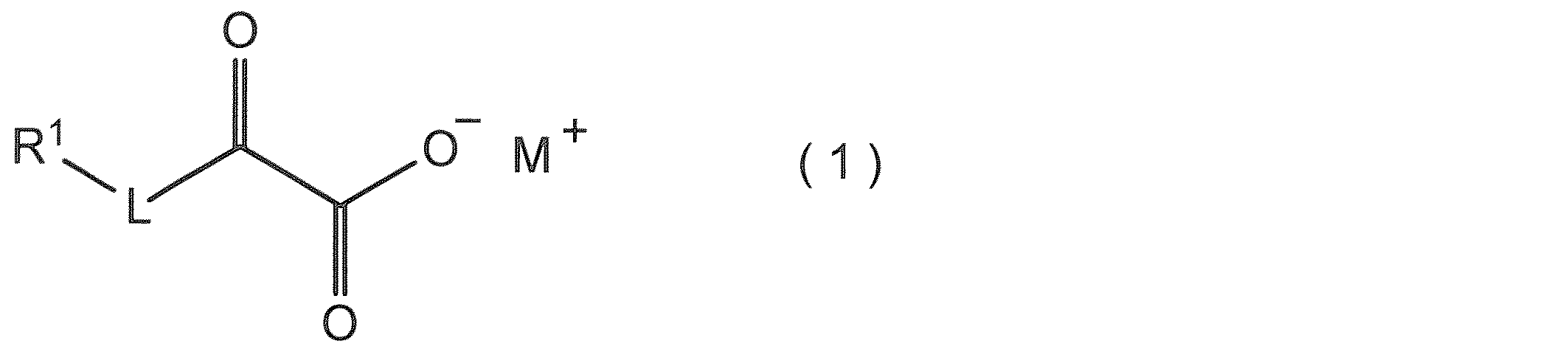
レジスト膜を形成する工程、
上記レジスト膜を露光する工程、及び
上記露光されたレジスト膜を現像する工程
を有し、
上記レジスト膜を当該感放射線性樹脂組成物により形成する。
下記式(1)で表される化合物からなる。
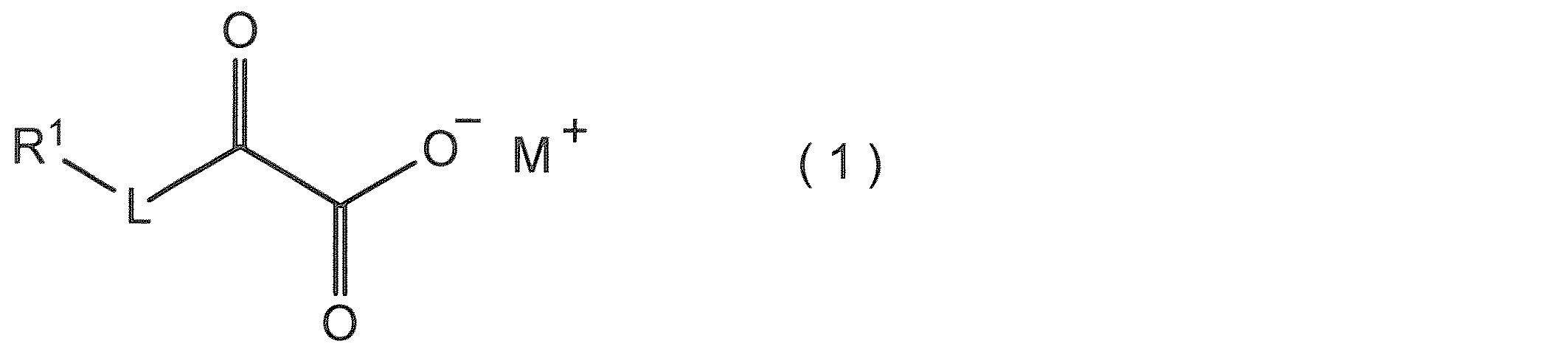
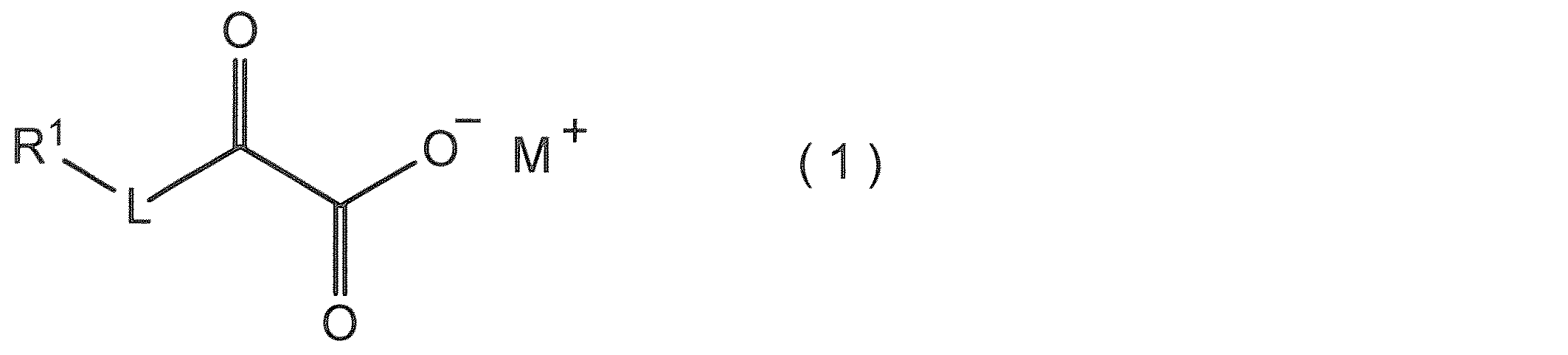
下記式(1a)で表される化合物と下記式(1b)で表される化合物とを反応させる工程を有する下記式(1)で表される化合物の製造方法である。

当該感放射線性樹脂組成物は、[A]重合体及び[B]化合物を含有する。また、当該感放射線性樹脂組成物は、好適成分として、[C]感放射線性酸発生体、[D][B]化合物以外の化合物からなる酸拡散制御剤(以下、「[D]他の酸拡散制御剤」ともいう)、[E]フッ素原子含有重合体(以下、「[E]重合体」ともいう)及び[F]溶媒を含有していてもよく、本発明の効果を損なわない範囲において、その他の任意成分を含有していてもよい。以下、各成分について説明する。
[A]重合体は、構造単位(I)を有する重合体である。当該感放射線性樹脂組成物によれば、放射線の照射により露光部の[A]重合体の酸解離性基が解離して、露光部と未露光部とで現像液に対する溶解性に差異が生じ、その結果、レジストパターンを形成することができる。「酸解離性基」とは、カルボキシ基、ヒドロキシ基等の水素原子を置換する基であって、酸の作用により解離する基をいう。[A]重合体は酸解離性基を含有する限り特に限定されず、主鎖、側鎖、末端等のどこに有していてもよい。[A]重合体は、構造単位(I)以外にも、非解離性でかつ極性を有する基を含む構造単位(II)、後述する下記式(4)で表される構造単位(III)及び上記構造単位(I)~(III)以外のその他の構造単位を有していてもよい。[A]重合体は、各構造単位を1種又は2種以上有していてもよい。以下、各構造単位について説明する。
構造単位(I)は、酸解離性基を含む構造単位である。構造単位(I)としては、例えば、下記式(2-1)で表される構造単位(以下、「構造単位(I-1)」ともいう)、下記式(2-2)で表される構造単位(以下、「構造単位(I-2)」ともいう)等が挙げられる。
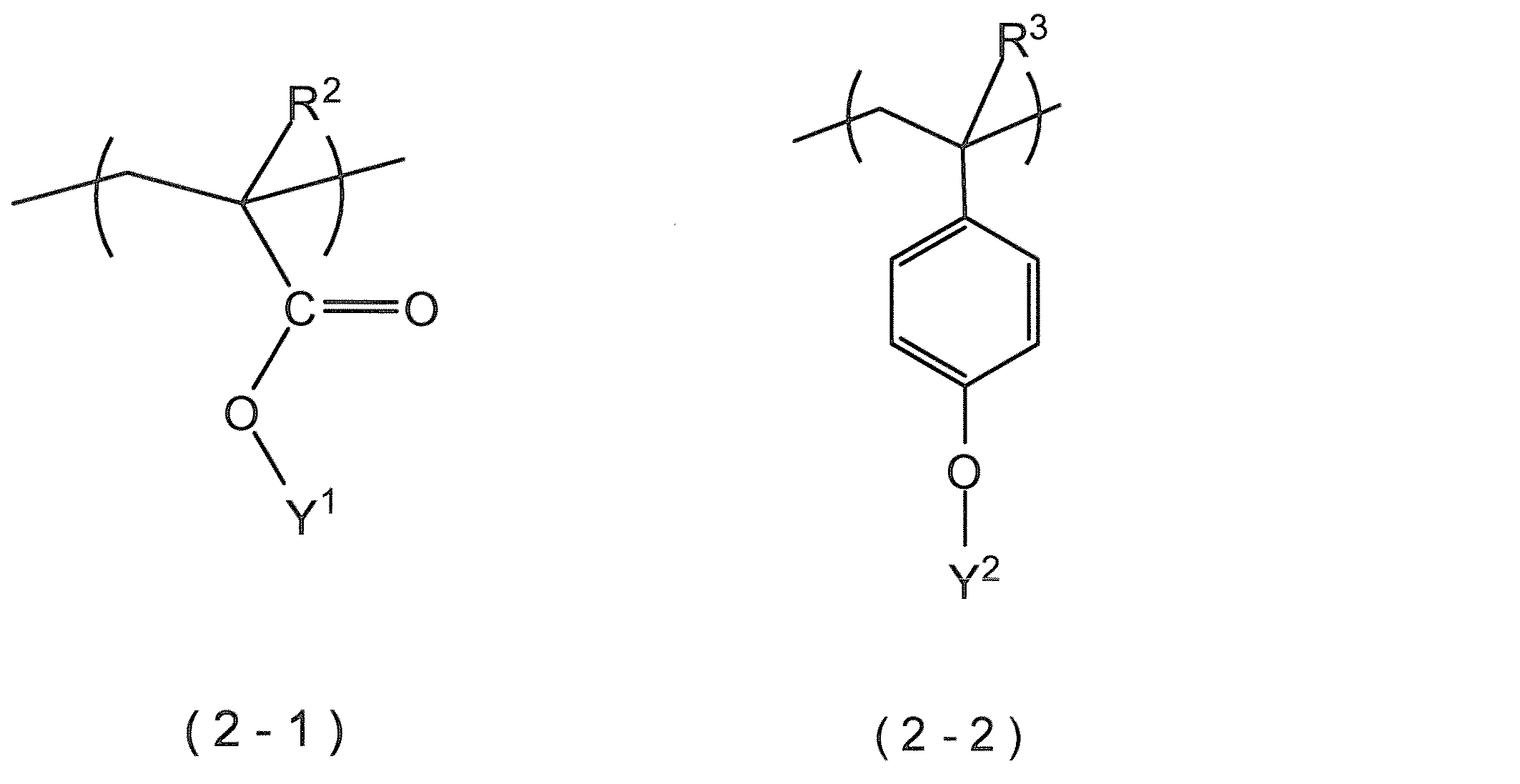
上記式(2-2)中、R3は、水素原子又はメチル基である。Y2は、1価の酸解離性基である。

メチル基、エチル基、n-プロピル基、i-プロピル基、n-ブチル基、i-ブチル基、sec-ブチル基、t-ブチル基、n-ペンチル基等のアルキル基;
エテニル基、プロペニル基、ブテニル基、ペンテニル基等のアルケニル基;
エチニル基、プロピニル基、ブチニル基、ペンチニル基等のアルキニル基等が挙げられる。
これらの中で、アルキル基が好ましく、炭素数1~4のアルキル基が好ましく、メチル基、エチル基、i-プロピル基がさらに好ましく、エチル基が特に好ましい。
シクロプロピル基、シクロブチル基、シクロペンチル基、シクロヘキシル基、シクロオクチル基等の単環のシクロアルキル基;
ノルボルニル基、アダマンチル基、トリシクロデシル基、テトラシクロドデシル基等の多環のシクロアルキル基;
シクロプロペニル基、シクロブテニル基、シクロペンテニル基、シクロヘキセニル基等の単環のシクロアルケニル基;
ノルボルネニル基、トリシクロデセニル基等の多環のシクロアルケニル基等が挙げられる。
これらの中で、単環のシクロアルキル基、多環のシクロアルキル基が好ましく、シクロペンチル基、シクロヘキシル基、ノルボルニル基、アダマンチル基がより好ましい。
フェニル基、トリル基、キシリル基、ナフチル基、アントリル基等のアリール基;
ベンジル基、フェネチル基、ナフチルメチル基等のアラルキル基などが挙げられる。
シクロプロパン構造、シクロブタン構造、シクロペンタン構造、シクロヘキサン構造、シクロオクタン構造等の単環のシクロアルカン構造;
ノルボルナン構造、アダマンタン構造、トリシクロデカン構造、テトラシクロドデカン構造等の多環のシクロアルカン構造;
シクロプロペン構造、シクロブテン構造、シクロペンテン構造、シクロヘキセン構造、シクロオクテン構造等の単環のシクロアルケン構造;
ノルボルネン構造、トリシクロデセン構造、テトラシクロドデセン構造等の多環のシクロアルケン構造等が挙げられる。
これらの中で、単環のシクロアルカン構造、多環のシクロアルカン構造が好ましく、炭素数5~8の単環のシクロアルカン構造、炭素数7~12の多環のシクロアルカン構造がより好ましく、シクロペンタン構造、シクロヘキサン構造、シクロオクタン構造、ノルボルナン構造、アダマンタン構造がさらに好ましく、シクロペンタン構造、アダマンタン構造が特に好ましい。
なお、上記脂環構造は、置換基を有していてもよい。上記置換基としては、例えば、ヒドロキシ基、カルボキシ基、シアノ基等が挙げられる。

メチル基、エチル基、n-プロピル基、i-プロピル基、n-ブチル基、i-ブチル基、sec-ブチル基、t-ブチル基、n-ペンチル基等のアルキル基;
エテニル基、プロペニル基、ブテニル基、ペンテニル基等のアルケニル基;
エチニル基、プロピニル基、ブチニル基、ペンチニル基等のアルキニル基等が挙げられる。
これらの中で、アルキル基が好ましく、炭素数1~4のアルキル基が好ましく、メチル基、エチル基、n-プロピル基がさらに好ましく、メチル基が特に好ましい。
これらの中で、単環のシクロアルキル基、多環のシクロアルキル基が好ましく、シクロペンチル基、シクロヘキシル基、ノルボルニル基、アダマンチル基がより好ましい。
メトキシ基、エトキシ基、n-プロポキシ基、i-プロポキシ基、n-ブトキシ基、i-ブトキシ基、sec-ブトキシ基、t-ブトキシ基、n-ペンチルオキシ基等のアルコキシ基;
エテニルオキシ基、プロペニルオキシ基、ブテニルオキシ基、ペンテニルオキシ基等のアルケニルオキシ基;
エチニルオキシ基、プロピニルオキシ基、ブチニルオキシ基、ペンチニルオキシ基等のアルキニルオキシ基等が挙げられる。
これらの中で、アルコキシ基が好ましく、炭素数1~4のアルコキシ基が好ましく、メトキシ基、エトキシ基、n-プロポキシ基がさらに好ましい。
シクロプロピルオキシ基、シクロブチルオキシ基、シクロペンチルオキシ基、シクロヘキシルオキシ基、シクロオクチルオキシ基等の単環のシクロアルキルオキシ基;
ノルボルニルオキシ基、アダマンチルオキシ基、トリシクロデシルオキシ基、テトラシクロドデシルオキシ基等の多環のシクロアルキルオキシ基;
シクロプロペニルオキシ基、シクロブテニルオキシ基、シクロペンテニルオキシ基、シクロヘキセニルオキシ基等の単環のシクロアルケニルオキシ基;
ノルボルネニルオキシ基、トリシクロデセニルオキシ基等の多環のシクロアルケニルオキシ基等が挙げられる。
これらの中で、単環のシクロアルキルオキシ基、多環のシクロアルキルオキシ基が好ましく、シクロペンチルオキシ基、シクロヘキシルオキシ基、ノルボルニルオキシ基、アダマンチルオキシ基がより好ましい。
構造単位(I-1)として、下記式(2-1-1)~(2-1-7)で表される構造単位等;
構造単位(I-2)として、下記式(2-2-1)~(2-2-3)で表される構造単位等が挙げられる。

上記式(2-2-1)~(2-2-3)中、R3は、上記式(2-2)と同義である。
構造単位(II)は、非解離性でかつ極性を有する基を含む構造単位である。[A]重合体が構造単位(II)を有することで、[B]化合物は[A]重合体中での分散性を向上させることができる。その結果、当該感放射線性樹脂組成物は、LWR性能、解像性、断面形状の矩形性及び焦点深度を向上させることができる。また、当該感放射線性樹脂組成物から形成されるレジストパターンの基板への密着性を向上させることができる。構造単位(II)としては、例えば、下記式(3-1)で表される構造単位(以下、「構造単位(II-1)」ともいう)、下記式(3-2)で表される構造単位(以下、「構造単位(II-2)」ともいう)等が挙げられる。
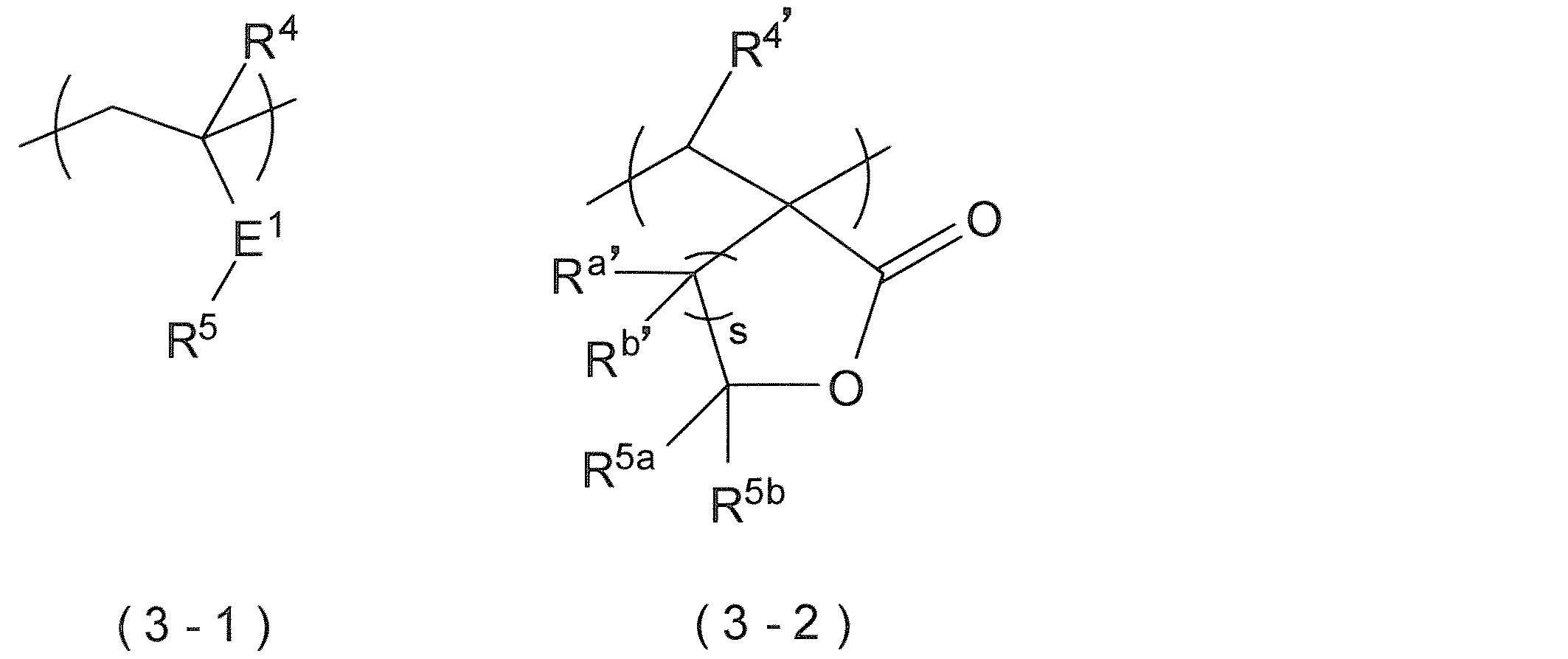
上記式(3-2)中、R4’は、水素原子又はメチル基である。Ra’及びRb’は、それぞれ独立して、水素原子、フッ素原子、ヒドロキシ基又は1価の有機基である。sは、1~3の整数である。sが2以上の場合、複数のRa’及びRb’はそれぞれ同一でも異なっていてもよい。R5b及びR5bは、それぞれ独立して、水素原子、フッ素原子、ヒドロキシ基又は1価の有機基である。
上記R4としては、構造単位(II-1)を与える単量体の共重合性の観点から、水素原子、メチル基が好ましく、メチル基がさらに好ましい。
上記炭素数1~20の1価の鎖状炭化水素基としては、例えば、上記式(2-2)におけるRe4、Re5及びRe6として例示したものと同様の基等が挙げられる。
上記炭素数3~20の1価の脂環式炭化水素基としては、例えば、上記式(2-1)におけるRe1、Re2及びRe3として例示したものと同様の基等が挙げられる。
上記炭素数6~20の1価の芳香族炭化水素基としては、例えば、
フェニル基、トリル基、キシリル基、メシチル基、ナフチル基、メチルナフチル基、アントリル基、メチルアントリル基等のアリール基;
ベンジル基、フェネチル基、ナフチルメチル基、アントリルメチル基等のアラルキル基等が挙げられる。
環状カーボネート構造を有する基としては、例えば、エチレンカーボネート-イルメチル基等が挙げられる。
スルトン構造を有する基としては、例えば、プロパンスルトン-イル基、ノルボルナンスルトン-イル基等のスルトン構造を有する基等が挙げられる。
ヒドロキシ基を有する基としては、例えば、ヒドロキシアダマンチル基、ジヒドロキシアダマンチル基、トリヒドロキシアダマンチル基、ヒドロキシエチル基等が挙げられる。
上記R4’としては、構造単位(II-2)を与える単量体の共重合性の観点から、水素原子が好ましい。
構造単位(II-1)として下記式(3-1-1)~(3-1-13)で表される構造単位等;
構造単位(II-2)として下記式(3-2-1)及び(3-2-2)で表される構造単位等が挙げられる。
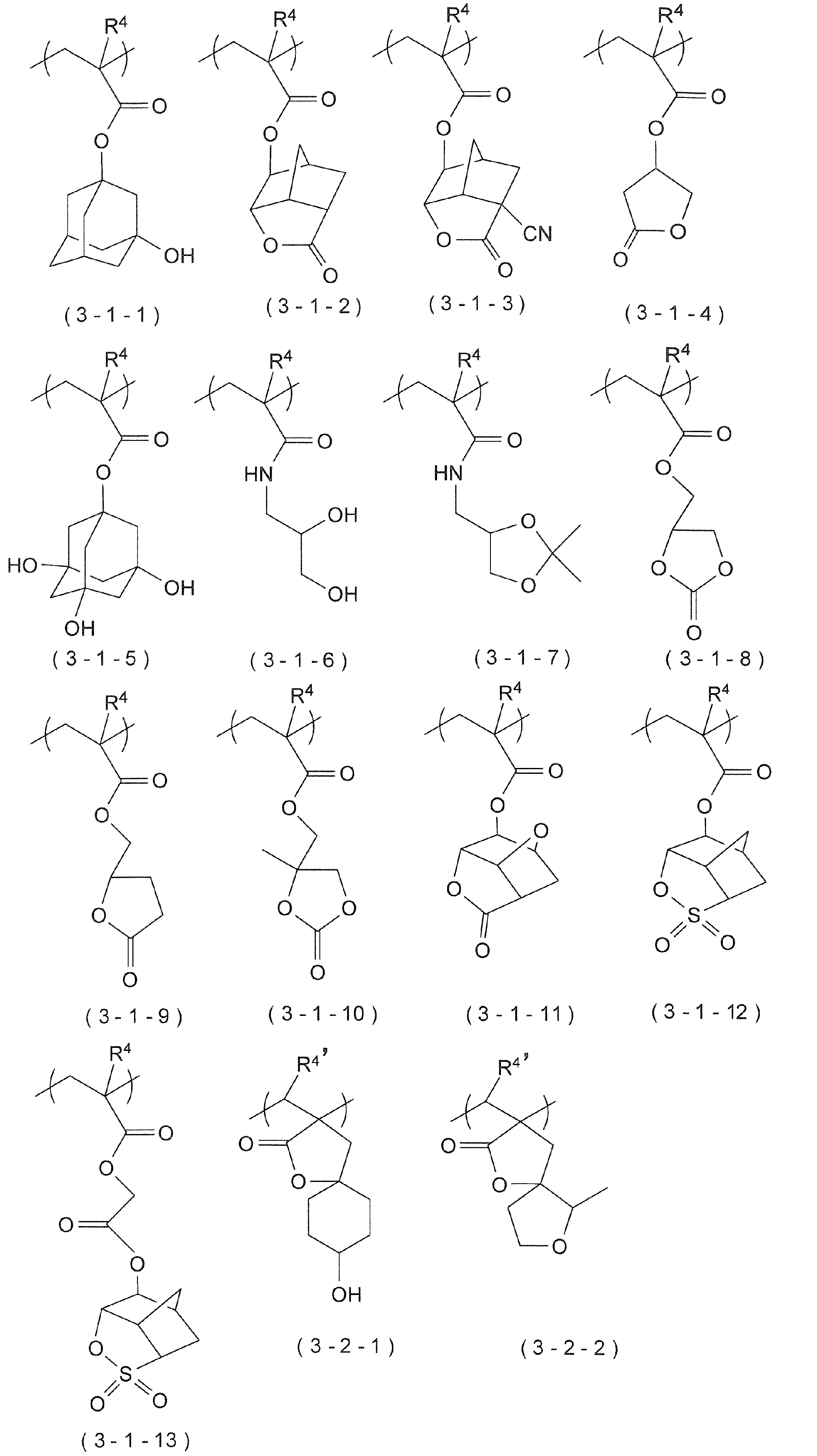
上記式(3-2-1)及び(3-2-2)中、R4’は、上記式(3-2)と同義である。
構造単位(III)は、下記式(4)で表される構造単位である。照射する放射線として、KrFエキシマレーザー光、EUV、電子線等を用いる場合には、当該感放射線性樹脂組成物は、[A]重合体が構造単位(III)を有することで、感度を高めることができる。

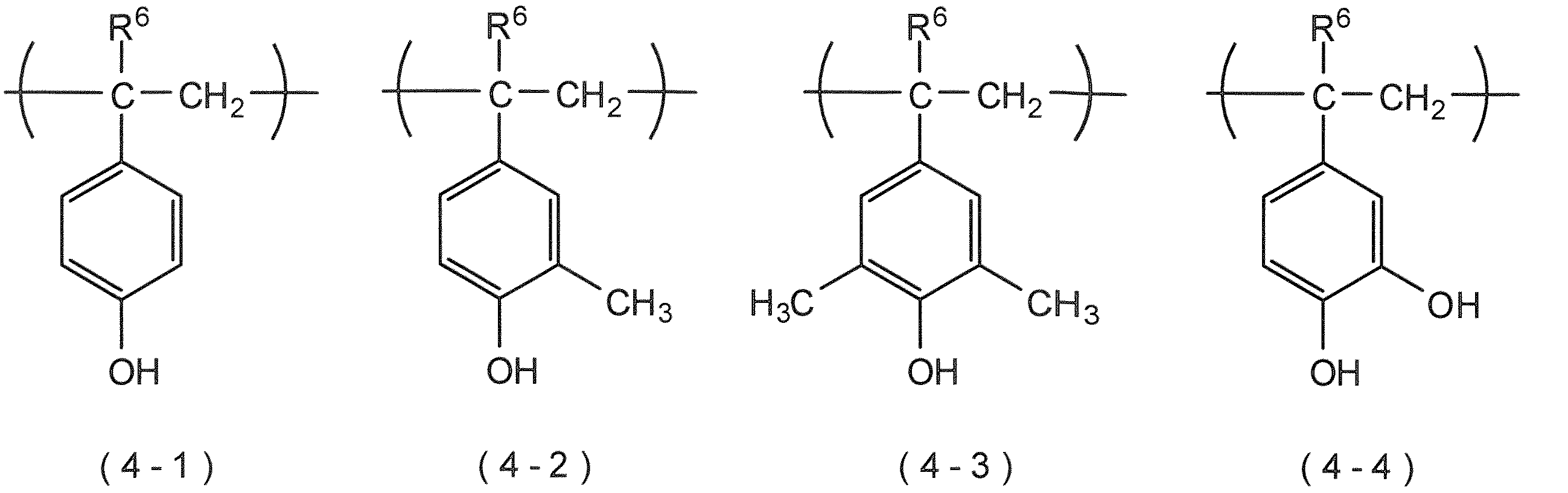
[A]重合体は、上記構造単位(I)~(III)以外の他の構造単位を有していてもよい。他の構造単位としては、例えば、非解離性の1価の脂環式炭化水素基を含む(メタ)アクリル酸エステルに由来する構造単位等が挙げられる。他の構造単位の含有割合としては、[A]重合体を構成する全構造単位に対して、20モル%以下が好ましく、10モル%以下がより好ましい。
[A]重合体は、ラジカル重合等の常法に従って合成することができる。例えば、(1)単量体及びラジカル開始剤を含有する溶液を、反応溶媒又は単量体を含有する溶液に滴下して重合反応させる方法、(2)単量体を含有する溶液とラジカル開始剤を含有する溶液とを各別に、反応溶媒又は単量体を含有する溶液に滴下して重合反応させる方法、(3)各々の単量体を含有する複数種の溶液と、ラジカル開始剤を含有する溶液とを各別に、反応溶媒又は単量体を含有する溶液に滴下して重合反応させる方法、(4)単量体及びラジカル開始剤を含有する溶液を無溶媒中や反応溶媒中で重合反応させる方法、等で合成することが好ましい。
[B]化合物は、下記式(1)で表される化合物である。当該感放射線性樹脂組成物は[B]化合物を含有することで、LWR性能、解像性、断面形状の矩形性及び焦点深度に優れる。当該感放射線性樹脂組成物が[B]化合物を含有することで上記効果を奏する理由については必ずしも明確ではないが、例えば以下のように推察することができる。すなわち、[B]化合物はカルボキシレートアニオンに隣接してカルボニル基を有している。このカルボニル基の存在により、[B]化合物は、極性がより適度に高められると共に、上記カルボキシレートアニオンの塩基性が適度に低くなっている。そのため、[B]化合物は、酸拡散制御剤として、レジスト膜中における酸捕捉性能がより適度に制御されており、加えて、[B]化合物自体のレジスト膜中における拡散移動が抑制されている。従って、これらの結果、当該感放射線性樹脂組成物のLWR性能、解像性、断面形状の矩形性及び焦点深度が向上する。

メチル基、エチル基、n-プロピル基、i-プロピル基、n-ブチル基、i-ブチル基、sec-ブチル基、t-ブチル基等のアルキル基;
エテニル基、プロペニル基、ブテニル基、ペンテニル基、ヘキセニル基、オクテニル基、デセニル基等のアルケニル基;
エチニル基、プロピニル基、ブチニル基、ペンチニル基、ヘキシニル基、オクチニル基等のアルキニル基などが挙げられる。
シクロプロピル基、シクロブチル基、シクロペンチル基、シクロヘキシル基、シクロオクチル基、シクロデシル基等の単環のシクロアルキル基;
ノルボルニル基、アダマンチル基、トリシクロデシル基、テトラシクロドデシル基等の多環のシクロアルキル基;
シクロプロペニル基、シクロブテニル基、シクロペンテニル基、シクロヘキセニル基、シクロオクテニル基、シクロデセニル基等の単環のシクロアルケニル基;
ノルボルネニル基、トリシクロデセニル基、テトラシクロドデセニル基等の多環のシクロアルケニル基などが挙げられる。
フェニル基、トリル基、キシリル基、ナフチル基、アントリル基等のアリール基;
ベンジル基、フェネチル基、ナフチルメチル基、アントリルメチル基等のアラルキル基などが挙げられる。
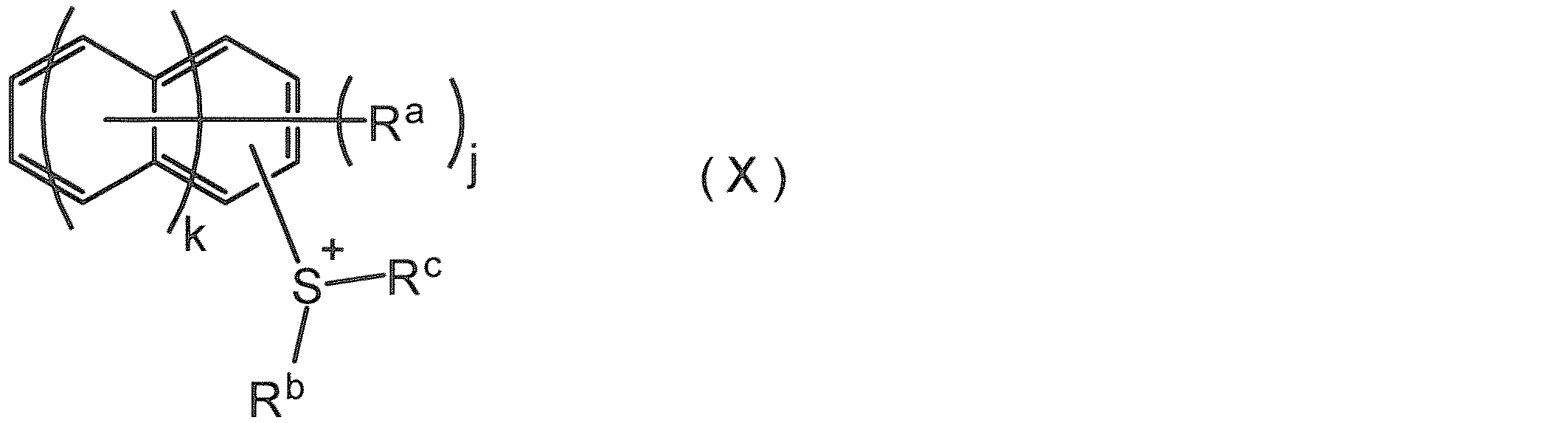

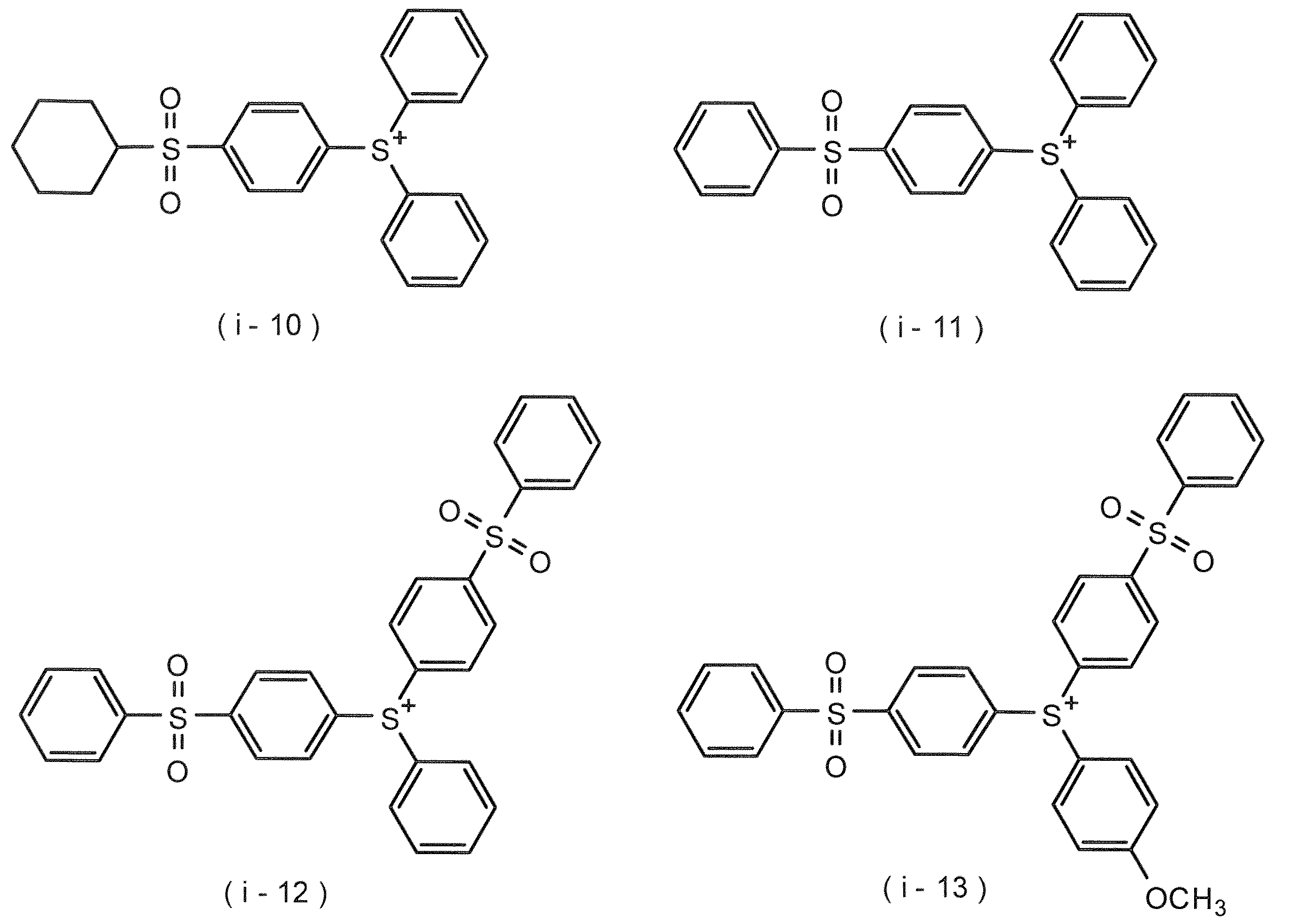


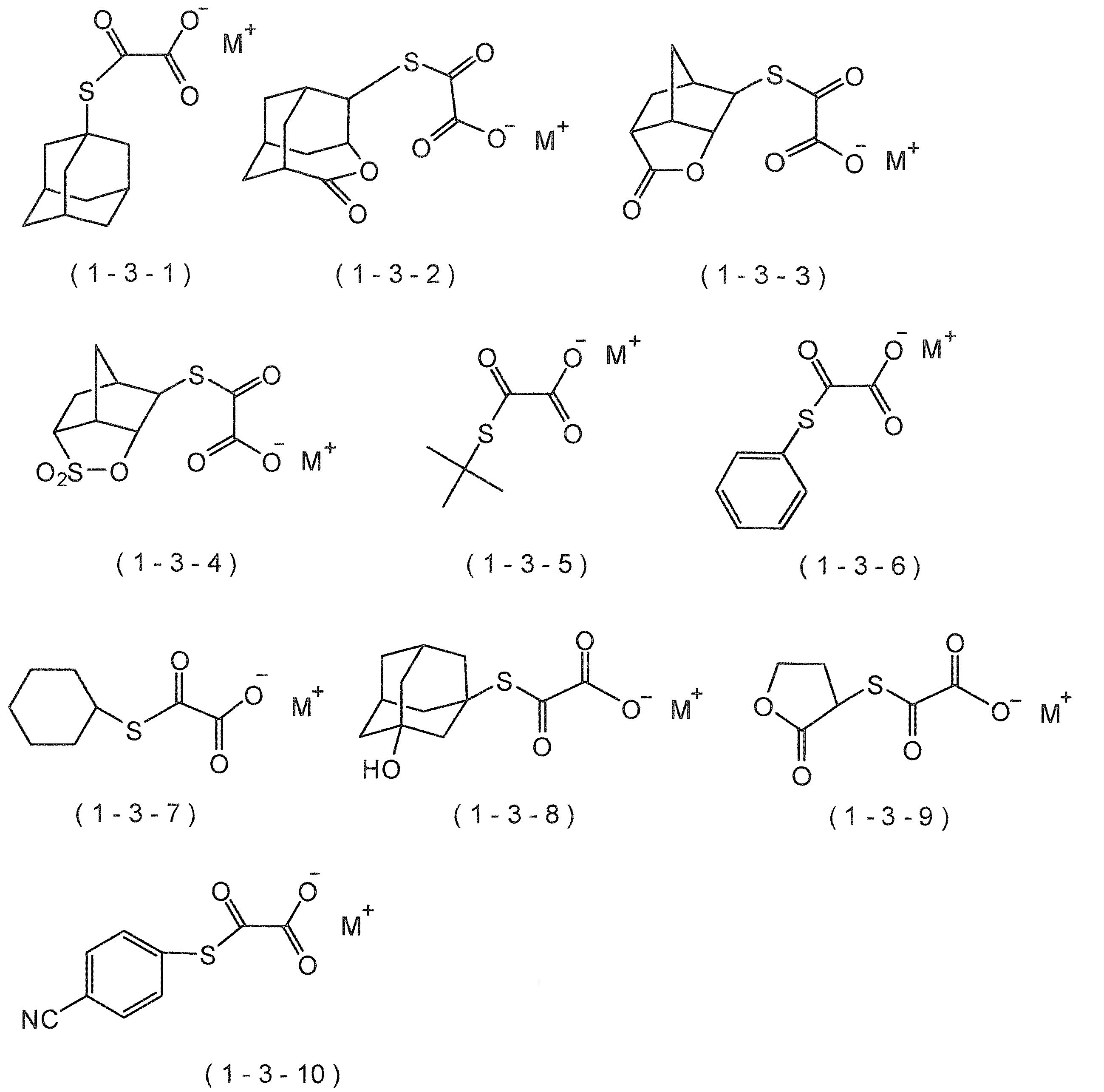
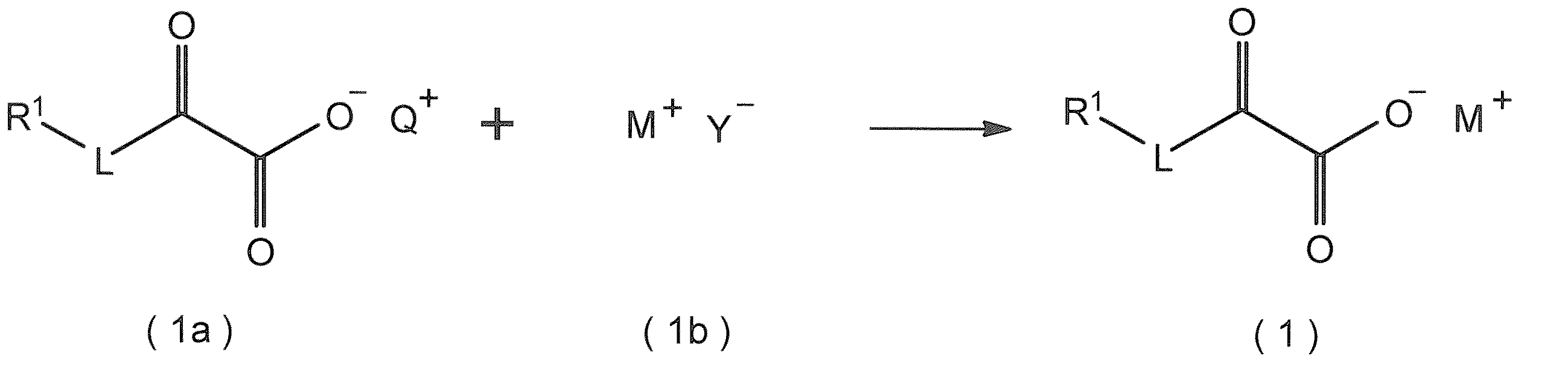
[C]酸発生体は、露光により酸を発生する物質である。この[C]酸発生体から発生した酸等により[A]重合体中の酸解離性基を解離させてカルボキシ基等を生成させ、その結果、[A]重合体の現像液への溶解性が変化する。当該感放射線性樹脂組成物における[C]酸発生体の含有形態としては、後述するような低分子化合物の形態(以下、適宜「[C]酸発生剤」ともいう)でも、重合体の一部として組み込まれた形態でも、これらの両方の形態でもよい。
当該感放射線性樹脂組成物は、[B]化合物以外の[D]他の酸拡散制御体を含有していてもよい。[D]他の酸拡散制御体は、露光により[C]酸発生体等から生じる酸のレジスト膜中における拡散現象を制御し、未露光部における好ましくない化学反応を抑制する効果を奏する成分である。また、露光から現像処理までの引き置き時間の変動によるレジストパターンの線幅変化を抑えることができ、プロセス安定性に優れた組成物とすることができる。当該感放射線性樹脂組成物は、[D]他の酸拡散制御体をさらに含有することで、LWR性能、解像性、断面形状の矩形性及び焦点深度をさらに向上させることができる。当該感放射線性樹脂組成物における[D]他の酸拡散制御体の含有形態としては、後述する低分子化合物の形態(以下、適宜「[D]他の酸拡散制御剤」という)でも、重合体の一部として組み込まれた形態でも、これらの両方の形態でもよい。当該感放射線性樹脂組成物は、[D]他の酸拡散制御体を1種又は2種以上含有していてもよい。
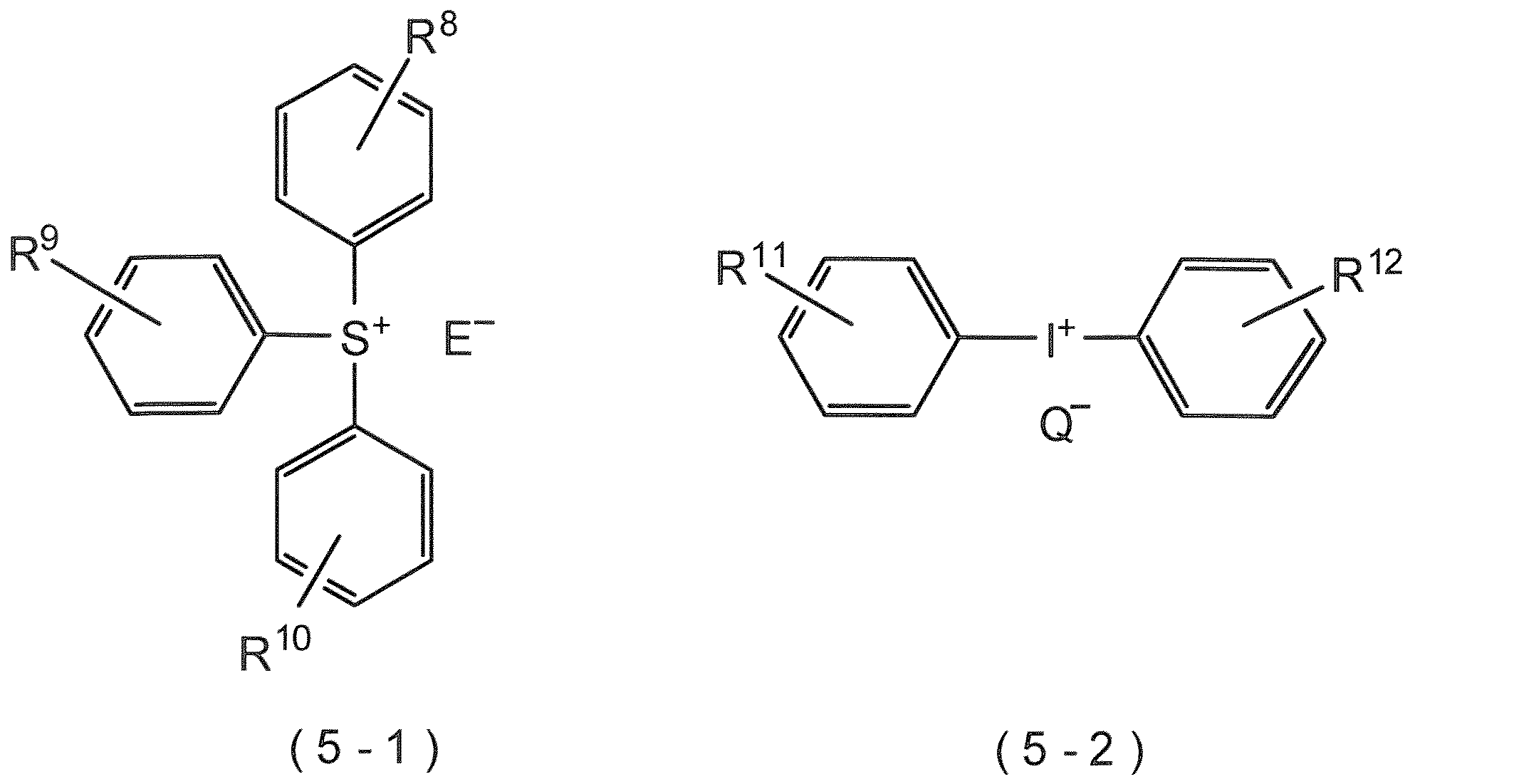


[E]重合体は、フッ素原子含有重合体である。当該感放射線性樹脂組成物によれば、[A]重合体に加えて[E]重合体をさらに含有することで、形成されるレジスト膜の表層に[E]重合体が偏在化し、その結果、レジスト膜表面の疎水性を向上させることができる。これにより、液浸露光を行う場合等に、レジスト膜からの物質溶出抑制性に優れると共に、レジスト膜と液浸液との後退接触角を十分高くすることができ、より高速なスキャンが可能になる。
主鎖にフッ素化アルキル基が結合した構造;
側鎖にフッ素化アルキル基が結合した構造;
主鎖と側鎖とにフッ素化アルキル基が結合した構造等が挙げられる。
構造単位(f1)は下記式(6)で表される構造単位である。

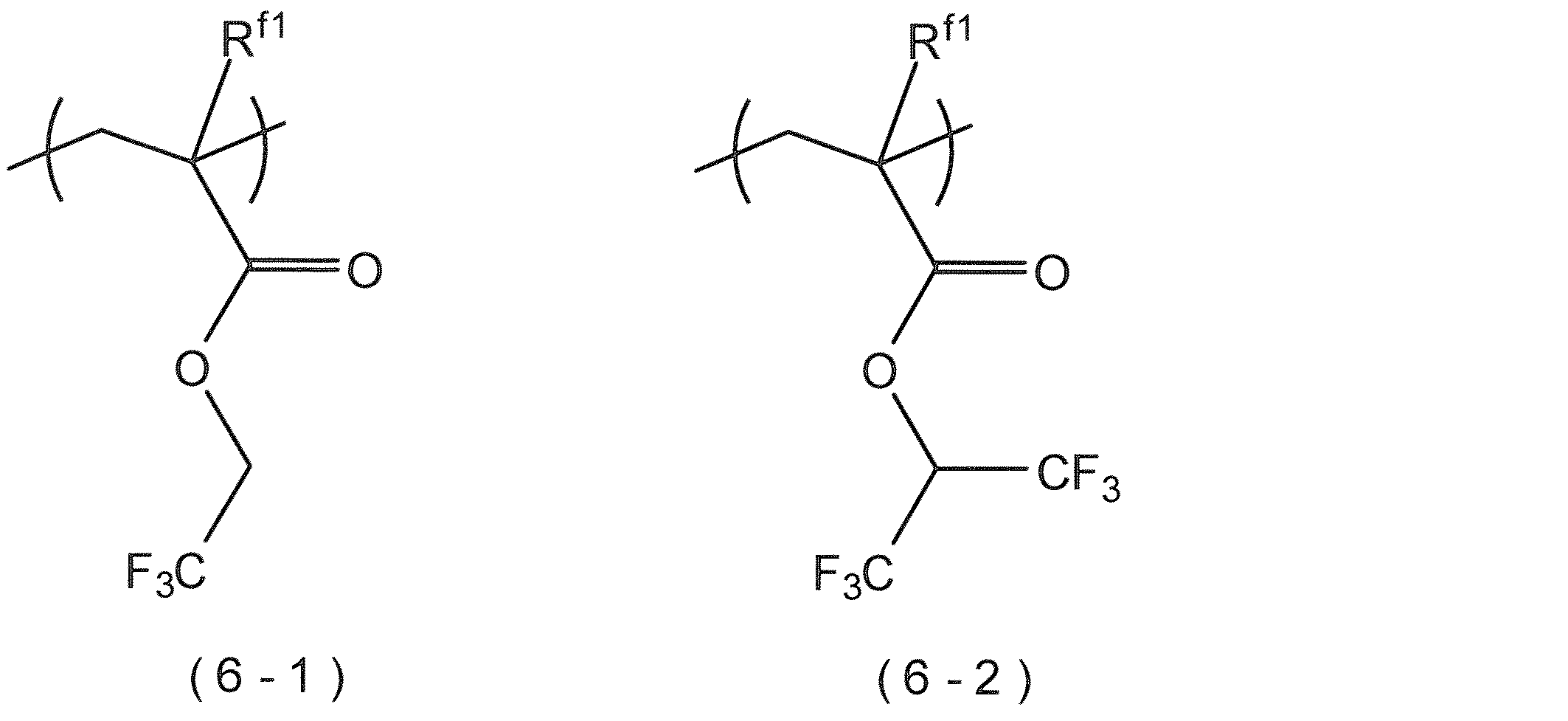
構造単位(f2)は、下記式(7)で表される構造単位である。
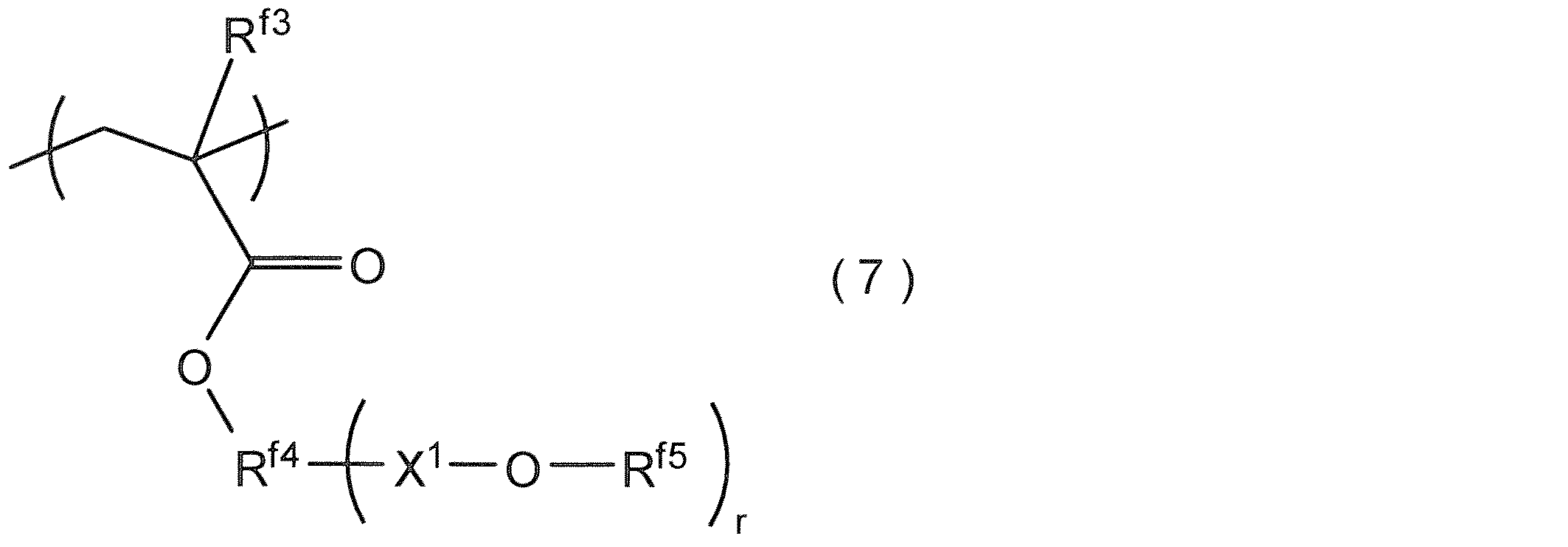
単環式飽和炭化水素として、シクロプロパン、シクロブタン、シクロペンタン、シクロヘキサン、シクロヘプタン、シクロオクタン、シクロデカン、メチルシクロヘキサン、エチルシクロヘキサン等;
単環式不飽和炭化水素として、シクロブテン、シクロペンテン、シクロヘキセン、シクロヘプテン、シクロオクテン、シクロデセン、シクロペンタジエン、シクロヘキサジエン、シクロオクタジエン、シクロデカジエン等;
多環式飽和炭化水素として、ビシクロ[2.2.1]ヘプタン、ビシクロ[2.2.2]オクタン、トリシクロ[5.2.1.02,6]デカン、トリシクロ[3.3.1.13,7]デカン、テトラシクロ[6.2.1.13,6.02,7]ドデカン、アダマンタン等;
多環式不飽和炭化水素として、ビシクロ[2.2.1]ヘプテン、ビシクロ[2.2.2]オクテン、トリシクロ[5.2.1.02,6]デセン、トリシクロ[3.3.1.13,7]デセン、テトラシクロ[6.2.1.13,6.02,7]ドデセン等から(k+1)個の水素原子を除いた基等が挙げられる。
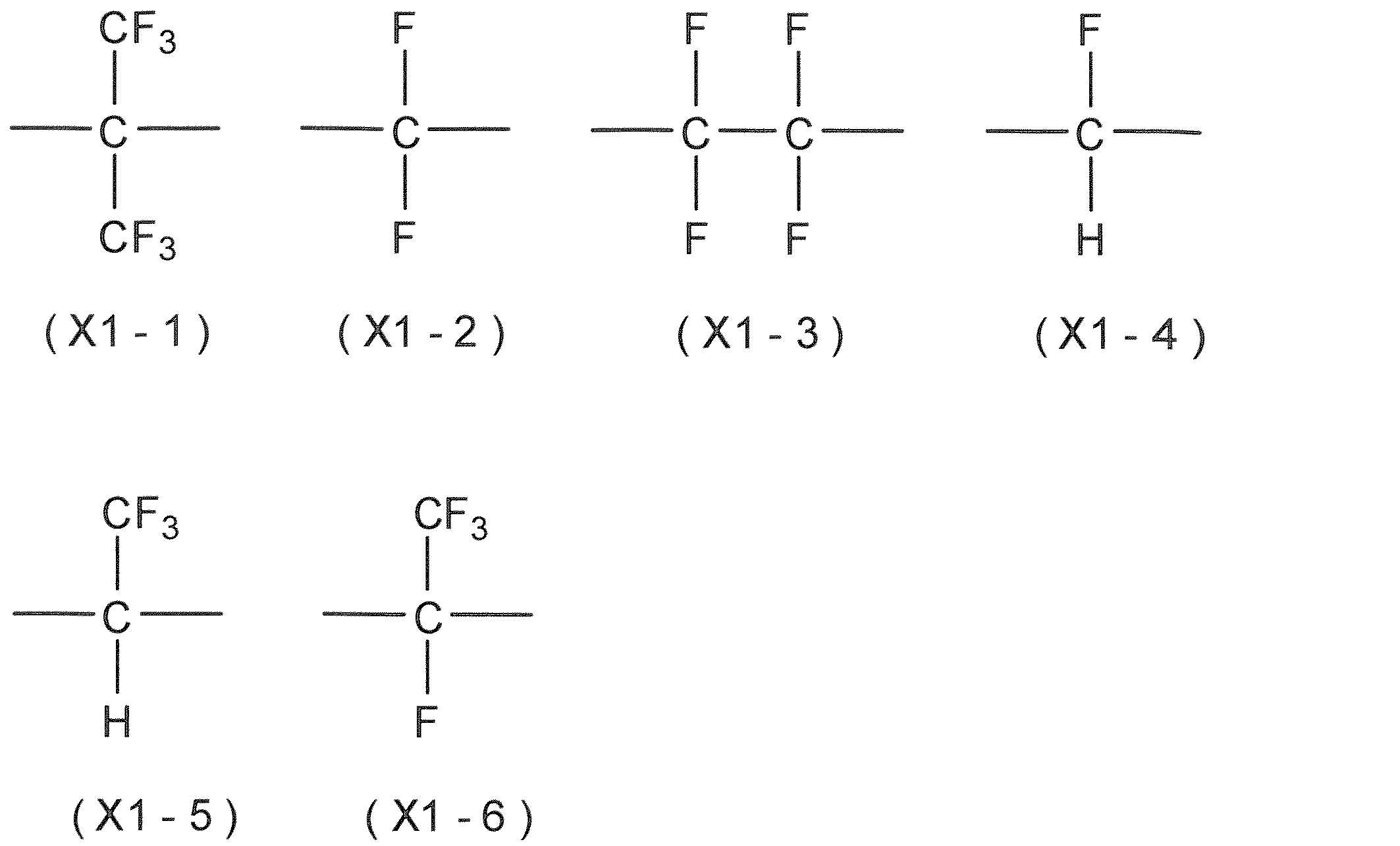
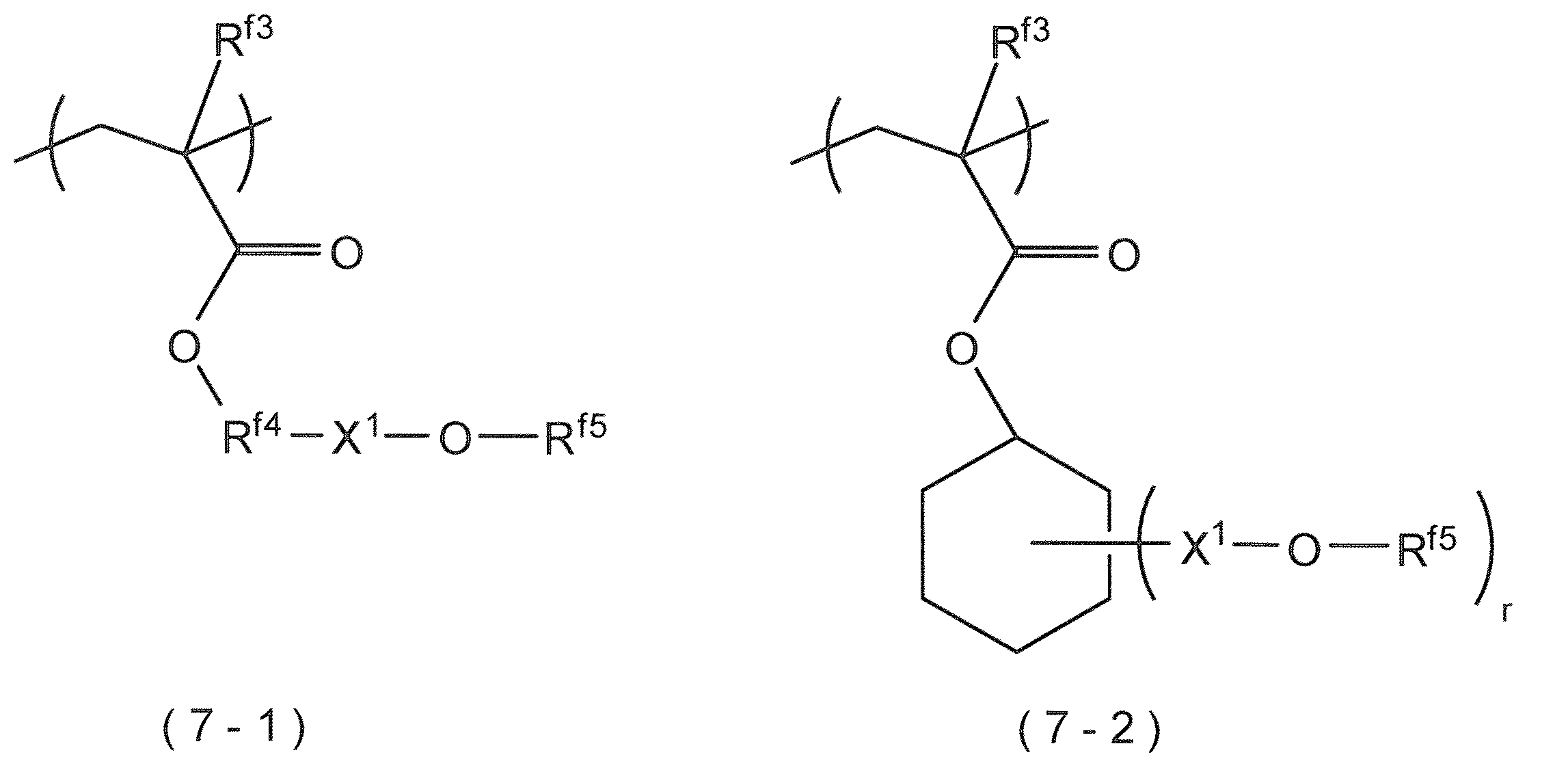
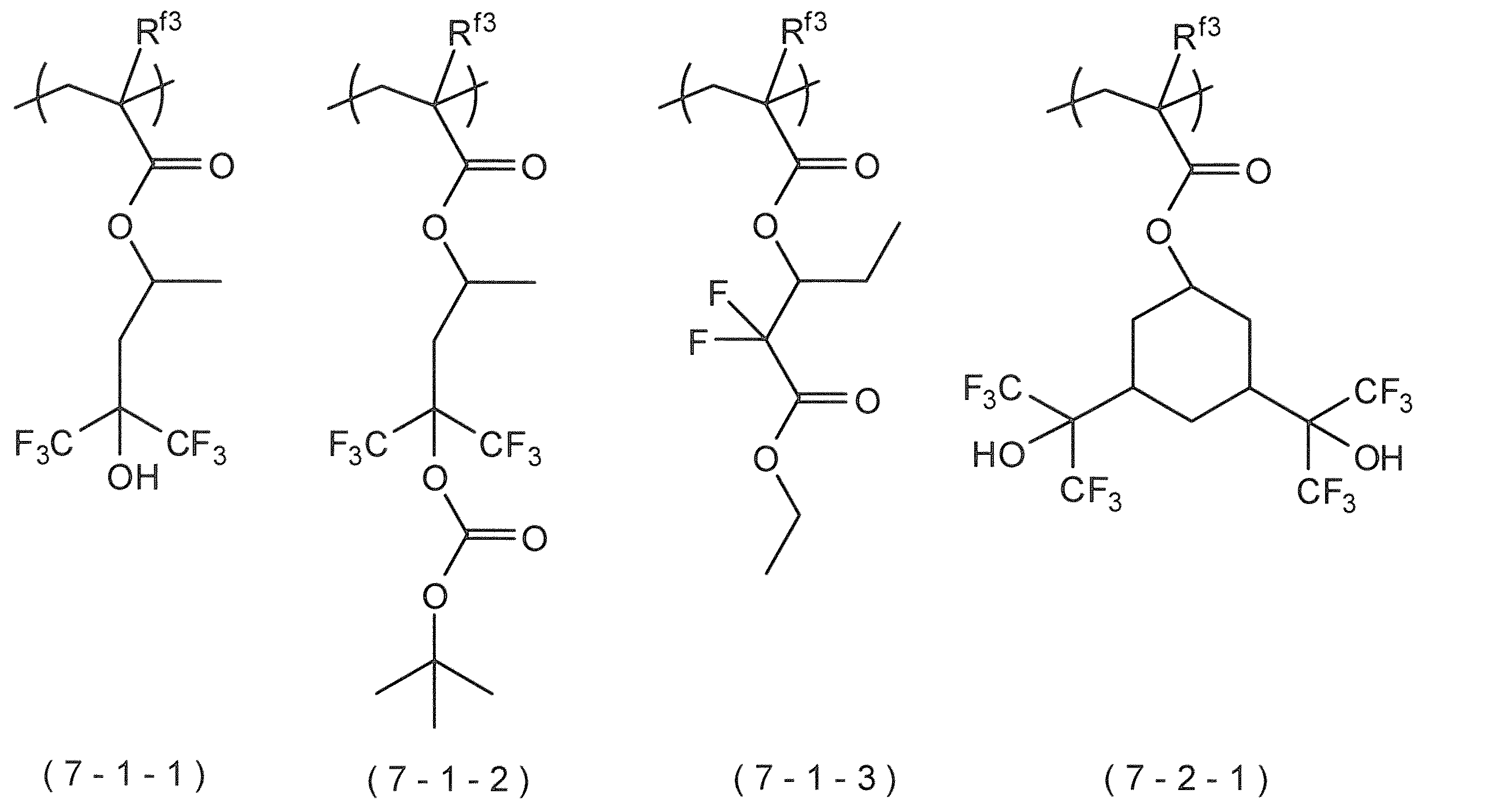
[E]重合体は、構造単位(f1)、構造単位(f2)以外の「他の構造単位」を含んでいてもよい。他の構造単位としては、例えば、[A]重合体の構造単位(I)等が挙げられる。
また、[E]重合体のフッ素原子含有率としては、1質量%以上が好ましく、3質量%以上がより好ましく、5質量%以上がさらに好ましく、10質量%以上が特に好ましい。
なお、このフッ素原子含有率(質量%)は、13C-NMRにより重合体の構造を求め、その構造から算出することができる。
[E]重合体は、例えば、所定の各構造単位に対応する単量体を、ラジカル重合開始剤を使用し、適当な重合溶媒中で重合することにより製造できる。
[F]溶媒は、[A]重合体、[B]化合物及び任意成分を溶解又は分散させるための成分である。[F]溶媒としては、例えば、アルコール系溶媒、ケトン系溶媒、アミド系溶媒、エーテル系溶媒、エステル系溶媒等が挙げられる。[F]溶媒は、1種単独で又は2種以上を組み合わせて用いてもよい。
モノアルコール系溶媒として、メタノール、エタノール、n-プロパノール、iso-プロパノール、n-ブタノール、iso-ブタノール、sec-ブタノール、tert-ブタノール、n-ペンタノール、iso-ペンタノール、2-メチルブタノール、sec-ペンタノール、tert-ペンタノール、3-メトキシブタノール、n-ヘキサノール、2-メチルペンタノール、sec-ヘキサノール、2-エチルブタノール、sec-ヘプタノール、3-ヘプタノール、n-オクタノール、2-エチルヘキサノール、sec-オクタノール、n-ノニルアルコール、2,6-ジメチル-4-ヘプタノール、n-デカノール、sec-ウンデシルアルコール、トリメチルノニルアルコール、sec-テトラデシルアルコール、sec-ヘプタデシルアルコール、フルフリルアルコール、フェノール、シクロヘキサノール、メチルシクロヘキサノール、3,3,5-トリメチルシクロヘキサノール、ベンジルアルコール、ジアセトンアルコール等;
多価アルコール系溶媒として、エチレングリコール、1,2-プロピレングリコール、1,3-ブチレングリコール、2,4-ペンタンジオール、2-メチル-2,4-ペンタンジオール、2,5-ヘキサンジオール、2,4-ヘプタンジオール、2-エチル-1,3-ヘキサンジオール、ジエチレングリコール、ジプロピレングリコール、トリエチレングリコール、トリプロピレングリコール等;
多価アルコール部分エーテル系溶媒として、エチレングリコールモノメチルエーテル、エチレングリコールモノエチルエーテル、エチレングリコールモノプロピルエーテル、エチレングリコールモノブチルエーテル、エチレングリコールモノヘキシルエーテル、エチレングリコールモノフェニルエーテル、エチレングリコールモノ-2-エチルブチルエーテル、ジエチレングリコールモノメチルエーテル、ジエチレングリコールモノエチルエーテル、ジエチレングリコールモノプロピルエーテル、ジエチレングリコールモノブチルエーテル、ジエチレングリコールモノヘキシルエーテル、プロピレングリコールモノメチルエーテル、プロピレングリコールモノエチルエーテル、プロピレングリコールモノプロピルエーテル、プロピレングリコールモノブチルエーテル、ジプロピレングリコールモノメチルエーテル、ジプロピレングリコールモノエチルエーテル、ジプロピレングリコールモノプロピルエーテル等が挙げられる。
鎖状ケトン系溶媒として、アセトン、メチルエチルケトン、メチル-n-プロピルケトン、メチル-n-ブチルケトン、ジエチルケトン、メチル-iso-ブチルケトン、メチル-n-ペンチルケトン、エチル-n-ブチルケトン、メチル-n-ヘキシルケトン、ジ-iso-ブチルケトン、トリメチルノナノン、2,4-ペンタンジオン、アセトニルアセトン、ジアセトンアルコール、アセトフェノン等;
環状ケトン系溶媒として、シクロペンタノン、シクロヘキサノン、シクロヘプタノン、シクロオクタノン、メチルシクロヘキサノン等が挙げられる。
鎖状アミド系溶媒として、N-メチルホルムアミド、N,N-ジメチルホルムアミド、N,N-ジエチルホルムアミド、アセトアミド、N-メチルアセトアミド、N,N-ジメチルアセトアミド、N-メチルプロピオンアミド等;
環状アミド系溶媒として、N-メチルピロリドン、N,N’-ジメチルイミダゾリジノン等が挙げられる。
鎖状エーテル系溶媒として、ジエチルエーテル、ジプロピルエーテル、ジブチルエーテル、ジフェニルエーテル等;
環状エーテル系溶媒としてテトラヒドロフラン、テトラヒドロピラン等が挙げられる。
酢酸エステル系溶媒として、酢酸メチル、酢酸エチル、酢酸n-プロピル、酢酸iso-プロピル、酢酸n-ブチル、酢酸iso-ブチル、酢酸sec-ブチル、酢酸n-ペンチル、酢酸sec-ペンチル、酢酸3-メトキシブチル、酢酸メチルペンチル、酢酸2-エチルブチル、酢酸2-エチルヘキシル、酢酸ベンジル、酢酸シクロヘキシル、酢酸メチルシクロヘキシル、酢酸n-ノニル、ジ酢酸グリコール、酢酸メトキシトリグリコール等;
多価アルコール部分エーテルの酢酸エステル系溶媒として、酢酸エチレングリコールモノメチルエーテル、酢酸エチレングリコールモノエチルエーテル、酢酸ジエチレングリコールモノメチルエーテル、酢酸ジエチレングリコールモノエチルエーテル、酢酸ジエチレングリコールモノ-n-ブチルエーテル、酢酸プロピレングリコールモノメチルエーテル、酢酸プロピレングリコールモノエチルエーテル、酢酸プロピレングリコールモノプロピルエーテル、酢酸プロピレングリコールモノブチルエーテル、酢酸ジプロピレングリコールモノメチルエーテル、酢酸ジプロピレングリコールモノエチルエーテル等;
炭酸エステル系溶媒として、ジメチルカーボネート、ジエチルカーボネート等;
その他のカルボン酸のエステル系溶媒として、アセト酢酸メチル、アセト酢酸エチル、プロピオン酸エチル、プロピオン酸n-ブチル、プロピオン酸iso-アミル、シュウ酸ジエチル、シュウ酸ジ-n-ブチル、乳酸メチル、乳酸エチル、乳酸n-ブチル、乳酸n-アミル、マロン酸ジエチル、フタル酸ジメチル、フタル酸ジエチル等が挙げられる。
[G]偏在化促進剤は、[E]重合体を、より効率的にレジスト膜表面に偏析させる成分である。当該感放射線性樹脂組成物が[G]偏在化促進剤を含有することで、[E]重合体をレジスト膜表面により効果的に偏析させることができ、結果として[E]重合体の使用量を少なくすることができる。[G]偏在化促進剤としては、例えば、ラクトン化合物、カーボネート化合物、ニトリル化合物、多価アルコール等が挙げられる。[G]偏在化促進剤は、1種単独で又は2種以上を組み合わせて用いてもよい。
当該感放射線性樹脂組成物は、上記[A]成分~[G]成分以外にも、界面活性剤、脂環式骨格含有化合物、増感剤等のその他の任意成分を含有していてもよい。その他の任意成分は、各成分を1種単独で又は2種以上組み合わせて用いてもよい。また、その他の任意成分の含有量は、その目的に応じて、適宜決定することができる。
界面活性剤は、塗布性、ストリエーション、現像性等を改良する効果を奏する。界面活性剤としては、例えばポリオキシエチレンラウリルエーテル、ポリオキシエチレンステアリルエーテル、ポリオキシエチレンオレイルエーテル、ポリオキシエチレンn-オクチルフェニルエーテル、ポリオキシエチレンn-ノニルフェニルエーテル、ポリエチレングリコールジラウレート、ポリエチレングリコールジステアレート等のノニオン系界面活性剤;市販品としては、KP341(信越化学工業製)、ポリフローNo.75、同No.95(以上、共栄社化学製)、エフトップEF301、同EF303、同EF352(以上、トーケムプロダクツ製)、メガファックF171、同F173(以上、DIC製)、フロラードFC430、同FC431(以上、住友スリーエム製)、アサヒガードAG710、サーフロンS-382、同SC-101、同SC-102、同SC-103、同SC-104、同SC-105、同SC-106(以上、旭硝子工業製)等が挙げられる。当該感放射線性樹脂組成物における界面活性剤の含有量としては、[A]重合体100質量部に対して通常2質量部以下である。
脂環式骨格含有化合物は、ドライエッチング耐性、パターン形状、基板との接着性等を改善する効果を奏する。
1-アダマンタンカルボン酸、2-アダマンタノン、1-アダマンタンカルボン酸t-ブチル等のアダマンタン誘導体類;
デオキシコール酸t-ブチル、デオキシコール酸t-ブトキシカルボニルメチル、デオキシコール酸2-エトキシエチル等のデオキシコール酸エステル類;
リトコール酸t-ブチル、リトコール酸t-ブトキシカルボニルメチル、リトコール酸2-エトキシエチル等のリトコール酸エステル類;
3-〔2-ヒドロキシ-2,2-ビス(トリフルオロメチル)エチル〕テトラシクロ[4.4.0.12,5.17,10]ドデカン、2-ヒドロキシ-9-メトキシカルボニル-5-オキソ-4-オキサ-トリシクロ[4.2.1.03,7]ノナン等が挙げられる。当該感放射線性樹脂組成物における脂環式骨格含有化合物の含有量としては、[A]重合体100質量部に対して通常5質量部以下である。
増感剤は、[C]酸発生剤等からの酸の生成量を増加する作用を示すものであり、当該感放射線性樹脂組成物の「みかけの感度」を向上させる効果を奏する。
当該感放射線性樹脂組成物は、例えば、[A]重合体、[B]化合物及び必要に応じて[C]酸発生体、[D]他の酸拡散制御体、[E]重合体及び[F]溶媒等の各任意成分を所定の割合で混合することにより調製できる。当該感放射線性樹脂組成物の固形分濃度としては、0.1質量%~50質量%が好ましく、0.5質量%~30質量%がより好ましく、1質量%~10質量%がさらに好ましい。
当該レジストパターンの形成方法は、
当該感放射線性樹脂組成物でレジスト膜を形成する工程(以下、「レジスト膜形成工程」ともいう)、
上記レジスト膜を露光する工程(以下、「露光工程」ともいう)、及び
上記露光されたレジスト膜を現像する工程(以下、「現像工程」ともいう)
を有する。以下、各工程について説明する。
本工程では、上述の本発明の感放射線性樹脂組成物でレジスト膜を形成する。塗布方法としては特に限定されないが、例えば、回転塗布、流延塗布、ロール塗布等の適宜の塗布手段を採用することができる。基板としては、例えば、シリコンウエハー、アルミニウムで被覆されたウエハー等が挙げられる。具体的には、得られるレジスト膜が所定の厚さになるように当該組成物を塗布した後、必要に応じてプレベーク(PB)することで塗膜中の溶媒を揮発させる。塗膜の膜厚としては、10nm~500nmが好ましい。PBの温度としては、通常60℃~140℃であり、80℃~120℃が好ましい。PBの時間としては、通常5秒~600秒であり、10秒~300秒が好ましい。
本工程では、上記レジスト膜形成工程で形成されたレジスト膜を露光する。この露光は、場合によっては水等の液浸媒体を介し、所定のパターンを有するマスクを介して放射線を照射することにより行う。上記放射線としては、目的とするパターンの線幅に応じて、例えば、可視光線、紫外線、遠紫外線、EUV(波長13.5nm)、X線、γ線等の電磁波;電子線、α線等の荷電粒子線等から適宜選択される。これらの中で、当該感放射線性樹脂組成物の[A]重合体が構造単位(I-1)を有する場合等は、遠紫外線が好ましく、ArFエキシマレーザー光(波長193nm)、KrFエキシマレーザー光(波長248nm)がより好ましく、ArFエキシマレーザー光がさらに好ましい。また、当該感放射線性樹脂組成物の[A]重合体が構造単位(I-2)を有する場合等は、電子線、EUVが好ましい。
本工程では、上記露光工程で露光されたレジスト膜を現像する。この現像に用いる現像液としては、例えば、アルカリ現像液、有機溶媒現像液等が挙げられる。これにより、所定のレジストパターンが形成される。
アルコール系溶媒として、メタノール、エタノール、n-プロパノール、iso-プロパノール、n-ブタノール、iso-ブタノール、sec-ブタノール等;
エーテル系溶媒として、ジエチルエーテル、ジプロピルエーテル、ジブチルエーテル、テトラヒドロフラン、ジオキサン、ジフェニルエーテル、アニソール等;
ケトン系溶媒として、アセトン、メチルエチルケトン、メチル-n-プロピルケトン、メチル-n-ブチルケトン等;
アミド系溶媒として、N,N’-ジメチルイミダゾリジノン、N-メチルホルムアミド、N,N-ジメチルホルムアミド等;
エステル系溶媒として、ジエチルカーボネート、酢酸メチル、酢酸エチル、酢酸n-プロピル、酢酸iso-プロピル、酢酸n-ブチル等が挙げられる。
本発明の感放射線性酸発生剤は、上記式(1)で表される化合物からなる。当該感放射線性酸発生剤は、上述の特性を有しているので、感放射線性樹脂組成物のLWR性能等を向上させることができる。
本発明の化合物は、上記式(1)で表される。当該化合物は、上記構造を有するので、当該感放射線性酸発生剤を構成する化合物として好適に用いることができる。
本発明の化合物の製造方法は、
(A)下記式(i-a)で表される有機ハロゲン化物とE2SO3で表される亜硫酸塩とを反応させ、下記式(i-b)で表される有機亜硫酸塩を得る工程、及び
(B)上記有機亜硫酸塩とMYで表されるオニウム塩とを反応させる工程
を有する下記式(1)で表される化合物の製造方法である。
当該化合物の製造方法によれば、当該化合物を簡便にかつ収率よく製造することができる。
東ソー製GPCカラム(G2000HXL:2本、G3000HXL:1本、G4000HXL:1本)を用い、流量:1.0mL/分、溶出溶媒:テトラヒドロフラン、試料濃度:1.0質量%、試料注入量:100μL、カラム温度:40℃、検出器:示差屈折計の分析条件で、単分散ポリスチレンを標準とするゲルパーミエーションクロマトグラフィ(GPC)により測定した。分散度(Mw/Mn)は、Mw及びMnの測定結果より算出した。
各重合体の各構造単位の含有割合を求めるための13C-NMR分析は、日本電子製JNM-ECX400を用い、測定溶媒として重クロロホルムを使用して行った。
[実施例1](化合物(S-1)の合成)
下記スキームに従い、下記式(S-1)で表される化合物を製造した。
シュウ酸10.0g(111mmol)、ジメチルアミノピリジン(DMAP)(下記式(a-1)で表される化合物)6.78g(55.5mmol)、1-エチル-3-[3-(ジメチルアミノ)プロピル]カルボジイミド塩酸塩(EDCI)(下記式(a-2)で表される化合物)10.6g(55.5mmol)及び溶媒としてのジクロロメタン300mLを1,000mLのナスフラスコに入れ撹拌した。そこへ、1-アダマンタノール8.45g(55.5mmol)のジクロロメタン溶液150mLを室温にてゆっくりと滴下してから、室温で48時間撹拌した後、希塩酸を加えて反応を停止した。次にジクロロメタン相を集め、濃縮後、カラムクロマトグラフィで精製することにより、1置換シュウ酸エステル体を7.22g(収率58%)得た。
続いて、この1置換シュウ酸エステル体2.00g(8.92mmol)をテトラヒドロフラン15gに溶解し、さらに水を10g加えた。そこへ、水酸化ナトリウム0.357g(8.92mmol)を固体のまま加え、室温で1時間撹拌した。次に、溶媒を留去した後、トリフェニルスルホニウムクロライド2.67g(8.92mmol)、ジクロロメタン60mL及び水60mLを加え、室温で6時間撹拌した。それから有機相を回収し、5回水洗した後、溶媒を留去してから、カラムクロマトグラフィで精製することにより、化合物(S-1)を3.26g(収率75%)得た。


前駆体を適宜選択し、実施例1と同様の操作を行うことによって、下記式(S-2)~(S-16)で表される化合物を合成した。
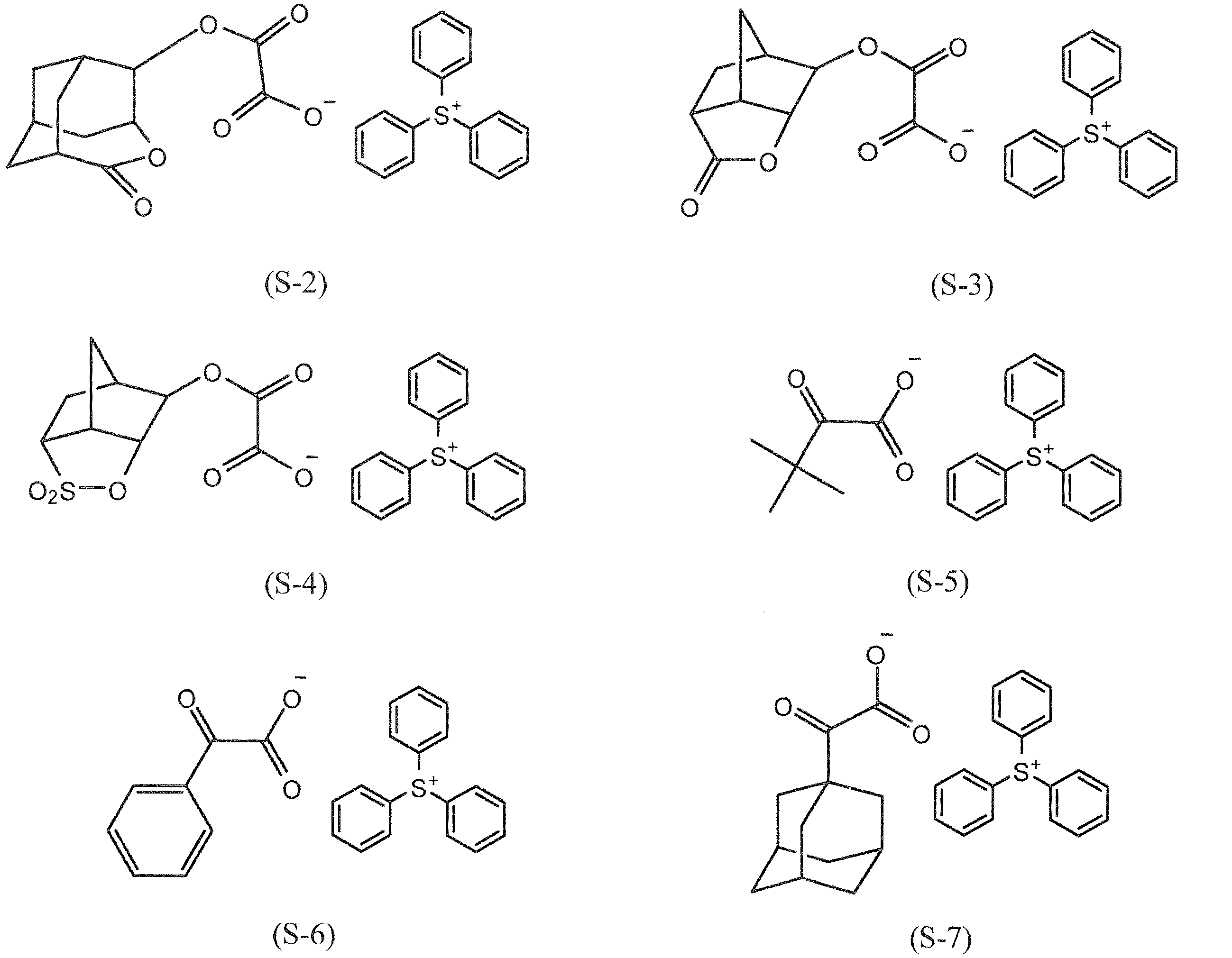
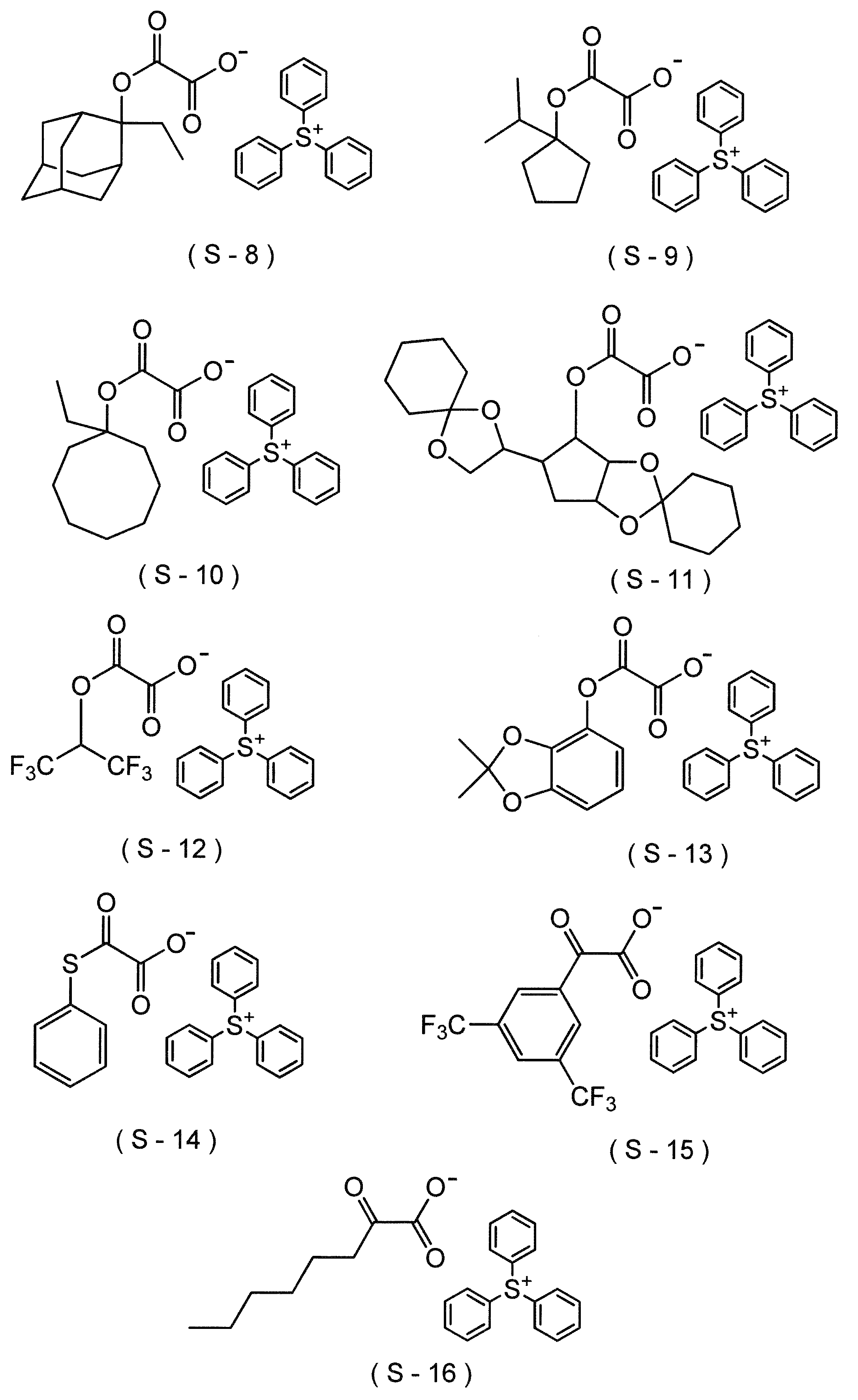
各重合体の製造に用いた単量体を以下に示す。

[合成例1](重合体(A-1)の製造)
化合物(M-6)7.97g(35モル%)、化合物(M-7)7.44g(45モル%)及び化合物(M-8)4.49g(20モル%)を2-ブタノン40gに溶解し、ラジカル開始剤としてのAIBN0.80g(化合物の合計モル数に対して5モル%)を添加して単量体溶液を調製した。20gの2-ブタノンを入れた100mLの三口フラスコを30分窒素パージした後、攪拌しながら80℃に加熱し、上記調製した単量体溶液を滴下漏斗にて3時間かけて滴下した。滴下開始を重合反応の開始時間とし、重合反応を6時間実施した。重合反応終了後、重合反応液を水冷して30℃以下に冷却した。この冷却した重合反応液を400gのメタノール中に投入し、析出した白色粉末をろ別した。ろ別した白色粉末を80gのメタノールで2回洗浄した後ろ別し、50℃で17時間乾燥させ、白色粉末状の重合体(A-1)を合成した(15.2g、収率76%)。重合体(A-1)のMwは7,300、Mw/Mnは1.53であった。13C-NMR分析の結果、(M-6)、(M-7)及び(M-8)に由来する各構造単位の含有割合は、それぞれ34.3モル%、45.1モル%及び20.6モル%であった。
化合物(M-1)6.88g(40モル%)、化合物(M-9)2.30g(10モル%)及び化合物(M-2)10.83g(50モル%)を2-ブタノン40gに溶解し、ラジカル開始剤としてのAIBN0.72g(化合物の合計モル数に対して5モル%)を添加して単量体溶液を調製した。次いで20gの2-ブタノンを入れた100mLの三口フラスコを30分窒素パージした後、攪拌しながら80℃に加熱し、上記調製した単量体溶液を滴下漏斗にて3時間かけて滴下した。滴下開始を重合反応の開始時間とし、重合反応を6時間実施した。得られた重合反応液を上記合成例1と同様に処理することにより、白色粉末状の重合体(A-2)を合成した(14.9g、収率75%)。重合体(A-2)のMwは7,500、Mw/Mnは1.55であった。13C-NMR分析の結果、(M-1)、(M-9)、(M-2)に由来する各構造単位の含有割合は、それぞれ40.1モル%、10.1モル%及び9.8モル%であった。
化合物(M-1)3.43g(20モル%)、化合物(M-11)3.59g(15モル%)、化合物(M-10)7.83g(40モル%)及び化合物(M-8)5.16g(25モル%)を2-ブタノン40gに溶解し、ラジカル開始剤としてのAIBN0.72g(化合物の合計モル数に対して5モル%)を添加して単量体溶液を調製した。次いで20gの2-ブタノンを入れた100mLの三口フラスコを30分窒素パージした後、攪拌しながら80℃に加熱し、上記調製した単量体溶液を滴下漏斗にて3時間かけて滴下した。滴下開始を重合反応の開始時間とし、重合反応を6時間実施した。得られた重合反応液を上記合成例1と同様に処理することにより、白色粉末状の重合体(A-3)を合成した(15.3g、収率77%)。重合体(A-3)のMwは7,200、Mw/Mnは1.53であった。13C-NMR分析の結果、(M-1)、(M-11)、(M-10)及び(M-8)に由来する各構造単位の含有割合は、それぞれ19.5モル%、15.5モル%、40.1モル%及び24.9モル%であった。
化合物(M-5)55.0g(65モル%)及び化合物(M-3)45.0g(35モル%)、ラジカル開始剤としてのAIBN4g並びに連鎖移動剤としてのt-ドデシルメルカプタン1gを、プロピレングリコールモノメチルエーテル100gに溶解した後、窒素雰囲気下、反応温度を70℃に保持して、16時間重合させた。重合反応終了後、重合反応液を1,000gのn-ヘキサン中に滴下して、重合体を凝固精製した。次いで、上記得られた重合体に、再度プロピレングリコールモノメチルエーテル150gを加え、さらに、メタノール150g、トリエチルアミン34g及び水6gを加えて、沸点にて還流させながら、8時間加水分解反応を行った。反応終了後、溶媒及びトリエチルアミンを減圧留去し、得られた重合体をアセトン150gに溶解した後、2,000gの水中に滴下して凝固させ、得られた白色粉末をろ過し、50℃で17時間乾燥させて白色粉末状の重合体(A-4)を得た(65.7g、収率77%)。重合体(A-4)のMwは7,500、Mw/Mnは1.90であった。13C-NMR分析の結果、p-ヒドロキシスチレン及び(M-3)に由来する各構造単位の含有割合は、それぞれ65.4モル%及び34.6モル%であった。
[合成例5](重合体(E-1)の合成)
化合物(M-1)79.9g(70モル%)及び化合物(M-4)20.91g(30モル%)を、100gの2-ブタノンに溶解し、ラジカル開始剤としてのジメチル2,2’-アゾビスイソブチレート4.77gを溶解させて単量体溶液を調製した。100gの2-ブタノンを入れた1,000mLの三口フラスコを30分窒素パージした後、攪拌しながら80℃に加熱し、上記調製した単量体溶液を滴下漏斗にて3時間かけて滴下した。滴下開始を重合反応の開始時間とし、重合反応を6時間実施した。重合反応終了後、重合反応液を水冷して30℃以下に冷却した。この重合反応液を2L分液漏斗に移液した後、150gのn-ヘキサンで上記重合反応液を均一に希釈し、600gのメタノールを投入して混合した。次いで、30gの蒸留水を投入し、さらに攪拌して30分静置した。その後、下層を回収して溶媒置換を行うことにより、重合体(E-1)を含むプロピレングリコールモノメチルエーテルアセテート溶液を得た(収率60%)。重合体(E-1)のMwは7,200、Mw/Mnは2.00であった。13C-NMR分析の結果、(M-1)及び(M-4)に由来する各構造単位の含有割合は、それぞれ71.1モル%及び28.9モル%であった。
感放射線性樹脂組成物の調製に用いた[B]化合物、[C]酸発生剤、[D]他の酸拡散制御剤、[F]溶媒及び[G]偏在化促進剤を以下に示す。
上記実施例1~16で製造した化合物(S-1)~(S-16)
C-1:トリフェニルスルホニウム2-(アダマンタン-1-イルカルボニルオキシ)-1,1,3,3,3-ペンタフルオロプロパン-1-スルホネート(下記式(C-1)で表される化合物)
C-2:トリフェニルスルホニウムノルボルナンスルトン-2-イルオキシカルボニル-ジフルオロメタンスルホネート(下記式(C-2)で表される化合物)
C-3:トリフェニルスルホニウム3-(ピペリジン-1-イルスルホニル)-1,1,2,2,3,3-ヘキサフルオロプロパン-1-スルホネート(下記式(C-3)で表される化合物)
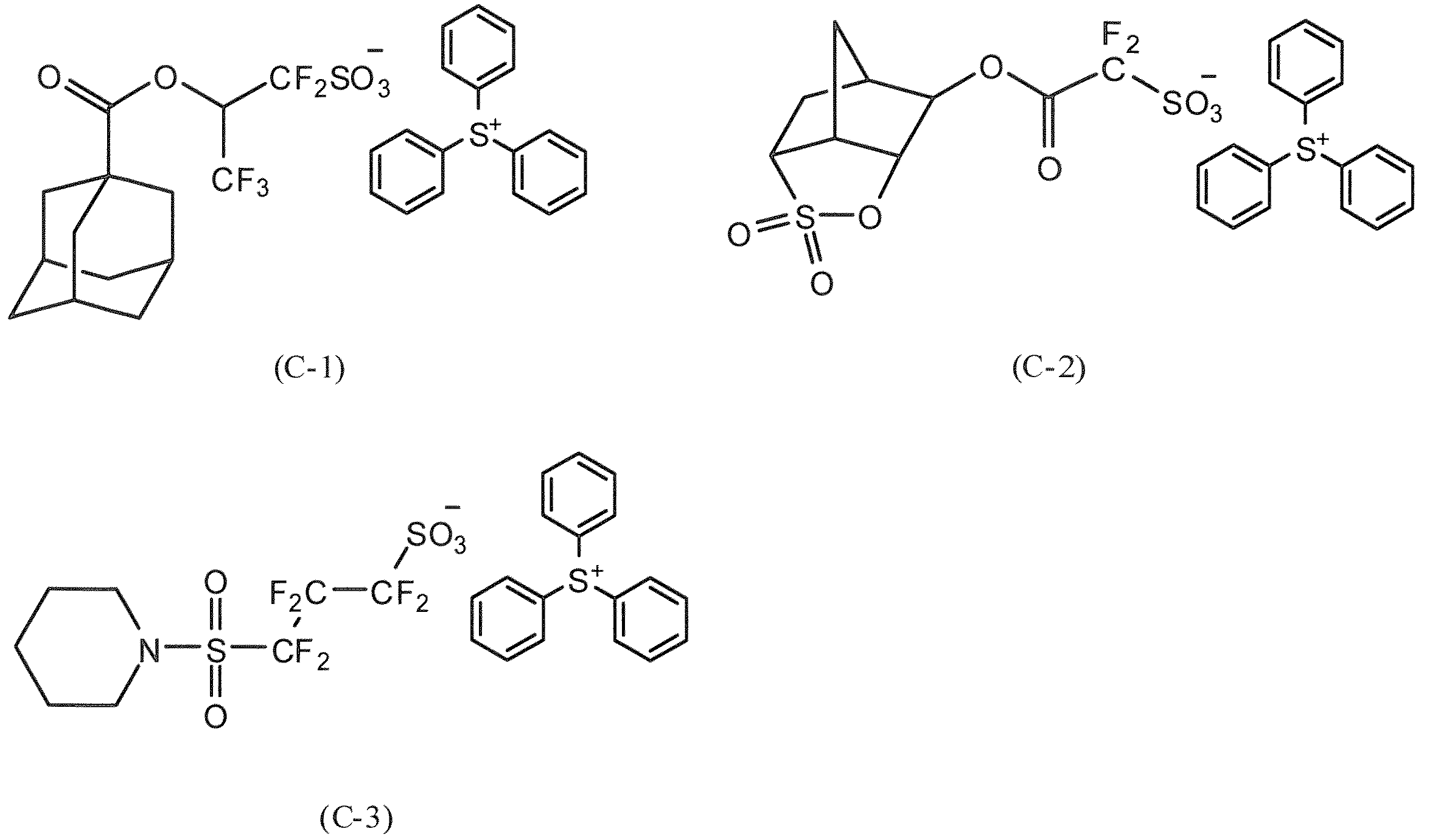
D-1:トリフェニルスルホニウムサリチレート(下記式(D-1)で表される化合物)
D-2:トリフェニルスルホニウム10-カンファースルホネート(下記式(D-2)で表される化合物)
D-3:N-ウンデシルカルボニルオキシエチルモルホリン(下記式(D-3)で表される化合物)
D-4:2,6-ジイソプロピルアニリン(下記式(D-4)で表される化合物)
D-5:トリn-ペンチルアミン(下記式(D-5)で表される化合物)
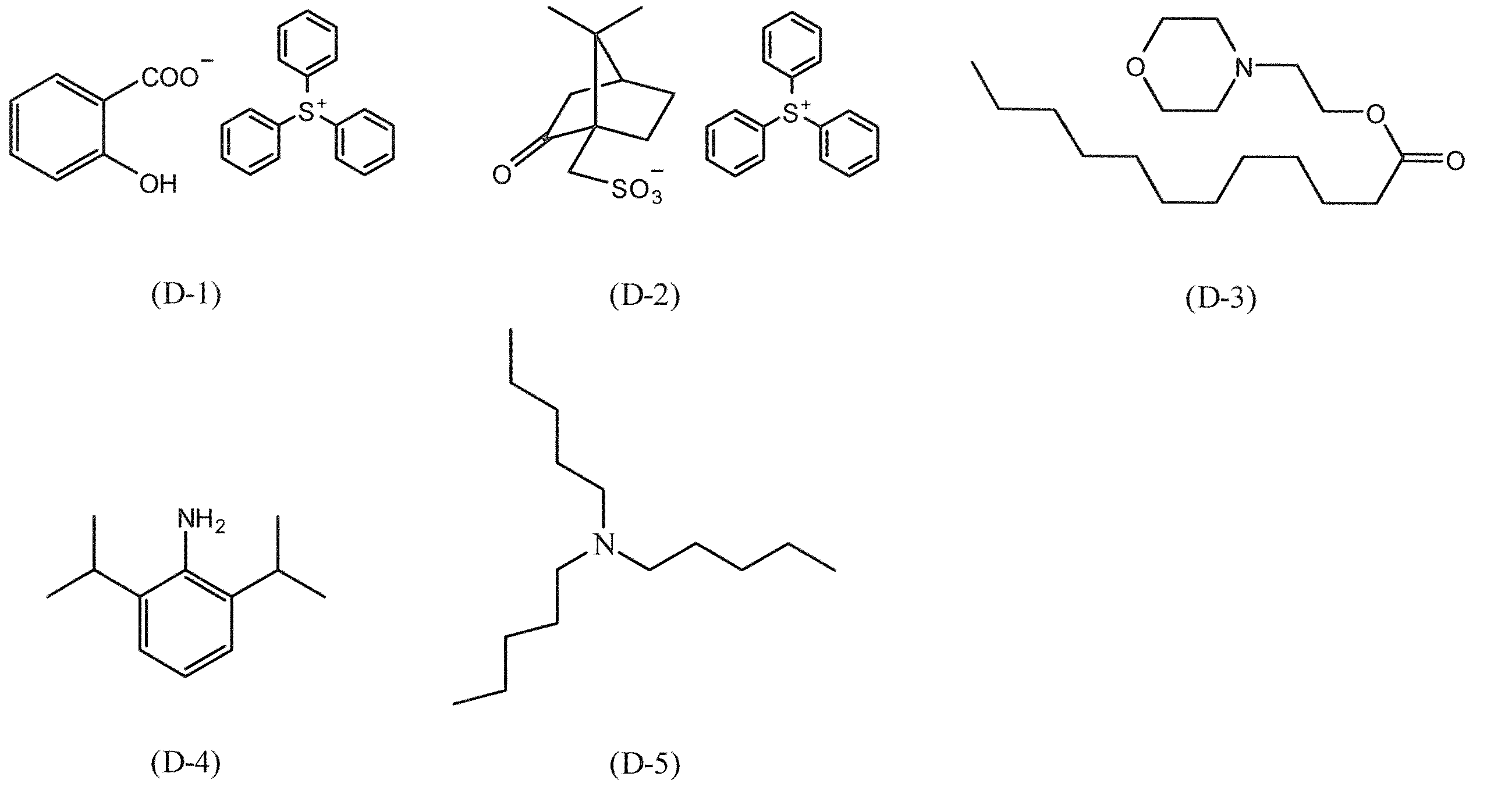
F-1:酢酸プロピレングリコールモノメチルエーテル
F-2:シクロヘキサノン
G-1:γ-ブチロラクトン
[実施例17]
[A]重合体としての(A-1)100質量部、[B]化合物としての(S-1)2.3質量部、[C]酸発生剤としての(C-1)8.5質量部、[E]重合体としての(E-1)3質量部、[F]溶媒としての(F-1)2,240質量部及び(F-2)960質量部、並びに[G]偏在化促進剤としての(G-1)30質量部を混合して感放射線性樹脂組成物(J-1)を調製した。
下記表1に示す種類及び含有量の各成分を用いた以外は実施例1と同様にして、感放射線性樹脂組成物(J-2)~(J-22)及び(CJ-1)~(CJ-5)を調製した。
12インチのシリコンウエハー表面に、スピンコーター(CLEAN TRACK ACT12、東京エレクトロン製)を使用して、下層反射防止膜形成用組成物(ARC66、ブルワーサイエンス製)を塗布した後、205℃で60秒間加熱することにより膜厚105nmの下層反射防止膜を形成した。この下層反射防止膜上に、上記スピンコーターを使用して上記調製した各感放射線性樹脂組成物を塗布し、90℃で60秒間PBを行った後23℃で30秒間冷却し、膜厚90nmのレジスト膜を形成した。次に、このレジスト膜を、ArFエキシマレーザー液浸露光装置(NSR-S610C、NIKON製)を用い、NA=1.3、ダイポール(シグマ0.977/0.782)の光学条件にて、40nmラインアンドスペース(1L1S)マスクパターンを介して露光した。露光後、90℃で60秒間PEBを行った。その後、アルカリ現像液としての2.38質量%のTMAH水溶液を用いてアルカリ現像し、水で洗浄し、乾燥してポジ型のレジストパターンを形成した。このレジストパターン形成の際、ターゲット寸法が40nmの1対1ラインアンドスペースのマスクを介して形成した際に、線幅40nmの1対1ラインアンドスペースに形成される露光量を最適露光量(Eop(1))とした。
上記TMAH水溶液の代わりに、有機溶媒現像液としての酢酸n-ブチルを用いて有機溶媒現像し、かつ水での洗浄を行わなかった以外は、上記レジストパターンの形成(1)と同様にして、ネガ型のレジストパターンを形成した。このレジストパターン形成の際、ターゲット寸法が40nmの1対1ラインアンドスペースのマスクを介して形成した際に、線幅40nmの1対1ラインアンドスペースに形成される露光量を最適露光量(Eop(2))とした。
各感放射線性樹脂組成物のLWR性能、解像性、断面形状の矩形性及び焦点深度を、上記レジストパターンの形成(1)及び(2)において得られたレジストパターンについて下記方法に従って測定することにより評価した。評価結果を表2に示す。上記レジストパターンの測長には、走査型電子顕微鏡(S-9380、日立ハイテクノロジーズ製)を用いた。なお、実施例17~23及び28~38は比較例1と、実施例24は比較例2と、実施例25は比較例3と、実施例26は比較例4と、実施例27は比較例5をそれぞれ基準として比較し、評価した。表2中の「-」は、評価の基準であることを示す。
上記得られたレジストパターンをパターン上部から観察し、線幅を任意のポイントで計50点測定し、その測定値の分布から3シグマ値を求め、これをLWR性能とした。LWR性能は、その値が小さいほど良好であることを示す。LWR性能は、比較する比較例(判定基準)と比べて10%以上向上した場合(LWR性能の値が90%以下の場合)は「A」と、10%未満の向上の場合(LWR性能の値が90%を超え100%未満の場合)は「B」と、同等又は悪化した場合(LWR性能の値100%以上の場合)は「C」と評価した。
上記最適露光量(Eop(1)又はEop(2))において解像される最小のレジストパターンの寸法を測定し、この寸法を解像性とした。解像性はその値が小さいほど良好であることを示す。解像性は、比較する比較例(判定基準)と比べて、10%以上向上した場合(解像性の値が90%以下の場合)は「A」と、10%未満の向上の場合(解像性の値が90%を超え100%未満の場合)は「B」と、同等又は悪化した場合(解像性の値が100%以上の場合)は「C」と評価した。
上記最適露光量(Eop(1)又はEop(2))において解像されるレジストパターンの断面形状を観察し、レジストパターンの高さ方向の中間での線幅Lb及び膜の上部での線幅Laを測定した。断面形状の矩形性は、0.9≦(La/Lb)≦1.1の場合は「A」と、(La/Lb)<0.9又は1.1<(La/Lb)の場合は「B」と評価した。
上記最適露光量(Eop(1)又はEop(2))において解像されるレジストパターンにおいて、深さ方向にフォーカスを変化させた際の形成されるパターンの寸法を観測し、ブリッジや残渣が無いまま、寸法が基準の90%~110%に入る深さ方向の余裕度を測定し、この測定値を焦点深度とした。焦点深度はその値が大きいほど良好であることを示す。焦点深度は、比較する比較例(判定基準)と比べて、10%以上向上した場合(焦点深度の値が110%以上の場合)は「A」と、10%未満の向上の場合(焦点深度の値が100%を超え110%未満の場合)は「B」と、同等又は悪化した場合(焦点深度の値が100%以下の場合)は「C」と評価した。

[実施例39]
[A]重合体としての(A-4)100質量部、[B]化合物としての(S-1)3.6質量部、[C]酸発生剤としての(C-1)20質量部、並びに[F]溶媒としての(F-1)4,280質量部及び(F-2)1,830質量部を混合して感放射線性樹脂組成物(J-23)を調製した。
下記表3に示す種類及び含有量の各成分を用いた以外は、実施例39と同様にして、感放射線性樹脂組成物(J-24)~(J-44)及び(CJ-6)~(CJ-10)を調製した。
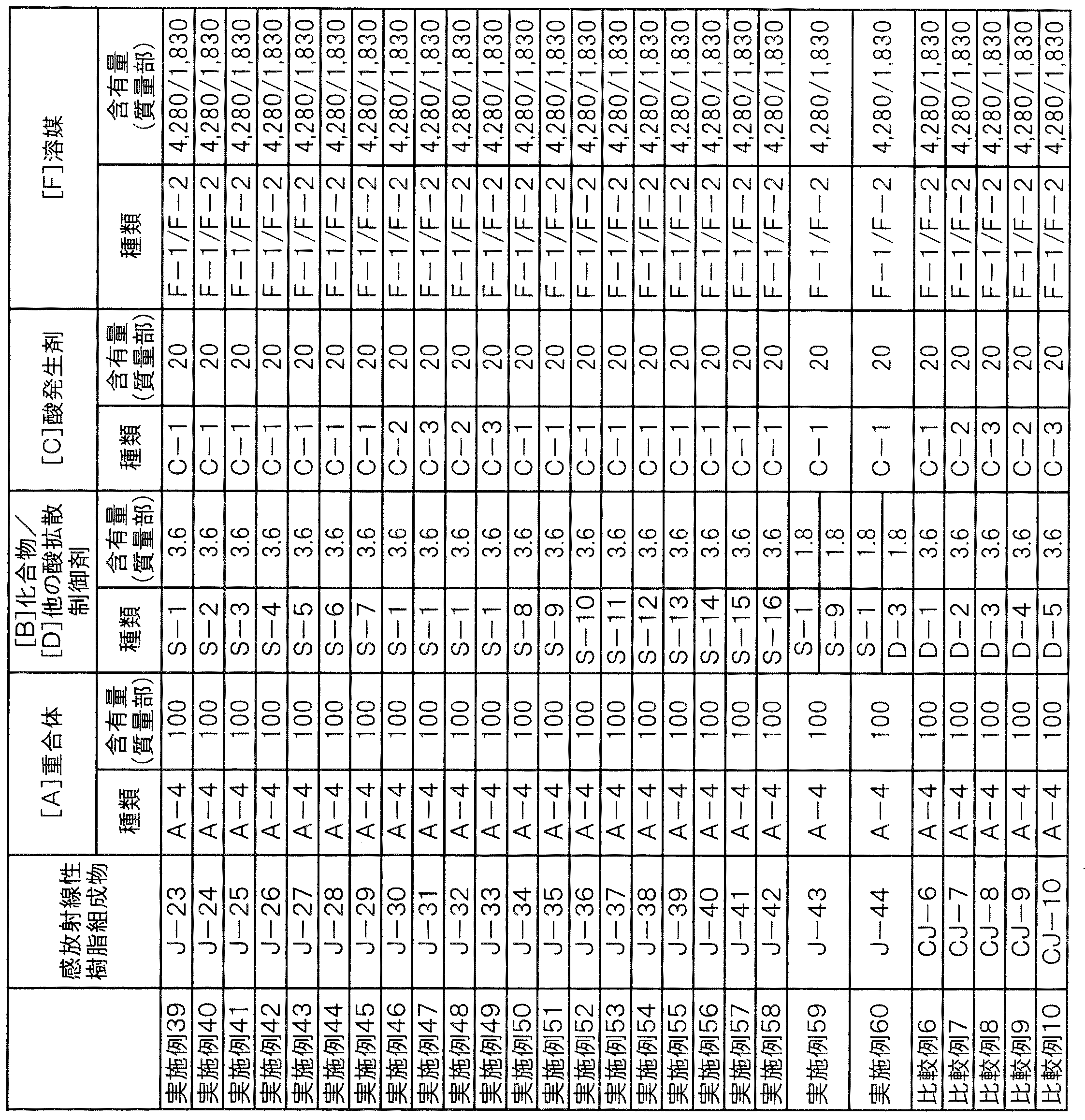
8インチのシリコンウエハー表面にスピンコーター(CLEAN TRACK ACT8、東京エレクトロン製)を使用して、各感放射線性樹脂組成物を塗布し、90℃で60秒間PBを行った後、23℃で30秒間冷却し、膜厚50nmのレジスト膜を形成した。次に、このレジスト膜に、簡易型の電子線描画装置(型式「HL800D」、日立製作所製、出力:50KeV、電流密度:5.0A/cm2)を用いて電子線を照射した。照射後、120℃で60秒間PEBを行った。その後、アルカリ現像液としての2.38質量%のTMAH水溶液を用いて23℃で30秒間アルカリ現像し、水で洗浄し、乾燥してポジ型のレジストパターンを形成した。
上記レジストパターンの形成(3)で得られたレジストパターンについて、上記同様の方法で測定することにより、各感放射線性樹脂組成物のLWR性能、解像性及び断面形状を評価した。評価結果を表4に示す。なお、実施例39~45及び50~60は比較例6と、実施例46は比較例7と、実施例47は比較例8と、実施例48は比較例9と、実施例49は比較例10をそれぞれ基準として比較し、評価した。表4中の「-」は、評価の基準であることを示す。
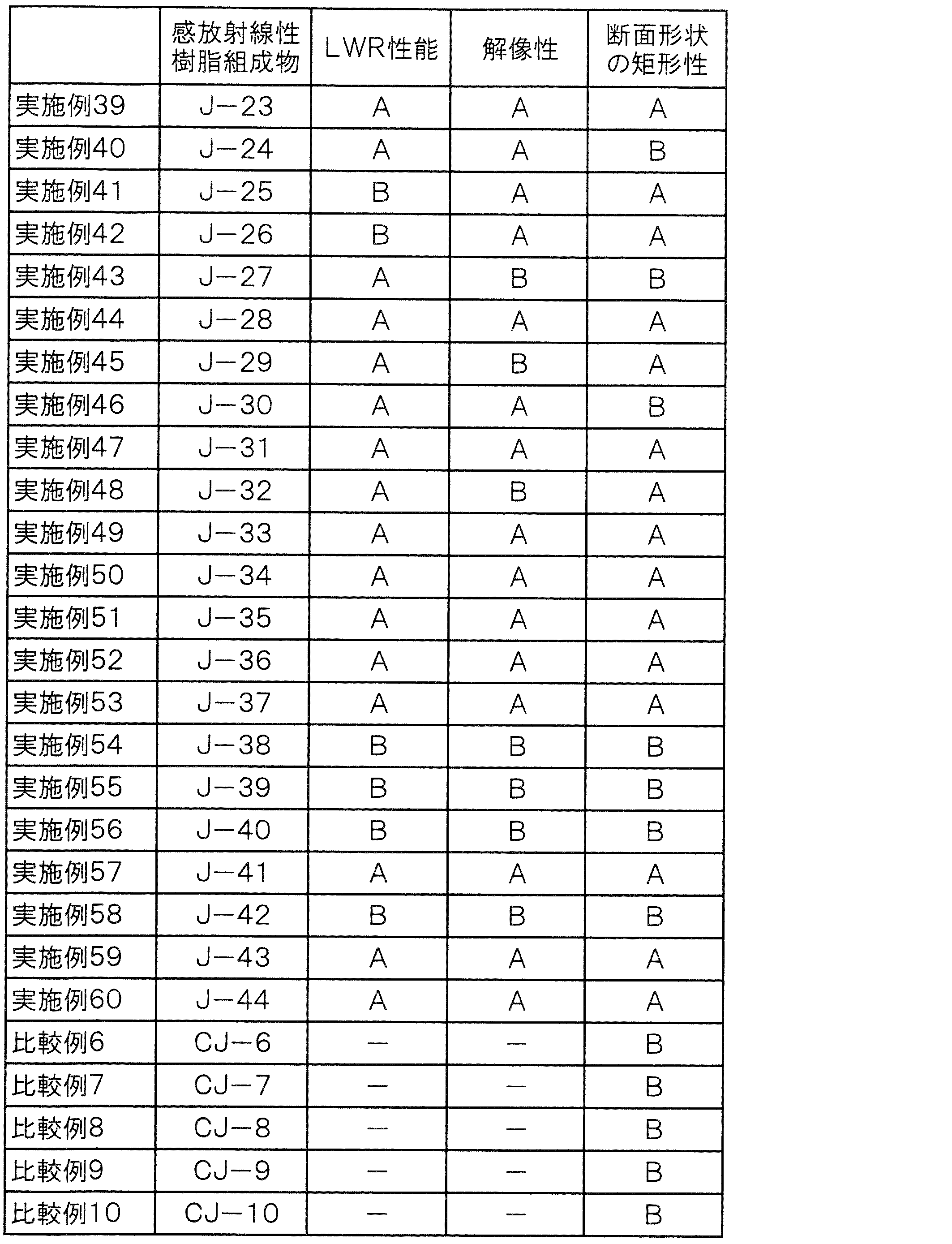
Claims (11)
- 酸解離性基を含む構造単位を有する重合体、及び
下記式(1)で表される化合物
を含有する感放射線性樹脂組成物。

- 上記式(1)におけるR1の1価の有機基が1価の炭化水素基又は1価のフッ素化炭化水素基であり、Lが単結合である請求項1に記載の感放射線性樹脂組成物。
- 上記式(1)におけるR1の1価の有機基が1価の炭化水素基、1価のフッ素化炭化水素基、1価の脂肪族複素環基又は1価のフッ素化脂肪族複素環基であり、Lが酸素原子又は硫黄原子である請求項1に記載の感放射線性樹脂組成物。
- 上記M+の1価の放射線分解性オニウムカチオンが下記式(X)で表される請求項1に記載の感放射線性樹脂組成物。
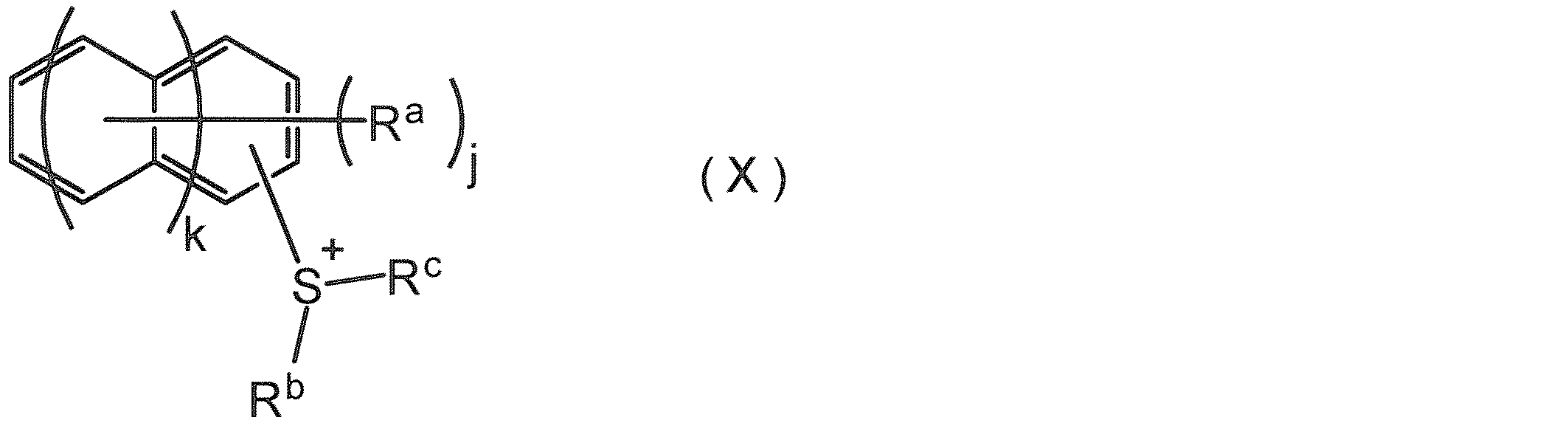
(式(X)中、Raは、フッ素原子、ヒドロキシ基、炭素数1~10のアルキル基、炭素数1~10のアルコキシ基、炭素数2~11のアルコキシカルボニル基又は炭素数1~10のアルキルスルホニル基である。jは、0~9の整数である。jが2以上の場合、複数のRaは、同一でも異なっていてもよい。Rb及びRcは、それぞれ独立して置換若しくは非置換の炭素数1~10のアルキル基及び置換若しくは非置換の炭素数6~20のアリール基のうちのいずれかであるか、又はこれらの基が互いに合わせられこれらが結合する硫黄原子と共に構成される環員数4~10の環構造を表す。kは、0~2の整数である。) - 感放射線性酸発生体をさらに含有する請求項1に記載の感放射線性樹脂組成物。
- 上記構造単位が下記式(2-1)で表される請求項1に記載の感放射線性樹脂組成物。


- 上記重合体が、下記式(4)で表される構造単位をさらに有する請求項1に記載の感放射線性樹脂組成物。

- レジスト膜を形成する工程、
上記レジスト膜を露光する工程、及び
上記露光されたレジスト膜を現像する工程
を有し、
上記レジスト膜を請求項1に記載の感放射線性樹脂組成物により形成するレジストパターン形成方法。 - 下記式(1)で表される化合物からなる酸拡散制御剤。
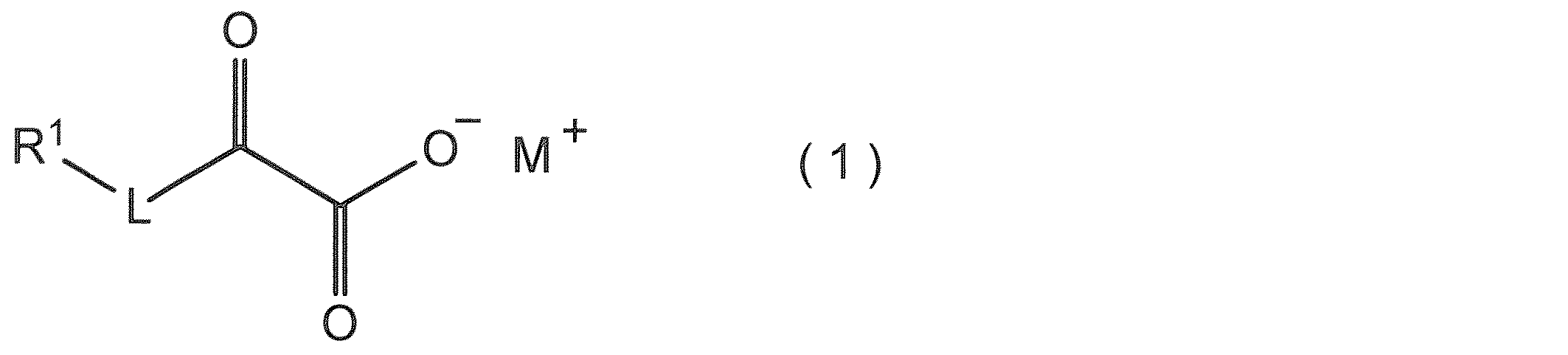
- 下記式(1)で表される化合物。
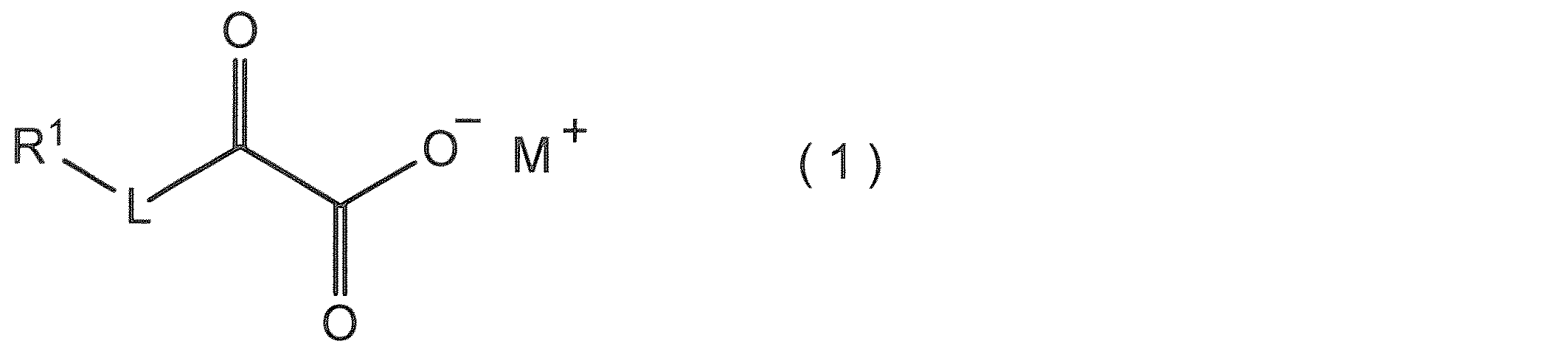
- 下記式(1a)で表される化合物と下記式(1b)で表される化合物とを反応させる工程を有する下記式(1)で表される化合物の製造方法。

Priority Applications (3)
| Application Number | Priority Date | Filing Date | Title |
|---|---|---|---|
| JP2015518126A JP6304246B2 (ja) | 2013-05-24 | 2014-03-11 | 感放射線性樹脂組成物及びレジストパターン形成方法 |
| KR1020157022696A KR102166206B1 (ko) | 2013-05-24 | 2014-03-11 | 감방사선성 수지 조성물, 레지스트 패턴 형성 방법, 산 확산 제어제, 화합물 및 화합물의 제조 방법 |
| US14/827,795 US9529259B2 (en) | 2013-05-24 | 2015-08-17 | Radiation-sensitive resin composition, resist pattern-forming method, acid diffusion control agent, compound, and method for producing compound |
Applications Claiming Priority (2)
| Application Number | Priority Date | Filing Date | Title |
|---|---|---|---|
| JP2013110437 | 2013-05-24 | ||
| JP2013-110437 | 2013-05-24 |
Related Child Applications (1)
| Application Number | Title | Priority Date | Filing Date |
|---|---|---|---|
| US14/827,795 Continuation US9529259B2 (en) | 2013-05-24 | 2015-08-17 | Radiation-sensitive resin composition, resist pattern-forming method, acid diffusion control agent, compound, and method for producing compound |
Publications (1)
| Publication Number | Publication Date |
|---|---|
| WO2014188762A1 true WO2014188762A1 (ja) | 2014-11-27 |
Family
ID=51933328
Family Applications (1)
| Application Number | Title | Priority Date | Filing Date |
|---|---|---|---|
| PCT/JP2014/056379 Ceased WO2014188762A1 (ja) | 2013-05-24 | 2014-03-11 | 感放射線性樹脂組成物、レジストパターン形成方法、酸拡散制御剤、化合物及び化合物の製造方法 |
Country Status (4)
| Country | Link |
|---|---|
| US (1) | US9529259B2 (ja) |
| JP (1) | JP6304246B2 (ja) |
| KR (1) | KR102166206B1 (ja) |
| WO (1) | WO2014188762A1 (ja) |
Cited By (14)
| Publication number | Priority date | Publication date | Assignee | Title |
|---|---|---|---|---|
| JP2017003927A (ja) * | 2015-06-15 | 2017-01-05 | Jsr株式会社 | 感放射線性樹脂組成物及びレジストパターン形成方法 |
| JP2017040833A (ja) * | 2015-08-20 | 2017-02-23 | 国立大学法人大阪大学 | 化学増幅型レジスト材料 |
| WO2017130629A1 (ja) * | 2016-01-25 | 2017-08-03 | Jsr株式会社 | 感放射線性樹脂組成物及びレジストパターン形成方法 |
| JP2018135326A (ja) * | 2017-02-20 | 2018-08-30 | 住友化学株式会社 | カルボン酸塩、カルボン酸発生剤、レジスト組成物及びレジストパターンの製造方法 |
| JP2021081476A (ja) * | 2019-11-14 | 2021-05-27 | 東京応化工業株式会社 | レジスト組成物及びレジストパターン形成方法 |
| KR20210082374A (ko) | 2019-12-25 | 2021-07-05 | 도오꾜오까고오교 가부시끼가이샤 | 레지스트 조성물 및 레지스트 패턴 형성 방법 |
| JP2021103236A (ja) * | 2019-12-25 | 2021-07-15 | 東京応化工業株式会社 | レジスト組成物及びレジストパターン形成方法 |
| JP2023035836A (ja) * | 2021-08-31 | 2023-03-13 | 富士フイルム株式会社 | 感活性光線性又は感放射線性樹脂組成物の製造方法、パターン形成方法、電子デバイスの製造方法、及びオニウム塩の製造方法 |
| US11703756B2 (en) | 2018-05-28 | 2023-07-18 | Tokyo Ohka Kogyo Co., Ltd. | Resist composition and method of forming resist pattern |
| WO2024071125A1 (ja) * | 2022-09-27 | 2024-04-04 | 東京応化工業株式会社 | レジスト組成物、レジストパターン形成方法、化合物及び酸拡散制御剤 |
| WO2024080128A1 (ja) * | 2022-10-12 | 2024-04-18 | 富士フイルム株式会社 | 感活性光線性又は感放射線性樹脂組成物、レジスト膜、パターン形成方法、電子デバイスの製造方法 |
| JP2024144828A (ja) * | 2023-03-31 | 2024-10-15 | 信越化学工業株式会社 | 化学増幅ネガ型レジスト組成物及びレジストパターン形成方法 |
| JP2024144822A (ja) * | 2023-03-31 | 2024-10-15 | 信越化学工業株式会社 | 化学増幅ポジ型レジスト組成物及びレジストパターン形成方法 |
| US12619152B2 (en) | 2021-08-31 | 2026-05-05 | Fujifilm Corporation | Method for producing actinic ray-sensitive or radiation-sensitive resin composition, pattern forming method, method for producing electronic device, and method for producing onium salt |
Families Citing this family (8)
| Publication number | Priority date | Publication date | Assignee | Title |
|---|---|---|---|---|
| JP6748493B2 (ja) * | 2015-07-24 | 2020-09-02 | 住友化学株式会社 | レジスト組成物 |
| US11112698B2 (en) * | 2016-11-29 | 2021-09-07 | Taiwan Semiconductor Manufacturing Co., Ltd. | Photoresist with gradient composition for improved uniformity |
| KR102912926B1 (ko) | 2018-07-19 | 2026-01-14 | 린트필드 리미티드 | 티오크산톤 유도체 및 이를 포함하는 조성물 및 상기 조성물을 포함하는 패턴 형성 방법{Thioxanthone derivatives, composition comprising the same and pattern forming method comprising said composition} |
| TWI836094B (zh) * | 2019-06-21 | 2024-03-21 | 日商富士軟片股份有限公司 | 感光化射線性或感放射線性樹脂組合物、光阻膜、圖案形成方法、電子裝置之製造方法 |
| US20210200086A1 (en) * | 2019-12-25 | 2021-07-01 | Tokyo Ohka Kogyo Co., Ltd. | Resist composition and method of forming resist pattern |
| GB202000736D0 (en) | 2020-01-17 | 2020-03-04 | Lintfield Ltd | Modified thioxanthone photoinitators |
| US12222650B2 (en) * | 2020-02-27 | 2025-02-11 | Taiwan Semiconductor Manufacuring Company, Ltd. | Photoresist underlayer and method of manufacturing a semiconductor device |
| JP7760962B2 (ja) | 2022-06-14 | 2025-10-28 | 信越化学工業株式会社 | オニウム塩、レジスト組成物、及びパターン形成方法 |
Citations (3)
| Publication number | Priority date | Publication date | Assignee | Title |
|---|---|---|---|---|
| JP2001013687A (ja) * | 1999-04-26 | 2001-01-19 | Jsr Corp | 感放射線性樹脂組成物 |
| JP2002148790A (ja) * | 2000-09-04 | 2002-05-22 | Fuji Photo Film Co Ltd | 感熱性組成物、それを用いた平版印刷版原版及びスルホニウム塩化合物 |
| JP2005014603A (ja) * | 2003-06-02 | 2005-01-20 | Fuji Photo Film Co Ltd | 平版印刷方法および機上現像用平版印刷原版 |
Family Cites Families (5)
| Publication number | Priority date | Publication date | Assignee | Title |
|---|---|---|---|---|
| JPH08146610A (ja) | 1994-11-17 | 1996-06-07 | Nippon Zeon Co Ltd | レジスト組成物及びそれを用いたパターン形成方法 |
| JP3991462B2 (ja) | 1997-08-18 | 2007-10-17 | Jsr株式会社 | 感放射線性樹脂組成物 |
| US6136501A (en) | 1998-08-28 | 2000-10-24 | Shipley Company, L.L.C. | Polymers and photoresist compositions comprising same |
| TW550438B (en) * | 1999-04-26 | 2003-09-01 | Jsr Corp | Radiation-sensitive resin composition |
| EP1484177B1 (en) * | 2003-06-02 | 2007-08-29 | FUJIFILM Corporation | Lithographic process involving on press development |
-
2014
- 2014-03-11 WO PCT/JP2014/056379 patent/WO2014188762A1/ja not_active Ceased
- 2014-03-11 JP JP2015518126A patent/JP6304246B2/ja active Active
- 2014-03-11 KR KR1020157022696A patent/KR102166206B1/ko active Active
-
2015
- 2015-08-17 US US14/827,795 patent/US9529259B2/en active Active
Patent Citations (3)
| Publication number | Priority date | Publication date | Assignee | Title |
|---|---|---|---|---|
| JP2001013687A (ja) * | 1999-04-26 | 2001-01-19 | Jsr Corp | 感放射線性樹脂組成物 |
| JP2002148790A (ja) * | 2000-09-04 | 2002-05-22 | Fuji Photo Film Co Ltd | 感熱性組成物、それを用いた平版印刷版原版及びスルホニウム塩化合物 |
| JP2005014603A (ja) * | 2003-06-02 | 2005-01-20 | Fuji Photo Film Co Ltd | 平版印刷方法および機上現像用平版印刷原版 |
Cited By (22)
| Publication number | Priority date | Publication date | Assignee | Title |
|---|---|---|---|---|
| JP2017003927A (ja) * | 2015-06-15 | 2017-01-05 | Jsr株式会社 | 感放射線性樹脂組成物及びレジストパターン形成方法 |
| JP2017040833A (ja) * | 2015-08-20 | 2017-02-23 | 国立大学法人大阪大学 | 化学増幅型レジスト材料 |
| WO2017130629A1 (ja) * | 2016-01-25 | 2017-08-03 | Jsr株式会社 | 感放射線性樹脂組成物及びレジストパターン形成方法 |
| KR102573542B1 (ko) | 2016-01-25 | 2023-09-01 | 제이에스알 가부시끼가이샤 | 감방사선성 수지 조성물 및 레지스트 패턴 형성 방법 |
| KR20180101409A (ko) * | 2016-01-25 | 2018-09-12 | 제이에스알 가부시끼가이샤 | 감방사선성 수지 조성물 및 레지스트 패턴 형성 방법 |
| JPWO2017130629A1 (ja) * | 2016-01-25 | 2018-11-15 | Jsr株式会社 | 感放射線性樹脂組成物及びレジストパターン形成方法 |
| JP7202780B2 (ja) | 2017-02-20 | 2023-01-12 | 住友化学株式会社 | カルボン酸塩、カルボン酸発生剤、レジスト組成物及びレジストパターンの製造方法 |
| JP2018135326A (ja) * | 2017-02-20 | 2018-08-30 | 住友化学株式会社 | カルボン酸塩、カルボン酸発生剤、レジスト組成物及びレジストパターンの製造方法 |
| US11703756B2 (en) | 2018-05-28 | 2023-07-18 | Tokyo Ohka Kogyo Co., Ltd. | Resist composition and method of forming resist pattern |
| JP2021081476A (ja) * | 2019-11-14 | 2021-05-27 | 東京応化工業株式会社 | レジスト組成物及びレジストパターン形成方法 |
| JP7394591B2 (ja) | 2019-11-14 | 2023-12-08 | 東京応化工業株式会社 | レジスト組成物及びレジストパターン形成方法 |
| KR20210082374A (ko) | 2019-12-25 | 2021-07-05 | 도오꾜오까고오교 가부시끼가이샤 | 레지스트 조성물 및 레지스트 패턴 형성 방법 |
| JP2021103236A (ja) * | 2019-12-25 | 2021-07-15 | 東京応化工業株式会社 | レジスト組成物及びレジストパターン形成方法 |
| JP7801841B2 (ja) | 2019-12-25 | 2026-01-19 | 東京応化工業株式会社 | レジスト組成物及びレジストパターン形成方法 |
| JP2023035836A (ja) * | 2021-08-31 | 2023-03-13 | 富士フイルム株式会社 | 感活性光線性又は感放射線性樹脂組成物の製造方法、パターン形成方法、電子デバイスの製造方法、及びオニウム塩の製造方法 |
| JP7850019B2 (ja) | 2021-08-31 | 2026-04-22 | 富士フイルム株式会社 | 感活性光線性又は感放射線性樹脂組成物の製造方法、パターン形成方法、及び電子デバイスの製造方法 |
| US12619152B2 (en) | 2021-08-31 | 2026-05-05 | Fujifilm Corporation | Method for producing actinic ray-sensitive or radiation-sensitive resin composition, pattern forming method, method for producing electronic device, and method for producing onium salt |
| WO2024071125A1 (ja) * | 2022-09-27 | 2024-04-04 | 東京応化工業株式会社 | レジスト組成物、レジストパターン形成方法、化合物及び酸拡散制御剤 |
| WO2024080128A1 (ja) * | 2022-10-12 | 2024-04-18 | 富士フイルム株式会社 | 感活性光線性又は感放射線性樹脂組成物、レジスト膜、パターン形成方法、電子デバイスの製造方法 |
| JP2024144828A (ja) * | 2023-03-31 | 2024-10-15 | 信越化学工業株式会社 | 化学増幅ネガ型レジスト組成物及びレジストパターン形成方法 |
| JP2024144822A (ja) * | 2023-03-31 | 2024-10-15 | 信越化学工業株式会社 | 化学増幅ポジ型レジスト組成物及びレジストパターン形成方法 |
| JP7838509B2 (ja) | 2023-03-31 | 2026-04-01 | 信越化学工業株式会社 | 化学増幅ポジ型レジスト組成物及びレジストパターン形成方法 |
Also Published As
| Publication number | Publication date |
|---|---|
| JP6304246B2 (ja) | 2018-04-04 |
| KR102166206B1 (ko) | 2020-10-15 |
| US20150355539A1 (en) | 2015-12-10 |
| KR20160014573A (ko) | 2016-02-11 |
| US9529259B2 (en) | 2016-12-27 |
| JPWO2014188762A1 (ja) | 2017-02-23 |
Similar Documents
| Publication | Publication Date | Title |
|---|---|---|
| JP6304246B2 (ja) | 感放射線性樹脂組成物及びレジストパターン形成方法 | |
| JP6052283B2 (ja) | フォトレジスト組成物 | |
| JP6569221B2 (ja) | 感放射線性樹脂組成物、レジストパターン形成方法、感放射線性酸発生剤及び化合物 | |
| JP6237763B2 (ja) | 感放射線性樹脂組成物及びレジストパターン形成方法 | |
| JP6115377B2 (ja) | 樹脂組成物及びレジストパターン形成方法 | |
| JP6241212B2 (ja) | 感放射線性樹脂組成物、レジストパターン形成方法、感放射線性酸発生体及び化合物 | |
| JP6421449B2 (ja) | 感放射線性樹脂組成物、レジストパターン形成方法、酸発生体及び化合物 | |
| WO2014034190A1 (ja) | 感放射線性樹脂組成物、レジストパターン形成方法、感放射線性酸発生剤、化合物及び化合物の製造方法 | |
| JP6160435B2 (ja) | 感放射線性樹脂組成物、レジストパターン形成方法、感放射線性酸発生剤及び化合物 | |
| WO2015025859A1 (ja) | 感放射線性樹脂組成物、レジストパターン形成方法、感放射線性酸発生剤、酸拡散制御剤及び化合物 | |
| JP6131793B2 (ja) | 感放射線性樹脂組成物、レジストパターン形成方法、重合体及び化合物 | |
| JP6721839B2 (ja) | 感放射線性樹脂組成物、レジストパターン形成方法、感放射線性酸発生剤及び化合物 | |
| JP6171774B2 (ja) | 感放射線性樹脂組成物、レジストパターン形成方法及び感放射線性酸発生剤 | |
| JP6146329B2 (ja) | 感放射線性樹脂組成物、レジストパターン形成方法、感放射線性酸発生剤及び化合物 | |
| JP6241226B2 (ja) | フォトレジスト組成物、レジストパターン形成方法、重合体及び化合物 | |
| JP6273689B2 (ja) | 感放射線性樹脂組成物、レジストパターン形成方法、重合体、化合物及びその製造方法 | |
| JP6241303B2 (ja) | 感放射線性樹脂組成物、レジストパターン形成方法、感放射線性酸発生剤及び化合物 | |
| JP6191684B2 (ja) | 感放射線性樹脂組成物、レジストパターン形成方法及び重合体 | |
| JP6319291B2 (ja) | 感放射線性樹脂組成物、レジストパターン形成方法、感放射線性酸発生剤及び化合物 | |
| JP6146328B2 (ja) | 感放射線性樹脂組成物、レジストパターン形成方法、感放射線性酸発生体及び化合物 | |
| KR102248827B1 (ko) | 감방사선성 수지 조성물, 레지스트 패턴 형성 방법, 산 발생체 및 화합물 | |
| JP5783118B2 (ja) | フォトレジスト組成物、レジストパターン形成方法及び重合体 |
Legal Events
| Date | Code | Title | Description |
|---|---|---|---|
| 121 | Ep: the epo has been informed by wipo that ep was designated in this application |
Ref document number: 14801416 Country of ref document: EP Kind code of ref document: A1 |
|
| ENP | Entry into the national phase |
Ref document number: 2015518126 Country of ref document: JP Kind code of ref document: A |
|
| ENP | Entry into the national phase |
Ref document number: 20157022696 Country of ref document: KR Kind code of ref document: A |
|
| NENP | Non-entry into the national phase |
Ref country code: DE |
|
| 122 | Ep: pct application non-entry in european phase |
Ref document number: 14801416 Country of ref document: EP Kind code of ref document: A1 |