WO2014178324A1 - 殺菌剤配合用カタラーゼ含有水溶液及びこれを用いてなる殺菌組成液 - Google Patents
殺菌剤配合用カタラーゼ含有水溶液及びこれを用いてなる殺菌組成液 Download PDFInfo
- Publication number
- WO2014178324A1 WO2014178324A1 PCT/JP2014/061554 JP2014061554W WO2014178324A1 WO 2014178324 A1 WO2014178324 A1 WO 2014178324A1 JP 2014061554 W JP2014061554 W JP 2014061554W WO 2014178324 A1 WO2014178324 A1 WO 2014178324A1
- Authority
- WO
- WIPO (PCT)
- Prior art keywords
- catalase
- aqueous solution
- containing aqueous
- blending
- bactericide
- Prior art date
- Legal status (The legal status is an assumption and is not a legal conclusion. Google has not performed a legal analysis and makes no representation as to the accuracy of the status listed.)
- Ceased
Links
Classifications
-
- A—HUMAN NECESSITIES
- A23—FOODS OR FOODSTUFFS; TREATMENT THEREOF, NOT COVERED BY OTHER CLASSES
- A23B—PRESERVATION OF FOODS, FOODSTUFFS OR NON-ALCOHOLIC BEVERAGES; CHEMICAL RIPENING OF FRUIT OR VEGETABLES
- A23B2/00—Preservation of foods or foodstuffs, in general
- A23B2/70—Preservation of foods or foodstuffs, in general by treatment with chemicals
- A23B2/725—Preservation of foods or foodstuffs, in general by treatment with chemicals in the form of liquids or solids
- A23B2/729—Organic compounds; Microorganisms; Enzymes
- A23B2/783—Microorganisms; Enzymes
-
- A—HUMAN NECESSITIES
- A01—AGRICULTURE; FORESTRY; ANIMAL HUSBANDRY; HUNTING; TRAPPING; FISHING
- A01N—PRESERVATION OF BODIES OF HUMANS OR ANIMALS OR PLANTS OR PARTS THEREOF; BIOCIDES, e.g. AS DISINFECTANTS, AS PESTICIDES OR AS HERBICIDES; PEST REPELLANTS OR ATTRACTANTS; PLANT GROWTH REGULATORS
- A01N31/00—Biocides, pest repellants or attractants, or plant growth regulators containing organic oxygen or sulfur compounds
- A01N31/02—Acyclic compounds
-
- A—HUMAN NECESSITIES
- A01—AGRICULTURE; FORESTRY; ANIMAL HUSBANDRY; HUNTING; TRAPPING; FISHING
- A01N—PRESERVATION OF BODIES OF HUMANS OR ANIMALS OR PLANTS OR PARTS THEREOF; BIOCIDES, e.g. AS DISINFECTANTS, AS PESTICIDES OR AS HERBICIDES; PEST REPELLANTS OR ATTRACTANTS; PLANT GROWTH REGULATORS
- A01N37/00—Biocides, pest repellants or attractants, or plant growth regulators containing organic compounds containing a carbon atom having three bonds to hetero atoms with at the most two bonds to halogen, e.g. carboxylic acids
- A01N37/10—Aromatic or araliphatic carboxylic acids, or thio analogues thereof; Derivatives thereof
-
- A—HUMAN NECESSITIES
- A01—AGRICULTURE; FORESTRY; ANIMAL HUSBANDRY; HUNTING; TRAPPING; FISHING
- A01N—PRESERVATION OF BODIES OF HUMANS OR ANIMALS OR PLANTS OR PARTS THEREOF; BIOCIDES, e.g. AS DISINFECTANTS, AS PESTICIDES OR AS HERBICIDES; PEST REPELLANTS OR ATTRACTANTS; PLANT GROWTH REGULATORS
- A01N37/00—Biocides, pest repellants or attractants, or plant growth regulators containing organic compounds containing a carbon atom having three bonds to hetero atoms with at the most two bonds to halogen, e.g. carboxylic acids
- A01N37/16—Biocides, pest repellants or attractants, or plant growth regulators containing organic compounds containing a carbon atom having three bonds to hetero atoms with at the most two bonds to halogen, e.g. carboxylic acids containing the group; Thio analogues thereof
-
- A—HUMAN NECESSITIES
- A01—AGRICULTURE; FORESTRY; ANIMAL HUSBANDRY; HUNTING; TRAPPING; FISHING
- A01N—PRESERVATION OF BODIES OF HUMANS OR ANIMALS OR PLANTS OR PARTS THEREOF; BIOCIDES, e.g. AS DISINFECTANTS, AS PESTICIDES OR AS HERBICIDES; PEST REPELLANTS OR ATTRACTANTS; PLANT GROWTH REGULATORS
- A01N37/00—Biocides, pest repellants or attractants, or plant growth regulators containing organic compounds containing a carbon atom having three bonds to hetero atoms with at the most two bonds to halogen, e.g. carboxylic acids
- A01N37/36—Biocides, pest repellants or attractants, or plant growth regulators containing organic compounds containing a carbon atom having three bonds to hetero atoms with at the most two bonds to halogen, e.g. carboxylic acids containing at least one carboxylic group or a thio analogue, or a derivative thereof, and a singly bound oxygen or sulfur atom attached to the same carbon skeleton, this oxygen or sulfur atom not being a member of a carboxylic group or of a thio analogue, or of a derivative thereof, e.g. hydroxy-carboxylic acids
- A01N37/38—Biocides, pest repellants or attractants, or plant growth regulators containing organic compounds containing a carbon atom having three bonds to hetero atoms with at the most two bonds to halogen, e.g. carboxylic acids containing at least one carboxylic group or a thio analogue, or a derivative thereof, and a singly bound oxygen or sulfur atom attached to the same carbon skeleton, this oxygen or sulfur atom not being a member of a carboxylic group or of a thio analogue, or of a derivative thereof, e.g. hydroxy-carboxylic acids having at least one oxygen or sulfur atom attached to an aromatic ring system
- A01N37/40—Biocides, pest repellants or attractants, or plant growth regulators containing organic compounds containing a carbon atom having three bonds to hetero atoms with at the most two bonds to halogen, e.g. carboxylic acids containing at least one carboxylic group or a thio analogue, or a derivative thereof, and a singly bound oxygen or sulfur atom attached to the same carbon skeleton, this oxygen or sulfur atom not being a member of a carboxylic group or of a thio analogue, or of a derivative thereof, e.g. hydroxy-carboxylic acids having at least one oxygen or sulfur atom attached to an aromatic ring system having at least one carboxylic group or a thio analogue, or a derivative thereof, and one oxygen or sulfur atom attached to the same aromatic ring system
-
- A—HUMAN NECESSITIES
- A01—AGRICULTURE; FORESTRY; ANIMAL HUSBANDRY; HUNTING; TRAPPING; FISHING
- A01N—PRESERVATION OF BODIES OF HUMANS OR ANIMALS OR PLANTS OR PARTS THEREOF; BIOCIDES, e.g. AS DISINFECTANTS, AS PESTICIDES OR AS HERBICIDES; PEST REPELLANTS OR ATTRACTANTS; PLANT GROWTH REGULATORS
- A01N37/00—Biocides, pest repellants or attractants, or plant growth regulators containing organic compounds containing a carbon atom having three bonds to hetero atoms with at the most two bonds to halogen, e.g. carboxylic acids
- A01N37/44—Biocides, pest repellants or attractants, or plant growth regulators containing organic compounds containing a carbon atom having three bonds to hetero atoms with at the most two bonds to halogen, e.g. carboxylic acids containing at least one carboxylic group or a thio analogue, or a derivative thereof, and a nitrogen atom attached to the same carbon skeleton by a single or double bond, this nitrogen atom not being a member of a derivative or of a thio analogue of a carboxylic group, e.g. amino-carboxylic acids
- A01N37/46—N-acyl derivatives
-
- A—HUMAN NECESSITIES
- A01—AGRICULTURE; FORESTRY; ANIMAL HUSBANDRY; HUNTING; TRAPPING; FISHING
- A01N—PRESERVATION OF BODIES OF HUMANS OR ANIMALS OR PLANTS OR PARTS THEREOF; BIOCIDES, e.g. AS DISINFECTANTS, AS PESTICIDES OR AS HERBICIDES; PEST REPELLANTS OR ATTRACTANTS; PLANT GROWTH REGULATORS
- A01N43/00—Biocides, pest repellants or attractants, or plant growth regulators containing heterocyclic compounds
- A01N43/02—Biocides, pest repellants or attractants, or plant growth regulators containing heterocyclic compounds having rings with one or more oxygen or sulfur atoms as the only ring hetero atoms
- A01N43/04—Biocides, pest repellants or attractants, or plant growth regulators containing heterocyclic compounds having rings with one or more oxygen or sulfur atoms as the only ring hetero atoms with one hetero atom
- A01N43/14—Biocides, pest repellants or attractants, or plant growth regulators containing heterocyclic compounds having rings with one or more oxygen or sulfur atoms as the only ring hetero atoms with one hetero atom six-membered rings
- A01N43/16—Biocides, pest repellants or attractants, or plant growth regulators containing heterocyclic compounds having rings with one or more oxygen or sulfur atoms as the only ring hetero atoms with one hetero atom six-membered rings with oxygen as the ring hetero atom
-
- A—HUMAN NECESSITIES
- A01—AGRICULTURE; FORESTRY; ANIMAL HUSBANDRY; HUNTING; TRAPPING; FISHING
- A01N—PRESERVATION OF BODIES OF HUMANS OR ANIMALS OR PLANTS OR PARTS THEREOF; BIOCIDES, e.g. AS DISINFECTANTS, AS PESTICIDES OR AS HERBICIDES; PEST REPELLANTS OR ATTRACTANTS; PLANT GROWTH REGULATORS
- A01N59/00—Biocides, pest repellants or attractants, or plant growth regulators containing elements or inorganic compounds
-
- A—HUMAN NECESSITIES
- A01—AGRICULTURE; FORESTRY; ANIMAL HUSBANDRY; HUNTING; TRAPPING; FISHING
- A01N—PRESERVATION OF BODIES OF HUMANS OR ANIMALS OR PLANTS OR PARTS THEREOF; BIOCIDES, e.g. AS DISINFECTANTS, AS PESTICIDES OR AS HERBICIDES; PEST REPELLANTS OR ATTRACTANTS; PLANT GROWTH REGULATORS
- A01N63/00—Biocides, pest repellants or attractants, or plant growth regulators containing microorganisms, viruses, microbial fungi, animals or substances produced by, or obtained from, microorganisms, viruses, microbial fungi or animals, e.g. enzymes or fermentates
- A01N63/50—Isolated enzymes; Isolated proteins
-
- A—HUMAN NECESSITIES
- A23—FOODS OR FOODSTUFFS; TREATMENT THEREOF, NOT COVERED BY OTHER CLASSES
- A23B—PRESERVATION OF FOODS, FOODSTUFFS OR NON-ALCOHOLIC BEVERAGES; CHEMICAL RIPENING OF FRUIT OR VEGETABLES
- A23B2/00—Preservation of foods or foodstuffs, in general
- A23B2/70—Preservation of foods or foodstuffs, in general by treatment with chemicals
- A23B2/725—Preservation of foods or foodstuffs, in general by treatment with chemicals in the form of liquids or solids
- A23B2/729—Organic compounds; Microorganisms; Enzymes
- A23B2/742—Organic compounds containing oxygen
- A23B2/754—Organic compounds containing oxygen containing carboxyl groups
- A23B2/758—Carboxylic acid esters
-
- A—HUMAN NECESSITIES
- A23—FOODS OR FOODSTUFFS; TREATMENT THEREOF, NOT COVERED BY OTHER CLASSES
- A23B—PRESERVATION OF FOODS, FOODSTUFFS OR NON-ALCOHOLIC BEVERAGES; CHEMICAL RIPENING OF FRUIT OR VEGETABLES
- A23B2/00—Preservation of foods or foodstuffs, in general
- A23B2/70—Preservation of foods or foodstuffs, in general by treatment with chemicals
- A23B2/725—Preservation of foods or foodstuffs, in general by treatment with chemicals in the form of liquids or solids
- A23B2/788—Inorganic compounds
Definitions
- the present invention relates to a catalase-containing aqueous solution blended with a bactericide used for sterilization of food containers and the like, and more specifically, a catalase-containing aqueous solution having a reduced chloride ion concentration and a chloride formed using the same.
- the present invention relates to a bactericidal composition liquid having a reduced ion concentration.
- peracetic acid-based disinfectants have been used for sterilization or sterilization of food containers. Especially in aseptic filling (aseptic filling) of beverages and the like, all of the containers, contents and filling environment should be sterilized.
- peracetic acid-based disinfectants are used for sterilization or sterilization of containers such as bottles and caps (Patent Document 1, etc.).
- Such a peracetic acid-based disinfectant is mainly composed of peracetic acid, acetic acid, and hydrogen peroxide, which exist in an equilibrium state, but when the concentration of hydrogen peroxide is high, hydrogen peroxide remains in the container. It becomes easy to perform washing with aseptic water after sterilization. There is also a desire to keep the concentration of peracetic acid lower than in conventional methods.
- a sterilizing composition in which a catalase capable of decomposing hydrogen peroxide is present in an amount of 20 to 250 ppm in a sterilizing composition comprising hydrogen peroxide, percarboxylic acid, and carboxylic acid is used.
- Patent Document 2 In the sterilization method using the sterilizing composition comprising hydrogen peroxide, percarboxylic acid, and carboxylic acid, which contains the above catalase, hydrogen peroxide is decomposed by catalase, and hydrogen peroxide in the sterilizing composition is obtained. Since the concentration is lowered, there is an advantage that the sterilization ability can be efficiently sterilized and the stable sterilization ability can be maintained over a long period of time by controlling the hydrogen peroxide concentration.
- an object of the present invention is to provide a catalase-containing aqueous solution for blending a bactericide that has a reduced chloride ion concentration and can be stored for a long period of time without being corroded by a bactericidal device even when blended with a bactericide.
- Another object of the present invention is to provide a sterilizing composition liquid in which the chloride ion concentration is reduced and there is no risk of corrosion of a sterilizing apparatus or the like.
- an aqueous solution containing catalase for blending with a bactericide wherein the weight ratio of chloride ions to catalase in the aqueous solution is 1 or less.
- the chloride ion is derived from sodium chloride, 2.
- Preservatives in particular, heat sterilization treatment and / or filtration treatment after at least one of the above four preservatives is added, 5.
- a bactericidal composition liquid comprising the bactericide-containing catalase-containing aqueous solution blended with a peracetic acid-based bactericidal agent containing peracetic acid, acetic acid and hydrogen peroxide.
- the chloride ion concentration is 10 ⁇ g / ml or less.
- the weight ratio of chloride ions to the catalase in the aqueous solution is reduced to 1 or less.
- the occurrence of corrosion can be effectively suppressed.
- sodium chloride as a preservative, there is a concern about the decrease in the preservability of the catalase-containing aqueous solution, but by adding a specific food preservative or heat sterilization treatment and / or filtration treatment
- the storage stability of the catalase-containing aqueous solution can be improved in a state where the chloride ion concentration is reduced.
- the bactericidal composition liquid obtained by adding the catalase-containing aqueous solution of the present invention can efficiently decompose hydrogen peroxide with catalase, and can maintain a stable bactericidal ability over a long period of time. Moreover, since the chloride ion concentration in the sterilizing composition liquid is as low as 10 ⁇ g / ml or less, there is no risk of corrosion of the piping of the sterilizer. In addition, by adding a specific preservative to the catalase-containing aqueous solution of the present invention and further blending with ethanol, it is possible to provide a catalase-containing aqueous solution that can maintain stable catalase activity even when stored for a long period of time. Become.
- the catalase-containing aqueous solution of the present invention has no risk of corrosion to stainless steel is also apparent from the results of Examples described later. That is, the stainless steel sample immersed in the catalase-containing aqueous solution in which the weight ratio of chloride ion to catalase is 1 or less is not corroded (Examples 1 to 8), whereas the chloride ion relative to the amount of catalase In the catalase-containing aqueous solution having a weight ratio of 1.5, corrosion occurs (Comparative Example 1).
- Catalase-containing aqueous solution Catalase is generally produced using a culture of microorganisms such as bacteria such as Bacillus genus, Thermus genus, Micrococcus genus, yeast such as Hansennula genus, filamentous fungi such as Aspergillus genus, etc. It is obtained in a solubilized state as a crude catalase solution.
- the catalase solution purified as necessary is prepared as a catalase-containing aqueous solution to which a preservative such as ethyl alcohol or sodium chloride or a buffer such as sodium citrate is added in order to stably store for a long period of time.
- the catalase-containing aqueous solution provided in such a state can be widely used, but it is important that the aqueous solution contains catalase having resistance in the acidic region in the peracetic acid-based sterilizing composition liquid described later.
- an aqueous solution containing a catalase derived from a fungus, among which a catalase derived from Aspergillus niger can be preferably used.
- the catalase-containing aqueous solution used in the present invention is preferably prepared in the range of pH 4 to 11, particularly pH 5 to 7.
- the activity and stability of catalase can be maintained, and even if the pH of the peracetic acid-based sterilizing composition liquid described later is adjusted to a range of 2 to 5, hydrogen peroxide can be added for 10 minutes by adding a catalase-containing aqueous solution. If it is less than 35%, it becomes possible to develop a performance capable of decomposing by 35% or more.
- Such a catalase-containing aqueous solution includes, but is not limited to, a commercially available catalase-containing aqueous solution such as Leonet F-35 and Leonette F Plus (manufactured by Nagase Chemtech Co., Ltd.).
- the chloride ion of the catalase-containing aqueous solution provided in such a state is 1 or less, particularly 0.5 or less in weight ratio to catalase, and the chloride ion concentration is as close to zero as possible. It is an important feature to reduce the level.
- the desalting method from the catalase-containing aqueous solution can be performed by a conventionally known desalting method, for example, but not limited to, a dialysis method, an ultrafiltration method (Ultrafiltration Membrane, UF membrane treatment), A gel filtration method or the like can be used. It is particularly desirable to perform desalting by an ultrafiltration method from the viewpoint of operability and productivity.
- a specific preservative is added, a heat sterilization treatment and / or a filtration treatment are performed, or both are performed. It is desirable to suppress or remove the growth of general bacteria or sputum that cause a decrease in storage stability.
- the preservative that can be suitably used in the present invention does not contain salt, is approved as a food additive, and can suppress the growth of general bacteria and sputum without further reducing the activity of catalase. It is important to be.
- Such preservatives include, but are not limited to, sorbic acid preservatives, benzoic acid preservatives, paraoxybenzoic acid preservatives, propionic acid preservatives, dehydroacetic acid preservatives, alcoholic preservatives, Examples include vitamin B1-based preservatives, among which sodium dehydroacetate, paraoxybenzoate, sodium benzoate, and polylysine can be suitably used. In the present invention, at least one of these is used as a catalase-containing aqueous solution. It is desirable to add so that it may become 0.005 to 0.5 weight% with respect to.
- ethanol it is particularly preferable to mix ethanol with the preservative. That is, as described above, by adding ethanol, it is possible to improve the retention performance of catalase activity during storage, effectively reducing the catalase activity even if the catalase-containing aqueous solution is stored for a long period of time. It is possible to provide a catalase-containing aqueous solution that can be prevented and has excellent stability of catalase activity.
- Ethanol is preferably in the range of 1 to 10% by weight, particularly 3 to 6% by weight, based on the catalase-containing aqueous solution. When the amount of ethanol is less than the above range, the effect of stability of catalase activity cannot be sufficiently obtained as compared with the case where there is the above range. On the other hand, even if the amount of ethanol is larger than the above range, catalase can not be obtained. There is no change in the effect of stability of activity, and it is preferable to be within the above-mentioned range even in consideration of cost.
- the heat sterilization treatment for improving the storage stability it is preferable to perform the heat sterilization treatment on the catalase-containing aqueous solution after desalting treatment at a temperature of 50 to 70 ° C. for 10 to 600 seconds.
- the heating temperature is lower than the above range, it cannot be sterilized sufficiently.
- the heating temperature is higher than the above temperature, the activity of catalase cannot be maintained.
- the filtration treatment it is important for the filtration treatment to separate bacteria and the like that cause a decrease in the storage stability of the catalase-containing aqueous solution and not to separate catalase, and the filter pore size is in the range of 0.1 to 1.0 ⁇ m. It is preferred to use a filtration device. At least one of these heat sterilization treatments and filtration treatments may be performed, but the removal rate of general bacteria or soot can be further increased by performing both.
- the preservative addition, the heat sterilization treatment, and / or the filtration treatment is performed, but it is preferable to perform both because the preservability can be improved.
- any of them may be performed first, but preferably the heat sterilization treatment and / or the filtration treatment is performed first to reduce the storage stability. It is desirable to add a preservative after removing the bacteria and the like.
- the catalase-containing aqueous solution of the present invention contains peracetic acid, acetic acid, and hydrogen peroxide as main components, and is used for sterilization of food containers and the like by blending with a peracetic acid-based disinfectant that is present in an equilibrium state.
- a sterilizing composition liquid can be obtained.
- the peracetic acid-based fungicide before blending the catalase-containing aqueous solution can be used as a raw material having various concentrations, but preferably 10 to 25% by weight peracetic acid, 20 to 40% by weight acetic acid, A peracetic acid-based disinfectant composed of 15 to 25% by weight of hydrogen oxide, the remaining components being water and a stabilizer to be blended if necessary can be suitably used.
- Examples of such a peracetic acid-based fungicide include oxypail 100 (manufactured by Nippon Peroxide Co., Ltd .: 10.2% by weight of peracetic acid, 20.6% by weight of acetic acid, 17.2% by weight of hydrogen peroxide) and the like. Use after adjusting the concentration by diluting.
- peracetic acid-based fungicides when the pH is 5 or more, peracetic acid is decomposed and the concentration decreases, resulting in inferior bactericidal activity. Therefore, while maintaining the activity of catalase, the bactericidal effect of peracetic acid In order to achieve the most effective, it is preferable to maintain the pH of the peracetic acid-based sterilizing composition solution in the range of 2 to 5.
- the pH adjusting agent used for bringing the pH of the peracetic acid-based sterilizing composition solution into the above range include conventionally known alkaline compositions such as sodium hydroxide and potassium hydroxide.
- the peracetic acid-based disinfectant composition liquid of the present invention is obtained by adding a pH adjuster, water, and a catalase-containing aqueous solution to a raw peracetic acid-based disinfectant in which peracetic acid, acetic acid, and hydrogen peroxide are present in an equilibrium state. Prepare by.
- the preparation method is based on the premise that the concentration of peracetic acid is 500 to 25000 ppm after dilution with water, and a pH adjuster is added to and mixed with a peracetic acid fungicide having a desired peracetic acid concentration, and the pH is adjusted to 2 to 5 It is preferable to prepare by blending a catalase-containing aqueous solution so that the concentration of catalase is 0.1 to 10 ⁇ g / ml, particularly 0.1 to 3.0 ⁇ g / ml after adjusting to the above range.
- the order of blending the pH adjuster and the catalase-containing aqueous solution is not necessarily limited to the order described above, but it is possible to keep the activity of catalase to the maximum by setting the order.
- the peracetic acid-based bactericidal composition solution of the present invention uses a catalase-containing aqueous solution that is subjected to a desalting treatment and has a weight ratio of chloride ion to catalase reduced to 1 or less, so that the chloride ion concentration is 10 ⁇ g / Reduced to below ml. Therefore, corrosion of stainless steel pipes and the like in the sterilizer does not occur.
- the peracetic acid-based sterilizing composition liquid of the present invention can be used in the same manner as the method used in sterilization methods using a conventionally known peracetic acid-based sterilizing agent.
- the treatment of the catalase-containing aqueous solution shown in Table 3 is a heat sterilization treatment in which cooling is performed to 50 ° C. immediately after heating at 65 ° C. for 1 minute, or a Millipack 60 filter unit manufactured by Merck Millipore (filter pore size: 0.45 ⁇ m) Filtration treatment with was performed.
- the method for preparing the bactericidal composition liquid was as follows: Peracetic acid type bactericide Oxypere 100 (manufactured by Nippon Peroxide Co., Ltd .: 10.2 wt% peracetic acid, 20.6 wt% acetic acid, 17. 2% by weight) and diluted with ion-exchanged water so that the concentration of peracetic acid was about 1000 ppm, 2000 ppm, 3000 ppm, and 15000 ppm.
- the concentration of catalase and chloride with respect to the total amount of the peracetic acid-based sterilizing composition solution was blended so that the ion concentration was the concentration shown in Table 4.
- concentration described in Table 4 is a measured value at the time of mix
- the concentration of peracetic acid was measured by the potassium permanganate-iodine method after the catalase-containing aqueous solution was mixed. That is, the sample was subjected to potassium permanganate titration under sulfuric acid acidity, the hydrogen peroxide concentration was measured, potassium iodide and starch indicator were added, sodium thiosulfate titration was performed, and the peracetic acid concentration was measured.
- the reaction end time of the above-described catalase-containing aqueous solution was measured every 5 minutes after 5 minutes after blending the catalase-containing aqueous solution of the peracetic acid-based sterilizing composition solution, and the decrease in hydrogen peroxide concentration in the time-lapse measurement was not observed.
- Hydrogen peroxide concentration is the concentration before the peracetic acid-based fungicide is mixed with the catalase-containing aqueous solution.
- the measurement method is the same as described in 3. above. It is as peracetic acid concentration.
- the evaluation is made by visually observing the inner and outer surfaces of the stainless steel pipe, ⁇ if there is no corrosion such as rust or pitting corrosion, ⁇ if there is no corrosion such as rust or pitting corrosion but discoloration, and if there is corrosion. X.
- preservative formulation preservative evaluation by treatment of catalase-containing aqueous solution A to D catalase-containing aqueous solutions described below are less than 10 times the difference in the increase in the number of bacteria in A and B and the increase in the number of bacteria in C and D Some were evaluated as ⁇ , and 10 or more times as x.
- 1 ml of an aqueous solution containing catalase A to D was mixed with 20 ml of a standard agar medium and cultured at 35 ° C. for 48 hours, and then the number of bacteria was measured. The results are shown in Tables 2 and 3.
- B Catalase-containing aqueous solution stored for 1 week at 30 ° C. after desalting treatment of A
- C Immediately after desalting treatment of A, preservative composition, heat sterilization treatment, and filtration treatment shown in Tables 2 and 3
- Catalase-containing aqueous solution of D C, and after each treatment, the catalase-containing aqueous solution stored at 30 ° C. for 1 week
- Bactericidal effect A 500 ml polyethylene terephthalate bottle (hereinafter referred to as a bottle) is used as a container, a bacterial solution is prepared using Bacillus cereus ATCC 9139 as a test bacterium, and uniform from the sprayer so that the inner surface of the bottle becomes 10 6 cfu / bottle. Then, the bottle was dried to produce an evaluation bottle. Next, the temperature of the peracetic acid-based sterilizing composition liquid immediately after the catalase reaction is adjusted to 65 ° C., sprayed into the evaluation bottle and brought into contact for 8 seconds, and then the inner surface of the bottle is washed with sterilized water and used for washing.
- the number of viable bacteria was counted by a membrane filter method using a sterile agar medium containing standard sterilized water.
- the bactericidal effect (D) was determined from the following formula from the number of primary bacteria and the number of surviving bacteria. When the D value is 6D or more, the sterilizing effect is high, and when it is less than 6D, the sterilizing effect is low and x.
- D LOG (N 0 / N) In the formula, N 0 is the number of primary bacteria, and N is the number of surviving bacteria.
- Examples 1 to 8 and Comparative Example 1 The corrosiveness to the sterilizer piping etc. by the difference of the weight ratio of the chloride ion to the catalase in the catalase containing aqueous solution was investigated. Using the catalase-containing aqueous solution subjected to desalting treatment, as shown in Table 1, sodium chloride was added so that the chloride ion concentration was 0 to 15 ⁇ g / ml with respect to the catalase concentration of 1 to 10 ⁇ g / ml. went. The results are shown in Table 1.
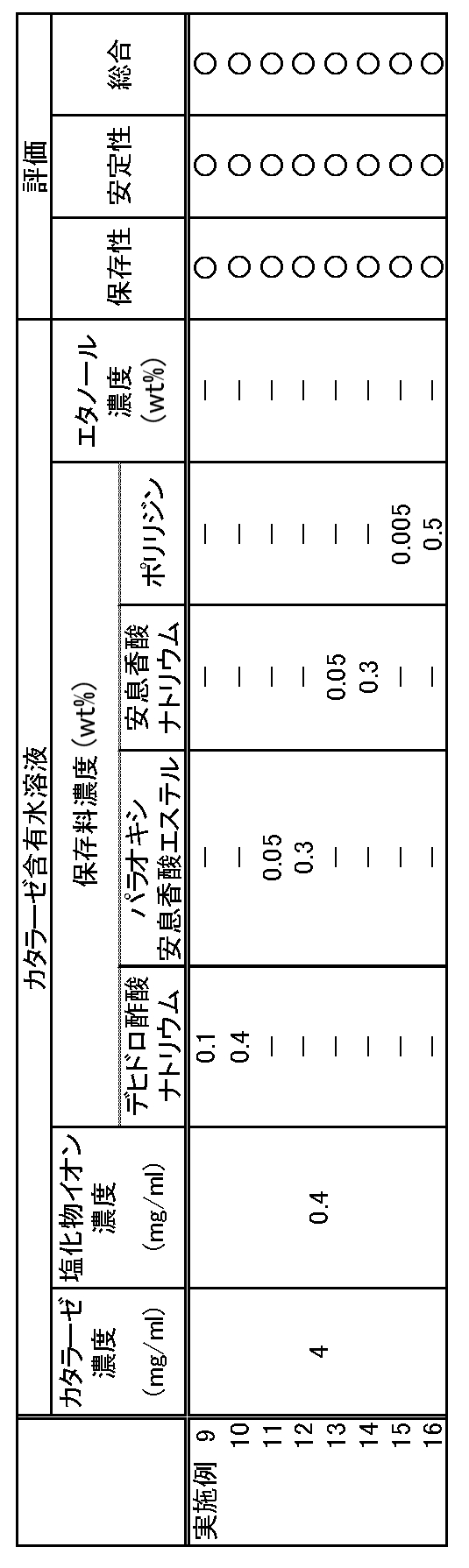
- Example 9 to 16 The preservation and stability of the catalase-containing aqueous solution subjected to desalting treatment when preservatives were blended were investigated.
- a catalase concentration of 4 mg / ml and a chloride ion concentration of 0.4 mg / ml as shown in Table 2, sodium dehydroacetate 0.1 wt%, 0.4 wt% %, P-hydroxybenzoate 0.05 wt%, 0.3 wt%, sodium benzoate 0.05 wt%, 0.3 wt%, polylysine 0.005 wt%, 0.5 wt%, Evaluation was performed. The results are shown in Table 2.
- Examples 17 to 24 and Comparative Example 2 The storage stability when the heat treatment and / or filtration treatment was performed on the catalase-containing aqueous solution subjected to the desalting treatment was examined. After preparing the catalase-containing aqueous solution subjected to the desalting treatment to a catalase concentration of 4 mg / ml and a chloride ion concentration of 0.4 mg / ml, as shown in Table 3, 0% by weight, 0% by weight of sodium dehydroacetate as a preservative was added. Evaluation was performed before and after blending 4% by weight by heat sterilization and / or filtration. The results are shown in Table 3.
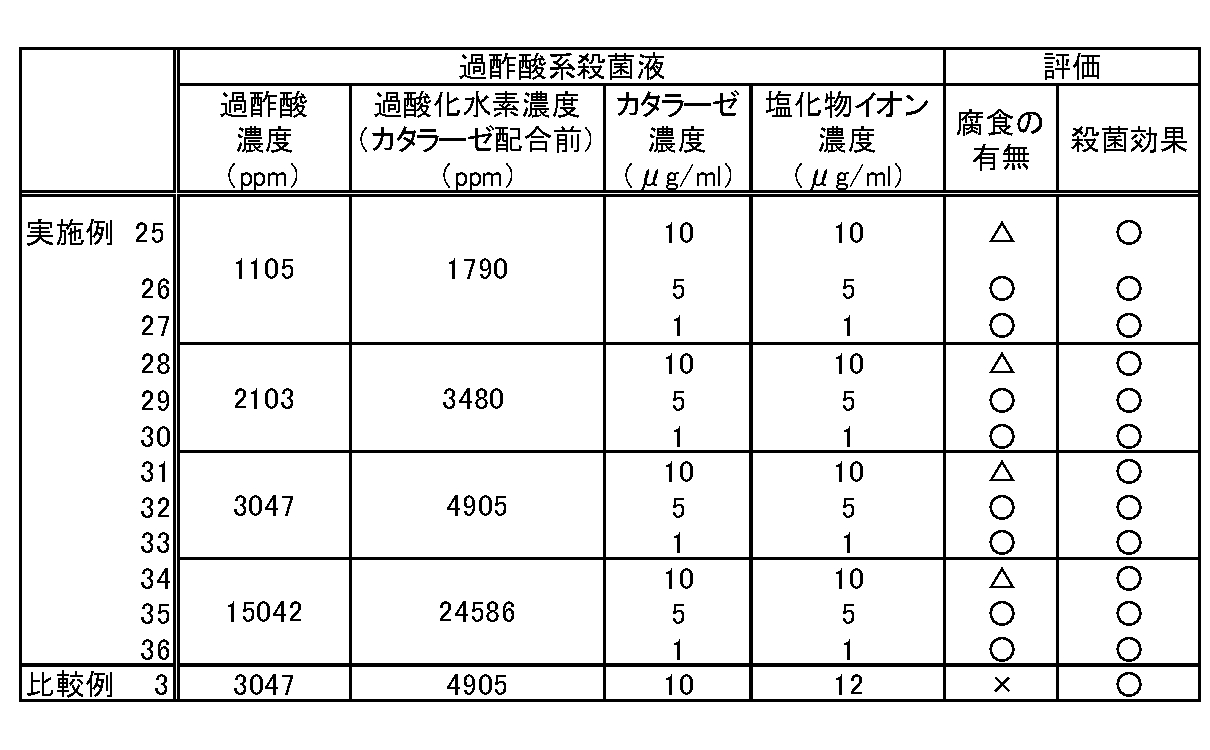
- Examples 25 to 36 and Comparative Example 3 About the bactericidal composition liquid which mix
- the catalase-containing aqueous solution and sodium chloride that had been subjected to the desalting treatment were mixed and evaluated so that the chloride ion concentration was 1 to 10 ⁇ g / ml and the chloride ion concentration was 0 to 12 ⁇ g / ml.
- Table 4 The results are shown in Table 4.
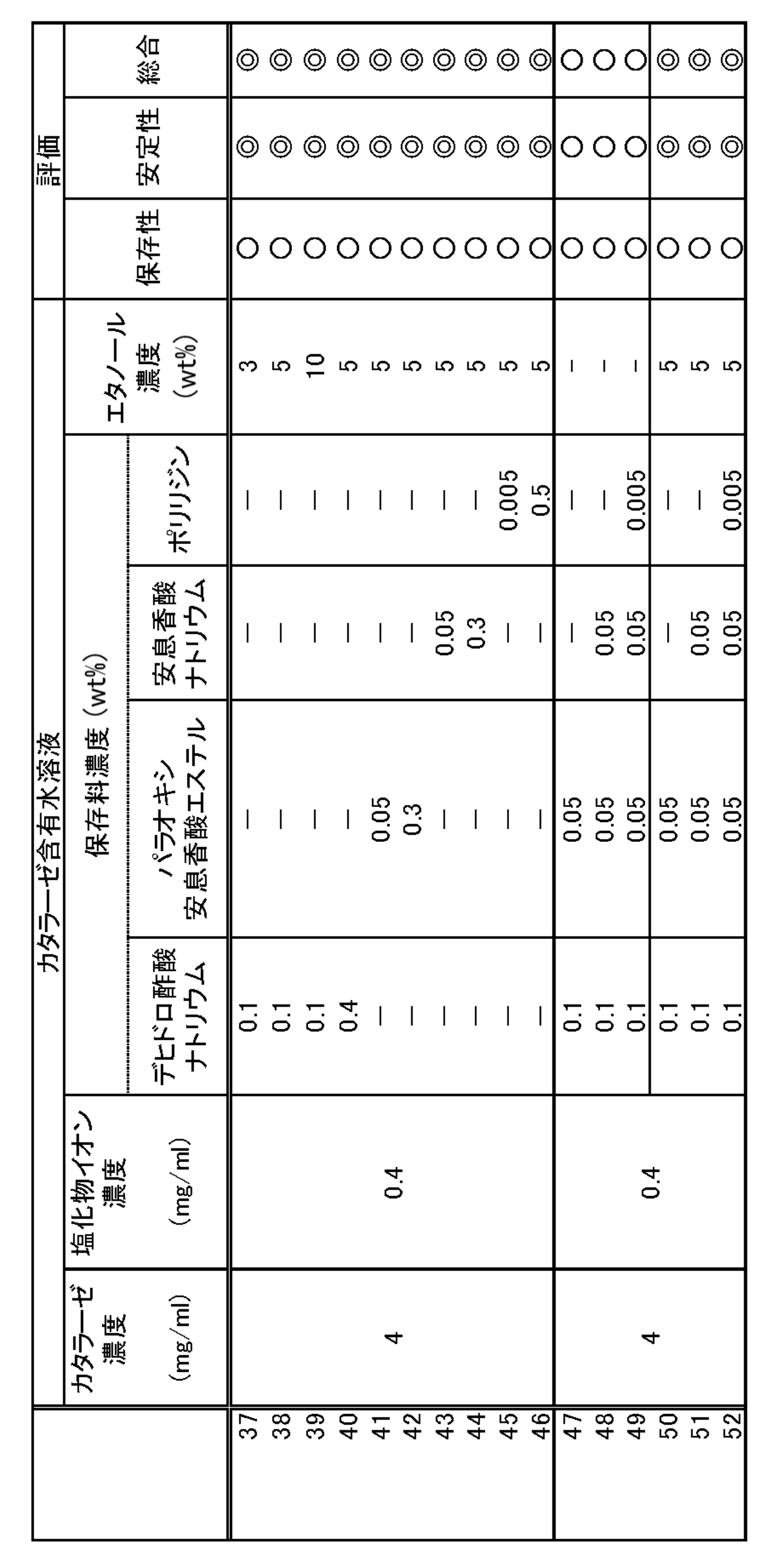
- Examples 37 to 52 The preservation and stability of the catalase-containing aqueous solution subjected to desalting treatment when preservatives were blended were investigated.
- a catalase concentration of 4 mg / ml and a chloride ion concentration of 0.4 mg / ml as shown in Table 5, 0.1% by weight, 0.4% by weight of sodium dehydroacetate %, P-hydroxybenzoate 0.05 wt%, 0.3 wt%, sodium benzoate 0.05 wt%, 0.3 wt%, polylysine 0.005 wt%, 0.5 wt% respectively Catalase-containing aqueous solution containing 3% by weight, 5% by weight, or 10% by weight of ethanol (Examples 37 to 46), or, as shown in Table 5, 0.1% by weight of sodium dehydroacetate, 0% of paraoxybenzoate ester .05% by weight,
- the catalase-containing aqueous solution of the present invention can be effectively used as a sterilizing agent used in sterilizing apparatuses such as stainless steel pipes and tanks because the weight ratio of chloride ions to catalase in the aqueous solution is reduced to 1 or less.
- the addition of specific food preservatives, or heat sterilization treatment and / or filtration treatment has improved the storage stability and stability of catalase-containing aqueous solution with reduced chloride ions. It can be produced and is economical.
- the sterilizing composition liquid obtained by adding the catalase-containing aqueous solution of the present invention efficiently decomposes hydrogen peroxide with catalase, maintains the sterilizing ability, and does not cause the occurrence of corrosion. And can be suitably used for sterilization of food containers and the like that are mass-produced.
Landscapes
- Life Sciences & Earth Sciences (AREA)
- Engineering & Computer Science (AREA)
- Zoology (AREA)
- General Health & Medical Sciences (AREA)
- Wood Science & Technology (AREA)
- Health & Medical Sciences (AREA)
- Environmental Sciences (AREA)
- Agronomy & Crop Science (AREA)
- Pest Control & Pesticides (AREA)
- Plant Pathology (AREA)
- Dentistry (AREA)
- Chemical & Material Sciences (AREA)
- Food Science & Technology (AREA)
- Polymers & Plastics (AREA)
- Proteomics, Peptides & Aminoacids (AREA)
- Biotechnology (AREA)
- Microbiology (AREA)
- Virology (AREA)
- Inorganic Chemistry (AREA)
- Agricultural Chemicals And Associated Chemicals (AREA)
- Food Preservation Except Freezing, Refrigeration, And Drying (AREA)
Abstract
塩化物イオンが低減された殺菌剤配合用カタラーゼ含有水溶液を提供することである。 殺菌剤に配合するためのカタラーゼを含有する水溶液であって、水溶液中のカタラーゼに対する塩化物イオンの重量割合が1以下であることを特徴とする殺菌剤配合用カタラーゼ含有水溶液。
Description
本発明は、食品容器等の殺菌に用いられる殺菌剤に配合されるカタラーゼ含有水溶液に関するものであり、より詳細には、塩化物イオン濃度が低減されたカタラーゼ含有水溶液及びこれを用いて成る塩化物イオン濃度が低減された殺菌組成液に関する。
従来より、食品容器等の殺菌乃至滅菌に過酢酸系殺菌剤が用いられており、特に飲料等の無菌充填(アセプティック充填)においては、容器、内容物及び充填環境の全てを無菌とすることが重要であり、ボトルやキャップ等の容器の殺菌乃至滅菌に過酢酸系殺菌剤が使用されている(特許文献1等)。
このような過酢酸系殺菌剤は、過酢酸、酢酸、及び過酸化水素を主成分とし、これらは平衡状態で存在するが、過酸化水素の濃度が高いと、過酸化水素が容器に残留しやすくなり、殺菌後の無菌水による洗浄を充分行う必要が生じてくる。また、従来の方法よりも過酢酸の濃度を低く抑えたいという要望もある。
このような過酢酸系殺菌剤は、過酢酸、酢酸、及び過酸化水素を主成分とし、これらは平衡状態で存在するが、過酸化水素の濃度が高いと、過酸化水素が容器に残留しやすくなり、殺菌後の無菌水による洗浄を充分行う必要が生じてくる。また、従来の方法よりも過酢酸の濃度を低く抑えたいという要望もある。
このような問題を解決するために、過酸化水素、ペルカルボン酸、及びカルボン酸から成る殺菌組成物中に、過酸化水素を分解可能なカタラーゼが20~250ppmの量で存在する殺菌組成物を用いた滅菌方法が提案されている(特許文献2)。
上記カタラーゼを配合して成る、過酸化水素、ペルカルボン酸、及びカルボン酸から成る殺菌組成物を使用してなる滅菌方法においては、カタラーゼにより過酸化水素が分解され、殺菌組成物中の過酸化水素濃度が低下することから、効率よく殺菌できると共に、過酸化水素濃度を管理することによって長期にわたって安定した殺菌能力を維持できるという利点がある。
上記カタラーゼを配合して成る、過酸化水素、ペルカルボン酸、及びカルボン酸から成る殺菌組成物を使用してなる滅菌方法においては、カタラーゼにより過酸化水素が分解され、殺菌組成物中の過酸化水素濃度が低下することから、効率よく殺菌できると共に、過酸化水素濃度を管理することによって長期にわたって安定した殺菌能力を維持できるという利点がある。
しかしながら、前述のカタラーゼを配合してなる過酢酸系殺菌組成液を長期にわたり用いた場合、カタラーゼを配合しない過酢酸系殺菌組成液を用いた場合に比べ、殺菌装置におけるステンレス鋼から成る配管やタンク等に腐食が発生するおそれがあることが判明した。発明者等は、この腐食の原因がカタラーゼ含有水溶液中の塩化物イオンであることをつきとめたが、カタラーゼ含有水溶液中の塩化物イオンを低減すると、特に、長期間保管ができなくなるという新たな問題が生じた。この塩化物イオンについて調べた結果、カタラーゼ産生微生物の培養に用いられる培地に含まれる塩化ナトリウム等の無機塩や、カタラーゼ含有水溶液を安定的に長期間保管可能とするための保存料や緩衝剤として添加される塩化ナトリウム等から由来するものであることがわかった。
従って本発明の目的は、殺菌剤に配合されても殺菌装置等の腐食のおそれがなく、長期保管が可能な塩化物イオン濃度が低減された殺菌剤配合用カタラーゼ含有水溶液を提供することである。
本発明の他の目的は、塩化物イオン濃度が低減され、殺菌装置等の腐食のおそれがない殺菌組成液を提供することである。
本発明の他の目的は、塩化物イオン濃度が低減され、殺菌装置等の腐食のおそれがない殺菌組成液を提供することである。
本発明によれば、殺菌剤に配合するためのカタラーゼを含有する水溶液であって、水溶液中のカタラーゼに対する塩化物イオンの重量割合が1以下であることを特徴とする殺菌剤配合用カタラーゼ含有水溶液が提供される。
本発明の殺菌剤配合用カタラーゼ含有水溶液においては、
1.塩化物イオンが塩化ナトリウム由来であること、
2.保存料、特にデヒドロ酢酸ナトリウム、パラオキシ安息香酸エステル、安息香酸ナトリウム、ポリリジンの少なくとも1種が含有されていること、更にこれらに加えてエタノールが含有されていること、
3.加熱殺菌処理及び/又は濾過処理されていること、
4.保存料、特に上記4種の保存料の少なくとも1種が添加された後、加熱殺菌処理及び/又は濾過処理されていること、
5.加熱殺菌処理及び/又は濾過処理された後、保存料、特に上記4種の保存料の少なくとも1種、更にこれらに加えてエタノールが添加されていること、
が好適である。
本発明によればまた、上記殺菌剤配合用カタラーゼ含有水溶液を、過酢酸、酢酸、過酸化水素を含有する過酢酸系殺菌剤に配合して成る殺菌組成液が提供される。
本発明の殺菌組成液においては、塩化物イオン濃度が10μg/ml以下であることが好適である。
本発明の殺菌剤配合用カタラーゼ含有水溶液においては、
1.塩化物イオンが塩化ナトリウム由来であること、
2.保存料、特にデヒドロ酢酸ナトリウム、パラオキシ安息香酸エステル、安息香酸ナトリウム、ポリリジンの少なくとも1種が含有されていること、更にこれらに加えてエタノールが含有されていること、
3.加熱殺菌処理及び/又は濾過処理されていること、
4.保存料、特に上記4種の保存料の少なくとも1種が添加された後、加熱殺菌処理及び/又は濾過処理されていること、
5.加熱殺菌処理及び/又は濾過処理された後、保存料、特に上記4種の保存料の少なくとも1種、更にこれらに加えてエタノールが添加されていること、
が好適である。
本発明によればまた、上記殺菌剤配合用カタラーゼ含有水溶液を、過酢酸、酢酸、過酸化水素を含有する過酢酸系殺菌剤に配合して成る殺菌組成液が提供される。
本発明の殺菌組成液においては、塩化物イオン濃度が10μg/ml以下であることが好適である。
本発明のカタラーゼ含有水溶液においては、水溶液中のカタラーゼに対する塩化物イオンの重量割合が1以下に低減されているため、殺菌剤にそのまま添加しても、殺菌装置におけるステンレス鋼製の配管やタンク等の腐食の発生を有効に抑制できる。
また保存料となる塩化ナトリウムを低減することに伴い、カタラーゼ含有水溶液の保存性の低下が懸念されるが、特定の食品保存料の添加、或いは加熱殺菌処理及び/又は濾過処理に賦することによって、塩化物イオン濃度が低減された状態でカタラーゼ含有水溶液の保存性を向上することができる。
本発明のカタラーゼ含有水溶液を添加して成る殺菌組成液は、カタラーゼにより過酸化水素を効率よく分解することができ、長期にわたって安定した殺菌能力を維持できる。しかも、殺菌組成液中の塩化物イオン濃度が10μg/ml以下と著しく低いことから、殺菌装置の配管等の腐食のおそれがない。
また本発明のカタラーゼ含有水溶液に、特定の保存料を添加し、更にエタノールを配合することにより、長期間保存しても安定的なカタラーゼ活性を保持し得るカタラーゼ含有水溶液を提供することが可能になる。
また保存料となる塩化ナトリウムを低減することに伴い、カタラーゼ含有水溶液の保存性の低下が懸念されるが、特定の食品保存料の添加、或いは加熱殺菌処理及び/又は濾過処理に賦することによって、塩化物イオン濃度が低減された状態でカタラーゼ含有水溶液の保存性を向上することができる。
本発明のカタラーゼ含有水溶液を添加して成る殺菌組成液は、カタラーゼにより過酸化水素を効率よく分解することができ、長期にわたって安定した殺菌能力を維持できる。しかも、殺菌組成液中の塩化物イオン濃度が10μg/ml以下と著しく低いことから、殺菌装置の配管等の腐食のおそれがない。
また本発明のカタラーゼ含有水溶液に、特定の保存料を添加し、更にエタノールを配合することにより、長期間保存しても安定的なカタラーゼ活性を保持し得るカタラーゼ含有水溶液を提供することが可能になる。
本発明のカタラーゼ含有水溶液が、ステンレス鋼に対して腐食のおそれがないことは後述する実施例の結果からも明らかである。
すなわち、カタラーゼに対する塩化物イオンの重量割合が1以下であるカタラーゼ含有水溶液中に浸漬されたステンレス試料は腐食が生じていないのに対して(実施例1~8)、カタラーゼ量に対する塩化物イオンの重量割合が1.5であるカタラーゼ含有水溶液では、腐食が発生している(比較例1)。
また、脱塩処理されたカタラーゼ含有水溶液に、特定の食品保存料を配合、加熱殺菌処理及び/又は濾過処理、或いはこれらの両方を行った場合には(実施例9~24)、保存性向上のための処理を行わないカタラーゼ含有水溶液(比較例2)に比して、保存性が改善されていることが明らかである。
更に、本発明のカタラーゼ含有水溶液を配合した過酢酸系殺菌組成液は、優れた殺菌性を有すると共に、腐食発生が有効に抑制されているのに対して(実施例25~36)、カタラーゼ量に対する塩化物イオンの重量割合が1.2(比較例3)、の過酢酸系殺菌組成液は腐食が発生している。
更にまた、カタラーゼ含有水溶液に特定の食品保存料と共にエタノールを配合した場合には(実施例37~46,50~52)、特定の食品保存料のみを配合しエタノールを配合しない場合(実施例9~16,47~49)に比して、カタラーゼ活性が向上していることが明らかである。
すなわち、カタラーゼに対する塩化物イオンの重量割合が1以下であるカタラーゼ含有水溶液中に浸漬されたステンレス試料は腐食が生じていないのに対して(実施例1~8)、カタラーゼ量に対する塩化物イオンの重量割合が1.5であるカタラーゼ含有水溶液では、腐食が発生している(比較例1)。
また、脱塩処理されたカタラーゼ含有水溶液に、特定の食品保存料を配合、加熱殺菌処理及び/又は濾過処理、或いはこれらの両方を行った場合には(実施例9~24)、保存性向上のための処理を行わないカタラーゼ含有水溶液(比較例2)に比して、保存性が改善されていることが明らかである。
更に、本発明のカタラーゼ含有水溶液を配合した過酢酸系殺菌組成液は、優れた殺菌性を有すると共に、腐食発生が有効に抑制されているのに対して(実施例25~36)、カタラーゼ量に対する塩化物イオンの重量割合が1.2(比較例3)、の過酢酸系殺菌組成液は腐食が発生している。
更にまた、カタラーゼ含有水溶液に特定の食品保存料と共にエタノールを配合した場合には(実施例37~46,50~52)、特定の食品保存料のみを配合しエタノールを配合しない場合(実施例9~16,47~49)に比して、カタラーゼ活性が向上していることが明らかである。
(カタラーゼ含有水溶液)
一般にカタラーゼは、Bacillus属、Thermus属、Micrococcus属等の細菌、Hansennula属等の酵母、Aspergillus属等の糸状菌等の微生物の培養を用いて製造され、培養終了後培養液から採取されたカタラーゼは、粗カタラーゼ液として可溶化された状態で得られる。必要により精製されたカタラーゼ液は安定的に長期間保管するために、エチルアルコール、塩化ナトリウム等の保存料やクエン酸ナトリウム等の緩衝剤が添加されたカタラーゼ含有水溶液として調製されている。
本発明においては、このような状態で提供されるカタラーゼ含有水溶液を広く使用することができるが、後述する過酢酸系殺菌組成液における酸性域で耐性を有するカタラーゼを含有する水溶液であることが重要であり、特に菌類由来のカタラーゼ、その中でも、Aspergillus niger由来のカタラーゼが含有された水溶液を好適に使用することができる。
一般にカタラーゼは、Bacillus属、Thermus属、Micrococcus属等の細菌、Hansennula属等の酵母、Aspergillus属等の糸状菌等の微生物の培養を用いて製造され、培養終了後培養液から採取されたカタラーゼは、粗カタラーゼ液として可溶化された状態で得られる。必要により精製されたカタラーゼ液は安定的に長期間保管するために、エチルアルコール、塩化ナトリウム等の保存料やクエン酸ナトリウム等の緩衝剤が添加されたカタラーゼ含有水溶液として調製されている。
本発明においては、このような状態で提供されるカタラーゼ含有水溶液を広く使用することができるが、後述する過酢酸系殺菌組成液における酸性域で耐性を有するカタラーゼを含有する水溶液であることが重要であり、特に菌類由来のカタラーゼ、その中でも、Aspergillus niger由来のカタラーゼが含有された水溶液を好適に使用することができる。
また本発明で用いるカタラーゼ含有水溶液は、pHが4~11、特にpH5~7の範囲に調製されていることが好ましい。これによりカタラーゼの活性及び安定性が維持されると共に、後述する過酢酸系殺菌組成液のpHが2~5の範囲に調整されても、カタラーゼ含有水溶液を添加することによって過酸化水素を10分未満で35%以上分解可能な性能を発現することが可能になる。
このようなカタラーゼ含有水溶液として、これに限定されないが、レオネットF-35、レオネットFプラス(ナガセケムテック株式会社製)等の商業的に入手可能なカタラーゼ含有水溶液を用いることができる。
このようなカタラーゼ含有水溶液として、これに限定されないが、レオネットF-35、レオネットFプラス(ナガセケムテック株式会社製)等の商業的に入手可能なカタラーゼ含有水溶液を用いることができる。
本発明においては、このような状態で提供されるカタラーゼ含有水溶液の塩化物イオンを、カタラーゼに対する重量割合で1以下、特に0.5以下と、塩化物イオンの濃度を可及的にゼロに近いレベルになるように低減させることが重要な特徴である。
本発明において、カタラーゼ含有水溶液からの脱塩方法は、従来公知の脱塩方法によって行うことができ、例えば、これに限定されないが、透析法、限外濾過法(Ultrafiltration Membrane,UF膜処理)、ゲル濾過法等を利用することができる。操作性や生産性等の点から限外濾過法によって脱塩を行うことが特に望ましい。
本発明において、カタラーゼ含有水溶液からの脱塩方法は、従来公知の脱塩方法によって行うことができ、例えば、これに限定されないが、透析法、限外濾過法(Ultrafiltration Membrane,UF膜処理)、ゲル濾過法等を利用することができる。操作性や生産性等の点から限外濾過法によって脱塩を行うことが特に望ましい。
本発明においては、カタラーゼ含有水溶液の保存性を確保する場合には、脱塩処理後、特定の保存料を添加すること、加熱殺菌処理及び/又は濾過処理を行うこと、或いはこれらの両方を行い、保存性を低下させる原因となる一般細菌或いは黴等の増殖を抑制或いは除去することが望ましい。
本発明で好適に用いることができる保存料は、塩分を含有しないことは勿論、食品添加物として認可され、更にカタラーゼの活性を低下させることなく、一般細菌及び黴の増殖を抑制し得るものであることが重要である。
このような保存料としては、これに限定されないが、ソルビン酸系保存料、安息香酸系保存料、パラオキシ安息香酸系保存料、プロピオン酸系保存料、デヒドロ酢酸系保存料、酒精系保存料、ビタミンB1系保存料等を挙げることができ、中でもデヒドロ酢酸ナトリウム、パラオキシ安息香酸エステル、安息香酸ナトリウム、ポリリジンを好適に用いることができ、本発明においては、これらの少なくとも1種を、カタラーゼ含有水溶液に対して0.005~0.5重量%となるように添加することが望ましい。
本発明で好適に用いることができる保存料は、塩分を含有しないことは勿論、食品添加物として認可され、更にカタラーゼの活性を低下させることなく、一般細菌及び黴の増殖を抑制し得るものであることが重要である。
このような保存料としては、これに限定されないが、ソルビン酸系保存料、安息香酸系保存料、パラオキシ安息香酸系保存料、プロピオン酸系保存料、デヒドロ酢酸系保存料、酒精系保存料、ビタミンB1系保存料等を挙げることができ、中でもデヒドロ酢酸ナトリウム、パラオキシ安息香酸エステル、安息香酸ナトリウム、ポリリジンを好適に用いることができ、本発明においては、これらの少なくとも1種を、カタラーゼ含有水溶液に対して0.005~0.5重量%となるように添加することが望ましい。
また本発明においては、上記保存料と共に、エタノールを配合することが特に好ましい。すなわち、前述したとおり、エタノールを追加することで、保存中のカタラーゼ活性の保持性能を向上することが可能になり、カタラーゼ含有水溶液を長期間保存しても、カタラーゼ活性が低下することを有効に防止でき、カタラーゼ活性の安定性に優れたカタラーゼ含有水溶液を提供できる。
尚、エタノールは、カタラーゼ含有水溶液に対して1~10重量%、特に3~6重量%の範囲にあることが好適である。上記範囲よりもエタノールの量が少ない場合には、上記範囲ある場合に比してカタラーゼ活性の安定性の効果を充分得ることができず、その一方上記範囲よりもエタノールの量が多くてもカタラーゼ活性の安定性の効果に変わりはなく、コスト面を考慮しても、上述範囲内とすることが好適である。
尚、エタノールは、カタラーゼ含有水溶液に対して1~10重量%、特に3~6重量%の範囲にあることが好適である。上記範囲よりもエタノールの量が少ない場合には、上記範囲ある場合に比してカタラーゼ活性の安定性の効果を充分得ることができず、その一方上記範囲よりもエタノールの量が多くてもカタラーゼ活性の安定性の効果に変わりはなく、コスト面を考慮しても、上述範囲内とすることが好適である。
また保存性を向上するために行う加熱殺菌処理は、脱塩処理後のカタラーゼ含有水溶液を50~70℃の温度で10~600秒間に加熱殺菌処理を行うことが好適である。上記範囲よりも加熱温度が低い場合には、十分に滅菌することができず、その一方上記温度より加熱温度が高い場合には、カタラーゼの活性を保持できない。
また濾過処理は、カタラーゼ含有水溶液の保存性を低下させる原因となる細菌等を分離し、カタラーゼを分離しないものであることが重要であり、フィルター孔径が0.1~1.0μmの範囲にある濾過装置を使用することが好適である。
これら加熱殺菌処理や濾過処理は、少なくとも一方を行えばよいが、両方行うことにより一般細菌或いは黴等の除去率を更に高めることが可能となる。
また濾過処理は、カタラーゼ含有水溶液の保存性を低下させる原因となる細菌等を分離し、カタラーゼを分離しないものであることが重要であり、フィルター孔径が0.1~1.0μmの範囲にある濾過装置を使用することが好適である。
これら加熱殺菌処理や濾過処理は、少なくとも一方を行えばよいが、両方行うことにより一般細菌或いは黴等の除去率を更に高めることが可能となる。
保存料添加と、加熱殺菌処理及び/又は濾過処理は、少なくとも一方を行えばよいが、両方行うことが保存性をより向上できるので好ましい。保存料添加と加熱殺菌処理及び/又は濾過処理の両方行う場合、何れを先に行ってもよいが、好適には加熱殺菌処理及び/又は濾過処理を先に行い、保存性を低下させる原因となる細菌等を除去した後、保存料を添加することが望ましい。
(過酢酸系殺菌組成液)
本発明のカタラーゼ含有水溶液は、過酢酸、酢酸、及び過酸化水素を主成分とし、これらが平衡状態で存在して成る過酢酸系殺菌剤に配合することにより、食品容器等の殺菌に用いられる殺菌組成液とすることができる。
カタラーゼ含有水溶液を配合する前の過酢酸系殺菌剤は、種々の濃度のものを原料として採用することができるが、好適には、過酢酸10~25重量%、酢酸20~40重量%、過酸化水素15~25重量%、残余の成分が水及び必要により配合される安定剤から成る過酢酸系殺菌剤を好適に用いることができる。このような過酢酸系殺菌剤としてはオキシペール100(日本パーオキサイド株式会社製:過酢酸10.2重量%、酢酸20.6重量%、過酸化水素17.2重量%)等が挙げられ、水で希釈して濃度調整した後に使用する。
本発明のカタラーゼ含有水溶液は、過酢酸、酢酸、及び過酸化水素を主成分とし、これらが平衡状態で存在して成る過酢酸系殺菌剤に配合することにより、食品容器等の殺菌に用いられる殺菌組成液とすることができる。
カタラーゼ含有水溶液を配合する前の過酢酸系殺菌剤は、種々の濃度のものを原料として採用することができるが、好適には、過酢酸10~25重量%、酢酸20~40重量%、過酸化水素15~25重量%、残余の成分が水及び必要により配合される安定剤から成る過酢酸系殺菌剤を好適に用いることができる。このような過酢酸系殺菌剤としてはオキシペール100(日本パーオキサイド株式会社製:過酢酸10.2重量%、酢酸20.6重量%、過酸化水素17.2重量%)等が挙げられ、水で希釈して濃度調整した後に使用する。
過酢酸系殺菌剤においては、pHが5以上になると過酢酸が分解して濃度が低下して殺菌力が劣るようになってしまうことから、カタラーゼの活性を維持しつつ、過酢酸の殺菌効果を最も効果的に発揮するために、過酢酸系殺菌組成液のpHは2~5の範囲に維持することが好ましい。過酢酸系殺菌組成液のpHを上記範囲にするために用いるpH調整剤としては、水酸化ナトリウム、水酸化カリウム等の従来公知のアルカリ性組成物を挙げることができる。
本発明の過酢酸系殺菌組成液は、過酢酸、酢酸、及び過酸化水素が平衡状態で存在してなる原料の過酢酸系殺菌剤に、pH調整剤、水、及びカタラーゼ含有水溶液を加えることによって調製する。
調製方法は、水で希釈後に過酢酸の濃度が500~25000ppmになることを前提に、所望の過酢酸濃度を有する過酢酸系殺菌剤にpH調整剤を加えて混合し、pHを2~5の範囲に調整した後、カタラーゼが0.1~10μg/ml、特に0.1~3.0μg/mlの濃度になるようにカタラーゼ含有水溶液を配合することによって調製することが好ましい。pH調整剤及びカタラーゼ含有水溶液の配合順序は、必ずしも上記順序に限定されないが、上記順序にすることによって、カタラーゼの活性を最大限保持することが可能になる。
調製方法は、水で希釈後に過酢酸の濃度が500~25000ppmになることを前提に、所望の過酢酸濃度を有する過酢酸系殺菌剤にpH調整剤を加えて混合し、pHを2~5の範囲に調整した後、カタラーゼが0.1~10μg/ml、特に0.1~3.0μg/mlの濃度になるようにカタラーゼ含有水溶液を配合することによって調製することが好ましい。pH調整剤及びカタラーゼ含有水溶液の配合順序は、必ずしも上記順序に限定されないが、上記順序にすることによって、カタラーゼの活性を最大限保持することが可能になる。
本発明の過酢酸系殺菌組成液は、脱塩処理に賦され、カタラーゼに対する塩化物イオンの重量割合が1以下に低減されているカタラーゼ含有水溶液を用いているため、塩化物イオン濃度が10μg/ml以下に低減されている。そのため、殺菌装置におけるステンレス鋼製の配管等の腐食を生じることがない。
本発明の過酢酸系殺菌組成液は、従来公知の過酢酸系殺菌剤を用いた殺菌方法に用いられていた方法と同様に使用することができる。
本発明の過酢酸系殺菌組成液は、従来公知の過酢酸系殺菌剤を用いた殺菌方法に用いられていた方法と同様に使用することができる。
(カタラーゼ含有水溶液の調製)
カタラーゼとして、レオネットFプラス(ナガセケムテック株式会社製、カタラーゼ濃度:4mg/ml、塩化物イオン濃度:34mg/ml)を使用し、UF膜(旭化成株式会社製:マイクローザUFモジュール、ACV-3010)にて脱塩処理を行い、塩化物イオン濃度を0mg/mlにした。次いで、イオン交換水で希釈した後、塩化ナトリウムを配合して、表1~3及び5に示すカタラーゼ濃度、塩化物イオン濃度のカタラーゼ含有水溶液となるよう調製した。
表2、表3、表5に示す保存料は、前記カタラーゼ含有水溶液の調製において、イオン交換水で希釈した後、各表に示す濃度となるよう配合する。また、表3に示すカタラーゼ含有水溶液の処理は、65℃-1分加熱後直ぐに50℃に冷却を行う加熱殺菌処理、または、メルクミリポア社製ミリパック60フィルターユニット(フィルター孔径:0.45μm)による濾過処理を行った。
カタラーゼとして、レオネットFプラス(ナガセケムテック株式会社製、カタラーゼ濃度:4mg/ml、塩化物イオン濃度:34mg/ml)を使用し、UF膜(旭化成株式会社製:マイクローザUFモジュール、ACV-3010)にて脱塩処理を行い、塩化物イオン濃度を0mg/mlにした。次いで、イオン交換水で希釈した後、塩化ナトリウムを配合して、表1~3及び5に示すカタラーゼ濃度、塩化物イオン濃度のカタラーゼ含有水溶液となるよう調製した。
表2、表3、表5に示す保存料は、前記カタラーゼ含有水溶液の調製において、イオン交換水で希釈した後、各表に示す濃度となるよう配合する。また、表3に示すカタラーゼ含有水溶液の処理は、65℃-1分加熱後直ぐに50℃に冷却を行う加熱殺菌処理、または、メルクミリポア社製ミリパック60フィルターユニット(フィルター孔径:0.45μm)による濾過処理を行った。
(カタラーゼ含有殺菌組成液の調製)
殺菌組成液の調製方法は、殺菌組成液の原液として、過酢酸系殺菌剤 オキシペール100(日本パーオキサイド株式会社製:過酢酸10.2重量%、酢酸20.6重量%、過酸化水素17.2重量%)を用い、過酢酸濃度がおよそ1000ppm、2000ppm、3000ppm、15000ppmとなるようイオン交換水で希釈した。次いで、前述の方法によりカタラーゼ濃度4mg/ml、塩化物イオン濃度0mg/mlの濃度に調整したカタラーゼ含有水溶液と塩化ナトリウムを用い、過酢酸系殺菌組成液全体量に対してのカタラーゼ濃度、塩化物イオン濃度が表4に示す濃度となるようカタラーゼ含有水溶液を配合した。
尚、表4に記載した過酢酸濃度の数値は、上述した殺菌組成液のイオン交換水希釈の後、カタラーゼ含有水溶液を配合し、カタラーゼの反応が終了した時点での測定値である。
殺菌組成液の調製方法は、殺菌組成液の原液として、過酢酸系殺菌剤 オキシペール100(日本パーオキサイド株式会社製:過酢酸10.2重量%、酢酸20.6重量%、過酸化水素17.2重量%)を用い、過酢酸濃度がおよそ1000ppm、2000ppm、3000ppm、15000ppmとなるようイオン交換水で希釈した。次いで、前述の方法によりカタラーゼ濃度4mg/ml、塩化物イオン濃度0mg/mlの濃度に調整したカタラーゼ含有水溶液と塩化ナトリウムを用い、過酢酸系殺菌組成液全体量に対してのカタラーゼ濃度、塩化物イオン濃度が表4に示す濃度となるようカタラーゼ含有水溶液を配合した。
尚、表4に記載した過酢酸濃度の数値は、上述した殺菌組成液のイオン交換水希釈の後、カタラーゼ含有水溶液を配合し、カタラーゼの反応が終了した時点での測定値である。
(カタラーゼ含有水溶液成分、殺菌組成液成分の測定方法)
1.カタラーゼ濃度
Invitrogen社製Nano Orange(登録商標)Protein Quantitation Kitを用い、Experimental Protocolに従い、表1及び表4は調整後の濃度のまま、表2,表3及び表5調整後のカタラーゼ含有水溶液を1000倍に希釈して測定を行い、表1~5に示した。
2.塩化物イオン濃度
DIONEX社製イオンクロマトグラフ:DX-320を用い、表1及び表4は調整後の濃度のまま、表2,表3及び表5は調整後のカタラーゼ含有水溶液を100倍に希釈し、次の条件で測定した。
1.カタラーゼ濃度
Invitrogen社製Nano Orange(登録商標)Protein Quantitation Kitを用い、Experimental Protocolに従い、表1及び表4は調整後の濃度のまま、表2,表3及び表5調整後のカタラーゼ含有水溶液を1000倍に希釈して測定を行い、表1~5に示した。
2.塩化物イオン濃度
DIONEX社製イオンクロマトグラフ:DX-320を用い、表1及び表4は調整後の濃度のまま、表2,表3及び表5は調整後のカタラーゼ含有水溶液を100倍に希釈し、次の条件で測定した。
カラム : AS11-HC(4×250mm)
ガードカラム : AG11-HC(4×50mm)
温度 : 35℃
溶離液 : KOH水溶液(グラジエント)
0-8分(1mmol/L)、
8-10分(1-7mmol/L)、
10-19分(7-14mmol/L)、
19-23分(14-23mmol/L)、
23-28分(23-45mmol/L)、
28-35分(45mmol/L)
流速 : 1.1mL/分
注入量 : 25μL
検出器 : 電気伝導度(サプレッサー使用)
サプレッサー : エクスターナルモード、170mA
ガードカラム : AG11-HC(4×50mm)
温度 : 35℃
溶離液 : KOH水溶液(グラジエント)
0-8分(1mmol/L)、
8-10分(1-7mmol/L)、
10-19分(7-14mmol/L)、
19-23分(14-23mmol/L)、
23-28分(23-45mmol/L)、
28-35分(45mmol/L)
流速 : 1.1mL/分
注入量 : 25μL
検出器 : 電気伝導度(サプレッサー使用)
サプレッサー : エクスターナルモード、170mA
3.過酢酸濃度
カタラーゼ含有水溶液を配合終了後、過マンガン酸カリウム-ヨウ素法によって測定した。すなわち、試料を硫酸酸性下で過マンガン酸カリウム滴定を行い、過酸化水素濃度を測定した後、ヨウ化カリウム及びデンプン指示薬を加えて、チオ硫酸ナトリウム滴定を行い、過酢酸濃度を測定した。
上述したカタラーゼ含有水溶液の反応終了時間については、過酢酸系殺菌組成液のカタラーゼ含有水溶液を配合後5分以降から5分おきに測定し、経時測定における過酸化水素濃度の減少が見られなくなった時を反応終了として、過酢酸濃度とした。
4.過酸化水素濃度
過酸化水素濃度は、過酢酸系殺菌剤にカタラーゼ含有水溶液を配合する前の濃度について記した。測定方法は、上述した3.過酢酸濃度の通りである。
カタラーゼ含有水溶液を配合終了後、過マンガン酸カリウム-ヨウ素法によって測定した。すなわち、試料を硫酸酸性下で過マンガン酸カリウム滴定を行い、過酸化水素濃度を測定した後、ヨウ化カリウム及びデンプン指示薬を加えて、チオ硫酸ナトリウム滴定を行い、過酢酸濃度を測定した。
上述したカタラーゼ含有水溶液の反応終了時間については、過酢酸系殺菌組成液のカタラーゼ含有水溶液を配合後5分以降から5分おきに測定し、経時測定における過酸化水素濃度の減少が見られなくなった時を反応終了として、過酢酸濃度とした。
4.過酸化水素濃度
過酸化水素濃度は、過酢酸系殺菌剤にカタラーゼ含有水溶液を配合する前の濃度について記した。測定方法は、上述した3.過酢酸濃度の通りである。
(評価方法)
1.腐食の有無(腐食性評価)
殺菌装置配管として用いるSUSステンレスパイプ(直径4cm、長さ10cm)を調整後のカタラーゼ含有水溶液、もしくは調整後のカタラーゼ含有殺菌組成液に浸漬し、40℃で6ヶ月保存した後、評価を行った。尚、過酢酸濃度は経時で変化するため、過酢酸濃度が2800ppm以下になった時点で上述の初期の過酢酸系殺菌組成液に取り替えて浸漬し直すことで、過酢酸量が2800~3000ppmに維持した。
評価は、当該ステンレスパイプの内外面を目視で観察し、錆や孔食などの腐食がないものを○、錆や孔食などの腐食はないが変色があるものを△、腐食があるものを×とした。
1.腐食の有無(腐食性評価)
殺菌装置配管として用いるSUSステンレスパイプ(直径4cm、長さ10cm)を調整後のカタラーゼ含有水溶液、もしくは調整後のカタラーゼ含有殺菌組成液に浸漬し、40℃で6ヶ月保存した後、評価を行った。尚、過酢酸濃度は経時で変化するため、過酢酸濃度が2800ppm以下になった時点で上述の初期の過酢酸系殺菌組成液に取り替えて浸漬し直すことで、過酢酸量が2800~3000ppmに維持した。
評価は、当該ステンレスパイプの内外面を目視で観察し、錆や孔食などの腐食がないものを○、錆や孔食などの腐食はないが変色があるものを△、腐食があるものを×とした。
2.保存料配合、カタラーゼ含有水溶液の処理による保存性評価
以下に記載するA~Dのカタラーゼ含有水溶液について、AとBの菌数増加の差及びCとDの菌数増加の差が10倍未満であるものを○、10倍以上のものを×として評価した。菌数の測定は、A~Dのカタラーゼ含有水溶液1mlをそれぞれ標準寒天培地20mlに混釈して35℃で48時間培養した後、菌数を測定した。結果を表2及び表3に示す。
A:脱塩処理を行った直後のカタラーゼ含有水溶液
(カタラーゼ濃度4.0mg/ml、塩化物イオン濃度0.4mg/
ml、塩化物イオン濃度/カタラーゼ濃度=0.1)
B:Aの脱塩処理後、30℃で1週間保存したカタラーゼ含有水溶液
C:Aの脱塩処理後、表2及び表3に示す保存料配合、加熱殺菌処理、濾
過処理を行った直後のカタラーゼ含有水溶液
D:Cの配合、各処理を行った後、30℃で1週間保存したカタラーゼ含
有水溶液
以下に記載するA~Dのカタラーゼ含有水溶液について、AとBの菌数増加の差及びCとDの菌数増加の差が10倍未満であるものを○、10倍以上のものを×として評価した。菌数の測定は、A~Dのカタラーゼ含有水溶液1mlをそれぞれ標準寒天培地20mlに混釈して35℃で48時間培養した後、菌数を測定した。結果を表2及び表3に示す。
A:脱塩処理を行った直後のカタラーゼ含有水溶液
(カタラーゼ濃度4.0mg/ml、塩化物イオン濃度0.4mg/
ml、塩化物イオン濃度/カタラーゼ濃度=0.1)
B:Aの脱塩処理後、30℃で1週間保存したカタラーゼ含有水溶液
C:Aの脱塩処理後、表2及び表3に示す保存料配合、加熱殺菌処理、濾
過処理を行った直後のカタラーゼ含有水溶液
D:Cの配合、各処理を行った後、30℃で1週間保存したカタラーゼ含
有水溶液
3.殺菌効果
容器として500mlポリエチレンテレフタレートボトル(以下、ボトルと記す)を使用し、供試菌としてBacillus cereus ATCC 9139を用いて菌液を作成し、ボトル内面に106cfu/ボトルとなるよう噴霧器から均一に吹き付けた後、ボトルを乾燥させて評価用ボトルを作製した。次いで、カタラーゼ反応終了直後の過酢酸系殺菌組成液を65℃に温度調節し、評価用ボトル内に噴霧し、8秒接触させた後、滅菌水を用いてボトル内面を洗浄し、洗浄に用いた滅菌水を標準寒天培地を用いてメンブレンフィルター法により生存菌数を計測した。初菌数及び生残菌数より、下記式より殺菌効果(D)を求めた。D値が6D以上の場合は殺菌効果が高く○、6D未満の場合は殺菌効果が低く×とした。尚、試験回数はn=3で実施し、平均生残菌数を生残菌数として殺菌効果を評価した。
D=LOG(N0/N)
式中、N0は初菌数であり、Nは生残菌数である。
容器として500mlポリエチレンテレフタレートボトル(以下、ボトルと記す)を使用し、供試菌としてBacillus cereus ATCC 9139を用いて菌液を作成し、ボトル内面に106cfu/ボトルとなるよう噴霧器から均一に吹き付けた後、ボトルを乾燥させて評価用ボトルを作製した。次いで、カタラーゼ反応終了直後の過酢酸系殺菌組成液を65℃に温度調節し、評価用ボトル内に噴霧し、8秒接触させた後、滅菌水を用いてボトル内面を洗浄し、洗浄に用いた滅菌水を標準寒天培地を用いてメンブレンフィルター法により生存菌数を計測した。初菌数及び生残菌数より、下記式より殺菌効果(D)を求めた。D値が6D以上の場合は殺菌効果が高く○、6D未満の場合は殺菌効果が低く×とした。尚、試験回数はn=3で実施し、平均生残菌数を生残菌数として殺菌効果を評価した。
D=LOG(N0/N)
式中、N0は初菌数であり、Nは生残菌数である。
4.エタノール配合による安定性評価
脱塩処理後に表2、表5に示す保存料を配合したカタラーゼ含有水溶液のカタラーゼ活性を、作成直後と25℃で3か月保存した後、とで比較した。
25℃-3か月保存後のカタラーゼ活性が、作成直後のカタラーゼ活性の90%以上を保持した場合を◎、80%以上を保持した場合を○、80%以上保持できなかった場合を×とした。
尚、カタラーゼ活性の測定方法は以下のとおりである。
(カタラーゼ活性測定方法)
30%過酸化水素水を50mMリン酸塩緩衝液(pH7)にて約800倍に希釈した過酸化水素基質を試験管に5ml入れ、30℃の恒温水槽で20分間保温しておき、測定に適した濃度まで希釈(希釈倍数n)したカタラーゼ含有水溶液を1ml加えてよく振りまぜ、直ちに30℃の恒温水槽に入れて反応を開始させる。反応開始から正確に5分後に1N硫酸溶液2mlを加えて高温水槽から取り出し、よく振りまぜて反応を止める。次いで10%ヨウ化カリウム溶液を1ml、1%モリブデン酸アンモニウム溶液を1滴及び指示薬として0.5%デンプン試薬を5滴加え、この溶液を攪拌しながら、1/200Nチオ硫酸ナトリウム溶液(定量用)で滴定し、サンプルの滴定値TSを求めた。
また、ブランクの滴定値T0は、前述した1N硫酸溶液とカタラーゼ含有水溶液の順番を逆にし、前述と同様の操作により滴定して求めた。
カタラーゼ活性(U/ml)は、以下の計算方法により求めた。
カタラーゼ活性(U/ml)=(T0-TS)×2.5*×n×f/5(分)
*1/200Nチオ硫酸ナトリウム1ml=2.5μM
過酸化水素
n:希釈倍数
f=1/200 Nチオ硫酸ナトリウムのファクター
T0 =ブランクの滴定値(ml)
TS =サンプルの滴定値(ml)
脱塩処理後に表2、表5に示す保存料を配合したカタラーゼ含有水溶液のカタラーゼ活性を、作成直後と25℃で3か月保存した後、とで比較した。
25℃-3か月保存後のカタラーゼ活性が、作成直後のカタラーゼ活性の90%以上を保持した場合を◎、80%以上を保持した場合を○、80%以上保持できなかった場合を×とした。
尚、カタラーゼ活性の測定方法は以下のとおりである。
(カタラーゼ活性測定方法)
30%過酸化水素水を50mMリン酸塩緩衝液(pH7)にて約800倍に希釈した過酸化水素基質を試験管に5ml入れ、30℃の恒温水槽で20分間保温しておき、測定に適した濃度まで希釈(希釈倍数n)したカタラーゼ含有水溶液を1ml加えてよく振りまぜ、直ちに30℃の恒温水槽に入れて反応を開始させる。反応開始から正確に5分後に1N硫酸溶液2mlを加えて高温水槽から取り出し、よく振りまぜて反応を止める。次いで10%ヨウ化カリウム溶液を1ml、1%モリブデン酸アンモニウム溶液を1滴及び指示薬として0.5%デンプン試薬を5滴加え、この溶液を攪拌しながら、1/200Nチオ硫酸ナトリウム溶液(定量用)で滴定し、サンプルの滴定値TSを求めた。
また、ブランクの滴定値T0は、前述した1N硫酸溶液とカタラーゼ含有水溶液の順番を逆にし、前述と同様の操作により滴定して求めた。
カタラーゼ活性(U/ml)は、以下の計算方法により求めた。
カタラーゼ活性(U/ml)=(T0-TS)×2.5*×n×f/5(分)
*1/200Nチオ硫酸ナトリウム1ml=2.5μM
過酸化水素
n:希釈倍数
f=1/200 Nチオ硫酸ナトリウムのファクター
T0 =ブランクの滴定値(ml)
TS =サンプルの滴定値(ml)
5.総合評価
上記保存性評価が○で安定性評価が◎ならば、総合評価は◎であり、保存性評価が○で安定性評価が○ならば、総合評価は○であり、保存性評価又は安定性評価の何れか一方でも×ならば、総合評価×とした。
上記保存性評価が○で安定性評価が◎ならば、総合評価は◎であり、保存性評価が○で安定性評価が○ならば、総合評価は○であり、保存性評価又は安定性評価の何れか一方でも×ならば、総合評価×とした。
(実施例1~8及び比較例1)
カタラーゼ含有水溶液中のカタラーゼに対する塩化物イオンの重量割合の違いによる殺菌装置配管等への腐食性について調べた。脱塩処理を行ったカタラーゼ含有水溶液を用い、表1に示すように、カタラーゼ濃度1~10μg/mlに対して塩化物イオン濃度が0~15μg/mlになるよう塩化ナトリウムを配合し、評価を行った。結果を表1に示す。
カタラーゼ含有水溶液中のカタラーゼに対する塩化物イオンの重量割合の違いによる殺菌装置配管等への腐食性について調べた。脱塩処理を行ったカタラーゼ含有水溶液を用い、表1に示すように、カタラーゼ濃度1~10μg/mlに対して塩化物イオン濃度が0~15μg/mlになるよう塩化ナトリウムを配合し、評価を行った。結果を表1に示す。

(実施例9~16)
脱塩処理を行ったカタラーゼ含有水溶液に保存料を配合した場合の保存性及び安定性について調べた。脱塩処理を行ったカタラーゼ含有水溶液をカタラーゼ濃度4mg/ml、塩化物イオン濃度0.4mg/mlに調製した後、表2に示すように、デヒドロ酢酸ナトリウム0.1重量%,0.4重量%、パラオキシ安息香酸エステル0.05重量%,0.3重量%、安息香酸ナトリウム0.05重量%,0.3重量%、ポリリジン0.005重量%,0.5重量%をそれぞれ配合し、評価を行った。結果を表2に示す。
脱塩処理を行ったカタラーゼ含有水溶液に保存料を配合した場合の保存性及び安定性について調べた。脱塩処理を行ったカタラーゼ含有水溶液をカタラーゼ濃度4mg/ml、塩化物イオン濃度0.4mg/mlに調製した後、表2に示すように、デヒドロ酢酸ナトリウム0.1重量%,0.4重量%、パラオキシ安息香酸エステル0.05重量%,0.3重量%、安息香酸ナトリウム0.05重量%,0.3重量%、ポリリジン0.005重量%,0.5重量%をそれぞれ配合し、評価を行った。結果を表2に示す。
(実施例17~24及び比較例2)
脱塩処理を行ったカタラーゼ含有水溶液に加熱殺菌処理及び/又は濾過処理を行った場合の保存性について調べた。脱塩処理を行ったカタラーゼ含有水溶液をカタラーゼ濃度4mg/ml、塩化物イオン濃度0.4mg/mlに調製した後、表3に示すように、保存料であるデヒドロ酢酸ナトリウムを0重量%,0.4重量%を配合する前と後に、加熱殺菌処理及び/又は濾過処理を行い、評価を行った。結果を表3に示す。
脱塩処理を行ったカタラーゼ含有水溶液に加熱殺菌処理及び/又は濾過処理を行った場合の保存性について調べた。脱塩処理を行ったカタラーゼ含有水溶液をカタラーゼ濃度4mg/ml、塩化物イオン濃度0.4mg/mlに調製した後、表3に示すように、保存料であるデヒドロ酢酸ナトリウムを0重量%,0.4重量%を配合する前と後に、加熱殺菌処理及び/又は濾過処理を行い、評価を行った。結果を表3に示す。

(実施例25~36及び比較例3)
カタラーゼ含有水溶液を配合した殺菌組成液について、カタラーゼ含有水溶液中のカタラーゼに対する塩化物イオンの重量割合の違いによる殺菌装置配管等への腐食性及び殺菌効果について調べた。表4に示すように、過酢酸濃度を1000~15000ppm程度、カタラーゼ含有水溶液の配合前の過酸化水素濃度を1700~24000ppm程度になるよう調製した殺菌組成液に、殺菌組成液中のカタラーゼ濃度が1~10μg/ml、塩化物イオン濃度が0~12μg/mlになるように、脱塩処理を行ったカタラーゼ含有水溶液と塩化ナトリウムを配合し、評価を行った。結果を表4に示す。
カタラーゼ含有水溶液を配合した殺菌組成液について、カタラーゼ含有水溶液中のカタラーゼに対する塩化物イオンの重量割合の違いによる殺菌装置配管等への腐食性及び殺菌効果について調べた。表4に示すように、過酢酸濃度を1000~15000ppm程度、カタラーゼ含有水溶液の配合前の過酸化水素濃度を1700~24000ppm程度になるよう調製した殺菌組成液に、殺菌組成液中のカタラーゼ濃度が1~10μg/ml、塩化物イオン濃度が0~12μg/mlになるように、脱塩処理を行ったカタラーゼ含有水溶液と塩化ナトリウムを配合し、評価を行った。結果を表4に示す。
(実施例37~52)
脱塩処理を行ったカタラーゼ含有水溶液に保存料を配合した場合の保存性及び安定性について調べた。脱塩処理を行ったカタラーゼ含有水溶液をカタラーゼ濃度4mg/ml、塩化物イオン濃度0.4mg/mlに調製した後、表5に示すように、デヒドロ酢酸ナトリウム0.1重量%,0.4重量%、パラオキシ安息香酸エステル0.05重量%,0.3重量%、安息香酸ナトリウム0.05重量%,0.3重量%、ポリリジン0.005重量%,0.5重量%をそれぞれ配合すると共に、エタノール3重量%、5重量%、10重量%を配合したカタラーゼ含有水溶液(実施例37~46)、或いは、表5に示すように、デヒドロ酢酸ナトリウム0.1重量%、パラオキシ安息香酸エステル0.05重量%、安息香酸ナトリウム0.05重量%、ポリリジン0.005重量%を組み合わせで配合すると共に、エタノール5重量%の配合又は無配合のカタラーゼ含有水溶液(47~52)について評価を行った。結果を表5に示す。
脱塩処理を行ったカタラーゼ含有水溶液に保存料を配合した場合の保存性及び安定性について調べた。脱塩処理を行ったカタラーゼ含有水溶液をカタラーゼ濃度4mg/ml、塩化物イオン濃度0.4mg/mlに調製した後、表5に示すように、デヒドロ酢酸ナトリウム0.1重量%,0.4重量%、パラオキシ安息香酸エステル0.05重量%,0.3重量%、安息香酸ナトリウム0.05重量%,0.3重量%、ポリリジン0.005重量%,0.5重量%をそれぞれ配合すると共に、エタノール3重量%、5重量%、10重量%を配合したカタラーゼ含有水溶液(実施例37~46)、或いは、表5に示すように、デヒドロ酢酸ナトリウム0.1重量%、パラオキシ安息香酸エステル0.05重量%、安息香酸ナトリウム0.05重量%、ポリリジン0.005重量%を組み合わせで配合すると共に、エタノール5重量%の配合又は無配合のカタラーゼ含有水溶液(47~52)について評価を行った。結果を表5に示す。
本発明のカタラーゼ含有水溶液は、水溶液中のカタラーゼに対する塩化物イオンの重量割合が1以下に低減されているため、ステンレス製の配管やタンク等の殺菌装置に用いられる殺菌剤に有効に利用できる。
また特定の食品保存料の添加、或いは加熱殺菌処理及び/又は濾過処理に賦することによって、塩化物イオンが低減された状態でカタラーゼ含有水溶液の保存性及び安定性が向上されているため、大量生産が可能であり、経済性に優れる。
更に本発明のカタラーゼ含有水溶液を添加して成る殺菌組成液は、カタラーゼにより過酸化水素を効率よく分解し、殺菌能力を維持できると共に、腐食の発生のおそれもないことから、経済性及び衛生性に優れ、大量生産される食品容器等の殺菌に好適に利用できる。
また特定の食品保存料の添加、或いは加熱殺菌処理及び/又は濾過処理に賦することによって、塩化物イオンが低減された状態でカタラーゼ含有水溶液の保存性及び安定性が向上されているため、大量生産が可能であり、経済性に優れる。
更に本発明のカタラーゼ含有水溶液を添加して成る殺菌組成液は、カタラーゼにより過酸化水素を効率よく分解し、殺菌能力を維持できると共に、腐食の発生のおそれもないことから、経済性及び衛生性に優れ、大量生産される食品容器等の殺菌に好適に利用できる。
Claims (10)
- 殺菌剤に配合するためのカタラーゼを含有する水溶液であって、水溶液中のカタラーゼに対する塩化物イオンの重量割合が1以下であることを特徴とする殺菌剤配合用カタラーゼ含有水溶液。
- 前記塩化物イオンが塩化ナトリウム由来である請求項1記載の殺菌剤配合用カタラーゼ含有水溶液。
- 保存料を含有して成る請求項1又は2に記載の殺菌剤配合用カタラーゼ含有水溶液。
- 請求項3記載の殺菌剤配合用カタラーゼ含有水溶液を、加熱殺菌処理及び/又は濾過処理して成る殺菌剤配合用カタラーゼ含有水溶液。
- 請求項1又は2記載の殺菌剤配合用カタラーゼ含有水溶液を、加熱殺菌処理及び/又は濾過処理して成る殺菌剤配合用カタラーゼ含有水溶液。
- 請求項5記載の殺菌剤配合用カタラーゼ含有水溶液に、保存料を配合して成る殺菌剤配合用カタラーゼ含有水溶液。
- 前記保存料が、デヒドロ酢酸ナトリウム、パラオキシ安息香酸エステル、安息香酸ナトリウム、ポリリジンの少なくとも1種である請求項3,4,6の何れかに記載の殺菌剤配合用カタラーゼ含有水溶液。
- 更にエタノールを含有して成る請求項7記載の殺菌剤配合用カタラーゼ含有水溶液。
- 請求項1~8の何れかに記載の殺菌剤配合用カタラーゼ含有水溶液を、過酢酸、酢酸、過酸化水素を含有する過酢酸系殺菌剤に配合して成る殺菌組成液。
- 塩化物イオン濃度が10μg/ml以下である請求項9記載の殺菌組成液。
Priority Applications (1)
| Application Number | Priority Date | Filing Date | Title |
|---|---|---|---|
| JP2015514822A JPWO2014178324A1 (ja) | 2013-05-01 | 2014-04-24 | 殺菌剤配合用カタラーゼ含有水溶液及びこれを用いてなる殺菌組成液 |
Applications Claiming Priority (2)
| Application Number | Priority Date | Filing Date | Title |
|---|---|---|---|
| JP2013-096384 | 2013-05-01 | ||
| JP2013096384 | 2013-05-01 |
Publications (1)
| Publication Number | Publication Date |
|---|---|
| WO2014178324A1 true WO2014178324A1 (ja) | 2014-11-06 |
Family
ID=51843456
Family Applications (1)
| Application Number | Title | Priority Date | Filing Date |
|---|---|---|---|
| PCT/JP2014/061554 Ceased WO2014178324A1 (ja) | 2013-05-01 | 2014-04-24 | 殺菌剤配合用カタラーゼ含有水溶液及びこれを用いてなる殺菌組成液 |
Country Status (2)
| Country | Link |
|---|---|
| JP (1) | JPWO2014178324A1 (ja) |
| WO (1) | WO2014178324A1 (ja) |
Cited By (1)
| Publication number | Priority date | Publication date | Assignee | Title |
|---|---|---|---|---|
| JP2018150256A (ja) * | 2017-03-10 | 2018-09-27 | 保土谷化学工業株式会社 | 腐食抑制過酢酸製剤とその調整方法 |
Citations (7)
| Publication number | Priority date | Publication date | Assignee | Title |
|---|---|---|---|---|
| JPS6411552A (en) * | 1987-07-06 | 1989-01-17 | Asahi Denka Kogyo Kk | Disinfection |
| JPH09512040A (ja) * | 1994-04-19 | 1997-12-02 | エコラボ インコーポレイテッド | ペルカルボン酸によるすすぎ方法 |
| WO1999033496A1 (fr) * | 1997-12-26 | 1999-07-08 | Morinaga Milk Industry Co., Ltd. | Procede de sterilisation d'articles et procede d'emballage d'articles |
| JP2004256408A (ja) * | 2003-02-25 | 2004-09-16 | Nagase Chemtex Corp | 毛髪用洗浄剤及びこれを用いた毛髪の洗浄方法 |
| JP2009269002A (ja) * | 2008-05-09 | 2009-11-19 | Japan Organo Co Ltd | 過酸化水素含有水の処理方法および処理装置 |
| JP2011517946A (ja) * | 2008-04-18 | 2011-06-23 | イーコラブ インコーポレイティド | 選択されたカタラーゼ酵素を有する殺菌過酸組成物及び無菌包装における使用の方法 |
| WO2014020961A1 (ja) * | 2012-08-03 | 2014-02-06 | 東洋製罐グループホールディングス株式会社 | 過酢酸系殺菌組成液及び容器の殺菌方法 |
-
2014
- 2014-04-24 WO PCT/JP2014/061554 patent/WO2014178324A1/ja not_active Ceased
- 2014-04-24 JP JP2015514822A patent/JPWO2014178324A1/ja active Pending
Patent Citations (7)
| Publication number | Priority date | Publication date | Assignee | Title |
|---|---|---|---|---|
| JPS6411552A (en) * | 1987-07-06 | 1989-01-17 | Asahi Denka Kogyo Kk | Disinfection |
| JPH09512040A (ja) * | 1994-04-19 | 1997-12-02 | エコラボ インコーポレイテッド | ペルカルボン酸によるすすぎ方法 |
| WO1999033496A1 (fr) * | 1997-12-26 | 1999-07-08 | Morinaga Milk Industry Co., Ltd. | Procede de sterilisation d'articles et procede d'emballage d'articles |
| JP2004256408A (ja) * | 2003-02-25 | 2004-09-16 | Nagase Chemtex Corp | 毛髪用洗浄剤及びこれを用いた毛髪の洗浄方法 |
| JP2011517946A (ja) * | 2008-04-18 | 2011-06-23 | イーコラブ インコーポレイティド | 選択されたカタラーゼ酵素を有する殺菌過酸組成物及び無菌包装における使用の方法 |
| JP2009269002A (ja) * | 2008-05-09 | 2009-11-19 | Japan Organo Co Ltd | 過酸化水素含有水の処理方法および処理装置 |
| WO2014020961A1 (ja) * | 2012-08-03 | 2014-02-06 | 東洋製罐グループホールディングス株式会社 | 過酢酸系殺菌組成液及び容器の殺菌方法 |
Cited By (1)
| Publication number | Priority date | Publication date | Assignee | Title |
|---|---|---|---|---|
| JP2018150256A (ja) * | 2017-03-10 | 2018-09-27 | 保土谷化学工業株式会社 | 腐食抑制過酢酸製剤とその調整方法 |
Also Published As
| Publication number | Publication date |
|---|---|
| JPWO2014178324A1 (ja) | 2017-02-23 |
Similar Documents
| Publication | Publication Date | Title |
|---|---|---|
| JP5413545B1 (ja) | 過酢酸系殺菌組成液及び容器の殺菌方法 | |
| EP0649310B1 (en) | Stable, anticorrosive peracetic/peroxide sterilant | |
| DE69913376T2 (de) | Getränkeherstellung und kalte aseptische abfüllung mit hilfe einer peroxysäure enthaltenden antimikrobiellen zusammensetzung | |
| CN104284683B (zh) | 改良杀菌方法 | |
| US8716339B2 (en) | Two-part disinfectant system and related methods | |
| JP5543450B2 (ja) | 殺菌剤を作製するための濃縮物及びその作製及び使用方法 | |
| UA43838C2 (uk) | Спосіб одержання водної дезінфікуючої композиції, дезінфікуюча композиція і подвійна упаковка для її одержання | |
| RU2480243C1 (ru) | Композиция, содержащая кислотный окислитель, обладающая эффектом подавления коррозии алюминия, и ее применение | |
| EP3769621A1 (en) | Naturally-derived surface sanitizer and disinfectant | |
| CN104981158A (zh) | 消毒剂 | |
| CN113519518A (zh) | 一种低温消毒剂 | |
| JP5737345B2 (ja) | 殺菌方法 | |
| JP5095308B2 (ja) | 殺菌剤組成物 | |
| WO2014178324A1 (ja) | 殺菌剤配合用カタラーゼ含有水溶液及びこれを用いてなる殺菌組成液 | |
| JP2015187084A (ja) | 殺菌組成物 | |
| JP2013213017A (ja) | 過酢酸含有殺菌組成物 | |
| WO2022158522A1 (ja) | 次亜塩素酸水溶液用防錆剤並びに防錆効果を有する殺菌・洗浄剤及びその調製方法 | |
| JP2012219053A (ja) | 過酢酸組成物 | |
| JP6371186B2 (ja) | 除菌剤組成物 | |
| RU2853577C1 (ru) | Ингибитор коррозии для водного раствора хлорноватистой кислоты, бактерицидный детергент, проявляющий действие ингибитора коррозии, и способ их получения | |
| JP3423971B2 (ja) | 低腐食性ヨウ素含有殺菌洗浄剤 | |
| JP2018150256A (ja) | 腐食抑制過酢酸製剤とその調整方法 | |
| WO2023228881A1 (ja) | 次亜塩素酸水溶液用防錆剤、殺菌剤及びその調製方法 | |
| Solis | Evaluation of common and novel sanitizers against spoilage yeasts found in wine environments | |
| CN106818748A (zh) | 一种基于过氧磺化油酸及过氧辛酸的消毒剂及制备方法 |
Legal Events
| Date | Code | Title | Description |
|---|---|---|---|
| 121 | Ep: the epo has been informed by wipo that ep was designated in this application |
Ref document number: 14792099 Country of ref document: EP Kind code of ref document: A1 |
|
| ENP | Entry into the national phase |
Ref document number: 2015514822 Country of ref document: JP Kind code of ref document: A |
|
| NENP | Non-entry into the national phase |
Ref country code: DE |
|
| 122 | Ep: pct application non-entry in european phase |
Ref document number: 14792099 Country of ref document: EP Kind code of ref document: A1 |