WO2014175071A1 - 銅およびモリブデンを含む多層膜のエッチングに使用される液体組成物、およびその液体組成物を用いた基板の製造方法、並びにその製造方法により製造される基板 - Google Patents
銅およびモリブデンを含む多層膜のエッチングに使用される液体組成物、およびその液体組成物を用いた基板の製造方法、並びにその製造方法により製造される基板 Download PDFInfo
- Publication number
- WO2014175071A1 WO2014175071A1 PCT/JP2014/060325 JP2014060325W WO2014175071A1 WO 2014175071 A1 WO2014175071 A1 WO 2014175071A1 JP 2014060325 W JP2014060325 W JP 2014060325W WO 2014175071 A1 WO2014175071 A1 WO 2014175071A1
- Authority
- WO
- WIPO (PCT)
- Prior art keywords
- copper
- molybdenum
- liquid composition
- main component
- compound containing
- Prior art date
- Legal status (The legal status is an assumption and is not a legal conclusion. Google has not performed a legal analysis and makes no representation as to the accuracy of the status listed.)
- Ceased
Links
Images









Classifications
-
- H—ELECTRICITY
- H10—SEMICONDUCTOR DEVICES; ELECTRIC SOLID-STATE DEVICES NOT OTHERWISE PROVIDED FOR
- H10P—GENERIC PROCESSES OR APPARATUS FOR THE MANUFACTURE OR TREATMENT OF DEVICES COVERED BY CLASS H10
- H10P95/00—Generic processes or apparatus for manufacture or treatments not covered by the other groups of this subclass
-
- C—CHEMISTRY; METALLURGY
- C09—DYES; PAINTS; POLISHES; NATURAL RESINS; ADHESIVES; COMPOSITIONS NOT OTHERWISE PROVIDED FOR; APPLICATIONS OF MATERIALS NOT OTHERWISE PROVIDED FOR
- C09K—MATERIALS FOR MISCELLANEOUS APPLICATIONS, NOT PROVIDED FOR ELSEWHERE
- C09K13/00—Etching, surface-brightening or pickling compositions
-
- C—CHEMISTRY; METALLURGY
- C23—COATING METALLIC MATERIAL; COATING MATERIAL WITH METALLIC MATERIAL; CHEMICAL SURFACE TREATMENT; DIFFUSION TREATMENT OF METALLIC MATERIAL; COATING BY VACUUM EVAPORATION, BY SPUTTERING, BY ION IMPLANTATION OR BY CHEMICAL VAPOUR DEPOSITION, IN GENERAL; INHIBITING CORROSION OF METALLIC MATERIAL OR INCRUSTATION IN GENERAL
- C23F—NON-MECHANICAL REMOVAL OF METALLIC MATERIAL FROM SURFACE; INHIBITING CORROSION OF METALLIC MATERIAL OR INCRUSTATION IN GENERAL; MULTI-STEP PROCESSES FOR SURFACE TREATMENT OF METALLIC MATERIAL INVOLVING AT LEAST ONE PROCESS PROVIDED FOR IN CLASS C23 AND AT LEAST ONE PROCESS COVERED BY SUBCLASS C21D OR C22F OR CLASS C25
- C23F1/00—Etching metallic material by chemical means
- C23F1/02—Local etching
-
- C—CHEMISTRY; METALLURGY
- C23—COATING METALLIC MATERIAL; COATING MATERIAL WITH METALLIC MATERIAL; CHEMICAL SURFACE TREATMENT; DIFFUSION TREATMENT OF METALLIC MATERIAL; COATING BY VACUUM EVAPORATION, BY SPUTTERING, BY ION IMPLANTATION OR BY CHEMICAL VAPOUR DEPOSITION, IN GENERAL; INHIBITING CORROSION OF METALLIC MATERIAL OR INCRUSTATION IN GENERAL
- C23F—NON-MECHANICAL REMOVAL OF METALLIC MATERIAL FROM SURFACE; INHIBITING CORROSION OF METALLIC MATERIAL OR INCRUSTATION IN GENERAL; MULTI-STEP PROCESSES FOR SURFACE TREATMENT OF METALLIC MATERIAL INVOLVING AT LEAST ONE PROCESS PROVIDED FOR IN CLASS C23 AND AT LEAST ONE PROCESS COVERED BY SUBCLASS C21D OR C22F OR CLASS C25
- C23F1/00—Etching metallic material by chemical means
- C23F1/10—Etching compositions
- C23F1/14—Aqueous compositions
- C23F1/16—Acidic compositions
- C23F1/18—Acidic compositions for etching copper or alloys thereof
-
- C—CHEMISTRY; METALLURGY
- C23—COATING METALLIC MATERIAL; COATING MATERIAL WITH METALLIC MATERIAL; CHEMICAL SURFACE TREATMENT; DIFFUSION TREATMENT OF METALLIC MATERIAL; COATING BY VACUUM EVAPORATION, BY SPUTTERING, BY ION IMPLANTATION OR BY CHEMICAL VAPOUR DEPOSITION, IN GENERAL; INHIBITING CORROSION OF METALLIC MATERIAL OR INCRUSTATION IN GENERAL
- C23F—NON-MECHANICAL REMOVAL OF METALLIC MATERIAL FROM SURFACE; INHIBITING CORROSION OF METALLIC MATERIAL OR INCRUSTATION IN GENERAL; MULTI-STEP PROCESSES FOR SURFACE TREATMENT OF METALLIC MATERIAL INVOLVING AT LEAST ONE PROCESS PROVIDED FOR IN CLASS C23 AND AT LEAST ONE PROCESS COVERED BY SUBCLASS C21D OR C22F OR CLASS C25
- C23F1/00—Etching metallic material by chemical means
- C23F1/10—Etching compositions
- C23F1/14—Aqueous compositions
- C23F1/16—Acidic compositions
- C23F1/26—Acidic compositions for etching refractory metals
-
- C—CHEMISTRY; METALLURGY
- C23—COATING METALLIC MATERIAL; COATING MATERIAL WITH METALLIC MATERIAL; CHEMICAL SURFACE TREATMENT; DIFFUSION TREATMENT OF METALLIC MATERIAL; COATING BY VACUUM EVAPORATION, BY SPUTTERING, BY ION IMPLANTATION OR BY CHEMICAL VAPOUR DEPOSITION, IN GENERAL; INHIBITING CORROSION OF METALLIC MATERIAL OR INCRUSTATION IN GENERAL
- C23F—NON-MECHANICAL REMOVAL OF METALLIC MATERIAL FROM SURFACE; INHIBITING CORROSION OF METALLIC MATERIAL OR INCRUSTATION IN GENERAL; MULTI-STEP PROCESSES FOR SURFACE TREATMENT OF METALLIC MATERIAL INVOLVING AT LEAST ONE PROCESS PROVIDED FOR IN CLASS C23 AND AT LEAST ONE PROCESS COVERED BY SUBCLASS C21D OR C22F OR CLASS C25
- C23F1/00—Etching metallic material by chemical means
- C23F1/44—Compositions for etching metallic material from a metallic material substrate of different composition
-
- H—ELECTRICITY
- H05—ELECTRIC TECHNIQUES NOT OTHERWISE PROVIDED FOR
- H05K—PRINTED CIRCUITS; CASINGS OR CONSTRUCTIONAL DETAILS OF ELECTRIC APPARATUS; MANUFACTURE OF ASSEMBLAGES OF ELECTRICAL COMPONENTS
- H05K3/00—Apparatus or processes for manufacturing printed circuits
- H05K3/02—Apparatus or processes for manufacturing printed circuits in which the conductive material is applied to the surface of the insulating support and is thereafter removed from such areas of the surface which are not intended for current conducting or shielding
- H05K3/06—Apparatus or processes for manufacturing printed circuits in which the conductive material is applied to the surface of the insulating support and is thereafter removed from such areas of the surface which are not intended for current conducting or shielding the conductive material being removed chemically or electrolytically, e.g. by photo-etch process
- H05K3/067—Etchants
-
- H—ELECTRICITY
- H10—SEMICONDUCTOR DEVICES; ELECTRIC SOLID-STATE DEVICES NOT OTHERWISE PROVIDED FOR
- H10D—INORGANIC ELECTRIC SEMICONDUCTOR DEVICES
- H10D30/00—Field-effect transistors [FET]
- H10D30/60—Insulated-gate field-effect transistors [IGFET]
- H10D30/67—Thin-film transistors [TFT]
- H10D30/674—Thin-film transistors [TFT] characterised by the active materials
- H10D30/6755—Oxide semiconductors, e.g. zinc oxide, copper aluminium oxide or cadmium stannate
-
- H—ELECTRICITY
- H10—SEMICONDUCTOR DEVICES; ELECTRIC SOLID-STATE DEVICES NOT OTHERWISE PROVIDED FOR
- H10D—INORGANIC ELECTRIC SEMICONDUCTOR DEVICES
- H10D64/00—Electrodes of devices having potential barriers
- H10D64/60—Electrodes characterised by their materials
- H10D64/62—Electrodes ohmically coupled to a semiconductor
-
- H—ELECTRICITY
- H10—SEMICONDUCTOR DEVICES; ELECTRIC SOLID-STATE DEVICES NOT OTHERWISE PROVIDED FOR
- H10D—INORGANIC ELECTRIC SEMICONDUCTOR DEVICES
- H10D86/00—Integrated devices formed in or on insulating or conducting substrates, e.g. formed in silicon-on-insulator [SOI] substrates or on stainless steel or glass substrates
- H10D86/01—Manufacture or treatment
- H10D86/021—Manufacture or treatment of multiple TFTs
-
- H—ELECTRICITY
- H10—SEMICONDUCTOR DEVICES; ELECTRIC SOLID-STATE DEVICES NOT OTHERWISE PROVIDED FOR
- H10D—INORGANIC ELECTRIC SEMICONDUCTOR DEVICES
- H10D86/00—Integrated devices formed in or on insulating or conducting substrates, e.g. formed in silicon-on-insulator [SOI] substrates or on stainless steel or glass substrates
- H10D86/40—Integrated devices formed in or on insulating or conducting substrates, e.g. formed in silicon-on-insulator [SOI] substrates or on stainless steel or glass substrates characterised by multiple TFTs
- H10D86/421—Integrated devices formed in or on insulating or conducting substrates, e.g. formed in silicon-on-insulator [SOI] substrates or on stainless steel or glass substrates characterised by multiple TFTs having a particular composition, shape or crystalline structure of the active layer
- H10D86/423—Integrated devices formed in or on insulating or conducting substrates, e.g. formed in silicon-on-insulator [SOI] substrates or on stainless steel or glass substrates characterised by multiple TFTs having a particular composition, shape or crystalline structure of the active layer comprising semiconductor materials not belonging to the Group IV, e.g. InGaZnO
-
- H—ELECTRICITY
- H10—SEMICONDUCTOR DEVICES; ELECTRIC SOLID-STATE DEVICES NOT OTHERWISE PROVIDED FOR
- H10D—INORGANIC ELECTRIC SEMICONDUCTOR DEVICES
- H10D86/00—Integrated devices formed in or on insulating or conducting substrates, e.g. formed in silicon-on-insulator [SOI] substrates or on stainless steel or glass substrates
- H10D86/40—Integrated devices formed in or on insulating or conducting substrates, e.g. formed in silicon-on-insulator [SOI] substrates or on stainless steel or glass substrates characterised by multiple TFTs
- H10D86/441—Interconnections, e.g. scanning lines
-
- H—ELECTRICITY
- H10—SEMICONDUCTOR DEVICES; ELECTRIC SOLID-STATE DEVICES NOT OTHERWISE PROVIDED FOR
- H10D—INORGANIC ELECTRIC SEMICONDUCTOR DEVICES
- H10D86/00—Integrated devices formed in or on insulating or conducting substrates, e.g. formed in silicon-on-insulator [SOI] substrates or on stainless steel or glass substrates
- H10D86/40—Integrated devices formed in or on insulating or conducting substrates, e.g. formed in silicon-on-insulator [SOI] substrates or on stainless steel or glass substrates characterised by multiple TFTs
- H10D86/60—Integrated devices formed in or on insulating or conducting substrates, e.g. formed in silicon-on-insulator [SOI] substrates or on stainless steel or glass substrates characterised by multiple TFTs wherein the TFTs are in active matrices
-
- H—ELECTRICITY
- H10—SEMICONDUCTOR DEVICES; ELECTRIC SOLID-STATE DEVICES NOT OTHERWISE PROVIDED FOR
- H10D—INORGANIC ELECTRIC SEMICONDUCTOR DEVICES
- H10D99/00—Subject matter not provided for in other groups of this subclass
-
- H—ELECTRICITY
- H10—SEMICONDUCTOR DEVICES; ELECTRIC SOLID-STATE DEVICES NOT OTHERWISE PROVIDED FOR
- H10P—GENERIC PROCESSES OR APPARATUS FOR THE MANUFACTURE OR TREATMENT OF DEVICES COVERED BY CLASS H10
- H10P50/00—Etching of wafers, substrates or parts of devices
- H10P50/60—Wet etching
- H10P50/66—Wet etching of conductive or resistive materials
- H10P50/663—Wet etching of conductive or resistive materials by chemical means only
- H10P50/667—Wet etching of conductive or resistive materials by chemical means only by liquid etching only
-
- H—ELECTRICITY
- H05—ELECTRIC TECHNIQUES NOT OTHERWISE PROVIDED FOR
- H05K—PRINTED CIRCUITS; CASINGS OR CONSTRUCTIONAL DETAILS OF ELECTRIC APPARATUS; MANUFACTURE OF ASSEMBLAGES OF ELECTRICAL COMPONENTS
- H05K2201/00—Indexing scheme relating to printed circuits covered by H05K1/00
- H05K2201/03—Conductive materials
- H05K2201/0332—Structure of the conductor
- H05K2201/0335—Layered conductors or foils
- H05K2201/0338—Layered conductor, e.g. layered metal substrate, layered finish layer or layered thin film adhesion layer
Definitions
- the present invention relates to a liquid composition, and more particularly to a liquid composition used for etching a multilayer film containing copper and molybdenum, a method of manufacturing a multilayer film wiring using the same, and a manufactured substrate.
- a multilayer film having a two-layer structure in which a layer made of copper and a metal having both adhesion and barrier properties or a layer made of an alloy of these layers are laminated, or oxidation of a layer made of copper is used.
- a multilayer film having a three-layer structure in which a layer made of a metal such as molybdenum or titanium or an alloy thereof is further laminated on the copper layer is employed.
- a multilayer wiring containing copper and molybdenum is obtained by forming the multilayer film on a substrate such as glass by a film forming process such as a sputtering method and then forming an electrode pattern by etching using a resist or the like as a mask. It is done.
- Etching methods include a wet method using an etchant (wet etching) and a dry method using an etching gas such as plasma (dry etching).
- the etching solution used in the wet method has the following characteristics: ⁇ High machining accuracy, ⁇ High stability and safety of ingredients, easy handling, It is required that the etching performance is stable, and that a good wiring shape is obtained after etching.
- an acidic etchant containing hydrogen peroxide and an acid and an acidic etchant containing a peroxosulfate and an acid are known.
- an etching solution containing hydrogen peroxide or peroxosulfuric acid has a problem that gas and heat are generated because hydrogen peroxide or peroxosulfuric acid is decomposed.
- an ammonia alkaline etching solution containing copper (II) ions and ammonia is known.
- the multilayer film containing copper can also be etched by such an ammonia alkaline etchant.
- the etching solution has a high pH, a large amount of ammonia is volatilized from the etching solution, and the etching rate may vary or the working environment may be significantly deteriorated due to a decrease in the ammonia concentration.
- the resist dissolves when the pH is high.
- etching solution containing an acid and an amino group-containing compound and having a pH of 5.0 to 10.5 has been proposed (Patent Document 1).
- etching of a multilayer film containing copper and molybdenum is not studied here.
- this etchant has a removability to copper, but has a low removability to molybdenum (see Comparative Example 3), and thus is not suitable for etching a multilayer film containing copper and molybdenum.
- an etching solution for copper or copper alloy an etching solution containing copper (II) ion, aliphatic carboxylic acid, halogen ion, and alkanolamine has been proposed (Patent Document 2). Further, as an etching solution for copper or copper alloy, an etching solution containing copper (II) ions, organic acid ions, and maleate ions has been proposed (Patent Document 3). Here, it is described that the etching solution can be applied to etching of a multilayer film containing copper and molybdenum.
- a semiconductor layer serving as a base of wiring is made of indium (In,), gallium (Ga), and zinc (Zn). Studies have been made on the structure of an oxide semiconductor (IGZO).
- IGZO When IGZO is used as a semiconductor layer, a high-temperature post-annealing process is required to improve reliability. As a result, there is a problem that copper as a wiring material is oxidized and wiring resistance increases. Therefore, in order to prevent oxidation of copper, a multilayer structure using molybdenum as a cap metal on the upper layer of copper (for example, a multilayer film of molybdenum / copper / molybdenum) has been studied. In order to prevent oxidation, it was necessary to form a thick molybdenum film.
- a liquid composition used for etching a multilayer film containing copper and molybdenum, and a method for manufacturing a multilayer wiring board in which a multilayer film containing copper and molybdenum using the liquid composition is provided on the substrate Offer is required.
- the present inventors have now found that the above-mentioned problems can be solved by using a liquid composition containing a copper ion source, a maleate ion source, and a specific amine compound.
- the present invention is as follows. 1. A layer made of copper or a compound containing copper as a main component, and a layer made of copper or a compound containing copper as a main component, and a layer made of copper or a compound containing copper as a main component, and molybdenum or molybdenum A liquid composition for selectively etching a layer made of a compound containing as a main component, (A) maleate ion source, (B) Copper ion source and (C) 1-amino-2-propanol, 2- (methylamino) ethanol, 2- (ethylamino) ethanol, 2- (butylamino) ethanol, 2- (dimethylamino) Ethanol, 2- (diethylamino) ethanol, 2-methoxyethylamine, 3-methoxypropylamine, 3-amino-1-propanol, 2-amino-2-methyl-1-propanol, 1-dimethylamino-2-propanol, 2
- Item 3 The liquid composition according to Item 1 or 2, wherein the (A) maleate ion source is at least one selected from the group consisting of maleic acid and maleic anhydride. 4).
- the (B) copper ion source is at least one selected from the group consisting of copper, copper sulfate, copper nitrate, copper acetate, and copper hydroxide.
- Liquid composition. 5. Item 5. The liquid according to any one of Items 1 to 4, wherein a blending ratio of the (A) maleate ion source to the (B) copper ion source is 0.1 to 10 on a molar basis. Composition. 6). Item 6. The liquid composition according to any one of Items 1 to 5, wherein the compounding ratio of the (C) amine compound to the (B) copper ion source is 2 to 20 on a molar basis. 7).
- the carboxylic acid ion source (D) is at least one selected from the group consisting of acetic acid, glycolic acid, malonic acid, succinic acid, lactic acid, citric acid, salts of these carboxylic acids, and acetic anhydride.
- a liquid composition according to 1. 9.
- Item 9. The liquid composition according to Item 7 or 8, wherein the compounding ratio of the carboxylate ion source (D) to the copper ion source (B) is 0.1 to 10 on a molar basis. 10.
- Item 10 The liquid composition according to any one of Items 1 to 9, further comprising a molybdate ion source (E).
- An oxide layer (IGZO) made of indium, gallium, and zinc is stacked on the substrate, and a layer made of copper or a compound containing copper as a main component and a compound containing molybdenum or molybdenum as a main component are further formed thereon.
- IGZO oxide layer
- the first to tenth aspects of the invention wherein a layer made of copper or a compound containing copper as a main component and a layer made of molybdenum or a compound containing molybdenum as a main component are selectively etched from a substrate on which a multilayer film containing layers is laminated.
- the liquid composition according to any one of the above.
- a layer made of copper or a compound containing copper as a main component, and a layer made of copper or a compound containing copper as a main component, and a layer made of copper or a compound containing copper as a main component, and molybdenum or molybdenum A method of selectively etching a multilayer film including a layer made of a compound containing as a main component, the liquid composition according to any one of items 1 to 11 being brought into contact with the multilayer film An etching method comprising: 13. 13.
- the multilayer film includes three layers in which a layer of molybdenum or a compound containing molybdenum as a main component, a layer made of copper or a compound containing copper as a main component, and a layer made of a compound containing molybdenum or molybdenum as a main component are stacked in this order.
- a method of manufacturing a multilayer wiring board provided with a multilayer film including a layer made of at least copper or a compound containing copper as a main component and a layer made of molybdenum or a compound containing molybdenum as a main component on a substrate A multilayer film is formed by sequentially providing a layer made of molybdenum or a compound containing molybdenum as a main component and a layer made of copper or a compound containing copper as a main component on a substrate, A resist is coated on the multilayer film to form a resist film, An object to be etched is formed by exposing and developing the resist film to form a predetermined resist pattern, A multilayer film wiring comprising: etching the multilayer film by bringing the object to be etched into contact with the liquid composition according to any one of items 1 to 11 to form a multilayer film wiring.
- a method for manufacturing a substrate. 16. A multilayer wiring board manufactured by the manufacturing method according to item 15.
- the multilayer film containing copper and molybdenum can be collectively and at a good etching rate (According to a preferred embodiment of the present invention, the etching of the multilayer film containing copper and molybdenum is completed. Then, the etching can be performed at a just etching time of about 30 to 400 seconds until the base is exposed, or at an etching rate of about 0.1 to 1 ⁇ m / min. Therefore, the productivity and controllability of etching can be improved. Further, since the liquid composition of the present invention does not contain ammonia, it does not generate odor due to volatilization of ammonia, and is easy to handle.
- the liquid composition of the present invention does not contain hydrogen peroxide or peroxosulfuric acid ions, generation of gas and heat due to the decomposition reaction thereof is not significant, and etching can be performed safely and stably.
- the liquid composition of the present invention since the liquid composition of the present invention has a high molybdenum removability compared to a conventional copper / molybdenum etchant, a multilayer wiring containing copper and molybdenum with a thick film of molybdenum. In this case, molybdenum is not removed.
- IGZO which is a semiconductor layer
- copper and molybdenum can be selectively etched in a wiring structure including a multilayer film containing copper and molybdenum and IGZO.
- a multilayer wiring etching liquid composition containing copper and molybdenum which is compatible with an increase in display size, resolution, and power consumption.
- the liquid composition according to the present invention can be used for long-term etching because the etching rate does not change much even when copper and molybdenum are dissolved during etching. Further, during etching, dissolved copper and molybdenum are mixed into the liquid composition, but these mixed components become a copper ion supply source (B) or a molybdate ion supply source (E). By adding each component that does not contain the component (B) and the component (E) (ie, the component (A), the component (C), the component (D), and the component (F)) to the liquid composition during etching, The composition of the liquid composition before etching can be reproduced. As a result, it can be used for longer-term etching.
- B copper ion supply source
- E molybdate ion supply source
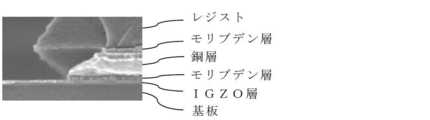
- FIG. 6 It is a schematic diagram of the wiring cross section which consists of a multilayer film structure containing copper and molybdenum after etching using the liquid composition by this invention.
- 6 is a SEM photograph of a wiring cross section having a multilayer structure containing copper and molybdenum after etching in Example 3.
- FIG. 6 is a SEM photograph of a wiring cross section having a multilayer structure containing copper and molybdenum after etching in Example 3.
- the liquid composition according to the present invention is used for etching a multilayer film containing copper and molybdenum, and comprises (A) a maleate ion source, (B) a copper ion source, and (C) 1-amino- 2-propanol, 2- (methylamino) ethanol, 2- (ethylamino) ethanol, 2- (butylamino) ethanol, 2- (dimethylamino) ethanol, 2- (diethylamino) ethanol, 2-methoxyethylamine, 3- Methoxypropylamine, 3-amino-1-propanol, 2-amino-2-methyl-1-propanol, 1-dimethylamino-2-propanol, 2- (2-aminoethoxy) ethanol, morpholine, and 4- (2 -Hydroxyethyl) a minimum amount of an amine compound selected from the group consisting of morpholine.
- wiring having a multilayer film structure containing copper and molybdenum can be collectively and at a good etching rate (according to a preferred embodiment of the present invention).
- the etching can be performed with a just etching time of about 30 to 400 seconds or an etching rate of about 0.1 to 1 ⁇ m / min until the underlayer is exposed after the etching of the multilayer film containing copper and molybdenum is completed. it can.
- the liquid composition of the present invention does not contain ammonia, there is no change in ammonia concentration due to generation of odor or volatilization, and handling is easy.
- the liquid composition of the present invention does not generate gas or heat due to the decomposition reaction of hydrogen peroxide or peroxosulfuric acid ions, it can be etched safely and stably.
- the liquid composition of the present invention since the liquid composition of the present invention has high molybdenum removability, the molybdenum is not removed even in a multilayer film containing copper and molybdenum formed with a thick molybdenum. There is no remaining.
- the “multilayer film containing copper and molybdenum” means a multilayer film including at least a layer containing copper and a layer containing molybdenum, and preferably copper or copper is used.
- a multilayer film including a layer made of a compound containing as a main component and a layer made of molybdenum or a compound containing molybdenum as a main component.
- the “compound containing copper as a main component” means a compound containing 50% or more, preferably 60% or more, more preferably 70% or more of copper on a weight basis.
- the “compound containing molybdenum as a main component” means a compound containing 50% or more, preferably 60% or more, more preferably 70% or more of molybdenum on a weight basis.
- FIG. 1 is a schematic diagram of a cross section of a wiring (multilayer film wiring) having a multilayer film structure containing copper and molybdenum after etching using the liquid composition of the present invention.
- a multilayer film including a layer containing copper (copper layer) and a layer containing molybdenum (molybdenum layer) is laminated on a substrate, and a resist is laminated thereon, and the multilayer film is etched.
- a multilayer film wiring is obtained.
- the angle ( ⁇ ) formed between the etching surface at the end of the multilayer wiring and the substrate is a forward taper angle, and the angle is 15 to 75 degrees. Is preferable, 20 to 70 degrees is more preferable, and 25 to 70 degrees is particularly preferable.
- the taper angle is smaller than 15 degrees, the cross-sectional area of the wiring is small, and fine wiring may cause disconnection, which is not preferable.
- the taper angle is larger than 75 degrees, the coverage when an insulating film or the like is formed on the upper layer of the wiring is deteriorated, which is not preferable.
- the horizontal distance (bottom critical dimension loss, also referred to as bottom CD loss for short) from the end of the barrier film constituting the lower layer (bottom) of the multilayer wiring to the end of the resist is 2.5 ⁇ m or less. It is preferably 1.8 ⁇ m or less, more preferably 1.5 ⁇ m or less.
- bottom CD loss is larger than 2.5 ⁇ m, the cross-sectional area of the wiring becomes small, which is not preferable. Further, the loss in etching increases.
- a multilayer film containing copper and molybdenum using a liquid composition containing a maleate ion source, a copper ion source, and a specific amine compound, a multilayer having a good shape is obtained. Membrane wiring can be obtained.
- each component which comprises the liquid composition by this invention is demonstrated.
- the maleate ion source (hereinafter sometimes simply referred to as component (A)) contained in the liquid composition according to the present invention forms a complex with copper ions, and is an etching agent for copper. It functions as.
- the maleate ion supply source is not particularly limited as long as it can supply maleate ions.
- maleic acid, maleic anhydride and the like are preferable. These maleate ion sources may be used alone or in combination. Among these, maleic acid and maleic anhydride are preferable from the viewpoints of excellent solubility in water and stability in a liquid composition and good etching performance.
- the maleate ion source (component (A)) is preferably contained in the range of 0.05 to 5 mol, more preferably in the range of 0.1 to 5 mol, particularly 0, in 1 kg of the liquid composition.
- the range of 1 to 3 mol is preferred.
- the blending ratio of the maleate ion source (component (A)) to the copper ion source (component (B)) described later is preferably in the range of 0.05 to 20 on a molar basis.
- a range of 05 to 10 is more preferable, and a range of 0.1 to 10 is particularly preferable.
- the copper ion supply source (hereinafter sometimes simply referred to as component (B)) contained in the liquid composition according to the present invention is a component that acts as an oxidizing agent for copper.
- the copper ion supply source is not particularly limited as long as it can supply copper (II) ions.
- copper sulfate, copper nitrate, copper acetate, copper hydroxide, cupric chloride, bromide Copper salts such as cupric, cupric fluoride, cupric iodide and ammonium copper sulfate are preferred.
- These copper ion supply sources may be used alone or in combination. Among these, copper, copper sulfate, copper nitrate, copper hydroxide, and copper acetate are particularly preferable.
- the copper ion source (component (B)) is preferably contained in an amount of 0.01 to 4 mol in 1 kg of the liquid composition, more preferably in the range of 0.01 to 2 mol, especially 0. A range of 0.02 to 2 mol is preferred. If the content of the copper ion supply source (component (B)) in the liquid composition according to the present invention is within the above range, a better etching rate and wiring shape can be obtained.
- component (C) Amine Compound
- the amine compound (hereinafter sometimes simply referred to as “component (C)”) contained in the liquid composition according to the present invention has a function of improving molybdenum removability.
- the amine compound is selected from the group consisting of amines and amine and acid salts.
- Examples of these amine compounds include 1-amino-2-propanol, 2- (methylamino) ethanol, 2- (ethylamino) ethanol, 2- (butylamino) ethanol, 2- (dimethylamino) ethanol, 2 -(Diethylamino) ethanol, 2-methoxyethylamine, 3-methoxypropylamine, 3-amino-1-propanol, 2-amino-2-methyl-1-propanol, 1-dimethylamino-2-propanol, 2- (2 -Aminoethoxy) ethanol, morpholine, 4- (2-hydroxyethyl) morpholine, 2- (2-aminoethylamino) ethanol, 2,2'-iminodiethanol, di-2-propanolamine, 2,2 '-( Amination such as methylimino) diethanol and 1-piperazineethanol Objects are preferably exemplified.
- amine compounds may be used alone or in combination of two or more.
- 1-amino-2-propanol 2- (methylamino) ethanol, 2- (dimethylamino) ethanol, 2-methoxyethylamine, 3-amino-1-propanol, and morpholine are preferable.
- the amine compound (component (C)) is preferably contained in a range of 0.1 to 5 moles in 1 kg of the liquid composition, more preferably in a range of 0.2 to 5 moles, particularly 0.2 to 5 moles. A range of 4 moles is preferred.
- the mixing ratio of the amine compound (component (C)) to the copper ion supply source (component (B)) is preferably in the range of 1 to 40, more preferably in the range of 1 to 20, on a molar basis. In particular, the range of 2 to 20 is preferable. If the content of the amine compound (component (C)) in the liquid composition according to the present invention is within the above range, a better etching rate and wiring shape can be obtained.
- the liquid composition according to the present invention may contain a carboxylic acid ion source (hereinafter sometimes simply referred to as component (D)) as necessary.
- the carboxylate ion source has a function as a ligand for copper ions, improves the stability of the liquid composition for etching the multilayer film containing copper and molybdenum, and functions to stabilize the etching rate. Have. In addition, there is also an effect of suppressing generation of a residue that precipitates when the liquid composition is diluted with water during the water rinsing step after etching.
- the carboxylate ion source (component (D)) is not particularly limited as long as it can supply carboxylate ions.
- monocarboxylic acids such as formic acid, acetic acid, propionic acid, butyric acid, isobutyric acid; oxalic acid Dicarboxylic acids such as malonic acid, succinic acid and maleic acid; aminocarboxylic acids such as glycine and alanine; hydroxyl carboxylic acids such as glycolic acid, lactic acid, 2-hydroxyisobutyric acid, citric acid, tartaric acid, malic acid, and the like Preferred examples include carboxylic acid salts. These carboxylate ion supply sources may be used alone or in combination.
- carboxylic acid anhydrides such as acetic anhydride, propionic anhydride, and maleic anhydride react with water to produce carboxylic acid
- carboxylic acid anhydride can also be suitably used as component (D).
- carboxylic acid esters such as ethyl acetate, propyl acetate, ethyl propionate, dimethyl malonate, diethyl malonate, dimethyl succinate and diethyl succinate produce carboxylic acid by hydrolysis reaction, (D) It can use suitably as a component.
- acetic acid, propionic acid, glycolic acid, malonic acid, succinic acid, lactic acid, citric acid, tartaric acid, malic acid; salts of these carboxylic acids; and acetic anhydride are more preferable.
- acetic acid, acetic anhydride, glycolic acid, malonic acid, succinic acid, lactic acid, and citric acid are preferred.
- a carboxylic acid copper salt such as copper acetate has a function as the component (D) and also functions as the aforementioned copper ion supply source.
- the content of the component (D) is the total content of the other carboxylic acid ion source and the carboxylic acid copper salt.
- carboxylic acid anhydrides in the form of dehydration condensation of two carboxylic acid molecules such as acetic anhydride or propionic anhydride react with water to produce two carboxylic acids, these carboxylic acid anhydrides are (D) When contained as a component, the content of the component (D) is defined as a content of the component (D) that is twice the content of the carboxylic anhydride.
- the carboxylate ion source (component (D)) is preferably contained in the range of 0.05 to 5 mol, more preferably in the range of 0.1 to 5 mol, in particular 0, in 1 kg of the liquid composition.
- the range of 1 to 4 mol is preferred.
- the blending ratio of the carboxylate ion source (component (D)) to the copper ion source (component (B)) is preferably in the range of 0.05 to 20, more preferably 0.
- the range is from 1 to 20, and the range from 0.2 to 20 is particularly preferable. If the content of the carboxylate ion supply source (component (D)) in the liquid composition according to the present invention is within the above range, the etching rate and the wiring shape will be good.
- the liquid composition according to the present invention may contain a molybdate ion supply source (hereinafter, also simply referred to as component (E)) as necessary.
- the molybdate ion source has a function of adjusting the etching rate of the multilayer film containing copper and molybdenum, and a function of controlling the etching to adjust the cross-sectional shape of the wiring.
- the concentration of molybdate ions increases due to the dissolution of molybdenum. Therefore, by incorporating the component (E) in the liquid composition in advance, fluctuations in etching characteristics (etching rate, etching shape, stability of the liquid composition, etc.) when the concentration of molybdate increases is reduced. can do.
- any source that can supply molybdate ions can be used without particular limitation.
- Such molybdate ions are not particularly limited as long as they are ionic species soluble in the liquid composition.
- 7 molybdenum atoms are contained in the ions. It may be an isopolymolybdate ion such as a paramolybdate ion or a heteropolymolybdate ion containing a hetero element in the ion.
- molybdate ion source examples include molybdenum, molybdate such as ammonium molybdate, sodium molybdate, and potassium molybdate; heteropolymolybdate such as ammonium phosphomolybdate and ammonium silicomolybdate; molybdenum oxide, Preferable examples include oxides and hydroxides such as molybdenum blue; molybdenum sulfide and the like. These molybdate ion sources may be used alone or in combination.
- molybdenum, ammonium molybdate, sodium molybdate, potassium molybdate, and molybdenum oxide are more preferable, and molybdenum, ammonium molybdate, and molybdenum oxide are particularly preferable.
- the content of the molybdate ion supply source (component (E)) in the liquid composition according to the present invention is calculated in terms of the content of orthomolybdate ions containing one molybdenum atom in the ions.
- molybdate ion ammonium eg, ammonium hexamolybdate
- the amount of hexamolybdenum hexaammonium salt is 7 times the amount.
- the content of molybdate ion supply source (component (E) is calculated in terms of the content of orthomolybdate ions containing one molybdenum atom in the ions.
- the molybdate ion source (component (E)) is preferably contained in 1 kg of the liquid composition in the range of 1 ⁇ 10 ⁇ 6 to 9 ⁇ 10 ⁇ 2 mol in terms of orthomolybdate ions.
- the range of ⁇ 10 ⁇ 5 to 9 ⁇ 10 ⁇ 2 mol is more preferable, and the range of 2 ⁇ 10 ⁇ 5 to 9 ⁇ 10 ⁇ 2 mol is particularly preferable. If the content of the molybdate ion supply source (component (E)) in the liquid composition according to the present invention is within the above range, a better etching rate and wiring cross-sectional shape can be obtained.
- the compounding ratio of the molybdate ion supply source (component (E)) to the copper ion supply source (component (B)) is on a molar basis, and the copper ions and molybdate ions dissolved in the liquid composition in the etching step.
- the pH of the liquid composition according to the present invention described above may be in the range of 4-9.
- the etching rate and the wiring cross-sectional shape are further improved.
- a pH of less than 4 is not preferable because the molybdenum removability tends to decrease.
- the pH exceeds 9 the etching rate tends to decrease, so that productivity is decreased, which is not preferable.
- the preferred pH range of the liquid composition is pH 4-9.
- the liquid composition according to the present invention may contain a pH adjuster (hereinafter sometimes simply referred to as the (F) component) as necessary in order to adjust the pH value.
- the pH adjuster (F component) is not particularly limited as long as it does not inhibit the effect of the liquid composition described above, and examples thereof include ammonia; metal hydroxides such as sodium hydroxide and potassium hydroxide; isopropylamine, Amines such as tertiary butylamine; hydroxylamines such as hydroxylamine; alkylammonium hydroxides such as tetramethylammonium hydroxide; inorganic acids such as hydrochloric acid, sulfuric acid, nitric acid, phosphoric acid, and perchloric acid; methanesulfonic acid And sulfonic acids such as trifluoromethanesulfonic acid; These pH adjusters may be used alone or in combination.
- ammonia, potassium hydroxide, isopropylamine, tertiary butylamine, tetramethylammonium hydroxide, nitric acid, sulfuric acid, phosphoric acid, and perchloric acid are more preferable.
- ammonia, sodium hydroxide and potassium hydroxide tend to reduce the molybdenum removability, so a small amount is preferable.
- the amine compound functions as a pH regulator, but is included in the component (C).
- carboxylic acid functions also as a pH adjuster, it is contained in (D) component.
- the content of the pH adjusting agent in the liquid composition according to the present invention is appropriately determined depending on the contents of other components so that the pH of the liquid composition becomes a target value.
- the liquid composition according to the present invention is usually used for the above-described components (A) to (C) and the components (D) to (F) to be added as necessary, as well as water and other liquid compositions for etching.
- the various additives to be used can be included in a range that does not impair the effects of the liquid composition described above.
- water those from which metal ions, organic impurities, particle particles, and the like have been removed by distillation, ion exchange treatment, filter treatment, various adsorption treatments, and the like are preferable, pure water is more preferable, and ultrapure water is particularly preferable. .
- the liquid composition according to the present invention may contain a known additive as a copper etching rate regulator.
- a copper etching rate regulator for example, an inhibitor of copper etching rate may include azole compounds such as benzotriazole, 5-amino-1H-tetrazole, imidazole and pyrazole, and phosphoric acid.
- halide ions such as chloride ions and bromide ions can be included.
- An etching method is a method of etching a multilayer film containing copper and molybdenum, and includes a step of bringing the liquid composition into contact with the multilayer film.
- a multilayer film containing copper and molybdenum can be etched at a time and at a good etching rate.
- the etching method according to the present invention uses a multilayer film containing copper and molybdenum as an object to be etched.
- the multilayer film to be etched has a multilayer structure including a layer made of copper or a compound containing copper as a main component and a layer made of molybdenum or a compound containing molybdenum as a main component.
- the multilayer film As the multilayer film, a two-layer film in which a layer made of copper or a compound containing copper as a main component and a layer made of molybdenum or a compound containing molybdenum as a main component, or a layer made of a compound containing molybdenum or molybdenum as a main component is used. And a three-layer film in which a layer of copper or a compound containing copper as a main component and a layer of molybdenum or a compound containing molybdenum as a main component are stacked.
- a three-layer film in which molybdenum or a compound composed mainly of molybdenum, a layer composed of copper or a compound composed mainly of copper, and a layer composed of molybdenum or a compound composed mainly of molybdenum are sequentially stacked is particularly preferable from the viewpoint of effectively exhibiting the performance of the liquid composition according to the present invention.
- the etching method according to the present invention includes an oxide layer (IGZO) made of indium, gallium, and zinc on a substrate, and further includes a layer containing at least molybdenum and a layer containing copper.
- IGZO oxide layer
- a multilayer wiring board provided with a multilayer film is an etching target.
- an oxide layer (IGZO) made of indium, gallium, and zinc is stacked on a substrate, a layer made of a compound containing molybdenum or molybdenum as a main component, a layer made of copper or a compound containing copper as a main component, molybdenum Or the film
- stacked in the order of the layer which consists of a compound which has molybdenum as a main component is especially preferable from a viewpoint from which the performance of the liquid composition by this invention is exhibited effectively.
- Examples of copper or a compound containing copper as a main component include copper (metal), a copper alloy, copper oxide, and copper nitride.
- Examples of molybdenum or a compound containing molybdenum as a main component include molybdenum (metal), a molybdenum alloy, an oxide or a nitride thereof.
- the object to be etched is formed by, for example, laminating a layer made of molybdenum, a layer made of copper, and a layer made of molybdenum on a substrate such as glass in order to form a multilayer film made of three layers, and a resist is formed thereon. It can be obtained by applying, exposing and transferring a desired pattern mask, and developing to form a desired resist pattern.
- a substrate for forming a multilayer film in addition to the glass substrate described above, for example, a gate wiring is formed on a glass plate and an insulating film made of silicon nitride or the like is provided on the gate wiring. It may be a substrate.
- the multilayer film is etched by bringing the liquid composition described above into contact with the object to be etched, and a desired multilayer film wiring is formed, whereby a layer containing molybdenum and a layer containing copper are formed.
- a multilayer film wiring provided with a multilayer film containing can be obtained.
- Such multilayer wiring containing copper and molybdenum is preferably used for wiring of a display device such as a flat panel display.
- the method of bringing the liquid composition into contact with the etching target there is no particular limitation on the method of bringing the liquid composition into contact with the etching target.
- a wet etching method such as a method of immersing in an object can be employed.
- etching can be performed by any method.
- a method in which the liquid composition is sprayed and contacted with the object to be etched is preferably employed.
- the method of spraying and contacting the liquid composition onto the object there are a method of spraying the liquid composition downward from above the etching object or a method of spraying the liquid composition upward from below the etching object.
- the spray nozzle may be fixed, or may be subjected to operations such as swinging and sliding. Moreover, the spray nozzle may be installed vertically downward or may be installed at an angle.
- the object to be etched may be fixed, may be subjected to operations such as swinging and rotation, may be arranged horizontally, or may be arranged tilted.
- the working temperature of the liquid composition is preferably 10 to 70 ° C., more preferably 20 to 50 ° C. If the temperature of the liquid composition is 10 ° C. or higher, the etching rate becomes good, and thus excellent production efficiency can be obtained. On the other hand, if it is 70 degrees C or less, a liquid composition change can be suppressed and etching conditions can be kept constant. Although the etching rate is increased by increasing the temperature of the liquid composition, an optimal processing temperature may be determined as appropriate in consideration of minimizing the composition change of the liquid composition.
- ⁇ Reference Example 1 Production of molybdenum / copper / molybdenum / glass substrate> A layer made of molybdenum (metal) (molybdenum film thickness: 200 mm (20 nm)) is formed by sputtering molybdenum on a glass substrate (dimension: 150 mm ⁇ 150 mm), and then copper is sputtered to form copper (metal). A layer (copper film thickness: 5000 mm (500 nm)) is formed, and molybdenum is sputtered again to form a layer made of molybdenum (metal) (molybdenum film thickness: 200 mm (20 nm)). A three-layer film structure was adopted.
- IGZO / glass substrate> A layer made of IGZO by sputtering IGZO having an element ratio of indium, gallium, zinc and oxygen of 1: 1: 1: 4 on a glass substrate (dimensions: 150 mm ⁇ 150 mm) (IGZO film thickness: 500 mm (50 nm)) was formed into an IGZO / glass substrate.
- molybdenum was sputtered again to form a molybdenum (metal) layer (molybdenum film thickness: 300 mm (30 nm)) to obtain a molybdenum / copper / molybdenum / IGZO structure. Further, a resist was applied, a line pattern mask (line width: 20 ⁇ m) was exposed and transferred, and then developed to prepare a molybdenum / copper / molybdenum / IGZO / glass substrate on which a resist pattern was formed.
- Example 1 In a polypropylene container with a capacity of 10 L, pure water 6.96 kg, (A) maleic anhydride (special grade, molecular weight 98.06, manufactured by Wako Pure Chemical Industries, Ltd.) as a maleate ion supply source, 0.64 kg, (B) 0.15 kg of copper hydroxide (manufactured by Wako Pure Chemical Industries, Ltd., special grade, molecular weight 97.56) as the copper ion source, and acetic acid (Wako Pure Chemical Industries, Ltd., special grade) as the component (D) Grade, molecular weight 60.05) and 0.78 kg of ammonium molybdate as component (E) were added.
- A maleic anhydride
- 98.06 manufactured by Wako Pure Chemical Industries, Ltd.
- B 0.15 kg of copper hydroxide (manufactured by Wako Pure Chemical Industries, Ltd., special grade, molecular weight 97.56) as the copper ion source
- acetic acid Waako Pure Chemical Industries
- the content of each component of the liquid composition obtained as described above is such that (A) component is 0.65 mol and (B) component is 0.16 mol per kg of the liquid composition.
- the blending ratio (molar ratio) of component A) to component (B) was 4.1.
- the content of component (C) per kg of liquid composition was 2.04 mol.
- the blending ratio (molar ratio) of component (C) to component (B) was 13.0.
- the content of component (D) per kg of the liquid composition was 1.17 mol.
- the blending ratio (molar ratio) of component (D) to component (B) was 7.4.
- the content of component (E) per kg of the liquid composition was 0.0044 mol.
- the molybdenum / copper / molybdenum / glass substrate on which the resist pattern obtained in Reference Example 1 is formed is sprayed at 35 ° C. using a small etching machine (manufactured by Kanto Kikai Kogyo). Went.
- the molybdenum / copper / molybdenum / glass substrate was placed horizontally with the film formation surface facing upward, and the spray nozzle was fixed vertically downward.
- the time (just etching time) until the part of the molybdenum / copper / molybdenum multilayer film not covered with the resist disappeared and the transparent glass substrate was exposed was 148 seconds as a result of visual confirmation.
- the molybdenum / copper / molybdenum / glass substrate after 222 seconds etching (50% over-etching condition) was rinsed with pure water, dried with a blower, and observed with an optical microscope. As a result, it was covered with a patterned resist. It was confirmed that the exposed molybdenum / copper / molybdenum multilayer film other than that was completely disappeared.
- Examples 2 to 6 the blending amount of 2- (methylamino) ethanol which is one of the components (C) is 1.48 kg (Example 2), and the blending amount of 2- (dimethylamino) ethanol is 1.67 kg.
- Example 3 the compounding amount of 2-methoxyethylamine is 1.49 kg (Example 4)
- the compounding amount of 3-amino-1-propanol is 1.48 kg (Example 5)
- the compounding amount of morpholine is 1.
- An etching solution was prepared in the same manner as in Example 1 except that 70 kg (Example 6) was used (the amount of pure water was adjusted so that the total weight of the liquid composition was 10 kg.
- Example 1 instead of 1-amino-2-propanol which is one of the components (C), an etching solution was used in the same manner as in Example 1 except that the amount of 2-aminoethanol was 1.26 kg. Prepared and sprayed (50% over-etching condition) using the etching solution. The evaluation results are shown in Table 1. As a result of observing the cross section and surface of the substrate using a scanning secondary electron microscope, it was observed that molybdenum was left behind.
- Example 2 In Example 1, the blending amount of maleic anhydride, which is one of the components (A), is 0.42 kg, the blending amount of acetic acid, which is one of the components (D), is 0.46 kg.
- An etching solution was prepared in the same manner as in Example 1 except that the amount of ammonia was changed to 0.22 kg instead of 1-amino-2-propanol, and spray treatment (50% Overetching conditions). The evaluation results are shown in Table 1. As a result of observing the cross section and surface of the substrate using a scanning secondary electron microscope, it was observed that molybdenum was left behind.
- FIG. 4 shows a secondary electron microscope image of the wiring cross section of the substrate obtained in Comparative Example 2
- FIG. 5 shows a secondary electron microscope image of the substrate surface.
- Comparative Example 3 In a polypropylene container having a capacity of 10 L, pure water 7.7 kg, malic acid 0.5 kg, copper (II) acetate monohydrate 0.3 kg, imidazole 0.5 kg, and triethanolamine 1.0 kg I put it in. After stirring to confirm the dissolution of each component, the mixture was stirred again to prepare a liquid composition. The pH of the liquid composition was 6.8. Spray treatment (50% overetching condition) was performed using the liquid composition. The just etching time was 242 seconds, the taper angle was 80 degrees, and the bottom CD loss was 4.4 ⁇ m. A secondary electron microscope image of the wiring cross section of the substrate obtained in Comparative Example 3 is shown in FIG. The bottom CD loss was large and a good wiring shape could not be obtained.
- Examples 7-12 Using the liquid composition having the composition shown in Table 2, spray treatment (50% overetching condition) was performed on the molybdenum / copper / molybdenum / glass substrate in the same manner as in Example 1. The evaluation results are shown in Table 2. As a result of observing the cross section and the surface of the substrate using a scanning secondary electron microscope, the taper angle and the bottom CD loss are good and the remaining of molybdenum is also observed for the substrate after treatment with any liquid composition. There wasn't.
- FIG. 7 shows a secondary electron microscope image of the cross section of the wiring of the substrate obtained in Example 9, and FIG. 8 shows a secondary electron microscope image of the surface of the substrate.
- Example 12 except for maleic anhydride, which is one of the components (A), the etching solution was the same as in Example 12 except that the blending amount of sulfuric acid, which is one of the components (F), was 0.33 kg. Was prepared, and spray treatment (50% over-etching condition) was performed using the etching solution. Even after treatment for 400 seconds, the molybdenum / copper / molybdenum substrate did not become transparent and etching was not completed. As described above, it is understood that the multilayer film containing copper and molybdenum cannot be etched in the liquid composition containing no component (A).
- Example 12 except for copper hydroxide which is one of the components (B), except for ammonium molybdate which is one of the components (E), 1-amino-2- An etching solution was prepared in the same manner as in Example 12 except that the blending amount of propanol was 0.99 kg, and spray treatment (50% overetching condition) was performed using the etching solution. Even after treatment for 400 seconds, the molybdenum / copper / molybdenum substrate did not become transparent and etching was not completed. As mentioned above, it turns out that the multilayer film containing copper and molybdenum cannot be etched in the liquid composition containing no component (B).
- Examples 13-14 Using the liquid composition having the composition shown in Table 3, spray treatment (50% overetching condition) was performed on the molybdenum / copper / molybdenum / glass substrate in the same manner as in Example 1. The evaluation results are shown in Table 3. Regarding the substrate after treatment with any liquid composition, the taper angle and the bottom CD loss were good, and no remaining molybdenum was observed.
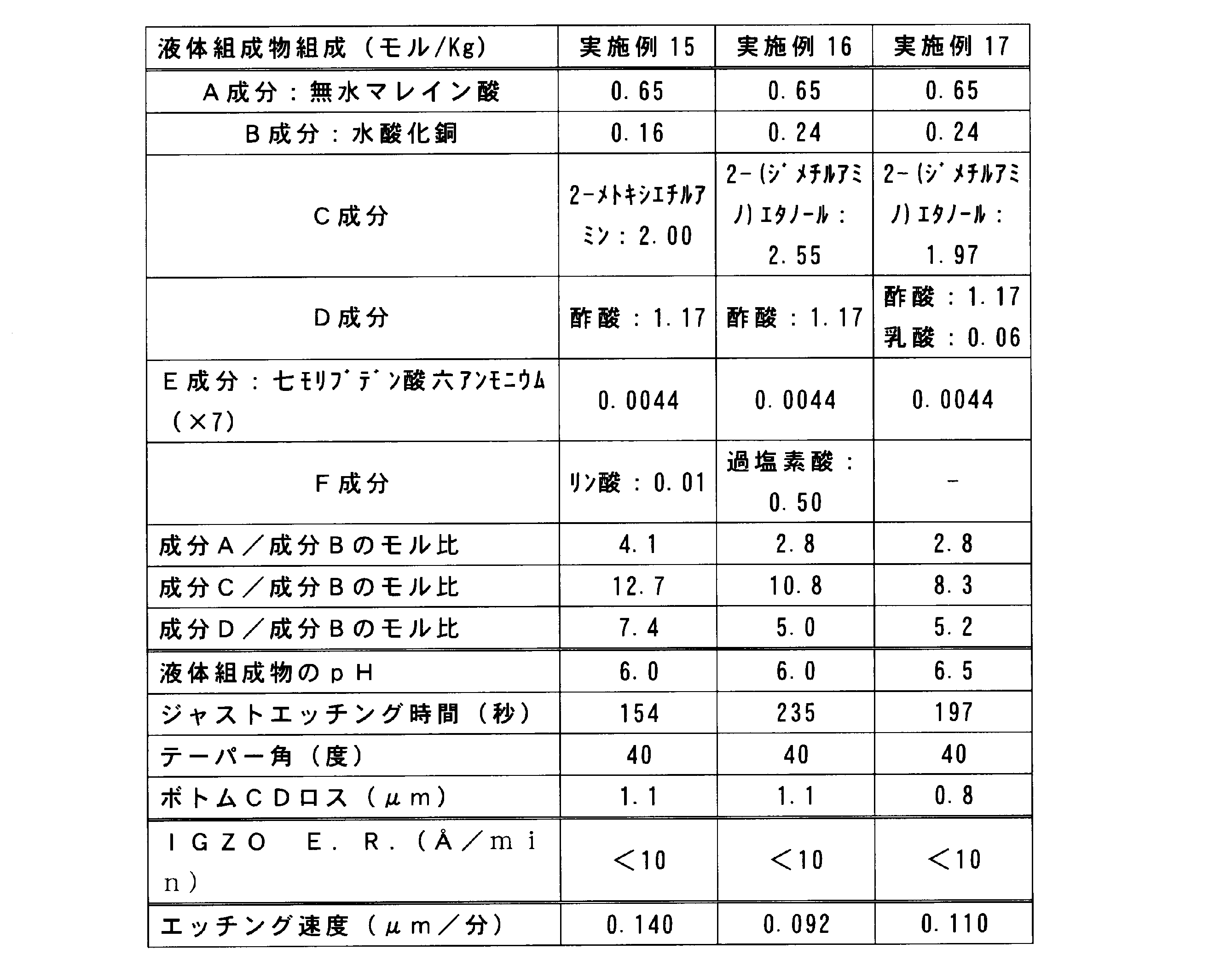
- Examples 15-17 Using the liquid composition having the composition shown in Table 4, spray treatment (50%) on the molybdenum / copper / molybdenum / IGZO / glass substrate on which the resist pattern obtained in Reference Example 3 was formed using the etching solution. Overetching conditions). The evaluation results are shown in Table 4. Regarding the substrate after treatment with any liquid composition, the taper angle and the bottom CD loss were good, and no remaining molybdenum was observed. Also, no damage to the IGZO layer was observed. FIG. 9 shows a secondary electron microscope image of the cross section of the wiring of the substrate obtained in Example 16, and FIG. 10 shows a secondary electron microscope image of the surface of the substrate.
- the liquid composition according to the present invention can be suitably used for etching a multilayer film containing copper and molybdenum, and can etch a wiring composed of a multilayer structure containing copper and molybdenum in a batch and at a good etching rate. High productivity can be achieved.
Landscapes
- Chemical & Material Sciences (AREA)
- Engineering & Computer Science (AREA)
- Materials Engineering (AREA)
- Organic Chemistry (AREA)
- Metallurgy (AREA)
- Mechanical Engineering (AREA)
- General Chemical & Material Sciences (AREA)
- Chemical Kinetics & Catalysis (AREA)
- Manufacturing & Machinery (AREA)
- Microelectronics & Electronic Packaging (AREA)
- Weting (AREA)
- ing And Chemical Polishing (AREA)
- Internal Circuitry In Semiconductor Integrated Circuit Devices (AREA)
- Thin Film Transistor (AREA)
- Electrodes Of Semiconductors (AREA)
Abstract
Description
上記したような問題を解消するため、ガラス等の基板との密着性が高く、且つ半導体膜への拡散が生じにくいバリア性をも兼ね備えた金属からなるバリア膜を介して銅層を設ける多層膜配線の検討が行われている。密着性とバリア性とを兼ね備えた金属としては、モリブデンやチタン等の金属が知られている。多層膜配線としては、銅からなる層と、これらの密着性とバリア性とを兼ね備えた金属あるいはこれら金属の合金からなる層とを積層した2層構造の多層膜や、銅からなる層の酸化を防ぐために、モリブデン又はチタン等の金属またはそれらの合金からなる層を、銅層上に更に積層した3層構造の多層膜が採用されている。
エッチングの方式には、エッチング液を用いる湿式法(ウェットエッチング)とプラズマ等のエッチングガスを用いる乾式法(ドライエッチング)とがある。湿式法(ウェットエッチング)において用いられるエッチング液には、下記のような特性、即ち、
・高い加工精度、
・成分の安定性及び安全性が高く、取り扱いが容易なこと、
・エッチング性能が安定していること、および
・エッチング後に良好な配線形状が得られること
等が求められている。
過酸化物を含まない銅のエッチング液として、銅(II)イオンおよびアンモニアを含有するアンモニアアルカリ性のエッチング液が知られている。このようなアンモニアアルカリ性のエッチング液によっても銅を含む多層膜のエッチングは可能である。しかし、該エッチング液はpHが高いため、該エッチング液からアンモニアが大量に揮発し、アンモニア濃度が低下することによりエッチング速度が変動したり、作業環境を著しく悪化させる場合がある。また、pHが高いとレジストが溶解してしまうという問題もある。
銅または銅合金のエッチング液として、銅(II)イオン、脂肪族カルボン酸、ハロゲンイオン、およびアルカノールアミンを含むエッチング液が提案されている(特許文献2)。
また、銅または銅合金のエッチング液として、銅(II)イオン、有機酸イオン、およびマレイン酸イオンを含むエッチング液が提案されている(特許文献3)。ここでは、該エッチング液を銅及びモリブデンを含む多層膜のエッチングにも適用できることが記載されている。
1.銅または銅を主成分として含む化合物からなる層およびモリブデンまたはモリブデンを主成分として含む化合物からなる層を含む多層膜を積層した基板より銅または銅を主成分として含む化合物からなる層およびモリブデンまたはモリブデンを主成分として含む化合物からなる層を選択的にエッチングする液体組成物であって、
(A)マレイン酸イオン供給源、
(B)銅イオン供給源、並びに
(C)1-アミノ-2-プロパノール、2-(メチルアミノ)エタノール、2-(エチルアミノ)エタノール、2-(ブチルアミノ)エタノール、2-(ジメチルアミノ)エタノール、2-(ジエチルアミノ)エタノール、2-メトキシエチルアミン、3-メトキシプロピルアミン、3-アミノ-1-プロパノール、2-アミノ-2-メチル-1-プロパノール、1-ジメチルアミノ-2-プロパノール、2-(2-アミノエトキシ)エタノール、モルホリン、および4-(2-ヒドロキシエチル)モルホリンからなる群より選ばれる少なくとも一種であるアミン化合物を含み、
かつpH値が4~9である液体組成物。
2.前記銅または銅を主成分として含む化合物からなる層の膜厚(銅膜厚)に対するモリブデンまたはモリブデンを主成分として含む化合物からなる層の膜厚(モリブデン膜厚)(各層が多層の場合はそれぞれの合計の膜厚)の比率(モリブデン膜厚/銅膜厚)が0.05~1である第1項に記載の液体組成物。この比率は、多層膜配線の用途によっても異なるが、モリブデンまたはモリブデンを主成分として含む層がバリア膜としての効果を発現するためには、通常、モリブデン膜厚/銅膜厚の比率は、0.01以上が好ましく、0.05以上がより好ましく、0.1以上が特に好ましい。また一方で、モリブデンまたはモリブデンを主成分として含む化合物は、銅または銅を主成分として含む化合物に比べて高価な材料であるため、経済的な点から、モリブデン膜厚/銅膜厚の比率は、2以下が好ましく、1以下がより好ましく、0.5以下が特に好ましい。
3.前記(A)マレイン酸イオン供給源が、マレイン酸、および無水マレイン酸からなる群より選ばれる少なくとも一種である第1項または第2項に記載の液体組成物。
4.前記(B)銅イオン供給源が、銅、硫酸銅、硝酸銅、酢酸銅、および水酸化銅からなる群より選ばれる少なくとも一種である第1項~第3項のいずれか一項に記載の液体組成物。
5.前記(A)マレイン酸イオン供給源の、前記(B)銅イオン供給源に対する配合比が、モル基準で0.1~10である第1項~第4項のいずれか一項に記載の液体組成物。
6.前記(C)アミン化合物の、前記(B)銅イオン供給源に対する配合比が、モル基準で2~20である第1項~第5項のいずれか一項に記載の液体組成物。
7.(D)カルボン酸イオン供給源をさらに含んでなる第1項~第6項のいずれか一項に記載の液体組成物。
8.前記カルボン酸イオン供給源(D)が、酢酸、グリコール酸、マロン酸、コハク酸、乳酸、クエン酸およびこれらのカルボン酸の塩、並びに無水酢酸からなる群より選ばれる少なくとも一種である第7項に記載の液体組成物。
9.前記カルボン酸イオン供給源(D)の、前記銅イオン供給源(B)に対する配合比が、モル基準で0.1~10である第7項または第8項に記載の液体組成物。
10.モリブデン酸イオン供給源(E)をさらに含んでなる、第1項~第9項のいずれか一項に記載の液体組成物。
11.前記基板上にインジウム、ガリウム、および亜鉛からなる酸化物層(IGZO)を積層し、さらにその上に銅または銅を主成分として含む化合物からなる層およびモリブデンまたはモリブデンを主成分として含む化合物からなる層を含む多層膜を積層した基板より、銅または銅を主成分として含む化合物からなる層およびモリブデンまたはモリブデンを主成分として含む化合物からなる層を選択的にエッチングする第1項~第10項のいずれか一項に記載の液体組成物。
12.銅または銅を主成分として含む化合物からなる層およびモリブデンまたはモリブデンを主成分として含む化合物からなる層を含む多層膜を積層した基板より銅または銅を主成分として含む化合物からなる層およびモリブデンまたはモリブデンを主成分として含む化合物からなる層を含む多層膜を選択的にエッチングする方法であって、該多層膜に第1項~第11項のいずれか一項に記載の液体組成物を接触させることを含む、エッチング方法。
13.前記多層膜が、モリブデンまたはモリブデンを主成分として含む化合物からなる層と、銅または銅を主成分として含む化合物からなる層とを積層した二層膜である、第12項に記載のエッチング方法。
14.前記多層膜が、モリブデンまたはモリブデンを主成分として含む化合物の層、銅または銅を主成分として含む化合物からなる層、およびモリブデンまたはモリブデンを主成分として含む化合物からなる層をこの順で積層した三層膜である、第12項に記載のエッチング方法。
15.基板上に少なくとも銅または銅を主成分として含む化合物からなる層およびモリブデンまたはモリブデンを主成分として含む化合物からなる層を含む多層膜が設けられた多層膜配線基板を製造する方法であって、
基板上にモリブデンまたはモリブデンを主成分として含む化合物からなる層および銅または銅を主成分として含む化合物からなる層を順に設けて多層膜を形成し、
前記多層膜上にレジストを被覆して、レジスト膜を形成し、
該レジスト膜を露光・現像して所定のレジストパターンを形成することにより、エッチング対象物を形成し、
前記エッチング対象物を、第1項~第11項のいずれか一項に記載の液体組成物と接触させることにより、前記多層膜をエッチングして多層膜配線を形成することを含む、多層膜配線基板の製造方法。
16.第15項に記載の製造方法により製造された多層膜配線基板。
また、本発明の液体組成物はアンモニアを含まないため、アンモニアの揮発による臭気の発生がなく、取扱いが容易である。また、本発明の液体組成物は過酸化水素やペルオキソ硫酸イオンを含まないため、それらの分解反応によるガス及び熱の発生も顕著ではなく、安全かつ安定的にエッチングを実施することができる。
本発明の好ましい態様によれば、本発明の液体組成物は、従来の銅/モリブデンエッチング液と比較してモリブデンの除去性が高いため、モリブデンを厚く成膜した銅およびモリブデンを含む多層膜配線においても、モリブデンが取れ残ることもない。さらに、半導体層であるIGZOへのダメージがないため、銅およびモリブデンを含む多層膜とIGZOとを含む配線構造において、銅およびモリブデンを選択的にエッチングできる。
以上より、ディスプレイの大型化、高解像度化および低消費電力化に対応した、銅およびモリブデンを含む多層膜配線エッチング用液体組成物を実現できる。
本発明による液体組成物は、銅およびモリブデンを含む多層膜のエッチングに使用されるものであり、(A)マレイン酸イオン供給源、(B)銅イオン供給源、および(C)1-アミノ-2-プロパノール、2-(メチルアミノ)エタノール、2-(エチルアミノ)エタノール、2-(ブチルアミノ)エタノール、2-(ジメチルアミノ)エタノール、2-(ジエチルアミノ)エタノール、2-メトキシエチルアミン、3-メトキシプロピルアミン、3-アミノ-1-プロパノール、2-アミノ-2-メチル-1-プロパノール、1-ジメチルアミノ-2-プロパノール、2-(2-アミノエトキシ)エタノール、モルホリン、および4-(2-ヒドロキシエチル)モルホリンからなる群より選ばれる少なくとも一種であるアミン化合物を少なくとも含む。
本発明によれば、このような特定の成分を含有する液体組成物において、銅およびモリブデンを含む多層膜構造からなる配線を、一括で、かつ、良好なエッチング速度(本発明の好ましい態様によれば、銅およびモリブデンを含む多層膜のエッチングが完了して下地が露出するまでのジャストエッチング時間として30~400秒程度、あるいは、エッチング速度として0.1~1μm/分程度)でエッチングすることができる。さらに、本発明の液体組成物はアンモニアを含まないため、臭気の発生や揮発によるアンモニア濃度の変化がなく、取扱いが容易である。また、本発明の液体組成物は過酸化水素やペルオキソ硫酸イオンの分解反応によるガスや熱の発生も生じないため、安全かつ安定的にエッチングを実施することができる。加えて、本発明の好ましい態様によれば、本発明の液体組成物はモリブデンの除去性が高いため、モリブデンが厚く成膜された銅およびモリブデンを含む多層膜においても、モリブデンが除去されずに残ることがない。
なお、本明細書において「銅およびモリブデンを含む多層膜」とは、少なくとも、銅を含んでなる層と、モリブデンを含んでなる層とを含む多層膜を意味し、好ましくは、銅または銅を主成分として含む化合物からなる層およびモリブデンまたはモリブデンを主成分として含む化合物からなる層を含む多層膜を意味する。ここで「銅を主成分として含む化合物」とは、重量基準で、銅を50%以上、好ましくは60%以上、より好ましくは70%以上含む化合物を意味する。「モリブデンを主成分として含む化合物」とは、重量基準で、モリブデンを50%以上、好ましくは60%以上、より好ましくは70%以上含む化合物を意味する。
本発明による液体組成物に含まれるマレイン酸イオン供給源(以下、単に(A)成分ということがある。)は、銅イオンと錯体を形成し、銅のエッチング剤として機能するものである。マレイン酸イオン供給源としては、マレイン酸イオンを供給できるものであれば特に制限はなく、例えば、マレイン酸、無水マレイン酸などが好ましく挙げられる。これらのマレイン酸イオン供給源は、単独で使用してもよく、又、複数を混合して使用してもよい。これらのなかでも、水への溶解性や液体組成物中での安定性に優れ、かつエッチング性能を良好にする観点からは、マレイン酸、および無水マレイン酸が好ましい。
また、マレイン酸イオン供給源((A)成分)の、後述する銅イオン供給源((B)成分)に対する配合比は、モル基準で0.05~20の範囲であることが好ましく、0.05~10の範囲がより好ましく、特に0.1~10の範囲が好ましい。本発明による液体組成物中のマレイン酸イオン供給源((A)成分)の含有量が上記範囲内であれば、エッチング速度および配線形状がより一層良好となる。
本発明による液体組成物に含まれる銅イオン供給源(以下、単に(B)成分ということがある。)は、銅の酸化剤として作用する成分である。銅イオン供給源としては、銅(II)イオンを供給できるものであれば特に制限はなく、例えば、銅のほか、硫酸銅、硝酸銅、酢酸銅、水酸化銅、塩化第二銅、臭化第二銅、フッ化第二銅、およびヨウ化第二銅、硫酸アンモニウム銅などの銅塩が好ましく挙げられる。これら銅イオン供給源は、単独で使用してもよく、又、複数を組み合わせて使用してもよい。これらのなかでも、銅、硫酸銅、硝酸銅、水酸化銅、および酢酸銅が特に好ましい。
本発明による液体組成物に含まれるアミン化合物(以下、単に(C)成分ということがある。)は、モリブデンの除去性を向上させる機能を有する。アミン化合物としては、アミン、およびアミンと酸の塩からなる群より選択されるものである。これらのアミン化合物としては、例えば、1-アミノ-2-プロパノール、2-(メチルアミノ)エタノール、2-(エチルアミノ)エタノール、2-(ブチルアミノ)エタノール、2-(ジメチルアミノ)エタノール、2-(ジエチルアミノ)エタノール、2-メトキシエチルアミン、3-メトキシプロピルアミン、3-アミノ-1-プロパノール、2-アミノ-2-メチル-1-プロパノール、1-ジメチルアミノ-2-プロパノール、2-(2-アミノエトキシ)エタノール、モルホリン、4-(2-ヒドロキシエチル)モルホリン、2-(2-アミノエチルアミノ)エタノール、2,2’-イミノジエタノール、ジ-2-プロパノールアミン、2,2’-(メチルイミノ)ジエタノール、1-ピペラジンエタノール、といったアミン化合物が好ましく挙げられる。これらアミン化合物は、単独で使用してもよく、又、複数を組み合わせて使用してもよい。
これらのなかでも、1-アミノ-2-プロパノール、2-(メチルアミノ)エタノール、2-(エチルアミノ)エタノール、2-(ブチルアミノ)エタノール、2-(ジメチルアミノ)エタノール、2-(ジエチルアミノ)エタノール、2-メトキシエチルアミン、3-メトキシプロピルアミン、3-アミノ-1-プロパノール、2-アミノ-2-メチル-1-プロパノール、1-ジメチルアミノ-2-プロパノール、2-(2-アミノエトキシ)エタノール、モルホリン、および4-(2-ヒドロキシエチル)モルホリンがより好ましい。特に、1-アミノ-2-プロパノール、2-(メチルアミノ)エタノール、2-(ジメチルアミノ)エタノール、2-メトキシエチルアミン、3-アミノ-1-プロパノール、およびモルホリンが好ましい。
また、アミン化合物((C)成分)の、銅イオン供給源((B)成分)に対する配合比が、モル基準で1~40の範囲であることが好ましく、より好ましくは1~20の範囲であり、特に2~20の範囲が好ましい。本発明による液体組成物中のアミン化合物((C)成分)の含有量が上記範囲内であれば、より一層良好なエッチング速度および配線形状が得られる。
本発明による液体組成物は、必要に応じて、カルボン酸イオン供給源(以下、単に(D)成分ということがある。)を含んでいてもよい。カルボン酸イオン供給源は、銅イオンに対する配位子としての役割を持ち、銅およびモリブデンを含む多層膜をエッチングする液体組成物の安定性を向上させ、かつ、エッチング速度の安定化を図る機能を有する。また、エッチング後の水リンス工程の際に、液体組成物が水で希釈された際に析出する残渣の発生を抑制する効果もある。
また、無水酢酸または無水プロピオン酸、無水マレイン酸などのカルボン酸無水物は、水と反応してカルボン酸を生成することから、カルボン酸無水物も(D)成分として好適に使用することができる。
また、酢酸エチル、酢酸プロピル、プロピオン酸エチル、マロン酸ジメチル、マロン酸ジエチル、コハク酸ジメチルおよびコハク酸ジエチルなどのカルボン酸エステルは、加水分解反応によってカルボン酸を生成することから、カルボン酸エステルも(D)成分として好適に使用することができる。
上記のなかでも入手の容易さなどの点から、酢酸、プロピオン酸、グリコール酸、マロン酸、コハク酸、乳酸、クエン酸、酒石酸、リンゴ酸;これらのカルボン酸の塩;および無水酢酸がより好ましく、特に、酢酸、無水酢酸、グリコール酸、マロン酸、コハク酸、乳酸、クエン酸が好ましい。
また、カルボン酸イオン供給源((D)成分)の、銅イオン供給源((B)成分)に対する配合比が、モル基準で0.05~20の範囲であることが好ましく、より好ましくは0.1~20の範囲であり、特に0.2~20の範囲が好ましい。本発明による液体組成物中のカルボン酸イオン供給源((D)成分)の含有量が上記範囲内であれば、エッチング速度および配線形状が良好となる。
本発明による液体組成物は、必要に応じて、モリブデン酸イオン供給源(以下、単に(E)成分ということがある。)を含んでいてもよい。モリブデン酸イオン供給源は、銅およびモリブデンを含む多層膜のエッチング速度を調節する働きやエッチングを制御して配線断面形状を調節する働きを有する。エッチング工程に使用した液体組成物は、モリブデンの溶解によってモリブデン酸イオンの濃度が上昇してしまう。そのため、液体組成物にあらかじめ(E)成分を含有させておくことにより、モリブデン酸イオンの濃度が上昇した際のエッチング特性(エッチング速度、エッチング形状および液体組成物の安定性等)の変動を小さくすることができる。
モリブデン酸イオン供給源としては、例えば、モリブデンのほか、モリブデン酸アンモニウム、モリブデン酸ナトリウム、モリブデン酸カリウムなどのモリブデン酸塩;リンモリブデン酸アンモニウム、ケイモリブデン酸アンモニウムなどのヘテロポリモリブデン酸塩;酸化モリブデン、モリブデンブルーなどの酸化物や水酸化物;硫化モリブデンなどが好ましく挙げられる。これらモリブデン酸イオン供給源は単独で使用してもよく、又、複数を組み合わせて使用してもよい。
これらのなかでモリブデン、モリブデン酸アンモニウム、モリブデン酸ナトリウム、モリブデン酸カリウム、および酸化モリブデンがより好ましく、特にモリブデン、モリブデン酸アンモニウム、および酸化モリブデンが好ましい。
また、モリブデン酸イオン供給源((E)成分)の、銅イオン供給源((B)成分)に対する配合比がモル基準で、エッチング工程で液体組成物に溶解する銅イオンとモリブデン酸イオンとのモル比と同程度になるように、モリブデン酸イオン供給源((E)成分)を添加することにより、銅およびモリブデンの溶解によるエッチング特性の変動を小さくすることができる。
本発明による液体組成物は、pH値を調整するために、必要に応じてpH調整剤(以下、単に(F)成分ということがある。)が含まれていてもよい。pH調整剤(F成分)としては、上記した液体組成物の効果を阻害しないものであれば特に制限はなく、例えば、アンモニア;水酸化ナトリウムや水酸化カリウムなどの金属水酸化物;イソプロピルアミン、ターシャリーブチルアミンなどのアミン類;ヒドロキシルアミンなどのヒドロキシルアミン類;テトラメチルアンモニウムヒドロキシドなどのアルキルアンモニウム水酸化物;塩酸、硫酸、硝酸、リン酸、および過塩素酸などの無機酸;メタンスルホン酸およびトリフルオロメタンスルホン酸などのスルホン酸;などが好ましく挙げられる。これらpH調整剤は、単独で使用してもよく、又、複数を組み合わせて使用してもよい。これらのなかでも、アンモニア、水酸化カリウム、イソプロピルアミン、ターシャリーブチルアミン、テトラメチルアンモニウムヒドロキシド、硝酸、硫酸、リン酸、過塩素酸がより好ましい。ただし、アンモニア、水酸化ナトリウムおよび水酸化カリウムはモリブデン除去性を低下させる傾向にあるため、少量であることが好ましい。
本発明によるエッチング方法は、銅およびモリブデンを含む多層膜をエッチングする方法であって、前記多層膜に上記の液体組成物を接触させる工程を含むものである。本発明の方法によれば、銅およびモリブデンを含む多層膜を一括で、かつ良好なエッチング速度でエッチングできる。また、本発明の好ましい態様によれば、上記したように、テーパー角が15~75度であり、且つボトムCDロスが0~2.5μmであるような多層膜配線断面形状を得ることができる。
多層膜を形成する基板としては、上記したガラス基板以外にも、例えば、ガラス板上にゲート配線を形成し、そのゲート配線上に窒化珪素等からなる絶縁膜を設けたような層構成を有する基板であってもよい。
本発明においては、エッチング対象物に上記した液体組成物を接触させることにより多層膜をエッチングし、所望の多層膜配線を形成することで、モリブデンを含んでなる層と銅を含んでなる層とを含む多層膜が設けられた多層膜配線を得ることができる。このような銅およびモリブデンを含む多層膜配線は、フラットパネルディスプレイ等の表示デバイスの配線などに好ましく用いられるものである。
液体組成物を対象物にスプレーして接触させる方法においては、エッチング対象物の上方から液体組成物を下向きにスプレーする方法、またはエッチング対象物の下方から液体組成物を上向きにスプレーする方法などが挙げられる。この際のスプレーノズルは、固定してもよいし、首振りや滑動などの動作を加えてもよい。また、スプレーノズルを鉛直下向きに設置してもよいし、傾けて設置してもよい。エッチング対象物は、固定してもよいし、揺動や回転などの動作を加えてもよく、また水平に配置してもよいし、傾けて配置してもよい。
実施例および比較例で得られたエッチングを行った後の銅層およびモリブデン層を含む多層薄膜試料の配線断面について、走査型電子顕微鏡(「S5000H形(型番)」;日立製)を用いて観察倍率3万倍(加速電圧2kV、エミッション電流10μA)で観察した。得られたSEM画像をもとに、配線断面のテーパー角が15~75度の順テーパー形状、およびボトムCDロスが2.5μm以下であるものを合格品とした。
実施例および比較例で得られたエッチングを行った後の銅層およびモリブデン層を含む多層薄膜試料について、アセトン中に25℃で300秒間浸漬してレジストを剥離した後に、レジスト剥離後の配線表面について、走査型電子顕微鏡(「S5000H形(型番)」;日立製)を用いて観察倍率2万倍(加速電圧2kV、エミッション電流10μA)で観察した。得られたSEM画像をもとに、基板表面に銅およびモリブデンの取れ残りがないものを合格品とした。
実施例および比較例で得られた処理を行った後のIGZO/ガラス基板において、処理前後のIGZO膜厚を、n&kTechnology Inc.製の光学式薄膜特性測定装置n&kAnalyzer 1280により測定し、処理前後の膜厚差をエッチング時間で除することによりE.Rを算出した。IGZOのE.Rが10Å/min(1nm/min)未満であるものを合格品とした。
ガラス基板(寸法:150mm×150mm)上にモリブデンをスパッタしてモリブデン(金属)からなる層(モリブデン膜厚:200Å(20nm))を成膜し、次いで銅をスパッタして銅(金属)からなる層(銅膜厚:5000Å(500nm))を成膜し、再びモリブデンをスパッタしてモリブデン(金属)からなる層(モリブデン膜厚:200Å(20nm))を成膜し、モリブデン/銅/モリブデンの三層膜構造とした。さらにレジストを塗布し、ライン状パターンマスク(ライン幅:20μm)を露光転写後、現像することで、レジストパターンを形成したモリブデン/銅/モリブデン/ガラス基板を作製した。参考例1に示した銅およびモリブデンを含む多層膜における銅層とモリブデン層の膜厚の比率(モリブデン膜厚/銅膜厚)=(200+200)/5000=0.08である。
ガラス基板(寸法:150mm×150mm)上にインジウム、ガリウム、亜鉛および酸素の元素比が1:1:1:4であるIGZOをスパッタしてIGZOからなる層(IGZO膜厚:500Å(50nm))を成膜し、IGZO/ガラス基板を作製した。
ガラス基板(寸法:150mm×150mm)上にインジウム、ガリウム、亜鉛および酸素の元素比が1:1:1:4であるIGZO膜を膜厚500Å(50nm)でスパッタ法により形成し、次いでモリブデンをスパッタしてモリブデン(金属)からなる層(モリブデン膜厚:300Å(30nm))を成膜し、次いで銅をスパッタして銅(金属)からなる層(銅膜厚:3000Å(300nm))を成膜し、再びモリブデンをスパッタしてモリブデン(金属)からなる層(モリブデン膜厚:300Å(30nm))を成膜し、モリブデン/銅/モリブデン/IGZOの構造とした。さらにレジストを塗布し、ライン状パターンマスク(ライン幅:20μm)を露光転写後、現像することで、レジストパターンを形成したモリブデン/銅/モリブデン/IGZO/ガラス基板を作製した。参考例3に示した銅およびモリブデンを含む多層膜における銅層とモリブデン層の膜厚の比率(モリブデン膜厚/銅膜厚)=(300+300)/3000=0.2である。
容量10Lのポリプロピレン容器に、純水6.96kgと、(A)マレイン酸イオン供給源である無水マレイン酸(和光純薬工業株式会社製、特級グレード、分子量98.06)を0.64kgと、(B)銅イオン供給源として水酸化銅(和光純薬工業株式会社製、特級グレード、分子量97.56)を0.15kgと、(D)成分として酢酸(和光純薬工業株式会社製、特級グレード、分子量60.05)を0.70kgと、(E)成分としてモリブデン酸アンモニウムを0.008kgとを、投入した。(F)pH調整剤でありかつ(C)アミン化合物の一つとして1-アミノ-2-プロパノール(和光純薬工業株式会社製、特級グレード、分子量75.11)を1.54kg、投入した。攪拌して各成分の溶解を確認した後、再び攪拌し、液体組成物を調製した。得られた液体組成物のpHは6.0であった。
実施例2~6において、(C)成分の一つである2-(メチルアミノ)エタノールの配合量を1.48kg(実施例2)、2-(ジメチルアミノ)エタノールの配合量を1.67kg(実施例3)、2-メトキシエチルアミンの配合量を1.49kg(実施例4)、3-アミノ-1―プロパノールの配合量を1.48kg(実施例5)、モルホリンの配合量を1.70kg(実施例6)とした以外は実施例1と同様にしてエッチング液を調製し(純水の量は液体組成物の全重量が10kgとなるように調整した。以下の液体組成物の調合に関しても同様)、該エッチング液を用いてスプレー処理(50%オーバーエッチング条件)を行った。評価結果を表1に示す。
基板の断面および表面を走査型二次電子顕微鏡を用いて観察した結果、いずれの液体組成物によるスプレー処理後の基板に関しても、テーパー角およびボトムCDロスは良好であり、モリブデンの取れ残りも観察されなかった。実施例3で得られた基板の配線断面の二次電子顕微鏡像を図2に、基板の表面の二次電子顕微鏡像を図3に示す。
実施例1において、(C)成分の一つである1-アミノ-2-プロパノールの代わりに、2-アミノエタノールの配合量を1.26kgとした以外は実施例1と同様にしてエッチング液を調製し、該エッチング液を用いてスプレー処理(50%オーバーエッチング条件)を行った。評価結果を表1に示す。基板の断面および表面を走査型二次電子顕微鏡を用いて観察した結果、モリブデンが取れ残っている様子が観察された。
実施例1において、(A)成分の一つである無水マレイン酸の配合量を0.42kg、(D)成分の一つである酢酸の配合量を0.46kgとし、(C)成分の一つである1-アミノ-2-プロパノールの代わりに、アンモニアの配合量を0.22kgとした以外は実施例1と同様にしてエッチング液を調製し、該エッチング液を用いてスプレー処理(50%オーバーエッチング条件)を行った。評価結果を表1に示す。
基板の断面および表面を走査型二次電子顕微鏡を用いて観察した結果、モリブデンが取れ残っている様子が観察された。比較例2で得られた基板の配線断面の二次電子顕微鏡像を図4に、基板表面の二次電子顕微鏡像を図5に示す。配線の横にモリブデンが膜状に取れ残っている様子が観察された。配線の横はレジストに覆われた部分の真下に当たる箇所であり、液の置換性が悪いため、モリブデンが取れ残りやすい箇所である。以上、比較例1および2より、(C)アミン化合物を含まない薬液組成においては、モリブデンに対する除去性が不足していることが分かる。
容量10Lのポリプロピレン容器に、純水7.7kgと、リンゴ酸0.5kgと、酢酸銅(II)一水和物0.3kgと、イミダゾール0.5kgと、トリエタノールアミン1.0kgとを、投入した。攪拌して各成分の溶解を確認した後、再び攪拌し、液体組成物を調製した。液体組成物のpHは6.8であった。該液体組成物を用いてスプレー処理(50%オーバーエッチング条件)を行った。ジャストエッチング時間は242秒であり、テーパー角は80度、ボトムCDロスは4.4μmであった。比較例3で得られた基板の配線断面の二次電子顕微鏡像を図6に示す。ボトムCDロスが大きく、良好な配線形状が得られなかった。また配線の横にはモリブデンが取れ残っている様子が確認された。以上のことから、比較例3より、(A)無水マレイン酸イオン供給源、および(C)アミン化合物を含まない薬液組成においては、良好な配線形状が得られず、またモリブデンに対する除去性が不足していることが分かる。

表2に示した組成の液体組成物を用いて、実施例1と同様に、モリブデン/銅/モリブデン/ガラス基板に対して、スプレー処理(50%オーバーエッチング条件)を行った。評価結果を表2に示す。基板の断面および表面を走査型二次電子顕微鏡を用いて観察した結果、いずれの液体組成物による処理後の基板に関しても、テーパー角およびボトムCDロスは良好であり、モリブデンの取れ残りも観察されなかった。実施例9で得られた基板の配線の断面の二次電子顕微鏡像を図7に、基板の表面の二次電子顕微鏡像を図8に示す。
実施例12において、(A)成分の一つである無水マレイン酸を除き、(F)成分の一つである硫酸の配合量を0.33kgとした以外は実施例12と同様にしてエッチング液を調製し、該エッチング液を用いてスプレー処理(50%オーバーエッチング条件)を行った。400秒処理しても、モリブデン/銅/モリブデン基板は透明にならず、エッチングが完了しなかった。以上、(A)成分を含まない液体組成物においては、銅およびモリブデンを含む多層膜をエッチングできないことが分かる。
実施例12において、(B)成分の一つである水酸化銅を除き、(E)成分の一つであるモリブデン酸アンモニウムを除き、(C)成分の一つである1-アミノ-2-プロパノールの配合量を0.99kgとした以外は実施例12と同様にしてエッチング液を調製し、該エッチング液を用いてスプレー処理(50%オーバーエッチング条件)を行った。400秒処理しても、モリブデン/銅/モリブデン基板は透明にならず、エッチングが完了しなかった。以上、(B)成分を含まない液体組成物においては、銅およびモリブデンを含む多層膜をエッチングできないことが分かる。
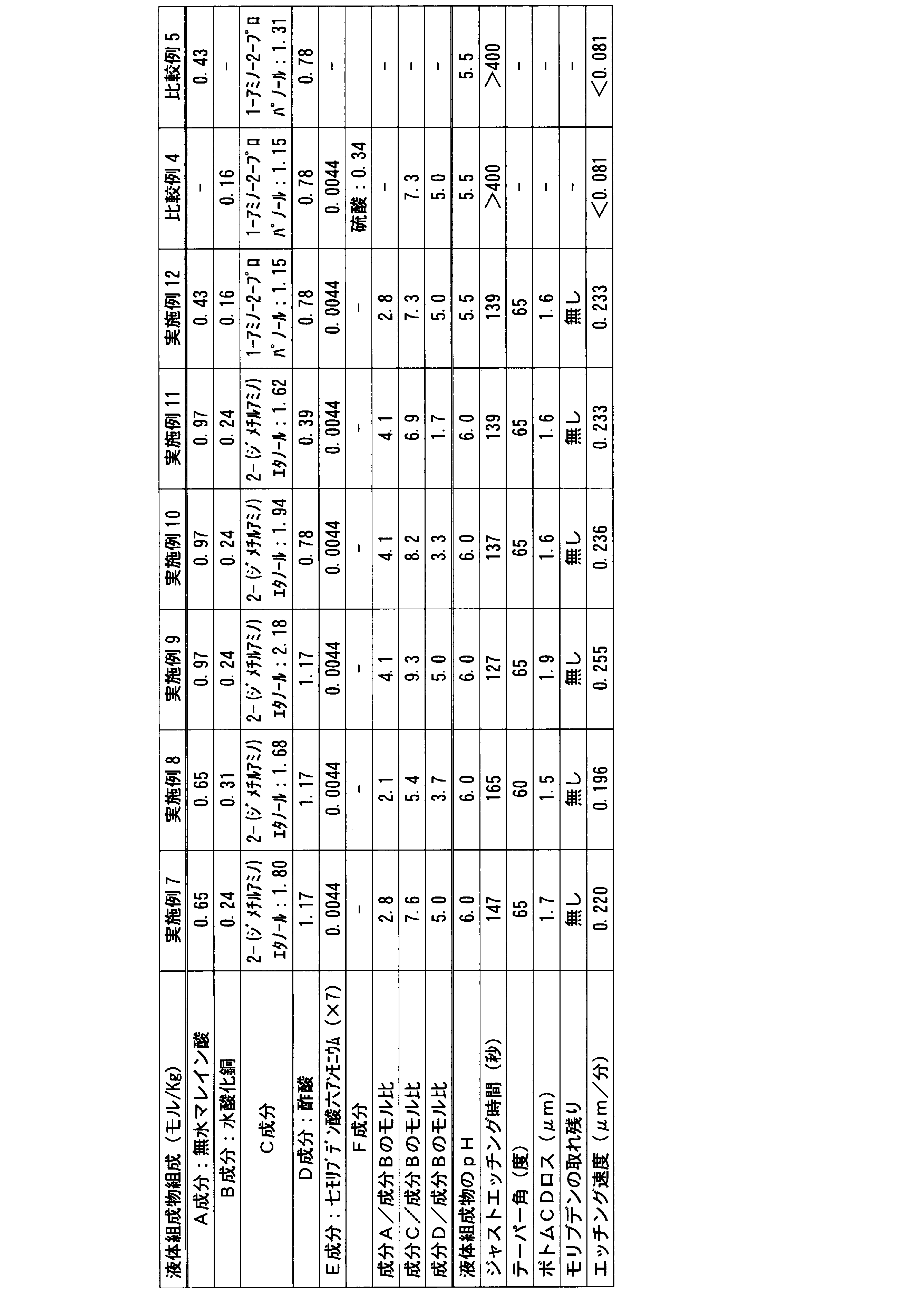
表3に示した組成の液体組成物を用いて、実施例1と同様に、モリブデン/銅/モリブデン/ガラス基板に対して、スプレー処理(50%オーバーエッチング条件)を行った。評価結果を表3に示す。いずれの液体組成物による処理後の基板に関しても、テーパー角およびボトムCDロスは良好であり、モリブデンの取れ残りも観察されなかった。
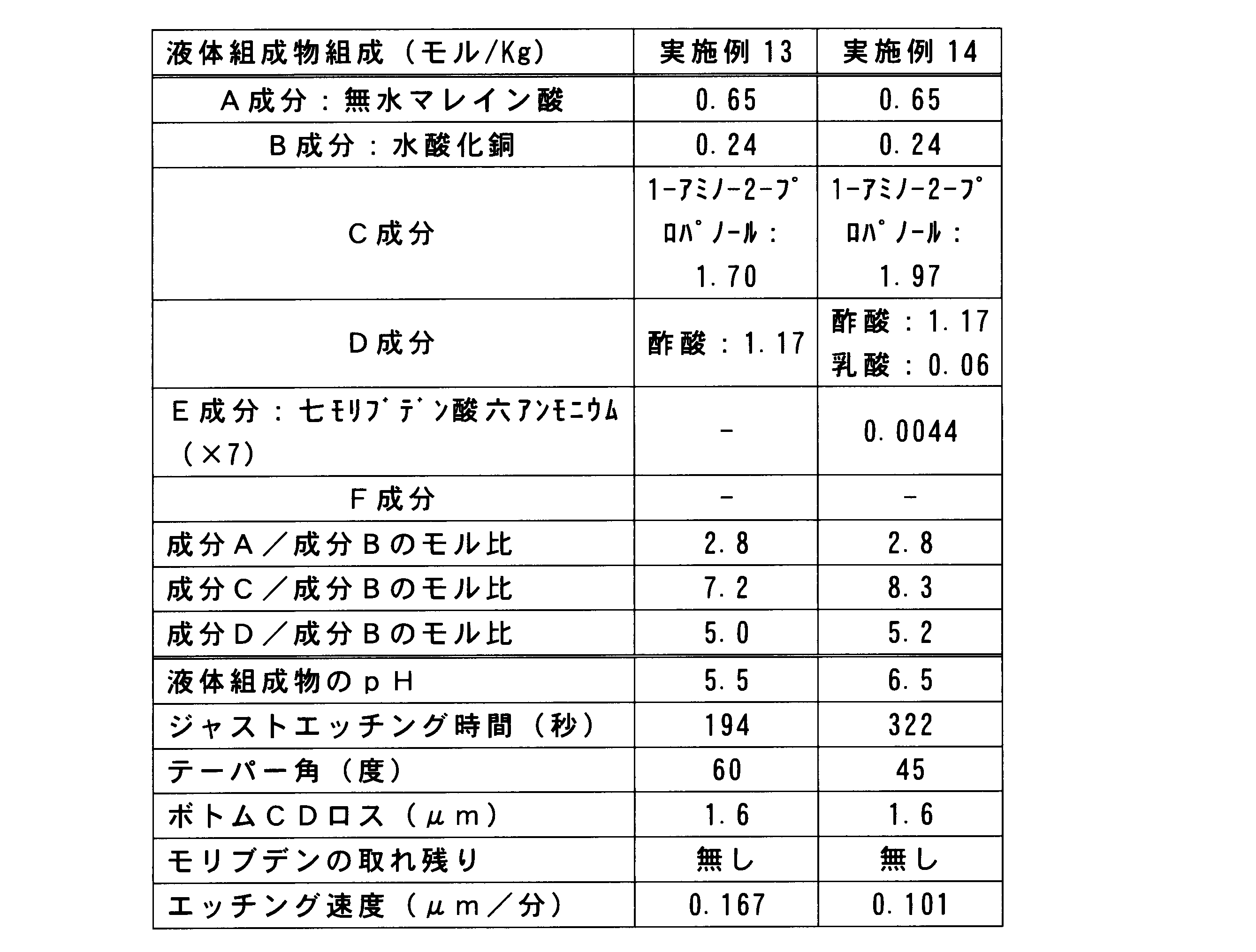
表4に示した組成の液体組成物を用いて、参考例3で得られたレジストパターンを形成したモリブデン/銅/モリブデン/IGZO/ガラス基板に対し、該エッチング液を用いてスプレー処理(50%オーバーエッチング条件)を行った。評価結果を表4に示す。いずれの液体組成物による処理後の基板に関しても、テーパー角およびボトムCDロスは良好であり、モリブデンの取れ残りも観察されなかった。また、IGZO層へのダメージも観察されなかった。実施例16で得られた基板の配線の断面の二次電子顕微鏡像を図9に、基板の表面の二次電子顕微鏡像を図10に示す。
Claims (16)
- 銅または銅を主成分として含む化合物からなる層およびモリブデンまたはモリブデンを主成分として含む化合物からなる層を含む多層膜を積層した基板より銅または銅を主成分として含む化合物からなる層およびモリブデンまたはモリブデンを主成分として含む化合物からなる層を選択的にエッチングする液体組成物であって、
(A)マレイン酸イオン供給源、
(B)銅イオン供給源、並びに
(C)1-アミノ-2-プロパノール、2-(メチルアミノ)エタノール、2-(エチルアミノ)エタノール、2-(ブチルアミノ)エタノール、2-(ジメチルアミノ)エタノール、2-(ジエチルアミノ)エタノール、2-メトキシエチルアミン、3-メトキシプロピルアミン、3-アミノ-1-プロパノール、2-アミノ-2-メチル-1-プロパノール、1-ジメチルアミノ-2-プロパノール、2-(2-アミノエトキシ)エタノール、モルホリン、および4-(2-ヒドロキシエチル)モルホリンからなる群より選ばれる少なくとも一種であるアミン化合物を含み、
かつpH値が4~9である液体組成物。 - 前記銅または銅を主成分として含む化合物からなる層の膜厚(銅膜厚)に対するモリブデンまたはモリブデンを主成分として含む化合物からなる層の膜厚(モリブデン膜厚)(各層が多層の場合はそれぞれの合計の膜厚)の比率(モリブデン膜厚/銅膜厚)が0.05~1である請求項1に記載の液体組成物。
- 前記(A)マレイン酸イオン供給源が、マレイン酸、および無水マレイン酸からなる群より選ばれる少なくとも一種である請求項1または2に記載の液体組成物。
- 前記(B)銅イオン供給源が、銅、硫酸銅、硝酸銅、酢酸銅、および水酸化銅からなる群より選ばれる少なくとも一種である請求項1~3のいずれか一項に記載の液体組成物。
- 前記(A)マレイン酸イオン供給源の、前記(B)銅イオン供給源に対する配合比が、モル基準で0.1~10である請求項1~4のいずれか一項に記載の液体組成物。
- 前記(C)アミン化合物の、前記(B)銅イオン供給源に対する配合比が、モル基準で2~20である請求項1~5のいずれか一項に記載の液体組成物。
- (D)カルボン酸イオン供給源をさらに含んでなる請求項1~6のいずれか一項に記載の液体組成物。
- 前記カルボン酸イオン供給源(D)が、酢酸、グリコール酸、マロン酸、コハク酸、乳酸、クエン酸およびこれらのカルボン酸の塩、並びに無水酢酸からなる群より選ばれる少なくとも一種である請求項7に記載の液体組成物。
- 前記カルボン酸イオン供給源(D)の、前記銅イオン供給源(B)に対する配合比が、モル基準で0.1~10である請求項7または8に記載の液体組成物。
- モリブデン酸イオン供給源(E)をさらに含んでなる、請求項1~9のいずれか一項に記載の液体組成物。
- 前記基板上にインジウム、ガリウム、および亜鉛からなる酸化物層(IGZO)を積層し、さらにその上に銅または銅を主成分として含む化合物からなる層およびモリブデンまたはモリブデンを主成分として含む化合物からなる層を含む多層膜を積層した基板より、銅または銅を主成分として含む化合物からなる層およびモリブデンまたはモリブデンを主成分として含む化合物からなる層を選択的にエッチングする請求項1~10のいずれか一項に記載の液体組成物。
- 銅または銅を主成分として含む化合物からなる層およびモリブデンまたはモリブデンを主成分として含む化合物からなる層を含む多層膜を積層した基板より銅または銅を主成分として含む化合物からなる層およびモリブデンまたはモリブデンを主成分として含む化合物からなる層を選択的にエッチングする方法であって、該多層膜に請求項1~11のいずれか一項に記載の液体組成物を接触させることを含む、エッチング方法。
- 前記多層膜が、モリブデンまたはモリブデンを主成分として含む化合物からなる層と、銅または銅を主成分として含む化合物からなる層とを積層した二層膜である、請求項12に記載のエッチング方法。
- 前記多層膜が、モリブデンまたはモリブデンを主成分として含む化合物の層、銅または銅を主成分として含む化合物からなる層、およびモリブデンまたはモリブデンを主成分として含む化合物からなる層をこの順で積層した三層膜である、請求項12に記載のエッチング方法。
- 基板上に少なくとも銅または銅を主成分として含む化合物からなる層およびモリブデンまたはモリブデンを主成分として含む化合物からなる層を含む多層膜が設けられた多層膜配線基板を製造する方法であって、
基板上にモリブデンまたはモリブデンを主成分として含む化合物からなる層および銅または銅を主成分として含む化合物からなる層を順に設けて多層膜を形成し、
前記多層膜上にレジストを被覆して、レジスト膜を形成し、
該レジスト膜を露光・現像して所定のレジストパターンを形成することにより、エッチング対象物を形成し、
前記エッチング対象物を、請求項1~11のいずれか一項に記載の液体組成物と接触させることにより、前記多層膜をエッチングして多層膜配線を形成することを含む、多層膜配線基板の製造方法。 - 請求項15に記載の製造方法により製造された多層膜配線基板。
Priority Applications (4)
| Application Number | Priority Date | Filing Date | Title |
|---|---|---|---|
| KR1020157020482A KR102008689B1 (ko) | 2013-04-23 | 2014-04-09 | 구리 및 몰리브덴을 포함하는 다층막의 에칭에 사용되는 액체 조성물, 및 그 액체 조성물을 이용한 기판의 제조방법, 그리고 그 제조방법에 의해 제조되는 기판 |
| CN201480022520.0A CN105121705B (zh) | 2013-04-23 | 2014-04-09 | 包含铜和钼的多层膜的蚀刻中使用的液体组合物、和使用该液体组合物的基板的制造方法、以及通过该制造方法制造的基板 |
| US14/763,891 US9466508B2 (en) | 2013-04-23 | 2014-04-09 | Liquid composition used in etching multilayer film containing copper and molybdenum, manufacturing method of substrate using said liquid composition, and substrate manufactured by said manufacturing method |
| JP2015513673A JP6176321B2 (ja) | 2013-04-23 | 2014-04-09 | 銅およびモリブデンを含む多層膜のエッチングに使用される液体組成物、およびその液体組成物を用いた基板の製造方法、並びにその製造方法により製造される基板 |
Applications Claiming Priority (2)
| Application Number | Priority Date | Filing Date | Title |
|---|---|---|---|
| JP2013-090553 | 2013-04-23 | ||
| JP2013090553 | 2013-04-23 |
Publications (1)
| Publication Number | Publication Date |
|---|---|
| WO2014175071A1 true WO2014175071A1 (ja) | 2014-10-30 |
Family
ID=51791651
Family Applications (1)
| Application Number | Title | Priority Date | Filing Date |
|---|---|---|---|
| PCT/JP2014/060325 Ceased WO2014175071A1 (ja) | 2013-04-23 | 2014-04-09 | 銅およびモリブデンを含む多層膜のエッチングに使用される液体組成物、およびその液体組成物を用いた基板の製造方法、並びにその製造方法により製造される基板 |
Country Status (6)
| Country | Link |
|---|---|
| US (1) | US9466508B2 (ja) |
| JP (1) | JP6176321B2 (ja) |
| KR (1) | KR102008689B1 (ja) |
| CN (1) | CN105121705B (ja) |
| TW (1) | TWI609097B (ja) |
| WO (1) | WO2014175071A1 (ja) |
Families Citing this family (5)
| Publication number | Priority date | Publication date | Assignee | Title |
|---|---|---|---|---|
| CN106601596A (zh) * | 2016-12-30 | 2017-04-26 | 惠科股份有限公司 | 一种导线制程阵列蚀刻方法 |
| CN107354467A (zh) * | 2017-06-19 | 2017-11-17 | 江阴润玛电子材料股份有限公司 | 一种环保型金属去除液 |
| CN113454267A (zh) * | 2019-01-31 | 2021-09-28 | 富士胶片电子材料美国有限公司 | 蚀刻组合物 |
| CN111808612A (zh) * | 2020-07-08 | 2020-10-23 | 江苏和达电子科技有限公司 | 一种用于铜/钼(铌)/igzo膜层的蚀刻液、蚀刻补充液及其制备方法和应用 |
| CN117626267A (zh) * | 2023-11-01 | 2024-03-01 | 陕西师范大学 | 一种甘氨酸调控钼酸钠形成三维网络结构缓蚀膜方法 |
Citations (3)
| Publication number | Priority date | Publication date | Assignee | Title |
|---|---|---|---|---|
| WO2011099624A1 (ja) * | 2010-02-15 | 2011-08-18 | 三菱瓦斯化学株式会社 | 銅層及びモリブデン層を含む多層薄膜用エッチング液 |
| WO2013005631A1 (ja) * | 2011-07-04 | 2013-01-10 | 三菱瓦斯化学株式会社 | 銅または銅を主成分とする化合物のエッチング液 |
| WO2013015322A1 (ja) * | 2011-07-26 | 2013-01-31 | 三菱瓦斯化学株式会社 | 銅/モリブデン系多層薄膜用エッチング液 |
Family Cites Families (10)
| Publication number | Priority date | Publication date | Assignee | Title |
|---|---|---|---|---|
| JPS60243286A (ja) | 1984-05-15 | 1985-12-03 | Canon Inc | エツチング剤 |
| JPS61591A (ja) | 1984-06-13 | 1986-01-06 | Fujitsu Ltd | 銅のエツチング方法 |
| JPH061591A (ja) | 1992-06-18 | 1994-01-11 | Otis Elevator Co | 作業車および作業車の使用方法 |
| JP4063475B2 (ja) | 1999-11-10 | 2008-03-19 | メック株式会社 | 銅または銅合金のエッチング剤 |
| JP2009076601A (ja) * | 2007-09-19 | 2009-04-09 | Nagase Chemtex Corp | エッチング溶液 |
| CN101952485A (zh) * | 2007-11-22 | 2011-01-19 | 出光兴产株式会社 | 蚀刻液组合物 |
| KR101495683B1 (ko) * | 2008-09-26 | 2015-02-26 | 솔브레인 주식회사 | 액정표시장치의 구리 및 구리/몰리브데늄 또는 구리/몰리브데늄합금 전극용 식각조성물 |
| JP5219304B2 (ja) | 2010-12-14 | 2013-06-26 | メック株式会社 | エッチング剤及びこれを用いたエッチング方法 |
| US9012261B2 (en) * | 2013-03-13 | 2015-04-21 | Intermolecular, Inc. | High productivity combinatorial screening for stable metal oxide TFTs |
| WO2014168037A1 (ja) * | 2013-04-12 | 2014-10-16 | 三菱瓦斯化学株式会社 | 銅およびチタンを含む多層膜のエッチングに使用される液体組成物、および該組成物を用いたエッチング方法、多層膜配線の製造方法、基板 |
-
2014
- 2014-04-09 US US14/763,891 patent/US9466508B2/en active Active
- 2014-04-09 JP JP2015513673A patent/JP6176321B2/ja active Active
- 2014-04-09 WO PCT/JP2014/060325 patent/WO2014175071A1/ja not_active Ceased
- 2014-04-09 KR KR1020157020482A patent/KR102008689B1/ko active Active
- 2014-04-09 CN CN201480022520.0A patent/CN105121705B/zh active Active
- 2014-04-18 TW TW103114303A patent/TWI609097B/zh active
Patent Citations (3)
| Publication number | Priority date | Publication date | Assignee | Title |
|---|---|---|---|---|
| WO2011099624A1 (ja) * | 2010-02-15 | 2011-08-18 | 三菱瓦斯化学株式会社 | 銅層及びモリブデン層を含む多層薄膜用エッチング液 |
| WO2013005631A1 (ja) * | 2011-07-04 | 2013-01-10 | 三菱瓦斯化学株式会社 | 銅または銅を主成分とする化合物のエッチング液 |
| WO2013015322A1 (ja) * | 2011-07-26 | 2013-01-31 | 三菱瓦斯化学株式会社 | 銅/モリブデン系多層薄膜用エッチング液 |
Also Published As
| Publication number | Publication date |
|---|---|
| JP6176321B2 (ja) | 2017-08-09 |
| KR102008689B1 (ko) | 2019-08-08 |
| US20150380273A1 (en) | 2015-12-31 |
| US9466508B2 (en) | 2016-10-11 |
| JPWO2014175071A1 (ja) | 2017-02-23 |
| TW201445007A (zh) | 2014-12-01 |
| CN105121705A (zh) | 2015-12-02 |
| TWI609097B (zh) | 2017-12-21 |
| KR20150143409A (ko) | 2015-12-23 |
| CN105121705B (zh) | 2017-08-04 |
Similar Documents
| Publication | Publication Date | Title |
|---|---|---|
| JP6135999B2 (ja) | 銅およびモリブデンを含む多層膜のエッチングに使用される液体組成物、およびそれを用いたエッチング方法 | |
| JP5692472B1 (ja) | 銅およびチタンを含む多層膜のエッチングに使用される液体組成物、および該組成物を用いたエッチング方法、多層膜配線の製造方法、基板 | |
| CN102985596B (zh) | 用于包含铜层和钼层的多层结构膜的蚀刻液 | |
| TWI495763B (zh) | 蝕刻液組成物及蝕刻方法 | |
| CN103814432B (zh) | 增大蚀刻液蚀刻用量的铜/钼合金膜的蚀刻方法 | |
| JP6176321B2 (ja) | 銅およびモリブデンを含む多層膜のエッチングに使用される液体組成物、およびその液体組成物を用いた基板の製造方法、並びにその製造方法により製造される基板 | |
| CN105960700B (zh) | 包含铟、锌、锡及氧的氧化物的蚀刻用液体组合物及蚀刻方法 | |
| CN103605266A (zh) | 光刻胶残渣及聚合物残渣去除液组合物 | |
| JP5971246B2 (ja) | 銅または銅を主成分とする化合物のエッチング液 | |
| CN107099801A (zh) | 对包含铜及钼的多层薄膜进行蚀刻的液体组合物及使用其的蚀刻方法及显示装置的制造方法 | |
| JP5874308B2 (ja) | 銅及びモリブデンを含む多層膜用エッチング液 |
Legal Events
| Date | Code | Title | Description |
|---|---|---|---|
| WWE | Wipo information: entry into national phase |
Ref document number: 201480022520.0 Country of ref document: CN |
|
| 121 | Ep: the epo has been informed by wipo that ep was designated in this application |
Ref document number: 14788308 Country of ref document: EP Kind code of ref document: A1 |
|
| ENP | Entry into the national phase |
Ref document number: 2015513673 Country of ref document: JP Kind code of ref document: A |
|
| ENP | Entry into the national phase |
Ref document number: 20157020482 Country of ref document: KR Kind code of ref document: A |
|
| WWE | Wipo information: entry into national phase |
Ref document number: 14763891 Country of ref document: US |
|
| NENP | Non-entry into the national phase |
Ref country code: DE |
|
| 122 | Ep: pct application non-entry in european phase |
Ref document number: 14788308 Country of ref document: EP Kind code of ref document: A1 |