WO2014167890A1 - 無溶剤型光学用接着剤組成物およびその製造方法、光学用粘着シート、画像表示装置、出入力装置、ならびに接着剤層の製造方法 - Google Patents
無溶剤型光学用接着剤組成物およびその製造方法、光学用粘着シート、画像表示装置、出入力装置、ならびに接着剤層の製造方法 Download PDFInfo
- Publication number
- WO2014167890A1 WO2014167890A1 PCT/JP2014/052944 JP2014052944W WO2014167890A1 WO 2014167890 A1 WO2014167890 A1 WO 2014167890A1 JP 2014052944 W JP2014052944 W JP 2014052944W WO 2014167890 A1 WO2014167890 A1 WO 2014167890A1
- Authority
- WO
- WIPO (PCT)
- Prior art keywords
- mass
- monomer
- acrylic
- acrylic monomer
- adhesive composition
- Prior art date
- Legal status (The legal status is an assumption and is not a legal conclusion. Google has not performed a legal analysis and makes no representation as to the accuracy of the status listed.)
- Ceased
Links
Images


Classifications
-
- C—CHEMISTRY; METALLURGY
- C09—DYES; PAINTS; POLISHES; NATURAL RESINS; ADHESIVES; COMPOSITIONS NOT OTHERWISE PROVIDED FOR; APPLICATIONS OF MATERIALS NOT OTHERWISE PROVIDED FOR
- C09J—ADHESIVES; NON-MECHANICAL ASPECTS OF ADHESIVE PROCESSES IN GENERAL; ADHESIVE PROCESSES NOT PROVIDED FOR ELSEWHERE; USE OF MATERIALS AS ADHESIVES
- C09J133/00—Adhesives based on homopolymers or copolymers of compounds having one or more unsaturated aliphatic radicals, each having only one carbon-to-carbon double bond, and at least one being terminated by only one carboxyl radical, or of salts, anhydrides, esters, amides, imides, or nitriles thereof; Adhesives based on derivatives of such polymers
- C09J133/02—Homopolymers or copolymers of acids; Metal or ammonium salts thereof
-
- C—CHEMISTRY; METALLURGY
- C08—ORGANIC MACROMOLECULAR COMPOUNDS; THEIR PREPARATION OR CHEMICAL WORKING-UP; COMPOSITIONS BASED THEREON
- C08F—MACROMOLECULAR COMPOUNDS OBTAINED BY REACTIONS ONLY INVOLVING CARBON-TO-CARBON UNSATURATED BONDS
- C08F220/00—Copolymers of compounds having one or more unsaturated aliphatic radicals, each having only one carbon-to-carbon double bond, and only one being terminated by only one carboxyl radical or a salt, anhydride ester, amide, imide or nitrile thereof
- C08F220/02—Monocarboxylic acids having less than ten carbon atoms; Derivatives thereof
- C08F220/04—Acids; Metal salts or ammonium salts thereof
- C08F220/06—Acrylic acid; Methacrylic acid; Metal salts or ammonium salts thereof
-
- C—CHEMISTRY; METALLURGY
- C09—DYES; PAINTS; POLISHES; NATURAL RESINS; ADHESIVES; COMPOSITIONS NOT OTHERWISE PROVIDED FOR; APPLICATIONS OF MATERIALS NOT OTHERWISE PROVIDED FOR
- C09J—ADHESIVES; NON-MECHANICAL ASPECTS OF ADHESIVE PROCESSES IN GENERAL; ADHESIVE PROCESSES NOT PROVIDED FOR ELSEWHERE; USE OF MATERIALS AS ADHESIVES
- C09J4/00—Adhesives based on organic non-macromolecular compounds having at least one polymerisable carbon-to-carbon unsaturated bond ; adhesives, based on monomers of macromolecular compounds of groups C09J183/00 - C09J183/16
- C09J4/06—Organic non-macromolecular compounds having at least one polymerisable carbon-to-carbon unsaturated bond in combination with a macromolecular compound other than an unsaturated polymer of groups C09J159/00 - C09J187/00
Definitions
- the present invention relates to a solventless optical adhesive composition and a method for producing the same, an optical pressure-sensitive adhesive sheet, an image display device, an input / output device, and a method for producing an adhesive layer.
- a syrup-like adhesive composition containing a monomer having a polar group such as a hydroxyl group tends to cause aggregation of polymer components, and the pressure-sensitive adhesive sheet obtained using this adhesive composition is cloudy. Tend to occur. For this reason, a syrup-like adhesive composition containing a monomer having a polar group such as a hydroxyl group may be difficult to use for applications requiring high transparency.
- the present invention relates to a solventless optical adhesive composition capable of obtaining an adhesive layer excellent in transparency and a method for producing the same, an optical pressure-sensitive adhesive sheet, an image display device, an input / output device, and production of an adhesive layer Provide a method.
- the present inventors can use an adhesive composition having a predetermined component to make an adhesive composition excellent in transparency and excellent in transparency. It was found that an adhesive layer was obtained.
- the solventless optical adhesive composition includes an acrylic monomer (A) having an alkyl group having 1 to 18 carbon atoms in the molecule, and an acrylic monomer having a hydroxyl group in the molecule.
- Weight average molecular weight 10,000 or more and 800 which is a copolymer of a monomer mixture (M) containing a monomer (B) and an acrylic monomer (C) having a nitrogen atom-containing group in the molecule , 1,000 or less acrylic polymer (P), acrylic monomer (a) having an alkyl group having 1 to 18 carbon atoms in the molecule, and acrylic monomer (b) having a hydroxyl group in the molecule And a monomer mixture (m) containing an acrylic monomer (c) having a nitrogen atom-containing group in the molecule, and the conditions represented by the following formulas (1) to (3): Satisfy both.
- the “acrylic polymer” means at least one selected from acrylic acid, acrylic acid salt, acrylic acid ester, methacrylic acid, methacrylic acid salt, and methacrylic acid ester in a structural unit of 50% by mass or more. Refers to the polymer containing.
- the proportion of the structural unit (A) derived from the acrylic monomer (A) is 65% by mass or more. It is 85 mass% or less, the ratio of the structural unit (B) derived from the said acrylic monomer (B) is 10 mass% or more and 30 mass% or less, and originates in the said acrylic monomer (C).
- the proportion of the structural unit (C) can be 0.5% by mass or more and 10% by mass or less.
- the turbidity may be 5.0 or less.
- An optical pressure-sensitive adhesive sheet according to another embodiment of the present invention is obtained by applying the solventless optical adhesive composition according to any one of 1 to 7 above to the surface of a separator and irradiating with light.
- An image display device includes the optical pressure-sensitive adhesive sheet described in 8 above.
- An input / output device includes the optical pressure-sensitive adhesive sheet described in 8 above.
- the method for producing a solventless optical adhesive composition according to any one of 1 to 7 above is an acrylic having an alkyl group having 1 to 18 carbon atoms in the molecule in a system substantially free of a solvent.
- a monomer mixture comprising an acrylic monomer (a1), an acrylic monomer (b1) having a hydroxyl group in the molecule, and an acrylic monomer (c1) having a nitrogen atom-containing group in the molecule (
- a method for producing an adhesive layer comprising: applying a solvent-free optical adhesive composition according to any one of 1 to 7 above and a coating liquid layer containing a photopolymerization initiator. It includes a step of applying to the surface of the body and irradiating the coating liquid layer with light to obtain an adhesive layer.
- the solventless optical adhesive composition according to any one of 1 to 7 comprises the acrylic polymer (P) and the monomer mixture (m), and the formulas (1) to (3). Since the composition of the acrylic polymer (P) and the monomer mixture (m) is approximated by satisfying all of the conditions represented by the above, the acrylic polymer (P) and the monomer mixture The compatibility with (m) is excellent, and as a result, the transparency is excellent. Thereby, the adhesive layer excellent in transparency can be obtained using the solvent-free optical adhesive composition.
- a part of the monomer mixture (m1) is polymerized in a system substantially free from a solvent.
- the optical pressure-sensitive adhesive sheet described in 8 above is excellent in transparency because it is obtained by applying the solventless optical adhesive composition described in any of 1 to 7 above to the surface of the separator and irradiating with light. ing.
- the optical pressure-sensitive adhesive sheet can be suitably used for, for example, applications requiring transparency (more specifically, image display devices and input / output devices).
- the method for producing an adhesive layer according to 19 above comprises applying a coating liquid layer containing the solventless optical adhesive composition according to any one of 1 to 7 and a photopolymerization initiator to the surface of the adherend.
- the adhesive layer excellent in transparency can be obtained by including the process of apply
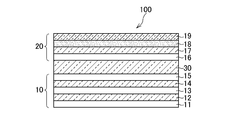
- FIG. 1 is a cross-sectional view schematically showing a configuration of an input / output device (touch panel type input / output device) according to an embodiment of the present invention.
- FIG. 2 is a schematic diagram showing a member configuration of an image display device (LCD) according to an embodiment of the present invention.
- FIGS. 3A to 3C are schematic views showing one manufacturing process of the image display device (LCD) shown in FIG.
- parts means “parts by mass” and “%” means “mass%” unless otherwise specified.
- solventless optical adhesive composition is an acrylic having a weight average molecular weight of 10,000 to 800,000.
- Polymer (P) hereinafter sometimes simply referred to as “(P) component”
- monomer mixture (m) hereinafter sometimes simply referred to as “(m) component”
- the solventless optical adhesive composition according to this embodiment satisfies all the conditions represented by the following formulas (1) to (3).
- (B), and (C) represent the mass percentage (% by mass) of the structural units (A) to (C) derived from each, and (a / m), (b / m), and (c / m) are (The mass percentage (% by mass) of each of the acrylic monomers (a) to (c) in the mass of the monomer mixture (m) is shown.)
- the above formula (1) is the ratio (mass percentage) of the structural unit (A) derived from the acrylic monomer (A) to the mass of the acrylic polymer (P) and the mass of the monomer mixture (m). It represents that the difference (absolute value) from the ratio (mass percentage) of the acrylic monomer (a) to 3 is 3 or less. That is, in the above formula (1), the proportion of the structural unit (A) derived from the acrylic monomer (A) in the mass of the acrylic polymer (P) accounts for the mass of the monomer mixture (m). It means that it approximates the ratio of the acrylic monomer (a).
- the above formula (2) is the proportion (mass percentage) of the structural unit (B) derived from the acrylic monomer (B) in the mass of the acrylic polymer (P) and the mass of the monomer mixture (m). It represents that the difference (absolute value) from the ratio (mass percentage) of the acrylic monomer (b) to 3 is 3 or less. That is, in the above formula (2), the proportion of the structural unit (B) derived from the acrylic monomer (B) in the mass of the acrylic polymer (P) accounts for the mass of the monomer mixture (m). It means that it is approximate to the ratio of the acrylic monomer (b).
- the above formula (3) is the ratio (mass percentage) of the structural unit (C) derived from the acrylic monomer (C) to the mass of the acrylic polymer (P) and the mass of the monomer mixture (m). It represents that the difference (absolute value) from the proportion (mass percentage) of the acrylic monomer (c) in 3 is 3 or less. That is, in the above formula (1), the proportion of the structural unit (C) derived from the acrylic monomer (C) in the mass of the acrylic polymer (P) accounts for the mass of the monomer mixture (m). It means that it approximates the ratio of the acrylic monomer (c).
- the solventless optical adhesive composition according to the present embodiment satisfies the conditions represented by the above formulas (1) to (3), so that the composition of the acrylic polymer (P) Since the composition of the monomer mixture (m) is close, the compatibility between the acrylic polymer (P) and the monomer mixture (m) is high, and as a result, the transparency is excellent. Thereby, an adhesive layer with high transparency can be obtained using the adhesive composition.
- compatible or “compatibilizing” means that turbidity or phase separation is not visually confirmed in a mixture obtained by mixing two different components. .
- the acrylic polymer (P) and the monomer mixture (m) are contained.
- the acrylic polymer (P) and the monomer mixture (m) shall be compatible.
- the acrylic polymer (P) and the monomer mixture (m) are not compatible.
- the “solvent-free optical adhesive composition” means an optical adhesive composition that does not substantially contain a solvent, and “substantially does not contain a solvent”.
- the solvent content is, for example, 1% by mass or less, more preferably 0.5% by mass or less, and ideally it means that no solvent is blended.
- the “solvent” is used to dissolve the monomer mixture (m), the acrylic polymer (P), and the monomer mixture (M) used for preparing the acrylic polymer (P).
- the solvent-free optical adhesive composition according to this embodiment includes an acrylic polymer (P) and a monomer produced in a system that does not substantially contain a solvent (does not contain a solvent).
- Mixture (m) can be included.
- the acrylic polymer (P) includes an acrylic monomer (A) having an alkyl group having 1 to 18 carbon atoms in the molecule (hereinafter sometimes simply referred to as “component (A)”). , An acrylic monomer (B) having a hydroxyl group in the molecule (hereinafter sometimes simply referred to as “component (B)”), and an acrylic monomer having a nitrogen atom-containing group in the molecule (C) (hereinafter sometimes simply referred to as “component (C)”) and a monomer mixture (M).
- component (A) an acrylic monomer having an alkyl group having 1 to 18 carbon atoms in the molecule
- component (B) An acrylic monomer (B) having a hydroxyl group in the molecule
- component (C) an acrylic monomer having a nitrogen atom-containing group in the molecule
- M monomer mixture
- the proportion of the structural unit (A) derived from the acrylic monomer (A) is 65% by mass or more and 85% by mass or less (preferably 70% by mass).
- the proportion of the structural unit (B) derived from the acrylic monomer (B) is 10% by mass to 30% by mass (preferably 12% by mass to 28% by mass).
- the proportion of the structural unit (C) derived from the acrylic monomer (C) is preferably 0.5% by mass or more and 10% by mass or less (preferably 0.8% by mass or more and 8% by mass or less).
- the ratio of the structural unit (A) derived from the acrylic monomer (A) is the acrylic polymer (P).
- P the acrylic polymer
- the proportion of the structural unit (B) derived from the acrylic monomer (B) is:
- the proportion of C) corresponds to the content of the acrylic monomer (C) in the monomer mixture (M) used for preparing the acrylic polymer (P).
- the content of the body (C) can be obtained according to the following methods (1) and (2).
- the monomer mixture (M) is composed of three components of acrylic monomers (A), (B) and (C)
- the monomer mixture (m) is an acrylic monomer ( An example composed of three components a), (b) and (c) is shown.
- the content of the acrylic monomer (A), the content of the acrylic monomer (B), and the acrylic in the monomer mixture (M) obtained by the following methods (1) and (2) From the content of the monomer (C), the proportion of the structural unit (A) derived from the acrylic monomer (A), the structural unit (B) derived from the acrylic monomer (B), and acrylic The proportion of the structural unit (C) derived from the system monomer (C) can be obtained.
- the content of the acrylic monomer (a) in the solventless optical adhesive composition by gas chromatographic analysis of the solventless optical adhesive composition according to the present embodiment The content of the acrylic monomer (b) and the content of the acrylic monomer (c) are measured.
- the acrylic monomer (a), the acrylic monomer (b), and the acrylic monomer (c) are constituent components of the monomer mixture (m).
- the mass of the solventless optical adhesive composition according to the present embodiment is defined as CON, and the content of the acrylic monomer (a) in the monomer mixture (m), the acrylic monomer ( Let the content rate of b) and the content rate of an acrylic monomer (c) be a, b, and c (mass%), respectively.
- the contents of (C) are ax, bx, and cx, respectively.
- the monomer mixture (m1) (hereinafter simply referred to as “(m1) component” used in the first step.
- the amount of the acrylic monomer (a1), the acrylic monomer (b1), and the acrylic monomer (c1) constituting the composition is a1, b1, and c1, Acrylic monomer (a2) and acrylic monomer (b2) constituting the monomer mixture (m2) used in the second step (hereinafter sometimes simply referred to as “(m2) component”)
- the amount of the acrylic monomer (c2) is a2, b2 and c2.
- the proportion of the structural unit (A) derived from the acrylic monomer (A), the structural unit (B) derived from the acrylic monomer (B), and the acrylic system The proportion of the structural unit (C) derived from the monomer (C) is represented by the following formulas 6 to 8, respectively.
- the content rate of the acrylic monomer (a) in the monomer mixture (m), the content rate of the acrylic monomer (b), and the content rate (% by mass) of the acrylic monomer (c) are respectively represented by the following formulas 9 to 11.
- Ratio (% by mass) of the structural unit (A) derived from the acrylic monomer (A) in the acrylic polymer (P) ( ⁇ a) / P ⁇ 100 (Formula 6)
- Ratio (% by mass) of structural unit (B) derived from acrylic monomer (B) in acrylic polymer (P) ( ⁇ b) / P ⁇ 100 (Formula 7)
- Ratio (% by mass) of structural unit (C) derived from acrylic monomer (C) in acrylic polymer (P) ( ⁇ c) / P ⁇ 100 (Formula 8)
- the acrylic monomer (C) content cx is as follows between a1, b1 and c1 in the monomer mixture (m1) and a2, b2 and c2 in the monomer mixture (m2): It has the relationship shown by Formula 12 thru
- the said calculation method is an example to the last, For example, it is also possible to calculate the ratio of the monomer component which comprises the adhesive composition of this invention by various instrumental analysis, such as GC / MS and NMR.
- Acrylic monomer (A) The acrylic monomer (A) having an alkyl group having 1 to 18 carbon atoms in the molecule can contribute to the adhesiveness and durability of the solventless adhesive composition according to this embodiment. That is, when the acrylic polymer (P) has the structural unit (A) derived from the acrylic monomer (A) having an alkyl group having 1 to 18 carbon atoms in the molecule, the adhesive composition The adhesion and durability of objects can be increased.
- acrylic monomer (A) examples include a (meth) acrylic acid alkyl ester monomer having an alkyl group having 1 to 18 carbon atoms in the ester site, such as methyl acrylate, methyl Methacrylate, ethyl acrylate, ethyl methacrylate, n-propyl acrylate, n-propyl methacrylate, n-butyl acrylate, n-butyl methacrylate, n-pentyl acrylate, n-hexyl acrylate, n-hexyl methacrylate, n-heptyl acrylate, n- Heptyl methacrylate, n-octyl acrylate, n-octyl methacrylate, n-nonyl acrylate, n-decyl acrylate, n-decyl methacrylate, n-lauryl methacrylate, n-lauryl meth
- Esters i-propyl acrylate, i-butyl acrylate, t-butyl acrylate, i-propyl methacrylate, i-butyl methacrylate, t-butyl methacrylate, i-amyl acrylate, i-amyl methacrylate, i-octyl acrylate, i-octyl
- a branched chain is formed at the ester site of methacrylate, 2-ethylhexyl acrylate, 2-ethylhexyl methacrylate, i-stearyl acrylate, i-stearyl methacrylate, etc.
- (Meth) acrylic acid alkyl ester having a kill group (meth) acrylic acid alkyl ester having an alicyclic group in an ester moiety such as cyclohexyl acrylate, cyclohexyl methacrylate, isobornyl acrylate, isobornyl methacrylate; benzyl methacrylate, benzyl acrylate And (meth) acrylic acid alkyl esters having an aromatic ring group at the ester site such as 2-naphthyl acrylate and phenoxyethyl acrylate, and one of these may be used alone or two or more of them may be used in combination.
- the acrylic monomer (A) is an alkyl ester of an alkyl (meth) acrylate in that the pressure-sensitive adhesive sheet formed using the adhesive composition according to this embodiment is excellent in durability.
- the alkyl chain constituting the site is preferably a linear or branched alkyl chain, and more preferably has a linear alkyl chain.
- Acrylic monomer (B) The acrylic monomer (B) having a hydroxyl group in the molecule can contribute to prevention of turbidity and white turbidity of the solventless adhesive composition according to this embodiment. That is, when the acrylic polymer (P) has the structural unit (B) derived from the acrylic monomer (B) having a hydroxyl group in the molecule, the transparency of the adhesive composition can be enhanced. .
- acrylic monomer (B) examples include (meth) acrylic acid alkyl ester monomers having a hydroxyl group at the ester site, such as 2-hydroxyethyl acrylate, 2-hydroxyethyl methacrylate, 2 -Hydroxypropyl acrylate, 2-hydroxypropyl methacrylate, 4-hydroxybutyl acrylate, 4-hydroxybutyl methacrylate and the like can be mentioned, and among these, one kind or a combination of two or more kinds can be used.
- acrylic acid alkyl ester monomers having a hydroxyl group at the ester site such as 2-hydroxyethyl acrylate, 2-hydroxyethyl methacrylate, 2 -Hydroxypropyl acrylate, 2-hydroxypropyl methacrylate, 4-hydroxybutyl acrylate, 4-hydroxybutyl methacrylate and the like can be mentioned, and among these, one kind or a combination of two or more kinds can be used.
- Acrylic monomer (C) The acrylic monomer (C) having a nitrogen atom-containing group in the molecule can contribute to the improvement of adhesive strength in addition to the turbidity and white turbidity preventing effect of the solventless adhesive composition according to this embodiment. it can. That is, the acrylic polymer (P) has the structural unit (C) derived from the acrylic monomer (C) having a nitrogen atom-containing group in the molecule, thereby increasing the transparency of the adhesive composition. In addition, the adhesive strength can be improved.
- Examples of the acrylic monomer (C) include a (meth) acrylic acid alkyl ester monomer having a nitrogen atom-containing group at the ester site.
- Examples of the nitrogen atom-containing group include an amino group, an amide group, an imide group, a diazo group, and a nitrile group, and at least one or two or more groups selected from these groups are preferable.
- examples of the acrylic monomer (C) include N, N-dimethylaminoethyl acrylate, N, N-dimethylaminoethyl methacrylate, N, N-diethylaminoethyl methacrylate, N, N-dimethyl.
- Aminopropylacrylamide, acrylamide, N, N-dimethylacrylamide, N, N-diethylacrylamide, acryloylmorpholine, N-methoxymethylacrylamide, N-butoxymethylacrylamide, isopropylacrylamide, Nt-butylacrylamide, diacetone acrylamide, Acrylonitrile etc. are mentioned, Among these, it can be used 1 type or in combination of 2 or more types. Among these, it is more preferable that the acrylic monomer (C) is acrylamide and / or dimethylacrylamide in that the aggregation suppression effect of the acrylic polymer (P) is more excellent.
- the monomer mixture (M) for obtaining the acrylic polymer (P) component may be a monomer other than the components (A) to (C) (hereinafter simply referred to as “component (D)”). May be further included.
- component (D) It is preferable that the content rate of a component is 0 to 10 mass%. Examples of the component (D) include vinyl acetate.
- the total amount of the component (A), the component (B), and the component (C) in M) can be 90% by mass to 100% by mass, and preferably 95% by mass to 100% by mass. .
- the acrylic polymer (P) has a weight average molecular weight (Mw) of 10,000 to 800,000, preferably 50,000 to 600, 000 or less, more preferably 150,000 or more and 500,000 or less.
- Mw weight average molecular weight
- the durability of the adhesive layer obtained using the adhesive composition may be inferior, whereas when it exceeds 800,000, In the adhesive composition, the compatibility between the acrylic polymer (P) and the monomer mixture (m) may be reduced, and turbidity may occur.
- the weight average molecular weight (Mw) and the number average molecular weight (Mn) of the acrylic polymer (P) component are values obtained by standard polystyrene conversion using GPC (gel permeation chromatography) under the following conditions. is there.
- Measuring apparatus HLC-8120GPC (manufactured by Tosoh Corp.)
- GPC column configuration The following five columns (all manufactured by Tosoh Corp.) (1) TSK-GEL HXL-H (guard column) (2) TSK-GEL G7000HXL (3) TSK-GEL GMHXL (4) TSK-GEL GMHXL (5) TSK-GEL G2500HXL Diluted with tetrahydrofuran so that the sample concentration is 1.0 mg / cm 3
- Mobile phase solvent Tetrahydrofuran flow rate: 1.0 cm 3 / Min Column temperature: 40 ° C
- the molecular weight dispersion (Mw / Mn) of the acrylic polymer (P) is preferably 4.5 or less, and usually 1 or more and 4.5 or less. Yes, it is more preferably 1 or more and 4.3 or less.
- the dispersion (Mw / Mn) of the molecular weight of the acrylic polymer (P) exceeds 4.5, the compatibility between the acrylic polymer (P) and the monomer mixture (m) is deteriorated in the adhesive composition. As a result, the adhesive composition may become turbid.
- the solventless optical adhesive composition according to the present embodiment is a syrupy transparent liquid.
- turbidity is an index of transparency, and the lower the turbidity, the higher the transparency.
- the turbidity of the solventless optical adhesive composition according to this embodiment is preferably 5.0 or less, and more preferably 2.0 or less.
- the monomer mixture (m) is an acrylic monomer (a) having an alkyl group having 1 to 18 carbon atoms in the molecule (hereinafter, And “acrylic monomer (b) having a hydroxyl group in the molecule” (hereinafter sometimes simply referred to as “component (b)”). And an acrylic monomer (c) having a nitrogen atom-containing group in the molecule (hereinafter sometimes simply referred to as “component (c)”).
- the proportion of the acrylic monomer (a) is 65% by mass or more and 85% by mass or less (more preferably 70% by mass or more and 85% by mass or less).
- the proportion of the acrylic monomer (b) is from 10 to 30% by mass (more preferably from 12% by mass to 28% by mass), and the proportion of the acrylic monomer (c) is 0.5%. It is preferable that it is 10 mass% or less (more preferably 0.8 mass% or more and 8 mass% or less).
- the ratio of the acrylic monomer (a), the acrylic monomer (b) and the acrylic monomer (c) in the monomer mixture (m) is as described in 1.1.1. It can be calculated by the method described in the column.
- Acrylic monomer (a) As the acrylic monomer (a), the above 1.1.2. In the column, those exemplified as the acrylic monomer (A) for preparing the acrylic polymer (P) can be used.
- the acrylic monomer (a) is preferably the same acrylic monomer as the acrylic monomer (A).
- Acrylic monomer (b) As acrylic monomer (b), said 1.1.3. In the column, those exemplified as the acrylic monomer (B) for preparing the acrylic polymer (P) can be used.
- the acrylic monomer (b) is preferably the same acrylic monomer as the acrylic monomer (B).
- Acrylic monomer (c) As the acrylic monomer (c), the above 1.1.4. In the column, those exemplified as the acrylic monomer (C) for preparing the acrylic polymer (P) can be used.
- the acrylic monomer (c) is preferably the same acrylic monomer as the acrylic monomer (C).
- the other monomer (d) may further contain a monomer other than the components (a) to (c) (hereinafter sometimes simply referred to as “component (d)”). . It is preferable that the content rate of (d) component is 0 mass% or more and 10 mass% or less. Examples of the component (d) include vinyl acetate.
- the total amount of the component (a), the component (b), and the component (c) can be 90% by mass or more and 100% by mass or less, and preferably 95% by mass or more and 100% by mass or less. .
- Blending ratio of acrylic polymer (P) and monomer mixture (m) Blending of acrylic polymer (P) and monomer mixture (m) in the solventless optical adhesive composition according to this embodiment.
- the ratio (content ratio) is preferably 50 parts by weight or more and 900 parts by weight or less, and 100 parts by weight or more and 500 parts by weight with respect to 100 parts by weight of the acrylic polymer (P). The following is more preferable.
- a blending ratio within the above range is preferable because the adhesive composition has an appropriate viscosity and is easy to handle.
- the solventless optical adhesive composition according to the present embodiment can further include components other than the acrylic polymer (P) and the monomer mixture (m) as necessary.
- the adhesive composition according to this embodiment includes a silane coupling agent, an ionic compound, an antioxidant, an ultraviolet absorber, a tackifier, a plasticizer, and the like as long as the effects of the present invention are not impaired. May be.
- the optical adhesive composition according to the present embodiment can be used for bonding optical members, and in particular, can be suitably used for bonding optical members that require transparency.
- a member to be bonded using the optical adhesive composition according to the present embodiment is an optical member (for example, a polarizing film, a retardation film, an elliptically polarizing film, an antireflection film, a brightness enhancement film, a light diffusion film).
- optical adhesive composition according to the present embodiment can be used for bonding members constituting a touch panel type input / output device or an image display device, for example.
- the example which used the adhesive composition for optics which concerns on this embodiment for the bonding of the member which comprises a touchscreen type input / output apparatus is demonstrated with reference to FIG.
- FIG. 1 is a cross-sectional view schematically showing a configuration of an input / output device (touch panel type input / output device 100) according to an embodiment of the present invention.
- the touch panel type input / output device 100 includes a liquid crystal display device (LCD) 10, a touch panel unit 20, and an adhesive layer 30 provided between the LCD 10 and the touch panel unit 20.
- the adhesive layer 30 bonds the LCD 10 and the touch panel unit 20 together.
- the adhesive layer 30 is applied to the surface of the separator (not shown) with the first optical adhesive composition according to the present embodiment.
- the coating liquid layer with light (for example, ultraviolet rays) in a state where oxygen is blocked
- the obtained pressure-sensitive adhesive sheet is peeled off from the separator and installed between the LCD 10 and the touch panel 20.
- the oxygen is blocked by irradiating light with the composition layer sandwiched between the separator having the composition layer formed on the surface and the adherend, or by applying nitrogen to the entire coating machine. This can be achieved by performing light irradiation in a purged state.
- the adhesive layer 30 is formed by applying a coating liquid containing a solventless optical adhesive composition according to the present embodiment and a photopolymerization initiator to the surface of a separator (not shown).
- a layer is formed, and if necessary, the pressure-sensitive adhesive sheet is formed by irradiating the coating liquid layer with light (for example, ultraviolet rays) in a state where oxygen is blocked, and the pressure-sensitive adhesive sheet is peeled off from the separator. It may be installed between the touch panel 20.
- the LCD 10 is configured by laminating a polarizing plate 11, an adhesive layer 12, a liquid crystal panel 13, an adhesive layer 14, and a polarizing plate 15 in this order.
- the pressure-sensitive adhesive layer 12 bonds the polarizing plate 11 and the liquid crystal panel 13, and the pressure-sensitive adhesive layer 14 bonds the liquid crystal panel 13 and the polarizing plate 15.
- the touch panel unit 20 is configured by a scattering prevention film 16, an adhesive layer 17, an ITO layer 18, and a glass panel 19 laminated in this order.
- the pressure-sensitive adhesive layer 17 bonds the scattering prevention film 16 and the ITO layer 18.
- the pressure-sensitive adhesive layers 12, 14, and 17 are manufactured using the solventless optical adhesive composition according to this embodiment, like the pressure-sensitive adhesive layer 30.
- FIG. 2 is a schematic diagram showing a member configuration of an image display device (LCD) 110 according to another embodiment of the present invention.
- the image display device (LCD) 110 shown in FIG. 2 can be manufactured, for example, by the steps shown in FIGS. 3 (a) to 3 (c).
- a liquid containing a solventless optical adhesive composition and a photopolymerization initiator according to this embodiment is applied to an adherend (LCD 110) and a cover lens / ITO layer.
- An adhesive layer (not shown) is formed between the LCD 110 and the cover lens / ITO layer 32 by irradiating the layer with light (for example, ultraviolet rays). May be.
- a dam layer 34 is formed on one surface of the adherend (LCD 110) shown in FIG. 3A so as to surround the side surface of the LCD 110 as shown in FIG. Form.
- the filling liquid 36 containing the solventless optical adhesive composition and the photopolymerization initiator according to this embodiment on the LCD 110 and inside the dam layer 34. Is dropped or patterned by a method such as patterning into a predetermined shape.
- the filling liquid 36 is irradiated with light (for example, ultraviolet rays) in a state where oxygen is blocked, as shown in FIG.
- An adhesive layer that bonds the cover glass / ITO layer 32 to the cover glass / ITO layer 32 is formed in a space surrounded by the dam layer 34, the LCD 110, and the cover glass / ITO layer 32.
- the photopolymerization initiator blended in the coating liquid described in the column is a reaction start at the time of forming a pressure-sensitive adhesive sheet using the pressure-sensitive adhesive composition It has a function as an agent.
- the photopolymerization initiator in the coating liquid (or filling liquid) according to this embodiment is preferably 0.1 parts by mass or more and 5 parts by mass or less with respect to 100 parts by mass of the pressure-sensitive adhesive composition. More preferably, they are 5 to 3 mass parts.
- the photopolymerization initiator is preferably, for example, an ultraviolet polymerization initiator that initiates polymerization by ultraviolet rays.
- photopolymerization initiator examples include 2,2-dimethoxy-1,2-diphenylethane-1-one, 1-hydroxy-cyclohexyl-phenyl ketone, 2-hydroxy-1-1-1 ⁇ 4- [4- (2 -Hydroxy-2-methyl-propionyl) -benzyl] phenyl ⁇ -2-methyl-propan-1-one, 2-hydroxy-2-methyl-1-phenyl-propan-1-one, 1- [4- (2 -Hydroxyethoxy) -phenyl] -2-hydroxy-2-methyl-1-propan-1-one, 2-methyl-1 [4- (methylthio) phenyl] -2-morpholinopropan-1-one, 2 -Benzyl-2-dimethylamino-1- (4-morpholinophenyl) -butanone-1,6-trimethylbenzoyldiphenylphosphine oxide, benzoin methyl ether , Benzoin ethyl ether, benzoin propy
- the optical adhesive composition according to the present embodiment includes the acrylic polymer (P) and the monomer mixture (m), and satisfies any of the conditions represented by the above formulas (1) to (3). Since the composition of the acrylic polymer (P) and the composition of the monomer mixture (m) are close to each other, the compatibility between the acrylic polymer (P) and the monomer mixture (m) is excellent. As a result, it has excellent transparency. Therefore, since the adhesive layer formed using the optical adhesive composition according to the present embodiment is excellent in transparency and cutability, for example, a touch panel type input / output device or image display containing a metal such as ITO It can be suitably used for bonding members constituting the apparatus.
- a method for producing a solventless optical adhesive composition according to an embodiment of the present invention is a method for producing a solventless optical adhesive composition according to the first embodiment, and includes the following first step. And a second step.
- the method for producing a solventless optical adhesive composition according to the present embodiment includes a solventless optical system comprising an acrylic polymer (P) and a monomer mixture (m) in a reaction system that does not substantially contain a solvent. It has the characteristics in the point which manufactures the adhesive composition for an electric field.
- Acrylic monomer (a1) (hereinafter simply referred to as “component (a1)”) having an alkyl group having 1 to 18 carbon atoms in the molecule in a system substantially free of solvent. ),
- An acrylic monomer (b1) having a hydroxyl group in the molecule (hereinafter sometimes simply referred to as “(b1) component”), and a nitrogen atom-containing group in the molecule.
- Second step an acrylic monomer (a2) having an alkyl group having 1 to 18 carbon atoms in the molecule (hereinafter sometimes simply referred to as “component (a2)”), and a hydroxyl group in the molecule
- An acrylic monomer (b2) (hereinafter sometimes simply referred to as “component (b2)”), and an acrylic monomer (c2) having a nitrogen atom-containing group in the molecule (hereinafter, A step of adding a monomer mixture (m2) containing “(c2) component” to the mixture (m ′).
- the acrylic monomer (a1) of the present invention is less reactive than the acrylic monomers (b1) and (c1), the polymer chain constituting the acrylic polymer (P) There is a tendency that it is hard to be taken in. Therefore, from the viewpoint of approximating the composition of the acrylic polymer (P) in the finally obtained adhesive composition and the composition of the monomer composition (m), the acrylic in the monomer mixture (m1)
- the proportion of the system monomer (a1) is preferably larger than the ratio of the acrylic monomer (a2) in the monomer mixture (m2).
- the acrylic monomer (b1) of the present invention is more reactive than the acrylic monomer (a1), the acrylic monomer (b1) in the polymer chain constituting the acrylic polymer (P). , Tend to be captured at a relatively high rate. Therefore, from the viewpoint of approximating the composition of the acrylic polymer (P) in the finally obtained adhesive composition and the composition of the monomer composition (m), the acrylic in the monomer mixture (m2)
- the proportion of the monomer (b2) is preferably larger than the proportion of the acrylic monomer (b1) in the monomer mixture (m1).
- the acrylic monomer (c1) of this invention since the acrylic monomer (c1) of this invention has high reactivity compared with an acrylic monomer (a1), it is in the polymer chain which comprises an acrylic polymer (P). , Tend to be captured at a relatively high rate. Therefore, from the viewpoint of approximating the composition of the acrylic polymer (P) in the finally obtained adhesive composition and the composition of the monomer composition (m), the acrylic in the monomer mixture (m2)
- the proportion of the monomer (c2) is preferably larger than the proportion of the acrylic monomer (c1) in the monomer mixture (m1).
- the ratio of the acrylic monomer (a1) in the monomer mixture (m1) is the viewpoint that the transparency of the finally obtained adhesive composition can be increased. 65 mass% or more and 85 mass% or less (more preferably 70 mass% or more and 85 mass% or less), and the ratio of the acrylic monomer (b1) is 10 mass% or more and 30 mass% or less (more preferably 12 mass%).
- the ratio of the acrylic monomer (c1) is preferably 0.5% by mass or more and 10% by mass or less (more preferably 0.8% by mass or more and 8% by mass or less). .
- the polymerization initiator (I) can be used.
- the amount of the polymerization initiator (I) used is 0.001 with respect to 100 parts by mass of the monomer mixture (m1). It is preferable to set it as a mass part or more and 0.1 mass part or less (more preferably 0.0015 mass part or more and 0.5 mass part or less).
- the reaction system is set within 30 minutes (preferably within 15 minutes) after the polymerization of the monomer mixture (m1). The progress of polymerization may be suppressed by cooling.
- the amount of the monomer mixture (m2) is 10 parts by mass with respect to 100 parts by mass of the amount of the monomer mixture (m1).
- the amount is preferably 100 parts by mass or less, and more preferably 15 parts by mass or more and 80 parts by mass or less.
- Examples of the polymerization initiator (I) used in the first step include isobutyryl peroxide, ⁇ , ⁇ ′-bis (neodecanoylperoxy) diisopropylbenzene, cumylperoxyneodecanoate, di- n-propyl peroxydicarbonate, diisopropyl peroxydicarbonate, di-sec-butyl peroxydicarbonate, 1,1,3,3-tetramethylbutylperoxyneodecanoate, bis (4-butylcyclohexyl) per Mention may be made of oxydicarbonate and 2,2′-azobis (4-methoxy-2,4-dimethylvaleronitrile).
- polymerization initiators can be used alone or in combination.
- isobutyryl peroxide, ⁇ , ⁇ ′-bis (neodecanoylperoxy) diisopropylbenzene, cumylperoxyneodecanoate, 2,2′-azobis (4-methoxy-2,4-dimethylvalero) Nitrile) is preferably used, and 2,2′-azobis (4-methoxy-2,4-dimethylvaleronitrile) is particularly preferably used.
- a partial copolymer (acrylic polymer (P ′)) in which 10% by mass to 67% by mass of the monomer mixture (m1) as a raw material has been polymerized. Can be obtained.
- the solvent-free optical adhesive having excellent transparency comprising the acrylic polymer (P) and the monomer mixture (m). An agent composition can be obtained.
- the temperature of the monomer mixture (m1) when adding the polymerization initiator (I) is usually in the range of 20 ° C. to 80 ° C., preferably 35 ° C. to 70 ° C., particularly preferably 40 ° C. to 65 ° C. Is in.
- the polymerization initiator (I) is usually added with stirring to the monomer mixture (m1) thus heated or heated.
- the above example is an example in which the monomer mixture (m1) is heated and the polymerization initiator (I) is added.
- the mixing and heating of the monomer mixture (m1) and the polymerization initiator (I) can be done in any order. For example, after the monomer mixture (m1) and the polymerization initiator (I) are mixed, the mixture can be heated to a temperature at which the reaction starts, or the monomer mixture (m1) can be heated as described above. After heating to a temperature at which the reaction starts, the polymerization initiator (I) can be added and mixed.
- a chain transfer agent such as normal dodecyl mercaptan, butyl mercaptan, 3-mercaptopropionic acid, thioglycolic acid or thioglycolic acid ester is used in combination. You may do it.
- a chain transfer agent is usually 0.001 to 10 parts by weight, preferably 0.01 to 0.5 parts by weight, based on 100 parts by weight of the monomer mixture used. Used in amounts within the range.
- Second Step a monomer mixture (m2) is added to the mixture (m ′) obtained in the first step, and the mixture (m ′) and the monomer mixture (m2) are added. And mix.
- the proportion of the acrylic monomer (a2) in the monomer mixture (m2) is 45% by mass from the viewpoint of enhancing the transparency of the finally obtained adhesive composition. It is 75 mass% or less, the ratio of acrylic monomer (b2) is 20 mass% or more and 50 mass% or less, and the ratio of acrylic monomer (c2) is 0.5 mass% or more and 15 mass%. The following is preferable.
- block polymerization in the said 1st process for manufacture of an acryl-type polymer (P). That is, in the first step, polymerization is carried out substantially without using a solvent.
- the polymerization reaction in the first step is preferably performed with stirring, and the reaction is preferably performed in an inert atmosphere such as nitrogen gas. Furthermore, since oxygen dissolved in the raw material used may hinder the progress of the reaction, it is preferable to use it after removing dissolved oxygen in the raw material used.
- the method for producing the solventless optical adhesive composition according to the present embodiment is a method for producing the solventless optical adhesive composition according to the first embodiment, and includes the first step and the first step. By including two steps, it has an acrylic polymer (P) and a monomer mixture (m) with excellent compatibility because the composition is close, and it is possible to obtain an adhesive layer with excellent transparency In addition, a solventless optical adhesive composition can be produced.
- the acrylic polymer (P) containing a hydroxyl group and a nitrogen-containing group is included as in the solventless optical adhesive composition according to the first embodiment, a comparative example 9 of an example described later is shown.
- the polymer is polymerized in the solvent and then the solvent is removed and mixed with the monomer mixture (m)
- the molecular weight distribution of the polymer is increased and the hydroxyl groups and nitrogen-containing groups are aggregated. Since it is easy, an acrylic polymer (P) and a monomer mixture (m) are hard to mix, and a uniform syrup may not be obtained.
- uniform syrup is obtained by performing the first step and the second step in a system that does not substantially contain a solvent. A solventless optical adhesive composition can be obtained.
- Adhesive sheet (third embodiment)
- the pressure-sensitive adhesive sheet (optical pressure-sensitive adhesive sheet) according to the present embodiment can be produced using, for example, the solventless optical adhesive composition according to the first embodiment.
- the thickness of the pressure-sensitive adhesive sheet is usually in the range of 10 ⁇ m to 500 ⁇ m, preferably 20 ⁇ m to 300 ⁇ m.
- the solventless optical adhesive composition according to the first embodiment is applied onto a substrate with a gravure coater, Mayer bar coater, air knife coater, roll coater, etc., and light irradiation is performed.
- a gravure coater Mayer bar coater
- air knife coater air knife coater
- roll coater etc.
- light irradiation light irradiation
- the pressure-sensitive adhesive sheet according to the present embodiment is excellent in transparency and cutability by being formed using the solventless optical adhesive composition according to the first embodiment. Therefore, the pressure-sensitive adhesive sheet according to the present embodiment can be suitably used for bonding optical members, and more specifically, preferably used for bonding members constituting a touch panel type input / output device or an image display device. be able to.
- Image display device and input / output device (fourth embodiment)
- An image display device according to another embodiment of the present invention includes the optical pressure-sensitive adhesive sheet according to the third embodiment.
- Examples of the image display device according to the present embodiment include a liquid crystal display device (LCD).
- an input / output device includes the optical pressure-sensitive adhesive sheet according to the above-described embodiment.
- examples of the input / output device include a capacitive touch panel type input / output device.
- Examples 1 to 6 and Comparative Examples 1 to 8 (Preparation of Solvent-Free Optical Adhesive Composition) Solventless optical adhesive compositions of Examples 1 to 6 and Comparative Examples 1 to 8 were prepared with the formulations shown in Table 1 below. More specifically, a nitrogen purge is performed by adding a small amount of normal dodecyl mercaptan to the monomer mixture (m1) heated to 60 ° C. in a reactor equipped with a stirrer, reflux condenser, thermometer and nitrogen introduction tube. Then, by adding a small amount of 2,2′-azobis (4-methoxy-2,4-dimethyl) valeronitrile, heat is generated from 120 ° C. to 140 ° C. to obtain a partial copolymer (P). When the exotherm reached a peak, the monomer mixture (m2) was added to prepare solventless optical adhesive compositions of Examples 1 to 6 and Comparative Examples 1 to 8.
- Comparative Example 9 The solventless optical adhesive composition of Comparative Example 9 was prepared by dissolving 100 g of the monomer mixture (m1) shown in Table 1 below in 120 g of a solvent (ethyl acetate) and adding 0.1 g of initiator AIBN. After polymerization at 60 ° C. for 10 hours, the solvent was distilled off, and 300 g of a monomer mixture (m2) shown in Table 1 below was added.
- the blending amounts of the (a2) component, (b2) component, and (c2) component contained in the (m2) component are blending amounts when the blending amount of the (m1) component is 100% by mass. It is. Further, in Table 1, the ratios of the components (a1), (b1), and (c1) in the component (m1), the ratios of the components (a2), (b2), and (c2) in the component (m2), (P (A) component, (B) component, (C) component ratio, (m) component (a), (b), (c) component ratio, and (P) component content ratio Are all expressed in mass%.
- Production Example 1 Manufacture of adhesive sheet
- separator After applying the solvent-free optical adhesive compositions of Examples 1 to 6 and Comparative Examples 1 to 9 to the surface of the release-treated polyester film (hereinafter referred to as separator), oxygen in the air was blocked with another separator.
- the separator sand of each adhesive was obtained by irradiating with black light for 180 seconds. Also, one of the separators was peeled off and bonded to a 100 ⁇ m thick PET base material to obtain various adhesive sheets.
- the weight average molecular weight (Mw) and dispersion (Mw / Mn) of the acrylic polymer (P) contained in the solventless optical adhesive compositions of Examples 1 to 6 and Comparative Examples 1 to 9 were determined by the following method. Measured with
- the content ratio of the component (P) is a value calculated as the content ratio (mass%) of the component (P) + the content ratio (mass%) of the component (m) ⁇ 100 mass%.
- the proportions of the structural units (A), (B), and (C) derived from the acrylic monomers (A), (B), and (C) in the acrylic polymer (P), and the single amount was also measured according to the method described in the above embodiment.
- each adhesive composition was dissolved in about 10 g of dichloromethane, and 1 drop of isopentyl benzoate was added as an internal standard to prepare a measurement sample.
- or (c) in each adhesive composition was measured.
- the content of the acrylic monomers (a) to (c) in each adhesive composition and the monomers used for preparing the acrylic polymer (P) in each adhesive composition From the usage amount of the acrylic monomers (A), (B), and (C) in the mixture (M), according to the method described in the above embodiment, the acrylic monomer in the acrylic polymer (P) The ratios of the structural units (A), (B) and (C) derived from the bodies (A), (B) and (C) were calculated.
- Turbidity after storage The turbidity after storing the solventless optical adhesive compositions of Examples 1 to 6 and Comparative Examples 1 to 9 at 60 ° C. for 15 days was measured with COH400 manufactured by Nippon Denshoku Co., Ltd. . Turbidity after storage is an index indicating the presence or absence of an increasing tendency of turbidity. The turbidity after storage is preferably 5 or less.
- the acrylic monomer (A) having an alkyl group having 1 to 18 carbon atoms in the molecule and a hydroxyl group in the molecule Is a copolymer of a monomer mixture (M) containing an acrylic monomer (B) having an acrylic monomer (C) having a nitrogen atom-containing group in the molecule, and a weight average molecular weight of 10 1,000 to 800,000 acrylic polymer (P), an acrylic monomer (a) having an alkyl group having 1 to 18 carbon atoms in the molecule, and an acrylic monomer having a hydroxyl group in the molecule And (b) and a monomer mixture (m) containing an acrylic monomer (c) having a nitrogen atom-containing group in the molecule, and represented by the above formulas (1) to (3)
- M monomer mixture
- Adhesive layer formed using the adhesive composition is excellent in transparency.
- the adhesive compositions of Examples 1 to 6 were applied to the surface of the separator, irradiated with light to form an adhesive layer having a film thickness of 150 ⁇ m, and this adhesive layer was cut using a punching machine. However, it was confirmed that it was excellent in cutability because it could be cut without causing stringing.
- the adhesive composition of Comparative Example 6 is a monomer that does not contain an acrylic polymer (P) having no nitrogen-containing group and an acrylic monomer (c) having a nitrogen-containing group in the molecule. It is presumed that the adhesive layer formed using the adhesive composition is inferior in transparency under high-temperature and high-humidity conditions, since the mixture (m) is likely to cause water aggregation in the system. Is done.
- the adhesive composition of Comparative Example 7 is a monomer mixture (m) containing no acrylic polymer (P) having no hydroxyl group and no acrylic monomer (b) having a hydroxyl group in the molecule. Since the water content is likely to agglomerate in the system, the adhesive layer formed using the adhesive composition is estimated to be inferior in transparency.
- the adhesive composition of Comparative Example 8 includes an acrylic polymer (P) having a weight average molecular weight exceeding 800,000, so that the phase of the acrylic polymer (P) and the monomer mixture (m) is increased. Since the solubility is low, the adhesive layer formed using the adhesive composition is presumed to be inferior in transparency.
- the adhesive composition of Comparative Example 9 was prepared by polymerizing the monomer mixture (m1) in a solvent to obtain an acrylic polymer, and then distilling off the solvent.
- the body mixture (m2) was mixed, but even if it was stirred on a shaker for 24 hours, the acrylic polymer and the monomer mixture (m) were only partially dissolved, and a uniform syrup was obtained. Cann't get.
Landscapes
- Chemical & Material Sciences (AREA)
- Organic Chemistry (AREA)
- Health & Medical Sciences (AREA)
- Chemical Kinetics & Catalysis (AREA)
- Medicinal Chemistry (AREA)
- Polymers & Plastics (AREA)
- Adhesives Or Adhesive Processes (AREA)
- Adhesive Tapes (AREA)
- Physics & Mathematics (AREA)
- General Physics & Mathematics (AREA)
- Optics & Photonics (AREA)
Abstract
Description
式(1):|(A/P)-(a/m)|≦3
式(2):|(B/P)-(b/m)|≦3
式(3):|(C/P)-(c/m)|≦3
(上記式(1)ないし(3)において、(A/P)、(B/P)および(C/P)はそれぞれ、前記アクリル系ポリマー(P)の質量に占める前記アクリル系単量体(A)、(B)、および(C)それぞれに由来する構成単位(A)ないし(C)の質量百分率(質量%)を示し、(a/m)、(b/m)および(c/m)はそれぞれ、前記単量体混合物(m)の質量に占める前記アクリル系単量体(a)ないし(c)それぞれの質量百分率(質量%)を示す。)
本発明の一実施形態に係る無溶剤型光学用接着剤組成物(以下、単に「接着剤組成物」と記載する場合もある。)は、重量平均分子量10,000以上800,000以下のアクリル系ポリマー(P)(以下、単に「(P)成分」と記載する場合もある。)と、単量体混合物(m)(以下、単に「(m)成分」と記載する場合もある。)と、を含む。
式(1):|(A/P)-(a/m)|≦3
式(2):|(B/P)-(b/m)|≦3
式(3):|(C/P)-(c/m)|≦3
(上記式(1)ないし(3)において、(A/P)、(B/P)および(C/P)はそれぞれ、アクリル系ポリマー(P)の質量に占めるアクリル系単量体(A)、(B)、および(C)それぞれに由来する構成単位(A)ないし(C)の質量百分率(質量%)を示し、(a/m)、(b/m)および(c/m)はそれぞれ、単量体混合物(m)の質量に占めるアクリル系単量体(a)ないし(c)それぞれの質量百分率(質量%)を示す。)
アクリル系ポリマー(P)は、分子内に炭素原子数1以上18以下のアルキル基を有するアクリル系単量体(A)(以下、単に「(A)成分」と記載する場合もある。)と、分子内に水酸基を有するアクリル系単量体(B)(以下、単に「(B)成分」と記載する場合もある。)と、分子内に窒素原子含有基を有するアクリル系単量体(C)(以下、単に「(C)成分」と記載する場合もある。)と、を含む単量体混合物(M)の共重合体である。
ここで、アクリル系単量体(A)に由来する構成単位(A)の割合は、アクリル系ポリマー(P)を調製するために使用した単量体混合物(M)におけるアクリル系単量体(A)の含有率に相当し、アクリル系単量体(B)に由来する構成単位(B)の割合は、アクリル系ポリマー(P)を調製するために使用した単量体混合物(M)におけるアクリル系単量体(B)の含有率に相当し、アクリル系単量体(C)に由来する構成単位(C)の割合は、アクリル系ポリマー(P)を調製するために使用した単量体混合物(M)におけるアクリル系単量体(C)の含有率に相当する。
無溶剤型光学用接着剤組成物中の(アクリル単量体(A)+アクリル系単量体(a))の含有率α(質量%)=(a1+a2)/CON (式2)
無溶剤型光学用接着剤組成物中の(アクリル単量体(B)+アクリル系単量体(b))の含有率β(質量%)=(b1+b2)/CON (式3)
無溶剤型光学用接着剤組成物中の(アクリル単量体(C)+アクリル系単量体(c))の含有率γ(質量%)=(c1+c2)/CON (式4)
アクリル系ポリマー(P)中のアクリル系単量体(B)由来の構成単位(B)の割合(質量%)=(β-b)/P×100 (式7)
アクリル系ポリマー(P)中のアクリル系単量体(C)由来の構成単位(C)の割合(質量%)=(γ-c)/P×100 (式8)
単量体混合物(m)中のアクリル系単量体(b)の含有率(質量%)=b/(a+b+c) (式10)
単量体混合物(m)中のアクリル系単量体(c)の含有率(質量%)=c/(a+b+c) (式11)
アクリル系ポリマー(P)を調製する際のアクリル系単量体(B)の使用量bx=アクリル系単量体(b1)の配合量b1+アクリル系単量体(b2)の使用量b2-単量体混合物(m)におけるアクリル系単量体(b)の含有量 (式13)
アクリル系ポリマー(P)を調製する際のアクリル系単量体(C)の使用量cx=アクリル系単量体(c1)の含有量c1+アクリル系単量体(c2)の含有量c2-単量体混合物(m)におけるアクリル系単量体(c)の含有量 (式14)
分子内に炭素原子数1以上18以下のアルキル基を有するアクリル系単量体(A)は、本実施形態に係る無溶剤型接着剤組成物の接着性および耐久性に寄与することができる。すなわち、アクリル系ポリマー(P)が、分子内に炭素原子数1以上18以下のアルキル基を有するアクリル系単量体(A)に由来する構成単位(A)を有することにより、該接着剤組成物の接着性および耐久性を高めることができる。
分子内に水酸基を有するアクリル系単量体(B)は、本実施形態に係る無溶剤型接着剤組成物の濁りや白濁の防止に寄与することができる。すなわち、アクリル系ポリマー(P)が、分子内に水酸基を有するアクリル系単量体(B)に由来する構成単位(B)を有することにより、該接着剤組成物の透明性を高めることができる。
分子内に窒素原子含有基を有するアクリル系単量体(C)は、本実施形態に係る無溶剤型接着剤組成物の濁りや白濁防止効果に加えて、粘着力の向上に寄与することができる。すなわち、アクリル系ポリマー(P)が、分子内に窒素原子含有基を有するアクリル系単量体(C)に由来する構成単位(C)を有することにより、該接着剤組成物の透明性を高めるとともに、粘着力の優れたものとすることができる。
また、アクリル系ポリマー(P)成分を得るための単量体混合物(M)は、(A)~(C)成分以外の単量体(以下、単に「(D)成分」と記載する場合もある。)をさらに含んでいてもよい。(D)成分の含有率は0質量%以上10質量%以下であることが好ましい。(D)成分としては、例えば、酢酸ビニルが挙げられる。
本実施形態に係る接着剤組成物では、良好な接着性および耐久性をより確実に達成できる観点から、単量体混合物(M)中における(A)成分、(B)成分、および(C)成分の合計量が90質量%以上100質量%以下であることができ、95質量%以上100質量%以下であることが好ましい。
本実施形態に係る無溶剤型光学用接着剤組成物において、アクリル系ポリマー(P)の重量平均分子量(Mw)は10,000以上800,000以下であり、好ましくは50,000以上600,000以下であり、より好ましくは150,000以上500,000以下である。アクリル系ポリマー(P)の重量平均分子量が10,000未満である場合、該接着剤組成物を用いて得られる接着剤層の耐久性が劣ることがあり、一方、800,000を超えると、該接着剤組成物においてアクリル系ポリマー(P)と単量体混合物(m)との相溶性が低下し、濁りが生じることがある。
本実施形態に係る無溶剤型光学用接着剤組成物において、アクリル系ポリマー(P)の分子量の分散(Mw/Mn)が4.5以下であることが好ましく、通常1以上4.5以下であり、1以上4.3以下であることがより好ましい。アクリル系ポリマー(P)の分子量の分散(Mw/Mn)が4.5を超える場合、該接着剤組成物においてアクリル系ポリマー(P)と単量体混合物(m)との相溶性が悪くなる結果、該接着剤組成物に濁りが生じることがある。
本実施形態に係る無溶剤型光学用接着剤組成物は、シロップ状の透明な液体である。本実施形態に係る無溶剤型光学用接着剤組成物において、濁度は透明性の指標であり、濁度が低いほど透明性が高いことを意味する。本実施形態に係る無溶剤型光学用接着剤組成物の濁度は5.0以下であることが好ましく、濁度が2.0以下であることがより好ましい。
本実施形態に係る無溶剤型光学用接着剤組成物において、単量体混合物(m)は、分子内に炭素数1以上18以下のアルキル基を有するアクリル系単量体(a)(以下、単に「(a)成分」と記載する場合もある。)と、分子内に水酸基を有するアクリル系単量体(b)(以下、単に「(b)成分」と記載する場合もある。)と、分子内に窒素原子含有基を有するアクリル系単量体(c)(以下、単に「(c)成分」と記載する場合もある。)と、を含む。
アクリル系単量体(a)としては、上記1.1.2.欄においてアクリル系ポリマー(P)を調製するためのアクリル系単量体(A)として例示されたものを用いることができる。アクリル系単量体(a)は、アクリル系単量体(A)と同じアクリル系単量体であることが好ましい。
アクリル系単量体(b)としては、上記1.1.3.欄においてアクリル系ポリマー(P)を調製するためのアクリル系単量体(B)として例示されたものを用いることができる。アクリル系単量体(b)は、アクリル系単量体(B)と同じアクリル系単量体であることが好ましい。
アクリル系単量体(c)としては、上記1.1.4.欄においてアクリル系ポリマー(P)を調製するためのアクリル系単量体(C)として例示されたものを用いることができる。アクリル系単量体(c)は、アクリル系単量体(C)と同じアクリル系単量体であることが好ましい。
また、その他の単量体(d)として、(a)~(c)成分以外の単量体(以下、単に「(d)成分」と記載する場合もある。)をさらに含んでいてもよい。(d)成分の含有率は0質量%以上10質量%以下であることが好ましい。(d)成分としては、例えば、酢酸ビニルが挙げられる。
本実施形態に係る接着剤組成物では、良好な接着性および耐久性をより確実に達成できる観点から、単量体混合物(m)中における(a)成分、(b)成分、および(c)成分の合計量が90質量%以上100質量%以下であることができ、95質量%以上100質量%以下であることが好ましい。
本実施形態に係る無溶剤型光学用接着剤組成物における、アクリル系ポリマー(P)と単量体混合物(m)の配合比(含有比率)は、アクリル系ポリマー(P)の100質量部に対して、単量体混合物(m)が50質量部以上900質量部以下であることが好ましく、100質量部以上500質量部以下であることがより好ましい。配合比上記の範囲内であれば、接着剤組成物は適度な粘性を有するものとなり、ハンドリングが容易となるため好ましい。
本実施形態に係る無溶剤型光学用接着剤組成物は、必要に応じて、アクリル系ポリマー(P)および単量体混合物(m)以外の成分をさらに含むことができる。例えば、本実施形態に係る接着剤組成物には、本発明の効果を損なわない範囲で、シランカップリング剤、イオン性化合物、酸化防止剤、紫外線吸収剤、粘着付与剤、可塑剤等が配合されていても良い。
本実施形態に係る光学用接着剤組成物は光学部材の貼り合わせに用いることができ、なかでも、透明性が要求される光学部材の貼り合わせに好適に使用することができる。本実施形態に係る光学用接着剤組成物を用いた貼り合わせの対象となる部材は、光学部材(例えば、偏光フィルム、位相差フィルム、楕円偏光フィルム、反射防止フィルム、輝度向上フィルム、光拡散フィルムおよびハードコートフィルムからなる群から選択される光学フィルム)、ITO層等の金属層、または、ガラスまたはプラスチックからなる基材であってもよい。
本実施形態に係る光学用接着剤組成物は例えば、タッチパネル式入出力装置または画像表示装置を構成する部材の貼り合わせに用いられることができる。本実施形態に係る光学用接着剤組成物を、タッチパネル式出入力装置を構成する部材の貼り合わせに使用した例を、図1を参照して説明する。
本実施形態に係る光学用接着剤組成物を、画像表示装置を構成する部材の貼り合わせに使用した例を、図2および図3を参照して説明する。図2は、本発明の他の一実施形態に係る画像表示装置(LCD)110の部材構成を示す模式図である。図2に示す画像表示装置(LCD)110は例えば、図3(a)~(c)に示される工程により製造することができる。
本実施形態に係る光学用接着剤組成物は、アクリル系ポリマー(P)および単量体混合物(m)を含み、かつ、上記式(1)ないし(3)で表される条件をいずれも満たすことにより、アクリル系ポリマー(P)の組成と単量体混合物(m)の組成が近似しているため、アクリル系ポリマー(P)と単量体混合物(m)との相溶性に優れており、その結果、透明性に優れている。したがって、本実施形態に係る光学用接着剤組成物を用いて形成された接着剤層は透明性およびカット性に優れているため、例えば、ITO等の金属を含むタッチパネル式入出力装置または画像表示装置を構成する部材の貼り合わせに好適に使用することができる。
本発明の一実施形態に係る無溶剤型光学用接着剤組成物の製造方法は、上記第1実施形態に係る無溶剤型光学用接着剤組成物の製造方法であって、下記の第1工程および第2工程を含む。本実施形態に係る無溶剤型光学用接着剤組成物の製造方法は、溶剤を実質的に含有しない反応系において、アクリル系ポリマー(P)および単量体混合物(m)を含む無溶剤型光学用接着剤組成物を製造する点に特徴を有する。
上記第1工程では、最終的に得られる接着剤組成物の透明性を高めることができる観点で、単量体混合物(m1)中において、アクリル系単量体(a1)の割合が65質量%以上85質量%以下(より好ましくは70質量%以上85質量%以下)であり、アクリル系単量体(b1)の割合が10質量%以上30質量%以下(より好ましくは12質量%以上28質量%以下)であり、アクリル系単量体(c1)の割合が0.5質量%以上10質量%以下(より好ましくは0.8質量%以上8質量%以下)であることが好ましい。
上記第2工程では、上記第1工程で得られた前記混合物(m’)に単量体混合物(m2)を添加して、前記混合物(m’)と単量体混合物(m2)とを混合する。上記第2工程では、最終的に得られる接着剤組成物の透明性を高めることができる観点で、単量体混合物(m2)中において、アクリル系単量体(a2)の割合が45質量%以上75質量%以下であり、アクリル系単量体(b2)の割合が20質量%以上50質量%以下であり、アクリル系単量体(c2)の割合が0.5質量%以上15質量%以下であることが好ましい。
本実施形態に係る無溶剤型光学用接着剤組成物の製造方法は、上記第1実施形態に係る無溶剤型光学用接着剤組成物の製造方法であって、上記第1工程および第2工程を含むことにより、組成が近似しているため相溶性に優れたアクリル系ポリマー(P)と単量体混合物(m)を有し、透明性に優れた接着剤層を得ることが可能な、無溶剤型光学用接着剤組成物を製造することができる。
本実施形態に係る粘着シート(光学用粘着シート)は、例えば、上記第1実施形態に係る無溶剤型光学用接着剤組成物を用いて製造することができる。粘着シートの厚みは、通常は10μm以上500μm以下、好ましくは20μm以上300μm以下の範囲程度である。
本発明の別の実施形態に係る画像表示装置は、上記第3実施形態に係る光学用粘着シートを含む。本実施形態に係る画像表示装置としては、例えば、液晶表示装置(LCD)が挙げられる。
以下、本発明を下記実施例に基づいて説明するが、本発明は実施例に限定されない。
下記表1に示される配合にて、実施例1ないし6および比較例1ないし8の無溶剤型光学用接着剤組成物を調製した。より具体的には、攪拌機、還流冷却器、温度計および窒素導入管を備えた反応装置に60℃まで昇温させた単量体混合物(m1)に少量のノルマルドデシルメルカプタンを添加して窒素パージし、2,2’-アゾビス(4-メトキシ-2,4-ジメチル)バレロニトリルを少量添加することで120℃以上140℃以下にまで発熱させ、部分共重合物(P)を得る。発熱がピークを迎えた時点で単量体混合物(m2)を添加し、実施例1ないし6および比較例1ないし8の無溶剤型光学用接着剤組成物を調製した。
比較例9の無溶剤型光学用接着剤組成物は、下記表1に示される単量体混合物(m1)100gを溶剤(酢酸エチル)120gに溶解させて、開始剤AIBNを0.1g添加し、60℃で10時間重合した後、溶剤を留去し、下記表1に示される単量体混合物(m2)300gを添加して得られた。

実施例1ないし6および比較例1ないし9の無溶剤型光学用接着剤組成物を剥離処理したポリエステルフィルム(以下:セパレーター)の表面に塗布した後、別のセパレータで空気中の酸素を遮断し、ブラックライトを180秒間照射することで各接着剤のセパレーターサンドを得た。また、片方のセパレータを剥離し、100μ厚のPET基材と貼り合わせることで各種接着シートを得た。
実施例1ないし6および比較例1ないし9の無溶剤型光学用接着剤組成物について、下記表1に示すように、アクリル系ポリマー(P)の含有率、単量体混合物(m)の含有率をそれぞれ上記実施形態に記載の方法にて算出した。これにより、アクリル系ポリマー(P)100質量部に対する単量体混合物(m)の質量(質量部)、ならびに、上記式1で示される|(A/P)-(a/m)|、上記式2で示される|(B/P)-(b/m)|、および上記式3で示される|(C/P)-(c/m)|の各値を算出した。また、各接着剤組成物のシロップ初期濁度および貯蔵後濁度を測定した。
測定機器として、ガスクロマトグラフィー装置(型名GC-1700(島津製作所製)を用いて、上記実施形態に記載の方法にしたがって、実施例1ないし6および比較例1ないし9の無溶剤型光学用接着剤組成物におけるアクリルポリマー(P)および単量体混合物(m)の含有率(含有割合)をそれぞれ算出した。なお、(P)成分の含有割合は、(P)成分の含有割合(質量%)+(m)成分の含有割合(質量%)≒100質量%として算出した値である。
測定機器として、型名HLC-8120GPC(東ソー社製)を用いて、実施例1ないし6および比較例1ないし9の無溶剤型光学用接着剤組成物に含まれるアクリルポリマー(P)の重量平均分子量(Mw)および分散(Mw/Mn)を測定した。
実施例1ないし6および比較例1ないし9の無溶剤型光学用接着剤組成物の初期濁度を日本電色株式会社製COH400にて測定した。初期濁度は5以下であることが好ましい。
実施例1ないし6および比較例1ないし9の無溶剤型光学用接着剤組成物を60℃にて15日間保管した後の濁度を日本電色株式会社製COH400にて測定した。貯蔵後濁度は濁度の増加傾向の有無を示す指標である。貯蔵後濁度は5以下であることが好ましい。
上記製造例1で得られた各接着剤のセパレーターサンドを用いて、接着剤層のみをガラス基板に貼り合わせ、ヘイズメーターHM-150(村上色彩技研研究所)を用いて、接着剤層のみの初期ヘイズを測定した。接着剤層のみの初期ヘイズは1.0以下であることが好ましい。
上記製造例1で得られた各接着剤のセパレーターサンドを40℃で1ヶ月保管した後、接着剤層のみをガラス基板に貼り合わせて、ヘイズメーターHM-150(村上色彩技研研究所)を用いて、接着剤層のみの老化後ヘイズを測定した。接着剤層のみの老化後ヘイズは1.0以下であることが好ましい。
上記5.3.の製造例1で調製された接着シートのセパレータを剥離し、ガラス基板に張り合わせた状態で測定資料とし、ヘイズメーター(型名「HM-150」、村上色彩技研研究所製)でヘイズを測定した(初期ヘイズ)。次に、65℃-95%RH条件下で該試料を100時間投入した後、23℃-50%RH条件下に移してから10分後にヘイズを測定した(湿熱試験後ヘイズ)。初期ヘイズ-湿熱試験後ヘイズの値(湿熱試験後のヘイズの変化値)が0.5以下であることが好ましい。
BA:n-ブチルアクリレート
2-EHA:2-エチルヘキシルアクリレート
2-HEA:2-ヒドロキエチルアクリレート
4-HBA:4-ヒドロキシブチルアクリレート
AM:アクリルアミド
DMAA:ジメチルアクリルアミド
Claims (19)
- 分子内に炭素原子数1以上18以下のアルキル基を有するアクリル系単量体(A)と、分子内に水酸基を有するアクリル系単量体(B)と、分子内に窒素原子含有基を有するアクリル系単量体(C)とを含む単量体混合物(M)の共重合体である、重量平均分子量10,000以上800,000以下のアクリル系ポリマー(P)と、
分子内に炭素数1以上18以下のアルキル基を有するアクリル系単量体(a)と、分子内に水酸基を有するアクリル系単量体(b)と、分子内に窒素原子含有基を有するアクリル系単量体(c)とを含む単量体混合物(m)と、を含み、
下記式(1)ないし(3)で表される条件をいずれも満たす、無溶剤型光学用接着剤組成物。
式(1):|(A/P)-(a/m)|≦3
式(2):|(B/P)-(b/m)|≦3
式(3):|(C/P)-(c/m)|≦3
(上記式(1)ないし(3)において、(A/P)、(B/P)および(C/P)はそれぞれ、前記アクリル系ポリマー(P)の質量に占める前記アクリル系単量体(A)、(B)、および(C)それぞれに由来する構成単位(A)ないし(C)の質量百分率(質量%)を示し、(a/m)、(b/m)および(c/m)はそれぞれ、前記単量体混合物(m)の質量に占める前記アクリル系単量体(a)ないし(c)それぞれの質量百分率(質量%)を示す。) - 前記アクリル系ポリマー(P)中において、前記アクリル系単量体(A)に由来する構成単位(A)の割合が65質量%以上85質量%以下であり、前記アクリル系単量体(B)に由来する構成単位(B)の割合が10質量%以上30質量%以下であり、前記アクリル系単量体(C)に由来する構成単位(C)の割合が0.5質量%以上10質量%以下である、請求項1に記載の無溶剤型光学用接着剤組成物。
- 前記単量体混合物(m)中において、前記アクリル系単量体(a)の割合が65質量%以上85質量%以下であり、前記アクリル系単量体(b)の割合が10質量%以上30質量%以下であり、前記アクリル系単量体(c)の割合が0.5質量%以上10質量%以下である、請求項1または2に記載の無溶剤型光学用接着剤組成物。
- 前記単量体混合物(m)の配合量が、前記アクリル系ポリマー(P)の100質量部に対して50質量部以上900質量部以下である、請求項1ないし3のいずれか1項に記載の無溶剤型光学用接着剤組成物。
- 濁度が5.0以下である、請求項1ないし4のいずれか1項に記載の無溶剤型光学用接着剤組成物。
- 前記アクリル系ポリマー(P)の分子量の分散(Mw/Mn)が4.5以下である、請求項1ないし5のいずれか1項に記載の無溶剤型光学用接着剤組成物。
- タッチパネル式入出力装置または画像表示装置を構成する部材の貼り合わせに用いられる、請求項1ないし6のいずれか1項に記載の無溶剤型光学用接着剤組成物。
- 請求項1ないし7のいずれか1項に記載の無溶剤型光学用接着剤組成物をセパレータの表面に塗布し、光照射して得られる、光学用粘着シート。
- 請求項8に記載の光学用粘着シートを含む、画像表示装置。
- 請求項8に記載の光学用粘着シートを含む、入出力装置。
- 溶剤を実質的に含まない系内で、分子内に炭素数1以上18以下のアルキル基を有するアクリル系単量体(a1)と、分子内に水酸基を有するアクリル系単量体(b1)と、分子内に窒素原子含有基を有するアクリル系単量体(c1)とを含む単量体混合物(m1)の一部を重合することにより、アクリル系ポリマー(P’)と、前記単量体混合物(m1)から得られる単量体残存物(r)との混合物(m’)を調製する工程と、
分子内に炭素数1以上18以下のアルキル基を有するアクリル系単量体(a2)と、分子内に水酸基を有するアクリル系単量体(b2)と、分子内に窒素原子含有基を有するアクリル系単量体(c2)とを含む単量体混合物(m2)を前記混合物(m’)に添加する工程と、
を含む、請求項1ないし7のいずれか1項に記載の無溶剤型光学用接着剤組成物の製造方法。 - 前記単量体混合物(m2)の配合量は、前記単量体混合物(m1)の配合量の100質量部に対して10質量部以上100質量部以下である、請求項11に無溶剤型光学用接着剤組成物の製造方法。
- 前記単量体混合物(m1)中における前記アクリル系単量体(a1)の割合は、前記単量体混合物(m2)中における前記アクリル系単量体(a2)の割合よりも多い、請求項11または12に記載の無溶剤型光学用接着剤組成物の製造方法。
- 前記単量体混合物(m2)中における前記アクリル系単量体(b2)の割合は、前記単量体混合物(m1)中における前記アクリル系単量体(b1)の割合よりも多い、請求項11ないし13のいずれか1項に記載の無溶剤型光学用接着剤組成物の製造方法。
- 前記単量体混合物(m2)中における前記アクリル系単量体(c2)の割合は、前記単量体混合物(m1)中における前記アクリル系単量体(c1)の割合よりも多い、請求項11ないし14のいずれか1項に記載の無溶剤型光学用接着剤組成物の製造方法。
- 前記単量体混合物(m1)中において、前記アクリル系単量体(a1)の割合が65質量%以上85質量%以下であり、前記アクリル系単量体(b1)の割合が10質量%以上30質量%以下であり、前記アクリル系単量体(c1)の割合が0.5質量%以上10質量%以下である、請求項11ないし15のいずれか1項に記載の無溶剤型光学用接着剤組成物の製造方法。
- 前記単量体混合物(m2)中において、前記アクリル系単量体(a2)の割合が45質量%以上75質量%以下であり、前記アクリル系単量体(b2)の割合が20質量%以上50質量%以下であり、前記アクリル系単量体(c2)の割合が0.5質量%以上15質量%以下である、請求項11ないし16のいずれか1項に記載の無溶剤型光学用接着剤組成物の製造方法。
- 前記混合物(m’)を調製する工程において、前記単量体混合物(m1)の一部を重合する際に、前記単量体混合物(m1)100質量部に対して0.001質量部以上0.1質量部以下の重合開始剤(I)を使用する、請求項11ないし17のいずれか1項に記載の無溶剤型光学用接着剤組成物の製造方法。
- 請求項1ないし7のいずれか1項に記載の無溶剤型光学用接着剤組成物および光重合開始剤を含む塗工液層を被着体の表面に塗布し、該塗工液層に光を照射して接着剤層を得る工程を含む、接着剤層の製造方法。
Priority Applications (3)
| Application Number | Priority Date | Filing Date | Title |
|---|---|---|---|
| CN201480020050.4A CN105102574A (zh) | 2013-04-08 | 2014-02-07 | 无溶剂型光学用粘接剂组合物及其制造方法、光学用粘合片、图像显示装置、输入输出装置以及粘接剂层的制造方法 |
| KR1020157030644A KR20150140699A (ko) | 2013-04-08 | 2014-02-07 | 무용제형 광학용 접착제 조성물 및 그 제조 방법, 광학용 점착 시트, 화상 표시 장치, 출입력 장치, 그리고 접착제층의 제조 방법 |
| JP2014509408A JP5864728B2 (ja) | 2013-04-08 | 2014-02-07 | 無溶剤型光学用接着剤組成物およびその製造方法、光学用粘着シート、画像表示装置、出入力装置、ならびに接着剤層の製造方法 |
Applications Claiming Priority (2)
| Application Number | Priority Date | Filing Date | Title |
|---|---|---|---|
| JP2013-080725 | 2013-04-08 | ||
| JP2013080725 | 2013-04-08 |
Publications (1)
| Publication Number | Publication Date |
|---|---|
| WO2014167890A1 true WO2014167890A1 (ja) | 2014-10-16 |
Family
ID=51689306
Family Applications (1)
| Application Number | Title | Priority Date | Filing Date |
|---|---|---|---|
| PCT/JP2014/052944 Ceased WO2014167890A1 (ja) | 2013-04-08 | 2014-02-07 | 無溶剤型光学用接着剤組成物およびその製造方法、光学用粘着シート、画像表示装置、出入力装置、ならびに接着剤層の製造方法 |
Country Status (5)
| Country | Link |
|---|---|
| JP (1) | JP5864728B2 (ja) |
| KR (1) | KR20150140699A (ja) |
| CN (1) | CN105102574A (ja) |
| TW (1) | TW201500497A (ja) |
| WO (1) | WO2014167890A1 (ja) |
Cited By (4)
| Publication number | Priority date | Publication date | Assignee | Title |
|---|---|---|---|---|
| WO2016104566A1 (ja) * | 2014-12-25 | 2016-06-30 | 日本合成化学工業株式会社 | 粘着剤組成物、粘着剤、粘着シート、両面粘着シート、透明電極用粘着剤、タッチパネルおよび画像表示装置 |
| WO2019123892A1 (ja) * | 2017-12-19 | 2019-06-27 | 三菱ケミカル株式会社 | 無溶剤型アクリル系樹脂組成物、これを用いた無溶剤型アクリル系粘着剤、粘着シートおよび無溶剤型アクリル系樹脂組成物の製造方法 |
| US10941321B2 (en) | 2015-09-30 | 2021-03-09 | 3M Innovative Properties Company | Curable and cured adhesive compositions |
| WO2026054027A1 (ja) * | 2024-09-06 | 2026-03-12 | 積水化学工業株式会社 | 粘着剤組成物、粘着テープ、及び、粘着テープの製造方法 |
Citations (4)
| Publication number | Priority date | Publication date | Assignee | Title |
|---|---|---|---|---|
| JP2001049200A (ja) * | 1999-08-11 | 2001-02-20 | Soken Chem & Eng Co Ltd | アクリル系粘着剤組成物、該組成物を用いた粘着テープの製造方法および粘着テープ |
| JP2008266514A (ja) * | 2007-04-24 | 2008-11-06 | Soken Chem & Eng Co Ltd | 末端反応性アクリル系ポリマーからなる粘着剤組成物およびその用途 |
| JP2012201803A (ja) * | 2011-03-25 | 2012-10-22 | Fujimori Kogyo Co Ltd | 粘着剤組成物の製造方法、粘着剤組成物、それを用いた粘着テープ |
| WO2012157630A1 (ja) * | 2011-05-17 | 2012-11-22 | 綜研化学株式会社 | 光学部材用粘着剤組成物およびその加工製品 |
Family Cites Families (6)
| Publication number | Priority date | Publication date | Assignee | Title |
|---|---|---|---|---|
| JP5135494B2 (ja) | 1999-12-22 | 2013-02-06 | 綜研化学株式会社 | アクリル系粘着テープおよびその製造方法 |
| JP4753196B2 (ja) * | 2002-08-29 | 2011-08-24 | 綜研化学株式会社 | 光学部材用粘着剤組成物及び該粘着剤組成物を用いた光学部材用粘着シート |
| JP4134350B2 (ja) * | 2002-08-29 | 2008-08-20 | 綜研化学株式会社 | 光学部材用粘着剤及び該粘着剤を用いた光学部材 |
| JP5066672B2 (ja) * | 2005-12-15 | 2012-11-07 | 綜研化学株式会社 | 光重合性粘着剤組成物及びこれを利用した粘着シート |
| JP2010155974A (ja) * | 2008-12-01 | 2010-07-15 | Nitto Denko Corp | アクリル系感圧性接着シート、アクリル系感圧性接着シートの製造方法、及び積層構成 |
| JP5738795B2 (ja) * | 2012-03-30 | 2015-06-24 | 株式会社イーテック | 光硬化型粘着剤組成物およびこれを用いた粘着シート |
-
2014
- 2014-02-07 WO PCT/JP2014/052944 patent/WO2014167890A1/ja not_active Ceased
- 2014-02-07 CN CN201480020050.4A patent/CN105102574A/zh active Pending
- 2014-02-07 JP JP2014509408A patent/JP5864728B2/ja active Active
- 2014-02-07 KR KR1020157030644A patent/KR20150140699A/ko not_active Withdrawn
- 2014-03-25 TW TW103110996A patent/TW201500497A/zh unknown
Patent Citations (4)
| Publication number | Priority date | Publication date | Assignee | Title |
|---|---|---|---|---|
| JP2001049200A (ja) * | 1999-08-11 | 2001-02-20 | Soken Chem & Eng Co Ltd | アクリル系粘着剤組成物、該組成物を用いた粘着テープの製造方法および粘着テープ |
| JP2008266514A (ja) * | 2007-04-24 | 2008-11-06 | Soken Chem & Eng Co Ltd | 末端反応性アクリル系ポリマーからなる粘着剤組成物およびその用途 |
| JP2012201803A (ja) * | 2011-03-25 | 2012-10-22 | Fujimori Kogyo Co Ltd | 粘着剤組成物の製造方法、粘着剤組成物、それを用いた粘着テープ |
| WO2012157630A1 (ja) * | 2011-05-17 | 2012-11-22 | 綜研化学株式会社 | 光学部材用粘着剤組成物およびその加工製品 |
Cited By (6)
| Publication number | Priority date | Publication date | Assignee | Title |
|---|---|---|---|---|
| WO2016104566A1 (ja) * | 2014-12-25 | 2016-06-30 | 日本合成化学工業株式会社 | 粘着剤組成物、粘着剤、粘着シート、両面粘着シート、透明電極用粘着剤、タッチパネルおよび画像表示装置 |
| US10941321B2 (en) | 2015-09-30 | 2021-03-09 | 3M Innovative Properties Company | Curable and cured adhesive compositions |
| US11608399B2 (en) | 2015-09-30 | 2023-03-21 | 3M Innovative Properties Company | Curable and cured adhesive compositions |
| WO2019123892A1 (ja) * | 2017-12-19 | 2019-06-27 | 三菱ケミカル株式会社 | 無溶剤型アクリル系樹脂組成物、これを用いた無溶剤型アクリル系粘着剤、粘着シートおよび無溶剤型アクリル系樹脂組成物の製造方法 |
| US11286370B2 (en) | 2017-12-19 | 2022-03-29 | Mitsubishi Chemical Corporation | Solvent-free acrylic resin composition, solvent-free acrylic adhesive using same, adhesive sheet, and production method for solvent-free acrylic resin composition |
| WO2026054027A1 (ja) * | 2024-09-06 | 2026-03-12 | 積水化学工業株式会社 | 粘着剤組成物、粘着テープ、及び、粘着テープの製造方法 |
Also Published As
| Publication number | Publication date |
|---|---|
| JPWO2014167890A1 (ja) | 2017-02-16 |
| CN105102574A (zh) | 2015-11-25 |
| TW201500497A (zh) | 2015-01-01 |
| KR20150140699A (ko) | 2015-12-16 |
| JP5864728B2 (ja) | 2016-02-17 |
Similar Documents
| Publication | Publication Date | Title |
|---|---|---|
| US12146084B2 (en) | Adhesive sheet, laminated sheet, and image display device using same | |
| JP6197899B2 (ja) | 光学用粘着材樹脂組成物、光学用粘着材シート、画像表示装置、光学用粘着材シートの製造方法及び画像表示装置の製造方法 | |
| TWI535806B (zh) | A light diffusing adhesive composition, a light diffusion adhesive sheet, a polarizing plate, and a liquid crystal display panel | |
| CN105308143B (zh) | 偏光板用粘合剂组合物、偏光板用粘合片、附有粘合剂层的偏光板、层积体及平板显示器 | |
| US9359531B2 (en) | Temporarily repositionable pressure sensitive adhesive blends | |
| JP5870933B2 (ja) | 画像表示装置用粘着シート、画像表示装置及び粘着性樹脂組成物 | |
| JP3997271B2 (ja) | 光学フィルム用粘着剤組成物および粘着シート、ならびにこれを用いた光学部材 | |
| CN102618183B (zh) | 粘合剂薄片、带粘合剂的光学膜和光学层叠体 | |
| JP6161994B2 (ja) | 光学用粘着剤組成物、光学用粘着シート、画像表示装置および入出力装置 | |
| US20130224425A1 (en) | Pressure-sensitive adhesive sheet for image display device, method for producing image display device and image display device | |
| JP5765303B2 (ja) | 光学用感圧接着剤組成物 | |
| CN103374274A (zh) | 压敏胶粘剂组合物和压敏胶粘片 | |
| JP6310271B2 (ja) | 光学用粘着剤組成物、光学用粘着シート、および画像表示装置 | |
| US20110021691A1 (en) | Antistatic ionic compound, oligomer thereof, copolymer thereof, and pressure-sensitive adhesive composition | |
| JP5864728B2 (ja) | 無溶剤型光学用接着剤組成物およびその製造方法、光学用粘着シート、画像表示装置、出入力装置、ならびに接着剤層の製造方法 | |
| CN102985960A (zh) | 带前表面板显示面板、显示装置、及树脂组合物 | |
| TWI535813B (zh) | 影像顯示裝置用黏著性樹脂組成物、影像顯示裝置用黏著片、影像顯示裝置及其製造方法 | |
| JP2016053113A (ja) | 光学用接着剤組成物およびその製造方法ならびにその使用方法、ならびに光学用粘着シート | |
| US10254576B2 (en) | Light control device and method for manufacturing the same | |
| TWI661018B (zh) | 黏接劑組成物及黏接片 | |
| WO2013099684A1 (ja) | 光学部材用粘着剤組成物並びにそれを使用した粘着シート、粘着剤層付き光学部材及びフラットパネルディスプレイ | |
| JP5386630B1 (ja) | 高分子/液晶複合材料および調光デバイス | |
| CN105073936A (zh) | 光学用粘合剂组合物、光学用粘合片及其制造方法 | |
| JP2014214275A (ja) | 活性エネルギー線硬化型光学用粘着剤組成物、光学用粘着シート、画像表示装置、出入力装置、ならびに粘着剤層の製造方法 | |
| JP2013221100A (ja) | 紫外線硬化型光学樹脂接着剤組成物およびそれを用いた画像表示装置、並びに画像表示装置の製法 |
Legal Events
| Date | Code | Title | Description |
|---|---|---|---|
| WWE | Wipo information: entry into national phase |
Ref document number: 201480020050.4 Country of ref document: CN |
|
| ENP | Entry into the national phase |
Ref document number: 2014509408 Country of ref document: JP Kind code of ref document: A |
|
| 121 | Ep: the epo has been informed by wipo that ep was designated in this application |
Ref document number: 14783329 Country of ref document: EP Kind code of ref document: A1 |
|
| NENP | Non-entry into the national phase |
Ref country code: DE |
|
| ENP | Entry into the national phase |
Ref document number: 20157030644 Country of ref document: KR Kind code of ref document: A |
|
| 122 | Ep: pct application non-entry in european phase |
Ref document number: 14783329 Country of ref document: EP Kind code of ref document: A1 |