WO2014157338A1 - 光学活性をもつカーボンナノチューブの分離回収方法及び光学活性をもつカーボンナノチューブ - Google Patents
光学活性をもつカーボンナノチューブの分離回収方法及び光学活性をもつカーボンナノチューブ Download PDFInfo
- Publication number
- WO2014157338A1 WO2014157338A1 PCT/JP2014/058538 JP2014058538W WO2014157338A1 WO 2014157338 A1 WO2014157338 A1 WO 2014157338A1 JP 2014058538 W JP2014058538 W JP 2014058538W WO 2014157338 A1 WO2014157338 A1 WO 2014157338A1
- Authority
- WO
- WIPO (PCT)
- Prior art keywords
- gel
- carbon nanotubes
- cnt
- cnts
- separation
- Prior art date
- Legal status (The legal status is an assumption and is not a legal conclusion. Google has not performed a legal analysis and makes no representation as to the accuracy of the status listed.)
- Ceased
Links
Images







Classifications
-
- B—PERFORMING OPERATIONS; TRANSPORTING
- B01—PHYSICAL OR CHEMICAL PROCESSES OR APPARATUS IN GENERAL
- B01D—SEPARATION
- B01D15/00—Separating processes involving the treatment of liquids with solid sorbents; Apparatus therefor
- B01D15/08—Selective adsorption, e.g. chromatography
-
- B—PERFORMING OPERATIONS; TRANSPORTING
- B01—PHYSICAL OR CHEMICAL PROCESSES OR APPARATUS IN GENERAL
- B01J—CHEMICAL OR PHYSICAL PROCESSES, e.g. CATALYSIS OR COLLOID CHEMISTRY; THEIR RELEVANT APPARATUS
- B01J20/00—Solid sorbent compositions or filter aid compositions; Sorbents for chromatography; Processes for preparing, regenerating or reactivating thereof
- B01J20/02—Solid sorbent compositions or filter aid compositions; Sorbents for chromatography; Processes for preparing, regenerating or reactivating thereof comprising inorganic material
- B01J20/20—Solid sorbent compositions or filter aid compositions; Sorbents for chromatography; Processes for preparing, regenerating or reactivating thereof comprising inorganic material comprising free carbon; comprising carbon obtained by carbonising processes
- B01J20/205—Carbon nanostructures, e.g. nanotubes, nanohorns, nanocones, nanoballs
-
- B—PERFORMING OPERATIONS; TRANSPORTING
- B01—PHYSICAL OR CHEMICAL PROCESSES OR APPARATUS IN GENERAL
- B01J—CHEMICAL OR PHYSICAL PROCESSES, e.g. CATALYSIS OR COLLOID CHEMISTRY; THEIR RELEVANT APPARATUS
- B01J20/00—Solid sorbent compositions or filter aid compositions; Sorbents for chromatography; Processes for preparing, regenerating or reactivating thereof
- B01J20/22—Solid sorbent compositions or filter aid compositions; Sorbents for chromatography; Processes for preparing, regenerating or reactivating thereof comprising organic material
- B01J20/24—Naturally occurring macromolecular compounds, e.g. humic acids or their derivatives
-
- B—PERFORMING OPERATIONS; TRANSPORTING
- B01—PHYSICAL OR CHEMICAL PROCESSES OR APPARATUS IN GENERAL
- B01J—CHEMICAL OR PHYSICAL PROCESSES, e.g. CATALYSIS OR COLLOID CHEMISTRY; THEIR RELEVANT APPARATUS
- B01J20/00—Solid sorbent compositions or filter aid compositions; Sorbents for chromatography; Processes for preparing, regenerating or reactivating thereof
- B01J20/22—Solid sorbent compositions or filter aid compositions; Sorbents for chromatography; Processes for preparing, regenerating or reactivating thereof comprising organic material
- B01J20/26—Synthetic macromolecular compounds
- B01J20/261—Synthetic macromolecular compounds obtained by reactions only involving carbon to carbon unsaturated bonds
-
- B—PERFORMING OPERATIONS; TRANSPORTING
- B01—PHYSICAL OR CHEMICAL PROCESSES OR APPARATUS IN GENERAL
- B01J—CHEMICAL OR PHYSICAL PROCESSES, e.g. CATALYSIS OR COLLOID CHEMISTRY; THEIR RELEVANT APPARATUS
- B01J20/00—Solid sorbent compositions or filter aid compositions; Sorbents for chromatography; Processes for preparing, regenerating or reactivating thereof
- B01J20/22—Solid sorbent compositions or filter aid compositions; Sorbents for chromatography; Processes for preparing, regenerating or reactivating thereof comprising organic material
- B01J20/26—Synthetic macromolecular compounds
- B01J20/262—Synthetic macromolecular compounds obtained otherwise than by reactions only involving carbon to carbon unsaturated bonds, e.g. obtained by polycondensation
-
- B—PERFORMING OPERATIONS; TRANSPORTING
- B01—PHYSICAL OR CHEMICAL PROCESSES OR APPARATUS IN GENERAL
- B01J—CHEMICAL OR PHYSICAL PROCESSES, e.g. CATALYSIS OR COLLOID CHEMISTRY; THEIR RELEVANT APPARATUS
- B01J20/00—Solid sorbent compositions or filter aid compositions; Sorbents for chromatography; Processes for preparing, regenerating or reactivating thereof
- B01J20/28—Solid sorbent compositions or filter aid compositions; Sorbents for chromatography; Processes for preparing, regenerating or reactivating thereof characterised by their form or physical properties
- B01J20/28014—Solid sorbent compositions or filter aid compositions; Sorbents for chromatography; Processes for preparing, regenerating or reactivating thereof characterised by their form or physical properties characterised by their form
- B01J20/28047—Gels
-
- B—PERFORMING OPERATIONS; TRANSPORTING
- B01—PHYSICAL OR CHEMICAL PROCESSES OR APPARATUS IN GENERAL
- B01J—CHEMICAL OR PHYSICAL PROCESSES, e.g. CATALYSIS OR COLLOID CHEMISTRY; THEIR RELEVANT APPARATUS
- B01J20/00—Solid sorbent compositions or filter aid compositions; Sorbents for chromatography; Processes for preparing, regenerating or reactivating thereof
- B01J20/281—Sorbents specially adapted for preparative, analytical or investigative chromatography
- B01J20/282—Porous sorbents
- B01J20/285—Porous sorbents based on polymers
-
- B—PERFORMING OPERATIONS; TRANSPORTING
- B01—PHYSICAL OR CHEMICAL PROCESSES OR APPARATUS IN GENERAL
- B01J—CHEMICAL OR PHYSICAL PROCESSES, e.g. CATALYSIS OR COLLOID CHEMISTRY; THEIR RELEVANT APPARATUS
- B01J20/00—Solid sorbent compositions or filter aid compositions; Sorbents for chromatography; Processes for preparing, regenerating or reactivating thereof
- B01J20/281—Sorbents specially adapted for preparative, analytical or investigative chromatography
- B01J20/29—Chiral phases
-
- B—PERFORMING OPERATIONS; TRANSPORTING
- B01—PHYSICAL OR CHEMICAL PROCESSES OR APPARATUS IN GENERAL
- B01J—CHEMICAL OR PHYSICAL PROCESSES, e.g. CATALYSIS OR COLLOID CHEMISTRY; THEIR RELEVANT APPARATUS
- B01J20/00—Solid sorbent compositions or filter aid compositions; Sorbents for chromatography; Processes for preparing, regenerating or reactivating thereof
- B01J20/281—Sorbents specially adapted for preparative, analytical or investigative chromatography
- B01J20/291—Gel sorbents
-
- B—PERFORMING OPERATIONS; TRANSPORTING
- B82—NANOTECHNOLOGY
- B82Y—SPECIFIC USES OR APPLICATIONS OF NANOSTRUCTURES; MEASUREMENT OR ANALYSIS OF NANOSTRUCTURES; MANUFACTURE OR TREATMENT OF NANOSTRUCTURES
- B82Y30/00—Nanotechnology for materials or surface science, e.g. nanocomposites
-
- C—CHEMISTRY; METALLURGY
- C01—INORGANIC CHEMISTRY
- C01B—NON-METALLIC ELEMENTS; COMPOUNDS THEREOF; METALLOIDS OR COMPOUNDS THEREOF NOT COVERED BY SUBCLASS C01C
- C01B32/00—Carbon; Compounds thereof
- C01B32/15—Nano-sized carbon materials
- C01B32/158—Carbon nanotubes
- C01B32/168—After-treatment
- C01B32/172—Sorting
-
- C—CHEMISTRY; METALLURGY
- C01—INORGANIC CHEMISTRY
- C01B—NON-METALLIC ELEMENTS; COMPOUNDS THEREOF; METALLOIDS OR COMPOUNDS THEREOF NOT COVERED BY SUBCLASS C01C
- C01B32/00—Carbon; Compounds thereof
- C01B32/15—Nano-sized carbon materials
- C01B32/158—Carbon nanotubes
- C01B32/168—After-treatment
- C01B32/174—Derivatisation; Solubilisation; Dispersion in solvents
-
- B—PERFORMING OPERATIONS; TRANSPORTING
- B01—PHYSICAL OR CHEMICAL PROCESSES OR APPARATUS IN GENERAL
- B01J—CHEMICAL OR PHYSICAL PROCESSES, e.g. CATALYSIS OR COLLOID CHEMISTRY; THEIR RELEVANT APPARATUS
- B01J2220/00—Aspects relating to sorbent materials
- B01J2220/50—Aspects relating to the use of sorbent or filter aid materials
- B01J2220/60—Use in several different columns
- B01J2220/603—Use in several different columns serially disposed columns
-
- B—PERFORMING OPERATIONS; TRANSPORTING
- B01—PHYSICAL OR CHEMICAL PROCESSES OR APPARATUS IN GENERAL
- B01J—CHEMICAL OR PHYSICAL PROCESSES, e.g. CATALYSIS OR COLLOID CHEMISTRY; THEIR RELEVANT APPARATUS
- B01J2220/00—Aspects relating to sorbent materials
- B01J2220/80—Aspects related to sorbents specially adapted for preparative, analytical or investigative chromatography
-
- B—PERFORMING OPERATIONS; TRANSPORTING
- B82—NANOTECHNOLOGY
- B82Y—SPECIFIC USES OR APPLICATIONS OF NANOSTRUCTURES; MEASUREMENT OR ANALYSIS OF NANOSTRUCTURES; MANUFACTURE OR TREATMENT OF NANOSTRUCTURES
- B82Y40/00—Manufacture or treatment of nanostructures
-
- C—CHEMISTRY; METALLURGY
- C01—INORGANIC CHEMISTRY
- C01B—NON-METALLIC ELEMENTS; COMPOUNDS THEREOF; METALLOIDS OR COMPOUNDS THEREOF NOT COVERED BY SUBCLASS C01C
- C01B2202/00—Structure or properties of carbon nanotubes
- C01B2202/20—Nanotubes characterized by their properties
-
- Y—GENERAL TAGGING OF NEW TECHNOLOGICAL DEVELOPMENTS; GENERAL TAGGING OF CROSS-SECTIONAL TECHNOLOGIES SPANNING OVER SEVERAL SECTIONS OF THE IPC; TECHNICAL SUBJECTS COVERED BY FORMER USPC CROSS-REFERENCE ART COLLECTIONS [XRACs] AND DIGESTS
- Y10—TECHNICAL SUBJECTS COVERED BY FORMER USPC
- Y10S—TECHNICAL SUBJECTS COVERED BY FORMER USPC CROSS-REFERENCE ART COLLECTIONS [XRACs] AND DIGESTS
- Y10S977/00—Nanotechnology
- Y10S977/70—Nanostructure
- Y10S977/734—Fullerenes, i.e. graphene-based structures, such as nanohorns, nanococoons, nanoscrolls or fullerene-like structures, e.g. WS2 or MoS2 chalcogenide nanotubes, planar C3N4, etc.
- Y10S977/742—Carbon nanotubes, CNTs
-
- Y—GENERAL TAGGING OF NEW TECHNOLOGICAL DEVELOPMENTS; GENERAL TAGGING OF CROSS-SECTIONAL TECHNOLOGIES SPANNING OVER SEVERAL SECTIONS OF THE IPC; TECHNICAL SUBJECTS COVERED BY FORMER USPC CROSS-REFERENCE ART COLLECTIONS [XRACs] AND DIGESTS
- Y10—TECHNICAL SUBJECTS COVERED BY FORMER USPC
- Y10S—TECHNICAL SUBJECTS COVERED BY FORMER USPC CROSS-REFERENCE ART COLLECTIONS [XRACs] AND DIGESTS
- Y10S977/00—Nanotechnology
- Y10S977/84—Manufacture, treatment, or detection of nanostructure
- Y10S977/842—Manufacture, treatment, or detection of nanostructure for carbon nanotubes or fullerenes
- Y10S977/845—Purification or separation of fullerenes or nanotubes
Definitions
- the present invention relates to a method of efficiently separating carbon nanotubes having optical activity using a gel and a carbon nanotube having optical activity obtained thereby.
- CNTs Single-walled carbon nanotubes
- CNTs have excellent properties such as optical properties, electrical properties, and mechanical strength, and research and development are being actively conducted as the ultimate new material.
- CNTs have a structure in which graphene sheets in which carbon atoms are arranged in a hexagonal shape are seamlessly rolled, and different structures can be formed depending on the rounding direction and thickness.
- CNTs are synthesized by various methods such as a laser evaporation method, an arc discharge method, and a chemical vapor deposition method (CVD method). At present, any synthesis method can be used only in the form of a mixture having a wide variety of different structures.
- CNTs have different electrical properties depending on the structure, and can be either a conductor or a semiconductor.
- CNT The structure of CNT is uniquely defined by a chiral index consisting of a pair of two integers (n, m) (n ⁇ m). However, this (n, m) does not consider optically active CNTs in a mirror image relationship, and usually does not distinguish CNTs in a mirror image relationship.
- Non-patent Documents 2 to 6 there is a method of selectively extracting and separating CNTs having optical activity by synthesizing tweezers-like molecules having optical activity and dispersing CNTs using the molecules.
- Non-patent Documents 2 to 6 it is necessary to separately synthesize special molecules having optical activity, and there are problems in terms of cost and mass processing.
- the methods of (Non-Patent Documents 2 to 5) have not solved the problem that the obtained CNT has optical activity but is a mixture of various (n, m) CNTs.
- Non-patent Document 7 There is a method for selectively extracting and separating CNTs having optical activity by synthesizing an optically active polymer and dispersing CNTs using the polymer. It is necessary to separately synthesize special molecules having activity, and there are problems in terms of cost and mass processing, and the obtained optically active CNTs are mainly those of (7,5) and (6,5) CNTs. The problem of being a mixture has not been solved.
- Non-Patent Document 8 There is a method of selectively extracting and separating CNTs having optical activity by dispersing CNTs using flavin mononucleotide that is a biomolecule. It is derived from a living body and is very expensive, There are problems in terms of cost and mass processing, and the problem that the optically active CNT obtained is a mixture of various (n, m) CNTs has not been solved.
- Non-Patent Documents 9 and 10 There is a method in which CNTs dispersed with an optically active surfactant are optically resolved by density gradient ultracentrifugation (Non-Patent Documents 9 and 10). This method uses a very expensive device called an ultracentrifuge, the ultracentrifugation operation requires a long time, and the size of the ultracentrifuge itself is limited, and multiple ultracentrifuges are installed in parallel. There was a problem that it would be difficult to perform automation and other processing.
- any of the separation methods described above requires an optically active dispersant, and when using the optical activity of CNTs, there is a problem in that an operation for removing the dispersant is required.
- Patent Documents 1 to 4 The present inventors started a novel metal-type CNT and semiconductor-type CNT separation method different from the conventional methods, and completed the following inventions (Patent Documents 1 to 4).
- the invention is such that when a combination of a specific type of dispersant and gel is used, the semiconductor CNT can be selectively adsorbed on the gel and can be separated from the metal CNT. In the separation, the semiconductor CNT adsorbed on the gel and the non-adsorbed CNT are separated by electrophoresis (Patent Documents 1 and 2), centrifugation, freezing / squeezing, diffusion, and permeation (Patent Documents 3 and 4).
- the present inventors made a single (n, m) structure in addition to the separation of metal-type and semiconductor-type CNTs by allowing a large excess of CNT dispersion to act on a small amount of gel.
- Invented a method for separating semiconductor-type CNTs Patent Document 5.
- This invention is also a method capable of mass processing and automatic processing simply, with high yield, short time, and inexpensive equipment, and industrially mass-producing semiconductor type CNT having a single (n, m) This is an extremely good technique.
- the present invention has been made in view of the circumstances as described above, and separates a single (n, m) and optically active CNT with high accuracy without using an optically active dispersant. It is an object to provide a method and an optically active carbon nanotube obtained thereby.
- CNTs having different optical activities can be separated by separation in which a large excess of CNT dispersion is applied to a small amount of gel.
- the present inventors preferably reduced the type of (n, m) CNT contained in the sample first by separation that causes a large excess of CNT dispersion to act on a small amount of gel, and then the CNT. It has also been found that CNTs having different optical activities can be separated by repeating the same separation again on the sample having a reduced number of types.
- CNTs having different optical activities can be separated without using a dispersant having optical activity, because the gel carrier used for the separation is a polysaccharide having optical activity.
- the gel exhibits different interactions with CNTs having different optical activities, so that it is considered that a high degree of optical resolution of CNTs has been achieved.
- the present invention can be said to be a very original invention.
- column separation can be applied, mass processing and separation can be automated, and it is very excellent for mass production of CNTs with different optical properties at low cost industrially. Become.
- a method for separating and collecting carbon nanotubes having different optical activities A carbon nanotube dispersion liquid containing carbon nanotubes in an amount exceeding the amount of carbon nanotubes that can be adsorbed on the gel is allowed to act on the gel to produce carbon nanotubes having strong adsorptive power and optical activity on the gel. Adsorbing to the gel; Separating the carbon nanotubes having an optical activity different from the optical activity, which is weak and unadsorbed, A step of allowing the eluate to act on the gel after the separation to take out the carbon nanotubes adsorbed on the gel; A method for separating and recovering carbon nanotubes having different optical activities.
- ⁇ 2> The method for separating and collecting carbon nanotubes according to ⁇ 1>, wherein the gel is packed in a column.
- ⁇ 3> A method for separating and collecting carbon nanotubes having different optical activities, Columns filled with gel are arranged in n stages in series (n ⁇ 2, n is a natural number), and the carbon nanotube dispersion liquid is applied to the first stage column until the carbon nanotubes are adsorbed to the gel of the nth stage column.
- ⁇ 4> An optically active carbon nanotube obtained by the separation and recovery method according to any one of ⁇ 1> to ⁇ 3>, wherein (5, 4), (7, 6), (9, 4), A carbon nanotube characterized by having a chiral index mainly comprising any one of (8, 6) or (8, 7).
- single (n, m) CNTs having different optical activities can be separated without requiring a special reagent or apparatus.
- One of the cheapest surfactants sodium dodecyl sulfate (SDS), a reusable gel, and a separation device that can be automated and enlarged for extremely low cost and high-throughput (a large amount in a short time) Easy to implement. Separation is possible only with a dispersant having no optical activity, such as SDS, and it is also possible to use it in applications without impairing the properties of CNT with optical activity without removing the dispersant. Since the gel having optical activity is a solid phase, there is no need to worry about gel contamination in the separated CNT sample solution.
- the present invention can be said to be a highly effective method capable of separating single (n, m) CNTs having different optical activities.
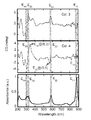
- Optical absorption spectrum of the sample that was pre-separated before optical resolution It is a light absorption spectrum of the sample (Col. 1 to 9) after optical resolution, and the upper row is a light absorption spectrum of the sample (C1) after preliminary separation.
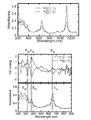
- Light absorption spectrum (lower) corresponding to the circular dichroism spectrum (upper, middle) of (7,3) CNT (Col. 1, 2) after optical resolution.
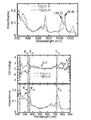
- the optical absorption spectrum (lower stage) corresponding to the circular dichroism spectrum (upper stage, middle stage) of (6,4) CNT (Col. 3, 4) after optical resolution.
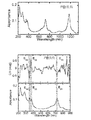
- the optical absorption spectrum (lower) corresponding to the circular dichroism spectrum (upper, middle) of (6,5) CNT (Col. 5-7) after optical resolution.
- the “optically active” CNTs separated in the present invention indicate optical activity by circular dichroism spectrum measurement, and from a single or limited type (n, m) from the light absorption spectrum. It is confirmed that it is CNT. Therefore, the CNTs having optical activity after separation are not only those having a single structure considering optical activity but also a mixture in which two or more kinds of specific structures are extracted. Good. Further, it is a mixture containing a small amount of any other structure within a range where it can be identified based on the above measurement that CNTs having specific optical activity are selectively separated and recovered. There may be.
- the present invention is not limited to a mixture containing various (n, m) CNTs (hereinafter also simply referred to as CNT), but a mixture containing a limited type of (n, m) CNTs, a single (n, m) CNTs consisting of m) are also subject to separation.
- CNT various CNTs
- a mixture containing a limited type of (n, m) CNTs, a single (n, m) CNTs consisting of m) are also subject to separation.
- mixtures of CNTs containing enantiomers in any ratio can also be targeted for separation.
- the present invention relates to a method for separating CNTs having different optical activities from a mixture of these various CNTs.
- an optically active CNT having a strong adsorptive power is separated by adding an excessive amount of a CNT dispersion obtained as described below to a gel packed in a column. It is to purify.
- the sample to be separated is a mixture containing various (n, m) CNTs
- the number of (n, m) CNTs to be reduced is reduced, it is preferable to separate CNTs having different optical activities by repeating the same separation again on the sample having the reduced CNT types.
- the excessive amount of the CNT dispersion is an amount larger than the adsorption capacity of the carbon nanotubes with respect to the gel packed in the column.
- the amount of CNT charged into the column is increased, the CNT that can be adsorbed on the gel is eluted without being adsorbed on the column in the same manner as the CNT that cannot be adsorbed on the gel. It is a quantity.
- the CNTs that are collected without adsorbing to the gel packed in the column are again left in the newly prepared similar column. When this occurs, the amount of CNT initially charged into the column is an excessive amount.
- the principle of binding only CNTs having specific optical activity when an excessive amount of CNT dispersion is applied to the gel packed in the column is considered as follows.
- an excessive amount of CNT dispersion liquid is charged into the column with respect to the gel packed in the column, among various types of CNTs, certain optically active CNTs with strong adsorptive power with respect to the gel are less than those with weak adsorbing power.
- CNTs that are preferentially adsorbed and CNTs having a weak adsorbing power are discharged without being adsorbed on the gel.
- the type of CNT adsorbed on the gel is limited to a specific optically active one having a strong adsorptive power, and only a specific type of CNT can be obtained.
- the carbon nanotubes used for the separation can be any of the separation targets of the present invention without any problem with respect to the production method, shape (diameter and length) or structure (single-layer, double-layer, etc.). .
- CNT dispersion The synthesized CNTs are usually in the form of tens to hundreds of bundles containing CNTs having various structures. Prior to optical division of CNTs, it is important to disperse and solubilize the CNTs one by one so that they exist stably for a long time. Therefore, CNTs are dispersed and isolated by adding a mixture of CNTs to a solution to which a surfactant is added as a dispersant and sufficiently performing ultrasonic treatment.
- the liquid subjected to the dispersion treatment includes dispersed / isolated CNT, CNT that cannot be dispersed / isolated and remains in a bundle, amorphous carbon or a metal catalyst that is a synthetic byproduct.
- CNTs, amorphous carbon, and metal catalyst as bundles are precipitated, while isolated CNTs that form micelles with surfactants are used as supernatant Can be recovered.
- the obtained supernatant becomes a sample used for separation of CNTs.
- water is most preferable. From this point, water is used for preparing the CNT dispersion.
- any of an anionic surfactant, a cationic surfactant, an amphoteric surfactant and a nonionic surfactant can be used. In the optical resolution of CNTs using gel, it is not necessary to use a dispersant having optical activity.
- the anionic surfactant alkylsulfuric acid type having 10 to 14 carbon atoms, dodecanesulfonic acid, dodecanoyl sarcosine, dodecanoic acid, cholic acid and the like are preferable.
- amphoteric surfactants n-dodecylphosphocholine and the like are preferable. These surfactants can be used in combination, and can also be used in combination with other surfactants.
- the surfactant used in combination may be an anionic surfactant, a cationic surfactant, an amphoteric surfactant, a nonionic surfactant, or a dispersing agent such as a polymer, DNA or protein.
- concentration of the dispersant such as the surfactant varies depending on the type and concentration of the CNT used, the type of the dispersant used, and the like. For example, the final concentration may be 0.01% to 25%.
- the concentration of CNT in the dispersion can be adjusted to 1 ⁇ g / ml to 10 mg / ml, preferably 0.1 mg / ml to 1 mg / ml.
- the amount of sample added varies depending on the type and number of substances to be separated, the composition ratio, and the like. it can.
- the gel to be used is a conventionally known saccharide-based gel, such as a dextran-based gel (sephaacryl: allyl dextran and N, N′-methylenebisacrylamide homopolymer, GE Healthcare), agarose gel, starch gel, etc. is there.
- the gel which consists of a mixture of these gels, or the structural component of these gels, and the mixture and compound of another substance may be sufficient.
- the gel concentration for example, the final concentration is preferably 0.01% to 25%.
- the separation of the present invention is not limited to the column method. For example, a small amount of gel is added to a large excess of CNT dispersion, and only a substance having strong adsorptive power is adsorbed on the gel and separated and recovered. It can also be applied to the batch method.
- the liquid can be sent to the column by a method of sending the solution by gravity drop of a solvent using an open column or a method of sending the solution by a pump to a sealed column.
- a method of sending the solution by gravity drop of a solvent using an open column or a method of sending the solution by a pump to a sealed column.
- the separation using a pump it is possible to increase the flow rate and perform a large amount of processing.
- Automatic separation using a chromatographic apparatus is also possible. Even when columns connected in series are used, it is possible to automate the entire separation process by arranging appropriate valves before and after the column.
- separation can be achieved by increasing the adsorption force by changing the concentration of the dispersant in the solution used for separation.
- a solution containing a dispersant such as a surfactant can be used as an eluent for recovering CNT adsorbed on the gel.
- FIG. 1 is a diagram showing a light absorption spectrum of a sample subjected to preliminary separation before optical division in Example 1 described later.
- an absorption wavelength band called M 11 is due to metallic CNT.
- the three absorption wavelength bands of S 11 (about 900 nm or more), S 22 (about 650-900 nm) and S 33 (about 450 nm or less) are due to semiconductor-type CNTs. These absorption wavelength bands correlate with the CNT diameter distribution, and the broader the diameter distribution, the wider the absorption wavelength band. In unseparated HiPco-CNT (sample before separation), a number of peaks are observed, and the absorption wavelength bands of S 11 , S 22 , M 11 , and S 33 slightly overlap each other. On the other hand, one specific type of (n, m) semiconductor CNT has one characteristic peak at each of S 11 , S 22 , and S 33 (also synonymous with E 11 , E 22 , and E 33 ).
- FIG. 2d shows the result of separation of CNT having optical activity with respect to (6,5) CNT in Example 1 to be described later, but the peak positions of E 22 and E 33 in the light absorption spectrum in the lower part of FIG. 2d. A peak was also observed in the CD spectrum at the same position as in Fig. 2d (upper, middle). From this, separation of optically active (6,5) CNT can be confirmed. Since the positive and negative peaks of Col.5, 6 and Col.8,9 are opposite, it can be seen that CNTs having different optical activities were separated.
- Example 1 In this example, the type of (n, m) CNT contained in the sample was reduced by preliminary separation, and a single (n, m) CNT having optical activity was separated using the sample.
- a solution containing CNT that could not be adsorbed to the gel with 1.5% SDS was again subjected to the same separation using a series column equilibrated with 1.5% SDS.
- the fractions collected from each column were designated C13 to C17 (since no CNT was collected from the bottom column, there was no C18 fraction at this point).
- the CNT solution recovered without adsorbing to the gel with 1.5% SDS was changed to the SDS concentration of 1%, and the same separation was repeated three times.
- the obtained fractions were designated C18 to C31.
- the CNT solution that was not adsorbed to the gel even with 1% SDS was recovered as an unadsorbed fraction.
- the light absorption spectrum of each obtained fraction is shown in FIG.
- the absorption peaks of S 11 , S 22 , and S 33 from the long wavelength side are M 11 around S 22 and S 33 if it is a metal type. A peak is observed. These absorption peaks have different peak wavelengths depending on their diameters, and shift to the long wavelength side if the CNT has a large diameter and to the short wavelength side if the CNT has a small diameter.
- the synthesized CNT is a mixture of CNTs of various types and diameters, and the light absorption spectrum is observed as a superposition of the peaks of these mixtures. Looking at the results of the optical absorption spectrum measurement in FIG.
- FIG. 2d summarizes the results of Col. 5 to 9 corresponding to (6,5) CNT.
- (6,5) corresponds to a wavelength (Fig. 2d bottom) leaving the light absorption peak characteristic of E 22, E 33 to CNT, as will Col.9 from Col.5, and negative in the E 22 to positive , E 33 shows that the peak changes from positive to negative (upper and middle stages in FIG. 2d). That is, it shows that optically active (6,5) CNT was separated.
- Col. 7 which is the middle of Col. 5 to 9, since peaks are observed in E 22 and E 33 in the light absorption spectrum, but no peak is observed in the circular dichroism spectrum, (6,5) CNT is an enantiomer. Is present as a racemate containing the same amount.
- FIG. 2 c summarizes the results of Col.3,4 corresponding to (6,4) CNT.
- (6, 4) CNT peaks were observed in the portions corresponding to E 11 , E 22 , and E 33 in the circular dichroism spectrum of Col.3, and it was found that one of the enantiomers increased ( FIG. 2c top).
- FIG. 2 b summarizes the results of Col.1, 2 corresponding to (7,3) CNT.
- (7,3) CNT negative peaks were observed in the portions corresponding to E 22 and E 33 in Col.1, and it was found that one of the enantiomers was slightly increased.
- optically active mirror images of (7,5), (7,6), (8,4), (9,4), (8,6), (8,7) CNT obtained in the same manner.
- the light absorption spectrum and circular dichroism spectrum of the isomer are shown in FIGS.
- the upper part is a light absorption spectrum
- the lower part is a circular dichroism (CD) spectrum.
- a light absorption spectrum in a corresponding wavelength range is displayed under each CD spectrum.
- the peak of E 22 is expressed as M @ (n, m)
- the negative peak is expressed as P @ (n, m).
- FIGS. 7 and 8,6 CNT and (8,7) CNT are obtained by concentrating one of the enantiomers.
- CNTs having optical activity (7, 6) shown in FIG. 4 CNTs having optical activity (9, 4) shown in FIG. 6, and (8, 6) shown in FIG.
- the CNT having the optical activity (1) and the CNT having the optical activity (8, 7) shown in FIG. 8 have been separated for the first time in the world, which has not been reported so far.
- Example 2 In this example, by using the optically inactive (6, 5) CNT obtained in Col. 7 of Example 1 described above, the same separation as described in the previous section [0045] was performed again to obtain an optical Tried to split. The results are shown in FIG. In the figure, the upper stage is before separation, and the lower stage is after separation. As apparent from FIG. 9, optically active CNTs could be separated by performing similar separation again using optically inactive CNTs.
- Example 3 In this example, the (5,4) CNTs were optically resolved without preliminary separation by optimizing the CNT dispersion conditions and separation parameters.
Landscapes
- Chemical & Material Sciences (AREA)
- Analytical Chemistry (AREA)
- Organic Chemistry (AREA)
- Chemical Kinetics & Catalysis (AREA)
- Engineering & Computer Science (AREA)
- Nanotechnology (AREA)
- Materials Engineering (AREA)
- Inorganic Chemistry (AREA)
- Dispersion Chemistry (AREA)
- Crystallography & Structural Chemistry (AREA)
- Physics & Mathematics (AREA)
- Composite Materials (AREA)
- Condensed Matter Physics & Semiconductors (AREA)
- General Physics & Mathematics (AREA)
- Carbon And Carbon Compounds (AREA)
- Treatment Of Liquids With Adsorbents In General (AREA)
- Solid-Sorbent Or Filter-Aiding Compositions (AREA)
Abstract
Description
(1)光学活性を持つが多様な(n,m)のCNTの混合物であること、(2)高価な設備や薬品を必要とすること、(3)大量処理ができないこと、(4)長時間を要すること、(5)複雑な工程を経るため自動化ができないこと、(6)光学活性をもつ分散剤を使用する必要があること、などである。
本発明の分離法においては、光学活性をもつ分散剤を用いることなく光学活性の異なるCNTを分離できるものであるが、その理由として、分離に用いるゲル担体が光学活性をもつ多糖であることから、ゲルがCNTの(n,m)の構造の違いに加えて、光学活性の異なるCNTに対して異なる相互作用を示す結果、高度なCNTの光学分割が達成されているものと考えている。このように、ゲルの光学活性を利用して、光学活性の異なるCNTを分離したという報告はこれまでになく、本発明は極めて独創的な発明であるといえる。さらに、カラム分離を適用することが可能であることから、大量処理や分離の自動化も可能であり、異なる光学特性をもつCNTを工業的に低コストで大量生産する上で非常に優れたものとなる。
すなわち、この出願によれば、以下の発明が提供される。
<1> 光学活性の異なるカーボンナノチューブの分離回収方法であって、
ゲルに対して、該ゲルが吸着することができるカーボンナノチューブの量を超える量のカーボンナノチューブを含むカーボンナノチューブ分散液を作用させて、ゲルに対して吸着力の強い、光学活性を持つカーボンナノチューブを該ゲルに吸着させる工程と、
吸着力が弱く未吸着の、前記の光学活性とは異なる光学活性を持つカーボンナノチューブを分離する工程と、
前記分離後のゲルに溶出液を作用させて、ゲルに吸着したカーボンナノチューブを取り出す工程と、
を備えることを特徴とする光学活性の異なるカーボンナノチューブの分離回収方法。
<2> 前記ゲルはカラムに充填されていることを特徴とする<1>に記載のカーボンナノチューブの分離回収方法。
<3> 光学活性の異なるカーボンナノチューブの分離回収方法であって、
ゲルを充填したカラムをn段直列して備え(n≧2、nは自然数)、第n段目のカラムのゲルにカーボンナノチューブが吸着するまで、第1段目のカラムにカーボンナノチューブ分散液を作用させることにより、n段の各カラムのゲルに1番目からn番目までの吸着力が強いカーボンナノチューブを吸着させる工程と、
すべてのカラムのゲルに吸着しない吸着力の弱いカーボンナノチューブを含む溶液を分離する工程と、
各カラムのゲルに吸着したn種類の吸着力の異なるカーボンナノチューブを取り出す工程と、
を備えることにより、n個のカラムのゲルに吸着した、光学活性が異なるn種類のカーボンナノチューブと、これらの光学活性とは異なる光学活性を持つゲルに未吸着のカーボンナノチューブとを得ることを特徴とする光学活性の異なるカーボンナノチューブの分離回収方法。
<4> <1>~<3>のいずれかに記載の分離回収方法で得られる光学活性を有するカーボンナノチューブであって、(5,4)、(7,6)、(9,4)、(8,6)、又は(8,7)のいずれか1つを主成分とするカイラル指数を有することを特徴とするカーボンナノチューブ。
光学活性を持つゲルは固相であるので、分離したCNT試料溶液へのゲル混入の心配をする必要もない。カラムを用いた連続分離のほか、バッチ式の分離に適用することも可能である。直列カラムを用いれば、異なる光学活性をもつCNTを一度に複数種、高い精度で得ることもできる。実際、これまでに他の方法で分離できていなかった、(7,6)、(9,4)、(8,6)、(8,7)の光学活性CNTは、本発明で初めて分離された。このように本発明は、光学活性が異なる単一の(n,m)CNTを分離することができる、非常に実効性の高い方法ということができる。
なお、本発明において分離される「光学活性を持つ」CNTとは、円二色性スペクトル測定で光学活性を示し、なおかつ、光吸収スペクトルから単一または限定された種類の(n、m)からなるCNTであることが確認されたものである。従って、このような分離後の光学活性を持つCNTは、光学活性も考慮した単一構造からなるものは勿論、特定の構造として2種以上の複数種のものが抽出された混合物であってもよい。また、このような特定の光学活性を持つCNTが選択的に分離回収されたことが上記のような測定に基づいて識別し得る範囲内において、他の任意の構造のものを若干量含む混合物であってもよい。
本発明の方法において、分離する試料が様々の(n,m)CNTを含む混合物である場合には、少量のゲルに対して大過剰のCNT分散液を作用させる分離により、まず試料中に含まれる(n,m)CNTの種類を減らした後、そのCNTの種類が減った試料を再度同様の分離を繰り返すことにより光学活性の異なるCNTを分離するのが好ましい。
合成されたCNTは通常、様々な構造のCNTを含む数十から数百本の束(バンドル)になっている。CNTの光学分割に先立って、一本ずつに孤立した状態のCNTとして分散可溶化して、長時間安定に存在させておくことが肝要である。
そこで、CNTの混合物を、分散剤として界面活性剤を添加した溶液に加え、十分に超音波処理を行うことにより、CNTを分散・孤立化させる。この分散処理を施した液には、分散・孤立化したCNTと、分散・孤立化できずにバンドルを形成したままのCNT、合成副産物であるアモルファスカーボンや金属触媒などが含まれる。
超音波処理後に得た分散液を遠心分離機より遠心分離することにより、バンドルのままのCNTやアモルファスカーボン、金属触媒は沈殿し、一方、界面活性剤とミセルをなした孤立CNTは上清として回収できる。得られた上清がCNTの分離に使用する試料となる。
陰イオン界面活性剤では、アルキル硫酸系で炭素数が10~14のものや、ドデカンスルホン酸、ドデカノイルサルコシン、ドデカン酸、コール酸などが好ましい。両性界面活性剤では、n-ドデシルホスホコリンなどが好ましい。これらの界面活性剤は混合して使用することができ、また、他の界面活性剤と併用することもできる。
併用される界面活性剤は、陰イオン性界面活性剤、陽イオン性界面活性剤、両性界面活性剤、非イオン性界面活性剤の他、高分子ポリマー、DNA、タンパク質などの分散剤でも良い。界面活性剤などの分散剤の濃度については、使用するCNTの種類や濃度、使用する分散剤の種類などによって異なるが、例えば、終濃度で0.01%~25%とすることができる。
使用するゲルは、従来公知の糖質系のゲルである、デキストラン系ゲル(セファクリル:アリルデキストランとN,N’-メチレンビスアクリルアミドのホモポリマー、GEヘルスケア社)、アガロースゲル、デンプンゲルなどである。また、これらゲルの混合物、あるいは、これらゲルの構成成分や他の物質の混合物や化合物からなるゲルであってもよい。
ゲル濃度については、例えば、終濃度で0.01%~25%とするのがよい。
本発明の分離はカラム法に限定されるものではなく、例えば、大過剰のCNT分散液に少量のゲルを添加して、吸着力の強い物質のみをゲルに吸着させて分離回収するというような、バッチ法にも適用できる。
直列に連結したカラムを用いた場合でも、カラムの前後に適当なバルブを配置することによって、分離の全行程を自動化することも可能である。
HiPco法で合成したCNT(HiPco-CNT、直径1.0±0.3nm)を用いた時の結果を例として説明する。
図1は、後述する実施例1において、光学分割前の予備分離を行った試料の光吸収スペクトルを示す図である。
図中、M11と呼ばれる吸収波長帯(およそ450-650nm)は、金属型CNTによるものである。S11(およそ900nm以上)、S22(およそ650-900nm)とS33(およそ450nm以下)という3つ吸収波長帯は、半導体型CNTによるものである。これらの吸収波長帯はCNTの直径分布と相関があり、直径分布が広くなると吸収波長帯も広くなる。
未分離のHiPco-CNT(分離前の試料)では、いくつものピークが認められ、S11、S22、M11、S33の吸収波長帯がそれぞれ少しずつ重なっている。
これに対し、特定の一種類の(n,m)の半導体CNTは、S11、S22、S33(E11、E22、E33も同義)にそれぞれ1つずつ特徴的なピークをもつことから、試料中に含まれる(n,m)の種類が少なくなると、どの(n,m)が含まれているかの情報を得ることができるようになる。図1のC1~C31(各カラムに吸着したCNTを回収した試料、抜粋)の画分ではピークの数が分離前のものに比べて減少しており、各画分には限定された(n,m)のCNTしか含んでいないことが分かる。
しかし、光吸収スペクトルでは、光学活性に関する詳細な情報は得ることが出来ない。
例えば、図2dは、後述する実施例1における、(6,5)CNTについての光学活性をもつCNTの分離の結果であるが、図2d下段の光吸収スペクトルのE22、E33のピーク位置と同じ位置にCDスペクトルにもピークが認められた(図2d上段、中段)。このことから、光学活性な(6,5)CNTの分離が確認できる。Col.5、6とCol.8、9ではピークの正負が反対であることから、それぞれ異なる光学活性をもつCNTが分離されたことが分かる。
本実施例においては、予備分離で試料中に含まれる(n,m)CNTの種類を減らし、その試料を用いて、単一の(n,m)でなおかつ光学活性をもつCNTを分離した。
100mg分のHipco-CNT(NanoIntegris社、化学気相成長法で合成されたCNT、直径1.0±0.3nm)に、2%SDS水溶液(100ml)を加えた。その溶液をチップ型超音波破砕機(ソニファイアー、ブランソン社製、チップ先端径:0.5インチ)を用いて、冷水中で冷却しながら、出力30W/cm2で9時間超音波処理した。超音波処理によって得られた分散液を、超遠心分離(289,000×g、15分)にかけた後、上清を90%回収した。この溶液をCNT分散液とした。
ゲルビーズ(セファクリルS-200HR、GEヘルスケア社)をカラム担体に用いた。長さ8cm、内径1.5cmのプラスチックシリンジの出口に綿を詰めたものに、1.4ml分のゲルビーズを充填したカラムを準備した。同様のカラムを6つ垂直ならべた直列カラムを準備し、一番上のカラムから純水を滴下しすべてのカラムを純水で平衡化した後、2%SDS水溶液で平衡化した。
次に、5mlの前記CNT分散液(0.15ml/ml)を一番上のカラムに添加した。その後、2%SDS水溶液を添加し、ゲルに吸着しないCNTを一番下のカラム出口から回収した。溶液が無色透明になるまでカラムを洗浄した。その後、各々のカラムを分離して、それぞれのカラムに吸着しているCNTを5%SDS水溶液で溶出して回収し、それぞれC1~C6画分とした。
前記一番下のカラム出口から回収した、ゲルに吸着できかったCNTを含む溶液は、純水で希釈してSDS濃度を1.5%に調整し、1.5%SDSで平衡化した直列カラムを用いて同様の分離を行った。それぞれのカラムから回収した画分をC7~C12とした。1.5%SDSでゲルに吸着出来なかったCNTを含む溶液を、再度、1.5%SDSで平衡化した直列カラムを用いて同様の分離を行った。それぞれのカラムから回収した画分をC13~C17とした(一番下のカラムからはCNTは回収されなかったため、この時点ではC18画分はない)。さらに、1.5%SDSでゲルに吸着せず回収されたCNT溶液は、SDS濃度を1%に変更し、同様の分離を3回繰り返し行った。得られた画分をC18~C31とした。1%SDSでもゲルに吸着しなかったCNT溶液は、未吸着画分として回収した。
得られた各画分の光吸収スペクトルを図1に示す。
CNTの光吸収スペクトルは、半導体型であれば、長波長側からS11、S22、S33という吸収ピークが、金属型であれば、S22とS33の間のあたりに、M11というピークが観測される。これらの吸収ピークは直径によってピークの波長が異なり、直径の大きなCNTであれば長波長側、直径の小さなCNTであれば短波長側へとシフトする。合成されたCNTは、様々な種類・直径のCNTの混合物であり、光吸収スペクトルはこれら混合物のピークの重ねあわせとなって観測される。
図1の光吸収スペクトル測定の結果を見ると、分離前のCNT(Pristine)ではいくつものピークが認められるが、カラムに吸着・溶出したもの(C1~C31)は、S11、S22、S33領域のピークの数が分離前のものに比べて減少しているのが見て取れる。これは、予備分離によって、各画分には限定された(n,m)のCNTしか含んでいないことを示している。
予備分離で得られた、(n,m)の種類が限定されたCNTを用いて、光学活性をもつCNTの分離を行う。分離法としては、上記と同様に直列カラムを用いた方法を用いる。
一例として、予備分離で得られたC1を分離試料に用いた時の結果を、図2a~図2dを用いて、詳しく説明する。
5%SDS溶液で回収したC1画分を純水で希釈して、SDS濃度を2%に合わせて、直列カラム分離を行った。図2aに、分離前と分離後の各画分(Col.1~9)の光吸収スペクトルを示す。Col.1,2は(7,3)CNT、Col.3,4は(6,4)CNT、Col.5~9は(6,5)CNTを主要産物として含むことが分かった。それぞれの画分について、円二色性スペクトルを測定した。
(6,5)CNTに特有のE22、E33の光吸収ピークが出る波長(図2d下段)に対応して、Col.5からCol.9になるにつれて、E22では負から正へと、E33では正から負へとピークが変化していることが分かる(図2d上段、中段)。つまり、光学活性な(6,5)CNTが分離されたことを示している。Col.5~9の中間にあたるCol.7では、E22,E33に光吸収スペクトルではピークが認められるが円二色性スペクトルではピークは認められないため、(6,5)CNTは鏡像体が同量含まれるラセミ体として存在していることを示している。
(6,4)CNTでは、Col.3の円二色性スペクトルでE11、E22、E33に対応する部分に共にピークが認められ、鏡像体の片方が増えていることが分かった(図2c上段)。
また、Col.4では、E22、E33に対応する部分とはずれた位置に、前述のCol.5における(6,5)CNTのE22に相当するピーク(E22@(6,5)と表記)及びE33に相当するピーク(E33@(6,5)と表記)が認められ、共存する(6,5)CNTの影響が大きく、(6,4)CNTの鏡像体分離の判断が難しかった(図2c中段)。
(7,3)CNTでは、Col.1にE22とE33に対応する部分に共に負のピークが認められ、鏡像体の片方が僅かに増えていることが分かった。
図7、8に示すように、(8,6)CNT及び(8,7)CNTは、片方の鏡像体が濃縮されたものしか得られていない。
これらの光学分離されたCNTのうち、図4に示す(7,6)の光学活性をもつCNT、図6に示す(9,4)の光学活性をもつCNT、図7に示す(8,6)の光学活性をもつCNT、及び図8に示す(8,7)の光学活性をもつCNTは、これまでに報告例のない世界で初めて分離されたものである。
本実施例では、前述の実施例1のCol.7で得られた光学不活性な(6,5)CNTをもちいて、再度、前項[0045]に記載と同様の分離を行うことにより、光学分割を試みた。
結果を図9に示す。図中、上段が分離前であり、下段が分離後である。
図9から明らかなように、光学不活性なCNTを用いて、再度同様な分離を行うことにより、光学活性なCNTを分離することができた。
本実施例では、CNTの分散条件、及び分離パラメータを最適化することにより、予備分離なしに、(5,4)CNTの光学分割を行った。
CNT分散液の調製条件を、SDS濃度を2.75%、超音波処理時間を20時間、超遠心分離条件を(210,000×g、2時間)に変更した以外は、実施例1と同様にしてCNT分散液を調製した。
2.75%のSDS水溶液で平衡化した2mlのゲルを充填したカラムを4本直列に並べ、一番上のカラムから80mlのCNT分散液を添加した。
次に2.75%SDS水溶液を一番上のカラムに添加し、ゲルに吸着しないCNTを洗浄した後、各々のカラムを分離して、それぞれのカラムに吸着しているCNTを5mlの5%SDS水溶液で溶出して回収した。
回収したCNT溶液を濃縮するために、それぞれのカラムから回収した5%SDS水溶液を混合し、水で希釈してSDS濃度を2.5%にあわせた後、2.5%SDSで平衡化した1mlのゲルを含むカラムに吸着させ、1mlの5%SDSで溶出し回収した。
得られたCNTの光吸収スペクトルと円二色性スペクトルの結果を図10に示す。図から明らかなように、条件を最適化することにより、予備分離なしに、光学活性な(5,4)CNTを分離することができた。
Claims (4)
- 光学活性の異なるカーボンナノチューブの分離回収方法であって、
ゲルに対して、該ゲルが吸着することができるカーボンナノチューブの量を超える量のカーボンナノチューブを含むカーボンナノチューブ分散液を作用させて、ゲルに対して吸着力の強い、光学活性を持つカーボンナノチューブを該ゲルに吸着させる工程と、
吸着力が弱く未吸着の、前記の光学活性とは異なる光学活性を持つカーボンナノチューブを分離する工程と、
前記分離後のゲルに溶出液を作用させて、ゲルに吸着したカーボンナノチューブを取り出す工程と、
を備えることを特徴とする光学活性の異なるカーボンナノチューブの分離回収方法。 - 前記ゲルはカラムに充填されていることを特徴とする請求項1記載のカーボンナノチューブの分離回収方法。
- 光学活性の異なるカーボンナノチューブの分離回収方法であって、
ゲルを充填したカラムをn段直列して備え(n≧2、nは自然数)、第n段目のカラムのゲルにカーボンナノチューブが吸着するまで、第1段目のカラムにカーボンナノチューブ分散液を作用させることにより、n段の各カラムのゲルに1番目からn番目までの吸着力が強いカーボンナノチューブを吸着させる工程と、
すべてのカラムのゲルに吸着しない吸着力の弱いカーボンナノチューブを含む溶液を分離する工程と、
各カラムのゲルに吸着したn種類の吸着力の異なるカーボンナノチューブを取り出す工程と、
を備えることにより、n個のカラムのゲルに吸着した、光学活性が異なるn種類のカーボンナノチューブと、これらの光学活性とは異なる光学活性を持つゲルに未吸着のカーボンナノチューブとを得ることを特徴とする光学活性の異なるカーボンナノチューブの分離回収方法。 - 請求項1~3のいずれか1項に記載の分離回収方法で得られる光学活性を有するカーボンナノチューブであって、(5,4)、(7,6)、(9,4)、(8,6)、又は(8,7)のいずれか1つを主成分とするカイラル指数を有することを特徴とするカーボンナノチューブ。
Priority Applications (4)
| Application Number | Priority Date | Filing Date | Title |
|---|---|---|---|
| US14/777,975 US20160280547A1 (en) | 2013-03-26 | 2014-03-26 | Method of separating and recovering optically active carbon nanotube, and optically active carbon nanotube |
| CN201480018406.0A CN105102372A (zh) | 2013-03-26 | 2014-03-26 | 具有光学活性的碳纳米管的分离回收方法及具有光学活性的碳纳米管 |
| KR1020157025937A KR20150133725A (ko) | 2013-03-26 | 2014-03-26 | 광학 활성을 갖는 카본 나노튜브의 분리 회수 방법 및 광학 활성을 갖는 카본 나노튜브 |
| JP2015508588A JPWO2014157338A1 (ja) | 2013-03-26 | 2014-03-26 | 光学活性をもつカーボンナノチューブの分離回収方法及び光学活性をもつカーボンナノチューブ |
Applications Claiming Priority (2)
| Application Number | Priority Date | Filing Date | Title |
|---|---|---|---|
| JP2013064895 | 2013-03-26 | ||
| JP2013-064895 | 2013-03-26 |
Publications (1)
| Publication Number | Publication Date |
|---|---|
| WO2014157338A1 true WO2014157338A1 (ja) | 2014-10-02 |
Family
ID=51624301
Family Applications (1)
| Application Number | Title | Priority Date | Filing Date |
|---|---|---|---|
| PCT/JP2014/058538 Ceased WO2014157338A1 (ja) | 2013-03-26 | 2014-03-26 | 光学活性をもつカーボンナノチューブの分離回収方法及び光学活性をもつカーボンナノチューブ |
Country Status (5)
| Country | Link |
|---|---|
| US (1) | US20160280547A1 (ja) |
| JP (1) | JPWO2014157338A1 (ja) |
| KR (1) | KR20150133725A (ja) |
| CN (1) | CN105102372A (ja) |
| WO (1) | WO2014157338A1 (ja) |
Families Citing this family (9)
| Publication number | Priority date | Publication date | Assignee | Title |
|---|---|---|---|---|
| WO2015077629A1 (en) | 2013-11-21 | 2015-05-28 | Atom Nanoelectronics, Inc. | Devices, structures, materials and methods for vertical light emitting transistors and light emitting displays |
| WO2017096058A1 (en) | 2015-12-01 | 2017-06-08 | LUAN, Xinning | Electron injection based vertical light emitting transistors and methods of making |
| US10541374B2 (en) | 2016-01-04 | 2020-01-21 | Carbon Nanotube Technologies, Llc | Electronically pure single chirality semiconducting single-walled carbon nanotube for large scale electronic devices |
| US10847757B2 (en) | 2017-05-04 | 2020-11-24 | Carbon Nanotube Technologies, Llc | Carbon enabled vertical organic light emitting transistors |
| US10978640B2 (en) | 2017-05-08 | 2021-04-13 | Atom H2O, Llc | Manufacturing of carbon nanotube thin film transistor backplanes and display integration thereof |
| US10665796B2 (en) | 2017-05-08 | 2020-05-26 | Carbon Nanotube Technologies, Llc | Manufacturing of carbon nanotube thin film transistor backplanes and display integration thereof |
| WO2020142770A1 (en) | 2019-01-04 | 2020-07-09 | Atom Optoelectronics, Llc | Carbon nanotube based radio frequency devices |
| US12534370B2 (en) * | 2020-03-12 | 2026-01-27 | Yazaki Corporation | Method for separating carbon nanotubes using modified cellulose |
| KR102550351B1 (ko) * | 2021-02-22 | 2023-06-30 | 이화여자대학교 산학협력단 | 반도체성 탄소나노튜브 및 금속성 탄소나노튜브의 분리방법 |
Citations (3)
| Publication number | Priority date | Publication date | Assignee | Title |
|---|---|---|---|---|
| WO2011108666A1 (ja) * | 2010-03-05 | 2011-09-09 | 独立行政法人産業技術総合研究所 | カーボンナノチューブの分離回収方法及びカーボンナノチューブ |
| JP2011195431A (ja) * | 2009-06-22 | 2011-10-06 | National Institute Of Advanced Industrial Science & Technology | カーボンナノチューブのより簡便な分離回収方法 |
| JP2012051765A (ja) * | 2010-09-02 | 2012-03-15 | Nagoya Univ | カーボンナノチューブ集合体および製造法 |
-
2014
- 2014-03-26 CN CN201480018406.0A patent/CN105102372A/zh active Pending
- 2014-03-26 KR KR1020157025937A patent/KR20150133725A/ko not_active Withdrawn
- 2014-03-26 US US14/777,975 patent/US20160280547A1/en not_active Abandoned
- 2014-03-26 WO PCT/JP2014/058538 patent/WO2014157338A1/ja not_active Ceased
- 2014-03-26 JP JP2015508588A patent/JPWO2014157338A1/ja active Pending
Patent Citations (3)
| Publication number | Priority date | Publication date | Assignee | Title |
|---|---|---|---|---|
| JP2011195431A (ja) * | 2009-06-22 | 2011-10-06 | National Institute Of Advanced Industrial Science & Technology | カーボンナノチューブのより簡便な分離回収方法 |
| WO2011108666A1 (ja) * | 2010-03-05 | 2011-09-09 | 独立行政法人産業技術総合研究所 | カーボンナノチューブの分離回収方法及びカーボンナノチューブ |
| JP2012051765A (ja) * | 2010-09-02 | 2012-03-15 | Nagoya Univ | カーボンナノチューブ集合体および製造法 |
Non-Patent Citations (3)
| Title |
|---|
| HIROMICHI KATAURA: "Separation and optical evaluation of single-wall carbon nanotubes", OYO BUTSURI, vol. 78, no. 12, 10 December 2009 (2009-12-10), pages 1128 - 1134 * |
| TAKESHI TANAKA ET AL.: "Agarose Gel o Mochiita Kinzokugata Handotaigata Carbon Nanotube no Renzoku Hanpuku Bunri", DAI 57 KAI EXTENDED ABSTRACTS, 3 March 2010 (2010-03-03) * |
| TANAKA, T. ET AL.: "Continuous separation of metallic and semiconducting carbon nanotubes using agarose gel", DAI 37 KAI FULLERENE- NANOTUBES GENERAL SYMPOSIUM KOEN YOSHISHU, 1 September 2009 (2009-09-01), pages 22 * |
Also Published As
| Publication number | Publication date |
|---|---|
| JPWO2014157338A1 (ja) | 2017-02-16 |
| CN105102372A (zh) | 2015-11-25 |
| US20160280547A1 (en) | 2016-09-29 |
| KR20150133725A (ko) | 2015-11-30 |
Similar Documents
| Publication | Publication Date | Title |
|---|---|---|
| JP5553282B2 (ja) | カーボンナノチューブの分離回収方法及びカーボンナノチューブ | |
| JPWO2014157338A1 (ja) | 光学活性をもつカーボンナノチューブの分離回収方法及び光学活性をもつカーボンナノチューブ | |
| JP5663806B2 (ja) | カーボンナノチューブの安価な分離方法と分離材並びに分離容器 | |
| JP5594727B2 (ja) | カーボンナノチューブのより簡便な分離回収方法 | |
| JP6716725B2 (ja) | 半導体性カーボンナノチューブを選択分散させ生産率を向上させる方法及び試薬 | |
| CN104428245B (zh) | 用于分离基于碳的纳米结构体的组合物、方法和系统 | |
| JP5481175B2 (ja) | カーボンナノチューブ直径分離法 | |
| WO2008057108A2 (en) | Chirality-based separation of carbon nanotubes | |
| KR102141140B1 (ko) | 반도체성 탄소나노튜브 및 금속성 탄소나노튜브의 분리방법 | |
| JP2016135725A (ja) | カーボンナノチューブの溶出・回収方法 | |
| Zanoni et al. | Single-walled carbon nanotube chiral selectivity exhibited by commercially available hydrogels of varying composition | |
| Watts et al. | Exploiting the physiochemical interactions between single-walled carbon nanotubes and hydrogel microspheres to afford chirally pure nanotubes | |
| JPWO2020022414A1 (ja) | カーボンナノチューブの構造分離用水溶液及び該水溶液を用いたカーボンナノチューブの分離回収方法並びに該方法により得られるカーボンナノチューブ | |
| Watts et al. | Mechanism and mitigation of irreversible material loss within gel-based single-walled carbon nanotube purification schemes | |
| JP2008266111A (ja) | 有機分子を内包したカーボンナノチューブから有機分子を内包した金属性カーボンナノチューブと有機分子を内包した半導体性カーボンナノチューブの分離方法 | |
| CN111285355B (zh) | 单一手性碳纳米管及其镜像体宏量分离方法 | |
| WO2022085771A1 (ja) | 金属型カーボンナノチューブと半導体型カーボンナノチューブとの分離および精製方法 | |
| JP6788914B1 (ja) | 金属型カーボンナノチューブと半導体型カーボンナノチューブとの分離および精製方法 | |
| JP7334901B2 (ja) | 低欠陥カーボンナノチューブの分離法および低欠陥ナノチューブ | |
| HU et al. | Analytical Separations | |
| JP2018140919A (ja) | 単一カーボンナノチューブの製造方法 | |
| Liu et al. | Industrial Single-Structure Separation of Single-Wall Carbon Nanotubes by Multicolumn Gel Chromatography |
Legal Events
| Date | Code | Title | Description |
|---|---|---|---|
| WWE | Wipo information: entry into national phase |
Ref document number: 201480018406.0 Country of ref document: CN |
|
| 121 | Ep: the epo has been informed by wipo that ep was designated in this application |
Ref document number: 14772724 Country of ref document: EP Kind code of ref document: A1 |
|
| WWE | Wipo information: entry into national phase |
Ref document number: 14777975 Country of ref document: US |
|
| ENP | Entry into the national phase |
Ref document number: 2015508588 Country of ref document: JP Kind code of ref document: A |
|
| ENP | Entry into the national phase |
Ref document number: 20157025937 Country of ref document: KR Kind code of ref document: A |
|
| NENP | Non-entry into the national phase |
Ref country code: DE |
|
| 122 | Ep: pct application non-entry in european phase |
Ref document number: 14772724 Country of ref document: EP Kind code of ref document: A1 |