WO2014142106A1 - ケテンイミン化合物、ポリエステルフィルム、太陽電池モジュール用バックシートおよび太陽電池モジュール - Google Patents
ケテンイミン化合物、ポリエステルフィルム、太陽電池モジュール用バックシートおよび太陽電池モジュール Download PDFInfo
- Publication number
- WO2014142106A1 WO2014142106A1 PCT/JP2014/056281 JP2014056281W WO2014142106A1 WO 2014142106 A1 WO2014142106 A1 WO 2014142106A1 JP 2014056281 W JP2014056281 W JP 2014056281W WO 2014142106 A1 WO2014142106 A1 WO 2014142106A1
- Authority
- WO
- WIPO (PCT)
- Prior art keywords
- substituent
- group
- general formula
- integer
- alkyl group
- Prior art date
- Legal status (The legal status is an assumption and is not a legal conclusion. Google has not performed a legal analysis and makes no representation as to the accuracy of the status listed.)
- Ceased
Links
- 0 C*1C#CC(*)C([C@](C=*C=N*)C2=C(*)C=C*(C)(C)C=C2*)=C(*)CC(*(C)(C)C)=C1 Chemical compound C*1C#CC(*)C([C@](C=*C=N*)C2=C(*)C=C*(C)(C)C=C2*)=C(*)CC(*(C)(C)C)=C1 0.000 description 5
- TUCCIXRLACAGSR-UHFFFAOYSA-N CC(C)(c(cc1C(c2ccccc2)=C=Nc2ccccc2)cc(C)c1OC)c(cc1C)cc(C(c2ccccc2)=C=Nc2ccccc2)c1OC Chemical compound CC(C)(c(cc1C(c2ccccc2)=C=Nc2ccccc2)cc(C)c1OC)c(cc1C)cc(C(c2ccccc2)=C=Nc2ccccc2)c1OC TUCCIXRLACAGSR-UHFFFAOYSA-N 0.000 description 1
- TZOKOXGRFRVPDI-UHFFFAOYSA-N CC(C)(c1ccc(C(C)(c(cc2)cc(C(c3ccccc3)=C=Nc3ccccc3)c2OC)c(cc2C(c3ccccc3)=C=Nc3ccccc3)ccc2OC)cc1)c(cc1)cc(C(c2ccccc2)=C=Nc2ccccc2)c1OC Chemical compound CC(C)(c1ccc(C(C)(c(cc2)cc(C(c3ccccc3)=C=Nc3ccccc3)c2OC)c(cc2C(c3ccccc3)=C=Nc3ccccc3)ccc2OC)cc1)c(cc1)cc(C(c2ccccc2)=C=Nc2ccccc2)c1OC TZOKOXGRFRVPDI-UHFFFAOYSA-N 0.000 description 1
- YIVIWXFAHNIMRD-UHFFFAOYSA-N CC(c1ccccc1)(c(cc1C(c2ccccc2)=C=Nc2ccccc2)ccc1OC)c(cc1C(c2ccccc2)=C=Nc2ccccc2)ccc1OC Chemical compound CC(c1ccccc1)(c(cc1C(c2ccccc2)=C=Nc2ccccc2)ccc1OC)c(cc1C(c2ccccc2)=C=Nc2ccccc2)ccc1OC YIVIWXFAHNIMRD-UHFFFAOYSA-N 0.000 description 1
- CJKLYVCQEMRXLT-UHFFFAOYSA-N COc(c(-c1cccc(C(c2ccccc2)=C=Nc2ccccc2)c1OC)ccc1)c1C(c1ccccc1)=C=Nc1ccccc1 Chemical compound COc(c(-c1cccc(C(c2ccccc2)=C=Nc2ccccc2)c1OC)ccc1)c1C(c1ccccc1)=C=Nc1ccccc1 CJKLYVCQEMRXLT-UHFFFAOYSA-N 0.000 description 1
- XPBRWEDYDDMKPE-UHFFFAOYSA-N COc(ccc(C(C(c(cc1)cc(C(c2ccccc2)=C=Nc2ccccc2)c1OC)c(cc1C(c2ccccc2)=C=Nc2ccccc2)ccc1OC)c(cc1)cc(C(c2ccccc2)=C=Nc2ccccc2)c1OC)c1)c1C(c1ccccc1)=C=Nc1ccccc1 Chemical compound COc(ccc(C(C(c(cc1)cc(C(c2ccccc2)=C=Nc2ccccc2)c1OC)c(cc1C(c2ccccc2)=C=Nc2ccccc2)ccc1OC)c(cc1)cc(C(c2ccccc2)=C=Nc2ccccc2)c1OC)c1)c1C(c1ccccc1)=C=Nc1ccccc1 XPBRWEDYDDMKPE-UHFFFAOYSA-N 0.000 description 1
- CHEXOLKCGXKRCP-UHFFFAOYSA-N COc(ccc(Cc(cc1)cc(C(c2ccccc2)=C=Nc2ccccc2)c1OC)c1)c1C(c1ccccc1)=C=Nc1ccccc1 Chemical compound COc(ccc(Cc(cc1)cc(C(c2ccccc2)=C=Nc2ccccc2)c1OC)c1)c1C(c1ccccc1)=C=Nc1ccccc1 CHEXOLKCGXKRCP-UHFFFAOYSA-N 0.000 description 1
- OBVWYROHSFTLIG-UHFFFAOYSA-N COc1ccc(C2(c(cccc3)c3C3=C2CCC=C3)c(cc2)cc(C(c3ccccc3)=C=Nc3ccccc3)c2OC)cc1C(c1ccccc1)=C=Nc1ccccc1 Chemical compound COc1ccc(C2(c(cccc3)c3C3=C2CCC=C3)c(cc2)cc(C(c3ccccc3)=C=Nc3ccccc3)c2OC)cc1C(c1ccccc1)=C=Nc1ccccc1 OBVWYROHSFTLIG-UHFFFAOYSA-N 0.000 description 1
- HCLKVGPTBBEPIR-UHFFFAOYSA-N Cc(cc(C1(CCCCC1)c(cc1C)cc(C(c2ccccc2)=C=Nc2ccccc2)c1OC)cc1C(c2ccccc2)=C=Nc2ccccc2)c1OC Chemical compound Cc(cc(C1(CCCCC1)c(cc1C)cc(C(c2ccccc2)=C=Nc2ccccc2)c1OC)cc1C(c2ccccc2)=C=Nc2ccccc2)c1OC HCLKVGPTBBEPIR-UHFFFAOYSA-N 0.000 description 1
- QRLBRXHWXJYOSD-UHFFFAOYSA-N Cc(cc1Cc(cc(C)cc2C(c3ccccc3)=C=Nc3ccccc3)c2OC)cc(C(c2ccccc2)=C=Nc2ccccc2)c1OC Chemical compound Cc(cc1Cc(cc(C)cc2C(c3ccccc3)=C=Nc3ccccc3)c2OC)cc(C(c2ccccc2)=C=Nc2ccccc2)c1OC QRLBRXHWXJYOSD-UHFFFAOYSA-N 0.000 description 1
Classifications
-
- C—CHEMISTRY; METALLURGY
- C07—ORGANIC CHEMISTRY
- C07C—ACYCLIC OR CARBOCYCLIC COMPOUNDS
- C07C251/00—Compounds containing nitrogen atoms doubly-bound to a carbon skeleton
- C07C251/02—Compounds containing nitrogen atoms doubly-bound to a carbon skeleton containing imino groups
- C07C251/04—Compounds containing nitrogen atoms doubly-bound to a carbon skeleton containing imino groups having carbon atoms of imino groups bound to hydrogen atoms or to acyclic carbon atoms
- C07C251/10—Compounds containing nitrogen atoms doubly-bound to a carbon skeleton containing imino groups having carbon atoms of imino groups bound to hydrogen atoms or to acyclic carbon atoms to carbon atoms of an unsaturated carbon skeleton
- C07C251/16—Compounds containing nitrogen atoms doubly-bound to a carbon skeleton containing imino groups having carbon atoms of imino groups bound to hydrogen atoms or to acyclic carbon atoms to carbon atoms of an unsaturated carbon skeleton containing six-membered aromatic rings
-
- C—CHEMISTRY; METALLURGY
- C08—ORGANIC MACROMOLECULAR COMPOUNDS; THEIR PREPARATION OR CHEMICAL WORKING-UP; COMPOSITIONS BASED THEREON
- C08J—WORKING-UP; GENERAL PROCESSES OF COMPOUNDING; AFTER-TREATMENT NOT COVERED BY SUBCLASSES C08B, C08C, C08F, C08G or C08H
- C08J5/00—Manufacture of articles or shaped materials containing macromolecular substances
- C08J5/18—Manufacture of films or sheets
-
- C—CHEMISTRY; METALLURGY
- C08—ORGANIC MACROMOLECULAR COMPOUNDS; THEIR PREPARATION OR CHEMICAL WORKING-UP; COMPOSITIONS BASED THEREON
- C08K—Use of inorganic or non-macromolecular organic substances as compounding ingredients
- C08K3/00—Use of inorganic substances as compounding ingredients
- C08K3/18—Oxygen-containing compounds, e.g. metal carbonyls
- C08K3/20—Oxides; Hydroxides
- C08K3/22—Oxides; Hydroxides of metals
-
- C—CHEMISTRY; METALLURGY
- C08—ORGANIC MACROMOLECULAR COMPOUNDS; THEIR PREPARATION OR CHEMICAL WORKING-UP; COMPOSITIONS BASED THEREON
- C08K—Use of inorganic or non-macromolecular organic substances as compounding ingredients
- C08K5/00—Use of organic ingredients
- C08K5/16—Nitrogen-containing compounds
- C08K5/29—Compounds containing one or more carbon-to-nitrogen double bonds
-
- H—ELECTRICITY
- H10—SEMICONDUCTOR DEVICES; ELECTRIC SOLID-STATE DEVICES NOT OTHERWISE PROVIDED FOR
- H10F—INORGANIC SEMICONDUCTOR DEVICES SENSITIVE TO INFRARED RADIATION, LIGHT, ELECTROMAGNETIC RADIATION OF SHORTER WAVELENGTH OR CORPUSCULAR RADIATION
- H10F19/00—Integrated devices, or assemblies of multiple devices, comprising at least one photovoltaic cell covered by group H10F10/00, e.g. photovoltaic modules
- H10F19/80—Encapsulations or containers for integrated devices, or assemblies of multiple devices, having photovoltaic cells
- H10F19/85—Protective back sheets
-
- H—ELECTRICITY
- H10—SEMICONDUCTOR DEVICES; ELECTRIC SOLID-STATE DEVICES NOT OTHERWISE PROVIDED FOR
- H10F—INORGANIC SEMICONDUCTOR DEVICES SENSITIVE TO INFRARED RADIATION, LIGHT, ELECTROMAGNETIC RADIATION OF SHORTER WAVELENGTH OR CORPUSCULAR RADIATION
- H10F77/00—Constructional details of devices covered by this subclass
- H10F77/40—Optical elements or arrangements
- H10F77/413—Optical elements or arrangements directly associated or integrated with the devices, e.g. back reflectors
-
- C—CHEMISTRY; METALLURGY
- C08—ORGANIC MACROMOLECULAR COMPOUNDS; THEIR PREPARATION OR CHEMICAL WORKING-UP; COMPOSITIONS BASED THEREON
- C08J—WORKING-UP; GENERAL PROCESSES OF COMPOUNDING; AFTER-TREATMENT NOT COVERED BY SUBCLASSES C08B, C08C, C08F, C08G or C08H
- C08J2367/00—Characterised by the use of polyesters obtained by reactions forming a carboxylic ester link in the main chain; Derivatives of such polymers
- C08J2367/02—Polyesters derived from dicarboxylic acids and dihydroxy compounds
-
- C—CHEMISTRY; METALLURGY
- C08—ORGANIC MACROMOLECULAR COMPOUNDS; THEIR PREPARATION OR CHEMICAL WORKING-UP; COMPOSITIONS BASED THEREON
- C08J—WORKING-UP; GENERAL PROCESSES OF COMPOUNDING; AFTER-TREATMENT NOT COVERED BY SUBCLASSES C08B, C08C, C08F, C08G or C08H
- C08J2367/00—Characterised by the use of polyesters obtained by reactions forming a carboxylic ester link in the main chain; Derivatives of such polymers
- C08J2367/02—Polyesters derived from dicarboxylic acids and dihydroxy compounds
- C08J2367/03—Polyesters derived from dicarboxylic acids and dihydroxy compounds the dicarboxylic acids and dihydroxy compounds having the hydroxy and the carboxyl groups directly linked to aromatic rings
-
- C—CHEMISTRY; METALLURGY
- C08—ORGANIC MACROMOLECULAR COMPOUNDS; THEIR PREPARATION OR CHEMICAL WORKING-UP; COMPOSITIONS BASED THEREON
- C08K—Use of inorganic or non-macromolecular organic substances as compounding ingredients
- C08K3/00—Use of inorganic substances as compounding ingredients
- C08K3/18—Oxygen-containing compounds, e.g. metal carbonyls
- C08K3/20—Oxides; Hydroxides
- C08K3/22—Oxides; Hydroxides of metals
- C08K2003/2237—Oxides; Hydroxides of metals of titanium
- C08K2003/2241—Titanium dioxide
-
- Y—GENERAL TAGGING OF NEW TECHNOLOGICAL DEVELOPMENTS; GENERAL TAGGING OF CROSS-SECTIONAL TECHNOLOGIES SPANNING OVER SEVERAL SECTIONS OF THE IPC; TECHNICAL SUBJECTS COVERED BY FORMER USPC CROSS-REFERENCE ART COLLECTIONS [XRACs] AND DIGESTS
- Y02—TECHNOLOGIES OR APPLICATIONS FOR MITIGATION OR ADAPTATION AGAINST CLIMATE CHANGE
- Y02E—REDUCTION OF GREENHOUSE GAS [GHG] EMISSIONS, RELATED TO ENERGY GENERATION, TRANSMISSION OR DISTRIBUTION
- Y02E10/00—Energy generation through renewable energy sources
- Y02E10/50—Photovoltaic [PV] energy
Definitions
- the present invention relates to a ketene imine compound, a polyester film, a back sheet for a solar cell module, and a solar cell module.
- a solar cell module has a structure in which glass or front sheet / transparent filler material (sealing material) / solar cell element / sealing material / back sheet are laminated in this order from the light receiving surface side where sunlight is incident doing.
- the solar cell element is generally embedded in a resin (sealing material) such as EVA (ethylene-vinyl acetate copolymer), and further has a structure in which a solar cell protective sheet is pasted thereon.
- a back sheet for a solar cell module disposed particularly in the outermost layer functions to protect the solar cell elements. When the solar cell module is installed in a house, the back sheet is expected to be exposed to wind and weather, and to be placed in a hot and humid environment for a long time, so excellent weather resistance is required.
- polyester films particularly polyethylene terephthalate (hereinafter referred to as PET) films
- PET films are used as back sheets for solar cell modules.
- a polyester film is preferably used as a backsheet for a solar cell module because it has excellent heat resistance, mechanical properties, chemical resistance and the like.
- these films have poor hydrolysis resistance, their molecular weight decreases due to hydrolysis, and embrittlement progresses and mechanical properties decrease, so they are used as backsheets for solar cells over a long period of time. It was not possible to maintain practical strength.
- patent document 1 and 2 propose that a ketene imine compound is added to a polyester film as terminal blocker.
- the ketene imine compound functions to suppress the hydrolysis of the polyester by reacting with the terminal carboxyl group of the polyester.
- the hydrolysis resistance of the polyester film can be improved by containing the ketene imine compound in the polyester film.
- the polyester film becomes yellowish.
- the light reflectance of the back sheet is reduced, and the power generation efficiency of the solar cell module is reduced.
- the colored polyester film is used as a back sheet of a solar cell module, there existed a problem of worsening the designability of the whole solar cell module.
- the present inventors advance examination for the purpose of providing the polyester film in which yellow coloring was reduced in addition to improving hydrolysis resistance.
- the present inventors color a polyester film yellow while improving the hydrolysis resistance of a polyester film rather than using the ketene imine compound which has a specific structure. I found that to suppress.
- the present invention has the following configuration.
- a polyester resin composition comprising a ketene imine compound represented by the following general formula (1) and a polyester.
- R 11 , R 12 , R 21 and R 22 each independently has an alkyl group which may have a substituent, an aryl group which may have a substituent Represents an alkoxy group which may have a substituent, or an aryloxy group which may have a substituent
- R 15 and R 25 each independently represent an alkyl group which may have a substituent, a substituent an aryl group which may have a represents an alkoxy group which may have a substituent or an optionally substituted aryloxy group.
- R 11, R 12 and R 15 are adjacent to each other substituted Groups may form a condensed ring, and R 21 , R 22 and R 25 may form a condensed ring with adjacent substituents
- R 3 is an alkyl group which may have a substituent Or an aryl group which may have a substituent, and a and b each represent Are independently represents an integer of 0-3.
- the polyester resin composition according to [1], wherein the ketene imine compound described above is represented by the following general formula (2).
- at least one of R 11 , R 12 , R 21 and R 22 independently represents an alkyl group which may have a substituent, an aryl group which may have a substituent.
- R 15 and R 25 each independently represent an alkyl group which may have a substituent, a substituent an aryl group which may have a represents an alkoxy group which may have a substituent or an optionally substituted aryloxy group.
- R 11, R 12 and R 15 are adjacent to each other substituted Groups may form a condensed ring, and R 21 , R 22 and R 25 may form a condensed ring with adjacent substituents
- R 3 is an alkyl group which may have a substituent Or an aryl group which may have a substituent, and a is an integer of 0 to 2 Represents, b is 0 .n represents an integer of 1-3 represents an integer of 1 - 4, L 1 represents an n-valent linking group.
- R 11 , R 12 and R 22 independently represents an alkyl group which may have a substituent, an aryl group which may have a substituent, Represents an alkoxy group which may have a substituent or an aryloxy group which may have a substituent;
- R 15 and R 25 each independently represent an alkyl group which may have a substituent, a substituent It represents an aryl group which may have, an alkoxy group which may have a substituent, or an aryloxy group which may have a substituent, and R 11 , R 12 and R 15 are substituents which are adjacent to each other.
- R 22 and R 25 may form a condensed ring with each other, and R 22 and R 25 may form a condensed ring with each other adjacent to each other
- R 3 is an alkyl group which may have a substituent, or a substituent
- each of a and b independently represents Represents an integer of 0 to 3.
- n represents an integer of 1 to 4 and L 2 represents an n-valent linking group.
- R 11 , R 12 , R 21 and R 22 may independently have an alkyl group which may have a substituent, or a substituent Represents an aryl group, an alkoxy group which may have a substituent, or an aryloxy group which may have a substituent;
- R 15 and R 25 each independently represent an alkyl group which may have a substituent; It represents an aryl group which may have a substituent, an alkoxy group which may have a substituent, or an aryloxy group which may have a substituent, and R 11 , R 12 and R 15 are adjacent to each other.
- R 21 and R 25 may form a condensed ring with each other adjacent to each other,
- R 3 may be an alkyl group which may have a substituent, Or an aryl group which may have a substituent, and a is an integer of 0 to 2 And, b is .n represents an integer of 0 to 3 represents an integer of 1 ⁇ 4, L 2 represents a n-valent linking group.
- [5] The polyester resin composition as described in [1], wherein the ketene imine compound is represented by the following general formula (4).
- at least one of R 21 and R 22 independently has an alkyl group which may have a substituent, an aryl group which may have a substituent, or a substituent.
- R 15 and R 25 each independently represent an alkyl group which may have a substituent, or an aryl group which may have a substituent.
- R 15 represents an alkoxy group which may have a substituent, or an aryloxy group which may have a substituent, and R 15 may form a fused ring with adjacent substituents, R 21 And R 22 and R 25 may form a fused ring with substituents adjacent to each other
- R 3 represents an alkyl group which may have a substituent or an aryl group which may have a substituent
- a represents an integer of 0 to 2
- b represents an integer of 0 to 5.
- n Represents an integer of 1 ⁇ 4
- L 1 represents an n-valent linking group.
- At least one of R 21 and R 22 in the above general formula (4) is characterized by representing an alkoxy group which may have a substituent or an aryloxy group which may have a substituent.
- R 22 in the above general formula (4) is characterized by representing an alkoxy group which may have a substituent or an aryloxy group which may have a substituent [5] or [ The polyester resin composition as described in 6].
- [8] The polyester resin composition as described in [1], wherein the ketene imine compound described above is represented by the following general formula (5).
- R 11 , R 12 , R 21 , R 22 , R 31 , R 32 , R 41 and R 42 may be independently an alkyl which may have a substituent.
- a group, an aryl group which may have a substituent, an alkoxy group which may have a substituent, or an aryloxy group which may have a substituent R 15 , R 25 , R 35 and R 45 Each independently represents an alkyl group which may have a substituent, an aryl group which may have a substituent, an alkoxy group which may have a substituent, or an aryloxy group which may have a substituent
- R 11 , R 12 and R 15 may form a condensed ring by mutually adjacent substituents
- R 21 , R 22 and R 25 form a condensed ring by mutually adjacent substituents.
- R 31, R 32 and R 35 represents a condensed ring formed by adjacent substituents to each other At best, have a R 41, R 42 and R 45 MAY form a condensed ring adjacent substituents together .
- R 3 and R 6 represents an alkyl group which may have a substituent or substituents, And a and d each independently represent an integer of 0 to 2, and b and c each independently represent an integer of 0 to 3.
- L 3 represents a single bond or a single bond or Represents a divalent linking group
- At least one of R 11 , R 12 , R 21 , R 22 , R 31 , R 32 , R 41 and R 42 in the above general formula (5) is an alkoxy group which may have a substituent Or an aryloxy group which may have a substituent, or a polyester resin composition as described in [8].
- At least one of R 21 , R 22 , R 31 and R 32 in the above general formula (5) is an alkoxy group which may have a substituent, or an aryloxy which may have a substituent
- R 15 and R 25 each represent An alkyl group which may independently have a substituent, an aryl group which may have a substituent, an alkoxy group which may have a substituent, or an aryloxy group which may have a substituent. represented. in addition, R 15 may form a condensed ring adjacent substituents to each other, R 21, R 22, and R 25 is optionally form a condensed ring adjacent substituents together .
- R 3 Represents an alkyl group which may have a substituent or an aryl group which may have a substituent, a represents an integer of 0 to 2, and b represents an integer of 0 to 5.
- n represents an integer of 0 to 5; Represents an integer of 1 to 4, and L 1 represents an n-valent linking group.
- R 22 in the above general formula (6) is characterized in that it represents an alkoxy group which may have a substituent or an aryloxy group which may have a substituent.
- Ketene imine compound [21] A ketene imine compound described in [19], which is represented by the following general formula (7).
- R 11 , R 12 , R 21 , R 22 , R 31 , R 32 , R 41 and R 42 is an alkoxy group which may have a substituent, or R 15 , R 25 , R 35 and R 45 each independently represents an alkyl group which may have a substituent, or an aryl which may have a substituent.
- R 11 represents an alkoxy group which may have a substituent, or an aryloxy group which may have a substituent, and R 11 , R 12 and R 15 form a fused ring with adjacent substituents.
- R 21 , R 22 and R 25 may form a fused ring between adjacent substituents
- R 31 , R 32 and R 35 may form a fused ring between adjacent substituents.
- R 41, R 42 and R 45 are adjacent to each other
- R 3 and R 6 represent an optionally substituted alkyl group or an optionally substituted aryl group.
- the respective a and d independently represent an integer of 0 to 2
- b and c each independently represent an integer of 0 to 3.
- L 3 represents a single bond or a divalent linking group.
- the yellowing of the polyester film can be suppressed while the hydrolysis resistance of the polyester film is enhanced, rather than using the ketene imine compound having the specific structure.
- the light reflectance of the solar cell module backsheet can be increased, and the power generation efficiency of the solar cell module can be improved.
- the solar cell module backsheet excellent in the designability can be obtained by suppressing yellowing of a polyester film.
- volatilization of the ketene imine compound in the production process can be suppressed by setting the molecular weight of the ketene imine compound to a certain value or more. Thereby, the further effect that a manufacturing aptitude can be raised can be acquired.
- a numerical range represented using “to” means a range including numerical values described before and after “to” as the lower limit value and the upper limit value.
- ketene imine compound The ketene imine compound used for this invention is represented by following General formula (1).
- R 11 , R 12 , R 21 and R 22 may independently have an alkyl group which may have a substituent, or a substituent
- a substituent represents an aryl group, an alkoxy group which may have a substituent, or an aryloxy group which may have a substituent
- R 15 and R 25 each independently represent an alkyl group which may have a substituent
- It represents an aryl group which may have a substituent, an alkoxy group which may have a substituent, or an aryloxy group which may have a substituent.
- R 11 , R 12 and R 15 may form a condensed ring by mutually adjacent substituents
- R 21 , R 22 and R 25 may form a condensed ring by mutually adjacent substituents.
- R 3 represents an alkyl group which may have a substituent or an aryl group which may have a substituent.
- a and b each independently represent an integer of 0 to 3.
- the carbon number of the alkyl group portion of the alkyl group which may be substituted represented by R 11 , R 12 , R 21 and R 22 is preferably 1 to 20, and more preferably 1 to 12. Preferably, it is more preferably 1 to 6.
- the alkyl group represented by R 11 , R 12 , R 21 and R 22 may be linear, branched or cyclic.
- the alkyl group represented by R 11 , R 12 , R 21 and R 22 is, for example, methyl, ethyl, n-propyl, iso-propyl, n-butyl, tert-butyl, sec-butyl, iso -Butyl group and the like can be mentioned.
- a methyl group, an ethyl group, an n-propyl group and an iso-propyl group are more preferable.
- the substituent is not particularly limited as long as the reactivity between the ketene imine group and the carboxyl group is not excessively reduced.
- the above-mentioned substituent can be illustrated similarly.
- the carbon number of the aryl group portion of the aryl group which may be substituted represented by R 11 , R 12 , R 21 and R 22 is preferably 6 to 20, and is 6 to 12 More preferable.
- Examples of the aryl group R 11, R 12, R 21 and R 22 represents a phenyl group, a naphthyl group can be exemplified a phenyl group is particularly preferred.
- R 11 , R 12 , R 21 and R 22 have a substituent, the above-mentioned substituents can be similarly exemplified as the substituent.
- Aryl groups are intended to include heteroaryl groups.
- the heteroaryl group means one in which at least one of the ring-constituting atoms of a 5-, 6- or 7-membered ring exhibiting aromaticity or a condensed ring thereof is substituted with a hetero atom.
- the heteroaryl group include imidazolyl group, pyridyl group, quinolyl group, furyl group, thienyl group, benzoxazolyl group, indolyl group, benzimidazolyl group, benzthiazolyl group, carbazolyl group and azepinyl group.
- the hetero atom contained in the heteroaryl group is preferably an oxygen atom, a sulfur atom or a nitrogen atom, and among them, an oxygen atom or a nitrogen atom is preferable.
- the heteroaryl group represented by R 11 , R 12 , R 21 and R 22 may further have a substituent, and the substituent is not particularly limited as long as the reactivity between the ketene imine group and the carboxyl group is not excessively reduced. .
- the carbon number of the alkoxy group moiety of the alkoxy group which may be substituted represented by R 11 , R 12 , R 21 and R 22 is preferably 1 to 20, and is 1 to 12 More preferably, it is more preferably 1 to 6.
- the alkoxy group represented by R 11 , R 12 , R 21 and R 22 may be linear, branched or cyclic.
- Preferred examples of the alkoxy groups R 11, R 12, R 21 and R 22 represent may, cited above R 11, R 12, groups the terminal -O- is linked alkyl group represented by R 21 and R 22 be able to.
- R 11 , R 12 , R 21 and R 22 have a substituent, the above-mentioned substituents can be similarly exemplified as the substituent.
- the carbon number of the aryloxy group portion of the aryloxy group which may have a substituent represented by R 11 , R 12 , R 21 and R 22 is preferably 6 to 20, and is 6 to 12 Is more preferred.
- the aryl part of the aryloxy group represented by R 11, R 12, R 21 and R 22, may be examples of the aryl groups described above.
- R 11 , R 12 , R 21 and R 22 are preferably an alkoxy group which may have a substituent or an aryloxy group which may have a substituent, It is more preferable that it is an alkoxy group which may have an alkoxy group, and particularly preferable is an alkoxy group having no hydrogen atom at the ⁇ -position of the oxygen atom of the alkoxy group.
- R 11 , R 12 , R 21 and R 22 a methoxy group, t-butyl methoxy group and the like can be mentioned, and the most preferable one is a methoxy group.
- ketene imine is shown to be dimerized as follows by electro-oxidation, and it is clearly shown that this dimer has absorption (yellow) over 400 nm.
- R 11 or R 12 and at least one of R 21 or R 22 be a substituent as described above. That is, it is preferable that both of the two phenyl groups linked to the ketene imine moiety have a substituent.
- the substituent is preferably an alkoxy group which may have a substituent or an aryloxy group which may have a substituent, and it may be an alkoxy group which may have a substituent. More preferred is an alkoxy group having no hydrogen atom at the ⁇ -position of the oxygen atom of the alkoxy group.
- both of the two phenyl groups linked to the ketene imine moiety have a sterically hindered group, the dimerization of the ketene imine compound can be suppressed more effectively, and yellowing of the polyester film containing the ketene imine compound is achieved. It can be suppressed.
- R 15 and R 25 are each independently an optionally substituted alkyl group, an optionally substituted aryl group, an alkoxy group which may have a substituent Or an aryloxy group which may have a substituent.
- the substituents R 15 and R 25 represent is the same as R 11, R 12, R 21 and R 22, and preferred ranges are also the same
- R 11 , R 12 and R 15 may form a fused ring with adjacent substituents
- R 21 , R 22 and R 25 may form a fused ring with adjacent substituents.
- a fused ring formed by the substituents R 11 , R 12 and R 15 adjacent to each other, and a fused ring formed by the substituents R 21 , R 22 and R 25 adjacent to each other are fused rings of benzene rings Or a fused ring of a benzene ring and an aliphatic ring, a benzene ring and a heterocycle, a benzene ring and an aliphatic ring and a heterocycle. Among them, a fused ring of benzene rings is preferable.
- R 3 represents an alkyl group which may have a substituent or an aryl group which may have a substituent. That the number of carbon atoms of the alkyl moiety of the alkyl group which may have a substituent represented by R 3 is preferably 1 to 20, more preferably 1 to 12, 1 to 6 Is more preferred.
- the alkyl group represented by R 3 may be linear, branched or cyclic.
- the alkyl group represented by R 3 is methyl, ethyl, n-propyl, iso-propyl, n-butyl, tert-butyl, sec-butyl, iso-butyl, n-pentyl, A sec-pentyl group, an iso-pentyl group, an n-hexyl group, a sec-hexyl group, an iso-hexyl group, a cyclohexyl group and the like can be mentioned.
- R 3 has a substituent
- the substituent is not particularly limited as long as the reactivity between the ketene imine group and the carboxyl group is not reduced.
- the above-mentioned substituent can be illustrated similarly.
- That the number of carbon atoms of the aryl moiety of the aryl group which may have a substituent represented by R 3 is preferably 1 to 20, more preferably 1 to 12, 1 to 6 Is more preferred.
- the aryl group R 3 represents a phenyl group, a naphthyl group can be exemplified a phenyl group is particularly preferred.
- R 3 has a substituent, the above-mentioned substituents can be similarly exemplified as the substituent.
- Aryl groups are intended to include heteroaryl groups.
- the heteroaryl group means one in which at least one of the ring-constituting atoms of a 5-, 6- or 7-membered ring exhibiting aromaticity or a condensed ring thereof is substituted with a hetero atom.
- the heteroaryl group include imidazolyl group, pyridyl group, quinolyl group, furyl group, thienyl group, benzoxazolyl group, indolyl group, benzimidazolyl group, benzthiazolyl group, carbazolyl group and azepinyl group.
- the hetero atom contained in the heteroaryl group is preferably an oxygen atom, a sulfur atom or a nitrogen atom, and among them, an oxygen atom or a nitrogen atom is preferable.
- a and b each independently represent an integer of 0 to 3.
- a and b each independently represent an integer of 0 to 2, and more preferably an integer of 0 or 1.
- General formula (1) may contain the repeating unit.
- the repeating unit preferably contains a ketene imine moiety.
- ketene imine compound used for this invention is represented by following General formula (2).
- R 11 , R 12 , R 21 and R 22 may independently have an alkyl group which may have a substituent, or a substituent
- a substituent represents an aryl group, an alkoxy group which may have a substituent, or an aryloxy group which may have a substituent
- R 15 and R 25 each independently represent an alkyl group which may have a substituent
- It represents an aryl group which may have a substituent, an alkoxy group which may have a substituent, or an aryloxy group which may have a substituent.
- R 11 , R 12 and R 15 may form a condensed ring by mutually adjacent substituents
- R 21 , R 22 and R 25 may form a condensed ring by mutually adjacent substituents.
- R 3 represents an alkyl group which may have a substituent or an aryl group which may have a substituent.
- a represents an integer of 0 to 2
- b represents an integer of 0 to 3.
- n represents an integer of 1 to 4
- L 1 represents an n-valent linking group.
- R 11 , R 12 , R 21 and R 22 are the same as those in the general formula (1), and the preferred ranges are also the same. Further, in the general formula (2), R 15 and R 25 are the same as those in the general formula (1), and the preferred ranges are also the same.
- R 3 is the same as that in general formula (1), and the preferred range is also the same.
- a represents an integer of 0 to 2
- b represents an integer of 0 to 3.
- a is preferably an integer of 0 or 1
- b is preferably an integer of 0 to 2, and more preferably an integer of 0 or 1.
- L 1 represents an n-valent linking group, where n represents an integer of 1 to 4. Among them, n is preferably 2 to 4, and more preferably 3 or 4.
- Specific examples of the divalent linking group is, for example, -NR 8 - (R 8 represents a hydrogen atom, which may have an optionally substituted alkyl group or an optionally substituted aryl group, A hydrogen atom is preferred, -SO 2- , -CO-, a substituted or unsubstituted alkylene group, a substituted or unsubstituted alkenylene group, an alkynylene group, a substituted or unsubstituted phenylene group, a substituted or unsubstituted group Examples thereof include a substituted biphenylene group, a substituted or unsubstituted naphthylene group, -O-, -S- and -SO-, and a group obtained by combining two or more of these.
- a trivalent linking group the group which remove
- a tetravalent coupling group the group which remove
- n 2 to 4
- a compound having two or more ketene imine moieties in one molecule can be obtained, and a more excellent end capping effect can be exhibited.
- the molecular weight of the ketene imine compound can be increased by using a compound having two or more ketene imine moieties in one molecule, and volatilization of the ketene imine compound and the ketene compound can be suppressed.
- the ketene imine value (total molecular weight / number of functional groups of ketene imine) can be lowered by using a compound having two or more ketene imine moieties in one molecule, and efficiently reacting the ketene imine compound with the terminal carboxyl group of the polyester.
- n is more preferably 3 or 4.
- n is more preferably 3 or 4.
- the ketene imine compound used in the present invention is preferably represented by the following general formula (3-1).
- R 11 , R 12 and R 22 independently represents an alkyl group which may have a substituent or an aryl which may have a substituent.
- R 15 and R 25 each independently represent an alkyl group which may have a substituent, a substituted alkoxy group which may have a substituent, or an aryloxy group which may have a substituent. It represents an aryl group which may have a group, an alkoxy group which may have a substituent, or an aryloxy group which may have a substituent.
- R 11 , R 12 and R 15 may form a fused ring with adjacent substituents
- R 22 and R 25 may form a fused ring with adjacent substituents.
- R 3 represents an alkyl group which may have a substituent or an aryl group which may have a substituent. Further, a and b each independently represent an integer of 0 to 3. n represents an integer of 1 to 4, and L 2 represents an n-valent linking group.
- R 11 , R 12 and R 22 are the same as those in the general formula (1), and the preferred ranges are also the same. Further, in the general formula (3-1), R 15 and R 25 are the same as those in the general formula (1), and the preferred ranges are also the same.
- a fused ring formed by R 11 , R 12 and R 15 adjacent to each other and a fused ring formed by R 22 and R 25 adjacent to each other are It is the same as that in the general formula (1), and the preferred range is also the same.
- R 3 is the same as that in the general formula (1), and the preferred range is also the same.
- a and b each independently represent an integer of 0 to 3.
- Each of a and b independently preferably represents an integer of 0 to 2, and more preferably an integer of 0 or 1.
- L 2 represents an n-valent linking group, where n represents an integer of 1 to 4. Among them, n is preferably 2 to 4, and more preferably 3 or 4. Specific examples of the linking group of L 2 include the linking groups exemplified for L 1 of General Formula (2).
- the ketene imine compound used in the present invention is preferably represented by the following general formula (3-2).
- R 11 , R 12 , R 21 and R 22 independently has an alkyl group which may have a substituent
- a substituent R 15 and R 25 each independently represent an alkyl which may have a substituent, or an aryl group which may have a substituent, an alkoxy group which may have a substituent, or an aryloxy group which may have a substituent.
- R 11 , R 12 and R 15 may form a condensed ring by mutually adjacent substituents
- R 21 and R 25 may form a condensed ring by mutually adjacent substituents.
- R 3 represents an alkyl group which may have a substituent or an aryl group which may have a substituent.
- a represents an integer of 0 to 2
- b represents an integer of 0 to 3.
- n represents an integer of 1 to 4
- L 1 represents an n-valent linking group.
- R 11 , R 12 , R 21 and R 22 are the same as those in the general formula (1), and the preferred ranges are also the same. Further, in the general formula (3-2), R 15 and R 25 are the same as those in the general formula (1), and the preferred ranges are also the same.
- a condensed ring formed by R 11 , R 12 and R 15 adjacent to each other and a condensed ring formed by R 21 and R 25 adjacent to each other are It is the same as that in the general formula (1), and the preferred range is also the same.
- R 3 is the same as that in the general formula (1), and the preferred range is also the same.
- a represents an integer of 0 to 2
- b represents an integer of 0 to 3.
- a represents an integer of 0 or 1.
- b is preferably an integer of 0 to 2, more preferably an integer of 0 or 1.
- L 2 represents an n-valent linking group, where n represents an integer of 1 to 4. Among them, n is preferably 2 to 4, and more preferably 3 or 4. Specific examples of the linking group of L 2 include the linking groups exemplified for L 1 of General Formula (2).
- ketene imine compound used for this invention is represented by following General formula (4).
- R 21 and R 22 independently has an alkyl group which may have a substituent, an aryl group which may have a substituent, and a substituent. Or an aryloxy group which may have one or more substituents.
- R 15 and R 25 each independently have an alkyl group which may have a substituent, an aryl group which may have a substituent, an alkoxy group which may have a substituent, or a substituent It also represents an aryloxy group.
- R 15 may form a condensed ring by mutually adjacent substituents
- R 21 , R 22 and R 25 may form a condensed ring by mutually adjacent substituents.
- R 3 represents an alkyl group which may have a substituent or an aryl group which may have a substituent. Further, a represents an integer of 0 to 2, and b represents an integer of 0 to 5. n represents an integer of 1 to 4, and L 1 represents an n-valent linking group.
- R 21 and R 22 are the same as those in the general formula (1), and the preferred ranges are also the same. Further, in the general formula (4), R 15 and R 25 are therewith agree in general formula (1), and preferred ranges are also the same.
- the fused ring formed by the substituents R 15 adjacent to each other, and the fused ring formed by the substituents R 21 , R 22 and R 25 adjacent to each other have the general formula (1) And their preferred ranges are also the same.
- R 3 is the same as that in general formula (1), and the preferred range is also the same.
- a represents an integer of 0 to 2
- b represents an integer of 0 to 5.
- a represents an integer of 0 or 1.
- b is preferably an integer of 0 to 3, more preferably an integer of 0 to 2, and still more preferably an integer of 0 or 1.
- L 1 represents an n-valent linking group, where n represents an integer of 1 to 4. Among them, n is preferably 2 to 4, and more preferably 3 or 4. Specific examples of the linking group of L 1 include the linking groups exemplified for L 1 in the general formula (2).
- At least one of R 21 and R 22 in General Formula (4) is preferably an alkoxy group which may have a substituent or an aryloxy group which may have a substituent. Furthermore, R 22 in the general formula (4) is more preferably an alkoxy group which may have a substituent or an aryloxy group which may have a substituent.
- ketene imine compound used for this invention is represented by following General formula (5).
- R 11 , R 12 , R 21 , R 22 , R 31 , R 32 , R 41 and R 42 independently has a substituent even if each has a substituent. It represents a good alkyl group, an aryl group which may have a substituent, an alkoxy group which may have a substituent, or an aryloxy group which may have a substituent.
- R 15, R 25, R 35 and R 45 are each independently an optionally substituted alkyl group, an optionally substituted aryl group, an alkoxy group which may have a substituent or, Represents an aryloxy group which may have a substituent.
- R 11 , R 12 and R 15 may form a condensed ring by mutually adjacent substituents
- R 21 , R 22 and R 25 may form a condensed ring by mutually adjacent substituents
- R 31 , R 32 and R 35 may form a fused ring with adjacent substituents
- R 41 , R 42 and R 45 may form a fused ring with adjacent substituents.
- R 3 and R 6 represent an alkyl group which may have a substituent or an aryl group which may have a substituent.
- a and d each independently represent an integer of 0 to 2
- b and c each independently represent an integer of 0 to 3.
- L 3 represents a single bond or a divalent linking group.
- R 11 , R 12 , R 21 , R 22 , R 31 , R 32 , R 41 and R 42 are each represented by R 11 , R 12 , R 21 or R 22 in the general formula (1) It is agreement and the preferable range is also the same. Further, in the general formula (5), R 15, R 25, R 35 and R 45 are synonymous with R 15 or R 25 in the general formula (1), and preferred ranges are also the same.
- a fused ring formed by R 11 , R 12 and R 15 adjacent to each other, a fused ring formed by R 21 , R 22 and R 25 adjacent to each other, R A fused ring formed by 31 , R 32 and R 35 adjacent to each other, and a fused ring formed by R 41 , R 42 and R 45 adjacent to each other are the same as those in the general formula (1)
- the preferable range is also the same.
- R 3 and R 6 are synonymous with R 3 in the general formula (1), and preferred ranges are also the same.
- a and d each independently represent an integer of 0 to 2
- b and c each independently represent an integer of 0 to 3.
- a and d each independently represent an integer of 0 or 1.
- b and c each independently preferably represent an integer of 0 to 1, and more preferably an integer of 0 or 1.
- L 3 represents a single bond or a divalent linking group.
- Specific examples of the divalent linking group can include the linking groups exemplified for L 1 in the general formula (2).
- At least one of R 11 , R 12 , R 21 , R 22 , R 31 , R 32 , R 41 and R 42 in the general formula (5) has an alkoxy group which may have a substituent, and a substituent It is preferable to represent the aryloxy group which may be. Furthermore, at least one of R 21 , R 22 , R 31 and R 32 preferably represents an alkoxy group which may have a substituent or an aryloxy group which may have a substituent.
- the ketene imine compound in which a substituent is introduced at at least one of the ortho positions of two phenyl groups linked to the ketene imine moiety as described above is Mandelic acid or its derivative, Friedel-Crafts reaction of a phenol compound, amidification, phenol It can be synthesized by protection (introduction of an alkoxy group) and amide dehydration.
- the Friedel-Crafts reaction can be generally performed by the formation of a lactone ring by dehydration condensation using an acid, or the formation of a lactone ring by dehydration condensation by heating.
- the synthesis method of a general ketene imine compound is as follows.
- the phenol skeleton may be bonded by an n-valent linking group to form an n-valent ketene imine. It is preferable to use a ketene imine compound having a valence.
- the polyhydric phenol mother nucleus is an n-valent residue formed by removing n hydroxy groups from n-valent polyhydric phenol.
- the presence of a hydrogen atom at the ortho position of the phenol substituent is essential from the point of view of ketene imine introduction.
- n-valent polyhydric phenols having a hydrogen atom in the ortho position those of the following general formulas P-1 to P-8 can be exemplified. However, it is not limited to these.
- R 7 represents a hydrogen atom, an alkyl group or an aryl group
- L 3 represents a single bond
- an alkylene group represents an oxygen atom or a sulfur atom
- R 8 represents a hydrogen atom or an alkyl Represents a group or an aryl group.
- the molecular weight of the ketene imine compound is preferably 500 or more.
- the molecular weight of the ketene imine compound is preferably 500 or more, more preferably 600 or more, and still more preferably 630 or more.
- the molecular weight may be in the range of 597 to 1325, in the range of 597 to 667, or in the range of 639 to 667.
- the ketene imine value is preferably 420 or less, more preferably 380 or less, and still more preferably 340 or less.
- the ketene imine value is in the range of 299 to 376, in the range of 320 to 334, and the like.
- the ketene imine value represents (total molecular weight / number of functional groups of ketene imine).
- volatilization of the ketene imine compound can be suppressed by setting the molecular weight of the ketene imine compound within the above range. Furthermore, by setting the ketene imine value within the above range, the terminal carboxyl group of the polyester can be efficiently sealed.
- the ketene imine compound used in the present invention is preferably derived from polyhydric phenol.
- a polyfunctional ketene imine compound can be easily synthesized.
- Exemplified Compounds 19-25, 27-50, and 59-63 are preferred examples as ketene imine compounds. More preferably, they are Exemplified Compounds 19 to 25, Exemplified Compounds 27 to 34, Exemplified Compounds 41 to 50, and Exemplified Compounds 59 to 63 in that they can form a bifunctional ketene imine compound.
- Exemplified Compound 21 Exemplified Compounds 41 to 48, or Exemplified Compounds 59 to 63, which have bisphenol A as a basic skeleton, because they can be synthesized inexpensively and have excellent compatibility with PET films.
- they are exemplified compounds 59 to 63 in that generation of a dimer of a ketene imine compound, which causes yellowing, can be remarkably suppressed by the steric effect of a substituent.
- the chemical modification of the polyester terminal carboxyl group of the present invention can be carried out by mixing the ketene imine compound represented by the general formula (1) and the polyester in a molten state.
- volatilization of the ketene compound (1) generated by the above reaction scheme can also be suppressed.
- volatilization of the ketene imine compound and the ketene compound can be suppressed.
- polyester resin composition of the present invention comprises a ketene imine compound as described above and a polyester.
- the polyester resin composition of this invention will be various additives, for example, a compatibilizer, a plasticizer, a weathering agent, an antioxidant, a heat stabilizer, a lubricant.
- Antistatic agents, brighteners, colorants, conductive agents, ultraviolet absorbers, flame retardants, flame retardant aids, pigments, dyes and the like may be included.
- the polyester is not particularly limited, but is preferably a saturated polyester.
- saturated polyester By using saturated polyester in this manner, it is possible to obtain a polyester film that is superior in terms of mechanical strength as compared to a film using unsaturated polyester.
- the polyester has -COO- bond or -OCO- bond in the molecular chain of the polymer.
- the terminal group of the polyester is an OH group, a COOH group or a group in which these are protected (OR X group, COOR X group (R X is an optional substituent such as an alkyl group)) and is an aromatic dibasic acid Or a linear saturated polyester synthesized from the ester-forming derivative thereof and a diol or the ester-forming derivative thereof
- Examples of the linear saturated polyester include, for example, JP-A 2009-155479 and JP-A Those described in JP-A-2010-235824 can be appropriately used, and the contents thereof are incorporated in the present specification.
- linear saturated polyester examples include polyethylene terephthalate (PET), polyethylene isophthalate, polybutylene terephthalate, poly (1,4-cyclohexylene dimethylene terephthalate), polyethylene-2,6-naphthalate, of which polyethylene terephthalate or Polyethylene-2,6-naphthalate is particularly preferred in view of the balance of mechanical properties and cost, and polyethylene terephthalate is more particularly preferred.
- PET polyethylene terephthalate
- polyethylene isophthalate polybutylene terephthalate
- polyethylene-2,6-naphthalate of which polyethylene terephthalate or Polyethylene-2,6-naphthalate is particularly preferred in view of the balance of mechanical properties and cost, and polyethylene terephthalate is more particularly preferred.
- PET polyethylene terephthalate
- polyethylene isophthalate polybutylene terephthalate
- the polyester film of the present invention can reduce the volatilization amount of the ketene imine compound or the ketene compound even when the polyester is PET.
- the polyester may be a homopolymer or a copolymer. Furthermore, polyester may be blended with a small amount of another type of resin such as polyimide. Moreover, you may use crystalline polyester which can form anisotropy at the time of melt film-forming as polyester.
- the molecular weight of the polyester is preferably a weight average molecular weight (Mw) of 5,000 to 100,000, more preferably 8,000 to 80,000, and particularly preferably 12,000 to 60000, from the viewpoint of heat resistance and viscosity.
- the weight average molecular weight of the polyester can be a value in terms of polymethyl methacrylate (PMMA) measured by gel permeation chromatography (GPC) using hexafluoroisopropanol as a solvent.
- the ketene imine compound is preferably contained in an amount of 0.1 to 2.0% by mass, preferably 0.15 to 0.95% by mass, with respect to the polyester contained in the polyester resin composition. Is more preferable, and 0.2 to 0.9% by mass is more preferable.
- the hydrolysis resistance and the film thickness uniformity of the polyester film of the present invention can be improved.
- the content of the ketene imine compound exceeds the above upper limit, the polyester film tends to be yellowed, and when it is less than the above lower limit, sufficient hydrolysis resistance tends not to be obtained, which is not preferable.
- the polyester resin composition of the present invention does not refuse to contain a compound other than the ketene imine compound of the present invention, as long as the purpose of the present invention is not violated.
- a compound other than the ketene imine compound of the present invention can be used in combination with a carbodiimide compound, an epoxy compound, and an oxazoline compound.
- the ketene imine compound of the present invention is preferably 70% or more by weight, more preferably 80% or more, and particularly preferably 90% or more, based on the organic compound other than polyester contained in the polyester film of the present invention.
- the polyester resin composition of the present invention preferably contains a pigment.
- the pigment include inorganic pigments such as titanium oxide, barium sulfate, silicon oxide, aluminum oxide, magnesium oxide, calcium carbonate, kaolin, talc, ultramarine blue, bitumen, carbon black, and organic pigments such as phthalocyanine blue and phthalocyanine green. Be Among them, it is preferable to use a white pigment of titanium oxide, barium sulfate or calcium carbonate, and it is particularly preferable to use titanium oxide.
- These pigments function to scatter incident light such as sunlight and to hide (reduce) the characteristic yellowness of the ketene imine compound.
- titanium oxide is preferably used because it can scatter light more effectively and has a high hiding factor.
- white pigments such as titanium oxide, barium sulfate, calcium carbonate Is preferably used.
- the pigment also functions to suppress volatilization of the ketene compound produced by the reaction of the terminal carboxyl group of the ketene imine compound with the polyester. It is considered that this is because the ketene compound does not volatilize out of the polyester film by the adsorption of the ketene compound on the particle surface of the pigment. For this reason, as the pigment, one having a good adsorptivity with the ketene compound is particularly preferably used. As described above, when the volatilization of the ketene compound is suppressed, the generation of the gas containing the ketene compound can be suppressed in the manufacturing process, and the working environment in the manufacturing process can be improved.
- the average particle size of the pigment is preferably 0.03 to 0.8 ⁇ m, and more preferably 0.15 to 0.5 ⁇ m in volume average particle size. By setting the average particle size in the above range, the light reflection efficiency can be enhanced.
- the average particle size is a value measured by a laser analysis / scattering type particle size distribution measuring apparatus LA950 (manufactured by Horiba, Ltd.).
- the pigment is preferably added in an amount of 1 to 10% by mass, more preferably 2 to 9% by mass, and more preferably 3 to 8% by mass, with respect to the total amount of polyester. It is further preferred to add.
- the pigment is preferably contained in the above range with respect to the polyester in the formed polyester film.
- the terminal carboxyl group content in the polyester (the acid value of the polyester, hereinafter also referred to as AV) is preferably 25 eq / ton or less, more preferably 20 eq / ton or less, particularly preferably 16 eq / ton or less with respect to the polyester. More preferably, it is 15 eq / ton or less.
- the carboxyl group content is 25 eq / ton or less, the hydrolysis resistance and heat resistance of the polyester film can be maintained by combining with the ketene imine compound, and the strength reduction when wet heat aging can be suppressed small.
- the lower limit of the terminal carboxyl group content is 10 eq in that the adhesiveness (adhesiveness) with the layer (for example, the white layer) formed when the polyester film of the present invention is used as a back sheet for solar cell module is maintained. More than / ton is desirable.
- the terminal carboxyl group content in the polyester can be adjusted by the polymerization catalyst species, the polymerization time, and the film forming conditions (film forming temperature and time).
- the carboxyl group content is as described in H. A. Pohl, Anal. Chem. It can measure by a titration method according to the method as described in 26 (1954) 2145.
- the polyester is dissolved in benzyl alcohol at 205 ° C., a phenol red indicator is added, and titration with a solution of sodium hydroxide in water / methanol / benzyl alcohol is carried out to determine its acidity (eq / ton). Can be calculated.
- the terminal hydroxyl group content in the polyester is preferably 120 eq / ton or less, more preferably 90 eq / ton or less, based on the polyester.
- the hydroxyl group content is 120 eq / ton or less, the reaction between the carbodiimide and the carbodiimide having a bulky functional group at a specific position described later is suppressed, and the acid is preferentially lowered by reacting with the carboxyl group.
- the lower limit of the hydroxyl group content is preferably 20 eq / ton or more from the viewpoint of adhesion to the upper layer.
- the hydroxyl group content in the polyester can be adjusted by the polymerization catalyst species, the polymerization time, and the film forming conditions (film forming temperature and time).
- the terminal hydroxyl group content can use the value measured by 1 H-NMR using a deuterated hexafluoroisopropanol solvent.
- the intrinsic viscosity (IV) of the polyester film of the present invention is preferably 0.70 to 0.94 dl / g, more preferably 0.71 to 0.84 dl / g, and 0.72 to 0.84 dl / g. Particularly preferred.
- the intrinsic viscosity of the polyester film is preferably the above lower limit value or less from the viewpoint of improving the film forming property and improving the film thickness uniformity.
- Intrinsic viscosity (IV) of the polyester is an intrinsic viscosity of polyester in which all polyesters are mixed when two or more types of polyesters are used at the time of film film formation (such as when using the recovered polyester of JP2011-256337A) The viscosity preferably satisfies the above range.
- the intrinsic viscosity (IV) of the polyester was obtained by dissolving the polyester in orthochlorophenol, and from the solution viscosity measured at 25 ° C., the intrinsic viscosity was obtained by the following equation.
- ⁇ sp / C [ ⁇ ] + K [ ⁇ ] 2 ⁇ C
- ⁇ sp (solution viscosity / solvent viscosity) -1
- C is the weight of dissolved polymer per 100 ml of solvent (in this measurement, 1 g / 100 ml)
- K is the Huggins constant (0.343)
- the solution viscosity and the solvent viscosity were measured using an Ostwald viscometer.
- Polyesters can be synthesized by known methods.
- the polyester can be synthesized by a known polycondensation method or ring-opening polymerization method, and any of transesterification reaction and reaction by direct polymerization can be applied.
- the polyester used in the present invention is a polymer or copolymer obtained by a condensation reaction comprising an aromatic dibasic acid or an ester-forming derivative thereof and a diol or an ester-forming derivative thereof as main components
- the aromatic dibasic acid or its ester-forming derivative and the diol or its ester-forming derivative can be produced by an esterification reaction or a transesterification reaction, and then a polycondensation reaction.
- the acid value and intrinsic viscosity of polyester can be controlled by selecting a raw material and reaction conditions. In order to effectively promote the esterification reaction or the transesterification reaction and the polycondensation reaction, it is preferable to add a polymerization catalyst at the time of these reactions.
- Ti-based compounds As a polymerization catalyst for polymerizing polyester, but in particular Ti-based compounds preferable.
- Ti-based compounds an embodiment is preferable in which the Ti-based compound is used as a catalyst in a range of 1 to 30 ppm, more preferably 3 to 15 ppm.
- the proportion of the Ti-based compound is in the range, the terminal carboxyl group can be adjusted to the following range, and the hydrolysis resistance of the polymer substrate can be kept low.
- the polyester is preferably solid-phase polymerized after polymerization.
- the solid phase polymerization may be a continuous method (the resin is filled in a tower, and this is slowly allowed to flow for a predetermined time while heating, and then delivered) or a batch method (the resin is introduced into a container) Method of heating for a predetermined time).
- solid-phase polymerization is described, for example, in Japanese Patent No. 2625663, Japanese Patent No. 3121774, Japanese Patent No. 3136774, Japanese Patent No. 36013585, Japanese Patent No. 3616522, Japanese Patent No. 3617340, Japanese Patent No. 3680523, Japanese Patent No. 3717392, Japanese Patent No. Methods can be applied, the contents of which are incorporated herein.
- the temperature for solid phase polymerization is preferably 170 to 240 ° C., more preferably 180 to 230 ° C., and still more preferably 190 to 220 ° C.
- the solid phase polymerization time is preferably 5 to 100 hours, more preferably 10 to 75 hours, and still more preferably 15 to 50 hours.
- the solid phase polymerization is preferably carried out in vacuum or under a nitrogen atmosphere.
- polyester film The present invention relates to a polyester film produced from the above-described polyester resin composition.
- the thickness of the polyester film of the present invention varies depending on the application, but when used as a member of a back sheet for a solar cell module, it is preferably 25 ⁇ m to 300 ⁇ m, and more preferably 120 to 300 ⁇ m. When the thickness is 25 ⁇ m or more, sufficient mechanical strength can be obtained, and by setting the thickness to 300 ⁇ m or less, a cost advantage can be obtained.
- the polyester film of the present invention is preferably stretched, more preferably biaxially stretched, particularly preferably planar biaxially stretched as compared to stretching such as tubular, etc., sequentially biaxially stretched Being particularly preferred.
- the MD (Machine Direction: longitudinal direction) orientation degree and the TD (Transverse Direction: width direction) orientation degree of the polyester film of the present invention are each preferably 0.14 or more, more preferably 0.155 or more, 0.16 or more is especially preferable. When each orientation degree is 0.14 or more, the restraint of the amorphous chain is improved (the mobility is reduced), and the hydrolysis resistance is improved.
- the refractive index in the z direction can be measured and calculated from the degree of MD orientation: ⁇ n (xz), the degree of TD orientation; ⁇ n (yz).
- the intrinsic viscosity (IV) of the polyester film of the present invention is preferably 0.70 to 0.94 dl / g, more preferably 0.71 to 0.84 dl / g, and 0.72 to 0.84 dl / g. Particularly preferred.
- the intrinsic viscosity of the polyester film is preferably the above lower limit value or less from the viewpoint of improving the film forming property and improving the film thickness uniformity.
- the polyester film of this invention will be various additives, for example, a compatibilizer, a plasticizer, a weathering agent, an antioxidant, a heat stabilizer, a lubricant, charging.
- a compatibilizer for example, a compatibilizer, a plasticizer, a weathering agent, an antioxidant, a heat stabilizer, a lubricant, charging.
- Inhibitors, brighteners, colorants, conductive agents, UV absorbers, flame retardants, flame retardant aids, pigments, dyes and the like may be added.
- a melt obtained by melting the polyester and the ketene imine compound contained in the resin composition for forming the polyester film of the present invention is passed through a gear pump or a filter and then extruded through a die to a cooling roll. By cooling and solidifying this, a (unstretched) film can be formed.
- the extruded melt can be brought into close contact with the cooling roll using an electrostatic application method. At this time, the surface temperature of the cooling roll can be approximately 10 ° C. to 40 ° C.
- the (unstretched) film formed by the film forming step can be subjected to a stretching treatment in the stretching step.
- the film is preferably stretched in one or two directions, more preferably in two directions, to a film solidified (unstretched) by cooling with a cooling roll.
- Stretching in two directions is stretching in the longitudinal direction (MD: Machine Direction) (hereinafter also referred to as “longitudinal stretching”) and stretching in the width direction (TD: Transverse Direction) (hereinafter, “transverse stretching” Is also preferred.
- MD Machine Direction
- TD Transverse Direction
- the longitudinal stretching and the transverse stretching may be performed once or plural times, and may be simultaneously stretched longitudinally or transversely.
- the stretching treatment is preferably performed at the glass temperature (Tg) ° C. to (Tg + 60) ° C. of the film, more preferably Tg + 3 ° C. to Tg + 40 ° C., still more preferably Tg + 5 ° C. to Tg + 30 ° C.
- the preferred draw ratio is 280% to 500%, more preferably 300% to 480%, and still more preferably 320% to 460% on at least one side.
- longitudinal and lateral stretching may be carried out uniformly, but it is more preferable to make one draw ratio larger than the other and to draw unevenly.
- Either vertical (MD) or horizontal (TD) may be enlarged.
- the total magnification is 3 to 6 times in the longitudinal direction once or twice in the longitudinal direction at (Tg 1 ) ° C. to (Tg 1 + 60) ° C. which is the glass transition temperature of the film After stretching, it can be applied at (Tg 1 ) ° C. to (Tg + 60) ° C. so that the magnification becomes 3 to 5 times in the width direction.
- the biaxial stretching process can be stretched in the longitudinal direction (longitudinal stretching) by using two or more pairs of nip rolls with an increased peripheral speed on the outlet side (longitudinal stretching), and both ends of the film are gripped by chucks. Can be done in a direction perpendicular to
- the film may be subjected to heat treatment before or after the stretching treatment, preferably after the stretching treatment.
- heat treatment By heat treatment, microcrystals can be generated and mechanical characteristics and durability can be improved.
- Heat treatment may be applied to the film at about 180 ° C. to 210 ° C. (more preferably 185 ° C. to 220 ° C.) for 1 second to 60 seconds (more preferably 2 seconds to 30 seconds).
- a thermal relaxation treatment can be performed after the heat treatment.
- the thermal relaxation process is a process of applying heat to the film for stress relaxation to shrink the film.
- the heat relaxation treatment is preferably applied to both the MD and TD of the film.
- the conditions in the thermal relaxation treatment are preferably a temperature lower than the heat treatment temperature, preferably 130 ° C. to 220 ° C.
- the thermal shrinkage (150 ° C.) of the film is preferably 1 to 12% for both MD and TD, and more preferably 1 to 10%.
- the heat shrinkage (150 ° C) is obtained by cutting out a sample with a measurement direction of 350 mm and a width of 50 mm, marking points at 300 mm intervals near both ends of the sample in the longitudinal direction and fixing one end to an oven adjusted to a temperature of 150 ° C. Leave the other end free for 30 minutes, then measure the distance between marks at room temperature, set this length as L (mm), and use this measurement value to determine the heat shrinkage rate according to the following equation.
- Can. 150 ° C thermal contraction rate (%) 100 ⁇ (300-L) / 300
- shrinkage is expressed, and negative is elongation.
- the polyester film of the present invention can be suitably used not only as a protective sheet for a solar cell module (back sheet for a solar cell module) as described later, but also for other uses.
- the film of the present invention can be on their, COOH, OH, SO 3 H, also be used as a laminate having a coating layer comprising at least one functional group selected from NH 2 and salts thereof.
- the polyester film of the present invention can also be used as a laminated film provided with a coating layer such as an easy adhesion layer thereon.
- the polyester film and laminated film of this invention are used for various uses, they are used suitably as a solar cell module backsheet (protective sheet of a solar cell module). Since the polyester film of the present invention has excellent adhesion and moisture and heat resistance, when used as a back sheet for a solar cell module, the solar cell module can be protected for a long time, and the power generation efficiency of the solar cell module There is no loss of In addition, since the polyester film of the present invention is suppressed from yellowing, the design of the solar cell module is not impaired.
- a solar cell module backsheet can be formed by laminating the following functional layers on the polyester film of the present invention.
- laminating a functional layer it is preferable to provide an easily bonding layer in between.
- stacking a functional layer for example, a flame treatment, a corona treatment, a plasma treatment, an ultraviolet treatment etc. can be given.
- the back sheet of the present invention it is preferable to provide a light reflection layer on the inner side (the side adhered to the sealing material).
- the reflective layer By providing the reflective layer, it is possible to reflect the light that has passed through the solar cell and reached the back sheet among the sunlight incident on the solar cell module, and to return the light to the solar cell. Thereby, power generation efficiency can be improved.
- the reflective layer preferably has an adhesive strength of 10 N / cm or more, more preferably 20 N / cm or more, to the sealing material.
- binder First, the binder of the reflective layer is described.
- a binder for the reflective layer of the present invention acrylic, polyester, polyurethane, polyolefin polymers and the like can be used, and among these, polyolefin polymers are preferable.
- the reflective layer of the present invention preferably contains a crosslinking agent such as an epoxy type, an isocyanate type, an oxazoline type, a carbodiimide type and the like in order to further improve the adhesion to the sealing material.
- a crosslinking agent such as an epoxy type, an isocyanate type, an oxazoline type, a carbodiimide type and the like in order to further improve the adhesion to the sealing material.
- crosslinking agents carbodiimide-based crosslinking agents and oxazoline-based crosslinking agents are particularly preferable from the viewpoint of securing the adhesiveness after wet heat aging.
- the carbodiimide type crosslinking agent used in the present invention is a compound having one or more carbodiimide groups in the molecule.
- a white pigment to the reflective layer of the present invention in order to increase the reflectance.
- white pigments include titanium oxide, barium sulfate, silicon oxide, aluminum oxide, magnesium oxide, calcium carbonate, kaolin, talc and the like.
- titanium oxide is particularly preferable from the viewpoint of whiteness, reflectance and durability.
- crystal systems of rutile, anatase and brookite in titanium oxide and those having a rutile type crystal structure are preferable because of high refractive index and whiteness and low photocatalytic activity.
- surfactants such as surfactants and preservatives may be added to the reflective layer of the present invention.
- surfactant include known surfactants such as anionic and nonionic surfactants.
- Anionic surfactants include alkyl sulfate sodium salt, alkyl benzene sulfonic acid sodium salt and the like, and nonionic surfactants include polyoxyethylene alkyl ether and the like.
- fluorosurfactants such as perfluoroalkyl sulfate sodium salt.
- the thickness of the reflective layer of the present invention is preferably in the range of 3 to 10 ⁇ m, more preferably 4 to 8 ⁇ m. By setting the thickness of the reflective layer in the range of 3 to 10 ⁇ m, it is possible to achieve both the required reflectance and the adhesiveness.
- the drying of the reflective layer is not particularly limited, but it is preferable to dry at about 120 to 200 ° C. for about 1 to 10 minutes, from the viewpoint of shortening the drying time. If the drying temperature is less than 120 ° C., the drying time will be long, which is disadvantageous for production. Conversely, if the temperature exceeds 200 ° C., the flatness of the resulting backsheet may be impaired.
- an overcoat layer may be provided on the reflective layer for the purpose of improving the adhesion to the sealing material.
- binder for the overcoat layer those described for the reflective layer can be preferably used.
- crosslinking agent species for the overcoat layer those described for the reflective layer can be preferably used.
- the content of the crosslinking agent in the overcoat layer is preferably 5% by mass to 40% by mass, and more preferably 10% by mass to 30% by mass, with respect to the binder constituting the overcoat layer.
- the content of the crosslinking agent is 5% by mass or more, a sufficient crosslinking effect can be obtained while maintaining the strength and adhesiveness of the polymer layer, and when it is 40% by mass or less, the pot life of the coating solution is kept longer. Can.
- the thickness of the overcoat layer is preferably in the range of 0.1 to 1.0 ⁇ m, more preferably 0.2 to 0.8 ⁇ m. By setting the thickness of the overcoat layer in the range of 0.1 to 1.0 ⁇ m, strong adhesiveness with the sealing material can be obtained.
- coating solvent and drying method of the overcoat layer those described for the reflective layer can be preferably used.
- the back sheet of the present invention is provided with a back layer for protecting the support on the outer side (the opposite side of the solar cell).
- Silicone hybrid polymers of the present invention (hereinafter sometimes referred to as "composite polymer") is a molecule - (Si (R 1) ( R 2) -O) n - moiety and the polymer structure to be copolymerized to that part It is a polymer containing a moiety.
- the silicone-based composite polymer is preferably in the form of a water-based polymer dispersion (so-called latex).
- the preferred particle size of the latex of the silicone composite polymer is about 50 to 500 nm, and the preferred concentration is about 15 to 50% by mass.
- the silicone-based composite polymer of the present invention is preferably one having a water affinity functional group such as a carboxyl group, a sulfonic acid group, a hydroxyl group or an amide group.
- the silicone composite polymer of the present invention has a carboxyl group, the carboxyl group may be neutralized with sodium, ammonium, an amine or the like.
- emulsion stabilizer such as a surfactant (eg, anionic or nonionic surfactant) or a polymer (eg, polyvinyl alcohol) to improve stability. Good.
- pH adjusters eg, ammonia, triethylamine, sodium hydrogencarbonate etc.
- preservatives eg: 1, 3, 5-hexahydro- (2-hydroxyethyl) -s-triazine, 2-
- thickeners eg sodium polyacrylate, methyl cellulose etc.
- coalescents eg butyl carbitol acetate etc.
- a crosslinking agent to the back surface layer of the present invention in order to improve the adhesion to the support.
- the type of crosslinking agent those described for the reflective layer can be used.
- the content of the crosslinking agent is preferably 5% by mass to 40% by mass, and more preferably 10% by mass to 30% by mass, with respect to the binder constituting the back surface layer.
- the content of the crosslinking agent is 5% by mass or more, a sufficient crosslinking effect can be obtained while maintaining the adhesiveness to the support, and when it is 40% by mass or less, the pot life of the coating solution can be maintained longer. it can.
- UV absorber it is preferable to add an ultraviolet absorber to the back surface layer of the present invention.
- UV absorbers include, in the case of organic UV absorbers, UV absorbers such as salicylic acid type, benzophenone type, benzotriazole type and cyanoacrylate type, UV stabilizers such as hindered amines, etc. .
- inorganic type ultraviolet absorber metal oxides, such as a titanium oxide, a zinc oxide, and a cerium oxide, Carbon type components, such as carbon, fullerene, a carbon fiber, a carbon nanotube, etc. are mentioned.
- titanium oxide is particularly preferable from the viewpoint of cost and durability.
- the amount of the UV absorber added to the back surface layer varies depending on the type of UV absorber, but is preferably in the range of 0.2 to 5 g / m 2 , more preferably 0.3 to 3 g / m 2 .
- a white pigment may be added to the back layer for the purpose of compensating the reflectance of the reflective layer.
- the white pigments mentioned for the reflective layer can preferably be used.
- the amount of the white pigment added to the back layer is preferably in the range of 0.3 to 10 g / m 2 , more preferably 4 to 9 g / m 2 . By setting the addition amount to 0.3 to 10 g / m 2 , it is possible to achieve both good adhesion and improvement in reflectance.
- a titanium oxide as a white pigment, it can serve as a pigment and an ultraviolet absorber.
- types and addition amounts of other additives in the back surface layer those described for the reflection layer can be preferably used.
- the thickness of the reflective layer is preferably in the range of 3 to 12 ⁇ m, more preferably 4 to 8 ⁇ m.
- the thickness of the back layer is preferably in the range of 3 to 12 ⁇ m, it is possible to achieve both the required durability and the adhesiveness.
- coating solvent and drying method of the back layer those described for the reflective layer and methods can be preferably used.
- a back surface protective layer may be provided on the back surface layer in order to further improve the durability.
- the binder of the back surface protective layer of the present invention is preferably a fluorine-based polymer from the viewpoint of durability.
- the fluorine-based polymer that can be preferably used in the present invention is a polymer containing a fluorine-containing monomer in the main chain or side chain.
- the fluorine-containing monomer may be contained in either the main chain or the side chain, but is preferably contained in the main chain from the viewpoint of durability.
- the particle size is preferably about 50 to 500 nm, and the solid concentration is preferably about 15 to 50% by mass.
- the fluorine-based polymer of the present invention is preferably one having a water affinity functional group such as a carboxyl group, a sulfonic acid group, a hydroxyl group or an amide group.
- crosslinking agent it is preferable to add a crosslinking agent to the back surface protective layer of the present invention in order to improve the adhesion to the support.
- a crosslinking agent those described for the reflective layer can be used.
- a slip agent may be added to the back protective layer of the present invention as required.
- the slip agent include synthetic wax compounds, natural wax compounds, surfactant compounds, inorganic compounds, organic resin compounds and the like. Among them, compounds selected from synthetic wax compounds, natural wax compounds, and surfactant compounds are preferable in terms of the surface strength of the polymer layer.
- colloidal silica may be added to the back surface protective layer of this invention as needed.
- the colloidal silica that can be used in the present invention is one in which fine particles containing silicon oxide as a main component are present in fine particles with water, an alcohol or diol of unit price, or a mixture thereof as a dispersion medium.
- the thickness of the back surface protective layer is preferably in the range of 0.5 to 6 ⁇ m, more preferably 1 to 5 ⁇ m. If the thickness of the back surface protective layer is less than 0.5, the durability may be insufficient. If it exceeds 6 ⁇ m, the cost is disadvantageous.
- the solar cell module of the present invention is characterized by including the polyester film of the present invention or the back sheet for a solar cell module of the present invention.
- the solar cell module of the present invention comprises a solar cell element for converting light energy of sunlight into electric energy, a transparent substrate on which sunlight is incident, and the polyester film (solar cell back sheet) of the present invention described above It is arranged and placed between.
- the space between the substrate and the polyester film can be sealed by, for example, a resin (so-called sealing agent) such as ethylene-vinyl acetate copolymer.
- the components other than the solar battery module, the solar battery cell, and the back sheet are described in detail, for example, in “PV system construction materials” (edited by Eiichi Sugimoto, industrial research association, 2008).
- the transparent substrate may be any one as long as it has light transmissivity capable of transmitting sunlight, and can be appropriately selected from light transmitting substrates. From the viewpoint of power generation efficiency, a substrate having a high light transmittance is more preferable, and as such a substrate, for example, a transparent substrate such as a glass substrate and an acrylic resin can be suitably used.
- silicon such as single crystal silicon, polycrystalline silicon, amorphous silicon, etc., copper-indium-gallium-selenium, copper-indium-selenium, cadmium-tellurium, gallium-arsenic, III-V group or II
- Various known solar cell devices such as a group VI compound semiconductor system can be applied.
- ketene imine compound represented by General formula (1) of this invention, Comprising: The ketene imine compound of the following structure was used for each Example as terminal blocker.
- DMSO dimethyl sulfoxide.
- Synthesis Example 8 Synthesis of Exemplified Compound 61 Charge 750 ml of acetic acid, 610 g (5.0 mol) of p-methyl anisole, and 437 g (4.75 mol) of glyoxylic acid monohydrate in a 5 L three-necked flask so that the internal temperature is 5 to 10 ° C. The mixture was added dropwise with 750 mL of methanesulfonic acid while cooling with an ice bath and then stirred for 2 hours. Thereafter, 650 g (6.0 mol) of p-cresol was added and stirred at 60 ° C. for 2 hours. The reaction solution was cooled to 20 ° C.
- Comparative Example 1 molecular weight 269
- Comparative Example 2 molecular weight 550 of the ketene imine compound used in the comparative example are the compounds represented by mono and bis described in the example of US Pat. No. 3,692,745.
- Example 1 Preparation of Saturated Polyester Resin-Process (A)- A slurry was formed by mixing 4.7 tons of high purity terephthalic acid and 1.8 tons of ethylene glycol over 90 minutes, and was continuously fed to the first esterification reaction vessel at a flow rate of 3800 kg / h. Subsequently, an ethylene glycol solution of a citric acid chelate titanium complex ("VERTEC AC-420", Johnson Matthey) manufactured by adjusting citric acid to Ti metal is continuously supplied to the first esterification reaction tank, and the reaction tank The reaction was carried out with an internal temperature of 250 ° C. and an average residence time of about 4.4 hours to obtain an oligomer. At this time, the citric acid chelated titanium complex was continuously added so that the addition amount of Ti was 9 ppm in terms of element. The acid value of the obtained oligomer was 500 eq / ton.
- the obtained oligomer was transferred to a second esterification reaction tank, stirred at a temperature in the reaction tank of 250 ° C. and an average residence time of 1.2 hours to be reacted, and an oligomer having an acid value of 180 eq / ton was obtained.
- the second esterification reaction tank is internally divided into three zones from the first zone to the third zone, and from the second zone, the ethylene glycol solution of magnesium acetate becomes 75 ppm in terms of element conversion of Mg addition amount As described above, ethylene glycol solution of trimethyl phosphate was continuously supplied from the third zone so that the amount of P added was 65 ppm in terms of element.
- the ethylene glycol solution of trimethyl phosphate was prepared by adding the trimethyl phosphate solution at 25 ° C. to an ethylene glycol solution at 25 ° C. and stirring for 2 hours at 25 ° C. (phosphorus compound content in solution: 3 .8% by mass). Thus, an esterification reaction product was obtained.
- step (B)- The esterification reaction product obtained in step (A) was continuously fed to the first polycondensation reaction tank. Then, while stirring the esterification reaction product at a reaction temperature of 270 ° C. and a pressure in the reaction tank of 20 torr (2.67 ⁇ 10 ⁇ 3 MPa), polycondensation (ester exchange reaction) is carried out with an average residence time of about 1.8 hours.
- reaction ester exchange reaction
- the reactant obtained by the transesterification reaction is transferred from the second condensation reaction vessel to the third polycondensation reaction vessel, and in this reaction vessel, the temperature in the reaction vessel is 276 ° C., the pressure in the reaction vessel is 1.
- the reaction (ester exchange reaction) is carried out under the condition of a residence time of 1.5 hours while stirring at 5 torr (2.0 ⁇ 10 -4 MPa), acid value: 22 eq / ton, IV (intrinsic viscosity): 0.65 dl / g of reactant (polyethylene terephthalate (PET)) was obtained.
- the obtained PET was subjected to heat treatment (solid phase polymerization) at 205 ° C. for 24 hours under a nitrogen stream.
- the IV tends to increase and the AV tends to decrease by prolonging the solid phase polymerization time, and the AV tends to increase and the IV to decrease by increasing the solid phase polymerization temperature.
- nitrogen gas at 25 ° C. was flowed in a vacuum polymerization apparatus, and the pellet was cooled to 25 ° C. to obtain PET having an acid value of 15 eq / ton and an IV of 0.78 dl / g.
- polyester film-extrusion molding (synthesis process, film formation process)-
- the obtained PET described above was charged into the hopper of a twin screw extruder having a diameter of 50 mm by a main feeder, and the exemplified compound 1 of the present invention was charged into a sub-feeder, and melted and extruded at 280 ° C.
- the extruded melt (melt) was passed through a gear pump and a filter (pore diameter 20 ⁇ m), and then extruded from a die to a 20 ° C. cooling roll to obtain an amorphous sheet.
- the extruded melt was brought into close contact with the cooling roll using an electrostatic application method.
- both ends of the polyester film were trimmed by 10 cm. Thereafter, the both ends were extruded (knurled) with a width of 10 mm, and wound up under a tension of 25 kg / m. The width was 1.5 m and the winding length was 2000 m.
- the polyester film of Example 1 was produced as mentioned above. The sample film thus obtained was free of bumps and wrinkles and had a good surface appearance.
- Examples 2 to 23, Comparative Examples 1 to 3 Polyester films of Examples and Comparative Examples were produced in the same manner as in Example 1 except that the ketene imine compound described in Table 1 below, the amount added and the addition conditions of the pigment were changed.
- the polyester film of the present invention preferably has a breaking elongation half life of 130 hours or more, more preferably 160 hours or more, before and after storage treatment under the conditions of 120 ° C. and relative humidity 100%.
- YI Yellowness Index
- ketene imine value represents the total molecular weight / the number of functional groups of ketene imine.
- the polyester films of Examples 1 to 23 contain the ketene imine compound represented by the general formula (1) described above, they are excellent in heat and moisture resistance (hydrolysis resistance) and yellowing of the polyester film is suppressed. Recognize. Above all, it can be seen that the polyester films of Examples 9 to 23 contain the ketene imine compound having a total molecular weight of 500 or more, so that the description of the ketene imine compound in the production process is significantly suppressed. Further, from the results in Table 1, the content of the ketene imine compound is preferably 0.1 to 2.0% by mass with respect to the polyester, and it is sufficient when the content of the ketene imine compound is less than 0.1% by mass.
- Example 3 Production of Back Sheet for Solar Cell Module
- the polyester film produced in Example 1 was used to produce a back sheet for a solar cell module.
- the back sheet for a solar cell module of Example 1 having the reflective layer and the easy adhesion layer on one side of the polyester film produced in the example and the undercoat layer, the barrier layer, and the antifouling layer on the other side. was produced.
- the solar cell module back sheet obtained in this manner was used by being attached to the solar cell module, the solar cell module exhibited good operability and the power generation efficiency did not decrease.
- the back sheet for solar cell modules did not have yellow coloring, and was maintaining favorable designability.
- the yellowing of the polyester film can be suppressed while the hydrolysis resistance of the polyester film is enhanced, rather than using the ketene imine compound having the specific structure.
- the polyester resin composition of this invention can be preferably used as a solar cell module backsheet, and industrial applicability is high.
Landscapes
- Chemical & Material Sciences (AREA)
- Organic Chemistry (AREA)
- Health & Medical Sciences (AREA)
- Chemical Kinetics & Catalysis (AREA)
- Medicinal Chemistry (AREA)
- Polymers & Plastics (AREA)
- Engineering & Computer Science (AREA)
- Manufacturing & Machinery (AREA)
- Materials Engineering (AREA)
- Compositions Of Macromolecular Compounds (AREA)
- Photovoltaic Devices (AREA)
- Manufacture Of Macromolecular Shaped Articles (AREA)
- Organic Low-Molecular-Weight Compounds And Preparation Thereof (AREA)
Abstract
Description
また、着色したポリエステルフィルムを太陽電池モジュールのバックシートとして用いた場合、太陽電池モジュール全体の意匠性を悪化させてしまうという問題があった。
具体的に、本発明は、以下の構成を有する。

[2]上記のケテンイミン化合物が下記一般式(2)で表されることを特徴とする[1]に記載のポリエステル樹脂組成物。

[3]上記のケテンイミン化合物が下記一般式(3-1)で表されることを特徴とする[1]に記載のポリエステル樹脂組成物。
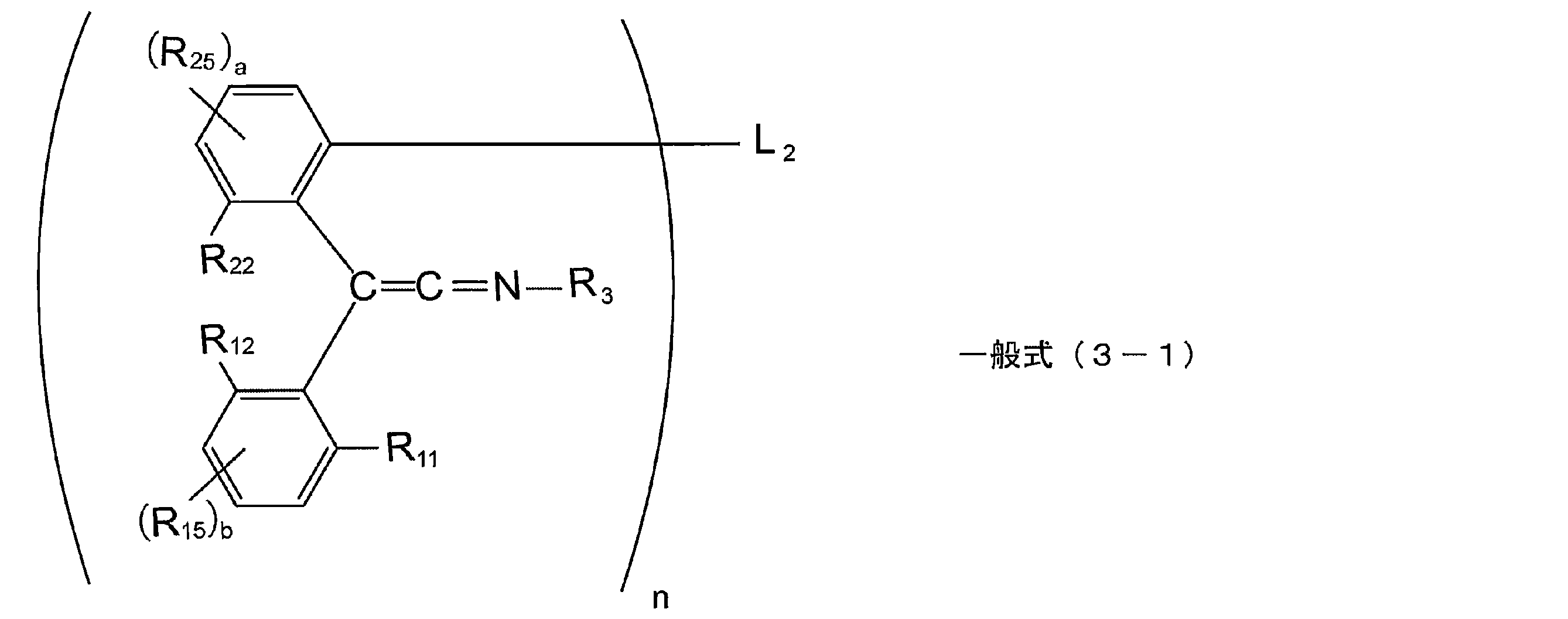
[4]上記のケテンイミン化合物が下記一般式(3-2)で表されることを特徴とする[1]に記載のポリエステル樹脂組成物。

[5]上記のケテンイミン化合物が下記一般式(4)で表されることを特徴とする[1]記載のポリエステル樹脂組成物。
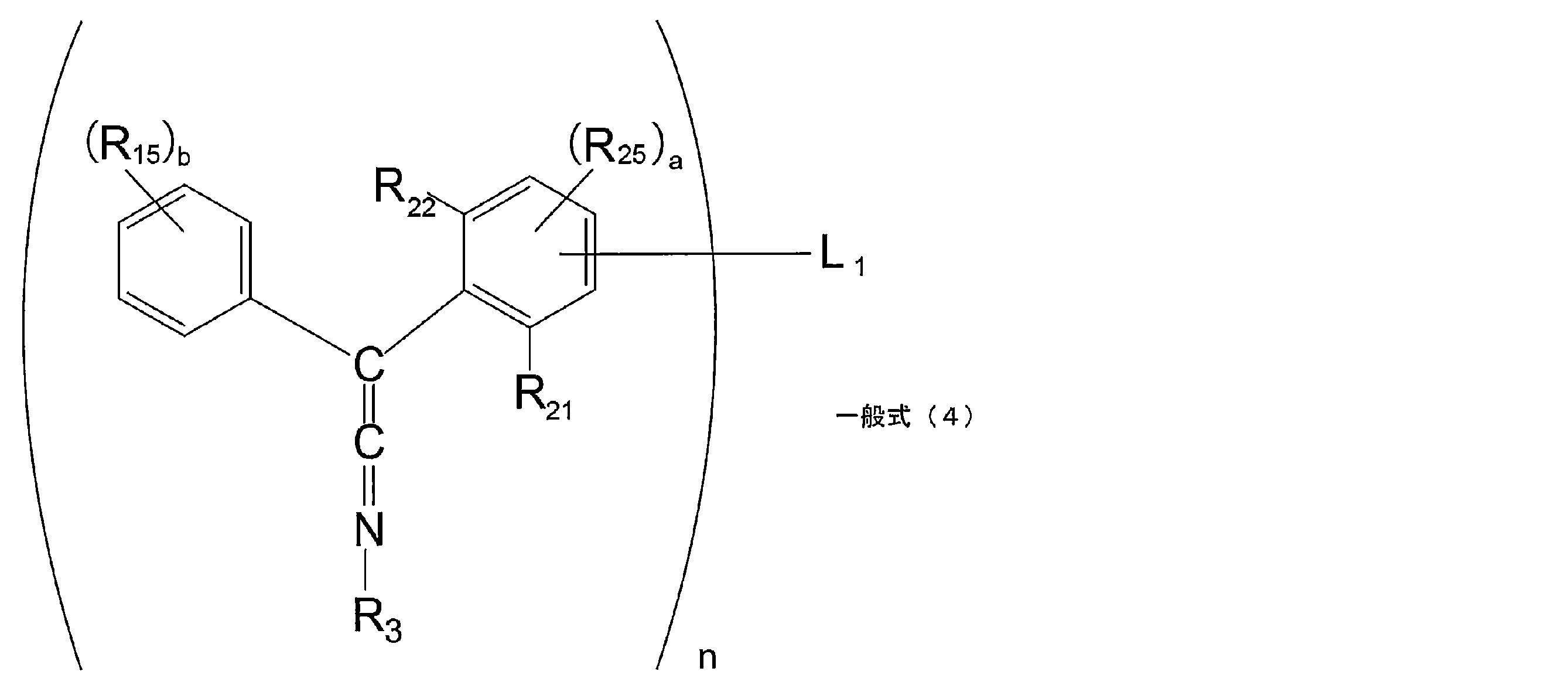
[6]上記の一般式(4)におけるR21およびR22の少なくとも一方は、置換基を有してもよいアルコキシ基、または置換基を有してもよいアリールオキシ基を表すことを特徴とする[5]に記載のポリエステル樹脂組成物。
[7]上記の一般式(4)におけるR22は、置換基を有してもよいアルコキシ基、または置換基を有してもよいアリールオキシ基を表すことを特徴とする[5]または[6]に記載のポリエステル樹脂組成物。
[8]上記のケテンイミン化合物が下記一般式(5)で表されることを特徴とする[1]に記載のポリエステル樹脂組成物。
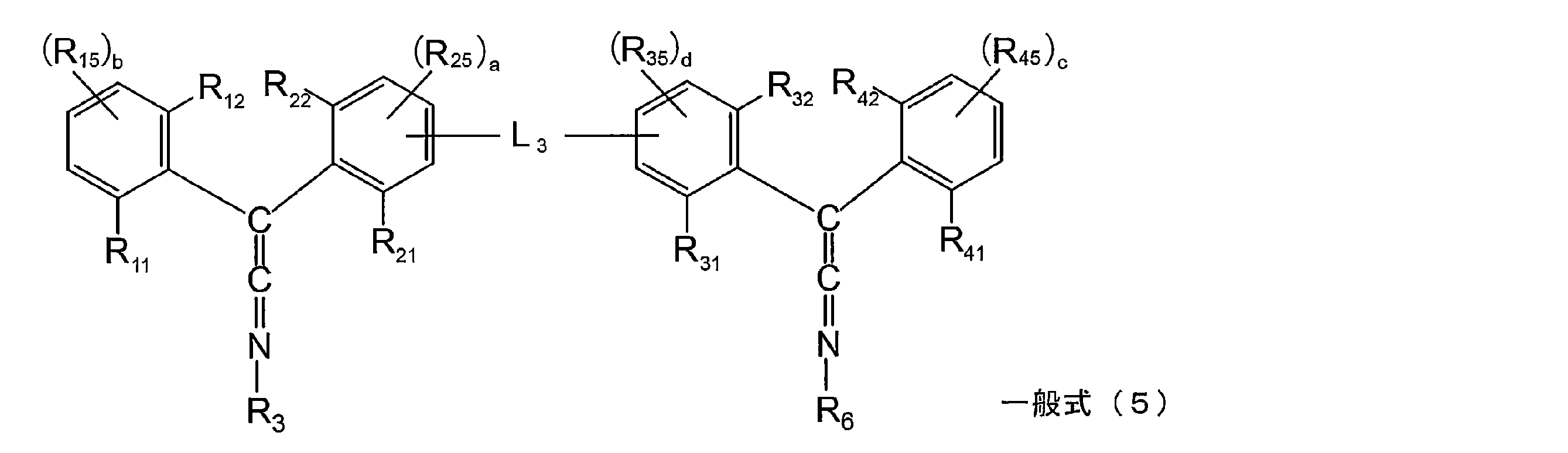
[9]上記の一般式(5)におけるR11、R12、R21、R22、R31、R32、R41およびR42の少なくとも一つは、置換基を有してもよいアルコキシ基、または置換基を有してもよいアリールオキシ基を表すことを特徴とする[8]に記載のポリエステル樹脂組成物。
[10]上記の一般式(5)におけるR21、R22、R31およびR32の少なくとも一つは、置換基を有してもよいアルコキシ基、または置換基を有してもよいアリールオキシ基を表すことを特徴とする[8]または[9]に記載のポリエステル樹脂組成物。
[11]上記のケテンイミン化合物の分子量は500以上であることを特徴とする[1]~[10]のいずれかに記載のポリエステル樹脂組成物。
[12]上記のケテンイミン化合物のケテンイミン価(全分子量/ケテンイミンの官能基数)が420以下であることを特徴とする[1]~[11]のいずれかに記載のポリエステル樹脂組成物。
[13]上記のポリエステルに対して、上記のケテンイミン化合物を0.1~2.0質量%含有することを特徴とする[1]~[12]のいずれかに記載のポリエステル樹脂組成物。
[14]顔料をさらに含有していることを特徴とする[1]~[13]のいずれかに記載のポリエステル樹脂組成物。
[15]上記の顔料が酸化チタンであることを特徴とする[14]に記載のポリエステル樹脂組成物。
[16][1]~[15]のいずれかに記載のポリエステル樹脂組成物から形成されるポリエステルフィルム。
[17][16]に記載のポリエステルフィルムを用いたことを特徴とする太陽電池モジュール用バックシート。
[18][17]に記載の太陽電池モジュール用バックシートを用いたことを特徴とする太陽電池モジュール。
[19]一般式(6)で表されることを特徴とするケテンイミン化合物。

[20]上記の一般式(6)におけるR22は、置換基を有してもよいアルコキシ基、または置換基を有してもよいアリールオキシ基を表すことを特徴とする[19]に記載のケテンイミン化合物。
[21]下記一般式(7)で表されることを特徴とする[19]に記載のケテンイミン化合物。

[22]上記の一般式(7)におけるR21、R22、R31およびR32の少なくとも一つは、置換基を有してもよいアルコキシ基、または置換基を有してもよいアリールオキシ基を表すことを特徴とする[21]に記載のケテンイミン化合物。
本発明に用いるケテンイミン化合物は、下記一般式(1)で表される。

R11、R12、R21およびR22が置換基を有する場合、ケテンイミン基とカルボキシル基との反応性を過度に低下させない限り、置換基は特に制限されることはない。置換基としては、上記の置換基を同様に例示することができる。
アリール基にはヘテロアリール基が含まれるものとする。ヘテロアリール基とは、芳香族性を示す5員、6員又は7員の環又はその縮合環の環構成原子の少なくとも1つがヘテロ原子に置換されたものをいう。ヘテロアリール基としては、例えば、イミダゾリル基、ピリジル基、キノリル基、フリル基、チエニル基、ベンズオキサゾリル基、インドリル基、ベンズイミダゾリル基、ベンズチアゾリル基、カルバゾリル基、アゼピニル基を例示することができる。ヘテロアリール基に含まれるヘテロ原子は、酸素原子、硫黄原子、窒素原子であることが好ましく、中でも、酸素原子または窒素原子であることが好ましい。
R11、R12、R21およびR22が表すヘテロアリール基はさらに置換基を有していてもよく、ケテンイミン基とカルボキシル基との反応性を過度に低下させない限り、置換基は特に制限されない。

R3が置換基を有する場合、ケテンイミン基とカルボキシル基との反応性を低下させない限り、置換基は特に制限されることはない。置換基としては、上記の置換基を同様に例示することができる。
アリール基にはヘテロアリール基が含まれるものとする。ヘテロアリール基とは、芳香族性を示す5員、6員又は7員の環又はその縮合環の環構成原子の少なくとも1つがヘテロ原子に置換されたものをいう。ヘテロアリール基としては、例えば、イミダゾリル基、ピリジル基、キノリル基、フリル基、チエニル基、ベンズオキサゾリル基、インドリル基、ベンズイミダゾリル基、ベンズチアゾリル基、カルバゾリル基、アゼピニル基を例示することができる。ヘテロアリール基に含まれるヘテロ原子は、酸素原子、硫黄原子、窒素原子であることが好ましく、中でも、酸素原子または窒素原子であることが好ましい。
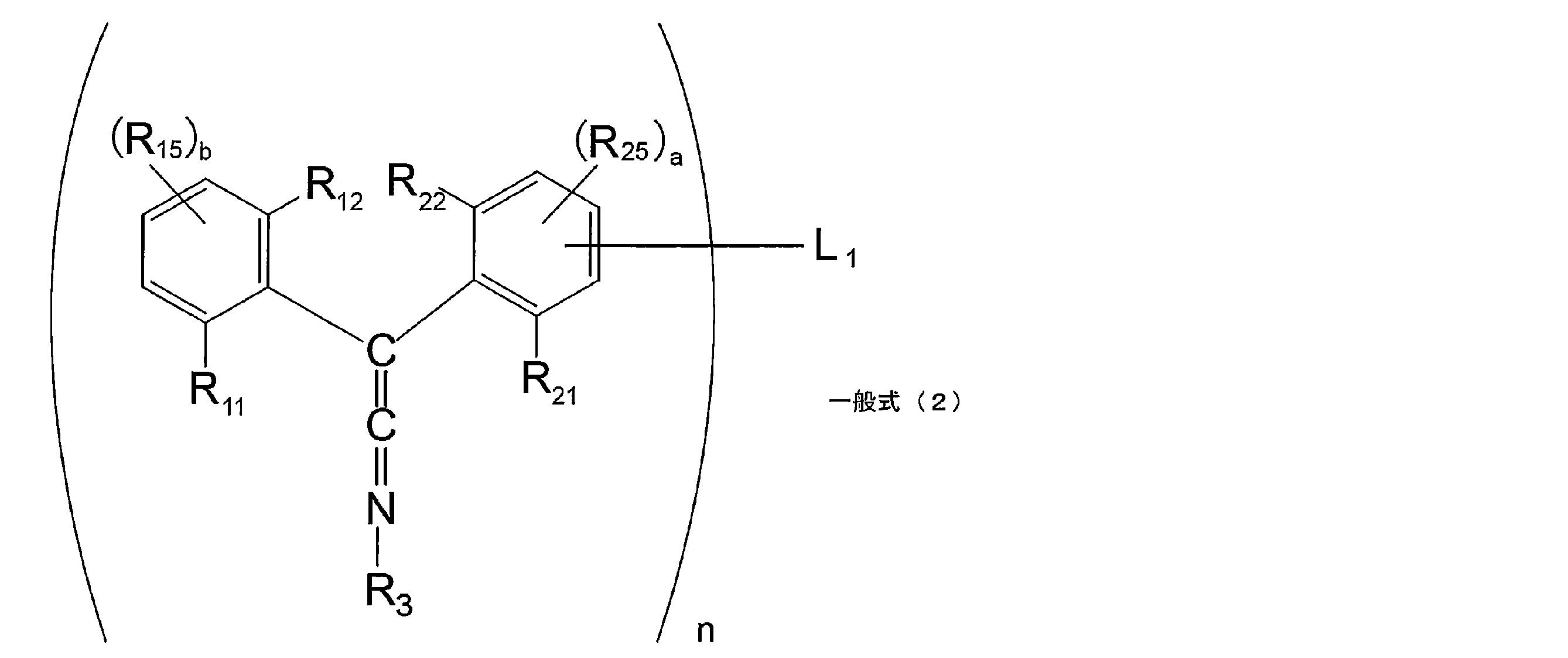
また、一般式(2)中、R15およびR25は、一般式(1)におけるそれと同意であり、好ましい範囲も同様である。
二価の連結基の具体例としては、例えば、-NR8-(R8は水素原子、置換基を有していてもよいアルキル基または置換基を有していてもよいアリール基を表し、水素原子が好ましい)で表される基、-SO2-、-CO-、置換もしくは無置換のアルキレン基、置換もしくは無置換のアルケニレン基、アルキニレン基、置換もしくは無置換のフェニレン基、置換もしくは無置換のビフェニレン基、置換もしくは無置換のナフチレン基、-O-、-S-および-SO-ならびにこれらを2つ以上組み合わせて得られる基が挙げられる。
三価の連結基の具体例としては、例えば、二価の連結基の例として挙げた連結基のうち置換基を有するものから1つの水素原子を取り除いた基が挙げられる。
四価の連結基の具体例としては、例えば、例えば、二価の連結基の例として挙げた連結基のうち置換基を有するものから2つの水素原子を取り除いた基が挙げられる。

また、一般式(3-1)中、R15およびR25は、一般式(1)におけるそれと同意であり、好ましい範囲も同様である。

また、一般式(3-2)中、R15およびR25は、一般式(1)におけるそれと同意であり、好ましい範囲も同様である。

また、一般式(4)中、R15およびR25は、一般式(1)におけるそれと同意であり、好ましい範囲も同様である。

また、一般式(5)中、R15、R25、R35およびR45は、一般式(1)におけるR15またはR25と同意であり、好ましい範囲も同様である。
フリーデルクラフト反応は、一般的には酸を用いた脱水縮合によるラクトン環の形成、または加熱による脱水縮合によるラクトン環の形成により行うことができる。一般的なケテンイミン化合物の合成方法は下記の通りである。
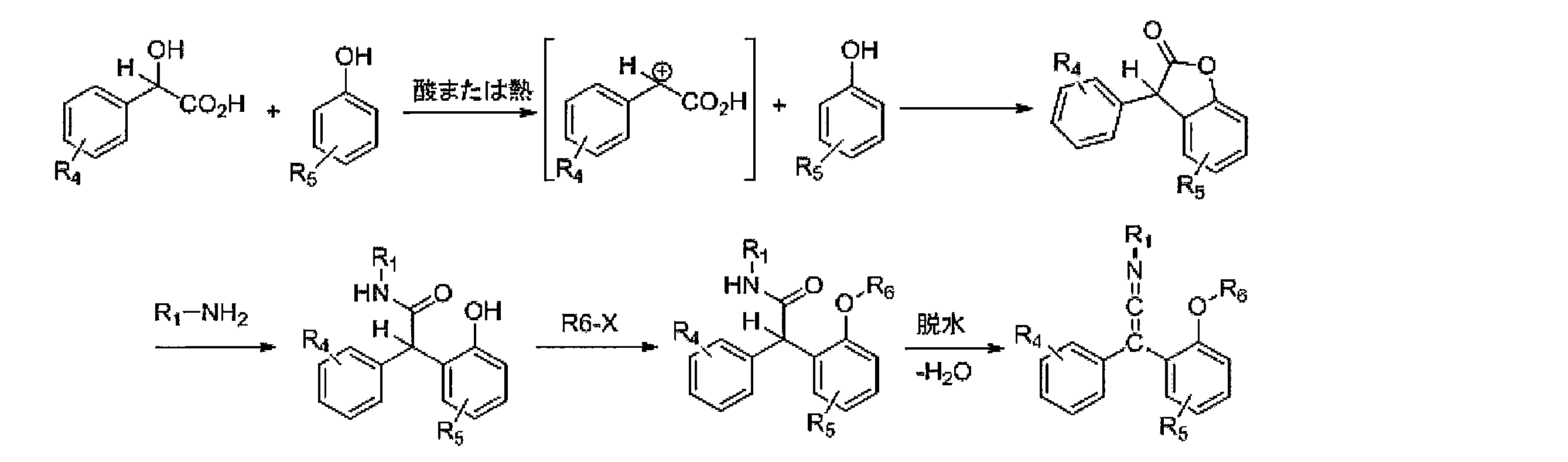
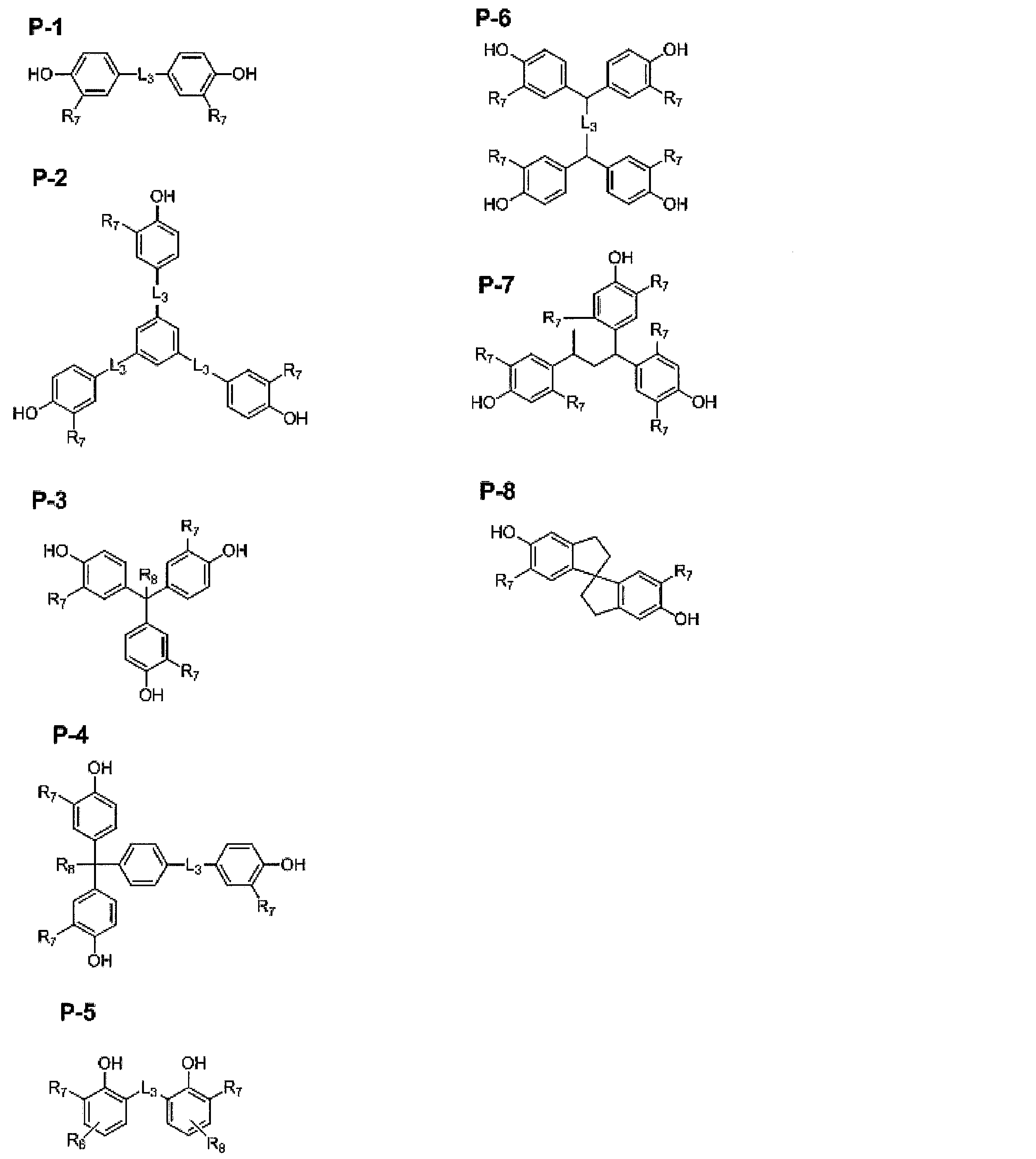


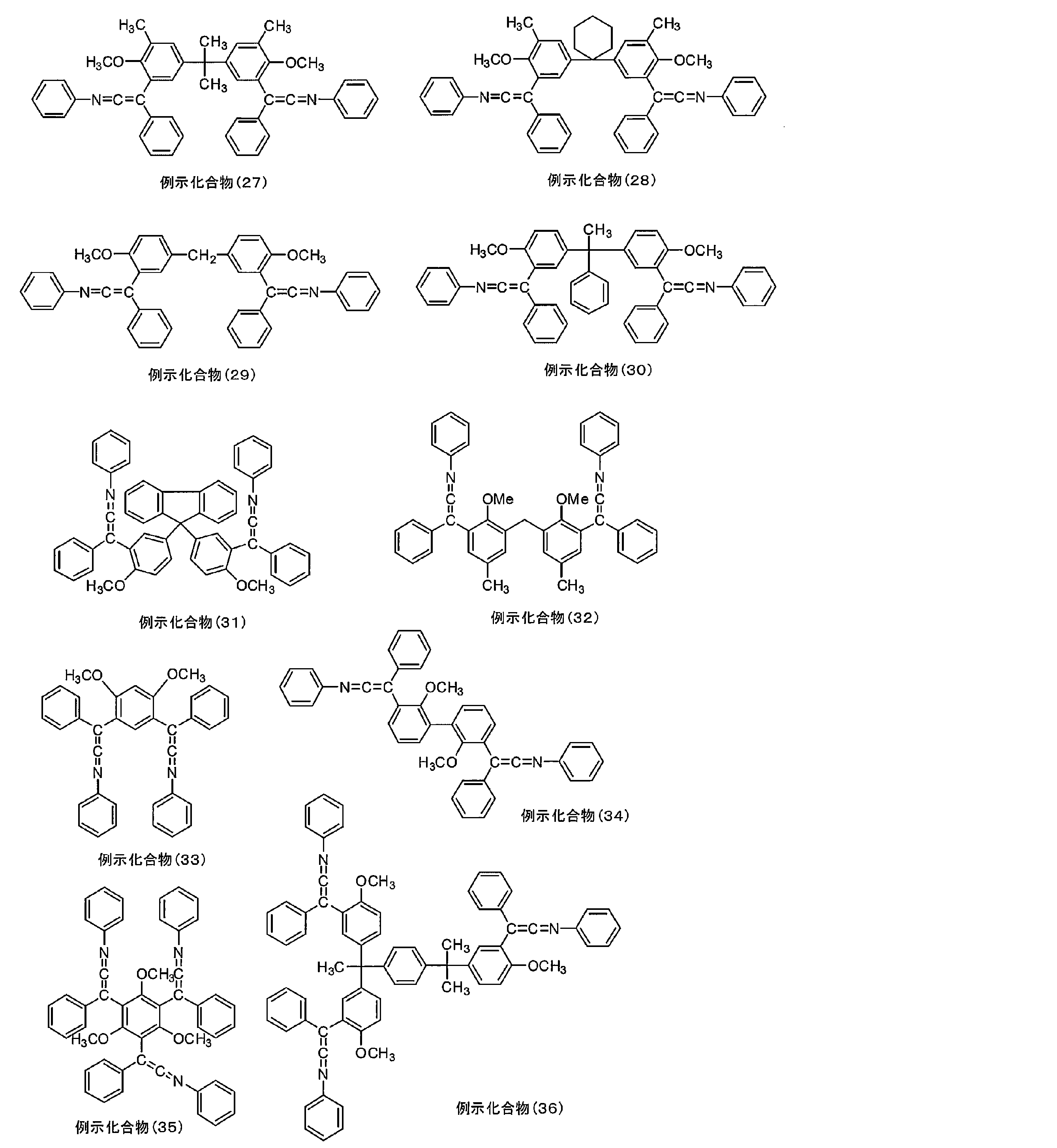


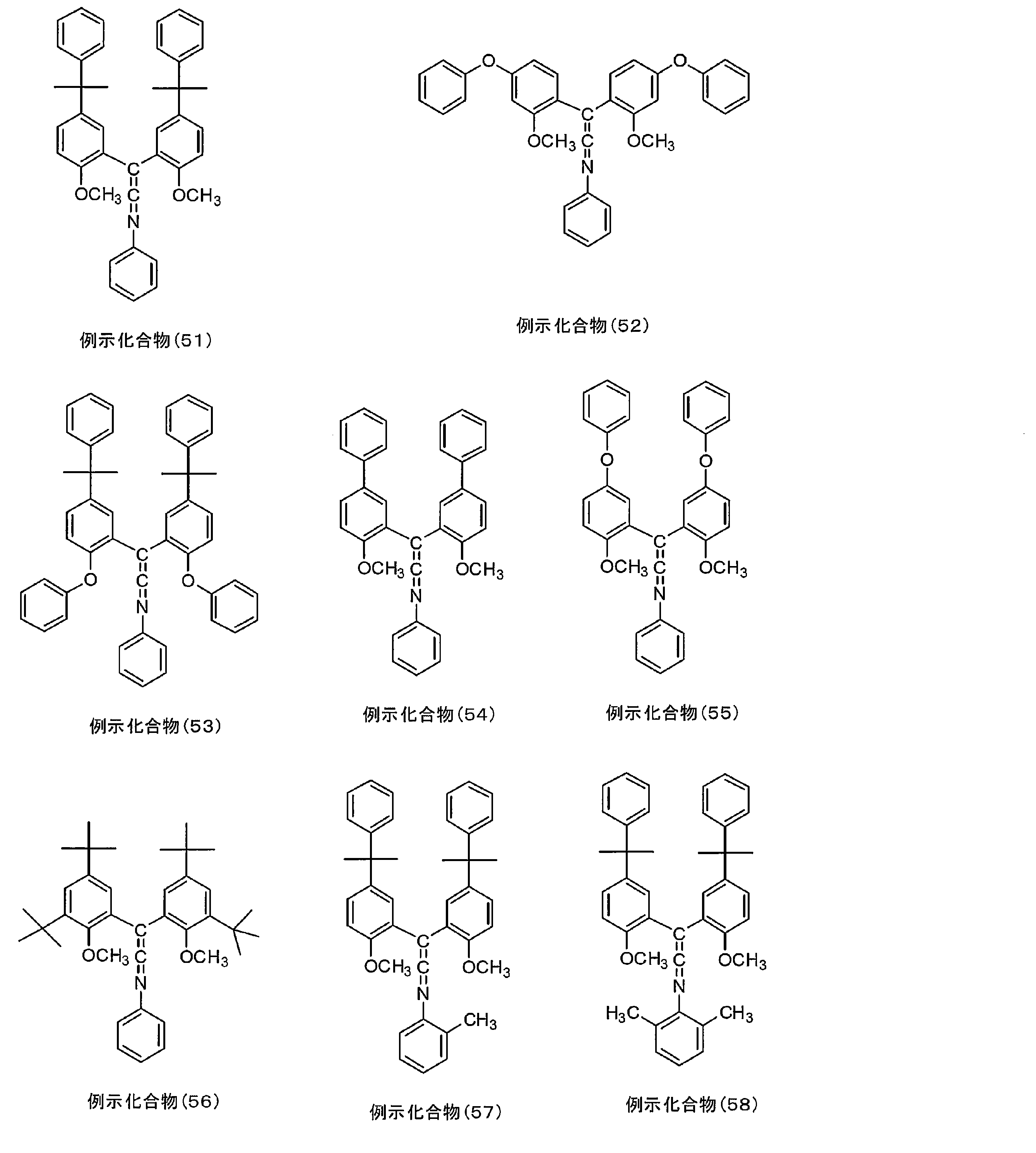
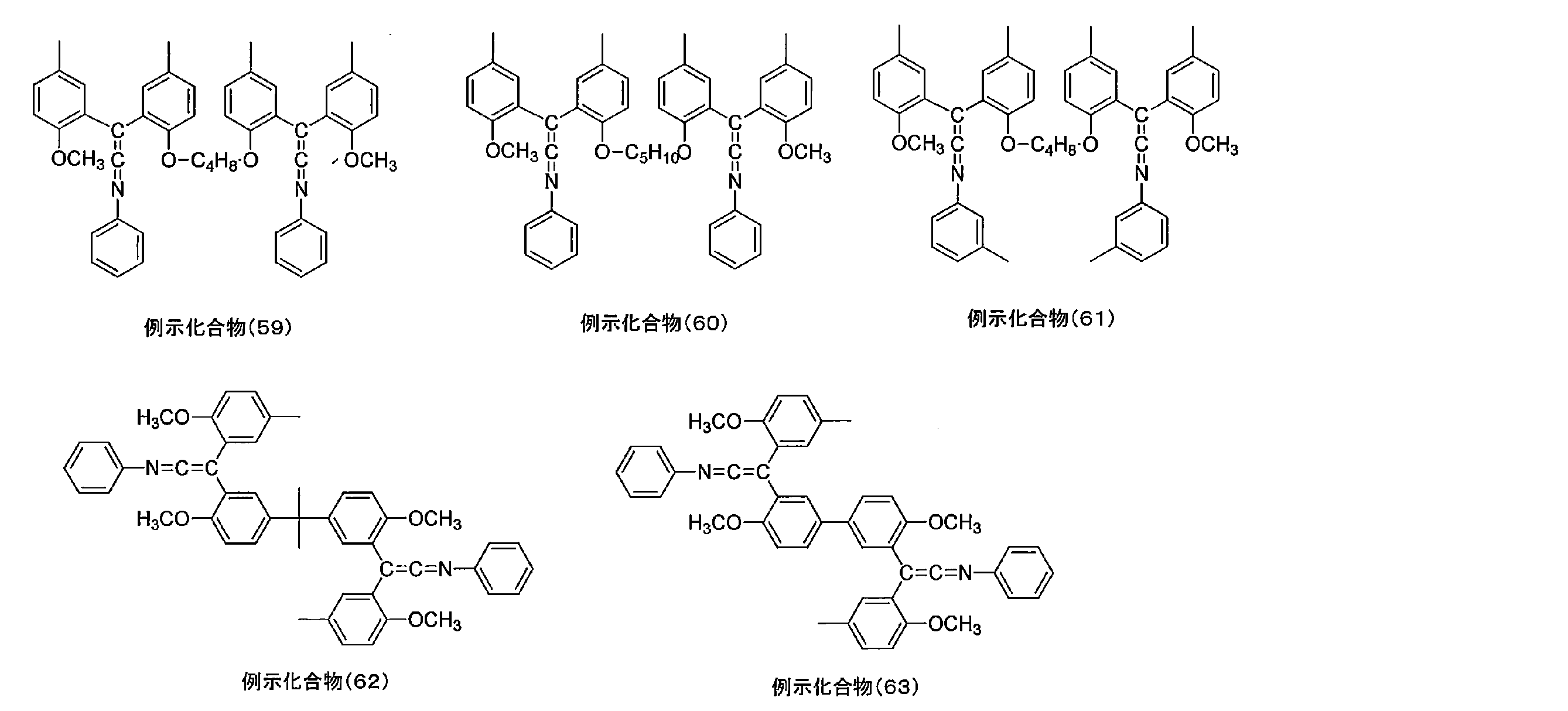
しかし、本発明者が詳細に検討した結果、溶融混合中にケテンイミン化合物及びケテン化合物(1)が揮散してくることが判明した。このことは、反応にてイミド化合物(1)の一部が熱によりケテン化合物(1)と、末端アミド基にて封止されたポリエステルが得られているものと推定できる。

本発明のポリエステル樹脂組成物は、上述したようなケテンイミン化合物とポリエステルを含む。なお、本発明の効果を阻害しない範囲内であれば、本発明のポリエステル樹脂組成物には、各種添加剤、例えば、相溶化剤、可塑剤、耐候剤、酸化防止剤、熱安定剤、滑剤、帯電防止剤、増白剤、着色剤、導電剤、紫外線吸収剤、難燃剤、難燃助剤、顔料および染料などを含むこととしても良い。
また、本発明のポリエステルフィルムを太陽電池モジュール用のバックシートに用いる場合、入射する太陽光を反射する反射層として着色層を構成する観点からも、酸化チタン、硫酸バリウム、炭酸カルシウム等の白色顔料が好ましく用いられる。
このように、ケテン化合物の揮散が抑えられると、製造工程においてケテン化合物を含むガスの発生を抑制することができ、製造工程における作業環境を良好にすることができる。
ポリエステルの固有粘度(IV)は、フィルム製膜時に使用するポリエステルが2種以上である場合(特開2011-256337号公報の回収ポリエステルを使用する場合など)、すべてのポリエステルを混合したポリエステルの固有粘度が、上記範囲を満たすことが好ましい。
ポリエステルの固有粘度(IV)は、ポリエステルをオルトクロロフェノールに溶解し、25℃で測定した溶液粘度から、下式より固有粘度を得た。
ηsp/C=[η]+K[η]2・C
ここで、ηsp=(溶液粘度/溶媒粘度)-1であり、Cは、溶媒100mlあたりの溶解ポリマー重量であり(本測定では1g/100mlとする)、Kはハギンス定数(0.343とする)であり、溶液粘度、溶媒粘度はオストワルド粘度計を用いて測定した。
本発明は、上述したポリエステル樹脂組成物から作成されるポリエステルフィルムに関する。
(フィルム形成工程)
フィルム形成工程においては、本発明のポリエステルフィルムを形成するための樹脂組成物に含まれるポリエステルおよびケテンイミン化合物を溶融させた溶融体をギアポンプや濾過器を通し、その後、ダイを介して冷却ロールに押出し、これを冷却固化させることで(未延伸)フィルムを形成することができる。なお、押出された溶融体は、静電印加法を用いて冷却ロールに密着させることができる。この際、冷却ロールの表面温度は、おおよそ10℃~40℃とすることができる。
フィルム形成工程によって形成された(未延伸)フィルムは、延伸工程において、延伸処理を施すことができる。延伸工程においては、冷却ロールで冷却固化させた(未延伸)フィルムに1つまたは2つの方向に延伸されることが好ましく、2つの方向に延伸されることがより好ましい。2つの方向への延伸(二軸延伸)は、長手方向(MD:Machine Direction)の延伸(以下「縦延伸」ともいう)及び幅方向(TD:Transverse Direction)の延伸(以下、「横延伸」ともいう)であることが好ましい。その縦延伸、横延伸は各々1回で行っても良く、複数回に亘って実施しても良く、同時に縦、横に延伸してもよい。
延伸処理は、フィルムのガラス温度(Tg)℃~(Tg+60)℃で行うのが好ましく、より好ましくはTg+3℃~Tg+40℃、さらに好ましくはTg+5℃~Tg+30℃である。
延伸倍率(%)=100×(延伸後の長さ)/(延伸前の長さ)
150℃熱収縮率(%)=100×(300-L)/300
また、熱収縮率が正の場合は縮みを、負は伸びを表わす。
また、本発明のフィルムは、その上に、COOH、OH、SO3H、NH2及びその塩から選ばれる少なくとも一つの官能基を含む塗布層を設けた積層体として用いることもできる。
本発明のポリエステルフィルムは、その上に易接着層等の塗布層を設けた積層フィルムとして用いることもできる。本発明のポリエステルフィルムや積層フィルムは、様々な用途に用いられるが、太陽電池モジュール用バックシート(太陽電池モジュールの保護シート)として好適に用いられる。本発明のポリエステルフィルムは、優れた密着性や耐湿熱性を有するため、太陽電池モジュール用バックシートに用いた場合、長期間に亘って太陽電池モジュールを保護することができ、太陽電池モジュールの発電効率を損ねることがない。また、本発明のポリエステルフィルムは、黄変することが抑制されているため、太陽電池モジュールの意匠性を損ねたりすることもない。
本発明のバックシートは内側面(封止材に接着する側)に光の反射層を設けることが好ましい。反射層を設けることにより太陽電池モジュールに入射した太陽光のうち、太陽電池セルをすり抜けてバックシートに到達した光を反射させて太陽電池セルに戻すことが可能になる。これにより、発電効率を向上させることができる。
更に、反射層は封止材に対して10N/cm以上、より好ましくは20N/cm以上の接着強度を持つことが好ましい。
初めに反射層のバインダーについて述べる。本発明の反射層のバインダーとしてはアクリル系、ポリエステル系、ポリウレタン系、ポリオレフィン系ポリマー等を用いることができるが、この中ではポリオレフィン系ポリマーが好ましい。
これらの架橋剤のうち、湿熱経時後の接着性を確保する観点から、カルボジイミド系架橋剤、オキサゾリン系架橋剤が特に好ましい。本発明で用いられるカルボジイミド系架橋剤は分子内に1つ以上のカルボジイミド基を持つ化合物である。
好ましい白色顔料としては、例えば酸化チタン、硫酸バリウム、酸化珪素、酸化アルミニウム、酸化マグネシウム、炭酸カルシウム、カオリン、タルク等を挙げることができる。これらの内で白色度、反射率、耐久性の観点から酸化チタンは特に好ましい。酸化チタンにはルチル、アナターゼ、ブルカイトの3種類の結晶系があるが、高い屈折率と白色度、及び低い光触媒活性からルチル型の結晶構造を持つものが好ましい。
界面活性剤としては、アニオン系やノニオン系等の公知の界面活性剤が挙げることができる。アニオン系界面活性剤としてはアルキル硫酸ナトリウム塩、アルキルベンゼンスルホン酸ナトリウム塩などがあり、ノニオン系界面活性剤としてはポリオキシエチレンアルキルエーテルなどがある。また、パーフロロアルキル硫酸ナトリウム塩のようなフッ素系界面活性剤も好ましい。
反射層の厚みを3~10μmの範囲にすることで、必要な反射率と接着性を両立することができる。
塗布溶媒にも制約はなく、メチルエチルケトン、トルエン、キシレンのような有機溶剤系の溶媒を用いても、水を溶媒として用いてもよい。しかし、環境負荷が小さいことを考えると水を溶媒とした塗布は特に好ましい。塗布溶媒は単独で用いても混合して用いてもよい。特に水系の塗布溶媒の場合、水に水混和性の有機溶剤を少量加えた混合溶媒として用いてもよい。
反射層の乾燥にも特に制限はないが、乾燥時間の短縮化の観点から120~200℃程度の温度で1~10分間程度乾燥させることが好ましい。乾燥温度が120℃未満の場合、乾燥時間が長くなり製造をする上で不利である。逆に200℃を超えると得られるバックシートの平面性が損なわれる場合がある。
本発明のバック層には封止材との接着性を向上させる目的で反射層の上にオーバーコート層を設けてもよい。
オーバーコート層の架橋剤の含有量としては、オーバーコート層を構成するバインダーに対して、5質量%~40質量%が好ましく、10質量%~30質量%がより好ましい。架橋剤の含有量が、5質量%以上であると、ポリマー層の強度及び接着性を保持しながら充分な架橋効果が得られ、40質量%以下とすると塗布液のポットライフをより長く保つことができる。
本発明のバックシートは外側面(太陽電池セルの反対側の面)に支持体を保護するための裏面層を設ける。
本発明のシリコーン系複合ポリマーは水系のポリマーをラテックスの形態とする場合、カルボキシル基、スルホン酸基、水酸基、アミド基などの水親和性の官能基を持つものであることが好ましい。本発明のシリコーン系複合ポリマーがカルボキシル基を持つ場合、カルボキシル基はナトリウム、アンモニウム、アミンなどで中和されていてもよい。
また、ラテックスの形態で使用する場合、安定性を向上させるために界面活性剤(例:アニオン系やノニオン系界面活性剤)、ポリマー(例:ポリビニルアルコール)等の乳化安定剤を含有させてもよい。さらに、必要に応じてpH調整剤(例:アンモニア、トリエチルアミン、炭酸水素ナトリウム等)、防腐剤(例:1、3、5-ヘキサヒドロ――(2-ヒドロキシエチル)―s―トリアジン、2-(4-チアゾリル)ベンズイミダゾール等)、増粘剤(例:ポリアクリル酸ナトリウム、メチルセルロース等)、造膜助剤(例:ブチルカルビトールアセテート等)等のラテックスの添加剤として公知の化合物を添加してもよい。
架橋剤の含有量としては、裏面層を構成するバインダーに対して、5質量%~40質量%が好ましく、10質量%~30質量%がより好ましい。架橋剤の含有量が、5質量%以上であると、支持体との接着性を保持しながら充分な架橋効果が得られ、40質量%以下とすると塗布液のポットライフをより長く保つことができる。
紫外線吸収剤の例としては、例えば、有機系の紫外線吸収剤の場合は、サリチル酸系、ベンゾフェノン系、ベンゾトリアゾール系、シアノアクリレート系等の紫外線吸収剤およびヒンダードアミン系等の紫外線安定剤などが挙げられる。
また、無機系の紫外線吸収剤としては、酸化チタン、酸化亜鉛、酸化セリウム、などの金属酸化物や、カーボン、フラーレン、カーボンファイバー、カーボンナノチューブなどの炭素系成分等が挙げられる。 これらの中でコストと耐久性の観点から酸化チタンは特に好ましい。
裏面層の紫外線吸収剤添加量は紫外線吸収剤の種類によっても異なるが、0.2~5g/m2、より好ましくは0.3~3g/m2の範囲が好ましい。
裏面層の白色顔料の添加量は0.3~10g/m2、より好ましくは4~9g/m2の範囲が好ましい。添加量を0.3~10g/m2とすることで良好な接着性と反射率向上を両立できる。なお、白色顔料として酸化チタンを用いる場合は顔料と紫外線吸収剤を兼ねることができる。裏面層のその他の添加剤の種類と添加量としては反射層のところで述べたものを好ましく用いることができる。
裏面層の厚みを3~12μmの範囲にすることで、必要な耐久性と接着性を両立することができる。
本発明のバックシートでは、耐久性をさらに向上させる目的で裏面層の上に裏面保護層を設けてもよい。
本発明で好ましく用いることができるフッ素系ポリマーは、主鎖又は側鎖にフッ素含有モノマーを含むポリマーである。フッ素含有モノマーは主鎖、側鎖のどちらに含まれていてもよいが、耐久性の観点から主鎖に含まれている事が好ましい。
本発明のフッ素系ポリマーは水系のポリマーをラテックスの形態とする場合、カルボキシル基、スルホン酸基、水酸基、アミド基などの水親和性の官能基を持つものであることが好ましい。
すべり剤としては、例えば、合成ワックス系化合物、天然ワックス系化合物、界面活性剤系化合物、無機系化合物、有機樹脂系化合物などが挙げられる。中でも、ポリマー層の表面強度の点で、合成ワックス系化合物、天然ワックス系化合物、及び界面活性剤系化合物から選ばれる化合物が好ましい。
本発明で使用できるコロイダルシリカは、ケイ素酸化物を主成分とする微粒子が水または単価のアルコール類またはジオール類またはこれらの混合物を分散媒として微粒子状態で存在するものである。
本発明の太陽電池モジュールは、本発明のポリエステルフィルムまたは本発明の太陽電池モジュール用バックシートを含むことを特徴とする。
本発明の太陽電池モジュールは、太陽光の光エネルギーを電気エネルギーに変換する太陽電池素子を、太陽光が入射する透明性の基板と既述の本発明のポリエステルフィルム(太陽電池用バックシート)との間に配置して構成されている。基板とポリエステルフィルムとの間は、例えばエチレン-酢酸ビニル共重合体等の樹脂(いわゆる封止剤)で封止して構成することができる。
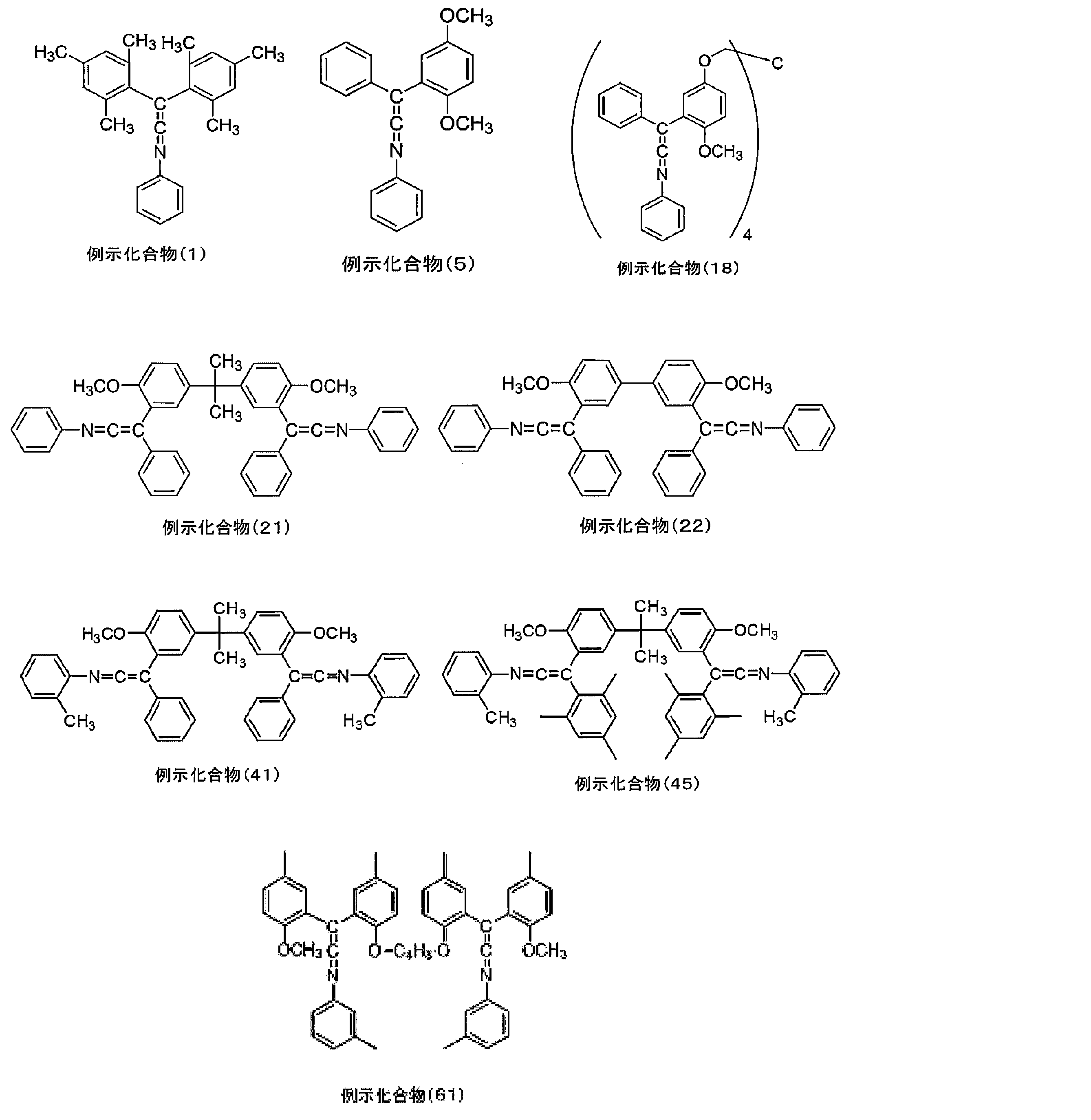
例示化合物1の合成
メシチレン2.4g(20mmol)とグリオキシル酸一水和物0.8g(9mmol)に、メタンスルホン酸50mLと酢酸50mLを加え、80℃で4時間攪拌した。これを酢酸エチルで抽出し蒸留水で洗浄したのち濃縮して白色固体を得た。これをジクロロメタン100mLに溶解させたのち塩化チオニル1.18g(10mmol)を滴下し6時間加熱還流した。残存した塩化チオニルを減圧溜去しアニリン1.9g(20mmol)を加えて70℃で2時間攪拌した。これを酢酸エチルで抽出し、1N塩酸水溶液で洗浄し、有機層を減圧濃縮して白色固体を得た。
これをクロロホルム50mLに溶解させ、トリエチルアミン1.02g(10mmol)、トリフェニルホスフィン2.1g(8mmol)、四塩化炭素1.27g(8mmol)を加えて65℃で6時間反応させた。これに酢酸エチルを加えてろ液を濃縮し、カラムクロマトグラフィー(ヘキサン/酢酸エチル=10/1)で精製することで例示化合物1を1.2g(3.3mmol 33%収率、黄色固体)で得た。1H-NMR(DMSO-d6):2.12(s,12H)、2.17(s、6H)、7.0-7.5(m、5H)
例示化合物5の合成
ヒドロキノン138g(1.25mol)とマンデル酸76g(0.50mol)に73%硫酸300mLを加えて100℃で30分間加熱攪拌した。2Lの氷水に開け、生じた薄桃色固体をろ取し純水で洗浄した。さらにトルエン500mLで再結晶を行うことで中間体5Aを102g(0.45mmol、90%収率、薄桃色固体)で得た。1H-NMR(DMSO-d6):5.28(s、1H)、6.54(s、1H)、6.74(d、1H)、7.10(d、1H)、7.31(d、2H)、7.3-7.5(m、3H)
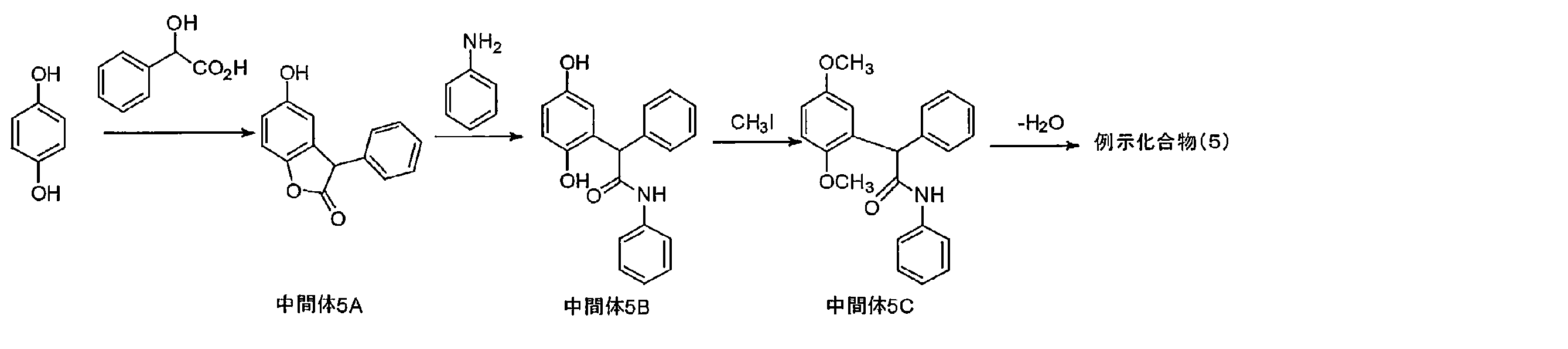
例示化合物18の合成
中間体5B(4.2mmol)をアセトンに溶解し、炭酸カリウム(4.2mmol)とペンタエリトリトールテトラブロミド(1.0mmol)を加えて60℃で2時間加熱攪拌した。その後室温に戻し炭酸カリウム(8.4mmol)とヨードメタン(8.4mmol)を加えて室温下で4時間攪拌した。これを純水に晶析し得られた白色固体をカラムクロマトグラフィー(ヘキサン/酢酸エチル=4/1)で精製することで中間体18Aを得た。1H-NMR(DMSO-d6):3.65(s、12H)、4.30(s、8H)、5.40(s、4H)、6.75(s、4H)、6.78(d、4H)、6.90(d、4H)、7.06(t、4H)、7.2-7.4(m、28H)、7.65(d、8H)、10.1(s、4H)

例示化合物21の合成
ビスフェノールA 40g(0.175mol)とマンデル酸64g(0.21mol)を300mLフラスコに加え、220℃で減圧し発生する水をディーンスタークトラップで溜去しながら6時間加熱攪拌した。室温に冷却し酢酸エチルで溶解抽出し蒸留水で洗浄、硫酸マグネシウムで乾燥して有機層を濃縮し中間体21を72g(0.158mol、収率90%、オレンジ色固体)で得た。1H-NMR(DMSO-d6):1.54(s、6H)、5.30(s、2H)、7.01(s、2H)、7.12(d、4H)、7.18(s、4H)、7.32(m、6H)

例示化合物22の合成
例示化合物21の合成において、ビスフェノールAの代わりにビフェノールを用いたこと以外は同様の方法にて例示化合物22を合成した。1H-NMR(DMSO-d6):3.72(s、6H)、7.1-7.5(m、26H)
例示化合物41の合成
例示化合物21の合成において、アニリンの代わりにo-トルイジンを用いたこと以外は同様の方法にて例示化合物41を合成した。1H-NMR(DMSO-d6):1.47(s、6H)、2.23(s、6H)、3.67(s、6H)、6.8-7.6(m24H)
例示化合物45の合成
例示化合物21の合成において、マンデル酸の代わりに2-ヒドロキシー2-(2,4,6-トリメチルフェニル)-プロピオン酸を用い、アニリンの代わりにo-トルイジンを用いたこと以外は同様の方法にて例示化合物45を合成した。1H-NMR(DMSO-d6):1.31(s、6H)、2.09(s、6H)、2.12(s、12H)、2.17(s、6H)、3.44(s、6H)、6.7-7.2(m、18H)
例示化合物61の合成
酢酸750ml、p-メチルアニソール610g(5.0モル)、グリオキシル酸一水和物437g(4.75モル)を5L三口フラスコに仕込み、内温が5~10℃となるように氷浴で冷却しながらメタンスルホン酸750mLを滴下した後2時間攪拌した。その後、p-クレゾール650g(6.0モル)を加え、60℃で2時間攪拌した。この反応液を氷浴で20℃に冷却し、エタノール2.5Lを加え、析出した固体をろ取することで中間体61Aを910g(3.4モル)で得た。
1H-NMR(DMSO-d6):2.25(s、3H)、2.30(s、3H)、3.55(s、3H)、5.19(s、1H)、6.8-7.2(m、6H)
1H-NMR(DMSO-d6):2.18(s、3H),2.21(s,3H),2.28(s,3H)、3.74(s、3H)、5.58(s、1H)6.6-6.9(m、6H)、7.0-7.2(m、2H)、7.3-7.6(m、2H)、9.24(s、1H)、10.09(s、1H)
1H-NMR(DMSO-d6):1.52(s、4H),2.18(s、6H),2.21(s、6H),2.28(s,3H)、3.50(s、4H),3.72(2,6H),3.57(s,2H),6.60(m、4H),6.8-7.2(m、12H),7.4-7.6(m,4H),10.08(s,2H)
1H-NMR(DMSO-d6):1.31(s、4H),2.19(s,6H),2.21(s,6H),2.29(s、6H),3.62(s、4H),3.71(s、6H),6.59(s、2H)、6.76(d、2H),6.82(s、2H),6.9-7.3(m、14H)


1.飽和ポリエステル樹脂の作製
-工程(A)-
高純度テレフタル酸4.7トンとエチレングリコール1.8トンとを90分間かけて混合してスラリーを形成し、3800kg/hの流量で連続的に第一エステル化反応槽に供給した。次いで、クエン酸がTi金属に配位したクエン酸キレートチタン錯体(「VERTEC AC-420」、ジョンソン・マッセイ社製)のエチレングリコール溶液を連続的に第一エステル化反応槽に供給し、反応槽内温度250℃として攪拌しながら平均滞留時間約4.4時間で反応を行なってオリゴマーを得た。この際、クエン酸キレートチタン錯体は、Ti添加量が元素換算値で9ppmとなるように連続的に添加した。得られたオリゴマーの酸価は500eq/tonであった。
以上により、エステル化反応生成物を得た。
工程(A)で得られたエステル化反応生成物を連続的に第一重縮合反応槽に供給した。次いで、反応温度270℃・反応槽内圧力20torr(2.67×10⁻³MPa)でエステル化反応生成物を攪拌しながら、平均滞留時間約1.8時間で重縮合(エステル交換反応)させた。
その後、真空重合装置内に、25℃の窒素ガスを流し、ペレットを25℃まで、冷却し、酸価15eq/ton、IVが0.78dl/gのPETを得た。
-押出成形(合成工程・フィルム形成工程)-
得られた上述のPETを直径50mmの2軸混練押出し機のホッパーに主フィーダーで投入し、副フィーダーに本発明の例示化合物1を投入し、280℃で溶融して押出した。押出した溶融体(メルト)をギアポンプ及び濾過器(孔径20μm)を通した後、ダイから20℃の冷却ロールに押出し、非晶性シートを得た。なお、押出されたメルトは、静電印加法を用い冷却ロールに密着させた。
冷却ロール上に押出し、固化した未延伸フィルムに対し、以下の方法で逐次2軸延伸を施し、厚み175μmのポリエステルフィルムを得た。
<延伸方法>
(a)縦延伸
未延伸フィルムを周速の異なる2対のニップロールの間に通し、縦方向(搬送方向)に延伸した。なお、予熱温度を90℃、延伸温度を90℃、延伸倍率を3.5倍、延伸速度を3000%/秒として実施した。
(b)横延伸
縦延伸した上記のフィルムに対し、テンターを用いて下記条件にて横延伸した。
<条件>
・予熱温度:100℃
・延伸温度:110℃
・延伸倍率:4.2倍
・延伸速度:70%/秒
続いて、縦延伸及び横延伸を終えた後の延伸フィルムを下記条件で熱固定した。さらに、熱固定した後、テンター幅を縮め下記条件で熱緩和した。
<熱固定条件>
・熱固定温度:198℃
・熱固定時間:2秒
<熱緩和条件>
・熱緩和温度:195℃
・熱緩和率:5%
熱固定及び熱緩和の後、ポリエステルフィルムの両端を10cmずつトリミングした。その後、両端に幅10mmで押出し加工(ナーリング)を行なった後、張力25kg/mで巻き取った。なお、幅は1.5m、巻長は2000mであった。
以上のようにして、実施例1のポリエステルフィルムを作製した。得られたサンプルフィルムはブツや皺などなく面状も良好であった。
下記表1に記載のケテンイミン化合物、添加量及び顔料の添加条件を変更した以外は実施例1と同様にして、各実施例および比較例のポリエステルフィルムを製造した。
<揮散>
得られたポリエステルフィルムに対して、290℃で10分の加熱処理を行い、発生したガス(ケテンイミン化合物)を検出した。発生したガスは、フィルム中の揮散成分の量をガスクロマトグラフィ(商品名P&T-GC/MS、日本分光(株)社製)により測定し、評価した。得られた結果を下記表1に記載した。
A: ガス量が0.1ppm以下
B: ガス量が0.1ppm以上10ppm未満
C: ガス量が10ppm以上1000ppm未満
D: ガス量が1000ppm未満
<耐加水分解性(PCT試験)>
耐加水分解性(耐湿熱性)の評価は破断伸度保持率半減期で評価した。破断伸度保持率半減期は、実施例1にて得られたポリエステルフィルムに対して、120℃、相対湿度100%の条件で保存処理(加熱処理)を行い、保存後のポリエステルフィルムが示す破断伸度(%)が、保存前のポリエステルフィルムが示す破断伸度(%)に対して50%となる保存時間を測定することで評価した。得られた結果を下記表1に記載した。
A:破断伸度半減期が200時間以上
B:破断伸度半減期が170時間以上200時間未満
C:破断伸度半減期が140時間以上170時間未満
D:破断伸度半減期が140時間未満
破断伸度保持率半減期が長い程、ポリエステルフィルムの耐加水分解性が優れていることを示す。すなわち、本発明のポリエステルフィルムは、120℃、相対湿度100%の条件で保存処理した前後の破断伸度半減期が130時間以上であることが好ましく、160時間以上であることがより好ましい。
得られたポリエステルフィルムの透過率を測定し、この値からYI(Yellowness Index)値を計算した。
A:YI値が0以上10未満
B:YI値が10以上20未満
C:YI値が20以上40未満
D:YI値が40以上
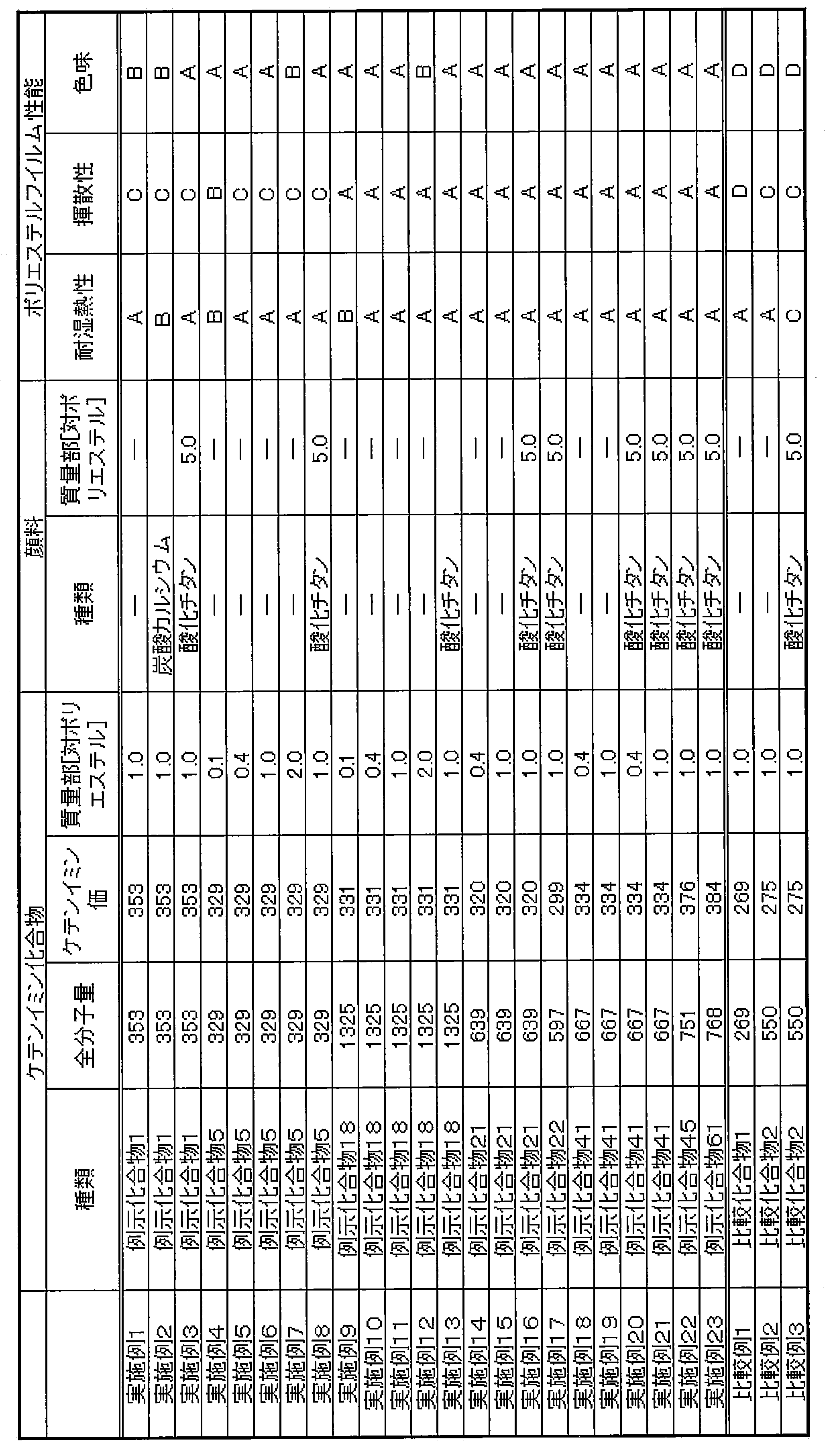
また、表1の結果より、ポリエステルに対してケテンイミン化合物の含有率は、0.1~2.0質量%であることが好ましく、ケテンイミン化合物の含有率が0.1質量%を下回ると十分な耐湿熱性が得られない傾向となり、2.0質量%を上回ると黄着色が発生する傾向となる。
さらに、ポリエステルフィルムが顔料を含む場合であって、特に酸化チタンを含む場合は、耐湿熱性が良好となり、黄着色が抑制される傾向であることがわかる。
実施例1で作製したポリエステルフィルムを用いて、太陽電池モジュール用バックシートを作製した。
まず、実施例で作製したポリエステルフィルムの一方の側に反射層及び易接着層を有し、他方の側に下塗り層、バリア層、及び防汚層を有する実施例1の太陽電池モジュール用バックシートを作製した。このようにして得られた太陽電池モジュール用バックシートは太陽電池モジュールに貼付し用いた場合、太陽電池モジュールは良好な動作性を示し、発電効率は低下しなかった。また、太陽電池モジュール用バックシートは、黄着色がなく、良好な意匠性を維持していた。
Claims (22)
- 下記一般式(1)で表されるケテンイミン化合物とポリエステルを含むことを特徴とするポリエステル樹脂組成物。

- 前記ケテンイミン化合物が下記一般式(2)で表されることを特徴とする請求項1に記載のポリエステル樹脂組成物。
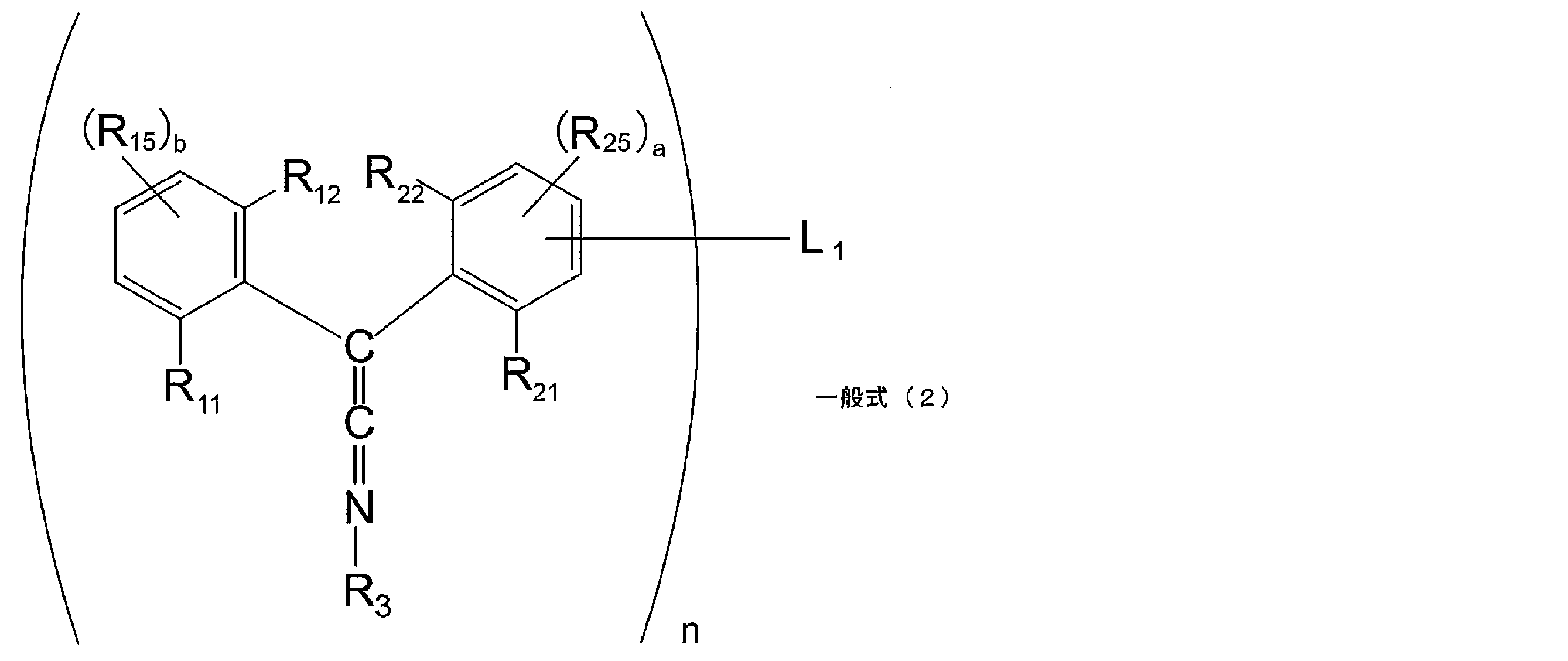
- 前記ケテンイミン化合物が下記一般式(3-1)で表されることを特徴とする請求項1に記載のポリエステル樹脂組成物。
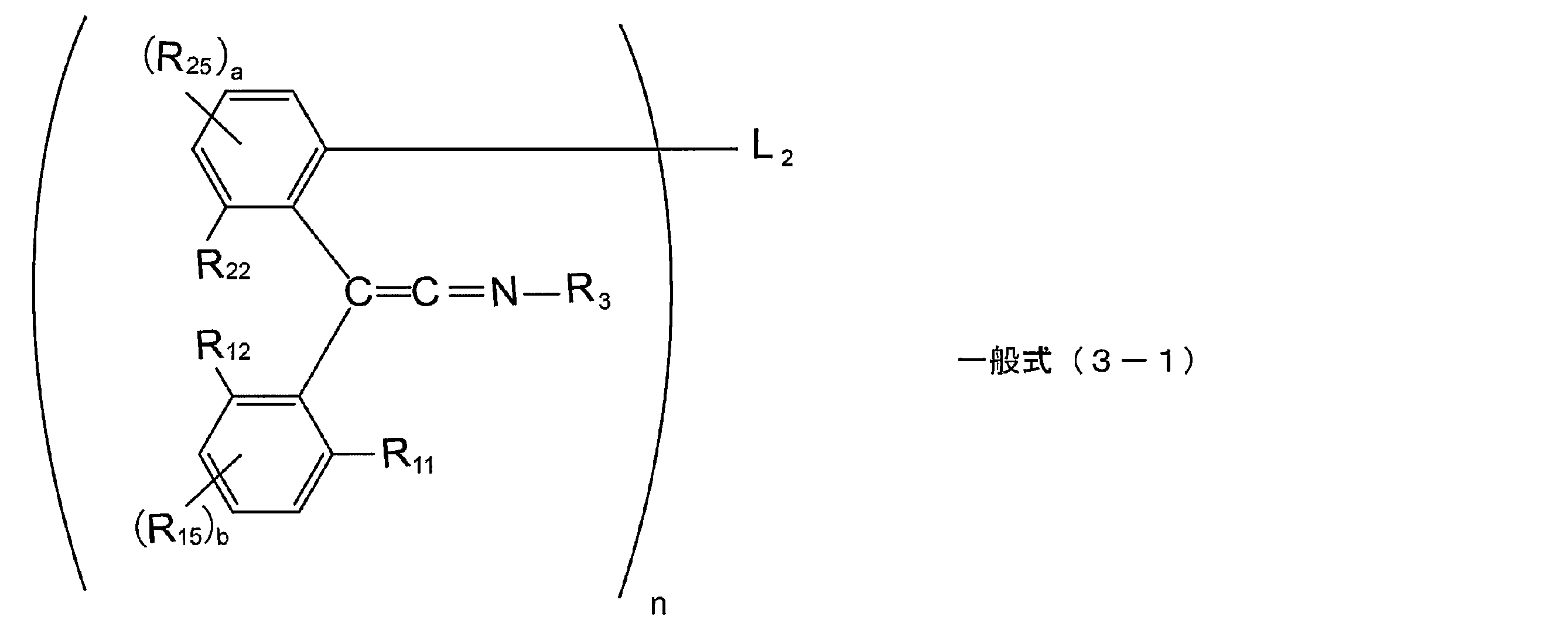
- 前記ケテンイミン化合物が下記一般式(3-2)で表されることを特徴とする請求項1に記載のポリエステル樹脂組成物。

- 前記ケテンイミン化合物が下記一般式(4)で表されることを特徴とする請求項1記載のポリエステル樹脂組成物。

- 前記一般式(4)におけるR21およびR22の少なくとも一方は、置換基を有してもよいアルコキシ基、または置換基を有してもよいアリールオキシ基を表すことを特徴とする請求項5に記載のポリエステル樹脂組成物。
- 前記一般式(4)におけるR22は、置換基を有してもよいアルコキシ基、または置換基を有してもよいアリールオキシ基を表すことを特徴とする請求項5または6に記載のポリエステル樹脂組成物。
- 前記ケテンイミン化合物が下記一般式(5)で表されることを特徴とする請求項1に記載のポリエステル樹脂組成物。

- 前記一般式(5)におけるR11、R12、R21、R22、R31、R32、R41およびR42の少なくとも一つは、置換基を有してもよいアルコキシ基、または置換基を有してもよいアリールオキシ基を表すことを特徴とする請求項8に記載のポリエステル樹脂組成物。
- 前記一般式(5)におけるR21、R22、R31およびR32の少なくとも一つは、置換基を有してもよいアルコキシ基、または置換基を有してもよいアリールオキシ基を表すことを特徴とする請求項8または9に記載のポリエステル樹脂組成物。
- 前記ケテンイミン化合物の分子量は500以上であることを特徴とする請求項1~10のいずれか1項に記載のポリエステル樹脂組成物。
- 前記ケテンイミン化合物のケテンイミン価である
全分子量/ケテンイミンの官能基数
で表される値が420以下であることを特徴とする請求項1~11のいずれか1項に記載のポリエステル樹脂組成物。 - 前記ポリエステルに対して、前記ケテンイミン化合物を0.1~2.0質量%含有することを特徴とする請求項1~12のいずれか1項に記載のポリエステル樹脂組成物。
- 顔料をさらに含有していることを特徴とする請求項1~13のいずれか1項に記載のポリエステル樹脂組成物。
- 前記顔料が酸化チタンであることを特徴とする請求項14に記載のポリエステル樹脂組成物。
- 請求項1~15のいずれか1項に記載のポリエステル樹脂組成物から形成されるポリエステルフィルム。
- 請求項16に記載のポリエステルフィルムを用いたことを特徴とする太陽電池モジュール用バックシート。
- 請求項17に記載の太陽電池モジュール用バックシートを用いたことを特徴とする太陽電池モジュール。
- 一般式(6)で表されることを特徴とするケテンイミン化合物。

- 前記一般式(6)におけるR22は、置換基を有してもよいアルコキシ基、または置換基を有してもよいアリールオキシ基を表すことを特徴とする請求項19に記載のケテンイミン化合物。
- 下記一般式(7)で表されることを特徴とする請求項19に記載のケテンイミン化合物。

- 前記一般式(7)におけるR21、R22、R31およびR32の少なくとも一つは、置換基を有してもよいアルコキシ基、または置換基を有してもよいアリールオキシ基を表すことを特徴とする請求項21に記載のケテンイミン化合物。
Priority Applications (3)
| Application Number | Priority Date | Filing Date | Title |
|---|---|---|---|
| KR1020157025083A KR101777934B1 (ko) | 2013-03-12 | 2014-03-11 | 케텐이민 화합물, 폴리에스테르 필름, 태양 전지 모듈용 백시트 및 태양 전지 모듈 |
| CN201480014265.5A CN105051106B (zh) | 2013-03-12 | 2014-03-11 | 烯酮亚胺化合物、聚酯膜、太阳能电池模块用背板及太阳能电池模块 |
| US14/850,361 US10005722B2 (en) | 2013-03-12 | 2015-09-10 | Ketene imine compound, polyester film, back sheet for solar cell module, and solar cell module |
Applications Claiming Priority (4)
| Application Number | Priority Date | Filing Date | Title |
|---|---|---|---|
| JP2013-049370 | 2013-03-12 | ||
| JP2013049370 | 2013-03-12 | ||
| JP2014-008327 | 2014-01-21 | ||
| JP2014008327A JP5992000B2 (ja) | 2013-03-12 | 2014-01-21 | ケテンイミン化合物、ポリエステルフィルム、太陽電池モジュール用バックシートおよび太陽電池モジュール |
Related Child Applications (1)
| Application Number | Title | Priority Date | Filing Date |
|---|---|---|---|
| US14/850,361 Continuation US10005722B2 (en) | 2013-03-12 | 2015-09-10 | Ketene imine compound, polyester film, back sheet for solar cell module, and solar cell module |
Publications (1)
| Publication Number | Publication Date |
|---|---|
| WO2014142106A1 true WO2014142106A1 (ja) | 2014-09-18 |
Family
ID=51536760
Family Applications (1)
| Application Number | Title | Priority Date | Filing Date |
|---|---|---|---|
| PCT/JP2014/056281 Ceased WO2014142106A1 (ja) | 2013-03-12 | 2014-03-11 | ケテンイミン化合物、ポリエステルフィルム、太陽電池モジュール用バックシートおよび太陽電池モジュール |
Country Status (5)
| Country | Link |
|---|---|
| US (1) | US10005722B2 (ja) |
| JP (1) | JP5992000B2 (ja) |
| KR (1) | KR101777934B1 (ja) |
| CN (1) | CN105051106B (ja) |
| WO (1) | WO2014142106A1 (ja) |
Cited By (1)
| Publication number | Priority date | Publication date | Assignee | Title |
|---|---|---|---|---|
| US10879475B2 (en) | 2014-12-01 | 2020-12-29 | Samsung Electronics Co., Ltd. | Composition, electronic device, and thin film transistor |
Families Citing this family (1)
| Publication number | Priority date | Publication date | Assignee | Title |
|---|---|---|---|---|
| CN109503477B (zh) * | 2019-01-04 | 2021-10-22 | 湖南大学 | 一种三芳基甲烷类化合物及其高效催化合成方法 |
Citations (4)
| Publication number | Priority date | Publication date | Assignee | Title |
|---|---|---|---|---|
| US3692745A (en) * | 1970-01-24 | 1972-09-19 | Akzona Inc | Method for chemically modifying thread-forming polyesters |
| JPH10130482A (ja) * | 1996-10-28 | 1998-05-19 | E I Du Pont De Nemours & Co | 加水分解の安定性を改良した配向型ポリエステル製品の製造方法 |
| WO2014041827A1 (ja) * | 2012-09-14 | 2014-03-20 | 富士フイルム株式会社 | 芳香族ポリエステルフィルム、太陽電池モジュール用バックシートおよび太陽電池モジュール |
| JP2014080561A (ja) * | 2012-09-26 | 2014-05-08 | Fujifilm Corp | 芳香族ポリエステルフィルム、太陽電池モジュール用バックシートおよび太陽電池モジュール |
Family Cites Families (2)
| Publication number | Priority date | Publication date | Assignee | Title |
|---|---|---|---|---|
| JP5584016B2 (ja) | 2010-06-07 | 2014-09-03 | 帝人株式会社 | 太陽電池裏面保護膜用二軸配向ポリエステルフィルムおよびそれを用いた太陽電池裏面保護膜 |
| JP5852626B2 (ja) * | 2012-11-06 | 2016-02-03 | 富士フイルム株式会社 | ケテンイミン化合物、ポリエステルフィルム、太陽電池モジュール用バックシートおよび太陽電池モジュール |
-
2014
- 2014-01-21 JP JP2014008327A patent/JP5992000B2/ja not_active Expired - Fee Related
- 2014-03-11 KR KR1020157025083A patent/KR101777934B1/ko not_active Expired - Fee Related
- 2014-03-11 CN CN201480014265.5A patent/CN105051106B/zh not_active Expired - Fee Related
- 2014-03-11 WO PCT/JP2014/056281 patent/WO2014142106A1/ja not_active Ceased
-
2015
- 2015-09-10 US US14/850,361 patent/US10005722B2/en not_active Expired - Fee Related
Patent Citations (4)
| Publication number | Priority date | Publication date | Assignee | Title |
|---|---|---|---|---|
| US3692745A (en) * | 1970-01-24 | 1972-09-19 | Akzona Inc | Method for chemically modifying thread-forming polyesters |
| JPH10130482A (ja) * | 1996-10-28 | 1998-05-19 | E I Du Pont De Nemours & Co | 加水分解の安定性を改良した配向型ポリエステル製品の製造方法 |
| WO2014041827A1 (ja) * | 2012-09-14 | 2014-03-20 | 富士フイルム株式会社 | 芳香族ポリエステルフィルム、太陽電池モジュール用バックシートおよび太陽電池モジュール |
| JP2014080561A (ja) * | 2012-09-26 | 2014-05-08 | Fujifilm Corp | 芳香族ポリエステルフィルム、太陽電池モジュール用バックシートおよび太陽電池モジュール |
Cited By (1)
| Publication number | Priority date | Publication date | Assignee | Title |
|---|---|---|---|---|
| US10879475B2 (en) | 2014-12-01 | 2020-12-29 | Samsung Electronics Co., Ltd. | Composition, electronic device, and thin film transistor |
Also Published As
| Publication number | Publication date |
|---|---|
| KR101777934B1 (ko) | 2017-09-26 |
| CN105051106A (zh) | 2015-11-11 |
| US10005722B2 (en) | 2018-06-26 |
| JP2014198826A (ja) | 2014-10-23 |
| JP5992000B2 (ja) | 2016-09-14 |
| CN105051106B (zh) | 2017-03-15 |
| US20160002150A1 (en) | 2016-01-07 |
| KR20150119264A (ko) | 2015-10-23 |
Similar Documents
| Publication | Publication Date | Title |
|---|---|---|
| KR101804715B1 (ko) | 이미노에터 화합물, 폴리에스터 수지 조성물, 카복실산 에스터를 생성하는 방법, 폴리에스터 필름, 태양전지 모듈용 백시트 및 태양전지 모듈 | |
| CN103748168B (zh) | 聚酯膜及其制造方法、太阳能电池用背板、以及太阳能电池模块 | |
| JP5827255B2 (ja) | 芳香族ポリエステルフィルム、太陽電池モジュール用バックシートおよび太陽電池モジュール | |
| JP2014080561A (ja) | 芳香族ポリエステルフィルム、太陽電池モジュール用バックシートおよび太陽電池モジュール | |
| JP5852626B2 (ja) | ケテンイミン化合物、ポリエステルフィルム、太陽電池モジュール用バックシートおよび太陽電池モジュール | |
| JP5584016B2 (ja) | 太陽電池裏面保護膜用二軸配向ポリエステルフィルムおよびそれを用いた太陽電池裏面保護膜 | |
| JP5992000B2 (ja) | ケテンイミン化合物、ポリエステルフィルム、太陽電池モジュール用バックシートおよび太陽電池モジュール | |
| JP5856924B2 (ja) | 環状カルボジイミド化合物、ポリエステルフィルム、太陽電池モジュール用バックシートおよび太陽電池モジュール | |
| JP5889776B2 (ja) | ポリエステルフィルム、太陽電池モジュール用バックシートおよび太陽電池モジュール | |
| JP6341998B2 (ja) | ポリエステル樹脂組成物、マスターペレット、ポリエステルフィルム、太陽電池モジュール用バックシート及び太陽電池モジュール | |
| JP6333747B2 (ja) | 封止剤、酸アルキル化剤、酸アルキル化物の生成方法、樹脂組成物、及びポリエステルフィルム | |
| JP2014121817A (ja) | 積層フィルム、太陽電池モジュール用バックシートおよび太陽電池モジュール | |
| JP2014077091A (ja) | ポリエステルフィルム、太陽電池モジュール用バックシートおよび太陽電池モジュール | |
| JP2014091732A (ja) | カルボジイミド化合物、ポリエステルフィルム、太陽電池モジュール用バックシートおよび太陽電池モジュール | |
| WO2016121260A1 (ja) | 酸アルキル化剤、酸アルキル化物の生成方法、樹脂組成物、及びポリエステルフィルム | |
| JP2012214385A (ja) | 化合物とそれを含有する樹脂組成物およびフィルム | |
| JPS6349705A (ja) | 偏光フイルム | |
| JP2016030808A (ja) | 二軸配向ポリエステルフィルム |
Legal Events
| Date | Code | Title | Description |
|---|---|---|---|
| WWE | Wipo information: entry into national phase |
Ref document number: 201480014265.5 Country of ref document: CN |
|
| 121 | Ep: the epo has been informed by wipo that ep was designated in this application |
Ref document number: 14763305 Country of ref document: EP Kind code of ref document: A1 |
|
| ENP | Entry into the national phase |
Ref document number: 20157025083 Country of ref document: KR Kind code of ref document: A |
|
| NENP | Non-entry into the national phase |
Ref country code: DE |
|
| 122 | Ep: pct application non-entry in european phase |
Ref document number: 14763305 Country of ref document: EP Kind code of ref document: A1 |