WO2014136808A1 - 細胞死抑制剤及びその製造方法 - Google Patents
細胞死抑制剤及びその製造方法 Download PDFInfo
- Publication number
- WO2014136808A1 WO2014136808A1 PCT/JP2014/055533 JP2014055533W WO2014136808A1 WO 2014136808 A1 WO2014136808 A1 WO 2014136808A1 JP 2014055533 W JP2014055533 W JP 2014055533W WO 2014136808 A1 WO2014136808 A1 WO 2014136808A1
- Authority
- WO
- WIPO (PCT)
- Prior art keywords
- group
- compound
- carbon atoms
- formula
- above formula
- Prior art date
- Legal status (The legal status is an assumption and is not a legal conclusion. Google has not performed a legal analysis and makes no representation as to the accuracy of the status listed.)
- Ceased
Links
- 0 *C(c1c(*)[n](*)c2ccccc12)=O Chemical compound *C(c1c(*)[n](*)c2ccccc12)=O 0.000 description 4
- BCMCBBGGLRIHSE-UHFFFAOYSA-N c1nc2ccccc2[o]1 Chemical compound c1nc2ccccc2[o]1 BCMCBBGGLRIHSE-UHFFFAOYSA-N 0.000 description 1
Images
Classifications
-
- C—CHEMISTRY; METALLURGY
- C07—ORGANIC CHEMISTRY
- C07D—HETEROCYCLIC COMPOUNDS
- C07D403/00—Heterocyclic compounds containing two or more hetero rings, having nitrogen atoms as the only ring hetero atoms, not provided for by group C07D401/00
- C07D403/02—Heterocyclic compounds containing two or more hetero rings, having nitrogen atoms as the only ring hetero atoms, not provided for by group C07D401/00 containing two hetero rings
- C07D403/04—Heterocyclic compounds containing two or more hetero rings, having nitrogen atoms as the only ring hetero atoms, not provided for by group C07D401/00 containing two hetero rings directly linked by a ring-member-to-ring-member bond
-
- A—HUMAN NECESSITIES
- A61—MEDICAL OR VETERINARY SCIENCE; HYGIENE
- A61K—PREPARATIONS FOR MEDICAL, DENTAL OR TOILETRY PURPOSES
- A61K31/00—Medicinal preparations containing organic active ingredients
- A61K31/33—Heterocyclic compounds
- A61K31/395—Heterocyclic compounds having nitrogen as a ring hetero atom, e.g. guanethidine or rifamycins
- A61K31/40—Heterocyclic compounds having nitrogen as a ring hetero atom, e.g. guanethidine or rifamycins having five-membered rings with one nitrogen as the only ring hetero atom, e.g. sulpiride, succinimide, tolmetin, buflomedil
- A61K31/403—Heterocyclic compounds having nitrogen as a ring hetero atom, e.g. guanethidine or rifamycins having five-membered rings with one nitrogen as the only ring hetero atom, e.g. sulpiride, succinimide, tolmetin, buflomedil condensed with carbocyclic rings, e.g. carbazole
- A61K31/404—Indoles, e.g. pindolol
-
- A—HUMAN NECESSITIES
- A61—MEDICAL OR VETERINARY SCIENCE; HYGIENE
- A61K—PREPARATIONS FOR MEDICAL, DENTAL OR TOILETRY PURPOSES
- A61K31/00—Medicinal preparations containing organic active ingredients
- A61K31/33—Heterocyclic compounds
- A61K31/395—Heterocyclic compounds having nitrogen as a ring hetero atom, e.g. guanethidine or rifamycins
- A61K31/41—Heterocyclic compounds having nitrogen as a ring hetero atom, e.g. guanethidine or rifamycins having five-membered rings with two or more ring hetero atoms, at least one of which being nitrogen, e.g. tetrazole
- A61K31/42—Oxazoles
- A61K31/423—Oxazoles condensed with carbocyclic rings
-
- A—HUMAN NECESSITIES
- A61—MEDICAL OR VETERINARY SCIENCE; HYGIENE
- A61P—SPECIFIC THERAPEUTIC ACTIVITY OF CHEMICAL COMPOUNDS OR MEDICINAL PREPARATIONS
- A61P1/00—Drugs for disorders of the alimentary tract or the digestive system
- A61P1/16—Drugs for disorders of the alimentary tract or the digestive system for liver or gallbladder disorders, e.g. hepatoprotective agents, cholagogues, litholytics
-
- A—HUMAN NECESSITIES
- A61—MEDICAL OR VETERINARY SCIENCE; HYGIENE
- A61P—SPECIFIC THERAPEUTIC ACTIVITY OF CHEMICAL COMPOUNDS OR MEDICINAL PREPARATIONS
- A61P43/00—Drugs for specific purposes, not provided for in groups A61P1/00-A61P41/00
-
- A—HUMAN NECESSITIES
- A61—MEDICAL OR VETERINARY SCIENCE; HYGIENE
- A61P—SPECIFIC THERAPEUTIC ACTIVITY OF CHEMICAL COMPOUNDS OR MEDICINAL PREPARATIONS
- A61P9/00—Drugs for disorders of the cardiovascular system
- A61P9/10—Drugs for disorders of the cardiovascular system for treating ischaemic or atherosclerotic diseases, e.g. antianginal drugs, coronary vasodilators, drugs for myocardial infarction, retinopathy, cerebrovascula insufficiency, renal arteriosclerosis
-
- C—CHEMISTRY; METALLURGY
- C07—ORGANIC CHEMISTRY
- C07D—HETEROCYCLIC COMPOUNDS
- C07D209/00—Heterocyclic compounds containing five-membered rings, condensed with other rings, with one nitrogen atom as the only ring hetero atom
- C07D209/02—Heterocyclic compounds containing five-membered rings, condensed with other rings, with one nitrogen atom as the only ring hetero atom condensed with one carbocyclic ring
- C07D209/04—Indoles; Hydrogenated indoles
- C07D209/10—Indoles; Hydrogenated indoles with substituted hydrocarbon radicals attached to carbon atoms of the hetero ring
- C07D209/12—Radicals substituted by oxygen atoms
-
- C—CHEMISTRY; METALLURGY
- C07—ORGANIC CHEMISTRY
- C07D—HETEROCYCLIC COMPOUNDS
- C07D209/00—Heterocyclic compounds containing five-membered rings, condensed with other rings, with one nitrogen atom as the only ring hetero atom
- C07D209/02—Heterocyclic compounds containing five-membered rings, condensed with other rings, with one nitrogen atom as the only ring hetero atom condensed with one carbocyclic ring
- C07D209/04—Indoles; Hydrogenated indoles
- C07D209/10—Indoles; Hydrogenated indoles with substituted hydrocarbon radicals attached to carbon atoms of the hetero ring
- C07D209/14—Radicals substituted by nitrogen atoms, not forming part of a nitro radical
-
- C—CHEMISTRY; METALLURGY
- C07—ORGANIC CHEMISTRY
- C07D—HETEROCYCLIC COMPOUNDS
- C07D263/00—Heterocyclic compounds containing 1,3-oxazole or hydrogenated 1,3-oxazole rings
- C07D263/52—Heterocyclic compounds containing 1,3-oxazole or hydrogenated 1,3-oxazole rings condensed with carbocyclic rings or ring systems
- C07D263/54—Benzoxazoles; Hydrogenated benzoxazoles
- C07D263/56—Benzoxazoles; Hydrogenated benzoxazoles with only hydrogen atoms, hydrocarbon or substituted hydrocarbon radicals, directly attached in position 2
Definitions
- the present invention relates to a cell death inhibitor comprising a fluorine-containing heteroaromatic compound as an active ingredient and a method for producing the same.
- Cell death inhibitor is expected as a symptom alleviating agent for diseases in which cell death occurs rapidly such as cerebral infarction and acute liver dysfunction. So far, several cell death inhibitors have been reported, and it is known that there are multiple cell death suppression mechanisms.
- the cell death inhibitors one comprising a compound that functions as a radical scavenger that supplements active oxygen or the like is known.
- the radical scavenger supplements active oxygen and the like, thereby suppressing cell death caused by active oxygen and the like.
- Edaravone which functions as a radical scavenger, is used as a brain protective agent in the treatment of cerebral infarction.
- Eladavon Non-patent Document 1
- N-acetylcysteine (NAC) is administered for the treatment of drug (acetaminophen) acute liver dysfunction.
- NAC functions as a radical scavenger and assists in the biosynthesis of glutathione, thereby alleviating symptoms.
- NAC has few serious side effects and can be administered orally.
- NAC has a problem that the duration of the effect is short and the effect cannot be obtained unless NAC is administered in the initial stage (Non-patent Document 2).
- Non-Patent Document 3 describes a caspase inhibitor comprising a fluorine-containing indole derivative. It is described that cell death involving caspase may be suppressed by inhibiting the caspase with the fluorine-containing indole derivative. However, Non-Patent Document 3 does not describe whether the fluorine-containing indole derivative functions as a radical scavenger. In some cases, the cell death inhibitory activity is insufficient. Patent Document 1 describes a cell death inhibitor composed of an indolylpyrrole derivative. However, the cell death inhibitor may have insufficient cell death inhibitory activity. Non-patent document 4 describes suppression of cell death by bisindolemaleimide. However, the compound sometimes has insufficient cell death inhibitory activity.
- the present invention has been made to solve the above-described problems, and an object thereof is to provide a cell death inhibitor having high activity and a method for producing the same.
- R 2 represents a halogen atom, an alkyl group having 1 to 4 carbon atoms, or an alkoxy group having 1 to 4 carbon atoms.
- n is an integer of 0-4.
- R 4 represents a fluoroalkyl group having 1 to 4 carbon atoms.
- R 1 represents a hydrogen atom, an optionally substituted hydrocarbon group having 1 to 10 carbon atoms, or an optionally substituted acyl group having 2 to 10 carbon atoms.
- R 3 represents a hydrogen atom or a methyl group.
- R 2 , R 4 and n are the same as in the above formula (1). It solves by providing the cell death inhibitor which contains at least one of the compounds represented by these as an active ingredient.
- R 1 and R 3 are the same as those in the above formula (2).
- R 2 , R 4 and n are the same as in the above formula (1).
- the cell death inhibitor of the present invention has a high cell death inhibitory activity. Therefore, even when the amount used is small, cell death is suppressed. Moreover, according to the manufacturing method of this invention, the cell death inhibitor of this invention can be manufactured at low cost.
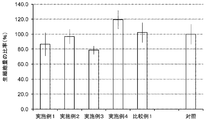
- FIG. 1 shows the safety of compounds in Examples 1 to 4 and Comparative Example 1.
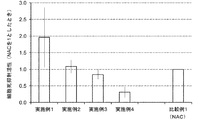
- FIG. 3 is a graph showing the cell death inhibitory activity of the compounds in Examples 1 to 4 and Comparative Example 1. It is the figure which showed the safety
- the cell death inhibitor of the present invention has the following formula (1)
- R 2 represents a halogen atom, an alkyl group having 1 to 4 carbon atoms, or an alkoxy group having 1 to 4 carbon atoms.
- n is an integer of 0-4.
- R 4 represents a fluoroalkyl group having 1 to 4 carbon atoms.
- R 1 represents a hydrogen atom, an optionally substituted hydrocarbon group having 1 to 10 carbon atoms, or an optionally substituted acyl group having 2 to 10 carbon atoms.
- R 3 represents a hydrogen atom or a methyl group.
- R 2 , R 4 and n are the same as in the above formula (1).
- It contains at least one of the compounds represented by the above as an active ingredient.
- R 2 represents a halogen atom, an alkyl group having 1 to 4 carbon atoms, or an alkoxy group having 1 to 4 carbon atoms.
- n is an integer of 0 to 4, and 0 or 1 is preferable.
- R 2 in the above formula (1) may be the same or different.
- the halogen atom in R 2 is preferably a bromine atom, a chlorine atom or a fluorine atom.
- Examples of the alkyl group in R 2 include a methyl group, an ethyl group, an n-propyl group, an isopropyl group, an n-butyl group, an isobutyl group, a sec-butyl group, and a tert-butyl group, and a methyl group or an ethyl group is preferable. It is.
- alkoxy group for R 2 examples include a methoxy group, an ethoxy group, an n-propoxy group, an isopropoxy group, an n-butoxy group, an isobutoxy group, a sec-butoxy group, and a tert-butoxy group. Is preferred.
- R 4 represents a fluoroalkyl group having 1 to 4 carbon atoms.
- the compound represented by the above formula (1) has excellent cell death inhibiting activity. It is considered that the stability to metabolism of the compound represented by the above formula (1) is improved by the steric effect of the fluoroalkyl group and the large binding energy of the C—F bond. Such improvement in metabolism stability is considered to be one of the reasons why the compound represented by the above formula (1) has excellent cell death inhibitory activity.
- the fat solubility of the compound represented by the said Formula (1) increases by having a fluoroalkyl group. It is considered that the absorption efficiency of the compound is improved or the transport efficiency of the compound is improved by increasing the fat solubility. These improvements in kinetics are also considered to be one of the reasons why the compound represented by the above formula (1) has excellent cell death inhibitory activity.
- R 4 is a perfluoroalkyl group.
- the number of carbon atoms in R 4 is preferably 2 or less.
- R 1 represents a hydrogen atom, an optionally substituted hydrocarbon group having 1 to 10 carbon atoms, or an optionally substituted acyl group having 2 to 10 carbon atoms.
- Examples of the hydrocarbon group for R 1 include an alkyl group, an alkenyl group, an alkynyl group, an aryl group, an arylalkyl group, an arylalkenyl group, an arylalkynyl group, and a cycloalkyl group. From the viewpoint of easy synthesis, the hydrocarbon group is preferably an alkyl group. Examples of the substituent in the hydrocarbon group include a halogen atom, a hydroxyl group, a hydroxyl group, and an amino group. From the viewpoint of easy synthesis, the hydrocarbon group preferably has 7 or less carbon atoms, more preferably 4 or less, and even more preferably 2 or less.
- Examples of the acyl group for R 1 include an alkylcarbonyl group and an arylcarbonyl group. From the viewpoint of easy synthesis, the acyl group preferably has 7 or less carbon atoms, more preferably 4 or less, and even more preferably 2 or less. Examples of the substituent in the acyl group include a halogen atom, a hydroxyl group, and an amino group. It is preferable that the acyl group is an acetyl group.
- R 2 represents a halogen atom, an alkyl group having 1 to 4 carbon atoms, or an alkoxy group having 1 to 4 carbon atoms.
- n is an integer of 0 to 4, and 0 or 1 is preferable.
- R 2 in the above formula (2) may be the same or different.
- the halogen atom in R 2 is preferably a bromine atom, a chlorine atom or a fluorine atom.
- Examples of the alkyl group in R 2 include a methyl group, an ethyl group, an n-propyl group, an isopropyl group, an n-butyl group, an isobutyl group, a sec-butyl group, and a tert-butyl group, and a methyl group or an ethyl group is preferable. It is.
- alkoxy group for R 2 examples include a methoxy group, an ethoxy group, an n-propoxy group, an isopropoxy group, an n-butoxy group, an isobutoxy group, a sec-butoxy group, and a tert-butoxy group. Is preferred.
- R 3 represents a hydrogen atom or a methyl group.
- R 3 is preferably a hydrogen atom.
- R 4 represents a fluoroalkyl group having 1 to 4 carbon atoms.
- the compound represented by the above formula (2) has excellent cell death inhibiting activity. It is considered that the stability to metabolism of the compound represented by the above formula (2) is improved by the steric effect of the fluoroalkyl group and the large binding energy of the C—F bond. Such an improvement in metabolism stability is considered to be one of the reasons why the compound represented by the above formula (2) has an excellent cell death inhibitory activity.
- the fat solubility of the compound represented by the said Formula (2) increases by having a fluoroalkyl group. It is considered that the absorption efficiency of the compound is improved or the transport efficiency of the compound is improved by increasing the fat solubility. These improvements in kinetics are also considered to be one of the reasons why the compound represented by the above formula (2) has excellent cell death inhibitory activity.
- R 4 is a perfluoroalkyl group.
- the number of carbon atoms in R 4 is preferably 2 or less.
- the production method of the compound represented by the above formula (1) is not particularly limited, but fluorocarboxylic acid anhydride and the following formula (3)
- the compound represented by the above formula (3) can be obtained by introducing R 2 into benzoxazole by a general method.
- R 4 is the same as the above formula (1).
- a solvent to be used N, N-dimethylformamide (DMF), dichloromethane, tetrahydrofuran (THF) or the like is used.
- the reaction temperature is not particularly limited, but 0-100 ° C. is preferred.
- the reaction product can be purified by ordinary separation means such as column chromatography or recrystallization.
- R 2 , R 4 and n are the same as those described for formula (1) in the description of the compound which is an active ingredient of the aforementioned cell death inhibitor.
- R 1 and R 3 are the same as those in the above formula (2).
- R 2 and n are the same as in the above formula (1).
- a method of obtaining the compound represented by the above formula (2) by reacting the compound represented by formula (2) is preferred.
- the compound represented by the above formula (4) can be obtained by introducing R 1 , R 2 or R 3 to indole by a general method.
- fluorocarboxylic acid anhydride those described above as the fluorocarboxylic acid anhydride used in the method for producing the compound represented by the above formula (1) are used.
- solvent used those described above as the solvent used in the method for producing the compound represented by the above formula (1) are used.
- the reaction temperature is not particularly limited, but 0-100 ° C. is preferred.
- the reaction product can be purified by ordinary separation means such as column chromatography or recrystallization.
- R 1 , R 2 , R 3 and n are the same as those described for formula (2) in the description of the compound which is an active ingredient of the aforementioned cell death inhibitor.
- the cell death inhibitor of the present invention is a preparation containing at least one of the compound represented by the above formula (1) or the compound represented by the above formula (2) and a pharmacologically acceptable carrier. May be.
- Such preparations include oral preparations such as tablets, films, capsules, granules, powders, troches, syrups, emulsions, suspensions; injections, external preparations, suppositories, pellets, nasal preparations, trans Examples include pulmonary agents, parenteral agents such as eye drops and the like.
- R 1 represents a hydrogen atom, an optionally substituted hydrocarbon group having 1 to 10 carbon atoms, or an optionally substituted acyl group having 2 to 10 carbon atoms.
- R 2 represents a halogen atom, an alkyl group having 1 to 4 carbon atoms, or an alkoxy group having 1 to 4 carbon atoms.
- n is an integer of 0-4.
- R 3 represents a hydrogen atom or a methyl group.
- R 4 represents an alkyl group having 1 to 4 carbon atoms in which a hydrogen atom may be substituted with a fluorine atom.
- R 5 represents a fluoroalkyl group having 1 to 4 carbon atoms.
- R 6 represents a fluoroalkyl group having 1 to 4 carbon atoms, a hydrogen atom, an optionally substituted hydrocarbon group having 1 to 10 carbon atoms or an optionally substituted acyl having 2 to 10 carbon atoms. Indicates a group.
- R 7 represents an optionally protected hydroxyl group.
- the compound represented by the above formula (6) two indolyl groups and an alkyl group represented by R 4 are bonded to a methine group. By having such a structure, the compound is considered to have a high cell death inhibitory activity.
- R 1 represents a hydrogen atom, an optionally substituted hydrocarbon group having 1 to 10 carbon atoms, or an optionally substituted acyl group having 2 to 10 carbon atoms.
- Two R 1 in the above formula (6) may be the same or different.
- Examples of the hydrocarbon group for R 1 include an alkyl group, an alkenyl group, an alkynyl group, an aryl group, an arylalkyl group, an arylalkenyl group, an arylalkynyl group, and a cycloalkyl group.
- the hydrocarbon group is preferably an alkyl group or an aryl group.
- the substituent in the hydrocarbon group include a halogen atom, a hydroxyl group, and an amino group.
- the hydrocarbon group preferably has 7 or less carbon atoms, more preferably 4 or less, and even more preferably 2 or less.
- Examples of the acyl group for R 1 include an alkylcarbonyl group and an arylcarbonyl group. From the viewpoint of easy synthesis, the acyl group preferably has 7 or less carbon atoms, more preferably 4 or less, and even more preferably 2 or less. Examples of the substituent in the acyl group include a halogen atom, a hydroxyl group, and an amino group. It is preferable that the acyl group is an acetyl group.
- R 2 represents a halogen atom, an alkyl group having 1 to 4 carbon atoms, or an alkoxy group having 1 to 4 carbon atoms.
- n is an integer of 0 to 4, and 0 or 1 is preferable.
- R 2 is preferably bonded to the 5-position of the indolyl group.
- R 2 in the above formula (6) may be the same or different.
- Two n in the above formula (6) may be the same or different.
- the halogen atom in R 2 is preferably a bromine atom, a chlorine atom or a fluorine atom.
- Examples of the alkyl group in R 2 include a methyl group, an ethyl group, an n-propyl group, an isopropyl group, an n-butyl group, an isobutyl group, a sec-butyl group, and a tert-butyl group, and a methyl group or an ethyl group is preferable. It is.
- alkoxy group for R 2 examples include a methoxy group, an ethoxy group, an n-propoxy group, an isopropoxy group, an n-butoxy group, an isobutoxy group, a sec-butoxy group, and a tert-butoxy group. Is preferred.
- R 3 represents a hydrogen atom or a methyl group.
- R 3 is preferably a hydrogen atom.
- Two R 3 in the above formula (6) may be the same or different.
- R 4 represents an alkyl group having 1 to 4 carbon atoms in which a hydrogen atom may be substituted with a fluorine atom.
- the number of carbon atoms in R 4 is preferably 2 or less.
- R 4 is a fluoroalkyl group.
- cell death inhibitory activity becomes higher.
- the stability to metabolism of the compound represented by the above formula (6) is improved by the steric effect of the fluoroalkyl group and the binding energy of the C—F bond being large.
- Such improvement in metabolism stability is considered to be one of the reasons why the cell death inhibitory activity becomes higher.
- R 4 is a fluoroalkyl group
- the fat solubility of the compound represented by the above formula (6) is increased. By increasing the fat solubility, it is considered that the absorption efficiency of the compound is improved and the transport efficiency of the compound is improved. These improvements in kinetics are also considered to be one of the reasons for the higher cell death inhibitory activity.
- R 4 is a perfluoroalkyl group.
- the two indolyl groups in the compound represented by the formula (6) are the same.
- the compound represented by the above formula (7) has a benzoxazolyl group and a fluoroalkyl group represented by R 5 . By having such a structure, the compound is considered to have an excellent cell death inhibitory effect.
- R 2 represents a halogen atom, an alkyl group having 1 to 4 carbon atoms, or an alkoxy group having 1 to 4 carbon atoms.
- n is an integer of 0 to 4, and 0 or 1 is preferable.
- R 2 in the above formula (7) may be the same or different.
- the halogen atom in R 2 is preferably a bromine atom, a chlorine atom or a fluorine atom.
- Examples of the alkyl group in R 2 include a methyl group, an ethyl group, an n-propyl group, an isopropyl group, an n-butyl group, an isobutyl group, a sec-butyl group, and a tert-butyl group, and a methyl group or an ethyl group is preferable. It is.
- alkoxy group for R 2 examples include a methoxy group, an ethoxy group, an n-propoxy group, an isopropoxy group, an n-butoxy group, an isobutoxy group, a sec-butoxy group, and a tert-butoxy group. Is preferred.
- R 5 represents a fluoroalkyl group having 1 to 4 carbon atoms.
- the compound represented by the formula (7) has an excellent cell death inhibitory activity. It is considered that the stability to metabolism of the compound represented by the above formula (7) is improved by the steric effect of the fluoroalkyl group and the large binding energy of the C—F bond. Such an improvement in metabolism stability is considered to be one of the reasons why the compound represented by the formula (7) has an excellent cell death inhibitory activity. Moreover, the fat solubility of the compound represented by the said Formula (7) increases by having a fluoroalkyl group.
- R 5 is a perfluoroalkyl group.
- the number of carbon atoms in R 5 is preferably 2 or less.
- R 6 may have a fluoroalkyl group having 1 to 4 carbon atoms, a hydrogen atom, an optionally substituted hydrocarbon group having 1 to 10 carbon atoms, or a substituent.
- An acyl group having 2 to 10 carbon atoms is shown.
- fluoroalkyl group for R 6 those described above as the fluoroalkyl group for R 5 are used.
- Examples of the hydrocarbon group for R 6 include an alkyl group, an alkenyl group, an alkynyl group, an aryl group, an arylalkyl group, an arylalkenyl group, an arylalkynyl group, and a cycloalkyl group.
- the hydrocarbon group is preferably an alkyl group or an aryl group.
- the substituent in the hydrocarbon group include a halogen atom, a hydroxyl group, and an amino group.
- the hydrocarbon group preferably has 7 or less carbon atoms, more preferably 4 or less, and even more preferably 2 or less.
- Examples of the acyl group for R 6 include an alkylcarbonyl group and an arylcarbonyl group. From the viewpoint of easy synthesis, the acyl group preferably has 7 or less carbon atoms, more preferably 4 or less, and even more preferably 2 or less. Examples of the substituent in the acyl group include a halogen atom, a hydroxyl group, and an amino group. It is preferable that the acyl group is an acetyl group.
- R 6 is a fluoroalkyl group.
- R 6 is a fluoroalkyl group, the effect of the fluoroalkyl group described above for explaining R 5 is further increased, and the cell death inhibitory activity is further increased. More preferably, R 6 is a perfluoroalkyl group.
- the number of carbon atoms in R 6 is preferably 2 or less.
- R 7 represents an optionally protected hydroxyl group.
- the method for producing the compound represented by the above formula (6) is not particularly limited, but examples of suitable production methods include the following two.
- the first production method comprises the following formula (8) in the presence of a metal salt belonging to Group 3 of the periodic table.
- the compound represented by the above formula (10) can be obtained by introducing R 1 , R 2 or R 3 to indole by a general method.
- the method for producing the compound represented by the above formula (8) is not particularly limited, but it is preferable to obtain it by reacting the carboxylic acid anhydride with the compound represented by the above formula (10).
- R 4 is the same as the above formula (6).
- a solvent to be used N, N-dimethylformamide (DMF), dichloromethane, tetrahydrofuran (THF) or the like is used.
- the reaction temperature is not particularly limited, but 0-100 ° C. is preferred.
- the reaction product can be purified by ordinary separation means such as column chromatography or recrystallization.
- R 1 , R 2 , R 3 , R 4 and n are the formulas (6) in the description of the compound which is an active ingredient of the above-mentioned cell death inhibitor. It is the same as the description about.
- the metal salt belonging to Group 3 of the periodic table used in the first production method functions as a catalyst.
- the anion that forms the salt include a trifluoromethanesulfonic acid anion, a chlorine anion, and a bromine anion.
- the metal constituting the salt include ytterbium, scandium, erbium, lanthanum, yttrium, samarium, europium, dysprosium, and the like.
- Preferred examples of the salt include ytterbium trifluoromethanesulfonate (III), scandium trifluoromethanesulfonate (III), erbium trifluoromethanesulfonate (yttrium), yttrium trifluoromethanesulfonate (III), and europium trifluoromethanesulfonate (III).
- ytterbium trifluoromethanesulfonate (III), erbium trifluoromethanesulfonate (III) and yttrium trifluoromethanesulfonate (III), ytterbium trifluoromethanesulfonate (III) and erbium trifluoromethanesulfonate ( III) is more preferred.
- the amount of the salt of the metal belonging to Group 3 of the periodic table is not particularly limited, but is 0.001 to 0.5 mol with respect to 1 mol of the compound represented by the above formula (8). Is preferable, and 0.01 to 0.5 mol is more preferable.
- the solvent used in the first production method is not particularly limited, but toluene, dichloroethane, tetrahydrofuran and the like are used.
- the reaction temperature is not particularly limited, but 0 to 200 ° C. is preferable.
- the reaction product can be purified by ordinary separation means such as column chromatography or recrystallization.
- the second manufacturing method is the following formula (8)
- the compound represented by the above formula (8) and the compound represented by the above formula (10) are obtained by the methods described as the production methods of the respective compounds used in the first production method described above.
- R 1 , R 2 , R 3 , R 4 and n are the formula (6) in the description of the compound which is an active ingredient of the aforementioned cell death inhibitor. It is the same as the description about.
- the reducing agent is not particularly limited, NaBH 4, NaH, Et 3 SiH, Ph 2 SiH 2, hydrosilane such as polymethylhydrosiloxane, and the like.
- the amount of the reducing agent to be used is not particularly limited, but it is preferable to use 0.01 to 5 mol with respect to 1 mol of the compound represented by the above formula (8).
- the solvent used when making a reducing agent act on the compound represented by the said Formula (8) is not specifically limited, Tetrahydrofuran, a dichloromethane, methanol, etc. are mentioned.
- the reaction temperature is not particularly limited but is preferably ⁇ 10 to 100 ° C.
- the reaction product may be subjected to the next step as it is, or may be subjected to the next step after purification. Purification can be performed by a conventional separation means such as column chromatography or recrystallization.
- the compound represented by the above formula (9) obtained by allowing a reducing agent to act on the compound represented by the above formula (8) is reacted with the compound represented by the above formula (10).
- This reaction is performed in the presence of a salt of a metal belonging to Group 3 of the periodic table.
- the salt functions as a catalyst.
- the anion that forms the salt include a trifluoromethanesulfonic acid anion, a chlorine anion, and a bromine anion.
- the metal constituting the salt include ytterbium, scandium, erbium, lanthanum, yttrium, samarium, europium, dysprosium, and the like.
- Preferred examples of the salt include ytterbium trifluoromethanesulfonate (III), scandium trifluoromethanesulfonate (III), erbium trifluoromethanesulfonate (yttrium), yttrium trifluoromethanesulfonate (III), and europium trifluoromethanesulfonate (III).
- ytterbium trifluoromethanesulfonate (III), scandium trifluoromethanesulfonate (III) and erbium trifluoromethanesulfonate (III), ytterbium trifluoromethanesulfonate (III) and scandium trifluoromethanesulfonate ( III) is more preferred.
- the amount of the salt used is not particularly limited, but 0.001 to 0.5 mol is preferable and 0.003 to 0.5 mol is more preferable with respect to 1 mol of the compound represented by the formula (9). is there.
- the solvent used for the reaction of the compound represented by the above formula (9) and the compound represented by the above formula (10) is not particularly limited, and examples thereof include toluene, dichloroethane, tetrahydrofuran and the like.
- the reaction temperature is not particularly limited, but 0 to 200 ° C. is preferable.
- the reaction product can be purified by ordinary separation means such as column chromatography or recrystallization.
- the production method of the compound represented by the above formula (7) is not particularly limited, but in the presence of a base, the following formula (12)
- R 5 is the same as the above formula (7).
- R 8 represents an alkyl group having 1 to 4 carbon atoms. It is preferable to obtain by reacting a compound represented by the formula:
- N, N-dimethylformamide (DMF), tetrahydrofuran or the like is used as a solvent used in the reaction of the carboxylic acid anhydride with the compound represented by the above formula (14).
- the reaction temperature is not particularly limited but is preferably 0 to 100 ° C.
- the reaction product can be purified by ordinary separation means such as column chromatography or recrystallization.
- R 8 represents an alkyl group having 1 to 4 carbon atoms.
- Examples of the alkyl group for R 8 include a methyl group, an ethyl group, an n-propyl group, and an isopropyl group.
- R 2 , R 5 , R 6 and n are the same as those described for formula (7) in the description of the compound which is an active ingredient of the cell death inhibitor described above. .
- the base used for the reaction of the compound represented by the above formula (12) and the compound represented by the above formula (13) is not particularly limited, but potassium fluoride, sodium hydroxide, triethylamine, cesium fluoride, Examples include sodium methoxide.
- the amount of the base used is not particularly limited, but it is preferable to use 0.01 to 5 mol with respect to 1 mol of the compound represented by the above formula (13).
- the solvent used is not particularly limited, but toluene, N, N-dimethylformamide (DMF), tetrahydrofuran, or the like is used.
- the reaction temperature is not particularly limited, but 0 to 200 ° C. is preferable.
- the reaction product can be purified by ordinary separation means such as column chromatography or recrystallization.
- the cell death inhibitor of the present invention is a preparation containing at least one of the compound represented by the above formula (6) or the compound represented by the above formula (7) and a pharmacologically acceptable carrier. May be.
- Such preparations include oral preparations such as tablets, films, capsules, granules, powders, troches, syrups, emulsions, suspensions; injections, external preparations, suppositories, pellets, nasal preparations, trans Examples include pulmonary agents, parenteral agents such as eye drops and the like.
- R 1 represents an optionally substituted hydrocarbon group having 1 to 10 carbon atoms or an optionally substituted acyl group having 2 to 10 carbon atoms.
- R 2 represents a halogen atom, an alkyl group having 1 to 4 carbon atoms, or an alkoxy group having 1 to 4 carbon atoms.
- n is an integer of 0-4.
- R 3 represents a hydrogen atom or a methyl group.
- R 4 represents a fluoroalkyl group having 1 to 4 carbon atoms.
- R 1 is an optionally substituted hydrocarbon group having 1 to 10 carbon atoms or an optionally substituted acyl group having 2 to 10 carbon atoms. Indicates. Two R 1 in the above formula (6) may be the same or different.
- Examples of the hydrocarbon group for R 1 include an alkyl group, an alkenyl group, an alkynyl group, an aryl group, an arylalkyl group, an arylalkenyl group, an arylalkynyl group, and a cycloalkyl group.
- the hydrocarbon group is preferably an alkyl group or an aryl group.
- the substituent in the hydrocarbon group include a halogen atom, a hydroxyl group, and an amino group.
- the hydrocarbon group preferably has 7 or less carbon atoms, more preferably 4 or less, and even more preferably 2 or less.
- Examples of the acyl group for R 1 include an alkylcarbonyl group and an arylcarbonyl group. From the viewpoint of easy synthesis, the acyl group preferably has 7 or less carbon atoms, more preferably 4 or less, and even more preferably 2 or less. Examples of the substituent in the acyl group include a halogen atom, a hydroxyl group, and an amino group. It is preferable that the acyl group is an acetyl group.
- R 4 is more preferably a perfluoroalkyl group.
- the number of carbon atoms in R 4 is preferably 2 or less.
- R 2 , R 3 and n are the same as those described for formula (6) in the description of the compound which is an active ingredient of the above-described cell death inhibitor.
- the two indolyl groups in the compound represented by the formula (6) are the same.
- R 1 represents a hydrogen atom, an optionally substituted hydrocarbon group having 1 to 10 carbon atoms, or an optionally substituted acyl group having 2 to 10 carbon atoms.
- R 2 represents a halogen atom, an alkyl group having 1 to 4 carbon atoms, or an alkoxy group having 1 to 4 carbon atoms.
- n is an integer of 1 to 4.
- R 3 represents a hydrogen atom or a methyl group.
- R 4 represents a fluoroalkyl group having 1 to 4 carbon atoms.
- R 2 represents a halogen atom, an alkyl group having 1 to 4 carbon atoms, or an alkoxy group having 1 to 4 carbon atoms.
- n is an integer of 1 to 4, and 1 is preferable. It is also preferable that R 2 is bonded to the 5-position of the indolyl group.
- R 2 in the above formula (6) may be the same or different.
- Two n in the above formula (6) may be the same or different.
- the halogen atom in R 2 is preferably a bromine atom, a chlorine atom or a fluorine atom.
- Examples of the alkyl group in R 2 include a methyl group, an ethyl group, an n-propyl group, an isopropyl group, an n-butyl group, an isobutyl group, a sec-butyl group, and a tert-butyl group, which are a methyl group or an ethyl group. Is preferred.
- Examples of the alkoxy group in R 2 include a methoxy group, an ethoxy group, an n-propoxy group, an isopropoxy group, an n-butoxy group, an isobutoxy group, a sec-butoxy group, and a tert-butoxy group. Preferably it is.
- R 4 is more preferably a perfluoroalkyl group.
- the number of carbon atoms in R 4 is preferably 2 or less.
- R 1 and R 3 are the same as those described for the formula (6) in the description of the compound that is an active ingredient of the cell death inhibitor described above.
- the two indolyl groups in the compound represented by the formula (6) are the same.
- R 1 represents a hydrogen atom, an optionally substituted hydrocarbon group having 1 to 10 carbon atoms, or an optionally substituted acyl group having 2 to 10 carbon atoms.
- R 2 represents a halogen atom, an alkyl group having 1 to 4 carbon atoms, or an alkoxy group having 1 to 4 carbon atoms.
- n is an integer of 0-4.
- R 3 represents a hydrogen atom or a methyl group.
- R 4 represents a fluoroalkyl group having 2 to 4 carbon atoms.
- R 4 represents a fluoroalkyl group having 2 to 4 carbon atoms. More preferably, R 4 is a perfluoroalkyl group. The number of carbon atoms in R 4 is preferably 2.
- R 1 , R 2 , R 3 and n are the same as those described for formula (6) in the description of the compound which is an active ingredient of the aforementioned cell death inhibitor.
- the two indolyl groups in the compound represented by the formula (6) are the same.
- R 2 represents a halogen atom, an alkyl group having 1 to 4 carbon atoms, or an alkoxy group having 1 to 4 carbon atoms.
- n is an integer of 0-4.
- R 5 and R 6 each independently represents a fluoroalkyl group having 1 to 4 carbon atoms.
- R 7 represents an optionally protected hydroxyl group.
- R 5 and R 6 each independently represents a fluoroalkyl group having 1 to 4 carbon atoms. More preferably, R 5 and R 6 are perfluoroalkyl groups. The number of carbon atoms in R 5 and R 6 is preferably 2 or less.
- R 2 , R 7 and n are the same as those described for the formula (7) in the description of the compound which is an active ingredient of the cell death inhibitor described above.
- HeLa Human cervical cancer cell line
- DMSO dimethyl sulfoxide
- a human cervical cancer cell line (HeLa) was plated on a well plate at approximately 4 ⁇ 10 3 cells / well and cultured for 16 hours.
- a compound to be evaluated dissolved in DMSO was added to the culture solution. At this time, the addition amount was adjusted so that the concentration of the compound in the culture solution was 20 ⁇ mol / L.
- hydrogen peroxide was added to the culture solution. At this time, the addition amount was adjusted so that the concentration of hydrogen peroxide in the culture solution was 1 mmol / L.
- the cells were cultured for 3 hours. The amount of viable cells in the culture broth after culturing was measured by the measurement method employed in the evaluation of the safety of the compound described above. The viable cell ratio was determined from the obtained viable cell amount and the results of a control experiment described later.
- the cell culture and the amount of living cells were measured in the same manner as the above-described cell death inhibitory activity evaluation method except that only DMSO was added to the culture solution instead of the compound to be evaluated dissolved in DMSO. Under this condition, hydrogen peroxide is known to induce cell death.
- the value obtained at this time was defined as the viable cell ratio of 0%.
- Example 1 Compound a was synthesized. The chemical reaction formula at this time is shown below.
- the safety of the obtained compound a was evaluated.
- the result is shown in FIG.
- the vertical axis in FIG. 1 represents the ratio (%) of the amount of viable cells when cultured after adding the compound to the amount of viable cells (control) when cultured without adding the compound to be evaluated.
- the cell death inhibitory activity of the obtained compound a was evaluated.
- the result is shown in FIG.
- the vertical axis in FIG. 2 represents the ratio of the viable cell ratio when compound a is added to the viable cell ratio (Comparative Example 1) determined from the cell death inhibitory activity evaluation of N-acetylcysteine (NAC) described later.
- NAC N-acetylcysteine
- the safety of the obtained compound b was evaluated. The result is shown in FIG.
- the cell death inhibitory activity of the obtained compound b was evaluated. The result is shown in FIG.
- Examples 3-7 Compound b was synthesized in the same manner as in Example 2 except that the raw materials shown in Table 1 were used. The yield at this time is shown in Table 1.
- Comparative Example 1 The safety of NAC was evaluated in the same manner as the safety evaluation method described above, except that the amount added was adjusted so that the concentration of NAC in the culture solution was 1 mmol / L. The result is shown in FIG. NAC cell death inhibitory activity was evaluated in the same manner as in the cell death inhibitory activity evaluation method described above, except that the addition amount was adjusted so that the concentration of NAC in the culture solution was 1 mmol / L. The results are shown in FIGS. 2 and 4, the viable cell ratio obtained at this time was taken as 1.
- the cell death inhibitor of the present invention (Examples 1 to 4) was equivalent to or higher than the NAC in spite of the use amount (1/50) being much smaller. It showed death-inhibiting activity.
- the safety of the obtained compound b was evaluated.
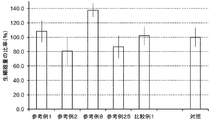
- the result is shown in FIG.
- the vertical axis in FIG. 3 shows the ratio (%) of the amount of living cells when cultured after adding the compound to the amount of living cells (control) when cultured without adding the compound to be evaluated.
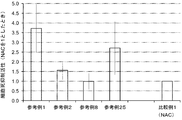
- the cell death inhibitory activity of the obtained compound b was evaluated.
- the result is shown in FIG.
- the vertical axis in FIG. 4 shows the ratio of the viable cell ratio when compound b is added to the viable cell ratio (Comparative Example 1) determined from the evaluation of the cell death inhibitory activity of N-acetylcysteine (NAC) described later.
- NAC N-acetylcysteine
- the safety of the obtained compound b was evaluated. The result is shown in FIG.
- the cell death inhibitory activity of each obtained compound was evaluated. The result is shown in FIG.
- Reference Examples 3-7, 26 Compound b was synthesized in the same manner as in Reference Example 1, except that the raw materials shown in the following chemical reaction formula were used and that the catalyst shown in Table 3 was used. The chemical reaction formula at this time is shown below. The yield of compound b is shown in Table 3.
- the safety of the obtained compound was evaluated. The result is shown in FIG.
- the cell death inhibitory activity of the obtained compound was evaluated. The result is shown in FIG.
- the safety of the obtained compound e was evaluated. The result is shown in FIG.
- the cell death inhibitory activity of the obtained compound e was evaluated. The result is shown in FIG.
Landscapes
- Chemical & Material Sciences (AREA)
- Health & Medical Sciences (AREA)
- Organic Chemistry (AREA)
- Veterinary Medicine (AREA)
- Public Health (AREA)
- General Health & Medical Sciences (AREA)
- Animal Behavior & Ethology (AREA)
- Life Sciences & Earth Sciences (AREA)
- Medicinal Chemistry (AREA)
- Pharmacology & Pharmacy (AREA)
- Bioinformatics & Cheminformatics (AREA)
- Engineering & Computer Science (AREA)
- General Chemical & Material Sciences (AREA)
- Nuclear Medicine, Radiotherapy & Molecular Imaging (AREA)
- Chemical Kinetics & Catalysis (AREA)
- Epidemiology (AREA)
- Vascular Medicine (AREA)
- Urology & Nephrology (AREA)
- Heart & Thoracic Surgery (AREA)
- Cardiology (AREA)
- Gastroenterology & Hepatology (AREA)
- Pharmaceuticals Containing Other Organic And Inorganic Compounds (AREA)
- Indole Compounds (AREA)
- Heterocyclic Carbon Compounds Containing A Hetero Ring Having Nitrogen And Oxygen As The Only Ring Hetero Atoms (AREA)
- Low-Molecular Organic Synthesis Reactions Using Catalysts (AREA)
Abstract
下記式(1)で表される化合物、又は下記式(2)で表される化合物の少なくとも一方を有効成分として含有する細胞死抑制剤。当該細胞死抑制剤は、高い細胞死抑制活性を有する。
Description
本発明は、含フッ素複素芳香族化合物を有効成分とする細胞死抑制剤及びその製造方法に関する。
細胞死抑制剤は、脳梗塞や急性肝機能障害等の細胞死が急速に起こる病気の症状緩和薬として期待されている。これまでに、いくつかの細胞死抑制剤が報告されており、細胞死の抑制機構は複数存在することが知られている。
細胞死抑制剤の一つとして、活性酸素等を補足するラジカルスカベンジャーとして機能する化合物からなるものが知られている。ラジカルスカベンジャーが活性酸素等を補足することにより、活性酸素等によって引き起こされる細胞死が抑制される。ラジカルスカベンジャーとして機能するエダラボン(edaravone)は、脳保護剤として、脳梗塞の治療に用いられている。しかしながら、エラダボンの副作用により、重篤な急性腎不全が起こるおそれがあることが報告されている(非特許文献1)。また、薬物(アセトアミノフェン)性急性肝機能障害の治療に、N-アセチルシステイン(NAC)が投与される。NACが、ラジカルスカベンジャーとして機能したり、グルタチオンの生合成を補助したりすることにより症状が緩和されると考えられている。NACは、重篤な副作用が少なく、経口投与が可能である。しかしながら、NACは効果の持続時間が短いうえに、初期段階でNACを投与しなければ効果が得られないという問題があった(非特許文献2)。
一方、非特許文献3には、含フッ素インドール誘導体からなるカスパーゼ阻害剤が記載されている。当該含フッ素インドール誘導体がカスパーゼを阻害することにより、カスパーゼが関与する細胞死が抑制される可能性があると記載されている。しかしながら、非特許文献3には、前記含フッ素インドール誘導体がラジカルスカベンジャーとして機能するかどうかについて記載されていない。また、細胞死抑制活性が不十分である場合があった。特許文献1には、インドリルピロール誘導体からなる細胞死抑制剤が記載されている。しかしながら、当該細胞死抑制剤は、細胞死抑制活性が不十分である場合があった。非特許文献4には、ビスインドールマレイミドによる細胞死の抑制について記載されている。しかしながら、当該化合物は、細胞死抑制活性が不十分である場合があった。
Clin.Exp.Nephrol.2009年、vol.13、p.118-122
Clinical Chemistry、2011年、vol.57、p.9-13
Organic and Medicinal Chemistry Letters、2012年、2:27
Bioorganic & Medicinal Chemistry Letters、2005年、vol.15、p.3109-3113
本発明は上記課題を解決するためになされたものであり、高い活性を有する細胞死抑制剤及びその製造方法を提供することを目的とする。
上記課題は、下記式(1)

[式中、R2は、ハロゲン原子、炭素数1~4のアルキル基又は炭素数1~4のアルコキシ基を示す。nは、0~4の整数である。R4は、炭素数1~4のフルオロアルキル基を示す。]
で表される化合物、又は下記式(2)
で表される化合物、又は下記式(2)
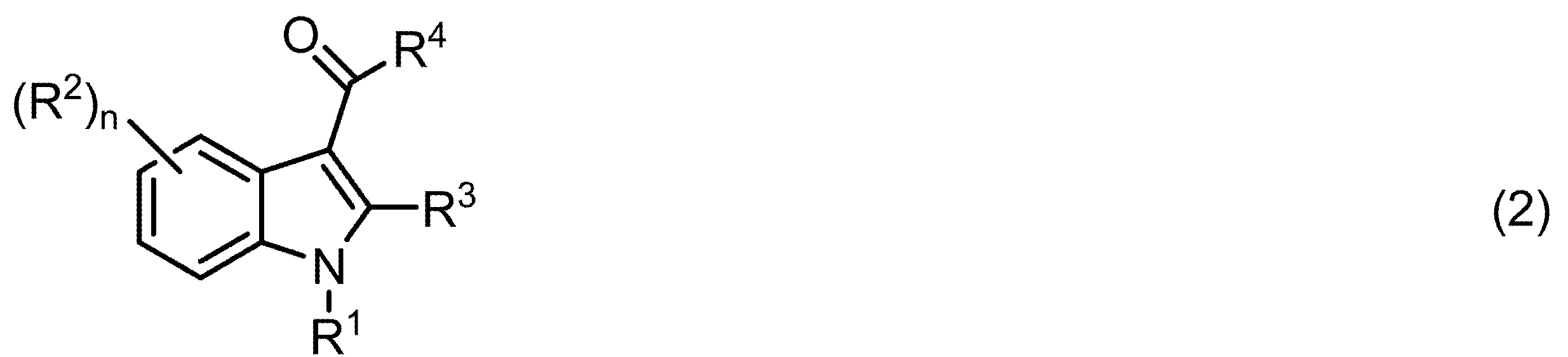
[式中、R1は、水素原子、置換基を有してもよい炭素数1~10の炭化水素基又は置換基を有してもよい炭素数2~10のアシル基を示す。R3は、水素原子又はメチル基を示す。R2、R4及びnは、上記式(1)と同じである。]
で表される化合物の少なくとも一方を有効成分として含有する細胞死抑制剤を提供することによって解決される。
で表される化合物の少なくとも一方を有効成分として含有する細胞死抑制剤を提供することによって解決される。
上記課題は、フルオロカルボン酸無水物と、下記式(3)

[式中、R2及びnは、上記式(1)と同じである。]
で表される化合物を反応させることにより、下記式(1)
で表される化合物を反応させることにより、下記式(1)

[式中、R2、R4及びnは、上記式(1)と同じである。]
で表される化合物を得る細胞死抑制剤の製造方法を提供することによっても解決される。
で表される化合物を得る細胞死抑制剤の製造方法を提供することによっても解決される。
上記課題は、フルオロカルボン酸無水物と、下記式(4)

で表される化合物を反応させることにより、下記式(2)
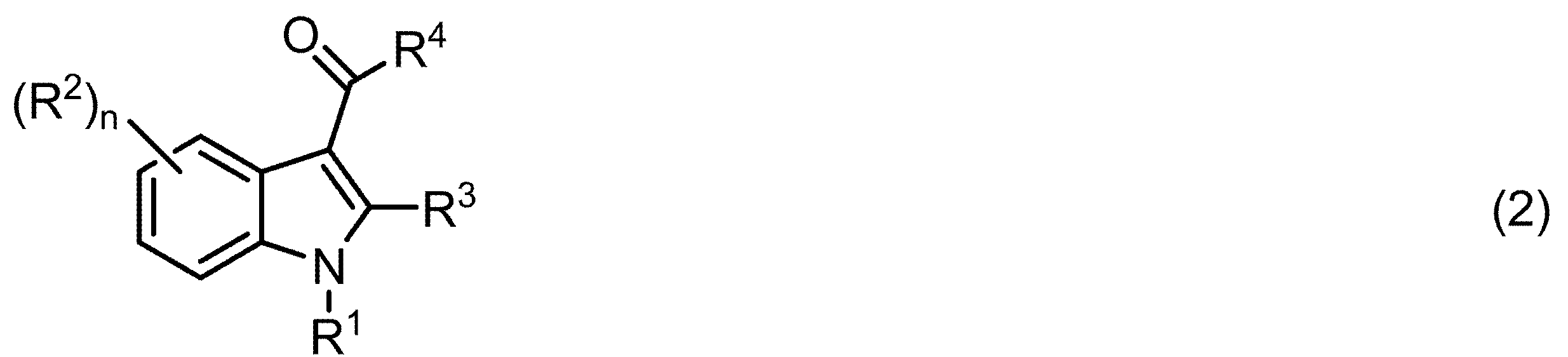
[式中、R1及びR3は、上記式(2)と同じである。R2、R4及びnは、上記式(1)と同じである。]
で表される化合物を得る細胞死抑制剤の製造方法を提供することによっても解決される。
で表される化合物を得る細胞死抑制剤の製造方法を提供することによっても解決される。
本発明の細胞死抑制剤は高い細胞死抑制活性を有する。したがって、使用量が少ない場合でも、細胞死が抑制される。また、本発明の製造法によれば、本発明の細胞死抑制剤を低コストで製造できる。
本発明の細胞死抑制剤は、下記式(1)

[式中、R2は、ハロゲン原子、炭素数1~4のアルキル基又は炭素数1~4のアルコキシ基を示す。nは、0~4の整数である。R4は、炭素数1~4のフルオロアルキル基を示す。]
で表される化合物、又は下記式(2)
で表される化合物、又は下記式(2)
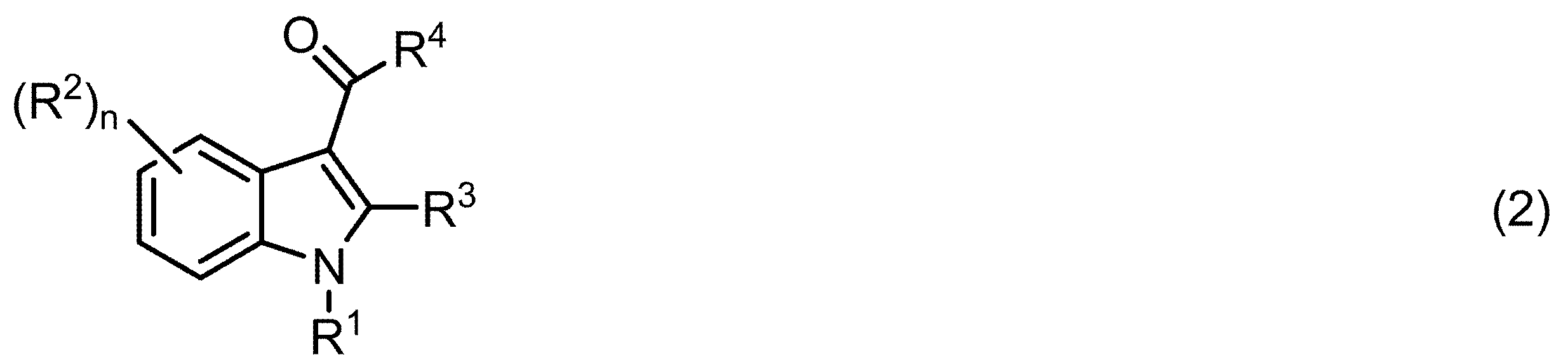
[式中、R1は、水素原子、置換基を有してもよい炭素数1~10の炭化水素基又は置換基を有してもよい炭素数2~10のアシル基を示す。R3は、水素原子又はメチル基を示す。R2、R4及びnは、上記式(1)と同じである。]
で表される化合物の少なくとも一方を有効成分として含有するものである。
で表される化合物の少なくとも一方を有効成分として含有するものである。
上記式(1)において、R2は、ハロゲン原子、炭素数1~4のアルキル基又は炭素数1~4のアルコキシ基を示す。nは、0~4の整数であり、0又は1が好適である。上記式(1)中のR2は、同じであってもよいし、異なっていてもよい。
R2におけるハロゲン原子が、臭素原子、塩素原子又はフッ素原子であることが好適である。
R2におけるアルキル基としては、メチル基、エチル基、n-プロピル基、イソプロピル基、n-ブチル基、イソブチル基、sec-ブチル基及びtert-ブチル基が挙げられ、メチル基又はエチル基が好適である。
R2におけるアルコキシ基としては、メトキシ基、エトキシ基、n-プロポキシ基、イソプロポキシ基、n-ブトキシ基、イソブトキシ基、sec-ブトキシ基及びtert-ブトキシ基が挙げられ、メトキシ基又はエトキシ基が好適である。
上記式(1)において、R4は、炭素数1~4のフルオロアルキル基を示す。このようなフルオロアルキル基を有することにより、上記式(1)で表される化合物は優れた細胞死抑制活性を有する。フルオロアルキル基の立体的効果やC-F結合の結合エネルギーが大きいことにより、上記式(1)で表される化合物の代謝に対する安定性が向上すると考えられる。このような代謝に対する安定性の向上が、上記式(1)で表される化合物が優れた細胞死抑制活性を有する理由の1つであると考えられる。また、フルオロアルキル基を有することにより、上記式(1)で表される化合物の脂溶性が増大する。脂溶性が増大することにより当該化合物の吸収効率が向上したり、当該化合物の輸送効率が向上したりすると考えられる。これらの動態の改善もまた、上記式(1)で表される化合物が優れた細胞死抑制活性を有する理由の1つであると考えられる。
R4がパーフルオロアルキル基であることがより好適である。R4における炭素数は、2以下が好適である。
上記式(2)において、R1は、水素原子、置換基を有してもよい炭素数1~10の炭化水素基又は置換基を有してもよい炭素数2~10のアシル基を示す。
R1における炭化水素基としては、アルキル基、アルケニル基、アルキニル基、アリール基、アリールアルキル基、アリールアルケニル基、アリールアルキニル基、シクロアルキル基等が挙げられる。合成が容易である観点からは、前記炭化水素基がアルキル基であることが好適である。前記炭化水素基における置換基としては、ハロゲン原子、ヒドロキシル基、ヒドロキシル基、アミノ基等が挙げられる。合成が容易である観点からは、前記炭化水素基の炭素数は、7以下が好適であり、4以下がより好適であり、2以下がさらに好適である。
R1におけるアシル基としては、アルキルカルボニル基、アリールカルボニル基等が挙げられる。合成が容易である観点からは、前記アシル基の炭素数は、7以下が好適であり、4以下がより好適であり、2以下がさらに好適である。前記アシル基における置換基としては、ハロゲン原子、ヒドロキシル基、アミノ基等が挙げられる。前記アシル基がアセチル基であることが好適である。
上記式(2)において、R2は、ハロゲン原子、炭素数1~4のアルキル基又は炭素数1~4のアルコキシ基を示す。nは、0~4の整数であり、0又は1が好適である。上記式(2)中のR2は、同じであってもよいし、異なっていてもよい。
R2におけるハロゲン原子が、臭素原子、塩素原子又はフッ素原子であることが好適である。
R2におけるアルキル基としては、メチル基、エチル基、n-プロピル基、イソプロピル基、n-ブチル基、イソブチル基、sec-ブチル基及びtert-ブチル基が挙げられ、メチル基又はエチル基が好適である。
R2におけるアルコキシ基としては、メトキシ基、エトキシ基、n-プロポキシ基、イソプロポキシ基、n-ブトキシ基、イソブトキシ基、sec-ブトキシ基及びtert-ブトキシ基が挙げられ、メトキシ基又はエトキシ基が好適である。
上記式(2)において、R3は、水素原子又はメチル基を示す。R3が水素原子であることが好適である。
上記式(2)において、R4は、炭素数1~4のフルオロアルキル基を示す。このようなフルオロアルキル基を有することにより、上記式(2)で表される化合物は優れた細胞死抑制活性を有する。フルオロアルキル基の立体的効果やC-F結合の結合エネルギーが大きいことにより、上記式(2)で表される化合物の代謝に対する安定性が向上すると考えられる。このような代謝に対する安定性の向上が、上記式(2)で表される化合物が優れた細胞死抑制活性を有する理由の1つであると考えられる。また、また、フルオロアルキル基を有することにより、上記式(2)で表される化合物の脂溶性が増大する。脂溶性が増大することにより当該化合物の吸収効率が向上したり、当該化合物の輸送効率が向上したりすると考えられる。これらの動態の改善もまた、上記式(2)で表される化合物が優れた細胞死抑制活性を有する理由の1つであると考えられる。
R4がパーフルオロアルキル基であることがより好適である。R4における炭素数は、2以下が好適である。
上記式(1)で表される化合物の製造方法は特に限定されないが、フルオロカルボン酸無水物と、下記式(3)

[式中、R2及びnは、上記式(1)と同じである。]
で表される化合物を反応させることにより、上記式(1)で表される化合物を得る方法が好適である。
で表される化合物を反応させることにより、上記式(1)で表される化合物を得る方法が好適である。
上記式(3)で表される化合物は、一般的な手法により、ベンゾオキサゾールに対して、R2を導入することにより得ることができる。
前記フルオロカルボン酸無水物として、下記式(5)

[式中、R4は上記式(1)と同じである。]
が用いられる。使用される溶媒として、N、N-ジメチルホルムアミド(DMF)、ジクロロメタン、テトラヒドロフラン(THF)等が用いられる。反応温度は特に限定されないが、0~100℃が好適である。反応生成物は、通常の分離手段、例えばカラムクロマトグラフィー又は再結晶などで精製することができる。
が用いられる。使用される溶媒として、N、N-ジメチルホルムアミド(DMF)、ジクロロメタン、テトラヒドロフラン(THF)等が用いられる。反応温度は特に限定されないが、0~100℃が好適である。反応生成物は、通常の分離手段、例えばカラムクロマトグラフィー又は再結晶などで精製することができる。
上記式(3)及び(5)において、R2、R4及びnは、前述した細胞死抑制剤の有効成分である化合物の説明における、式(1)についての記載と同様である。
上記式(2)で表される化合物の製造方法は特に限定されないが、フルオロカルボン酸無水物と、下記式(4)

で表される化合物を反応させることにより、上記式(2)で表される化合物を得る方法が好適である。
上記式(4)で表される化合物は、一般的な手法により、インドールに対して、R1、R2又はR3を導入することにより得ることができる。
前記フルオロカルボン酸無水物として、上記式(1)で表される化合物の製造方法において用いられるフルオロカルボン酸無水物として上述したものが用いられる。使用される溶媒として、上記式(1)で表される化合物の製造方法において用いられる溶媒として上述したものが用いられる。反応温度は特に限定されないが、0~100℃が好適である。反応生成物は、通常の分離手段、例えばカラムクロマトグラフィー又は再結晶などで精製することができる。
上記式(4)において、R1、R2、R3及びnは、前述した細胞死抑制剤の有効成分である化合物の説明における、式(2)についての記載と同様である。
本発明の細胞死抑制剤は、上記式(1)で表される化合物又は上記式(2)で表される化合物の少なくとも一方と、薬理学的に許容される担体とを含有する製剤であってもよい。当該製剤としては、錠剤、フィルム剤、カプセル剤、顆粒剤、散剤、トローチ剤、シロップ剤、乳剤、懸濁剤等の経口剤;注射剤、外用剤、坐剤、ペレット、経鼻剤、経肺剤、点眼剤等の非経口剤等が挙げられる。
下記式(6)
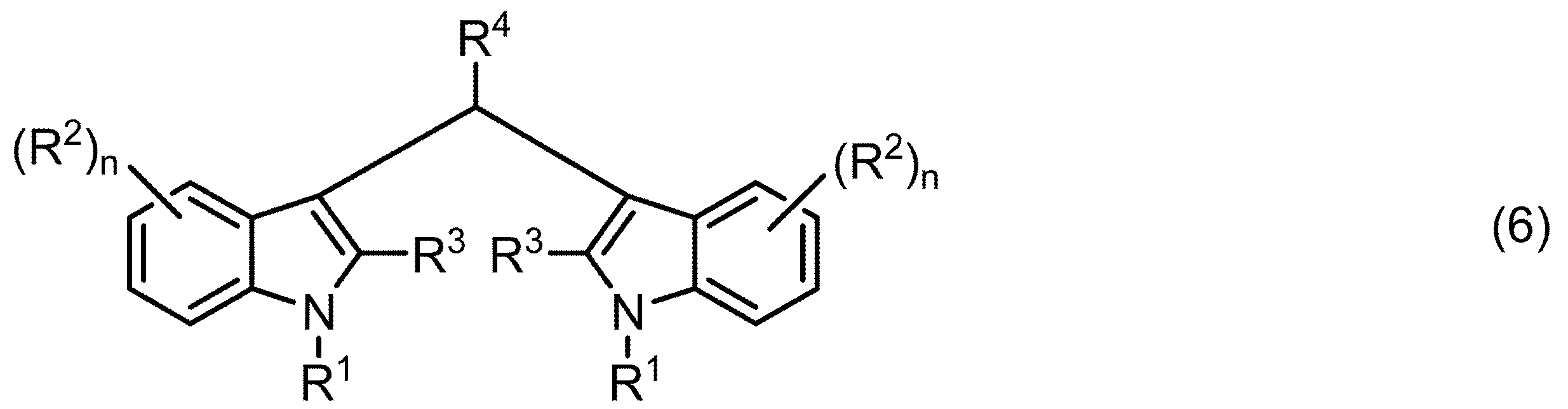
[式中、R1は、水素原子、置換基を有してもよい炭素数1~10の炭化水素基又は置換基を有してもよい炭素数2~10のアシル基を示す。R2は、ハロゲン原子、炭素数1~4のアルキル基又は炭素数1~4のアルコキシ基を示す。nは、0~4の整数である。R3は、水素原子又はメチル基を示す。R4は、水素原子がフッ素原子で置換されていてもよい炭素数1~4のアルキル基を示す。]
で表される化合物、又は下記式(7)
で表される化合物、又は下記式(7)

[式中、R2及びnは、上記式(6)と同じである。R5は、炭素数1~4のフルオロアルキル基を示す。R6は、炭素数1~4のフルオロアルキル基、水素原子、置換基を有してもよい炭素数1~10の炭化水素基又は置換基を有してもよい炭素数2~10のアシル基を示す。R7は、保護されていてもよいヒドロキシル基を示す。]
で表される化合物の少なくとも一方を有効成分として含有するものも細胞死抑制剤として有用である。以下、当該細胞死抑制剤について説明する。
で表される化合物の少なくとも一方を有効成分として含有するものも細胞死抑制剤として有用である。以下、当該細胞死抑制剤について説明する。
上記式(6)で表される化合物は、メチン基に対して、2つのインドリル基とR4で示されるアルキル基が結合したものである。このような構造を有することにより、当該化合物は、高い細胞死抑制活性を有すると考えられる。
上記式(6)において、R1は、水素原子、置換基を有してもよい炭素数1~10の炭化水素基又は置換基を有してもよい炭素数2~10のアシル基を示す。上記式(6)中の2つのR1は、同じであってもよいし、異なっていてもよい。
R1における炭化水素基としては、アルキル基、アルケニル基、アルキニル基、アリール基、アリールアルキル基、アリールアルケニル基、アリールアルキニル基、シクロアルキル基等が挙げられる。合成が容易である観点からは、前記炭化水素基がアルキル基又はアリール基であることが好適である。前記炭化水素基における置換基としては、ハロゲン原子、ヒドロキシル基、アミノ基等が挙げられる。合成が容易である観点からは、前記炭化水素基の炭素数は、7以下が好適であり、4以下がより好適であり、2以下がさらに好適である。
R1におけるアシル基としては、アルキルカルボニル基、アリールカルボニル基等が挙げられる。合成が容易である観点からは、前記アシル基の炭素数は、7以下が好適であり、4以下がより好適であり、2以下がさらに好適である。前記アシル基における置換基としては、ハロゲン原子、ヒドロキシル基、アミノ基等が挙げられる。前記アシル基がアセチル基であることが好適である。
上記式(6)において、R2は、ハロゲン原子、炭素数1~4のアルキル基又は炭素数1~4のアルコキシ基を示す。nは、0~4の整数であり、0又は1が好適である。インドリル基の5位にR2が結合していることが好適である。上記式(6)中のR2は、同じであってもよいし、異なっていてもよい。上記式(6)中の2つのnは、同じであってもよいし、異なっていてもよい。
R2におけるハロゲン原子が、臭素原子、塩素原子又はフッ素原子であることが好適である。
R2におけるアルキル基としては、メチル基、エチル基、n-プロピル基、イソプロピル基、n-ブチル基、イソブチル基、sec-ブチル基及びtert-ブチル基が挙げられ、メチル基又はエチル基が好適である。
R2におけるアルコキシ基としては、メトキシ基、エトキシ基、n-プロポキシ基、イソプロポキシ基、n-ブトキシ基、イソブトキシ基、sec-ブトキシ基及びtert-ブトキシ基が挙げられ、メトキシ基又はエトキシ基が好適である。
上記式(6)において、R3は、水素原子又はメチル基を示す。R3が水素原子であることが好適である。上記式(6)中の2つのR3は、同じであってもよいし、異なっていてもよい。
上記式(6)において、R4は、水素原子がフッ素原子で置換されていてもよい炭素数1~4のアルキル基を示す。R4における炭素数は、2以下が好適である。
R4がフルオロアルキル基であることが好適である。これにより、細胞死抑制活性がより高くなる。フルオロアルキル基の立体的効果やC-F結合の結合エネルギーが大きいことにより、上記式(6)で表される化合物の代謝に対する安定性が向上すると考えられる。このような代謝に対する安定性の向上が、細胞死抑制活性がより高くなる理由の1つであると考えられる。また、R4がフルオロアルキル基であることにより、上記式(6)で表される化合物の脂溶性が増大する。脂溶性が増大することにより、当該化合物の吸収効率が向上したり、当該化合物の輸送効率が向上したりすると考えられる。これらの動態の改善もまた、細胞死抑制活性がより高くなる理由の1つであると考えられる。R4がパーフルオロアルキル基であることがより好適である。
製造コストが低減する観点からは、上記式(6)で表される化合物中の2つのインドリル基が同じであることが好適である。
上記式(7)で表される化合物は、ベンゾオキサゾリル基とR5で示されるフルオロアルキル基を有するものである。このような構造を有することにより、当該化合物は、優れた細胞死抑制効果を有すると考えられる。
上記式(7)において、R2は、ハロゲン原子、炭素数1~4のアルキル基又は炭素数1~4のアルコキシ基を示す。nは、0~4の整数であり、0又は1が好適である。上記式(7)中のR2は、同じであってもよいし、異なっていてもよい。
R2におけるハロゲン原子が、臭素原子、塩素原子又はフッ素原子であることが好適である。
R2におけるアルキル基としては、メチル基、エチル基、n-プロピル基、イソプロピル基、n-ブチル基、イソブチル基、sec-ブチル基及びtert-ブチル基が挙げられ、メチル基又はエチル基が好適である。
R2におけるアルコキシ基としては、メトキシ基、エトキシ基、n-プロポキシ基、イソプロポキシ基、n-ブトキシ基、イソブトキシ基、sec-ブトキシ基及びtert-ブトキシ基が挙げられ、メトキシ基又はエトキシ基が好適である。
上記式(7)において、R5は、炭素数1~4のフルオロアルキル基を示す。このようなフルオロアルキル基を有することにより、上記式(7)で表される化合物は優れた細胞死抑制活性を有する。フルオロアルキル基の立体的効果やC-F結合の結合エネルギーが大きいことにより、上記式(7)で表される化合物の代謝に対する安定性が向上すると考えられる。このような代謝に対する安定性の向上が、上記式(7)で表される化合物が優れた細胞死抑制活性を有する理由の1つであると考えられる。また、フルオロアルキル基を有することにより、上記式(7)で表される化合物の脂溶性が増大する。脂溶性が増大することにより当該化合物の吸収効率が向上したり、当該化合物の輸送効率が向上したりすると考えられる。これらの動態の改善もまた、上記式(7)で表される化合物が優れた細胞死抑制活性を有する理由の1つであると考えられる。
R5がパーフルオロアルキル基であることがより好適である。R5における炭素数は、2以下が好適である。
上記式(7)において、R6は、炭素数1~4のフルオロアルキル基、水素原子、置換基を有してもよい炭素数1~10の炭化水素基又は置換基を有してもよい炭素数2~10のアシル基を示す。
R6におけるフルオロアルキル基として、R5で示されるフルオロアルキル基として上述したものが用いられる。
R6における炭化水素基としては、アルキル基、アルケニル基、アルキニル基、アリール基、アリールアルキル基、アリールアルケニル基、アリールアルキニル基、シクロアルキル基等が挙げられる。合成が容易である観点からは、前記炭化水素基がアルキル基又はアリール基であることが好適である。前記炭化水素基における置換基としては、ハロゲン原子、ヒドロキシル基、アミノ基等が挙げられる。合成が容易である観点からは、前記炭化水素基の炭素数は、7以下が好適であり、4以下がより好適であり、2以下がさらに好適である。
R6におけるアシル基としては、アルキルカルボニル基、アリールカルボニル基等が挙げられる。合成が容易である観点からは、前記アシル基の炭素数は、7以下が好適であり、4以下がより好適であり、2以下がさらに好適である。前記アシル基における置換基としては、ハロゲン原子、ヒドロキシル基、アミノ基等が挙げられる。前記アシル基がアセチル基であることが好適である。
R6がフルオロアルキル基であることが好適である。R6がフルオロアルキル基であることにより、R5の説明として上述したフルオロアルキル基による効果がさらに高まり、細胞死抑制活性がさらに高くなる。R6がパーフルオロアルキル基であることがより好適である。R6における炭素数は、2以下が好適である。
上記式(7)において、R7は、保護されていてもよいヒドロキシル基を示す。
上記式(6)で表される化合物の製造方法は特に限定されないが、好適な製造方法として、以下の2つが挙げられる。
第1の製造方法は、周期律表の第3族に属する金属の塩の存在下、下記式(8)
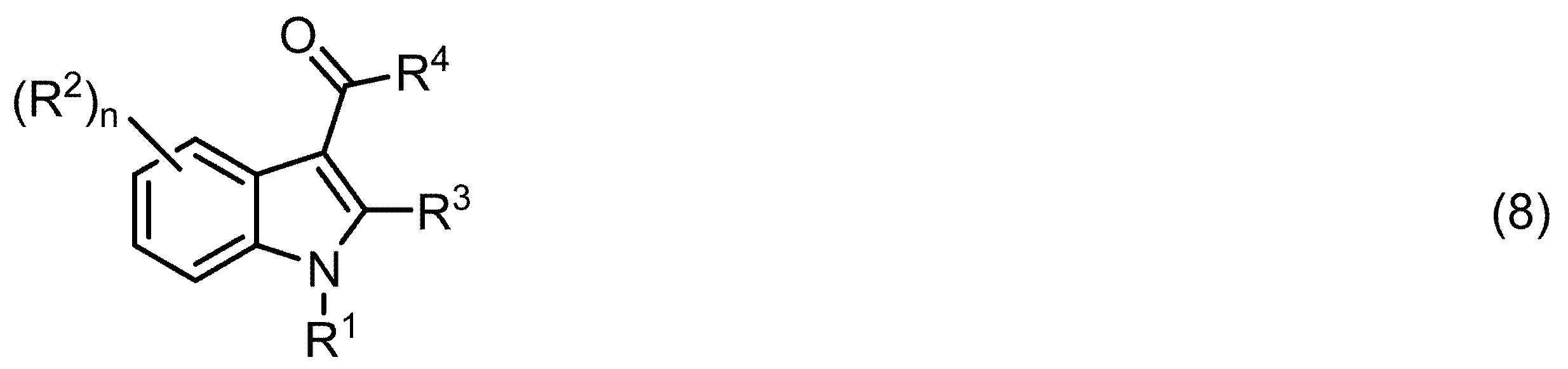
[式中、R1、R2、R3、R4及びnは、上記式(6)と同じである。]
で表される化合物と、下記式(10)
で表される化合物と、下記式(10)

[式中、R1、R2、R3及びnは、上記式(6)と同じである。]
で表される化合物を反応させることにより上記式(6)で表される化合物を得る方法である。当該方法は、工程数が少ないうえに、上記式(8)で表される化合物及び上記式(10)で表される化合物は安価である。したがって、上記式(6)で表される化合物の製造コストが低減する。
で表される化合物を反応させることにより上記式(6)で表される化合物を得る方法である。当該方法は、工程数が少ないうえに、上記式(8)で表される化合物及び上記式(10)で表される化合物は安価である。したがって、上記式(6)で表される化合物の製造コストが低減する。
上記式(10)で表される化合物は、一般的な手法により、インドールに対して、R1、R2又はR3を導入することにより得ることができる。
上記式(8)で表される化合物の製造方法は特に限定されないが、カルボン酸無水物と、上記式(10)で表される化合物を反応させることにより得ることが好適である。
前記カルボン酸無水物として、下記式(11)

[式中、R4は上記式(6)と同じである。]
が用いられる。使用される溶媒として、N、N-ジメチルホルムアミド(DMF)、ジクロロメタン、テトラヒドロフラン(THF)等が用いられる。反応温度は特に限定されないが、0~100℃が好適である。反応生成物は、通常の分離手段、例えばカラムクロマトグラフィー又は再結晶などで精製することができる。
が用いられる。使用される溶媒として、N、N-ジメチルホルムアミド(DMF)、ジクロロメタン、テトラヒドロフラン(THF)等が用いられる。反応温度は特に限定されないが、0~100℃が好適である。反応生成物は、通常の分離手段、例えばカラムクロマトグラフィー又は再結晶などで精製することができる。
上記式(8)、(10)及び(11)において、R1、R2、R3、R4及びnは、前述した細胞死抑制剤の有効成分である化合物の説明における、式(6)についての記載と同様である。
第1の製造方法において用いられる周期律表の第3族に属する金属の塩は、触媒として機能する。当該塩を形成するアニオンとしては、トリフルオロメタンスルホン酸アニオン、塩素アニオン、臭素アニオン等が挙げられる。当該塩を構成する金属としては、イッテルビウム、スカンジウム、エルビウム、ランタン、イットリウム、サマリウム、ユウロピウム、ジスプロシウム等が挙げられる。前記塩として、トリフルオロメタンスルホン酸イッテルビウム(III)、トリフルオロメタンスルホン酸スカンジウム(III)、トリフルオロメタンスルホン酸エルビウム(III)、トリフルオロメタンスルホン酸イットリウム(III)及びトリフルオロメタンスルホン酸ユウロピウム(III)が好適であり、トリフルオロメタンスルホン酸イッテルビウム(III)、トリフルオロメタンスルホン酸エルビウム(III)及びトリフルオロメタンスルホン酸イットリウム(III)がより好適であり、トリフルオロメタンスルホン酸イッテルビウム(III)及びトリフルオロメタンスルホン酸エルビウム(III)がさらに好適である。
第1の製造方法において、周期律表の第3族に属する金属の塩の使用量は特に限定されないが、上記式(8)で表される化合物1molに対して、0.001~0.5molが好適であり、0.01~0.5molがより好適である。
第1の製造方法において用いられる溶媒は特に限定されないが、トルエン、ジクロロエタン、テトラヒドロフラン等が用いられる。反応温度は特に限定されないが、0~200℃が好適である。反応生成物は、通常の分離手段、例えばカラムクロマトグラフィー又は再結晶などで精製することができる。
第2の製造方法は、下記式(8)

[式中、R1、R2、R3、R4及びnは、上記式(6)と同じである。]
で表される化合物に還元剤を作用させて、下記式(9)
で表される化合物に還元剤を作用させて、下記式(9)

[式中、R1、R2、R3、R4及びnは、上記式(6)と同じである。]
で表される化合物を得た後に、周期律表の第3族に属する金属の塩の存在下、上記式(9)で表される化合物と、下記式(10)
で表される化合物を得た後に、周期律表の第3族に属する金属の塩の存在下、上記式(9)で表される化合物と、下記式(10)

[式中、R1、R2、R3及びnは、上記式(6)と同じである。]
で表される化合物を反応させることにより上記式(6)で表される化合物を得る方法である。当該方法もまた、安価な上記式(8)で表される化合物及び上記式(10)で表される化合物を使用するため、製造コストが低減する。
で表される化合物を反応させることにより上記式(6)で表される化合物を得る方法である。当該方法もまた、安価な上記式(8)で表される化合物及び上記式(10)で表される化合物を使用するため、製造コストが低減する。
上記式(8)で表される化合物及び上記式(10)で表される化合物は、上述した第1の製造方法において用いられるそれぞれの化合物の製造方法として記載した方法により得られる。
上記式(8)、(9)及び(10)において、R1、R2、R3、R4及びnは、前述した細胞死抑制剤の有効成分である化合物の説明における、式(6)についての記載と同様である。
前記還元剤は特に限定されないが、NaBH4、NaH、Et3SiH、Ph2SiH2、ポリメチルヒドロシロキサン等のヒドロシラン類等が挙げられる。前記還元剤の使用量は特に限定されないが、上記式(8)で表される化合物1molに対して、0.01~5mol使用することが好適である。上記式(8)で表される化合物に還元剤を作用させる際に用いられる溶媒は特に限定されないが、テトラヒドロフラン、ジクロロメタン、メタノール等が挙げられる。反応温度は特に限定されないが、-10~100℃が好適である。反応生成物は、そのまま次の工程に供してもよいし、精製した後に次の工程に供してもよい。精製は、通常の分離手段、例えばカラムクロマトグラフィー又は再結晶などにより行うことができる。
上記式(8)で表される化合物に還元剤を作用させて得られた上記式(9)で表される化合物と上記式(10)で表される化合物を反応させる。この反応は、周期律表の第3族に属する金属の塩の存在下で行う。当該塩は触媒として機能する。当該塩を形成するアニオンとしては、トリフルオロメタンスルホン酸アニオン、塩素アニオン、臭素アニオン等が挙げられる。当該塩を構成する金属としては、イッテルビウム、スカンジウム、エルビウム、ランタン、イットリウム、サマリウム、ユウロピウム、ジスプロシウム等が挙げられる。前記塩として、トリフルオロメタンスルホン酸イッテルビウム(III)、トリフルオロメタンスルホン酸スカンジウム(III)、トリフルオロメタンスルホン酸エルビウム(III)、トリフルオロメタンスルホン酸イットリウム(III)及びトリフルオロメタンスルホン酸ユウロピウム(III)が好適であり、トリフルオロメタンスルホン酸イッテルビウム(III)、トリフルオロメタンスルホン酸スカンジウム(III)及びトリフルオロメタンスルホン酸エルビウム(III)がより好適であり、トリフルオロメタンスルホン酸イッテルビウム(III)及びトリフルオロメタンスルホン酸スカンジウム(III)がさらに好適である。当該記塩の使用量は特に限定されないが、上記式(9)で表される化合物1molに対して、0.001~0.5molが好適であり、0.003~0.5molがより好適である。
上記式(9)で表される化合物と上記式(10)で表される化合物との反応に用いられる溶媒は特に限定されないが、トルエン、ジクロロエタン、テトラヒドロフラン等が挙げられる。反応温度は特に限定されないが、0~200℃が好適である。反応生成物は、通常の分離手段、例えばカラムクロマトグラフィー又は再結晶などで精製することができる。
上記式(7)で表される化合物の製造方法は特に限定されないが、塩基の存在下、下記式(12)

[式中、R2、R6及びnは、上記式(7)と同じである。]
で表される化合物と、下記式(13)
で表される化合物と、下記式(13)

[式中、R5は、上記式(7)と同じである。R8は、炭素数1~4のアルキル基を示す。]
で表される化合物を反応させることにより得ることが好適である。
で表される化合物を反応させることにより得ることが好適である。
上記式(12)で表される化合物の製造方法は特に限定されないが、カルボン酸無水物と、下記式(14)

[式中、R2及びnは、上記式(7)と同じである。]
で表される化合物を反応させること等により得ることができる。
で表される化合物を反応させること等により得ることができる。
カルボン酸無水物と上記式(14)で表される化合物との反応に使用される溶媒として、N、N-ジメチルホルムアミド(DMF)、テトラヒドロフラン等が用いられる。反応温度は特に限定されないが、0~100℃が好適である。反応生成物は、通常の分離手段、例えばカラムクロマトグラフィー又は再結晶などで精製することができる。
上記式(13)において、R8は、炭素数1~4のアルキル基を示す。R8におけるアルキル基としては、メチル基、エチル基、n-プロピル基又はイソプロピル基が挙げられる。
上記式(12)~(14)において、R2、R5、R6及びnは、前述した細胞死抑制剤の有効成分である化合物の説明における、式(7)についての記載と同様である。
上記式(12)で表される化合物と上記式(13)で表される化合物との反応に使用される塩基は、特に限定されないが、フッ化カリウム、水酸化ナトリウム、トリエチルアミン、フッ化セシウム、ナトリウムメトキシド等が挙げられる。
前記塩基の使用量は特に限定されないが、上記式(13)で表される化合物1molに対して、0.01~5mol使用することが好適である。使用される溶媒は特に限定されないが、トルエン、N、N-ジメチルホルムアミド(DMF)、テトラヒドロフラン等が用いられる。反応温度は特に限定されないが、0~200℃が好適である。反応生成物は、通常の分離手段、例えばカラムクロマトグラフィー又は再結晶などで精製することができる。
本発明の細胞死抑制剤は、上記式(6)で表される化合物又は上記式(7)で表される化合物の少なくとも一方と、薬理学的に許容される担体とを含有する製剤であってもよい。当該製剤としては、錠剤、フィルム剤、カプセル剤、顆粒剤、散剤、トローチ剤、シロップ剤、乳剤、懸濁剤等の経口剤;注射剤、外用剤、坐剤、ペレット、経鼻剤、経肺剤、点眼剤等の非経口剤等が挙げられる。
以下、新規化合物について説明する。
下記式(6)
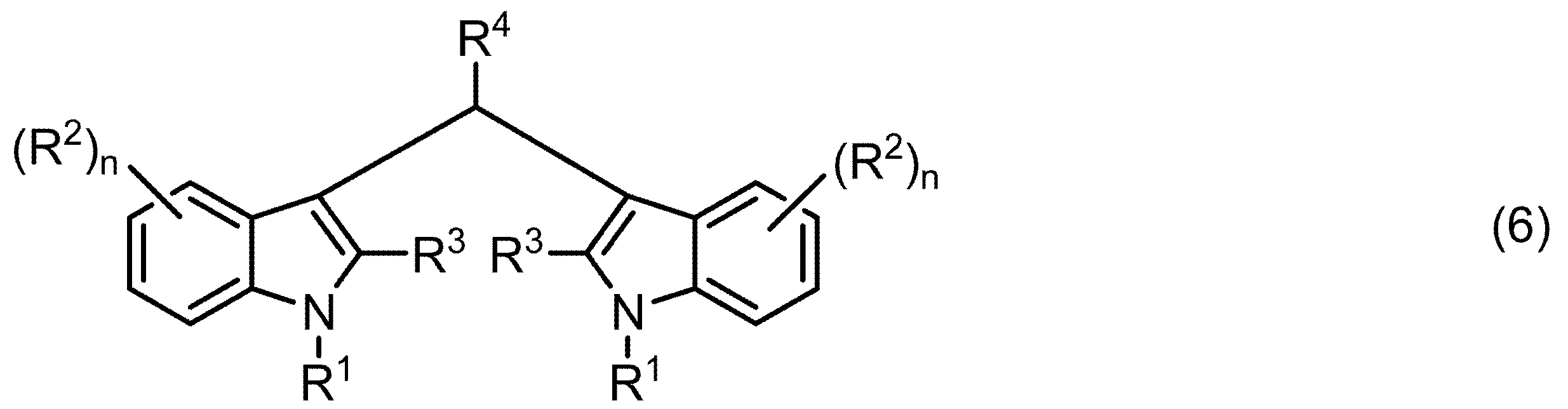
[式中、R1は、置換基を有してもよい炭素数1~10の炭化水素基又は置換基を有してもよい炭素数2~10のアシル基を示す。R2は、ハロゲン原子、炭素数1~4のアルキル基又は炭素数1~4のアルコキシ基を示す。nは、0~4の整数である。R3は、水素原子又はメチル基を示す。R4は、炭素数1~4のフルオロアルキル基を示す。]
で表される化合物は新規化合物である。上述のとおり、当該化合物は細胞死抑制活性を有し、細胞死抑制活性剤等として好適に使用される。
で表される化合物は新規化合物である。上述のとおり、当該化合物は細胞死抑制活性を有し、細胞死抑制活性剤等として好適に使用される。
上記式(6)で表される化合物において、R1は、置換基を有してもよい炭素数1~10の炭化水素基又は置換基を有してもよい炭素数2~10のアシル基を示す。上記式(6)中の2つのR1は、同じであってもよいし、異なっていてもよい。
R1における炭化水素基としては、アルキル基、アルケニル基、アルキニル基、アリール基、アリールアルキル基、アリールアルケニル基、アリールアルキニル基、シクロアルキル基等が挙げられる。合成が容易である観点からは、前記炭化水素基がアルキル基又はアリール基であることが好適である。前記炭化水素基における置換基としては、ハロゲン原子、ヒドロキシル基、アミノ基等が挙げられる。合成が容易である観点からは、前記炭化水素基の炭素数は、7以下が好適であり、4以下がより好適であり、2以下がさらに好適である。
R1におけるアシル基としては、アルキルカルボニル基、アリールカルボニル基等が挙げられる。合成が容易である観点からは、前記アシル基の炭素数は、7以下が好適であり、4以下がより好適であり、2以下がさらに好適である。前記アシル基における置換基としては、ハロゲン原子、ヒドロキシル基、アミノ基等が挙げられる。前記アシル基がアセチル基であることが好適である。
上記式(6)において、R4がパーフルオロアルキル基であることがより好適である。R4における炭素数は、2以下が好適である。
上記式(6)において、R2、R3及びnは、前述した細胞死抑制剤の有効成分である化合物の説明における、式(6)についての記載と同様である。
製造コストが低減する観点からは、上記式(6)で表される化合物中の2つのインドリル基が同じであることが好適である。
下記式(6)
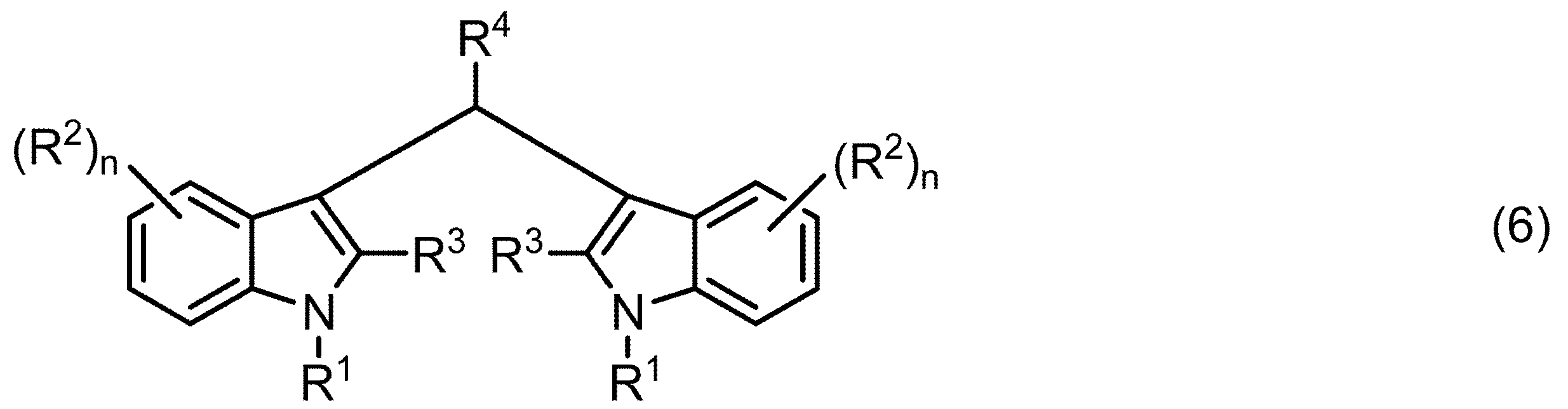
[式中、R1は、水素原子、置換基を有してもよい炭素数1~10の炭化水素基又は置換基を有してもよい炭素数2~10のアシル基を示す。R2は、ハロゲン原子、炭素数1~4のアルキル基又は炭素数1~4のアルコキシ基を示す。nは、1~4の整数である。R3は、水素原子又はメチル基を示す。R4は、炭素数1~4のフルオロアルキル基を示す。]
で表される化合物は新規化合物である。上述のとおり、当該化合物は細胞死抑制活性を有し、細胞死抑制活性剤等として好適に使用される。
で表される化合物は新規化合物である。上述のとおり、当該化合物は細胞死抑制活性を有し、細胞死抑制活性剤等として好適に使用される。
上記式(6)において、R2は、ハロゲン原子、炭素数1~4のアルキル基又は炭素数1~4のアルコキシ基を示す。nは、1~4の整数であり、1が好適である。インドリル基の5位にR2が結合していることも好適である。上記式(6)中のR2は、同じであってもよいし、異なっていてもよい。上記式(6)中の2つのnは、同じであってもよいし、異なっていてもよい。
R2におけるハロゲン原子が臭素原子、塩素原子又はフッ素原子であることが好適である。
R2におけるアルキル基としては、メチル基、エチル基、n-プロピル基、イソプロピル基、n-ブチル基、イソブチル基、sec-ブチル基及びtert-ブチル基が挙げられ、メチル基又はエチル基であることが好適である。
R2におけるアルコキシ基としては、メトキシ基、エトキシ基、n-プロポキシ基、イソプロポキシ基、n-ブトキシ基、イソブトキシ基、sec-ブトキシ基及びtert-ブトキシ基が挙げられ、メトキシ基又はエトキシ基であることが好適である。
上記式(6)において、R4がパーフルオロアルキル基であることがより好適である。R4における炭素数は、2以下が好適である。
上記式(6)において、R1及びR3は、前述した細胞死抑制剤の有効成分である化合物の説明における、式(6)についての記載と同様である。
製造コストが低減する観点からは、上記式(6)で表される化合物中の2つのインドリル基が同じであることが好適である。
下記式(6)
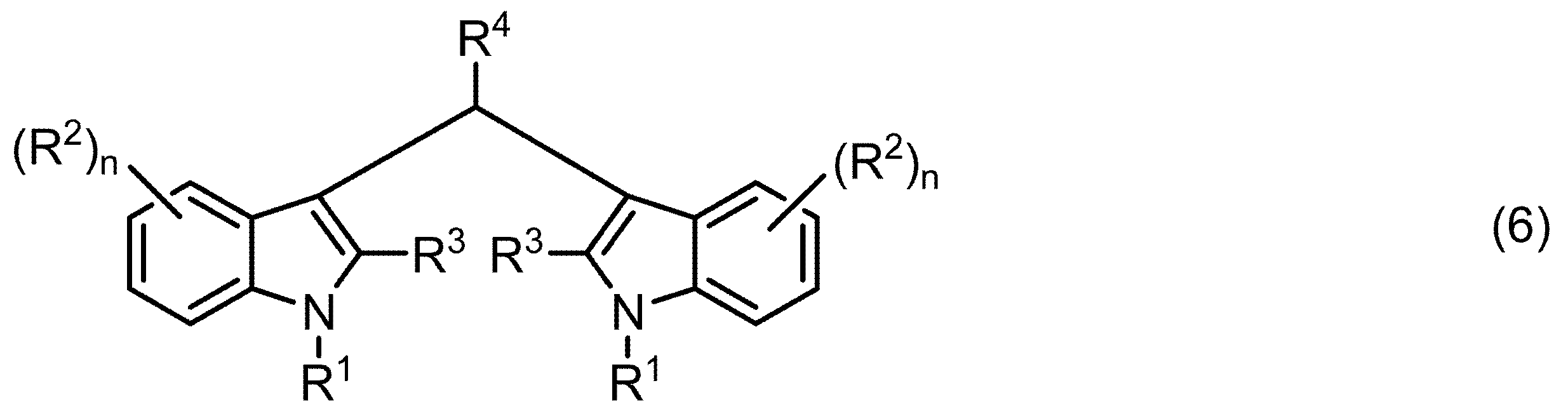
[式中、R1は、水素原子、置換基を有してもよい炭素数1~10の炭化水素基又は置換基を有してもよい炭素数2~10のアシル基を示す。R2は、ハロゲン原子、炭素数1~4のアルキル基又は炭素数1~4のアルコキシ基を示す。nは、0~4の整数である。R3は、水素原子又はメチル基を示す。R4は、炭素数2~4のフルオロアルキル基を示す。]
で表される化合物は新規化合物である。上述のとおり、当該化合物は細胞死抑制活性を有し、細胞死抑制活性剤等として好適に使用される。
で表される化合物は新規化合物である。上述のとおり、当該化合物は細胞死抑制活性を有し、細胞死抑制活性剤等として好適に使用される。
上記式(6)において、R4は、炭素数2~4のフルオロアルキル基を示す。R4がパーフルオロアルキル基であることがより好適である。R4における炭素数は、2であることが好適である。
上記式(6)において、R1、R2、R3及びnは、前述した細胞死抑制剤の有効成分である化合物の説明における、式(6)についての記載と同様である。
製造コストが低減する観点からは、上記式(6)で表される化合物中の2つのインドリル基が同じであることが好適である。
下記式(7)

で表される化合物は新規化合物である。上述のとおり、当該化合物は細胞死抑制活性を有し、細胞死抑制活性剤等として好適に使用される。
前記式(7)において、R5及びR6は、それぞれ独立に、炭素数1~4のフルオロアルキル基を示す。R5及びR6がパーフルオロアルキル基であることがより好適である。R5及びR6における炭素数は、2以下が好適である。
上記式(7)において、R2、R7及びnは、前述した細胞死抑制剤の有効成分である化合物の説明における、式(7)についての記載と同様である。
以下、実施例を用いて本発明をさらに具体的に説明する。
化合物の安全性の評価
ウェルプレートにヒト子宮頸癌細胞株(HeLa)をおよそ4x10³個/1ウェル蒔き、16時間培養した。培養液に、ジメチルスルホキシド(DMSO)に溶解した評価対象の化合物を加えた。このとき、培養液中の化合物の濃度が20μmol/Lとなるよう、その添加量を調整した。化合物を加えた後、3時間培養を行った。培養後の培養液の生細胞量をタカラバイオ株式会社製「Premix WST-1」を用い、取り扱い説明書の記載に従って測定した。また、対照実験として、DMSOに溶解した評価対象の化合物の代わりにDMSOのみを加えたこと以外は、上述した方法と同様にして細胞培養及び生細胞量の測定を行った。評価対象の化合物を加えずに培養した場合の生細胞量に対する当該化合物を加えてから培養した場合の生細胞量の比から安全性を評価した。
ウェルプレートにヒト子宮頸癌細胞株(HeLa)をおよそ4x10³個/1ウェル蒔き、16時間培養した。培養液に、ジメチルスルホキシド(DMSO)に溶解した評価対象の化合物を加えた。このとき、培養液中の化合物の濃度が20μmol/Lとなるよう、その添加量を調整した。化合物を加えた後、3時間培養を行った。培養後の培養液の生細胞量をタカラバイオ株式会社製「Premix WST-1」を用い、取り扱い説明書の記載に従って測定した。また、対照実験として、DMSOに溶解した評価対象の化合物の代わりにDMSOのみを加えたこと以外は、上述した方法と同様にして細胞培養及び生細胞量の測定を行った。評価対象の化合物を加えずに培養した場合の生細胞量に対する当該化合物を加えてから培養した場合の生細胞量の比から安全性を評価した。
細胞死抑制活性評価
ウェルプレートにヒト子宮頸癌細胞株(HeLa)をおよそ4x10³個/1ウェル蒔き、16時間培養した。培養液に、DMSOに溶解した評価対象の化合物を加えた。このとき、培養液中の化合物の濃度が20μmol/Lとなるよう、その添加量を調整した。さらに培養液に過酸化水素を加えた。このとき、培養液中の過酸化水素の濃度が1mmol/Lとなるよう、その添加量を調整した。過酸化水素を加えた後、3時間培養を行った。上述した化合物の安全性の評価で採用した測定方法により培養後の培養液の生細胞量を測定した。得られた生細胞量及び後述する対照実験の結果から生細胞率を求めた。
ウェルプレートにヒト子宮頸癌細胞株(HeLa)をおよそ4x10³個/1ウェル蒔き、16時間培養した。培養液に、DMSOに溶解した評価対象の化合物を加えた。このとき、培養液中の化合物の濃度が20μmol/Lとなるよう、その添加量を調整した。さらに培養液に過酸化水素を加えた。このとき、培養液中の過酸化水素の濃度が1mmol/Lとなるよう、その添加量を調整した。過酸化水素を加えた後、3時間培養を行った。上述した化合物の安全性の評価で採用した測定方法により培養後の培養液の生細胞量を測定した。得られた生細胞量及び後述する対照実験の結果から生細胞率を求めた。
対照実験として、以下の2種類の実験を行った。
DMSOに溶解した評価対象の化合物の代わりにDMSOのみを培養液に加えたこと以外は、上述した細胞死抑制活性評価方法と同様にして細胞培養及び生細胞量の測定を行った。この条件で、過酸化水素が細胞死を誘導することが知られている。生細胞率を求めるに際して、このとき得られた値を生細胞率0%とした。
DMSOに溶解した評価対象の化合物の代わりにDMSOのみを加えたことと、過酸化水素を加えなかったこと以外は、上述した細胞死抑制活性評価方法と同様にして細胞培養及び生細胞量の測定を行った。生細胞率を求めるに際して、このとき得られた値を生細胞率100%とした。
実施例1
化合物aの合成を行った。このときの化学反応式を以下に示す。
化合物aの合成を行った。このときの化学反応式を以下に示す。

アルゴン雰囲気下、ベンゾオキサゾール(1mmol)とDMF(2ml)を2口フラスコに加えた。さらにトリフルオロ酢酸無水物(1mmol)を前記2口フラスコに加え、室温で3時間撹拌した。反応混合物に水を加えた後、酢酸エチルで抽出した。抽出物からカラムクロマトグラフィー(ヘキサン:酢酸エチル=3:1)により化合物aを単離した。このときの収率は58%であった。
得られた化合物aのデータを以下に示す。
1H NMR(300MHz、CDCl3)δ8.27(d、J=1.98、1H)、7.13-7.18(m、2H)、7.01-7.04(m、1H)、6.87-6.93(m、1H)
1H NMR(300MHz、CDCl3)δ8.27(d、J=1.98、1H)、7.13-7.18(m、2H)、7.01-7.04(m、1H)、6.87-6.93(m、1H)
得られた化合物aの安全性の評価を行った。その結果を図1に示す。図1の縦軸は、評価対象の化合物を加えずに培養した場合の生細胞量(対照)に対する当該化合物を加えてから培養した場合の生細胞量の比(%)を示す。得られた化合物aの細胞死抑制活性評価を行った。その結果を図2に示す。図2の縦軸は、後述するN-アセチルシステイン(NAC)の細胞死抑制活性評価から求められた生細胞率(比較例1)に対する化合物aを加えた場合の生細胞率の比を示す。
実施例2
化合物b(R1=H、R2=H、R3=H、R4=CF3)の合成を行った。このときの化学反応式を以下に示す。
化合物b(R1=H、R2=H、R3=H、R4=CF3)の合成を行った。このときの化学反応式を以下に示す。

アルゴン雰囲気下、インドール(1mmol)とDMF(2ml)を2口フラスコに加えた。さらにパーフルオロカルボン酸無水物(1mmol)を前記2口フラスコに加え、室温で3時間撹拌した。反応混合物に水を加えた後、酢酸エチルで抽出した。抽出物からカラムクロマトグラフィー(ヘキサン:酢酸エチル=3:1)により化合物bを単離した。このときの収率は90%であった。
得られた化合物bのデータを以下に示す。
1H NMR(300MHz、CDCl3)δ8.41-8.44(m、1H)、8.08-8.09(m、1H)、7.47-7.51(m、1H)、7.37-7.40(m、2H)
1H NMR(300MHz、CDCl3)δ8.41-8.44(m、1H)、8.08-8.09(m、1H)、7.47-7.51(m、1H)、7.37-7.40(m、2H)
得られた化合物bの安全性の評価を行った。その結果を図1に示す。得られた化合物bの細胞死抑制活性評価を行った。その結果を図2に示す。
実施例3~7
表1に示される原料を用いたこと以外は、実施例2と同様にして化合物bを合成した。このときの収率を表1に示す。
表1に示される原料を用いたこと以外は、実施例2と同様にして化合物bを合成した。このときの収率を表1に示す。
得られた化合物bのデータを以下に示す。
(実施例3: R1=CH3、R2=H、R3=H、R4=C2F5)
1H NMR(300MHz、CDCl3)δ8.41-8.49(m、1H)、7.95-7.96(m、1H)、7.38-7.41(m、3H)、3.92(s、2H)
(実施例3: R1=CH3、R2=H、R3=H、R4=C2F5)
1H NMR(300MHz、CDCl3)δ8.41-8.49(m、1H)、7.95-7.96(m、1H)、7.38-7.41(m、3H)、3.92(s、2H)
(実施例4: R1=H、R2=H、R3=H、R4=C2F5)
1H NMR(300MHz、CDCl3)δ9.06(br、1H)、8.42-8.46(m、1H)、7.99-8.14(m、1H)、7.46-7.51(m、1H)、7.26-7.40(m、2H)
1H NMR(300MHz、CDCl3)δ9.06(br、1H)、8.42-8.46(m、1H)、7.99-8.14(m、1H)、7.46-7.51(m、1H)、7.26-7.40(m、2H)
(実施例5: R1=CH3、R2=H、R3=H、R4=CF3)
1H NMR(300MHz、CDCl3)δ8.31-8.35(m、1H)、7.83(s、1H)、7.31-7.33(m、3H)、3.83(s、3H)
1H NMR(300MHz、CDCl3)δ8.31-8.35(m、1H)、7.83(s、1H)、7.31-7.33(m、3H)、3.83(s、3H)
(実施例6: R1=H、R2=Br、R3=H、R4=CF3)
1H NMR(300MHz、CDCl3)δ8.58-8.59(m、1H)、8.05-8.07(m、1H)、7.46-7.50(m、1H)、7.20-7.37(m、5H)
1H NMR(300MHz、CDCl3)δ8.58-8.59(m、1H)、8.05-8.07(m、1H)、7.46-7.50(m、1H)、7.20-7.37(m、5H)
(実施例7: R1=H、R2=Br、R3=H、R4=C2F5)
1H NMR(300MHz、CDCl3)δ9.06(br、1H)、8.42-8.46(m、1H)、8.11-8.14(m、1H)、7.46-7.51(m、1H)、7.26-7.39(m、2H)
1H NMR(300MHz、CDCl3)δ9.06(br、1H)、8.42-8.46(m、1H)、8.11-8.14(m、1H)、7.46-7.51(m、1H)、7.26-7.39(m、2H)
実施例3及び4において得られた化合物bの安全性の評価を行った。その結果を図1に示す。実施例3及び4において得られた化合物bの細胞死抑制活性評価を行った。その結果を図2に示す。

比較例1
培養液中のNACの濃度が1mmol/Lとなるよう、その添加量を調整したこと以外は上述した安全性の評価方法と同様にしてNACの安全性を評価した。その結果を図1に示す。培養液中のNACの濃度が1mmol/Lとなるよう、その添加量を調整したこと以外は、上述した細胞死抑制活性評価方法と同様にして、NACの細胞死抑制活性評価を行った。その結果を図2及び4に示す。図2及び4において、このとき得られた生細胞率を1とした。
培養液中のNACの濃度が1mmol/Lとなるよう、その添加量を調整したこと以外は上述した安全性の評価方法と同様にしてNACの安全性を評価した。その結果を図1に示す。培養液中のNACの濃度が1mmol/Lとなるよう、その添加量を調整したこと以外は、上述した細胞死抑制活性評価方法と同様にして、NACの細胞死抑制活性評価を行った。その結果を図2及び4に示す。図2及び4において、このとき得られた生細胞率を1とした。
図1に示されるとおり、本発明の細胞死抑制剤(実施例1~4)は、NACと比較して、使用量(1/50)が遥かに少なかったにも関わらず、同等以上の細胞死抑制活性を示した。
参考例1
化合物b(R1=H、R2=Br、R3=H、R4=C2F5)の合成を行った。このときの化学反応式を以下に示す。
化合物b(R1=H、R2=Br、R3=H、R4=C2F5)の合成を行った。このときの化学反応式を以下に示す。
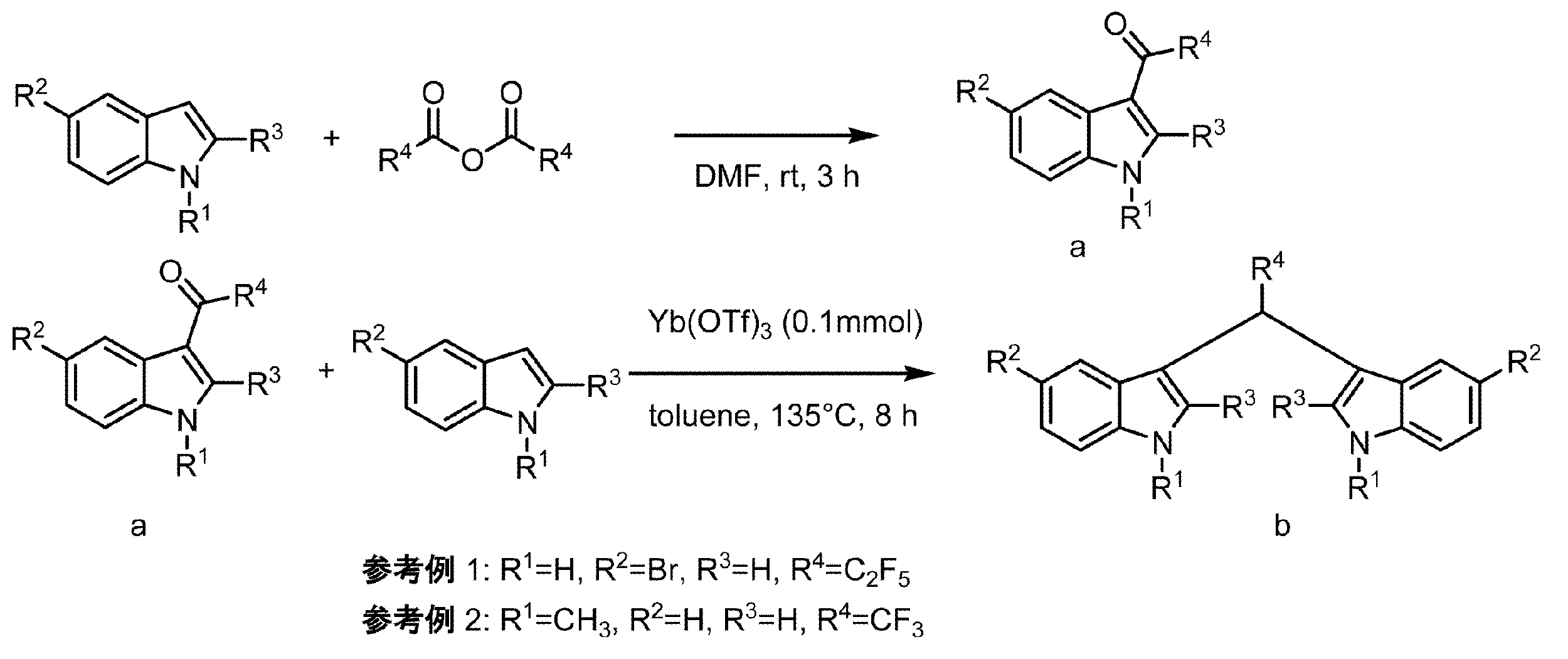
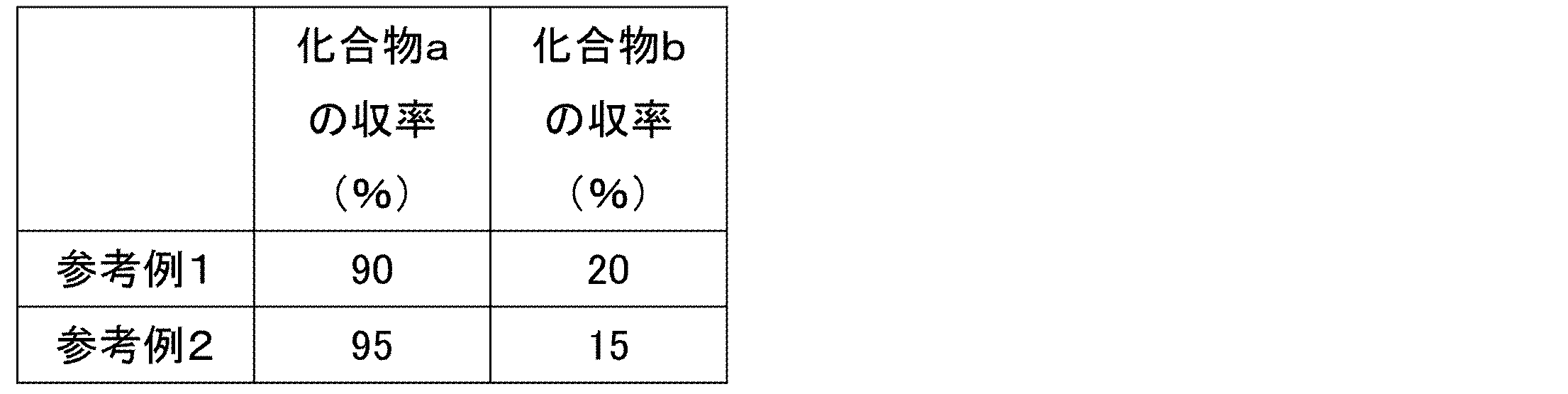
アルゴン雰囲気下、インドール(1mmol)とDMF(2ml)を2口フラスコに加えた。さらにパーフルオロカルボン酸無水物(1mmol)を前記2口フラスコに加え、室温で3時間撹拌した。反応混合物に水を加えた後、酢酸エチルで抽出した。抽出物からカラムクロマトグラフィー(ヘキサン:酢酸エチル=3:1)により化合物aを単離した。このときの収率を表2に示す。
アルゴン雰囲気下、得られた化合物a(1mmol)とインドール(1mmol)の混合物と、トルエン(2ml)とを2口フラスコに加えた。さらにトリフルオロメタンスルホン酸イッテルビウム(III)(0.1mmol)を前記2口フラスコに加え、135℃で8時間撹拌した。反応混合物からカラムクロマトグラフィー(ヘキサン:酢酸エチル=3:1)により化合物bを単離した。このときの収率を表2に示す。
得られた化合物bのデータを以下に示す。
1H NMR(300MHz、CDCl3)δ8.22(br、1H)、7.73(s、1H)、7.22-7.33(m、3H)、5.12-5.23(t、J=17.3Hz、1H)
13C NMR(100MHz、CDCl3)δ111.43、112.84、113.47、119.23、121.86、122.64、123.58、125.09、125.50、134.83、136.21
1H NMR(300MHz、CDCl3)δ8.22(br、1H)、7.73(s、1H)、7.22-7.33(m、3H)、5.12-5.23(t、J=17.3Hz、1H)
13C NMR(100MHz、CDCl3)δ111.43、112.84、113.47、119.23、121.86、122.64、123.58、125.09、125.50、134.83、136.21
得られた化合物bの安全性の評価を行った。その結果を図3に示す。図3の縦軸は、評価対象の化合物を加えずに培養した場合の生細胞量(対照)に対する当該化合物を加えてから培養した場合の生細胞量の比(%)を示す。得られた化合物bの細胞死抑制活性評価を行った。その結果を図4に示す。図4の縦軸は、後述するN-アセチルシステイン(NAC)の細胞死抑制活性評価から求められた生細胞率(比較例1)に対する化合物bを加えた場合の生細胞率の比を示す。
参考例2
参考例1に記載された化学反応式に示される原料を用いたこと以外は、参考例1と同様にして化合物b(参考例2:R1=CH3、R2=H、R3=H、R4=CF3)を合成した。化合物a及びbの収率を表2に示す。
参考例1に記載された化学反応式に示される原料を用いたこと以外は、参考例1と同様にして化合物b(参考例2:R1=CH3、R2=H、R3=H、R4=CF3)を合成した。化合物a及びbの収率を表2に示す。
得られた化合物bのデータを以下に示す。
(参考例2: R1=CH3、R2=H、R3=H、R4=CF3)
1H NMR(300MHz、CDCl3)δ7.56-7.59(m、2H)、7.21-7.32(m、6H)、7.08-7.12(m、4H)、5.24-5.33(q、2H)、3.76(s、6H)
13C NMR(100MHz、CDCl3)δ32.36、38.11、38.50、38.90、39.30(q、J=40.0Hz)、108.73、109.06、118.82、119.07、121.54、125.04、127.01、127.85、128.75、136.51
(参考例2: R1=CH3、R2=H、R3=H、R4=CF3)
1H NMR(300MHz、CDCl3)δ7.56-7.59(m、2H)、7.21-7.32(m、6H)、7.08-7.12(m、4H)、5.24-5.33(q、2H)、3.76(s、6H)
13C NMR(100MHz、CDCl3)δ32.36、38.11、38.50、38.90、39.30(q、J=40.0Hz)、108.73、109.06、118.82、119.07、121.54、125.04、127.01、127.85、128.75、136.51
得られた化合物bの安全性の評価を行った。その結果を図3に示す。得られた各化合物の細胞死抑制活性評価を行った。その結果を図4に示す。
参考例3~7、26
下記化学反応式に示される原料を用いたこと及び触媒として表3に示されるものを使用したこと以外は、参考例1と同様にして化合物bを合成した。このときの化学反応式を以下に示す。化合物bの収率を表3に示す。
下記化学反応式に示される原料を用いたこと及び触媒として表3に示されるものを使用したこと以外は、参考例1と同様にして化合物bを合成した。このときの化学反応式を以下に示す。化合物bの収率を表3に示す。

得られた化合物bのデータを以下に示す。
(R1=H、R2=H、R3=H、R4=CF3)
1H NMR(300MHz、CDCl3)δ8.13(s、1H)、7.64-7.66(m、2H)、7.42-7.45(m、2H)、7.16-7.33(m、6H)、5.35-5.44(m、6H)
13C NMR(100MHz、CDCl3)δ39.13、39.59、39.99、40.39(q、J=39.9Hz)、111.79、119.68、120.47、122.93、124.17、127.40、136.58
(R1=H、R2=H、R3=H、R4=CF3)
1H NMR(300MHz、CDCl3)δ8.13(s、1H)、7.64-7.66(m、2H)、7.42-7.45(m、2H)、7.16-7.33(m、6H)、5.35-5.44(m、6H)
13C NMR(100MHz、CDCl3)δ39.13、39.59、39.99、40.39(q、J=39.9Hz)、111.79、119.68、120.47、122.93、124.17、127.40、136.58
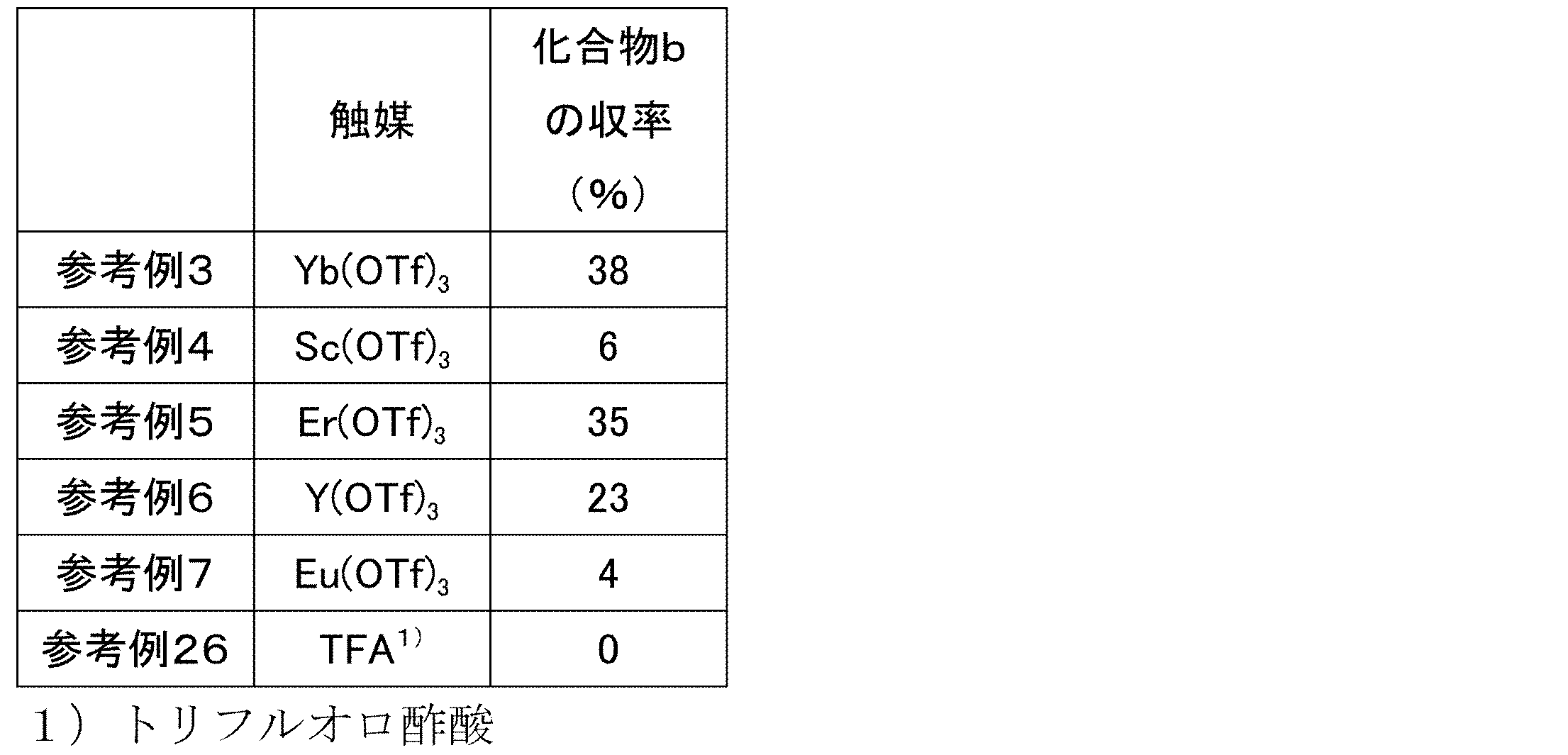
参考例8
Journal of the Indian Chemical Society、2009年、Vol.86(5)、p.488-490に記載された方法により、下式で示されるビス(インドール)アルカンを合成した。
Journal of the Indian Chemical Society、2009年、Vol.86(5)、p.488-490に記載された方法により、下式で示されるビス(インドール)アルカンを合成した。
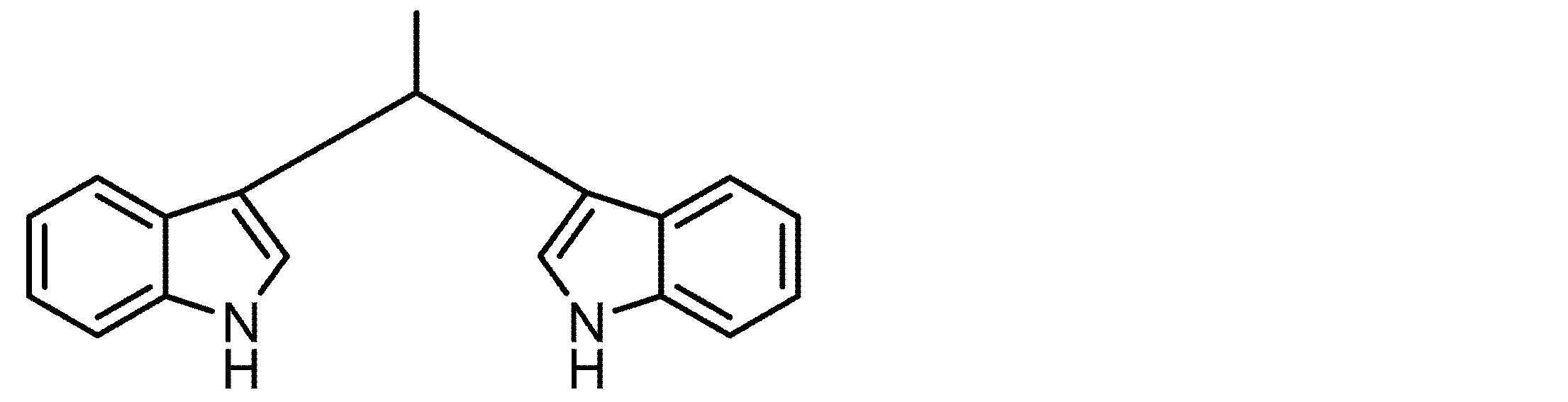
得られた化合物の安全性の評価を行った。その結果を図3に示す。得られた化合物の細胞死抑制活性評価を行った。その結果を図4に示す。
参考例9
化合物b(R1=H、R2=Br、R3=H、R4=C2F5)の合成を行った。このときの化学反応式を以下に示す。
化合物b(R1=H、R2=Br、R3=H、R4=C2F5)の合成を行った。このときの化学反応式を以下に示す。

参考例1と同様にして、化合物aを得た。アルゴン雰囲気下、得られた化合物a(1mmol)、NaBH4(1.5mmol)及びテトラヒドロフラン(5ml)を反応器に加えた後、室温で3時間撹拌した。反応混合物に水を加えた後、酢酸エチルで抽出し、化合物cを得た。このときの収率を表4に示す。
アルゴン雰囲気下、化合物c(1mmol)、インドール(1mmol)、トリフルオロメタンスルホン酸イッテルビウム(III)(0.1mmol)及びトルエン(1mL)を反応器に加えた後、80℃で3時間撹拌した。反応混合物からカラムクロマトグラフィー(ヘキサン:酢酸エチル=3:1)により化合物bを単離した。このときの収率を表4に示す。
参考例10
参考例9に記載された化学反応式に示される原料を用いたこと以外は、参考例9と同様にして化合物b(R1=CH3、R2=H、R3=H、R4=CF3)を合成した。化合物c及びbの収率を表4に示す。
参考例9に記載された化学反応式に示される原料を用いたこと以外は、参考例9と同様にして化合物b(R1=CH3、R2=H、R3=H、R4=CF3)を合成した。化合物c及びbの収率を表4に示す。

参考例11~15
原料及び反応時間を下記化学反応式に示されるとおりに変更したこと、触媒として表5に示されるものを使用したこと以外は、参考例9と同様にして化合物bを合成した。このときの化学反応式を以下に示す。化合物bの収率を表5に示す。
原料及び反応時間を下記化学反応式に示されるとおりに変更したこと、触媒として表5に示されるものを使用したこと以外は、参考例9と同様にして化合物bを合成した。このときの化学反応式を以下に示す。化合物bの収率を表5に示す。

参考例16~24
反応時間、並びに触媒の種類及び添加量を下記化学反応式に示されるとおりに変更したこと、原料を表6に示されるものを使用したこと以外は、参考例9と同様にして化合物bを合成した。このときの化学反応式を以下に示す。化合物bの収率を表6に示す。
反応時間、並びに触媒の種類及び添加量を下記化学反応式に示されるとおりに変更したこと、原料を表6に示されるものを使用したこと以外は、参考例9と同様にして化合物bを合成した。このときの化学反応式を以下に示す。化合物bの収率を表6に示す。

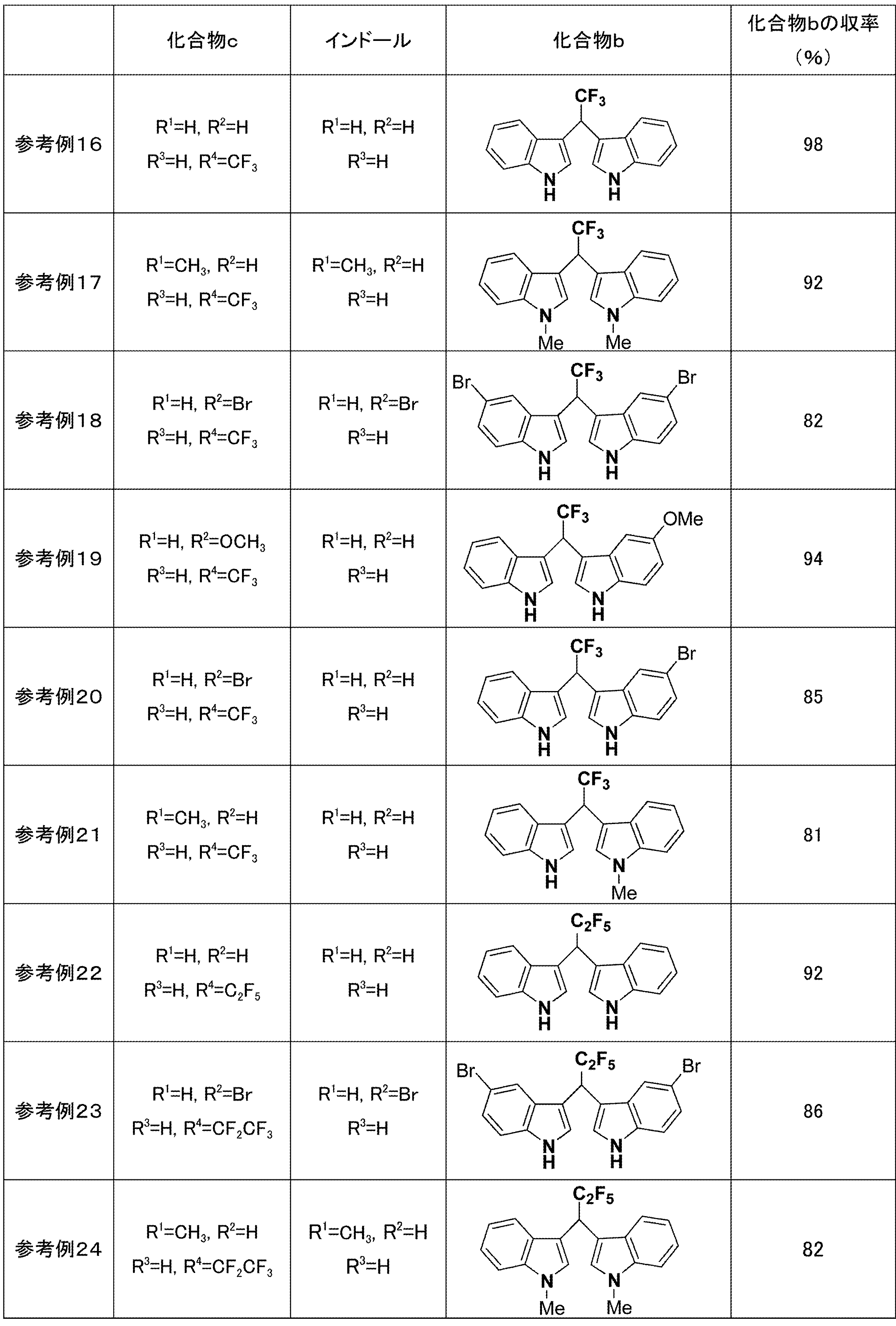
参考例18で得られた化合物bのデータを以下に示す。
1H NMR(300MHz、CDCl3)δ8.17(s、2H)、7.71(s、2H)、7.31-7.35(m、2H)7.21-7.26(m、4H)、5.16-5.25(m、1H)
13C NMR(100MHz、CDCl3)δ39.21、39.60、39.61、40.02(q、J=1.7Hz)、110.15、113.40、113.86、122.14、125.41、125.95、128.82、135.25
1H NMR(300MHz、CDCl3)δ8.17(s、2H)、7.71(s、2H)、7.31-7.35(m、2H)7.21-7.26(m、4H)、5.16-5.25(m、1H)
13C NMR(100MHz、CDCl3)δ39.21、39.60、39.61、40.02(q、J=1.7Hz)、110.15、113.40、113.86、122.14、125.41、125.95、128.82、135.25
参考例19で得られた化合物bのデータを以下に示す。
1H NMR(300MHz、CDCl3)δ7.95-8.05(m、1H)、7.75(d、J=7.92Hz、1H)、7.16-7.42(m、8H)、7.01-7.04(m、1H)、5.37-5.46(m、1H)、3.93-4.01(m、3H)
13C NMR(100MHz、CDCl3)δ38.29、38.67、38.70、39.10(q、J=2.8Hz、)、55.56、100.79、111.04、111.76、111.97、118.70、119.53、122.00、123.27、124.27、126.40、126.90、130.85、135.65、153.78
1H NMR(300MHz、CDCl3)δ7.95-8.05(m、1H)、7.75(d、J=7.92Hz、1H)、7.16-7.42(m、8H)、7.01-7.04(m、1H)、5.37-5.46(m、1H)、3.93-4.01(m、3H)
13C NMR(100MHz、CDCl3)δ38.29、38.67、38.70、39.10(q、J=2.8Hz、)、55.56、100.79、111.04、111.76、111.97、118.70、119.53、122.00、123.27、124.27、126.40、126.90、130.85、135.65、153.78
参考例20で得られた化合物bのデータを以下に示す。
1H NMR(300MHz、CDCl3)δ7.72-7.87(m、3H)、7.53(d、J=7.92Hz、1H)、7.17-7.29(m、3H)7.01-7.13(m、4H)、5.16-5.25(m、1H)
13C NMR(100MHz、CDCl3)δ38.70、39.10、39.50、39.89(q、J=39.9Hz)、111.52、112.92、113.35、119.12、120.09、121.67、122.59、123.63、125.16、125.36、126.65、128.52、134.72、136.10
1H NMR(300MHz、CDCl3)δ7.72-7.87(m、3H)、7.53(d、J=7.92Hz、1H)、7.17-7.29(m、3H)7.01-7.13(m、4H)、5.16-5.25(m、1H)
13C NMR(100MHz、CDCl3)δ38.70、39.10、39.50、39.89(q、J=39.9Hz)、111.52、112.92、113.35、119.12、120.09、121.67、122.59、123.63、125.16、125.36、126.65、128.52、134.72、136.10
参考例21で得られた化合物bのデータを以下に示す。
1H NMR(300MHz、CDCl3)δ7.86(br、1H)、7.59-7.63(m、2H)、7.20-7.32(m、5H)、7.05-7.18(m、5H)、5.29-7.38(m、1H)、3.66-3.68(m、4H)
13C NMR(100MHz、CDCl3)δ32.81、38.62、39.01、39.41、39.81(q、J=39.8Hz)、109.56、111.37、119.15、119.25、119.53、119.95、121.98、122.41、123.62、125.41、126.87、127.43、128.45、136.06、136.96
1H NMR(300MHz、CDCl3)δ7.86(br、1H)、7.59-7.63(m、2H)、7.20-7.32(m、5H)、7.05-7.18(m、5H)、5.29-7.38(m、1H)、3.66-3.68(m、4H)
13C NMR(100MHz、CDCl3)δ32.81、38.62、39.01、39.41、39.81(q、J=39.8Hz)、109.56、111.37、119.15、119.25、119.53、119.95、121.98、122.41、123.62、125.41、126.87、127.43、128.45、136.06、136.96
参考例22で得られた化合物bのデータを以下に示す。
1H NMR(300MHz、CDCl3)δ8.17(s、2H)、7.79(s、2H)、7.23-7.29(m、5H)、7.13-7.16(m、2H)、5.26(dd、 J=34.8Hz、1H)
13C NMR(100MHz、CDCl3)δ111.83,119.37、119.39,122.88,124.41,124.43,127.42,126.38
1H NMR(300MHz、CDCl3)δ8.17(s、2H)、7.79(s、2H)、7.23-7.29(m、5H)、7.13-7.16(m、2H)、5.26(dd、 J=34.8Hz、1H)
13C NMR(100MHz、CDCl3)δ111.83,119.37、119.39,122.88,124.41,124.43,127.42,126.38
参考例23で得られた化合物bのデータを以下に示す。
1H NMR(300MHz、CDCl3)δ8.22(br、1H)、7.72(s、1H)、7.27-7.32(m、3H)、5.10-5.22(t、J=17.3Hz、1H)
13C NMR(100MHz、CDCl3)δ111.43、112.84、113.47、119.23、121.86、122.64、123.58、125.09、125.50、134.83、136.21
1H NMR(300MHz、CDCl3)δ8.22(br、1H)、7.72(s、1H)、7.27-7.32(m、3H)、5.10-5.22(t、J=17.3Hz、1H)
13C NMR(100MHz、CDCl3)δ111.43、112.84、113.47、119.23、121.86、122.64、123.58、125.09、125.50、134.83、136.21
参考例24で得られた化合物bのデータを以下に示す。
1H NMR(300MHz、CDCl3)δ7.74-7.77(m、2H)、7.32-7.40(m、5H)、7.20-7.30(m、4H)、5.42(q、2H)、3.86(s、6H)
1H NMR(300MHz、CDCl3)δ7.74-7.77(m、2H)、7.32-7.40(m、5H)、7.20-7.30(m、4H)、5.42(q、2H)、3.86(s、6H)
参考例25
化合物eの合成を行った。このときの化学反応式を以下に示す。
化合物eの合成を行った。このときの化学反応式を以下に示す。
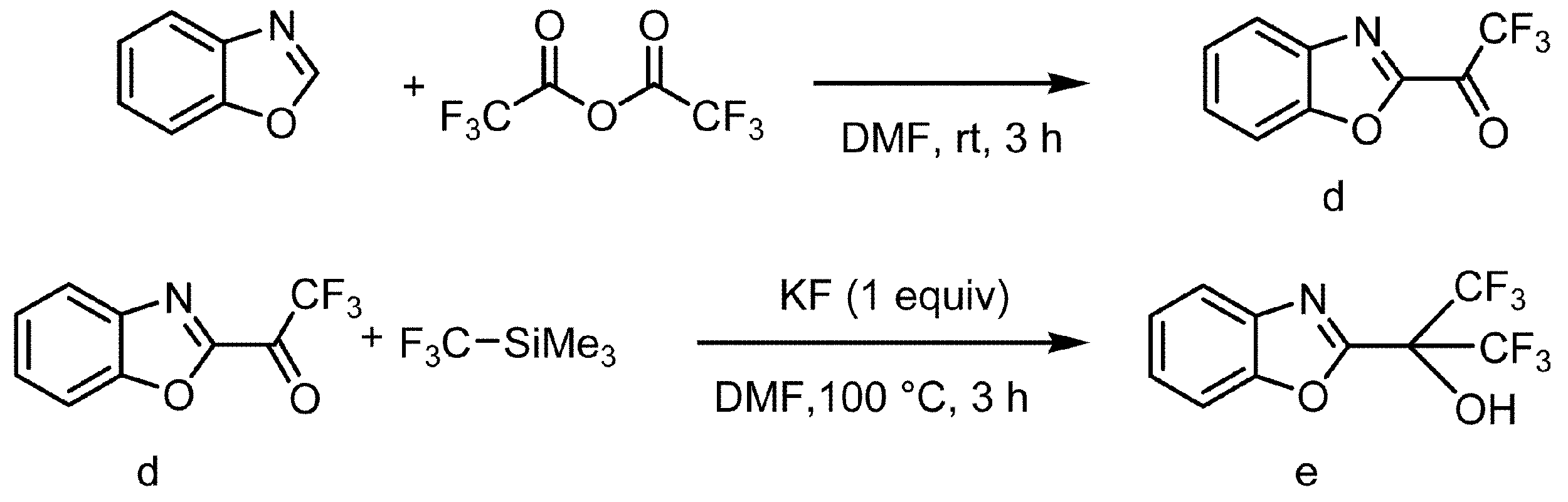
アルゴン雰囲気下、ベンゾオキサゾール(1mmol)とDMF(2ml)を2口フラスコに加えた。さらにトリフルオロ酢酸無水物(1mmol)を前記2口フラスコに加え、室温で3時間撹拌した。反応混合物に水を加えた後、酢酸エチルで抽出した。抽出物からカラムクロマトグラフィー(ヘキサン:酢酸エチル=3:1)により化合物dを単離した。このときの収率は58%であった。
アルゴン雰囲気下、KF(0.2mmol)、得られた化合物d(0.2mmol)及びDMF(0.5ml)をねじ蓋式試験管に加えた。さらに、(トリフルオロメチル)トリメチルシラン(0.3mmol)を加え、100℃で3時間撹拌した後、塩酸を加えて後処理した。反応液中の有機物を酢酸エチルで抽出し、エバポレーターで濃縮後,カラムクロマトグラフィー(ヘキサン:酢酸エチル=3:1)で化合物eを単離した。このときの収率は87%であった。
得られた化合物eのデータを以下に示す。
1H NMR(300MHz、CDCl3)δ7.86-7.87(m、1H)、7.67-7.71(m、1H)、7.46-7.56(m、2H)、5.90(s、1H)
1H NMR(300MHz、CDCl3)δ7.86-7.87(m、1H)、7.67-7.71(m、1H)、7.46-7.56(m、2H)、5.90(s、1H)
得られた化合物eの安全性の評価を行った。その結果を図3に示す。得られた化合物eの細胞死抑制活性評価を行った。その結果を図4に示す。
Claims (3)
- 下記式(1)

で表される化合物、又は
下記式(2)
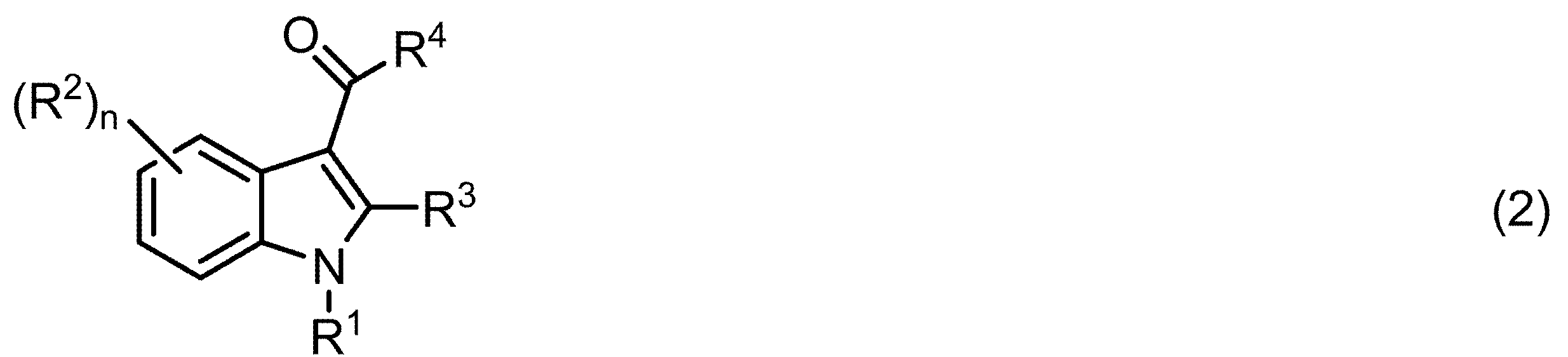
0の炭化水素基又は置換基を有してもよい炭素数2~10のアシル基を示す。R3は、水素原子又はメチル基を示す。R2、R4及びnは、式(1)と同じである。]
で表される化合物の少なくとも一方を有効成分として含有する細胞死抑制剤。 - フルオロカルボン酸無水物と、下記式(3)

で表される化合物を反応させることにより、式(1)で表される化合物を得る請求項1に記載の細胞死抑制剤の製造方法。 - フルオロカルボン酸無水物と、下記式(4)

で表される化合物を反応させることにより、式(2)で表される化合物を得る請求項1に記載の細胞死抑制剤の製造方法。
Priority Applications (1)
| Application Number | Priority Date | Filing Date | Title |
|---|---|---|---|
| JP2015504347A JP6263815B2 (ja) | 2013-03-05 | 2014-03-05 | 細胞死抑制剤及びその製造方法 |
Applications Claiming Priority (4)
| Application Number | Priority Date | Filing Date | Title |
|---|---|---|---|
| JP2013043562 | 2013-03-05 | ||
| JP2013043563 | 2013-03-05 | ||
| JP2013-043562 | 2013-03-05 | ||
| JP2013-043563 | 2013-03-05 |
Publications (1)
| Publication Number | Publication Date |
|---|---|
| WO2014136808A1 true WO2014136808A1 (ja) | 2014-09-12 |
Family
ID=51491320
Family Applications (2)
| Application Number | Title | Priority Date | Filing Date |
|---|---|---|---|
| PCT/JP2014/055532 Ceased WO2014136807A1 (ja) | 2013-03-05 | 2014-03-05 | 細胞死抑制剤及び新規化合物 |
| PCT/JP2014/055533 Ceased WO2014136808A1 (ja) | 2013-03-05 | 2014-03-05 | 細胞死抑制剤及びその製造方法 |
Family Applications Before (1)
| Application Number | Title | Priority Date | Filing Date |
|---|---|---|---|
| PCT/JP2014/055532 Ceased WO2014136807A1 (ja) | 2013-03-05 | 2014-03-05 | 細胞死抑制剤及び新規化合物 |
Country Status (2)
| Country | Link |
|---|---|
| JP (2) | JP6263815B2 (ja) |
| WO (2) | WO2014136807A1 (ja) |
Families Citing this family (1)
| Publication number | Priority date | Publication date | Assignee | Title |
|---|---|---|---|---|
| KR20170113596A (ko) * | 2015-02-10 | 2017-10-12 | 토비라 쎄라퓨틱스, 인크. | 섬유증의 치료를 위한 세니크리비록 |
Citations (1)
| Publication number | Priority date | Publication date | Assignee | Title |
|---|---|---|---|---|
| WO2001074807A1 (en) * | 2000-03-30 | 2001-10-11 | Sagami Chemical Research Center | Indolylpyrrole derivatives and cell death inhibitors |
Family Cites Families (1)
| Publication number | Priority date | Publication date | Assignee | Title |
|---|---|---|---|---|
| US4120863A (en) * | 1977-09-27 | 1978-10-17 | The United States Of America As Represented By The Secretary Of The Air Force | Fluorine-containing benzoxazoles |
-
2014
- 2014-03-05 JP JP2015504347A patent/JP6263815B2/ja not_active Expired - Fee Related
- 2014-03-05 WO PCT/JP2014/055532 patent/WO2014136807A1/ja not_active Ceased
- 2014-03-05 JP JP2015504346A patent/JP6263814B2/ja not_active Expired - Fee Related
- 2014-03-05 WO PCT/JP2014/055533 patent/WO2014136808A1/ja not_active Ceased
Patent Citations (1)
| Publication number | Priority date | Publication date | Assignee | Title |
|---|---|---|---|---|
| WO2001074807A1 (en) * | 2000-03-30 | 2001-10-11 | Sagami Chemical Research Center | Indolylpyrrole derivatives and cell death inhibitors |
Non-Patent Citations (2)
| Title |
|---|
| KAWASE, M. ET AL.: "Alpha-trifluoromethylated acyloins induce apoptosis in human oral tumor cell lines", BIOORG MED CHEM LETT, vol. 9, no. 21, 1999, pages 3113 - 8, XP004181017, DOI: doi:10.1016/S0960-894X(99)00548-X * |
| SIBGATULIN,D.A. ET AL.: "Reaction of enamines with trifluoromethyl containing carbonyl reagents", JOURNAL OF FLUORINE CHEMISTRY, vol. 131, no. 2, 2010, pages 190 - 199, XP026871302 * |
Also Published As
| Publication number | Publication date |
|---|---|
| JP6263814B2 (ja) | 2018-01-24 |
| WO2014136807A1 (ja) | 2014-09-12 |
| JPWO2014136807A1 (ja) | 2017-02-16 |
| JP6263815B2 (ja) | 2018-01-24 |
| JPWO2014136808A1 (ja) | 2017-02-16 |
Similar Documents
| Publication | Publication Date | Title |
|---|---|---|
| JP5371033B2 (ja) | 3官能ニトリルオキシドおよびその製造方法 | |
| CN111875538A (zh) | 一种匹伐他汀叔丁酯的合成方法 | |
| KR100583667B1 (ko) | 아리피프라졸의 제조방법 | |
| CN110041333A (zh) | 溴结构域抑制剂化合物及其用途 | |
| CA2971093A1 (en) | Process of making cenicriviroc and related analogs | |
| CN105985258B (zh) | 一种苯甲酰胺化合物的制备方法及其中间体 | |
| WO2012174685A1 (zh) | 一种2-取代-2h-1,2,3-三氮唑衍生物的制备方法 | |
| TW201236685A (en) | New pyrazole amide derivatives | |
| CN110612291A (zh) | 2-([1,2,3]三唑-2-基)-苯甲酸衍生物的制备 | |
| JP6263815B2 (ja) | 細胞死抑制剤及びその製造方法 | |
| EP3088391B1 (en) | Method for producing benzyl ester 2-aminonicotinate derivative | |
| CA3038381C (en) | Method for preparing the phenylalanine compound 2-[(2-(4-fluorobenzoyl)phenyl)amino]-3-[4-(2-carbazolylethoxy)-phenyl]propionic acid | |
| JP4219696B2 (ja) | 光学活性トランス−1,2−シクロヘキサンジカルボン酸誘導体の製造方法 | |
| CA3011662A1 (en) | An improved process for the preparation of regorafenib | |
| EP1847538A1 (en) | A process for the preparation of pyridine compounds | |
| TWI687418B (zh) | 唑苯衍生物之結晶 | |
| WO2010027060A1 (ja) | 3,5-ジヒドロキシ-6-ヘプテン酸アミン塩類の製造方法 | |
| CN105669596B (zh) | 一种n,n‑二烷基胺基酚的制备方法 | |
| RU2701515C2 (ru) | Производное азолобензола и его кристаллическая форма | |
| JP5702956B2 (ja) | 芳香族トリカルボン酸 | |
| JP6856365B2 (ja) | アジルサルタンの製造方法 | |
| KR20100067886A (ko) | (r)-(+)-란소프라졸의 제조방법 및 이에 사용되는 중간체 | |
| JP2007153823A (ja) | アレンカルボン酸エステル類の製造法 | |
| JP2015174853A (ja) | 2−(4−メチル−2−フェニルピペラジン−1−イル)ピリジン−3−メタノールの製造方法 | |
| CN104030997B (zh) | 一种用于埃索美拉唑不对称合成的催化剂 |
Legal Events
| Date | Code | Title | Description |
|---|---|---|---|
| 121 | Ep: the epo has been informed by wipo that ep was designated in this application |
Ref document number: 14759638 Country of ref document: EP Kind code of ref document: A1 |
|
| ENP | Entry into the national phase |
Ref document number: 2015504347 Country of ref document: JP Kind code of ref document: A |
|
| NENP | Non-entry into the national phase |
Ref country code: DE |
|
| 122 | Ep: pct application non-entry in european phase |
Ref document number: 14759638 Country of ref document: EP Kind code of ref document: A1 |