WO2014119587A1 - 溶解分離層を備えた薬剤付き支持体 - Google Patents
溶解分離層を備えた薬剤付き支持体 Download PDFInfo
- Publication number
- WO2014119587A1 WO2014119587A1 PCT/JP2014/051893 JP2014051893W WO2014119587A1 WO 2014119587 A1 WO2014119587 A1 WO 2014119587A1 JP 2014051893 W JP2014051893 W JP 2014051893W WO 2014119587 A1 WO2014119587 A1 WO 2014119587A1
- Authority
- WO
- WIPO (PCT)
- Prior art keywords
- drug
- layer
- dissolution
- separation layer
- support
- Prior art date
- Legal status (The legal status is an assumption and is not a legal conclusion. Google has not performed a legal analysis and makes no representation as to the accuracy of the status listed.)
- Ceased
Links
Images

Classifications
-
- A—HUMAN NECESSITIES
- A61—MEDICAL OR VETERINARY SCIENCE; HYGIENE
- A61K—PREPARATIONS FOR MEDICAL, DENTAL OR TOILETRY PURPOSES
- A61K9/00—Medicinal preparations characterised by special physical form
- A61K9/0012—Galenical forms characterised by the site of application
- A61K9/0048—Eye, e.g. artificial tears
-
- A—HUMAN NECESSITIES
- A61—MEDICAL OR VETERINARY SCIENCE; HYGIENE
- A61F—FILTERS IMPLANTABLE INTO BLOOD VESSELS; PROSTHESES; DEVICES PROVIDING PATENCY TO, OR PREVENTING COLLAPSING OF, TUBULAR STRUCTURES OF THE BODY, e.g. STENTS; ORTHOPAEDIC, NURSING OR CONTRACEPTIVE DEVICES; FOMENTATION; TREATMENT OR PROTECTION OF EYES OR EARS; BANDAGES, DRESSINGS OR ABSORBENT PADS; FIRST-AID KITS
- A61F9/00—Methods or devices for treatment of the eyes; Devices for putting in contact-lenses; Devices to correct squinting; Apparatus to guide the blind; Protective devices for the eyes, carried on the body or in the hand
- A61F9/0008—Introducing ophthalmic products into the ocular cavity or retaining products therein
-
- A—HUMAN NECESSITIES
- A61—MEDICAL OR VETERINARY SCIENCE; HYGIENE
- A61K—PREPARATIONS FOR MEDICAL, DENTAL OR TOILETRY PURPOSES
- A61K47/00—Medicinal preparations characterised by the non-active ingredients used, e.g. carriers or inert additives; Targeting or modifying agents chemically bound to the active ingredient
- A61K47/30—Macromolecular organic or inorganic compounds, e.g. inorganic polyphosphates
- A61K47/36—Polysaccharides; Derivatives thereof, e.g. gums, starch, alginate, dextrin, hyaluronic acid, chitosan, inulin, agar or pectin
- A61K47/38—Cellulose; Derivatives thereof
-
- A—HUMAN NECESSITIES
- A61—MEDICAL OR VETERINARY SCIENCE; HYGIENE
- A61K—PREPARATIONS FOR MEDICAL, DENTAL OR TOILETRY PURPOSES
- A61K9/00—Medicinal preparations characterised by special physical form
- A61K9/70—Web, sheet or filament bases ; Films; Fibres of the matrix type containing drug
- A61K9/7007—Drug-containing films, membranes or sheets
-
- A—HUMAN NECESSITIES
- A61—MEDICAL OR VETERINARY SCIENCE; HYGIENE
- A61P—SPECIFIC THERAPEUTIC ACTIVITY OF CHEMICAL COMPOUNDS OR MEDICINAL PREPARATIONS
- A61P27/00—Drugs for disorders of the senses
- A61P27/02—Ophthalmic agents
Definitions
- the present invention relates to a support with a drug for administering a drug to the eye.
- eye drops are widely known as ophthalmic preparations.
- the drop amount differs depending on the pressing force of the eye drop container, and the intended drop amount may not be administered.
- Patent Document 1 discloses an applicator for administering a drug to a wet biological surface. That is, in this applicator, a matrix layer containing a drug component in a soluble matrix is provided at one end of a disposable applicator having a long and narrow band shape. A separation portion whose thickness is thinner than other portions is formed in the middle of the matrix layer (see FIG. 1 of Patent Document 1). In this applicator, by holding the other end of the applicator opposite to the drug body and bringing the drug body into contact with the living body surface that is the administration site, the thinner separation part dissolves and the drug body. Is separated from the applicator and the drug main body is administered, so that a certain amount of drug can be administered while maintaining the sterilized state when the drug is administered.
- the present invention has been made in view of the above-described background, and an object thereof is to provide a drug-supported support capable of reliably administering a certain amount of drug to the eye.
- a support with a drug for administering a drug to the eye A drug layer comprising a drug and a water-soluble polymer; A dissolution separation layer comprising a water-soluble polymer set to have a higher water solubility than the water-soluble polymer of the drug layer; With a support to be a handle, The drug layer and the support are connected to the opposite side via the dissolution separation layer.
- the form of the drug layer and the dissolution / separation layer is not particularly limited.
- a film-like form is preferable, and the support is a handle of the support with the drug, and the application at the time of drug administration is performed. Can be used as data. Therefore, the drug-supported support of the present invention can administer the drug while maintaining a sterilized state.
- the solubility of the dissolution / separation layer provided between the drug layer and the support is higher than the water solubility of the drug layer. For this reason, when the drug is administered, the dissolution / separation layer dissolves before the drug layer on the surface of the eye, so that the drug layer is separated from the support with the drug and administered to the surface of the eye. As a result, a certain amount of drug (drug layer) can be reliably administered.
- connection strength between the drug layer and the dissolution / separation layer can be increased by increasing the overlap (contact area) between the drug layer and the dissolution / separation layer.
- the dissolution separation layer and the support are partially overlapped.
- the connection strength can be increased with the drug layer, the dissolution / separation layer, and the support as one body.
- the drug layer, the dissolution / separation layer, and the dissolution / separation layer and the support are reliably connected by thermocompression bonding or adhesion.
- the average disintegration time of the dissolution separation layer (disintegration time is the time required for the film-like matrix of a certain size to dissolve in water or physiological saline) is 60 seconds or less, more preferably 50 seconds or less. is there. This is because if the average disintegration time of the dissolved separation layer exceeds 60 seconds, it takes too much time to administer the drug to the eye using the drug-supported support.
- This configuration allows the dissolution / separation layer to dissolve quickly on the ocular surface, so that a certain amount of drug can be quickly administered to the ocular surface.
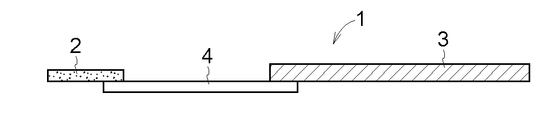
- the drug-supported support 1 is composed of a film-like drug layer 2, a film-like dissolution / separation layer 4, and a support 3 serving as a handle, and the size of the drug layer 2 is not particularly limited.
- the width is preferably about 1 to 4 mm, the length is about 5 to 10 mm, and the thickness is 1 to 300 ⁇ m.
- the size of the dissolution separation layer 4 is not particularly limited, but for example, the width is about 1 to 4 mm and the length is 3 to 3 mm. It is preferably about 10 mm and a thickness of 1 to 300 ⁇ m, and the size of the support 3 is not particularly limited.
- the width is about 1 to 4 mm, the length is about 10 to 60 mm, and the thickness is 50 ⁇ m to 2 mm. Is preferred.
- the support 3 has, for example, a long and thin rectangular shape and serves as a handle for maintaining a sterilized state.
- the material of the support body 3 is not specifically limited, Paper, plastics, aluminum foil, etc. are applicable suitably. Further, the support 3 may be formed by laminating a plurality of these layers.
- each of the drug layer 2 and the dissolution / separation layer 4 is a film-like matrix, and is connected by adhering the entire lower surface of the drug layer 2 and a part of the upper surface of the dissolution / separation layer 4. Then, a part of the lower surface of the dissolution separation layer 4 and a part of the upper surface of the support 3 are connected by thermocompression bonding or adhesion.
- connection strength can be increased by connecting the drug layer 2 and the dissolution / separation layer 4 and the dissolution / separation layer 4 and the support 3 in an overlapping manner and increasing the respective contact areas.
- connection method between the drug layer 2 and the dissolution / separation layer 4 and the connection method between the dissolution / separation layer 4 and the support 3 may be connected by methods other than thermocompression bonding and adhesion.
- the drug layer 2 is composed of a matrix containing a water-soluble polymer and a drug, and an emulsifier such as polysorbate 80 and a plasticizer such as glycerin can be blended in the matrix as necessary. These water-soluble polymers can be mixed, or a matrix having two or more kinds of multilayer structures can be formed.
- the dissolution / separation layer 4 is composed of a matrix containing a water-soluble polymer that does not contain a drug, and an emulsifier and a plasticizer can be blended in the matrix as necessary, and mannitol is used to enhance water solubility.
- the matrix constituting the dissolution / separation layer 4 is set to have higher water solubility than the matrix constituting the drug layer 2. In this way, by making the water solubility of the dissolution / separation layer 4 higher than that of the drug layer 2, the dissolution / separation layer 4 dissolves before the drug layer 2 if it comes into contact with tears during administration.
- the dissolution / separation layer 4 having a higher water solubility than the drug layer 2, there is no problem such as separation from the middle part of the drug layer 2 during administration, and the drug layer 2 is separated from the support 1 with the drug. Thus, it adheres to the ocular surface, so that a certain amount of drug can be reliably administered (see FIGS. 1 to 3).
- the average disintegration time with respect to water or physiological saline when a film-like matrix having a certain size [2 ⁇ 7 mm, film thickness of about 30 ⁇ m] described in detail in the examples can be used.
- the average disintegration time of the matrix constituting the drug layer 2 is not particularly limited, but is preferably 100 minutes or less.
- the average disintegration time of the film-like matrix constituting the dissolution / separation layer 4 is not particularly limited because the dissolution / separation layer 4 is more easily dissolved by tears on the ocular surface as the solubility in water or physiological saline increases. 60 seconds or less, more preferably 50 seconds or less. This is because if the average disintegration time of the dissolved separation layer 4 exceeds 60 seconds, it takes too much time to administer the drug to the eye using the drug-supported support 1. That is, by setting the average disintegration time of the dissolution / separation layer 4 to 60 seconds or less, the dissolution / separation layer 4 quickly dissolves in the tears on the ocular surface, and a certain amount of drug can be quickly administered to the ocular surface. .
- the average disintegration time of the film-like matrix constituting the drug layer 2 is larger than the average disintegration time of the film-like matrix constituting the dissolution / separation layer 4, and the difference is not particularly limited but is preferably 1 second or more. Is 2 seconds or more. That is, by setting the difference in average disintegration time as described above, the dissolution / separation layer 4 dissolves before the drug layer 2 on the surface of the eye at the time of administration, and the drug layer 2 is separated from the drug-supported support 1 to the eye.
- the sum of the average disintegration time of the drug layer 2 and the average disintegration time of the dissolution / separation layer 4 is the average of the dissolution / separation layer 4.
- the dissolution / separation layer 4 can be dissolved on the surface of the eye before the laminate of the drug layer 2 and the dissolution / separation layer 4. .
- the matrix constituting the drug layer 2 is not particularly limited as long as it is a water-soluble matrix.
- cellulose-based water-soluble polymer acrylate-based polymer, polyvinyl pyrrolidone, polyvinyl alcohol, poly (ethylene oxide), polysaccharides Specifically, CMC Daicel 1205 (average disintegration time 10 seconds, manufactured by Daicel Finechem), PLASDONE K-90 (average disintegration time 11 seconds, manufactured by ASHLAND), HPC-L (average disintegration time 27 seconds) , Nippon Soda Co., Ltd.), Gohsenol EG-05 (average decay time 29 seconds, manufactured by Nippon Synthetic Chemical Co., Ltd.), TC-5S (average decay time 34 seconds, manufactured by Shin-Etsu Chemical Co., Ltd.), Metrose 60SH-50 (average decay time 43 Second, manufactured by Shin-Etsu Chemical Co., Ltd.), Metroz SM15 (average decay time 138 seconds, Shin-Ets
- Examples of the matrix constituting the dissolution / separation layer 4 include cellulose-based water-soluble polymers, polyvinyl pyrrolidone, polyvinyl alcohol, and the like.
- CMC Daicel 1205 average disintegration time 10 seconds, manufactured by Daicel Finechem
- PLASDONE K-90 average disintegration time 11 seconds, manufactured by Ashland
- HPC-L average disintegration time 27 seconds, manufactured by Nippon Soda Co., Ltd.
- Gohsenol EG-05 average disintegration time 29 seconds, manufactured by Nippon Synthetic Chemical Co., Ltd.
- a material containing a highly water-soluble polymer such as TC-5S (average disintegration time 34 seconds, manufactured by Shin-Etsu Chemical Co., Ltd.), Metrose 60SH-50 (average disintegration time 43 seconds, manufactured by Shin-Etsu Chemical Co., Ltd.) is preferably used.
- the combination of the matrix constituting the drug layer 2 and the matrix constituting the dissolution / separation layer 4 is not particularly limited.
- the matrix constituting the drug layer 2 include water-soluble polymers such as HPC-L and Metrose SM15.
- the matrix constituting the dissolution / separation layer 4 preferably includes a water-soluble polymer having higher water solubility such as PLASDONE K-90 and CMC Daicel 1205.
- the user picks the vicinity of the end of the support 3 opposite to the end on the side where the drug layer 2 of the support 1 with the drug is provided, and administers the drug layer 2. Move closer to the site.
- the lower eyelid is pulled down with the finger of one hand to expose the conjunctiva, and the region near the end opposite to the side on which the drug layer 2 is provided of the support 3 with the finger of the other hand
- the drug layer 2 and the dissolution / separation layer 4 are brought close to the eye surface and brought into contact with the exposed conjunctiva.
- the water solubility of the dissolution / separation layer 4 is higher than the water solubility of the drug layer 2, so that the drug separation layer 4 is quickly separated from the support 3 as a result of the dissolution / separation layer 4 being dissolved in tears. Adhere to.
- this support body 1 with a medicine it does not separate in the middle part of the medicine layer 2, and a certain amount of medicine (the medicine layer 2) can be reliably administered.
- a part of the lower surface of the drug layer 2 and a part of the upper surface of the dissolution / separation layer 4 are connected, and a part of the lower surface of the dissolution / separation layer 4 and a part of the upper surface of the support 3 are connected.
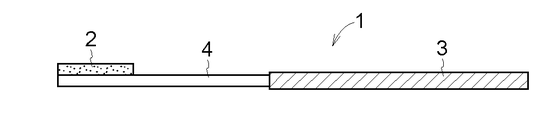
- FIG. 5 the entire lower surface of the drug layer 2 and a part of the upper surface of the dissolution / separation layer 4 are connected, and the upper surface of the dissolution / separation layer 4 and a part of the lower surface of the support 3 are connected. ing.
- FIG. 4 Another embodiment of the drug-supported substrate 1 according to the present invention is shown in FIGS.
- FIG. 9 shows a form in which the entire lower surface of the drug layer 2 and a part of the upper surface of the dissolution / separation layer 4 are connected, and the two supports 3 sandwich the dissolution / separation layer 4.
- the support 3 and the dissolution / separation layer 4 do not necessarily require thermocompression bonding or bonding.
- PLASDONE K-90 [Polymer B], HPC-L [Polymer C], Gohsenol EG-05 [Polymer D], TC-5S [Polymer E], Metrolose 60SH-50 are carried out in the same manner as water-soluble polymers.
- [Polymer F] Metrolz SM15 [Polymer G], Metrolz SM100 [Polymer H], Celny M [Polymer I], Kimika Argin IL-2 [Polymer J], and HEC Daicel SE400 [Polymer K] are used as solvents (water, ethanol, water Samples 2 to 11 were prepared as shown in Table 1 by adding glycerin as a plasticizer and polysorbate 80 as an emulsifier as necessary.
- Samples 1 to 11 were coated on a polypropylene film base material using an applicator so as to have a thickness of about 30 ⁇ m, and dried with warm air.
- each of the obtained film-like matrices is chopped into 2 ⁇ 7 mm sizes, immersed in 10 mL of physiological saline at room temperature, and the disintegration time of the film-like matrix [until the matrix completely dissolves and disappears. Time].
- the results are shown in Table 1.
- the average disintegration time of each film matrix obtained from Samples 1 to 11 is an average value of disintegration times when measured three times.
- Comparative Examples 1 and 2 are drug-supported supports in the form of FIG. 4 in which a part of the lower surface of the drug layer 2 and a part of the upper surface of the dissolution / separation layer 4 are connected.
- the drug layer was separated from the support within 10 seconds, and the entire amount could be administered to the rabbit conjunctiva. Therefore, when the drug-supported support of the present invention is used, a certain amount of drug can be reliably administered to the eye.
- the present invention can be applied to a support with a drug for administering a drug to the eye.
Landscapes
- Health & Medical Sciences (AREA)
- Veterinary Medicine (AREA)
- Chemical & Material Sciences (AREA)
- Life Sciences & Earth Sciences (AREA)
- Animal Behavior & Ethology (AREA)
- General Health & Medical Sciences (AREA)
- Public Health (AREA)
- Engineering & Computer Science (AREA)
- Pharmacology & Pharmacy (AREA)
- Medicinal Chemistry (AREA)
- Epidemiology (AREA)
- Ophthalmology & Optometry (AREA)
- Bioinformatics & Cheminformatics (AREA)
- Vascular Medicine (AREA)
- Inorganic Chemistry (AREA)
- Heart & Thoracic Surgery (AREA)
- Biomedical Technology (AREA)
- Chemical Kinetics & Catalysis (AREA)
- General Chemical & Material Sciences (AREA)
- Nuclear Medicine, Radiotherapy & Molecular Imaging (AREA)
- Organic Chemistry (AREA)
- Medicinal Preparation (AREA)
- Media Introduction/Drainage Providing Device (AREA)
Abstract
眼に薬剤を適切に投与することができる薬剤付き支持体を提供する。眼に薬剤を投与するための薬剤付き支持体は、薬剤及び水溶性ポリマーを含む薬剤層と、薬剤層の水溶性ポリマーよりも水溶性が高く設定された水溶性ポリマーを含む溶解分離層と、持ち手となる支持体とを備え、溶解分離層を介して薬剤層と支持体とが反対側に接続されている。
Description
本発明は、眼への薬剤投与用の薬剤付き支持体に関する。
従来から眼科用剤として点眼剤が広く知られている。点眼剤の場合、点眼容器に収納された液体状の薬剤を滴下して投与することから、点眼容器の押圧力によって滴下量が異なり、意図していた滴下量を投与できないことがあった。
一方、眼に薬剤を一定量投与する手段としては、眼科用の固形組成物を眼に挿入する方法が知られている。この種の固形組成物は、1つの固形組成物に1回の投与に必要な薬剤成分が含有されているので、一定量投与することが可能となるが、該固形組成物を直接手にとって投与するため、滅菌状態を維持することが困難であった。
上述の課題を解決することを意図した眼科用剤として、特許文献1には、湿潤した生体表面に薬剤を投与するためのアプリケータが開示されている。つまり、このアプリケータにおいて、溶解性マトリックス中に薬剤成分を含有させたマトリックス層が、長細い帯形状を有した使い捨てのアプリケータの一端に設けられている。このマトリックス層の中途部に他の部分よりその厚さが薄い分離部が形成されている(特許文献1の図1参照)。このアプリケータでは、アプリケータの薬剤本体とは反対側の他端部を持って、薬剤本体を投与部位である生体表面に接触させることにより、他の部分より薄い分離部が溶解して薬剤本体がアプリケータから分離し、薬剤本体が投与されるので、薬剤を投与する際の滅菌状態を維持しつつ、一定量の薬剤を投与することが可能となる。
しかしながら、元来それほど厚みのないマトリックス層において、他の部分より薄い分離部を形成することは、その加工が非常に困難であった。また、分離部を形成できたとしても、分離部の溶解度と他の部分の溶解度の差が充分ではなく、例えば、マトリックス層中の分離部よりも先端側で分離するなどして、必ずしも一定量の薬剤を投与することができなかった。
本発明は上述した背景に鑑みてなされたものであり、眼に一定量の薬剤を確実に投与することができる薬剤付き支持体を提供することにある。
本発明に係る眼に薬剤を投与するための薬剤付き支持体は、
薬剤及び水溶性ポリマーを含む薬剤層と、
前記薬剤層の水溶性ポリマーよりも水溶性が高く設定された水溶性ポリマーを含む溶解分離層と、
持ち手となる支持体とを備え、
前記溶解分離層を介して前記薬剤層と前記支持体とが反対側に接続されている。
薬剤及び水溶性ポリマーを含む薬剤層と、
前記薬剤層の水溶性ポリマーよりも水溶性が高く設定された水溶性ポリマーを含む溶解分離層と、
持ち手となる支持体とを備え、
前記溶解分離層を介して前記薬剤層と前記支持体とが反対側に接続されている。
本構成によれば、薬剤層および溶解分離層の形態は特に制限されないが、例えばフィルム状の形態を取ることが好ましく、また、支持体は薬剤付き支持体の持ち手となり、薬剤投与時のアプリケータとして利用することができる。したがって、本発明の薬剤付き支持体は、滅菌状態を維持したままで薬剤を投与することができる。
また、薬剤層と支持体との間に設けた溶解分離層の水溶性は、薬剤層の水溶性よりも高いことを特徴とする。このため、薬剤の投与時に、眼の表面で溶解分離層が薬剤層よりも先に溶解することによって、薬剤層が薬剤付き支持体から分離して眼の表面に投与される。この結果、一定量の薬剤(薬剤層)を確実に投与することができる。
上述のように、一定量の薬剤を確実に投与することができる薬剤付き支持体を提供することができる。
また、薬剤層と支持体との間に設けた溶解分離層の水溶性は、薬剤層の水溶性よりも高いことを特徴とする。このため、薬剤の投与時に、眼の表面で溶解分離層が薬剤層よりも先に溶解することによって、薬剤層が薬剤付き支持体から分離して眼の表面に投与される。この結果、一定量の薬剤(薬剤層)を確実に投与することができる。
上述のように、一定量の薬剤を確実に投与することができる薬剤付き支持体を提供することができる。
上記構成において、前記薬剤層の全部または一部と前記溶解分離層の一部とが重なっていると好適である。
薬剤層と溶解分離層との重なり(接触面積)を増加させることによって、薬剤層と溶解分離層との接続強度を増大させることができる。
また、前記溶解分離層と前記支持体もそれらの一部が重なっていると好適である。
薬剤層と溶解分離層および溶解分離層と支持体を重ねて接続することにより、薬剤層、溶解分離層および支持体を一体物として、接続強度を増大させることができる。
薬剤層と溶解分離層および溶解分離層と支持体を重ねて接続することにより、薬剤層、溶解分離層および支持体を一体物として、接続強度を増大させることができる。
上記構成において、前記薬剤層と前記溶解分離層および前記溶解分離層と前記支持体は、熱圧着または接着することにより、確実に接続することが好ましい。
上記構成において、前記溶解分離層の平均崩壊時間(崩壊時間は一定サイズのフィルム状のマトリックスが水または生理食塩水に溶解するのに必要な時間)は60秒以下、より好ましくは50秒以下である。これは、溶解分離層の平均崩壊時間が60秒を超えると薬剤付き支持体を用いて眼に薬剤を投与するのに時間がかかり過ぎるからである。
本構成により、溶解分離層が眼表面で素早く溶解することから、一定量の薬剤を迅速に眼表面に投与することができる。
以下に、本発明に係る薬剤付き支持体1の実施形態について、図面に基づいて説明する。ただし、以下の実施形態に限定されることなく、その要旨を逸脱しない範囲内で種々の変形が可能である。
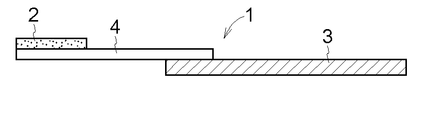
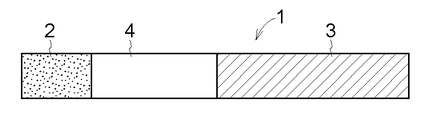
図1に示すように、この薬剤付き支持体1は、フィルム状の薬剤層2、フィルム状の溶解分離層4および持ち手となる支持体3から構成され、薬剤層2のサイズは特に制限されないが、例えば幅1~4mm程度、長さ5~10mm程度、厚さ1~300μmであることが好ましく、溶解分離層4のサイズは特に制限されないが、例えば幅1~4mm程度、長さ3~10mm程度、厚さ1~300μmであることが好ましく、また、支持体3のサイズは特に制限されないが、例えば幅1~4mm程度、長さ10~60mm程度、厚さは50μm~2mmであることが好ましい。
支持体3は、例えば長細い長方形状を有し、滅菌状態を維持するための持ち手となる。支持体3の材質は特に限定されないが、紙製、プラスチック製、アルミニウム箔製等、適宜適用可能である。また、これらの複数の層を積層して支持体3を形成してもよい。
図1及び図2に示すように、溶解分離層4を介して薬剤層2と支持体3とが反対側に接続され、溶解分離層4は薬剤層2と支持体3との間に設けられる。より具体的には、薬剤層2及び溶解分離層4はそれぞれフィルム状のマトリックスであり、薬剤層2の下面の全部と溶解分離層4の上面の一部とを接着することによって接続し、また、溶解分離層4の下面の一部と支持体3の上面の一部とを熱圧着または接着することによって接続する。このように、薬剤層2と溶解分離層4および溶解分離層4と支持体3を重ねて接続し、夫々の接触面積を増加させることによって接続強度を増大させることができる。
なお、薬剤層2と溶解分離層4との接続方法および溶解分離層4と支持体3との接続方法は、熱圧着、接着以外の方法で接続しても差し支えない。
なお、薬剤層2と溶解分離層4との接続方法および溶解分離層4と支持体3との接続方法は、熱圧着、接着以外の方法で接続しても差し支えない。
薬剤層2は、水溶性ポリマーおよび薬剤を含有するマトリックスから構成され、該マトリックス中には必要に応じてポリソルベート80などの乳化剤やグリセリンなどの可塑剤を配合することができ、また、2種以上の水溶性ポリマーを混合したり、あるいは、2種以上の多層構造のマトリックスとすることもできる。
溶解分離層4は薬剤を含有しない水溶性ポリマーを含有するマトリックスから構成され、該マトリックス中には必要に応じて乳化剤や可塑剤を配合することができ、また、水溶性をより高めるためにマンニトール等の糖アルコールやオリゴマー、テロマーなどの分子量が大きくない水溶性高分子を添加したり、気泡を導入することもできる。必要に応じて、2種以上の水溶性ポリマーを混合することもできる。溶解分離層4を構成するマトリックスは、薬剤層2を構成するマトリックスよりも水溶性がより高くなるように設定する。このように、溶解分離層4の水溶性を、薬剤層2のそれよりも高くすることにより、投与時に涙液と接触すれば、溶解分離層4が薬剤層2よりも先に溶解する。また、薬剤層2よりも水溶性の高い溶解分離層4を設けることによって、投与時に薬剤層2の中途部から分離するなどの不具合の発生がなく、薬剤層2が薬剤付き支持体1から分離して眼表面に付着するため、一定量の薬剤を確実に投与することができる(図1~3を参照)。
溶解分離層4は薬剤を含有しない水溶性ポリマーを含有するマトリックスから構成され、該マトリックス中には必要に応じて乳化剤や可塑剤を配合することができ、また、水溶性をより高めるためにマンニトール等の糖アルコールやオリゴマー、テロマーなどの分子量が大きくない水溶性高分子を添加したり、気泡を導入することもできる。必要に応じて、2種以上の水溶性ポリマーを混合することもできる。溶解分離層4を構成するマトリックスは、薬剤層2を構成するマトリックスよりも水溶性がより高くなるように設定する。このように、溶解分離層4の水溶性を、薬剤層2のそれよりも高くすることにより、投与時に涙液と接触すれば、溶解分離層4が薬剤層2よりも先に溶解する。また、薬剤層2よりも水溶性の高い溶解分離層4を設けることによって、投与時に薬剤層2の中途部から分離するなどの不具合の発生がなく、薬剤層2が薬剤付き支持体1から分離して眼表面に付着するため、一定量の薬剤を確実に投与することができる(図1~3を参照)。
水溶性を示す指標として、実施例において詳述する一定サイズ[2×7mm、膜厚約30μm]のフィルム状のマトリックスを用いた場合の水または生理食塩水に対する平均崩壊時間を適用することができる。例えば、薬剤層2を構成するマトリックスの平均崩壊時間は、特に制限されないが100分以下が好ましい。
また、溶解分離層4を構成するフィルム状マトリックスの平均崩壊時間は、水または生理食塩水に対する溶解性が大きくなるほど溶解分離層4は眼表面の涙液によって溶解し易くなるので、特に制限されないが60秒以下、より好ましくは50秒以下である。これは、溶解分離層4の平均崩壊時間が60秒を超えると薬剤付き支持体1を用いて眼に薬剤を投与するのに時間がかかり過ぎるからである。すなわち、溶解分離層4の平均崩壊時間を60秒以下に設定することで、溶解分離層4が眼表面の涙液に素早く溶解し、一定量の薬剤を迅速に眼表面に投与することができる。
薬剤層2を構成するフィルム状マトリックスの平均崩壊時間は、溶解分離層4を構成するフィルム状マトリックスの平均崩壊時間よりも大きく、その差は、特に限定はされないが1秒以上が好ましく、より好ましくは2秒以上である。つまり、平均崩壊時間の差を上記に設定することにより、投与時に眼の表面で溶解分離層4が薬剤層2よりも先に溶解し、薬剤付き支持体1から薬剤層2を分離して眼の表面に投与することができる。また、薬剤層2と溶解分離層4の一部とが積層して接続する場合には、薬剤層2の平均崩壊時間と溶解分離層4の平均崩壊時間との合計が溶解分離層4の平均崩壊時間よりも大きく、より好ましくは2秒以上大きくなるように設定することにより、眼の表面で溶解分離層4を薬剤層2と溶解分離層4の積層体よりも先に溶解させることができる。
上記を踏まえ、薬剤層2を構成するマトリックスとしては、水溶性のマトリックスであれば特に限定されないが、例えばセルロース系水溶性ポリマー、アクリレート系ポリマー、ポリビニルピロリドン、ポリビニルアルコール、ポリ(エチレンオキシド)、多糖類等が挙げられ、具体的にはCMCダイセル1205(平均崩壊時間10秒、ダイセルファインケム社製)、PLASDONE K-90(平均崩壊時間11秒、ASHLAND社製)、HPC-L(平均崩壊時間27秒、日本曹達社製)、ゴーセノールEG-05(平均崩壊時間29秒、日本合成化学社製)、TC-5S(平均崩壊時間34秒、信越化学社製)、メトローズ60SH-50(平均崩壊時間43秒、信越化学社製)、メトローズSM15(平均崩壊時間138秒、信越化学社製)、メトローズSM100(平均崩壊時間162秒、信越化学社製)、セルニーM(平均崩壊時間287秒、日本曹達社製)、キミカアルギンIL-2(平均崩壊時間332秒、キミカ社製)、HECダイセルSE400(平均崩壊時間1800秒以上、ダイセルファインケム社製)などの水溶性ポリマーを含むものが好適に用いられる。
また、溶解分離層4を構成するマトリックスとしては、例えばセルロース系水溶性ポリマー、ポリビニルピロリドン、ポリビニルアルコール等が挙げられ、具体的にはCMCダイセル1205(平均崩壊時間10秒、ダイセルファインケム社製)、PLASDONE K-90(平均崩壊時間11秒、ASHLAND社製)、HPC-L(平均崩壊時間27秒、日本曹達社製)、ゴーセノールEG-05(平均崩壊時間29秒、日本合成化学社製)、TC-5S(平均崩壊時間34秒、信越化学社製)、メトローズ60SH-50(平均崩壊時間43秒、信越化学社製)などの水溶性の高いポリマーを含むものが好適に用いられる。
薬剤層2を構成するマトリックスと溶解分離層4を構成するマトリックスとの組み合わせは、特に限定されないが、薬剤層2を構成するマトリックスとしては、例えばHPC-L、メトローズSM15などの水溶性ポリマーを含み、また、溶解分離層4を構成するマトリックスとしては、例えばPLASDONE K-90、CMCダイセル1205などのより水溶性の高い水溶性ポリマーを含むのが好適である。
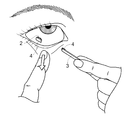
次に、この薬剤付き支持体1の使用方法について説明する。薬剤層2を眼表面に投与する場合を例に挙げて説明するが、例えば、角膜、眼瞼結膜又は結膜襄等の前眼部に投与される。図3に示すように、使用者は、薬剤付き支持体1の薬剤層2が設けられた側の端部とは反対側の支持体3の端部近傍を指で摘み、薬剤層2を投与部位に近づける。本実施形態では、一方の手の指で下眼瞼を引き下げて結膜を露出させるとともに、他方の手の指で支持体3のうち薬剤層2が設けられた側とは反対側の端部近傍部位を摘んで、薬剤層2及び溶解分離層4を眼表面に近づけて露出した結膜に接触させる。この際、溶解分離層4の水溶性は、薬剤層2の水溶性よりも高いので、溶解分離層4が涙液で溶解する結果として薬剤層2は支持体3から速やかに分離して眼表面に付着する。このように、この薬剤付き支持体1では薬剤層2の中途部分で分離することがなく、一定量の薬剤(薬剤層2)を確実に投与することができる。
[別実施形態]
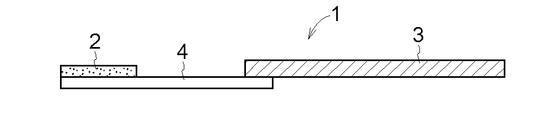
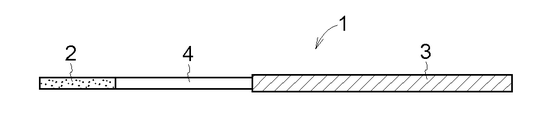
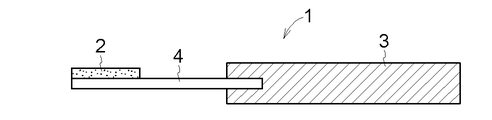
本発明に係る薬剤付き支持体1の別実施形態を図4~図9に示す。図4は、薬剤層2の下面の一部と溶解分離層4の上面の一部とが接続され、また、溶解分離層4の下面の一部と支持体3の上面の一部とが接続されている。図5は、薬剤層2の下面の全部と溶解分離層4の上面の一部とが接続され、また、溶解分離層4の上面の一部と支持体3の下面の一部とが接続されている。図6は、薬剤層2の下面の一部と溶解分離層4の上面の一部とが接続され、また、溶解分離層4の上面の一部と支持体3の下面の一部とが接続されている。図7は、薬剤層2の下面の全部と溶解分離層4の上面の一部とが接続され、また、溶解分離層4の上下面と支持体3の上下面とは重なり合うことなく接続されている。図8は、薬剤層2、溶解分離層4および支持体3の上下面はどれも重なり合うことなく接続されている。図9は、薬剤層2の下面の全部と溶解分離層4の上面の一部とが接続され、また、2つの支持体3が溶解分離層4を挟み込む形態である。図9においては支持体3と溶解分離層4は必ずしも熱圧着または接着することを要しない。
本発明に係る薬剤付き支持体1の別実施形態を図4~図9に示す。図4は、薬剤層2の下面の一部と溶解分離層4の上面の一部とが接続され、また、溶解分離層4の下面の一部と支持体3の上面の一部とが接続されている。図5は、薬剤層2の下面の全部と溶解分離層4の上面の一部とが接続され、また、溶解分離層4の上面の一部と支持体3の下面の一部とが接続されている。図6は、薬剤層2の下面の一部と溶解分離層4の上面の一部とが接続され、また、溶解分離層4の上面の一部と支持体3の下面の一部とが接続されている。図7は、薬剤層2の下面の全部と溶解分離層4の上面の一部とが接続され、また、溶解分離層4の上下面と支持体3の上下面とは重なり合うことなく接続されている。図8は、薬剤層2、溶解分離層4および支持体3の上下面はどれも重なり合うことなく接続されている。図9は、薬剤層2の下面の全部と溶解分離層4の上面の一部とが接続され、また、2つの支持体3が溶解分離層4を挟み込む形態である。図9においては支持体3と溶解分離層4は必ずしも熱圧着または接着することを要しない。
[実験例]
(1)フィルム状マトリックスの平均崩壊時間の測定方法および測定結果
水溶性ポリマーとしてCMCダイセル1205[ポリマーA] 18.0%(w/w)、可塑剤としてグリセリン 1.62%(w/w)、乳化剤としてポリソルベート80 0.09%(w/w)となるように、水溶性ポリマー(CMCダイセル1205)、可塑剤(グリセリン)および乳化剤(ポリソルベート80)を溶媒(水)に溶解させて試料1を作製した。また、同様の操作を行って水溶性ポリマーとしてPLASDONE K-90[ポリマーB]、HPC-L[ポリマーC]、ゴーセノールEG-05[ポリマーD]、TC-5S[ポリマーE]、メトローズ60SH-50[ポリマーF]、メトローズSM15[ポリマーG]、メトローズSM100[ポリマーH]、セルニーM[ポリマーI]、キミカアルギンIL-2[ポリマーJ]およびHECダイセルSE400[ポリマーK]を溶媒(水、エタノール、水とエタノールの混合液)に溶解させ、また、必要に応じて可塑剤としてグリセリンを、また、乳化剤としてポリソルベート80を添加して表1に示すように試料2~11を作製した。ついで、試料1~11をポリプロピレンフィルムのベース材上にアプリケータを用いて厚さ約30μmとなるように塗布して温風で乾燥させた。つぎに、得られた各フィルム状マトリックスを2×7mmの大きさに細切し、室温下10mLの生理食塩水中に浸漬し、フィルム状マトリックスの崩壊時間[マトリックスが完全に溶解し、消失するまでの時間]を計測した。結果を表1に示す。なお、試料1~11から得られた各フィルム状マトリックスの平均崩壊時間は、3回測定したときの崩壊時間の平均値である。

(1)フィルム状マトリックスの平均崩壊時間の測定方法および測定結果
水溶性ポリマーとしてCMCダイセル1205[ポリマーA] 18.0%(w/w)、可塑剤としてグリセリン 1.62%(w/w)、乳化剤としてポリソルベート80 0.09%(w/w)となるように、水溶性ポリマー(CMCダイセル1205)、可塑剤(グリセリン)および乳化剤(ポリソルベート80)を溶媒(水)に溶解させて試料1を作製した。また、同様の操作を行って水溶性ポリマーとしてPLASDONE K-90[ポリマーB]、HPC-L[ポリマーC]、ゴーセノールEG-05[ポリマーD]、TC-5S[ポリマーE]、メトローズ60SH-50[ポリマーF]、メトローズSM15[ポリマーG]、メトローズSM100[ポリマーH]、セルニーM[ポリマーI]、キミカアルギンIL-2[ポリマーJ]およびHECダイセルSE400[ポリマーK]を溶媒(水、エタノール、水とエタノールの混合液)に溶解させ、また、必要に応じて可塑剤としてグリセリンを、また、乳化剤としてポリソルベート80を添加して表1に示すように試料2~11を作製した。ついで、試料1~11をポリプロピレンフィルムのベース材上にアプリケータを用いて厚さ約30μmとなるように塗布して温風で乾燥させた。つぎに、得られた各フィルム状マトリックスを2×7mmの大きさに細切し、室温下10mLの生理食塩水中に浸漬し、フィルム状マトリックスの崩壊時間[マトリックスが完全に溶解し、消失するまでの時間]を計測した。結果を表1に示す。なお、試料1~11から得られた各フィルム状マトリックスの平均崩壊時間は、3回測定したときの崩壊時間の平均値である。
(2)薬剤付き支持体の作製
代用薬剤としてフルオレセインナトリウム10%(w/w)となるように、フルオレセインナトリウムを各試料[試料1、3、6、7、10、11]に添加して薬剤層用塗工液を作製した。この薬剤層用塗工液をポリプロピレンフィルムのベース材上にアプリケータを用いて厚さ約30μm、幅7mmとなるように塗布して温風で乾燥させた。つぎに、このベース材に塗布した薬剤層の上に溶解分離層用塗工液(試料1、2、6、10、11)をアプリケータを用いて厚さ約30μm、幅約50mmとなるように塗布し、薬剤層の上に溶解分離層を形成し、温風で乾燥させて各積層フィルムを得た。ベース材から各積層フィルムを分離し、積層フィルムと支持体(セパレート紙)を粘着剤で接続した後、得られた薬剤付き支持体を2×50mmの大きさに細切した。表2に実施例1~4および比較例1~2の各薬剤層や各溶解分離層を構成する水溶性ポリマーの種類とその平均崩壊時間を示す。
代用薬剤としてフルオレセインナトリウム10%(w/w)となるように、フルオレセインナトリウムを各試料[試料1、3、6、7、10、11]に添加して薬剤層用塗工液を作製した。この薬剤層用塗工液をポリプロピレンフィルムのベース材上にアプリケータを用いて厚さ約30μm、幅7mmとなるように塗布して温風で乾燥させた。つぎに、このベース材に塗布した薬剤層の上に溶解分離層用塗工液(試料1、2、6、10、11)をアプリケータを用いて厚さ約30μm、幅約50mmとなるように塗布し、薬剤層の上に溶解分離層を形成し、温風で乾燥させて各積層フィルムを得た。ベース材から各積層フィルムを分離し、積層フィルムと支持体(セパレート紙)を粘着剤で接続した後、得られた薬剤付き支持体を2×50mmの大きさに細切した。表2に実施例1~4および比較例1~2の各薬剤層や各溶解分離層を構成する水溶性ポリマーの種類とその平均崩壊時間を示す。
(3)ウサギを用いた眼への投与試験
正常ウサギ(♂、日本白色種、北山ラベス)の右眼下眼瞼結膜中央に、上記(2)で作製した各薬剤付き支持体の溶解分離層側を10秒間押しつけた後、回収してウサギ結膜部に薬剤層の全量が投与できたかどうかを目視により判定した。ウサギ結膜部に薬剤層の全量が投与できた場合を「1」、また、薬剤層を全く投与できないか、一部しか投与できなかった場合は「0」として、本操作を3回繰り返した場合の合計点を算出した。表2に結果を示す。なお、実施例1~2は、薬剤層2の下面の全部と溶解分離層4の上面の一部とが接続された図1の形態の薬剤付き支持体であり、また、実施例3~4及び比較例1~2は、薬剤層2の下面の一部と溶解分離層4の上面の一部とが接続された図4の形態の薬剤付き支持体である。

実施例1~4の薬剤付き支持体は、10秒以内に薬剤層が支持体から分離され、その全量をウサギ結膜部に投与できた。
したがって、本発明の薬剤付き支持体を用いれば、眼に一定量の薬剤を確実に投与できる。
正常ウサギ(♂、日本白色種、北山ラベス)の右眼下眼瞼結膜中央に、上記(2)で作製した各薬剤付き支持体の溶解分離層側を10秒間押しつけた後、回収してウサギ結膜部に薬剤層の全量が投与できたかどうかを目視により判定した。ウサギ結膜部に薬剤層の全量が投与できた場合を「1」、また、薬剤層を全く投与できないか、一部しか投与できなかった場合は「0」として、本操作を3回繰り返した場合の合計点を算出した。表2に結果を示す。なお、実施例1~2は、薬剤層2の下面の全部と溶解分離層4の上面の一部とが接続された図1の形態の薬剤付き支持体であり、また、実施例3~4及び比較例1~2は、薬剤層2の下面の一部と溶解分離層4の上面の一部とが接続された図4の形態の薬剤付き支持体である。
したがって、本発明の薬剤付き支持体を用いれば、眼に一定量の薬剤を確実に投与できる。
本発明は、眼への薬剤投与用の薬剤付き支持体に適用可能である。
1 薬剤付き支持体
2 薬剤層
3 支持体
4 溶解分離層
2 薬剤層
3 支持体
4 溶解分離層
Claims (6)
- 薬剤及び水溶性ポリマーを含む薬剤層と、
前記薬剤層の水溶性ポリマーよりも水溶性が高く設定された水溶性ポリマーを含む溶解分離層と、
持ち手となる支持体とを備え、
前記溶解分離層を介して前記薬剤層と前記支持体とが反対側に接続される、眼に薬剤を投与するための薬剤付き支持体。 - 前記薬剤層の全部または一部と前記溶解分離層の一部とが重なっている請求項1に記載の薬剤付き支持体。
- 前記溶解分離層の一部と前記支持体の一部とが重なっている請求項2に記載の薬剤付き支持体。
- 前記溶解分離層と前記支持体とが熱圧着または接着されている請求項1~3のいずれか一項に記載の薬剤付き支持体。
- 前記溶解分離層の水または生理食塩水に対する平均崩壊時間が60秒以下である請求項1~4のいずれか一項に記載の薬剤付き支持体。
- 請求項1~5記載の薬剤付き支持体を用いて眼表面に一定量の薬剤を投与する方法。
Applications Claiming Priority (2)
| Application Number | Priority Date | Filing Date | Title |
|---|---|---|---|
| JP2013-014670 | 2013-01-29 | ||
| JP2013014670 | 2013-01-29 |
Publications (1)
| Publication Number | Publication Date |
|---|---|
| WO2014119587A1 true WO2014119587A1 (ja) | 2014-08-07 |
Family
ID=51262300
Family Applications (1)
| Application Number | Title | Priority Date | Filing Date |
|---|---|---|---|
| PCT/JP2014/051893 Ceased WO2014119587A1 (ja) | 2013-01-29 | 2014-01-29 | 溶解分離層を備えた薬剤付き支持体 |
Country Status (3)
| Country | Link |
|---|---|
| JP (1) | JP6334181B2 (ja) |
| TW (1) | TW201517919A (ja) |
| WO (1) | WO2014119587A1 (ja) |
Families Citing this family (4)
| Publication number | Priority date | Publication date | Assignee | Title |
|---|---|---|---|---|
| WO2017033967A1 (ja) * | 2015-08-24 | 2017-03-02 | 参天製薬株式会社 | 眼科用フィルム製剤 |
| EP3487480A4 (en) * | 2016-07-20 | 2019-07-24 | Ryan, Edwin | APPLICATOR OF OPHTHALMIC DROPS. |
| KR102467288B1 (ko) * | 2020-06-09 | 2022-11-17 | 동국대학교 산학협력단 | 결막 접촉용 약물 전달기 |
| CN119455236B (zh) * | 2025-01-08 | 2025-05-30 | 湖南省华芯医疗器械有限公司 | 药物释放球囊、药物释放器械及内镜组件 |
Citations (2)
| Publication number | Priority date | Publication date | Assignee | Title |
|---|---|---|---|---|
| JP2004534030A (ja) * | 2001-05-14 | 2004-11-11 | スリーエム イノベイティブ プロパティズ カンパニー | 化粧品および医薬品を送達するためのシステム |
| JP2012045379A (ja) * | 2010-07-29 | 2012-03-08 | Santen Pharmaceut Co Ltd | 薬剤付き支持体及びその製造方法 |
Family Cites Families (2)
| Publication number | Priority date | Publication date | Assignee | Title |
|---|---|---|---|---|
| NZ200429A (en) * | 1981-04-30 | 1984-10-19 | Smith & Nephew Ass | Applicator for placing pharmaceutically active agent in contact with moist surface,e.g.,eye |
| DE10246900A1 (de) * | 2002-10-08 | 2004-04-22 | Horstmann, Michael, Dr. | Am Auge applizierbare Vorrichtung zur sicheren Dosierung systemischer und tropischer Medikation |
-
2014
- 2014-01-29 TW TW103103555A patent/TW201517919A/zh unknown
- 2014-01-29 WO PCT/JP2014/051893 patent/WO2014119587A1/ja not_active Ceased
- 2014-01-29 JP JP2014014461A patent/JP6334181B2/ja not_active Expired - Fee Related
Patent Citations (2)
| Publication number | Priority date | Publication date | Assignee | Title |
|---|---|---|---|---|
| JP2004534030A (ja) * | 2001-05-14 | 2004-11-11 | スリーエム イノベイティブ プロパティズ カンパニー | 化粧品および医薬品を送達するためのシステム |
| JP2012045379A (ja) * | 2010-07-29 | 2012-03-08 | Santen Pharmaceut Co Ltd | 薬剤付き支持体及びその製造方法 |
Also Published As
| Publication number | Publication date |
|---|---|
| JP6334181B2 (ja) | 2018-05-30 |
| JP2014166350A (ja) | 2014-09-11 |
| TW201517919A (zh) | 2015-05-16 |
Similar Documents
| Publication | Publication Date | Title |
|---|---|---|
| Li et al. | Reversible bioadhesives using tannic acid primed thermally‐responsive polymers | |
| US20250090453A1 (en) | Microstructure array, methods of making, and methods of use | |
| US7758939B2 (en) | Adhesive laminates for rapid wound occlusion | |
| JP6334181B2 (ja) | 溶解分離層を備えた薬剤付き支持体 | |
| CN105596287B (zh) | 主动分离型可溶性微针及其制备方法 | |
| CN113332588B (zh) | 用于口腔黏膜给药的尖端载药可溶性微针贴片及其制备方法 | |
| FR2936408A1 (fr) | Pansement pour site de ponction ou de perfusion | |
| KR20160046846A (ko) | 파프제 및 그 제조 방법 | |
| KR20090125257A (ko) | 경구 투여제 및 그 제조 방법 | |
| CN110248647A (zh) | 制造基于电纺纤维的双层产品的方法 | |
| CN106061544B (zh) | 微型针薄片 | |
| CN111655242A (zh) | 多层口服薄膜 | |
| JP2017104490A (ja) | マイクロ構造体製造方法 | |
| WO2017033967A1 (ja) | 眼科用フィルム製剤 | |
| CN101422447B (zh) | 含有盐酸去氧肾上腺素的速溶性膜制剂及其制造方法 | |
| CN103189097B (zh) | 带药剂的支承体及其制造方法 | |
| CN206081320U (zh) | 主动分离型可溶性微针 | |
| JPS6256420A (ja) | フイルム状付着性製剤 | |
| JP7143996B2 (ja) | 口腔内粘膜保護フィルム | |
| JP5227041B2 (ja) | 薬物含有貼付製剤 | |
| US20170340580A1 (en) | Bioadhesive patch | |
| Patel et al. | Design and evaluation of buccal patch containing combination of hydrochlorothiazide and lisinopril | |
| JP2017530990A (ja) | 口腔粘膜フィルム製剤 | |
| CN210447355U (zh) | 一种眼部保护贴膜 | |
| CN217091660U (zh) | 一种防脱针的输液器 |
Legal Events
| Date | Code | Title | Description |
|---|---|---|---|
| 121 | Ep: the epo has been informed by wipo that ep was designated in this application |
Ref document number: 14746271 Country of ref document: EP Kind code of ref document: A1 |
|
| NENP | Non-entry into the national phase |
Ref country code: DE |
|
| 122 | Ep: pct application non-entry in european phase |
Ref document number: 14746271 Country of ref document: EP Kind code of ref document: A1 |