WO2014089738A1 - 一种以n-甲基二乙醇胺为模板剂的sapo-34分子筛及其合成方法 - Google Patents
一种以n-甲基二乙醇胺为模板剂的sapo-34分子筛及其合成方法 Download PDFInfo
- Publication number
- WO2014089738A1 WO2014089738A1 PCT/CN2012/086278 CN2012086278W WO2014089738A1 WO 2014089738 A1 WO2014089738 A1 WO 2014089738A1 CN 2012086278 W CN2012086278 W CN 2012086278W WO 2014089738 A1 WO2014089738 A1 WO 2014089738A1
- Authority
- WO
- WIPO (PCT)
- Prior art keywords
- sapo
- molecular sieve
- methyldiethanolamine
- mdea
- aluminum
- Prior art date
- Legal status (The legal status is an assumption and is not a legal conclusion. Google has not performed a legal analysis and makes no representation as to the accuracy of the status listed.)
- Ceased
Links
Classifications
-
- B—PERFORMING OPERATIONS; TRANSPORTING
- B01—PHYSICAL OR CHEMICAL PROCESSES OR APPARATUS IN GENERAL
- B01J—CHEMICAL OR PHYSICAL PROCESSES, e.g. CATALYSIS OR COLLOID CHEMISTRY; THEIR RELEVANT APPARATUS
- B01J29/00—Catalysts comprising molecular sieves
- B01J29/82—Phosphates
- B01J29/84—Aluminophosphates containing other elements, e.g. metals, boron
- B01J29/85—Silicoaluminophosphates [SAPO compounds]
-
- B—PERFORMING OPERATIONS; TRANSPORTING
- B01—PHYSICAL OR CHEMICAL PROCESSES OR APPARATUS IN GENERAL
- B01J—CHEMICAL OR PHYSICAL PROCESSES, e.g. CATALYSIS OR COLLOID CHEMISTRY; THEIR RELEVANT APPARATUS
- B01J35/00—Catalysts, in general, characterised by their form or physical properties
- B01J35/70—Catalysts, in general, characterised by their form or physical properties characterised by their crystalline properties, e.g. semi-crystalline
-
- C—CHEMISTRY; METALLURGY
- C01—INORGANIC CHEMISTRY
- C01B—NON-METALLIC ELEMENTS; COMPOUNDS THEREOF; METALLOIDS OR COMPOUNDS THEREOF NOT COVERED BY SUBCLASS C01C
- C01B37/00—Compounds having molecular sieve properties but not having base-exchange properties
- C01B37/06—Aluminophosphates containing other elements, e.g. metals, boron
- C01B37/08—Silicoaluminophosphates [SAPO compounds], e.g. CoSAPO
-
- C—CHEMISTRY; METALLURGY
- C01—INORGANIC CHEMISTRY
- C01B—NON-METALLIC ELEMENTS; COMPOUNDS THEREOF; METALLOIDS OR COMPOUNDS THEREOF NOT COVERED BY SUBCLASS C01C
- C01B39/00—Compounds having molecular sieve and base-exchange properties, e.g. crystalline zeolites; Their preparation; After-treatment, e.g. ion-exchange or dealumination
- C01B39/54—Phosphates, e.g. APO or SAPO compounds
-
- B—PERFORMING OPERATIONS; TRANSPORTING
- B01—PHYSICAL OR CHEMICAL PROCESSES OR APPARATUS IN GENERAL
- B01J—CHEMICAL OR PHYSICAL PROCESSES, e.g. CATALYSIS OR COLLOID CHEMISTRY; THEIR RELEVANT APPARATUS
- B01J2235/00—Indexing scheme associated with group B01J35/00, related to the analysis techniques used to determine the catalysts form or properties
-
- B—PERFORMING OPERATIONS; TRANSPORTING
- B01—PHYSICAL OR CHEMICAL PROCESSES OR APPARATUS IN GENERAL
- B01J—CHEMICAL OR PHYSICAL PROCESSES, e.g. CATALYSIS OR COLLOID CHEMISTRY; THEIR RELEVANT APPARATUS
- B01J2235/00—Indexing scheme associated with group B01J35/00, related to the analysis techniques used to determine the catalysts form or properties
- B01J2235/05—Nuclear magnetic resonance [NMR]
-
- B—PERFORMING OPERATIONS; TRANSPORTING
- B01—PHYSICAL OR CHEMICAL PROCESSES OR APPARATUS IN GENERAL
- B01J—CHEMICAL OR PHYSICAL PROCESSES, e.g. CATALYSIS OR COLLOID CHEMISTRY; THEIR RELEVANT APPARATUS
- B01J2235/00—Indexing scheme associated with group B01J35/00, related to the analysis techniques used to determine the catalysts form or properties
- B01J2235/15—X-ray diffraction
-
- B—PERFORMING OPERATIONS; TRANSPORTING
- B01—PHYSICAL OR CHEMICAL PROCESSES OR APPARATUS IN GENERAL
- B01J—CHEMICAL OR PHYSICAL PROCESSES, e.g. CATALYSIS OR COLLOID CHEMISTRY; THEIR RELEVANT APPARATUS
- B01J2235/00—Indexing scheme associated with group B01J35/00, related to the analysis techniques used to determine the catalysts form or properties
- B01J2235/30—Scanning electron microscopy; Transmission electron microscopy
Definitions
- SAPO-34 molecular sieve with N-methyldiethanolamine as template and its synthesis method
- the invention belongs to the field of SAPO molecular sieves, and particularly relates to a SAPO-34 molecular sieve and a synthesis method thereof. Background technique
- Low carbon 'olefins are the basic organic raw materials for the chemical industry and are in increasing demand.
- the production methods of low-carbon olefins can be divided into two categories: one is the oil route, and the other is the non-oil route.
- MTO Methanol to Olefme
- MTO is a process for producing low-carbon olefins such as ethylene and propylene from methanol or natural gas. It is the most promising non-oil route process. Methanol is abundant in source and low in price, providing a solid raw material basis for MTO processes.
- the core technology of the MTO process is a catalyst, and the catalyst with high activity, high selectivity and good regeneration performance is the key.
- SAPO-34 is a chabazite type (CHA) molecular sieve having an eight-membered ring ellipsoidal cage and a three-dimensional cross-cell structure formed by a double six-membered ring stacked in an ABC manner, and having a pore diameter of 0.38 x 0.38 nm, belonging to a small pore molecular sieve. Its spatial symmetry group is R3m and belongs to the trigonal system (J. Phys. Chem., 1990, 94: 2730). SAPO-34 is composed of four elements of Si, Al, P and O, and its composition can be varied within a certain range, generally n(Si) ⁇ n(P) ⁇ n(Ai;).
- SAPO-34 molecular sieves are generally hydrothermally synthesized using water as a solvent in a closed autoclave.
- the synthetic components include an aluminum source, a silicon source, a phosphorus source, a structure directing agent, and deionized water.
- a silicon source there are silica sol, active silica and orthosilicate.
- the aluminum source is activated alumina, pseudoboehmite and alkoxy aluminum.
- the ideal silicon source and aluminum source are silica sol and pseudoboehmite.
- Phosphorus sources generally use 85% phosphoric acid.
- the choice of structure-directing agent will have some influence on the microstructure, element composition and morphology of the synthetic molecular sieve, and then affect its catalytic performance.
- the invention firstly synthesizes pure phase SAPO-34 molecular sieve under the condition of hydrothermal condition by using N-methyldiethanolamine as a structure directing agent.
- the prepared SAPO-34 molecular sieve exhibits excellent catalytic performance and gas adsorption separation performance in the catalytic reaction. Summary of the invention
- the anhydrous chemical composition of the molecular sieve can represent a chemical composition of: mMDEA-(Si x Al y P z )0 2 .
- MDEA is N-methyldiethanolamine, which is distributed in the molecular sieve cage and the pores;
- m is the mole number of the methyl-diethanolamine template agent per mole of 1 ?
- the molecular sieve X-ray diffraction analysis results in at least diffraction peaks as shown in the following table -
- N-methyldiethanolamine is used as a structure directing agent, and the pure phase SAPO is synthesized under the condition of hydrothermal or solvothermal conditions by using the phosphorus source, the silicon source and the aluminum source used in the synthesis of the conventional molecular sieve as raw materials. -34 molecular sieve.
- Si0 2 /Al 2 0 3 0.05 ⁇ 1.5 ;
- MDEA/A1 2 ⁇ 3 1 .5 ⁇ 30, MDEA is N-methyldiethanolamine
- step b) The initial gel mixture obtained in step a) is charged into a high pressure synthesis kettle, sealed, and heated to
- the silicon source in the step a) is a mixture of silicon sol, active silica, orthosilicate, metakaolin or any combination thereof;
- the aluminum source is aluminum salt, activated alumina, alkoxy aluminum And one or a mixture of any of the metakaolin;
- the phosphorus source is one or a mixture of any one of orthophosphoric acid, ammonium hydrogen phosphate, ammonium dihydrogen phosphate, an organic phosphide or a phosphorus oxide.
- the molar ratio of SiO 2 /Al 2 0 3 in the initial gel mixture in the step a) is preferably 0.15 to 1.0.
- the molar ratio of P 2 0 5 /A1 2 0 3 in the initial gel mixture in the step a) is preferably 0.8 to 1.5.
- the molar ratio of H 2 0/A1 2 0 3 in the initial gel mixture in the step a) is preferably from 10 to 150.
- the molar ratio of MDEA/A1 2 0 3 in the initial gel mixture in the step a) is preferably 5.5-20.
- the crystallization process in step b) can be carried out either statically or dynamically.
- the present invention also relates to a catalyst for acid-catalyzed reaction which is obtained by calcining in an air of 400 to 700 ° C by the SAPO-34 molecular sieve described above or the SAPO-34 molecular sieve synthesized according to the above method.
- the invention further relates to a catalyst for the conversion of an oxygen-containing compound to an olefin, which is obtained by calcining the above-mentioned SAPO-34 molecular sieve or the SAPO-34 molecular sieve synthesized according to the above method in air at 400 to 70 CTC.
- the present invention also relates to a CH 4 /C ⁇ 2 adsorption separation material which is obtained by calcining in an air of 400 to 700 ° C by the SAPO-34 molecular sieve described above or the SAPO-34 molecular sieve synthesized according to the above method.
- the prepared SAPO-34 molecular sieve exhibits excellent catalytic performance in the conversion of methanol or dimethyl ether to a lower olefin.
- FIG. 1 is a scanning electron micrograph (SEM) of the product synthesized in Example 1. detailed description:
- the SEM morphology analysis was performed using a KYKY-AM AY-1000B scanning electron microscope from the Scientific Instrument Factory of the Chinese Academy of Sciences.
- Carbon nuclear magnetic resonance ( 13 C MAS NMR) analysis was performed using the Infinity plus 400 WB solid-state nuclear magnetic spectrum analyzer from Varian, USA, and the magnetic field strength was 9.4 T using a BBO MAS probe.
- the CHN elemental analysis was carried out using a Vario EL Cube elemental analyzer made in Germany.
- Example 1 The invention is described in detail below by way of examples, but the invention is not limited to the examples.
- Example 1 The invention is described in detail below by way of examples, but the invention is not limited to the examples.
- the molar ratio of the raw materials, the crystallization conditions and the composition of the sample elements are shown in Table 1. Specific ingredients such as Next, 14.07g pseudo-boehmite (A1 2 0 3 mass percentage 72.5%) and 78.47g deionized water are mixed uniformly, then add 23.06g phosphoric acid (H 3 P0 4 mass percentage 85%), stir After homogenization, 6 g of silica sol (Si ⁇ 2 mass% 30.34%) was added, and finally 35.7 g of N-methyldiethanolamine was added, and the mixture was stirred to form a gel, and the gel was transferred to a stainless steel reaction vessel. The molar ratio of each component of the synthesis system was 3.0 MDEA: 0.30 SiO 2 : 1 A1 2 0 3 : 1 P 2 O 5 : 50H 2 O.
- the actual MDEA aluminum source and the phosphorus source and the silicon source and the elemental composition of the H 2 0 crystallized temperature crystallization product are divided into two parts: a sample containing Al 2 O s p 2 o 5 mol containing 0 2 molars. Number of moles
- Example 1 The sample obtained in Example 1 was calcined at 55 (TC) for 4 hours, then tableted and crushed to 20 to 40 mesh. 5.0 g of the sample was weighed and added to a kettle reactor containing 30 ml of ethanol to carry out ethanol dehydration reaction. The reaction temperature was set at 150 ° C, and the reaction was carried out under stirring. The reaction results showed that the conversion of ethanol was 91%, and the selectivity of the ether in the product was 91%.
- Example 1 The sample obtained in Example 1 was calcined at 55 (TC) for 4 hours, and then tableted and crushed to 20 to 40 mesh.
- the sample of 1.0 g was weighed into a fixed bed reactor for evaluation of MTO reaction. The reaction was carried out under nitrogen at °C for 1 hour and then cooled to 450 ° C. The methanol was carried by nitrogen, the nitrogen flow rate was 40 ml/min, and the methanol weight space velocity was 4.0 h.
- the reaction product was analyzed by on-line gas chromatography (Vanan 3800, FID detection). , capillary column PoraPLOT Q-HT). The results are shown in Table 3. Table 3 sample methanol conversion to olefin' hydrocarbon reaction results
- Example 1 The sample obtained in Example 1 was calcined at 550 ° C for 4 hours. The adsorption isotherms of C ⁇ 2 and CH 4 were measured by a Micrometrics ASAP 2020 unit. The sample was degassed and pretreated at 350 ° C for 4 hours under vacuum. The adsorption test was at a constant temperature of 25 ° C and the pressure was 101 kPa. The CO 2 /CH 4 adsorption separation results of the samples in Table 4
Landscapes
- Chemical & Material Sciences (AREA)
- Organic Chemistry (AREA)
- Engineering & Computer Science (AREA)
- Materials Engineering (AREA)
- Chemical Kinetics & Catalysis (AREA)
- Inorganic Chemistry (AREA)
- Life Sciences & Earth Sciences (AREA)
- General Life Sciences & Earth Sciences (AREA)
- Geology (AREA)
- Silicates, Zeolites, And Molecular Sieves (AREA)
Abstract
一提供种硅磷铝分子筛SAPO-34,其特征在于,无水化学组成为:mMDEA·(SixAlyPz)O2,其中,MDEA为N-甲基二乙醇胺,分布于分子筛笼及孔道中,m为每摩尔(SixAlyPz)O2中N-甲基二乙醇胺模板剂的摩尔数,m=0.03-0.25;x、y、z分别表示Si、Al、P的摩尔分数,其范围分别是x=0.01-0.30,y=0.40-0.60,z=0.25-0.49,且x+y+z=1。合成的硅磷铝分子筛SAPO-34可用作酸催化反应的催化剂,如甲醇制烯烃反应。此外,还提供该SAPO-34分子筛在CH4、CO2吸附分离方面的应用。
Description
一种以 N-甲基二乙醇胺为模板剂的 SAPO-34分子筛及其合成方法 技术领域
本发明属于 SAPO分子筛领域,具体涉及一种 SAPO-34分子筛及其合 成方法。 背景技术
低碳'烯烃, 特别是乙烯和丙烯, 是化学工业的基本有机原料, 其需求 量越来越大。低碳烯烃的生产方法可以分为两类: 一类是石油路线, 一类 是非石油路线。对于石油路线而言, 短时间有价格上涨、供应不稳定的问 题, 长时间有石油资源储量有限的问题, 因此仅靠传统的石油路线来增产 低碳烯烃是不够的。 由甲醇制低碳烯烃 (Methanol to Olefme,简称 MTO ) 是以煤或天然气为原料由甲醇制乙烯、丙烯等低碳烯烃的工艺过程, 是最 有希望的非石油路线工艺。 甲醇来源丰富、 价格低廉, 可以为 MTO工艺 提供坚实的原料基础。 MTO工艺的核心技术是催化剂, 具有高活性、 高 选择性和良好的再生性能催化剂是关键所在。
自从 1982年, 美国联碳公司申请的专利 US 4310440, 成功的合成出 一系列的磷酸铝分子筛及其衍生物以来,磷酸铝分子筛及其杂原子取代衍 生物一直是材料界和催化领域的研究热点之一。 其中, 具有 CHA拓扑结 构的硅磷铝分子筛 SAPO-34, 由于其适宜的孔道结构和酸性质,在甲醇制 烯烃 (MTO) 反应中呈现出优异的催化性能 (Applied Catalysis, 1988, 40: 316 ) o
SAPO-34是菱沸石型 (CHA)分子筛, 具有由双六元环按照 ABC方 式堆积而成的八元环椭球形笼和三维交叉孔道结构,孔径为 0.38x0.38nm, 属于小孔分子筛。其空间对称群为 R3m,属三方晶系 (J. Phys. Chem., 1990, 94: 2730)。 SAPO-34由 Si、 Al、 P和 O四种元素构成, 其组成可在一定 范围内变化, 一般 n(Si)<n(P)<n(Ai;)。
SAPO-34分子筛一般采用水热合成法, 以水为溶剂,在密闭高压釜 内进行。 合成组分包括铝源、 硅源、 磷源、 结构导向剂和去离子水。 可选
作硅源的有硅溶胶、活性二氧化硅和正硅酸酯, 铝源有活性氧化铝、拟薄 水铝石和烷氧基铝, 理想的硅源与铝源是硅溶胶和拟薄水铝石; 磷源一般 采用 85%的磷酸。结构导向剂的选择对于合成分子筛的微结构、元素组成 和形貌会产生一定影响, 并进而影响其催化性能。 美国专利 US 4310440 和 US 4440871中报道了多种 SAPO分子筛的制备,其公布的合成 SAPO-34 的模板剂四乙基氢氧化铵、异丙胺、 以及四乙基氢氧化铵及二正丙胺的混 合物。中国专利 ZL93112230公幵了以三乙胺为模板剂合成 SAPO-34的方 法, 该模板剂价格低廉, 可以降低 SAPO-34的合成成本。 此后, 中国专 利 ZL93112015和 ZL94110059又分别公幵了以二乙胺为模板剂或以三乙 胺和二乙胺双模板剂合成 SAPO-34的方法, 进一步降低了合成成本。
本发明首次以 N-甲基二乙醇胺为结构导向剂、在水热条件下合成出 了纯相 SAPO-34分子筛。制备的 SAPO-34分子筛在催化反应中表现出优 良的催化性能和气体吸附分离性能。 发明内容
本发明的目的在于提供一种以 N-甲基二乙醇胺为模板剂的 SAPO-34 分子筛。 该分子筛无水化学组成可表示化学组成为: mMDEA- (SixAlyPz)02。 其中, MDEA为 N-甲基二乙醇胺, 分布于分子筛笼及孔道 中; m为每摩尔 1?^1^2)02中]^-甲基二乙醇胺模板剂的摩尔数, m=0.03〜 0.25; x、 y、 z分别表示 Si、 Al、 P的摩尔分数,其范围分别是 x=0.01~0.30, y=0.40〜0.60, z=0.25~0.49, 且 x+y+z=l; 优选范围为 χ=0·07~0.20, y=0.43〜0.52, z=0.34~0.42, 且 x+y+z=l。 该分子筛 X射线衍射分析结果 中至少含有如下表所示的衍射峰-

本发明的又一目的在于提供一种通过上述方法合成 SAPO-34分子筛 及由其制备的酸催化反应催化剂或含氧化合物转化制烯烃反应催化剂。
本发明的又一目的在于提供一种 (:1¾/(:02吸附分离材料。
本发明所要解决的技术问题是以 N-甲基二乙醇胺为结构导向剂, 以 常规分子筛合成所采用的磷源、硅源和铝源为原料, 在水热或溶剂热条件 下合成纯相 SAPO-34分子筛。
本发明的特点在于制备过程如下:
a) 将去离子水、硅源、铝源、磷源和模板剂 MDEA按照一定比例混合, 得到具有如下摩尔配比的初始凝胶混合物-
Si02/Al203 =0.05〜 1.5 ;
Ρ2Ο5/Α12Ο3 = 0·5〜 1.5 ;
Η2Ο/Α12Ο3 = 5 ~ 200;
MDEA/A12〇3 = 1 .5〜30, MDEA为 N-甲基二乙醇胺;
b)将步骤 a) 所得初始凝胶混合物装入高压合成釜, 密闭, 升温到
150-220 °C, 在自生压力下晶化 5~72小时;
c) 待晶化完全后, 固体产物经分离, 用去离子水洗涤至中性, 干燥后 即得所述 SAPO-34分子筛。
所述步骤 a) 中的硅源为硅溶胶、 活性二氧化硅、 正硅酸酯、 偏高岭 土中的一种或任意几种的混合物; 铝源为铝盐、 活性氧化铝、 烷氧基铝、 偏高岭土中的一种或任意几种的混合物; 磷源为正磷酸、磷酸氢铵、磷酸 二氢铵、 有机磷化物或磷氧化物中的一种或任意几种的混合物。
所述步骤 a)初始凝胶混合物中 Si02/Al203 的摩尔比优选 0.15 ~ 1 .0。 所述步骤 a) 初始凝胶混合物中 P205/A1203的摩尔比优选 0.8 ~ 1 .5。 所述步骤 a) 初始凝胶混合物中 H20/A1203的摩尔比优选 10~ 150。 所述步骤 a) 初始凝胶混合物中 MDEA/A1203的摩尔比优选 5.5~20。 步骤 b)中的晶化过程可以在静态进行, 也可以在动态进行。
本发明还涉及一种酸催化反应的催化剂, 它是通过上述的 SAPO-34 分子筛或根据上述方法合成的 SAPO-34分子筛经 400〜 700°C空气中焙烧 得到。
本发明还涉及一种含氧化合物转化制烯烃反应的催化剂, 它是通过上 述的 SAPO-34分子筛或根据上述方法合成的 SAPO-34分子筛经 400 〜 70CTC空气中焙烧得到。
本发明还涉及一种 CH4/C〇2吸附分离材料,它是通过上述的 SAPO-34 分子筛或根据上述方法合成的 SAPO-34分子筛经 400〜 700°C空气中焙烧 得到。
发明能产生的有益效果包括:
(1)获得一种以 N-甲基二乙醇胺为模板剂的 SAPO-34分子筛。
(2)制备的 SAPO-34分子筛在甲醇或二甲醚转化为低碳烯烃反应中表现出 优良的催化性能。
(3;)制备的 SAPO-34分子筛在 CH4/C02吸附分离中表现良好的选择性。 附图说明
图 1是实施例 1中合成产物的扫描电镜图 (SEM)。 具体实施方式:
元素组成采用 Philips 公司的 Magix 2424 X型射线荧光分析仪(XRF)
X射线粉末衍射物相分析(X D)采用荷兰帕纳科(PANalytical)公 司的 X'Pert PRO X射线衍射仪, Cu靶, Κα辐射源 (λ=0.15418 nm), 电 压 40 KV, 电流 40 mA。
SEM形貌分析采用中国科学院科学仪器厂 KYKY-AM AY-1000B型 扫描电子显微镜。
碳核磁共振(13C MAS NMR)分析采用美国 Varian公司的 Infinity plus 400WB固体核磁波谱分析仪, 用 BBO MAS探针, 操作磁场强度为 9.4T。
CHN元素分析采用德国制造的 Vario EL Cube元素分析仪。
下面通过实施例详述本发明, 但本发明并不局限于这些实施例。 实施例 1
各原料摩尔配料比例、 晶化条件及样品元素组成见表 1。 具体配料过程如
下, 将 14.07g拟薄水铝石(A1203质量百分含量 72.5%)和 78.47g去离子 水混合均匀后滴加 23.06g磷酸 (H3P04质量百分含量 85%), 搅拌均匀后 加入 6g硅溶胶(Si〇2质量百分含量 30.34%), 最后加入 35.7gN-甲基二乙 醇胺, 搅拌均匀制成凝胶, 将凝胶转移到不锈钢反应釜中。合成体系各组 分的摩尔配比为 3.0MDEA:0.30SiO2: 1 A1203: 1 P2O5:50H2O。
将反应釜放入烘箱后, 程序升温到 200^动态下晶化 48h。 晶化结束 后, 将固体产物离心, 纖, 在 10CTC空气中烘干后, 得原粉。 原粉样品 做 XRD分析 (表 2), 结果表明合成产物具有 SAPO-34结构的特征。 采 用 XRF和 CHN元素分析仪表征原粉样品的无机和有机组成,结果见表 1。 表 1 分子筛合成配料及晶化条件表 *
实 MDEA 铝源及所 磷源及所含 硅源及所 H20 晶化温 晶化 产品元素组成分 施 摩尔用 含 Al2Os p2o5摩尔 含 02摩 度 时间 析结果 例 里 摩尔数 数 尔数
1 0.3mol 拟薄水铝 正磷酸 硅溶胶 5.0mol 200°C 48h 0.20MDEA- 石 0.10 O. l Omol 0.03mol (Sio.loAlo.5lPo.39)〇2 mol
2 0.59mol 异丙醇铝 正磷酸 硅溶胶 1.6mol 180°C 48h 0.03MDEA- 0.1 mol O. l Omol 0.005mol (Sio.OlAl0.5oPo. 9)02
3 0.25mol Y氧化铝 正磷酸 硅溶胶 4.5mol 200°C 24h 0.05MDEA- 0.1 mol O. l Omol 0.15mol (Sio.3oAl0.45P0.25)02
4 0.38mol Y氧化铝 正磷酸 硅溶胶 6.3mol 200°C 24h 0.08MDEA- 0.1 mol O. l Omol O. l Omol (Si0.22Alo. oPo.3s)02
5 0.5mol 硫 酸 正 磷 酸 活性二氧 2.6mol 190°C 48h 0.18MDEA- 0.1 mol 0.05mol 化硅 (Si0.nAlo.JoPo.39)02
0.03mol
6 1.3mol 氯化铝 正磷酸 正硅酸乙 12mol 200°C 24h 0.19MDEA- 0.1 mol 0.15mol 酯 (Si0.ljAlo. 9Po.36)02
0.08mol
7 1.5mol 拟薄水铝 正磷酸 硅溶胶 20mol 200°C 24h 0.22MDEA- 石 0.1 0.09mol 0.04mol (Sio.i2Alo. sPo. o)02 mol
8 0.8mol 拟薄水铝 正磷酸 硅溶胶 lOmol 200°C 24h 0.15MDEA- 石 0.1 0.15mol 0.085mol (Si0.17Al0.46P0.37)O2 mol
9 0.15mol 拟薄水铝 磷酸氢胺 硅溶胶 0.5mol 220°C 5h 0.21 MDEA- 石 0.1 O. l Omol 0.06mol (Sio.l5Alo. 7Po.3s)02 mol
1.5mol 拟薄水铝 磷酸氢二胺 活性二氧 15mol 200°C 24h 0.23MDEA- 石 0.1 O.lOmol 化硅 (Si0.14Al0.48P0.38)O2 mol 0.06mol
2.0mol 硫酸 磷酸氢二胺 硅溶胶 8.8mol 200°C 18h 0.19MDEA- 0.1 mol 0.15mol 0.07mol (Sio.l6Alo.49Po.36)〇2
0.3mol 拟薄水铝 磷酸氢二胺 硅溶胶 6.5mol 180°C 24h 0.13MDEA- 石 ι 0.12mol 0.12mol (Si0.lsAlo. oPo.2)02 mol
1.4mol 拟薄水铝 磷酸酐 活性二氧 12mol 210°C 18h 0.19MDEA- 石 ι 0.13mol 化硅 (Si0.07Al0.60P0.33)O2 mol O.Olmol
0.39mol 拟薄水铝 正磷酸 硅溶胶 4.5mol 190°C 12h 0.18MDEA- 石 0.1 O.lOmol 0.03mol CSio.llAlo. sPo. l)02 mol
2.5mol 拟薄水铝 正磷酸 正硅酸甲 5.5mol 150°C 72h 0.21MDEA- 石 0.1 O.lOmol 酯 (Sio.09Al0. 9Po.2)02 mol 0.03mol
0.30mol 拟薄水铝 三甲基磷 硅溶胶 6.5mol 200°C 15h 0.17MDEA- 石 0.1 O.lOmol 0.03mol (Sio.loAl0. 7Po.3)02 mol
0.35mol 拟薄水铝 三乙基磷 硅溶胶 6.5mol 170°C 60h 0.18MDEA- 石 0.1 O.lOmol 0.03mol (Si0.10Al0.48P0.42)〇2 mol
0.8mol 拟薄水铝 正磷酸 硅溶胶 1.5mol 150°C 72h 0.20MDEA- 石 0.1 O.lOmol 0.03mol (Sio.llAlo. 9Po. o)02 mol
3.00mol 拟薄水铝 正磷酸 硅溶胶 20mol 160°C 48h 0.22MDEA- 石 0.1 O.lOmol 0.03mol (Si0.12Alo. sPo. o)02 mol
表 2实施例 1样品的 XRD结果
No. 2Θ d (A) 100x1/1°
1 9.4587 9.35043 58.47
2 12.8627 6.88261 14. 15
3 13.913 6.36528 1 1.89
4 15.9991 5.53971
5 17.671 5.0192 23.46
6 18.9967 4.6718 3.13
7 20.5866 4.31445 100
8 21.9223 4.05451 13.06
9 22.3789 3.97281 4.42
10 23.0093 3.86536 12.99
1 1 24.8071 3.58916 50.4
12 25.9088 3.43898 20.44
13 27.641 8 3.22719 7.36
14 28.0399 3.18228 3.72
15 29.5201 3.02599 4.56
16 30.5979 2.92182 46.6
17 30.9616 2.88832 22.4
18 31.5336 2.83722 3.59
19 33.3399 2.68752 4.59
20 34.4988 2.59985 6.43
21 35.8739 2.50328 7.14
22 38.4075 2.34378 0.53
23 39.672 2.27195 3.24
24 42.6776 2.1 1 865 4.39
25 44.9709 2.01579 0.9
26 46.8748 1.93826 0.93
27 47.6526 1.90842 2.96
28 48.7106 1.86942 4.39
29 50.5536 1.80551 6.49
30 52.7562 1.7352 1.16
31 53.2955 1.71 891 3.14
32 54.2188 1.6918 2.69
33 58.01 1.58994 0.98
34 59.4503 1.55481 2.36 实施例 2-19
具体配料比例和晶化条件见表 1, 具体配料过程同实施例 1。
合成样品做 XRD分析,数据结果与表 2接近, 即峰位置和形状相同, 依合成条件的变化峰相对峰强度在 ±10%范围内波动, 表明合成产物具有
SAPO-34结构的特征。 产品元素组成分析结果见表 1。
对实施例 1-10的原粉样品进行 13C MAS NM 分析, 通过与 N-甲基 二乙醇胺的 13C MAS NMR标准谱图对照,发现样品中只有 N-甲基二乙醇 胺的共振峰。 实施例 20
将实施例 1得到的样品于 55(TC下通入空气焙烧 4小时, 然后压片、 破碎至 20〜40目。 称取 5.0g样品加入装有 30ml乙醇的釜式反应器, 进行乙醇脱水反应。 反应温度设定在 150°C, 反应在搅拌状态下进行。 反应结果显示, 乙醇转化率可达 91%, 产物中乙醚选择性为 91%。 实施例 21
将实施例 1得到的样品于 55(TC下通入空气焙烧 4小时, 然后压片、 破碎至 20〜40目。 称取 l .Og样品装入固定床反应器, 进行 MTO反应 评价。 在 550 °C下通氮气活化 1小时, 然后降温至 450°C进行反应。 甲醇 由氮气携带, 氮气流速为 40ml/min, 甲醇重量空速 4.0h— 反应产物由 在线气相色谱进行分析(Vanan3800, FID检测器, 毛细管柱 PoraPLOT Q-HT) 。 结果示于表 3。
表 3样品的甲醇转化制烯'烃反应结果
寿命 选择性 (质量%) *
样品
(mill) CH4 C2H4 C2 C3H C3H8 c4 + c5 + C2H4+C3H6 实施
140 1.38 43.94 0.57 38.60 1.03 11.17 4.13 82.74 例 1 实施例 22
将实施例 1得到的样品于 550°C下通入空气焙烧 4小时。 C〇2、 CH4 的吸附等温线由 Micrometrics ASAP 2020装置测得。测量前样品在真空状 态下 350°C脱气预处理 4小时。 吸附测试恒温在 25°C, 压力是 101kpa。 表 4样品的 C02/CH4吸附分离结果
样品 吸附量 (imnol g) C02/CH4比
co2 CH4
实施例 1 3.85 0.25 15.4
Claims
1 . 一种 SAPO-34分子筛,其特征在于,所述分子筛无水化学组成表示为 :
mMDEA - (SixAlyPz)02, 其中: MDEA为 N-甲基二乙醇胺, m为每摩 尔 (SixAlyPz)〇2中 N-甲基二乙醇胺模板剂的摩尔数, m=0.03〜0.25 ; x、 y、 z分别表示 Si、 Al、 P 的摩尔分数, 其范围分别是 x=0.01~0.30, y=0.40〜0.60, z=0.25~0.49 , 且 x+y+z=l。
2. 根据权利要求 1所述的 SAPO-34分子筛, 其特征在于, X射线衍射图 谱在以下位置具有衍射峰-
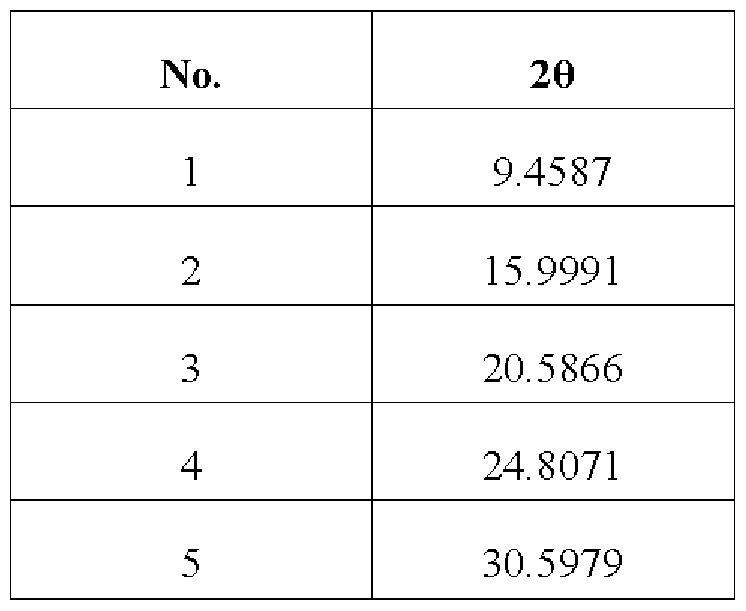
3. 一种合成权利要求 1所述 SAPO-34分子筛的方法, 其特征在于, 合成 步骤如下:
a) 将去离子水、 硅源、 铝源、 磷源和模板剂 MDEA按照一定比例混合, 得到具有如下摩尔配比的初始凝胶混合物-
Si02/Al203 =0.05 - 1 .5;
Ρ2Ο5/Α12Ο3 = 0.5 ~ 1 .5 ;
H20/A1203 = 5〜200;
MDEA/A1203 = 1 .5- 30 , MDEA为 N-甲基二乙醇胺;
b)将步骤 a) 所得初始凝胶混合物装入高压合成釜, 密闭, 升温到
150-220 °C, 在自生压力下晶化 5〜72小时;
c) 待晶化完全后, 固体产物经分离, 用去离子水洗涤至中性, 干燥后即 得所述 SAPO-34分子筛。
4. 按照权利要求 3所述的方法, 其特征在于, 所述步骤 a)初始凝胶混合 物中的硅源为硅溶胶、 活性二氧化硅、 正硅酸酯、 偏高岭土中的一种 或任意几种的混合物; 铝源为铝盐、 活性氧化铝、 烷氧基铝、 偏高岭
土中的一种或任意几种的混合物; 磷源为正磷酸、 磷酸氢铵、 磷酸二 氢铵、 有机磷化物或磷氧化物中的一种或任意几种的混合物。
5. 按照权利要求 3所述的方法, 其特征在于, 所述步骤 b)中的晶化过程 在静态或动态下进行。
6. 按照权利要求 3所述的方法, 其特征在于, 所述步骤 a)初始凝胶混合 物中 MDEA/A12〇3 = 5.5~16.0。
7. 一种酸催化反应的催化剂, 其特征在于, 根据权利要求 1-2任一项所 述的 SAPO-34 分子筛或根据权利要求 3-6 所述任一方法合成的 SAPO-34分子筛经 400 ~ 700 空气中焙烧得到。
8. 一种含氧化合物转化制烯烃反应的催化剂, 其特征在于, 根据权利要 求 1-2任一项所述的 SAPO-34分子筛或根据权利要求 3-6所述任一方 法合成的 SAPO-34分子筛经 400〜700°C空气中焙烧得到。
9. 一种(:1¾/(:02吸附分离材料, 其特征在于, 根据权利要求 1-2任一项 所述的 SAPO-34 分子筛或根据权利要求 3-6 所述任一方法合成的 SAPO-34分子筛经 400 ~ 700 空气中焙烧得到。
Priority Applications (1)
| Application Number | Priority Date | Filing Date | Title |
|---|---|---|---|
| PCT/CN2012/086278 WO2014089738A1 (zh) | 2012-12-10 | 2012-12-10 | 一种以n-甲基二乙醇胺为模板剂的sapo-34分子筛及其合成方法 |
Applications Claiming Priority (1)
| Application Number | Priority Date | Filing Date | Title |
|---|---|---|---|
| PCT/CN2012/086278 WO2014089738A1 (zh) | 2012-12-10 | 2012-12-10 | 一种以n-甲基二乙醇胺为模板剂的sapo-34分子筛及其合成方法 |
Publications (1)
| Publication Number | Publication Date |
|---|---|
| WO2014089738A1 true WO2014089738A1 (zh) | 2014-06-19 |
Family
ID=50933663
Family Applications (1)
| Application Number | Title | Priority Date | Filing Date |
|---|---|---|---|
| PCT/CN2012/086278 Ceased WO2014089738A1 (zh) | 2012-12-10 | 2012-12-10 | 一种以n-甲基二乙醇胺为模板剂的sapo-34分子筛及其合成方法 |
Country Status (1)
| Country | Link |
|---|---|
| WO (1) | WO2014089738A1 (zh) |
Cited By (4)
| Publication number | Priority date | Publication date | Assignee | Title |
|---|---|---|---|---|
| CN104117343A (zh) * | 2014-07-14 | 2014-10-29 | 中国人民解放军国防科学技术大学 | 一种可再生低浓度co2高效吸附材料的制备方法 |
| CN105032496A (zh) * | 2015-06-16 | 2015-11-11 | 武汉凯迪工程技术研究总院有限公司 | 用于合成气选择性合成高品质煤油馏分的载体及其催化剂和制备方法 |
| US10532350B2 (en) | 2014-08-22 | 2020-01-14 | W.R. Grace & Co.-Conn | Method for synthesizing silicoaluminophosphate-34 molecular sieves using monoisopropanolamine |
| CN117263200A (zh) * | 2023-09-27 | 2023-12-22 | 大唐南京环保科技有限责任公司 | 一种纳米单晶sapo-34分子筛及其制备方法和应用 |
Citations (3)
| Publication number | Priority date | Publication date | Assignee | Title |
|---|---|---|---|---|
| CN1096496A (zh) * | 1993-06-18 | 1994-12-21 | 中国科学院大连化学物理研究所 | 以二乙胺为模板剂合成磷酸硅铝分子筛 |
| CN101084065A (zh) * | 2004-12-22 | 2007-12-05 | 埃克森美孚化学专利公司 | 硅铝磷酸盐分子筛的合成 |
| CN101195491A (zh) * | 2006-12-04 | 2008-06-11 | 中国科学院大连化学物理研究所 | 提升合成凝胶中硅进入sapo-34分子筛骨架程度的方法 |
-
2012
- 2012-12-10 WO PCT/CN2012/086278 patent/WO2014089738A1/zh not_active Ceased
Patent Citations (3)
| Publication number | Priority date | Publication date | Assignee | Title |
|---|---|---|---|---|
| CN1096496A (zh) * | 1993-06-18 | 1994-12-21 | 中国科学院大连化学物理研究所 | 以二乙胺为模板剂合成磷酸硅铝分子筛 |
| CN101084065A (zh) * | 2004-12-22 | 2007-12-05 | 埃克森美孚化学专利公司 | 硅铝磷酸盐分子筛的合成 |
| CN101195491A (zh) * | 2006-12-04 | 2008-06-11 | 中国科学院大连化学物理研究所 | 提升合成凝胶中硅进入sapo-34分子筛骨架程度的方法 |
Cited By (4)
| Publication number | Priority date | Publication date | Assignee | Title |
|---|---|---|---|---|
| CN104117343A (zh) * | 2014-07-14 | 2014-10-29 | 中国人民解放军国防科学技术大学 | 一种可再生低浓度co2高效吸附材料的制备方法 |
| US10532350B2 (en) | 2014-08-22 | 2020-01-14 | W.R. Grace & Co.-Conn | Method for synthesizing silicoaluminophosphate-34 molecular sieves using monoisopropanolamine |
| CN105032496A (zh) * | 2015-06-16 | 2015-11-11 | 武汉凯迪工程技术研究总院有限公司 | 用于合成气选择性合成高品质煤油馏分的载体及其催化剂和制备方法 |
| CN117263200A (zh) * | 2023-09-27 | 2023-12-22 | 大唐南京环保科技有限责任公司 | 一种纳米单晶sapo-34分子筛及其制备方法和应用 |
Similar Documents
| Publication | Publication Date | Title |
|---|---|---|
| AU2016417175B2 (en) | Method for synthesizing nano SAPO-34 molecular sieve, and SAPO-34 molecular sieve catalyst and application thereof | |
| CN103663490B (zh) | 一种sapo-34分子筛及其合成方法 | |
| WO2008022532A1 (en) | A method for rapidly synthesizing a silicoaluminophosphate sapo-34 molecular sieve | |
| WO2016090612A1 (zh) | 一种中微孔sapo-34分子筛的合成方法 | |
| CN107434252B (zh) | 低硅纳米sapo-34分子筛的制备方法 | |
| JP2016500622A (ja) | Sapo−34分子篩及びその合成方法 | |
| JP2017525651A (ja) | 高シリカアルミナ比のy型分子篩の製造方法 | |
| BR112015006461A2 (pt) | peneira molecular sapo-34 e método para preparar a mesma | |
| WO2014089740A1 (zh) | 一种以二甘醇胺为模板剂的sapo-34分子筛及其合成方法 | |
| CN101157057A (zh) | 一种原位合成含氧化合物转化制烯烃微球催化剂的方法 | |
| CN103663492B (zh) | 一种sapo-34分子筛及其合成方法 | |
| Di et al. | Green and efficient dry gel conversion synthesis of SAPO-34 catalyst with plate-like morphology | |
| WO2019104778A1 (zh) | 分子筛催化剂及其制备方法和应用 | |
| WO2014089738A1 (zh) | 一种以n-甲基二乙醇胺为模板剂的sapo-34分子筛及其合成方法 | |
| CN105731484B (zh) | 一种中微孔sapo‑34分子筛的合成方法 | |
| CN103864095B (zh) | 一种以二异丙醇胺为模板剂的sapo-34分子筛及其合成方法 | |
| CN103043681A (zh) | 一种纳米层状zsm-5沸石分子筛的制备方法 | |
| Li et al. | Synthesis of nano-sheet SAPO-34 zeolites via aminothermal method and its methanol to olefins (MTO) performance | |
| CN103864087B (zh) | 一种以n-甲基二乙醇胺为模板剂的sapo-34分子筛及其合成方法 | |
| CN105439170A (zh) | 一种sapo-35分子筛及其合成方法 | |
| CN109928402B (zh) | Sapo-34分子筛的制备方法、酸催化剂及含氧化合物转化制烯烃反应的催化剂 | |
| Fan et al. | Synthesis of ZSM-34 and its catalytic properties in methanol-to-olefins reaction | |
| CN105347356B (zh) | 一种sapo‑44分子筛及其合成方法 | |
| CN103864097B (zh) | 一种以二甘醇胺为模板剂的sapo-34分子筛及其合成方法 | |
| CN105600801B (zh) | 一种中微孔sapo‑34分子筛的合成方法 |
Legal Events
| Date | Code | Title | Description |
|---|---|---|---|
| 121 | Ep: the epo has been informed by wipo that ep was designated in this application |
Ref document number: 12890028 Country of ref document: EP Kind code of ref document: A1 |
|
| NENP | Non-entry into the national phase |
Ref country code: DE |
|
| 122 | Ep: pct application non-entry in european phase |
Ref document number: 12890028 Country of ref document: EP Kind code of ref document: A1 |