WO2014077305A1 - シラノール化合物除去剤 - Google Patents
シラノール化合物除去剤 Download PDFInfo
- Publication number
- WO2014077305A1 WO2014077305A1 PCT/JP2013/080756 JP2013080756W WO2014077305A1 WO 2014077305 A1 WO2014077305 A1 WO 2014077305A1 JP 2013080756 W JP2013080756 W JP 2013080756W WO 2014077305 A1 WO2014077305 A1 WO 2014077305A1
- Authority
- WO
- WIPO (PCT)
- Prior art keywords
- silanol compound
- activated carbon
- oxygen
- containing functional
- air
- Prior art date
- Legal status (The legal status is an assumption and is not a legal conclusion. Google has not performed a legal analysis and makes no representation as to the accuracy of the status listed.)
- Ceased
Links
Images

Classifications
-
- B—PERFORMING OPERATIONS; TRANSPORTING
- B01—PHYSICAL OR CHEMICAL PROCESSES OR APPARATUS IN GENERAL
- B01J—CHEMICAL OR PHYSICAL PROCESSES, e.g. CATALYSIS OR COLLOID CHEMISTRY; THEIR RELEVANT APPARATUS
- B01J20/00—Solid sorbent compositions or filter aid compositions; Sorbents for chromatography; Processes for preparing, regenerating or reactivating thereof
- B01J20/02—Solid sorbent compositions or filter aid compositions; Sorbents for chromatography; Processes for preparing, regenerating or reactivating thereof comprising inorganic material
- B01J20/20—Solid sorbent compositions or filter aid compositions; Sorbents for chromatography; Processes for preparing, regenerating or reactivating thereof comprising inorganic material comprising free carbon; comprising carbon obtained by carbonising processes
-
- B—PERFORMING OPERATIONS; TRANSPORTING
- B01—PHYSICAL OR CHEMICAL PROCESSES OR APPARATUS IN GENERAL
- B01J—CHEMICAL OR PHYSICAL PROCESSES, e.g. CATALYSIS OR COLLOID CHEMISTRY; THEIR RELEVANT APPARATUS
- B01J20/00—Solid sorbent compositions or filter aid compositions; Sorbents for chromatography; Processes for preparing, regenerating or reactivating thereof
- B01J20/28—Solid sorbent compositions or filter aid compositions; Sorbents for chromatography; Processes for preparing, regenerating or reactivating thereof characterised by their form or physical properties
- B01J20/28054—Solid sorbent compositions or filter aid compositions; Sorbents for chromatography; Processes for preparing, regenerating or reactivating thereof characterised by their form or physical properties characterised by their surface properties or porosity
- B01J20/28057—Surface area, e.g. B.E.T specific surface area
- B01J20/28066—Surface area, e.g. B.E.T specific surface area being more than 1000 m2/g
-
- B—PERFORMING OPERATIONS; TRANSPORTING
- B01—PHYSICAL OR CHEMICAL PROCESSES OR APPARATUS IN GENERAL
- B01J—CHEMICAL OR PHYSICAL PROCESSES, e.g. CATALYSIS OR COLLOID CHEMISTRY; THEIR RELEVANT APPARATUS
- B01J20/00—Solid sorbent compositions or filter aid compositions; Sorbents for chromatography; Processes for preparing, regenerating or reactivating thereof
- B01J20/28—Solid sorbent compositions or filter aid compositions; Sorbents for chromatography; Processes for preparing, regenerating or reactivating thereof characterised by their form or physical properties
- B01J20/28054—Solid sorbent compositions or filter aid compositions; Sorbents for chromatography; Processes for preparing, regenerating or reactivating thereof characterised by their form or physical properties characterised by their surface properties or porosity
- B01J20/28069—Pore volume, e.g. total pore volume, mesopore volume, micropore volume
- B01J20/28076—Pore volume, e.g. total pore volume, mesopore volume, micropore volume being more than 1.0 ml/g
-
- B—PERFORMING OPERATIONS; TRANSPORTING
- B01—PHYSICAL OR CHEMICAL PROCESSES OR APPARATUS IN GENERAL
- B01J—CHEMICAL OR PHYSICAL PROCESSES, e.g. CATALYSIS OR COLLOID CHEMISTRY; THEIR RELEVANT APPARATUS
- B01J20/00—Solid sorbent compositions or filter aid compositions; Sorbents for chromatography; Processes for preparing, regenerating or reactivating thereof
- B01J20/28—Solid sorbent compositions or filter aid compositions; Sorbents for chromatography; Processes for preparing, regenerating or reactivating thereof characterised by their form or physical properties
- B01J20/28054—Solid sorbent compositions or filter aid compositions; Sorbents for chromatography; Processes for preparing, regenerating or reactivating thereof characterised by their form or physical properties characterised by their surface properties or porosity
- B01J20/28078—Pore diameter
-
- B—PERFORMING OPERATIONS; TRANSPORTING
- B01—PHYSICAL OR CHEMICAL PROCESSES OR APPARATUS IN GENERAL
- B01J—CHEMICAL OR PHYSICAL PROCESSES, e.g. CATALYSIS OR COLLOID CHEMISTRY; THEIR RELEVANT APPARATUS
- B01J20/00—Solid sorbent compositions or filter aid compositions; Sorbents for chromatography; Processes for preparing, regenerating or reactivating thereof
- B01J20/28—Solid sorbent compositions or filter aid compositions; Sorbents for chromatography; Processes for preparing, regenerating or reactivating thereof characterised by their form or physical properties
- B01J20/28054—Solid sorbent compositions or filter aid compositions; Sorbents for chromatography; Processes for preparing, regenerating or reactivating thereof characterised by their form or physical properties characterised by their surface properties or porosity
- B01J20/28088—Pore-size distribution
- B01J20/2809—Monomodal or narrow distribution, uniform pores
-
- C—CHEMISTRY; METALLURGY
- C01—INORGANIC CHEMISTRY
- C01B—NON-METALLIC ELEMENTS; COMPOUNDS THEREOF; METALLOIDS OR COMPOUNDS THEREOF NOT COVERED BY SUBCLASS C01C
- C01B32/00—Carbon; Compounds thereof
- C01B32/30—Active carbon
- C01B32/354—After-treatment
Definitions
- the present invention relates to a silanol compound removing agent for removing a silanol compound, such as removal of a silanol compound in air to be treated containing the silanol compound.
- HMDS hexamethyldisilazane
- Patent Document 1 Japanese Patent Laid-Open No. 2009-295765 discloses that silanols are brought into contact with a fibrous inorganic compound having a hydroxyl group, and the silanols are chemically bonded to the fibrous inorganic compound. A method for purifying a substrate to be collected and removed is disclosed.
- Patent Document 2 Japanese Patent Application Laid-Open No. 2011-166085
- adsorbents composed of a porous body, and at least a part of the large number of adsorbents includes a metal catalyst (platinum or palladium).
- a supported chemical filter is disclosed.
- the chemical filter employs a method in which a silanol compound is dimerized in a filter portion on which a metal catalyst is supported, and the dimer is adsorbed on a filter portion on which the metal catalyst is not supported.
- Patent Document 3 Japanese Patent Application Laid-Open No. 2012-30164 discloses a dehumidifying unit that dehumidifies air containing a silanol compound to a relative humidity of 33% or less, and air dehumidified by the dehumidifying unit.
- An air purification system comprising a chemical filter for filtering and removing the silanol compound is disclosed.
- the relative humidity of the air in the optical system space of an exposure apparatus for semiconductor manufacturing and the air in a clean room for semiconductor manufacturing is normally adjusted to 30 to 55%.
- Cited Document 1 a mechanism for maintaining the surface temperature of the inorganic fiber compound at 70 to 300 ° C. is necessary, and it is not practical to mount it on an exposure apparatus or the like in which the temperature and humidity are extremely precisely controlled. It will also be expensive.
- Cited Document 2 an expensive metal catalyst is used, a part on which the metal catalyst is supported, and a part for adsorbing the dimer of the silanol compound are required, so that the filter layer becomes thick. It is not economical.
- an object of the present invention is to provide a silanol compound removing agent having a high effect of removing a silanol compound, in particular, a high effect of removing a silanol compound in air to be treated.
- the present inventors have made (1) bringing a silanol compound, particularly trimethylsilanol, into contact with activated carbon into which an oxygen-containing functional group has been introduced.
- the silanol compound can be dimerized by the action of the oxygen-containing functional group, and by dimerizing the silanol compound, it can be easily adsorbed on the activated carbon, and the amount of the oxygen-containing functional group in the activated carbon can be reduced.
- the effect of removing silanol compounds, particularly trimethylsilanol compound is enhanced.
- the activated carbon having an oxygen-containing functional group of 0.5 mmol / g or more Those having many micropores with small pore diameters have high silanol compounds when the relative humidity of the air to be treated is about 45% or less.
- the removal performance is shown, when the relative humidity of the air to be treated is about 50 to 55%, the removal performance of the silanol compound may be lower than the case of about 45% or less, and (3) Even if the relative humidity of the air to be treated is about 50 to 55% by adjusting the pore size distribution of activated carbon having an oxygen-containing functional group of 0.5 mmol / g or more and increasing the number of micropores having a large pore size,
- the present inventors have found that the decrease in silanol compound removal performance when compared with the case of about 45% or less can be reduced, and have completed the present invention.
- the present invention (1) is activated carbon having an oxygen-containing functional group, the amount of oxygen-containing functional groups per 1 g of the activated carbon having the oxygen-containing functional group is 0.5 mmol / g or more, and a nitrogen adsorption isotherm
- the silanol compound removing agent is characterized in that, in the differential pore volume distribution obtained by the MP method, the peak top of the peak of the micropores is 0.8 to 1.1 nm.
- a silanol compound removing agent having a high effect of removing a silanol compound, in particular, a high effect of removing a silanol compound in air to be treated.
- the silanol compound removing agent of the present invention is activated carbon having an oxygen-containing functional group, the amount of oxygen-containing functional groups per 1 g of the activated carbon having the oxygen-containing functional group is 0.5 mmol / g or more, and a nitrogen adsorption isotherm Is a silanol compound removing agent characterized in that the peak top of the micropore peak is in the range of 0.8 to 1.1 nm in the differential pore volume distribution obtained by the MP method.
- the silanol compound removing agent of the present invention is activated carbon having an oxygen-containing functional group, that is, activated carbon into which an oxygen-containing functional group has been introduced. That is, the activated carbon having an oxygen-containing functional group is activated carbon in which an oxygen-containing functional group is bonded to a carbon atom of the activated carbon.
- the silanol compound removing agent of the present invention is activated carbon that has been subjected to oxidation treatment, and activated carbon into which an oxygen-containing functional group has been introduced by oxidation treatment.
- oxygen-containing functional group examples include a carbonyl group, a hydroxyl group, a lactone group, a carboxyl group, a quinone group, and a carboxylic anhydride group.
- the activated carbon having an oxygen-containing functional group preferably has at least one or more of a carbonyl group, a hydroxyl group, a lactone group and a carboxyl group as the oxygen-containing functional group, and at least a carbonyl group, a hydroxyl group It is particularly preferable to have a lactone group and a carboxyl group.
- the amount of the oxygen-containing functional group per 1 g of the activated carbon having an oxygen-containing functional group is 0.5 mmol / g or more, preferably 0.8 to 3.0 mmol / g, particularly preferably 1.0 to 2.5 mmol / g. It is. When the amount of the oxygen-containing functional group per 1 g of the activated carbon having the oxygen-containing functional group is within the above range, the effect of removing the silanol compound is enhanced.
- the amount of oxygen-containing functional groups per 1 g of activated carbon having oxygen-containing functional groups and the amount of each functional group are measured as follows. First, activated carbon having an oxygen-containing functional group is vacuum-dried for 8 to 10 hours in a constant temperature dryer adjusted to 115 ° C., and then allowed to cool in a desiccator containing silica gel as a desiccant. Next, four 50 ml stoppered Erlenmeyer flasks (A, B, C, D) are prepared, and 1 g of cooled activated carbon is accurately weighed to 0.1 mg in each Erlenmeyer flask.
- an N / 10 sodium hydrogen carbonate aqueous solution was added to the Erlenmeyer flask (D)
- an N / 10 sodium carbonate aqueous solution was added to the Erlenmeyer flask (C)
- an N / 10 sodium hydroxide aqueous solution was added to the Erlenmeyer flask (B)
- an Erlenmeyer flask (A ) 25 ml of N / 10 sodium ethoxide ethanol solution is added to the solution and shaken at 160 rpm at 25 ° C. for 24 hours.
- the supernatant and precipitate are separated by centrifugation, and 10 ml of the supernatant is accurately weighed into a 20 ml beaker and titrated with N / 10 hydrochloric acid until the pH is 4 using a pH meter.
- the consumption of each base per gram of activated carbon is calculated from the hydrochloric acid titration amount according to the following formula.
- the amount of hydroxyl groups is“ BC (mmol / g) ”, the amount of lactone groups is“ CD (mmol / g) ”, and the amount of carboxyl groups is“ D (mmol / g) ”.
- the activated carbon having an oxygen-containing functional group according to the silanol compound removing agent of the present invention has a micropore peak peak top of 0.8 to 1 in a differential pore volume distribution determined by the MP method from a nitrogen adsorption isotherm. It is 1 nm, preferably 0.9 to 1.0 nm. Since the peak top of the micropore peak in the differential pore volume distribution of the activated carbon having an oxygen-containing functional group is in the above range, the removal performance of the silanol compound is high, and the relative humidity of the air to be treated is 50 to 55%. Even if it is compared with the case where it is about 45% or less, there exists an effect that the fall of the removal performance of the silanol compound can be made small.
- the nitrogen adsorption isotherm is obtained by measuring changes in pressure and the amount of adsorption while keeping the material at a constant temperature by a nitrogen gas adsorption method.
- an adsorption isotherm is obtained by adsorbing nitrogen to an adsorbent (porous carbon material), and the adsorption isotherm is converted into a pore volume with respect to the thickness t of the adsorption layer (t plot).
- a pore distribution curve is obtained based on the curvature of this plot (the amount of change in the pore volume with respect to the amount of change in the thickness t of the adsorption layer).
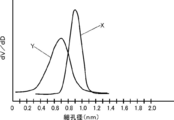
- the differential pore volume distribution obtained by the MP method from the nitrogen adsorption isotherm indicates the relationship between the pore diameter calculated by the MP method from the nitrogen adsorption isotherm and its volume, and as shown in FIG. It relates to the pore volume obtained by plotting the pore diameter (nm) on the axis and dV / dD (change ratio of the pore volume V (cm 3 / g) to the amount of change of the pore diameter D (nm)) on the vertical axis. It is a distribution map.
- FIG. 1 is a schematic graph showing the differential pore volume distribution of activated carbon.
- the peak top of the micropore peak is in the range of 0.8 to 1.1 nm.
- the position of the peak top of the peak seen in the micropore range in the differential pore volume distribution diagram is , 0.8 to 1.1 nm.
- Micropores refer to pores having a pore diameter greater than 0 nm and 2 nm or less. Therefore, in the differential pore volume distribution obtained by the MP method from the nitrogen adsorption isotherm, the activated carbon having the peak top of the micropore in the range of 0.8 to 1.1 nm is finer than 0 nm which is the micropore and 2 nm or less.
- the pore diameter value when dV / dD was the maximum value was 0.8 to 1.1 nm. Is in range.
- the differential pore volume distribution indicated by the symbol X has a peak top at a position where the pore diameter is 0.9 nm in the range from 0 nm to 2 nm. Therefore, in the activated carbon having the differential pore volume distribution of X, the peak top of the micropore peak is 0.9 nm in the differential pore volume distribution.
- the differential pore volume distribution indicated by the symbol Y has a peak top at a position where the pore diameter is 0.7 nm in the range from 0 nm to 2 nm. Therefore, in the activated carbon having the differential pore volume distribution of Y, the peak top of the micropore peak is 0.7 nm in the differential pore volume distribution.
- the activated carbon having an oxygen-containing functional group according to the silanol compound removing agent of the present invention has a pore volume of pores having a pore diameter of more than 0 nm and 2 nm or less in a differential pore volume distribution determined by the MP method from a nitrogen adsorption isotherm.
- the total pore volume (cm 3 / g)) ⁇ 100) of pores having a diameter greater than 0 nm and less than or equal to 2 nm is preferably 70 to 100%, particularly preferably 80 to 100%, more preferably 90 to 100%. is there.
- the ratio of the pore volume of pores having a pore diameter of 0.7 to 1.2 nm to the pore volume of pores having a pore diameter of greater than 0 nm and less than or equal to 2 nm in the differential pore volume distribution of activated carbon having an oxygen-containing functional group is By being in the above range, the removal performance of the silanol compound is high, and even when the relative humidity of the air to be treated is 50 to 55%, the removal performance of the silanol compound compared to the case of about 45% or less. The effect that reduction can be made small increases.
- the BET specific surface area of the activated carbon having an oxygen-containing functional group according to the silanol compound removing agent of the present invention is preferably 1700 m 2 / g or more, particularly preferably 1900 to 2600 m 2 / g. Since the BET specific surface area of the activated carbon having an oxygen-containing functional group is in the above range, the removal performance of the silanol compound is high, and even if the relative humidity of the air to be treated is 50 to 55%, it is about 45% or less. The effect that the fall of the removal performance of the silanol compound when compared with the case can be reduced is enhanced.
- the micropore volume of the activated carbon having an oxygen-containing functional group according to the silanol compound removing agent of the present invention is preferably 1.0 cm 3 / g or more, particularly preferably 1.05 to 1.25 cm 3 / g.
- the micropore volume refers to the total pore volume of pores having a pore diameter greater than 0 nm and 2 nm or less.
- the activated carbon having an oxygen-containing functional group according to the silanol compound remover of the present invention has, in addition to micropores, mesopores having a pore diameter of more than 2 nm and not more than 50 nm, and macropores having a pore diameter of more than 50 nm.
- the substance removed by the silanol compound removing agent of the present invention is a silanol compound contained in the air to be treated.
- a silanol compound is a compound having a silanol group (—Si—OH).
- a silanol compound having a molecular weight of 300 or less is preferable, and a silanol compound having a molecular weight of 200 or less is particularly preferable.
- examples of the silanol compound include trimethylsilanol and triethylsilanol.
- the silanol compound removing agent of this invention has a remarkable effect especially when to-be-processed air contains a trimethylsilanol.
- Examples of a method for producing activated carbon having an oxygen-containing functional group include a method of oxidizing activated carbon in a gas phase or a liquid phase.
- activated carbon used as the raw material of manufacture of the activated carbon which has an oxygen-containing functional group A coconut shell type
- the physical properties or properties of the raw material activated carbon are appropriately selected according to the physical properties or properties of the activated carbon having an oxygen-containing functional group to be produced.
- a method of oxidizing activated carbon in the gas phase a method of oxidizing activated carbon with ozone gas, a method of oxidizing with chlorine gas, a method of air oxidation by heating in air, a combination of oxygen treatment and nitrogen oxide treatment, oxygen Examples thereof include low-temperature plasma treatment with gas or air.
- activated carbon is converted into ozone aqueous solution, nitric acid aqueous solution, hydrogen peroxide aqueous solution, sulfuric acid solution, chloric acid solution, iodic acid solution, hypochlorous acid solution, bromine aqueous solution, permanganic acid.
- the method of immersing in a potassium solution etc. is mentioned.
- the oxidized activated carbon is thoroughly washed with pure water and dried at about 80 to 120 ° C.
- the oxidation conditions of the activated carbon are selected as appropriate, but the condition that the amount of the oxygen-containing functional group per 1 g of activated carbon is 0.5 mmol / g or more, preferably 0.8 to 3.0 mmol / g, particularly A condition of 1.0 to 2.5 mmol / g is preferably selected.
- the silanol compound removing agent of the present invention is used for removing a silanol compound such as removal of a silanol compound in air to be treated containing the silanol compound.
- the silanol compound removing agent of the present invention is activated carbon having an oxygen-containing functional group
- the silanol compound and the oxygen-containing functional group come into contact with the oxygen-containing functional group, for example, by contact with the air to be treated containing the silanol compound.
- the unshared electron pair of the oxygen atom of the oxygen-containing functional group in the activated carbon having an oxygen-containing functional group is bonded to the hydrogen atom of the silanol group in the silanol compound. It is considered that two silanol compounds in which a hydrogen atom of a silanol group is bonded to an unshared electron pair of an oxygen atom of an oxygen-containing functional group present in the vicinity undergoes dehydration condensation to dimerize.
- the dimerization reaction is “2R 3 SiOH ⁇ R 3 SiOSiR 3 + H 2 O”.
- the present inventors have found that dimerization of the silanol compound occurs even at a low temperature of 5 to 40 ° C., preferably 10 to 30 ° C., due to the action of the oxygen-containing functional group introduced into the activated carbon, and that the silanol compound is dimerized. As a result, the molecular weight of the object to be removed can be increased, so that it can be easily adsorbed on the activated carbon.
- the amount of the oxygen-containing functional group per 1 g of the activated carbon having an oxygen-containing functional group is 0.5 mmol / g or more, preferably 0.8 to 3.0 mmol / g, particularly preferably 1.0 to 2.5 mmol.
- silanol compound removing agent of the present invention even low molecular weight silanol compounds such as trimethylsilanol, which have been conventionally considered difficult to adsorb and remove with activated carbon due to the low molecular weight, are adsorbed on activated carbon. Can be removed. Further, according to the silanol compound removing agent of the present invention, it is possible to remove the silanol compound such as removal of the silanol compound in the air to be treated at a low temperature of 5 to 40 ° C., preferably 10 to 30 ° C.
- the amount of oxygen-containing functional group is 0.5 mmol / g or more, preferably 0.8 to 3.0 mmol / g, particularly preferably 1.0 to 2.5 mmol / g.
- activated carbon having a functional group activated carbon having many micropores with small pore diameters exhibits high silanol compound removal performance when the relative humidity of the air to be treated is about 45% or less. It has been found that when the relative humidity is 50 to 55%, the removal performance of the silanol compound is lowered as compared with the case where the relative humidity is about 45% or less.
- activated carbon with a peak top of the micropore peak in the differential pore volume distribution of less than 0.8 nm was found to increase the relative humidity from low to high.
- the humidity is changed, when the relative humidity is about 45% or less, the moisture in the air is hardly absorbed.
- the relative humidity becomes higher than about 45% the moisture starts to be absorbed, and when the relative humidity becomes higher than about 50%.
- activated carbon with a peak top of micropores in the differential pore volume distribution of 0.8 to 1.1 nm changes the relative humidity from low to high.
- the amount of oxygen-containing functional groups per gram is 0.5 mmol / g or more, preferably 0.8 to 3.0 mmol / g, particularly preferably 1.0 to 2.5 mmol / g.
- the pore distribution is adjusted so that the peak top of the micropore peak in the differential pore volume distribution is in the range of 0.8 to 1.1 nm.
- the silanol compound removing agent of the present invention has a relative humidity of 45% or less even when the relative humidity of the air to be treated is higher than 45% and 55% or less, or even 50 to 55%. Compared with the above case, the decrease in silanol compound removal performance is small, and the silanol compound removal performance is high. Therefore, the silanol compound removing agent of the present invention has a stable and high silanol compound removal performance over a range of relative humidity of the air to be treated of 30 to 55%.
- the silanol compound removing agent of the present invention is a removal for removing the silanol compound in the air to be treated having a relative humidity higher than 45% and 55% or less, particularly in the air to be treated having a relative humidity of 50 to 55%. It is preferably used as an agent.
- the silanol compound remover of the present invention is suitable as a remover for removing the silanol compound in the air to be treated when the relative humidity of the air to be treated fluctuates in the range of 30 to 55%. used.
- Examples of the method for removing the silanol compound in the air to be treated using the silanol compound removing agent of the present invention include a method of bringing the silanol compound removing agent of the present invention into contact with the air to be treated containing the silanol compound.
- the air to be treated is not particularly limited, but is air containing a silanol compound such as air in an optical system installation space of an exposure apparatus for semiconductor manufacturing.
- the silanol compound contained in the air to be treated is a compound having a silanol group (—Si—OH), and examples thereof include trimethylsilanol and triethylsilanol. And in the removal method of the silanol compound of this invention, when a to-be-processed air contains a trimethylsilanol, there exists a remarkable effect.
- the content of the silanol compound in the air to be treated is not particularly limited.
- it is usually 0.3 to 8.0 ppb.
- the method for bringing the air to be treated into contact with the silanol compound removing agent of the present invention is not particularly limited.
- the filled layer of the silanol compound removing agent of the present invention is filled with the silanol compound removing agent of the present invention.
- a method of allowing the air to be treated to pass through the packed bed, a method of carrying the silanol compound removing agent of the present invention on a carrier, and allowing the air to be treated to pass through the carrier is not particularly limited.
- the filled layer of the silanol compound removing agent of the present invention is filled with the silanol compound removing agent of the present invention.
- the temperature when the air to be treated is brought into contact with the silanol compound removing agent of the present invention is 5 to 40 ° C., preferably 10 to 30 ° C.
- the supply of the air to be treated when the air to be treated is brought into contact with the silanol compound remover of the present invention is appropriately selected depending on the content of the silanol compound in the air to be treated, the amount of the silanol compound remover of the present invention used, etc.
- the chemical filter in which the silanol compound removing agent of the present invention is filled in the filling container can be produced by filling the silanol compound removing agent of the present invention into a filling container having air permeability and forming a filling layer. .
- a chemical filter carrying the silanol compound removing agent of the present invention can be produced.
- the carrier on which the silanol compound removing agent of the present invention is carried is not particularly limited as long as it is used as a carrier for a chemical filter.
- An inorganic fiber carrier paper
- a pleated structure is preferable because it can increase the amount of activated carbon per unit volume and has a low pressure loss.
- the loading method of the silanol compound remover of the present invention is not particularly limited.
- the silanol compound removing agent of the present invention may be supported by using a binder on the carrier, or may be made of inorganic fiber or organic fiber.
- the silanol compound removing agent of the present invention may be sandwiched by the sheet and may be supported.
- air to be treated containing the silanol compound for example, air in the optical system installation space of an exposure apparatus for semiconductor production is introduced into the chemical filter.
- the treated air is allowed to pass through and the treated air is brought into contact with the silanol compound removing agent of the present invention supported on the carrier, whereby the chemical filter of the present invention is used to remove the silanol compound in the treated air. Removal can be performed.
- the chemical filter carrying the silanol compound remover of the present invention can be installed in an exposure apparatus to produce an exposure apparatus.
- the structure of the exposure apparatus in which the chemical filter carrying the silanol compound removing agent of the present invention is installed is not particularly limited, and may be any exposure apparatus that is usually used in semiconductor manufacturing.
- the exposure apparatus in which the chemical filter carrying the silanol compound removing agent of the present invention is installed is provided with an optical system installation space in which an optical system member and an exposure object are installed and can be shielded from external air. Further, the exposure apparatus in which the chemical filter carrying the silanol compound removing agent of the present invention is installed extracts air in the optical system installation space and returns it to the optical system installation space again. And an external air intake path for taking the air in the clean room into the optical system installation space. And in the exposure apparatus in which the chemical filter carrying the silanol compound removing agent of the present invention is installed, the chemical carrying the silanol compound removing agent of the present invention in each of the circulation path and the external air intake path. A filter is installed.
- the exposure apparatus in which the chemical filter carrying the silanol compound removing agent of the present invention is installed includes a relay lens system, a condenser lens system, a projection optical system lens (hereinafter also referred to as an optical system member), and an object to be exposed. It has an installation part. And in the exposure apparatus in which the chemical filter carrying the silanol compound removing agent of the present invention is installed, the optical system member and the exposure object are installed in a small chamber that can be cut off from the outside air. A space (hereinafter also referred to as an optical system installation space) of an installation part in which the system member and the exposure object are installed is shielded from external air.
- the exposure apparatus in which the chemical filter carrying the silanol compound removing agent of the present invention is installed circulates the air in the optical system installation space for extracting the air in the optical system installation space and returning it to the optical system installation space again.
- a path and an external air intake path that takes in the air in the clean room into the optical system installation space, and the silanol compound removing agent of the present invention is carried in each of the circulation path and the external air intake path.
- a chemical filter is installed.
- the air in the optical system installation space extracted from the optical system installation space is in the circulation path.
- silanol compounds, particularly trimethylsilanol By passing through the installed chemical filter, silanol compounds, particularly trimethylsilanol, in the air in the extracted optical system installation space are removed. The air from which silanol compounds such as trimethylsilanol have been removed is returned to the optical system installation space again. Further, in the exposure apparatus in which the chemical filter carrying the silanol compound removing agent of the present invention is installed, the air taken in from the clean room is installed in the external air intake path in the external air intake path. By passing through the filter, silanol compounds, particularly trimethylsilanol, in the air in the taken-in clean room are removed. The air from which silanol compounds such as trimethylsilanol have been removed is supplied to the optical system installation space.
- an N / 10 sodium hydrogen carbonate aqueous solution was added to the Erlenmeyer flask (D)
- an N / 10 sodium carbonate aqueous solution was added to the Erlenmeyer flask (C)
- an N / 10 sodium hydroxide aqueous solution was added to the Erlenmeyer flask (B)
- an Erlenmeyer flask (A ) 25 ml of N / 10 sodium ethoxide ethanol solution was added to the solution and shaken at 160 rpm at 25 ° C. for 24 hours.
- Base consumption (mmol / g) (0.1 ⁇ (10 ⁇ HCl titration) ⁇ 25) / 10
- the consumption of sodium bicarbonate is D (mmol / g)
- the consumption of sodium carbonate is C (mmol / g)
- the consumption of sodium hydroxide is B (mmol / g)
- the consumption of sodium ethoxide is A ( mmol / g)
- the oxygen-containing functional group amount per 1 g of activated carbon is “A (mmol / g)”
- the carbonyl group amount is “AB (mmol / g)”.
- the amount is “BC (mmol / g)”
- the amount of lactone group is “CD (mmol / g)”
- the amount of carboxyl group is “D (mmol / g)”.
- ⁇ Trimethylsilanol removal test> As shown in FIG. 1, a test sample is sandwiched between hollow glass tubes 2 having an inner diameter of 20 mm and a length of 300 mm with a support member 4 so as to have a thickness of 5 mm or 7 mm (length in the ventilation direction of air to be treated).
- a test sample layer (activated carbon layer) 3 was formed to produce a trimethylsilanol removal test apparatus 1.
- 150 ppb of trimethylsilanol-containing air (temperature: 23 ° C., predetermined relative humidity) is supplied from the gas inlet 21, discharged from the gas outlet 22, and the air to be treated is supplied to the test sample layer 3 at a wind speed of 0.3 m / Aerated in seconds.
- Trimethylsilanol removal rate (%) ((trimethylsilanol concentration at the inlet side ⁇ trimethylsilanol concentration at the outlet side) / trimethylsilanol concentration at the inlet side) ⁇ 100
- Example 1 Oxidation was performed by exposing 20 g of activated carbon a having a crushed shape average particle size of 32/60 mesh (0.25 to 0.50 mm) and a specific surface area of 2400 m 2 / g to 1% ozone atmosphere for 8 hours. .
- the amount of oxygen-containing functional groups of the obtained activated carbon A having oxygen-containing functional groups was measured, the amount of oxygen-containing functional groups was 1.25 mmol / g, the amount of carbonyl groups was 0.41 mmol / g, and the amount of hydroxyl groups was 0.45 mmol. / G, the amount of lactone groups was 0.23 mmol / g, and the amount of carboxyl groups was 0.16 mmol / g.
- the position of the peak top of the micropore peak was 0.9 nm, and the pore diameter was larger than 0 nm and smaller than 2 nm.
- the ratio of the pore volume of pores having a pore diameter of 0.7 to 1.2 nm to the pore volume was 94%.
- the specific surface area of the activated carbon A having an oxygen-containing functional group was 2400 m 2 / g, and the micropore volume of the pore diameter larger than 0 nm and 2 nm or less was 1.12 cm 3 / g.
- Oxidation was performed by exposing 20 g of activated carbon b having an average particle size of crushed shape of 32/60 mesh (0.25 to 0.50 mm) and a specific surface area of 1500 m 2 / g to 1% ozone atmosphere for 8 hours. .
- the amount of oxygen-containing functional groups of the obtained activated carbon c having oxygen-containing functional groups was measured.
- the amount of oxygen-containing functional groups was 1.57 mmol / g
- the amount of carbonyl groups was 0.35 mmol / g
- the amount of hydroxyl groups was 0.59 mmol. / G
- the amount of lactone groups was 0.33 mmol / g
- the amount of carboxyl groups was 0.30 mmol / g.
- the position of the peak top of the peak of the micropore was 0.7 nm, and the pore diameter was larger than 0 nm and smaller than 2 nm.
- the ratio of the pore volume of pores having a pore diameter of 0.7 to 1.2 nm to the pore volume was 43%.
- the specific surface area of the activated carbon c having an oxygen-containing functional group was 1500 m 2 / g, and the micropore volume larger than 0 nm and not more than 2 nm was 0.65 cm 3 / g.
- the position of the peak top of the micropore peak was 0.7 nm, and the pore diameter relative to the pore volume of pores having a pore diameter of more than 0 nm and 2 nm or less.
- the ratio of the pore volume of pores having a diameter of 0.7 to 1.2 nm was 43%.
- the specific surface area of the activated carbon b was 1500 m 2 / g, and the micropore volume of the pore diameter larger than 0 nm and 2 nm or less was 0.65 cm 3 / g.
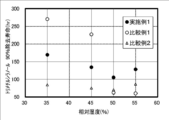
- FIG. 3 shows the relationship between the 90% removal life of the activated carbons of Example 1, Comparative Example 1 and Comparative Example 2 and the relative humidity of the air to be treated.
- the activated carbon A of Example 1 has a higher removal life characteristic than the activated carbon b of Comparative Example 2 over the entire range of relative humidity of 35 to 55%, and the relative humidity of 50 to 55. It was found that the removal life characteristics at% showed a small reduction in the removal life characteristics when compared with the case where the relative humidity was 45% or less, and stable removal performance when the relative humidity was 35 to 55%.
- the activated carbon c of Comparative Example 1 shows a very high removal life characteristic compared to the activated carbon b of Comparative Example 2 when the relative humidity is 45% or less.
- the relative humidity is 50% or more
- the relative humidity is Compared with the case of 45% or less
- the removal life characteristic was greatly reduced
- the relative humidity was 55%
- the removal life characteristic was lower than that of the active substance b of Comparative Example 2.
- Example 1-A Analysis of adsorption amount of dimer of silanol compound
- Comparative Example 1-B Comparative Example 2-B
- the activated carbon after the trimethylsilanol removal test in Example 1, after 217.3 hours test, in Comparative Example 1, 234.1
- 0.1 g of the sample after the time test and the sample after 99.3 hours in Comparative Example 2 were collected in a vial.
- 2 mL of dichloromethane was added to the vial and shaken for extraction.
- the extract was quantitatively analyzed by GC-MS, and the ratio of the trimers of trimethylsilanol and trimethylsilanol in the substance adsorbed on the activated carbon was determined.
- Example 1-A the content of trimethylsilanol was 5% by mass, and the dimer of trimethylsilanol was 95% by mass.
- Comparative Example 1-B trimethylsilanol was 12% by mass and trimethylsilanol dimer was 88% by mass.
- Comparative Example 2-B the content of trimethylsilanol was 76% by mass, and the dimer of trimethylsilanol was 24% by mass.
Landscapes
- Chemical & Material Sciences (AREA)
- Organic Chemistry (AREA)
- Analytical Chemistry (AREA)
- Chemical Kinetics & Catalysis (AREA)
- Inorganic Chemistry (AREA)
- Solid-Sorbent Or Filter-Aiding Compositions (AREA)
- Carbon And Carbon Compounds (AREA)
Abstract
含酸素官能基を有する活性炭であり、該含酸素官能基を有する活性炭1g当たりの含酸素官能基の量が0.5mmol/g以上であり、窒素吸着等温線からMP法により求められる微分細孔容積分布において、マイクロ孔のピークのピークトップが0.8~1.1nmにあることを特徴とするシラノール化合物除去剤。 本発明によれば、シラノール化合物の除去効果が高いシラノール化合物除去剤を提供することができる。
Description
本発明は、シラノール化合物を含有する被処理空気中のシラノール化合物の除去等、シラノール化合物を除去するためシラノール化合物除去剤に関する。
半導体・液晶をはじめとする産業では、製品の歩留まりや品質、信頼性を確保するため、クリーンルーム内の空気や製品表面の汚染制御が重要である。特に、半導体産業分野では、製品の高集積度化に伴い、回路パターンが微細化しているため、半導体の製造に用いられる露光工程においては、露光波長が短波長化してきている。現在では、光源として、波長が248nmであるKrFエキシマレーザーや、波長が193nmであるArFエキシマレーザーが用いられている。
半導体の製造では、ウエハの表面に水酸基があるとレジストがはじかれるので、ウエハの処理過程として、フォトレジスト塗布前にウエハの水酸基を除去し、疎水性を増すために、ヘキサメチルジシラザン(HMDS)が使用される。このHMDSが加水分解すると、トリメチルシラノールが生成する。そして、トリメチルシラノールは、上記露光工程において、エネルギーの高い短波長の光と光化化学反応を起こし、露光装置の露光レンズに付着し、ヘイズ(曇り)の原因となり、露光障害を引き起こす。
このような背景から、特許文献1(特開2009-295765号公報)には、シラノール類を、水酸基が存在する繊維状無機化合物と接触させて、該繊維状無機化合物に化学結合でシラノール類を捕集除去する基体の浄化方法が開示されている。
また、特許文献2(特開2011-166085号公報)には、多孔質体から構成される多数の吸着剤を備え、前記多数の吸着剤の少なくとも一部は、金属触媒(白金又はパラジウム)が担持されているケミカルフィルタが開示されている。該ケミカルフィルタでは、金属触媒が担持されているフィルタ部で、シラノール化合物を二量化し、その二量体を金属触媒が担持されていないフィルタ部で吸着させる方法が採用されている。
また、特許文献3(特開2012-30164号公報)には、シラノール化合物を含む空気を減湿して相対湿度33%以下とする減湿手段と、前記減湿手段で減湿された空気をろ過して、前記シラノール化合物を除去するケミカルフィルタとを備えることを特徴とする空気浄化システムが開示されている。
なお、半導体製造用の露光装置の光学系空間の空気や、半導体製造用のクリーンルーム内の空気は、通常、相対湿度が30~55%に調節されている。
ところが、引用文献1では、無機状繊維化合物の表面温度を70~300℃に保持する機構が必要であり、温湿度が極めて精密に制御されている露光装置等に搭載するには、現実的ではなく、また、コスト高になってしまう。
また、引用文献2では、高価な金属触媒が使用されていること、金属触媒が担持されている部分と、シラノール化合物の二量体を吸着させる部分とが必要となるため、フィルタ層が厚くなってしまい、経済的ではない。
また、引用文献3には、減湿を行うための除湿装置が必要になるため、コスト高になってしまう。
従って、本発明の課題は、シラノール化合物の除去効果、特に、被処理空気中のシラノール化合物の除去効果が高いシラノール化合物除去剤を提供することにある。
本発明者らは、上記従来技術における課題を解決すべく、鋭意研究を重ねた結果、(1)シラノール化合物、特に、トリメチルシラノールを、含酸素官能基が導入されている活性炭に接触させることにより、含酸素官能基の作用で、シラノール化合物を二量化させることができ、そして、シラノール化合物を二量化させることにより、活性炭に吸着され易くすることができること、活性炭中の含酸素官能基の量を0.5mmol/g以上と多くすることにより、シラノール化合物、特に、トリメチルシラノール化合物の除去効果が高くなること、(2)ところが、0.5mmol/g以上の含酸素官能基を有する活性炭で、細孔径が小さいマイクロ孔多く有するものは、被処理空気の相対湿度が45%程度以下だと、高いシラノール化合物の除去性能を示すが、被処理空気の相対湿度が50~55%程度になると、45%程度以下の場合に比べ、シラノール化合物の除去性能が低くなってしまうことがあること、そして、(3)0.5mmol/g以上の含酸素官能基を有する活性炭の細孔径分布を調節し、細孔径が大きいマイクロ孔を多くすることにより、被処理空気の相対湿度が50~55%程度であっても、45%程度以下の場合と比べたときのシラノール化合物の除去性能の低下を小さくすることができること等を見出し、本発明を完成させるに至った。
すなわち、本発明(1)は、含酸素官能基を有する活性炭であり、該含酸素官能基を有する活性炭1g当たりの含酸素官能基の量が0.5mmol/g以上であり、窒素吸着等温線からMP法により求められる微分細孔容積分布において、マイクロ孔のピークのピークトップが0.8~1.1nmにあることを特徴とするシラノール化合物除去剤を提供するものである。
本発明によれば、シラノール化合物の除去効果、特に、被処理空気中のシラノール化合物の除去効果が高いシラノール化合物除去剤を提供することができる。
本発明のシラノール化合物除去剤は、含酸素官能基を有する活性炭であり、該含酸素官能基を有する活性炭1g当たりの含酸素官能基の量が0.5mmol/g以上であり、窒素吸着等温線からMP法により求められる微分細孔容積分布において、マイクロ孔のピークのピークトップが0.8~1.1nmにあることを特徴とするシラノール化合物除去剤である。
本発明のシラノール化合物除去剤は、含酸素官能基を有する活性炭、すなわち、含酸素官能基が導入されている活性炭である。つまり、含酸素官能基を有する活性炭とは、活性炭の炭素原子に、含酸素官能基が結合している活性炭である。言い換えると、本発明のシラノール化合物除去剤は、酸化処理された活性炭であり、酸化処理により含酸素官能基が導入された活性炭である。
含酸素官能基としては、カルボニル基、水酸基、ラクトン基、カルボキシル基、キノン基、無水カルボン酸基等が挙げられる。そして、含酸素官能基を有する活性炭は、含酸素官能基として、少なくとも、カルボニル基、水酸基、ラクトン基及びカルボキシル基のうちの1種又は2種以上を有することが好ましく、少なくとも、カルボニル基、水酸基、ラクトン基及びカルボキシル基を有することが特に好ましい。
含酸素官能基を有する活性炭の1g当たりの含酸素官能基の量は、0.5mmol/g以上、好ましくは0.8~3.0mmol/g、特に好ましくは1.0~2.5mmol/gである。含酸素官能基を有する活性炭の1g当たりの含酸素官能基の量が、上記範囲にあることにより、シラノール化合物の除去効果が高くなる。
なお、含酸素官能基を有する活性炭の1g当たりの含酸素官能基の量及び各官能基の量は、以下のようにして測定される。先ず、含酸素官能基を有する活性炭を、115℃に調節した恒温乾燥器で8~10時間真空乾燥後、乾燥剤としてシリカゲルを入れたデシケータ中で放冷する。次いで、4個の50ml共栓三角フラスコ(A、B、C、D)を用意し、各三角フラスコに、冷却した活性炭1gを0.1mgまで正確に量り取る。次いで、三角フラスコ(D)にN/10炭酸水素ナトリウム水溶液を、三角フラスコ(C)にN/10炭酸ナトリウム水溶液を、三角フラスコ(B)にN/10水酸化ナトリウム水溶液を、三角フラスコ(A)にN/10ナトリウムエトキシドエタノール溶液を、25ml加え、160rpm、25℃にて24時間振盪する。振盪後、遠心分離にて上澄みと沈殿に分離し、上澄み液10mlを20mlビーカーに正確に量り、pH計を用いてpHが4になるまで、N/10塩酸で滴定する。次いで、塩酸滴定量から、次式により、活性炭1g当たりの各塩基の消費量を算出する。
塩基消費量(mmol/g)=(0.1×(10-HCl滴定量)×25)/10
滴定の結果、炭酸水素ナトリウムの消費量がD(mmol/g)、炭酸ナトリウムの消費量がC(mmol/g)、水酸化ナトリウムの消費量がB(mmol/g)、ナトリウムエトキシドの消費量がA(mmol/g)であった場合、活性炭1g当たりの含酸素官能基の量は「A(mmol/g)」であり、また、カルボニル基の量は「A-B(mmol/g)」、水酸基の量は「B-C(mmol/g)」、ラクトン基の量は「C-D(mmol/g)」、カルボキシル基の量は「D(mmol/g)」となる。
塩基消費量(mmol/g)=(0.1×(10-HCl滴定量)×25)/10
滴定の結果、炭酸水素ナトリウムの消費量がD(mmol/g)、炭酸ナトリウムの消費量がC(mmol/g)、水酸化ナトリウムの消費量がB(mmol/g)、ナトリウムエトキシドの消費量がA(mmol/g)であった場合、活性炭1g当たりの含酸素官能基の量は「A(mmol/g)」であり、また、カルボニル基の量は「A-B(mmol/g)」、水酸基の量は「B-C(mmol/g)」、ラクトン基の量は「C-D(mmol/g)」、カルボキシル基の量は「D(mmol/g)」となる。
本発明のシラノール化合物除去剤に係る含酸素官能基を有する活性炭は、窒素吸着等温線からMP法により求められる微分細孔容積分布において、マイクロ孔のピークのピークトップが、0.8~1.1nm、好ましくは0.9~1.0nmにある。含酸素官能基を有する活性炭の微分細孔容積分布におけるマイクロ孔のピークのピークトップが上記範囲にあることにより、シラノール化合物の除去性能が高く、且つ、被処理空気の相対湿度が50~55%であっても、45%程度以下の場合と比べたときのシラノール化合物の除去性能の低下を小さくすることができるという効果を奏する。
窒素吸着等温線とは、窒素ガス吸着法により、材料を一定温度にし、圧力と吸着量の変化を測定したものである。MP法とは、吸着剤(多孔質炭素材料)に窒素を吸着させることにより、吸着等温線を求め、そして、この吸着等温線を吸着層の厚さtに対する細孔容積に変換し(tプロットする)、そして、このプロットの曲率(吸着層の厚さtの変化量に対する細孔容積の変化量)に基づき細孔分布曲線を得るものである。窒素吸着等温線からMP法により求められる微分細孔容積分布とは、窒素吸着等温線からMP法により算出される細孔径とその体積の関係を示すものであり、図1に示すように、横軸に細孔径(nm)を、縦軸にdV/dD(細孔径D(nm)の変化量に対する細孔容積V(cm3/g)の変化割合)をプロットして得られる細孔容積に関する分布図である。なお、図1は、活性炭の微分細孔容積分布を示す模式的なグラフである。
そして、微分細孔容積分布において、マイクロ孔のピークのピークトップが0.8~1.1nmにあるとは、微分細孔容積分布図のマイクロ孔の範囲に見られるピークのピークトップの位置が、0.8~1.1nmの範囲にあることを指す。なお、マイクロ孔とは、細孔径が0nmより大きく2nm以下の細孔を指す。よって、窒素吸着等温線からMP法により求められる微分細孔容積分布において、マイクロ孔のピークのピークトップが0.8~1.1nmにある活性炭では、マイクロ孔である0nmより大きく2nm以下の細孔について、窒素吸着等温線からMP法により、細孔径に対するdV/dDの値を求めたときに、dV/dDが最大値となるときの細孔径の値が、0.8~1.1nmの範囲にある。
図1中、符号Xの微分細孔容積分布は、0nmより大きく2nm以下の範囲では、細孔径が0.9nmの位置にピークトップがある。よって、符号Xの微分細孔容積分布を有する活性炭では、微分細孔容積分布において、マイクロ孔のピークのピークトップが0.9nmにある。また、図1中、符号Yの微分細孔容積分布は、0nmより大きく2nm以下の範囲では、細孔径が0.7nmの位置にピークトップがある。よって、符号Yの微分細孔容積分布を有する活性炭では、微分細孔容積分布において、マイクロ孔のピークのピークトップが0.7nmにある。
本発明のシラノール化合物除去剤に係る含酸素官能基を有する活性炭は、窒素吸着等温線からMP法により求められる微分細孔容積分布において、細孔径が0nmより大きく2nm以下の細孔の細孔容積に対する細孔径が0.7~1.2nmの細孔の細孔容積の割合((細孔径が0.7~1.2nmの細孔の細孔容積の総和(cm3/g)/細孔径が0nmより大きく2nm以下の細孔の細孔容積の総和(cm3/g))×100)が、好ましくは70~100%、特に好ましくは80~100%、更に好ましくは90~100%である。含酸素官能基を有する活性炭の微分細孔容積分布における細孔径が0nmより大きく2nm以下の細孔の細孔容積に対する細孔径が0.7~1.2nmの細孔の細孔容積の割合が上記範囲にあることにより、シラノール化合物の除去性能が高く、且つ、被処理空気の相対湿度が50~55%であっても、45%程度以下の場合と比べたときのシラノール化合物の除去性能の低下を小さくすることができるという効果が高まる。
本発明のシラノール化合物除去剤に係る含酸素官能基を有する活性炭のBET比表面積は、好ましくは1700m2/g以上、特に好ましくは1900~2600m2/gである。含酸素官能基を有する活性炭のBET比表面積が上記範囲にあることにより、シラノール化合物の除去性能が高く、且つ、被処理空気の相対湿度が50~55%であっても、45%程度以下の場合と比べたときのシラノール化合物の除去性能の低下を小さくすることができるという効果が高まる。
本発明のシラノール化合物除去剤に係る含酸素官能基を有する活性炭のマイクロ孔容積は、好ましくは1.0cm3/g以上、特に好ましくは1.05~1.25cm3/gである。なお、マイクロ孔容積とは、細孔径が0nmより大きく2nm以下の細孔の細孔容積の総和を指す。含酸素官能基を有する活性炭のマイクロ孔容積が上記範囲にあることにより、シラノール化合物の除去性能が高く、且つ、被処理空気の相対湿度が50~55%であっても、45%程度以下の場合と比べたときのシラノール化合物の除去性能の低下を小さくすることができるという効果が高まる。
本発明のシラノール化合物除去剤に係る含酸素官能基を有する活性炭は、マイクロ孔以外に、細孔径が2nmを超え50nm以下であるメソ孔、及び細孔径が50nmを超えるマクロ孔を有する。
本発明のシラノール化合物除去剤により除去される物質は、被処理空気等に含有されているシラノール化合物である。シラノール化合物は、シラノール基(-Si-OH)を有する化合物である。シラノール化合物としては、分子量が300以下のシラノール化合物が好ましく、分子量が200以下のシラノール化合物が特に好ましい。更に好ましくは、シラノール化合物としては、トリメチルシラノール、トリエチルシラノール等が挙げられる。そして、本発明のシラノール化合物除去剤は、被処理空気がトリメチルシラノールを含有する場合に、特に顕著な効果を奏する。
含酸素官能基を有する活性炭を製造する方法としては、活性炭を気相又は液相で酸化する方法が挙げられる。
含酸素官能基を有する活性炭の製造の原料となる活性炭としては、特に制限されないが、ヤシ殻系活性炭、木質炭系活性炭、ピッチ系活性炭、フェノール樹脂系活性炭等が挙げられる。原料活性炭の物性又は性状は、製造目的とする含酸素官能基を有する活性炭の物性又は性状に合わせて、適宜選択される。
活性炭を気相で酸化する方法としては、活性炭を、オゾンガスで酸化する方法、塩素ガスで酸化する方法、空気中で加熱することにより空気酸化する方法、酸素処理と窒素酸化物処理の併用、酸素ガス又は空気による低温プラズマ処理等が挙げられる。
また、活性炭を液相で酸化する方法としては、活性炭を、オゾン水溶液、硝酸水溶液、過酸化水素水溶液、硫酸溶液、塩素酸溶液、ヨウ素酸溶液、次亜塩素酸溶液、臭素水溶液、過マンガン酸カリウム溶液等に浸漬する方法が挙げられる。液相での活性炭の酸化を行った後は、酸化処理された活性炭を、純水で十分に洗浄し、80~120℃程度で乾燥する。
活性炭の酸化条件は、適宜選択されるが、活性炭1g当たりの含酸素官能基の量が、0.5mmol/g以上となる条件、好ましくは0.8~3.0mmol/gとなる条件、特に好ましくは1.0~2.5mmol/gとなる条件が選択される。
そして、活性炭を酸化することにより、活性炭の炭素の一部が酸化されて、含酸素官能基へと変換され、含酸素官能基を有する活性炭が得られる。
本発明のシラノール化合物除去剤は、シラノール化合物を含有する被処理空気中のシラノール化合物の除去等、シラノール化合物を除去するために用いられる。
本発明のシラノール化合物除去剤は、含酸素官能基を有する活性炭であるので、その含酸素官能基にシラノール化合物を含有する被処理空気が接触すること等により、シラノール化合物と含酸素官能基が接触すると、下記式(1)に示すように、含酸素官能基を有する活性炭中の含酸素官能基の酸素原子の非共有電子対と、シラノール化合物中のシラノール基の水素原子とが結合し、次いで、近隣に存在している含酸素官能基の酸素原子の非共有電子対にシラノール基の水素原子が結合している2つのシラノール化合物が、脱水縮合して、二量化するものと考えられる。二量化反応は、「2R3SiOH→R3SiOSiR3+H2O」である。
式(1):
式(1):

本発明者らは、活性炭に導入されている含酸素官能基の作用により、5~40℃、好ましくは10~30℃の低温でも、シラノール化合物の二量化が起こること、及びシラノール化合物を二量化することにより、除去対象物の分子量を大きくすることができるので、活性炭に吸着され易くすることができることを見出した。そして、含酸素官能基を有する活性炭の1g当たりの含酸素官能基の量を、0.5mmol/g以上、好ましくは0.8~3.0mmol/g、特に好ましくは1.0~2.5mmol/gとすることにより、シラノール化合物の除去効果が高くなることを見出した。そのため、本発明のシラノール化合物除去剤によれば、従来、分子量が小さいために、活性炭では吸着除去し難いと考えられていたトリメチルシラノール等の低分子量のシラノール化合物であっても、活性炭に吸着させて除去することができる。また、本発明のシラノール化合物除去剤によれば、5~40℃、好ましくは10~30℃と低温で、被処理空気中のシラノール化合物の除去等、シラノール化合物の除去を行うことができる。
更に、本発明者らは、含酸素官能基の量が0.5mmol/g以上、好ましくは0.8~3.0mmol/g、特に好ましくは1.0~2.5mmol/gである含酸素官能基を有する活性炭であっても、細孔径が小さいマイクロ孔を多く有する活性炭は、被処理空気の相対湿度が45%程度以下だと、高いシラノール化合物の除去性能を示すが、被処理空気の相対湿度が50~55%になると、45%程度以下の場合に比べ、シラノール化合物の除去性能が低くなってしまうことを見出した。そして、相対湿度と活性炭の水分吸着量との関係について検討を重ねたところ、微分細孔容積分布におけるマイクロ孔のピークのピークトップが0.8nm未満にある活性炭は、相対湿度を低湿度から高湿度に変化させた場合、相対湿度が45%程度以下では、空気中の水分を殆ど吸収しないが、相対湿度が45%程度より高くなると水分を吸収し始め、相対湿度が50%程度より高くなると水分の吸収量が多くなること、それに対して、微分細孔容積分布におけるマイクロ孔のピークのピークトップが0.8~1.1nmにある活性炭は、相対湿度を低湿度から高湿度に変化させた場合、相対湿度が55%程度以下では、空気中の水分を殆ど吸収せず、水分を吸収し始めるのは相対湿度が55%程度より高くなったときであり、水分の吸収量が多くなるのは相対湿度60%程度より高くなったときであることを見出した。これらのことから、1g当たりの含酸素官能基の量が、0.5mmol/g以上、好ましくは0.8~3.0mmol/g、特に好ましくは1.0~2.5mmol/gである含酸素官能基を有する活性炭について、その細孔分布を調節して、微分細孔容積分布におけるマイクロ孔のピークのピークトップが0.8~1.1nmにあるようにすることにより、被処理空気の相対湿度が45%より高く55%以下であっても、更には、50~55%であっても、45%以下の場合と比べたときのシラノール化合物の除去性能の低下を小さくすることができるという効果を有することを見出した。
このように、本発明のシラノール化合物除去剤は、被処理空気の相対湿度が45%より高く55%以下であっても、更には、50~55%であっても、相対湿度が45%以下の場合と比べたときのシラノール化合物の除去性能の低下が小さく、シラノール化合物の除去性能が高いという効果を示す。そのため、本発明のシラノール化合物除去剤は、被処理空気の相対湿度が30~55%の範囲に亘って、安定して高いシラノール化合物の除去性能を有する。このことから、本発明のシラノール化合物除去剤は、相対湿度が45%より高く55%以下の被処理空気、特に相対湿度が50~55%の被処理空気中のシラノール化合物を除去するための除去剤として、好適に使用される。また、本発明のシラノール化合物除去剤は、被処理空気の相対湿度が30~55%の範囲で変動するような場合に、被処理空気中のシラノール化合物を除去するための除去剤として、好適に使用される。
本発明のシラノール化合物除去剤を用いて、被処理空気中のシラノール化合物を除去する方法としては、本発明のシラノール化合物除去剤に、シラノール化合物を含有する被処理空気を接触させる方法が挙げられる。
被処理空気は、特に制限されないが、例えば、半導体製造用の露光装置の光学系設置空間の空気等のシラノール化合物を含有する空気である。
被処理空気に含有されているシラノール化合物は、シラノール基(-Si-OH)を有する化合物であり、トリメチルシラノール、トリエチルシラノール等が挙げられる。そして、本発明のシラノール化合物の除去方法では、被処理空気がトリメチルシラノールを含有する場合に、特に顕著な効果を奏する。
被処理空気中のシラノール化合物の含有量は、特に制限されないが、例えば、半導体製造用の露光装置の光学系設置空間の空気の場合、通常、0.3~8.0ppbである。
本発明のシラノール化合物除去剤に被処理空気を接触させる方法としては、特に制限されず、例えば、本発明のシラノール化合物除去剤を充填容器に充填して、本発明のシラノール化合物除去剤の充填層を形成し、その充填層に被処理空気を通過させる方法、本発明のシラノール化合物除去剤を担体に担持し、その担体内に被処理空気を通過させる方法等が挙げられる。
本発明のシラノール化合物除去剤に被処理空気を接触させるときの温度は、5~40℃、好ましくは10~30℃である。
本発明のシラノール化合物除去剤に被処理空気を接触させるときの被処理空気の供給は、被処理空気中のシラノール化合物の含有量、本発明のシラノール化合物除去剤の使用量等により、適宜選択される。
本発明のシラノール化合物除去剤を、通気性を有する充填容器に充填し、充填層を形成させることにより、充填容器に本発明のシラノール化合物除去剤が充填されているケミカルフィルタを作製することができる。
また、本発明のシラノール化合物除去剤を、担体に担持することにより、本発明のシラノール化合物除去剤が担持されているケミカルフィルタを作製することができる。
本発明のシラノール化合物除去剤が担持されているケミカルフィルタにおいて、本発明のシラノール化合物除去剤が担持される担体としては、特に制限されず、ケミカルフィルタの担体として用いられるものであればよく、例えば、無機繊維で構成される無機維質基材(ペーパー)をハニカム構造やプリーツ構造に成形した無機繊維質担体、有機繊維で構成される有機繊維質基材(ペーパー)をハニカム構造やプリーツ構造に成形した有機繊維質担体等が挙げられる。これらのうち、担体としては、プリーツ構造が、単位体積あたりの活性炭量を増やせること、低圧力損失であることから、好ましい。
本発明のシラノール除去剤が担持されているケミカルフィルタでは、本発明のシラノール化合物除去剤の担持方法は特に制限されない。例えば、本発明のシラノール除去剤が担持されているケミカルフィルタにおいて、本発明のシラノール化合物除去剤は、担体にバインダーを用いて担持されていてもよいし、また、無機繊維質又は有機繊維質のシートにより、本発明のシラノール化合物除去剤が挟み込むまれることにより、担持されていてもよい。
そして、本発明のシラノール化合物除去剤が担持されているケミカルフィルタ内に、シラノール化合物を含有する被処理空気、例えば、半導体製造用の露光装置の光学系設置空間の空気を導入し、ケミカルフィルタ内に被処理空気を通過させて、担体に担持されている本発明のシラノール化合物除去剤に、被処理空気を接触させることにより、本発明のケミカルフィルタを用いて、被処理空気中のシラノール化合物の除去を行うことができる。
本発明のシラノール化合物除去剤が担持されているケミカルフィルタを、露光装置に設置し、露光装置を作製することができる。
本発明のシラノール化合物除去剤が担持されているケミカルフィルタが設置される露光装置の構造は、特に制限されず、通常、半導体の製造に用いられている露光装置であればよい。
本発明のシラノール化合物除去剤が担持されているケミカルフィルタが設置される露光装置には、光学系部材と露光対象物が設置され外部空気とは遮断可能な光学系設置空間が設けられている。また、本発明のシラノール化合物除去剤が担持されているケミカルフィルタが設置される露光装置は、光学系設置空間内の空気を抜き出し、再び、光学系設置空間内に戻す光学系設置空間内の空気の循環経路と、クリーンルーム内の空気を光学系設置空間内に取り込む外部空気取り込み経路と、を有する。そして、本発明のシラノール化合物除去剤が担持されているケミカルフィルタが設置される露光装置では、循環経路中及び外部空気取り込み経路中のそれぞれに、本発明のシラノール化合物除去剤が担持されているケミカルフィルタが設置される。
本発明のシラノール化合物除去剤が担持されているケミカルフィルタが設置される露光装置は、リレーレンズ系、コンデンサーレンズ系及び投影光学系レンズ(以下、光学系部材とも記載する。)並びに露光対象物の設置部を有する。そして、本発明のシラノール化合物除去剤が担持されているケミカルフィルタが設置される露光装置では、外部空気とは遮断可能な小室内に、光学系部材及び露光対象物が設置されることにより、光学系部材及び露光対象物が設置される設置部の空間(以下、光学系設置空間とも記載する。)は、外部空気とは遮断されている。
本発明のシラノール化合物除去剤が担持されているケミカルフィルタが設置される露光装置は、光学系設置空間内の空気を抜き出し、再び、光学系設置空間内に戻す光学系設置空間内の空気の循環経路と、クリーンルーム内の空気を光学系設置空間内に取り込む外部空気取り込み経路と、を有し、その循環経路中と外部空気取り込み経路中のそれぞれに、本発明のシラノール化合物除去剤が担持されているケミカルフィルタが設置されている。そして、本発明のシラノール化合物除去剤が担持されているケミカルフィルタが設置される露光装置では、循環経路において、光学系設置空間から抜き出された光学系設置空間内の空気が、循環経路内に設置されているケミカルフィルタを通過することにより、抜き出された光学系設置空間内の空気中のシラノール化合物、特に、トリメチルシラノールが除去される。トリメチルシラノール等のシラノール化合物が除去された空気は、再び、光学系設置空間に戻される。また、本発明のシラノール化合物除去剤が担持されているケミカルフィルタが設置される露光装置では、外部空気取り込み経路において、クリーンルームから取り込こまれる空気が、外部空気取り込み経路内に設置されているケミカルフィルタを通過することにより、取り込まれたクリーンルーム内の空気中のシラノール化合物、特に、トリメチルシラノールが除去される。トリメチルシラノール等のシラノール化合物が除去された空気は、光学系設置空間に供給される。
(分析方法及び評価方法)
<含酸素官能基量の測定方法>
測定対象の活性炭を、115℃に調節した恒温乾燥器で8~10時間真空乾燥後、乾燥剤としてシリカゲルを入れたデシケータ中で放冷した。次いで、4個の50ml共栓三角フラスコ(A、B、C、D)を用意し、各三角フラスコに、冷却した活性炭1gを0.1mgまで正確に量り取った。次いで、三角フラスコ(D)にN/10炭酸水素ナトリウム水溶液を、三角フラスコ(C)にN/10炭酸ナトリウム水溶液を、三角フラスコ(B)にN/10水酸化ナトリウム水溶液を、三角フラスコ(A)にN/10ナトリウムエトキシドエタノール溶液を、25ml加え、160rpm、25℃にて24時間振盪した。振盪後、遠心分離にて上澄みと沈殿に分離し、上澄み液10mlを20mlビーカーに正確に量り、pH計を用いてpHが4になるまで、N/10塩酸で滴定した。次いで、塩酸滴定量から、次式により、活性炭1g当たりの各塩基の消費量を算出した。
塩基消費量(mmol/g)=(0.1×(10-HCl滴定量)×25)/10
炭酸水素ナトリウムの消費量がD(mmol/g)、炭酸ナトリウムの消費量がC(mmol/g)、水酸化ナトリウムの消費量がB(mmol/g)、ナトリウムエトキシドの消費量がA(mmol/g)であった場合、活性炭1g当たりの含酸素官能基量は「A(mmol/g)」であり、また、カルボニル基の量は「A-B(mmol/g)」、水酸基の量は「B-C(mmol/g)」、ラクトン基の量は「C-D(mmol/g)」、カルボキシル基の量は「D(mmol/g)」である。
<含酸素官能基量の測定方法>
測定対象の活性炭を、115℃に調節した恒温乾燥器で8~10時間真空乾燥後、乾燥剤としてシリカゲルを入れたデシケータ中で放冷した。次いで、4個の50ml共栓三角フラスコ(A、B、C、D)を用意し、各三角フラスコに、冷却した活性炭1gを0.1mgまで正確に量り取った。次いで、三角フラスコ(D)にN/10炭酸水素ナトリウム水溶液を、三角フラスコ(C)にN/10炭酸ナトリウム水溶液を、三角フラスコ(B)にN/10水酸化ナトリウム水溶液を、三角フラスコ(A)にN/10ナトリウムエトキシドエタノール溶液を、25ml加え、160rpm、25℃にて24時間振盪した。振盪後、遠心分離にて上澄みと沈殿に分離し、上澄み液10mlを20mlビーカーに正確に量り、pH計を用いてpHが4になるまで、N/10塩酸で滴定した。次いで、塩酸滴定量から、次式により、活性炭1g当たりの各塩基の消費量を算出した。
塩基消費量(mmol/g)=(0.1×(10-HCl滴定量)×25)/10
炭酸水素ナトリウムの消費量がD(mmol/g)、炭酸ナトリウムの消費量がC(mmol/g)、水酸化ナトリウムの消費量がB(mmol/g)、ナトリウムエトキシドの消費量がA(mmol/g)であった場合、活性炭1g当たりの含酸素官能基量は「A(mmol/g)」であり、また、カルボニル基の量は「A-B(mmol/g)」、水酸基の量は「B-C(mmol/g)」、ラクトン基の量は「C-D(mmol/g)」、カルボキシル基の量は「D(mmol/g)」である。
<微分細孔容積分布の測定>
測定対象の活性炭を、日本ベル株式会社製ベルソープminiで測定し、窒素吸着等温線を求めた。次いで、得られた窒素吸着等温線からMP法により、微分細孔容積分布を求めた。
測定対象の活性炭を、日本ベル株式会社製ベルソープminiで測定し、窒素吸着等温線を求めた。次いで、得られた窒素吸着等温線からMP法により、微分細孔容積分布を求めた。
<トリメチルシラノールの除去試験>
図1に示すように、内径20mm、長さ300mmの中空ガラス管2内に、支持部材4で試験試料を挟み込むようにして、厚さ5mm又は7mm(被処理空気の通気方向の長さ)の試験試料層(活性炭層)3を形成させて、トリメチルシラノール除去試験装置1を作製した。
次いで、150ppbのトリメチルシラノール含有空気(温度:23℃、所定の相対湿度)を、ガス入口21から供給し、ガス出口22から排出して、試験試料層3に被処理空気を風速0.3m/秒で通気した。所定時間が経過する毎に、通気時のガス入口21側のトリメチルシラノール含有空気と、ガス出口22側のトリメチルシラノール含有空気を、専用の分析用炭素系吸着管にて捕集し、ガスクロマトグラフ質量分析計を用いて分析し、各捕集空気のトリメチルシラノール濃度を分析した。下記式により、各経時時間のトリメチルシラノール除去率を求めた。
トリメチルシラノール除去率(%)=((入口側のトリメチルシラノール濃度-出口側のトリメチルシラノール濃度)/入口側のトリメチルシラノール濃度)×100
図1に示すように、内径20mm、長さ300mmの中空ガラス管2内に、支持部材4で試験試料を挟み込むようにして、厚さ5mm又は7mm(被処理空気の通気方向の長さ)の試験試料層(活性炭層)3を形成させて、トリメチルシラノール除去試験装置1を作製した。
次いで、150ppbのトリメチルシラノール含有空気(温度:23℃、所定の相対湿度)を、ガス入口21から供給し、ガス出口22から排出して、試験試料層3に被処理空気を風速0.3m/秒で通気した。所定時間が経過する毎に、通気時のガス入口21側のトリメチルシラノール含有空気と、ガス出口22側のトリメチルシラノール含有空気を、専用の分析用炭素系吸着管にて捕集し、ガスクロマトグラフ質量分析計を用いて分析し、各捕集空気のトリメチルシラノール濃度を分析した。下記式により、各経時時間のトリメチルシラノール除去率を求めた。
トリメチルシラノール除去率(%)=((入口側のトリメチルシラノール濃度-出口側のトリメチルシラノール濃度)/入口側のトリメチルシラノール濃度)×100
<90%除去寿命>
上記トリメチルシラノールの除去試験で求めたトリメチルシラノールの除去率の経時変化から、トリメチルシラノールの除去率が90%に達する時間を、90%除去寿命(時間)とした。
上記トリメチルシラノールの除去試験で求めたトリメチルシラノールの除去率の経時変化から、トリメチルシラノールの除去率が90%に達する時間を、90%除去寿命(時間)とした。
(実施例1)
破砕形状の平均粒径が32/60メッシュ(0.25~0.50mm)、比表面積が2400m2/gである活性炭a 20gを、1%オゾン雰囲気に8時間曝露して、酸化を行った。得られた含酸素官能基を有する活性炭Aの含酸素官能基量を測定したところ、含酸素官能基量は1.25mmol/g、カルボニル基量は0.41mmol/g、水酸基量は0.45mmol/g、ラクトン基量は0.23mmol/g、カルボキシル基量は0.16mmol/gであった。また、含酸素官能基を有する活性炭Aの微分細孔容積分布を求めたところ、マイクロ孔のピークのピークトップの位置は、0.9nmであり、細孔径が0nmより大きく2nm以下の細孔の細孔容積に対する細孔径が0.7~1.2nmの細孔の細孔容積の割合は、94%であった。また、含酸素官能基を有する活性炭Aの比表面積は2400m2/gであり、細孔径0nmより大きく2nm以下のマイクロ孔容積は1.12cm3/gであった。
次いで、図1に示すトリメチルシラノール除去試験装置1に、含酸素官能基を有する活性炭Aを充填し、150ppbのトリメチルシラノール含有空気として、温度が23℃、相対湿度が表1に示す相対湿度の150ppbのトリメチルシラノール含有空気を用いて、トリメチルシラノールの除去試験を行った。その結果を表1に示す。
破砕形状の平均粒径が32/60メッシュ(0.25~0.50mm)、比表面積が2400m2/gである活性炭a 20gを、1%オゾン雰囲気に8時間曝露して、酸化を行った。得られた含酸素官能基を有する活性炭Aの含酸素官能基量を測定したところ、含酸素官能基量は1.25mmol/g、カルボニル基量は0.41mmol/g、水酸基量は0.45mmol/g、ラクトン基量は0.23mmol/g、カルボキシル基量は0.16mmol/gであった。また、含酸素官能基を有する活性炭Aの微分細孔容積分布を求めたところ、マイクロ孔のピークのピークトップの位置は、0.9nmであり、細孔径が0nmより大きく2nm以下の細孔の細孔容積に対する細孔径が0.7~1.2nmの細孔の細孔容積の割合は、94%であった。また、含酸素官能基を有する活性炭Aの比表面積は2400m2/gであり、細孔径0nmより大きく2nm以下のマイクロ孔容積は1.12cm3/gであった。
次いで、図1に示すトリメチルシラノール除去試験装置1に、含酸素官能基を有する活性炭Aを充填し、150ppbのトリメチルシラノール含有空気として、温度が23℃、相対湿度が表1に示す相対湿度の150ppbのトリメチルシラノール含有空気を用いて、トリメチルシラノールの除去試験を行った。その結果を表1に示す。

(比較例1)
破砕形状の平均粒径が32/60メッシュ(0.25~0.50mm)、比表面積が1500m2/gである活性炭b 20gを、1%オゾン雰囲気に8時間曝露して、酸化を行った。得られた含酸素官能基を有する活性炭cの含酸素官能基量を測定したところ、含酸素官能基量は1.57mmol/g、カルボニル基量は0.35mmol/g、水酸基量は0.59mmol/g、ラクトン基量は0.33mmol/g、カルボキシル基量は0.30mmol/gであった。また、含酸素官能基を有する活性炭cの微分細孔容積分布を求めたところ、マイクロ孔のピークのピークトップの位置は、0.7nmであり、細孔径が0nmより大きく2nm以下の細孔の細孔容積に対する細孔径が0.7~1.2nmの細孔の細孔容積の割合は、43%であった。また、含酸素官能基を有する活性炭cの比表面積は1500m2/gであり、細孔径0nmより大きく2nm以下のマイクロ孔容積は0.65cm3/gであった。
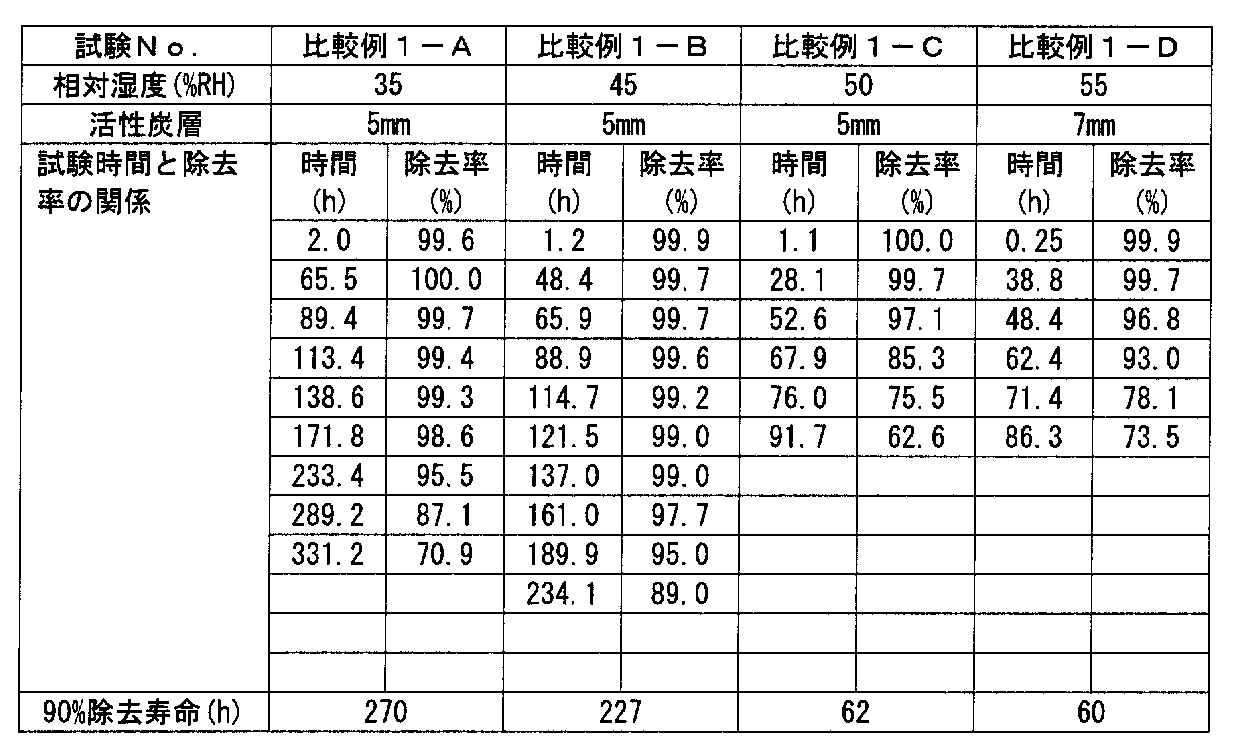
次いで、図1に示すトリメチルシラノール除去試験装置1に、含酸素官能基を有する活性炭cを充填し、150ppbのトリメチルシラノール含有空気として、温度が23℃、相対湿度が表2に示す相対湿度の150ppbのトリメチルシラノール含有空気を用いて、トリメチルシラノールの除去試験を行った。その結果を表2に示す。
破砕形状の平均粒径が32/60メッシュ(0.25~0.50mm)、比表面積が1500m2/gである活性炭b 20gを、1%オゾン雰囲気に8時間曝露して、酸化を行った。得られた含酸素官能基を有する活性炭cの含酸素官能基量を測定したところ、含酸素官能基量は1.57mmol/g、カルボニル基量は0.35mmol/g、水酸基量は0.59mmol/g、ラクトン基量は0.33mmol/g、カルボキシル基量は0.30mmol/gであった。また、含酸素官能基を有する活性炭cの微分細孔容積分布を求めたところ、マイクロ孔のピークのピークトップの位置は、0.7nmであり、細孔径が0nmより大きく2nm以下の細孔の細孔容積に対する細孔径が0.7~1.2nmの細孔の細孔容積の割合は、43%であった。また、含酸素官能基を有する活性炭cの比表面積は1500m2/gであり、細孔径0nmより大きく2nm以下のマイクロ孔容積は0.65cm3/gであった。
次いで、図1に示すトリメチルシラノール除去試験装置1に、含酸素官能基を有する活性炭cを充填し、150ppbのトリメチルシラノール含有空気として、温度が23℃、相対湿度が表2に示す相対湿度の150ppbのトリメチルシラノール含有空気を用いて、トリメチルシラノールの除去試験を行った。その結果を表2に示す。
(比較例2)
破砕形状の平均粒径が32/60メッシュ(0.25~0.50mm)、比表面積が1500m2/gである活性炭bの含酸素官能基量を測定したところ、含酸素官能基量は0.39mmol/g、カルボニル基量は0.14mmol/g、水酸基量は0.20mmol/g、ラクトン基量は0.02mmol/g、カルボキシル基量は0.03mmol/gであった。また、活性炭bの微分細孔容積分布を求めたところ、マイクロ孔のピークのピークトップの位置は、0.7nmであり、細孔径が0nmより大きく2nm以下の細孔の細孔容積に対する細孔径が0.7~1.2nmの細孔の細孔容積の割合は、43%であった。また、活性炭bの比表面積は1500m2/gであり、細孔径0nmより大きく2nm以下のマイクロ孔容積は0.65cm3/gであった。
次いで、図1に示すトリメチルシラノール除去試験装置1に、含酸素官能基を有する活性炭bを充填し、150ppbのトリメチルシラノール含有空気として、温度が23℃、相対湿度が表3に示す相対湿度の150ppbのトリメチルシラノール含有空気を用いて、トリメチルシラノールの除去試験を行った。その結果を表3に示す。
破砕形状の平均粒径が32/60メッシュ(0.25~0.50mm)、比表面積が1500m2/gである活性炭bの含酸素官能基量を測定したところ、含酸素官能基量は0.39mmol/g、カルボニル基量は0.14mmol/g、水酸基量は0.20mmol/g、ラクトン基量は0.02mmol/g、カルボキシル基量は0.03mmol/gであった。また、活性炭bの微分細孔容積分布を求めたところ、マイクロ孔のピークのピークトップの位置は、0.7nmであり、細孔径が0nmより大きく2nm以下の細孔の細孔容積に対する細孔径が0.7~1.2nmの細孔の細孔容積の割合は、43%であった。また、活性炭bの比表面積は1500m2/gであり、細孔径0nmより大きく2nm以下のマイクロ孔容積は0.65cm3/gであった。
次いで、図1に示すトリメチルシラノール除去試験装置1に、含酸素官能基を有する活性炭bを充填し、150ppbのトリメチルシラノール含有空気として、温度が23℃、相対湿度が表3に示す相対湿度の150ppbのトリメチルシラノール含有空気を用いて、トリメチルシラノールの除去試験を行った。その結果を表3に示す。

実施例1、比較例1及び比較例2の活性炭の90%除去寿命と被処理空気の相対湿度の関係を、図3に示す。この結果から分かるように、実施例1の活性炭Aは、相対湿度が35~55%の全範囲で、比較例2の活性炭bに比べ、除去寿命特性が高くなり、また、相対湿度50~55%での除去寿命特性は、相対湿度が45%以下の場合と比べたときの除去寿命特性の低下が小さく、相対湿度が35~55%で安定した除去性能を有することが分かった。一方、比較例1の活性炭cは、相対湿度が45%以下だと、比較例2の活性炭bに比べ、非常に高い除去寿命特性を示すものの、相対湿度が50%以上になると、相対湿度が45%以下の場合に比べて、除去寿命特性が大きく低下し、相対湿度が55%の場合には、比較例2の活性体bよりも除去寿命特性が低くなってしまった。
(シラノール化合物の二量体の吸着量の分析)
実施例1-A、比較例1-B及び比較例2-Bにおいて、トリメチルシラノール除去試験を行った後の活性炭(実施例1では217.3時間試験後のもの、比較例1では234.1時間試験後のもの、比較例2では99.3時間試験後のもの)を、それぞれ、バイアル瓶に0.1g採取した。次いで、バイアル瓶に、ジクロロメタン2mLを加えてから振とうし、抽出を行った。次いで、抽出液を、GC-MSにて定量分析し、活性炭に吸着されていた物質中のトリメチルシラノールとトリメチルシラノールの二量体の比率を求めた。その結果、実施例1-Aでは、トリメチルシラノールが5質量%、トリメチルシラノールの二量体が95質量%であった。また、比較例1-Bでは、トリメチルシラノールが12質量%、トリメチルシラノールの二量体が88質量%であった。また、比較例2-Bでは、トリメチルシラノールが76質量%、トリメチルシラノールの二量体が24質量%であった。
実施例1-A、比較例1-B及び比較例2-Bにおいて、トリメチルシラノール除去試験を行った後の活性炭(実施例1では217.3時間試験後のもの、比較例1では234.1時間試験後のもの、比較例2では99.3時間試験後のもの)を、それぞれ、バイアル瓶に0.1g採取した。次いで、バイアル瓶に、ジクロロメタン2mLを加えてから振とうし、抽出を行った。次いで、抽出液を、GC-MSにて定量分析し、活性炭に吸着されていた物質中のトリメチルシラノールとトリメチルシラノールの二量体の比率を求めた。その結果、実施例1-Aでは、トリメチルシラノールが5質量%、トリメチルシラノールの二量体が95質量%であった。また、比較例1-Bでは、トリメチルシラノールが12質量%、トリメチルシラノールの二量体が88質量%であった。また、比較例2-Bでは、トリメチルシラノールが76質量%、トリメチルシラノールの二量体が24質量%であった。
Claims (5)
- 含酸素官能基を有する活性炭であり、該含酸素官能基を有する活性炭1g当たりの含酸素官能基の量が0.5mmol/g以上であり、窒素吸着等温線からMP法により求められる微分細孔容積分布において、マイクロ孔のピークのピークトップが0.8~1.1nmにあることを特徴とするシラノール化合物除去剤。
- 前記細孔容積分布において、細孔径が0nmより大きく2nm以下の細孔の細孔容積に対する細孔径が0.7~1.2nmの細孔の細孔容積の割合が、70~100%であることを特徴とする請求項1記載のシラノール化合物除去剤。
- 前記含酸素官能基を有する活性炭の比表面積が1700m2/g以上であり、マイクロ孔容積が1cm3/g以上であることを特徴とする請求項1又は2いずれか1項記載のシラノール化合物除去剤。
- 前記含酸素官能基を有する活性炭は、前記含酸素官能基として、少なくとも、カルボニル基、水酸基、ラクトン基及びカルボキシル基のうちの1種又は2種以上を有することを特徴とする請求項1~3いずれか1項記載のシラノール化合物除去剤。
- 前記シラノール化合物が、トリメチルシラノールであることを特徴とする請求項1~4いずれか1項記載のシラノール化合物除去剤。
Priority Applications (1)
| Application Number | Priority Date | Filing Date | Title |
|---|---|---|---|
| JP2014547020A JP6156391B2 (ja) | 2012-11-16 | 2013-11-14 | シラノール化合物除去剤 |
Applications Claiming Priority (2)
| Application Number | Priority Date | Filing Date | Title |
|---|---|---|---|
| JP2012252238 | 2012-11-16 | ||
| JP2012-252238 | 2012-11-16 |
Publications (1)
| Publication Number | Publication Date |
|---|---|
| WO2014077305A1 true WO2014077305A1 (ja) | 2014-05-22 |
Family
ID=50731214
Family Applications (1)
| Application Number | Title | Priority Date | Filing Date |
|---|---|---|---|
| PCT/JP2013/080756 Ceased WO2014077305A1 (ja) | 2012-11-16 | 2013-11-14 | シラノール化合物除去剤 |
Country Status (2)
| Country | Link |
|---|---|
| JP (1) | JP6156391B2 (ja) |
| WO (1) | WO2014077305A1 (ja) |
Cited By (3)
| Publication number | Priority date | Publication date | Assignee | Title |
|---|---|---|---|---|
| WO2018116858A1 (ja) * | 2016-12-19 | 2018-06-28 | 株式会社アドール | 活性炭及びその製造方法 |
| JP2019198542A (ja) * | 2018-05-18 | 2019-11-21 | ユニチカ株式会社 | 脱臭材及び脱臭シート |
| CN116801974A (zh) * | 2020-11-18 | 2023-09-22 | 恩特格里斯公司 | 改性的碳吸附剂 |
Citations (8)
| Publication number | Priority date | Publication date | Assignee | Title |
|---|---|---|---|---|
| JP2009295765A (ja) * | 2008-06-05 | 2009-12-17 | Ebara Corp | シラノール類を捕集除去する気体浄化方法と装置 |
| WO2011099616A1 (ja) * | 2010-02-15 | 2011-08-18 | ニッタ株式会社 | 酸性添着剤を用いたケミカルフィルタ |
| JP2011166085A (ja) * | 2010-02-15 | 2011-08-25 | Nitta Corp | 金属触媒担持ケミカルフィルタ |
| JP2011212531A (ja) * | 2010-03-31 | 2011-10-27 | Kuraray Chemical Co Ltd | アルキルシラノール除去材及びそれを製造する方法 |
| JP2012030163A (ja) * | 2010-07-29 | 2012-02-16 | Nitta Corp | 空気浄化システム |
| JP2012055807A (ja) * | 2010-09-07 | 2012-03-22 | Kureha Corp | トリメチルシラノール用吸着剤、及びそれを担持したケミカルフィルタ |
| JP2012101948A (ja) * | 2010-11-05 | 2012-05-31 | Kansai Coke & Chem Co Ltd | 活性炭の製造方法 |
| WO2013137300A1 (ja) * | 2012-03-13 | 2013-09-19 | ニチアス株式会社 | シラノール化合物除去剤、シラノール化合物の除去方法、ケミカルフィルタ及び露光装置 |
Family Cites Families (1)
| Publication number | Priority date | Publication date | Assignee | Title |
|---|---|---|---|---|
| JP5327009B2 (ja) * | 2009-11-17 | 2013-10-30 | 東洋紡株式会社 | 活性炭素繊維 |
-
2013
- 2013-11-14 WO PCT/JP2013/080756 patent/WO2014077305A1/ja not_active Ceased
- 2013-11-14 JP JP2014547020A patent/JP6156391B2/ja active Active
Patent Citations (8)
| Publication number | Priority date | Publication date | Assignee | Title |
|---|---|---|---|---|
| JP2009295765A (ja) * | 2008-06-05 | 2009-12-17 | Ebara Corp | シラノール類を捕集除去する気体浄化方法と装置 |
| WO2011099616A1 (ja) * | 2010-02-15 | 2011-08-18 | ニッタ株式会社 | 酸性添着剤を用いたケミカルフィルタ |
| JP2011166085A (ja) * | 2010-02-15 | 2011-08-25 | Nitta Corp | 金属触媒担持ケミカルフィルタ |
| JP2011212531A (ja) * | 2010-03-31 | 2011-10-27 | Kuraray Chemical Co Ltd | アルキルシラノール除去材及びそれを製造する方法 |
| JP2012030163A (ja) * | 2010-07-29 | 2012-02-16 | Nitta Corp | 空気浄化システム |
| JP2012055807A (ja) * | 2010-09-07 | 2012-03-22 | Kureha Corp | トリメチルシラノール用吸着剤、及びそれを担持したケミカルフィルタ |
| JP2012101948A (ja) * | 2010-11-05 | 2012-05-31 | Kansai Coke & Chem Co Ltd | 活性炭の製造方法 |
| WO2013137300A1 (ja) * | 2012-03-13 | 2013-09-19 | ニチアス株式会社 | シラノール化合物除去剤、シラノール化合物の除去方法、ケミカルフィルタ及び露光装置 |
Non-Patent Citations (1)
| Title |
|---|
| GRZEGORS PIECHOTA ET AL: "REMOVAL AND DETERMINATION OF TRIMETHYLSILANOL FROM THE LANDFILL GAS", BIORESOURCE TECHNOLOGY, vol. 103, 7 September 2007 (2007-09-07), pages 16 - 20 * |
Cited By (4)
| Publication number | Priority date | Publication date | Assignee | Title |
|---|---|---|---|---|
| WO2018116858A1 (ja) * | 2016-12-19 | 2018-06-28 | 株式会社アドール | 活性炭及びその製造方法 |
| JP6379324B1 (ja) * | 2016-12-19 | 2018-08-22 | 株式会社アドール | 活性炭及びその製造方法 |
| JP2019198542A (ja) * | 2018-05-18 | 2019-11-21 | ユニチカ株式会社 | 脱臭材及び脱臭シート |
| CN116801974A (zh) * | 2020-11-18 | 2023-09-22 | 恩特格里斯公司 | 改性的碳吸附剂 |
Also Published As
| Publication number | Publication date |
|---|---|
| JP6156391B2 (ja) | 2017-07-05 |
| JPWO2014077305A1 (ja) | 2017-01-05 |
Similar Documents
| Publication | Publication Date | Title |
|---|---|---|
| JP4153483B2 (ja) | 水素化物ガスを精製する方法 | |
| Qin et al. | Enhanced nitrobenzene adsorption in aqueous solution by surface silylated MCM-41 | |
| Chen et al. | Fabricating efficient porous sorbents to capture organophosphorus pesticide in solution | |
| Martínez de Yuso et al. | Adsorption of toluene and toluene–water vapor mixture on almond shell based activated carbons | |
| JP5771012B2 (ja) | 超高純度過酸化水素水の生産方法およびこれに用いる分子篩の製作方法 | |
| CN102216213A (zh) | 定制的吸水材料 | |
| JP6156391B2 (ja) | シラノール化合物除去剤 | |
| JP5482133B2 (ja) | 活性炭素繊維 | |
| Zuin et al. | Polysaccharide-derived mesoporous materials (Starbon®) for sustainable separation of complex mixtures | |
| WO2013137300A1 (ja) | シラノール化合物除去剤、シラノール化合物の除去方法、ケミカルフィルタ及び露光装置 | |
| Li et al. | Adsorption of simple aromatics from aqueous solutions on modified activated carbon fibers | |
| WO2013031415A1 (ja) | 二酸化窒素吸着剤、二酸化窒素吸着装置および二酸化窒素の除去方法 | |
| JP6156390B2 (ja) | シラノール化合物の除去方法、ケミカルフィルタ及び露光装置 | |
| CN114225906A (zh) | 一种用于甲苯吸附的可再生多孔碳吸附剂及其制备方法 | |
| JP2009295765A (ja) | シラノール類を捕集除去する気体浄化方法と装置 | |
| CN116801974A (zh) | 改性的碳吸附剂 | |
| JP2012055807A (ja) | トリメチルシラノール用吸着剤、及びそれを担持したケミカルフィルタ | |
| EP1712889A1 (en) | Benzene sensor and method for manufacturing same | |
| JP2014033188A (ja) | シラノール化合物の除去方法及び露光装置 | |
| JP5482134B2 (ja) | 活性炭素繊維 | |
| JP3969489B2 (ja) | ベンゼンの測定方法及びベンゼンガス選択吸着性多孔質シリカ材料の製造方法 | |
| JP7300124B2 (ja) | トリハロメタン除去用活性炭およびその製造方法 | |
| TWI894768B (zh) | 包含氫氧化鉀及碳酸鉀之吸附劑以及相關方法及裝置 | |
| JP5354561B2 (ja) | プロトイモゴライトとリン酸の複合化物からなる非晶質物質並びにそれを用いたデシカント空調用吸着剤及び結露防止剤 | |
| JPH11114411A (ja) | 吸着剤及びその製造方法 |
Legal Events
| Date | Code | Title | Description |
|---|---|---|---|
| 121 | Ep: the epo has been informed by wipo that ep was designated in this application |
Ref document number: 13855189 Country of ref document: EP Kind code of ref document: A1 |
|
| ENP | Entry into the national phase |
Ref document number: 2014547020 Country of ref document: JP Kind code of ref document: A |
|
| NENP | Non-entry into the national phase |
Ref country code: DE |
|
| 122 | Ep: pct application non-entry in european phase |
Ref document number: 13855189 Country of ref document: EP Kind code of ref document: A1 |