WO2014077135A1 - 血中アセトアルデヒド低減剤 - Google Patents
血中アセトアルデヒド低減剤 Download PDFInfo
- Publication number
- WO2014077135A1 WO2014077135A1 PCT/JP2013/079576 JP2013079576W WO2014077135A1 WO 2014077135 A1 WO2014077135 A1 WO 2014077135A1 JP 2013079576 W JP2013079576 W JP 2013079576W WO 2014077135 A1 WO2014077135 A1 WO 2014077135A1
- Authority
- WO
- WIPO (PCT)
- Prior art keywords
- acid
- blood acetaldehyde
- citric
- ascorbic
- reducing agent
- Prior art date
- Legal status (The legal status is an assumption and is not a legal conclusion. Google has not performed a legal analysis and makes no representation as to the accuracy of the status listed.)
- Ceased
Links
Classifications
-
- A—HUMAN NECESSITIES
- A61—MEDICAL OR VETERINARY SCIENCE; HYGIENE
- A61K—PREPARATIONS FOR MEDICAL, DENTAL OR TOILETRY PURPOSES
- A61K31/00—Medicinal preparations containing organic active ingredients
- A61K31/185—Acids; Anhydrides, halides or salts thereof, e.g. sulfur acids, imidic, hydrazonic or hydroximic acids
- A61K31/19—Carboxylic acids, e.g. valproic acid
- A61K31/194—Carboxylic acids, e.g. valproic acid having two or more carboxyl groups, e.g. succinic, maleic or phthalic acid
-
- A—HUMAN NECESSITIES
- A23—FOODS OR FOODSTUFFS; TREATMENT THEREOF, NOT COVERED BY OTHER CLASSES
- A23L—FOODS, FOODSTUFFS OR NON-ALCOHOLIC BEVERAGES, NOT OTHERWISE PROVIDED FOR; PREPARATION OR TREATMENT THEREOF
- A23L2/00—Non-alcoholic beverages; Dry compositions or concentrates therefor; Preparation or treatment thereof
- A23L2/52—Adding ingredients
-
- A—HUMAN NECESSITIES
- A23—FOODS OR FOODSTUFFS; TREATMENT THEREOF, NOT COVERED BY OTHER CLASSES
- A23L—FOODS, FOODSTUFFS OR NON-ALCOHOLIC BEVERAGES, NOT OTHERWISE PROVIDED FOR; PREPARATION OR TREATMENT THEREOF
- A23L33/00—Modifying nutritive qualities of foods; Dietetic products; Preparation or treatment thereof
- A23L33/10—Modifying nutritive qualities of foods; Dietetic products; Preparation or treatment thereof using additives
-
- A—HUMAN NECESSITIES
- A23—FOODS OR FOODSTUFFS; TREATMENT THEREOF, NOT COVERED BY OTHER CLASSES
- A23L—FOODS, FOODSTUFFS OR NON-ALCOHOLIC BEVERAGES, NOT OTHERWISE PROVIDED FOR; PREPARATION OR TREATMENT THEREOF
- A23L33/00—Modifying nutritive qualities of foods; Dietetic products; Preparation or treatment thereof
- A23L33/10—Modifying nutritive qualities of foods; Dietetic products; Preparation or treatment thereof using additives
- A23L33/15—Vitamins
-
- A—HUMAN NECESSITIES
- A61—MEDICAL OR VETERINARY SCIENCE; HYGIENE
- A61K—PREPARATIONS FOR MEDICAL, DENTAL OR TOILETRY PURPOSES
- A61K31/00—Medicinal preparations containing organic active ingredients
- A61K31/185—Acids; Anhydrides, halides or salts thereof, e.g. sulfur acids, imidic, hydrazonic or hydroximic acids
- A61K31/19—Carboxylic acids, e.g. valproic acid
-
- A—HUMAN NECESSITIES
- A61—MEDICAL OR VETERINARY SCIENCE; HYGIENE
- A61K—PREPARATIONS FOR MEDICAL, DENTAL OR TOILETRY PURPOSES
- A61K31/00—Medicinal preparations containing organic active ingredients
- A61K31/33—Heterocyclic compounds
- A61K31/335—Heterocyclic compounds having oxygen as the only ring hetero atom, e.g. fungichromin
- A61K31/365—Lactones
- A61K31/375—Ascorbic acid, i.e. vitamin C; Salts thereof
-
- A—HUMAN NECESSITIES
- A61—MEDICAL OR VETERINARY SCIENCE; HYGIENE
- A61K—PREPARATIONS FOR MEDICAL, DENTAL OR TOILETRY PURPOSES
- A61K9/00—Medicinal preparations characterised by special physical form
- A61K9/0012—Galenical forms characterised by the site of application
- A61K9/0053—Mouth and digestive tract, i.e. intraoral and peroral administration
- A61K9/0056—Mouth soluble or dispersible forms; Suckable, eatable, chewable coherent forms; Forms rapidly disintegrating in the mouth; Lozenges; Lollipops; Bite capsules; Baked products; Baits or other oral forms for animals
-
- A—HUMAN NECESSITIES
- A61—MEDICAL OR VETERINARY SCIENCE; HYGIENE
- A61P—SPECIFIC THERAPEUTIC ACTIVITY OF CHEMICAL COMPOUNDS OR MEDICINAL PREPARATIONS
- A61P3/00—Drugs for disorders of the metabolism
-
- A—HUMAN NECESSITIES
- A61—MEDICAL OR VETERINARY SCIENCE; HYGIENE
- A61P—SPECIFIC THERAPEUTIC ACTIVITY OF CHEMICAL COMPOUNDS OR MEDICINAL PREPARATIONS
- A61P43/00—Drugs for specific purposes, not provided for in groups A61P1/00-A61P41/00
Definitions
- the present invention relates to a blood acetaldehyde reducing agent, and more particularly to a blood acetaldehyde reducing agent that efficiently lowers the blood acetaldehyde concentration after alcohol intake by drinking.
- Alcohol taken into the body by drinking is metabolized by alcohol dehydrogenase in the liver cells and decomposed into acetaldehyde having strong hepatotoxicity, and then acetaldehyde is rapidly decomposed into acetic acid.
- Acetic acid is released from the liver into the blood, enters the TCA circuit as a source of energy for peripheral tissues, and is eventually broken down into carbon dioxide and water.
- acetaldehyde is not decomposed into acetic acid and causes discomfort such as nausea and headache.
- Patent Document 1 discloses that a higher aliphatic alcohol having 22 to 36 carbon atoms is an active ingredient, and Patent Document 2 contains kale and / or kale extract as an active ingredient.
- Patent Document 3 discloses a blood acetaldehyde reducing agent mainly composed of a herbal extract and supplemented with citric acid or vitamin C.
- the present invention solves the above-mentioned conventional problems, and an object of the present invention is to provide a blood acetaldehyde reducing agent excellent in effect and safety by using raw materials that are easily available.
- the present invention provides use of at least one selected from the group consisting of ascorbic acids [A] and acetic acid [C] and citric acids [B] in a blood acetaldehyde reducing agent.
- the present invention also provides use of ascorbic acids [A] and citric acids [B] in a blood acetaldehyde reducing agent.
- weight ratio [A / B] of ascorbic acids [A] and citric acids [B] is more than 0.33 and less than 1.33.
- the weight ratio [A / B] of ascorbic acids [A] and citric acids [B] is 0.5 to 1.
- the dosage of ascorbic acids [A] and citric acids [B] is 0.05 g / kg or more based on body weight.
- acetic acid [C] is further used in the above use.
- the present invention also provides use of acetic acid [C] and citric acids [B] in a blood acetaldehyde reducing agent.
- the weight ratio [C / B] of acetic acid [C] and citric acids [B] is 0.01 to 5.
- the dosage of ascorbic acids [A] and citric acids [B] is 0.01 g / kg or more based on body weight, and the dosage of acetic acid [C] is 0.1 g / kg or less. is there.
- the ascorbic acid is at least one selected from the group consisting of ascorbic acid, sodium ascorbate, calcium ascorbate and potassium ascorbate.
- the citric acid is at least one selected from the group consisting of citric acid, sodium citrate and potassium citrate.
- the present invention also provides a blood acetaldehyde reducing agent comprising at least one selected from the group consisting of ascorbic acids [A] and acetic acid [C] and citric acids [B].
- ascorbic acid refers to ascorbic acid and ascorbate that can be added to food.
- specific examples of ascorbic acids include ascorbic acid, sodium ascorbate, calcium ascorbate and potassium ascorbate.
- citric acids refer to citric acid and citrate that can be added to food.
- Specific examples of citric acids include citric acid, sodium citrate and potassium citrate.
- examples of such foods include citrus fruits such as lemons and tangerines, and fruits such as peaches, plums, strawberries, and kiwifruits. These may be pulverized, squeezed or the like to use a portion containing citric acids.
- the amount of ascorbic acid and citric acid used is adjusted so that the weight ratio between them is 0.3 / 1 to 1.4 / 1. If the weight ratio of ascorbic acid and citric acid is less than 0.3 / 1 or exceeds 1.4 / 1, the effect of lowering the blood acetaldehyde concentration becomes insufficient. That is, when the weight ratio of ascorbic acid and citric acid is 0.3 / 1 to 1.4 / 1, a synergistic effect of using both is recognized. In addition, when there are more ascorbic acids than citrates, there exists a tendency for an effect to be attenuated.
- the weight ratio of ascorbic acid and citric acid is preferably more than 0.33 and less than 1.33, more preferably 0.4 to 1.25, still more preferably 0.45 to 1.1, and most preferably 0.8. 5 to 1.0.
- Ascorbic acid and citric acid can be used in combination as a blood acetaldehyde reducing agent. Accordingly, when ascorbic acid and citric acid are ingested by humans as a blood acetaldehyde reducing agent, the dosage may be determined appropriately depending on the effect.
- the dose of citric acid is about 0.05 g / kg or more based on body weight.
- the dose of citric acid is less than 0.05 g / kg based on body weight, the effect of lowering the blood acetaldehyde concentration is reduced.
- a preferred dosage is about 0.1 g / kg or more, more preferably about 0.2 g / kg or more.
- the dose of ascorbic acid can be adjusted in consideration of the weight ratio with citric acid.
- Acetic acid is a component contained in approximately 3% of vinegar, and if it is in an appropriate amount, it is harmless to the human body. Acetic acid has an effect of reducing blood acetaldehyde.
- the blood acetaldehyde-reducing action of acetic acid is synergistically enhanced particularly when acetic acid and citric acid are used in combination.
- the blood acetaldehyde reducing action is further enhanced.
- the amount of acetic acid used is 0.01 to 5, preferably 0.05 to 2, and more preferably 0.1 to 1 by weight ratio with respect to citric acid. If the amount of acetic acid used is less than 0.01 or exceeds 5, it is difficult to obtain a synergistic effect of reducing blood acetaldehyde.
- Acetic acid has a strong acidity and may adversely affect the digestive tract, so it is not preferable to take it in excess of the appropriate amount.
- the dosage of acetic acid is 0.1 g / kg or less, preferably 0.05 g / kg or less, more preferably 0.02 g / kg or less.
- the dosage of citric acid may be 0.01 g / kg or more, preferably 0.03 g / kg or more based on body weight.
- the dose of ascorbic acid can be adjusted taking into account the weight ratio with citric acid.
- the effect of efficiently suppressing the blood acetaldehyde concentration after alcohol consumption by drinking is strong when taken at the time of drinking or by taking the composition of the present invention before drinking.
- the blood acetaldehyde reducing agent of the present invention may be prepared in the form of pharmaceuticals, foods or beverages.
- a form called a supplement is preferable, and a form such as a tablet or granule is preferable.
- As a beverage it is common to adjust to a form such as a drink. You may mix with alcoholic beverages.
- These foods or beverages may be produced by a conventional method. For example, it can be produced by the following method.
- granules In the case of granules, it can be produced with a fluid granulator or a tumbling granulator together with additives such as excipients and sweeteners to ascorbic acids and citric acids.
- additives such as excipients, sweeteners, lubricants are added and mixed, and then compressed into tablets using a rotary tableting machine, single-punch tableting machine, etc. Can be manufactured.
- excipients include starch (corn starch, potato starch, wheat starch, rice starch, etc.), lactose colloidal silica, crystalline cellulose, anhydrous silicic acid, anhydrous calcium phosphate, precipitated calcium carbonate, calcium silicate, light anhydrous silicic acid. Hydrous silicon dioxide, silicon dioxide, aluminum oxide, magnesium carbonate, precipitated calcium carbonate, crystalline cellulose, synthetic aluminum silicate, magnesium silicate, magnesium metasilicate aluminate, dextrin, carmellose calcium and the like. These carriers may be used alone or in combination of two or more.
- the crystalline cellulose includes microcrystalline cellulose.
- sweetener examples include sugar, sugar alcohol, glucose, fructose, galactose, mannose, lactose, maltose, sucrose, sucrose (including purified sucrose), trehalose, mannitol, sorbitol, maltitol, aspartame, erythritol. Xylitol and the like, and these may be used alone or in combination of two or more.
- the lubricant examples include magnesium stearate, calcium stearate, sodium stearyl fumarate, stearic acid, talc, sucrose fatty acid ester, glycerin fatty acid ester, polyethylene glycol, vegetable oil and the like.
- the lubricant may be added by any of the method of adding to the granule before tableting and mixing, or the method of adhering directly to the punch or die during tableting.
- Water may be water that is suitable for drinking, and is, for example, pure water, hard water, soft water, or ion-exchanged water, and deionized ion-exchanged water is preferable in order to suppress ascorbic acid deterioration.
- test solution prepared by dissolving either active substance ascorbic acid or citric acid in 5% (v / v) ethanol-containing water is prepared in male BALB / c mice 7 weeks of age or older, based on body weight. It was administered by gavage in an amount of 8.45 ml / kg. The concentration of each test solution was adjusted so that the dose of ascorbic acid or citric acid became the values shown in Tables 1 and 2. For example, when the dose was 0.5 g / kg, the ascorbic acid concentration or citric acid concentration of the test solution was 5.9% by weight. A group to which only 5% (v / v) ethanol-containing water was administered was used as a control.
- the blood acetaldehyde concentration inhibition rate was determined by comparing the blood acetaldehyde concentration of the above control with the blood acetaldehyde concentration of the administration group, and calculating the decreased blood acetaldehyde concentration ratio. For example, when the dose was 0.5 g / kg, ascorbic acid had a blood acetaldehyde concentration inhibition rate of 39.0%, and citric acid had a blood acetaldehyde concentration inhibition rate of 38.6%.
- the blood acetaldehyde concentration inhibition rate values of ascorbic acid and citric acid are used as basic data for calculating theoretical values when both are used in combination.
- the dose of citric acid was fixed at 0.3 g / kg, and the dose of ascorbic acid was changed stepwise.
- the combination ratio of ascorbic acid and citric acid was 0.5 or more, the effect of exceeding the theoretical value was demonstrated with respect to citric acid 1, and the synergistic effect was strongest when 1/1.
- the combination ratio of ascorbic acid and citric acid was fixed at 1, and the doses of both compounds were changed.
- the doses of ascorbic acid and citric acid were 0.05 g / kg or more, superiority to the theoretical value was recognized.
- the blood acetaldehyde concentration inhibition rate was determined by comparing the blood acetaldehyde concentration of the above control with the blood acetaldehyde concentration of the administration group, and calculating the decreased blood acetaldehyde concentration ratio.
- Example 14 The concentration of blood acetaldehyde in each test solution was the same as in the reference example except that the test solution was adjusted so that the doses of active ingredients ascorbic acid, citric acid and acetic acid were as shown in Table 6. The inhibition rate was measured. Further, the theoretical value of the blood acetaldehyde concentration inhibition rate was calculated in the same manner as described above.
- the blood acetaldehyde concentration after alcohol intake by drinking can be reduced efficiently, it is extremely useful as a food or beverage that effectively prevents hangovers such as nausea and headache after drinking a large amount of alcohol due to excessive drinking.
Landscapes
- Health & Medical Sciences (AREA)
- Life Sciences & Earth Sciences (AREA)
- Chemical & Material Sciences (AREA)
- Veterinary Medicine (AREA)
- General Health & Medical Sciences (AREA)
- Medicinal Chemistry (AREA)
- Pharmacology & Pharmacy (AREA)
- Animal Behavior & Ethology (AREA)
- Public Health (AREA)
- Engineering & Computer Science (AREA)
- Nutrition Science (AREA)
- Epidemiology (AREA)
- Polymers & Plastics (AREA)
- Food Science & Technology (AREA)
- Chemical Kinetics & Catalysis (AREA)
- Mycology (AREA)
- Bioinformatics & Cheminformatics (AREA)
- General Chemical & Material Sciences (AREA)
- Organic Chemistry (AREA)
- Nuclear Medicine, Radiotherapy & Molecular Imaging (AREA)
- Diabetes (AREA)
- Hematology (AREA)
- Obesity (AREA)
- Zoology (AREA)
- Physiology (AREA)
- Pharmaceuticals Containing Other Organic And Inorganic Compounds (AREA)
- Acyclic And Carbocyclic Compounds In Medicinal Compositions (AREA)
Abstract
発明の課題は、入手が容易な原材料を使用して、効果及び安全性に優れた血中アセトアルデヒド低減剤を提供することである。課題の解決手段は、血中アセトアルデヒド低減剤における、アスコルビン酸類[A]及び酢酸[C]から成る群から選択される少なくとも一種と、クエン酸類[B]との使用である。
Description
本発明は血中アセトアルデヒド低減剤に関し、詳しくは、飲酒によるアルコール摂取後の血中アセトアルデヒド濃度を効率良く低下させる血中アセトアルデヒド低減剤に関する。
飲酒により体内に摂取されたアルコールは肝細胞内のアルコール脱水素酵素などにより代謝され、肝毒性の強いアセトアルデヒドに分解され、次いでアセトアルデヒドは速やかに酢酸に分解される。酢酸は、肝臓から血中に放出され、末梢組織のエネルギー源としてTCA回路に入り、最終的には、二酸化炭素と水に分解される。しかしながら、アセトアルデヒドが酢酸に分解されずに、吐き気や頭痛などの不快感の原因になると考えられている。
これまでに血中アセトアルデヒド濃度を低下する食品素材・成分は複数報告されている。ヒト又は動物の血中アセトアルデヒド濃度を低下させるための食用組成物を血中アセトアルデヒド低減剤という。例えば、血中アセトアルデヒド低減剤として、特許文献1には炭素数22~36の高級脂肪族アルコールを有効成分とする開示があり、また特許文献2にはケールおよび又はケール抽出物を有効成分とする開示がある。また特許文献3には、生薬抽出物を主成分とし、クエン酸やビタミンCが補助添加された血中アセトアルデヒド低減剤の開示がある。
しかし、従来の血中アセトアルデヒド低減剤は特殊な成分を含み、原材料の入手が困難であり、製造するのに労力及びコストを要するものである。
本発明は上記従来の問題を解決するものであり、その目的とするところは、入手が容易な原材料を使用して、効果及び安全性に優れた血中アセトアルデヒド低減剤を提供することにある。
本発明は、血中アセトアルデヒド低減剤における、アスコルビン酸類[A]及び酢酸[C]から成る群から選択される少なくとも一種と、クエン酸類[B]との使用を提供する。
また、本発明は、血中アセトアルデヒド低減剤における、アスコルビン酸類[A]とクエン酸類[B]との使用を提供する。
ある一形態においては、アスコルビン酸類[A]及びクエン酸類[B]の重量比[A/B]が0.33を超えて1.33未満である。
ある一形態においては、アスコルビン酸類[A]及びクエン酸類[B]の重量比[A/B]が0.5~1である。
ある一形態においては、アスコルビン酸類[A]及びクエン酸類[B]の投与量が体重を基準にして0.05g/kg以上である。
ある一形態においては、上記使用では、更に酢酸[C]を使用する。
また、本発明は、血中アセトアルデヒド低減剤における、酢酸[C]とクエン酸類[B]との使用を提供する。
ある一形態においては、酢酸[C]とクエン酸類[B]との重量比[C/B]が0.01~5である。
ある一形態においては、アスコルビン酸類[A]及びクエン酸類[B]の投与量が体重を基準にして0.01g/kg以上であり、酢酸[C]の投与量が0.1g/kg以下である。
ある一形態においては、前記アスコルビン酸類が、アスコルビン酸、アスコルビン酸ナトリウム、アスコルビン酸カルシウム及びアスコルビン酸カリウムからなる群から選択される少なくとも一種である。
ある一形態においては、前記クエン酸類が、クエン酸、クエン酸ナトリウム及びクエン酸カリウムからなる群から選択される少なくとも一種である。
また、本発明は、アスコルビン酸類[A]及び酢酸[C]から成る群から選択される少なくとも一種と、クエン酸類[B]とを含む血中アセトアルデヒド低減剤を提供する。
本発明によれば、入手が容易な原材料を使用して、効果及び安全性に優れた血中アセトアルデヒド低減剤を提供することができる。
本発明においてアスコルビン酸類とは、食品に添加することができるアスコルビン酸及びアスコルビン酸塩をいう。アスコルビン酸類の具体例としては、アスコルビン酸、アスコルビン酸ナトリウム、アスコルビン酸カルシウム及びアスコルビン酸カリウムが挙げられる。また、アスコルビン酸類を含む食品を利用しても良い。このような食品としては、アセロラやレモン等の果実や、ピーマン、芽キャベツ等の野菜が挙げられる。これらは粉砕、搾汁等することによりアスコルビン酸類を含む部分を利用してもよい。
本発明においてクエン酸類とは、食品に添加することができるクエン酸及びクエン酸塩をいう。クエン酸類の具体例としては、クエン酸、クエン酸ナトリウム及びクエン酸カリウムが挙げられる。また、クエン酸類を含む食品を利用しても良い。このよう食品としては、レモンやミカン等の柑橘類や、桃、梅、イチゴ、キウィフルーツ等の果実が挙げられる。これらは粉砕、搾汁等することによりクエン酸類を含む部分を利用してもよい。
アスコルビン酸類及びクエン酸類の使用量は、両者の重量比が0.3/1~1.4/1になるように調節する。アスコルビン酸類及びクエン酸類の重量比が0.3/1未満であるか、1.4/1を超えると血中アセトアルデヒド濃度を低下する効果が不十分になる。つまり、アスコルビン酸類及びクエン酸類の重量比が0.3/1~1.4/1である場合に、両者を併用する相乗効果が認められる。尚、クエン酸類よりもアスコルビン酸類が多くなると、効果が減弱される傾向がある。
アスコルビン酸類及びクエン酸類の重量比は、好ましくは0.33を超えて1.33未満、より好ましくは0.4~1.25、更に好ましくは0.45~1.1、最も好ましくは0.5~1.0である。
アスコルビン酸及びクエン酸は、組み合わせて血中アセトアルデヒド低減剤として使用することができる。従って、アスコルビン酸及びクエン酸を血中アセトアルデヒド低減剤としてヒトに摂取させる場合、投与量は効果に応じて適量を決定すればよい。
クエン酸の投与量は、体重を基準にして約0.05g/kg以上である。クエン酸の投与量が体重を基準にして0.05g/kg未満であると、血中アセトアルデヒド濃度を低下させる効果は低くなる。好ましい投与量は約0.1g/kg以上であり、より好ましくは約0.2g/kg以上である。
アスコルビン酸の投与量は、クエン酸との重量比を考慮して調整することができる。
酢酸は食酢に約3%含有される成分であり、適量であれば人体に無害な物質である。酢酸には血中アセトアルデヒド低減作用がある。酢酸の血中アセトアルデヒド低減作用は、特に酢酸とクエン酸とを組み合わせて使用する場合に相乗的に増強される。酢酸、アスコルビン酸及びクエン酸を組み合わせて使用する場合に血中アセトアルデヒド低減作用がより増強される。
酢酸の使用量はクエン酸に対する重量比で0.01~5、好ましくは0.05~2、より好ましくは0.1~1である。酢酸の上記使用量が0.01未満、又は5を超えると血中アセトアルデヒド低減作用の相乗効果が得られ難くなる。
酢酸は酸味が強く、消化器官に悪影響を与える可能性があるから、適量を超えて摂取させることは好ましくない。酢酸の投与量は0.1g/kg以下、好ましくは0.05g/kg以下、より好ましくは0.02g/kg以下である。
酢酸を併用する場合、クエン酸又はアスコルビン酸の投与量は少量で足りる。この場合、クエン酸の投与量は、体重を基準にして0.01g/kg以上、好ましくは0.03g/kg以上でよい。アスコルビン酸の投与量は、この場合もクエン酸との重量比を考慮して調整することができる。
飲酒によるアルコール摂取後の血中アセトアルデヒド濃度を効率良く抑制させる効果は、飲酒時に摂取するか、もしくは飲酒前に本発明の組成物を摂取しておくと、強い効果が得られる。
本発明の血中アセトアルデヒド低減剤は、医薬品、食品または飲料の形態に調製してよい。食品としては、サプリメントと云われる形態が好ましく、錠剤や顆粒など形状が好ましい。飲料としては、ドリンク剤等の形態に調整するのが一般的である。アルコール飲料に混合してもよい。これら、食品または飲料は、慣用された方法により製造すればよい。例えば以下のような方法で製造することができる。
顆粒とする際は、アスコルビン酸類とクエン酸類に賦形剤、甘味料などの添加剤と一緒に流動造粒機や転動造粒機などで製造することができる。錠剤とする際は、顆粒とした後、賦形剤、甘味料、滑沢剤などの添加剤を加えて混合し、ロータリー式打錠機、単発打錠機などで圧縮成型することにより、錠剤を製造することができる。
飲料とする際は、水や酒類に、アスコルビン酸類とクエン酸類を添加して攪拌し、飲料原液を調製し、容器に充填して製造することができる。なお、必要に応じて加熱殺菌など行う。また、本発明の効果を阻害しない範囲で糖類や香料等の添加剤を加えても良い。
賦形剤としては、例えば、デンプン(トウモロコシデンプン、馬鈴薯デンプン、コムギデンプン、コメデンプン等)、ラクトースコロイダルシリカ、結晶セルロース、無水ケイ酸、無水リン酸カルシウム、沈降炭酸カルシウム、ケイ酸カルシウム、軽質無水ケイ酸、含水二酸化ケイ素、二酸化ケイ素、酸化アルミニウム、炭酸マグネシウム、沈降炭酸カルシウム、結晶セルロース、合成ケイ酸アルミニウム、ケイ酸マグネシウム、メタケイ酸アルミン酸マグネシウム、デキストリン、カルメロースカルシウム等が挙げられる。これらの担体は、単独または2種以上を併用して用いても良い。前記結晶セルロースとしては、微結晶セルロースを含む。
甘味料としては、例えば、糖、糖アルコールが挙げられ、グルコース、フルクトース、ガラクトース、マンノース、ラクトース、マルトース、スクロース、白糖(精製白糖を含む。)、トレハロース、マンニトール、ソルビトール、マルチトール、アスパルテーム、エリスリトール、キシリトール等が挙げられ、これらを単独または2種以上を併用して用いても良い。
滑沢剤としては、例えば、ステアリン酸マグネシウムやステアリン酸カルシウム、フマル酸ステアリルナトリウム、ステアリン酸、タルク、ショ糖脂肪酸エステル、グリセリン脂肪酸エステル、ポリエチレングリコール、植物油脂等が挙げられる。滑沢剤は、打錠する前に顆粒に加え混合する方法、あるいは打錠時に杵または臼に直接付着させる方法の何れの方法で添加しても良い。
水は飲用に適した水であればよく、例えば、純水、硬水、軟水、イオン交換水であり、アスコルビン酸の劣化を抑制するためには、脱酸素処理したイオン交換水が好ましい。
以下の実施例により本発明を更に具体的に説明するが、本発明はこれらに限定されない。
(参考例1)
7週齢以上の雄性BALB/cマウスに、有効成分であるアスコルビン酸又はクエン酸のいずれか一方を5%(v/v)エタノール含有水に溶解した被験液を調製し、体重を基準にして8.45ml/kgの量で強制胃内投与した。各被験液は、アスコルビン酸又はクエン酸の投与量が表1及び表2に示す値になるように濃度を調節した。例えば、投与量が0.5g/kgである場合、被験液のアスコルビン酸濃度又はクエン酸濃度は5.9重量%とした。なお、5%(v/v)エタノール含有水のみを投与する群をコントロールとした。
7週齢以上の雄性BALB/cマウスに、有効成分であるアスコルビン酸又はクエン酸のいずれか一方を5%(v/v)エタノール含有水に溶解した被験液を調製し、体重を基準にして8.45ml/kgの量で強制胃内投与した。各被験液は、アスコルビン酸又はクエン酸の投与量が表1及び表2に示す値になるように濃度を調節した。例えば、投与量が0.5g/kgである場合、被験液のアスコルビン酸濃度又はクエン酸濃度は5.9重量%とした。なお、5%(v/v)エタノール含有水のみを投与する群をコントロールとした。
そして、投与15分後に尾静脈から5μl採血し、直ちにDNPH誘導体化法(Kozutsumi D et al. J.Chromatog.Sci., 40, p477-482, 2002)によって血中アセトアルデヒド濃度(μg/ml)を測定した。
血中アセトアルデヒド濃度抑制率は、上記コントロールの血中アセトアルデヒド濃度と、投与群の血中アセトアルデヒド濃度を比較して、減少した血中アセトアルデヒド濃度比率を算出して決定した。例えば、投与量が0.5g/kgである場合、アスコルビン酸は血中アセトアルデヒド濃度抑制率39.0%、クエン酸は血中アセトアルデヒド濃度抑制率38.6%であった。
[表1]

[表2]

上記アスコルビン酸及びクエン酸の血中アセトアルデヒド濃度抑制率の値は、両者を併用した場合の理論値を計算するための基礎データとして使用する。
(実施例1~5)
有効成分であるアスコルビン酸及びクエン酸の投与量が表3に示す値になるように濃度調節した被験液を使用すること以外は参考例と同様にして、各被験液について血中アセトアルデヒド濃度抑制率を測定した。
有効成分であるアスコルビン酸及びクエン酸の投与量が表3に示す値になるように濃度調節した被験液を使用すること以外は参考例と同様にして、各被験液について血中アセトアルデヒド濃度抑制率を測定した。
これに対し、参考例の結果からアスコルビン酸及びクエン酸のそれぞれの投与量に基づいて、血中アセトアルデヒド濃度抑制率の理論値を計算した。
[表3]
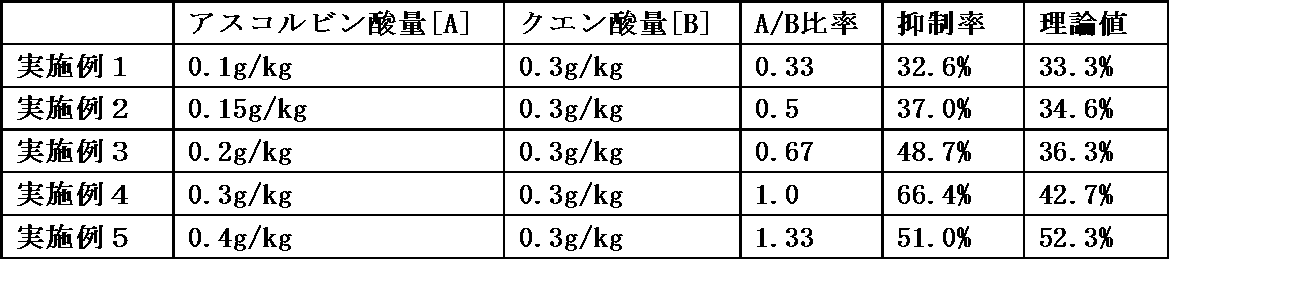
クエン酸の投与量を0.3g/kgに固定し、アスコルビン酸の投与量を段階的に変化させた。アスコルビン酸とクエン酸の組み合わせ比率がクエン酸1に対して、アスコルビン酸が0.5以上で理論値を超える効果を発揮し、1/1の場合に最も相乗効果が強くなった。
(実施例6~13)
有効成分であるアスコルビン酸及びクエン酸の投与量が表4に示す値になるように濃度調節した被験液を使用すること以外は参考例と同様にして、各被験液について血中アセトアルデヒド濃度抑制率を測定した。また、上記と同様にして血中アセトアルデヒド濃度抑制率の理論値を計算した。
有効成分であるアスコルビン酸及びクエン酸の投与量が表4に示す値になるように濃度調節した被験液を使用すること以外は参考例と同様にして、各被験液について血中アセトアルデヒド濃度抑制率を測定した。また、上記と同様にして血中アセトアルデヒド濃度抑制率の理論値を計算した。
[表4]

アスコルビン酸とクエン酸の組み合わせ比率を1に固定し、両化合物の投与量を変化させた。アスコルビン酸とクエン酸の投与量が0.05g/kg以上の場合に、理論値に対する優位性が認められた。
(参考例2)
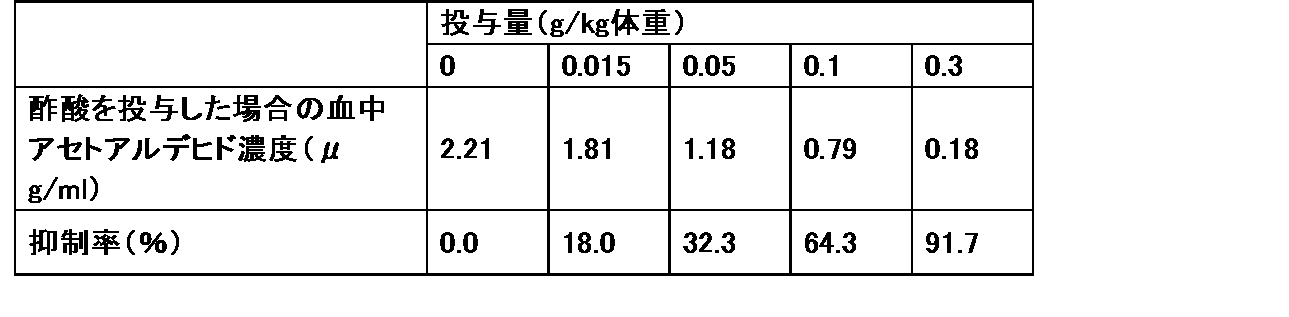
7週齢以上の雄性BALB/cマウスに、有効成分である酢酸を5%(v/v)エタノール含有水に溶解した被験液を調製し、体重を基準にして8.45ml/kgの量で強制胃内投与した。各被験液は、酢酸の投与量が表1に示す値になるように濃度を調節した。
7週齢以上の雄性BALB/cマウスに、有効成分である酢酸を5%(v/v)エタノール含有水に溶解した被験液を調製し、体重を基準にして8.45ml/kgの量で強制胃内投与した。各被験液は、酢酸の投与量が表1に示す値になるように濃度を調節した。
そして、投与15分後に尾静脈から5μl採血し、直ちにDNPH誘導体化法(Kozutsumi D et al. J.Chromatog.Sci., 40, p477-482, 2002)によって血中アセトアルデヒド濃度(μg/ml)を測定した。
血中アセトアルデヒド濃度抑制率は、上記コントロールの血中アセトアルデヒド濃度と、投与群の血中アセトアルデヒド濃度を比較して、減少した血中アセトアルデヒド濃度比率を算出して決定した。
[表5]
(実施例14、15)
有効成分であるアスコルビン酸、クエン酸及び酢酸の投与量が表6に示す値になるように濃度調節した被験液を使用すること以外は参考例と同様にして、各被験液について血中アセトアルデヒド濃度抑制率を測定した。また、上記と同様にして血中アセトアルデヒド濃度抑制率の理論値を計算した。
有効成分であるアスコルビン酸、クエン酸及び酢酸の投与量が表6に示す値になるように濃度調節した被験液を使用すること以外は参考例と同様にして、各被験液について血中アセトアルデヒド濃度抑制率を測定した。また、上記と同様にして血中アセトアルデヒド濃度抑制率の理論値を計算した。
[表6]

アスコルビン酸及び/又は酢酸とクエン酸とを組み合わせた場合に、血中アセトアルデヒド濃度抑制率について、理論値に対する優位性が認められた。
飲酒によるアルコール摂取後の血中アセトアルデヒド濃度を効率良く低下させることできるため、飲みすぎによる大量のアルコール摂取後の吐き気や頭痛などの二日酔いを効果的に防止する食品または飲料として極めて有用である。
Claims (12)
- 血中アセトアルデヒド低減剤における、アスコルビン酸類[A]及び酢酸[C]から成る群から選択される少なくとも一種と、クエン酸類[B]との使用。
- 血中アセトアルデヒド低減剤における、アスコルビン酸類[A]とクエン酸類[B]との使用。
- アスコルビン酸類[A]とクエン酸類[B]との重量比[A/B]が0.33を超えて1.33未満である請求項2に記載の使用。
- アスコルビン酸類[A]とクエン酸類[B]との重量比[A/B]が0.5~1である請求項2に記載の使用。
- アスコルビン酸類[A]及びクエン酸類[B]の投与量が体重を基準にして0.05g/kg以上である請求項1~4のいずれか一項に記載の使用。
- 更に酢酸[C]を使用する請求項2~5のいずれか一項に記載の使用。
- 血中アセトアルデヒド低減剤における、酢酸[C]とクエン酸類[B]との使用。
- 酢酸[C]とクエン酸類[B]との重量比[C/B]が0.01~5である請求項6又は7に記載の使用。
- アスコルビン酸類[A]及びクエン酸類[B]の投与量が体重を基準にして0.01g/kg以上であり、酢酸[C]の投与量が0.1g/kg以下である請求項6~8のいずれか一項に記載の使用。
- 前記アスコルビン酸類が、アスコルビン酸、アスコルビン酸ナトリウム、アスコルビン酸カルシウム及びアスコルビン酸カリウムからなる群から選択される少なくとも一種である請求項1~9のいずれか一項に記載の使用。
- 前記クエン酸類が、クエン酸、クエン酸ナトリウム及びクエン酸カリウムからなる群から選択される少なくとも一種である請求項1~10のいずれか一項に記載の使用。
- アスコルビン酸類[A]及び酢酸[C]から成る群から選択される少なくとも一種と、クエン酸類[B]とを含む血中アセトアルデヒド低減剤。
Priority Applications (1)
| Application Number | Priority Date | Filing Date | Title |
|---|---|---|---|
| JP2014546935A JP6220792B2 (ja) | 2012-11-15 | 2013-10-31 | 血中アセトアルデヒド低減剤 |
Applications Claiming Priority (2)
| Application Number | Priority Date | Filing Date | Title |
|---|---|---|---|
| JP2012-251408 | 2012-11-15 | ||
| JP2012251408 | 2012-11-15 |
Publications (1)
| Publication Number | Publication Date |
|---|---|
| WO2014077135A1 true WO2014077135A1 (ja) | 2014-05-22 |
Family
ID=50731053
Family Applications (1)
| Application Number | Title | Priority Date | Filing Date |
|---|---|---|---|
| PCT/JP2013/079576 Ceased WO2014077135A1 (ja) | 2012-11-15 | 2013-10-31 | 血中アセトアルデヒド低減剤 |
Country Status (2)
| Country | Link |
|---|---|
| JP (1) | JP6220792B2 (ja) |
| WO (1) | WO2014077135A1 (ja) |
Cited By (3)
| Publication number | Priority date | Publication date | Assignee | Title |
|---|---|---|---|---|
| WO2021157627A1 (ja) * | 2020-02-04 | 2021-08-12 | 株式会社東洋新薬 | 経口組成物 |
| JP2021123578A (ja) * | 2020-02-04 | 2021-08-30 | 株式会社東洋新薬 | 経口組成物 |
| US20210353575A1 (en) * | 2018-10-16 | 2021-11-18 | Nippon Chemiphar Co., Ltd. | Agent for suppressing alcohol sickness or hangover due to alcoholic beverage ingestion |
Citations (3)
| Publication number | Priority date | Publication date | Assignee | Title |
|---|---|---|---|---|
| JPS62143678A (ja) * | 1985-12-17 | 1987-06-26 | Nakano Vinegar Co Ltd | 深酔い防止アルコ−ル飲料の製造法 |
| JPS63169974A (ja) * | 1985-06-24 | 1988-07-13 | マンフレ−ト・バンネス | フルクト−ス・ビタミンc、キニン及び/又はこれらの代替物を含有する飲料 |
| WO2006064550A1 (ja) * | 2004-12-14 | 2006-06-22 | Toyo Shinyaku Co.,Ltd. | アルコール代謝向上剤及びアルコール飲料 |
-
2013
- 2013-10-31 JP JP2014546935A patent/JP6220792B2/ja active Active
- 2013-10-31 WO PCT/JP2013/079576 patent/WO2014077135A1/ja not_active Ceased
Patent Citations (3)
| Publication number | Priority date | Publication date | Assignee | Title |
|---|---|---|---|---|
| JPS63169974A (ja) * | 1985-06-24 | 1988-07-13 | マンフレ−ト・バンネス | フルクト−ス・ビタミンc、キニン及び/又はこれらの代替物を含有する飲料 |
| JPS62143678A (ja) * | 1985-12-17 | 1987-06-26 | Nakano Vinegar Co Ltd | 深酔い防止アルコ−ル飲料の製造法 |
| WO2006064550A1 (ja) * | 2004-12-14 | 2006-06-22 | Toyo Shinyaku Co.,Ltd. | アルコール代謝向上剤及びアルコール飲料 |
Non-Patent Citations (1)
| Title |
|---|
| J.P. BONJOUR: "VITAMINS AND ALCOHOLISM", INTERNATIONAL JOURNAL FOR VITAMIN AND NUTRITION RESEARCH, vol. 49, no. 4, 1 January 1979 (1979-01-01), pages 434 - 441 * |
Cited By (6)
| Publication number | Priority date | Publication date | Assignee | Title |
|---|---|---|---|---|
| US20210353575A1 (en) * | 2018-10-16 | 2021-11-18 | Nippon Chemiphar Co., Ltd. | Agent for suppressing alcohol sickness or hangover due to alcoholic beverage ingestion |
| JP2024156043A (ja) * | 2018-10-16 | 2024-10-31 | 日本ケミファ株式会社 | アルコール飲料摂取による悪酔い又は二日酔いの抑制剤 |
| WO2021157627A1 (ja) * | 2020-02-04 | 2021-08-12 | 株式会社東洋新薬 | 経口組成物 |
| JP2021123578A (ja) * | 2020-02-04 | 2021-08-30 | 株式会社東洋新薬 | 経口組成物 |
| JP7724518B2 (ja) | 2020-02-04 | 2025-08-18 | 株式会社東洋新薬 | 経口組成物 |
| US12502415B2 (en) | 2020-02-04 | 2025-12-23 | Toyo Shinyaku Co., Ltd. | Oral composition |
Also Published As
| Publication number | Publication date |
|---|---|
| JP6220792B2 (ja) | 2017-10-25 |
| JPWO2014077135A1 (ja) | 2017-01-05 |
Similar Documents
| Publication | Publication Date | Title |
|---|---|---|
| US6037375A (en) | Nutrient composition | |
| JP6224489B2 (ja) | ナトリウム含有飲料 | |
| WO1993020718A1 (fr) | Composition alimentaire inhibant la formation de produits de putrefaction intestinale | |
| CN109985042A (zh) | 一种含有大麻二酚或大麻提取物和咖啡因的组合物及其应用 | |
| CN102132819A (zh) | 一种含有低聚糖的泡腾片 | |
| WO2010118405A2 (en) | Compositions and methods for reducing hangover symptoms | |
| JP6220792B2 (ja) | 血中アセトアルデヒド低減剤 | |
| JP2015091768A (ja) | 肝臓加水分解物含有液状組成物 | |
| JP5069416B2 (ja) | 吸湿性の改善された飲食品用組成物 | |
| JP2005185188A (ja) | アセロラ処理物およびl−カルニチン含有組成物 | |
| CN103689747A (zh) | 一种快速补充体能的泡腾片及其制备方法 | |
| WO2022013581A1 (en) | Nutritional supplement, suitable for oral administration, comprising dihydromyricetin, choline and one or more vitamins with antioxidant activity, for use in the maintenance of normal liver function | |
| JP5759047B1 (ja) | ウコン中の有用成分を含有する低水分系組成物 | |
| JP6196068B2 (ja) | クチナシ抽出物を含む眠気覚まし用組成物 | |
| JP2012131760A (ja) | 脂肪酸吸収抑制剤 | |
| JP7090849B2 (ja) | 肝機能改善用組成物及び肝機能改善用食品組成物 | |
| US20200330454A1 (en) | Capsule containing pyrroloquinoline quinone or salt thereof and branched-chain amino acid | |
| CN104305464A (zh) | 蓝莓c+e泡腾片 | |
| JP7026422B1 (ja) | 飲料 | |
| CN104366648A (zh) | 甜橙vc泡腾片 | |
| US20200170935A1 (en) | Effervescent tablets that include crystalline sugar binder and methods of making the same | |
| JP2008120754A (ja) | 抗疲労剤 | |
| JP6012415B2 (ja) | 酒酔い軽減剤 | |
| JP2007230989A (ja) | 持久力増強・抗疲労剤 | |
| JP2018153166A (ja) | 筋肉量増加用組成物、体脂肪低下用組成物、並びに筋肉量増加及び体脂肪低下用組成物 |
Legal Events
| Date | Code | Title | Description |
|---|---|---|---|
| 121 | Ep: the epo has been informed by wipo that ep was designated in this application |
Ref document number: 13854429 Country of ref document: EP Kind code of ref document: A1 |
|
| ENP | Entry into the national phase |
Ref document number: 2014546935 Country of ref document: JP Kind code of ref document: A |
|
| NENP | Non-entry into the national phase |
Ref country code: DE |
|
| 122 | Ep: pct application non-entry in european phase |
Ref document number: 13854429 Country of ref document: EP Kind code of ref document: A1 |