WO2014077073A1 - モリブデンを含有する薄膜の製造方法、薄膜形成用原料及びモリブデンイミド化合物 - Google Patents
モリブデンを含有する薄膜の製造方法、薄膜形成用原料及びモリブデンイミド化合物 Download PDFInfo
- Publication number
- WO2014077073A1 WO2014077073A1 PCT/JP2013/077889 JP2013077889W WO2014077073A1 WO 2014077073 A1 WO2014077073 A1 WO 2014077073A1 JP 2013077889 W JP2013077889 W JP 2013077889W WO 2014077073 A1 WO2014077073 A1 WO 2014077073A1
- Authority
- WO
- WIPO (PCT)
- Prior art keywords
- thin film
- molybdenum
- imide compound
- compound
- raw material
- Prior art date
- Legal status (The legal status is an assumption and is not a legal conclusion. Google has not performed a legal analysis and makes no representation as to the accuracy of the status listed.)
- Ceased
Links
Images



Classifications
-
- C—CHEMISTRY; METALLURGY
- C07—ORGANIC CHEMISTRY
- C07F—ACYCLIC, CARBOCYCLIC OR HETEROCYCLIC COMPOUNDS CONTAINING ELEMENTS OTHER THAN CARBON, HYDROGEN, HALOGEN, OXYGEN, NITROGEN, SULFUR, SELENIUM OR TELLURIUM
- C07F11/00—Compounds containing elements of Groups 6 or 16 of the Periodic Table
-
- C—CHEMISTRY; METALLURGY
- C07—ORGANIC CHEMISTRY
- C07F—ACYCLIC, CARBOCYCLIC OR HETEROCYCLIC COMPOUNDS CONTAINING ELEMENTS OTHER THAN CARBON, HYDROGEN, HALOGEN, OXYGEN, NITROGEN, SULFUR, SELENIUM OR TELLURIUM
- C07F17/00—Metallocenes
-
- C—CHEMISTRY; METALLURGY
- C23—COATING METALLIC MATERIAL; COATING MATERIAL WITH METALLIC MATERIAL; CHEMICAL SURFACE TREATMENT; DIFFUSION TREATMENT OF METALLIC MATERIAL; COATING BY VACUUM EVAPORATION, BY SPUTTERING, BY ION IMPLANTATION OR BY CHEMICAL VAPOUR DEPOSITION, IN GENERAL; INHIBITING CORROSION OF METALLIC MATERIAL OR INCRUSTATION IN GENERAL
- C23C—COATING METALLIC MATERIAL; COATING MATERIAL WITH METALLIC MATERIAL; SURFACE TREATMENT OF METALLIC MATERIAL BY DIFFUSION INTO THE SURFACE, BY CHEMICAL CONVERSION OR SUBSTITUTION; COATING BY VACUUM EVAPORATION, BY SPUTTERING, BY ION IMPLANTATION OR BY CHEMICAL VAPOUR DEPOSITION, IN GENERAL
- C23C16/00—Chemical coating by decomposition of gaseous compounds, without leaving reaction products of surface material in the coating, i.e. chemical vapour deposition [CVD] processes
- C23C16/06—Chemical coating by decomposition of gaseous compounds, without leaving reaction products of surface material in the coating, i.e. chemical vapour deposition [CVD] processes characterised by the deposition of metallic material
- C23C16/18—Chemical coating by decomposition of gaseous compounds, without leaving reaction products of surface material in the coating, i.e. chemical vapour deposition [CVD] processes characterised by the deposition of metallic material from metallo-organic compounds
-
- C—CHEMISTRY; METALLURGY
- C23—COATING METALLIC MATERIAL; COATING MATERIAL WITH METALLIC MATERIAL; CHEMICAL SURFACE TREATMENT; DIFFUSION TREATMENT OF METALLIC MATERIAL; COATING BY VACUUM EVAPORATION, BY SPUTTERING, BY ION IMPLANTATION OR BY CHEMICAL VAPOUR DEPOSITION, IN GENERAL; INHIBITING CORROSION OF METALLIC MATERIAL OR INCRUSTATION IN GENERAL
- C23C—COATING METALLIC MATERIAL; COATING MATERIAL WITH METALLIC MATERIAL; SURFACE TREATMENT OF METALLIC MATERIAL BY DIFFUSION INTO THE SURFACE, BY CHEMICAL CONVERSION OR SUBSTITUTION; COATING BY VACUUM EVAPORATION, BY SPUTTERING, BY ION IMPLANTATION OR BY CHEMICAL VAPOUR DEPOSITION, IN GENERAL
- C23C16/00—Chemical coating by decomposition of gaseous compounds, without leaving reaction products of surface material in the coating, i.e. chemical vapour deposition [CVD] processes
- C23C16/22—Chemical coating by decomposition of gaseous compounds, without leaving reaction products of surface material in the coating, i.e. chemical vapour deposition [CVD] processes characterised by the deposition of inorganic material, other than metallic material
- C23C16/30—Deposition of compounds, mixtures or solid solutions, e.g. borides, carbides, nitrides
- C23C16/40—Oxides
- C23C16/405—Oxides of refractory metals or yttrium
-
- C—CHEMISTRY; METALLURGY
- C23—COATING METALLIC MATERIAL; COATING MATERIAL WITH METALLIC MATERIAL; CHEMICAL SURFACE TREATMENT; DIFFUSION TREATMENT OF METALLIC MATERIAL; COATING BY VACUUM EVAPORATION, BY SPUTTERING, BY ION IMPLANTATION OR BY CHEMICAL VAPOUR DEPOSITION, IN GENERAL; INHIBITING CORROSION OF METALLIC MATERIAL OR INCRUSTATION IN GENERAL
- C23C—COATING METALLIC MATERIAL; COATING MATERIAL WITH METALLIC MATERIAL; SURFACE TREATMENT OF METALLIC MATERIAL BY DIFFUSION INTO THE SURFACE, BY CHEMICAL CONVERSION OR SUBSTITUTION; COATING BY VACUUM EVAPORATION, BY SPUTTERING, BY ION IMPLANTATION OR BY CHEMICAL VAPOUR DEPOSITION, IN GENERAL
- C23C16/00—Chemical coating by decomposition of gaseous compounds, without leaving reaction products of surface material in the coating, i.e. chemical vapour deposition [CVD] processes
- C23C16/44—Chemical coating by decomposition of gaseous compounds, without leaving reaction products of surface material in the coating, i.e. chemical vapour deposition [CVD] processes characterised by the method of coating
-
- C—CHEMISTRY; METALLURGY
- C23—COATING METALLIC MATERIAL; COATING MATERIAL WITH METALLIC MATERIAL; CHEMICAL SURFACE TREATMENT; DIFFUSION TREATMENT OF METALLIC MATERIAL; COATING BY VACUUM EVAPORATION, BY SPUTTERING, BY ION IMPLANTATION OR BY CHEMICAL VAPOUR DEPOSITION, IN GENERAL; INHIBITING CORROSION OF METALLIC MATERIAL OR INCRUSTATION IN GENERAL
- C23C—COATING METALLIC MATERIAL; COATING MATERIAL WITH METALLIC MATERIAL; SURFACE TREATMENT OF METALLIC MATERIAL BY DIFFUSION INTO THE SURFACE, BY CHEMICAL CONVERSION OR SUBSTITUTION; COATING BY VACUUM EVAPORATION, BY SPUTTERING, BY ION IMPLANTATION OR BY CHEMICAL VAPOUR DEPOSITION, IN GENERAL
- C23C16/00—Chemical coating by decomposition of gaseous compounds, without leaving reaction products of surface material in the coating, i.e. chemical vapour deposition [CVD] processes
- C23C16/44—Chemical coating by decomposition of gaseous compounds, without leaving reaction products of surface material in the coating, i.e. chemical vapour deposition [CVD] processes characterised by the method of coating
- C23C16/455—Chemical coating by decomposition of gaseous compounds, without leaving reaction products of surface material in the coating, i.e. chemical vapour deposition [CVD] processes characterised by the method of coating characterised by the method used for introducing gases into reaction chamber or for modifying gas flows in reaction chamber
- C23C16/45523—Pulsed gas flow or change of composition over time
- C23C16/45525—Atomic layer deposition [ALD]
Definitions
- the present invention relates to a method for producing a thin film containing molybdenum using vapor obtained by vaporizing a specific molybdenum imide compound, a thin film containing molybdenum produced by the production method, a raw material for forming a thin film used in the production method, and a novel Related to molybdenum imide compounds.
- Thin films containing molybdenum can be used in organic light emitting diodes, liquid crystal displays, plasma display panels, field emission displays, thin film solar cells, low resistance ohmics and other electronic and semiconductor devices, mainly as barrier films, etc. Used as a member of electronic parts.
- Examples of the method for producing the thin film include a sputtering method, an ion plating method, a MOD method such as a coating pyrolysis method and a sol-gel method, a chemical vapor deposition method, etc., but has excellent composition controllability and step coverage. Since it has many advantages such as being suitable for mass production and being capable of hybrid integration, it is a chemical vapor deposition (hereinafter sometimes simply referred to as CVD) method including an ALD (Atomic Layer Deposition) method. Is the optimal manufacturing process.
- CVD chemical vapor deposition
- ALD Atomic Layer Deposition
- Patent Document 1 reports biscyclopentadienyl molybdenum dihydride, bismethylcyclopentadienyl molybdenum dihydride, bisethylcyclopentadienyl molybdenum dihydride, and bisisopropylcyclopentadienyl molybdenum dihydride.
- the compound disclosed in Patent Document 1 has a high melting point, a low vapor pressure, and a problem that a large amount of residue is generated after thermal decomposition by heating. It wasn't.
- Non-Patent Document 1 reports a biscyclopentadienylimido molybdenum compound. However, Non-Patent Document 1 does not disclose that a biscyclopentadienylimidomolybdenum compound is useful as a raw material for the CVD method.
- the molybdenum compounds proposed so far have not necessarily had sufficient characteristics.
- the properties required for a compound (precursor) suitable for a raw material for forming a thin film by vaporizing a compound such as a CVD method are high thermal stability, low melting point, and high vapor pressure and easy vaporization.
- a compound used as a conventional molybdenum source has a high melting point, a low vapor pressure, and a large amount of residue is generated after thermal decomposition by heating. If a large amount of pyrolyzate residue is generated by heating, the residue causes particles, which degrades the quality of the desired thin film and makes it difficult to clean piping and containers. In some cases, the piping may become clogged.
- the present invention introduces a vapor containing a molybdenum imide compound obtained by vaporizing a raw material for forming a thin film containing a molybdenum imide compound represented by the following general formula (I) onto a substrate, which is decomposed and decomposed.
- the present invention provides a thin film production method for forming a thin film containing molybdenum on a substrate by chemical reaction, and a thin film containing molybdenum produced by the above thin film production method.
- R 1 to R 10 represent a hydrogen atom or a linear or branched alkyl group having 1 to 5 carbon atoms, and R 11 represents a linear or branched alkyl group having 1 to 8 carbon atoms.
- the present invention also provides a raw material for forming a thin film comprising the molybdenum imide compound represented by the general formula (I).
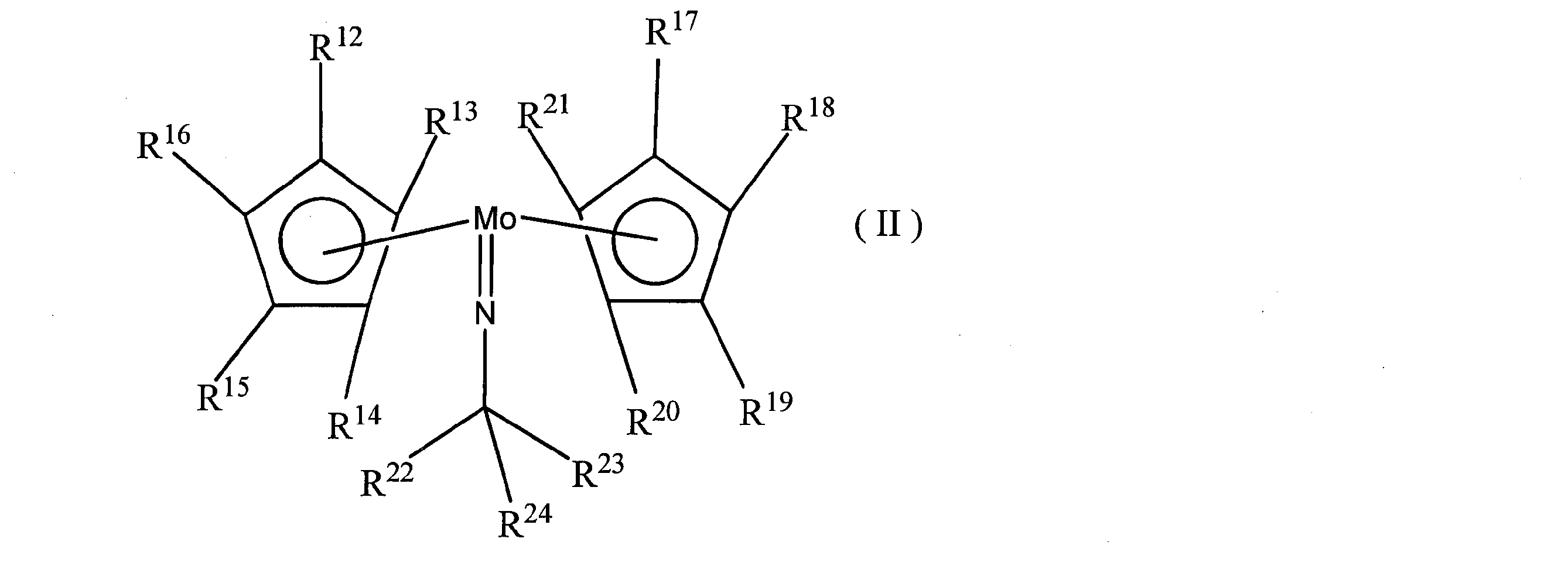
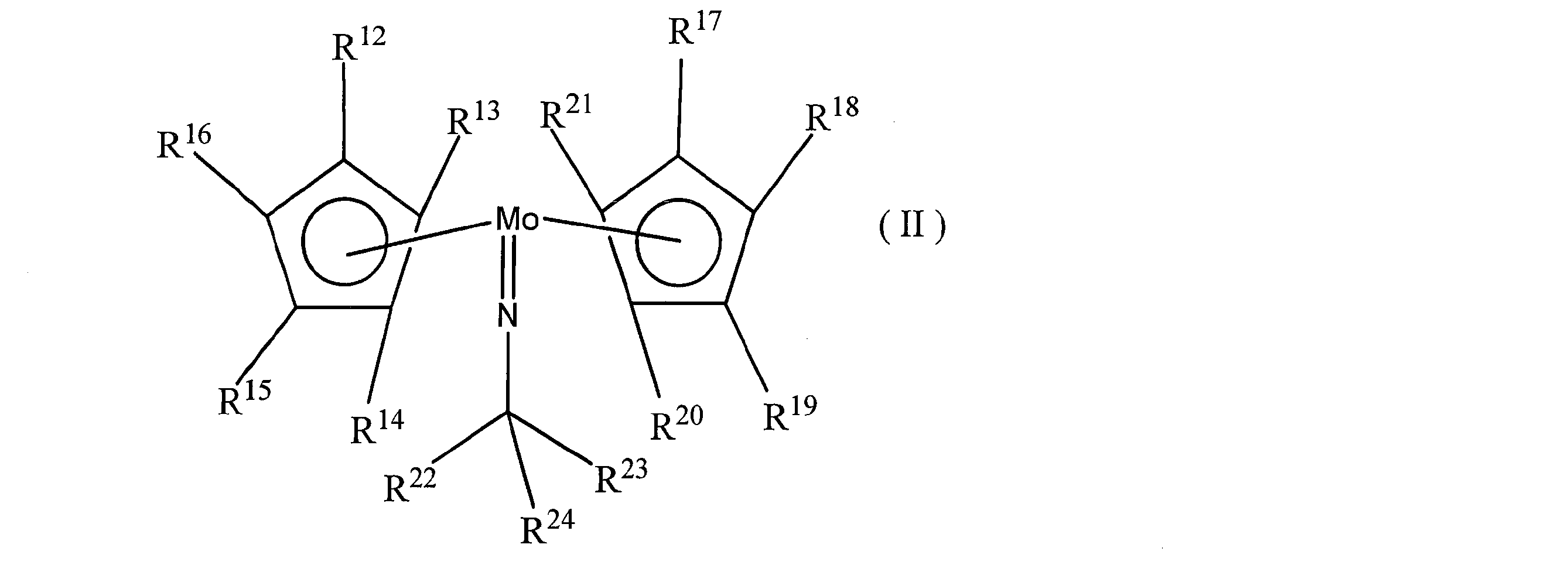
- the present invention also provides a novel molybdenum imide compound represented by the following general formula (II).
- R 12 to R 21 represent a hydrogen atom or a linear or branched alkyl group having 1 to 5 carbon atoms
- R 22 and R 23 each represents a methyl group or an ethyl group
- R 24 represents a carbon number of 2 Represents a linear or branched alkyl group of 5 to 5.
- the compound is excellent in thermal stability, has a low melting point, and has a high vapor pressure.
- the transportability of the precursor is excellent, the supply amount to the substrate can be controlled easily and stably, and a thin film containing high-quality molybdenum can be produced with high mass productivity.
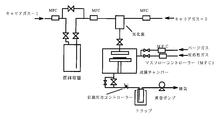
- FIG. 1 is a schematic diagram showing an example of an apparatus for chemical vapor deposition used in a method for producing a thin film containing molybdenum according to the present invention.
- FIG. 2 is a schematic diagram showing another example of an apparatus for chemical vapor deposition used in the method for producing a thin film containing molybdenum according to the present invention.
- FIG. 3 is a schematic view showing another example of an apparatus for chemical vapor deposition used in the method for producing a thin film containing molybdenum according to the present invention.
- FIG. 4 is a schematic view showing another example of an apparatus for chemical vapor deposition used in the method for producing a thin film containing molybdenum according to the present invention.
- examples of the linear or branched alkyl group having 1 to 5 carbon atoms represented by R 1 to R 10 include methyl, ethyl, propyl, isopropyl, butyl, sec-butyl.
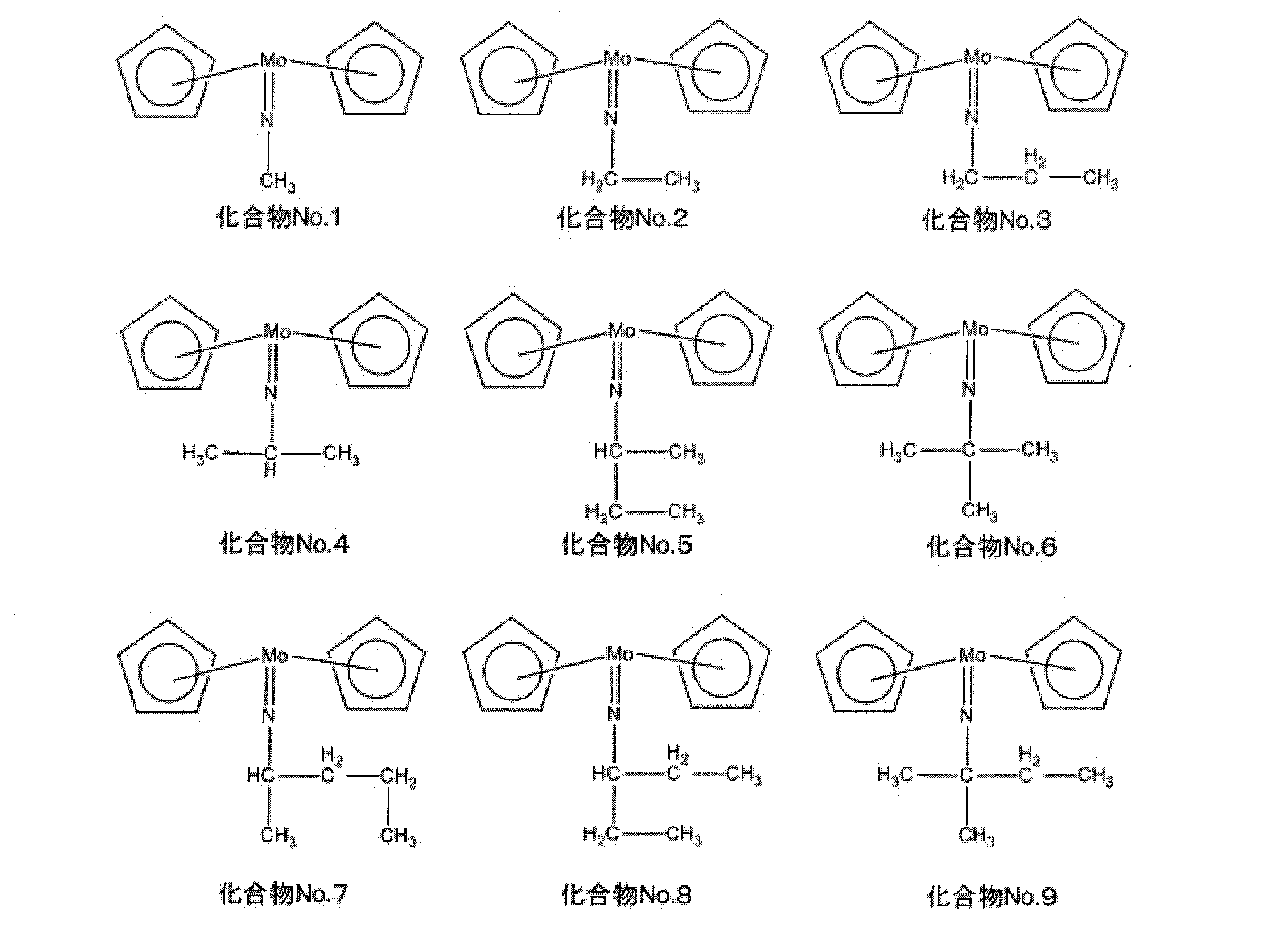
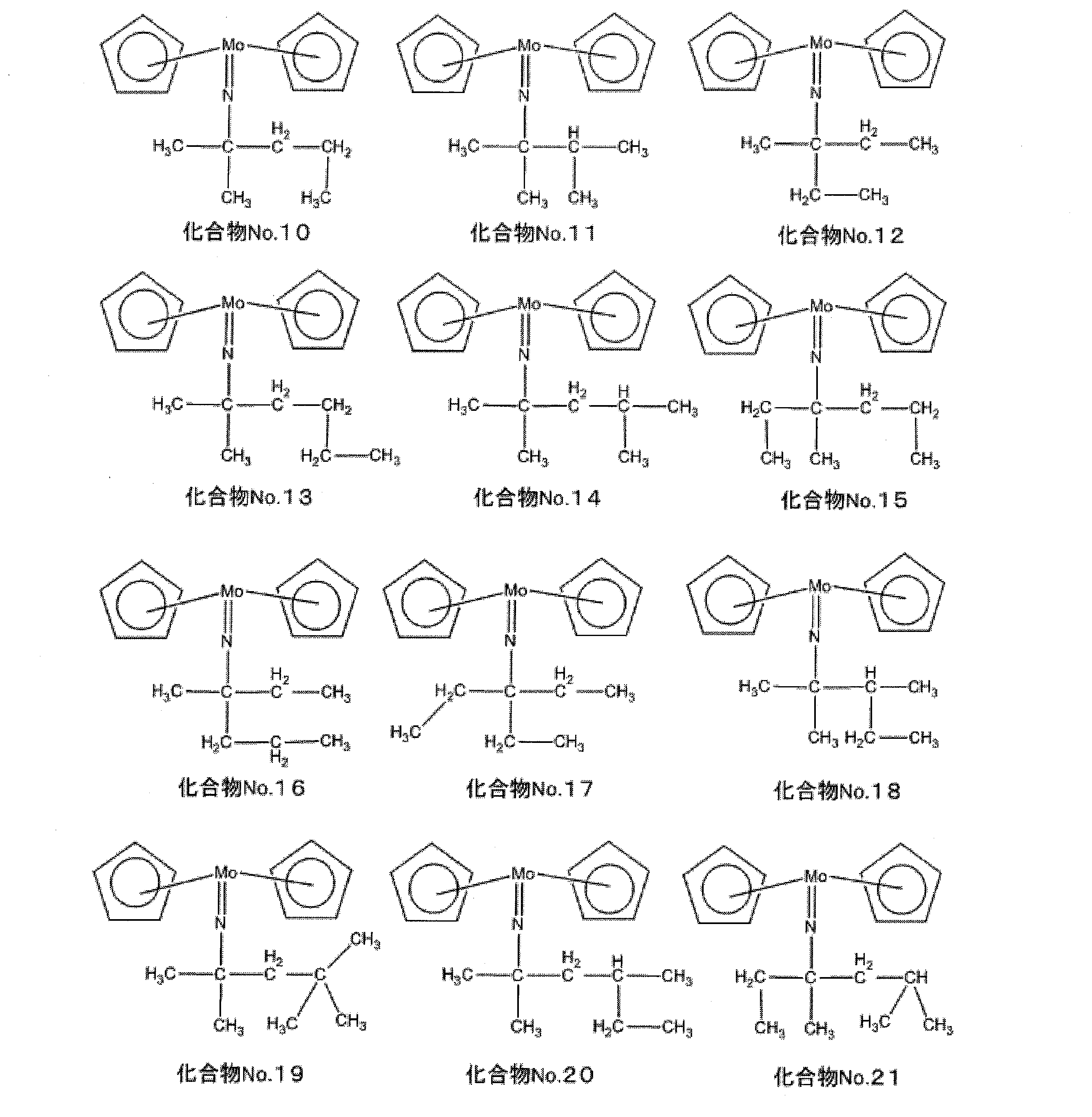
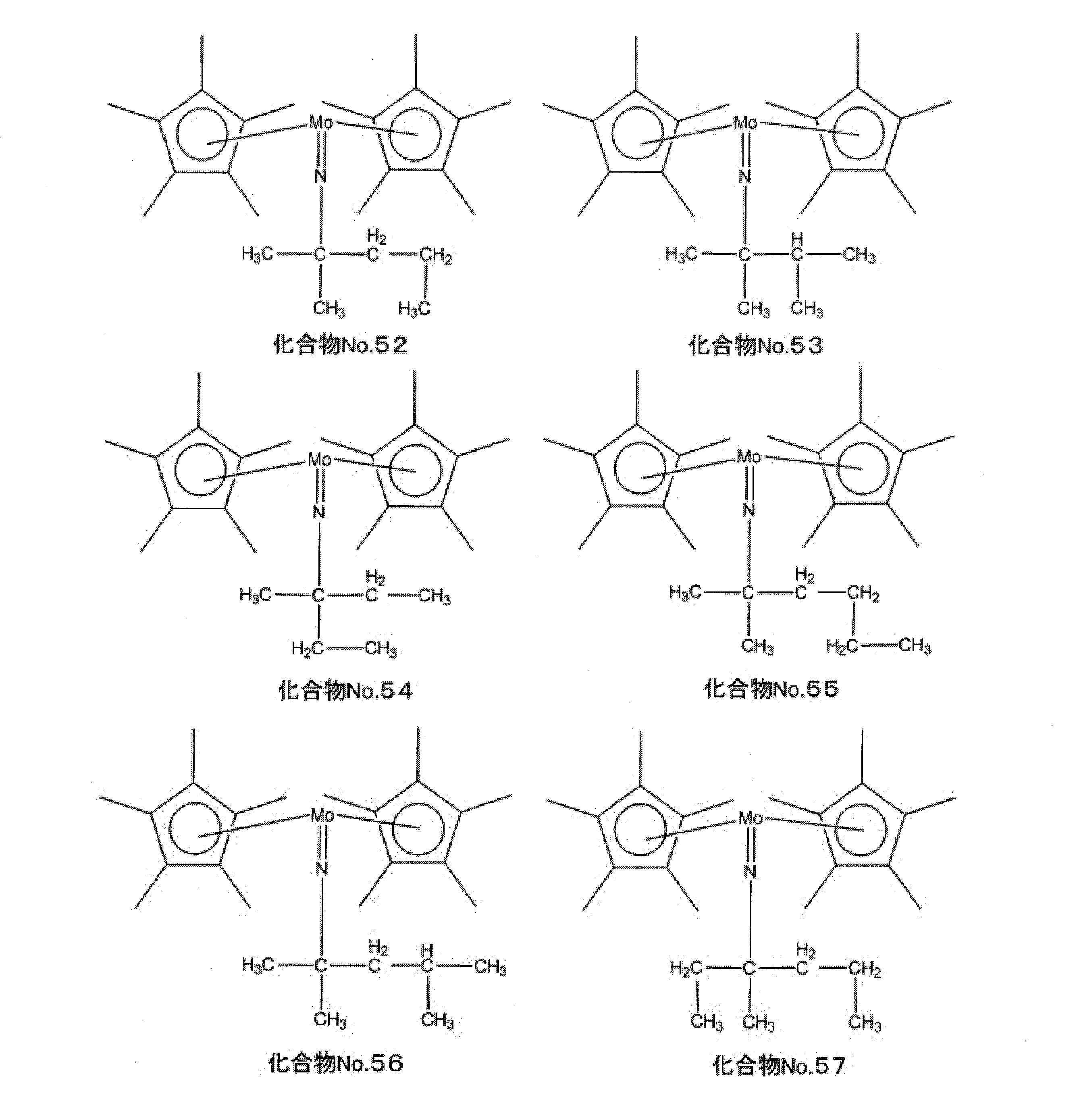
- molybdenum imide compound having such a group examples include, for example, the following compound No. 1 to 63 may be mentioned. However, this invention is not limited at all by the following exemplary compounds.
- R 1 to R 10 in the general formula (I) are preferably those having a low melting point and a high vapor pressure. it preferably has R 1 ⁇ R 10 is a hydrogen atom or a methyl group, those R 1 ⁇ R 10 are all hydrogen atoms or one of R 1 ⁇ R 5 is methyl group, further R 6 ⁇ One in which one of R 10 is a methyl group is particularly preferred because of its high vapor pressure.
- R 11 is preferably a tertiary alkyl group because of its low melting point, and among them, a tertiary butyl group, a tertiary pentyl group, or a 1,1,3,3-tetramethylbutyl group is preferable.
- a compound in which R 11 is a tertiary pentyl group or a 1,1,3,3-tetramethylbutyl group is particularly preferred because the melting point is particularly low.
- the raw material for forming a thin film of the present invention is the above-described molybdenum imide compound used as a precursor for manufacturing a thin film containing molybdenum, and the form varies depending on the process.
- the molybdenum imide compound represented by the general formula (I) is particularly useful as a raw material for chemical vapor deposition because of its physical properties.
- the raw material for forming a thin film of the present invention is a raw material for chemical vapor deposition
- the form thereof is appropriately selected according to a method such as a transport supply method of chemical vapor deposition used.
- the chemical vapor deposition raw material is vaporized by heating and / or depressurizing in the raw material container, and together with a carrier gas such as argon, nitrogen, helium, etc. used as needed, to the deposition reaction section.
- a carrier gas such as argon, nitrogen, helium, etc. used as needed.
- the chemical vapor deposition raw material is transported to the vaporization chamber in a liquid or solution state, vaporized by heating and / or decompressing in the vaporization chamber, and then transported to the deposition reaction section
- a carrier gas such as argon, nitrogen, helium, etc.
- the molybdenum imide compound represented by the general formula (I) itself is a raw material for chemical vapor deposition
- the molybdenum imide compound represented by the general formula (I) A solution in which the compound itself or the compound is dissolved in an organic solvent becomes a raw material for chemical vapor deposition.
- a chemical vapor deposition material is vaporized and supplied independently for each component (hereinafter sometimes referred to as a single source method), and a multi-component material is previously prepared.
- a method of vaporizing and supplying a mixed raw material mixed in a desired composition hereinafter sometimes referred to as a cocktail sauce method.
- a cocktail sauce method a mixture or a mixed solution of the molybdenum imide compound represented by the general formula (I) and another precursor is a chemical vapor deposition raw material.
- the organic solvent used for the chemical vapor deposition raw material is not particularly limited and a known general organic solvent can be used.
- the organic solvent include acetates such as ethyl acetate, butyl acetate and methoxyethyl acetate; ether alcohols such as ethylene glycol monomethyl ether, ethylene glycol monoethyl ether, ethylene glycol monobutyl ether and diethylene glycol monomethyl ether; tetrahydrofuran, Ethers such as tetrahydropyran, ethylene glycol dimethyl ether, diethylene glycol dimethyl ether, triethylene glycol dimethyl ether, dibutyl ether, dioxane; methyl butyl ketone, methyl isobutyl ketone, ethyl butyl ketone, dipropyl ketone, diisobutyl ketone, methyl amyl ketone, cyclohexanone, methyl Ketones such as cyclo
- the solvent may be used alone or as a mixed solvent of two or more.
- the total amount of the molybdenum imide compound represented by the above general formula (I) and other precursors in the organic solvent is 0.01 to 2.0 mol / liter, particularly 0.05. It is preferable to set it to ⁇ 1.0 mol / liter.
- Examples of the other precursor include a compound of one or more organic coordination compounds selected from alcohol compounds, glycol compounds, ⁇ -diketone compounds, cyclopentadiene compounds, organic amine compounds, and the like, and silicon or a metal. It is done.
- the precursor metal species include lithium, sodium, potassium, magnesium, calcium, strontium, barium, titanium, zirconium, hafnium, vanadium, niobium, tantalum, molybdenum, manganese, iron, ruthenium, cobalt, rhodium, iridium, nickel.
- Examples of the alcohol compound used as the organic ligand include alkyl alcohols such as methanol, ethanol, propanol, isopropanol, butanol, 2-butanol, isobutanol, t-butanol, amyl alcohol, isoamyl alcohol, and t-amyl alcohol.
- alkyl alcohols such as methanol, ethanol, propanol, isopropanol, butanol, 2-butanol, isobutanol, t-butanol, amyl alcohol, isoamyl alcohol, and t-amyl alcohol.
- glycol compound used as the organic ligand examples include 1,2-ethanediol, 1,2-propanediol, 1,3-propanediol, 2,4-hexanediol, 2,2-dimethyl-1, 3-propanediol, 2,2-diethyl-1,3-propanediol, 1,3-butanediol, 2,4-butanediol, 2,2-diethyl-1,3-butanediol, 2-ethyl-2 -Butyl-1,3-propanediol, 2,4-pentanediol, 2-methyl-1,3-propanediol, 2-methyl-2,4-pentanediol, 2,4-hexanediol, 2,4- Examples include dimethyl-2,4-pentanediol.
- Examples of the ⁇ -diketone compound used as the organic ligand include acetylacetone, hexane-2,4-dione, 5-methylhexane-2,4-dione, heptane-2,4-dione, 2-methylheptane- 3,5-dione, 5-methylheptane-2,4-dione, 6-methylheptane-2,4-dione, 2,2-dimethylheptane-3,5-dione, 2,6-dimethylheptane-3, 5-dione, 2,2,6-trimethylheptane-3,5-dione, 2,2,6,6-tetramethylheptane-3,5-dione, octane-2,4-dione, 2,2,6 -Trimethyloctane-3,5-dione, 2,6-dimethyloctane-3,5-dione, 2,9-dimethylnonane-4,6-dione 2-methyl-6-e
- cyclopentadiene compound used as the organic ligand examples include cyclopentadiene, methylcyclopentadiene, ethylcyclopentadiene, propylcyclopentadiene, isopropylcyclopentadiene, butylcyclopentadiene, s-butylcyclopentadiene, isobutylcyclopentadiene, t- Examples include organic amine compounds used as organic ligands such as methylamine, ethylamine, propylamine, isopropylamine, butylamine, s-butylamine, and t-butylamine. , Isobutylamine, dimethylamine, diethylamine, dipropylamine, diisopropylamine, ethylmethylamine, Pills methylamine, isopropyl-methyl amine.
- the above-mentioned other precursors are preferably compounds having similar thermal and / or oxidative decomposition behavior, and in the case of the cocktail source method, the thermal and / or oxidative decomposition behavior is similar.
- a material that does not undergo alteration due to a chemical reaction during mixing is preferable.
- the raw material for chemical vapor deposition of the present invention should contain as little as possible impurity metal elements other than the components constituting it, impurity halogen components such as impurity chlorine, and impurity organic components.
- the impurity metal element content is preferably 100 ppb or less for each element, more preferably 10 ppb or less, and the total amount is preferably 1 ppm or less, more preferably 100 ppb or less.
- alkali metal elements, alkaline earth metal elements, and related elements chromium or tungsten
- the impurity halogen content is preferably 100 ppm or less, more preferably 10 ppm or less, and even more preferably 1 ppm or less.
- the total amount of impurity organic components is preferably 500 ppm or less, more preferably 50 ppm or less, and even more preferably 10 ppm or less.
- each metal compound, organic solvent, and nucleophilic reagent is reduced in moisture. Therefore, it is better to remove moisture as much as possible before use.
- the water content of each of the metal compound, the organic solvent, and the nucleophilic reagent is preferably 10 ppm or less, and more preferably 1 ppm or less.
- the chemical vapor deposition material of the present invention contains as few particles as possible in order to reduce or prevent particle contamination of the thin film to be formed.
- the number of particles larger than 0.3 ⁇ m is preferably 100 or less in 1 ml of the liquid phase, and larger than 0.2 ⁇ m.
- the number of particles is more preferably 1000 or less in 1 ml of the liquid phase, and the number of particles larger than 0.2 ⁇ m is further preferably 100 or less in 1 ml of the liquid phase.
- the method for producing a molybdenum-containing thin film according to the present invention includes a gas containing a molybdenum imide compound obtained by vaporizing the molybdenum imide compound represented by the general formula (I), and other precursors used as necessary.
- the gas vaporized and the reactive gas are introduced onto the substrate, and then the molybdenum imide compound and other precursors used as necessary are decomposed and / or reacted on the substrate to grow a desired thin film on the substrate.
- chemical vapor deposition for deposition There are no particular restrictions on the method of transporting and supplying the raw material, the deposition method, the production conditions, the production apparatus, etc., and well-known general conditions and methods can be used.
- Examples of the reactive gas used as necessary include oxygen, ozone, nitrogen dioxide, nitric oxide, water vapor, hydrogen peroxide, formic acid, acetic acid, acetic anhydride, etc.
- Examples of reducing substances include hydrogen, and examples of nitrides that can be used include organic amine compounds such as monoalkylamines, dialkylamines, trialkylamines, and alkylenediamines, hydrazine, and ammonia. Can be used alone or in combination of two or more.
- examples of the transport and supply method include the gas transport method, the liquid transport method, the single source method, and the cocktail sauce method described above.
- the deposition method includes a thermal CVD method in which a molybdenum imide compound (and other precursor gas) and a reactive gas are reacted only with heat to deposit a thin film, a plasma CVD method using heat and plasma, and heat and light.
- a photo-CVD method using a laser a photo-plasma CVD method using heat, light and plasma
- an ALD method in which the deposition reaction of the CVD method is divided into elementary processes and deposition is performed stepwise at the molecular level.
- Examples of the material of the substrate include silicon; ceramics such as silicon nitride, titanium nitride, tantalum nitride, titanium oxide, titanium nitride, ruthenium oxide, zirconium oxide, hafnium oxide, and lanthanum oxide; glass; metals such as metal ruthenium.
- Examples of the shape of the substrate include a plate shape, a spherical shape, a fiber shape, and a scale shape, and the surface of the substrate may be a flat surface or a three-dimensional structure such as a trench structure.
- the production conditions include reaction temperature (substrate temperature), reaction pressure, deposition rate, and the like.
- the reaction temperature is preferably 100 ° C. or higher, which is a temperature at which the molybdenum imide compound sufficiently reacts, and more preferably 100 to 300 ° C.
- the reaction pressure is preferably 0.01 to 300 Pa in the case of the thermal CVD method, the photo CVD method, and the plasma CVD method.
- the deposition rate can be controlled by the raw material supply conditions (vaporization temperature, vaporization pressure), reaction temperature, and reaction pressure. When the deposition rate is large, the properties of the obtained thin film may be deteriorated. When the deposition rate is small, the productivity may be problematic.
- the deposition rate is preferably 0.2 to 40.0 nm / min, and 4.0 to 25.0 nm. / Min is more preferable.
- the number of cycles is controlled so as to obtain a desired film thickness.
- the raw material for forming the thin film is vaporized by the transport and supply method described above to form a vapor, and the vapor is deposited on the substrate (specifically, deposition in which the substrate is installed).
- the raw material introduction step to be introduced is performed in the reaction section.
- a precursor thin film is formed on the substrate by the molybdenum imide compound introduced into the deposition reaction part (precursor thin film forming step). At this time, heat may be applied by heating the substrate or heating the deposition reaction part.
- the precursor thin film formed in this step is a molybdenum imide thin film or a thin film formed by decomposition and / or reaction of a part of the molybdenum imide compound, and has a composition different from that of the target molybdenum oxide thin film.
- the temperature at which this step is performed is preferably from room temperature to 500 ° C, more preferably from 100 to 300 ° C.
- unreacted molybdenum imide compound gas and by-product gas are exhausted from the deposition reaction part (exhaust process).
- exhaust process Ideally, unreacted molybdenum imide compound gas or by-product gas is completely exhausted from the deposition reaction part, but it is not always necessary to exhaust completely.
- the exhaust method include a method of purging the system with an inert gas such as helium and argon, a method of exhausting the system by depressurizing the system, and a method combining these.
- the degree of pressure reduction is preferably 0.01 to 300 Pa, more preferably 0.1 to 100 Pa.
- an oxidizing gas is introduced into the deposition reaction part, and a molybdenum oxide thin film is formed from the precursor thin film obtained in the precursor thin film forming step by the action of the oxidizing gas, the oxidizing gas and heat ( Molybdenum oxide thin film formation process).
- the temperature when heat is applied in this step is preferably room temperature to 500 ° C, more preferably 100 to 300 ° C.
- the molybdenum imide compound represented by the general formula (I) has good reactivity with an oxidizing gas, and a molybdenum oxide thin film can be obtained.
- Thin film deposition by a series of operations consisting of the above-described raw material introduction process, precursor thin film formation process, exhaust process, and molybdenum oxide thin film formation process is defined as one cycle, and this cycle is repeated until a thin film having a required film thickness is obtained. May be repeated. In this case, after one cycle is performed, the next one cycle is performed after exhausting unreacted molybdenum imide compound gas, oxidizing gas, and by-product gas from the deposition reaction portion in the same manner as in the exhaust process. Is preferred.
- energy such as plasma, light, or voltage may be applied.
- the timing for applying these energies is not particularly limited. For example, when introducing a molybdenum imide compound gas in the raw material introduction process, heating in the precursor thin film formation process or molybdenum oxide thin film formation process, and in the exhaust process At the time of evacuation, it may be at the time of introducing an oxidizing gas in the molybdenum oxide thin film forming step, or may be between the above steps.
- annealing may be performed in an inert atmosphere, an oxidizing gas or a reducing gas atmosphere in order to obtain better film quality, and step filling is necessary.
- a reflow process may be provided.
- the temperature is preferably 400 to 1200 ° C., particularly preferably 500 to 800 ° C.
- a known chemical vapor deposition apparatus can be used as the apparatus for producing a thin film using the thin film forming raw material of the present invention.
- the apparatus include an apparatus that can perform a precursor as shown in FIG. 1 by bubbling supply, and an apparatus that has a vaporization chamber as shown in FIG.
- an apparatus capable of performing plasma treatment on a reactive gas can be used.
- the present invention is not limited to the single wafer type apparatus as shown in FIGS. 1, 2, 3, and 4, and an apparatus capable of simultaneously processing a large number of sheets using a batch furnace can also be used.
- the above-described deposition reaction part corresponds to the film forming chamber in FIGS.
- Examples of the thin film containing molybdenum formed and manufactured using the raw material for chemical vapor deposition according to the present invention include metal molybdenum, molybdenum nitride, molybdenum dioxide, molybdenum trioxide, molybdenum-sodium composite oxide, and molybdenum-calcium.
- applications include catalysts, catalyst raw materials, metal raw materials, metal surface treatment agents, ceramic additives, sintered metal additives, flame retardants, smoke reducing agents, Raw materials for antifreeze, color formers for inorganic pigments, basic dye mordants, rust preventive raw materials, trace fertilizers for agriculture, auxiliary materials for ceramics .
- the molybdenum imide compound represented by the general formula (I) of the present invention is not particularly limited by its production method, and is produced by applying a known reaction.
- a production method a well-known general method for synthesizing a metal imide compound using the corresponding imide compound may be applied.
- a method of reacting an alkylimide-halogenated oxomolybdenum compound having a corresponding structure with triphenylphosphine as necessary and further reacting a cyclopentadiene compound derivative having a corresponding structure is exemplified.
- the novel molybdenum imide compound of the present invention is a compound represented by the above general formula (II).
- the novel molybdenum imide compound of the present invention is a particularly suitable compound as a precursor for a thin film production method having a vaporization step such as a CVD method because of its low melting point and high vapor pressure.
- R 12 to R 21 represent a hydrogen atom or a linear or branched alkyl group having 1 to 5 carbon atoms.
- Examples of the linear or branched alkyl group having 1 to 5 carbon atoms include methyl, ethyl, propyl, isopropyl, butyl, sec-butyl, tert-butyl, isobutyl, pentyl, sec-pentyl, tertiary pentyl, isopentyl, Neopentyl is mentioned.
- R 12 to R 21 in the general formula (II) are preferably those having a low melting point and a high vapor pressure of the compound.
- R 12 to R 21 are preferably a hydrogen atom or a methyl group. Particularly, those in which 12 to R 21 are all hydrogen atoms, and those in which one of R 12 to R 16 is a methyl group and one of R 17 to R 21 is a methyl group have particularly high vapor pressure. preferable.
- R 22 and R 23 each represent a methyl group or an ethyl group, and the carbon to which R 22 and R 23 are bonded by the selected group has optical activity.
- R and S isomers there is no particular distinction between R and S isomers, and either of them may be used, and the R and S isomers may be a mixture. The racemate is inexpensive to manufacture.
- examples of the linear or branched alkyl group having 2 to 5 carbon atoms represented by R 24 include, for example, ethyl, propyl, isopropyl, butyl, sec-butyl, tertiary Examples include butyl, isobutyl, pentyl, secondary pentyl, tertiary pentyl, isopentyl, and neopentyl.
- R 12 ⁇ R 21 is a hydrogen atom
- R 22, R 23 is a methyl group
- the compound R 24 is ethyl or neopentyl
- the R 12 ⁇ R 16 One of them is a methyl group
- one of R 17 to R 21 is a methyl group
- R 22 and R 23 are methyl groups
- R 24 is ethyl or neopentyl
- R 22 and R 23 are methyl groups
- R 24 is neopentyl
- one of R 12 to R 16 is a methyl group.
- a compound in which one of R 17 to R 21 is a methyl group, R 22 and R 23 are methyl groups, and R 24 is ethyl or neopentyl is particularly preferred because of its very low melting point.
- the molybdenum imide compound represented by the general formula (II) of the present invention is not particularly limited by its production method, and is produced by applying a known reaction.
- a well-known general method for synthesizing a metal imide compound using the corresponding imide compound may be applied.
- a method of reacting an alkylimide halogenated oxomolybdenum compound having a corresponding structure with triphenylphosphine as necessary and further reacting a cyclopentadiene compound derivative having a corresponding structure is exemplified.
- Example 1 Compound No. 1 Synthesis and analysis of 19 To 158.1 g (0.15 mol) of a 38.0 mass% solution of 1,1,3,3-tetramethylbutylimide-dichlorooxomolybdenum in tetrahydrofuran in a 500 mL reaction flask under a dry argon gas atmosphere 0.03 mol of triphenylphosphine was added and reacted at room temperature for 20 hours. A tetrahydrofuran solution (0.32 mol) of cyclopentadienyl sodium was added dropwise to the molybdenum solution, followed by refluxing for 6 hours.
- the solvent was concentrated by distillation under reduced pressure, hexane and celite were added, and filtration was performed with a 0.5 ⁇ m filter. This filtrate was concentrated by distillation under reduced pressure, and fractions having a pressure of 45 Pa and a tower top temperature of 136 ° C. were collected by distillation under reduced pressure to obtain Compound No. 19 was obtained. The following analysis was performed about the obtained dark red purple liquid.
- Example 2 Compound No. Synthesis and analysis of 30 Under a dry argon gas atmosphere, a tetrahydrofuran solution of methylcyclopentadienyl sodium in 75.76 g (0.08 mol) of a 39.6% by weight tetrahydrofuran solution of t-amylimide-dichlorooxomolybdenum in a 500 mL reaction flask. (0.18 mol) was added dropwise and then refluxed for 6 hours. The solvent was concentrated by distillation under reduced pressure, hexane was added and refluxed for 2 hours, the temperature was lowered to room temperature, and filtration was performed with a 0.5 ⁇ m filter.
- This filtrate was concentrated by distillation under reduced pressure, and fractions having a pressure of 40 Pa and a tower top temperature of 118 to 121 ° C. were collected by distillation under reduced pressure to obtain compound No. 30 was obtained.
- the following analysis was performed about the obtained dark red purple liquid.
- Example 3 Compound No. Synthesis and analysis of 40 Under a dry argon gas atmosphere, in a 500 mL reaction flask, 0.062 mol of 1,1,3,3-tetramethylbutylimide-dichlorooxomolybdenum, 0.625 mol of tetrahydrofuran and 0.01 mol of triphenylphosphine And reacted at room temperature for 20 hours. A tetrahydrofuran solution (0.131 mol) of methylcyclopentadienyl sodium was added dropwise to the molybdenum solution, followed by refluxing for 6 hours. The solvent was concentrated by distillation under reduced pressure, hexane and celite were added, and filtration was performed with a 0.5 ⁇ m filter.
- This filtrate was concentrated by distillation under reduced pressure, and fractions having a pressure of 33 Pa and a tower top temperature of 142 ° C. were collected by distillation under reduced pressure to obtain Compound No. 40 was obtained.
- the following analysis was performed about the obtained dark red purple liquid.
- the melting points of Evaluation Examples 1-1 to 1-5 are significantly lower than those of Comparative Example 1, and in particular, 1-3 to 1-5 are liquid compounds under the condition of less than 20 ° C. I understood it.
- a compound having a low melting point is advantageous as a raw material for vapor phase chemical growth because it is easy to stably supply the raw material in a liquid state.
- the evaluation examples 1-1 to 1-5 for 50% T were not much different from those of the comparative example 1 and the vapor pressures were almost the same.
- Comparative Example 1 is thermally decomposed when heated to 400 ° C., and a large amount of residue is generated.
- Evaluation Examples 1-1 to 1-5 when heated to 400 ° C. It was found that very little residue was generated by pyrolysis.
Landscapes
- Chemical & Material Sciences (AREA)
- Organic Chemistry (AREA)
- General Chemical & Material Sciences (AREA)
- Chemical Kinetics & Catalysis (AREA)
- Engineering & Computer Science (AREA)
- Materials Engineering (AREA)
- Mechanical Engineering (AREA)
- Metallurgy (AREA)
- Inorganic Chemistry (AREA)
- Chemical Vapour Deposition (AREA)
- Formation Of Insulating Films (AREA)
- Electroluminescent Light Sources (AREA)
Abstract
Description




乾燥アルゴンガス雰囲気下で、500mL反応フラスコにt-ブチルイミド-ジクロロオキソモリブデンのテトラヒドロフラン30.7質量%溶液81.4g(0.07モル)にトリフェニルホスフィンのテトラヒドロフラン溶液26.9質量%溶液76.9g(0.08モル)を加え室温で16時間反応させた。このモリブデン溶液へ、シクロペンタジエニルナトリウムのテトラヒドロフラン溶液(0.18モル)を滴下した後、還流を6時間行った。溶媒を減圧留去により濃縮し、ヘキサンを加え還流を3時間行い、室温まで温度を下げ、G4ボールフィルターで濾過を行った。この濾液を減圧留去により濃縮し、120℃、40Paで昇華することにより粗製物を得た後、ヘキサンに溶解させた溶液を-30℃に冷却し、再結晶することで化合物No.6を得た。得られた暗赤紫固体について、以下の分析を行った。
(1)元素分析(金属分析:ICP-AES)
モリブデン;31.97質量%(理論値32.28%)、C: 56.2質量%、H:6.7質量%、N: 4.9質量%(理論値;C: 56.6%、H: 6.4%、N: 4.7%)
(2)1H-NMR(溶媒:重ベンゼン)(ケミカルシフト:多重度:H数)
(1.04:s:9)(5.12:s:10)
(3)TG-DTA
(Ar100ml/min、10℃/min昇温、サンプル量9.177mg)
50質量%減少温度219℃
乾燥アルゴンガス雰囲気下で、500mL反応フラスコにt-ブチルイミド-ジクロロオキソモリブデンのテトラヒドロフラン36.2質量%溶液138.83g(0.15モル)にトリフェニルホスフィン0.03モルを加え室温で16時間反応させた。このモリブデン溶液へメチルシクロペンタジエニルナトリウムのテトラヒドロフラン溶液(0.32モル)を滴下した後、還流を6時間行った。溶媒を減圧留去により濃縮し、ヘキサンを加え還流を15分間行い室温まで温度を下げ、セライト11.5gを加え、0.5μmフィルターで濾過を行った。この濾液を減圧留去により濃縮し、減圧蒸留により40Pa、塔頂温度116~119℃のフラクションを分取することで化合物No.27を得た。得られた暗赤紫色固体について、以下の分析を行った。
(1)元素分析(金属分析:ICP-AES)
モリブデン;38.8質量%(理論値29.49%)、C: 58.6質量%、H:6.7質量%、N: 4.5質量%(理論値;C: 59.1%、H: 7.1%、N: 4.3%)
(2)1H-NMR(溶媒:重ベンゼン)(ケミカルシフト:多重度:H数)
(1.10:s:9)(1.91:s:6)(4.82:t:4)(5.23:t:4)
(3)TG-DTA
(Ar100ml/min、10℃/min昇温、サンプル量10.314mg)
50質量%減少温度222℃
乾燥アルゴンガス雰囲気下で、500mL反応フラスコに1,1,3,3-テトラメチルブチルイミド-ジクロロオキソモリブデンのテトラヒドロフラン38.0質量%溶液158.1g(0.15モル)にトリフェニルホスフィン0.03モルを加え、室温で20時間反応させた。このモリブデン溶液にシクロペンタジエニルナトリウムのテトラヒドロフラン溶液(0.32モル)を滴下した後、還流を6時間行った。溶媒を減圧留去により濃縮し、ヘキサン及びセライトを加え、0.5μmフィルターで濾過を行った。この濾液を減圧留去により濃縮し、減圧蒸留により45Pa、塔頂温度136℃のフラクションを分取することで化合物No.19を得た。得られた暗赤紫液体について、以下の分析を行った。
(1)元素分析(金属分析:ICP-AES)
モリブデン;26.1質量%(理論値27.15%)、C: 60.7質量%、H:7.2質量%、N: 3.8質量%(理論値;C: 61.2%、H: 7.7%、N: 4.0%)
(2)1H-NMR(溶媒:重ベンゼン)(ケミカルシフト:多重度:H数)
(1.02:s:9)(1.10:s:6)(1.39:s:2)(5.12:s:10)
(3)TG-DTA
(Ar100ml/min、10℃/min昇温、サンプル量10.411mg)
50質量%減少温度251℃
乾燥アルゴンガス雰囲気下で、500mL反応フラスコにt-アミルイミド-ジクロロオキソモリブデンのテトラヒドロフラン39.6質量%溶液75.76g(0.08モル)にメチルシクロペンタジエニルナトリウムのテトラヒドロフラン溶液(0.18モル)を滴下した後、還流を6時間行った。溶媒を減圧留去により濃縮し、ヘキサンを加え還流を2時間行い室温まで温度を下げ、0.5μmフィルターで濾過を行った。この濾液を減圧留去により濃縮し、減圧蒸留により40Pa、塔頂温度118~121℃のフラクションを分取することで化合物No.30を得た。得られた暗赤紫液体について、以下の分析を行った。
(1)元素分析(金属分析:ICP-AES)
モリブデン;28.7質量%(理論値28.27%)、C: 60.7質量%、H:7.2質量%、N: 4.3質量%(理論値;C: 60.2%、H: 7.4%、N: 4.1%)
(2)1H-NMR(溶媒:重ベンゼン)(ケミカルシフト:多重度:H数)
(0.93:t:3)(1.03:s:6)(1.32:q:2)(1.92:s:6)(4.76:t:4)(5.25:t:4)
(3)TG-DTA
(Ar100ml/min、10℃/min昇温、サンプル量10.932mg)
50質量%減少温度236℃
乾燥アルゴンガス雰囲気下で、500mL反応フラスコに1,1,3,3-テトラメチルブチルイミド-ジクロロオキソモリブデン0.062モルにテトラヒドロフラン0.625モルにトリフェニルホスフィン0.01モルを加え、室温で20時間反応させた。このモリブデン溶液にメチルシクロペンタジエニルナトリウムのテトラヒドロフラン溶液(0.131モル)を滴下した後、還流を6時間行った。溶媒を減圧留去により濃縮し、ヘキサン及びセライトを加え、0.5μmフィルターで濾過を行った。この濾液を減圧留去により濃縮し、減圧蒸留により33Pa、塔頂温度142℃のフラクションを分取することで化合物No.40を得た。得られた暗赤紫液体について、以下の分析を行った。
(1)元素分析(金属分析:ICP-AES)
モリブデン;24.7質量%(理論値25.154%)、C: 62.5質量%、H:8.4質量%、N: 3.8質量%(理論値;C: 63.0%、H: 8.2%、N: 3.7%)
(2)1H-NMR(溶媒:重ベンゼン)(ケミカルシフト:多重度:H数)
(1.03:s:9)(1.15:s:6)(1.46:s:2)(1.93:s:6)(4.75:t:4)(5.29:t:4)
(3)TG-DTA
(Ar100ml/min、10℃/min昇温、サンプル量11.349mg)
50質量%減少温度259℃
化合物No.6、19、27、30、40及び以下に示す比較化合物1について、目視によって常圧20℃における化合物の状態を観察し、固体化合物についてはDSC測定装置を用いて融点を測定し、さらにTG-DTA(常圧、Ar流量:100ml/min、昇温:10℃/min)を測定することによって、50質量%減少時の温度(以下、50%Tと略す場合がある。)及び400℃まで加熱した際に減少した質量%(以下、400wtと略す場合がある。)を測定した。結果を表1に示す。


化合物No.19を化学気相成長用原料とし、図1に示す装置を用いて以下の条件のALD法により、シリコンウエハ上に酸化モリブデン薄膜を製造した。得られた薄膜について、X線反射率法による膜厚測定及びX線光電子分光法による薄膜組成の確認を行ったところ、膜厚は1.5nmであり、膜組成は酸化モリブデン(MoOx:x=2~3)であり、炭素含有量は検出下限である0.1atom%よりも少なかった。1サイクル当たりに得られる膜厚は、0.03nmであった。
(条件)
反応温度(基体温度);280℃、反応性ガス;オゾンガス
(工程)
下記(1)~(4)からなる一連の工程を1サイクルとして、50サイクル繰り返した。
(1)原料容器温度:90℃、原料容器内圧力70Paの条件で気化させた化学気相成長用原料の蒸気を導入し、系圧力100Paで10秒間堆積させる。
(2)15秒間のアルゴンパージにより、未反応原料を除去する。
(3)反応性ガスを導入し、系圧力100Paで10秒間反応させる。
(4)15秒間のアルゴンパージにより、未反応原料を除去する。
Claims (3)
- 下記一般式(I)で表されるモリブデンイミド化合物を含有してなる薄膜形成用原料を気化させて得たモリブデンイミド化合物を含有する蒸気を基体上に導入し、これを分解及び/又は化学反応させて基体上にモリブデンを含有する薄膜を形成する薄膜の製造方法。

- 請求項1に記載の薄膜の製造方法に使用する下記一般式(I)で表されるモリブデンイミド化合物を含有してなる薄膜形成用原料。

- 下記一般式(II)で表されるモリブデンイミド化合物。
Priority Applications (7)
| Application Number | Priority Date | Filing Date | Title |
|---|---|---|---|
| US14/421,154 US9695207B2 (en) | 2012-11-19 | 2013-10-15 | Method for producing thin film containing molybdenum |
| SG11201501107XA SG11201501107XA (en) | 2012-11-19 | 2013-10-15 | Method for producing thin film containing molybdenum, thin film-forming starting material, and molybdenum imide compound |
| CN201380043243.7A CN104603327B (zh) | 2012-11-19 | 2013-10-15 | 含有钼的薄膜的制造方法、薄膜形成用原料及钼酰亚胺化合物 |
| JP2014546911A JP6198280B2 (ja) | 2012-11-19 | 2013-10-15 | モリブデンを含有する薄膜の製造方法、薄膜形成用原料及びモリブデンイミド化合物 |
| KR1020157003286A KR102149490B1 (ko) | 2012-11-19 | 2013-10-15 | 몰리브덴을 함유하는 박막의 제조방법, 박막 형성용 원료 및 몰리브덴이미드 화합물 |
| US15/598,450 US10150789B2 (en) | 2012-11-19 | 2017-05-18 | Molybdenum imide compound |
| US15/598,398 US9988411B2 (en) | 2012-11-19 | 2017-05-18 | Thin-film-forming material including a molybdenum imide compound |
Applications Claiming Priority (2)
| Application Number | Priority Date | Filing Date | Title |
|---|---|---|---|
| JP2012-253276 | 2012-11-19 | ||
| JP2012253276 | 2012-11-19 |
Related Child Applications (3)
| Application Number | Title | Priority Date | Filing Date |
|---|---|---|---|
| US14/421,154 A-371-Of-International US9695207B2 (en) | 2012-11-19 | 2013-10-15 | Method for producing thin film containing molybdenum |
| US15/598,450 Division US10150789B2 (en) | 2012-11-19 | 2017-05-18 | Molybdenum imide compound |
| US15/598,398 Division US9988411B2 (en) | 2012-11-19 | 2017-05-18 | Thin-film-forming material including a molybdenum imide compound |
Publications (1)
| Publication Number | Publication Date |
|---|---|
| WO2014077073A1 true WO2014077073A1 (ja) | 2014-05-22 |
Family
ID=50730994
Family Applications (1)
| Application Number | Title | Priority Date | Filing Date |
|---|---|---|---|
| PCT/JP2013/077889 Ceased WO2014077073A1 (ja) | 2012-11-19 | 2013-10-15 | モリブデンを含有する薄膜の製造方法、薄膜形成用原料及びモリブデンイミド化合物 |
Country Status (7)
| Country | Link |
|---|---|
| US (3) | US9695207B2 (ja) |
| JP (1) | JP6198280B2 (ja) |
| KR (1) | KR102149490B1 (ja) |
| CN (1) | CN104603327B (ja) |
| SG (1) | SG11201501107XA (ja) |
| TW (1) | TWI609983B (ja) |
| WO (1) | WO2014077073A1 (ja) |
Families Citing this family (14)
| Publication number | Priority date | Publication date | Assignee | Title |
|---|---|---|---|---|
| WO2014077073A1 (ja) * | 2012-11-19 | 2014-05-22 | 株式会社Adeka | モリブデンを含有する薄膜の製造方法、薄膜形成用原料及びモリブデンイミド化合物 |
| CN110831950B (zh) * | 2017-08-21 | 2022-08-23 | 株式会社Adeka | 钨化合物、薄膜形成用原料和薄膜的制造方法 |
| US11560625B2 (en) | 2018-01-19 | 2023-01-24 | Entegris, Inc. | Vapor deposition of molybdenum using a bis(alkyl-arene) molybdenum precursor |
| KR102898793B1 (ko) * | 2020-06-24 | 2025-12-18 | 솔브레인 주식회사 | 박막 형성용 프리커서, 이의 제조방법 및 이를 포함하는 박막 제조 방법 |
| US11459347B2 (en) | 2021-01-12 | 2022-10-04 | Applied Materials, Inc. | Molybdenum(IV) and molybdenum(III) precursors for deposition of molybdenum films |
| US11390638B1 (en) | 2021-01-12 | 2022-07-19 | Applied Materials, Inc. | Molybdenum(VI) precursors for deposition of molybdenum films |
| US11434254B2 (en) | 2021-01-12 | 2022-09-06 | Applied Materials, Inc. | Dinuclear molybdenum precursors for deposition of molybdenum-containing films |
| US11760768B2 (en) | 2021-04-21 | 2023-09-19 | Applied Materials, Inc. | Molybdenum(0) precursors for deposition of molybdenum films |
| EP4430226A4 (en) * | 2021-11-10 | 2025-11-05 | Entegris Inc | MOLYBDENE PRECURSOR COMPOUNDS |
| KR102650935B1 (ko) | 2021-11-24 | 2024-03-26 | 한국화학연구원 | 신규한 몰리브데넘 또는 텅스텐 유기금속화합물, 이의 제조방법 및 이를 이용하여 박막을 제조하는 방법 |
| KR102735110B1 (ko) | 2022-01-19 | 2024-11-27 | 한국화학연구원 | 신규한 몰리브데넘 유기금속화합물, 이의 제조방법 및 이를 이용하여 박막을 제조하는 방법 |
| KR102573398B1 (ko) | 2022-09-06 | 2023-08-30 | 한국화학연구원 | 이종금속 칼코게나이드 박막형성을 위한 용액공정용 조성물, 및 이를 이용한 박막의 제조방법 |
| KR102570721B1 (ko) | 2022-03-30 | 2023-08-25 | 한국화학연구원 | 신규한 다성분계 유기금속 화합물, 이의 제조방법 및 이를 이용하여 박막을 제조하는 방법 |
| KR102793187B1 (ko) | 2022-09-05 | 2025-04-08 | 한국화학연구원 | 신규한 몰리브데넘 유기금속화합물, 이의 제조방법 및 이를 이용하여 박막을 제조하는 방법 |
Citations (4)
| Publication number | Priority date | Publication date | Assignee | Title |
|---|---|---|---|---|
| JPS60125372A (ja) * | 1983-12-09 | 1985-07-04 | Fujitsu Ltd | 金属膜の製造方法 |
| JP2003342732A (ja) * | 2002-05-20 | 2003-12-03 | Mitsubishi Materials Corp | タンタル錯体を含む有機金属化学蒸着法用溶液原料及びそれを用いて作製されたタンタル含有薄膜 |
| JP2006097100A (ja) * | 2004-09-30 | 2006-04-13 | Tri Chemical Laboratory Inc | 膜形成材料、膜形成方法、及び素子 |
| JP2012246531A (ja) * | 2011-05-27 | 2012-12-13 | Adeka Corp | 酸化モリブデンを含有する薄膜の製造方法、酸化モリブデンを含有する薄膜の形成用原料及びモリブデンアミド化合物 |
Family Cites Families (14)
| Publication number | Priority date | Publication date | Assignee | Title |
|---|---|---|---|---|
| US7323581B1 (en) * | 1990-07-06 | 2008-01-29 | Advanced Technology Materials, Inc. | Source reagent compositions and method for forming metal films on a substrate by chemical vapor deposition |
| PT1161572E (pt) * | 1999-03-03 | 2003-11-28 | Widia Gmbh | Pastilha de corte para maquinar por levantamento de aparas materiais metalicos com um revestimento contendo sulfureto de molibdenio e processo para o seu fabrico |
| US6238734B1 (en) * | 1999-07-08 | 2001-05-29 | Air Products And Chemicals, Inc. | Liquid precursor mixtures for deposition of multicomponent metal containing materials |
| US6984591B1 (en) | 2000-04-20 | 2006-01-10 | International Business Machines Corporation | Precursor source mixtures |
| JP3822135B2 (ja) | 2002-05-13 | 2006-09-13 | 日本パイオニクス株式会社 | 気化供給装置 |
| US6798068B2 (en) | 2002-11-26 | 2004-09-28 | Advanced Micro Devices, Inc. | MOCVD formation of Cu2S |
| JP4326005B2 (ja) | 2004-11-08 | 2009-09-02 | 株式会社高純度化学研究所 | ターシャリーアミルイミドトリス(ジメチルアミド)ニオブとその製造方法及びそれを用いたald用原料溶液並びにそれを用いた窒化ニオブ膜もしくは酸化ニオブ膜の形成方法。 |
| US7547464B2 (en) * | 2005-01-19 | 2009-06-16 | Praxair Technology, Inc. | Organometallic precursor compounds |
| US7956207B2 (en) | 2006-09-28 | 2011-06-07 | Praxair Technology, Inc. | Heteroleptic organometallic compounds |
| US8795771B2 (en) * | 2006-10-27 | 2014-08-05 | Sean T. Barry | ALD of metal-containing films using cyclopentadienyl compounds |
| US20120077719A1 (en) * | 2010-09-24 | 2012-03-29 | Chevron Oronite Company Llc | Preparation of a molybdenum imide additive composition and lubricating oil compositions containing same |
| US20130011579A1 (en) | 2010-11-30 | 2013-01-10 | Air Products And Chemicals, Inc. | Metal-Enolate Precursors For Depositing Metal-Containing Films |
| US8980434B2 (en) * | 2011-12-16 | 2015-03-17 | Wisconsin Alumni Research Foundation | Mo—Si—B—based coatings for ceramic base substrates |
| WO2014077073A1 (ja) * | 2012-11-19 | 2014-05-22 | 株式会社Adeka | モリブデンを含有する薄膜の製造方法、薄膜形成用原料及びモリブデンイミド化合物 |
-
2013
- 2013-10-15 WO PCT/JP2013/077889 patent/WO2014077073A1/ja not_active Ceased
- 2013-10-15 JP JP2014546911A patent/JP6198280B2/ja active Active
- 2013-10-15 SG SG11201501107XA patent/SG11201501107XA/en unknown
- 2013-10-15 US US14/421,154 patent/US9695207B2/en active Active
- 2013-10-15 KR KR1020157003286A patent/KR102149490B1/ko active Active
- 2013-10-15 CN CN201380043243.7A patent/CN104603327B/zh active Active
- 2013-10-28 TW TW102138949A patent/TWI609983B/zh active
-
2017
- 2017-05-18 US US15/598,398 patent/US9988411B2/en active Active
- 2017-05-18 US US15/598,450 patent/US10150789B2/en active Active
Patent Citations (4)
| Publication number | Priority date | Publication date | Assignee | Title |
|---|---|---|---|---|
| JPS60125372A (ja) * | 1983-12-09 | 1985-07-04 | Fujitsu Ltd | 金属膜の製造方法 |
| JP2003342732A (ja) * | 2002-05-20 | 2003-12-03 | Mitsubishi Materials Corp | タンタル錯体を含む有機金属化学蒸着法用溶液原料及びそれを用いて作製されたタンタル含有薄膜 |
| JP2006097100A (ja) * | 2004-09-30 | 2006-04-13 | Tri Chemical Laboratory Inc | 膜形成材料、膜形成方法、及び素子 |
| JP2012246531A (ja) * | 2011-05-27 | 2012-12-13 | Adeka Corp | 酸化モリブデンを含有する薄膜の製造方法、酸化モリブデンを含有する薄膜の形成用原料及びモリブデンアミド化合物 |
Non-Patent Citations (3)
| Title |
|---|
| JENNIFER C. GREEN: "Bis(eta- cyclopentadienyl)-molybdenum and-tungsten limido Complexes: X-Ray Structures of [Mo(eta-C5H5)2(NBut)] and [Mo(eta-C5H4Me)2(NBut)Me]I", J CHEM SOC CHEM COMMUN, no. 18, 15 September 1992 (1992-09-15), pages 1361 - 1365 * |
| MALCOLM L.H. GREEN: "Bis(eta-cyclopentadienyl)imidomolybdenum Compounds", DALTON TRANS, no. 2, 21 January 1995 (1995-01-21), pages 155 - 162 * |
| MOHAMMAD S. ASKARI ET AL.: "Oxygen-atom transfer to a nucleophilic molybdenum complex", DALTON TRANS, vol. 39, no. 10, 14 March 2010 (2010-03-14), pages 2644 - 2650 * |
Also Published As
| Publication number | Publication date |
|---|---|
| KR20150084757A (ko) | 2015-07-22 |
| CN104603327A (zh) | 2015-05-06 |
| TW201422841A (zh) | 2014-06-16 |
| US20170253625A1 (en) | 2017-09-07 |
| KR102149490B1 (ko) | 2020-08-28 |
| SG11201501107XA (en) | 2015-07-30 |
| US10150789B2 (en) | 2018-12-11 |
| TWI609983B (zh) | 2018-01-01 |
| US20170253624A1 (en) | 2017-09-07 |
| JPWO2014077073A1 (ja) | 2017-01-05 |
| CN104603327B (zh) | 2017-12-01 |
| US20150203521A1 (en) | 2015-07-23 |
| US9695207B2 (en) | 2017-07-04 |
| US9988411B2 (en) | 2018-06-05 |
| JP6198280B2 (ja) | 2017-09-20 |
Similar Documents
| Publication | Publication Date | Title |
|---|---|---|
| JP6198280B2 (ja) | モリブデンを含有する薄膜の製造方法、薄膜形成用原料及びモリブデンイミド化合物 | |
| JP5730670B2 (ja) | 酸化モリブデンを含有する薄膜の製造方法、及び酸化モリブデンを含有する薄膜の形成用原料 | |
| TWI397532B (zh) | Method for producing film and film for film formation | |
| JP6184030B2 (ja) | アルミニウム化合物、薄膜形成用原料及び薄膜の製造方法 | |
| WO2014077089A1 (ja) | 金属アルコキシド化合物、薄膜形成用原料、薄膜の製造方法及びアルコール化合物 | |
| CN103502202B (zh) | 醇盐化合物以及薄膜形成用原料 | |
| JP6509128B2 (ja) | ルテニウム化合物、薄膜形成用原料及び薄膜の製造方法 | |
| TWI419896B (zh) | A metal compound, a method for producing a chemical vapor-containing raw material and a film containing a metal | |
| JP5912911B2 (ja) | アルミニウム化合物を用いたald法による薄膜の製造方法 | |
| TWI403606B (zh) | Raw material, and a method of manufacturing a thin film of film-forming zinc compound | |
| JP7710437B2 (ja) | 亜鉛化合物、薄膜形成用原料、薄膜及びその製造方法 | |
| JP4781012B2 (ja) | アルコール化合物を配位子とした金属化合物及び薄膜形成用原料並びに薄膜の製造方法 | |
| KR102768702B1 (ko) | 박막 형성용 원료, 박막의 제조 방법 및 신규의 스칸듐 화합물 | |
| JP5913663B2 (ja) | モリブデンアミド化合物 |
Legal Events
| Date | Code | Title | Description |
|---|---|---|---|
| 121 | Ep: the epo has been informed by wipo that ep was designated in this application |
Ref document number: 13855817 Country of ref document: EP Kind code of ref document: A1 |
|
| ENP | Entry into the national phase |
Ref document number: 2014546911 Country of ref document: JP Kind code of ref document: A |
|
| ENP | Entry into the national phase |
Ref document number: 20157003286 Country of ref document: KR Kind code of ref document: A |
|
| WWE | Wipo information: entry into national phase |
Ref document number: 14421154 Country of ref document: US |
|
| NENP | Non-entry into the national phase |
Ref country code: DE |
|
| 122 | Ep: pct application non-entry in european phase |
Ref document number: 13855817 Country of ref document: EP Kind code of ref document: A1 |