WO2014069561A1 - 液体試料分析のための試験片、およびそれを用いた測定方法 - Google Patents
液体試料分析のための試験片、およびそれを用いた測定方法 Download PDFInfo
- Publication number
- WO2014069561A1 WO2014069561A1 PCT/JP2013/079524 JP2013079524W WO2014069561A1 WO 2014069561 A1 WO2014069561 A1 WO 2014069561A1 JP 2013079524 W JP2013079524 W JP 2013079524W WO 2014069561 A1 WO2014069561 A1 WO 2014069561A1
- Authority
- WO
- WIPO (PCT)
- Prior art keywords
- test piece
- layer
- sample
- blood
- piece according
- Prior art date
- Legal status (The legal status is an assumption and is not a legal conclusion. Google has not performed a legal analysis and makes no representation as to the accuracy of the status listed.)
- Ceased
Links
Images






Classifications
-
- G—PHYSICS
- G01—MEASURING; TESTING
- G01N—INVESTIGATING OR ANALYSING MATERIALS BY DETERMINING THEIR CHEMICAL OR PHYSICAL PROPERTIES
- G01N33/00—Investigating or analysing materials by specific methods not covered by groups G01N1/00 - G01N31/00
- G01N33/48—Biological material, e.g. blood, urine; Haemocytometers
- G01N33/50—Chemical analysis of biological material, e.g. blood, urine; Testing involving biospecific ligand binding methods; Immunological testing
- G01N33/52—Use of compounds or compositions for colorimetric, spectrophotometric or fluorometric investigation, e.g. use of reagent paper and including single- and multilayer analytical elements
- G01N33/525—Multi-layer analytical elements
-
- G—PHYSICS
- G01—MEASURING; TESTING
- G01N—INVESTIGATING OR ANALYSING MATERIALS BY DETERMINING THEIR CHEMICAL OR PHYSICAL PROPERTIES
- G01N33/00—Investigating or analysing materials by specific methods not covered by groups G01N1/00 - G01N31/00
- G01N33/48—Biological material, e.g. blood, urine; Haemocytometers
- G01N33/50—Chemical analysis of biological material, e.g. blood, urine; Testing involving biospecific ligand binding methods; Immunological testing
- G01N33/66—Chemical analysis of biological material, e.g. blood, urine; Testing involving biospecific ligand binding methods; Immunological testing involving blood sugars, e.g. galactose
Definitions
- the present invention relates to an analytical test piece for measuring a trace amount of an analyte in a liquid sample, and a measurement method using the test piece.
- the present invention is a structure such as a fabric made of a hydrophilic fiber such as a synthetic fiber that has been subjected to hydrophilic processing, and the structure includes a fabric including a deformed cross-sectional yarn in the fiber.
- the present invention relates to an analytical test piece that can control the spreadability of a liquid sample and has improved measurement accuracy, a method for producing the test piece, and a method for quantifying an analyte using the test piece.
- POCT Point of Care Testing
- Dry chemistry is useful as a method for quickly quantifying a minute amount of an analyte in a biological sample with high accuracy.
- reagents necessary for measuring the analyte are placed in a dry state in the substrate or container, and when the biological sample containing the analyte is added, the reagent dissolves, An analytical element that completes the reaction.
- all of the measuring reagents are in a dry state, so the moisture necessary for the reaction utilizes the moisture of the biological sample. Therefore, it is important to uniformly develop a small amount of biological sample on the analytical test piece in order to maintain high measurement accuracy.
- Patent Documents 1 to 3 As an analysis technique using dry chemistry, Patent Documents 1 to 3 have long been used. These relate to a test piece capable of quantifying the glucose concentration in blood by a multilayer structure type test piece comprising a plurality of layers. The spreading property of blood is improved by using cotton or a woven fabric made of cotton and polyethylene terephthalate as a spreading layer of the test piece. Patent Documents 2, 3 and 6 disclose a technique for promoting the developability of a blood sample by impregnating a development layer in a multilayer structure type test piece with a nonionic surfactant, a measurement method using the test piece, and the test. The technique regarding the manufacturing method of a piece is published.
- Patent Document 4 discloses a technique relating to a blood glucose level measuring apparatus using a test piece using a porous membrane.
- Patent Document 5 discloses a technique relating to a porous membrane in which blood developability is improved by adjusting the pore diameter of the pores of the porous membrane, and a method for producing the porous membrane.
- an analytical test piece made of a hydrophobic material such as polyethylene repels a liquid sample and causes uneven development.
- Analytical test pieces made using a hydrophilic material whose surface has been processed with a hydrophobic material are also known, but even with such test pieces, development unevenness could not be sufficiently eliminated.
- glucose in blood it is generally required to complete the measurement in a very short time (for example, a few seconds). For this purpose, it is necessary to quickly and uniformly develop a liquid sample over the entire detection portion. there were.
- the inventors examined an analytical test piece made mainly of a hydrophilic material such as cotton or filter paper, and the development of the liquid sample was smooth. Surprisingly, however, it has been found that even in such a test piece, the measurement accuracy may be inferior despite the rapid development of the liquid sample. Initially, we did not know why this phenomenon occurred, but the inventors further investigated that the liquid sample diffused concentrically like a donut from the spot where it was spotted. It was found that this was because the sample could not be developed uniformly.
- the reaction proceeds in the order of a reaction in which a protease excises a glycated peptide, and then a reaction in which fructosyl amino acid oxidase reacts with HbA1c that is a glycated peptide.
- a protease excises a glycated peptide
- fructosyl amino acid oxidase reacts with HbA1c that is a glycated peptide.
- the reaction rate of the protease to cut out the glycated peptide is generally slow, it is required to react the protease for a long time (for example, 3 minutes to 5 minutes). For this time, it was necessary to keep the portion of the test piece where the protease was supported.
- the inventors when using a hydrophobic material, the inventors cannot sufficiently dissolve the protease carried on the test piece if the spread of the deposited liquid sample is too fast, in such a case. Found that there was a problem that glycated protein was not sufficiently decomposed. Therefore, the inventors reviewed the materials used for the test specimens from such a viewpoint, and the analytical test specimens made mainly of hydrophilic materials such as cotton and filter paper have smooth liquid sample development and uneven development. Surprisingly, it was surprisingly found that even in such a test piece, the measurement accuracy may be inferior despite the rapid development of the liquid sample.
- the inventors searched for various materials and shapes in order to find a more suitable base material for the development layer of the liquid sample. It has been found that a fabric made of fibers and including a fabric including a modified cross-section yarn in the fibers has excellent developability, and that a liquid sample can be quickly absorbed. And, by using a structure made of a hydrophilic fiber and including a cloth having a modified cross-section thread in the fiber as a development layer of an analytical test piece, it enables uniform development of a liquid sample and measurement. We succeeded in producing analytical specimens with improved accuracy.
- the inventors further adjust the “ratio of deformed cross-sectional yarn” in “a structure including a fabric made of hydrophilic fiber and including a fabric including a deformed cross-sectional yarn in the fiber”, thereby obtaining a liquid sample. It was found that the developability of can be adjusted. This knowledge has made it possible to construct a test piece suitable for measurement according to the state of the sample to be analyzed and the target component.
- the inventors investigated a hemolytic agent capable of quickly dissolving a solid component in whole blood, and found that a nonionic surfactant was suitable.
- the nonionic surfactant is impregnated into a fabric including a modified cross-section thread that has been hydrophilically processed to produce a fabric that enables rapid hemolysis and uniform development of blood cell components in a blood sample.
- Successful the fabric as a development layer of the analytical test piece, it is possible to uniformly develop even a blood sample having a high ratio of solid components such as blood cell components, and to produce an analytical test piece with improved measurement accuracy.
- the inventors have found that the developability of a blood sample can be adjusted by adjusting the ratio of the deformed cross-section yarn in a structure such as a woven fabric constructed of a synthetic fiber subjected to hydrophilic processing. Based on this knowledge, even when a biological sample such as a blood sample is used as the liquid sample, a test piece suitable for measurement can be constructed according to the state of the sample to be analyzed and the target component.
- a multilayer test piece for analyzing an analyte in a liquid sample wherein at least the following (a) layer and (b) layer are (a) layer / (b) from the sample landing surface
- the cross-sectional shape of the irregularly-shaped cross-section yarn in the layer (a) is a group consisting of a triangle, a quadrangle, a pentagon, a hexagon, a Y shape, a T shape, an H shape, a U shape, a W shape, a rhombus, and a star shape.
- Item 5 The test piece according to any one of Items 1 to 4, which is one selected from the inside.
- the fiber in the layer (a) is obtained by hydrophilically processing any one selected from the group consisting of polyesters, polyether sulfones, polyvinyl chlorides, polyurethanes, acrylics and nylons. Item 6. The test piece according to any one of Items 1 to 5. [Item 7] The test piece according to any one of Items 1 to 6, wherein in the layer (a), at least a part of the hydrophilic processing of the fiber is made of a hydrophilic polymer.
- the hydrophilic polymer is selected from the group consisting of polyethylene glycol, polyvinylpyrrolidone, hydroxypropylcellulose, carboxymethylcellulose, hydroxymethylcellulose, hydroxyethylcellulose, hydroxypropylmethylcellulose, hydroxypropylmethylcellulose, and a polyester polyether block copolymer.
- Item 8 The test piece according to Item 7, wherein [Item 9] The test piece according to any one of Items 3 to 8, wherein the surfactant in the layer (a) is a nonionic surfactant.
- the surfactant is 4- (1,1,3,3-tetramethylbutyl) phenyl-polyethylene glycol (Triton (registered trademark) X-100), 1,1,3,3-tetramethylbutylphenyl. -Any one selected from the group consisting of polyethylene glycol (Triton (registered trademark) X-114) and polyoxyethylene p-nonylphenyl ether (nonidet (registered trademark) P-40), The test piece in any one of. [Section 11] Item 11. The test piece according to any one of Items 3 to 10, wherein the surfactant content is 0.02 to 0.06 g / m 2 .
- [Item 12] The test piece according to any one of Items 1 to 11, wherein the proportion of the irregular cross-sectional yarn constituting the structure of the layer (a) is 40% or more and 100% or less.
- the structure of the layer (a) is a woven fabric, and the number of warps and wefts constituting the woven fabric is 60 to 200 / 2.54 cm, and 60 to 200 / 2.54 cm, respectively.
- Item 13 The test piece according to any one of Items 4 to 12, which is a combination of [Item 14] A method for analyzing glucose in a liquid sample using the test piece according to any one of items 1 to 13.
- [Item 15] A product comprising the test piece according to any one of Items 1 to 13.
- the analytical test strip of the present invention can be developed uniformly by controlling the spreadability of the liquid sample, it is possible to measure even a very small amount of a substance to be analyzed contained in a liquid sample such as a biological sample.
- the analytical test strip of the present invention can rapidly dissolve and uniformly develop a solid component contained in a biological sample such as a blood sample, the biological sample remains as a stock solution without pretreatment such as dilution. It can be analyzed, and even a very small amount of a substance to be analyzed can be measured with high accuracy.
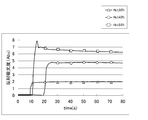
- a test piece knitted with a density of a warp thread 89 (lines / 2.54 cm) and a weft thread 76 (lines / 2.54 cm) as a spreading layer on the upper layer of the reaction layer a blood sample is spotted. The change in reflected absorbance when worn is shown.
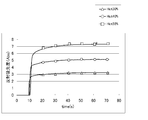
- a test piece knitted with a density of warp yarn 89 (lines / 2.54 cm) and weft yarns 76 (lines / 2.54 cm) as a spreading layer above the reaction layer as a spreading layer a blood sample is prepared. The change in reflected absorbance when spotted is shown.
- a blood sample is prepared.
- the change in reflected absorbance when spotted is shown.
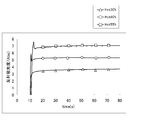
- a Y-shaped cross-section yarn e was used for both the warp and the weft, and a fabric using a fabric knitted with a density of warp 89 (lines / 2.54 cm) and weft 87 (lines / 2.54 cm) as the spreading layer was used for the spreading layer.
- the change in reflected absorbance when a test specimen is used and a blood sample is spotted is shown.
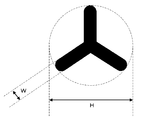
- Example apparatus for measuring glucose using the test piece of the present invention Description of Y-shaped cross section yarn Description of Y-shaped cross section yarn
- Example apparatus for measuring glucose using the test piece of the present invention Description of Y-shaped cross section yarn
- the relationship between the glucose concentration and the reflection absorbance in a test piece using a modified cross-section yarn fabric (concentration of Triton X-100 in the spreading layer is 0.0 g / m 2 ) is shown.
- concentration of Triton X-100 in the spreading layer is 0.02 g / m 2
- concentration of Triton X-100 in the spreading layer is 0.02 g / m 2
- the relationship between the glucose concentration and the reflection absorbance in a test piece using a modified cross-section yarn fabric (the concentration of Triton X-100 in the spreading layer is 0.04 g / m 2 ) is shown.
- the relationship between the glucose concentration and the reflection absorbance in a test piece using a modified cross-section yarn fabric (the concentration of Triton X-100 in the spreading layer is 0.06 g / m 2 ) is shown.
- the measurement target is not particularly limited.
- general test items in biochemical tests blood glucose (hereinafter, glucose is also referred to as blood glucose), blood glycated protein, blood hemoglobin, blood creatinine, blood ammonia, blood urea, blood Nitrogen, blood total cholesterol, blood HDL cholesterol, blood neutral fat, blood bilirubin, blood calcium, blood inorganic phosphorus, blood magnesium, blood total protein, blood albumin, blood CRP, blood Na, blood K, blood Cl, blood enzyme activity, urinary Na, urinary K, urinary Cl) can be exemplified as the analyte.
- the glycated protein has, as a measurement principle, a reaction in which a protease excises “glycated peptide and / or glycated amino acid” (hereinafter also referred to as “glycated peptide etc.”), and fructosyl amino acid in the excised glycated peptide or the like.
- a protease excises “glycated peptide and / or glycated amino acid”
- fructosyl amino acid in the excised glycated peptide or the like There is no particular limitation as long as it can be measured by a method including a reaction that causes oxidase to act. Examples thereof include glycated albumin and glycated hemoglobin. An example of glycated hemoglobin is HbA 1c .
- the measurement sample is not particularly limited as long as it is a liquid.
- examples thereof include those derived from biological samples such as blood, lymph, spinal fluid, sweat, urine, tears, saliva, skin, mucous membrane, hair, and foods such as drinking water and seasonings. Even if it is not a liquid, it can be used as a sample if it is prepared in a liquid state by means of extraction or the like.
- biological samples are not limited to human origin, and biological samples derived from mammals such as dogs, cats, and cows are also targeted.
- the amount of the measurement sample is not particularly limited, but is preferably, for example, 1 to 50 ⁇ L, more preferably 1 to 40 ⁇ L, further preferably 1 to 30 ⁇ L.
- the amount of the measurement sample is less than 1 ⁇ L, there is a possibility that the multilayer test piece cannot be developed from the uppermost layer to the lowermost layer.
- the amount of the measurement sample is more than 50 ⁇ L, for example, when the measurement sample is blood, the burden on the patient increases, which is not preferable.
- glucose in blood can be measured using a multilayer test piece.
- the measurement principle is not particularly limited as long as it is a method for detecting a physicochemical change caused by a reaction between glucose and a reagent that specifically reacts with glucose in an aqueous system using moisture of a biological sample.
- a method for example, a method (so-called enzyme colorimetric method) in which a multilayer test piece is colored by performing an enzyme reaction with moisture in a measurement sample (so-called dry chemistry) and the degree of coloration is detected by reflected light measurement.
- a method of measuring glucose in a sample using a measuring device described in Utility Model Registration No. 3175929 is known.
- the reaction for measuring glucose is exemplified below, but the present invention is not limited in any way.
- hydrogen peroxide detection there can be exemplified a step of producing a quinone dye by oxidizing and condensing 4-aminoantipyrine and a so-called Trinder reagent such as phenol or a halogenated phenol derivative (or aniline derivative) by the action of peroxidase. .
- Colorimetric determination of glucose in the measurement sample from the dye For example, the degree of coloration can be detected and the blood glucose concentration can be calculated by irradiating the colored test piece with light having an absorption wavelength specific to the dye and measuring the reflected light.
- the principle of measuring a glycated protein using a multilayer test piece is based on the physics that occurs when a glycated protein and a reagent that specifically reacts with the glycated protein react in an aqueous system using the water of a liquid sample.
- the method is not particularly limited as long as it is a method for detecting a chemical change.
- there is a method (so-called enzyme colorimetric method) in which a multilayer test piece is colored by performing an enzyme reaction with moisture in a measurement sample (so-called dry chemistry) and the degree of coloration is detected by reflected light measurement.
- a method of measuring a glycated protein in a sample using a measuring apparatus described in Utility Model Registration No. 3175929 is known.
- the reaction in the case of measuring glycated hemoglobin which is an example of a glycated protein is illustrated below, but the present invention is not limited at all.
- the basic structure of the multilayer specimen for liquid sample analysis of the present invention is as follows: (a) Layer: a fabric made of hydrophilic fibers, the fabric including a fabric including a modified cross-section yarn in the fibers; ) Layer: A multilayer test piece in which a structure impregnated with a reagent that specifically reacts with an analyte is laminated in the order of (a) layer / (b) layer from the sample spotting surface.
- the (a) layer is also referred to as a development layer
- the (b) layer is also referred to as a reaction layer.
- a liquid sample spotted on the sample spotting surface in (a) layer is developed in an appropriate range, and the developed sample is measured in (b) layer in the sample. It can be carried out by detecting the physicochemical change that has occurred from the surface opposite to the sample spotting surface.
- the layer (b) may be composed of two or more layers.
- components such as a surfactant, glucose oxidase, peroxidase, buffer, redox coloring reagent (for example, 4-aminoantipyrine and aniline derivatives) are required.
- redox coloring reagent for example, 4-aminoantipyrine and aniline derivatives
- the layer is a single layer, glucose oxidase, peroxidase, and redox coloring reagent must be carried on the same layer. For example, if peroxidase and redox coloring reagent are carried on the same layer, oxidation will occur.
- the multilayer test piece of the present invention may further include a blood separation layer for obtaining plasma or serum by filtering blood cells from whole blood, a transparent support layer, etc. It may include several layers.
- the number of layers of the multilayer test piece including all of these may vary depending on the embodiment, but is preferably 2 to 7 layers, more preferably 2 to 6 layers, and even more preferably 2 to 5 layers. On the other hand, if the number of layers is more than 7, it is not preferable because the amount of measurement sample necessary for developing from the top layer to the bottom layer increases.
- the multilayer test piece can be produced using any procedure. For example, multiple layers may be made separately and then assembled into a final specimen.
- ((A) layer) (Structure including a fabric made of hydrophilic fiber, the fabric including a modified cross-section yarn in the fiber)
- the structure of the layer (a) used in the present invention is not particularly limited as long as it is a fabric made of hydrophilic fibers and the fibers include a modified cross-section yarn.
- the shape is such that the measurement sample is in the same plane (referred to as “horizontal direction” or “XY direction” for convenience in this specification) when viewed from the spotted portion of the sample) and in the vertical direction (the “horizontal direction”).
- the sheet structure is not limited to any form as long as it can be appropriately developed in the vertical direction (also referred to as “Z direction”).
- various forms such as a woven fabric, a knitted fabric, and a nonwoven fabric
- plain weaving fabrics are uniformly arranged in both the warp and weft directions, so that the spread of the liquid on the horizontal surface is uniform.
- knitted fabrics or fabrics using twisted yarns Compared to using knitted fabrics or fabrics using twisted yarns.
- the movement of the liquid sample by capillary action becomes smooth, which is more preferable.
- the structure of the layer (a) used in the present invention may be made of a woven fabric.
- the basis weight of the sheet of the structure is not particularly limited as long as it is 30 g / m 2 or more and 100 g / m 2 or less.
- the basis weight exceeds 100 g / m 2 , the thickness of the structure (for example, woven fabric) increases, the density also increases, and the liquid developability tends to be slow even when hydrophilic processing is performed.
- a preferable minimum is 50 g / m ⁇ 2 > or less, and a more preferable minimum is 80 g / m ⁇ 2 >.
- the thickness of the sheet of the structure is not particularly limited as long as it is 10 ⁇ m or more and 200 ⁇ m or less.
- a preferable upper limit is 150 ⁇ m, and a more preferable upper limit is 125 ⁇ m.
- a preferred lower limit is 20 ⁇ m, a more preferred lower limit is 50 ⁇ m, a more preferred lower limit is 80 ⁇ m, and a further preferred lower limit is 100 ⁇ m.
- the bulk density of the sheet of the structure is not particularly limited as long as it is 0.6 g / m 3 or more and 0.9 g / m 3 or less.
- the bulk density is less than 0.6 g / m 3
- the distance between the fibers in the structure becomes large, and the capillary phenomenon tends to occur, so that the liquid tends to develop quickly.
- the bulk density exceeds 0.9 g / m 3
- the distance between fibers in the structure (for example, woven fabric) becomes small and there is no gap, so that the capillary phenomenon hardly occurs and the liquid developability tends to be slow.
- the single yarn fineness of the warp fibers used for the sheet of the structure is not particularly limited.
- the single yarn fineness (dpf) is preferably 2.0 to 4.0.
- the single yarn fineness is preferably 0.5 dpf or less.
- a preferred lower limit is 0.4 dpf, and a more preferred lower limit is 0.3 dpf.
- the total fineness of the synthetic fibers used for the sheet of the structure is not particularly limited, but is preferably in the range of 11 to 122 dtex.
- a preferable upper limit is 84 dtex, and a more preferable upper limit is 56 dtex.
- a preferred lower limit is 22 dtex.
- the hydrophilic fiber used for the (a) layer structure is not particularly limited. Examples thereof include natural fibers such as cotton, hemp, hair, and silk, and regenerated fibers such as rayon and cupra. Alternatively, a hydrophobic fiber obtained by hydrophilic processing may be used. Examples of the hydrophobic fibers include synthetic fibers using polymers such as polyesters, polyether sulfones, polyvinyl chlorides, polyurethanes, acrylics or nylons.
- PET polyethylene terephthalate
- PBT polybutylene terephthalate
- PEN polyethylene naphthalate
- PBN polybutylene naphthalate
- PE polyethylene
- PP polypropylene
- vinyl resin such as polyvinyl chloride (PVC), polyvinylidene chloride, polyvinyl acetate, etc.
- acrylic resin acrylate resin
- fluororesin such as polytetrafluoroethylene (PTFE), polyvinylidene fluoride (PVDF), etc.
- Polycarbonate resin Polyether resin polyoxymethylene (POM), polyphenylene oxide (PPO), polyether ketone (PEK), polyether ether ketone (PEEK), polyphenylenes
- POM polyether resin polyoxymethylene
- PPO polyphenylene oxide
- PEK polyether ketone
- PEEK polyether ether ketone
- polyphenylenes Examples include Fido (PPS), Polysulfone (PSU), Polyethersulfone (PES), Polyetherimide (PEI), polyamide resins such as nylon and aramid, celluloses such as cellulose acetate, nitrocellulose, and regenerated cellulose.
- the composition which combined said substance may be sufficient and the composition which contains a part of said substance (or said combination of said substance) may be sufficient.
- polyester is preferable from the viewpoint of ease of processing and price.
- polymers used for these synthetic fiber yarns include various functional agents and copolymers having antibacterial properties, flame retardancy, hygroscopic properties, water absorption properties, and matting agents. It may be contained.
- hydrophilic processing When using the thing which carried out the hydrophilic process of the hydrophobic fiber for the structure of a layer, the substance used for the hydrophilic process is not specifically limited.
- a hydrophilic polymer can be exemplified.
- the hydrophilic polymer any one selected from the group consisting of polyethylene glycol, polyvinylpyrrolidone, hydroxypropylcellulose, carboxymethylcellulose, hydroxymethylcellulose, hydroxyethylcellulose, hydroxypropylmethylcellulose, hydroxypropylmethylcellulose and polyester polyether block copolymer It is preferable to use these. Among these, surface treatment that is block copolymerization of polyethylene glycol and polyethylene terephthalate is common.
- composition which combined said substance may be sufficient as a hydrophilic polymer, and the composition containing a part of said substance (or combination of said substance) may be sufficient as it.
- Commercially available products are SR-1000, SR-1800, SR-6200, SR, manufactured by Takamatsu Yushi Co., Ltd., as commercial products of modified polyester resins using Permalose TM, a polyester polyether block copolymer from ICI. -5000 etc. are mentioned.
- the hydrophilic processing method is not specifically limited. Various known methods such as the Pad dry method and the exhaust processing method can be used. In the Pad dry method, the fiber surface is hydrophilically processed. In the exhaust processing method, the hydrophilic processing agent penetrates into the inside of the fiber.
- a specific example of the hydrophilic processing is preferably exemplified by subjecting the woven or knitted fabric to a bath treatment at the time of dyeing with a hydrophilic agent such as polyethylene glycol diacrylate or a derivative thereof, or a polyethylene terephthalate-polyethylene glycol copolymer.
- conditions may be selected as appropriate so that a wide range of the fiber surface is subjected to hydrophilic processing, and the range is not particularly limited, but specifically, 60% or more of the surface is subjected to hydrophilic processing. It is preferable. More preferably, it is 70% or more, More preferably, it is 80% or more, More preferably, it is 90% or more.
- hydrophilic processing the reaction reagent can be impregnated uniformly, and in addition, the biological sample developed in the development layer can be absorbed quickly and the reaction between the analyte and the reaction reagent is not hindered. A molecular substrate can be obtained.
- the adhesion amount of the hydrophilizing agent is not particularly limited, but is preferably in the range of 0.25 to 0.50% by weight with respect to the weight of the fabric.
- the degree of hydrophilic processing affects the balance between the hydrophilicity of the fiber surface and the hydrophobicity of the fiber itself, but if the hydrophilic processing agent penetrates too much into the fiber, the hydrophilicity becomes too high and the liquid sample develops. Becomes slower.
- Larose method The water supply rate can be measured using a commercially available Larose method water absorption performance measuring device (for example, manufactured by Toyobo Engineering Co., Ltd.). The water absorption rate can be obtained by the following equation.
- Byreck method The water absorption in the warp direction and the weft direction can be measured according to JIS L1907-1998.
- the fiber used for the structure of a layer contains a modified cross-section thread.
- the irregular cross-section yarn means a fiber whose cross section is not circular.
- the shape of the irregular cross-section yarn used in the present invention is not particularly limited. Typical shapes include polygons such as triangles, quadrangles, pentagons and hexagons, Y shapes, T shapes, H shapes, U shapes, W shapes, and the like. Among them, a polyester modified cross-sectional yarn having a Y-shaped cross section (for example, reported in JP-A-2003-3328) is preferable.
- the reason why the development speed of the liquid sample is increased by using the modified cross-section yarn is considered as follows.
- a thread with a circular cross section When a thread with a circular cross section is used, the part where the fibers are in contact with each other becomes a “surface” because the threads are crushed and contact each other, whereas with the irregularly shaped cross section thread, only the protruding part is in contact with the “line”. Therefore, it is considered that the deformed cross-section yarn promotes the movement of the liquid sample due to capillary action as compared with the circular yarn.
- those having a Y-shaped cross section are particularly preferable among polygons such as a triangle, a quadrangle, a pentagon, and a hexagon, as shown in the examples described later.
- the ratio of the surface to the contact portion of the fiber is slightly large (although it is improved as compared with the circular one).
- the T-shape, H-shape, U-shape, W-shape, etc. are less isotropic than the Y-shape, so the shape is distorted by the force applied to the contact. Conceivable.
- flat yarns are not preferable.
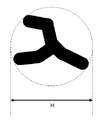
- the Y-shaped modified cross-section yarn used in the present invention will be described with reference to FIGS. 9 and 10.
- the Y-shaped modified cross-section yarn used in the present invention has three protrusions of approximately the same length in the direction of about 120 ° from the center.
- the deformation coefficient (H / W) is not particularly limited, but is preferably in the range of 2 to 6.
- H is the maximum width of the fiber single yarn cross section (diameter of circumscribed circle in contact with the tip of each protrusion: ⁇ m)
- W is the minimum width of the fiber single yarn cross section (inscribed circle inscribed in the central portion) The diameter of each is shown as ⁇ m).
- all cross-sectional shapes of the Y-shaped irregular cross-section yarn in the structure (for example, woven fabric) of the present invention are not similar in mathematical sense to the figure shown in FIG. This can be assumed naturally.
- the isotropic property from the center of the protrusion may be lost (FIG. 10).
- the deformation coefficient H is the diameter of the circumscribed circle in contact with the tips of the three protrusions.
- Percentage of irregular cross-section yarn in the structure including irregular cross-section yarn is not specifically limited, 25 to 100% is preferable. Furthermore, it is preferable that they are 40% or more and 100% or less. Further, the lower limit of the ratio of the modified cross-sectional yarn is 41%, the more preferable lower limit is 43%, and the more preferable lower limit is 46%. On the other hand, the preferable upper limit is 75%, and the more preferable upper limit is 50%.
- the cross-sectional form of the irregular cross-section yarn is not particularly limited, as described above, one having a Y-shaped cross section is preferable.
- the structure of the (a) layer may be woven with a general round cross-section yarn and a modified cross-section yarn in any form. If technically possible, two or more kinds of yarns may be woven randomly in the longitudinal and lateral directions, but it is preferable that one is a warp and the other is a weft.
- the ratio of the irregular cross-sectional yarn can be obtained by the number ratio of the irregular cross-sectional yarns in the total number of warps and wefts constituting the woven fabric.
- the number of warps and wefts constituting the fabric is not particularly limited.
- a combination of 60 to 200 warps / 2.54 cm and 60 to 200 wefts / 2.54 cm is preferable.
- “book / 2.54 cm” is synonymous with “book / inch”.
- the liquid spreading speed can be adjusted to a speed suitable for the object to be analyzed.
- a combination of warp 60-100 yarns / 2.54 cm and weft 60-100 yarns / 2.54 cm is preferable.
- a combination of 70 to 100 warps / 2.54 cm and warps 70 to 100 / 2.54 cm is preferable.
- a combination of warp yarns of 85 to 95 yarns / 2.54 cm and weft yarns of 85 to 95 yarns / 2.54 cm is preferable.
- a combination of 85 to 90 warps / 2.54 cm and 85 to 90 wefts / 2.54 cm is preferable.
- a combination of warp 160-200 / 2.54 cm and weft 160-200 / 2.54 cm is preferable. Further, a combination of warp 170 to 200 / 2.54 cm and weft 170 to 200 / 2.54 cm is preferable.
- both warp and weft exceed 200 / 2.54 cm, the density becomes too high, and even if hydrophilic processing is performed, there is a case where water absorption properties are not preferable. If both warp and weft are 60 yarns / 2.54 cm or less, the density will be too low, and if hydrophilic processing is performed, the water absorption characteristics will be too good and the liquid development speed will be high, so the residence time cannot be gained. In some cases, the enzyme reaction is insufficient, which is not preferable.
- a capillary phenomenon is likely to occur due to the irregularity effect of the modified cross-section. Therefore, even when a liquid, particularly a highly viscous liquid such as blood, is dropped on the fabric, it can be uniformly passed through the fabric by the high capillary action force. Therefore, even when the enzyme reaction is performed for a long time (several minutes) in the fabric, the enzyme reaction can be made uniform. Furthermore, when a high-density fabric is manufactured using a modified cross-section yarn, the high-density fabric is first subjected to a hydrophilic process so that the liquid can pass through. Even when the enzyme reaction is performed for a long time (several minutes), the reaction can be performed uniformly.
- the layer structure may be impregnated with a surfactant.
- the surfactant is not particularly limited as long as it rapidly lyses solid components such as blood cells in the blood sample and improves the developability of the blood sample.
- a nonionic surfactant can be illustrated.
- this surfactant may be used independently or may be used in combination of 2 or more type.
- Nonionic surfactants include polyoxyethylene-p-octylphenyl ether (such as Triton (registered trademark) surfactant), polyoxyethylene sorbitan alkyl ester (such as Tween (registered trademark) surfactant), polyoxy Ethylene alkyl ether (Brij surfactant etc.) etc. are mentioned. Specifically, 4- (1,1,3,3-tetramethylbutyl) phenyl-polyethylene glycol (Triton (registered trademark) x) in that it has a sufficient hemolytic effect and an effect of improving the developability of blood samples.
- the hydrophilic / lipophilic balance (HLB) of the surfactant is preferably 10 to 20, more preferably 12 to 20, and still more preferably 14 to 20.
- HLB value is smaller than 10
- a surfactant having an HLB value greater than 20 does not exist in the definition of HLB.
- the concentration of the surfactant is not particularly limited, but the lower limit is preferably 0.001 g / m 2 and the upper limit is preferably 1 g / m 2 .
- the surfactant concentration is less than 0.01 g / m 2 , there is a possibility that a sufficient hemolysis effect and an effect of improving the spreadability of the blood sample cannot be obtained. On the other hand, even if the surfactant concentration is higher than 1 g / m 2 , the effect is not improved.
- a more preferred lower limit is 0.01 g / m 2 .
- a more preferred lower limit is 0.02 g / m 2 .
- a more preferable upper limit is 0.1 g / m 2 .
- a more preferable upper limit is 0.06 g / m 2 .
- a more preferred upper limit is 0.04 g / m 2 .
- the structure of the (b) layer of the test piece of the present invention is not particularly limited. Any form and composition can be used as long as it can carry the required amount of a reagent that specifically reacts with the analyte and a reagent that produces a detectable change in response to the reaction, and that the sample to be measured can be appropriately developed in the horizontal and vertical directions. A thing may be used.
- fiber structures such as filter papers and fabrics (woven fabrics, knitted fabrics, nonwoven fabrics, etc.), porous membranes (membrane filters), films and other self-supporting materials, and polymer gels and other non-supporting materials can be mentioned.
- a non-supporting material such as a polymer gel
- it is preferable to provide a support such as a filter paper, a fiber structure, a porous membrane (membrane filter), or a film.
- the reagent that specifically reacts with the analyte is impregnated in the layer (b), but if necessary, a part of the reagent may be impregnated in the layer (a).
- the method for impregnating the structure with the reagent is not particularly limited, and can be performed using an arbitrary procedure. For example, a conventional procedure in which one or more reagent solutions exemplified above are immersed in the structure and dried may be used.
- a biological component measuring method by an enzyme method particularly a method using an oxidase-peroxidase-color former system, that is, a hydrogen peroxide is generated by a specific enzymatic reaction of an analyte in a specimen.
- An example is a method using a method for colorimetric determination by reacting with a color former in the presence of peroxidase.
- glucose oxidase also referred to as GOD
- peroxidase also referred to as POD
- a hydrogen peroxide detection reagent as an indicator
- the hydrogen peroxide detection reagent is not particularly limited.
- a combination of a hydrogen donor and a coupler, specifically, N-methyl-N- (2-hydroxy-3-sulfopropyl) -3,5-dimethylaniline (MAOS) as a hydrogen donor, 4- Aminoantipyrine is mentioned.
- glucose oxidase used in the glucose measuring method glucose oxidase derived from Aspergillus (GLO-201 manufactured by Toyobo Co., Ltd.) can be used, but is not limited thereto.
- the peroxidase may be peroxidase (PEO-302 manufactured by Toyobo Co., Ltd.) extracted from horseradish, but is not limited thereto.
- the content of glucose oxidase in the reaction layer is not particularly limited, but is preferably 10,000 to 50,000 U / cm 2 .
- a more preferred lower limit is 20,000 U / cm 2
- a more preferred lower limit is 25,000 U / cm 2 .
- a more preferable upper limit is 40,000 U / cm 2
- a more preferable upper limit is 30,000 U / cm 2 .
- the content of peroxidase is not particularly limited, but is preferably about 10,000 to 50,000 U / cm 2 .
- a more preferred lower limit is 20,000 U / cm 2
- a more preferred lower limit is 25,000 U / cm 2 .
- a more preferable upper limit is 40,000 U / cm 2
- a more preferable upper limit is 30,000 U / cm 2
- the content of 4-aminoantipyrine is not particularly limited, but is preferably 30 to 100 ⁇ g / cm 2 .
- a more preferred lower limit is 40 ⁇ g / cm 2
- a more preferred lower limit is 50 ⁇ g / cm 2 .
- more preferred upper limit is 90 [mu] g / cm 2
- still more preferred upper limit is 70 [mu] g / cm 2.
- the content of N-methyl-N- (2-hydroxy-3-sulfopropyl) -3,5-dimethylaniline is not particularly limited, but is preferably 60 to 120 ⁇ g / cm 2 .
- a more preferred lower limit is 70 ⁇ g / cm 2
- a more preferred lower limit is 80 ⁇ g / cm 2 .
- a more preferable upper limit is 110 ⁇ g / cm 2
- a more preferable upper limit is 100 ⁇ g / cm 2 .
- the reagent preferably further contains a buffer.
- a buffering agent a buffering agent that has a buffering capacity at or near the optimum pH value of an enzyme reaction of glucose oxidase or peroxidase, and that does not inhibit the coupling reaction of the hydrogen peroxide detection reagent Is preferably selected.
- the buffer that satisfies these conditions include phosphate buffer, citrate buffer, citrate-phosphate buffer, and acetate buffer.
- a phosphate buffer is preferable.
- the pH range of the buffer is preferably in the range of pH 5.0 to 8.0. A more preferred lower pH limit is 5.5, and a more preferred lower pH limit is 6.0.
- the more preferable pH upper limit is 7.5, and the more preferable pH upper limit is 7.0.
- the concentration of the buffer solution is preferably set to 10 to 50 mM when dissolved in the biological sample.
- a more preferred lower limit is 20 mM, and a more preferred lower limit is 25 mM.
- a more preferable upper limit is 40 mM, and a more preferable upper limit is 35 mM.
- Another aspect of the present invention is a method for analyzing an analyte in a liquid sample using the various test strips described above.
- the method is not particularly limited as long as the test piece of the present invention is used.
- a method using the measuring apparatus 100 shown in FIGS. 7 and 8 is exemplified.
- the measuring apparatus 100 is a measuring apparatus capable of fixing the test piece 200 to the mounting portion 1 and capable of controlling the temperature of the fixed test piece. What is the sample spotting surface of the test piece with respect to the test piece?
- a light emitting device that can irradiate light having an absorption wavelength specific to the dye toward the opposite surface (the surface on which the reaction layer is exposed), and can receive light reflected by the reaction layer.
- a test piece is installed at the insertion port of the measuring apparatus, the power is turned on, the light emitting element and the light receiving element are interlocked, and a specific wavelength (for example, 4-aminoantipyrine and N-methyl-N- (2-hydroxy) is emitted from the light emitting element.
- a specific wavelength for example, 4-aminoantipyrine and N-methyl-N- (2-hydroxy) is emitted from the light emitting element.
- -3-sulfopropyl) -3,5-dimethylaniline is irradiated with light of 660 nm).
- the reaction with the reagent is started by spotting a blood sample on the test piece.
- the concentration of the analyte can be evaluated by measuring the coloration degree of the test piece that has penetrated the blood sample as reflected light.
- the “product including a multilayer test piece” is a product form constituting a part or all of one system used by a user for the purpose of performing analysis of an analyte, and the test piece of the present invention. , Those based on the use of the test strip of the present invention, and those used for carrying out the analyte analysis method of the present invention. Therefore, the product of the present invention covers not only the test piece, but also the measuring instrument that uses the test piece as a consumable or the entire analyte measurement system.
- Example 1 Preparation of analytical test piece (preparation of reaction layer) ⁇ 8mm filter paper 5A (manufactured by ADVANTEC) is impregnated with a reaction reagent having the following composition, and then dried under reduced pressure at 0.1 kPa at 40 ° C. for 1 hour using a square vacuum dryer DP83 (manufactured by Yamato Scientific Co., Ltd.). Then, a reaction layer was produced.
- Glucose oxidase (GLO-201 manufactured by Toyobo Co., Ltd.) 26 U / cm 2 Peroxidase (PEO-302 manufactured by Toyobo Co., Ltd.) 26 U / cm 2 4-aminoantipyrine (manufactured by Nacalai Tesque) 60 ⁇ g / cm 2 N-methyl-N- (2-hydroxy-3-sulfopropyl) -3,5-dimethylaniline (manufactured by Tokyo Chemical Industry Co., Ltd.) 90 ⁇ g / cm 2 Phosphate buffer (Nacalai Tesque) (pH 6.5) 30 mM Triton X-100 (manufactured by Nacalai Tesque) 1% (0.04 g / m 3 in the completed reaction layer)
- the spreading layer was impregnated with Triton (registered trademark) X-100 at a concentration of 0.0 g / m 2 , 0.02 g / m 2 , 0.04 g / m 2 , and 0 ° C. for 1 hour at 30 ° C.
- a dried layer impregnated with a surfactant was produced by drying under reduced pressure at 1 KPa.
- a multilayer test specimen for analysis was prepared by arranging and laminating the spreading layer on the reaction layer.
- Example 2 Preparation of blood sample After centrifuging whole blood at 3,000 rpm for 5 minutes and separating it into blood cells and plasma, the hematocrit values were changed to 30%, 40%, and 55% by mixing these at different ratios. Three levels of blood samples were prepared. The higher the hematocrit value, the higher the viscosity of the liquid sample.
- Example 3 Measurement of blood sample developability Using the measurement apparatus 100 shown in FIGS. 7 and 8, the developability of the blood sample in the test piece of the present invention was evaluated.
- Table 2 shows the multilayer specimen used for the measurement.
- the symbol in the “deployability” column in Table 2 indicates that the deployability in each direction is faster in the order of ⁇ , ⁇ , and X.
- the measuring apparatus 100 is a measuring apparatus capable of fixing the test piece 200 to the mounting portion 1 and capable of controlling the temperature of the fixed test piece. What is the sample spotting surface of the test piece with respect to the test piece?
- the light emitting element 2 and the light receiving element can be irradiated with light of a desired wavelength toward the opposite surface (the surface where the reaction layer is exposed), and further, the irradiated light can receive light reflected by the reaction layer. 3 is arranged, and the obtained photometric value can be measured over time.
- the multilayer test piece produced in Example 1 was installed in the insertion port of the measuring apparatus adjusted to 37 ° C. in advance. By turning on the power switch, the light emitting element and the light receiving element were interlocked, and light having a wavelength of 470 nm was irradiated from the light emitting element to start measurement.
- the reflected light measurement at a wavelength of 470 nm reflects the color of the blood itself because it is not affected by the dye produced by the enzymatic reaction of glucose in the sample. Therefore, it is possible to grasp the behavior of the blood sample spotted on the development layer of the test piece until it reaches the surface reflecting the light of the reaction layer. Ten seconds after the start of the measurement, 10 ⁇ L of blood samples having different hematocrit values adjusted in Example 2 were spotted on the test piece. The developability of the blood sample was evaluated by measuring the change in color tone of the test piece permeated with the blood sample as the change in reflected light.
- FIG. 1 shows that a general round cross-section yarn a as a spreading layer is knitted at a density of warp (warp) 89 (w / 2.54 cm) and weft (weft) 76 (w / 2.54 cm) on the upper layer of the reaction layer.
- the change in the reflection absorbance when using a test piece is shown (Experiment No. 1).
- the rise of the reflected absorbance after spotting was delayed. It was suggested that the woven fabric made of round cross-section yarns had poor water absorption.
- FIG. 2 shows a test piece (ratio of deformed cross-sectional yarn of 0) in which the development layer is knitted with a yarn b thicker than the round cross-sectional yarn a at a density of warp 89 (line / 2.54 cm) and weft 76 (line / 2.54 cm). %) Is shown (Experiment No. 2).
- FIG. 3 shows a test piece (a modified cross-sectional yarn of a modified cross-sectional yarn) in which a spread layer is knitted with a thread c thinner than a round cross-sectional yarn a at a density of warp 89 (line / 2.54 cm) and weft 76 (line / 2.54 cm).
- the change in reflected absorbance when using a ratio of 0% is shown (Experiment No. 3). In either case, a delay in the rise of the reflection absorbance after spotting and an unstable transition of the absorbance after the rise were observed.
- FIG. 4 shows a woven fabric (an irregular cross-section) knitted with a density of warp yarn 89 (line / 2.54 cm) and weft yarn 76 (line / 2.54 cm) using a round cross-sectional yarn a for the warp and a Y-shaped cross-sectional yarn d for the weft.
- the change in the reflection absorbance when a test piece using a yarn layer (46.1%) as a spreading layer is shown (Experiment No. 5).
- the reflected absorbance increased rapidly after spotting the blood sample, and the absorbance transition after the rise was relatively stable. This indicates that the blood sample is sufficiently developed.
- Fig. 5 shows the development of a woven fabric (100% proportion of irregular cross-section yarn) knitted with a density of warp yarn 89 (lines / cm 2 ) and weft yarn 87 (lines / cm 2 ) using a Y-shaped cross-section yarn e for both warp and weft.
- the change in reflection absorbance when a test piece using the fabric used for the layer as the spreading layer is shown (Experiment No. 8).
- the reflected absorbance increased rapidly after spotting the blood sample, and the absorbance transition after the rise was relatively stable.
- a woven fabric ratio of irregular cross-section yarn
- a density of warp yarn round cross-section yarn a) 76 (line / 2.54 cm) and weft yarn (Y-shaped cross-section yarn e) 89 (line / 2.54 cm) 54.
- FIG. 6 shows a woven fabric (an irregular cross section) knitted with a density of warp yarn 190 (line / 2.54 cm) and weft yarn 179 (line / 2.54 cm) using a round cross-section yarn f as the warp and a Y-shaped cross-section yarn g as the weft.
- the change in reflection absorbance when a test piece using a yarn layer (47.1%) as a spreading layer is shown (Experiment No. 9).
- the reflected absorbance increased rapidly after spotting the blood sample, and the absorbance transition after the rise was relatively stable.
- Example 4 Preparation of blood sample After centrifuging whole blood at 3,000 rpm for 5 minutes and separating it into blood cells and plasma, the hematocrit values were 30, 35, 40, 45 and 55 by mixing these at different ratios. % Blood sample was prepared. The higher the hematocrit value, the higher the viscosity of the biological sample. By mixing these with a glucose solution, 17 levels of blood samples with different glucose concentrations were prepared. These blood samples are shown in Table 3.
- Example 5 Measurement of blood sample developability Using the measurement apparatus 100 shown in FIGS. 7 and 8, the developability of the blood sample in the test piece of the present invention was evaluated in the same manner as in Example 3. Sample No. 1 (hematocrit value 30%, blood glucose concentration 74 mg / dL) and sample No. 11 (hematocrit value 55%, blood glucose concentration 70 mg / dL) prepared in Example 4 were used as blood samples. Table 4 shows the multilayer test pieces used for the measurement. The results are shown in Table 4. The symbols in the column of “Development of blood sample” in Table 4 indicate that the developability in each direction is faster in the order of ⁇ and ⁇ .
- Example 6 Measurement of blood glucose concentration Using the 17-level blood sample prepared in Example 4 and the test piece of Experiment No. 8 prepared in Example 5, the blood glucose concentration in the blood sample was measured.
- the spreading layer was prepared by the same method as that described in Example 1 except that the Triton (registered trademark) X-100 concentration was different, and the surfactant was blood glucose. The effect of concentration on measurement accuracy was evaluated.
- the blood glucose concentration can be measured by irradiating light having an absorption wavelength specific to the dye and measuring the reflected light. Since the dye is colored blue depending on the glucose concentration, it can be measured by irradiating light with a wavelength of 660 nm.
- the glucose concentration was measured using the measuring apparatus 100 as in Example 5. Ten seconds after the start of measurement, 10 ⁇ L of the blood sample was spotted on the test piece, and the rate of increase in absorbance was measured for five seconds after the blood sample was spotted.
- the concentration of Triton (registered trademark) X-100 in the spreading layer is 0.0 g / m 2
- the measurement accuracy of the test piece is 5 (30 to 45%) and the blood glucose concentration (74 to 249 mg / dL).
- the blood glucose concentration was measured by the method described above. The measurement results are shown in FIG.
- the blood glucose concentration was measured in the same manner using blood samples having hematocrit values of 55% and two levels (sample numbers 13 and 15) having different blood glucose concentrations (129, 244 mg / dL).
- the measurement results are shown in FIG.
- the ratio of the actually measured value to the theoretical value obtained from the approximate expression was 72.4% for sample number 13 and 53.7% for sample number 15.
- the plot of the sample with a high hematocrit value tended to be lower than the straight line created earlier, and was greatly deviated.
- sample number 11 was equivalent to the straight line prepared earlier, but the other samples tended to be low and deviated greatly.
- the blood glucose concentration is measured by the above-described method using a blood sample having the same Triton (registered trademark) X-100 concentration of 0.04 g / m 2 as the measurement accuracy (2) of the test piece. did.
- the measurement results are shown in FIG.
- the multilayer analytical test strip of the present invention can quickly and easily quantify the analyte in the biological sample.
- Test piece (same for 200a) 1 Test piece mounting part (same for 1a) 2 Light emitting part (same for 2a) 3 Light receiving part (same for 3a) 4 Calculation unit 5 Blood sample spotting unit 6 Power switch 7 Display monitor
Landscapes
- Health & Medical Sciences (AREA)
- Life Sciences & Earth Sciences (AREA)
- Hematology (AREA)
- Engineering & Computer Science (AREA)
- Immunology (AREA)
- Molecular Biology (AREA)
- Urology & Nephrology (AREA)
- Chemical & Material Sciences (AREA)
- Biomedical Technology (AREA)
- General Health & Medical Sciences (AREA)
- Microbiology (AREA)
- Cell Biology (AREA)
- Food Science & Technology (AREA)
- Medicinal Chemistry (AREA)
- Physics & Mathematics (AREA)
- Analytical Chemistry (AREA)
- Biochemistry (AREA)
- Biotechnology (AREA)
- General Physics & Mathematics (AREA)
- Pathology (AREA)
- Diabetes (AREA)
- Investigating Or Analysing Biological Materials (AREA)
Abstract
【課題】測定精度の高い生化学分析用試験片及びその製造方法、並びにその用途を提供することを課題とする。
【解決手段】液体試料中の分析対象物を分析するための多層試験片であって、少なくとも親水性の繊維で作られた布帛であって、前記繊維に異形断面糸を含む布帛を含む構造体である(a)層と、分析対象物と特異的に反応する試薬が含浸された構造体である(b)層とが、試料点着面から(a)層/(b)層の順に積層されている多層試験片。
Description
本発明は、液体試料中の微量な分析対象物を測定するための分析用試験片、および前記試験片を用いる測定法に関する。
詳しくは、本発明は、親水加工した合成繊維などの親水性の繊維で作られた、布帛などの構造体であって、前記繊維に異形断面糸を含む布帛を含む構造体を利用することで液体試料の展開性を制御でき、測定精度が向上した分析用試験片、当該試験片の製造方法、当該試験片を使用した分析対象物の定量方法に関する。
詳しくは、本発明は、親水加工した合成繊維などの親水性の繊維で作られた、布帛などの構造体であって、前記繊維に異形断面糸を含む布帛を含む構造体を利用することで液体試料の展開性を制御でき、測定精度が向上した分析用試験片、当該試験片の製造方法、当該試験片を使用した分析対象物の定量方法に関する。
臨床検査分野において、医療従事者が被験者の傍らで行う検査のことをPOCT(Point of care testing)という。臨床検査は検査結果に基づいて後の治療を行うことから、高い精度と迅速さが求められる。POCTはリアルタイムな臨床検査であるため、検査結果をその場で知ることができ、迅速な治療が行えることから注目を集めている。
生体試料中の微量な分析対象物を高い精度で迅速に定量する方法として、ドライケミストリーが有用である。ドライケミストリーとは分析対象物を測定するために必要な試薬が基材や容器内に乾燥した状態で置かれており、分析対象物を含む生体試料が添加されることにより、試薬が溶解し、反応が完結する分析素子のことである。ドライケミストリーでは測定試薬は全て乾燥状態にあるため、反応に必要な水分は生体試料の水分を利用している。従って分析試験片上で少量の生体試料を均一展開することは高い測定精度を維持する上で重要である。
ドライケミストリーを用いた分析技術としては古くは特許文献1~3が挙げられる。これらは複数の層からなる多層構造型試験片によって血液中のグルコース濃度を定量することができる試験片に関するものである。試験片の展開層として綿あるいは綿とポリエチレンテレフタレートとの混紡糸で作製された織物を用いて血液の展開性を改善している。
特許文献2、3、6には多層構造型試験片における展開層にノニオン性界面活性剤を含浸することで血液試料の展開性を促進する技術、当該試験片を用いた測定方法、および当該試験片の製造方法に関する技術が公開されている。
また特許文献4には多孔質膜を使用した試験片を用いた血糖値測定装置に関する技術が公開されている。また特許文献5には、多孔質膜の細孔の孔径を調整することで血液の展開性が改善した多孔質膜、および多孔質膜の製造方法に関する技術が公開されている。
特許文献2、3、6には多層構造型試験片における展開層にノニオン性界面活性剤を含浸することで血液試料の展開性を促進する技術、当該試験片を用いた測定方法、および当該試験片の製造方法に関する技術が公開されている。
また特許文献4には多孔質膜を使用した試験片を用いた血糖値測定装置に関する技術が公開されている。また特許文献5には、多孔質膜の細孔の孔径を調整することで血液の展開性が改善した多孔質膜、および多孔質膜の製造方法に関する技術が公開されている。
ところが、従来の織物や多孔質膜を用いて作られた分析試験片を用いて生体試料(たとえば全血)などの液体試料を測定した場合、頻度はさほど多くないものの、測定の再現性が悪くなり定量性を著しく損なうケースが見られた。
上記のような課題に対して、本発明者らは測定精度の高い分析試験片を開発すべく検討を重ねたところ、水分を含有する生体試料の試験片上での展開性が生体試料の種類や性質に影響されるために展開ムラを生じ、測定の再現性を悪くしていることがわかった。
たとえば、ポリエチレン類などの疎水性の素材で作られた分析試験片は、液体試料をはじいて、展開ムラを生じさせる。疎水性素材の表面を親水加工した素材を用いて作られた分析試験片も知られているが、このような試験片でも展開ムラを十分になくすことは出来なかった。
さらに、血液中のグルコース測定の場合は、一般に、きわめて短時間(例えば数秒)で測定を完結することが求められており、そのためには液体試料を迅速に検出部分全体にムラなく展開させる必要があった。
たとえば、ポリエチレン類などの疎水性の素材で作られた分析試験片は、液体試料をはじいて、展開ムラを生じさせる。疎水性素材の表面を親水加工した素材を用いて作られた分析試験片も知られているが、このような試験片でも展開ムラを十分になくすことは出来なかった。
さらに、血液中のグルコース測定の場合は、一般に、きわめて短時間(例えば数秒)で測定を完結することが求められており、そのためには液体試料を迅速に検出部分全体にムラなく展開させる必要があった。
そこで発明者らは、綿や濾紙など親水性の素材を中心に作られた分析試験片を検討したところ、液体試料の展開がスムーズであった。ところが、意外なことに、このような試験片においても、液体試料の展開が速いにもかかわらず測定精度が劣る場合があることが判明した。
当初は、この現象がなぜ起こるのかわからなかったが、発明者らがさらに検討したところ、液体試料が点着箇所から同心円状にドーナツのように拡散するために、ドーナツの中心部分にあたる検出部分において試料の均一な展開ができなくなるためであることを突き止めた。
当初は、この現象がなぜ起こるのかわからなかったが、発明者らがさらに検討したところ、液体試料が点着箇所から同心円状にドーナツのように拡散するために、ドーナツの中心部分にあたる検出部分において試料の均一な展開ができなくなるためであることを突き止めた。
一方、血液中の糖化蛋白質(たとえば、HbA1c)測定の場合は、反応が、プロテアーゼが糖化ペプチドを切り出す反応、次いで、糖化ペプチドであるHbA1cにフルクトシルアミノ酸オキシダーゼが反応する反応、の順に進むが、従来技術においては一般にプロテアーゼが糖化ペプチドを切り出す反応の速度が遅いため、ある程度長時間(たとえば、3分ないし5分間)プロテアーゼを反応させることが求められており、そのためには液体試料を、一定以上の時間、試験片においてプロテアーゼが担持されている部分に留める必要があった。
この点に関して、発明者らは、疎水性の素材を用いた場合、点着した液体試料の拡がりが速すぎると、試験片に担持されているプロテアーゼが十分に溶解せず、そのような場合には糖化蛋白質の分解が十分に行われない問題点があることを突き止めた。
そこで発明者らは、そのような観点から試験片に用いられる素材を見直したところ、綿や濾紙など親水性の素材を中心に作られた分析試験片は、液体試料の展開がスムーズで展開ムラはないように思われたが、意外なことに、このような試験片においても、液体試料の展開が速いにもかかわらず測定精度が劣る場合があることが判明した。
当初は、この現象がなぜ起こるのかわからなかったが、発明者らがさらに検討したところ、綿や濾紙など親水性の素材では多層の試験片の場合、液体試料が素材の表面だけではなく内部まで浸透し、液体試料を次の層へ送りだす放出性が低いため、反応が進みにくいことを突き止めた。
この点に関して、発明者らは、疎水性の素材を用いた場合、点着した液体試料の拡がりが速すぎると、試験片に担持されているプロテアーゼが十分に溶解せず、そのような場合には糖化蛋白質の分解が十分に行われない問題点があることを突き止めた。
そこで発明者らは、そのような観点から試験片に用いられる素材を見直したところ、綿や濾紙など親水性の素材を中心に作られた分析試験片は、液体試料の展開がスムーズで展開ムラはないように思われたが、意外なことに、このような試験片においても、液体試料の展開が速いにもかかわらず測定精度が劣る場合があることが判明した。
当初は、この現象がなぜ起こるのかわからなかったが、発明者らがさらに検討したところ、綿や濾紙など親水性の素材では多層の試験片の場合、液体試料が素材の表面だけではなく内部まで浸透し、液体試料を次の層へ送りだす放出性が低いため、反応が進みにくいことを突き止めた。
発明者らは、次に、この新たに見出した問題点を解決するために、液体試料の展開層により適した基材を見出すべく、さまざまな材質や形状のものを探索した結果、親水性の繊維で作られた布帛であって前記繊維に異形断面糸を含む布帛を含む構造体が優れた展開性を有すること、加えて、液体試料を迅速に吸水できることを見出した。そして、親水性の繊維で作られた布帛であって前記繊維に異形断面糸を含む布帛を含む構造体を分析試験片の展開層として使用することで、液体試料の均一展開を可能にし、測定精度が向上した分析試験片を作製することに成功した。
発明者らは、さらに、「親水性の繊維で作られた布帛であって前記繊維に異形断面糸を含む布帛を含む構造体」における「異形断面糸の割合」を調節することで、液体試料の展開性を調節できることを見出した。この知見により、分析の試料の状態や目的成分に応じて、測定に適した試験片を構築することが出来るようになった。
発明者らは、さらに、「親水性の繊維で作られた布帛であって前記繊維に異形断面糸を含む布帛を含む構造体」における「異形断面糸の割合」を調節することで、液体試料の展開性を調節できることを見出した。この知見により、分析の試料の状態や目的成分に応じて、測定に適した試験片を構築することが出来るようになった。
ところが、液体試料として血液試料を用いた場合に当該分析試験片を使用したにもかかわらず、頻度は高くないものの測定精度が劣る場合があることが判明した。本発明者らはさらに検討を重ねたところ、全血に含まれる赤血球等の固形成分の割合が高い試料において、これらの固形成分が展開層の空隙に目詰まりして展開性が損なわれることを突き止めた。
発明者らは、次に、この新たに見出した問題点を解決するために、全血中の固形成分を速やかに溶解できる溶血剤を調査したところ、ノニオン性界面活性剤が好適であることを見出し、さらに、当該ノニオン性界面活性剤を親水加工した異形断面糸を含む織物に含浸することで、血液試料中の血球成分の迅速な溶血と均一な展開を可能にした織物を作製することに成功した。そして、当該織物を分析試験片の展開層として使用することで、血球成分等の固形成分の割合が高い血液試料でも均一な展開を可能にし、測定精度が向上した分析試験片を作製することに成功した。
発明者らはさらに、親水加工した合成繊維で構築された織物などの構造体における異形断面糸の割合を調節することで、血液試料の展開性を調節できることを見出した。この知見により、液体試料として血液試料などの生体試料を用いた場合においても、分析の試料の状態や目的成分に応じて、測定に適した試験片を構築することが出来るようになった。
発明者らはさらに、親水加工した合成繊維で構築された織物などの構造体における異形断面糸の割合を調節することで、血液試料の展開性を調節できることを見出した。この知見により、液体試料として血液試料などの生体試料を用いた場合においても、分析の試料の状態や目的成分に応じて、測定に適した試験片を構築することが出来るようになった。
本発明は、係る知見に基づき、更なる研究と改良を重ねた結果完成したものであり、代表的な発明は、以下の通りである。
[項1]液体試料中の分析対象物を分析するための多層試験片であって、少なくとも下記(a)層と(b)層とが、試料点着面から(a)層/(b)層の順に積層されている多層試験片。
(a)層:親水性の繊維で作られた布帛であって、前記繊維に異形断面糸を含む布帛を含む構造体
(b)層:分析対象物と特異的に反応する試薬が含浸された構造体
[項2]分析対象物がグルコースである、項1に記載の試験片。
[項3](a)層において布帛が界面活性剤を含浸している、項1または2に記載の試験片。
[項4](a)層の構造体が織物でできている、項1から3のいずれかに記載の試験片。
[項5](a)層における異形断面糸の横断面形状が、三角形、四角形、五角形、六角形、Y字形、T字形、H字形、U字形、W字形、菱形および星形からなる群の中から選ばれたいずれかである、項1から4のいずれかに記載の試験片。
[項6](a)層における繊維が、ポリエステル類、ポリエーテルスルホン類、ポリ塩化ビニル類、ポリウレタン類、アクリル類およびナイロン類からなる群の中から選ばれたいずれかを親水加工したものである、項1から5のいずれかに記載の試験片。
[項7](a)層において、繊維の親水加工の少なくとも一部が親水性ポリマーでなされている、項1から6のいずれかに記載の試験片。
[項8]親水性ポリマーがポリエチレングリコール、ポリビニルピロリドン、ヒドロキシプロピルセルロース、カルボキシメチルセルロース、ヒドロキシメチルセルロース、ヒドロキシエチルセルロース、ヒドロキシプロピルメチルセルロース、ヒドロキシプロピルメチルセルロースおよびポリエステルポリエーテルブロック共重合体からなる群の中から選ばれたいずれかである、項7に記載の試験片。
[項9](a)層における界面活性剤が、ノニオン性界面活性剤である、項3から8のいずれかに記載の試験片。
[項10]界面活性剤が4-(1,1,3,3-テトラメチルブチル)フェニル-ポリエチレングリコール(Triton(登録商標) X-100)、1,1,3,3-テトラメチルブチル フェニル-ポリエチレングリコール(Triton(登録商標) X-114)、ポリオキシエチレンp-ノニルフェニルエーテル(ノニデット(登録商標) P-40)からなる群の中から選ばれたいずれかである、項3から9のいずれかに記載の試験片。
[項11]
界面活性剤の含有量が0.02~0.06g/m2であることを特徴とする、項3から10のいずれかに記載の試験片。
[項12](a)層の構造体を構成する異形断面糸の割合が、40%以上100%以下である、項1から11のいずれかに記載の試験片。
[項13](a)層の構造体が織物であって、該織物を構成する経糸と緯糸の本数が、それぞれ、経糸60~200本/2.54cm、緯糸60~200本/2.54cmの組合せである、項4から12のいずれかに記載の試験片。
[項14]項1から13のいずれかに記載の試験片を用いて液体試料中のグルコースを分析する方法。
[項15]項1から13のいずれかに記載の試験片を含むプロダクト。
[項1]液体試料中の分析対象物を分析するための多層試験片であって、少なくとも下記(a)層と(b)層とが、試料点着面から(a)層/(b)層の順に積層されている多層試験片。
(a)層:親水性の繊維で作られた布帛であって、前記繊維に異形断面糸を含む布帛を含む構造体
(b)層:分析対象物と特異的に反応する試薬が含浸された構造体
[項2]分析対象物がグルコースである、項1に記載の試験片。
[項3](a)層において布帛が界面活性剤を含浸している、項1または2に記載の試験片。
[項4](a)層の構造体が織物でできている、項1から3のいずれかに記載の試験片。
[項5](a)層における異形断面糸の横断面形状が、三角形、四角形、五角形、六角形、Y字形、T字形、H字形、U字形、W字形、菱形および星形からなる群の中から選ばれたいずれかである、項1から4のいずれかに記載の試験片。
[項6](a)層における繊維が、ポリエステル類、ポリエーテルスルホン類、ポリ塩化ビニル類、ポリウレタン類、アクリル類およびナイロン類からなる群の中から選ばれたいずれかを親水加工したものである、項1から5のいずれかに記載の試験片。
[項7](a)層において、繊維の親水加工の少なくとも一部が親水性ポリマーでなされている、項1から6のいずれかに記載の試験片。
[項8]親水性ポリマーがポリエチレングリコール、ポリビニルピロリドン、ヒドロキシプロピルセルロース、カルボキシメチルセルロース、ヒドロキシメチルセルロース、ヒドロキシエチルセルロース、ヒドロキシプロピルメチルセルロース、ヒドロキシプロピルメチルセルロースおよびポリエステルポリエーテルブロック共重合体からなる群の中から選ばれたいずれかである、項7に記載の試験片。
[項9](a)層における界面活性剤が、ノニオン性界面活性剤である、項3から8のいずれかに記載の試験片。
[項10]界面活性剤が4-(1,1,3,3-テトラメチルブチル)フェニル-ポリエチレングリコール(Triton(登録商標) X-100)、1,1,3,3-テトラメチルブチル フェニル-ポリエチレングリコール(Triton(登録商標) X-114)、ポリオキシエチレンp-ノニルフェニルエーテル(ノニデット(登録商標) P-40)からなる群の中から選ばれたいずれかである、項3から9のいずれかに記載の試験片。
[項11]
界面活性剤の含有量が0.02~0.06g/m2であることを特徴とする、項3から10のいずれかに記載の試験片。
[項12](a)層の構造体を構成する異形断面糸の割合が、40%以上100%以下である、項1から11のいずれかに記載の試験片。
[項13](a)層の構造体が織物であって、該織物を構成する経糸と緯糸の本数が、それぞれ、経糸60~200本/2.54cm、緯糸60~200本/2.54cmの組合せである、項4から12のいずれかに記載の試験片。
[項14]項1から13のいずれかに記載の試験片を用いて液体試料中のグルコースを分析する方法。
[項15]項1から13のいずれかに記載の試験片を含むプロダクト。
本発明の分析用試験片は、液体試料の展開性を制御でき均一に展開できるので、生体試料などの液体試料中に含まれる微量の分析対象物質でも高い精度で測定することが可能である。また、本発明の分析用試験片は、血液試料などの生体試料に含まれる固形成分を迅速に溶解し、均一に展開できるので、生体試料を希釈等の前処理をすることなく、原液のまま分析することができ、微量の分析対象物質でも高い精度で測定することが可能である。
以下、本発明を詳細に説明する。なお、本明細書において「測定」「分析」「定量」の語は特に断らない限り同義である。
(分析対象物および測定試料)
本発明において、測定の対象は特に限定されない。
たとえば、生化学検査における一般検査項目(血中グルコース(以下、グルコースのことを血糖とも記載する。)、血中糖化蛋白質、血中ヘモグロビン、血中クレアチニン、血中アンモニア、血中尿素、血中窒素、血中総コレステロール、血中HDLコレステロール、血中中性脂肪、血中ビリルビン、血中カルシウム、血中無機リン、血中マグネシウム、血中総タンパク質、血中アルブミン、血中CRP、血中Na、血中K、血中Cl、血中酵素活性、尿中Na、尿中K、尿中Cl)を分析対象物質として例示することができる。
上記において、糖化蛋白質は、測定原理として、プロテアーゼが「糖化ペプチドおよび/または糖化アミノ酸」(以下「糖化ペプチド等」とも表記する。)を切り出す反応、および、切り出された糖化ペプチド等にフルクトシルアミノ酸オキシダーゼを作用させる反応、を含む方法で測定できるものであれば特に限定されない。例えば、糖化アルブミンや糖化ヘモグロビンが例示できる。糖化ヘモグロビンとしてはHbA1cが例示できる。
本発明において、測定の対象は特に限定されない。
たとえば、生化学検査における一般検査項目(血中グルコース(以下、グルコースのことを血糖とも記載する。)、血中糖化蛋白質、血中ヘモグロビン、血中クレアチニン、血中アンモニア、血中尿素、血中窒素、血中総コレステロール、血中HDLコレステロール、血中中性脂肪、血中ビリルビン、血中カルシウム、血中無機リン、血中マグネシウム、血中総タンパク質、血中アルブミン、血中CRP、血中Na、血中K、血中Cl、血中酵素活性、尿中Na、尿中K、尿中Cl)を分析対象物質として例示することができる。
上記において、糖化蛋白質は、測定原理として、プロテアーゼが「糖化ペプチドおよび/または糖化アミノ酸」(以下「糖化ペプチド等」とも表記する。)を切り出す反応、および、切り出された糖化ペプチド等にフルクトシルアミノ酸オキシダーゼを作用させる反応、を含む方法で測定できるものであれば特に限定されない。例えば、糖化アルブミンや糖化ヘモグロビンが例示できる。糖化ヘモグロビンとしてはHbA1cが例示できる。
本発明において、測定試料は液体であれば特に限定されない。例えば、血液、リンパ液、髄液、汗、尿、涙液、唾液、皮膚、粘膜、毛髪等などの生体試料や、飲料水、調味料などの食品類に由来するものが挙げられる。液体でないものであっても、抽出などの手段を経て液状に調製したものであれば試料とすることができる。血液においては、全血のほか、血液を遠心分離して得られた血清、血球または血漿を試料とすることができる。また、生体試料はヒト由来に限らず、イヌ、ネコ、ウシ等の哺乳動物由来の生体試料も対象である。
本発明において、測定試料の量は特に限定されないが、例えば1~50μLが好ましく、1~40μLがより好ましく、1~30μLがさらに好ましい。測定試料量が1μLより少ないと、多層試験片の最上層から最下層まで展開できない恐れがある。一方、測定試料量が50μLより多いと、例えば測定試料が血液の場合、患者の負担が大きくなるため好ましくない。
(例1:グルコースの測定原理)
本発明において、多層試験片を用いて血液中のグルコースを測定することができる。その測定原理は、グルコースと、グルコースに特異的に反応する試薬とが、生体試料の水分を利用した水系中で反応することにより起こる物理化学的変化を検知する方法であれば、特に限定されない。
例えば、酵素反応を測定試料中の水分によって行う(いわゆる、ドライケミストリー)ことで多層試験片を呈色させ、その呈色の程度を反射光測定によって検知する方法(いわゆる、酵素比色法)が挙げられる。そのような方法として、たとえば実用新案登録第3175929号に記載の測定装置を用いて試料中のグルコースを測定する方法が知られている。
本発明において、多層試験片を用いて血液中のグルコースを測定することができる。その測定原理は、グルコースと、グルコースに特異的に反応する試薬とが、生体試料の水分を利用した水系中で反応することにより起こる物理化学的変化を検知する方法であれば、特に限定されない。
例えば、酵素反応を測定試料中の水分によって行う(いわゆる、ドライケミストリー)ことで多層試験片を呈色させ、その呈色の程度を反射光測定によって検知する方法(いわゆる、酵素比色法)が挙げられる。そのような方法として、たとえば実用新案登録第3175929号に記載の測定装置を用いて試料中のグルコースを測定する方法が知られている。
以下にグルコースを測定する場合の反応について例示するが、本発明を何ら限定するものではない。
(1)測定試料中のグルコースとグルコースオキシダーゼを反応させ、グルコノラクトンと過酸化水素を生成させる工程。
(2)前記過酸化水素に、過酸化水素検出試薬とペルオキシダーゼとを反応させることで、試験片を呈色させる工程。
過酸化水素検出については、4-アミノアンチピリン、および、フェノールやハロゲン化フェノール誘導体(または、アニリン誘導体)などのいわゆるトリンダー試薬を、ペルオキシダーゼの働きにより酸化縮合させ、キノン色素を生成させる工程が例示できる。
(3)前記色素から測定試料中のグルコースを比色定量する工程。
例えば、呈色した試験片に色素に特異的な吸収波長の光を照射し、反射光を測定することで、呈色の度合いを検出し、血中グルコース濃度を算出することができる。
(1)測定試料中のグルコースとグルコースオキシダーゼを反応させ、グルコノラクトンと過酸化水素を生成させる工程。
(2)前記過酸化水素に、過酸化水素検出試薬とペルオキシダーゼとを反応させることで、試験片を呈色させる工程。
過酸化水素検出については、4-アミノアンチピリン、および、フェノールやハロゲン化フェノール誘導体(または、アニリン誘導体)などのいわゆるトリンダー試薬を、ペルオキシダーゼの働きにより酸化縮合させ、キノン色素を生成させる工程が例示できる。
(3)前記色素から測定試料中のグルコースを比色定量する工程。
例えば、呈色した試験片に色素に特異的な吸収波長の光を照射し、反射光を測定することで、呈色の度合いを検出し、血中グルコース濃度を算出することができる。
(例2:糖化蛋白質の測定原理)
本発明において、多層試験片を用いて糖化蛋白質を測定する原理は、糖化蛋白質と、糖化蛋白質に特異的に反応する試薬とが、液体試料の水分を利用した水系中で反応することにより起こる物理化学的変化を検知する方法であれば、特に限定されない。
例えば、酵素反応を測定試料中の水分によって行う(いわゆる、ドライケミストリー)ことで多層試験片を呈色させ、その呈色の程度を反射光測定によって検知する方法(いわゆる、酵素比色法)が挙げられる。そのような方法として、たとえば実用新案登録第3175929号に記載の測定装置を用いて試料中の糖化蛋白質を測定する方法が知られている。
本発明において、多層試験片を用いて糖化蛋白質を測定する原理は、糖化蛋白質と、糖化蛋白質に特異的に反応する試薬とが、液体試料の水分を利用した水系中で反応することにより起こる物理化学的変化を検知する方法であれば、特に限定されない。
例えば、酵素反応を測定試料中の水分によって行う(いわゆる、ドライケミストリー)ことで多層試験片を呈色させ、その呈色の程度を反射光測定によって検知する方法(いわゆる、酵素比色法)が挙げられる。そのような方法として、たとえば実用新案登録第3175929号に記載の測定装置を用いて試料中の糖化蛋白質を測定する方法が知られている。
以下に糖化蛋白質の一例である糖化ヘモグロビンを測定する場合の反応について例示するが、本発明を何ら限定するものではない。
(1)測定試料中の赤血球と界面活性剤を反応させ、溶血させ、糖化ヘモグロビンを取り出す工程。
(2)前記糖化ヘモグロビンとプロテアーゼを反応させ、糖化ヘモグロビンの糖化されたβ鎖N末端から糖化アミノ酸および/または糖化ペプチドを切り出す工程。
(3)前記糖化アミノ酸および/または糖化ペプチドと糖化アミノ酸オキシダーゼを反応させ、過酸化水素を生成する工程。
(4)ペルオキシダーゼ存在下で、前記過酸化水素と酸化還元系発色試薬を反応させ、発色させる工程。
(5)前記発色から測定試料中の糖化ヘモグロビン量を比色定量する工程。
例えば、呈色した試験片に色素に特異的な吸収波長の光を照射し、反射光を測定することで、呈色の度合いを検出し、糖化蛋白質を定量することができる。
(1)測定試料中の赤血球と界面活性剤を反応させ、溶血させ、糖化ヘモグロビンを取り出す工程。
(2)前記糖化ヘモグロビンとプロテアーゼを反応させ、糖化ヘモグロビンの糖化されたβ鎖N末端から糖化アミノ酸および/または糖化ペプチドを切り出す工程。
(3)前記糖化アミノ酸および/または糖化ペプチドと糖化アミノ酸オキシダーゼを反応させ、過酸化水素を生成する工程。
(4)ペルオキシダーゼ存在下で、前記過酸化水素と酸化還元系発色試薬を反応させ、発色させる工程。
(5)前記発色から測定試料中の糖化ヘモグロビン量を比色定量する工程。
例えば、呈色した試験片に色素に特異的な吸収波長の光を照射し、反射光を測定することで、呈色の度合いを検出し、糖化蛋白質を定量することができる。
(多層試験片)
本発明の液体試料分析用多層試験片の基本構成は、(a)層:親水性の繊維で作られた布帛であって、前記繊維に異形断面糸を含む布帛を含む構造体と、(b)層:分析対象物と特異的に反応する試薬が含浸された構造体とが、試料点着面から(a)層/(b)層の順に積層された多層試験片である。
本明細書では、(a)層を展開層、(b)層を反応層とも呼ぶ。
本発明の液体試料分析用多層試験片の基本構成は、(a)層:親水性の繊維で作られた布帛であって、前記繊維に異形断面糸を含む布帛を含む構造体と、(b)層:分析対象物と特異的に反応する試薬が含浸された構造体とが、試料点着面から(a)層/(b)層の順に積層された多層試験片である。
本明細書では、(a)層を展開層、(b)層を反応層とも呼ぶ。
本発明の多層試験片による測定は、例えば、(a)層で試料点着面に点着した液体試料を適度な範囲に展開させ、展開した試料を(b)層で試料中の測定対象物と特異的に反応する試薬と反応させて、起こった物理化学的変化を試料点着面と反対側の面から検出することにより行うことが出来る。
液体試料中の測定対象物と特異的に反応する試薬が、複数の成分より構成される場合は、(b)層を2層以上の複数層にしてもよい。例えば、グルコースを測定する場合であれば、界面活性剤、グルコースオキシダーゼ、ペルオキシダーゼ、緩衝剤、酸化還元系発色試薬(例えば、4-アミノアンチピリン、および、アニリン誘導体)等の成分が必要になるが、(b)層が1層だと、グルコースオキシダーゼ、ペルオキシダーゼと酸化還元系発色試薬等を同一層に担持せざるを得なくなり、例えば、ペルオキシダーゼと酸化還元系発色試薬が同一層に担持されると酸化還元系発色試薬の自己発色が生じる恐れがある。つまり、多層試験片の保存安定性が著しく低下する恐れがある。このような場合、必要な試薬を2層以上に分けて担持させれば、より良好な保存安定性を確保することができる。(以下、液体試料中の測定対象物と特異的に反応する試薬が含浸された構造体が2層以上に分かれる場合は、(b1)層、(b2層)などと表記する。)
あるいは、試薬の一部の成分を(a)層に配し、(a)層で液体試料の展開と反応とを同時に進行させても良い。このような方法は、たとえば、HbA1cの測定など、多段階の反応を利用する場合に利用することが出来る。
あるいは、試薬の一部の成分を(a)層に配し、(a)層で液体試料の展開と反応とを同時に進行させても良い。このような方法は、たとえば、HbA1cの測定など、多段階の反応を利用する場合に利用することが出来る。
本発明の多層試験片は、(a)層および(b)層以外に、全血から血球を濾別することで血漿または血清を得るための血液分離層や、透明支持層など、さらに任意の数の層を含んでもよい。
これらをすべて含めた、前記多層試験片の層数は、実施形態に合わせて変化し得るが、2~7層が好ましく、2~6層がより好ましく、2~5層がさらに好ましい。
一方、層数が7層より多いと、最上層から最下層まで展開するのに必要な測定試料量が多くなるため、好ましくない。
これらをすべて含めた、前記多層試験片の層数は、実施形態に合わせて変化し得るが、2~7層が好ましく、2~6層がより好ましく、2~5層がさらに好ましい。
一方、層数が7層より多いと、最上層から最下層まで展開するのに必要な測定試料量が多くなるため、好ましくない。
前記多層試験片は、任意の手順を用いて作製することができる。例えば、複数の層を別個に作製し、次いで最終的な試験片に組み立てればよい。
((a)層)
(親水性の繊維で作られた布帛であって、前記繊維に異形断面糸を含む布帛を含む構造体)
本発明で用いる(a)層の構造体は、親水性の繊維で作られた布帛であって、前記繊維に異形断面糸を含む布帛であれば特に限定されない。その形状は、測定試料を、試料の点着部分からみて同一平面上(本明細書では、便宜上「水平方向」または「XY方向」とよぶ。)および垂直方向(前記「水平方向」に対して垂直な方向のことを言う。「Z方向」ともよぶ。)に適切に展開できるものであれば、いかなる形態にも限定されないが、シート構造体であることが好ましい。例えば、織物、編物、不織布など種々の形態をとることができる。中でも、平織りの織物は、糸が、経方向、緯方向とも均一に配置されることにより液体の水平面への展開性が均一になるため、編み物や、撚糸を使用した織物を用いた場合と比較して、毛細管現象による液体試料の移動がスムーズになり、さらに好ましい。
(親水性の繊維で作られた布帛であって、前記繊維に異形断面糸を含む布帛を含む構造体)
本発明で用いる(a)層の構造体は、親水性の繊維で作られた布帛であって、前記繊維に異形断面糸を含む布帛であれば特に限定されない。その形状は、測定試料を、試料の点着部分からみて同一平面上(本明細書では、便宜上「水平方向」または「XY方向」とよぶ。)および垂直方向(前記「水平方向」に対して垂直な方向のことを言う。「Z方向」ともよぶ。)に適切に展開できるものであれば、いかなる形態にも限定されないが、シート構造体であることが好ましい。例えば、織物、編物、不織布など種々の形態をとることができる。中でも、平織りの織物は、糸が、経方向、緯方向とも均一に配置されることにより液体の水平面への展開性が均一になるため、編み物や、撚糸を使用した織物を用いた場合と比較して、毛細管現象による液体試料の移動がスムーズになり、さらに好ましい。
(織物)
本発明で用いる(a)層の構造体は、織物でできていてもよい。
本発明で用いる(a)層の構造体は、織物でできていてもよい。
本発明において、上記構造体(たとえば織物)のシートの目付けは30g/m2以上100g/m2以下であれば特に限定されない。目付けが100g/m2を超えると構造体(たとえば織物)の厚みが増し、密度も高くなり親水加工を行っても液体の展開性が遅くなる傾向にある。また、好ましい下限は50g/m2以下であり、さらに好ましい下限は80g/m2である。
本発明において、上記構造体(たとえば織物)のシートの厚みは10μm以上200μm以下であれば特に限定されない。好ましい上限は150μmであり、さらに好ましい上限は125μmである。また、好ましい下限は20μmであり、さらに好ましい下限は50μmであり、さらに好ましい下限は80μmであり、さらに好ましい下限は100μmである。
本発明において、上記構造体(たとえば織物)のシートの嵩密度は0.6g/m3以上0.9g/m3以下であれば特に限定されない。嵩密度が0.6g/m3より下回ると構造体(たとえば織物)中の繊維間の距離が大きくなり毛細管現象が起こりやすく、液体が速く展開する傾向にある。嵩密度が0.9g/m3を超えると構造体(たとえば織物)中の繊維間距離が小さくなり隙間がなくなるため毛細管現象が起こりにくく液体の展開性が遅くなる傾向にある。
本発明において、上記構造体(たとえば織物)のシートに用いる経糸の繊維の単糸繊度は特に限定されない。
たとえば、グルコース測定のように液体試料の迅速な(数秒程度の)展開が求められる場合は、単糸繊度(dpf)が2.0~4.0であることが好ましい。
一方、HbA1cのように長時間(数分程度)の反応を要する場合は、単糸繊度は0.5dpf以下が好ましい。好ましい下限は0.4dpfであり、さらに好ましい下限は0.3dpfである。単糸繊度が0.5dpfより大きい場合、織物を作製した場合、高密度になりにくい傾向にある。単糸繊度が0.3より小さい場合には、単糸が細すぎ織物を均一に作製することが難しくなる傾向にある。
たとえば、グルコース測定のように液体試料の迅速な(数秒程度の)展開が求められる場合は、単糸繊度(dpf)が2.0~4.0であることが好ましい。
一方、HbA1cのように長時間(数分程度)の反応を要する場合は、単糸繊度は0.5dpf以下が好ましい。好ましい下限は0.4dpfであり、さらに好ましい下限は0.3dpfである。単糸繊度が0.5dpfより大きい場合、織物を作製した場合、高密度になりにくい傾向にある。単糸繊度が0.3より小さい場合には、単糸が細すぎ織物を均一に作製することが難しくなる傾向にある。
本発明において、上記構造体(たとえば織物)のシートに用いる合成繊維の総繊度は特に限定されないが、11~122dtexの範囲内が好ましい。好ましい上限は84dtexであり、さらに好ましい上限は56dtexである。好ましい下限は22dtexである。dtexが大きい場合厚みが大きな構造体(たとえば織物)になりやすく、検体の通過性が悪くなる傾向にある。dtexが22dtexより小さい場合、製造上繊維や構造体(たとえば織物)を均一に作ることが難しくなる傾向にある。
(親水性の繊維)
(a)層の構造体に用いる親水性の繊維は、特に限定されない。たとえば綿、麻、毛、絹などの天然繊維や、レーヨン、キュプラなどの再生繊維などが例示できる。あるいは、疎水性の繊維を親水加工したものでも良い。疎水性繊維に属するものとしては、例えば、ポリエステル類、ポリエーテルスルホン類、ポリ塩化ビニル類、ポリウレタン類、アクリル類またはナイロン類の高分子を用いた合成繊維が挙げられる。
詳細には、ポリエステル樹脂であるポリエチレンテレフタレート(PET)、ポリブチレンテレフタレート(PBT)、ポリエチレンナフタレート(PEN)、ポリブチレンナフタレート(PBN)等、オレフィン樹脂であるポリエチレン(PE)、ポリプロピレン(PP)、ポリブテン等、ビニル樹脂であるポリ塩化ビニル(PVC)、ポリ塩化ビニリデン、ポリ酢酸ビニル等、アクリル樹脂、アクリレート樹脂、フッ素樹脂であるポリテトラフルオロエチレン(PTFE)、ポリビニリデンフルオライド(PVDF)等、ポリカーボネート樹脂、ポリエーテル樹脂であるポリオキシメチレン(POM)、ポリフェニレンオキシド(PPO)、ポリエーテルケトン(PEK)、ポリエーテルエーテルケトン(PEEK)、ポリフェニレンスルフィド(PPS)、ポリスルホン(PSU)、ポリエーテルスルホン(PES)、ポリエーテルイミド(PEI)等、ポリアミド樹脂であるナイロン、アラミド等、セルロース類であるセルロースアセテート、ニトロセルロース、再生セルロース等が挙げられる。
なお、上記の物質を組み合わせた組成物であってもよいし、上記の物質(または上記物質の組み合わせ)を一部含む組成物であってもよい。
中でも、加工のしやすさと価格の観点からポリエステルが好ましい。
(a)層の構造体に用いる親水性の繊維は、特に限定されない。たとえば綿、麻、毛、絹などの天然繊維や、レーヨン、キュプラなどの再生繊維などが例示できる。あるいは、疎水性の繊維を親水加工したものでも良い。疎水性繊維に属するものとしては、例えば、ポリエステル類、ポリエーテルスルホン類、ポリ塩化ビニル類、ポリウレタン類、アクリル類またはナイロン類の高分子を用いた合成繊維が挙げられる。
詳細には、ポリエステル樹脂であるポリエチレンテレフタレート(PET)、ポリブチレンテレフタレート(PBT)、ポリエチレンナフタレート(PEN)、ポリブチレンナフタレート(PBN)等、オレフィン樹脂であるポリエチレン(PE)、ポリプロピレン(PP)、ポリブテン等、ビニル樹脂であるポリ塩化ビニル(PVC)、ポリ塩化ビニリデン、ポリ酢酸ビニル等、アクリル樹脂、アクリレート樹脂、フッ素樹脂であるポリテトラフルオロエチレン(PTFE)、ポリビニリデンフルオライド(PVDF)等、ポリカーボネート樹脂、ポリエーテル樹脂であるポリオキシメチレン(POM)、ポリフェニレンオキシド(PPO)、ポリエーテルケトン(PEK)、ポリエーテルエーテルケトン(PEEK)、ポリフェニレンスルフィド(PPS)、ポリスルホン(PSU)、ポリエーテルスルホン(PES)、ポリエーテルイミド(PEI)等、ポリアミド樹脂であるナイロン、アラミド等、セルロース類であるセルロースアセテート、ニトロセルロース、再生セルロース等が挙げられる。
なお、上記の物質を組み合わせた組成物であってもよいし、上記の物質(または上記物質の組み合わせ)を一部含む組成物であってもよい。
中でも、加工のしやすさと価格の観点からポリエステルが好ましい。
また、これらの合成繊維の原糸に使用するポリマー中には抗菌性、難燃性、吸湿性、吸水性等の機能性を有する種々の機能剤および共重合物さらには艶消し剤等が複数含有されていても構わない。
(親水加工)
(a)層の構造体に疎水性の繊維を親水加工したものを用いる場合、その親水加工に用いる物質は特に限定されない。例えば親水性ポリマーが例示できる。
親水性ポリマーとしては、ポリエチレングリコール、ポリビニルピロリドン、ヒドロキシプロピルセルロース、カルボキシメチルセルロース、ヒドロキシメチルセルロース、ヒドロキシエチルセルロース、ヒドロキシプロピルメチルセルロース、ヒドロキシプロピルメチルセルロースおよびポリエステルポリエーテルブロック共重合体からなる群の中から選ばれたいずれかを用いることが好ましい。
中でも、ポリエチレングリコールとポリエチレンテレフタレートのブロック共重合である表面処理が一般的である。
(a)層の構造体に疎水性の繊維を親水加工したものを用いる場合、その親水加工に用いる物質は特に限定されない。例えば親水性ポリマーが例示できる。
親水性ポリマーとしては、ポリエチレングリコール、ポリビニルピロリドン、ヒドロキシプロピルセルロース、カルボキシメチルセルロース、ヒドロキシメチルセルロース、ヒドロキシエチルセルロース、ヒドロキシプロピルメチルセルロース、ヒドロキシプロピルメチルセルロースおよびポリエステルポリエーテルブロック共重合体からなる群の中から選ばれたいずれかを用いることが好ましい。
中でも、ポリエチレングリコールとポリエチレンテレフタレートのブロック共重合である表面処理が一般的である。
なお、親水性ポリマーは、上記の物質を組み合わせた組成物であってもよいし、上記の物質(または上記物質の組み合わせ)を一部含む組成物であってもよい。
市販品では、ICI社のPermalose TM、ポリエステルポリエーテルブロック共重合体を使用した変性ポリエステル系の樹脂の市販品として、高松油脂(株)製のSR-1000、SR-1800、SR-6200、SR-5000等が挙げられる。
市販品では、ICI社のPermalose TM、ポリエステルポリエーテルブロック共重合体を使用した変性ポリエステル系の樹脂の市販品として、高松油脂(株)製のSR-1000、SR-1800、SR-6200、SR-5000等が挙げられる。
(a)層の構造体に疎水性の繊維を親水加工したものを用いる場合、その親水加工法は特に限定されない。Pad dry法、吸尽加工法など、種々の公知の方法を用いることができる。
Pad dry法では繊維表面が親水加工される。吸尽加工法では繊維の内部まで親水加工剤が浸透する。
親水加工の具体的方法としては、織編物にポリエチレングリコールジアクリレートやその誘導体、またはポリエチレンテレフタレート-ポリエチレングリコール共重合体などの親水化剤を染色時に同浴加工することが好適に例示される。
Pad dry法では繊維表面が親水加工される。吸尽加工法では繊維の内部まで親水加工剤が浸透する。
親水加工の具体的方法としては、織編物にポリエチレングリコールジアクリレートやその誘導体、またはポリエチレンテレフタレート-ポリエチレングリコール共重合体などの親水化剤を染色時に同浴加工することが好適に例示される。
いずれの方法であっても、繊維表面の広い範囲が親水加工されるよう適宜条件を選択すればよく、その範囲は特に限定されないが、具体的には60%以上の表面が親水加工されていることが好ましい。さらに好ましくは70%以上、さらに好ましくは80%以上、さらに好ましくは90%以上である。
親水加工処理を施すことにより、反応試薬を均一に含侵することができ、加えて、展開層で展開された生体試料を速やかに吸収し、分析対象物質と反応試薬との反応を阻害しない高分子基材を得ることが出来る。
親水加工処理を施すことにより、反応試薬を均一に含侵することができ、加えて、展開層で展開された生体試料を速やかに吸収し、分析対象物質と反応試薬との反応を阻害しない高分子基材を得ることが出来る。
親水化剤の付着量は特に限定されないが、布帛の重量に対して0.25~0.50重量%の範囲であることが好ましい。
親水加工の程度は、繊維表面の親水性と繊維そのものの疎水性とのバランスに影響を与えるが、繊維の内部まで親水加工剤が浸透しすぎると親水性が高くなりすぎて、液体試料の展開が遅くなる。
親水加工の程度は、繊維表面の親水性と繊維そのものの疎水性とのバランスに影響を与えるが、繊維の内部まで親水加工剤が浸透しすぎると親水性が高くなりすぎて、液体試料の展開が遅くなる。
繊維が親水加工されているかどうかは、以下の方法等で吸水性を評価することにより確認することができる。
(ラローズ法):市販のラローズ法吸水性能測定装置(たとえば、東洋紡エンジニアリング製)を用いて給水率を測定できる。吸水率は次式で求めることができる。
ラローズ法吸水率(wt%)=100×吸水量(ml=g)/試料の重量(g)
(バイレック法):JIS L1907-1998に従って、経方向と緯方向の吸水性を
測定することが出来る。
(ラローズ法):市販のラローズ法吸水性能測定装置(たとえば、東洋紡エンジニアリング製)を用いて給水率を測定できる。吸水率は次式で求めることができる。
ラローズ法吸水率(wt%)=100×吸水量(ml=g)/試料の重量(g)
(バイレック法):JIS L1907-1998に従って、経方向と緯方向の吸水性を
測定することが出来る。
(異形断面糸の断面形状)
(a)層の構造体に用いる繊維には、異形断面糸を含む。異形断面糸とは、横断面が円形でない繊維を意味する。
本発明で用いる異形断面糸の形状は、特に限定されない。代表的な形状としては、三角形、四角形、五角形、六角形などの多角形、Y字形、T字形、H字形、U字形、W字形等を挙げることができる。
中でも、Y字形断面からなるポリエステル異形断面糸(例えば、特開2003-3328に報告されている。)が好ましい。
(a)層の構造体に用いる繊維には、異形断面糸を含む。異形断面糸とは、横断面が円形でない繊維を意味する。
本発明で用いる異形断面糸の形状は、特に限定されない。代表的な形状としては、三角形、四角形、五角形、六角形などの多角形、Y字形、T字形、H字形、U字形、W字形等を挙げることができる。
中でも、Y字形断面からなるポリエステル異形断面糸(例えば、特開2003-3328に報告されている。)が好ましい。
異形断面糸を用いることにより、液体試料の展開速度が速くなる理由は、以下のように考えられる。
断面が円形の糸を用いた場合、繊維が互いに接触する部分が、糸どうしが互いに押しつぶされて接するので「面」になるのに対し、異形断面糸では突起部分のみが接するので「線」になるために、異形断面糸のほうが円形糸に比べて毛細管現象による液体試料の移動が促進されるものと考えられる。
後述の実施例で示されるように、さまざまな形状のうちでも、特にY字形断面を有するものが好ましいのは、三角形、四角形、五角形、六角形などの多角形では、断面の頂点間が直線であることから、繊維の接触部分に占める面の割合がやや大きい(円形のものに比べると改善されるものの)ためと考えられる。また、T字形、H字形、U字形、W字形などでは、Y字形と比べて等方性が低いため、接触にかかる力により形がひずむため、やはり結果として、面で接触する部分が大きくなると考えられる。また、この考え方から、扁平形の糸なども好ましくないと考えられる。
断面が円形の糸を用いた場合、繊維が互いに接触する部分が、糸どうしが互いに押しつぶされて接するので「面」になるのに対し、異形断面糸では突起部分のみが接するので「線」になるために、異形断面糸のほうが円形糸に比べて毛細管現象による液体試料の移動が促進されるものと考えられる。
後述の実施例で示されるように、さまざまな形状のうちでも、特にY字形断面を有するものが好ましいのは、三角形、四角形、五角形、六角形などの多角形では、断面の頂点間が直線であることから、繊維の接触部分に占める面の割合がやや大きい(円形のものに比べると改善されるものの)ためと考えられる。また、T字形、H字形、U字形、W字形などでは、Y字形と比べて等方性が低いため、接触にかかる力により形がひずむため、やはり結果として、面で接触する部分が大きくなると考えられる。また、この考え方から、扁平形の糸なども好ましくないと考えられる。
本発明で用いるY字形の異形断面糸を、図9および図10を用いて説明する。本発明で用いるY字形の異形断面糸は、中心から約120°間隔の方向に3本のほぼ同じ長さの突起を有する。その異形係数(H/W)は特に限定されないが、2~6の範囲内が好ましい。なお、ここで、原則として、Hは繊維単糸断面の最大幅(各突起の先端に接する外接円の直径:μm)、Wは繊維単糸断面の最小幅(中心部分に内接する内接円の直径:μm)をそれぞれ示す。
なお、繊維の物性やその製造方法を考慮すると、本発明の構造体(たとえば織物)におけるY字形の異形断面糸のすべての断面形状が図9に示した図形と数学的な意味で相似にならないことは当然に想定できる。例えば織物の状態で異形断面糸の断面形状観察時に、突起の中心からの等方性が失われている場合がありうる(図10)。このような場合であっても、異形係数のHは3本の突起の先端に接する外接円の直径とする。
1つの構造体に用いられているY字形の異形断面糸のうち少なくとも10本が上記の特徴を有するときは、その構造体に用いられている全てのY字形の異形断面糸が上記の特徴を満たすものと推定する。
なお、繊維の物性やその製造方法を考慮すると、本発明の構造体(たとえば織物)におけるY字形の異形断面糸のすべての断面形状が図9に示した図形と数学的な意味で相似にならないことは当然に想定できる。例えば織物の状態で異形断面糸の断面形状観察時に、突起の中心からの等方性が失われている場合がありうる(図10)。このような場合であっても、異形係数のHは3本の突起の先端に接する外接円の直径とする。
1つの構造体に用いられているY字形の異形断面糸のうち少なくとも10本が上記の特徴を有するときは、その構造体に用いられている全てのY字形の異形断面糸が上記の特徴を満たすものと推定する。
(異形断面糸を含む構造体に占める異形断面糸の割合)
(a)層の構造体を構成する異形断面糸の割合は、特に限定されないが、25%以上100%以下が好ましい。さらには、40%以上100%以下であることが好ましい。さらに好ましい異形断面糸の比率の下限は41%、さらに好ましい下限は43%、さらに好ましい下限は46%である。一方、好ましい上限は75%、さらに好ましい上限は50%である。異形断面糸の断面形態は特に限定されないが、上述のとおり、Y字形断面を有するものが好ましい。
(a)層の構造体は、一般的な丸型断面糸と異形断面糸をどのような形態で織り込んでもよい。技術的に可能であれば2種類以上の糸を縦横ランダムに織り込んでもよいが、一方を経糸にし、もう一方を緯糸にするのが好ましい。
異形断面糸の割合は、(a)層の構造体が織物の場合、該織物を構成する経糸と緯糸との合計本数に占める異形断面糸の本数割合で求めることができる。
(a)層の構造体を構成する異形断面糸の割合は、特に限定されないが、25%以上100%以下が好ましい。さらには、40%以上100%以下であることが好ましい。さらに好ましい異形断面糸の比率の下限は41%、さらに好ましい下限は43%、さらに好ましい下限は46%である。一方、好ましい上限は75%、さらに好ましい上限は50%である。異形断面糸の断面形態は特に限定されないが、上述のとおり、Y字形断面を有するものが好ましい。
(a)層の構造体は、一般的な丸型断面糸と異形断面糸をどのような形態で織り込んでもよい。技術的に可能であれば2種類以上の糸を縦横ランダムに織り込んでもよいが、一方を経糸にし、もう一方を緯糸にするのが好ましい。
異形断面糸の割合は、(a)層の構造体が織物の場合、該織物を構成する経糸と緯糸との合計本数に占める異形断面糸の本数割合で求めることができる。
(a)層の構造体に用いる織物において、一般的な丸型断面糸を経糸にし、異型断面糸を緯糸にする場合、該織物を構成する経糸と緯糸の本数は、特に限定されないが、それぞれ、経糸60~200本/2.54cm、緯糸60~200本/2.54cmの組合せが好ましい。(なお、本明細書で「本/2.54cm」は、「本/インチ(inch)」と同義である。)
この範囲内であれば、経糸および/または緯糸の本数を増やすことによって、織物を構成する繊維の密度が高くなり、吸水特性が低下していく。一方、この範囲内であれば、経糸および/または緯糸の本数を減らすことによって、織物を構成する繊維の密度が低くなり、吸水特性が高くなり液体の展開速度が速くなる。したがって、経糸および/または緯糸の本数を適宜増減させることにより、液体の展開速度を分析対象物に合った速度に調節することができる。
この範囲内であれば、経糸および/または緯糸の本数を増やすことによって、織物を構成する繊維の密度が高くなり、吸水特性が低下していく。一方、この範囲内であれば、経糸および/または緯糸の本数を減らすことによって、織物を構成する繊維の密度が低くなり、吸水特性が高くなり液体の展開速度が速くなる。したがって、経糸および/または緯糸の本数を適宜増減させることにより、液体の展開速度を分析対象物に合った速度に調節することができる。
たとえば、グルコースを測定するときのように、迅速な反応が求められる場合は、経糸60~100本/2.54cm、緯糸60~100本/2.54cmの組合せが好ましい。さらには、経糸70~100本/2.54cmと緯糸70~100本/2.54cmの組合せであることが好ましい。さらには、経糸85~95本/2.54cmと緯糸85~95本/2.54cmの組合せであることが好ましい。さらには、経糸85~90本/2.54cmと緯糸85~90本/2.54cmの組合せであることが好ましい。
一方、HbA1cを測定するときのように、プロテアーゼを十分に反応させる時間を確保したい場合は、経糸160~200本/2.54cm、緯160~200本/2.54cmの組合せが好ましい。さらには、経糸170~200本/2.54cmと緯糸170~200本/2.54cmの組合せであることが好ましい。
一方、HbA1cを測定するときのように、プロテアーゼを十分に反応させる時間を確保したい場合は、経糸160~200本/2.54cm、緯160~200本/2.54cmの組合せが好ましい。さらには、経糸170~200本/2.54cmと緯糸170~200本/2.54cmの組合せであることが好ましい。
経糸、緯糸とも200本/2.54cmを超えると高密度になりすぎ、親水加工を行っても吸水特性がなく好ましくない場合がありうる。経糸、緯糸とも60本/2.54cm以下の場合には密度が低くなりすぎ、親水加工を行った場合、吸水特性が良くなりすぎ、液体の展開速度が速いため滞留時間を稼ぐことができず、酵素反応も不十分となり好ましくない場合がありうる。
緯糸に異型断面糸を用い織物を作製した場合、異型断面の凹凸効果により、毛細管現象が起こりやすくなる。そのためその織物に液体、特に血液のような粘度の高い液体を滴下した場合でも、高毛細管現象力により均一に織物中を通過させることができる。
そのため、その織物中で長時間(数分程度)の酵素反応を行う場合でも、酵素反応を均一にすることができる。さらには高密度織物に異型断面糸を用いて作製した場合には、まず高密度織物に親水加工を施し液体が通過するようにし、さらには異型断面糸の効果により、液体の展開及び通過時間を長くし、均一に通過するようにでき、長時間(数分程度)の酵素反応を行う場合でも、均一に反応をさせることができる。
そのため、その織物中で長時間(数分程度)の酵素反応を行う場合でも、酵素反応を均一にすることができる。さらには高密度織物に異型断面糸を用いて作製した場合には、まず高密度織物に親水加工を施し液体が通過するようにし、さらには異型断面糸の効果により、液体の展開及び通過時間を長くし、均一に通過するようにでき、長時間(数分程度)の酵素反応を行う場合でも、均一に反応をさせることができる。
(界面活性剤)
(a)層の構造体には界面活性剤を含浸させてもよい。該界面活性剤は、血液試料中の血球等の固形成分を迅速に溶血し、血液試料の展開性を向上するものであれば特に限定されない。例えばノニオン性界面活性剤を例示することができる。また、該界面活性剤は単独で用いても、二種以上を組み合わせて用いてもよい。
(a)層の構造体には界面活性剤を含浸させてもよい。該界面活性剤は、血液試料中の血球等の固形成分を迅速に溶血し、血液試料の展開性を向上するものであれば特に限定されない。例えばノニオン性界面活性剤を例示することができる。また、該界面活性剤は単独で用いても、二種以上を組み合わせて用いてもよい。
ノニオン性界面活性剤としてはポリオキシエチレン-p-オクチルフェニルエーテル(Triton(登録商標)系界面活性剤等)、ポリオキシエチレン ソルビタン アルキルエステル(Tween(登録商標)系界面活性剤等)、ポリオキシエチレン アルキル エーテル(Brij系界面活性剤等)等が挙げられる。具体的には、十分な溶血効果、および血液試料の展開性向上効果を有するという点で、4-(1,1,3,3-テトラメチルブチル)フェニル-ポリエチレングリコール(Triton(登録商標) x-100)、1,1,3,3-テトラメチルブチル フェニル-ポリエチレングリコール(Triton(登録商標) X-114)、ポリオキシエチレンp-ノニルフェニルエーテル(ノニデット(登録商標) P-40)が好ましい。
前記界面活性剤の親水親油バランス(Hydrophile Lipophile Blance:HLB)は、10~20であることが好ましく、12~20がより好ましく、14~20がさらに好ましい。HLB値が10より小さいと、十分な溶血効果、および血液試料の展開性向上効果が得られない恐れがある。一方、HLB値が20より大きい界面活性剤は、HLBの定義上存在しない。
前記界面活性剤の濃度は、特に限定されないが、下限は0.001g/m2、上限は1g/m2であるとこが好ましい。界面活性剤濃度が0.01g/m2より少ないと、十分な溶血効果、および血液試料の展開性向上効果が得られない恐れがある。一方、界面活性剤濃度が1g/m2より多くしても、効果の向上は見られない。
さらに好ましい下限は0.01g/m2である。さらに好ましい下限は0.02g/m2である。
さらに好ましい上限は0.1g/m2である。さらに好ましい上限は0.06g/m2である。さらに好ましい上限は0.04g/m2である。
さらに好ましい下限は0.01g/m2である。さらに好ましい下限は0.02g/m2である。
さらに好ましい上限は0.1g/m2である。さらに好ましい上限は0.06g/m2である。さらに好ましい上限は0.04g/m2である。
((b)層)
(構造体)
本発明の試験片の(b)層の構造体は特に限定されない。分析対象物と特異的に反応する試薬と、反応に応じて検出可能な変化を生じる試薬とを必要量担持でき、かつ測定試料を水平方向および垂直方向に適切に展開できれば、いかなる形態、組成のものを用いてもよい。例えば、ろ紙、布帛(織物、編物、不織布など)などの繊維構造体、多孔質膜(メンブレンフィルター)、フィルム等の自立可能なものや、高分子ゲル等の自立不可能なものが挙げられる。なお、高分子ゲル等の自立不可能なものを用いる際は、ろ紙、繊維構造体、多孔質膜(メンブレンフィルター)、フィルム等の自立可能なものを支持体として設けるのが好ましい。
(構造体)
本発明の試験片の(b)層の構造体は特に限定されない。分析対象物と特異的に反応する試薬と、反応に応じて検出可能な変化を生じる試薬とを必要量担持でき、かつ測定試料を水平方向および垂直方向に適切に展開できれば、いかなる形態、組成のものを用いてもよい。例えば、ろ紙、布帛(織物、編物、不織布など)などの繊維構造体、多孔質膜(メンブレンフィルター)、フィルム等の自立可能なものや、高分子ゲル等の自立不可能なものが挙げられる。なお、高分子ゲル等の自立不可能なものを用いる際は、ろ紙、繊維構造体、多孔質膜(メンブレンフィルター)、フィルム等の自立可能なものを支持体として設けるのが好ましい。
(分析対象物と特異的に反応する試薬)
分析対象物と特異的に反応する試薬は、原則として(b)層に含浸されているが、必要により、その一部を(a)層にも含浸させてよい。前記構造体へ試薬を含浸させる方法は、特に限定されず任意の手順を用いて行うことができる。例えば、前記構造体に、上記で例示した一種以上の試薬溶液を浸漬させ、乾燥する慣用の手順を用いればよい。
分析対象物と特異的に反応する試薬は、原則として(b)層に含浸されているが、必要により、その一部を(a)層にも含浸させてよい。前記構造体へ試薬を含浸させる方法は、特に限定されず任意の手順を用いて行うことができる。例えば、前記構造体に、上記で例示した一種以上の試薬溶液を浸漬させ、乾燥する慣用の手順を用いればよい。
本発明が適用される測定試薬(測定方法)としては、種々の方法が既に当該技術分野において確立されている。よって、その知見を本発明に適用して、各種液体試料中の測定対象成分の量または濃度を測定することができ、その態様は特に制限されない。
そのようなものとして、酵素法による生体成分測定方法であって、特に酸化酵素-ペルオキシダーゼ-発色剤系による方法、すなわち検体中の分析対象物質を特異的に酵素反応させて過酸化水素を発生させ、これをペルオキシダーゼの存在下で発色剤と反応させて比色定量する方法を利用する方法が例示できる。
そのようなものとして、酵素法による生体成分測定方法であって、特に酸化酵素-ペルオキシダーゼ-発色剤系による方法、すなわち検体中の分析対象物質を特異的に酵素反応させて過酸化水素を発生させ、これをペルオキシダーゼの存在下で発色剤と反応させて比色定量する方法を利用する方法が例示できる。
例えば、酵素としてグルコースオキシダーゼ(GODとも表記する。)、ペルオキシダーゼ(PODとも表記する。)、指示薬として過酸化水素検出試薬を含む組成をもちいてグルコースを測定する方法が有用である。
上記グルコース測定方法において、過酸化水素検出試薬は特に限定されない。水素供与体とカプラーとの組み合わせ、具体的には水素供与体としてはN-メチル-N-(2-ヒドロキシ-3-スルホプロピル)-3,5-ジメチルアニリン(MAOS)、カプラーとしては4-アミノアンチピリンが挙げられる。
上記グルコース測定方法で用いるグルコースオキシダーゼは、Aspergillus属由来のグルコースオキシダーゼ(GLO-201東洋紡株式会社製)を用いることができるがこれに限定されない。また、ペルオキシダーゼは、西洋わさびから抽出したペルオキシダーゼ(PEO-302東洋紡株式会社製)を用いることができるがこれに限定されない。
上記グルコース測定方法において、反応層におけるグルコースオキシダーゼの含有量は特に限定されないが、好ましくは10,000~50,000U/cm2である。さらに好ましい下限は20,000U/cm2、さらに好ましい下限は25,000U/cm2である。一方、さらに好ましい上限は40,000U/cm2、さらに好ましい上限は30,000U/cm2である。
ペルオキシダーゼの含有量は特に限定されないが、好ましくは約10,000~50,000U/cm2である。さらに好ましい下限は20,000U/cm2、さらに好ましい下限は25,000U/cm2である。一方、さらに好ましい上限は40,000U/cm2、さらに好ましい上限は30,000U/cm2である。
4-アミノアンチピリンの含有量は特に限定されないが、好ましくは30~100μg/cm2である。さらに好ましい下限は40μg/cm2、さらに好ましい下限は50μg/cm2である。一方、さらに好ましい上限は90μg/cm2、さらに好ましい上限は70μg/cm2である。
N-メチル-N-(2-ヒドロキシ-3-スルホプロピル)-3,5-ジメチルアニリンの含有量は特に限定されないが、好ましくは、60~120μg/cm2である。さらに好ましい下限は70μg/cm2、さらに好ましい下限は80μg/cm2である。一方、さらに好ましい上限は110μg/cm2、さらに好ましい上限は100μg/cm2である。
ペルオキシダーゼの含有量は特に限定されないが、好ましくは約10,000~50,000U/cm2である。さらに好ましい下限は20,000U/cm2、さらに好ましい下限は25,000U/cm2である。一方、さらに好ましい上限は40,000U/cm2、さらに好ましい上限は30,000U/cm2である。
4-アミノアンチピリンの含有量は特に限定されないが、好ましくは30~100μg/cm2である。さらに好ましい下限は40μg/cm2、さらに好ましい下限は50μg/cm2である。一方、さらに好ましい上限は90μg/cm2、さらに好ましい上限は70μg/cm2である。
N-メチル-N-(2-ヒドロキシ-3-スルホプロピル)-3,5-ジメチルアニリンの含有量は特に限定されないが、好ましくは、60~120μg/cm2である。さらに好ましい下限は70μg/cm2、さらに好ましい下限は80μg/cm2である。一方、さらに好ましい上限は110μg/cm2、さらに好ましい上限は100μg/cm2である。
前記試薬においては、さらに緩衝剤を含むことが好ましい。緩衝剤としては、グルコースオキシダーゼやペルオキシダーゼの酵素反応の至適pH値あるいは至適pH値付近において緩衝能を有する緩衝剤であって、かつ、過酸化水素検出試薬のカップリング反応を阻害しない緩衝剤を選択することが好ましい。これらの条件を両立する緩衝剤としては、リン酸緩衝液、クエン酸緩衝液、クエン酸-リン酸緩衝液、酢酸緩衝液などが挙げられる。これらの緩衝液の中でもリン酸緩衝液が好適である。
緩衝液のpH範囲としては、pH5.0~8.0の範囲が好ましい。さらに好ましいpH下限は5.5、さらに好ましいpH下限は6.0である。一方、さらに好ましいpH上限は7.5、さらに好ましいpH上限は7.0である。
緩衝液の濃度としては、生体試料に溶解したときに10~50mMになるよう設定するのが好ましい。さらに好ましい下限は20mM、さらに好ましい下限は25mMである。一方、さらに好ましい上限は40mM、さらに好ましい上限は35mMである。
緩衝液のpH範囲としては、pH5.0~8.0の範囲が好ましい。さらに好ましいpH下限は5.5、さらに好ましいpH下限は6.0である。一方、さらに好ましいpH上限は7.5、さらに好ましいpH上限は7.0である。
緩衝液の濃度としては、生体試料に溶解したときに10~50mMになるよう設定するのが好ましい。さらに好ましい下限は20mM、さらに好ましい下限は25mMである。一方、さらに好ましい上限は40mM、さらに好ましい上限は35mMである。
(分析対象物を分析する方法)
本発明の別の形態は、上記で説明した種々の試験片を用いて液体試料中の分析対象物を分析する方法である。その方法は、本発明の試験片を用いる限り特に限定されないが、例えば、図7および図8に示す測定装置100を用いる方法が例示される。
測定装置100は、試験片200を装着部1に固定でき、かつ、固定した試験片の温度制御が可能な測定装置であって、該試験片に対して、試験片の試料点着面とは反対側の面(反応層が露出している面)に向かって色素に特異的な吸収波長の光を照射でき、さらには、照射した光が反応層に反射した光を受光できるように発光素子2および受光素子3を配置してあり、得られた測光値を経時的に測定することができるよう設計されている。
試験片を測定装置の挿入口に設置し、電源をONにして発光素子と受光素子とを連動させ、発光素子から特定波長(たとえば、4-アミノアンチピリンおよびN-メチル-N-(2-ヒドロキシ-3-スルホプロピル)-3,5-ジメチルアニリンの酸化縮合色素の場合では660nm)の光を照射させる。血液検体を試験片に点着させることで試薬との反応が開始する。分析対象物濃度は、血液検体が浸透した試験片の呈色度合いを反射光として測定することで評価することができる。
本発明の別の形態は、上記で説明した種々の試験片を用いて液体試料中の分析対象物を分析する方法である。その方法は、本発明の試験片を用いる限り特に限定されないが、例えば、図7および図8に示す測定装置100を用いる方法が例示される。
測定装置100は、試験片200を装着部1に固定でき、かつ、固定した試験片の温度制御が可能な測定装置であって、該試験片に対して、試験片の試料点着面とは反対側の面(反応層が露出している面)に向かって色素に特異的な吸収波長の光を照射でき、さらには、照射した光が反応層に反射した光を受光できるように発光素子2および受光素子3を配置してあり、得られた測光値を経時的に測定することができるよう設計されている。
試験片を測定装置の挿入口に設置し、電源をONにして発光素子と受光素子とを連動させ、発光素子から特定波長(たとえば、4-アミノアンチピリンおよびN-メチル-N-(2-ヒドロキシ-3-スルホプロピル)-3,5-ジメチルアニリンの酸化縮合色素の場合では660nm)の光を照射させる。血液検体を試験片に点着させることで試薬との反応が開始する。分析対象物濃度は、血液検体が浸透した試験片の呈色度合いを反射光として測定することで評価することができる。
(多層試験片を含むプロダクト)
本明細書において「多層試験片を含むプロダクト」とは、使用者が分析対象物測定を実行する目的で用いる1システムのうち一部または全部を構成する製品形態であって、本発明の試験片を含むもの、本発明の試験片を使用することを前提とするもの、本発明の分析対象物分析方法の実施に使用するものなどを包含する。したがって、本発明のプロダクトは、試験片のほか、該試験片を消耗品として使用する測定機器、あるいは分析対象物測定システム全体に及ぶ。
本明細書において「多層試験片を含むプロダクト」とは、使用者が分析対象物測定を実行する目的で用いる1システムのうち一部または全部を構成する製品形態であって、本発明の試験片を含むもの、本発明の試験片を使用することを前提とするもの、本発明の分析対象物分析方法の実施に使用するものなどを包含する。したがって、本発明のプロダクトは、試験片のほか、該試験片を消耗品として使用する測定機器、あるいは分析対象物測定システム全体に及ぶ。
以下に、本発明を実施例により具体的に説明する。
実施例1 分析用試験片の作製
(反応層の作製)
φ8mm濾紙5A(ADVANTEC社製)に下記の組成の反応試薬を含浸させ、その後、角型真空乾燥器DP83(ヤマト科学株式会社製)を用いて、40℃、1時間、0.1kPaで減圧乾燥し反応層を作製した。
グルコースオキシダーゼ(GLO-201東洋紡株式会社製) 26U/cm2
ペルオキシダーゼ(PEO-302東洋紡株式会社製) 26U/cm2
4-アミノアンチピリン(ナカライテスク社製) 60μg/cm2
N-メチル-N-(2-ヒドロキシ-3-スルホプロピル)-3,5-ジメチルアニリン(東京化成工業株式会社製) 90μg/cm2
リン酸緩衝液(ナカライテスク社製)(pH6.5) 30mM
トリトンX-100(ナカライテスク社製) 1%(出来上がった反応層において0.04g/m3)
(反応層の作製)
φ8mm濾紙5A(ADVANTEC社製)に下記の組成の反応試薬を含浸させ、その後、角型真空乾燥器DP83(ヤマト科学株式会社製)を用いて、40℃、1時間、0.1kPaで減圧乾燥し反応層を作製した。
グルコースオキシダーゼ(GLO-201東洋紡株式会社製) 26U/cm2
ペルオキシダーゼ(PEO-302東洋紡株式会社製) 26U/cm2
4-アミノアンチピリン(ナカライテスク社製) 60μg/cm2
N-メチル-N-(2-ヒドロキシ-3-スルホプロピル)-3,5-ジメチルアニリン(東京化成工業株式会社製) 90μg/cm2
リン酸緩衝液(ナカライテスク社製)(pH6.5) 30mM
トリトンX-100(ナカライテスク社製) 1%(出来上がった反応層において0.04g/m3)
(展開層の作製)
表1に示すa~gの糸を種々組み合わせて各種織物を作製した。糸の素材はポリエステルとし、糸断面の形状や太さが異なる様々な形態の糸を組み合わせた。それぞれの織物の具体的な態様は後述の実施例で示す。
それぞれの織物を、10%(w/v%)の濃度で調整した親水加工剤SR1800に浸漬させたあと、マングルで脱水し、熱風乾燥した。これを適当な大きさにカットし、展開層とした。
その後、展開層にTriton(登録商標)X-100を0.0g/m2、0.02g/m2、0.04g/m2の濃度になるように含浸し、30℃で1時間、0.1KPaで減圧乾燥し界面活性剤を含浸した展開層を作製した。
表1に示すa~gの糸を種々組み合わせて各種織物を作製した。糸の素材はポリエステルとし、糸断面の形状や太さが異なる様々な形態の糸を組み合わせた。それぞれの織物の具体的な態様は後述の実施例で示す。
それぞれの織物を、10%(w/v%)の濃度で調整した親水加工剤SR1800に浸漬させたあと、マングルで脱水し、熱風乾燥した。これを適当な大きさにカットし、展開層とした。
その後、展開層にTriton(登録商標)X-100を0.0g/m2、0.02g/m2、0.04g/m2の濃度になるように含浸し、30℃で1時間、0.1KPaで減圧乾燥し界面活性剤を含浸した展開層を作製した。

(多層試験片の作製)
前記展開層を前記反応層の上に配置し積層することで分析用多層試験片を作製した。
前記展開層を前記反応層の上に配置し積層することで分析用多層試験片を作製した。
実施例2 血液検体の調整
全血を3,000rpm、5分間遠心分離し、血球と血漿に分離した後、これらの割合を変えて混合することでヘマトクリット値が30%、40%、55%の3水準の血液検体を調整した。ヘマトクリット値が高いほど液体試料の粘度が高い。
全血を3,000rpm、5分間遠心分離し、血球と血漿に分離した後、これらの割合を変えて混合することでヘマトクリット値が30%、40%、55%の3水準の血液検体を調整した。ヘマトクリット値が高いほど液体試料の粘度が高い。
実施例3 血液検体の展開性測定
図7および図8に示す測定装置100を用いて、本発明の試験片における血液検体の展開性を評価した。測定に用いた多層試験片を表2に示す。
なお、表2における「展開性」欄の記号は、○、△、×の順に、各方向の展開性がより速いことを示している。
測定装置100は、試験片200を装着部1に固定でき、かつ、固定した試験片の温度制御が可能な測定装置であって、該試験片に対して、試験片の試料点着面とは反対側の面(反応層が露出している面)に向かって所望の波長の光を照射でき、さらには、照射した光が反応層に反射した光を受光できるように発光素子2および受光素子3を配置してあり、得られた測光値を経時的に測定することができる。
実施例1で作製した多層試験片を予め37℃に調整した測定装置の挿入口に設置した。電源スイッチをONにすることにより、発光素子と受光素子とを連動させ、発光素子から波長470nmの光を照射させ測定を開始した。
波長470nmでの反射光測定は、試料中のグルコースが酵素反応することにより生じる色素の影響を受けないので血液そのものの色を反映する。したがって、試験片の展開層に点着した血液検体が展開して、反応層の光を反射する面に達するまでの挙動を把握することが出来る。
測定開始してから10秒後に実施例2で調整したヘマトクリット値の異なる血液検体を10μL用いて試験片に点着させた。血液検体の展開性は、血液検体が浸透した試験片の色調の変化を反射光の変化として測定することで評価した。
図7および図8に示す測定装置100を用いて、本発明の試験片における血液検体の展開性を評価した。測定に用いた多層試験片を表2に示す。
なお、表2における「展開性」欄の記号は、○、△、×の順に、各方向の展開性がより速いことを示している。
測定装置100は、試験片200を装着部1に固定でき、かつ、固定した試験片の温度制御が可能な測定装置であって、該試験片に対して、試験片の試料点着面とは反対側の面(反応層が露出している面)に向かって所望の波長の光を照射でき、さらには、照射した光が反応層に反射した光を受光できるように発光素子2および受光素子3を配置してあり、得られた測光値を経時的に測定することができる。
実施例1で作製した多層試験片を予め37℃に調整した測定装置の挿入口に設置した。電源スイッチをONにすることにより、発光素子と受光素子とを連動させ、発光素子から波長470nmの光を照射させ測定を開始した。
波長470nmでの反射光測定は、試料中のグルコースが酵素反応することにより生じる色素の影響を受けないので血液そのものの色を反映する。したがって、試験片の展開層に点着した血液検体が展開して、反応層の光を反射する面に達するまでの挙動を把握することが出来る。
測定開始してから10秒後に実施例2で調整したヘマトクリット値の異なる血液検体を10μL用いて試験片に点着させた。血液検体の展開性は、血液検体が浸透した試験片の色調の変化を反射光の変化として測定することで評価した。
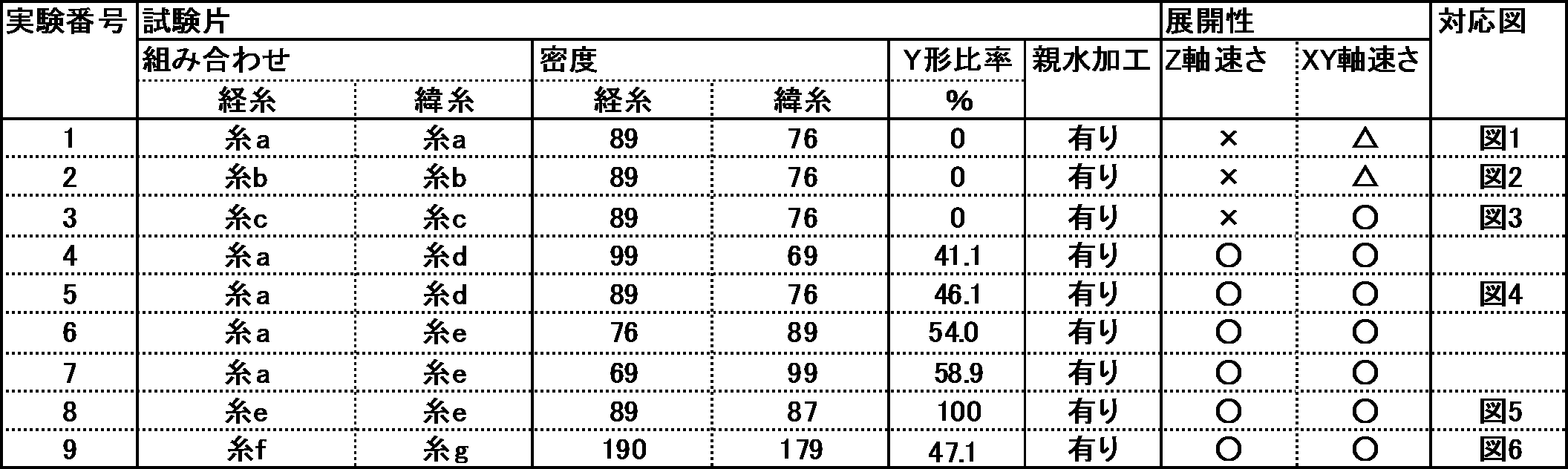
図1~6および表2に血液検体の展開性を測定した結果を示す。
図1は、反応層の上層に展開層として一般的な丸型断面糸aを経糸(経糸)89(本/2.54cm)、緯糸(緯糸)76(本/2.54cm)の密度で編んだ試験片(異形断面糸の割合0%)を用いた場合の反射吸光度の変化を示す(実験番号1)。ヘマトクリット40%、55%の検体では点着後の反射吸光度の立ち上がりが遅れた。丸形断面糸からなる織物の血液検体に対する吸水性の悪さが示唆された。
点着から反射吸光度が立ち上がるまでの時間とヘマトクリット値とは必ずしも比例的な関係を示さず、試料の展開にばらつきがあることがわかった。
また、ヘマトクリット55%の検体ではその後急速に吸光度が低下した。これは、液体試料が点着箇所から同心円状にドーナツのように拡散するために、ドーナツの中心部分にあたる検出部分において試料の均一な展開ができなくなっていることを示している。
図1は、反応層の上層に展開層として一般的な丸型断面糸aを経糸(経糸)89(本/2.54cm)、緯糸(緯糸)76(本/2.54cm)の密度で編んだ試験片(異形断面糸の割合0%)を用いた場合の反射吸光度の変化を示す(実験番号1)。ヘマトクリット40%、55%の検体では点着後の反射吸光度の立ち上がりが遅れた。丸形断面糸からなる織物の血液検体に対する吸水性の悪さが示唆された。
点着から反射吸光度が立ち上がるまでの時間とヘマトクリット値とは必ずしも比例的な関係を示さず、試料の展開にばらつきがあることがわかった。
また、ヘマトクリット55%の検体ではその後急速に吸光度が低下した。これは、液体試料が点着箇所から同心円状にドーナツのように拡散するために、ドーナツの中心部分にあたる検出部分において試料の均一な展開ができなくなっていることを示している。
図2は、展開層を丸型断面糸aより太い糸bを経糸89(本/2.54cm)、緯糸76(本/2.54cm)の密度で編んだ試験片(異形断面糸の割合0%)を用いた場合の反射吸光度の変化を示す(実験番号2)。
また、図3は、展開層を丸型断面糸aより細い糸cを経糸89(本/2.54cm)、緯糸76(本/2.54cm)の密度で編んだ試験片(異形断面糸の割合0%)を用いた場合の反射吸光度の変化を示す(実験番号3)。
いずれの場合も、点着後の反射吸光度の立ち上がりの遅れや、立ち上がり後の吸光度の不安定な推移が見られた。
また、図3は、展開層を丸型断面糸aより細い糸cを経糸89(本/2.54cm)、緯糸76(本/2.54cm)の密度で編んだ試験片(異形断面糸の割合0%)を用いた場合の反射吸光度の変化を示す(実験番号3)。
いずれの場合も、点着後の反射吸光度の立ち上がりの遅れや、立ち上がり後の吸光度の不安定な推移が見られた。
図4は、経糸に丸型断面糸a、緯糸にY字形断面糸dを用い、経糸89(本/2.54cm)、緯糸76(本/2.54cm)の密度で編んだ織物(異形断面糸の割合46.1%)を展開層に使用した試験片を用いた場合の反射吸光度の変化を示す(実験番号5)。反射吸光度は血液検体を点着後に速やかに増加し、また、立ち上がり後の吸光度の推移も比較的安定していた。これは、血液検体が十分に展開されていることを示している。
このほか、経糸(丸型断面糸a)99(本/2.54cm)、緯糸(Y字形断面糸d)69(本/2.54cm)の密度で編んだ織物(異形断面糸の割合41.1%)を展開層に使用した試験片を用いた場合においても、反射吸光度は血液検体を点着後に速やかに増加し、また、立ち上がり後の吸光度の推移も比較的安定していた。(表2)
このほか、経糸(丸型断面糸a)99(本/2.54cm)、緯糸(Y字形断面糸d)69(本/2.54cm)の密度で編んだ織物(異形断面糸の割合41.1%)を展開層に使用した試験片を用いた場合においても、反射吸光度は血液検体を点着後に速やかに増加し、また、立ち上がり後の吸光度の推移も比較的安定していた。(表2)
図5は、経糸、緯糸ともにY字形断面糸eを用い、経糸89(本/cm2)、緯糸87(本/cm2)の密度で編んだ織物(異形断面糸の割合100%)を展開層に用いた織物を展開層に使用した試験片を用いた場合の反射吸光度の変化を示す(実験番号8)。
反射吸光度は血液検体を点着後に速やかに増加し、また、立ち上がり後の吸光度の推移も比較的安定していた。
このほか、経糸(丸型断面糸a)76(本/2.54cm)、緯糸(Y字形断面糸e)89(本/2.54cm)の密度で編んだ織物(異形断面糸の割合54.0%)を展開層に使用した試験片を用いた場合、および、経糸(丸型断面糸a)99(本/2.54cm)、緯糸(Y字形断面糸e)69(本/2.54cm)の密度で編んだ織物(異形断面糸の割合58.9%)を展開層に使用した試験片を用いた場合においても、それぞれ、反射吸光度は血液検体を点着後に速やかに増加し、また、立ち上がり後の吸光度の推移も比較的安定していた。(表2)
反射吸光度は血液検体を点着後に速やかに増加し、また、立ち上がり後の吸光度の推移も比較的安定していた。
このほか、経糸(丸型断面糸a)76(本/2.54cm)、緯糸(Y字形断面糸e)89(本/2.54cm)の密度で編んだ織物(異形断面糸の割合54.0%)を展開層に使用した試験片を用いた場合、および、経糸(丸型断面糸a)99(本/2.54cm)、緯糸(Y字形断面糸e)69(本/2.54cm)の密度で編んだ織物(異形断面糸の割合58.9%)を展開層に使用した試験片を用いた場合においても、それぞれ、反射吸光度は血液検体を点着後に速やかに増加し、また、立ち上がり後の吸光度の推移も比較的安定していた。(表2)
図6は、経糸に丸型断面糸f、緯糸にY字形断面糸gを用い、経糸190(本/2.54cm)、緯糸179(本/2.54cm)の密度で編んだ織物(異形断面糸の割合47.1%)を展開層に使用した試験片を用いた場合の反射吸光度の変化を示す(実験番号9)。反射吸光度は血液検体を点着後に速やかに増加し、また、立ち上がり後の吸光度の推移も比較的安定していた。
以上のことから、一般的な丸型断面糸との組み合わせにおいて、Y字形断面糸を40%以上織り込むことが、グルコース測定に必要な、迅速かつ正確な測定に適した試料展開性を有する試験片への適用に好ましいことがわかった。
実施例4 血液試料の調整
全血を3,000rpm、5分間遠心分離し、血球と血漿に分離した後、これらの割合を変えて混合することでヘマトクリット値が30、35、40、45および55%の血液試料を調整した。ヘマトクリット値が高いほど生体試料の粘度が高い。これらにグルコース溶液を混合することでグルコース濃度の異なる17水準の血液試料を調整した。これらの血液試料を表3に示す。
全血を3,000rpm、5分間遠心分離し、血球と血漿に分離した後、これらの割合を変えて混合することでヘマトクリット値が30、35、40、45および55%の血液試料を調整した。ヘマトクリット値が高いほど生体試料の粘度が高い。これらにグルコース溶液を混合することでグルコース濃度の異なる17水準の血液試料を調整した。これらの血液試料を表3に示す。
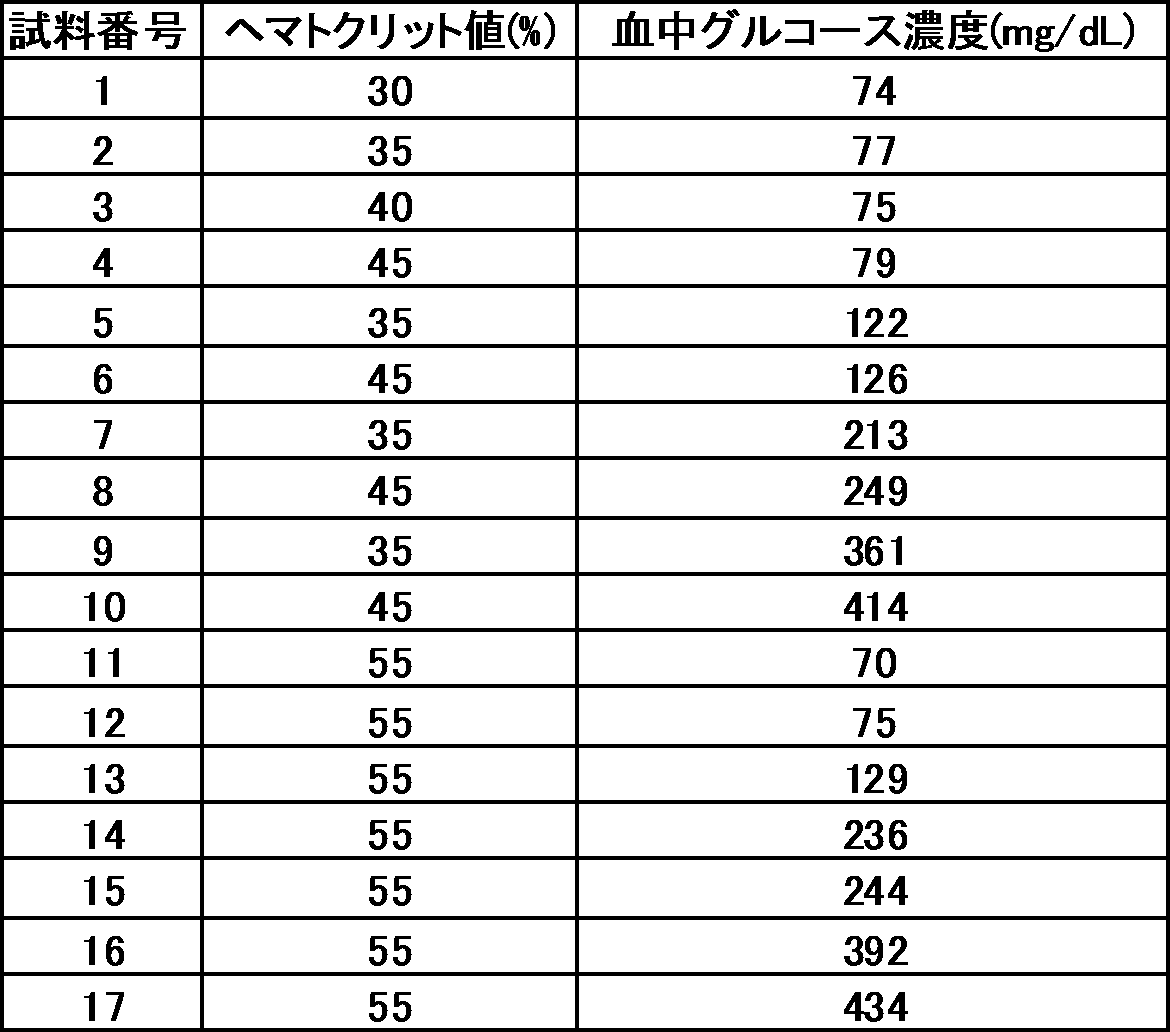
実施例5 血液試料の展開性測定
図7および図8に示す測定装置100を用いて、実施例3と同様にして本発明の試験片における血液試料の展開性を評価した。血液試料は実施例4で作製した試料番号1(ヘマトクリット値30%、血中グルコース濃度74mg/dL)、試料番号11(ヘマトクリット値55%、血中グルコース濃度70mg/dL)を用いた。測定に用いた多層試験片を表4に示す。
結果を表4に示す。表4における「血液試料の展開性」の欄の記号は、○、×の順に、各方向の展開性がより速いことを示している。試料番号1の血液試料の場合、実験番号1~9の試験片の血液試料の展開性は良好であった。ヘマトクリット値が高い試料番号11の血液試料の場合、実験番号1~3の試験片の血液試料の展開性は良くなかったが、実験番号4~9の試験片の血液試料の展開性は良好であった。糸d、糸eまたは糸g、すなわち、Y字型断面の糸を使用して作製した試験片を用いた場合、ヘマトクリット値が高い試料であっても試料の展開性が良好であることが示された。
図7および図8に示す測定装置100を用いて、実施例3と同様にして本発明の試験片における血液試料の展開性を評価した。血液試料は実施例4で作製した試料番号1(ヘマトクリット値30%、血中グルコース濃度74mg/dL)、試料番号11(ヘマトクリット値55%、血中グルコース濃度70mg/dL)を用いた。測定に用いた多層試験片を表4に示す。
結果を表4に示す。表4における「血液試料の展開性」の欄の記号は、○、×の順に、各方向の展開性がより速いことを示している。試料番号1の血液試料の場合、実験番号1~9の試験片の血液試料の展開性は良好であった。ヘマトクリット値が高い試料番号11の血液試料の場合、実験番号1~3の試験片の血液試料の展開性は良くなかったが、実験番号4~9の試験片の血液試料の展開性は良好であった。糸d、糸eまたは糸g、すなわち、Y字型断面の糸を使用して作製した試験片を用いた場合、ヘマトクリット値が高い試料であっても試料の展開性が良好であることが示された。
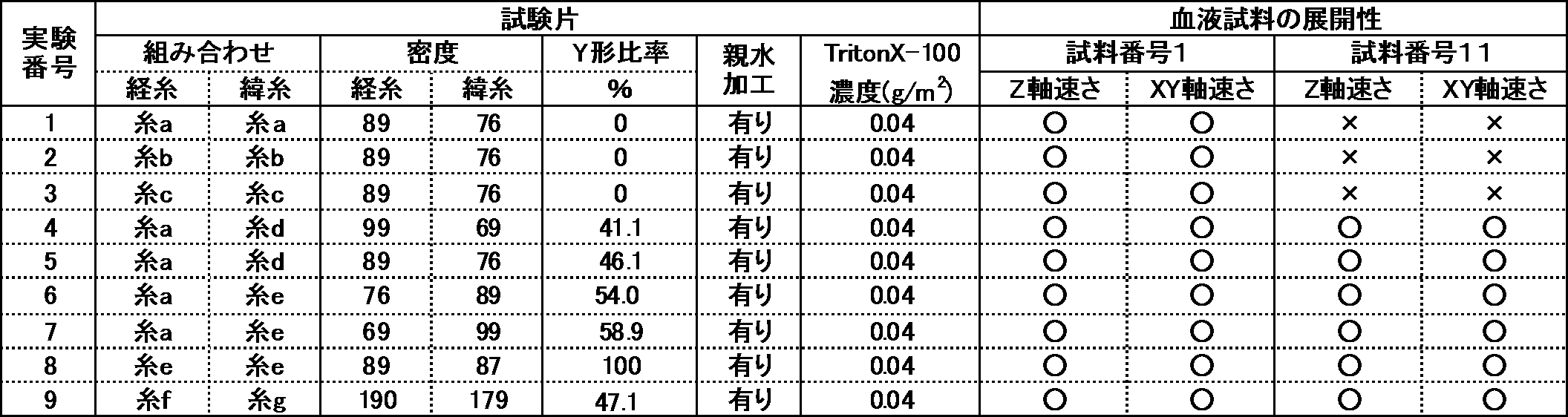
実施例6 血中グルコース濃度の測定
実施例4で作製した17水準の血液試料と実施例5で作製した実験番号8の試験片を用いて血液試料中の血中グルコース濃度を測定した。下記に示すように、展開層はTriton(登録商標)X-100濃度が異なる以外は実施例1に記載された作製方法と同じ方法で作製されたものを使用し、界面活性剤が血中グルコース濃度の測定精度に及ぼす影響を評価した。
血中グルコース濃度は色素に特異的な吸収波長の光を照射し、反射光を測定することで血中グルコース濃度を測定することができる。色素はグルコース濃度依存的に青色に呈色するので、波長660nmの光を照射させて測定することができる。
実施例5と同様に測定装置100を用いてグルコース濃度を測定した。測定開始してから10秒後に血液試料を10μL用いて試験片に点着させ、血液試料を点着してから5秒間の吸光度の増加速度を測定した。
実施例4で作製した17水準の血液試料と実施例5で作製した実験番号8の試験片を用いて血液試料中の血中グルコース濃度を測定した。下記に示すように、展開層はTriton(登録商標)X-100濃度が異なる以外は実施例1に記載された作製方法と同じ方法で作製されたものを使用し、界面活性剤が血中グルコース濃度の測定精度に及ぼす影響を評価した。
血中グルコース濃度は色素に特異的な吸収波長の光を照射し、反射光を測定することで血中グルコース濃度を測定することができる。色素はグルコース濃度依存的に青色に呈色するので、波長660nmの光を照射させて測定することができる。
実施例5と同様に測定装置100を用いてグルコース濃度を測定した。測定開始してから10秒後に血液試料を10μL用いて試験片に点着させ、血液試料を点着してから5秒間の吸光度の増加速度を測定した。
(1)展開層のTriton(登録商標)X-100の濃度が0.0g/m2試験片の測定精度
ヘマトクリット値(30~45%)と血中グルコース濃度(74~249mg/dL)の5水準(試料番号1、3、5、6、8)の血液試料を用いて、上述の方法により血中グルコース濃度を測定した。測定結果を図11(■)に示す。横軸に血中グルコース濃度、縦軸に吸光度の増加速度とした場合のプロットは良好な直線性を示し、直線の近似式はY=0.0013X+0.0118であった。
続いてヘマトクリット値が55%で血中グルコース濃度(129、244mg/dL)の異なる2水準(試料番号13、15)の血液試料を用いて同様に血中グルコース濃度を測定した。測定結果を図11(○)に示す。近似式より得られる理論値に対する実測値の比率は表5に示すように試料番号13が72.4%、試料番号15が53.7%であった。ヘマトクリット値の高い試料のプロットは先に作成した直線よりも低い傾向を示し大きく乖離した。
ヘマトクリット値(30~45%)と血中グルコース濃度(74~249mg/dL)の5水準(試料番号1、3、5、6、8)の血液試料を用いて、上述の方法により血中グルコース濃度を測定した。測定結果を図11(■)に示す。横軸に血中グルコース濃度、縦軸に吸光度の増加速度とした場合のプロットは良好な直線性を示し、直線の近似式はY=0.0013X+0.0118であった。
続いてヘマトクリット値が55%で血中グルコース濃度(129、244mg/dL)の異なる2水準(試料番号13、15)の血液試料を用いて同様に血中グルコース濃度を測定した。測定結果を図11(○)に示す。近似式より得られる理論値に対する実測値の比率は表5に示すように試料番号13が72.4%、試料番号15が53.7%であった。ヘマトクリット値の高い試料のプロットは先に作成した直線よりも低い傾向を示し大きく乖離した。
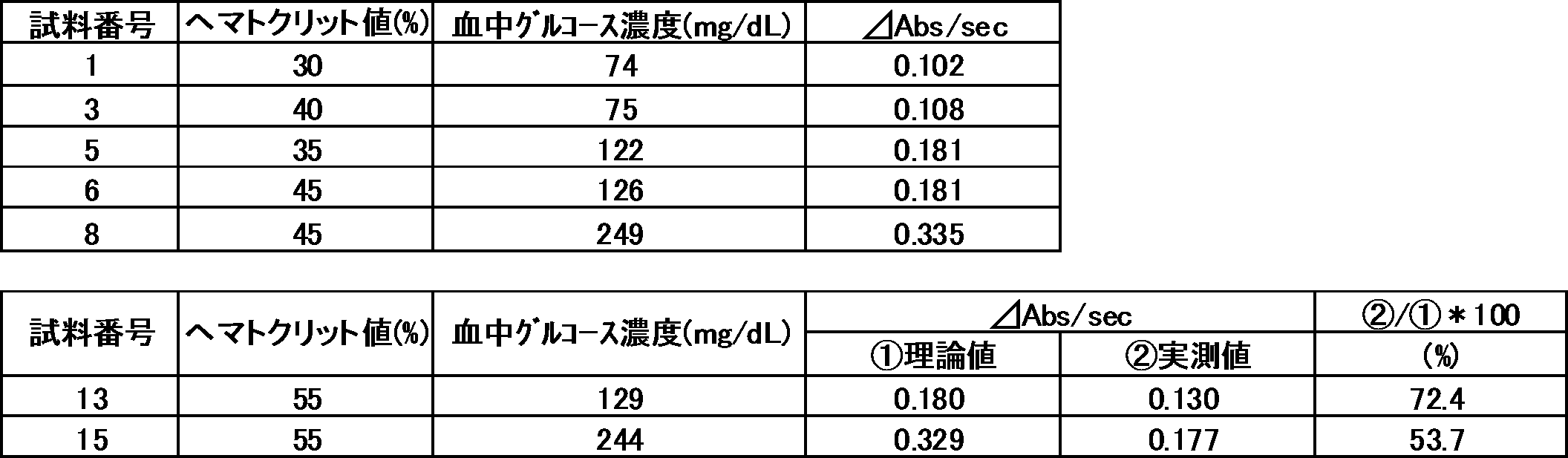
(2)展開層のTriton(登録商標)X-100の濃度が0.02g/m2試験片の測定精度
ヘマトクリット値(30~45%)と血中グルコース濃度(77~414mg/dL)の5水準(試料番号2、4、7、9、10)の血液試料を用いて、上述の方法により血中グルコース濃度を測定した。測定結果を図12(■)に示す。横軸に血中グルコース濃度、縦軸に吸光度の増加速度とした場合のプロットは良好な直線性を示し、直線の近似式はY=0.0007X+0.0122であった。
続いてヘマトクリット値が55%で血中グルコース濃度(70、75、236、392、434mg/dL)の異なる5水準(試料番号11、12、14、16、17)の血液試料を用いて同様に血中グルコース濃度を測定した。測定結果を図12(○)に示す。近似式より得られる理論値に対する実測値の比率は表6に示すように試料番号11が49.0%、試料番号12が56.0%、試料番号14が103.3%、試料番号16が88.9%、試料番号17が72.0%であった。ヘマトクリット値の高い試料のプロットの中で試料番号14は先に作成した直線と同等であったが、他の試料は低い傾向を示し大きく乖離した。
ヘマトクリット値(30~45%)と血中グルコース濃度(77~414mg/dL)の5水準(試料番号2、4、7、9、10)の血液試料を用いて、上述の方法により血中グルコース濃度を測定した。測定結果を図12(■)に示す。横軸に血中グルコース濃度、縦軸に吸光度の増加速度とした場合のプロットは良好な直線性を示し、直線の近似式はY=0.0007X+0.0122であった。
続いてヘマトクリット値が55%で血中グルコース濃度(70、75、236、392、434mg/dL)の異なる5水準(試料番号11、12、14、16、17)の血液試料を用いて同様に血中グルコース濃度を測定した。測定結果を図12(○)に示す。近似式より得られる理論値に対する実測値の比率は表6に示すように試料番号11が49.0%、試料番号12が56.0%、試料番号14が103.3%、試料番号16が88.9%、試料番号17が72.0%であった。ヘマトクリット値の高い試料のプロットの中で試料番号14は先に作成した直線と同等であったが、他の試料は低い傾向を示し大きく乖離した。
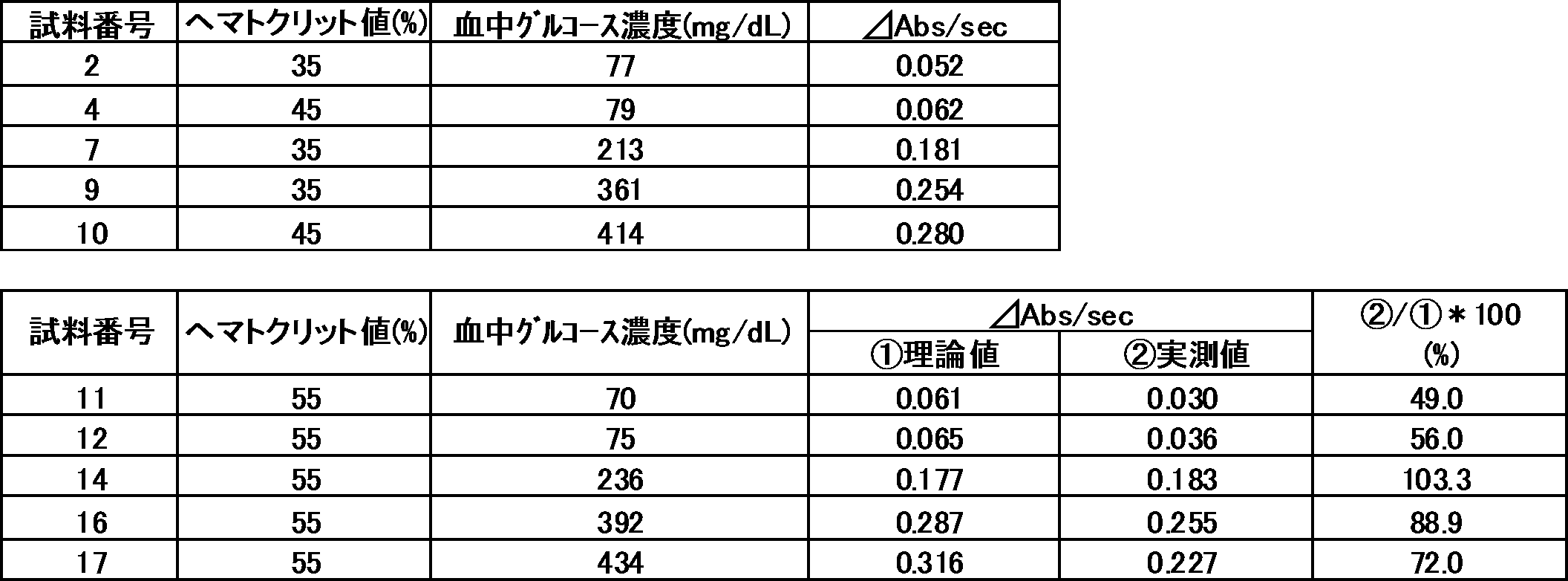
(3)展開層のTriton(登録商標)X-100の濃度が0.04g/m2試験片の測定精度
(2)と同様の血液試料を用いて、上述の方法により血中グルコース濃度を測定した。
測定結果を図13(■)に示す。横軸に血中グルコース濃度、縦軸に吸光度の増加速度とした場合のプロットは良好な直線性を示し、直線の近似式はY=0.0007X+0.0125であった。
続いてヘマトクリット値が55%で血中グルコース濃度(70、75、236、392、434mg/dL)の異なる5水準(試料番号11、12、14、16、17)の血液試料を用いて同様に血中グルコース濃度を測定した。測定結果を図13(○)に示す。近似式より得られる理論値に対する実測値の比率は表7に示すように試料番号11が91.1%、試料番号12が92.3%、試料番号14が98.4%、試料番号16が99.3%、試料番号17が100.2%であった。これらのヘマトクリット値の高い試料のプロットはいずれも先に作成した直線と同等であった。
(2)と同様の血液試料を用いて、上述の方法により血中グルコース濃度を測定した。
測定結果を図13(■)に示す。横軸に血中グルコース濃度、縦軸に吸光度の増加速度とした場合のプロットは良好な直線性を示し、直線の近似式はY=0.0007X+0.0125であった。
続いてヘマトクリット値が55%で血中グルコース濃度(70、75、236、392、434mg/dL)の異なる5水準(試料番号11、12、14、16、17)の血液試料を用いて同様に血中グルコース濃度を測定した。測定結果を図13(○)に示す。近似式より得られる理論値に対する実測値の比率は表7に示すように試料番号11が91.1%、試料番号12が92.3%、試料番号14が98.4%、試料番号16が99.3%、試料番号17が100.2%であった。これらのヘマトクリット値の高い試料のプロットはいずれも先に作成した直線と同等であった。
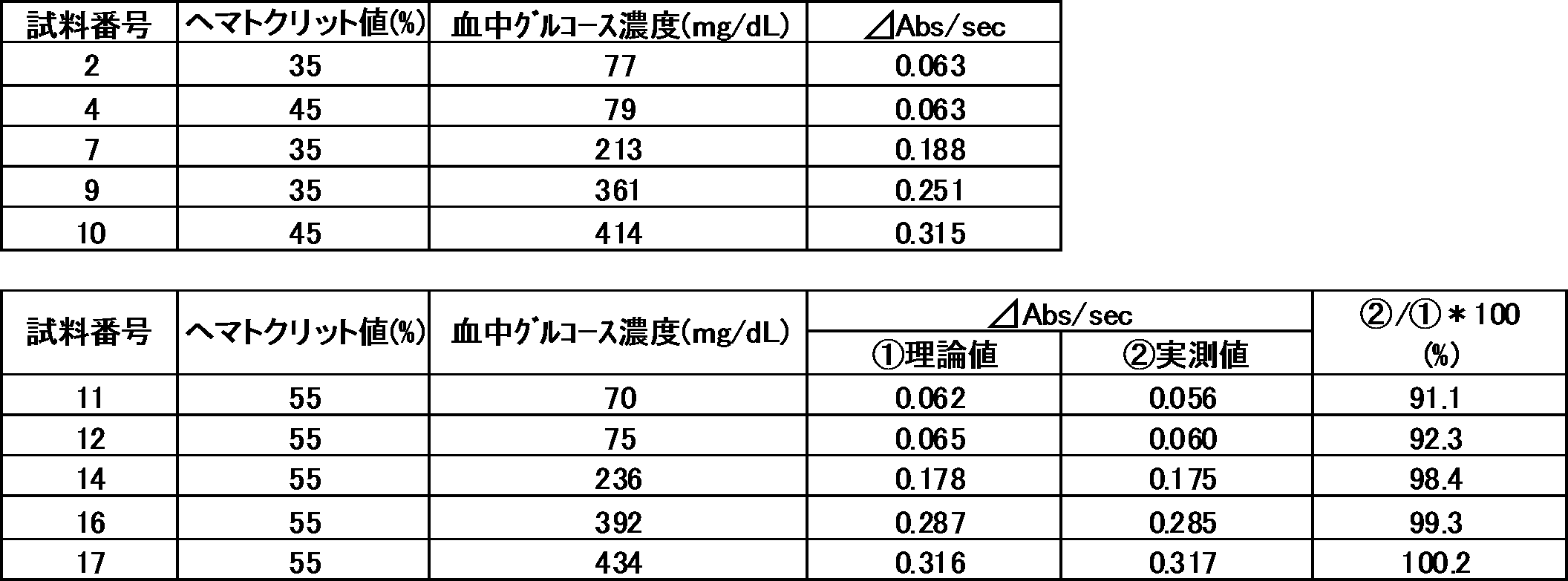
(4)展開層のTriton(登録商標)X-100の濃度が0.06g/m2試験片の測定精度
(2)と同様の血液試料を用いて、上述の方法により血中グルコース濃度を測定した。
測定結果を図14(■)に示す。横軸に血中グルコース濃度、縦軸に吸光度の増加速度とした場合のプロットは良好な直線性を示し、直線の近似式はY=0.0007X+0.0126であった。
続いてヘマトクリット値が55%で血中グルコース濃度(70、75、236、392、434mg/dL)の異なる5水準(試料番号11、12、14、16、17)の血液試料を用いて同様に血中グルコース濃度を測定した。測定結果を図14(○)に示す。近似式より得られる理論値に対する実測値の比率は表8に示すように試料番号11が97.4%、試料番号12が95.2%、試料番号14が98.4%、試料番号16が103.8%、試料番号17が102.7%であった。これらのヘマトクリット値の高い試料のプロットはいずれも先に作成した直線と同等であった。
(2)と同様の血液試料を用いて、上述の方法により血中グルコース濃度を測定した。
測定結果を図14(■)に示す。横軸に血中グルコース濃度、縦軸に吸光度の増加速度とした場合のプロットは良好な直線性を示し、直線の近似式はY=0.0007X+0.0126であった。
続いてヘマトクリット値が55%で血中グルコース濃度(70、75、236、392、434mg/dL)の異なる5水準(試料番号11、12、14、16、17)の血液試料を用いて同様に血中グルコース濃度を測定した。測定結果を図14(○)に示す。近似式より得られる理論値に対する実測値の比率は表8に示すように試料番号11が97.4%、試料番号12が95.2%、試料番号14が98.4%、試料番号16が103.8%、試料番号17が102.7%であった。これらのヘマトクリット値の高い試料のプロットはいずれも先に作成した直線と同等であった。

以上のことから、一般的な丸型断面糸との組み合わせにおいて、Y字形断面糸を40%以上織り込むことと、これらの糸で構成された布帛にTritonX-100の濃度が0.04g/m2以上になるように含浸することが、グルコース測定に必要な、迅速かつ正確な測定に適した試料展開性を有する試験片への適用に好ましいことがわかった。
本発明の多層状分析試験片は生体試料中の分析対象物を迅速かつ簡便に定量することができる。
100 測定装置
200 試験片(200aも同じ)
1 試験片装着部(1aも同じ)
2 発光部(2aも同じ)
3 受光部(3aも同じ)
4 演算部
5 血液検体点着部
6 電源スイッチ
7 表示モニター
200 試験片(200aも同じ)
1 試験片装着部(1aも同じ)
2 発光部(2aも同じ)
3 受光部(3aも同じ)
4 演算部
5 血液検体点着部
6 電源スイッチ
7 表示モニター
Claims (15)
- 液体試料中の分析対象物を分析するための多層試験片であって、少なくとも下記(a)層と(b)層とが、試料点着面から(a)層/(b)層の順に積層されている多層試験片。
(a)層:親水性の繊維で作られた布帛であって、前記繊維に異形断面糸を含む布帛を含む構造体
(b)層:分析対象物と特異的に反応する試薬が含浸された構造体 - 分析対象物がグルコースである、請求項1に記載の試験片。
- (a)層において布帛が界面活性剤を含浸している、請求項1または2に記載の試験片。
- (a)層の構造体が織物でできている、請求項1から3のいずれかに記載の試験片。
- (a)層における異形断面糸の横断面形状が、三角形、四角形、五角形、六角形、Y字形、T字形、H字形、U字形、W字形、菱形および星形からなる群の中から選ばれたいずれかである、請求項1から4のいずれかに記載の試験片。
- (a)層における繊維が、ポリエステル類、ポリエーテルスルホン類、ポリ塩化ビニル類、ポリウレタン類、アクリル類およびナイロン類からなる群の中から選ばれたいずれかを親水加工したものである、請求項1から5のいずれかに記載の試験片。
- (a)層において、繊維の親水加工の少なくとも一部が親水性ポリマーでなされている、請求項1から6のいずれかに記載の試験片。
- 親水性ポリマーがポリエチレングリコール、ポリビニルピロリドン、ヒドロキシプロピルセルロース、カルボキシメチルセルロース、ヒドロキシメチルセルロース、ヒドロキシエチルセルロース、ヒドロキシプロピルメチルセルロース、ヒドロキシプロピルメチルセルロースおよびポリエステルポリエーテルブロック共重合体からなる群の中から選ばれたいずれかである、請求項7に記載の試験片。
- (a)層における界面活性剤が、ノニオン性界面活性剤である、請求項3から8のいずれかに記載の試験片。
- 界面活性剤が4-(1,1,3,3-テトラメチルブチル)フェニル-ポリエチレングリコール(Triton(登録商標) X-100)、1,1,3,3-テトラメチルブチル フェニル-ポリエチレングリコール(Triton(登録商標) X-114)、ポリオキシエチレンp-ノニルフェニルエーテル(ノニデット(登録商標) P-40)からなる群の中から選ばれたいずれかである、請求項3から9のいずれかに記載の試験片。
- 界面活性剤の含有量が0.02~0.06g/m2であることを特徴とする、請求項3から10のいずれかに記載の試験片。
- (a)層の構造体を構成する異形断面糸の割合が、40%以上100%以下である、請求項1から11のいずれかに記載の試験片。
- (a)層の構造体が織物であって、該織物を構成する経糸と緯糸の本数が、それぞれ、経糸60~200本/2.54cm、緯糸60~200本/2.54cmの組合せである、請求項4から12のいずれかに記載の試験片。
- 請求項1から13のいずれかに記載の試験片を用いて液体試料中のグルコースを分析する方法。
- 請求項1から13のいずれかに記載の試験片を含むプロダクト。
Applications Claiming Priority (4)
| Application Number | Priority Date | Filing Date | Title |
|---|---|---|---|
| JP2012243562 | 2012-11-05 | ||
| JP2012-243562 | 2012-11-05 | ||
| JP2013021359 | 2013-02-06 | ||
| JP2013-021359 | 2013-09-13 |
Publications (1)
| Publication Number | Publication Date |
|---|---|
| WO2014069561A1 true WO2014069561A1 (ja) | 2014-05-08 |
Family
ID=50627459
Family Applications (1)
| Application Number | Title | Priority Date | Filing Date |
|---|---|---|---|
| PCT/JP2013/079524 Ceased WO2014069561A1 (ja) | 2012-11-05 | 2013-10-31 | 液体試料分析のための試験片、およびそれを用いた測定方法 |
Country Status (1)
| Country | Link |
|---|---|
| WO (1) | WO2014069561A1 (ja) |
Citations (4)
| Publication number | Priority date | Publication date | Assignee | Title |
|---|---|---|---|---|
| JPH0518953A (ja) * | 1991-07-09 | 1993-01-26 | Konica Corp | 分析素子 |
| JPH05223807A (ja) * | 1992-02-13 | 1993-09-03 | Unitika Ltd | 液体試料展開層用布帛 |
| JPH05232108A (ja) * | 1992-02-18 | 1993-09-07 | Kanebo Ltd | 液体試料分析用具 |
| JP2579222B2 (ja) * | 1989-10-18 | 1997-02-05 | 富士写真フイルム株式会社 | 全血試料分析用乾式分析要素 |
-
2013
- 2013-10-31 WO PCT/JP2013/079524 patent/WO2014069561A1/ja not_active Ceased
Patent Citations (4)
| Publication number | Priority date | Publication date | Assignee | Title |
|---|---|---|---|---|
| JP2579222B2 (ja) * | 1989-10-18 | 1997-02-05 | 富士写真フイルム株式会社 | 全血試料分析用乾式分析要素 |
| JPH0518953A (ja) * | 1991-07-09 | 1993-01-26 | Konica Corp | 分析素子 |
| JPH05223807A (ja) * | 1992-02-13 | 1993-09-03 | Unitika Ltd | 液体試料展開層用布帛 |
| JPH05232108A (ja) * | 1992-02-18 | 1993-09-07 | Kanebo Ltd | 液体試料分析用具 |
Similar Documents
| Publication | Publication Date | Title |
|---|---|---|
| CN1143132C (zh) | 可用肉眼观察的血糖检测条 | |
| CA1069419A (en) | Integral analytical element | |
| JP2644331B2 (ja) | 液体の化学的分析のための改良可処分装置 | |
| US4292272A (en) | Multilayer analysis sheet for analyzing liquid samples | |
| US6555061B1 (en) | Multi-layer reagent test strip | |
| US8377684B2 (en) | Test strip and method for measuring blood cholesterol level using the same | |
| Ji et al. | “Ready-to-use” hollow nanofiber membrane-based glucose testing strips | |
| JP5985231B2 (ja) | カルシウム測定用乾式試験片 | |
| EP0511120A1 (en) | Testing device | |
| JPH0133783B2 (ja) | ||
| US20100311154A1 (en) | Test strip designed to improve spreadability of blood | |
| JPH03130662A (ja) | 血液から血漿を分離するための装置と方法および血液中の分析対象物の測定法 | |
| EP0226465A2 (en) | Integral multilayer analytical element | |
| JPH06504376A (ja) | 全血中の被分析物測定用テストキャリア | |
| CN109580489A (zh) | 同时检测血糖和血脂的芯片及方法 | |
| US20030129086A1 (en) | Functional overlay for flexible objects in particular for diagnostic test strips | |
| JP2014102084A (ja) | 液体試料分析のための多層試験片、およびそれを用いた測定方法 | |
| WO2014069561A1 (ja) | 液体試料分析のための試験片、およびそれを用いた測定方法 | |
| KR101656894B1 (ko) | 분석학적 시험 부재 및 그의 제조 방법 | |
| JP2005114368A (ja) | 酵素の安定化方法およびそれに用いる検体分析用具 | |
| JP3799395B2 (ja) | ヘマトクリット値測定方法及び試験具 | |
| EP1806578A1 (en) | Multilayered analytical element | |
| JPH0518959A (ja) | 分析素子 | |
| JPH0755795A (ja) | 分析用試験片 | |
| JPWO2006035874A1 (ja) | 多層分析要素 |
Legal Events
| Date | Code | Title | Description |
|---|---|---|---|
| 121 | Ep: the epo has been informed by wipo that ep was designated in this application |
Ref document number: 13850583 Country of ref document: EP Kind code of ref document: A1 |
|
| NENP | Non-entry into the national phase |
Ref country code: DE |
|
| 122 | Ep: pct application non-entry in european phase |
Ref document number: 13850583 Country of ref document: EP Kind code of ref document: A1 |
|
| NENP | Non-entry into the national phase |
Ref country code: JP |