WO2014046097A1 - フォトレジスト組成物、レジストパターン形成方法及び酸発生剤 - Google Patents
フォトレジスト組成物、レジストパターン形成方法及び酸発生剤 Download PDFInfo
- Publication number
- WO2014046097A1 WO2014046097A1 PCT/JP2013/075061 JP2013075061W WO2014046097A1 WO 2014046097 A1 WO2014046097 A1 WO 2014046097A1 JP 2013075061 W JP2013075061 W JP 2013075061W WO 2014046097 A1 WO2014046097 A1 WO 2014046097A1
- Authority
- WO
- WIPO (PCT)
- Prior art keywords
- group
- carbon atoms
- photoresist composition
- substituted
- polymer
- Prior art date
- Legal status (The legal status is an assumption and is not a legal conclusion. Google has not performed a legal analysis and makes no representation as to the accuracy of the status listed.)
- Ceased
Links
- 0 CCC(*)(*)C(OC1(C)C2CC(C3)CC1CC3C2)=O Chemical compound CCC(*)(*)C(OC1(C)C2CC(C3)CC1CC3C2)=O 0.000 description 2
Classifications
-
- C—CHEMISTRY; METALLURGY
- C07—ORGANIC CHEMISTRY
- C07C—ACYCLIC OR CARBOCYCLIC COMPOUNDS
- C07C309/00—Sulfonic acids; Halides, esters, or anhydrides thereof
- C07C309/63—Esters of sulfonic acids
- C07C309/64—Esters of sulfonic acids having sulfur atoms of esterified sulfo groups bound to acyclic carbon atoms
- C07C309/65—Esters of sulfonic acids having sulfur atoms of esterified sulfo groups bound to acyclic carbon atoms of a saturated carbon skeleton
-
- C—CHEMISTRY; METALLURGY
- C07—ORGANIC CHEMISTRY
- C07C—ACYCLIC OR CARBOCYCLIC COMPOUNDS
- C07C309/00—Sulfonic acids; Halides, esters, or anhydrides thereof
- C07C309/63—Esters of sulfonic acids
- C07C309/64—Esters of sulfonic acids having sulfur atoms of esterified sulfo groups bound to acyclic carbon atoms
- C07C309/65—Esters of sulfonic acids having sulfur atoms of esterified sulfo groups bound to acyclic carbon atoms of a saturated carbon skeleton
- C07C309/66—Methanesulfonates
-
- C—CHEMISTRY; METALLURGY
- C07—ORGANIC CHEMISTRY
- C07C—ACYCLIC OR CARBOCYCLIC COMPOUNDS
- C07C381/00—Compounds containing carbon and sulfur and having functional groups not covered by groups C07C301/00 - C07C337/00
- C07C381/12—Sulfonium compounds
-
- C—CHEMISTRY; METALLURGY
- C07—ORGANIC CHEMISTRY
- C07D—HETEROCYCLIC COMPOUNDS
- C07D307/00—Heterocyclic compounds containing five-membered rings having one oxygen atom as the only ring hetero atom
- C07D307/77—Heterocyclic compounds containing five-membered rings having one oxygen atom as the only ring hetero atom ortho- or peri-condensed with carbocyclic rings or ring systems
- C07D307/78—Benzo [b] furans; Hydrogenated benzo [b] furans
- C07D307/79—Benzo [b] furans; Hydrogenated benzo [b] furans with only hydrogen atoms, hydrocarbon or substituted hydrocarbon radicals, directly attached to carbon atoms of the hetero ring
-
- C—CHEMISTRY; METALLURGY
- C07—ORGANIC CHEMISTRY
- C07D—HETEROCYCLIC COMPOUNDS
- C07D307/00—Heterocyclic compounds containing five-membered rings having one oxygen atom as the only ring hetero atom
- C07D307/77—Heterocyclic compounds containing five-membered rings having one oxygen atom as the only ring hetero atom ortho- or peri-condensed with carbocyclic rings or ring systems
- C07D307/91—Dibenzofurans; Hydrogenated dibenzofurans
-
- C—CHEMISTRY; METALLURGY
- C07—ORGANIC CHEMISTRY
- C07D—HETEROCYCLIC COMPOUNDS
- C07D333/00—Heterocyclic compounds containing five-membered rings having one sulfur atom as the only ring hetero atom
- C07D333/50—Heterocyclic compounds containing five-membered rings having one sulfur atom as the only ring hetero atom condensed with carbocyclic rings or ring systems
- C07D333/76—Dibenzothiophenes
-
- C—CHEMISTRY; METALLURGY
- C08—ORGANIC MACROMOLECULAR COMPOUNDS; THEIR PREPARATION OR CHEMICAL WORKING-UP; COMPOSITIONS BASED THEREON
- C08F—MACROMOLECULAR COMPOUNDS OBTAINED BY REACTIONS ONLY INVOLVING CARBON-TO-CARBON UNSATURATED BONDS
- C08F20/00—Homopolymers and copolymers of compounds having one or more unsaturated aliphatic radicals, each having only one carbon-to-carbon double bond, and only one being terminated by only one carboxyl radical or a salt, anhydride, ester, amide, imide or nitrile thereof
- C08F20/02—Monocarboxylic acids having less than ten carbon atoms, Derivatives thereof
- C08F20/10—Esters
- C08F20/12—Esters of monohydric alcohols or phenols
- C08F20/16—Esters of monohydric alcohols or phenols of phenols or of alcohols containing two or more carbon atoms
-
- G—PHYSICS
- G03—PHOTOGRAPHY; CINEMATOGRAPHY; ANALOGOUS TECHNIQUES USING WAVES OTHER THAN OPTICAL WAVES; ELECTROGRAPHY; HOLOGRAPHY
- G03F—PHOTOMECHANICAL PRODUCTION OF TEXTURED OR PATTERNED SURFACES, e.g. FOR PRINTING, FOR PROCESSING OF SEMICONDUCTOR DEVICES; MATERIALS THEREFOR; ORIGINALS THEREFOR; APPARATUS SPECIALLY ADAPTED THEREFOR
- G03F7/00—Photomechanical, e.g. photolithographic, production of textured or patterned surfaces, e.g. printing surfaces; Materials therefor, e.g. comprising photoresists; Apparatus specially adapted therefor
- G03F7/004—Photosensitive materials
- G03F7/0045—Photosensitive materials with organic non-macromolecular light-sensitive compounds not otherwise provided for, e.g. dissolution inhibitors
-
- G—PHYSICS
- G03—PHOTOGRAPHY; CINEMATOGRAPHY; ANALOGOUS TECHNIQUES USING WAVES OTHER THAN OPTICAL WAVES; ELECTROGRAPHY; HOLOGRAPHY
- G03F—PHOTOMECHANICAL PRODUCTION OF TEXTURED OR PATTERNED SURFACES, e.g. FOR PRINTING, FOR PROCESSING OF SEMICONDUCTOR DEVICES; MATERIALS THEREFOR; ORIGINALS THEREFOR; APPARATUS SPECIALLY ADAPTED THEREFOR
- G03F7/00—Photomechanical, e.g. photolithographic, production of textured or patterned surfaces, e.g. printing surfaces; Materials therefor, e.g. comprising photoresists; Apparatus specially adapted therefor
- G03F7/004—Photosensitive materials
- G03F7/0046—Photosensitive materials with perfluoro compounds, e.g. for dry lithography
-
- G—PHYSICS
- G03—PHOTOGRAPHY; CINEMATOGRAPHY; ANALOGOUS TECHNIQUES USING WAVES OTHER THAN OPTICAL WAVES; ELECTROGRAPHY; HOLOGRAPHY
- G03F—PHOTOMECHANICAL PRODUCTION OF TEXTURED OR PATTERNED SURFACES, e.g. FOR PRINTING, FOR PROCESSING OF SEMICONDUCTOR DEVICES; MATERIALS THEREFOR; ORIGINALS THEREFOR; APPARATUS SPECIALLY ADAPTED THEREFOR
- G03F7/00—Photomechanical, e.g. photolithographic, production of textured or patterned surfaces, e.g. printing surfaces; Materials therefor, e.g. comprising photoresists; Apparatus specially adapted therefor
- G03F7/004—Photosensitive materials
- G03F7/039—Macromolecular compounds which are photodegradable, e.g. positive electron resists
- G03F7/0392—Macromolecular compounds which are photodegradable, e.g. positive electron resists the macromolecular compound being present in a chemically amplified positive photoresist composition
- G03F7/0397—Macromolecular compounds which are photodegradable, e.g. positive electron resists the macromolecular compound being present in a chemically amplified positive photoresist composition the macromolecular compound having an alicyclic moiety in a side chain
-
- G—PHYSICS
- G03—PHOTOGRAPHY; CINEMATOGRAPHY; ANALOGOUS TECHNIQUES USING WAVES OTHER THAN OPTICAL WAVES; ELECTROGRAPHY; HOLOGRAPHY
- G03F—PHOTOMECHANICAL PRODUCTION OF TEXTURED OR PATTERNED SURFACES, e.g. FOR PRINTING, FOR PROCESSING OF SEMICONDUCTOR DEVICES; MATERIALS THEREFOR; ORIGINALS THEREFOR; APPARATUS SPECIALLY ADAPTED THEREFOR
- G03F7/00—Photomechanical, e.g. photolithographic, production of textured or patterned surfaces, e.g. printing surfaces; Materials therefor, e.g. comprising photoresists; Apparatus specially adapted therefor
- G03F7/004—Photosensitive materials
- G03F7/09—Photosensitive materials characterised by structural details, e.g. supports, auxiliary layers
- G03F7/11—Photosensitive materials characterised by structural details, e.g. supports, auxiliary layers having cover layers or intermediate layers, e.g. subbing layers
-
- G—PHYSICS
- G03—PHOTOGRAPHY; CINEMATOGRAPHY; ANALOGOUS TECHNIQUES USING WAVES OTHER THAN OPTICAL WAVES; ELECTROGRAPHY; HOLOGRAPHY
- G03F—PHOTOMECHANICAL PRODUCTION OF TEXTURED OR PATTERNED SURFACES, e.g. FOR PRINTING, FOR PROCESSING OF SEMICONDUCTOR DEVICES; MATERIALS THEREFOR; ORIGINALS THEREFOR; APPARATUS SPECIALLY ADAPTED THEREFOR
- G03F7/00—Photomechanical, e.g. photolithographic, production of textured or patterned surfaces, e.g. printing surfaces; Materials therefor, e.g. comprising photoresists; Apparatus specially adapted therefor
- G03F7/20—Exposure; Apparatus therefor
- G03F7/2041—Exposure; Apparatus therefor in the presence of a fluid, e.g. immersion; using fluid cooling means
-
- C—CHEMISTRY; METALLURGY
- C07—ORGANIC CHEMISTRY
- C07C—ACYCLIC OR CARBOCYCLIC COMPOUNDS
- C07C2602/00—Systems containing two condensed rings
- C07C2602/36—Systems containing two condensed rings the rings having more than two atoms in common
- C07C2602/42—Systems containing two condensed rings the rings having more than two atoms in common the bicyclo ring system containing seven carbon atoms
Definitions
- the present invention relates to a photoresist composition, a resist pattern forming method, and an acid generator.
- a resist film is formed on a substrate using a photoresist composition containing a polymer having an acid-dissociable group, and the resist film is formed through a mask pattern.
- the resist film is exposed to short wavelength exposure light such as excimer laser light, and the exposed portion is removed with a developer to form a fine resist pattern.
- a chemically amplified resist in which an acid generator that generates an acid upon exposure is contained in the photoresist composition and the sensitivity is improved by the action of the acid is used.
- the photoresist composition not only has the above resolution, but also has excellent rectangularity of the cross-sectional shape of the pattern, and MEEF (mask error enhancement factor) performance indicating the dependence of the pattern width on the mask dimension. are also required to be superior.
- photoresist compositions containing various acid generators have been developed (see Japanese Patent Application Laid-Open No. 2007-145803 and International Publication No. 2011/104127).
- MEEF performance is required to be more excellent.
- the resist pattern formed tends to become top loss etc., and the rectangularity of the cross-sectional shape is not enough.
- the resist pattern is also required to have excellent etching resistance as the resist film becomes thinner.
- This invention is made
- the objective is providing the photoresist composition which can form the resist pattern which was excellent in MEEF performance, and was excellent in the cross-sectional rectangularity and etching resistance. There is.
- a polymer having a structural unit containing an acid dissociable group (hereinafter also referred to as “[A] polymer”), and a compound represented by the following formula (1) (hereinafter also referred to as “compound (1)”). ) Containing an acid generator (hereinafter also referred to as “[B] acid generator”).
- R 1 is a substituted or unsubstituted monovalent hydrocarbon group having 1 to 30 carbon atoms or a substituted or unsubstituted monovalent heterocyclic group having 3 to 30 ring atoms.
- R 2 is an alkanediyl group having 1 to 30 carbon atoms or a fluorinated alkanediyl group having 2 to 30 carbon atoms whose fluorine number is smaller than the carbon number, Q + is a monovalent photodegradable organic cation .
- Another invention made to solve the above problems is as follows: Forming a resist film; A step of exposing the resist film, and a step of developing the exposed resist film, This is a resist pattern forming method in which the resist film is formed from the photoresist composition.
- R 1 is a substituted or unsubstituted monovalent hydrocarbon group having 1 to 30 carbon atoms or a substituted or unsubstituted monovalent heterocyclic group having 3 to 30 ring atoms.
- R 2 is an alkanediyl group having 1 to 30 carbon atoms or a fluorinated alkanediyl group having 2 to 30 carbon atoms whose fluorine number is smaller than the carbon number, Q + is a monovalent photodegradable organic cation .
- hydrocarbon group refers to a group composed of a carbon atom and a hydrogen atom, and includes “chain hydrocarbon group”, “alicyclic hydrocarbon group” and “aromatic hydrocarbon group”. being classified.
- the “chain hydrocarbon group” refers to a hydrocarbon group that does not include a cyclic structure and is composed only of a chain structure.
- the “alicyclic hydrocarbon group” refers to a hydrocarbon group containing only an alicyclic structure as a ring structure. However, it is not necessary to be composed only of the alicyclic structure, and a part thereof may include a chain structure.
- “Aromatic hydrocarbon group” refers to a hydrocarbon group containing an aromatic ring structure as a ring structure. However, it is not necessary to be composed only of an aromatic ring structure, and a part thereof may include an alicyclic structure or a chain structure.
- the chain hydrocarbon group and the chain structure may be linear or branched.
- Heterocyclic group refers to a group having a ring structure similar to an alicyclic hydrocarbon group or aromatic hydrocarbon group, and containing an atom other than carbon as a ring-constituting atom. Examples of atoms other than carbon include one or more heteroatoms such as sulfur, nitrogen, and oxygen.
- the heterocyclic group may be monocyclic, polycyclic, aromatic heterocyclic group, or aliphatic heterocyclic group. However, it is not necessary to be composed only of a heterocyclic structure, and a part thereof may include an alicyclic structure, an aromatic ring structure, a chain structure, or the like.
- the chain structure may be linear or branched.
- the photoresist composition and the resist pattern forming method of the present invention it is possible to form a resist pattern having excellent cross-sectional rectangularity and etching resistance while exhibiting excellent MEEF performance.
- the acid generator of the present invention can be suitably used as a component of the photoresist composition. Therefore, these can be suitably used in forming a pattern in a lithography process for various electronic devices such as semiconductor devices and liquid crystal devices.
- the photoresist composition contains a [A] polymer and a [B] acid generator.
- the photoresist composition may contain a [C] acid diffusion controller, a [D] fluorine atom-containing polymer, and a [E] solvent as suitable components, as long as the effects of the present invention are not impaired.
- [F] You may contain other arbitrary components, such as an uneven distribution promoter. Hereinafter, each component will be described.
- the polymer is a polymer having a structural unit containing an acid dissociable group (hereinafter also referred to as “structural unit (I)”). Due to the action of an acid generated from the [B] acid generator described later, the solubility of the [A] polymer in the developer changes. For this reason, the [A] polymer usually functions as a base polymer.
- the “base polymer” refers to a polymer that is a main component of a polymer that forms a resist pattern formed from a photoresist composition, and preferably 50% of the total polymer that forms the resist pattern. A polymer occupying at least mass%.
- the polymer is a structural unit having at least one selected from the group consisting of a lactone structure, a cyclic carbonate structure, and a sultone structure in addition to the structural unit (I) as long as the effects of the present invention are not impaired (hereinafter referred to as the structural unit (I)). , Also referred to as “structural unit (II)”).
- the polymer may have one or two or more of these structural units.
- the polymer may be a random copolymer or a block copolymer.
- the structural unit (I) is a structural unit containing an acid dissociable group.
- the structural unit (I) is not particularly limited as long as it contains an acid dissociable group.
- the “acid-dissociable group” refers to a group that replaces a hydrogen atom such as a hydroxy group or a carboxy group and dissociates in the presence of an acid. Thereby, the said structural unit will produce a polar group by the effect
- Examples of the acid dissociable group include a t-butoxycarbonyl group, a tetrahydropyranyl group, a tetrahydrofuranyl group, a (thiotetrahydropyranylsulfanyl) methyl group, and a (thiotetrahydrofuranylsulfanyl) group that replaces a hydrogen atom of a hydroxy group.
- Examples thereof include a methyl group, an alkoxy-substituted methyl group, and an alkylsulfanyl-substituted methyl group.
- Examples of the group that substitutes a hydrogen atom of a carboxy group include a tertiary alkyl group.
- Examples of the alkoxy group (substituent) in the alkoxy-substituted methyl group include an alkoxy group having 1 to 4 carbon atoms.
- Examples of the alkyl group (substituent) in the alkylsulfanyl-substituted methyl group include an alkyl group having 1 to 4 carbon atoms.
- the number of carbon atoms in the tertiary alkyl group is preferably 4-30, and more preferably 4-20.
- the tertiary alkyl group may be any of a chain hydrocarbon group, an alicyclic hydrocarbon group, an alicyclic structure, and the like.
- the structural unit (I) is preferably a structural unit represented by the following formula (3). Since the [A] polymer has the above structural unit, a polar group can be easily generated by an acid, and the compatibility between the [A] polymer and the [B] acid generator can be increased.
- R ⁇ 9 > is a hydrogen atom, a fluorine atom, a methyl group, or a trifluoromethyl group.
- R 10 is a chain hydrocarbon group having 1 to 10 carbon atoms.
- R 11 and R 12 are each independently a chain hydrocarbon group having 1 to 10 carbon atoms or an alicyclic hydrocarbon group having 3 to 20 carbon atoms, or these groups are combined with each other It represents an alicyclic structure having 3 to 20 ring carbon atoms, which is composed of carbon atoms to be bonded.
- R 9 is preferably a hydrogen atom and a methyl group, more preferably a methyl group, from the viewpoint of increasing the copolymerizability of the monomer that provides the structural unit.
- Examples of the chain hydrocarbon group having 1 to 10 carbon atoms represented by R 10 , R 11 and R 12 include, for example, methyl group, ethyl group, n-propyl group, i-propyl group, n-butyl group, i-butyl group, sec-butyl group, tert-butyl group, n-pentyl group, i-pentyl group, sec-pentyl group, neo-pentyl group, tert-pentyl group, n-hexyl group, i-hexyl group, Examples thereof include alkyl groups such as n-heptyl group, i-heptyl group, n-octyl group, i-octyl group, n-nonyl group, i-nonyl group, n-decyl group and i-decyl group.
- the chain hydrocarbon group is preferably an alkyl group
- Examples of the monovalent alicyclic hydrocarbon group having 3 to 20 carbon atoms represented by R 11 and R 12 include a monocyclic ring such as a cyclobutyl group, a cyclopentyl group, a cyclohexyl group, a cycloheptyl group, and a cyclooctyl group. And an alicyclic hydrocarbon group such as a norbornyl group, an isobornyl group, an adamantyl group, a tricyclodecanyl group, and a tetracyclododecanyl group.
- a cyclopentyl group, a cyclohexyl group, a norbornyl group, an isobornyl group, and an adamantyl group are preferable, and a cyclopentyl group and an adamantyl group are more preferable.
- the number of carbon atoms of R 11 and R 12 is preferably 4-15, and more preferably 4-12.
- Examples of the alicyclic structure having 3 to 20 carbon atoms constituted by the carbon atoms to which R 11 and R 12 are combined and bonded to each other include, for example, a simple structure such as a cyclobutane structure, a cyclopentane structure, a cyclohexane structure, and a cyclooctane structure.
- a cyclopentane structure, a cyclohexane structure, a norbornane structure, and an adamantane structure are preferable, and a cyclopentane structure and an adamantane structure are more preferable.
- the number of carbon atoms of R 11 and R 12 is preferably 4-15, and more preferably 4-12.
- Examples of the structural unit (I) include structural units represented by the following formulas (4-1) to (4-4).
- R 9 to R 12 have the same meanings as the above formula (3).
- R is an integer of 1 to 4.
- Examples of the structural unit represented by the above formula (3) or (4-1) to (4-4) include a structural unit represented by the following formula.
- R 9 has the same meaning as the above formula (3).
- the structural unit (I) is preferably a structural unit represented by the above formula (4-1) or a structural unit represented by the formula (4-2), and is derived from 1-alkyl-1-cyclopentyl (meth) acrylate. More preferred are structural units derived from 2-alkyl-2-adamantyl (meth) acrylate.
- a structural unit derived from 1-methyl-1-cyclopentyl (meth) acrylate a structural unit derived from 1-ethyl-1-cyclopentyl (meth) acrylate, and derived from 2-methyl-2-adamantyl (meth) acrylate
- (Meth) acrylate refers to acrylate or methacrylate.
- the content ratio of the structural unit (I) is preferably 20% by mole to 80% by mole, and more preferably 40% by mole to 70% by mole with respect to all the structural units constituting the [A] polymer. By setting the content ratio within the above range, a sufficient amount of acid tends to be dissociated in the photoresist composition. When the content ratio of the structural unit (I) is less than the lower limit, the pattern forming property of the photoresist composition may be deteriorated. When the content rate of structural unit (I) exceeds the said upper limit, the adhesiveness of the resist pattern formed may fall.
- the structural unit (II) is a structural unit containing at least one selected from the group consisting of a lactone structure, a cyclic carbonate structure, and a sultone structure.
- the polymer further has the structural unit (II), whereby the solubility in the developer can be adjusted. Moreover, the adhesiveness of the resist pattern formed from the said photoresist composition and a board
- Examples of the structural unit (II) include a structural unit represented by the following formula.
- R 13 is a hydrogen atom, a fluorine atom, a methyl group or a trifluoromethyl group.
- R 13 a methyl group is preferable.
- the structural unit (II) is preferably a structural unit containing a lactone structure or a structural unit containing a sultone structure, more preferably a structural unit containing a lactone structure, more preferably a structural unit containing a norbornane lactone structure, Structural units derived from lactone-yl (meth) acrylate are particularly preferred.
- the content ratio of the structural unit (II) is preferably 0 to 80 mol%, more preferably 20 to 80 mol%, more preferably 30 mol% with respect to all the structural units constituting the [A] polymer. More preferred is ⁇ 70 mol%.
- the polymer may contain other structural units in addition to the structural units (I) and (II).
- other structural units include a structural unit containing a non-acid dissociable alicyclic hydrocarbon group, a structural unit having a polar group, and the like.
- As a content rate of another structural unit it is 30 mol% or less normally with respect to all the structural units which comprise a [A] polymer, and 20 mol% or less is preferable.
- the content of the [A] polymer in the photoresist composition is usually 70% by mass or more and preferably 75% by mass or more with respect to the total solid content. [A] If the content of the polymer is less than the lower limit, the pattern forming property of the photoresist composition may be lowered. In addition, the said photoresist composition may contain 1 type (s) or 2 or more types of [A] polymers.
- the polymer can be synthesized, for example, by polymerizing a monomer giving each structural unit in a suitable solvent using a radical polymerization initiator.
- radical polymerization initiator examples include azobisisobutyronitrile (AIBN), 2,2′-azobis (4-methoxy-2,4-dimethylvaleronitrile), 2,2′-azobis (2-cyclohexane). Azo radical initiators such as propylpropionitrile), 2,2′-azobis (2,4-dimethylvaleronitrile), dimethyl 2,2′-azobisisobutyrate; benzoyl peroxide, t-butyl hydroper And peroxide radical initiators such as oxide and cumene hydroperoxide. Among these, as the radical polymerization initiator, AIBN and dimethyl 2,2'-azobisisobutyrate are preferable, and AIBN is more preferable. These radical initiators can be used alone or in combination of two or more.
- alkanes such as n-pentane, n-hexane, n-heptane, n-octane, n-nonane, n-decane
- Cycloalkanes such as cyclohexane, cycloheptane, cyclooctane, decalin, norbornane
- Aromatic hydrocarbons such as benzene, toluene, xylene, ethylbenzene, cumene
- Halogenated hydrocarbons such as chlorobutanes, bromohexanes, dichloroethanes, hexamethylene dibromide, chlorobenzene
- Saturated carboxylic acid esters such as ethyl acetate, n-butyl acetate, i-butyl acetate and methyl propionate
- Ketones such as acetone, 2-butanone, 2-pentan
- the reaction temperature in the above polymerization is usually 40 ° C to 150 ° C, preferably 50 ° C to 120 ° C.
- the reaction time is usually 1 hour to 48 hours, preferably 1 hour to 24 hours.
- the polystyrene-reduced weight average molecular weight (Mw) by gel permeation chromatography (GPC) of the polymer is not particularly limited and is usually 1,000 or more and 500,000 or less, and 2,000 or more and 400,000. The following is preferable, and 3,000 to 300,000 is more preferable. [A] If the Mw of the polymer is less than the above lower limit, the heat resistance of the resulting resist film may be lowered. [A] If the Mw of the polymer exceeds the above upper limit, the developability of the resist film may be lowered.
- the ratio (Mw / Mn) of Mw to the number average molecular weight (Mn) in terms of polystyrene by GPC of the polymer is usually from 1 to 5, preferably from 1 to 3, more preferably from 1 to 2. .
- Mw / Mn exceeds the above upper limit, the heat resistance of the resulting resist film may be lowered.
- Mw and Mn of the polymer in this specification are values measured using gel permeation chromatography (GPC) under the following conditions.
- GPC column 2 G2000HXL, 1 G3000HXL, 1 G4000HXL (above, manufactured by Tosoh) Column temperature: 40 ° C
- Elution solvent Tetrahydrofuran Flow rate: 1.0 mL / min Sample concentration: 1.0% by mass
- Sample injection volume 100 ⁇ L
- Detector Differential refractometer Standard material: Monodisperse polystyrene
- the low molecular weight component contained in the polymer means a component having a molecular weight of 1,000 or less.
- the content (% by mass) of the low molecular weight component is preferably less than 0.5% by mass, more preferably less than 0.2% by mass, and 0.1% by mass from the viewpoint of increasing the glass transition temperature of the [A] polymer. Less than is more preferable.
- the content (% by mass) of the low molecular weight component in the present specification is a value measured using high performance liquid chromatography (HPLC) under the following conditions.
- HPLC column Intersil ODS-25 ⁇ m, 4.6 mm ⁇ ⁇ 250 mm (manufactured by GL Sciences Inc.)
- Elution solvent acrylonitrile / 0.1% by mass phosphoric acid aqueous solution
- Flow rate 1.0 mL / min
- Sample concentration 1.0% by mass
- Sample injection volume 100 ⁇ L
- Detector Differential refractive index
- the acid generator is an acid generator containing at least the compound (1).
- the acid generator refers to a compound that absorbs energy upon exposure and generates an acid such as sulfonic acid.
- [A] By using a photoresist composition containing a polymer and [B] an acid generator, it is possible to form a resist pattern excellent in pattern shape such as a cross-sectional shape and etching resistance while exhibiting excellent MEEF performance.
- the acid generator can contain a compound other than the compound (1) as long as the effects of the present invention are not impaired, and can also be used as an acid generator composition. These compounds may be used alone or in combination of two or more.
- the photoresist composition has the above-described configuration, the following reason is presumed. That is, when R 2 is the alkanediyl group or the fluorinated alkanediyl group, the compatibility of the [B] acid generator with the [A] polymer and the like can be increased, and [B] The acid generator can be more uniformly dispersed. As a result, the resist pattern is unlikely to have a top-loss shape unlike conventional ones, and the cross-sectional shape tends to be rectangular. Furthermore, by suitable polar sulfonic acid ester structure and the R 2, since acid diffusion resistance is appropriately controlled, is believed possible to improve the MEEF performance of the photoresist composition. Furthermore, the number of fluorine atoms in R 2 is relatively small, i.e. hydrofluoric primes the R 2 in the above range, it is possible to improve the resistance to etching.
- Compound (1) is represented by the following formula (1).
- R 1 is a substituted or unsubstituted monovalent hydrocarbon group having 1 to 30 carbon atoms or a substituted or unsubstituted monovalent heterocyclic group having 3 to 30 ring atoms.
- R 2 is an alkanediyl group having 1 to 30 carbon atoms or a fluorinated alkanediyl group having 2 to 30 carbon atoms whose fluorine number is smaller than the carbon number.
- Q + is a monovalent photodegradable organic cation.
- the above carbon number refers to the carbon number contained in the hydrocarbon group, not including the carbon number contained in any substituent.
- the number of ring atoms refers to the number of carbon atoms and heteroatoms contained in the heterocyclic group, and does not include the number of carbon atoms contained in any substituent.
- the compound (1) contains an anion and a photodegradable organic cation (Q + ).
- a “photodegradable organic cation” is a cation containing a carbon atom that can decompose upon exposure to generate protons.
- R 1 is the hydrocarbon group or the heterocyclic group, excellent compatibility with the [A] polymer or the [E] solvent can be ensured.
- the compatibility is lowered.
- hydrocarbon group examples include: Methyl group, ethyl group, n-propyl group, i-propyl group, n-butyl group, i-butyl group, sec-butyl group, tert-butyl group, n-pentyl group, i-pentyl group, sec-pentyl group , Neo-pentyl group, tert-pentyl group, n-hexyl group, i-hexyl group, n-heptyl group, i-heptyl group, n-octyl group, i-octyl group, n-nonyl group, i-nonyl group Alkyl groups such as n-decyl group and i-decyl group; A monocyclic cycloalkyl group such as a cyclobutyl group, a cyclopentyl group, a cyclohexyl group,
- the number of carbon atoms of the hydrocarbon group is preferably 1-20, and more preferably 1-15.
- heterocyclic group examples include: Furyl group, pyrrolyl group, thienyl group, oxazolyl group, isoxazolyl group, imidazolyl group, thiazolyl group, isothiazolyl group, pyridinyl group, pyrimidinyl group, tetrazolyl group, pyrazolyl group, pyridazinyl group, pyrazinyl group, thiadiazolyl group, dibenzofuranyl group, etc.
- An aromatic heterocyclic group ie, a heteroaryl group
- aliphatic heterocyclic groups such as piperidinyl group, tetrahydropyranyl group, tetrahydrofuranyl group, oxetanyl group, azetidinyl group, pyrrolidinyl group, morpholinyl group, thiomorpholinyl group, dioxanyl group, piperazinyl group and the like.
- the number of ring atoms of the heterocyclic group is preferably from 3 to 20, and more preferably from 3 to 15.
- a part or all of the hydrogen atoms may be substituted with an arbitrary substituent as long as the effects of the present invention are not impaired.
- the substituent is not particularly limited as long as desired physical properties can be obtained, and examples thereof include an alkoxy group, a hydroxy group, an aldehyde group, a carboxy group, a carbonyl group, an amide group, an imide group, an amino group, an imino group, and a cyano group.
- R 1 preferably contains a carbonyl group.
- R 1 is preferably a substituted or unsubstituted alkyl group, a substituted or unsubstituted cycloalkyl group, a substituted or unsubstituted aromatic heterocyclic group, and an unsubstituted alkyl group, a substituted cycloalkyl group, or an unsubstituted
- An aromatic heterocyclic group is more preferable, an unsubstituted alkyl group having 1 to 4 carbon atoms, a cycloalkyl group substituted with an oxo group, an aromatic heterocyclic group containing an oxygen atom as a constituent atom is more preferable, a methyl group, Particularly preferred are an n-butyl group, a 10-camphor group, and a dibenzofuranyl group.
- R 2 is an alkanediyl group having 1 to 30 carbon atoms or a fluorinated alkanediyl group having 2 to 30 carbon atoms having a fluorine number smaller than the carbon number, preferably 2 carbon atoms having a fluorine number smaller than the carbon number. ⁇ 30 fluorinated alkanediyl groups.
- alkanediyl group examples include a methanediyl group, an ethanediyl group, a propanediyl group, a butanediyl group, a pentanediyl group, a hexanediyl group, a heptanediyl group, an octanediyl group, a nonanediyl group, and the like.
- Examples of the fluorinated alkanediyl group include groups in which a part of hydrogen atoms in the alkanediyl group is substituted with fluorine atoms, and the number of fluorines is smaller than the number of carbons.
- the [B] acid generator can have both excellent properties such as lipophilicity derived from a hydrocarbon moiety and polarity derived from a fluorine atom.
- the carbon number of the alkanediyl group is preferably 1-20, and more preferably 1-10. Further, the carbon number of the fluorinated alkanediyl group is preferably 2 to 20, and more preferably 2 to 10.
- the alkanediyl group and the fluorinated alkanediyl group may be linear or may have a side chain.
- R 2 is a fluorinated alkanediyl group, and the fluorinated alkanediyl group preferably has 2 or more fluorine atoms.
- the strength of the generated acid can be increased.
- the photoresist composition it is possible to form a resist pattern that is superior in pattern shape and etching resistance while exhibiting better MEEF performance. .
- fluorinated alkanediyl group having 2 or more fluorine atoms examples include any hydrogen atom such as propanediyl group, butanediyl group, pentanediyl group, hexanediyl group, heptanediyl group, octanediyl group, nonanediyl group, decandiyl group, Examples thereof include those substituted by 2 or more atoms.
- the number of fluorine is preferably 2 to 10, more preferably 2 to 8.
- the fluorine number is smaller than the carbon number of the fluorinated alkanediyl group.
- the fluorinated alkanediyl group is preferably represented by the following formula (i).
- R 3 is an alkanediyl group having 3 or more carbon atoms or a fluorinated alkanediyl group having 3 or more carbon atoms.
- the acid generator can further increase the strength of the generated acid, and as a result, the photoresist composition further enhances the above characteristics. Can do.
- the —CF 2 — group of the above formula (i) is bonded to the —SO 3 — group of the above formula (1).
- one hydrogen atom is substituted with a fluorine atom or an unsubstituted propanediyl group
- one or two hydrogen atoms are substituted with a fluorine atom, or unsubstituted butanediyl
- 1 to 4 hydrogen atoms are substituted by fluorine atoms or unsubstituted hexanediyl group
- 1 1 to 5 hydrogen atoms are substituted by fluorine atoms or unsubstituted heptanediyl groups
- 1 to 6 hydrogen atoms are substituted by fluorine atoms or unsubstituted octanediyl groups
- 1 to 7 Examples include a hydrogen atom substituted with a fluorine atom or an unsubstituted nonanediyl group, 1 to
- the number of carbon atoms of R 3 is preferably 3 to 29, more preferably 3 to 19, and even more preferably 3 to 9 regardless of whether the carbon atom is an alkanediyl group or a fluorinated alkanediyl group.
- the compound (1) tends to exhibit better compatibility with the [A] polymer.
- one hydrogen atom is substituted with a fluorine atom or an unsubstituted propanediyl group
- one or two hydrogen atoms are substituted with a fluorine atom, or an unsubstituted butanediyl group
- 1 to 3 hydrogen atoms are substituted by fluorine atoms or unsubstituted pentanediyl groups
- 1 to 4 hydrogen atoms are substituted by fluorine atoms or unsubstituted hexanediyl groups
- 1 to 5 hydrogen atoms are substituted by fluorine atoms or unsubstituted heptanediyl groups
- 1 to 6 hydrogen atoms are substituted by fluorine atoms or unsubstituted octanediyl groups, propanediyl groups, A difluorobutanediyl group, a difluorooctanediyl group, and a he
- anion of the compound (1) examples include anions represented by the following formulas (5-1) to (5-14). These anions may be used alone or in combination of two or more.
- anion of the compound (1) examples include the above formulas (5-1), (5-4), (5-5), (5-6), (5-7), (5-8) and (5 An anion represented by ⁇ 11) is preferred, and an anion represented by the above formula (5-1) is more preferred.
- the Q + is not particularly limited as long as it is a monovalent photodegradable organic cation, and examples thereof include known photodegradable organic cations.
- Examples of the photodegradable organic cation include a sulfonium ion, an iodonium ion, an imidazolium ion, a pyridinium ion, an ammonium ion, a pyrrolidinium ion, a phosphonium ion, and the photodecomposable organic cation includes a sulfonium. Ions and iodonium ions are preferred. When the photodegradable organic cation is either a sulfonium ion or an iodonium ion, the above properties such as MEEF performance of the photoresist composition tend to be enhanced. These photodegradable organic cations may be used alone or in combination of two or more.
- the Q + is more preferably at least one selected from the group consisting of a sulfonium cation represented by the following formula (2-1) and an iodonium cation represented by the following formula (2-2).
- the sensitivity of the resist pattern can be increased.
- R 4 , R 5 and R 6 are each independently a substituted or unsubstituted alkyl group having 1 to 20 carbon atoms or a substituted or unsubstituted aryl group having 6 to 30 carbon atoms. Or a ring structure in which any two or more of these groups are combined with each other and the sulfur atom to which they are attached.
- R 7 and R 8 are each independently a substituted or unsubstituted alkyl group having 1 to 20 carbon atoms or a substituted or unsubstituted aryl group having 6 to 30 carbon atoms. Or a ring structure in which these groups are combined together with an iodine atom to which they are bonded.
- the above carbon number refers to the carbon number contained in each functional group, and does not include the carbon number contained in any substituent.
- the carbon number of the alkyl group or aryl group exceeds the upper limit, the compatibility of the compound with the [A] polymer and the solubility in the [E] solvent may be reduced.
- R 4 to R 8 examples of the optional substituent that R 4 to R 8 may have include known functional groups as exemplified in R 1 .
- Examples of the alkyl group contained in R 4 , R 5 and R 6 include those exemplified for R 1 .
- the number of carbon atoms of the alkyl group is preferably 1-15, and more preferably 1-10.
- Examples of the aryl group contained in R 4 , R 5 and R 6 include those exemplified for R 1 . Of these, the aryl group is preferably a phenyl group. The number of carbon atoms of the aryl group is preferably 6 to 25, more preferably 6 to 20.
- R 4 , R 5 and R 6 may represent a ring structure in which any two or more of these groups are combined with each other and the sulfur atom to which they are bonded.
- the ring structure include a structure in which one carbon atom in the alicyclic structure is substituted with a sulfur atom.
- the number of ring atoms is preferably 3 to 20, and more preferably 3 to 15. If the number of return atoms is within the above range, the sensitivity of the resist pattern tends to be increased.
- Examples of the sulfonium cation include triphenylsulfonium cation, cyclohexyl 2-oxocyclohexylmethylsulfonium cation, dicyclohexyl 2-oxocyclohexylsulfonium cation, 2-oxocyclohexyldimethylsulfonium cation, 4-hydroxy-1-naphthyldimethylsulfonium cation, diphenyl Known cations such as -4-hydroxyphenylsulfonium cation and 4-t-butoxyphenyldiphenylsulfonium cation may be mentioned.
- the triphenylsulfonium cation is preferable as the sulfonium cation.
- Examples of the alkyl group contained in R 7 and R 8 include those exemplified for R 1 .
- the number of carbon atoms of the alkyl group is preferably 1-15, and more preferably 1-10.
- Examples of the aryl group contained in R 7 and R 8 include those exemplified for R 1 . Of these, the aryl group is preferably a phenyl group. The number of carbon atoms of the aryl group is preferably 6 to 25, more preferably 6 to 20.
- R 7 and R 8 may represent a ring structure in which these groups are combined with each other and an iodine atom to which they are bonded.
- the ring structure include a structure in which one carbon atom in the alicyclic structure is substituted with an iodine atom.
- the number of ring atoms is preferably 3 to 20, and more preferably 3 to 15. If the number of return atoms is within the above range, the sensitivity of the resist pattern tends to be increased.
- iodonium cation examples include known cations such as diphenyliodonium cation, bis (4-t-butylphenyl) iodonium perfluoro-n-octanesulfonate, and bis (4-t-butylphenyl) iodonium.
- diphenyliodonium cation bis (4-t-butylphenyl) iodonium perfluoro-n-octanesulfonate
- bis (4-t-butylphenyl) iodonium bis (4-t-butylphenyl) iodonium.
- a diphenyliodonium cation is preferable as the iodonium cation.
- Examples of the compound (1) include a combination of the above-mentioned anion and a photodegradable organic cation.
- the content of the compound (1) contained in the acid generator is not particularly limited, and is usually 10% by mass or more, and preferably 20% by mass or more and 100% or less. If the content is less than the above lower limit, the cross-sectional shape of the resist pattern may be lowered.
- acid generators other than the compound (1) contained in the acid generator include, for example, onium salt compounds other than the compound (1), halogen-containing compounds, diazoketone compounds, sulfone compounds, sulfonic acid compounds, Examples thereof include diazomethane compounds, nitrobenzyl sulfonate compounds, imino sulfonate compounds, and the like.
- Examples of the onium salt compound include iodonium salts and sulfonium salts other than the compound (1), and phosphonium salts, diazonium salts, pyridinium salts, and the like.
- halogen-containing compounds include haloalkyl group-containing hydrocarbon compounds, haloalkyl group-containing heterocyclic compounds, and the like.
- (trichloromethyl)- such as phenylbis (trichloromethyl) -s-triazine, 4-methoxyphenylbis (trichloromethyl) -s-triazine, 1-naphthylbis (trichloromethyl) -s-triazine, etc.
- s-triazine derivatives 1,1-bis (4-chlorophenyl) -2,2,2-trichloroethane and the like.
- diazo ketone compound examples include 1,3-diketo-2-diazo compounds, diazobenzoquinone compounds, diazonaphthoquinone compounds, and the like.
- sulfone compounds include ⁇ -ketosulfone, ⁇ -sulfonylsulfone, and ⁇ -diazo compounds of these compounds. Specific examples include 4-trisphenacylsulfone, mesitylphenacylsulfone, bis (phenylsulfonyl) methane, and the like.
- sulfonic acid compounds include alkyl sulfonic acid esters, alkyl sulfonic acid imides, haloalkyl sulfonic acid esters, aryl sulfonic acid esters, and imino sulfonates.
- the blending amount of the acid generator is usually 0.1 to 20 parts by weight, preferably 0.5 to 15 parts by weight, based on 100 parts by weight of the [A] polymer.
- the blending amount is within the above range, excellent compatibility between the [A] polymer and the [B] acid generator tends to be ensured.
- the blending amount exceeds the above upper limit, the transparency of the photoresist composition with respect to exposure light may be reduced, and it may be difficult to obtain a resist pattern having the desired characteristics.
- the blending amount is less than the above lower limit, the sensitivity and developability of the photoresist composition may be lowered.
- the acid generator containing the compound (1) is not particularly limited and can be produced according to a known method.
- the above compound obtained using Br—R 2 —OH (R 2 has the same meaning as the above formula (1)) as a starting material is Heating the starting material in an aqueous acetonitrile solution in the presence of sodium dithionite and sodium bicarbonate; Heating the aqueous layer obtained in the previous step in the presence of aqueous hydrogen peroxide and disodium tungstate; To the aqueous layer obtained in the previous step, a photodegradable organic cation (Q + ) chloride (Q + is as defined in the above formula (1)), dichloromethane and water are added and stirred at room temperature.
- Q + photodegradable organic cation
- dichloromethane and water are added and stirred at room temperature.
- the photoresist composition may contain a [C] acid diffusion controller, a [D] fluorine atom-containing polymer and a [E] solvent as suitable components, and within a range not impairing the effects of the present invention.
- the blending amount of other components can be appropriately determined according to the purpose. These components are described below.
- the acid diffusion controller controls the diffusion phenomenon of the acid generated by exposure in the resist film, and suppresses an undesirable chemical reaction in the non-exposed region, and the storage stability of the resulting photoresist composition In addition to further improving the resolution as a resist, it is also possible to suppress changes in the line width of the resist pattern due to fluctuations in the holding time from exposure to development processing. Things are obtained.
- Examples of the acid diffusion controller include amine compounds, amide group-containing compounds, urea compounds, nitrogen-containing heterocyclic compounds, and the like.
- Examples of the amine compound include mono (cyclo) alkylamines; di (cyclo) alkylamines; tri (cyclo) alkylamines; substituted alkylanilines or derivatives thereof; ethylenediamine, N, N, N ′, N′— Tetramethylethylenediamine, tetramethylenediamine, hexamethylenediamine, 4,4'-diaminodiphenylmethane, 4,4'-diaminodiphenyl ether, 4,4'-diaminobenzophenone, 4,4'-diaminodiphenylamine, 2,2-bis ( 4-aminophenyl) propane, 2- (3-aminophenyl) -2- (4-aminophenyl) propane, 2- (4-aminophenyl) -2- (3-hydroxyphenyl) propane, 2- (4- Aminophenyl) -2- (4-hydroxyphenyl) propane, , 4-bis (1- (4-aminophenyl)
- amide group-containing compounds include Nt-butoxycarbonyl group-containing amino compounds, formamide, N-methylformamide, N, N-dimethylformamide, acetamide, N-methylacetamide, N, N-dimethylacetamide, propionamide Benzamide, pyrrolidone, N-methylpyrrolidone, N-acetyl-1-adamantylamine, isocyanuric acid tris (2-hydroxyethyl) and the like.
- urea compounds include urea, methylurea, 1,1-dimethylurea, 1,3-dimethylurea, 1,1,3,3-tetramethylurea, 1,3-diphenylurea, tri-n-butylthiourea. Etc.
- nitrogen-containing heterocyclic compound examples include imidazoles; pyridines; piperazines; pyrazine, pyrazole, pyridazine, quinosaline, purine, pyrrolidine, piperidine, piperidine ethanol, 3-piperidino-1,2-propanediol, morpholine, 4 -Methylmorpholine, 1- (4-morpholinyl) ethanol, 4-acetylmorpholine, 3- (N-morpholino) -1,2-propanediol, 1,4-dimethylpiperazine, 1,4-diazabicyclo [2.2. 2] Octane, Nt-butoxycarbonyl 4-hydroxypiperidine and the like.
- Nt-butoxycarbonyl 4-hydroxypiperidine is preferred as the [C] acid diffusion controller.
- [C] acid diffusion controllers may be used alone or in combination of two or more.
- the content of [C] acid diffusion controller is preferably less than 15 parts by mass with respect to 100 parts by mass of [A] polymer when [C] acid diffusion controller is [C] acid diffusion controller. Less than 10 mass parts is more preferable. [C] When the content of the acid diffusion controller is more than the above, the sensitivity as a resist tends to decrease.
- the photoresist composition may further contain a polymer having a higher fluorine atom content than the [A] polymer (hereinafter also referred to as “[D] fluorine atom-containing polymer”).
- a polymer having a higher fluorine atom content than the [A] polymer hereinafter also referred to as “[D] fluorine atom-containing polymer”.
- the embodiment of the fluorine atom-containing polymer is not particularly limited as long as it has a fluorine atom.
- Examples include a structure in which a fluorinated alkyl group is bonded to the main chain and the side chain.
- Examples of the monomer that gives a structure in which a fluorinated alkyl group is bonded to the main chain include, for example, ⁇ -trifluoromethyl acrylate compound, ⁇ -trifluoromethyl acrylate compound, ⁇ , ⁇ -trifluoromethyl acrylate compound, one or more types And compounds in which the hydrogen atom of the vinyl moiety is substituted with a fluorinated alkyl group such as a trifluoromethyl group.
- Examples of the monomer that gives a structure in which a fluorinated alkyl group is bonded to the side chain include, for example, those in which the side chain of an alicyclic olefin compound such as norbornene is a fluorinated alkyl group or a derivative thereof, acrylic acid or methacrylic acid And a compound in which the side chain is a fluorinated alkyl group or an ester compound thereof, and the side chain of one or more olefins (site not including a double bond) is a fluorinated alkyl group or a derivative group thereof.
- Monomers that give a structure in which a fluorinated alkyl group is bonded to the main chain and side chain include, for example, ⁇ -trifluoromethylacrylic acid, ⁇ -trifluoromethylacrylic acid, ⁇ , ⁇ -trifluoromethylacrylic acid Fluorinated alkyl group or its derivative group ester compound, etc., one or more vinyl moiety hydrogen atom substituted with fluorinated alkyl group such as trifluoromethyl group side chain fluorinated alkyl group Or substituted with a derivative thereof, a hydrogen atom bonded to a double bond of one or more alicyclic olefin compounds is replaced with a fluorinated alkyl group such as a trifluoromethyl group, and the side chain is fluorinated Examples thereof include alkyl groups and derivatives thereof.
- an alicyclic olefin compound shows the compound in which a part of ring is a double bond.
- R 14 and R 15 are each independently a hydrogen atom, a fluorine atom or a monovalent hydrocarbon group having 1 to 20 carbon atoms which may have at least one fluorine atom.
- a fluorine atom-containing polymer is a structural unit other than the fluorine-containing structural unit as long as the effects of the present invention are not impaired, a structural unit having an acid dissociable group, a lactone structure, a cyclic carbonate structure, and a sultone structure
- You may have a structural unit which has at least 1 sort (s) chosen from the group which consists of. Examples of such a structural unit include those exemplified in the structural units (I) and (II) in the [A] polymer.
- the fluorine atom-containing polymer is preferably a copolymer containing a fluorine-containing structural unit and a structural unit containing an acid dissociable group.
- the content ratio of the fluorine-containing structural unit is preferably 5 mol% to 100 mol% with respect to all the structural units constituting the [D] fluorine atom-containing polymer. % To 80 mol% is more preferable, and 20 mol% to 70 mol% is more preferable. If the content ratio exceeds the above upper limit, pattern collapse or pattern peeling may occur. If the content ratio is less than the above lower limit, the substance elution inhibiting property may be lowered.
- the polymer may be a random copolymer or a block copolymer.
- the fluorine atom content is preferably 1% by mass to 60% by mass, and more preferably 2% by mass to 25% by mass.
- the fluorine atom content exceeds the above upper limit, the pattern of the formed resist pattern may fall or peel off. If the fluorine atom content is less than the above lower limit, the substance elution suppression property may be lowered.
- the fluorine atom content in the polymer can be calculated from the structure of the polymer by 13 C-NMR.
- fluorine atom-containing polymers may be used alone or in combination of two or more.
- the content of the fluorine atom-containing polymer is preferably less than 15 parts by mass and more preferably less than 10 parts by mass with respect to 100 parts by mass of the polymer [A].
- desired resist characteristics may not be obtained.
- the [D] fluorine atom-containing polymer is prepared by, for example, using a radical polymerization initiator and a monomer corresponding to each predetermined structural unit in an appropriate solvent. It can be synthesized by polymerization.
- the photoresist composition usually contains an [E] solvent.
- the [E] solvent used is not particularly limited as long as it is a solvent capable of dissolving at least the [A] polymer and the [B] acid generator.
- solvents include alcohols, ethers, diethylene glycol alkyl ethers, ethylene glycol alkyl ether acetates, propylene glycol monoalkyl ethers, propylene glycol monoalkyl ether acetates, propylene glycol monoalkyl ether propionate.
- Aromatic hydrocarbons, ketones, esters, amides, nitriles, and mixed solvents thereof can be used.
- Examples of alcohols include benzyl alcohol and diacetone alcohol;
- Examples of ethers include dialkyl ethers such as tetrahydrofuran, diisopropyl ether, di n-butyl ether, di n-pentyl ether, diisopentyl ether, and di n-hexyl ether;
- Examples of diethylene glycol alkyl ethers include diethylene glycol monomethyl ether, diethylene glycol monoethyl ether, diethylene glycol dimethyl ether, diethylene glycol diethyl ether, and diethylene glycol ethyl methyl ether;
- Examples of ethylene glycol alkyl ether acetates include methyl cellosolve acetate, ethyl cellosolve acetate, ethylene glycol monobutyl ether acetate, and ethylene glycol monoethyl ether acetate;
- Examples of propylene glycol monoalkyl ethers include propylene
- propylene glycol monoalkyl ether acetates and ketones are preferable, and propylene glycol monomethyl ether acetate and cyclohexanone are more preferable.
- [E] solvents may be used alone or in combination of two or more.
- the content of the solvent is preferably 500 to 8,000 parts by mass, more preferably 600 to 7,000 parts by mass with respect to 100 parts by mass of the [A] polymer. If the content exceeds the above upper limit, the production cost may increase. When the content is less than the above lower limit, the [A] polymer or the like may not be sufficiently dissolved.
- the said photoresist composition can contain the [F] uneven distribution promoter which has the effect of segregating the said [D] fluorine atom containing polymer to the resist film surface more efficiently.
- the additive By adding the additive to the photoresist composition, the amount of the fluorine atom-containing polymer added can be reduced as compared with the conventional case. Therefore, while maintaining the basic resist characteristics such as MEEF performance, LWR performance, and pattern collapse resistance, further elution of components from the resist film to the immersion liquid is performed, and immersion exposure is performed at a higher speed by high-speed scanning.
- additives examples include lactone compounds such as ⁇ -butyrolactone, cyclic carbonate compounds such as propylene carbonate, nitrile compounds such as succinonitrile, polyhydric alcohols such as glycerin, and the like.
- lactone compounds such as ⁇ -butyrolactone
- cyclic carbonate compounds such as propylene carbonate
- nitrile compounds such as succinonitrile
- polyhydric alcohols such as glycerin, and the like.
- ⁇ -butyrolactone is preferable as the additive.
- the content of the uneven distribution promoter is preferably 1 to 100 parts by mass, more preferably 2 to 80 parts by mass with respect to 100 parts by mass of the [A] polymer. If the content exceeds the above upper limit, the production cost may increase. When the content is less than the above lower limit, [D] a fluorine atom-containing polymer may be required in many cases.
- Surfactants have the effect of improving coatability, striation, developability, and the like.
- the surfactant include polyoxyethylene lauryl ether, polyoxyethylene stearyl ether, polyoxyethylene oleyl ether, polyoxyethylene n-octylphenyl ether, polyoxyethylene n-nonylphenyl ether, polyethylene glycol dilaurate, polyethylene glycol
- nonionic surfactants such as distearate, KP341 (manufactured by Shin-Etsu Chemical Co., Ltd.), Polyflow No. 75, no.
- the alicyclic skeleton-containing compound has an effect of improving dry etching resistance, pattern shape, adhesion to the substrate, and the like.
- Examples of the alicyclic skeleton-containing compound include: Adamantane derivatives such as 1-adamantanecarboxylic acid, 2-adamantanone, t-butyl 1-adamantanecarboxylate; Deoxycholates such as t-butyl deoxycholate, t-butoxycarbonylmethyl deoxycholate, 2-ethoxyethyl deoxycholate; Lithocholic acid esters such as tert-butyl lithocholic acid, tert-butoxycarbonylmethyl lithocholic acid, 2-ethoxyethyl lithocholic acid; 3- [2-hydroxy-2,2-bis (trifluoromethyl) ethyl] tetracyclo [4.4.0.1 2,5 .
- Adamantane derivatives such as 1-adamantanecarboxylic acid, 2-adamantanone, t-butyl 1-adamantanecarboxylate
- Deoxycholates such as t-butyl deoxycholate, t-but
- dodecane 2-hydroxy-9-methoxycarbonyl-5-oxo-4-oxa-tricyclo [4.2.1.0 3,7 ] nonane, and the like.
- These alicyclic skeleton containing compounds may be used independently and may use 2 or more types together.
- the sensitizer exhibits the effect of increasing the amount of acid generated from the [B] acid generator, and has the effect of improving the “apparent sensitivity” of the photoresist composition.
- sensitizer examples include carbazoles, acetophenones, benzophenones, naphthalenes, phenols, biacetyl, eosin, rose bengal, pyrenes, anthracenes, phenothiazines, and the like. These sensitizers may be used independently and may use 2 or more types together.
- the preparation method of a photoresist composition is not specifically limited, It can carry out according to a well-known method.
- the photoresist composition can be prepared, for example, by mixing [A] polymer, [B] acid generator and an optional component in a predetermined ratio in an organic solvent.
- the photoresist composition can be prepared and used in a state dissolved or dispersed in a suitable organic solvent.
- the resist pattern forming method is: A step of forming a resist film (hereinafter also referred to as a “resist film forming step”), A step of exposing the resist film (hereinafter also referred to as “exposure step”) and a step of developing the exposed resist film (hereinafter also referred to as “development step”).
- the resist film is formed from the photoresist composition.
- the photoresist composition described above since the photoresist composition described above is used, it is possible to form a resist pattern that is excellent in cross-sectional rectangularity and etching resistance while exhibiting excellent MEEF performance. .
- each step will be described.
- a resist film is formed using the photoresist composition.
- the substrate on which the resist film is formed include a silicon wafer, silicon dioxide, a wafer coated with an antireflection film, and the like.
- the method for applying the photoresist composition include methods such as spin coating, cast coating, and roll coating. It is preferable to evaporate and remove the solvent in the coating film by pre-baking (PB) the coating film formed by the above application.
- PB temperature is usually 60 ° C. to 140 ° C., preferably 80 ° C. to 120 ° C.
- the PB time is usually 5 seconds to 600 seconds, and preferably 10 seconds to 300 seconds.
- the resist film formed in the resist film formation step is exposed.
- This exposure is performed by irradiating exposure light through a photomask or the like (in some cases through an immersion medium such as water).
- exposure light include electromagnetic waves such as visible light, ultraviolet light, far ultraviolet light, extreme ultraviolet light, X-rays, and ⁇ rays; charged particle beams such as electron beams and ⁇ rays, depending on the line width of the target pattern. Can be mentioned.
- ArF excimer laser light wavelength 193 nm
- KrF excimer laser light wavelength 248 nm
- electron beam More preferred are ArF excimer laser light and electron beam.
- PEB post-exposure baking
- the PEB temperature is usually 50 ° C. to 180 ° C., preferably 80 ° C. to 130 ° C.
- the PEB time is usually 5 to 600 seconds, and preferably 10 to 300 seconds.
- a protective film for immersion that is insoluble in immersion liquid may be provided on the resist film before the exposure process in order to protect the direct contact between the immersion liquid and the resist film.
- the immersion protective film include a solvent peeling type protective film that peels off with a solvent before the developing step (see, for example, JP-A-2006-227632), and a developer peeling type protective film that peels off simultaneously with development in the developing step (for example, any of International Publication No. 2005/069076, International Publication No. 2006/035790, etc.) may be used.
- a developer peeling type immersion protective film it is preferable to use a developer peeling type immersion protective film.
- the development process In the development process, the resist film exposed in the exposure process is developed. Thereby, a predetermined resist pattern is formed.
- the development method may be alkali development or organic solvent development. Usually, a positive resist pattern is formed by alkali development, and a negative resist pattern is formed by organic solvent development. After the development, it is common to wash with water or a rinse solution such as alcohol and dry.
- TMAH tetramethylammonium hydroxide
- Examples include an aqueous alkali solution in which at least one alkaline compound such as 5-diazabicyclo- [4.3.0] -5-nonene is dissolved.
- a TMAH aqueous solution is preferable, and a 2.38% by mass TMAH aqueous solution is more preferable.
- organic solvents such as hydrocarbon solvents, ether solvents, ester solvents, ketone solvents, alcohol solvents, etc., or solvents containing organic solvents, etc.
- organic solvent include one or more of the solvents listed as the [E] solvent of the above-described photoresist composition.
- an ester solvent and a ketone solvent are preferable as the organic solvent.
- an acetate solvent is preferable, and n-butyl acetate is more preferable.
- the ketone solvent is preferably a chain ketone, more preferably 2-heptanone.
- the photoresist composition of the present invention is useful as a chemically amplified resist.
- an acid-dissociable group such as the [A] polymer is dissociated by the action of an acid generated by exposure to generate a polar group typified by a carboxy group.
- a polar group typified by a carboxy group.
- the solubility of the exposed portion of the resist in the alkaline developer is increased, and the exposed portion is dissolved and removed by the alkaline developer to obtain a positive resist pattern.
- a relatively low-polarity developer containing an organic solvent or the like as a developing solution, a negative resist pattern can be obtained by making the polar group portion generated by the exposure hardly soluble in the developing solution. .
- the resist pattern obtained from the photoresist composition can have the excellent characteristics described above. Specifically, it is possible to form a resist pattern that exhibits MEEF performance of preferably 4.7 or less, more preferably 4.4 or less, has a good pattern shape, and excellent etching resistance.
- a resist pattern having excellent rectangularity in cross-sectional shape and etching resistance can be formed while exhibiting excellent MEEF performance. Therefore, these can be suitably used in forming a pattern in a lithography process for various electronic devices such as semiconductor devices and liquid crystal devices.
- the content (% by mass) of the low molecular weight component is a value measured using high performance liquid chromatography (HPLC) under the following conditions.
- HPLC column Intersil ODS-25 ⁇ m, 4.6 mm ⁇ ⁇ 250 mm (manufactured by GL Sciences Inc.)
- Elution solvent acrylonitrile / 0.1% by mass phosphoric acid aqueous solution
- Flow rate 1.0 mL / min
- Sample concentration 1.0% by mass
- Sample injection volume 100 ⁇ L
- Detector Differential refractive index
- aqueous layer To the obtained aqueous layer was added 100 g of acetonitrile, 29.2 g of an aqueous solution containing hydrogen peroxide of 9.79 g (288 mmol) of 31% by mass hydrogen peroxide, and 7.59 g (23 mmol) of disodium tungstate, up to 40 ° C. Heat and stir for 8 hours. The reaction solution was separated and purified, and the aqueous layer was recovered. To this aqueous layer (solid content: 36.2 g; 138 mmol), 41.2 g (138 mmol) of triphenylsulfonium chloride, 120 g of dichloromethane and 60 g of water were added and stirred at room temperature for 2 hours.
- the polymerization solution was cooled with water and cooled to 30 ° C. or lower.
- the cooled polymerization solution was put into 800 g of methanol, and the precipitated white powder was separated by filtration.
- the filtered white powder was washed twice with 160 g of methanol, then filtered and dried at 50 ° C. for 17 hours to synthesize a white powdery polymer (A-1).
- Mw of (A-1) was 4,500, and Mw / Mn was 1.4.
- the content of the low molecular weight component (A-1) was 0.04% by mass.
- the content of each structural unit derived from (M-1), (M-3) and (M-5) was 54 mol%, 11 mol% and 35 mol%, respectively. It was.
- the polymerization start was carried out for 6 hours with the start of dropping as the polymerization start time.
- 120 g of methanol was added to the precipitated polymer to wash the polymer.
- it was dried at 50 ° C. for 17 hours to synthesize a fluorine atom-containing polymer (D-1).
- the Mw of (D-1) was 4,200, and (Mw / Mn) was 1.3.
- the fluorine atom content was 5% by mass, and the content ratios of structural units derived from (M-4) and (M-6) were 32.0 mol% and 68%, respectively. 0.0 mol%.
- Example 1 [A] 100 parts by mass of (A-1) as a polymer, [B] 15 parts by mass of (B-1) as an acid generator, [C] 1.1 (C-1) as an acid diffusion controller Parts by weight, (D-1) 7 parts by weight as a fluorine atom-containing polymer, (E-1) 2,590 parts by weight as (E) solvent and (E-2) 1,110 parts by weight, In addition, 15 parts by mass of (F-1) as a [F] uneven distribution accelerator was mixed, and the obtained mixed solution was filtered with a filter having a pore diameter of 0.20 ⁇ m to prepare a photoresist composition.
- Example 2 to 14 and Comparative Examples 1 to 10 Each photoresist composition was prepared in the same manner as in Example 1 except that the components of the types and amounts shown in Table 2 were used.
- An antireflection film having a film thickness of 105 nm was formed on the surface of a 12-inch silicon wafer using a composition for forming an antireflection film (ARC66, manufactured by Nissan Chemical Industries).
- ARC66 an antireflection film
- a resist film having a thickness of 95 nm was formed using each of the prepared photoresist compositions, and SB was performed at 115 ° C. for 45 seconds.
- NSR S610C ArF excimer laser light immersion exposure apparatus
- the exposure amount formed in a one-to-one line and space with a line width of 50 nm is defined as an optimum exposure amount through a one-to-one line and space mask with a target dimension of 50 nm. did.
- the length of the resist pattern was measured using a scanning electron microscope (CG4000, manufactured by Hitachi High-Technologies).
- sensitivity The optimum exposure amount was defined as sensitivity. At this time, when the sensitivity is 50 mJ / cm 2 or less, the sensitivity can be evaluated as “good”, and when it exceeds 50 mJ / cm 2 , it can be evaluated as “bad”.
- MEEF performance Using a scanning electron microscope (CG4000, manufactured by Hitachi High-Technologies Corporation), at the above optimum exposure amount, five types of mask sizes (48.0 nmLine / 100 nmPitch, 49.0 nmLine / 100 nmPitch, 50.0 nmLine / 100 nmPitch, 51.0 nmLine / 100 nmPitch) The resist pattern dimension resolved at 52.0 nm Line / 100 nm Pitch) was measured. Using the measured values, the horizontal axis represents the mask size, and the vertical axis represents the line width formed with each mask size. The slope of the approximate straight line calculated by the least square method was obtained, and this slope was defined as MEEF performance. The MEEF performance indicates that the closer the value is to 1, the better. When the MEEF performance is 4.7 or less, it can be evaluated as “good” and when it exceeds 4.7, it can be evaluated as “bad”.
- Onishi parameter (total number of atoms in the following part) / ⁇ (number of carbon atoms in the following part)-(number of oxygen atoms in the following part)-(number of fluorine atoms in the following part) ⁇
- Onishi parameters of the compounds according to the examples are 15.00 for the compounds (B-1) to (B-4), 5.40 for the compound (B-5), and 27.00 for the compound (B-6). In (B-7), it was 6.00.
- the Onishi parameter of the compounds according to the comparative examples was ⁇ 9.00 for the compounds (CB-1) to (CB-4).
- the Onishi parameter of the portion bonded to —SO 3 — in the anion portion was calculated to be ⁇ 2.60. This is due to the fact that the number of fluorine in the portion is larger than the number of carbon.
- the MEEF is small and the pattern shape and the etching resistance are both good.
- the photoresist composition of the comparative example the MEEF The pattern shape and etching resistance were both poor.
- the photoresist composition and the resist pattern forming method of the present invention it is possible to form a resist pattern having excellent cross-sectional rectangularity and etching resistance while exhibiting excellent MEEF performance.
- the acid generator of the present invention can be suitably used as a component of the photoresist composition. Therefore, these can be suitably used in forming a pattern in a lithography process for various electronic devices such as semiconductor devices and liquid crystal devices.
Landscapes
- Chemical & Material Sciences (AREA)
- Organic Chemistry (AREA)
- Physics & Mathematics (AREA)
- General Physics & Mathematics (AREA)
- Spectroscopy & Molecular Physics (AREA)
- Engineering & Computer Science (AREA)
- Structural Engineering (AREA)
- Architecture (AREA)
- Health & Medical Sciences (AREA)
- Chemical Kinetics & Catalysis (AREA)
- Medicinal Chemistry (AREA)
- Polymers & Plastics (AREA)
- Materials For Photolithography (AREA)
- Organic Low-Molecular-Weight Compounds And Preparation Thereof (AREA)
- Addition Polymer Or Copolymer, Post-Treatments, Or Chemical Modifications (AREA)
Description
本発明は、フォトレジスト組成物、レジストパターン形成方法及び酸発生剤に関する。
集積回路素子の製造に代表される微細加工の分野においては、従来、酸解離性基を有する重合体を含むフォトレジスト組成物を用いて基板上にレジスト膜を形成し、マスクパターンを介してそのレジスト膜にエキシマレーザー光等の短波長の露光光を露光し、露光部を現像液で除去することにより微細なレジストパターンを形成している。この際、フォトレジスト組成物中に露光により酸を発生する酸発生剤を含有させ、その酸の作用により感度を向上させた化学増幅型レジストが利用されている。しかし、現在、集積回路の高集積化、高速度化等のリソグラフィ技術の進歩に伴って、より微細なレジストパターンを形成できるフォトレジスト組成物が求められるようになっている。また、それに伴って、フォトレジスト組成物には、上記解像性だけでなく、パターンの断面形状の矩形性に優れることや、パターン幅のマスク寸法依存性を示すMEEF(マスクエラーエンハンスメントファクター)性能が優れることも求められるようになっている。
このような要求に対して、様々な酸発生剤を含有するフォトレジスト組成物が開発されている(特開2007-145803号公報及び国際公開第2011/104127号参照)。しかし、レジストパターンの微細化がますます進行する現在においては、MEEF性能はより優れることが求められる。また、上記フォトレジスト組成物については、形成されるレジストパターンがトップロス等になる傾向があり、その断面形状の矩形性も十分ではない。さらに、レジスト膜の薄膜化に伴って、レジストパターンがエッチング耐性に優れることも求められる。
本発明は、以上のような事情に基づいてなされたものであり、その目的は、MEEF性能に優れ、断面形状の矩形性及びエッチング耐性に優れたレジストパターンを形成できるフォトレジスト組成物を提供することにある。
上記課題を解決するためになされた発明は、
酸解離性基を含む構造単位を有する重合体(以下、「[A]重合体」ともいう。)、及び
下記式(1)で表される化合物(以下、「化合物(1)」ともいう。)を含む酸発生剤(以下、「[B]酸発生剤」ともいう。)
を含有するフォトレジスト組成物である。

(式(1)中、R1は、置換若しくは非置換の炭素数1~30の1価の炭化水素基又は置換若しくは非置換の環原子数3~30の1価の複素環基である。R2は、炭素数1~30のアルカンジイル基又はフッ素数が炭素数よりも小さい炭素数2~30のフッ素化アルカンジイル基である。Q+は、1価の光分解性有機カチオンである。)
酸解離性基を含む構造単位を有する重合体(以下、「[A]重合体」ともいう。)、及び
下記式(1)で表される化合物(以下、「化合物(1)」ともいう。)を含む酸発生剤(以下、「[B]酸発生剤」ともいう。)
を含有するフォトレジスト組成物である。
上記課題を解決するためになされた別の発明は、
レジスト膜を形成する工程、
上記レジスト膜を露光する工程、及び
上記露光されたレジスト膜を現像する工程
を有し、
上記レジスト膜を当該フォトレジスト組成物により形成するレジストパターン形成方法である。
レジスト膜を形成する工程、
上記レジスト膜を露光する工程、及び
上記露光されたレジスト膜を現像する工程
を有し、
上記レジスト膜を当該フォトレジスト組成物により形成するレジストパターン形成方法である。
上記課題を解決するためになされた別の発明は、
下記式(1)で表される化合物を含む酸発生剤である。

(式(1)中、R1は、置換若しくは非置換の炭素数1~30の1価の炭化水素基又は置換若しくは非置換の環原子数3~30の1価の複素環基である。R2は、炭素数1~30のアルカンジイル基又はフッ素数が炭素数よりも小さい炭素数2~30のフッ素化アルカンジイル基である。Q+は、1価の光分解性有機カチオンである。)
下記式(1)で表される化合物を含む酸発生剤である。
ここで、「炭化水素基」とは、炭素原子と水素原子とで構成される基をいい、「鎖状炭化水素基」、「脂環式炭化水素基」及び「芳香族炭化水素基」に分類される。「鎖状炭化水素基」とは、環状構造を含まず、鎖状構造のみで構成される炭化水素基をいう。「脂環式炭化水素基」とは、環構造として脂環構造のみを含む炭化水素基をいう。但し、脂環構造のみで構成されている必要はなく、その一部に鎖状構造を含んでいてもよい。「芳香族炭化水素基」とは、環構造として芳香環構造を含む炭化水素基をいう。但し、芳香環構造のみで構成されている必要はなく、その一部に脂環構造や鎖状構造を含んでいてもよい。上記鎖状炭化水素基及び鎖状構造は、直鎖状であってよく、分岐状であってもよい。
「複素環基」は、脂環式炭化水素基や芳香族炭化水素基と同様の環構造であって、環構成原子として炭素以外の原子を含む基をいう。炭素以外の原子としては、1以上の、例えば、硫黄、窒素、酸素等のヘテロ原子が挙げられる。複素環基は、単環式であってよく、多環式であってもよく、また、芳香族複素環基であってよく、脂肪族複素環基であってもよい。但し、複素環構造のみで構成されている必要はなく、その一部に脂環構造、芳香族環構造、鎖状構造等を含んでいてもよい。上記鎖状構造は、直鎖状であってよく、分岐状であってもよい。
本発明のフォトレジスト組成物及びレジストパターン形成方法によれば、優れたMEEF性能を発揮しつつ、断面形状の矩形性及びエッチング耐性に優れたレジストパターンを形成できる。また、本発明の酸発生剤は、当該フォトレジスト組成物の成分として好適に用いることができる。従って、これらは、半導体デバイス、液晶デバイス等の各種電子デバイスのリソグラフィ工程のパターンの形成において好適に用いることができる。
<フォトレジスト組成物>
当該フォトレジスト組成物は[A]重合体及び[B]酸発生剤を含有する。当該フォトレジスト組成物は、好適成分として、[C]酸拡散制御体、[D]フッ素原子含有重合体、及び[E]溶媒を含有してもよく、本発明の効果を損なわない範囲において、[F]偏在化促進剤等のその他の任意成分を含有してもよい。以下、各成分について説明する。
当該フォトレジスト組成物は[A]重合体及び[B]酸発生剤を含有する。当該フォトレジスト組成物は、好適成分として、[C]酸拡散制御体、[D]フッ素原子含有重合体、及び[E]溶媒を含有してもよく、本発明の効果を損なわない範囲において、[F]偏在化促進剤等のその他の任意成分を含有してもよい。以下、各成分について説明する。
<[A]重合体>
[A]重合体は、酸解離性基を含む構造単位(以下、「構造単位(I)」ともいう。)を有する重合体である。後述する[B]酸発生剤から発生する酸の作用により、[A]重合体は現像液に対する溶解性が変化する。このため、[A]重合体は通常ベース重合体として機能する。なお、「ベース重合体」とは、フォトレジスト組成物から形成されるレジストパターンを構成する重合体の主成分となる重合体をいい、好ましくは、レジストパターンを構成する全重合体に対して50質量%以上を占める重合体をいう。
[A]重合体は、酸解離性基を含む構造単位(以下、「構造単位(I)」ともいう。)を有する重合体である。後述する[B]酸発生剤から発生する酸の作用により、[A]重合体は現像液に対する溶解性が変化する。このため、[A]重合体は通常ベース重合体として機能する。なお、「ベース重合体」とは、フォトレジスト組成物から形成されるレジストパターンを構成する重合体の主成分となる重合体をいい、好ましくは、レジストパターンを構成する全重合体に対して50質量%以上を占める重合体をいう。
[A]重合体は、本発明の効果を損なわない範囲で、構造単位(I)以外にも、ラクトン構造、環状カーボネート構造及びスルトン構造からなる群より選ばれる少なくとも1種を有する構造単位(以下、「構造単位(II)」ともいう。)を含むことが好ましい。[A]重合体は、これらの構造単位をそれぞれ1種単独で又は2種以上を有していてもよい。[A]重合体は、ランダム共重合体であってよく、ブロック共重合体であってもよい。
<構造単位(I)>
構造単位(I)は、酸解離性基を含む構造単位である。構造単位(I)としては、酸解離性基を含む限り、特に限定されない。「酸解離性基」とは、例えば、ヒドロキシ基、カルボキシ基等の水素原子を置換する基であって、酸の存在下で解離する基をいう。これにより、上記構造単位は、酸の作用によって極性基を生じることとなる。
構造単位(I)は、酸解離性基を含む構造単位である。構造単位(I)としては、酸解離性基を含む限り、特に限定されない。「酸解離性基」とは、例えば、ヒドロキシ基、カルボキシ基等の水素原子を置換する基であって、酸の存在下で解離する基をいう。これにより、上記構造単位は、酸の作用によって極性基を生じることとなる。
酸解離性基としては、例えば、ヒドロキシ基の水素原子を置換する基としてt-ブトキシカルボニル基、テトラヒドロピラニル基、テトラヒドロフラニル基、(チオテトラヒドロピラニルスルファニル)メチル基、(チオテトラヒドロフラニルスルファニル)メチル基や、アルコキシ置換メチル基、アルキルスルファニル置換メチル基等が挙げられ、カルボキシ基の水素原子を置換する基としては、第3級アルキル基等が挙げられる。アルコキシ置換メチル基におけるアルコキシ基(置換基)としては、例えば、炭素数1~4のアルコキシ基等が挙げられる。また、アルキルスルファニル置換メチル基におけるアルキル基(置換基)としては、例えば、炭素数1~4のアルキル基等が挙げられる。第3級アルキル基の炭素数としては、4~30が好ましく、4~20がより好ましい。また、第3級アルキル基は、鎖状炭化水素基、脂環式炭化水素基、脂環構造等のいずれであってもよい。
上記構造単位(I)としては、下記式(3)で表される構造単位が好ましい。[A]重合体は上記構造単位を有することで、酸により極性基を容易に発生させることができ、また[A]重合体と[B]酸発生剤との相溶性を高めることができる。
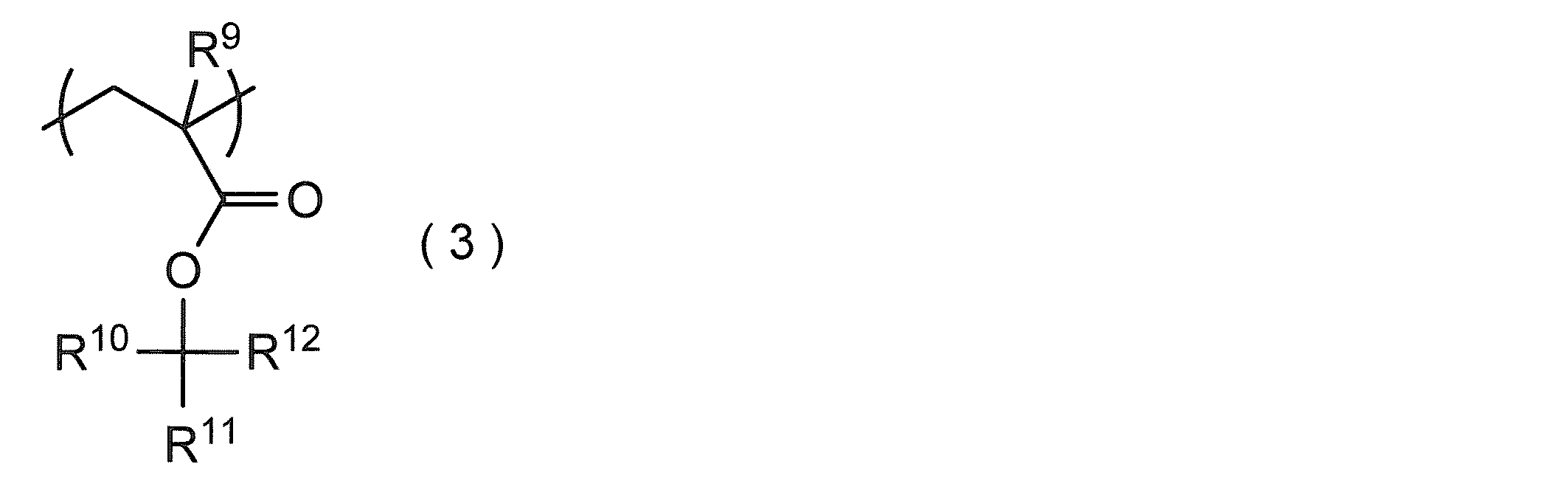
上記式(3)中、R9は、水素原子、フッ素原子、メチル基又はトリフルオロメチル基である。R10は、炭素数1~10の鎖状炭化水素基である。R11及びR12は、それぞれ独立して、炭素数1~10の鎖状炭化水素基若しくは炭素数3~20の脂環式炭化水素基であるか、又はこれらの基が互いに合わせられこれらが結合する炭素原子と共に構成される環炭素数3~20の脂環構造を表す。
上記R9としては、上記構造単位を与える単量体の共重合性が高くなる観点から、水素原子及びメチル基が好ましく、メチル基がより好ましい。
上記R10、R11及びR12で表される炭素数1~10の鎖状炭化水素基としては、例えば、メチル基、エチル基、n-プロピル基、i-プロピル基、n-ブチル基、i-ブチル基、sec-ブチル基、tert-ブチル基、n-ペンチル基、i-ペンチル基、sec-ペンチル基、neo-ペンチル基、tert-ペンチル基、n-ヘキシル基、i-ヘキシル基、n-ヘプチル基、i-ヘプチル基、n-オクチル基、i-オクチル基、n-ノニル基、i-ノニル基、n-デシル基、i-デシル基等のアルキル基等が挙げられる。上記鎖状炭化水素基としては、これらの中でも、炭素数1~3のアルキル基が好ましく、メチル基、エチル基、i-プロピル基がより好ましく、メチル基がさらに好ましい。
上記R11及びR12で表される炭素数3~20の1価の脂環式炭化水素基としては、例えば、シクロブチル基、シクロペンチル基、シクロヘキシル基、シクロヘプチル基、シクロオクチル基等の単環の脂環式炭化水素基;ノルボルニル基、イソボルニル基、アダマンチル基、トリシクロデカニル基、テトラシクロドデカニル基等の多環の脂環式炭化水素基等が挙げられる。上記脂環式炭化水素基としては、これらの中でも、シクロペンチル基、シクロヘキシル基、ノルボルニル基、イソボルニル基、アダマンチル基が好ましく、シクロペンチル基、アダマンチル基がより好ましい。上記R11及びR12の炭素数としては、4~15が好ましく、4~12がより好ましい。
上記R11及びR12が互いに合わせられこれらが結合する炭素原子と共に構成される炭素数3~20の脂環構造としては、例えば、シクロブタン構造、シクロペンタン構造、シクロヘキサン構造、シクロオクタン構造等の単環の脂環式炭化水素基;ノルボルナン構造、アダマンタン構造等の多環の脂環式炭化水素基等が挙げられる。上記脂環構造としては、これらの中でも、シクロペンタン構造、シクロヘキサン構造、ノルボルナン構造、アダマンタン構造が好ましく、シクロペンタン構造、アダマンタン構造がより好ましい。上記R11及びR12の炭素数としては、4~15が好ましく、4~12がより好ましい。
構造単位(I)としては、例えば、下記式(4-1)~(4-4)で表される構造単位等が挙げられる。
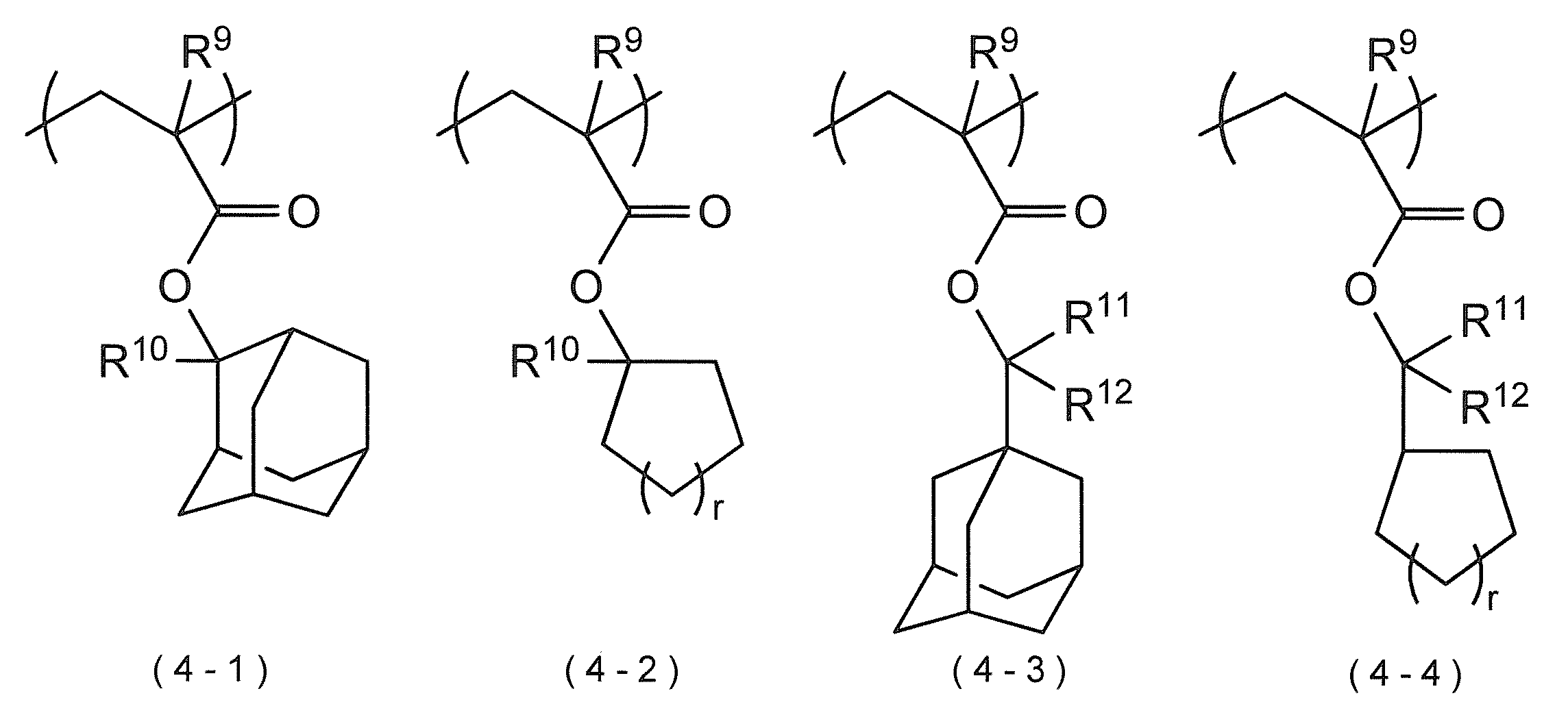
上記式(4-1)~(4-4)中、R9~R12は上記式(3)と同義である。また、rは1~4の整数である。
上記式(3)又は(4-1)~(4-4)で表される構造単位としては、例えば、下記式で表される構造単位等が挙げられる。
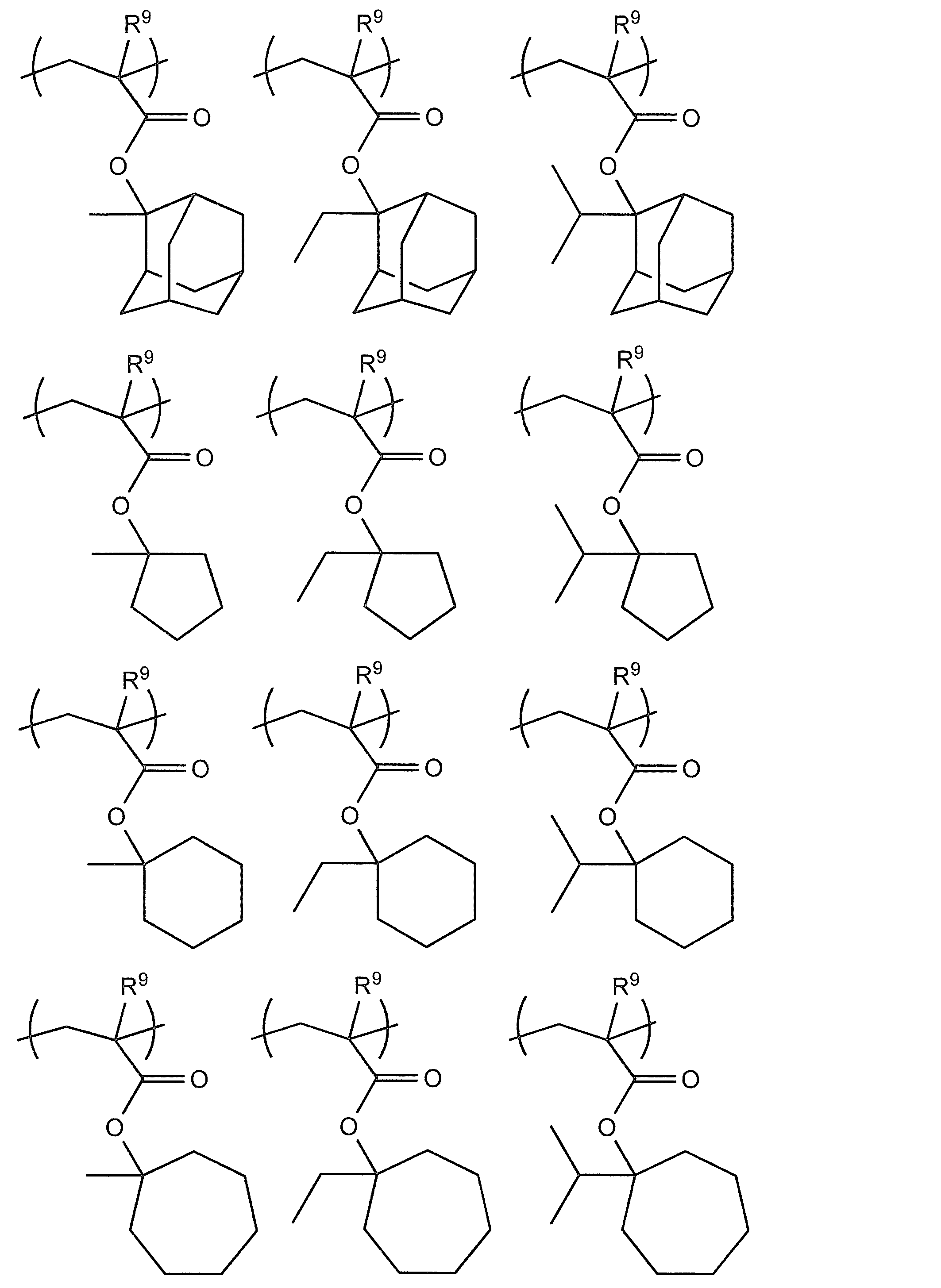

上記式中、R9は、上記式(3)と同義である。
構造単位(I)としては、上記式(4-1)で表される構造単位、式(4-2)で表される構造単位が好ましく、1-アルキル-1-シクロペンチル(メタ)アクリレートに由来する構造単位、2-アルキル-2-アダマンチル(メタ)アクリレートに由来する構造単位がより好ましい。また、1-メチル-1-シクロペンチル(メタ)アクリレートに由来する構造単位、1-エチル-1-シクロペンチル(メタ)アクリレートに由来する構造単位、2-メチル-2-アダマンチル(メタ)アクリレートに由来する構造単位、2-イソプロピル-2-アダマンチル(メタ)アクリレートに由来する構造単位がさらに好ましい。なお、(メタ)アクリレートはアクリレート又はメタクリレートをいう。
構造単位(I)の含有割合としては、[A]重合体を構成する全構造単位に対して、20モル%~80モル%が好ましく、40モル%~70モル%がより好ましい。含有割合を上記範囲内とすることで、フォトレジスト組成物中で十分な量の酸を解離させることができる傾向がある。構造単位(I)の含有割合が上記下限未満であると、当該フォトレジスト組成物のパターン形成性が低下することがある。構造単位(I)の含有割合が上記上限を超えると、形成されるレジストパターンの密着性が低下することがある。
<構造単位(II)>
構造単位(II)は、ラクトン構造、環状カーボネート構造及びスルトン構造からなる群より選ばれる少なくとも1種を含む構造単位である。[A]重合体は、構造単位(II)をさらに有することで、現像液への溶解性を調整することができる。また、当該フォトレジスト組成物から形成されるレジストパターンと基板との密着性を向上させることができる。
構造単位(II)は、ラクトン構造、環状カーボネート構造及びスルトン構造からなる群より選ばれる少なくとも1種を含む構造単位である。[A]重合体は、構造単位(II)をさらに有することで、現像液への溶解性を調整することができる。また、当該フォトレジスト組成物から形成されるレジストパターンと基板との密着性を向上させることができる。
構造単位(II)としては、例えば、下記式で表される構造単位等が挙げられる。


上記式中、R13は、水素原子、フッ素原子、メチル基又はトリフルオロメチル基である。
上記R13としては、これらの中でも、メチル基が好ましい。
構造単位(II)としては、これらの中でも、ラクトン構造を含む構造単位、スルトン構造を含む構造単位が好ましく、ラクトン構造を含む構造単位がより好ましく、ノルボルナンラクトン構造を含む構造単位がさらに好ましく、ノルボルナンラクトン-イル(メタ)アクリレートに由来する構造単位が特に好ましい。
構造単位(II)の含有割合としては、[A]重合体を構成する全構造単位に対して、0モル%~80モル%が好ましく、20モル%~80モル%がより好ましく、30モル%~70モル%がさらに好ましい。構造単位(II)の含有割合を上記範囲とすることで、[A]重合体の現像液への溶解性をより向上させることができる。また、当該フォトレジスト組成物から形成されるレジストパターンと基板との密着性をより向上させることができる。構造単位(II)の含有割合が上記上限を超えると、当該フォトレジスト組成物のパターン形成性が低下することがある。
<その他の構造単位>
[A]重合体は、上記構造単位(I)及び(II)以外にも、その他の構造単位を含有してもよい。その他の構造単位としては、例えば、非酸解離性の脂環式炭化水素基を含む構造単位、極性基を有する構造単位等が挙げられる。その他の構造単位の含有割合としては、[A]重合体を構成する全構造単位に対して、通常30モル%以下であり、20モル%以下が好ましい。
[A]重合体は、上記構造単位(I)及び(II)以外にも、その他の構造単位を含有してもよい。その他の構造単位としては、例えば、非酸解離性の脂環式炭化水素基を含む構造単位、極性基を有する構造単位等が挙げられる。その他の構造単位の含有割合としては、[A]重合体を構成する全構造単位に対して、通常30モル%以下であり、20モル%以下が好ましい。
当該フォトレジスト組成物における[A]重合体の含有量としては、全固形分に対して通常70質量%以上であり、75質量%以上が好ましい。[A]重合体の含有量が上記下限未満であると、当該フォトレジスト組成物のパターン形成性が低下することがある。なお、当該フォトレジスト組成物は[A]重合体を1種又は2種以上含有していてもよい。
<[A]重合体の合成方法>
[A]重合体は、例えば、各構造単位を与える単量体を、ラジカル重合開始剤を用い、適当な溶媒中で重合することにより合成できる。
[A]重合体は、例えば、各構造単位を与える単量体を、ラジカル重合開始剤を用い、適当な溶媒中で重合することにより合成できる。
上記ラジカル重合開始剤としては、例えば、アゾビスイソブチロニトリル(AIBN)、2,2’-アゾビス(4-メトキシ-2,4-ジメチルバレロニトリル)、2,2’-アゾビス(2-シクロプロピルプロピオニトリル)、2,2’-アゾビス(2,4-ジメチルバレロニトリル)、ジメチル2,2’-アゾビスイソブチレート等のアゾ系ラジカル開始剤;ベンゾイルパーオキサイド、t-ブチルハイドロパーオキサイド、クメンハイドロパーオキサイド等の過酸化物系ラジカル開始剤等が挙げられる。上記ラジカル重合開始剤としては、これらの中でも、AIBN、ジメチル2,2’-アゾビスイソブチレートが好ましく、AIBNがより好ましい。これらのラジカル開始剤は1種単独で又は2種以上を混合して用いることができる。
上記重合に使用される溶媒としては、例えば、
n-ペンタン、n-ヘキサン、n-ヘプタン、n-オクタン、n-ノナン、n-デカン等のアルカン類;
シクロヘキサン、シクロヘプタン、シクロオクタン、デカリン、ノルボルナン等のシクロアルカン類;
ベンゼン、トルエン、キシレン、エチルベンゼン、クメン等の芳香族炭化水素類;
クロロブタン類、ブロモヘキサン類、ジクロロエタン類、ヘキサメチレンジブロミド、クロロベンゼン等のハロゲン化炭化水素類;
酢酸エチル、酢酸n-ブチル、酢酸i-ブチル、プロピオン酸メチル等の飽和カルボン酸エステル類;
アセトン、2-ブタノン、2-ペンタノン、4-メチル-2-ペンタノン、2-ヘプタノン等のケトン類;
テトラヒドロフラン、ジメトキシエタン類、ジエトキシエタン類等のエーテル類;
メタノール、エタノール、1-プロパノール、2-プロパノール、4-メチル-2-ペンタノール等のアルコール類等が挙げられる。上記溶媒としては、2-ブタノンが好ましい。これらの重合に使用される溶媒は、1種単独で又は2種以上を併用してもよい。
n-ペンタン、n-ヘキサン、n-ヘプタン、n-オクタン、n-ノナン、n-デカン等のアルカン類;
シクロヘキサン、シクロヘプタン、シクロオクタン、デカリン、ノルボルナン等のシクロアルカン類;
ベンゼン、トルエン、キシレン、エチルベンゼン、クメン等の芳香族炭化水素類;
クロロブタン類、ブロモヘキサン類、ジクロロエタン類、ヘキサメチレンジブロミド、クロロベンゼン等のハロゲン化炭化水素類;
酢酸エチル、酢酸n-ブチル、酢酸i-ブチル、プロピオン酸メチル等の飽和カルボン酸エステル類;
アセトン、2-ブタノン、2-ペンタノン、4-メチル-2-ペンタノン、2-ヘプタノン等のケトン類;
テトラヒドロフラン、ジメトキシエタン類、ジエトキシエタン類等のエーテル類;
メタノール、エタノール、1-プロパノール、2-プロパノール、4-メチル-2-ペンタノール等のアルコール類等が挙げられる。上記溶媒としては、2-ブタノンが好ましい。これらの重合に使用される溶媒は、1種単独で又は2種以上を併用してもよい。
上記重合における反応温度としては、通常40℃~150℃であり、50℃~120℃が好ましい。反応時間としては、通常1時間~48時間であり、1時間~24時間が好ましい。
[A]重合体のゲルパーミエーションクロマトグラフィー(GPC)によるポリスチレン換算重量平均分子量(Mw)としては、特に限定されず、通常1,000以上500,000以下であり、2,000以上400,000以下が好ましく、3,000以上300,000以下がより好ましい。[A]重合体のMwが上記下限未満であると、得られるレジスト膜の耐熱性が低下することがある。[A]重合体のMwが上記上限を超えると、レジスト膜の現像性は低下することがある。
[A]重合体のGPCによるポリスチレン換算数平均分子量(Mn)に対するMwの比(Mw/Mn)としては、通常1以上5以下であり、1以上3以下が好ましく、1以上2以下がより好ましい。Mw/Mnが上記上限を超えると、得られるレジスト膜の耐熱性が低下することがある。
本明細書における重合体のMw及びMnは、以下の条件によるゲルパーミエーションクロマトグラフィー(GPC)を用いて測定される値である。
GPCカラム:G2000HXL 2本、G3000HXL 1本、G4000HXL 1本(以上、東ソー製)
カラム温度:40℃
溶出溶媒:テトラヒドロフラン
流速:1.0mL/分
試料濃度:1.0質量%
試料注入量:100μL
検出器:示差屈折計
標準物質:単分散ポリスチレン
GPCカラム:G2000HXL 2本、G3000HXL 1本、G4000HXL 1本(以上、東ソー製)
カラム温度:40℃
溶出溶媒:テトラヒドロフラン
流速:1.0mL/分
試料濃度:1.0質量%
試料注入量:100μL
検出器:示差屈折計
標準物質:単分散ポリスチレン
[A]重合体が含む低分子量成分とは、分子量1,000以下の成分をいう。低分子量成分の含有量(質量%)は、[A]重合体のガラス転移温度上昇の観点から、0.5質量%未満が好ましく、0.2質量%未満がさらに好ましく、0.1質量%未満がより好ましい。
本明細書における低分子量成分の含有量(質量%)は、以下の条件による高速液体クロマトグラフィー(HPLC)を用いて測定される値である。
HPLCカラム:Intersil ODS-25μm、4.6mmφ×250mm(ジーエルサイエンス社製)
溶出溶媒:アクリルニトリル/0.1質量%リン酸水溶液
流速:1.0mL/分
試料濃度:1.0質量%
試料注入量:100μL
検出器:示差屈折率
HPLCカラム:Intersil ODS-25μm、4.6mmφ×250mm(ジーエルサイエンス社製)
溶出溶媒:アクリルニトリル/0.1質量%リン酸水溶液
流速:1.0mL/分
試料濃度:1.0質量%
試料注入量:100μL
検出器:示差屈折率
<[B]酸発生剤>
[B]酸発生剤は、化合物(1)を少なくとも含む酸発生剤である。酸発生剤は、露光によりエネルギーを吸収し、スルホン酸等の酸を発生する化合物等をいう。[A]重合体及び[B]酸発生剤を含有するフォトレジスト組成物を用いることで、優れたMEEF性能を発揮しつつ、断面形状等のパターン形状及びエッチング耐性に優れたレジストパターンを形成できる。[B]酸発生剤は、本発明の効果を損なわない範囲で、化合物(1)以外の化合物を含むこともでき、酸発生剤組成物としても使用できる。これらの化合物は、単独で使用してもよく、2種以上を併用してもよい。
[B]酸発生剤は、化合物(1)を少なくとも含む酸発生剤である。酸発生剤は、露光によりエネルギーを吸収し、スルホン酸等の酸を発生する化合物等をいう。[A]重合体及び[B]酸発生剤を含有するフォトレジスト組成物を用いることで、優れたMEEF性能を発揮しつつ、断面形状等のパターン形状及びエッチング耐性に優れたレジストパターンを形成できる。[B]酸発生剤は、本発明の効果を損なわない範囲で、化合物(1)以外の化合物を含むこともでき、酸発生剤組成物としても使用できる。これらの化合物は、単独で使用してもよく、2種以上を併用してもよい。
当該フォトレジスト組成物が上記構成を有することで上記効果を奏する理由については必ずしも明確ではないが、例えば、以下のように推察される。すなわち、R2が上記アルカンジイル基又は上記フッ素化アルカンジイル基であることで、[B]酸発生剤の[A]重合体等との相溶性を高めることができ、レジスト膜中に[B]酸発生剤をより均一に分散させることができる。その結果、レジストパターンは従来のもののようにトップロス形状にはなり難く、断面形状は矩形となり易い。また、スルホン酸エステル構造と上記R2との好適な極性により、酸拡散性が適度に制御されるので、当該フォトレジスト組成物のMEEF性能を向上できると考えられる。さらに、R2内のフッ素原子数が比較的少なく、すなわち上記R2のフッ素数を上記範囲とすることで、エッチングに対する耐性を向上させることができる。
<化合物(1)>
化合物(1)は下記式(1)で表される。
化合物(1)は下記式(1)で表される。

上記式(1)中、R1は、置換若しくは非置換の炭素数1~30の1価の炭化水素基又は置換若しくは非置換の環原子数3~30の1価の複素環基である。R2は、炭素数1~30のアルカンジイル基又はフッ素数が炭素数よりも小さい炭素数2~30のフッ素化アルカンジイル基である。Q+は、1価の光分解性有機カチオンである。
上記炭素数は炭化水素基に含まれる炭素数をいい、任意の置換基に含まれる炭素数は含まない。また、上記環原子数は、複素環基に含まれる炭素原子及びヘテロ原子の個数をいい、任意の置換基に含まれる炭素数等は含まない。
上記化合物(1)はアニオンと光分解性有機カチオン(Q+)とを含む。「光分解性有機カチオン」は、露光により分解し、プロトンを発生することができる炭素原子を含むカチオンである。
上記R1は上記炭化水素基又は上記複素環基であるため、[A]重合体や[E]溶媒への優れた相溶性を確保することができる。炭化水素基の炭素数や複素環基の環原子数が上記上限を超えると、上記相溶性が低下する。
上記炭化水素基としては、例えば、
メチル基、エチル基、n-プロピル基、i-プロピル基、n-ブチル基、i-ブチル基、sec-ブチル基、tert-ブチル基、n-ペンチル基、i-ペンチル基、sec-ペンチル基、neo-ペンチル基、tert-ペンチル基、n-ヘキシル基、i-ヘキシル基、n-ヘプチル基、i-ヘプチル基、n-オクチル基、i-オクチル基、n-ノニル基、i-ノニル基、n-デシル基、i-デシル基等のアルキル基;
シクロブチル基、シクロペンチル基、シクロヘキシル基、シクロヘプチル基、シクロオクチル基等の単環のシクロアルキル基;
ノルボルニル基、イソボルニル基、アダマンチル基、トリシクロデカニル基、テトラシクロドデカニル基等の多環のシクロアルキル基;
エテニル基、1-プロペン-1-イル基等のアルケニル基;
エチニル基、プロピニル基等のアルキニル基;
フェニル基、ナフチル基、ビフェニル基、フルオレニル基、アントリル基、フェナントリル基等のアリール基;
ベンジル基、フェネチル基、1-ナフチルメチル基、2-ナフチルメチル基、1-ナフチルエチル基、2-ナフチルエチル基等のアラルキル基等が挙げられる。
メチル基、エチル基、n-プロピル基、i-プロピル基、n-ブチル基、i-ブチル基、sec-ブチル基、tert-ブチル基、n-ペンチル基、i-ペンチル基、sec-ペンチル基、neo-ペンチル基、tert-ペンチル基、n-ヘキシル基、i-ヘキシル基、n-ヘプチル基、i-ヘプチル基、n-オクチル基、i-オクチル基、n-ノニル基、i-ノニル基、n-デシル基、i-デシル基等のアルキル基;
シクロブチル基、シクロペンチル基、シクロヘキシル基、シクロヘプチル基、シクロオクチル基等の単環のシクロアルキル基;
ノルボルニル基、イソボルニル基、アダマンチル基、トリシクロデカニル基、テトラシクロドデカニル基等の多環のシクロアルキル基;
エテニル基、1-プロペン-1-イル基等のアルケニル基;
エチニル基、プロピニル基等のアルキニル基;
フェニル基、ナフチル基、ビフェニル基、フルオレニル基、アントリル基、フェナントリル基等のアリール基;
ベンジル基、フェネチル基、1-ナフチルメチル基、2-ナフチルメチル基、1-ナフチルエチル基、2-ナフチルエチル基等のアラルキル基等が挙げられる。
炭化水素基の炭素数としては、1~20が好ましく、1~15がより好ましい。
上記複素環基としては、例えば、
フリル基、ピロリル基、チエニル基、オキサゾリル基、イソオキサゾリル基、イミダゾリル基、チアゾリル基、イソチアゾリル基、ピリジニル基、ピリミジニル基、テトラゾリル基、ピラゾリル基、ピリダジニル基、ピラジニル基、チアジアゾリル基、ジベンゾフラニル基等の芳香族複素環基(すなわちヘテロアリール基);
ピペリジニル基、テトラヒドロピラニル基、テトラヒドロフラニル基、オキセタニル基、アゼチジニル基、ピロリジニル基、モルホリニル基、チオモルホリニル基、ジオキサニル基、ピペラジニル基等の脂肪族複素環基等が挙げられる。
フリル基、ピロリル基、チエニル基、オキサゾリル基、イソオキサゾリル基、イミダゾリル基、チアゾリル基、イソチアゾリル基、ピリジニル基、ピリミジニル基、テトラゾリル基、ピラゾリル基、ピリダジニル基、ピラジニル基、チアジアゾリル基、ジベンゾフラニル基等の芳香族複素環基(すなわちヘテロアリール基);
ピペリジニル基、テトラヒドロピラニル基、テトラヒドロフラニル基、オキセタニル基、アゼチジニル基、ピロリジニル基、モルホリニル基、チオモルホリニル基、ジオキサニル基、ピペラジニル基等の脂肪族複素環基等が挙げられる。
複素環基の環原子数としては、3~20が好ましく、3~15がより好ましい。
上記炭化水素基及び複素環基は、本発明の効果を損なわない範囲で、それらの水素原子の一部又は全部が任意の置換基によって置換されていてもよい。上記置換基としては、所望の物性を得ることができる限り特に限定されず、例えば、アルコキシ基、ヒドロキシ基、アルデヒド基、カルボキシ基、カルボニル基、アミド基、イミド基、アミノ基、イミノ基、シアノ基、アゾ基、アジ基、チオール基、スルホ基、ニトロ基、エーテル基、エステル基、ラクトン構造を有する基、アルキルカルボニル基、オキソ基、ハロゲン原子等の公知の基が挙げられる。上記置換基としては、これらの中でも、オキソ基が好ましい。すなわち、上記R1はカルボニル基を含むことが好ましい。
上記R1としては、置換又は非置換のアルキル基、置換又は非置換のシクロアルキル基、置換又は非置換の芳香族複素環基が好ましく、非置換のアルキル基、置換シクロアルキル基、非置換の芳香族複素環基がより好ましく、非置換の炭素数1~4のアルキル基、オキソ基で置換されたシクロアルキル基、酸素原子を構成原子として含む芳香族複素環基がさらに好ましく、メチル基、n-ブチル基、10-カンファー基、ジベンゾフラニル基が特に好ましい。
上記R2は、炭素数1~30のアルカンジイル基又はフッ素数が炭素数よりも小さい炭素数2~30のフッ素化アルカンジイル基であり、好ましくはフッ素数が炭素数よりも小さい炭素数2~30のフッ素化アルカンジイル基である。炭化水素基の炭素数や複素環基の環原子数が上記上限を超えると、溶媒への溶解性が低下する。
上記アルカンジイル基としては、例えば、メタンジイル基、エタンジイル基、プロパンジイル基、ブタンジイル基、ペンタンジイル基、ヘキサンジイル基、ヘプタンジイル基、オクタンジイル基、ノナンジイル基、デカンジイル基等が挙げられる。
上記フッ素化アルカンジイル基としては、例えば、上記アルカンジイル基の水素原子の一部がフッ素原子で置換された基のうち、フッ素数が炭素数よりも小さい基等が挙げられる。フッ素数を上記範囲とすることで、炭化水素部分に由来する親油性、フッ素原子に由来する極性等の両者の優れた特性を[B]酸発生剤は有することができると推察される。
上記アルカンジイル基の炭素数としては、1~20が好ましく、1~10がより好ましい。また、上記フッ素化アルカンジイル基の炭素数としては、2~20が好ましく、2~10がより好ましい。
アルカンジイル基及びフッ素化アルカンジイル基は、直鎖状であってよく、或いは側鎖を有していてもよい。
上記R2はフッ素化アルカンジイル基であり、このフッ素化アルカンジイル基のフッ素数は2以上であることが好ましい。この場合、発生する酸の強さを高めることができ、その結果、当該フォトレジスト組成物によれば、より優れたMEEF性能を発揮しつつ、パターン形状及びエッチング耐性により優れたレジストパターンを形成できる。
フッ素数が2以上のフッ素化アルカンジイル基としては、例えば、プロパンジイル基、ブタンジイル基、ペンタンジイル基、ヘキサンジイル基、ヘプタンジイル基、オクタンジイル基、ノナンジイル基、デカンジイル基等の任意の水素原子をフッ素原子で2以上置換したもの等が挙げられる。
上記フッ素数としては、2~10がより好ましく、2~8がさらに好ましい。なお、上記フッ素数は上記フッ素化アルカンジイル基の炭素数より小さい。
上記フッ素化アルカンジイル基としては、下記式(i)で表されることが好ましい。

上記式(i)中、R3は、炭素数3以上のアルカンジイル基又は炭素数3以上のフッ素化アルカンジイル基である。
[B]酸発生剤は上記式(i)で表される基を有することで、発生する酸の強さをより高めることができ、その結果当該フォトレジスト組成物は、上記特性をさらに高めることができる。なお、上記式(i)の-CF2-基は上記式(1)の-SO3
-基と結合する。
上記R3としては、例えば、1個の水素原子がフッ素原子で置換されているか又は非置換のプロパンジイル基、1個又は2個の水素原子がフッ素原子で置換されているか又は非置換のブタンジイル基、1個~3個の水素原子がフッ素原子で置換されているか又は非置換のペンタンジイル基、1個~4個の水素原子がフッ素原子で置換されているか又は非置換のヘキサンジイル基、1個~5個の水素原子がフッ素原子で置換されているか又は非置換のヘプタンジイル基、1個~6個の水素原子がフッ素原子で置換されているか又は非置換のオクタンジイル基、1個~7個の水素原子がフッ素原子で置換されているか又は非置換のノナンジイル基、1個~8個の水素原子がフッ素原子で置換されているか又は非置換のデカンジイル基等が挙げられる。また、本発明の効果を損なわない範囲で、いずれの水素原子がフッ素原子で置換されていてもよい。
上記R3の炭素数としては、アルカンジイル基及びフッ素化アルカンジイル基のいずれの場合であっても、3~29が好ましく、3~19がより好ましく、3~9がさらに好ましい。炭素数が上記範囲内であると、化合物(1)は[A]重合体へのさらに優れた相溶性を示す傾向がある。
上記R3としては、1個の水素原子がフッ素原子で置換されているか又は非置換のプロパンジイル基、1個又は2個の水素原子がフッ素原子で置換されているか又は非置換のブタンジイル基、1個~3個の水素原子がフッ素原子で置換されているか又は非置換のペンタンジイル基、1個~4個の水素原子がフッ素原子で置換されているか又は非置換のヘキサンジイル基、1個~5個の水素原子がフッ素原子で置換されているか又は非置換のヘプタンジイル基、1個~6個の水素原子がフッ素原子で置換されているか又は非置換のオクタンジイル基が好ましく、プロパンジイル基、ジフルオロブタンジイル基、ジフルオロオクタンジイル基、ヘキサフルオロオクタンジイル基がより好ましい。
上記化合物(1)のアニオンとしては、例えば、下記式(5-1)~(5-14)で表されるアニオン等が挙げられる。これらのアニオンは、単独で使用してもよく、2種以上を併用してもよい。
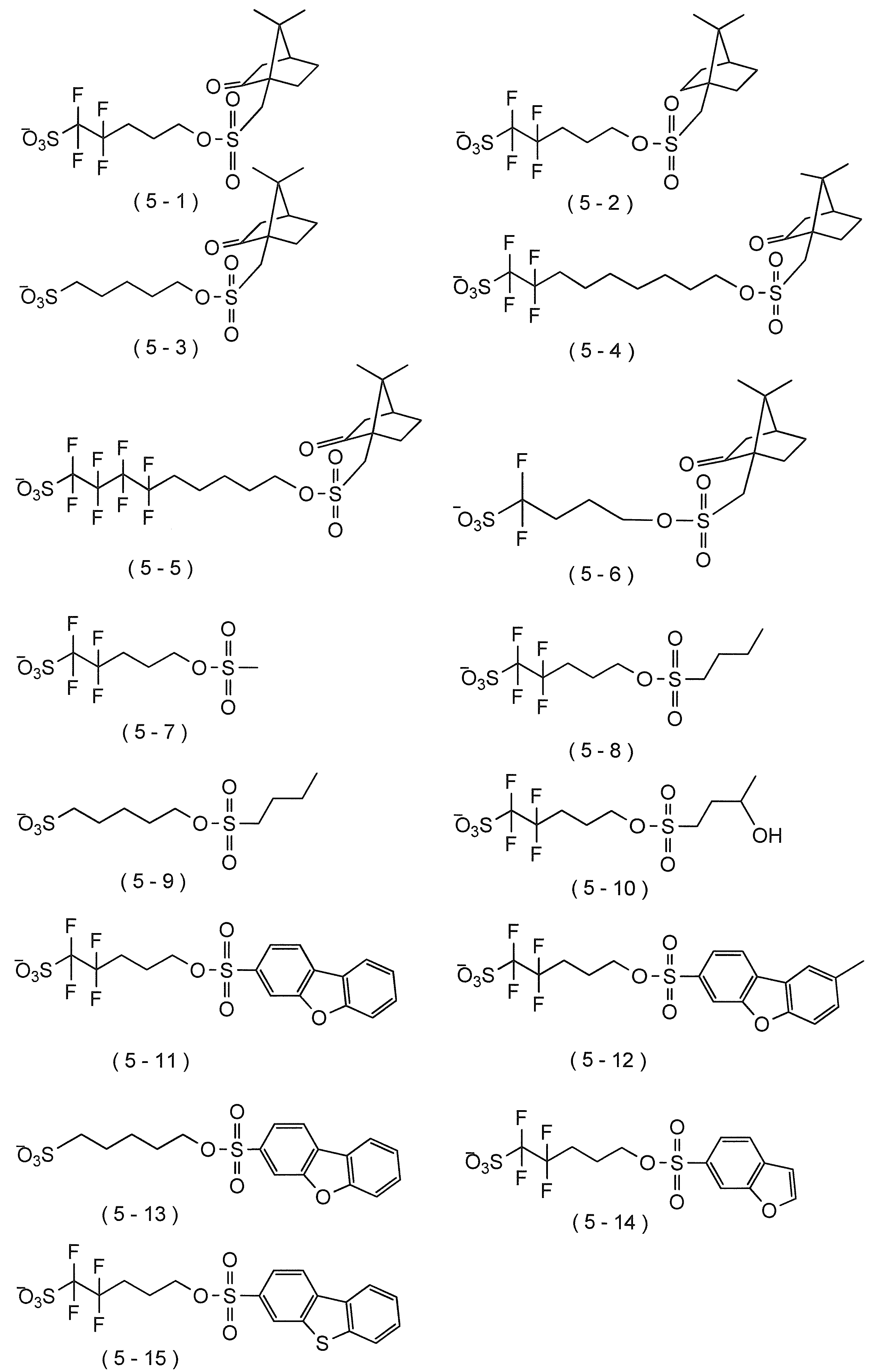
上記化合物(1)のアニオンとしては、上記式(5-1)、(5-4)、(5-5)、(5-6)、(5-7)、(5-8)及び(5-11)で表されるアニオンが好ましく、上記式(5-1)で表されるアニオンがより好ましい。
上記Q+としては、1価の光分解性有機カチオンである限り特に限定されず、例えば、公知の光分解性有機カチオンが挙げられる。
光分解性有機カチオンとしては、例えば、スルホニウムイオン、ヨードニウムイオン、イミダゾリウムイオン、ピリジニウムイオン、アンモニウムイオン、ピロリジニウムイオン、ホスホニウムイオン等が挙げられ、光分解性有機カチオンとしては、これらの中でも、スルホニウムイオン、ヨードニウムイオンが好ましい。光分解性有機カチオンがスルホニウムイオン及びヨードニウムイオンのいずれかであると、当該フォトレジスト組成物のMEEF性能等の上記特性を高められる傾向がある。これらの光分解性有機カチオンは、単独で使用してもよく、2種以上を併用してもよい。
上記Q+としては、下記式(2-1)で表されるスルホニウムカチオン及び下記式(2-2)で表されるヨードニウムカチオンからなる群より選ばれる少なくとも1種であることがより好ましい。レジストパターンの感度を高めることができる。

上記式(2-1)中、R4、R5及びR6は、それぞれ独立して、置換若しくは非置換の炭素数1~20のアルキル基若しくは置換若しくは非置換の炭素数6~30のアリール基であるか、又はこれらの基のうちのいずれか2つ以上が互いに合わせられこれらが結合する硫黄原子と共に構成される環構造を表す。
上記式(2-2)中、R7及びR8は、それぞれ独立して、置換若しくは非置換の炭素数1~20のアルキル基又は置換若しくは非置換の炭素数6~30のアリール基であるか、又はこれらの基が互いに合わせられこれらが結合するヨウ素原子と共に構成される環構造を表す。
上記炭素数は各官能基に含まれる炭素数をいい、任意の置換基に含まれる炭素数は含まない。
上記アルキル基やアリール基の炭素数が上記上限を超えると、当該化合物の[A]重合体との間の相溶性や[E]溶媒への溶解性が低下することがある。
上記R4~R8が有していてもよい任意の置換基としては、例えば、R1において例示したような公知の官能基が挙げられる。
上記R4、R5及びR6に含まれるアルキル基としては、例えば、R1において例示したようなもの等が挙げられる。上記アルキル基の炭素数としては、1~15が好ましく、1~10がより好ましい。
上記R4、R5及びR6に含まれるアリール基としては、例えば、R1において例示したようなもの等が挙げられる。上記アリール基としては、これらの中でも、フェニル基が好ましい。上記アリール基の炭素数としては、6~25が好ましく、6~20がより好ましい。
上記R4、R5及びR6は、これらの基のうちのいずれか2つ以上が互いに合わせられこれらが結合する硫黄原子と共に構成される環構造を表していてもよい。環構造としては、例えば、脂環構造内の1つの炭素原子を硫黄原子で置換した構造等が挙げられる。環原子数としては、3~20が好ましく、3~15がより好ましい。還原子数が上記範囲内であると、レジストパターンの感度を高められる傾向がある。
上記スルホニウムカチオンとしては、例えば、トリフェニルスルホニウムカチオン、シクロヘキシル2-オキソシクロヘキシルメチルスルホニウムカチオン、ジシクロヘキシル2-オキソシクロヘキシルスルホニウムカチオン、2-オキソシクロヘキシルジメチルスルホニウムカチオン、4-ヒドロキシ-1-ナフチルジメチルスルホニウムカチオン、ジフェニル-4-ヒドロキシフェニルスルホニウムカチオン、4-t-ブトキシフェニルジフェニルスルホニウムカチオン等の公知のカチオンが挙げられる。上記スルホニウムカチオンとしては、これらの中でも、トリフェニルスルホニウムカチオンが好ましい。
上記R7及びR8に含まれるアルキル基としては、例えば、R1において例示したもの等が挙げられる。上記アルキル基の炭素数としては、1~15が好ましく、1~10がより好ましい。
上記R7及びR8に含まれるアリール基としては、例えば、R1において例示したもの等が挙げられる。上記アリール基としては、これらの中でも、フェニル基が好ましい。上記アリール基の炭素数としては、6~25が好ましく、6~20がより好ましい。
上記R7及びR8は、これらの基が互いに合わせられこれらが結合するヨウ素原子と共に構成される環構造を表していてもよい。環構造としては、例えば、脂環構造内の1つの炭素原子をヨウ素原子で置換した構造等が挙げられる。環原子数としては、3~20が好ましく、3~15がより好ましい。還原子数が上記範囲内であると、レジストパターンの感度を高められる傾向がある。
上記ヨードニウムカチオンとしては、例えば、ジフェニルヨードニウムカチオン、ビス(4-t-ブチルフェニル)ヨードニウムパーフルオロ-n-オクタンスルホネート、ビス(4-t-ブチルフェニル)ヨードニウム等の公知のカチオンが挙げられる。上記ヨードニウムカチオンとしては、これらの中でも、ジフェニルヨードニウムカチオンが好ましい。
上記化合物(1)としては、例えば、上述のアニオンと光分解性有機カチオンとの組み合わせ等が挙げられる。
上記化合物(1)としては、下記式で表される化合物が好ましい。

[B]酸発生剤中に含まれる化合物(1)の含有率としては、特に限定されず、通常10質量%以上であり、20質量%以上100%以下が好ましい。含有率が上記下限未満であると、レジストパターンの断面形状が低下することがある。
[B]酸発生剤中に含まれる化合物(1)以外のその他の酸発生剤としては、例えば、化合物(1)以外のオニウム塩化合物、ハロゲン含有化合物、ジアゾケトン化合物、スルホン化合物、スルホン酸化合物、ジアゾメタン系化合物、ニトロベンジルスルホネート系化合物、イミノスルホネート系化合物等が挙げられる。
上記オニウム塩化合物としては、例えば、化合物(1)以外のヨードニウム塩及びスルホニウム塩、そしてホスホニウム塩、ジアゾニウム塩、ピリジニウム塩等が挙げられる。
具体的には、ジフェニルヨードニウムトリフルオロメタンスルホネート、ジフェニルヨードニウムノナフルオロ-n-ブタンスルホネート、ジフェニルヨードニウムパーフルオロ-n-オクタンスルホネート、ジフェニルヨードニウム2-ビシクロ[2.2.1]ヘプタ-2-イル-1,1,2,2-テトラフルオロエタンスルホネート、ビス(4-t-ブチルフェニル)ヨードニウムトリフルオロメタンスルホネート、ビス(4-t-ブチルフェニル)ヨードニウムノナフルオロ-n-ブタンスルホネート、ビス(4-t-ブチルフェニル)ヨードニウムパーフルオロ-n-オクタンスルホネート、ビス(4-t-ブチルフェニル)ヨードニウム2-ビシクロ[2.2.1]ヘプタ-2-イル-1,1,2,2-テトラフルオロエタンスルホネート、シクロヘキシル2-オキソシクロヘキシルメチルスルホニウムトリフルオロメタンスルホネート、ジシクロヘキシル2-オキソシクロヘキシルスルホニウムトリフルオロメタンスルホネート、2-オキソシクロヘキシルジメチルスルホニウムトリフルオロメタンスルホネート等が挙げられる。
具体的には、ジフェニルヨードニウムトリフルオロメタンスルホネート、ジフェニルヨードニウムノナフルオロ-n-ブタンスルホネート、ジフェニルヨードニウムパーフルオロ-n-オクタンスルホネート、ジフェニルヨードニウム2-ビシクロ[2.2.1]ヘプタ-2-イル-1,1,2,2-テトラフルオロエタンスルホネート、ビス(4-t-ブチルフェニル)ヨードニウムトリフルオロメタンスルホネート、ビス(4-t-ブチルフェニル)ヨードニウムノナフルオロ-n-ブタンスルホネート、ビス(4-t-ブチルフェニル)ヨードニウムパーフルオロ-n-オクタンスルホネート、ビス(4-t-ブチルフェニル)ヨードニウム2-ビシクロ[2.2.1]ヘプタ-2-イル-1,1,2,2-テトラフルオロエタンスルホネート、シクロヘキシル2-オキソシクロヘキシルメチルスルホニウムトリフルオロメタンスルホネート、ジシクロヘキシル2-オキソシクロヘキシルスルホニウムトリフルオロメタンスルホネート、2-オキソシクロヘキシルジメチルスルホニウムトリフルオロメタンスルホネート等が挙げられる。
ハロゲン含有化合物としては、例えば、ハロアルキル基含有炭化水素化合物、ハロアルキル基含有複素環式化合物等が挙げられる。具体的には、例えば、フェニルビス(トリクロロメチル)-s-トリアジン、4-メトキシフェニルビス(トリクロロメチル)-s-トリアジン、1-ナフチルビス(トリクロロメチル)-s-トリアジン等の(トリクロロメチル)-s-トリアジン誘導体;1,1-ビス(4-クロロフェニル)-2,2,2-トリクロロエタン等が挙げられる。
ジアゾケトン化合物としては、例えば、1,3-ジケト-2-ジアゾ化合物、ジアゾベンゾキノン化合物、ジアゾナフトキノン化合物等が挙げられる。具体的には、例えば、1,2-ナフトキノンジアジド-4-スルホニルクロリド、1,2-ナフトキノンジアジド-5-スルホニルクロリド、2,3,4,4’-テトラヒドロキシベンゾフェノンの1,2-ナフトキノンジアジド-4-スルホン酸エステル、1,2-ナフトキノンジアジド-5-スルホン酸エステル、1,1,1-トリス(4-ヒドロキシフェニル)エタンの1,2-ナフトキノンジアジド-4-スルホン酸エステル、1,2-ナフトキノンジアジド-5-スルホン酸エステル等が挙げられる。
スルホン化合物としては、例えば、β-ケトスルホン、β-スルホニルスルホンや、これらの化合物のα-ジアゾ化合物等が挙げられる。具体的には、例えば、4-トリスフェナシルスルホン、メシチルフェナシルスルホン、ビス(フェニルスルホニル)メタン等が挙げられる。
スルホン酸化合物としては、例えば、アルキルスルホン酸エステル、アルキルスルホン酸イミド、ハロアルキルスルホン酸エステル、アリールスルホン酸エステル、イミノスルホネート等が挙げられる。
具体的には、ベンゾイントシレート、ピロガロールのトリス(トリフルオロメタンスルホネート)、ニトロベンジル-9,10-ジエトキシアントラセン-2-スルホネート、トリフルオロメタンスルホニルビシクロ[2.2.1]ヘプト-5-エン-2,3-ジカルボジイミド、ノナフルオロ-n-ブタンスルホニルビシクロ[2.2.1]ヘプト-5-エン-2,3-ジカルボジイミド、パーフルオロ-n-オクタンスルホニルビシクロ[2.2.1]ヘプト-5-エン-2,3-ジカルボジイミド、2-ビシクロ[2.2.1]ヘプタ-2-イル-1,1,2,2-テトラフルオロエタンスルホニルビシクロ[2.2.1]ヘプト-5-エン-2,3-ジカルボジイミド、N-(トリフルオロメタンスルホニルオキシ)スクシンイミド、N-(ノナフルオロ-n-ブタンスルホニルオキシ)スクシンイミド、N-(パーフルオロ-n-オクタンスルホニルオキシ)スクシンイミド、N-(2-ビシクロ[2.2.1]ヘプタ-2-イル-1,1,2,2-テトラフルオロエタンスルホニルオキシ)スクシンイミド、1,8-ナフタレンジカルボン酸イミドトリフルオロメタンスルホネート、1,8-ナフタレンジカルボン酸イミドノナフルオロ-n-ブタンスルホネート、1,8-ナフタレンジカルボン酸イミドパーフルオロ-n-オクタンスルホネート等が挙げられる。
これらの化合物は、単独で使用してもよく、2種以上を併用してもよい。[B]酸発生剤の配合量としては、[A]重合体100質量部に対して、通常0.1質量部~20質量部であり、0.5質量部~15質量部が好ましい。配合量が上記範囲内である場合、[A]重合体と[B]酸発生剤との間の優れた相溶性を確保できる傾向がある。配合量が上記上限を超えると、当該フォトレジスト組成物の露光光に対する透明性が低下し、所望の上記特性を有するレジストパターンが得られ難いことがある。配合量が上記下限未満であると、当該フォトレジスト組成物の感度や現像性が低下することがある。
<酸発生剤の製造方法>
化合物(1)を含む酸発生剤は、特に制限されず、公知の方法に従って製造することができる。
化合物(1)を含む酸発生剤は、特に制限されず、公知の方法に従って製造することができる。
化合物(1)の製造方法の一例を挙げると、出発原料としてBr-R2-OH(R2は、上記式(1)と同義である。)を用いて得られる上記化合物は、
上記出発原料を、亜二チオン酸ナトリウム及び炭酸水素ナトリウムの存在下、アセトニトリル水溶液中で加熱する工程、
先の工程で得られた水層を、過酸化水素水及びタングステン酸二ナトリウムの存在下、加熱する工程、
先の工程で得られた水層に、光分解性有機カチオン(Q+)の塩化物(Q+は、上記式(1)と同義である。)、ジクロロメタン及び水を加え、室温で攪拌する工程、及び
先の工程で得られたジクロロメタン溶液に、トリエチルアミン及び4-ジメチルアミノピリジンを加え、冷却し、次いでR1-SO2Cl(R1は、上記式(1)と同義である。)のジクロロメタン溶液を滴下し、攪拌する工程を有する製造方法により得ることができる。各工程における温度、圧力、時間や設備のようなその他の工程条件は、特に限定されず、使用原料等に従って適宜設定される。各工程の段階数も、特に限定されず、1段階で行ってもよく、多段階で行ってもよい。
上記出発原料を、亜二チオン酸ナトリウム及び炭酸水素ナトリウムの存在下、アセトニトリル水溶液中で加熱する工程、
先の工程で得られた水層を、過酸化水素水及びタングステン酸二ナトリウムの存在下、加熱する工程、
先の工程で得られた水層に、光分解性有機カチオン(Q+)の塩化物(Q+は、上記式(1)と同義である。)、ジクロロメタン及び水を加え、室温で攪拌する工程、及び
先の工程で得られたジクロロメタン溶液に、トリエチルアミン及び4-ジメチルアミノピリジンを加え、冷却し、次いでR1-SO2Cl(R1は、上記式(1)と同義である。)のジクロロメタン溶液を滴下し、攪拌する工程を有する製造方法により得ることができる。各工程における温度、圧力、時間や設備のようなその他の工程条件は、特に限定されず、使用原料等に従って適宜設定される。各工程の段階数も、特に限定されず、1段階で行ってもよく、多段階で行ってもよい。
<任意成分>
当該フォトレジスト組成物は、好適成分として、[C]酸拡散制御体、[D]フッ素原子含有重合体及び[E]溶媒を含有してもよく、また、本発明の効果を損なわない範囲で、[F]偏在化促進剤、界面活性剤、脂環式骨格化合物、増感剤、架橋剤、界面活性剤、溶解抑制剤、可塑剤、安定剤、着色剤、ハレーション防止剤、染料、顔料、接着助剤、アルカリ可溶性樹脂、酸解離性の保護基を有する低分子のアルカリ溶解性制御剤、塩基性化合物、溶解阻止剤、保存安定化剤、消泡剤等のその他の任意成分を含むことができる。その他の成分の配合量は、その目的に応じて適宜決定することができる。これらの成分について以下に説明する。
当該フォトレジスト組成物は、好適成分として、[C]酸拡散制御体、[D]フッ素原子含有重合体及び[E]溶媒を含有してもよく、また、本発明の効果を損なわない範囲で、[F]偏在化促進剤、界面活性剤、脂環式骨格化合物、増感剤、架橋剤、界面活性剤、溶解抑制剤、可塑剤、安定剤、着色剤、ハレーション防止剤、染料、顔料、接着助剤、アルカリ可溶性樹脂、酸解離性の保護基を有する低分子のアルカリ溶解性制御剤、塩基性化合物、溶解阻止剤、保存安定化剤、消泡剤等のその他の任意成分を含むことができる。その他の成分の配合量は、その目的に応じて適宜決定することができる。これらの成分について以下に説明する。
<[C]酸拡散制御体>
[C]酸拡散制御体は、露光により発生する酸のレジスト膜中における拡散現象を制御し、非露光領域における好ましくない化学反応を抑制する効果を奏し、得られるフォトレジスト組成物の貯蔵安定性がさらに向上し、またレジストとしての解像度がさらに向上すると共に、露光から現像処理までの引き置き時間の変動によるレジストパターンの線幅変化を抑えることができ、プロセス安定性に極めて優れたフォトレジスト組成物が得られる。[C]酸拡散制御体の当該フォトレジスト組成物における含有形態としては、遊離の化合物の形態(以下、適宜「[C]酸拡散制御剤」という)でも、重合体の一部として組み込まれた形態でも、これらの両方の形態でもよい。
[C]酸拡散制御体は、露光により発生する酸のレジスト膜中における拡散現象を制御し、非露光領域における好ましくない化学反応を抑制する効果を奏し、得られるフォトレジスト組成物の貯蔵安定性がさらに向上し、またレジストとしての解像度がさらに向上すると共に、露光から現像処理までの引き置き時間の変動によるレジストパターンの線幅変化を抑えることができ、プロセス安定性に極めて優れたフォトレジスト組成物が得られる。[C]酸拡散制御体の当該フォトレジスト組成物における含有形態としては、遊離の化合物の形態(以下、適宜「[C]酸拡散制御剤」という)でも、重合体の一部として組み込まれた形態でも、これらの両方の形態でもよい。
[C]酸拡散制御剤としては、例えば、アミン化合物、アミド基含有化合物、ウレア化合物、含窒素複素環化合物等が挙げられる。
アミン化合物としては、例えば、モノ(シクロ)アルキルアミン類;ジ(シクロ)アルキルアミン類;トリ(シクロ)アルキルアミン類;置換アルキルアニリン又はその誘導体;エチレンジアミン、N,N,N’,N’-テトラメチルエチレンジアミン、テトラメチレンジアミン、ヘキサメチレンジアミン、4,4’-ジアミノジフェニルメタン、4,4’-ジアミノジフェニルエーテル、4,4’-ジアミノベンゾフェノン、4,4’-ジアミノジフェニルアミン、2,2-ビス(4-アミノフェニル)プロパン、2-(3-アミノフェニル)-2-(4-アミノフェニル)プロパン、2-(4-アミノフェニル)-2-(3-ヒドロキシフェニル)プロパン、2-(4-アミノフェニル)-2-(4-ヒドロキシフェニル)プロパン、1,4-ビス(1-(4-アミノフェニル)-1-メチルエチル)ベンゼン、1,3-ビス(1-(4-アミノフェニル)-1-メチルエチル)ベンゼン、ビス(2-ジメチルアミノエチル)エーテル、ビス(2-ジエチルアミノエチル)エーテル、1-(2-ヒドロキシエチル)-2-イミダゾリジノン、2-キノキサリノール、N,N,N’,N’-テトラキス(2-ヒドロキシプロピル)エチレンジアミン、N,N,N’,N’’N’’-ペンタメチルジエチレントリアミン等が挙げられる。
アミド基含有化合物としては、例えば、N-t-ブトキシカルボニル基含有アミノ化合物、ホルムアミド、N-メチルホルムアミド、N,N-ジメチルホルムアミド、アセトアミド、N-メチルアセトアミド、N,N-ジメチルアセトアミド、プロピオンアミド、ベンズアミド、ピロリドン、N-メチルピロリドン、N-アセチル-1-アダマンチルアミン、イソシアヌル酸トリス(2-ヒドロキシエチル)等が挙げられる。
ウレア化合物としては、例えば、尿素、メチルウレア、1,1-ジメチルウレア、1,3-ジメチルウレア、1,1,3,3-テトラメチルウレア、1,3-ジフェニルウレア、トリ-n-ブチルチオウレア等が挙げられる。
含窒素複素環化合物としては、例えば、イミダゾール類;ピリジン類;ピペラジン類;ピラジン、ピラゾール、ピリダジン、キノザリン、プリン、ピロリジン、ピペリジン、ピペリジンエタノール、3-ピペリジノ-1,2-プロパンジオール、モルホリン、4-メチルモルホリン、1-(4-モルホリニル)エタノール、4-アセチルモルホリン、3-(N-モルホリノ)-1,2-プロパンジオール、1,4-ジメチルピペラジン、1,4-ジアザビシクロ[2.2.2]オクタン、N-t-ブトキシカルボニル4-ヒドロキシピペリジン等が挙げられる。
[C]酸拡散制御体としては、これらの中でも、N-t-ブトキシカルボニル4-ヒドロキシピペリジンが好ましい。
これらの[C]酸拡散制御体は、単独で使用してもよく、2種以上を併用してもよい。[C]酸拡散制御体の含有量としては、[C]酸拡散制御体が[C]酸拡散制御剤の場合、[A]重合体100質量部に対して、15質量部未満が好ましく、10質量部未満がより好ましい。[C]酸拡散制御体の含有量が上記以上であると、レジストとしての感度が低下する傾向にある。
<[D]フッ素原子含有重合体>
当該フォトレジスト組成物は、さらに、[A]重合体よりフッ素原子含有率が高い重合体(以下、「[D]フッ素原子含有重合体」ともいう。)を含有できる。当該フォトレジスト組成物が[D]フッ素原子含有重合体を含有することで、レジスト膜の疎水性が向上し液浸露光を行った場合においても物質溶出抑制性に優れ、また、レジスト膜と液浸液との後退接触角を十分に高くでき、高速でスキャン露光した場合に水滴が残らない等の効果を奏するため、当該フォトレジスト組成物の液浸露光用としての有用性が高まる。
当該フォトレジスト組成物は、さらに、[A]重合体よりフッ素原子含有率が高い重合体(以下、「[D]フッ素原子含有重合体」ともいう。)を含有できる。当該フォトレジスト組成物が[D]フッ素原子含有重合体を含有することで、レジスト膜の疎水性が向上し液浸露光を行った場合においても物質溶出抑制性に優れ、また、レジスト膜と液浸液との後退接触角を十分に高くでき、高速でスキャン露光した場合に水滴が残らない等の効果を奏するため、当該フォトレジスト組成物の液浸露光用としての有用性が高まる。
[D]フッ素原子含有重合体の態様としては、フッ素原子を有している限り特に限定されず、例えば、
主鎖にフッ素化アルキル基が結合した構造;
側鎖にフッ素化アルキル基が結合した構造;
主鎖と側鎖とにフッ素化アルキル基が結合した構造等が挙げられる。
主鎖にフッ素化アルキル基が結合した構造;
側鎖にフッ素化アルキル基が結合した構造;
主鎖と側鎖とにフッ素化アルキル基が結合した構造等が挙げられる。
主鎖にフッ素化アルキル基が結合した構造を与える単量体としては、例えば、α-トリフルオロメチルアクリレート化合物、β-トリフルオロメチルアクリレート化合物、α,β-トリフルオロメチルアクリレート化合物、1種類以上のビニル部位の水素原子がトリフルオロメチル基等のフッ素化アルキル基で置換された化合物等が挙げられる。
側鎖にフッ素化アルキル基が結合した構造を与える単量体としては、例えば、ノルボルネン等の脂環式オレフィン化合物の側鎖がフッ素化アルキル基やその誘導基であるもの、アクリル酸又はメタクリル酸の側鎖がフッ素化アルキル基やその誘導基のエステル化合物、1種類以上のオレフィンの側鎖(二重結合を含まない部位)がフッ素化アルキル基やその誘導基であるもの等が挙げられる。
主鎖と側鎖とにフッ素化アルキル基が結合した構造を与える単量体としては、例えば、α-トリフルオロメチルアクリル酸、β-トリフルオロメチルアクリル酸、α,β-トリフルオロメチルアクリル酸等の側鎖がフッ素化アルキル基やその誘導基のエステル化合物、1種類以上のビニル部位の水素原子がトリフルオロメチル基等のフッ素化アルキル基で置換された化合物の側鎖をフッ素化アルキル基やその誘導基で置換したもの、1種類以上の脂環式オレフィン化合物の二重結合に結合している水素原子をトリフルオロメチル基等のフッ素化アルキル基で置換し、かつ側鎖がフッ素化アルキル基やその誘導基であるもの等が挙げられる。なお、脂環式オレフィン化合物とは、環の一部が二重結合である化合物を示す。
上記構造としては、下記式で表される構造単位が好ましい。


上記式中、R14及びR15は、それぞれ独立して、水素原子、フッ素原子又は少なくとも1個のフッ素原子を有していてもよい炭素数1~20の1価の炭化水素基である。
また、[D]フッ素原子含有重合体は、本発明の効果を損なわない範囲で、フッ素含有構造単位以外の構造単位として、酸解離性基を有する構造単位、ラクトン構造、環状カーボネート構造及びスルトン構造からなる群より選ばれる少なくとも1種を有する構造単位を有してもよい。このような構造単位としては、例えば、[A]重合体における構造単位(I)、(II)で例示したもの等が挙げられる。
[D]フッ素原子含有重合体としては、フッ素含有構造単位及び酸解離性基を含む構造単位を含有する共重合体が好ましい。
[D]フッ素原子含有重合体において、フッ素含有構造単位の含有割合としては、[D]フッ素原子含有重合体を構成する全構造単位に対して、5モル%~100モル%が好ましく、10モル%~80モル%がより好ましく、20モル%~70モル%がさらに好ましい。含有割合が上記上限を超えるとパターン倒れやパターン剥れを起こすことがある。含有割合が上記下限未満であると、物質溶出抑制性が低下することがある。[D]重合体は、ランダム共重合体であってよく、ブロック共重合体であってもよい。
また、[D]フッ素原子含有重合体において、フッ素原子含有率としては、1質量%~60質量%が好ましく、2質量%~25質量%がより好ましい。フッ素原子含有率が上記上限を超えると形成されたレジストパターンのパターン倒れやパターン剥れを起こすことがある。フッ素原子含有率が上記下限未満であると、物質溶出抑制性が低下することがある。重合体中のフッ素原子含有率は13C-NMRにより重合体の構造から算出できる。
これらの[D]フッ素原子含有重合体は、単独で使用してもよく、2種以上を併せて用いてもよい。[D]フッ素原子含有重合体の含有量としては、[A]重合体100質量部に対して、15質量部未満が好ましく、10質量部未満がより好ましい。[D]フッ素原子含有重合体の含有量が以上であると、所望のレジスト特性を得ることができないことがある。
上記[D]フッ素原子含有重合体は、[A]重合体の場合と同様に、例えば、所定の各構造単位に対応する単量体を、ラジカル重合開始剤を使用し、適当な溶媒中で重合することにより合成できる。
<[E]溶媒>
当該フォトレジスト組成物は、通常[E]溶媒を含有する。用いられる[E]溶媒は、少なくとも[A]重合体及び[B]酸発生剤を溶解可能な溶媒であれば、特に限定されるものではない。このような溶媒としては、例えば、アルコール類、エーテル類、ジエチレングリコールアルキルエーテル類、エチレングリコールアルキルエーテルアセテート類、プロピレングリコールモノアルキルエーテル類、プロピレングリコールモノアルキルエーテルアセテート類、プロピレングリコールモノアルキルエーテルプロピオネート類、芳香族炭化水素類、ケトン類、エステル類、アミド類、ニトリル類及びその混合溶媒等を使用することができる。
当該フォトレジスト組成物は、通常[E]溶媒を含有する。用いられる[E]溶媒は、少なくとも[A]重合体及び[B]酸発生剤を溶解可能な溶媒であれば、特に限定されるものではない。このような溶媒としては、例えば、アルコール類、エーテル類、ジエチレングリコールアルキルエーテル類、エチレングリコールアルキルエーテルアセテート類、プロピレングリコールモノアルキルエーテル類、プロピレングリコールモノアルキルエーテルアセテート類、プロピレングリコールモノアルキルエーテルプロピオネート類、芳香族炭化水素類、ケトン類、エステル類、アミド類、ニトリル類及びその混合溶媒等を使用することができる。
上記[E]溶媒としては、
アルコール類として、例えば、ベンジルアルコール、ジアセトンアルコール等;
エーテル類として、例えば、テトラヒドロフラン、ジイソプロピルエーテル、ジn-ブチルエーテル、ジn-ペンチルエーテル、ジイソペンチルエーテル、ジn-ヘキシルエーテル等のジアルキルエーテル等;
ジエチレングリコールアルキルエーテル類として、例えば、ジエチレングリコールモノメチルエーテル、ジエチレングリコールモノエチルエーテル、ジエチレングリコールジメチルエーテル、ジエチレングリコールジエチルエーテル、ジエチレングリコールエチルメチルエーテル等;
エチレングリコールアルキルエーテルアセテート類として、例えば、メチルセロソルブアセテート、エチルセロソルブアセテート、エチレングリコールモノブチルエーテルアセテート、エチレングリコールモノエチルエーテルアセテート等;
プロピレングリコールモノアルキルエーテル類として、例えば、プロピレングリコールモノメチルエーテル、プロピレングリコールモノエチルエーテル、プロピレングリコールモノプロピルエーテル、プロピレングリコールモノブチルエーテル等;
プロピレングリコールモノアルキルエーテルアセテート類として、例えば、プロピレングリコールモノメチルエーテルアセテート(酢酸プロピレングリコールモノメチルエーテル)、プロピレングリコールモノエチルエーテルアセテート、プロピレングリコールモノプロピルエーテルアセテート、プロピレングリコールモノブチルエーテルアセテート等; プロピレングリコールモノアルキルエーテルプロピオネート類として、例えば、プロピレングリコールモノメチルエーテルプロピオネート、プロピレングリコールモノエチルエーテルプロピオネート、プロピレングリコールモノプロピルエーテルプロピオネート、プロピレングリコールモノブチルエーテルプロピオネート等;
芳香族炭化水素類として、例えば、トルエン、キシレン等;
ケトン類として、例えば、メチルエチルケトン、メチルイソブチルケトン、シクロヘキサノン、2-ヘプタノン、4-ヒドロキシ-4-メチル-2-ペンタノン等;
エステル類として、例えば、酢酸メチル、酢酸エチル、酢酸プロピル、酢酸i-プロピル、酢酸ブチル、2-ヒドロキシプロピオン酸エチル、2-ヒドロキシ-2-メチルプロピオン酸メチル、2-ヒドロキシ-2-メチルプロピオン酸エチル、ヒドロキシ酢酸メチル、ヒドロキシ酢酸エチル、ヒドロキシ酢酸ブチル、乳酸メチル、乳酸エチル、乳酸プロピル、乳酸ブチル、3-ヒドロキシプロピオン酸メチル、3-ヒドロキシプロピオン酸エチル、3-ヒドロキシプロピオン酸プロチル、3-ヒドロキシプロピオン酸ブチル、2-ヒドロキシ-3-メチルブタン酸メチル、メトキシ酢酸メチル、メトキシ酢酸エチル、メトキシ酢酸プロピル、メトキシ酢酸ブチル、エトキシ酢酸メチル、エトキシ酢酸エチル、エトキシ酢酸プロピル、エトキシ酢酸ブチル、プロポキシ酢酸メチル、プロポキシ酢酸エチル、プロポキシ酢酸プロピル、プロポキシ酢酸ブチル、ブトキシ酢酸メチル、ブトキシ酢酸エチル、ブトキシ酢酸プロピル、ブトキシ酢酸ブチル、2-メトキシプロピオン酸メチル、2-メトキシプロピオン酸エチル、2-メトキシプロピオン酸プロピル、2-メトキシプロピオン酸ブチル、2-エトキシプロピオン酸メチル、2-エトキシプロピオン酸エチル等;
アミド類として、例えば、ホルムアミド、N-メチルホルムアミド、N,N-ジメチルホルムアミド、N-メチルアセトアミド、N,N-ジメチルアセトアミド、N-メチル-2-ピロリドン等;
ニトリル類として、例えば、アセトニトリル、プロピオニトリル等が挙げられる。
アルコール類として、例えば、ベンジルアルコール、ジアセトンアルコール等;
エーテル類として、例えば、テトラヒドロフラン、ジイソプロピルエーテル、ジn-ブチルエーテル、ジn-ペンチルエーテル、ジイソペンチルエーテル、ジn-ヘキシルエーテル等のジアルキルエーテル等;
ジエチレングリコールアルキルエーテル類として、例えば、ジエチレングリコールモノメチルエーテル、ジエチレングリコールモノエチルエーテル、ジエチレングリコールジメチルエーテル、ジエチレングリコールジエチルエーテル、ジエチレングリコールエチルメチルエーテル等;
エチレングリコールアルキルエーテルアセテート類として、例えば、メチルセロソルブアセテート、エチルセロソルブアセテート、エチレングリコールモノブチルエーテルアセテート、エチレングリコールモノエチルエーテルアセテート等;
プロピレングリコールモノアルキルエーテル類として、例えば、プロピレングリコールモノメチルエーテル、プロピレングリコールモノエチルエーテル、プロピレングリコールモノプロピルエーテル、プロピレングリコールモノブチルエーテル等;
プロピレングリコールモノアルキルエーテルアセテート類として、例えば、プロピレングリコールモノメチルエーテルアセテート(酢酸プロピレングリコールモノメチルエーテル)、プロピレングリコールモノエチルエーテルアセテート、プロピレングリコールモノプロピルエーテルアセテート、プロピレングリコールモノブチルエーテルアセテート等; プロピレングリコールモノアルキルエーテルプロピオネート類として、例えば、プロピレングリコールモノメチルエーテルプロピオネート、プロピレングリコールモノエチルエーテルプロピオネート、プロピレングリコールモノプロピルエーテルプロピオネート、プロピレングリコールモノブチルエーテルプロピオネート等;
芳香族炭化水素類として、例えば、トルエン、キシレン等;
ケトン類として、例えば、メチルエチルケトン、メチルイソブチルケトン、シクロヘキサノン、2-ヘプタノン、4-ヒドロキシ-4-メチル-2-ペンタノン等;
エステル類として、例えば、酢酸メチル、酢酸エチル、酢酸プロピル、酢酸i-プロピル、酢酸ブチル、2-ヒドロキシプロピオン酸エチル、2-ヒドロキシ-2-メチルプロピオン酸メチル、2-ヒドロキシ-2-メチルプロピオン酸エチル、ヒドロキシ酢酸メチル、ヒドロキシ酢酸エチル、ヒドロキシ酢酸ブチル、乳酸メチル、乳酸エチル、乳酸プロピル、乳酸ブチル、3-ヒドロキシプロピオン酸メチル、3-ヒドロキシプロピオン酸エチル、3-ヒドロキシプロピオン酸プロチル、3-ヒドロキシプロピオン酸ブチル、2-ヒドロキシ-3-メチルブタン酸メチル、メトキシ酢酸メチル、メトキシ酢酸エチル、メトキシ酢酸プロピル、メトキシ酢酸ブチル、エトキシ酢酸メチル、エトキシ酢酸エチル、エトキシ酢酸プロピル、エトキシ酢酸ブチル、プロポキシ酢酸メチル、プロポキシ酢酸エチル、プロポキシ酢酸プロピル、プロポキシ酢酸ブチル、ブトキシ酢酸メチル、ブトキシ酢酸エチル、ブトキシ酢酸プロピル、ブトキシ酢酸ブチル、2-メトキシプロピオン酸メチル、2-メトキシプロピオン酸エチル、2-メトキシプロピオン酸プロピル、2-メトキシプロピオン酸ブチル、2-エトキシプロピオン酸メチル、2-エトキシプロピオン酸エチル等;
アミド類として、例えば、ホルムアミド、N-メチルホルムアミド、N,N-ジメチルホルムアミド、N-メチルアセトアミド、N,N-ジメチルアセトアミド、N-メチル-2-ピロリドン等;
ニトリル類として、例えば、アセトニトリル、プロピオニトリル等が挙げられる。
上記[E]溶媒としては、これらの中でも、プロピレングリコールモノアルキルエーテルアセテート類、ケトン類が好ましく、酢酸プロピレングリコールモノメチルエーテル、シクロヘキサノンがより好ましい。
これらの[E]溶媒は、単独で使用してもよく、2種以上を併用してもよい。[E]溶媒の含有量としては、[A]重合体100質量部に対して、500質量部~8,000質量部が好ましく、600質量部~7,000質量部がより好ましい。含有量が上記上限を超えると、製造コストが高くなることがある。含有量が上記下限未満であると、[A]重合体等を十分に溶解できないことがある。
<[F]偏在化促進剤>
当該フォトレジスト組成物は、上記[D]フッ素原子含有重合体を、より効率的にレジスト膜表面に偏析させる効果を有する[F]偏在化促進剤を含有することができる。当該フォトレジスト組成物にこの添加剤を含有させることで、フッ素原子含有重合体の添加量を従来よりも少なくすることができる。従って、MEEF性能、LWR性能、パターン倒れ耐性等のレジスト基本特性を維持しつつ、レジスト膜から液浸液への成分の溶出をさらに抑制したり、高速スキャンにより液浸露光をより高速に行うことが可能になり、このような添加剤としては、例えば、γ-ブチロラクトン等のラクトン化合物、プロピレンカーボネート等の環状カーボネート化合物、スクシノニトリル等のニトリル化合物、グリセリン等の多価アルコール等が挙げられる。上記添加剤としては、これらの中でも、γ-ブチロラクトンが好ましい。
当該フォトレジスト組成物は、上記[D]フッ素原子含有重合体を、より効率的にレジスト膜表面に偏析させる効果を有する[F]偏在化促進剤を含有することができる。当該フォトレジスト組成物にこの添加剤を含有させることで、フッ素原子含有重合体の添加量を従来よりも少なくすることができる。従って、MEEF性能、LWR性能、パターン倒れ耐性等のレジスト基本特性を維持しつつ、レジスト膜から液浸液への成分の溶出をさらに抑制したり、高速スキャンにより液浸露光をより高速に行うことが可能になり、このような添加剤としては、例えば、γ-ブチロラクトン等のラクトン化合物、プロピレンカーボネート等の環状カーボネート化合物、スクシノニトリル等のニトリル化合物、グリセリン等の多価アルコール等が挙げられる。上記添加剤としては、これらの中でも、γ-ブチロラクトンが好ましい。
これらの[F]偏在化促進剤は、単独で使用してもよく、2種以上を併用してもよい。[F]偏在化促進剤の含有量としては、[A]重合体100質量部に対して、1質量部~100質量部が好ましく、2質量部~80質量部がより好ましい。含有量が上記上限を超えると、製造コストが高くなることがある。含有量が上記下限未満であると、[D]フッ素原子含有重合体を多く必要とすることがある。
<界面活性剤>
界面活性剤は、塗布性、ストリエーション、現像性等を改良する効果を奏する。界面活性剤としては、例えば、ポリオキシエチレンラウリルエーテル、ポリオキシエチレンステアリルエーテル、ポリオキシエチレンオレイルエーテル、ポリオキシエチレンn-オクチルフェニルエーテル、ポリオキシエチレンn-ノニルフェニルエーテル、ポリエチレングリコールジラウレート、ポリエチレングリコールジステアレート等のノニオン系界面活性剤の他、以下商品名でKP341(信越化学工業製)、ポリフローNo.75、同No.95(以上、共栄社化学製)、エフトップEF301、同EF303、同EF352(以上、トーケムプロダクツ製)、メガファックF171、同F173(以上、DIC製)、フロラードFC430、同FC431(以上、住友スリーエム製)、アサヒガードAG710、サーフロンS-382、同SC-101、同SC-102、同SC-103、同SC-104、同SC-105、同SC-106(以上、旭硝子製)等が挙げられる。これらの界面活性剤は、単独で使用してもよく、2種以上を併用してもよい。
界面活性剤は、塗布性、ストリエーション、現像性等を改良する効果を奏する。界面活性剤としては、例えば、ポリオキシエチレンラウリルエーテル、ポリオキシエチレンステアリルエーテル、ポリオキシエチレンオレイルエーテル、ポリオキシエチレンn-オクチルフェニルエーテル、ポリオキシエチレンn-ノニルフェニルエーテル、ポリエチレングリコールジラウレート、ポリエチレングリコールジステアレート等のノニオン系界面活性剤の他、以下商品名でKP341(信越化学工業製)、ポリフローNo.75、同No.95(以上、共栄社化学製)、エフトップEF301、同EF303、同EF352(以上、トーケムプロダクツ製)、メガファックF171、同F173(以上、DIC製)、フロラードFC430、同FC431(以上、住友スリーエム製)、アサヒガードAG710、サーフロンS-382、同SC-101、同SC-102、同SC-103、同SC-104、同SC-105、同SC-106(以上、旭硝子製)等が挙げられる。これらの界面活性剤は、単独で使用してもよく、2種以上を併用してもよい。
<脂環式骨格含有化合物>
脂環式骨格含有化合物は、ドライエッチング耐性、パターン形状、基板との接着性等を改善する効果を奏する。
脂環式骨格含有化合物は、ドライエッチング耐性、パターン形状、基板との接着性等を改善する効果を奏する。
脂環式骨格含有化合物としては、例えば、
1-アダマンタンカルボン酸、2-アダマンタノン、1-アダマンタンカルボン酸t-ブチル等のアダマンタン誘導体類;
デオキシコール酸t-ブチル、デオキシコール酸t-ブトキシカルボニルメチル、デオキシコール酸2-エトキシエチル等のデオキシコール酸エステル類;
リトコール酸t-ブチル、リトコール酸t-ブトキシカルボニルメチル、リトコール酸2-エトキシエチル等のリトコール酸エステル類;
3-〔2-ヒドロキシ-2,2-ビス(トリフルオロメチル)エチル〕テトラシクロ[4.4.0.12,5.17,10]ドデカン、2-ヒドロキシ-9-メトキシカルボニル-5-オキソ-4-オキサ-トリシクロ[4.2.1.03,7]ノナン等が挙げられる。これらの脂環式骨格含有化合物は、単独で使用してもよく、2種以上を併用してもよい。
1-アダマンタンカルボン酸、2-アダマンタノン、1-アダマンタンカルボン酸t-ブチル等のアダマンタン誘導体類;
デオキシコール酸t-ブチル、デオキシコール酸t-ブトキシカルボニルメチル、デオキシコール酸2-エトキシエチル等のデオキシコール酸エステル類;
リトコール酸t-ブチル、リトコール酸t-ブトキシカルボニルメチル、リトコール酸2-エトキシエチル等のリトコール酸エステル類;
3-〔2-ヒドロキシ-2,2-ビス(トリフルオロメチル)エチル〕テトラシクロ[4.4.0.12,5.17,10]ドデカン、2-ヒドロキシ-9-メトキシカルボニル-5-オキソ-4-オキサ-トリシクロ[4.2.1.03,7]ノナン等が挙げられる。これらの脂環式骨格含有化合物は、単独で使用してもよく、2種以上を併用してもよい。
<増感剤>
増感剤は、[B]酸発生剤から発生する酸の生成量を増加させる作用を示すものであり、当該フォトレジスト組成物の「みかけの感度」を向上させる効果を奏する。
増感剤は、[B]酸発生剤から発生する酸の生成量を増加させる作用を示すものであり、当該フォトレジスト組成物の「みかけの感度」を向上させる効果を奏する。
増感剤としては、例えば、カルバゾール類、アセトフェノン類、ベンゾフェノン類、ナフタレン類、フェノール類、ビアセチル、エオシン、ローズベンガル、ピレン類、アントラセン類、フェノチアジン類等が挙げられる。これらの増感剤は、単独で使用してもよく、2種以上を併用してもよい。
<フォトレジスト組成物の調製方法>
フォトレジスト組成物の調製方法は、特に限定されず、公知の方法に従って行うことができる。フォトレジスト組成物は、例えば、有機溶媒中で[A]重合体、[B]酸発生剤及び任意成分を所定の割合で混合することにより調製できる。また、当該フォトレジスト組成物は、適当な有機溶媒に溶解又は分散させた状態に調製され、使用され得る。
フォトレジスト組成物の調製方法は、特に限定されず、公知の方法に従って行うことができる。フォトレジスト組成物は、例えば、有機溶媒中で[A]重合体、[B]酸発生剤及び任意成分を所定の割合で混合することにより調製できる。また、当該フォトレジスト組成物は、適当な有機溶媒に溶解又は分散させた状態に調製され、使用され得る。
<レジストパターン形成方法>
当該レジストパターンの形成方法は、
レジスト膜を形成する工程(以下、「レジスト膜形成工程」ともいう。)、
上記レジスト膜を露光する工程(以下、「露光工程」ともいう。)、及び
上記露光されたレジスト膜を現像する工程(以下、「現像工程」ともいう。)
を有し、
上記レジスト膜を当該フォトレジスト組成物により形成する。
当該レジストパターンの形成方法は、
レジスト膜を形成する工程(以下、「レジスト膜形成工程」ともいう。)、
上記レジスト膜を露光する工程(以下、「露光工程」ともいう。)、及び
上記露光されたレジスト膜を現像する工程(以下、「現像工程」ともいう。)
を有し、
上記レジスト膜を当該フォトレジスト組成物により形成する。
当該レジストパターン形成方法によれば、上述した当該フォトレジスト組成物を用いているので、優れたMEEF性能を発揮しつつ、断面形状の矩形性及びエッチング耐性に優れたレジストパターンを形成することができる。以下、各工程について説明する。
[レジスト膜形成工程]
レジスト膜形成工程では、当該フォトレジスト組成物を用い、レジスト膜を形成する。レジスト膜を形成する基板としては、例えば、シリコンウエハ、二酸化シリコン、反射防止膜で被覆されたウエハ等が挙げられる。フォトレジスト組成物の塗布方法としては、例えば、回転塗布、流延塗布、ロール塗布等の方法が挙げられる。上記塗布により形成された塗膜をプレベーク(PB)することにより塗膜中の溶媒を蒸発除去することが好ましい。PB温度としては、通常60℃~140℃であり、80℃~120℃が好ましい。PB時間としては、通常5秒~600秒であり、10秒~300秒が好ましい。
レジスト膜形成工程では、当該フォトレジスト組成物を用い、レジスト膜を形成する。レジスト膜を形成する基板としては、例えば、シリコンウエハ、二酸化シリコン、反射防止膜で被覆されたウエハ等が挙げられる。フォトレジスト組成物の塗布方法としては、例えば、回転塗布、流延塗布、ロール塗布等の方法が挙げられる。上記塗布により形成された塗膜をプレベーク(PB)することにより塗膜中の溶媒を蒸発除去することが好ましい。PB温度としては、通常60℃~140℃であり、80℃~120℃が好ましい。PB時間としては、通常5秒~600秒であり、10秒~300秒が好ましい。
[露光工程]
露光工程では、レジスト膜形成工程で形成されたレジスト膜を露光する。この露光は、フォトマスク等(場合によっては、水等の液浸媒体を介して)を介して露光光を照射して行う。露光光としては、目的とするパターンの線幅に応じて、例えば、可視光線、紫外線、遠紫外線、極端紫外線、X線、γ線等の電磁波;電子線、α線等の荷電粒子線等が挙げられる。また、露光光としては、これらの中でも、遠紫外線、極端紫外線、電子線が好ましく、ArFエキシマレーザー光(波長193nm)、KrFエキシマレーザー光(波長248nm)、EUV(13.5nm)、電子線がより好ましく、ArFエキシマレーザー光、電子線がさらに好ましい。
露光工程では、レジスト膜形成工程で形成されたレジスト膜を露光する。この露光は、フォトマスク等(場合によっては、水等の液浸媒体を介して)を介して露光光を照射して行う。露光光としては、目的とするパターンの線幅に応じて、例えば、可視光線、紫外線、遠紫外線、極端紫外線、X線、γ線等の電磁波;電子線、α線等の荷電粒子線等が挙げられる。また、露光光としては、これらの中でも、遠紫外線、極端紫外線、電子線が好ましく、ArFエキシマレーザー光(波長193nm)、KrFエキシマレーザー光(波長248nm)、EUV(13.5nm)、電子線がより好ましく、ArFエキシマレーザー光、電子線がさらに好ましい。
上記露光の後、ポストエクスポージャーベーク(PEB)を行い、レジスト膜の露光された部分において、露光により[B]酸発生剤から発生した酸による[A]重合体の酸解離性基の解離を促進させることが好ましい。このPEBによって、露光された部分(露光部)と露光されていない部分(未露光部)の現像液に対する溶解性の差を確実に生じさせることができる。PEB温度としては、通常50℃~180℃であり、80℃~130℃が好ましい。PEB時間としては、通常5秒~600秒であり、10秒~300秒が好ましい。
液浸露光を行う場合は、露光工程の前に、液浸液とレジスト膜との直接の接触を保護するために、液浸液に不溶性の液浸用保護膜をレジスト膜上に設けてもよい。液浸用保護膜としては、現像工程の前に溶媒により剥離する溶媒剥離型保護膜(例えば、特開2006-227632号公報参照)、現像工程の現像と同時に剥離する現像液剥離型保護膜(例えば、国際公開第2005/069076号、国際公開第2006/035790号等参照)のいずれを用いてもよい。但し、スループットの観点からは、現像液剥離型液浸用保護膜を用いることが好ましい。
[現像工程]
現像工程では、露光工程で露光されたレジスト膜を現像する。これにより、所定のレジストパターンが形成される。上記現像の方法としては、アルカリ現像でも、有機溶媒現像でもよい。通常、アルカリ現像によりポジ型のレジストパターンが、有機溶媒現像によって、ネガ型のレジストパターンが形成される。上記現像後は、水又はアルコール等のリンス液で洗浄し、乾燥することが一般的である。
現像工程では、露光工程で露光されたレジスト膜を現像する。これにより、所定のレジストパターンが形成される。上記現像の方法としては、アルカリ現像でも、有機溶媒現像でもよい。通常、アルカリ現像によりポジ型のレジストパターンが、有機溶媒現像によって、ネガ型のレジストパターンが形成される。上記現像後は、水又はアルコール等のリンス液で洗浄し、乾燥することが一般的である。
上記現像液としては、アルカリ現像の場合、例えば、水酸化ナトリウム、水酸化カリウム、炭酸ナトリウム、けい酸ナトリウム、メタけい酸ナトリウム、アンモニア水、エチルアミン、n-プロピルアミン、ジエチルアミン、ジ-n-プロピルアミン、トリエチルアミン、メチルジエチルアミン、エチルジメチルアミン、トリエタノールアミン、テトラメチルアンモニウムヒドロキシド(TMAH)、ピロール、ピペリジン、コリン、1,8-ジアザビシクロ-[5.4.0]-7-ウンデセン、1,5-ジアザビシクロ-[4.3.0]-5-ノネン等のアルカリ性化合物の少なくとも1種を溶解したアルカリ水溶液等が挙げられる。上記現像液としては、これらの中でも、TMAH水溶液が好ましく、2.38質量%TMAH水溶液がより好ましい。
また、有機溶媒現像の場合、炭化水素系溶媒、エーテル系溶媒、エステル系溶媒、ケトン系溶媒、アルコール系溶媒等の有機溶媒、又は有機溶媒を含有する溶媒等が挙げられる。上記有機溶媒としては、例えば、上述のフォトレジスト組成物の[E]溶媒として列挙した溶媒の1種又は2種以上等が挙げられる。上記有機溶媒としては、これらの中でも、エステル系溶媒、ケトン系溶媒が好ましい。エステル系溶媒としては、酢酸エステル系溶媒が好ましく、酢酸n-ブチルがより好ましい。ケトン系溶媒としては、鎖状ケトンが好ましく、2-ヘプタノンがより好ましい。
本発明のフォトレジスト組成物は、化学増幅型レジストとして有用である。化学増幅型レジストにおいては、露光により発生した酸の作用によって、[A]重合体等の酸解離性基が解離してカルボキシ基に代表される極性基を生じる。その結果、レジストの露光部のアルカリ現像液に対する溶解性が高くなり、この露光部がアルカリ現像液によって溶解、除去され、ポジ型のレジストパターンが得られる。また、現像液として、有機溶媒等を含有する比較的低極性のものを用いることにより、上記露光により生じた極性基の部分が現像液に難溶化することで、ネガ型のレジストパターンが得られる。
当該フォトレジスト組成物は相溶性に優れるため、当該フォトレジスト組成物から得られたレジストパターンは優れた上記特性を有することができる。具体的には、好ましくは4.7以下、より好ましくは4.4以下のMEEF性能を発揮しつつ、パターン形状も良好であり、エッチング耐性にも優れるレジストパターンを形成することができる。
本発明のフォトレジスト組成物、レジストパターン形成方法及び酸発生剤によれば、優れたMEEF性能を発揮しつつ、断面形状の矩形性及びエッチング耐性に優れたレジストパターンを形成できる。従って、これらは、半導体デバイス、液晶デバイス等の各種電子デバイスのリソグラフィ工程のパターンの形成において好適に用いることができる。
以下、本発明の実施例によりさらに具体的に説明するが、本発明はこれらの実施例に制限されるものではない。
[1H-NMR及び13C-NMR分析]
日本電子製JNM-EX400を用い、測定溶媒として重クロロホルムを使用して分析を行った。
日本電子製JNM-EX400を用い、測定溶媒として重クロロホルムを使用して分析を行った。
[重量平均分子量(Mw)及び数平均分子量(Mn)]
東ソー製GPCカラム(G2000HXL:2本、G3000HXL:1本、G4000HXL:1本)を用い、流量:1.0mL/分、溶出溶媒:テトラヒドロフラン、カラム温度:40℃の分析条件で、単分散ポリスチレンを標準とするゲルパーミエーションクロマトグラフィー(GPC)により測定した。また、分散度(Mw/Mn)は、Mw及びMnの測定結果より算出した。
東ソー製GPCカラム(G2000HXL:2本、G3000HXL:1本、G4000HXL:1本)を用い、流量:1.0mL/分、溶出溶媒:テトラヒドロフラン、カラム温度:40℃の分析条件で、単分散ポリスチレンを標準とするゲルパーミエーションクロマトグラフィー(GPC)により測定した。また、分散度(Mw/Mn)は、Mw及びMnの測定結果より算出した。
[低分子量成分の含有量]
低分子量成分の含有量(質量%)は、以下の条件による高速液体クロマトグラフィー(HPLC)を用いて測定される値である。
HPLCカラム:Intersil ODS-25μm、4.6mmφ×250mm(ジーエルサイエンス社製)
溶出溶媒:アクリルニトリル/0.1質量%リン酸水溶液
流速:1.0mL/分
試料濃度:1.0質量%
試料注入量:100μL
検出器:示差屈折率
低分子量成分の含有量(質量%)は、以下の条件による高速液体クロマトグラフィー(HPLC)を用いて測定される値である。
HPLCカラム:Intersil ODS-25μm、4.6mmφ×250mm(ジーエルサイエンス社製)
溶出溶媒:アクリルニトリル/0.1質量%リン酸水溶液
流速:1.0mL/分
試料濃度:1.0質量%
試料注入量:100μL
検出器:示差屈折率
<化合物の合成>
[合成例1](化合物(B-1)の合成)
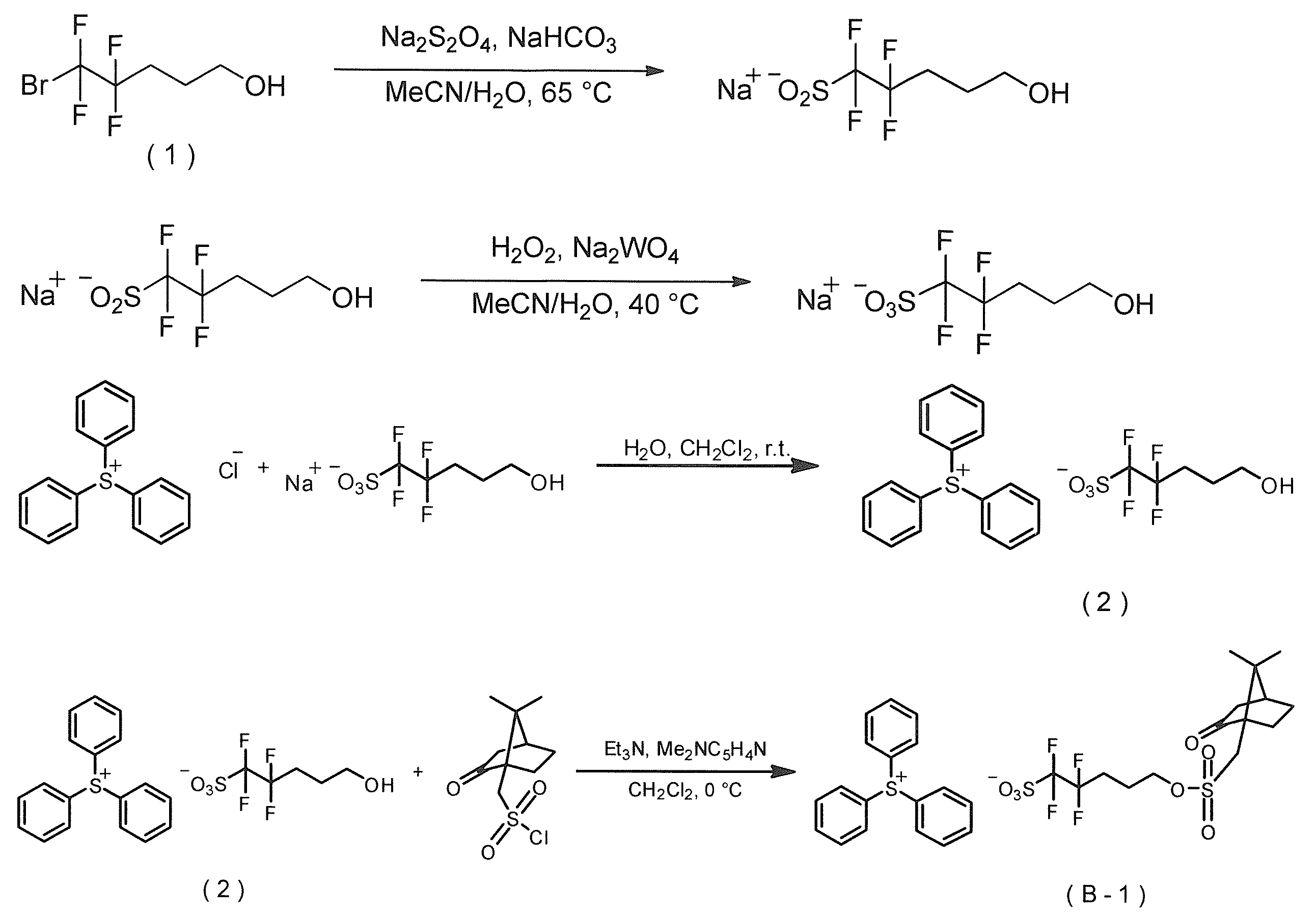
[合成例1](化合物(B-1)の合成)
化合物(1)55.0g(230mmol)を、亜二チオン酸ナトリウム60.1g(345mmol)と炭酸水素ナトリウム32.8g(391mmol)とが溶解したアセトニトリル水溶液100g(アセトニトリル:水の質量比4:3)に加え、65℃まで加熱し、7時間攪拌した。上記反応溶液を分液精製し、水層を回収した。
得られた水層にアセトニトリル100g、31質量%の過酸化水素9.79g(288mmol)の過酸化水素を含有する水溶液29.2g、タングステン酸二ナトリウム7.59g(23mmol)を加え、40℃まで加熱し、8時間攪拌した。上記反応溶液を分液精製し、水層を回収した。
この水層(固形分36.2g;138mmol)に、トリフェニルスルホニウムクロリド41.2g(138mmol)、ジクロロメタン120g及び水60gを加え、室温にて2時間攪拌した。上記反応溶液を分液精製し、有機層を回収した後、濃縮し、上記化合物(2)を62.3g得た。
得られた化合物(2)62.3g(124mmol)をジクロロメタン310gに溶解させた溶液にトリエチルアミン18.8g(186mmol)、4-ジメチルアミノピリジン0.303g(2.48mmol)を加え、0℃に冷却した。続いて、D-カンファー-10-スルホニルクロライド37.4g(149mmol)のジクロロメタン溶液30mLを滴下し、6時間攪拌した。次いでジクロロメタン、水を用いて分液精製し、化合物(B-1)を得た(収量79.1g、総収率48%)。
得られた水層にアセトニトリル100g、31質量%の過酸化水素9.79g(288mmol)の過酸化水素を含有する水溶液29.2g、タングステン酸二ナトリウム7.59g(23mmol)を加え、40℃まで加熱し、8時間攪拌した。上記反応溶液を分液精製し、水層を回収した。
この水層(固形分36.2g;138mmol)に、トリフェニルスルホニウムクロリド41.2g(138mmol)、ジクロロメタン120g及び水60gを加え、室温にて2時間攪拌した。上記反応溶液を分液精製し、有機層を回収した後、濃縮し、上記化合物(2)を62.3g得た。
得られた化合物(2)62.3g(124mmol)をジクロロメタン310gに溶解させた溶液にトリエチルアミン18.8g(186mmol)、4-ジメチルアミノピリジン0.303g(2.48mmol)を加え、0℃に冷却した。続いて、D-カンファー-10-スルホニルクロライド37.4g(149mmol)のジクロロメタン溶液30mLを滴下し、6時間攪拌した。次いでジクロロメタン、水を用いて分液精製し、化合物(B-1)を得た(収量79.1g、総収率48%)。
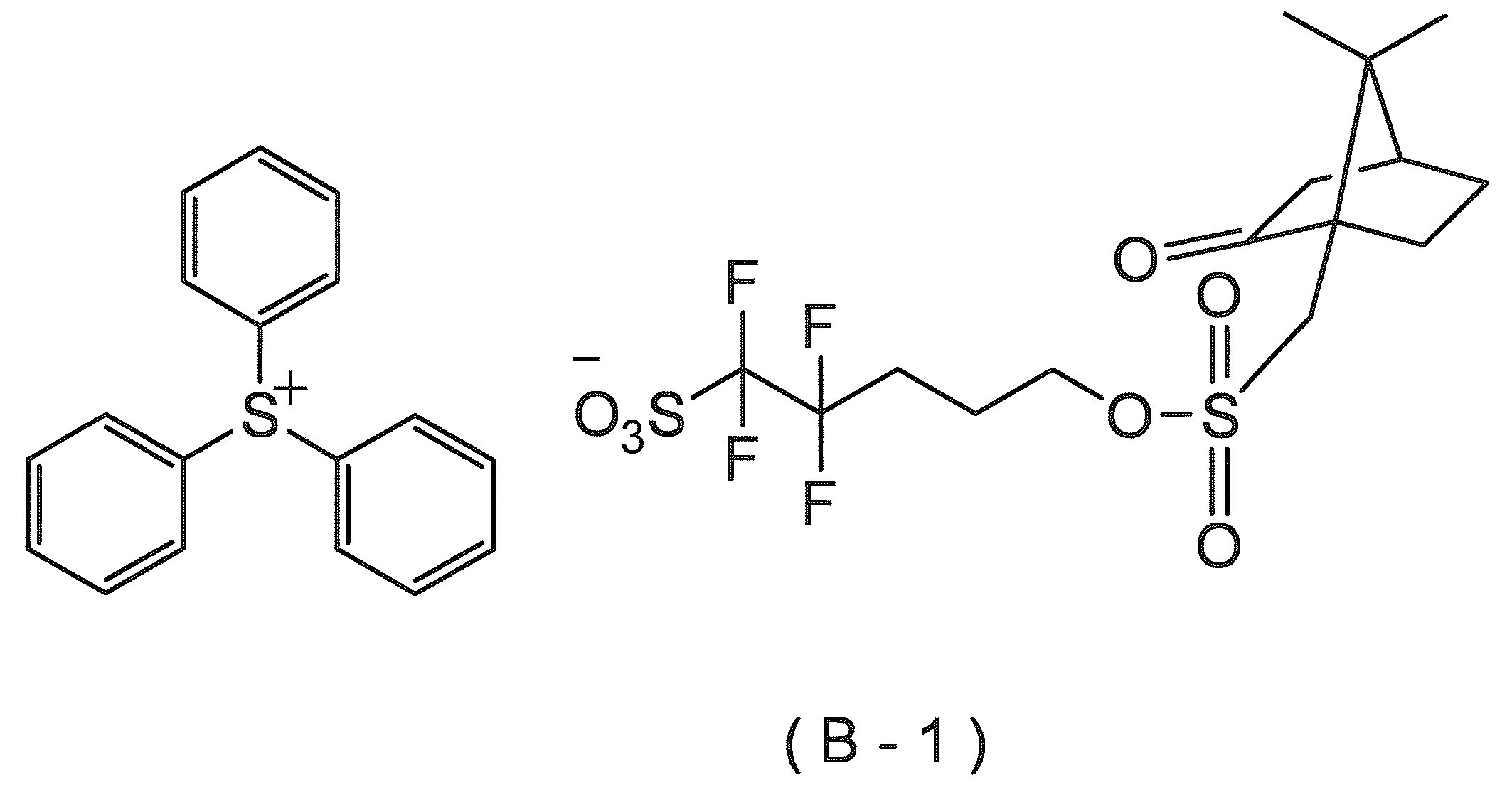
[化合物(B-1)の物性]
1H-NMR分析(測定溶媒:重クロロホルム,基準物質:テトラメチルシラン);δ=7.69-7.78(m,15H),4.26-4.36(m,2H),3.58(d,1H),3.00(d,1H),2.34-2.48(m,4H),1.93-2.12(m,5H),1.65-1.69(m,1H),1.41-1.48(m,1H),1.10(s,3H),0.87(s,3H).
1H-NMR分析(測定溶媒:重クロロホルム,基準物質:テトラメチルシラン);δ=7.69-7.78(m,15H),4.26-4.36(m,2H),3.58(d,1H),3.00(d,1H),2.34-2.48(m,4H),1.93-2.12(m,5H),1.65-1.69(m,1H),1.41-1.48(m,1H),1.10(s,3H),0.87(s,3H).
[合成例2~7](化合物(B-2)~(B-7)の合成)
合成例1と同様に操作して、下記式(B-2)~(B-7)で表される化合物を得た。
合成例1と同様に操作して、下記式(B-2)~(B-7)で表される化合物を得た。
[化合物(B-2)の物性]
1H-NMR分析(測定溶媒:重クロロホルム,基準物質:テトラメチルシラン);δ=7.69-7.78(m,15H),4.26-4.36(m,2H),3.01(s,3H),2.43-2.56(m,2H),2.04-2.11(m,2H).
1H-NMR分析(測定溶媒:重クロロホルム,基準物質:テトラメチルシラン);δ=7.69-7.78(m,15H),4.26-4.36(m,2H),3.01(s,3H),2.43-2.56(m,2H),2.04-2.11(m,2H).
[化合物(B-3)の物性]
1H-NMR分析(測定溶媒:重クロロホルム,基準物質:テトラメチルシラン);δ=7.69-7.78(m,15H),4.23-4.27(m,2H),3.07-3.11(m,2H),2.41-2.56(m,2H),2.03-2.11(m,2H),1.79-1.87(m,2H),1.42-1.51(m,2H),0.95(t,3H).
1H-NMR分析(測定溶媒:重クロロホルム,基準物質:テトラメチルシラン);δ=7.69-7.78(m,15H),4.23-4.27(m,2H),3.07-3.11(m,2H),2.41-2.56(m,2H),2.03-2.11(m,2H),1.79-1.87(m,2H),1.42-1.51(m,2H),0.95(t,3H).
[化合物(B-4)の物性]
1H-NMR分析(測定溶媒:重クロロホルム,基準物質:テトラメチルシラン);δ=8.97(s,1H),8.47(d,1H),8.06(d,1H),7.98(d,1H),7.69-7.82(m,18H),4.26-4.36(m,2H),2.43-2.56(m,2H),2.04-2.11(m,2H).
1H-NMR分析(測定溶媒:重クロロホルム,基準物質:テトラメチルシラン);δ=8.97(s,1H),8.47(d,1H),8.06(d,1H),7.98(d,1H),7.69-7.82(m,18H),4.26-4.36(m,2H),2.43-2.56(m,2H),2.04-2.11(m,2H).
[化合物(B-5)の物性]
1H-NMR分析(測定溶媒:重クロロホルム,基準物質:テトラメチルシラン);δ=7.69-7.78(m,15H),4.26-4.36(m,2H),3.58(d,1H),3.00(d,1H),2.34-2.48(m,4H),1.93-2.12(m,3H),1.65-1.69(m,5H),1.41-1.48(m,7H),1.10(s,3H),0.87(s,3H).
1H-NMR分析(測定溶媒:重クロロホルム,基準物質:テトラメチルシラン);δ=7.69-7.78(m,15H),4.26-4.36(m,2H),3.58(d,1H),3.00(d,1H),2.34-2.48(m,4H),1.93-2.12(m,3H),1.65-1.69(m,5H),1.41-1.48(m,7H),1.10(s,3H),0.87(s,3H).
[化合物(B-6)の物性]
1H-NMR分析(測定溶媒:重クロロホルム,基準物質:テトラメチルシラン);δ=7.69-7.78(m,15H),4.26-4.36(m,2H),3.58(d,1H),3.00(d,1H),2.34-2.48(m,4H),1.93-2.12(m,3H),1.65-1.69(m,5H),1.41-1.48(m,3H),1.10(s,3H),0.87(s,3H).
1H-NMR分析(測定溶媒:重クロロホルム,基準物質:テトラメチルシラン);δ=7.69-7.78(m,15H),4.26-4.36(m,2H),3.58(d,1H),3.00(d,1H),2.34-2.48(m,4H),1.93-2.12(m,3H),1.65-1.69(m,5H),1.41-1.48(m,3H),1.10(s,3H),0.87(s,3H).
[化合物(B-7)の物性]
1H-NMR分析(測定溶媒:重クロロホルム,基準物質:テトラメチルシラン);δ=7.69-7.78(m,15H),4.26-4.36(m,2H),3.58(d,1H),3.00(d,1H),2.74-2.88(m,4H),1.93-2.12(m,5H),1.65-1.69(m,1H),1.41-1.48(m,1H),1.10(s,3H),0.87(s,3H).
1H-NMR分析(測定溶媒:重クロロホルム,基準物質:テトラメチルシラン);δ=7.69-7.78(m,15H),4.26-4.36(m,2H),3.58(d,1H),3.00(d,1H),2.74-2.88(m,4H),1.93-2.12(m,5H),1.65-1.69(m,1H),1.41-1.48(m,1H),1.10(s,3H),0.87(s,3H).

<[A]重合体の合成>
合成で用いた化合物(単量体)を以下に示す。
合成で用いた化合物(単量体)を以下に示す。
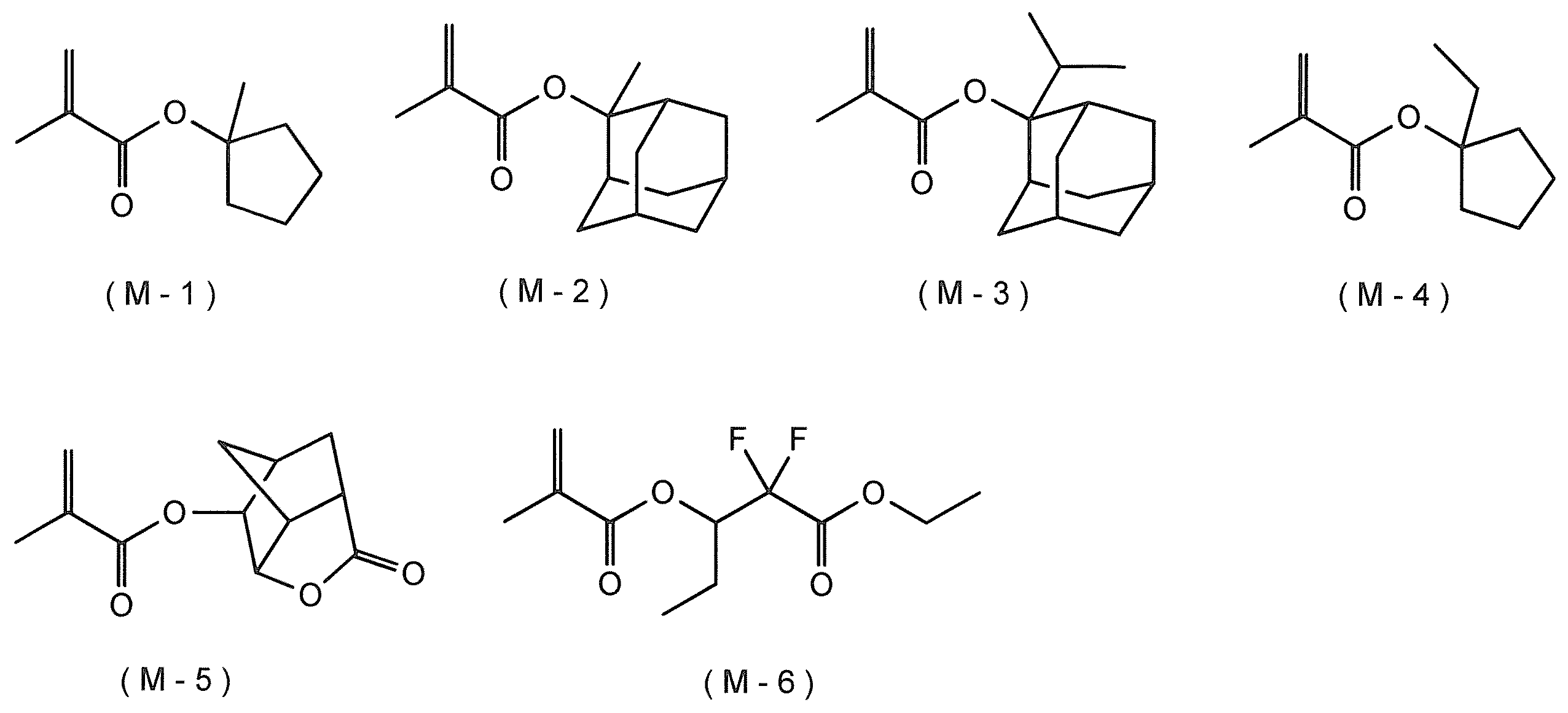
[重合例1](重合体(A-1)の合成)
化合物(M-1)21.12g(55モル%)、化合物(M-3)3.84g(10モル%)及び化合物(M-5)13.44g(35モル%)を80gの2-ブタノンに溶解し、AIBN3.54gをさらに添加して単量体溶液を調製した。次いで、40gの2-ブタノンを入れた200mLの三口フラスコを30分間窒素パージした後、攪拌しながら80℃に加熱し、調製した単量体溶液を滴下漏斗にて3時間かけて滴下した。滴下開始を重合反応の開始時間とし、重合反応を6時間実施した。次いで重合反応終了後、重合溶液を水冷して30℃以下に冷却した。800gのメタノール中に冷却した重合溶液を投入し、析出した白色粉末をろ別した。ろ別した白色粉末を160gのメタノールで2回洗浄した後、ろ別し、50℃で17時間乾燥させて白色粉末状の重合体(A-1)を合成した。
(A-1)のMwは4,500であり、Mw/Mnは1.4であった。(A-1)の低分子量成分の含有量は0.04質量%であった。13C-NMR分析の結果、(M-1)、(M-3)及び(M-5)に由来する各構造単位の含有割合は、それぞれ54モル%、11モル%及び35モル%であった。
化合物(M-1)21.12g(55モル%)、化合物(M-3)3.84g(10モル%)及び化合物(M-5)13.44g(35モル%)を80gの2-ブタノンに溶解し、AIBN3.54gをさらに添加して単量体溶液を調製した。次いで、40gの2-ブタノンを入れた200mLの三口フラスコを30分間窒素パージした後、攪拌しながら80℃に加熱し、調製した単量体溶液を滴下漏斗にて3時間かけて滴下した。滴下開始を重合反応の開始時間とし、重合反応を6時間実施した。次いで重合反応終了後、重合溶液を水冷して30℃以下に冷却した。800gのメタノール中に冷却した重合溶液を投入し、析出した白色粉末をろ別した。ろ別した白色粉末を160gのメタノールで2回洗浄した後、ろ別し、50℃で17時間乾燥させて白色粉末状の重合体(A-1)を合成した。
(A-1)のMwは4,500であり、Mw/Mnは1.4であった。(A-1)の低分子量成分の含有量は0.04質量%であった。13C-NMR分析の結果、(M-1)、(M-3)及び(M-5)に由来する各構造単位の含有割合は、それぞれ54モル%、11モル%及び35モル%であった。
[重合例2](重合体(A-2)の合成)
下記表1に示す種類及び使用量の単量体を用いた以外は重合例1と同様に操作して、[A]重合体となる(A-2)を合成した。単量体の合計質量は重合例1と同様とした。得られた各重合体の低分子量成分の含有量、Mw及び(Mw/Mn)を表1に示す。
下記表1に示す種類及び使用量の単量体を用いた以外は重合例1と同様に操作して、[A]重合体となる(A-2)を合成した。単量体の合計質量は重合例1と同様とした。得られた各重合体の低分子量成分の含有量、Mw及び(Mw/Mn)を表1に示す。
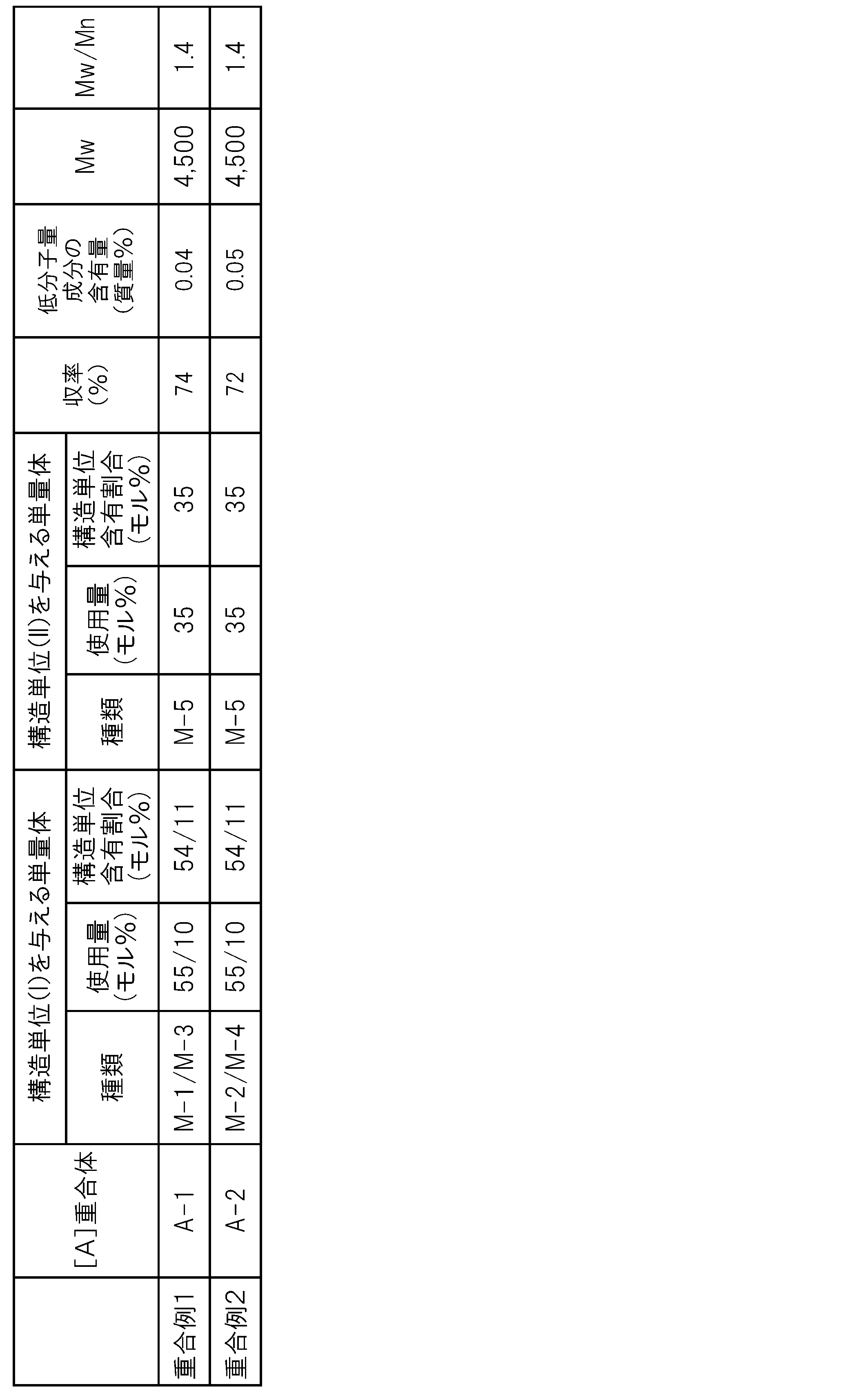
<[D]フッ素原子含有重合体の合成>
[重合例3](フッ素原子含有重合体(D-1)の合成)
上記化合物(M-4)14.3g(30モル%)及び化合物(M-6)45.7g(70モル%)を2-ブタノン60gに溶解し、AIBN3gを投入した単量体溶液を調整した。30gの2-ブタノンを投入した300mLの三口フラスコを30分窒素パージした後、反応器を攪拌しながら80℃に加熱し、上記単量体溶液を、滴下漏斗を用いて3時間かけて滴下した。滴下開始を重合開始時間とし、重合反応を6時間実施した。重合反応終了後、重合溶液を水冷することにより30℃以下に冷却し、600gのメタノール:水=8:2(質量比)の溶液へ投入して重合体を沈殿させた。上澄みの溶液を除いた後、沈殿した重合体にメタノール120gを加え、重合体を洗浄した。上澄み液を除いた後に、50℃にて17時間乾燥して、フッ素原子含有重合体(D-1)を合成した。(D-1)のMwは4,200、(Mw/Mn)は1.3であった。また、13C-NMR分析の結果、フッ素原子含有率は5質量%であり、(M-4)及び(M-6)に由来する構造単位の含有割合は、それぞれ32.0モル%及び68.0モル%であった。
[重合例3](フッ素原子含有重合体(D-1)の合成)
上記化合物(M-4)14.3g(30モル%)及び化合物(M-6)45.7g(70モル%)を2-ブタノン60gに溶解し、AIBN3gを投入した単量体溶液を調整した。30gの2-ブタノンを投入した300mLの三口フラスコを30分窒素パージした後、反応器を攪拌しながら80℃に加熱し、上記単量体溶液を、滴下漏斗を用いて3時間かけて滴下した。滴下開始を重合開始時間とし、重合反応を6時間実施した。重合反応終了後、重合溶液を水冷することにより30℃以下に冷却し、600gのメタノール:水=8:2(質量比)の溶液へ投入して重合体を沈殿させた。上澄みの溶液を除いた後、沈殿した重合体にメタノール120gを加え、重合体を洗浄した。上澄み液を除いた後に、50℃にて17時間乾燥して、フッ素原子含有重合体(D-1)を合成した。(D-1)のMwは4,200、(Mw/Mn)は1.3であった。また、13C-NMR分析の結果、フッ素原子含有率は5質量%であり、(M-4)及び(M-6)に由来する構造単位の含有割合は、それぞれ32.0モル%及び68.0モル%であった。
<フォトレジスト組成物の調製>
フォトレジスト組成物の調製に用いた[B]酸発生剤、[C]酸拡散制御体、[E]溶媒及び[F]偏在化促進剤を以下に示す。
フォトレジスト組成物の調製に用いた[B]酸発生剤、[C]酸拡散制御体、[E]溶媒及び[F]偏在化促進剤を以下に示す。
[[B]酸発生剤]]
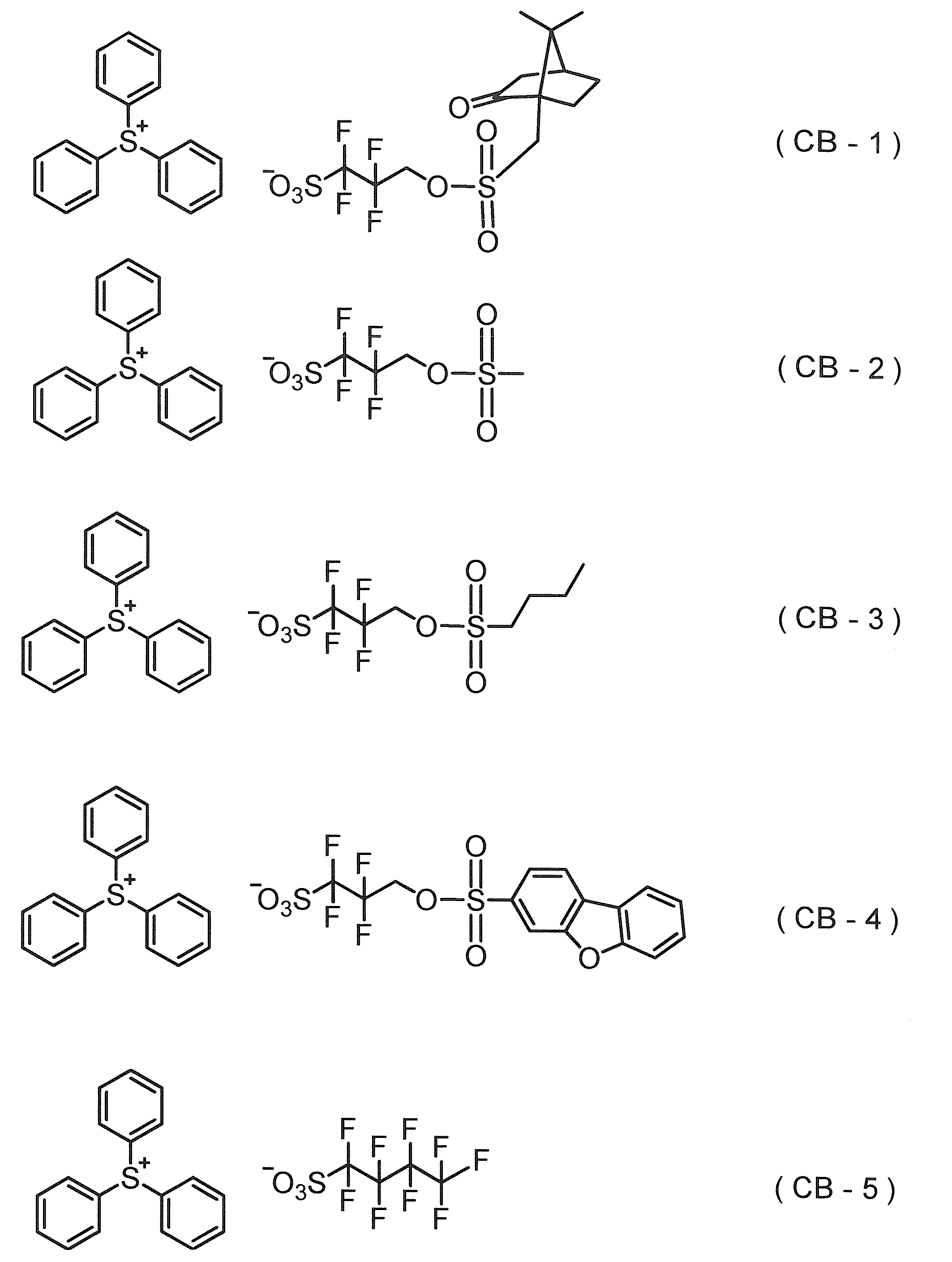
[[C]酸拡散制御体]

[[E]溶媒]
E-1:酢酸プロピレングリコールモノメチルエーテル
E-2:シクロヘキサノン
E-1:酢酸プロピレングリコールモノメチルエーテル
E-2:シクロヘキサノン
[[F]偏在化促進剤]
F-1:γ-ブチロラクトン
F-1:γ-ブチロラクトン
[実施例1]
[A]重合体としての(A-1)100質量部、[B]酸発生剤としての(B-1)15質量部、[C]酸拡散制御体としての(C-1)1.1質量部、[D]フッ素原子含有重合体としての(D-1)7質量部、[E]溶媒としての(E-1)2,590質量部及び(E-2)1,110質量部、並びに[F]偏在化促進剤としての(F-1)15質量部を混合し、得られた混合液を孔径0.20μmのフィルターでろ過してフォトレジスト組成物を調製した。
[A]重合体としての(A-1)100質量部、[B]酸発生剤としての(B-1)15質量部、[C]酸拡散制御体としての(C-1)1.1質量部、[D]フッ素原子含有重合体としての(D-1)7質量部、[E]溶媒としての(E-1)2,590質量部及び(E-2)1,110質量部、並びに[F]偏在化促進剤としての(F-1)15質量部を混合し、得られた混合液を孔径0.20μmのフィルターでろ過してフォトレジスト組成物を調製した。
[実施例2~14及び比較例1~10]
下記表2に示す種類及び配合量の各成分を用いた以外は、実施例1と同様に操作して、各フォトレジスト組成物を調製した。
下記表2に示す種類及び配合量の各成分を用いた以外は、実施例1と同様に操作して、各フォトレジスト組成物を調製した。

<レジストパターンの形成>
12インチのシリコンウエハ表面に、反射防止膜形成用組成物(ARC66、日産化学製)を用いて、膜厚105nmの反射防止膜を形成した。この反射防止膜上に、上記調製した各フォトレジスト組成物を用いて、膜厚95nmのレジスト膜を形成し、115℃で45秒間SBを行った。次に、このレジスト膜を、ArFエキシマレーザー光液浸露光装置(NSR S610C、NIKON製)を用い、NA=1.3、ratio=0.800、Annularの条件により、50nmライン100nmピッチ形成用のマスクパターンを介して露光した。露光後、100℃で45秒間PEBを行った。その後、2.38質量%のTMAH水溶液により現像し、水で洗浄し、乾燥し、ラインアンドスペースのポジ型のレジストパターンを形成した。このレジストパターン形成の際、ターゲット寸法が50nmの1対1ラインアンドスペースのマスクを介して形成した線幅が、線幅50nmの1対1ラインアンドスペースに形成される露光量を最適露光量とした。なお、レジストパターンの測長は、走査型電子顕微鏡(CG4000、日立ハイテクノロジーズ製)を用いて行った。
12インチのシリコンウエハ表面に、反射防止膜形成用組成物(ARC66、日産化学製)を用いて、膜厚105nmの反射防止膜を形成した。この反射防止膜上に、上記調製した各フォトレジスト組成物を用いて、膜厚95nmのレジスト膜を形成し、115℃で45秒間SBを行った。次に、このレジスト膜を、ArFエキシマレーザー光液浸露光装置(NSR S610C、NIKON製)を用い、NA=1.3、ratio=0.800、Annularの条件により、50nmライン100nmピッチ形成用のマスクパターンを介して露光した。露光後、100℃で45秒間PEBを行った。その後、2.38質量%のTMAH水溶液により現像し、水で洗浄し、乾燥し、ラインアンドスペースのポジ型のレジストパターンを形成した。このレジストパターン形成の際、ターゲット寸法が50nmの1対1ラインアンドスペースのマスクを介して形成した線幅が、線幅50nmの1対1ラインアンドスペースに形成される露光量を最適露光量とした。なお、レジストパターンの測長は、走査型電子顕微鏡(CG4000、日立ハイテクノロジーズ製)を用いて行った。
<評価>
上記調製した各フォトレジスト組成物について、感度、並びにMEEF性能及び断面形状の矩形性、エッチング耐性を下記方法に従い評価した。その評価結果を表3に示す。
上記調製した各フォトレジスト組成物について、感度、並びにMEEF性能及び断面形状の矩形性、エッチング耐性を下記方法に従い評価した。その評価結果を表3に示す。
[感度]
上記最適露光量を感度とした。このとき、感度が50mJ/cm2以下の場合、感度は「良好」と、50mJ/cm2を超えた場合、「不良」と評価できる。
上記最適露光量を感度とした。このとき、感度が50mJ/cm2以下の場合、感度は「良好」と、50mJ/cm2を超えた場合、「不良」と評価できる。
[MEEF性能]
走査型電子顕微鏡(CG4000、日立ハイテクノロジーズ製)を用い、上記最適露光量において、5種類のマスクサイズ(48.0nmLine/100nmPitch、49.0nmLine/100nmPitch、50.0nmLine/100nmPitch、51.0nmLine/100nmPitch、52.0nmLine/100nmPitch)で解像されるレジストパターン寸法を測定した。その測定値を用い、横軸にマスクサイズ、縦軸に各マスクサイズで形成された線幅としてプロットし、最小二乗法により算出した近似直線の傾きを求め、この傾きをMEEF性能とした。MEEF性能は、その値が1に近いほど良好であることを示す。MEEF性能は4.7以下の場合、「良好」と、4.7を超える場合、「不良」と評価できる。
走査型電子顕微鏡(CG4000、日立ハイテクノロジーズ製)を用い、上記最適露光量において、5種類のマスクサイズ(48.0nmLine/100nmPitch、49.0nmLine/100nmPitch、50.0nmLine/100nmPitch、51.0nmLine/100nmPitch、52.0nmLine/100nmPitch)で解像されるレジストパターン寸法を測定した。その測定値を用い、横軸にマスクサイズ、縦軸に各マスクサイズで形成された線幅としてプロットし、最小二乗法により算出した近似直線の傾きを求め、この傾きをMEEF性能とした。MEEF性能は、その値が1に近いほど良好であることを示す。MEEF性能は4.7以下の場合、「良好」と、4.7を超える場合、「不良」と評価できる。
[断面形状の矩形性]
上記走査型電子顕微鏡を用い、レジストパターン観察し、パターン上部のライン幅xとパターン下部のライン幅yを任意のポイントで計10点測定した。各々の割合x/yを算出し、これらの相加平均値を求めた。この値(x/y)が0.9≦(x/y)≦1.1の範囲内であれば、断面形状の矩形性は「良好」と、(x/y)<0.9又は1.1<(x/y)である場合、「不良」と評価できる。
上記走査型電子顕微鏡を用い、レジストパターン観察し、パターン上部のライン幅xとパターン下部のライン幅yを任意のポイントで計10点測定した。各々の割合x/yを算出し、これらの相加平均値を求めた。この値(x/y)が0.9≦(x/y)≦1.1の範囲内であれば、断面形状の矩形性は「良好」と、(x/y)<0.9又は1.1<(x/y)である場合、「不良」と評価できる。
[エッチング耐性]
エッチング耐性を評価できると一般的に知られている大西パラメータを下記式の実線で囲まれた部分について算出した。この数値が正の値で小さいほど、エッチング耐性は「良好」と、この数値が大きいほど、「不良」と評価できる。
エッチング耐性を評価できると一般的に知られている大西パラメータを下記式の実線で囲まれた部分について算出した。この数値が正の値で小さいほど、エッチング耐性は「良好」と、この数値が大きいほど、「不良」と評価できる。
大西パラメータ=(下記部分中の総原子数)/{(下記部分中の炭素原子数)-(下記部分中の酸素原子数)-(下記部分中のフッ素原子数)}
実施例に係る化合物の大西パラメータは、化合物(B-1)~(B-4)では15.00、化合物(B-5)では5.40、化合物(B-6)では27.00、化合物(B-7)では6.00であった。他方、比較例に係る化合物の大西パラメータは、化合物(CB-1)~(CB-4)では-9.00であった。また化合物(CB-5)については、アニオン部における-SO3
-に結合している部分について大西パラメータを算出したところ、-2.60であった。これは、該部分におけるフッ素数が炭素数よりも多いことに起因する。
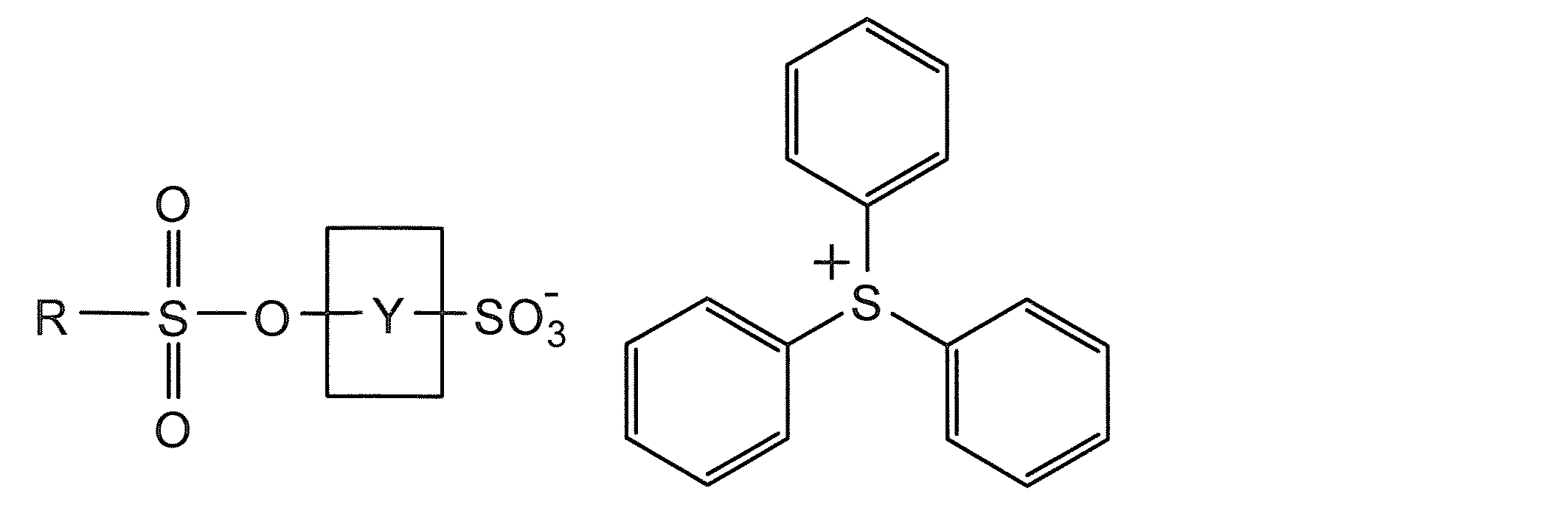

表3等の結果から明らかなように、実施例のフォトレジスト組成物によれば、MEEFは小さく、パターン形状及びエッチング耐性はいずれも良好であり、比較例のフォトレジスト組成物によれば、MEEFは大きく、パターン形状及びエッチング耐性はいずれも不良であった。
本発明のフォトレジスト組成物及びレジストパターン形成方法によれば、優れたMEEF性能を発揮しつつ、断面形状の矩形性及びエッチング耐性に優れたレジストパターンを形成できる。本発明の酸発生剤は、当該フォトレジスト組成物の成分として好適に用いることができる。従って、これらは、半導体デバイス、液晶デバイス等の各種電子デバイスのリソグラフィ工程のパターンの形成において好適に用いることができる。
Claims (7)
- 酸解離性基を含む構造単位を有する重合体、及び
下記式(1)で表される化合物を含む酸発生剤
を含有するフォトレジスト組成物。

- 上記式(1)のR2が上記フッ素化アルカンジイル基であり、このフッ素化アルカンジイル基のフッ素数が2以上である請求項1に記載のフォトレジスト組成物。
- 上記フッ素化アルカンジイル基が、下記式(i)で表される請求項2に記載のフォトレジスト組成物。

- 上記式(1)におけるQ+が、下記式(2-1)で表されるスルホニウムカチオン及び下記式(2-2)で表されるヨードニウムカチオンからなる群より選ばれる少なくとも1種である請求項1に記載のフォトレジスト組成物。

式(2-2)中、R7及びR8は、それぞれ独立して、置換若しくは非置換の炭素数1~20のアルキル基又は置換若しくは非置換の炭素数6~30のアリール基であるか、又はこれらの基が互いに合わせられこれらが結合するヨウ素原子と共に構成される環構造を表す。) - 上記構造単位が、下記式(3)で表される請求項1に記載のフォトレジスト組成物。
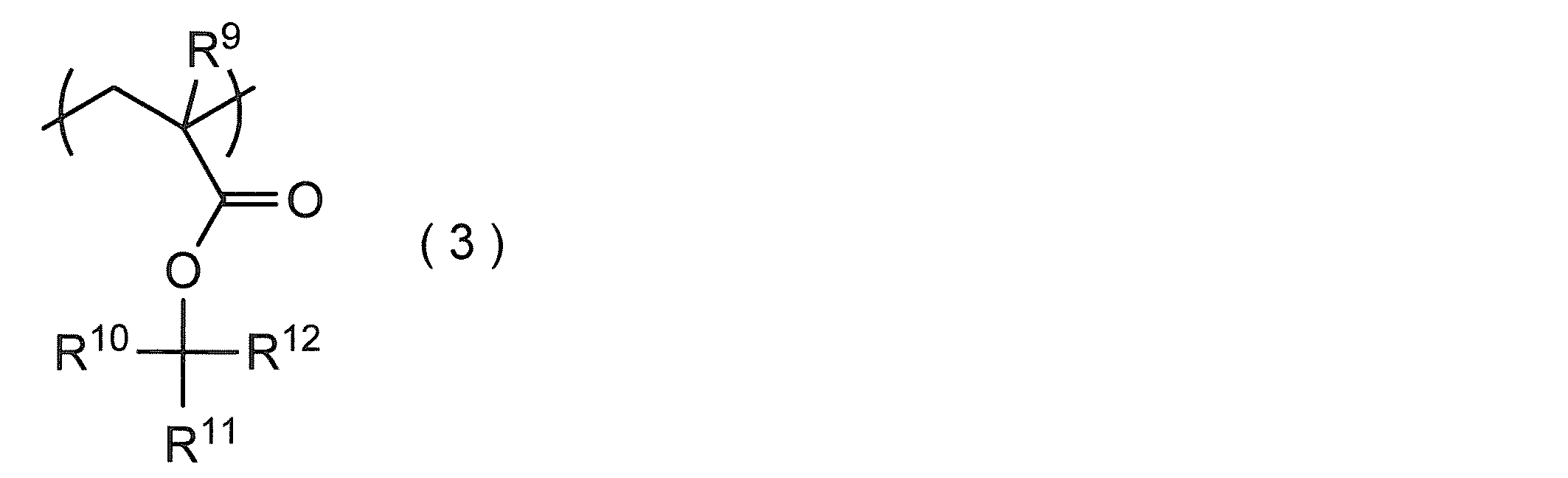
- レジスト膜を形成する工程、
上記レジスト膜を露光する工程、及び
上記露光されたレジスト膜を現像する工程
を有し、
上記レジスト膜を請求項1に記載のフォトレジスト組成物により形成するレジストパターン形成方法。 - 下記式(1)で表される化合物を含む酸発生剤。

Priority Applications (1)
| Application Number | Priority Date | Filing Date | Title |
|---|---|---|---|
| JP2014536861A JP6202000B2 (ja) | 2012-09-21 | 2013-09-17 | フォトレジスト組成物及びレジストパターン形成方法 |
Applications Claiming Priority (2)
| Application Number | Priority Date | Filing Date | Title |
|---|---|---|---|
| JP2012208928 | 2012-09-21 | ||
| JP2012-208928 | 2012-09-21 |
Publications (1)
| Publication Number | Publication Date |
|---|---|
| WO2014046097A1 true WO2014046097A1 (ja) | 2014-03-27 |
Family
ID=50341407
Family Applications (1)
| Application Number | Title | Priority Date | Filing Date |
|---|---|---|---|
| PCT/JP2013/075061 Ceased WO2014046097A1 (ja) | 2012-09-21 | 2013-09-17 | フォトレジスト組成物、レジストパターン形成方法及び酸発生剤 |
Country Status (3)
| Country | Link |
|---|---|
| JP (1) | JP6202000B2 (ja) |
| TW (1) | TW201420553A (ja) |
| WO (1) | WO2014046097A1 (ja) |
Families Citing this family (2)
| Publication number | Priority date | Publication date | Assignee | Title |
|---|---|---|---|---|
| WO2019093245A1 (ja) * | 2017-11-09 | 2019-05-16 | 富士フイルム株式会社 | 装置、有機層形成用組成物 |
| JP7099418B2 (ja) * | 2018-09-18 | 2022-07-12 | 信越化学工業株式会社 | レジスト材料及びパターン形成方法 |
Citations (5)
| Publication number | Priority date | Publication date | Assignee | Title |
|---|---|---|---|---|
| JP2007145803A (ja) * | 2005-10-31 | 2007-06-14 | Shin Etsu Chem Co Ltd | 新規スルホン酸塩及びその誘導体、光酸発生剤並びにこれを用いたレジスト材料及びパターン形成方法 |
| JP2010191015A (ja) * | 2009-02-16 | 2010-09-02 | Fujifilm Corp | 感活性光線性または感放射線性樹脂組成物及びそれを用いたパターン形成方法 |
| JP2011079778A (ja) * | 2009-10-07 | 2011-04-21 | Tokyo Ohka Kogyo Co Ltd | レジスト組成物、レジストパターン形成方法、新規な化合物及び酸発生剤 |
| JP2011095700A (ja) * | 2009-09-30 | 2011-05-12 | Fujifilm Corp | 感活性光線性または感放射線性樹脂組成物、及び該感光性組成物を用いたパターン形成方法 |
| WO2011104127A1 (en) * | 2010-02-24 | 2011-09-01 | Basf Se | Latent acids and their use |
Family Cites Families (1)
| Publication number | Priority date | Publication date | Assignee | Title |
|---|---|---|---|---|
| JP6007011B2 (ja) * | 2012-07-18 | 2016-10-12 | 東京応化工業株式会社 | レジスト組成物、レジストパターン形成方法及び化合物 |
-
2013
- 2013-09-17 WO PCT/JP2013/075061 patent/WO2014046097A1/ja not_active Ceased
- 2013-09-17 JP JP2014536861A patent/JP6202000B2/ja active Active
- 2013-09-18 TW TW102133864A patent/TW201420553A/zh unknown
Patent Citations (5)
| Publication number | Priority date | Publication date | Assignee | Title |
|---|---|---|---|---|
| JP2007145803A (ja) * | 2005-10-31 | 2007-06-14 | Shin Etsu Chem Co Ltd | 新規スルホン酸塩及びその誘導体、光酸発生剤並びにこれを用いたレジスト材料及びパターン形成方法 |
| JP2010191015A (ja) * | 2009-02-16 | 2010-09-02 | Fujifilm Corp | 感活性光線性または感放射線性樹脂組成物及びそれを用いたパターン形成方法 |
| JP2011095700A (ja) * | 2009-09-30 | 2011-05-12 | Fujifilm Corp | 感活性光線性または感放射線性樹脂組成物、及び該感光性組成物を用いたパターン形成方法 |
| JP2011079778A (ja) * | 2009-10-07 | 2011-04-21 | Tokyo Ohka Kogyo Co Ltd | レジスト組成物、レジストパターン形成方法、新規な化合物及び酸発生剤 |
| WO2011104127A1 (en) * | 2010-02-24 | 2011-09-01 | Basf Se | Latent acids and their use |
Also Published As
| Publication number | Publication date |
|---|---|
| JPWO2014046097A1 (ja) | 2016-08-18 |
| JP6202000B2 (ja) | 2017-09-27 |
| TW201420553A (zh) | 2014-06-01 |
Similar Documents
| Publication | Publication Date | Title |
|---|---|---|
| JP5786426B2 (ja) | フォトレジスト組成物、レジストパターン形成方法 | |
| JP5742563B2 (ja) | フォトレジスト組成物及びレジストパターン形成方法 | |
| JP5655563B2 (ja) | 感放射線性樹脂組成物及びパターン形成方法 | |
| JP6561731B2 (ja) | 感放射線性樹脂組成物、レジストパターン形成方法、酸拡散制御剤及び化合物 | |
| JP6743618B2 (ja) | 感放射線性樹脂組成物、レジストパターン形成方法、感放射線性酸発生剤、化合物及び化合物の製造方法 | |
| JP5724791B2 (ja) | 感放射線性樹脂組成物及びレジストパターンの形成方法 | |
| WO2018012472A1 (ja) | 感放射線性樹脂組成物及びレジストパターン形成方法 | |
| WO2018101339A1 (ja) | 感放射線性樹脂組成物、オニウム塩化合物及びレジストパターンの形成方法 | |
| KR20130084325A (ko) | 감방사선성 수지 조성물 | |
| WO2015025859A1 (ja) | 感放射線性樹脂組成物、レジストパターン形成方法、感放射線性酸発生剤、酸拡散制御剤及び化合物 | |
| JP2017227810A (ja) | 感放射線性樹脂組成物及びレジストパターン形成方法 | |
| JP2017156649A (ja) | 感放射線性樹脂組成物、レジストパターン形成方法、重合体及び化合物 | |
| JP6398793B2 (ja) | 感放射線性樹脂組成物、レジストパターン形成方法及び重合体 | |
| JP5729114B2 (ja) | 感放射線性樹脂組成物、パターン形成方法、重合体及び化合物 | |
| JP6202000B2 (ja) | フォトレジスト組成物及びレジストパターン形成方法 | |
| JP6319291B2 (ja) | 感放射線性樹脂組成物、レジストパターン形成方法、感放射線性酸発生剤及び化合物 | |
| JP2012242813A (ja) | 感放射線性樹脂組成物及びレジストパターン形成方法 | |
| WO2017122697A1 (ja) | 感放射線性樹脂組成物、レジストパターン形成方法、酸拡散制御剤及び化合物 | |
| JP2012215694A (ja) | フォトレジスト組成物及びレジストパターン形成方法 | |
| JP6146328B2 (ja) | 感放射線性樹脂組成物、レジストパターン形成方法、感放射線性酸発生体及び化合物 | |
| JP5772432B2 (ja) | フォトレジスト組成物、レジストパターン形成方法及び重合体 | |
| JP6447631B2 (ja) | 感放射線性樹脂組成物及びレジストパターン形成方法 | |
| JP6354445B2 (ja) | 感放射線性樹脂組成物、レジストパターン形成方法、酸拡散制御剤及び化合物 | |
| JP5954332B2 (ja) | フォトレジスト組成物及びレジストパターン形成方法 | |
| WO2025204295A1 (ja) | 感放射線性組成物及びレジストパターン形成方法 |
Legal Events
| Date | Code | Title | Description |
|---|---|---|---|
| 121 | Ep: the epo has been informed by wipo that ep was designated in this application |
Ref document number: 13838489 Country of ref document: EP Kind code of ref document: A1 |
|
| ENP | Entry into the national phase |
Ref document number: 2014536861 Country of ref document: JP Kind code of ref document: A |
|
| NENP | Non-entry into the national phase |
Ref country code: DE |
|
| 122 | Ep: pct application non-entry in european phase |
Ref document number: 13838489 Country of ref document: EP Kind code of ref document: A1 |