WO2014041765A1 - 複合収縮部材を用いた着用物品及び該着用物品の製造方法 - Google Patents
複合収縮部材を用いた着用物品及び該着用物品の製造方法 Download PDFInfo
- Publication number
- WO2014041765A1 WO2014041765A1 PCT/JP2013/005244 JP2013005244W WO2014041765A1 WO 2014041765 A1 WO2014041765 A1 WO 2014041765A1 JP 2013005244 W JP2013005244 W JP 2013005244W WO 2014041765 A1 WO2014041765 A1 WO 2014041765A1
- Authority
- WO
- WIPO (PCT)
- Prior art keywords
- composite
- shrinkable
- panel material
- members
- manufacturing
- Prior art date
- Legal status (The legal status is an assumption and is not a legal conclusion. Google has not performed a legal analysis and makes no representation as to the accuracy of the status listed.)
- Ceased
Links
Images




Classifications
-
- A—HUMAN NECESSITIES
- A61—MEDICAL OR VETERINARY SCIENCE; HYGIENE
- A61F—FILTERS IMPLANTABLE INTO BLOOD VESSELS; PROSTHESES; DEVICES PROVIDING PATENCY TO, OR PREVENTING COLLAPSING OF, TUBULAR STRUCTURES OF THE BODY, e.g. STENTS; ORTHOPAEDIC, NURSING OR CONTRACEPTIVE DEVICES; FOMENTATION; TREATMENT OR PROTECTION OF EYES OR EARS; BANDAGES, DRESSINGS OR ABSORBENT PADS; FIRST-AID KITS
- A61F13/00—Bandages or dressings; Absorbent pads
- A61F13/15—Absorbent pads, e.g. sanitary towels, swabs or tampons for external or internal application to the body; Supporting or fastening means therefor; Tampon applicators
- A61F13/45—Absorbent pads, e.g. sanitary towels, swabs or tampons for external or internal application to the body; Supporting or fastening means therefor; Tampon applicators characterised by the shape
- A61F13/49—Absorbent pads, e.g. sanitary towels, swabs or tampons for external or internal application to the body; Supporting or fastening means therefor; Tampon applicators characterised by the shape specially adapted to be worn around the waist, e.g. diapers, nappies
- A61F13/49058—Absorbent pads, e.g. sanitary towels, swabs or tampons for external or internal application to the body; Supporting or fastening means therefor; Tampon applicators characterised by the shape specially adapted to be worn around the waist, e.g. diapers, nappies characterised by the modular concept of constructing the diaper
- A61F13/4906—Absorbent pads, e.g. sanitary towels, swabs or tampons for external or internal application to the body; Supporting or fastening means therefor; Tampon applicators characterised by the shape specially adapted to be worn around the waist, e.g. diapers, nappies characterised by the modular concept of constructing the diaper the diaper having an outer chassis forming the diaper and an independent absorbent structure attached to the chassis
- A61F13/49061—Absorbent pads, e.g. sanitary towels, swabs or tampons for external or internal application to the body; Supporting or fastening means therefor; Tampon applicators characterised by the shape specially adapted to be worn around the waist, e.g. diapers, nappies characterised by the modular concept of constructing the diaper the diaper having an outer chassis forming the diaper and an independent absorbent structure attached to the chassis the diaper having one or two waist members forming the diaper waist region and an independent absorbent structure attached to the one or two waist members forming the crotch region
-
- A—HUMAN NECESSITIES
- A61—MEDICAL OR VETERINARY SCIENCE; HYGIENE
- A61F—FILTERS IMPLANTABLE INTO BLOOD VESSELS; PROSTHESES; DEVICES PROVIDING PATENCY TO, OR PREVENTING COLLAPSING OF, TUBULAR STRUCTURES OF THE BODY, e.g. STENTS; ORTHOPAEDIC, NURSING OR CONTRACEPTIVE DEVICES; FOMENTATION; TREATMENT OR PROTECTION OF EYES OR EARS; BANDAGES, DRESSINGS OR ABSORBENT PADS; FIRST-AID KITS
- A61F13/00—Bandages or dressings; Absorbent pads
- A61F13/15—Absorbent pads, e.g. sanitary towels, swabs or tampons for external or internal application to the body; Supporting or fastening means therefor; Tampon applicators
- A61F13/15577—Apparatus or processes for manufacturing
- A61F13/15585—Apparatus or processes for manufacturing of babies' napkins, e.g. diapers
-
- A—HUMAN NECESSITIES
- A61—MEDICAL OR VETERINARY SCIENCE; HYGIENE
- A61F—FILTERS IMPLANTABLE INTO BLOOD VESSELS; PROSTHESES; DEVICES PROVIDING PATENCY TO, OR PREVENTING COLLAPSING OF, TUBULAR STRUCTURES OF THE BODY, e.g. STENTS; ORTHOPAEDIC, NURSING OR CONTRACEPTIVE DEVICES; FOMENTATION; TREATMENT OR PROTECTION OF EYES OR EARS; BANDAGES, DRESSINGS OR ABSORBENT PADS; FIRST-AID KITS
- A61F13/00—Bandages or dressings; Absorbent pads
- A61F13/15—Absorbent pads, e.g. sanitary towels, swabs or tampons for external or internal application to the body; Supporting or fastening means therefor; Tampon applicators
- A61F13/15577—Apparatus or processes for manufacturing
- A61F13/15804—Plant, e.g. involving several steps
-
- A—HUMAN NECESSITIES
- A61—MEDICAL OR VETERINARY SCIENCE; HYGIENE
- A61F—FILTERS IMPLANTABLE INTO BLOOD VESSELS; PROSTHESES; DEVICES PROVIDING PATENCY TO, OR PREVENTING COLLAPSING OF, TUBULAR STRUCTURES OF THE BODY, e.g. STENTS; ORTHOPAEDIC, NURSING OR CONTRACEPTIVE DEVICES; FOMENTATION; TREATMENT OR PROTECTION OF EYES OR EARS; BANDAGES, DRESSINGS OR ABSORBENT PADS; FIRST-AID KITS
- A61F13/00—Bandages or dressings; Absorbent pads
- A61F13/15—Absorbent pads, e.g. sanitary towels, swabs or tampons for external or internal application to the body; Supporting or fastening means therefor; Tampon applicators
- A61F13/45—Absorbent pads, e.g. sanitary towels, swabs or tampons for external or internal application to the body; Supporting or fastening means therefor; Tampon applicators characterised by the shape
- A61F13/49—Absorbent pads, e.g. sanitary towels, swabs or tampons for external or internal application to the body; Supporting or fastening means therefor; Tampon applicators characterised by the shape specially adapted to be worn around the waist, e.g. diapers, nappies
- A61F13/496—Absorbent pads, e.g. sanitary towels, swabs or tampons for external or internal application to the body; Supporting or fastening means therefor; Tampon applicators characterised by the shape specially adapted to be worn around the waist, e.g. diapers, nappies in the form of pants or briefs
Definitions
- the present invention relates to a wearing article such as a disposable diaper, which is formed by providing two long composite shrinkable members in parallel with each other and an absorbent body between the two composite shrinkable members, and a method for manufacturing the worn article.
- Wearing articles such as paper diapers are provided with an absorbent body on the inside, and are provided with a waist gather portion located around the waist of the wearer and a fit gather portion located between the waist and the crotch.
- a method for manufacturing such a wearing article is disclosed in Patent Document 1, for example.
- two long composite shrinkable members are arranged so as to be parallel to each other while being stretched against the elastic restoring force.
- a plurality of absorbers are spanned between the two composite contracting members at intervals, and the composite contracting member and the absorber are joined. Between adjacent absorbers, arc-shaped notches are formed at the inner edges of the two composite contracting members facing each other.
- the absorbent body is folded in two, the two composite shrinkable members are overlapped with each other, and the two overlapped composite shrinkable members are cut at an intermediate portion between adjacent absorbent bodies to obtain a diaper.
- the composite contracting member forms a waist gather portion and a fit gather portion of the diaper, and the notch forms a leg hole into which the wearer's leg is fitted.
- the composite contracting member contracts, and the waist gather portion lightly tightens the wearer's waist to prevent deviation from the waist.
- both gather parts have the same touch and air permeability.
- both gather parts have the same touch and air permeability.
- the waist gather portion and the fit gather portion have different touch and breathability.
- the conventional method for manufacturing a worn article cannot meet such a requirement.
- the composite contraction member contracts due to the elastic restoring force when the worn article is completed.
- symbols and characters such as cartoons are displayed on the outside of the absorber, that is, the non-skin surface, and if the fit gather facing the display location contracts, the symbols and characters are difficult to read. there were.
- An object of the present invention is to provide a method for manufacturing a worn article that can have different characteristics between a waist gather portion and a fit gather portion. It is another object of the present invention to make it easier to see the display portion such as symbols on the outside of the absorbent body and to prevent wrinkles from occurring in the absorbent body.
- the manufacturing method of the wearing article provided with a waist gather part and a fit gather part is a step A in which two long composite shrinkable members to be the waist gather part are arranged in parallel with each other; A step B in which a plurality of panel materials to be the fit gathers are arranged along the longitudinal direction of the composite contraction member and joined to the inner end of the composite contraction member at the inner end of each composite contraction member; Step C for bridging the absorber between adjacent composite material between the two composite shrinkable members, and joining the overlapping portion of the panel material and the absorber; A step D in which the absorbent body is folded in two, the composite shrinkable members are overlapped, and the composite shrinkable members are cut along a direction perpendicular to the longitudinal direction of the composite shrinkable member between adjacent absorbent bodies; .
- a display area to which display elements are attached is formed on the absorber at least at a portion not covered with the composite contracting member or the panel material.
- the composite shrinkable member that becomes the waist gather portion and the panel material that becomes the fit gather portion are separate members. Therefore, the characteristics of the waist gather portion and the fit gather portion, for example, touch and color can be changed.
- the portion of the absorber that does not cover the composite contracting member or the panel material is not expanded or contracted by the composite contracting member or the panel material. Therefore, it is possible to make the display elements easy to see by forming a display area in which the display elements such as symbols and characters that are visually recognized by the user are attached.
- FIG. 1 It is a perspective view of a paper diaper. It is a disassembled perspective view of an absorber. It is a top view of a composite contraction member. It is a figure which shows the manufacturing process of a paper diaper. It is a figure which shows the manufacturing process of a paper diaper. (a), (b) is a figure which shows the manufacturing process of a panel material. It is an enlarged view of a non-shrink area
- FIG. 1 is a perspective view of a wearing article, specifically, a disposable diaper 1 according to the present embodiment.
- the disposable diaper 1 includes a waist gather portion 10 located around the waist of the wearer and a fit gather portion 11 located between the waist and the crotch, and a lower end portion of the fit gather portion 11.
- Leg holes 12 are formed in the front.
- An absorbent body 6 that is folded in two swells, that is, is attached with the fold line facing downward, at an intermediate portion in the lateral direction of the fit gather portion 11.
- the outside of the absorbent body 6 is covered with a protective sheet 4 made of a nonwoven fabric.
- the waist gather part 10 is formed by the composite contraction member 2 that expands and contracts along the lateral direction.
- the fit gather part 11 is formed from the panel material 3 which consists of a nonwoven fabric which has a stretching property, and expands and contracts when it is worn by the wearer. In order to prevent stuffiness in the disposable diaper 1, it is preferable that the panel material 3 which comprises the fit gather part 11 has air permeability.
- the waist gather portion 1 and the fit gather portion 11 are formed so as to be stretchable, the waist and the portion between the waist and the crotch can be brought into close contact with the wearer, and the fit can be improved. Moreover, the wearer can wear it while standing. For this reason, the paper diaper 1 is used not only for infants but also for various purposes such as walking for adults.
- FIG. 2 is an exploded perspective view of the absorber 6.
- the absorbent body 6 is formed by laminating a top sheet 60 made of a liquid-permeable nonwoven fabric, a core body 61 in which a water-absorbing polymer is mixed with a pulp material, and a liquid-impermeable back sheet 62.
- a display element 63 to be described later is attached to the back surface of the back sheet 62.
- the absorbent body 6 is attached to the composite contracting member 2 so that the top sheet 60 faces the wearer's skin side and the back sheet 62 faces the wearer's non-skin side.
- the protective sheet 4 is put on the outer side of the absorbent body 6 to improve the ease of rubbing with pants.
- a leak-proof wall called a cuff that prevents urine and the like from leaking out of the absorber 6 may be provided on the top sheet 60.
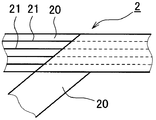
- FIG. 3 is a plan view of the composite contracting member 2 constituting the waist gather portion 10.
- the composite shrinkable member 2 includes two long sheet materials 20 that are aligned in the longitudinal direction, and a plurality of elastic members 21 that extend along the longitudinal direction of the two sheet materials 20 are substantially parallel to each other. It is formed sandwiched between the materials 20.
- the sheet material 20 is made of a nonwoven fabric, and the elastic member 21 is specifically a rubber thread.
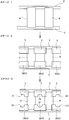
- (Method of manufacturing worn articles) 4 and 5 are diagrams showing the manufacturing process of the disposable diaper 1.
- FIG. The manufacturing process includes processes from stage 1 to stage 5. First, on the stage 1, the two bands of the composite contracting members 2 are arranged so as to be parallel to each other in a state where they are extended against the restoring force of the elastic member 21.
- a plurality of protective sheets 4 are spanned across the two composite contracting members 2 at intervals, and the composite contracting member 2 and both ends of the protective sheet 4 are joined.
- heat fusion or an adhesive such as a hot melt material may be used.
- heat fusion or bonding with an adhesive is used.
- the panel material 3 to be the fit gather part 11 is joined so as to cover the side part of the adjacent protective sheet 4 and the inner end part of the composite shrinkable member 2.
- the panel material 3 is formed from a rectangular base material 30.
- an arc-shaped notch 31 that forms the leg hole 12 is formed in the inner end portion of the base material 30.
- the absorbent body 6 is placed so as to overlap the protective sheet 4, and the peripheral portion of the absorbent body 6 is joined onto the protective sheet 4 and the panel material 3.
- the back sheet 62 of the absorber 6 is joined so as to cover the side portion of the panel material 3.
- the panel material 3 is joined to the protective sheet 4, the panel material 3 is sandwiched between the back sheet 62 and the protective sheet 4.
- the back sheet 62 and the top sheet 60 are shown smaller than the protective sheet 4, but this is for convenience of illustration, and the back sheet 62 and the top sheet 60 are equal to or greater than the protective sheet 4. It may be a size.
- the imaginary line AA passing through the intermediate portion in the width direction between the two composite contracting members 2 is folded, and the absorber 6 is folded in two as shown in the stage 5 in FIG.
- the composite shrinkable member 2 and the panel material 3 are cut by joining along an imaginary line BB which is an intermediate portion between adjacent absorbers 6.
- the paper diaper 1 shown in FIG. 1 is obtained.
- the elastic member 21 (see FIG. 3) that has been stretched returns to elasticity, and the composite contracting member 2 contracts so that the waist gathers 10 lightly tightens the waist of the wearer.
- the paper diaper 1 is for infants, for example, a character such as a cartoon may be attached to the outside.
- identification characters such as “front” and “rear” may be attached to the outside of the disposable diaper 1.
- Such display elements such as comics and identification characters are preferably easy to see.
- the display element is attached
- the composite shrinkable member 2 that becomes the waist gather portion 10 and the panel material 3 that becomes the fit gather portion 11 are separate members. Therefore, the characteristics of the waist gather part 10 and the fit gather part 11, for example, touch, color, and air permeability can be made different.
- the panel material 3 is made of a stretchable nonwoven fabric, but may be a laminate of a nonwoven fabric on a stretchable film, or a nonwoven fabric in which a string-like elastic member, for example, a thread rubber is bonded together. (Manufacturing method of panel material) As shown in the stage 3 of FIG. 4, the panel material 3 is configured by providing a notch 31 in the base material 30. Here, if the notch 31 is directly formed in the base material 30 when the panel material 3 is formed, the nonwoven fabric for the notch 31 is wasted. In view of this point, the applicant proposes a method for manufacturing the panel material 3 shown below.
- FIG. 6A is a diagram showing a manufacturing process of the panel material 3.
- a stretch nonwoven fabric strip 32 is prepared, and a sinusoidal cut 35 is provided at the center of the strip 32 in the width direction with a cutter or the like.
- An imaginary line that is parallel to the width direction of the strip 32 and connects the peak of the notch 35 and the edge of the strip 32 far from the top of the peak is set as W1. Since the cut 35 is wavy, a plurality of virtual lines W1 are set.
- the strip material 32 is cut along every other virtual line W1 adjacent to one virtual line W1, the portion R1 surrounded by the cutting line and the cut 35 on the virtual line W1 becomes the panel material 3. That is, the notch 35 becomes the edge of the notch 31.
- the notch 35 has a sine wave shape
- the waveform of the notch 35 is determined by the peripheral shape of the leg hole 12 and is not limited to a sine wave shape.
- the shape which connected the mountain shape in the horizontal direction may be sufficient.
- an imaginary line parallel to the width direction of the strip 32 and passing through the top of the notch 35 is set as W2, and the strip 32 along the imaginary line W2 is set. May be cut. A portion R2 surrounded by the cutting line and the cut 35 on the virtual line W2 becomes a half of the panel material 3. If the two halves are joined side by side so that the mountains meet, the panel material 3 is obtained.
- Nonwoven fabrics used for the sheet material 20 constituting the panel material 3, the protective sheet 4, and the composite shrinkable member 2 are air-through nonwoven fabric, spunlace nonwoven fabric, spunbond nonwoven fabric, and melt blown from the viewpoint of beauty of appearance and touch. A nonwoven fabric or the like is used. Of course, other non-woven fabrics may be used. Further, the non-woven fabric used for the sheet material 20 constituting the panel material 3, the protective sheet 4, and the composite shrinkable member 2 may have the same or different forming material.
- Examples of the elastic member 21 used for the composite shrinkable member 2 include synthetic rubbers such as styrene-butadiene, butadiene, isoprene, and neoprene, natural rubber, stretchable polyolefin, and polyurethane.
- the elastic member 21 is not limited to thread rubber, but may be a string-like body such as flat rubber, and the cross section may be any of a rectangle, a square, a circle, and a polygon. (Modified example of paper diaper)
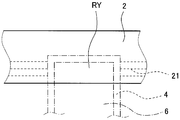
- a non-shrinkable region RY in which the shrinkage force of the elastic member 21 does not occur may be provided in a portion where the absorber 6 or the protective sheet 4 overlaps on the composite shrinkable member 2.
- display elements such as a pattern provided in the non-skin surface of the absorber 6 or the protection sheet 4, do not shrink
- the non-shrinkable region RY can be formed as an empty region where the elastic member 21 is not provided. Specifically, before the absorbent body 6 is disposed, the contraction force in the longitudinal direction of the elastic member 21 is removed by pressurizing or heating the portion of the composite shrinkable member 2 where the absorbent body 6 or the protective sheet 4 overlaps. Thus, the non-stretchable region RY can be formed.
- a roll (not shown) having protrusions and blades provided in a predetermined pattern at intervals along the axial direction and / or circumferential direction is provided. It may be used. It is desirable to substantially remove the contraction force by pressing or heating the composite contraction member 2 between the roll and the roll facing the roll to finely cut the elastic member 21.
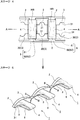
- the step 1 in FIG. 4 is omitted. That is, as shown in the stage 3 in FIG. 8, the two long composite contracting members 2 to be the waist gathers 10 are arranged so as to be parallel to each other. Next, a plurality of panel members 3 to be the fit gather portions 11 are arranged along the longitudinal direction of the composite shrinkable member 2 at the inner end of each composite shrinkable member 2 and joined to the inner end of the composite shrinkable member 2. . A notch 31 is formed at the inner end of the panel material 3.
- the absorber 6 is bridged between the adjacent panel members 3 between the two composite contracting members 2, and the overlapping portion of the panel member 3 and the absorber 6 is joined. Thereafter, the absorbent body 6 is folded in half, and the composite shrinkable member 2 and the panel material 3 are cut at the intermediate portion of the adjacent absorbent bodies 6, and the description is omitted.
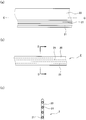
- the composite shrinkable member 2 is configured by sandwiching an elastic member 21 between two sheet materials 20. However, the two sheet materials 20 may be displaced from each other. Therefore, as shown in FIG. 9A, a plurality of elastic members 21 extending along the longitudinal direction of the sheet material 20 are joined substantially parallel to each other on the lower half of one sheet material 20. Thereafter, as shown in FIG. 9B, the sheet material 20 is folded in half along the center line CC in the width direction of the sheet material 20 so that the elastic member 21 is on the inner side. The upper half and the lower half are joined to obtain the composite shrinkable member 2. Thereby, possibility that the sheet
- FIG. 9 (c) is a cross-sectional view of the composite shrinkable member 2 of FIG. 9 (b), taken along the plane including the DD line.
- the fold portion (the upper end portion in FIG. 9C) is rounded.
- the disposable diaper is exemplified as the wearing article using the composite shrinkable member 2, but the present invention is not limited thereto, and may be, for example, sanitary shorts.
- the present invention is useful when applied to worn articles such as disposable diapers.
Landscapes
- Health & Medical Sciences (AREA)
- Engineering & Computer Science (AREA)
- Life Sciences & Earth Sciences (AREA)
- Vascular Medicine (AREA)
- Biomedical Technology (AREA)
- Heart & Thoracic Surgery (AREA)
- Epidemiology (AREA)
- Animal Behavior & Ethology (AREA)
- General Health & Medical Sciences (AREA)
- Public Health (AREA)
- Veterinary Medicine (AREA)
- Manufacturing & Machinery (AREA)
- Botany (AREA)
- Absorbent Articles And Supports Therefor (AREA)
- Orthopedics, Nursing, And Contraception (AREA)
Abstract
Description
各複合収縮部材の内側端部に、前記フィットギャザー部となる複数のパネル材を前記複合収縮部材の長手方向に沿って並べて該複合収縮部材の内側端部に接合する工程Bと、
両複合収縮部材間であって隣り合うパネル材に吸収体を架け渡し、該パネル材と該吸収体の重なり部分を接合する工程Cと、
前記吸収体を2つ折りにして、両複合収縮部材を重ね合わせ、隣り合う吸収体の間にて前記複合収縮部材の長手方向に直交する向きに沿って両複合収縮部材を切断する工程Dを有する。
(着用物品の製造方法)
図4及び図5は、紙おむつ1の製造工程を示す図である。製造工程はステージ1からステージ5までの工程を有する。まずステージ1にて、2本の複合収縮部材2の帯を、弾性部材21の復帰力に抗して延ばした状態で、互いに並行となるように並べる。次に、両複合収縮部材2に複数枚の保護シート4を互いに間隔を開けて掛け渡し、複合収縮部材2と該保護シート4の両端部とを接合する。該接合には、熱融着を用いても、ホットメルト材のような接着剤を用いてもよい。以下に示す各接合作業にも、熱融着や接着剤による接着が用いられる。
(パネル材の製造方法)
図4のステージ3に示したように、パネル材3は基材30に切欠き31を設けて構成される。ここで、パネル材3を形成する際に、仮に基材30に直接切欠き31を形成すると、該切欠き31分の不織布が無駄になる。出願人は、この点に鑑みて、以下に示すパネル材3の製造方法を提案する。
(紙おむつの変形例)
図7に拡大して示すように、複合収縮部材2上にて吸収体6又は保護シート4が重なる部分に、弾性部材21の収縮力が生じない非収縮領域RYを設けてもよい。これにより、吸収体6又は保護シート4の非肌面に設けられる図柄等の表示要素が収縮せず、見易くなる。
2 複合収縮部材
3 パネル材
4 保護シート
6 吸収体
10 ウエストギャザー部
11 フィットギャザー部
Claims (5)
- ウエストギャザー部とフィットギャザー部とを備える着用物品の製造方法であって、
前記ウエストギャザー部となる長尺の2枚の複合収縮部材を、互いに並行となるように並べる工程Aと、
各複合収縮部材の内側端部に、前記フィットギャザー部となる複数のパネル材を前記複合収縮部材の長手方向に沿って並べて、該複合収縮部材の内側端部に接合する工程Bと、
両複合収縮部材間であって隣り合うパネル材に吸収体を架け渡し、該パネル材と該吸収体の重なり部分を接合する工程Cと、
前記吸収体を2つ折りにして、両複合収縮部材を重ね合わせ、隣り合う吸収体の間にて前記複合収縮部材の長手方向に直交する向きに沿って両複合収縮部材を切断する工程Dを有する、着用物品の製造方法。 - 前記吸収体上にて、少なくとも前記複合収縮部材及び/又はパネル材と被らない箇所には、表示要素が付される表示領域が形成されている、請求項1に記載の着用物品の製造方法。
- 前記工程Aと工程Bの間に、両複合収縮部材に亘って保護シートを架け渡す工程を有し、前記吸収体は該保護シート上に載置され、前記パネル材は該保護シートに一部が被さり、該保護シートと前記吸収体とで前記パネル材の一部を挟持する、請求項1又は2に記載の着用物品の製造方法。
- 前記フィットギャザー部には、装着者の足が嵌まるレッグホールが開設され、前記パネル材には該レッグホールとなる切欠きが設けられ、
該パネル材は、長尺の帯材の幅方向中央部に前記切欠きの周縁となる波状の切り込みを形成する工程と、
該帯材の幅方向に平行であって、切り込みの山を通る仮想線を複数本設定する工程と、
仮想線に沿って帯材を切断する工程にて形成される、請求項1又は2に記載の着用物品の製造方法。 - ウエストギャザー部とフィットギャザー部とを備え、該フィットギャザー部の下端部には2つ折りにされて折り目を下向きにした吸収体が設けられ、
該吸収体は両端部がウエストギャザー部に接合され、フィットギャザー部はウエストギャザー部とは別部材から形成された、着用物品。
Priority Applications (3)
| Application Number | Priority Date | Filing Date | Title |
|---|---|---|---|
| CN201380046099.2A CN104582651B (zh) | 2012-09-13 | 2013-09-04 | 使用复合收缩构件的穿戴物品以及该穿戴物品的制造方法 |
| BR112015004955-9A BR112015004955B1 (pt) | 2012-09-13 | 2013-09-04 | Método de fabricação de um artigo de uso |
| IN270KON2015 IN2015KN00270A (ja) | 2012-09-13 | 2015-01-29 |
Applications Claiming Priority (2)
| Application Number | Priority Date | Filing Date | Title |
|---|---|---|---|
| JP2012-201459 | 2012-09-13 | ||
| JP2012201459A JP6095305B2 (ja) | 2012-09-13 | 2012-09-13 | 複合収縮部材を用いた着用物品及び該着用物品の製造方法 |
Publications (1)
| Publication Number | Publication Date |
|---|---|
| WO2014041765A1 true WO2014041765A1 (ja) | 2014-03-20 |
Family
ID=50277908
Family Applications (1)
| Application Number | Title | Priority Date | Filing Date |
|---|---|---|---|
| PCT/JP2013/005244 Ceased WO2014041765A1 (ja) | 2012-09-13 | 2013-09-04 | 複合収縮部材を用いた着用物品及び該着用物品の製造方法 |
Country Status (6)
| Country | Link |
|---|---|
| JP (1) | JP6095305B2 (ja) |
| CN (1) | CN104582651B (ja) |
| BR (1) | BR112015004955B1 (ja) |
| IN (1) | IN2015KN00270A (ja) |
| MY (1) | MY174232A (ja) |
| WO (1) | WO2014041765A1 (ja) |
Families Citing this family (3)
| Publication number | Priority date | Publication date | Assignee | Title |
|---|---|---|---|---|
| WO2015199186A1 (ja) * | 2014-06-26 | 2015-12-30 | 株式会社瑞光 | 使い捨て着用物品の製造方法 |
| JP6347826B2 (ja) * | 2016-12-08 | 2018-06-27 | 大王製紙株式会社 | パンツタイプ使い捨ておむつ |
| JP6396396B2 (ja) * | 2016-12-08 | 2018-09-26 | 大王製紙株式会社 | パンツタイプ使い捨ておむつ及びその製造方法 |
Citations (3)
| Publication number | Priority date | Publication date | Assignee | Title |
|---|---|---|---|---|
| JPS50154135U (ja) * | 1974-06-06 | 1975-12-20 | ||
| JP2010227654A (ja) * | 2003-08-06 | 2010-10-14 | Zuiko Corp | 使い捨て着用物品の製造方法 |
| JP2012157661A (ja) * | 2011-02-02 | 2012-08-23 | Unicharm Corp | 使い捨てのパンツ型おむつおよびその製造方法 |
Family Cites Families (3)
| Publication number | Priority date | Publication date | Assignee | Title |
|---|---|---|---|---|
| JP4243063B2 (ja) * | 2002-01-07 | 2009-03-25 | 大王製紙株式会社 | 吸収性物品及びその製造方法 |
| JP4540624B2 (ja) * | 2005-04-21 | 2010-09-08 | 花王株式会社 | 使い捨ておむつ |
| JP5930584B2 (ja) * | 2011-01-07 | 2016-06-08 | ユニ・チャーム株式会社 | 使い捨てオムツ |
-
2012
- 2012-09-13 JP JP2012201459A patent/JP6095305B2/ja not_active Expired - Fee Related
-
2013
- 2013-09-04 WO PCT/JP2013/005244 patent/WO2014041765A1/ja not_active Ceased
- 2013-09-04 CN CN201380046099.2A patent/CN104582651B/zh active Active
- 2013-09-04 BR BR112015004955-9A patent/BR112015004955B1/pt not_active IP Right Cessation
- 2013-09-04 MY MYPI2015700741A patent/MY174232A/en unknown
-
2015
- 2015-01-29 IN IN270KON2015 patent/IN2015KN00270A/en unknown
Patent Citations (3)
| Publication number | Priority date | Publication date | Assignee | Title |
|---|---|---|---|---|
| JPS50154135U (ja) * | 1974-06-06 | 1975-12-20 | ||
| JP2010227654A (ja) * | 2003-08-06 | 2010-10-14 | Zuiko Corp | 使い捨て着用物品の製造方法 |
| JP2012157661A (ja) * | 2011-02-02 | 2012-08-23 | Unicharm Corp | 使い捨てのパンツ型おむつおよびその製造方法 |
Also Published As
| Publication number | Publication date |
|---|---|
| JP6095305B2 (ja) | 2017-03-15 |
| CN104582651B (zh) | 2018-11-23 |
| MY174232A (en) | 2020-04-01 |
| JP2014054422A (ja) | 2014-03-27 |
| CN104582651A (zh) | 2015-04-29 |
| IN2015KN00270A (ja) | 2015-06-12 |
| BR112015004955A2 (pt) | 2017-07-04 |
| BR112015004955B1 (pt) | 2021-06-29 |
Similar Documents
| Publication | Publication Date | Title |
|---|---|---|
| JP4482457B2 (ja) | 使い捨て着用物品の製造方法 | |
| CN100493480C (zh) | 套穿型一次性穿着用品 | |
| JP5706925B2 (ja) | パンツ型着用物品およびその製造方法 | |
| RU2674845C2 (ru) | Абсорбирующее устройство | |
| JP4521214B2 (ja) | パンツタイプ着用物品の製造方法 | |
| JP2002035029A (ja) | 伸縮性シートの製造方法およびこれを用いた紙おむつ | |
| WO2013146842A1 (ja) | 使い捨て着用物品 | |
| JP5237323B2 (ja) | パンツタイプ着用物品の製造方法 | |
| CN104470710A (zh) | 复合伸缩部件及其生产方法、以及设有复合伸缩部件的穿戴物品及其生产方法 | |
| KR20120099290A (ko) | 팬츠형 일회용 착용 물품 | |
| JP5785781B2 (ja) | 使い捨ておむつ | |
| WO2020116592A1 (ja) | 使い捨ておむつ | |
| JP6703381B2 (ja) | 使い捨ての着用物品 | |
| WO2014196215A1 (ja) | パンツ型使い捨ておむつ及びその製造方法 | |
| EP3103425B1 (en) | Method for manufacturing disposable wear | |
| JP6209162B2 (ja) | 複合シート材とその製造方法及びこれを用いた使い捨て着用物品 | |
| JP6095305B2 (ja) | 複合収縮部材を用いた着用物品及び該着用物品の製造方法 | |
| US10925779B2 (en) | Disposable undergarment and method for manufacturing disposable undergarment | |
| JP6297438B2 (ja) | 使い捨て着用品 | |
| JP6220661B2 (ja) | パンツ型吸収性物品 | |
| JP4769891B2 (ja) | 使い捨て着用物品の製造方法 | |
| JP4540215B2 (ja) | 使い捨てパンツおよびその製造方法 | |
| JP7173829B2 (ja) | パンツ型吸収性物品 | |
| JP2020124423A (ja) | 使い捨て吸収性物品 | |
| JP6829031B2 (ja) | パンツタイプ使い捨ておむつ |
Legal Events
| Date | Code | Title | Description |
|---|---|---|---|
| 121 | Ep: the epo has been informed by wipo that ep was designated in this application |
Ref document number: 13837555 Country of ref document: EP Kind code of ref document: A1 |
|
| NENP | Non-entry into the national phase |
Ref country code: DE |
|
| REG | Reference to national code |
Ref country code: BR Ref legal event code: B01A Ref document number: 112015004955 Country of ref document: BR |
|
| 122 | Ep: pct application non-entry in european phase |
Ref document number: 13837555 Country of ref document: EP Kind code of ref document: A1 |
|
| ENP | Entry into the national phase |
Ref document number: 112015004955 Country of ref document: BR Kind code of ref document: A2 Effective date: 20150305 |