WO2014034494A1 - 合金粒子、電極、非水電解質二次電池および合金粒子製造方法 - Google Patents
合金粒子、電極、非水電解質二次電池および合金粒子製造方法 Download PDFInfo
- Publication number
- WO2014034494A1 WO2014034494A1 PCT/JP2013/072301 JP2013072301W WO2014034494A1 WO 2014034494 A1 WO2014034494 A1 WO 2014034494A1 JP 2013072301 W JP2013072301 W JP 2013072301W WO 2014034494 A1 WO2014034494 A1 WO 2014034494A1
- Authority
- WO
- WIPO (PCT)
- Prior art keywords
- alloy
- silicon
- mass
- powder
- particles
- Prior art date
- Legal status (The legal status is an assumption and is not a legal conclusion. Google has not performed a legal analysis and makes no representation as to the accuracy of the status listed.)
- Ceased
Links
Images

Classifications
-
- H—ELECTRICITY
- H01—ELECTRIC ELEMENTS
- H01M—PROCESSES OR MEANS, e.g. BATTERIES, FOR THE DIRECT CONVERSION OF CHEMICAL ENERGY INTO ELECTRICAL ENERGY
- H01M4/00—Electrodes
- H01M4/02—Electrodes composed of, or comprising, active material
- H01M4/36—Selection of substances as active materials, active masses, active liquids
- H01M4/362—Composites
-
- C—CHEMISTRY; METALLURGY
- C01—INORGANIC CHEMISTRY
- C01B—NON-METALLIC ELEMENTS; COMPOUNDS THEREOF; METALLOIDS OR COMPOUNDS THEREOF NOT COVERED BY SUBCLASS C01C
- C01B33/00—Silicon; Compounds thereof
- C01B33/06—Metal silicides
-
- H—ELECTRICITY
- H01—ELECTRIC ELEMENTS
- H01M—PROCESSES OR MEANS, e.g. BATTERIES, FOR THE DIRECT CONVERSION OF CHEMICAL ENERGY INTO ELECTRICAL ENERGY
- H01M10/00—Secondary cells; Manufacture thereof
- H01M10/05—Accumulators with non-aqueous electrolyte
- H01M10/052—Li-accumulators
- H01M10/0525—Rocking-chair batteries, i.e. batteries with lithium insertion or intercalation in both electrodes; Lithium-ion batteries
-
- H—ELECTRICITY
- H01—ELECTRIC ELEMENTS
- H01M—PROCESSES OR MEANS, e.g. BATTERIES, FOR THE DIRECT CONVERSION OF CHEMICAL ENERGY INTO ELECTRICAL ENERGY
- H01M4/00—Electrodes
- H01M4/02—Electrodes composed of, or comprising, active material
- H01M4/36—Selection of substances as active materials, active masses, active liquids
- H01M4/38—Selection of substances as active materials, active masses, active liquids of elements or alloys
- H01M4/386—Silicon or alloys based on silicon
-
- H—ELECTRICITY
- H01—ELECTRIC ELEMENTS
- H01M—PROCESSES OR MEANS, e.g. BATTERIES, FOR THE DIRECT CONVERSION OF CHEMICAL ENERGY INTO ELECTRICAL ENERGY
- H01M4/00—Electrodes
- H01M4/02—Electrodes composed of, or comprising, active material
- H01M4/36—Selection of substances as active materials, active masses, active liquids
- H01M4/58—Selection of substances as active materials, active masses, active liquids of inorganic compounds other than oxides or hydroxides, e.g. sulfides, selenides, tellurides, halogenides or LiCoFy; of polyanionic structures, e.g. phosphates, silicates or borates
-
- C—CHEMISTRY; METALLURGY
- C01—INORGANIC CHEMISTRY
- C01P—INDEXING SCHEME RELATING TO STRUCTURAL AND PHYSICAL ASPECTS OF SOLID INORGANIC COMPOUNDS
- C01P2006/00—Physical properties of inorganic compounds
- C01P2006/40—Electric properties
-
- H—ELECTRICITY
- H01—ELECTRIC ELEMENTS
- H01M—PROCESSES OR MEANS, e.g. BATTERIES, FOR THE DIRECT CONVERSION OF CHEMICAL ENERGY INTO ELECTRICAL ENERGY
- H01M10/00—Secondary cells; Manufacture thereof
- H01M10/05—Accumulators with non-aqueous electrolyte
- H01M10/052—Li-accumulators
-
- Y—GENERAL TAGGING OF NEW TECHNOLOGICAL DEVELOPMENTS; GENERAL TAGGING OF CROSS-SECTIONAL TECHNOLOGIES SPANNING OVER SEVERAL SECTIONS OF THE IPC; TECHNICAL SUBJECTS COVERED BY FORMER USPC CROSS-REFERENCE ART COLLECTIONS [XRACs] AND DIGESTS
- Y02—TECHNOLOGIES OR APPLICATIONS FOR MITIGATION OR ADAPTATION AGAINST CLIMATE CHANGE
- Y02E—REDUCTION OF GREENHOUSE GAS [GHG] EMISSIONS, RELATED TO ENERGY GENERATION, TRANSMISSION OR DISTRIBUTION
- Y02E60/00—Enabling technologies; Technologies with a potential or indirect contribution to GHG emissions mitigation
- Y02E60/10—Energy storage using batteries
Definitions
- the present invention relates to an alloy particle that can be used as a negative electrode active material for a non-aqueous electrolyte secondary battery.
- the present invention also relates to a method for producing the alloy particles.
- the present invention also relates to an electrode formed from the alloy particles.
- the present invention also relates to a nonaqueous electrolyte secondary battery including the electrode as a negative electrode.
- Such negative electrode materials for non-aqueous electrolyte secondary batteries are “high charge / discharge capacity”, “excellent in charge / discharge cycle life”, “high charge / discharge efficiency”, “small variation in characteristics”. Therefore, it is attracting attention as a next-generation material.
- the problem of the present invention is that it has a charge / discharge cycle life equal to or higher than that of a conventional non-aqueous electrolyte secondary battery negative electrode material, and has a charge / discharge capacity higher than that of a conventional non-aqueous electrolyte secondary battery negative electrode material.
- the object is to provide a large negative electrode material for a non-aqueous electrolyte secondary battery.
- the alloy particles according to one aspect of the present invention include a metal silicide phase and a silicon phase.
- the metal silicide phase is formed from silicon atoms and at least two metal atoms.
- the silicon phase is mainly formed from silicon atoms.
- the silicon phase is preferably formed only from silicon atoms.
- the silicon phase is dispersed in the metal silicide phase.
- the silicon phase accounts for 20% by mass or more with respect to the total amount of the alloy particles.
- the silicon phase preferably occupies a ratio of 22% by mass or more, more preferably occupies a ratio of 24% by mass or more, more preferably occupies a ratio of 26% by mass or more, based on the total amount of alloy particles.
- a silicon atom accounts for the ratio of 85 mass% or less with respect to the whole quantity. It is preferable that the silicon atom occupies a ratio of 70% by mass or less with respect to the total amount.
- the silicon phase is dispersed in the metal silicide phase.
- a metal silicide phase that is not substantially reactive with lithium (Li) is formed by occlusion / release of lithium (Li).
- the silicon phase that expands and contracts can be physically constrained. Therefore, the alloy particles can exhibit a charge / discharge cycle life equal to or higher than that of a conventional negative electrode material for a nonaqueous electrolyte secondary battery.
- this alloy particle the silicon phase occupies a ratio of 20% by mass or more with respect to the total amount of the alloy particle. For this reason, this alloy particle has a larger charge / discharge capacity than a conventional negative electrode material for a non-aqueous electrolyte secondary battery.
- the alloy particles have a charge / discharge cycle life equal to or higher than that of the conventional negative electrode material for nonaqueous electrolyte secondary batteries, and are more charged / discharged than the conventional negative electrode material for nonaqueous electrolyte secondary batteries. Large capacity.
- metal silicides usually have good conductivity and are less susceptible to oxidation than silicon, so that there are few irreversible reactions caused by surface oxides. For this reason, when this alloy particle is used as a negative electrode material for a non-aqueous electrolyte secondary battery, electrons can be efficiently exchanged at the negative electrode of the non-aqueous electrolyte secondary battery. Can keep good.
- the alloy particles are used as a negative electrode material for a non-aqueous electrolyte secondary battery, the area of the silicon portion (silicon phase) that comes into contact with the electrolytic solution is reduced, so that decomposition of the electrolytic solution by silicon is suppressed.
- silicon atoms have a chemical composition that occupies a ratio of 85% by mass or less, preferably 70% by mass or less, based on the total amount of the alloy particles. For this reason, this alloy particle is excellent in continuous castability at the time of manufacture.
- the silicon phase preferably has an average particle diameter of more than 0 nm and not more than 100 nm. This is because the charge / discharge cycle life is improved as the average particle size of the silicon phase is reduced.
- the metal silicide phase preferably has a composition of mainly MSix.
- M is two or more metal elements
- Si is silicon
- x is a value greater than 0 and less than 2.
- M is preferably a metal element capable of forming a silicide.
- M may be a metal element that does not form a silicide alone with silicon, or may be a metal element that forms a silicon compound when added together with other silicon compound-forming elements.
- metal elements include aluminum (Al), iron (Fe), nickel (Ni), titanium (Ti), copper (Cu), cobalt (Co), and chromium (Cr).
- M includes at least one metal element selected from the group consisting of aluminum (Al), iron (Fe), nickel (Ni), titanium (Ti), and copper (Cu). Preferably.
- M preferably contains at least one metal element selected from the group consisting of cobalt (Co) and chromium (Cr).
- the metal silicide phase preferably contains silicon (Si), nickel (Ni), and titanium (Ti). This is because in the alloy particles having such a composition, the silicon phase is more easily refined than before.
- An electrode according to another aspect of the present invention includes the above-described alloy particles as an active material. In addition, it is preferable that this electrode is utilized as a negative electrode of a nonaqueous electrolyte secondary battery.
- a nonaqueous electrolyte secondary battery includes the above electrode as a negative electrode.
- the capacity retention with respect to the initial cycle time is preferably 85% or more, more preferably 90% or more, and 95% or more at the time of 50 charge / discharge cycles. Is more preferable, and 98% or more is particularly preferable.
- the alloy particle manufacturing method includes a metal melting step, a rapid solidification step, a pulverization step, and a mechanical grinding step.
- the metal melting step at least silicon (Si) and at least two kinds of metals are melted to prepare a specific alloy molten metal.
- nickel (Ni) and titanium (Ti) are preferably added to the specific alloy molten metal, and copper (Cu) is more preferably added.
- the rapid solidification process the specific alloy melt is rapidly solidified to produce a specific alloy solidified product.
- the pulverization step the specific alloy solidified product is pulverized to form a specific alloy powder.
- the mechanical grinding step the specific alloy powder is mechanically ground to produce the above-described alloy particles.
- the silicon phase in the alloy particles can be refined as compared with the conventional negative electrode material for non-aqueous electrolyte secondary batteries. For this reason, if this alloy particle manufacturing method is utilized, the negative electrode material (namely, alloy particle) for nonaqueous electrolyte secondary batteries which is excellent in a charge / discharge cycle life can be obtained.
- silicon (Si) preferably occupies a ratio of 85% by mass or less, and preferably 70% by mass or less in the specific alloy molten metal. This is because continuous casting can be performed satisfactorily in the rapid solidification process, and the production efficiency of alloy particles can be increased.
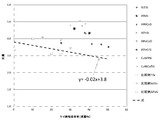
- the specific alloy powder has a silicon phase content of 20% by mass or more, the specific gravity is y, and the silicon phase content (% by mass) is x, where y> It is preferable that the relationship of ⁇ 0.02x + 3.8 is established.
- the silicon phase content preferably accounts for 30% by mass or more, more preferably 35% by mass or more, and more preferably 40% by mass or more. Preferably, it occupies a ratio of 45% by mass or more.
- the specific alloy powder In the mechanical grinding process, the specific alloy powder is repeatedly crushed and granulated. And how often the specific alloy powder collides with the ball as the processing medium depends on the volume ratio. Therefore, when the specific alloy powder having the same mass is mechanically ground, the larger the specific gravity, the more efficiently it can be processed. That is, in this alloy particle manufacturing method, alloy particles can be efficiently processed while maintaining a high silicon phase content.
- the volume ratio between the specific alloy powder and the ball is fixed to a certain value, the specific alloy powder having a larger specific gravity is processed in a larger amount in terms of mass. For this reason, if this alloy particle manufacturing method is utilized, the production amount of alloy particles per batch of the mechanical grinding apparatus can be increased.
- the alloy particles according to an embodiment of the present invention include a metal silicide phase and a silicon phase.
- the silicon phase is dispersed in the metal silicide phase.
- a silicon atom occupies the ratio of 85 mass% or less with respect to the whole quantity of an alloy particle. It is preferable that silicon atoms occupy a ratio of 70% by mass or less with respect to the total amount of alloy particles.
- the content of silicon atoms needs to be increased until the silicon phase is dispersed in the metal silicide phase as described above.
- the metal silicide phase and the silicon phase will be described in detail.
- Metal silicide phase The metal silicide phase is formed from a silicon atom and at least two metal atoms.
- the metal silicide phase may be an intermetallic compound.
- strain (dislocation) is introduced into the metal silicide phase so as not to be completely crystalline.
- This metal silicide phase is required not to substantially react with lithium (Li), but may be reactive to lithium (Li) as long as the gist of the present invention is not impaired.
- This metal silicide phase preferably has a composition of mainly MSix.
- M is two or more metal elements, Si is silicon, and x is a value greater than 0 and less than 2.
- M is aluminum (Al), iron (Fe), nickel (Ni), titanium (Ti), copper (Cu), cobalt (Co), chromium (Cr), vanadium (V), manganese (Mn), Zinc (Zn), yttrium (Y), zirconium (Zr), niobium (Nb), molybdenum (Mo), ruthenium (Ru), rhodium (Rh), palladium (Pd), silver (Ag), hafnium (Hf), Two or more metal elements selected from the group consisting of tantalum (Ta), tungsten (W), platinum (Pt), lanthanum (La), cerium (Ce), praseodymium (Pr) and neodymium (Nd) Is preferred.
- the metal silicide phase
- the metal silicide phase may contain a structure other than MSix such as TiSi 2 , Ni 4 Ti 4 Si 7, and NiSi 2 as long as the gist of the present invention is not impaired.
- the MSix content in the metal silicide phase is preferably 20% by volume or more, and more preferably 30% by volume or more.
- the silicon phase is mainly formed from silicon atoms.
- the silicon phase is preferably formed only from silicon atoms. As described above, this silicon phase is dispersed in the metal silicide phase. In this silicon phase, strain (dislocation) is introduced so as not to be completely crystalline.
- This silicon phase occupies a ratio of 20% by mass or more with respect to the total mass of the alloy particles. More preferably, the silicon phase accounts for 30% by mass or more of the total mass of the alloy particles, more preferably 40% by mass or more, and 50% by mass or more of the total mass of the alloy particles. It is further preferable to occupy a ratio of 60% by mass or more with respect to the total mass of the alloy particles.
- the content of the silicon phase is increased as long as the state in which the silicon phase is dispersed in the metal silicide phase is maintained, that is, as long as the sea-island structure is maintained in which the silicon phase is an island and the metal silicide phase is the sea. be able to.
- the average particle size of the silicon phase is preferably more than 0 nm and not more than 100 nm, more preferably more than 0 nm and not more than 90 nm, more preferably more than 0 nm and not more than 80 nm, and still more preferably more than 0 nm and not more than 70 nm. More preferably, more than 0 nm and less than 60 nm, more preferably more than 0 nm and less than 50 nm, further preferably more than 0 nm and less than 40 nm, more preferably more than 0 nm and less than 30 nm, more preferably more than 0 nm and less than 20 nm. More preferably, it is more than 0 nm and not more than 10 nm.
- the alloy particles having the above configuration are manufactured through a metal melting step, a rapid solidification step, a pulverization step, and a mechanical grinding step. Hereinafter, each process is explained in full detail.
- Metal melting step a plurality of metal raw materials containing silicon (Si) are melted to prepare a specific molten metal.
- silicon (Si) is added to the metal raw material so that the silicon phase is 85 mass% or less with respect to the total mass of the metal raw material, and 20 mass% or more of the silicon phase is precipitated in the rapid solidification process in the subsequent step. Added.
- the amount of silicon added can be easily determined using an equilibrium diagram.
- the metal raw material preferably contains nickel (Ni) and titanium (Ti) in addition to silicon (Si), and more preferably contains copper (Cu). Note that the metal raw materials are not necessarily melted at the same time, and may be melted in stages.
- the metal raw material is usually brought into a molten state by heating.
- the metal raw material is preferably heated and melted in an inert gas or vacuum atmosphere.
- the heating method includes high frequency induction heating, arc discharge heating (arc melting), plasma discharge heating (plasma melting), resistance heating, and the like. In this step, it is important to form a compositionally uniform molten metal.
- the specific alloy melt is rapidly solidified to produce a specific alloy solidified product.
- the molten specific alloy is preferably rapidly solidified at a cooling rate of 100 K / second or more, and the molten specific alloy is preferably rapidly solidified at a cooling rate of 1,000 K / second or more.
- rapid solidification method examples include a gas atomizing method, a roll rapid cooling method, a plate casting method, a rotating electrode method, a liquid atomizing method, and a melt spinning method.
- the molten metal in the tundish is caused to flow out from the pores at the bottom of the tundish, and a high-pressure inert gas such as argon (Ar), nitrogen (N 2 ), and helium (He) is supplied to the fine stream of the molten metal.
- a high-pressure inert gas such as argon (Ar), nitrogen (N 2 ), and helium (He) is supplied to the fine stream of the molten metal.
- the roll rapid cooling method is a method in which a molten metal is dropped on a single roll or a double roll rotating at high speed, or a thin cast slab is obtained by pulling up the molten metal with a roll.
- the obtained thin cast slab is pulverized to an appropriate size in a pulverization process which is a subsequent process.
- the flat plate casting method is a method of casting a molten metal into a flat plate mold so that the thickness of the ingot is thin, and the cooling rate is faster than that of the block shape ingot.
- the obtained flat plate-like ingot is pulverized to an appropriate size in a pulverization step which is a subsequent step.
- the specific alloy solidified product is pulverized to form a specific alloy powder.
- the specific alloy powder satisfies the relationship of y> ⁇ 0.02x + 3.8 (see FIG. 2), where y is the (bulk) specific gravity and x is the silicon phase content (mass%). preferable. The reason is as described in the section [Means for Solving the Problems].
- this pulverization step is preferably performed in a non-oxidizing atmosphere. This is because, in the pulverization step, when the specific alloy solidified product is pulverized, a new surface is formed and the specific surface area is also increased. Note that an inert gas atmosphere is preferable as the non-oxidizing atmosphere, but there is no particular problem even if oxygen of about 2 to 5% by volume is contained.
- the specific alloy powder is subjected to mechanical grinding (hereinafter referred to as “MG treatment”) to produce the above-described alloy particles.
- MG treatment mechanical grinding
- the specific alloy powder subjected to the MG treatment preferably has an average particle size of 5 mm or less, more preferably 1 mm or less, and even more preferably 500 ⁇ m or less.
- the MG treatment In the MG treatment, a compressive force and a shear force are applied to the powder as the material to be treated, and the powder is repeatedly disintegrated and granulated while being crushed. As a result, the original structure of the powder is collapsed, and particles having a structure in which the phase existing before the processing is ultrafinely dispersed on the nanometer order are formed. However, the type and content of the phase constituting the fine structure are substantially the same as before the treatment, and no new phase is formed by the treatment. Due to the characteristics of this MG treatment, when the alloy particles according to the present invention are used as a negative electrode material for a nonaqueous electrolyte secondary battery, the negative electrode exhibits a stable discharge capacity. This is different from the MA method (mechanical alloying method) in which an alloying reaction between elements occurs and the content of the phase is changed by the treatment. In the process of MG treatment, local mechanical alloying may occur in a very small part of the alloy powder.
- MA method mechanical alloying method
- the particles after pulverization retain the structure before pulverization. That is, in the pulverization, only the particle diameter is reduced, and the structure is not refined.
- the MG process in which the structure is crushed and broken during processing and the structure becomes finer is different from pulverization in this respect.
- MG treatment can be carried out by any pulverizer capable of grinding the material.
- a pulverizer using a ball-shaped pulverizing medium that is, a ball mill type pulverizer is preferable.
- the ball mill type grinder is simple in structure, the balls of the grinding media are easily available in various materials, and grinding / grinding occurs at the contact point between the balls, so it can be uniformly ground in many places. And the like (which is particularly important from the viewpoint of high uniformity of reaction, that is, product stability), and is particularly suitable for use in the present invention.
- ball mill-type pulverizers not only simply rotating the pulverizing cylinder, but also a vibrating ball mill with increased pulverization energy by applying vibrations, and a rotating rod forcing the balls to be crushed and grinding media
- An attritor that stirs and a planetary ball mill in which grinding energy is increased by rotational force and centrifugal force are preferred.
- MG treatment is preferably performed in an inert gas atmosphere such as argon in order to prevent oxidation of the material being treated.
- the material may be subjected to MG treatment in an air atmosphere.
- the metal particles after MG treatment preferably have an oxygen concentration of 2.5% by mass or less, and more preferably 2.0% by mass or less.
- the oxygen concentration of the metal particles after MG treatment exceeds 2.5% by mass, when the metal particles are used as an electrode material for a non-aqueous electrolyte secondary battery, the irreversible capacity increases and the charge / discharge efficiency decreases remarkably. Because.
- the pulverizer is provided with a cooling mechanism. In such a case, the MG process is performed while the system is cooled.
- MG treatment is stearic acid, zinc stearate, lithium stearate, magnesium stearate, calcium stearate, barium stearate, calcium laurate, barium laurate, zinc laurate, polyvinylpyrrolidone, zinc octylate, calcium ricinoleate, ricinoleic acid Barium, zinc ricinoleate, or the like may be added to the material to be treated. Thereby, adhesion of the to-be-processed material to a container is reduced.
- alloy powders are separately prepared by the steps (1) to (3) described above, and the mixed alloy powder mixed so as to satisfy the above relational expression is subjected to MG treatment. It doesn't matter.
- a raw material alloy can be prepared with a chemical composition having good solubility and castability, and can be produced at a high yield. This is because, in the case of producing a plurality of different alloy powders, it is possible to enjoy the merits of being able to make them by simply changing the mixing ratio of the alloy powders prepared in advance.
- the electrode which concerns on embodiment of this invention can be formed from the above-mentioned alloy particle.
- an electrode binder is prepared by mixing an appropriate binder with alloy particles and mixing an appropriate conductive powder as necessary to improve conductivity.
- a solvent for dissolving the binder is added to the electrode mixture, and if necessary, the mixture is sufficiently stirred using a homogenizer and glass beads to form a slurry.
- a slurry kneader combining a rotation motion and a revolution motion may be used.
- this slurry-like electrode mixture is applied to an electrode substrate (current collector) such as rolled copper foil or copper electrodeposited copper foil using a doctor blade or the like, dried, and then consolidated by roll rolling or the like, An electrode for a water electrolyte secondary battery is obtained.
- This electrode is usually used as a negative electrode.
- water-insoluble resins such as polyvinylidene fluoride (PVDF), polymethyl methacrylate (PMMA), and polytetrafluoroethylene (PTFE) (however, those that are insoluble in the solvent used for the non-aqueous electrolyte of the battery) ), Water-soluble resins such as carboxymethyl cellulose (CMC) and polyvinyl alcohol (PVA), and aqueous dispersion type binders such as styrene-butadiene rubber (SBR).
- an organic solvent such as N-methylpyrrolidone (NMP) or dimethylformamide (DMF) or water can be used depending on the binder.
- Examples of the conductive powder include carbon materials (eg, carbon black, graphite) and metals (eg, Ni). Among these, carbon materials are preferable. Since the carbon material can occlude Li ions between the layers, the carbon material can contribute to the capacity of the negative electrode in addition to the conductivity, and also has excellent liquid retention. Among these carbon materials, acetylene black is particularly preferable.
- the nonaqueous electrolyte secondary battery according to the embodiment of the present invention is manufactured using the above-described negative electrode.
- the nonaqueous electrolyte secondary battery is, for example, a lithium ion secondary battery.
- the above-mentioned alloy particle and electrode are suitable as a negative electrode material and a negative electrode of a lithium ion secondary battery.
- the alloy particles and electrodes according to the present embodiment can theoretically be applied to other nonaqueous electrolyte secondary batteries.
- the nonaqueous electrolyte secondary battery includes a negative electrode, a positive electrode, a separator, and a nonaqueous electrolyte as a basic structure.
- a negative electrode the one manufactured according to the present invention as described above is used.
- the positive electrode, the separator and the electrolyte known materials or materials developed in the future may be appropriately used.
- the nonaqueous electrolyte may be liquid, solid, or gel.
- the solid electrolyte include polymer electrolytes such as polyethylene oxide, polytetrafluoroethylene, fluorine-containing copolymers, and combinations thereof.
- the liquid electrolyte include ethylene carbonate, diethyl carbonate, propylene carbonate, and combinations thereof.
- the electrolyte is provided with a lithium electrolyte salt.
- suitable salts include lithium hexafluorophosphate (LiPF 6 ), lithium borofluoride (LiBF 4 ), and lithium perchlorate (LiClO 4 ).
- suitable cathode compositions for example, lithium cobalt oxide (LiCoO 2), lithium manganate (LiMn 2 O 4) and LiCo 0.2 Ni 0.8 O 2 and the like.
- a pure crucible of nickel, titanium and silicon is melted into a crucible made of aluminum titanate so that the mass ratio of nickel (Ni), titanium (Ti) and silicon (Si) is 25.0: 17.0: 58.0. It was thrown into.
- the pure raw material (metal mixture) in the melting crucible was heated to 1500 ° C. by high frequency induction heating to be completely dissolved.
- the melt was rapidly solidified by bringing it into contact with a copper water-cooled roll rotating at a peripheral speed of 90 m / min to obtain a flaky slab (strip casting (SC) method).
- the cooling rate at this time is about 500 to 2,000 ° C./second.
- the cast slab thus obtained was pulverized and classified with a 63 ⁇ m sieve to produce a primary powder having an average particle size of 25 to 30 ⁇ m.
- the silicon phase content in the primary powder was calculated by a method based on the ternary equilibrium diagram, and the value was 38% by mass.
- the specific gravity of the primary powder particles was 4.34 (see Table 1). And substituting 38 for x in the formula: y> ⁇ 0.02x + 3.8 (where x is the silicon phase content (% by mass) in the primary powder and y is the specific gravity of the primary powder).
- this primary powder is put into a planetary ball mill (BX384E manufactured by Kurimoto Steel Co., Ltd.), and the primary powder is mechanically ground (hereinafter abbreviated as “MG treatment”) at a rotational speed of 500 rpm.
- MG treatment mechanically ground
- a powder hereinafter, one alloy powder may be referred to as “alloy particle”.
- the MG treatment is performed in a glove box in a nitrogen atmosphere (less than 1% oxygen) in a primary powder and a ball (material: SUS304, ball diameter: 4 mm, ball ratio, primary powder: graphite (alloy powder fixed to the ball and outer wall).
- Ball (mixed) 34 g: 6 g: 600 g) is inserted into a pod (material: SUS304, inner diameter: 100 mm, depth: 67 mm, rotation speed: 500 rpm), and then the pod is covered for 10 hours. It was done over.
- the alloy powder was taken out and classified in a glove box in a nitrogen atmosphere (less than 1% oxygen) (63 ⁇ m).
- the MG workability index value at the time of the MG treatment was 136 (see Table 1).
- This MG workability index value is obtained on the basis of the volume ratio of the ball to the alloy powder when the specific gravity of the particles of the alloy powder is 3.2. That is, for example, when the ball and the alloy powder are mixed at the volume ratio described above, if the specific gravity of the alloy particles is 1.2 times the specific gravity of the previous alloy particles, the batch processing mass becomes + 20%, and the MG The workability index value is 120%.
- the diameter of the silicon phase on the order of ⁇ m (1 ⁇ m or more) was directly measured using a scanning electron micrograph of the cross section of the sample piece cut so that the cross section of the alloy particles was exposed.
- the diameter of the silicon phase in the alloy particles according to this example was 5 to 20 nm (see Table 1).
- ⁇ Negative electrode characteristics of alloy powder and silicon phase content in alloy particles > (1) Production of negative electrode 5 parts by mass of styrene butadiene rubber (SBR) (binder), 5 parts by mass of carboxymethyl cellulose (CMC) (binder), 15 parts by mass of acetylene black with respect to 75 parts by mass of the above-described alloy powder Powder (conductive powder) was added, and distilled water was further added to the mixture, followed by kneading to prepare a uniform negative electrode mixture slurry.
- SBR styrene butadiene rubber
- CMC carboxymethyl cellulose
- This negative electrode mixture slurry was thinly applied onto a 30 ⁇ m thick electrolytic copper foil using a doctor blade and dried to form a coating film.
- This coating film was punched out using a punch having a diameter of 13 mm to obtain a negative electrode for a nonaqueous electrolyte secondary battery.
- the mixture coating amount on the copper foil was in the range of 2 to 3 mg / cm 2 .
- LiPF 6 of the supporting electrolyte was used a solution obtained by dissolving LiPF 6 as a 1 Mol / L. Moreover, 8 mass% fluoroethylene carbonate was added to this electrolyte solution as an additive.
- This coin-type battery had an initial charge capacity of 1051 mAh / g, an initial discharge capacity of 834 mAh / g, and an initial efficiency of 79%.
- the ratio of the “discharge capacity at the detachment at the 51st cycle” to the “discharge capacity at the detachment at the 2nd cycle” is defined as the capacity maintenance ratio (hereinafter referred to as “51C Called capacity retention rate).
- the ambient temperature was 25 ° C. If this 51C capacity maintenance rate is 85% or more, it can be regarded as a good practical battery.
- the 51C capacity maintenance rate of the coin-type battery according to this example was 89.8% (see Table 1).
- Silicon phase content in alloy particles is expressed as follows: "Discharge capacity at the first cycle of the coin-type battery” as described above "Electrode provided with active material layer using only silicon powder as active material” It was determined by dividing by 100 by dividing by “actual value 3200 mAh / g of discharge capacity in the first cycle of the coin-type battery in which is incorporated”. In addition, the silicon phase content rate in the alloy particle which concerns on a present Example was 26 mass% (refer Table 1).
- the pure powder of nickel, titanium, and silicon was put into an aluminum titanate melting crucible so that the mass ratio of nickel, titanium, and silicon was 13.5: 21.5: 65.0, and the primary powder during MG treatment
- An alloy powder was prepared in the same manner as in Example 1 except that the mass ratio of: graphite was 36 g: 4 g, and the size of the silicon phase in the alloy particles was measured in the same manner as in Example 1.
- a negative electrode was produced from this alloy powder and a coin-type battery incorporating the negative electrode was prepared, and the initial charge capacity, initial discharge capacity, and initial efficiency of the coin-type battery were determined.
- the silicon phase content in the alloy particles was determined.
- the specific gravity of the particles of the primary powder during the production of the alloy powder was 3.68, and the silicon phase content of the particles in the primary powder was 41% by mass. Then, substituting 41 for x in the formula: y> ⁇ 0.02x + 3.8 and substituting 3.68 for y yields 3.68> 2.98, and this formula holds for particles of the same primary powder. It became clear to do.
- the MG workability index value at the time of MG treatment according to this example was 115, and the diameter of the silicon phase in the alloy particles according to this example was 5 to 20 nm.
- the initial charge capacity of the coin-type battery according to this example was 958 mAh / g, the initial discharge capacity was 782 mAh / g, and the initial efficiency was 82%.
- the silicon phase content in the alloy particles according to this example was 24% by mass. (See Table 1)
- the pure powder of nickel, titanium and silicon was put into a melting crucible made of aluminum titanate so that the mass ratio of nickel, titanium and silicon was 14.0: 19.0: 67.0, and the primary powder during MG treatment
- An alloy powder was prepared in the same manner as in Example 1 except that the mass ratio of: graphite was 36 g: 4 g, and the size of the silicon phase in the alloy particles was measured in the same manner as in Example 1.
- a negative electrode was produced from this alloy powder and a coin-type battery incorporating the negative electrode was produced. The initial charge capacity, initial discharge capacity, initial efficiency and 51C capacity of the coin-type battery were maintained. While calculating
- the specific gravity of the particles of the primary powder during the production of the alloy powder was 3.66, and the silicon phase content of the particles in the primary powder was 46% by mass.
- the MG workability index value at the time of MG treatment according to this example was 115, and the diameter of the silicon phase in the alloy particles according to this example was 5 to 20 nm.
- the initial charge capacity of the coin-type battery according to this example is 979 mAh / g, the initial discharge capacity is 807 mAh / g, the initial efficiency is 82%, and the 51C capacity maintenance rate is 89.9%. It was.
- the silicon phase content in the alloy particles according to this example was 25% by mass. (See Table 1)
- the pure powder of nickel, titanium, and silicon was put into a melting crucible made of aluminum titanate so that the mass ratio of nickel, titanium, and silicon was 12.0: 18.0: 70.0, and the primary powder during MG treatment
- An alloy powder was prepared in the same manner as in Example 1 except that the mass ratio of: graphite was 36 g: 4 g, and the size of the silicon phase in the alloy particles was measured in the same manner as in Example 1.
- a negative electrode was produced from this alloy powder and a coin-type battery incorporating the negative electrode was prepared, and the initial charge capacity, initial discharge capacity, and initial efficiency of the coin-type battery were determined.
- the silicon phase content in the alloy particles was determined.
- the specific gravity of the particles of the primary powder during the production of the alloy powder was 3.51, and the silicon phase content of the particles in the primary powder was 50% by mass. Substituting 50 for x in the formula: y> ⁇ 0.02x + 3.8 and substituting 3.51 for y yields 3.51> 2.80, and the same formula holds for particles of the same primary powder. It became clear to do. Further, the MG workability index value at the time of MG treatment according to this example was 110, and the diameter of the silicon phase in the alloy particles according to this example was 5 to 20 nm. The initial charge capacity of the coin-type battery according to this example was 1627 mAh / g, the initial discharge capacity was 1420 mAh / g, and the initial efficiency was 87%. The silicon phase content in the alloy particles according to this example was 44% by mass. (See Table 1)
- the specific gravity of the particles of the primary powder during the production of the alloy powder was 4.33, and the silicon phase content of the particles in the primary powder was 40% by mass. Then, when 40 is substituted for x in the formula: y> ⁇ 0.02x + 3.8 and 4.33 is substituted for y, 4.33> 3.00 is obtained, and the same formula is established for particles of the same primary powder. It became clear to do. Further, the MG workability index value at the time of MG treatment according to this example was 135, and the diameter of the silicon phase in the alloy particles according to this example was 5 to 20 nm.
- the initial charge capacity of the coin-type battery according to this example is 1028 mAh / g, the initial discharge capacity is 833 mAh / g, the initial efficiency is 81%, and the 51C capacity maintenance rate is 85.8%. It was.
- the silicon phase content in the alloy particles according to this example was 26% by mass. (See Table 1)
- a pure powder of aluminum, nickel and silicon was put into a melting crucible made of aluminum titanate so that the mass ratio of aluminum, nickel and silicon was 26.5: 28.9: 44.6, and the primary powder during MG treatment :
- the alloy powder was prepared in the same manner as in Example 1 except that the mass ratio of graphite was 36.8 g: 3.2 g, and the size of the silicon phase in the alloy particles was measured in the same manner as in Example 1. .
- a negative electrode was produced from this alloy powder and a coin-type battery incorporating the negative electrode was produced. The initial charge capacity, initial discharge capacity, initial efficiency and 51C capacity of the coin-type battery were maintained. While calculating
- the specific gravity of the particles of the primary powder during the production of the alloy powder was 4.33, and the silicon phase content of the particles in the primary powder was 40% by mass. Then, when 40 is substituted for x in the formula: y> ⁇ 0.02x + 3.8 and 4.33 is substituted for y, 4.33> 3.00 is obtained, and the same formula is established for particles of the same primary powder. It became clear to do. Further, the MG workability index value at the time of MG treatment according to this example was 135, and the diameter of the silicon phase in the alloy particles according to this example was 5 to 20 nm.
- the initial charge capacity of the coin-type battery according to this example is 1108 mAh / g
- the initial discharge capacity is 960 mAh / g
- the initial efficiency is 87%
- the 51C capacity maintenance rate is 85.2%. It was.
- the silicon phase content in the alloy particles according to this example was 30% by mass. (See Table 1)
- the specific gravity of the particles of the primary powder during the production of the alloy powder was 4.59, and the silicon phase content of the particles in the primary powder was 32% by mass. Then, substituting 32 for x in the formula: y> ⁇ 0.02x + 3.8 and substituting 4.59 for y yields 4.59> 3.16, and the same formula holds for particles of the same powder. It became clear to do. Further, the MG workability index value at the time of MG treatment according to this example was 144, and the diameter of the silicon phase in the alloy particles according to this example was 5 to 20 nm.
- the initial charge capacity of the coin-type battery according to this example is 912 mAh / g, the initial discharge capacity is 772 mAh / g, the initial efficiency is 85%, and the 51C capacity maintenance rate is 89.7%. It was.
- the silicon phase content in the alloy particles according to this example was 24% by mass. (See Table 1)
- Example 1 Aluminum, nickel, cobalt, and silicon so that the mass ratio of aluminum (Al), nickel (Ni), cobalt (Co), and silicon (Si) is 26.5: 23.9: 5.0: 44.6.
- An alloy powder was prepared in the same manner as in Example 1 except that the pure raw material was put into a melting crucible made of aluminum titanate and the mass ratio of primary powder: graphite during MG treatment was 36.8 g: 3.2 g.
- the dimensions of the silicon phase in the alloy particles were measured.
- a negative electrode was produced from this alloy powder and a coin-type battery incorporating the negative electrode was produced. The initial charge capacity, initial discharge capacity, initial efficiency and 51C capacity of the coin-type battery were maintained. While calculating
- the specific gravity of the particles of the primary powder during the production of the alloy powder was 4.33, and the silicon phase content of the particles in the primary powder was 38% by mass. Then, substituting 38 for x in the formula: y> ⁇ 0.02x + 3.8 and substituting 4.33 for y yields 4.33> 3.04, and the same formula holds for particles of the same powder. It became clear to do. Further, the MG workability index value at the time of MG treatment according to this example was 135, and the diameter of the silicon phase in the alloy particles according to this example was 5 to 20 nm.
- the initial charge capacity of the coin-type battery according to this example is 1076 mAh / g, the initial discharge capacity is 930 mAh / g, the initial efficiency is 86%, and the 51C capacity maintenance rate is 88.5%. It was.
- the silicon phase content in the alloy particles according to this example was 29% by mass. (See Table 1)
- the specific gravity of the particles of the primary powder during the production of the alloy powder was 3.44, and the silicon phase content of the particles in the primary powder was 30% by mass. Substituting 30 for x and y for 3.44 in the formula: y> ⁇ 0.02x + 3.8, and 3.44> 3.20, the same formula holds for particles of the same powder. It became clear to do. Further, the MG workability index value at the time of MG treatment according to this example was 107, and the diameter of the silicon phase in the alloy particles according to this example was 5 to 20 nm.
- the initial charge capacity of the coin-type battery according to this example is 946 mAh / g
- the initial discharge capacity is 758 mAh / g
- the initial efficiency is 80%
- the 51C capacity maintenance rate is 89.4%. It was.
- the silicon phase content in the alloy particles according to this example was 24% by mass. (See Table 2)
- Example 1 Aluminum, iron, cobalt, and silicon so that the mass ratio of aluminum (Al), iron (Fe), cobalt (Co), and silicon (Si) is 29.8: 12.7: 12.0: 45.5.
- An alloy powder was prepared in the same manner as in Example 1 except that the pure raw material was put into a melting crucible made of aluminum titanate, and the size of the silicon phase in the alloy particles was measured in the same manner as in Example 1.
- a negative electrode was produced from this alloy powder and a coin-type battery incorporating the negative electrode was produced. The initial charge capacity, initial discharge capacity, initial efficiency and 51C capacity of the coin-type battery were maintained. While calculating
- the specific gravity of the particles of the primary powder during the production of the alloy powder was 3.93, and the silicon phase content of the particles in the primary powder was 25% by mass. Then, substituting 25 for x in the formula: y> ⁇ 0.02x + 3.8 and substituting 3.93 for y yields 3.93> 3.30, and the same formula holds for particles of the same powder. It became clear to do. Further, the MG workability index value at the time of MG treatment according to this example was 123, and the diameter of the silicon phase in the alloy particles according to this example was 5 to 20 nm.
- the initial charge capacity of the coin-type battery according to this example was 834 mAh / g, the initial discharge capacity was 651 mAh / g, the initial efficiency was 78%, and the 51C capacity maintenance rate was 95.2%. It was.
- the silicon phase content in the alloy particles according to this example was 20% by mass. (See Table 2)
- Example 1 Aluminum, iron, chromium and silicon so that the mass ratio of aluminum (Al), iron (Fe), chromium (Cr) and silicon element (Si) is 29.8: 14.7: 10.0: 45.5.
- An alloy powder was prepared in the same manner as in Example 1 except that the pure raw material was put into a melting crucible made of aluminum titanate, and the dimensions of the silicon phase in the alloy particles were measured in the same manner as in Example 1.
- a negative electrode was produced from this alloy powder and a coin-type battery incorporating the negative electrode was produced. The initial charge capacity, initial discharge capacity, initial efficiency and 51C capacity of the coin-type battery were maintained. While calculating
- the specific gravity of the particles of the primary powder during the production of the alloy powder was 3.74, and the silicon phase content of the particles in the primary powder was 25% by mass. Then, substituting 25 for x in the formula: y> ⁇ 0.02x + 3.8 and substituting 3.74 for y yields 3.74> 3.30, and the same formula holds for particles of the same primary powder. It became clear to do. Further, the MG workability index value during the MG treatment according to this example was 117, and the diameter of the silicon phase in the alloy particles according to this example was 5 to 20 nm.
- the initial charge capacity of the coin-type battery according to this example is 849 mAh / g
- the initial discharge capacity is 672 mAh / g
- the initial efficiency is 79%
- the 51C capacity maintenance rate is 91.2%. It was.
- the silicon phase content in the alloy particles was 21% by mass. (See Table 2)
- Example 1 Copper, nickel, titanium, and silicon so that the mass ratio of copper (Cu), nickel (Ni), titanium (Ti), and silicon (Si) is 7.5: 23.8: 18.4: 50.3.
- An alloy powder was prepared in the same manner as in Example 1, except that the pure raw material was put into a melting crucible made of aluminum titanate, and the mass ratio of primary powder: graphite during MG treatment was 36 g: 4 g. In the same manner as in Example 1, the dimensions of the silicon phase in the alloy particles were measured. Similarly to Example 1, a negative electrode was produced from this alloy powder and a coin-type battery incorporating the negative electrode was produced. The initial charge capacity, initial discharge capacity, initial efficiency and 51C capacity of the coin-type battery were maintained. While calculating
- the specific gravity of the particles of the primary powder during the production of the alloy powder was 4.79, and the silicon phase content of the particles in the primary powder was 30% by mass. Then, when 30 is substituted for x in the formula: y> ⁇ 0.02x + 3.8 and 4.79 is substituted for y, 4.79> 3.20 is obtained, and this formula is established for particles of the same primary powder. It became clear to do. Further, the MG workability index value at the time of MG treatment according to this example was 150, and the diameter of the silicon phase in the alloy particles according to this example was 5 to 20 nm.
- the initial charge capacity of the coin-type battery according to this example is 948 mAh / g, the initial discharge capacity is 780 mAh / g, the initial efficiency is 82%, and the 51C capacity maintenance rate is 93.7%. It was.
- the silicon phase content in the alloy particles according to this example was 24% by mass. (See Table 2)
- Example 1 Copper, nickel, titanium, and silicon so that the mass ratio of copper (Cu), nickel (Ni), titanium (Ti), and silicon (Si) is 15.0: 21.1: 15.4: 48.5.
- An alloy powder was prepared in the same manner as in Example 1, except that the pure raw material was put into a melting crucible made of aluminum titanate, and the mass ratio of primary powder: graphite during MG treatment was 36 g: 4 g. In the same manner as in Example 1, the dimensions of the silicon phase in the alloy particles were measured. Similarly to Example 1, a negative electrode was produced from this alloy powder and a coin-type battery incorporating the negative electrode was produced. The initial charge capacity, initial discharge capacity, initial efficiency and 51C capacity of the coin-type battery were maintained. While calculating
- the specific gravity of the particles of the primary powder during the production of the alloy powder was 5.04, and the silicon phase content of the particles in the primary powder was 35% by mass. Then, when 35 is substituted for x in the formula: y> ⁇ 0.02x + 3.8 and 5.04 is substituted for y, 5.04> 3.10 is obtained, and this formula is established for particles of the same primary powder. It became clear to do. Further, the MG workability index value during MG treatment according to this example was 158, and the diameter of the silicon phase in the alloy particles according to this example was 5 to 20 nm.
- the initial charge capacity of the coin-type battery according to this example is 1109 mAh / g
- the initial discharge capacity is 926 mAh / g
- the initial efficiency is 83%
- the 51C capacity maintenance rate is 92.6%. It was.
- the silicon phase content in the alloy particles according to this example was 29% by mass. (See Table 2)
- Example 1 Copper, nickel, titanium, and silicon so that the mass ratio of copper (Cu), nickel (Ni), titanium (Ti), and silicon (Si) is 15.0: 19.2: 13.8: 52.0.
- An alloy powder was prepared in the same manner as in Example 1, except that the pure raw material was put into a melting crucible made of aluminum titanate, and the mass ratio of primary powder: graphite during MG treatment was 36 g: 4 g. In the same manner as in Example 1, the dimensions of the silicon phase in the alloy particles were measured. Similarly to Example 1, a negative electrode was produced from this alloy powder and a coin-type battery incorporating the negative electrode was produced. The initial charge capacity, initial discharge capacity, initial efficiency and 51C capacity of the coin-type battery were maintained. While calculating
- the specific gravity of the particles of the primary powder during the production of the alloy powder was 4.88, and the silicon phase content of the particles in the primary powder was 38% by mass. Substituting 38 for x in the formula: y> ⁇ 0.02x + 3.8 and substituting 4.88 for y yields 4.88> 3.04, and this formula holds for particles of the same powder. It became clear to do. Further, the MG workability index value at the time of MG treatment according to this example was 153, and the diameter of the silicon phase in the alloy particles according to this example was 5 to 20 nm.
- the initial charge capacity of the coin-type battery according to this example is 1266 mAh / g
- the initial discharge capacity is 1111 mAh / g
- the initial efficiency is 88%
- the 51C capacity maintenance rate is 85.2%. It was.
- the silicon phase content in the alloy particles according to this example was 35% by mass. (See Table 2)
- the mass ratio of copper (Cu), nickel (Ni), titanium (Ti), cobalt (Co), and silicon (Si) is 11.2: 15.6: 15.4: 5.0: 52.8.
- Example 1 except that pure raw materials of copper, nickel, titanium, cobalt and silicon were put into a melting crucible made of aluminum titanate, and the primary powder: graphite mass ratio during MG treatment was 36 g: 4 g.
- an alloy powder was prepared, and the dimensions of the silicon phase in the alloy particles were measured in the same manner as in Example 1.
- a negative electrode was produced from this alloy powder and a coin-type battery incorporating the negative electrode was produced. The initial charge capacity, initial discharge capacity, initial efficiency and 51C capacity of the coin-type battery were maintained. While calculating
- the specific gravity of the particles of the primary powder during the production of the alloy powder was 4.76, and the silicon phase content of the particles in the primary powder was 36% by mass. Substituting 36 for x in the formula: y> ⁇ 0.02x + 3.8 and substituting 4.76 for y yields 4.76> 3.08, and the same formula holds for particles of the same primary powder. It became clear to do. Further, the MG workability index value during MG treatment according to this example was 149, and the diameter of the silicon phase in the alloy particles according to this example was 5 to 20 nm.
- the initial charge capacity of the coin-type battery according to this example is 1227 mAh / g, the initial discharge capacity is 1064 mAh / g, the initial efficiency is 87%, and the 51C capacity maintenance rate is 87.2%. It was.
- the silicon phase content in the alloy particles according to this example was 33% by mass. (See Table 2)
- the alloy powder was prepared in the same manner as in Example 1 except that the mass ratio of the primary powder to graphite during the MG treatment was 94 g: 6 g.
- the silicon phase in the alloy particles was prepared in the same manner as in Example 1. The dimensions of were measured.
- the negative electrode mixture slurry was prepared by adding 52.5 parts by mass of graphite powder, 5.0 parts by mass of SBR, 5.0 parts by mass of CMC, 15.0 parts per 22.5 parts by mass of the above-described alloy powder.
- the specific gravity of the particles of the primary powder during the production of the alloy powder was 4.08, and the silicon phase content of the particles in the primary powder was 44% by mass. Substituting 44 for x in the formula: y> ⁇ 0.02x + 3.8 and substituting 4.08 for y yields 4.08> 2.92, which holds for the same powder particles. It became clear to do. Further, the MG workability index value at the time of MG treatment according to this example was 127, and the diameter of the silicon phase in the alloy particles according to this example was 10 to 40 nm.
- the initial charge capacity of the coin-type battery according to this example is 1573 mAh / g
- the initial discharge capacity is 1352 mAh / g
- the initial efficiency is 86%
- the 51C capacity maintenance rate is 91.5%. It was.
- the silicon phase content in the alloy particles according to this example was 42% by mass. (See Table 2)
- the alloy powder was prepared in the same manner as in Example 1 except that the mass ratio of the primary powder to graphite during the MG treatment was 94 g: 6 g.
- the silicon phase in the alloy particles was prepared in the same manner as in Example 1. The dimensions of were measured.
- the negative electrode mixture slurry was prepared by adding 52.5 parts by mass of graphite powder, 5.0 parts by mass of SBR, 5.0 parts by mass of CMC, 15.0 parts per 22.5 parts by mass of the above-described alloy powder.
- the specific gravity of the particles of the primary powder during the production of the alloy powder was 3.73, and the silicon phase content of the particles in the primary powder was 56% by mass. Substituting 56 for x in the formula: y> ⁇ 0.02x + 3.8 and substituting 3.73 for y yields 3.73> 2.68, and the same formula holds for particles of the same powder. It became clear to do. Further, the MG workability index value during the MG treatment according to this example was 117, and the diameter of the silicon phase in the alloy particles according to this example was 10 to 40 nm.
- the initial charge capacity of the coin-type battery according to this example is 1688 mAh / g, the initial discharge capacity is 1482 mAh / g, the initial efficiency is 88%, and the 51C capacity maintenance rate is 90.1%. It was.
- the silicon phase content in the alloy particles according to this example was 46% by mass. (See Table 3)
- the alloy powder was prepared in the same manner as in Example 1 except that the mass ratio of the primary powder to graphite during the MG treatment was 94 g: 6 g.
- the silicon phase in the alloy particles was prepared in the same manner as in Example 1. The dimensions of were measured.
- the negative electrode mixture slurry was prepared by adding 52.5 parts by mass of graphite powder, 5.0 parts by mass of SBR, 5.0 parts by mass of CMC, 15.0 parts per 22.5 parts by mass of the above-described alloy powder.
- the specific gravity of the particles of the primary powder during the production of the alloy powder was 3.38, and the silicon phase content of the particles in the primary powder was 67% by mass. Then, when 67 is substituted for x in the formula: y> ⁇ 0.02x + 3.8 and 3.38 is substituted for y, 3.38> 2.46 is obtained, and this formula is established for particles of the same primary powder. It became clear to do. Further, the MG workability index value at the time of MG treatment according to this example was 106, and the diameter of the silicon phase in the alloy particles according to this example was 10 to 40 nm.
- the initial charge capacity of the coin-type battery according to this example is 2074 mAh / g, the initial discharge capacity is 1824 mAh / g, the initial efficiency is 88%, and the 51C capacity maintenance rate is 88.5%. It was.
- the silicon phase content in the alloy particles according to this example was 57% by mass. (See Table 3)
- the alloy powder was prepared in the same manner as in Example 1 except that the mass ratio of the primary powder to graphite during the MG treatment was 94 g: 6 g.
- the silicon phase in the alloy particles was prepared in the same manner as in Example 1. The dimensions of were measured.
- the negative electrode mixture slurry was prepared by adding 52.5 parts by mass of graphite powder, 5.0 parts by mass of SBR, 5.0 parts by mass of CMC, 15.0 parts per 22.5 parts by mass of the above-described alloy powder.
- the specific gravity of the particles of the primary powder during the production of the alloy powder was 3.03, and the silicon phase content of the particles in the primary powder was 78% by mass. Substituting 78 for x in the formula: y> ⁇ 0.02x + 3.8 and substituting 3.03 for y yields 3.03> 2.24, and the same formula holds for particles of the same primary powder. It became clear to do. Further, the MG workability index value at the time of MG treatment according to this example was 95, and the diameter of the silicon phase in the alloy particles according to this example was 20 to 50 nm.
- the initial charge capacity of the coin-type battery according to this example is 2460 mAh / g
- the initial discharge capacity is 2045 mAh / g
- the initial efficiency is 83%
- the 51C capacity maintenance rate is 83.4%. It was.
- the silicon phase content in the alloy particles according to this example was 64% by mass. (See Table 3)
- the alloy powder was prepared in the same manner as in Example 1 except that the mass ratio of the primary powder to graphite during the MG treatment was 94 g: 6 g.
- the silicon phase in the alloy particles was prepared in the same manner as in Example 1. The dimensions of were measured.
- the negative electrode mixture slurry was prepared by adding 52.5 parts by mass of graphite powder, 5.0 parts by mass of SBR, 5.0 parts by mass of CMC, 15.0 parts per 22.5 parts by mass of the above-described alloy powder.
- the specific gravity of the particles of the primary powder during the production of the alloy powder was 4.21, and the silicon phase content of the particles in the primary powder was 56% by mass. Substituting 56 for x in the formula: y> ⁇ 0.02x + 3.8 and substituting 4.21 for y yields 4.21> 2.68, and the same formula holds for particles of the same primary powder. It became clear to do. Further, the MG workability index value at the time of MG treatment according to this example was 132, and the diameter of the silicon phase in the alloy particles according to this example was 10 to 40 nm.
- the initial charge capacity of the coin-type battery according to this example is 1750 mAh / g, the initial discharge capacity is 1540 mAh / g, the initial efficiency is 88%, and the 51C capacity maintenance rate is 89.3%. It was.
- the silicon phase content in the alloy particles according to this example was 48% by mass. (See Table 3)
- the alloy powder was prepared in the same manner as in Example 1 except that the mass ratio of the primary powder to graphite during the MG treatment was 94 g: 6 g.
- the silicon phase in the alloy particles was prepared in the same manner as in Example 1. The dimensions of were measured.
- the negative electrode mixture slurry was prepared by adding 52.5 parts by mass of graphite powder, 5.0 parts by mass of SBR, 5.0 parts by mass of CMC, 15.0 parts per 22.5 parts by mass of the above-described alloy powder.
- the specific gravity of the particles of the primary powder during the production of the alloy powder was 4.15, and the silicon phase content of the particles in the primary powder was 56% by mass. Substituting 56 for x in the formula: y> ⁇ 0.02x + 3.8 and substituting 4.15 for y yields 4.15> 2.68, and this formula holds for particles of the same primary powder. It became clear to do. Further, the MG workability index value at the time of MG treatment according to this example was 130, and the diameter of the silicon phase in the alloy particles according to this example was 10 to 40 nm.
- the initial charge capacity of the coin-type battery according to this example is 1882 mAh / g, the initial discharge capacity is 1664 mAh / g, the initial efficiency is 88%, and the 51C capacity maintenance rate is 88.8%. It was.
- the silicon phase content in the alloy particles according to this example was 52% by mass. (See Table 3)
- Example 1 Comparative Example 1 Except that the pure raw materials of titanium and silicon were put into an aluminum titanate melting crucible such that the mass ratio of titanium (Ti) and silicon (Si) was 46.0: 54.0, the same as in Example 1 An alloy powder was prepared, and the size of the silicon phase in the alloy particles was measured in the same manner as in Example 1. In addition, as in Example 1, a negative electrode was produced from this alloy powder and a coin-type battery incorporating the negative electrode was prepared, and the initial charge capacity, initial discharge capacity, and initial efficiency of the coin-type battery were determined. The silicon phase content in the alloy particles was determined.
- the specific gravity of the particles of the primary powder during the production of the alloy powder was 3.33, and the silicon phase content of the particles in the primary powder was 0% by mass. Then, when 0 is substituted for x in the formula: y> ⁇ 0.02x + 3.8 and 3.33 is substituted for y, 3.33 ⁇ 3.80 is obtained, and the same formula is established for particles of the same primary powder. It became clear not to.
- the MG workability index value during MG processing according to this comparative example was 104.
- the initial charge capacity of the coin-type battery according to this comparative example was 26 mAh / g, the initial discharge capacity was 6 mAh / g, and the initial efficiency was 23%.
- the silicon phase content in the alloy particles according to this comparative example was 0% by mass. (See Table 4)
- Example 2 An alloy powder was prepared in the same manner as in Example 1 except that a pure raw material of titanium and silicon was put into an aluminum titanate melting crucible so that the mass ratio of titanium and silicon was 36.8: 63.2. In the same manner as in Example 1, the dimensions of the silicon phase in the alloy particles were measured. Similarly to Example 1, a negative electrode was produced from this alloy powder and a coin-type battery incorporating the negative electrode was produced. The initial charge capacity, initial discharge capacity, initial efficiency and 51C capacity of the coin-type battery were maintained. While calculating
- the specific gravity of the particles of the primary powder during the production of the alloy powder was 3.13, and the silicon phase content of the particles in the primary powder was 20% by mass. Substituting 20 for x in the formula: y> ⁇ 0.02x + 3.8 and substituting 3.13 for y yields 3.13 ⁇ 3.40, and this formula holds for particles of the same powder. It became clear not to.
- the MG workability index value during MG treatment according to this comparative example was 98, and the diameter of the silicon phase in the alloy particles according to this comparative example was 5 to 20 nm.
- the initial charge capacity of the coin-type battery according to this comparative example is 851 mAh / g, the initial discharge capacity is 681 mAh / g, the initial efficiency is 80%, and the 51C capacity maintenance rate is 88.0%. It was.
- the silicon phase content in the alloy particles according to this comparative example was 21% by mass. (See Table 4)
- Example 3 Titanium and silicon pure raw materials were put into a melting crucible made of aluminum titanate so that the mass ratio of titanium and silicon was 34.5: 65.5, and the primary powder: graphite mass ratio during the MG treatment was 36 g:
- An alloy powder was prepared in the same manner as in Example 1 except that the amount was 4 g, and the size of the silicon phase in the alloy particles was measured in the same manner as in Example 1.
- a negative electrode was produced from this alloy powder and a coin-type battery incorporating the negative electrode was produced. The initial charge capacity, initial discharge capacity, initial efficiency and 51C capacity of the coin-type battery were maintained. While calculating
- the specific gravity of the particles of the primary powder during the production of the alloy powder was 3.08, and the silicon phase content of the particles in the primary powder was 25% by mass. Then, substituting 25 for x in the formula: y> ⁇ 0.02x + 3.8 and substituting 3.08 for y yields 3.08 ⁇ 3.30, and the same formula holds for particles of the same powder. It became clear not to. Further, the MG workability index value at the time of MG treatment according to this comparative example was 96, and the diameter of the silicon phase in the alloy particles according to this comparative example was 5 to 20 nm.
- the initial charge capacity of the coin-type battery according to this comparative example is 891 mAh / g, the initial discharge capacity is 738 mAh / g, the initial efficiency is 83%, and the 51C capacity maintenance rate is 81.0%. It was.
- the silicon phase content in the alloy particles according to this comparative example was 23% by mass. (See Table 4)
- Example 4 The pure powder of nickel, titanium, and silicon was put into a melting crucible made of aluminum titanate so that the mass ratio of nickel, titanium, and silicon was 18.0: 26.0: 56.0, and the primary powder during MG treatment An alloy powder was prepared in the same manner as in Example 1 except that the mass ratio of: graphite was 36 g: 4 g, and the size of the silicon phase in the alloy particles was measured in the same manner as in Example 1.
- a negative electrode was produced from this alloy powder and a coin-type battery incorporating the negative electrode was prepared, and the initial charge capacity, initial discharge capacity, and initial efficiency of the coin-type battery were determined. The silicon phase content in the alloy particles was determined.
- the specific gravity of the particles of the primary powder during the production of the alloy powder was 4.08, and the silicon phase content of the particles in the primary powder was 15% by mass. Substituting 15 for x in the formula: y> ⁇ 0.02x + 3.8 and substituting 4.08 for y yields 4.08> 3.50, and the same formula holds for particles of the same powder. It became clear to do. Further, the MG workability index value during MG treatment according to this comparative example was 128, and the diameter of the silicon phase in the alloy particles according to this comparative example was 5 to 20 nm. The initial charge capacity of the coin-type battery according to this comparative example was 570 mAh / g, the initial discharge capacity was 422 mAh / g, and the initial efficiency was 74%. The silicon phase content in the alloy particles according to this comparative example was 13% by mass. (See Table 4)
- Example 5 The pure powder of aluminum, iron and silicon was put into a melting crucible made of aluminum titanate so that the mass ratio of aluminum, iron and silicon was 33.5: 27.8: 38.7, and the primary powder during MG treatment An alloy powder was prepared in the same manner as in Example 1 except that the mass ratio of: graphite was 36 g: 4 g, and the size of the silicon phase in the alloy particles was measured in the same manner as in Example 1.
- a negative electrode was produced from this alloy powder and a coin-type battery incorporating the negative electrode was prepared, and the initial charge capacity, initial discharge capacity, and initial efficiency of the coin-type battery were determined. The silicon phase content in the alloy particles was determined.
- the specific gravity of the particles of the primary powder during the production of the alloy powder was 3.99, and the silicon phase content of the particles in the primary powder was 10% by mass. Substituting 10 for x and y for 3.99 and 3.99 for x: y> ⁇ 0.02x + 3.8, 3.99> 3.60, and the same equation holds for particles of the same primary powder. It became clear to do. Further, the MG workability index value during the MG treatment according to this comparative example was 125, and the diameter of the silicon phase in the alloy particles according to this comparative example was 5 to 20 nm.
- the initial charge capacity of the coin-type battery according to this comparative example was 254 mAh / g, the initial discharge capacity was 133 mAh / g, and the initial efficiency was 52%.
- the silicon phase content in the alloy particles according to this comparative example was 4% by mass. (See Table 4)
- Example 6 Put pure raw materials of nickel, titanium and silicon into melting crucible made of aluminum titanate so that mass ratio of nickel (Ni), titanium (Ti) and silicon (Si) is 4.2: 3.4: 92.4.
- the alloy powder was prepared in the same manner as in Example 1 except that the mass ratio of the primary powder to graphite during the MG treatment was 94 g: 6 g.
- the silicon phase in the alloy particles was prepared in the same manner as in Example 1. The dimensions of were measured.
- the negative electrode mixture slurry was prepared by adding 52.5 parts by mass of graphite powder, 5.0 parts by mass of SBR, 5.0 parts by mass of CMC, 15.0 parts per 22.5 parts by mass of the above-described alloy powder.
- the specific gravity of the particles of the primary powder during the production of the alloy powder was 2.68, and the silicon phase content of the particles in the primary powder was 89% by mass. Then, when 89 is substituted for x in the formula: y> ⁇ 0.02x + 3.8 and 2.68 is substituted for y, 2.68> 2.02, and the same formula is established for particles of the same primary powder. It became clear to do. Further, the MG workability index value at the time of MG treatment according to this comparative example was 84, and the diameter of the silicon phase in the alloy particles according to this comparative example was 20 to 50 nm.
- the initial charge capacity of the coin-type battery according to this comparative example is 2956 mAh / g, the initial discharge capacity is 2409 mAh / g, the initial efficiency is 81%, and the 51C capacity maintenance rate is 77.4%. It was.
- the silicon phase content in the alloy particles according to this comparative example was 75% by mass. (See Table 4)
- the alloy particles according to the present invention can be used as a negative electrode active material for a non-aqueous electrolyte secondary battery.
Landscapes
- Chemical & Material Sciences (AREA)
- General Chemical & Material Sciences (AREA)
- Chemical Kinetics & Catalysis (AREA)
- Electrochemistry (AREA)
- Organic Chemistry (AREA)
- Inorganic Chemistry (AREA)
- Composite Materials (AREA)
- Engineering & Computer Science (AREA)
- Materials Engineering (AREA)
- Manufacturing & Machinery (AREA)
- Battery Electrode And Active Subsutance (AREA)
- Silicon Compounds (AREA)
- Secondary Cells (AREA)
Abstract
Description
本発明の一実施形態に係る合金粒子は、金属ケイ化物相およびケイ素相を備える。なお、本実施の形態に係る合金粒子では、金属ケイ化物相中にケイ素相が分散された状態となっている。また、この合金粒子では、ケイ素原子が、合金粒子の全量に対して85質量%以下の割合を占める。ケイ素原子は、合金粒子の全量に対して70質量%以下の割合を占めるのが好ましい。なお、この合金粒子において、ケイ素原子の含有量は、上述の通り、ケイ素相が金属ケイ化物相中に分散される状態になるまで高められる必要がある。以下、金属ケイ化物相およびケイ素相についてそれぞれ詳述する。
金属ケイ化物相は、ケイ素原子および少なくとも二種の金属原子から形成される。なお、金属ケイ化物相は、金属間化合物であってもよい。また、この金属ケイ化物相には、完全な結晶質とは言い難いほど、歪(転位)が導入されている。この金属ケイ化物相は、リチウム(Li)と実質的に反応しないことが必要とされるが、本発明の趣旨を損ねない範囲でリチウム(Li)に対して反応性があってもかまわない。
ケイ素相は、主としてケイ素原子から形成される。ケイ素相は、ケイ素原子のみから形成されるのが好ましい。このケイ素相は、上述の通り、金属ケイ化物相中に分散されている。このケイ素相には、完全な結晶質とは言い難いほど、歪(転位)が導入されている。
上記構成を有する合金粒子は、金属溶融工程、急冷凝固工程、粉砕工程およびメカニカルグラインディング工程を経て製造される。以下、各工程について詳述する。
金属溶融工程では、ケイ素(Si)を含む複数の金属原料が溶融されて特定金属溶湯が調製される。かかる場合、ケイ素(Si)は、金属原料の全質量に対して85質量%以下となるように、且つ、後工程の急冷凝固工程において20質量%以上のケイ素相が析出するように金属原料に添加される。かかる場合、平衡状態図を利用すれば、ケイ素添加量を容易に決定することができる。金属原料には、ケイ素(Si)以外にニッケル(Ni)及びチタン(Ti)が含まれるのが好ましく、さらに銅(Cu)が含まれるのがより好ましい。なお、金属原料は、必ずしも同時に溶融される必要はなく、段階的に溶融されてもかまわない。
急冷凝固工程では、特定合金溶湯が急冷凝固されて特定合金固化物が生成される。なお、この急冷凝固工程では、100K/秒以上の冷却速度で特定合金溶湯が急冷凝固されるのが好ましく、1,000K/秒以上の冷却速度で特定合金溶湯が急冷凝固されるのが好ましい。
粉砕工程では、特定合金固化物が粉砕されて特定合金粉末が形成される。
なお、特定合金粉末は、(バルク)比重をyとし、ケイ素相の含有量(質量%)をxとしたとき、y>-0.02x+3.8の関係(図2参照)が成立するのが好ましい。その理由は、[課題を解決するための手段]の欄で述べた通りである。
メカニカルグラインディング工程では、特定合金粉末がメカニカルグラインディング処理(以下「MG処理」と称する)されて上述の合金粒子が製造される。なお、MG処理に供する特定合金粉末は、5mm以下の平均粒子径を有するのが好ましく、1mm以下の平均粒子径を有するのがより好ましく、500μm以下の平均粒子径を有するのがさらに好ましい。
本発明の実施の形態に係る電極は、上述の合金粒子から形成することができる。例えば、合金粒子に適当な結着剤を混合し、必要に応じて導電性向上のために適当な導電粉を混合して、電極合剤を調製する。次いで、結着剤を溶解する溶媒を電極合剤に加え、必要であればホモジナイザーとガラスビーズを用いて充分に攪拌して電極合剤をスラリー状にする。なお、このとき、自転運動と公転運動とを組み合わせたスラリー混練機を用いてもよい。このスラリー状の電極合剤を圧延銅箔、銅電析銅箔などの電極基板(集電体)にドクターブレード等を用いて塗布し、乾燥した後、ロール圧延等で圧密化させると、非水電解質二次電池用電極が得られる。なお、この電極は、通常、負極として利用される。
本発明の実施の形態に係る非水電解質二次電池は、上述の負極を利用して作製される。なお、非水電解質二次電池は、例えば、リチウムイオン二次電池である。そして、上述の合金粒子および電極は、リチウムイオン二次電池の負極材料および負極として好適である。ただし、本実施の形態に係る合金粒子および電極は、理論的には、他の非水電解質二次電池にも適用することができる。
なお、以下に示される実施例によって本発明が限定されることはない。
先ず、ニッケル(Ni)、チタン(Ti)及びケイ素(Si)の質量比が25.0:17.0:58.0となるようにニッケル、チタン及びケイ素の純原料をチタン酸アルミ製溶解るつぼに投入した。次いで、その溶解るつぼ内をアルゴン(Ar)雰囲気とした後、溶解るつぼ内の純原料(金属混合物)を高周波誘導加熱により1500℃まで加熱して完全に溶解させた。続いて、その溶解物を、周速90m/分で回転する銅製の水冷ロール上に接触させることにより急冷凝固させて、薄片状の鋳片を得た(ストリップキャスティング(SC)法)。なお、このときの冷却速度はおよそ500~2,000℃/秒程度であると推察される。そして、このようにして得られた鋳片を粉砕した後、63μmの篩で分級して平均粒径25~30μmの一次粉末を作製した。三元系平衡状態図に基づいた方法により一次粉末中のケイ素相含有率を算出したところ、その値は38質量%であった。また、一次粉末の粒子の比重は4.34であった(表1参照)。そして、式:y>-0.02x+3.8(ただし、xは一次粉末中のケイ素相含有率(質量%)であり、yは一次粉末の比重である。)のxに38を代入すると共にyに4.34を代入したところ4.34>3.04となり、同一次粉末の粒子に対して同式が成立することが明らかとなった。そして、さらに、この一次粉末を遊星ボールミル(株式会社栗本鐵工所製BX384E)に投入して、その一次粉末を回転数500rpmでメカニカルグラインディング処理(以下「MG処理」と略する)して合金粉末(以下、合金粉末の一粒を「合金粒子」という場合がある)を調製した。なお、MG処理は、窒素雰囲気(酸素1%未満)のグローブボックス内で、一次粉末およびボール(材質:SUS304,ボール径:4mm,ボール比,一次粉末:黒鉛(ボールや外壁に対する合金粉末の固着防止):ボール(混合)=34g:6g:600g)をポッド(材質:SUS304,内径:100mm,深さ:67mm,回転数:500rpm)内へ挿入した後、そのポッドに蓋をして10時間に亘って行われた。MG処理後、窒素雰囲気(酸素1%未満)のグローブボックス内で合金粉末を取り出して篩分級(63μm)した。
透過型電子顕微鏡写真(明視野像)(図1参照)を利用してnmオーダー(1μm未満)のケイ素相の直径を直接的に計測した。
(1)負極の製造
上述の合金粉末75質量部に対して、5質量部のスチレンブタジエンラバー(SBR)(バインダー)、5質量部のカルボキシメチルセルロース(CMC)(バインダー)、15質量部のアセチレンブラック粉末(導電粉)を加え、さらにその混合物に蒸留水を添加した後に混練して均一な負極合剤スラリーを調製した。
(2-1)負極性能評価用コイン型電池の作製
上述の負極の性能を、対極にLi金属を用いたコイン型電池(2016型)を作製して評価した。具体的には、負極電極上に直径19mmのセパレーターを配置し、さらにその上に直径15mmに打ち抜いた金属Liを配置し、その積層物をケース内に納めた後にそのケースの外周部を専用のかしめ機でプレス加工して、コイン型電池(2016型)を作製した。なお、電解液としては、エチレンカーボネートとエチルメチルカーボネートの1:3混合溶媒中に、支持電解質のLiPF6が1Mol/LとなるようにLiPF6を溶解させた溶液を使用した。また、この電解液には、添加剤として8質量%のフルオロエチレンカーボネートを添加した。
上述のコイン型電池において、先ず、0.15mAの電流値で、対極に対して電位差5mVになるまで定電流ドープ(負極へのリチウムイオンの挿入、リチウムイオン二次電池の充電に相当)を行った後、さらに5mVを保持したまま、電流値が10μAになるまで定電圧でドープを続けた。30分間の休止時間後、0.15mAの定電流で、電位差1.2Vになるまで脱ドープ(電極からのリチウムイオンの離脱、リチウムイオン二次電池の放電に相当)を行ってこのコイン型電池の初回充電容量および初回放電容量を求めた。なお、本実施例において、初回充電容量および初回放電容量は、黒鉛のリチウムイオン吸蔵量を0(ゼロ)と仮定して計算したもの、すなわち合金粒子のみの質量を分母として計算したものである。つまり、本実施例に係る初回充電容量および初回放電容量は、初回充電容量および初回放電容量の測定値を0.85(=34/(34+6))で割った値である。このコイン型電池の初回充電容量は1051mAh/gであり、初回放電容量は834mAh/gであり、初回効率は79%であった。
上述のコイン型電池において、先ず、0.15mAの電流値で、対極に対して電位差5mVになるまで定電流ドープ(負極へのリチウムイオンの挿入、リチウムイオン二次電池の充電に相当)を行った後、さらに5mVを保持したまま、電流値が10μAになるまで定電圧でドープを続けた。30分間の休止時間後、0.15mAの定電流で、電位差1.2Vになるまで脱ドープ(電極からのリチウムイオンの離脱、リチウムイオン二次電池の放電に相当)を行った。
合金粒子中のケイ素相含有率は、「上記コイン型電池の1サイクル目の放電容量」を「ケイ素粉末のみを活物質とする活物質層を備える電極が組み込まれたコイン型電池の1サイクル目の放電容量の実測値3200mAh/g」で割って100を掛けることにより求めた。なお、本実施例に係る合金粒子中のケイ素相含有率は26質量%であった(表1参照)。
チタン(Ti)及びケイ素(Si)の質量比が46.0:54.0となるようにチタン及びケイ素の純原料をチタン酸アルミ製溶解るつぼに投入した以外は、実施例1と同様にして合金粉末を調製し、実施例1と同様にして合金粒子中のケイ素相の寸法を測定した。また、実施例1と同様に、この合金粉末から負極を製造すると共にその負極を組み込んだコイン型電池を作製して、そのコイン型電池の初回充電容量、初回放電容量および初回効率を求めると共に、合金粒子中のケイ素相含有率を求めた。
チタン及びケイ素の質量比が36.8:63.2となるようにチタン及びケイ素の純原料をチタン酸アルミ製溶解るつぼに投入した以外は、実施例1と同様にして合金粉末を調製し、実施例1と同様にして合金粒子中のケイ素相の寸法を測定した。また、実施例1と同様に、この合金粉末から負極を製造すると共にその負極を組み込んだコイン型電池を作製して、そのコイン型電池の初回充電容量、初回放電容量および初回効率ならびに51C容量維持率を求めると共に、合金粒子中のケイ素相含有率を求めた。
チタン及びケイ素の質量比が34.5:65.5となるようにチタン及びケイ素の純原料をチタン酸アルミ製溶解るつぼに投入したこと、MG処理時の一次粉末:黒鉛の質量比を36g:4gとしたこと以外は、実施例1と同様にして合金粉末を調製し、実施例1と同様にして合金粒子中のケイ素相の寸法を測定した。また、実施例1と同様に、この合金粉末から負極を製造すると共にその負極を組み込んだコイン型電池を作製して、そのコイン型電池の初回充電容量、初回放電容量および初回効率ならびに51C容量維持率を求めると共に、合金粒子中のケイ素相含有率を求めた。
ニッケル、チタン及びケイ素の質量比が18.0:26.0:56.0となるようにニッケル、チタン及びケイ素の純原料をチタン酸アルミ製溶解るつぼに投入したこと、MG処理時の一次粉末:黒鉛の質量比を36g:4gとしたこと以外は、実施例1と同様にして合金粉末を調製し、実施例1と同様にして合金粒子中のケイ素相の寸法を測定した。また、実施例1と同様に、この合金粉末から負極を製造すると共にその負極を組み込んだコイン型電池を作製して、そのコイン型電池の初回充電容量、初回放電容量および初回効率を求めると共に、合金粒子中のケイ素相含有率を求めた。
アルミニウム、鉄及びケイ素の質量比が33.5:27.8:38.7となるようにアルミニウム、鉄及びケイ素の純原料をチタン酸アルミ製溶解るつぼに投入したこと、MG処理時の一次粉末:黒鉛の質量比を36g:4gとしたこと以外は、実施例1と同様にして合金粉末を調製し、実施例1と同様にして合金粒子中のケイ素相の寸法を測定した。また、実施例1と同様に、この合金粉末から負極を製造すると共にその負極を組み込んだコイン型電池を作製して、そのコイン型電池の初回充電容量、初回放電容量および初回効率を求めると共に、合金粒子中のケイ素相含有率を求めた。
ニッケル(Ni)、チタン(Ti)及びケイ素(Si)の質量比が4.2:3.4:92.4となるようにニッケル、チタン及びケイ素の純原料をチタン酸アルミ製溶解るつぼに投入したこと、MG処理時の一次粉末:黒鉛の質量比を94g:6gとしたこと以外は、実施例1と同様にして合金粉末を調製し、実施例1と同様にして合金粒子中のケイ素相の寸法を測定した。また、負極合剤スラリーの調製を、上述の合金粉末22.5質量部に対して52.5質量部の黒鉛粉末、5.0質量部のSBR、5.0質量部のCMC、15.0質量部のアセチレンブラック粉末を加え、さらにその混合物に蒸留水を添加した後に混練することによって行った以外は、実施例1と同様にしてこの合金粉末から負極を製造すると共にその負極を組み込んだコイン型電池を作製した。そして、実施例1と同様にしてそのコイン型電池の初回充電容量、初回放電容量および初回効率ならびに51C容量維持率を求めると共に、合金粒子中のケイ素相含有率を求めた。

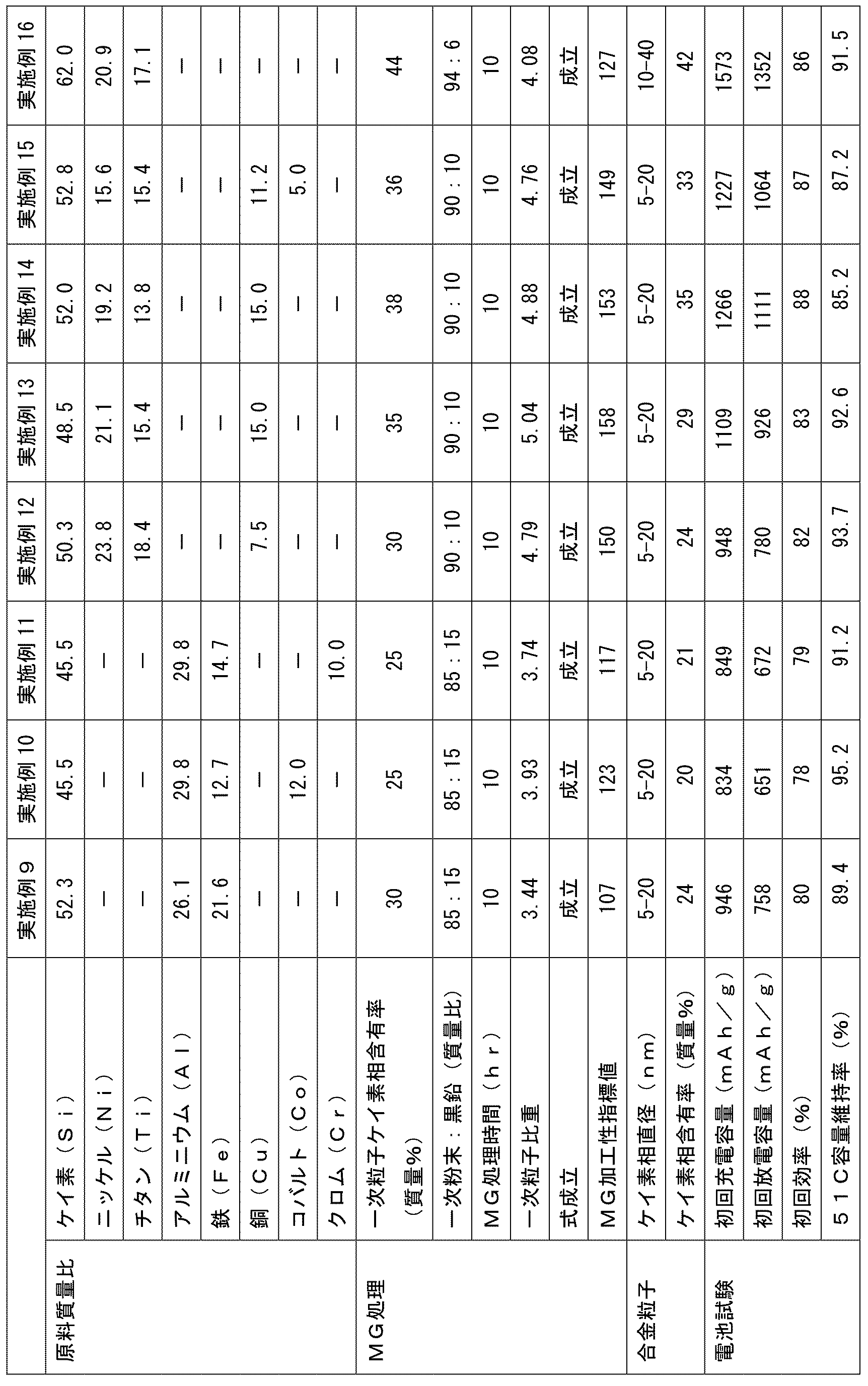
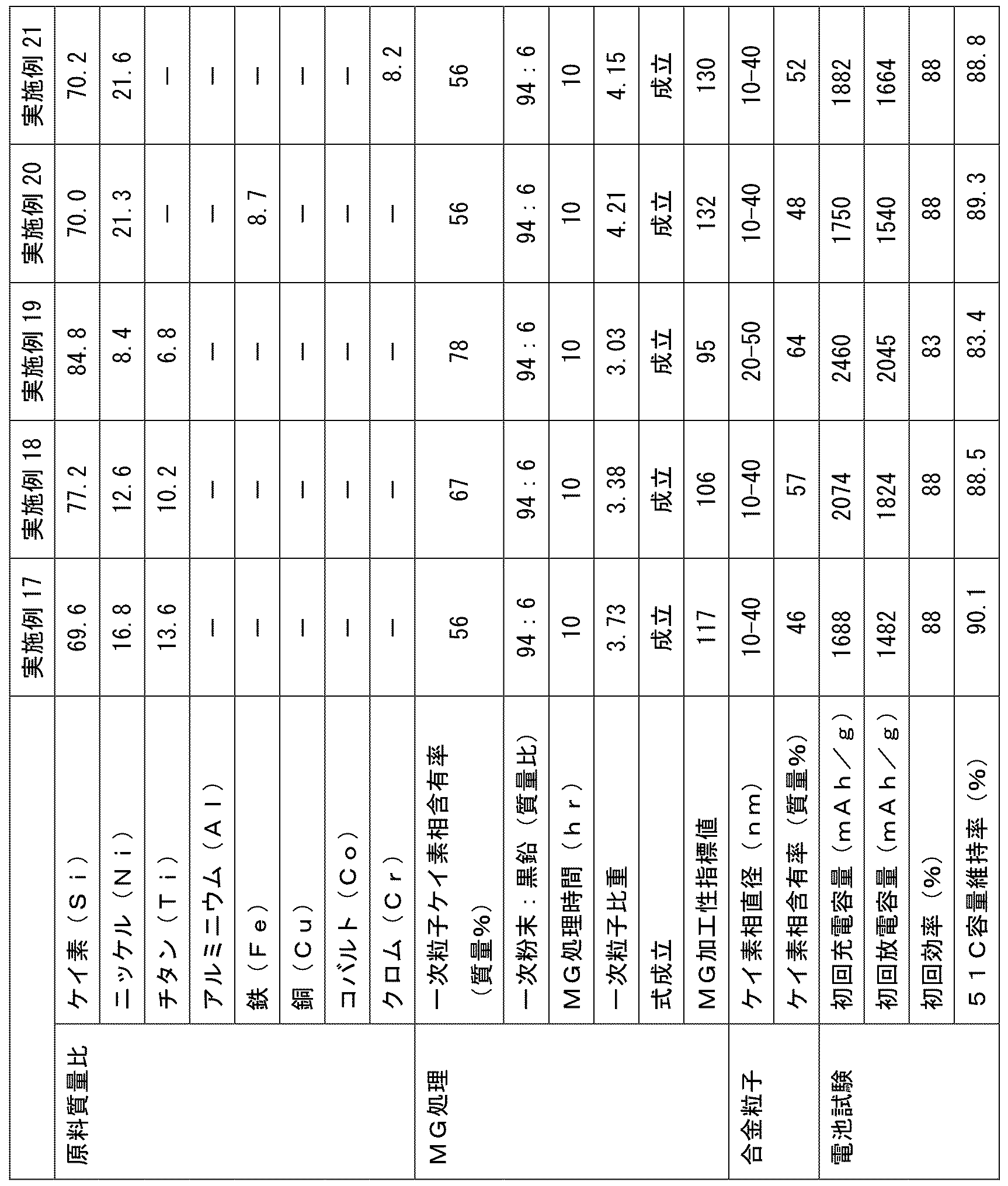
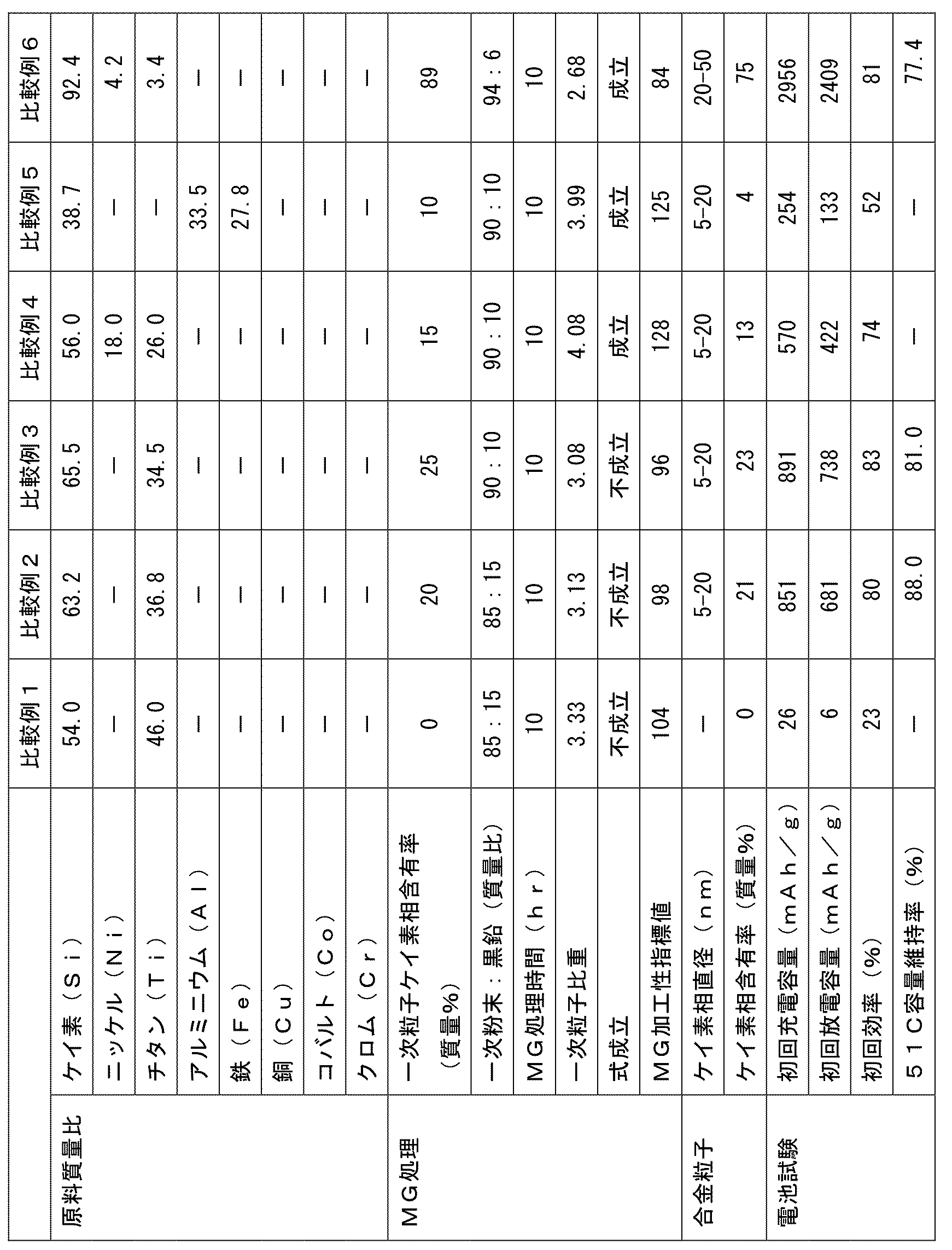
Claims (13)
- ケイ素原子および少なくとも二種の金属原子から形成される金属ケイ化物相と、
主としてケイ素原子から形成され、前記金属ケイ化物相中に分散されるケイ素相と
を備え、
前記ケイ素相は、全量に対して20質量%以上の割合を占めており、
前記ケイ素原子は、全量に対して85質量%以下の割合を占めている
合金粒子。 - 前記ケイ素原子は、全量に対して70質量%以下の割合を占めている
請求項1に記載の合金粒子。 - 前記ケイ素相は、平均粒子径が100nm以下である
請求項1または2に記載の合金粒子。 - 前記金属ケイ化物相は、主にMSix(ここで、Mは二種以上の金属元素であり、Siはケイ素であり、xは0超2未満の値である。)の組成を有する
請求項1から3のいずれかに記載の合金粒子。 - 前記Mには、アルミニウム(Al)、鉄(Fe)、ニッケル(Ni)、チタン(Ti)及び銅(Cu)より成る群から選択される少なくとも一種の金属元素が含まれる
請求項4に記載の合金粒子。 - 前記Mには、コバルト(Co)及びクロム(Cr)より成る群から選択される少なくとも一種の金属元素が含まれる
請求項4または5に記載の合金粒子。 - 前記金属ケイ化物相は、ケイ素(Si)、ニッケル(Ni)及びチタン(Ti)を含有する
請求項1から3のいずれかに記載の合金粒子。 - 請求項1から7のいずれか1項に記載の合金粒子を活物質として備える電極。
- 請求項8に記載の電極を負極として備える非水電解質二次電池。
- 50回の充放電サイクル時点において初期サイクル時点に対する容量保持率が85%以上である
請求項9に記載の非水電解質二次電池。 - 少なくともケイ素(Si)および少なくとも二種の金属を溶融して特定合金溶湯を調製する金属溶融工程と、
前記特定合金溶湯を急冷凝固して特定合金固化物を生成させる急冷凝固工程と、
前記特定合金固化物を粉砕して特定合金粉末を形成する粉砕工程と、
前記特定合金粉末をメカニカルグラインディング処理して請求項1または2に記載の合金粒子を製造するメカニカルグラインディング工程と
を備える、合金粒子製造方法。 - 前記特定合金溶湯では、前記ケイ素(Si)が85質量%以下の割合を占めている
請求項11に記載の合金粒子製造方法。 - 前記特定合金粉末は、ケイ素相の含有量が20質量%以上の割合を占め、比重をyとし、前記ケイ素相の含有量(質量%)をxとしたとき、y>-0.02x+3.8の関係が成立する
請求項11または12に記載の合金粒子製造方法。
Priority Applications (2)
| Application Number | Priority Date | Filing Date | Title |
|---|---|---|---|
| KR20157002066A KR20150036208A (ko) | 2012-08-31 | 2013-08-21 | 합금 입자, 전극, 비수 전해질 이차 전지 및 합금 입자 제조 방법 |
| JP2014532953A JPWO2014034494A1 (ja) | 2012-08-31 | 2013-08-21 | 合金粒子、電極、非水電解質二次電池および合金粒子製造方法 |
Applications Claiming Priority (2)
| Application Number | Priority Date | Filing Date | Title |
|---|---|---|---|
| JP2012-192202 | 2012-08-31 | ||
| JP2012192202 | 2012-08-31 |
Publications (1)
| Publication Number | Publication Date |
|---|---|
| WO2014034494A1 true WO2014034494A1 (ja) | 2014-03-06 |
Family
ID=50183309
Family Applications (1)
| Application Number | Title | Priority Date | Filing Date |
|---|---|---|---|
| PCT/JP2013/072301 Ceased WO2014034494A1 (ja) | 2012-08-31 | 2013-08-21 | 合金粒子、電極、非水電解質二次電池および合金粒子製造方法 |
Country Status (3)
| Country | Link |
|---|---|
| JP (1) | JPWO2014034494A1 (ja) |
| KR (1) | KR20150036208A (ja) |
| WO (1) | WO2014034494A1 (ja) |
Cited By (7)
| Publication number | Priority date | Publication date | Assignee | Title |
|---|---|---|---|---|
| JP2016039098A (ja) * | 2014-08-11 | 2016-03-22 | 山陽特殊製鋼株式会社 | 蓄電デバイス用Si系合金負極材料およびそれを用いた電極 |
| WO2016067577A1 (ja) * | 2014-10-29 | 2016-05-06 | 新日鐵住金株式会社 | 負極活物質材料、負極及び電池 |
| JP2017191707A (ja) * | 2016-04-13 | 2017-10-19 | 株式会社豊田自動織機 | 炭素被覆Si含有負極活物質の製造方法 |
| WO2017198795A1 (fr) * | 2016-05-19 | 2017-11-23 | Centre National D'etudes Spatiales | Nouveau materiau composite enrichi en silicium, son procede de fabrication et son utilisation a titre d'electrode |
| CN109314233A (zh) * | 2016-06-16 | 2019-02-05 | 日产自动车株式会社 | 电气设备用负极活性物质、和使用其的电气设备 |
| JP2021022438A (ja) * | 2019-07-24 | 2021-02-18 | 大同特殊鋼株式会社 | 多元系シリサイドおよびケイ素を含むリチウムイオン電池用負極材料 |
| JP2021520602A (ja) * | 2018-04-12 | 2021-08-19 | ジョンソン、マッセイ、パブリック、リミテッド、カンパニーJohnson Matthey Public Limited Company | アノード材料並びにその製造方法及び使用方法 |
Citations (10)
| Publication number | Priority date | Publication date | Assignee | Title |
|---|---|---|---|---|
| JPH10294112A (ja) * | 1997-02-24 | 1998-11-04 | Hitachi Metals Ltd | リチウム二次電池 |
| JP2000149937A (ja) * | 1998-09-08 | 2000-05-30 | Matsushita Electric Ind Co Ltd | 非水電解質二次電池用負極材料とその製造方法 |
| JP2004095469A (ja) * | 2002-09-03 | 2004-03-25 | Sumitomo Metal Ind Ltd | 非水電解質二次電池用負極材料およびその製造方法 |
| JP2004228059A (ja) * | 2002-11-29 | 2004-08-12 | Mitsui Mining & Smelting Co Ltd | 非水電解液二次電池用負極及びその製造方法並びに非水電解液二次電池 |
| JP2004362895A (ja) * | 2003-06-03 | 2004-12-24 | Sony Corp | 負極材料およびそれを用いた電池 |
| JP2005011802A (ja) * | 2003-05-22 | 2005-01-13 | Matsushita Electric Ind Co Ltd | 非水電解質二次電池とその製造方法 |
| JP2007502004A (ja) * | 2003-08-08 | 2007-02-01 | スリーエム イノベイティブ プロパティズ カンパニー | リチウムイオン電池用の多相ケイ素含有電極 |
| JP2007149685A (ja) * | 2005-11-29 | 2007-06-14 | Samsung Sdi Co Ltd | リチウム2次電池用負極活物質及び、これを含むリチウム2次電池 |
| JP2009517850A (ja) * | 2005-12-01 | 2009-04-30 | スリーエム イノベイティブ プロパティズ カンパニー | ケイ素含有量が高いアモルファス合金に基づく電極組成物 |
| WO2012099056A1 (ja) * | 2011-01-17 | 2012-07-26 | 山陽特殊製鋼株式会社 | リチウムイオン二次電池負極用Si合金粉末およびその製造方法 |
-
2013
- 2013-08-21 JP JP2014532953A patent/JPWO2014034494A1/ja active Pending
- 2013-08-21 WO PCT/JP2013/072301 patent/WO2014034494A1/ja not_active Ceased
- 2013-08-21 KR KR20157002066A patent/KR20150036208A/ko not_active Ceased
Patent Citations (10)
| Publication number | Priority date | Publication date | Assignee | Title |
|---|---|---|---|---|
| JPH10294112A (ja) * | 1997-02-24 | 1998-11-04 | Hitachi Metals Ltd | リチウム二次電池 |
| JP2000149937A (ja) * | 1998-09-08 | 2000-05-30 | Matsushita Electric Ind Co Ltd | 非水電解質二次電池用負極材料とその製造方法 |
| JP2004095469A (ja) * | 2002-09-03 | 2004-03-25 | Sumitomo Metal Ind Ltd | 非水電解質二次電池用負極材料およびその製造方法 |
| JP2004228059A (ja) * | 2002-11-29 | 2004-08-12 | Mitsui Mining & Smelting Co Ltd | 非水電解液二次電池用負極及びその製造方法並びに非水電解液二次電池 |
| JP2005011802A (ja) * | 2003-05-22 | 2005-01-13 | Matsushita Electric Ind Co Ltd | 非水電解質二次電池とその製造方法 |
| JP2004362895A (ja) * | 2003-06-03 | 2004-12-24 | Sony Corp | 負極材料およびそれを用いた電池 |
| JP2007502004A (ja) * | 2003-08-08 | 2007-02-01 | スリーエム イノベイティブ プロパティズ カンパニー | リチウムイオン電池用の多相ケイ素含有電極 |
| JP2007149685A (ja) * | 2005-11-29 | 2007-06-14 | Samsung Sdi Co Ltd | リチウム2次電池用負極活物質及び、これを含むリチウム2次電池 |
| JP2009517850A (ja) * | 2005-12-01 | 2009-04-30 | スリーエム イノベイティブ プロパティズ カンパニー | ケイ素含有量が高いアモルファス合金に基づく電極組成物 |
| WO2012099056A1 (ja) * | 2011-01-17 | 2012-07-26 | 山陽特殊製鋼株式会社 | リチウムイオン二次電池負極用Si合金粉末およびその製造方法 |
Cited By (12)
| Publication number | Priority date | Publication date | Assignee | Title |
|---|---|---|---|---|
| JP2016039098A (ja) * | 2014-08-11 | 2016-03-22 | 山陽特殊製鋼株式会社 | 蓄電デバイス用Si系合金負極材料およびそれを用いた電極 |
| WO2016067577A1 (ja) * | 2014-10-29 | 2016-05-06 | 新日鐵住金株式会社 | 負極活物質材料、負極及び電池 |
| JPWO2016067577A1 (ja) * | 2014-10-29 | 2017-04-27 | 新日鐵住金株式会社 | 負極活物質材料、負極及び電池 |
| JP2017191707A (ja) * | 2016-04-13 | 2017-10-19 | 株式会社豊田自動織機 | 炭素被覆Si含有負極活物質の製造方法 |
| WO2017198795A1 (fr) * | 2016-05-19 | 2017-11-23 | Centre National D'etudes Spatiales | Nouveau materiau composite enrichi en silicium, son procede de fabrication et son utilisation a titre d'electrode |
| FR3051483A1 (fr) * | 2016-05-19 | 2017-11-24 | Centre Nat D'etudes Spatiales (Cnes) | Nouveau materiau composite enrichi en silicium, son procede de fabrication et son utilisation a titre d'electrode |
| CN109563574A (zh) * | 2016-05-19 | 2019-04-02 | 法国国家空间研究中心 | 富集硅的新复合材料、其生产方法以及所述材料作为电极的用途 |
| CN109314233A (zh) * | 2016-06-16 | 2019-02-05 | 日产自动车株式会社 | 电气设备用负极活性物质、和使用其的电气设备 |
| JP2021520602A (ja) * | 2018-04-12 | 2021-08-19 | ジョンソン、マッセイ、パブリック、リミテッド、カンパニーJohnson Matthey Public Limited Company | アノード材料並びにその製造方法及び使用方法 |
| JP7613917B2 (ja) | 2018-04-12 | 2025-01-15 | ジェライオン・テクノロジーズ・プロプライエタリー・リミテッド | アノード材料並びにその製造方法及び使用方法 |
| JP2021022438A (ja) * | 2019-07-24 | 2021-02-18 | 大同特殊鋼株式会社 | 多元系シリサイドおよびケイ素を含むリチウムイオン電池用負極材料 |
| JP7337580B2 (ja) | 2019-07-24 | 2023-09-04 | 大同特殊鋼株式会社 | 多元系シリサイドおよびケイ素を含むリチウムイオン電池用負極材料 |
Also Published As
| Publication number | Publication date |
|---|---|
| KR20150036208A (ko) | 2015-04-07 |
| JPWO2014034494A1 (ja) | 2016-08-08 |
Similar Documents
| Publication | Publication Date | Title |
|---|---|---|
| JP4865556B2 (ja) | リチウムイオン電池用の多相ケイ素含有電極 | |
| US8980428B2 (en) | Porous silicon particles and complex porous silicon particles, and method for producing both | |
| JP5884573B2 (ja) | リチウムイオン電池用負極活物質及びこれを用いたリチウムイオン電池用負極 | |
| JP5790282B2 (ja) | リチウム二次電池用負極活物質およびリチウム二次電池用負極 | |
| JP4368139B2 (ja) | 非水電解質二次電池用負極材料 | |
| JPWO2007015508A1 (ja) | リチウム二次電池負極用合金 | |
| WO2014034494A1 (ja) | 合金粒子、電極、非水電解質二次電池および合金粒子製造方法 | |
| JP2003520398A (ja) | 非晶質電極組成物 | |
| WO2013141230A1 (ja) | 多孔質シリコン粒子及び多孔質シリコン複合体粒子 | |
| JP6808988B2 (ja) | リチウムイオン電池用負極活物質およびリチウムイオン電池 | |
| JP5831407B2 (ja) | リチウムイオン電池用負極材 | |
| US8586240B2 (en) | Method of making tin-based alloys for negative electrode compositions | |
| CN105393386A (zh) | 复合颗粒及其制造方法以及电极和非水电解质二次电池 | |
| WO2014129346A1 (ja) | 蓄電デバイス用Si系合金負極材料およびそれを用いた電極 | |
| JP2004087264A (ja) | 非水電解液二次電池用負極材料及びその製造方法 | |
| JP2004006206A (ja) | 非水電解質電池用負極材料、負極、非水電解質電池及び非水電解質電池用負極材料の製造方法 | |
| JP2010519718A (ja) | 電解質、電極組成物、及びこれらから製造される電気化学電池 | |
| JP4069710B2 (ja) | リチウムイオン二次電池用負極材料およびその製造方法ならびにリチウムイオン二次電池 | |
| WO2007015508A1 (ja) | リチウム二次電池負極用合金 | |
| JP3624417B2 (ja) | 負極活物質及びその製造方法、並びに非水電解質電池 | |
| JP2004356054A (ja) | 非水電解質二次電池用負極材料とその製造方法、ならびにそれを用いた非水電解質二次電池用負極および非水電解質二次電池 | |
| JP6245954B2 (ja) | リチウムイオン二次電池用負極活物質 | |
| JP2021022438A (ja) | 多元系シリサイドおよびケイ素を含むリチウムイオン電池用負極材料 | |
| JP2021150111A (ja) | 非水電解質二次電池用の電極活物質層、非水電解質二次電池用の電極、及び、非水電解質二次電池 | |
| JP7443851B2 (ja) | リチウムイオン電池の負極用粉末材料およびその製造方法 |
Legal Events
| Date | Code | Title | Description |
|---|---|---|---|
| 121 | Ep: the epo has been informed by wipo that ep was designated in this application |
Ref document number: 13833448 Country of ref document: EP Kind code of ref document: A1 |
|
| ENP | Entry into the national phase |
Ref document number: 2014532953 Country of ref document: JP Kind code of ref document: A |
|
| ENP | Entry into the national phase |
Ref document number: 20157002066 Country of ref document: KR Kind code of ref document: A |
|
| NENP | Non-entry into the national phase |
Ref country code: DE |
|
| 122 | Ep: pct application non-entry in european phase |
Ref document number: 13833448 Country of ref document: EP Kind code of ref document: A1 |