WO2014024880A1 - 有機エレクトロルミネッセンス素子、および電子機器 - Google Patents
有機エレクトロルミネッセンス素子、および電子機器 Download PDFInfo
- Publication number
- WO2014024880A1 WO2014024880A1 PCT/JP2013/071248 JP2013071248W WO2014024880A1 WO 2014024880 A1 WO2014024880 A1 WO 2014024880A1 JP 2013071248 W JP2013071248 W JP 2013071248W WO 2014024880 A1 WO2014024880 A1 WO 2014024880A1
- Authority
- WO
- WIPO (PCT)
- Prior art keywords
- group
- substituted
- unsubstituted
- carbon atoms
- general formula
- Prior art date
- Legal status (The legal status is an assumption and is not a legal conclusion. Google has not performed a legal analysis and makes no representation as to the accuracy of the status listed.)
- Ceased
Links
- 0 CC*[C@@](C)[C@@](CC)(C(c1c(*CC)c(**)c(C)c(C)c1*CC)=C)C(C(*)=C)=C*CC Chemical compound CC*[C@@](C)[C@@](CC)(C(c1c(*CC)c(**)c(C)c(C)c1*CC)=C)C(C(*)=C)=C*CC 0.000 description 23
- LNCJWUCXEOFQSE-UHFFFAOYSA-N c(cc1)ccc1-c1c(cccc2)c2c(-c2ccc3[o]c4ccc(cccc5)c5c4c3c2)c2c1cccc2 Chemical compound c(cc1)ccc1-c1c(cccc2)c2c(-c2ccc3[o]c4ccc(cccc5)c5c4c3c2)c2c1cccc2 LNCJWUCXEOFQSE-UHFFFAOYSA-N 0.000 description 1
- PSXBUHDSFZDBKJ-UHFFFAOYSA-N c(ccc1c2c3c4)cc1ccc2[o]c3ccc4-c1c(cccc2)c2c(-c2c(cccc3)c3ccc2)c2c1cccc2 Chemical compound c(ccc1c2c3c4)cc1ccc2[o]c3ccc4-c1c(cccc2)c2c(-c2c(cccc3)c3ccc2)c2c1cccc2 PSXBUHDSFZDBKJ-UHFFFAOYSA-N 0.000 description 1
Images

Classifications
-
- C—CHEMISTRY; METALLURGY
- C07—ORGANIC CHEMISTRY
- C07D—HETEROCYCLIC COMPOUNDS
- C07D405/00—Heterocyclic compounds containing both one or more hetero rings having oxygen atoms as the only ring hetero atoms, and one or more rings having nitrogen as the only ring hetero atom
- C07D405/14—Heterocyclic compounds containing both one or more hetero rings having oxygen atoms as the only ring hetero atoms, and one or more rings having nitrogen as the only ring hetero atom containing three or more hetero rings
-
- C—CHEMISTRY; METALLURGY
- C07—ORGANIC CHEMISTRY
- C07D—HETEROCYCLIC COMPOUNDS
- C07D209/00—Heterocyclic compounds containing five-membered rings, condensed with other rings, with one nitrogen atom as the only ring hetero atom
- C07D209/56—Ring systems containing three or more rings
-
- C—CHEMISTRY; METALLURGY
- C07—ORGANIC CHEMISTRY
- C07D—HETEROCYCLIC COMPOUNDS
- C07D411/00—Heterocyclic compounds containing two or more hetero rings, at least one ring having oxygen and sulfur atoms as the only ring hetero atoms
- C07D411/14—Heterocyclic compounds containing two or more hetero rings, at least one ring having oxygen and sulfur atoms as the only ring hetero atoms containing three or more hetero rings
-
- C—CHEMISTRY; METALLURGY
- C09—DYES; PAINTS; POLISHES; NATURAL RESINS; ADHESIVES; COMPOSITIONS NOT OTHERWISE PROVIDED FOR; APPLICATIONS OF MATERIALS NOT OTHERWISE PROVIDED FOR
- C09B—ORGANIC DYES OR CLOSELY-RELATED COMPOUNDS FOR PRODUCING DYES, e.g. PIGMENTS; MORDANTS; LAKES
- C09B57/00—Other synthetic dyes of known constitution
-
- C—CHEMISTRY; METALLURGY
- C09—DYES; PAINTS; POLISHES; NATURAL RESINS; ADHESIVES; COMPOSITIONS NOT OTHERWISE PROVIDED FOR; APPLICATIONS OF MATERIALS NOT OTHERWISE PROVIDED FOR
- C09B—ORGANIC DYES OR CLOSELY-RELATED COMPOUNDS FOR PRODUCING DYES, e.g. PIGMENTS; MORDANTS; LAKES
- C09B57/00—Other synthetic dyes of known constitution
- C09B57/008—Triarylamine dyes containing no other chromophores
-
- C—CHEMISTRY; METALLURGY
- C09—DYES; PAINTS; POLISHES; NATURAL RESINS; ADHESIVES; COMPOSITIONS NOT OTHERWISE PROVIDED FOR; APPLICATIONS OF MATERIALS NOT OTHERWISE PROVIDED FOR
- C09B—ORGANIC DYES OR CLOSELY-RELATED COMPOUNDS FOR PRODUCING DYES, e.g. PIGMENTS; MORDANTS; LAKES
- C09B67/00—Influencing the physical, e.g. the dyeing or printing properties of dyestuffs without chemical reactions, e.g. by treating with solvents grinding or grinding assistants, coating of pigments or dyes; Process features in the making of dyestuff preparations; Dyestuff preparations of a special physical nature, e.g. tablets, films
- C09B67/0033—Blends of pigments; Mixtured crystals; Solid solutions
-
- C—CHEMISTRY; METALLURGY
- C09—DYES; PAINTS; POLISHES; NATURAL RESINS; ADHESIVES; COMPOSITIONS NOT OTHERWISE PROVIDED FOR; APPLICATIONS OF MATERIALS NOT OTHERWISE PROVIDED FOR
- C09B—ORGANIC DYES OR CLOSELY-RELATED COMPOUNDS FOR PRODUCING DYES, e.g. PIGMENTS; MORDANTS; LAKES
- C09B69/00—Dyes not provided for by a single group of this subclass
- C09B69/008—Dyes containing a substituent, which contains a silicium atom
-
- C—CHEMISTRY; METALLURGY
- C09—DYES; PAINTS; POLISHES; NATURAL RESINS; ADHESIVES; COMPOSITIONS NOT OTHERWISE PROVIDED FOR; APPLICATIONS OF MATERIALS NOT OTHERWISE PROVIDED FOR
- C09K—MATERIALS FOR MISCELLANEOUS APPLICATIONS, NOT PROVIDED FOR ELSEWHERE
- C09K11/00—Luminescent materials, e.g. electroluminescent or chemiluminescent
- C09K11/06—Luminescent materials, e.g. electroluminescent or chemiluminescent containing organic luminescent materials
-
- H—ELECTRICITY
- H05—ELECTRIC TECHNIQUES NOT OTHERWISE PROVIDED FOR
- H05B—ELECTRIC HEATING; ELECTRIC LIGHT SOURCES NOT OTHERWISE PROVIDED FOR; CIRCUIT ARRANGEMENTS FOR ELECTRIC LIGHT SOURCES, IN GENERAL
- H05B33/00—Electroluminescent light sources
- H05B33/12—Light sources with substantially two-dimensional [2D] radiating surfaces
- H05B33/14—Light sources with substantially two-dimensional [2D] radiating surfaces characterised by the chemical or physical composition or the arrangement of the electroluminescent material, or by the simultaneous addition of the electroluminescent material in or onto the light source
-
- H—ELECTRICITY
- H10—SEMICONDUCTOR DEVICES; ELECTRIC SOLID-STATE DEVICES NOT OTHERWISE PROVIDED FOR
- H10K—ORGANIC ELECTRIC SOLID-STATE DEVICES
- H10K85/00—Organic materials used in the body or electrodes of devices covered by this subclass
- H10K85/60—Organic compounds having low molecular weight
- H10K85/649—Aromatic compounds comprising a hetero atom
- H10K85/657—Polycyclic condensed heteroaromatic hydrocarbons
- H10K85/6572—Polycyclic condensed heteroaromatic hydrocarbons comprising only nitrogen in the heteroaromatic polycondensed ring system, e.g. phenanthroline or carbazole
-
- H—ELECTRICITY
- H10—SEMICONDUCTOR DEVICES; ELECTRIC SOLID-STATE DEVICES NOT OTHERWISE PROVIDED FOR
- H10K—ORGANIC ELECTRIC SOLID-STATE DEVICES
- H10K85/00—Organic materials used in the body or electrodes of devices covered by this subclass
- H10K85/60—Organic compounds having low molecular weight
- H10K85/649—Aromatic compounds comprising a hetero atom
- H10K85/657—Polycyclic condensed heteroaromatic hydrocarbons
- H10K85/6574—Polycyclic condensed heteroaromatic hydrocarbons comprising only oxygen in the heteroaromatic polycondensed ring system, e.g. cumarine dyes
-
- C—CHEMISTRY; METALLURGY
- C09—DYES; PAINTS; POLISHES; NATURAL RESINS; ADHESIVES; COMPOSITIONS NOT OTHERWISE PROVIDED FOR; APPLICATIONS OF MATERIALS NOT OTHERWISE PROVIDED FOR
- C09K—MATERIALS FOR MISCELLANEOUS APPLICATIONS, NOT PROVIDED FOR ELSEWHERE
- C09K2211/00—Chemical nature of organic luminescent or tenebrescent compounds
- C09K2211/10—Non-macromolecular compounds
- C09K2211/1003—Carbocyclic compounds
- C09K2211/1007—Non-condensed systems
-
- C—CHEMISTRY; METALLURGY
- C09—DYES; PAINTS; POLISHES; NATURAL RESINS; ADHESIVES; COMPOSITIONS NOT OTHERWISE PROVIDED FOR; APPLICATIONS OF MATERIALS NOT OTHERWISE PROVIDED FOR
- C09K—MATERIALS FOR MISCELLANEOUS APPLICATIONS, NOT PROVIDED FOR ELSEWHERE
- C09K2211/00—Chemical nature of organic luminescent or tenebrescent compounds
- C09K2211/10—Non-macromolecular compounds
- C09K2211/1003—Carbocyclic compounds
- C09K2211/1011—Condensed systems
-
- H—ELECTRICITY
- H10—SEMICONDUCTOR DEVICES; ELECTRIC SOLID-STATE DEVICES NOT OTHERWISE PROVIDED FOR
- H10K—ORGANIC ELECTRIC SOLID-STATE DEVICES
- H10K85/00—Organic materials used in the body or electrodes of devices covered by this subclass
- H10K85/60—Organic compounds having low molecular weight
- H10K85/615—Polycyclic condensed aromatic hydrocarbons, e.g. anthracene
- H10K85/626—Polycyclic condensed aromatic hydrocarbons, e.g. anthracene containing more than one polycyclic condensed aromatic rings, e.g. bis-anthracene
Definitions
- the present invention relates to an organic electroluminescence element and an electronic device.
- an organic electroluminescence element (hereinafter sometimes referred to as an organic EL element)
- holes from the anode and electrons from the cathode are injected into the light emitting layer.
- the injected holes and electrons are recombined to form excitons.
- singlet excitons and triplet excitons are generated at a ratio of 25%: 75% according to the statistical rule of electron spin.
- the fluorescence type uses light emission by singlet excitons.
- the phosphorescent type since light emission by triplet excitons is used, it is known that the internal quantum efficiency can be increased to 100% when intersystem crossing is efficiently performed from singlet excitons.
- Patent Document 1 attempts to provide a fluorescent organic EL element having high emission efficiency and a long lifetime by setting an anthracene derivative as a host material of the light emitting layer to a specific structure.
- An object of the present invention is to provide an organic EL element with high luminous efficiency and long life. Another object of the present invention is to provide an electronic apparatus provided with the organic EL element of the present invention.
- the organic electroluminescence device is The anode, A cathode provided opposite to the anode; An organic layer provided between the anode and the cathode, The organic layer includes a hole transport layer and a light emitting layer in this order from the anode side,
- the hole transport layer includes a compound represented by the following general formula (1)
- the light emitting layer includes a light emitting material, a compound represented by the following general formula (10), and a compound represented by the following general formula (11).
- a 1 and A 2 each independently represent a substituted or unsubstituted aromatic hydrocarbon group having 6 to 30 carbon atoms, or a substituted or unsubstituted ring carbon 2 Represents 30 to 30 aromatic heterocyclic groups.
- Y 1 to Y 16 each independently represent C (R) or a nitrogen atom, and each R independently represents a bond bonded to a hydrogen atom, a substituent or a carbazole skeleton.
- L 1 and L 2 each independently represent a single bond or a divalent linking group.
- a 1 , A 2 and R is a substituted or unsubstituted fluoranthenyl group, a substituted or unsubstituted triphenylenyl group, a substituted or unsubstituted benzophenanthrenyl group, substituted or unsubstituted Benzotriphenylenyl group, substituted or unsubstituted dibenzotriphenylenyl group, substituted or unsubstituted chrysenyl group, substituted or unsubstituted benzochrysenyl group, substituted or unsubstituted picenyl group, substituted or unsubstituted benzo [b ] Fluoranthenyl group, substituted or unsubstituted benzofuranyl group, substituted or unsubstituted dibenzofuranyl group, substituted or unsubstituted benzothiophenyl group, substituted or unsubstituted dibenzothiophenyl group
- R 101 to R 108 each independently represents a hydrogen atom, a halogen atom, a hydroxyl group, a cyano group, a substituted or unsubstituted amino group, a substituted or unsubstituted group.
- Ar 31 to Ar 33 , R 109 , R 110 , and R 21 to R 28 each independently represent a hydrogen atom, a halogen atom, a hydroxyl group, a cyano group, a substituted or unsubstituted amino group, or a substituted or unsubstituted carbon number.
- Ar 31 to Ar 33 is a substituted or unsubstituted aromatic hydrocarbon group having 6 to 30 ring carbon atoms
- Ar 31 when Ar 31 is a substituted or unsubstituted aromatic hydrocarbon group having 6 to 30 ring carbon atoms, Ar 31 is substituted or unsubstituted. Substituted fluorenyl group.
- Ar 31 , Ar 33 , R 109 , and R 110 are hydrogen atoms
- Ar 32 is a substituted or unsubstituted aromatic hydrocarbon group having 10 to 30 ring carbon atoms. is there. )
- the organic electroluminescence element is The anode, A cathode provided opposite to the anode; An organic layer provided between the anode and the cathode, The organic layer includes a hole transport layer and a light emitting layer in this order from the anode side,
- the hole transport layer includes a compound represented by the following general formula (30), and the light emitting layer includes a compound represented by the following general formula (2A) and a light emitting material.
- a 1 and A 2 are each independently a substituted or unsubstituted aromatic hydrocarbon group having 6 to 30 ring carbon atoms, or a substituted or unsubstituted ring forming atom number of 5; Represents 30 to 30 aromatic heterocyclic groups. Any two adjacent R 41 to R 44 are bonded to a partial structure represented by the following general formula (31). Any two adjacent R 51 to R 54 may be bonded to a partial structure represented by the following general formula (31). )
- R 41 to R 44 and R 51 to R 54 not bonded to the partial structure represented by the general formula (31) are each independently a hydrogen atom, halogen atom, hydroxyl group, cyano group, substituted or unsubstituted A substituted amino group, a substituted or unsubstituted alkyl group having 1 to 20 carbon atoms, a substituted or unsubstituted alkoxy group having 1 to 20 carbon atoms, a substituted or unsubstituted aryloxy group having 6 to 20 ring carbon atoms, Substituted or unsubstituted arylthio group having 6 to 20 carbon atoms, substituted or unsubstituted trialkylsilyl group having 3 to 40 carbon atoms, substituted or unsubstituted arylsilyl group having 8 to 50 carbon atoms, substituted or unsubstituted A substituted aromatic hydrocarbon group having 6 to 50 ring carbon atoms, or a substituted or unsubstit
- * represents a bonding site with the ring structure represented by the general formula (30),
- One of Z 1 and Z 2 is a single bond, and the other is —O—, —S—, —CR 65 R 66 —, or —NR 67 —;
- R 61 to R 67 are each independently a hydrogen atom, halogen atom, hydroxyl group, cyano group, substituted or unsubstituted amino group, substituted or unsubstituted alkyl group having 1 to 20 carbon atoms, substituted or unsubstituted An alkoxy group having 1 to 20 carbon atoms, a substituted or unsubstituted aryloxy group having 6 to 20 ring carbon atoms, a substituted or unsubstituted arylthio group having 6 to 20 ring carbon atoms, a substituted or unsubstituted carbon number of 3 ⁇ 40 trialkylsilyl group, substituted or unsubstituted aryls
- R 101 to R 108 each independently represents a hydrogen atom, a halogen atom, a hydroxyl group, a cyano group, a substituted or unsubstituted amino group, a substituted or unsubstituted carbon number of 1 to 20 Alkyl groups, substituted or unsubstituted alkoxy groups having 1 to 20 carbon atoms, substituted or unsubstituted aryloxy groups having 6 to 20 ring carbon atoms, and substituted or unsubstituted arylthio groups having 6 to 20 ring carbon atoms.
- a substituted or unsubstituted trialkylsilyl group having 3 to 40 carbon atoms, or a substituted or unsubstituted arylsilyl group having 8 to 50 carbon atoms, Ar 1001 and Ar 101 are each independently a substituted or unsubstituted aromatic hydrocarbon group having 6 to 30 ring carbon atoms or a substituted or unsubstituted heterocyclic group having 5 to 30 ring atoms. .
- Ar 100 may form a ring with R 101 or R 108, and Ar 101 may form a ring with R 104 or R 105 .
- the configuration of (d) is preferably used. However, of course, it is not limited to these.
- the “light emitting layer” is an organic layer having a light emitting function, and includes a host material and a dopant material when a doping system is employed.
- the host material mainly has a function of encouraging recombination of electrons and holes and confining excitons in the light emitting layer, and the dopant material efficiently emits excitons obtained by recombination. It has a function.
- the host material mainly has a function of confining excitons generated by the dopant in the light emitting layer.
- the “hole injection / transport layer” means “at least one of a hole injection layer and a hole transport layer”, and “electron injection / transport layer” means “an electron injection layer and an electron transport layer”. "At least one of them”.
- the positive hole injection layer is provided in the anode side.
- the electron injection layer refers to an organic layer having the highest electron mobility among the organic layers in the electron transport region existing between the light emitting layer and the cathode.
- the layer is an electron transport layer.
- a barrier layer that does not necessarily have high electron mobility is used to prevent diffusion of excitation energy generated in the light emitting layer.
- the organic layer adjacent to the light emitting layer does not necessarily correspond to the electron transport layer.
- the organic EL element 1 includes a translucent substrate 2, an anode 3, a cathode 4, and an organic layer 10 disposed between the anode 3 and the cathode 4.
- the organic layer 10 includes a hole transport layer 5 and a light emitting layer 6 in this order from the anode 3 side. In the present embodiment, the hole transport layer 5 and the light emitting layer 6 are adjacent to each other. Further, the organic EL element 1 includes a hole injection layer 7 between the anode 3 and the hole transport layer 5, and includes an electron injection / transport layer 8 between the cathode 4 and the light emitting layer 6. .
- the light emitting layer 6 includes a host material and a fluorescent dopant material as a fluorescent light emitting material. Further, an electron barrier layer may be provided on the phosphorescent light emitting layer 5 on the anode 3 side, and a hole barrier layer may be provided on the phosphorescent light emitting layer 5 on the cathode 4 side. With such a barrier layer, electrons and holes can be confined in the light emitting layer 6 and the exciton generation probability in the light emitting layer 6 can be increased.
- the organic layer 10 may contain an inorganic compound.
- the organic EL element of the present invention is produced on a light-transmitting substrate.
- the light-transmitting substrate is a substrate that supports the organic EL element, and is preferably a smooth substrate having a light transmittance in the visible region of 400 nm to 700 nm of 50% or more.
- a glass plate, a polymer plate, etc. are mentioned.
- the glass plate include those using soda lime glass, barium / strontium-containing glass, lead glass, aluminosilicate glass, borosilicate glass, barium borosilicate glass, quartz and the like as raw materials.
- the polymer plate include those using polycarbonate, acrylic, polyethylene terephthalate, polyether sulfide, polysulfone and the like as raw materials.
- the anode of the organic EL element plays a role of injecting holes into the hole injection layer, the hole transport layer, or the light emitting layer, and it is effective to have a work function of 4.5 eV or more.
- Specific examples of the anode material include indium tin oxide alloy (ITO), tin oxide (NESA), indium zinc oxide, gold, silver, platinum, copper, and the like.
- the anode can be produced by forming a thin film of these electrode materials by a method such as vapor deposition or sputtering.
- the light transmittance in the visible region of the anode be greater than 10%.
- the sheet resistance of the anode is preferably several hundred ⁇ / ⁇ ( ⁇ / sq. Ohm per square) or less.
- the film thickness of the anode depends on the material, but is usually selected in the range of 10 nm to 1 ⁇ m, preferably 10 nm to 200 nm.
- the cathode a material having a small work function is preferable for the purpose of injecting electrons into the electron injection layer, the electron transport layer, or the light emitting layer.
- the cathode material is not particularly limited, and specifically, indium, aluminum, magnesium, magnesium-indium alloy, magnesium-aluminum alloy, aluminum-lithium alloy, aluminum-scandium-lithium alloy, magnesium-silver alloy and the like can be used.
- the cathode can be produced by a method such as vapor deposition, for example, by forming a thin film on the electron transport layer or the electron injection layer.
- the aspect which takes out light emission from a light emitting layer from a cathode side is also employable.
- the light transmittance in the visible region of the cathode be greater than 10%.
- the sheet resistance of the cathode is preferably several hundred ⁇ / ⁇ or less.
- the layer thickness of the cathode depends on the material, but is usually selected in the range of 10 nm to 1 ⁇ m, preferably 50 nm to 200 nm.
- the hole transport layer 5 of the present embodiment is adjacent to the light emitting layer 6 on the anode 3 side and includes a compound represented by the following general formula (1).
- a 1 and A 2 are each independently a substituted or unsubstituted aromatic hydrocarbon group having 6 to 30 ring carbon atoms, or a substituted or unsubstituted ring carbon number 2 Represents 30 to 30 aromatic heterocyclic groups.
- Y 1 to Y 16 each independently represent C (R) or a nitrogen atom, and each R independently represents a bond bonded to a hydrogen atom, a substituent, or a carbazole skeleton.
- the compound represented by the general formula (1) includes a case where it has a carbazole skeleton and a case where it has an azalated carbazole skeleton.
- L 1 and L 2 each independently represent a single bond or a divalent linking group.
- at least one of A 1 , A 2 and R is a substituted or unsubstituted fluoranthenyl group, a substituted or unsubstituted triphenylenyl group, a substituted or unsubstituted benzophenant.
- Renyl group substituted or unsubstituted benzotriphenylenyl group, substituted or unsubstituted dibenzotriphenylenyl group, substituted or unsubstituted chrysenyl group, substituted or unsubstituted benzochrysenyl group, substituted or unsubstituted picenyl group, Substituted or unsubstituted benzo [b] fluoranthenyl group, substituted or unsubstituted benzofuranyl group, substituted or unsubstituted dibenzofuranyl group, substituted or unsubstituted benzothiophenyl group, substituted or unsubstituted dibenzothiophenyl Group, substituted or unsubstituted carbazolyl group, substituted or unsubstituted Conversion of phenanthrenyl group, a substituted or unsubstituted fluorenyl group, or a substituted or unsubsti
- Y 1 to Y 16 are all C (R), Y 6 and Y 11 are bonded by a single bond, L 1 and L 2 are a single bond, and A 1 Is a phenanthrenyl group, A 2 is not a phenanthrenyl group.
- R when Y 1 to Y 16 are all C (R), Y 6 and Y 11 are bonded by a single bond, and L 1 and L 2 are a single bond, R Are not fluorenyl groups, and when A 1 is a fluorenyl group, A 2 is not a phenyl group, a naphthyl group, or a fluorenyl group.
- At least one of Y 1 to Y 4 is C (R)
- at least one of Y 5 to Y 8 is C (R)
- Y 9 at least one of ⁇ Y 12 is a C (R)
- at least one of Y 13 ⁇ Y 16 is C (R).
- One of Y 5 to Y 8 is C (R) and one of Y 9 to Y 12 is C (R), and these Rs represent bonds that are bonded to each other.
- R in the said General formula (1) may mutually be same or different.
- the compound represented by the general formula (1) contained in the hole transport layer 5 is represented by the following general formula (1-2), the following general formula (1-3), or the following general formula (1-4). It is preferable.
- At least one of A 1 and A 2 is a substituted or unsubstituted fluoranthenyl group, a substituted or unsubstituted triphenylenyl group, substituted or Unsubstituted benzophenanthrenyl group, substituted or unsubstituted benzotriphenylenyl group, substituted or unsubstituted dibenzotriphenylenyl group, substituted or unsubstituted chrysenyl group, substituted or unsubstituted benzochrysenyl group, substituted or An unsubstituted picenyl group, a substituted or unsubstituted benzo [b] fluoranthenyl group, a substituted or unsubstituted benzofuranyl group, a substituted or unsubstituted dibenzofuranyl group, a substituted or unsubstituted benzothiophenyl group
- a 1 and A 2 are each independently a substituted or unsubstituted fluoranthenyl group, a substituted or unsubstituted triphenylenyl group.
- Substituted or unsubstituted benzotriphenylenyl group, substituted or unsubstituted benzophenanthrenyl group, substituted or unsubstituted dibenzofuranyl group, substituted or unsubstituted dibenzothiophenyl group, or substituted or unsubstituted A carbazolyl group is preferred.
- a 1 and A 2 each independently represent a substituted or unsubstituted dibenzofuranyl group, Jibenzochio substituted or unsubstituted It is preferably a phenyl group or a substituted or unsubstituted carbazolyl group.
- the structure of the portion represented by L 1 -A 1 and the structure of the portion represented by L 2 -A 2 are preferably different from each other.
- substituents of A 1 and A 2 in this embodiment and the substituent represented by R include a halogen atom, a cyano group, a substituted or unsubstituted straight chain or branched chain having 1 to 20 carbon atoms.
- halogen atom in this embodiment examples include a fluorine atom, a chlorine atom, a bromine atom, and an iodine atom.
- the alkyl group having 1 to 20 carbon atoms may be linear, branched or cyclic, and examples of the linear or branched alkyl group include a methyl group, an ethyl group, and a propyl group.
- cyclic alkyl group examples include a cyclopropyl group, a cyclobutyl group, a cyclopentyl group, a cyclohexyl group, a cyclopentyl group, a cyclohexyl group, a cyclooctyl group, a 4-methylcyclohexyl group, and 3,5-tetramethylcyclohexyl.
- Examples of the linear, branched or cyclic haloalkyl group having 1 to 20 carbon atoms in the present embodiment include those in which the alkyl group having 1 to 20 carbon atoms is substituted with one or more halogen atoms. . Specific examples include a fluoromethyl group, a difluoromethyl group, a trifluoromethyl group, a fluoroethyl group, and a trifluoromethylmethyl group.
- Examples of the linear, branched or cyclic alkylene group having 1 to 20 carbon atoms in the present embodiment include an ethylene group, a propylene group, and a butylene group.
- Examples of the linear, branched or cyclic divalent unsaturated hydrocarbon group having 1 to 20 carbon atoms in the present embodiment include a 1,3-butadiene-1,4-diyl group.
- the linear, branched or cyclic alkoxy group having 1 to 20 carbon atoms in the present embodiment is represented as —OZ 1 .
- Z 1 include the alkyl group having 1 to 20 carbon atoms.
- the alkoxy group include a methoxy group, an ethoxy group, a propoxy group, a butoxy group, a pentyloxy group, and a hexyloxy group.
- the aryloxy group having 6 to 30 ring carbon atoms in the present embodiment is represented by —OZ 2 .
- Z 2 include the following aromatic hydrocarbon groups having 6 to 30 ring carbon atoms.
- the aryloxy group include a phenoxy group.
- the arylthio group having 6 to 30 ring carbon atoms in the general formulas (1) and (1-2) to (1-4) is represented by —SZ 3 .
- Z 3 include the following aromatic hydrocarbon groups having 6 to 30 ring carbon atoms.
- Examples of the linear, branched or cyclic haloalkoxy group having 1 to 20 carbon atoms in the present embodiment include those in which the alkoxy group having 1 to 20 carbon atoms is substituted with one or more halogen groups. It is done.
- Examples of the linear, branched or cyclic alkylsilyl group having 1 to 10 carbon atoms in the present embodiment include a trimethylsilyl group, a triethylsilyl group, a tributylsilyl group, a dimethylethylsilyl group, a dimethylisopropylsilyl group, and dimethyl
- Examples thereof include a propylsilyl group, a dimethylbutylsilyl group, a dimethyltertiarybutylsilyl group, and a diethylisopropylsilyl group.
- Examples of the arylsilyl group having 6 to 30 carbon atoms in the present embodiment include a phenyldimethylsilyl group, a diphenylmethylsilyl group, a diphenyl tertiary butylsilyl group, and a triphenylsilyl group.
- Examples of the aromatic hydrocarbon group having 6 to 30 ring carbon atoms in the present embodiment include a non-condensed aromatic hydrocarbon group and a condensed aromatic hydrocarbon group. More specifically, a phenyl group, a naphthyl group, Phenanthryl group, biphenyl group, terphenyl group, quarterphenyl group, fluoranthenyl group, triphenylenyl group, phenanthrenyl group, 9,9-dimethylfluorenyl group, benzo [c] phenanthrenyl group, benzo [a] triphenylenyl group, naphtho [1,2-c] phenanthrenyl group, naphtho [1,2-a] triphenylenyl group, dibenzo [a, c] triphenylenyl group, benzo [b] fluoranthenyl group, and the like.
- Examples of the aromatic heterocyclic group having 2 to 30 ring carbon atoms or the aromatic heterocyclic group having 5 to 30 ring atoms in the present embodiment include a non-condensed aromatic heterocyclic ring and a condensed aromatic heterocyclic ring, More specifically, pyrrolyl group, pyrazinyl group, pyridinyl group, indolyl group, isoindolyl group, furyl group, benzofuranyl group, isobenzofuranyl group, dibenzofuranyl group, dibenzothiophenyl group, quinolyl group, isoquinolyl group, quinoxalinyl Group, carbazolyl group, phenanthridinyl group, acridinyl group, phenanthrolinyl group, thienyl group, and pyridine ring, pyrazine ring, pyrimidine ring, pyridazine ring, triazine ring, indole ring,
- Examples of the divalent linking group represented by L 1 and L 2 in the present embodiment include a substituted or unsubstituted divalent aromatic hydrocarbon group having 6 to 30 ring carbon atoms, a substituted or unsubstituted divalent group. And an aromatic heterocyclic group having 2 to 10 ring carbon atoms.
- Specific examples of the divalent aromatic hydrocarbon group having 6 to 30 ring carbon atoms include those having a divalent group as the aromatic hydrocarbon group having 6 to 30 ring carbon atoms described above. Can be mentioned.
- specific examples of the divalent aromatic heterocyclic group having 2 to 30 ring carbon atoms include those mentioned above as the aromatic heterocyclic group having 2 to 30 ring carbon atoms. Things.
- Y 1 to Y 16 are preferably all C (R). That is, the compound represented by the general formula (1) contained in the hole transport layer 5 preferably has a structure in which two carbazole skeletons that are not azalated are connected. Furthermore, the compound represented by the general formula (1) preferably has two carbazole skeletons in the molecule.
- the number of substituents represented by R is 0 to 2 Preferably, it is 0 or 1, more preferably.
- the compounds represented by the general formulas (1), (1-2) to (1-4) include a substituted or unsubstituted fluoranthenyl group, a substituted or unsubstituted triphenylenyl group at a specific position.
- Selected from the group consisting of a substituted or unsubstituted benzotriphenylenyl group, a substituted or unsubstituted benzophenanthrenyl group, a substituted or unsubstituted dibenzofuranyl group, and a substituted or unsubstituted dibenzothiophenyl group Are preferably bonded.
- ring-forming carbon means a carbon atom constituting a saturated ring, an unsaturated ring, or an aromatic ring.
- Ring-forming atom means a carbon atom and a hetero atom constituting a hetero ring (including a saturated ring, an unsaturated ring, and an aromatic ring).
- the hydrogen atom includes isotopes having different numbers of neutrons, that is, light hydrogen (Protium), deuterium (Deuterium), and tritium (Tritium).
- substituents include the aromatic hydrocarbon group, aromatic heterocyclic group, alkyl group (straight chain or branched chain alkyl group, cycloalkyl group, haloalkyl group). Group), alkoxy group, aryloxy group, aralkyl group, haloalkoxy group, alkylsilyl group, dialkylarylsilyl group, alkyldiarylsilyl group, triarylsilyl group, halogen atom, cyano group, hydroxyl group, nitro group, and carboxy group Groups.
- an alkenyl group and an alkynyl group are also included.
- an aromatic hydrocarbon group, an aromatic heterocyclic group, an alkyl group, a halogen atom, an alkylsilyl group, an arylsilyl group, and a cyano group are preferable. Further, in the description of each substituent, Specific substituents that are preferred are preferred.
- the term “unsubstituted” in the case of “substituted or unsubstituted” means that a hydrogen atom is bonded without being substituted with the substituent. In the compound described below or a partial structure thereof, the case of “substituted or unsubstituted” is the same as described above.
- the number of ring-forming carbon atoms refers to a compound having a structure in which atoms or molecules are bonded in a ring (for example, a monocyclic compound, a condensed ring compound, a bridged compound, a spiro ring compound, a carbocyclic compound, or a heterocyclic compound). This represents the number of carbon atoms among atoms constituting the ring itself. When the ring is substituted with a substituent, the carbon contained in the substituent is not included in the number of ring-forming carbons.
- the “ring-forming carbon number” described below is the same unless otherwise specified.
- the number of ring-forming atoms refers to the ring itself of a compound having a structure in which atoms or molecules are bonded in a ring (for example, a monocyclic compound, a condensed ring compound, a bridging compound, a spiro ring compound, a carbocyclic compound, or a heterocyclic compound). This represents the number of atoms to be played.
- An atom that does not constitute a ring for example, a hydrogen atom that terminates the dangling bond of an atom that constitutes a ring
- an atom contained in a substituent when the ring is substituted by a substituent is included in the number of ring-forming atoms Absent.
- the “number of ring-forming atoms” described below is the same unless otherwise specified.
- the “carbon number ab” in the expression “substituted or unsubstituted XX group having carbon number ab” represents the number of carbons when the XX group is unsubstituted. The number of carbon atoms of the substituent when the XX group is substituted is not included.
- the case of “substituted or unsubstituted” is the same as described above.
- examples of the compound contained in the hole transport layer 5 include the following compounds.
- D represents deuterium.
- the light emitting layer of the organic EL element has the following functions. That is, (1) injection function; a function capable of injecting holes from the anode or hole injection layer when an electric field is applied, and a function of injecting electrons from the cathode or electron injection layer; (2) Transport function; function to move injected charges (electrons and holes) by the force of electric field, (3) Luminescent function; a function to provide a field for recombination of electrons and holes and connect this to light emission, There is.
- a known method such as an evaporation method, a spin coating method, or an LB method can be applied.
- the light emitting layer is preferably a molecular deposited film.
- the molecular deposition film is a thin film formed by deposition from a material compound in a gas phase state or a film formed by solidification from a material compound in a solution state or a liquid phase state. Can be classified from a thin film (accumulated film) formed by the LB method according to a difference in an agglomerated structure and a higher-order structure and a functional difference resulting therefrom.
- the light emitting layer can also be formed by dissolving a binder such as a resin and a material compound in a solvent to form a solution, and then thinning the solution by a spin coating method or the like.
- the host material contained in the light emitting layer of this embodiment is a compound represented by following General formula (2).
- R 101 to R 108 each independently represents a hydrogen atom, a halogen atom, a hydroxyl group, a cyano group, a substituted or unsubstituted amino group, a substituted or unsubstituted carbon group having 1 to 20 carbon atoms.
- any one of R 109 to R 113 is a substituted or unsubstituted aromatic hydrocarbon group having 6 to 30 ring carbon atoms, or a substituted or unsubstituted ring atom.
- a heterocyclic group of formula 5 to 30, and other R 109 to R 113 are each independently a hydrogen atom, a halogen atom, a hydroxyl group, a cyano group, a substituted or unsubstituted amino group, a substituted or unsubstituted group
- Ar 101 is a substituted or unsubstituted aromatic hydrocarbon group having 6 to 30 ring carbon atoms or a substituted or unsubstituted heterocyclic group having 5 to 30 ring atoms. .
- the host material included in the light emitting layer is preferably either a compound represented by the following general formula (10) or a compound represented by the following general formula (11).
- R 101 to R 108 each independently represents a hydrogen atom, a halogen atom, a hydroxyl group, a cyano group, a substituted or unsubstituted amino group, a substituted or unsubstituted group.
- Ar 31 to Ar 33 , R 109 , R 110 , and R 21 to R 28 each independently represent a hydrogen atom, a halogen atom, a hydroxyl group, a cyano group, a substituted or unsubstituted amino group, or a substituted or unsubstituted carbon number.
- Ar 31 to Ar 33 is a substituted or unsubstituted aromatic hydrocarbon group having 6 to 30 ring carbon atoms.
- Ar 31 is substituted or unsubstituted fluorenyl. It is a group.
- Ar 32 is a substituted or unsubstituted aromatic group having 10 to 30 ring carbon atoms.
- Group hydrocarbon group In this case, Ar 32 is preferably a substituted or unsubstituted naphthyl group.
- R 31 and R 32 are each independently a substituted or unsubstituted alkyl group having 1 to 20 carbon atoms.
- R 33 to R 37 are each independently a hydrogen atom, halogen atom, hydroxyl group, cyano group, substituted or unsubstituted amino group, substituted or unsubstituted alkyl group having 1 to 20 carbon atoms, substituted or unsubstituted An alkoxy group having 1 to 20 carbon atoms, a substituted or unsubstituted aryloxy group having 6 to 20 ring carbon atoms, a substituted or unsubstituted arylthio group having 6 to 20 ring carbon atoms, a substituted or unsubstituted carbon number of 3 ⁇ 40 trialkylsilyl group, substituted or unsubstituted arylsilyl group having 8 to 50 carbon atoms, substituted or unsubstituted aromatic hydrocarbon group having 6 to 50
- the dopant material is selected from fluorescent materials that exhibit fluorescent emission.
- Specific examples of the dopant material include naphthalene derivatives, anthracene derivatives, pyrene derivatives, chrysene derivatives, fluoranthene derivatives, indenoperylene derivatives, pyromethene boron complex compounds, compounds having a pyromethene skeleton or metal complexes thereof, diketopyrrolo Examples include pyrrole derivatives and perylene derivatives.
- naphthalene derivatives include bisarylaminonaphthalene derivatives and aryl-substituted naphthalene derivatives
- anthracene derivatives include bisarylaminoanthracene derivatives and aryl group-substituted anthracene derivatives
- pyrene derivative examples include bisarylaminopyrene derivatives and aryl group-substituted pyrene derivatives.
- chrysene derivatives include bisarylaminochrysene derivatives and aryl-substituted chrysene derivatives.
- fluoranthene derivatives it is selected from fluoranthene derivatives, pyrene derivatives, arylacetylene derivatives, fluorene derivatives, boron complexes, perylene derivatives, oxadiazole derivatives, anthracene derivatives, chrysene derivatives, and the like.
- a fluoranthene derivative, a pyrene derivative, and a boron complex are used.
- the emission color of the dopant material contained in the light emitting layer is not particularly limited, but is preferably a fluorescent light emitting dopant material that emits blue light having a main peak wavelength of 480 nm or less.
- the main peak wavelength refers to the peak wavelength of the emission spectrum that maximizes the emission intensity in the emission spectrum measured in a toluene solution having a concentration of 10 ⁇ 5 mol / liter to 10 ⁇ 6 mol / liter.
- a dopant material having such a main peak wavelength is doped into the host material represented by the general formula (2) to form a light emitting layer, and the hole transport layer adjacent to the anode side of the light emitting layer has the general formula
- the organic EL device has high efficiency and long life.
- the hole injection / transport layer is a layer that assists hole injection into the light emitting layer and transports it to the light emitting region, and has a high hole mobility and a low ionization energy.
- the hole injection / transport layer has at least a hole transport layer containing a compound represented by the general formula (2), and may have a hole injection layer in addition to this. Or may have another hole transport layer.
- the hole injection / transport layer is formed from the anode side, the hole injection layer, the first hole transport layer, the second hole transport layer (a hole transport layer containing a compound represented by the general formula (2)) ) May be laminated in this order.
- a material for forming the hole injection layer and the hole transport layer a material that transports holes to the light emitting layer with lower electric field strength is preferable.
- an aromatic amine compound is preferably used.
- a porphyrin compound, an aromatic tertiary amine compound or a styrylamine compound is preferably used. It is preferable to use it.
- an aromatic amine compound for example, an aromatic amine derivative represented by the following general formula (A1) is preferably used.
- Ar 1 to Ar 4 are each independently an aromatic hydrocarbon group having 6 to 50 ring carbon atoms, an aromatic heterocyclic group having 2 to 40 ring carbon atoms, It represents a group in which the aromatic hydrocarbon group and the aromatic heterocyclic group are bonded, or a group in which the aromatic hydrocarbon group and the aromatic heterocyclic group are bonded.
- the aromatic hydrocarbon group and aromatic heterocyclic group mentioned here may have a substituent.
- L is a linking group, a divalent aromatic hydrocarbon group having 6 to 50 ring carbon atoms, and a divalent aromatic heterocyclic ring having 5 to 50 ring carbon atoms.
- the divalent aromatic hydrocarbon group and divalent aromatic heterocyclic group mentioned here may have a substituent.
- An aromatic amine represented by the following general formula (A2) is also preferably used for forming the hole injection / transport layer.
- the electron injection / transport layer is a layer that assists injection of electrons into the light emitting layer, and has a high electron mobility.
- the electron injection layer is provided to adjust the energy level, for example, to alleviate a sudden change in the energy level.
- the electron injection / transport layer includes at least one of an electron injection layer and an electron transport layer.
- This embodiment preferably has an electron injection layer between the light emitting layer and the cathode, and the electron injection layer preferably contains a nitrogen-containing ring derivative as a main component.
- the electron injection layer may be a layer that functions as an electron transport layer. “As a main component” means that the electron injection layer contains 50% by mass or more of a nitrogen-containing ring derivative.
- an aromatic heterocyclic compound containing at least one hetero atom in the molecule is preferably used, and a nitrogen-containing ring derivative is particularly preferable.
- a nitrogen-containing ring derivative an aromatic ring having a nitrogen-containing 6-membered ring or 5-membered ring skeleton, or a condensed aromatic ring compound having a nitrogen-containing 6-membered ring or 5-membered ring skeleton is preferable.
- this nitrogen-containing ring derivative for example, a nitrogen-containing ring metal chelate complex represented by the following general formula (B1) is preferable.
- R 2 to R 7 in formula (B1) are independently a hydrogen atom, a halogen atom, an oxy group, an amino group, a hydrocarbon group having 1 to 40 carbon atoms, an alkoxy group, an aryloxy group, or an alkoxycarbonyl group. Or an aromatic heterocyclic group, which may have a substituent.
- the halogen atom include fluorine, chlorine, bromine and iodine.
- the optionally substituted amino group include an alkylamino group, an arylamino group, and an aralkylamino group.
- the alkoxycarbonyl group is represented as —COOY ′, and examples of Y ′ include the same as the alkyl group.
- the alkylamino group and the aralkylamino group are represented as —NQ 1 Q 2 . Specific examples of Q 1 and Q 2 are independently the same as those described for the alkyl group and the aralkyl group, and preferred examples are also the same. One of Q 1 and Q 2 may be a hydrogen atom.
- the aralkyl group is a group in which a hydrogen atom of the alkyl group is substituted with the aryl group.
- the arylamino group is represented by —NAr 1 Ar 2, and specific examples of Ar 1 and Ar 2 are the same as those described for the non-condensed aromatic hydrocarbon group and the condensed aromatic hydrocarbon group, respectively.
- One of Ar 1 and Ar 2 may be a hydrogen atom.
- M is aluminum (Al), gallium (Ga) or indium (In), and is preferably In.
- L in the general formula (B1) is a group represented by the following general formula (B2) or (B3).
- R 8 to R 12 are independently a hydrogen atom or a hydrocarbon group having 1 to 40 carbon atoms, and groups adjacent to each other may form a cyclic structure. .
- This hydrocarbon group may have a substituent.
- R 13 to R 27 are independently a hydrogen atom or a hydrocarbon group having 1 to 40 carbon atoms, and groups adjacent to each other form a cyclic structure. Also good.
- This hydrocarbon group may have a substituent. Examples of the hydrocarbon group having 1 to 40 carbon atoms represented by R 8 to R 12 and R 13 to R 27 in the general formula (B2) and the general formula (B3) include those in the general formula (B1).
- examples of the divalent group include a tetramethylene group, a pentamethylene group, a hexamethylene group, diphenylmethane- Examples include 2,2′-diyl group, diphenylethane-3,3′-diyl group, and diphenylpropane-4,4′-diyl group.
- the electron transport layer preferably contains at least one of nitrogen-containing heterocyclic derivatives represented by the following general formulas (B4) to (B6).
- R is a hydrogen atom, an aromatic hydrocarbon group having 6 to 60 ring carbon atoms, or a condensed aromatic hydrocarbon having 6 to 60 ring carbon atoms.
- n is an integer of 0 or more and 4 or less.
- R 1 is an aromatic hydrocarbon group having 6 to 60 ring carbon atoms, a condensed aromatic hydrocarbon group having 6 to 60 ring carbon atoms, A pyridyl group, a quinolyl group, an alkyl group having 1 to 20 carbon atoms, or an alkoxy group having 1 to 20 carbon atoms.
- R 2 and R 3 independently represent a hydrogen atom, an aromatic hydrocarbon group having 6 to 60 ring carbon atoms, or 6 to 60 ring carbon atoms.
- L represents an aromatic hydrocarbon group having 6 to 60 ring carbon atoms, a condensed aromatic hydrocarbon group having 6 to 60 ring carbon atoms, and pyridinylene.
- Ar 1 represents an aromatic hydrocarbon group having 6 to 60 ring carbon atoms, a condensed aromatic hydrocarbon group having 6 to 60 ring carbon atoms, A pyridinylene group and a quinolinylene group;
- Ar 2 is an aromatic hydrocarbon group having 6 to 60 ring carbon atoms, a condensed aromatic hydrocarbon group having 6 to 60 ring carbon atoms, A pyridyl group, a quinolyl group, an alkyl group having 1 to 20 carbon atoms, or an alkoxy group having 1 to 20 carbon atoms.
- Ar 3 represents an aromatic hydrocarbon group having 6 to 60 ring carbon atoms, a condensed aromatic hydrocarbon group having 6 to 60 ring carbon atoms, A pyridyl group, a quinolyl group, an alkyl group having 1 to 20 carbon atoms, an alkoxy group having 1 to 20 carbon atoms, or a group represented by “—Ar 1 —Ar 2 ” (Ar 1 and Ar 2 are The same).
- 8-hydroxyquinoline or a metal complex of its derivative, an oxadiazole derivative, or a nitrogen-containing heterocyclic derivative is preferable.
- a metal chelate oxinoid compound containing a chelate of oxine (generally 8-quinolinol or 8-hydroxyquinoline), for example, tris (8-quinolinol) aluminum is used.
- 8-quinolinol or 8-hydroxyquinoline for example, tris (8-quinolinol
- Ar 17 , Ar 18 , Ar 19 , Ar 21 , Ar 22 and Ar 25 are each an aromatic hydrocarbon group having 6 to 40 ring carbon atoms, or a ring forming carbon number. 6 or more and 40 or less condensed aromatic hydrocarbon group. However, the aromatic hydrocarbon group and condensed aromatic hydrocarbon group mentioned here may have a substituent. Ar 17 and Ar 18 , Ar 19 and Ar 21 , Ar 22 and Ar 25 may be the same as or different from each other.
- aromatic hydrocarbon group or condensed aromatic hydrocarbon group mentioned here examples include a phenyl group, a naphthyl group, a biphenyl group, an anthranyl group, a perylenyl group, and a pyrenyl group. And as a substituent to these, a C1-C10 alkyl group, a C1-C10 alkoxy group, a cyano group, etc. are mentioned.
- Ar 20 , Ar 23, and Ar 24 are divalent aromatic hydrocarbon groups having 6 to 40 ring carbon atoms, or 2 having 6 to 40 ring carbon atoms.
- Valent condensed aromatic hydrocarbon group may have a substituent.
- Ar 23 and Ar 24 may be the same as or different from each other.
- Examples of the divalent aromatic hydrocarbon group or the divalent condensed aromatic hydrocarbon group mentioned here include a phenylene group, a naphthylene group, a biphenylene group, an anthranylene group, a peryleneylene group, and a pyrenylene group.
- a substituent to these a C1-C10 alkyl group, a C1-C10 alkoxy group, a cyano group, etc. are mentioned.
- electron transfer compounds those having good thin film forming properties are preferably used.
- Specific examples of these electron transfer compounds include the following.
- the nitrogen-containing heterocyclic derivative as the electron transfer compound is a nitrogen-containing heterocyclic derivative composed of an organic compound having the following general formula, and includes a nitrogen-containing compound that is not a metal complex.
- a 5-membered or 6-membered ring containing a skeleton represented by the following general formula (B7) and a structure represented by the following general formula (B8) can be given.
- X represents a carbon atom or a nitrogen atom.
- Z 1 and Z 2 each independently represents an atomic group capable of forming a nitrogen-containing heterocycle.
- the nitrogen-containing heterocyclic derivative is more preferably an organic compound having a nitrogen-containing aromatic polycyclic group consisting of a 5-membered ring or a 6-membered ring. Further, in the case of such a nitrogen-containing aromatic polycyclic group having a plurality of nitrogen atoms, a skeleton obtained by combining the general formulas (B7) and (B8) or the general formula (B7) with the following general formula (B9) is used.
- the nitrogen-containing aromatic polycyclic organic compound having is preferable.
- the nitrogen-containing group of the nitrogen-containing aromatic polycyclic organic compound is selected from, for example, nitrogen-containing heterocyclic groups represented by the following general formula.
- R represents an aromatic hydrocarbon group having 6 to 40 ring carbon atoms, a condensed aromatic hydrocarbon group having 6 to 40 ring carbon atoms, and a ring forming carbon number.
- n is an integer of 0 or more and 5 or less, and when n is an integer of 2 or more, a plurality of R may be the same or different from each other.
- preferred specific compounds include nitrogen-containing heterocyclic derivatives represented by the following general formula (B10).
- HAr-L 1 -Ar 1 -Ar 2 (B10)
- HAr is a nitrogen-containing heterocyclic group having 1 to 40 ring carbon atoms.
- L 1 represents a single bond, an aromatic hydrocarbon group having 6 to 40 ring carbon atoms, a condensed aromatic hydrocarbon group having 6 to 40 ring carbon atoms, and a ring forming carbon number.
- Ar 1 is a divalent aromatic hydrocarbon group having 6 to 40 ring carbon atoms.
- Ar 2 represents an aromatic hydrocarbon group having 6 to 40 ring carbon atoms, a condensed aromatic hydrocarbon group having 6 to 40 ring carbon atoms, and 2 to 40 ring carbon atoms.
- the ring group and the condensed aromatic heterocyclic group may have a substituent.
- HAr in the formula of the general formula (B10) is selected from the following group, for example.
- L 1 in the formula (B10) is, for example, selected from the following group.
- Ar 1 in the formula (B10) is, for example, selected from the following arylanthranyl groups.
- R 1 to R 14 are independently a hydrogen atom, a halogen atom, an alkyl group having 1 to 20 carbon atoms, an alkoxy group having 1 to 20 carbon atoms, or ring-forming carbon.
- Ar 3 represents an aromatic hydrocarbon group having 6 to 40 ring carbon atoms, a condensed aromatic hydrocarbon group having 6 to 40 ring carbon atoms, and 2 or more ring carbon atoms.
- the cyclic group may have a substituent.
- any of R 1 to R 8 may be a nitrogen-containing heterocyclic derivative which is a hydrogen atom.
- Ar 2 is selected from the following group, for example.
- the nitrogen-containing aromatic polycyclic organic compound as the electron transfer compound, the following compounds (see JP-A-9-3448) are also preferably used.
- R 1 to R 4 independently represent a hydrogen atom, an aliphatic group, an aliphatic cyclic group, a carbocyclic aromatic cyclic group, or a heterocyclic group.
- the aliphatic group, aliphatic cyclic group, carbocyclic aromatic ring group, and heterocyclic group mentioned here may have a substituent.
- X 1 and X 2 independently represent an oxygen atom, a sulfur atom, or a dicyanomethylene group.
- R 1 , R 2 , R 3, and R 4 are the same or different groups, and are an aromatic hydrocarbon group or a condensed aromatic hydrocarbon group represented by the following general formula.
- R 5 , R 6 , R 7 , R 8 and R 9 are the same or different groups, and hydrogen atom or at least one of them is a saturated or unsaturated alkoxyl group, alkyl group, amino group A group or an alkylamino group.
- the electron transfer compound may be a polymer compound containing the nitrogen-containing heterocyclic group or the nitrogen-containing heterocyclic derivative.
- the thickness of the electron injection layer or the electron transport layer is not particularly limited, but is preferably 1 nm or more and 100 nm or less. Moreover, as a constituent component of the electron injection layer, it is preferable to use an insulator or a semiconductor as an inorganic compound in addition to the nitrogen-containing ring derivative. If the electron injection layer is made of an insulator or a semiconductor, current leakage can be effectively prevented and the electron injection property can be improved.
- alkali metal chalcogenides include, for example, lithium oxide (Li 2 O), potassium oxide (K 2 O), sodium sulfide (Na 2 S), sodium selenide (Na 2 Se), and sodium oxide (Na 2 O).
- Preferred alkaline earth metal chalcogenides include, for example, calcium oxide (CaO), barium oxide (BaO), strontium oxide (SrO), beryllium oxide (BeO), barium sulfide (BaS), and calcium selenide (CaSe).
- Examples of preferable alkali metal halides include lithium fluoride (LiF), sodium fluoride (NaF), potassium fluoride (KF), lithium chloride (LiCl), potassium chloride (KCl), and sodium chloride (NaCl). ) And the like.
- Examples of preferable alkaline earth metal halides include calcium fluoride (CaF 2 ), barium fluoride (BaF 2 ), strontium fluoride (SrF 2 ), magnesium fluoride (MgF 2 ), and beryllium fluoride. Examples thereof include fluorides such as (BeF 2 ) and halides other than fluorides.
- the inorganic compound constituting the electron injection layer is preferably a microcrystalline or amorphous insulating thin film.
- the electron injection layer is composed of these insulating thin films, a more uniform thin film is formed, so that pixel defects such as dark spots can be reduced.
- inorganic compounds include alkali metal chalcogenides, alkaline earth metal chalcogenides, alkali metal halides, and alkaline earth metal halides.
- the preferable thickness of the layer is about 0.1 nm to 15 nm.
- the electron injection layer in this invention contains the above-mentioned reducing dopant material, it is preferable.
- the organic EL device of the present invention preferably has at least one of an electron donating dopant and an organometallic complex in the interface region between the cathode and the organic layer. According to such a configuration, it is possible to improve the light emission luminance and extend the life of the organic EL element.
- the electron donating dopant include at least one selected from alkali metals, alkali metal compounds, alkaline earth metals, alkaline earth metal compounds, rare earth metals, rare earth metal compounds, and the like.
- the organometallic complex include at least one selected from an organometallic complex containing an alkali metal, an organometallic complex containing an alkaline earth metal, an organometallic complex containing a rare earth metal, and the like.
- alkali metal examples include lithium (Li) (work function: 2.93 eV), sodium (Na) (work function: 2.36 eV), potassium (K) (work function: 2.28 eV), rubidium (Rb) (work Function: 2.16 eV), cesium (Cs) (work function: 1.95 eV) and the like, and those having a work function of 2.9 eV or less are particularly preferable.
- K, Rb and Cs are preferred, Rb or Cs is more preferred, and Cs is most preferred.
- alkaline earth metal examples include calcium (Ca) (work function: 2.9 eV), strontium (Sr) (work function: 2.0 eV to 2.5 eV), barium (Ba) (work function: 2.52 eV).
- a work function of 2.9 eV or less is particularly preferable.
- the rare earth metal examples include scandium (Sc), yttrium (Y), cerium (Ce), terbium (Tb), ytterbium (Yb) and the like, and those having a work function of 2.9 eV or less are particularly preferable.
- preferred metals are particularly high in reducing ability, and by adding a relatively small amount to the electron injection region, it is possible to improve the light emission luminance and extend the life of the organic EL element.
- alkali metal compound examples include lithium oxide (Li 2 O), cesium oxide (Cs 2 O), alkali oxides such as potassium oxide (K 2 O), lithium fluoride (LiF), sodium fluoride (NaF), fluorine.
- alkali halides such as cesium fluoride (CsF) and potassium fluoride (KF), and lithium fluoride (LiF), lithium oxide (Li 2 O), and sodium fluoride (NaF) are preferable.
- alkaline earth metal compound examples include barium oxide (BaO), strontium oxide (SrO), calcium oxide (CaO), and barium strontium oxide (Ba x Sr 1-x O) (0 ⁇ x ⁇ 1), Examples thereof include barium calcium oxide (Ba x Ca 1-x O) (0 ⁇ x ⁇ 1), and BaO, SrO, and CaO are preferable.
- the rare earth metal compound ytterbium fluoride (YbF 3), scandium fluoride (ScF 3), scandium oxide (ScO 3), yttrium oxide (Y 2 O 3), cerium oxide (Ce 2 O 3), gadolinium fluoride (GdF 3), such as terbium fluoride (TbF 3) can be mentioned, YbF 3, ScF 3, TbF 3 are preferable.
- the organometallic complex is not particularly limited as long as it contains at least one of alkali metal ions, alkaline earth metal ions, and rare earth metal ions as metal ions as described above.
- the ligands include quinolinol, benzoquinolinol, acridinol, phenanthridinol, hydroxyphenyl oxazole, hydroxyphenyl thiazole, hydroxydiaryl thiadiazole, hydroxydiaryl thiadiazole, hydroxyphenylpyridine, hydroxyphenylbenzimidazole, hydroxybenzotriazole, Hydroxyfulborane, bipyridyl, phenanthroline, phthalocyanine, porphyrin, cyclopentadiene, ⁇ -diketones, azomethines, and derivatives thereof are preferred, but not limited thereto.
- the addition form of the electron donating dopant and the organometallic complex is preferably formed in a layered or island shape in the interface region.
- a forming method while depositing at least one of an electron donating dopant and an organometallic complex by a resistance heating vapor deposition method, an organic material which is a light-emitting material or an electron injection material for forming an interface region is vapor-deposited at the same time.
- a method of dispersing at least one of a donor dopant and an organometallic complex reducing dopant is preferable.
- At least one of the electron donating dopant and the organometallic complex in a layered form, after forming the light emitting material or the electron injecting material as the organic layer at the interface in a layered form, at least one of the electron donating dopant and the organometallic complex is formed.
- These are vapor-deposited by a resistance heating vapor deposition method alone, preferably with a layer thickness of 0.1 nm to 15 nm.
- the electron donating dopant and the organometallic complex is formed in an island shape
- the electron donating dopant and the organometallic complex At least one of them is vapor-deposited by a resistance heating vapor deposition method, preferably with an island thickness of 0.05 nm to 1 nm.
- each layer of the organic EL element of the present invention is not particularly limited. Conventionally known methods such as vacuum deposition and spin coating can be used.
- the organic layer used in the organic EL device of the present invention is formed by a vacuum deposition method, a molecular beam deposition method (MBE method, MBE; Molecular Beam Epitaxy), a solution dipping method in a solvent, a spin coating method, a casting method, or a bar coating method. It can be formed by a known method using a coating method such as a roll coating method.
- the thickness of the light emitting layer is preferably 5 nm to 50 nm, more preferably 7 nm to 50 nm, and most preferably 10 nm to 50 nm.
- the film thickness of each of the other organic layers is not particularly limited, but is usually preferably in the range of several nm to 1 ⁇ m.
- the compound contained in the hole transport layer is different from the above-described first embodiment, and the compound contained in the light-emitting layer has more types than the above-described first embodiment.
- the other points are the same as in the first embodiment.
- the same materials, compounds, device configurations, and definitions as those described in the first embodiment can be applied unless otherwise specified.
- the hole transport layer of the organic EL device according to this embodiment contains a compound represented by the following general formula (30).
- a 1 and A 2 are each independently a substituted or unsubstituted aromatic hydrocarbon group having 6 to 30 ring carbon atoms, or a substituted or unsubstituted ring atom having 5 to 5 ring atoms.
- 30 aromatic heterocyclic groups are represented. Any two adjacent R 41 to R 44 are bonded to a partial structure represented by the following general formula (31). Any two adjacent R 51 to R 54 may be bonded to a partial structure represented by the following general formula (31).
- R 41 to R 44 and R 51 to R 54 not bonded to the partial structure represented by the general formula (31) are each independently a hydrogen atom, a halogen atom, a hydroxyl group, a cyano group, substituted or unsubstituted.
- L 1 and L 2 each independently represents a single bond or a divalent linking group.
- * represents a binding site with the ring structure represented by the general formula (30).
- One of Z 1 and Z 2 is a single bond, and the other is —O—, —S—, —CR 65 R 66 —, or —NR 67 —.
- it is preferable that one of Z 1 and Z 2 is a single bond, and the other is —O— or —CR 65 R 66 —.
- either one of Z 1 and Z 2 is preferably a single bond, and the other is preferably —S— or —NR 67 —.
- R 61 to R 67 are each independently a hydrogen atom, halogen atom, hydroxyl group, cyano group, substituted or unsubstituted amino group, substituted or unsubstituted alkyl group having 1 to 20 carbon atoms, substituted or unsubstituted An alkoxy group having 1 to 20 carbon atoms, a substituted or unsubstituted aryloxy group having 6 to 20 ring carbon atoms, a substituted or unsubstituted arylthio group having 6 to 20 ring carbon atoms, a substituted or unsubstituted carbon number of 3 ⁇ 40 trialkylsilyl group, substituted or unsubstituted arylsilyl group having 8 to 50 carbon atoms, substituted or unsubstituted aromatic hydrocarbon group having 6 to 50 ring carbon atoms, or substituted or unsubstituted ring formation It is a heterocyclic group having 5 to 50 atoms.
- the compound represented by the general formula (30) is preferably represented by the following general formula (32).
- the compound represented by the general formula (30) is preferably represented by the following general formula (33) or the following general formula (34).
- R 67 is as defined in the general formulas (30) and (31).
- the compound represented by the general formula (30) is preferably represented by any one of the following general formula (35), general formula (36), and general formula (37).
- a 1 , A 2 , L 1 , L 2 , R 41 to R 45 , R 51 to R 55 , p, q, Z 1 and Z 2 , R 61 to R 67 in the general formulas (35) to (37). are synonymous with those in the general formulas (30) and (31), respectively.
- Z 1 in the general formulas (35) to (37) is —O— or —CR 65 R 66 —, and Z 2 is a single bond.
- Z 1 in the general formulas (35) to (37) is a single bond, and Z 2 is —O— or —CR 65 R 66 —.
- Z 1 in the general formulas (35) to (37) is —CR 65 R 66 — and Z 2 is a single bond.
- Z 1 in the general formulas (35) to (37) is —S— or —NR 67 —
- Z 2 is a single bond
- Z 1 in the general formulas (35) to (37) is a single bond
- Z 2 is —S— or —NR 67 —.
- a 1 and A 2 are each independently a substituted or unsubstituted aromatic hydrocarbon group having 6 to 30 ring carbon atoms.
- the A 2 is preferably a substituted or unsubstituted phenyl group.
- a 2 is preferably a substituted or unsubstituted phenyl group, a substituted or unsubstituted dibenzofuranyl group, or a substituted or unsubstituted dibenzothiophenyl group.
- the A 2 is more preferably a substituted or unsubstituted dibenzothiophenyl group, a substituted or unsubstituted 2-dibenzothiophenyl group, or a substituted or unsubstituted 4-dibenzothiophenyl group. More preferably.
- a 2 is more preferably a substituted or unsubstituted dibenzofuranyl group, a substituted or unsubstituted 2-dibenzofuranyl group, or a substituted or unsubstituted 4-dibenzofuranyl group. More preferably.
- L 2 is preferably a substituted or unsubstituted phenylene group, more preferably a substituted or unsubstituted m-phenylene group, or a substituted or unsubstituted p-phenylene group. It is more preferably a substituted or unsubstituted m-phenylene group.
- the A 2 is a substituted or unsubstituted 2-dibenzothiophenyl group or a substituted or unsubstituted 4-dibenzothiophenyl group
- the L 2 is a substituted or unsubstituted m-phenylene group.
- a 2 is a substituted or unsubstituted 4-dibenzothiophenyl group
- L 2 is a substituted or unsubstituted m-phenylene group.
- L 2 is preferably a single bond.
- a 2 is a substituted or unsubstituted 2-dibenzothiophenyl group or a substituted or unsubstituted 4-dibenzothiophenyl group, and L 2 is a single bond. More preferably, A 2 is a substituted or unsubstituted 4-dibenzothiophenyl group, and L 2 is a single bond.
- Examples of the compound contained in the hole transport layer of the present embodiment include the following compounds, but the present invention is not limited to this specific example.
- the light emitting layer of the present embodiment includes a compound represented by the following general formula (2A) and a light emitting material.
- R 101 to R 108 each independently represents a hydrogen atom, a halogen atom, a hydroxyl group, a cyano group, a substituted or unsubstituted amino group, a substituted or unsubstituted carbon group having 1 to 20 carbon atoms.
- Ar 101 and Ar 101 are each independently a substituted or unsubstituted aromatic hydrocarbon group having 6 to 30 ring carbon atoms, or a substituted or unsubstituted heterocyclic group having 5 to 30 ring atoms. .
- the compound described in the first embodiment can also be used in the light emitting layer of the present embodiment.
- the host material is preferably a compound represented by the following general formula (3), the following general formula (4), or the following general formula (5).
- Ar 111 and Ar 112 are each independently a substituted or unsubstituted aromatic hydrocarbon group having 6 to 30 ring carbon atoms, or a substituted or unsubstituted ring atom number of 5 30 heterocyclic groups.
- R 121 to R 132 each independently represents a hydrogen atom, a halogen atom, a hydroxyl group, a cyano group, a substituted or unsubstituted amino group, a substituted or unsubstituted carbon group having 1 to 20 carbon atoms.
- the Ar 111 and the Ar 112 in the general formula (3) are preferably naphthyl groups.
- the Ar 111 and the Ar 112 are 2-naphthyl groups, or the Ar 111 is a 1-naphthyl group, and the Ar 112 is a 2-naphthyl group. More preferred.
- Ar 121 and Ar 122 each independently represent a substituted or unsubstituted aromatic hydrocarbon group having 6 to 30 ring carbon atoms, or a substituted or unsubstituted ring atom number of 5 30 heterocyclic groups.
- R 141 to R 152 each independently represents a hydrogen atom, a halogen atom, a hydroxyl group, a cyano group, a substituted or unsubstituted amino group, a substituted or unsubstituted carbon group having 1 to 20 carbon atoms.
- Ar 131 is a substituted or unsubstituted phenyl group
- Ar 132 is a substituted or unsubstituted aromatic hydrocarbon group having 6 to 30 ring carbon atoms, or a substituted or unsubstituted group.
- the number of ring-forming atoms is 5-30.
- R 161 to R 172 are each independently a hydrogen atom, halogen atom, hydroxyl group, cyano group, substituted or unsubstituted amino group, substituted or unsubstituted alkyl group having 1 to 20 carbon atoms, substituted or unsubstituted An alkoxy group having 1 to 20 carbon atoms, a substituted or unsubstituted aryloxy group having 6 to 20 ring carbon atoms, a substituted or unsubstituted arylthio group having 6 to 20 ring carbon atoms, a substituted or unsubstituted carbon number of 3 A trialkylsilyl group of ⁇ 40, or a substituted or unsubstituted arylsilyl group of 8 to 50 carbon atoms.
- Ar 131 and Ar 132 in the general formula (5) are naphthyl groups.
- the Ar 131 is a 2-naphthyl group and the Ar 132 is a 1-naphthyl group, or the Ar 131 is a 2-naphthyl group, and the Ar 132 is 1-naphthyl group. More preferably, it is a group.
- Examples of the aromatic hydrocarbon group having 6 to 30 ring carbon atoms in the compound included in the light emitting layer of this embodiment include the aromatic hydrocarbon groups exemplified in the above embodiment.
- a substituted or unsubstituted phenyl group, a substituted or unsubstituted biphenyl group, a substituted or unsubstituted naphthyl group, and a substituted or unsubstituted phenanthryl group are particularly preferable, and more specifically, a phenyl group, 2- A biphenylyl group, a 3-biphenylyl group, a 4-biphenylyl group, a 1-naphthyl group, a 2-naphthyl group, and a 9-phenanthryl group are preferable.
- heterocyclic group having 5 to 30 ring atoms in the compound represented by the general formula (2A) included in the light emitting layer of this embodiment include the aromatic heterocyclic groups exemplified in the above embodiment.
- Examples of the alkyl group having 1 to 20 carbon atoms in the compound represented by the general formula (2A) included in the light emitting layer of this embodiment include the alkyl groups exemplified in the above embodiment.
- the linear or branched alkyl group in the compound represented by the general formula (2A) contained in the light emitting layer of the present embodiment preferably has 1 to 10 carbon atoms, and preferably 1 to 6 carbon atoms. Further preferred.
- the linear or branched alkyl groups methyl group, ethyl group, propyl group, isopropyl group, n-butyl group, s-butyl group, isobutyl group, t-butyl group, n-pentyl group, n-hexyl group Is preferred.
- the number of ring-forming carbon atoms of the cycloalkyl group in the compound represented by the general formula (2A) contained in the light emitting layer of the present embodiment is preferably 3 to 10, and more preferably 5 to 8.
- a cyclopentyl group and a cyclohexyl group are preferable.
- Examples of the alkoxy group having 1 to 20 carbon atoms in the compound represented by the general formula (2A) included in the light emitting layer of this embodiment include the alkoxy groups exemplified in the above embodiment.
- Examples of the aryloxy group having 6 to 30 ring carbon atoms in the compound represented by the general formula (2A) included in the light emitting layer of this embodiment include the aryloxy groups exemplified in the above embodiment.
- Examples of the arylthio group having 6 to 30 ring carbon atoms in the compound represented by the general formula (2A) included in the light emitting layer of this embodiment include the arylthio groups exemplified in the above embodiment.
- Examples of the trialkylsilyl group having 3 to 40 carbon atoms in the compound represented by the general formula (2A) included in the light emitting layer of this embodiment include the trialkylsilyl groups exemplified in the above embodiment.
- Examples of the arylsilyl group having 8 to 60 carbon atoms in the compound represented by the general formula (2A) included in the light emitting layer of the present embodiment include a dialkylarylsilyl group, an alkyldiarylsilyl group, and a triarylsilyl group. It is done.
- Examples of the dialkylarylsilyl group having 8 to 50 carbon atoms in the compound represented by the general formula (2A) included in the light emitting layer of the present embodiment include, for example, the alkyl groups exemplified as the alkyl group having 1 to 20 carbon atoms. And a dialkylarylsilyl group having one aromatic hydrocarbon group having 6 to 20 ring carbon atoms.
- the carbon number of the dialkylarylsilyl group is preferably 8-30.
- the two alkyl groups in the dialkylarylsilyl group may be the same or different.
- Examples of the alkyldiarylsilyl group having 13 to 50 carbon atoms in the compound represented by the general formula (2A) included in the light emitting layer of the present embodiment include, for example, the alkyl groups exemplified as the alkyl group having 1 to 20 carbon atoms.
- the alkyldiarylsilyl group preferably has 13 to 30 carbon atoms.
- the two aryl groups may be the same or different from each other.
- the triarylsilyl group having 18 to 60 carbon atoms in the compound represented by the general formula (2A) included in the light emitting layer of the present embodiment include, for example, the aromatic hydrocarbon group having 6 to 30 ring carbon atoms.
- a triarylsilyl group having three groups The carbon number of the triarylsilyl group is preferably 18-30.
- the three aromatic hydrocarbon groups may be the same or different.
- Specific examples of the compound represented by the general formula (2A) contained in the light emitting layer of the present embodiment include the following compounds in addition to the compounds described in the first embodiment.
- the light emitting material described in the first embodiment can be used as the light emitting material.
- the light emitting layer is not limited to one layer, and a plurality of light emitting layers may be stacked.
- at least one light emitting layer may be a combination of the compound contained in the hole transport layer described in the above embodiment and the compound contained in the light emitting layer.
- the light emitting layer may be a fluorescent light emitting layer or a phosphorescent light emitting layer.
- these light emitting layers may be provided adjacent to each other, or a so-called tandem organic material in which a plurality of light emitting units are stacked via an intermediate layer. It may be an EL element.
- the light emitting layer contains a charge injection auxiliary material.
- a light emitting layer is formed using a host material having a wide energy gap, the difference between the ionization potential (Ip) of the host material and Ip of the hole injection / transport layer, etc. increases, and holes are injected into the light emitting layer. This may make it difficult to increase the driving voltage for obtaining sufficient luminance.
- by adding a hole injection / transport charge injection auxiliary agent to the light emitting layer hole injection into the light emitting layer can be facilitated and the driving voltage can be lowered.
- a general hole injection / transport material or the like can be used as the charge injection auxiliary agent.
- Specific examples include triazole derivatives, oxadiazole derivatives, imidazole derivatives, polyarylalkane derivatives, pyrazoline derivatives and pyrazolone derivatives, phenylenediamine derivatives, arylamine derivatives, amino-substituted chalcone derivatives, oxazole derivatives, fluorenone derivatives, hydrazone derivatives, stilbenes.
- Derivatives, silazane derivatives, polysilane-based, aniline-based copolymers, conductive polymer oligomers (particularly thiophene oligomers), and the like can be given.
- hole-injecting material examples include those described above, but porphyrin compounds, aromatic tertiary amine compounds and styrylamine compounds, particularly aromatic tertiary amine compounds are preferred.
- NPD 4,4′-bis (N- (1-naphthyl) -N-phenylamino) biphenyl (hereinafter abbreviated as NPD) having two condensed aromatic rings in the molecule, or triphenylamine 4,4 ′, 4 ′′ -tris (N- (3-methylphenyl) -N-phenylamino) triphenylamine (hereinafter abbreviated as MTDATA), etc., in which three units are connected in a starburst type. it can.
- a hexaazatriphenylene derivative or the like can also be suitably used as the hole injecting material.
- inorganic compounds such as p-type Si and p-type SiC can also be used as the hole injection material.
- the organic EL element of the present invention can be suitably used as an electronic device such as a display device such as a television, a mobile phone, or a personal computer, or a light emitting device for lighting or a vehicular lamp.
- a display device such as a television, a mobile phone, or a personal computer, or a light emitting device for lighting or a vehicular lamp.
- Example 1 A glass substrate with an ITO transparent electrode of 25 mm ⁇ 75 mm ⁇ thickness 1.1 mm (manufactured by Geomatic Co., Ltd.) was subjected to ultrasonic cleaning in isopropyl alcohol for 5 minutes and then UV ozone cleaning for 30 minutes. The thickness of the ITO transparent electrode was 130 nm.
- the glass substrate with the ITO transparent electrode line after the cleaning is mounted on the substrate holder of the vacuum evaporation apparatus, and the following compound (HI-1) is first formed so as to cover the transparent electrode on the surface where the ITO transparent electrode line is formed. ) was deposited to form a 5 nm thick HI-1 film, and a hole injection layer was formed.
- the following compound HT-1 was deposited as a first hole transporting material to form an HT-1 film having a thickness of 80 nm to form a first hole transporting layer.
- the following compound HT-2 (compound 1 obtained in Synthesis Example 1) is deposited to form a 15 nm-thick HT-2 film, and the second hole transport A layer was formed.
- Compound BH-1 was vapor-deposited on this HT-2 film to form a light emitting layer having a thickness of 25 nm.
- the following compound (BD1) was co-deposited as a fluorescent material.
- the concentration of Compound BD1 was 5.0% by mass. This co-deposited film functions as a light emitting layer.
- the following compound ET-1 was deposited to form an ET-1 film having a thickness of 20 nm to form a first electron transport layer.
- the following compound ET-2 was vapor-deposited on this ET-1 film to form an ET-2 film having a thickness of 5 nm, thereby forming a second electron transport layer.
- LiF was deposited on the ET-2 film at a deposition rate of 0.1 angstrom / min to form a 1-nm-thick LiF film to form an electron injecting electrode (cathode).
- metal Al was vapor-deposited on this LiF film
- Examples 2 to 3 The organic EL devices of Examples 2 to 3 were produced in the same manner as in Example 1 except that the compounds in the second hole transport layer and the light emitting layer in Example 1 were changed to the compounds shown in Table 1. .
- Comparative examples 1 to 3 In the organic EL elements of Comparative Examples 1 to 3, except that at least one of the compound HT-2 of the second hole transport layer and the compound BH-1 of the light emitting layer in Example 1 was changed to the compounds shown in Table 1. Was prepared in the same manner as in Example 1.
- Main peak wavelength ⁇ p (unit: nm) was determined from the obtained spectral radiance spectrum.
- External quantum efficiency EQE (unit:%) was calculated from the obtained spectral radiance spectrum on the assumption that Lambtian radiation was performed.
- the organic EL element of Example 1 was higher in luminous efficiency and longer in life than the organic EL elements of Comparative Examples 1 to 3.
- the organic EL element of Example 1 has an external quantum efficiency EQE of 2.3 times, a lifetime LT80 of 1.3 times, a high luminous efficiency, and a long lifetime compared to the organic EL element of Comparative Example 1. It turns out that.
- the organic EL elements of Examples 2 and 3 were higher in luminous efficiency and longer in life than the organic EL elements of Comparative Examples 1 to 3. .
- the organic EL element of the present invention has high luminous efficiency and can be used for electronic devices such as lighting devices and display devices as long-life organic EL elements.
Landscapes
- Chemical & Material Sciences (AREA)
- Organic Chemistry (AREA)
- Engineering & Computer Science (AREA)
- Materials Engineering (AREA)
- Physics & Mathematics (AREA)
- Spectroscopy & Molecular Physics (AREA)
- Chemical Kinetics & Catalysis (AREA)
- Electroluminescent Light Sources (AREA)
- Plural Heterocyclic Compounds (AREA)
Abstract
陽極と、前記陽極と対向して設けられた陰極と、前記陽極および前記陰極の間に設けられた有機層と、を有し、前記有機層は、前記陽極側から、正孔輸送層および発光層をこの順に備え、前記正孔輸送層は、下記一般式(1)で表される化合物を含み、前記発光層は、発光材料と下記一般式(10)表される化合物および下記一般式(11)で表される化合物のいずれかを含むことを特徴とする有機エレクトロルミネッセンス素子。
Description
本発明は、有機エレクトロルミネッセンス素子、および電子機器に関する。
有機エレクトロルミネッセンス素子(以下、有機EL素子という場合がある。)に電圧を印加すると、陽極から正孔が、また陰極から電子が、それぞれ発光層に注入される。そして、発光層において、注入された正孔と電子とが再結合し、励起子が形成される。このとき、電子スピンの統計則により、一重項励起子及び三重項励起子が25%:75%の割合で生成する。発光原理に従って分類した場合、蛍光型では、一重項励起子による発光を用いる。一方、燐光型では、三重項励起子による発光を用いるため、一重項励起子から項間交差が効率的に行われた場合には内部量子効率が100%まで高められることが知られている。
従来、有機EL素子においては、蛍光型、及び燐光型の発光メカニズムに応じ、最適な素子設計がなされてきた。
例えば、特許文献1では、発光層のホスト材料としてのアントラセン誘導体を特定の構造とすることで、発光効率が高く、寿命の長い蛍光型の有機EL素子を提供することを試みている。
例えば、特許文献1では、発光層のホスト材料としてのアントラセン誘導体を特定の構造とすることで、発光効率が高く、寿命の長い蛍光型の有機EL素子を提供することを試みている。
しかしながら、近年、特許文献1に記載されたような有機EL素子よりも更なる高効率化かつ長寿命化した有機EL素子が望まれている。
本発明の目的は、高発光効率かつ長寿命の有機EL素子を提供することである。また、本発明の別の目的は、前記本発明の有機EL素子を備えた電子機器を提供することである。
本発明の一態様に係る有機エレクトロルミネッセンス素子は、
陽極と、
前記陽極と対向して設けられた陰極と、
前記陽極および前記陰極の間に設けられた有機層と、を有し、
前記有機層は、前記陽極側から、正孔輸送層および発光層をこの順に備え、
前記正孔輸送層は、下記一般式(1)で表される化合物を含み、
前記発光層は、発光材料と下記一般式(10)表される化合物および下記一般式(11)で表される化合物のいずれかを含むことを特徴とする。
陽極と、
前記陽極と対向して設けられた陰極と、
前記陽極および前記陰極の間に設けられた有機層と、を有し、
前記有機層は、前記陽極側から、正孔輸送層および発光層をこの順に備え、
前記正孔輸送層は、下記一般式(1)で表される化合物を含み、
前記発光層は、発光材料と下記一般式(10)表される化合物および下記一般式(11)で表される化合物のいずれかを含むことを特徴とする。

(前記一般式(1)において、A1及びA2は、それぞれ独立に、置換もしくは無置換の環形成炭素数6~30の芳香族炭化水素基、又は置換もしくは無置換の環形成炭素数2~30の芳香族複素環基を表す。
Y1~Y16は、それぞれ独立に、C(R)または窒素原子を表し、Rは、それぞれ独立に、水素原子、置換基又はカルバゾール骨格に結合する結合手を表す。
L1及びL2は、互いに独立して単結合、または2価の連結基を表す。
但し、A1、A2及びRのうち少なくとも1つは、置換もしくは無置換のフルオランテニル基、置換もしくは無置換のトリフェニレニル基、置換もしくは無置換のベンゾフェナントレニル基、置換もしくは無置換のベンゾトリフェニレニル基、置換もしくは無置換のジベンゾトリフェニレニル基、置換もしくは無置換のクリセニル基、置換もしくは無置換のベンゾクリセニル基、置換もしくは無置換のピセニル基、置換もしくは無置換のベンゾ[b]フルオランテニル基、置換もしくは無置換のベンゾフラニル基、置換もしくは無置換のジベンゾフラニル基、置換もしくは無置換のベンゾチオフェニル基、置換もしくは無置換のジベンゾチオフェニル基、置換もしくは無置換のカルバゾリル基、置換もしくは無置換のフェナントレニル基、置換もしくは無置換のフルオレニル基、又は置換もしくは無置換のビナフチル基を表す。
また、Y1~Y16が全てC(R)であり、Y6とY11とが単結合で結合し、L1及びL2が単結合であり、A1がフェナントレニル基の場合、A2はフェナントレニル基ではない。
さらに、Y1~Y16が全てC(R)であり、Y6とY11とが単結合で結合し、L1とL2が単結合である場合、Rは、いずれもフルオレニル基ではなく、さらにA1がフルオレニル基の場合、A2は、フェニル基、ナフチル基、又はフルオレニル基ではない。)
Y1~Y16は、それぞれ独立に、C(R)または窒素原子を表し、Rは、それぞれ独立に、水素原子、置換基又はカルバゾール骨格に結合する結合手を表す。
L1及びL2は、互いに独立して単結合、または2価の連結基を表す。
但し、A1、A2及びRのうち少なくとも1つは、置換もしくは無置換のフルオランテニル基、置換もしくは無置換のトリフェニレニル基、置換もしくは無置換のベンゾフェナントレニル基、置換もしくは無置換のベンゾトリフェニレニル基、置換もしくは無置換のジベンゾトリフェニレニル基、置換もしくは無置換のクリセニル基、置換もしくは無置換のベンゾクリセニル基、置換もしくは無置換のピセニル基、置換もしくは無置換のベンゾ[b]フルオランテニル基、置換もしくは無置換のベンゾフラニル基、置換もしくは無置換のジベンゾフラニル基、置換もしくは無置換のベンゾチオフェニル基、置換もしくは無置換のジベンゾチオフェニル基、置換もしくは無置換のカルバゾリル基、置換もしくは無置換のフェナントレニル基、置換もしくは無置換のフルオレニル基、又は置換もしくは無置換のビナフチル基を表す。
また、Y1~Y16が全てC(R)であり、Y6とY11とが単結合で結合し、L1及びL2が単結合であり、A1がフェナントレニル基の場合、A2はフェナントレニル基ではない。
さらに、Y1~Y16が全てC(R)であり、Y6とY11とが単結合で結合し、L1とL2が単結合である場合、Rは、いずれもフルオレニル基ではなく、さらにA1がフルオレニル基の場合、A2は、フェニル基、ナフチル基、又はフルオレニル基ではない。)
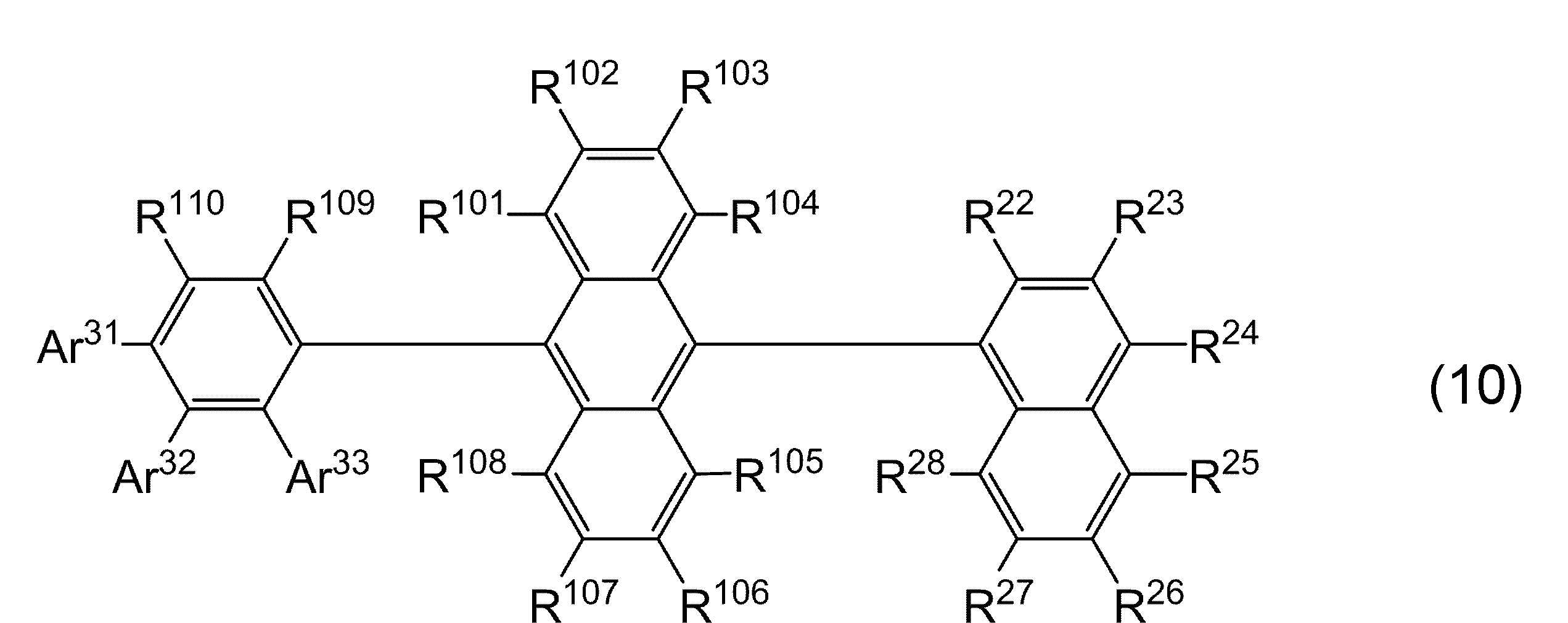

(前記一般式(10)および前記一般式(11)において、R101~R108は、それぞれ独立に、水素原子、ハロゲン原子、ヒドロキシル基、シアノ基、置換もしくは無置換のアミノ基、置換もしくは無置換の炭素数1~20のアルキル基、置換もしくは無置換の炭素数1~20のアルコキシ基、置換もしくは無置換の環形成炭素数6~20のアリールオキシ基、置換もしくは無置換の環形成炭素数6~20のアリールチオ基、置換もしくは無置換の炭素数3~40のトリアルキルシリル基、又は置換もしくは無置換の炭素数8~50のアリールシリル基であり、
Ar31~Ar33、R109、R110、R21~R28は、それぞれ独立に、水素原子、ハロゲン原子、ヒドロキシル基、シアノ基、置換もしくは無置換のアミノ基、置換もしくは無置換の炭素数1~20のアルキル基、置換もしくは無置換の炭素数1~20のアルコキシ基、置換もしくは無置換の環形成炭素数6~20のアリールオキシ基、置換もしくは無置換の環形成炭素数6~20のアリールチオ基、置換もしくは無置換の炭素数3~40のトリアルキルシリル基、置換もしくは無置換の炭素数8~50のアリールシリル基、置換もしくは無置換の環形成炭素数6~50の芳香族炭化水素基、又は置換もしくは無置換の環形成原子数5~50の複素環基であり、隣り合うR21~R28同士は環を形成してもよい。
ただし、Ar31~Ar33のうち少なくともいずれかは、置換もしくは無置換の環形成炭素数6~30の芳香族炭化水素基であり、
前記一般式(10)及び前記一般式(11)において、Ar31が、置換もしくは無置換の環形成炭素数6~30の芳香族炭化水素基となる場合には、Ar31は、置換もしくは無置換のフルオレニル基である。
前記一般式(11)において、Ar31、Ar33、R109、およびR110が水素原子である場合、Ar32は、置換もしくは無置換の環形成炭素数10~30の芳香族炭化水素基である。)
Ar31~Ar33、R109、R110、R21~R28は、それぞれ独立に、水素原子、ハロゲン原子、ヒドロキシル基、シアノ基、置換もしくは無置換のアミノ基、置換もしくは無置換の炭素数1~20のアルキル基、置換もしくは無置換の炭素数1~20のアルコキシ基、置換もしくは無置換の環形成炭素数6~20のアリールオキシ基、置換もしくは無置換の環形成炭素数6~20のアリールチオ基、置換もしくは無置換の炭素数3~40のトリアルキルシリル基、置換もしくは無置換の炭素数8~50のアリールシリル基、置換もしくは無置換の環形成炭素数6~50の芳香族炭化水素基、又は置換もしくは無置換の環形成原子数5~50の複素環基であり、隣り合うR21~R28同士は環を形成してもよい。
ただし、Ar31~Ar33のうち少なくともいずれかは、置換もしくは無置換の環形成炭素数6~30の芳香族炭化水素基であり、
前記一般式(10)及び前記一般式(11)において、Ar31が、置換もしくは無置換の環形成炭素数6~30の芳香族炭化水素基となる場合には、Ar31は、置換もしくは無置換のフルオレニル基である。
前記一般式(11)において、Ar31、Ar33、R109、およびR110が水素原子である場合、Ar32は、置換もしくは無置換の環形成炭素数10~30の芳香族炭化水素基である。)
また、本発明の一態様に係る有機エレクトロルミネッセンス素子は、
陽極と、
前記陽極と対向して設けられた陰極と、
前記陽極および前記陰極の間に設けられた有機層と、を有し、
前記有機層は、前記陽極側から、正孔輸送層および発光層をこの順に備え、
前記正孔輸送層は、下記一般式(30)で表される化合物を含み、前記発光層は、下記一般式(2A)で表される化合物、および発光材料を含むことを特徴とする
陽極と、
前記陽極と対向して設けられた陰極と、
前記陽極および前記陰極の間に設けられた有機層と、を有し、
前記有機層は、前記陽極側から、正孔輸送層および発光層をこの順に備え、
前記正孔輸送層は、下記一般式(30)で表される化合物を含み、前記発光層は、下記一般式(2A)で表される化合物、および発光材料を含むことを特徴とする

(前記一般式(30)において、A1及びA2は、それぞれ独立に、置換もしくは無置換の環形成炭素数6~30の芳香族炭化水素基、又は置換もしくは無置換の環形成原子数5~30の芳香族複素環基を表す。
R41~R44の内、隣り合ういずれか2つは、下記一般式(31)で表される部分構造と結合している。R51~R54の内、隣り合ういずれか2つが、下記一般式(31)で表される部分構造と結合していてもよい。)
R41~R44の内、隣り合ういずれか2つは、下記一般式(31)で表される部分構造と結合している。R51~R54の内、隣り合ういずれか2つが、下記一般式(31)で表される部分構造と結合していてもよい。)
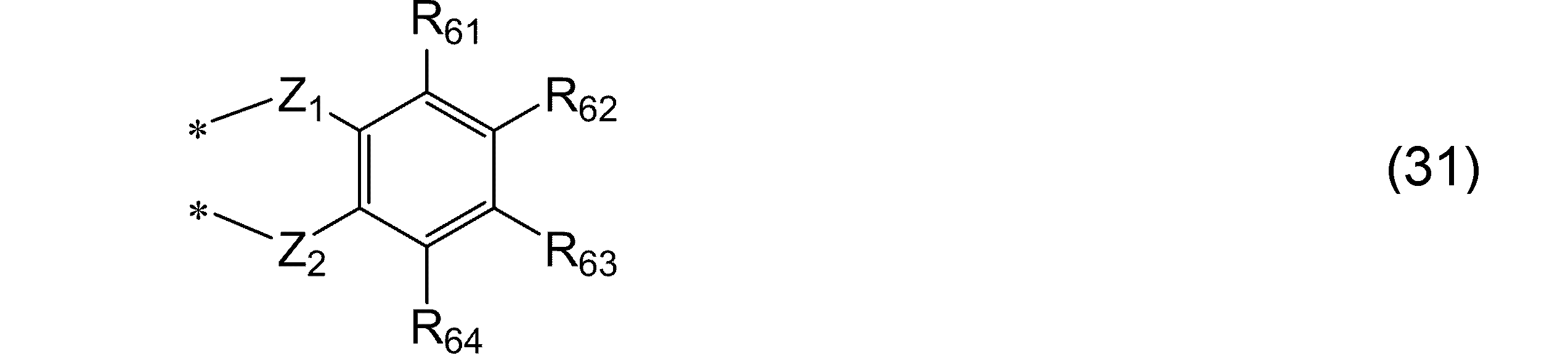
(前記一般式(31)で表される部分構造と結合していないR41~R44およびR51~R54は、それぞれ独立に、水素原子、ハロゲン原子、ヒドロキシル基、シアノ基、置換もしくは無置換のアミノ基、置換もしくは無置換の炭素数1~20のアルキル基、置換もしくは無置換の炭素数1~20のアルコキシ基、置換もしくは無置換の環形成炭素数6~20のアリールオキシ基、置換もしくは無置換の環形成炭素数6~20のアリールチオ基、置換もしくは無置換の炭素数3~40のトリアルキルシリル基、置換もしくは無置換の炭素数8~50のアリールシリル基、置換もしくは無置換の環形成炭素数6~50の芳香族炭化水素基、又は置換もしくは無置換の環形成原子数5~50の複素環基であり、
pおよびqは、3であり、
L1及びL2は、それぞれ独立に、単結合、または2価の連結基を表す。
前記一般式(31)において、*は、前記一般式(30)で表される環構造との結合部位を表し、
Z1およびZ2は、いずれか一方が単結合であり、他方が、-O-、-S-、-CR65R66-、または-NR67-であり、
R61~R67は、それぞれ独立に、水素原子、ハロゲン原子、ヒドロキシル基、シアノ基、置換もしくは無置換のアミノ基、置換もしくは無置換の炭素数1~20のアルキル基、置換もしくは無置換の炭素数1~20のアルコキシ基、置換もしくは無置換の環形成炭素数6~20のアリールオキシ基、置換もしくは無置換の環形成炭素数6~20のアリールチオ基、置換もしくは無置換の炭素数3~40のトリアルキルシリル基、置換もしくは無置換の炭素数8~50のアリールシリル基、置換もしくは無置換の環形成炭素数6~50の芳香族炭化水素基、又は置換もしくは無置換の環形成原子数5~50の複素環基
である。)
pおよびqは、3であり、
L1及びL2は、それぞれ独立に、単結合、または2価の連結基を表す。
前記一般式(31)において、*は、前記一般式(30)で表される環構造との結合部位を表し、
Z1およびZ2は、いずれか一方が単結合であり、他方が、-O-、-S-、-CR65R66-、または-NR67-であり、
R61~R67は、それぞれ独立に、水素原子、ハロゲン原子、ヒドロキシル基、シアノ基、置換もしくは無置換のアミノ基、置換もしくは無置換の炭素数1~20のアルキル基、置換もしくは無置換の炭素数1~20のアルコキシ基、置換もしくは無置換の環形成炭素数6~20のアリールオキシ基、置換もしくは無置換の環形成炭素数6~20のアリールチオ基、置換もしくは無置換の炭素数3~40のトリアルキルシリル基、置換もしくは無置換の炭素数8~50のアリールシリル基、置換もしくは無置換の環形成炭素数6~50の芳香族炭化水素基、又は置換もしくは無置換の環形成原子数5~50の複素環基
である。)
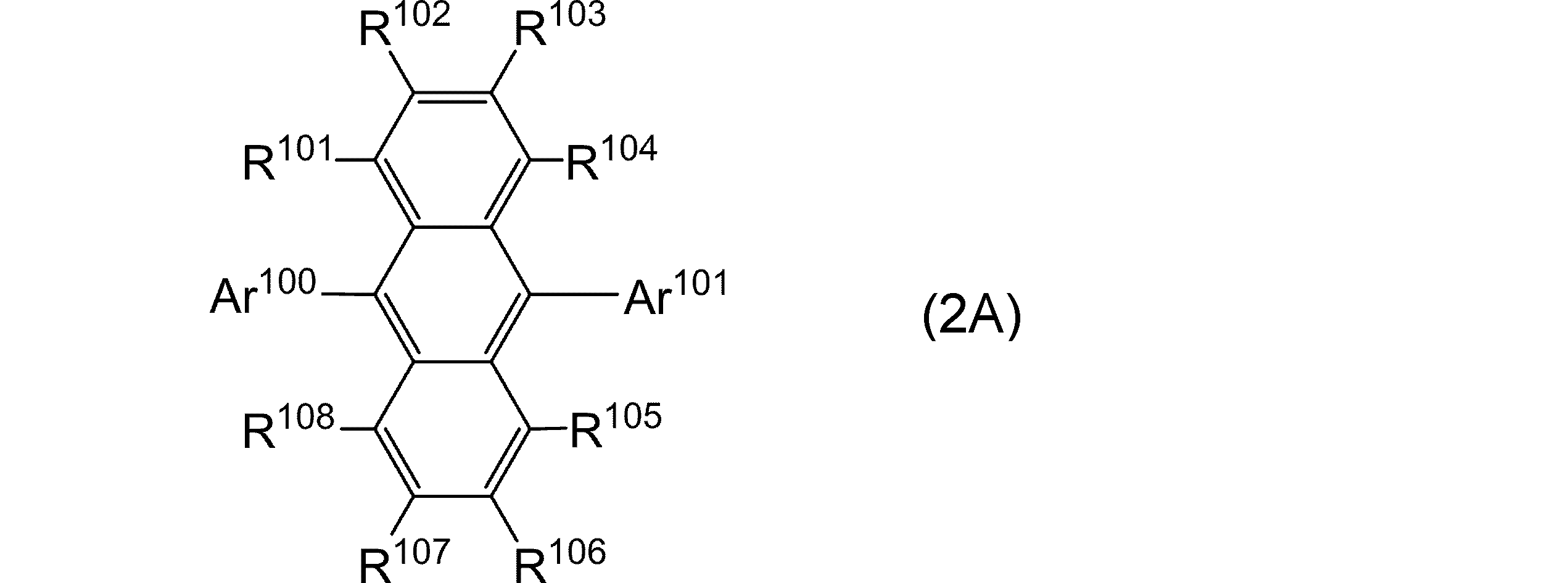
(前記一般式(2A)において、R101~R108は、それぞれ独立に、水素原子、ハロゲン原子、ヒドロキシル基、シアノ基、置換もしくは無置換のアミノ基、置換もしくは無置換の炭素数1~20のアルキル基、置換もしくは無置換の炭素数1~20のアルコキシ基、置換もしくは無置換の環形成炭素数6~20のアリールオキシ基、置換もしくは無置換の環形成炭素数6~20のアリールチオ基、置換もしくは無置換の炭素数3~40のトリアルキルシリル基、又は置換もしくは無置換の炭素数8~50のアリールシリル基であり、
Ar1001およびAr101は、それぞれ独立に、置換または無置換の環形成炭素数6~30の芳香族炭化水素基、又は、置換または無置換の環形成原子数5~30の複素環基
である。Ar100は、R101又はR108と環を形成してもよく、Ar101は、R104又はR105と環を形成してもよい。)
Ar1001およびAr101は、それぞれ独立に、置換または無置換の環形成炭素数6~30の芳香族炭化水素基、又は、置換または無置換の環形成原子数5~30の複素環基
である。Ar100は、R101又はR108と環を形成してもよく、Ar101は、R104又はR105と環を形成してもよい。)
本発明によれば、高発光効率かつ長寿命の有機EL素子を提供することができる。
以下、本発明について具体的に説明する。
[第1実施形態]
(有機EL素子の構成)
まず、有機EL素子の素子構成について説明する。
有機EL素子の代表的な素子構成としては、例えば、次の(a)~(e)などの構成を挙げることができる。
(a)陽極/発光層/陰極
(b)陽極/正孔注入・輸送層/発光層/陰極
(c)陽極/発光層/電子注入・輸送層/陰極
(d)陽極/正孔注入・輸送層/発光層/電子注入・輸送層/陰極
(e)陽極/正孔注入・輸送層/発光層/障壁層/電子注入・輸送層/陰極
前記の中で(d)の構成が好ましく用いられるが、もちろんこれらに限定されるものではない。
なお、前記「発光層」とは、発光機能を有する有機層であって、ドーピングシステムを採用する場合、ホスト材料とドーパント材料を含んでいる。このとき、ホスト材料は、主に電子と正孔の再結合を促し、励起子を発光層内に閉じ込める機能を有し、ドーパント材料は、再結合で得られた励起子を効率的に発光させる機能を有する。燐光素子の場合、ホスト材料は主にドーパントで生成された励起子を発光層内に閉じ込める機能を有する。
前記「正孔注入・輸送層」は「正孔注入層および正孔輸送層のうちの少なくともいずれか1つ」を意味し、「電子注入・輸送層」は「電子注入層および電子輸送層のうちの少なくともいずれか1つ」を意味する。ここで、正孔注入層および正孔輸送層を有する場合には、陽極側に正孔注入層が設けられていることが好ましい。また、電子注入層および電子輸送層を有する場合には、陰極側に電子注入層が設けられていることが好ましい。
本発明において電子輸送層といった場合には、発光層と陰極との間に存在する電子輸送領域の有機層のうち、最も電子移動度の高い有機層をいう。電子輸送領域が一層で構成されている場合には、当該層が電子輸送層である。また、燐光型の有機EL素子においては、構成(e)に示すように発光層で生成された励起エネルギーの拡散を防ぐ目的で必ずしも電子移動度が高くない障壁層を発光層と電子輸送層との間に採用することがあり、発光層に隣接する有機層が電子輸送層に必ずしも該当しない。
[第1実施形態]
(有機EL素子の構成)
まず、有機EL素子の素子構成について説明する。
有機EL素子の代表的な素子構成としては、例えば、次の(a)~(e)などの構成を挙げることができる。
(a)陽極/発光層/陰極
(b)陽極/正孔注入・輸送層/発光層/陰極
(c)陽極/発光層/電子注入・輸送層/陰極
(d)陽極/正孔注入・輸送層/発光層/電子注入・輸送層/陰極
(e)陽極/正孔注入・輸送層/発光層/障壁層/電子注入・輸送層/陰極
前記の中で(d)の構成が好ましく用いられるが、もちろんこれらに限定されるものではない。
なお、前記「発光層」とは、発光機能を有する有機層であって、ドーピングシステムを採用する場合、ホスト材料とドーパント材料を含んでいる。このとき、ホスト材料は、主に電子と正孔の再結合を促し、励起子を発光層内に閉じ込める機能を有し、ドーパント材料は、再結合で得られた励起子を効率的に発光させる機能を有する。燐光素子の場合、ホスト材料は主にドーパントで生成された励起子を発光層内に閉じ込める機能を有する。
前記「正孔注入・輸送層」は「正孔注入層および正孔輸送層のうちの少なくともいずれか1つ」を意味し、「電子注入・輸送層」は「電子注入層および電子輸送層のうちの少なくともいずれか1つ」を意味する。ここで、正孔注入層および正孔輸送層を有する場合には、陽極側に正孔注入層が設けられていることが好ましい。また、電子注入層および電子輸送層を有する場合には、陰極側に電子注入層が設けられていることが好ましい。
本発明において電子輸送層といった場合には、発光層と陰極との間に存在する電子輸送領域の有機層のうち、最も電子移動度の高い有機層をいう。電子輸送領域が一層で構成されている場合には、当該層が電子輸送層である。また、燐光型の有機EL素子においては、構成(e)に示すように発光層で生成された励起エネルギーの拡散を防ぐ目的で必ずしも電子移動度が高くない障壁層を発光層と電子輸送層との間に採用することがあり、発光層に隣接する有機層が電子輸送層に必ずしも該当しない。
図1に、本発明の実施形態における有機EL素子の一例の概略構成を示す。
有機EL素子1は、透光性の基板2と、陽極3と、陰極4と、陽極3と陰極4との間に配置された有機層10と、を有する。
有機層10は、陽極3側から、正孔輸送層5および発光層6を、この順に備えている。本実施形態において、正孔輸送層5と発光層6とが隣接している。また、有機EL素子1は、陽極3と正孔輸送層5との間に、正孔注入層7を備え、陰極4と発光層6との間に、電子注入・輸送層8を備えている。なお、正孔注入層7と正孔輸送層5との間には、正孔輸送層5とは異なる別の正孔輸送層を備えていてもよい。
発光層6は、ホスト材料及び蛍光発光材料としての蛍光ドーパント材料を含む。
また、燐光発光層5の陽極3側に電子障壁層を、燐光発光層5の陰極4側に正孔障壁層を、それぞれ設けてもよい。このような障壁層により、電子や正孔を発光層6に閉じ込めて、発光層6における励起子の生成確率を高めることができる。
なお、有機層10は、無機化合物を含んでいてもよい。
有機EL素子1は、透光性の基板2と、陽極3と、陰極4と、陽極3と陰極4との間に配置された有機層10と、を有する。
有機層10は、陽極3側から、正孔輸送層5および発光層6を、この順に備えている。本実施形態において、正孔輸送層5と発光層6とが隣接している。また、有機EL素子1は、陽極3と正孔輸送層5との間に、正孔注入層7を備え、陰極4と発光層6との間に、電子注入・輸送層8を備えている。なお、正孔注入層7と正孔輸送層5との間には、正孔輸送層5とは異なる別の正孔輸送層を備えていてもよい。
発光層6は、ホスト材料及び蛍光発光材料としての蛍光ドーパント材料を含む。
また、燐光発光層5の陽極3側に電子障壁層を、燐光発光層5の陰極4側に正孔障壁層を、それぞれ設けてもよい。このような障壁層により、電子や正孔を発光層6に閉じ込めて、発光層6における励起子の生成確率を高めることができる。
なお、有機層10は、無機化合物を含んでいてもよい。
(基板)
本発明の有機EL素子は、透光性の基板上に作製する。ここでいう透光性基板は有機EL素子を支持する基板であり、400nm~700nmの可視領域の光の透過率が50%以上で平滑な基板が好ましい。
具体的には、ガラス板、ポリマー板等が挙げられる。
ガラス板としては、特にソーダ石灰ガラス、バリウム・ストロンチウム含有ガラス、鉛ガラス、アルミノケイ酸ガラス、ホウケイ酸ガラス、バリウムホウケイ酸ガラス、石英等を原料として用いてなるものを挙げられる。
またポリマー板としては、ポリカーボネート、アクリル、ポリエチレンテレフタレート、ポリエーテルサルファイド、ポリサルフォン等を原料として用いてなるものを挙げることができる。
本発明の有機EL素子は、透光性の基板上に作製する。ここでいう透光性基板は有機EL素子を支持する基板であり、400nm~700nmの可視領域の光の透過率が50%以上で平滑な基板が好ましい。
具体的には、ガラス板、ポリマー板等が挙げられる。
ガラス板としては、特にソーダ石灰ガラス、バリウム・ストロンチウム含有ガラス、鉛ガラス、アルミノケイ酸ガラス、ホウケイ酸ガラス、バリウムホウケイ酸ガラス、石英等を原料として用いてなるものを挙げられる。
またポリマー板としては、ポリカーボネート、アクリル、ポリエチレンテレフタレート、ポリエーテルサルファイド、ポリサルフォン等を原料として用いてなるものを挙げることができる。
(陽極及び陰極)
有機EL素子の陽極は、正孔を正孔注入層、正孔輸送層又は発光層に注入する役割を担うものであり、4.5eV以上の仕事関数を有することが効果的である。
陽極材料の具体例としては、酸化インジウム錫合金(ITO)、酸化錫(NESA)、酸化インジウム亜鉛酸化物、金、銀、白金、銅等が挙げられる。
陽極はこれらの電極物質を蒸着法やスパッタリング法等の方法で薄膜を形成させることにより作製することができる。
本実施形態のように、発光層からの発光を陽極から取り出す場合、陽極の可視領域の光の透過率を10%より大きくすることが好ましい。また、陽極のシート抵抗は、数百Ω/□(Ω/sq。オーム・パー・スクウェア。)以下が好ましい。陽極の膜厚は、材料にもよるが、通常10nm~1μm、好ましくは10nm~200nmの範囲で選択される。
有機EL素子の陽極は、正孔を正孔注入層、正孔輸送層又は発光層に注入する役割を担うものであり、4.5eV以上の仕事関数を有することが効果的である。
陽極材料の具体例としては、酸化インジウム錫合金(ITO)、酸化錫(NESA)、酸化インジウム亜鉛酸化物、金、銀、白金、銅等が挙げられる。
陽極はこれらの電極物質を蒸着法やスパッタリング法等の方法で薄膜を形成させることにより作製することができる。
本実施形態のように、発光層からの発光を陽極から取り出す場合、陽極の可視領域の光の透過率を10%より大きくすることが好ましい。また、陽極のシート抵抗は、数百Ω/□(Ω/sq。オーム・パー・スクウェア。)以下が好ましい。陽極の膜厚は、材料にもよるが、通常10nm~1μm、好ましくは10nm~200nmの範囲で選択される。
陰極としては、電子注入層、電子輸送層または発光層に電子を注入する目的で、仕事関数の小さい材料が好ましい。
陰極材料は特に限定されないが、具体的にはインジウム、アルミニウム、マグネシウム、マグネシウム-インジウム合金、マグネシウム-アルミニウム合金、アルミニウム-リチウム合金、アルミニウム-スカンジウム-リチウム合金、マグネシウム-銀合金などが使用できる。
陰極も、陽極と同様に、蒸着法などの方法で、例えば、電子輸送層や電子注入層上に薄膜を形成させることにより作製することができる。また、陰極側から、発光層からの発光を取り出す態様を採用することもできる。発光層からの発光を陰極側から取り出す場合、陰極の可視領域の光の透過率を10%より大きくすることが好ましい。
陰極のシート抵抗は、数百Ω/□以下が好ましい。
陰極の層厚は材料にもよるが、通常10nm以上1μm以下、好ましくは50nm以上200nm以下の範囲で選択される。
陰極材料は特に限定されないが、具体的にはインジウム、アルミニウム、マグネシウム、マグネシウム-インジウム合金、マグネシウム-アルミニウム合金、アルミニウム-リチウム合金、アルミニウム-スカンジウム-リチウム合金、マグネシウム-銀合金などが使用できる。
陰極も、陽極と同様に、蒸着法などの方法で、例えば、電子輸送層や電子注入層上に薄膜を形成させることにより作製することができる。また、陰極側から、発光層からの発光を取り出す態様を採用することもできる。発光層からの発光を陰極側から取り出す場合、陰極の可視領域の光の透過率を10%より大きくすることが好ましい。
陰極のシート抵抗は、数百Ω/□以下が好ましい。
陰極の層厚は材料にもよるが、通常10nm以上1μm以下、好ましくは50nm以上200nm以下の範囲で選択される。
(正孔輸送層)
本実施形態の正孔輸送層5は、発光層6の陽極3側において隣接し、下記一般式(1)で表される化合物を含む。
本実施形態の正孔輸送層5は、発光層6の陽極3側において隣接し、下記一般式(1)で表される化合物を含む。
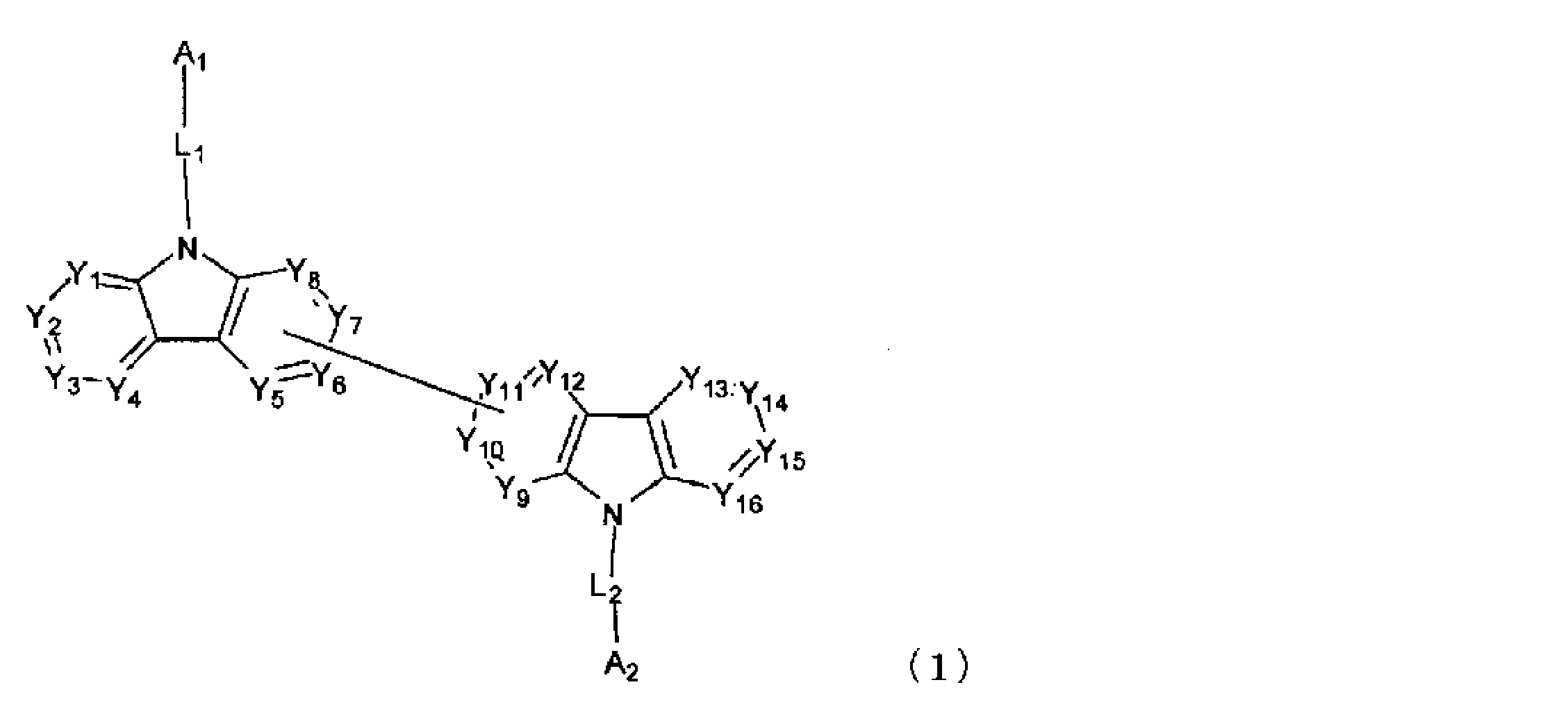
前記一般式(1)において、A1及びA2は、互いに独立して、置換もしくは無置換の環形成炭素数6~30の芳香族炭化水素基、又は置換もしくは無置換の環形成炭素数2~30の芳香族複素環基を表す。
前記一般式(1)において、Y1~Y16は、互いに独立して、C(R)または窒素原子を表し、Rは、それぞれ独立に、水素原子、置換基又はカルバゾール骨格に結合する結合手を表す。すなわち、前記一般式(1)で表される化合物としては、カルバゾール骨格を有する場合や、アザ化されたカルバゾール骨格を有する場合も含まれる。
前記一般式(1)において、L1及びL2は、互いに独立して、単結合、または2価の連結基を表す。
但し、前記一般式(1)において、A1、A2及びRのうち少なくとも1つは、置換もしくは無置換のフルオランテニル基、置換もしくは無置換のトリフェニレニル基、置換もしくは無置換のベンゾフェナントレニル基、置換もしくは無置換のベンゾトリフェニレニル基、置換もしくは無置換のジベンゾトリフェニレニル基、置換もしくは無置換のクリセニル基、置換もしくは無置換のベンゾクリセニル基、置換もしくは無置換のピセニル基、置換もしくは無置換のベンゾ[b]フルオランテニル基、置換もしくは無置換のベンゾフラニル基、置換もしくは無置換のジベンゾフラニル基、置換もしくは無置換のベンゾチオフェニル基、置換もしくは無置換のジベンゾチオフェニル基、置換もしくは無置換のカルバゾリル基、置換もしくは無置換のフェナントレニル基、置換もしくは無置換のフルオレニル基、又は置換もしくは無置換のビナフチル基を表す。
但し、前記一般式(1)において、A1、A2及びRのうち少なくとも1つは、置換もしくは無置換のフルオランテニル基、置換もしくは無置換のトリフェニレニル基、置換もしくは無置換のベンゾフェナントレニル基、置換もしくは無置換のベンゾトリフェニレニル基、置換もしくは無置換のジベンゾトリフェニレニル基、置換もしくは無置換のクリセニル基、置換もしくは無置換のベンゾクリセニル基、置換もしくは無置換のピセニル基、置換もしくは無置換のベンゾ[b]フルオランテニル基、置換もしくは無置換のベンゾフラニル基、置換もしくは無置換のジベンゾフラニル基、置換もしくは無置換のベンゾチオフェニル基、置換もしくは無置換のジベンゾチオフェニル基、置換もしくは無置換のカルバゾリル基、置換もしくは無置換のフェナントレニル基、置換もしくは無置換のフルオレニル基、又は置換もしくは無置換のビナフチル基を表す。
また、前記一般式(1)において、Y1~Y16が全てC(R)であり、Y6とY11とが単結合で結合し、L1及びL2が単結合であり、A1がフェナントレニル基の場合、A2はフェナントレニル基ではない。
さらに、前記一般式(1)において、Y1~Y16が全てC(R)であり、Y6とY11とが単結合で結合し、L1とL2が単結合である場合、Rは、いずれもフルオレニル基ではなく、さらにA1がフルオレニル基の場合、A2は、フェニル基、ナフチル基、又はフルオレニル基ではない。
なお、前記一般式(1)において、Y1~Y4のうち少なくとも1つは、C(R)であり、Y5~Y8のうち少なくとも1つは、C(R)であり、Y9~Y12のうち少なくとも1つは、C(R)であり、Y13~Y16のうち少なくとも1つはC(R)である。
また、Y5~Y8のうち1つはC(R)であり、Y9~Y12のうち1つはC(R)であり、これらのRは、互いに結合する結合手を表す。
前記一般式(1)における複数のRは、互いに同じでも異なっていてもよい。
また、Y5~Y8のうち1つはC(R)であり、Y9~Y12のうち1つはC(R)であり、これらのRは、互いに結合する結合手を表す。
前記一般式(1)における複数のRは、互いに同じでも異なっていてもよい。
正孔輸送層5に含まれる前記一般式(1)で表される化合物は、下記一般式(1-2)、下記一般式(1-3)または下記一般式(1-4)で表されることが好ましい。
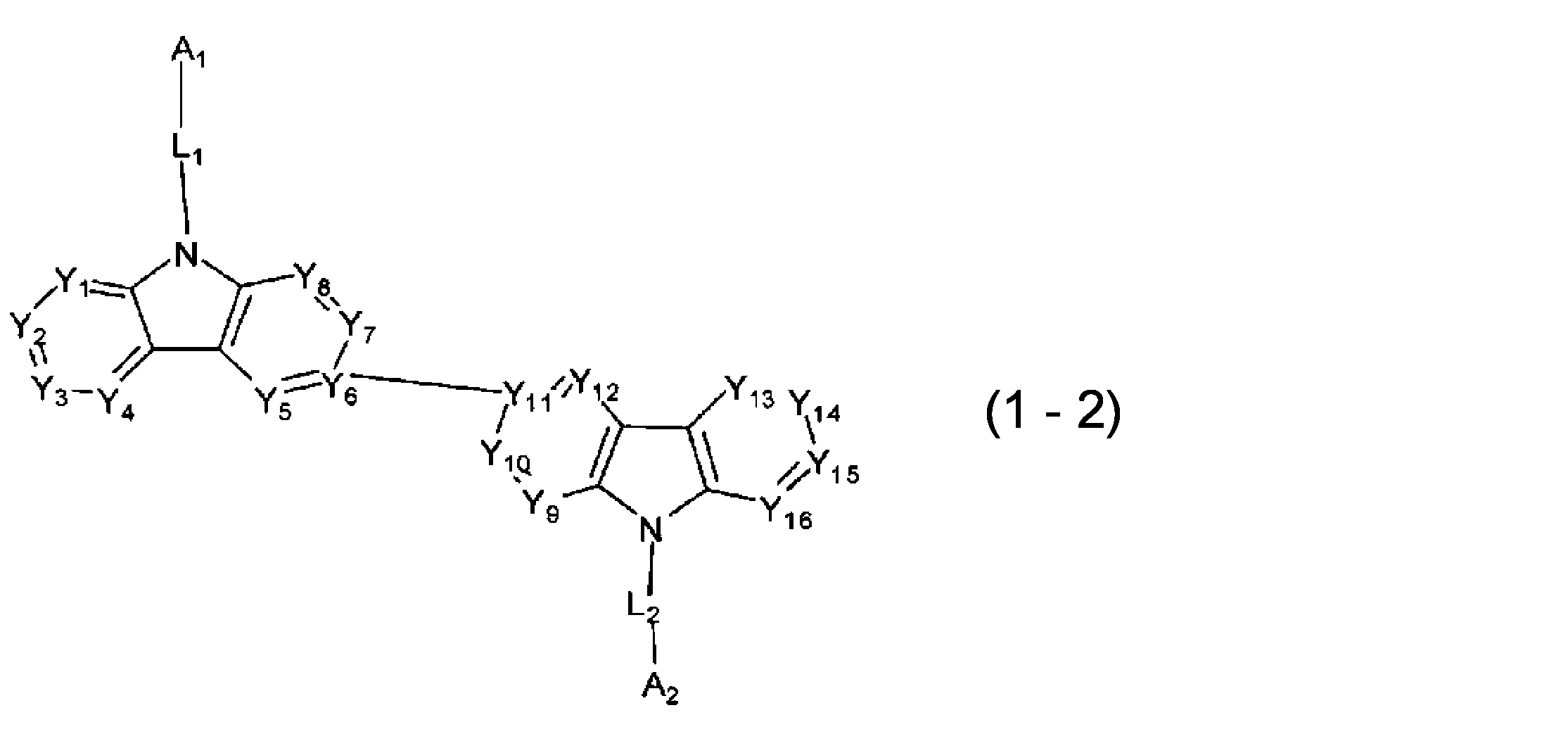
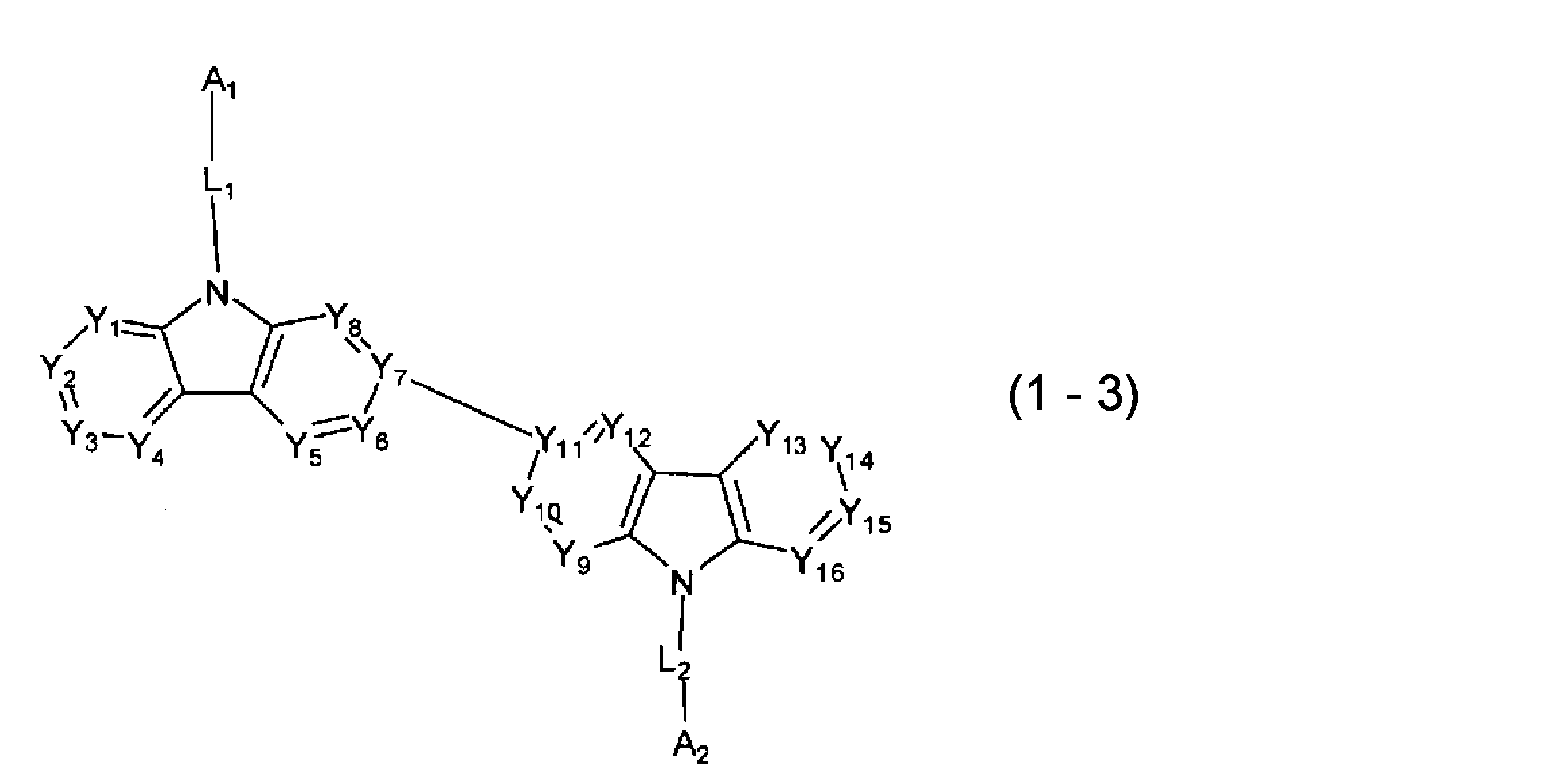
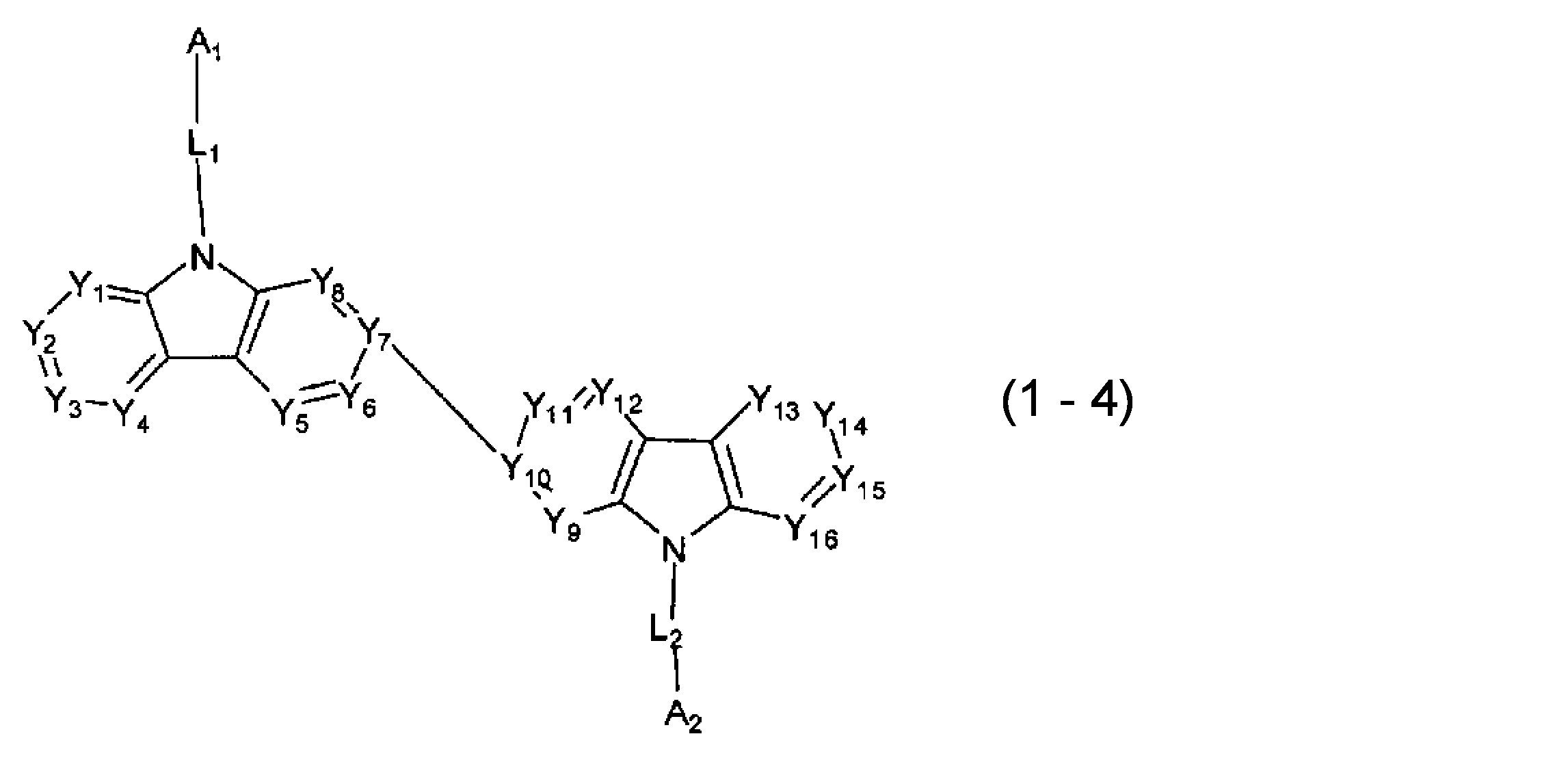
前記一般式(1),(1-2)~(1-4)において、A1及びA2の少なくとも一方が、置換もしくは無置換のフルオランテニル基、置換もしくは無置換のトリフェニレニル基、置換もしくは無置換のベンゾフェナントレニル基、置換もしくは無置換のベンゾトリフェニレニル基、置換もしくは無置換のジベンゾトリフェニレニル基、置換もしくは無置換のクリセニル基、置換もしくは無置換のベンゾクリセニル基、置換もしくは無置換のピセニル基、置換もしくは無置換のベンゾ[b]フルオランテニル基、置換もしくは無置換のベンゾフラニル基、置換もしくは無置換のジベンゾフラニル基、置換もしくは無置換のベンゾチオフェニル基、置換もしくは無置換のジベンゾチオフェニル基、置換もしくは無置換のカルバゾリル基、置換もしくは無置換のフェナントレニル基、置換もしくは無置換のフルオレニル基、又は置換もしくは無置換のビナフチル基であることが好ましい。
また、前記一般式(1),(1-2)~(1-4)において、A1及びA2は、それぞれ独立に、置換もしくは無置換のフルオランテニル基、置換もしくは無置換のトリフェニレニル基、置換もしくは無置換のベンゾトリフェニレニル基、置換もしくは無置換のベンゾフェナントレニル基、置換もしくは無置換のジベンゾフラニル基、置換もしくは無置換のジベンゾチオフェニル基、又は置換もしくは無置換のカルバゾリル基であることが好ましい。
また、前記一般式(1),(1-2)~(1-4)において、A1及びA2は、それぞれ独立に、置換もしくは無置換のジベンゾフラニル基、置換もしくは無置換のジベンゾチオフェニル基、又は置換もしくは無置換のカルバゾリル基であることが好ましい。
さらに、前記一般式(1),(1-2)~(1-4)において、の、L1-A1で表される部分の構造と、L2-A2で表される部分の構造とが互いに異なることが好ましい。
本実施形態におけるA1及びA2が有する置換基や、Rで表される置換基の具体例としては、ハロゲン原子、シアノ基、置換もしくは無置換の炭素数1~20の直鎖状、分岐鎖状又は環状のアルキル基、置換もしくは無置換の炭素数1~20の直鎖状、分岐鎖状または環状のハロアルキル基、炭素数1~20の直鎖状、分岐鎖状又は環状のアルキレン基、炭素数1~20の直鎖状、分岐鎖状又は環状の2価の不飽和炭化水素基、置換もしくは無置換の炭素数1~20の直鎖状、分岐鎖状または環状のアルコキシ基、置換もしくは無置換の炭素数1~20の直鎖状、分岐鎖状または環状のハロアルコキシ基、置換もしくは無置換の環形成炭素数6~30のアリールオキシ基、置換もしくは無置換の環形成炭素数6~30のアリールチオ基、置換もしくは無置換の炭素数1~10の直鎖状、分岐鎖状または環状のアルキルシリル基、置換もしくは無置換の炭素数6~30のアリールシリル基、置換もしくは無置換の環形成炭素数6~30の芳香族炭化水素基、置換もしくは無置換の環形成炭素数2~30の芳香族複素環基が挙げられる。また、これらの置換基は、複数でも良く、複数の場合は互いに同一でも異なっていても良い。
なお、隣接する環形成炭素上のRは、互いに結合して環形成炭素と共に環構造を形成しても良い。
なお、隣接する環形成炭素上のRは、互いに結合して環形成炭素と共に環構造を形成しても良い。
本実施形態におけるハロゲン原子としては、フッ素原子、塩素原子、臭素原子、ヨウ素原子等が挙げられる。
本実施形態における炭素数1~20のアルキル基としては、直鎖、分岐鎖又は環状のいずれであってもよく、直鎖または分岐鎖のアルキル基としては、例えば、メチル基、エチル基、プロピル基、イソプロピル基、n-ブチル基、s-ブチル基、イソブチル基、t-ブチル基、n-ペンチル基、n-ヘキシル基、n-ヘプチル基、n-オクチル基、n-ノニル基、n-デシル基、n-ウンデシル基、n-ドデシル基、n-トリデシル基、n-テトラデシル基、n-ペンタデシル基、n-ヘキサデシル基、n-ヘプタデシル基、n-オクタデシル基、ネオペンチル基、1-メチルペンチル基、2-メチルペンチル基、1-ペンチルヘキシル基、1-ブチルペンチル基、1-ヘプチルオクチル基、3-メチルペンチル基、ヒドロキシメチル基、1-ヒドロキシエチル基、2-ヒドロキシエチル基、2-ヒドロキシイソブチル基、1,2-ジヒドロキシエチル基、1,3-ジヒドロキシイソプロピル基、2,3-ジヒドロキシ-t-ブチル基、1,2,3-トリヒドロキシプロピル基、クロロメチル基、1-クロロエチル基、2-クロロエチル基、2-クロロイソブチル基、1,2-ジクロロエチル基、1,3-ジクロロイソプロピル基、2,3-ジクロロ-t-ブチル基、1,2,3-トリクロロプロピル基、ブロモメチル基、1-ブロモエチル基、2-ブロモエチル基、2-ブロモイソブチル基、1,2-ジブロモエチル基、1,3-ジブロモイソプロピル基、2,3-ジブロモ-t-ブチル基、1,2,3-トリブロモプロピル基、ヨードメチル基、1-ヨードエチル基、2-ヨードエチル基、2-ヨードイソブチル基、1,2-ジヨードエチル基、1,3-ジヨードイソプロピル基、2,3-ジヨード-t-ブチル基、1,2,3-トリヨードプロピル基、アミノメチル基、1-アミノエチル基、2-アミノエチル基、2-アミノイソブチル基、1,2-ジアミノエチル基、1,3-ジアミノイソプロピル基、2,3-ジアミノ-t-ブチル基、1,2,3-トリアミノプロピル基、シアノメチル基、1-シアノエチル基、2-シアノエチル基、2-シアノイソブチル基、1,2-ジシアノエチル基、1,3-ジシアノイソプロピル基、2,3-ジシアノ-t-ブチル基、1,2,3-トリシアノプロピル基、ニトロメチル基、1-ニトロエチル基、2-ニトロエチル基、1,2-ジニトロエチル基、2,3-ジニトロ-t-ブチル基、1,2,3-トリニトロプロピル基、トリフルオロメチル基、2,2,2-トリフルオロエチル基、1,1,1,3,3,3-ヘキサフルオロ-2-プロピル基等が挙げられる。
環状のアルキル基(シクロアルキル基)としては、例えば、シクロプロピル基、シクロブチル基、シクロペンチル基、シクロヘキシル基、シクロペンチル基、シクロヘキシル基、シクロオクチル基、4-メチルシクロヘキシル基、3,5-テトラメチルシクロヘキシル基、1-アダマンチル基、2-アダマンチル基、1-ノルボルニル基、2-ノルボルニル基等が挙げられる。
環状のアルキル基(シクロアルキル基)としては、例えば、シクロプロピル基、シクロブチル基、シクロペンチル基、シクロヘキシル基、シクロペンチル基、シクロヘキシル基、シクロオクチル基、4-メチルシクロヘキシル基、3,5-テトラメチルシクロヘキシル基、1-アダマンチル基、2-アダマンチル基、1-ノルボルニル基、2-ノルボルニル基等が挙げられる。
本実施形態における炭素数1~20の直鎖状、分岐鎖状または環状のハロアルキル基としては、例えば、前記炭素数1~20のアルキル基が1以上のハロゲン原子で置換されたものが挙げられる。具体的には、フルオロメチル基、ジフルオロメチル基、トリフルオロメチル基、フルオロエチル基、トリフルオロメチルメチル基等が挙げられる。
本実施形態における炭素数1~20の直鎖状、分岐鎖状又は環状のアルキレン基としては、例えば、エチレン基、プロピレン基、ブチレン基等が挙げられる。
本実施形態における炭素数1~20の直鎖状、分岐鎖状又は環状の2価の不飽和炭化水素基としては、例えば、1,3-ブタジエン-1,4-ジイル基等が挙げられる。
本実施形態における炭素数1~20の直鎖状、分岐鎖状又は環状の2価の不飽和炭化水素基としては、例えば、1,3-ブタジエン-1,4-ジイル基等が挙げられる。
本実施形態における炭素数1~20の直鎖状、分岐鎖状または環状のアルコキシ基は、-OZ1と表される。このZ1の例として、前記炭素数1~20のアルキル基が挙げられる。アルコキシ基は、例えばメトキシ基、エトキシ基、プロポキシ基、ブトキシ基、ペンチルオキシ基、ヘキシルオキシ基があげられる。
本実施形態における環形成炭素数6~30のアリールオキシ基は、-OZ2と表される。このZ2の例として、下記環形成炭素数6~30の芳香族炭化水素基が挙げられる。このアリールオキシ基としては、例えば、フェノキシ基が挙げられる。
前記一般式(1),(1-2)~(1-4)における環形成炭素数6~30のアリールチオ基は、-SZ3と表される。このZ3の例として、下記環形成炭素数6~30の芳香族炭化水素基が挙げられる。
本実施形態における環形成炭素数6~30のアリールオキシ基は、-OZ2と表される。このZ2の例として、下記環形成炭素数6~30の芳香族炭化水素基が挙げられる。このアリールオキシ基としては、例えば、フェノキシ基が挙げられる。
前記一般式(1),(1-2)~(1-4)における環形成炭素数6~30のアリールチオ基は、-SZ3と表される。このZ3の例として、下記環形成炭素数6~30の芳香族炭化水素基が挙げられる。
本実施形態における炭素数1~20の直鎖状、分岐鎖状または環状のハロアルコキシ基としては、例えば、前記炭素数1~20のアルコキシ基が1以上のハロゲン基で置換されたものが挙げられる。
本実施形態における炭素数1~10の直鎖状、分岐鎖状または環状のアルキルシリル基としては、例えば、トリメチルシリル基、トリエチルシリル基、トリブチルシリル基、ジメチルエチルシリル基、ジメチルイソプロピルシリル基、ジメチルプロピルシリル基、ジメチルブチルシリル基、ジメチルターシャリーブチルシリル基、ジエチルイソプロピルシリル基等が挙げられる。
本実施形態における炭素数6~30のアリールシリル基としては、例えば、フェニルジメチルシリル基、ジフェニルメチルシリル基、ジフェニルターシャリーブチルシリル基、トリフェニルシリル基等が挙げられる。
本実施形態における環形成炭素数6~30の芳香族炭化水素基としては、非縮合芳香族炭化水素基及び縮合芳香族炭化水素基が挙げられ、より具体的には、フェニル基、ナフチル基、フェナントリル基、ビフェニル基、ターフェニル基、クォーターフェニル基、フルオランテニル基、トリフェニレニル基、フェナントレニル基、9,9-ジメチルフルオレニル基、ベンゾ[c]フェナントレニル基、ベンゾ[a]トリフェニレニル基、ナフト[1,2-c]フェナントレニル基、ナフト[1,2-a]トリフェニレニル基、ジベンゾ[a,c]トリフェニレニル基、ベンゾ[b]フルオランテニル基、などが挙げられる。
本実施形態における環形成炭素数2~30の芳香族複素環基もしくは環形成原子数5~30の芳香族複素環基としては、非縮合芳香族複素環及び縮合芳香族複素環が挙げられ、より具体的には、ピロリル基、ピラジニル基、ピリジニル基、インドリル基、イソインドリル基、フリル基、ベンゾフラニル基、イソベンゾフラニル基、ジベンゾフラニル基、ジベンゾチオフェニル基、キノリル基、イソキノリル基、キノキサリニル基、カルバゾリル基、フェナントリジニル基、アクリジニル基、フェナントロリニル基、チエニル基、およびピリジン環、ピラジン環、ピリミジン環、ピリダジン環、トリアジン環、インドール環、キノリン環、アクリジン環、ピロリジン環、ジオキサン環、ピペリジン環、モルフォリン環、ピペラジン環、カルバゾール環、フラン環、チオフェン環、オキサゾール環、オキサジアゾール環、ベンゾオキサゾール環、チアゾール環、チアジアゾール環、ベンゾチアゾール環、トリアゾール環、イミダゾール環、ベンゾイミダゾール環、ピラン環、ジベンゾフラン環、ベンゾ[c]ジベンゾフラン環から形成される基が挙げられる。
本実施形態におけるL1及びL2で表される2価の連結基としては、置換もしくは無置換の環形成炭素数6~30の2価の芳香族炭化水素基、置換もしくは無置換の2価の環形成炭素数2~10の芳香族複素環基が挙げられる。
環形成炭素数6~30の2価の芳香族炭化水素基の具体例としては、上述の環形成炭素数6~30の芳香族炭化水素基として挙げられたものを2価基としたものが挙げられる。
また、環形成炭素数2~30の2価の芳香族複素環基の具体例としては、上述の環形成炭素数2~30の芳香族複素環基として挙げられたものを2価基としたものが挙げられる。
環形成炭素数6~30の2価の芳香族炭化水素基の具体例としては、上述の環形成炭素数6~30の芳香族炭化水素基として挙げられたものを2価基としたものが挙げられる。
また、環形成炭素数2~30の2価の芳香族複素環基の具体例としては、上述の環形成炭素数2~30の芳香族複素環基として挙げられたものを2価基としたものが挙げられる。
前記一般式(1),(1-2)~(1-4)において、Y1~Y16が全てC(R)であると好ましい。すなわち、正孔輸送層5に含まれる前記一般式(1)で表される化合物は、アザ化されていないカルバゾール骨格が2つ連結した構造であることが好ましい。さらに、前記一般式(1)で表される化合物としては、分子中に有するカルバゾール骨格が2つであることが好ましい。
前記一般式(1),(1-2)~(1-4)のY1~Y8、並びにY9~Y16のそれぞれにおいて、Rで表される置換基の数が0~2個であると好ましく、0又は1個であるとより好ましい。
また、前記一般式(1),(1-2)~(1-4)で表される化合物としては、特定の位置に、置換もしくは無置換のフルオランテニル基、置換もしくは無置換のトリフェニレニル基、置換もしくは無置換のベンゾトリフェニレニル基、置換もしくは無置換のベンゾフェナントレニル基、置換もしくは無置換のジベンゾフラニル基、および置換もしくは無置換のジベンゾチオフェニル基からなる群から選択される基が結合していることが好ましい。
また、前記一般式(1),(1-2)~(1-4)で表される化合物としては、特定の位置に、置換もしくは無置換のフルオランテニル基、置換もしくは無置換のトリフェニレニル基、置換もしくは無置換のベンゾトリフェニレニル基、置換もしくは無置換のベンゾフェナントレニル基、置換もしくは無置換のジベンゾフラニル基、および置換もしくは無置換のジベンゾチオフェニル基からなる群から選択される基が結合していることが好ましい。
本発明において、「環形成炭素」とは飽和環、不飽和環、又は芳香環を構成する炭素原子を意味する。「環形成原子」とはヘテロ環(飽和環、不飽和環、および芳香環を含む)を構成する炭素原子およびヘテロ原子を意味する。
また、本発明において、水素原子とは、中性子数の異なる同位体、すなわち、軽水素(Protium)、重水素(Deuterium)、三重水素(Tritium)を包含する。
また、本発明において、水素原子とは、中性子数の異なる同位体、すなわち、軽水素(Protium)、重水素(Deuterium)、三重水素(Tritium)を包含する。
また、「置換もしくは無置換の」という場合における置換基としては、上述のような芳香族炭化水素基、芳香族複素環基、アルキル基(直鎖または分岐鎖のアルキル基、シクロアルキル基、ハロアルキル基)、アルコキシ基、アリールオキシ基、アラルキル基、ハロアルコキシ基、アルキルシリル基、ジアルキルアリールシリル基、アルキルジアリールシリル基、トリアリールシリル基、ハロゲン原子、シアノ基、ヒドロキシル基、ニトロ基、およびカルボキシ基が挙げられる。その他、アルケニル基やアルキニル基も挙げられる。
ここで挙げた置換基の中では、芳香族炭化水素基、芳香族複素環基、アルキル基、ハロゲン原子、アルキルシリル基、アリールシリル基、シアノ基が好ましく、さらには、各置換基の説明において好ましいとした具体的な置換基が好ましい。
「置換もしくは無置換の」という場合における「無置換」とは前記置換基で置換されておらず、水素原子が結合していることを意味する。
以下に説明する化合物またはその部分構造において、「置換もしくは無置換の」という場合についても、前記と同様である。
ここで挙げた置換基の中では、芳香族炭化水素基、芳香族複素環基、アルキル基、ハロゲン原子、アルキルシリル基、アリールシリル基、シアノ基が好ましく、さらには、各置換基の説明において好ましいとした具体的な置換基が好ましい。
「置換もしくは無置換の」という場合における「無置換」とは前記置換基で置換されておらず、水素原子が結合していることを意味する。
以下に説明する化合物またはその部分構造において、「置換もしくは無置換の」という場合についても、前記と同様である。
本明細書において、環形成炭素数とは、原子または分子が環状に結合した構造の化合物(例えば、単環化合物、縮合環化合物、架橋化合物、スピロ環化合物、炭素環化合物、複素環化合物)の当該環自体を構成する原子のうちの炭素原子の数を表す。当該環が置換基によって置換される場合、置換基に含まれる炭素は環形成炭素数には含まない。以下で記される「環形成炭素数」については、特筆しない限り同様とする。
環形成原子数とは、原子または分子が環状に結合した構造の化合物(例えば、単環化合物、縮合環化合物、架橋化合物、スピロ環化合物、炭素環化合物、複素環化合物)の当該環自体を構成する原子の数を表す。環を構成しない原子(例えば、環を構成する原子の未結合手を終端する水素原子)や、当該環が置換基によって置換される場合の置換基に含まれる原子は環形成原子数には含まない。以下で記される「環形成原子数」については、特筆しない限り同様とする。
なお、本明細書において、「置換もしくは無置換の炭素数a~bのXX基」という表現における「炭素数a~b」は、XX基が無置換である場合の炭素数を表すものであり、XX基が置換されている場合の置換基の炭素数は含めない。
以下に説明する化合物またはその部分構造において、「置換もしくは無置換の」という場合についても、前記と同様である。
環形成原子数とは、原子または分子が環状に結合した構造の化合物(例えば、単環化合物、縮合環化合物、架橋化合物、スピロ環化合物、炭素環化合物、複素環化合物)の当該環自体を構成する原子の数を表す。環を構成しない原子(例えば、環を構成する原子の未結合手を終端する水素原子)や、当該環が置換基によって置換される場合の置換基に含まれる原子は環形成原子数には含まない。以下で記される「環形成原子数」については、特筆しない限り同様とする。
なお、本明細書において、「置換もしくは無置換の炭素数a~bのXX基」という表現における「炭素数a~b」は、XX基が無置換である場合の炭素数を表すものであり、XX基が置換されている場合の置換基の炭素数は含めない。
以下に説明する化合物またはその部分構造において、「置換もしくは無置換の」という場合についても、前記と同様である。
本実施形態において正孔輸送層5に含まれる前記化合物としては、例えば、以下に示す化合物が具体例として挙げられる。なお、以下の構造式において、Dは重水素(deuterium)を表す。

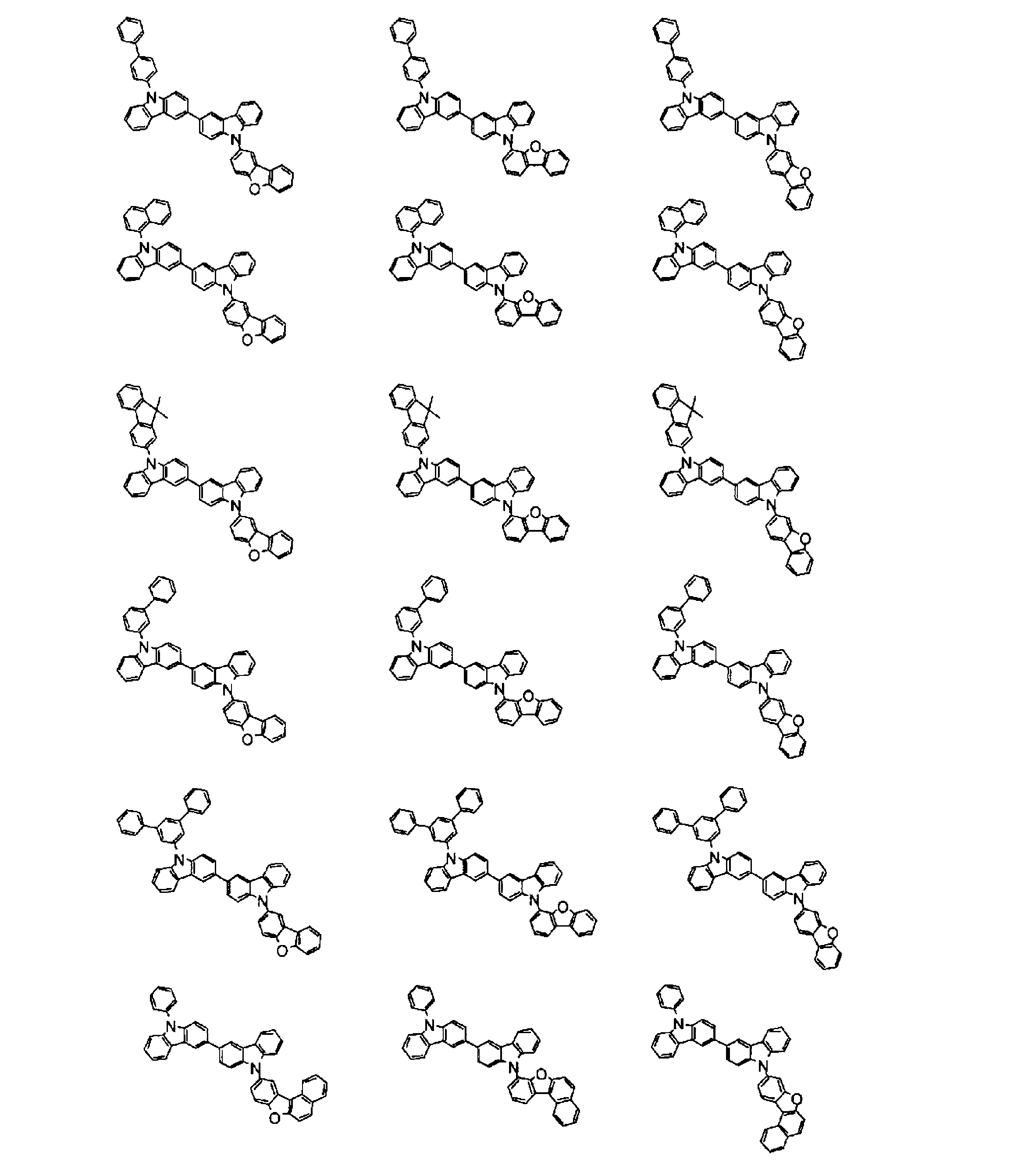
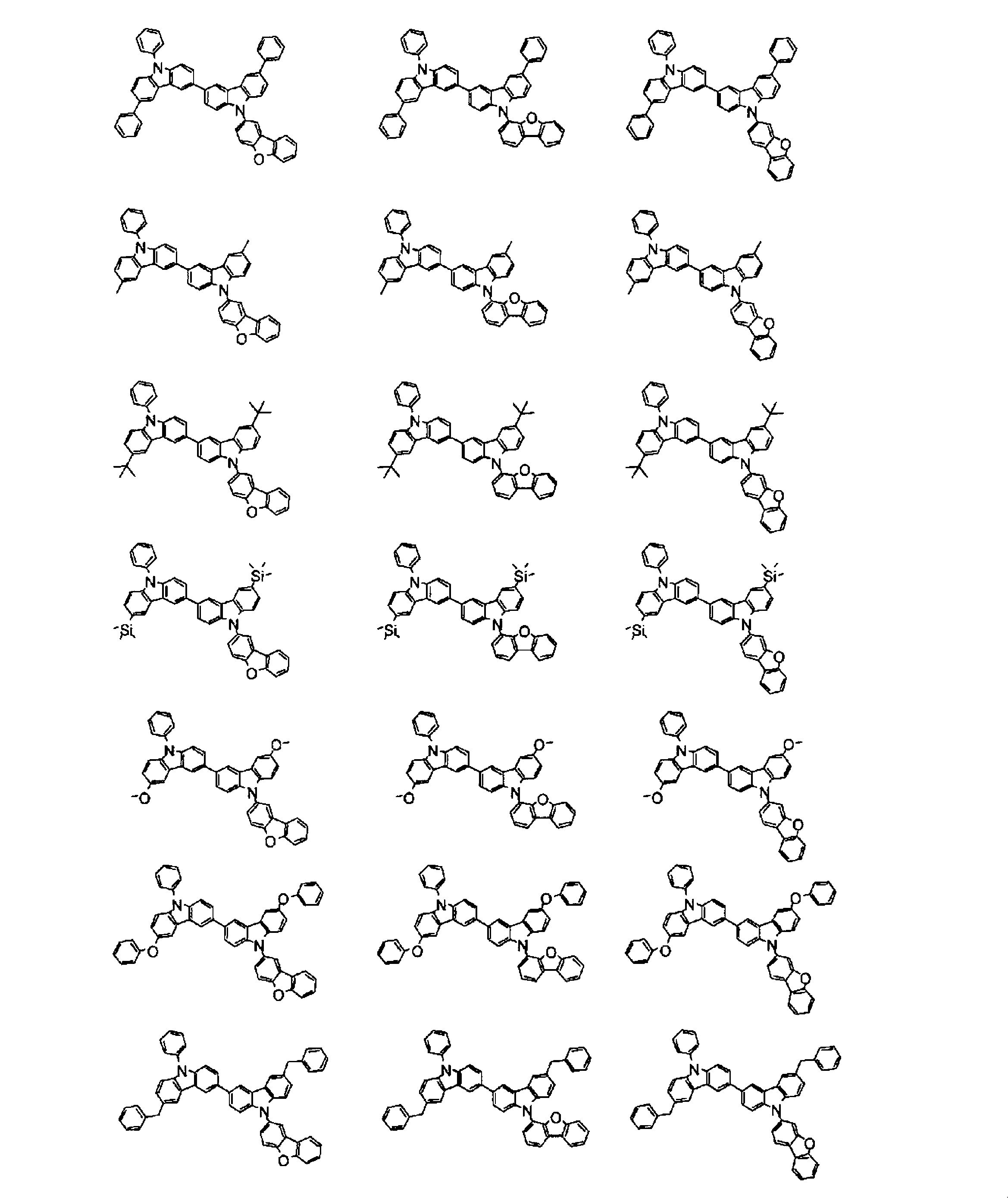
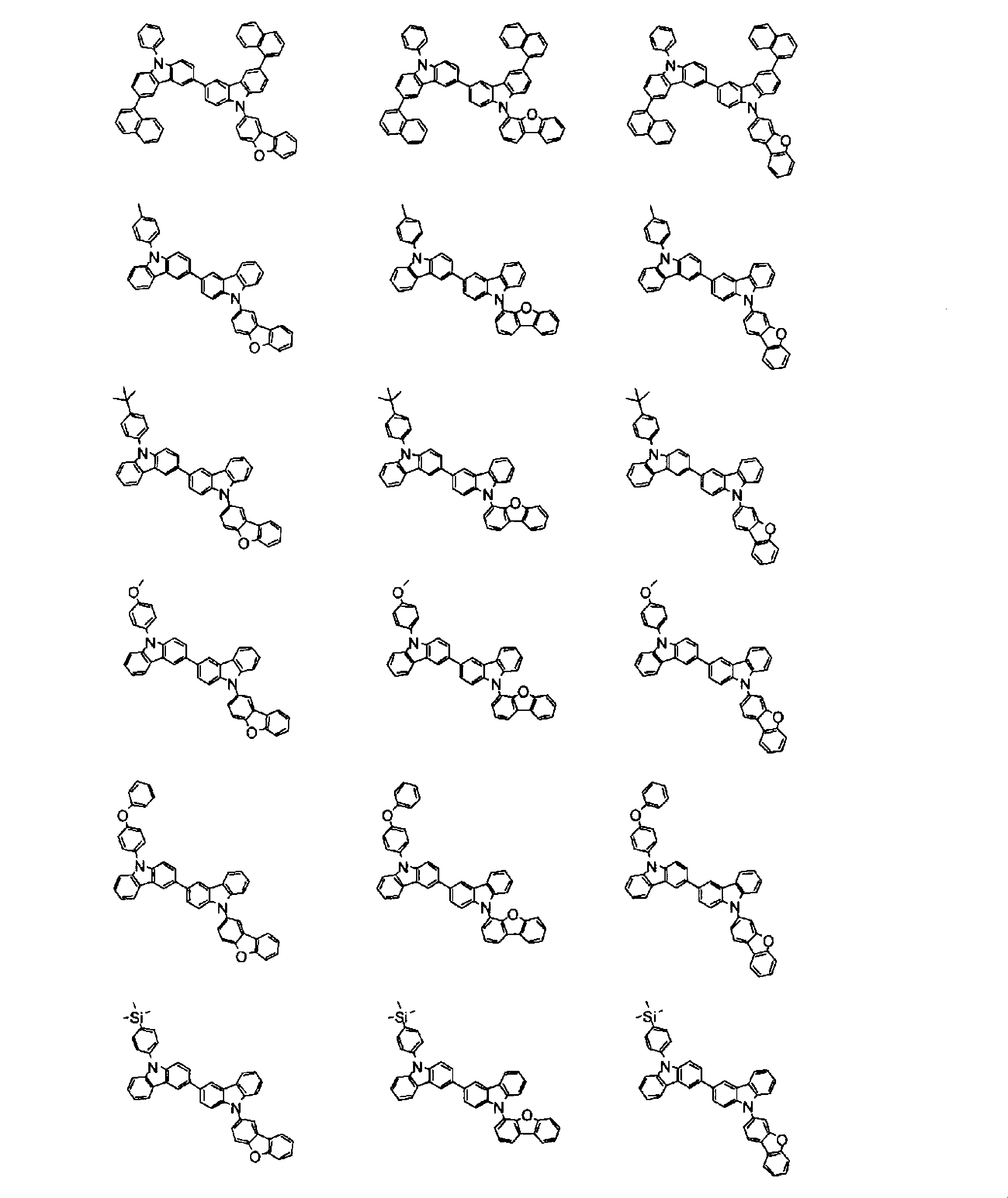
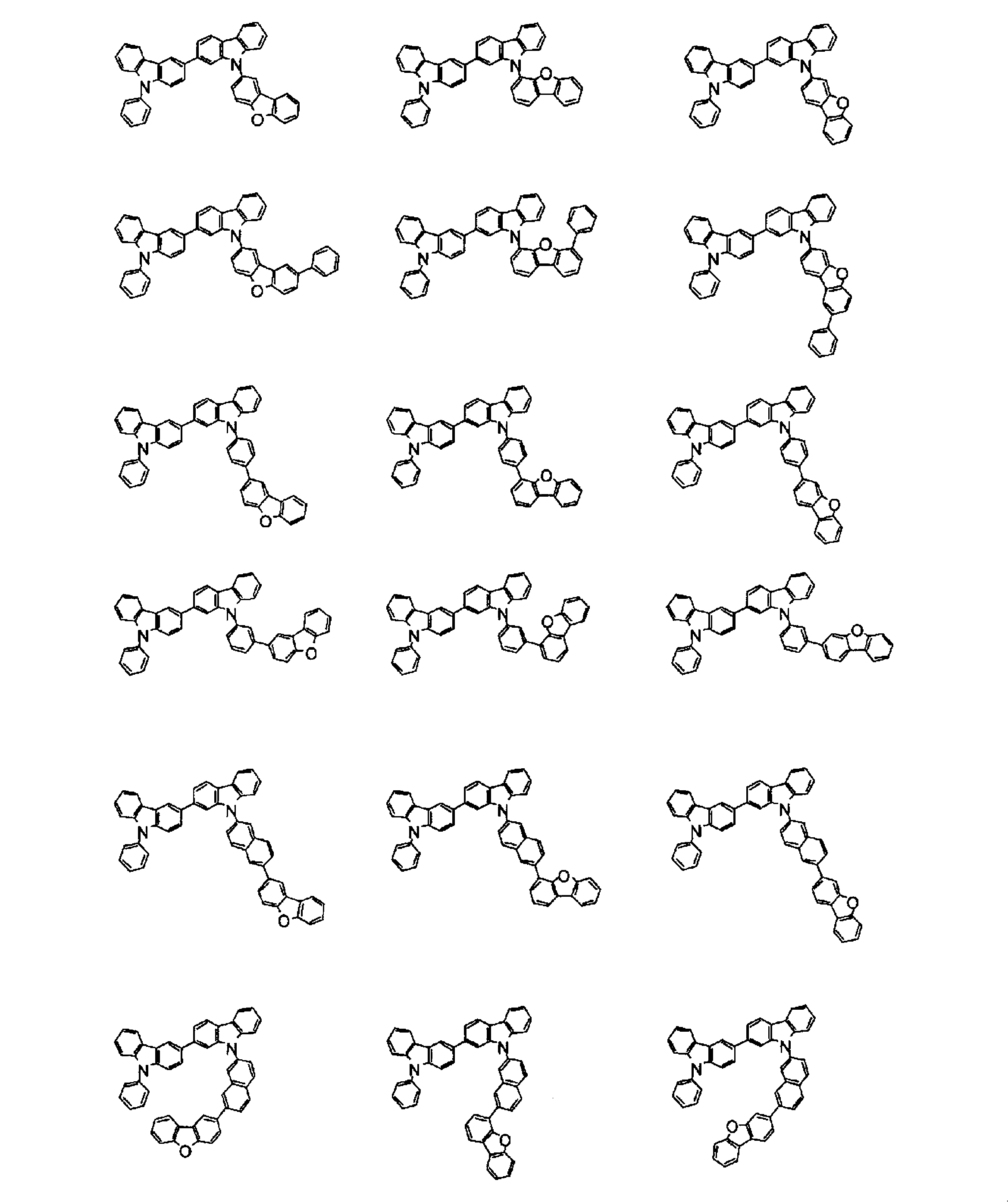
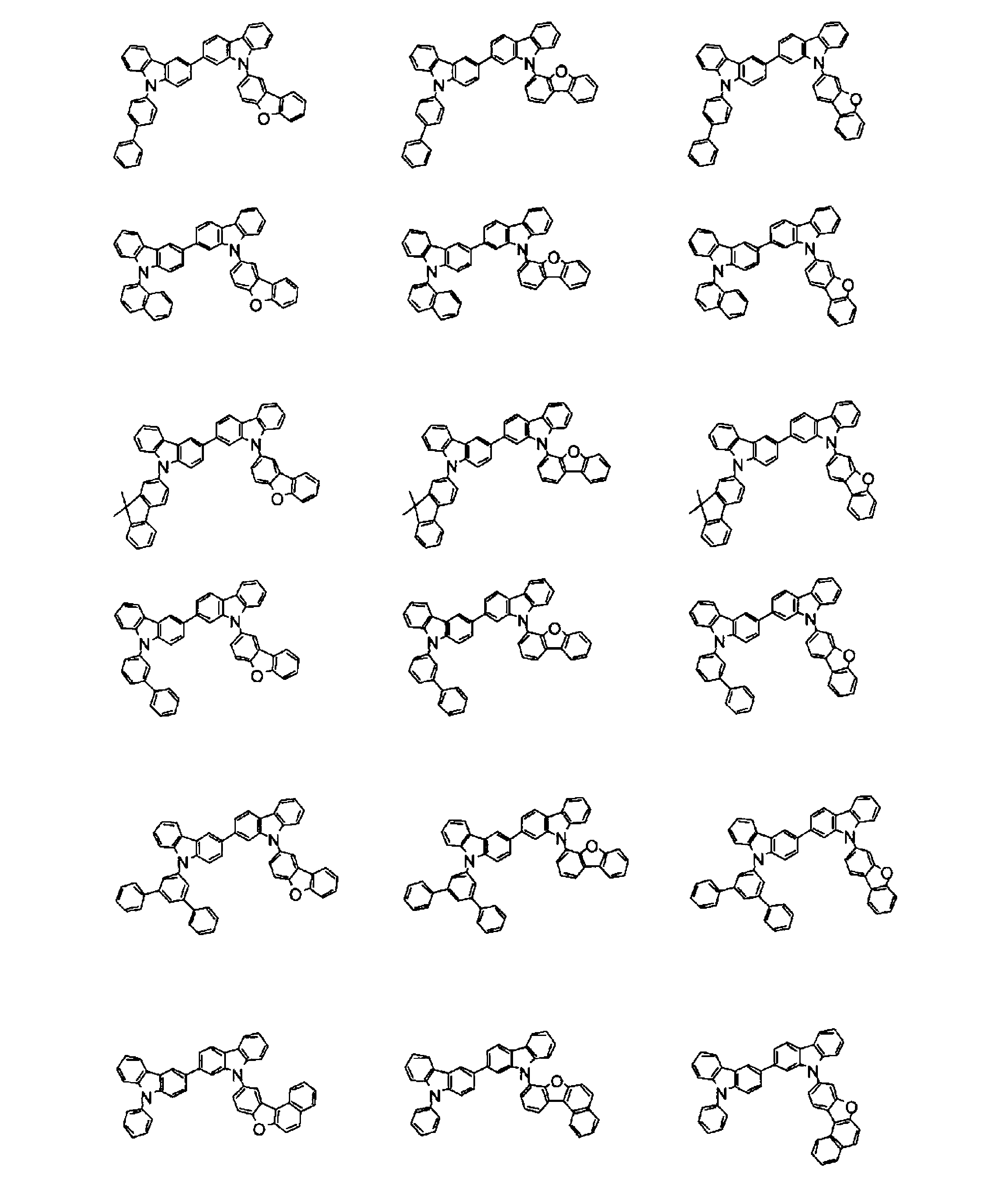


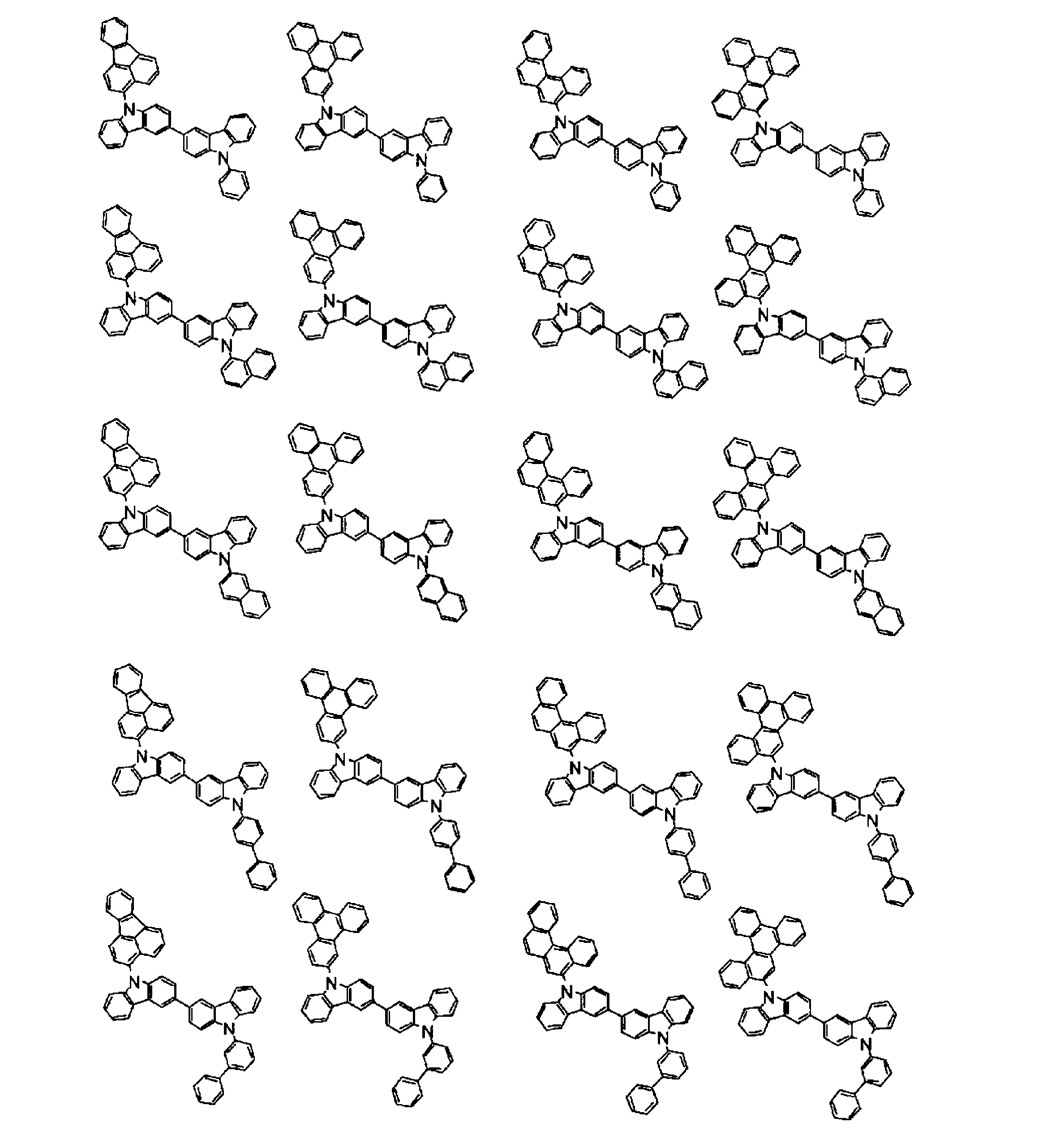
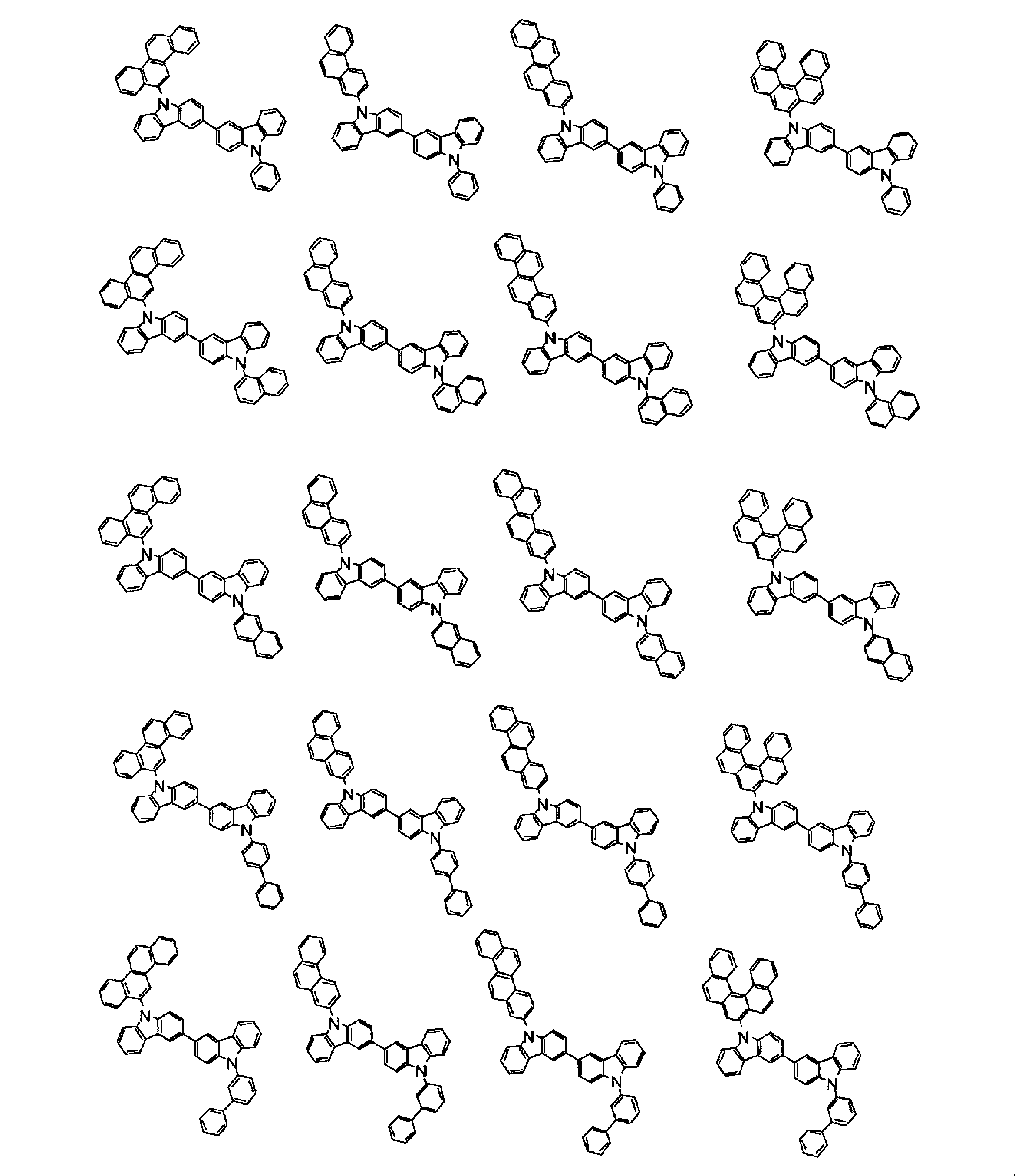
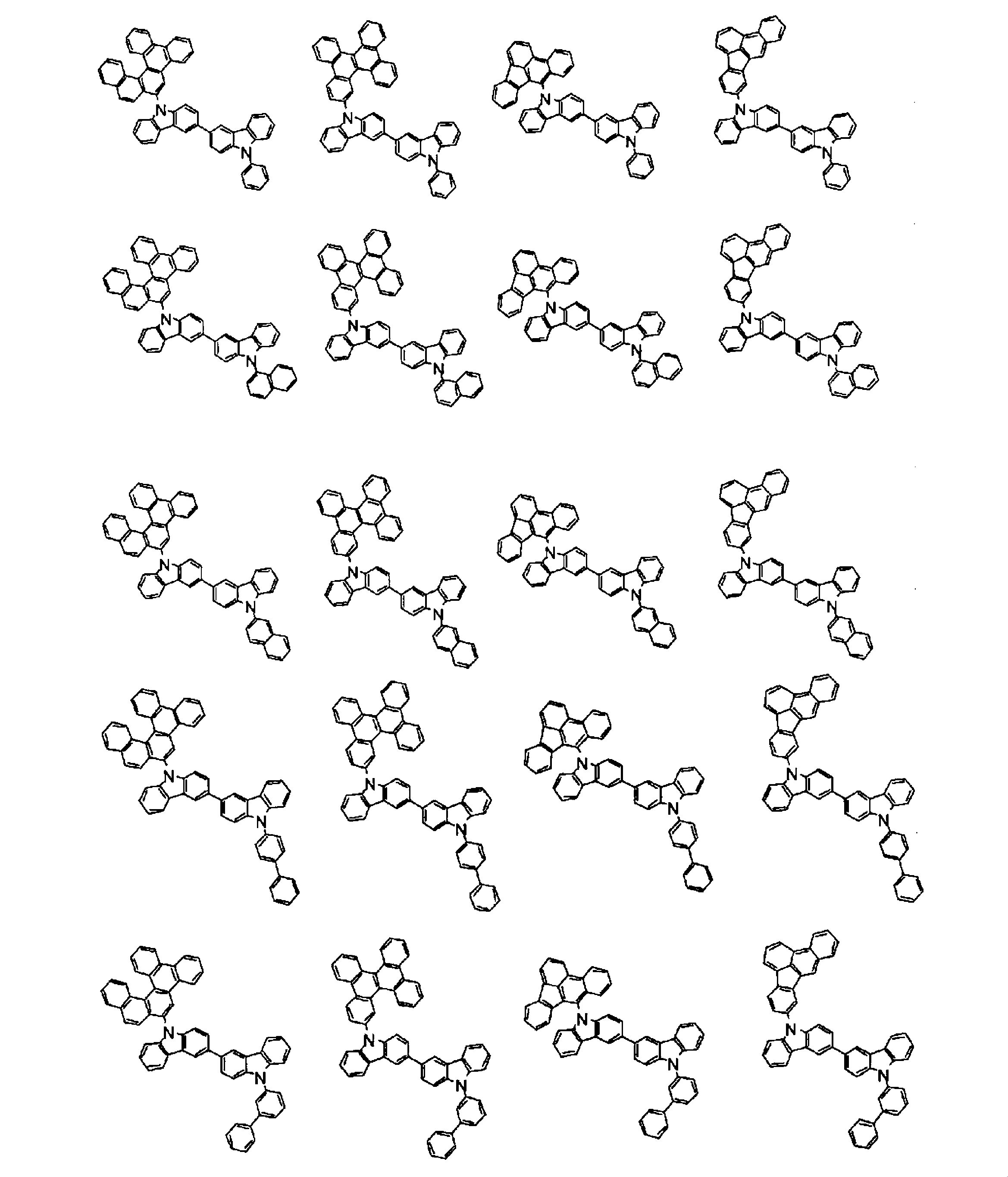
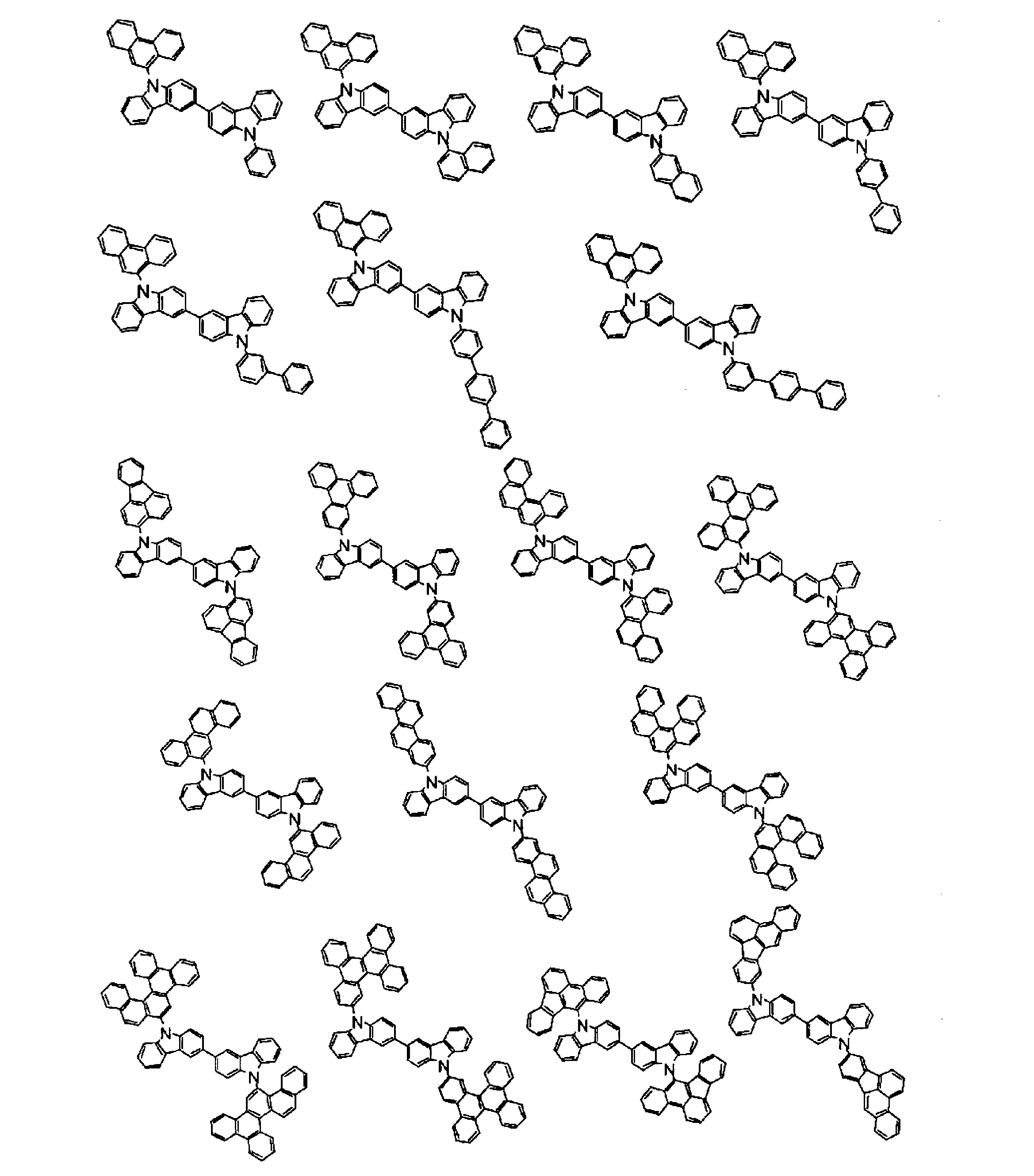


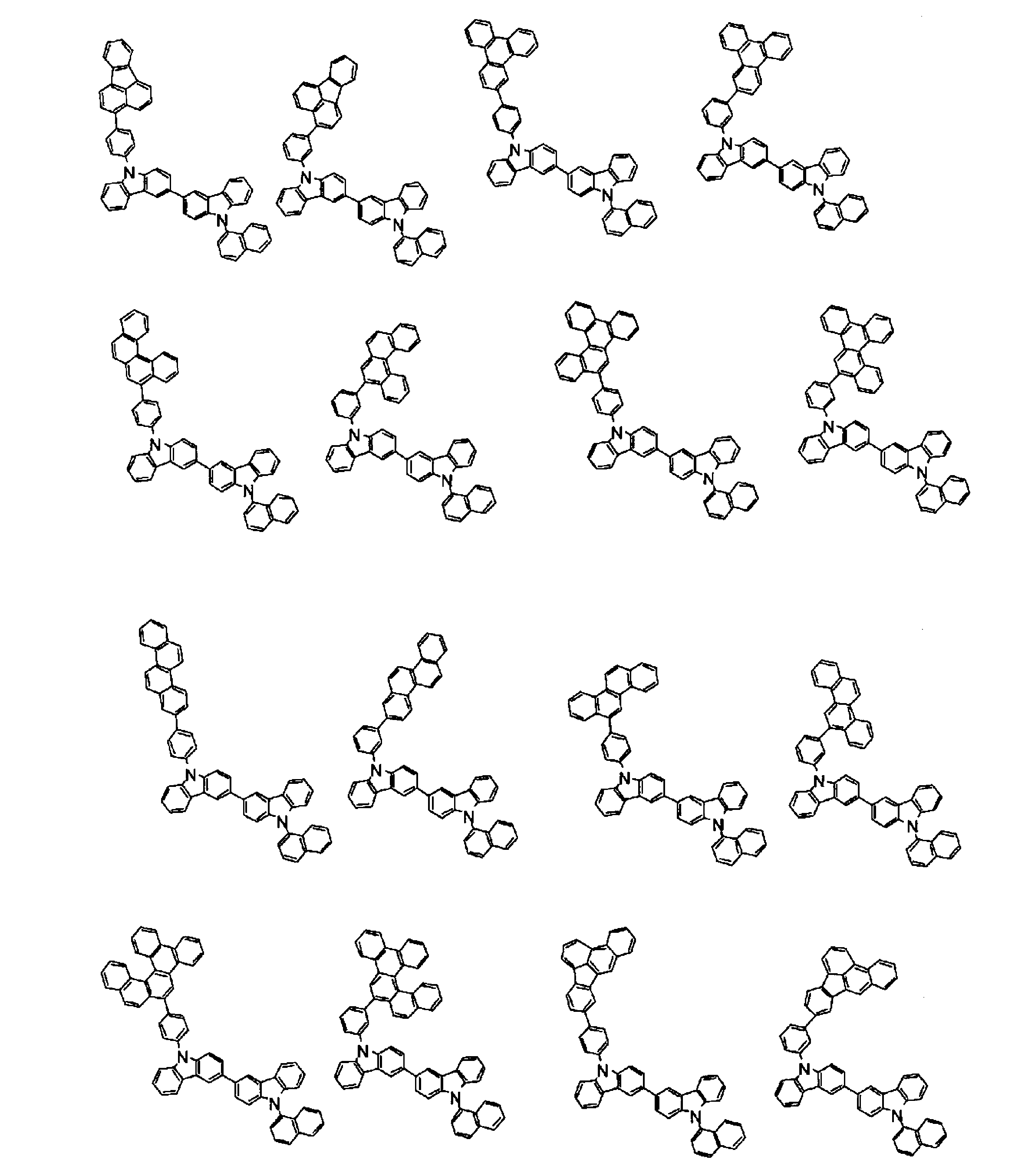
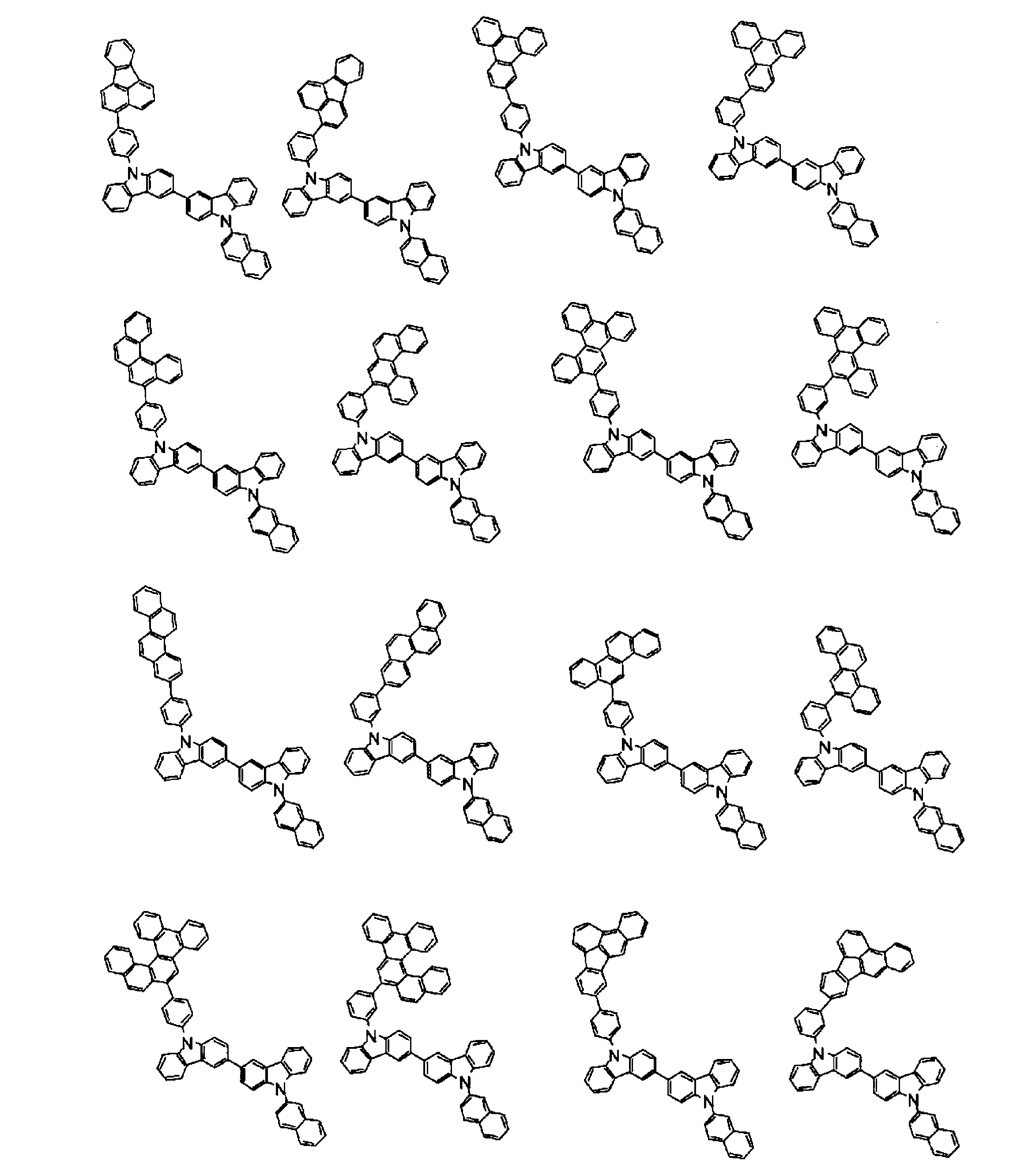

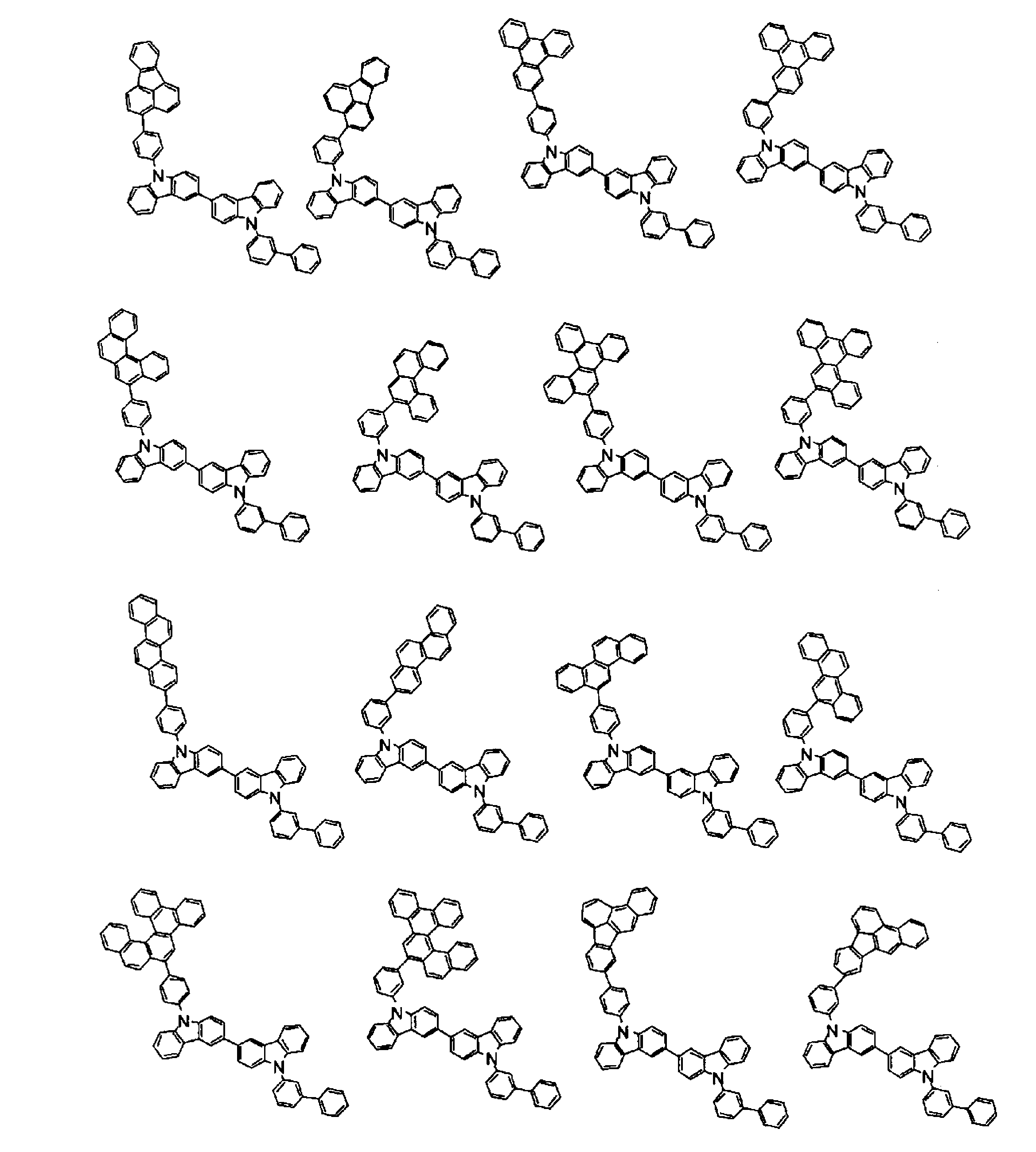
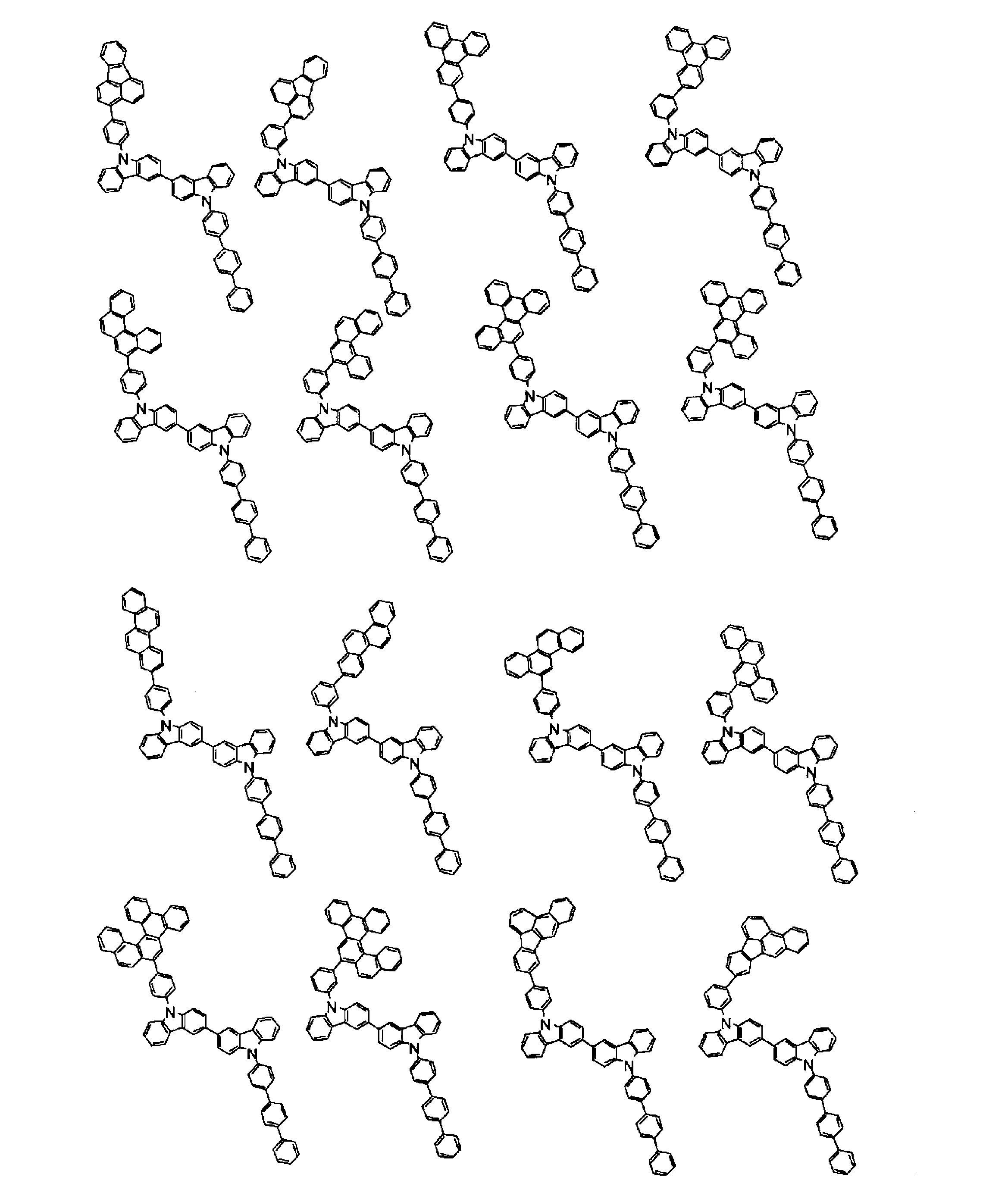

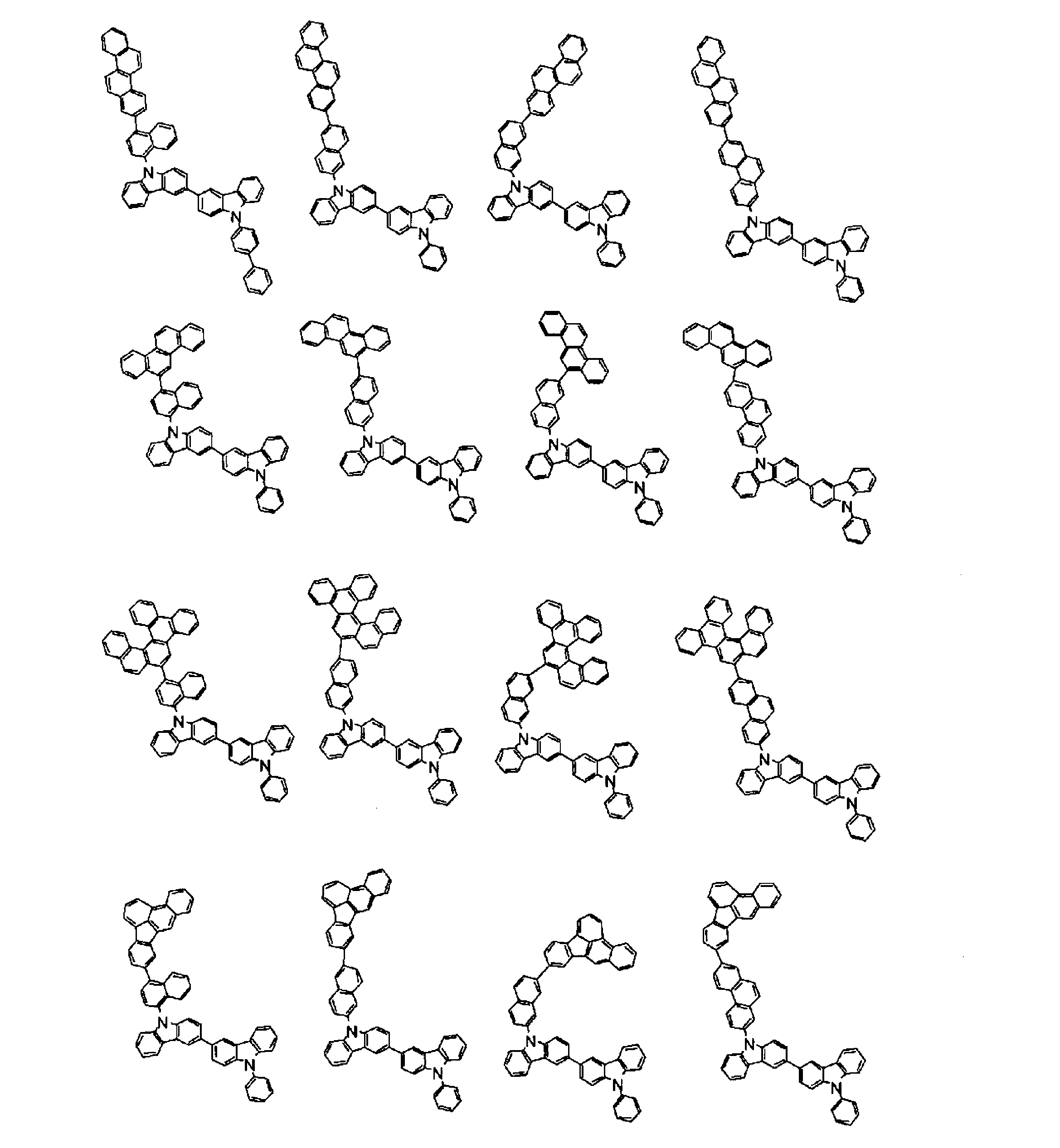
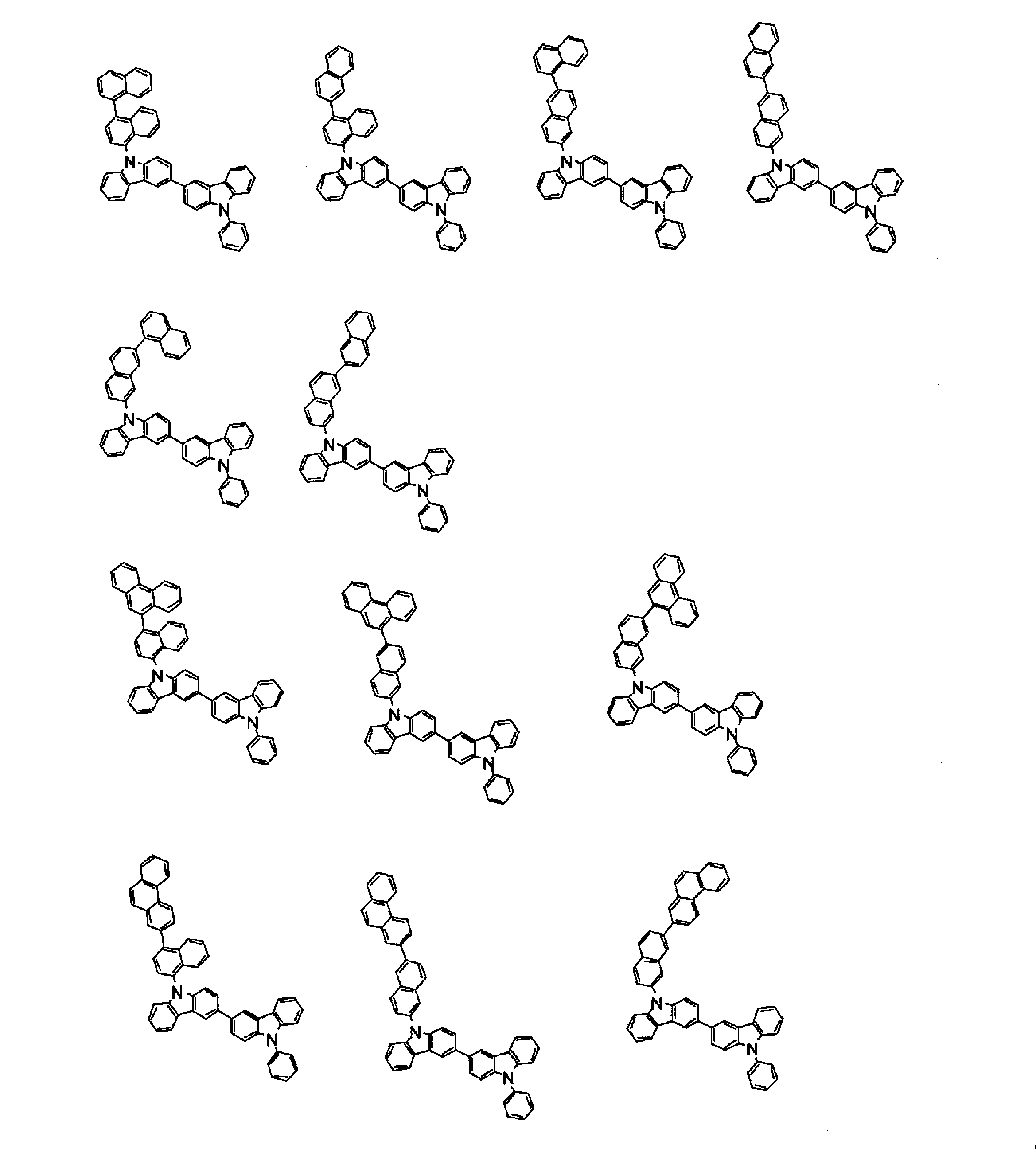
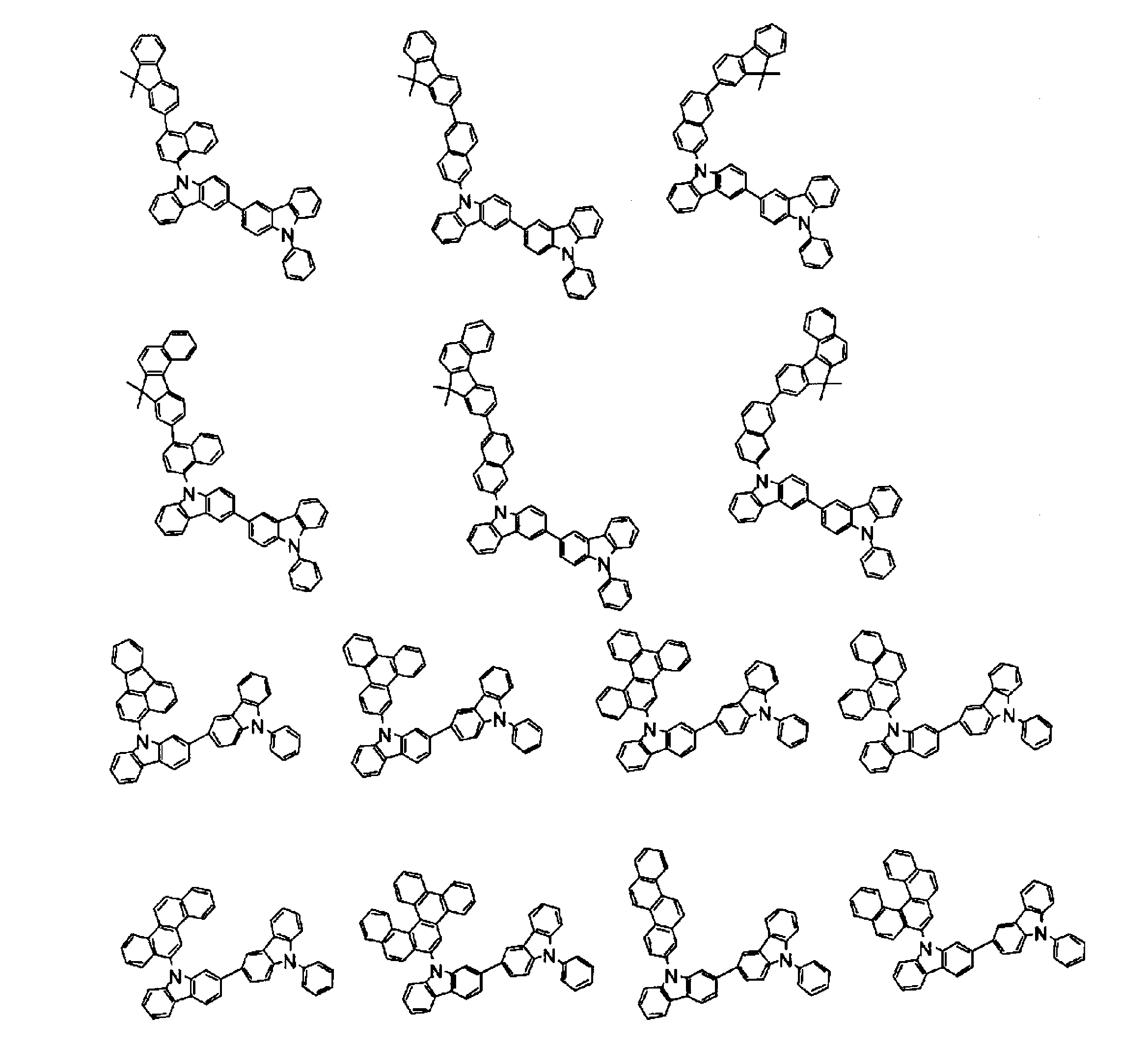
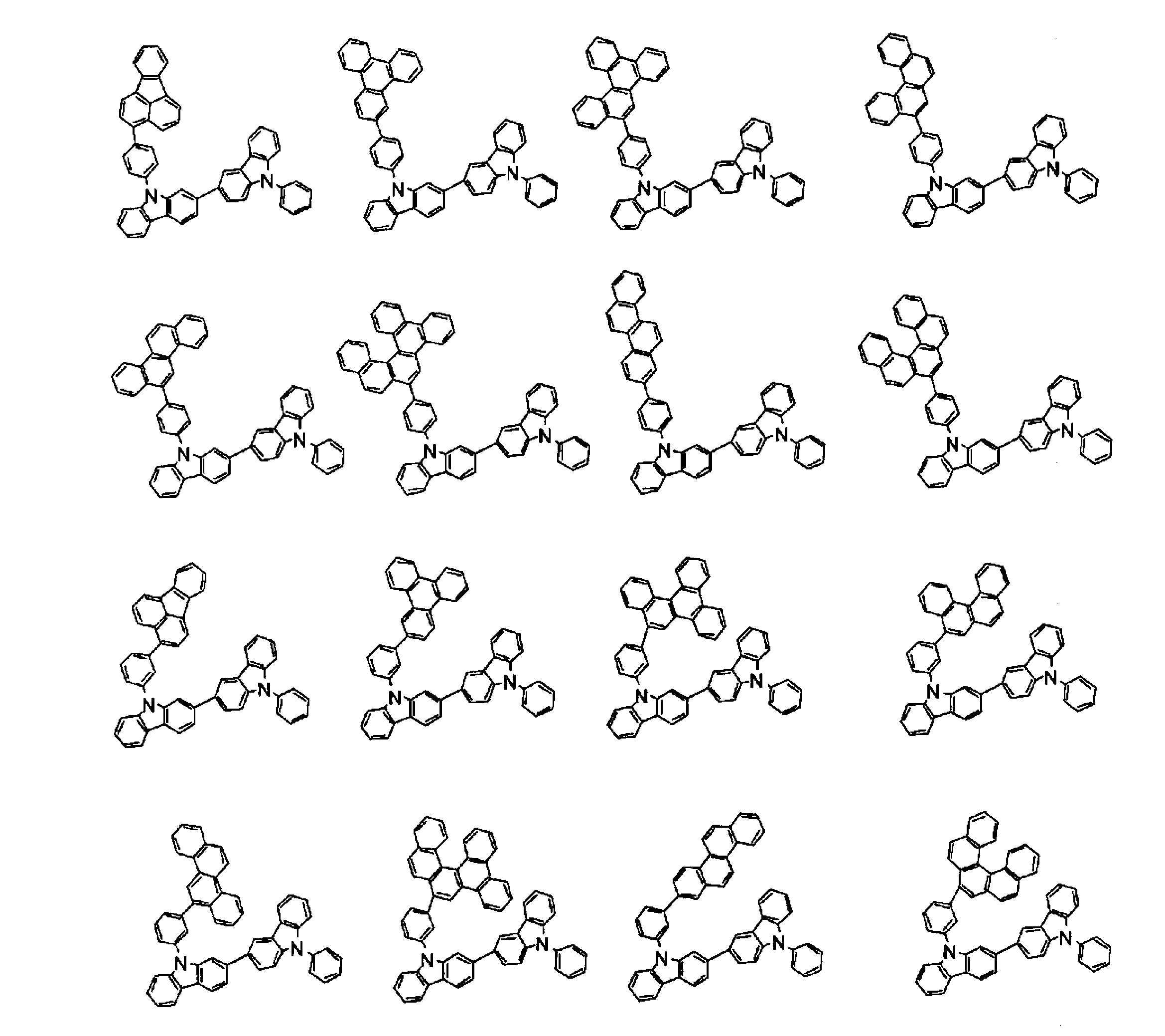


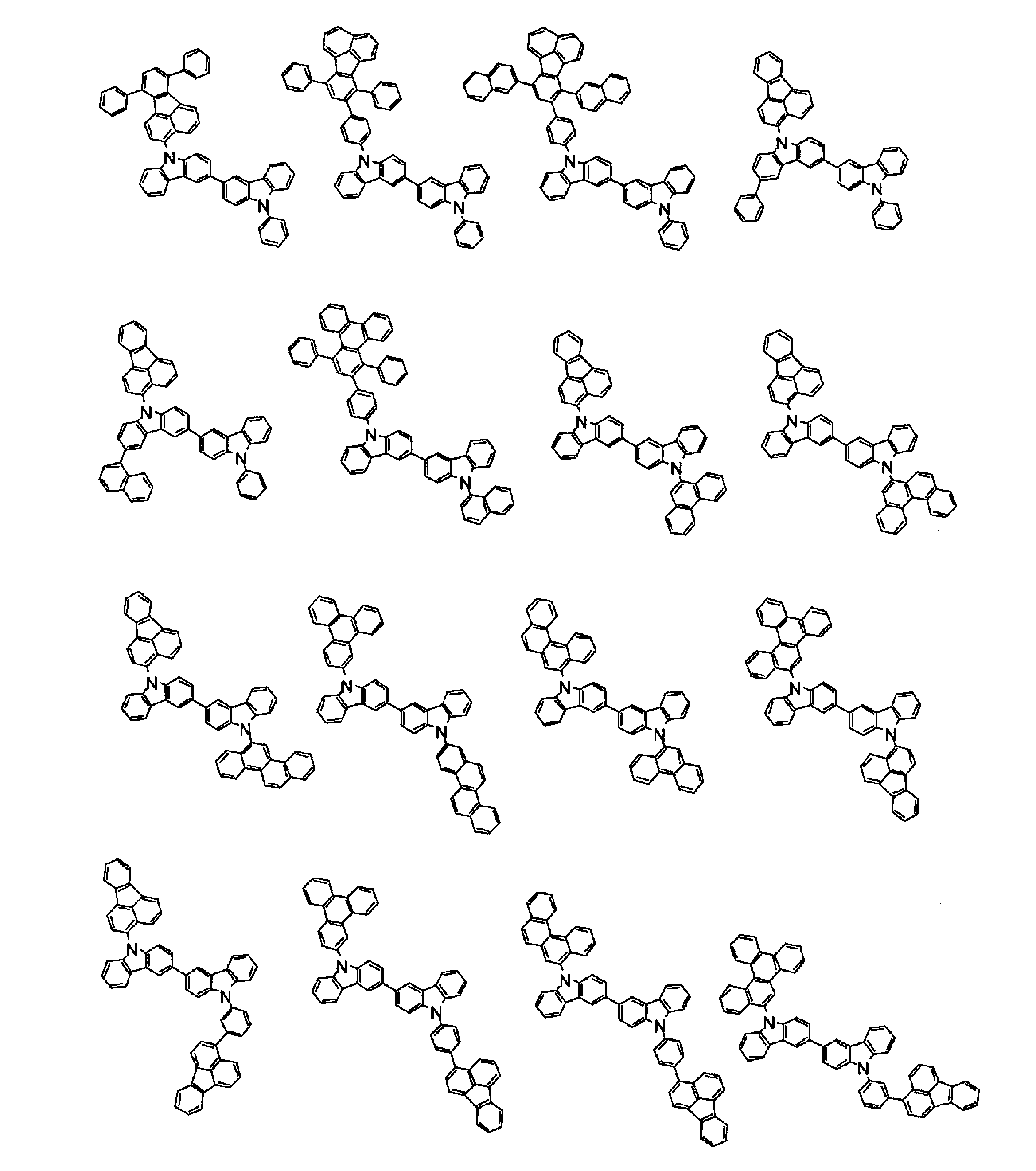
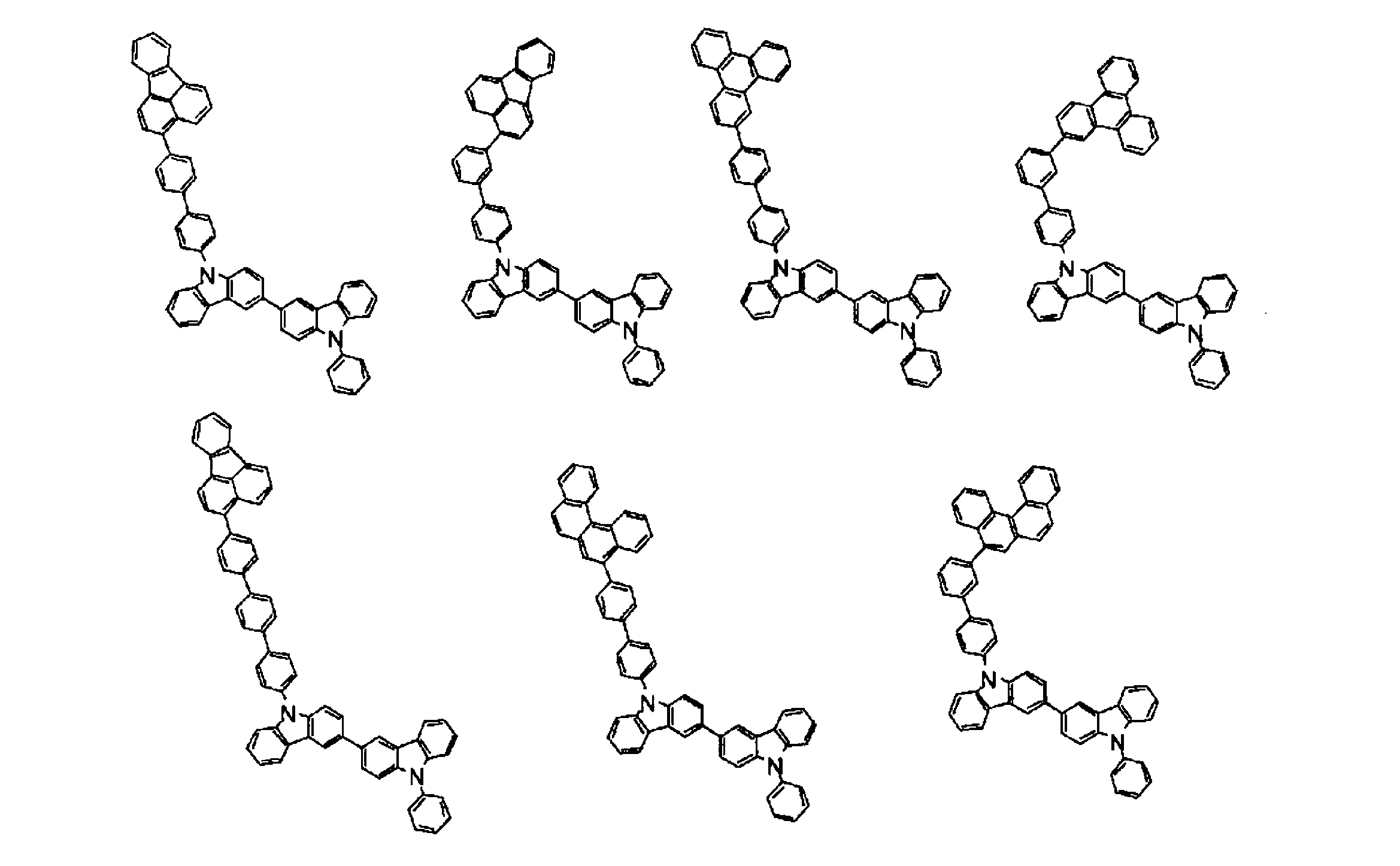
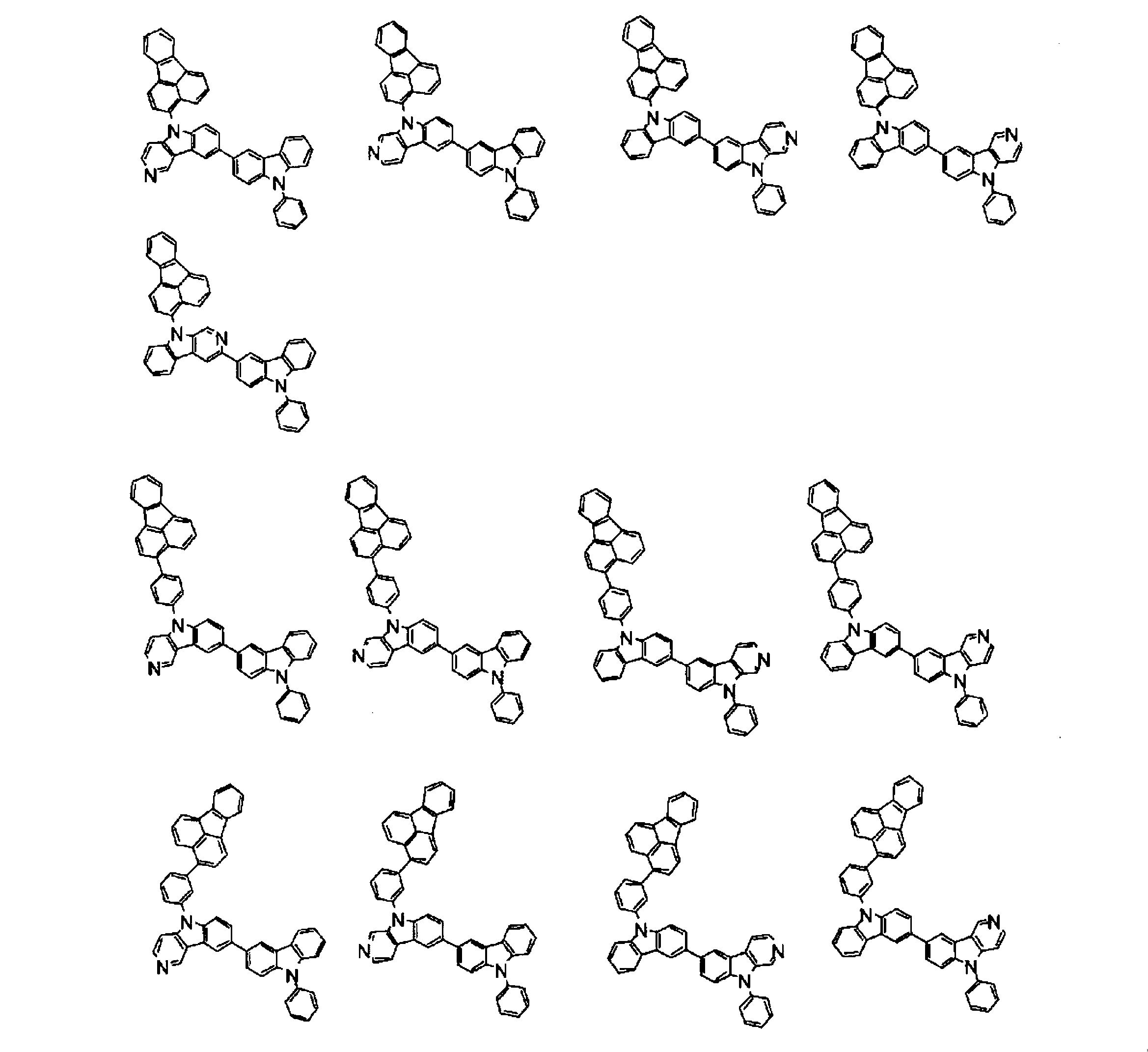

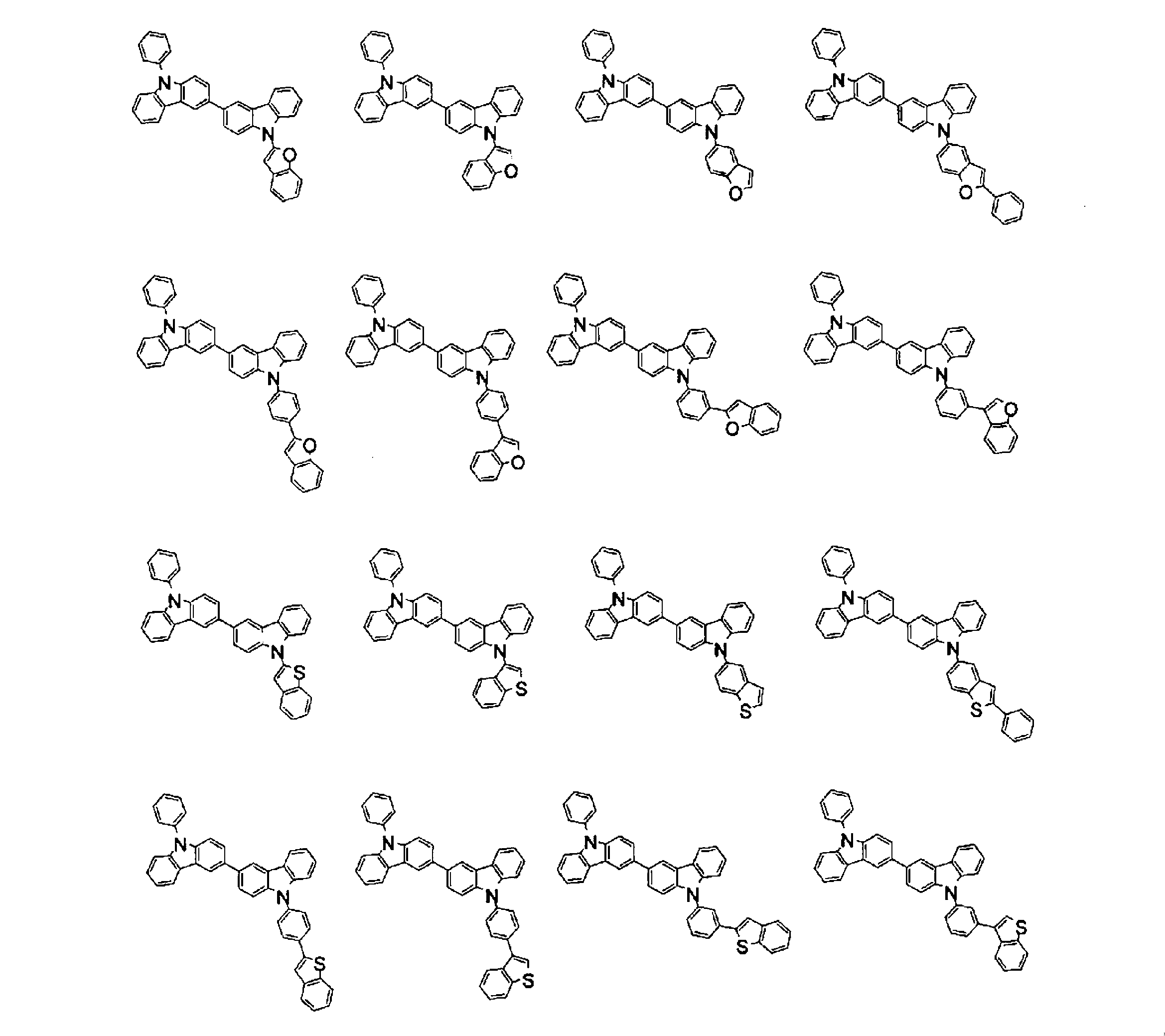
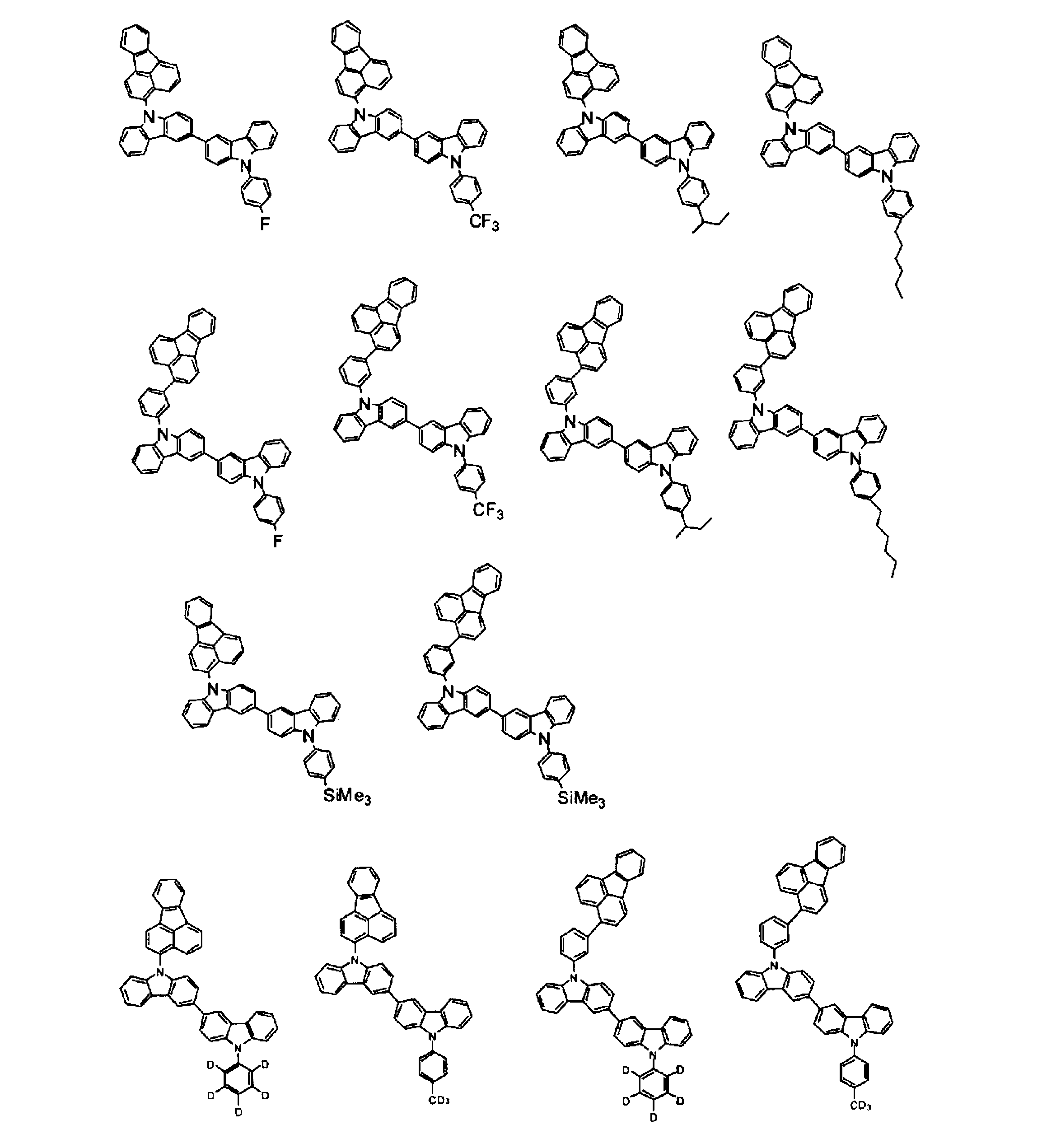

(発光層)
有機EL素子の発光層は以下の機能を併せ持つものである。
すなわち、
(1)注入機能;電界印加時に陽極又は正孔注入層より正孔を注入することができ、陰極又は電子注入層より電子を注入することができる機能、
(2)輸送機能;注入した電荷(電子と正孔)を電界の力で移動させる機能、
(3)発光機能;電子と正孔の再結合の場を提供し、これを発光につなげる機能、
がある。
有機EL素子の発光層は以下の機能を併せ持つものである。
すなわち、
(1)注入機能;電界印加時に陽極又は正孔注入層より正孔を注入することができ、陰極又は電子注入層より電子を注入することができる機能、
(2)輸送機能;注入した電荷(電子と正孔)を電界の力で移動させる機能、
(3)発光機能;電子と正孔の再結合の場を提供し、これを発光につなげる機能、
がある。
ただし、正孔の注入されやすさと電子の注入されやすさに違いがあってもよく、また、正孔と電子の移動度で表される輸送能に大小があってもよい。
この発光層を形成する方法としては、例えば蒸着法、スピンコート法、LB法等の公知の方法を適用することができる。
この発光層を形成する方法としては、例えば蒸着法、スピンコート法、LB法等の公知の方法を適用することができる。
発光層は、分子堆積膜であることが好ましい。
ここで分子堆積膜とは、気相状態の材料化合物から沈着され形成された薄膜や、溶液状態又は液相状態の材料化合物から固体化され形成された膜のことであり、通常この分子堆積膜は、LB法により形成された薄膜(分子累積膜)とは凝集構造、高次構造の相違や、それに起因する機能的な相違により区分することができる。
また、樹脂等の結着剤と材料化合物とを溶剤に溶かして溶液とした後、これをスピンコート法等により薄膜化することによっても、発光層を形成することができる。
ここで分子堆積膜とは、気相状態の材料化合物から沈着され形成された薄膜や、溶液状態又は液相状態の材料化合物から固体化され形成された膜のことであり、通常この分子堆積膜は、LB法により形成された薄膜(分子累積膜)とは凝集構造、高次構造の相違や、それに起因する機能的な相違により区分することができる。
また、樹脂等の結着剤と材料化合物とを溶剤に溶かして溶液とした後、これをスピンコート法等により薄膜化することによっても、発光層を形成することができる。
・ホスト材料
本実施形態の発光層に含まれるホスト材料は、下記一般式(2)で表される化合物である。
本実施形態の発光層に含まれるホスト材料は、下記一般式(2)で表される化合物である。

前記一般式(2)において、R101~R108は、それぞれ独立に、水素原子、ハロゲン原子、ヒドロキシル基、シアノ基、置換もしくは無置換のアミノ基、置換もしくは無置換の炭素数1~20のアルキル基、置換もしくは無置換の炭素数1~20のアルコキシ基、置換もしくは無置換の環形成炭素数6~20のアリールオキシ基、置換もしくは無置換の環形成炭素数6~20のアリールチオ基、置換もしくは無置換の炭素数3~40のトリアルキルシリル基、又は置換もしくは無置換の炭素数8~50のアリールシリル基である。
前記一般式(2)において、R109~R113のうちいずれか一つは、置換または無置換の環形成炭素数6~30の芳香族炭化水素基、又は、置換または無置換の環形成原子数5~30の複素環基であり、これ以外のR109~R113は、それぞれ独立に、水素原子、ハロゲン原子、ヒドロキシル基、シアノ基、置換もしくは無置換のアミノ基、置換もしくは無置換の炭素数1~20のアルキル基、置換もしくは無置換の炭素数1~20のアルコキシ基、置換もしくは無置換の環形成炭素数6~20のアリールオキシ基、置換もしくは無置換の環形成炭素数6~20のアリールチオ基、置換もしくは無置換の炭素数3~40のトリアルキルシリル基、置換もしくは無置換の炭素数8~50のアリールシリル基、置換もしくは無置換の環形成炭素数6~50の芳香族炭化水素基、又は置換もしくは無置換の環形成原子数5~50の複素環基である。
前記一般式(2)において、Ar101は、置換または無置換の環形成炭素数6~30の芳香族炭化水素基、又は置換または無置換の環形成原子数5~30の複素環基である。
本実施形態において、発光層に含まれるホスト材料は、下記一般式(10)で表される化合物または下記一般式(11)で表される化合物のいずれかであることが好ましい。

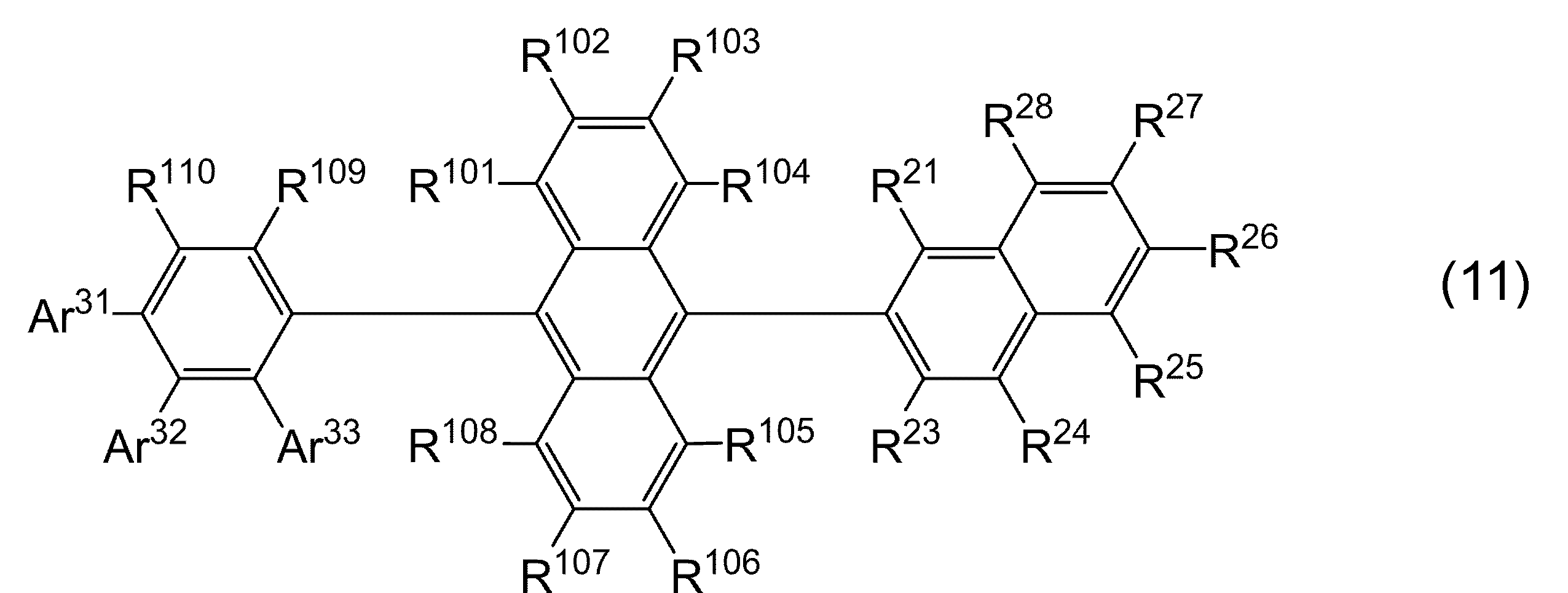
前記一般式(10)および前記一般式(11)において、R101~R108は、それぞれ独立に、水素原子、ハロゲン原子、ヒドロキシル基、シアノ基、置換もしくは無置換のアミノ基、置換もしくは無置換の炭素数1~20のアルキル基、置換もしくは無置換の炭素数1~20のアルコキシ基、置換もしくは無置換の環形成炭素数6~20のアリールオキシ基、置換もしくは無置換の環形成炭素数6~20のアリールチオ基、置換もしくは無置換の炭素数3~40のトリアルキルシリル基、又は置換もしくは無置換の炭素数8~50のアリールシリル基である。
Ar31~Ar33、R109、R110、R21~R28は、それぞれ独立に、水素原子、ハロゲン原子、ヒドロキシル基、シアノ基、置換もしくは無置換のアミノ基、置換もしくは無置換の炭素数1~20のアルキル基、置換もしくは無置換の炭素数1~20のアルコキシ基、置換もしくは無置換の環形成炭素数6~20のアリールオキシ基、置換もしくは無置換の環形成炭素数6~20のアリールチオ基、置換もしくは無置換の炭素数3~40のトリアルキルシリル基、置換もしくは無置換の炭素数8~50のアリールシリル基、置換もしくは無置換の環形成炭素数6~50の芳香族炭化水素基、又は置換もしくは無置換の環形成原子数5~50の複素環基であり、隣り合うR21~R28同士は環を形成してもよい。
ただし、Ar31~Ar33のうち少なくともいずれかは、置換もしくは無置換の環形成炭素数6~30の芳香族炭化水素基であり、
前記一般式(10)及び(11)において、Ar31が、置換もしくは無置換の環形成炭素数6~30の芳香族炭化水素基となる場合には、Ar31は、置換もしくは無置換のフルオレニル基である。
Ar31~Ar33、R109、R110、R21~R28は、それぞれ独立に、水素原子、ハロゲン原子、ヒドロキシル基、シアノ基、置換もしくは無置換のアミノ基、置換もしくは無置換の炭素数1~20のアルキル基、置換もしくは無置換の炭素数1~20のアルコキシ基、置換もしくは無置換の環形成炭素数6~20のアリールオキシ基、置換もしくは無置換の環形成炭素数6~20のアリールチオ基、置換もしくは無置換の炭素数3~40のトリアルキルシリル基、置換もしくは無置換の炭素数8~50のアリールシリル基、置換もしくは無置換の環形成炭素数6~50の芳香族炭化水素基、又は置換もしくは無置換の環形成原子数5~50の複素環基であり、隣り合うR21~R28同士は環を形成してもよい。
ただし、Ar31~Ar33のうち少なくともいずれかは、置換もしくは無置換の環形成炭素数6~30の芳香族炭化水素基であり、
前記一般式(10)及び(11)において、Ar31が、置換もしくは無置換の環形成炭素数6~30の芳香族炭化水素基となる場合には、Ar31は、置換もしくは無置換のフルオレニル基である。
本実施形態において、前記一般式(11)において、Ar31、Ar33、R109、およびR110が水素原子である場合、Ar32は、置換もしくは無置換の環形成炭素数10~30の芳香族炭化水素基である。この場合の当該Ar32は、置換もしくは無置換のナフチル基であることが好ましい。
本実施形態において、前記一般式(10)および前記一般式(11)において、Ar31が、置換もしくは無置換の環形成炭素数6~30の芳香族炭化水素基となる場合、下記一般式(12)および下記一般式(13)で表されることが好ましい。

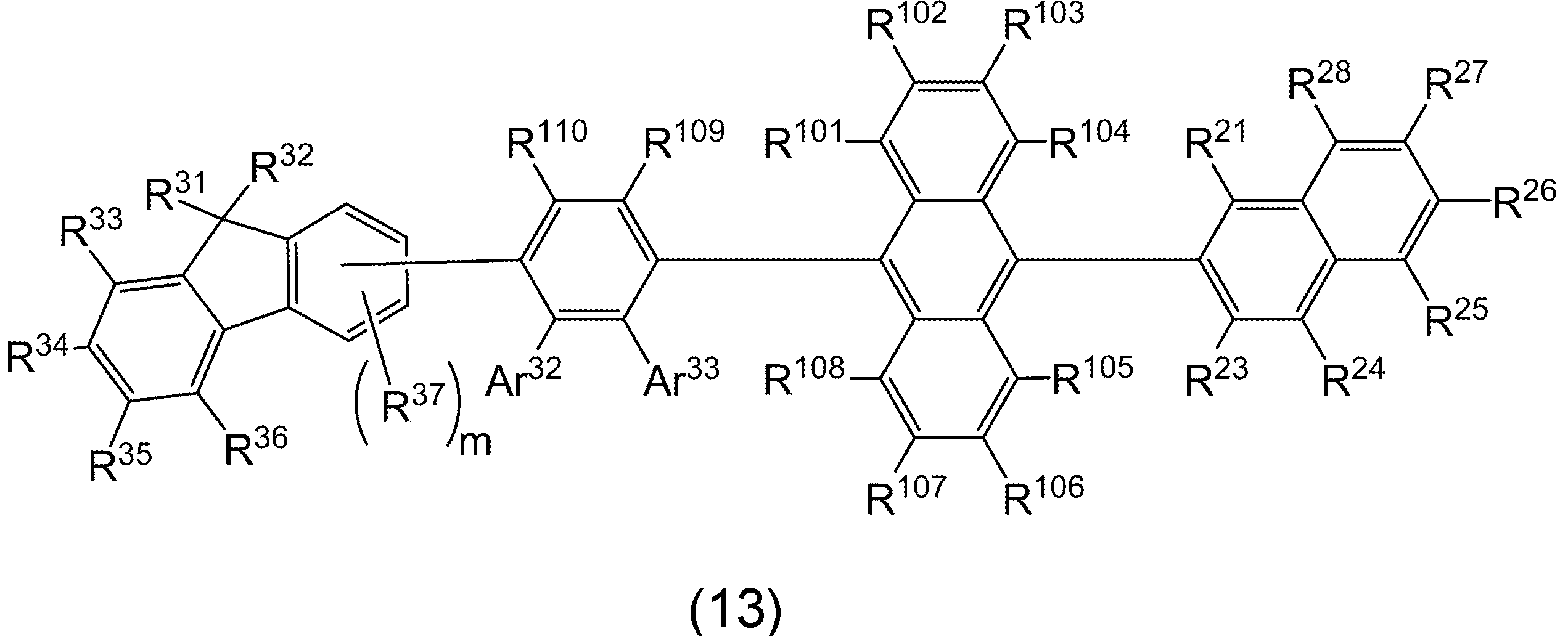
前記一般式(12)および前記一般式(13)において、R31およびR32は、それぞれ独立に、置換もしくは無置換の炭素数1~20のアルキル基である。
R33~R37は、それぞれ独立に、水素原子、ハロゲン原子、ヒドロキシル基、シアノ基、置換もしくは無置換のアミノ基、置換もしくは無置換の炭素数1~20のアルキル基、置換もしくは無置換の炭素数1~20のアルコキシ基、置換もしくは無置換の環形成炭素数6~20のアリールオキシ基、置換もしくは無置換の環形成炭素数6~20のアリールチオ基、置換もしくは無置換の炭素数3~40のトリアルキルシリル基、置換もしくは無置換の炭素数8~50のアリールシリル基、置換もしくは無置換の環形成炭素数6~50の芳香族炭化水素基、又は置換もしくは無置換の環形成原子数5~50の複素環基である。
mは、4である。
R33~R37は、それぞれ独立に、水素原子、ハロゲン原子、ヒドロキシル基、シアノ基、置換もしくは無置換のアミノ基、置換もしくは無置換の炭素数1~20のアルキル基、置換もしくは無置換の炭素数1~20のアルコキシ基、置換もしくは無置換の環形成炭素数6~20のアリールオキシ基、置換もしくは無置換の環形成炭素数6~20のアリールチオ基、置換もしくは無置換の炭素数3~40のトリアルキルシリル基、置換もしくは無置換の炭素数8~50のアリールシリル基、置換もしくは無置換の環形成炭素数6~50の芳香族炭化水素基、又は置換もしくは無置換の環形成原子数5~50の複素環基である。
mは、4である。
次に、本実施形態の発光層に含まれる前記化合物の具体例を示すが、本発明は、この具体例に限定されない。
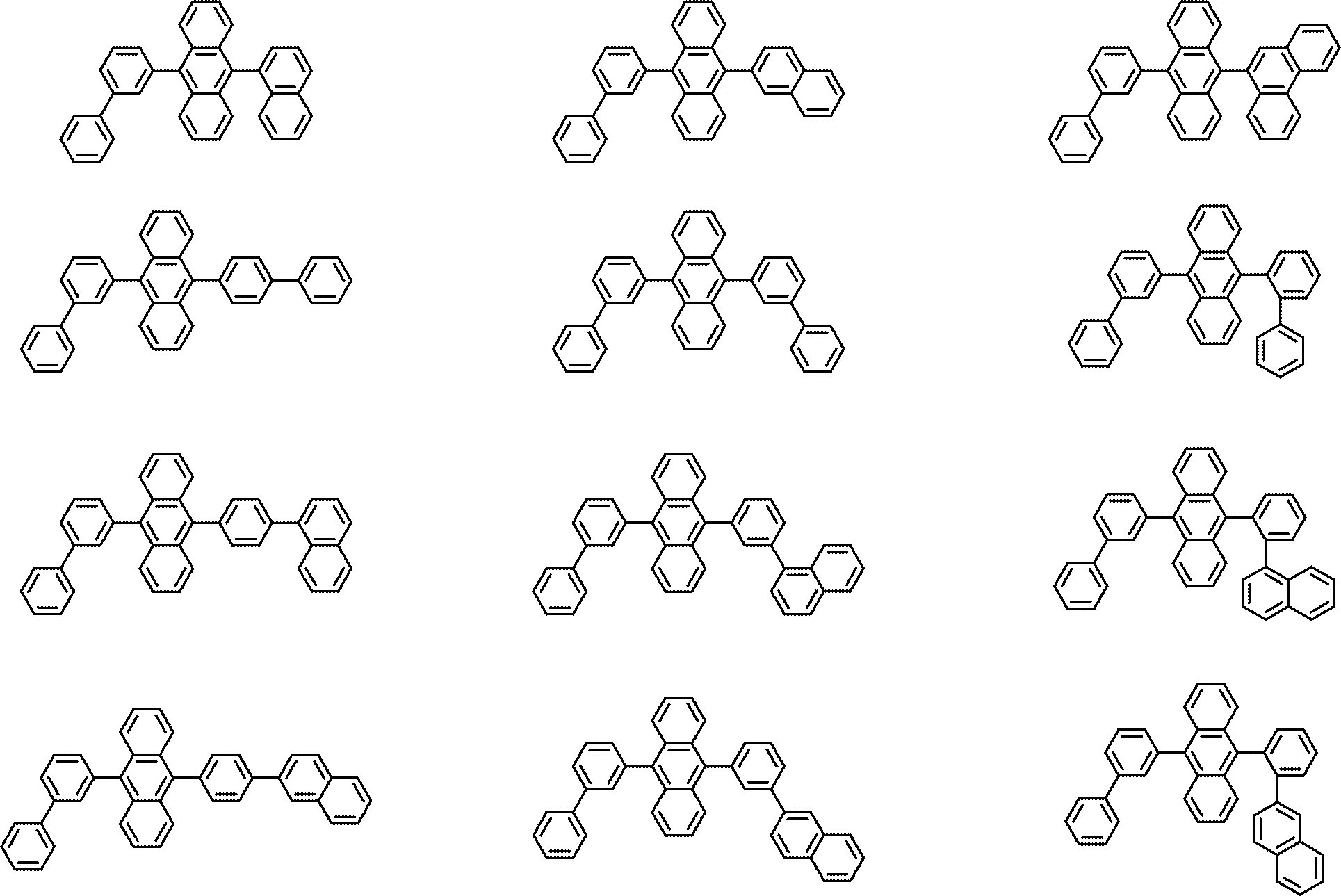
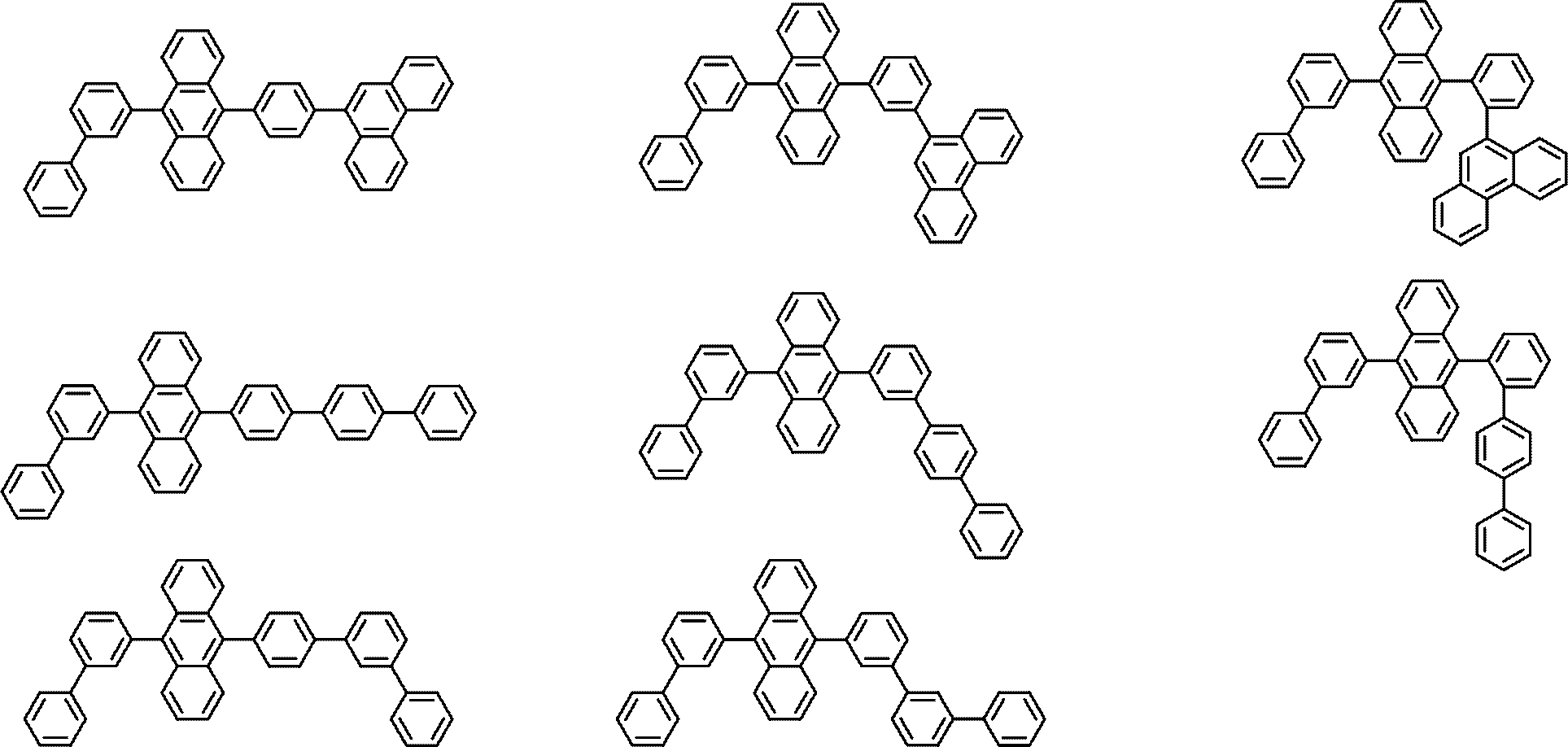


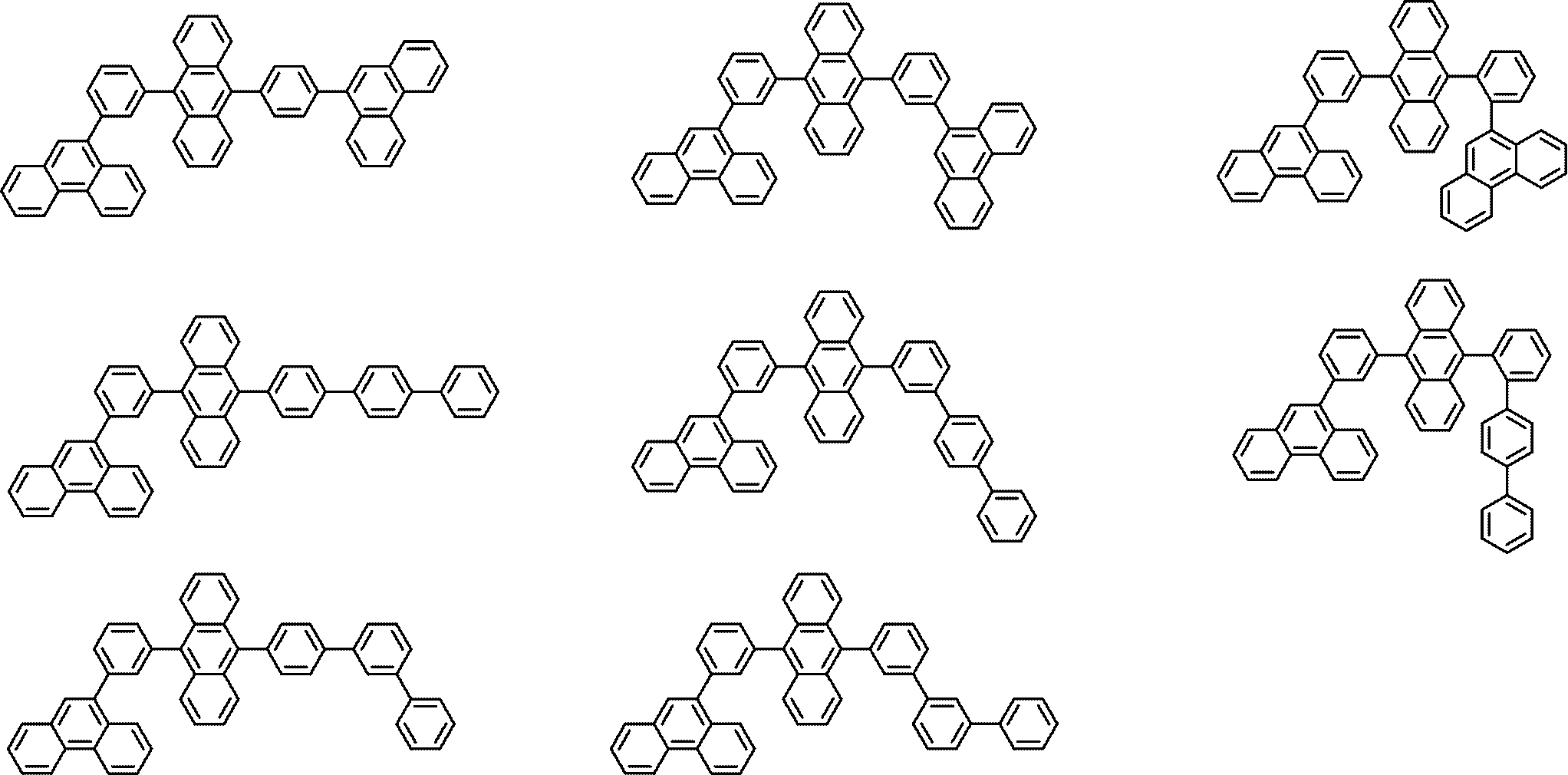


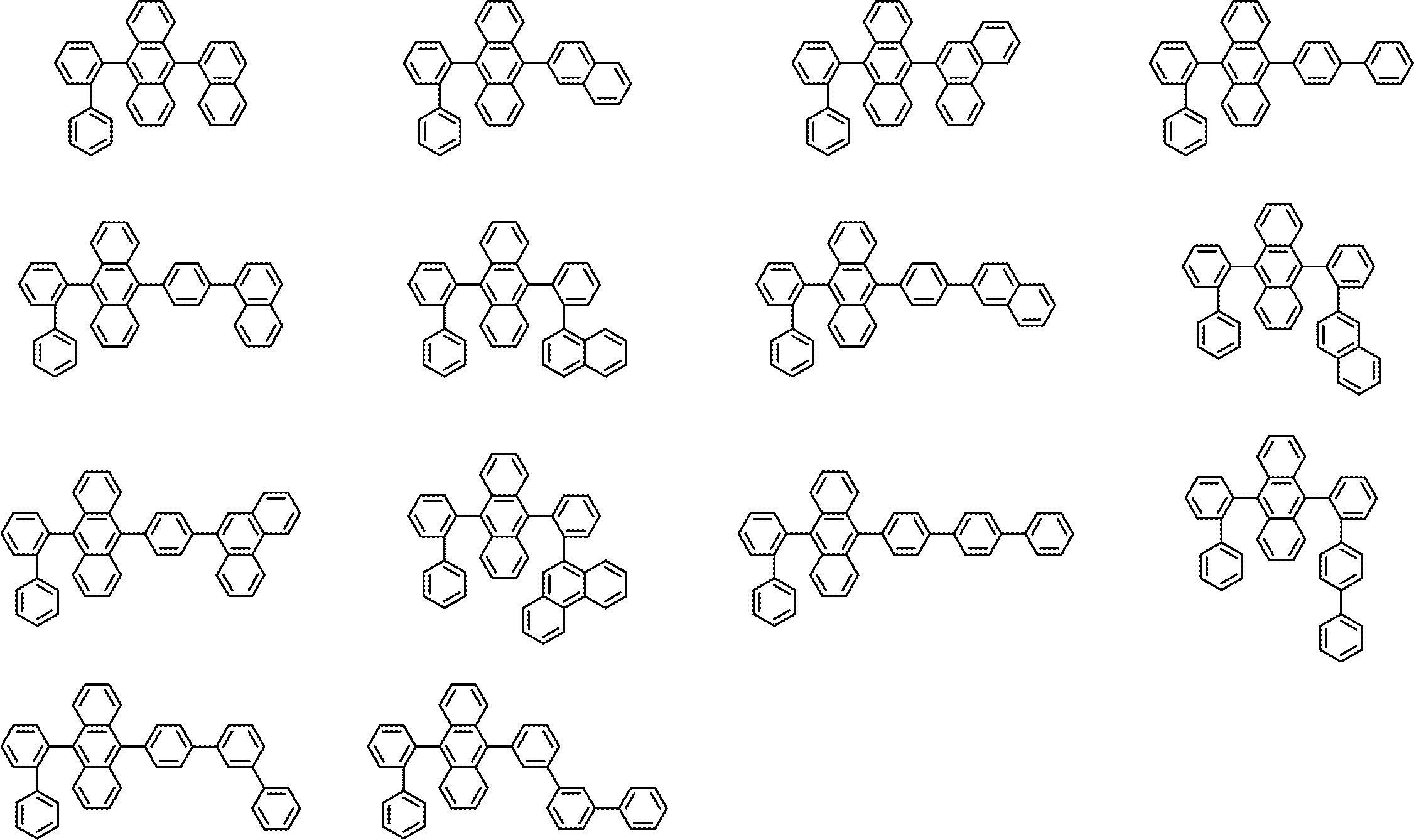
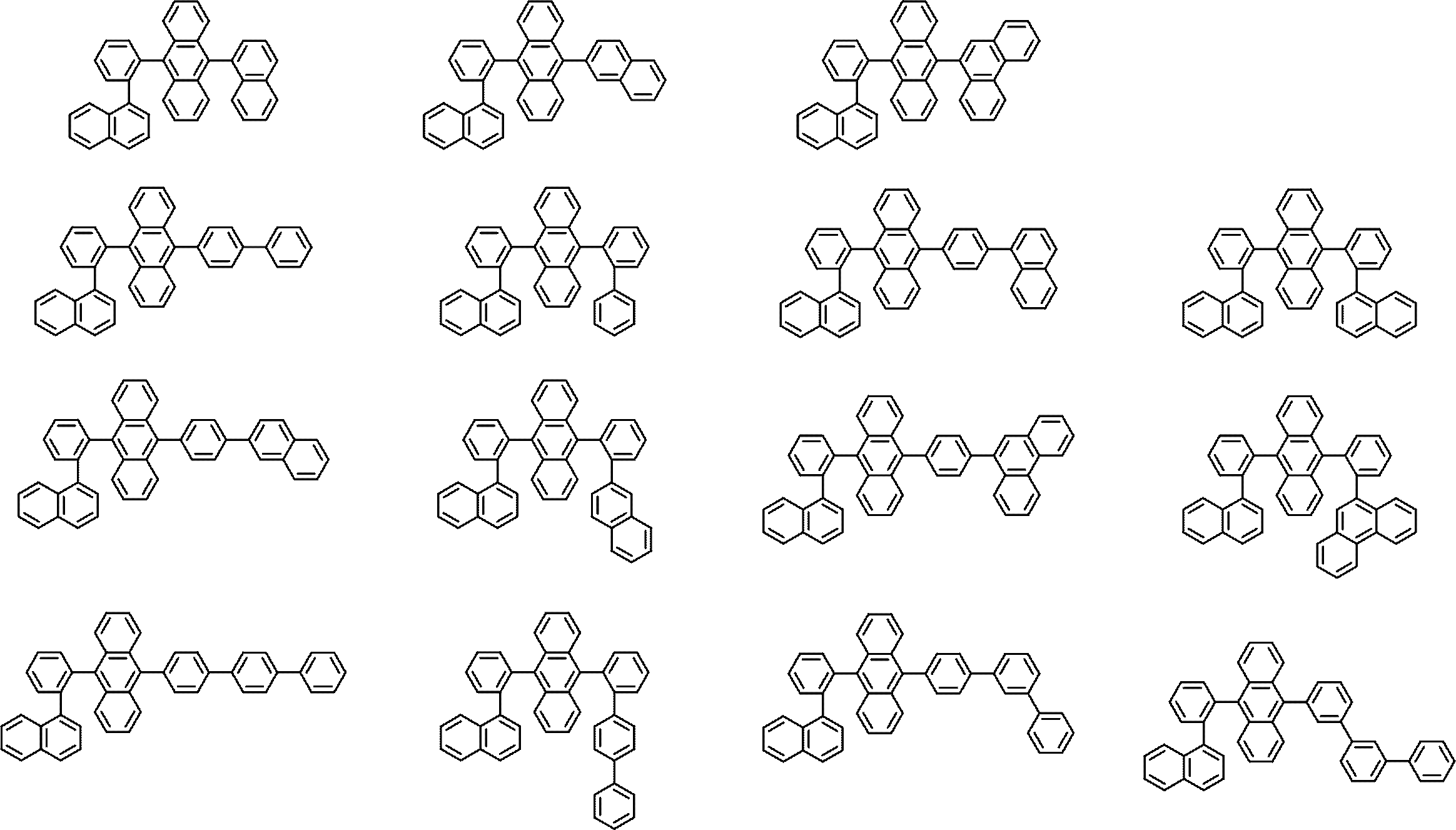
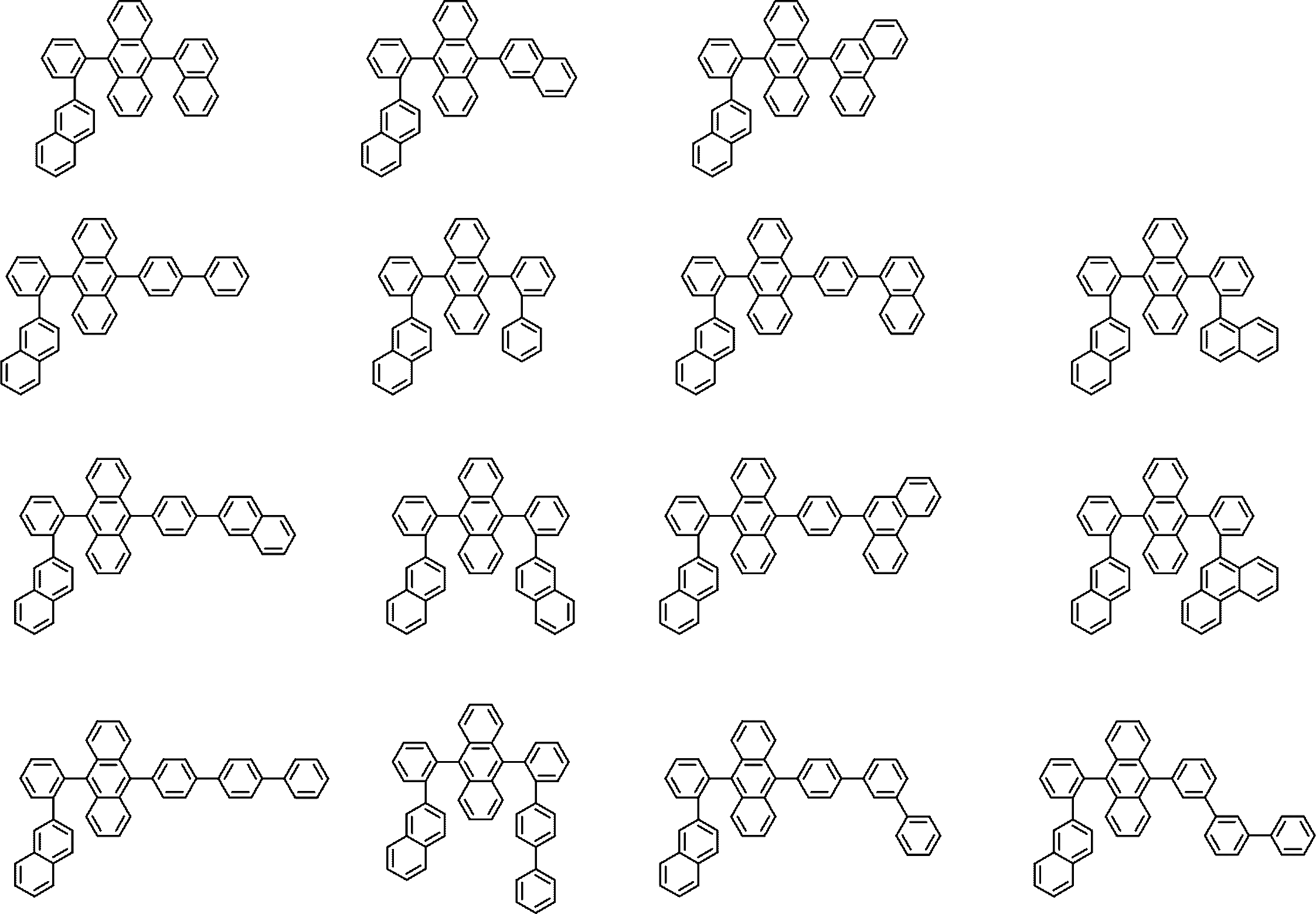
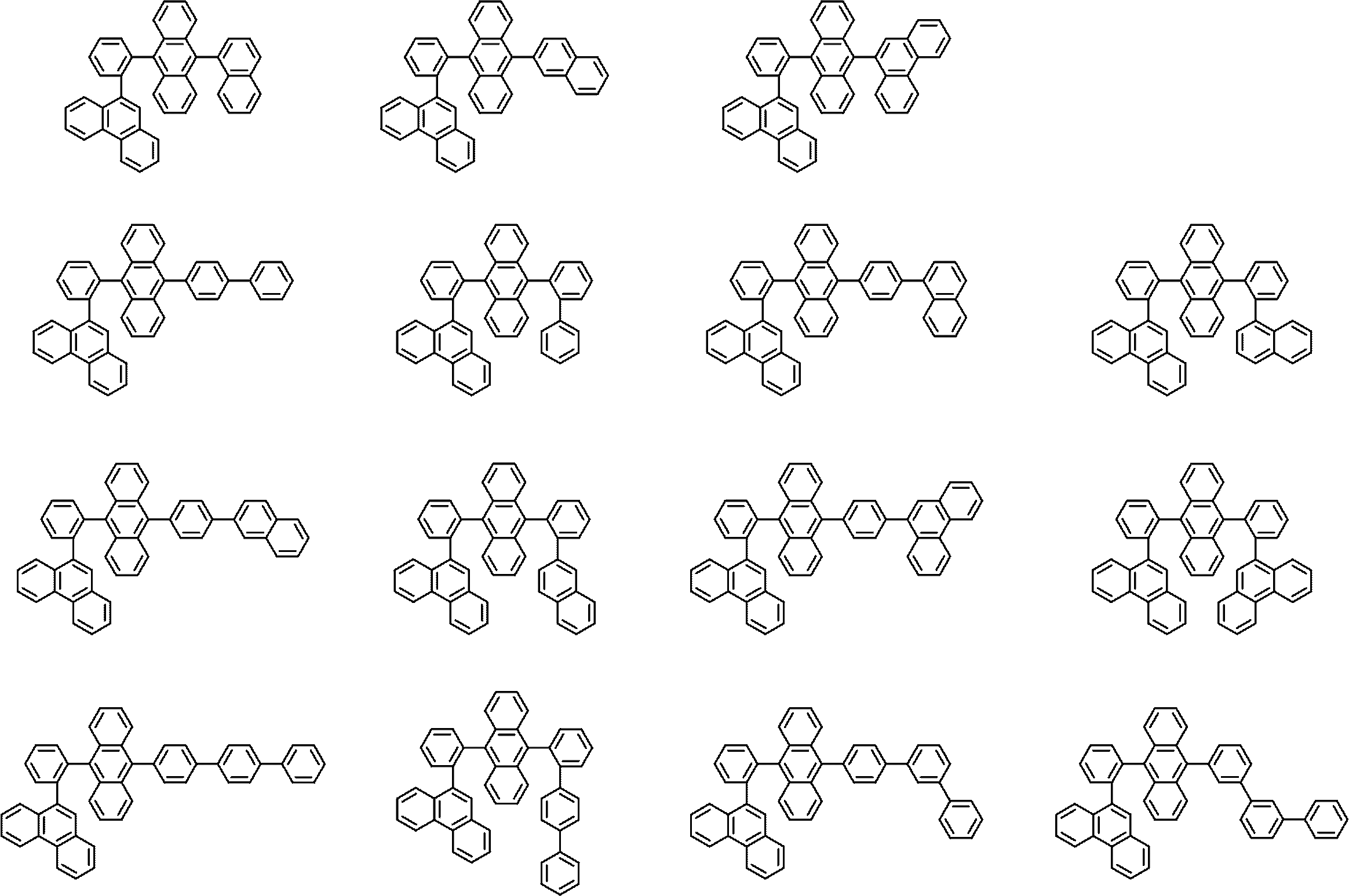
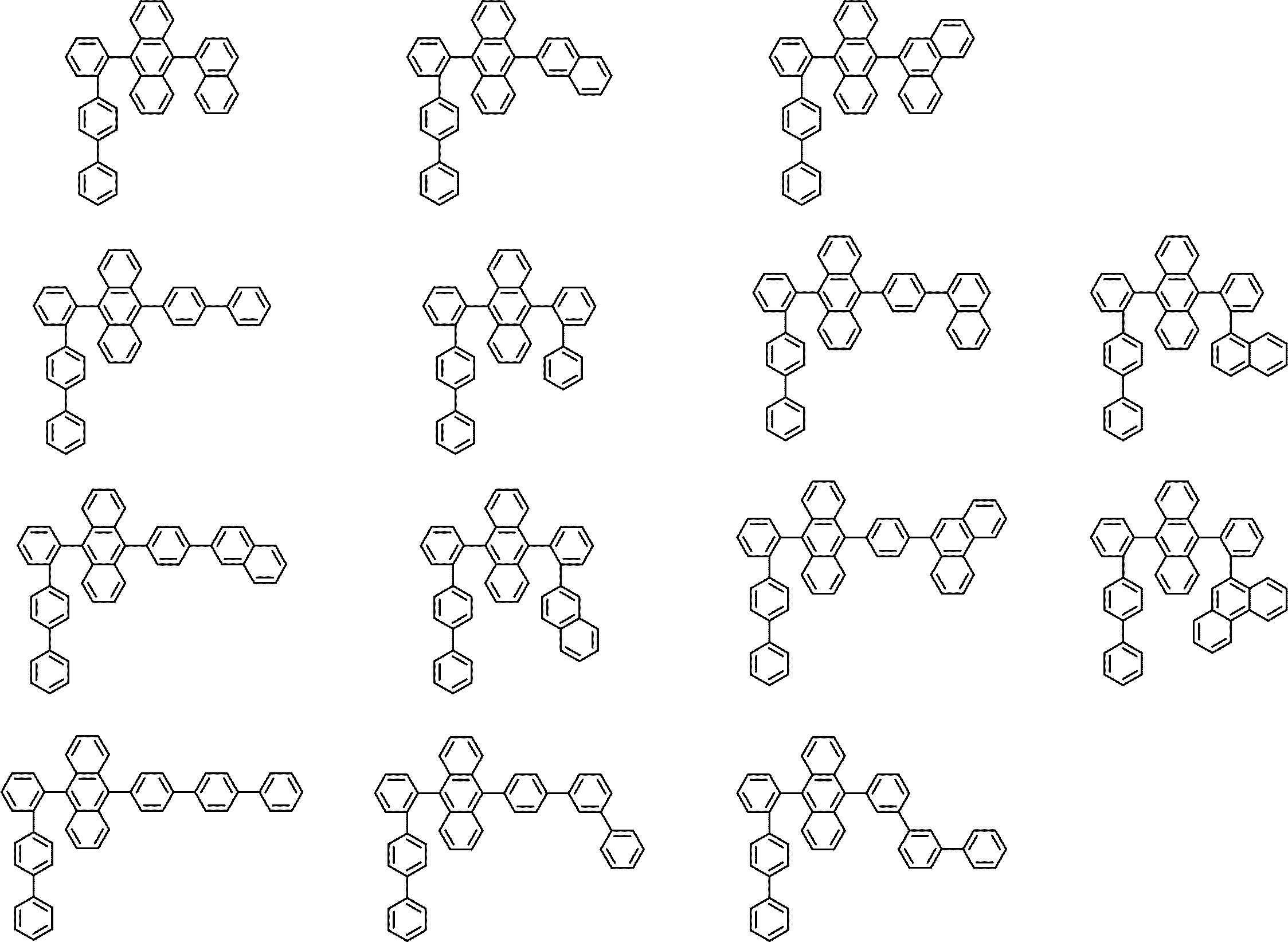


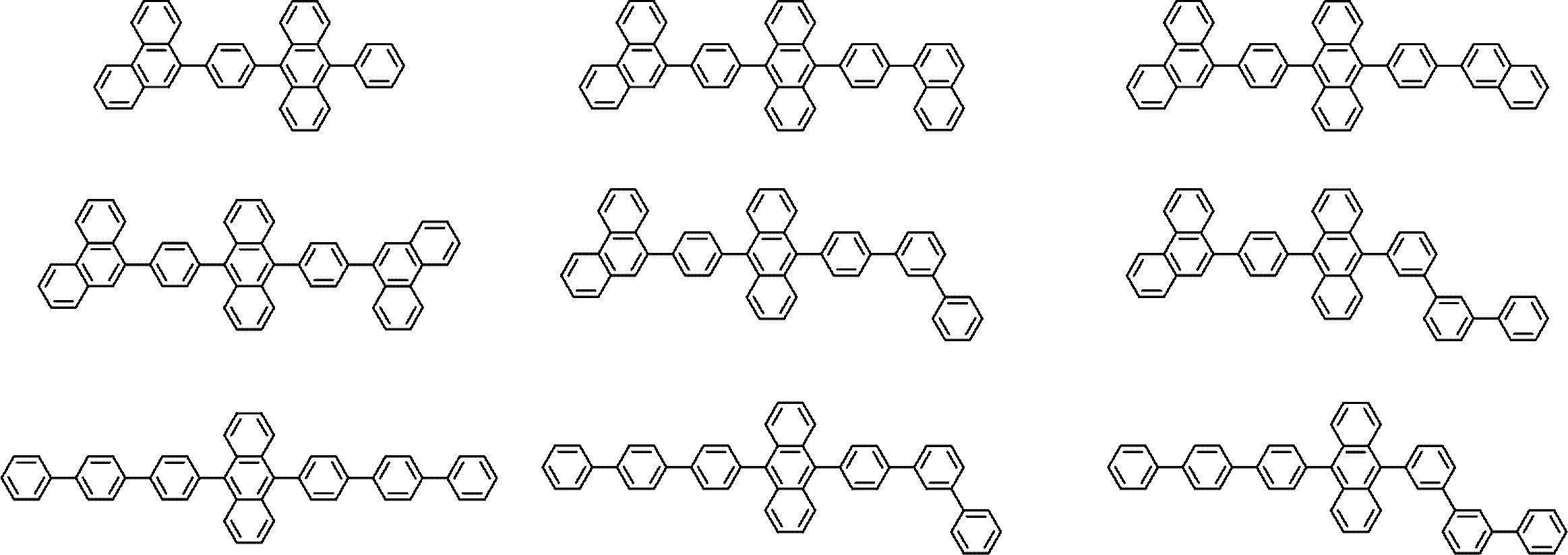
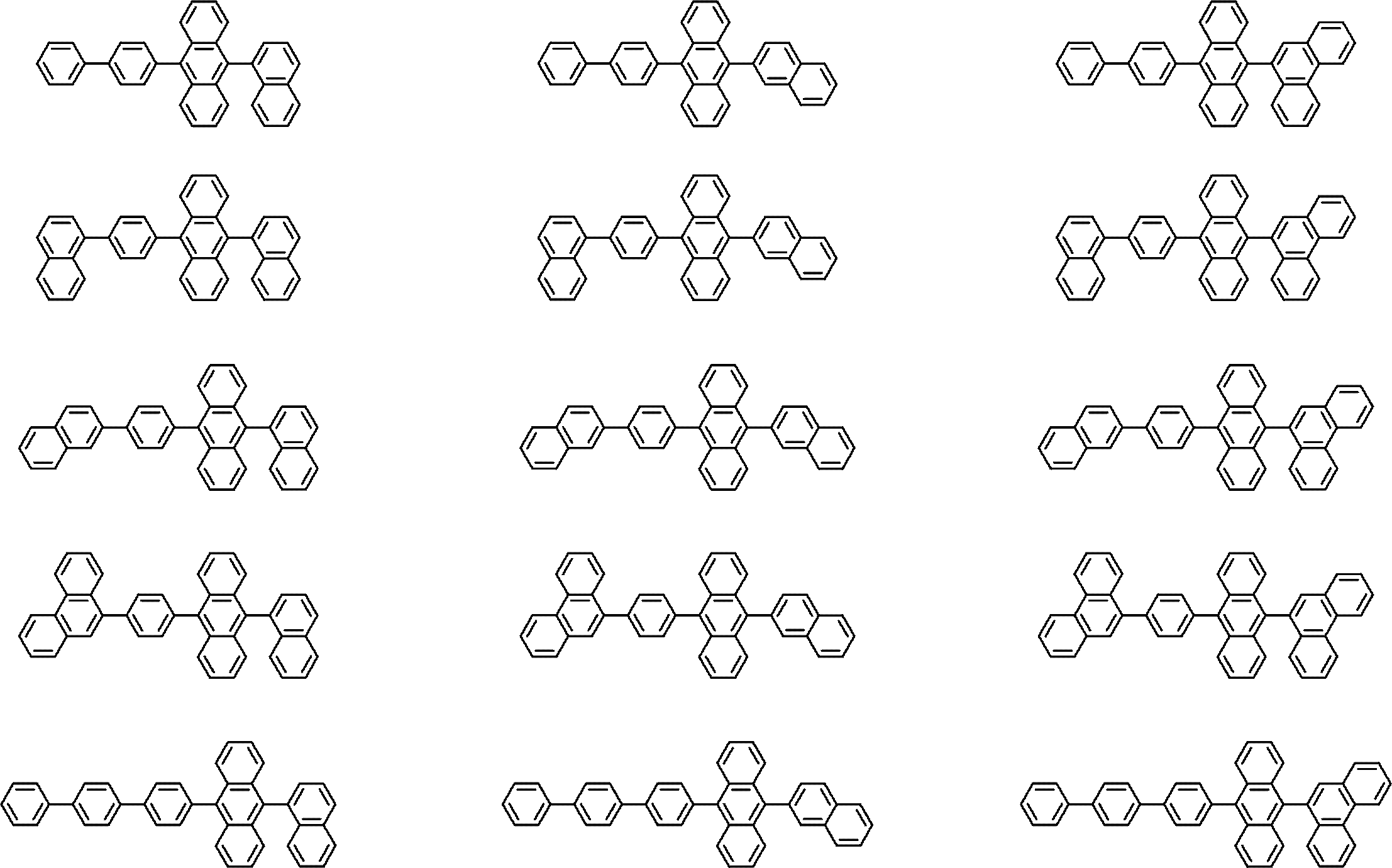

(ドーパント材料)
ドーパント材料としては、蛍光発光を示す蛍光発光性材料から選ばれる。
ドーパント材料としては、具体的には、例えば、ナフタレン誘導体、アントラセン誘導体、ピレン誘導体、クリセン誘導体、フルオランテン誘導体、インデノペリレン誘導体、ピロメテンホウ素錯体化合物、ピロメテン骨格を有する化合物もしくはその金属錯体、ジケトピロロピロール誘導体、ペリレン誘導体が挙げられる。
ナフタレン誘導体としては、ビスアリールアミノナフタレン誘導体、アリール置換ナフタレン誘導体が挙げられ、アントラセン誘導体としては、ビスアリールアミノアントラセン誘導体、アリール基置換アントラセン誘導体が挙げられる。ピレン誘導体としては、ビスアリールアミノピレン誘導体、アリール基置換ピレン誘導体が挙げられ、クリセン誘導体としては、ビスアリールアミノクリセン誘導体、アリール置換クリセン誘導体が挙げられる。フルオランテン誘導体、ピレン誘導体、アリールアセチレン誘導体、フルオレン誘導体、硼素錯体、ペリレン誘導体、オキサジアゾール誘導体、アントラセン誘導体、クリセン誘導体等から選ばれる。好ましくは、フルオランテン誘導体、ピレン誘導体、硼素錯体が挙げられる。
ドーパント材料としては、蛍光発光を示す蛍光発光性材料から選ばれる。
ドーパント材料としては、具体的には、例えば、ナフタレン誘導体、アントラセン誘導体、ピレン誘導体、クリセン誘導体、フルオランテン誘導体、インデノペリレン誘導体、ピロメテンホウ素錯体化合物、ピロメテン骨格を有する化合物もしくはその金属錯体、ジケトピロロピロール誘導体、ペリレン誘導体が挙げられる。
ナフタレン誘導体としては、ビスアリールアミノナフタレン誘導体、アリール置換ナフタレン誘導体が挙げられ、アントラセン誘導体としては、ビスアリールアミノアントラセン誘導体、アリール基置換アントラセン誘導体が挙げられる。ピレン誘導体としては、ビスアリールアミノピレン誘導体、アリール基置換ピレン誘導体が挙げられ、クリセン誘導体としては、ビスアリールアミノクリセン誘導体、アリール置換クリセン誘導体が挙げられる。フルオランテン誘導体、ピレン誘導体、アリールアセチレン誘導体、フルオレン誘導体、硼素錯体、ペリレン誘導体、オキサジアゾール誘導体、アントラセン誘導体、クリセン誘導体等から選ばれる。好ましくは、フルオランテン誘導体、ピレン誘導体、硼素錯体が挙げられる。
ドーパント材料の発光層における含有量は、特に制限はなく、目的に応じて適宜選択することができるが、例えば、0.1質量%以上70質量%以下が好ましく、1質量%以上30質量%以下がより好ましい。ドーパント材料の含有量が0.1質量%以上であると十分な発光が得られ、70質量%以下であると濃度消光を避けることができる。
本実施形態では、発光層に含まれるドーパント材料としては、発光色は特に限定されないが、主ピーク波長が480nm以下の青色発光を示す蛍光発光性のドーパント材料であることが好ましい。主ピーク波長とは、濃度10-5モル/リットル以上10-6モル/リットル以下のトルエン溶液中で測定した発光スペクトラムにおける発光強度が最大となる発光スペクトルのピーク波長をいう。
このような主ピーク波長のドーパント材料を、前記一般式(2)で表されるホスト材料にドープして発光層を構成し、この発光層の陽極側に隣接する正孔輸送層に前記一般式(1)で表される化合物を含有させることにより、有機EL素子は、高効率かつ長寿命となる。
このような主ピーク波長のドーパント材料を、前記一般式(2)で表されるホスト材料にドープして発光層を構成し、この発光層の陽極側に隣接する正孔輸送層に前記一般式(1)で表される化合物を含有させることにより、有機EL素子は、高効率かつ長寿命となる。
(正孔注入・輸送層)
正孔注入・輸送層は、発光層への正孔注入を助け、発光領域まで輸送する層であって、正孔移動度が大きく、イオン化エネルギーが小さい。
本実施形態では、正孔注入・輸送層は、少なくとも、前記一般式(2)で表される化合物を含む正孔輸送層を有し、この他に、正孔注入層を有していてもよいし、または別の正孔輸送層を有していてもよい。また、正孔注入・輸送層を、陽極側から、正孔注入層、第一正孔輸送層、第二正孔輸送層(前記一般式(2)で表される化合物を含む正孔輸送層)をこの順番で積層させて構成してもよい。
正孔注入層及び正孔輸送層を形成する材料としては、より低い電界強度で正孔を発光層に輸送する材料が好ましく、例えば、芳香族アミン化合物が好適に用いられる。また、正孔注入層の材料としては、ポルフィリン化合物、芳香族第三級アミン化合物またはスチリルアミン化合物を用いることが好ましく、特に、ヘキサシアノヘキサアザトリフェニレン(HAT)などの芳香族第三級アミン化合物を用いることが好ましい。
芳香族アミン化合物としては、例えば、下記一般式(A1)で表わされる芳香族アミン誘導体が好適に用いられる。
正孔注入・輸送層は、発光層への正孔注入を助け、発光領域まで輸送する層であって、正孔移動度が大きく、イオン化エネルギーが小さい。
本実施形態では、正孔注入・輸送層は、少なくとも、前記一般式(2)で表される化合物を含む正孔輸送層を有し、この他に、正孔注入層を有していてもよいし、または別の正孔輸送層を有していてもよい。また、正孔注入・輸送層を、陽極側から、正孔注入層、第一正孔輸送層、第二正孔輸送層(前記一般式(2)で表される化合物を含む正孔輸送層)をこの順番で積層させて構成してもよい。
正孔注入層及び正孔輸送層を形成する材料としては、より低い電界強度で正孔を発光層に輸送する材料が好ましく、例えば、芳香族アミン化合物が好適に用いられる。また、正孔注入層の材料としては、ポルフィリン化合物、芳香族第三級アミン化合物またはスチリルアミン化合物を用いることが好ましく、特に、ヘキサシアノヘキサアザトリフェニレン(HAT)などの芳香族第三級アミン化合物を用いることが好ましい。
芳香族アミン化合物としては、例えば、下記一般式(A1)で表わされる芳香族アミン誘導体が好適に用いられる。

前記一般式(A1)において、Ar1からAr4までは、それぞれ独立に、環形成炭素数6以上50以下の芳香族炭化水素基、環形成炭素数2以上40以下の芳香族複素環基、それら芳香族炭化水素基とそれら芳香族複素環基とを結合させた基、またはそれら芳香族炭化水素基とそれら芳香族複素環基とを結合させた基を表す。但し、ここで挙げた芳香族炭化水素基、および芳香族複素環基は、置換基を有してもよい。
前記一般式(A1)において、Lは、連結基であり、環形成炭素数6以上50以下の2価の芳香族炭化水素基、環形成炭素数5以上50以下の2価の芳香族複素環基、または2個以上の芳香族炭化水素基または芳香族複素環基を単結合、エーテル結合、チオエーテル結合、炭素数1以上20以下のアルキレン基、炭素数2以上20以下のアルケニレン基、もしくはアミノ基で結合して得られる2価の基、を表す。但し、ここで挙げた2価の芳香族炭化水素基、および2価の芳香族複素環基は、置換基を有してもよい。
前記一般式(A1)で表される化合物の具体例を以下に記すが、これらに限定されるものではない。
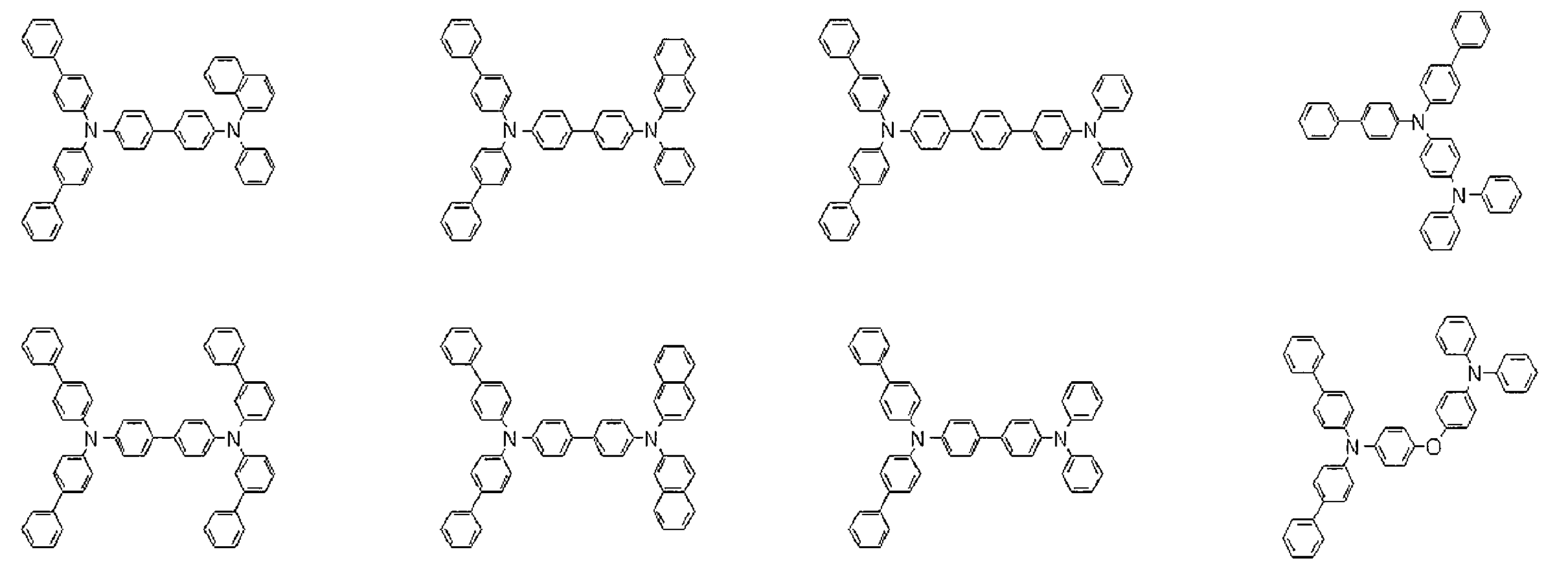
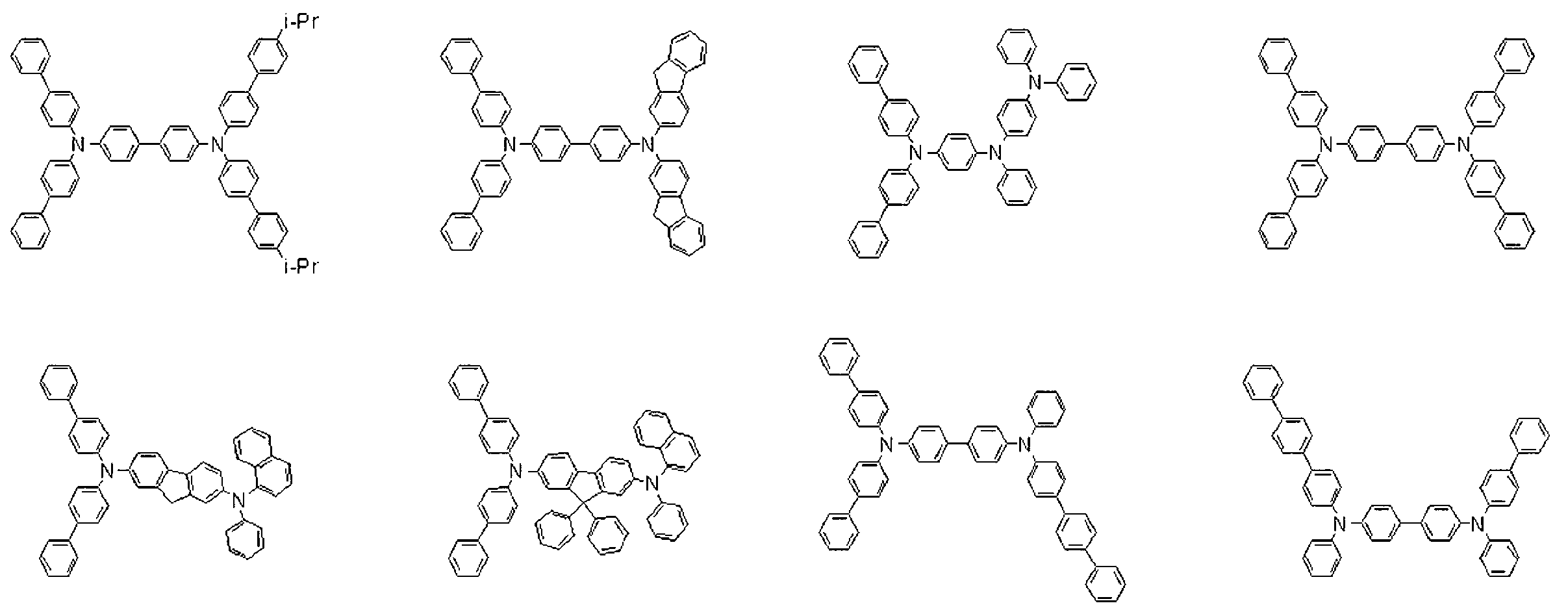


また、下記一般式(A2)で表される芳香族アミンも、正孔注入・輸送層の形成に好適に用いられる。
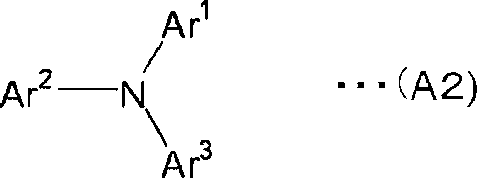
前記一般式(A2)において、Ar1からAr3までの定義は前記一般式(A1)のAr1からAr4までの定義と同様である。以下に一般式(A2)で表される化合物の具体例を記すがこれらに限定されるものではない。
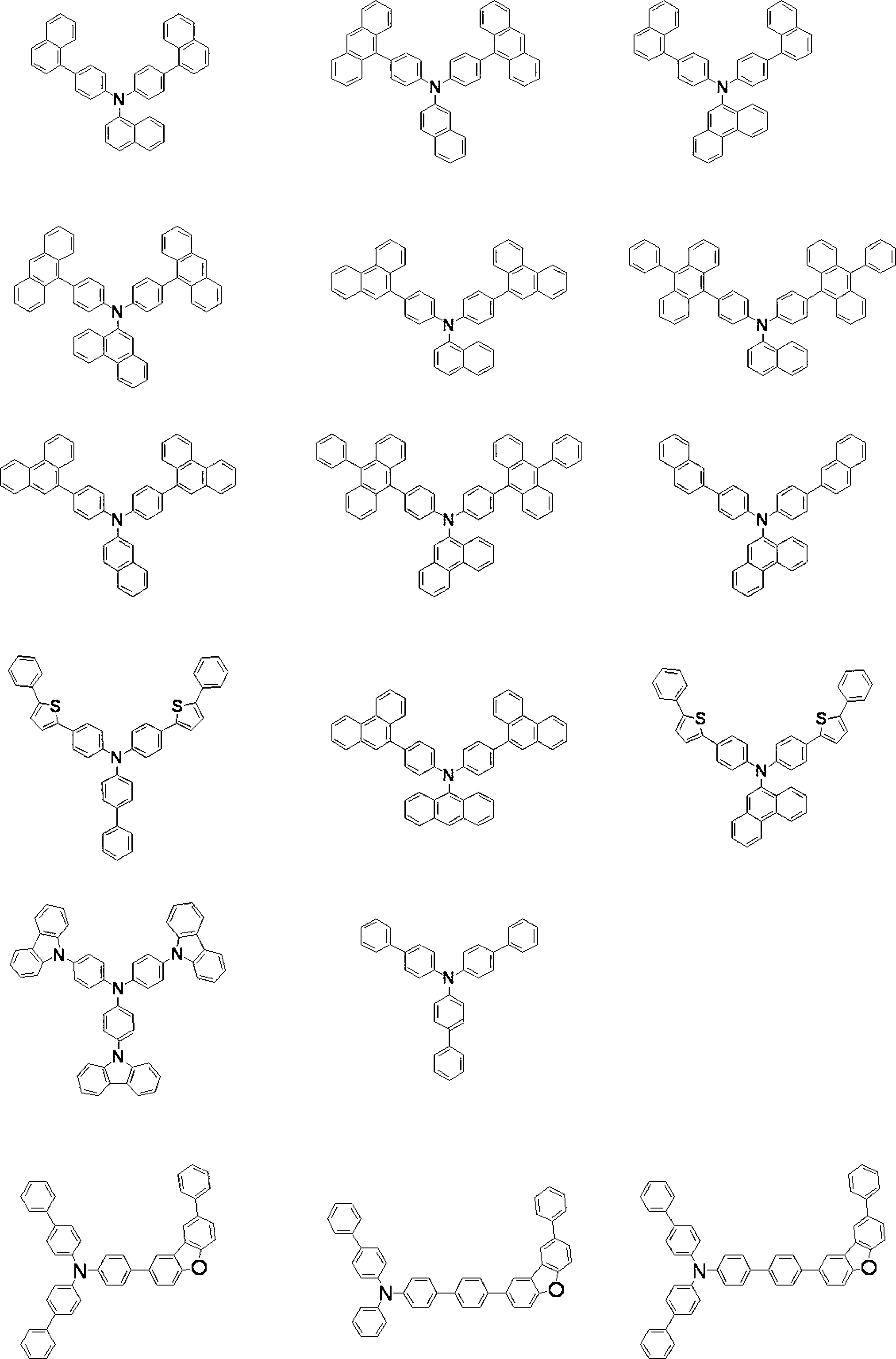
(電子注入・輸送層)
電子注入・輸送層は、発光層への電子の注入を助ける層であって、電子移動度が大きい。電子注入層はエネルギーレベルの急な変化を緩和するなど、エネルギーレベルを調整するために設ける。電子注入・輸送層は、電子注入層と電子輸送層とのうちの少なくともいずれか一方を備える。
本実施形態は、発光層と陰極との間に電子注入層を有し、前記電子注入層は、含窒素環誘導体を主成分として含有することが好ましい。ここで、電子注入層は電子輸送層として機能する層であってもよい。
なお、「主成分として」とは、電子注入層が50質量%以上の含窒素環誘導体を含有していることを意味する。
電子注入・輸送層は、発光層への電子の注入を助ける層であって、電子移動度が大きい。電子注入層はエネルギーレベルの急な変化を緩和するなど、エネルギーレベルを調整するために設ける。電子注入・輸送層は、電子注入層と電子輸送層とのうちの少なくともいずれか一方を備える。
本実施形態は、発光層と陰極との間に電子注入層を有し、前記電子注入層は、含窒素環誘導体を主成分として含有することが好ましい。ここで、電子注入層は電子輸送層として機能する層であってもよい。
なお、「主成分として」とは、電子注入層が50質量%以上の含窒素環誘導体を含有していることを意味する。
電子注入層に用いる電子輸送性材料としては、分子内にヘテロ原子を1個以上含有する芳香族ヘテロ環化合物が好ましく用いられ、特に含窒素環誘導体が好ましい。また、含窒素環誘導体としては、含窒素6員環もしくは5員環骨格を有する芳香族環、または含窒素6員環もしくは5員環骨格を有する縮合芳香族環化合物が好ましい。
この含窒素環誘導体としては、例えば、下記一般式(B1)で表される含窒素環金属キレート錯体が好ましい。
この含窒素環誘導体としては、例えば、下記一般式(B1)で表される含窒素環金属キレート錯体が好ましい。

一般式(B1)におけるR2からR7までは、独立に、水素原子、ハロゲン原子、オキシ基、アミノ基、炭素数1以上40以下の炭化水素基、アルコキシ基、アリールオキシ基、アルコキシカルボニル基、または芳香族複素環基であり、これらは置換基を有してもよい。
ハロゲン原子としては、フッ素、塩素、臭素、ヨウ素などが挙げられる。また、置換されていてもよいアミノ基の例としては、アルキルアミノ基、アリールアミノ基、アラルキルアミノ基が挙げられる。
ハロゲン原子としては、フッ素、塩素、臭素、ヨウ素などが挙げられる。また、置換されていてもよいアミノ基の例としては、アルキルアミノ基、アリールアミノ基、アラルキルアミノ基が挙げられる。
アルコキシカルボニル基は-COOY’と表され、Y’の例としては前記アルキル基と同様のものが挙げられる。アルキルアミノ基およびアラルキルアミノ基は-NQ1Q2と表される。Q1およびQ2の具体例としては、独立に、前記アルキル基、前記アラルキル基で説明したものと同様のものが挙げられ、好ましい例も同様である。Q1およびQ2の一方は水素原子であってもよい。なお、アラルキル基は、前記アルキル基の水素原子が前記アリール基で置換された基である。
アリールアミノ基は-NAr1Ar2と表され、Ar1およびAr2の具体例としては、それぞれ独立に前記非縮合芳香族炭化水素基および縮合芳香族炭化水素基で説明した基と同様である。Ar1およびAr2の一方は水素原子であってもよい。
アリールアミノ基は-NAr1Ar2と表され、Ar1およびAr2の具体例としては、それぞれ独立に前記非縮合芳香族炭化水素基および縮合芳香族炭化水素基で説明した基と同様である。Ar1およびAr2の一方は水素原子であってもよい。
Mは、アルミニウム(Al)、ガリウム(Ga)またはインジウム(In)であり、Inであると好ましい。
前記一般式(B1)のLは、下記一般式(B2)または(B3)で表される基である。
前記一般式(B1)のLは、下記一般式(B2)または(B3)で表される基である。

前記一般式(B2)中、R8からR12までは、独立に、水素原子、または炭素数1以上40以下の炭化水素基であり、互いに隣接する基が環状構造を形成していてもよい。この炭化水素基は、置換基を有してもよい。
また、前記一般式(B3)中、R13からR27までは、独立に、水素原子、または炭素数1以上40以下の炭化水素基であり、互いに隣接する基が環状構造を形成していてもよい。この炭化水素基は、置換基を有してもよい。
前記一般式(B2)および一般式(B3)のR8からR12まで、およびR13からR27までが示す炭素数1以上40以下の炭化水素基としては、前記一般式(B1)中のR2からR7までの具体例と同様のものが挙げられる。
また、R8からR12まで、およびR13からR27までの互いに隣接する基が環状構造を形成した場合の2価の基としては、テトラメチレン基、ペンタメチレン基、ヘキサメチレン基、ジフェニルメタン-2,2’-ジイル基、ジフェニルエタン-3,3’-ジイル基、ジフェニルプロパン-4,4’-ジイル基などが挙げられる。
また、前記一般式(B3)中、R13からR27までは、独立に、水素原子、または炭素数1以上40以下の炭化水素基であり、互いに隣接する基が環状構造を形成していてもよい。この炭化水素基は、置換基を有してもよい。
前記一般式(B2)および一般式(B3)のR8からR12まで、およびR13からR27までが示す炭素数1以上40以下の炭化水素基としては、前記一般式(B1)中のR2からR7までの具体例と同様のものが挙げられる。
また、R8からR12まで、およびR13からR27までの互いに隣接する基が環状構造を形成した場合の2価の基としては、テトラメチレン基、ペンタメチレン基、ヘキサメチレン基、ジフェニルメタン-2,2’-ジイル基、ジフェニルエタン-3,3’-ジイル基、ジフェニルプロパン-4,4’-ジイル基などが挙げられる。
また、電子輸送層は、下記一般式(B4)から(B6)までで表される含窒素複素環誘導体の少なくともいずれか1つを含有することが好ましい。
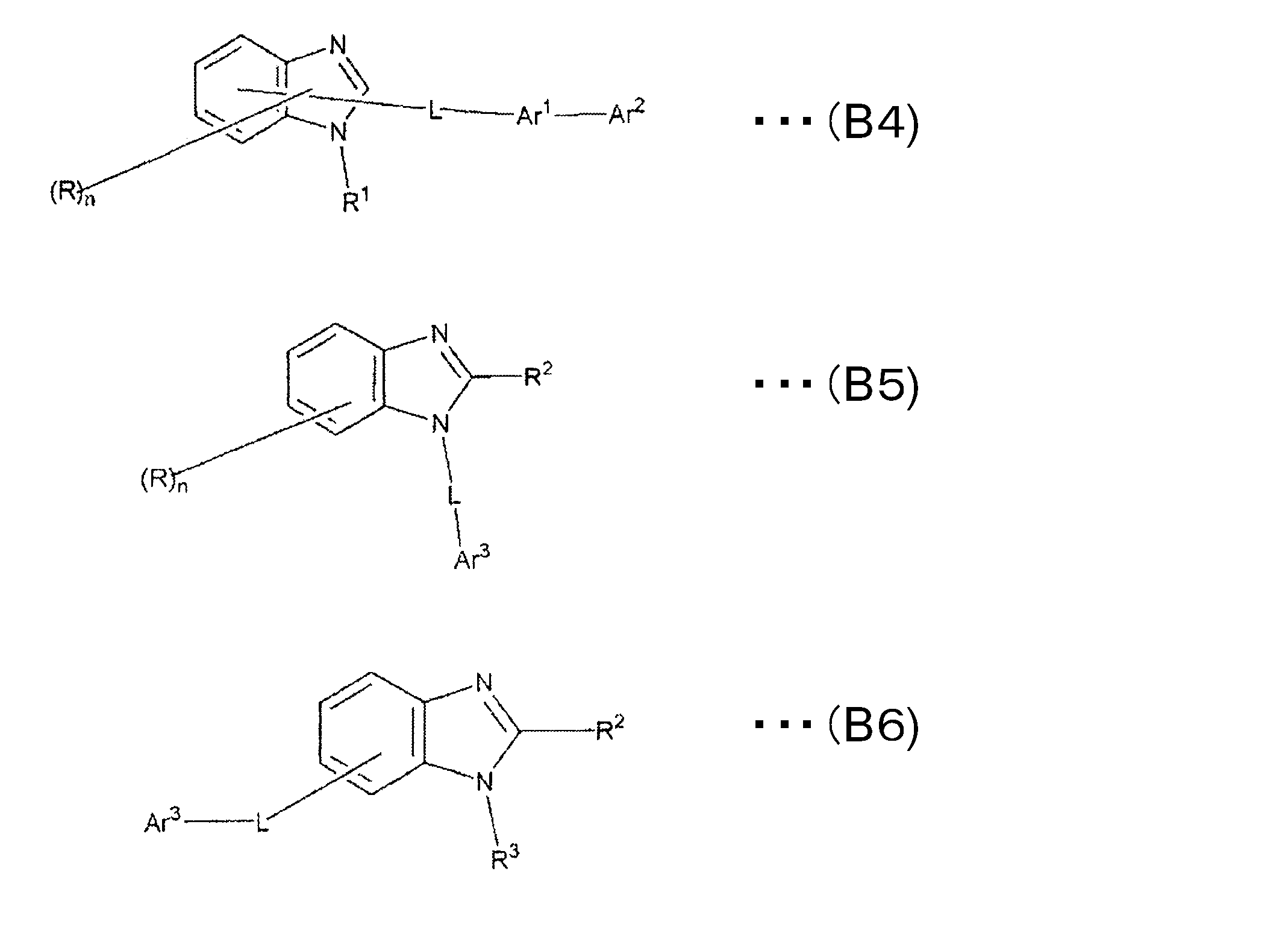
前記一般式(B4)から(B6)までの式中、Rは、水素原子、環形成炭素数6以上60以下の芳香族炭化水素基、環形成炭素数6以上60以下の縮合芳香族炭化水素基、ピリジル基、キノリル基、炭素数1以上20以下のアルキル基、または炭素数1以上20以下のアルコキシ基である。
nは0以上4以下の整数である。
nは0以上4以下の整数である。
前記一般式(B4)から(B6)までの式中、R1は、環形成炭素数6以上60以下の芳香族炭化水素基、環形成炭素数6以上60以下の縮合芳香族炭化水素基、ピリジル基、キノリル基、炭素数1以上20以下のアルキル基、または炭素数1以上20以下のアルコキシ基である。
前記一般式(B4)から(B6)までの式中、R2およびR3は、独立に、水素原子、環形成炭素数6以上60以下の芳香族炭化水素基、環形成炭素数6以上60以下の縮合芳香族炭化水素基、ピリジル基、キノリル基、炭素数1以上20以下のアルキル基、または炭素数1以上20以下のアルコキシ基である。
前記一般式(B4)から(B6)までの式中、Lは、環形成炭素数6以上60以下の芳香族炭化水素基、環形成炭素数6以上60以下の縮合芳香族炭化水素基、ピリジニレン基、キノリニレン基、またはフルオレニレン基である。
前記一般式(B4)から(B6)までの式中、Ar1は、環形成炭素数6以上60以下の芳香族炭化水素基、環形成炭素数6以上60以下の縮合芳香族炭化水素基、ピリジニレン基、キノリニレン基である。
前記一般式(B4)から(B6)までの式中、Ar2は、環形成炭素数6以上60以下の芳香族炭化水素基、環形成炭素数6以上60以下の縮合芳香族炭化水素基、ピリジル基、キノリル基、炭素数1以上20以下のアルキル基、または炭素数1以上20以下のアルコキシ基である。
前記一般式(B4)から(B6)までの式中、Ar3は、環形成炭素数6以上60以下の芳香族炭化水素基、環形成炭素数6以上60以下の縮合芳香族炭化水素基、ピリジル基、キノリル基、炭素数1以上20以下のアルキル基、炭素数1以上20以下のアルコキシ基、または「-Ar1-Ar2」で表される基(Ar1およびAr2は、それぞれ前記と同じ)である。
また、前記一般式(B4)から(B6)までの式中のR、R1、R2、R3、L、Ar1、Ar2、およびAr3の説明で挙げた、縮合芳香族炭化水素基、ピリジル基、キノリル基、アルキル基、アルコキシ基、ピリジニレン基、キノリニレン基、フルオレニレン基は、置換基を有してもよい。
電子注入層または電子輸送層に用いられる電子伝達性化合物としては、8-ヒドロキシキノリンまたはその誘導体の金属錯体、オキサジアゾール誘導体、含窒素複素環誘導体が好適である。前記8-ヒドロキシキノリンまたはその誘導体の金属錯体の具体例としては、オキシン(一般に8-キノリノールまたは8-ヒドロキシキノリン)のキレートを含む金属キレートオキシノイド化合物、例えばトリス(8-キノリノール)アルミニウムを用いることができる。そして、オキサジアゾール誘導体としては、下記のものを挙げることができる。

これらオキサジアゾール誘導体の各一般式中、Ar17、Ar18、Ar19、Ar21、Ar22およびAr25は、環形成炭素数6以上40以下の芳香族炭化水素基、または環形成炭素数6以上40以下の縮合芳香族炭化水素基である。
但し、ここで挙げた芳香族炭化水素基および縮合芳香族炭化水素基は置換基を有してもよい。また、Ar17とAr18、Ar19とAr21、Ar22とAr25は、互いに同一でも異なっていてもよい。
ここで挙げた芳香族炭化水素基または縮合芳香族炭化水素基としては、フェニル基、ナフチル基、ビフェニル基、アントラニル基、ペリレニル基、ピレニル基などが挙げられる。そして、これらへの置換基としては炭素数1以上10以下のアルキル基、炭素数1以上10以下のアルコキシ基またはシアノ基などが挙げられる。
但し、ここで挙げた芳香族炭化水素基および縮合芳香族炭化水素基は置換基を有してもよい。また、Ar17とAr18、Ar19とAr21、Ar22とAr25は、互いに同一でも異なっていてもよい。
ここで挙げた芳香族炭化水素基または縮合芳香族炭化水素基としては、フェニル基、ナフチル基、ビフェニル基、アントラニル基、ペリレニル基、ピレニル基などが挙げられる。そして、これらへの置換基としては炭素数1以上10以下のアルキル基、炭素数1以上10以下のアルコキシ基またはシアノ基などが挙げられる。
これらオキサジアゾール誘導体の各一般式中、Ar20、Ar23およびAr24は、環形成炭素数6以上40以下の2価の芳香族炭化水素基、または環形成炭素数6以上40以下の2価の縮合芳香族炭化水素基である。
但し、ここで挙げた芳香族炭化水素基および縮合芳香族炭化水素基は置換基を有してもよい。
また、Ar23とAr24は、互いに同一でも異なっていてもよい。
ここで挙げた2価の芳香族炭化水素基または2価の縮合芳香族炭化水素基としては、フェニレン基、ナフチレン基、ビフェニレン基、アントラニレン基、ペリレニレン基、ピレニレン基などが挙げられる。そして、これらへの置換基としては炭素数1以上10以下のアルキル基、炭素数1以上10以下のアルコキシ基またはシアノ基などが挙げられる。
但し、ここで挙げた芳香族炭化水素基および縮合芳香族炭化水素基は置換基を有してもよい。
また、Ar23とAr24は、互いに同一でも異なっていてもよい。
ここで挙げた2価の芳香族炭化水素基または2価の縮合芳香族炭化水素基としては、フェニレン基、ナフチレン基、ビフェニレン基、アントラニレン基、ペリレニレン基、ピレニレン基などが挙げられる。そして、これらへの置換基としては炭素数1以上10以下のアルキル基、炭素数1以上10以下のアルコキシ基またはシアノ基などが挙げられる。
これらの電子伝達性化合物は、薄膜形成性の良好なものが好ましく用いられる。そして、これら電子伝達性化合物の具体例としては、下記のものを挙げることができる。
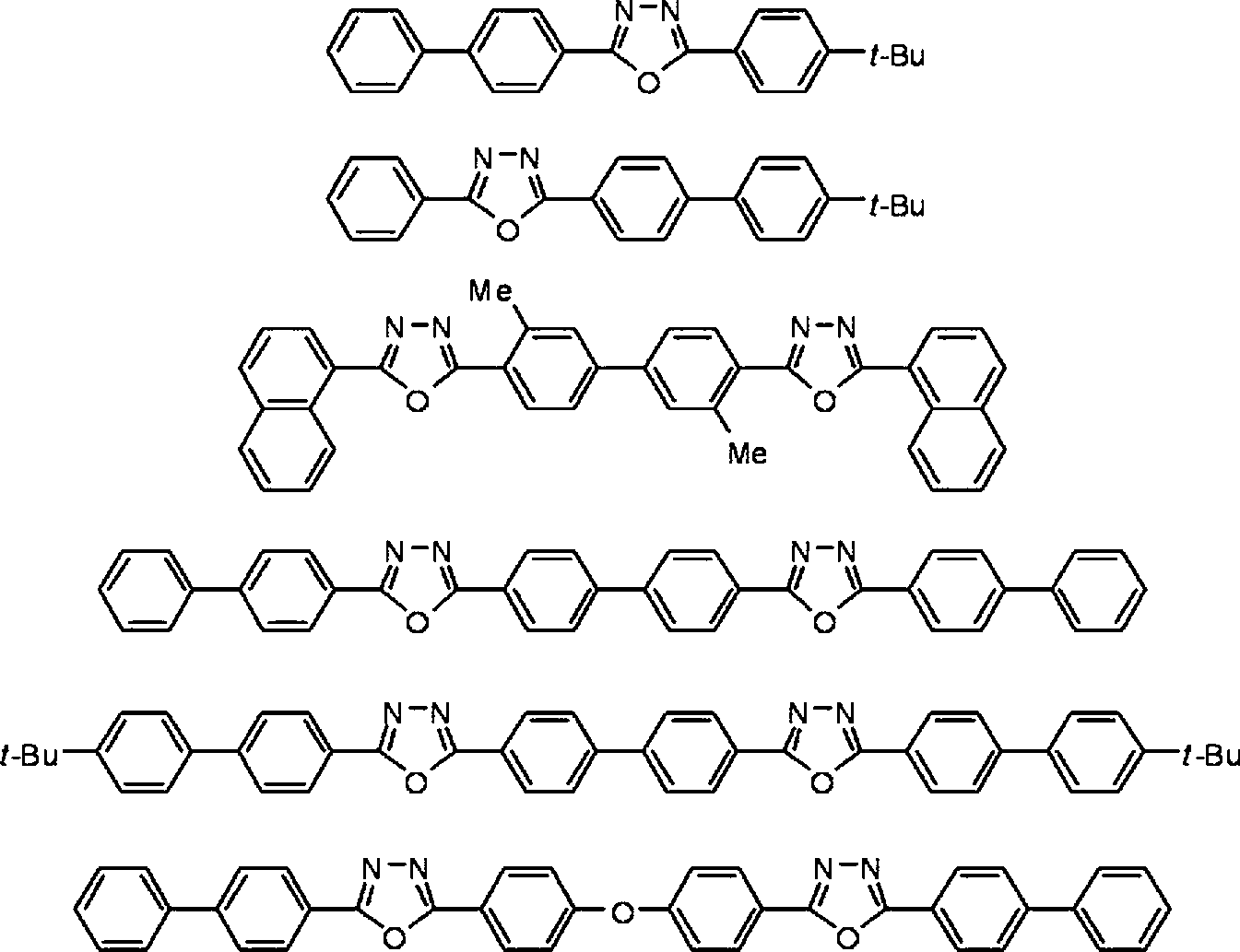
電子伝達性化合物としての含窒素複素環誘導体は、以下の一般式を有する有機化合物からなる含窒素複素環誘導体であって、金属錯体でない含窒素化合物が挙げられる。例えば、下記一般式(B7)に示す骨格を含有する5員環もしくは6員環や、下記一般式(B8)に示す構造のものが挙げられる。

前記一般式(B8)中、Xは炭素原子もしくは窒素原子を表す。Z1ならびにZ2は、それぞれ独立に含窒素ヘテロ環を形成可能な原子群を表す。
含窒素複素環誘導体は、さらに好ましくは、5員環もしくは6員環からなる含窒素芳香多環族を有する有機化合物である。さらには、このような複数窒素原子を有する含窒素芳香多環族の場合は、前記一般式(B7)と(B8)もしくは前記一般式(B7)と下記一般式(B9)を組み合わせた骨格を有する含窒素芳香多環有機化合物が好ましい。
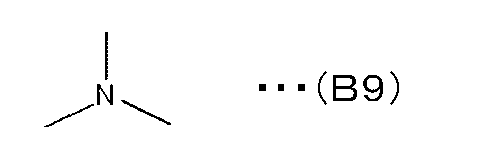
前記の含窒素芳香多環有機化合物の含窒素基は、例えば、以下の一般式で表される含窒素複素環基から選択される。
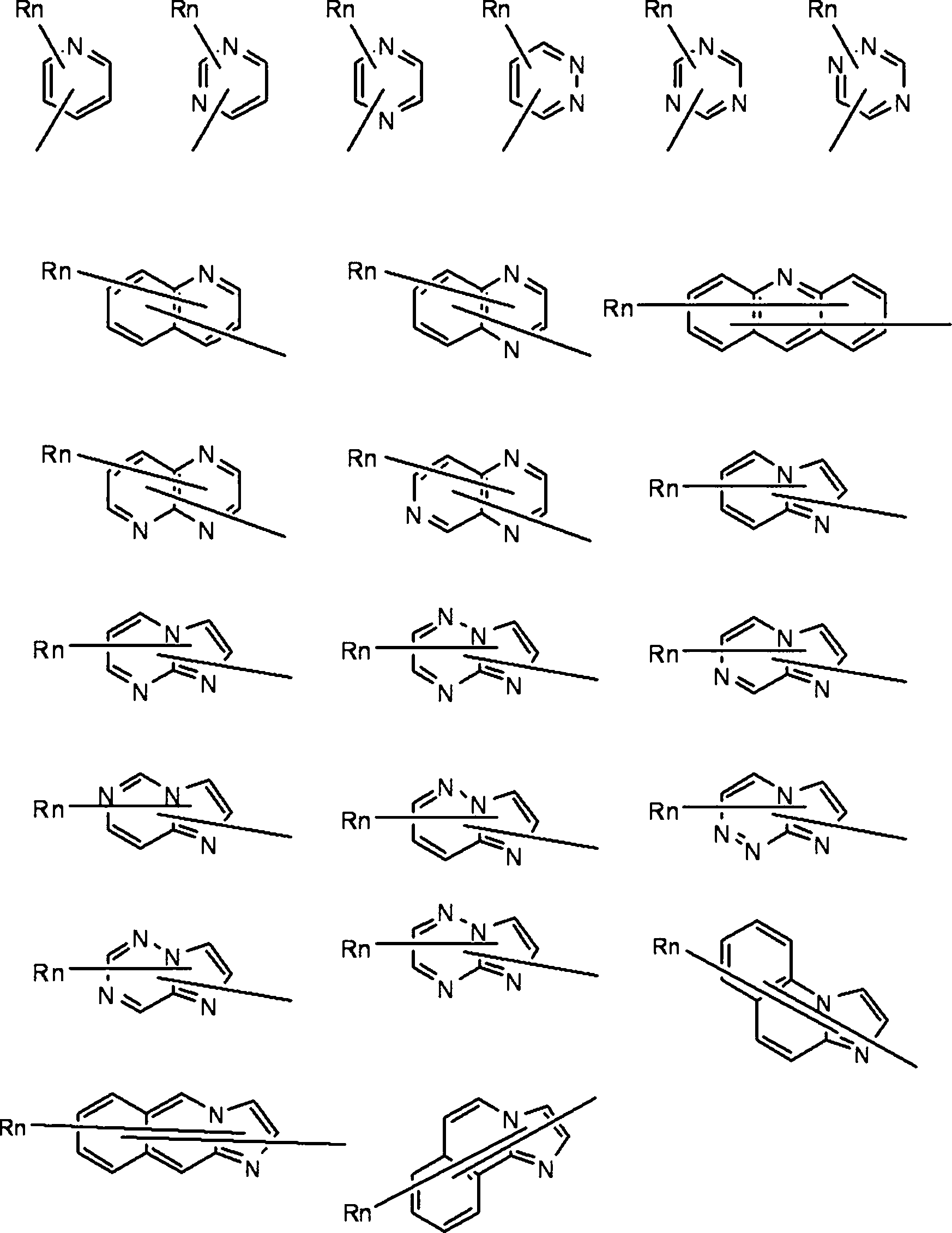
これら含窒素複素環基の各一般式中、Rは、環形成炭素数6以上40以下の芳香族炭化水素基、環形成炭素数6以上40以下の縮合芳香族炭化水素基、環形成炭素数2以上40以下の芳香族複素環基、環形成炭素数2以上40以下の縮合芳香族複素環基、炭素数1以上20以下のアルキル基、または炭素数1以上20以下のアルコキシ基である。
これら含窒素複素環基の各一般式中、nは0以上5以下の整数であり、nが2以上の整数であるとき、複数のRは互いに同一または異なっていてもよい。
これら含窒素複素環基の各一般式中、nは0以上5以下の整数であり、nが2以上の整数であるとき、複数のRは互いに同一または異なっていてもよい。
さらに、好ましい具体的な化合物として、下記一般式(B10)で表される含窒素複素環誘導体が挙げられる。
HAr-L1-Ar1-Ar2 ・・・(B10)
前記一般式(B10)中、HArは、環形成炭素数1以上40以下の含窒素複素環基である。
前記一般式(B10)中、L1は、単結合、環形成炭素数6以上40以下の芳香族炭化水素基、環形成炭素数6以上40以下の縮合芳香族炭化水素基、環形成炭素数2以上40以下の芳香族複素環基、または環形成炭素数2以上40以下の縮合芳香族複素環基である。
HAr-L1-Ar1-Ar2 ・・・(B10)
前記一般式(B10)中、HArは、環形成炭素数1以上40以下の含窒素複素環基である。
前記一般式(B10)中、L1は、単結合、環形成炭素数6以上40以下の芳香族炭化水素基、環形成炭素数6以上40以下の縮合芳香族炭化水素基、環形成炭素数2以上40以下の芳香族複素環基、または環形成炭素数2以上40以下の縮合芳香族複素環基である。
前記一般式(B10)中、Ar1は、環形成炭素数6以上40以下の2価の芳香族炭化水素基である。
前記一般式(B10)中、Ar2は、環形成炭素数6以上40以下の芳香族炭化水素基、環形成炭素数6以上40以下の縮合芳香族炭化水素基、環形成炭素数2以上40以下の芳香族複素環基、または環形成炭素数2以上40以下の縮合芳香族複素環基である。
前記一般式(B10)中、Ar2は、環形成炭素数6以上40以下の芳香族炭化水素基、環形成炭素数6以上40以下の縮合芳香族炭化水素基、環形成炭素数2以上40以下の芳香族複素環基、または環形成炭素数2以上40以下の縮合芳香族複素環基である。
また、前記一般式(B10)の式中のHAr、L1、Ar1、およびAr2の説明で挙げた含窒素複素環基、芳香族炭化水素基、縮合芳香族炭化水素基、芳香族複素環基、および縮合芳香族複素環基は置換基を有してもよい。
前記一般式(B10)の式中のHArは、例えば、下記の群から選択される。

前記一般式(B10)の式中のL1は、例えば、下記の群から選択される。

前記一般式(B10)の式中のAr1は、例えば、下記のアリールアントラニル基から選択される。

前記アリールアントラニル基の一般式中、R1からR14までは、独立して、水素原子、ハロゲン原子、炭素数1以上20以下のアルキル基、炭素数1以上20以下のアルコキシ基、環形成炭素数6以上40以下のアリールオキシ基、環形成炭素数6以上40以下の芳香族炭化水素基、環形成炭素数6以上40以下の縮合芳香族炭化水素基、環形成炭素数2以上40以下の芳香族複素環基、または環形成炭素数2以上40以下の縮合芳香族複素環基である。
前記アリールアントラニル基の一般式中、Ar3は、環形成炭素数6以上40以下の芳香族炭化水素基、環形成炭素数6以上40以下の縮合芳香族炭化水素基、環形成炭素数2以上40以下の芳香族複素環基、または環形成炭素数2以上40以下の縮合芳香族複素環基である。
但し、前記アリールアントラニル基の一般式中のR1からR14まで、およびAr3の説明で挙げた芳香族炭化水素基、縮合芳香族炭化水素基、芳香族複素環基、および縮合芳香族複素環基は、置換基を有してもよい。
また、R1からR8までは、いずれも水素原子である含窒素複素環誘導体であってもよい。
また、R1からR8までは、いずれも水素原子である含窒素複素環誘導体であってもよい。
前記アリールアントラニル基の一般式中、Ar2は、例えば、下記の群から選択される。

電子伝達性化合物としての含窒素芳香多環有機化合物には、この他、下記の化合物(特開平9-3448号公報参照)も好適に用いられる。

この含窒素芳香多環有機化合物の一般式中、R1からR4までは、独立に、水素原子、脂肪族基、脂肪族式環基、炭素環式芳香族環基、または複素環基を表す。但し、ここで挙げた脂肪族基、脂肪族式環基、炭素環式芳香族環基、および複素環基は、置換基を有してもよい。
この含窒素芳香多環有機化合物の一般式中、X1、X2は、独立に、酸素原子、硫黄原子、またはジシアノメチレン基を表す。
この含窒素芳香多環有機化合物の一般式中、X1、X2は、独立に、酸素原子、硫黄原子、またはジシアノメチレン基を表す。
また、電子伝達性化合物として、下記の化合物(特開2000-173774号公報参照)も好適に用いられる。
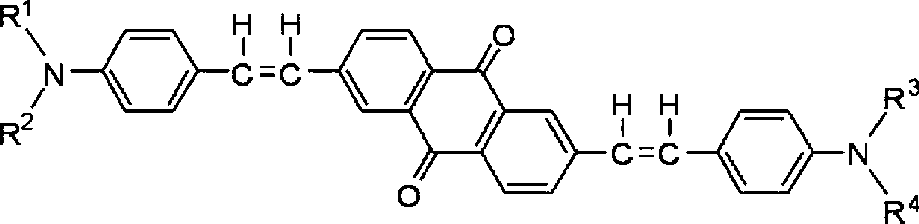
前記一般式中、R1、R2、R3およびR4は互いに同一のまたは異なる基であって、下記一般式で表わされる芳香族炭化水素基または縮合芳香族炭化水素基である。

前記一般式中、R5、R6、R7、R8およびR9は互いに同一のまたは異なる基であって、水素原子、或いはそれらの少なくとも1つが飽和もしくは不飽和アルコキシル基、アルキル基、アミノ基、またはアルキルアミノ基である。
さらに、電子伝達性化合物は、該含窒素複素環基または含窒素複素環誘導体を含む高分子化合物であってもよい。
なお、電子注入層または電子輸送層の膜厚は、特に限定されないが、好ましくは、1nm以上100nm以下である。
また、電子注入層の構成成分としては、含窒素環誘導体の他に、無機化合物として絶縁体または半導体を使用することが好ましい。電子注入層が絶縁体や半導体で構成されていれば、電流のリークを有効に防止して、電子注入性を向上させることができる。
また、電子注入層の構成成分としては、含窒素環誘導体の他に、無機化合物として絶縁体または半導体を使用することが好ましい。電子注入層が絶縁体や半導体で構成されていれば、電流のリークを有効に防止して、電子注入性を向上させることができる。
このような絶縁体としては、アルカリ金属カルコゲニド、アルカリ土類金属カルコゲニド、アルカリ金属のハロゲン化物およびアルカリ土類金属のハロゲン化物からなる群から選択される少なくとも一つの金属化合物を使用するのが好ましい。電子注入層がこれらのアルカリ金属カルコゲニドなどで構成されていれば、電子注入性をさらに向上させることができる点で好ましい。具体的に、好ましいアルカリ金属カルコゲニドとしては、例えば、酸化リチウム(Li2O)、酸化カリウム(K2O)、硫化ナトリウム(Na2S)、セレン化ナトリウム(Na2Se)および酸化ナトリウム(Na2O)が挙げられる。好ましいアルカリ土類金属カルコゲニドとしては、例えば、酸化カルシウム(CaO)、酸化バリウム(BaO)、酸化ストロンチウム(SrO)、酸化ベリリウム(BeO)、硫化バリウム(BaS)およびセレン化カルシウム(CaSe)が挙げられる。また、好ましいアルカリ金属のハロゲン化物としては、例えば、フッ化リチウム(LiF)、フッ化ナトリウム(NaF)、フッ化カリウム(KF)、塩化リチウム(LiCl)、塩化カリウム(KCl)および塩化ナトリウム(NaCl)などが挙げられる。また、好ましいアルカリ土類金属のハロゲン化物としては、例えば、フッ化カルシウム(CaF2)、フッ化バリウム(BaF2)、フッ化ストロンチウム(SrF2)、フッ化マグネシウム(MgF2)およびフッ化ベリリウム(BeF2)などのフッ化物や、フッ化物以外のハロゲン化物が挙げられる。
また、半導体としては、バリウム(Ba)、カルシウム(Ca)、ストロンチウム(Sr)、イッテルビウム(Yb)、アルミニウム(Al)、ガリウム(Ga)、インジウム(In)、リチウム(Li)、ナトリウム(Na)、カドミウム(Cd)、マグネシウム(Mg)、ケイ素(Si)、タンタル(Ta)、アンチモン(Sb)および亜鉛(Zn)の少なくとも一つの元素を含む酸化物、窒化物または酸化窒化物などの一種単独または二種以上の組み合わせが挙げられる。また、電子注入層を構成する無機化合物が、微結晶または非晶質の絶縁性薄膜であることが好ましい。電子注入層がこれらの絶縁性薄膜で構成されていれば、より均質な薄膜が形成されるために、ダークスポットなどの画素欠陥を減少させることができる。なお、このような無機化合物としては、アルカリ金属カルコゲニド、アルカリ土類金属カルコゲニド、アルカリ金属のハロゲン化物およびアルカリ土類金属のハロゲン化物などが挙げられる。
このような絶縁体または半導体を使用する場合、その層の好ましい厚みは、0.1nm以上15nm以下程度である。また、本発明における電子注入層は、前述の還元性ドーパント材料を含有していても好ましい。
このような絶縁体または半導体を使用する場合、その層の好ましい厚みは、0.1nm以上15nm以下程度である。また、本発明における電子注入層は、前述の還元性ドーパント材料を含有していても好ましい。
(電子供与性ドーパントおよび有機金属錯体)
本発明の有機EL素子は、陰極と有機層との界面領域に電子供与性ドーパントおよび有機金属錯体の少なくともいずれかを有することも好ましい。
このような構成によれば、有機EL素子における発光輝度の向上や長寿命化が図られる。
電子供与性ドーパントとしては、アルカリ金属、アルカリ金属化合物、アルカリ土類金属、アルカリ土類金属化合物、希土類金属、および希土類金属化合物などから選ばれた少なくとも一種類が挙げられる。
有機金属錯体としては、アルカリ金属を含む有機金属錯体、アルカリ土類金属を含む有機金属錯体、および希土類金属を含む有機金属錯体などから選ばれた少なくとも一種類が挙げられる。
本発明の有機EL素子は、陰極と有機層との界面領域に電子供与性ドーパントおよび有機金属錯体の少なくともいずれかを有することも好ましい。
このような構成によれば、有機EL素子における発光輝度の向上や長寿命化が図られる。
電子供与性ドーパントとしては、アルカリ金属、アルカリ金属化合物、アルカリ土類金属、アルカリ土類金属化合物、希土類金属、および希土類金属化合物などから選ばれた少なくとも一種類が挙げられる。
有機金属錯体としては、アルカリ金属を含む有機金属錯体、アルカリ土類金属を含む有機金属錯体、および希土類金属を含む有機金属錯体などから選ばれた少なくとも一種類が挙げられる。
アルカリ金属としては、リチウム(Li)(仕事関数:2.93eV)、ナトリウム(Na)(仕事関数:2.36eV)、カリウム(K)(仕事関数:2.28eV)、ルビジウム(Rb)(仕事関数:2.16eV)、セシウム(Cs)(仕事関数:1.95eV)などが挙げられ、仕事関数が2.9eV以下のものが特に好ましい。これらのうち好ましくはK、Rb、Cs、さらに好ましくはRbまたはCsであり、最も好ましくはCsである。
アルカリ土類金属としては、カルシウム(Ca)(仕事関数:2.9eV)、ストロンチウム(Sr)(仕事関数:2.0eV以上2.5eV以下)、バリウム(Ba)(仕事関数:2.52eV)などが挙げられ、仕事関数が2.9eV以下のものが特に好ましい。
希土類金属としては、スカンジウム(Sc)、イットリウム(Y)、セリウム(Ce)、テルビウム(Tb)、イッテルビウム(Yb)などが挙げられ、仕事関数が2.9eV以下のものが特に好ましい。
以上の金属のうち好ましい金属は、特に還元能力が高く、電子注入域への比較的少量の添加により、有機EL素子における発光輝度の向上や長寿命化が可能である。
アルカリ土類金属としては、カルシウム(Ca)(仕事関数:2.9eV)、ストロンチウム(Sr)(仕事関数:2.0eV以上2.5eV以下)、バリウム(Ba)(仕事関数:2.52eV)などが挙げられ、仕事関数が2.9eV以下のものが特に好ましい。
希土類金属としては、スカンジウム(Sc)、イットリウム(Y)、セリウム(Ce)、テルビウム(Tb)、イッテルビウム(Yb)などが挙げられ、仕事関数が2.9eV以下のものが特に好ましい。
以上の金属のうち好ましい金属は、特に還元能力が高く、電子注入域への比較的少量の添加により、有機EL素子における発光輝度の向上や長寿命化が可能である。
アルカリ金属化合物としては、酸化リチウム(Li2O)、酸化セシウム(Cs2O)、酸化カリウム(K2O)などのアルカリ酸化物、フッ化リチウム(LiF)、フッ化ナトリウム(NaF)、フッ化セシウム(CsF)、フッ化カリウム(KF)などのアルカリハロゲン化物などが挙げられ、フッ化リチウム(LiF)、酸化リチウム(Li2O)、フッ化ナトリウム(NaF)が好ましい。
アルカリ土類金属化合物としては、酸化バリウム(BaO)、酸化ストロンチウム(SrO)、酸化カルシウム(CaO)およびこれらを混合したストロンチウム酸バリウム(BaxSr1-xO)(0<x<1)、カルシウム酸バリウム(BaxCa1-xO)(0<x<1)などが挙げられ、BaO、SrO、CaOが好ましい。
希土類金属化合物としては、フッ化イッテルビウム(YbF3)、フッ化スカンジウム(ScF3)、酸化スカンジウム(ScO3)、酸化イットリウム(Y2O3)、酸化セリウム(Ce2O3)、フッ化ガドリニウム(GdF3)、フッ化テルビウム(TbF3)などが挙げられ、YbF3、ScF3、TbF3が好ましい。
アルカリ土類金属化合物としては、酸化バリウム(BaO)、酸化ストロンチウム(SrO)、酸化カルシウム(CaO)およびこれらを混合したストロンチウム酸バリウム(BaxSr1-xO)(0<x<1)、カルシウム酸バリウム(BaxCa1-xO)(0<x<1)などが挙げられ、BaO、SrO、CaOが好ましい。
希土類金属化合物としては、フッ化イッテルビウム(YbF3)、フッ化スカンジウム(ScF3)、酸化スカンジウム(ScO3)、酸化イットリウム(Y2O3)、酸化セリウム(Ce2O3)、フッ化ガドリニウム(GdF3)、フッ化テルビウム(TbF3)などが挙げられ、YbF3、ScF3、TbF3が好ましい。
有機金属錯体としては、前記の通り、それぞれ金属イオンとしてアルカリ金属イオン、アルカリ土類金属イオン、希土類金属イオンの少なくとも一つ含有するものであれば特に限定はない。また、配位子にはキノリノール、ベンゾキノリノール、アクリジノール、フェナントリジノール、ヒドロキシフェニルオキサゾール、ヒドロキシフェニルチアゾール、ヒドロキシジアリールオキサジアゾール、ヒドロキシジアリールチアジアゾール、ヒドロキシフェニルピリジン、ヒドロキシフェニルベンゾイミダゾール、ヒドロキシベンゾトリアゾール、ヒドロキシフルボラン、ビピリジル、フェナントロリン、フタロシアニン、ポルフィリン、シクロペンタジエン、β-ジケトン類、アゾメチン類、およびそれらの誘導体などが好ましいが、これらに限定されるものではない。
電子供与性ドーパントおよび有機金属錯体の添加形態としては、界面領域に層状または島状に形成することが好ましい。形成方法としては、抵抗加熱蒸着法により電子供与性ドーパントおよび有機金属錯体の少なくともいずれかを蒸着しながら、界面領域を形成する発光材料や電子注入材料である有機物を同時に蒸着させ、有機物中に電子供与性ドーパントおよび有機金属錯体還元ドーパントの少なくともいずれかを分散する方法が好ましい。分散濃度はモル比で有機物:電子供与性ドーパント,有機金属錯体=100:1から1:100まで、好ましくは5:1から1:5までである。
電子供与性ドーパントおよび有機金属錯体の少なくともいずれかを層状に形成する場合は、界面の有機層である発光材料や電子注入材料を層状に形成した後に、電子供与性ドーパントおよび有機金属錯体の少なくともいずれかを単独で抵抗加熱蒸着法により蒸着し、好ましくは層の厚み0.1nm以上15nm以下で形成する。
電子供与性ドーパントおよび有機金属錯体の少なくともいずれかを島状に形成する場合は、界面の有機層である発光材料や電子注入材料を島状に形成した後に、電子供与性ドーパントおよび有機金属錯体の少なくともいずれかを単独で抵抗加熱蒸着法により蒸着し、好ましくは島の厚み0.05nm以上1nm以下で形成する。
また、本発明の有機EL素子における、主成分と電子供与性ドーパントおよび有機金属錯体の少なくともいずれかとの割合としては、モル比で主成分:電子供与性ドーパント,有機金属錯体=5:1から1:5までであると好ましく、2:1から1:2までであるとさらに好ましい。
電子供与性ドーパントおよび有機金属錯体の少なくともいずれかを層状に形成する場合は、界面の有機層である発光材料や電子注入材料を層状に形成した後に、電子供与性ドーパントおよび有機金属錯体の少なくともいずれかを単独で抵抗加熱蒸着法により蒸着し、好ましくは層の厚み0.1nm以上15nm以下で形成する。
電子供与性ドーパントおよび有機金属錯体の少なくともいずれかを島状に形成する場合は、界面の有機層である発光材料や電子注入材料を島状に形成した後に、電子供与性ドーパントおよび有機金属錯体の少なくともいずれかを単独で抵抗加熱蒸着法により蒸着し、好ましくは島の厚み0.05nm以上1nm以下で形成する。
また、本発明の有機EL素子における、主成分と電子供与性ドーパントおよび有機金属錯体の少なくともいずれかとの割合としては、モル比で主成分:電子供与性ドーパント,有機金属錯体=5:1から1:5までであると好ましく、2:1から1:2までであるとさらに好ましい。
(有機EL素子の各層の形成方法)
本発明の有機EL素子の各層の形成方法は特に限定されない。従来公知の真空蒸着法、スピンコーティング法等による形成方法を用いることができる。本発明の有機EL素子に用いる有機層は、真空蒸着法、分子線蒸着法(MBE法、MBE; Molecular Beam Epitaxy)あるいは溶媒に解かした溶液のディッピング法、スピンコーティング法、キャスティング法、バーコート法、ロールコート法等の塗布法による公知の方法で形成することができる。
本発明の有機EL素子の各層の形成方法は特に限定されない。従来公知の真空蒸着法、スピンコーティング法等による形成方法を用いることができる。本発明の有機EL素子に用いる有機層は、真空蒸着法、分子線蒸着法(MBE法、MBE; Molecular Beam Epitaxy)あるいは溶媒に解かした溶液のディッピング法、スピンコーティング法、キャスティング法、バーコート法、ロールコート法等の塗布法による公知の方法で形成することができる。
(有機EL素子の各層の膜厚)
発光層の膜厚は、好ましくは5nm以上50nm以下、より好ましくは7nm以上50nm以下、最も好ましくは10nm以上50nm以下である。発光層の膜厚を5nm以上とすることで、発光層を形成し易くなり、色度を調整し易くなる。発光層の膜厚を50nm以下とすることで、駆動電圧の上昇を抑制できる。
その他の各有機層の膜厚は特に制限されないが、通常は数nmから1μmの範囲が好ましい。このような膜厚範囲とすることで、膜厚が薄すぎることに起因するピンホール等の欠陥を防止するとともに、膜厚が厚すぎることに起因する駆動電圧の上昇を抑制し、効率の悪化を防止できる。
発光層の膜厚は、好ましくは5nm以上50nm以下、より好ましくは7nm以上50nm以下、最も好ましくは10nm以上50nm以下である。発光層の膜厚を5nm以上とすることで、発光層を形成し易くなり、色度を調整し易くなる。発光層の膜厚を50nm以下とすることで、駆動電圧の上昇を抑制できる。
その他の各有機層の膜厚は特に制限されないが、通常は数nmから1μmの範囲が好ましい。このような膜厚範囲とすることで、膜厚が薄すぎることに起因するピンホール等の欠陥を防止するとともに、膜厚が厚すぎることに起因する駆動電圧の上昇を抑制し、効率の悪化を防止できる。
[第2実施形態]
本発明の第2実施形態は、正孔輸送層に含まれる化合物が、上述の第1実施形態とは異なり、また、発光層に含まれる化合物が上述の第1実施形態よりも種類が多い点で相違し、その他の点については、第1実施形態と同様である。
なお、第2実施形態においても、特に言及しない限り、第1実施形態で説明したものと同様の材料や化合物、素子構成、定義を適用することができる。
本発明の第2実施形態は、正孔輸送層に含まれる化合物が、上述の第1実施形態とは異なり、また、発光層に含まれる化合物が上述の第1実施形態よりも種類が多い点で相違し、その他の点については、第1実施形態と同様である。
なお、第2実施形態においても、特に言及しない限り、第1実施形態で説明したものと同様の材料や化合物、素子構成、定義を適用することができる。
(正孔輸送層に含まれる化合物)
本実施形態に係る有機EL素子の正孔輸送層は、下記一般式(30)で表される化合物を含む。
本実施形態に係る有機EL素子の正孔輸送層は、下記一般式(30)で表される化合物を含む。
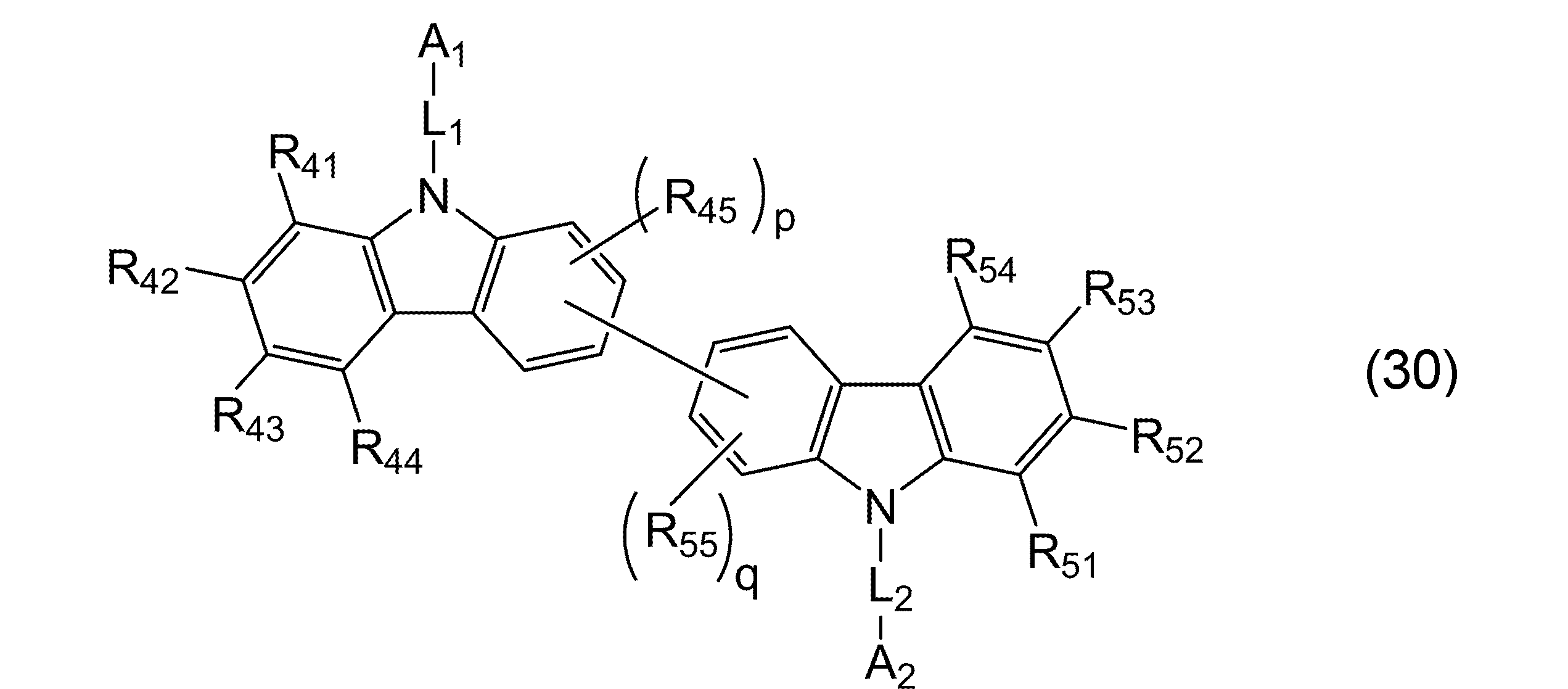
前記一般式(30)において、A1及びA2は、それぞれ独立に、置換もしくは無置換の環形成炭素数6~30の芳香族炭化水素基、又は置換もしくは無置換の環形成原子数5~30の芳香族複素環基を表す。
R41~R44の内、隣り合ういずれか2つは、下記一般式(31)で表される部分構造と結合している。R51~R54の内、隣り合ういずれか2つが、下記一般式(31)で表される部分構造と結合していてもよい。
R41~R44の内、隣り合ういずれか2つは、下記一般式(31)で表される部分構造と結合している。R51~R54の内、隣り合ういずれか2つが、下記一般式(31)で表される部分構造と結合していてもよい。

前記一般式(31)で表される部分構造と結合していないR41~R44およびR51~R54は、それぞれ独立に、水素原子、ハロゲン原子、ヒドロキシル基、シアノ基、置換もしくは無置換のアミノ基、置換もしくは無置換の炭素数1~20のアルキル基、置換もしくは無置換の炭素数1~20のアルコキシ基、置換もしくは無置換の環形成炭素数6~20のアリールオキシ基、置換もしくは無置換の環形成炭素数6~20のアリールチオ基、置換もしくは無置換の炭素数3~40のトリアルキルシリル基、置換もしくは無置換の炭素数8~50のアリールシリル基、置換もしくは無置換の環形成炭素数6~50の芳香族炭化水素基、又は置換もしくは無置換の環形成原子数5~50の複素環基である。
pおよびqは、3である。
L1及びL2は、それぞれ独立に、単結合、または2価の連結基を表す。
前記一般式(31)において、*は、前記一般式(30)で表される環構造との結合部位を表す。
Z1およびZ2は、いずれか一方が単結合であり、他方が、-O-、-S-、-CR65R66-、または-NR67-である。本実施形態では、Z1およびZ2のいずれか一方が単結合であり、他方が-O-、または-CR65R66-であることが好ましい。または、Z1およびZ2のいずれか一方が単結合であり、他方が-S-、または-NR67-であることが好ましい。
R61~R67は、それぞれ独立に、水素原子、ハロゲン原子、ヒドロキシル基、シアノ基、置換もしくは無置換のアミノ基、置換もしくは無置換の炭素数1~20のアルキル基、置換もしくは無置換の炭素数1~20のアルコキシ基、置換もしくは無置換の環形成炭素数6~20のアリールオキシ基、置換もしくは無置換の環形成炭素数6~20のアリールチオ基、置換もしくは無置換の炭素数3~40のトリアルキルシリル基、置換もしくは無置換の炭素数8~50のアリールシリル基、置換もしくは無置換の環形成炭素数6~50の芳香族炭化水素基、又は置換もしくは無置換の環形成原子数5~50の複素環基である。
pおよびqは、3である。
L1及びL2は、それぞれ独立に、単結合、または2価の連結基を表す。
前記一般式(31)において、*は、前記一般式(30)で表される環構造との結合部位を表す。
Z1およびZ2は、いずれか一方が単結合であり、他方が、-O-、-S-、-CR65R66-、または-NR67-である。本実施形態では、Z1およびZ2のいずれか一方が単結合であり、他方が-O-、または-CR65R66-であることが好ましい。または、Z1およびZ2のいずれか一方が単結合であり、他方が-S-、または-NR67-であることが好ましい。
R61~R67は、それぞれ独立に、水素原子、ハロゲン原子、ヒドロキシル基、シアノ基、置換もしくは無置換のアミノ基、置換もしくは無置換の炭素数1~20のアルキル基、置換もしくは無置換の炭素数1~20のアルコキシ基、置換もしくは無置換の環形成炭素数6~20のアリールオキシ基、置換もしくは無置換の環形成炭素数6~20のアリールチオ基、置換もしくは無置換の炭素数3~40のトリアルキルシリル基、置換もしくは無置換の炭素数8~50のアリールシリル基、置換もしくは無置換の環形成炭素数6~50の芳香族炭化水素基、又は置換もしくは無置換の環形成原子数5~50の複素環基である。
本実施形態において、前記一般式(30)で表される化合物は、下記一般式(32)で表されることが好ましい。

前記一般式(32)におけるA1,A2,L1,L2,R41~R45,R51~R55、p、q、Z1およびZ2、R61~R67は、それぞれ前記一般式(30),(31)におけるものと同義である。
本実施形態において、前記一般式(30)で表される化合物は、下記一般式(33)または下記一般式(34)で表されることが好ましい。


前記一般式(33)および前記一般式(34)におけるA1,A2,L1,L2,R41~R45,R51~R55、p、q、Z1およびZ2、R61~R67は、それぞれ前記一般式(30),(31)におけるものと同義である。
前記一般式(30)で表される化合物は、下記一般式(35),一般式(36)および一般式(37)のいずれかで表されることが好ましい。


前記一般式(35)~(37)におけるA1,A2,L1,L2,R41~R45,R51~R55、p、q、Z1およびZ2、R61~R67は、それぞれ前記一般式(30),(31)におけるものと同義である。
本実施形態において、前記一般式(35)~(37)におけるZ1が-O-、または-CR65R66-であり、Z2が単結合であることが好ましい。
あるいは、本実施形態において、前記一般式(35)~(37)におけるZ1が単結合であり、Z2が-O-、または-CR65R66-であることが好ましい。
あるいは、本実施形態において、前記一般式(35)~(37)におけるZ1が単結合であり、Z2が-O-、または-CR65R66-であることが好ましい。
本実施形態において、前記一般式(35)~(37)におけるZ1が-CR65R66-であり、Z2が単結合であることが好ましい。
本実施形態において、前記一般式(35)~(37)におけるZ1が-S-、または-NR67-であり、Z2が単結合であることが好ましい。
あるいは、前記一般式(35)~(37)におけるZ1が、単結合であり、Z2が-S-、または-NR67-であることが好ましい。
あるいは、前記一般式(35)~(37)におけるZ1が、単結合であり、Z2が-S-、または-NR67-であることが好ましい。
本実施形態において、前記A1及びA2は、それぞれ独立に、置換もしくは無置換の環形成炭素数6~30の芳香族炭化水素基であることが好ましい。
本実施形態において、前記R51~R54が、前記一般式(31)で表される部分構造と結合しない場合、前記A2は、置換もしくは無置換のフェニル基であることが好ましい。
本実施形態において、前記R51~R54が、前記一般式(31)で表される部分構造と結合しない場合、前記A2は、置換もしくは無置換のフェニル基であることが好ましい。
本実施形態において、前記A2は、置換もしくは無置換のフェニル基、置換もしくは無置換のジベンゾフラニル基、又は置換もしくは無置換のジベンゾチオフェニル基であることが好ましい。
本実施形態において、前記A2は、置換もしくは無置換のジベンゾチオフェニル基であることがより好ましく、置換もしくは無置換の2-ジベンゾチオフェニル基、または置換もしくは無置換の4-ジベンゾチオフェニル基であることがさらに好ましい。
本実施形態において、前記A2は、置換もしくは無置換のジベンゾフラニル基であることがより好ましく、置換もしくは無置換の2-ジベンゾフラニル基、または置換もしくは無置換の4-ジベンゾフラニル基であることがさらに好ましい。
本実施形態において、前記A2は、置換もしくは無置換のジベンゾチオフェニル基であることがより好ましく、置換もしくは無置換の2-ジベンゾチオフェニル基、または置換もしくは無置換の4-ジベンゾチオフェニル基であることがさらに好ましい。
本実施形態において、前記A2は、置換もしくは無置換のジベンゾフラニル基であることがより好ましく、置換もしくは無置換の2-ジベンゾフラニル基、または置換もしくは無置換の4-ジベンゾフラニル基であることがさらに好ましい。
本実施形態において、前記L2は、置換もしくは無置換のフェニレン基であることが好ましく、置換もしくは無置換のm-フェニレン基、または置換もしくは無置換のp-フェニレン基であることがより好ましく、置換もしくは無置換のm-フェニレン基であることがさらに好ましい。
本実施形態において、前記A2が置換もしくは無置換の2-ジベンゾチオフェニル基、または置換もしくは無置換の4-ジベンゾチオフェニル基であり、前記L2は、置換もしくは無置換のm-フェニレン基、または置換もしくは無置換のp-フェニレン基であることが好ましい。前記A2が置換もしくは無置換の4-ジベンゾチオフェニル基であり、前記L2は、置換もしくは無置換のm-フェニレン基であることがより好ましい。
本実施形態において、前記A2が置換もしくは無置換の2-ジベンゾチオフェニル基、または置換もしくは無置換の4-ジベンゾチオフェニル基であり、前記L2は、置換もしくは無置換のm-フェニレン基、または置換もしくは無置換のp-フェニレン基であることが好ましい。前記A2が置換もしくは無置換の4-ジベンゾチオフェニル基であり、前記L2は、置換もしくは無置換のm-フェニレン基であることがより好ましい。
本実施形態において、前記L2は、単結合であることが好ましい。
本実施形態において、前記A2が、置換もしくは無置換の2-ジベンゾチオフェニル基、または置換もしくは無置換の4-ジベンゾチオフェニル基であり、前記L2が、単結合であることが好ましい。前記A2が、置換もしくは無置換の4-ジベンゾチオフェニル基であり、前記L2が、単結合であることがより好ましい。
本実施形態において、前記A2が、置換もしくは無置換の2-ジベンゾチオフェニル基、または置換もしくは無置換の4-ジベンゾチオフェニル基であり、前記L2が、単結合であることが好ましい。前記A2が、置換もしくは無置換の4-ジベンゾチオフェニル基であり、前記L2が、単結合であることがより好ましい。
本実施形態の正孔輸送層に含まれる化合物としては、例えば、下記のような化合物が挙げられるが、本発明は、この具体例に限定されない。

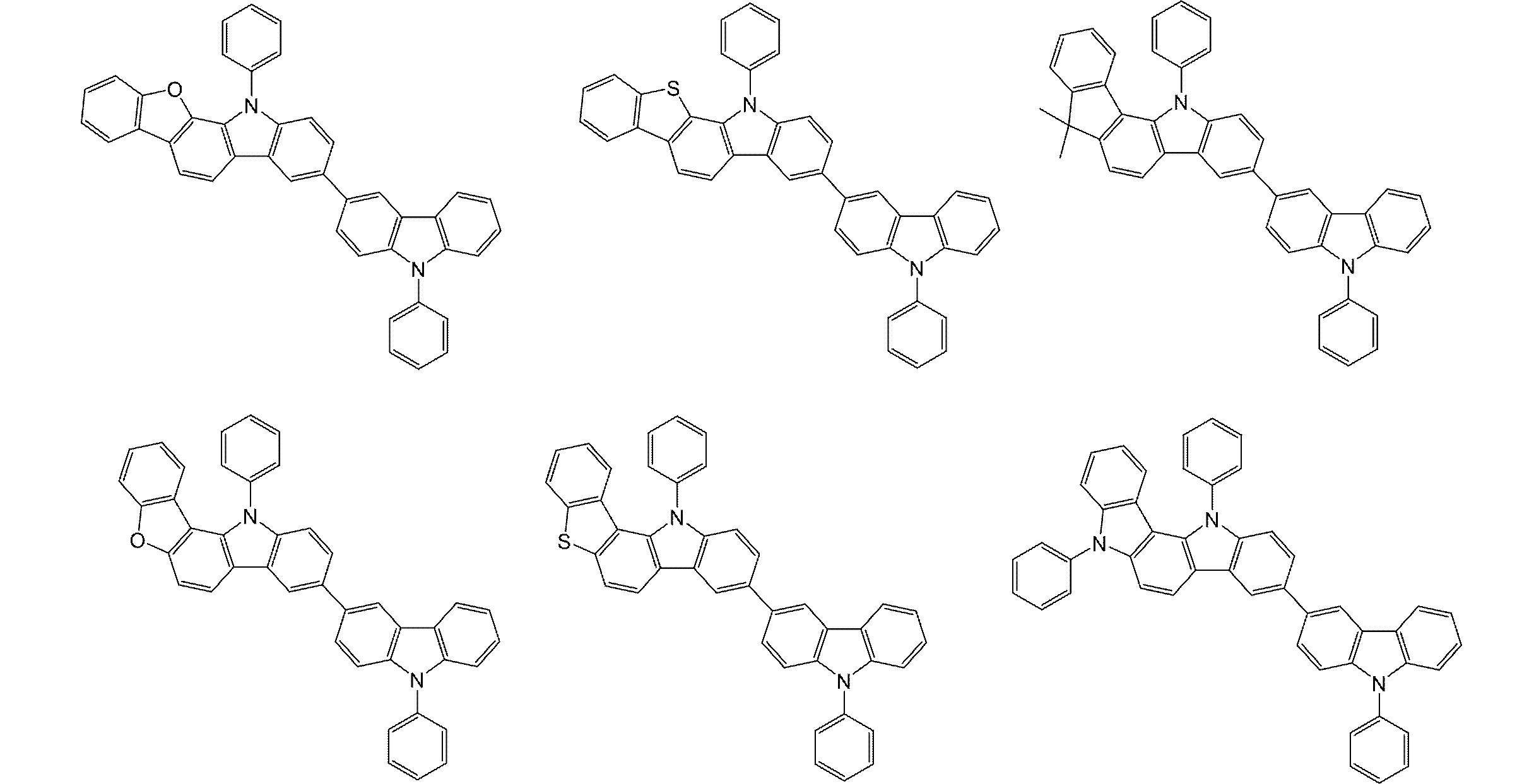

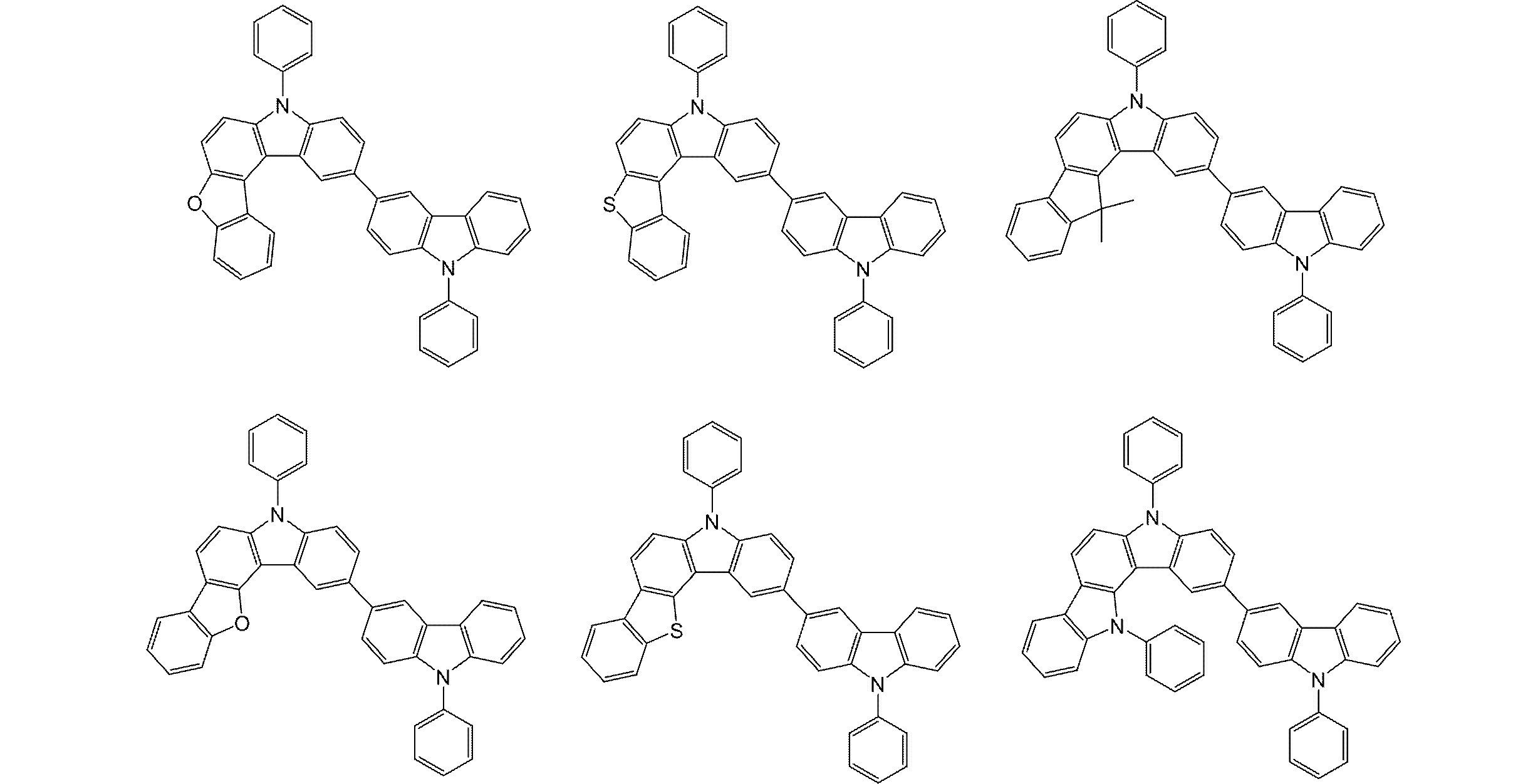
(発光層)
本実施形態の前記発光層は、下記一般式(2A)で表される化合物、および発光材料を含む。
本実施形態の前記発光層は、下記一般式(2A)で表される化合物、および発光材料を含む。
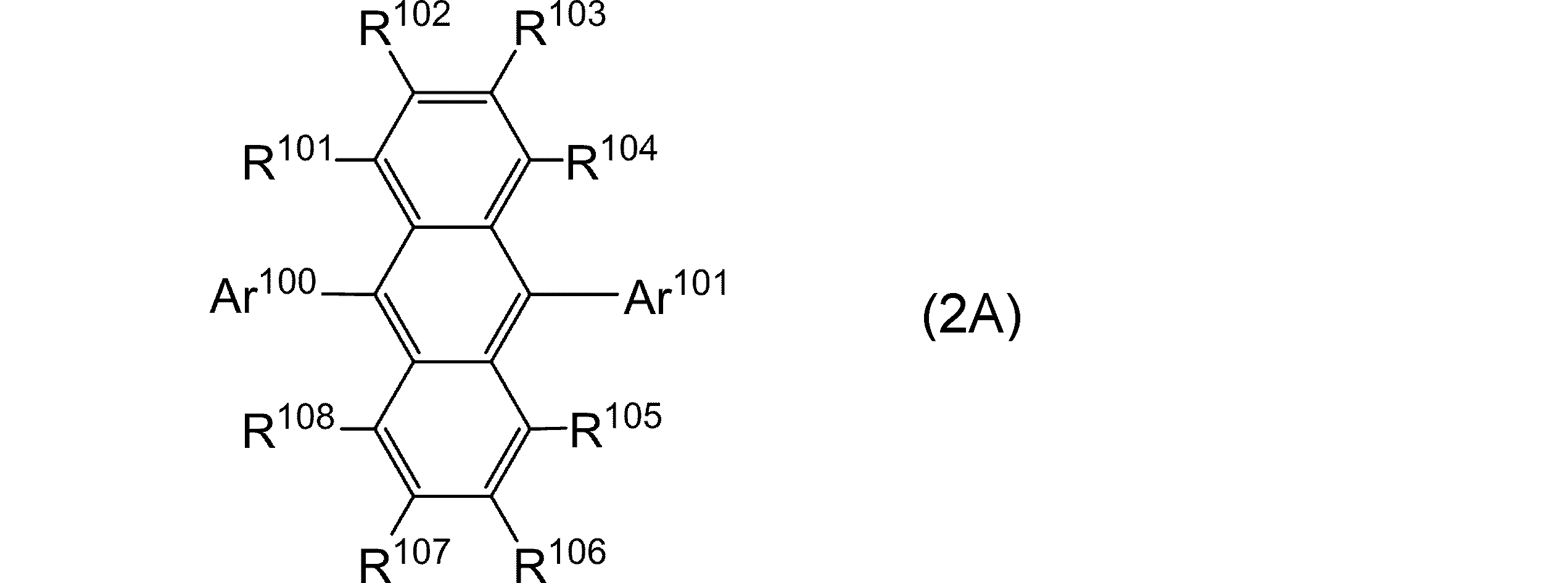
前記一般式(2A)において、R101~R108は、それぞれ独立に、水素原子、ハロゲン原子、ヒドロキシル基、シアノ基、置換もしくは無置換のアミノ基、置換もしくは無置換の炭素数1~20のアルキル基、置換もしくは無置換の炭素数1~20のアルコキシ基、置換もしくは無置換の環形成炭素数6~20のアリールオキシ基、置換もしくは無置換の環形成炭素数6~20のアリールチオ基、置換もしくは無置換の炭素数3~40のトリアルキルシリル基、又は置換もしくは無置換の炭素数8~50のアリールシリル基である。
Ar101およびAr101は、それぞれ独立に、置換または無置換の環形成炭素数6~30の芳香族炭化水素基、又は、置換または無置換の環形成原子数5~30の複素環基である。
Ar101およびAr101は、それぞれ独立に、置換または無置換の環形成炭素数6~30の芳香族炭化水素基、又は、置換または無置換の環形成原子数5~30の複素環基である。
本実施形態の発光層において、第1実施形態で説明した化合物を用いることもできる。
本実施形態において、ホスト材料は、下記一般式(3)、下記一般式(4)、又は下記一般式(5)で表される化合物であることが好ましい。
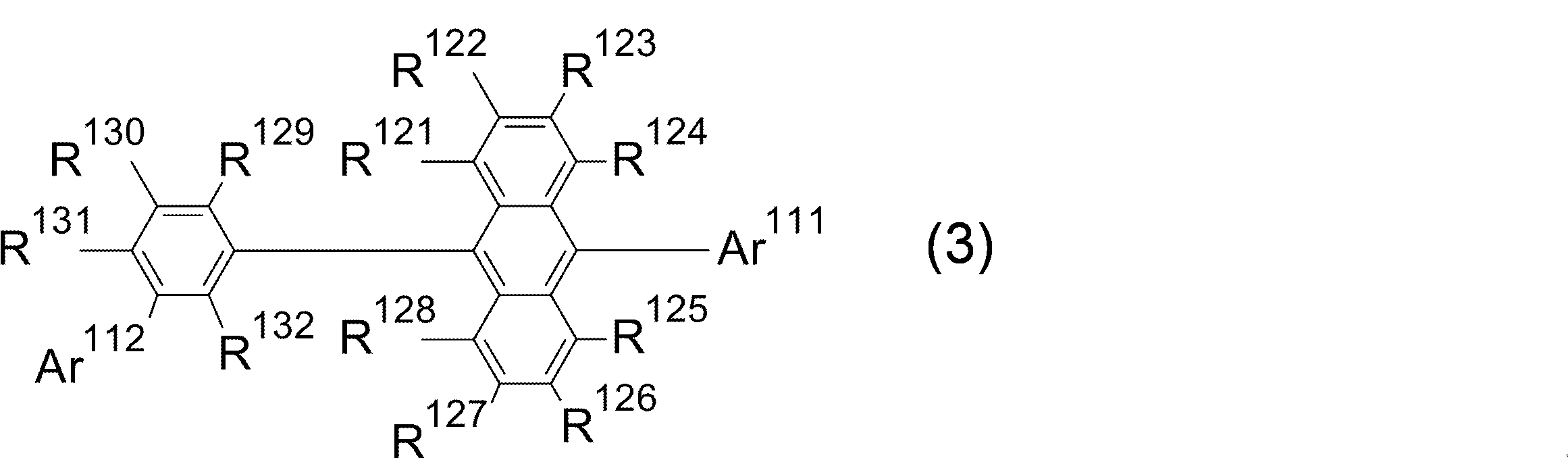
前記一般式(3)において、Ar111およびAr112は、それぞれ独立に、置換もしくは無置換の環形成炭素数6~30の芳香族炭化水素基、又は、置換もしくは無置換の環形成原子数5~30の複素環基である。
前記一般式(3)において、R121~R132は、それぞれ独立に、水素原子、ハロゲン原子、ヒドロキシル基、シアノ基、置換もしくは無置換のアミノ基、置換もしくは無置換の炭素数1~20のアルキル基、置換もしくは無置換の炭素数1~20のアルコキシ基、置換もしくは無置換の環形成炭素数6~20のアリールオキシ基、置換もしくは無置換の環形成炭素数6~20のアリールチオ基、置換もしくは無置換の炭素数3~40のトリアルキルシリル基、又は置換もしくは無置換の炭素数8~50のアリールシリル基である。
前記一般式(3)において、R121~R132は、それぞれ独立に、水素原子、ハロゲン原子、ヒドロキシル基、シアノ基、置換もしくは無置換のアミノ基、置換もしくは無置換の炭素数1~20のアルキル基、置換もしくは無置換の炭素数1~20のアルコキシ基、置換もしくは無置換の環形成炭素数6~20のアリールオキシ基、置換もしくは無置換の環形成炭素数6~20のアリールチオ基、置換もしくは無置換の炭素数3~40のトリアルキルシリル基、又は置換もしくは無置換の炭素数8~50のアリールシリル基である。
本実施形態において、前記一般式(3)における前記Ar111および前記Ar112が、ナフチル基であることが好ましい。前記一般式(3)における前記Ar111および前記Ar112が、2-ナフチル基であること、もしくは前記Ar111が、1-ナフチル基であり、前記Ar112が、2-ナフチル基であることがより好ましい。
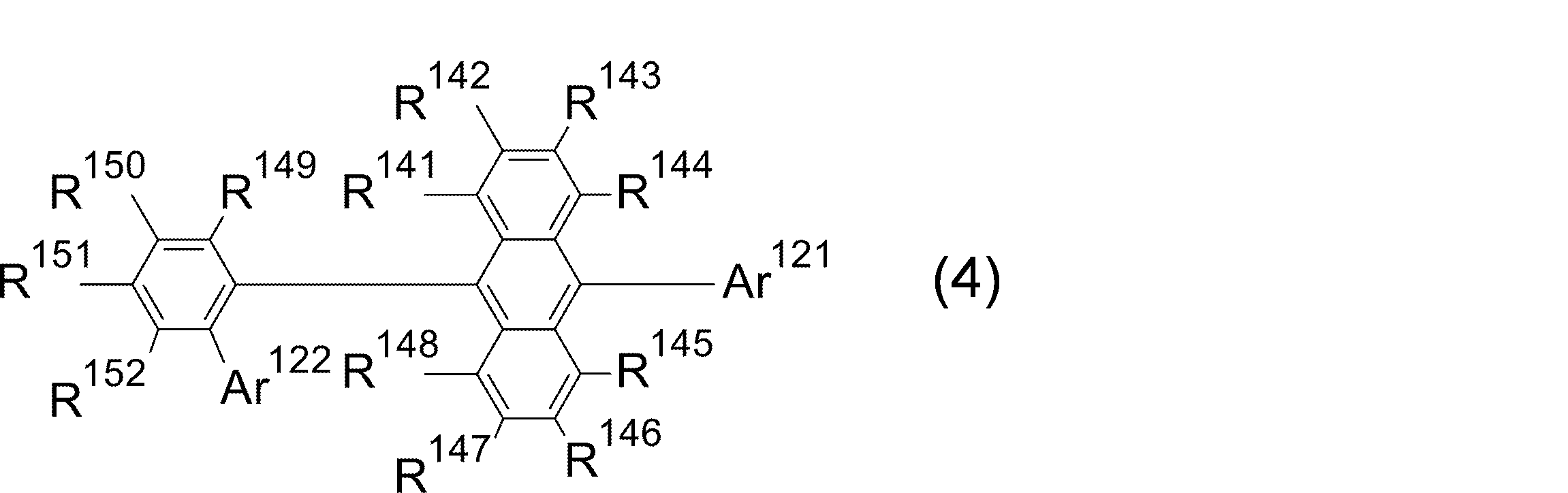
前記一般式(4)において、Ar121およびAr122は、それぞれ独立に、置換もしくは無置換の環形成炭素数6~30の芳香族炭化水素基、又は、置換もしくは無置換の環形成原子数5~30の複素環基である。
前記一般式(4)において、R141~R152は、それぞれ独立に、水素原子、ハロゲン原子、ヒドロキシル基、シアノ基、置換もしくは無置換のアミノ基、置換もしくは無置換の炭素数1~20のアルキル基、置換もしくは無置換の炭素数1~20のアルコキシ基、置換もしくは無置換の環形成炭素数6~20のアリールオキシ基、置換もしくは無置換の環形成炭素数6~20のアリールチオ基、置換もしくは無置換の炭素数3~40のトリアルキルシリル基、又は置換もしくは無置換の炭素数8~50のアリールシリル基である。
前記一般式(4)において、R141~R152は、それぞれ独立に、水素原子、ハロゲン原子、ヒドロキシル基、シアノ基、置換もしくは無置換のアミノ基、置換もしくは無置換の炭素数1~20のアルキル基、置換もしくは無置換の炭素数1~20のアルコキシ基、置換もしくは無置換の環形成炭素数6~20のアリールオキシ基、置換もしくは無置換の環形成炭素数6~20のアリールチオ基、置換もしくは無置換の炭素数3~40のトリアルキルシリル基、又は置換もしくは無置換の炭素数8~50のアリールシリル基である。

前記一般式(5)において、Ar131は、置換もしくは無置換のフェニル基であり、Ar132は、置換もしくは無置換の環形成炭素数6~30の芳香族炭化水素基、又は置換もしくは無置換の環形成原子数5~30である。
R161~R172は、それぞれ独立に、水素原子、ハロゲン原子、ヒドロキシル基、シアノ基、置換もしくは無置換のアミノ基、置換もしくは無置換の炭素数1~20のアルキル基、置換もしくは無置換の炭素数1~20のアルコキシ基、置換もしくは無置換の環形成炭素数6~20のアリールオキシ基、置換もしくは無置換の環形成炭素数6~20のアリールチオ基、置換もしくは無置換の炭素数3~40のトリアルキルシリル基、又は置換もしくは無置換の炭素数8~50のアリールシリル基である。
R161~R172は、それぞれ独立に、水素原子、ハロゲン原子、ヒドロキシル基、シアノ基、置換もしくは無置換のアミノ基、置換もしくは無置換の炭素数1~20のアルキル基、置換もしくは無置換の炭素数1~20のアルコキシ基、置換もしくは無置換の環形成炭素数6~20のアリールオキシ基、置換もしくは無置換の環形成炭素数6~20のアリールチオ基、置換もしくは無置換の炭素数3~40のトリアルキルシリル基、又は置換もしくは無置換の炭素数8~50のアリールシリル基である。
本実施形態において、前記一般式(5)における前記Ar131および前記Ar132が、ナフチル基であることが好ましい。さらには、前記Ar131が、2-ナフチル基であり、前記Ar132が、1-ナフチル基であるか、もしくは、前記Ar131が、2-ナフチル基であり、前記Ar132が、1-ナフチル基であることがより好ましい。
本実施形態の発光層に含まれる前記化合物における環形成炭素数6~30の芳香族炭化水素基としては、前記実施形態で例示した芳香族炭化水素基が挙げられる。これらの中でも、置換もしくは無置換のフェニル基、置換もしくは無置換のビフェニル基、置換もしくは無置換のナフチル基、置換もしくは無置換のフェナントリル基が特に好ましく、より具体的には、フェニル基、2-ビフェニルイル基、3-ビフェニルイル基、4-ビフェニルイル基、1-ナフチル基、2-ナフチル基、9-フェナントリル基が好ましい。
本実施形態の発光層に含まれる前記一般式(2A)で表される化合物における環形成原子数5~30の複素環基としては、前記実施形態で例示した芳香族複素環基が挙げられる。
本実施形態の発光層に含まれる前記一般式(2A)で表される化合物における炭素数1~20のアルキル基としては、前記実施形態で例示したアルキル基が挙げられる。
本実施形態の発光層に含まれる前記一般式(2A)で表される化合物における直鎖または分岐鎖のアルキル基の炭素数は、1~10であることが好ましく、1~6であることがさらに好ましい。前記直鎖または分岐鎖のアルキル基の中でもメチル基、エチル基、プロピル基、イソプロピル基、n-ブチル基、s-ブチル基、イソブチル基、t-ブチル基、n-ペンチル基、n-ヘキシル基が好ましい。
本実施形態の発光層に含まれる前記一般式(2A)で表される化合物におけるシクロアルキル基の環形成炭素数は、3~10であることが好ましく、5~8であることがさらに好ましい。前記シクロアルキル基の中でも、シクロペンチル基やシクロヘキシル基が好ましい。
本実施形態の発光層に含まれる前記一般式(2A)で表される化合物における炭素数1~20のアルコキシ基としては、前記実施形態で例示したアルコキシ基が挙げられる。
本実施形態の発光層に含まれる前記一般式(2A)で表される化合物における環形成炭素数6~30のアリールオキシ基としては、前記実施形態で例示したアリールオキシ基が挙げられる。
本実施形態の発光層に含まれる前記一般式(2A)で表される化合物における環形成炭素数6~30のアリールチオ基としては、前記実施形態で例示したアリールチオ基が挙げられる。
本実施形態の発光層に含まれる前記一般式(2A)で表される化合物における炭素数3~40のトリアルキルシリル基としては、前記実施形態で例示したトリアルキルシリル基が挙げられる。
本実施形態の発光層に含まれる前記一般式(2A)で表される化合物における炭素数8~60のアリールシリル基としては、ジアルキルアリールシリル基、アルキルジアリールシリル基、またはトリアリールシリル基が挙げられる。
本実施形態の発光層に含まれる前記一般式(2A)で表される化合物における炭素数8~50のジアルキルアリールシリル基としては、例えば、前記炭素数1~20のアルキル基で例示したアルキル基を2つ有し、前記環形成炭素数6~20の芳香族炭化水素基を1つ有するジアルキルアリールシリル基が挙げられる。ジアルキルアリールシリル基の炭素数は、8~30であることが好ましい。ジアルキルアリールシリル基における2つのアルキル基は、それぞれ同一でも異なっていてもよい。
本実施形態の発光層に含まれる前記一般式(2A)で表される化合物における炭素数13~50のアルキルジアリールシリル基としては、例えば、前記炭素数1~20のアルキル基で例示したアルキル基を1つ有し、前記環形成炭素数6~20の芳香族炭化水素基を2つ有するアルキルジアリールシリル基が挙げられる。アルキルジアリールシリル基の炭素数は、13~30であることが好ましい。アルキルジアリールシリル基において、2つのアリール基は、それぞれ同一でも異なっていてもよい。
本実施形態の発光層に含まれる前記一般式(2A)で表される化合物における炭素数18~60のトリアリールシリル基としては、例えば、前記環形成炭素数6~30の芳香族炭化水素基を3つ有するトリアリールシリル基が挙げられる。トリアリールシリル基の炭素数は、18~30であることが好ましい。トリアリールシリル基において、3つの芳香族炭化水素基は、それぞれ同一でも異なっていてもよい。
本実施形態の発光層に含まれる前記一般式(2A)で表される化合物における炭素数8~50のジアルキルアリールシリル基としては、例えば、前記炭素数1~20のアルキル基で例示したアルキル基を2つ有し、前記環形成炭素数6~20の芳香族炭化水素基を1つ有するジアルキルアリールシリル基が挙げられる。ジアルキルアリールシリル基の炭素数は、8~30であることが好ましい。ジアルキルアリールシリル基における2つのアルキル基は、それぞれ同一でも異なっていてもよい。
本実施形態の発光層に含まれる前記一般式(2A)で表される化合物における炭素数13~50のアルキルジアリールシリル基としては、例えば、前記炭素数1~20のアルキル基で例示したアルキル基を1つ有し、前記環形成炭素数6~20の芳香族炭化水素基を2つ有するアルキルジアリールシリル基が挙げられる。アルキルジアリールシリル基の炭素数は、13~30であることが好ましい。アルキルジアリールシリル基において、2つのアリール基は、それぞれ同一でも異なっていてもよい。
本実施形態の発光層に含まれる前記一般式(2A)で表される化合物における炭素数18~60のトリアリールシリル基としては、例えば、前記環形成炭素数6~30の芳香族炭化水素基を3つ有するトリアリールシリル基が挙げられる。トリアリールシリル基の炭素数は、18~30であることが好ましい。トリアリールシリル基において、3つの芳香族炭化水素基は、それぞれ同一でも異なっていてもよい。
本実施形態の発光層に含まれる前記一般式(2A)で表される化合物の具体例としては、第1実施形態で説明した化合物に加えて、次に示す化合物が挙げられる。
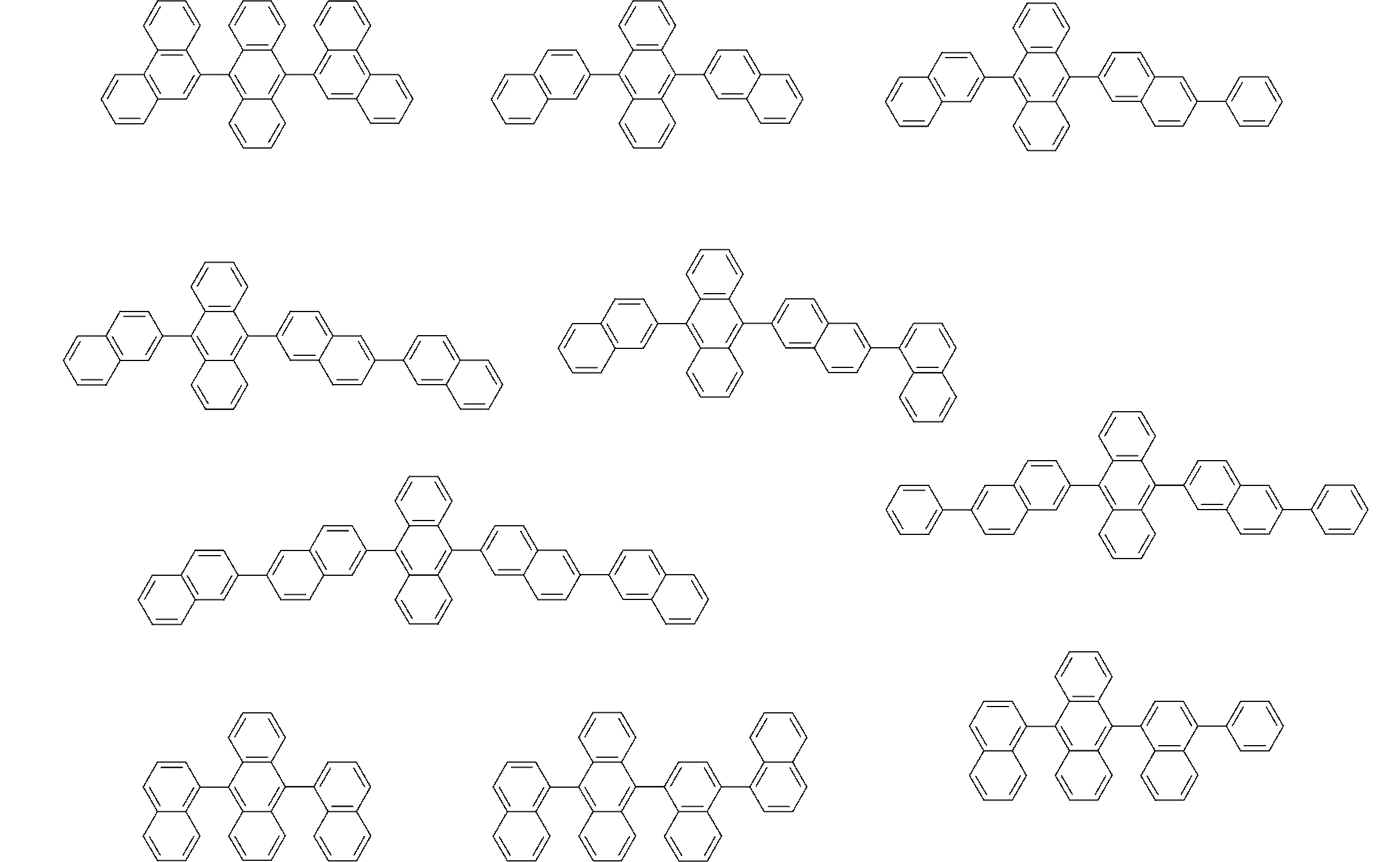
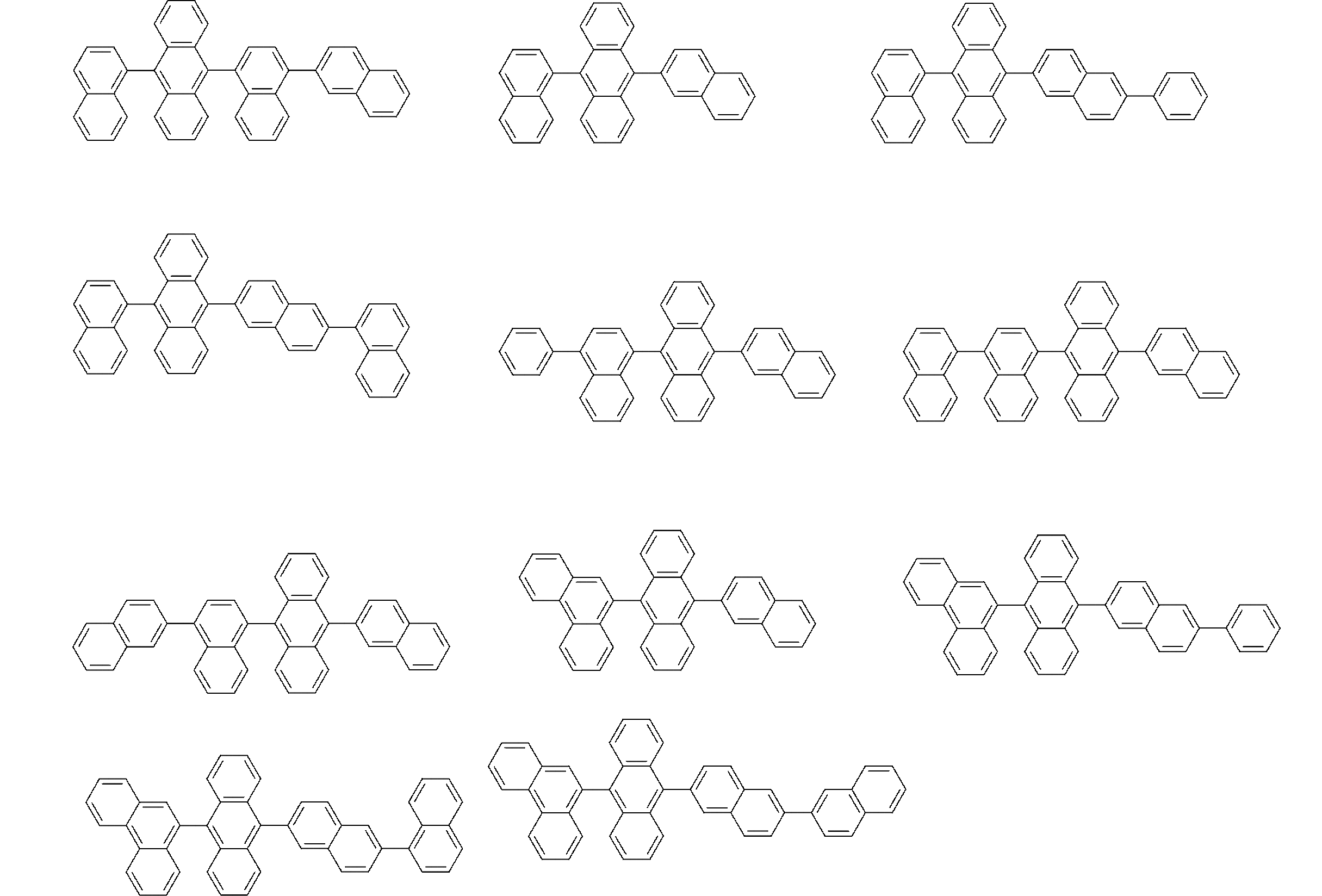

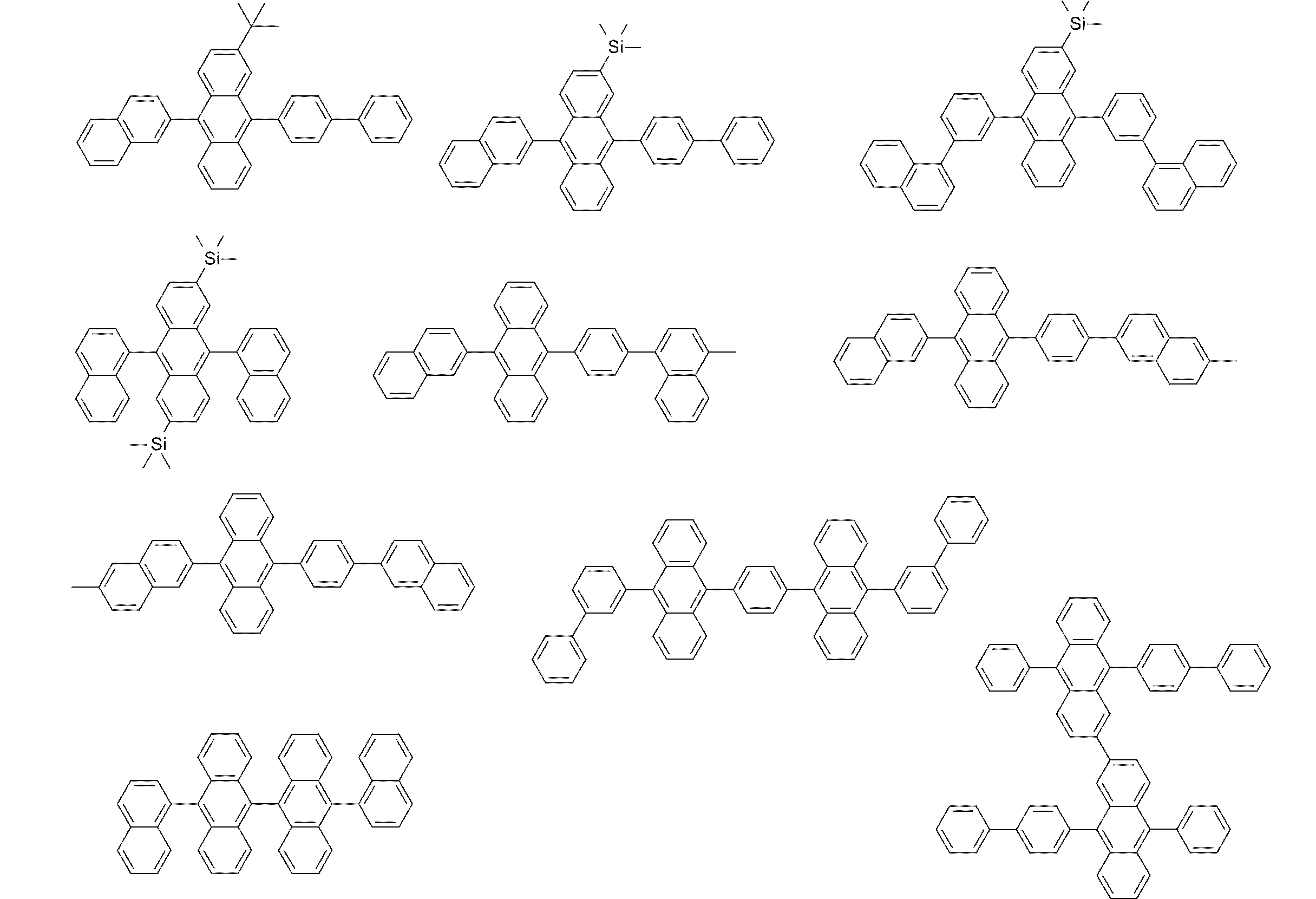


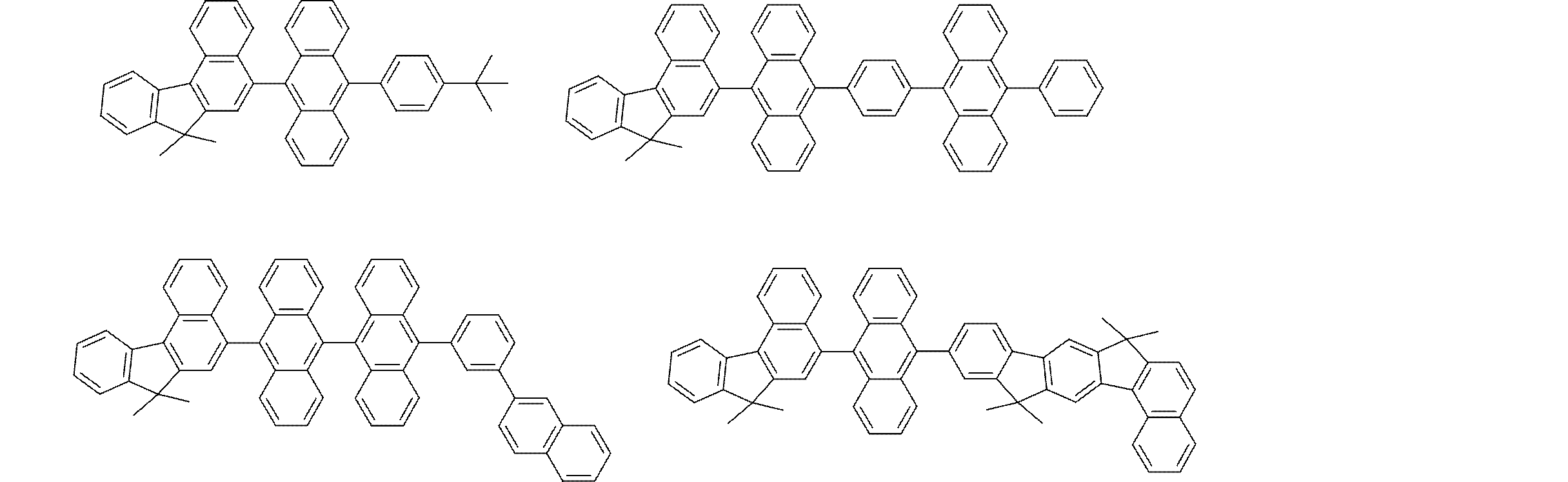
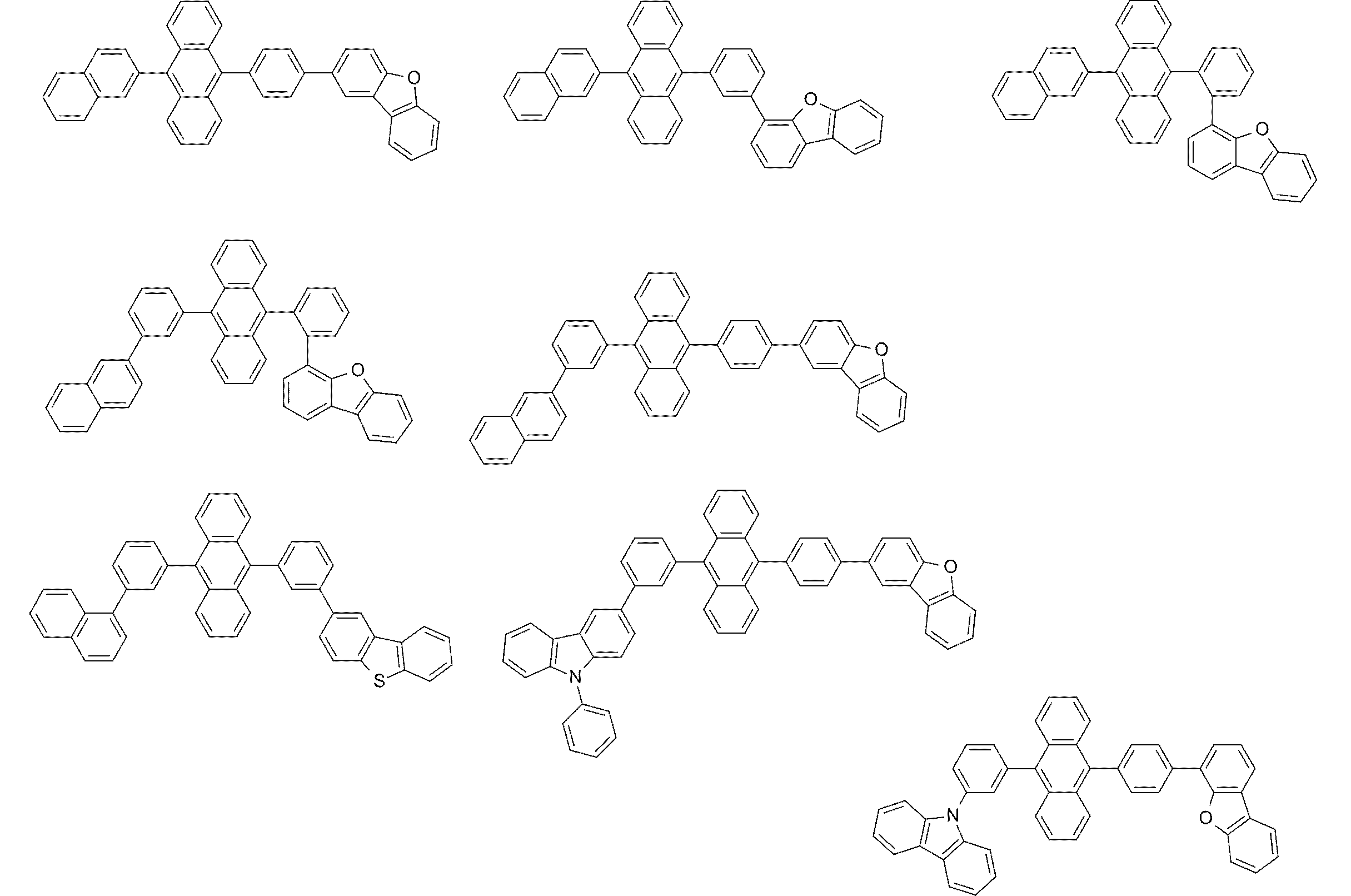
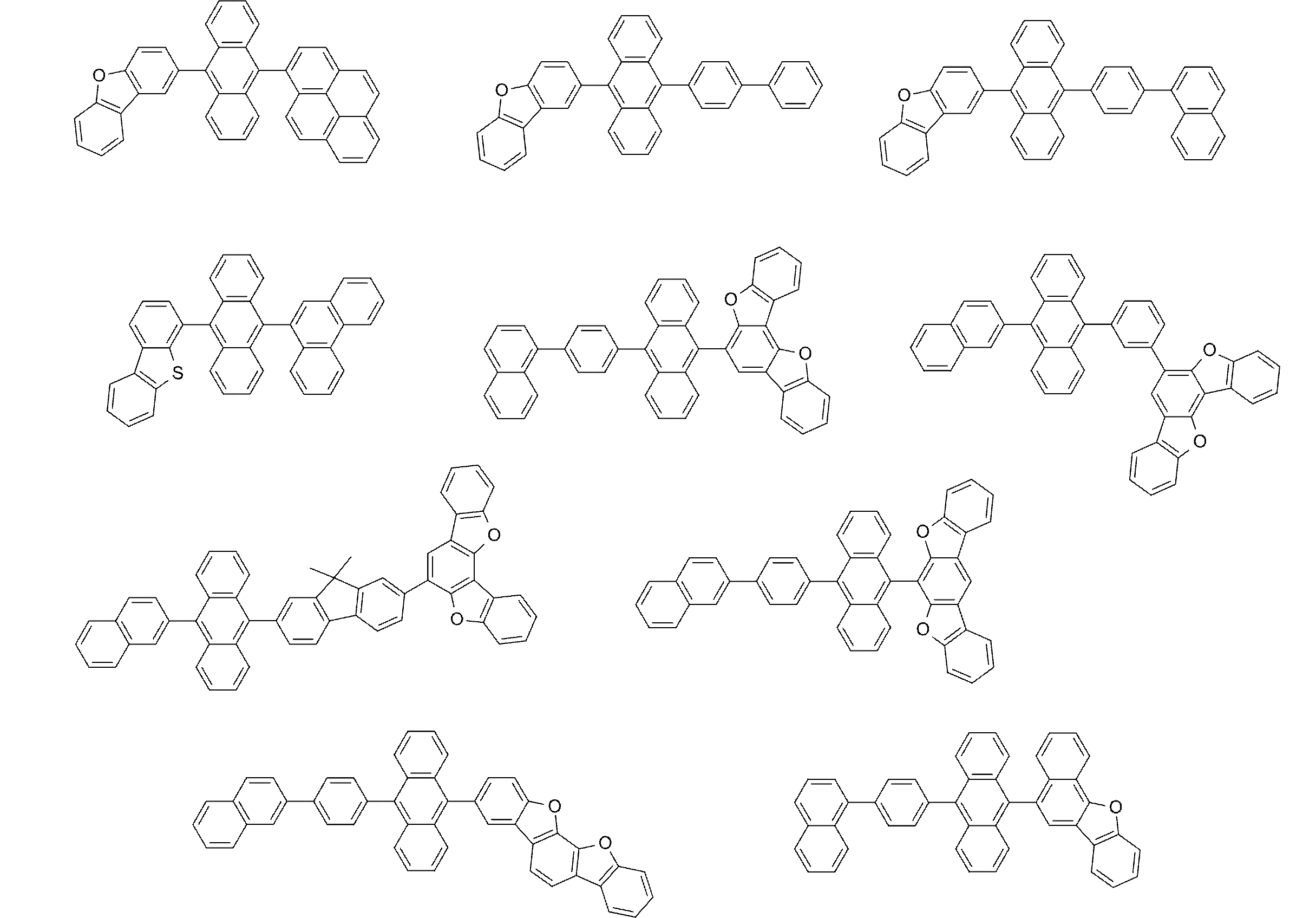
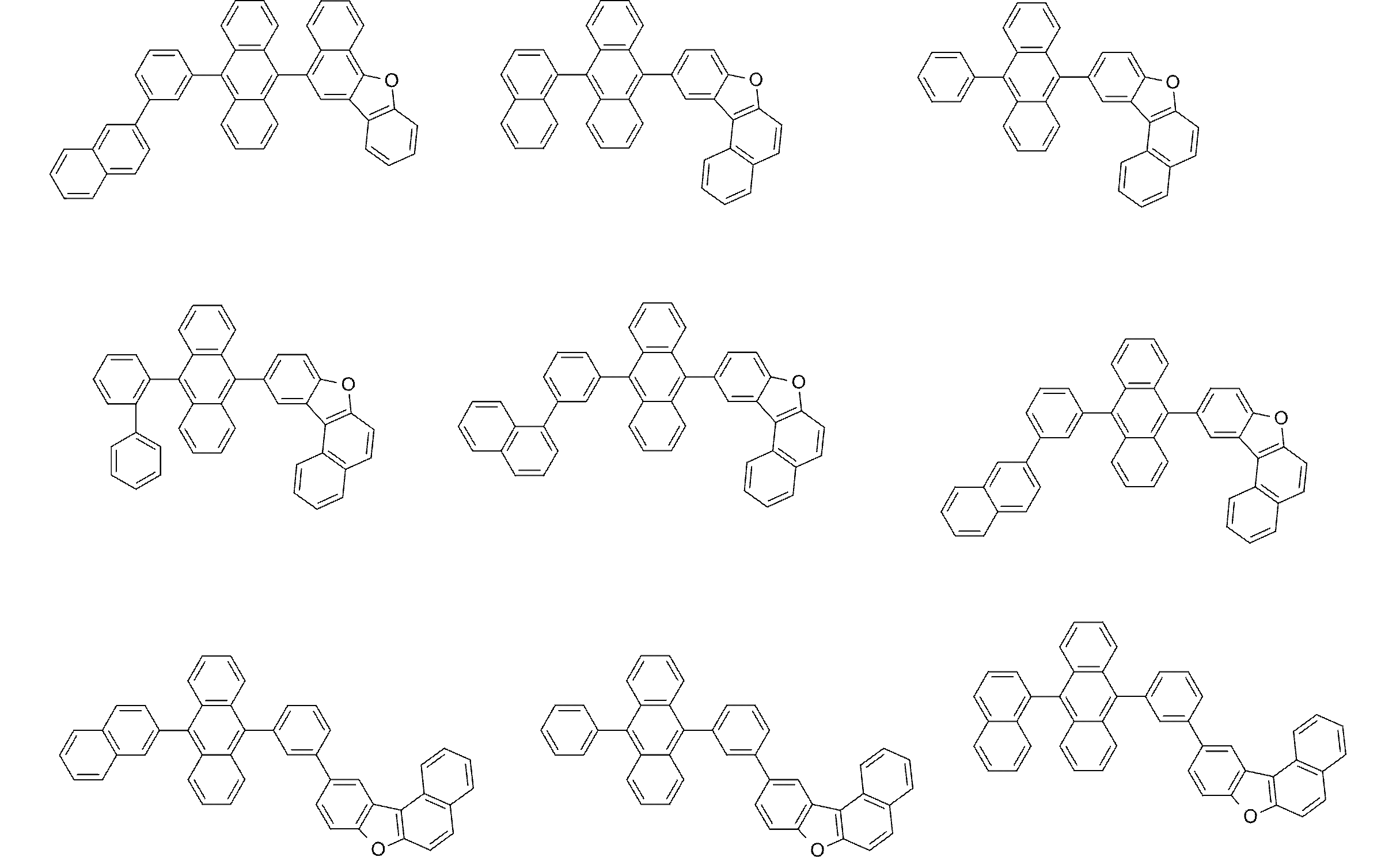
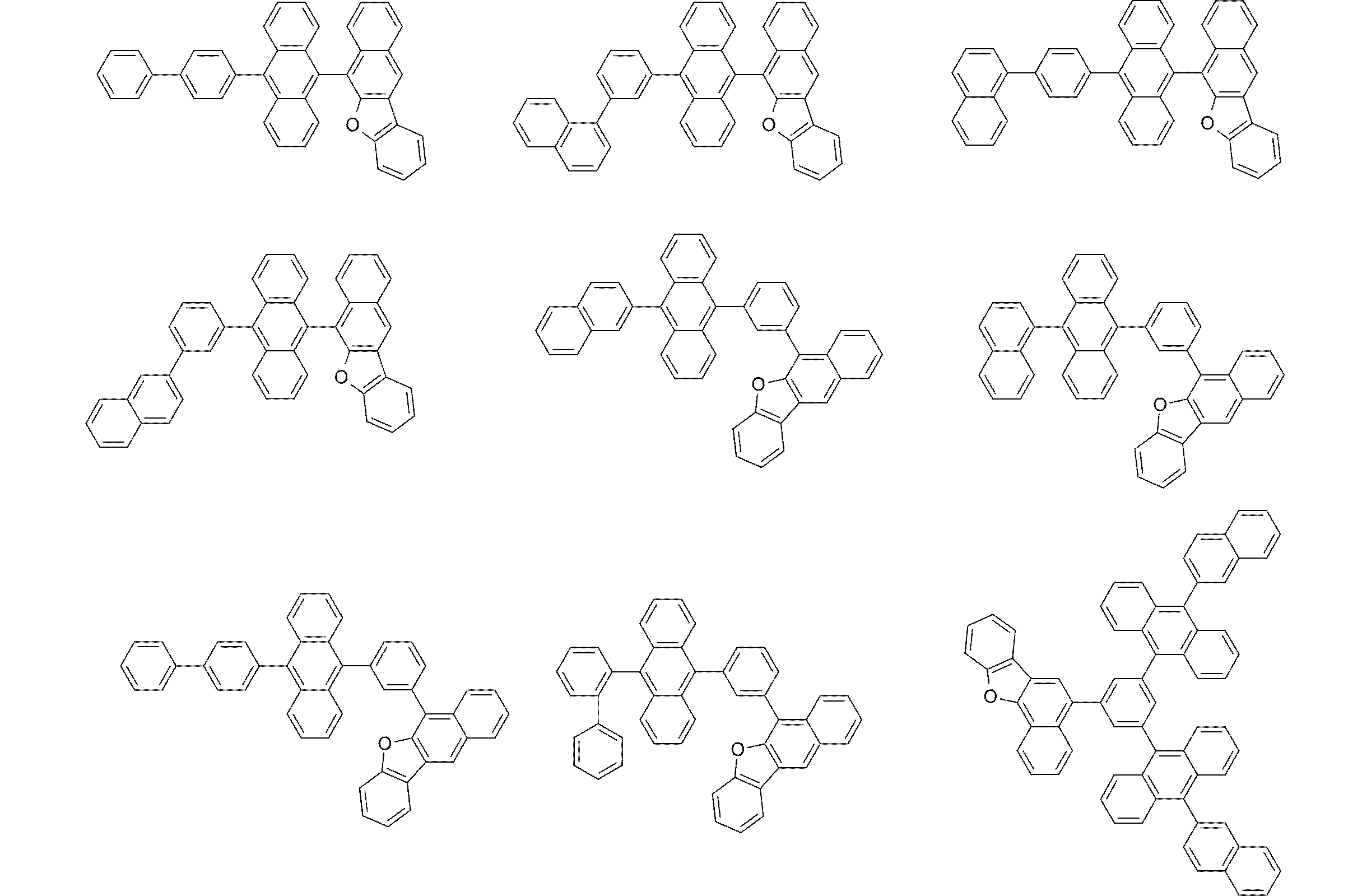
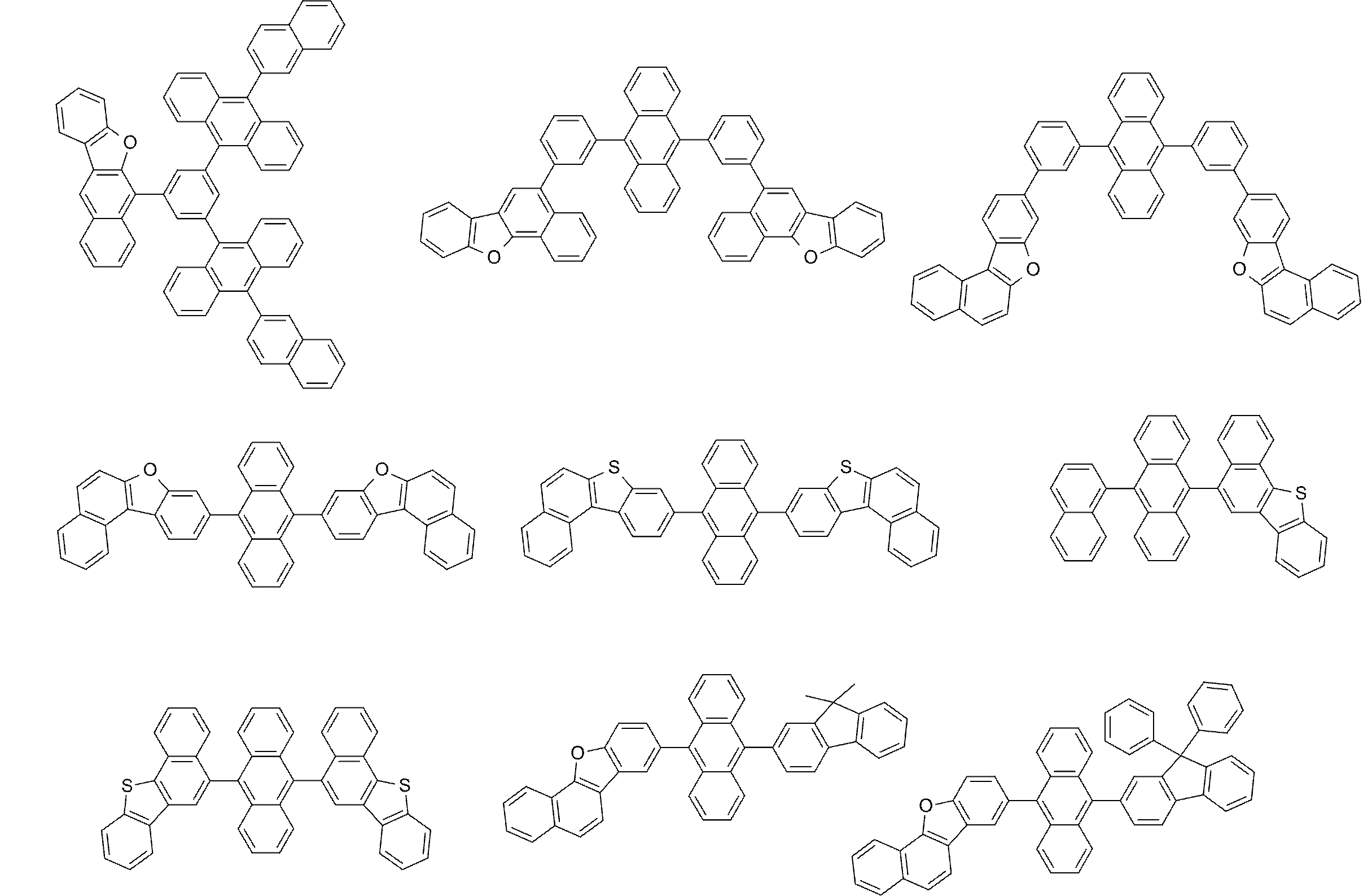


本実施形態では、発光材料として、第1実施形態で説明した発光材料を用いることができる。
[実施形態の変形]
なお、本発明は、上述の実施形態に限定されるものではなく、本発明の目的を達成できる範囲での変更、改良などは、本発明に含まれるものである。
なお、本発明は、上述の実施形態に限定されるものではなく、本発明の目的を達成できる範囲での変更、改良などは、本発明に含まれるものである。
発光層は、1層に限られず、複数の発光層が積層されていてもよい。有機EL素子が複数の発光層を有する場合、少なくとも1つの発光層が、前記実施形態で説明した正孔輸送層に含まれる化合物と、発光層に含まれる化合物との組み合わせであればよく、その他の発光層が蛍光発光型の発光層であっても、燐光発光型の発光層であってもよい。
また、有機EL素子が複数の発光層を有する場合、これらの発光層が互いに隣接して設けられていてもよいし、中間層を介して複数の発光ユニットが積層された、いわゆるタンデム型の有機EL素子であってもよい。
また、有機EL素子が複数の発光層を有する場合、これらの発光層が互いに隣接して設けられていてもよいし、中間層を介して複数の発光ユニットが積層された、いわゆるタンデム型の有機EL素子であってもよい。
その他の前記実施形態で説明した化合物についても、合成目的となる化合物に即した原料を用いることにより、下記実施例で説明する合成法に準じて合成することができる。
本発明では、前記発光層が電荷注入補助材を含有していることも好ましい。
エネルギーギャップが広いホスト材料を用いて発光層を形成した場合、ホスト材料のイオン化ポテンシャル(Ip)と正孔注入・輸送層等のIpとの差が大きくなり、発光層への正孔の注入が困難となり、十分な輝度を得るための駆動電圧が上昇するおそれがある。
このような場合、発光層に、正孔注入・輸送性の電荷注入補助剤を含有させることで、発光層への正孔注入を容易にし、駆動電圧を低下させることができる。
エネルギーギャップが広いホスト材料を用いて発光層を形成した場合、ホスト材料のイオン化ポテンシャル(Ip)と正孔注入・輸送層等のIpとの差が大きくなり、発光層への正孔の注入が困難となり、十分な輝度を得るための駆動電圧が上昇するおそれがある。
このような場合、発光層に、正孔注入・輸送性の電荷注入補助剤を含有させることで、発光層への正孔注入を容易にし、駆動電圧を低下させることができる。
電荷注入補助剤としては、例えば、一般的な正孔注入・輸送材料等が利用できる。
具体例としては、トリアゾール誘導体、オキサジアゾール誘導体、イミダゾール誘導体、ポリアリールアルカン誘導体、ピラゾリン誘導体及びピラゾロン誘導体、フェニレンジアミン誘導体、アリールアミン誘導体、アミノ置換カルコン誘導体、オキサゾール誘導体、フルオレノン誘導体、ヒドラゾン誘導体、スチルベン誘導体、シラザン誘導体、ポリシラン系、アニリン系共重合体、導電性高分子オリゴマー(特にチオフェンオリゴマー)等を挙げることができる。
具体例としては、トリアゾール誘導体、オキサジアゾール誘導体、イミダゾール誘導体、ポリアリールアルカン誘導体、ピラゾリン誘導体及びピラゾロン誘導体、フェニレンジアミン誘導体、アリールアミン誘導体、アミノ置換カルコン誘導体、オキサゾール誘導体、フルオレノン誘導体、ヒドラゾン誘導体、スチルベン誘導体、シラザン誘導体、ポリシラン系、アニリン系共重合体、導電性高分子オリゴマー(特にチオフェンオリゴマー)等を挙げることができる。
正孔注入性の材料としては前記のものを挙げることができるが、ポルフィリン化合物、芳香族第三級アミン化合物及びスチリルアミン化合物、特に芳香族第三級アミン化合物が好ましい。
また、2個の縮合芳香族環を分子内に有する、例えば、4,4’-ビス(N-(1-ナフチル)-N-フェニルアミノ)ビフェニル(以下NPDと略記する)、またトリフェニルアミンユニットが3つスターバースト型に連結された4,4’,4”-トリス(N-(3-メチルフェニル)-N-フェニルアミノ)トリフェニルアミン(以下MTDATAと略記する)等を挙げることができる。
また、ヘキサアザトリフェニレン誘導体等も正孔注入性の材料として好適に用いることができる。
また、p型Si、p型SiC等の無機化合物も正孔注入材料として使用することができる。
また、ヘキサアザトリフェニレン誘導体等も正孔注入性の材料として好適に用いることができる。
また、p型Si、p型SiC等の無機化合物も正孔注入材料として使用することができる。
[電子機器]
本発明の有機EL素子は、テレビ、携帯電話、若しくはパーソナルコンピュータ等の表示装置、又は照明、若しくは車両用灯具の発光装置等の電子機器として好適に使用できる。
本発明の有機EL素子は、テレビ、携帯電話、若しくはパーソナルコンピュータ等の表示装置、又は照明、若しくは車両用灯具の発光装置等の電子機器として好適に使用できる。
次に、実施例および比較例を挙げて本発明をさらに詳しく説明するが、本発明はこれらの実施例の記載内容になんら制限されるものではない。
[合成実施例]
(化合物1の合成)
(化合物1の合成)

・中間体1-2の合成
アルゴン雰囲気下、4-ヨードブロモベンゼン(28.3g、100.0mmol)、ジベンゾフラン-4-ボロン酸(22.3g、105mmol)、テトラキス(トリフェニルフォスフィン)パラジウム(0)(2.31g、2.00mmol)にトルエン(150mL)、ジメトキシエタン(150mL)、2M濃度の炭酸ナトリウム水溶液(150mL)を加え、10時間還流させながら加熱した。
反応終了後、直ちにろ過した後、水層を除去した。有機層を硫酸ナトリウムで乾燥させた後、濃縮した。残渣をシリカゲルカラムクロマトグラフィーにて精製し、中間体1-2(26.2g、収率81%)を得た。
FD-MSの分析により、分子量322に対してm/e=322であった。
アルゴン雰囲気下、4-ヨードブロモベンゼン(28.3g、100.0mmol)、ジベンゾフラン-4-ボロン酸(22.3g、105mmol)、テトラキス(トリフェニルフォスフィン)パラジウム(0)(2.31g、2.00mmol)にトルエン(150mL)、ジメトキシエタン(150mL)、2M濃度の炭酸ナトリウム水溶液(150mL)を加え、10時間還流させながら加熱した。
反応終了後、直ちにろ過した後、水層を除去した。有機層を硫酸ナトリウムで乾燥させた後、濃縮した。残渣をシリカゲルカラムクロマトグラフィーにて精製し、中間体1-2(26.2g、収率81%)を得た。
FD-MSの分析により、分子量322に対してm/e=322であった。
・化合物1の合成
アルゴン雰囲気下、3つ口フラスコに、中間体1-2(2.36g,7.3mmol)、中間体1-1(3.0g,7.3mmol)、CuI(1.4g,7.3mmol)、りん酸三カリウム(2.3g,11mmol)、無水ジオキサン(30mL)、シクロヘキサンジアミン(0.84g,7.3mmol)の順で加えて100℃で8時間攪拌した。反応液に水を加えて固体を析出させ、この固体をヘキサン、次いでメタノールで洗浄した。さらに、得られた固体をシリカゲルカラムクロマトグラフィーにて精製し、化合物1(2.9g,収率60%)を得た。
FD-MS分析の結果、分子量650に対してm/e=650であった。
アルゴン雰囲気下、3つ口フラスコに、中間体1-2(2.36g,7.3mmol)、中間体1-1(3.0g,7.3mmol)、CuI(1.4g,7.3mmol)、りん酸三カリウム(2.3g,11mmol)、無水ジオキサン(30mL)、シクロヘキサンジアミン(0.84g,7.3mmol)の順で加えて100℃で8時間攪拌した。反応液に水を加えて固体を析出させ、この固体をヘキサン、次いでメタノールで洗浄した。さらに、得られた固体をシリカゲルカラムクロマトグラフィーにて精製し、化合物1(2.9g,収率60%)を得た。
FD-MS分析の結果、分子量650に対してm/e=650であった。
[有機EL素子の製造例]
・実施例1
25mm×75mm×厚さ1.1mmのITO透明電極付きガラス基板(ジオマティック株式会社製)をイソプロピルアルコール中で超音波洗浄を5分間行なった後、UVオゾン洗浄を30分間行った。ITO透明電極の厚さは130nmとした。
洗浄後のITO透明電極ライン付きガラス基板を真空蒸着装置の基板ホルダーに装着し、まずITO透明電極ラインが形成されている側の面上に前記透明電極を覆うようにして下記化合物(HI-1)を蒸着して膜厚5nmのHI-1膜を成膜し、正孔注入層を形成した。
次に、このHI-1膜上に、第1正孔輸送材料として下記化合物HT-1を蒸着して膜厚80nmのHT-1膜を成膜し、第1正孔輸送層を形成した。
次に、このHT-1膜上に、下記化合物HT-2(前記合成実施例1で得た化合物1)を蒸着して膜厚15nmのHT-2膜を成膜し、第2正孔輸送層を形成した。
さらに、このHT-2膜上に、化合物BH-1を蒸着し、膜厚25nmの発光層を成膜した。同時に蛍光発光材料として下記化合物(BD1)を共蒸着した。化合物BD1の濃度は5.0質量%であった。この共蒸着膜は発光層として機能する。
そして、この発光層の上に、下記化合物ET-1蒸着して膜厚20nmのET-1膜を成膜し、第1電子輸送層を形成した。
次に、このET-1膜上に、下記化合物ET-2を蒸着して膜厚5nmのET-2膜を成膜し、第2電子輸送層を形成した。
次に、このET-2膜上に、LiFを成膜速度0.1オングストローム/minで蒸着して膜厚1nmのLiF膜を成膜し、電子注入性電極(陰極)を形成した。
そして、このLiF膜上に金属Alを蒸着して膜厚80nmの金属Al膜を成膜し、金属Al陰極を形成した。
・実施例1
25mm×75mm×厚さ1.1mmのITO透明電極付きガラス基板(ジオマティック株式会社製)をイソプロピルアルコール中で超音波洗浄を5分間行なった後、UVオゾン洗浄を30分間行った。ITO透明電極の厚さは130nmとした。
洗浄後のITO透明電極ライン付きガラス基板を真空蒸着装置の基板ホルダーに装着し、まずITO透明電極ラインが形成されている側の面上に前記透明電極を覆うようにして下記化合物(HI-1)を蒸着して膜厚5nmのHI-1膜を成膜し、正孔注入層を形成した。
次に、このHI-1膜上に、第1正孔輸送材料として下記化合物HT-1を蒸着して膜厚80nmのHT-1膜を成膜し、第1正孔輸送層を形成した。
次に、このHT-1膜上に、下記化合物HT-2(前記合成実施例1で得た化合物1)を蒸着して膜厚15nmのHT-2膜を成膜し、第2正孔輸送層を形成した。
さらに、このHT-2膜上に、化合物BH-1を蒸着し、膜厚25nmの発光層を成膜した。同時に蛍光発光材料として下記化合物(BD1)を共蒸着した。化合物BD1の濃度は5.0質量%であった。この共蒸着膜は発光層として機能する。
そして、この発光層の上に、下記化合物ET-1蒸着して膜厚20nmのET-1膜を成膜し、第1電子輸送層を形成した。
次に、このET-1膜上に、下記化合物ET-2を蒸着して膜厚5nmのET-2膜を成膜し、第2電子輸送層を形成した。
次に、このET-2膜上に、LiFを成膜速度0.1オングストローム/minで蒸着して膜厚1nmのLiF膜を成膜し、電子注入性電極(陰極)を形成した。
そして、このLiF膜上に金属Alを蒸着して膜厚80nmの金属Al膜を成膜し、金属Al陰極を形成した。
有機EL素子の製造に用いた化合物を以下に示す。

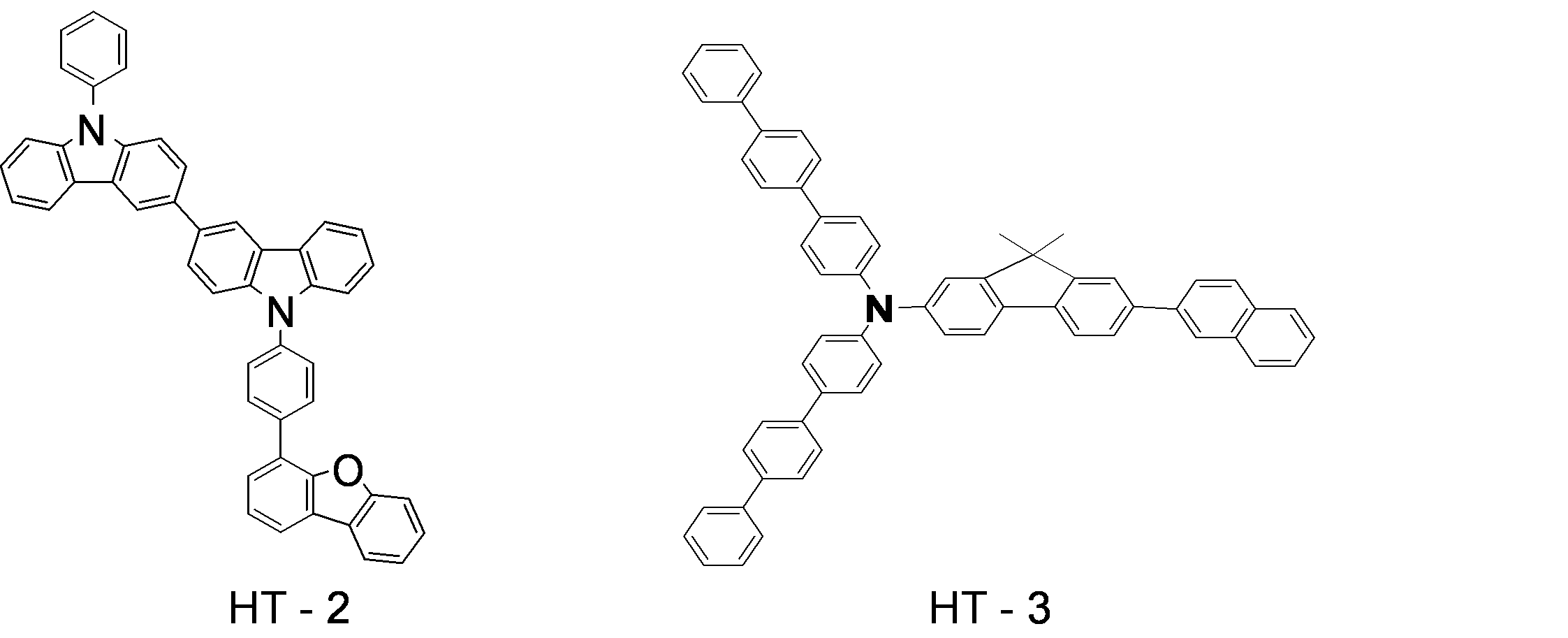
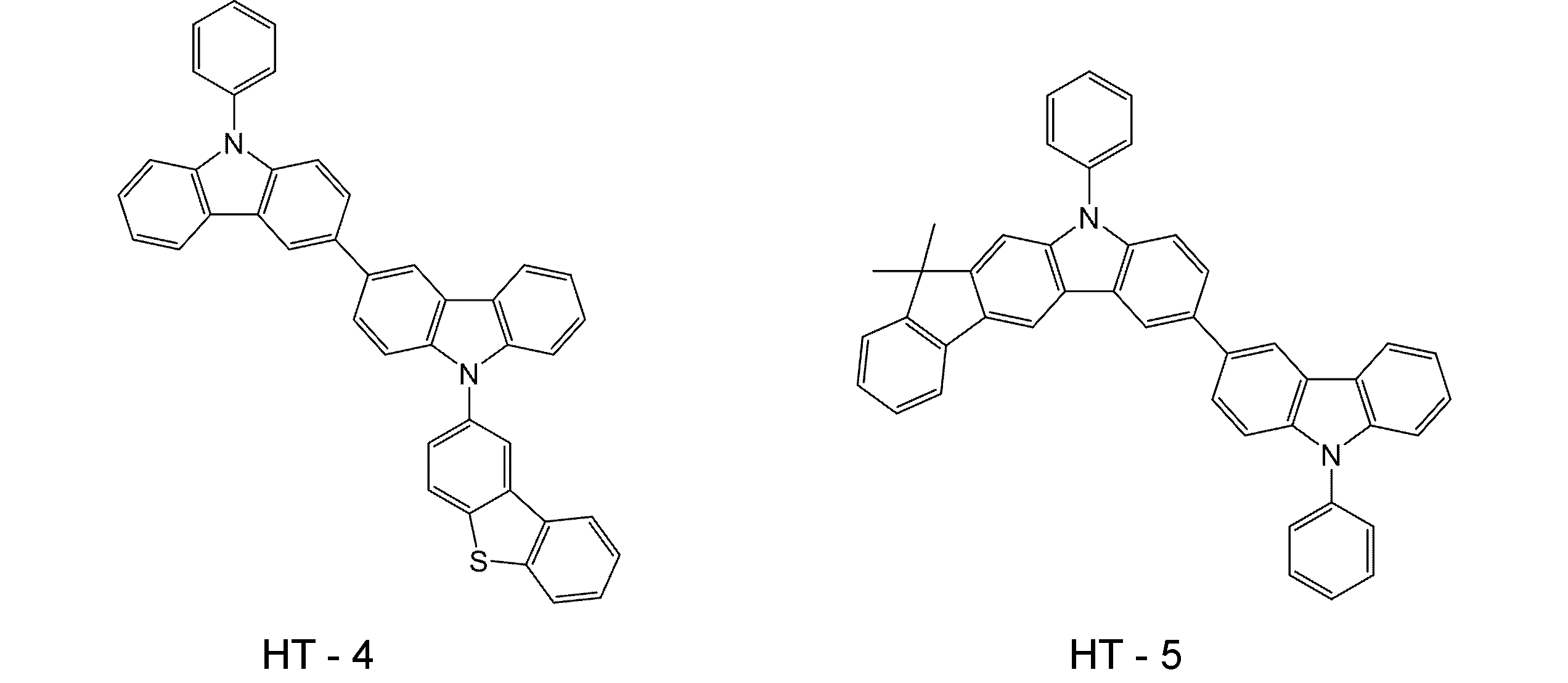


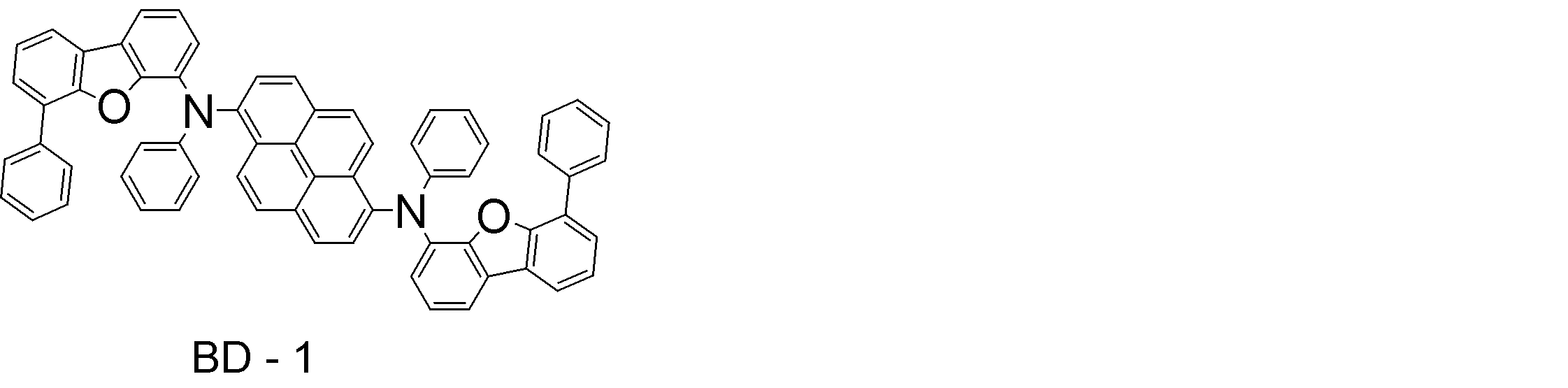

・実施例2~3
実施例2~3の有機EL素子は、実施例1における第2正孔輸送層の化合物および発光層の化合物を、表1に記載の化合物に変更した以外は実施例1と同様にして作製した。
実施例2~3の有機EL素子は、実施例1における第2正孔輸送層の化合物および発光層の化合物を、表1に記載の化合物に変更した以外は実施例1と同様にして作製した。
・比較例1~3
比較例1~3の有機EL素子は、実施例1における第2正孔輸送層の化合物HT-2および発光層の化合物BH-1の少なくともいずれかを、表1に記載の化合物に変更した以外は実施例1と同様にして作製した。
比較例1~3の有機EL素子は、実施例1における第2正孔輸送層の化合物HT-2および発光層の化合物BH-1の少なくともいずれかを、表1に記載の化合物に変更した以外は実施例1と同様にして作製した。

〔有機EL素子の評価〕
作製した有機EL素子について、輝度(単位:cd/m2)、CIE1931色度、電流効率L/J、外部量子効率EQE、主ピーク波長λp、及び寿命の評価を行った。各評価項目について、電流密度を1.00mA/cm2とした場合の結果を表2に示す。なお、表2に示す輝度、電流効率L/J、外部量子効率EQE、及び寿命の値は、比較例1の各評価項目の値に対する実施例1~3並びに比較例1~3の各評価項目の値の比を算出して得た値である。
作製した有機EL素子について、輝度(単位:cd/m2)、CIE1931色度、電流効率L/J、外部量子効率EQE、主ピーク波長λp、及び寿命の評価を行った。各評価項目について、電流密度を1.00mA/cm2とした場合の結果を表2に示す。なお、表2に示す輝度、電流効率L/J、外部量子効率EQE、及び寿命の値は、比較例1の各評価項目の値に対する実施例1~3並びに比較例1~3の各評価項目の値の比を算出して得た値である。
・CIE1931色度
電流密度が1.00mA/cm2となるように素子に電圧を印加した時のCIE1931色度座標(x、y)を分光放射輝度計CS-1000(コニカミノルタ社製)で計測した。
電流密度が1.00mA/cm2となるように素子に電圧を印加した時のCIE1931色度座標(x、y)を分光放射輝度計CS-1000(コニカミノルタ社製)で計測した。
・電流効率L/J
電流密度が1.00mA/cm2となるように素子に電圧を印加した時の分光放射輝度スペクトルを前記分光放射輝度計で計測し、得られた分光放射輝度スペクトルから、電流効率(単位:cd/A)を算出した。
電流密度が1.00mA/cm2となるように素子に電圧を印加した時の分光放射輝度スペクトルを前記分光放射輝度計で計測し、得られた分光放射輝度スペクトルから、電流効率(単位:cd/A)を算出した。
・主ピーク波長λp
得られた前記分光放射輝度スペクトルから主ピーク波長λp(単位:nm)を求めた。
得られた前記分光放射輝度スペクトルから主ピーク波長λp(単位:nm)を求めた。
・外部量子効率EQE
得られた前記分光放射輝度スペクトルから、ランバシアン放射を行なったと仮定し外部量子効率EQE(単位:%)を算出した。
得られた前記分光放射輝度スペクトルから、ランバシアン放射を行なったと仮定し外部量子効率EQE(単位:%)を算出した。
・寿命LT80
電流密度が50.00mA/cm2となるように素子に電圧を印加し、初期輝度に対して輝度が80%となるまでの時間(単位:h)を測定した。
電流密度が50.00mA/cm2となるように素子に電圧を印加し、初期輝度に対して輝度が80%となるまでの時間(単位:h)を測定した。

表2が示すように、実施例1の有機EL素子は、比較例1~3の有機EL素子に比べて、発光効率が高く、長寿命な有機EL素子であることが分かった。例えば、実施例1の有機EL素子は、比較例1の有機EL素子に比べて、外部量子効率EQEが2.3倍となり、寿命LT80が1.3倍となり、発光効率が高く、かつ長寿命であることが分かった。
また、表2が示すように、実施例2および3の有機EL素子は、比較例1~3の有機EL素子に比べて、発光効率が高く、長寿命な有機EL素子であることが分かった。
また、表2が示すように、実施例2および3の有機EL素子は、比較例1~3の有機EL素子に比べて、発光効率が高く、長寿命な有機EL素子であることが分かった。
本発明の有機EL素子は、発光効率が高く、長寿命な有機EL素子として、照明装置や表示装置等の電子機器にも利用できる。
1…有機エレクトロルミネッセンス素子
2…基板
3…陽極
4…陰極
5…燐光発光層
6…正孔注入・輸送層
7…電子注入・輸送層
10…有機薄膜層
2…基板
3…陽極
4…陰極
5…燐光発光層
6…正孔注入・輸送層
7…電子注入・輸送層
10…有機薄膜層
Claims (40)
- 陽極と、
前記陽極と対向して設けられた陰極と、
前記陽極および前記陰極の間に設けられた有機層と、を有し、
前記有機層は、前記陽極側から、正孔輸送層および発光層をこの順に備え、
前記正孔輸送層は、下記一般式(1)で表される化合物を含み、
前記発光層は、発光材料と下記一般式(10)表される化合物および下記一般式(11)で表される化合物のいずれかを含むことを特徴とする有機エレクトロルミネッセンス素子。
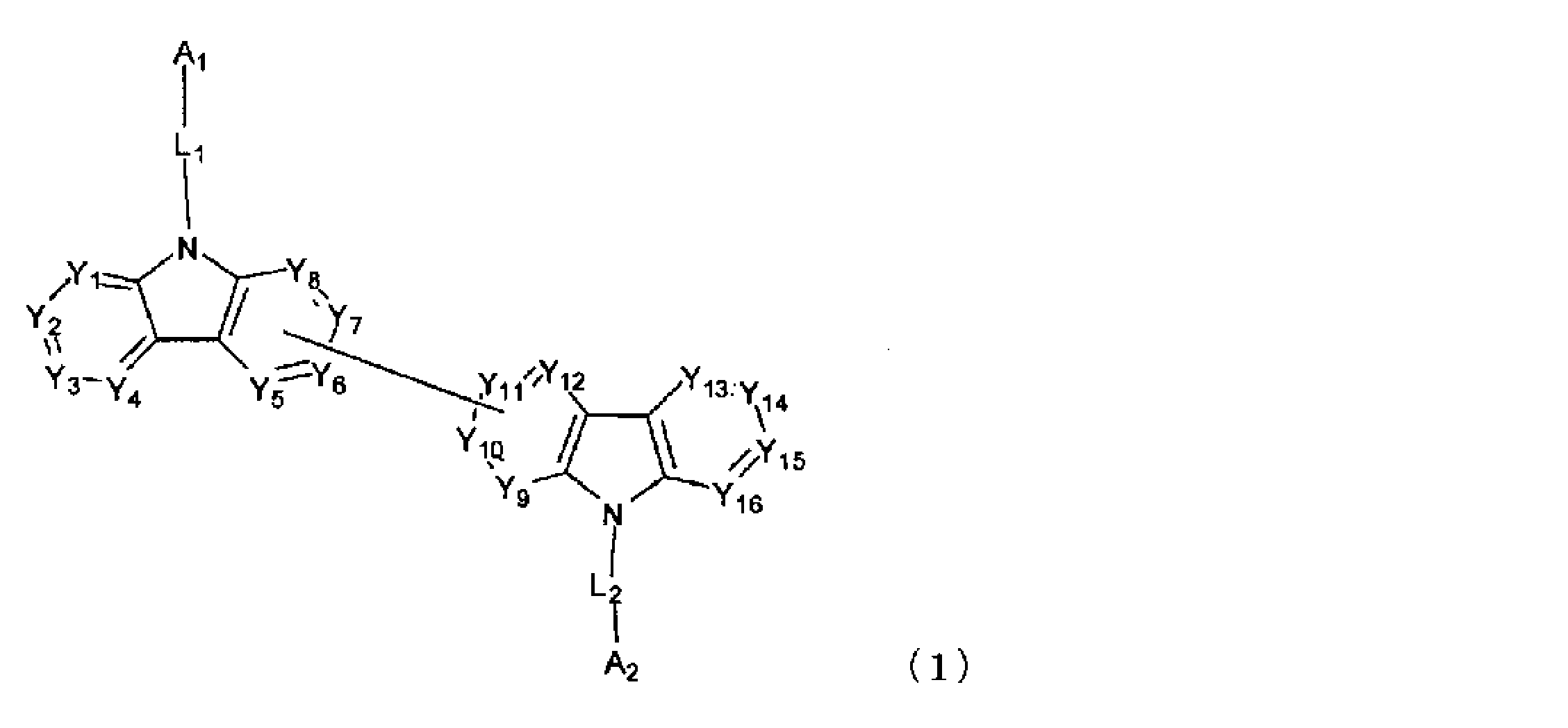
(前記一般式(1)において、A1及びA2は、それぞれ独立に、置換もしくは無置換の環形成炭素数6~30の芳香族炭化水素基、又は置換もしくは無置換の環形成炭素数2~30の芳香族複素環基を表す。
Y1~Y16は、それぞれ独立に、C(R)または窒素原子を表し、Rは、それぞれ独立に、水素原子、置換基又はカルバゾール骨格に結合する結合手を表す。
L1及びL2は、互いに独立して単結合、または2価の連結基を表す。
但し、A1、A2及びRのうち少なくとも1つは、置換もしくは無置換のフルオランテニル基、置換もしくは無置換のトリフェニレニル基、置換もしくは無置換のベンゾフェナントレニル基、置換もしくは無置換のベンゾトリフェニレニル基、置換もしくは無置換のジベンゾトリフェニレニル基、置換もしくは無置換のクリセニル基、置換もしくは無置換のベンゾクリセニル基、置換もしくは無置換のピセニル基、置換もしくは無置換のベンゾ[b]フルオランテニル基、置換もしくは無置換のベンゾフラニル基、置換もしくは無置換のジベンゾフラニル基、置換もしくは無置換のベンゾチオフェニル基、置換もしくは無置換のジベンゾチオフェニル基、置換もしくは無置換のカルバゾリル基、置換もしくは無置換のフェナントレニル基、置換もしくは無置換のフルオレニル基、又は置換もしくは無置換のビナフチル基を表す。
また、Y1~Y16が全てC(R)であり、Y6とY11とが単結合で結合し、L1及びL2が単結合であり、A1がフェナントレニル基の場合、A2はフェナントレニル基ではない。
さらに、Y1~Y16が全てC(R)であり、Y6とY11とが単結合で結合し、L1とL2が単結合である場合、Rは、いずれもフルオレニル基ではなく、さらにA1がフルオレニル基の場合、A2は、フェニル基、ナフチル基、又はフルオレニル基ではない。)
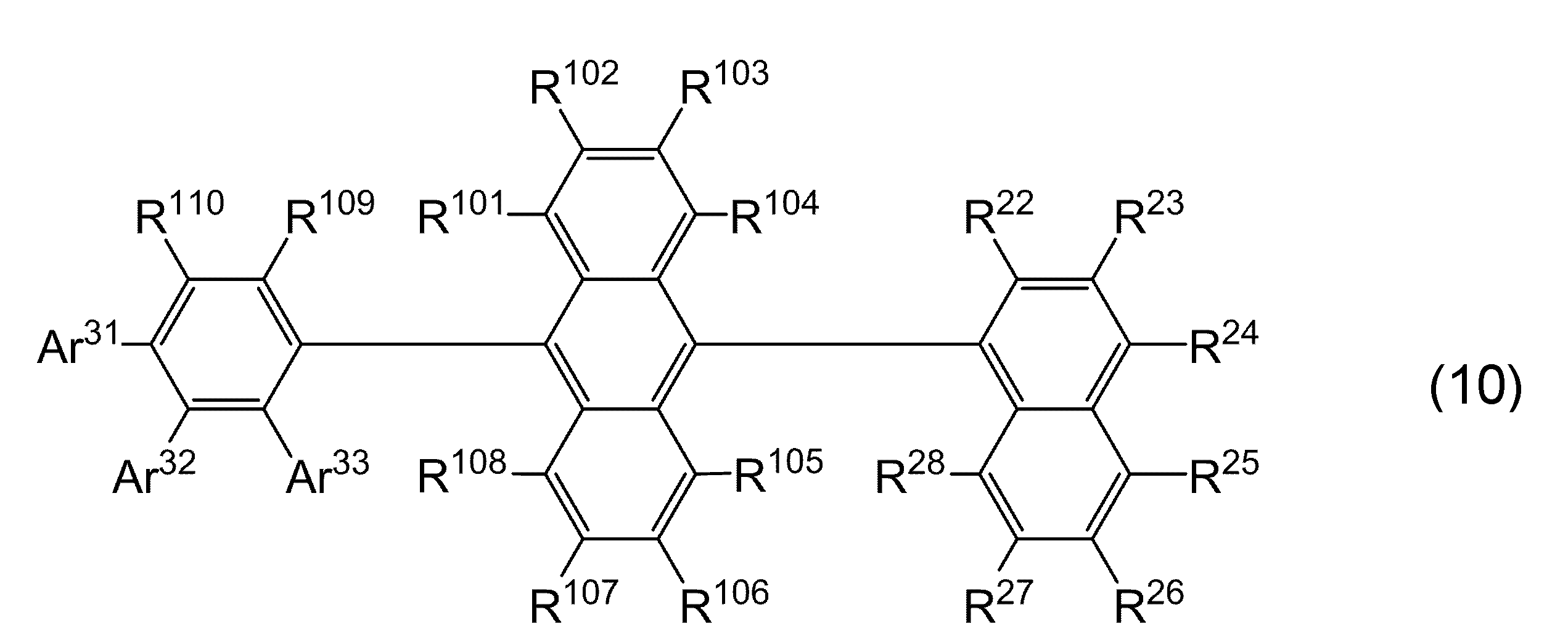

(前記一般式(10)および前記一般式(11)において、R101~R108は、それぞれ独立に、水素原子、ハロゲン原子、ヒドロキシル基、シアノ基、置換もしくは無置換のアミノ基、置換もしくは無置換の炭素数1~20のアルキル基、置換もしくは無置換の炭素数1~20のアルコキシ基、置換もしくは無置換の環形成炭素数6~20のアリールオキシ基、置換もしくは無置換の環形成炭素数6~20のアリールチオ基、置換もしくは無置換の炭素数3~40のトリアルキルシリル基、又は置換もしくは無置換の炭素数8~50のアリールシリル基であり、
Ar31~Ar33、R109、R110、R21~R28は、それぞれ独立に、水素原子、ハロゲン原子、ヒドロキシル基、シアノ基、置換もしくは無置換のアミノ基、置換もしくは無置換の炭素数1~20のアルキル基、置換もしくは無置換の炭素数1~20のアルコキシ基、置換もしくは無置換の環形成炭素数6~20のアリールオキシ基、置換もしくは無置換の環形成炭素数6~20のアリールチオ基、置換もしくは無置換の炭素数3~40のトリアルキルシリル基、置換もしくは無置換の炭素数8~50のアリールシリル基、置換もしくは無置換の環形成炭素数6~50の芳香族炭化水素基、又は置換もしくは無置換の環形成原子数5~50の複素環基であり、隣り合うR21~R28同士は環を形成してもよい。
ただし、Ar31~Ar33のうち少なくともいずれかは、置換もしくは無置換の環形成炭素数6~30の芳香族炭化水素基であり、
前記一般式(10)及び前記一般式(11)において、Ar31が、置換もしくは無置換の環形成炭素数6~30の芳香族炭化水素基となる場合には、Ar31は、置換もしくは無置換のフルオレニル基である。
前記一般式(11)において、Ar31、Ar33、R109、およびR110が水素原子である場合、Ar32は、置換もしくは無置換の環形成炭素数10~30の芳香族炭化水素基である。) - 請求項1に記載の有機エレクトロルミネッセンス素子において、前記一般式(1)において、A1及びA2の少なくとも一方が、置換もしくは無置換のフルオランテニル基、置換もしくは無置換のトリフェニレニル基、置換もしくは無置換のベンゾフェナントレニル基、置換もしくは無置換のベンゾトリフェニレニル基、置換もしくは無置換のジベンゾトリフェニレニル基、置換もしくは無置換のクリセニル基、置換もしくは無置換のベンゾクリセニル基、置換もしくは無置換のピセニル基、置換もしくは無置換のベンゾ[b]フルオランテニル基、置換もしくは無置換のベンゾフラニル基、置換もしくは無置換のジベンゾフラニル基、置換もしくは無置換のベンゾチオフェニル基、置換もしくは無置換のジベンゾチオフェニル基、置換もしくは無置換のカルバゾリル基、置換もしくは無置換のフェナントレニル基、置換もしくは無置換のフルオレニル基、又は置換もしくは無置換のビナフチル基であることを特徴とする有機エレクトロルミネッセンス素子。
- 請求項1または請求項2に記載の有機エレクトロルミネッセンス素子において、前記一般式(1)において、A1及びA2の少なくとも一方が、置換もしくは無置換のジベンゾフラニル基、置換もしくは無置換のジベンゾチオフェニル基、または置換もしくは無置換のカルバゾリル基であることを特徴とする有機エレクトロルミネッセンス素子。
- 請求項1から請求項3までのいずれか一項に記載の有機エレクトロルミネッセンス素子において、前記正孔輸送層に含まれる前記一般式(1)で表される化合物は、下記一般式(1-2)で表されることを特徴とする有機エレクトロルミネッセンス素子。
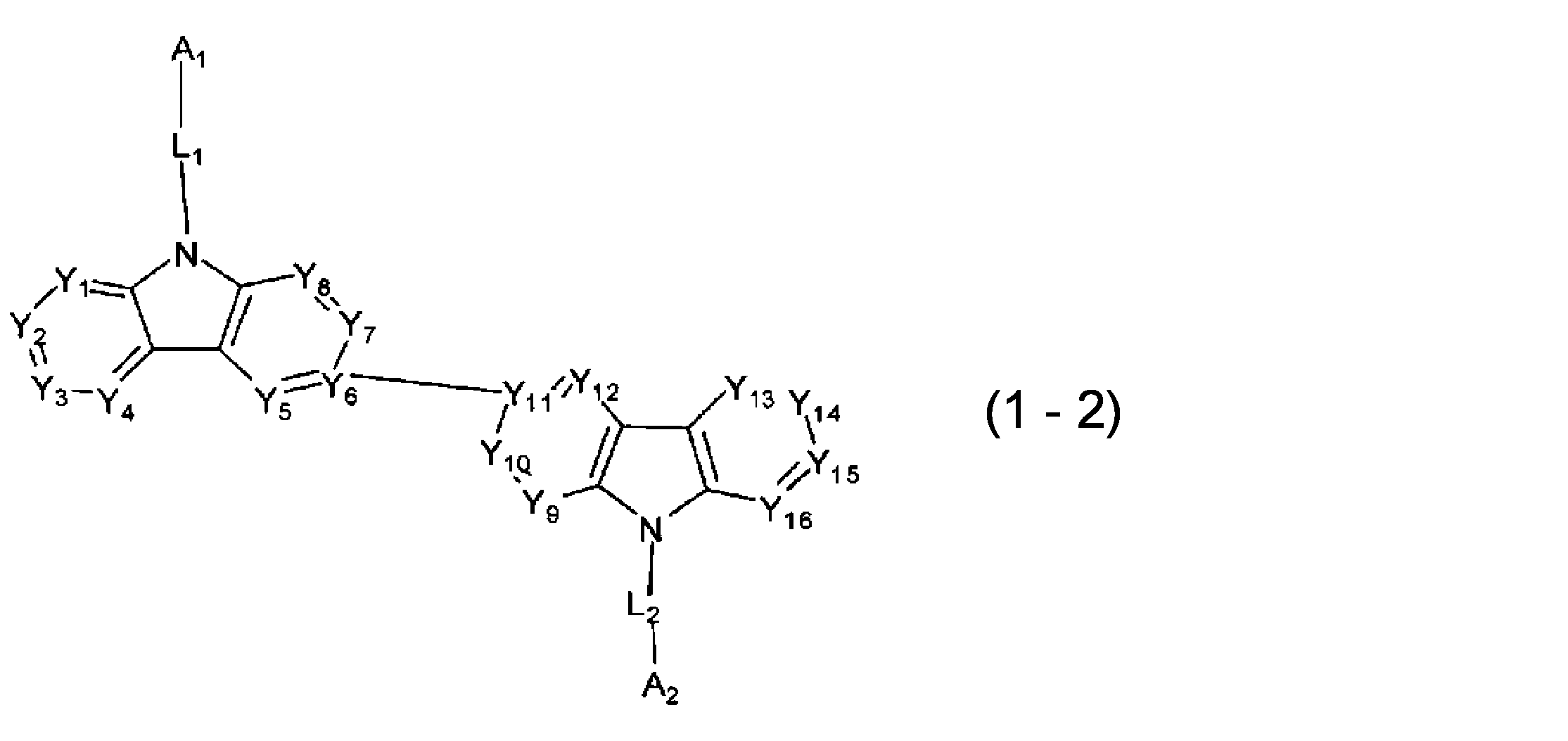
- 請求項1から請求項3までのいずれか一項に記載の有機エレクトロルミネッセンス素子において、前記正孔輸送層に含まれる前記一般式(1)で表される化合物は、下記一般式(1-3)または下記一般式(1-4)で表されることを特徴とする有機エレクトロルミネッセンス素子。


- 請求項1から請求項5までのいずれか一項に記載の有機エレクトロルミネッセンス素子において、前記正孔輸送層に含まれる前記一般式(1)で表される化合物のL1-A1で表される部分の構造と、L2-A2で表される部分の構造とが互いに異なることを特徴とする有機エレクトロルミネッセンス素子。
- 請求項1から請求項6までのいずれか一項に記載の有機エレクトロルミネッセンス素子において、前記発光層に前記一般式(11)で表される化合物が含まれ、Ar31、Ar33、R109、およびR110が水素原子である場合、Ar32は、置換もしくは無置換のナフチル基であることを特徴とする有機エレクトロルミネッセンス素子。
- 請求項1から請求項6までのいずれか一項に記載の有機エレクトロルミネッセンス素子において、前記一般式(10)および前記一般式(11)において、Ar31が、置換もしくは無置換の環形成炭素数6~30の芳香族炭化水素基となる場合、下記一般式(12)および下記一般式(13)で表されることを特徴とする有機エレクトロルミネッセンス素子。
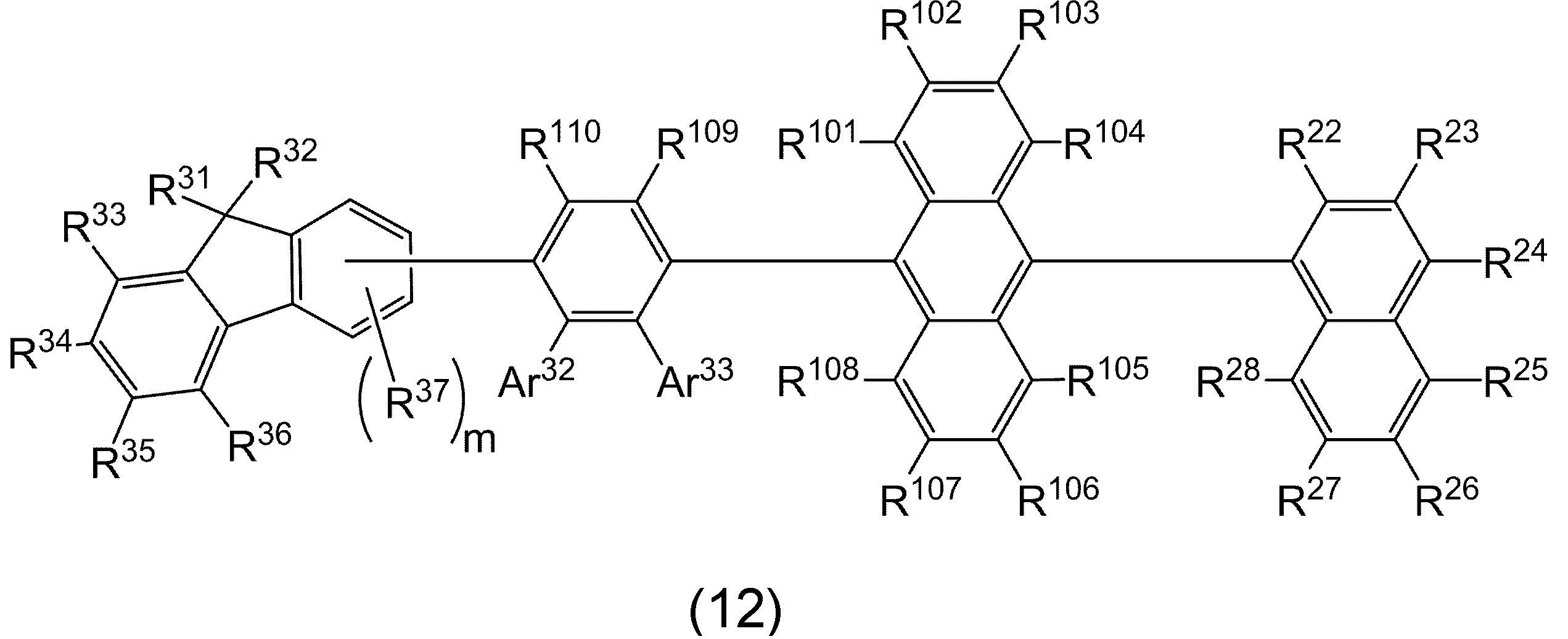

(前記一般式(12)および前記一般式(13)において、
R31およびR32は、それぞれ独立に、置換もしくは無置換の炭素数1~20のアルキル基であり、R33~R37は、それぞれ独立に、水素原子、ハロゲン原子、ヒドロキシル基、シアノ基、置換もしくは無置換のアミノ基、置換もしくは無置換の炭素数1~20のアルキル基、置換もしくは無置換の炭素数1~20のアルコキシ基、置換もしくは無置換の環形成炭素数6~20のアリールオキシ基、置換もしくは無置換の環形成炭素数6~20のアリールチオ基、置換もしくは無置換の炭素数3~40のトリアルキルシリル基、置換もしくは無置換の炭素数8~50のアリールシリル基、置換もしくは無置換の環形成炭素数6~50の芳香族炭化水素基、又は置換もしくは無置換の環形成原子数5~50の複素環基であり、mは、4である。) - 陽極と、
前記陽極と対向して設けられた陰極と、
前記陽極および前記陰極の間に設けられた有機層と、を有し、
前記有機層は、前記陽極側から、正孔輸送層および発光層をこの順に備え、
前記正孔輸送層は、下記一般式(30)で表される化合物を含み、前記発光層は、下記一般式(2A)で表される化合物、および発光材料を含むことを特徴とする有機エレクトロルミネッセンス素子。
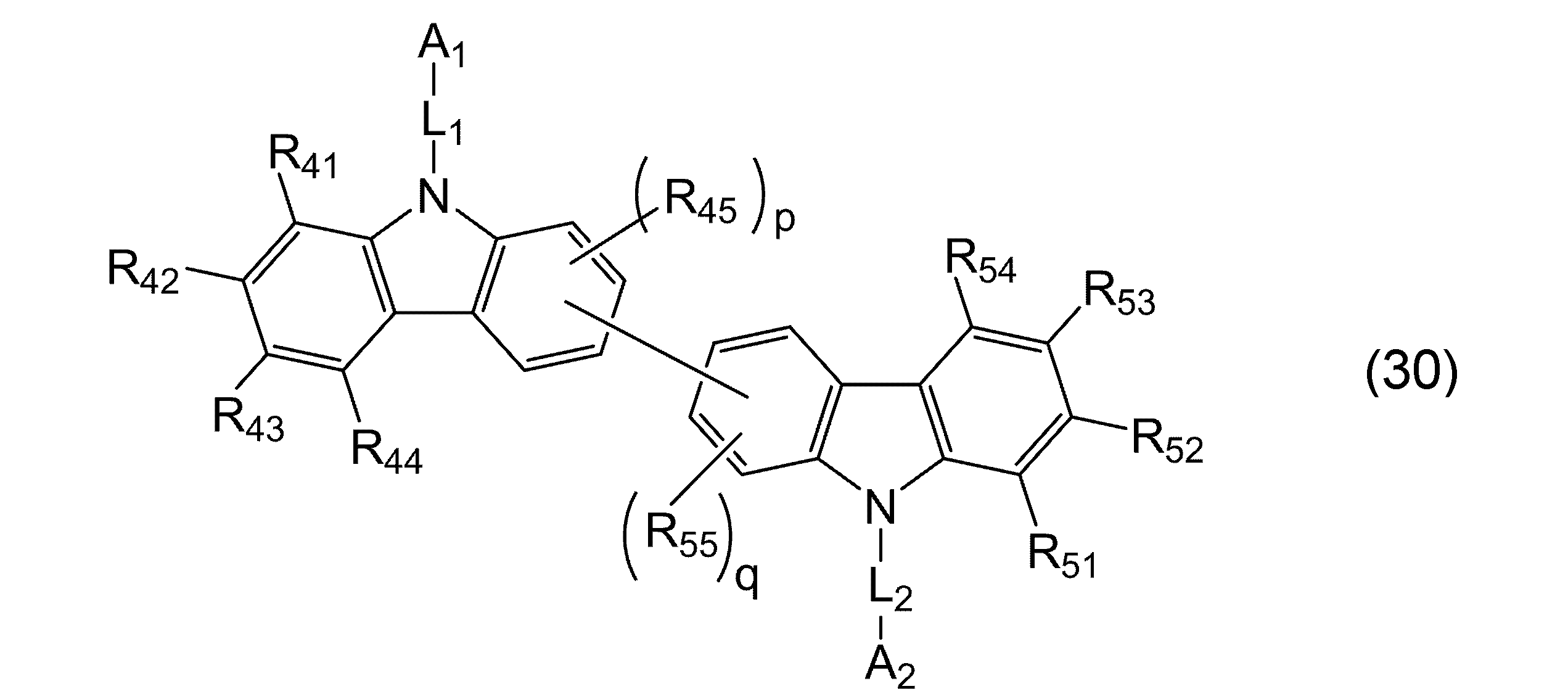
(前記一般式(30)において、A1及びA2は、それぞれ独立に、置換もしくは無置換の環形成炭素数6~30の芳香族炭化水素基、又は置換もしくは無置換の環形成原子数5~30の芳香族複素環基を表す。
R41~R44の内、隣り合ういずれか2つは、下記一般式(31)で表される部分構造と結合している。R51~R54の内、隣り合ういずれか2つが、下記一般式(31)で表される部分構造と結合していてもよい。)
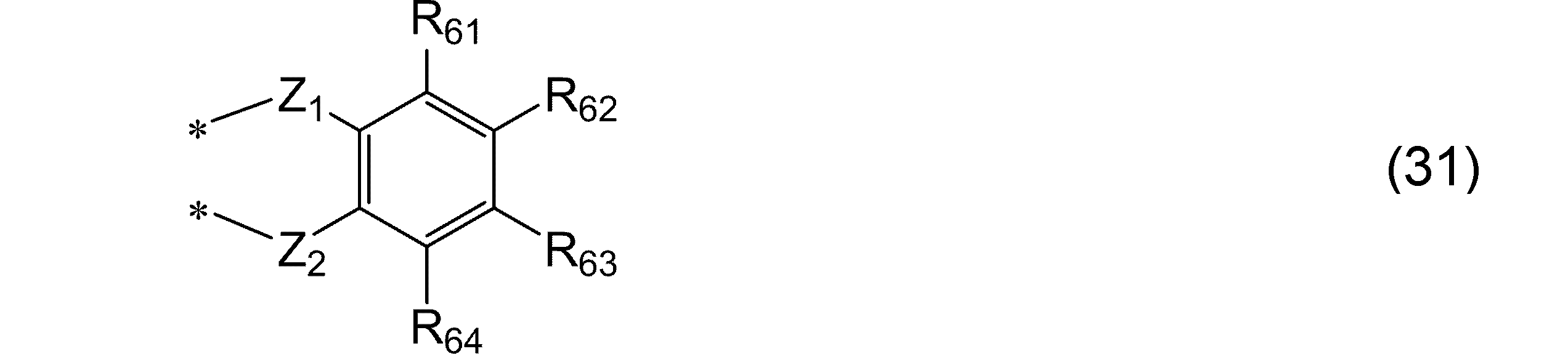
(前記一般式(31)で表される部分構造と結合していないR41~R44およびR51~R54は、それぞれ独立に、水素原子、ハロゲン原子、ヒドロキシル基、シアノ基、置換もしくは無置換のアミノ基、置換もしくは無置換の炭素数1~20のアルキル基、置換もしくは無置換の炭素数1~20のアルコキシ基、置換もしくは無置換の環形成炭素数6~20のアリールオキシ基、置換もしくは無置換の環形成炭素数6~20のアリールチオ基、置換もしくは無置換の炭素数3~40のトリアルキルシリル基、置換もしくは無置換の炭素数8~50のアリールシリル基、置換もしくは無置換の環形成炭素数6~50の芳香族炭化水素基、又は置換もしくは無置換の環形成原子数5~50の複素環基であり、
pおよびqは、3であり、
L1及びL2は、それぞれ独立に、単結合、または2価の連結基を表す。
前記一般式(31)において、*は、前記一般式(30)で表される環構造との結合部位を表し、
Z1およびZ2は、いずれか一方が単結合であり、他方が、-O-、-S-、-CR65R66-、または-NR67-であり、
R61~R67は、それぞれ独立に、水素原子、ハロゲン原子、ヒドロキシル基、シアノ基、置換もしくは無置換のアミノ基、置換もしくは無置換の炭素数1~20のアルキル基、置換もしくは無置換の炭素数1~20のアルコキシ基、置換もしくは無置換の環形成炭素数6~20のアリールオキシ基、置換もしくは無置換の環形成炭素数6~20のアリールチオ基、置換もしくは無置換の炭素数3~40のトリアルキルシリル基、置換もしくは無置換の炭素数8~50のアリールシリル基、置換もしくは無置換の環形成炭素数6~50の芳香族炭化水素基、又は置換もしくは無置換の環形成原子数5~50の複素環基
である。))

(前記一般式(2A)において、R101~R108は、それぞれ独立に、水素原子、ハロゲン原子、ヒドロキシル基、シアノ基、置換もしくは無置換のアミノ基、置換もしくは無置換の炭素数1~20のアルキル基、置換もしくは無置換の炭素数1~20のアルコキシ基、置換もしくは無置換の環形成炭素数6~20のアリールオキシ基、置換もしくは無置換の環形成炭素数6~20のアリールチオ基、置換もしくは無置換の炭素数3~40のトリアルキルシリル基、又は置換もしくは無置換の炭素数8~50のアリールシリル基であり、
Ar1001およびAr101は、それぞれ独立に、置換または無置換の環形成炭素数6~30の芳香族炭化水素基、又は、置換または無置換の環形成原子数5~30の複素環基
である。Ar100は、R101又はR108と環を形成してもよく、Ar101は、R104又はR105と環を形成してもよい。) - 請求項9に記載の有機エレクトロルミネッセンス素子において、前記一般式(30)で表される化合物は、下記一般式(32)で表されることを特徴とする有機エレクトロルミネッセンス素子。
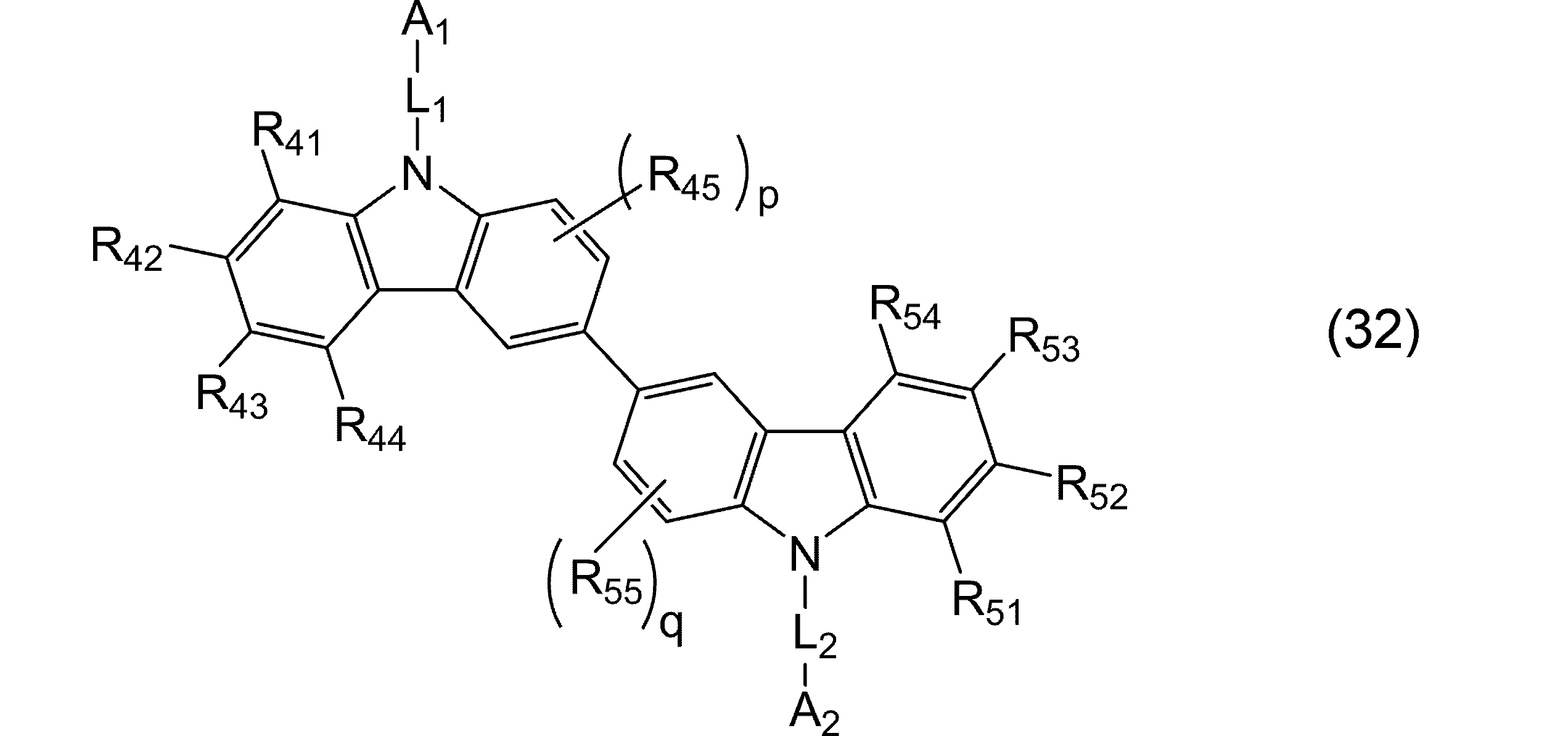
(前記一般式(32)におけるA1,A2,L1,L2,R41~R45,R51~R55、p、q、Z1およびZ2、R61~R67は、それぞれ前記一般式(30),(31)におけるものと同義である。) - 請求項9に記載の有機エレクトロルミネッセンス素子において、前記一般式(30)で表される化合物は、下記一般式(33)または下記一般式(34)で表されることを特徴とする有機エレクトロルミネッセンス素子。
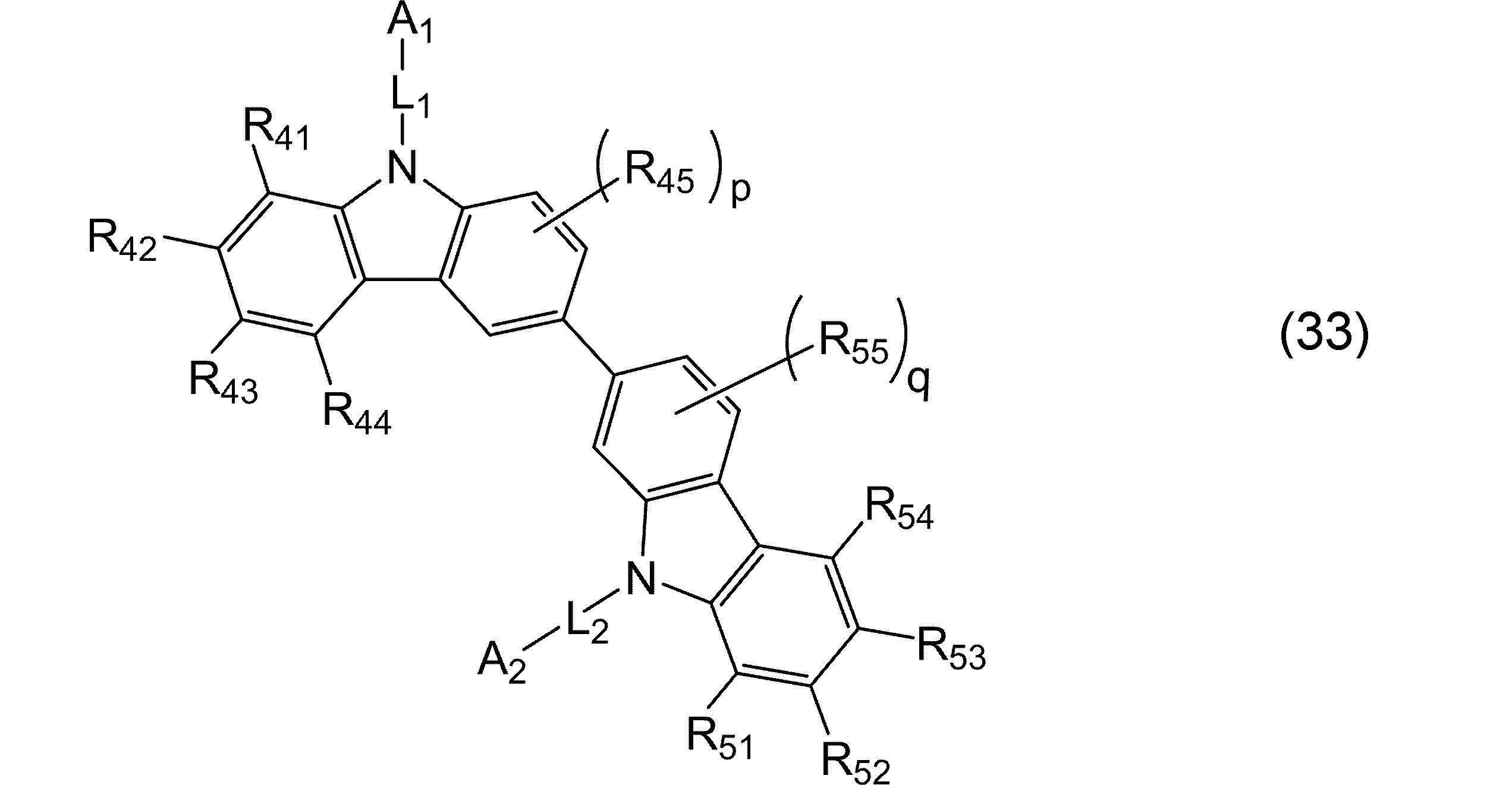
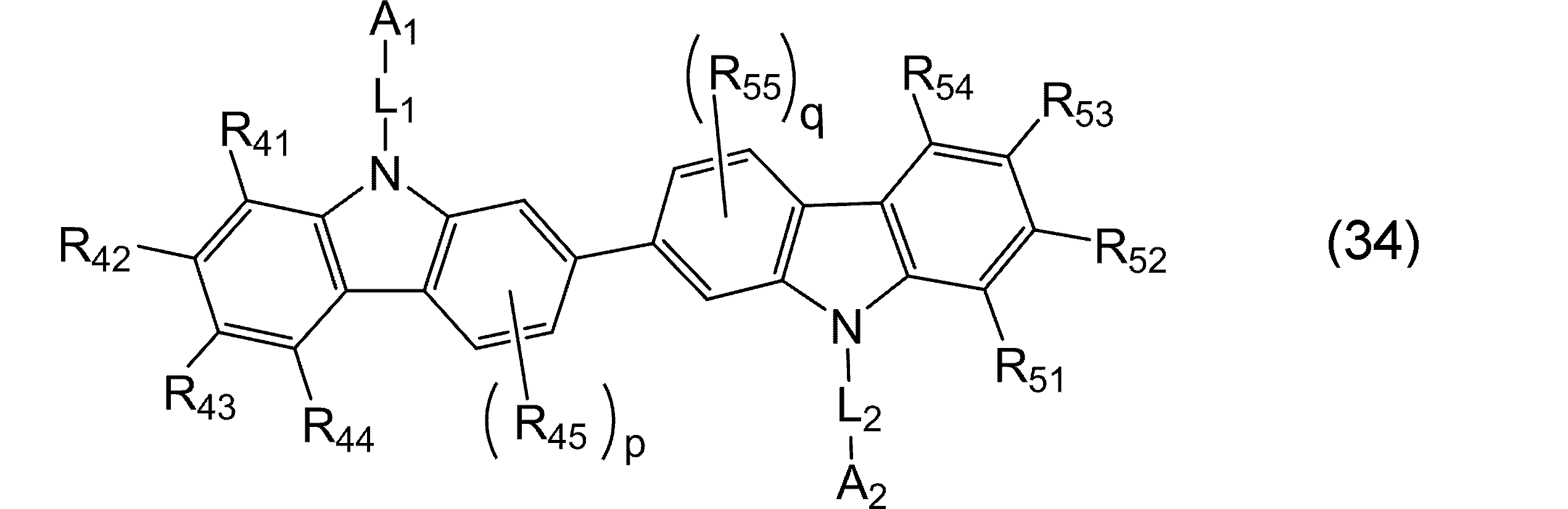
(前記一般式(33)および前記一般式(34)におけるA1,A2,L1,L2,R41~R45,R51~R55、p、q、Z1およびZ2、R61~R67は、それぞれ前記一般式(30),(31)におけるものと同義である。) - 請求項9から請求項11までのいずれか一項に記載の有機エレクトロルミネッセンス素子において、前記一般式(31)におけるZ1およびZ2のいずれか一方が単結合であり、他方が-O-、または-CR65R66-であることを特徴とする有機エレクトロルミネッセンス素子。
- 請求項9から請求項11までのいずれか一項に記載の有機エレクトロルミネッセンス素子において、前記Z1およびZ2のいずれか一方が単結合であり、他方が-S-、または-NR67-であることを特徴とする有機エレクトロルミネッセンス素子。
- 請求項9に記載の有機エレクトロルミネッセンス素子において、前記一般式(30)で表される化合物は、下記一般式(35),一般式(36)および一般式(37)のいずれかで表されることを特徴とする有機エレクトロルミネッセンス素子。

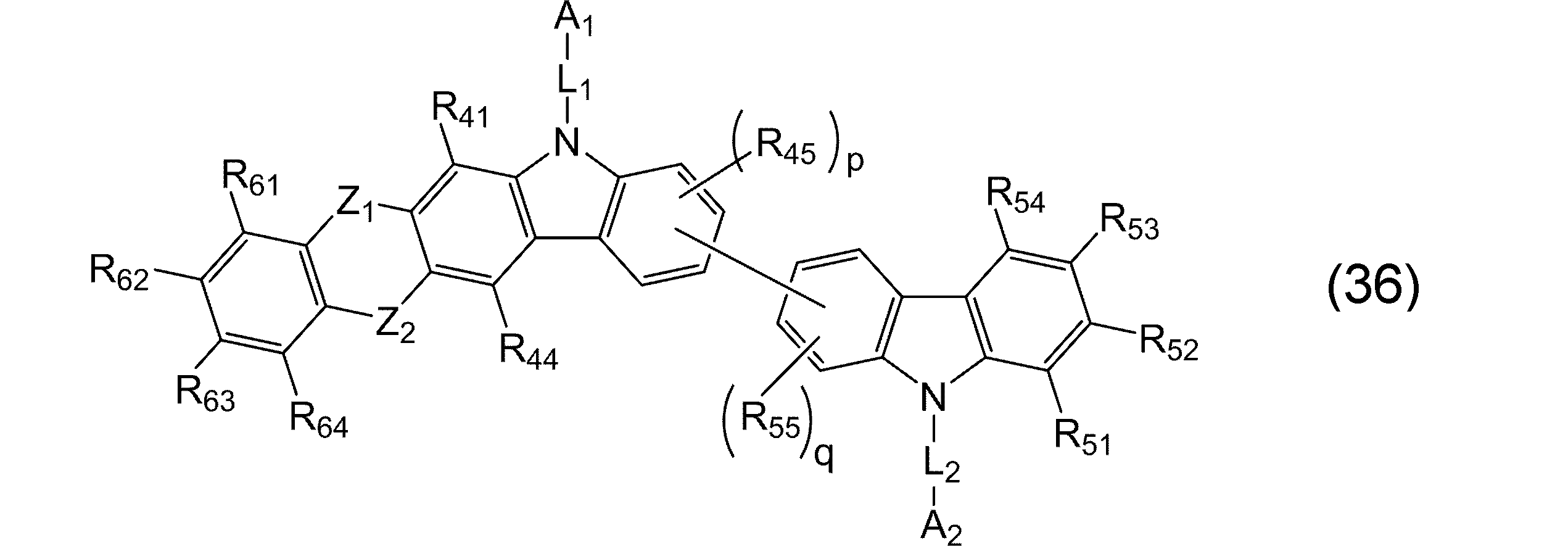
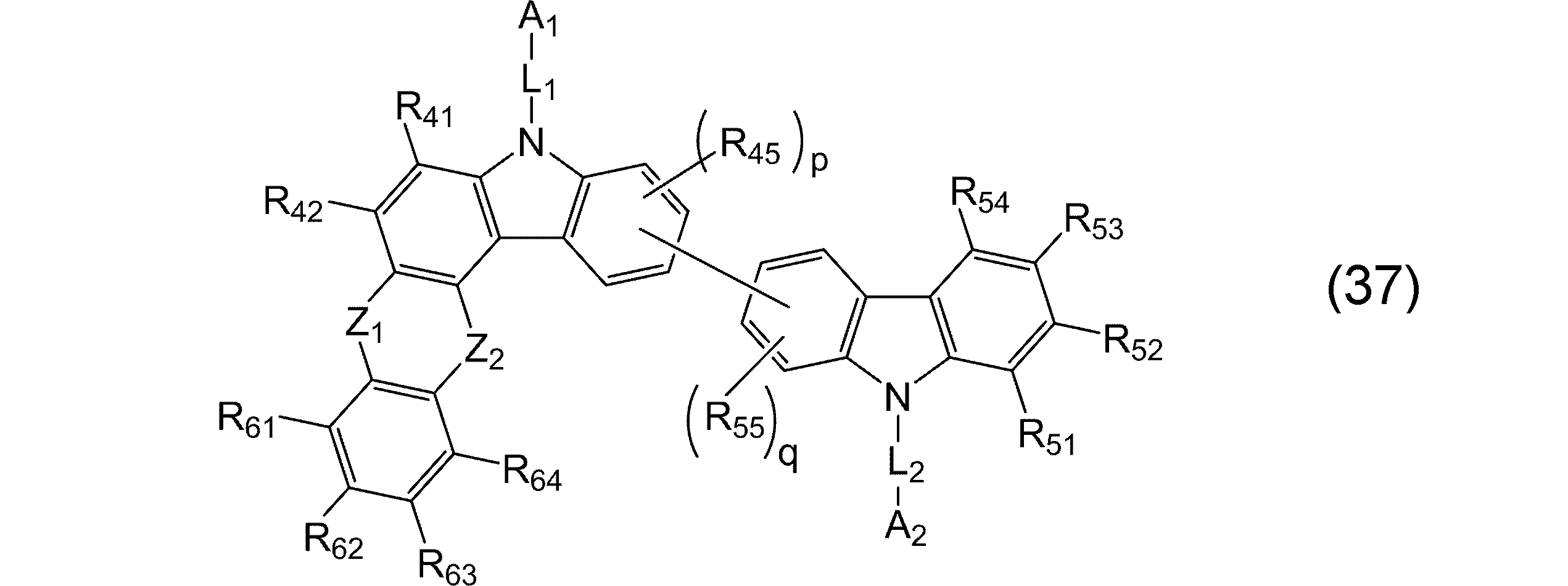
(前記一般式(35)~(37)におけるA1,A2,L1,L2,R41~R45,R51~R55、p、q、Z1およびZ2、R61~R67は、それぞれ前記一般式(30),(31)におけるものと同義である。) - 請求項14に記載の有機エレクトロルミネッセンス素子において、前記一般式(35)~(37)におけるZ1が-O-、または-CR65R66-であり、Z2が単結合であることを特徴とする有機エレクトロルミネッセンス素子。
- 請求項14に記載の有機エレクトロルミネッセンス素子において、前記一般式(35)~(37)におけるZ1が単結合であり、Z2が-O-、または-CR65R66-であることを特徴とする有機エレクトロルミネッセンス素子。
- 請求項14に記載の有機エレクトロルミネッセンス素子において、前記一般式(35)~(37)におけるZ1が-CR65R66-であり、Z2が単結合であることを特徴とする有機エレクトロルミネッセンス素子。
- 請求項14に記載の有機エレクトロルミネッセンス素子において、前記一般式(35)~(37)におけるZ1が-S-、または-NR67-であり、Z2が単結合であることを特徴とする有機エレクトロルミネッセンス素子。
- 請求項14に記載の有機エレクトロルミネッセンス素子において、前記一般式(35)~(37)におけるZ1が、単結合であり、Z2が-S-、または-NR67-であることを特徴とする有機エレクトロルミネッセンス素子。
- 請求項9から請求項19までのいずれか一項に記載の有機エレクトロルミネッセンス素子において、前記A1及びA2は、それぞれ独立に、置換もしくは無置換の環形成炭素数6~30の芳香族炭化水素基であることを特徴とする有機エレクトロルミネッセンス素子。
- 請求項9から請求項19までのいずれか一項に記載の有機エレクトロルミネッセンス素子において、前記A2は、置換もしくは無置換のフェニル基、置換もしくは無置換のジベンゾフラニル基、又は置換もしくは無置換のジベンゾチオフェニル基であることを特徴とする有機エレクトロルミネッセンス素子。
- 請求項21に記載の有機エレクトロルミネッセンス素子において、前記A2は、置換もしくは無置換のジベンゾチオフェニル基であることを特徴とする有機エレクトロルミネッセンス素子。
- 請求項22に記載の有機エレクトロルミネッセンス素子において、前記A2は、置換もしくは無置換の2-ジベンゾチオフェニル基、または置換もしくは無置換の4-ジベンゾチオフェニル基であることを特徴とする有機エレクトロルミネッセンス素子。
- 請求項21に記載の有機エレクトロルミネッセンス素子において、前記A2は、置換もしくは無置換のジベンゾフラニル基であることを特徴とする有機エレクトロルミネッセンス素子。
- 請求項24に記載の有機エレクトロルミネッセンス素子において、前記A2は、置換もしくは無置換の2-ジベンゾフラニル基、または置換もしくは無置換の4-ジベンゾフラニル基であることを特徴とする有機エレクトロルミネッセンス素子。
- 請求項9から請求項25までのいずれか一項に記載の有機エレクトロルミネッセンス素子において、前記L2は、置換もしくは無置換のフェニレン基であることを特徴とする有機エレクトロルミネッセンス素子。
- 請求項26に記載の有機エレクトロルミネッセンス素子において、前記L2は、置換もしくは無置換のm-フェニレン基、または置換もしくは無置換のp-フェニレン基であることを特徴とする有機エレクトロルミネッセンス素子。
- 請求項26に記載の有機エレクトロルミネッセンス素子において、前記L2は、置換もしくは無置換のm-フェニレン基であることを特徴とする有機エレクトロルミネッセンス素子。
- 請求項9から請求項25までのいずれか一項に記載の有機エレクトロルミネッセンス素子において、前記L2は、単結合であることを特徴とする有機エレクトロルミネッセンス素子。
- 請求項9から請求項29までのいずれか一項に記載の有機エレクトロルミネッセンス素子において、前記一般式(2A)で表される化合物は、下記一般式(2)で表されることを特徴とする有機エレクトロルミネッセンス素子。

(前記一般式(2)において、R109~R113のうちいずれか一つは、置換または無置換の環形成炭素数6~30の芳香族炭化水素基、又は、置換または無置換の環形成原子数5~30の複素環基であり、これ以外のR109~R113は、それぞれ独立に、水素原子、ハロゲン原子、ヒドロキシル基、シアノ基、置換もしくは無置換のアミノ基、置換もしくは無置換の炭素数1~20のアルキル基、置換もしくは無置換の炭素数1~20のアルコキシ基、置換もしくは無置換の環形成炭素数6~20のアリールオキシ基、置換もしくは無置換の環形成炭素数6~20のアリールチオ基、置換もしくは無置換の炭素数3~40のトリアルキルシリル基、置換もしくは無置換の炭素数8~50のアリールシリル基、置換もしくは無置換の環形成炭素数6~50の芳香族炭化水素基、又は置換もしくは無置換の環形成原子数5~50の複素環基であり、
Ar101およびR101~R108は、前記一般式(2A)におけるものと同義である。) - 請求項30に記載の有機エレクトロルミネッセンス素子において、前記一般式(2)で表される化合物が、下記一般式(3)で表されることを特徴とする有機エレクトロルミネッセンス素子。
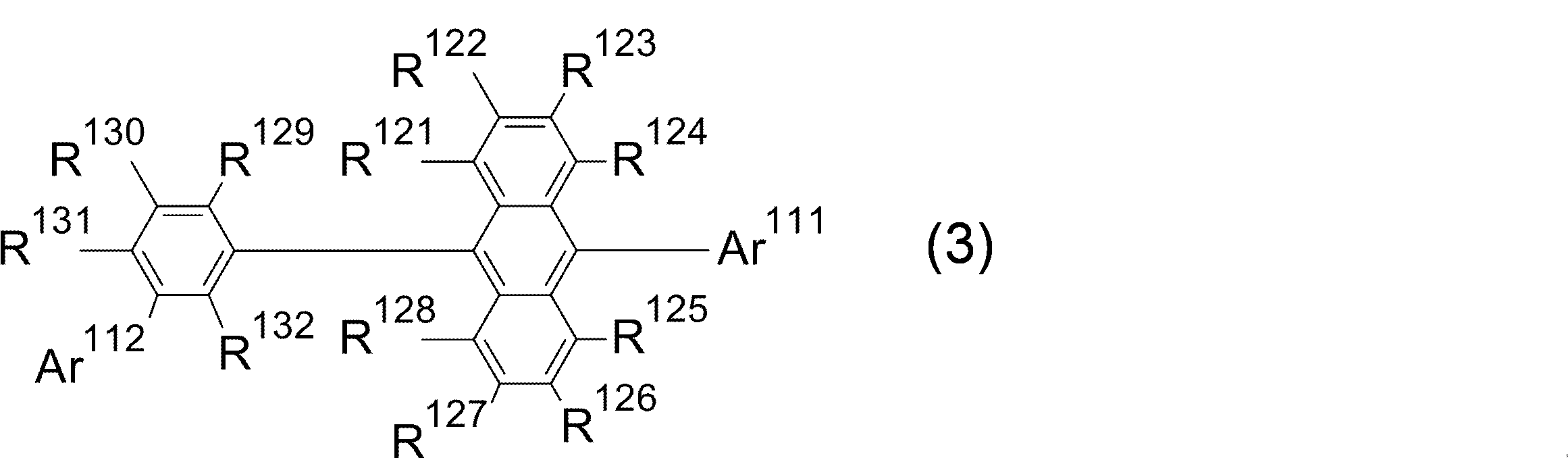
(前記一般式(3)において、Ar111およびAr112は、それぞれ独立に、置換もしくは無置換の環形成炭素数6~30の芳香族炭化水素基、又は、置換もしくは無置換の環形成原子数5~30の複素環基であり、
R121~R132は、それぞれ独立に、水素原子、ハロゲン原子、ヒドロキシル基、シアノ基、置換もしくは無置換のアミノ基、置換もしくは無置換の炭素数1~20のアルキル基、置換もしくは無置換の炭素数1~20のアルコキシ基、置換もしくは無置換の環形成炭素数6~20のアリールオキシ基、置換もしくは無置換の環形成炭素数6~20のアリールチオ基、置換もしくは無置換の炭素数3~40のトリアルキルシリル基、又は置換もしくは無置換の炭素数8~50のアリールシリル基である。) - 請求項31に記載の有機エレクトロルミネッセンス素子において、前記Ar111および前記Ar112が、ナフチル基であることを特徴とする有機エレクトロルミネッセンス素子。
- 請求項32に記載の有機エレクトロルミネッセンス素子において、前記Ar111および前記Ar112が、2-ナフチル基であることを特徴とする有機エレクトロルミネッセンス素子。
- 請求項32に記載の有機エレクトロルミネッセンス素子において、前記Ar111が、1-ナフチル基であり、前記Ar112が、2-ナフチル基であることを特徴とする有機エレクトロルミネッセンス素子。
- 請求項30に記載の有機エレクトロルミネッセンス素子において、前記一般式(2)で表される化合物が、下記一般式(4)で表されることを特徴とする有機エレクトロルミネッセンス素子。

(前記一般式(4)において、Ar121およびAr122は、それぞれ独立に、置換もしくは無置換の環形成炭素数6~30の芳香族炭化水素基、又は、置換もしくは無置換の環形成原子数5~30の複素環基であり、
R141~R152は、それぞれ独立に、水素原子、ハロゲン原子、ヒドロキシル基、シアノ基、置換もしくは無置換のアミノ基、置換もしくは無置換の炭素数1~20のアルキル基、置換もしくは無置換の炭素数1~20のアルコキシ基、置換もしくは無置換の環形成炭素数6~20のアリールオキシ基、置換もしくは無置換の環形成炭素数6~20のアリールチオ基、置換もしくは無置換の炭素数3~40のトリアルキルシリル基、又は置換もしくは無置換の炭素数8~50のアリールシリル基である。) - 請求項30に記載の有機エレクトロルミネッセンス素子において、前記一般式(2)で表される化合物が、下記一般式(5)で表されることを特徴とする有機エレクトロルミネッセンス素子。
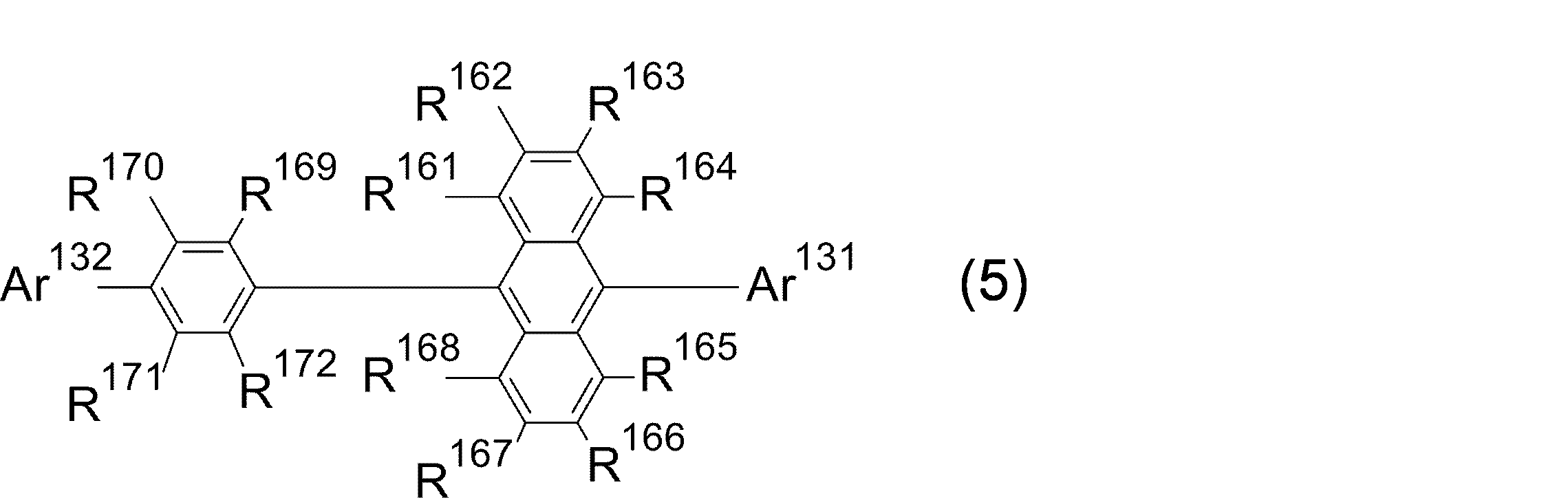
(前記一般式(5)において、Ar131は、置換もしくは無置換のフェニル基であり、Ar132は、置換もしくは無置換の環形成炭素数6~30の芳香族炭化水素基、又は置換もしくは無置換の環形成原子数5~30の複素環基であり、
R161~R172は、それぞれ独立に、水素原子、ハロゲン原子、ヒドロキシル基、シアノ基、置換もしくは無置換のアミノ基、置換もしくは無置換の炭素数1~20のアルキル基、置換もしくは無置換の炭素数1~20のアルコキシ基、置換もしくは無置換の環形成炭素数6~20のアリールオキシ基、置換もしくは無置換の環形成炭素数6~20のアリールチオ基、置換もしくは無置換の炭素数3~40のトリアルキルシリル基、又は置換もしくは無置換の炭素数8~50のアリールシリル基である。) - 請求項36に記載の有機エレクトロルミネッセンス素子において、前記Ar131および前記Ar132が、ナフチル基であることを特徴とする有機エレクトロルミネッセンス素子。
- 請求項37に記載の有機エレクトロルミネッセンス素子において、前記Ar131が、2-ナフチル基であり、前記Ar132が、1-ナフチル基であることを特徴とする有機エレクトロルミネッセンス素子。
- 請求項38に記載の有機エレクトロルミネッセンス素子において、前記Ar131が、2-ナフチル基であり、前記Ar132が、1-ナフチル基であることを特徴とする有機エレクトロルミネッセンス素子。
- 請求項1から請求項39までのいずれか一項に記載の有機エレクトロルミネッセンス素子を備えることを特徴とする電子機器。
Applications Claiming Priority (2)
| Application Number | Priority Date | Filing Date | Title |
|---|---|---|---|
| JP2012178872A JP2015216135A (ja) | 2012-08-10 | 2012-08-10 | 有機エレクトロルミネッセンス素子、および電子機器 |
| JP2012-178872 | 2012-08-10 |
Publications (1)
| Publication Number | Publication Date |
|---|---|
| WO2014024880A1 true WO2014024880A1 (ja) | 2014-02-13 |
Family
ID=50068104
Family Applications (1)
| Application Number | Title | Priority Date | Filing Date |
|---|---|---|---|
| PCT/JP2013/071248 Ceased WO2014024880A1 (ja) | 2012-08-10 | 2013-08-06 | 有機エレクトロルミネッセンス素子、および電子機器 |
Country Status (3)
| Country | Link |
|---|---|
| JP (1) | JP2015216135A (ja) |
| TW (1) | TW201412938A (ja) |
| WO (1) | WO2014024880A1 (ja) |
Cited By (17)
| Publication number | Priority date | Publication date | Assignee | Title |
|---|---|---|---|---|
| JP5520423B1 (ja) * | 2012-09-03 | 2014-06-11 | 保土谷化学工業株式会社 | インデノアクリダン環構造を有する化合物および有機エレクトロルミネッセンス素子 |
| JP2017178832A (ja) * | 2016-03-30 | 2017-10-05 | Jnc株式会社 | 自己組織化し得る多環式芳香族化合物およびそれを用いた有機el素子 |
| US10056558B2 (en) | 2011-11-25 | 2018-08-21 | Idemitsu Kosan Co., Ltd. | Aromatic amine derivative, material for organic electroluminescent element, and organic electroluminescent element |
| WO2019088281A1 (ja) * | 2017-11-06 | 2019-05-09 | 保土谷化学工業株式会社 | インデノカルバゾール環構造を有する化合物および有機エレクトロルミネッセンス素子 |
| CN109796450A (zh) * | 2017-11-16 | 2019-05-24 | 江苏三月光电科技有限公司 | 一种以吡啶并吲哚为核心的化合物及其在电致发光器件上的应用 |
| TWI688137B (zh) * | 2015-03-24 | 2020-03-11 | 學校法人關西學院 | 有機電場發光元件、顯示裝置以及照明裝置 |
| EP3544073A4 (en) * | 2016-11-16 | 2020-11-25 | Hodogaya Chemical Co., Ltd. | ORGANIC ELECTROLUMINESCENT ELEMENT |
| JP2021132221A (ja) * | 2015-08-21 | 2021-09-09 | 三星ディスプレイ株式會社Samsung Display Co., Ltd. | 有機発光素子 |
| CN114586189A (zh) * | 2019-10-23 | 2022-06-03 | 保土谷化学工业株式会社 | 有机电致发光元件 |
| US11581487B2 (en) | 2017-04-26 | 2023-02-14 | Oti Lumionics Inc. | Patterned conductive coating for surface of an opto-electronic device |
| US11730012B2 (en) | 2019-03-07 | 2023-08-15 | Oti Lumionics Inc. | Materials for forming a nucleation-inhibiting coating and devices incorporating same |
| US11751415B2 (en) | 2018-02-02 | 2023-09-05 | Oti Lumionics Inc. | Materials for forming a nucleation-inhibiting coating and devices incorporating same |
| US11985841B2 (en) | 2020-12-07 | 2024-05-14 | Oti Lumionics Inc. | Patterning a conductive deposited layer using a nucleation inhibiting coating and an underlying metallic coating |
| US12069938B2 (en) | 2019-05-08 | 2024-08-20 | Oti Lumionics Inc. | Materials for forming a nucleation-inhibiting coating and devices incorporating same |
| US12101987B2 (en) | 2019-04-18 | 2024-09-24 | Oti Lumionics Inc. | Materials for forming a nucleation-inhibiting coating and devices incorporating same |
| US12113279B2 (en) | 2020-09-22 | 2024-10-08 | Oti Lumionics Inc. | Device incorporating an IR signal transmissive region |
| US12150374B2 (en) | 2015-10-26 | 2024-11-19 | Oti Lumionics Inc. | Method for patterning a coating on a surface and device including a patterned coating |
Families Citing this family (1)
| Publication number | Priority date | Publication date | Assignee | Title |
|---|---|---|---|---|
| JP7325731B2 (ja) | 2018-08-23 | 2023-08-15 | 国立大学法人九州大学 | 有機エレクトロルミネッセンス素子 |
Citations (3)
| Publication number | Priority date | Publication date | Assignee | Title |
|---|---|---|---|---|
| JP2011222831A (ja) * | 2010-04-12 | 2011-11-04 | Idemitsu Kosan Co Ltd | 有機エレクトロルミネッセンス素子 |
| WO2012014500A1 (ja) * | 2010-07-30 | 2012-02-02 | 保土谷化学工業株式会社 | インデノカルバゾール環構造を有する化合物および有機エレクトロルミネッセンス素子 |
| WO2012070234A1 (en) * | 2010-11-22 | 2012-05-31 | Idemitsu Kosan Co.,Ltd. | Organic electroluminescence device |
-
2012
- 2012-08-10 JP JP2012178872A patent/JP2015216135A/ja active Pending
-
2013
- 2013-08-06 WO PCT/JP2013/071248 patent/WO2014024880A1/ja not_active Ceased
- 2013-08-09 TW TW102128643A patent/TW201412938A/zh unknown
Patent Citations (3)
| Publication number | Priority date | Publication date | Assignee | Title |
|---|---|---|---|---|
| JP2011222831A (ja) * | 2010-04-12 | 2011-11-04 | Idemitsu Kosan Co Ltd | 有機エレクトロルミネッセンス素子 |
| WO2012014500A1 (ja) * | 2010-07-30 | 2012-02-02 | 保土谷化学工業株式会社 | インデノカルバゾール環構造を有する化合物および有機エレクトロルミネッセンス素子 |
| WO2012070234A1 (en) * | 2010-11-22 | 2012-05-31 | Idemitsu Kosan Co.,Ltd. | Organic electroluminescence device |
Cited By (33)
| Publication number | Priority date | Publication date | Assignee | Title |
|---|---|---|---|---|
| US10056558B2 (en) | 2011-11-25 | 2018-08-21 | Idemitsu Kosan Co., Ltd. | Aromatic amine derivative, material for organic electroluminescent element, and organic electroluminescent element |
| JP5520423B1 (ja) * | 2012-09-03 | 2014-06-11 | 保土谷化学工業株式会社 | インデノアクリダン環構造を有する化合物および有機エレクトロルミネッセンス素子 |
| TWI688137B (zh) * | 2015-03-24 | 2020-03-11 | 學校法人關西學院 | 有機電場發光元件、顯示裝置以及照明裝置 |
| JP2023052206A (ja) * | 2015-08-21 | 2023-04-11 | 三星ディスプレイ株式會社 | 有機発光素子 |
| US11672173B2 (en) | 2015-08-21 | 2023-06-06 | Samsung Display Co., Ltd. | Organic light-emitting device |
| JP7832999B2 (ja) | 2015-08-21 | 2026-03-18 | 三星ディスプレイ株式會社 | 有機発光素子 |
| JP7206319B2 (ja) | 2015-08-21 | 2023-01-17 | 三星ディスプレイ株式會社 | 有機発光素子 |
| US11968890B2 (en) | 2015-08-21 | 2024-04-23 | Samsung Display Co., Ltd. | Organic light-emitting device |
| JP2024156870A (ja) * | 2015-08-21 | 2024-11-06 | 三星ディスプレイ株式會社 | 有機発光素子 |
| JP2021132221A (ja) * | 2015-08-21 | 2021-09-09 | 三星ディスプレイ株式會社Samsung Display Co., Ltd. | 有機発光素子 |
| US12590244B2 (en) | 2015-10-26 | 2026-03-31 | Oti Lumionics Inc. | Method for patterning a coating on a surface and device including a patterned coating |
| US12150374B2 (en) | 2015-10-26 | 2024-11-19 | Oti Lumionics Inc. | Method for patterning a coating on a surface and device including a patterned coating |
| JP2017178832A (ja) * | 2016-03-30 | 2017-10-05 | Jnc株式会社 | 自己組織化し得る多環式芳香族化合物およびそれを用いた有機el素子 |
| EP3544073A4 (en) * | 2016-11-16 | 2020-11-25 | Hodogaya Chemical Co., Ltd. | ORGANIC ELECTROLUMINESCENT ELEMENT |
| US11594700B2 (en) | 2016-11-16 | 2023-02-28 | Hodogaya Chemical Co., Ltd. | Organic electroluminescent device |
| US12069939B2 (en) | 2017-04-26 | 2024-08-20 | Oti Lumionics Inc. | Method for patterning a coating on a surface and device including a patterned coating |
| US11581487B2 (en) | 2017-04-26 | 2023-02-14 | Oti Lumionics Inc. | Patterned conductive coating for surface of an opto-electronic device |
| JPWO2019088281A1 (ja) * | 2017-11-06 | 2020-11-26 | 保土谷化学工業株式会社 | インデノカルバゾール環構造を有する化合物および有機エレクトロルミネッセンス素子 |
| CN111316462B (zh) * | 2017-11-06 | 2023-04-18 | 保土谷化学工业株式会社 | 具有茚并咔唑环结构的化合物及有机电致发光元件 |
| JP7213820B2 (ja) | 2017-11-06 | 2023-01-27 | 保土谷化学工業株式会社 | 有機エレクトロルミネッセンス素子 |
| WO2019088281A1 (ja) * | 2017-11-06 | 2019-05-09 | 保土谷化学工業株式会社 | インデノカルバゾール環構造を有する化合物および有機エレクトロルミネッセンス素子 |
| CN111316462A (zh) * | 2017-11-06 | 2020-06-19 | 保土谷化学工业株式会社 | 具有茚并咔唑环结构的化合物及有机电致发光元件 |
| CN109796450B (zh) * | 2017-11-16 | 2022-08-30 | 江苏三月科技股份有限公司 | 一种以吡啶并吲哚为核心的化合物及其在电致发光器件上的应用 |
| CN109796450A (zh) * | 2017-11-16 | 2019-05-24 | 江苏三月光电科技有限公司 | 一种以吡啶并吲哚为核心的化合物及其在电致发光器件上的应用 |
| US11751415B2 (en) | 2018-02-02 | 2023-09-05 | Oti Lumionics Inc. | Materials for forming a nucleation-inhibiting coating and devices incorporating same |
| US12178064B2 (en) | 2018-02-02 | 2024-12-24 | Oti Lumionics Inc. | Materials for forming a nucleation-inhibiting coating and devices incorporating same |
| US12492313B2 (en) | 2019-03-07 | 2025-12-09 | Oti Lumionics Inc. | Materials for forming a nucleation-inhibiting coating and devices incorporating same |
| US11730012B2 (en) | 2019-03-07 | 2023-08-15 | Oti Lumionics Inc. | Materials for forming a nucleation-inhibiting coating and devices incorporating same |
| US12101987B2 (en) | 2019-04-18 | 2024-09-24 | Oti Lumionics Inc. | Materials for forming a nucleation-inhibiting coating and devices incorporating same |
| US12069938B2 (en) | 2019-05-08 | 2024-08-20 | Oti Lumionics Inc. | Materials for forming a nucleation-inhibiting coating and devices incorporating same |
| CN114586189A (zh) * | 2019-10-23 | 2022-06-03 | 保土谷化学工业株式会社 | 有机电致发光元件 |
| US12113279B2 (en) | 2020-09-22 | 2024-10-08 | Oti Lumionics Inc. | Device incorporating an IR signal transmissive region |
| US11985841B2 (en) | 2020-12-07 | 2024-05-14 | Oti Lumionics Inc. | Patterning a conductive deposited layer using a nucleation inhibiting coating and an underlying metallic coating |
Also Published As
| Publication number | Publication date |
|---|---|
| TW201412938A (zh) | 2014-04-01 |
| JP2015216135A (ja) | 2015-12-03 |
Similar Documents
| Publication | Publication Date | Title |
|---|---|---|
| JP5952690B2 (ja) | 芳香族アミン誘導体およびそれを用いた有機エレクトロルミネッセンス素子 | |
| KR101720444B1 (ko) | 비스카바졸 유도체 및 그것을 이용한 유기 전기발광 소자 | |
| JP5870045B2 (ja) | ビスカルバゾール誘導体及びそれを用いた有機エレクトロルミネッセンス素子 | |
| KR102240991B1 (ko) | 신규 화합물, 유기 일렉트로 루미네선스 소자용 재료, 유기 일렉트로 루미네선스 소자 및 전자 기기 | |
| JP6335428B2 (ja) | 有機エレクトロルミネッセンス素子および電子機器 | |
| JP6088161B2 (ja) | 芳香族アミン誘導体及び有機エレクトロルミネッセンス素子 | |
| WO2014024880A1 (ja) | 有機エレクトロルミネッセンス素子、および電子機器 | |
| JP5666907B2 (ja) | ハロゲン化合物、多環系化合物及びそれを用いた有機エレクトロルミネッセンス素子 | |
| JP6270735B2 (ja) | 芳香族アミン誘導体及び有機エレクトロルミネッセンス素子 | |
| EP2489664A1 (en) | Fluorene-containing aromatic compound, material for organic electroluminescent element, and organic electroluminescent element using same | |
| JP6376727B2 (ja) | 有機エレクトロルミネッセンス素子および電子機器 | |
| WO2014157574A1 (ja) | 縮合フルオランテン化合物、これを用いた有機エレクトロルミネッセンス素子用材料、並びにこれを用いた有機エレクトロルミネッセンス素子及び電子機器 | |
| WO2013175789A1 (ja) | 有機エレクトロルミネッセンス素子用材料、及びそれを用いた有機エレクトロルミネッセンス素子 | |
| KR20140013614A (ko) | 헤테로고리 화합물 및 이를 포함하는 유기 발광 소자 | |
| WO2014054263A1 (ja) | 有機エレクトロルミネッセンス素子用材料、及びそれを用いた有機エレクトロルミネッセンス素子 | |
| WO2014034893A1 (ja) | 有機エレクトロルミネッセンス素子 | |
| EP3569603A1 (en) | Polycyclic compound, and organic electroluminescence element comprising the polycyclic compound |
Legal Events
| Date | Code | Title | Description |
|---|---|---|---|
| 121 | Ep: the epo has been informed by wipo that ep was designated in this application |
Ref document number: 13828572 Country of ref document: EP Kind code of ref document: A1 |
|
| NENP | Non-entry into the national phase |
Ref country code: DE |
|
| 122 | Ep: pct application non-entry in european phase |
Ref document number: 13828572 Country of ref document: EP Kind code of ref document: A1 |
|
| NENP | Non-entry into the national phase |
Ref country code: JP |