WO2014003000A1 - アルキル芳香族炭化水素の分離方法および分離装置 - Google Patents
アルキル芳香族炭化水素の分離方法および分離装置 Download PDFInfo
- Publication number
- WO2014003000A1 WO2014003000A1 PCT/JP2013/067383 JP2013067383W WO2014003000A1 WO 2014003000 A1 WO2014003000 A1 WO 2014003000A1 JP 2013067383 W JP2013067383 W JP 2013067383W WO 2014003000 A1 WO2014003000 A1 WO 2014003000A1
- Authority
- WO
- WIPO (PCT)
- Prior art keywords
- complex
- alkyl aromatic
- aromatic hydrocarbon
- acid
- diluent
- Prior art date
- Legal status (The legal status is an assumption and is not a legal conclusion. Google has not performed a legal analysis and makes no representation as to the accuracy of the status listed.)
- Ceased
Links
Images
Classifications
-
- C—CHEMISTRY; METALLURGY
- C07—ORGANIC CHEMISTRY
- C07C—ACYCLIC OR CARBOCYCLIC COMPOUNDS
- C07C7/00—Purification; Separation; Use of additives
- C07C7/10—Purification; Separation; Use of additives by extraction, i.e. purification or separation of liquid hydrocarbons with the aid of liquids
-
- B—PERFORMING OPERATIONS; TRANSPORTING
- B01—PHYSICAL OR CHEMICAL PROCESSES OR APPARATUS IN GENERAL
- B01D—SEPARATION
- B01D11/00—Solvent extraction
- B01D11/04—Solvent extraction of solutions which are liquid
-
- B—PERFORMING OPERATIONS; TRANSPORTING
- B01—PHYSICAL OR CHEMICAL PROCESSES OR APPARATUS IN GENERAL
- B01D—SEPARATION
- B01D11/00—Solvent extraction
- B01D11/04—Solvent extraction of solutions which are liquid
- B01D11/0426—Counter-current multistage extraction towers in a vertical or sloping position
- B01D11/043—Counter-current multistage extraction towers in a vertical or sloping position with stationary contacting elements, sieve plates or loose contacting elements
-
- C—CHEMISTRY; METALLURGY
- C07—ORGANIC CHEMISTRY
- C07C—ACYCLIC OR CARBOCYCLIC COMPOUNDS
- C07C7/00—Purification; Separation; Use of additives
- C07C7/04—Purification; Separation; Use of additives by distillation
-
- C—CHEMISTRY; METALLURGY
- C07—ORGANIC CHEMISTRY
- C07C—ACYCLIC OR CARBOCYCLIC COMPOUNDS
- C07C7/00—Purification; Separation; Use of additives
- C07C7/148—Purification; Separation; Use of additives by treatment giving rise to a chemical modification of at least one compound
- C07C7/152—Purification; Separation; Use of additives by treatment giving rise to a chemical modification of at least one compound by forming adducts or complexes
Definitions
- the present invention relates to a method for separating alkyl aromatic hydrocarbons, and more particularly, to isolate a desired alkyl aromatic hydrocarbon from a mixture of alkyl aromatic hydrocarbons containing a plurality of isomers to obtain a desired alkyl.
- the present invention relates to a method for obtaining aromatic hydrocarbons with high purity and a separation apparatus for carrying out the method.
- polyalkyl aromatic hydrocarbons such as xylene and mesitylene.
- mixed xylene obtained from petroleum reformed oil or cracked gasoline contains four isomers of p-xylene, m-xylene, o-xylene, and ethylbenzene.
- p-xylene hereinafter sometimes abbreviated as “PX”
- MX m-xylene
- the boiling point is 139 ° C.
- o-xylene hereinafter sometimes abbreviated as “OX” has a boiling point of 144 ° C. and is close to each other.
- a method for separating only a specific aromatic hydrocarbon from a mixture of aromatic hydrocarbons containing a plurality of isomers has been developed.
- two methods are known as methods for industrially separating MX from mixed xylene.
- One is a method in which only MX is adsorbed and separated from mixed xylene using an adsorbent having an affinity for MX.
- the affinity for zeolite and other adsorbents can be obtained using the principle of liquid chromatogram.
- a method is known in which MX is obtained by selectively adsorbing and separating strong MX from mixed xylene (see Patent Document 1).
- MX uses other C8 aromatic hydrocarbon compounds (PX, OX, And MX is selectively extracted and separated from mixed xylene by utilizing its basicity stronger than ethylbenzene).
- This method has an advantage that the selectivity of MX is higher than the method using the adsorbent described above. For example, when separating MX from a C8 aromatic hydrocarbon mixture, in the method using an adsorbent, the selectivity of MX with respect to OX which is a separation limit component is 2 (paragraph [0037] of Patent Document 1).
- selectivity is 10 in the method of separating and extracting MX using hydrogen fluoride and boron trifluoride, which are super strong acids.
- the method using a super strong acid as an extractant can be used if there is a difference in basicity among the isomer mixtures, in addition to the mixed xylene, from the isomer mixture of C9 alkyl aromatic hydrocarbon, It is possible to extract and separate only mesitylene which is specifically high.
- Patent Document 2 supplies mixed xylene from the center of the extraction tower and liquid hydrogen fluoride from the top of the tower. And boron trifluoride are supplied, a diluent is supplied from the bottom of the column, and continuous countercurrent extraction is performed at a temperature of ⁇ 20 ° C. to + 30 ° C., and MX-HF-BF 3 complex is converted into excess fluoride.
- a method for separating MX from mixed xylene by extraction into hydrogen has been proposed.
- Patent Document 3 proposes that MX-HF-BF 3 complex is thermally decomposed in a decomposition tower, and hydrogen fluoride and boron trifluoride are isolated and recycled.
- hexane is evaporated and refluxed as a decomposition aid, and MX is extracted from the bottom of the decomposition tower by decomposing the complex at a pressure of 2 to 10 atm and a tower bottom temperature of 131 to 217 ° C. It is described that hydrogen fluoride and boron trifluoride that are are recovered and recycled.
- Non-Patent Document 1 describes the following reactions as complex formation reactions.
- A represents an aromatic hydrocarbon
- a ⁇ H + + BF 4 ⁇ represents an aromatic hydrocarbon-HF—BF 3 complex.
- the extraction tower is cooled to a low temperature of ⁇ 20 ° C. to + 30 ° C. so as not to alter the complex when forming the MX-HF-BF 3 complex.
- the MX-HF-BF 3 complex is altered by heat. Therefore, in order to perform thermal decomposition quickly while suppressing alteration of the complex, it is necessary to keep the bottom of the decomposition tower at a high temperature of 100 ° C. or higher.
- the latent heat of hydrogen fluoride, the latent heat of the decomposition aid, etc. there is a problem that a large amount of energy is required to maintain the tower bottom at a high temperature.
- an object of the present invention is to extract and separate alkyl aromatic hydrocarbons from a mixture containing at least one alkyl aromatic hydrocarbon and its isomer using a super strong acid such as hydrogen fluoride and boron trifluoride.
- An object of the present invention is to provide a method for significantly reducing the energy required for separation in a method for separating a desired alkyl aromatic hydrocarbon.
- Another object of the present invention is to provide a separation apparatus for performing the separation method.
- the present inventors have obtained specific super strong acids such as hydrogen fluoride and boron trifluoride from alkyl aromatic hydrocarbons containing a plurality of isomers such as mixed xylene.
- specific alkyl aromatic hydrocarbon is extracted and separated, the complex of the alkyl aromatic hydrocarbon and the super strong acid is decomposed using a specific leaving agent, thereby It was found that the heating when separating the strong acid can be almost eliminated, and as a result, the energy for industrially separating the alkyl aromatic hydrocarbon such as MX can be greatly reduced.
- a super strong acid can be used as a super strong acid solution of a complex of a leaving agent and a super strong acid without isolating super strong acids (for example, hydrogen fluoride and boron trifluoride). It was recovered and was found to be recyclable as an extractant in the complex state. The present invention has been completed based on this finding.
- a method for separating an alkyl aromatic hydrocarbon comprising: The alkyl aromatic hydrocarbon is extracted by adding a first diluent and an extractant composed of a super strong acid to a mixture containing at least one of the alkyl aromatic hydrocarbon and its isomer, and performing acid-base extraction. Separating the complex from the mixture after forming a complex with the superacid and A releasing agent having a relative basicity with respect to the alkyl aromatic hydrocarbon in the range of 0.06 to 10 and a second diluent are added to the complex, and the alkyl aromatic hydrocarbon and the releasing agent are added.
- a method for separating alkyl aromatic hydrocarbons comprising: [2] The alkyl fragrance according to the above [1], further comprising the step of adding the release agent and super strong acid complex formed by the complex exchange to the mixture as an extractant together with the second diluent and recycling the mixture.
- a releasing agent having a relative basicity with respect to the alkyl aromatic hydrocarbon in the range of 0.1 to 2.0 and a second diluent are added to the complex to remove the alkyl aromatic hydrocarbon and the releasing agent.
- the method according to [1] or [2] above comprising: [4] The method according to any one of [1] to [3] above, wherein the mixture containing at least one alkyl aromatic hydrocarbon and its isomer is C8 alkylbenzene, C9 alkylbenzene, or C10 alkylbenzene. [5] The method according to [4] above, wherein the mixture containing one or more alkyl aromatic hydrocarbons and isomers thereof is a C8 alkylbenzene, and the alkyl aromatic hydrocarbon is m-xylene.
- the super strong acid is a mixed super strong acid of Bronsted acid and Lewis acid.
- the complex of the leaving agent and super strong acid is such that the number of moles of alkyl aromatic hydrocarbon in the mixture / number of moles of Lewis acid in the complex is in the range of 0.5 to 1.5.
- the first diluent is added in an amount such that the volume of the first diluent / the number of moles of Lewis acid in the super strong acid is in the range of 50 mL / mol to 500 mL / mol, [6 ] Or the method according to [7].
- the Lewis acid is at least one selected from the group consisting of boron trifluoride, tantalum pentafluoride, niobium pentafluoride, titanium tetrafluoride, phosphorus pentafluoride, antimony pentafluoride, and tungsten hexafluoride.
- the first and / or second diluent comprises isohexane, 3-methylpentane, 2-methylhexane, 2-ethylhexane, decalin, tetrahydrodicyclopentadiene, ethylcyclohexane, methylcyclohexane, and methylcyclopentane;
- a pipe supplying a complex solution of the leaving agent and the super strong acid, and the alkyl aromatic hydrocarbon is discharged from the bottom of the acid-base extraction tower as a complex solution of the alkyl aromatic hydrocarbon and the super strong acid.
- the complex exchange column includes a tube for supplying a complex solution of the alkyl aromatic hydrocarbon and super strong acid discharged from the bottom of the acid-base extraction column, and a tube for supplying a second diluent and a desorbing agent.
- a tube for discharging the extracted mixture of the alkyl aromatic hydrocarbon, the desorbing agent and the diluent from the top of the complex exchange column, and a desorbing agent after the complex exchange is performed.
- An apparatus comprising: a pipe for discharging a complex solution with a super strong acid from the bottom of the complex exchange tower.
- the energy required for separation in a method for separating desired alkyl aromatic hydrocarbons by extracting and separating alkyl aromatic hydrocarbons from a mixture containing at least one alkyl aromatic hydrocarbon and its isomer. can be greatly reduced.
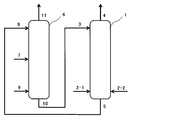
- FIG. 1 is a schematic view showing an embodiment of a separation apparatus for carrying out the separation method according to the present invention.
- the present embodiment a mode for carrying out the present invention (hereinafter referred to as “the present embodiment”) will be described in detail.
- the present invention is not limited to the following embodiment, and can be implemented with various modifications within the scope of the gist.
- the same elements are denoted by the same reference numerals, and redundant description is omitted.
- the positional relationship such as up, down, left and right is based on the positional relationship shown in the drawings unless otherwise specified.
- the dimensional ratios of the devices and members are not limited to the illustrated ratios.
- the separation method of the alkyl aromatic hydrocarbon in the present embodiment is as follows: A mixture containing at least one alkyl aromatic hydrocarbon and isomer thereof is added with a first diluent and an extractant composed of a super strong acid, and acid-base extraction is performed. Separating the complex from the mixture after forming a complex with the super strong acid; A releasing agent having a relative basicity with respect to the alkyl aromatic hydrocarbon in the range of 0.06 to 10 and a second diluent are added to the complex, and the alkyl aromatic hydrocarbon and the releasing agent are added. Separating the alkyl aromatic hydrocarbon from the complex by performing a complex exchange; Is a method for separating an alkyl aromatic hydrocarbon.
- the method for separating alkyl aromatic hydrocarbons is a method of selectively extracting and separating alkyl aromatic hydrocarbons from a mixture containing at least one alkyl aromatic hydrocarbon and its isomer. It separates alkyl aromatic hydrocarbons with high purity.
- high precision distillation Therefore, it is not realistic from an industrial viewpoint such as manufacturing cost and apparatus scale.
- the separation method of this embodiment is particularly suitable for separating specific alkyl aromatic hydrocarbons from alkyl aromatic hydrocarbons containing a plurality of isomers having close boiling points.
- a diluent and a super strong acid are added as an extractant to a mixture containing at least one alkyl aromatic hydrocarbon and its isomer, and acid-base extraction is performed. From this, an extract containing a complex of an alkyl aromatic hydrocarbon and a super strong acid in high purity is obtained. Thereafter, a high purity alkyl aromatic hydrocarbon can be separated from the extract by adding a leaving agent having a relative basicity within a specific range to the extract and performing complex exchange. Moreover, since the complex of the alkyl aromatic hydrocarbon and the super strong acid is formed by returning the complex of the releasing agent and the super strong acid formed by the complex exchange to the mixture again, the super strong acid is isolated. It can be recycled without doing.
- the complex of the alkyl aromatic hydrocarbon and the super strong acid can be decomposed as in the conventional case because the complex of the release agent and the super strong acid can be recycled as an extractant without thermal decomposition.
- no heat is required to isolate the super strong acid.
- the energy for separating the alkyl aromatic hydrocarbon can be greatly reduced.
- a mixture containing one or more alkyl aromatic hydrocarbons and isomers thereof is not particularly limited, but from the viewpoint of the number of isomers having close boiling points, C8 alkylbenzene, C9 alkylbenzene, or C10 alkylbenzenes are preferred.
- the C8 alkylbenzene is a mixture containing two or more selected from the group consisting of p-xylene (PX), m-xylene (MX), o-xylene (OX), and ethylbenzene.
- a mixture of the above-mentioned alkyl aromatic hydrocarbon isomers is used as a raw material, but a compound other than the isomer may be contained, and the alkyl aromatic carbonization is performed on the entire mixture. It is preferable that 90% or more of hydrogen is contained on a mass basis.
- the separation method includes a mixture of alkyl aromatic hydrocarbons containing isomers having a small boiling point difference as described above, and the most basic alkyl aromatic hydrocarbon (hereinafter referred to as “specific alkyl aromatic” in the mixture). Is also selectively extracted and separated.
- specific alkyl aromatic the most basic alkyl aromatic hydrocarbon
- the most basic one is MX
- the most basic one is mesitylene
- the most basic one is C10. Is isodulene.
- the separation method of the alkyl aromatic hydrocarbon in the present embodiment is as follows: A mixture containing at least one alkyl aromatic hydrocarbon and isomer thereof is added with a first diluent and an extractant composed of a super strong acid, and acid-base extraction is performed. After the complex with the super strong acid is formed, a step (acid-base extraction step) of separating the complex from the mixture is included.
- a super strong acid is added as an extractant to a mixture containing at least one of the specific alkyl aromatic hydrocarbons and isomers thereof.
- “super strong acid” means an acid having an acid strength stronger than 100% sulfuric acid having Hammett acidity function H 2 O of ⁇ 11.93.
- the “super strong acid” includes not only an acid alone but also an acid solution.
- Super strong acids form complexes with the most basic alkyl aromatic hydrocarbons in the mixture.
- alkyl aromatic hydrocarbon-super strong acid complex By adding a diluent to a mixture containing this complex (hereinafter also referred to as “alkyl aromatic hydrocarbon-super strong acid complex”) and stripping components other than the specific alkyl aromatic hydrocarbon in the mixture.
- the specific alkyl aromatic hydrocarbon can be extracted from the mixture in a complex state.
- the super strong acid used as an extractant are not limited to, the Bronsted acids, for example, fluorosulfonic acid (FSO 3 H), trifluoromethanesulfonic acid (CF 3 SO 3 H) and the like. Further, a mixed super strong acid in which Bronsted acid and Lewis acid are combined may be used.
- the Bronsted acids for example, fluorosulfonic acid (FSO 3 H), trifluoromethanesulfonic acid (CF 3 SO 3 H) and the like.
- FSO 3 H fluorosulfonic acid
- CF 3 SO 3 H trifluoromethanesulfonic acid
- a mixed super strong acid in which Bronsted acid and Lewis acid are combined may be used.
- mixed super strong acids include Bronsted acids such as hydrogen fluoride (HF), hydrochloric acid (HCl), fluorosulfuric acid (FSO 3 H), trifluoromethanesulfonic acid (CF 3 SO 3 H), and sulfuric acid (H 2 SO 4 ) and at least one selected from the group consisting of antimony pentafluoride (SbF 5 ), boron trifluoride (BF 3 ), aluminum chloride (AlCl 3 ), and tantalum pentafluoride (TaF 5 ).
- Bronsted acids such as hydrogen fluoride (HF), hydrochloric acid (HCl), fluorosulfuric acid (FSO 3 H), trifluoromethanesulfonic acid (CF 3 SO 3 H), and sulfuric acid (H 2 SO 4 ) and at least one selected from the group consisting of antimony pentafluoride (SbF 5 ), boron trifluoride (BF 3 ), aluminum chloride (AlCl 3 ), and tantalum
- a super strong acid that combines at least one selected from the group consisting of niobium pentafluoride (NbF 5 ), titanium tetrafluoride (TiF 4 ), and phosphorus pentafluoride (PF 5 ).
- a super strong acid in which the alkyl aromatic hydrocarbon-super strong acid complex exists in a liquid form at a temperature range of ⁇ 50 ° C. to + 20 ° C. is preferable.
- it is preferable to use a mixture of hydrogen fluoride and the above Lewis acid and more preferably, a mixture of hydrogen fluoride (HF) and boron trifluoride (BF 3 ), hydrogen fluoride (HF) and five fluorine.
- an alkyl aromatic hydrocarbon-super strong acid complex or a leaving agent-super strong acid complex after a complex exchange reaction described later is a Lewis acid (gas). It is preferable to add in such an amount that the complex state can be maintained without releasing.
- the molar ratio of Bronsted acid to Lewis acid in the super strong acid is preferably in the range of 5-50, more preferably 5-20. Range. If the molar ratio of Bronsted acid to Lewis acid in the super strong acid is in the above range, the alkylaromatic hydrocarbon-super strong acid complex and / or the leaving agent-super There is a tendency that the strong acid complex can be stably maintained.
- the Lewis acid can be effectively prevented from being released as a gas from the super strong acid complex solution, the amount of the alkyl aromatic hydrocarbon and the desorbing agent transferred to the oil phase side including the diluent and the extraction residue is reduced. It tends to be reduced.
- hydrogen fluoride is used as the Bronsted acid in the above ratio, it is particularly preferable because the releasing agent-superstrong acid complex can be easily controlled in a liquid state.
- first diluent used in the acid-base extraction step
- second diluent the diluent used in the complex exchange step
- each diluent is shown individually or the mixture of a 1st diluent and a 2nd diluent is shown.
- the first diluent added in the acid-base extraction step is a component other than the complex in the component extracted by the extractant, that is, an alkyl aromatic hydrocarbon other than the specific alkyl aromatic hydrocarbon that is physically dissolved by the complex.
- the first diluent is a specific alkyl aromatic hydrocarbon-super strong acid complex obtained by complex exchange of the releasing agent-super strong acid complex. It is preferable to add in an amount sufficient to
- the first diluent can be used without particular limitation as long as it dissolves alkyl aromatic hydrocarbons.
- the first diluent is a secondary agent such as disproportionation reaction or polymerization that occurs in the presence of a super strong acid. From the viewpoint of suppressing the reaction, it is preferable to use an aliphatic or alicyclic saturated hydrocarbon.
- Examples of the aliphatic or alicyclic saturated hydrocarbon include n-hexane, n-heptane, n-decane, isohexane, 3-methylpentane, 2-methylhexane, 2-ethylhexane, cis-decalin, tetrahydrodi Examples include cyclopentadiene, ethylcyclohexane, methylcyclohexane, methylcyclopentane, cis-1,2-dimethylcyclohexane, 1,3-dimethyladamantane, decahydroacenaphthene, and the like. These may be used alone or in combination of two or more. be able to.
- saturated hydrocarbon In addition to the saturated hydrocarbon, other saturated hydrocarbons that do not contain a quaternary carbon atom may be used in combination, but in this case, the volumetric efficiency of the apparatus may be reduced. Moreover, it is preferable that the said 1st diluent does not contain the impurity which has an unsaturated bond and the impurity containing atoms other than carbon and hydrogen.
- isohexane, 3-methylpentane, 2-methylhexane, 2-ethylhexane, cis-decalin, tetrahydrodicyclopentadiene, ethylcyclohexane, methylcyclohexane are used from the viewpoint of suppressing the disproportionation reaction.
- Methylcyclopentane, cis-1,2-dimethylcyclohexane, 1,3-dimethyladamantane, and decahydroacenaphthene are more preferable, and methylcyclopentane, cis-decalin, decahydroacenaphthene, cis-1,2, -Dimethylcyclohexane, 1,3-dimethyladamantane, decahydroacenaphthene.
- the separation method of the alkyl aromatic hydrocarbon in the present embodiment is as follows: A releasing agent having a relative basicity with respect to the alkyl aromatic hydrocarbon in the range of 0.06 to 10 and a second diluent are added to the complex, and the alkyl aromatic hydrocarbon and the releasing agent are added. It includes a step (complex exchange step) of separating the alkyl aromatic hydrocarbon from the complex by performing complex exchange.
- the alkyl aromatic hydrocarbon extracted and separated as an alkyl aromatic hydrocarbon-super strong acid complex by the acid-base extraction step is subjected to complex state exchange (complex exchange) by adding a specific leaving agent to the complex,
- complex state exchange complex exchange
- the desired alkyl aromatic hydrocarbon is separated. That is, the following equilibrium reaction is established between the alkyl aromatic hydrocarbon-super strong acid complex and the leaving agent-super strong acid complex after the complex exchange.
- a 1 is an alkyl aromatic hydrocarbon
- a 1 H + is an alkyl aromatic hydrocarbon-super strong acid complex
- a 2 is a leaving agent
- a 2 H + is a leaving agent— Super strong acid complex.
- a method for calculating the relative basicity of the desorbing agent will be described by taking as an example the case where MX is used as the alkyl aromatic hydrocarbon and HF—BF 3 is used as the super strong acid.
- An autoclave with an electromagnetic stirrer with an internal volume of 500 mL (manufactured by SUS316L) capable of controlling the temperature was mixed with anhydrous hydrogen fluoride, MX, hexane, and a desorbing agent in a molar ratio of 4.0: 0.32: 0.95: 0.66. The contents are stirred and the liquid temperature is kept at -10 ° C.
- a leaving agent having a relative basicity with respect to the alkyl aromatic hydrocarbon to be separated (eg, MX) within the above range, between the alkyl aromatic hydrocarbon-superacid complex and the leaving agent, and Complex state exchange between the alkyl aromatic hydrocarbon and the leaving agent-superacid complex proceeds easily.
- the relative basicity is less than 0.06, acid-base extraction becomes easy, but the complex exchange reaction between the alkyl aromatic hydrocarbon-superstrong acid complex and the releasing agent does not easily proceed, and a large amount of the releasing agent Is required. Therefore, when it implements industrially, the fall of the volumetric efficiency of the reaction container in which complex exchange with a releasing agent is performed will be caused.
- a desorbing agent an aromatic hydrocarbon can be preferably used. Among them, it is more preferable to use one that can stably form a desorbing agent-super strong acid complex.
- the releasing agent alone and the releasing agent-superstrong acid complex are in the liquid state in the range of ⁇ 50 to + 20 ° C.
- the releasing agent-super strong acid complex is particularly preferable because it can be easily controlled into a liquid state by adjusting the ratio of hydrogen fluoride.
- Non-Patent Document 1 the detailed measurement method is omitted, but the relative basicity of the alkyl aromatic hydrocarbon is described when the relative basicity of p-xylene (PX) is 1. Yes.
- PX p-xylene
- the relative basicity of C8 to C9 alkyl aromatic hydrocarbons is as shown in Table 1 below, and the elimination agent may be appropriately selected with reference to these data.
- an aromatic hydrocarbon having a boiling point higher than that of the specific alkyl aromatic hydrocarbon to be separated is used from the viewpoint that the specific alkyl aromatic hydrocarbon can be more easily separated by distillation operation. It is preferable to use an aromatic hydrocarbon having a boiling point in the range of 145 to 400 ° C.
- examples of the leaving agent include 3-ethyltoluene, 1-methyl-3-propylbenzene, metadiethylbenzene, 1-fluoronaphthalene, 1,3, 5-triethylbenzene, 3-methylbiphenyl, fluoro-2,4,6-trimethylbenzene, fluoro-2,3,6-trimethylbenzene, fluoro-3,4,5-trimethylbenzene, or fluoro-2,3 5-trimethylbenzene, 1,3-dimethyl-4- (2,2-dimethylpropyl) benzene, 1,3-dimethyl-5- (2,2-dimethylpropyl) benzene, 1-methyl-3,5-di (2,2-dimethylpropyl) benzene, 1-isobutyl-3-methylbenzene and the like can be preferably used.
- the releasing agents can be used alone or in admixture of two or more.
- C8 alkylbenzenes are used as alkyl aromatic hydrocarbons, and MX is extracted from the mixture as specific alkyl aromatic hydrocarbons, 3-ethyltoluene, metadiethylbenzene or these as a desorbing agent.
- a mixture of these can be suitably used.
- C9 alkylbenzenes are used as alkyl aromatic hydrocarbons and mesitylene is extracted from the mixture as specific alkyl aromatic hydrocarbons, 1,3,5-triethylbenzene or the like is used as a desorbing agent. It can be preferably used.
- the amount of the releasing agent added is not particularly limited as long as it can be complex-exchanged with the alkyl aromatic hydrocarbon-super strong acid complex, but the amount of the specific alkyl aromatic hydrocarbon-super strong acid complex, the relative base of the releasing agent It is appropriately determined according to the degree and the ability of the reaction vessel for performing the complex exchange.
- the amount of addition of the desorbing agent should be such that complex exchange is possible when the number of theoretical plates in the reaction vessel for complex exchange is in the range of 5 to 10 stages. preferable.
- the molar ratio with respect to the Lewis acid in the complex of the alkyl aromatic hydrocarbon and the super strong acid is used. It is preferable to add the releasing agent in such an amount as to be in the range of 1-15.
- the addition amount of the leaving agent within the above range, the complex exchange reaction between the alkyl aromatic hydrocarbon-Bronsted acid-Lewis acid complex and the leaving agent can easily proceed.
- the concentration of the extracted alkyl aromatic hydrocarbon tends to increase, and the distillation efficiency tends to be improved.
- the amount should be in the range of 1.1 to 10 in molar ratio to the Lewis acid in the complex of alkyl aromatic hydrocarbon and super strong acid. More preferred.
- the alkyl aromatic hydrocarbon separated by the complex exchange becomes a mixed solution of the desorbing agent and the second diluent. Extracted and separated, and only alkyl aromatic hydrocarbons can be obtained by known means such as distillation. Therefore, the second diluent is preferably added in such an amount that the super strong acid solution and the oil phase (mixed solution of the alkyl aromatic hydrocarbon, the releasing agent, and the second diluent) can be separated. .
- the addition amount of the second diluent that can separate the super strong acid solution and the oil phase and suppress the disproportionation reaction of the releasing agent is a mass ratio (second The weight of the diluent / the weight of the releasing agent is preferably in the range of 0.001 to 1, more preferably in the range of 0.01 to 0.25.
- the same one as the first diluent described above can be used.
- a mixture of a releasing agent and a super strong acid formed by complex exchange and a second diluent together with one or more alkyl aromatic hydrocarbons and isomers thereof as an extractant is preferable to further include a step of adding to and recycling.
- the leaving agent-superacid complex formed by complex exchange is continuously added to the original mixture and recycled without isolating superacids (eg, hydrogen fluoride and Lewis acid).
- superacids eg, hydrogen fluoride and Lewis acid
- the leaving agent-super strong acid complex added to the original mixture may contain a part of the alkyl aromatic hydrocarbon-super strong acid complex that could not be completely exchanged in the complex exchange step.
- the alkyl aromatic hydrocarbon-superstrong acid complex discharged after the acid-base extraction step contains an alkyl that is simultaneously with the acid-base extraction.
- a part of the leaving agent-superstrong acid complex that could not complete the complex exchange with the aromatic hydrocarbon may be contained.
- the above leaving agent-super strong acid complex is added again to the mixture containing the alkyl aromatic hydrocarbon and its isomer, so that the complex exchange is performed again, and the alkyl aromatic hydrocarbon is exchanged with the super strong acid. Acid-base extraction is performed as a complex. Therefore, the first diluent added to the reaction vessel in which complex formation is performed is the other non-complexed alkyl aromatic hydrocarbon that is physically dissolved in the super strong acid solution of the alkyl aromatic hydrocarbon-super strong acid complex. It is preferable to add (that is, an isomer) in an amount capable of stripping.
- the amount of the first diluent (diluent volume (mL) / super The number of moles of Lewis acid in the strong acid solution is preferably in the range of 50 mL / mol to 500 mL / mol, more preferably in the range of 100 mL / mol to 300 mL / mol.
- the super strong acid solution containing the leaving agent-super strong acid complex is added to the mixture containing the alkyl aromatic hydrocarbon and its isomer, whereby the complex exchange is performed again and the desorption is performed. Since the super strong acid solution containing the agent-super strong acid complex functions as an extractant, the alkyl aromatic hydrocarbon in the mixture is extracted as the alkyl aromatic hydrocarbon-super strong acid complex by acid-base extraction. For example, when a mixture of Bronsted acid and Lewis acid is used as a super strong acid, in order to perform complex exchange and acid-base extraction, a super strong acid solution containing a desorbing agent-super strong acid complex is used as an extractant.
- the number of moles of alkyl aromatic hydrocarbon in the mixture / number of moles of Lewis acid in the complex ranges from 0.5 to 1.5.
- the separation apparatus for alkyl aromatic hydrocarbons in the present embodiment is: A separation apparatus comprising an acid-base extraction tower and a complex exchange tower, The acid-base extraction column is extracted from a tube for supplying a mixture containing one or more alkyl aromatic hydrocarbons and isomers thereof, a tube for supplying a first diluent, and a bottom of the complex exchange column. A pipe supplying a complex solution of the leaving agent and the super strong acid, and the alkyl aromatic hydrocarbon is discharged from the bottom of the acid-base extraction tower as a complex solution of the alkyl aromatic hydrocarbon and the super strong acid.
- the complex exchange column includes a tube for supplying a complex solution of the alkyl aromatic hydrocarbon and super strong acid discharged from the bottom of the acid-base extraction column, and a tube for supplying a second diluent and a desorbing agent.
- a tube for discharging the extracted mixture of the alkyl aromatic hydrocarbon, the desorbing agent and the diluent from the top of the complex exchange column, and a desorbing agent after the complex exchange is performed.
- FIG. 1 is a schematic view showing an embodiment of a purification apparatus for carrying out the purification method according to the present invention.
- FIG. 1 is an example provided with a pipe 5 for performing a step of adding a complex of a desorbing agent and a super strong acid together with a second diluent as an extractant to the mixture for recycling.
- FIG. 1 shows that from the lower side of the complex exchange column, the second diluent is supplied through the tube 2-1, the desorbing agent is supplied through the tube 2-2, and both are mixed at the lower portion of the column.
- the second diluent and the releasing agent may be mixed in advance and supplied in one tube.
- description will be made using an example of purifying MX by extracting and separating MX having the strongest basicity from mixed xylene, which is an alkyl aromatic hydrocarbon, using a super strong acid.
- mixed xylene as a raw material is supplied to an acid-base extraction column 6 for extracting MX in mixed xylene as an MX-super strong acid complex through a tube 7.
- the first diluent is supplied to the acid-base extraction tower 6 from a pipe 9 disposed below the acid-base extraction tower.
- the super strong acid solution of the desorbing agent-super strong acid complex extracted from the bottom 5 of the complex exchange tower 1 for performing the complex exchange reaction of the MX-super strong acid complex with the desorbing agent is It is supplied from above the base extraction column 6.
- a complex exchange between the leaving agent-super strong acid complex and MX is performed, and MX is acid-base extracted as the MX-super strong acid complex.
- the super strong acid solution of the releasing agent-super strong acid complex can be said to be a Bronsted acid solution of the releasing agent-Bronsted acid-Lewis acid complex.
- the super strong acid solution of MX-super strong acid complex can also be said to be a Bronsted acid solution of MX-Bronsted acid-Lewis acid complex.
- the super strong acid solution of MX-super strong acid complex extracted from the acid-base extraction tower 6 is supplied from above the complex exchange tower 1 through the pipe 3. Further, from the lower side of the complex exchange tower, the second diluent is supplied through the pipe 2-1, and the desorbing agent is supplied through the pipe 2-2, and both are mixed in the lower part of the tower. In the complex exchange tower 1, the MX-superacid complex solution and the mixed solution of the second diluent and the desorbing agent are brought into countercurrent contact. Here, complex exchange is performed, and the MX-super strong acid complex is separated into MX and a leaving agent-super strong acid complex.
- the separated MX is continuously extracted from the top 4 of the complex exchange tower 1 as a mixed liquid of excess desorbent and diluent. Further, as described above, the complex-exchanged leaving agent-super strong acid complex is continuously withdrawn from the bottom 5 of the complex exchange tower 1 as a super strong acid solution, and is again extracted by the tube 5 through the acid-base extraction tower. By being supplied to 6, it is recycled.
- the separation device in the present embodiment distills the mixed liquid composed of the alkyl aromatic hydrocarbon, the desorbing agent and the diluent discharged from the complex exchange tower to obtain the alkyl aromatic hydrocarbon, the desorbing agent and the diluent. It is preferable to further comprise a distillation column for separating the components.
- the mixed solution composed of the desorbing agent discharged from the top 11 of the acid-base extraction column 6, the extracted residual xylene and the diluent is passed through a known distillation column (not shown), Separated into xylene, desorbent and diluent.
- the separation apparatus in the present embodiment distills a mixed solution composed of the desorbing agent discharged from the acid-base extraction tower, the extracted non-extracted extracted isomer, and the diluent, It is preferable to further comprise a distillation column for separating the body and diluent.
- the mixed liquid composed of MX, the desorbing agent and the diluent discharged from the top 4 of the complex exchange column 1 passes through a known distillation column (not shown), and then the MX, desorbing agent and diluent are mixed. Separated into each. In this way, high purity MX can be separated from the mixed xylene.
- the complex exchange column 1 and the acid-base extraction column 6 known means applicable to the liquid-liquid extraction operation system can be used without particular limitation, and packed column, perforated plate column, perforated plate pulse column, acid with stirrer A base extraction tower, WINRAY (registered trademark), a mixer settler, or the like can be suitably used. Among these, a type having a high throughput per unit cross-sectional area and a high extraction efficiency can be preferably used.
- the internal temperatures of the complex exchange column 1 and the acid-base extraction column 6 are preferably maintained in the temperature range of ⁇ 50 ° C. to + 20 ° C., and more preferably the temperature range is ⁇ 30 ° C. to 0 ° C.
- the complex alteration tends to be reduced. From the above viewpoint, it can be said that it is preferable to keep the temperature as low as possible. However, excessive cooling has the disadvantage of increasing the separation cost.
- the internal pressure of the complex exchange column 1 and acid-base extraction column 6 is higher than the vapor pressure of the MX-HF-BF 3 complex and DatsuHanarezai -HF-BF 3 complex
- a pressure that does not cause problems when the tower is operated is preferably selected.
- the internal pressures of the complex exchange column 1 and the acid-base extraction column 6 are preferably in the pressure range of 0.2 MPa to 10 MPa, more preferably in the pressure range of 0.25 MPa to 1 MPa. If the internal pressure is too low, boron trifluoride (gas) is released from the HF-BF 3 complex, and the complex state may not be maintained. On the other hand, if the internal pressure is too high, it is necessary to prepare a tower having a material and structure capable of withstanding the pressure, which tends to increase the separation cost.
- the molar ratio of MX (manufactured by Mitsubishi Gas Chemical Co., Inc.), 3-ethyltoluene (reagent grade, manufactured by Tokyo Chemical Industry Co., Ltd.), and n-hexane (reagent grade, manufactured by Wako Pure Chemical Industries, Ltd.) is 1 : 122.9 g of raw material liquid (MX: 0.20 mol, 3-ethyltoluene: 0.41 mol, n-hexane: 0.59 mol) mixed at a ratio of 2: 3 was added to the reactor at 4 g / min. Supplied in proportion.
- the obtained hydrogen fluoride solution phase and the oil phase were each neutralized to obtain an oil component dissolved in the hydrogen fluoride solution and an oil component obtained by removing a trace amount of acid from the oil phase.
- the relative basicity of 3-ethyltoluene determined from the reaction results obtained by gas chromatography analysis was 0.52.
- the analysis was performed using gas chromatography (GC-14B, manufactured by Shimadzu Corporation), and a calibration curve was prepared and evaluated using n-decane (reagent grade, manufactured by Wako Pure Chemical Industries, Ltd.) as an internal standard substance.
- n-decane reagent grade, manufactured by Wako Pure Chemical Industries, Ltd.
- ULBON Xylene Master inner diameter 0.32 mm ⁇ , length 50 m
- Shinwa Kako Co., Ltd. was used as a capillary column.
- the temperature raising program the temperature was raised from 70 ° C. to 150 ° C. at a rate of 2 ° C./min and held for 30 minutes.
- Sample 2 Relative basicity was measured in the same manner as Sample 1 except that 1-fluoronaphthalene (reagent grade, manufactured by Tokyo Chemical Industry Co., Ltd.) was used instead of 3-ethyltoluene. The relative basicity of 1-fluoronaphthalene was 0.37.
- Sample 3 Relative basicity was measured in the same manner as Sample 1, except that fluoro-2,3,4,6-tetramethylbenzene (manufactured by Shin Nippon Pharmaceutical Co., Ltd.) was used instead of 3-ethyltoluene. .
- the relative basicity of 1-fluoro-2,3,4,6-tetramethylbenzene was 0.29.
- Sample 4 Relative basicity was measured in the same manner as Sample 1 except that metadiethylbenzene (reagent grade, manufactured by Tokyo Chemical Industry Co., Ltd.) was used instead of 3-ethyltoluene. The relative basicity of metadiethylbenzene was 0.28.
- Sample 5 Relative basicity was measured in the same manner as Sample 1 except that fluoro-2,4,6-trimethylbenzene (reagent grade, manufactured by Tokyo Chemical Industry Co., Ltd.) was used instead of 3-ethyltoluene. The relative basicity of fluoro-2,4,6-trimethylbenzene was 0.16.
- Sample 6 Relative basicity was measured in the same manner as Sample 1 except that pseudocumene (reagent grade, manufactured by Wako Pure Chemical Industries, Ltd.) was used instead of 3-ethyltoluene. The relative basicity of pseudocumene was 1.63.
- Sample 7 Relative basicity was measured in the same manner as Sample 1, except that mesitylene (reagent grade, manufactured by Wako Pure Chemical Industries, Ltd.) was used instead of 3-ethyltoluene. The relative basicity of mesitylene was 5.00.
- Sample 8 Relative basicity was measured in the same manner as Sample 1 except that OX (reagent grade, manufactured by Wako Pure Chemical Industries, Ltd.) was used instead of 3-ethyltoluene. The relative basicity of OX was 0.04.
- Sample 9 Relative basicity was measured in the same manner as Sample 1, except that 1,3,5-triethylbenzene (reagent grade, manufactured by Tokyo Chemical Industry Co., Ltd.) was used instead of 3-ethyltoluene.
- the relative basicity of 1,3,5-triethylbenzene was 3.52.
- Sample 10 Relative basicity was measured in the same manner as Sample 1 except that ethylbenzene (reagent grade, manufactured by Tokyo Chemical Industry Co., Ltd.) was used instead of 3-ethyltoluene.
- the relative basicity of ethylbenzene was 0.02.
- the amount of MX-HF-BF 3 complex and MX in each step described later is determined by extracting each hydrogen fluoride solution phase and oil phase into ice water, respectively, and with respect to the obtained hydrogen fluoride solution phase and oil phase. Each was neutralized to obtain an oil component dissolved in the hydrogen fluoride solution and an oil component obtained by removing a small amount of acid from the oil phase, and then using gas chromatography (GC-14B, manufactured by Shimadzu Corporation). , N-decane (reagent grade, manufactured by Wako Pure Chemical Industries, Ltd.) was used as an internal standard substance, and was evaluated by preparing a calibration curve.
- GC-14B gas chromatography
- ULBON Xylene Master (inner diameter: 0.32 mm ⁇ , length: 50 m) manufactured by Shinwa Kako Co., Ltd. was used.
- the temperature was raised from 70 ° C. to 150 ° C. at a rate of 2 ° C./min and held for 30 minutes.
- Example 1 [MX acid-base extraction step] As raw materials, ethylbenzene, p-xylene, m-xylene, and o-xylene (all reagent grades, manufactured by Wako Pure Chemical Industries, Ltd.) are contained at 14%, 19%, 41%, and 24%, respectively, on a mass basis. A xylene mixture mixed in this manner was used.
- a rotating disk extraction tower (made of material SUS316L) having an inner diameter of 45 mm and a total length of 2,000 mm with a total of 52 rotating disks inside is maintained at 0.4 ° C. with a temperature of 0 ° C. and nitrogen pressure in the middle of the extraction tower.
- the xylene mixture is supplied from the provided supply pipe at a rate of 524 g / hour, and 524 g of hexane (manufactured by Gordo Co., Ltd.) containing 39 mol% of methylcyclopentane as a diluent is supplied from the pipe provided at the bottom of the extraction tower. Supplied at a rate of / hour.
- MX extracted with hydrogen fluoride and boron trifluoride was continuously discharged as a hydrogen fluoride solution of MX-HF-BF 3 complex from a tube provided at the bottom of the extraction tower at a rate of 1370 g / hr. .
- mixed components other than the complex solution were continuously discharged from the tube provided at the top of the extraction tower at a rate of 1534 g / hour.
- Complex solution discharged from the column bottom, MX-HF-BF 3 are included and complex and meta diethylbenzene -HF-BF 3 complex, the molar ratio is 60: was 8.
- MX extraction rate (%) (([number of moles of MX-HF-BF 3 complex discharged from the extraction tower] ⁇ [number of moles of MX-HF-BF 3 complex supplied to the extraction tower]) / [supplied] Number of moles of MX] in the xylene mixture) ⁇ 100
- a rotary disk extraction tower (material SUS316L) having an inner diameter of 45 mm and a total length of 1,000 mm equipped with a total of 26 rotary disks inside is maintained at a column temperature of 0 ° C. and a nitrogen pressure of 0.4 MPa. From the tube provided in the upper stage, the complex solution discharged in the MX extraction step was supplied at a rate of 1367 g / hour.
- MX which had undergone complex exchange with the desorbent in the complex exchange tower was continuously discharged at a rate of 1988 g / hr from the tube provided at the top of the complex exchange tower as a mixed liquid of the desorbent and diluent.
- concentrations of MX and metadiethylbenzene in the discharged mixture were 11.2% and 55.2%, respectively, on a mass basis.
- a fluorinated aqueous solution of metadiethylbenzene-HF-BF 3 complex was continuously discharged at a rate of 1843 g / hr from a tube provided at the bottom of the complex exchange column.
- MX complex exchange rate (%) 100- (number of moles of [MX-HF-BF 3 complex discharged from complex exchange tower]) / ([MX-HF-BF 3 complex supplied to complex exchange tower]) Number of moles) x 100
- MX yield 81% when MX was separated from the raw material xylene mixture through the MX acid-base extraction step and the complex exchange step.
- MX was isolated by distilling the mixed solution containing MX discharged from the tube provided at the top of the extraction tower.
- distillation was performed at a column top pressure of 31 kPa to separate into a component mainly containing MX and a component mainly containing diethylbenzene higher than the boiling point of MX.
- Example 2 The above operation was performed in the same manner as in Example 1 except that 3-ethyltoluene was used instead of metadiethylbenzene as the releasing agent.
- the MX extraction rate in the MX extraction step is 90%
- the MX complex exchange rate in the complex exchange step is 98%
- MX is extracted from the raw material xylene mixture through the MX extraction step and the complex exchange step.
- the MX yield upon separation was 88%.
- Example 3 The above operation was performed in the same manner as in Example 1 except that pseudocumene was used instead of metadiethylbenzene as the desorbing agent.
- the MX extraction rate in the MX extraction step is 74%
- the MX complex exchange rate in the complex exchange step is 100%
- MX is extracted from the raw material xylene mixture through the MX extraction step and the complex exchange step.
- the MX yield upon separation was 74%.
- Example 4 The above operation was performed in the same manner as in Example 1 except that fluoro-2,4,6-trimethylbenzene was used as a desorbing agent instead of metadiethylbenzene.
- the MX extraction rate in the MX extraction step is 93%
- the MX complex exchange rate in the complex exchange step is 70%
- MX is separated from the raw material xylene mixture through the MX extraction step and the complex exchange step.
- the MX yield of was 65%.
- Example 5 The above operation was performed in the same manner as in Example 1 except that mesitylene was used in place of metadiethylbenzene as a desorbing agent.
- the MX extraction rate in the MX extraction step is 53%
- the MX complex exchange rate in the complex exchange step is 100%
- MX is separated from the raw material xylene mixture through the MX extraction step and the complex exchange step.
- the MX yield of was 53%.
- Example 1 The above operation was performed in the same manner as in Example 1 except that o-xylene (OX) was used in place of metadiethylbenzene.
- the MX extraction rate in the MX extraction step is 71%
- the MX complex exchange rate in the complex exchange step is 1.6%
- MX is separated from the raw material xylene mixture through the MX extraction step and the complex exchange step.
- the MX yield was 1%.
- Number of moles of MX-HF-BF 3 complex relative to the total number of moles of aromatic hydrocarbons having 8 carbon atoms (ethylbenzene, p-xylene, MX, and o-xylene) in the hydrogen fluoride solution, ie, hydrogen fluoride solution MX component / total C8 aromatic hydrocarbon molar ratio) and MX complex exchange rate in the complex exchange step were as shown in Table 3 below.
- examples and comparative examples are described in the order of relative basicity of the releasing agents used.
- [MX acid-base extraction step] A rotary disk extraction tower (made of material SUS316L) having an inner diameter of 45 mm and a total length of 2,000 mm with a total of 52 rotary disks inside is maintained at 0.4 MPa with a tower temperature of 0 ° C. and nitrogen pressure, and is placed at the bottom of the extraction tower. From the provided tube, hexane (manufactured by Gordo Co., Ltd.) containing 39 mol% of methylcyclopentane as a diluent was supplied at a rate of 524 g / hour.
- MX extracted with hydrogen fluoride and boron trifluoride was continuously discharged as a hydrogen fluoride solution of MX-HF-BF 3 complex from a tube provided at the bottom of the extraction tower at a rate of 1429 g / hr. .
- mixed components other than the complex solution were continuously discharged from the tube provided at the top of the extraction tower at a rate of 1005 g / hour.
- the molar ratio of MX, HF and BF 3 in the complex solution discharged from the column bottom was 0.39: 5: 0.5.
- the number of moles of MX-HF-BF 3 complex in the discharged complex solution (hydrogen fluoride solution) was 0.995 with respect to the total number of moles of the xylene mixture in the complex solution.
- MX extraction rate (%) ([number of moles of MX in the complex solution discharged from the bottom of the extraction tower]) / (number of moles of [MX in the supplied mixture]) ⁇ 100
- the MX complex decomposition rate and MX recovery rate were calculated from the reaction results obtained by gas chromatography analysis, and were 99.9% and 99.9%, respectively.
- the complex decomposition rate and MX alteration rate were calculated by the following formulas. From the above results, the MX yield was 98.4% when MX was separated from the raw material xylene mixture through the MX acid-base extraction step and the complex decomposition step.
- MX was isolated in the same manner as in Example 1 using a hexane solution containing MX discharged from the bottom of the decomposition tower.
- the purity of the obtained MX was 99.7%, and the distillation recovery rate of MX was 78%.
- the complex decomposition tower in order to decompose the complex without deteriorating, it is necessary to set the tower bottom temperature to 100 ° C. or higher, and in Examples 1 to 5, it is understood that an unnecessary amount of heat is required.
- Example 6 [Mix acid-base extraction process using circulating release agent complex]
- the acid base of MX of Example 1 except that the metadiethylbenzene-HF-BF3 complex discharged from the tower bottom in the complex exchange step of Example 1 was used as the mixed solution supplied from the tube provided in the upper stage of the extraction tower. The operation was performed in the same manner as in the extraction step.
- the number of moles of MX-HF-BF3 complex in the complex solution discharged from the column bottom was 0.995 with respect to the total number of moles of the xylene mixture in the complex solution, and the MX extraction rate was 92%. The results were the same as when blended in proportions.
- Example 7 [Mesitylene acid-base extraction process] As a raw material, a C9 alkylbenzene mixture containing 7% propylbenzenes, 36% ethyltoluenes, 11% mesitylene, 35% pseudocumene, 6% hemimeritene, 1% indane, and 4% other (manufactured by Gordo Co., Ltd.) is used. It was.
- a rotating disk extraction tower (made of material SUS316L) having an inner diameter of 45 mm and a total length of 2,000 mm with a total of 52 rotating disks inside is maintained at 0.4 ° C. with a temperature of 0 ° C. and nitrogen pressure in the middle of the extraction tower.
- the above-mentioned C9 alkylbenzene mixture was supplied from the provided supply pipe at a rate of 2392 g / hr, and hexane containing 39 mol% of methylcyclopentane as a diluent from a pipe provided at the bottom of the extraction tower (manufactured by Gordo Co., Ltd.) was fed at a rate of 524 g / hr.
- the complex solution discharged from the bottom of the column was a hydrogen fluoride solution of mesitylene-HF-BF 3 complex and 1,2,3-triethylbenzene-HF-BF 3 complex (molar ratio of mesitylene-HF-BF 3 complex: The molar ratio with the 1,2,3-triethylbenzene-HF-BF 3 complex was 9:55).
- the mole number of the mesitylene-HF-BF 3 complex in the discharged complex solution (hydrogen fluoride solution) was 0.90 with respect to the total mole number of the C9 alkylbenzene mixture charged. Moreover, it was 87% when the mesitylene extraction rate was computed from the following formula.
- Extraction rate of mesitylene (%) ((number of moles of [mesitylene-HF-BF 3 complex discharged from the extraction tower] ⁇ number of moles of mesitylene-HF-BF 3 complex supplied to the extraction tower]) / [supplied Number of moles of mesitylene in the C9 alkylbenzene mixture] ⁇ 100
- a rotary disk extraction tower (material SUS316L) having an inner diameter of 45 mm and a total length of 1,000 mm equipped with a total of 26 rotary disks inside is maintained at a column temperature of 0 ° C. and a nitrogen pressure of 0.4 MPa. From the tube provided in the upper stage, the complex solution discharged in the mesitylene extraction step was supplied at a rate of 1300 g / hour.
- the mesitylene complex-exchanged with the releasing agent in the extraction tower was continuously discharged at a rate of 1299 g / hour from the tube provided at the top of the extraction tower as a mixed liquid of the releasing agent and the diluent.
- the concentration of mesitylene and the concentration of 1,2,3-triethylbenzene in the discharged mixture were 15.0% and 48.0%, respectively, on a mass basis.
- the 1,2,3-triethylbenzene-HF-BF 3 complex fluorinated aqueous solution was continuously discharged at a rate of 2170 g / hr from the tube provided at the bottom of the extraction column.
- the discharged complex hydrogen fluoride solution contains mesitylene-HF-BF 3 complex and 1,2,3-triethylbenzene-HF-BF 3 complex, and the ratio is 0.26 in molar ratio: It was 99.74. Moreover, it was 99.5% when the mesitylene complex exchange rate was computed from the following formula.
- Mesitylene complex exchange rate (%) 100 ⁇ (number of moles of [mesitylene-HF-BF 3 complex discharged from the complex exchange column]) / ([mesitylene-HF-BF 3 complex supplied to the complex exchange column]) Number of moles) x 100
- mesitylene was isolated by distilling a mixed solution containing mesitylene discharged from a tube provided at the top of the extraction tower. First, 150 kg of mesitylene containing a desorbing agent and a diluent is distilled at a top pressure of 93 kPa, so that the components below the boiling point of mesitylene mainly containing hexane and methylcyclopentane and the components above the boiling point of mesitylene are obtained. And separated.
- distillation was performed at a column top pressure of 31 kPa to separate a component mainly containing mesitylene and a component mainly containing 1,2,3-triethylbenzene higher than the boiling point of mesitylene.
- a column top pressure of 31 kPa to separate a component mainly containing mesitylene and a component mainly containing 1,2,3-triethylbenzene higher than the boiling point of mesitylene.
- the purity of mesitylene was 99.5%.
- the number of theoretical columns of the distillation column used was 85, the reflux ratio condition of each distillation operation was 15, and the distillation recovery rate of mesitylene was 85%.
- the energy required for separation can be greatly reduced in the separation of high-purity alkyl aromatic hydrocarbons compared to the conventional one, and it can be used as an industrially advantageous process.
Landscapes
- Chemical & Material Sciences (AREA)
- Organic Chemistry (AREA)
- Engineering & Computer Science (AREA)
- Analytical Chemistry (AREA)
- Oil, Petroleum & Natural Gas (AREA)
- Water Supply & Treatment (AREA)
- Chemical Kinetics & Catalysis (AREA)
- General Chemical & Material Sciences (AREA)
- Organic Low-Molecular-Weight Compounds And Preparation Thereof (AREA)
- Extraction Or Liquid Replacement (AREA)
- Production Of Liquid Hydrocarbon Mixture For Refining Petroleum (AREA)
Priority Applications (8)
| Application Number | Priority Date | Filing Date | Title |
|---|---|---|---|
| US14/411,289 US9896397B2 (en) | 2012-06-29 | 2013-06-25 | Method and apparatus for separating alkyl aromatic hydrocarbon |
| CN201380034869.1A CN104411666B (zh) | 2012-06-29 | 2013-06-25 | 烷基芳香族烃的分离方法和分离装置 |
| EP13810190.2A EP2868644B1 (en) | 2012-06-29 | 2013-06-25 | Method and apparatus for separating alkyl aromatic hydrocarbon |
| IN188DEN2015 IN2015DN00188A (enExample) | 2012-06-29 | 2013-06-25 | |
| KR1020147036424A KR102048250B1 (ko) | 2012-06-29 | 2013-06-25 | 알킬 방향족 탄화수소의 분리방법 및 분리장치 |
| SG11201408633WA SG11201408633WA (en) | 2012-06-29 | 2013-06-25 | Method and apparatus for separating alkyl aromatic hydrocarbon |
| JP2014522639A JP6146411B2 (ja) | 2012-06-29 | 2013-06-25 | アルキル芳香族炭化水素の分離方法および分離装置 |
| US15/713,972 US10207967B2 (en) | 2012-06-29 | 2017-09-25 | Method and apparatus for separating alkyl aromatic hydrocarbon |
Applications Claiming Priority (2)
| Application Number | Priority Date | Filing Date | Title |
|---|---|---|---|
| JP2012147540 | 2012-06-29 | ||
| JP2012-147540 | 2012-06-29 |
Related Child Applications (2)
| Application Number | Title | Priority Date | Filing Date |
|---|---|---|---|
| US14/411,289 A-371-Of-International US9896397B2 (en) | 2012-06-29 | 2013-06-25 | Method and apparatus for separating alkyl aromatic hydrocarbon |
| US15/713,972 Division US10207967B2 (en) | 2012-06-29 | 2017-09-25 | Method and apparatus for separating alkyl aromatic hydrocarbon |
Publications (2)
| Publication Number | Publication Date |
|---|---|
| WO2014003000A1 true WO2014003000A1 (ja) | 2014-01-03 |
| WO2014003000A9 WO2014003000A9 (ja) | 2014-03-27 |
Family
ID=49783146
Family Applications (1)
| Application Number | Title | Priority Date | Filing Date |
|---|---|---|---|
| PCT/JP2013/067383 Ceased WO2014003000A1 (ja) | 2012-06-29 | 2013-06-25 | アルキル芳香族炭化水素の分離方法および分離装置 |
Country Status (9)
| Country | Link |
|---|---|
| US (2) | US9896397B2 (enExample) |
| EP (1) | EP2868644B1 (enExample) |
| JP (1) | JP6146411B2 (enExample) |
| KR (1) | KR102048250B1 (enExample) |
| CN (1) | CN104411666B (enExample) |
| IN (1) | IN2015DN00188A (enExample) |
| SG (1) | SG11201408633WA (enExample) |
| TW (1) | TWI591053B (enExample) |
| WO (1) | WO2014003000A1 (enExample) |
Cited By (1)
| Publication number | Priority date | Publication date | Assignee | Title |
|---|---|---|---|---|
| US11584796B2 (en) | 2014-12-18 | 2023-02-21 | Bergenbio Asa | Anti-Axl antagonistic antibodies |
Families Citing this family (4)
| Publication number | Priority date | Publication date | Assignee | Title |
|---|---|---|---|---|
| IN2015DN00188A (enExample) | 2012-06-29 | 2015-06-12 | Mitsubishi Gas Chemical Co | |
| CN111410182A (zh) * | 2020-03-31 | 2020-07-14 | 福建省龙德新能源股份有限公司 | 一种回用六氟磷酸锂合成尾气中五氟化磷的方法 |
| US12441672B2 (en) * | 2020-08-26 | 2025-10-14 | China Petroleum & Chemical Corporation | Composite adsorbent for separation of ethylbenzene by adsorption distillation and application thereof |
| CN113248343A (zh) * | 2021-05-13 | 2021-08-13 | 天津济泰科技有限公司 | 隔板塔分离重整碳十芳烃的工艺及方法 |
Citations (4)
| Publication number | Priority date | Publication date | Assignee | Title |
|---|---|---|---|---|
| JPS4835041B1 (enExample) * | 1968-09-03 | 1973-10-25 | ||
| JPH06287149A (ja) * | 1991-01-18 | 1994-10-11 | Agency Of Ind Science & Technol | ベンゼン二置換異性体の分離法及びその分離用薬剤 |
| JPH06305989A (ja) * | 1993-02-23 | 1994-11-01 | Sekiyu Sangyo Kasseika Center | 錯体形成による分離回収方法 |
| JPH08143485A (ja) | 1994-11-22 | 1996-06-04 | Uop Inc | 芳香族炭化水素からメタキシレンの吸着分離法 |
Family Cites Families (13)
| Publication number | Priority date | Publication date | Assignee | Title |
|---|---|---|---|---|
| US2662925A (en) | 1951-06-29 | 1953-12-15 | Standard Oil Co | Isomerization of xylenes |
| US3512931A (en) * | 1966-08-12 | 1970-05-19 | Mitsubishi Gas Chemical Co | Process for recovering hydrogen fluoride and boron fluoride |
| JPS4719256Y1 (enExample) | 1966-11-19 | 1972-07-01 | ||
| JPS4737408Y1 (enExample) | 1967-08-03 | 1972-11-13 | ||
| US3562347A (en) * | 1967-12-15 | 1971-02-09 | Japan Gas Chemical Co | Process for extract-isomerization of xylene isomers |
| US3592865A (en) | 1968-09-03 | 1971-07-13 | Exxon Research Engineering Co | Separation and recovery of complexible ligands by liquid exchange |
| US3644553A (en) * | 1968-12-17 | 1972-02-22 | Japan Gas Chemical Co | Process for the decomposition of a solution of hydrogen fluoride-boron trifluoride-xylenes complex |
| US3766286A (en) * | 1971-06-25 | 1973-10-16 | Exxon Research Engineering Co | Process for the isomerization of hydrocarbons |
| US5177302A (en) | 1990-11-27 | 1993-01-05 | Director-General, Agency Of Industrial Science And Technology | Process for separating isomers of disubstituted benzenes and agents to be used therefor |
| DE102004004683A1 (de) * | 2004-01-29 | 2005-08-18 | Basf Ag | Verfahren zur Herstellung von Dinitrilen |
| WO2006009553A1 (en) * | 2004-06-23 | 2006-01-26 | Exxonmobil Chemical Patents Inc. | Methods for separating mixture components |
| CN103857651B (zh) * | 2011-08-29 | 2016-05-04 | 沙特基础工业公司 | 用于制备二取代的琥珀酸酯的方法 |
| IN2015DN00188A (enExample) * | 2012-06-29 | 2015-06-12 | Mitsubishi Gas Chemical Co |
-
2013
- 2013-06-25 IN IN188DEN2015 patent/IN2015DN00188A/en unknown
- 2013-06-25 WO PCT/JP2013/067383 patent/WO2014003000A1/ja not_active Ceased
- 2013-06-25 KR KR1020147036424A patent/KR102048250B1/ko active Active
- 2013-06-25 JP JP2014522639A patent/JP6146411B2/ja active Active
- 2013-06-25 SG SG11201408633WA patent/SG11201408633WA/en unknown
- 2013-06-25 EP EP13810190.2A patent/EP2868644B1/en active Active
- 2013-06-25 CN CN201380034869.1A patent/CN104411666B/zh active Active
- 2013-06-25 US US14/411,289 patent/US9896397B2/en active Active
- 2013-06-28 TW TW102123241A patent/TWI591053B/zh active
-
2017
- 2017-09-25 US US15/713,972 patent/US10207967B2/en active Active
Patent Citations (4)
| Publication number | Priority date | Publication date | Assignee | Title |
|---|---|---|---|---|
| JPS4835041B1 (enExample) * | 1968-09-03 | 1973-10-25 | ||
| JPH06287149A (ja) * | 1991-01-18 | 1994-10-11 | Agency Of Ind Science & Technol | ベンゼン二置換異性体の分離法及びその分離用薬剤 |
| JPH06305989A (ja) * | 1993-02-23 | 1994-11-01 | Sekiyu Sangyo Kasseika Center | 錯体形成による分離回収方法 |
| JPH08143485A (ja) | 1994-11-22 | 1996-06-04 | Uop Inc | 芳香族炭化水素からメタキシレンの吸着分離法 |
Non-Patent Citations (1)
| Title |
|---|
| MACAULAY, D.A.; A.P. LIEN, TETRAHEDRON, vol. 5, 1959, pages 186 - 193 |
Cited By (1)
| Publication number | Priority date | Publication date | Assignee | Title |
|---|---|---|---|---|
| US11584796B2 (en) | 2014-12-18 | 2023-02-21 | Bergenbio Asa | Anti-Axl antagonistic antibodies |
Also Published As
| Publication number | Publication date |
|---|---|
| US10207967B2 (en) | 2019-02-19 |
| TW201412704A (zh) | 2014-04-01 |
| US9896397B2 (en) | 2018-02-20 |
| KR102048250B1 (ko) | 2019-11-25 |
| WO2014003000A9 (ja) | 2014-03-27 |
| EP2868644A1 (en) | 2015-05-06 |
| CN104411666B (zh) | 2016-04-13 |
| KR20150021956A (ko) | 2015-03-03 |
| US20150141730A1 (en) | 2015-05-21 |
| SG11201408633WA (en) | 2015-02-27 |
| EP2868644B1 (en) | 2018-08-01 |
| CN104411666A (zh) | 2015-03-11 |
| EP2868644A4 (en) | 2016-02-10 |
| JPWO2014003000A1 (ja) | 2016-06-02 |
| IN2015DN00188A (enExample) | 2015-06-12 |
| JP6146411B2 (ja) | 2017-06-14 |
| US20180016209A1 (en) | 2018-01-18 |
| TWI591053B (zh) | 2017-07-11 |
Similar Documents
| Publication | Publication Date | Title |
|---|---|---|
| JP6146411B2 (ja) | アルキル芳香族炭化水素の分離方法および分離装置 | |
| JP6359119B2 (ja) | ベンゼン水素化を前接続して、ベンゼンおよびメチルシクロペンタンからシクロヘキサンを製造するための方法 | |
| CN105531247B (zh) | 包括改进的固体去除步骤的烷基化物制备方法 | |
| JP6666587B2 (ja) | m−キシレンの分離方法 | |
| JP5662587B2 (ja) | オレフィンメタセシスプロセスおよびタングステンフッ素結合を有する触媒 | |
| JP5902885B2 (ja) | 芳香族ヨード化化合物の製造方法 | |
| CN114436758B (zh) | 含有蒽烷基化反应产物的混合物的分离方法 | |
| US8993823B2 (en) | Olefin metathesis process using a catalyst containing tungsten fluorine bonds | |
| US2780659A (en) | Ethylbenzene from c8 aromatic hydrocarbons | |
| US2766305A (en) | Separation of mixed c8 aromatic hydrocarbons into xylene and ethylxylene | |
| JP6466396B2 (ja) | パラプロピルベンズアルデヒドの生成 | |
| US2833836A (en) | Separation of c aromatic hydrocarbon isomers | |
| JPH0451556B2 (enExample) | ||
| JP4273301B2 (ja) | アルキル芳香族化合物の製造方法 | |
| US2914585A (en) | Xylene-ethylbenzene separation using hydrogen fluoride and copper fluoride | |
| RU2759569C1 (ru) | Восстановление катализатора в виде ионной жидкости | |
| US2753383A (en) | Preparation of mono-nu-alkylbenzenes by treating benzene and poly-nu-alkylbenzenes with hf-bf3 | |
| US2683762A (en) | Xylene separation with liquid hf and tif4 | |
| JPH04288026A (ja) | アルキル置換芳香族化合物の製造方法 | |
| US2785211A (en) | Separation of 1 ethyl 3, 5 dimethyl benzene from diethyl benzene by disproportionating the latter in the presence of hf-bf3 | |
| US3047620A (en) | Production of terephthalic acid from toluene | |
| JPH0797345A (ja) | アルキル芳香族化合物のエチル化方法 | |
| CN104755447A (zh) | 具有在先氢化的在酸性离子液体存在下的烃转化方法 | |
| KR20080024109A (ko) | 2,7-디메틸나프탈렌의 정제 방법 |
Legal Events
| Date | Code | Title | Description |
|---|---|---|---|
| 121 | Ep: the epo has been informed by wipo that ep was designated in this application |
Ref document number: 13810190 Country of ref document: EP Kind code of ref document: A1 |
|
| ENP | Entry into the national phase |
Ref document number: 2014522639 Country of ref document: JP Kind code of ref document: A |
|
| ENP | Entry into the national phase |
Ref document number: 20147036424 Country of ref document: KR Kind code of ref document: A |
|
| WWE | Wipo information: entry into national phase |
Ref document number: 14411289 Country of ref document: US |
|
| NENP | Non-entry into the national phase |
Ref country code: DE |
|
| WWE | Wipo information: entry into national phase |
Ref document number: 2013810190 Country of ref document: EP |