WO2014002903A1 - 光学ガラスおよびその利用 - Google Patents
光学ガラスおよびその利用 Download PDFInfo
- Publication number
- WO2014002903A1 WO2014002903A1 PCT/JP2013/067117 JP2013067117W WO2014002903A1 WO 2014002903 A1 WO2014002903 A1 WO 2014002903A1 JP 2013067117 W JP2013067117 W JP 2013067117W WO 2014002903 A1 WO2014002903 A1 WO 2014002903A1
- Authority
- WO
- WIPO (PCT)
- Prior art keywords
- glass
- optical
- content
- refractive index
- optical glass
- Prior art date
- Legal status (The legal status is an assumption and is not a legal conclusion. Google has not performed a legal analysis and makes no representation as to the accuracy of the status listed.)
- Ceased
Links
Classifications
-
- C—CHEMISTRY; METALLURGY
- C03—GLASS; MINERAL OR SLAG WOOL
- C03C—CHEMICAL COMPOSITION OF GLASSES, GLAZES OR VITREOUS ENAMELS; SURFACE TREATMENT OF GLASS; SURFACE TREATMENT OF FIBRES OR FILAMENTS MADE FROM GLASS, MINERALS OR SLAGS; JOINING GLASS TO GLASS OR OTHER MATERIALS
- C03C3/00—Glass compositions
- C03C3/12—Silica-free oxide glass compositions
- C03C3/16—Silica-free oxide glass compositions containing phosphorus
- C03C3/21—Silica-free oxide glass compositions containing phosphorus containing titanium, zirconium, vanadium, tungsten or molybdenum
-
- C—CHEMISTRY; METALLURGY
- C03—GLASS; MINERAL OR SLAG WOOL
- C03B—MANUFACTURE, SHAPING, OR SUPPLEMENTARY PROCESSES
- C03B11/00—Pressing molten glass or performed glass reheated to equivalent low viscosity without blowing
-
- C—CHEMISTRY; METALLURGY
- C03—GLASS; MINERAL OR SLAG WOOL
- C03C—CHEMICAL COMPOSITION OF GLASSES, GLAZES OR VITREOUS ENAMELS; SURFACE TREATMENT OF GLASS; SURFACE TREATMENT OF FIBRES OR FILAMENTS MADE FROM GLASS, MINERALS OR SLAGS; JOINING GLASS TO GLASS OR OTHER MATERIALS
- C03C1/00—Ingredients generally applicable to manufacture of glasses, glazes, or vitreous enamels
-
- C—CHEMISTRY; METALLURGY
- C03—GLASS; MINERAL OR SLAG WOOL
- C03C—CHEMICAL COMPOSITION OF GLASSES, GLAZES OR VITREOUS ENAMELS; SURFACE TREATMENT OF GLASS; SURFACE TREATMENT OF FIBRES OR FILAMENTS MADE FROM GLASS, MINERALS OR SLAGS; JOINING GLASS TO GLASS OR OTHER MATERIALS
- C03C3/00—Glass compositions
- C03C3/12—Silica-free oxide glass compositions
- C03C3/16—Silica-free oxide glass compositions containing phosphorus
-
- C—CHEMISTRY; METALLURGY
- C03—GLASS; MINERAL OR SLAG WOOL
- C03C—CHEMICAL COMPOSITION OF GLASSES, GLAZES OR VITREOUS ENAMELS; SURFACE TREATMENT OF GLASS; SURFACE TREATMENT OF FIBRES OR FILAMENTS MADE FROM GLASS, MINERALS OR SLAGS; JOINING GLASS TO GLASS OR OTHER MATERIALS
- C03C3/00—Glass compositions
- C03C3/12—Silica-free oxide glass compositions
- C03C3/16—Silica-free oxide glass compositions containing phosphorus
- C03C3/19—Silica-free oxide glass compositions containing phosphorus containing boron
-
- G—PHYSICS
- G02—OPTICS
- G02B—OPTICAL ELEMENTS, SYSTEMS OR APPARATUS
- G02B1/00—Optical elements characterised by the material of which they are made; Optical coatings for optical elements
-
- C—CHEMISTRY; METALLURGY
- C03—GLASS; MINERAL OR SLAG WOOL
- C03B—MANUFACTURE, SHAPING, OR SUPPLEMENTARY PROCESSES
- C03B2215/00—Press-moulding glass
- C03B2215/40—Product characteristics
-
- Y—GENERAL TAGGING OF NEW TECHNOLOGICAL DEVELOPMENTS; GENERAL TAGGING OF CROSS-SECTIONAL TECHNOLOGIES SPANNING OVER SEVERAL SECTIONS OF THE IPC; TECHNICAL SUBJECTS COVERED BY FORMER USPC CROSS-REFERENCE ART COLLECTIONS [XRACs] AND DIGESTS
- Y10—TECHNICAL SUBJECTS COVERED BY FORMER USPC
- Y10S—TECHNICAL SUBJECTS COVERED BY FORMER USPC CROSS-REFERENCE ART COLLECTIONS [XRACs] AND DIGESTS
- Y10S501/00—Compositions: ceramic
- Y10S501/90—Optical glass, e.g. silent on refractive index and/or ABBE number
- Y10S501/903—Optical glass, e.g. silent on refractive index and/or ABBE number having refractive index less than 1.8 and ABBE number less than 70
Definitions
- One embodiment of the present invention relates to an optical glass having a high refractive index and a method for producing the same, a glass material for press molding made of the optical glass and an optical element, and a method for producing the optical element.
- a compound raw material (batch raw material) is roughly melted using a refractory melting vessel such as a quartz crucible to produce a cullet raw material, and then the cullet raw material is made of platinum or gold.
- An optical glass is obtained by melting, clarifying and homogenizing using a precious metal melting vessel and molding the resulting molten glass.
- the clarification performed after melting is a process performed to remove bubbles in the molten glass, and raises the temperature of the molten glass to reduce the viscosity, thereby promoting the blowout of bubbles in the glass.
- the content of the high refractive index component in order to increase the refractive index of the glass such as phosphoric acid component, boric acid component, alkali metal component, divalent metal component, etc. that have a function to improve the meltability of the glass
- the content is relatively lowered.
- the meltability of the glass tends to deteriorate. Therefore, in the conventional high refractive index glass, measures such as increasing the melting temperature and extending the melting time have been taken in order to completely melt the glass raw material.
- the temperature of the molten glass is raised, so the clarification temperature is higher than the melting temperature. Therefore, when the melting temperature is increased, the fining temperature is increased accordingly.
- the refining temperature is usually over 1100 ° C., and it is not uncommon to exceed 1400 ° C. in order to make the glass suitable for blowing bubbles.
- One embodiment of the present invention provides an optical glass exhibiting excellent meltability while being a high refractive index glass.
- a cullet raw material is melted to be melted, and then the temperature of the melt is raised to clarify, and after the temperature of the melt is lowered after clarification, the glass is flowed out and molded.
- the rough melting in the production of the cullet raw material is carried out using a refractory melting apparatus such as quartz because it shows severe erosion in the process of melting the batch raw material.
- a refractory container is used, the refractory melts into the glass, making it difficult to obtain a homogeneous molten glass, and the optical properties such as the refractive index also vary.
- the temperature of the glass melt is highest during clarification.
- the clarification is preferably performed at a temperature at which the viscosity of the molten glass is about 1.0 dPa ⁇ s so that bubbles of the glass melt rise and are easily discharged from the melt.
- a high refractive index glass for example, a glass having a refractive index nd of more than 2.0 generally has a high melting temperature and a fining temperature, and it is not uncommon for the fining temperature to exceed 1400 ° C.
- the glass is colored as described above, or foreign substances in the glass are increased.
- the present inventor has based on the oxide glass composition containing P 5+ , and has high refractive index components Ti 4+ , Nb 5+ , W 6+ , Bi 3+ , Te 4. + , Components B 3+ , Li + , Na + , K + , Rb + , Cs + , Mg 2+ , Ca 2+ , Sr 2+ , Ba 2+, and Zn 2 that work to improve the meltability of the glass
- + in a required distribution a viscosity characteristic that gives a refining temperature of, for example, 1100 ° C. or less, while giving a refractive index nd in the range exceeding 2.0, specifically 2.02 or more is given.
- a high refractive index glass free from defective foaming can be obtained while suppressing the coloring of the glass and the increase in foreign matter due to the increase in melting temperature and clarification temperature. Completed.
- One embodiment of the present invention provides: As a cation component, 10 to 40 cation% P 5+ Ti 4+ , Nb 5+ , W 6+ , Bi 3+ and Te 4+ total 50 cation% or more, provided that the total content of Ti 4+ and Nb 5+ with respect to the total content of W 6+ and Bi 3+
- the cation ratio of the content ((Ti 4+ + Nb 5+ ) / (W 6+ + Bi 3+ )) is 1.3 or less, B 3+ , Li + , Na + , K + , Rb + , Cs + , Mg 2+ , Ca 2+ , Sr 2+ , Ba 2+ and Zn 2+ in total, Ti 4+ , Nb 5+ , 1/3 or less of the total content of W 6+ , Bi 3+ and Te 4+ , Li + , Na + , K + , Rb + and Cs + in total exceeding 0%, An optical glass having a refractive index of 2.02
- the optical glass A contains 0 to 4 cations of Te 4+ as a cation component.
- the optical glass A has an Abbe number ⁇ d of 18.0 or less.
- the conventional high refractive index glass measures such as increasing the melting temperature and lengthening the melting time have been taken in order to completely melt the glass raw material inferior in meltability.
- the conventional high refractive index glass melted at a high melting temperature has a phenomenon of coloring of the glass and generation of foreign matter in the glass, and it is difficult to obtain an optical glass suitable as an optical element material. It was.
- Another embodiment of the present invention also provides an optical glass exhibiting excellent meltability while being a high refractive index glass.
- clarification is performed by increasing the temperature of the glass melt.
- a container made of a noble metal such as platinum or gold.
- high refractive index components such as Ti 4+ , Nb 5+ , W 6+ , Bi 3+ , Te 4+ are reduced and the glass is colored (so-called reduced color).
- Increased, or a metal material such as platinum or gold constituting the glass melting vessel melts into the glass as ions, causing a phenomenon of coloring the glass or increasing foreign matter in the glass.
- the temperature of the glass melt is highest during clarification. Therefore, the present inventor has intensively studied to lower the temperature of the glass melt during clarification of the high refractive index glass.
- the viscosity characteristic nd is in the range exceeding 2.0, specifically 2.02 or more, and the viscosity characteristics such that the refining temperature is 1100 ° C. or less, specifically, the viscosity is 1.0 dPa ⁇ s. It has been found that by imparting the viscosity characteristic that the temperature becomes 1100 ° C. or less, it is possible to obtain a glass having a high refractive index without defective foaming while suppressing the coloring of the glass and the increase of foreign matters.
- the clarification is preferably performed at a temperature at which the viscosity of the molten glass is about 1.0 dPa ⁇ s so that bubbles of the glass melt rise and are easily discharged from the melt. Therefore, the lower the temperature at which the viscosity of the molten glass is 1.0 dPa ⁇ s, the more clarification can be performed at a low temperature, thereby suppressing the coloring and the generation of foreign matter due to the high temperature of the glass melt. Is possible.
- One embodiment of the present invention has been completed based on the above findings.
- optical glass B An optical glass having a refractive index nd of 2.02 or more and a temperature at which the viscosity is 1.0 dPa ⁇ s is 1100 ° C. or less; About.
- the optical glass B contains 0 to 4 cations of Te 4+ as a cation component.
- the viscosity at the liquidus temperature of the optical glass B is 1.0 dPa ⁇ s or more.
- the liquidus temperature of the optical glass B is 1100 ° C. or lower.
- the refractive index nd and the Abbe number ⁇ d satisfy the following relational expression (1). ⁇ d ⁇ 39.0-10 ⁇ nd (1)
- the optical glass B contains 10 cation% or more of P 5+ as a cation component in the glass component.
- the optical glass B includes Ti 4+ , Nb 5+ , Bi 3+ , W 6+ and Te 4+ as a cation component in the glass component in total of 50 cation% or more.
- a further aspect of the invention provides: Melting a glass raw material by heating, refining the obtained molten glass, and forming a clarified molten glass,
- a method for producing optical glass comprising preparing the glass raw material so that optical glass A or B is obtained; About.
- the above melting is performed using a molten glass container made of platinum, a platinum alloy, gold, or a gold alloy.
- a further aspect of the present invention relates to a glass material for press molding made of optical glass A or B.
- a further aspect of the present invention relates to an optical element made of optical glass A or B.
- a further aspect of the invention provides: An optical element manufacturing method including obtaining an optical element by processing the optical glass described above or by manufacturing the optical glass by the above-described method and processing the manufactured optical glass; About.
- both high refractive index and improved meltability of optical glass can be achieved. Therefore, it is possible to provide an optical glass in which the increase in melting temperature is suppressed while the refractive index nd is 2.02 or more. According to the optical glass having excellent meltability, it is possible to obtain a homogeneous glass without excessively increasing the glass melting temperature or excessively increasing the melting time. Suppresses the coloring of the glass caused by the melting of the material into the molten glass and the increase in coloring caused by the reduction of high refractive index imparting components such as Ti 4+ , Nb 5+ , W 6+ , Bi 3+ during melting be able to.
- a glass material for press molding made of the above optical glass, an optical element, for example, an optical element suitable for downsizing and high functionality of an optical system such as an imaging optical system and a projection optical system, and Their manufacturing method can be provided.
- Optical glass A In the optical glass A, P 5+ as a cation component is 10 to 40 cation%, Ti 4+ , Nb 5+ , W 6+ , Bi 3+ and Te 4+ in total 50 cation% or more, provided that W 6 + and the total content of the cation ratio of Ti 4+ or Nb 5+ to the total content of Bi 3+ ((Ti 4+ + Nb 5+) / (W 6+ + Bi 3+)) is 1.3 or less, B 3+ , Li + , Na + , K + , Rb + , Cs + , Mg2 + , Ca2 + , Sr2 + , Ba2 + and Zn2 + in total, Ti4 + , Nb5 + , W 6+ , Bi 3+ and Te 4+ are oxide glasses containing not more than 1/3 of the total content, Li + , Na + , K + , Rb + and Cs + in total exceeding 0% and having a refractive index of The optical glass is
- the optical glass A is a glass having a refractive index nd of 2.02 or higher and an extremely high refractive index, it can exhibit excellent glass meltability. Therefore, it is not necessary to increase the melting temperature excessively, corrosion of glass melting container materials such as platinum and gold can be reduced, and coloring of glass due to the penetration of these metal materials can be reduced. Further, since the foaming is good without excessively increasing the fining temperature, it is possible to obtain optical glass with high homogeneity.
- Optical glass A is an oxide glass, and O 2 ⁇ is the main component of an anion.
- the content of O 2 ⁇ may be considered with reference to 90 to 100 anion%. If the content of O 2 ⁇ is within the above range, the other anion components are F ⁇ , Cl ⁇ , Br ⁇ , I ⁇ , S 2 ⁇ , Se 2 ⁇ , N 3 ⁇ , NO 3 ⁇ , or SO 4. 2- etc. may be included.
- the total content of F ⁇ , Cl ⁇ , Br ⁇ , I ⁇ , S 2 ⁇ , Se 2 ⁇ , N 3 ⁇ , NO 3 ⁇ , and SO 4 2 ⁇ is, for example, 0 to 10 anion%. can do.
- the content of O 2 ⁇ may be 100 anion%.
- the cation component will be described.
- the cation component content and the total content are expressed as cation%.
- P 5+ is a glass network forming component and an essential component in the optical glass A. It is effective in improving the thermal stability of the glass, and lowers the liquidus temperature and functions to suppress an increase in temperature at which the glass exhibits a viscosity suitable for blowing bubbles (preferably the viscosity is about 1.0 dPa ⁇ s). It is also an ingredient.
- the content of P 5+ is less than 10%, it is difficult to obtain the above effect.
- the content of P 5+ exceeds 40%, the refractive index decreases and the tendency of crystallization of glass increases. Therefore , the P 5+ content is set to 10 to 40%.
- the preferable lower limit of the P 5+ content is 12%, and it is more preferable that the lower limit value is increased in the order of 14%, 16%, 18%, 20%, 22%, 24%, and 26%.
- the preferable upper limit of the P 5+ content is 38%, and it is more preferable that the upper limit value becomes smaller in the order of 35%, 33%, 31%, 30%, 29%, and 28%.
- Ti 4+ , Nb 5+ , W 6+ , Bi 3+ , Te 4+ all have a function of increasing the refractive index, and Ti 4+ , Nb 5 is used to make the refractive index nd 2.02 or more.
- the total content of + , W 6+ , Bi 3+ and Te 4+ is 50% or more.
- the preferable lower limit of the total content of Ti 4+ , Nb 5+ , W 6+ , Bi 3+ and Te 4+ is 55%, and hereinafter, 56%, 57% , 58%, 59%, and 60% in this order are more preferable as the lower limit value.
- the upper limit of the total content of Bi 3+ and Te 4+ is preferably 75%.
- smaller values in the order of 72%, 70%, 68%, and 66% are more preferable as the upper limit value.
- Ti 4+ , Nb 5+ , W 6+ , and Bi 3+ components that can provide an advantageous effect for lowering the temperature at which the viscosity of the glass melt exhibits 1.0 dPa ⁇ s are W 6+ , Bi 3+ . Therefore, in the optical glass A, the sum of Ti 4+ and Nb 5+ with respect to the total content of W 6+ and Bi 3+ is suppressed in order to suppress an increase in temperature at which the viscosity of the glass melt is 1.0 dPa ⁇ s.
- the cation ratio of content ((Ti 4+ + Nb 5+ ) / (W 6+ + Bi 3+ )) is set to 1.3 or less.
- the temperature range effective for suppressing increase in coloration during glass melting for example, a temperature of 1100 ° C. or lower
- the clarification temperature is higher than the area.
- the cation ratio ((Ti 4+ + Nb 5+ ) / (W 6+ + Bi 3+ )) is preferably set to a range of 1.2 or less. .
- smaller values in the order of 1.15, 1.10, 1.05, 1.00, and 0.90 are more preferable as the upper limit value.
- Ti 4+ , Nb 5+ , W 6+ , Bi 3+ , and Te 4+ have different effects on meltability, but when they coexist, certain components vitrify. However, the remaining components remain in the glass without melting, or when trying to vitrify all the components, the other components tend to deteriorate the glass meltability, such as worsening the coloration of the glass. is there.
- B 3+ , Li + , Na + , K + , Rb + , Cs + , Mg 2+ , Ca 2+ , Sr 2+ , Ba 2+ , and Zn 2+ work to improve the meltability of the glass. There is.
- B 3+ Li + , Na + , K + , Rb + , Cs + , Mg 2+ , Ca 2+ , Sr 2+ , Ba 2+ and Zn are used in order to maintain high refractive index characteristics.
- the upper limit of the total content of 2+ is defined by the ratio to the total content of Ti 4+ , Nb 5+ , W 6+ , Bi 3+ and Te 4+ .
- the total content of B 3+ , Li + , Na + , K + , Rb + , Cs + , Mg 2+ , Ca 2+ , Sr 2+ , Ba 2+ and Zn 2+ is expressed as Ti 4+ , It should be 1/3 or less of the total content of Nb 5+ , W 6+ , Bi 3+ and Te 4+ .
- Li + , Na + , K + , Rb + and Cs + effective for improving the meltability are contained in total exceeding 0%. By doing so, an optical glass having a refractive index nd of 2.02 or more and excellent meltability can be obtained.
- B 3+ , Li + , Na + , K + , Rb + , Cs + , Mg 2+ , Ca with respect to the total content of Ti 4+ , Nb 5+ , W 6+ , Bi 3+ and Te 4+ Cation ratio of the total content of 2+ , Sr 2+ , Ba 2+ and Zn 2+ ((B 3+ + Li + + Na + + K + + Rb + + Cs + + Mg 2+ + Ca 2+ + Sr 2+ + Ba 2+ + Zn 2 + ) / (Ti 4+ + Nb 5+ + W 6+ + Bi 3+ + Te 4+ )) is preferably 3/10, more preferably 1/4, and even more preferably 9/40. 1/5, more preferable lower limit is 1/6, and still more preferable lower limit is 3/20, 4/30.
- Ti 4+ is a component that works to make the glass have a high refractive index and a high dispersion, and is an optional component that works to maintain the thermal stability of the glass by coexisting with Bi 3+ and Nb 5+. . Therefore, the content can be 0%. It also functions to increase the chemical durability of the glass and increase the mechanical strength of the glass. When the content of Ti 4+ exceeds 15%, the thermal stability decreases, the crystallization tendency increases, the meltability deteriorates, and the liquidus temperature rises remarkably. Further, the absorption edge in the spectral transmittance characteristic has a longer wavelength, and the glass tends to be colored brown. Therefore, the Ti 4+ content is preferably 0 to 15%.
- the more preferable upper limit of the content of Ti 4+ is 14%, the more preferable upper limit is 13%, the still more preferable upper limit is 12%, the still more preferable upper limit is 11%, and the still more preferable upper limit is 10%.
- the more preferred lower limit of the Ti 4+ content is 2%, the more preferred lower limit is 3%, the still more preferred lower limit is 4%, the still more preferred lower limit is 5%, the still more preferred lower limit is 6%, 7%, 8%, It is.
- Nb 5+ is a component that works to make the glass have a high refractive index and high dispersion, and is an optional component that works to maintain the thermal stability of the glass by coexisting with Bi 3+ and Ti 4+. . It also functions to increase the chemical durability of the glass and increase the mechanical strength of the glass. In order to obtain desired high refractive index and high dispersion characteristics while maintaining thermal stability, the Nb 5+ content is preferably 10% or more, more preferably 12% or more, 13 % Or more, 14% or more, and 15% or more are more preferable.
- the Nb 5+ content is preferably 24% or less.
- smaller values in the order of 23%, 22%, 21%, 20%, and 19% are more preferable as the upper limit value.
- W 6+ is an optional component that functions to increase the refractive index and the dispersion of the glass and increase the chemical durability and mechanical strength of the glass. Therefore, the content can be 0%. If the W 6+ content is too high, the thermal stability of the glass will decrease, the liquidus temperature will tend to rise, the glass will appear blue-gray, and the absorption edge in the spectral transmittance characteristics will also be longer. . Therefore, the content of W 6+ is preferably 19% or less. A more preferable upper limit of the content of W 6+ is 18%. Hereinafter, smaller values in the order of 17%, 16%, 15%, 14%, 13%, and 12% are more preferable as the upper limit value.
- Bi 3+ is a component having a high refractive index and a high dispersion, and works to improve the thermal stability of the glass by containing an appropriate amount.
- the Bi 3+ content is preferably 33% or less.
- smaller values in the order of 32%, 31%, 30%, 29%, and 28% are more preferable as the upper limit value.
- the preferable lower limit of the Bi 3+ content is 16%, and the higher the value in the order of 17%, 18%, 19%, and 20%, the more preferable as the lower limit.
- Te 4+ has a function of improving the thermal stability of the glass by increasing the refractive index and the dispersion of the glass.
- the Te 4+ content is preferably 0 to 4%, but considering the influence on the environment, the Te 4+ content is preferably small, and the content range is 0%. More preferably, it is set to ⁇ 2%, and more preferably 0 to 1%. Te 4+ may not be contained.
- Li + is an effective component for improving the meltability, lowering the melting temperature, and lowering the temperature at which the glass exhibits a viscosity of 1.0 dPa ⁇ s, and shortens the absorption edge in the spectral transmittance characteristics. At the same time, it suppresses the reduction of the high refractive index component during glass melting and functions to suppress coloring.
- the Li + content is preferably 5% or less.
- a more preferable upper limit of the content of Li + is 4%, a more preferable upper limit is 3%, a still more preferable upper limit is 2%, and a more preferable upper limit is 1%.
- a preferable lower limit of the content of Li + is 0%, and a more preferable lower limit is 0.1%.
- Na + improves the meltability without lowering the thermal stability of the glass, lowers the melting temperature, shortens the absorption edge in the spectral transmittance characteristics, and reduces the high refraction during glass melting. It functions to suppress reduction of the rate-increasing component and to suppress coloring. It also serves to lower the liquidus temperature.
- the Na + content is preferably 0 to 15%.
- the upper limit of the Na + content smaller values in the order of 13%, 10%, 8% and 6% are more preferable as the upper limit.
- the preferred lower limit of the Na + content is 0%, the more preferred lower limit is 0.5%, the still more preferred lower limit is 1.0%, the more preferred lower limit is 1.5%, and the still more preferred lower limit is 2.0%. .
- K + also functions to improve the meltability and lower the melting temperature.
- the wavelength of the absorption edge in the spectral transmittance characteristics is shortened, and the reduction of the high refractive index component during glass melting is suppressed and coloring is also suppressed.
- it improves the thermal stability and lowers the liquidus temperature compared with Li + and Na + .
- the K + content is preferably 0 to 15%.
- a more preferable upper limit of the content of K + is 13%, a further preferable upper limit is 10%, and a still more preferable upper limit is 8%, further 6%.
- Rb + also has a function of improving the meltability and can be introduced into the glass as an optional component.
- the content of Rb + is preferably 0 to 2%, more preferably 0 to 1%, and 0 to 0.5%. More preferably.
- Cs + can be introduced into the glass as an optional component because the glass is stabilized by introduction of a small amount.
- the content of Cs + is preferably 0 to 5%, more preferably 0 to 3%, 0 to 2%, 0 to More preferably, it is 1%.
- Rb + and Cs + need not be contained.
- the total content of Li + , Na + and K + is preferably more than 0%, more preferably 0.2% or more. Preferably, it is more preferably 0.5% or more, still more preferably 1.0% or more, still more preferably 1.5% or more, and even more preferably 2.0% or more. Preferably, 2.5% or more is even more preferable.
- the introduction of the alkali metal component is also preferable from the viewpoint of suppressing the coloring of the glass due to the reduction of the high refractive index increasing component.
- the total content of Li + , Na + and K + is preferably 15% or less, more preferably 12% or less. % Or less, more preferably 8% or less, even more preferably 6% or less, still more preferably 5% or less, and even more preferably 4% or less. preferable.
- B 3+ serves to improve the thermal stability and meltability of the glass by introducing an appropriate amount, to increase the viscosity, and to lower the liquidus temperature.
- the temperature at which the glass can be clarified increases due to the effect of increasing the viscosity of B 3+ , and as a result, the coloration degree of the produced glass tends to deteriorate.
- the content is excessive, the refractive index decreases, the thermal stability associated with reheating of the glass decreases, the liquidus temperature increases, and the glass tends to accelerate coloring due to the reduction of the higher refractive index component.
- B 3+ is a component whose content should be reduced as much as possible. That is, the B 3+ content is preferably 0 to 8%.
- a more preferable upper limit of the content of B 3+ is 6%, a further preferable upper limit is 4%, a more preferable upper limit is 2%, and a still more preferable upper limit is 1%.
- the preferable lower limit of the content of B 3+ is 0% or more, and it is preferable not to contain B 3+ from the viewpoint of reducing the fining viscosity.
- Mg 2+ , Ca 2+ , Sr 2+ , Ba 2+ , and Zn 2+ all have a function of improving the meltability of the glass.
- Mg 2+ , Ca 2+ , Sr 2+ , and Zn 2+ show a tendency for the refractive index to decrease when the content of these components is increased, so the content of Mg 2+ falls within the range of 0 to 4%.
- Ba 2+ improves the thermal stability of the glass, improves the meltability, shortens the absorption edge in the spectral transmittance characteristics, and functions to suppress the coloring of the glass due to the reduction of the high refractive index component.
- the content is preferably not excessive from the viewpoint of maintaining high refractive index characteristics.
- the Ba 2+ content is preferably in the range of 0 to 10%.
- the upper limit of the Ba 2+ content is more preferably 8%, still more preferably 7%, still more preferably 6%, and even more preferably 5%.
- the more preferable lower limit of the Ba 2+ content is 0%, the more preferable lower limit is 1%, the still more preferable lower limit is 2%, the still more preferable lower limit is 3%, and the still more preferable lower limit is 4%. From the viewpoint of optical properties, Ba 2+ may not be contained.
- Si 4+ is a component that lowers the refractive index. Further, since excessive introduction leads to an increase in the liquidus temperature of the glass or phase separation of the glass, the content of Si 4+ is preferably 0 to 4%, more preferably 0 to 2%. More preferably, it is 0 to 1%. Although Si 4+ is mainly introduced by an ordinary oxide raw material, it can be mixed from a crucible (quartz crucible) made of a material mainly composed of SiO 2 .
- Al 3+ serves to lower the refractive index and raise the liquidus temperature of the glass
- the content of Al 3+ is preferably in the range of 0 to 3%, preferably in the range of 0 to 1%. More preferably. Al 3+ may not be contained.
- Na + , K + , B 3+ , Si 4+ and Ba 2+ is preferably 90 to 100%, more preferably 95 to 100%, and more preferably 98 to 100%. More preferably, it is more preferably 99 to 100%.
- the total content may be 100%.
- a clarifier may be added to the optical glass A.
- a preferred fining agent is Sb 2 O 3 .
- Sb 2 O 3 When Sb 2 O 3 is used, it is preferable that the externally added amount of Sb 2 O 3 by mass ratio is in the range of 0 to 10,000 ppm.
- the extra split addition amount by mass ratio is an addition amount shown by the ratio on the basis of the mass of a glass component.
- Sb 2 O 3 functions to stabilize the oxidized state while bringing the above-described high refractive index component into an oxidized state during glass melting.
- the external addition amount exceeds 10,000 ppm, the glass tends to be colored due to light absorption of Sb itself.
- the preferable upper limit of the external addition amount of Sb 2 O 3 is 5000 ppm, the more preferable upper limit is 2000 ppm, the further preferable upper limit is 1100 ppm, the more preferable upper limit is 900 ppm, and the further preferable upper limit is An even more preferable upper limit is 400 ppm, a preferable lower limit is 0 ppm, a more preferable lower limit is 50 ppm, a still more preferable lower limit is 100 ppm, a still more preferable lower limit is 150 ppm, and a still more preferable lower limit is 200 ppm.
- Sb is an additive
- the addition amount is indicated by an oxide-converted value, unlike the glass component.
- Pb, As, Cd, Tl, and Se cations are preferably not contained or added in consideration of environmental burden.
- V, Cr, Mn, Fe, Co, Ni, Cu, Pr, Nd, Eu, Tb, Ho, and Er cations are all contained in the glass or fluorescent when irradiated with ultraviolet light. It is desirable not to add. However, the inclusion and addition of the above does not exclude even mixing as impurities derived from the glass raw material or the glass melting step.
- Ga 3+ , La 3+ , Gd 3+ , Y 3+ , Yb 3+ , Lu 3+ , In 3+ , Ge 4+ and Hf 4+ may be contained in small amounts.
- the content is preferably in the range of 0 to 2%, more preferably in the range of 0 to 1%. Preferably, it is more preferably 0% or more and less than 0.5%, further preferably 0% or more and less than 0.1%, and it is desirable not to contain it from the viewpoint of reducing the manufacturing cost of glass.
- the refractive index nd of the optical glass A is 2.02 or more.
- the optical glass having a very high refractive index is suitable as a material for an optical element for constituting a high zoom ratio, wide angle, and compact optical system.
- the upper limit of the refractive index nd is naturally determined from the range of the glass composition, but can be 3.0 as a guide.
- a preferable lower limit of the refractive index nd is 2.03, a more preferable lower limit is 2.05, and a further preferable lower limit. Is 2.07.
- the preferable upper limit of the refractive index nd is 2.3, the more preferable upper limit is 2.2, the still more preferable upper limit is 2.18, and the more preferable upper limit is 2.16. is there.
- the upper limit of the Abbe number ⁇ d is preferably 18.0, more preferably 17.8, still more preferably 17.6, and still more preferably 17 in terms of correcting chromatic aberration by combining with an optical element made of low dispersion glass. .4, an even more preferred upper limit is 17.2, and an even more preferred upper limit is 17.1.
- the lower limit of the Abbe number ⁇ d is naturally determined from the range of the above glass composition. From the viewpoint of maintaining the meltability and thermal stability of the glass, the preferred lower limit of the Abbe number ⁇ d is 14, a more preferred lower limit is 15, and a more preferred lower limit. Is 16.
- a preferable range of refractive index nd and Abbe number ⁇ d is a range satisfying the following formula (1), and a more preferable range is a range satisfying the following formula (2), and further preferable.
- the range is a range that satisfies the following formula (3), a more preferable range is a range that satisfies the following formula (4), and a still more preferable range is a range that satisfies the following formula (5).
- the optical glass A preferably has the viscosity characteristics described in detail below for the optical glass B for the reason described below.
- the liquidus temperature tends to increase with increasing the refractive index and dispersion of the glass.
- the melting temperature and the molding temperature are raised in order to prevent devitrification during glass production.
- a preferable range of the liquidus temperature of the optical glass A is 1100 ° C. or less. By setting the liquidus temperature within the above range, an excessive increase in the melting temperature and the molding temperature can be suppressed.
- the liquid phase temperature is within the above range in order to prevent platinum and gold, which are melting container materials, from being melted into the glass and coloring the glass, or from mixing platinum and gold as foreign substances and deteriorating the quality of the glass. It is preferable to make it.
- the more preferred upper limit of the liquidus temperature is 1050 ° C.
- the more preferred upper limit is 1000 ° C.
- the more preferred upper limit is 980 ° C.
- the still more preferred upper limit is 960 ° C.
- the still more preferred upper limit is 950 ° C.
- the still more preferred upper limit is 940 ° C.
- the preferred upper limit is 930 ° C
- the most preferred upper limit is 920 ° C.
- the lower limit of the liquidus temperature can be considered with 800 ° C. or more, more preferably 850 ° C. or more as a guideline from the viewpoint of containing a high refractive index component having a high melting point.
- the viscosity of the glass at the liquidus temperature is preferably 1.0 dPa ⁇ s or more, more preferably 1.5 dPa ⁇ s or more, further preferably 2.0 dPa ⁇ s or more, and 2.5 dPa ⁇ s.
- -It is more preferable that it is s or more, it is still more preferable that it is 3.0 dPa * s or more, and it is still more preferable that it is 3.5 dPa * s or more.
- the upper limit of the viscosity of the glass at the liquidus temperature is not particularly limited, but is preferably 100 dPa ⁇ s or less, more preferably 30 dPa ⁇ s or less, more preferably 20 dPa from the viewpoint of improving the optical properties of the glass. -More preferably, it is s or less.
- ⁇ 70 a wavelength at which the light transmittance is 70% in the wavelength range of 280 to 700 nm.
- the light transmittance means that a glass sample having parallel surfaces polished to a thickness of 10.0 ⁇ 0.1 mm is used, and light is incident on the polished surface from a vertical direction.
- the obtained spectral transmittance that is, Iout / Iin where Iin is the intensity of light incident on the sample and Iout is the intensity of light transmitted through the sample.
- the spectral transmittance includes light reflection loss on the sample surface.
- polishing means that the surface roughness is smooth
- ⁇ 5 is a wavelength at which the light transmittance measured by the method described above for ⁇ 70 is 5%.
- the conventional high refractive index glass tends to be colored easily in melting and refining. However, in a preferred embodiment of the optical glass A, ⁇ 70 of 550 nm or less is realized while the refractive index nd is 2.02 or more.
- a more preferable range of ⁇ 70 is 520 nm or less, a further preferable range is 500 nm or less, a more preferable range is 490 nm or less, a still more preferable range is 480 nm or less, a still more preferable range is 470 nm or less, and a still more preferable range is 460 nm or less.
- the lower limit of ⁇ 70 is not particularly limited, but 380 nm may be considered as a guideline for the lower limit of ⁇ 70.
- a preferable range of ⁇ 5 is 450 nm or less, a more preferable range is 430 nm or less, a further preferable range is 410 nm or less, a more preferable range is 400 nm or less, a still more preferable range is 395 nm or less, and an even more preferable range is 390 nm or less.
- the lower limit of ⁇ 5 is not particularly limited, but 300 nm may be considered as a guideline for the lower limit of ⁇ 5. According to one embodiment of the present invention, it is possible to provide an optical glass that is not only less colored but also contains very little contamination due to ionization or contamination as a metal particle of a metal material such as platinum or gold.
- the specific gravity is defined by the specific gravity of the glass obtained at a slow cooling rate of ⁇ 30 ° C./hour.
- the preferable upper limit of the specific gravity of the optical glass A is 6.5, the more preferable upper limit is 5.9, the still more preferable upper limit is 5.8, the still more preferable upper limit is 5.7, and the still more preferable upper limit is 5.65.
- the preferred lower limit is not particularly limited, but if the specific gravity is excessively lowered, a phenomenon such as a decrease in the refractive index may occur. Therefore, the preferred lower limit of the specific gravity is 3.0, and the more preferred lower limit is 4.0.
- the preferred lower limit is 4.5, the more preferred lower limit is 4.8, and the still more preferred lower limit is 5.0.
- the optical glass B has a refractive index nd of 2.02 or more, and a temperature at which the viscosity is 1.0 dPa ⁇ s is 1100 ° C. or less.
- nd refractive index
- a temperature at which the viscosity is 1.0 dPa ⁇ s is 1100 ° C. or less.
- the clarification temperature of the molten glass is preferably set to a temperature at which the viscosity of the glass exhibits 1.0 dPa ⁇ s.
- the temperature of the glass becomes the highest at the time of clarification. It becomes possible to perform a melting process at 1100 degrees C or less.
- molten glass made of molten metal such as platinum and gold is less likely to be corroded by the molten glass, thereby suppressing an increase in coloration of the glass due to the penetration of platinum ions, gold ions, etc., and an increase in coloration due to the reduction of the high refractive index component. it can.
- the preferable range of the temperature at which the viscosity is 1.0 dPa ⁇ s in the glass melt state is 1080 ° C. or less, the more preferable range is 1060 ° C. or less, the more preferable range is 1050 or less, the still more preferable range is 1040 ° C. or less, and still more preferable.
- the range is 1030 ° C. or lower, and an even more preferable range is 1020 ° C. or lower.
- the lower limit of the temperature indicating 1.0 dPa ⁇ s may be considered to be 800 ° C.
- optical glass B Next, some preferred embodiments of the optical glass B will be described. Any combination of these aspects is possible.
- a 1st preferable aspect is an optical glass whose viscosity in liquidus temperature is 1.0 dPa * s or more.
- the viscosity at the liquidus temperature is 1.0 dPa ⁇ s or more, the glass can be easily molded while preventing crystallization during glass production.
- the viscosity of the glass at the liquidus temperature is more preferably 1.5 dPa ⁇ s or more, further preferably 2.0 dPa ⁇ s or more, and further preferably 2.5 dPa ⁇ s or more. It is more preferably 0 dPa ⁇ s or more, and even more preferably 3.5 dPa ⁇ s or more.
- the upper limit of the viscosity of the glass at the liquidus temperature is not particularly limited, but is preferably 100 dPa ⁇ s or less, more preferably 30 dPa ⁇ s or less, more preferably 20 dPa from the viewpoint of improving the optical properties of the glass. -More preferably, it is s or less.
- a 2nd preferable aspect is optical glass whose liquidus temperature is 1100 degrees C or less.
- the more preferred upper limit of the liquidus temperature is 1050 ° C.
- the more preferred upper limit is 1000 ° C.
- the more preferred upper limit is 980 ° C.
- the still more preferred upper limit is 960 ° C.
- the still more preferred upper limit is 950 ° C.
- the still more preferred upper limit is 940 ° C.
- the preferred upper limit is 930 ° C
- the most preferred upper limit is 920 ° C.
- the lower limit of the liquidus temperature can be considered with 800 ° C. or more, more preferably 850 ° C. or more as a guideline from the viewpoint of containing a high refractive index component having a high melting point.
- the refractive index nd and the Abbe number ⁇ d are the relational expression (1) described above, preferably the relational expression (2), more preferably the relational expression (3), and more preferably the relational expression (4 More preferably, the optical glass satisfies the relational expression (5).
- the optical glass satisfying the above relational expression is a glass having a very high refractive index and dispersion, and is an optical element material suitable for high zoom ratio, wide angle, and compactness.
- the upper limit of the refractive index nd can be set to 3.0.
- a preferable lower limit of the refractive index nd is 2.03, a more preferable lower limit is 2.05, and a further preferable lower limit. Is 2.07.
- the preferable upper limit of the refractive index nd is 2.3, the more preferable upper limit is 2.2, the still more preferable upper limit is 2.18, and the more preferable upper limit is 2.16. is there.
- the preferred lower limit of the Abbe number ⁇ d is 14, a more preferred lower limit is 15, and a more preferred lower limit is 16.
- the optical glass B is preferably an oxide glass in which O 2 ⁇ is the main component of an anion.
- the content of O 2 ⁇ may be considered with reference to 90 to 100 anion%. If the content of O 2 ⁇ is within the above range, the other anion components are F ⁇ , Cl ⁇ , Br ⁇ , I ⁇ , S 2 ⁇ , Se 2 ⁇ , N 3 ⁇ , NO 3 ⁇ , or SO 4. 2- etc. may be included. In that case, the total content of F ⁇ , Cl ⁇ , Br ⁇ , I ⁇ , S 2 ⁇ , Se 2 ⁇ , N 3 ⁇ , NO 3 ⁇ , or SO 4 2 ⁇ is, for example, 0 to 10 anion%. can do. The content of O 2 ⁇ may be 100 anion%.
- a fourth preferred embodiment is an optical glass containing 10 cation% or more of P 5+ as a glass component.
- P 5+ is a glass network forming component, and is also a component that functions to lower the liquidus temperature and to suppress the temperature rise where the viscosity is 1.0 dPa ⁇ s. If the P 5+ content exceeds 40%, the refractive index decreases and the glass crystallization tendency tends to increase. Therefore, the P 5+ content is preferably 40% or less.
- a more preferable lower limit of the content of P 5+ is 12%, and it is more preferable that the lower limit value is increased in the order of 14%, 16%, 18%, 20%, 22%, 24%, and 26%.
- the more preferable upper limit of the content of P 5+ is 38%, and it is more preferable that the upper limit value becomes smaller in the order of 35%, 33%, 31%, 30%, 29%, and 28%.
- a fifth preferred embodiment is an optical glass containing Ti 4+ , Nb 5+ , Bi 3+ , W 6+ and Te 4+ as a glass component in total of 50% or more.
- Ti 4+ , Nb 5+ , W 6+ , Bi 3+ , Te 4+ all have a function of increasing the refractive index, and Ti 4+ , Nb 5 is used to make the refractive index nd 2.02 or more.
- the total content of + , W 6+ , Bi 3+ and Te 4+ is preferably 50% or more.
- a more preferable lower limit of the total content of Ti 4+ , Nb 5+ , W 6+ , Bi 3+ and Te 4+ is 55%, and hereinafter, 56%, 57 Larger values in the order of%, 58%, 59%, and 60% are more preferable as the lower limit value.
- the upper limit of the total content of Bi 3+ and Te 4+ is preferably 75%.
- smaller values in the order of 72%, 70%, 68%, and 66% are more preferable as the upper limit value.
- Ti 4+ , Nb 5+ , W 6+ , and Bi 3+ components that can provide an advantageous effect for lowering the temperature at which the viscosity of the glass melt exhibits 1.0 dPa ⁇ s are W 6+ , Bi 3+ . Therefore, in the present invention, the total content of Ti 4+ and Nb 5+ with respect to the total content of W 6+ and Bi 3+ in order to suppress an increase in temperature at which the viscosity of the glass melt is 1.0 dPa ⁇ s.
- the cation ratio of the amount ((Ti 4+ + Nb 5+ ) / (W 6+ + Bi 3+ )) is preferably 1.3 or less.
- the cation ratio ((Ti 4+ + Nb 5+ ) / (W 6+ + Bi 3+ )) should be set to a range of 1.2 or less.
- the cation ratio ((Ti 4+ + Nb 5+ ) / (W 6+ + Bi 3+ )) should be set to a range of 1.2 or less.
- smaller values in the order of 1.15, 1.10, 1.05, 1.00, and 0.90 are more preferable as the upper limit value.
- Ti 4+ , Nb 5+ , W 6+ , Bi 3+ , and Te 4+ have different effects on meltability, but one component vitrifies by coexisting with each other. However, the remaining components remain in the glass without melting, or when trying to vitrify all the components, the other components tend to deteriorate the glass melting properties, such as worsening the coloration of the glass. There is.
- B 3+ , Li + , Na + , K + , Rb + , Cs + , Mg 2+ , Ca 2+ , Sr 2+ , Ba 2+ , and Zn 2+ work to improve the meltability of the glass. is there.
- B 3+ , Li + , Na + , K + , Rb + , Cs + , Mg 2+ , Ca 2+ , Sr 2+ , Ba 2+ are used to maintain high refractive index characteristics.
- the upper limit of the total content of Zn 2+ is defined by the ratio to the total content of Ti 4+ , Nb 5+ , W 6+ , Bi 3+ and Te 4+ . That is, the sixth preferred embodiment is the total content of B 3+ , Li + , Na + , K + , Rb + , Cs + , Mg 2+ , Ca 2+ , Sr 2+ , Ba 2+ and Zn 2+ .
- B 3+ , Li + , Na + , K + , Rb + , Cs + , Mg 2+ , Ca with respect to the total content of Ti 4+ , Nb 5+ , W 6+ , Bi 3+ and Te 4+ Cation ratio of the total content of 2+ , Sr 2+ , Ba 2+ and Zn 2+ ((B 3+ + Li + + Na + + K + + Rb + + Cs + + Mg 2+ + Ca 2+ + Sr 2+ + Ba 2+ + Zn 2 + ) / (Ti 4+ + Nb 5+ + W 6+ + Bi 3+ + Te 4+ )) is preferably 3/10, more preferably 1/4, and even more preferably 9/40. 1/5, more preferable lower limit is 1/6, and still more preferable lower limit is 3/20, 4/
- a seventh preferred embodiment is an optical glass containing a total of more than 0% of Li + , Na + , K + , Rb + and Cs + effective for improving the meltability. From the viewpoint of obtaining an optical glass having a refractive index nd of 2.02 or more and excellent meltability, an embodiment in which the sixth preferred embodiment and the seventh preferred embodiment are combined is a more preferred embodiment.
- Ti 4+ is a component that works to make the glass have a high refractive index and a high dispersion, and is an optional component that works to maintain the thermal stability of the glass by coexisting with Bi 3+ and Nb 5+. . Therefore, the content can be 0%. It also functions to increase the chemical durability of the glass and increase the mechanical strength of the glass. When the content of Ti 4+ exceeds 15%, the thermal stability decreases, the crystallization tendency increases, the meltability deteriorates, and the liquidus temperature rises remarkably. Further, the absorption edge in the spectral transmittance characteristic has a longer wavelength, and the glass tends to be colored brown. Therefore, the Ti 4+ content is preferably 0 to 15%.
- the more preferable upper limit of the content of Ti 4+ is 14%, the more preferable upper limit is 13%, the still more preferable upper limit is 12%, the still more preferable upper limit is 11%, and the still more preferable upper limit is 10%.
- the more preferred lower limit of the Ti 4+ content is 2%, the more preferred lower limit is 3%, the still more preferred lower limit is 4%, the still more preferred lower limit is 5%, the still more preferred lower limit is 6%, 7%, 8%, It is.
- Nb 5+ is a component that works to make the glass have a high refractive index and high dispersion, and is an optional component that works to maintain the thermal stability of the glass by coexisting with Bi 3+ and Ti 4+. . It also functions to increase the chemical durability of the glass and increase the mechanical strength of the glass. In order to obtain desired high refractive index and high dispersion characteristics while maintaining thermal stability, the Nb 5+ content is preferably 10% or more, more preferably 12% or more, 13 % Or more, 14% or more, and 15% or more are more preferable.
- the Nb 5+ content is preferably 24% or less.
- smaller values in the order of 23%, 22%, 21%, 20%, and 19% are more preferable as the upper limit value.
- W 6+ is an optional component that functions to increase the refractive index and the dispersion of the glass and increase the chemical durability and mechanical strength of the glass. Therefore, the content can be 0%. If the W 6+ content is too high, the thermal stability of the glass will decrease, the liquidus temperature will tend to rise, the glass will appear blue-gray, and the absorption edge in the spectral transmittance characteristics will also be longer. . Therefore, the content of W 6+ is preferably 19% or less. A more preferable upper limit of the content of W 6+ is 18%. Hereinafter, smaller values in the order of 17%, 16%, 15%, 14%, 13%, and 12% are more preferable as the upper limit value.
- Bi 3+ is a component having a high refractive index and a high dispersion, and works to improve the thermal stability of the glass by containing an appropriate amount.
- the Bi 3+ content is preferably 33% or less.
- smaller values in the order of 32%, 31%, 30%, 29%, and 28% are more preferable as the upper limit value.
- the preferable lower limit of the Bi 3+ content is 16%, and the higher the value in the order of 17%, 18%, 19%, and 20%, the more preferable as the lower limit.
- Te 4+ has a function of improving the thermal stability of the glass by increasing the refractive index and the dispersion of the glass.
- the Te 4+ content is preferably 0 to 4%, but considering the influence on the environment, the Te 4+ content is preferably small, and the content range is 0%. More preferably, it is set to ⁇ 2%, and more preferably 0 to 1%. Te 4+ may not be contained.
- Li + is an effective component for improving the meltability, lowering the melting temperature, and lowering the temperature at which the glass exhibits a viscosity of 1.0 dPa ⁇ s, and shortens the absorption edge in the spectral transmittance characteristics. At the same time, it suppresses the reduction of the high refractive index component during glass melting and functions to suppress coloring.
- the Li + content is preferably 5% or less.
- a more preferable upper limit of the content of Li + is 4%, a more preferable upper limit is 3%, a still more preferable upper limit is 2%, and a more preferable upper limit is 1%.
- a preferable lower limit of the content of Li + is 0%, and a more preferable lower limit is 0.1%.
- Na + improves the meltability without lowering the thermal stability of the glass, lowers the melting temperature, shortens the absorption edge in the spectral transmittance characteristics, and reduces the high refraction during glass melting. It functions to suppress reduction of the rate-increasing component and to suppress coloring. It also serves to lower the liquidus temperature.
- the Na + content is preferably 0 to 15%.
- the upper limit of the Na + content smaller values in the order of 13%, 10%, 8% and 6% are more preferable as the upper limit.
- the preferred lower limit of the Na + content is 0%, the more preferred lower limit is 0.5%, the still more preferred lower limit is 1.0%, the more preferred lower limit is 1.5%, and the still more preferred lower limit is 2.0%. .
- K + also functions to improve the meltability and lower the melting temperature.
- the wavelength of the absorption edge in the spectral transmittance characteristics is shortened, and the reduction of the high refractive index component during glass melting is suppressed and coloring is also suppressed.
- it improves the thermal stability and lowers the liquidus temperature compared with Li + and Na + .
- the K + content is preferably 0 to 15%.
- a more preferable upper limit of the content of K + is 13%, a further preferable upper limit is 10%, and a still more preferable upper limit is 8%, further 6%.
- Rb + also has a function of improving the meltability and can be introduced into the glass as an optional component.
- the content of Rb + is preferably 0 to 2%, more preferably 0 to 1%, and 0 to 0.5%. More preferably.
- Cs + can be introduced into the glass as an optional component because the glass is stabilized by introduction of a small amount.
- the content of Cs + is preferably 0 to 5%, more preferably 0 to 3%, 0 to 2%, 0 to More preferably, it is 1%.
- Rb + and Cs + need not be contained.
- the total content of Li + , Na + and K + is preferably more than 0%, more preferably 0.2% or more. Preferably, it is more preferably 0.5% or more, still more preferably 1.0% or more, still more preferably 1.5% or more, and even more preferably 2.0% or more. Preferably, 2.5% or more is even more preferable.
- the introduction of the alkali metal component is also preferable from the viewpoint of suppressing the coloring of the glass due to the reduction of the high refractive index increasing component.
- the total content of Li + , Na + and K + is preferably 15% or less, more preferably 12% or less. % Or less, more preferably 8% or less, even more preferably 6% or less, still more preferably 5% or less, and even more preferably 4% or less. preferable.
- B 3+ serves to improve the thermal stability and meltability of the glass by introducing an appropriate amount, to increase the viscosity, and to lower the liquidus temperature.
- the temperature at which the glass can be clarified increases due to the effect of increasing the viscosity of B 3+ , and as a result, the coloration degree of the produced glass tends to deteriorate.
- the content is excessive, the refractive index decreases, the thermal stability associated with reheating of the glass decreases, the liquidus temperature increases, and the glass tends to accelerate coloring due to the reduction of the higher refractive index component.
- B 3+ is a component whose content should be reduced as much as possible. That is, the B 3+ content is preferably 0 to 8%.
- a more preferable upper limit of the content of B 3+ is 6%, a further preferable upper limit is 4%, a more preferable upper limit is 2%, and a still more preferable upper limit is 1%.
- the preferable lower limit of the content of B 3+ is 0% or more, and it is preferable not to contain B 3+ from the viewpoint of reducing the fining viscosity.
- Mg 2+ , Ca 2+ , Sr 2+ , Ba 2+ , and Zn 2+ all have a function of improving the meltability of the glass.
- Mg 2+ , Ca 2+ , Sr 2+ , and Zn 2+ show a tendency for the refractive index to decrease when the content of these components is increased, so the content of Mg 2+ falls within the range of 0 to 4%.
- Ba 2+ improves the thermal stability of the glass, improves the meltability, shortens the absorption edge in the spectral transmittance characteristics, and functions to suppress the coloring of the glass due to the reduction of the high refractive index component.
- the content is preferably not excessive from the viewpoint of maintaining high refractive index characteristics.
- the Ba 2+ content is preferably in the range of 0 to 10%.
- the upper limit of the Ba 2+ content is more preferably 8%, still more preferably 7%, still more preferably 6%, and even more preferably 5%.
- the more preferable lower limit of the Ba 2+ content is 0%, the more preferable lower limit is 1%, the still more preferable lower limit is 2%, the still more preferable lower limit is 3%, and the still more preferable lower limit is 4%. From the viewpoint of optical properties, Ba 2+ may not be contained.
- Si 4+ is a component that lowers the refractive index. Further, since excessive introduction leads to an increase in the liquidus temperature of the glass or phase separation of the glass, the content of Si 4+ is preferably 0 to 4%, more preferably 0 to 2%. More preferably, it is 0 to 1%. Although Si 4+ is mainly introduced by an ordinary oxide raw material, it can be mixed from a crucible (quartz crucible) made of a material mainly composed of SiO 2 .
- Al 3+ serves to lower the refractive index and raise the liquidus temperature of the glass
- the content of Al 3+ is preferably in the range of 0 to 3%, preferably in the range of 0 to 1%. More preferably. Al 3+ may not be contained.
- Na + , K + , B 3+ , Si 4+ and Ba 2+ is preferably 90 to 100%, more preferably 95 to 100%, and more preferably 98 to 100%. More preferably, it is more preferably 99 to 100%.
- the total content may be 100%.
- a clarifier can be added to the optical glass B. Details of the fining agent that can be added to glass B are as described for glass A above.
- any of cations of Pb, As, Cd, Tl, and Se is not contained or added in consideration of environmental burden.
- V, Cr, Mn, Fe, Co, Ni, Cu, Pr, Nd, Eu, Tb, Ho, and Er cations are all contained in the glass or fluorescent when irradiated with ultraviolet light. It is desirable not to add.
- the inclusion and addition of the above does not exclude even mixing as impurities derived from the glass raw material or the glass melting step.
- Ga 3+ , La 3+ , Gd 3+ , Y 3+ , Yb 3+ , Lu 3+ , In 3+ , Ge 4+ and Hf 4+ may be contained in small amounts.
- the content is preferably in the range of 0 to 2%, more preferably in the range of 0 to 1%. Preferably, it is more preferably 0% or more and less than 0.5%, further preferably 0% or more and less than 0.1%, and it is desirable not to contain it from the viewpoint of reducing the manufacturing cost of glass.
- the optical glass B can be an optical glass with little coloration and very little contamination due to ionization of metal materials constituting the melting vessel such as platinum or gold or contamination as metal particles.
- optical glass A The description regarding the optical glass A described above is applicable to the optical glass B unless otherwise specified. Conversely, the description relating to the optical glass B is also applicable to the optical glass A unless otherwise specified.
- mode of this invention melt
- the said glass raw material Is formulated so as to obtain the above-described optical glass A or B of the present invention.
- this invention is not limited to the following aspect.
- the compound raw materials corresponding to each component are weighed so as to obtain a glass having a required composition, mixed well to prepare a mixed raw material, and the mixed raw material is placed in a crucible and stirred at 1050 to 1250 ° C. for 0.5 to After melting for 3 hours, the glass melt is poured into a predetermined container, cooled and pulverized to obtain cullet. Next, the obtained cullet is put into a crucible made of noble metal such as platinum, platinum alloy, gold, gold alloy, and heated to a liquidus temperature LT to LT + 80 ° C., preferably a liquidus temperature LT to LT + 50 ° C., and stirred. And melted.
- noble metal such as platinum, platinum alloy, gold, gold alloy
- the molten glass is clarified at a temperature ⁇ 50 ° C. at which the glass exhibits 1.0 dPa ⁇ s, preferably at a temperature ⁇ 20 ° C. at which the glass exhibits 1.0 dPa ⁇ s over 0.5 to 3 hours.
- the glass temperature is changed from the clarification temperature to the liquidus temperature LT to LT + 80 ° C., preferably the liquidus temperature LT to LT + 50 ° C., more preferably the liquidus temperature LT to LT + 40 ° C., and more preferably the liquidus temperature LT to LT + 30 ° C.
- molten glass is allowed to flow out from a pipe connected to the bottom of the crucible, or cast into a mold and molded to obtain optical glass.
- the set temperature when using a gold noble metal crucible is set to 1050 ° C. or lower, which is lower than the melting point of gold.
- the temperature conditions and the time required for each step can be adjusted as appropriate. It is also possible to produce a plurality of types of cullet having different optical characteristics by the above-described method, prepare these cullets so as to obtain the required optical characteristics, and melt, clarify, and shape the optical glass.
- Press-molding glass material (hereinafter referred to as a glass material) according to one embodiment of the present invention comprises optical glass A or B.
- a glass material prepared so as to obtain optical glass A or B is heated, melted, and molded.
- the glass molded body thus produced is processed to produce a glass material corresponding to the amount of one press-formed product.
- a known method for producing a glass material for press molding from molten glass can be applied.
- An optical element according to one embodiment of the present invention is made of optical glass A or B.
- An optical element manufacturing method according to one embodiment of the present invention is a method of manufacturing an optical glass by processing the optical glass A or B, or by manufacturing the optical glass according to the above-described optical glass manufacturing method. By doing so, an optical element is obtained.
- Specific examples of optical elements include aspherical lenses, spherical lenses, or plano-concave lenses, plano-convex lenses, biconcave lenses, biconvex lenses, convex meniscus lenses, concave meniscus lenses, micro lenses, lens arrays, lenses with diffraction gratings, etc.
- optical element is made of optical glass having an ultrahigh refractive index characteristic, satisfactory chromatic aberration correction can be performed by combining with an optical element made of other glass. It is also effective in increasing the zoom ratio, wide angle, and compactness of the imaging optical system. Furthermore, since the increase in specific gravity can be suppressed by adjusting the composition while having an ultrahigh refractive index characteristic, it is possible to reduce the weight of the optical element, and it is also effective in preventing the deviation of the focal position with respect to vibration.
- the optical element described above is an optical element that guides a light beam for reading and writing data to an optical recording medium such as a DVD or CD, an imaging optical system of various cameras such as a digital still camera, a digital video camera, a surveillance camera, and an in-vehicle camera. It is also suitable for optical pickup lenses and collimator lenses. It is also suitable as an optical element for optical communication.
- Processing for obtaining an optical element can be performed by a known method such as precision press molding, grinding, and polishing.
- a method of polishing the surface of a molded product obtained by molding the optical glass of the present invention, a glass material for press molding of the present invention is heated and press-molded to produce an optical element blank.
- the optical element can be produced by a known method such as a method of grinding and polishing, a method of heating the glass material for press molding of the present invention and precision press molding to form an optical element.
- Example 1 No. shown in Table 1.
- the compound raw materials corresponding to each component were weighed so as to obtain a glass having a composition of 1 to 14, and mixed thoroughly to obtain a blended raw material.
- the glass composition shown in Table 1 is based on the cation% value.
- No. The total amount of anionic components of the oxide glass having a composition of 1 to 14 is O 2 ⁇ .
- the prepared raw material was put in a quartz crucible and melted for 0.5 to 1.5 hours with stirring at 1100 ° C. to 1200 ° C., and then rapidly cooled and pulverized to obtain cullet.
- the obtained cullet was put into a platinum or gold noble metal crucible, heated to a liquidus temperature LT + 20 ° C.
- the molten glass was clarified at a temperature ⁇ 50 ° C. at which the glass exhibits 1.0 dPa ⁇ s, preferably at a temperature ⁇ 20 ° C. at which the glass exhibits 1.0 dPa ⁇ s over 0.5 to 3 hours.
- the glass temperature was lowered from the clarification temperature to the liquidus temperature LT to LT + 60 ° C., and then the molten glass was poured out from a pipe connected to the bottom of the crucible or cast into a mold to form a glass block.
- the set temperature when using a gold precious metal crucible was set to 1050 ° C. or lower, which is lower than the melting point of gold.
- the obtained optical glass No. For 1 to 14, the refractive index nd, Abbe number ⁇ d, liquidus temperature, temperature exhibiting a viscosity of 1.0 dPa ⁇ s, glass transition temperature, specific gravity, ⁇ 70, ⁇ 5 were measured as follows.
- Refractive index nd and Abbe number ⁇ d Measurements were made based on Japan Optical Glass Industry Association Standard JOGIS-01. The measurement results are shown in Table 1.
- (2) Temperature indicating liquidus temperature LT and viscosity of 1.0 dPa ⁇ s A glass sample is placed in a furnace heated to a predetermined temperature and held for 2 hours. After cooling, the inside of the glass is observed with a 100 ⁇ optical microscope.
- the liquidus temperature was determined from the presence or absence of crystals. Viscosity JIS standard Z8803, the viscosity was measured by a viscosity measuring method using a coaxial double cylindrical rotational viscometer, and a temperature showing a viscosity of 1.0 dPa ⁇ s was determined. (3) Glass transition temperature Tg The glass transition temperature was measured from the endothermic curve when the temperature of the solid glass was raised using a differential scanning calorimeter DSC3300SA. Tg measured by this measuring method shows a correspondence relationship with Tg measured based on Japan Optical Glass Industry Association Standard JOGIS-08. The measurement results are shown in Table 1. (4) Specific gravity Measured based on Japan Optical Glass Industry Association Standard JOGIS-05.
- ⁇ 70, ⁇ 5 ⁇ 70 and ⁇ 5 were measured as follows. Spectral transmittances in a wavelength range from 280 nm to 700 nm are measured using glass samples having a plane parallel to each other and optically polished having a thickness of 10 mm. The spectral transmittance is calculated by B / A by measuring the intensity B of a light beam incident on an optically polished plane perpendicular to one plane and exiting from the other plane. Therefore, the spectral transmittance includes a reflection loss of light rays on the sample surface. The wavelength at which the spectral transmittance is 70% is ⁇ 70, and the wavelength at which the spectral transmittance is 5% is ⁇ 5. The measurement results are shown in Table 1.
- Example 2 In the same manner as in Example 1, optical glass no. The glass raw material was heated, melted, clarified and homogenized so that 1 to 14 were obtained, and the obtained molten glass was poured into a mold and rapidly cooled to form glass black. Next, after annealing the glass block, it was cut and ground to produce a glass material for press molding.
- Example 3 The glass material for press molding produced in Example 2 was heated and softened, and was press-molded by a known method using a press mold to produce optical element blanks such as a lens blank and a prism blank.
- the obtained optical element blank was subjected to precision annealing to precisely adjust the refractive index so as to have a required refractive index, and then finished into a lens or a prism by known grinding and polishing methods.
- Example 4 The surface of the glass material for press molding produced in Example 2 was polished to obtain a glass material for press molding for precision press molding, and this glass material was heated and precision press molded to obtain an aspheric lens. Precision press molding was performed by a known method. In this way, optical elements such as various lenses and prisms were produced.
- the imaging optical system was configured using the lenses obtained in Examples 3 and 4, an imaging device with good color reproducibility could be obtained. Moreover, when an imaging unit or an optical pickup unit mounted on a mobile phone was produced using the obtained lens, a unit with extremely small focal position deviation with respect to vibration could be obtained.
- the optical element of the present embodiment enables good chromatic aberration correction when combined with a low dispersion glass optical element. In addition, it is effective for improving the performance and compactness of various optical devices including imaging devices.
- One embodiment of the present invention can provide an optical glass having a high refractive index suitable as an optical element material for correcting chromatic aberration, and further provides a glass material for press molding and an optical element using the optical glass. be able to.
- optical glass according to one embodiment of the present invention can be manufactured by performing the composition adjustment described in the specification on the glass composition exemplified above.
- composition adjustment described in the specification on the glass composition exemplified above.
Landscapes
- Chemical & Material Sciences (AREA)
- Engineering & Computer Science (AREA)
- Organic Chemistry (AREA)
- Materials Engineering (AREA)
- Life Sciences & Earth Sciences (AREA)
- Chemical Kinetics & Catalysis (AREA)
- General Chemical & Material Sciences (AREA)
- Geochemistry & Mineralogy (AREA)
- Physics & Mathematics (AREA)
- Optics & Photonics (AREA)
- General Physics & Mathematics (AREA)
- Manufacturing & Machinery (AREA)
- Glass Compositions (AREA)
Description
これに対し本発明者は鋭意検討を重ねた結果、P5+含有の酸化物ガラス組成をベースとし、高屈折率化成分Ti4+、Nb5+、W6+、Bi3+、Te4+、ガラスの熔融性を改善する働きのある成分B3+、Li+、Na+、K+、Rb+、Cs+、Mg2+、Ca2+、Sr2+、Ba2+およびZn2+を所要の配分で含有させることにより、屈折率ndを2.0を超える範囲、具体的には2.02以上としつつ、清澄温度が例えば1100℃以下になるような粘性特性を付与することができ、これにより熔融温度および清澄温度の上昇に起因するガラスの着色および異物の増加を抑制しつつ、泡切れ不良のない高屈折率ガラスを得ることができることを見出し、本発明の一態様を完成させた。
カチオン成分として、
P5+を10~40カチオン%、
Ti4+、Nb5+、W6+、Bi3+およびTe4+を合計で50カチオン%以上、但し、W6+およびBi3+の合計含有量に対するTi4+およびNb5+の合計含有量のカチオン比((Ti4++Nb5+)/(W6++Bi3+))が1.3以下、
B3+、Li+、Na+、K+、Rb+、Cs+、Mg2+、Ca2+、Sr2+、Ba2+およびZn2+を合計で、Ti4+、Nb5+、W6+、Bi3+およびTe4+の合計含有量の1/3以下、
Li+、Na+、K+、Rb+およびCs+を合計で0%超、
含む酸化物ガラスであり、屈折率が2.02以上である光学ガラス(以下、「光学ガラスA」ともいう。)、
に関する。
上記の貴金属製容器を用いて行う一連の工程のうち、ガラス融液の温度は清澄時が最も高い。そこで本発明者は、高屈折率ガラスの清澄時のガラス融液の温度を低くすべく鋭意検討を重ねた。その結果、屈折率ndを2.0を超える範囲、具体的には2.02以上としつつ、清澄温度が1100℃以下になるような粘性特性、具体的には、粘度が1.0dPa・sとなる温度が1100℃以下となる粘度特性を付与することにより、ガラスの着色および異物の増加を抑制しつつ、泡切れ不良のない高屈折率ガラスを得ることができることを見出した。清澄はガラス融液の気泡が浮上し融液から排出されやすいよう、熔融ガラスの粘度が1.0dPa・s程度となる温度で行うことが好ましい。したがって、熔融ガラスの粘度が1.0dPa・sとなる温度が低いほど、清澄を低温で行うことが可能となるため、ガラス融液を高温にすることに起因する着色や異物発生を抑制することが可能となる。
本発明の一態様は、以上の知見に基づき完成された。
屈折率ndが2.02以上であり、かつ粘度が1.0dPa・sとなる温度が1100℃以下である光学ガラス(以下、「光学ガラスB」ともいう。)、
に関する。
νd<39.0-10×nd ・・・・・ (1)
ガラス原料を加熱により熔融し、得られた熔融ガラスを清澄し、清澄した熔融ガラスを成形することを含み、
上記ガラス原料を、光学ガラスAまたはBが得られるように調合することを含む光学ガラスの製造方法、
に関する。
上述の光学ガラスを加工することにより、または上述の方法により光学ガラスを作製し、作製した光学ガラス加工することにより、光学素子を得ることを含む光学素子の製造方法、
に関する。
さらに本発明の一態様によれば、上記光学ガラスからなるプレス成形用ガラス素材、光学素子、例えば撮像光学系、投射光学系などの光学系のコンパクト化、高機能化に適した光学素子、およびそれらの製造方法を提供することができる。
光学ガラスAは、カチオン成分として、P5+を10~40カチオン%、Ti4+、Nb5+、W6+、Bi3+およびTe4+を合計で50カチオン%以上、但し、W6+およびBi3+の合計含有量に対するTi4+およびNb5+の合計含有量のカチオン比((Ti4++Nb5+)/(W6++Bi3+))が1.3以下、B3+、Li+、Na+、K+、Rb+、Cs+、Mg2+、Ca2+、Sr2+、Ba2+およびZn2+を合計で、Ti4+、Nb5+、W6+、Bi3+およびTe4+の合計含有量の1/3以下、Li+、Na+、K+、Rb+およびCs+を合計で0%超含む酸化物ガラスであり、屈折率が2.02以上である光学ガラスである。
光学ガラスAは、屈折率ndが2.02以上と屈折率が極めて高いガラスでありながら、優れたガラス熔融性を示すことができる。そのため、熔融温度を過剰に高くする必要がなく、白金、金などのガラス熔融容器材料の侵蝕を軽減することができ、これら金属材料の溶け込みによるガラスの着色を軽減することができる。また、清澄温度を過剰に高くしなくても泡切れが良好なため、均質性の高い光学ガラスを得ることもできる。
以下、光学ガラスAのガラス組成について詳説する。
光学ガラスAは酸化物ガラスであり、O2-がアニオンの主成分である。O2-の含有量は90~100アニオン%を目安として考えればよい。O2-の含有量が上記範囲内であれば、他のアニオン成分としてF-、Cl-、Br-、I-、S2-、Se2-、N3-、NO3 -、またはSO4 2-などを含有させてもよい。その場合、F-、Cl-、Br-、I-、S2-、Se2-、N3-、NO3 -、およびSO4 2-の合計含有量は、例えば、0~10アニオン%とすることができる。O2-の含有量を100アニオン%としてもよい。
一方、B3+、Li+、Na+、K+、Rb+、Cs+、Mg2+、Ca2+、Sr2+、Ba2+、Zn2+は、ガラスの熔融性を改善する働きがある。
光学ガラスAでは、高屈折率特性を維持するため、B3+、Li+、Na+、K+、Rb+、Cs+、Mg2+、Ca2+、Sr2+、Ba2+およびZn2+の合計含有量の上限を、Ti4+、Nb5+、W6+、Bi3+およびTe4+の合計含有量との比により規定する。すなわち、B3+、Li+、Na+、K+、Rb+、Cs+、Mg2+、Ca2+、Sr2+、Ba2+およびZn2+の合計含有量を、Ti4+、Nb5+、W6+、Bi3+およびTe4+の合計含有量の1/3以下とする。その上で、熔融性改善に有効なLi+、Na+、K+、Rb+およびCs+を合計で0%超含有させる。このようにすることで、屈折率ndが2.02以上であり、熔融性に優れた光学ガラスを得ることができる。
なお、Ti4+、Nb5+、W6+、Bi3+およびTe4+の合計含有量に対するB3+、Li+、Na+、K+、Rb+、Cs+、Mg2+、Ca2+、Sr2+、Ba2+およびZn2+の合計含有量のカチオン比((B3++Li++Na++K++Rb++Cs++Mg2++Ca2++Sr2++Ba2++Zn2+)/(Ti4++Nb5++W6++Bi3++Te4+))の好ましい上限は3/10、より好ましい上限は1/4、さらに好ましい上限は9/40であり、好ましい下限は1/5、より好ましい下限は1/6、さらに好ましい下限は3/20、4/30である。
Cs+は少量の導入によりガラスが安定化するため、任意成分としてガラスに導入することができる。しかし、他のアルカリ金属成分と比較し高価であることから、Cs+の含有量を0~5%とすることが好ましく、0~3%とすることがより好ましく、0~2%、0~1%とすることがさらに好ましい。
なおRb+、Cs+は、含有させなくてもよい。
高屈折率特性、ガラスの熱的安定性を維持する上から、Li+、Na+およびK+の合計含有量を15%以下にすることが好ましく、12%以下にすることがより好ましく、10%以下にすることがさらに好ましく、8%以下にすることが一層好ましく、6%以下にすることがより一層好ましく、5%以下にすることがさらに一層好ましく、4%以下にすることがなお一層好ましい。
なお、Mg2+、Ca2+、Sr2+、Zn2+を含有させなくてもよい。
Ga3+、La3+、Gd3+、Y3+、Yb3+、Lu3+、In3+、Ge4+、Hf4+は、少量であれば含有しても構わないが、これら成分により有意義な効果が得られることはなく、いずれも高価な成分であることから、それぞれの含有量を0~2%の範囲とすることが好ましく、0~1%の範囲とすることがより好ましく、0%以上0.5%未満とすることがさらに好ましく、0%以上0.1%未満とすることが一層好ましく、ガラスの製造コストを抑える上から含有させないことが望ましい。
次に、光学ガラスAのガラス特性について詳述する。
光学ガラスAの屈折率ndは2.02以上である。このように高屈折率が極めて高い光学ガラスは、高ズーム比、広角、コンパクトな光学系を構成するための光学素子の材料として好適である。屈折率ndの上限は、上記ガラス組成の範囲から自ずと定まるが、3.0を目安とすることができる。
なお、光学系の高機能化、コンパクト化により有効な光学素子に用いられる光学ガラスを提供するという観点から、屈折率ndの好ましい下限は2.03、より好ましい下限は2.05、さらに好ましい下限は2.07である。
ガラスの熔融性、熱的安定性を維持する上から、屈折率ndの好ましい上限は2.3、より好ましい上限は2.2、さらに好ましい上限は2.18、一層好ましい上限は2.16である。
アッベ数νdの下限は、上記ガラス組成の範囲から自ずと定まるが、ガラスの熔融性、熱的安定性を維持する上から、アッベ数νdの好ましい下限は14、より好ましい下限は15、さらに好ましい下限は16である。
νd<39.00-10×nd ・・・・・ (1)
νd<38.80-10×nd ・・・・・ (2)
νd<38.60-10×nd ・・・・・ (3)
νd<38.40-10×nd ・・・・・ (4)
νd<38.20-10×nd ・・・・・ (5)
光学ガラスAは、後述する理由から、光学ガラスBについて下記に詳述する粘度特性を有することが好ましい。
液相温度はガラスの高屈折率高分散化に伴い上昇傾向を示す。液相温度が上昇すると、ガラス製造時の失透を防止するために、熔融温度、成形温度を上昇させることとなる。光学ガラスAの液相温度の好ましい範囲は1100℃以下の範囲である。液相温度を前記範囲にすることで、熔融温度、成形温度の過度な上昇を抑制することができる。ガラス製造時、熔融容器材料である白金や金がガラスに溶け込んでガラスが着色したり、白金や金が異物として混入しガラスの品質を低下することを防止する上から、液相温度を上記範囲にすることが好ましい。液相温度のより好ましい上限は1050℃、さらに好ましい上限は1000℃、一層好ましい上限は980℃、より一層好ましい上限は960℃、さらに一層好ましい上限は950℃、なお一層好ましい上限は940℃、特に好ましい上限は930℃、最も好ましい上限は920℃である。
なお、液相温度の下限は、高融点の高屈折率成分を多く含有する観点から800℃以上、より好ましくは850℃以上を目安として考えることができる。
なお液相温度におけるガラスの粘度は1.0dPa・s以上であることが好ましく、1.5dPa・s以上であることがより好ましく、2.0dPa・s以上であることがさらに好ましく、2.5dPa・s以上であることがより一層好ましく、3.0dPa・s以上であることがさらに一層好ましく、3.5dPa・s以上がなお一層好ましい。
液相温度におけるガラスの粘度の上限に特に制限はないが、ガラスの光学特性などの改善を図る上から、100dPa・s以下であることが好ましく、30dPa・s以下であることがより好ましく、20dPa・s以下であることがさらに好ましい。
一般に、光学ガラスの分光透過率特性において、どこまで短波長の光を透過するかを示す指標として、外部透過率70%を示す波長であるλ70、外部透過率5%を示す波長であるλ5といった特定波長による指標が用いられている。
λ70とは、波長280~700nmの範囲において光線透過率が70%になる波長のことである。ここで、光線透過率とは、10.0±0.1mmの厚さに研磨された互いに平行な面を有するガラス試料を用い、前記研磨された面に対して垂直方向から光を入射して得られる分光透過率、すなわち、前記試料に入射する光の強度をIin、前記試料を透過した光の強度をIoutとしたときのIout/Iinのことである。分光透過率には、試料表面における光の反射損失も含まれる。また、上記研磨は測定波長域の波長に対し、表面粗さが十分小さい状態に平滑化されていることを意味する。λ5は、λ70について前記した方法で測定される光線透過率が5%となる波長である。
前述の通り従来の高屈折率ガラスは熔融、清澄において着色しやすい傾向があるが、光学ガラスAの好ましい態様では、屈折率ndが2.02以上でありながら、550nm以下のλ70を実現することができる。λ70のより好ましい範囲は520nm以下、さらに好ましい範囲は500nm以下、一層好ましい範囲は490nm以下、より一層好ましい範囲は480nm以下、さらに一層好ましい範囲は470nm以下、なお一層好ましい範囲は460nm以下である。λ70の下限は特に限定されるものではないが、380nmをλ70の下限の目安として考えればよい。
λ5の好ましい範囲は450nm以下、より好ましい範囲は430nm以下、さらに好ましい範囲は410nm以下、一層好ましい範囲は400nm以下、より一層好ましい範囲は395nm以下、さらに一層好ましい範囲は390nm以下である。λ5の下限は特に限定されるものではないが、300nmをλ5の下限の目安として考えればよい。
本発明の一態様によれば、着色が少ないというだけでなく、白金や金など熔融容器を構成する金属材料のイオン化による混入や金属粒子としての混入が極めて少ない光学ガラスの提供が可能である。
本明細書において、比重は-30℃/時の徐冷速度で得られたガラスの比重により定義される。光学ガラスAの比重の好ましい上限は6.5、より好ましい上限は5.9、さらに好ましい上限は5.8、一層好ましい上限は5.7、より一層好ましい上限は5.65である。好ましい下限には特に制限はないが、比重を過剰に低くすると、屈折率の低下などの現象が発生するおそれがあるため、比重の好ましい下限は3.0、より好ましい下限は4.0、さらに好ましい下限は4.5、一層好ましい下限は4.8、より一層好ましい下限は5.0である。
光学ガラスBは、屈折率ndが2.02以上であり、かつ粘度が1.0dPa・sとなる温度が1100℃以下である。
以下、光学ガラスBについて詳説する。
なお液相温度におけるガラスの粘度は1.5dPa・s以上であることがより好ましく、2.0dPa・s以上であることがさらに好ましく、2.5dPa・s以上であることが一層好ましく、3.0dPa・s以上であることがより一層好ましく、3.5dPa・s以上がさらに一層好ましい。
液相温度におけるガラスの粘度の上限に特に制限はないが、ガラスの光学特性などの改善を図る上から、100dPa・s以下であることが好ましく、30dPa・s以下であることがより好ましく、20dPa・s以下であることがさらに好ましい。
なお、液相温度の下限は、高融点の高屈折率成分を多く含有する観点から800℃以上、より好ましくは850℃以上を目安として考えることができる。
上記関係式を満たす光学ガラスは、屈折率、分散が極めて高いガラスであり、高ズーム比化、広角化、コンパクト化に好適な光学素子材料である。屈折率ndの上限は3.0を目安とすることができる。
なお、光学系の高機能化、コンパクト化により有効な光学素子に用いられる光学ガラスを提供するという観点から、屈折率ndの好ましい下限は2.03、より好ましい下限は2.05、さらに好ましい下限は2.07である。
ガラスの熔融性、熱的安定性を維持する上から、屈折率ndの好ましい上限は2.3、より好ましい上限は2.2、さらに好ましい上限は2.18、一層好ましい上限は2.16である。
ガラスの熔融性、熱的安定性を維持する上から、アッベ数νdの好ましい下限は14、より好ましい下限は15、さらに好ましい下限は16である。
第4の好ましい態様は、ガラス成分として、P5+を10カチオン%以上含む光学ガラスである。P5+の含有量が10カチオン%以上であることにより、ガラスの熱的安定性、熔融性を改善することができる。
P5+は、ガラスネットワーク形成成分であり、液相温度を低下させるとともに粘度が1.0dPa・sを示す温度の上昇を抑制する働きをする成分でもある。P5+の含有量が40%を越えると屈折率が低下し、ガラスの結晶化傾向が増大する傾向を示すため、P5+の含有量を40%以下とすることが好ましい。P5+の含有量のより好ましい下限は12%であり、さらに14%、16%、18%、20%、22%、24%、26%の順に下限値が大きくなるほど一層好ましい。一方、P5+の含有量のより好ましい上限は38%であり、さらに35%、33%、31%、30%、29%、28%の順に上限値が小さくなるほど一層好ましい。
Ti4+、Nb5+、W6+、Bi3+、Te4+は、いずれも屈折率を高める働きがあり、屈折率ndを2.02以上にするために、Ti4+、Nb5+、W6+、Bi3+およびTe4+の合計含有量を50%以上とすることが好ましい。より屈折率の高いガラスを得る上から、Ti4+、Nb5+、W6+、Bi3+およびTe4+の合計含有量のより好ましい下限は55%であり、以下、56%、57%、58%、59%、60%の順により大きい値ほど下限値としてより一層好ましい。Ti4+、Nb5+、W6+、Bi3+およびTe4+の合計含有量が過剰になるとガラスの熱的安定性が低下するため、Ti4+、Nb5+、W6+、Bi3+およびTe4+の合計含有量の上限を75%とすることが好ましい。以下、72%、70%、68%、66%の順により小さい値ほど上限値としてより一層好ましい。
一方、B3+、Li+、Na+、K+、Rb+、Cs+、Mg2+、Ca2+、Sr2+、Ba2+、Zn2+はガラスの熔融性を改善する働きがある。
第6の好ましい態様では、高屈折率特性を維持するため、B3+、Li+、Na+、K+、Rb+、Cs+、Mg2+、Ca2+、Sr2+、Ba2+およびZn2+の合計含有量の上限をTi4+、Nb5+、W6+、Bi3+およびTe4+の合計含有量との比により規定する。すなわち、第6の好ましい態様は、B3+、Li+、Na+、K+、Rb+、Cs+、Mg2+、Ca2+、Sr2+、Ba2+およびZn2+の合計含有量が、Ti4+、Nb5+、W6+、Bi3+およびTe4+の合計含有量の1/3以下である光学ガラスである。
なお、Ti4+、Nb5+、W6+、Bi3+およびTe4+の合計含有量に対するB3+、Li+、Na+、K+、Rb+、Cs+、Mg2+、Ca2+、Sr2+、Ba2+およびZn2+の合計含有量のカチオン比((B3++Li++Na++K++Rb++Cs++Mg2++Ca2++Sr2++Ba2++Zn2+)/(Ti4++Nb5++W6++Bi3++Te4+))の好ましい上限は3/10、より好ましい上限は1/4、さらに好ましい上限は9/40であり、好ましい下限は1/5、より好ましい下限は1/6、さらに好ましい下限は3/20、4/30である。
屈折率ndが2.02以上であり、熔融性の優れた光学ガラスを得る上から、第6の好ましい態様と第7の好ましい態様を組み合わせた態様が一層好ましい態様となる。
Cs+は少量の導入によりガラスが安定化するため、任意成分としてガラスに導入することができる。しかし、他のアルカリ金属成分と比較し高価であることから、Cs+の含有量を0~5%とすることが好ましく、0~3%とすることがより好ましく、0~2%、0~1%とすることがさらに好ましい。
なおRb+、Cs+は、含有させなくてもよい。
高屈折率特性、ガラスの熱的安定性を維持する上から、Li+、Na+およびK+の合計含有量を15%以下にすることが好ましく、12%以下にすることがより好ましく、10%以下にすることがさらに好ましく、8%以下にすることが一層好ましく、6%以下にすることがより一層好ましく、5%以下にすることがさらに一層好ましく、4%以下にすることがなお一層好ましい。
なお、Mg2+、Ca2+、Sr2+、Zn2+を含有させなくてもよい。
Ga3+、La3+、Gd3+、Y3+、Yb3+、Lu3+、In3+、Ge4+、Hf4+は、少量であれば含有しても構わないが、これら成分により有意義な効果が得られることはなく、いずれも高価な成分であることから、それぞれの含有量を0~2%の範囲とすることが好ましく、0~1%の範囲とすることがより好ましく、0%以上0.5%未満とすることがさらに好ましく、0%以上0.1%未満とすることが一層好ましく、ガラスの製造コストを抑える上から含有させないことが望ましい。
光学ガラスBの着色度に関する好ましい態様については、先に光学ガラスAについて記載した通りである。光学ガラスBは、着色が少なく、かつ白金や金など熔融容器を構成する金属材料のイオン化による混入や金属粒子としての混入が極めて少ない光学ガラスとなり得る。
光学ガラスBの比重に関する好ましい態様については、先に光学ガラスAについて記載した通りである。
本発明の一態様にかかる光学ガラスの製造方法は、ガラス原料を加熱により熔融し、得られた熔融ガラスを清澄し、清澄した熔融ガラスを成形することを含み、上記ガラス原料を、上述の本発明の光学ガラスAまたはBが得られるように調合する。
以下、本発明の一態様にかかる光学ガラスの製造方法の具体的態様について説明するが、本発明は下記態様に限定されるものではない。
次に、得られたカレットを白金、白金合金、金、金合金などの貴金属製の坩堝に投入し、液相温度LT~LT+80℃、好ましくは液相温度LT~LT+50℃に加熱し、攪拌して、熔融した。次いでガラスが1.0dPa・sを示す温度±50℃、好ましくはガラスが1.0dPa・sを示す温度±20℃で0.5~3時間かけて熔融ガラスを清澄する。清澄後、ガラスの温度を清澄温度から液相温度LT~LT+80℃、好ましくは液相温度LT~LT+50℃、より好ましくは液相温度LT~LT+40℃、さらに好ましくは液相温度LT~LT+30℃に降温した後、坩堝底部に接続したパイプから熔融ガラスを流出させ、または鋳型に鋳込んで成形し、光学ガラスを得ることができる。なお、金製の貴金属製坩堝を使う際の設定温度は金の融点より低い1050℃以下とする。
上記温度条件、ならびに各工程に要する時間は適宜、調整可能である。
また、光学特性が異なる複数種のカレットを上述の方法で作製し、これらカレットを所要の光学特性が得られるように調合して熔融、清澄、成形し、光学ガラスを作製することもできる。
本発明の一態様にかかるプレス成形用ガラス素材(以下、ガラス素材という)は、光学ガラスAまたはBからなる。上述のガラス素材を得るためには、例えば、まず光学ガラスAまたはBが得られるように調合したガラス原料を加熱、熔融し、成形する。このようにして作製したガラス成形体を加工し、プレス成形品1個分の量に相当するガラス素材を作製する。このような方法以外でも熔融ガラスからプレス成形用ガラス素材を作る公知の方法を適用することができる。
本発明の一態様にかかる光学素子は、光学ガラスAまたはBからなる。
本発明の一態様にかかる光学素子の製造方法は、光学ガラスAまたはBを加工することにより、または上述の一態様にかかる光学ガラスの製造方法により光学ガラスを作製し、作製した光学ガラスを加工することにより、光学素子を得る。
光学素子の具体例としては、非球面レンズ、球面レンズ、または平凹レンズ、平凸レンズ、両凹レンズ、両凸レンズ、凸メニスカスレンズ、凹メニスカスレンズなどのレンズ、マイクロレンズ、レンズアレイ、回折格子付きレンズなどの各種レンズ、プリズム、レンズ機能付きプリズムなどを例示することができる。表面には必要に応じて反射防止膜や波長選択性のある部分反射膜などを設けてもよい。
上述の光学素子は超高屈折率特性を有する光学ガラスからなるので、他のガラスからなる光学素子と組合せることにより、良好な色収差補正を行うことができる。また、撮像光学系を高ズーム比化、広角化、コンパクト化する上でも有効である。さらに、超高屈折率特性を備えながら、組成調整により比重増大を抑制することができるため、光学素子の軽量化が可能となり、振動に対する焦点位置のズレ防止にも有効である。
さらに、分光透過率特性における吸収端が短波長化されたガラスの使用により、可視短波長域の画像情報の欠落を防止することができ、デジタル式撮像装置の色再現性改善にも有効である。
上述の光学素子は、デジタルスチルカメラ、デジタルビデオカメラ、監視カメラ、車載カメラなど各種カメラの撮像光学系、DVD、CDなどの光記録媒体へのデータ書き込み、読み出し用の光線を導く光学素子、例えば、光ピックアップレンズやコリメータレンズなどにも好適である。また、光通信用の光学素子としても好適である。
表1に示すNo.1~14の組成を有するガラスとなるように各成分に対応する化合物原料を秤量し、十分混合して調合原料とした。なお、表1に示すガラス組成は、カチオン%表示の値が基準である。なお、No.1~14の組成を有する酸化物ガラスのアニオン成分は、全量、O2-である。
次に調合原料を石英製坩堝に入れて1100℃~1200℃で攪拌しながら0.5~1.5時間熔解を行った後、急冷、粉砕して、カレットを得た。
次に、得られたカレットを白金製または金製の貴金属製坩堝に投入し、液相温度LT+20℃~LT+80℃に加熱し、攪拌して、熔融した。次いで、ガラスが1.0dPa・sを示す温度±50℃、好ましくはガラスが1.0dPa・sを示す温度±20℃で0.5~3時間かけて熔融ガラスを清澄した。清澄後、ガラスの温度を清澄温度から液相温度LT~LT+60℃に降温した後、坩堝底部に接続したパイプから熔融ガラスを流出させ、または鋳型に鋳込んでガラスブロックに成形した。なお、金製の貴金属製坩堝を使う際の設定温度は金の融点より低い1050℃以下とした。
得られた各ガラスブロックに光線を入射させ、ガラス中の前記光線の光路を横から観察したところ、ガラス中に結晶などの異物は認められず、均質性の高い、高品質の光学ガラスが得られたことが確認された。
(1)屈折率ndおよびアッベ数νd
日本光学硝子工業会規格JOGIS-01に基づいて測定した。測定結果を表1に示す。
(2)液相温度LTおよび粘度1.0dPa・sを示す温度
ガラス試料を所定温度に加熱された炉内に入れて2時間保持し、冷却後、ガラス内部を100倍の光学顕微鏡で観察し、結晶の有無から液相温度を決定した。粘度JIS規格 Z8803、共軸二重円筒形回転粘度計による粘度測定方法により粘度を測定し、粘度1.0dPa・sを示す温度を求めた。
(3)ガラス転移温度Tg
ガラス転移温度は示差走査型熱量計DSC3300SAを用いて固体状態のガラスを昇温したときの吸熱カーブから測定した。この測定方法により測定されるTgは日本光学硝子工業会規格JOGIS-08に基づいて測定したTgと対応関係を示す。測定結果を表1に示す。
(4)比重
日本光学硝子工業会規格JOGIS-05に基づいて測定した。測定結果を表1に示す。
(5)λ70、λ5
λ70、λ5は次のようにして測定した。厚さ10mmの互いに平行かつ光学研磨された平面を有するガラス試料を用い、波長280nmから700nmまでの波長域における分光透過率を測定する。分光透過率は、光学研磨された一方の平面に垂直に強度Aの光線を入射し、他方の平面から出射する光線の強度Bを測定し、B/Aによって算出される。したがって、分光透過率には試料表面における光線の反射損失も含まれる。分光透過率が70%になる波長がλ70であり、分光透過率が5%になる波長がλ5である。測定結果を表1に示す。

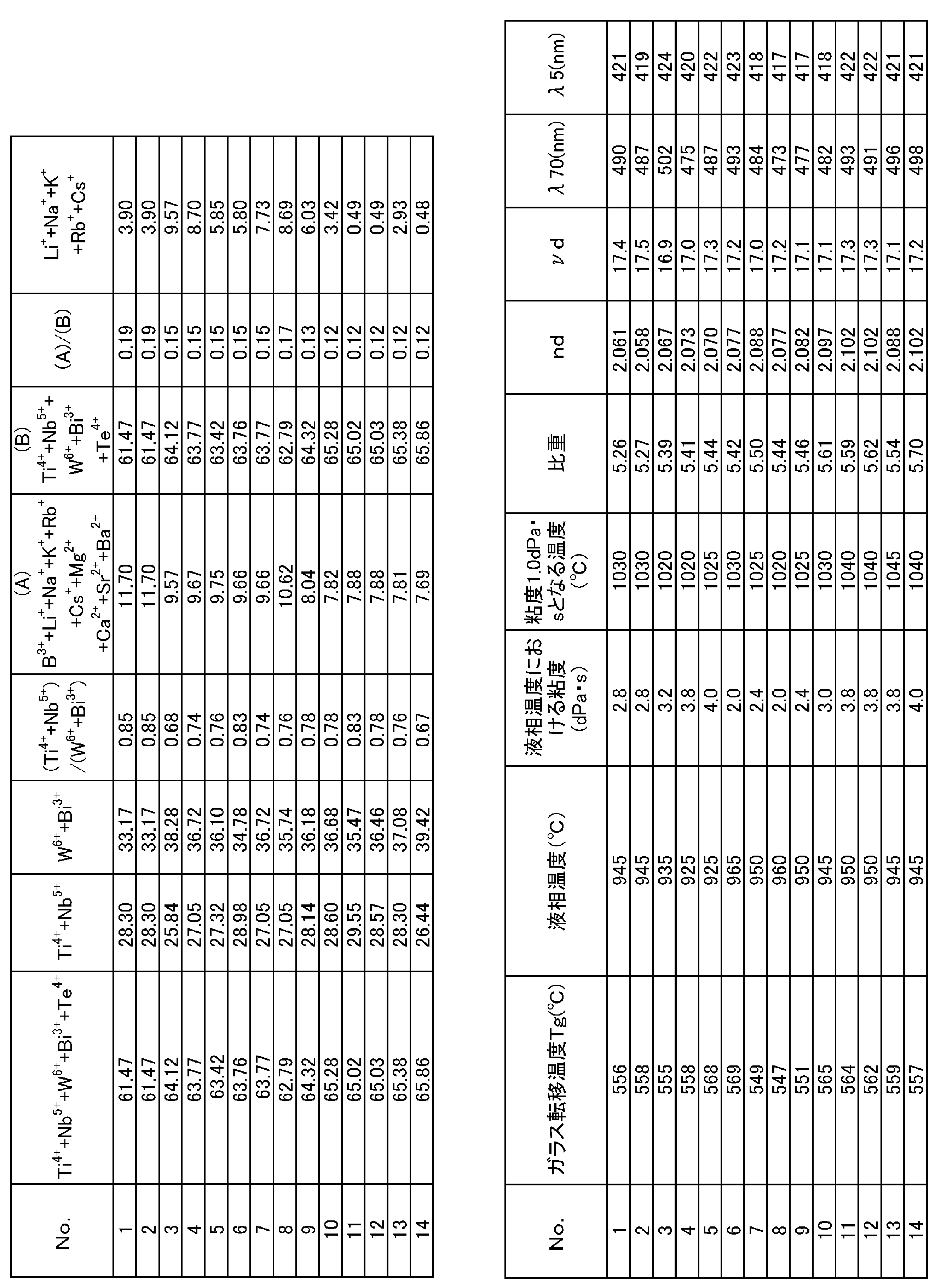
実施例1と同様にして光学ガラスNo.1~14が得られるようにガラス原料を加熱、熔融、清澄、均質化し、得られた熔融ガラスを鋳型に流し込んで急冷し、ガラスブラックに成形した。次にガラスブロックをアニールした後、切断、研削してプレス成形用ガラス素材を作製した。
実施例2において作製したプレス成形用ガラス素材を加熱、軟化し、プレス成形型を用いて公知の方法によりプレス成形し、レンズブランク、プリズムブランクなどの光学素子ブランクを作製した。
得られた光学素子ブランクは精密アニールを施し所要の屈折率になるよう屈折率の精密調整を行った後、公知の研削、研磨法によりレンズやプリズムに仕上げた。
実施例2において作製したプレス成形用ガラス素材の表面を研磨して精密プレス成形用のプレス成形用ガラス素材とし、このガラス素材を加熱し精密プレス成形して非球面レンズを得た。精密プレス成形は公知の方法で行った。
このようにして、各種レンズ、プリズムなどの光学素子を作製した。
また、得られたレンズを用いて携帯電話搭載の撮像ユニットや光ピックアップユニットを作製したところ、振動に対して焦点位置ズレの極めて少ないユニットを得ることができた。
本実施例の光学素子は、低分散ガラス製光学素子との組合せにより良好な色収差補正を可能にする。また、撮像装置をはじめ各種光学機器の高性能化、コンパクト化に有効である。
例えば、上述の例示されたガラス組成に対し、明細書に記載の組成調整を行うことにより、本発明の一態様にかかる光学ガラスを作製することができる。
また、明細書に例示または好ましい範囲として記載した事項の2つ以上を任意に組み合わせることは、もちろん可能である。
Claims (15)
- カチオン成分として、
P5+を10~40カチオン%、
Ti4+、Nb5+、W6+、Bi3+およびTe4+を合計で50カチオン%以上(但し、W6+およびBi3+の合計含有量に対するTi4+およびNb5+の合計含有量のカチオン比((Ti4++Nb5+)/(W6++Bi3+))が1.3以下)、
B3+、Li+、Na+、K+、Rb+、Cs+、Mg2+、Ca2+、Sr2+、Ba2+およびZn2+を合計で、Ti4+、Nb5+、W6+、Bi3+およびTe4+の合計含有量の1/3以下、
Li+、Na+、K+、Rb+およびCs+を合計で0%超、
含む酸化物ガラスであり、屈折率が2.02以上である光学ガラス。 - カチオン成分として、Te4+を0~4カチオン%含む請求項1に記載の光学ガラス。
- アッベ数νdが18.0以下である請求項1または2に記載の光学ガラス。
- 屈折率ndが2.02以上であり、かつ粘度が1.0dPa・sとなる温度が1100℃以下である光学ガラス。
- カチオン成分として、Te4+を0~4カチオン%含む請求項4に記載の光学ガラス。
- 液相温度における粘度が1.0dPa・s以上である請求項4または5に記載の光学ガラス。
- 液相温度が1100℃以下である請求項4~6のいずれか1項に記載の光学ガラス。
- 屈折率ndとアッベ数νdとが下記関係式(1)を満たす請求項4~7のいずれか1項に記載の光学ガラス。
νd<39.0-10×nd ・・・・・ (1) - ガラス成分中にカチオン成分として、P5+を10カチオン%以上含む請求項4~8のいずれか1項に記載の光学ガラス。
- ガラス成分中にカチオン成分として、Ti4+、Nb5+、Bi3+、W6+およびTe4+を合計で50カチオン%以上含む請求項4~9のいずれか1項に記載の光学ガラス。
- ガラス原料を加熱により熔融し、得られた熔融ガラスを清澄し、清澄した熔融ガラスを成形することを含み、
前記ガラス原料を、請求項1~10のいずれか1項に記載の光学ガラスが得られるように調合することを含む光学ガラスの製造方法。 - 前記熔融を、白金、白金合金、金または金合金を用いて作製した熔融ガラス容器を用いて行う請求項11に記載の光学ガラスの製造方法。
- 請求項1~10のいずれか1項に記載の光学ガラスよりなるプレス成形用ガラス素材。
- 請求項1~10のいずれか1項に記載の光学ガラスよりなる光学素子。
- 請求項1~10のいずれか1項に記載の光学ガラスを加工することにより、または請求項11もしくは12に記載の方法により光学ガラスを作製し、作製した光学ガラスを加工することにより、光学素子を得ることを含む光学素子の製造方法。
Priority Applications (3)
| Application Number | Priority Date | Filing Date | Title |
|---|---|---|---|
| CN201380033257.0A CN104379524A (zh) | 2012-06-28 | 2013-06-21 | 光学玻璃及其应用 |
| KR1020147035900A KR101660625B1 (ko) | 2012-06-28 | 2013-06-21 | 광학 유리 및 그 이용 |
| US14/411,730 US9550698B2 (en) | 2012-06-28 | 2013-06-21 | Optical glass and use thereof |
Applications Claiming Priority (4)
| Application Number | Priority Date | Filing Date | Title |
|---|---|---|---|
| JP2012145484A JP2014009112A (ja) | 2012-06-28 | 2012-06-28 | 光学ガラスおよびその利用 |
| JP2012-145485 | 2012-06-28 | ||
| JP2012-145484 | 2012-06-28 | ||
| JP2012145485A JP2014009113A (ja) | 2012-06-28 | 2012-06-28 | 光学ガラスおよびその利用 |
Publications (1)
| Publication Number | Publication Date |
|---|---|
| WO2014002903A1 true WO2014002903A1 (ja) | 2014-01-03 |
Family
ID=49783055
Family Applications (1)
| Application Number | Title | Priority Date | Filing Date |
|---|---|---|---|
| PCT/JP2013/067117 Ceased WO2014002903A1 (ja) | 2012-06-28 | 2013-06-21 | 光学ガラスおよびその利用 |
Country Status (5)
| Country | Link |
|---|---|
| US (1) | US9550698B2 (ja) |
| KR (1) | KR101660625B1 (ja) |
| CN (1) | CN104379524A (ja) |
| TW (1) | TW201410634A (ja) |
| WO (1) | WO2014002903A1 (ja) |
Families Citing this family (5)
| Publication number | Priority date | Publication date | Assignee | Title |
|---|---|---|---|---|
| WO2020230649A1 (ja) * | 2019-05-10 | 2020-11-19 | Hoya株式会社 | ガラス |
| CN111138082B (zh) * | 2020-01-13 | 2022-06-17 | 苏州众为光电有限公司 | 一种高稳定性玻璃光纤及其制备方法 |
| JP2024505204A (ja) | 2021-01-22 | 2024-02-05 | コーニング インコーポレイテッド | カルシウム含有高屈折率リン酸塩ガラス |
| EP4281420A1 (en) | 2021-01-22 | 2023-11-29 | Corning Incorporated | Phosphate glasses with high refractive index and low density |
| JP2024504373A (ja) | 2021-01-22 | 2024-01-31 | コーニング インコーポレイテッド | 屈折率が高い低分散のリン酸塩ガラス |
Citations (4)
| Publication number | Priority date | Publication date | Assignee | Title |
|---|---|---|---|---|
| JP2006111499A (ja) * | 2004-10-15 | 2006-04-27 | Hoya Corp | 光学ガラス、精密プレス成形用プリフォーム及びその製造方法、光学素子及びその製造方法 |
| JP2007015904A (ja) * | 2005-07-11 | 2007-01-25 | Konica Minolta Opto Inc | 光学ガラス及び光学素子 |
| WO2010084925A1 (ja) * | 2009-01-26 | 2010-07-29 | 旭硝子株式会社 | ガラス組成物および基板上にそれを具備する部材 |
| WO2012043815A1 (ja) * | 2010-09-30 | 2012-04-05 | Hoya株式会社 | 光学ガラス、プレス成形用ガラス素材および光学素子 |
Family Cites Families (1)
| Publication number | Priority date | Publication date | Assignee | Title |
|---|---|---|---|---|
| JP4597937B2 (ja) | 2006-10-10 | 2010-12-15 | 株式会社オハラ | 光学ガラス |
-
2013
- 2013-06-21 CN CN201380033257.0A patent/CN104379524A/zh active Pending
- 2013-06-21 KR KR1020147035900A patent/KR101660625B1/ko not_active Expired - Fee Related
- 2013-06-21 US US14/411,730 patent/US9550698B2/en active Active
- 2013-06-21 WO PCT/JP2013/067117 patent/WO2014002903A1/ja not_active Ceased
- 2013-06-26 TW TW102122647A patent/TW201410634A/zh unknown
Patent Citations (4)
| Publication number | Priority date | Publication date | Assignee | Title |
|---|---|---|---|---|
| JP2006111499A (ja) * | 2004-10-15 | 2006-04-27 | Hoya Corp | 光学ガラス、精密プレス成形用プリフォーム及びその製造方法、光学素子及びその製造方法 |
| JP2007015904A (ja) * | 2005-07-11 | 2007-01-25 | Konica Minolta Opto Inc | 光学ガラス及び光学素子 |
| WO2010084925A1 (ja) * | 2009-01-26 | 2010-07-29 | 旭硝子株式会社 | ガラス組成物および基板上にそれを具備する部材 |
| WO2012043815A1 (ja) * | 2010-09-30 | 2012-04-05 | Hoya株式会社 | 光学ガラス、プレス成形用ガラス素材および光学素子 |
Also Published As
| Publication number | Publication date |
|---|---|
| US20150175475A1 (en) | 2015-06-25 |
| TW201410634A (zh) | 2014-03-16 |
| US9550698B2 (en) | 2017-01-24 |
| CN104379524A (zh) | 2015-02-25 |
| KR20150022873A (ko) | 2015-03-04 |
| KR101660625B1 (ko) | 2016-09-27 |
Similar Documents
| Publication | Publication Date | Title |
|---|---|---|
| JP5260623B2 (ja) | 光学ガラス、プレス成形用ガラス素材および光学素子 | |
| JP6382256B2 (ja) | 光学ガラスおよびその利用 | |
| JP5543395B2 (ja) | 光学ガラス、プレス成形用ガラス素材および光学素子 | |
| KR102265764B1 (ko) | 광학 유리, 광학 소자 블랭크, 프레스 성형용 유리 소재, 광학 소자, 및 그것들의 제조 방법 | |
| JP6069217B2 (ja) | 光学ガラス、プレス成形用ガラス素材、ならびに光学素子およびその製造方法 | |
| JP5856509B2 (ja) | 光学ガラス、プレス成形用ガラス素材、および光学素子とその製造方法 | |
| WO2015025943A1 (ja) | 光学ガラスおよびその利用 | |
| WO2010053214A1 (ja) | ガラスの製造方法、光学ガラス、プレス成形用ガラス素材、光学素子とそれら製造方法 | |
| JP2010083705A (ja) | 光学ガラス、プレス成形用ガラスゴブおよび光学素子とその製造方法ならびに光学素子ブランクの製造方法 | |
| JP2011037660A (ja) | 光学ガラス、レンズプリフォーム及び光学素子 | |
| WO2013161889A1 (ja) | 光学ガラス、精密プレス成形用プリフォーム、および光学素子とその製造方法 | |
| KR101660625B1 (ko) | 광학 유리 및 그 이용 | |
| JP6812147B2 (ja) | 光学ガラス、光学素子ブランク、および光学素子 | |
| JP5444490B2 (ja) | 光学ガラス、プレス成形用ガラス素材および光学素子 | |
| JP2013227220A (ja) | 光学ガラス、プレス成形用ガラスゴブおよび光学素子とその製造方法ならびに光学素子ブランクの製造方法 | |
| CN114599617A (zh) | 光学玻璃、预成型体以及光学元件 | |
| JP2014009113A (ja) | 光学ガラスおよびその利用 | |
| JP2014009112A (ja) | 光学ガラスおよびその利用 | |
| CN119707284A (zh) | 光学玻璃和光学元件 | |
| WO2017002956A1 (ja) | 光学ガラスおよび光学素子 |
Legal Events
| Date | Code | Title | Description |
|---|---|---|---|
| 121 | Ep: the epo has been informed by wipo that ep was designated in this application |
Ref document number: 13808789 Country of ref document: EP Kind code of ref document: A1 |
|
| ENP | Entry into the national phase |
Ref document number: 20147035900 Country of ref document: KR Kind code of ref document: A |
|
| NENP | Non-entry into the national phase |
Ref country code: DE |
|
| WWE | Wipo information: entry into national phase |
Ref document number: 14411730 Country of ref document: US |
|
| 122 | Ep: pct application non-entry in european phase |
Ref document number: 13808789 Country of ref document: EP Kind code of ref document: A1 |