WO2013183442A1 - 骨接合材 - Google Patents
骨接合材 Download PDFInfo
- Publication number
- WO2013183442A1 WO2013183442A1 PCT/JP2013/064086 JP2013064086W WO2013183442A1 WO 2013183442 A1 WO2013183442 A1 WO 2013183442A1 JP 2013064086 W JP2013064086 W JP 2013064086W WO 2013183442 A1 WO2013183442 A1 WO 2013183442A1
- Authority
- WO
- WIPO (PCT)
- Prior art keywords
- osteosynthesis material
- branched polymer
- polylactic acid
- represent
- arm portion
- Prior art date
- Legal status (The legal status is an assumption and is not a legal conclusion. Google has not performed a legal analysis and makes no representation as to the accuracy of the status listed.)
- Ceased
Links
Images


Classifications
-
- A—HUMAN NECESSITIES
- A61—MEDICAL OR VETERINARY SCIENCE; HYGIENE
- A61L—METHODS OR APPARATUS FOR STERILISING MATERIALS OR OBJECTS IN GENERAL; DISINFECTION, STERILISATION OR DEODORISATION OF AIR; CHEMICAL ASPECTS OF BANDAGES, DRESSINGS, ABSORBENT PADS OR SURGICAL ARTICLES; MATERIALS FOR BANDAGES, DRESSINGS, ABSORBENT PADS OR SURGICAL ARTICLES
- A61L31/00—Materials for other surgical articles, e.g. stents, stent-grafts, shunts, surgical drapes, guide wires, materials for adhesion prevention, occluding devices, surgical gloves, tissue fixation devices
- A61L31/04—Macromolecular materials
- A61L31/06—Macromolecular materials obtained otherwise than by reactions only involving carbon-to-carbon unsaturated bonds
-
- A—HUMAN NECESSITIES
- A61—MEDICAL OR VETERINARY SCIENCE; HYGIENE
- A61L—METHODS OR APPARATUS FOR STERILISING MATERIALS OR OBJECTS IN GENERAL; DISINFECTION, STERILISATION OR DEODORISATION OF AIR; CHEMICAL ASPECTS OF BANDAGES, DRESSINGS, ABSORBENT PADS OR SURGICAL ARTICLES; MATERIALS FOR BANDAGES, DRESSINGS, ABSORBENT PADS OR SURGICAL ARTICLES
- A61L31/00—Materials for other surgical articles, e.g. stents, stent-grafts, shunts, surgical drapes, guide wires, materials for adhesion prevention, occluding devices, surgical gloves, tissue fixation devices
- A61L31/14—Materials characterised by their function or physical properties, e.g. injectable or lubricating compositions, shape-memory materials, surface modified materials
- A61L31/148—Materials at least partially resorbable by the body
-
- A—HUMAN NECESSITIES
- A61—MEDICAL OR VETERINARY SCIENCE; HYGIENE
- A61L—METHODS OR APPARATUS FOR STERILISING MATERIALS OR OBJECTS IN GENERAL; DISINFECTION, STERILISATION OR DEODORISATION OF AIR; CHEMICAL ASPECTS OF BANDAGES, DRESSINGS, ABSORBENT PADS OR SURGICAL ARTICLES; MATERIALS FOR BANDAGES, DRESSINGS, ABSORBENT PADS OR SURGICAL ARTICLES
- A61L2430/00—Materials or treatment for tissue regeneration
- A61L2430/02—Materials or treatment for tissue regeneration for reconstruction of bones; weight-bearing implants
Definitions
- the present invention relates to an osteosynthesis material having both high strength and excellent biodegradability. More specifically, the present invention relates to an osteosynthesis material that has high initial strength and is rapidly decomposed and absorbed in vivo after a certain period of time.
- a treatment method is generally adopted in which a bone bonding material such as a pin, screw, or plate is implanted and fixed in the bone damage site.
- a bone bonding material such as a pin, screw, or plate
- metal and ceramic bone bonding materials have the disadvantage that they are subject to corrosion and damage when placed in vivo for a long period of time, and are more rigid than bone.
- the bone around the material can be destroyed. Therefore, when metal or ceramic bone bonding materials are used, it is necessary to remove them again by surgery when the bone damage has healed, which places a heavy burden on the patient.
- osteosynthesis materials using biodegradable absorbable polymers such as polylactic acid have been developed and actually used clinically.
- Such an osteosynthesis material is hydrolyzed and absorbed by the living body after a certain period of time after being implanted in the living body, so there is no need for reoperation for removing the osteosynthesis material, greatly reducing the burden on the patient. is made of.
- the glass transition temperature is lower than the body temperature of 37 ° C., so the strength decreases when implanted in a living body, and the site of bone damage or the site of bone damage caused by surgery is reduced. There is a risk of breaking during placement until healing.
- the conventional osteosynthesis material made of biodegradable absorbable polymer cannot realize both high strength and excellent biodegradable absorbability.
- the development of an osteosynthesis material that combines decomposition and absorbability is eagerly desired.
- An object of the present invention is to provide an osteosynthesis having high initial strength and excellent biodegradability.
- the present inventor has intensively studied to solve the above problems, and as a result, by forming a bone cement using a branched polymer (particularly a star polymer) having an arm portion made of at least three polylactic acids.
- the inventors have found that the initial strength is high, and that it can be rapidly decomposed and absorbed in vivo after a certain period of time.
- the present invention has been completed by further studies based on such knowledge.
- Item 1 An osteosynthesis material comprising a branched polymer having an arm portion composed of at least three polylactic acids.
- Item 2. Item 2. The osteosynthesis material according to Item 1, wherein the branched polymer is a star polymer having a core portion and an arm portion made of at least three polylactic acids extending from the core portion.
- the star polymer has a pentaerythritol residue or dipentaerythritol residue as a core portion, and the hydroxyl group of pentaerythritol or dipentaerythritol and the carboxyl group of polylactic acid constituting the arm portion are linked by an ester bond.
- the osteosynthesis material according to Item 2 which is a structure.
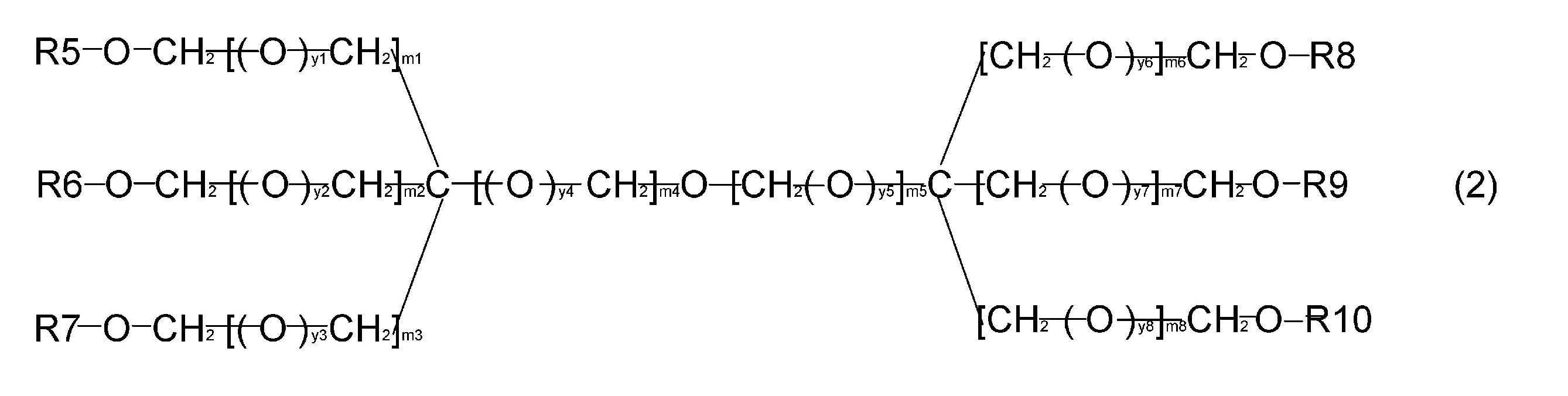
- Item 4. Item 4. The osteosynthesis material according to Item 2 or 3, wherein the star polymer is a compound represented by the following general formula (1) or (2).
- n1 to n4 are the same or different and represent an integer of 0 to 4
- x1 to x4 are the same or different and represent 0 or 1
- R1 to R4 are the same or different and represent poly It represents lactic acid or a hydrogen atom
- at least three of R1 to R4 represent polylactic acid.
- m1 to m8 are the same or different and represent an integer of 0 to 4
- y1 to y8 are the same or different and represent 0 or 1
- R5 to R10 are the same or different, It represents polylactic acid or a hydrogen atom, and at least three of R5 to R10 represent polylactic acid.
- Item 5. The osteosynthesis material according to any one of Items 1 to 4, wherein the polylactic acid constituting the arm portion is poly L-lactic acid.
- the bone cement according to any one of Items 1 to 5, wherein the degree of polymerization (lactide unit) of polylactic acid constituting the arm portion is 80 to 600.
- Item 7. Item 7.
- the osteosynthesis material according to any one of Items 1 to 6, which is a pin, screw, plate, screw, screw, cloth, or film.
- Items 1 to 6 which is a pin, screw, plate, screw, screw, cloth, or film.
- Items 8 Use of a branched polymer having an arm portion composed of at least three polylactic acids for producing an osteosynthesis.
- Item 9. A branched polymer having an arm portion composed of at least three polylactic acids, which is used for treatment of bone damage.
- Item 10 A method for treating bone damage, comprising a step of fixing an osteosynthesis material containing a branched polymer having an arm portion made of at least three polylactic acids to a bone injury site.
- the osteosynthesis material of the present invention has high initial strength, can be embedded without breaking during surgery, and can stably fix a bone damage site without breaking before the bone damage site heals. . Furthermore, since the bone cement of the present invention is rapidly hydrolyzed and absorbed in the living body after a certain period of time in the living body, the bone joining material remains in the living body for a long time after healing of the bone damage. It is possible to suppress harmful effects caused by
- osteosynthesis materials made of linear polylactic acid have the drawbacks of being hard and brittle, but the osteosynthesis materials of the present invention have the properties of high flexural modulus and high maximum point stress. It is also excellent in terms of mechanical properties required for osteosynthesis.
- each press film is immersed in PBS ( ⁇ ) at 37 ° C. for a predetermined period and then the tensile strength is measured.
- each press film is immersed in 50 ° C. PBS ( ⁇ ) for a predetermined period and then the tensile strength is measured.
- each press film is immersed in PBS ( ⁇ ) at 65 ° C. for a predetermined period, and the residual weight percentage (%) is measured.
- each press film was immersed in PBS ( ⁇ ) at 65 ° C. for a predetermined period, and then the reduction rate (%) of the polymer molecular weight was measured.
- the osteosynthesis material of the present invention is characterized by containing a branched polymer having an arm portion composed of at least three polylactic acids.
- a branched polymer having an arm portion composed of at least three polylactic acids is characterized by containing a branched polymer having an arm portion composed of at least three polylactic acids.
- the branched polymer contained in the osteosynthesis material of the present invention has a structure having three or more arm portions made of polylactic acid.
- the number of arm portions made of polylactic acid may be 3 or more, preferably 3 to 10, more preferably 4 to 8, and particularly preferably 4 to 6.
- the degree of polymerization of polylactic acid per arm portion is not particularly limited, but is, for example, 80 to 600, preferably 80 to 550, more preferably 80 to 500, and particularly preferably 90 to 200. Can be mentioned.
- the degree of polymerization of polylactic acid is a lactide unit, and — [CO—CH (CH 3 ) —O—CO—CH (CH 3 ) —O] — is represented as one unit (degree of polymerization 1). .
- the polymerization degree of the polylactic acid in the arm part is a value measured by NMR.
- the three or more arm portions in the branched polymer may be composed of polylactic acid having the same molecular weight, or may be composed of polylactic acid having different molecular weights.
- the arm part in the branched polymer may be any of poly-L-lactic acid, poly-D-lactic acid, poly-D, L-lactic acid, but has high strength and excellent biodegradability.
- Poly-L-lactic acid is preferably used from the viewpoint of making it better combined.
- the structure of the branched polymer is not particularly limited as long as it has three or more arm portions made of polylactic acid, and these arm portions are connected to the core portion. Any of a mold, a bottle brush type, a starburst type, etc. may be sufficient. From the viewpoint of combining the high strength and the excellent biodegradable absorbability, the branched polymer structure used in the osteosynthesis material of the present invention preferably includes a star shape.
- the structure of the core part in the branched polymer is not particularly limited, and may be appropriately designed according to the structure of the branched polymer.
- a residue of a trihydric or higher polyhydric alcohol or a residue of a trivalent or higher polyvalent amine can be mentioned.
- the polyhydric alcohol has a structure in which the hydroxyl group of the polyhydric alcohol is linked to the carboxyl group of the polylactic acid constituting the arm by an ester bond. .
- the amino group of the polyvalent amine is linked to the polylactic acid carboxyl group constituting the arm part by an amide bond. Become a structure.
- the compound constituting the core in the branched polymer include pentaerythritol, dipentaerythritol, tripentaerythritol, glycerin, diglycerin, triglycerin, sorbitol, poly (vinyl alcohol), and poly (hydroxyethyl methacrylate). ), Poly (hydroxypropyl methacrylate); monosaccharides such as glucose, galactose, mannose and fructose; and trihydric or higher polyhydric alcohols such as disaccharides such as lactose, sucrose and maltose.
- Preferred examples of the branched polymer used in the osteosynthesis material of the present invention include pentaerythritol residues, or star polymers having a dipentaerythritol residue as a core, that is, each hydroxyl group of pentaerythritol or dipentaerythritol.
- branched polymer a star polymer represented by the following general formula (1) or (2) is exemplified.
- n1 to n4 are the same or different and represent an integer of 0 to 4.
- n1 to n4 are preferably integers of 0 to 2, and more preferably 0.
- x1 to x4 are the same or different and represent 0 or 1. x1 to x4 are preferably 0.
- R1 to R4 are the same or different and represent polylactic acid or a hydrogen atom, and at least three of R1 to R4 represent polylactic acid.
- Preferable examples of the star polymer represented by the general formula (1) include those in which all of R1 to R4 are polylactic acid.
- the at least three polylactic acids constituting R1 to R4 may have the same molecular weight, or may have different molecular weights.
- the molecular weight of at least three polylactic acids constituting R1 to R4, the types of optical isomers of the constituent monomers, etc. are as described above.
- m1 to m8 are the same or different and represent an integer of 0 to 4.
- m1 to m3 and m6 to m8 are preferably integers of 0 to 2, more preferably 0.
- m4 and m5 are preferably integers of 1 to 3, and more preferably 1.
- y1 to y8 are the same or different and represent 0 or 1. Y1 to y8 are preferably 0.
- R5 to R10 are the same or different and represent polylactic acid or a hydrogen atom, and at least three of R5 to R10 represent polylactic acid.
- the star polymer represented by the general formula (1) at least four of R5 to R10 are preferably polylactic acid, more preferably at least five are polylactic acid, and all of these are polylactic acid. Those are particularly preferred.
- the at least three polylactic acids constituting R5 to R10 may have the same molecular weight, or may have different molecular weights. With respect to at least three polylactic acids constituting R5 to R10, the molecular weight, the type of optical isomers of the constituent monomers, etc. are as described above.
- the branched polymer can be produced by a known method. Specifically, as a method for producing the branched polymer, a method of ring-opening polymerization of lactide using a catalyst in the presence of a compound constituting the core part, and a method in which lactic acid is directly polymerized in the presence of the compound constituting the core part. Examples thereof include a method of dehydrating condensation polymerization by a condensation method.
- Examples of the catalyst used for ring-opening polymerization of lactide include, for example, tin 2-ethylhexanoate, tin (II) octylate, triphenyltin acetate, tin oxide, dibutyltin oxide, tin oxalate, tin chloride, dibutyltin dilaurate, Examples thereof include metal catalysts such as thorium ethoxide, potassium tert-butoxide, triethylaluminum, tetrabutyl titanate, and bismuth; organic base catalysts such as organic onium salts.
- the osteosynthesis material of the present invention may be composed only of the branched polymer, but may contain other biodegradable absorbable polymers as necessary.
- the other biodegradable absorbable polymers include polylactic acid, lactic acid-glycolic acid copolymer, polyglycolic acid, lactic acid- ⁇ -caprolactone copolymer, glycolic acid- ⁇ -caprolactone copolymer, polydioxanone, and the like. Is mentioned.
- polylactic acid is preferably used for the purpose of adjusting the strength of the osteosynthesis because it can moderate the degradation rate of the osteosynthesis of the present invention.
- the polylactic acid contained as necessary in the osteosynthesis material of the present invention may be any of poly-L-lactic acid, poly-D-lactic acid, poly-D, L-lactic acid, preferably Poly-L-lactic acid is exemplified.
- the weight average molecular weight of the polylactic acid is not particularly limited, and examples thereof include 150,000 to 500,000, preferably 180,000 to 450,000, and more preferably 200,000 to 400,000.
- the osteosynthesis material of the present invention contains a biodegradable absorbable polymer other than the branched polymer
- the content thereof is not particularly limited.
- the osteosynthesis material of the present invention may contain, as necessary, components showing affinity with bone tissues such as tricalcium phosphate, tetracalcium phosphate, calcium hydrogen phosphate, and hydroxyapatite; a cell growth factor, a growth factor, An antibacterial agent, antibiotics, etc. may be contained or surface-coated.
- the glass transition temperature of the osteosynthesis material of the present invention is determined depending on the type of branched polymer used, but is usually 40 ° C. or higher, preferably 45 to 65 ° C., more preferably 50 to 60 ° C.
- the glass transition temperature is a value measured by DSC (differential scanning calorimetry).
- the osteosynthesis material of the present invention has the property of being rapidly decomposed after a certain period of time after being implanted in a living body, and as a suitable example of the degradation characteristics of the osteosynthesis material of the present invention,
- the weight residual ratio when immersed in a phosphate buffer solution (PBS ( ⁇ ), pH 7.4) for 36 days at 65 ° C. is usually 90% or less, preferably 0 to 89%, more preferably 0 to 85%. Can be mentioned.
- the weight residual ratio (%) is a value calculated according to the following formula.
- the shape of the osteosynthesis material of the present invention is not particularly limited as long as it can be implanted in a living body and fix a bone damage site.
- a pin, screw, plate, screw, screw, cloth Shape, film shape and the like for example, a pin, screw, plate, screw, screw, cloth Shape, film shape and the like.
- the bone bonding material of the present invention can have high strength, among the shapes, pins, screws, plates, screws, and the like that are required to maintain high strength until the bone damage site is healed, and A screw is illustrated as a suitable shape in the osteosynthesis of this invention.
- the osteosynthesis material of the present invention is manufactured by molding by a known method. Specifically, the osteosynthesis material of the present invention is manufactured by preparing a pellet containing the branched polymer and other biodegradable absorbable polymer contained as necessary, and molding the pellet into a predetermined shape.
- Synthesis Example 1 Synthesis of 4-armPLLA L, L-lactide 2000 g (13.9 mol), pentaerythritol 2.36 g (1.7 ⁇ 10 ⁇ 2 mol), and tin 2-ethylhexanoate (L, L-lactide) 100 ppm per unit weight) was placed in a separable flask and dried overnight under vacuum. Thereafter, the inside of the container was filled with nitrogen, immersed in an oil bath set at 125 ° C., and polymerized for 2 days. The branched polymer (4-armPLLA) obtained after the completion of the polymerization was pulverized with a rotary pulverizer having a mesh size of 3 mm to obtain pulverized pieces.
- the obtained branched polymer (4-armPLLA) was analyzed by NMR (solvent: deuterated chloroform, measurement nucleus: 1H, integration number: 128), the degree of hydroxyl group substitution, the average number of arm parts made of polylactic acid, and one arm part.
- the degree of polymerization of polylactic acid per unit (lactide unit) and the number average molecular weight were determined.
- the number average molecular weight, the weight average molecular weight, and dispersion degree were calculated
- required by GPC are the values of standard polystyrene conversion.
- the DSC Different Scanning Calorimetry
- the crystallinity (Xc (%)) was calculated according to the following formula.
- Xc (%) ⁇ H1st (J / g) / ⁇ 93.6 (J / g) ⁇ ⁇ 100
- Synthesis Example 2 Synthesis of 6-armPLLA L, L-lactide 2000 g (13.9 mol), dipentaerythritol 4.52 g (1.7 ⁇ 10 -2 mol), and tin 2-ethylhexanoate (L, L- 100 ppm per lactide unit weight) was placed in a separable flask and dried overnight under vacuum. Thereafter, the inside of the container was filled with nitrogen, immersed in an oil bath set at 125 ° C., and polymerized for 2 days. The branched polymer (6-armPLLA) obtained after completion of the polymerization was pulverized by a rotary pulverizer having a mesh size of 3 mm to obtain pulverized pieces.
- the obtained branched polymer (6-armPLLA) was analyzed by NMR, GPC, and DSC under the same conditions as in Synthesis Example 1. The results are shown in Table 2.
- Synthesis Example 3 Synthesis of linear PLLA L, L-lactide 2000 g (13.9 mol), 1-dodecanol 3.2 g (1.7 ⁇ 10 ⁇ 2 mol), and tin 2-ethylhexanoate (L, L— 100 ppm per lactide unit weight) was placed in a separable flask and dried overnight under vacuum. Thereafter, the inside of the container was filled with nitrogen, immersed in an oil bath set at 125 ° C., and polymerized for 2 days. The linear polylactic acid (linear PLLA) obtained after completion of the polymerization was pulverized by a rotary pulverizer having a mesh size of 3 mm to obtain pulverized pieces.
- linear PLLA linear PLLA
- linear polylactic acid (linear PLLA) was analyzed by GPC and DSC under the same conditions as in Synthesis Example 1. The results are shown in Table 3.
- Example 1 Preparation of 4-armPLLA Press Film 4-armPLLA obtained in Synthesis Example 1 was prepared into a press film having an average thickness of 300 ⁇ m using a heating press machine (Tester Sangyo Co., Ltd. ACM press machine 30T 400C). Specifically, 6-armPLLA 6 g was sandwiched between two 200 mm ⁇ 200 mm ⁇ 0.2 mm aluminum plates and two SUS plates (200 mm ⁇ 200 mm ⁇ 5 mm) and set in a heating press set to 200 ° C. The upper and lower SUS plates were brought into contact with the press surface to melt each polylactic acid over 5 minutes, and then pressurized with a pressure of 20 kgf / m 2 for 1 minute, and then rapidly cooled with ice. Thereafter, heat setting was performed under vacuum at 90 ° C. while sandwiched between aluminum plates. It was 57 degreeC when the glass transition temperature of the obtained film was measured by DSC.
- a heating press machine Teester Sangyo Co., Ltd. ACM press
- Example 2 Preparation of 6-armPLLA Press Film Using 6-armPLLA 6 g obtained in Synthesis Example 2, a press film was processed in the same manner as in Example 1. It was 55 degreeC when the glass transition temperature of the obtained film was measured by DSC.
- Example 3 Preparation of Mixed Press Film of 4-armPLLA and Linear PLLA After thoroughly mixing 2 g of 4-armPLLA obtained in Synthesis Example 1 and 4 g of linear PLLA obtained in Synthesis Example 3, the Example 1 was processed into a press film by the same method. It was 60 degreeC when the glass transition temperature of the obtained film was measured by DSC.
- Example 4 Preparation of mixed press film of 6-armPLLA and linear PLLA After thoroughly mixing 2 g of 6-armPLLA obtained in Synthesis Example 2 and 4 g of linear PLLA obtained in Synthesis Example 3, Example 1 was processed into a press film by the same method. It was 60 degreeC when the glass transition temperature of the obtained film was measured by DSC.
- Comparative Example 1 Preparation of linear PLLA press film Using 6 g of linear PLLA obtained in Synthesis Example 3, the film was processed into a press film in the same manner as in Example 1. It was 63 degreeC when the glass transition temperature of the obtained film was measured by DSC.
- Test Example 1 Evaluation of initial strength and strength after storage The press film obtained above was cut into a 10 mm ⁇ 40 mm strip and the tensile strength was measured (initial strength). Next, the press film cut into strips was immersed in PBS (-) at 37 ° C, and after 1 month, 2 months, and 3 months, each press film was taken out from PBS and dried, and then the tensile strength at break was measured. (Strength after storage). Similarly, a press film cut into strips was immersed in PBS ( ⁇ ) at 50 ° C. for 3 weeks, and then the tensile fracture was measured (strength after storage). The test under the conditions immersed in PBS ( ⁇ ) at 37 ° C.
- Example 1-2 and Comparative Example 1 The press films of Examples 1-4 and Comparative Example 1 were used.
- the tensile strength at break was measured using a universal tensile testing machine (Shimadzu Corporation EZ-Graph) under the conditions of a distance between chucks of 15 mm and a tensile speed of 10 mm / min. From the calculation by Arrhenius plot, it is known that the condition of immersing in PBS ( ⁇ ) at 50 ° C. for 3 weeks substantially corresponds to the condition of immersing in PBS ( ⁇ ) at 37 ° C. for 3 months.
- FIG. 1 shows the test results under conditions immersed in PBS ( ⁇ ) at 37 ° C.
- FIG. 2 shows the results of tests under conditions immersed in PBS ( ⁇ ) at 50 ° C.
- the press film prepared using the branched polymer obtained in Synthesis Examples 1 and 2 showed the same initial strength as the press film prepared using linear PLLA.
- the press film prepared using the branched polymer obtained in Synthesis Examples 1 and 2 is one month or 2 times in PBS ( ⁇ ) at 37 ° C. compared to the press film prepared using linear PLLA. It was shown that the strength decrease after immersion for months was large (see FIG. 1).
- the mixed press film of the branched polymer obtained in Synthesis Example 1 or 2 and the linear PLLA is compared with the press film produced with the branched polymer obtained in Synthesis Example 1 or 2 after storage. It was shown that the strength decrease after storage was larger than that of the press film prepared using linear PLLA (see FIG. 2).
- the press film prepared using the branched polymer obtained in Synthesis Examples 1 and 2 has a high initial strength and has a property of being rapidly decomposed after a certain period of time. It was confirmed that it can be suitably used as a material.
- Test Example 2 Evaluation of weight reduction rate after storage of press film
- Each press film of Example 1-4 and Comparative Example 1 was cut into 10 mm ⁇ 40 mm strips, which were cut into PBS ( ⁇ ) at 65 ° C. for a predetermined period. Soaked. After immersing in PBS ( ⁇ ) at 65 ° C. for 6, 12, and 36 days, each press film is taken out from PBS ( ⁇ ), washed and dried, and then weighed to determine the remaining weight percentage (%). It was. Further, after immersion for 6, 12, and 36 days, about 10 mg pieces were collected from each press film, and using this as a sample, the weight average molecular weight of the polymer remaining by the GPC method was measured.
- the rate of decrease in the weight average molecular weight of the polymer after the immersion relative to the weight average molecular weight of the polymer before the immersion was determined as a decrease rate (%) of the polymer molecular weight. From the calculation by Arrhenius plot, the conditions of 6-12, 36 days immersion in PBS (-) at 65 ° C are almost equivalent to 6-12 months of PBS (-) at 37 ° C respectively. I know that
- Example 5 Preparation of 4-armPLLA rolled plate Using 4-armPLLA obtained in Synthesis Example 1 as a raw material polymer and molding using an injection molding machine and a rolling machine, a plate of 10 mm x 60 mm x 2 mm Manufactured.
- Example 6 Preparation of 6-armPLLA rolled plate A plate was prepared in the same manner as in Example 5 using 6-armPLLA obtained in Synthesis Example 2.
- Comparative Example 2 Preparation of linear PLLA rolled plate A plate was prepared in the same manner as in Example 5 using the linear PLLA obtained in Synthesis Example 3.
- Test Example 3 Evaluation of Mechanical Properties of Rolled Plates
- the rolled plates of Example 5-6 and Comparative Example 2 were subjected to a three-point bending test using a small universal testing machine (Ez Graph Shimadzu Corporation) to determine the flexural modulus ( GPa), maximum point stress (MPa), and energy (J) up to the maximum point were measured.
- Ez Graph Shimadzu Corporation Ez Graph Shimadzu Corporation
- Table 4 shows the obtained results. From this result, it is understood that the rolled plate (Example 5-6) prepared using a branched polymer has both a high flexural modulus and a maximum point stress, and has desirable mechanical properties as an osteosynthesis material. It was.
Landscapes
- Health & Medical Sciences (AREA)
- Epidemiology (AREA)
- Heart & Thoracic Surgery (AREA)
- Surgery (AREA)
- Vascular Medicine (AREA)
- Life Sciences & Earth Sciences (AREA)
- Animal Behavior & Ethology (AREA)
- General Health & Medical Sciences (AREA)
- Public Health (AREA)
- Veterinary Medicine (AREA)
- Chemical Kinetics & Catalysis (AREA)
- Chemical & Material Sciences (AREA)
- Materials For Medical Uses (AREA)
Description
本発明は、高い強度と優れた生体内分解吸収性を兼ね備える骨接合材に関する。より具体的には、初期の強度が高く、しかも一定期間経過後には生体内で速やかに分解吸収される骨接合材に関する。
骨折等の骨損傷において、外部からの固定で自然治癒が望めない場合には、ピン、スクリュー、プレート等の骨接合材を骨損傷部位に埋入して固定する治療法が一般的に採用されている。従来、このような骨接合材として、金属製やセラミックス製のものが使用されている。しかしながら、金属製やセラミックス製の骨接合材では、長期間生体内に留置すると腐食や損傷が生じるという欠点があり、更に骨と比べて剛性が高いため、長期間留置することによる持続的刺激により材料周囲の骨が破壊される恐れがあるという欠点もある。そのため、金属製やセラミックス製の骨接合材を使用した場合には、骨損傷が治癒した段階で、再度手術により取り除くことが必要であり、患者に大きな負担を強いることになっていた。
そこで、近年、ポリ乳酸等の生体内分解吸収性ポリマーを材料とした骨接合材が開発され、実際に臨床使用されている。このような骨接合材は、生体内に埋入後は一定期間後に加水分解されて生体に吸収されるため、骨接合材の除去のための再手術が不要であり、患者の負担を大きく軽減できている。
しかしながら、ポリ乳酸を初めとした従来の生体内分解吸収性ポリマーで形成した骨接合材は、生体内で一定期間経過すると、加水分解されて生体内で吸収されるものの、生体内で消失するまでに通常5年以上の期間を要することがあるという問題点がある。そこで、生体内での分解吸収速度を制御するために、構成素材として乳酸とグリコール酸との共重合体を使用し、表面粗さを特定範囲に調節した骨接合材が報告されている(例えば、特許文献1参照)。但し、このような構成素材を使用した骨接合材では、ガラス転移温度が体温である37℃よりも低いため、生体内に埋入すると強度が低下し、手術による埋入時又は骨損傷部位が治癒するまでの留置中に破断してしまう恐れがある。
このように、従来の生体内分解吸収性ポリマーを材料とした骨接合材では、高い強度と優れた生体内分解吸収性を両存させることを実現できておらず、高い強度と優れた生体内分解吸収性を兼ね備える骨接合材の開発が切望されている。
本発明は、初期の強度が高く、しかも優れた生体内分解吸収性を兼ね備える骨接合材を提供することを目的とする。
本発明者は、前記課題を解決すべく鋭意検討を行ったところ、少なくとも3つのポリ乳酸からなるアーム部を有する分岐状ポリマー(特に、星型ポリマー)を用いて骨接合材を形成することによって、初期の強度が高く、しかも一定期間経過後には生体内で速やかに分解吸収される特性を備えさせ得ることを見出した。本発明は、かかる知見に基づいて更に検討を重ねることにより完成したものである。
即ち、本発明は、下記に掲げる態様の発明を提供する。
項1. 少なくとも3つのポリ乳酸からなるアーム部を有する分岐状ポリマーを含有することを特徴とする、骨接合材。
項2. 前記分岐状ポリマーが、コア部と、該コア部から伸びる少なくとも3つのポリ乳酸からなるアーム部を有する星型ポリマーである、項1に記載の骨接合材。
項3. 前記星型ポリマーが、ペンタエリスリトール残基又はジペンタエリスリトール残基をコア部として有し、ペンタエリスリトール又はジペンタエリスリトールの水酸基とアーム部を構成するポリ乳酸のカルボキシル基がエステル結合により連結している構造である、項2に記載の骨接合材。
項4. 前記星型ポリマーが、下記一般式(1)又は(2)で示される化合物である、項2又は3に記載の骨接合材。
[一般式(1)中、n1~n4は、同一又は異なって0~4の整数を示し、x1~x4は、同一又は異なって0又は1を示し、R1~R4は、同一又は異なってポリ乳酸又は水素原子を示し、且つR1~R4の少なくとも3つはポリ乳酸を示す。]

[一般式(2)中、m1~m8は、同一又は異なって0~4の整数を示し、y1~y8は、同一又は異なって0又は1を示し、R5~R10は、同一又は異なって、ポリ乳酸又は水素原子を示し、且つR5~R10の少なくとも3つはポリ乳酸を示す。]
項5. 前記アーム部を構成するポリ乳酸が、ポリL-乳酸である、項1~4のいずれかに記載の骨接合材。
項6. 前記アーム部を構成するポリ乳酸の重合度(ラクチド単位)が80~600である、項1~5のいずれかに記載の骨接合材。
項7. ピン、スクリュー、プレート、ネジ、ビス、布状、又はフィルム状である、項1~6のいずれかに記載の骨接合材。
項8. 少なくとも3つのポリ乳酸からなるアーム部を有する分岐状ポリマーの、骨接合材の製造のための使用。
項9. 骨損傷の治療に使用される、少なくとも3つのポリ乳酸からなるアーム部を有する分岐状ポリマー。
項10. 少なくとも3つのポリ乳酸からなるアーム部を有する分岐状ポリマーを含有する骨接合材を、骨損傷部位に固定する工程を含む、骨損傷の治療方法。
項1. 少なくとも3つのポリ乳酸からなるアーム部を有する分岐状ポリマーを含有することを特徴とする、骨接合材。
項2. 前記分岐状ポリマーが、コア部と、該コア部から伸びる少なくとも3つのポリ乳酸からなるアーム部を有する星型ポリマーである、項1に記載の骨接合材。
項3. 前記星型ポリマーが、ペンタエリスリトール残基又はジペンタエリスリトール残基をコア部として有し、ペンタエリスリトール又はジペンタエリスリトールの水酸基とアーム部を構成するポリ乳酸のカルボキシル基がエステル結合により連結している構造である、項2に記載の骨接合材。
項4. 前記星型ポリマーが、下記一般式(1)又は(2)で示される化合物である、項2又は3に記載の骨接合材。
項5. 前記アーム部を構成するポリ乳酸が、ポリL-乳酸である、項1~4のいずれかに記載の骨接合材。
項6. 前記アーム部を構成するポリ乳酸の重合度(ラクチド単位)が80~600である、項1~5のいずれかに記載の骨接合材。
項7. ピン、スクリュー、プレート、ネジ、ビス、布状、又はフィルム状である、項1~6のいずれかに記載の骨接合材。
項8. 少なくとも3つのポリ乳酸からなるアーム部を有する分岐状ポリマーの、骨接合材の製造のための使用。
項9. 骨損傷の治療に使用される、少なくとも3つのポリ乳酸からなるアーム部を有する分岐状ポリマー。
項10. 少なくとも3つのポリ乳酸からなるアーム部を有する分岐状ポリマーを含有する骨接合材を、骨損傷部位に固定する工程を含む、骨損傷の治療方法。
本発明の骨接合材は、初期の強度が高く、手術時に破断することなく埋入可能で、骨損傷部位が治癒するまでの間に破損することなく骨損傷部位を安定に固定することができる。更に、本発明の骨接合材は、生体内で一定期間経過すると、速やかに加水分解されて生体内で吸収されるので、骨損傷が治癒した後に骨接合材が生体内に長期間残留することによる弊害を抑制することができる。
また、直鎖状のポリ乳酸で形成した骨接合材は、硬くて脆いという欠点があるが、本発明の骨接合材は、曲げ弾性率が高く、最大点応力も高いという特性を備えており、骨接合材として要求される機械的特性の点でも卓越している。
本発明の骨接合材は、少なくとも3つのポリ乳酸からなるアーム部を有する分岐状ポリマーを含有することを特徴とする。以下、本発明の骨接合材について詳述する。
本発明の骨接合材において含有される分岐状ポリマーは、ポリ乳酸からなるアーム部を3つ以上有する構造を備えるものである。当該分岐状ポリマーにおいて、ポリ乳酸からなるアーム部の数については、3以上であればよいが、好ましくは3~10、更に好ましくは4~8、特に好ましくは4~6が挙げられる。
前記分岐状ポリマーにおいて、アーム部1本当たりのポリ乳酸の重合度については、特に制限されないが、例えば80~600、好ましくは80~550、更に好ましくは80~500、特に好ましくは90~200が挙げられる。本明細書において、ポリ乳酸の重合度は、ラクチド単位であり、-[CO-CH(CH3)-O-CO-CH(CH3)-O]-を1単位(重合度1)として表す。このような重合度のポリ乳酸をアーム部として備えることにより、より一層効果的に、高い強度と優れた生体内分解吸収性を備えることができる。ここで、アーム部のポリ乳酸の重合度は、NMRにより測定される値である。なお、前記分岐状ポリマーにおける3以上のアーム部は、各々同一の分子量のポリ乳酸から構成されていてもよく、また各々異なる分子量のポリ乳酸から構成されていてもよい。
また、前記分岐状ポリマーにおけるアーム部は、ポリ-L-乳酸、ポリ-D-乳酸、ポリ-D,L-乳酸のいずれであってもよいが、高い強度と優れた生体内分解吸収性を一層良好に兼ね備えさせるという観点から、好ましくはポリ-L-乳酸が挙げられる。
前記分岐状ポリマーの構造については、ポリ乳酸からなるアーム部を3つ以上有し、これらのアーム部がコア部に連結していることを限度として特に制限されず、星型、櫛型、H型、ボトルブラシ型、スターバースト型等のいずれであってもよい。高い強度と優れた生体内分解吸収性を一層良好に兼ね備えさせるという観点から、本発明の骨接合材に使用される分岐状ポリマーの構造として、好ましくは星型が挙げられる。
前記分岐状ポリマーにおけるコア部の構造については、特に制限されず、当該分岐状ポリマーの構造に応じて適宜設計すればよい。例えば、前記分岐状ポリマーにおけるコア部として、3価以上の多価アルコールの残基、又は3価以上の多価アミンの残基が挙げられる。前記分岐状ポリマーにおけるコア部が3価以上の多価アルコールの残基で構成される場合、当該多価アルコールの水酸基がアーム部を構成するポリ乳酸のカルボキシル基とエステル結合により連結した構造になる。また、前記分岐状ポリマーにおけるコア部が3価以上の多価アミンの残基で構成される場合、当該多価アミンのアミノ基がアーム部を構成するポリ乳酸のカルボキシル基とアミド結合により連結した構造になる。
前記分岐状ポリマーにおけるコア部を構成する化合物として、具体的には、ペンタエリスリトール、ジペンタエリスリトール、トリペンタエリスリトール、グリセリン、ジグリセリン、トリグリセリン、ソルビトール、ポリ(ビニルアルコール)、ポリ(ヒドロキシエチルメタクリレート)、ポリ(ヒドロキシプロピルメタクリレート);グルコース、ガラクトース、マンノース、フルクトースなどの単糖類;ラクトース、スクロース、マルトース等の二糖類等の3価以上の多価アルコールが挙げられる。
本発明の骨接合材に使用される前記分岐状ポリマーの好適な例として、ペンタエリスリトール残基、又はジペンタエリスリトール残基をコア部として有する星型ポリマー、即ちペンタエリスリトール又はジペンタエリスリトールの各水酸基に対してアーム部を構成するポリ乳酸のカルボキシル基がエステル結合により連結した構造の星型ポリマーが挙げられる。
また、前記分岐状ポリマーの好適な例として、下記一般式(1)又は(2)で示される星型ポリマーが例示される。

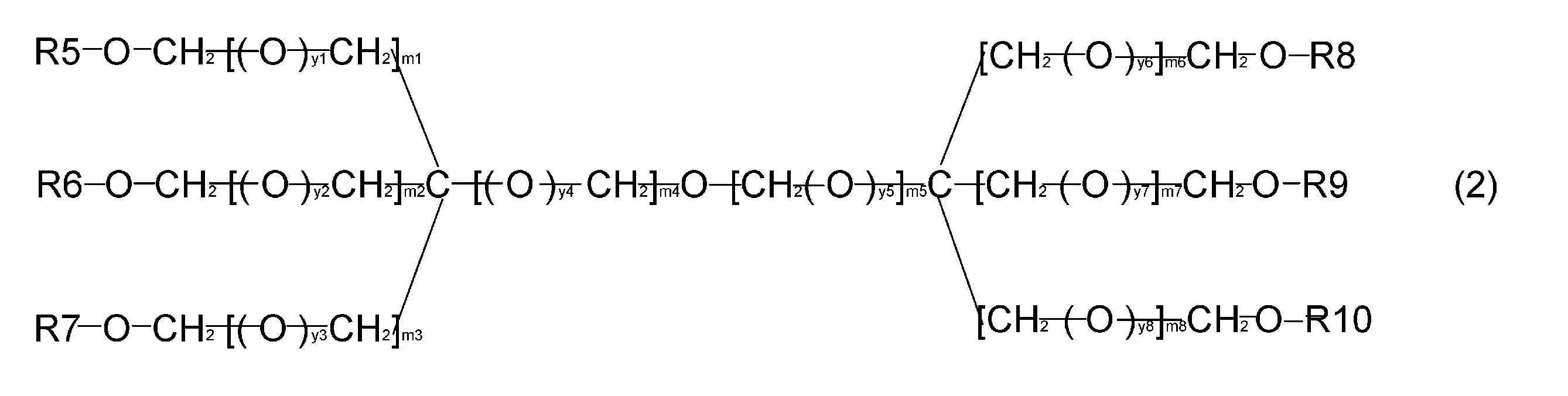
一般式(1)中、n1~n4は、同一又は異なって0~4の整数を示す。n1~n4として、好ましくは0~2の整数、更に好ましくは0が挙げられる。
一般式(1)中、x1~x4は、同一又は異なって0又は1を示す。x1~x4として、好ましくは0が挙げられる。
また、一般式(1)中、R1~R4は、同一又は異なって、ポリ乳酸又は水素原子を示し、且つR1~R4の少なくとも3つはポリ乳酸を示す。一般式(1)で示される星型ポリマーの好適な例として、R1~R4の全てがポリ乳酸であるものが挙げられる。なお、R1~R4を構成する少なくとも3つのポリ乳酸は、各々同じ分子量のものであってもよく、また各々異なる分子量のものであってもよい。R1~R4を構成する少なくとも3つのポリ乳酸について、その分子量、構成モノマーの光学異性体の種類等については、前記の通りである。
一般式(2)中、m1~m8は、同一又は異なって0~4の整数を示す。m1~m3及びm6~m8として、好ましくは0~2の整数、更に好ましくは0が挙げられる。m4及びm5として、好ましくは1~3の整数、更に好ましくは1が挙げられる。
一般式(1)中、y1~y8は、同一又は異なって0又は1を示す。y1~y8として、好ましくは0が挙げられる。
また、一般式(2)中、R5~R10は、同一又は異なって、ポリ乳酸又は水素原子を示し、且つR5~R10の少なくとも3つはポリ乳酸を示す。一般式(1)で示される星型ポリマーとして、R5~R10の内、少なくとも4つがポリ乳酸であるものが好ましく、少なくとも5つがポリ乳酸であるものが更に好ましく、これらの全てがポリ乳酸であるものが特に好ましい。なお、R5~R10を構成する少なくとも3つのポリ乳酸は、各々同じ分子量のものであってもよく、また各々異なる分子量のものであってもよい。R5~R10を構成する少なくとも3つのポリ乳酸について、その分子量、構成モノマーの光学異性体の種類等については、前記の通りである。
前記分岐状ポリマーは、公知の方法で製造することができる。具体的には、当該分岐状ポリマーの製造方法として、コア部を構成する化合物の存在下で触媒を用いてラクチドを開環重合する方法、コア部を構成する化合物の存在下で乳酸を直接重縮合法により脱水縮重合する方法等が挙げられる。ラクチドの開環重合に使用される触媒としては、例えば、2-エチルヘキサン酸スズ、オクチル酸スズ(II)、トリフェニルスズアセテート、酸化スズ、酸化ジブチルスズ、シュウ酸スズ、塩化スズ、ジブチルスズジラウレート、トリウムエトキシド、カリウム-t-ブトキシド、トリエチルアルミニウム、チタン酸テトラブチル、ビスマス等の金属触媒;有機オニウム塩等の有機塩基触媒等が挙げられる。
本発明の骨接合材は、前記分岐状ポリマーのみから構成されていてもよいが、必要に応じて他の生体内分解吸収性ポリマーを含んでいてもよい。当該他の生体内分解吸収性ポリマーとしては、例えば、ポリ乳酸、乳酸-グリコール酸共重合体、ポリグリコール酸、乳酸-ε-カプロラクトン共重合体、グリコール酸-ε-カプロラクトン共重合体、ポリジオキサノン等が挙げられる。これらの中でも、ポリ乳酸は、本発明の骨接合材の分解速度を穏やかにすることができるので、骨接合材の強度を調節する目的で好適に使用される。
本発明の骨接合材において必要に応じて含有される前記ポリ乳酸としては、ポリ-L-乳酸、ポリ-D-乳酸、ポリ-D,L-乳酸のいずれであってもよいが、好ましくはポリ-L-乳酸が挙げられる。また、当該ポリ乳酸の重量平均分子量については、特に制限されないが、例えば15万~50万、好ましくは18万~45万、更に好ましくは20万~40万が挙げられる。
本発明の骨接合材が前記分岐状ポリマー以外の生体内分解吸収性ポリマーを含む場合、その含有量については、特に制限されないが、例えば、前記分岐状ポリマー100重量部当たり、当該生体内分解吸収性ポリマー(前記分岐状ポリマー以外)が1~900重量部、好ましくは1~400重量部、更に好ましくは1~200重量部が挙げられる。
更に、本発明の骨接合材は、必要に応じて、リン酸三カルシウム、リン酸四カルシウム、リン酸水素カルシウム、ハイドロキシアパタイト等の骨組織と親和性を示す成分;細胞増殖因子、成長因子、抗菌剤、抗生物質等が含有されたり、表面コーティングされていてもよい。
本発明の骨接合材のガラス転移温度としては、使用される分岐状ポリマーの種類等によって定まるが、通常40℃以上、好ましくは45~65℃、更に好ましくは50~60℃が挙げられる。当該ガラス転移温度は、DSC(示差走査熱量測定)にて測定される値である。
また、本発明の骨接合材は、生体内に埋入されて一定期間が経過すると速やかに分解されるという特性を備えており、本発明の骨接合材が備える分解特性の好適な例として、リン酸緩衝液(PBS(-)、pH7.4))に65℃で36日間浸漬した場合の重量残存率が、通常90%以下、好ましくは0~89%、更に好ましくは0~85%が挙げられる。ここで、重量残存率(%)は、下記式に従って算出される値である。
<数1>
重量残存率(%)={PBS(-)浸漬後の骨接合材の重量/PBS(-)浸漬前の骨接合材の重量}×100
本発明の骨接合材は、生体内に埋入して骨損傷部位を固定し得ることを限度として、その形状については、特に制限されないが、例えば、ピン、スクリュー、プレート、ネジ、ビス、布状、フィルム状等が挙げられる。本発明の骨接合材が高い強度を備え得ることを鑑みれば、前記形状の中でも、骨損傷部位が治癒するまでの間に高い強度を維持することが求められるピン、スクリュー、プレート、ネジ、及びビスは、本発明の骨接合材における好適な形状として例示される。
重量残存率(%)={PBS(-)浸漬後の骨接合材の重量/PBS(-)浸漬前の骨接合材の重量}×100
本発明の骨接合材は、生体内に埋入して骨損傷部位を固定し得ることを限度として、その形状については、特に制限されないが、例えば、ピン、スクリュー、プレート、ネジ、ビス、布状、フィルム状等が挙げられる。本発明の骨接合材が高い強度を備え得ることを鑑みれば、前記形状の中でも、骨損傷部位が治癒するまでの間に高い強度を維持することが求められるピン、スクリュー、プレート、ネジ、及びビスは、本発明の骨接合材における好適な形状として例示される。
本発明の骨接合材は、公知の方法によって成型することにより製造される。具体的には、前記分岐状ポリマー及び必要に応じて含まれる他の生体内分解吸収性ポリマーを含有するペレットを調製し、これを所定形状に成型することによって本発明の骨接合材が製造される。
以下、実施例等に基づいて本発明をより詳細に説明するが、本発明はこれらによって限定されるものではない。
合成例1:4-armPLLAの合成
L,L-ラクチド2000g(13.9mol)、ペンタエリスリトール2.36g(1.7×10⁻²mol)、及び2-エチルヘキサン酸スズ(L,L-ラクチド単位重量当たり100ppm)をセパラブルフラスコに入れ、一晩真空下で乾燥した。その後、容器内を窒素で充填し、125℃に設定されたオイルバスに浸漬し、2日間重合を行った。重合終了後に得られた分岐状ポリマー(4-armPLLA)をメッシュサイズ3mmの回転式粉砕機にて粉砕し、粉砕片を得た。
L,L-ラクチド2000g(13.9mol)、ペンタエリスリトール2.36g(1.7×10⁻²mol)、及び2-エチルヘキサン酸スズ(L,L-ラクチド単位重量当たり100ppm)をセパラブルフラスコに入れ、一晩真空下で乾燥した。その後、容器内を窒素で充填し、125℃に設定されたオイルバスに浸漬し、2日間重合を行った。重合終了後に得られた分岐状ポリマー(4-armPLLA)をメッシュサイズ3mmの回転式粉砕機にて粉砕し、粉砕片を得た。
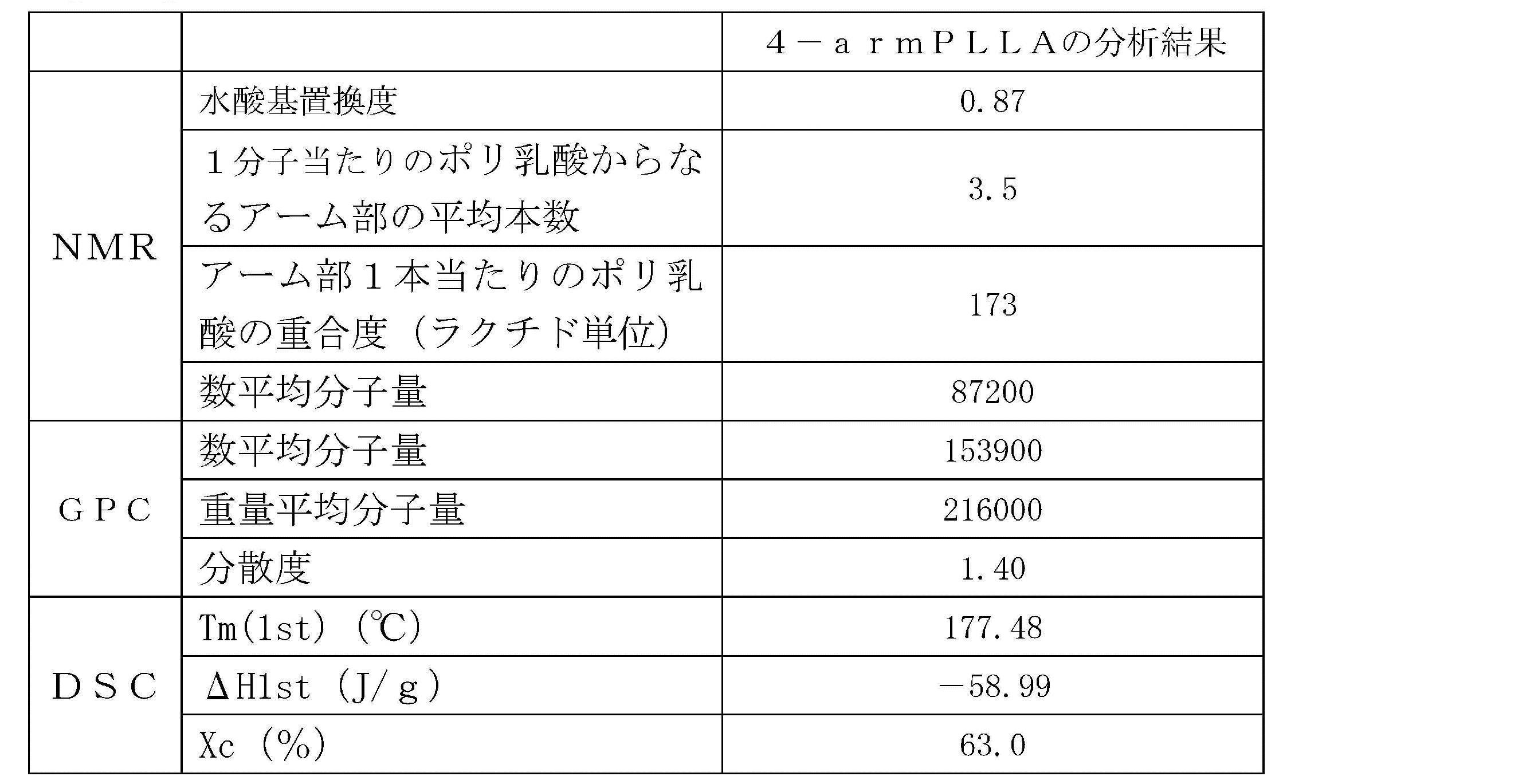
得られた分岐状ポリマー(4-armPLLA)について、NMR(溶媒:重クロロホルム、測定核:1H、積算数:128)によって、水酸基置換度、ポリ乳酸からなるアーム部の平均本数、アーム部1本当たりのポリ乳酸の重合度(ラクチド単位)、及び数平均分子量を求めた。また、当該分岐状ポリマーについて、GPC(溶媒:クロロホルム、流速:1ml/min)にて、数平均分子量、重量平均分子量、分散度を求めた。なお、GPCにて求めた数平均分子量及び重量平均分子量は、標準ポリスチレン換算の値である。更に、当該分岐状ポリマーについて、DSC(示差走査熱量測定)にて、1st-heatingにおける融点(Tm(1st))、1st-heatingにおける溶解エンタルピー(ΔH1st(J/g))、結晶化度(Xc(%))を求めた。なお、結晶化度(Xc(%))は、下式に従って算出した。
Xc(%)={ΔH1st(J/g)/-93.6(J/g)}×100
Xc(%)={ΔH1st(J/g)/-93.6(J/g)}×100
合成例1で得られた分岐状ポリマー(4-armPLLA)の分析結果を表1に示す。
合成例2:6-armPLLAの合成
L,L-ラクチド2000g(13.9mol)、ジペンタエリスリトール4.52g(1.7×10⁻²mol)、及び2-エチルヘキサン酸スズ(L,L-ラクチド単位重量当たり100ppm)をセパラブルフラスコに入れ、一晩真空下で乾燥した。その後、容器内を窒素で充填し、125℃に設定されたオイルバスに浸漬し、2日間重合を行った。重合終了後に得られた分岐状ポリマー(6-armPLLA)をメッシュサイズ3mmの回転式粉砕機にて粉砕し、粉砕片を得た。
L,L-ラクチド2000g(13.9mol)、ジペンタエリスリトール4.52g(1.7×10⁻²mol)、及び2-エチルヘキサン酸スズ(L,L-ラクチド単位重量当たり100ppm)をセパラブルフラスコに入れ、一晩真空下で乾燥した。その後、容器内を窒素で充填し、125℃に設定されたオイルバスに浸漬し、2日間重合を行った。重合終了後に得られた分岐状ポリマー(6-armPLLA)をメッシュサイズ3mmの回転式粉砕機にて粉砕し、粉砕片を得た。
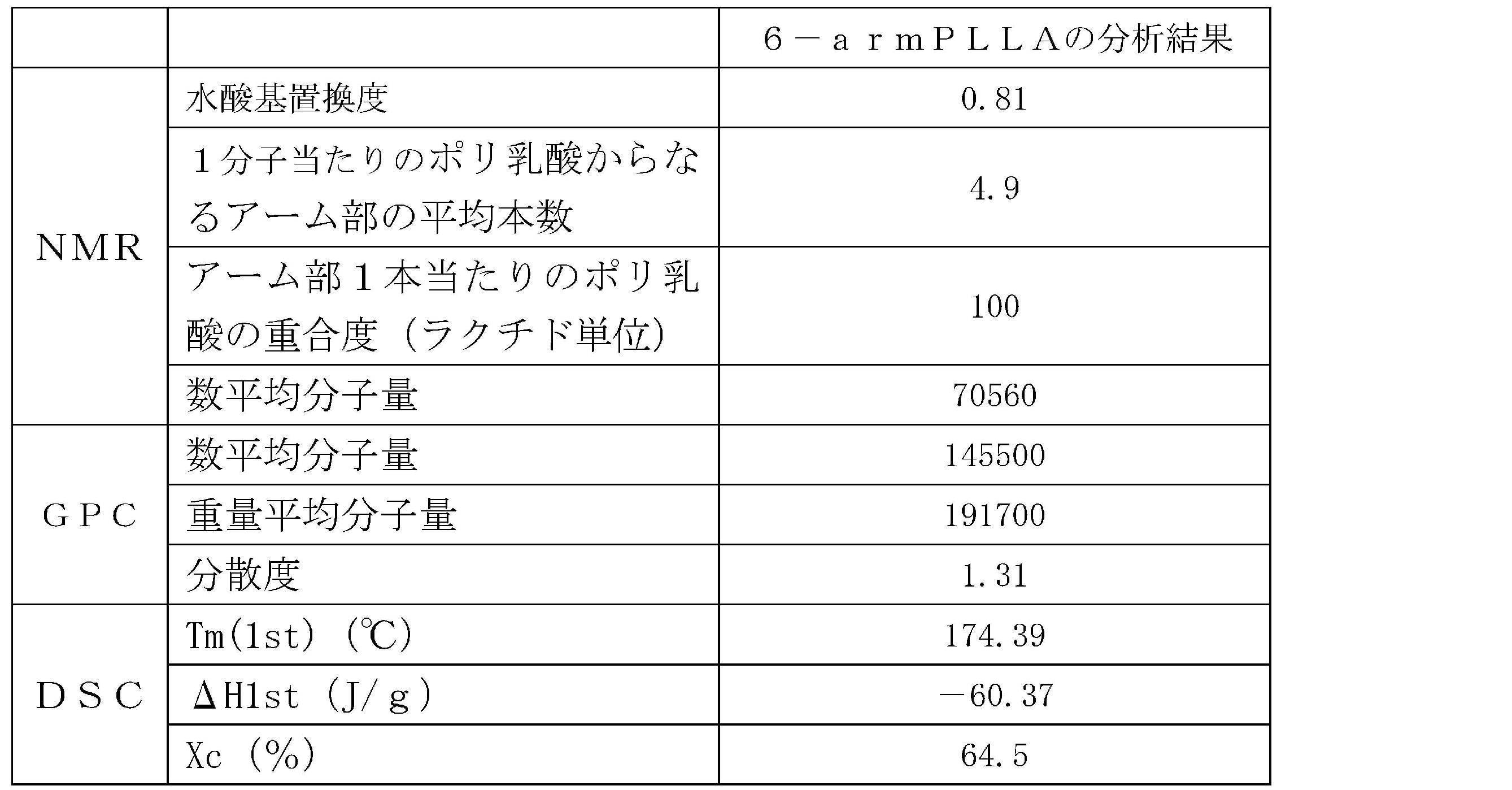
得られた分岐状ポリマー(6-armPLLA)について、合成例1と同条件でNMR、GPC、及びDSCによる分析を行った。結果を表2に示す。
合成例3:直鎖PLLAの合成
L,L-ラクチド2000g(13.9mol)、1-ドデカノール3.2g(1.7×10⁻²mol)、及び2-エチルヘキサン酸スズ(L,L-ラクチド単位重量当たり100ppm)をセパラブルフラスコに入れ、一晩真空下で乾燥した。その後、容器内を窒素で充填し、125℃に設定されたオイルバスに浸漬し、2日間重合を行った。重合終了後に得られた直鎖状ポリ乳酸(直鎖PLLA)をメッシュサイズ3mmの回転式粉砕機にて粉砕し、粉砕片を得た。
L,L-ラクチド2000g(13.9mol)、1-ドデカノール3.2g(1.7×10⁻²mol)、及び2-エチルヘキサン酸スズ(L,L-ラクチド単位重量当たり100ppm)をセパラブルフラスコに入れ、一晩真空下で乾燥した。その後、容器内を窒素で充填し、125℃に設定されたオイルバスに浸漬し、2日間重合を行った。重合終了後に得られた直鎖状ポリ乳酸(直鎖PLLA)をメッシュサイズ3mmの回転式粉砕機にて粉砕し、粉砕片を得た。
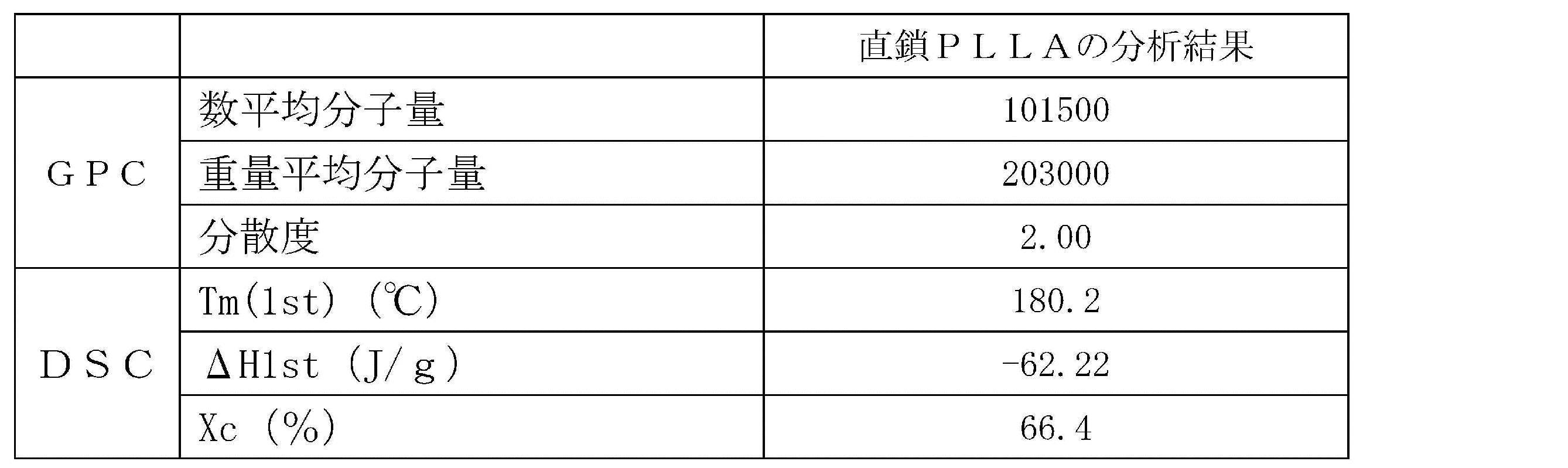
得られた直鎖状ポリ乳酸(直鎖PLLA)について、合成例1と同条件でGPC、及びDSCによる分析を行った。結果を表3に示す。
実施例1:4-armPLLAプレスフィルムの調製
合成例1で得られた4-armPLLAを加熱プレス機(テスター産業株式会社 ACMプレス機 30T 400C)を用いて平均厚さ300μmのプレスフィルムに調製した。具体的には、4-armPLLA6gを200mm×200mm×0.2mmのアルミ板二枚およびSUS板(200mm×200mm×5mm)二枚で上下を挟み、200℃に設定した加熱プレス機にセットした。上下のSUS板をプレス機表面に接触させ、5分間かけて各ポリ乳酸を溶融し、次いで1分間20kgf/m2の圧力で加圧したのち、氷にて急冷した。その後、アルミ板に挟んだまま90℃、真空下熱固定処理を行った。得られフィルムのガラス転移温度をDSCにより測定したところ、57℃であった。
合成例1で得られた4-armPLLAを加熱プレス機(テスター産業株式会社 ACMプレス機 30T 400C)を用いて平均厚さ300μmのプレスフィルムに調製した。具体的には、4-armPLLA6gを200mm×200mm×0.2mmのアルミ板二枚およびSUS板(200mm×200mm×5mm)二枚で上下を挟み、200℃に設定した加熱プレス機にセットした。上下のSUS板をプレス機表面に接触させ、5分間かけて各ポリ乳酸を溶融し、次いで1分間20kgf/m2の圧力で加圧したのち、氷にて急冷した。その後、アルミ板に挟んだまま90℃、真空下熱固定処理を行った。得られフィルムのガラス転移温度をDSCにより測定したところ、57℃であった。
実施例2:6-armPLLAプレスフィルムの調製
合成例2で得られた6-armPLLA6gを用いて、実施例1と同様の方法でプレスフィルムに加工した。得られフィルムのガラス転移温度をDSCにより測定したところ、55℃であった。
合成例2で得られた6-armPLLA6gを用いて、実施例1と同様の方法でプレスフィルムに加工した。得られフィルムのガラス転移温度をDSCにより測定したところ、55℃であった。
実施例3:4-armPLLAと直鎖PLLAとの混合プレスフィルムの調製
合成例1で得られた4-armPLLA2gと、合成例3で得られた直鎖PLLA4gとを十分に混合した後、実施例1と同様の方法でプレスフィルムに加工した。得られフィルムのガラス転移温度をDSCにより測定したところ、60℃であった。
合成例1で得られた4-armPLLA2gと、合成例3で得られた直鎖PLLA4gとを十分に混合した後、実施例1と同様の方法でプレスフィルムに加工した。得られフィルムのガラス転移温度をDSCにより測定したところ、60℃であった。
実施例4:6-armPLLAと直鎖PLLAとの混合プレスフィルムの調製
合成例2で得られた6-armPLLA2gと、合成例3で得られた直鎖PLLA4gとを十分に混合した後、実施例1と同様の方法でプレスフィルムに加工した。得られフィルムのガラス転移温度をDSCにより測定したところ、60℃であった。
合成例2で得られた6-armPLLA2gと、合成例3で得られた直鎖PLLA4gとを十分に混合した後、実施例1と同様の方法でプレスフィルムに加工した。得られフィルムのガラス転移温度をDSCにより測定したところ、60℃であった。
比較例1:直鎖PLLAプレスフィルムの調製
合成例3で得られた直鎖PLLA6gを用いて、実施例1と同様の方法でプレスフィルムに加工した。得られフィルムのガラス転移温度をDSCにより測定したところ、63℃であった。
合成例3で得られた直鎖PLLA6gを用いて、実施例1と同様の方法でプレスフィルムに加工した。得られフィルムのガラス転移温度をDSCにより測定したところ、63℃であった。
試験例1:初期強度及び保存後強度の評価
上記で得られたプレスフィルムを10mm×40mmの短冊状に切断し、引張り強度を測定した(初期強度)。次いで、短冊状に切断したプレスフィルムを37℃のPBS(-)に浸漬し、1ヶ月、2か月、及び3ヵ月後にPBSから各プレスフィルムを取り出して乾燥させた後に、引張破断強度を測定した(保存後強度)。また、同様に、短冊状に切断したプレスフィルムについて、50℃のPBS(-)に3週間浸漬した後に、引張破断を測定した(保存後強度)。なお、37℃のPBS(-)に浸漬した条件での試験は、前記実施例1-2及び比較例1のプレスフィルムについて行い、50℃のPBS(-)に浸漬した条件での試験は、前記実施例1-4及び比較例1のプレスフィルムについて行った。また、引張破断強度は、万能引張試験機(島津製作所 EZ-Graph)を用いて、チャック間距離 15mm、引張速度10mm/minの条件で測定した。なお、アレニウスプロットによる計算から、50℃のPBS(-)に3週間浸漬する条件は、37℃のPBS(-)に3ヵ月浸漬する条件にほぼ相当していることが分かっている。
上記で得られたプレスフィルムを10mm×40mmの短冊状に切断し、引張り強度を測定した(初期強度)。次いで、短冊状に切断したプレスフィルムを37℃のPBS(-)に浸漬し、1ヶ月、2か月、及び3ヵ月後にPBSから各プレスフィルムを取り出して乾燥させた後に、引張破断強度を測定した(保存後強度)。また、同様に、短冊状に切断したプレスフィルムについて、50℃のPBS(-)に3週間浸漬した後に、引張破断を測定した(保存後強度)。なお、37℃のPBS(-)に浸漬した条件での試験は、前記実施例1-2及び比較例1のプレスフィルムについて行い、50℃のPBS(-)に浸漬した条件での試験は、前記実施例1-4及び比較例1のプレスフィルムについて行った。また、引張破断強度は、万能引張試験機(島津製作所 EZ-Graph)を用いて、チャック間距離 15mm、引張速度10mm/minの条件で測定した。なお、アレニウスプロットによる計算から、50℃のPBS(-)に3週間浸漬する条件は、37℃のPBS(-)に3ヵ月浸漬する条件にほぼ相当していることが分かっている。
37℃のPBS(-)に浸漬した条件での試験結果を図1に示し、50℃のPBS(-)に浸漬した条件での試験結果を図2に示す。この結果から、合成例1及び2で得られた分岐状のポリマーを用いて調製したプレスフィルムは、直鎖PLLAを用いて調製したプレスフィルムと同等の初期強度を示した。一方、合成例1及び2で得られた分岐状のポリマーを用いて調製したプレスフィルムは、直鎖PLLAを用いて調製したプレスフィルムに比べて、37℃のPBS(-)に1ヶ月又は2か月浸漬した後の強度低下が大きいことが示された(図1参照)。また、合成例1又は2で得られた分岐状のポリマーと直鎖PLLAの混合プレスフィルムは、合成例1又は2で得られた分岐状のポリマー単独で製造したプレスフィルムに比べて、保存後の強度低下は穏やかであるものの、直鎖PLLAを用いて調製したプレスフィルムに比べて、保存後の強度低下が大きいことが示された(図2参照)。
これらの結果から、合成例1及び2で得られた分岐状のポリマーを用いて調製したプレスフィルムは、高い初期強度と共に、一定期間経過後には速やかに分解される特性を備えており、骨接合材として好適に使用し得ることが確認された。
試験例2:プレスフィルムの保存後重量減少率の評価
実施例1-4及び比較例1の各プレスフィルムを10mm×40mmの短冊状に切断し、これを65℃のPBS(-)に所定期間浸漬した。65℃のPBS(-)に6、12、36日間浸漬した後に、PBS(-)から各プレスフィルムを取り出して、洗浄及び乾燥を行った後に重量を測定し、残存重量率(%)を求めた。また、6、12、36日間浸漬後に、各プレスフィルムから10mg程度の破片を採取し、これをサンプルとして、GPC法によりに残存しているポリマーの重量平均分子量を測定した。浸漬前のポリマーの重量平均分子量に対して浸漬後のポリマーの重量平均分子量の低下した割合を、ポリマー分子量の低下率(%)として求めた。なお、アレニウスプロットによる計算から、65℃のPBS(-)に6、12、36日間浸漬する条件は、それぞれ37℃のPBS(-)に6ヵ月、12ヵ月、36ヵ月浸漬する条件にほぼ相当していることが分かっている。
実施例1-4及び比較例1の各プレスフィルムを10mm×40mmの短冊状に切断し、これを65℃のPBS(-)に所定期間浸漬した。65℃のPBS(-)に6、12、36日間浸漬した後に、PBS(-)から各プレスフィルムを取り出して、洗浄及び乾燥を行った後に重量を測定し、残存重量率(%)を求めた。また、6、12、36日間浸漬後に、各プレスフィルムから10mg程度の破片を採取し、これをサンプルとして、GPC法によりに残存しているポリマーの重量平均分子量を測定した。浸漬前のポリマーの重量平均分子量に対して浸漬後のポリマーの重量平均分子量の低下した割合を、ポリマー分子量の低下率(%)として求めた。なお、アレニウスプロットによる計算から、65℃のPBS(-)に6、12、36日間浸漬する条件は、それぞれ37℃のPBS(-)に6ヵ月、12ヵ月、36ヵ月浸漬する条件にほぼ相当していることが分かっている。
残存重量率(%)に関する結果を図3に示し、ポリマー分子量の残存率(%)に関する結果を図4に示す。この結果から、65℃のPBS(-)で36日間浸漬した条件、即ち37℃のPBS(-)でほぼ36ヵ月浸漬する条件でも、直鎖PLLAを用いて調製したプレスフィルム(比較例1)では、僅か2%程度しか重量が減少しておらず、分解が殆ど進行していないことが明らかとなった。一方、分岐状のポリマーを用いて調製したプレスフィルム(実施例1-4)では、65℃のPBS(-)で36日間浸漬した後には、残存重量率が90%を下回っており、優れた分解性を備えていることが明らかとなった。また、ポリマー分子量の低下率の結果からも、分岐状のポリマーを用いて調製したプレスフィルム(実施例1-4)は、直鎖PLLAを用いて調製したプレスフィルム(比較例2)に比して、分子量の低下速度が速いことが確認された。
実施例5:4-armPLLA圧延プレートの調製
合成例1で得られた4-armPLLAを原料ポリマーとして使用して、射出成型機と圧延機を用いて成型することにより、10mm×60mm×2mmのプレートを製造した。
合成例1で得られた4-armPLLAを原料ポリマーとして使用して、射出成型機と圧延機を用いて成型することにより、10mm×60mm×2mmのプレートを製造した。
実施例6:6-armPLLA圧延プレートの調製
合成例2で得られた6-armPLLAを用いて、実施例5と同様の方法でプレートを調製した。
合成例2で得られた6-armPLLAを用いて、実施例5と同様の方法でプレートを調製した。
比較例2:直鎖PLLA圧延プレートの調製
合成例3で得られた直鎖PLLAを用いて、実施例5と同様の方法でプレートを調製した。
合成例3で得られた直鎖PLLAを用いて、実施例5と同様の方法でプレートを調製した。
試験例3:圧延プレートの機械的特性の評価
実施例5-6及び比較例2の圧延プレートについて、小型万能試験機(Ez Graph 島津製作所)を用いて3点曲げ試験を行い、曲げ弾性率(GPa)、最大点応力(MPa)、及び最大点までのエネルギー(J)を測定した。
実施例5-6及び比較例2の圧延プレートについて、小型万能試験機(Ez Graph 島津製作所)を用いて3点曲げ試験を行い、曲げ弾性率(GPa)、最大点応力(MPa)、及び最大点までのエネルギー(J)を測定した。
得られた結果を表4に示す。この結果から、分岐状のポリマーを用いて調製した圧延プレート(実施例5-6)では、曲げ弾性率及び最大点応力が共に高く、骨接合材として望ましい機械的特性を備えていることが分かった。

Claims (10)
- 少なくとも3つのポリ乳酸からなるアーム部を有する分岐状ポリマーを含有することを特徴とする、骨接合材。
- 前記分岐状ポリマーが、コア部と、該コア部から伸びる少なくとも3つのポリ乳酸からなるアーム部を有する星型ポリマーである、請求項1に記載の骨接合材。
- 前記星型ポリマーが、ペンタエリスリトール残基又はジペンタエリスリトール残基をコア部として有し、ペンタエリスリトール又はジペンタエリスリトールの水酸基とアーム部を構成するポリ乳酸のカルボキシル基がエステル結合により連結している構造である、請求項2に記載の骨接合材。
- 前記星型ポリマーが、下記一般式(1)又は(2)で示される化合物である、請求項2又は3に記載の骨接合材。

- 前記アーム部を構成するポリ乳酸が、ポリL-乳酸である、請求項1~4のいずれかに記載の骨接合材。
- 前記アーム部を構成するポリ乳酸の重合度(ラクチド単位)が80~600である、請求項1~5のいずれかに記載の骨接合材。
- ピン、スクリュー、プレート、ネジ、ビス、布状、又はフィルム状である、請求項1~6のいずれかに記載の骨接合材。
- 少なくとも3つのポリ乳酸からなるアーム部を有する分岐状ポリマーの、骨接合材の製造のための使用。
- 骨損傷の治療に使用される、少なくとも3つのポリ乳酸からなるアーム部を有する分岐状ポリマー。
- 少なくとも3つのポリ乳酸からなるアーム部を有する分岐状ポリマーを含有する骨接合材を、骨損傷部位に固定する工程を含む、骨損傷の治療方法。
Priority Applications (2)
| Application Number | Priority Date | Filing Date | Title |
|---|---|---|---|
| JP2014519913A JPWO2013183442A1 (ja) | 2012-06-07 | 2013-05-21 | 骨接合材 |
| CN201380023397.XA CN104284684A (zh) | 2012-06-07 | 2013-05-21 | 骨接合材料 |
Applications Claiming Priority (2)
| Application Number | Priority Date | Filing Date | Title |
|---|---|---|---|
| JP2012130227 | 2012-06-07 | ||
| JP2012-130227 | 2012-06-07 |
Publications (1)
| Publication Number | Publication Date |
|---|---|
| WO2013183442A1 true WO2013183442A1 (ja) | 2013-12-12 |
Family
ID=49711840
Family Applications (1)
| Application Number | Title | Priority Date | Filing Date |
|---|---|---|---|
| PCT/JP2013/064086 Ceased WO2013183442A1 (ja) | 2012-06-07 | 2013-05-21 | 骨接合材 |
Country Status (3)
| Country | Link |
|---|---|
| JP (1) | JPWO2013183442A1 (ja) |
| CN (1) | CN104284684A (ja) |
| WO (1) | WO2013183442A1 (ja) |
Cited By (1)
| Publication number | Priority date | Publication date | Assignee | Title |
|---|---|---|---|---|
| CN114712559A (zh) * | 2022-05-05 | 2022-07-08 | 湖北翎美生物科技有限公司 | 一种体内可促进胶原稳定再生的可注射聚左旋乳酸微球及其制备和应用 |
Citations (3)
| Publication number | Priority date | Publication date | Assignee | Title |
|---|---|---|---|---|
| JPH06313032A (ja) * | 1993-04-24 | 1994-11-08 | Korea Advanced Inst Of Sci Technol | 改良された物理特性を有する生分解性ポリ(乳酸)類及びそれらの製造法 |
| JP2005527678A (ja) * | 2002-05-29 | 2005-09-15 | ヒカイル・ベスローテン・フェンノートシャップ | 超分枝状ポリマー |
| WO2008029527A1 (en) * | 2006-09-04 | 2008-03-13 | Bio-Energy Corporation | Polyester polyol |
-
2013
- 2013-05-21 JP JP2014519913A patent/JPWO2013183442A1/ja active Pending
- 2013-05-21 WO PCT/JP2013/064086 patent/WO2013183442A1/ja not_active Ceased
- 2013-05-21 CN CN201380023397.XA patent/CN104284684A/zh active Pending
Patent Citations (3)
| Publication number | Priority date | Publication date | Assignee | Title |
|---|---|---|---|---|
| JPH06313032A (ja) * | 1993-04-24 | 1994-11-08 | Korea Advanced Inst Of Sci Technol | 改良された物理特性を有する生分解性ポリ(乳酸)類及びそれらの製造法 |
| JP2005527678A (ja) * | 2002-05-29 | 2005-09-15 | ヒカイル・ベスローテン・フェンノートシャップ | 超分枝状ポリマー |
| WO2008029527A1 (en) * | 2006-09-04 | 2008-03-13 | Bio-Energy Corporation | Polyester polyol |
Non-Patent Citations (1)
| Title |
|---|
| DONG, TUAN-RUI ET AL.: "Synthesis of poly (lactic acid) under microwave radiation", SHAANXI SHIFAN DAXUE XUEBAO, ZIRAN KEXUEBAN, vol. 38, no. 2, 2010, pages 50 - 53 * |
Cited By (1)
| Publication number | Priority date | Publication date | Assignee | Title |
|---|---|---|---|---|
| CN114712559A (zh) * | 2022-05-05 | 2022-07-08 | 湖北翎美生物科技有限公司 | 一种体内可促进胶原稳定再生的可注射聚左旋乳酸微球及其制备和应用 |
Also Published As
| Publication number | Publication date |
|---|---|
| JPWO2013183442A1 (ja) | 2016-01-28 |
| CN104284684A (zh) | 2015-01-14 |
Similar Documents
| Publication | Publication Date | Title |
|---|---|---|
| AU690323B2 (en) | Absorbable polymer blends | |
| US7557167B2 (en) | Polyester compositions, methods of manufacturing said compositions, and articles made therefrom | |
| AU2006271727B2 (en) | Resorbable polyether esters for producing medical implants | |
| JP6328604B2 (ja) | セグメント化した、半結晶性ポリ(ラクチド−コ−ε−カプロラクトン)吸収性コポリマー | |
| CA2721855A1 (en) | Thermal-responsive polymer siloxanes, compositions, and methods and applications related thereto | |
| TW200922533A (en) | Lactide/ε-caprolactone copolymer for medical implant, method for producing lactide/ε-caprolactone copolymer for medical implant, medical implant and artificial dura mater | |
| Oh et al. | Degradation behavior of 3D porous polydioxanone-b-polycaprolactone scaffolds fabricated using the melt-molding particulate-leaching method | |
| JP2017505832A (ja) | 単官能性及び二官能性重合開始剤から調製されたコポリマーに基づく吸収性ポリマーブレンド組成物、加工方法、並びにそれらによる医療デバイス | |
| JP6017580B2 (ja) | 生分解性高分子化合物 | |
| WO2015043496A1 (zh) | 一种骨损伤修复固定器械及其制备方法 | |
| Du et al. | Dual stimulus response mechanical properties tunable biodegradable and biocompatible PLCL/PPDO based shape memory composites | |
| CN103992465B (zh) | 生物可降解三元共聚物 | |
| JP6851990B2 (ja) | 長期吸収特性を呈する半結晶性のラクチドとε−カプロラクトンとのセグメント化コポリマーから製造された新規な発泡体及びフィルムに基づく吸収性医療用装置 | |
| JP6291363B2 (ja) | 生分解性分岐状ポリマー | |
| WO2013183442A1 (ja) | 骨接合材 | |
| JP2009132769A (ja) | 医療用インプラント用ラクチド/ε−カプロラクトン共重合体 | |
| JP3487703B2 (ja) | 生体吸収性ポリエステル及びその製造方法 | |
| JP7484167B2 (ja) | 医療用成形体、医療機器、神経再生誘導チューブ | |
| JP5258189B2 (ja) | 柔軟性生分解性ポリマー | |
| Xie et al. | Novel injectable and in situ curable glycolide/lactide based biodegradable polymer resins and composites | |
| CN115337466A (zh) | 一种调节降解环境酸碱性的植入材料及其制备方法 | |
| CN115154671A (zh) | 一种聚乳酸和形状记忆聚氨酯材料的复合物 | |
| Yeo et al. | Engineering of Dual-Phase PLA/PHB-rubber copolymer towards a High-Performance Shape Memory Biocomposite: Microphase Separation with Interfacial Adhesion |
Legal Events
| Date | Code | Title | Description |
|---|---|---|---|
| 121 | Ep: the epo has been informed by wipo that ep was designated in this application |
Ref document number: 13801027 Country of ref document: EP Kind code of ref document: A1 |
|
| ENP | Entry into the national phase |
Ref document number: 2014519913 Country of ref document: JP Kind code of ref document: A |
|
| NENP | Non-entry into the national phase |
Ref country code: DE |
|
| 122 | Ep: pct application non-entry in european phase |
Ref document number: 13801027 Country of ref document: EP Kind code of ref document: A1 |