WO2013183335A1 - ゲーム装置、ゲーム制御サーバ及び記録媒体 - Google Patents
ゲーム装置、ゲーム制御サーバ及び記録媒体 Download PDFInfo
- Publication number
- WO2013183335A1 WO2013183335A1 PCT/JP2013/057735 JP2013057735W WO2013183335A1 WO 2013183335 A1 WO2013183335 A1 WO 2013183335A1 JP 2013057735 W JP2013057735 W JP 2013057735W WO 2013183335 A1 WO2013183335 A1 WO 2013183335A1
- Authority
- WO
- WIPO (PCT)
- Prior art keywords
- game
- player
- management unit
- players
- specific
- Prior art date
- Legal status (The legal status is an assumption and is not a legal conclusion. Google has not performed a legal analysis and makes no representation as to the accuracy of the status listed.)
- Ceased
Links
Images







Classifications
-
- A—HUMAN NECESSITIES
- A63—SPORTS; GAMES; AMUSEMENTS
- A63F—CARD, BOARD, OR ROULETTE GAMES; INDOOR GAMES USING SMALL MOVING PLAYING BODIES; VIDEO GAMES; GAMES NOT OTHERWISE PROVIDED FOR
- A63F13/00—Video games, i.e. games using an electronically generated display having two or more dimensions
- A63F13/70—Game security or game management aspects
- A63F13/79—Game security or game management aspects involving player-related data, e.g. identities, accounts, preferences or play histories
- A63F13/798—Game security or game management aspects involving player-related data, e.g. identities, accounts, preferences or play histories for assessing skills or for ranking players, e.g. for generating a hall of fame
-
- A—HUMAN NECESSITIES
- A63—SPORTS; GAMES; AMUSEMENTS
- A63F—CARD, BOARD, OR ROULETTE GAMES; INDOOR GAMES USING SMALL MOVING PLAYING BODIES; VIDEO GAMES; GAMES NOT OTHERWISE PROVIDED FOR
- A63F13/00—Video games, i.e. games using an electronically generated display having two or more dimensions
- A63F13/55—Controlling game characters or game objects based on the game progress
- A63F13/58—Controlling game characters or game objects based on the game progress by computing conditions of game characters, e.g. stamina, strength, motivation or energy level
-
- A—HUMAN NECESSITIES
- A63—SPORTS; GAMES; AMUSEMENTS
- A63F—CARD, BOARD, OR ROULETTE GAMES; INDOOR GAMES USING SMALL MOVING PLAYING BODIES; VIDEO GAMES; GAMES NOT OTHERWISE PROVIDED FOR
- A63F13/00—Video games, i.e. games using an electronically generated display having two or more dimensions
- A63F13/60—Generating or modifying game content before or while executing the game program, e.g. authoring tools specially adapted for game development or game-integrated level editor
- A63F13/69—Generating or modifying game content before or while executing the game program, e.g. authoring tools specially adapted for game development or game-integrated level editor by enabling or updating specific game elements, e.g. unlocking hidden features, items, levels or versions
-
- A—HUMAN NECESSITIES
- A63—SPORTS; GAMES; AMUSEMENTS
- A63F—CARD, BOARD, OR ROULETTE GAMES; INDOOR GAMES USING SMALL MOVING PLAYING BODIES; VIDEO GAMES; GAMES NOT OTHERWISE PROVIDED FOR
- A63F13/00—Video games, i.e. games using an electronically generated display having two or more dimensions
- A63F13/70—Game security or game management aspects
- A63F13/79—Game security or game management aspects involving player-related data, e.g. identities, accounts, preferences or play histories
- A63F13/795—Game security or game management aspects involving player-related data, e.g. identities, accounts, preferences or play histories for finding other players; for building a team; for providing a buddy list
-
- A—HUMAN NECESSITIES
- A63—SPORTS; GAMES; AMUSEMENTS
- A63F—CARD, BOARD, OR ROULETTE GAMES; INDOOR GAMES USING SMALL MOVING PLAYING BODIES; VIDEO GAMES; GAMES NOT OTHERWISE PROVIDED FOR
- A63F13/00—Video games, i.e. games using an electronically generated display having two or more dimensions
- A63F13/50—Controlling the output signals based on the game progress
- A63F13/53—Controlling the output signals based on the game progress involving additional visual information provided to the game scene, e.g. by overlay to simulate a head-up display [HUD] or displaying a laser sight in a shooting game
- A63F13/533—Controlling the output signals based on the game progress involving additional visual information provided to the game scene, e.g. by overlay to simulate a head-up display [HUD] or displaying a laser sight in a shooting game for prompting the player, e.g. by displaying a game menu
-
- A—HUMAN NECESSITIES
- A63—SPORTS; GAMES; AMUSEMENTS
- A63F—CARD, BOARD, OR ROULETTE GAMES; INDOOR GAMES USING SMALL MOVING PLAYING BODIES; VIDEO GAMES; GAMES NOT OTHERWISE PROVIDED FOR
- A63F13/00—Video games, i.e. games using an electronically generated display having two or more dimensions
- A63F13/70—Game security or game management aspects
- A63F13/73—Authorising game programs or game devices, e.g. checking authenticity
-
- A—HUMAN NECESSITIES
- A63—SPORTS; GAMES; AMUSEMENTS
- A63F—CARD, BOARD, OR ROULETTE GAMES; INDOOR GAMES USING SMALL MOVING PLAYING BODIES; VIDEO GAMES; GAMES NOT OTHERWISE PROVIDED FOR
- A63F13/00—Video games, i.e. games using an electronically generated display having two or more dimensions
- A63F13/80—Special adaptations for executing a specific game genre or game mode
- A63F13/825—Fostering virtual characters
-
- A—HUMAN NECESSITIES
- A63—SPORTS; GAMES; AMUSEMENTS
- A63F—CARD, BOARD, OR ROULETTE GAMES; INDOOR GAMES USING SMALL MOVING PLAYING BODIES; VIDEO GAMES; GAMES NOT OTHERWISE PROVIDED FOR
- A63F2300/00—Features of games using an electronically generated display having two or more dimensions, e.g. on a television screen, showing representations related to the game
- A63F2300/60—Methods for processing data by generating or executing the game program
- A63F2300/609—Methods for processing data by generating or executing the game program for unlocking hidden game elements, e.g. features, items, levels
Definitions
- the present invention relates to a game device in which a plurality of players play in parallel in the same game world, a game control server connected to a plurality of terminal devices including the game device, and a recording medium on which the game control program is recorded.
- a golf game played by players nationwide connected by a network is known (for example, see Patent Document 2).
- this golf game when a player achieves a special play such as hole-in-one, Albatros, etc., the game operation is not required for other players who are playing independent golf games at the same game center at the same time.
- “Star” items and other benefits This "star” item does not affect the play content of a given player, but is intended to enhance the sense of unity between players playing at the same game center, such as clothes, clubs, balls, etc. Can be exchanged for items.
- an object of the present invention is to present a way of enjoying playing a game in the same game world within a friend in a game device, and to produce an excitement.
- a reception unit that accepts a login operation by a player
- a game progress management unit that manages game progress so that a plurality of players logged in to the reception unit play in parallel in the same game world
- a grouping processing unit that groups players who have performed a predetermined operation on the reception unit; When a specific player satisfies a predetermined condition in the game progress managed by the game progress management unit, a specific player and a specific player that satisfy the predetermined condition among a plurality of logged-in players
- An item management unit that gives specific in-game items to players belonging to the same group,
- a game device comprising:
- the “game world” refers to a virtual world having some degree of semantic and temporal connection.
- items causing a specific effect, in-game currency, and the like are commonly used by each player.
- “Play in the same game world” means, for example, that each player individually develops a racehorse in a racehorse breeding game and runs the racehorse in a race under a common racehorse schedule, It means betting on local currency.
- RPG role playing game
- a hunting game etc.
- a racing game it means that each player runs a racing car or the like on the same virtual course.
- the game device of the present invention it is possible to present a way of enjoying playing a game in the same game world within a friend, and to produce excitement.
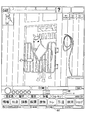
- FIG. 1 It is a figure which shows the hardware constitutions of the game device which concerns on one Example of this invention. It is a figure which shows an example of the time allocation of a horse racing game. It is a figure which shows the function structure of a game device. It is a figure which shows the function structure of a game device. It is a figure which shows the function structure of a game device. It is a figure which shows the relationship between the ranch where a player can put a racehorse, a stable, and a training center. It is a figure which shows the example of a screen which receives bet operation by a player. It is a figure which shows the example of a display screen which shows the scene which can give a usual fodder to a racehorse.
- FIG. 1 shows a hardware configuration of a game apparatus 1 according to an embodiment of the present invention.
- the game apparatus 1 includes a main device 100 and a plurality of satellite devices 200 # 0 to 200 # n.
- the main device 100 and the plurality of satellite devices 200 # 0 to 200 # n may be physically separated separate devices or may be integrated and integrated devices.
- the main device 100 includes, for example, a main game board 110 including a processor 120 such as a CPU (Central Processing Unit) and a storage device 140 such as an SSD (Solid State Drive), a large display 160, a speaker 165, and a network hub 170. Is provided.
- a processor 120 such as a CPU (Central Processing Unit) and a storage device 140 such as an SSD (Solid State Drive), a large display 160, a speaker 165, and a network hub 170.
- each satellite device 200 (hereinafter, when it is not distinguished which satellite device is described, omitting the description of “#” or less, which is the identification code of the satellite device), a game board 210, a monitor 230, An input operation unit 240, a card reader 250, a medal mechanism 260, and a speaker 270 are provided.
- the game board 210 includes a processor and a storage device.
- the input operation unit 240 may be a mechanical switch or may be a software switch set on the monitor 230.
- the expression “touch a switch on the screen” means a software switch set on the monitor 230.
- an IC card 300 purchased in advance by each player can be set.
- the card reader 250 reads the card ID stored in the IC card 300 (it does not need to match the login ID, and may be a serial number or other simple identification code). A log-in to the game with the player ID associated with the ID is accepted.
- the game device 1 is an arcade game in which, for example, the main device 100 and a plurality of satellite devices 200 # 0 to 200 # n are installed in the same play facility (game center, amusement park, etc.).
- the game apparatus 1 of the present embodiment configured as described above holds a race according to a common horse racing schedule, and according to the player's instruction, the race horses that each player cultivates satisfy the start conditions specified by each race.
- a game hereinafter referred to as a “horse racing game” in which a race is started or a player is allowed to purchase a winning voting ticket in the game currency for each race is advanced.
- major events for example, race images
- events indicating the circumstances unique to each player for example, the state of each race horse, the purchase screen for winning voting tickets, etc.
- the ability value of the racehorse can be increased by training the racehorse or giving a fodder. It is necessary to use medals for training and fodder, and the number of medals required for training and fodder that can be expected to be highly effective increases. Moreover, in order to increase the ability value of a racehorse, it is necessary to spend time on training and fodder.
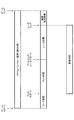
- FIG. 2 is a diagram showing an example of time allocation for a horse racing game.
- One game corresponds to one race and corresponds to one week in the game.
- One game takes about 3 minutes in real time.
- One game starts at the start of the game, ends at the end of the game, and is repeated while the game apparatus 1 is operating.
- the loading time starts when the game starts
- the betting starts when the loading time ends
- the race starts when the betting ends when the betting time ends.
- each player can bet (vote) in-game currency on the race result.
- the race ends when the race time ends, resulting in a payout time, and when the result payout time ends, the game ends.
- the result payout time the result of the race is displayed and the payout for the vote is paid out.
- FIG. 3A, 3B, and 3C are diagrams showing a functional configuration of the game apparatus 1.
- the main device 100 includes a satellite management unit 122 that manages the satellite device 200 as a functional block that functions when the processor 120 executes a program stored in the storage device 140 or the like, and a race result.
- Video to bet game management unit 123 that manages bet games by voting, owner game management unit 124 that manages owner games that own racehorses and jockeys, item management unit 130 and partner management unit 131, and video on large display 160
- a video output unit 132 that controls output
- an audio output unit 133 that controls audio output to the speaker 165
- a main game control unit 121 that controls these
- a communication processing unit 134 that functions as a network interface.
- the owner game management unit 124 includes a racehorse mode management unit 125 that performs racehorse training, fodder, and race registration, a jockey mode management unit 126 that performs recruitment and adjustment of jockeys, stable information, rankings, and the like.
- Stable mode management unit 127 for confirming the race
- ranch mode management unit 128 for producing or entering racehorses
- train center mode management unit 129 for confirming the status of automatic breeding in the training center and interrupting automatic breeding And manage.
- the communication processing unit 134 communicates with the communication processing unit 228 of each satellite device 200 via a network.
- the communication processing unit 134 communicates with the data center 400, which is a facility installed outside the amusement facility where the main device 100 and the satellite device 200 are installed, via a network.
- the data center 400 includes a communication processing unit 410, a database management device 420, and an IC card database 430, and card IDs, partner information, and the like registered in each amusement facility are accumulated in the IC card database 430. Is done.
- the satellite device 200 detects the insertion of the IC card 300 into the card reader / writer 250 and controls the reading / writing of data as a functional block that functions when the processor of the game board 210 executes a program stored in the storage device.
- Card data input control unit 212 for performing the input, input instruction receiving unit 213 for receiving an input instruction of the player to the input operation unit 240, video output unit 214 for controlling the video output to the monitor 230, and audio output to the speaker 270
- a log-in processing unit 218 that performs a process
- a bet game management unit 219 that manages a bet game by voting on a race result
- an owner game management unit 220 that manages an owner game that owns
- the owner game management unit 220 includes a racehorse mode management unit 221 that performs racehorse training, fodder, and race registration, a jockey mode management unit 222 that performs recruitment and adjustment of jockeys, stable information, rankings, and the like.
- Stable mode management unit 223 for confirming, ranch mode management unit 224 for producing or entering racehorses, and training mode management unit 225 for confirming the status of automatic breeding in the training center and interrupting automatic breeding And manage.
- the bet game management unit 219 and the owner game management unit 220 autonomously perform the processing that can be performed on the satellite device 200 side, and communicate with the bet game management unit 123 and the owner game management unit 124 of the main device 100 as necessary. Acquire necessary data and notify status.
- the functional blocks in the main device 100 and the satellite device 200 do not need to be realized by a clearly separated program, and may be called by another program as a subroutine or function.
- a part of the functional block may be hardware means such as LSI (Large Scale Integrated circuit), IC (Integrated Circuit), FPGA (Field Programmable Gate Array), and the like.
- the program may be installed by attaching a storage medium to the drive device, or may be downloaded from another computer via a network such as the Internet, a LAN (Local Area Network), or a wireless network.
- the program may be stored in advance in the storage device 140 or the like when the game apparatus 1 is shipped.
- the storage device 140 of the main device 100 stores information such as a satellite correspondence table 141, a racehorse database 142, a jockey database 143, a race start table 144, a special fodder list 145, partner information 146, and the like.
- the satellite correspondence table 141 includes items such as “satellite ID”, “card ID”, “absence flag”, and “credit”. “Satellite ID” is information for identifying the satellite device 200. “Card ID” is information for identifying the IC card 300. The “absence flag” is information indicating whether or not the corresponding satellite device 200 is absent. “Credit” is information indicating the number of medals inserted in the corresponding satellite device 200.
- the racehorse database 142 has items such as “horse type”, “card ID”, “horse ID”, “stable ID”, “horse data”, “training data”, “run flag”, and “race ID”.
- the “horse type” is information indicating the type of the corresponding racehorse such as “user horse” owned by the player or “CPU horse” on the system (CPU) side.
- the “card ID” is information for identifying the IC card 300 of the player who owns the corresponding racehorse when the “horse type” is “user horse”.
- “Horse ID” is information for identifying a corresponding racehorse.
- “Stable ID” is information for identifying the stable to which the corresponding racehorse belongs.
- “Horse data” is information indicating characteristics such as the life and ability of the corresponding racehorse.
- “Train center data” is information indicating the details of training in the training center, such as the type, period, and start time of automatic training.
- the “run flag” is information indicating whether or not the corresponding racehorse is registered for the race.
- the “race ID” is information for identifying a race registered for running when the “run flag” is on.
- the jockey database 143 includes items such as “Jockey type”, “Card ID”, “Jockey ID”, “Stable ID”, “Jockey data”, “Start flag”, and “Race ID”.
- “Jockey type” is information indicating the type of the corresponding jockey such as “user jockey” owned by the player or “CPU jockey” on the system (CPU) side.
- the “card ID” is information for identifying the IC card 300 of the player who owns the corresponding jockey when the “jockey type” is “user jockey”.
- “Jockey ID” is information for identifying a corresponding jockey.
- “Stable ID” is information for identifying the stable to which the corresponding jockey belongs.
- “Jockey data” is information indicating characteristics of the corresponding jockey, such as life and ability.
- the “run flag” is information indicating whether or not the corresponding jockey is registered for the race.
- the “race ID” is information for identifying a race registered for running when the “run flag” is on.
- the race start table 144 includes items such as “race ID”, “horse ID”, “horse-owned satellite ID”, “jockey ID”, “jockey-owned satellite ID”.
- “Race ID” is information for identifying a corresponding race.
- “Horse ID” is information for identifying a racehorse registered to start running in the corresponding race.
- the “horse-owned satellite ID” is information for identifying the satellite device 200 used by the player who owns the corresponding racehorse.
- “Jockey ID” is information for identifying a jockey who is registered for the corresponding race.
- “Jockey-owned satellite ID” is information for identifying the satellite device 200 used by the player who owns the corresponding jockey.
- the special fodder list 145 is information defining special fodders that greatly improve the ability of racehorses and their appearance conditions.
- Partner information 146 is information managed by the partner management unit 131, and is information that associates the card IDs of the cards 300 held by the player, that is, information that associates the players with each other.
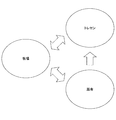
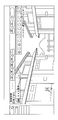
- FIG. 4 is a diagram showing the relationship between the ranch, the stable and the training center where the player can place a racehorse. As shown in FIG. 4, the player can place his own racehorse on a ranch, stable or training center. Data indicating whether the racehorse is in the ranch, stable or training center may be managed in the satellite device 200, or may be centrally managed in the racehorse database 142 of the main device 100.
- the life of the racehorse does not change when it is grazed on the ranch, but the life decreases every game when it is in the stable or the training center.
- the racehorse When running in a race, the racehorse must be moved to the stable and registered for a run from the stable before one or more games. Race horses can be moved between the ranch and stables.
- the card data input control unit 212 detects card insertion, and the login processing unit 218 starts the login process.
- the login processing unit 218 displays a personal identification number input screen on the monitor 230 via the video output unit 214 and accepts that the player inputs the personal identification number to the input operation unit 240 and the input instruction reception unit 213.
- the login processing unit 218 compares the personal identification number input from the player with the personal identification number held by the main apparatus 100, and if the two match, determines that the player is an appropriate player and permits login.
- the login processing unit 218 transmits a login notification including the satellite ID and the card ID to the main apparatus 100, and the satellite management unit 122 of the main apparatus 100 associates the satellite ID and the card ID with the satellite correspondence table 141. to manage.
- the bet game management unit 219 and the bet game management unit 123 are configured such that a player wins a single win, a double win, a frame win, a horse run, a wide run, a horse run, and a race where a racehorse owned by a player and a racehorse on a computer side run.
- Manage betting games where you bet on in-game currency in a form such as duplication.
- the bet game management unit 219 in the satellite device 200 acquires data such as odds from the main device 100.
- the odds are determined based on a predetermined rule by using the data stored in the race start table 144, the racehorse database 142, and the jockey database 143 by the bet game management unit 123 in the main device 100.
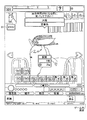
- FIG. 5 shows an example of a screen for accepting a bet operation by a player.
- a single win / double win bet operation displayed as a default is performed.
- a horse name column, a result column, a single win column, a double win column, and the like are provided.
- buttons for selecting how to bet are displayed, and by touching these, it is possible to shift to a corresponding page.
- a single win or a double bet is placed on each racehorse, and the cumulative bet number is displayed for each racehorse.
- the betting operation is performed by touching the software switch in which the odds in the third row winning row or the fourth row winning row are listed from the left in FIG. Is displayed.
- the betting game management unit 219 of the satellite device 200 When the betting time is over, the betting game management unit 219 of the satellite device 200 notifies the main device 100 of the betting content by the player. This will start the race time. At the end of the race, medals (in-game currency) are paid out to the hit player based on the bet content.
- the racehorse mode management unit 221 and the racehorse mode management unit 125 accept a racehorse that satisfies the race condition among racehorses held by the player for each race to be held.
- the jockey mode management unit 222 and the jockey mode management unit 126 display the selectable jockeys, allow the player to select a jockey, and determine the jockey to ride.
- the racehorse mode management unit 221 and the racehorse mode management unit 125 determine the ability (speed, racehorse) of the racehorse based on the type and number of fodder given to the racehorse by the player. Improve stamina, etc.) and increase or decrease weight. That is, in the fodder (item), a parameter that affects the ability of the racehorse is set according to its type, and the program that realizes the racehorse mode management unit 221 and the racehorse mode management unit 125 uses this parameter. The higher the value (the larger the value), the higher the performance of the racehorse and the more the weight is increased or decreased.
- the player can advantageously advance the game by appropriately changing the parameters set for the racehorse by giving the fodder to the racehorse.
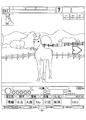
- FIG. 6 is a diagram showing an example of a display screen showing a scene where a normal fodder (indicated as “standard system” in FIG. 6) can be given to the racehorse.
- a normal fodder indicated as “standard system” in FIG. 6
- the fodder is given to the racehorse, the ability-up effect peculiar to each fodation occurs in the racehorse, and medals corresponding to each fodder are consumed.
- the recommendation button B1 the most suitable fodder for the racehorse at that time is automatically selected.
- the satellite device 200 makes a training center request to the main device 100.
- the selection instruction for the input operation unit 240 is recognized by the racehorse mode management unit 221 via the input instruction receiving unit 213.
- FIG. 7A and 7B show examples of display screens when a racehorse to be trained is selected.
- FIG. 7A shows an example of a display screen after selecting a racehorse from the ranch.
- FIG. 7B shows an example of a display screen after selecting a racehorse from the stable. In either case, selection is performed by touching the “Train” button (Trescen button) B2.
- the racehorse mode management unit 125 in the main device 100 causes the number of medals (credits) of the satellite device 200 that has made the training center request, the remaining life of the target racehorse, and a free space in the training center. If the training center request can be accepted, “OK” is returned to the satellite device 200.
- the racehorse mode management unit 221 moves the racehorse to the training center managed by the train center mode management unit 225.
- the corresponding racehorse cannot run in the race until the automatic breeding is completed, and the operation cannot be performed except for the interruption of the automatic breeding described later.
- the number of medals corresponding to the selected type of auto training is collected from the credit.
- the payment may be weekly or postpay.
- the payment method may be a format approved by the player (such as selecting OK / NG by a button touch or the like) or an automatic withdrawal format.
- the training mode management unit 129 in the main device 100 notifies the corresponding satellite device 200 of the expiration of the training center period when the deposit period ends.
- the owner game management unit 220 in the satellite device 200 makes a training center result request to the main device 100.
- the owner game management unit 124 in the main device 100 calculates a training center result reflecting the breeding effect, saves the ability value in the racehorse database 142, and notifies the satellite device 200.
- the training effect refers to the amount of racehorse capacity improvement (change in speed, stamina, etc.) by depositing to the training center, and is determined by, for example, the deposit period to the training center, the number of medals, or a random number. Is done.
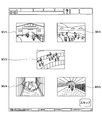
- the training mode management unit 225 in the satellite device 200 displays the training center result as a movie and a comment on the monitor 230 via the video output unit 214. At this time, BGM or the like is also output to the speaker 270 via the audio output unit 215.
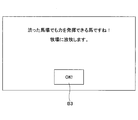
- 8A and 8B are diagrams illustrating display examples of training center training results. As shown in FIG. 8A, a plurality of movies MV1 to MV5 flow over a predetermined time, and the state of training at the training center is displayed in a digest manner. Then, a dialog box shown in FIG. 8B is displayed in the screen, and a comment and a message to graze on the ranch are displayed. Touching the “OK” button B3 ends the display of the training center result.
- the racehorse mode management unit 221 or the train center mode management unit 225 moves the corresponding racehorse to the ranch. Let Moving to the ranch stops the life of the racehorse.
- the following describes a partner system for sharing merits (intra-game currency) in the betting game described above and the benefits of special fodder among players.
- the item management unit 130 gives a special fodder to the player via the item management unit 226 when the player satisfies a specific condition.
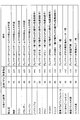
- FIG. 9 shows an example of types of special fodder and appearance conditions.
- the special fodder is given to the corresponding player when the player leaves an excellent result in the betting game or the owner game.
- in-game currency (medals) is required, and as the number of required medals increases, the parameters of special fodder are set higher, and the effect of improving the ability of racehorses increases. .
- FIG. 10 is an example of a display screen showing a scene where a special fodder can be given to a racehorse.
- the special fodder given to the player is, for example, “Champagne” (requires 50 in-game currencies) and “Pineapple” (requires 10 in-game currencies).
- a special fodder having high effect may be selected.
- the partner management unit 227 and the partner management unit 131 group players who have performed a predetermined operation on the satellite device 200 and register them as partner information 146.
- the item management unit 226 and the item are assigned so that the special fodder given to a certain player is equally given to the corresponding player and the player registered as a partner.
- the management unit 130 operates.
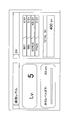
- FIG. 11 shows an example of a screen displayed on the monitor 230 when the in-game currency acquired by another player is awarded.
- “400” displayed in the “BONUS” column indicates the in-game currency (“SH” in the figure) given to the corresponding player.
- players A, B, and C there are three or more players registered as partners (referred to as players A, B, and C), and the special fodder and in-game currency given to the players A and B are all given to the player C.
- players A, B, and C the special fodder and in-game currency given to the players A and B are all given to the player C.
- player A wins a special fodder “Matsutake” player B wins a special fodder “champagne”, and player C wins 50 in-game currencies
- each player A, B and C will receive a special The fodder “matsutake”, “champagne”, and 50 in-game currencies are awarded.
- champagne (requires 50 in-game currencies) is more effective in improving the horse's ability than “matsutake” (requires 40 in-game currencies). Only “Champagne” is displayed as a special fodder that can be used, and “Matsutake” can be used after “Champagne” is used.
- FIG. 12 is a flowchart for explaining processing executed by the satellite device when partner registration is performed.
- the result of the process which each functional block of the satellite apparatus 200 performed in the following processes is transmitted to the corresponding functional block of the main apparatus 100 as needed, and is stored in various databases.
- the jockey mode management unit 222 of the satellite device 200 determines the game clothes of the new player (S500).
- the partner management unit 227 of the satellite device 200 displays on the monitor 230 whether or not to ask the corresponding new player whether or not to select a partner stable (actually a partner player). It is determined whether or not it is decided to select a stable (S502).
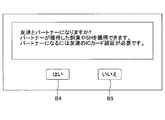
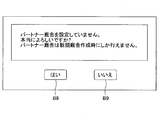
- FIG. 13 shows an example of a screen displayed on the monitor 230 when the process of S502 in FIG. 12 is performed. In FIG. 13, if the “Yes” button B4 is touched, the determination in S502 is Yes, and if the “No” button B5 is touched, the determination in S502 is No.
- the partner management unit 227 determines whether or not the IC card database 430 is online by communicating with the main device 100 (S504). When the IC card database 430 is offline, the partner management unit 227 displays that the partner registration is not possible on the monitor 230 (S506), ends this flowchart, and the partner registration is not performed. Start a horse racing game.
- the partner management unit 227 performs IC card authentication (S508). Specifically, the card reader 250 is operated via the card reader input control unit 212 to perform processing for reading the card ID of the IC card 300 held over.
- the partner management unit 227 reads whether or not the held IC card 300 is the same as the new stable, that is, read from the IC card 300 held by the player who newly starts the game. It is determined whether the card ID and the card ID read in S508 are the same (S510).
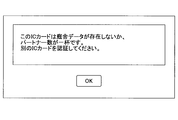
- FIG. 14 shows an example of a screen displayed on the monitor 230 when the process of S512 in FIG. 12 is performed.
- the partner management unit 227 has registered the card ID read in S508 in the same play facility (the stable mode is stored in the stable mode management unit 127 of the main device 100). It is determined whether the information is a registered card ID (S514).
- the partner management unit 227 registers the corresponding card ID. It is determined whether or not there is a vacancy in the number of partners that can be registered for the completed card ID (S516).
- the number of partners that can be registered for a certain card ID is, for example, two.
- FIG. 15 shows an example of a screen displayed on the monitor 230 when the processing of S518 in FIG. 12 is performed.
- the partner management unit 227 determines whether or not a cancel button (not shown) has been pressed by the player (S520).
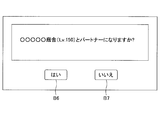
- FIG. 16 shows an example of a screen displayed on the monitor 230 when the process of S522 in FIG. 12 is performed. In FIG. 16, if the “Yes” button B6 is touched, the determination in S522 is Yes, and if the “No” button B7 is touched, the determination in S522 is No.
- the partner management unit 227 displays on the monitor 230 that the partner has been registered, and transmits a set of the card ID of the player to be newly played and the card ID of the existing player to the main device 100.
- the main device 100 stores a pair of a card ID of a player to be newly played and a card ID of an existing player (as a group of three if the existing player already has a partner) in the partner information 146, Information is transmitted to the data center 400 and stored in the IC card database 430.
- the partner management unit 227 ends this flowchart and starts the horse racing game.
- the partner management unit 227 determines whether or not a confirmation operation for not registering has been performed by the player (S526).
- FIG. 17 shows an example of a screen displayed on the monitor 230 when the processing of S526 in FIG. 12 is performed. In FIG. 17, if the “Yes” button B8 is touched, the determination in S526 is Yes, and if the “No” button B9 is touched, the determination in S526 is No.
- the partner management unit 227 ends the flowchart, and starts the horse racing game in a state where the partner registration is not performed.
- the partner management unit 227 returns to the IC card authentication process of S508.
- FIG. 18 shows an example of a screen displayed by the monitor 230 when another player who is a partner is logging in.
- being treated as a partner may be limited to playing in the same amusement facility.
- the partner registration may be deleted when, for example, the IC card 300 of any player has expired for reasons such as not playing for a long time.
- the game device 1 of the present embodiment described above when one of a plurality of players registered as partners has acquired special fodder or in-game currency, other players registered as partners with the corresponding player are also notified. In order to give special fodder and in-game currency, it is possible to present a way to enjoy the game in the horse racing game world constituted by the betting game and the owner game, and to produce excitement.
- a partner registration is made with a combination of a player who starts a new game and a player whose game progress has already progressed to a predetermined stage, and receives a privilege as a partner that he / she is logged in within the same amusement facility
- the present invention can be implemented in all suitable forms, such as dedicated hardware or a mixture of dedicated hardware and software.
- the present invention can be implemented as computer software executed by a processing device connected to one or more networks.
- the network may include all conventional land and wireless communication networks such as the Internet.
- Processing devices may include any suitably programmed device such as a general purpose computer, PDA, mobile phone (such as a WAP or 3G compliant phone). Since the present invention is implemented as software, each and every aspect of the present invention includes computer software that can be implemented on a programmable device.
- Computer software is supplied to programmable devices using all recording media that record processor-readable codes such as floppy disks, hard disks, CD-ROMs, magnetic tape devices and solid-state recording devices. obtain.
- the hardware platform includes all desired hardware resources including, for example, a central processing unit (CPU), a random access memory (RAM) and a hard disk drive (HDD).
- the CPU can be configured with all desired types and numbers of processors.
- the RAM can be composed of any desired volatile or non-volatile memory.
- the HDD can be composed of all desired non-volatile memories capable of recording a large amount of data.
- the hardware resource may further include an input device, an output device, and a network device in accordance with the device type. Alternatively, the HDD may be external to the device as long as it can be accessed.
- the CPU and RAM such as the CPU cache memory, can function as the physical memory or main memory of the device, while the HDD can function as the secondary memory of the device.
- the present invention is not limited to a horse racing game, but RPG (role playing game) or hunting game in which each player individually acts in the same virtual game field, each player playing a racing car on the same virtual course, etc. It can also be applied to racing games that run. In these cases, when a player acquires an item that improves the combat power of an object operated by the player or an item that improves the running performance of the racing car, it is given to the other player registered as a partner with that player. That's fine.
- special fodder etc. given to each player registered as a partner does not have to be given completely equally.
- a special fodder given to a player who receives a privilege by partner registration may be slightly inferior to a special fodder obtained by a player who satisfies the acquisition conditions.
Landscapes
- Engineering & Computer Science (AREA)
- Multimedia (AREA)
- Business, Economics & Management (AREA)
- Computer Security & Cryptography (AREA)
- General Business, Economics & Management (AREA)
- Theoretical Computer Science (AREA)
- Human Computer Interaction (AREA)
- Management, Administration, Business Operations System, And Electronic Commerce (AREA)
Applications Claiming Priority (2)
| Application Number | Priority Date | Filing Date | Title |
|---|---|---|---|
| JP2012126876A JP2013248320A (ja) | 2012-06-04 | 2012-06-04 | ゲーム装置、ゲーム制御サーバ、ゲーム制御プログラム |
| JP2012-126876 | 2012-06-04 |
Publications (1)
| Publication Number | Publication Date |
|---|---|
| WO2013183335A1 true WO2013183335A1 (ja) | 2013-12-12 |
Family
ID=49711737
Family Applications (1)
| Application Number | Title | Priority Date | Filing Date |
|---|---|---|---|
| PCT/JP2013/057735 Ceased WO2013183335A1 (ja) | 2012-06-04 | 2013-03-18 | ゲーム装置、ゲーム制御サーバ及び記録媒体 |
Country Status (2)
| Country | Link |
|---|---|
| JP (1) | JP2013248320A (enExample) |
| WO (1) | WO2013183335A1 (enExample) |
Cited By (1)
| Publication number | Priority date | Publication date | Assignee | Title |
|---|---|---|---|---|
| CN116510290A (zh) * | 2023-03-21 | 2023-08-01 | 网易(杭州)网络有限公司 | 游戏任务的启动控制方法、装置和电子设备 |
Families Citing this family (3)
| Publication number | Priority date | Publication date | Assignee | Title |
|---|---|---|---|---|
| JP6161660B2 (ja) * | 2015-06-24 | 2017-07-12 | 株式会社マーベラス | ゲームシステム、制御方法および制御プログラム |
| JP6442783B1 (ja) * | 2017-07-07 | 2018-12-26 | 株式会社コナミアミューズメント | ゲーム装置およびゲーム装置のプログラム |
| JP6856881B1 (ja) * | 2019-11-28 | 2021-04-14 | 株式会社ミクシィ | 情報処理装置、情報処理方法及びプログラム |
Citations (3)
| Publication number | Priority date | Publication date | Assignee | Title |
|---|---|---|---|---|
| JP2009066055A (ja) * | 2007-09-11 | 2009-04-02 | Sega Corp | ネットワークゲームシステム、及びその処理方法、並びに、ネットワークゲーム処理プログラム、及びそのプログラムを記憶した記憶媒体 |
| JP2009119030A (ja) * | 2007-11-15 | 2009-06-04 | Sega Corp | ゲーム装置制御プログラム |
| JP2011019841A (ja) * | 2009-07-17 | 2011-02-03 | Sega Corp | ゲーム制御プログラム |
Family Cites Families (1)
| Publication number | Priority date | Publication date | Assignee | Title |
|---|---|---|---|---|
| JP2008012218A (ja) * | 2006-07-10 | 2008-01-24 | Aruze Corp | サーバ及びゲームシステム |
-
2012
- 2012-06-04 JP JP2012126876A patent/JP2013248320A/ja active Pending
-
2013
- 2013-03-18 WO PCT/JP2013/057735 patent/WO2013183335A1/ja not_active Ceased
Patent Citations (3)
| Publication number | Priority date | Publication date | Assignee | Title |
|---|---|---|---|---|
| JP2009066055A (ja) * | 2007-09-11 | 2009-04-02 | Sega Corp | ネットワークゲームシステム、及びその処理方法、並びに、ネットワークゲーム処理プログラム、及びそのプログラムを記憶した記憶媒体 |
| JP2009119030A (ja) * | 2007-11-15 | 2009-06-04 | Sega Corp | ゲーム装置制御プログラム |
| JP2011019841A (ja) * | 2009-07-17 | 2011-02-03 | Sega Corp | ゲーム制御プログラム |
Non-Patent Citations (5)
| Title |
|---|
| "Hikari no 4 Senshi - Final Fantasy Gaiden", KOSHIKI COMPLETE GUIDE, FIRST EDITION, 26 November 2009 (2009-11-26), SQUARE ENIX CO., pages 14, 41 * |
| "Phantasy Star Portable", DENGEKI PSP, vol. 14, no. 23, 11 July 2008 (2008-07-11), ASCII MEDIA WORKS INC., pages 118 - 121 * |
| "Star Horse 3", SHUKAN FAMITSU, vol. 27, no. 6, 26 January 2012 (2012-01-26) * |
| "Tears to Tiara - Kakan no Daichi", THE COMPLETE GUIDE, FIRST EDITION, 10 September 2008 (2008-09-10), ASCII MEDIA WORKS INC., pages 31 * |
| 4GAMER BOOKS MABINOGI KOSHIKI GUIDEBOOK, FIRST EDITION, 28 October 2005 (2005-10-28), SOFTBANK CREATIVE CORP., pages 28 * |
Cited By (1)
| Publication number | Priority date | Publication date | Assignee | Title |
|---|---|---|---|---|
| CN116510290A (zh) * | 2023-03-21 | 2023-08-01 | 网易(杭州)网络有限公司 | 游戏任务的启动控制方法、装置和电子设备 |
Also Published As
| Publication number | Publication date |
|---|---|
| JP2013248320A (ja) | 2013-12-12 |
Similar Documents
| Publication | Publication Date | Title |
|---|---|---|
| US20190340885A1 (en) | System for managing individual performance challenges in fantasy gaming | |
| JP6807313B2 (ja) | ファンタジー・ゲーミングにおいて個々の成績挑戦を管理するシステムおよび方法 | |
| WO2001091866A1 (en) | Methods and systems of providing real time on-line casino games | |
| JP7648970B2 (ja) | 情報処理装置、情報処理方法及びプログラム | |
| JP7617489B2 (ja) | 情報処理装置、情報処理方法及びプログラム | |
| JP2024163235A (ja) | 情報処理装置、情報処理方法及びプログラム | |
| JP2025081491A (ja) | 情報処理装置、情報処理方法及びプログラム | |
| JP2014155554A (ja) | ゲームシステム及びゲームサーバー | |
| CN104936667B (zh) | 信息处理设备 | |
| WO2013183335A1 (ja) | ゲーム装置、ゲーム制御サーバ及び記録媒体 | |
| US20070225067A1 (en) | Personal game device and method | |
| JP6323790B2 (ja) | ゲーム装置、ゲームシステムおよびゲームプログラム | |
| JP3901211B2 (ja) | ゲームシステム | |
| JP5953986B2 (ja) | ゲーム装置、ゲーム制御サーバ、ゲーム制御プログラム | |
| JP2025161852A (ja) | 情報処理方法、情報処理システムおよびプログラム | |
| JP5424078B2 (ja) | ゲームシステム | |
| JP6168466B2 (ja) | ゲームシステムおよびゲーム装置 | |
| JP5140940B2 (ja) | ゲームシステム | |
| US20220319279A1 (en) | System for managing individual performance challenges in fantasy gaming | |
| JP7705681B1 (ja) | ゲームライブ配信システム及びプログラム | |
| JP2025180762A (ja) | ゲームライブ配信システム及びプログラム | |
| JP2024158863A (ja) | 情報処理装置、情報処理方法、及びプログラム | |
| JP2024111322A (ja) | 情報処理装置、情報処理方法及びプログラム | |
| JP2025184107A (ja) | 情報処理装置、情報処理システム、情報処理方法、及びプログラム | |
| JP2025180774A (ja) | ゲームライブ配信システム及びプログラム |
Legal Events
| Date | Code | Title | Description |
|---|---|---|---|
| 121 | Ep: the epo has been informed by wipo that ep was designated in this application |
Ref document number: 13800548 Country of ref document: EP Kind code of ref document: A1 |
|
| NENP | Non-entry into the national phase |
Ref country code: DE |
|
| 122 | Ep: pct application non-entry in european phase |
Ref document number: 13800548 Country of ref document: EP Kind code of ref document: A1 |