WO2013168709A1 - 有機薄膜太陽電池、これに用いられる有機半導体材料用組成物および単量体 - Google Patents
有機薄膜太陽電池、これに用いられる有機半導体材料用組成物および単量体 Download PDFInfo
- Publication number
- WO2013168709A1 WO2013168709A1 PCT/JP2013/062847 JP2013062847W WO2013168709A1 WO 2013168709 A1 WO2013168709 A1 WO 2013168709A1 JP 2013062847 W JP2013062847 W JP 2013062847W WO 2013168709 A1 WO2013168709 A1 WO 2013168709A1
- Authority
- WO
- WIPO (PCT)
- Prior art keywords
- group
- atom
- carbon atoms
- substituent
- hydrogen atom
- Prior art date
- Legal status (The legal status is an assumption and is not a legal conclusion. Google has not performed a legal analysis and makes no representation as to the accuracy of the status listed.)
- Ceased
Links
- 0 *C(*C(*)=C1*)=C(*)C1=C(*C1=C(**2)N)*C1=C2N Chemical compound *C(*C(*)=C1*)=C(*)C1=C(*C1=C(**2)N)*C1=C2N 0.000 description 12
- IZHCDZRBXJPNQG-UHFFFAOYSA-N CN(C1C(O2)=O)c3c[s]cc3N=C1C2=O Chemical compound CN(C1C(O2)=O)c3c[s]cc3N=C1C2=O IZHCDZRBXJPNQG-UHFFFAOYSA-N 0.000 description 1
Images

Classifications
-
- C—CHEMISTRY; METALLURGY
- C07—ORGANIC CHEMISTRY
- C07D—HETEROCYCLIC COMPOUNDS
- C07D235/00—Heterocyclic compounds containing 1,3-diazole or hydrogenated 1,3-diazole rings, condensed with other rings
- C07D235/02—Heterocyclic compounds containing 1,3-diazole or hydrogenated 1,3-diazole rings, condensed with other rings condensed with carbocyclic rings or ring systems
- C07D235/04—Benzimidazoles; Hydrogenated benzimidazoles
- C07D235/24—Benzimidazoles; Hydrogenated benzimidazoles with hetero atoms or with carbon atoms having three bonds to hetero atoms with at the most one bond to halogen, e.g. ester or nitrile radicals, directly attached in position 2
- C07D235/26—Oxygen atoms
-
- C—CHEMISTRY; METALLURGY
- C07—ORGANIC CHEMISTRY
- C07D—HETEROCYCLIC COMPOUNDS
- C07D235/00—Heterocyclic compounds containing 1,3-diazole or hydrogenated 1,3-diazole rings, condensed with other rings
- C07D235/02—Heterocyclic compounds containing 1,3-diazole or hydrogenated 1,3-diazole rings, condensed with other rings condensed with carbocyclic rings or ring systems
- C07D235/04—Benzimidazoles; Hydrogenated benzimidazoles
- C07D235/24—Benzimidazoles; Hydrogenated benzimidazoles with hetero atoms or with carbon atoms having three bonds to hetero atoms with at the most one bond to halogen, e.g. ester or nitrile radicals, directly attached in position 2
- C07D235/28—Sulfur atoms
-
- C—CHEMISTRY; METALLURGY
- C07—ORGANIC CHEMISTRY
- C07D—HETEROCYCLIC COMPOUNDS
- C07D333/00—Heterocyclic compounds containing five-membered rings having one sulfur atom as the only ring hetero atom
- C07D333/50—Heterocyclic compounds containing five-membered rings having one sulfur atom as the only ring hetero atom condensed with carbocyclic rings or ring systems
- C07D333/72—Benzo[c]thiophenes; Hydrogenated benzo[c]thiophenes
-
- C—CHEMISTRY; METALLURGY
- C07—ORGANIC CHEMISTRY
- C07D—HETEROCYCLIC COMPOUNDS
- C07D333/00—Heterocyclic compounds containing five-membered rings having one sulfur atom as the only ring hetero atom
- C07D333/50—Heterocyclic compounds containing five-membered rings having one sulfur atom as the only ring hetero atom condensed with carbocyclic rings or ring systems
- C07D333/74—Naphthothiophenes
-
- C—CHEMISTRY; METALLURGY
- C07—ORGANIC CHEMISTRY
- C07D—HETEROCYCLIC COMPOUNDS
- C07D471/00—Heterocyclic compounds containing nitrogen atoms as the only ring hetero atoms in the condensed system, at least one ring being a six-membered ring with one nitrogen atom, not provided for by groups C07D451/00 - C07D463/00
- C07D471/02—Heterocyclic compounds containing nitrogen atoms as the only ring hetero atoms in the condensed system, at least one ring being a six-membered ring with one nitrogen atom, not provided for by groups C07D451/00 - C07D463/00 in which the condensed system contains two hetero rings
- C07D471/04—Ortho-condensed systems
-
- C—CHEMISTRY; METALLURGY
- C07—ORGANIC CHEMISTRY
- C07D—HETEROCYCLIC COMPOUNDS
- C07D487/00—Heterocyclic compounds containing nitrogen atoms as the only ring hetero atoms in the condensed system, not provided for by groups C07D451/00 - C07D477/00
- C07D487/02—Heterocyclic compounds containing nitrogen atoms as the only ring hetero atoms in the condensed system, not provided for by groups C07D451/00 - C07D477/00 in which the condensed system contains two hetero rings
- C07D487/04—Ortho-condensed systems
-
- C—CHEMISTRY; METALLURGY
- C07—ORGANIC CHEMISTRY
- C07D—HETEROCYCLIC COMPOUNDS
- C07D495/00—Heterocyclic compounds containing in the condensed system at least one hetero ring having sulfur atoms as the only ring hetero atoms
- C07D495/02—Heterocyclic compounds containing in the condensed system at least one hetero ring having sulfur atoms as the only ring hetero atoms in which the condensed system contains two hetero rings
- C07D495/04—Ortho-condensed systems
-
- C—CHEMISTRY; METALLURGY
- C07—ORGANIC CHEMISTRY
- C07D—HETEROCYCLIC COMPOUNDS
- C07D495/00—Heterocyclic compounds containing in the condensed system at least one hetero ring having sulfur atoms as the only ring hetero atoms
- C07D495/12—Heterocyclic compounds containing in the condensed system at least one hetero ring having sulfur atoms as the only ring hetero atoms in which the condensed system contains three hetero rings
- C07D495/14—Ortho-condensed systems
-
- C—CHEMISTRY; METALLURGY
- C08—ORGANIC MACROMOLECULAR COMPOUNDS; THEIR PREPARATION OR CHEMICAL WORKING-UP; COMPOSITIONS BASED THEREON
- C08G—MACROMOLECULAR COMPOUNDS OBTAINED OTHERWISE THAN BY REACTIONS ONLY INVOLVING UNSATURATED CARBON-TO-CARBON BONDS
- C08G61/00—Macromolecular compounds obtained by reactions forming a carbon-to-carbon link in the main chain of the macromolecule
- C08G61/12—Macromolecular compounds containing atoms other than carbon in the main chain of the macromolecule
- C08G61/122—Macromolecular compounds containing atoms other than carbon in the main chain of the macromolecule derived from five- or six-membered heterocyclic compounds, other than imides
- C08G61/123—Macromolecular compounds containing atoms other than carbon in the main chain of the macromolecule derived from five- or six-membered heterocyclic compounds, other than imides derived from five-membered heterocyclic compounds
- C08G61/126—Macromolecular compounds containing atoms other than carbon in the main chain of the macromolecule derived from five- or six-membered heterocyclic compounds, other than imides derived from five-membered heterocyclic compounds with a five-membered ring containing one sulfur atom in the ring
-
- C—CHEMISTRY; METALLURGY
- C08—ORGANIC MACROMOLECULAR COMPOUNDS; THEIR PREPARATION OR CHEMICAL WORKING-UP; COMPOSITIONS BASED THEREON
- C08L—COMPOSITIONS OF MACROMOLECULAR COMPOUNDS
- C08L65/00—Compositions of macromolecular compounds obtained by reactions forming a carbon-to-carbon link in the main chain; Compositions of derivatives of such polymers
-
- H—ELECTRICITY
- H10—SEMICONDUCTOR DEVICES; ELECTRIC SOLID-STATE DEVICES NOT OTHERWISE PROVIDED FOR
- H10K—ORGANIC ELECTRIC SOLID-STATE DEVICES
- H10K85/00—Organic materials used in the body or electrodes of devices covered by this subclass
- H10K85/10—Organic polymers or oligomers
- H10K85/111—Organic polymers or oligomers comprising aromatic, heteroaromatic, or aryl chains, e.g. polyaniline, polyphenylene or polyphenylene vinylene
-
- H—ELECTRICITY
- H10—SEMICONDUCTOR DEVICES; ELECTRIC SOLID-STATE DEVICES NOT OTHERWISE PROVIDED FOR
- H10K—ORGANIC ELECTRIC SOLID-STATE DEVICES
- H10K85/00—Organic materials used in the body or electrodes of devices covered by this subclass
- H10K85/10—Organic polymers or oligomers
- H10K85/111—Organic polymers or oligomers comprising aromatic, heteroaromatic, or aryl chains, e.g. polyaniline, polyphenylene or polyphenylene vinylene
- H10K85/113—Heteroaromatic compounds comprising sulfur or selene, e.g. polythiophene
-
- H—ELECTRICITY
- H10—SEMICONDUCTOR DEVICES; ELECTRIC SOLID-STATE DEVICES NOT OTHERWISE PROVIDED FOR
- H10K—ORGANIC ELECTRIC SOLID-STATE DEVICES
- H10K85/00—Organic materials used in the body or electrodes of devices covered by this subclass
- H10K85/10—Organic polymers or oligomers
- H10K85/151—Copolymers
-
- C—CHEMISTRY; METALLURGY
- C08—ORGANIC MACROMOLECULAR COMPOUNDS; THEIR PREPARATION OR CHEMICAL WORKING-UP; COMPOSITIONS BASED THEREON
- C08G—MACROMOLECULAR COMPOUNDS OBTAINED OTHERWISE THAN BY REACTIONS ONLY INVOLVING UNSATURATED CARBON-TO-CARBON BONDS
- C08G2261/00—Macromolecular compounds obtained by reactions forming a carbon-to-carbon link in the main chain of the macromolecule
- C08G2261/10—Definition of the polymer structure
- C08G2261/12—Copolymers
- C08G2261/124—Copolymers alternating
-
- C—CHEMISTRY; METALLURGY
- C08—ORGANIC MACROMOLECULAR COMPOUNDS; THEIR PREPARATION OR CHEMICAL WORKING-UP; COMPOSITIONS BASED THEREON
- C08G—MACROMOLECULAR COMPOUNDS OBTAINED OTHERWISE THAN BY REACTIONS ONLY INVOLVING UNSATURATED CARBON-TO-CARBON BONDS
- C08G2261/00—Macromolecular compounds obtained by reactions forming a carbon-to-carbon link in the main chain of the macromolecule
- C08G2261/10—Definition of the polymer structure
- C08G2261/14—Side-groups
- C08G2261/141—Side-chains having aliphatic units
- C08G2261/1412—Saturated aliphatic units
-
- C—CHEMISTRY; METALLURGY
- C08—ORGANIC MACROMOLECULAR COMPOUNDS; THEIR PREPARATION OR CHEMICAL WORKING-UP; COMPOSITIONS BASED THEREON
- C08G—MACROMOLECULAR COMPOUNDS OBTAINED OTHERWISE THAN BY REACTIONS ONLY INVOLVING UNSATURATED CARBON-TO-CARBON BONDS
- C08G2261/00—Macromolecular compounds obtained by reactions forming a carbon-to-carbon link in the main chain of the macromolecule
- C08G2261/10—Definition of the polymer structure
- C08G2261/14—Side-groups
- C08G2261/142—Side-chains containing oxygen
- C08G2261/1424—Side-chains containing oxygen containing ether groups, including alkoxy
-
- C—CHEMISTRY; METALLURGY
- C08—ORGANIC MACROMOLECULAR COMPOUNDS; THEIR PREPARATION OR CHEMICAL WORKING-UP; COMPOSITIONS BASED THEREON
- C08G—MACROMOLECULAR COMPOUNDS OBTAINED OTHERWISE THAN BY REACTIONS ONLY INVOLVING UNSATURATED CARBON-TO-CARBON BONDS
- C08G2261/00—Macromolecular compounds obtained by reactions forming a carbon-to-carbon link in the main chain of the macromolecule
- C08G2261/10—Definition of the polymer structure
- C08G2261/14—Side-groups
- C08G2261/142—Side-chains containing oxygen
- C08G2261/1426—Side-chains containing oxygen containing carboxy groups (COOH) and/or -C(=O)O-moieties
-
- C—CHEMISTRY; METALLURGY
- C08—ORGANIC MACROMOLECULAR COMPOUNDS; THEIR PREPARATION OR CHEMICAL WORKING-UP; COMPOSITIONS BASED THEREON
- C08G—MACROMOLECULAR COMPOUNDS OBTAINED OTHERWISE THAN BY REACTIONS ONLY INVOLVING UNSATURATED CARBON-TO-CARBON BONDS
- C08G2261/00—Macromolecular compounds obtained by reactions forming a carbon-to-carbon link in the main chain of the macromolecule
- C08G2261/10—Definition of the polymer structure
- C08G2261/14—Side-groups
- C08G2261/146—Side-chains containing halogens
-
- C—CHEMISTRY; METALLURGY
- C08—ORGANIC MACROMOLECULAR COMPOUNDS; THEIR PREPARATION OR CHEMICAL WORKING-UP; COMPOSITIONS BASED THEREON
- C08G—MACROMOLECULAR COMPOUNDS OBTAINED OTHERWISE THAN BY REACTIONS ONLY INVOLVING UNSATURATED CARBON-TO-CARBON BONDS
- C08G2261/00—Macromolecular compounds obtained by reactions forming a carbon-to-carbon link in the main chain of the macromolecule
- C08G2261/30—Monomer units or repeat units incorporating structural elements in the main chain
- C08G2261/34—Monomer units or repeat units incorporating structural elements in the main chain incorporating partially-aromatic structural elements in the main chain
- C08G2261/344—Monomer units or repeat units incorporating structural elements in the main chain incorporating partially-aromatic structural elements in the main chain containing heteroatoms
-
- C—CHEMISTRY; METALLURGY
- C08—ORGANIC MACROMOLECULAR COMPOUNDS; THEIR PREPARATION OR CHEMICAL WORKING-UP; COMPOSITIONS BASED THEREON
- C08G—MACROMOLECULAR COMPOUNDS OBTAINED OTHERWISE THAN BY REACTIONS ONLY INVOLVING UNSATURATED CARBON-TO-CARBON BONDS
- C08G2261/00—Macromolecular compounds obtained by reactions forming a carbon-to-carbon link in the main chain of the macromolecule
- C08G2261/40—Polymerisation processes
- C08G2261/41—Organometallic coupling reactions
- C08G2261/414—Stille reactions
-
- C—CHEMISTRY; METALLURGY
- C08—ORGANIC MACROMOLECULAR COMPOUNDS; THEIR PREPARATION OR CHEMICAL WORKING-UP; COMPOSITIONS BASED THEREON
- C08G—MACROMOLECULAR COMPOUNDS OBTAINED OTHERWISE THAN BY REACTIONS ONLY INVOLVING UNSATURATED CARBON-TO-CARBON BONDS
- C08G2261/00—Macromolecular compounds obtained by reactions forming a carbon-to-carbon link in the main chain of the macromolecule
- C08G2261/90—Applications
- C08G2261/91—Photovoltaic applications
-
- H—ELECTRICITY
- H10—SEMICONDUCTOR DEVICES; ELECTRIC SOLID-STATE DEVICES NOT OTHERWISE PROVIDED FOR
- H10K—ORGANIC ELECTRIC SOLID-STATE DEVICES
- H10K30/00—Organic devices sensitive to infrared radiation, light, electromagnetic radiation of shorter wavelength or corpuscular radiation
- H10K30/20—Organic devices sensitive to infrared radiation, light, electromagnetic radiation of shorter wavelength or corpuscular radiation comprising organic-organic junctions, e.g. donor-acceptor junctions
-
- H—ELECTRICITY
- H10—SEMICONDUCTOR DEVICES; ELECTRIC SOLID-STATE DEVICES NOT OTHERWISE PROVIDED FOR
- H10K—ORGANIC ELECTRIC SOLID-STATE DEVICES
- H10K30/00—Organic devices sensitive to infrared radiation, light, electromagnetic radiation of shorter wavelength or corpuscular radiation
- H10K30/50—Photovoltaic [PV] devices
-
- Y—GENERAL TAGGING OF NEW TECHNOLOGICAL DEVELOPMENTS; GENERAL TAGGING OF CROSS-SECTIONAL TECHNOLOGIES SPANNING OVER SEVERAL SECTIONS OF THE IPC; TECHNICAL SUBJECTS COVERED BY FORMER USPC CROSS-REFERENCE ART COLLECTIONS [XRACs] AND DIGESTS
- Y02—TECHNOLOGIES OR APPLICATIONS FOR MITIGATION OR ADAPTATION AGAINST CLIMATE CHANGE
- Y02E—REDUCTION OF GREENHOUSE GAS [GHG] EMISSIONS, RELATED TO ENERGY GENERATION, TRANSMISSION OR DISTRIBUTION
- Y02E10/00—Energy generation through renewable energy sources
- Y02E10/50—Photovoltaic [PV] energy
- Y02E10/549—Organic PV cells
Definitions
- the present invention relates to an organic thin film solar cell, a composition for an organic semiconductor material used therefor, and a monomer.
- Organic semiconductor polymers have been actively researched in recent years in the electronics field. For example, it is used for an organic electroluminescence element that emits light when electricity is passed, an organic photoelectric conversion element that generates power by light irradiation, an organic thin film transistor element that controls the amount of current and voltage, and the like.
- an organic semiconductor material in which a p-type conductivity / semiconductor material as an electron donating material and an n-type conductivity / semiconductor material as an electron-accepting material are combined is used as in the case of the inorganic semiconductor material.
- fossil energy such as petroleum has a problem of releasing carbon dioxide into the atmosphere
- demand for solar cells is increasing in order to protect the global environment by suppressing global warming.
- Known organic solar cells using organic photoelectric conversion elements include wet-type dye-sensitized solar cells (Gretzel cells) and all-solid-state organic thin-film solar cells. Since the latter does not use an electrolytic solution, there is no need to consider evaporation or leakage of the electrolytic solution. Moreover, it is possible to give flexibility, and the structure and manufacture of the solar cell become simpler than the former.
- the photoelectric conversion efficiency of the organic thin film solar cell is still insufficient.
- the photoelectric conversion efficiency is calculated by short circuit current density (Jsc) ⁇ open circuit voltage (Voc) ⁇ fill factor (FF).
- Jsc short circuit current density
- Voc open circuit voltage
- FF fill factor
- the open-circuit voltage is said to be related to the difference between the HOMO level of the p-type conductivity / semiconductor material and the LUMO level of the n-type conductivity / semiconductor material. Increasing this difference increases the open-circuit voltage. .
- Patent Document 1 proposes a polymer having a specific thienoisothiazole structure.
- Patent Document 2 and Non-Patent Document 1 disclose thienopyrazine structural units
- Non-Patent Documents 2 and 3 disclose compounds having an isothianaphthene structural unit.
- the inventors of the present invention focused on a technology for stabilizing product quality in view of further improvement in performance as an organic thin film solar cell, mass production and widespread use.
- the object of the present invention is to provide an organic thin-film solar cell that is excellent in various characteristics relating to photoelectric conversion and has little variation in product quality. Furthermore, an object of the present invention is to provide a composition useful as a semiconductor material used in the solar cell and the like, and a monomer for polymer synthesis.
- An organic thin-film solar cell comprising a first electrode, a second electrode, and a photoelectric conversion layer disposed therebetween, wherein the photoelectric conversion layer has the following formulas (1) to (4):
- the organic thin-film solar cell containing the polymer which has a structural unit represented by either.
- R 11 represents a hydrogen atom, an acyl group, an alkoxycarbonyl group, an alkyl group, a fluorine atom, an aryl group, a carbamoyl group, a carboxyl group or a group represented by —CR c ⁇ CR a R b .
- R a and R b each independently represents an alkyl group, a cyano group, an alkoxycarbonyl group or an acyl group
- R c represents a hydrogen atom or an alkyl group.
- one of R a and R b is a cyano group, an alkoxycarbonyl group, or an acyl group.
- R 12 represents a hydrogen atom or a substituent.
- X A represents an oxygen atom, a sulfur atom, a selenium atom, SiR 2 (R is a hydrogen atom or a substituent), a tellurium atom,>C ⁇ O,> SO 2 or> NR N ( RN is a hydrogen atom or a substituent).
- X 11 represents an oxygen atom, a sulfur atom, or> NR N ( RN is a hydrogen atom or a substituent).
- X 12 represents an oxygen atom, a sulfur atom or ⁇ NR n (R n is a substituent).
- X 21 represents an oxygen atom, a sulfur atom, a divalent group represented by ⁇ NR n or ⁇ CR 201 R 202 .
- R 201 and R 202 each independently represent a substituent.
- R 201 and R 202 may be connected to each other to form a ring.
- Is R n is as defined in the formula (1).
- Ring A represents an aromatic ring.
- X B is as defined above X A.
- Ring B represents a monocyclic or bicyclic aromatic ring or alicyclic ring.
- X 31 and X 32 each independently represent a nitrogen atom or ⁇ CR 31 —.
- R 31 represents a hydrogen atom or a substituent.
- the ring B represents a monocyclic aromatic ring, a monocyclic alicyclic ring containing no nitrogen atom, or a bicyclic aromatic ring or alicyclic ring.
- the X C have the same meanings as defined above X A.
- R 41 and R 42 each independently represent a hydrogen atom, a formyl group, a fluorine atom, a chlorine atom, an alkyl group having 1 to 24 carbon atoms, an acyl group having 2 to 24 carbon atoms, an alkoxycarbonyl group having 3 to 24 carbon atoms, An acyloxy group having 2 to 24 carbon atoms, an alkylsulfonyl group having 1 to 24 carbon atoms, an alkoxysulfonyl group having 1 to 24 carbon atoms, a nitro group, a perfluoroalkyl group having 1 to 24 carbon atoms, and a perfluoroalkyl group having 1 to 24 carbon atoms.
- Fluoroalkoxy group carbamoyl group having 1 to 24 carbon atoms, sulfamoyl group having 1 to 24 carbon atoms, perfluoroalkylcarbonyl group having 2 to 24 carbon atoms, perfluoroalkylcarbonyloxy group having 2 to 24 carbon atoms, 2 carbon atoms
- R 45 represents a hydrogen atom or an alkyl group.
- R 46 and R 47 each independently represents a hydrogen atom, an alkyl group, a cyano group, an alkoxycarbonyl group or an acyl group.
- R 46 and R 47 is a cyano group, an alkoxycarbonyl group or an acyl group.
- R 43 represents a substituent.
- X 41 represents a nitrogen atom or ⁇ CR 44 —.
- R 44 represents a hydrogen atom or a substituent.
- * in the formulas (1) to (4) represents a bond forming a polymer main chain.
- the organic thin film solar cell according to any one of X A is a sulfur atom in the formula (1) [1] to [3].
- X 21 has the same meaning as in Formula (2).
- * indicates a bond forming a polymer main chain.
- R 22 represents> NR N or> C ⁇ O.
- R 23 to R 26 each independently represents a hydrogen atom or a substituent.
- X E and X F have the same meaning as in formula (2-1).
- RN is synonymous with the formula (1).
- * indicates a bond forming a polymer main chain.
- R 33 represents a hydrogen atom or a substituent.
- X 33 represents an oxygen atom, a sulfur atom, a selenium atom, a tellurium atom or> NR N.
- X 35 represents a divalent group represented by> CR b R c ,> C ⁇ CR d R e or> NR N.
- R b to R e each independently represents a hydrogen atom or a substituent.
- R 34 to R 37 each independently represents a hydrogen atom or a substituent.
- X B has the same meaning as in the above formula (3).
- R N and R M have the same meanings as those in the above formulas (1) and (2-1), respectively.
- * indicates a bond forming a polymer main chain.
- [8] The organic thin-film solar cell according to [1], wherein the structural unit represented by the formula (3) is a structural unit represented by any of the following formulas (3-4) to (3-6) .
- R 33 represents a hydrogen atom or a substituent.
- X 33 represents an oxygen atom, a sulfur atom, a selenium atom, a tellurium atom or> NR N.
- R b to R e each independently represents a hydrogen atom or a substituent.
- R 64 and R 65 each independently represents a hydrogen atom or a substituent.
- X B is as defined X B in the formula (3).
- R N and R M have the same meanings as those in the above formulas (1) and (2-1), respectively.
- * indicates a bond forming a polymer main chain.
- R 33 represents a hydrogen atom or a substituent.
- X 33 represents an oxygen atom, a sulfur atom, a selenium atom, a tellurium atom or> NR N.
- X 35 represents a divalent group represented by> CR b R c ,> C ⁇ CR d R e or> NR N.
- R b to R e each independently represents a hydrogen atom or a substituent.
- R 74 to R 77 each independently represents a hydrogen atom or a substituent.
- X B has the same meaning as in the above formula (3).
- R N and R M have the same meanings as those in the above formulas (1) and (2-1), respectively.
- * indicates a bond forming a polymer main chain.
- X C in Formula (4) an organic thin film solar cell according to a sulfur atom [1].
- R 41 and R 42 in the formula (4) are each independently a formyl group, a fluorine atom, a chlorine atom, an acyl group having 2 to 24 carbon atoms, an alkoxycarbonyl group having 3 to 24 carbon atoms, or 2 carbon atoms.
- R 46 and R 47 are a cyano group, an alkoxycarbonyl group or an acyl group.
- a composition comprising a polymer having a structural unit represented by any one of the following formulas (1) to (4) in an organic solvent.
- R 11 represents a hydrogen atom, an acyl group, an alkoxycarbonyl group, an alkyl group, a fluorine atom, an aryl group, a carbamoyl group, a carboxyl group or a group represented by —CR c ⁇ CR a R b .
- R a and R b each independently represents an alkyl group, a cyano group, an alkoxycarbonyl group or an acyl group
- R c represents a hydrogen atom or an alkyl group.
- one of R a and R b is a cyano group, an alkoxycarbonyl group, or an acyl group.
- R 12 represents a hydrogen atom or a substituent.
- X A represents an oxygen atom, a sulfur atom, a selenium atom, SiR 2 (R is a hydrogen atom or a substituent), a tellurium atom,>C ⁇ O,> SO 2 or> NR N ( RN is a hydrogen atom or a substituent).
- X 11 represents an oxygen atom, a sulfur atom or> NR N (R N is a hydrogen atom or a substituent).
- X 12 represents an oxygen atom, a sulfur atom or ⁇ NR n (R n is a substituent).
- X 21 represents an oxygen atom, a sulfur atom, a divalent group represented by ⁇ NR n or ⁇ CR 201 R 202 .
- R 201 and R 202 each independently represent a substituent.
- R 201 and R 202 may be connected to each other to form a ring.
- Is R n is as defined in the formula (1).
- Ring A represents an aromatic ring.
- X B is as defined above X A.
- Ring B represents a monocyclic or bicyclic aromatic ring or alicyclic ring.
- X 31 and X 32 each independently represent a nitrogen atom or ⁇ CR 31 —.
- R 31 represents a hydrogen atom or a substituent.
- ring B represents a monocyclic aromatic ring, a monocyclic alicyclic ring containing no nitrogen atom, or a bicyclic aromatic ring or alicyclic ring.
- the X C have the same meanings as defined above X A.
- R 41 and R 42 each independently represent a hydrogen atom, a formyl group, a fluorine atom, a chlorine atom, an alkyl group having 1 to 24 carbon atoms, an acyl group having 2 to 24 carbon atoms, an alkoxycarbonyl group having 3 to 24 carbon atoms, An acyloxy group having 2 to 24 carbon atoms, an alkylsulfonyl group having 1 to 24 carbon atoms, an alkoxysulfonyl group having 1 to 24 carbon atoms, a nitro group, a perfluoroalkyl group having 1 to 24 carbon atoms, and a perfluoroalkyl group having 1 to 24 carbon atoms.
- Fluoroalkoxy group carbamoyl group having 1 to 24 carbon atoms, sulfamoyl group having 1 to 24 carbon atoms, perfluoroalkylcarbonyl group having 2 to 24 carbon atoms, perfluoroalkylcarbonyloxy group having 2 to 24 carbon atoms, 2 carbon atoms
- R 45 represents a hydrogen atom or an alkyl group.
- R 46 and R 47 each independently represents a hydrogen atom, a cyano group, an alkoxycarbonyl group or an acyl group.
- R 46 and R 47 is a cyano group, an alkoxycarbonyl group or an acyl group.
- R 43 represents a substituent.
- X 41 represents a nitrogen atom or ⁇ CR 44 —.
- R 44 represents a hydrogen atom or a substituent.
- * in the formulas (1) to (4) represents a bond forming a polymer main chain.
- R a and R b each independently represents an alkyl group, a cyano group, an alkoxycarbonyl group or an acyl group
- R c represents a hydrogen atom or an alkyl group.
- one of R a and R b is a cyano group, an alkoxycarbonyl group, or an acyl group.
- R 12 represents a hydrogen atom or a substituent.
- X A represents an oxygen atom, a sulfur atom, a selenium atom, SiR 2 (R is a hydrogen atom or a substituent), a tellurium atom,>C ⁇ O,> SO 2 or> NR N ( RN is a hydrogen atom or a substituent).
- X 11 represents an oxygen atom, a sulfur atom, or> NR N ( RN is a hydrogen atom or a substituent).
- X 12 represents an oxygen atom, a sulfur atom or ⁇ NR n (R n is a substituent).
- R 201 and R 202 each independently represent a substituent.
- R 201 and R 202 may be connected to each other to form a ring.
- Is R n is as defined in the formula (1).
- Ring A represents an aromatic ring.
- X B is as defined above X A.
- Ring B represents a monocyclic or bicyclic aromatic ring or alicyclic ring.
- X 31 and X 32 each independently represent a nitrogen atom or ⁇ CR 31 —.
- R 31 represents a hydrogen atom or a substituent.
- the ring B represents a monocyclic aromatic ring, a monocyclic alicyclic ring containing no nitrogen atom, or a bicyclic aromatic ring or alicyclic ring.
- X C has the same meaning as X A above.
- R 41 and R 42 each independently represent a hydrogen atom, a formyl group, a fluorine atom, a chlorine atom, an alkyl group having 1 to 24 carbon atoms, an acyl group having 2 to 24 carbon atoms, an alkoxycarbonyl group having 3 to 24 carbon atoms, An acyloxy group having 2 to 24 carbon atoms, an alkylsulfonyl group having 1 to 24 carbon atoms, an alkoxysulfonyl group having 1 to 24 carbon atoms, a nitro group, a perfluoroalkyl group having 1 to 24 carbon atoms, and a perfluoroalkyl group having 1 to 24 carbon atoms.
- Fluoroalkoxy group carbamoyl group having 1 to 24 carbon atoms, sulfamoyl group having 1 to 24 carbon atoms, perfluoroalkylcarbonyl group having 2 to 24 carbon atoms, perfluoroalkylcarbonyloxy group having 2 to 24 carbon atoms, 2 carbon atoms
- R 45 represents a hydrogen atom or an alkyl group.
- R 46 and R 47 each independently represents a hydrogen atom, a cyano group, an alkoxycarbonyl group or an acyl group.
- R 46 and R 47 is a cyano group, an alkoxycarbonyl group or an acyl group.
- R 43 represents a substituent.
- X 41 represents a nitrogen atom or ⁇ CR 44 —.
- R 44 represents a hydrogen atom or a substituent.
- Ya and Yb each independently represent a halogen atom, a perfluoroalkanesulfonyloxy group, a trialkyltin group, a boronic ester group or a boronic acid group.
- aromatic ring is used to mean an aromatic ring and an aromatic heterocyclic ring, and may be monocyclic or bicyclic.
- An alicyclic ring represents a non-aromatic ring structure which may contain a hetero atom, and may be monocyclic or multicyclic.
- the organic thin film solar cell of the present invention is excellent in various characteristics relating to photoelectric conversion. Furthermore, there is an excellent effect that there is little variation in quality when considering mass production and actual use. Further, the polymer synthesis monomer of the present invention and the composition containing the same are novel and useful as a semiconductor material used in the solar cell and the like.
- FIG. 1 is a side view schematically showing the configuration of a preferred embodiment of the organic thin film solar cell of the present invention.
- the organic thin film solar cell of the present invention uses a polymer having a structural unit represented by any one of the following formulas (1) to (4) in the photoelectric conversion layer.
- a polymer having a structural unit represented by any one of the following formulas (1) to (4) in the photoelectric conversion layer is described.
- FIG. 1 is a side view schematically showing an example of the organic thin film solar cell of the present invention.
- the solar cell 10 of the present embodiment includes a photoelectric conversion layer (bulk hetero bond layer) 3 including a polymer having the following specific structural unit.
- Organic thin film solar cells are generally classified into pin junction type organic thin film solar cells having a pin three-layer structure and bulk heterojunction type organic thin film solar cells. I do not care. Since high power generation efficiency can be easily obtained, it is particularly preferably applied to a bulk heterojunction organic thin film solar cell as shown in FIG.
- the photoelectric conversion layer 3 is composed of the p-type semiconductor phase that is an electron donating compound and the n-type semiconductor phase that is an electron accepting compound made of the specific polymer.
- the photoelectric conversion layer 3 is provided between the first electrode 11 and the second electrode 12.
- the hole transport layer 21 is preferably provided between the first electrode and the photoelectric conversion layer
- the electron transport layer 22 is preferably provided between the second electrode and the photoelectric conversion layer.
- the distinction between the upper and lower sides is not particularly important, but if necessary for convenience, the first electrode 11 side is positioned as the “up” or “top” side, and the second electrode 12 side is defined as “ Position it as “bottom” or “bottom”.
- the configuration of the substrate, the positive electrode, the hole transport layer, the photoelectric conversion layer, the electron transport layer, and the negative electrode is referred to as the forward configuration
- the substrate, the negative electrode, the electron transport layer, the photoelectric conversion layer, and the hole transport in order from the upper layer.
- the configuration of the layer and the positive electrode is referred to as a reverse configuration, and in the present invention, both the forward configuration and the reverse configuration are preferably applied.
- the p-type semiconductor phase and the n-type semiconductor phase are mixed in a specific form as described above, and photoelectric conversion is performed at the interface.
- the form is not particularly limited, but as an ideal example, a state in which the phases are interdigitated in the order of nanometers as illustrated is preferable.
- the p-type semiconductor polymer preferably has a specific compatibility or incompatibility with the n-type semiconductor polymer.
- the material that becomes the p-type semiconductor is not determined only by the specific physical properties, but is specified by the relative relationship with the material that becomes the n-type semiconductor.
- a material having a higher electron donating property can be a p-type semiconductor material. According to the following specific polymer, the above requirements can be satisfied satisfactorily.
- a polymer having a structural unit represented by any of the following formulas (1) to (4) (hereinafter sometimes referred to as a specific structural unit) is applied to the photoelectric conversion layer of the organic thin film solar cell.
- R 11 represents a hydrogen atom, an acyl group, an alkoxycarbonyl group, an alkyl group, a fluorine atom, an aryl group, a carbamoyl group, a carboxyl group, or a group represented by —CR c ⁇ CR a R b .
- R 12 represents a hydrogen atom or a substituent.
- Preferable examples of R 12 include examples of the substituent T described later, and include a hydrogen atom, a fluorine atom, a chlorine atom, an alkyl group (preferably having 1 to 24 carbon atoms), a hydroxyl group, and an acyloxy group (having 2 to 24 carbon atoms).
- R 11 is preferably a hydrogen atom, an alkyl group, an acyl group, an alkoxycarbonyl group, or a group represented by —CR c ⁇ CR a R b .
- R a and R b each independently represents an alkyl group (preferably having 1 to 24 carbon atoms), a cyano group, an alkoxycarbonyl group (preferably having 2 to 24 carbon atoms), or an acyl group (preferably having 2 to 24 carbon atoms).
- R c represents a hydrogen atom or an alkyl group (preferably having 1 to 24 carbon atoms).
- one of R a and R b is a cyano group, an alkoxycarbonyl group, or an acyl group.
- X A is an oxygen atom, a sulfur atom, a selenium atom, SiR 2 (R represents a hydrogen atom or a substituent), a tellurium atom,>C ⁇ O,> SO 2 or> NR N ( RN is a hydrogen atom or a substituent) Represents).
- R N and R are substituents, preferred examples of the substituent include the examples of substituent T described later, and include a hydrogen atom, an alkyl group (preferably having 1 to 24 carbon atoms), an alkenyl group (carbon number). 2-24 are preferred), alkynyl groups (preferably having 2-24 carbon atoms) are preferred, and alkyl groups are more preferred.
- a preferable range of the carbon number of the alkyl group and the like exemplified in the substituent T is not particularly specified, but is the same as that described for the substituent T throughout the present specification.
- X A is preferably a sulfur atom, a selenium atom,>C ⁇ O,> SO 2 , or> NR N, and more preferably a sulfur atom.
- X 11 represents an oxygen atom, a sulfur atom or> NR N.
- the R N wherein has the same meaning as R N, and their preferable ranges are also the same.
- X 11 is preferably an oxygen atom.
- X 12 represents an oxygen atom, a sulfur atom or ⁇ NR n (R n represents a substituent).
- R n represents a substituent
- substituent for R n include the examples of substituent T described later, and include a hydrogen atom, an alkyl group (preferably having 1 to 24 carbon atoms), an alkenyl group (preferably having 2 to 24 carbon atoms), and an alkynyl group. (C2-C24 is preferred).
- X 12 is preferably an oxygen atom.
- X 21 represents an oxygen atom, a sulfur atom, a divalent group represented by ⁇ NR n or ⁇ CR 201 R 202 .
- R 201 and R 202 represent a substituent.
- R n has the same meaning as described above.
- Examples of the substituent of R 201 and R 202 include the examples of the substituent T described later, an alkyl group (preferably having 1 to 24 carbon atoms), an alkenyl group (preferably having 2 to 24 carbon atoms), an alkynyl group (having a carbon number) 2-24 are preferred), acyl groups (preferably having 2-24 carbon atoms), alkoxycarbonyl groups (preferably having 2-24 carbon atoms), and cyano groups are preferred.
- R 201 and R 202 may be bonded to each other to form a ring.
- Ring A represents an aromatic ring.
- the aromatic ring includes an aromatic hydrocarbon ring and an aromatic heterocycle, and examples of the aromatic hydrocarbon ring include a benzene ring, a naphthalene ring, an anthracene ring, and a phenanthrene ring.
- the aromatic heterocycle is preferably a 5- or 6-membered ring, and the ring-constituting heteroatom is preferably a nitrogen atom, oxygen atom, sulfur atom, selenium atom or tellurium atom.
- a ring in which a benzene ring is condensed is also preferable.
- Preferred aromatic rings include benzene ring, naphthalene ring, benzothiophene ring, benzothiazole ring, benzoisothiazole ring, benzoxazole ring, benzisoxazole ring, pyridine ring, pyridazine ring, among them, benzene ring, pyridine ring A pyridazine ring is preferred.
- Ring A may be substituted with a substituent T described later.
- the structural unit represented by the formula (2) is preferably a structural unit represented by the following formula (2-1).
- X 21 have the same meanings as those in formula (2).
- R M represents a hydrogen atom or a substituent) or a nitrogen atom.
- substituent T preferably an alkyl group (having 1 to 24 carbon atoms is preferred), 2 alkenyl group (carbon-24 ), An alkynyl group (preferably having 2 to 24 carbon atoms), an acyl group (preferably having 2 to 24 carbon atoms), an acyloxy group (preferably having 2 to 24 carbon atoms), an alkoxycarbonyl group (having 2 to 24 carbon atoms).
- a fluorine atom a chlorine atom, and a cyano group.
- the structural unit represented by the formula (2-1) is preferably a structural unit represented by the following formula (2-2).
- R 22 represents> NR N or> C ⁇ O.
- RN has the same meaning as defined above.
- R 23 to R 26 each independently represent a hydrogen atom or a substituent.
- X E and X F have the same meaning as in formula (2-1).
- examples of the substituent include the examples of substituent T described later, and include a hydrogen atom, an alkyl group (preferably having 1 to 24 carbon atoms), an alkoxy group (carbon number). 1 to 24 are preferred), an alkoxycarbonyl group (preferably having 2 to 24 carbon atoms), and an aryl group (preferably having 6 to 24 carbon atoms) are preferred.
- X B is as defined above X A.
- ⁇ Ring B Ring B represents a monocyclic or bicyclic aromatic ring or alicyclic ring.
- the ring B represents a monocyclic aromatic ring, a monocyclic alicyclic ring containing no nitrogen atom, or a bicyclic aromatic ring or alicyclic ring.
- the aromatic ring includes an aromatic hydrocarbon ring and an aromatic heterocycle, and examples of the aromatic hydrocarbon ring include a benzene ring and a naphthalene ring.
- the aromatic heterocycle is preferably a 5- or 6-membered ring, and the ring-constituting heteroatom is preferably a nitrogen atom, oxygen atom, sulfur atom, selenium atom or tellurium atom.
- the ring-constituting heteroatom is preferably a nitrogen atom, oxygen atom, sulfur atom, selenium atom or tellurium atom.
- the alicyclic ring is a ring other than an aromatic ring, including a cycloalkane or a hetero ring, and a 5- or 6-membered ring is preferable.
- the cycloalkane include cyclopentane, cyclopentanone, 1,3-cyclopentanedione, cyclohexane, cyclohexanone, and 1,4-cyclohexanedione
- examples of the heterocyclic ring include pyrrolidinone and 2,5-pyrrolidinedione.
- Ring B may be substituted with a substituent T described later.
- the ring B is benzene, naphthalene, 2,5-pyrrolidinedione, 1,3-cyclopentanedione, thiophene, selenophene, pyrrole, thiazole, isothiazole, imidazole.
- ⁇ X 31, X 32 X 31 and X 32 each represent a nitrogen atom or ⁇ CR 31 —.
- R 31 include a substituent T described later, preferably a hydrogen atom, a fluorine atom or a chlorine atom, and more preferably a hydrogen atom or a fluorine atom.
- the structural unit represented by the formula (3) is preferably a structural unit represented by any of the following formulas (3-1) to (3-3).
- R 33 represents a hydrogen atom or a substituent.
- substituents include the substituent T described later.
- alkoxycarbonyl groups preferably having 2 to 24 carbon atoms
- acyl groups preferably having 2 to 24 carbon atoms
- alkylsulfonyl groups preferably having 1 to 24 carbon atoms
- X 33 represents an oxygen atom, a sulfur atom, a selenium atom, a tellurium atom or> NR N.
- X 33 is preferably a sulfur atom or> NR N, more preferably a sulfur atom.
- RN is synonymous with that defined in Formula (1), and the preferred range is also the same.
- R M has the same meaning as defined above, and the preferred range is also the same.
- X 35 represents a divalent group represented by> CR b R c ,> C ⁇ CR d R e or> NR N.
- X 35 is preferably> CR b R c or> NR N.
- RN has the same meaning as defined above.
- R b to R e each independently represents a hydrogen atom or a substituent.
- substituents include the substituent T described later, an alkyl group (preferably having 1 to 24 carbon atoms), an alkenyl group (preferably having 2 to 24 carbon atoms) An alkynyl group (preferably having 2 to 24 carbon atoms) is preferred, and an alkyl group is more preferred.
- R 34 to R 37 each independently represents a hydrogen atom or a substituent.
- substituent include the examples of substituent T described later.
- R 34 to R 37 are each independently an alkyl group (preferably having 1 to 24 carbon atoms), an alkenyl group (preferably having 2 to 24 carbon atoms), alkynyl. Group (preferably having 2 to 24 carbon atoms), acyl group (preferably having 2 to 24 carbon atoms), alkoxycarbonyl group (preferably having 2 to 24 carbon atoms), acyloxy group (preferably having 2 to 24 carbon atoms), fluorine atom A chlorine atom is preferred.
- At least one of R 34 to R 37 is preferably an electron withdrawing group.
- R 34 and R 37 are preferably a halogen atom among the electron-attracting groups, and more preferably a fluorine atom or a chlorine atom.
- R 35 and R 36 are preferably an alkoxycarbonyl group or an acyl group among electron withdrawing groups.
- ⁇ X B X B is as defined in the formula (3).
- the structural unit represented by the formula (3) is a structural unit represented by the following formulas (3-4) to (3-6).
- R 33 , X 33 , X 34 , and X B are as defined in formulas (3-1) to (3-3).
- R b to R e have the same meanings as (3-2) R b to R e .
- R 64, R 65 and R M is preferably an electron withdrawing group.
- R 64 and R 65 is preferably an alkoxycarbonyl group or an acyl group, R M is preferably a halogen atom, a fluorine atom or a chlorine atom is more preferable.
- the structural unit represented by the formula (3) is a structural unit represented by the following formulas (3-7) to (3-9).
- R 33 , X 33 , X 34 , X 35 , and X B are as defined in the above formulas (3-1) to (3-3).
- R 74 to R 77 in the formula (3-9) have the same meanings as R 34 to R 37 in the formula (3-3).
- the notation of a repeating unit means that this includes an isomer having a structure that is horizontally reversed. In other words, the structural unit represented by the structural formula may be introduced into the polymer in an inverted form.
- X C has the same meaning as defined above X A, the preferred range is also the same.
- R 41 , R 42 R 41 and R 42 each independently represents a hydrogen atom, a formyl group, a fluorine atom, a chlorine atom, an alkyl group having 1 to 24 carbon atoms (preferably having 4 to 24 carbon atoms, more preferably 6 to 24 carbon atoms), carbon An acyl group having 2 to 24 carbon atoms (preferably 4 to 24 carbon atoms, more preferably 6 to 24 carbon atoms), an alkoxycarbonyl group having 3 to 25 carbon atoms (preferably having 5 to 25 carbon atoms, and having 7 to 25 carbon atoms) More preferably), an acyloxy group having 2 to 24 carbon atoms (preferably 4 to 24 carbon atoms, more preferably 6 to 24 carbon atoms), an alkylsulfonyl group having 1 to 24 carbon atoms (preferably 4 to 24 carbon atoms, carbon 6 to 24 are more preferable), an alkoxysulfonyl group having 2 to 24 carbon atoms (preferably 4 to 24 carbon atoms,
- An alkyl group (preferably having 1 to 16 carbon atoms, more preferably 1 to 6 carbon atoms), a perfluoroalkoxy group having 1 to 24 carbon atoms (preferably having 1 to 16 carbon atoms, more preferably 1 to 6 carbon atoms), A carbamoyl group having 1 to 24 carbon atoms (preferably 4 to 24 carbon atoms, more preferably 6 to 24 carbon atoms), a sulfamoyl group having 1 to 24 carbon atoms (preferably having 4 to 24 carbon atoms, and having 6 to 24 carbon atoms) More preferably), a perfluoroalkylcarbonyl group having 2 to 24 carbon atoms (preferably 2 to 16 carbon atoms, more preferably 2 to 6 carbon atoms), a perfluoroalkylcarbonyloxy group having 2 to 24 carbon atoms (2 carbon atoms).
- CR 46 R 47 It represents a CR 46 R 47.
- the number of carbons in the above groups excluding perfluoroalkyl groups, perfluoroalkoxy groups, perfluoroalkylcarbonyl groups, and perfluoroalkylcarbonyloxy groups is preferably 4 to 24, more preferably 6 to 24.
- the perfluoroalkyl group, perfluoroalkoxy group and perfluoroalkylcarbonyl group preferably have 1 to 16 carbon atoms, more preferably 1 to 6 carbon atoms.
- -CR 45
- R 45 represents a hydrogen atom or an alkyl group (preferably having 1 to 24 carbon atoms).
- R 46 and R 47 each independently represents a hydrogen atom, a cyano group, an alkoxycarbonyl group (preferably having 2 to 24 carbon atoms) or an acyl group (preferably having 2 to 24 carbon atoms). However, either one of R 46 and R 47 is a cyano group, an alkoxycarbonyl group or an acyl group.
- R 43 represents a hydrogen atom or a substituent. Examples of the substituent include the substituent T described later, and a hydrogen atom and a fluorine atom are preferable.
- X 41 represents a nitrogen atom or ⁇ CR 44 —.
- R 44 represents a hydrogen atom or a substituent.
- substituents include a substituent T described later, a hydrogen atom, a fluorine atom, a chlorine atom, an alkyl group (preferably having 1 to 24 carbon atoms), an alkenyl group (preferably having 2 to 24 carbon atoms), an alkynyl group ( (Preferably having 2 to 24 carbon atoms) is preferred, and a hydrogen atom or a fluorine atom is more preferred.
- the specific structural unit in the specific polymer can be synthesized from a compound represented by any of the following formulas (M1) to (M4).
- R 11 , R 12 , R 41 , R 42 , R 43 , X A , X B , X C , X 11 , X 12 , X 21 , X 31 , X 32 , X 41 , Ring A, Ring B Is as defined in the above formulas (1) to (4).
- ⁇ Ya, Yb Ya and Yb each independently represent a halogen atom, a perfluoroalkanesulfonyloxy group, a trialkyltin group, a boronic ester group or a boronic acid group.
- the polymer used in the present invention is preferably a copolymer having the specific structural unit and two or more other copolymer components.
- copolymerization components benzene structural unit, naphthalene structural unit, anthracene structural unit, phenanthrene structural unit, benzodithiophene structural unit, naphthodithiophene structural unit, carbazole structural unit, silacyclopentadithiophene structural unit, cyclopentadithiazole Structural unit, benzothiadiazole structural unit, thiadiazoloquinoxaline structural unit, cyclopentadithiophene structural unit, oxidized cyclopentadithiophene structural unit, benzisothiazole structural unit, benzothiazole structural unit, oxidized thiophene structural unit, thienothiophene structural unit , Thienothiophene oxide unit, dithienothiophene unit,
- ⁇ Xb Xb in the formulas (II-1) to (II-23) represents NH, NRb, O or S.
- Xc represents CRa or N.
- Ra Ra represents a hydrogen atom or a substituent, and may be connected to each other to form a ring. When a plurality of substituents are indicated by a specific code, they may be different from each other. Further, when the substituent Ra is condensed to form an aromatic ring or an aromatic heterocyclic ring, it may have a structure different from the resonance structure shown above. Examples of Ra include the substituent T described later, a hydrogen atom, a fluorine atom, a chlorine atom, a cyano group, an alkyl group (preferably having 1 to 24 carbon atoms), an alkenyl group (preferably having 2 to 24 carbon atoms), alkynyl.
- alkoxy group preferably having 1 to 24 carbon atoms
- acyl group preferably having 2 to 12 carbon atoms
- acyloxy group preferably having 2 to 24 carbon atoms
- alkoxycarbonyl group An alkylsulfonyl group (preferably having 1 to 24 carbon atoms) is preferred (preferably having 2 to 24 carbon atoms).
- Rb Rb represents a hydrogen atom or a substituent, and examples of the substituent include the substituent T described later, a hydrogen atom, an alkyl group (preferably having 1 to 24 carbon atoms), and an alkenyl group (preferably having 2 to 24 carbon atoms). ) And alkynyl groups (preferably having 2 to 24 carbon atoms) are preferred.
- Rb is a substituent, they may be connected to each other to form a ring.
- Rc Rc represents a hydrogen atom substituent, and examples of the substituent include the substituent T described later, a hydrogen atom, an alkyl group (preferably having 1 to 24 carbon atoms), and an alkenyl group (preferably having 2 to 24 carbon atoms).
- An alkynyl group preferably having 2 to 4 carbon atoms
- an alkoxycarbonyl group preferably having 2 to 24 carbon atoms
- an acyl group preferably having 2 to 24 carbon atoms
- a cyano group are preferred.
- the structural units of the formulas (II-1) to (II-23) are preferably those represented by the formulas (1) to (61).
- Ra and Rb are the same as described above.
- Examples of the monomer forming the specific structural unit of the present invention include the following examples.
- Me represents —CH 3
- Bu represents —C 4 H 9
- M + represents a metal ion such as Na + or K + .
- Examples of the polymer that forms the specific structural unit of the present invention include the following examples.
- Me represents —CH 3 .
- the polymers of the present invention can be used in coupling reactions such as Chemical Reviews, 2002, 102, 1358, Chemical Reviews, 2011, 111, 1493, Journal of Materials of Chemistry, 2004, 14, 11 and the like. Can be synthesized using the method described in 1. above. In other words, Negishi coupling using a transition metal catalyst, zinc reaction agent, Ueda-Kosugi-Still coupling using tin reactant, Suzuki-Miyaura coupling using boron reactant, Kumada-tama using magnesium reactant It can be synthesized by using cross-coupling such as tail-Coriu coupling, Kashiyama coupling using silicon reagent, Ullmann reaction using copper, Yamamoto polymerization using nickel, and the like.
- metals such as palladium, nickel, copper, cobalt, and iron (Journal of the American Chemical Society, 2007, Vol. 129, page 9844) can be used.
- the metal may have a ligand, such as a phosphorus ligand such as PPh 3 or P (t-Bu) 3 , an N-heterocyclic carbene ligand (Angewandte Chemie International Edition, 2002, 41, 1290) and the like are preferably used.
- a method for synthesizing a metal reactant such as a tin reactant and a boron reactant as a raw material is not particularly limited, and can be synthesized according to various known methods.
- the tin reactant is Journal of the American Chemistry, 2009, 131, 7792, the Journal of the American Chemistry, 2008, 130, 16144, the European Patent Application No. 2407465, and the boron reactant is Journal. It can be synthesized with reference to American Chemistry, pages 2012, 134, 539 and the like.
- the reaction may be performed under microwave irradiation as described in Macromolecular Rapid Communications, 2007, 28, 387.
- the molecular weight of the polymer having the specific structural unit is not particularly limited, but the mass average molecular weight (weight average molecular weight) is preferably 5,000 to 50,000, more preferably 10,000 to 500,000.
- the molecular weight and the degree of dispersion are values measured using a GPC (gel filtration chromatography) method, and the molecular weight is a weight average molecular weight in terms of polystyrene.
- the gel packed in the column used in the GPC method is preferably a gel having an aromatic compound as a repeating unit, and examples thereof include a gel made of a styrene-divinylbenzene copolymer. Two to six columns are preferably connected and used.
- the solvent used include ether solvents such as tetrahydrofuran, amide solvents of N-methylpyrrolidone, halogen solvents such as chloroform, and aromatic solvents such as chlorobenzene and 1,2-dichlorobenzene.
- the measurement is preferably performed at a solvent flow rate in the range of 0.1 to 2 mL / min, and most preferably in the range of 0.5 to 1.5 mL / min. By performing the measurement within this range, the apparatus is not loaded and the measurement can be performed more efficiently.
- the measurement temperature is preferably 10 to 50 ° C, most preferably 20 to 40 ° C. Measurement can also be performed at 50 ° C. to 200 ° C. using a column having a high usable temperature and a solvent having a high boiling point.
- the column and carrier to be used can be appropriately selected according to the physical properties of the polymer compound to be measured.
- the copolymerization ratio is not particularly limited, but the specific structural unit is preferably 10 to 90 mol%, and preferably 40 to 60 mol% of the total molar ratio. preferable.
- the copolymer may be a random copolymer, an alternating copolymer, a block copolymer, or a periodic copolymer, but is preferably an alternating copolymer or a periodic copolymer. More preferably, it is an alternating copolymer.
- a substituent for which substitution / non-substitution is not specified means that the group may have an arbitrary substituent. This is also the same for compounds and polymers that do not specify substitution / non-substitution.
- Preferred substituents include the following substituent T.
- substituent T examples include the following.
- An alkyl group preferably an alkyl group having 1 to 24 carbon atoms such as methyl, ethyl, isopropyl, n-butyl, t-butyl, sec-butyl, n-pentyl, n-hexyl, n-heptyl, n-octyl, 2 -Methylheptyl, 2-ethylhexyl, n-nonyl, n-decyl, 3,7-dimethyloctyl, isodecyl, n-undecyl, n-dodecyl, 2-butyloctyl, n-tridecyl, 3-butylnonyl, n-tetradecyl, n-pentadecyl, n-hexadecyl, 2-hexyldecyl, n-heptadecyl
- a cycloalkyl group such as cyclopropyl, cyclopentyl, cyclohexyl, 4-methylcyclohexyl, etc., an aryl group (preferably an aryl group having 6 to 26 carbon atoms such as phenyl, 1-naphthyl, 4-methoxyphenyl, 2-chlorophenyl) , 3-methylphenyl, etc.),
- a heterocyclic group (preferably a heterocyclic group having 2 to 20 carbon atoms, preferably a 5- or 6-membered heterocyclic group having at least one oxygen atom, sulfur atom, or nitrogen atom is preferable.
- An acyl group (preferably an acyl group having 1 to 24 carbon atoms such as acetyl, propionyl, butyryl, benzoyl, hexanoyl, 2-ethylhexanoyl, octanoyl, 3,7-dimethyloctanoyl, 2-butyloctanoyl, 2- Hexyldecanoyl, 2-decyltetradecanoyl, etc.), acyloxy groups (preferably acyloxy groups having 1 to 24 carbon atoms, such as acetyloxy, benzoyloxy, hexanoyloxy, 2-ethylhexanoyloxy, octanoyloxy, 3,7-dimethyloctanoyloxy, 2-butyloctanoyloxy, 2-hexyldecanoyloxy, 2-decyltetradecanoyloxy, etc.), a carbamoyl group (
- a alkyl group or an arylsulfonyloxy group (preferably an alkyl or arylsulfonyloxy group having 1 to 24 carbon atoms, such as methanesulfonyloxy, ethanesulfonyloxy).
- alkoxy or aryloxysulfonyl group preferably an alkoxy or aryloxysulfonyl group having 1 to 24 carbon atoms, such as methoxysulfonyl, ethoxysulfonyl, phenoxysulfonyl, etc.
- hydroxyl group preferably an alkoxy or aryloxysulfonyl group having 1 to 24 carbon atoms, such as methoxysulfonyl, ethoxysulfonyl, phenoxysulfonyl, etc.
- hydroxyl group preferably an alkoxy or aryloxysulfonyl group having 1 to 24 carbon atoms, such as methoxysulfonyl, ethoxysulfonyl, phenoxysulfonyl, etc.
- hydroxyl group preferably an alkoxy or aryloxysulfonyl group having 1 to 24 carbon atoms, such as methoxysulf
- the compound or substituent / linking group contains an alkyl group / alkylene group, alkenyl group / alkenylene group, etc.
- these may be cyclic or chain-like, and may be linear or branched, and substituted as described above. It may be substituted or unsubstituted.
- an aryl group, a heterocyclic group, etc. may be monocyclic or condensed and may be similarly substituted or unsubstituted.
- Organic semiconductor polymer is a polymer of an organic compound capable of exhibiting properties as a semiconductor, and the polymer of the present invention is particularly useful as a p-type organic semiconductor polymer.
- a p-type organic semiconductor compound containing a polymer is generally a ⁇ -electron conjugated compound having a highest occupied orbital (HOMO) level of 4.5 to 6.0 eV.
- Organic semiconductor polymers are used in the field of organic electronics, organic electroluminescence elements that emit light when electricity is passed, organic photoelectric conversion elements that generate electricity when irradiated with light, organic thin film transistor elements that control the amount of current and voltage, electrochemical sensors, and printables Used in circuits.
- a photovoltaic cell especially an organic thin-film solar cell.
- composition for organic semiconductor material The composition for organic semiconductor materials of the present invention will be described.
- the polymer (specific polymer) having the specific structural unit of the present invention is useful as a p-type organic semiconductor polymer, and the composition for an organic semiconductor material preferably contains the specific polymer in an organic solvent.
- the composition further preferably contains an n-type semiconductor compound, and particularly preferably contains an n-type organic semiconductor compound.
- a p-type organic semiconductor compound other than a polymer having a specific structural unit a compound other than a semiconductor (for example, poly-3-hexylthiophene (P3HT), poly [2-HT Methoxy-5- (2-ethylhexyloxy) -1,4-phenylene vinylene (MEH-PPV), poly [2-methoxy-5- (3 ′, 7′-dimethyloctyloxy) -1,4-phenylene vinylene ] (MDMO-PPV), poly [(9,9-di-n-octylfluorenyl-2,7-diyl) -alt- (benzo [2,1,3] thiadiazole-4,8-diyl)] (F8BT) etc.
- P3HT poly-3-hexylthiophene
- MEH-PPV poly [2-HT Methoxy-5- (2-ethylhexyloxy) -1,4-phenylene vinylene
- the organic solvent applied to the composition is not particularly limited, but ether solvents such as tetrahydrofuran, 1,4-dioxane, cyclopentylmethyl ether, benzene, toluene, ethylbenzene, xylene, mesitylene, anisole, thioanisole, pyridine, picoline , Aromatic solvents such as lutidine, halogen solvents such as chloroform, dichloromethane, 1,2-dichloroethane, 1,1,2,2-tetrachloroethane, chlorobenzene, o-dichlorobenzene, 1,3,5-trichlorobenzene, bromo Aromatic halogen solvents such as benzene, iodobenzene, trifluoromethylbenzene, fluorobenzene, difluorobenzene, thioanisole, 1-chloronaphthalene, etc. are mentioned. Tetrahydrofuran,
- additives include diiodoalkanes (for example, 1,8-diiodooctane, 1,6-diiodohexane, 1,10-diiododecane, etc.), alkanedithiols (for example, 1,8-octanedithiol, 1,6-hexanedithiol, 1,10-decanedithiol, etc.) and 1-chloronaphthalene.
- diiodoalkanes for example, 1,8-diiodoctane, 1,6-diiodohexane, 1,10-diiododecane, etc.
- alkanedithiols for example, 1,8-octanedithiol, 1,6-hexanedithiol, 1,10-decanedithiol, etc.
- 1-chloronaphthalene for example, 1,8-diiodoct
- the content of the polymer having the specific structural unit is not particularly limited, but when the total mass of the composition is 100, it is preferable to contain 0.01 to 90% by mass of the polymer having the specific structural unit, More preferably, 70% by mass is contained.
- the n-type organic semiconductor compound is preferably contained in an amount of 0.01 to 90% by mass, more preferably 0.1 to 70% by mass, when the total mass of the composition is 100.
- Any p-type organic semiconductor compound other than the polymer having a specific structural unit is preferably contained in an amount of 0 to 50% by mass, more preferably 0 to 30% by mass.
- a compound other than a semiconductor may be contained in an amount of about 0 to 50% by mass, depending on the component.
- the composition means that two or more components exist substantially uniformly in a specific composition.
- substantially uniform means that each component may be unevenly distributed within the range where the effects of the invention are exerted.
- the composition is not particularly limited as long as the above definition is satisfied, is not limited to a fluid liquid or a paste, and includes a solid or powder composed of a plurality of components. Furthermore, even when there is a sediment, it means that the composition maintains a dispersion state for a predetermined time by stirring.
- the n-type organic semiconductor compound is not particularly limited, but is generally a ⁇ -electron conjugated compound having a lowest unoccupied orbital (LUMO) level of 3.5 to 4.5 eV, such as fullerene or Perfluoro derivatives (eg, perfluoropentacene or perfluorophthalocyanine) in which hydrogen atoms of p-type organic semiconductor compounds are substituted with fluorine atoms, such as derivatives thereof, octaazaporphyrins, naphthalene tetracarboxylic acid anhydrides, naphthalene tetracarboxylic acid diimides, Examples thereof include aromatic carboxylic acid anhydrides such as perylene tetracarboxylic acid anhydride and perylene tetracarboxylic acid diimide, and polymer compounds containing the imidized product thereof as a skeleton.
- LUMO lowest unoccupied orbital
- Perfluoro derivatives eg, per
- fullerene or a derivative thereof is preferable because charge separation can be performed at high speed and efficiently from the organic semiconductor polymer (p-type organic semiconductor compound) having the specific structural unit of the present invention.
- fullerenes and derivatives thereof C 60 fullerene, C 70 fullerene, C 76 fullerene, C 78 fullerene, C 84 fullerene, C 240 fullerene, C 540 fullerene, mixed fullerene, fullerene nanotube, and a part of them are hydrogen atoms.
- Fullerene derivatives substituted by halogen atoms substituted or unsubstituted alkyl groups, alkenyl groups, alkynyl groups, aryl groups, heteroaryl groups, cycloalkyl groups, silyl groups, ether groups, thioether groups, amino groups, silyl groups, etc. Can be mentioned.
- Preferred fullerene derivatives are phenyl-C 61 -butyric acid ester, diphenyl-C 62 -bis (butyric acid ester), phenyl-C 71 -butyric acid ester, phenyl-C 85 -butyric acid ester or thienyl-C 61 -butyric acid ester,
- the preferred number of carbon atoms in the alcohol portion of the butyric acid ester is 1-30, more preferably 1-8, even more preferably 1-4, and most preferably 1.
- Examples of preferred fullerene derivatives include phenyl-C 61 -butyric acid methyl ester ([60] PCBM), phenyl-C 61 -butyric acid n-butyl ester ([60] PCBnB), phenyl-C 61 -butyric acid isobutyl ester ([60 PCBiB), phenyl-C 61 -butyric acid n-hexyl ester ([60] PCBH), phenyl-C 61 -butyric acid n-octyl ester ([60] PCBO), diphenyl-C 62 -bis (butyric acid methyl ester) ( Bis [60] PCBM), phenyl-C 71 -butyric acid methyl ester ([70] PCBM), phenyl-C 85 -butyric acid methyl ester ([84] PCBM), thienyl-C 61 -butyric acid methyl ester (
- composition for an organic semiconductor material of the present invention contains another p-type semiconductor compound (for example, a condensed polycyclic aromatic low molecular weight compound, oligomer or polymer) together with the polymer having the specific structural unit of the present invention. Also good.
- another p-type semiconductor compound for example, a condensed polycyclic aromatic low molecular weight compound, oligomer or polymer
- Examples of the condensed polycyclic aromatic low-molecular compound that is a p-type semiconductor compound include anthracene, tetracene, pentacene, hexacene, heptacene, chrysene, picene, fluorene, pyrene, peropyrene, perylene, terylene, quaterylene, coronene, ovalene, circumcam Compounds such as anthracene, bisanthene, zeslen, heptazesulene, pyranthrene, violanthene, isoviolanthene, sacobiphenyl, anthradithiophene, porphyrin, copper phthalocyanine, tetrathiafulvalene (TTF) -tetracyanoquinodimethane (TCNQ) complex, bis Examples thereof include ethylenetetrathiafulvalene (BEDTTTTF) -perchloric acid complex, and derivative
- the composition for an organic semiconductor material is preferably used as a coating composition for a photoelectric conversion layer (particularly a bulk hetero layer).
- the mixing ratio of the p-type organic semiconductor compound that is an electron-donating material and the n-type semiconductor compound that is an electron-accepting material is preferably adjusted so as to increase the photoelectric conversion efficiency. It is selected from the range of ⁇ 90: 10, preferably 20:80 to 80:20.
- a co-evaporation method is used.
- a coating method is preferable in order to increase the area of the interface where holes and electrons are separated by charge and to have high photoelectric conversion efficiency.
- the method for the purpose of promoting the phase separation of the electron donating region (donor) and the electron accepting region (acceptor) in the photoelectric conversion layer, crystallization of the organic material contained in the photoelectric conversion layer, and transparency of the electron transport layer, etc.
- You may heat-process (anneal) by the method.
- a dry film forming method such as vapor deposition
- a wet film forming method such as printing or coating
- heating may be performed at 50 ° C. to 250 ° C. after the subsequent step, for example, the formation of the metal negative electrode is completed.
- the photoelectric conversion element according to the present invention has at least a first electrode and a second electrode.
- One of the first electrode and the second electrode is a positive electrode, and the rest is a negative electrode.
- the tandem configuration can be achieved by using an intermediate electrode.
- an electrode through which holes mainly flow is referred to as a positive electrode
- an electrode through which electrons mainly flow is referred to as a negative electrode.
- an electrode having translucency is referred to as a transparent electrode
- an electrode having no translucency is referred to as a counter electrode or a metal electrode.
- the positive electrode is a translucent transparent electrode
- the negative electrode is a non-translucent counter electrode or metal electrode, but both the first electrode and the second electrode can be transparent electrodes.
- the first electrode is a positive electrode. In the case of a solar cell having a forward configuration, it is preferably a transparent electrode that transmits light from visible light to near infrared light (380 to 800 nm).
- transparent conductive metal oxides such as indium tin oxide (ITO), indium zinc oxide (IZO), indium tungsten oxide (IWO), tin oxide, zinc oxide, and indium oxide, magnesium, aluminum, calcium, Ultrathin films of metal and metal alloys such as titanium, chromium, manganese, iron, copper, zinc, strontium, silver, indium, tin, barium, and bismuth, metal nanowires, and carbon nanotubes can be used.
- ITO indium tin oxide
- IZO indium zinc oxide
- IWO indium tungsten oxide
- tin oxide zinc oxide
- magnesium aluminum, calcium
- Ultrathin films of metal and metal alloys such as titanium, chromium, manganese, iron, copper, zinc, strontium, silver,
- a mesh electrode in which a metal such as silver is meshed to ensure light transmission.
- a conductive material selected from the group consisting of polypyrrole, polyaniline, polythiophene, polythienylene vinylene, polyazulene, polyisothianaphthene, polycarbazole, polyacetylene, polyphenylene, polyphenylene vinylene, polyacene, polyphenylacetylene, polydiacetylene and polynaphthalene.
- a functional polymer can also be used.
- a plurality of these conductive compounds can be combined to form a positive electrode.
- the transmittance of the positive electrode is the thickness used for solar cells (eg, 0.2 ⁇ m thickness), and the average light transmittance in the wavelength region of 380 nm to 800 nm is 75% or more. It is preferably some 85% or more. If light transmittance is not required in the reverse configuration, metals such as chromium, cobalt, nickel, copper, molybdenum, palladium, silver, tantalum, tungsten, platinum, and gold, alloys thereof, transparent conductive oxide, polyaniline
- the positive electrode can be formed of a conductive polymer such as polythiophene or polypyrrole.
- Suitable conductive polymer layers are disclosed in JP 2012-43835 A, polythiophene derivatives are preferable, and polyethylenedioxythiophene-polystyrene sulfonic acid (PEDOT-PSS) is more preferable.
- PEDOT-PSS polyethylenedioxythiophene-polystyrene sulfonic acid
- These metals, transparent conductive oxides, and conductive polymers may be used alone, or two or more kinds may be mixed or laminated.
- the second electrode is a negative electrode.
- the negative electrode may be a single layer of a conductive material, but in addition to a conductive material, a resin that holds these may be used in combination.
- a material having a small work function (4 eV or less) metal, alloy, electrically conductive compound, and a mixture thereof as an electrode material is used.
- Specific examples of such electrode materials include sodium, sodium-potassium alloy, magnesium, lithium, magnesium / copper mixture, magnesium / silver mixture, magnesium / aluminum mixture, magnesium / indium mixture, aluminum / aluminum oxide (Al 2 O 3 ) Mixtures, indium, lithium / aluminum mixtures, rare earth metals and the like.
- a mixture of these metals and a second metal which is a stable metal having a larger work function value than this for example, a magnesium / silver mixture, magnesium / Aluminum mixtures, magnesium / indium mixtures, aluminum / aluminum oxide (Al 2 O 3 ) mixtures, lithium / aluminum mixtures, aluminum and the like are preferred.
- the negative electrode can be produced by forming a thin film of these electrode materials by a method such as vapor deposition or sputtering.
- the film thickness is usually selected in the range of 10 nm to 5 ⁇ m, preferably 50 to 200 nm.
- the second electrode is a transparent electrode.
- a transparent electrode that transmits light from visible light to near infrared light (380 to 800 nm) is preferable, and examples thereof include metals, metal oxides, conductive polymers, mixtures thereof, and laminated structures.
- transparent conductive oxides such as tin oxide, zinc oxide, indium oxide, indium tin oxide (ITO), indium zinc oxide (IZO), and indium tungsten oxide (IWO), magnesium, aluminum, calcium, titanium
- transparent conductive oxides such as tin oxide, zinc oxide, indium oxide, indium tin oxide (ITO), indium zinc oxide (IZO), and indium tungsten oxide (IWO)
- magnesium aluminum, calcium, titanium
- ultrathin films of metals and metal alloys such as chromium, manganese, iron, copper, zinc, strontium, silver, indium, tin, barium, and bismuth
- conductive polymers such as polyaniline, polythiophene, and polypyrrole.
- the transparent conductive oxide is ITO, IZO, tin oxide, antimony-doped tin oxide (ATO), fluorine-doped tin oxide (FTO), zinc oxide, antimony-doped zinc oxide (AZO), and gallium-doped oxide.
- Zinc (GZO) can be used.
- the transmittance of the negative electrode is the thickness used for solar cells (eg, 0.2 ⁇ m thickness), and the average light transmittance in the wavelength region of 380 nm to 800 nm is 75% or more. It is preferably some 85% or more.
- the metal electrode may be a metal (eg, gold, silver, copper, platinum, rhodium, ruthenium, aluminum, magnesium, indium, etc.), carbon nanoparticle, nanowire, or nanostructure.
- a dispersion is preferable because a transparent and highly conductive negative electrode can be formed by a coating method.
- the metal electrode side is made light transmissive, for example, a conductive material suitable for the negative electrode such as aluminum and aluminum alloy, silver and silver compound is formed in a thin film thickness of about 1 to 20 nm, and then the positive electrode is formed.
- a light-transmitting negative electrode can be obtained by providing the conductive light-transmitting material film mentioned in the description.
- hole transport layer In the present invention, it is preferable to provide a hole transport layer between the first electrode and the photoelectric conversion layer.
- the conductive polymer that forms the hole transport layer include polythiophene, polypyrrole, polyaniline, polyphenylene vinylene, polyphenylene, polyacetylene, polyquinoxaline, polyoxadiazole, polybenzothiadiazole, and polymers having a plurality of these conductive skeletons. Can be mentioned. Among these, polythiophene and its derivatives are preferable, and polyethylenedioxythiophene and polythienothiophene are particularly preferable. These polythiophenes are usually partially oxidized in order to obtain conductivity.
- the electrical conductivity of the conductive polymer can be adjusted by the degree of partial oxidation (doping amount). The larger the doping amount, the higher the electrical conductivity.
- polythiophene becomes cationic by partial oxidation, a counter anion for neutralizing the charge is required.
- polythiophenes include polyethylene dioxythiophene (PEDOT-PSS) with polystyrene sulfonic acid as a counter ion and polyethylene dioxythiophene (PEDOT-TsO) with p-toluenesulfonic acid as a counter anion.
- an electron transport layer is preferably provided between the second electrode and the photoelectric conversion layer, a hole transport layer is provided between the first electrode and the photoelectric conversion layer, and the photoelectric conversion layer and the second It is particularly preferable to provide an electron transport layer between the electrodes.
- the electron transporting material that can be used for the electron transporting layer include an n-type semiconductor compound that is the electron accepting material mentioned in the above photoelectric conversion layer, and Electron ⁇ in Chemical Review Vol. 107, pages 953 to 1010 (2007). Examples thereof include those described as Transporting and Hole-Blocking Materials.
- alkali metal compounds such as lithium fluoride, sodium fluoride, and cesium fluoride are preferable.
- Various metal oxides are preferably used as materials for electron transport layers having high stability.
- relatively stable aluminum oxide, titanium oxide, and zinc oxide are more preferable.
- the film thickness of the electron transport layer is 0.1 to 500 nm, preferably 0.5 to 300 nm.
- the electron transport layer can be suitably formed by any of a wet film formation method by coating or the like, a dry film formation method by PVD method such as vapor deposition or sputtering, a transfer method, or a printing method.
- holes generated in the photoelectric conversion layer do not flow to the negative electrode side in the electron transport layer having a HOMO level deeper than the HOMO level of the p-type semiconductor compound used in the photoelectric conversion layer.
- a hole blocking function having a rectifying effect is provided.
- a material deeper than the HOMO level of the n-type semiconductor compound is used as the electron transport layer.
- Such an electron transport layer is also referred to as a hole block layer, and it is preferable to use an electron transport layer having such a function.
- Examples of such materials include phenanthrene compounds such as bathocuproine, n-type semiconductor compounds such as naphthalenetetracarboxylic acid anhydride, naphthalenetetracarboxylic acid diimide, perylenetetracarboxylic acid anhydride, perylenetetracarboxylic acid diimide, and titanium oxide.
- n-type semiconductor compounds such as naphthalenetetracarboxylic acid anhydride, naphthalenetetracarboxylic acid diimide, perylenetetracarboxylic acid anhydride, perylenetetracarboxylic acid diimide, and titanium oxide.
- N-type inorganic oxides such as zinc oxide and gallium oxide, and alkali metal compounds such as lithium fluoride, sodium fluoride, and cesium fluoride can be used.
- unit used for the photoelectric converting layer can also be used.
- the support constituting the photovoltaic cell includes at least a first electrode (positive electrode), a photoelectric conversion layer, a second electrode (metal negative electrode), and in a more preferred embodiment, a first electrode (positive electrode), a hole. It is not particularly limited as long as it can form and hold a transport layer, a photoelectric conversion layer, an electron transport layer, and a second electrode (metal negative electrode). For example, glass, plastic film, etc. You can choose.
- a conventional layer may be applied to provide an easy adhesion layer / undercoat layer, functional layer, recombination layer, other semiconductor layer, protective layer, gas barrier layer, UV absorption layer, antireflection layer, etc. Good.
- the specific polymer can be used in other devices and systems.
- field effect transistors eg, photodetectors (eg, infrared photodetectors), photovoltaic detectors, imaging devices (eg, RGB imaging devices for cameras or medical imaging systems), light emitting diodes (LEDs) (eg, Organic LEDs, or infrared or near-infrared LEDs), laser elements, conversion layers (eg, layers that convert visible emission into infrared emission), amplifiers and radiators for telecommunications (eg, fiber dopants),
- LEDs light emitting diodes
- conversion layers eg, layers that convert visible emission into infrared emission
- amplifiers and radiators for telecommunications eg, fiber dopants
- These polymers can be used in suitable organic semiconductor elements such as storage elements (eg, holographic storage elements), as well as electrochromic elements (eg, electrochromic displays).
- Example 1 (Polymer synthesis) The polymer of the present invention was synthesized as follows.
- the concentrate was purified by silica gel column chromatography, crystallized from chloroform-methanol, and collected by filtration.
- the solid collected by filtration was extracted with acetone for 10 hours by Soxhlet and then dried under reduced pressure to obtain 669 mg (yield 82%) of the polymer (101).
- the compound (2-2) was obtained in the same manner as the synthesis of the compound (1-5) except that the cyanoacetic acid ester (1-4) was changed to the malonic acid ester (2-1).
- the compound (1-5) was changed to the compound (2-2) and the same procedure as in the synthesis of the compound (1-6) was performed to obtain the compound (2-3).
- the polymer (102) was prepared in the same manner as in the synthesis of the polymer (101) except that the compound (1-7) was replaced with the compound (2-4) and the compound (1-6) was replaced with the compound (2-3). Of 658 mg (yield 79.9%).
- the cyanoacetate ester (1-4) was changed to the acetoacetate ester (3-1) and the same procedure as in the synthesis of the compound (1-5) was carried out to obtain the compound (3-2).
- the compound (1-5) was replaced with the compound (3-2) and the same procedure as in the synthesis of the compound (1-6) was performed to obtain the compound (3-3).
- the polymer (103) was prepared in the same manner as in the synthesis of the polymer (101) except that the compound (1-7) was replaced with the compound (3-4) and the compound (1-6) was replaced with the compound (3-3). 643 mg (yield 80.2%) was obtained.
- Compound (6-2) was prepared as described in Journal of Organic Chemistry, 1991, 56, p.
- the compound (6-3) was obtained by reacting with iodooctane according to the method described in 4223-4233.
- Compound (6-3) was treated with ion exchange resin Amberlite resin IRA-401 (OH ⁇ form) according to the method described in the same document to obtain compound (6-4).
- compound (9-4) and compound (9-3) were reacted to obtain compound (9-5).
- Compound (9-8) was synthesized from compound (9-5) according to the method described in Macromolecules, 2001, 34, 1810-1816. Compound (9-8) was hydrolyzed and esterified, and then compound (9-9) was brominated in the same manner as in polymer (101) to give compound (9-10).
- the polymer (302) was prepared in the same manner as in the synthesis of the polymer (101) except that the compound (1-6) was replaced with the compound (9-10) and the compound (1-7) was replaced with the compound (9-11). 652 mg (yield 81.9%) was obtained.
- the polymer (303) was prepared in the same manner as the synthesis of the polymer (101) except that the compound (1-6) was replaced with the compound (10-4) and the compound (1-7) was replaced with the compound (10-5). 643 mg (yield 83.1%) was obtained.
- the compound (11-7) was synthesized with reference to the method described in 756-762.
- the compound (11-8) is fluorinated according to the method described in US Pat. No. 4,782,180, and the thiophene ring is converted according to the method described in Journal of American Chemical Society, 2009, 131, 7792-7799.
- Compound (11-12) was synthesized by construction and bromination.
- the polymer (305) was prepared in the same manner as in the synthesis of the polymer (101) except that the compound (1-6) was replaced with the compound (12-3) and the compound (1-7) was replaced with the compound (2-4). Of 659 mg (yield 80.2%).
- the polymer (406) was synthesized in the same manner as the polymer (405).
- Comparative polymer (C-1) is a polymer described in Chemistry of Materials, 2009, 21, 3618-3628. Comparative polymers (C-2) and (C-3) are described in Macromolecules, Vol. 45, 2012, 4069-4074.
- PEDOT-PSS HC Stark CleviosP VP AI4083
- HC Stark CleviosP VP AI4083 used as a hole transport layer was spin-coated (3000 rpm) on a glass-ITO substrate that had been cleaned and UV-ozone treated, and dried at 140 ° C. for 30 minutes.
- a mixture of 10 mg of the polymer (101) and 10 mg of PC 71 BM was dissolved in 2 mL of 3% by mass of 1,8-diiodooctane-containing o-dichlorobenzene and filtered through a 0.45 ⁇ m polytetrafluoroethylene filter (one The amount and mass ratio of the polymer and the fullerene derivative, and the kind and amount of the solvent were changed for some of the exemplified compounds.)
- the filtrate was applied onto the PEDOT-PSS layer by spin coating (1000 rpm, 40 seconds) and dried to produce a photoelectric conversion layer. The operation so far was performed in a glove box under a nitrogen atmosphere / yellow light. Lithium fluoride and aluminum were sequentially deposited on the photoelectric conversion layer to form an upper electrode to obtain a 2 mm square element. This is element A.
- annealing was performed at 80 ° C., 90 ° C., 100 ° C., 110 ° C., and 120 ° C. for 10 minutes. Three elements were produced for each temperature, and a total of 15 element C groups were obtained.
- Elements E group was obtained in the same manner as Element A except that the photoelectric conversion layer was applied and dried under a fluorescent lamp.
- Sample No. 102 to 406 and comparative sample Nos. C01 to C03 Sample No.
- the polymer (101) is converted into an equal mass of the polymers (102), (103), (201) to (204), (301) to (310), (401) to (406), the comparative polymer ( Sample No. 1 except that C-1) to (C-3) were replaced.
- Sample No. 102, 103, 201 to 204, 301 to 310, 401 to 406, and comparative samples C01 to C03 were prepared.
- the solar cell using the polymer of the present invention as a p-type semiconductor has high photoelectric conversion efficiency, and the polymers [polymers (201) to (204)] represented by formula (2) Polymers represented by (1) [Polymers (101) to (103)] and polymers represented by Formula (3) [Polymers (301) to (310)] and polymers represented by Formula (4) [Polymer The photoelectric conversion ability is improved in the order of (401) to (406)]. Further, all of the polymers (101) to (103) have a small variation in photoelectric conversion ability during device fabrication under fluorescent lamp irradiation. All of the polymers (201) to (204) have small variations with respect to the annealing temperature. All of the polymers (301) to (310) have small variations during device fabrication in the atmosphere.
- All of the polymers (401) to (406) have small variations due to the spin coat rotation speed. As described above, it can be seen that all the polymers of the present invention have high photoelectric conversion ability, small variation in photoelectric conversion ability with respect to fluctuations in production conditions, and high quality stability during production.
Landscapes
- Chemical & Material Sciences (AREA)
- Organic Chemistry (AREA)
- Engineering & Computer Science (AREA)
- Materials Engineering (AREA)
- Health & Medical Sciences (AREA)
- Chemical Kinetics & Catalysis (AREA)
- Medicinal Chemistry (AREA)
- Polymers & Plastics (AREA)
- Polyoxymethylene Polymers And Polymers With Carbon-To-Carbon Bonds (AREA)
- Photovoltaic Devices (AREA)
- Electroluminescent Light Sources (AREA)
Description
本発明は、有機薄膜太陽電池、これに用いられる有機半導体材料用組成物および単量体に関する。
有機半導体ポリマーは、エレクトロニクス分野において近年盛んに研究が行われている。例えば、電気を流すと発光する有機エレクトロルミネッセンス素子、光照射で発電する有機光電変換素子、電流量や電圧量を制御する有機薄膜トランジスタ素子等に使用されている。このような素子では、無機半導体材料と同様、電子供与材料であるp型導電性・半導体材料と電子受容材料であるn型導電性・半導体材料を組み合わせた有機半導体材料が使用される。
近年、石油等の化石エネルギーでは大気中への二酸化炭素の放出が問題となることから、温暖化抑制による地球環境保全のため、太陽電池への需要が高まっている。有機光電変換素子を使用する有機太陽電池には、湿式である色素増感太陽電池(グレッツェルセル)と全固形型である有機薄膜太陽電池が知られている。後者は電解液を使用しないため、この電解液の蒸発や液漏れを考慮する必要がない。また、柔軟性をもたせることが可能であり、太陽電池の構造や製造が前者より簡便となる。
近年、石油等の化石エネルギーでは大気中への二酸化炭素の放出が問題となることから、温暖化抑制による地球環境保全のため、太陽電池への需要が高まっている。有機光電変換素子を使用する有機太陽電池には、湿式である色素増感太陽電池(グレッツェルセル)と全固形型である有機薄膜太陽電池が知られている。後者は電解液を使用しないため、この電解液の蒸発や液漏れを考慮する必要がない。また、柔軟性をもたせることが可能であり、太陽電池の構造や製造が前者より簡便となる。
しかしながら、有機薄膜太陽電池の光電変換効率はいまだ不十分である。光電変換効率は短絡電流密度(Jsc)×開放電圧(Voc)×曲線因子(FF)で算出されるが、この効率を高めるためには、短絡電流密度の向上に加え、開放電圧の向上も必要となる。短絡電流の向上には、近赤外領域の光まで吸収する狭いバンドギャプを有し、かつキャリア移動性の高い有機半導体材料(例えば、ドナー-アクセプター型のチオフェン誘導体ポリマー化合物)を使用すること、また、開放電圧はp型導電性・半導体材料のHOMO準位とn型導電性・半導体材料のLUMO準位との差分と関係しているといわれており、この差分を大きくすると開放電圧は向上する。
上記のような有機薄膜太陽電池に係る効果と作用原理を考慮し、電子供与材料であるp型導電性・半導体材料としての有機半導体ポリマーの研究が盛んに行なわれている。例えば、特許文献1では特定のチエノイソチアゾール構造のポリマーが提案されている。また、特許文献2および非特許文献1では、チエノピラジン構成単位を、非特許文献2および3では、イソチアナフテン構成単位を有する化合物が開示されている。
上記のような有機薄膜太陽電池に係る効果と作用原理を考慮し、電子供与材料であるp型導電性・半導体材料としての有機半導体ポリマーの研究が盛んに行なわれている。例えば、特許文献1では特定のチエノイソチアゾール構造のポリマーが提案されている。また、特許文献2および非特許文献1では、チエノピラジン構成単位を、非特許文献2および3では、イソチアナフテン構成単位を有する化合物が開示されている。
Chem. Mater.,Vol.21,No.15,2009,pp.3618-3628
Journal of Polymer Science Polymer Chemistry,Vol.50,No.2,2012,pp.250-260
Macromolecules,Vol.45,2012,4069―4074
本発明者らは、有機薄膜太陽電池としての更なる性能の向上とともに、大量生産化および広範な普及を見据え、製品品質の安定化のための技術にも着目した。
本発明は、光電変換に係る諸特性に優れ、しかも製品品質のばらつきが少ない有機薄膜太陽電池の提供を目的とする。さらに本発明は、上記太陽電池等に用いられる半導体材料として有用な組成物及びポリマー合成用の単量体の提供を目的とする。
前記の課題は以下の手段により達成できた。
〔1〕第一の電極と、第二の電極と、その間に配置された光電変換層とを具備する有機薄膜太陽電池であって、前記光電変換層に下記式(1)~(4)のいずれかで表される構成単位を有するポリマーを含有する有機薄膜太陽電池。
〔1〕第一の電極と、第二の電極と、その間に配置された光電変換層とを具備する有機薄膜太陽電池であって、前記光電変換層に下記式(1)~(4)のいずれかで表される構成単位を有するポリマーを含有する有機薄膜太陽電池。
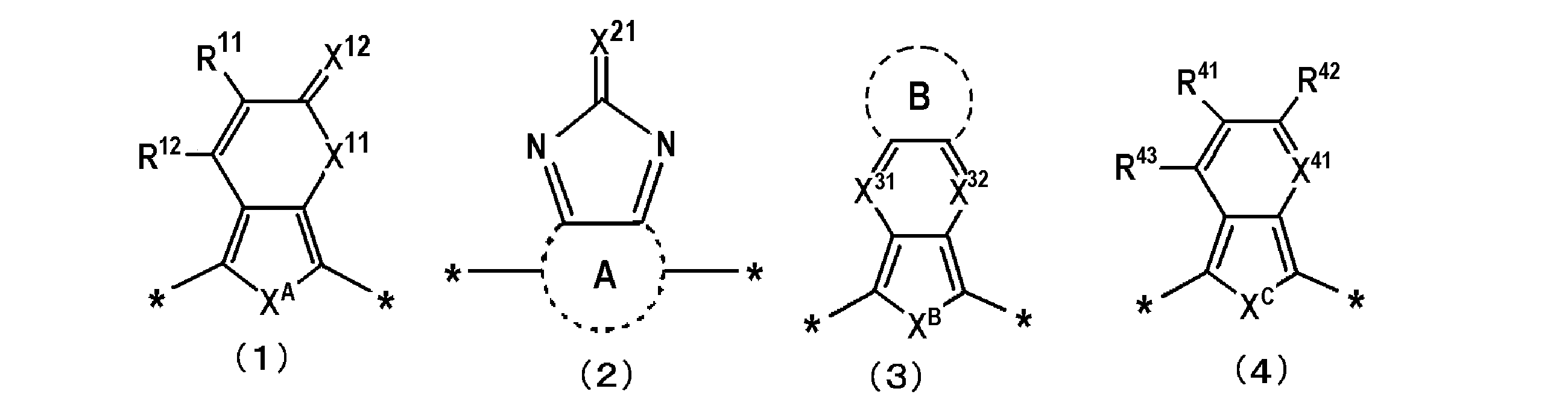
[式(1)中、R11は水素原子、アシル基、アルコキシカルボニル基、アルキル基、フッ素原子、アリール基、カルバモイル基、カルボキシル基または-CRc=CRaRbで表される基を表す。RaおよびRbは各々独立に、アルキル基、シアノ基、アルコキシカルボニル基またはアシル基を表し、Rcは水素原子またはアルキル基を表す。ただし、RaおよびRbのいずれか一方はシアノ基、アルコキシカルボニル基、アシル基である。R12は水素原子または置換基を表す。XAは酸素原子、硫黄原子、セレン原子、SiR2(Rは水素原子または置換基)、テルル原子、>C=O、>SO2または>NRN(RNは水素原子または置換基)を表す。X11は酸素原子、硫黄原子または>NRN(RNは水素原子または置換基)を表す。X12は酸素原子、硫黄原子または=NRn(Rnは置換基)を表す。
式(2)中、X21は酸素原子、硫黄原子、=NRnまたは=CR201R202で表される2価の基を表す。R201およびR202は各々独立に置換基を示す。R201とR202が互いに連結して環を形成してもよい。Rnは前記式(1)と同義である。環Aは芳香環を表す。
式(3)中、XBは前記XAと同義である。環Bは単環もしくは2環の芳香環、または脂環を表す。X31およびX32は各々独立に窒素原子または=CR31-を表す。R31は水素原子または置換基を表す。ただし、X31およびX32の両方が=CR31-のとき、環Bは、単環の芳香環、窒素原子を含まない単環の脂環、または2環の芳香環もしくは脂環を表す。
式(4)中、XCは前記XAと同義である。R41およびR42は各々独立に、水素原子、ホルミル基、フッ素原子、塩素原子、炭素数1~24のアルキル基、炭素数2~24のアシル基、炭素数3~24のアルコキシカルボニル基、炭素数2~24のアシルオキシ基、炭素数1~24のアルキルスルホニル基、炭素数1~24のアルコキシスルホニル基、ニトロ基、炭素数1~24のパーフルオロアルキル基、炭素数1~24のパーフルオロアルコキシ基、炭素数1~24のカルバモイル基、炭素数1~24のスルファモイル基、炭素数2~24のパーフルオロアルキルカルボニル基、炭素数2~24のパーフルオロアルキルカルボニルオキシ基、炭素数2~24のアルキニル基または-CR45=CR46R47を表す。R45は水素原子またはアルキル基を表す。R46およびR47は各々独立に、水素原子、アルキル基、シアノ基、アルコキシカルボニル基またはアシル基を表す。ただし、R46およびR47のいずれか一方はシアノ基、アルコキシカルボニル基またはアシル基である。R43は置換基を表す。X41は窒素原子または=CR44-を表す。R44は水素原子または置換基を表す。
ここで、式(1)~(4)における*はポリマー主鎖を形成する結合手を示す。]
〔2〕前記式(1)におけるX12が酸素原子である〔1〕に記載の有機薄膜太陽電池。
〔3〕前記式(1)におけるX11が酸素原子である〔1〕または〔2〕に記載の有機薄膜太陽電池。
〔4〕前記式(1)におけるXAが硫黄原子である〔1〕~〔3〕のいずれか1項に記載の有機薄膜太陽電池。
〔5〕前記式(2)で表される構成単位が下記式(2-1)で表される構成単位である〔1〕に記載の有機薄膜太陽電池。
式(2)中、X21は酸素原子、硫黄原子、=NRnまたは=CR201R202で表される2価の基を表す。R201およびR202は各々独立に置換基を示す。R201とR202が互いに連結して環を形成してもよい。Rnは前記式(1)と同義である。環Aは芳香環を表す。
式(3)中、XBは前記XAと同義である。環Bは単環もしくは2環の芳香環、または脂環を表す。X31およびX32は各々独立に窒素原子または=CR31-を表す。R31は水素原子または置換基を表す。ただし、X31およびX32の両方が=CR31-のとき、環Bは、単環の芳香環、窒素原子を含まない単環の脂環、または2環の芳香環もしくは脂環を表す。
式(4)中、XCは前記XAと同義である。R41およびR42は各々独立に、水素原子、ホルミル基、フッ素原子、塩素原子、炭素数1~24のアルキル基、炭素数2~24のアシル基、炭素数3~24のアルコキシカルボニル基、炭素数2~24のアシルオキシ基、炭素数1~24のアルキルスルホニル基、炭素数1~24のアルコキシスルホニル基、ニトロ基、炭素数1~24のパーフルオロアルキル基、炭素数1~24のパーフルオロアルコキシ基、炭素数1~24のカルバモイル基、炭素数1~24のスルファモイル基、炭素数2~24のパーフルオロアルキルカルボニル基、炭素数2~24のパーフルオロアルキルカルボニルオキシ基、炭素数2~24のアルキニル基または-CR45=CR46R47を表す。R45は水素原子またはアルキル基を表す。R46およびR47は各々独立に、水素原子、アルキル基、シアノ基、アルコキシカルボニル基またはアシル基を表す。ただし、R46およびR47のいずれか一方はシアノ基、アルコキシカルボニル基またはアシル基である。R43は置換基を表す。X41は窒素原子または=CR44-を表す。R44は水素原子または置換基を表す。
ここで、式(1)~(4)における*はポリマー主鎖を形成する結合手を示す。]
〔2〕前記式(1)におけるX12が酸素原子である〔1〕に記載の有機薄膜太陽電池。
〔3〕前記式(1)におけるX11が酸素原子である〔1〕または〔2〕に記載の有機薄膜太陽電池。
〔4〕前記式(1)におけるXAが硫黄原子である〔1〕~〔3〕のいずれか1項に記載の有機薄膜太陽電池。
〔5〕前記式(2)で表される構成単位が下記式(2-1)で表される構成単位である〔1〕に記載の有機薄膜太陽電池。

[式(2-1)中、X21は式(2)と同義である。XEおよびXFは各々独立にメチン基(=CRM-:RMは水素原子または置換基)または窒素原子を表す。ここで、*はポリマー主鎖を形成する結合手を示す。]
〔6〕前記式(2-1)で表される構成単位が下記式(2-2)で表される構成単位である〔5〕に記載の有機薄膜太陽電池。
〔6〕前記式(2-1)で表される構成単位が下記式(2-2)で表される構成単位である〔5〕に記載の有機薄膜太陽電池。

[式(2-2)中、R22は>NRNまたは>C=Oを表す。R23~R26は各々独立に水素原子または置換基を表す。XEおよびXFは式(2-1)と同義である。RNは前記式(1)と同義である。ここで、*はポリマー主鎖を形成する結合手を示す。]
〔7〕前記式(3)で表される構成単位が下記式(3-1)~(3-3)のいずれかで表される構成単位である〔1〕に記載の有機薄膜太陽電池。
〔7〕前記式(3)で表される構成単位が下記式(3-1)~(3-3)のいずれかで表される構成単位である〔1〕に記載の有機薄膜太陽電池。

[式中、R33は水素原子または置換基を表す。X33は酸素原子、硫黄原子、セレン原子、テルル原子または>NRNを表す。X34はメチン基(=CRM-)または窒素原子を表す。X35は>CRbRc、>C=CRdReまたは>NRNで表される2価の基を表す。Rb~Reは各々独立に水素原子または置換基を表す。R34~R37は各々独立に水素原子または置換基を表す。前記式中、XBは前記式(3)と同義である。RNおよびRMはそれぞれ前記式(1)および式(2-1)と同義である。ここで、*はポリマー主鎖を形成する結合手を示す。]
〔8〕前記式(3)で表される構成単位が、下記式(3-4)~(3-6)のいずれかで表される構成単位である〔1〕に記載の有機薄膜太陽電池。
〔8〕前記式(3)で表される構成単位が、下記式(3-4)~(3-6)のいずれかで表される構成単位である〔1〕に記載の有機薄膜太陽電池。
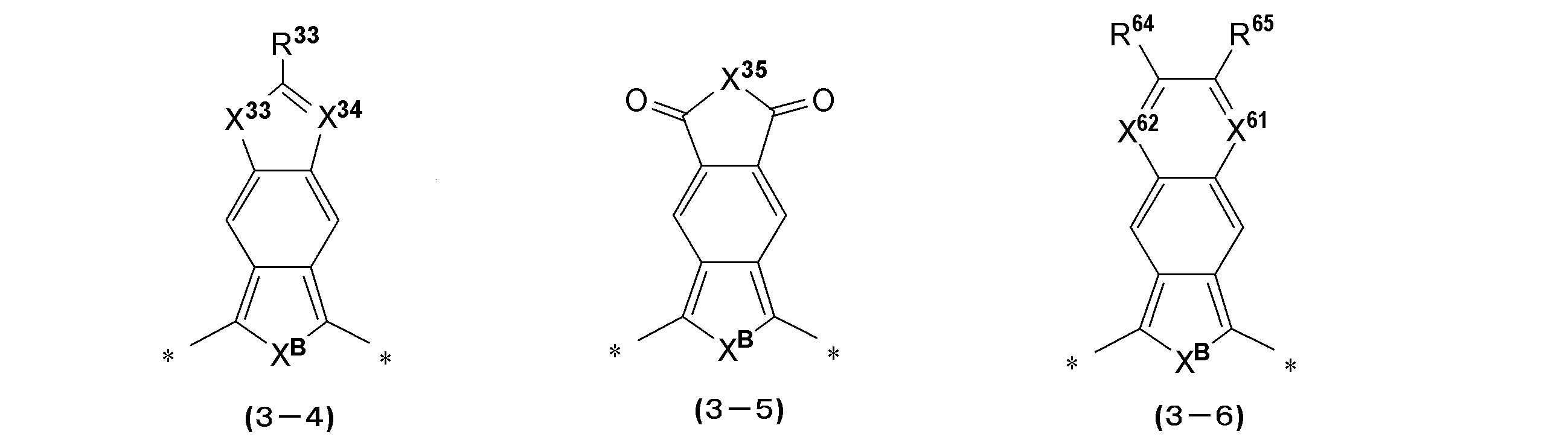
[式中、R33は水素原子または置換基を表す。X33は酸素原子、硫黄原子、セレン原子、テルル原子または>NRNを表す。X34はメチン基(=CRM-)または窒素原子を表す。X35は>CRbRcまたは>C=CRdReを表す。Rb~Reは各々独立に水素原子または置換基を表す。X61およびX62は各々独立に、メチン基(=CRM-)または窒素原子を表す。R64およびR65は各々独立に水素原子または置換基を表す。式中、XBは式(3)におけるXBと同義である。RNおよびRMはそれぞれ前記式(1)および式(2-1)と同義である。ここで、*はポリマー主鎖を形成する結合手を示す。]
〔9〕前記式(3)で表される構成単位が下記式(3-7)~(3-9)のいずれかで表される構成単位である〔1〕に記載の有機薄膜太陽電池。
〔9〕前記式(3)で表される構成単位が下記式(3-7)~(3-9)のいずれかで表される構成単位である〔1〕に記載の有機薄膜太陽電池。

[式中、R33は水素原子または置換基を表す。X33は酸素原子、硫黄原子、セレン原子、テルル原子または>NRNを表す。X34はメチン基(=CRM-)または窒素原子を表す。X35は>CRbRc、>C=CRdReまたは>NRNで表される2価の基を表す。X36およびX37の一方は窒素原子を表し、他方は=CRM-を表す。Rb~Reは各々独立に水素原子または置換基を表す。R74~R77は各々独立に水素原子または置換基を表す。前記式中、XBは前記式(3)と同義である。RNおよびRMはそれぞれ前記式(1)および式(2-1)と同義である。ここで、*はポリマー主鎖を形成する結合手を示す。]
〔10〕前記式(4)におけるXCが、硫黄原子である〔1〕に記載の有機薄膜太陽電池。
〔11〕前記式(4)におけるR41およびR42が各々独立に、ホルミル基、フッ素原子、塩素原子、炭素数2~24のアシル基、炭素数3~24のアルコキシカルボニル基、炭素数2~24のアシルオキシ基、炭素数1~24のアルキルスルホニル基、炭素数1~24のアルコキシスルホニル基、ニトロ基、炭素数1~24のパーフルオロアルキル基、炭素数1~24のパーフルオロアルコキシ基、炭素数1~24のカルバモイル基、炭素数1~24のスルファモイル基、炭素数2~24のパーフルオロアルキルカルボニル基、炭素数2~24のパーフルオロアルキルカルボニルオキシ基、炭素数2~24のアルキニル基または-CR45=CR46R47(R45は水素原子またはアルキル基を表す。R46およびR47は各々独立に、水素原子、アルキル基、シアノ基、アルコキシカルボニル基またはアシル基を表す。ただし、R46およびR47のいずれか一方はシアノ基、アルコキシカルボニル基またはアシル基である。)である〔1〕または〔10〕に記載の有機薄膜太陽電池。
〔12〕下記式(1)~(4)のいずれかで表される構成単位を有するポリマーを有機溶媒中に含有する組成物。
〔10〕前記式(4)におけるXCが、硫黄原子である〔1〕に記載の有機薄膜太陽電池。
〔11〕前記式(4)におけるR41およびR42が各々独立に、ホルミル基、フッ素原子、塩素原子、炭素数2~24のアシル基、炭素数3~24のアルコキシカルボニル基、炭素数2~24のアシルオキシ基、炭素数1~24のアルキルスルホニル基、炭素数1~24のアルコキシスルホニル基、ニトロ基、炭素数1~24のパーフルオロアルキル基、炭素数1~24のパーフルオロアルコキシ基、炭素数1~24のカルバモイル基、炭素数1~24のスルファモイル基、炭素数2~24のパーフルオロアルキルカルボニル基、炭素数2~24のパーフルオロアルキルカルボニルオキシ基、炭素数2~24のアルキニル基または-CR45=CR46R47(R45は水素原子またはアルキル基を表す。R46およびR47は各々独立に、水素原子、アルキル基、シアノ基、アルコキシカルボニル基またはアシル基を表す。ただし、R46およびR47のいずれか一方はシアノ基、アルコキシカルボニル基またはアシル基である。)である〔1〕または〔10〕に記載の有機薄膜太陽電池。
〔12〕下記式(1)~(4)のいずれかで表される構成単位を有するポリマーを有機溶媒中に含有する組成物。
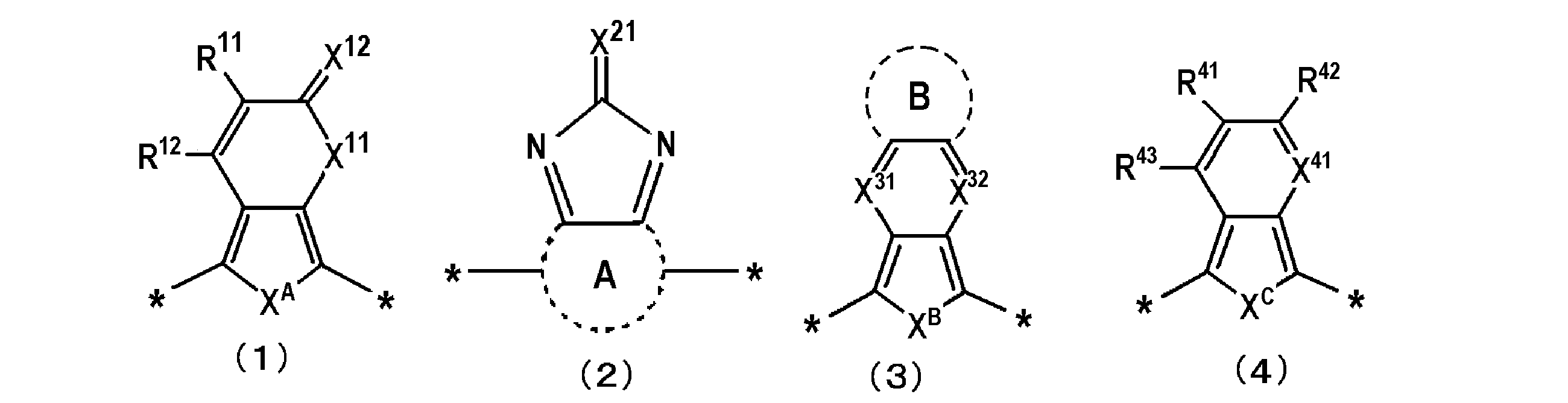
[式(1)中、R11は水素原子、アシル基、アルコキシカルボニル基、アルキル基、フッ素原子、アリール基、カルバモイル基、カルボキシル基または-CRc=CRaRbで表される基を表す。RaおよびRbは各々独立に、アルキル基、シアノ基、アルコキシカルボニル基またはアシル基を表し、Rcは水素原子またはアルキル基を表す。ただし、RaおよびRbのいずれか一方はシアノ基、アルコキシカルボニル基、アシル基である。R12は水素原子または置換基を表す。XAは酸素原子、硫黄原子、セレン原子、SiR2(Rは水素原子または置換基)、テルル原子、>C=O、>SO2または>NRN(RNは水素原子または置換基)を表す。X11は、酸素原子、硫黄原子または>NRN(RNは水素原子または置換基)を表す。X12は酸素原子、硫黄原子または=NRn(Rnは置換基)を表す。
式(2)中、X21は酸素原子、硫黄原子、=NRnまたは=CR201R202で表される2価の基を表す。R201およびR202は各々独立に置換基を表す。R201とR202が互いに連結して環を形成してもよい。Rnは前記式(1)と同義である。環Aは芳香環を表す。
式(3)中、XBは前記XAと同義である。環Bは単環もしくは2環の芳香環または、脂環を表す。X31およびX32は各々独立に窒素原子または=CR31-を表す。R31は水素原子または置換基を表す。ただし、X31およびX32の両方が=CR31-のとき、環Bは単環の芳香環、窒素原子を含まない単環の脂環、または2環の芳香環もしくは脂環を示す。
式(4)中、XCは前記XAと同義である。R41およびR42は各々独立に、水素原子、ホルミル基、フッ素原子、塩素原子、炭素数1~24のアルキル基、炭素数2~24のアシル基、炭素数3~24のアルコキシカルボニル基、炭素数2~24のアシルオキシ基、炭素数1~24のアルキルスルホニル基、炭素数1~24のアルコキシスルホニル基、ニトロ基、炭素数1~24のパーフルオロアルキル基、炭素数1~24のパーフルオロアルコキシ基、炭素数1~24のカルバモイル基、炭素数1~24のスルファモイル基、炭素数2~24のパーフルオロアルキルカルボニル基、炭素数2~24のパーフルオロアルキルカルボニルオキシ基、炭素数2~24のアルキニル基または-CR45=CR46R47を表す。R45は水素原子またはアルキル基を表す。R46およびR47は各々独立に、水素原子、シアノ基、アルコキシカルボニル基またはアシル基を表す。ただし、R46およびR47のいずれか一方はシアノ基、アルコキシカルボニル基またはアシル基である。R43は置換基を表す。X41は窒素原子または=CR44-を表す。R44は水素原子または置換基を表す。
ここで、式(1)~(4)における*はポリマー主鎖を形成する結合手を示す。]
〔13〕さらにn型半導体成分を含有する〔12〕に記載の組成物。
〔14〕前記n型半導体成分がフラーレン誘導体である〔13〕に記載の組成物。
〔15〕有機半導体材料用である〔12〕~〔14〕のいずれか1項に記載の組成物。
〔16〕前記〔15〕に記載の組成物を塗布することにより形成されてなる膜。
〔17〕下記式(M1)~(M4)のいずれかで表される化合物からなる単量体。
式(2)中、X21は酸素原子、硫黄原子、=NRnまたは=CR201R202で表される2価の基を表す。R201およびR202は各々独立に置換基を表す。R201とR202が互いに連結して環を形成してもよい。Rnは前記式(1)と同義である。環Aは芳香環を表す。
式(3)中、XBは前記XAと同義である。環Bは単環もしくは2環の芳香環または、脂環を表す。X31およびX32は各々独立に窒素原子または=CR31-を表す。R31は水素原子または置換基を表す。ただし、X31およびX32の両方が=CR31-のとき、環Bは単環の芳香環、窒素原子を含まない単環の脂環、または2環の芳香環もしくは脂環を示す。
式(4)中、XCは前記XAと同義である。R41およびR42は各々独立に、水素原子、ホルミル基、フッ素原子、塩素原子、炭素数1~24のアルキル基、炭素数2~24のアシル基、炭素数3~24のアルコキシカルボニル基、炭素数2~24のアシルオキシ基、炭素数1~24のアルキルスルホニル基、炭素数1~24のアルコキシスルホニル基、ニトロ基、炭素数1~24のパーフルオロアルキル基、炭素数1~24のパーフルオロアルコキシ基、炭素数1~24のカルバモイル基、炭素数1~24のスルファモイル基、炭素数2~24のパーフルオロアルキルカルボニル基、炭素数2~24のパーフルオロアルキルカルボニルオキシ基、炭素数2~24のアルキニル基または-CR45=CR46R47を表す。R45は水素原子またはアルキル基を表す。R46およびR47は各々独立に、水素原子、シアノ基、アルコキシカルボニル基またはアシル基を表す。ただし、R46およびR47のいずれか一方はシアノ基、アルコキシカルボニル基またはアシル基である。R43は置換基を表す。X41は窒素原子または=CR44-を表す。R44は水素原子または置換基を表す。
ここで、式(1)~(4)における*はポリマー主鎖を形成する結合手を示す。]
〔13〕さらにn型半導体成分を含有する〔12〕に記載の組成物。
〔14〕前記n型半導体成分がフラーレン誘導体である〔13〕に記載の組成物。
〔15〕有機半導体材料用である〔12〕~〔14〕のいずれか1項に記載の組成物。
〔16〕前記〔15〕に記載の組成物を塗布することにより形成されてなる膜。
〔17〕下記式(M1)~(M4)のいずれかで表される化合物からなる単量体。
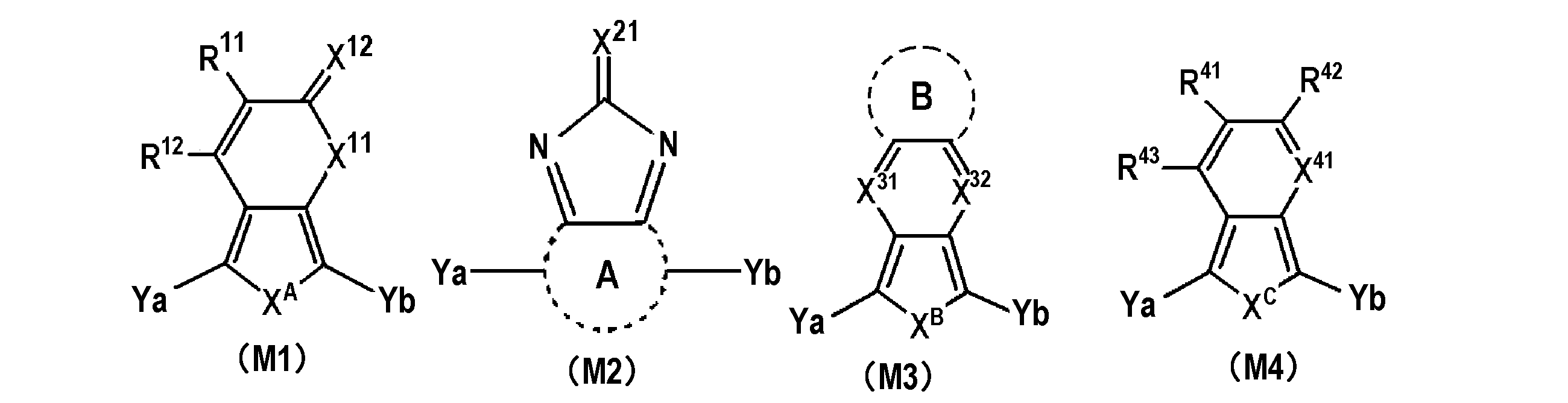
[式(M1)中、R11は水素原子、アシル基、アルコキシカルボニル基、アルキル基、フッ素原子、アリール基、カルバモイル基、カルボキシル基または-CRc=CRaRbで表される基を表す。RaおよびRbは各々独立に、アルキル基、シアノ基、アルコキシカルボニル基またはアシル基を表し、Rcは水素原子またはアルキル基を表す。ただし、RaおよびRbのいずれか一方はシアノ基、アルコキシカルボニル基、アシル基である。R12は水素原子または置換基を表す。XAは酸素原子、硫黄原子、セレン原子、SiR2(Rは水素原子または置換基)、テルル原子、>C=O、>SO2または>NRN(RNは水素原子または置換基)を表す。X11は酸素原子、硫黄原子または>NRN(RNは水素原子または置換基)を表す。X12は酸素原子、硫黄原子または=NRn(Rnは置換基)を表す。
式(M2)中、X21は酸素原子、硫黄原子、=NRnまたは=CR201R202で表される2価の基を表す。R201およびR202は各々独立に置換基を表す。R201とR202が互いに連結して環を形成してもよい。Rnは前記式(1)と同義である。環Aは芳香環を表す。
式(M3)中、XBは前記XAと同義である。環Bは単環もしくは2環の芳香環または、脂環を表す。X31およびX32は各々独立に窒素原子または=CR31-を表す。R31は水素原子または置換基を表す。ただし、X31およびX32の両方が=CR31-のとき、環Bは単環の芳香環、窒素原子を含まない単環の脂環、または2環の芳香環もしくは脂環を表す。
式(M4)中、XCは前記XAと同義である。R41およびR42は各々独立に、水素原子、ホルミル基、フッ素原子、塩素原子、炭素数1~24のアルキル基、炭素数2~24のアシル基、炭素数3~24のアルコキシカルボニル基、炭素数2~24のアシルオキシ基、炭素数1~24のアルキルスルホニル基、炭素数1~24のアルコキシスルホニル基、ニトロ基、炭素数1~24のパーフルオロアルキル基、炭素数1~24のパーフルオロアルコキシ基、炭素数1~24のカルバモイル基、炭素数1~24のスルファモイル基、炭素数2~24のパーフルオロアルキルカルボニル基、炭素数2~24のパーフルオロアルキルカルボニルオキシ基、炭素数2~24のアルキニル基または-CR45=CR46R47を表す。R45は水素原子またはアルキル基を表す。R46およびR47は各々独立に、水素原子、シアノ基、アルコキシカルボニル基またはアシル基を表す。ただし、R46およびR47のいずれか一方はシアノ基、アルコキシカルボニル基またはアシル基である。R43は置換基を表す。X41は窒素原子または=CR44-を表す。R44は水素原子または置換基を表す。
式(M1)~(M4)におけるYaおよびYbは各々独立に、ハロゲン原子、パーフルオロアルカンスルホニルオキシ基、トリアルキルスズ基、ボロン酸エステル基またはボロン酸基を表す。]
式(M2)中、X21は酸素原子、硫黄原子、=NRnまたは=CR201R202で表される2価の基を表す。R201およびR202は各々独立に置換基を表す。R201とR202が互いに連結して環を形成してもよい。Rnは前記式(1)と同義である。環Aは芳香環を表す。
式(M3)中、XBは前記XAと同義である。環Bは単環もしくは2環の芳香環または、脂環を表す。X31およびX32は各々独立に窒素原子または=CR31-を表す。R31は水素原子または置換基を表す。ただし、X31およびX32の両方が=CR31-のとき、環Bは単環の芳香環、窒素原子を含まない単環の脂環、または2環の芳香環もしくは脂環を表す。
式(M4)中、XCは前記XAと同義である。R41およびR42は各々独立に、水素原子、ホルミル基、フッ素原子、塩素原子、炭素数1~24のアルキル基、炭素数2~24のアシル基、炭素数3~24のアルコキシカルボニル基、炭素数2~24のアシルオキシ基、炭素数1~24のアルキルスルホニル基、炭素数1~24のアルコキシスルホニル基、ニトロ基、炭素数1~24のパーフルオロアルキル基、炭素数1~24のパーフルオロアルコキシ基、炭素数1~24のカルバモイル基、炭素数1~24のスルファモイル基、炭素数2~24のパーフルオロアルキルカルボニル基、炭素数2~24のパーフルオロアルキルカルボニルオキシ基、炭素数2~24のアルキニル基または-CR45=CR46R47を表す。R45は水素原子またはアルキル基を表す。R46およびR47は各々独立に、水素原子、シアノ基、アルコキシカルボニル基またはアシル基を表す。ただし、R46およびR47のいずれか一方はシアノ基、アルコキシカルボニル基またはアシル基である。R43は置換基を表す。X41は窒素原子または=CR44-を表す。R44は水素原子または置換基を表す。
式(M1)~(M4)におけるYaおよびYbは各々独立に、ハロゲン原子、パーフルオロアルカンスルホニルオキシ基、トリアルキルスズ基、ボロン酸エステル基またはボロン酸基を表す。]
本明細書において、芳香環とは、芳香族環および芳香族複素環を含む意味に用い、単環であっても複環であってもよい。脂環とは、ヘテロ原子を含んでいてもよい、非芳香族性の環構造を示し、単環であっても複環であってもよい。特定の符号で表示された置換基や連結基等(以下、置換基等という)が複数あるとき、あるいは複数の置換基等を同時もしくは択一的に規定するときには、それぞれの置換基等は互いに同一でも異なっていてもよい。このことは、置換基等の数の規定についても同様である。また、特に断らなくても、複数の置換基等が近接するときにはそれらが互いに連結したり縮環したりして環を形成していてもよい。
本発明の有機薄膜太陽電池は、光電変換に係る諸特性に優れる。さらに、大量生産および実使用を考慮したときの品質のばらつきが少ないという優れた効果を奏する。また、本発明のポリマー合成用単量体およびこれを含む組成物は新規であり、かつ前記太陽電池等に用いられる半導体材料として有用である。
本発明の上記及び他の特徴及び利点は、下記の記載および添付の図面からより明らかになるであろう。
本発明の上記及び他の特徴及び利点は、下記の記載および添付の図面からより明らかになるであろう。
本発明の有機薄膜太陽電池は、その光電変換層に後記式(1)~(4)のいずれかで表される構成単位を有するポリマーを用いる。以下、本発明について有機薄膜太陽電池の基本構造を説明した上で、そのポリマーの特徴について説明する。
<有機薄膜太陽電池>
図1は、本発明の有機薄膜太陽電池の一例を模式的に示した側面図である。本実施形態の太陽電池10は、下記特定の構成単位を有するポリマーを含む光電変換層(バルクへテロ結合層)3を具備する。有機薄膜太陽電池は、一般に、p-i-n三層構造を有するp-i-n接合型有機薄膜太陽電池とバルクへテロ接合型有機薄膜太陽電池に分類され、本発明においてはそのいずれでも構わない。高い発電効率が容易に得られることから、図1に示したようなバルクへテロ接合型有機薄膜太陽電池に特に好ましく適用される。
図1は、本発明の有機薄膜太陽電池の一例を模式的に示した側面図である。本実施形態の太陽電池10は、下記特定の構成単位を有するポリマーを含む光電変換層(バルクへテロ結合層)3を具備する。有機薄膜太陽電池は、一般に、p-i-n三層構造を有するp-i-n接合型有機薄膜太陽電池とバルクへテロ接合型有機薄膜太陽電池に分類され、本発明においてはそのいずれでも構わない。高い発電効率が容易に得られることから、図1に示したようなバルクへテロ接合型有機薄膜太陽電池に特に好ましく適用される。
本実施形態の有機薄膜太陽電池においては、光電変換層3を前記特定のポリマーからなり電子供与化合物であるp型半導体相と、電子受容化合物であるn型半導体相で構成している。この光電変換層3は、第一の電極11と第二の電極12の間に設けられる。本発明においては、第一の電極と光電変換層の間にホール輸送層21を設けるのが好ましく、また第二の電極と光電変換層の間に電子輸送層22を設けることが好ましい。これらのホール輸送層や電子輸送層を設けることにより、光電変換層で発生した電荷をより効率的に取り出すことが可能となる。なお、本実施形態の太陽電池においてその上下の区別は特に重要ではないが、便宜的に必要により、第1電極11側を「上」もしくは「天」側と位置づけ、第2電極12側を「下」もしくは「底」側と位置づける。ここで、上層から順に、基板、正極、ホール輸送層、光電変換層、電子輸送層、負極の構成を順構成と称し、上層から順に、基板、負極、電子輸送層、光電変換層、ホール輸送層、正極の構成を逆構成と称し、本発明では、順構成、逆構成ともに好ましく適用される。
光電変換層においては前記のようにp型半導体相とn型半導体相とが特有の形態で混在し、その界面で光電変換が行われる。その形態は特に限定されないが、理想的な例として挙げると、図示したもののように櫛歯状に互いの相がナノメートルオーダーで入り込んだ状態が好ましい。このような形態を効果的に作出できるよう、p型半導体ポリマーにはn型半導体ポリマーとの特有の相溶性あるいは非相溶があることが好ましい。またp型半導体となる材料は固有の物性のみで定まるものではなく、n型半導体となる材料との相対的な関係で特定されるものである。例えば、n型半導体材料として代表的なフラーレンを例にとれば、これよりも電子供与性が高いものがp型半導体材料となりうる。下記特定ポリマーによれば、上記の要求を好的に満足することができる。
<特定ポリマー>
本発明においては、有機薄膜太陽電池の光電変換層に下記式(1)~(4)のいずれかで表される構成単位(以下、特定構成単位ということがある)を有するポリマーを適用する。
本発明においては、有機薄膜太陽電池の光電変換層に下記式(1)~(4)のいずれかで表される構成単位(以下、特定構成単位ということがある)を有するポリマーを適用する。
(特定構成単位)
[式(1)で表される構成単位]
[式(1)で表される構成単位]

・R11、R12
式(1)中、R11は水素原子、アシル基、アルコキシカルボニル基、アルキル基、フッ素原子、アリール基、カルバモイル基、カルボキシル基または-CRc=CRaRbで表される基を表す。R12は水素原子または置換基を表す。R12の好ましいものとしては、後記置換基Tの例が挙げられ、水素原子、フッ素原子、塩素原子、アルキル基(炭素数1~24が好ましい)、水酸基、アシルオキシ基(炭素数2~24が好ましい)、アリール基(炭素数6~24が好ましい)が好ましく、水素原子、アルキル基がより好ましい。R11は水素原子、アルキル基、アシル基、アルコシキカルボニル基、-CRc=CRaRbで表される基が好ましい。RaおよびRbは各々独立に、アルキル基(炭素数1~24が好ましい)、シアノ基、アルコキシカルボニル基(炭素数2~24が好ましい)、アシル基(炭素数2~24が好ましい)を表し、Rcは水素原子またはアルキル基(炭素数1~24が好ましい)を表す。ただし、RaおよびRbのいずれか一方はシアノ基、アルコキシカルボニル基、アシル基である。
式(1)中、R11は水素原子、アシル基、アルコキシカルボニル基、アルキル基、フッ素原子、アリール基、カルバモイル基、カルボキシル基または-CRc=CRaRbで表される基を表す。R12は水素原子または置換基を表す。R12の好ましいものとしては、後記置換基Tの例が挙げられ、水素原子、フッ素原子、塩素原子、アルキル基(炭素数1~24が好ましい)、水酸基、アシルオキシ基(炭素数2~24が好ましい)、アリール基(炭素数6~24が好ましい)が好ましく、水素原子、アルキル基がより好ましい。R11は水素原子、アルキル基、アシル基、アルコシキカルボニル基、-CRc=CRaRbで表される基が好ましい。RaおよびRbは各々独立に、アルキル基(炭素数1~24が好ましい)、シアノ基、アルコキシカルボニル基(炭素数2~24が好ましい)、アシル基(炭素数2~24が好ましい)を表し、Rcは水素原子またはアルキル基(炭素数1~24が好ましい)を表す。ただし、RaおよびRbのいずれか一方はシアノ基、アルコキシカルボニル基、アシル基である。
・XA
XAは酸素原子、硫黄原子、セレン原子、SiR2(Rは水素原子または置換基を表す)、テルル原子、>C=O、>SO2または>NRN(RNは水素原子または置換基を表す)を表す。RN、Rが置換基であるとき、該置換基の好ましいものとしては、後記置換基Tの例が挙げられ、水素原子、アルキル基(炭素数1~24が好ましい)、アルケニル基(炭素数2~24が好ましい)、アルキニル基(炭素数2~24が好ましい)が好ましく、アルキル基がより好ましい。置換基Tの中で例示されるアルキル基等の炭素数の好ましい範囲は、特に断らないが、本明細書を通じて、それぞれ置換基Tに挙げたものと同義である。XAは、硫黄原子、セレン原子、>C=O、>SO2、>NRNが好ましく、硫黄原子がより好ましい。
XAは酸素原子、硫黄原子、セレン原子、SiR2(Rは水素原子または置換基を表す)、テルル原子、>C=O、>SO2または>NRN(RNは水素原子または置換基を表す)を表す。RN、Rが置換基であるとき、該置換基の好ましいものとしては、後記置換基Tの例が挙げられ、水素原子、アルキル基(炭素数1~24が好ましい)、アルケニル基(炭素数2~24が好ましい)、アルキニル基(炭素数2~24が好ましい)が好ましく、アルキル基がより好ましい。置換基Tの中で例示されるアルキル基等の炭素数の好ましい範囲は、特に断らないが、本明細書を通じて、それぞれ置換基Tに挙げたものと同義である。XAは、硫黄原子、セレン原子、>C=O、>SO2、>NRNが好ましく、硫黄原子がより好ましい。
・X11
X11は酸素原子、硫黄原子または>NRNを表す。RNとしては、前記RNと同義であり、好ましい範囲も同じである。X11は酸素原子が好ましい。
X11は酸素原子、硫黄原子または>NRNを表す。RNとしては、前記RNと同義であり、好ましい範囲も同じである。X11は酸素原子が好ましい。
・X12
X12は酸素原子、硫黄原子または=NRn(Rnは置換基を表す)を表す。Rnの置換基の好ましいものとしては、後記置換基Tの例が挙げられ、水素原子、アルキル基(炭素数1~24が好ましい)、アルケニル基(炭素数2~24が好ましい)、アルキニル基(炭素数2~24が好ましい)が好ましい。X12は酸素原子が好ましい。
X12は酸素原子、硫黄原子または=NRn(Rnは置換基を表す)を表す。Rnの置換基の好ましいものとしては、後記置換基Tの例が挙げられ、水素原子、アルキル基(炭素数1~24が好ましい)、アルケニル基(炭素数2~24が好ましい)、アルキニル基(炭素数2~24が好ましい)が好ましい。X12は酸素原子が好ましい。
*はポリマー主鎖を形成する結合手を示す。このことは、他の化学式についても同様であるが、逐一断ることはしていない。
[式(2)で表される構成単位]

・X21
式(2)中、X21は酸素原子、硫黄原子、=NRnまたは=CR201R202で表される2価の基を表す。R201およびR202は置換基を示す。ここで、Rnは前記と同義である。R201およびR202の置換基としては、後記置換基Tの例が挙げられ、アルキル基(炭素数1~24が好ましい)、アルケニル基(炭素数2~24が好ましい)、アルキニル基(炭素数2~24が好ましい)、アシル基(炭素数2~24が好ましい)、アルコキシカルボニル基(炭素数2~24が好ましい)、シアノ基が好ましい。R201およびR202は互いに結合して環を形成していてもよい。
式(2)中、X21は酸素原子、硫黄原子、=NRnまたは=CR201R202で表される2価の基を表す。R201およびR202は置換基を示す。ここで、Rnは前記と同義である。R201およびR202の置換基としては、後記置換基Tの例が挙げられ、アルキル基(炭素数1~24が好ましい)、アルケニル基(炭素数2~24が好ましい)、アルキニル基(炭素数2~24が好ましい)、アシル基(炭素数2~24が好ましい)、アルコキシカルボニル基(炭素数2~24が好ましい)、シアノ基が好ましい。R201およびR202は互いに結合して環を形成していてもよい。
環Aは芳香環を表す。該芳香環は、芳香族炭化水素環、芳香族ヘテロ環を含み、芳香族炭化水素環としてはベンゼン環、ナフタレン環、アントラセン環、フェナントレン環が挙げられる。
芳香族ヘテロ環としては、5または6員環が好ましく、環構成ヘテロ原子は、窒素原子、酸素原子、硫黄原子、セレン原子、テルル原子が好ましく、例えば、ピロール環、チオフェン環、フラン環、ピラゾール環、イミダゾール環、トリアゾール環、オキサゾール環、イソオキサゾール環、チアゾール環、イソチアゾール環、チアジアゾール環、セレノフェン環、テルロフェン環、ピリジン環、ピラジン環、ピリミジン環、ピリダジン環が挙げられ、これらの環にベンゼン環が縮環した環も好ましい。
好ましい芳香環は、ベンゼン環、ナフタレン環、ベンゾチオフェン環、ベンゾチアゾール環、ベンゾイソチアゾール環、ベンゾオキサゾール環、ベンゾイソオキサゾール環、ピリジン環、ピリダジン環が挙げられ、なかでも、ベンゼン環、ピリジン環、ピリダジン環が好ましい。なお、環Aは後述の置換基Tで置換されていてもよい。
芳香族ヘテロ環としては、5または6員環が好ましく、環構成ヘテロ原子は、窒素原子、酸素原子、硫黄原子、セレン原子、テルル原子が好ましく、例えば、ピロール環、チオフェン環、フラン環、ピラゾール環、イミダゾール環、トリアゾール環、オキサゾール環、イソオキサゾール環、チアゾール環、イソチアゾール環、チアジアゾール環、セレノフェン環、テルロフェン環、ピリジン環、ピラジン環、ピリミジン環、ピリダジン環が挙げられ、これらの環にベンゼン環が縮環した環も好ましい。
好ましい芳香環は、ベンゼン環、ナフタレン環、ベンゾチオフェン環、ベンゾチアゾール環、ベンゾイソチアゾール環、ベンゾオキサゾール環、ベンゾイソオキサゾール環、ピリジン環、ピリダジン環が挙げられ、なかでも、ベンゼン環、ピリジン環、ピリダジン環が好ましい。なお、環Aは後述の置換基Tで置換されていてもよい。
前記式(2)で表される構成単位は、下記式(2-1)で表される構成単位であることが好ましい。

・X21
式中、X21は、式(2)におけるものと同義である。
式中、X21は、式(2)におけるものと同義である。
・XE、XF
XEおよびXFは各々独立にメチン基(=CRM-:RMは水素原子または置換基を表す)または窒素原子を表す。ここで、RMが置換基であるとき、該置換基としては後記置換基Tの例が挙げられ、好ましくは、アルキル基(炭素数1~24が好ましい)、アルケニル基(炭素数2~24が好ましい)、アルキニル基(炭素数2~24が好ましい)、アシル基(炭素数2~24が好ましい)、アシルオキシ基(炭素数2~24が好ましい)、アルコキシカルボニル基(炭素数2~24が好ましい)、フッ素原子、塩素原子、シアノ基が好ましい。
XEおよびXFは各々独立にメチン基(=CRM-:RMは水素原子または置換基を表す)または窒素原子を表す。ここで、RMが置換基であるとき、該置換基としては後記置換基Tの例が挙げられ、好ましくは、アルキル基(炭素数1~24が好ましい)、アルケニル基(炭素数2~24が好ましい)、アルキニル基(炭素数2~24が好ましい)、アシル基(炭素数2~24が好ましい)、アシルオキシ基(炭素数2~24が好ましい)、アルコキシカルボニル基(炭素数2~24が好ましい)、フッ素原子、塩素原子、シアノ基が好ましい。
前記式(2-1)で表される構成単位は、下記式(2-2)で表される構成単位であることが好ましい。

・R22
式中、R22は>NRNまたは>C=Oを表す。RNは前記で定義したものと同義である。
式中、R22は>NRNまたは>C=Oを表す。RNは前記で定義したものと同義である。
・R23~R26
R23~R26は各々独立に水素原子または置換基を示す。XEおよびXFは式(2-1)と同義である。ここで、R23~R26が置換基であるとき、該置換基としては後記置換基Tの例が挙げられ、水素原子、アルキル基(炭素数1~24が好ましい)、アルコキシ基(炭素数1~24が好ましい)、アルコキシカルボニル基(炭素数2~24が好ましい)、アリール基(炭素数6~24が好ましい)が好ましい。
R23~R26は各々独立に水素原子または置換基を示す。XEおよびXFは式(2-1)と同義である。ここで、R23~R26が置換基であるとき、該置換基としては後記置換基Tの例が挙げられ、水素原子、アルキル基(炭素数1~24が好ましい)、アルコキシ基(炭素数1~24が好ましい)、アルコキシカルボニル基(炭素数2~24が好ましい)、アリール基(炭素数6~24が好ましい)が好ましい。
[式(3)で表される構成単位]

・XB
式中、XBは前記XAと同義である。
式中、XBは前記XAと同義である。
・環B
環Bは単環もしくは2環の芳香環または脂環を表す。ただし、X31およびX32の両方が=CR31-のとき、環Bは、単環の芳香環、窒素原子を含まない単環の脂環、または2環の芳香環もしくは脂環を表す。
芳香環は、芳香族炭化水素環、芳香族ヘテロ環を含み、芳香族炭化水素環としてはベンゼン環、ナフタレン環が挙げられる。
芳香族ヘテロ環としては、5または6員環が好ましく、環構成ヘテロ原子は、窒素原子、酸素原子、硫黄原子、セレン原子、テルル原子が好ましく、例えば、ピロール環、チオフェン環、フラン環、ピラゾール環、イミダゾール環、トリアゾール環、オキサゾール環、イソオキサゾール環、チアゾール環、イソチアゾール環、チアジアゾール環、セレノフェン環、テルロフェン環、ピリジン環、ピラジン環、ピリミジン環、ピリダジン環、トリアジン環が挙げられ、これらの環にベンゼン環が縮環した環も好ましい。
環Bは単環もしくは2環の芳香環または脂環を表す。ただし、X31およびX32の両方が=CR31-のとき、環Bは、単環の芳香環、窒素原子を含まない単環の脂環、または2環の芳香環もしくは脂環を表す。
芳香環は、芳香族炭化水素環、芳香族ヘテロ環を含み、芳香族炭化水素環としてはベンゼン環、ナフタレン環が挙げられる。
芳香族ヘテロ環としては、5または6員環が好ましく、環構成ヘテロ原子は、窒素原子、酸素原子、硫黄原子、セレン原子、テルル原子が好ましく、例えば、ピロール環、チオフェン環、フラン環、ピラゾール環、イミダゾール環、トリアゾール環、オキサゾール環、イソオキサゾール環、チアゾール環、イソチアゾール環、チアジアゾール環、セレノフェン環、テルロフェン環、ピリジン環、ピラジン環、ピリミジン環、ピリダジン環、トリアジン環が挙げられ、これらの環にベンゼン環が縮環した環も好ましい。
脂環としては、芳香族環以外の環であり、シクロアルカンやヘテロ環を含み、5または6員環が好ましい。シクロアルカンは、シクロペンタン、シクロペンタノン、1,3-シクロペンタンジオン、シクロヘキサン、シクロヘキサノン、1,4-シクロヘキサンジオンが挙げられ、ヘテロ環は、ピロリジノン、2,5-ピロリジンジオンが挙げられる。
なお、環Bは後述の置換基Tで置換されていてもよい。
なお、環Bは後述の置換基Tで置換されていてもよい。
X31およびX32の少なくとも一方が窒素原子の場合、該環Bは、ベンゼン、ナフタレン、2,5-ピロリジンジオン、1,3-シクロペンタンジオン、チオフェン、セレノフェン、ピロール、チアゾール、イソチアゾール、イミダゾール、ピラゾール、1,2,3-トリアゾール、オキサゾール、イソオキサゾール、1,4-シクロヘキサンジオン、1,2,5-チアジアゾール、ピリジン、ピリミジン、ピラジン、ピリダジンが挙げられ、ベンゼン、2,5-ピロリジンジオン、1,3-シクロペンタンジオン、チオフェン、チアゾール、イソチアゾール、イミダゾール、1,2,3-トリアゾール、オキサゾール、イソオキサゾール、1,4-シクロヘキサンジオンが好ましい。X31およびX32の両方が=CR31-の場合、ベンゼン、ナフタレン、1,3-シクロペンタンジオン、チオフェン、セレノフェン、ピロール、チアゾール、イソチアゾール、イミダゾール、ピラゾール、1,2,3-トリアゾール、オキサゾール、イソオキサゾール、1,4-シクロヘキサンジオン、1,2,5-チアジアゾール、ピリジン、ピリミジン、ピラジン、ピリダジンが挙げられ、ベンゼン、1,3-シクロペンタンジオン、チオフェン、チアゾール、イソチアゾール、イミダゾール、1,2,3-トリアゾール、オキサゾール、イソオキサゾール、1,4-シクロヘキサンジオンが好ましい。
・X31、X32
X31、X32は窒素原子または=CR31-を表す。R31としては後述の置換基Tが挙げられ、水素原子、フッ素原子または塩素原子が好ましく、水素原子またはフッ素原子がより好ましい。
X31、X32は窒素原子または=CR31-を表す。R31としては後述の置換基Tが挙げられ、水素原子、フッ素原子または塩素原子が好ましく、水素原子またはフッ素原子がより好ましい。
前記式(3)で表される構成単位は、下記式(3-1)~(3-3)のいずれかで表される構成単位であることが好ましい。

・R33
式中、R33は水素原子または置換基を表す。該置換基としては後記置換基Tの例が挙げられ、水素原子、アルキル基(炭素数1~24が好ましい)、アルケニル基(炭素数2~24が好ましい)、アルキニル基(炭素数2~24が好ましい)、アルコキシカルボニル基(炭素数2~24が好ましい)、アシル基(炭素数2~24が好ましい)、アルキルスルホニル基(炭素数1~24が好ましい)が好ましい。
式中、R33は水素原子または置換基を表す。該置換基としては後記置換基Tの例が挙げられ、水素原子、アルキル基(炭素数1~24が好ましい)、アルケニル基(炭素数2~24が好ましい)、アルキニル基(炭素数2~24が好ましい)、アルコキシカルボニル基(炭素数2~24が好ましい)、アシル基(炭素数2~24が好ましい)、アルキルスルホニル基(炭素数1~24が好ましい)が好ましい。
・X33
X33は酸素原子、硫黄原子、セレン原子、テルル原子または>NRNを表す。X33は、硫黄原子または>NRNが好ましく、硫黄原子がより好ましい。RNは前記式(1)で定義したものと同義であり、好ましい範囲も同じである。
X33は酸素原子、硫黄原子、セレン原子、テルル原子または>NRNを表す。X33は、硫黄原子または>NRNが好ましく、硫黄原子がより好ましい。RNは前記式(1)で定義したものと同義であり、好ましい範囲も同じである。
・X34
X34はメチン基(=CRM-)または窒素原子を表す。RMは、前記で定義したものと同義であり、好ましい範囲も同じである。
X34はメチン基(=CRM-)または窒素原子を表す。RMは、前記で定義したものと同義であり、好ましい範囲も同じである。
・X35
X35は>CRbRc、>C=CRdReまたは>NRNで表される2価の基を表す。X35は、>CRbRcまたは>NRNが好ましい。RNは、前記で定義したものと同義である。Rb~Reは各々独立に水素原子または置換基を表す。Rb~Reが置換基であるとき、該置換基としては後記置換基Tの例が挙げられ、アルキル基(炭素数1~24が好ましい)、アルケニル基(炭素数2~24が好ましい)、アルキニル基(炭素数2~24が好ましい)が好ましく、アルキル基がより好ましい。
X35は>CRbRc、>C=CRdReまたは>NRNで表される2価の基を表す。X35は、>CRbRcまたは>NRNが好ましい。RNは、前記で定義したものと同義である。Rb~Reは各々独立に水素原子または置換基を表す。Rb~Reが置換基であるとき、該置換基としては後記置換基Tの例が挙げられ、アルキル基(炭素数1~24が好ましい)、アルケニル基(炭素数2~24が好ましい)、アルキニル基(炭素数2~24が好ましい)が好ましく、アルキル基がより好ましい。
・R34~R37
R34~R37は各々独立に水素原子または置換基を表す。該置換基としては後記置換基Tの例が挙げられ、R34~R37は各々独立に、アルキル基(炭素数1~24が好ましい)、アルケニル基(炭素数2~24が好ましい)、アルキニル基(炭素数2~24が好ましい)、アシル基(炭素数2~24が好ましい)、アルコキシカルボニル基(炭素数2~24が好ましい)、アシルオキシ基(炭素数2~24が好ましい)、フッ素原子、塩素原子が好ましい。R34~R37はその少なくとも1つが電子求引性基であることが好ましい。電子求引性基は、後記でR41およびR42で定義するものと同義であり、好ましい範囲も同じである。R34およびR37は、電子求引性基の中でもハロゲン原子が好ましく、フッ素原子または塩素原子がより好ましい。R35およびR36は、電子求引性基の中でもアルコキシカルボニル基またはアシル基が好ましい。
R34~R37は各々独立に水素原子または置換基を表す。該置換基としては後記置換基Tの例が挙げられ、R34~R37は各々独立に、アルキル基(炭素数1~24が好ましい)、アルケニル基(炭素数2~24が好ましい)、アルキニル基(炭素数2~24が好ましい)、アシル基(炭素数2~24が好ましい)、アルコキシカルボニル基(炭素数2~24が好ましい)、アシルオキシ基(炭素数2~24が好ましい)、フッ素原子、塩素原子が好ましい。R34~R37はその少なくとも1つが電子求引性基であることが好ましい。電子求引性基は、後記でR41およびR42で定義するものと同義であり、好ましい範囲も同じである。R34およびR37は、電子求引性基の中でもハロゲン原子が好ましく、フッ素原子または塩素原子がより好ましい。R35およびR36は、電子求引性基の中でもアルコキシカルボニル基またはアシル基が好ましい。
・XB
XBは前記式(3)と同義である。
XBは前記式(3)と同義である。
前記式(3)で表される構成単位が、下記式(3-4)~(3-6)で表される構成単位であることも好ましい。
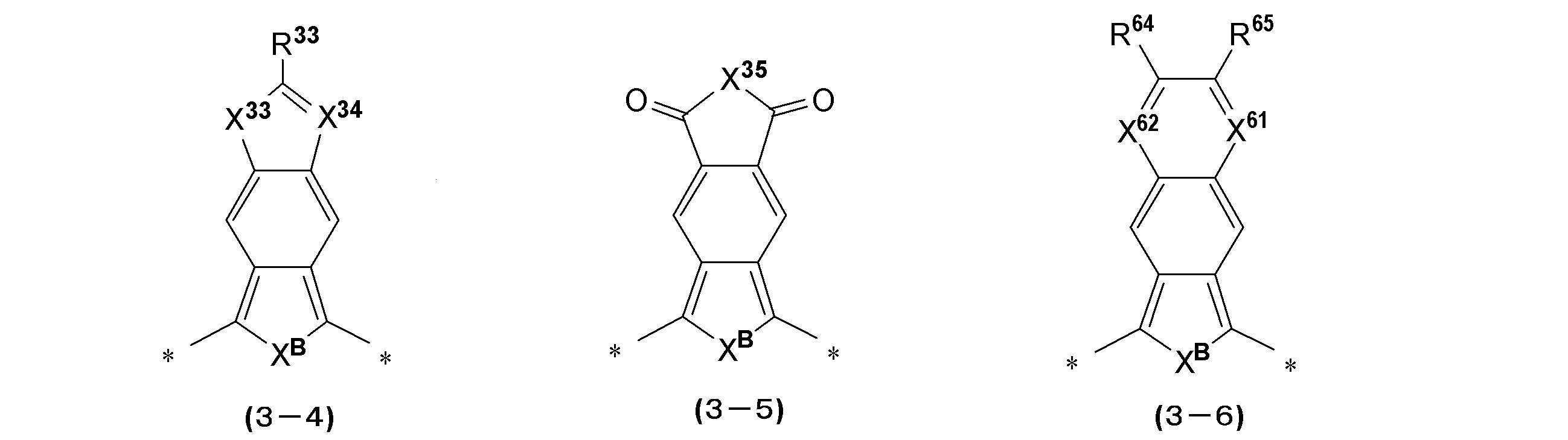
式中、R33、X33、X34、XBは式(3-1)~(3-3)と同義である。X35は>CRbRcまたは>C=CRdReを表す。Rb~Reは前記(3-2)Rb~Reと同義である。X61およびX62は各々独立に、メチン基(=CRM-)または窒素原子を表す。R64およびR65は水素原子または置換基を表す。X61、X62の両方がメチン基(=CRM-)の場合、R64、R65およびRMは電子求引性基が好ましい。R64およびR65は、アルコキシカルボニル基またはアシル基が好ましく、RMは、ハロゲン原子が好ましく、フッ素原子または塩素原子がより好ましい。
前記式(3)で表される構成単位が、下記式(3-7)~(3-9)で表される構成単位であることも好ましい。
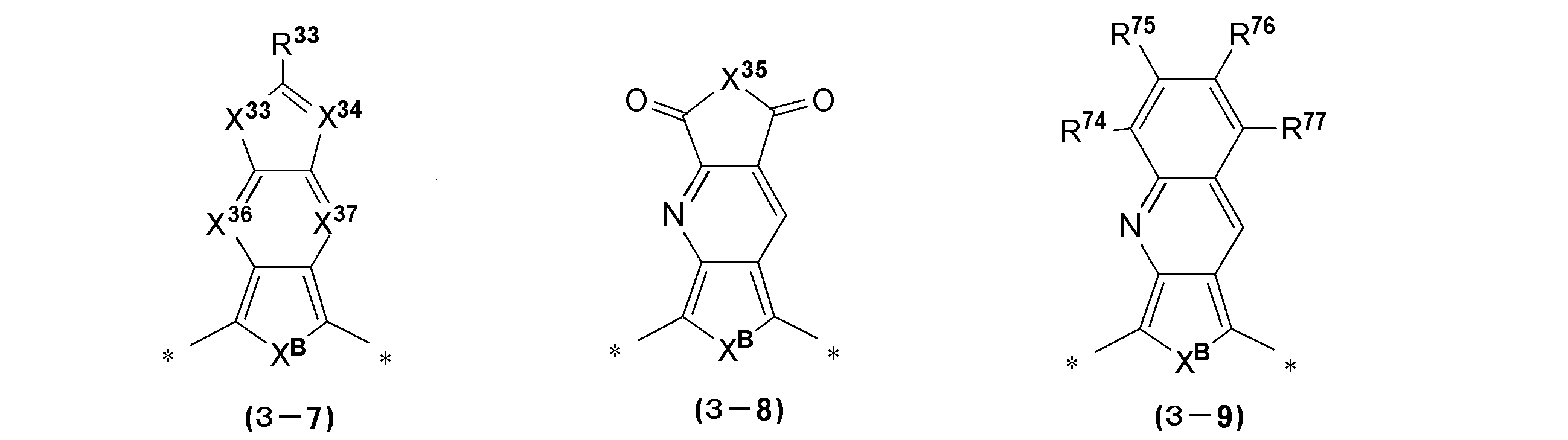
式中、R33、X33、X34、X35、XBは前記式(3-1)~(3-3)と同義である。前記式(3-9)におけるR74~R77は式(3-3)のR34~R37と同義である。なお、本明細書において繰り返し単位の表記は、これが左右反転した構造の異性体を含む意味である。換言すると、構造式で表記された構成単位はこれが反転した形でポリマー中に導入されていてもよい。
[式(4)で表される構成単位]

・XC
式中、XCは、前記XAと同義であり、好ましい範囲も同様である。
式中、XCは、前記XAと同義であり、好ましい範囲も同様である。
・R41、R42
R41およびR42は各々独立に、水素原子、ホルミル基、フッ素原子、塩素原子、炭素数1~24のアルキル基(炭素数4~24が好ましく、炭素数6~24がより好ましい)、炭素数2~24のアシル基(炭素数4~24が好ましく、炭素数6~24がより好ましい)、炭素数3~25のアルコキシカルボニル基(炭素数5~25が好ましく、炭素数7~25がより好ましい)、炭素数2~24のアシルオキシ基(炭素数4~24が好ましく、炭素数6~24がより好ましい)、炭素数1~24のアルキルスルホニル基(炭素数4~24が好ましく、炭素数6~24がより好ましい)、炭素数2~24のアルコキシスルホニル基(炭素数4~24が好ましく、炭素数6~24がより好ましい)、ニトロ基、炭素数1~24のパーフルオロアルキル基(炭素数1~16が好ましく、炭素数1~6がより好ましい)、炭素数1~24のパーフルオロアルコキシ基(炭素数1~16が好ましく、炭素数1~6がより好ましい)、炭素数1~24のカルバモイル基(炭素数4~24が好ましく、炭素数6~24がより好ましい)、炭素数1~24のスルファモイル基(炭素数4~24が好ましく、炭素数6~24がより好ましい)、炭素数2~24のパーフルオロアルキルカルボニル基(炭素数2~16が好ましく、炭素数2~6がより好ましい)、炭素数2~24のパーフルオロアルキルカルボニルオキシ基(炭素数2~16が好ましく、炭素数2~6がより好ましい)、炭素数2~24のアルキニル基(炭素数3~24が好ましく、炭素数6~24がより好ましい)、-CR45=CR46R47を表す。
R41およびR42は各々独立に、水素原子、ホルミル基、フッ素原子、塩素原子、炭素数1~24のアルキル基(炭素数4~24が好ましく、炭素数6~24がより好ましい)、炭素数2~24のアシル基(炭素数4~24が好ましく、炭素数6~24がより好ましい)、炭素数3~25のアルコキシカルボニル基(炭素数5~25が好ましく、炭素数7~25がより好ましい)、炭素数2~24のアシルオキシ基(炭素数4~24が好ましく、炭素数6~24がより好ましい)、炭素数1~24のアルキルスルホニル基(炭素数4~24が好ましく、炭素数6~24がより好ましい)、炭素数2~24のアルコキシスルホニル基(炭素数4~24が好ましく、炭素数6~24がより好ましい)、ニトロ基、炭素数1~24のパーフルオロアルキル基(炭素数1~16が好ましく、炭素数1~6がより好ましい)、炭素数1~24のパーフルオロアルコキシ基(炭素数1~16が好ましく、炭素数1~6がより好ましい)、炭素数1~24のカルバモイル基(炭素数4~24が好ましく、炭素数6~24がより好ましい)、炭素数1~24のスルファモイル基(炭素数4~24が好ましく、炭素数6~24がより好ましい)、炭素数2~24のパーフルオロアルキルカルボニル基(炭素数2~16が好ましく、炭素数2~6がより好ましい)、炭素数2~24のパーフルオロアルキルカルボニルオキシ基(炭素数2~16が好ましく、炭素数2~6がより好ましい)、炭素数2~24のアルキニル基(炭素数3~24が好ましく、炭素数6~24がより好ましい)、-CR45=CR46R47を表す。
上記基のうちパーフルオロアルキル基、パーフルオロアルコキシ基、パーフルオロアルキルカルボニル基、およびパーフルオロアルキルカルボニルオキシ基を除く上記基の炭素数は、4~24が好ましく、6~24がより好ましい。パーフルオロアルキル基、パーフルオロアルコキシ基、パーフルオロアルキルカルボニル基の炭素数は、1~16が好ましいく、1~6がより好ましい。炭素数が、上記範囲にあるとき、ポリマーの溶解性が向上し、均一な膜が形成できることから電池特性の向上および製品品質のばらつきを抑制できると考えられる。
R41およびR42は各々独立に、ホルミル基、フッ素原子、塩素原子、炭素数4~24のアシル基、炭素数5~25のアルコキシカルボニル基、炭素数4~24のアルキルスルホニル基、炭素数1~16のパーフルオロアルキル基、炭素数1~16のパーフルオロアルコキシ基、炭素数2~16のパーフルオロアルキルカルボニル基、炭素数3~24のアルキニル基、-CR45=CR46R47が好ましく、水素原子、フッ素原子、塩素原子、炭素数6~24のアシル基、炭素数7~25のアルコキシカルボニル基、炭素数1~6のパーフルオロアルキル基、炭素数6~24のアルキニル基、-CR45=CR46R47がより好ましい。
R45は水素原子またはアルキル基(炭素数1~24が好ましい)を表す。R46およびR47は各々独立に、水素原子、シアノ基、アルコキシカルボニル基(炭素数2~24が好ましい)またはアシル基を表す(炭素数2~24が好ましい)。ただし、R46およびR47のいずれか一方はシアノ基、アルコキシカルボニル基またはアシル基である。
R43は水素原子または置換基を表す。該置換基としては後述の置換基Tが挙げられ、水素原子、フッ素原子が好ましい
R43は水素原子または置換基を表す。該置換基としては後述の置換基Tが挙げられ、水素原子、フッ素原子が好ましい
・X41
X41は窒素原子または=CR44-を表す。R44は水素原子または置換基を表す。該置換基としては後述の置換基Tが挙げられ、水素原子、フッ素原子、塩素原子、アルキル基(炭素数1~24が好ましい)、アルケニル基(炭素数2~24が好ましい)、アルキニル基(炭素数2~24が好ましい)が好ましく、水素原子またはフッ素原子がより好ましい。
X41は窒素原子または=CR44-を表す。R44は水素原子または置換基を表す。該置換基としては後述の置換基Tが挙げられ、水素原子、フッ素原子、塩素原子、アルキル基(炭素数1~24が好ましい)、アルケニル基(炭素数2~24が好ましい)、アルキニル基(炭素数2~24が好ましい)が好ましく、水素原子またはフッ素原子がより好ましい。
(特定単量体)
上記特定ポリマーにおける特定構成単位は、下記式(M1)~(M4)のいずれかで表される化合物から合成することができる。
上記特定ポリマーにおける特定構成単位は、下記式(M1)~(M4)のいずれかで表される化合物から合成することができる。

式中、R11、R12、R41、R42、R43、XA、XB、XC、X11、X12、X21、X31、X32、X41、環A、環Bは、前記式(1)~(4)と同義である。
・Ya,Yb
YaおよびYbは各々独立に、ハロゲン原子、パーフルオロアルカンスルホニルオキシ基、トリアルキルスズ基、ボロン酸エステル基またはボロン酸基を表す。
YaおよびYbは各々独立に、ハロゲン原子、パーフルオロアルカンスルホニルオキシ基、トリアルキルスズ基、ボロン酸エステル基またはボロン酸基を表す。
(共重合成分)
本発明に用いられる前記ポリマーは前記特定構成単位と二種以上の他の共重合成分とを有するコポリマーであることが好ましい。共重合成分としては、ベンゼン構成単位、ナフタレン構成単位、アントラセン構成単位、フェナントレン構成単位、ベンゾジチオフェン構成単位、ナフトジチオフェン構成単位、カルバゾール構成単位、シラシクロペンタジチオフェン構成単位、シクロペンタジチアゾール構成単位、ベンゾチアジアゾール構成単位、チアジアゾロキノキサリン構成単位、シクロペンタジチオフェン構成単位、酸化シクロペンタジチオフェン構成単位、ベンゾイソチアゾール構成単位、ベンゾチアゾール構成単位、酸化チオフェン構成単位、チエノチオフェン構成単位、酸化チエノチオフェン構成単位、ジチエノチオフェン構成単位、酸化ジチエノチオフェン構成単位、テトラヒドロイソインドール構成単位、フルオレン構成単位、フルオレノン構成単位、チアゾール構成単位、イソチアゾール構成単位、セレノフェン構成単位、チオフェン構成単位、フラン構成単位、ピロール構成単位、シロール構成単位、チアゾロチアゾール構成単位、ナフトチアジアゾール構成単位、チエノピラジン構成単位、オキサゾール構成単位、イソオキサゾール構成単位、イミダゾール構成単位、ピラゾール構成単位、トリアゾール構成単位、ピリジン構成単位、ピリダジン構成単位、ピリミジン構成単位、トリアジン構成単位、テトラジン構成単位、チアジアゾール構成単位、オキサジアゾール構成単位、ベンゾオキサゾール構成単位、ベンゾイミダゾール構成単位、チエノチアゾール構成単位およびシクロペンタジピリジン構成単位が挙げられる。上記の構成単位が縮環したものも好ましい。共重合様式は特に限定されないが、モノマーが2成分であるときは交互共重合体となることが好ましい。
本発明に用いられる前記ポリマーは前記特定構成単位と二種以上の他の共重合成分とを有するコポリマーであることが好ましい。共重合成分としては、ベンゼン構成単位、ナフタレン構成単位、アントラセン構成単位、フェナントレン構成単位、ベンゾジチオフェン構成単位、ナフトジチオフェン構成単位、カルバゾール構成単位、シラシクロペンタジチオフェン構成単位、シクロペンタジチアゾール構成単位、ベンゾチアジアゾール構成単位、チアジアゾロキノキサリン構成単位、シクロペンタジチオフェン構成単位、酸化シクロペンタジチオフェン構成単位、ベンゾイソチアゾール構成単位、ベンゾチアゾール構成単位、酸化チオフェン構成単位、チエノチオフェン構成単位、酸化チエノチオフェン構成単位、ジチエノチオフェン構成単位、酸化ジチエノチオフェン構成単位、テトラヒドロイソインドール構成単位、フルオレン構成単位、フルオレノン構成単位、チアゾール構成単位、イソチアゾール構成単位、セレノフェン構成単位、チオフェン構成単位、フラン構成単位、ピロール構成単位、シロール構成単位、チアゾロチアゾール構成単位、ナフトチアジアゾール構成単位、チエノピラジン構成単位、オキサゾール構成単位、イソオキサゾール構成単位、イミダゾール構成単位、ピラゾール構成単位、トリアゾール構成単位、ピリジン構成単位、ピリダジン構成単位、ピリミジン構成単位、トリアジン構成単位、テトラジン構成単位、チアジアゾール構成単位、オキサジアゾール構成単位、ベンゾオキサゾール構成単位、ベンゾイミダゾール構成単位、チエノチアゾール構成単位およびシクロペンタジピリジン構成単位が挙げられる。上記の構成単位が縮環したものも好ましい。共重合様式は特に限定されないが、モノマーが2成分であるときは交互共重合体となることが好ましい。
これらの構成単位は、好ましくは、さらに下記式(II-1)~(II-23)で表されるものが好ましい。*は主鎖に組み込まれる結合手を表す。

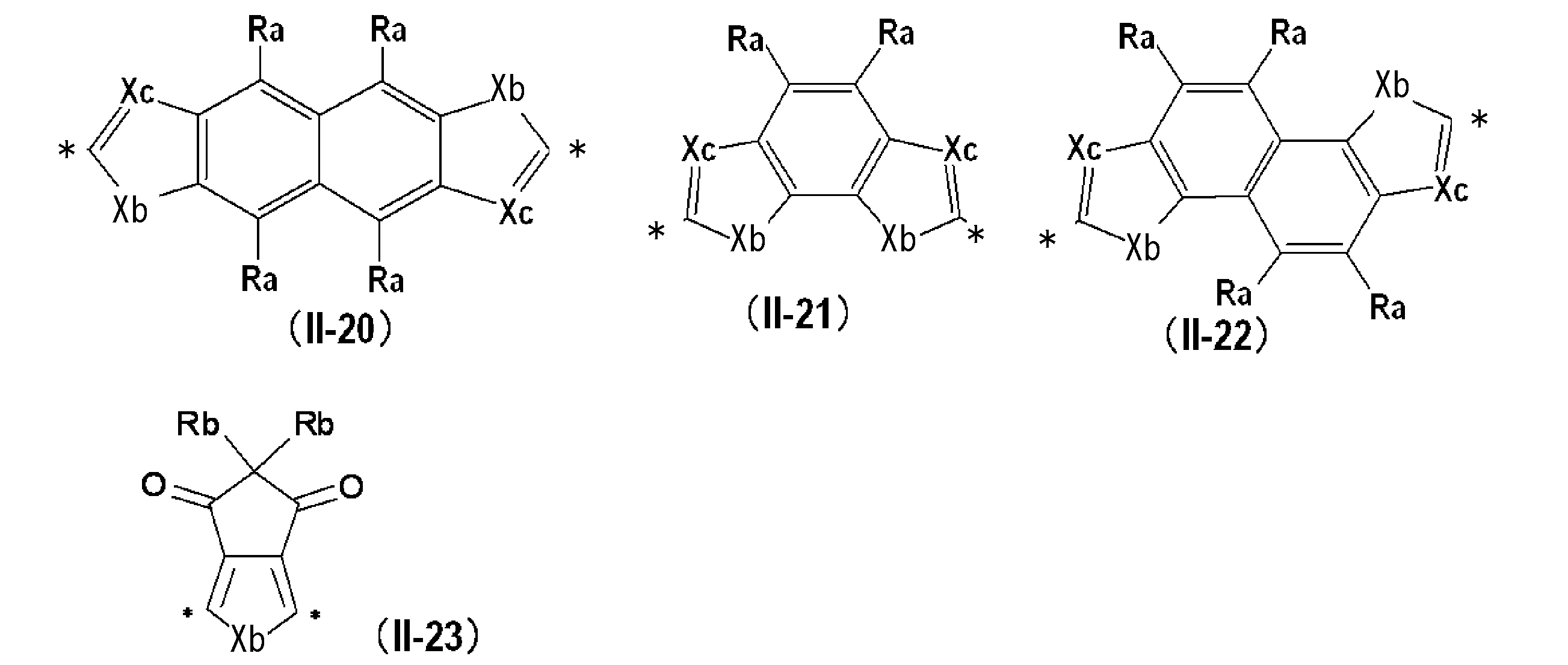
・Xa
式(II-1)~(II-23)におけるXaはC(Rb)2、C=C(Rc)2、Si(Rb)2、S、Se、Te、S=O、SO2、C=O、O、NHまたはNRbを表す。
式(II-1)~(II-23)におけるXaはC(Rb)2、C=C(Rc)2、Si(Rb)2、S、Se、Te、S=O、SO2、C=O、O、NHまたはNRbを表す。
・Xb
式(II-1)~(II-23)におけるXbはNH、NRb、OまたはSを表す。XcはCRaまたはNを表す。
式(II-1)~(II-23)におけるXbはNH、NRb、OまたはSを表す。XcはCRaまたはNを表す。
・Ra
Raは水素原子または置換基を表し、互いに連結して環を形成していてもよい。なお、特定の符号で複数の置換基を表示するとき、それらは各々異なっていてもよい。また、置換基Raが縮環して芳香族環もしくは芳香族複素環を構成するとき、上記で示した共鳴構造と異なる構造をとっていてもよい。Raとしては、後述の置換基Tが挙げられ、水素原子、フッ素原子、塩素原子、シアノ基、アルキル基(炭素数1~24が好ましい)、アルケニル基(炭素数2~24が好ましい)、アルキニル基(炭素数2~24が好ましい)、アルコキシ基(炭素数1~24が好ましい)、アシル基(炭素数2~12が好ましい)、アシルオキシ基(炭素数2~24が好ましい)、アルコキシカルボニル基(炭素数2~24が好ましい)、アルキルスルホニル基(炭素数1~24が好ましい)が好ましい。
Raは水素原子または置換基を表し、互いに連結して環を形成していてもよい。なお、特定の符号で複数の置換基を表示するとき、それらは各々異なっていてもよい。また、置換基Raが縮環して芳香族環もしくは芳香族複素環を構成するとき、上記で示した共鳴構造と異なる構造をとっていてもよい。Raとしては、後述の置換基Tが挙げられ、水素原子、フッ素原子、塩素原子、シアノ基、アルキル基(炭素数1~24が好ましい)、アルケニル基(炭素数2~24が好ましい)、アルキニル基(炭素数2~24が好ましい)、アルコキシ基(炭素数1~24が好ましい)、アシル基(炭素数2~12が好ましい)、アシルオキシ基(炭素数2~24が好ましい)、アルコキシカルボニル基(炭素数2~24が好ましい)、アルキルスルホニル基(炭素数1~24が好ましい)が好ましい。
・Rb
Rbは水素原子または置換基を表し、該置換基としては、後述の置換基Tが挙げられ、水素原子、アルキル基(炭素数1~24が好ましい)、アルケニル基(炭素数2~24が好ましい)、アルキニル基(炭素数2~24が好ましい)が好ましい。Rbが置換基のとき、互いに連結して環を形成していてもよい。
Rbは水素原子または置換基を表し、該置換基としては、後述の置換基Tが挙げられ、水素原子、アルキル基(炭素数1~24が好ましい)、アルケニル基(炭素数2~24が好ましい)、アルキニル基(炭素数2~24が好ましい)が好ましい。Rbが置換基のとき、互いに連結して環を形成していてもよい。
・Rc
Rcは水素原子置換基を表し、該置換基としては、後述の置換基Tが挙げられ、水素原子、アルキル基(炭素数1~24が好ましい)、アルケニル基(炭素数2~24が好ましい)、アルキニル基(炭素数2~4が好ましい)、アルコキシカルボニル基(炭素数2~24が好ましい)、アシル基(炭素数2~24が好ましい)、シアノ基が好ましい。
Rcは水素原子置換基を表し、該置換基としては、後述の置換基Tが挙げられ、水素原子、アルキル基(炭素数1~24が好ましい)、アルケニル基(炭素数2~24が好ましい)、アルキニル基(炭素数2~4が好ましい)、アルコキシカルボニル基(炭素数2~24が好ましい)、アシル基(炭素数2~24が好ましい)、シアノ基が好ましい。
式(II-1)~(II-23)の構成単位は、好ましくは、さらに式(1)~(61)表されるものである。

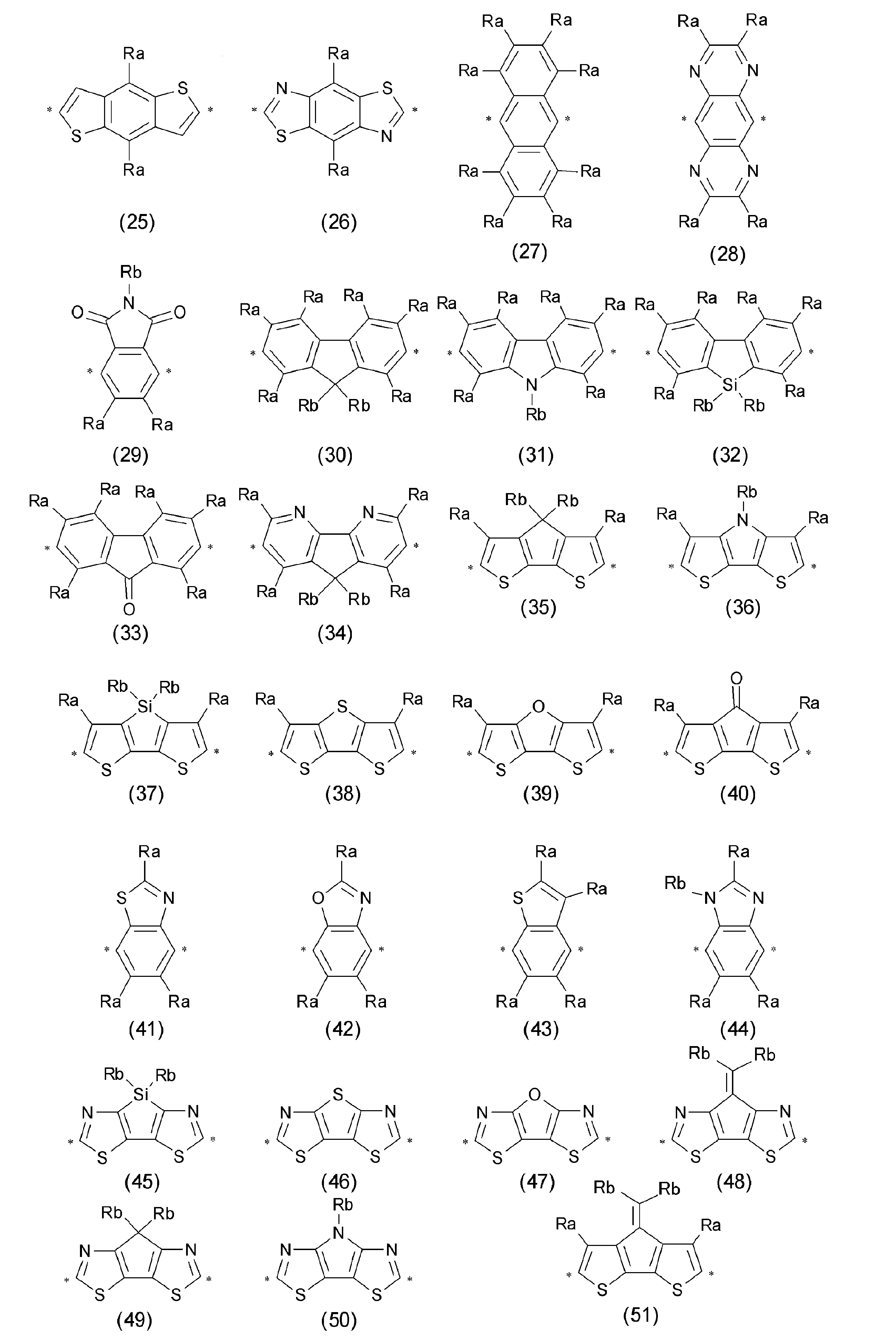
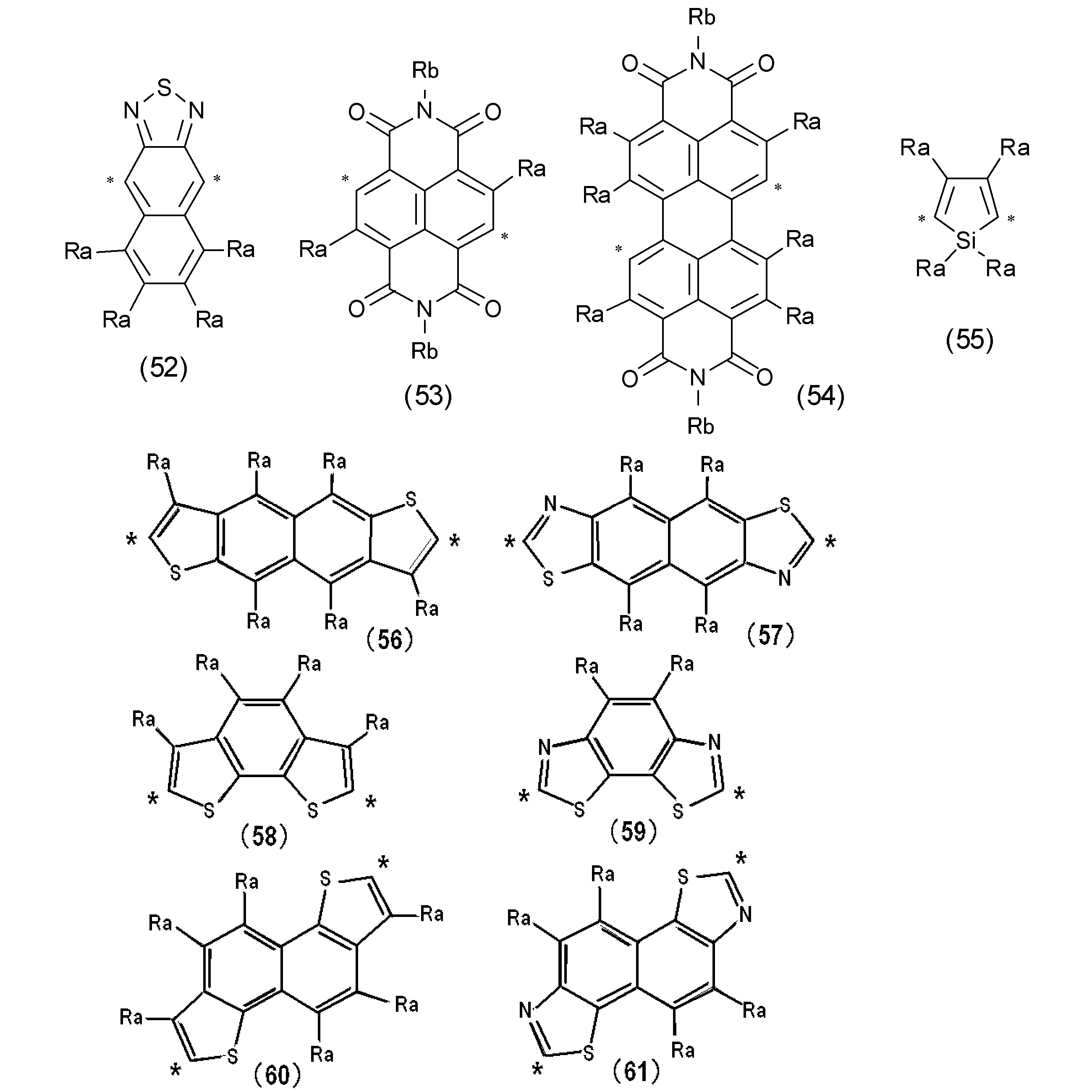
式(1)~(61)において、RaおよびRbは前記と同様である。
これらの中でも、(2)、(3)、(5)、(9)、(10)、(11)、(16)、(21)、(25)、(26)、(27)、(30)、(31)、(32)、(33)、(34)、(35)、(36)、(37)、(38)、(39)、(40)、(43)、(45)、(46)、(47)、(48)、(49)、(50)、(51)、(56)~(61)で表される構成単位が好ましく、(2)、(3)、(5)、(9)、(25)、(26)、(30)、(31)、(32)、(34)、(35)、(36)、(37)、(38)、(45)、(46)、(47)、(48)、(49)、(50)、(51)、(56)~(61)で表される構成単位がより好ましい。
本発明の上記特定構成単位を形成するモノマーとしては下記の例が挙げられる。
ここで、Meは-CH3、Buは-C4H9、M+はNa+やK+などの金属イオンを表す。
ここで、Meは-CH3、Buは-C4H9、M+はNa+やK+などの金属イオンを表す。
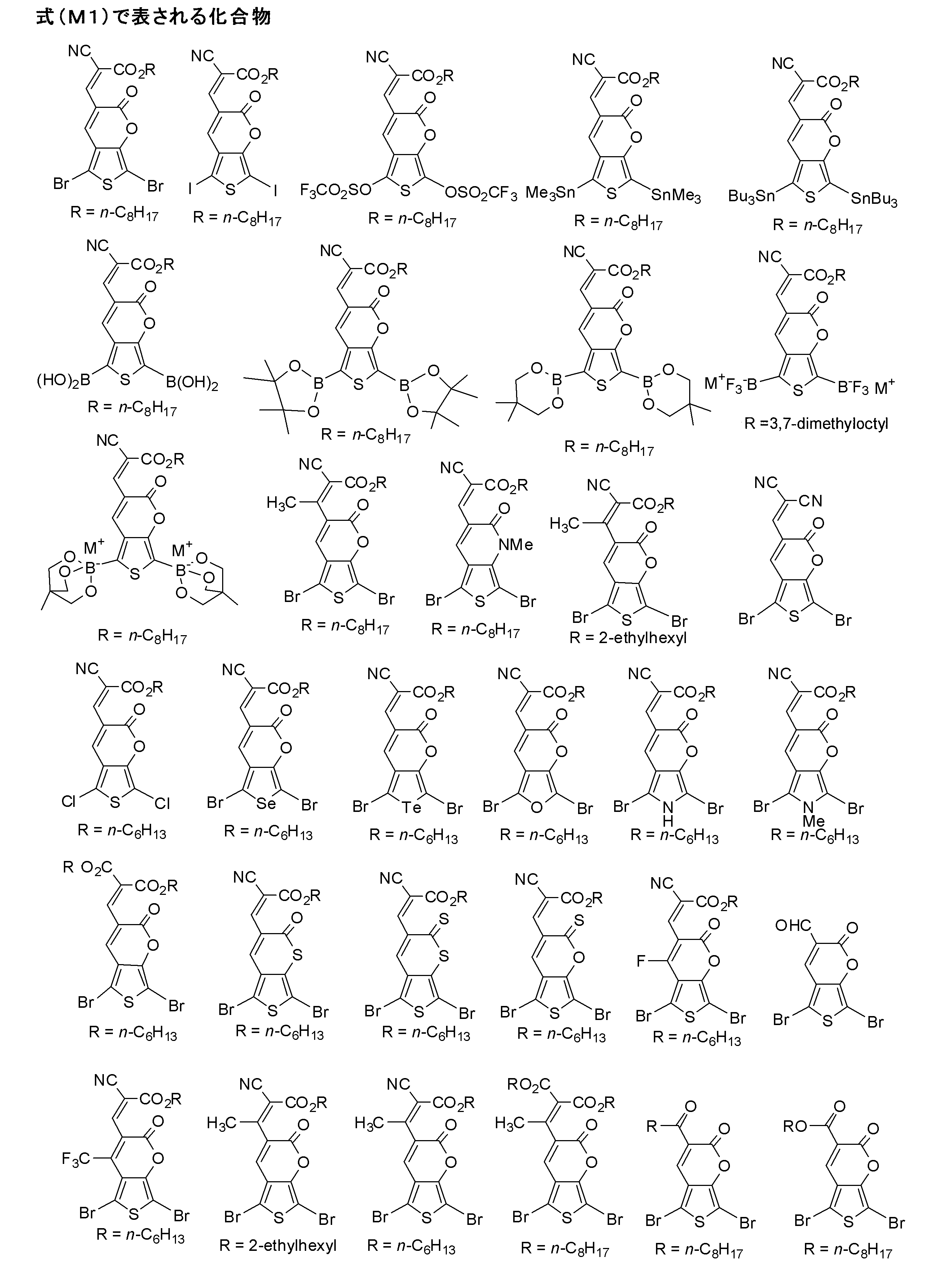
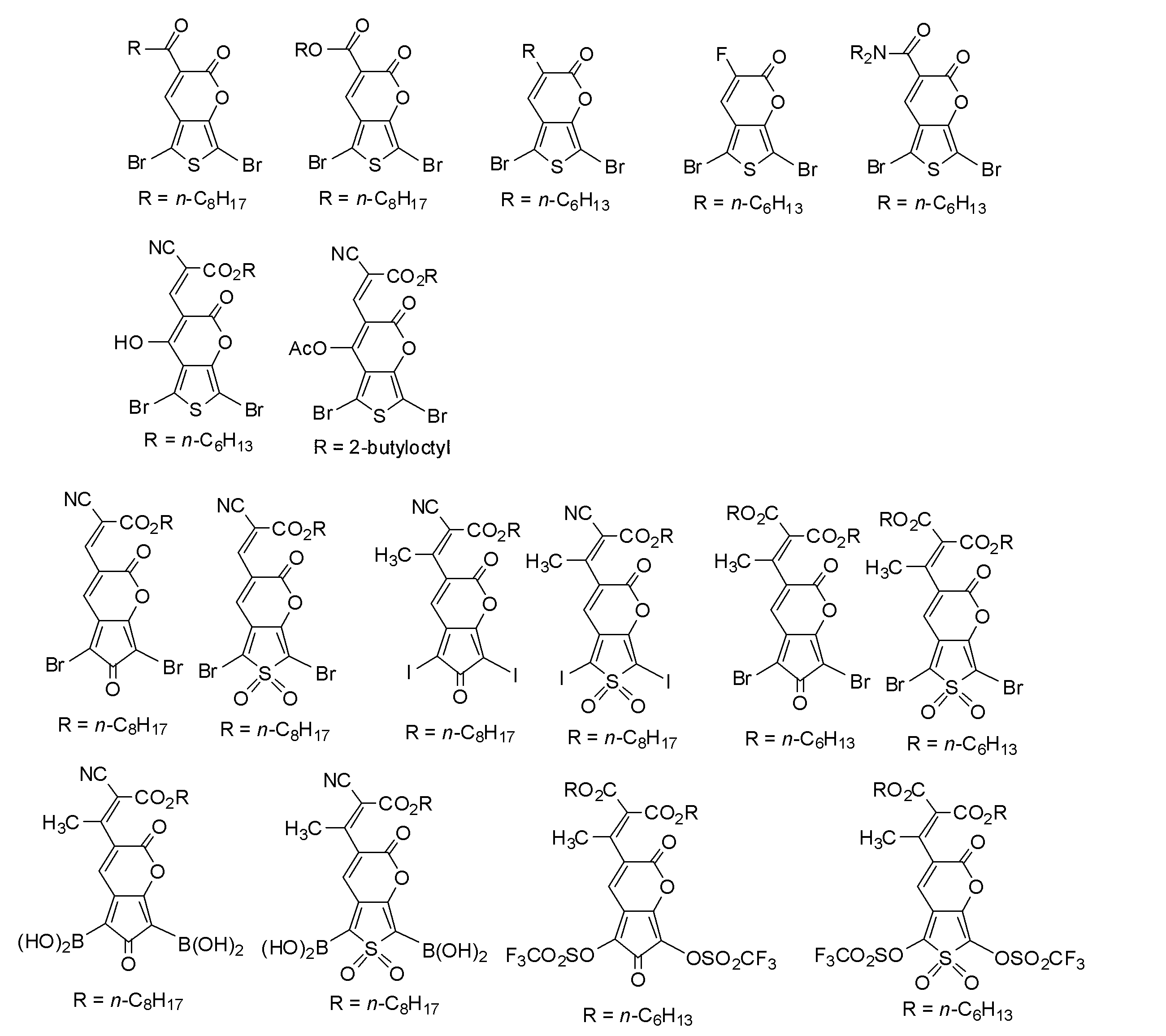

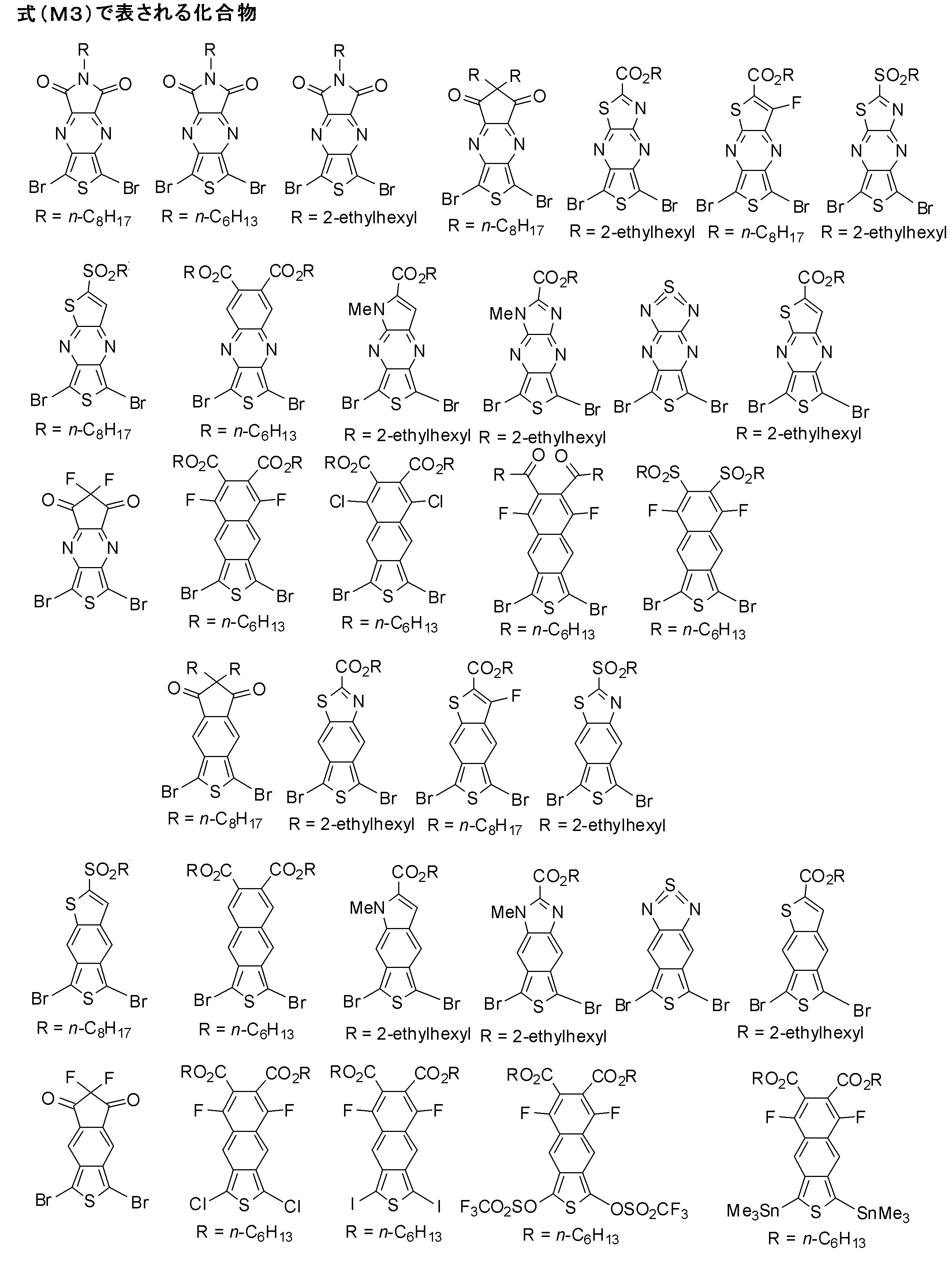


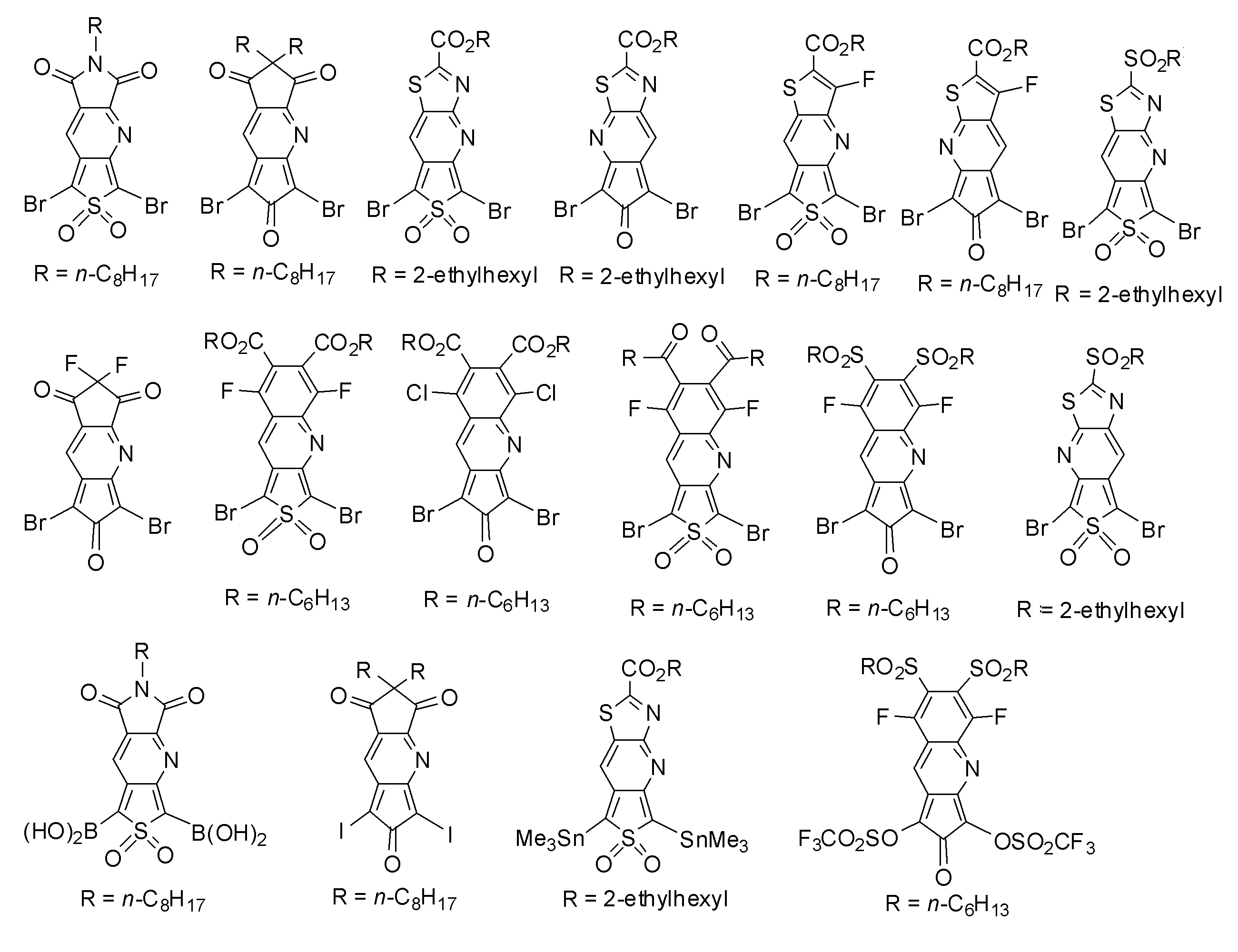
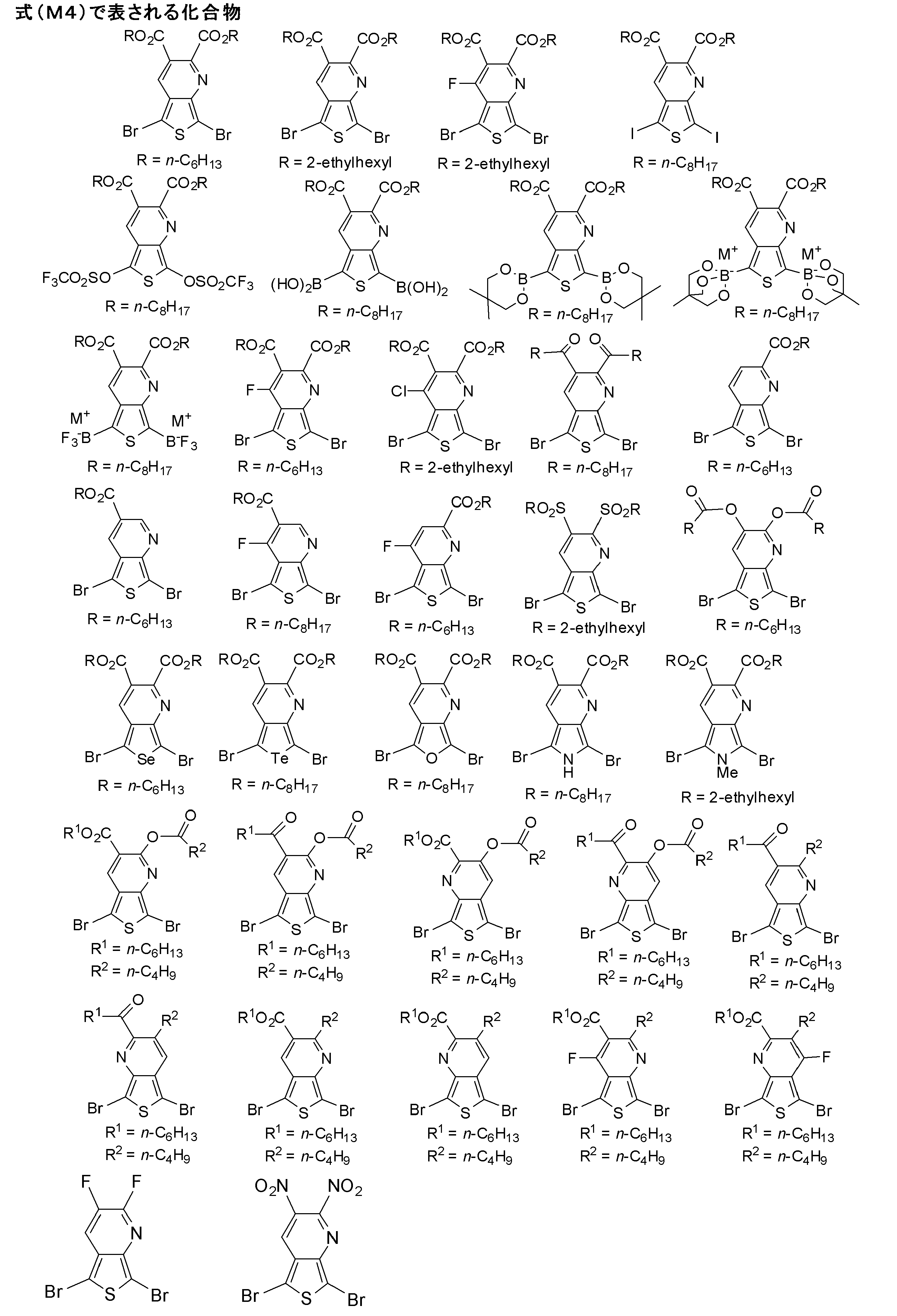
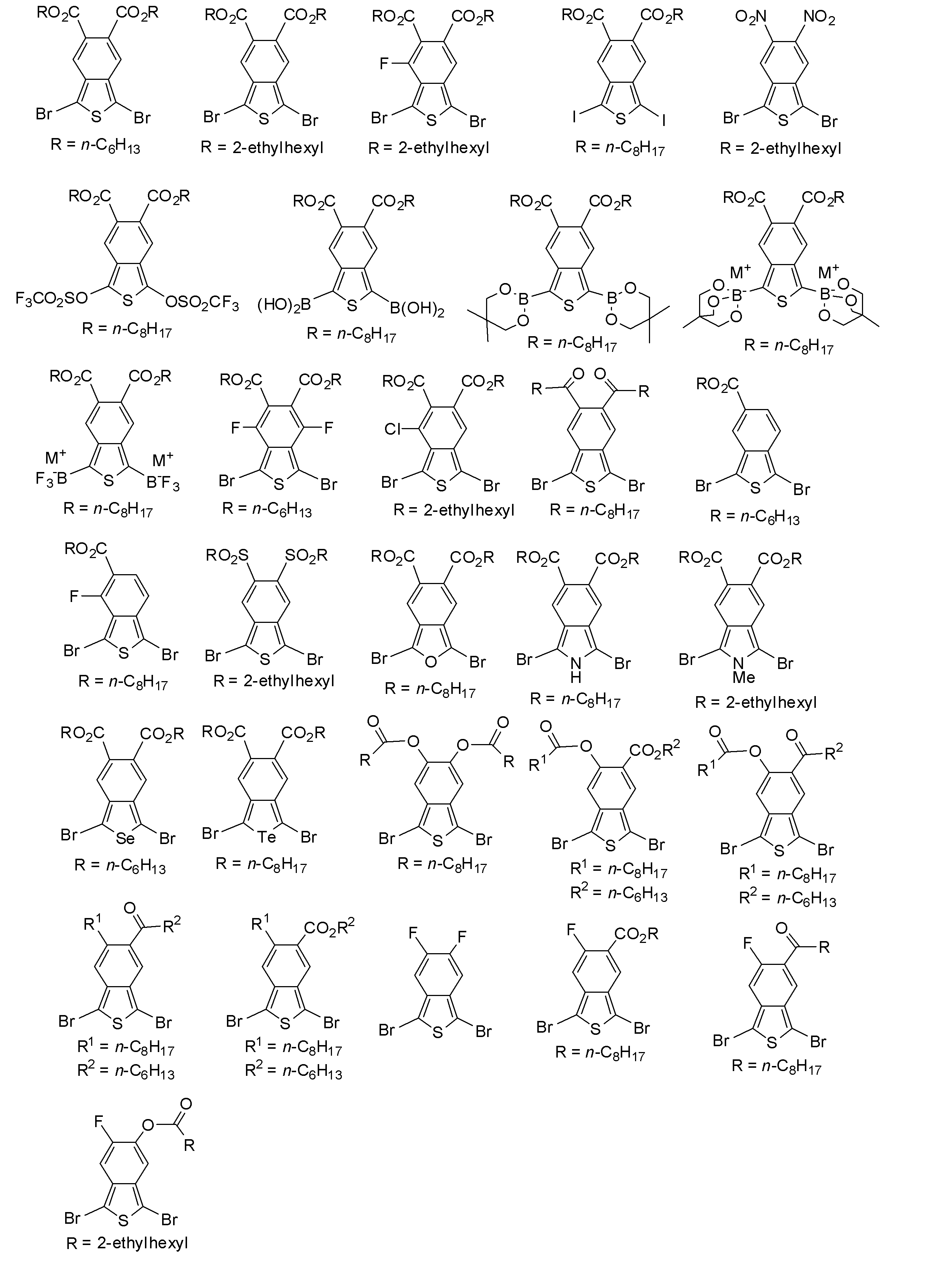
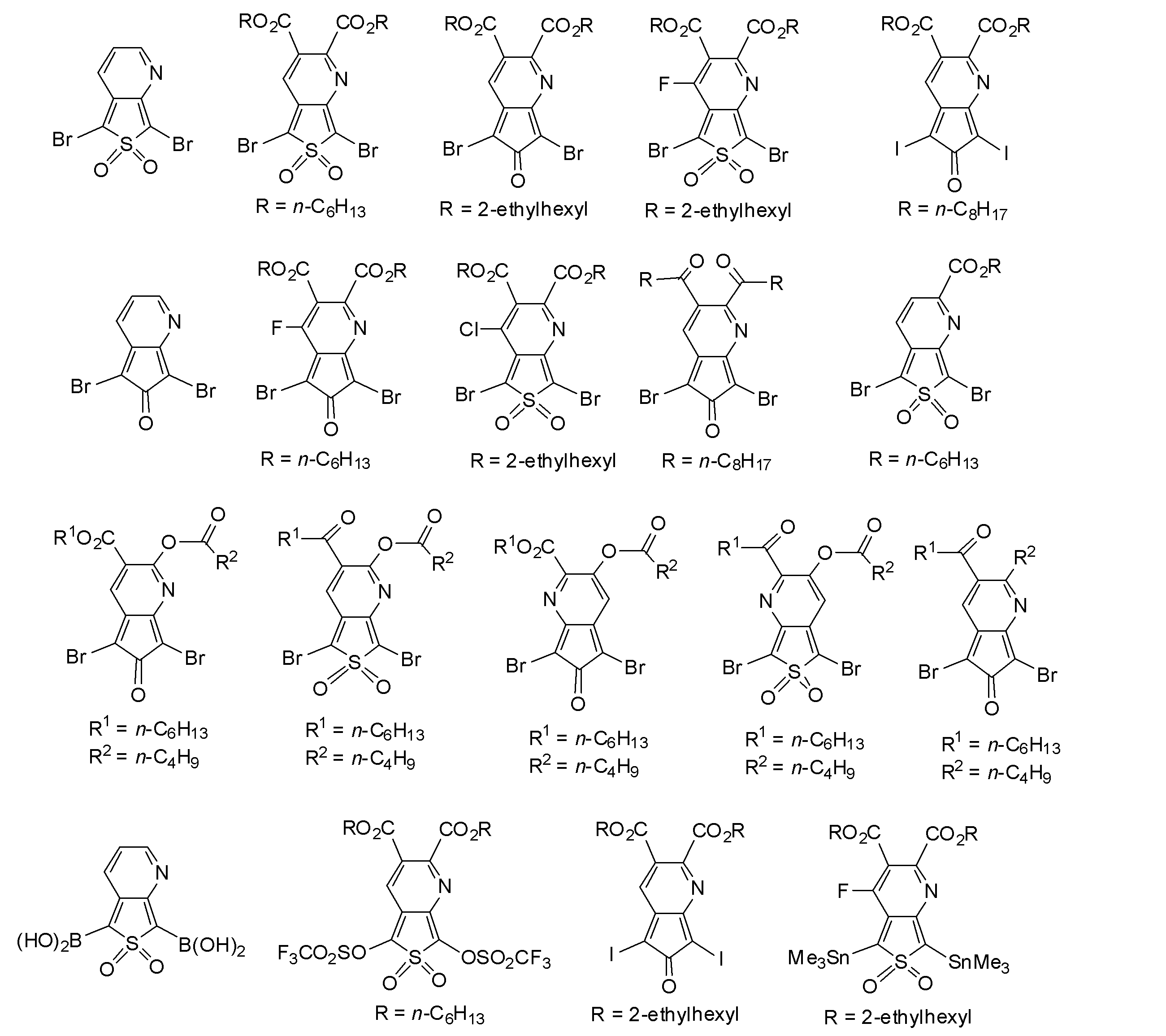
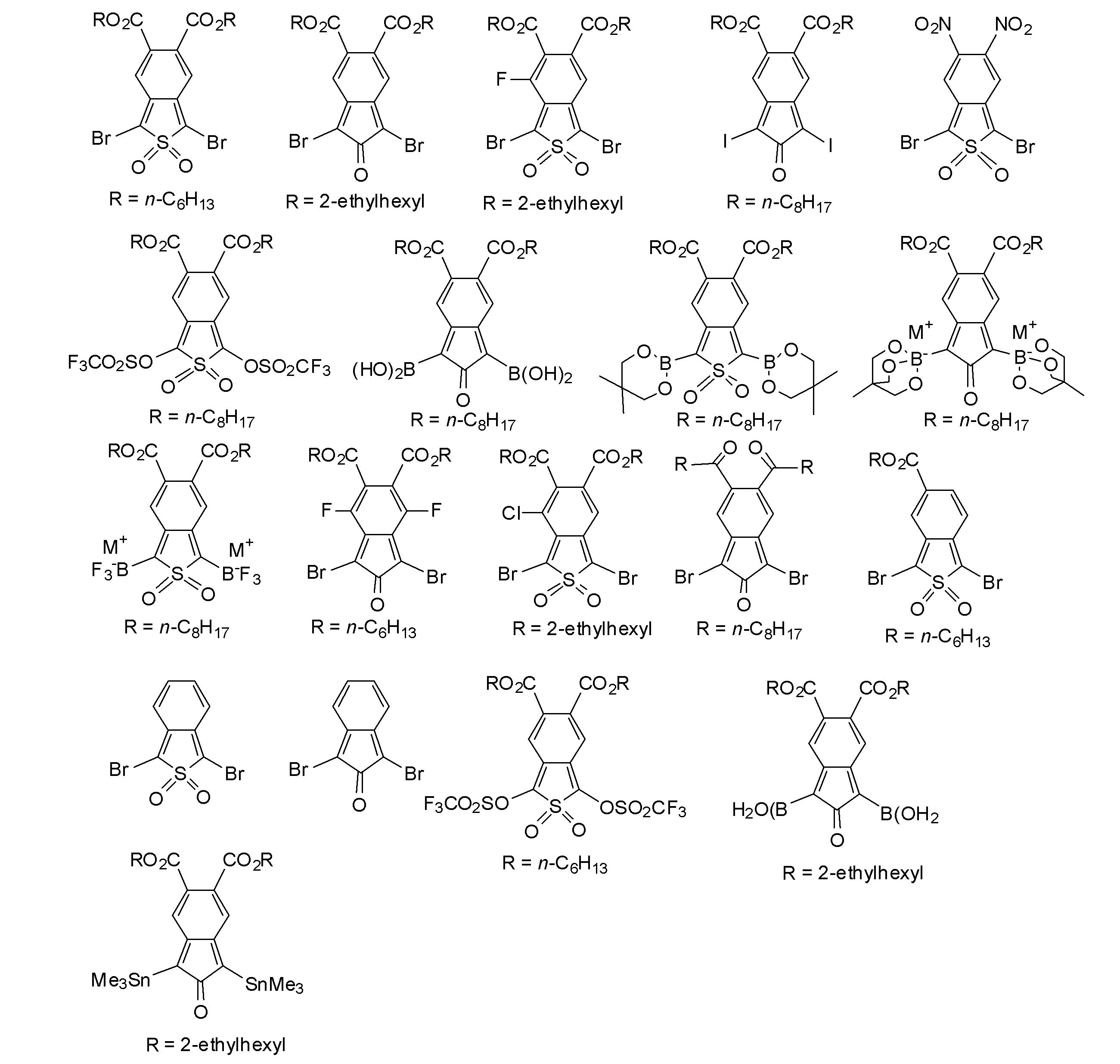
本発明の前記特定構成単位を形成するポリマーとしては下記の例が挙げられる。
ここで、Meは-CH3を表す。
ここで、Meは-CH3を表す。

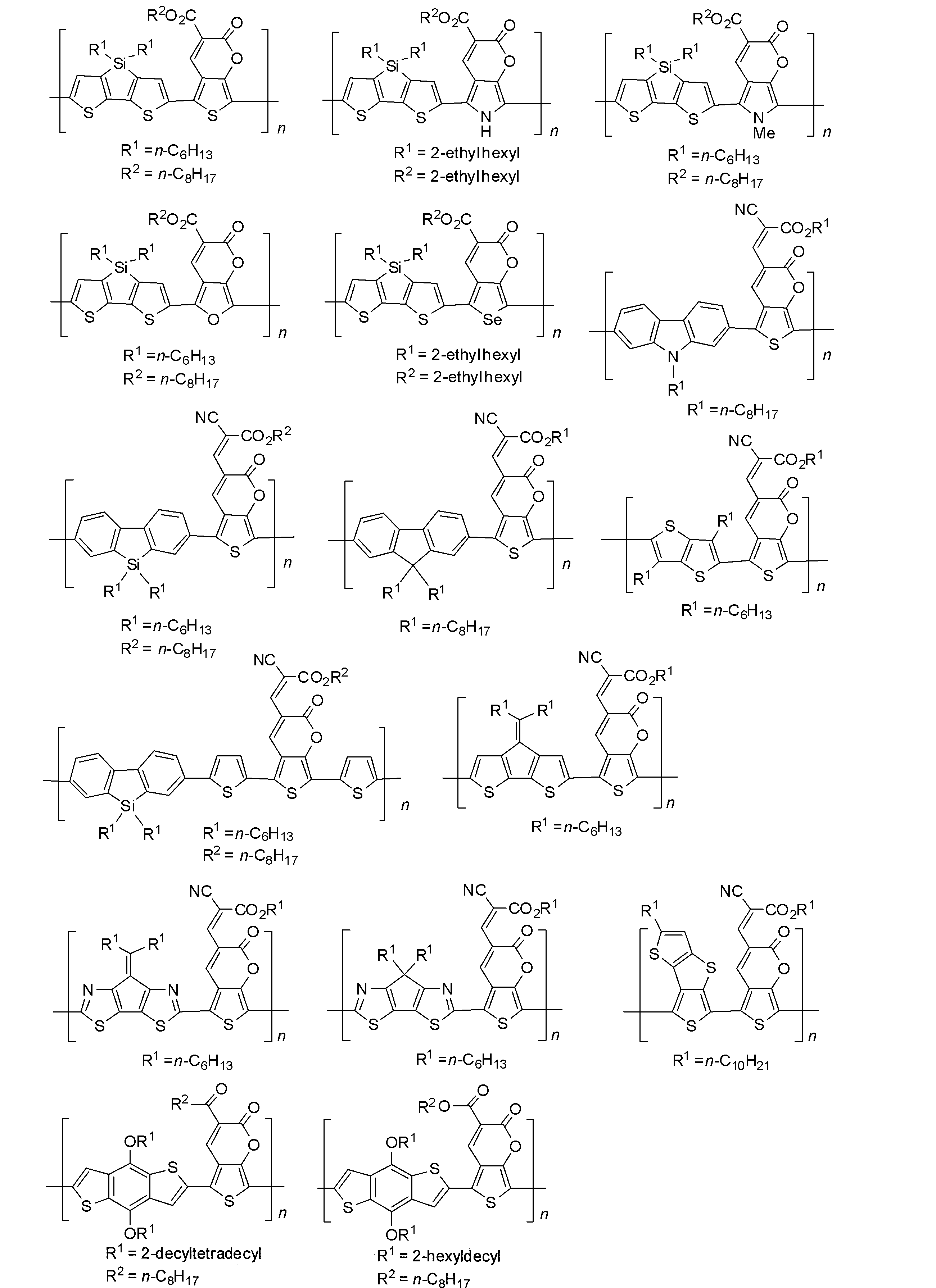
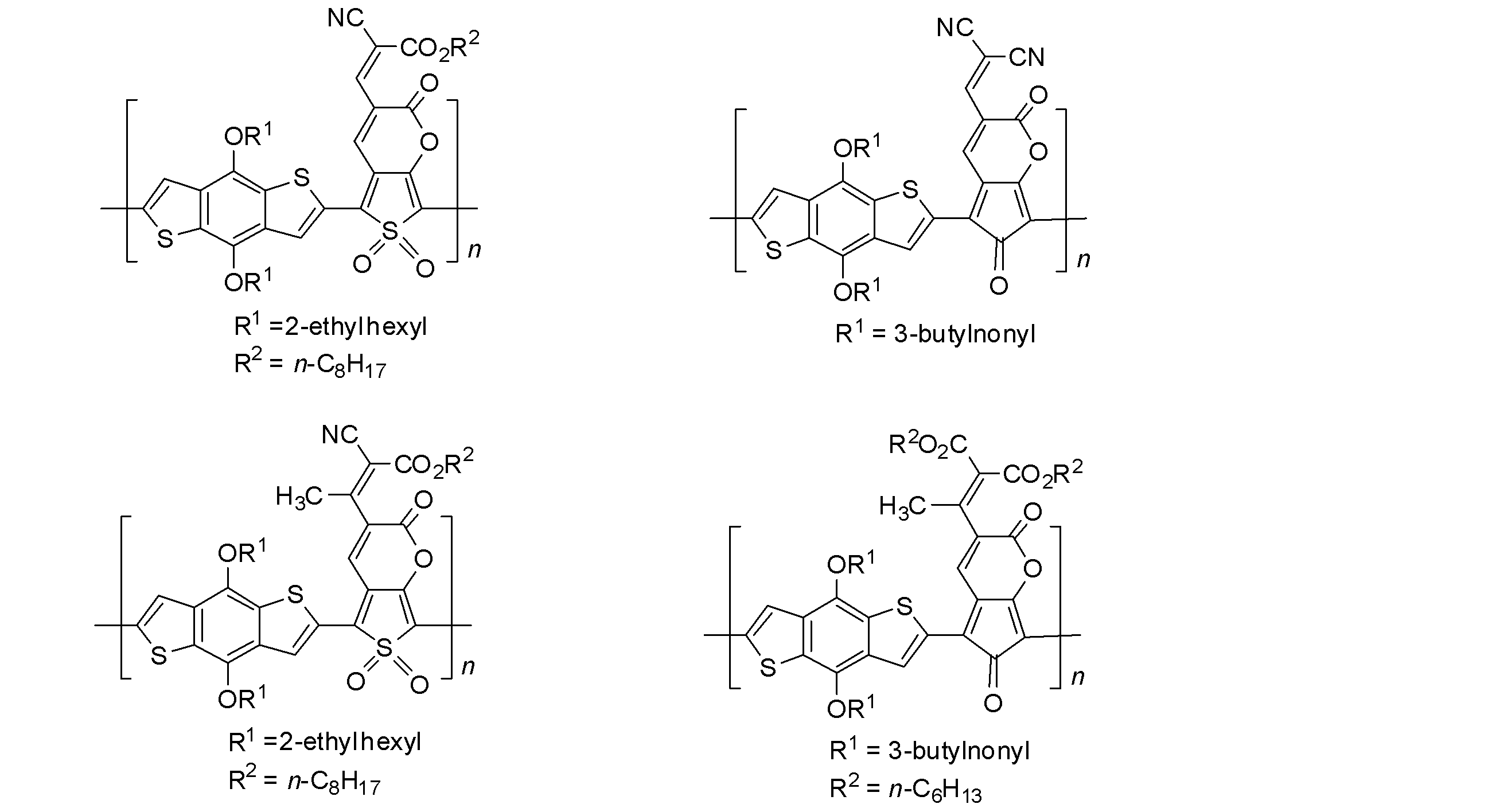

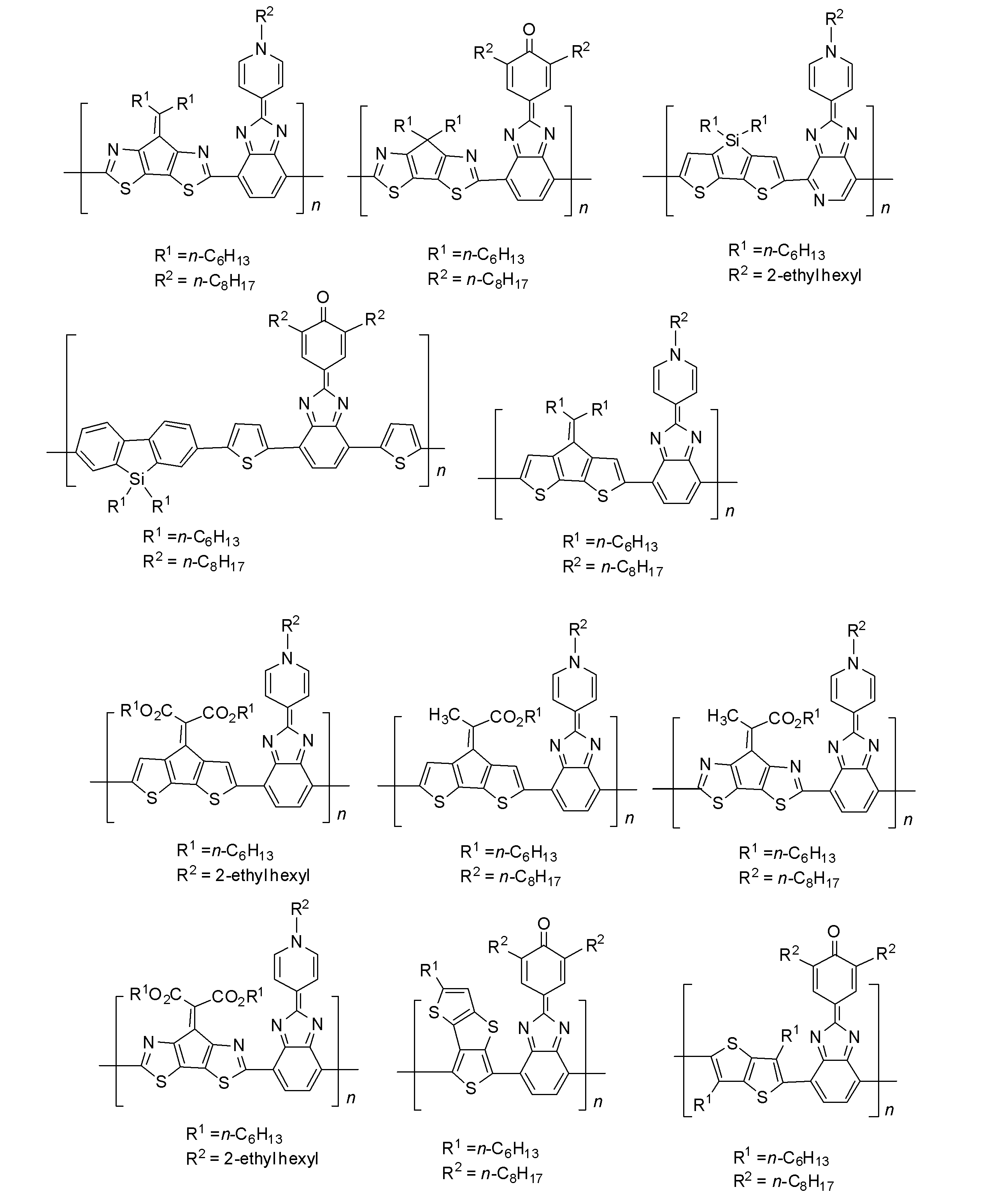

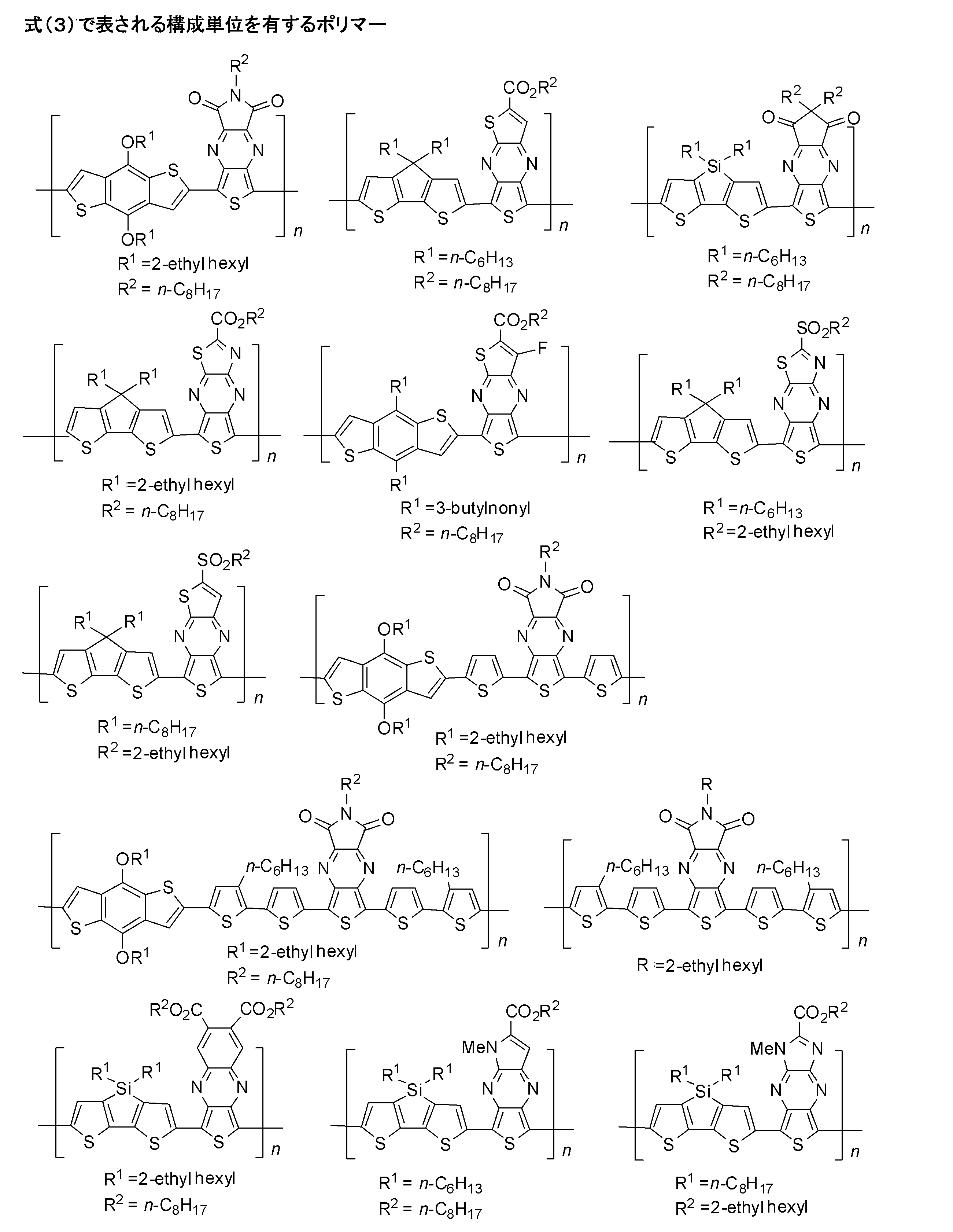
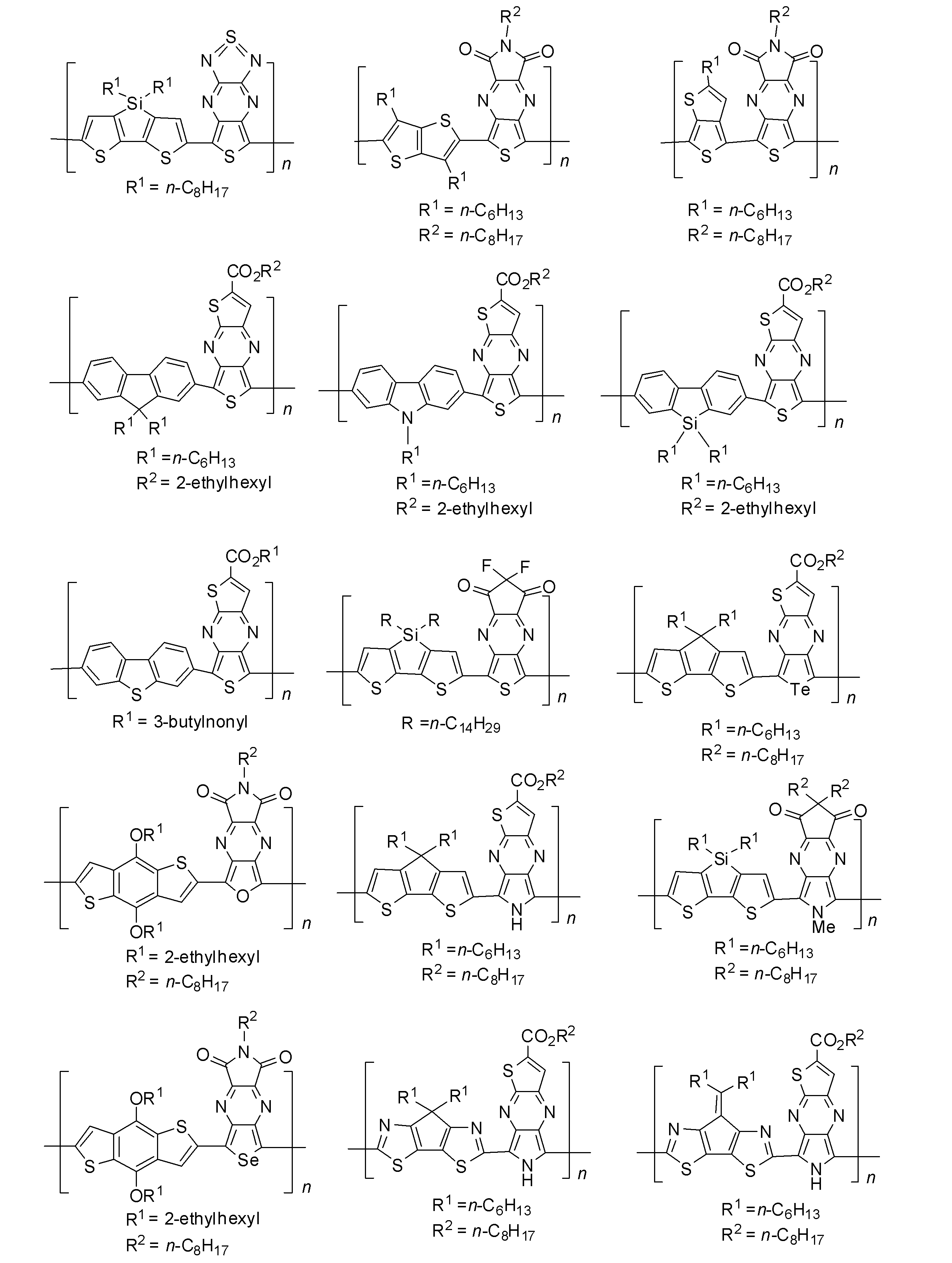


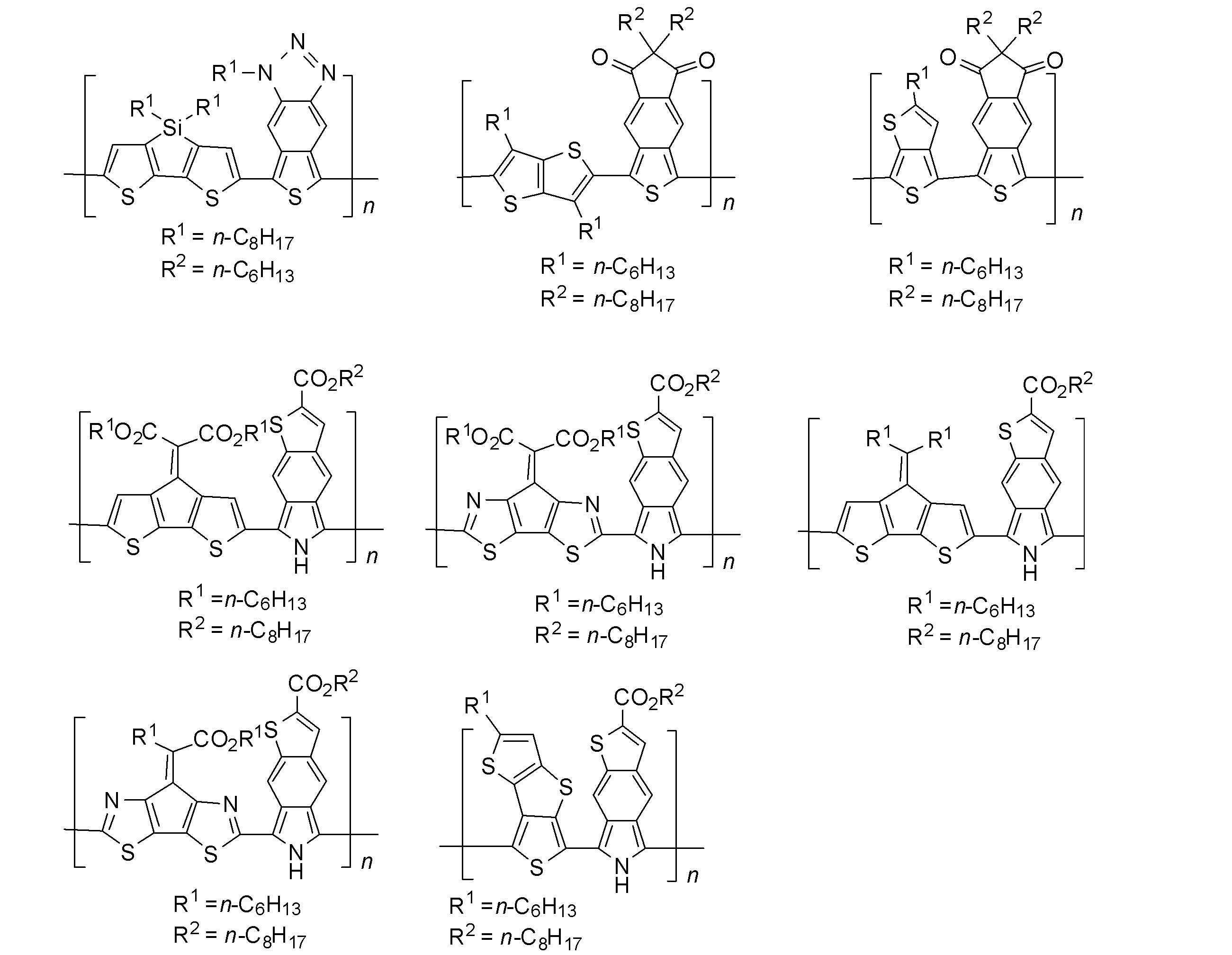


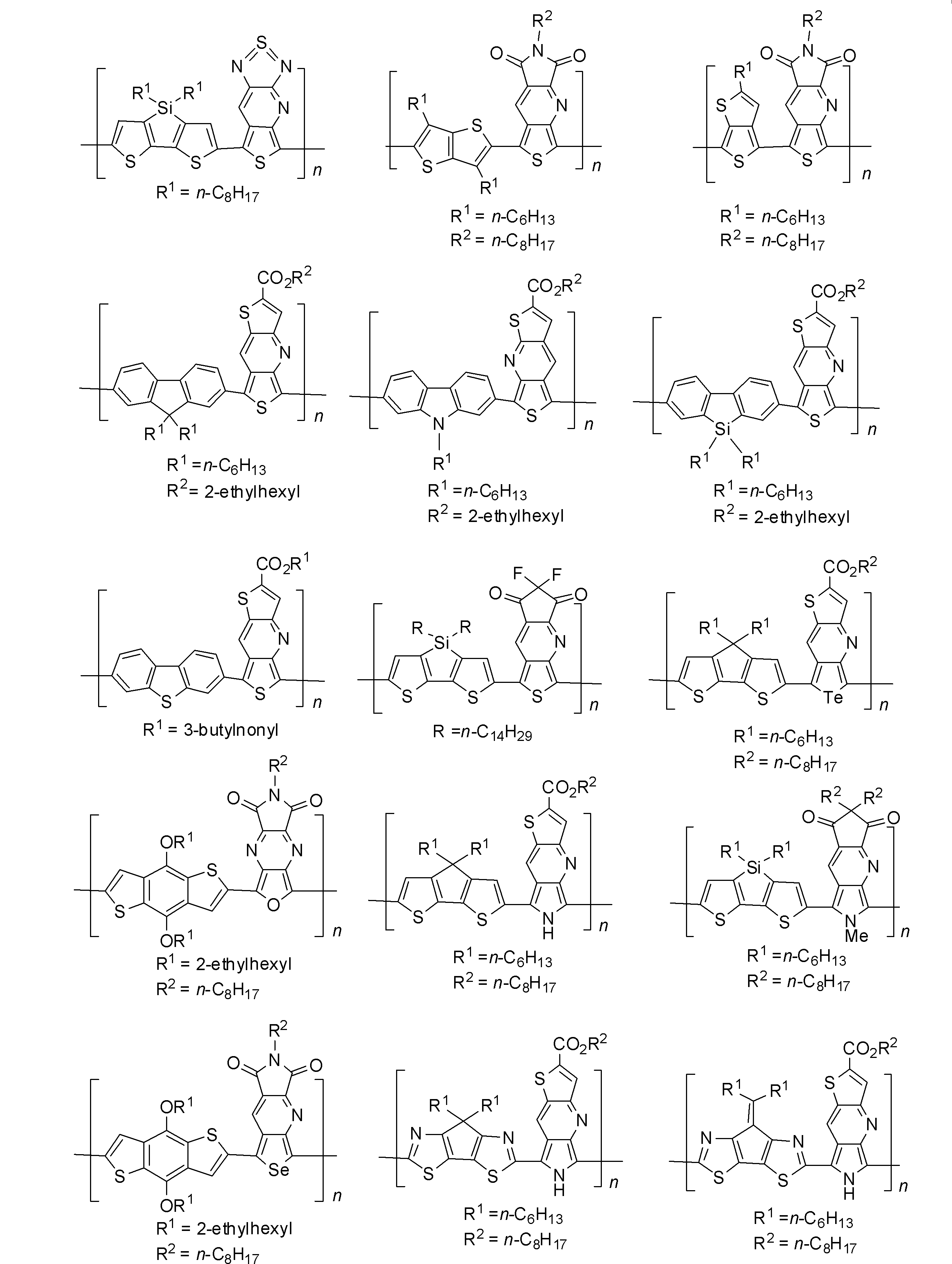

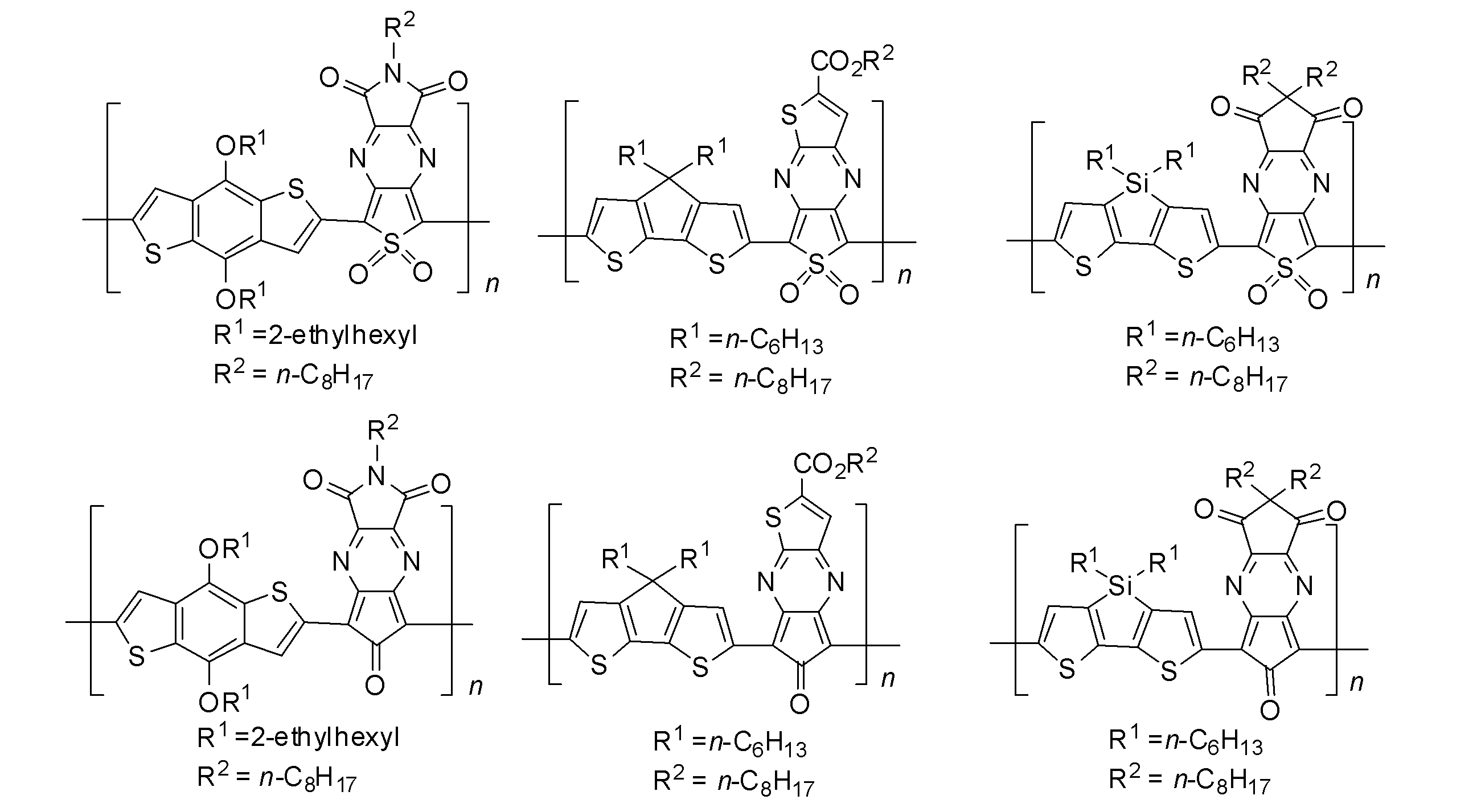
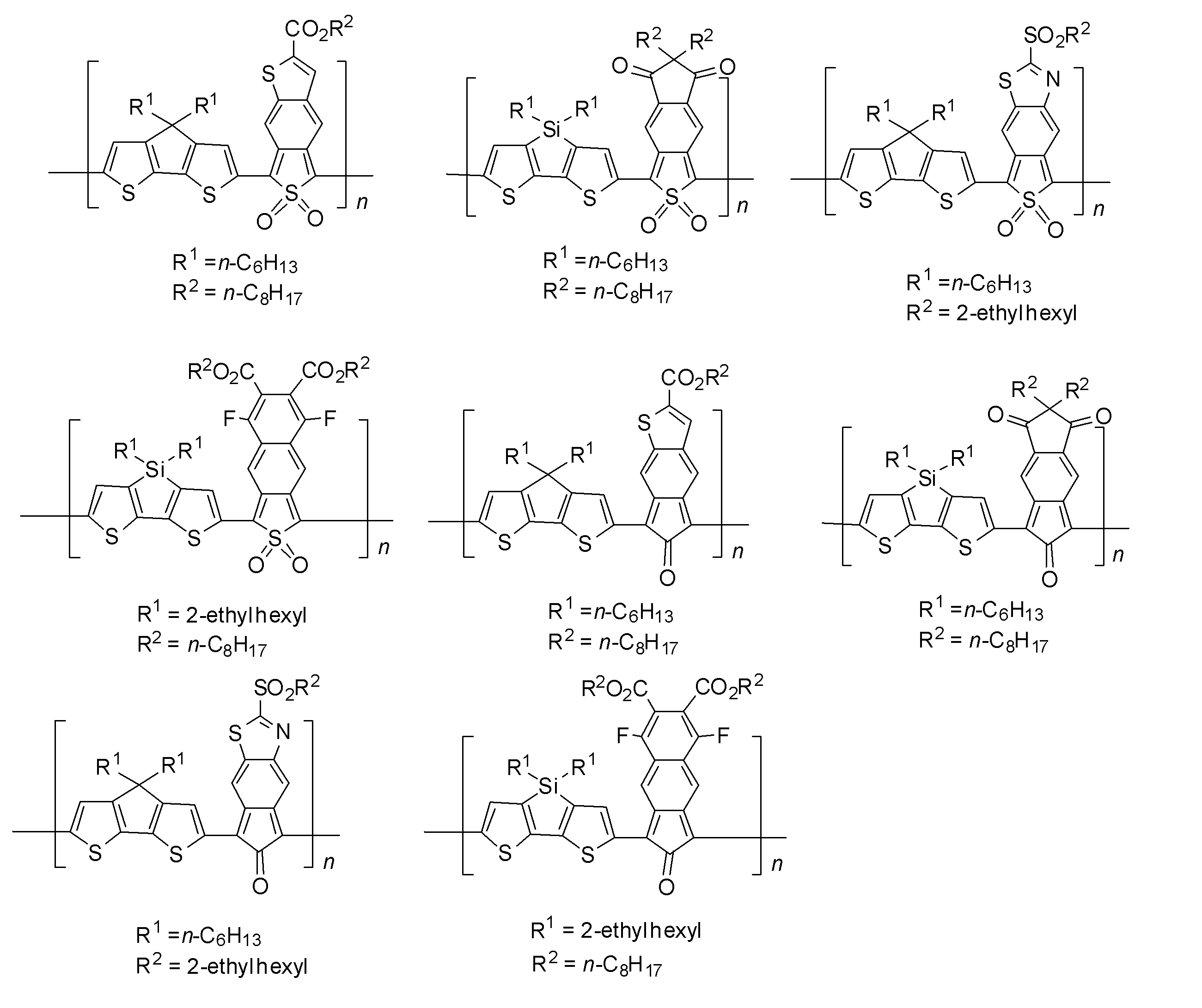
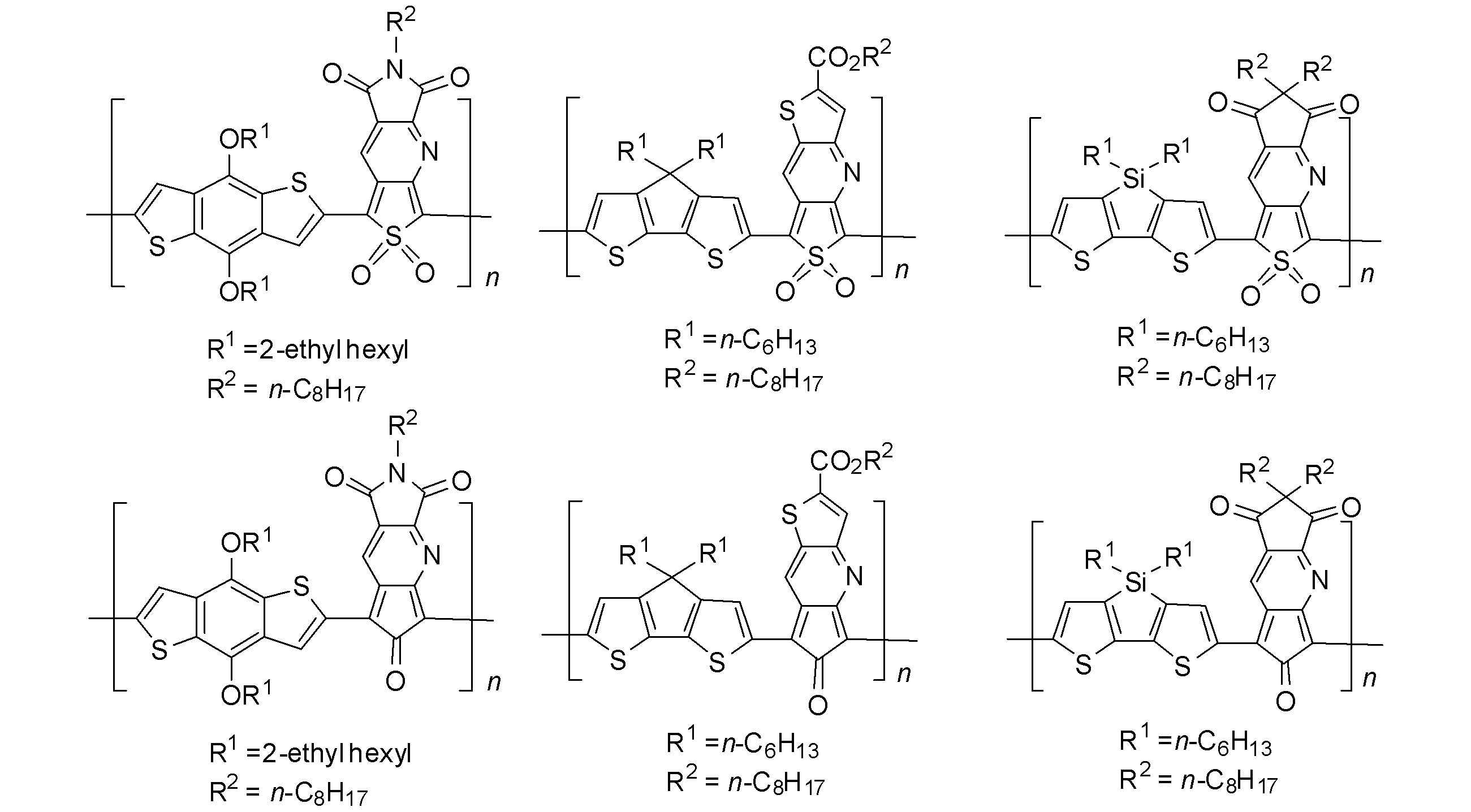

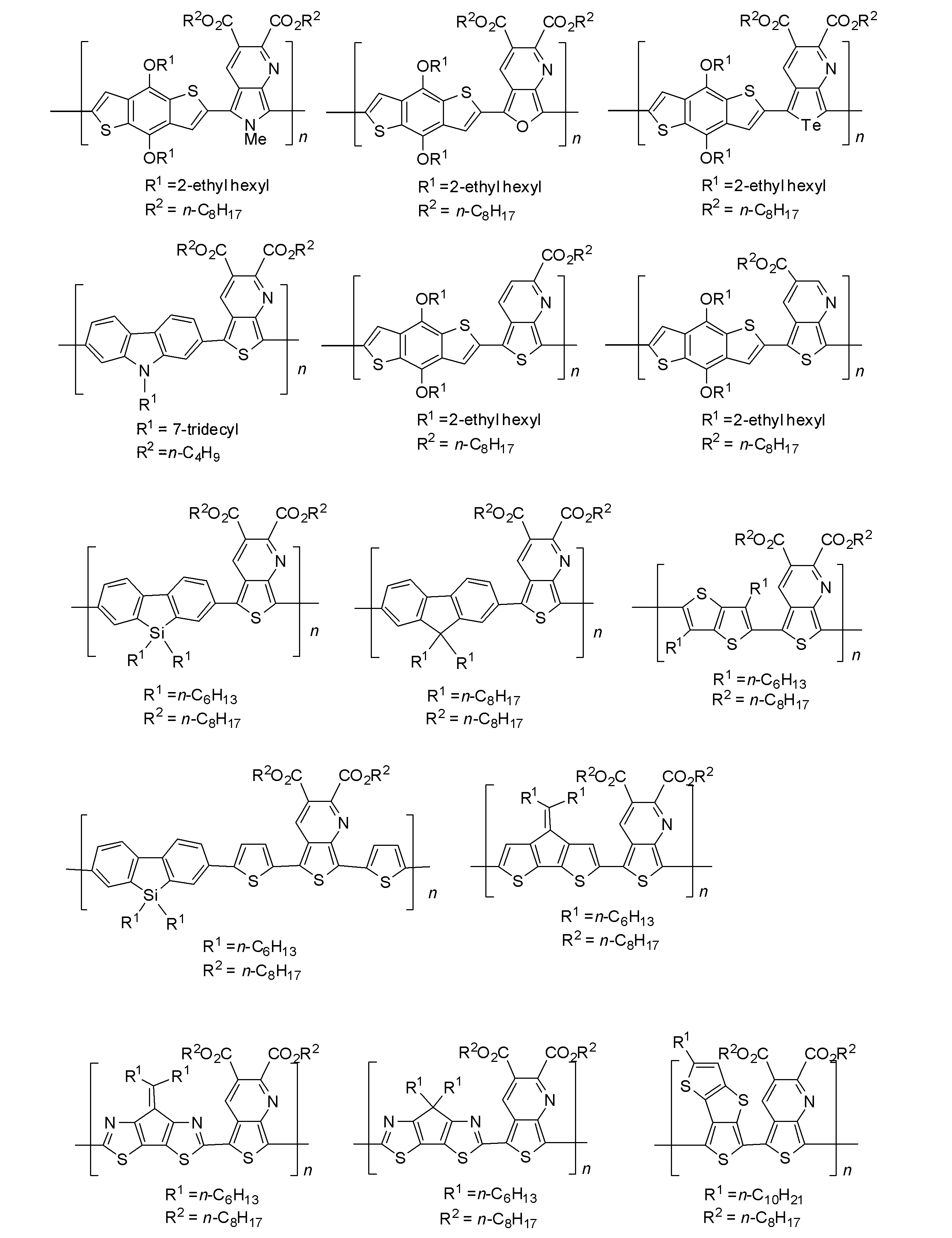
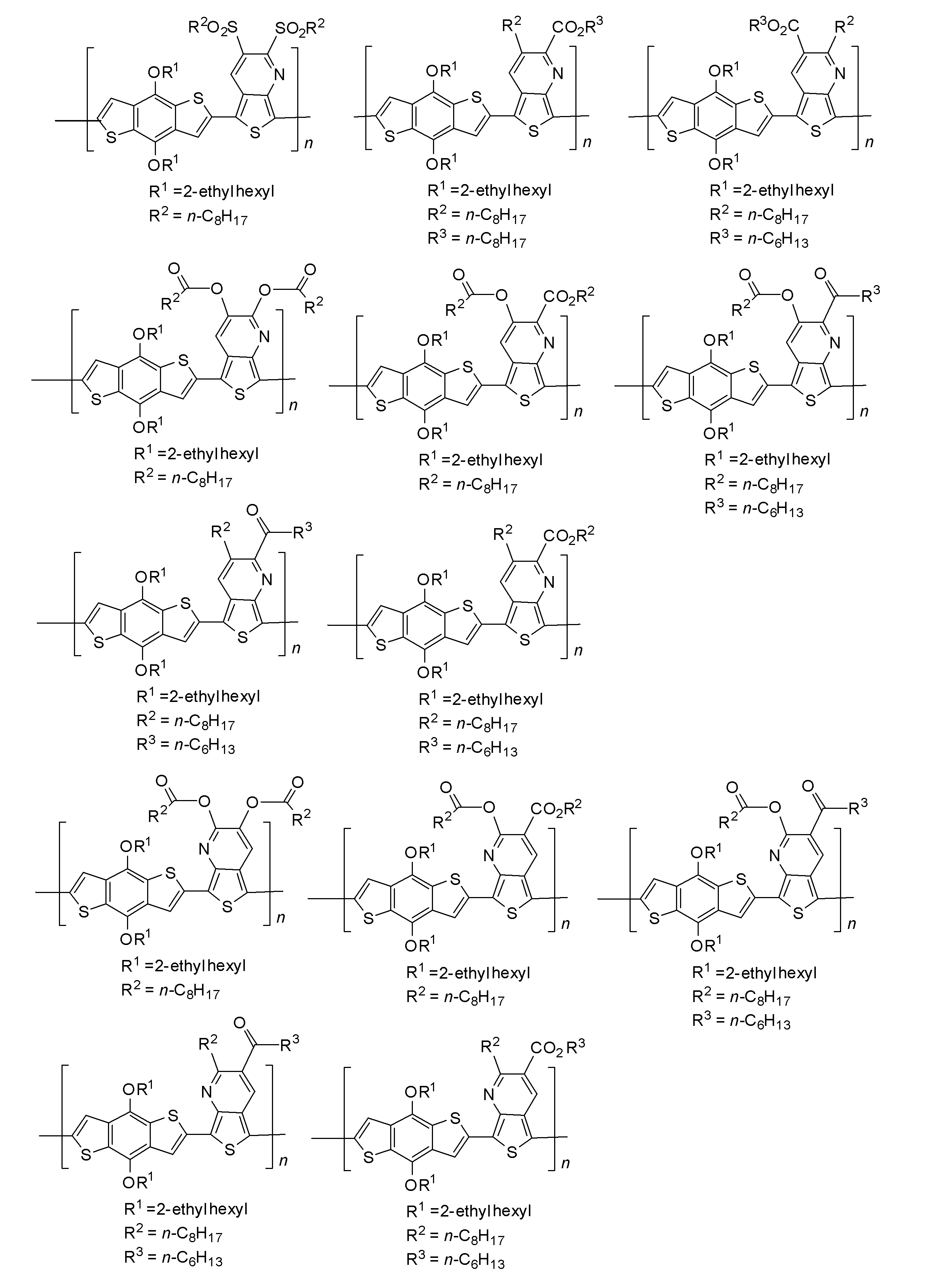

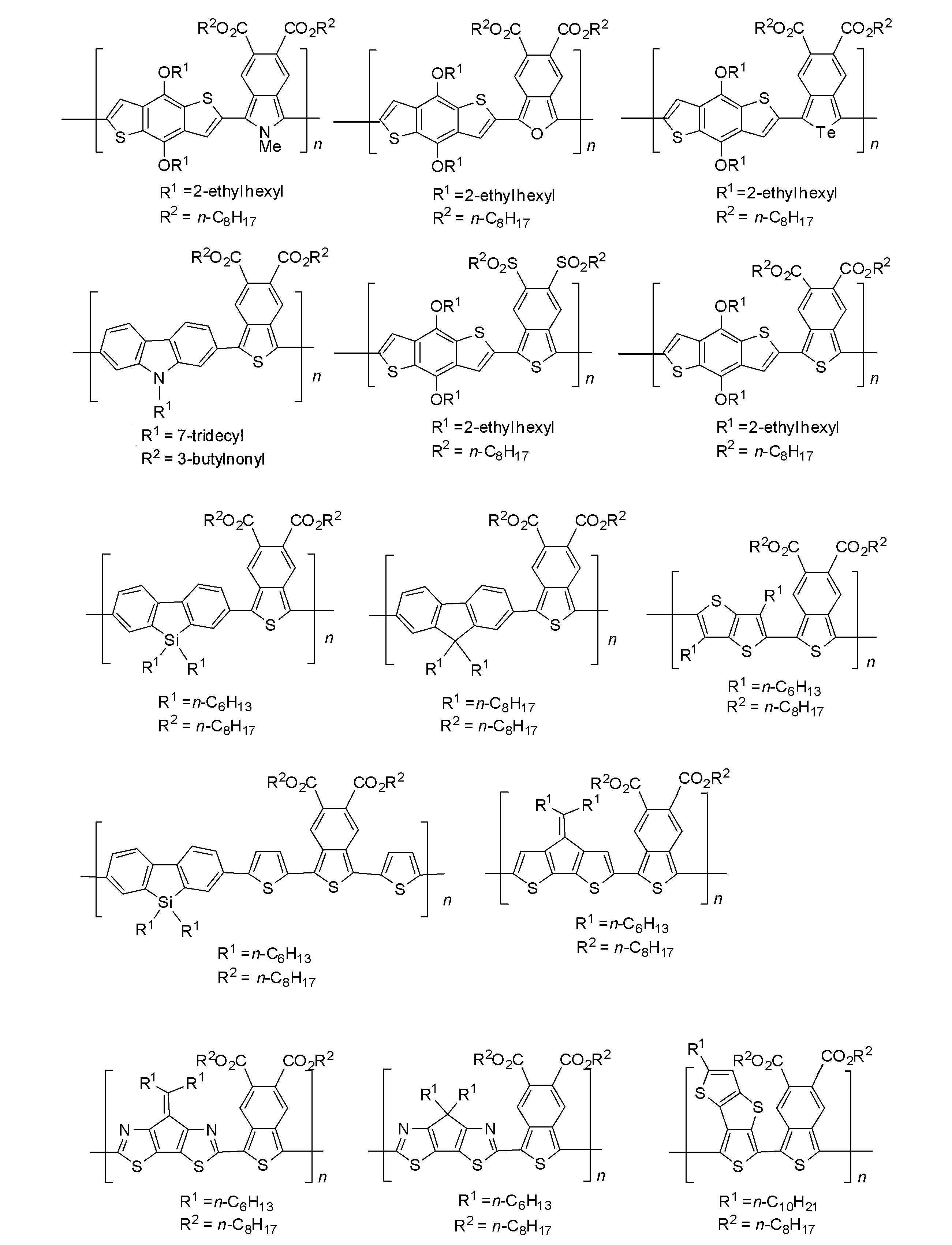
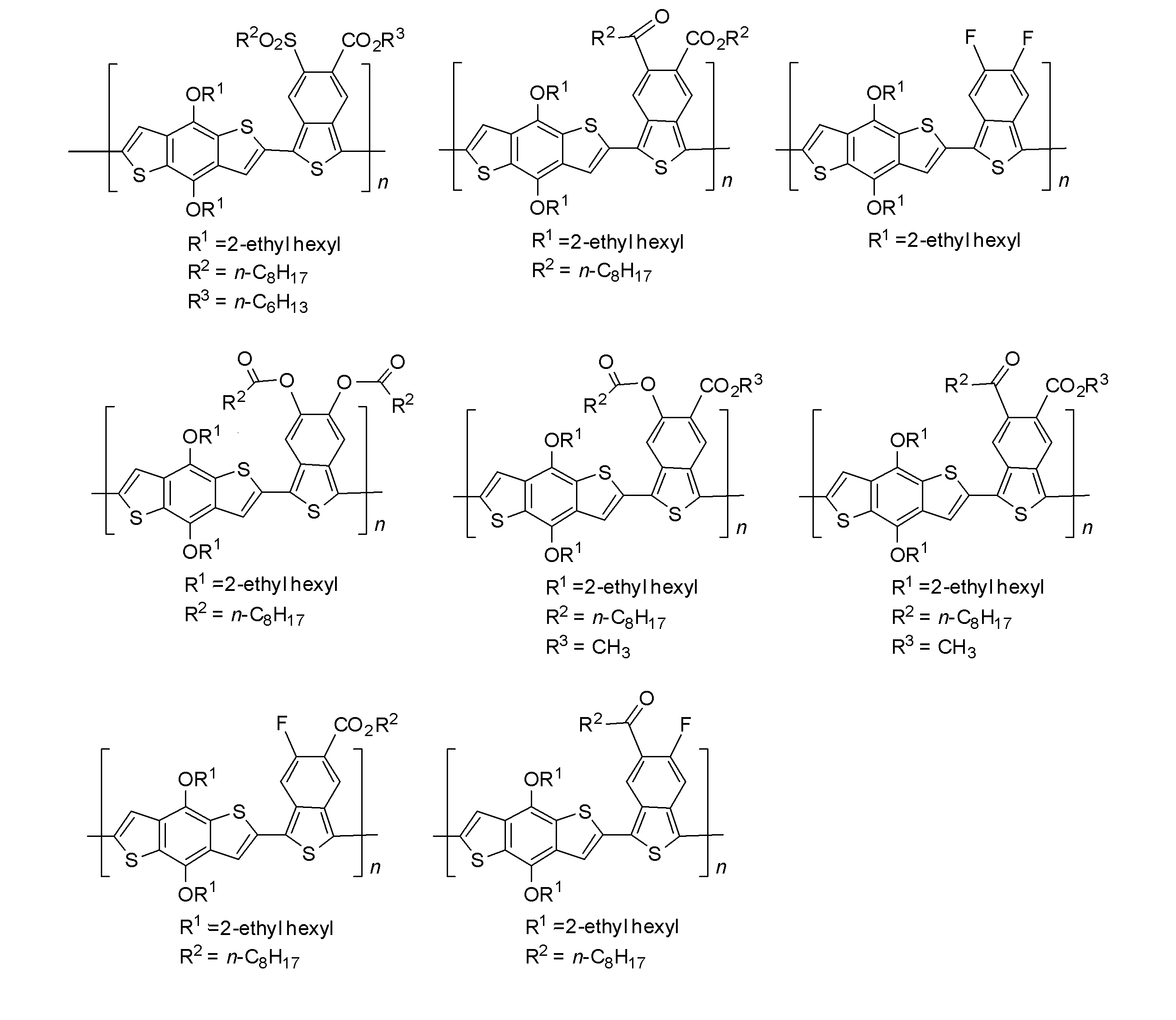

本発明のポリマーは、カップリング反応、例えばChemical Reviews,2002年,102巻,1358頁、Chemical Reviews,2011年,111巻,1493頁、Journal of Materals of Chemistry,2004年,14巻,11頁などに記載の方法を用いて合成することができる。すなわち、遷移金属触媒を使用した、亜鉛反応剤を用いる根岸カップリング、スズ反応剤を用いる右田-小杉-Stilleカップリング、ホウ素反応剤を用いる鈴木-宮浦カップリング、マグネシウム反応剤を用いる熊田-玉尾-Corriuカップリング、ケイ素反応剤を用いる檜山カップリングなどのクロスカップリングや、銅を使用したUllmann反応、ニッケルを使用した山本重合などを利用して合成することができる。遷移金属触媒としては、パラジウム、ニッケル、銅、コバルト、鉄(Journal of the American Chemical Society,2007年,129巻,9844頁)などの金属を使用することができる。また金属は配位子を有していても良く、PPh3、P(t-Bu)3などのリン配位子や、N-ヘテロサイクリックカルベン配位子(Angewandte Chemie International Edition,2002年,41巻,1290頁)などが好ましく用いられる。原料となるスズ反応剤やホウ素反応剤などの金属反応剤の合成方法は特に限定されず、種々の公知の方法にしたがって、合成することができる。例えばスズ反応剤はJournal of the American Chemistry,2009,131,7792頁、Journal of the American Chemistry,2008,130,16144頁、欧州特許出願公開第2407465号明細書などを、ホウ素反応剤はJournal of the American Chemistry,2012,134,539頁などを参考にして合成することができる。反応はMacromolecular Rapid Communications,2007年,28巻,387頁に記載されているようにマイクロウェーブの照射下で行ってもよい。
前記特定構成単位を有するポリマーの分子量は特に限定されないが、質量平均分子量(重量平均分子量)で5,000~50,0000が好ましく、10,000~500,000がより好ましい。
分子量および分散度は特に断らない限りGPC(ゲルろ過クロマトグラフィー)法を用いて測定した値あり、分子量はポリスチレン換算の質量平均分子量とする。GPC法に用いるカラムに充填されているゲルは芳香族化合物を繰り返し単位に持つゲルが好ましく、例えばスチレン-ジビニルベンゼン共重合体からなるゲルが挙げられる。カラムは2~6本連結させて用いることが好ましい。用いる溶媒は、テトラヒドロフラン等のエーテル系溶媒、N-メチルピロリドンのアミド系溶媒、クロロホルム等のハロゲン系溶媒、クロロベンゼン、1,2-ジクロロベンゼン等の芳香族系溶媒が挙げられる。測定は、溶媒の流速が0.1~2mL/minの範囲で行うことが好ましく、0.5~1.5mL/minの範囲で行うことが最も好ましい。この範囲内で測定を行うことで、装置に負荷がかからず、さらに効率的に測定ができる。測定温度は10~50℃で行うことが好ましく、20~40℃で行うことが最も好ましい。使用可能温度が高いカラムおよび高沸点の溶媒を用いて50℃~200℃で測定を行うこともできる。なお、使用するカラムおよびキャリアは測定対象となる高分子化合物の物性に応じて適宜選定することができる
本発明において特定構成単位を含むポリマーが共重合体であるとき、その共重合比は特に限定されないが、特定構成単位がモル比で全体の10~90モル%が好ましく、40~60モル%が好ましい。本発明において、コポリマーはランダム共重合体、交互共重合体、ブロック共重合体、周期的共重合体のいずれであってもよいが、交互共重合体または周期的共重合体であることが好ましく、交互共重合体であることがより好ましい。
本明細書において、置換・無置換を明記していない置換基(連結基を含む)については、その基に任意の置換基を有していてもよい意味である。これは置換・無置換を明記していない化合物やポリマーについても同義である。好ましい置換基としては、下記置換基Tが挙げられる。
置換基Tとしては、下記のものが挙げられる。
アルキル基(好ましくは炭素数1~24のアルキル基、例えばメチル、エチル、イソプロピル、n-ブチル、t-ブチル、sec-ブチル、n-ペンチル、n-ヘキシル、n-ヘプチル、n-オクチル、2-メチルヘプチル、2-エチルヘキシル、n-ノニル、n-デシル、3,7-ジメチルオクチル、イソデシル、n-ウンデシル、n-ドデシル、2-ブチルオクチル、n-トリデシル、3-ブチルノニル、n-テトラデシル、n-ペンタデシル、n-ヘキサデシル、2-ヘキシルデシル、n-ヘプタデシル、n-オクタデシル、n-ノナデシル、2-オクチルドデシル、n-イコシル、n-ヘンエイコシル、n-ドコシル、n-トリコシル、n-テトラコシル、2-デシルテトラデシル等)、アルケニル基(好ましくは炭素数2~24のアルケニル基、例えば、ビニル、アリル、オレイル等)、アルキニル基(好ましくは炭素数2~24のアルキニル基、例えば、エチニル、ブタジイニル、フェニルエチニル等)、シクロアルキル基(好ましくは炭素数3~20のシクロアルキル基、例えば、シクロプロピル、シクロペンチル、シクロヘキシル、4-メチルシクロヘキシル等)、アリール基(好ましくは炭素数6~26のアリール基、例えば、フェニル、1-ナフチル、4-メトキシフェニル、2-クロロフェニル、3-メチルフェニル等)、
アルキル基(好ましくは炭素数1~24のアルキル基、例えばメチル、エチル、イソプロピル、n-ブチル、t-ブチル、sec-ブチル、n-ペンチル、n-ヘキシル、n-ヘプチル、n-オクチル、2-メチルヘプチル、2-エチルヘキシル、n-ノニル、n-デシル、3,7-ジメチルオクチル、イソデシル、n-ウンデシル、n-ドデシル、2-ブチルオクチル、n-トリデシル、3-ブチルノニル、n-テトラデシル、n-ペンタデシル、n-ヘキサデシル、2-ヘキシルデシル、n-ヘプタデシル、n-オクタデシル、n-ノナデシル、2-オクチルドデシル、n-イコシル、n-ヘンエイコシル、n-ドコシル、n-トリコシル、n-テトラコシル、2-デシルテトラデシル等)、アルケニル基(好ましくは炭素数2~24のアルケニル基、例えば、ビニル、アリル、オレイル等)、アルキニル基(好ましくは炭素数2~24のアルキニル基、例えば、エチニル、ブタジイニル、フェニルエチニル等)、シクロアルキル基(好ましくは炭素数3~20のシクロアルキル基、例えば、シクロプロピル、シクロペンチル、シクロヘキシル、4-メチルシクロヘキシル等)、アリール基(好ましくは炭素数6~26のアリール基、例えば、フェニル、1-ナフチル、4-メトキシフェニル、2-クロロフェニル、3-メチルフェニル等)、
ヘテロ環基(好ましくは炭素数2~20のヘテロ環基、好ましくは、少なくとも1つの酸素原子、硫黄原子、窒素原子を有する5または6員環のヘテロ環基が好ましく、例えば、ピリジル、ピラジル、ピリダジル、ピリミジル、トリアジル、テトラジル、ピロリル、フリル、チエニル、イミダゾリル、ピラゾリル、トリアゾリル、ベンゾイミダゾリル、チアゾリル、チアジアゾリル、イソチアゾリル、オキサゾリル、イソオキサゾリル、オキサジアゾリル、セレノフェニル等)、アルコキシ基(好ましくは炭素数1~24のアルコキシ基、例えば、メトキシ、エトキシ、イソプロピルオキシ、ベンジルオキシ、ヘキシルオキシ、2-エチルヘキシルオキシ、オクチルオキシ、3,7-ジメチルオクチルオキシ、2-ブチルオクチルオキシ、2-ヘキシルデシルオキシ、2-デシルテトラデシルオキシ等)、アリールオキシ基(好ましくは炭素数6~26のアリールオキシ基、例えば、フェノキシ、1-ナフチルオキシ、3-メチルフェノキシ、4-メトキシフェノキシ等)、アルコキシカルボニル基(好ましくは炭素数2~24のアルコキシカルボニル基、例えば、エトキシカルボニル、2-エチルヘキシルオキシカルボニル、ヘキシルオキシカルボニル、2-エチルヘキシルオキシカルボニル、オクチルオキシカルボニル、3,7-ジメチルオクチルオキシカルボニル、2-ブチルオクチルオキシカルボニル、2-ヘキシルデシルオキシカルボニル、2-デシルテトラデシルオキシカルボニル等)、アミノ基(好ましくは炭素数0~20のアミノ基、アルキルアミノ基、アリールアミノ基を含み、例えば、アミノ、N,N-ジメチルアミノ、N,N-ジエチルアミノ、N-エチルアミノ、アニリノ等)、スルファモイル基(好ましくは炭素数0~20のスルホンアミド基、例えば、N,N-ジメチルスルファモイル、N-フェニルスルファモイル等)、
アシル基(好ましくは炭素数1~24のアシル基、例えば、アセチル、プロピオニル、ブチリル、ベンゾイル、ヘキサノイル、2-エチルヘキサノイル、オクタノイル、3,7-ジメチルオクタノイル、2-ブチルオクタノイル、2-ヘキシルデカノイル、2-デシルテトラデカノイル等)、アシルオキシ基(好ましくは炭素数1~24のアシルオキシ基、例えば、アセチルオキシ、ベンゾイルオキシ、ヘキサノイルオキシ、2-エチルヘキサノイルオキシ、オクタノイルオキシ、3,7-ジメチルオクタノイルオキシ、2-ブチルオクタノイルオキシ、2-ヘキシルデカノイルオキシ、2-デシルテトラデカノイルオキシ等)、カルバモイル基(好ましくは炭素数1~24のカルバモイル基、例えば、N,N-ジメチルカルバモイル、N-フェニルカルバモイル等)、アシルアミノ基(好ましくは炭素数1~24のアシルアミノ基、例えば、アセチルアミノ、ベンゾイルアミノ等)、スルホンアミド基((好ましくは炭素数0~24のスルファモイル基、例えば、メタンスルホンアミド、ベンゼンスルホンアミド、N-メチルメタンスルスルホンアミド、N-エチルベンゼンスルホンアミド等)、アルキルチオ基(好ましくは炭素数1~24のアルキルチオ基、例えば、メチルチオ、エチルチオ、イソプロピルチオ、ベンジルチオ等)、アリールチオ基(好ましくは炭素数6~26のアリールチオ基、例えば、フェニルチオ、1-ナフチルチオ、3-メチルフェニルチオ、4-メトキシフェニルチオ等)、アルキルもしくはアリールスルホニル基(好ましくは炭素数1~24のアルキルもしくはアリールスルホニル基、例えば、メタンスルホニル、エタンスルホニル、ベンゼンスルホニル等)、アルキルもしくはアリールスルホニルオキシ基(好ましくは炭素数1~24のアルキルもしくはアリールスルホニルオキシ基、例えば、メタンスルホニルオキシ、エタンスルホニルオキシ、ベンゼンスルホニルオキシ等)アルコキシもしくはアリールオキシスルホニル基(好ましくは炭素数1~24のアルコキシもしくはアリールオキシスルホニル基、例えば、メトキシスルホニル、エトキシスルホニル、フェノキシスルホニル等)、ヒドロキシル基、シアノ基、ニトロ基、カルボキシル基、チオール基、ホルミル基、ハロゲン原子(例えばフッ素原子、塩素原子、臭素原子、ヨウ素原子等)である。
また、これらの置換基Tで挙げた各基は、上記の置換基Tがさらに置換していてもよい。
また、これらの置換基Tで挙げた各基は、上記の置換基Tがさらに置換していてもよい。
化合物または置換基・連結基等がアルキル基・アルキレン基、アルケニル基・アルケニレン基等を含むとき、これらは環状でも鎖状でもよく、また直鎖でも分岐していてもよく、上記のように置換されていても無置換でもよい。またアリール基、ヘテロ環基等を含むとき、それらは単環でも縮環でもよく、同様に置換されていても無置換でもよい。
<有機半導体ポリマー>
本発明の前記特定構成単位を有するポリマーは、有機半導体ポリマーとして有用である。有機半導体ポリマーとは、半導体としての性質を示すことが可能な有機化合物のポリマーであり、本発明のポリマーは、とりわけp型有機半導体ポリマーとして有用である。なお、ポリマーを含むp型有機半導体化合物は、一般的に最高被占軌道(HOMO)準位が4.5~6.0eVのπ電子共役系化合物である。
有機半導体ポリマーは有機エレクトロニクス分野で使用される、電気を流すと発光する有機エレクトロルミネッセンス素子、光照射で発電する有機光電変換素子、電流量や電圧量を制御する有機薄膜トランジスタ素子、電気化学センサー、プリンタブル回路等で利用される。本発明においては、光電池、特に有機薄膜太陽電池で使用するのが好ましい。
本発明の前記特定構成単位を有するポリマーは、有機半導体ポリマーとして有用である。有機半導体ポリマーとは、半導体としての性質を示すことが可能な有機化合物のポリマーであり、本発明のポリマーは、とりわけp型有機半導体ポリマーとして有用である。なお、ポリマーを含むp型有機半導体化合物は、一般的に最高被占軌道(HOMO)準位が4.5~6.0eVのπ電子共役系化合物である。
有機半導体ポリマーは有機エレクトロニクス分野で使用される、電気を流すと発光する有機エレクトロルミネッセンス素子、光照射で発電する有機光電変換素子、電流量や電圧量を制御する有機薄膜トランジスタ素子、電気化学センサー、プリンタブル回路等で利用される。本発明においては、光電池、特に有機薄膜太陽電池で使用するのが好ましい。
<有機半導体材料用組成物>
本発明の有機半導体材料用組成物に関して説明する。
本発明の前記特定構成単位を有するポリマー(特定ポリマー)は、p型有機半導体ポリマーとして有用であり、有機半導体材料用組成物は、この特定ポリマーを有機溶媒中に含有することが好ましい。当該組成物は、さらにn型半導体化合物を含有することが好ましく、特にn型有機半導体化合物を含有することが好ましい。また、必要によっては、特定構成単位を有するポリマー以外のp型有機半導体化合物、半導体以外の化合物(例えば、その他のp型半導体化合物として、ポリ-3-ヘキシルチオフェン(P3HT)や、ポリ[2-メトキシ-5-(2-エチルヘキシロキシ)-1,4-フェニレンビニレン(MEH-PPV)、ポリ[2-メトキシ-5-(3’,7’-ジメチルオクチルオキシ)-1,4-フェニレンビニレン](MDMO-PPV)、ポリ[(9,9-ジ-n-オクチルフルオレニル-2,7-ジイル)-alt-(ベンゾ[2,1,3]チアジアゾール-4,8-ジイル)](F8BT)等が例示され、半導体以外の化合物としては、後述するポリエステル系樹脂やメタクリル樹脂等の他のポリマー)を含有してもよい。
本発明の有機半導体材料用組成物に関して説明する。
本発明の前記特定構成単位を有するポリマー(特定ポリマー)は、p型有機半導体ポリマーとして有用であり、有機半導体材料用組成物は、この特定ポリマーを有機溶媒中に含有することが好ましい。当該組成物は、さらにn型半導体化合物を含有することが好ましく、特にn型有機半導体化合物を含有することが好ましい。また、必要によっては、特定構成単位を有するポリマー以外のp型有機半導体化合物、半導体以外の化合物(例えば、その他のp型半導体化合物として、ポリ-3-ヘキシルチオフェン(P3HT)や、ポリ[2-メトキシ-5-(2-エチルヘキシロキシ)-1,4-フェニレンビニレン(MEH-PPV)、ポリ[2-メトキシ-5-(3’,7’-ジメチルオクチルオキシ)-1,4-フェニレンビニレン](MDMO-PPV)、ポリ[(9,9-ジ-n-オクチルフルオレニル-2,7-ジイル)-alt-(ベンゾ[2,1,3]チアジアゾール-4,8-ジイル)](F8BT)等が例示され、半導体以外の化合物としては、後述するポリエステル系樹脂やメタクリル樹脂等の他のポリマー)を含有してもよい。
前記組成物に適用される有機溶媒は特に限定されないが、テトラヒドロフラン、1,4-ジオキサン、シクロペンチルメチルエーテルなどのエーテル系溶媒、ベンゼン、トルエン、エチルベンゼン、キシレン、メシチレン、アニソール、チオアニソール、ピリジン、ピコリン、ルチジンなどの芳香族溶媒、クロロホルム、ジクロロメタン、1,2-ジクロロエタン、1,1,2,2-テトラクロロエタンなどのハロゲン溶媒、クロロベンゼン、o-ジクロロベンゼン、1,3,5-トリクロロベンゼン、ブロモベンゼン、ヨードベンゼン、トリフルオロメチルベンゼン、フルオロベンゼン、ジフルオロベンゼン、チオアニソール、1-クロロナフタレンなどの芳香族ハロゲン溶媒などが挙げられ、テトラヒドロフラン、トルエン、クロロホルム、ジクロロメタン、クロロベンゼン、o-ジクロロベンゼン、1,3,5-トリクロロベンゼンなどが好ましい。
これらの溶媒は単独で用いても、2種以上の混合溶媒として用いてもよい。また、後述のp型半導体相とn型半導体相の相分離構造制御のために、上記溶媒に0.1質量%~10質量%の添加剤を加えてもよい。添加剤としては、ジヨードアルカン(例えば、1,8-ジヨードオクタン、1,6-ジヨードヘキサン、1,10-ジヨードデカンなどが挙げられる)、アルカンジチオール(例えば、1,8-オクタンジチオール、1,6-ヘキサンジチオール、1,10-デカンジチオールなどが挙げられる)、1-クロロナフタレンなどが挙げられる。
特定構成単位を有するポリマーの含有量は特に限定されないが、組成物全量の質量を100としたとき、特定構成単位を有するポリマーを0.01~90質量%含有させることが好ましく、0.1~70質量%含有させることがより好ましい。
n型有機半導体化合物については、組成物全量の質量を100としたとき、0.01~90質量%含有させることが好ましく、0.1~70質量%含有させることがより好ましい。特定構成単位を有するポリマー以外の任意のp型有機半導体化合物については、0~50質量%含有させることが好ましく、0~30質量%含有させることがより好ましい。半導体以外の化合物については、その成分にもよるが、0~50質量%程度含有させてもよい。
なお、本発明において組成物とは、2以上の成分が特定の組成で実質的に均一に存在していることを言う。ここで実質的に均一とは発明の作用効果を奏する範囲で各成分が偏在していていもよいことを意味する。また、組成物とは上記の定義を満たす限り形態は特に限定されず、流動性の液体やペーストに限定されず、複数の成分からなる固体や粉末等も含む意味である。さらに、沈降物があるような場合でも、攪拌により所定時間分散状態を保つようなものも組成物に含む意味である。
<有機薄膜太陽電池の部材>
(n型有機半導体化合物)
n型有機半導体化合物としては、特に限定されないが、一般的に、その最低空軌道(LUMO)準位が3.5~4.5eVであるようなπ電子共役系化合物であり、例えば、フラーレンもしくはその誘導体、オクタアザポルフィリン等、p型有機半導体化合物の水素原子をフッ素原子に置換したパーフルオロ体(例えば、パーフルオロペンタセンやパーフルオロフタロシアニン)、ナフタレンテトラカルボン酸無水物、ナフタレンテトラカルボン酸ジイミド、ペリレンテトラカルボン酸無水物、ペリレンテトラカルボン酸ジイミド等の芳香族カルボン酸無水物やそのイミド化物を骨格として含む高分子化合物等を挙げることができる。
(n型有機半導体化合物)
n型有機半導体化合物としては、特に限定されないが、一般的に、その最低空軌道(LUMO)準位が3.5~4.5eVであるようなπ電子共役系化合物であり、例えば、フラーレンもしくはその誘導体、オクタアザポルフィリン等、p型有機半導体化合物の水素原子をフッ素原子に置換したパーフルオロ体(例えば、パーフルオロペンタセンやパーフルオロフタロシアニン)、ナフタレンテトラカルボン酸無水物、ナフタレンテトラカルボン酸ジイミド、ペリレンテトラカルボン酸無水物、ペリレンテトラカルボン酸ジイミド等の芳香族カルボン酸無水物やそのイミド化物を骨格として含む高分子化合物等を挙げることができる。
これらのn型有機半導体化合物のうち、本発明の特定構成単位を有する有機半導体ポリマー(p型有機半導体化合物)と高速かつ効率的に電荷分離ができるためフラーレンもしくはその誘導体が好ましい。
フラーレンやその誘導体としては、C60フラーレン、C70フラーレン、C76フラーレン、C78フラーレン、C84フラーレン、C240フラーレン、C540フラーレン、ミックスドフラーレン、フラーレンナノチューブ、およびこれらの一部が水素原子、ハロゲン原子、置換または無置換のアルキル基、アルケニル基、アルキニル基、アリール基、ヘテロアリール基、シクロアルキル基、シリル基、エーテル基、チオエーテル基、アミノ基、シリル基等によって置換されたフラーレン誘導体を挙げることができる。
フラーレンやその誘導体としては、C60フラーレン、C70フラーレン、C76フラーレン、C78フラーレン、C84フラーレン、C240フラーレン、C540フラーレン、ミックスドフラーレン、フラーレンナノチューブ、およびこれらの一部が水素原子、ハロゲン原子、置換または無置換のアルキル基、アルケニル基、アルキニル基、アリール基、ヘテロアリール基、シクロアルキル基、シリル基、エーテル基、チオエーテル基、アミノ基、シリル基等によって置換されたフラーレン誘導体を挙げることができる。
フラーレン誘導体としては、フェニル-C61-酪酸エステル、ジフェニル-C62-ビス(酪酸エステル)、フェニル-C71-酪酸エステル、フェニル-C85-酪酸エステルまたはチエニル-C61-酪酸エステルが好ましく、上記の酪酸エステルのアルコール部分の好ましい炭素数は1~30、より好ましくは1~8、さらに好ましくは1~4、最も好ましくは1である。
好ましいフラーレン誘導体を例示すると、フェニル-C61-酪酸メチルエステル([60]PCBM)、フェニル-C61-酪酸n-ブチルエステル([60]PCBnB)、フェニル-C61-酪酸イソブチルエステル([60]PCBiB)、フェニル-C61-酪酸n-ヘキシルエステル([60]PCBH)、フェニル-C61-酪酸n-オクチルエステル([60]PCBO)、ジフェニル-C62-ビス(酪酸メチルエステル)(ビス[60]PCBM)、フェニル-C71-酪酸メチルエステル([70]PCBM)、フェニル-C85-酪酸メチルエステル([84]PCBM)、チエニル-C61-酪酸メチルエステル([60]ThCBM)、C60ピロリジントリス酸、C60ピロリジントリス酸エチルエステル、N-メチルフラロピロリジン(MP-C60)、(1,2-メタノフラーレンC60)-61-カルボン酸、(1,2-メタノフラーレンC60)-61-カルボン酸t-ブチルエステル、特開2008-130889号公報等のメタロセン化フラーレン、米国特許第7,329,709号明細書等の環状エーテル基を有するフラーレンが挙げられる。
(p型有機半導体化合物)
本発明の有機半導体材料用組成物には、本発明の前記特定構成単位を有するポリマーとともに、他のp型半導体化合物(例えば、縮合多環芳香族低分子化合物、オリゴマーまたはポリマー)を含有してもよい。
本発明の有機半導体材料用組成物には、本発明の前記特定構成単位を有するポリマーとともに、他のp型半導体化合物(例えば、縮合多環芳香族低分子化合物、オリゴマーまたはポリマー)を含有してもよい。
p型半導体化合物である縮合多環芳香族低分子化合物としては、例えば、アントラセン、テトラセン、ペンタセン、ヘキサセン、ヘプタセン、クリセン、ピセン、フルミネン、ピレン、ペロピレン、ペリレン、テリレン、クオテリレン、コロネン、オバレン、サーカムアントラセン、ビスアンテン、ゼスレン、ヘプタゼスレン、ピランスレン、ビオランテン、イソビオランテン、サーコビフェニル、アントラジチオフェン等の化合物、ポルフィリンや銅フタロシアニン、テトラチアフルバレン(TTF)-テトラシアノキノジメタン(TCNQ)錯体、ビスエチレンテトラチアフルバレン(BEDTTTF)-過塩素酸錯体、及びこれらの誘導体や前駆体が挙げられる。
(光電変換層)
本発明において有機半導体材料用組成物は、光電変換層(特にバルクへテロ層)の塗工用組成物として好ましく使用される。電子供与材料であるp型有機半導体化合物と電子受容材料であるn型半導体化合物の混合比は光電変換効率が高くなるように調整されることが好ましいが、通常は、質量比で、10:90~90:10、好ましくは20:80~80:20の範囲から選ばれる。このような混合層の形成方法は、例えば、共蒸着法が用いられる。あるいは、両方の有機材料に共通する溶媒を用いて溶剤塗布することによって作製することも可能である。正孔と電子が電荷分離する界面の面積を増大させ、高い光電変換効率を有するためには、塗布法が好ましい。
本発明において有機半導体材料用組成物は、光電変換層(特にバルクへテロ層)の塗工用組成物として好ましく使用される。電子供与材料であるp型有機半導体化合物と電子受容材料であるn型半導体化合物の混合比は光電変換効率が高くなるように調整されることが好ましいが、通常は、質量比で、10:90~90:10、好ましくは20:80~80:20の範囲から選ばれる。このような混合層の形成方法は、例えば、共蒸着法が用いられる。あるいは、両方の有機材料に共通する溶媒を用いて溶剤塗布することによって作製することも可能である。正孔と電子が電荷分離する界面の面積を増大させ、高い光電変換効率を有するためには、塗布法が好ましい。
ここで、光電変換層における電子供与領域(ドナー)と電子受容領域(アクセプター)の相分離促進、光電変換層に含まれる有機材料の結晶化、電子輸送層の透明化などを目的として、種々の方法で加熱処理(アニール)してもよい。蒸着等の乾式製膜法の場合は、例えば、製膜中の基板温度を50℃~150℃に加熱する方法がある。印刷や塗布等の湿式製膜法の場合は、塗布後の乾燥温度を50℃~250℃とする方法などがある。また、後の工程、例えば、金属負極の形成が終了した後に50℃~250℃に加熱してもよい。相分離が促進されることで、キャリア移動度が向上し、高い光電変換効率を得ることができることがある。
(電極)
本発明に関わる光電変換素子においては、少なくとも第一の電極と第二の電極を有する。第一の電極と第二の電極は、いずれか一方が正極で、残りが負極となる。また、タンデム構成をとる場合には中間電極を用いることでタンデム構成を達成することができる。なお、本発明においては主に正孔(ホール)が流れる電極を正極と称し、主に電子が流れる電極を負極と称す。また透光性があるかどうかといった機能面から、透光性のある電極を透明電極と称し、透光性のない電極を対電極または金属電極と称す。通常、正極は透光性のある透明電極であり、負極は透光性のない対電極または金属電極であるが、第一の電極と第二の電極の両方を透明電極とすることもできる。
本発明に関わる光電変換素子においては、少なくとも第一の電極と第二の電極を有する。第一の電極と第二の電極は、いずれか一方が正極で、残りが負極となる。また、タンデム構成をとる場合には中間電極を用いることでタンデム構成を達成することができる。なお、本発明においては主に正孔(ホール)が流れる電極を正極と称し、主に電子が流れる電極を負極と称す。また透光性があるかどうかといった機能面から、透光性のある電極を透明電極と称し、透光性のない電極を対電極または金属電極と称す。通常、正極は透光性のある透明電極であり、負極は透光性のない対電極または金属電極であるが、第一の電極と第二の電極の両方を透明電極とすることもできる。
(第一の電極)
第一の電極は、正極である。順構成の太陽電池の場合、好ましくは可視光から近赤外光(380~800nm)の光を透過する透明電極である。材料としては、例えば、酸化インジウム錫(ITO)、酸化インジウム亜鉛(IZO)、酸化インジウムタングステン(IWO)、酸化錫、酸化亜鉛、酸化インジウム等の透明導電性金属酸化物、マグネシウム、アルミニウム、カルシウム、チタン、クロム、マンガン、鉄、銅、亜鉛、ストロンチウム、銀、インジウム、錫、バリウム、ビスマス等の金属および金属合金の超薄膜、金属ナノワイヤー、カーボンナノチューブ等を用いることができる。銀等の金属をメッシュ状にして、光の透過性を確保したメッシュ電極を用いることもできる。またポリピロール、ポリアニリン、ポリチオフェン、ポリチエニレンビニレン、ポリアズレン、ポリイソチアナフテン、ポリカルバゾール、ポリアセチレン、ポリフェニレン、ポリフェニレンビニレン、ポリアセン、ポリフェニルアセチレン、ポリジアセチレン及びポリナフタレンの各誘導体からなる群より選ばれる導電性ポリマー等も用いることができる。また、これらの導電性化合物を複数組み合わせて正極とすることもできる。順構成で透明電極とする場合は、正極の透過率は、太陽電池に使用する厚さ(例えば、0.2μmの厚さ)で、波長380nm~800nm領域における平均光透過率が75%以上であることが好ましく85%以上であることがより好ましい。なお、逆構成で光透過性が要求されない場合は、クロム、コバルト、ニッケル、銅、モリブデン、パラジウム、銀、タンタル、タングステン、白金、金などの金属やこれらの合金、透明導電性酸化物、ポリアニリン、ポリチオフェン、ポリピロール等の導電性ポリマーなどによって正極を形成することができる。好適な導電性ポリマー層は、特開2012-43835号公報に詳細が開示されており、ポリチオフェン誘導体が好ましく、ポリエチレンジオキシチオフェン-ポリスチレンスルホン酸(PEDOT-PSS)がより好ましい。これらの金属、透明導電性酸化物、導電性ポリマーは、1種のみで使用しても、2種以上を混合または積層してもよい。
第一の電極は、正極である。順構成の太陽電池の場合、好ましくは可視光から近赤外光(380~800nm)の光を透過する透明電極である。材料としては、例えば、酸化インジウム錫(ITO)、酸化インジウム亜鉛(IZO)、酸化インジウムタングステン(IWO)、酸化錫、酸化亜鉛、酸化インジウム等の透明導電性金属酸化物、マグネシウム、アルミニウム、カルシウム、チタン、クロム、マンガン、鉄、銅、亜鉛、ストロンチウム、銀、インジウム、錫、バリウム、ビスマス等の金属および金属合金の超薄膜、金属ナノワイヤー、カーボンナノチューブ等を用いることができる。銀等の金属をメッシュ状にして、光の透過性を確保したメッシュ電極を用いることもできる。またポリピロール、ポリアニリン、ポリチオフェン、ポリチエニレンビニレン、ポリアズレン、ポリイソチアナフテン、ポリカルバゾール、ポリアセチレン、ポリフェニレン、ポリフェニレンビニレン、ポリアセン、ポリフェニルアセチレン、ポリジアセチレン及びポリナフタレンの各誘導体からなる群より選ばれる導電性ポリマー等も用いることができる。また、これらの導電性化合物を複数組み合わせて正極とすることもできる。順構成で透明電極とする場合は、正極の透過率は、太陽電池に使用する厚さ(例えば、0.2μmの厚さ)で、波長380nm~800nm領域における平均光透過率が75%以上であることが好ましく85%以上であることがより好ましい。なお、逆構成で光透過性が要求されない場合は、クロム、コバルト、ニッケル、銅、モリブデン、パラジウム、銀、タンタル、タングステン、白金、金などの金属やこれらの合金、透明導電性酸化物、ポリアニリン、ポリチオフェン、ポリピロール等の導電性ポリマーなどによって正極を形成することができる。好適な導電性ポリマー層は、特開2012-43835号公報に詳細が開示されており、ポリチオフェン誘導体が好ましく、ポリエチレンジオキシチオフェン-ポリスチレンスルホン酸(PEDOT-PSS)がより好ましい。これらの金属、透明導電性酸化物、導電性ポリマーは、1種のみで使用しても、2種以上を混合または積層してもよい。
(第二の電極)
本発明において第二の電極は負極である。負極は導電材単独層であってもよいが、導電性を有する材料に加えて、これらを保持する樹脂を併用してもよい。負極の導電材としては、仕事関数の小さい(4eV以下)金属、合金、電気伝導性化合物及びこれらの混合物を電極物質とするものが用いられる。このような電極物質の具体例としては、ナトリウム、ナトリウム-カリウム合金、マグネシウム、リチウム、マグネシウム/銅混合物、マグネシウム/銀混合物、マグネシウム/アルミニウム混合物、マグネシウム/インジウム混合物、アルミニウム/酸化アルミニウム(Al2O3)混合物、インジウム、リチウム/アルミニウム混合物、希土類金属等が挙げられる。これらの中で、電子の取り出し性能及び酸化等に対する耐久性の点から、これら金属とこれより仕事関数の値が大きく安定な金属である第二金属との混合物、例えば、マグネシウム/銀混合物、マグネシウム/アルミニウム混合物、マグネシウム/インジウム混合物、アルミニウム/酸化アルミニウム(Al2O3)混合物、リチウム/アルミニウム混合物、アルミニウム等が好適である。負極はこれらの電極物質を蒸着やスパッタリング等の方法により薄膜を形成させることにより、作製することができる。また、膜厚は通常10nm~5μm、好ましくは50~200nmの範囲で選ばれる。
本発明において第二の電極は負極である。負極は導電材単独層であってもよいが、導電性を有する材料に加えて、これらを保持する樹脂を併用してもよい。負極の導電材としては、仕事関数の小さい(4eV以下)金属、合金、電気伝導性化合物及びこれらの混合物を電極物質とするものが用いられる。このような電極物質の具体例としては、ナトリウム、ナトリウム-カリウム合金、マグネシウム、リチウム、マグネシウム/銅混合物、マグネシウム/銀混合物、マグネシウム/アルミニウム混合物、マグネシウム/インジウム混合物、アルミニウム/酸化アルミニウム(Al2O3)混合物、インジウム、リチウム/アルミニウム混合物、希土類金属等が挙げられる。これらの中で、電子の取り出し性能及び酸化等に対する耐久性の点から、これら金属とこれより仕事関数の値が大きく安定な金属である第二金属との混合物、例えば、マグネシウム/銀混合物、マグネシウム/アルミニウム混合物、マグネシウム/インジウム混合物、アルミニウム/酸化アルミニウム(Al2O3)混合物、リチウム/アルミニウム混合物、アルミニウム等が好適である。負極はこれらの電極物質を蒸着やスパッタリング等の方法により薄膜を形成させることにより、作製することができる。また、膜厚は通常10nm~5μm、好ましくは50~200nmの範囲で選ばれる。
逆構成の場合、第二の電極は透明電極である。好ましくは可視光から近赤外光(380~800nm)の光を透過する透明電極であり、例えば、金属、金属酸化物、導電性ポリマー、これらの混合物や積層構造などが挙げられる。具体例としては、酸化錫、酸化亜鉛、酸化インジウム、酸化インジウム錫(ITO)、酸化インジウム亜鉛(IZO)、酸化インジウムタングステン(IWO)等の透明導電性酸化物、マグネシウム、アルミニウム、カルシウム、チタン、クロム、マンガン、鉄、銅、亜鉛、ストロンチウム、銀、インジウム、錫、バリウム、ビスマス等の金属および金属合金の超薄膜、ポリアニリン、ポリチオフェン、ポリピロール等の導電性ポリマー等が挙げられる。透明導電性酸化物の材料として特に好ましいのは、ITO、IZO、酸化錫、アンチモンドープ酸化錫(ATO)、弗素ドープ酸化錫(FTO)、酸化亜鉛、アンチモンドープ酸化亜鉛(AZO)、ガリウムドープ酸化亜鉛(GZO)を用いることができる。逆構成で透明電極とする場合は、負極の透過率は、太陽電池に使用する厚さ(例えば、0.2μmの厚さ)で、波長380nm~800nm領域における平均光透過率が75%以上であることが好ましく85%以上であることがより好ましい。
順構成の負極導電材および逆構成の正極導電材として金属材料を用いれば金属電極に到達した光は反射されて光電変換層側に反射され、反射光が再度吸収されるため、より光電変換効率が向上し好ましい。また、金属電極は、金属(例えば金、銀、銅、白金、ロジウム、ルテニウム、アルミニウム、マグネシウム、インジウム等)、炭素からなるナノ粒子、ナノワイヤー、ナノ構造体であってもよく、ナノワイヤーの分散物であれば、透明で導電性の高い負極を塗布法により形成でき好ましい。
また、金属電極側を光透過性とする場合は、例えば、アルミニウム及びアルミニウム合金、銀及び銀化合物等の負極に適した導電性材料を薄く1~20nm程度の膜厚で作製した後、上記正極の説明で挙げた導電性光透過性材料の膜を設けることで、光透過性負極とすることができる。
また、金属電極側を光透過性とする場合は、例えば、アルミニウム及びアルミニウム合金、銀及び銀化合物等の負極に適した導電性材料を薄く1~20nm程度の膜厚で作製した後、上記正極の説明で挙げた導電性光透過性材料の膜を設けることで、光透過性負極とすることができる。
(ホール輸送層)
本発明においては、第一の電極と光電変換層の間にホール輸送層を設けるのが好ましい。ホール輸送層を形成する導電性ポリマーとしては、例えば、ポリチオフェン、ポリピロール、ポリアニリン、ポリフェニレンビニレン、ポリフェニレン、ポリアセチレン、ポリキノキサリン、ポリオキサジアゾール、ポリベンゾチアジアゾール等や、これら導電骨格を複数有するポリマー等が挙げられる。
これらのなかではポリチオフェンおよびその誘導体が好ましく、ポリエチレンジオキシチオフェン、ポリチエノチオフェンが特に好ましい。これらのポリチオフェンは導電性を得るために、通常、部分酸化されている。導電性ポリマーの電気伝導率は部分酸化の程度(ドープ量)で調節することができ、ドープ量が多いほど電気伝導率が高くなる。部分酸化によりポリチオフェンはカチオン性となるので、電荷を中和するための対アニオンを要する。そのようなポリチオフェンの例としては、ポリスチレンスルホン酸を対イオンとするポリエチレンジオキシチオフェン(PEDOT-PSS)やp-トルエンスルホン酸を対アニオンとするポリエチレンジオキシチオフェン(PEDOT-TsO)が挙げられる。
本発明においては、第一の電極と光電変換層の間にホール輸送層を設けるのが好ましい。ホール輸送層を形成する導電性ポリマーとしては、例えば、ポリチオフェン、ポリピロール、ポリアニリン、ポリフェニレンビニレン、ポリフェニレン、ポリアセチレン、ポリキノキサリン、ポリオキサジアゾール、ポリベンゾチアジアゾール等や、これら導電骨格を複数有するポリマー等が挙げられる。
これらのなかではポリチオフェンおよびその誘導体が好ましく、ポリエチレンジオキシチオフェン、ポリチエノチオフェンが特に好ましい。これらのポリチオフェンは導電性を得るために、通常、部分酸化されている。導電性ポリマーの電気伝導率は部分酸化の程度(ドープ量)で調節することができ、ドープ量が多いほど電気伝導率が高くなる。部分酸化によりポリチオフェンはカチオン性となるので、電荷を中和するための対アニオンを要する。そのようなポリチオフェンの例としては、ポリスチレンスルホン酸を対イオンとするポリエチレンジオキシチオフェン(PEDOT-PSS)やp-トルエンスルホン酸を対アニオンとするポリエチレンジオキシチオフェン(PEDOT-TsO)が挙げられる。
(電子輸送層)
本発明においては、第二の電極と光電変換層の間に電子輸送層を設けることが好ましく、第一の電極と光電変換層の間にホール輸送層を設け、かつ光電変換層と第二の電極の間に電子輸送層を設けるのが特に好ましい。
電子輸送層に用いることのできる電子輸送材料としては、前記の光電変換層で挙げた電子受容材料であるn型半導体化合物および、ケミカルレビュー第107巻,953~1010頁(2007年)にElectron-Transporting and Hole-Blocking Materialsとして記載されているものが挙げられる。本発明においては、無機塩や無機酸化物を使用することが好ましい。無機塩としては、フッ化リチウム、フッ化ナトリウム、フッ化セシウム等のアルカリ金属化合物等が好ましい。各種金属酸化物は安定性が高い電子輸送層の材料として好ましく利用され、例えば、酸化リチウム、酸化マグネシウム、酸化アルミニウム、酸化カルシウム、酸化チタン、酸化亜鉛、酸化ストロンチウム、酸化ニオブ、酸化ルテニウム、酸化インジウム、酸化亜鉛、酸化バリウムが挙げられる。これらのうち比較的に安定な酸化アルミニウム、酸化チタン、酸化亜鉛がより好ましい。電子輸送層の膜厚は0.1~500nmであり、好ましくは0.5~300nmである。電子輸送層は、塗布などによる湿式製膜法、蒸着やスパッタ等のPVD法による乾式製膜法、転写法、印刷法など、いずれによっても好適に形成することができる。
本発明においては、第二の電極と光電変換層の間に電子輸送層を設けることが好ましく、第一の電極と光電変換層の間にホール輸送層を設け、かつ光電変換層と第二の電極の間に電子輸送層を設けるのが特に好ましい。
電子輸送層に用いることのできる電子輸送材料としては、前記の光電変換層で挙げた電子受容材料であるn型半導体化合物および、ケミカルレビュー第107巻,953~1010頁(2007年)にElectron-Transporting and Hole-Blocking Materialsとして記載されているものが挙げられる。本発明においては、無機塩や無機酸化物を使用することが好ましい。無機塩としては、フッ化リチウム、フッ化ナトリウム、フッ化セシウム等のアルカリ金属化合物等が好ましい。各種金属酸化物は安定性が高い電子輸送層の材料として好ましく利用され、例えば、酸化リチウム、酸化マグネシウム、酸化アルミニウム、酸化カルシウム、酸化チタン、酸化亜鉛、酸化ストロンチウム、酸化ニオブ、酸化ルテニウム、酸化インジウム、酸化亜鉛、酸化バリウムが挙げられる。これらのうち比較的に安定な酸化アルミニウム、酸化チタン、酸化亜鉛がより好ましい。電子輸送層の膜厚は0.1~500nmであり、好ましくは0.5~300nmである。電子輸送層は、塗布などによる湿式製膜法、蒸着やスパッタ等のPVD法による乾式製膜法、転写法、印刷法など、いずれによっても好適に形成することができる。
なお、光電変換層に用いられるp型半導体化合物のHOMO準位よりも深いHOMO準位を有する電子輸送層には、光電変換層で生成した正孔(ホール)を負極側には流さないような整流効果を有する、正孔(ホール)ブロック機能が付与される。より好ましくは、n型半導体化合物のHOMO準位よりも深い材料を電子輸送層として用いることである。また、電子を輸送する特性から、電子移動度の高い化合物を用いることが好ましい。このような電子輸送層は、正孔(ホール)ブロック層とも称し、このような機能を有する電子輸送層を使用する方が好ましい。このような材料としては、バソキュプロイン等のフェナントレン系化合物、ナフタレンテトラカルボン酸無水物、ナフタレンテトラカルボン酸ジイミド、ペリレンテトラカルボン酸無水物、ペリレンテトラカルボン酸ジイミド等のn型半導体化合物、および酸化チタン、酸化亜鉛、酸化ガリウム等のn型無機酸化物及びフッ化リチウム、フッ化ナトリウム、フッ化セシウム等のアルカリ金属化合物等を用いることができる。また、光電変換層に用いたn型半導体化合物単体からなる層を用いることもできる。
(支持体)
本発明において光電池を構成する支持体は、その上に少なくとも第一の電極(正極)、光電変換層、第二の電極(金属負極)、より好ましい態様では、第一の電極(正極)、ホール輸送層、光電変換層、電子輸送層、第二の電極(金属負極)を形成して保持することができるものであれば特に限定されず、例えば、ガラス、プラスチックフィルムなど、目的に応じて適宜選択しうる。
本発明において光電池を構成する支持体は、その上に少なくとも第一の電極(正極)、光電変換層、第二の電極(金属負極)、より好ましい態様では、第一の電極(正極)、ホール輸送層、光電変換層、電子輸送層、第二の電極(金属負極)を形成して保持することができるものであれば特に限定されず、例えば、ガラス、プラスチックフィルムなど、目的に応じて適宜選択しうる。
その他、常用のものを適用して、易接着層/下塗り層、機能性層、再結合層、その他の半導体層、保護層、ガスバリア層、UV吸収層、反射防止層などを配設してもよい。
本発明の特定構成単位を有するポリマー(特定ポリマー)に対し、光電池について説明してきたが、いくつかの実施形態では、特定ポリマーを、その他の素子およびシステムに使用することができる。例えば、電界効果トランジスタ、光検出器(例えば、赤外光検出器)、光起電力検出器、撮像素子(例えば、カメラまたは医用画像撮影システムのRGB撮像素子)、発光ダイオード(LED)(例えば、有機LED、または赤外もしくは近赤外LED)、レーザー素子、変換層(例えば、可視発光を赤外発光に変換する層)、電気通信用の増幅器兼放射器(例えば、ファイバ用ドープ剤)、記憶素子(例えば、ホログラフィック記憶素子)、並びにエレクトロクロミック素子(例えば、エレクトロクロミックディスプレイ)のような好適な有機半導体素子に、これらのポリマーを使用することができる。
以下に実施例を挙げて本発明をさらに具体的に説明するが、本発明がこれにより限定して解釈されるものではない。
実施例1
〔ポリマーの合成〕
以下のようにして、本発明のポリマーを合成した。
〔ポリマーの合成〕
以下のようにして、本発明のポリマーを合成した。
(1)式(1)の構成単位を有するポリマー(101)の合成
以下の反応スキームでポリマー(101)を合成した。
以下の反応スキームでポリマー(101)を合成した。

Journal of Organic Chemistry, 1980,45,617-620に記載の方法に従って合成した化合物(1-1)を、国際公開第2003/93277号に記載の方法に従って、還元・酸化して化合物(1-2)を得た。
化合物(1-2)をTetrahedron Letters,2011,52,6643-6645に記載の方法に従って、アセト酢酸エチルと反応させて化合物(1-3)を得た。
化合物(1-3)をJournal of Medicinal Chemistry,2008,51,6538-6546に記載の方法に従って、シアノ酢酸エステル(1-4)と反応させ、化合物(1-5)を得た。
化合物(1-5)をJournal of American Chemical Society, 2009,131,7792-7799に記載の方法に従って、臭素化して化合物(1-6)を得た。
化合物(1-6):MALDI-MS m/z 530.1 (M++H)
1H-NMR(CDCl3);δ[ppm]= 0.90(3H、t)1.09-1.39(10H、m)、1.65(2H、m)、2.51(3H、s)、4.13(2H、q)、7.78(1H、s)
化合物(1-2)をTetrahedron Letters,2011,52,6643-6645に記載の方法に従って、アセト酢酸エチルと反応させて化合物(1-3)を得た。
化合物(1-3)をJournal of Medicinal Chemistry,2008,51,6538-6546に記載の方法に従って、シアノ酢酸エステル(1-4)と反応させ、化合物(1-5)を得た。
化合物(1-5)をJournal of American Chemical Society, 2009,131,7792-7799に記載の方法に従って、臭素化して化合物(1-6)を得た。
化合物(1-6):MALDI-MS m/z 530.1 (M++H)
1H-NMR(CDCl3);δ[ppm]= 0.90(3H、t)1.09-1.39(10H、m)、1.65(2H、m)、2.51(3H、s)、4.13(2H、q)、7.78(1H、s)
ガラス製反応容器に、化合物(1-7)772mg(1.00mmol)、化合物(1-6)531mg(1.00mmol)、テトラキス(トリフェニルホルフィン)パラジウム20mgをとり、容器内をアルゴン置換した。トルエン(脱水)20mLおよびN,N-ジメチルホルムアミド(脱水)5mLを加え、120℃で12時間反応させた。室温まで放冷後、メタノール500mLにあけ、析出した固体を濾取した。乾燥後、固体をクロロホルムに溶解させ、セライト濾過し、濃縮した。濃縮物をシリカゲルカラムクロマトグラフィーで精製後、クロロホルム-メタノールで晶析し、濾取した。濾取した固体を、アセトンで10時間ソックスレーにより抽出後、減圧下乾燥させてポリマー(101)を669mg(収率82%)得た。
ポリマー(101):Mw=8.3×10⁴、Mn=2.7×10⁴
1H-NMR(CDCl3);δ[ppm]=0.80-2.81(48H)、3.60-5.00(6H)、6.70-8.02(3H)
Tg=158℃
1H-NMR(CDCl3);δ[ppm]=0.80-2.81(48H)、3.60-5.00(6H)、6.70-8.02(3H)
Tg=158℃
(2)式(1)の構成単位を有するポリマー(102)の合成
以下の反応スキームでポリマー(102)を合成した。
以下の反応スキームでポリマー(102)を合成した。
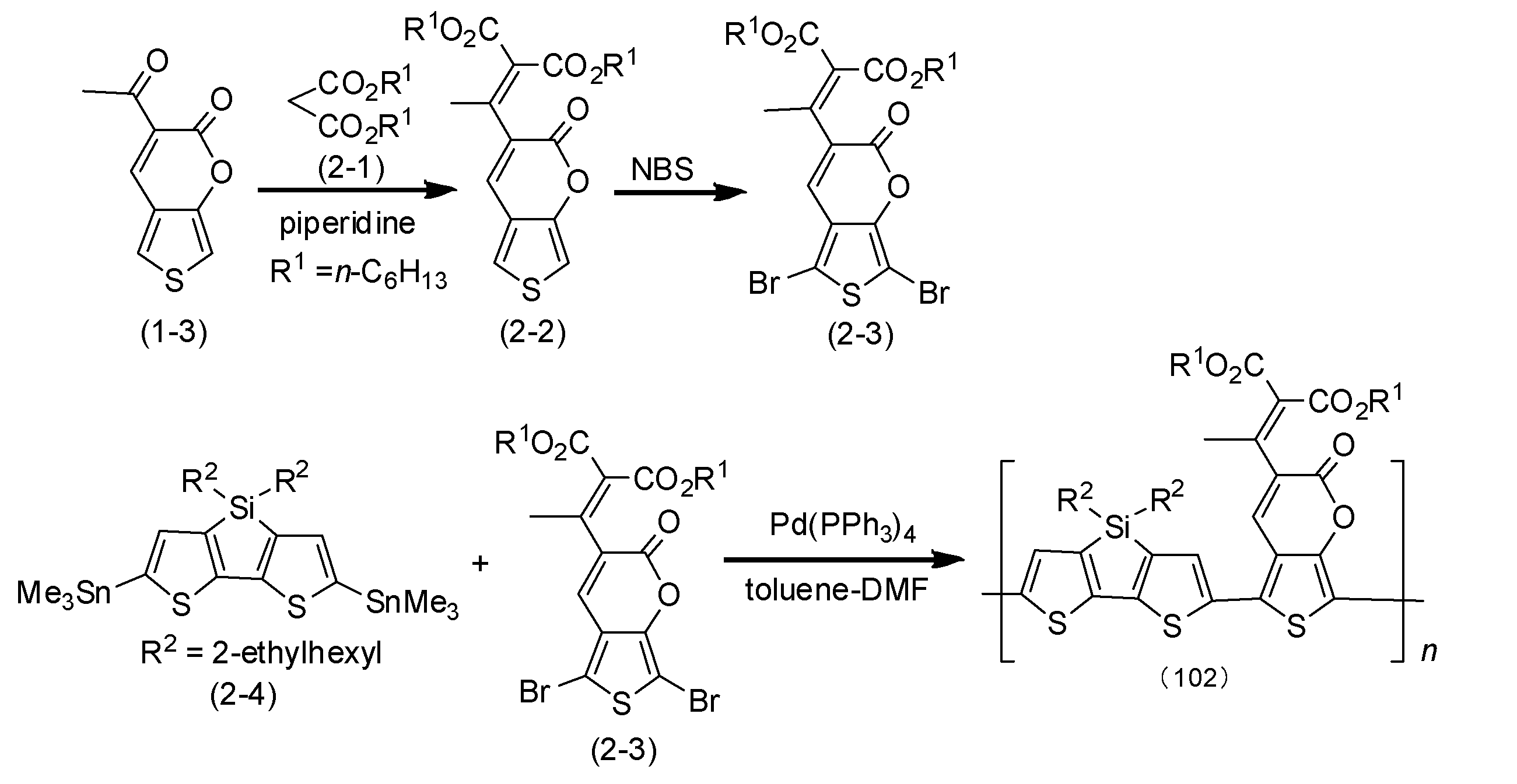
シアノ酢酸エステル(1-4)をマロン酸エステル(2-1)にかえて、化合物(1-5)の合成と同様に行い、化合物(2-2)を得た。
化合物(1-5)を化合物(2-2)にかえ、化合物(1-6)の合成と同様に行い、化合物(2-3)を得た。
化合物(1-5)を化合物(2-2)にかえ、化合物(1-6)の合成と同様に行い、化合物(2-3)を得た。
化合物(2-3):MALDI-MS m/z 605.2 (M++H)
1H-NMR(CDCl3);δ[ppm]= 0.91(6H、m)、1.11-1.35(12H、m)、1.65(4H、m)、2.47(3H、s)、4.15(4H、m)、7.76(1H、s)
1H-NMR(CDCl3);δ[ppm]= 0.91(6H、m)、1.11-1.35(12H、m)、1.65(4H、m)、2.47(3H、s)、4.15(4H、m)、7.76(1H、s)
化合物(1-7)を化合物(2-4)に、化合物(1-6)を化合物(2-3)にかえたこと以外は、ポリマー(101)の合成と同様に行い、ポリマー(102)を658mg(収率79.9%)得た。
ポリマー(102):Mw=8.9×10⁴、Mn=3.0×10⁴
1H-NMR(CDCl3);δ[ppm]=0.75-2.80(59H)、3.69-4.98(4H)、6.74-8.02(3H)
Tg=151℃
1H-NMR(CDCl3);δ[ppm]=0.75-2.80(59H)、3.69-4.98(4H)、6.74-8.02(3H)
Tg=151℃
(3)式(1)の構成単位を有するポリマー(103)の合成
以下の反応スキームでポリマー(103)を合成した。
以下の反応スキームでポリマー(103)を合成した。

シアノ酢酸エステル(1-4)をアセト酢酸エステル(3-1)にかえて、化合物(1-5)の合成と同様に行い、化合物(3-2)を得た。
化合物(1-5)を化合物(3-2)にかえ、化合物(1-6)の合成と同様に行い、化合物(3-3)を得た。
化合物(1-5)を化合物(3-2)にかえ、化合物(1-6)の合成と同様に行い、化合物(3-3)を得た。
化合物(3-3):MALDI-MS m/z 575.1 (M++H)
1H-NMR(CDCl3);δ[ppm]= 0.89(3H、t)1.10-1.37(14H、m)、1.65(2H、m)、2.10(3H、s)、2.48(3H、s)、4.18(2H、q)、7.73(1H、s)
1H-NMR(CDCl3);δ[ppm]= 0.89(3H、t)1.10-1.37(14H、m)、1.65(2H、m)、2.10(3H、s)、2.48(3H、s)、4.18(2H、q)、7.73(1H、s)
化合物(1-7)を化合物(3-4)に、化合物(1-6)を化合物(3-3)にかえたこと以外は、ポリマー(101)の合成と同様に行い、ポリマー(103)を643mg(収率80.2%)得た。
ポリマー(103):Mw=7.1×10⁴、Mn=2.2×10⁴
1H-NMR(CDCl3);δ[ppm]=0.77-2.90(51H)、3.75-4.87(2H)、6.70-7.99(3H)
Tg=182℃
1H-NMR(CDCl3);δ[ppm]=0.77-2.90(51H)、3.75-4.87(2H)、6.70-7.99(3H)
Tg=182℃
(4)式(2)の構成単位を有するポリマー(201)の合成
以下の反応スキームでポリマー(201)を合成した。
以下の反応スキームでポリマー(201)を合成した。

Journal of Organic Chemistry, 1992, 57, 6749-6755に記載の方法に従って合成した化合物(4-1)を、国際公開第2008/143759号に記載の方法に従って、化合物(4-2)と反応させ、化合物(4-3)を得た。
Journal of Polymer Science PartA, 2011, 49, 369-380に記載の方法に従って、化合物(4-3)を酸化して化合物(4-4)を得た。
Journal of Polymer Science PartA, 2011, 49, 369-380に記載の方法に従って、化合物(4-3)を酸化して化合物(4-4)を得た。
化合物(4-4):MALDI-MS m/z 288.9 (M++H)
1H-NMR(CDCl3);δ[ppm]= 7.63(2H、s)
1H-NMR(CDCl3);δ[ppm]= 7.63(2H、s)
化合物(1-6)を化合物(4-4)にかえたこと以外は、ポリマー(101)の合成と同様に行い、ポリマー(201)を653mg(収率86.1%)得た。
ポリマー(201):Mw=5.0×10⁴、Mn=2.1×10⁴
1H-NMR(CDCl3);δ[ppm]=0.77-2.77(30H)、3.75-4.87(4H)、6.82-7.93(4H)
Tg=198℃
1H-NMR(CDCl3);δ[ppm]=0.77-2.77(30H)、3.75-4.87(4H)、6.82-7.93(4H)
Tg=198℃
(5)式(2)の構成単位を有するポリマー(202)の合成
以下の反応スキームでポリマー(202)を合成した。
以下の反応スキームでポリマー(202)を合成した。

米国特許第4,065,572号明細書に記載の方法に従って、化合物(4-1)と二硫化炭素を反応させ、化合物(5-1)とし、化合物(5-1)を酸化して(5-2)を得た。
化合物(5-2)MALDI-MS m/z 305.1 (M++H)
1H-NMR(CDCl3);δ[ppm]= 7.57(2H、s)
1H-NMR(CDCl3);δ[ppm]= 7.57(2H、s)
化合物(1-7)を化合物(5-3)にかえ、化合物(1-6)を化合物(5-2)にかえたこと以外は、ポリマー(101)の合成と同様に行い、ポリマー(202)を613mg(収率71.3%)得た。
ポリマー(202):Mw=5.4×10⁴、Mn=2.2×10⁴
1H-NMR(CDCl3);δ[ppm]=0.78-2.80(54H)、6.74-8.10(4H)
Tg=187℃
1H-NMR(CDCl3);δ[ppm]=0.78-2.80(54H)、6.74-8.10(4H)
Tg=187℃
(6)式(2)の構成単位を有するポリマー(203)の合成
以下の反応スキームでポリマー(203)を合成した。
以下の反応スキームでポリマー(203)を合成した。
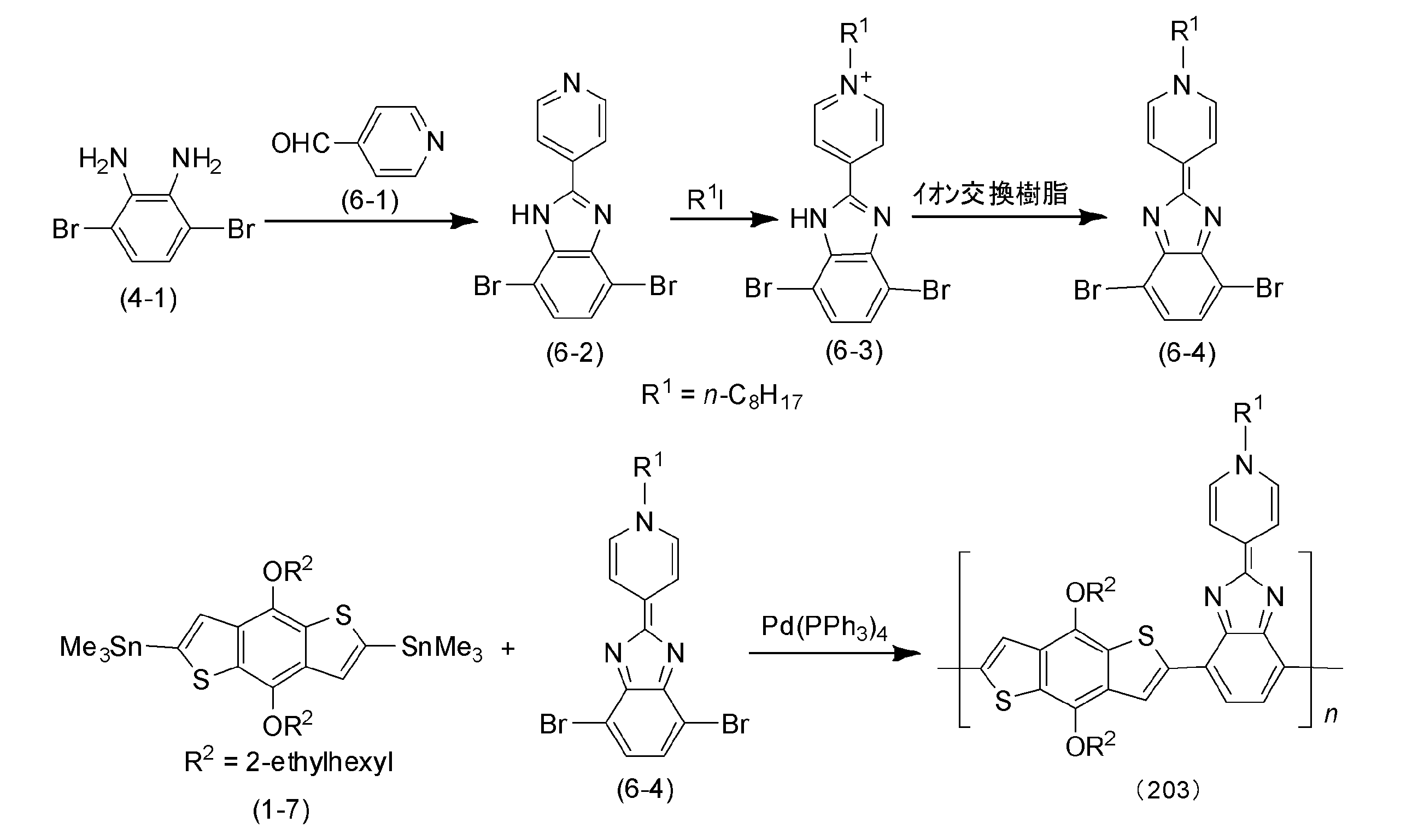
化合物(4-1)を、Journal of Fluorine Chemistry, 2007,128,p.232-235に記載の方法に従って、化合物(6-1)と反応させ、化合物(6-2)を得た。
化合物(6-2)をJournal of Organic Chemistry, 1991,56,p.4223-4233に記載の方法に従って、ヨードオクタンと反応させ、化合物(6-3)を得た。化合物(6-3)を同文献に記載の方法に従って、イオン交換樹脂Amberlite resin IRA-401 (OH-form)で処理して、化合物(6-4)を得た。
化合物(6-4):MALDI-MS m/z 464.0 (M++H)
1H-NMR(CDCl3);δ[ppm]= 0.89(3H、t)、1.10-1.37(10H、m)、1.84(2H、m)、4.26(2H,t)、7.43(2H、s)、8.63(2H、d)、8.82(2H、d)
1H-NMR(CDCl3);δ[ppm]= 0.89(3H、t)、1.10-1.37(10H、m)、1.84(2H、m)、4.26(2H,t)、7.43(2H、s)、8.63(2H、d)、8.82(2H、d)
化合物(1-6)を化合物(6-4)にかえたこと以外は、ポリマー(101)の合成と同様に行い、ポリマー(203)を689mg(収率82.9%)得た。
ポリマー(203):Mw=3.9×10⁴、Mn=1.2×10⁴
1H-NMR(CDCl3);δ[ppm]=0.84-2.69(45H)、3.78-4.79(6H)、6.71-8.90(8H)
Tg=172℃
ポリマー(203):Mw=3.9×10⁴、Mn=1.2×10⁴
1H-NMR(CDCl3);δ[ppm]=0.84-2.69(45H)、3.78-4.79(6H)、6.71-8.90(8H)
Tg=172℃
(7)式(2)の構成単位を有するポリマー(204)の合成
以下の反応スキームでポリマー(204)を合成した。
以下の反応スキームでポリマー(204)を合成した。

Angewandte Chemie, International Edition, 2010,49,p.7992-7995に記載の方法に従って、化合物(7-1)を還元して化合物(7-2)を合成した。化合物(7-2)と化合物(7-3)を反応させ、化合物(7-4)を得た後、以下、ポリマー(203)の場合と同様にして、化合物(7-5)を合成した。
化合物(7-5):MALDI-MS m/z 465.2 (M++H)
1H-NMR(CDCl3);δ[ppm]= 0.92(6H、t)、1.22-1.63(20H、m)、1.89(4H、m)、3.67(4H,t)、7.13(2H、s)、7.77(1H、s)
1H-NMR(CDCl3);δ[ppm]= 0.92(6H、t)、1.22-1.63(20H、m)、1.89(4H、m)、3.67(4H,t)、7.13(2H、s)、7.77(1H、s)
化合物(1-6)を化合物(7-5)にかえたこと以外は、ポリマー(101)の合成と同様に行い、ポリマー(204)を651mg(収率80.0%)得た。
ポリマー(204):Mw=5.9×10⁴、Mn=2.2×10⁴
1H-NMR(CDCl3);δ[ppm]=0.84-2.69(60H)、3.29-4.79(8H)、6.67-8.21(5H)
Tg=164℃
1H-NMR(CDCl3);δ[ppm]=0.84-2.69(60H)、3.29-4.79(8H)、6.67-8.21(5H)
Tg=164℃
(8)式(3)の構成単位を有するポリマー(301)の合成
以下の反応スキームでポリマー(301)を合成した。
以下の反応スキームでポリマー(301)を合成した。

Chemistry-A European Journal, 2000,6,p.1007-1016記載の方法に従って、化合物(8-1)と化合物(8-2)を反応させて、化合物(8-3)を合成した。Journal of American Chemical Society, 2010,132,7595-7597に記載の方法に従って、化合物(8-3)から化合物(8-7)を合成した。
化合物(8-7):MALDI-MS m/z 529.9 (M++H)
1H-NMR(CDCl3);δ[ppm]=0.89(3H、t)、1.28(10H、m)、1.67(2H,m)、3.62(2H、t)
1H-NMR(CDCl3);δ[ppm]=0.89(3H、t)、1.28(10H、m)、1.67(2H,m)、3.62(2H、t)
化合物(1-6)を化合物(8-7)にかえたこと以外は、ポリマー(101)の合成と同様に行い、ポリマー(301)を599mg(収率72.3%)得た。
ポリマー(301):Mw=7.9×10⁴、Mn=3.2×10⁴
1H-NMR(CDCl3);δ[ppm]=0.85-2.71(45H)、3.22-4.78(6H)、6.72-7.98(2H)
Tg=179℃
1H-NMR(CDCl3);δ[ppm]=0.85-2.71(45H)、3.22-4.78(6H)、6.72-7.98(2H)
Tg=179℃
(9)式(3)の構成単位を有するポリマー(302)の合成
以下の反応スキームでポリマー(302)を合成した。
以下の反応スキームでポリマー(302)を合成した。
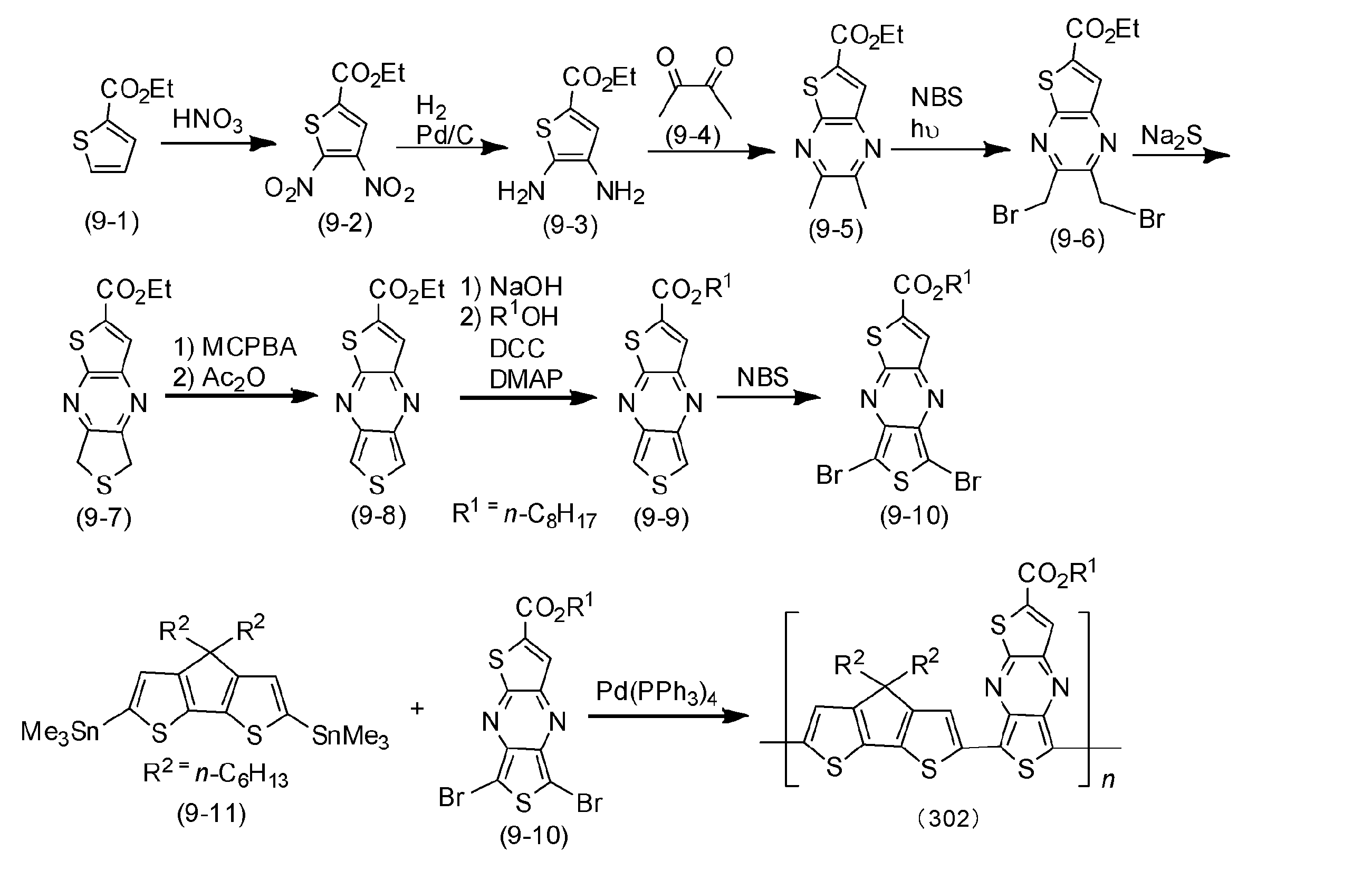
Journal of the Chemical Society, Perkin Transactions 2: Physical Organic Chemistry(1972-1999),1980,p.1331-1335に記載の方法に従って、化合物(9-1)をニトロ化して化合物(9-2)を得た。
国際公開第2006/65788号に記載の方法に従って、化合物(9-2)を還元して、化合物(9-3)を合成した。
国際公開第2006/65788号に記載の方法に従って、化合物(9-2)を還元して、化合物(9-3)を合成した。
Chemistry-A European Journal, 2000,6,p.1007-1016に記載の方法に従って、化合物(9-4)と化合物(9-3)を反応させて化合物(9-5)を得た。
Macromolecules, 2001,34,1810-1816に記載の方法に従って、化合物(9-5)から化合物(9-8)を合成した。化合物(9-8)を加水分解・エステル化後、化合物(9-9)をポリマー(101)の場合と同様の方法で臭素化して化合物(9-10)を得た。
Macromolecules, 2001,34,1810-1816に記載の方法に従って、化合物(9-5)から化合物(9-8)を合成した。化合物(9-8)を加水分解・エステル化後、化合物(9-9)をポリマー(101)の場合と同様の方法で臭素化して化合物(9-10)を得た。
化合物(9-10):MALDI-MS m/z 529.9 (M++H)
1H-NMR(CDCl3);δ[ppm]=0.90(3H、t)、1.69(2H、m)、1.21-1.49(10H、m)、4.21(2H,t)、7.67(1H、s)
1H-NMR(CDCl3);δ[ppm]=0.90(3H、t)、1.69(2H、m)、1.21-1.49(10H、m)、4.21(2H,t)、7.67(1H、s)
化合物(1-6)を化合物(9-10)に、化合物(1-7)を化合物(9-11)にかえたこと以外は、ポリマー(101)の合成と同様に行い、ポリマー(302)を652mg(収率81.9%)得た。
ポリマー(302):Mw=8.9×10⁴、Mn=3.7×10⁴
1H-NMR(CDCl3);δ[ppm]=0.85-2.71(41H)、3.51-4.81(2H)、6.79-7.89(3H)
Tg=162℃
1H-NMR(CDCl3);δ[ppm]=0.85-2.71(41H)、3.51-4.81(2H)、6.79-7.89(3H)
Tg=162℃
(10)式(3)の構成単位を有するポリマー(303)の合成
以下の反応スキームでポリマー(303)を合成した。
以下の反応スキームでポリマー(303)を合成した。

化合物(10-1)を国際公開第2011/28827号に記載の方法に従って、酢酸エチルと反応させ、化合物(10-2)を得た後、これとヨードオクタンを反応させ、化合物(10-3)を得た。化合物(10-3)をポリマー(101)の場合と同様の方法で、臭素化して化合物(10-4)を得た。
化合物(10-4):MALDI-MS m/z 585.1 (M++H)
1H-NMR(CDCl3);δ[ppm]= 0.90(6H、t)、1.21-1.49(20H、m)、1.63(4H、m)、1.99(4H、t)
1H-NMR(CDCl3);δ[ppm]= 0.90(6H、t)、1.21-1.49(20H、m)、1.63(4H、m)、1.99(4H、t)
化合物(1-6)を化合物(10-4)に、化合物(1-7)を化合物(10-5)にかえたこと以外は、ポリマー(101)の合成と同様に行い、ポリマー(303)を643mg(収率83.1%)得た。
ポリマー(303):Mw=8.3×10⁴、Mn=3.6×10⁴
1H-NMR(CDCl3);δ[ppm]=0.85-2.73(60H)、6.69-7.91(2H)
Tg=169℃
1H-NMR(CDCl3);δ[ppm]=0.85-2.73(60H)、6.69-7.91(2H)
Tg=169℃
(11)式(3)の構成単位を有するポリマー(304)の合成
以下の反応スキームでポリマー(304)を合成した。
以下の反応スキームでポリマー(304)を合成した。

Organic and Biomolecular Chemistry,2003,vol.1,#4 p.756-762に記載の方法を参考にして、化合物(11-7)を合成した。米国特許第4,782,180号明細書に記載の方法に従って、化合物(11-8)のフッ素を行い、Journal of American Chemical Society, 2009,131,7792-7799に記載の方法に従って、チオフェン環の構築および臭素化して化合物(11-12)を合成した。
化合物(11-12):MALDI-MS m/z 633.2 (M++H)
1H-NMR(CDCl3);δ[ppm]= 0.90(6H、t)、1.21-1.49(12H、m)、1.63(4H、m)、4.27(4H、t)、8.25(2H、s)
1H-NMR(CDCl3);δ[ppm]= 0.90(6H、t)、1.21-1.49(12H、m)、1.63(4H、m)、4.27(4H、t)、8.25(2H、s)
化合物(1-6)を化合物(11-12)にかえたこと以外は、ポリマー(101)の合成と同様に行い、ポリマー(304)を666mg(収率87.1%)得た。
ポリマー(304):Mw=9.3×10⁴、Mn=4.0×10⁴
1H-NMR(CDCl3);δ[ppm]=0.85-2.73(52H)、3.47-4.75(8H)、6.72-8.51(4H)
Tg=151℃
1H-NMR(CDCl3);δ[ppm]=0.85-2.73(52H)、3.47-4.75(8H)、6.72-8.51(4H)
Tg=151℃
(12)式(3)の構成単位を有するポリマー(305)の合成
以下の反応スキームでポリマー(305)を合成した。
以下の反応スキームでポリマー(305)を合成した。

化合物(11-8)から上記スキームに従って、化合物(12-3)を合成した。
化合物(12-3):MALDI-MS m/z 721.1 (M++H)
1H-NMR(CDCl3);δ[ppm]= 0.91(12H、m)、1.21-1.48(16H、m)1.70(4H、m)、4.23(4H、m)8.19(2H、s)
化合物(12-3):MALDI-MS m/z 721.1 (M++H)
1H-NMR(CDCl3);δ[ppm]= 0.91(12H、m)、1.21-1.48(16H、m)1.70(4H、m)、4.23(4H、m)8.19(2H、s)
化合物(1-6)を化合物(12-3)に、化合物(1-7)を化合物(2-4)にかえたこと以外は、ポリマー(101)の合成と同様に行い、ポリマー(305)を659mg(収率80.2%)得た。
ポリマー(305):Mw=8.0×10⁴、Mn=3.3×10⁴
1H-NMR(CDCl3);δ[ppm]=0.88-2.80(64H)、3.40-4.81(4H)、6.69-8.39(4H)
Tg=167℃
1H-NMR(CDCl3);δ[ppm]=0.88-2.80(64H)、3.40-4.81(4H)、6.69-8.39(4H)
Tg=167℃
(13)式(3)の構成単位を有するポリマー(306)の合成
以下の反応スキームでポリマー(306)を合成した。
以下の反応スキームでポリマー(306)を合成した。

上記スキームに従って、化合物(13-6)を合成した。
化合物(13-6):MALDI-MS m/z 601.2 (M++H)
1H-NMR(CDCl3);δ[ppm]= 0.88(6H、t)、1.13-1.41(20H、m)、1.76(4H、m)、2.98(4H、t)、8.28(2H、s)
1H-NMR(CDCl3);δ[ppm]= 0.88(6H、t)、1.13-1.41(20H、m)、1.76(4H、m)、2.98(4H、t)、8.28(2H、s)
化合物(1-6)を化合物(13-6)にかえたこと以外は、ポリマー(101)の合成と同様に行い、ポリマー(306)を629mg(収率78.2%)得た。
ポリマー(306):Mw=10.2×10⁴、Mn=4.9×10⁴
1H-NMR(CDCl3);δ[ppm]=0.88-3.32(64H)、3.51-4.76(4H)、6.68-8.52(4H)
Tg=187℃
1H-NMR(CDCl3);δ[ppm]=0.88-3.32(64H)、3.51-4.76(4H)、6.68-8.52(4H)
Tg=187℃
(14)式(3)の構成単位を有するポリマー(307)の合成
以下の反応スキームでポリマー(307)を合成した。
以下の反応スキームでポリマー(307)を合成した。
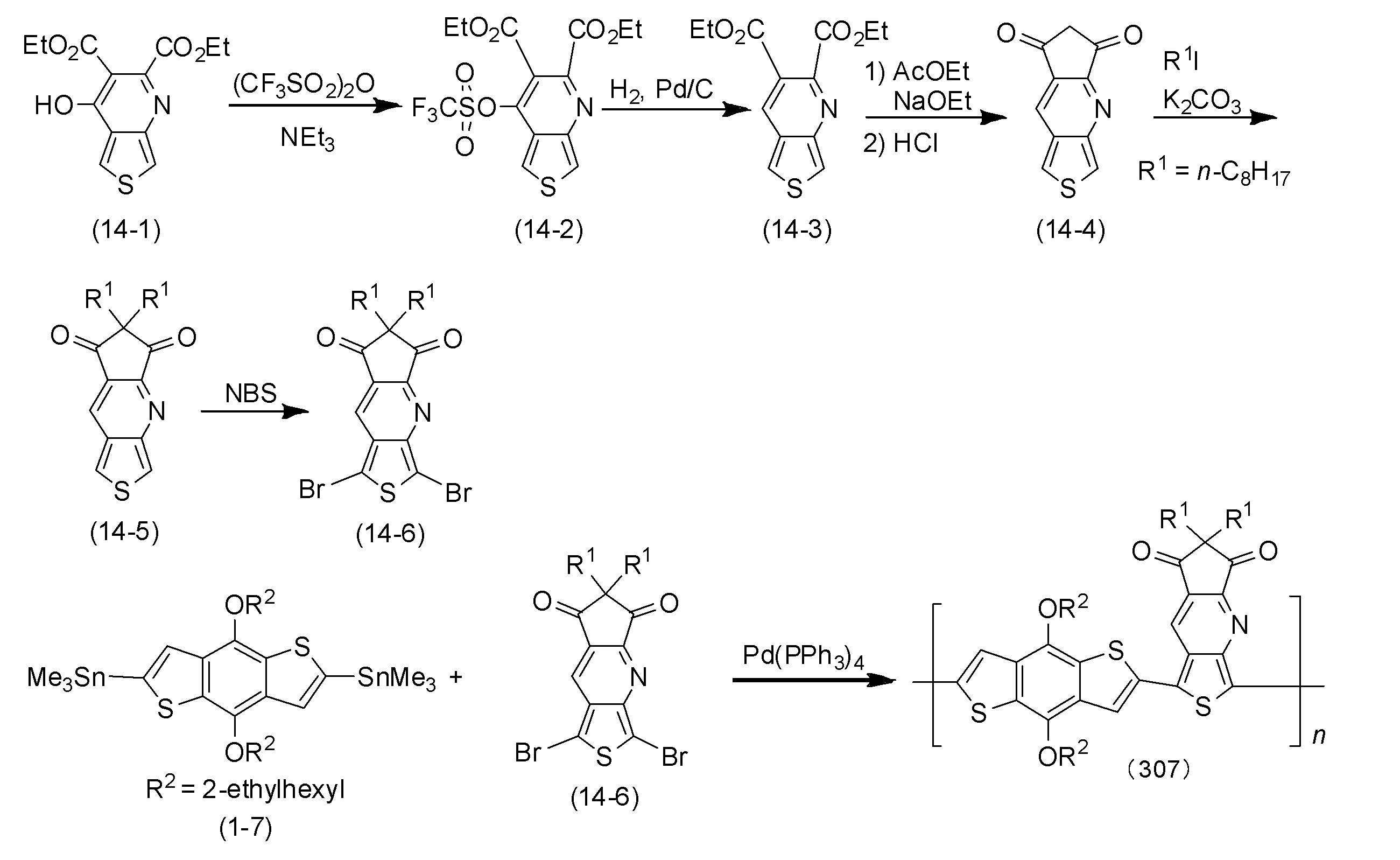
Journal of Chemical Research, Miniprint, 1989, 7, pp.1501-1523に記載の方法に従って合成した化合物(14-1)を用いて上記スキームで、化合物(14-6)を合成した。
化合物(14-6):MALDI-MS m/z 601.2 (M++H)
1H-NMR(CDCl3);δ[ppm]= 0.90(6H、t)、1.63(4H、m)、1.21-1.49(20H、m)、1.99(4H、t)、8.31(1H、s)
1H-NMR(CDCl3);δ[ppm]= 0.90(6H、t)、1.63(4H、m)、1.21-1.49(20H、m)、1.99(4H、t)、8.31(1H、s)
化合物(1-6)を化合物(14-6)にかえたこと以外は、ポリマー(101)の合成と同様に行い、ポリマー(307)を599mg(収率77.7%)得た。
ポリマー(307):Mw=8.2×10⁴、Mn=3.9×10⁴
1H-NMR(CDCl3);δ[ppm]=0.86-2.81(64H)、3.51-4.76(4H)、6.72-8.59(3H)
Tg=191℃
1H-NMR(CDCl3);δ[ppm]=0.86-2.81(64H)、3.51-4.76(4H)、6.72-8.59(3H)
Tg=191℃
(15)式(3)の構成単位を有するポリマー(308)の合成
以下の反応スキームでポリマー(308)を合成した。
以下の反応スキームでポリマー(308)を合成した。
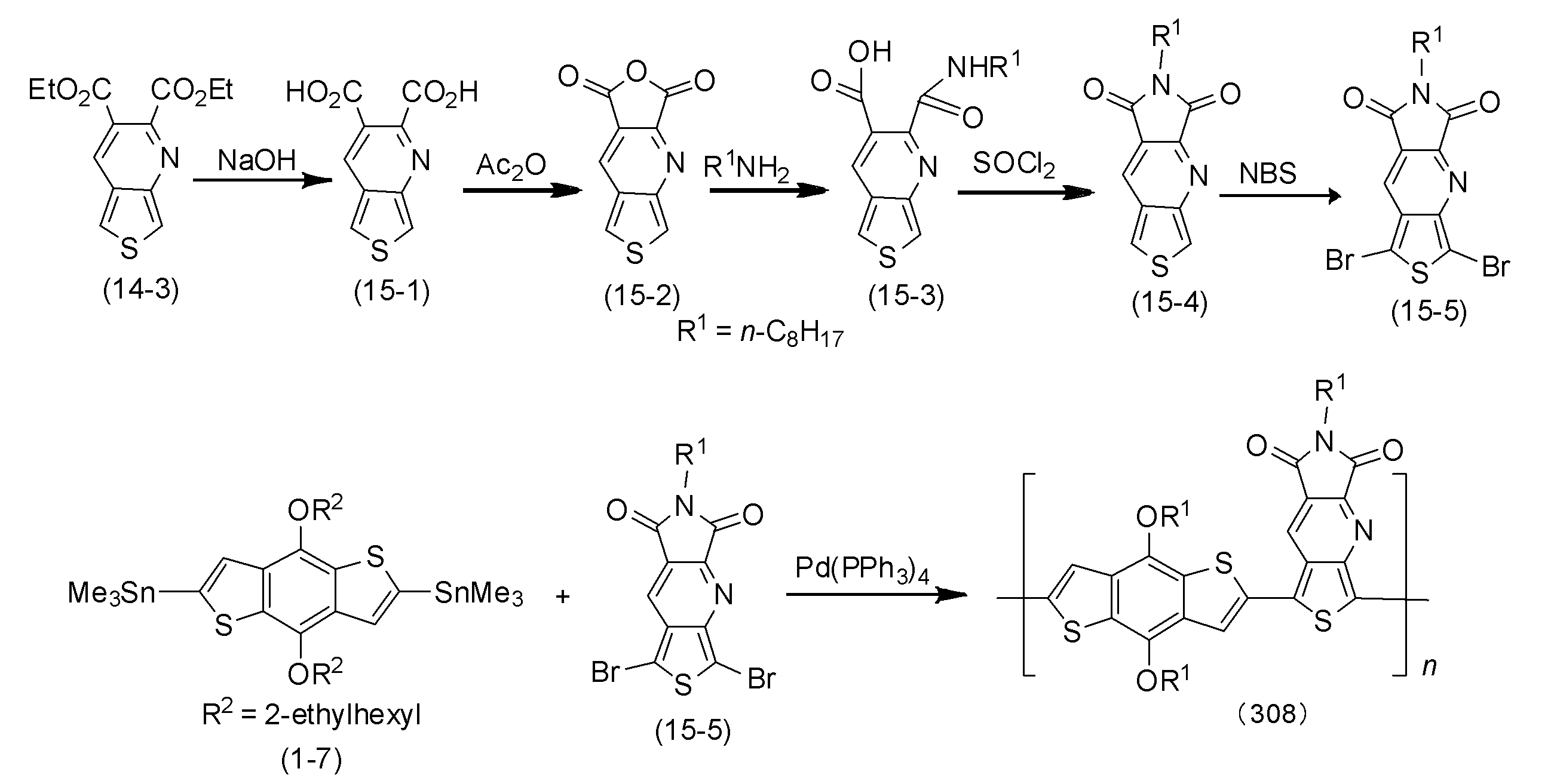
上記スキームに従って、化合物(15-5)を合成した。
化合物(15-5):MALDI-MS m/z 601.2 (M++H)
1H-NMR(CDCl3);δ[ppm]=0.90(3H、t)、1.27(10H、m)、1.67(2H、m)、3.60(2H、t)、8.29(1H、s)
1H-NMR(CDCl3);δ[ppm]=0.90(3H、t)、1.27(10H、m)、1.67(2H、m)、3.60(2H、t)、8.29(1H、s)
化合物(1-6)を化合物(15-5)にかえたこと以外は、ポリマー(101)の合成と同様に行い、ポリマー(308)を638mg(収率78.6%)得た。
ポリマー(308):Mw=7.1×10⁴、Mn=2.9×10⁴
1H-NMR(CDCl3);δ[ppm]=0.82-2.72(47H)、3.50-4.77(4H)、6.70-8.54(3H)
Tg=180℃
1H-NMR(CDCl3);δ[ppm]=0.82-2.72(47H)、3.50-4.77(4H)、6.70-8.54(3H)
Tg=180℃
(16)式(3)の構成単位を有するポリマー(309)の合成
以下の反応スキームでポリマー(309)を合成した。
以下の反応スキームでポリマー(309)を合成した。
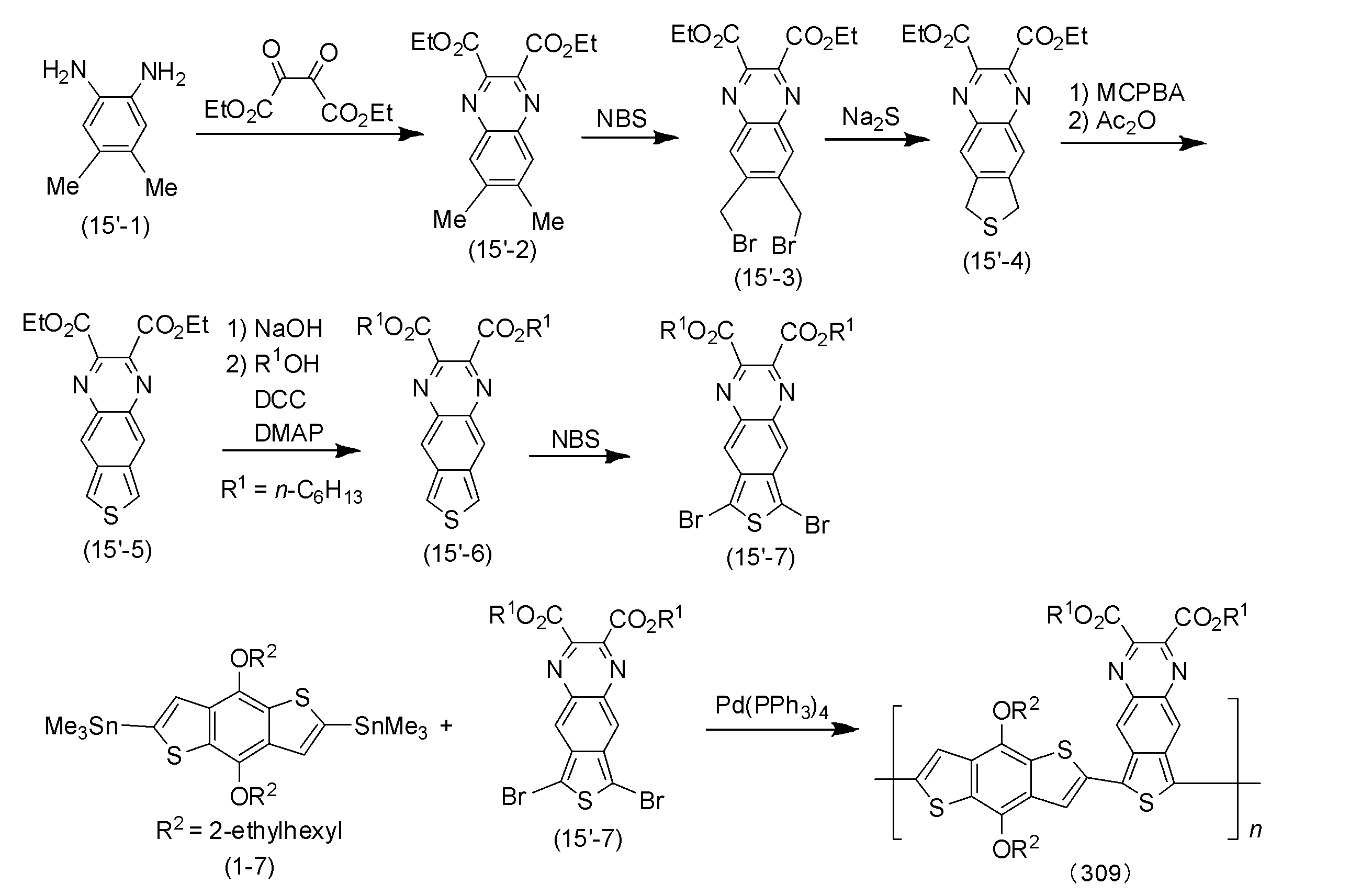
上記スキームに従って、化合物(15’-7)を合成した。
化合物(15’-7):MALDI-MS m/z 599.2 (M++H)
1H-NMR(CDCl3);δ[ppm]=0.90(6H、t)、1.21-1.49(12H、m)、1.63(4H、m)、4.27(4H、t)、8.19(2H、s)
1H-NMR(CDCl3);δ[ppm]=0.90(6H、t)、1.21-1.49(12H、m)、1.63(4H、m)、4.27(4H、t)、8.19(2H、s)
化合物(1-6)を化合物(15’-7)にかえたこと以外は、ポリマー(101)の合成と同様に行い、ポリマー(309)を622mg(収率82.1%)得た。
ポリマー(309):Mw=6.0×10⁴、Mn=2.3×10⁴
1H-NMR(CDCl3);δ[ppm]=0.86-2.79(52H)、3.39-4.79(8H)、6.59-8.30(4H)
Tg=175℃
1H-NMR(CDCl3);δ[ppm]=0.86-2.79(52H)、3.39-4.79(8H)、6.59-8.30(4H)
Tg=175℃
(17)式(3)の構成単位を有するポリマー(310)の合成
以下の反応スキームでポリマー(310)を合成した。
以下の反応スキームでポリマー(310)を合成した。

上記スキームに従って、化合物(15”-6)を合成した。
化合物(15”-6):MALDI-MS m/z 599.2 (M++H)
1H-NMR(CDCl3);δ[ppm]=0.90(6H、t)、1.21-1.49(12H、m)、1.63(4H、m)、4.27(4H、t)、8.08(2H、s)
1H-NMR(CDCl3);δ[ppm]=0.90(6H、t)、1.21-1.49(12H、m)、1.63(4H、m)、4.27(4H、t)、8.08(2H、s)
化合物(1-6)を化合物(15”-6)にかえたこと以外は、ポリマー(101)の合成と同様に行い、ポリマー(310)を661mg(収率85.1%)得た。
ポリマー(310):Mw=6.9×10⁴、Mn=2.4×10⁴
1H-NMR(CDCl3);δ[ppm]=0.86-2.86(56H)、3.50-4.76(4H)、6.60-8.32(4H)
Tg=149℃
1H-NMR(CDCl3);δ[ppm]=0.86-2.86(56H)、3.50-4.76(4H)、6.60-8.32(4H)
Tg=149℃
(18)式(4)の構成単位を有するポリマー(401)の合成
以下の反応スキームでポリマー(401)を合成した。
以下の反応スキームでポリマー(401)を合成した。
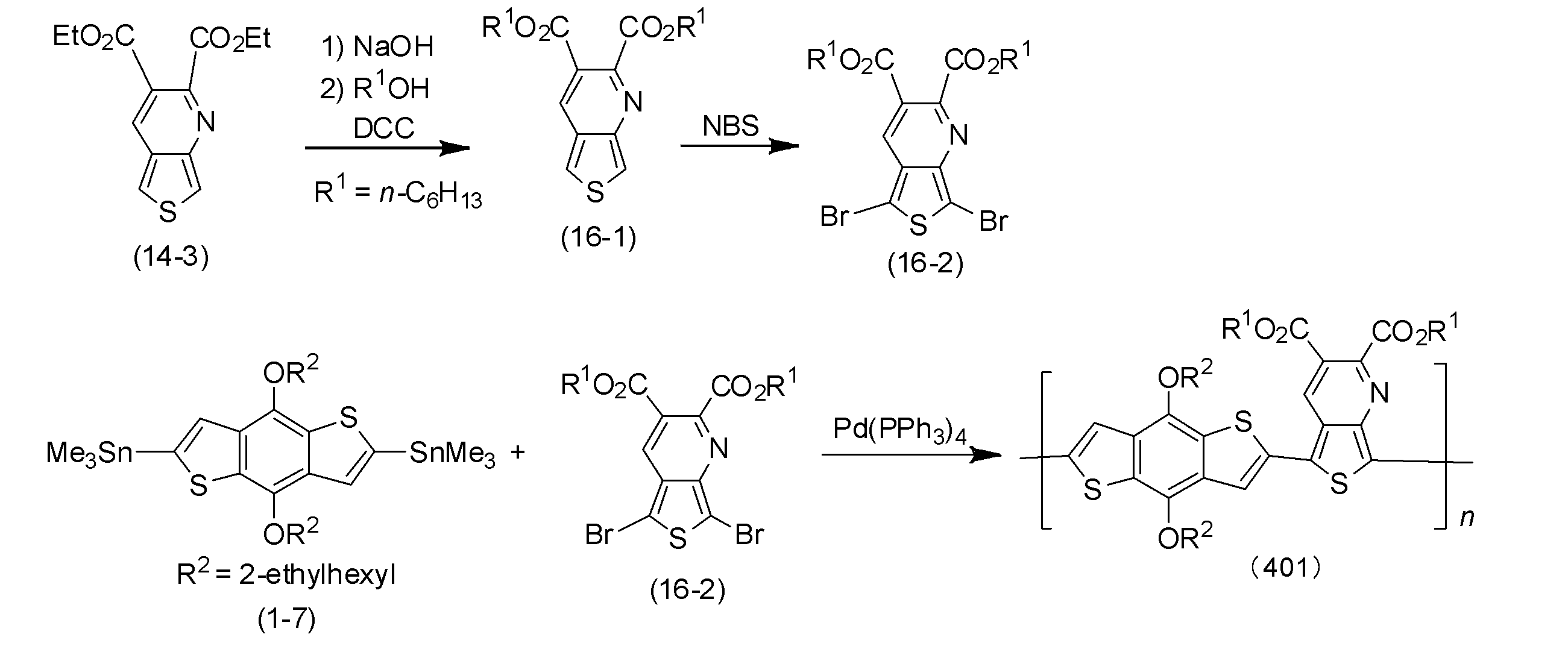
上記スキームに従って、化合物(16-2)を合成した。
化合物(16-2):MALDI-MS m/z 548.2 (M++H)
1H-NMR(CDCl3);δ[ppm]= 0.89(6H、t)、1.18-1.51(12H、m)、1.64(4H、m)、4.23(4H、t)、8.27(1H、s)
1H-NMR(CDCl3);δ[ppm]= 0.89(6H、t)、1.18-1.51(12H、m)、1.64(4H、m)、4.23(4H、t)、8.27(1H、s)
化合物(1-6)を化合物(16-2)にかえたこと以外は、ポリマー(101)の合成と同様に行い、ポリマー(401)を659mg(収率83.2%)得た。
ポリマー(401):Mw=11.0×10⁴、Mn=5.3×10⁴
1H-NMR(CDCl3);δ[ppm]=0.86-2.79(52H)、3.39-4.79(8H)、6.49-8.49(3H)
Tg=185℃
1H-NMR(CDCl3);δ[ppm]=0.86-2.79(52H)、3.39-4.79(8H)、6.49-8.49(3H)
Tg=185℃
(19)式(4)の構成単位を有するポリマー(402)の合成
以下の反応スキームでポリマー(402)を合成した。
以下の反応スキームでポリマー(402)を合成した。
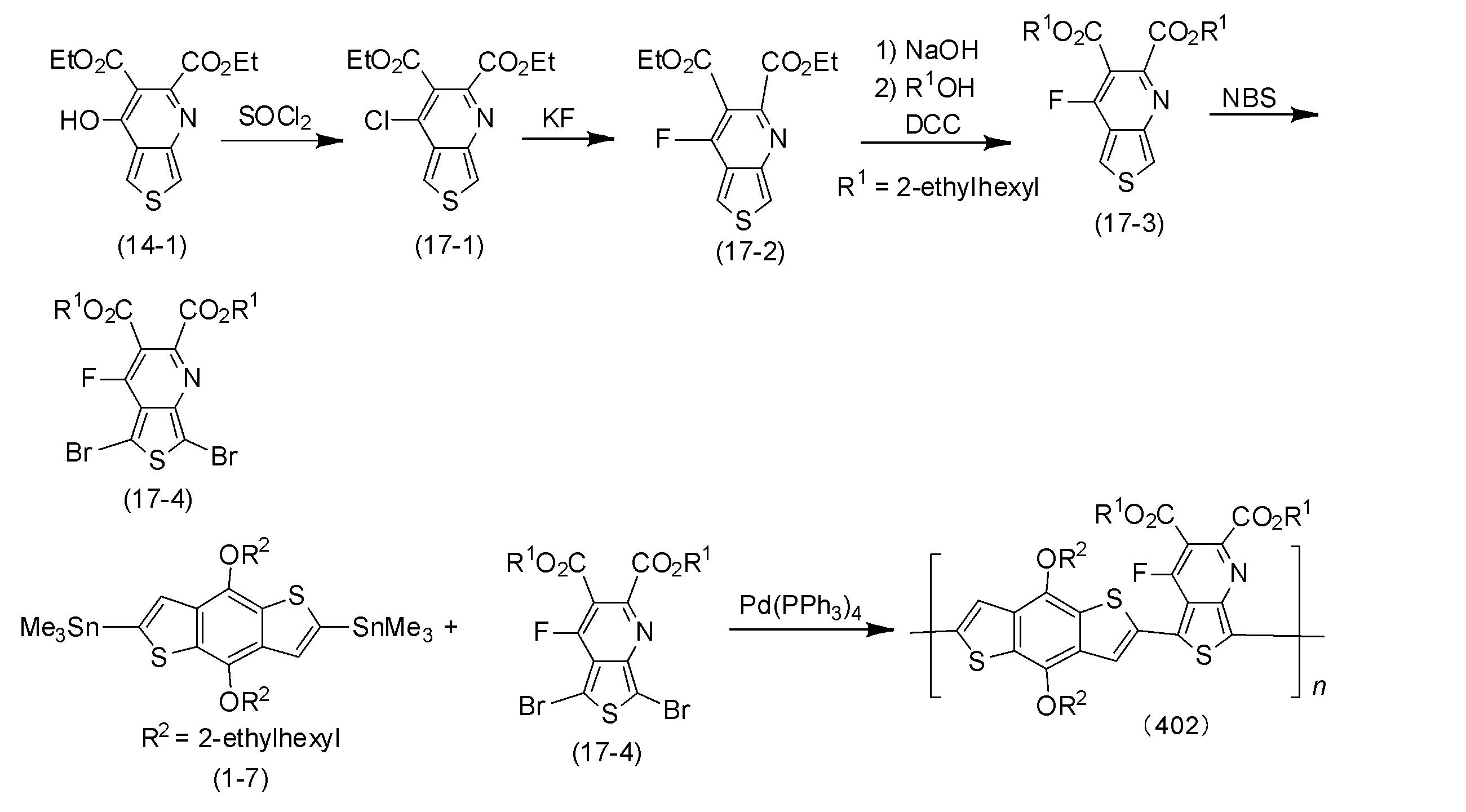
化合物(14-1)から、上記スキームで化合物(17-4)を合成した。
化合物(17-4):MALDI-MS m/z 622.1 (M++H)
1H-NMR(CDCl3);δ[ppm]= 0.89(12H、m)、1.22-1.48(16H、m)1.71(4H、m)、4.26(4H、m)
1H-NMR(CDCl3);δ[ppm]= 0.89(12H、m)、1.22-1.48(16H、m)1.71(4H、m)、4.26(4H、m)
化合物(1-6)を化合物(17-4)にかえたこと以外は、ポリマー(101)の合成と同様に行い、ポリマー(402)を642mg(収率79.6%)得た。
ポリマー(402):Mw=8.9×10⁴、Mn=3.8×10⁴
1H-NMR(CDCl3);δ[ppm]=0.86-2.79(60H)、3.39-4.79(8H)、6.51-7.91(2H)
Tg=164℃
1H-NMR(CDCl3);δ[ppm]=0.86-2.79(60H)、3.39-4.79(8H)、6.51-7.91(2H)
Tg=164℃
(20)式(4)の構成単位を有するポリマー(403)の合成
以下の反応スキームでポリマー(403)を合成した。
以下の反応スキームでポリマー(403)を合成した。
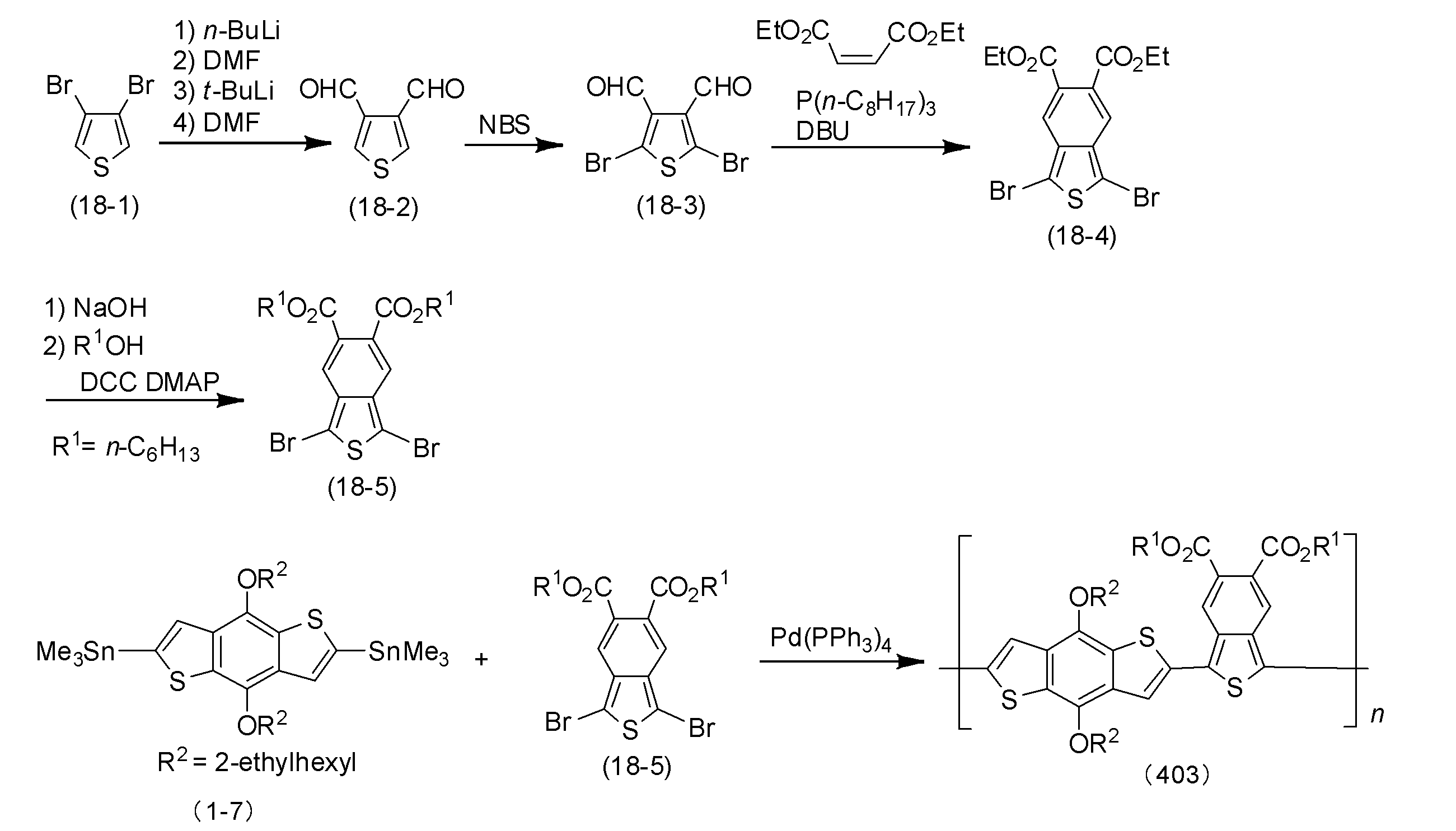
上記スキームに従って、化合物(18-5)を合成した。
化合物(18-5):MALDI-MS m/z 547.2 (M++H)
1H-NMR(CDCl3);δ[ppm]=0.89(6H、t)、1.21-1.48(12H、m)、1.62(4H、m)、4.27(4H、t)、7.88(2H、s)
1H-NMR(CDCl3);δ[ppm]=0.89(6H、t)、1.21-1.48(12H、m)、1.62(4H、m)、4.27(4H、t)、7.88(2H、s)
化合物(1-6)を化合物(18-5)にかえたこと以外は、ポリマー(101)の合成と同様に行い、ポリマー(403)を661mg(収率83.5%)得た。
ポリマー(403):Mw=9.2×10⁴、Mn=3.8×10⁴
1H-NMR(CDCl3);δ[ppm]=0.86-2.79(52H)、3.39-4.79(8H)、6.51-8.31(4H)
Tg=173℃
1H-NMR(CDCl3);δ[ppm]=0.86-2.79(52H)、3.39-4.79(8H)、6.51-8.31(4H)
Tg=173℃
(21)式(4)の構成単位を有するポリマー(404)の合成
以下の反応スキームでポリマー(404)を合成した。
以下の反応スキームでポリマー(404)を合成した。
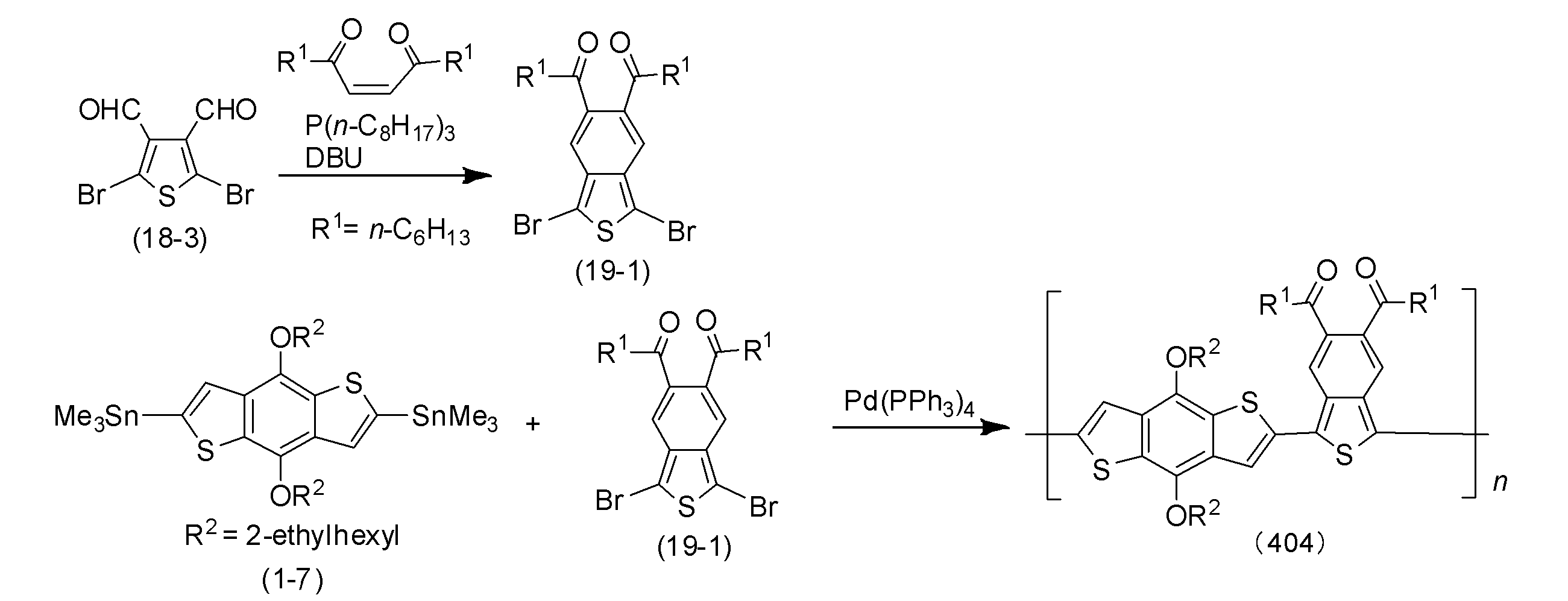
上記スキームに従って、化合物(19-1)を合成した。
化合物(19-1):MALDI-MS m/z 515.0 (M++H)
1H-NMR(CDCl3);δ[ppm]= 0.89(6H、t)、1.14-1.41(12H、m)、1.76(4H、m)、2.96(4H、t)、7.97(2H、s)
1H-NMR(CDCl3);δ[ppm]= 0.89(6H、t)、1.14-1.41(12H、m)、1.76(4H、m)、2.96(4H、t)、7.97(2H、s)
化合物(1-6)を化合物(19-1)にかえたこと以外は、ポリマー(101)の合成と同様に行い、ポリマー(404)を643mg(収率81.8%)得た。
ポリマー(404):Mw=8.2×10⁴、Mn=3.6×10⁴
1H-NMR(CDCl3);δ[ppm]=0.88-3.32(56H)、3.51-4.76(4H)、6.69-8.42(4H)
Tg=183℃
1H-NMR(CDCl3);δ[ppm]=0.88-3.32(56H)、3.51-4.76(4H)、6.69-8.42(4H)
Tg=183℃
(22)式(4)の構成単位を有するポリマー(405)の合成
以下の反応スキームでポリマー(405)を合成した。
以下の反応スキームでポリマー(405)を合成した。

上記スキームに従って、化合物(20-7)を合成した。
化合物(20-7):MALDI-MS m/z 326.9 (M++H)
1H-NMR(CDCl3)δ[ppm]= 8.24(2H、s)
1H-NMR(CDCl3)δ[ppm]= 8.24(2H、s)
化合物(1-6)を化合物(20-7)にかえたこと以外は、ポリマー(101)の合成と同様に行い、ポリマー(405)を848mg(収率81.9%)得た。
ポリマー(405):Mw=9.3×10⁴、Mn=3.6×10⁴
1H-NMR(CDCl3);δ[ppm]=0.86-2.79(30H)、3.39-4.79(4H)、6.71-8.52(4H)
Tg=163℃
1H-NMR(CDCl3);δ[ppm]=0.86-2.79(30H)、3.39-4.79(4H)、6.71-8.52(4H)
Tg=163℃
(23)式(4)の構成単位を有するポリマー(406)の合成
以下のようにしてポリマー(406)を合成した。
以下のようにしてポリマー(406)を合成した。
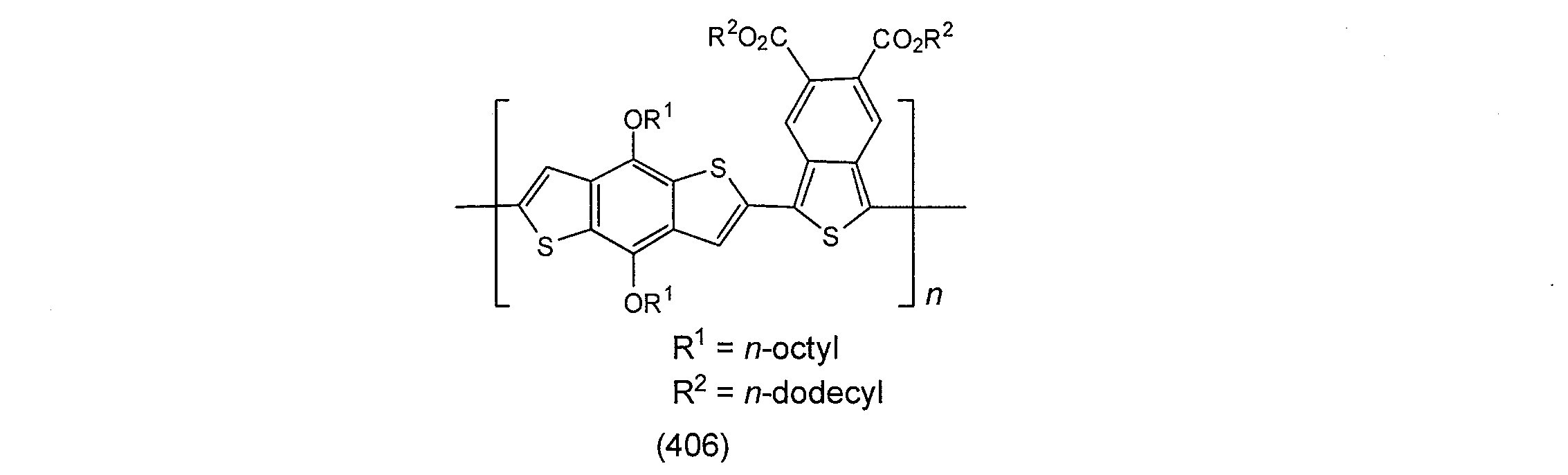
ポリマー(405)と同様にしてポリマー(406)を合成した。
ポリマー(406):Mw=7.2×10⁴、Mn=3.1×10⁴
1H-NMR(CDCl3);δ[ppm]=0.83-2.81(76H)、3.38-4.80(8H)、6.71-8.32(4H)
Tg=141℃
1H-NMR(CDCl3);δ[ppm]=0.83-2.81(76H)、3.38-4.80(8H)、6.71-8.32(4H)
Tg=141℃
〔比較のポリマー〕
以下の比較ポリマーを使用した。
以下の比較ポリマーを使用した。

比較ポリマー(C-1)は、Chemistry of Materials, 2009,21,3618-3628に記載のポリマーである。
比較ポリマー(C-2)および(C-3)は、Macromolecules, Vol.45,2012,4069-4074に記載のポリマーである。
比較ポリマー(C-2)および(C-3)は、Macromolecules, Vol.45,2012,4069-4074に記載のポリマーである。
〔素子の作製〕
(試料No.101)
洗浄およびUV-オゾン処理したガラス-ITO基板上に、ホール輸送層として使用するPEDOT-PSS(H.C.Stark社CleviosP VP AI4083)をスピンコート(3000rpm)し、140℃で30分間乾燥した。ポリマー(101)10mgとPC71BM10mgの混合物を、3質量%の1、8-ジヨードオクタン含有のo-ジクロロベンゼン2mLに溶解させ、0.45μmのポリテトラフルオロエチレン製フィルターで濾過した(一部の例示化合物については、ポリマーとフラーレン誘導体の量・質量比、および溶媒の種類や量を変更した。)。濾液を、PEDOT-PSS層上にスピンコート(1000rpm、40秒)で塗布して、乾燥して光電変換層を作製した。ここまでの操作は、グローブボックス内で窒素雰囲気下・黄色灯下で行った。光電変換層上にフッ化リチウム、アルミニウムを順に蒸着させて上部電極を形成し、2mm□素子を得た。これを素子Aとする。
(試料No.101)
洗浄およびUV-オゾン処理したガラス-ITO基板上に、ホール輸送層として使用するPEDOT-PSS(H.C.Stark社CleviosP VP AI4083)をスピンコート(3000rpm)し、140℃で30分間乾燥した。ポリマー(101)10mgとPC71BM10mgの混合物を、3質量%の1、8-ジヨードオクタン含有のo-ジクロロベンゼン2mLに溶解させ、0.45μmのポリテトラフルオロエチレン製フィルターで濾過した(一部の例示化合物については、ポリマーとフラーレン誘導体の量・質量比、および溶媒の種類や量を変更した。)。濾液を、PEDOT-PSS層上にスピンコート(1000rpm、40秒)で塗布して、乾燥して光電変換層を作製した。ここまでの操作は、グローブボックス内で窒素雰囲気下・黄色灯下で行った。光電変換層上にフッ化リチウム、アルミニウムを順に蒸着させて上部電極を形成し、2mm□素子を得た。これを素子Aとする。
スピンコートの回転数を、1300rpm、1400rpm、1600rpm、1700rpmにかえたこと以外は、素子Aと同様に行った。各回転数毎に3素子を作製した。また、回転数1500rpmでも3素子素を作製し、合計15個の素子B群を得た。
光電変換層塗布後に、80℃、90℃、100℃、110℃、120℃でそれぞれ10分間アニールしたこと以外は、素子Aと同様に行った。各温度毎に3素子を作製し、合成15個の素子C群を得た。
光電変換層を大気下で塗布・乾燥させたこと以外は、素子Aと同様に行い、10個の素子D群を得た。
光電変換層を蛍光灯下で塗布・乾燥させたこと以外は、素子Aと同様に行い、10個の素子E群を得た。
(試料No.102~406および比較の試料No.C01~C03)
試料No.101と同様にして、ポリマー(101)を等質量のポリマー(102)、(103)、(201)~(204)、(301)~(310)、(401)~(406)、比較ポリマー(C-1)~(C-3)に置き換えた以外は、試料No.101と同様にして、素子A、素子B群~D群の試料No.102、103、201~204、301~310、401~406、比較の試料C01~C03を作製した。
なお、ポリマー番号と試料No.は対応している。
試料No.101と同様にして、ポリマー(101)を等質量のポリマー(102)、(103)、(201)~(204)、(301)~(310)、(401)~(406)、比較ポリマー(C-1)~(C-3)に置き換えた以外は、試料No.101と同様にして、素子A、素子B群~D群の試料No.102、103、201~204、301~310、401~406、比較の試料C01~C03を作製した。
なお、ポリマー番号と試料No.は対応している。
(光電池の評価)
(1)素子Aの電流密度-電圧(J-V)特性
上記の試料No.101~406および比較の試料No.C01~C03の素子Aを以下のようにして性能評価した。
得られた素子を窒素雰囲気下(酸素濃度1ppm以下、水分濃度1ppm以下)で、ケースレー社(Keithley)製SMU2400型I-V測定装置を用いて、素子の電流密度-電圧(J-V)特性を評価した。オリエル(Oriel)社製太陽光シミュレータからの濾波キセノン灯光を使用して、100mW/cm2のAM1.5Gスペクトルに近づけた。上記装置で、出力された短絡電流密度(Jsc)、開放電圧(Voc)、フィルファクター(FF)および光電変換効率〔η(%)〕を下記表1の「素子の電池性能」中に記載した。
(1)素子Aの電流密度-電圧(J-V)特性
上記の試料No.101~406および比較の試料No.C01~C03の素子Aを以下のようにして性能評価した。
得られた素子を窒素雰囲気下(酸素濃度1ppm以下、水分濃度1ppm以下)で、ケースレー社(Keithley)製SMU2400型I-V測定装置を用いて、素子の電流密度-電圧(J-V)特性を評価した。オリエル(Oriel)社製太陽光シミュレータからの濾波キセノン灯光を使用して、100mW/cm2のAM1.5Gスペクトルに近づけた。上記装置で、出力された短絡電流密度(Jsc)、開放電圧(Voc)、フィルファクター(FF)および光電変換効率〔η(%)〕を下記表1の「素子の電池性能」中に記載した。
(2)素子B、素子C、素子D、素子Eの光電変換効率のバラツキの評価
実施例・比較例で得られた素子B群、素子C群、素子D群、素子E群を、上記(1)と同様にして素子の電流密度-電圧(J-V)特性を評価し、変換効率(光電変換効率)の標準偏差を算出した。これらの結果を、下記表1の「変換効率の標準偏差」中にまとめて示した。
実施例・比較例で得られた素子B群、素子C群、素子D群、素子E群を、上記(1)と同様にして素子の電流密度-電圧(J-V)特性を評価し、変換効率(光電変換効率)の標準偏差を算出した。これらの結果を、下記表1の「変換効率の標準偏差」中にまとめて示した。

上記表から明らかなように、本発明のポリマーをp型半導体として用いた太陽電池は、光電変換効率が高く、式(2)で表されるポリマー[ポリマー(201)~(204)]、式(1)で表されるポリマー[ポリマー(101)~(103)]および式(3)で表されるポリマー[ポリマー(301)~(310)]、式(4)で表されるポリマー[ポリマー(401)~(406)]の順に光電変換能が向上する。
さらに、ポリマー(101)~(103)は、いずれも蛍光灯照射下での素子作製時の光電変換能のバラツキが小さい。ポリマー(201)~(204)は、いずれもアニール温度に対するバラツキが小さい。ポリマー(301)~(310)は、いずれも大気下での素子作製時のバラツキが小さい。ポリマー(401)~(406)は、いずれもスピンコート回転数によるバラツキが小さい。以上のように、本発明のポリマーは、いずれも高い光電変換能に加えて、製造条件の振れに対する光電変換能のバラツキが小さく、製造時の品質安定性が高いことがわかる。
さらに、ポリマー(101)~(103)は、いずれも蛍光灯照射下での素子作製時の光電変換能のバラツキが小さい。ポリマー(201)~(204)は、いずれもアニール温度に対するバラツキが小さい。ポリマー(301)~(310)は、いずれも大気下での素子作製時のバラツキが小さい。ポリマー(401)~(406)は、いずれもスピンコート回転数によるバラツキが小さい。以上のように、本発明のポリマーは、いずれも高い光電変換能に加えて、製造条件の振れに対する光電変換能のバラツキが小さく、製造時の品質安定性が高いことがわかる。
本発明をその実施態様とともに説明したが、我々は特に指定しない限り我々の発明を説明のどの細部においても限定しようとするものではなく、添付の請求の範囲に示した発明の精神と範囲に反することなく幅広く解釈されるべきであると考える。
本願は、2012年5月7日に日本国で特許出願された特願2012-106344に基づく優先権を主張するものであり、これらはここに参照してその内容を本明細書の記載の一部として取り込む。
本願は、2012年5月7日に日本国で特許出願された特願2012-106344に基づく優先権を主張するものであり、これらはここに参照してその内容を本明細書の記載の一部として取り込む。
7 透明支持体
10 バルクへテロ接合型有機薄膜太陽電池
11 透明電極(第1電極)
12 対極(第2電極)
21 ホール輸送層
22 電子輸送層
3 光電変換層
31 p型半導体相
32 n型半導体相
L 光
P 電動モータ(扇風機)
10 バルクへテロ接合型有機薄膜太陽電池
11 透明電極(第1電極)
12 対極(第2電極)
21 ホール輸送層
22 電子輸送層
3 光電変換層
31 p型半導体相
32 n型半導体相
L 光
P 電動モータ(扇風機)
Claims (17)
- 第一の電極と、第二の電極と、その間に配置された光電変換層とを具備する有機薄膜太陽電池であって、前記光電変換層に下記式(1)~(4)のいずれかで表される構成単位を有するポリマーを含有する有機薄膜太陽電池。

式(2)中、X21は酸素原子、硫黄原子、=NRnまたは=CR201R202で表される2価の基を表す。R201およびR202は各々独立に置換基を示す。R201とR202が互いに連結して環を形成してもよい。Rnは前記式(1)と同義である。環Aは芳香環を表す。
式(3)中、XBは前記XAと同義である。環Bは単環もしくは2環の芳香環、または脂環を表す。X31およびX32は各々独立に窒素原子または=CR31-を表す。R31は水素原子または置換基を表す。ただし、X31およびX32の両方が=CR31-のとき、環Bは、単環の芳香環、窒素原子を含まない単環の脂環、または2環の芳香環もしくは脂環を表す。
式(4)中、XCは前記XAと同義である。R41およびR42は各々独立に、水素原子、ホルミル基、フッ素原子、塩素原子、炭素数1~24のアルキル基、炭素数2~24のアシル基、炭素数3~24のアルコキシカルボニル基、炭素数2~24のアシルオキシ基、炭素数1~24のアルキルスルホニル基、炭素数1~24のアルコキシスルホニル基、ニトロ基、炭素数1~24のパーフルオロアルキル基、炭素数1~24のパーフルオロアルコキシ基、炭素数1~24のカルバモイル基、炭素数1~24のスルファモイル基、炭素数2~24のパーフルオロアルキルカルボニル基、炭素数2~24のパーフルオロアルキルカルボニルオキシ基、炭素数2~24のアルキニル基または-CR45=CR46R47を表す。R45は水素原子またはアルキル基を表す。R46およびR47は各々独立に、水素原子、アルキル基、シアノ基、アルコキシカルボニル基またはアシル基を表す。ただし、R46およびR47のいずれか一方はシアノ基、アルコキシカルボニル基またはアシル基である。R43は置換基を表す。X41は窒素原子または=CR44-を表す。R44は水素原子または置換基を表す。
ここで、式(1)~(4)における*はポリマー主鎖を形成する結合手を示す。] - 前記式(1)におけるX12が酸素原子である請求項1に記載の有機薄膜太陽電池。
- 前記式(1)におけるX11が酸素原子である請求項1または2に記載の有機薄膜太陽電池。
- 前記式(1)におけるXAが硫黄原子である請求項1~3のいずれか1項に記載の有機薄膜太陽電池。
- 前記式(2)で表される構成単位が下記式(2-1)で表される構成単位である請求項1に記載の有機薄膜太陽電池。

- 前記式(2-1)で表される構成単位が下記式(2-2)で表される構成単位である請求項5に記載の有機薄膜太陽電池。

- 前記式(3)で表される構成単位が下記式(3-1)~(3-3)のいずれかで表される構成単位である請求項1に記載の有機薄膜太陽電池。
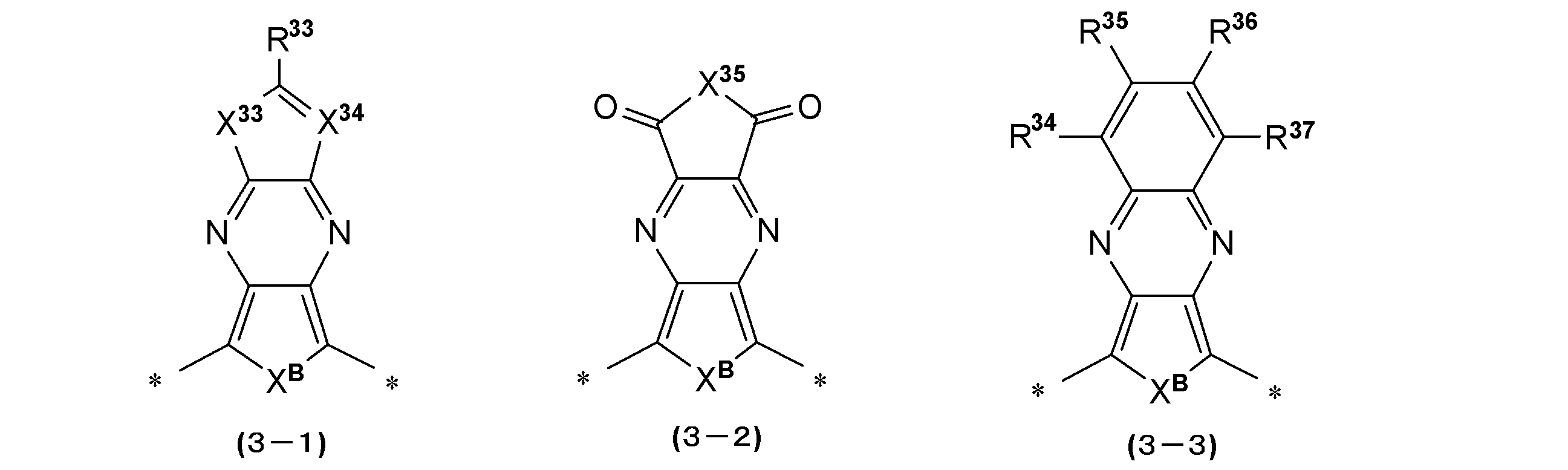
- 前記式(3)で表される構成単位が、下記式(3-4)~(3-6)のいずれかで表される構成単位である請求項1に記載の有機薄膜太陽電池。

- 前記式(3)で表される構成単位が下記式(3-7)~(3-9)のいずれかで表される構成単位である請求項1に記載の有機薄膜太陽電池。
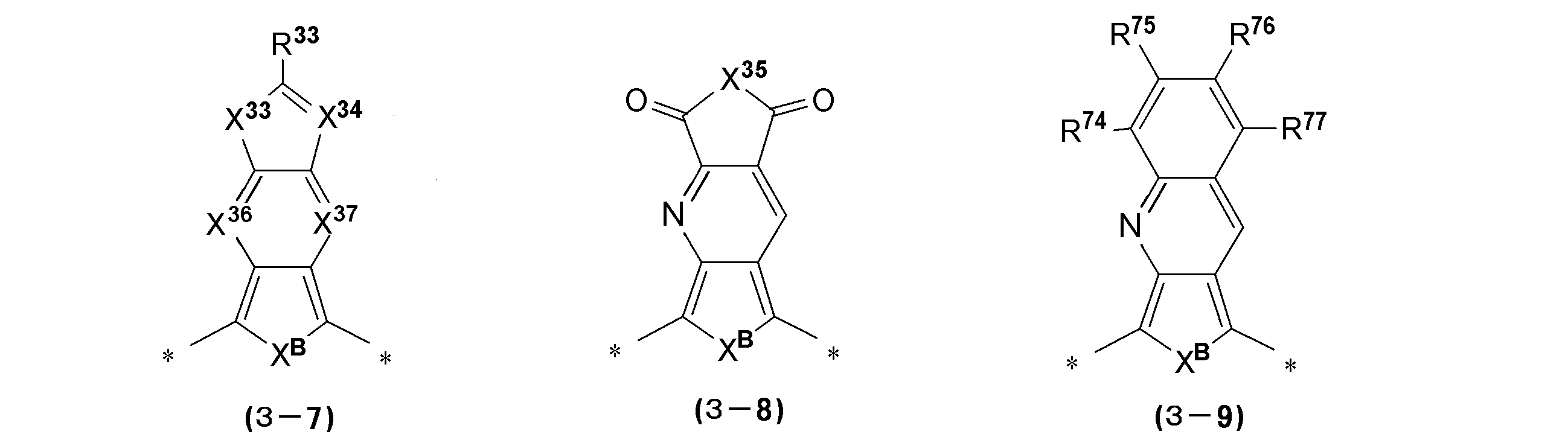
- 前記式(4)におけるXCが、硫黄原子である請求項1に記載の有機薄膜太陽電池。
- 前記式(4)におけるR41およびR42が各々独立に、ホルミル基、フッ素原子、塩素原子、炭素数2~24のアシル基、炭素数3~24のアルコキシカルボニル基、炭素数2~24のアシルオキシ基、炭素数1~24のアルキルスルホニル基、炭素数1~24のアルコキシスルホニル基、ニトロ基、炭素数1~24のパーフルオロアルキル基、炭素数1~24のパーフルオロアルコキシ基、炭素数1~24のカルバモイル基、炭素数1~24のスルファモイル基、炭素数2~24のパーフルオロアルキルカルボニル基、炭素数2~24のパーフルオロアルキルカルボニルオキシ基、炭素数2~24のアルキニル基または-CR45=CR46R47(R45は水素原子またはアルキル基を表す。R46およびR47は各々独立に、水素原子、アルキル基、シアノ基、アルコキシカルボニル基またはアシル基を表す。ただし、R46およびR47のいずれか一方はシアノ基、アルコキシカルボニル基またはアシル基である。)である請求項1または10に記載の有機薄膜太陽電池。
- 下記式(1)~(4)のいずれかで表される構成単位を有するポリマーを有機溶媒中に含有する組成物。
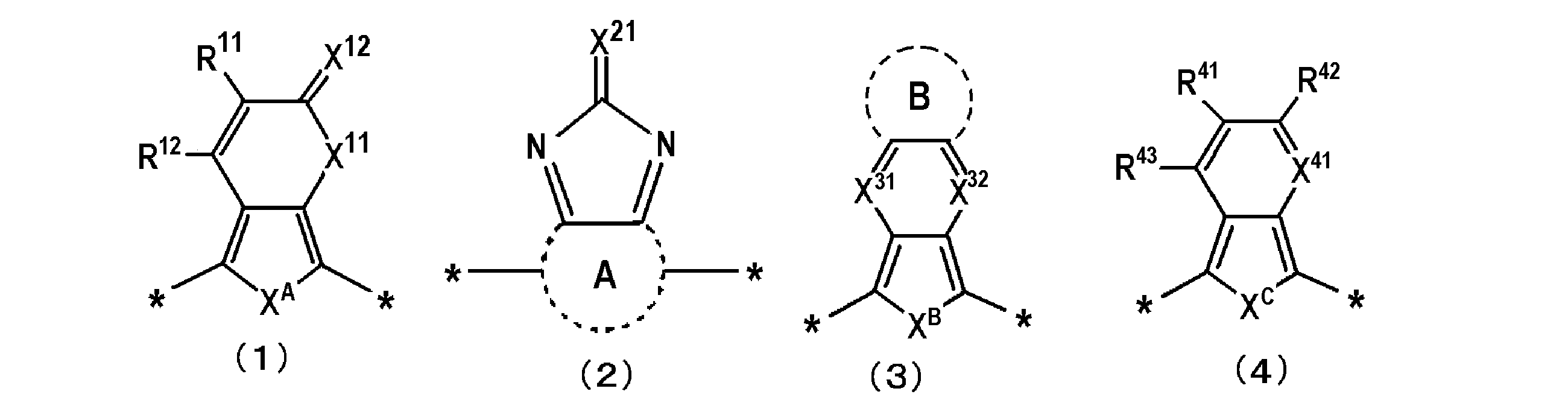
式(2)中、X21は酸素原子、硫黄原子、=NRnまたは=CR201R202で表される2価の基を表す。R201およびR202は各々独立に置換基を表す。R201とR202が互いに連結して環を形成してもよい。Rnは前記式(1)と同義である。環Aは芳香環を表す。
式(3)中、XBは前記XAと同義である。環Bは単環もしくは2環の芳香環または、脂環を表す。X31およびX32は各々独立に窒素原子または=CR31-を表す。R31は水素原子または置換基を表す。ただし、X31およびX32の両方が=CR31-のとき、環Bは単環の芳香環、窒素原子を含まない単環の脂環、または2環の芳香環もしくは脂環を示す。
式(4)中、XCは前記XAと同義である。R41およびR42は各々独立に、水素原子、ホルミル基、フッ素原子、塩素原子、炭素数1~24のアルキル基、炭素数2~24のアシル基、炭素数3~24のアルコキシカルボニル基、炭素数2~24のアシルオキシ基、炭素数1~24のアルキルスルホニル基、炭素数1~24のアルコキシスルホニル基、ニトロ基、炭素数1~24のパーフルオロアルキル基、炭素数1~24のパーフルオロアルコキシ基、炭素数1~24のカルバモイル基、炭素数1~24のスルファモイル基、炭素数2~24のパーフルオロアルキルカルボニル基、炭素数2~24のパーフルオロアルキルカルボニルオキシ基、炭素数2~24のアルキニル基または-CR45=CR46R47を表す。R45は水素原子またはアルキル基を表す。R46およびR47は各々独立に、水素原子、シアノ基、アルコキシカルボニル基またはアシル基を表す。ただし、R46およびR47のいずれか一方はシアノ基、アルコキシカルボニル基またはアシル基である。R43は置換基を表す。X41は窒素原子または=CR44-を表す。R44は水素原子または置換基を表す。
ここで、式(1)~(4)における*はポリマー主鎖を形成する結合手を示す。] - さらにn型半導体成分を含有する請求項12に記載の組成物。
- 前記n型半導体成分がフラーレン誘導体である請求項13に記載の組成物。
- 有機半導体材料用である請求項12~14のいずれか1項に記載の組成物。
- 請求項15に記載の組成物を塗布することにより形成されてなる膜。
- 下記式(M1)~(M4)のいずれかで表される化合物からなる単量体。

式(M2)中、X21は酸素原子、硫黄原子、=NRnまたは=CR201R202で表される2価の基を表す。R201およびR202は各々独立に置換基を表す。R201とR202が互いに連結して環を形成してもよい。Rnは前記式(1)と同義である。環Aは芳香環を表す。
式(M3)中、XBは前記XAと同義である。環Bは単環もしくは2環の芳香環または、脂環を表す。X31およびX32は各々独立に窒素原子または=CR31-を表す。R31は水素原子または置換基を表す。ただし、X31およびX32の両方が=CR31-のとき、環Bは単環の芳香環、窒素原子を含まない単環の脂環、または2環の芳香環もしくは脂環を表す。
式(M4)中、XCは前記XAと同義である。R41およびR42は各々独立に、水素原子、ホルミル基、フッ素原子、塩素原子、炭素数1~24のアルキル基、炭素数2~24のアシル基、炭素数3~24のアルコキシカルボニル基、炭素数2~24のアシルオキシ基、炭素数1~24のアルキルスルホニル基、炭素数1~24のアルコキシスルホニル基、ニトロ基、炭素数1~24のパーフルオロアルキル基、炭素数1~24のパーフルオロアルコキシ基、炭素数1~24のカルバモイル基、炭素数1~24のスルファモイル基、炭素数2~24のパーフルオロアルキルカルボニル基、炭素数2~24のパーフルオロアルキルカルボニルオキシ基、炭素数2~24のアルキニル基または-CR45=CR46R47を表す。R45は水素原子またはアルキル基を表す。R46およびR47は各々独立に、水素原子、シアノ基、アルコキシカルボニル基またはアシル基を表す。ただし、R46およびR47のいずれか一方はシアノ基、アルコキシカルボニル基またはアシル基である。R43は置換基を表す。X41は窒素原子または=CR44-を表す。R44は水素原子または置換基を表す。
式(M1)~(M4)におけるYaおよびYbは各々独立に、ハロゲン原子、パーフルオロアルカンスルホニルオキシ基、トリアルキルスズ基、ボロン酸エステル基またはボロン酸基を表す。]
Applications Claiming Priority (2)
| Application Number | Priority Date | Filing Date | Title |
|---|---|---|---|
| JP2012-106344 | 2012-05-07 | ||
| JP2012106344 | 2012-05-07 |
Publications (1)
| Publication Number | Publication Date |
|---|---|
| WO2013168709A1 true WO2013168709A1 (ja) | 2013-11-14 |
Family
ID=49550744
Family Applications (1)
| Application Number | Title | Priority Date | Filing Date |
|---|---|---|---|
| PCT/JP2013/062847 Ceased WO2013168709A1 (ja) | 2012-05-07 | 2013-05-07 | 有機薄膜太陽電池、これに用いられる有機半導体材料用組成物および単量体 |
Country Status (2)
| Country | Link |
|---|---|
| JP (1) | JP5848280B2 (ja) |
| WO (1) | WO2013168709A1 (ja) |
Cited By (5)
| Publication number | Priority date | Publication date | Assignee | Title |
|---|---|---|---|---|
| US20170141318A1 (en) * | 2014-04-24 | 2017-05-18 | The Trustees Of Columbia University In The City Of New York | Molecular compositions, materials, and methods for efficient multiple excition generation |
| CN110214204A (zh) * | 2016-08-23 | 2019-09-06 | 杰森·D·阿祖莱 | 用于电子装置的使用交叉共轭供体的窄带隙共轭聚合物 |
| CN113264948A (zh) * | 2021-04-22 | 2021-08-17 | 华南师范大学 | 一种含酯基取代的芳香杂环共轭骨架及其聚合物材料和应用 |
| CN114497380A (zh) * | 2022-01-28 | 2022-05-13 | 青岛科技大学 | 一种通过粒界钝化改善钙钛矿电池性能的方法 |
| WO2023282605A3 (ko) * | 2021-07-07 | 2023-03-02 | (주)피엔에이치테크 | 다기능 단일 정공층을 구비한 저전압 구동 고효율 유기발광소자 |
Families Citing this family (6)
| Publication number | Priority date | Publication date | Assignee | Title |
|---|---|---|---|---|
| US10711092B2 (en) | 2017-09-21 | 2020-07-14 | The University Of Southern Mississippi | Gold catalyzed polymerization reactions of unsaturated substrates |
| US11773211B2 (en) | 2018-05-05 | 2023-10-03 | University Of Southern Mississippi | Open-shell conjugated polymer conductors, composites, and compositions |
| KR102675085B1 (ko) * | 2018-06-20 | 2024-06-13 | (주)피엔에이치테크 | 유기발광 화합물 및 이를 포함하는 유기발광소자 |
| WO2020106361A2 (en) | 2018-09-21 | 2020-05-28 | Joshua Tropp | Thiol-based post-modification of conjugated polymers |
| US11781986B2 (en) | 2019-12-31 | 2023-10-10 | University Of Southern Mississippi | Methods for detecting analytes using conjugated polymers and the inner filter effect |
| KR20230010087A (ko) * | 2021-07-08 | 2023-01-18 | (주)피엔에이치테크 | 다기능 정공층 화합물 및 이를 이용한 유기발광소자 |
Citations (7)
| Publication number | Priority date | Publication date | Assignee | Title |
|---|---|---|---|---|
| JPH0326719A (ja) * | 1989-06-26 | 1991-02-05 | Toray Ind Inc | ナフト[2,3―c]チオフェン構造を有する重合体の製造方法 |
| JP2004115443A (ja) * | 2002-09-26 | 2004-04-15 | Mitsui Chemicals Inc | 全フッ素化芳香族基を有する複素環式化合物、および該化合物を用いた電子写真感光体、電子写真装置、有機電界発光素子 |
| JP2006076978A (ja) * | 2004-09-13 | 2006-03-23 | Dainippon Printing Co Ltd | チオフェン誘導体および有機エレクトロルミネッセンス素子 |
| WO2009151144A1 (ja) * | 2008-06-13 | 2009-12-17 | 住友化学株式会社 | 共重合体及びそれを用いた高分子発光素子 |
| JP2010280641A (ja) * | 2009-06-08 | 2010-12-16 | Hokkaido Univ | 縮合チオフェン誘導体及びその製造方法 |
| WO2012024592A2 (en) * | 2010-08-19 | 2012-02-23 | Massachusetts Institute Of Technology | Compositions, methods, and systems comprising fluorous-soluble polymers |
| WO2012099000A1 (ja) * | 2011-01-18 | 2012-07-26 | コニカミノルタホールディングス株式会社 | 有機光電変換素子および太陽電池 |
-
2013
- 2013-05-07 WO PCT/JP2013/062847 patent/WO2013168709A1/ja not_active Ceased
- 2013-05-07 JP JP2013097581A patent/JP5848280B2/ja active Active
Patent Citations (7)
| Publication number | Priority date | Publication date | Assignee | Title |
|---|---|---|---|---|
| JPH0326719A (ja) * | 1989-06-26 | 1991-02-05 | Toray Ind Inc | ナフト[2,3―c]チオフェン構造を有する重合体の製造方法 |
| JP2004115443A (ja) * | 2002-09-26 | 2004-04-15 | Mitsui Chemicals Inc | 全フッ素化芳香族基を有する複素環式化合物、および該化合物を用いた電子写真感光体、電子写真装置、有機電界発光素子 |
| JP2006076978A (ja) * | 2004-09-13 | 2006-03-23 | Dainippon Printing Co Ltd | チオフェン誘導体および有機エレクトロルミネッセンス素子 |
| WO2009151144A1 (ja) * | 2008-06-13 | 2009-12-17 | 住友化学株式会社 | 共重合体及びそれを用いた高分子発光素子 |
| JP2010280641A (ja) * | 2009-06-08 | 2010-12-16 | Hokkaido Univ | 縮合チオフェン誘導体及びその製造方法 |
| WO2012024592A2 (en) * | 2010-08-19 | 2012-02-23 | Massachusetts Institute Of Technology | Compositions, methods, and systems comprising fluorous-soluble polymers |
| WO2012099000A1 (ja) * | 2011-01-18 | 2012-07-26 | コニカミノルタホールディングス株式会社 | 有機光電変換素子および太陽電池 |
Non-Patent Citations (3)
| Title |
|---|
| JESSICA D. DOUGLAS ET AL.: "Functionalized Isothianaphthene Monomers That Promote Quinoidal Character in Donor-Acceptor Copolymers for Organic Photovoltaics", MACROMOLECULES, vol. 45, no. ISSUE, 3 May 2012 (2012-05-03), pages 4069 - 4074 * |
| JUNG YONG KIM ET AL.: "High Open-Circuit Voltage Photovoltaic Cells with a Low Bandgap Copolymer of Isothianaphthene", THIOPHENE, AND BENZOTHIADIAZOLE UNITS, JOURNAL OF PHYSICAL CHEMISTRY C, vol. 113, no. ISSUE, 31 December 2009 (2009-12-31), pages 21928 - 21936 * |
| YANG QIN ET AL.: "Distannylated Isothianaphthene: A Versatile Building Block for Low Bandgap Conjugated Polymers", MACROMOLECULES, vol. 41, no. ISSSUE, 12 August 2008 (2008-08-12), pages 5563 - 5570 * |
Cited By (6)
| Publication number | Priority date | Publication date | Assignee | Title |
|---|---|---|---|---|
| US20170141318A1 (en) * | 2014-04-24 | 2017-05-18 | The Trustees Of Columbia University In The City Of New York | Molecular compositions, materials, and methods for efficient multiple excition generation |
| US10636974B2 (en) * | 2014-04-24 | 2020-04-28 | The Trustees Of Columbia University In The City Of New York | Molecular compositions, materials, and methods for efficient multiple exciton generation |
| CN110214204A (zh) * | 2016-08-23 | 2019-09-06 | 杰森·D·阿祖莱 | 用于电子装置的使用交叉共轭供体的窄带隙共轭聚合物 |
| CN113264948A (zh) * | 2021-04-22 | 2021-08-17 | 华南师范大学 | 一种含酯基取代的芳香杂环共轭骨架及其聚合物材料和应用 |
| WO2023282605A3 (ko) * | 2021-07-07 | 2023-03-02 | (주)피엔에이치테크 | 다기능 단일 정공층을 구비한 저전압 구동 고효율 유기발광소자 |
| CN114497380A (zh) * | 2022-01-28 | 2022-05-13 | 青岛科技大学 | 一种通过粒界钝化改善钙钛矿电池性能的方法 |
Also Published As
| Publication number | Publication date |
|---|---|
| JP2013254943A (ja) | 2013-12-19 |
| JP5848280B2 (ja) | 2016-01-27 |
Similar Documents
| Publication | Publication Date | Title |
|---|---|---|
| JP5848280B2 (ja) | 有機薄膜太陽電池、これに用いられる組成物および単量体、ならびに膜の製造方法 | |
| JP5869420B2 (ja) | 有機薄膜太陽電池、これに用いられる組成物、単量体および半導体膜の製造方法 | |
| JP6460553B2 (ja) | 重合体及びこれを含む有機太陽電池 | |
| Wang et al. | Extending π-conjugation system with benzene: an effective method to improve the properties of benzodithiophene-based polymer for highly efficient organic solar cells | |
| JP5859872B2 (ja) | 有機光電変換素子組成物、これを含む薄膜、光電池、これに用いられる有機半導体ポリマー、化合物およびポリマーの製造方法 | |
| JP5482973B1 (ja) | 共役系重合体、これを用いた電子供与性有機材料、光起電力素子用材料および光起電力素子 | |
| JP6085236B2 (ja) | 有機半導体デバイス、これに用いる化合物、組成物及び塗布膜 | |
| JP5859911B2 (ja) | 有機薄膜太陽電池、これに用いられる組成物および半導体膜の製造方法 | |
| JP6088954B2 (ja) | 有機光電変換素子、有機薄膜太陽電池、これに用いる組成物、塗布膜およびこれに有用な化合物 | |
| CN107109033A (zh) | 有机半导体组合物、光伏元件、光电转换装置和光伏元件的制造方法 | |
| JP5658633B2 (ja) | 有機半導体用組成物及びそれを用いた光電変換素子 | |
| WO2013123508A2 (en) | Organic semiconducting compounds for use in organic electronic devices | |
| JP5616273B2 (ja) | 有機半導体ポリマー、有機半導体材料用組成物および光電池 | |
| JP5662916B2 (ja) | 有機薄膜太陽電池、これに用いられる有機半導体ポリマーおよび有機半導体材料用組成物 | |
| Liu et al. | PDI-based hexapod-shaped nonfullerene acceptors for the high-performance as-cast organic solar cells | |
| JP5616272B2 (ja) | 有機半導体ポリマー、有機半導体材料用組成物および光電池 | |
| JP6181318B2 (ja) | 光電子工学用途のための高い導電性および吸収を有する小分子/オリゴマーの合成 | |
| JP6051102B2 (ja) | 有機光電変換素子および有機薄膜太陽電池 | |
| JP5643735B2 (ja) | 有機薄膜太陽電池、これに用いられる有機半導体ポリマーおよび有機半導体材料用組成物 | |
| JP6068729B2 (ja) | 電子豊富な部位と電子不足の部位を有する化合物、および有機電子用途におけるその使用 | |
| CN110536917B (zh) | 聚合物和包含其的有机太阳能电池 | |
| KR102855934B1 (ko) | P형 유기 반도체 화합물, 이의 제조방법 및 이를 함유하는 반투명 유기 태양전지 | |
| WO2014098094A1 (ja) | 有機光電変換素子、有機薄膜太陽電池、これらに用いる組成物、塗布膜、ポリマーおよび化合物 | |
| JP2016103570A (ja) | 光起電力素子 | |
| WO2014050902A1 (ja) | 有機薄膜太陽電池 |
Legal Events
| Date | Code | Title | Description |
|---|---|---|---|
| 121 | Ep: the epo has been informed by wipo that ep was designated in this application |
Ref document number: 13787166 Country of ref document: EP Kind code of ref document: A1 |
|
| NENP | Non-entry into the national phase |
Ref country code: DE |
|
| 122 | Ep: pct application non-entry in european phase |
Ref document number: 13787166 Country of ref document: EP Kind code of ref document: A1 |