WO2013161916A1 - 光情報記録媒体 - Google Patents
光情報記録媒体 Download PDFInfo
- Publication number
- WO2013161916A1 WO2013161916A1 PCT/JP2013/062146 JP2013062146W WO2013161916A1 WO 2013161916 A1 WO2013161916 A1 WO 2013161916A1 JP 2013062146 W JP2013062146 W JP 2013062146W WO 2013161916 A1 WO2013161916 A1 WO 2013161916A1
- Authority
- WO
- WIPO (PCT)
- Prior art keywords
- range
- recording medium
- information recording
- optical information
- depth
- Prior art date
- Legal status (The legal status is an assumption and is not a legal conclusion. Google has not performed a legal analysis and makes no representation as to the accuracy of the status listed.)
- Ceased
Links
Images


Classifications
-
- G—PHYSICS
- G11—INFORMATION STORAGE
- G11B—INFORMATION STORAGE BASED ON RELATIVE MOVEMENT BETWEEN RECORD CARRIER AND TRANSDUCER
- G11B7/00—Recording or reproducing by optical means, e.g. recording using a thermal beam of optical radiation by modifying optical properties or the physical structure, reproducing using an optical beam at lower power by sensing optical properties; Record carriers therefor
- G11B7/24—Record carriers characterised by shape, structure or physical properties, or by the selection of the material
- G11B7/2403—Layers; Shape, structure or physical properties thereof
- G11B7/24062—Reflective layers
-
- G—PHYSICS
- G11—INFORMATION STORAGE
- G11B—INFORMATION STORAGE BASED ON RELATIVE MOVEMENT BETWEEN RECORD CARRIER AND TRANSDUCER
- G11B7/00—Recording or reproducing by optical means, e.g. recording using a thermal beam of optical radiation by modifying optical properties or the physical structure, reproducing using an optical beam at lower power by sensing optical properties; Record carriers therefor
- G11B7/12—Heads, e.g. forming of the optical beam spot or modulation of the optical beam
- G11B7/135—Means for guiding the beam from the source to the record carrier or from the record carrier to the detector
- G11B7/1372—Lenses
- G11B7/1374—Objective lenses
-
- G—PHYSICS
- G11—INFORMATION STORAGE
- G11B—INFORMATION STORAGE BASED ON RELATIVE MOVEMENT BETWEEN RECORD CARRIER AND TRANSDUCER
- G11B7/00—Recording or reproducing by optical means, e.g. recording using a thermal beam of optical radiation by modifying optical properties or the physical structure, reproducing using an optical beam at lower power by sensing optical properties; Record carriers therefor
- G11B7/24—Record carriers characterised by shape, structure or physical properties, or by the selection of the material
- G11B7/24018—Laminated discs
- G11B7/24027—Layers; Shape, structure or physical properties thereof
-
- G—PHYSICS
- G11—INFORMATION STORAGE
- G11B—INFORMATION STORAGE BASED ON RELATIVE MOVEMENT BETWEEN RECORD CARRIER AND TRANSDUCER
- G11B7/00—Recording or reproducing by optical means, e.g. recording using a thermal beam of optical radiation by modifying optical properties or the physical structure, reproducing using an optical beam at lower power by sensing optical properties; Record carriers therefor
- G11B7/24—Record carriers characterised by shape, structure or physical properties, or by the selection of the material
- G11B7/2403—Layers; Shape, structure or physical properties thereof
- G11B7/24035—Recording layers
-
- G—PHYSICS
- G11—INFORMATION STORAGE
- G11B—INFORMATION STORAGE BASED ON RELATIVE MOVEMENT BETWEEN RECORD CARRIER AND TRANSDUCER
- G11B7/00—Recording or reproducing by optical means, e.g. recording using a thermal beam of optical radiation by modifying optical properties or the physical structure, reproducing using an optical beam at lower power by sensing optical properties; Record carriers therefor
- G11B7/24—Record carriers characterised by shape, structure or physical properties, or by the selection of the material
- G11B7/2403—Layers; Shape, structure or physical properties thereof
- G11B7/24067—Combinations of two or more layers with specific interrelation
-
- G—PHYSICS
- G11—INFORMATION STORAGE
- G11B—INFORMATION STORAGE BASED ON RELATIVE MOVEMENT BETWEEN RECORD CARRIER AND TRANSDUCER
- G11B7/00—Recording or reproducing by optical means, e.g. recording using a thermal beam of optical radiation by modifying optical properties or the physical structure, reproducing using an optical beam at lower power by sensing optical properties; Record carriers therefor
- G11B7/24—Record carriers characterised by shape, structure or physical properties, or by the selection of the material
- G11B7/2407—Tracks or pits; Shape, structure or physical properties thereof
- G11B7/24073—Tracks
- G11B7/24076—Cross sectional shape in the radial direction of a disc, e.g. asymmetrical cross sectional shape
-
- G—PHYSICS
- G11—INFORMATION STORAGE
- G11B—INFORMATION STORAGE BASED ON RELATIVE MOVEMENT BETWEEN RECORD CARRIER AND TRANSDUCER
- G11B7/00—Recording or reproducing by optical means, e.g. recording using a thermal beam of optical radiation by modifying optical properties or the physical structure, reproducing using an optical beam at lower power by sensing optical properties; Record carriers therefor
- G11B7/24—Record carriers characterised by shape, structure or physical properties, or by the selection of the material
- G11B7/2407—Tracks or pits; Shape, structure or physical properties thereof
- G11B7/24073—Tracks
- G11B7/24079—Width or depth
-
- G—PHYSICS
- G11—INFORMATION STORAGE
- G11B—INFORMATION STORAGE BASED ON RELATIVE MOVEMENT BETWEEN RECORD CARRIER AND TRANSDUCER
- G11B7/00—Recording or reproducing by optical means, e.g. recording using a thermal beam of optical radiation by modifying optical properties or the physical structure, reproducing using an optical beam at lower power by sensing optical properties; Record carriers therefor
- G11B7/24—Record carriers characterised by shape, structure or physical properties, or by the selection of the material
- G11B7/241—Record carriers characterised by shape, structure or physical properties, or by the selection of the material characterised by the selection of the material
- G11B7/242—Record carriers characterised by shape, structure or physical properties, or by the selection of the material characterised by the selection of the material of recording layers
- G11B7/244—Record carriers characterised by shape, structure or physical properties, or by the selection of the material characterised by the selection of the material of recording layers comprising organic materials only
- G11B7/246—Record carriers characterised by shape, structure or physical properties, or by the selection of the material characterised by the selection of the material of recording layers comprising organic materials only containing dyes
- G11B7/248—Record carriers characterised by shape, structure or physical properties, or by the selection of the material characterised by the selection of the material of recording layers comprising organic materials only containing dyes porphines; azaporphines, e.g. phthalocyanines
-
- G—PHYSICS
- G11—INFORMATION STORAGE
- G11B—INFORMATION STORAGE BASED ON RELATIVE MOVEMENT BETWEEN RECORD CARRIER AND TRANSDUCER
- G11B7/00—Recording or reproducing by optical means, e.g. recording using a thermal beam of optical radiation by modifying optical properties or the physical structure, reproducing using an optical beam at lower power by sensing optical properties; Record carriers therefor
- G11B7/08—Disposition or mounting of heads or light sources relatively to record carriers
- G11B7/09—Disposition or mounting of heads or light sources relatively to record carriers with provision for moving the light beam or focus plane for the purpose of maintaining alignment of the light beam relative to the record carrier during transducing operation, e.g. to compensate for surface irregularities of the latter or for track following
- G11B7/0938—Disposition or mounting of heads or light sources relatively to record carriers with provision for moving the light beam or focus plane for the purpose of maintaining alignment of the light beam relative to the record carrier during transducing operation, e.g. to compensate for surface irregularities of the latter or for track following servo format, e.g. guide tracks, pilot signals
-
- G—PHYSICS
- G11—INFORMATION STORAGE
- G11B—INFORMATION STORAGE BASED ON RELATIVE MOVEMENT BETWEEN RECORD CARRIER AND TRANSDUCER
- G11B7/00—Recording or reproducing by optical means, e.g. recording using a thermal beam of optical radiation by modifying optical properties or the physical structure, reproducing using an optical beam at lower power by sensing optical properties; Record carriers therefor
- G11B7/24—Record carriers characterised by shape, structure or physical properties, or by the selection of the material
- G11B7/2403—Layers; Shape, structure or physical properties thereof
- G11B7/24047—Substrates
- G11B7/2405—Substrates being also used as track layers of pre-formatted layers
Definitions
- the present technology relates to an optical information recording medium. More specifically, the present invention relates to an optical information recording medium including a substrate having a recess on the surface, a recording layer, and a reflective layer.
- Examples of recordable optical information recording media include rewritable optical information recording media represented by CD-RW (Compact Disc-Rewritable) and DVD ⁇ RW (Digital Versatile Disc ⁇ Rewritable), and CD-R (Compact Disc- Rewritable). Recordable) and DVD-R (Digital Versatile Disc-Recordable) are typical of the write-once type optical information recording medium, but in particular, the latter has greatly contributed to the market expansion as a low-cost medium.
- CD-RW Compact Disc-Rewritable
- DVD ⁇ RW Digital Versatile Disc ⁇ Rewritable
- Recordable and DVD-R Digital Versatile Disc-Recordable
- recording materials used for the write-once type optical information recording medium there are inorganic materials and organic dye materials, but conventionally, organic dye materials have mainly been studied as recording materials.
- organic dye materials As an optical information recording medium using an organic dye material, one having a structure in which a reflective layer is provided on the surface of a recording layer containing an organic dye material is adopted.
- Silver (Ag) is widely used as the material of the reflective layer. It is disclosed that aluminum (Al) is used as a material other than silver (Ag) (see, for example, Patent Documents 1 to 4).
- an object of the present technology is to provide an optical information recording medium capable of suppressing a decrease in reflectance.
- the present technology A substrate having a recess on the surface, Recording layer, And a reflective layer, This is an optical information recording medium in which the decrease in reflectance is suppressed by the combination of the range of the optical density of the recording layer and the depth of the recess of the substrate.
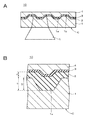
- FIG. 1A is a schematic cross-sectional view showing an exemplary configuration of an optical information recording medium according to an embodiment of the present technology.
- FIG. 1B is an enlarged sectional view showing a part of FIG. 1A.
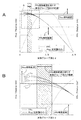
- FIG. 2A is a diagram showing changes in the maximum reflectance R top and the push-pull signal PPb with respect to the effective groove depth d.
- FIG. 2B is an enlarged view of a region A of FIG. 2A.
- FIG. 3A is an enlarged sectional view showing a part of an optical information recording medium having a deep groove.
- FIG. 3B is an enlarged sectional view showing a part of the optical information recording medium having a groove of a prescribed depth.
- FIG. 1A is a schematic cross-sectional view showing an exemplary configuration of an optical information recording medium according to an embodiment of the present technology.
- FIG. 1B is an enlarged sectional view showing a part of FIG. 1A.
- FIG. 2A is a diagram showing changes in the maximum reflectance
- FIG. 3C is an enlarged sectional view showing a part of the optical information recording medium having a shallow groove.
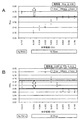
- FIG. 4A is a diagram showing the evaluation results of the maximum reflectance R top of the write-once type optical information recording medium of Samples 1-1 to 1-8 and Sample 2-1.
- FIG. 4B is a diagram showing the evaluation results of the push-pull signal PPb when the write-once type optical information recording medium of Samples 1-1 to 1-8 and Sample 2-1 is not recorded.
- FIG. 5A is a diagram showing the evaluation results of the push-pull signal PPb when the write-once type optical information recording medium of Samples 3-1 to 6-2 is not recorded.
- FIG. 5B is a diagram showing the evaluation results of the maximum reflectance R top of the write-once type optical information recording media of Samples 3-1 to 6-2.
- FIG. 1A is a schematic cross-sectional view showing an exemplary configuration of an optical information recording medium according to an embodiment of the present technology.
- FIG. 1B is an enlarged sectional view showing a part of FIG. 1A.
- This optical information recording medium 10 is a so-called single layer write-once optical information recording medium, and as shown in FIG. 1A, the recording layer 2, the reflective layer 3 and the protective layer 4 are in this order on one main surface of the substrate 1. It has a stacked configuration.
- optical information recording medium 10 In the optical information recording medium 10 according to this embodiment, recording or reproduction of an information signal is performed by irradiating the recording layer 2 with the laser light L from the surface C on the substrate 1 side.
- a laser beam L having a wavelength in the range of 770 nm to 790 nm is collected by an objective lens having a numerical aperture in the range of 0.44 to 0.46, and the surface C on the substrate 1 side is transferred to the recording layer 2
- an optical information recording medium 10 for example, a single layer CD-R can be mentioned.
- the substrate 1, the recording layer 2, the reflective layer 3 and the protective layer 4 constituting the optical information recording medium 10 will be sequentially described.
- the substrate 1 has, for example, an annular shape in which an opening (hereinafter referred to as a center hole) is formed at the center.
- One main surface of the substrate 1 is, for example, an uneven surface, and the recording layer 2 is provided on the uneven surface.
- the concave portion is referred to as a groove 1a, and the convex portion is referred to as a land 1b.
- Examples of the shape of the groove 1a and the land 1b include various shapes such as a spiral shape and a concentric shape. Further, the groove 1a and / or the land 1b are wobbled (serpently), for example, for stabilization of linear velocity and addition of address information.
- the diameter (diameter) of the substrate 1 is selected to be, for example, 120 mm.
- the thickness of the substrate 1 is selected in consideration of rigidity, and is preferably 0.3 mm or more and 1.3 mm or less, more preferably 0.6 mm or more and 1.3 mm or less, for example, 1.2 mm.
- the diameter (diameter) of the center hole is selected to be, for example, 15 mm.
- the depth D of the groove 1a of the substrate 1 is, for example, in the range of 198 nm to 220 nm.
- a plastic material or glass can be used, and from the viewpoint of cost, it is preferable to use a plastic material.
- a plastic material polycarbonate resin, polyolefin resin, acrylic resin etc. can be used, for example.
- the recording layer 2 is a recording layer capable of recording an information signal by irradiation of laser light L.
- the recording layer 2 contains an organic dye as a main component.
- the organic dye for example, at least one of phthalocyanine dyes, naphthalocyanine dyes, porphyrin dyes, cyanine dyes, merocyanine dyes, styryl dyes, squarylium dyes and azo dyes can be used.
- the reflective layer 4 preferably contains aluminum (Al) as a main component. This is because the cost of the optical information recording medium 10 can be reduced as compared with the case where the reflective layer 3 contains silver (Ag) as a main component.
- the protective layer 2 is, for example, a resin layer formed by curing a photosensitive resin such as an ultraviolet curing resin.
- a photosensitive resin such as an ultraviolet curing resin.
- Examples of the material of the resin layer include ultraviolet curable acrylic resins.
- Optical Properties of Optical Information Recording Medium The combination of the range of the optical density (OD) of the recording layer 2 and the depth D of the groove 1 a of the substrate 1 suppresses the decrease in the maximum reflectance R top . Due to this suppression, the maximum reflectance R top is preferably maintained in the range of 0.6 or more. When the maximum reflectance R top is 0.6 or more, recording or reproduction of the optical information recording medium 10 can be favorably performed by a general consumer drive.
- the push-pull signal PPb at the time of non-recording is improved by the combination of the range of the optical density of the recording layer 2 and the depth D of the groove 1 a of the substrate 1. Due to this improvement, it is preferable that the push-pull signal PPb in the unrecorded state be set in the range of 0.080 or more and 0.13 or less.
- the recording of the optical information recording medium 10 can be favorably performed by a general consumer drive.
- the optical information recording medium 10 condenses a laser beam L having a wavelength in the range of 770 nm or more and 790 nm or less by an objective lens having a numerical aperture in the range of 0.44 or more and 0.46 or less.
- the range of the optical density of the recording layer 2 is in the range of more than 0.560 and not more than 0.700.
- the depth D of the groove 1a is preferably in the range of 198 nm to 220 nm.
- the push-pull signal PPb at the time of unrecorded can be increased depending on the increase of the depth D of the groove 1a, and the depth of the groove 1a is It is because the fluctuation of the maximum reflectance R top with respect to the change can be suppressed.
- the optical information recording medium 10 condenses a laser beam L having a wavelength in the range of 770 nm or more and 790 nm or less by an objective lens having a numerical aperture in the range of 0.44 or more and 0.46 or less.
- the range of the optical density of the recording layer 2 is in the range of more than 0.560 and 0.710 or less.
- the depth D of the groove 1a is more preferably in the range of 203.5 nm or more and 220 nm or less.
- the push-pull signal PPb at the time of unrecorded can be increased depending on the increase of the depth D of the groove 1a and the depth of the groove 1a This is because it is possible to suppress the fluctuation of the maximum reflectance R top with respect to the change of height .
- the variation of the maximum reflectance R top within the range of the depth D of the groove 1 a is suppressed by the combination of the range of the optical density of the recording layer 2 and the depth D of the groove 1 a of the substrate 1. More specifically, the combination of the range of the optical density of the recording layer 2 and the depth D of the groove 1a of the substrate 1 depends on the increase of the depth D of the groove 1a in the range of the depth D of the groove 1a. It is preferable that the fluctuation of the maximum reflectance R top with respect to the increase of the depth D of the groove 1a is suppressed while the push-pull signal PPb at the time of unrecorded increases.
- the suppression of such variation in the maximum reflectivity R top it is preferable that the maximum reflectivity R top is substantially constant.
- almost constant means that the fluctuation range of the maximum reflectance R top is 0.015 or less.
- the maximum reflectance R top is the reflectance when the reproduction signal corresponding to the 11T signal of the EFM signal reaches the maximum level, and is expressed by the following equation (1).
- R top R 0 ⁇ I top / I 0 (1)
- R 0 is the reflectance at the mirror surface of the optical information recording medium 10
- I 0 is the reproduction signal level at the mirror surface
- I top is the maximum level of the reproduction signal corresponding to the 11T signal of the EFM modulation signal.
- the push-pull signal PPb at the time of unrecorded is expressed by the following equation (2).
- PPb (I 1 ⁇ I 2 ) pp / (I 1 + I 2 ) max (2)
- I1 and I2 represent the respective outputs when the light receiving element of the light detector is divided into two in the radial direction, pp represents the peak to peak, and max represents the maximum value.
- Optical density is a dimensionless quantity that indicates how much the intensity diminishes when light passes through an object. When it does not include scattering and reflection, it is simply called absorbance.
- the optical density A ⁇ at wavelength ⁇ is defined by the following equation (3).
- a ⁇ ⁇ log 10 (I / I 0 ) (3)
- I Transmitted light intensity
- I 0 Incident light intensity
- the transmittance is an exponential function of the optical path length, while the absorbance is expressed in logarithm, so it is proportional to the optical path length and the film thickness of the organic dye is to be measured. Used in
- FIG. 2A is a diagram showing changes in the maximum reflectance R top and the push-pull signal PPb with respect to the effective groove depth d.
- FIG. 2B is an enlarged view of a region A of FIG. 2A.
- a curve L 0 , a curve L A , a curve L B , and a curve L C respectively indicate the maximum reflectance R top of the optical information recording medium 10 described below.
- Curve L 0 maximum reflectance R top of the optical information recording medium in which only the reflective layer and the protective layer are laminated without forming the recording layer on the substrate
- Curve L A Maximum reflectance R top of the optical information recording medium 10 having a deep groove
- Curve L B Maximum reflectance R top of the optical information recording medium 10 having a groove of a prescribed depth
- Curve L C maximum reflectance R top of the optical information recording medium 10 having a shallow groove
- the effective groove depth d which is the horizontal axis in FIGS. 2A and 2B, is the groove depth that the laser beam actually feels, and more specifically, the depth of the reflective layer 3.
- the depth of the reflective layer 3 depends on both the groove depth D of the substrate 1 and the optical density OD (that is, the thickness t of the recording layer 2).
- the optical density OD it referred to the optical density OD as the minimum value
- the minimum optical density OD min referred to as the maximum optical density OD max optical density OD as the maximum value.
- the thickness t of the recording layer 2 is the thickness of the recording layer 2 in the groove 1 a.
- FIGS. 3A to 3C are enlarged cross-sectional views showing a part of the optical information recording medium having a deep groove, a groove of a prescribed depth, and a shallow groove, respectively.
- a groove having a defined depth means a groove whose groove depth D is within a range not less than a prescribed minimum depth D min and a prescribed maximum depth D max or less
- a deep groove means a groove deeper than a groove having a prescribed depth
- the shallow groove means a groove shallower than a groove of a prescribed depth.
- the groove 1a is a deep groove (see FIG. 3A), a groove of a prescribed depth (see FIG. 3B), and a shallow groove (see FIG. 3C)
- the following characteristics are exhibited regardless of which of the That is, when the effective groove depth d is in the range of 0 ⁇ d ⁇ ⁇ / 4, the polarity of the push-pull signal is “positive”. Then, when the effective groove depth d is ⁇ / 8, the push-pull signal is maximum.
- the range of d is derived.
- the groove 1a is a deep groove (see FIG. 3A), a groove of a prescribed depth (see FIG. 3B), and a shallow groove (see FIG. 3B). It differs depending on which is 3C) and shows the following characteristics. That is, when the effective groove depth d is in the range of 0 ⁇ d ⁇ ⁇ / 4, the maximum reflectance R top tends to increase as the effective groove depth d becomes shallower than ⁇ / 4. When the effective groove depth d becomes shallow and approaches “0”, the maximum reflectance R top tends to decrease as the groove depth D of the substrate 1 becomes deeper.
- the maximum reflectance R is obtained as compared with the case where the groove depth D is set to the specified groove depth as shown by a curve L C shown in FIG. 2B. It is possible to improve top .
- the difficulty in reducing the groove depth D in this way is as follows.
- an optical density OD (a thickness t of the recording layer 2) of a certain level or more is required. That is, the minimum optical density OD min (minimum thickness t min of the recording layer 2) exists in the optical density OD (thickness t of the recording layer 2). If the optical density OD is set so as to satisfy the minimum optical density OD min (minimum thickness t min of the recording layer 2) while making the groove depth D shallower than the prescribed minimum depth D min , the effective groove depth d becomes too shallow, and deviates from the standard range of the push-pull signal PPb. For this reason, it is difficult to make the groove depth D shallower than the specified minimum depth D min within the range where the standard of the push-pull signal PPb is satisfied.
- Such a decrease in the maximum reflectance R top is due to the following reason.
- an organic dye is added to the groove 1a. It is necessary to store a large amount and increase the optical density OD (that is, the thickness t of the recording layer 2) beyond the maximum optical density OD max .
- the optical density OD is increased as described above, the light absorption by the recording layer 2 is increased, and the maximum reflectance R top is lowered as described above.
- the push-pull signal PPb and the maximum reflectance R top in the optical information recording medium 10 it is important to consider the following points. Since the effective groove depth d depends on both the groove depth D and the optical density OD, the groove depth D and the maximum reflectance R top are within the standard range. It is necessary to consider both variables with the optical density OD. The push-pull signal PPb and the maximum reflectance R top satisfy the standard range only in a limited range of combinations of the groove depth D and the optical density OD.
- the groove depth D of the substrate 1 is not less than the prescribed minimum depth D min and not more than the prescribed maximum depth D max
- the optical density OD is not less than the minimal optical density OD min and not more than the maximum optical density OD max Is within a very limited range.
- the present inventors are important to set both the groove depth D and the optical density OD. I found that. As a result, a new concept was introduced into the design concept of the optical information recording medium 10, and the range of selection of the material of the reflective layer 3 could be expanded.
- the substrate 1 having an uneven surface formed on one main surface is formed.
- a method of molding the substrate for example, an injection molding (injection) method, a photopolymer method (2P method: Photo Polymerization), or the like can be used.
- the organic dye is dissolved in a solvent to prepare a paint.
- the solvent include aliphatic or alicyclic hydrocarbon solvents such as hexane, heptane, octane, decane, cyclohexane, methylcyclohexane, ethylcyclohexane and dimethylcyclohexane, and aromatic hydrocarbon solvents such as toluene, xylene and benzene Halogenated hydrocarbon solvents such as carbon tetrachloride, chloroform, tetrachloroethane and dibromoethane, methanol, ethanol, isopropyl alcohol, pentanol, isomethylbutanol, pentyl alcohol, hexanol, heptanol, octafluoropentanol, allyl alcohol, Methyl cellosolve, ethyl cellosolv
- the substrate 1 is transferred into a vacuum chamber provided with, for example, an Al-based target, and the inside of the vacuum chamber is evacuated to a predetermined pressure. Thereafter, while introducing a process gas such as Ar gas into the vacuum chamber, the target is sputtered to form the reflective layer 3 on the recording layer 2.
- a process gas such as Ar gas
- Step of forming protective layer Next, after a photosensitive resin such as an ultraviolet curable resin (UV resin) is spin-coated on the reflective layer 3 by, for example, a spin coating method, light such as ultraviolet light is irradiated to the photosensitive resin to be cured. Thereby, the protective layer 4 is formed on the reflective layer 3.
- a photosensitive resin such as an ultraviolet curable resin (UV resin)
- UV resin ultraviolet curable resin
- the combination of the range of the optical density of the recording layer 2 and the depth D of the groove 1 a of the substrate 1 suppresses the decrease in the maximum reflectance R top and pushes when no recording occurs.
- the pull signal PPb is improved. Therefore, it is possible to achieve both a good unrecorded push-pull signal PPb and the maximum reflectance R top .
- ETA-RT model name: ETA-RT3, serial No: 050707 manufactured by Audiodev was used for measurement of the optical density (OD).
- Corelation Factor was set to “1” (uncorrected value).
- substrate is Dr. Argus manufactured by Schwab was used.
- Examples 1-1 to 1-8) First, a substrate made of polycarbonate resin was molded by injection molding. Under the present circumstances, the uneven surface which consists of a land and a groove was formed in one main surface of a board
- the land and groove pitch i.e., track pitch
- the groove depth was 200 nm.
- a paint containing a phthalocyanine dye was prepared.
- the adjusted paint was applied onto the irregular surface of the substrate by spin coating to form an organic dye film.
- the optical density (OD) is 0.329 (sample 1-1), 0.364 (sample 1-2), 0.382 (sample 1-3), 0.452 (sample 1-4), 0 Conditions for forming the organic dye film so that .515 (sample 1-5), 0.655 (sample 1-6), 0.690 (sample 1-7), and 0.746 (sample 1-8) can be obtained. It was adjusted.
- an Al film having a thickness of 50 nm was formed on the organic dye film by sputtering.
- an ultraviolet curable resin was applied on the substrate by spin coating, and the ultraviolet curable resin was cured by irradiation with ultraviolet light. Thereby, a protective layer was formed on the substrate.
- the target write-once optical information recording medium was obtained.
- Example 2-1 The conditions for adjusting the film forming conditions of the organic dye film so that the optical density (OD) is 0.515, and forming an Ag film with a film thickness of 65 nm on the organic dye film A write-once type optical information recording medium was obtained in the same manner as in 1-8.
- the maximum reflectance R top is a standard value of 0.60 or more at an optical density of 0.515.
- the maximum reflectance R top is less than the standard value 0.60 at an optical density of 0.515.
- the push-pull signal PPb in the unrecorded state falls within the range of the standard value of 0.080 or more and 0.13 or less at the optical density of 0.515.
- the push-pull signal PPb at the time of non-recording falls within the range of the standard value of 0.080 or more and 0.13 or less at the optical density of 0.515.
- the push-pull signal PPb tends to decrease as the optical density is increased.
- Example 3-1 A write-once type optical information recording medium was obtained in the same manner as in samples 1-5 except that the groove depth was 198 nm.
- Example 4-1 A write-once optical information recording medium was obtained in the same manner as in sample 3-1 except that the optical density was set to 0.560.
- Example 4-2 A write-once type optical information recording medium was obtained in the same manner as in sample 3-2 except that the optical density was set to 0.560.
- Example 5-1 A write-once optical information recording medium was obtained in the same manner as in sample 3-1 except that the optical density was changed to 0.600.
- Example 5-2 A write-once optical information recording medium was obtained in the same manner as in sample 3-2 except that the optical density was changed to 0.600.
- Example 6-1 A write-once type optical information recording medium was obtained in the same manner as in sample 3-1 except that the optical density was 0.710.
- Example 6-2 A write-once type optical information recording medium was obtained in the same manner as in sample 3-2 except that the optical density was 0.710.
- Table 1 shows the evaluation results of the write-once type optical information recording media of Samples 3-1 to 6-2.
- the lower limit value 203.5 nm of the groove depth is obtained from the point of intersection of a straight line with an optical density of 0.710 and a straight line with a push-pull signal PPb of not recorded, 0.08.
- an optical density (OD) of 0.515, 0.560 when the groove depth is increased in the range of 198 nm to 220 nm, the maximum reflectance R top is less than the standard value of 0.60 and decreases. There is a tendency to On the other hand, when the optical density (OD) is 0.600 or 0.710, the maximum reflectance R top is 0.60 or more when the groove depth is increased in the range of 198 nm to 220 nm. And tend to be held approximately constant.
- the predetermined range (above 0.560 and 0.600 or less) of the optical density of the recording layer with the predetermined range (198 nm or more and 220 nm or less) of the groove depth of the substrate, push-pull at the time of unrecorded While satisfying the standard value of the signal PPb, it is possible to suppress the fluctuation of the reflectance with respect to the change of the groove depth.
- the optical density (OD) is set in the range of more than 0.560 and 0.600 or less, and the groove depth is 198 nm. It is preferable to set in the range of 220 nm or less.
- the optical density (OD) is set in the range of more than 0.560 and 0.700 or less and the groove depth is 198 nm. It is preferable to set in the range of 220 nm or less. Further, from the viewpoint of the push-pull signal PPb at the time of unrecorded and the maximum reflectance R top , the optical density (OD) is set in the range of more than 0.560 and 0.710 or less, and the groove depth 203 It is preferable to set in the range of not less than 5 nm and not more than 220 nm.
- the recording layer, the reflective layer, and the protective layer are stacked in this order on the substrate, and the recording layer is irradiated with the laser beam from the substrate side to record or reproduce the information signal.
- the present technology is not limited to this example.
- it has a configuration in which a reflective layer, a recording layer, and a light transmission layer are stacked in this order on a substrate, and recording or reproduction of an information signal is performed by irradiating the recording layer with laser light from the light transmission layer side.
- An optical information recording medium for example, Blu-ray Disc (BD: Blu-ray Disc (registered trademark)) or a configuration in which a recording layer and a reflection layer are provided between two substrates, from one substrate side
- BD Blu-ray Disc
- the present technology is also applicable to an optical information recording medium (for example, a DVD (Digital Versatile Disc)) in which recording or reproduction of an information signal is performed by irradiating a recording layer with a laser beam.
- the present technology is not limited to this, and recording of two or more layers is performed.
- the present technology is also applicable to an optical information recording medium having a layer.
- the present technology may adopt the following configuration.
- the range of the optical density of the recording layer is in the range of more than 0.560 and 0.700 or less,
- the optical information recording medium according to (1), wherein the depth range of the concave portion of the substrate is in the range of 198 nm to 220 nm.
- the range of the optical density of the recording layer is in the range of more than 0.560 and 0.710 or less, The optical information recording medium according to any one of (1) and (4) to (8), wherein the depth of the concave portion of the substrate is in the range of 203.5 nm or more and 220 nm or less.
Landscapes
- Physics & Mathematics (AREA)
- Optics & Photonics (AREA)
- Optical Record Carriers And Manufacture Thereof (AREA)
- Optical Recording Or Reproduction (AREA)
Priority Applications (2)
| Application Number | Priority Date | Filing Date | Title |
|---|---|---|---|
| CN201380001770.1A CN103608862B (zh) | 2012-04-26 | 2013-04-18 | 光学信息记录介质 |
| US14/127,243 US9082430B2 (en) | 2012-04-26 | 2013-04-18 | Optical information recording medium |
Applications Claiming Priority (4)
| Application Number | Priority Date | Filing Date | Title |
|---|---|---|---|
| JP2012-101660 | 2012-04-26 | ||
| JP2012101660 | 2012-04-26 | ||
| JP2013-042746 | 2013-03-05 | ||
| JP2013042746A JP2013242953A (ja) | 2012-04-26 | 2013-03-05 | 光情報記録媒体 |
Publications (1)
| Publication Number | Publication Date |
|---|---|
| WO2013161916A1 true WO2013161916A1 (ja) | 2013-10-31 |
Family
ID=49483223
Family Applications (1)
| Application Number | Title | Priority Date | Filing Date |
|---|---|---|---|
| PCT/JP2013/062146 Ceased WO2013161916A1 (ja) | 2012-04-26 | 2013-04-18 | 光情報記録媒体 |
Country Status (5)
| Country | Link |
|---|---|
| US (1) | US9082430B2 (https=) |
| JP (1) | JP2013242953A (https=) |
| CN (1) | CN103608862B (https=) |
| TW (1) | TWI539450B (https=) |
| WO (1) | WO2013161916A1 (https=) |
Citations (8)
| Publication number | Priority date | Publication date | Assignee | Title |
|---|---|---|---|---|
| JPH0855367A (ja) * | 1994-08-16 | 1996-02-27 | Mitsui Toatsu Chem Inc | 光記録媒体 |
| JP2007152825A (ja) * | 2005-12-07 | 2007-06-21 | Mitsubishi Kagaku Media Co Ltd | 光記録媒体の製造方法 |
| JP2007220268A (ja) * | 2006-01-18 | 2007-08-30 | Mitsubishi Kagaku Media Co Ltd | 光記録媒体 |
| JP2008108414A (ja) * | 2006-09-26 | 2008-05-08 | Mitsubishi Kagaku Media Co Ltd | 光記録媒体の製造方法及び製造装置 |
| JP2009064547A (ja) * | 2002-11-01 | 2009-03-26 | Ciba Holding Inc | 溶剤組成物、および前記組成物を用いた光学的記録媒体の製造方法、および光学的記録媒体 |
| JP2010134978A (ja) * | 2008-12-03 | 2010-06-17 | Mitsubishi Kagaku Media Co Ltd | 光記録媒体の製造方法及び製造装置 |
| JP2010282706A (ja) * | 2009-06-08 | 2010-12-16 | Taiyo Yuden Co Ltd | 光情報記録媒体用色素及びそれを用いた光情報記録媒体 |
| JP2011183580A (ja) * | 2010-03-05 | 2011-09-22 | Taiyo Yuden Co Ltd | 光情報記録媒体用色素及びそれを用いた光情報記録媒体 |
Family Cites Families (5)
| Publication number | Priority date | Publication date | Assignee | Title |
|---|---|---|---|---|
| JP2005078782A (ja) * | 2003-09-04 | 2005-03-24 | Tdk Corp | 光記録媒体及びその製造方法、並びに、光記録媒体に対するデータ記録方法及びデータ再生方法 |
| EP1978515B1 (en) | 2006-01-18 | 2010-03-10 | Mitsubishi Kagaku Media Co., Ltd. | Optical recording medium |
| WO2008041526A1 (en) | 2006-09-26 | 2008-04-10 | Mitsubishi Kagaku Media Co., Ltd. | Method and apparatus for manufacturing optical recording medium |
| JP2008310922A (ja) * | 2007-06-18 | 2008-12-25 | Toshiba Corp | 情報記録媒体及びこの媒体を用いたディスク装置 |
| CN101556810A (zh) * | 2008-04-09 | 2009-10-14 | 鸿富锦精密工业(深圳)有限公司 | 光存储介质 |
-
2013
- 2013-03-05 JP JP2013042746A patent/JP2013242953A/ja active Pending
- 2013-04-12 TW TW102113188A patent/TWI539450B/zh not_active IP Right Cessation
- 2013-04-18 US US14/127,243 patent/US9082430B2/en active Active
- 2013-04-18 CN CN201380001770.1A patent/CN103608862B/zh not_active Expired - Fee Related
- 2013-04-18 WO PCT/JP2013/062146 patent/WO2013161916A1/ja not_active Ceased
Patent Citations (8)
| Publication number | Priority date | Publication date | Assignee | Title |
|---|---|---|---|---|
| JPH0855367A (ja) * | 1994-08-16 | 1996-02-27 | Mitsui Toatsu Chem Inc | 光記録媒体 |
| JP2009064547A (ja) * | 2002-11-01 | 2009-03-26 | Ciba Holding Inc | 溶剤組成物、および前記組成物を用いた光学的記録媒体の製造方法、および光学的記録媒体 |
| JP2007152825A (ja) * | 2005-12-07 | 2007-06-21 | Mitsubishi Kagaku Media Co Ltd | 光記録媒体の製造方法 |
| JP2007220268A (ja) * | 2006-01-18 | 2007-08-30 | Mitsubishi Kagaku Media Co Ltd | 光記録媒体 |
| JP2008108414A (ja) * | 2006-09-26 | 2008-05-08 | Mitsubishi Kagaku Media Co Ltd | 光記録媒体の製造方法及び製造装置 |
| JP2010134978A (ja) * | 2008-12-03 | 2010-06-17 | Mitsubishi Kagaku Media Co Ltd | 光記録媒体の製造方法及び製造装置 |
| JP2010282706A (ja) * | 2009-06-08 | 2010-12-16 | Taiyo Yuden Co Ltd | 光情報記録媒体用色素及びそれを用いた光情報記録媒体 |
| JP2011183580A (ja) * | 2010-03-05 | 2011-09-22 | Taiyo Yuden Co Ltd | 光情報記録媒体用色素及びそれを用いた光情報記録媒体 |
Also Published As
| Publication number | Publication date |
|---|---|
| CN103608862A (zh) | 2014-02-26 |
| US9082430B2 (en) | 2015-07-14 |
| JP2013242953A (ja) | 2013-12-05 |
| CN103608862B (zh) | 2018-01-26 |
| TW201407608A (zh) | 2014-02-16 |
| US20150036473A1 (en) | 2015-02-05 |
| TWI539450B (zh) | 2016-06-21 |
Similar Documents
| Publication | Publication Date | Title |
|---|---|---|
| CN1615515A (zh) | 光学数据存储介质及其应用 | |
| JP2002092947A (ja) | 光情報記録媒体及び光情報記録媒体の製造方法 | |
| JP5094698B2 (ja) | 光情報記録媒体用色素及び光情報記録媒体 | |
| EP2309505B1 (en) | Coloring matter for optical information recording medium and optical information recording medium | |
| WO2013161916A1 (ja) | 光情報記録媒体 | |
| US7727706B2 (en) | Recording method for dye-based recordable optical recording medium | |
| WO2005057556A1 (ja) | 色素系追記型dvd媒体の記録再生方法及び装置 | |
| JP4053974B2 (ja) | 光記録媒体 | |
| JP4083667B2 (ja) | 光記録媒体 | |
| JPH10340483A (ja) | 光情報記録媒体とその記録/再生方法 | |
| JPH0827992B2 (ja) | 光情報記録媒体及びそれを用いた光情報記録方法 | |
| JP2006073086A (ja) | 光記録媒体 | |
| JP4481943B2 (ja) | 色素系追記型dvd媒体の記録再生方法及びその記録再生装置 | |
| US20070195674A1 (en) | Recording method for dye-based recordable DVD medium and recording apparatus | |
| JP2002092941A (ja) | 光情報記録媒体及びその記録方法 | |
| JP2009291975A (ja) | 光情報記録媒体 | |
| JP2002279696A (ja) | 光情報記録媒体、記録再生方法 | |
| CN100474407C (zh) | 色素类追记型dvd介质的记录再现方法 | |
| JP2010009712A (ja) | 光情報記録媒体 | |
| JPH04255929A (ja) | 情報記録媒体 | |
| JPH0476836A (ja) | 情報記録媒体及びその製造方法 | |
| JP2004118898A (ja) | 光記録媒体、これを用いる光記録方法および装置 | |
| JP2007220171A (ja) | 光記録媒体 | |
| JP2008181620A (ja) | 光記録媒体 | |
| JPH10340484A (ja) | 光記録媒体とその記録/再生方法及び製造方法 |
Legal Events
| Date | Code | Title | Description |
|---|---|---|---|
| 121 | Ep: the epo has been informed by wipo that ep was designated in this application |
Ref document number: 13781506 Country of ref document: EP Kind code of ref document: A1 |
|
| WWE | Wipo information: entry into national phase |
Ref document number: 14127243 Country of ref document: US |
|
| NENP | Non-entry into the national phase |
Ref country code: DE |
|
| 122 | Ep: pct application non-entry in european phase |
Ref document number: 13781506 Country of ref document: EP Kind code of ref document: A1 |