WO2013154233A1 - Sycmv 유래의 재조합 바이러스 벡터 및 이의 용도 - Google Patents
Sycmv 유래의 재조합 바이러스 벡터 및 이의 용도 Download PDFInfo
- Publication number
- WO2013154233A1 WO2013154233A1 PCT/KR2012/006480 KR2012006480W WO2013154233A1 WO 2013154233 A1 WO2013154233 A1 WO 2013154233A1 KR 2012006480 W KR2012006480 W KR 2012006480W WO 2013154233 A1 WO2013154233 A1 WO 2013154233A1
- Authority
- WO
- WIPO (PCT)
- Prior art keywords
- gene
- foreign gene
- vector
- plant
- recombinant
- Prior art date
- Legal status (The legal status is an assumption and is not a legal conclusion. Google has not performed a legal analysis and makes no representation as to the accuracy of the status listed.)
- Ceased
Links
Images

Classifications
-
- C—CHEMISTRY; METALLURGY
- C12—BIOCHEMISTRY; BEER; SPIRITS; WINE; VINEGAR; MICROBIOLOGY; ENZYMOLOGY; MUTATION OR GENETIC ENGINEERING
- C12N—MICROORGANISMS OR ENZYMES; COMPOSITIONS THEREOF; PROPAGATING, PRESERVING, OR MAINTAINING MICROORGANISMS; MUTATION OR GENETIC ENGINEERING; CULTURE MEDIA
- C12N15/00—Mutation or genetic engineering; DNA or RNA concerning genetic engineering, vectors, e.g. plasmids, or their isolation, preparation or purification; Use of hosts therefor
- C12N15/09—Recombinant DNA-technology
- C12N15/63—Introduction of foreign genetic material using vectors; Vectors; Use of hosts therefor; Regulation of expression
- C12N15/79—Vectors or expression systems specially adapted for eukaryotic hosts
- C12N15/82—Vectors or expression systems specially adapted for eukaryotic hosts for plant cells, e.g. plant artificial chromosomes (PACs)
- C12N15/8201—Methods for introducing genetic material into plant cells, e.g. DNA, RNA, stable or transient incorporation, tissue culture methods adapted for transformation
- C12N15/8202—Methods for introducing genetic material into plant cells, e.g. DNA, RNA, stable or transient incorporation, tissue culture methods adapted for transformation by biological means, e.g. cell mediated or natural vector
- C12N15/8203—Virus mediated transformation
-
- C—CHEMISTRY; METALLURGY
- C12—BIOCHEMISTRY; BEER; SPIRITS; WINE; VINEGAR; MICROBIOLOGY; ENZYMOLOGY; MUTATION OR GENETIC ENGINEERING
- C12N—MICROORGANISMS OR ENZYMES; COMPOSITIONS THEREOF; PROPAGATING, PRESERVING, OR MAINTAINING MICROORGANISMS; MUTATION OR GENETIC ENGINEERING; CULTURE MEDIA
- C12N2770/00—MICROORGANISMS OR ENZYMES; COMPOSITIONS THEREOF; PROPAGATING, PRESERVING, OR MAINTAINING MICROORGANISMS; MUTATION OR GENETIC ENGINEERING; CULTURE MEDIA ssRNA viruses positive-sense
- C12N2770/00011—Details
- C12N2770/34011—Potyviridae
- C12N2770/34041—Use of virus, viral particle or viral elements as a vector
Definitions
- the present invention relates to a recombinant viral vector derived from SYCMV and its use, and more particularly, to a promoter and full length SYCMV (soybean yellow commom mosaic virus) nucleic acid sequence, the coat protein coding gene in the full-length SYCMV sequence
- Recombinant viral vector derived from SYCMV characterized in that it comprises a restriction enzyme site capable of inserting a foreign gene between the inner or outer protein coding gene and the 3'-end of the SYCMV sequence, the function of the foreign gene using the recombinant viral vector
- Method of analyzing and foreign gene overexpression method the method for producing a plant in which the foreign gene is silenced using the recombinant viral vector and the method for producing a plant overexpressed the foreign gene, the plant prepared by the method and its seeds and SEQ ID NO: It relates to a SYCMV gene consisting of a nucleotide sequence.
- Soybean is a very important crop economically all over the world. We always use a lot of food and feed for ingestion, and more recently, a lot of research is being conducted as a raw material of biodiesel. Therefore, researchers around the world are concentrating on developing varieties by discovering and researching many useful genes in soybeans, and trying to preempt the original technology through patents.
- T-DNA knockout mutants were mainly used to obtain such a large amount of mutants.
- VIGS Virus-induced gene silencing
- transformation techniques are necessary to obtain T-DNA knockout mutants, and unfortunately, there are no techniques for transformation in large quantities in soybeans.
- a mutant having a stable and high expression level of the introduced gene and a target gene is required. Therefore, for efficient gene research and useful protein production in soybeans, an efficient viral vector that can be used in soybeans is required.
- Genes in plant viruses contain inhibitors that suppress silencing in plants, and these genes often make it difficult to efficiently produce VIGS effects, and the mechanisms and capabilities of these inhibitors vary slightly from virus to virus. have. Also important for the VIGS experiments is that the virus should not cause confusion of phenotypes caused by VIGS and viral signs used as vectors in plants. Therefore, it is necessary to develop a viral vector that satisfies all these conditions.
- Korean Patent No. 0795367 discloses a VIGS vector constructed by inserting a transcriptional regulatory gene of peppers resistant to pathogens into a tobacco rattle virus vector
- Korean Patent No. 1122955 describes an infectious clone of soybean mosaic virus. Foreign gene overexpression in plants using the 'is disclosed.
- the recombinant viral vector derived from SYCMV as in the present invention.
- the present invention is derived from the above requirements, and the present inventors have identified SYCMV (soybean yellow common mosaic virus) isolated from soybeans for the analysis of useful genes of soybeans with very low transformation efficiency and for the production of mutants for expression of useful proteins.
- SYCMV soybean yellow common mosaic virus
- VIGS virus-induced gene silencing
- the present invention comprises a promoter and a full length (soybean yellow commom mosaic virus) nucleic acid sequence, the full-length SYCMV sequence of the coat protein coding gene or in the coat protein coding gene and SYCMV sequence
- a recombinant viral vector derived from SYCMV comprising a restriction enzyme site capable of inserting a foreign gene between the 3'-terminus.
- the present invention provides a method for analyzing the function of a foreign gene using the recombinant viral vector and a foreign gene overexpression method.
- the present invention also provides a method for producing a plant in which the foreign gene is silenced using the recombinant viral vector, a method for producing a plant in which the foreign gene is overexpressed, a plant produced by the method, and a seed thereof.
- the present invention also provides a SYCMV gene consisting of the nucleotide sequence of SEQ ID NO: 1.
- VIGS has emerged as the biggest alternative as a tool for characterizing a large number of genes in soybean, and by using a recombinant VIGS vector using SYCMV, efficient silencing of the desired gene It is thought to be very useful for unique functional studies and search for economically valuable useful genes.
- SYCMV-derived recombinant expression vector inserted with the gene found as a VIGS vector can be used for transformation of soybeans, which can be expected to cultivate new varieties of soybeans.
- expression of useful foreign genes in soybeans is expected to contribute to the production of soybean plants and functional soybeans that express economically valuable useful proteins beyond the functional utility of soybeans currently used worldwide.
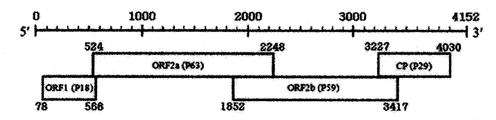
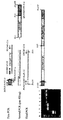
- FIG. 1 shows a schematic diagram of a soybean yellow common mosaic virus (SYCMV), a new virus isolated from soybeans.
- SYCMV soybean yellow common mosaic virus
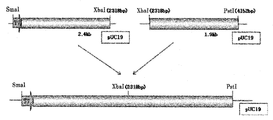
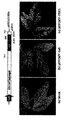
- FIG. 2 shows a schematic diagram of an infectious clone prepared using SYCMV.
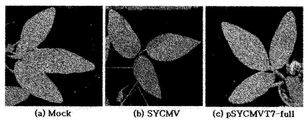
- Figure 3 shows the results of pathogenicity by inoculating SYCMV standard strain (SYCMV type strain) and SYCMV infectious clone in soybean.
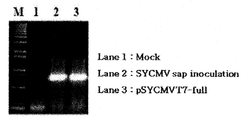
- Figure 4 shows the results of detecting the SYCMV in soybean leaves inoculated with SYCMV using RT-PCR.
- Lane 1 buffer inoculation
- lane 2 SYCMV sap inoculation
- lane 3 SYCMV infectious clone (pSYCMVT7-full) inoculation.
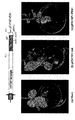
- Figure 5 is a schematic diagram of the production of SYCMV VIGS vector using single-joint PCR.
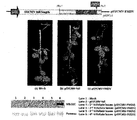
- FIG. 7 shows the results of confirming virus-induced gene silencing using SYCMV VIGS vector in soybean.
- MCS multiple cloning site
- FIG 10 shows the results of Western blot confirming the antigenic determinant protein expression of foot-and-mouth disease virus (FMDV) O1Campos strain using SYCMV foreign protein expression vector in stone beans.
- FMDV foot-and-mouth disease virus
- the present invention comprises a promoter and a full length SYCMV (soybean yellow commom mosaic virus) nucleic acid sequence, wherein the coat protein coding gene and SYCMV in the coat protein coding gene of the full length SYCMV sequence It provides a recombinant viral vector derived from SYCMV, characterized in that it comprises a restriction enzyme site capable of inserting a foreign gene between the 3'-end of the sequence.
- SYCMV synthetic yellow commom mosaic virus
- the promoter is a promoter suitable for in vitro transcription or transformation, preferably T7 promoter, SP6 promoter, CaMV 35S promoter, actin promoter, ubiquitin promoter, pEMU promoter, MAS promoter or histone promoter. It may be more preferably T7 promoter, SP6 promoter or CaMV 35S promoter, but is not limited thereto.
- promoter refers to a region of DNA upstream from a structural gene and refers to a DNA molecule to which an RNA polymerase binds to initiate transcription.
- Recombinant viral vectors of the invention may include a terminator after the full-length SYCMV sequence.
- the terminator may use a conventional terminator, such as nopaline synthase (NOS), rice ⁇ -amylase RAmy1 A terminator, phaseoline terminator, agrobacterium tumefaciens (ocrobacterium tumefaciens) (Octopine) gene terminator, etc., but is not limited thereto.
- recombinant refers to a cell in which a cell replicates a heterologous nucleic acid, expresses the nucleic acid, or expresses a protein encoded by a peptide, a heterologous peptide, or a heterologous nucleic acid.
- Recombinant cells can express genes or gene fragments that are not found in their natural form in either the sense or antisense form.
- Recombinant cells can also express genes found in natural cells, but the genes are modified and reintroduced into cells by artificial means.
- vector is used to refer to a DNA fragment (s), a nucleic acid molecule, that is delivered into a cell. Vectors can replicate DNA and be reproduced independently in host cells.
- carrier is often used interchangeably with “vector”.
- Recombinant viral vectors of the present invention can be constructed by methods well known to those of skill in the art, including sequences of foreign genes to be analyzed or useful genes to be expressed and appropriate transcriptional / translational control signals.
- the method may include in vitro recombinant DNA technology, DNA synthesis technology, in vivo recombinant technology and in vitro transcription and the like.
- the DNA sequence can be effectively linked to a suitable promoter in the expression vector to drive mRNA synthesis.
- the expression vector may also include ribosomal binding sites and transcription terminators as translation initiation sites.
- Preferred examples of recombinant viral vectors of the invention may be, but are not limited to, single-stranded viral vectors from SYCMV that can be used to introduce the genes according to the invention into plant hosts.
- the use of such plant viral vectors can be advantageous especially when it is difficult to properly transform a plant host.
- Recombinant viral vectors may preferably include, but are not limited to, one or more selectable markers.
- the marker is typically a nucleic acid sequence having properties that can be selected by a chemical method, which corresponds to all genes capable of distinguishing transformed cells from non-transformed cells. Examples include herbicide resistance genes such as glyphosate or phosphinothricin, kanamycin, hygromycin, chloramphenicol, G418, and antibiotics such as bleomycin. Resistance gene, aadA gene, and the like, but are not limited thereto.
- the recombinant viral vector may be a recombinant virus-induced gene silencing (VIGS) vector or a recombinant expression vector, but is not limited thereto.
- VIPGS virus-induced gene silencing
- VIGS Virus-induced gene silencing
- PTGS post-transcriptional gene silencing
- a recombinant expression vector can be used as long as it can replicate and stabilize in a host.
- An important characteristic of the expression vector is that it has a replication origin, a promoter, a marker gene, and a translation control element.
- the full-length SYCMV nucleic acid sequence may consist of the nucleotide sequence of SEQ ID NO: 1, but is not limited thereto.
- homologues of the above base sequences are included within the scope of the present invention.
- the gene has a base sequence having a sequence homology of at least 70%, more preferably at least 80%, even more preferably at least 90%, most preferably at least 95% with the nucleotide sequence of SEQ ID NO: 1, respectively. It may include.
- the "% sequence homology" for a polynucleotide is determined by comparing the comparison regions with two optimally arranged sequences, wherein part of the polynucleotide sequence in the comparison region is the reference sequence (addition or deletion) for the optimal alignment of the two sequences. It may include the addition or deletion (ie, gap) compared to).
- the restriction enzyme site is a site into which a foreign gene can be inserted, and the 3'-terminus of the coat protein coding gene or the coat protein coding gene and the SYCMV sequence. It can be located in between. Restriction sites in the coat protein coding gene may be preferably located at the 3'-end of the coat protein coding gene, more preferably MCS (multiple) located at the 3'-end of the coat protein coding gene cloning site) may be, but is not limited to, BsrG I, Mlu I, Spe I or Sal I sites.
- the restriction enzyme site located between the envelope protein coding gene and the 3'-end of the SYCMV sequence may preferably be a BsrG I site, but is not limited thereto.
- the restriction enzyme site is a site into which a foreign gene can be inserted in-frame, and may be located in a coat protein coding gene.
- 3'-terminus of the envelope protein coding gene more preferably BsrG I, Mlu I, Spe I of the multiple cloning site (MCS) located at the 3'-end of the envelope protein coding gene or Sal I site, or Sac II site located at the 3'-end of the envelope protein coding gene and BsrG I site located at the 3 'UTR, most preferably MCS (located at the 3'-end of the envelope protein coding gene)
- MCS multiple cloning site
- Multiple cloning site may be a BsrG I, Mlu I, Spe I or Sal I site, but is not limited thereto.
- the present invention is also characterized in that a PDS (phytoene desaturase) gene is inserted in the antisense direction in the coat protein coding gene in the recombinant viral vector of the present invention or between the coat protein coding gene and the 3'-end of the SYCMV sequence.
- a recombinant VIGS vector into which a PDS fragment is inserted can be provided, and the gene can be inserted into the coat protein coding gene in the recombinant VIGS vector or in the antisense direction between the coat protein coding gene and the 3'-end of the SYCMV sequence. Is not limited thereto.
- the photosynthesis related gene PDS gene was used as a marker to confirm the success of VIGS. Since the PDS gene encodes an enzyme involved in carotenoid biosynthesis, when the gene is inhibited, bleaching of plant leaves can be observed.
- the present invention also provides a recombinant recombinant FMDV fragment characterized in that the antigen gene of the foot-and-mouth disease virus (FMDV) 01Campos strain is inserted at the 3'-end of the coat protein coding gene in the recombinant viral vector of the present invention.
- Expression vectors may be provided, and genes insertable at the 3′-end of the envelope protein coding gene in the recombinant expression vector are not limited thereto.
- Genes that can be inserted into the recombinant expression vectors are useful genes that are desired to be expressed in plants, including herbicide resistance genes, disease resistance genes, insecticide resistance genes, genes affecting grain or fruit quality, screenable marker genes, and environment. Or stress resistant genes.
- 5-EPSP synthase (5-Enolpyruvylshikimate 3-phosphate synthase), a resistance gene of herbicide Glyphosate, and phosphinotri, a resistance gene of herbicide bialaphos (Basta) Phosphinothricin acetyltransferase, a gene encoding coat protein, a virus resistant protein, a Bt toxin producing gene isolated from Bacillus thuringiensis , a pest resistance gene, and fruit ripening ACC diaminoase (1-aminocyclopropane-1-carboxylic acid deaminase) gene for prevention, and Phytophthora infestans elicitin gene (INF1), which is a necrosis-causing gene of plant cells capable of easily selecting viral resistant plants, This is not restrictive.
- the present invention also comprises the steps of preparing a recombinant VIGS vector by inserting a foreign gene to be analyzed for function in the recombinant viral vector of the present invention
- It provides a method for analyzing the function of a foreign gene comprising analyzing a phenotype of a plant in which the foreign gene has been silenced.
- in vitro transcription may use, for example, T7 RNA polymerase, but is not limited thereto.
- the inoculation method used in the present invention may be a method of introducing a gene into a plant by contacting the wounded plant with an inoculum having a gene (RNA transcript or vector) to be introduced as one of the methods for introducing the gene into the plant. It is not limited thereto.
- the present invention also comprises the steps of preparing a recombinant VIGS vector by inserting a foreign gene to be analyzed for function in the recombinant viral vector of the present invention
- It provides a method for analyzing the function of a foreign gene comprising analyzing a phenotype of a plant in which the foreign gene has been silenced.
- the method for analyzing the function of a foreign gene comprises inserting a foreign gene to be analyzed in the recombinant VIGS vector of the present invention.
- the foreign gene may be inserted into the coat protein coding gene or between the coat protein coding gene and the 3′-end of the SYCMV sequence.
- the insertion position of the foreign gene in the coat protein coding gene may be preferably located at the 3'-end of the coat protein coding gene, more preferably at the 3'-end of the coat protein coding gene It may be a BsrG I, Mlu I, Spe I or Sal I site of (multiple cloning site), but is not limited thereto.
- the insertion position of the foreign gene between the envelope protein coding gene and the 3′-end of the SYCMV sequence may be preferably a BsrG I site, but is not limited thereto.
- the insertion direction may be inserted in the antisense direction, but is not limited thereto.
- the method for analyzing the function of a foreign gene of the present invention comprises inoculating a plant with the RNA transcript to silence the foreign gene.
- Silent generally refers to a phenomenon in which the expression of a gene is downregulated or completely suppressed.
- Useful genes that can be analyzed using the recombinant VIGS vector according to the present invention may be plant growth genes, disease resistance genes, environmental stress related genes, and the like, but are not limited thereto.
- the present invention also comprises the steps of preparing a recombinant expression vector by inserting a foreign gene to be expressed in the recombinant viral vector of the present invention.
- a method for overexpressing a foreign gene in a plant using a SYCMV infectious clone comprising introducing a recombinant expression vector into which a foreign gene has been inserted.
- the foreign gene overexpression method in a plant using the SYCMV infectious clone of the present invention is agro-infiltration using Agrobacterium tumefaciens transformed with a recombinant expression vector inserted with a foreign gene.
- a rub-inoculation method which is a plant virus inoculation method, which artificially inoculates a plant leaf tissue with a juice or virus solution of a diseased leaf without a method or a mediated organism, may be used, but is not limited thereto.
- the term 'Agro-infiltration' refers to a method for introducing and expressing a gene into a plant or producing a desired protein in the plant.
- the Agrobacterium suspension containing the gene to be transferred is injected into a plant leaf by applying pressure using a needleless syringe to transfer a desired gene to plant cells. This has the advantage of being quick and convenient compared to traditional plant transformations.
- the term 'rub-inoculation' used in the present invention is one of methods of introducing a gene into a plant and is also called a sap inoculation, a smear inoculation or a mechanical inoculation.
- This method is generally a method of introducing a gene into a plant by wounding the plant with a friction agent such as carborundum, and then contacting the wounded plant with the inoculum (vector) having the gene to be introduced.
- self-inoculation in which needles are bundled with a needle, and the needle is inoculated with the leaf of the inoculation leaf, and the diseased leaf is cut with a sharp blade. Spraying; Self-acupuncture or rapid methods can be used for inoculating difficult-to-activate viruses that are difficult to inoculate with juice.
- the present invention also comprises the steps of preparing a recombinant expression vector by inserting a foreign gene to be expressed in the recombinant viral vector of the present invention.
- a method for overexpressing a foreign gene in a plant comprising the step of transforming the plant with a recombinant expression vector into which the foreign gene is inserted.
- the foreign gene may be inserted in-frame within the coat protein coding gene of the full-length SYCMV sequence, preferably 3 ′ of the coat protein coding gene.
- MCS multiple cloning site
- the BsrG I, Mlu I, Spe I or Sal I site of the multiple cloning site (MCS) located at the 3′-end of the gene may be inserted in-frame (in-frame), but is not limited thereto.
- the insertion direction may be inserted in the sense direction, but is not limited thereto.
- the recombinant viral vector (recombinant VIGS vector or recombinant expression vector) of the present invention can be permanently expressed in a transient expression vector and a plant into which the foreign gene has been introduced. It can be used as a plant expression vector.
- Preferred examples of plant expression vectors are Ti-plasmid vectors which, when present in a suitable host such as Agrobacterium tumerfaciens, can transfer a portion of themselves, the so-called T-region, to plant cells.
- Another type of Ti-plasmid vector (see EP 0 116 718 B1) is currently used to transfer hybrid DNA sequences to protoplasts from which plant cells or new plants can be produced that properly insert hybrid DNA into the plant's genome. have.
- a particularly preferred form of the Ti-plasmid vector is the so-called binary vector as claimed in EP 0 120 516 B1 and US Pat. No. 4,940,838.
- Any binary vector may be included, but it is preferable to use pBI101, pBIN19, pBI121, pCAMBIA vectors and the like which are frequently used in the art.
- Methods of transporting the vectors of the present invention into host cells include microinjection (Capecchi, MR, Cell , 22: 479.1980), calcium phosphate precipitation (Graham, FL et al. , Virology , 52: 456. 1973), electroporation (Neumann, E. et al. , EMBO J. , 1: 841. 1982), liposome-mediated transfection (Wong, TK et al. , Gene , 10:87. 1980), DEAE-dextran treatment (Gopal , Mol. Cell Biol.
- Agrobacterium mediated transformation Chond MD et al., Cell , 2: 263-71, 1977
- gene balm Yang et al. , Proc. Natl. Acad. Sci. , 87: 9568-9572. 1990
- Agrobacterium-mediated transformation or gene balm This is not restrictive.
- the present invention also comprises the steps of preparing a recombinant VIGS vector by inserting a foreign gene to be silenced in the recombinant viral vector of the present invention
- a method for producing a plant in which the foreign gene is silenced comprising inoculating the plant with the RNA transcript to silence the foreign gene.
- the present invention also comprises the steps of preparing a recombinant VIGS vector by inserting a foreign gene to be silenced in the recombinant viral vector of the present invention
- a method for producing a plant in which a foreign gene has been silenced comprising the step of transforming the plant with a recombinant VIGS vector having a foreign gene inserted therein.
- each step is as described in the method for analyzing the function of the foreign gene.
- the present invention also provides plants and seeds thereof in which the foreign genes produced by the method are silenced.
- Plants infected with the SYCMV or transformed with SYCMV recombinant VIGS vector are not particularly limited, but may be preferably dicotyledonous plants, more preferably, the Faceae family, and more preferably the Glycine max . have.
- the present invention also comprises the steps of preparing a recombinant expression vector by inserting a foreign gene to be expressed in the recombinant viral vector of the present invention.
- a method for producing a plant overexpressed by a foreign gene using a SYCMV infectious clone comprising introducing a recombinant expression vector into which a foreign gene has been inserted.
- the present invention also comprises the steps of preparing a recombinant expression vector by inserting a foreign gene to be expressed in the recombinant viral vector of the present invention.
- a method for producing a plant overexpressed with a foreign gene comprising the step of transforming the plant with a recombinant expression vector into which the foreign gene is inserted.
- each step is as described in the method of overexpressing a foreign gene.
- the present invention also provides plants and seeds thereof, wherein the foreign genes produced by the method are overexpressed.
- Plants infected with the SYCMV or transformed with the SYCMV recombinant expression vector are not particularly limited, but may be preferably dicotyledonous plants, more preferably, the Faceae family, and most preferably the Glycine max . have.
- the present invention also provides a SYCMV gene consisting of the nucleotide sequence of SEQ ID NO: 1.
- SYCMV gene consisting of the nucleotide sequence of SEQ ID NO: 1.
- homologues of the above base sequences are included within the scope of the present invention.
- the gene has a base sequence having a sequence homology of at least 70%, more preferably at least 80%, even more preferably at least 90%, most preferably at least 95% with the nucleotide sequence of SEQ ID NO: 1, respectively. It may include.
- Soybean yellow common mosaic virus was isolated from soybean for the first time in Korea, and the entire sequence of the virus was analyzed.
- SYCMV has a strand of RNA genome and consists of a total of 4,152 bp.
- the total ORF consists of four, 5'-UTR and 3'-UTR are 77bp and 122bp, respectively.
- ORF1 (nt 78-566) encodes an 18 kDa protein and has low sequence similarity to the species belonging to Sobemovirus.
- the second ORF2a (nt 524-2248) encodes a 63kDa protein and has two transmembrane domains at the N-terminus.
- This protein is a polyprotein that contains a serine protease and a viral genome-linked protein.
- ORF2b (nt 1852-3417) encodes an RNA-dependent RNA polymerase and has a GDD motif.
- the last ORF3 (nt 3227-4030) encodes a coat protein (CP) protein (FIG. 1).
- SYCMV a recombinant viral vector isolated from soybean
- SYCMV infectious clone was prepared using SYCMV as follows.
- the T7 promoter was coupled to the 5 'terminal of the virus, and each clone was divided into two parts and finally bound to the pUC19 vector.
- Construction of infectious clones using SYCMV was performed by PCR using two overlapping fragments. Xba Manufactured around I site. The two fragments consist of 5'- and 3'- fragments, respectively, and have sizes of 2.4 kb and 1.9 kb, respectively.
- 5'- Fragment is SYCMV-T7- Sma Amplified with I-U (5'-AAAGTCGACAATACGACTCACTATAGGGAGACAAAATATAAGAACAAAGAGTCTG-3 '; SEQ ID NO: 2) primers and SYCMV-C24 (5'-TCGACCATTTCAACGGGAGTAA-3'; SEQ ID NO: 3) primers, Sma I Site and T7 promoter.
- the 3'-fragment is SYCMV-N23 (5'-CAGTTTGTTGCTCTTTGTGTTA-3 '; SEQ ID NO: 4) Primer and SYCMV-End- Pst Amplified with I-L (5'-AAACTGCAGACATTTGGATTACGCTCCATTTC-3 '; SEQ ID NO: 5) primers, Pst Have I site (FIG. 2).
- Soybeans inoculated with buffer showed no symptoms at all, and soybeans inoculated with SYCMV standard strain and SYCMV infectious clone. Symptoms could be confirmed (FIG. 3).
- RT-PCR confirmed that the inoculated virus normally replicates and migrates in the plant. As a result, the virus was detected in the upper leaves that were not inoculated with the virus. Therefore, it was found that the virus works normally in both the inoculated SYCMV sap and inoculated SYCMV infectious clone (Fig. 4).
- a 35S promoter was attached to the 5 'end of SYCMV using single-joint PCR.
- the 35S promoter was amplified based on the pSNU1 vector, and 5 'fragments of SYCMV including a portion of the 35S promoter were amplified by PCR, respectively. Each of these fragments was bound via a second PCR and finally the SYCMV sequence was determined via PSNU35S-SJ2-EcoR-1U primer (5'-AAAGAATTCAAGTTTGCATGCCTGCTGCT-3 '; SEQ ID NO: 6) and SYCMV-C24 primer (SEQ ID NO: 2).
- a fragment with a 35S promoter at the 5'-end was obtained. This fragment was recombined with the SYCMV 3′-terminal fragment with Rz-NOS and cloned into the binary vector pPZP211 (FIG. 5).
- a restriction enzyme ( BsrG I) site was generated using a single point mutation at the back of CP of SYCMV, and then gmPDS fragments amplified in soybean were inserted backward (FIG. 6).
- the SYCMV VIGS vectors pSYCMV-full and pSYCMV-PDS clones were transformed into Agrobacterium, respectively, and the syringe was used after activating the vir gene located in the binary vector with acetocyringon. Was inoculated on the back of the leaves of the beans.
- one control was inoculated with a buffer and the other was inoculated with a SYCMV virus vector without a PDS gene.
- the virus symptom began to show up in the plants inoculated with pSYCMV-full, and after three weeks, the effect of PDS in the plants inoculated with pSYCMV-PDS began.
- the bleaching phenomenon in which the leaves of the beans turned white was confirmed.
- the SYCMV VIGS vectors pSYCMV-full and pSYCMV-PDS clones were transformed into Agrobacterium, respectively, and acetocyringon was used as a binary vector. After activating the vir gene located within, the syringe was used to inoculate on the back of the leaves of the stone. At the time of inoculation, one was inoculated with a buffer and the other was inoculated with a SYCMV virus vector without inserting the PDS gene.
- the virus symptom began to show up in the plants inoculated with pSYCMV-full, and after three weeks, the effect of PDS in the plants inoculated with pSYCMV-PDS began. After inoculation, about 4 weeks later, as shown in FIG. 8, the whitening phenomenon in which the leaves of stone beans turned white was confirmed.
- a 35S promoter was linked to the 5 'end of SYCMV and cloned into the binary vector pPZP211 by binding Rz-NOS to the 3' end (FIG. 10).
- the foreign gene was intended to insert some sequences of the antigenic determinants of the foot-and-mouth disease virus (FMDV) O1Campos strain, and DNA sequences were synthesized by overlap PCR.
- Antigen determinant sequences are cited in previously reported literature and express the final protein product from amino acid sequence 135-160 of FMDV O1C VP1 (P.
- a syringe was used to inoculate the back of the leaves of the oleander.
- the control group was inoculated with buffer and pSYCMV-full.
- the virus symptom began to appear little by little in the plants inoculated with pSYCMV-FMDV and pSYCMV-full.
Landscapes
- Life Sciences & Earth Sciences (AREA)
- Health & Medical Sciences (AREA)
- Engineering & Computer Science (AREA)
- Genetics & Genomics (AREA)
- Biomedical Technology (AREA)
- Biotechnology (AREA)
- Wood Science & Technology (AREA)
- Bioinformatics & Cheminformatics (AREA)
- Molecular Biology (AREA)
- Organic Chemistry (AREA)
- Chemical & Material Sciences (AREA)
- General Engineering & Computer Science (AREA)
- Zoology (AREA)
- Virology (AREA)
- Microbiology (AREA)
- Cell Biology (AREA)
- Plant Pathology (AREA)
- Biophysics (AREA)
- Biochemistry (AREA)
- General Health & Medical Sciences (AREA)
- Physics & Mathematics (AREA)
- Breeding Of Plants And Reproduction By Means Of Culturing (AREA)
- Micro-Organisms Or Cultivation Processes Thereof (AREA)
Description
본 발명은 SYCMV 유래의 재조합 바이러스 벡터 및 이의 용도에 관한 것으로, 더욱 상세하게는 프로모터 및 전장 (full length) SYCMV (soybean yellow commom mosaic virus) 핵산 서열을 포함하고, 상기 전장 SYCMV 서열 중 외피 단백질 코딩 유전자 내 또는 외피 단백질 코딩 유전자와 SYCMV 서열의 3'-말단 사이에 외래 유전자를 삽입할 수 있는 제한효소 부위를 포함하는 것을 특징으로 하는 SYCMV 유래의 재조합 바이러스 벡터, 상기 재조합 바이러스 벡터를 이용한 외래 유전자의 기능을 분석하는 방법 및 외래 유전자 과발현 방법, 상기 재조합 바이러스 벡터를 이용한 외래 유전자가 침묵된 식물체의 제조 방법 및 외래 유전자가 과발현된 식물체의 제조 방법, 상기 방법으로 제조된 식물체 및 이의 종자 및 서열번호 1의 염기 서열로 이루어진 SYCMV 유전자에 관한 것이다.
콩은 전 세계에서 경제적으로 매우 중요한 작물이다. 우리가 항상 섭취하는 음식과 사료용으로 많이 이용하고 있으며 더욱이 최근에는 바이오 디젤의 원료로서 많은 연구가 진행되고 있다. 따라서 전 세계 연구원들은 콩이 가지고 있는 수많은 유용 유전자들의 발굴과 연구로 인한 품종 개발에 집중하고 있으며, 특허를 통한 원천기술을 선점하기 위해 노력하고 있다.
작물이 가지고 있는 유전자들의 기능을 연구하기 위해서는 유전자들 각각의 돌연변이체가 필요하다. 지금까지는 이러한 대량의 돌연변이체를 얻기 위해 T-DNA 넉아웃 돌연변이체 (knockout mutant) 등을 주로 사용하였으며, 몇몇 작물에서는 식물 바이러스를 이용한 VIGS (Virus-induced gene silencing) 방법을 사용하였다. 하지만 T-DNA 넉아웃 돌연변이체를 얻기 위해서는 형질전환기술이 반드시 필요하며, 불행히도 콩에서는 아직 대량으로 형질전환할 수 있는 기술이 전무하다. 또한, 외래 유전자를 도입하여 신기능의 작물을 개발함에 있어서 외래 유전자 도입에 따른 효과를 가시적으로 얻기 위해서는 도입 유전자의 안정적이고 높은 발현 수준 및 목적 유전자가 도입된 돌연변이체가 필요하다. 따라서 콩에서 유용 유전자 연구 및 유용 단백질 생산을 위해서는 대량의 효율적인 형질전환이 가능하고, 콩에서 사용 가능한 효과적인 바이러스 벡터가 반드시 필요하다.
콩에서 사용할 수 있는 바이러스 벡터의 개발을 위해서는 콩에 발생하는 새로운 바이러스의 탐색이 필요하다. 모든 바이러스들은 각각의 병원성, 기주 범위 및 침묵현상 억제자 (silencing suppressor)의 효율이 모두 다르므로 끊임없는 VIGS 벡터의 탐색과 연구가 반드시 필요하다. 또한 바이러스로 인한 기주의 병징이 나타나지 않게 하는 것이 중요하다. 이것은 바이러스에 대한 수많은 품종별 병징 조사를 통하여 정상적으로 바이러스의 증식은 이루어지면서 병징이 나타나지 않는 품종을 선별함으로써 해결할 수 있다.
식물 바이러스 내 유전자에는 식물체 내에서 일어나는 침묵현상을 억제하는 억제자 (suppressor)가 존재하는데 이들 유전자로 인하여 실제로 VIGS 효과가 효율적으로 일어나기 어려운 경우가 많이 있으며 이들 억제자의 기작과 능력은 바이러스별로 조금씩 다르다고 알려져 있다. 또한 VIGS 실험에서 중요한 점은 식물체에서 벡터로 사용한 바이러스의 병징과 VIGS로 인한 표현형(phenotype)의 혼돈을 일으키지 않아야 한다는 것이다. 따라서 이러한 조건을 모두 만족시키는 바이러스 벡터의 개발이 필요하다.
현재 여러 작물에서 VIGS를 이용하여 유전자 기능 분석을 진행하고 있으며, 담배, 토마토, 고추, 애기장대 등에서 담배 래틀 바이러스 (Tobacco rattle virus; TRV) 벡터를 주로 이용하고 있다 (Ratcliff F. et al., Plant J. Jan;25(2):237-45, 2001). 콩의 경우에는 TRV 벡터와 같이 강력한 침묵 효과를 기대할 수 있는 바이러스 벡터가 아직 없으며, 현재 미국에서 강낭콩 꼬투리 얼룩 바이러스 (Bean pod mottle virus; BPMV) 벡터가 개발되어 연구가 진행되고 있다 (US 2007/0214518 A1 (Ghabrial, S. A.) Sep. 13, 2007).
콩에서 VIGS 벡터 또는 재조합 단백질 발현 벡터로 사용할 수 있는 바이러스의 발굴을 위해서는 기존에 보고된 바이러스만을 가지고는 한계가 있다. 많은 연구에서 이미 보고된 바이러스들의 벡터로서의 가능성에 대한 연구를 대부분 끝마쳤기 때문에 지속적인 새로운 바이러스의 탐색이 필요하다. SYCMV (soybean yellow common mosaic virus)는 단일 가닥 양성 RNA 게놈 (single strand positive RNA genome)을 갖는 최근 국내에서 처음 발견된 바이러스로 아직 그 연구가 미진한 상태이다. 지금까지의 VIGS 벡터는 대부분 두 가닥의 RNA 바이러스 (담배 래틀 바이러스, 강낭콩 꼬투리 얼룩 바이러스 등)를 이용하였으며 SYCMV와 같이 한 가닥의 RNA 바이러스를 이용한 예는 극히 드물다. 따라서 새로운 바이러스인 SYCMV를 이용한 VIGS 벡터에서 지금까지 개발된 VIGS 벡터보다 더욱 효과적인 유전자 침묵 (silencing) 효과가 요구된다. 또한, 콩 식물의 효율적인 형질전환을 통해 경제적으로 가치있는 유용 단백질을 발현하는 콩 식물체 및 기능성 콩의 생산에 SYCMV 유래의 재조합 벡터가 사용될 수 있는지 검증이 필요하다.
한국등록특허 제0795367호에는 '병원균에 저항성을 갖는 고추의 전사 조절 유전자를 담배 래틀 바이러스 벡터에 삽입시켜 구축한 VIGS 벡터'가 개시되어 있으며, 한국등록특허 제1122955호에는 '콩 모자이크 바이러스의 감염성 클론을 이용한 식물체 내에서의 외래 유전자 과발현 방법'이 개시되어 있다. 그러나 본 발명에서와 같이 SYCMV 유래의 재조합 바이러스 벡터에 대해서는 기재된 바가 전혀 없다.
본 발명은 상기와 같은 요구에 의해 도출된 것으로서, 본 발명자들은 형질전환 효율이 매우 낮은 콩의 유용 유전자 분석 및 유용 단백질 발현을 위한 돌연변이체의 생산을 위해 콩에서 분리된 SYCMV (soybean yellow common mosaic virus)를 이용하여 재조합 VIGS (virus-induced gene silencing) 벡터 및 발현 벡터를 구축하였고, 상기 VIGS 벡터가 식물체에서 효과적으로 유전자 침묵현상을 나타내며, 발현 벡터에 삽입된 유전자가 식물체에서 발현되는 것을 확인함으로써, 본 발명을 완성하였다.
상기 과제를 해결하기 위해, 본 발명은 프로모터 및 전장 (full length) SYCMV (soybean yellow commom mosaic virus) 핵산 서열을 포함하고, 상기 전장 SYCMV 서열 중 외피 단백질 코딩 유전자 내 또는 외피 단백질 코딩 유전자와 SYCMV 서열의 3'-말단 사이에 외래 유전자를 삽입할 수 있는 제한효소 부위를 포함하는 것을 특징으로 하는 SYCMV 유래의 재조합 바이러스 벡터를 제공한다.
또한, 본 발명은 상기 재조합 바이러스 벡터를 이용한 외래 유전자의 기능을 분석하는 방법 및 외래 유전자 과발현 방법을 제공한다.
또한, 본 발명은 상기 재조합 바이러스 벡터를 이용한 외래 유전자가 침묵된 식물체의 제조 방법 및 외래 유전자가 과발현된 식물체의 제조 방법, 상기 방법으로 제조된 식물체 및 이의 종자를 제공한다.
또한, 본 발명은 서열번호 1의 염기 서열로 이루어진 SYCMV 유전자를 제공한다.
본 발명에 따르면, 콩에서 수많은 유전자들의 특성을 분석하기 위한 도구로서 VIGS가 가장 커다란 대안으로 부각되고 있으며 여기에 SYCMV를 이용한 재조합 VIGS 벡터를 이용함으로써, 원하는 유전자를 효율적으로 침묵 (silencing)시켜 유전자의 고유 기능 연구, 경제적으로 가치 있는 유용 유전자 탐색에 매우 유용할 것으로 여겨진다. VIGS 벡터로 탐색된 유용 유전자가 삽입된 SYCMV 유래 재조합 발현 벡터를 콩(soybean)의 형질전환에 이용하여 신품종 콩 육성을 기대할 수 있으며 특허를 통한 원천기술 확보에도 유용할 것으로 기대된다. 또한, 유용한 외래 유전자를 콩에서 발현시킴으로써 현재 세계적으로 활용되는 콩의 기능적 유용성에서 나아가 경제적으로 가치 있는 유용 단백질을 발현하는 콩 식물체 및 기능성 콩을 생산하는데 이바지할 것으로 여겨진다.
도 1은 콩에서 분리한 새로운 바이러스인 SYCMV (soybean yellow common mosaic virus)의 모식도를 나타낸다.
도 2는 SYCMV를 이용하여 제작한 감염성 클론의 모식도를 나타낸다.
도 3은 SYCMV 표준 균주 (SYCMV type strain) 및 SYCMV 감염성 클론을 콩에 접종하여 병원성을 조사한 결과를 나타낸다.
도 4는 RT-PCR을 이용하여 SYCMV를 접종한 콩 잎에서 SYCMV를 검출한 결과를 나타낸다. 레인 1: 버퍼 접종, 레인 2: SYCMV 즙액 (sap) 접종, 레인 3: SYCMV 감염성 클론 (pSYCMVT7-full) 접종.
도 5는 Single-joint PCR을 이용한 SYCMV VIGS 벡터의 제작 모식도이다.
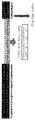
도 6은 SYCMV VIGS 벡터의 클로닝 사이트를 나타낸다.
도 7은 대두에서 SYCMV VIGS 벡터를 이용한 바이러스 유도 유전자 침묵 현상 (Virus-induced gene silencing)을 확인한 결과를 나타낸다. (a) 버퍼 접종, (b) SYCMV 바이러스 벡터 (pSYCMV-full) 접종, (c) gmPDS 단편이 삽입된 SYCMV 바이러스 벡터 (pSYCMV-PDS) 접종.
도 8은 돌콩에서 SYCMV VIGS 벡터를 이용한 바이러스 유도 유전자 침묵 현상을 확인한 결과를 나타낸다.
도 9는 SYCMV 재조합 발현 벡터의 MCS (multiple cloning site)를 나타낸다.
도 10은 돌콩에서 SYCMV 외래 단백질 발현 벡터를 이용한 FMDV (foot-and-mouth disease virus) O1Campos strain의 항원 결정기 단백질 발현을 웨스턴 블럿으로 확인한 결과를 나타낸다.
본 발명의 목적을 달성하기 위하여, 본 발명은 프로모터 및 전장 (full length) SYCMV (soybean yellow commom mosaic virus) 핵산 서열을 포함하고, 상기 전장 SYCMV 서열 중 외피 단백질 코딩 유전자 내 또는 외피 단백질 코딩 유전자와 SYCMV 서열의 3'-말단 사이에 외래 유전자를 삽입할 수 있는 제한효소 부위를 포함하는 것을 특징으로 하는 SYCMV 유래의 재조합 바이러스 벡터를 제공한다.
본 발명의 재조합 바이러스 벡터에서, 상기 프로모터는 시험관 내 전사 또는 형질전환에 적합한 프로모터들로서, 바람직하게는 T7 프로모터, SP6 프로모터, CaMV 35S 프로모터, 액틴 프로모터, 유비퀴틴 프로모터, pEMU 프로모터, MAS 프로모터 또는 히스톤 프로모터일 수 있으며, 더욱 바람직하게는 T7 프로모터, SP6 프로모터 또는 CaMV 35S 프로모터일 수 있으나, 이에 제한되지 않는다. "프로모터"란 용어는 구조 유전자로부터의 DNA 업스트림의 영역을 의미하며 전사를 개시하기 위하여 RNA 중합효소가 결합하는 DNA 분자를 말한다.
본 발명의 재조합 바이러스 벡터는 전장 SYCMV 서열 뒤에 터미네이터를 포함할 수 있다. 상기 터미네이터는 통상의 터미네이터를 사용할 수 있으며, 그 예로는 노팔린 신타아제 (NOS), 벼 α-아밀라아제 RAmy1 A 터미네이터, 파세올린 (phaseoline) 터미네이터, 아그로박테리움 투메파시엔스 (agrobacterium tumefaciens)의 옥토파인 (Octopine) 유전자의 터미네이터 등이 있으나, 이에 한정되는 것은 아니다.
용어 "재조합"은 세포가 이종의 핵산을 복제하거나, 상기 핵산을 발현하거나 또는 펩티드, 이종의 펩티드 또는 이종의 핵산에 의해 암호된 단백질을 발현하는 세포를 지칭하는 것이다. 재조합 세포는 상기 세포의 천연 형태에서는 발견되지 않는 유전자 또는 유전자 단편을, 센스 또는 안티센스 형태 중 하나로 발현할 수 있다. 또한 재조합 세포는 천연 상태의 세포에서 발견되는 유전자를 발현할 수 있으며, 그러나 상기 유전자는 변형된 것으로서 인위적인 수단에 의해 세포 내 재도입된 것이다.
용어 "벡터"는 세포 내로 전달하는 DNA 단편(들), 핵산 분자를 지칭할 때 사용된다. 벡터는 DNA를 복제시키고, 숙주세포에서 독립적으로 재생산될 수 있다. 용어 "전달체"는 흔히 "벡터"와 호환하여 사용된다.
본 발명의 재조합 바이러스 벡터는 기능을 분석하고자 하는 외래 유전자 또는 발현시키고자 하는 유용 유전자 각각의 서열 및 적당한 전사/번역 조절 신호를 포함하여 당업자에 주지된 방법에 의해 구축될 수 있다. 상기 방법은 시험관 내 재조합 DNA 기술, DNA 합성 기술, 생체 내 재조합 기술 및 시험관 내 전사 (in vitro transcription) 등을 포함할 수 있다. 상기 DNA 서열은 mRNA 합성을 이끌기 위해 발현 벡터 내의 적당한 프로모터에 효과적으로 연결될 수 있다. 또한 발현 벡터는 번역 개시 부위로서 리보솜 결합 부위 및 전사 터미네이터를 포함할 수 있다.
본 발명의 재조합 바이러스 벡터의 바람직한 예는 본 발명에 따른 유전자를 식물 숙주에 도입시키는데 이용될 수 있는 SYCMV 유래의 단일 가닥 바이러스 벡터일 수 있으나, 이에 제한되지 않는다. 이러한 식물 바이러스 벡터의 사용은 특히 식물 숙주를 적당하게 형질전환하는 것이 어려울 때 유리할 수 있다.
재조합 바이러스 벡터는 바람직하게는 하나 이상의 선택성 마커를 포함할 수 있으나, 이에 제한되지 않는다. 상기 마커는 통상적으로 화학적인 방법으로 선택될 수 있는 특성을 갖는 핵산 서열로, 형질전환된 세포를 비형질전환 세포로부터 구별할 수 있는 모든 유전자가 이에 해당된다. 그 예로는 글리포세이트 (glyphosate) 또는 포스피노트리신 (phosphinothricin)과 같은 제초제 저항성 유전자, 카나마이신 (kanamycin), 하이그로마이신 (hygromycin), 클로람페니콜 (chloramphenicol), G418, 블레오마이신 (Bleomycin)과 같은 항생제 내성 유전자, aadA 유전자 등이 있으나, 이에 한정되는 것은 아니다.
본 발명의 일 구현 예에 있어서, 상기 재조합 바이러스 벡터는 재조합 VIGS (Virus-induced gene silencing) 벡터 또는 재조합 발현 벡터일 수 있으나, 이에 제한되지 않는다.
본 발명에서 VIGS (Virus-induced gene silencing)는 바이러스 벡터에 식물유전자를 도입한 후 식물체를 감염시키면, 그 도입된 유전자의 내인성 식물유전자가 발현이 억제되는 현상을 말한다. 이는 PTGS (Post-transcriptional gene silencing)의 일종으로서, 전사-후 (post-transcriptional), RNA 턴오버 (RNA turnover) 및 뉴클레오티드 서열 특이적 (nucleotide sequence-specific) 이라는 특징들을 가진다. 따라서, VIGS를 이용하면 도입유전자의 기능을 신속하고 간편하게 대량으로 분석할 수 있다.
본 발명에서 재조합 발현 벡터는 숙주 내에서 복제 및 안정화할 수 있다면 사용될 수 있으며, 상기 발현 벡터의 중요한 특성은 복제 원점, 프로모터, 마커 유전자 및 번역 조절 요소 (translation control element)를 가지는 것이다.
본 발명의 일 구현 예에 따른 재조합 바이러스 벡터에서, 전장 SYCMV 핵산 서열은 서열번호 1의 염기 서열로 이루어질 수 있으나, 이에 제한되지 않는다. 또한, 상기 염기 서열의 상동체가 본 발명의 범위 내에 포함된다. 구체적으로, 상기 유전자는 서열번호 1의 염기 서열과 각각 70% 이상, 더욱 바람직하게는 80% 이상, 더 더욱 바람직하게는 90% 이상, 가장 바람직하게는 95% 이상의 서열 상동성을 가지는 염기 서열을 포함할 수 있다. 폴리뉴클레오티드에 대한 "서열 상동성의 %"는 두 개의 최적으로 배열된 서열과 비교 영역을 비교함으로써 확인되며, 비교 영역에서의 폴리뉴클레오티드 서열의 일부는 두 서열의 최적 배열에 대한 참고 서열 (추가 또는 삭제를 포함하지 않음)에 비해 추가 또는 삭제 (즉, 갭)를 포함할 수 있다.
본 발명의 일 구현 예에 따른 재조합 VIGS 벡터에서, 상기 제한효소 부위는 외래 유전자를 삽입할 수 있는 부위로서, 외피 단백질 (coat protein) 코딩 유전자 내 또는 외피 단백질 코딩 유전자와 SYCMV 서열의 3'-말단 사이에 위치할 수 있다. 상기 외피 단백질 (coat protein) 코딩 유전자 내의 제한효소 부위는 바람직하게는 외피 단백질 코딩 유전자의 3'-말단에 위치할 수 있으며, 더욱 바람직하게는 외피 단백질 코딩 유전자의 3'-말단에 위치한 MCS (multiple cloning site)의 BsrGI, MluI, SpeI 또는 SalI 사이트일 수 있으나, 이에 제한되지 않는다. 상기 외피 단백질 코딩 유전자와 SYCMV 서열의 3'-말단 사이에 위치한 제한효소 부위는 바람직하게는 BsrGI 사이트일 수 있으나, 이에 제한되지 않는다.
본 발명의 일 구현 예에 따른 재조합 발현 벡터에서, 상기 제한효소 부위는 외래 유전자를 인-프레임(in-frame)으로 삽입할 수 있는 부위로서, 외피 단백질 (coat protein) 코딩 유전자 내에 위치할 수 있으며, 바람직하게는 외피 단백질 코딩 유전자의 3'-말단에 위치할 수 있으며, 더욱 바람직하게는 외피 단백질 코딩 유전자의 3'-말단에 위치한 MCS (multiple cloning site)의 BsrGI, MluI, SpeI 또는 SalI 사이트, 또는 외피 단백질 코딩 유전자의 3'-말단에 위치한 SacII 사이트 및 3' UTR에 위치하는 BsrGI 사이트일 수 있으며, 가장 바람직하게는 외피 단백질 코딩 유전자의 3'-말단에 위치한 MCS (multiple cloning site)의 BsrGI, MluI, SpeI 또는 SalI 사이트일 수 있으나, 이에 제한되지 않는다.
본 발명은 또한, 본 발명의 재조합 바이러스 벡터 내의 외피 단백질 (coat protein) 코딩 유전자 내 또는 외피 단백질 코딩 유전자와 SYCMV 서열의 3'-말단 사이에 PDS (phytoene desaturase) 유전자가 안티센스 방향으로 삽입된 것을 특징으로 하는 PDS 단편이 삽입된 재조합 VIGS 벡터를 제공할 수 있으며, 재조합 VIGS 벡터 내의 외피 단백질 (coat protein) 코딩 유전자 내 또는 외피 단백질 코딩 유전자와 SYCMV 서열의 3'-말단 사이에 안티센스 방향으로 삽입 가능한 유전자는 이에 제한되지 않는다.
본 발명의 일 구현예에서, VIGS의 성공 여부를 확인하기 위해 광합성 관련 유전자인 PDS 유전자를 마커로 사용하였다. PDS 유전자는 카로티노이드 생합성에 관여하는 효소를 코딩하고 있으므로, 이 유전자가 억제되는 경우 식물 잎의 백화현상을 관찰할 수 있다.
본 발명은 또한, 본 발명의 재조합 바이러스 벡터 내의 외피 단백질 코딩 유전자의 3'-말단에 FMDV (foot-and-mouth disease virus) 01Campos strain의 항원 유전자가 삽입된 것을 특징으로 하는 FMDV 단편이 삽입된 재조합 발현 벡터를 제공할 수 있으며, 재조합 발현 벡터 내의 외피 단백질 코딩 유전자의 3'-말단에 삽입 가능한 유전자는 이에 제한되지 않는다.
상기 재조합 발현 벡터 내에 삽입 가능한 유전자는 식물체 내에서 발현되기를 원하는 유용 유전자로서, 이에는 제초제 저항성 유전자, 질병 저항성 유전자, 살충제 저항성 유전자, 곡식 또는 과실의 품질에 영향을 주는 유전자, 스크리닝 가능한 표식 유전자, 환경 또는 스트레스 저항성 유전자 등이 포함될 수 있다. 더욱 상세하게는 제초제 글리포세이트 (Glyphosate)의 저항성 유전자인 5-EPSP 신타아제 (5-Enolpyruvylshikimate 3-phosphate synthase), 제초제 비알라포스(바스타) (bialaphos(Basta))의 저항성 유전자인 포스피노트리신 아세틸트랜스퍼라제 (phosphinothricin acetyltransferase), 바이러스 저항성 단백질인 외피 단백질 (coat protein)을 코딩하는 유전자, 해충 저항성 유전자인 바실러스 투린지엔시스 (Bacillus thuringiensis)로부터 분리한 Bt 독소 (Bt toxin) 생성 유전자, 과실 완숙 방지를 위한 ACC 디아미나아제 (1-aminocyclopropane-1-carboxylic acid deaminase) 유전자, 바이러스 저항성 식물을 용이하게 선발할 수 있는 식물체 세포의 괴사유발 유전자인 INF1 (Phytophthora infestans elicitin gene) 등이 포함될 수 있으나, 이에 제한되지 않는다.
본 발명은 또한, 본 발명의 재조합 바이러스 벡터에 기능을 분석하고자 하는 외래 유전자를 삽입하여 재조합 VIGS 벡터를 제작하는 단계;
외래 유전자가 삽입된 재조합 VIGS 벡터를 절단 후, 시험관 내 전사 (in vitro transcription)를 수행하여 RNA 전사체를 제조하는 단계;
상기 RNA 전사체를 식물체에 접종하여 외래 유전자를 침묵시키는 단계; 및
외래 유전자가 침묵된 식물체의 표현형을 분석하는 단계를 포함하는 외래 유전자의 기능을 분석하는 방법을 제공한다.
본 발명의 외래 유전자의 기능을 분석하는 방법에서, 시험관 내 전사는 예를 들면, T7 RNA 중합효소 등을 이용할 수 있으나, 이에 제한되지 않는다. 또한, 본 발명에서 사용되는 접종 방법은 식물체 내로 유전자를 도입하는 방법 중의 하나로 도입하고자 하는 유전자 (RNA 전사체 또는 벡터)를 가진 접종액을 상처 낸 식물체에 접촉시켜 식물체 내로 유전자를 도입하는 방법일 수 있으며, 이에 제한되지 않는다.
본 발명은 또한, 본 발명의 재조합 바이러스 벡터에 기능을 분석하고자 하는 외래 유전자를 삽입하여 재조합 VIGS 벡터를 제작하는 단계;
외래 유전자가 삽입된 재조합 VIGS 벡터를 식물체에 형질전환하여 외래 유전자를 침묵시키는 단계; 및
외래 유전자가 침묵된 식물체의 표현형을 분석하는 단계를 포함하는 외래 유전자의 기능을 분석하는 방법을 제공한다.
본 발명의 일 구현 예에 있어서, 외래 유전자의 기능을 분석하는 방법은 본 발명의 재조합 VIGS 벡터에 기능을 분석하고자 하는 외래 유전자를 삽입하는 단계를 포함한다. 이때, 상기 외래 유전자는 바람직하게는 외피 단백질 (coat protein) 코딩 유전자 내 또는 외피 단백질 코딩 유전자와 SYCMV 서열의 3'-말단 사이에 삽입될 수 있다. 상기 외피 단백질 (coat protein) 코딩 유전자 내의 외래 유전자의 삽입 위치는 바람직하게는 외피 단백질 코딩 유전자의 3'-말단에 위치할 수 있으며, 더욱 바람직하게는 외피 단백질 코딩 유전자의 3'-말단에 위치한 MCS (multiple cloning site)의 BsrGI, MluI, SpeI 또는 SalI 사이트일 수 있으나, 이에 제한되지 않는다. 상기 외피 단백질 코딩 유전자와 SYCMV 서열의 3'-말단 사이에 외래 유전자의 삽입 위치는 바람직하게는 BsrGI 사이트일 수 있으나, 이에 제한되지 않는다. 또한, 삽입되는 방향은 안티센스 방향으로 삽입될 수 있으나, 이에 제한되지 않는다.
본 발명의 외래 유전자의 기능을 분석하는 방법은 상기 RNA 전사체를 식물체에 접종하여 외래 유전자를 침묵시키는 단계를 포함한다. "침묵"이란 일반적으로 유전자의 발현이 하향조절 (downregulation) 또는 완전히 억제 (suppression)되는 현상을 말한다. 본 발명에 따른 재조합 VIGS 벡터를 이용하여 분석가능한 유용 유전자는 식물 생장 유전자, 병 저항성 유전자, 환경 스트레스 관련 유전자 등일 수 있으나, 이에 제한되지는 않는다.
본 발명은 또한, 본 발명의 재조합 바이러스 벡터에 발현시키고자 하는 외래 유전자를 삽입하여 재조합 발현 벡터를 제작하는 단계; 및
외래 유전자가 삽입된 재조합 발현 벡터를 식물체에 도입하는 단계를 포함하는 SYCMV 감염성 클론을 이용한 식물체 내에서의 외래 유전자 과발현 방법을 제공한다.
본 발명의 SYCMV 감염성 클론을 이용한 식물체 내에서의 외래 유전자 과발현 방법은 외래 유전자가 삽입된 재조합 발현 벡터로 형질전환된 아그로박테리움 튜머파시엔스 (Agrobacterium tumefaciens)를 이용한 아그로박테리움 침윤 (agro-infiltration) 방법 또는 매개 생물 등의 매개 없이 병든 잎의 즙액이나 바이러스액을 직접 피접종 식물조직에 인공적으로 접종하는 식물 바이러스 접종법인 럽-접종 (rub-inoculation) 방법이 사용될 수 있으나, 이에 제한되지 않는다.
본 발명에서 사용되는 '아그로박테리움 침윤 (Agro-infiltration)'이라는 용어는 식물체 내로 유전자를 도입하여 발현시키거나 식물체 내에서 원하는 단백질을 생산하기 위한 방법을 의미한다. 이동시키고자 하는 유전자를 가진 아그로박테리움의 현탁액을 바늘이 없는 주사기를 사용해서 압력을 줌으로써 식물의 잎에 주입하여 식물체 세포로 원하는 유전자를 이동시키는 방법이다. 이는 전통적인 식물 형질전환과 비교하면 신속하고 편리하다는 장점이 있다.
본 발명에서 사용되는 '럽-접종 (rub-inoculation)'이라는 용어는 식물체 내로 유전자를 도입하는 방법 중의 하나로 즙액 (sap) 접종, 도말 접종 또는 기계적 접종 (mechanical inoculation)이라고도 부른다. 이 방법은 일반적으로 카보런덤 (carborundum)과 같은 마찰제로 식물체에 상처를 낸 후, 도입하고자 하는 유전자를 가진 접종액 (벡터)을 상처 낸 식물체에 접촉시켜 식물체 내로 유전자를 도입하는 방법이다. 그밖에 바늘을 다발로 만들어 병든 잎을 접종 엽면과 겹쳐서 찌르는 자침(刺針) 접종, 병든 잎을 겹쳐서 예리한 칼날로 절단한 후에 마찰제를 미리 처리한 접종 엽면에 절단면을 직접 칠하는 신속법, 즙액을 가압분무하는 방법 등이 있다. 자침법이나 신속법은 즙액 접종이 곤란한 활성화하기 어려운 바이러스 접종에 사용될 수 있다.
본 발명은 또한, 본 발명의 재조합 바이러스 벡터에 발현시키고자 하는 외래 유전자를 삽입하여 재조합 발현 벡터를 제작하는 단계; 및
외래 유전자가 삽입된 재조합 발현 벡터를 식물체에 형질전환시키는 단계를 포함하는 식물체 내에서 외래 유전자 과발현 방법을 제공한다.
본 발명의 일 구현 예에 있어서, 상기 외래 유전자는 전장 SYCMV 서열 중 외피 단백질 (coat protein) 코딩 유전자 내에 인-프레임(in-frame)으로 삽입될 수 있으며, 바람직하게는 외피 단백질 코딩 유전자의 3'-말단에 인-프레임(in-frame)으로 삽입될 수 있으며, 더욱 바람직하게는 외피 단백질 코딩 유전자의 3'-말단에 위치한 MCS (multiple cloning site)의 BsrGI, MluI, SpeI 또는 SalI 사이트, 또는 외피 단백질 코딩 유전자의 3'-말단에 위치한 SacII 사이트와 3' UTR에 위치하는 BsrGI 사이트 사이에 인-프레임(in-frame)으로 삽입될 수 있으며, 가장 바람직하게는 외피 단백질 코딩 유전자의 3'-말단에 위치한 MCS (multiple cloning site)의 BsrGI, MluI, SpeI 또는 SalI 사이트에 인-프레임(in-frame)으로 삽입될 수 있으나, 이에 제한되지 않는다. 또한, 삽입되는 방향은 센스 방향으로 삽입될 수 있으나, 이에 제한되지 않는다.
본 발명의 재조합 바이러스 벡터 (재조합 VIGS 벡터 또는 재조합 발현 벡터)는 외래 유전자를 도입한 식물체 내에서 일시적으로 발현시킬 수 있는 일시적 (transient) 발현 벡터 및 외래 유전자가 도입된 식물체에서 영구적으로 발현시킬 수 있는 식물 발현 벡터로 사용할 수 있다. 식물 발현 벡터의 바람직한 예는 아그로박테리움 튜머파시엔스와 같은 적당한 숙주에 존재할 때 그 자체의 일부, 소위 T-영역을 식물 세포로 전이시킬 수 있는 Ti-플라스미드 벡터이다. 다른 유형의 Ti-플라스미드 벡터 (EP 0 116 718 B1호 참조)는 현재 식물 세포, 또는 잡종 DNA를 식물의 게놈 내에 적당하게 삽입시키는 새로운 식물이 생산될 수 있는 원형질체로 잡종 DNA 서열을 전이시키는데 이용되고 있다. Ti-플라스미드 벡터의 특히 바람직한 형태는 EP 0 120 516 B1호 및 미국 특허 제4,940,838호에 청구된 바와 같은 소위 바이너리 (binary) 벡터이다.
본 발명의 재조합 바이러스 벡터에 이용될 수 있는 바이너리 벡터는 아그로박테리움 튜머파시엔스의 Ti 플라스미드와 함께 존재 시 식물체를 형질전환시킬 수 있는 T-DNA의 RB (right border)과 LB (left border)을 함유하는 어떤 바이너리 벡터도 될 수 있으나, 바람직하게는 당업계에서 자주 사용되는 pBI101, pBIN19, pBI121, pCAMBIA 벡터 등을 사용하는 것이 좋다.
본 발명의 벡터를 숙주 세포 내로 운반하는 방법은 미세주입법 (Capecchi, M.R., Cell, 22:479.1980), 칼슘포스페이트 침전법 (Graham, F.L. et al., Virology, 52:456. 1973), 전기천공법 (Neumann, E. et al., EMBO J., 1:841. 1982), 리포좀-매개 형질감염법 (Wong, T.K. et al., Gene, 10:87. 1980), DEAE-덱스트란 처리법 (Gopal, Mol. Cell Biol., 5:1188-1190. 1985), 아그로박테리움 매개 형질전환법 (Chilton MD et al., Cell, 2:263-71, 1977) 또는 유전자 밤바드먼트 (Yang et al., Proc.Natl. Acad. Sci., 87:9568-9572. 1990) 등에 의해 벡터를 숙주세포 내로 주입할 수 있으며, 바람직하게는 아그로박테리움 매개 형질전환법 또는 유전자 밤바드먼트를 사용할 수 있으나, 이에 제한되지 않는다.
본 발명은 또한, 본 발명의 재조합 바이러스 벡터에 침묵시키고자 하는 외래 유전자를 삽입하여 재조합 VIGS 벡터를 제작하는 단계;
외래 유전자가 삽입된 재조합 VIGS 벡터를 절단 후, 시험관 내 전사 (in vitro transcription)를 수행하여 RNA 전사체를 제조하는 단계; 및
상기 RNA 전사체를 식물체에 접종하여 외래 유전자를 침묵시키는 단계를 포함하는 외래 유전자가 침묵된 식물체의 제조 방법을 제공한다.
본 발명은 또한, 본 발명의 재조합 바이러스 벡터에 침묵시키고자 하는 외래 유전자를 삽입하여 재조합 VIGS 벡터를 제작하는 단계;
외래 유전자가 삽입된 재조합 VIGS 벡터를 식물체에 형질전환시키는 단계를 포함하는 외래 유전자가 침묵된 식물체의 제조 방법을 제공한다.
본 발명의 외래 유전자가 침묵된 식물체의 제조 방법에서, 각 단계는 외래 유전자의 기능을 분석하는 방법에서 기재된 바와 같다.
본 발명은 또한, 상기 방법에 의해 제조된 외래 유전자가 침묵된 식물체 및 이의 종자를 제공한다. 상기 SYCMV에 의해 감염된 식물체 또는 SYCMV 재조합 VIGS 벡터로 형질전환된 식물체는 특별히 제한되지 않으나, 바람직하게는 쌍자엽 식물, 더 바람직하게는 콩과 (Fabaceae) 식물, 더욱 바람직하게는 콩 (Glycine max)일 수 있다.
본 발명은 또한, 본 발명의 재조합 바이러스 벡터에 발현시키고자 하는 외래 유전자를 삽입하여 재조합 발현 벡터를 제작하는 단계; 및
외래 유전자가 삽입된 재조합 발현 벡터를 식물체에 도입하는 단계를 포함하는 SYCMV 감염성 클론을 이용한 외래 유전자가 과발현된 식물체의 제조 방법을 제공한다.
본 발명은 또한, 본 발명의 재조합 바이러스 벡터에 발현시키고자 하는 외래 유전자를 삽입하여 재조합 발현 벡터를 제작하는 단계; 및
외래 유전자가 삽입된 재조합 발현 벡터를 식물체에 형질전환시키는 단계를 포함하는 외래 유전자가 과발현된 식물체의 제조 방법을 제공한다.
본 발명의 외래 유전자가 과발현된 식물체의 제조 방법에서, 각 단계는 외래 유전자의 과발현 방법에서 기재한 바와 같다.
본 발명은 또한, 상기 방법에 의해 제조된 외래 유전자가 과발현된 식물체 및 이의 종자를 제공한다. 상기 SYCMV에 의해 감염된 식물체 또는 SYCMV 재조합 발현 벡터로 형질전환된 식물체는 특별히 제한되지 않으나, 바람직하게는 쌍자엽 식물, 더 바람직하게는 콩과 (Fabaceae) 식물, 가장 바람직하게는 콩 (Glycine max)일 수 있다.
본 발명은 또한, 서열번호 1의 염기 서열로 이루어진 SYCMV 유전자를 제공한다. 또한, 상기 염기 서열의 상동체가 본 발명의 범위 내에 포함된다. 구체적으로, 상기 유전자는 서열번호 1의 염기 서열과 각각 70% 이상, 더욱 바람직하게는 80% 이상, 더 더욱 바람직하게는 90% 이상, 가장 바람직하게는 95% 이상의 서열 상동성을 가지는 염기 서열을 포함할 수 있다.
이하, 본 발명을 실시예에 의해 상세히 설명한다. 단, 하기 실시예는 본 발명을 예시하는 것일 뿐, 본 발명의 내용이 하기 실시예에 한정되는 것은 아니다.
실시예 1. 콩 (soybean)에서 분리한 새로운 바이러스인 SYCMV
콩 (soybean)으로부터 SYCMV (Soybean yellow common mosaic virus)를 국내에서 처음으로 분리하여, 바이러스의 전체 염기서열을 분석하였다. SYCMV는 한가닥의 RNA 게놈을 가지고 있으며 총 4,152bp의 염기로 이루어져 있다. 전체 ORF는 4개로 구성되어 있으며, 5'-UTR과 3'-UTR은 각각 77bp와 122bp 이다. ORF1 (nt 78-566)은 18kDa의 단백질을 코딩하고 있으며, 소베모바이러스 (Sobemovirus)에 속하는 종들과 낮은 서열 유사성을 가지고 있다. 두 번째 ORF2a (nt 524-2248)는 63kDa의 단백질을 코딩하며, N-말단 부위에 두 개의 트랜스맴브레인 도메인 (transmembrane domain)을 가지고 있다. 이 단백질은 단백질 분해효소 (serine protease)와 바이러스의 게놈 연결 단백질 (viral genome-linked protein)을 포함하고 있는 다기능단백질 (polyprotein)이다. ORF2b(nt 1852-3417)는 RNA 중합효소 (RNA-dependent RNA polymerase)를 코딩하고 있으며, GDD 모티프 (motif)를 가지고 있다. 마지막 ORF3 (nt 3227-4030)는 CP(coat protein) 단백질을 코딩한다 (도 1).
실시예 2. SYCMV를 이용한 감염성 클론의 제작
콩에서 분리된 SYCMV의 재조합 바이러스 벡터로서의 가능성을 알아보기 위해 아래와 같이 SYCMV를 이용하여 감염성 클론 (infectious clone)을 제작하였다. 바이러스의 5' 말단 부위에 T7 프로모터를 결합시켰으며, 각각 두 부분으로 나누어서 클로닝 한 후에 최종적으로 pUC19 벡터에 결합하였다. SYCMV를 이용한 감염성 클론의 제작은 PCR을 이용하여 두 개의 겹쳐지는 (overlapping) 단편을 XbaⅠ 부위를 중심으로 제작하였다. 두 개의 단편은 각각 5'-단편과 3'-단편으로 구성되며, 각각 2.4kb와 1.9kb의 크기를 가진다. 5'-단편은 SYCMV-T7-SmaI-U (5'-AAAGTCGACAATACGACTCACTATAGGGAGACAAAATATAAGAACAAAGAGTCTG-3'; 서열번호 2) 프라이머와 SYCMV-C24 (5'-TCGACCATTTCAACGGGAGTAA-3'; 서열번호 3) 프라이머로 증폭하였으며, SmaI 부위와 T7 프로모터를 가지고 있다. 3'-단편은 SYCMV-N23 (5'-CAGTTTGTTGCTCTTTGTGTTA-3'; 서열번호 4) 프라이머와 SYCMV-End-PstI-L (5'-AAACTGCAGACATTTGGATTACGCTCCATTTC-3'; 서열번호 5) 프라이머로 증폭하였으며, PstI 부위를 가지고 있다 (도 2).
SYCMV의 감염성 클론은 PstI을 이용하여 한 가닥의 플라스미드로 만든 후에, T7-RNA 중합효소를 이용하여 RNA를 합성한 후 합성된 RNA를 접종원으로 사용하였다. 콩은 파종한 지 10일이 지난 후 2개의 본엽에 접종을 하였다. 도 3에서와 같이 (a)는 버퍼를 접종 (Mock)하였으며, (b)는 SYCMV 표준 균주 (SYCMV type strain)를 접종하였고, (c)는 SYCMV 감염성 클론 (pSYCMVT7-full)을 접종하였다. 접종 일주일 이후부터 서서히 병징이 나타나기 시작하였으며, 15일이 지난 후에는 명확한 병징을 확인할 수 있었는데, 버퍼를 접종한 콩에서는 병징이 전혀 보이지 않았으며, SYCMV 표준 균주와 SYCMV 감염성 클론을 접종한 콩에서는 명확한 병징을 확인할 수 있었다 (도 3). 또한 접종한 바이러스가 식물체 내에서 정상적으로 복제와 이동을 하는지 RT-PCR을 통해 확인한 결과, 바이러스를 접종하지 않은 윗잎에서도 바이러스가 검출되었다. 따라서 SYCMV 즙액 (sap)을 접종한 것과 SYCMV 감염성 클론을 접종한 식물 모두에서 바이러스가 정상적으로 작동한다는 것을 알 수 있었다 (도 4).
실시예 3. SYCMV 감염성 클론을 이용한 VIGS 벡터의 제작
SYCMV 바이러스를 이용한 VIGS 벡터로의 가능성을 연구하기 위해 SYCMV의 5'말단 부위에 single-joint PCR을 이용하여 35S 프로모터를 붙였다. pSNU1 벡터를 바탕으로 하여 35S 프로모터를 증폭하였으며, 35S 프로모터의 일부분을 포함한 SYCMV의 5' 단편을 PCR을 통하여 각각 증폭하였다. 이들 각각의 단편은 두 번째 PCR을 통하여 결합시켰으며 최종적으로 PSNU35S-SJ2-EcoR-1U 프라이머 (5'-AAAGAATTCAAGTTTGCATGCCTGCTGCT-3'; 서열번호 6)와 SYCMV-C24 프라이머 (서열번호 2)를 통하여 SYCMV의 5'-말단에 35S 프로모터가 결합된 단편을 얻을 수 있었다. 이 단편은 Rz-NOS를 붙인 SYCMV 3'-말단 단편과 다시 결합하여 바이너리 벡터인 pPZP211에 클로닝 하였다 (도 5).
실시예 4. 대두에서 pSYCMV를 이용한 VIGS 벡터로의 이용 가능성 확인
pSYCMV를 이용하여 VIGS 벡터의 가능성을 조사하기 위해 SYCMV의 CP 뒷부분에 single point mutation을 이용하여 제한효소 (BsrGI) 자리를 만든 후에 콩에서 증폭한 gmPDS 단편을 역방향으로 삽입하였다 (도 6). SYCMV VIGS 벡터인 pSYCMV-full, pSYCMV-PDS 클론을 아그로박테리움에 각각 형질전환하였으며, 아세토실린곤 (Acetocyringon)으로 바이너리 벡터 (binary vector) 내에 위치한 병원성 유전자 (vir gene)를 활성화시킨 후에 주사기를 사용하여 콩의 잎 뒷면에 접종하였다. 접종할 때는 대조구로 한쪽은 버퍼 (buffer)를 접종하고 다른 한쪽은 PDS 유전자를 삽입하지 않은 SYCMV 바이러스 벡터를 접종하였다. 접종한 후 약 2주가 지나기 시작하면서 pSYCMV-full을 접종한 식물에서 바이러스 병징이 조금씩 나타나기 시작했으며, 3주가 지나면서 pSYCMV-PDS를 접종한 식물에서는 PDS에 의한 침묵 효과가 나타나기 시작했다. 접종 후, 약 4주가 지나면 도 7에서와 같이 콩의 잎이 흰색으로 변하는 백화 (photo bleaching) 현상을 확인할 수 있었다.
이것은 SYCMV를 이용한 VIGS 벡터가 콩의 유용유전자 기능 검정에 이용 가능하다는 것을 나타낸다.
실시예 5. 돌콩 (Glycine soja)에서 pSYCMV를 이용한 VIGS 벡터로의 가능성 확인
pSYCMV를 이용하여 VIGS 벡터의 가능성을 조사하기 위해 SYCMV VIGS 벡터인 pSYCMV-full과 pSYCMV-PDS 클론을 아그로박테리움에 각각 형질전환을 하였으며, 아세토실린곤 (Acetocyringon)을 이용하여 바이너리 벡터 (binary vector) 내에 위치한 병원성 유전자 (vir gene)를 활성화시킨 후에 주사기를 사용하여 돌콩의 잎 뒷면에 접종하였다. 접종할 때 대조구로 한쪽은 버퍼 (buffer)를 접종하고 다른 한쪽은 PDS 유전자를 삽입하지 않은 SYCMV 바이러스 벡터를 접종하였다. 접종한 후 약 2주가 지나기 시작하면서 pSYCMV-full을 접종한 식물에서 바이러스 병징이 조금씩 나타나기 시작했으며, 3주가 지나면서 pSYCMV-PDS를 접종한 식물에서는 PDS에 의한 침묵 효과가 나타나기 시작했다. 접종 후, 약 4주가 지나면서 도 8에서와 같이 돌콩의 잎이 흰색으로 변하는 백화 현상을 확인할 수 있었다.
실시예 6. pSYCMV를 이용한 외래 단백질 발현 벡터로서의 가능성 조사
pSYCMV를 이용하여 외래 단백질 발현 벡터로서의 가능성을 조사하기 위해 SYCMV의 5' 말단 부위에 35S 프로모터를 연결시켰으며, 3' 말단 부위에는 Rz-NOS를 결합시켜 바이너리 벡터인 pPZP211에 클로닝하였다 (도 10). 외래 유전자로 FMDV (foot-and-mouth disease virus) O1Campos strain의 항원 결정기 일부 서열을 삽입하고자 하였으며, 오버랩 PCR을 통해서 DNA 서열을 합성하였다. 항원 결정기 서열은 기존에 보고된 문헌에서 인용되었으며, FMDV O1C VP1의 아미노산 서열순서 135-160으로부터 최종 단백질 산물을 발현한다 (P. ZAMORANO et al., Virology, 212:614-621, 1995). CP 종결 코돈의 바로 앞에 외래 유전자를 삽입하기 위해서 CP에 위치하는 Sac II 사이트부터 3' UTR에 위치하는 BsrGⅠ 사이트까지의 DNA 서열도 외래 유전자 앞과 뒤에 추가로 합성하였으며, 클로닝 과정에서 기존의 Sac II 사이트부터 BsrGⅠ 사이트까지의 서열을 제거한 후 합성한 서열을 삽입하였다. SYCMV 외래 유전자 단백질 발현 벡터인 pSYCMV-FMDV 클론을 아그로박테리움 (Agrobacterium)에 형질전환을 하였으며 아세토시린곤 (Acetocyringon)을 이용하여 바이너리벡터 (binary vector) 내에 위치한 병원성 유전자 (vir gene)을 활성화시킨 후에 주사기를 사용하여 돌콩의 잎 뒷면에 접종하였다. 접종할 때는 대조구로 버퍼 (buffer) 및 pSYCMV-full을 접종하였다. 접종 후 약 2주가 지나면서 pSYCMV-FMDV와 pSYCMV-full을 접종한 식물에서 바이러스 병징이 조금씩 나타나기 시작하였다.
pSYCMV-FMDV를 접종한 식물에서 외래 단백질 발현 여부를 확인하기 위해서 웨스턴 블럿을 수행하였다. 그 결과 대조구에서는 단백질 발현을 확인할 수 없었으며, pSYCMV-FMDV를 접종한 식물에서 원하는 크기의 단백질이 발현되는 것을 확인할 수 있었다 (도 10). 돌콩의 초생엽에 pSYCMV-FMDV를 접종한 후 상엽인 trifoliate leaves를 각각 웨스턴 블럿으로 확인해 본 결과, 네 번째 trifoliate leaves에서 예상 크기의 단백질이 발현하는 것을 확인할 수 있었다. 이는 바이러스가 기주를 감염하고 복제를 통해서 증식하는 과정과 단백질을 발현하는 과정에 있어서 충분한 시간이 요구되기 때문이다. 따라서, 약 접종 2주 후에 생성되는 네 번째 trifoliate leaves 정도에서 충분히 복제된 바이러스의 RNA로부터 단백질의 원활한 발현이 야기되는 것으로 생각된다. 이러한 결과를 미루어 봤을 때, SYCMV가 외래 단백질 발현 벡터로서 이용될 수 있다는 것을 보여준다.
Claims (22)
- 프로모터 및 전장 (full length) SYCMV (soybean yellow commom mosaic virus) 핵산 서열을 포함하고, 상기 전장 SYCMV 서열 중 외피 단백질 코딩 유전자 내 또는 외피 단백질 코딩 유전자와 SYCMV 서열의 3'-말단 사이에 외래 유전자를 삽입할 수 있는 제한효소 부위를 포함하는 것을 특징으로 하는 SYCMV 유래의 재조합 바이러스 벡터.
- 제1항에 있어서, 상기 재조합 바이러스 벡터는 재조합 VIGS (Virus-induced gene silencing) 벡터 또는 재조합 발현 벡터인 것을 특징으로 하는 재조합 바이러스 벡터.
- 제1항에 있어서, 상기 전장 SYCMV 핵산 서열은 서열번호 1의 염기 서열로 이루어진 것을 특징으로 하는 재조합 바이러스 벡터.
- 제1항의 재조합 바이러스 벡터 내의 외피 단백질 코딩 유전자 내 또는 외피 단백질 코딩 유전자와 SYCMV 서열의 3'-말단 사이에 PDS (phytoene desaturase) 유전자가 안티센스 방향으로 삽입된 것을 특징으로 하는 PDS 단편이 삽입된 재조합 VIGS 벡터.
- 제1항의 재조합 바이러스 벡터 내의 외피 단백질 코딩 유전자의 3'-말단에 FMDV (foot-and-mouth disease virus) 01Campos strain의 항원 유전자가 삽입된 것을 특징으로 하는 FMDV 단편이 삽입된 재조합 발현 벡터.
- 제1항의 재조합 바이러스 벡터에 기능을 분석하고자 하는 외래 유전자를 삽입하여 재조합 VIGS 벡터를 제작하는 단계;외래 유전자가 삽입된 재조합 VIGS 벡터를 절단 후, 시험관 내 전사 (in vitro transcription)를 수행하여 RNA 전사체를 제조하는 단계;상기 RNA 전사체를 식물체에 접종하여 외래 유전자를 침묵시키는 단계; 및외래 유전자가 침묵된 식물체의 표현형을 분석하는 단계를 포함하는 외래 유전자의 기능을 분석하는 방법.
- 제1항의 재조합 바이러스 벡터에 기능을 분석하고자 하는 외래 유전자를 삽입하여 재조합 VIGS 벡터를 제작하는 단계;외래 유전자가 삽입된 재조합 VIGS 벡터를 식물체에 형질전환하여 외래 유전자를 침묵시키는 단계; 및외래 유전자가 침묵된 식물체의 표현형을 분석하는 단계를 포함하는 외래 유전자의 기능을 분석하는 방법.
- 제6항 또는 제7항에 있어서, 상기 외래 유전자는 외피 단백질 코딩 유전자 내 또는 외피 단백질 코딩 유전자와 SYCMV 서열의 3'-말단 사이에 안티센스 방향으로 삽입되는 것을 특징으로 하는 방법.
- 제1항의 재조합 바이러스 벡터에 발현시키고자 하는 외래 유전자를 삽입하여 재조합 발현 벡터를 제작하는 단계; 및외래 유전자가 삽입된 재조합 발현 벡터를 식물체에 도입하는 단계를 포함하는 SYCMV 감염성 클론을 이용한 식물체 내에서의 외래 유전자 과발현 방법.
- 제1항의 재조합 바이러스 벡터에 발현시키고자 하는 외래 유전자를 삽입하여 재조합 발현 벡터를 제작하는 단계; 및외래 유전자가 삽입된 재조합 발현 벡터를 식물체에 형질전환시키는 단계를 포함하는 식물체 내에서 외래 유전자 과발현 방법.
- 제9항 또는 제10항에 있어서, 상기 외래 유전자는 외피 단백질 코딩 유전자 내에 센스 방향으로 삽입되는 것을 특징으로 하는 방법.
- 제1항의 재조합 바이러스 벡터에 침묵시키고자 하는 외래 유전자를 삽입하여 재조합 VIGS 벡터를 제작하는 단계;외래 유전자가 삽입된 재조합 VIGS 벡터를 절단 후, 시험관 내 전사 (in vitro transcription)를 수행하여 RNA 전사체를 제조하는 단계; 및상기 RNA 전사체를 식물체에 접종하여 외래 유전자를 침묵시키는 단계를 포함하는 외래 유전자가 침묵된 식물체의 제조 방법.
- 제1항의 재조합 바이러스 벡터에 침묵시키고자 하는 외래 유전자를 삽입하여 재조합 VIGS 벡터를 제작하는 단계;외래 유전자가 삽입된 재조합 VIGS 벡터를 식물체에 형질전환시키는 단계를 포함하는 외래 유전자가 침묵된 식물체의 제조 방법.
- 제12항 또는 제13항의 방법에 의해 제조된 외래 유전자가 침묵된 식물체.
- 제14항에 있어서, 상기 식물체는 콩인 것을 특징으로 하는 식물체.
- 제14항에 따른 식물체의 종자.
- 제1항의 재조합 바이러스 벡터에 발현시키고자 하는 외래 유전자를 삽입하여 재조합 발현 벡터를 제작하는 단계; 및외래 유전자가 삽입된 재조합 발현 벡터를 식물체에 도입하는 단계를 포함하는 SYCMV 감염성 클론을 이용한 외래 유전자가 과발현된 식물체의 제조 방법.
- 제1항의 재조합 바이러스 벡터에 발현시키고자 하는 외래 유전자를 삽입하여 재조합 발현 벡터를 제작하는 단계; 및외래 유전자가 삽입된 재조합 발현 벡터를 식물체에 형질전환시키는 단계를 포함하는 외래 유전자가 과발현된 식물체의 제조 방법.
- 제17항 또는 제18항의 방법에 의해 제조된 외래 유전자가 과발현된 식물체.
- 제19항에 있어서, 상기 식물체는 콩인 것을 특징으로 하는 식물체.
- 제19항에 따른 식물체의 종자.
- 서열번호 1의 염기 서열로 이루어진 SYCMV 유전자.
Applications Claiming Priority (4)
| Application Number | Priority Date | Filing Date | Title |
|---|---|---|---|
| KR1020120037952A KR101478113B1 (ko) | 2012-04-12 | 2012-04-12 | 콩에서 유용 유전자의 기능 분석을 위한 sycmv 유래의 재조합 vigs 벡터 및 이의 용도 |
| KR10-2012-0037952 | 2012-04-12 | ||
| KR10-2012-0081327 | 2012-07-25 | ||
| KR20120081327 | 2012-07-25 |
Publications (1)
| Publication Number | Publication Date |
|---|---|
| WO2013154233A1 true WO2013154233A1 (ko) | 2013-10-17 |
Family
ID=49327780
Family Applications (1)
| Application Number | Title | Priority Date | Filing Date |
|---|---|---|---|
| PCT/KR2012/006480 Ceased WO2013154233A1 (ko) | 2012-04-12 | 2012-08-14 | Sycmv 유래의 재조합 바이러스 벡터 및 이의 용도 |
Country Status (1)
| Country | Link |
|---|---|
| WO (1) | WO2013154233A1 (ko) |
Cited By (2)
| Publication number | Priority date | Publication date | Assignee | Title |
|---|---|---|---|---|
| CN108486147A (zh) * | 2018-03-28 | 2018-09-04 | 浙江理工大学 | 同时表达两个外源蛋白载体TRVe2的构建方法与应用 |
| CN108949809A (zh) * | 2018-07-05 | 2018-12-07 | 北京林业大学 | 一种连翘叶片trv载体介导病毒诱导基因沉默的方法 |
Citations (2)
| Publication number | Priority date | Publication date | Assignee | Title |
|---|---|---|---|---|
| JP2007510423A (ja) * | 2003-11-10 | 2007-04-26 | アイコン ジェネティクス アクチェンゲゼルシャフト | Rnaウイルス由来植物発現システム |
| KR20090071350A (ko) * | 2007-12-26 | 2009-07-01 | 서울여자대학교 산학협력단 | 고감염성 고추모틀바이러스 핵산분자 및 이로부터 유래된 식물 바이러스 벡터 |
-
2012
- 2012-08-14 WO PCT/KR2012/006480 patent/WO2013154233A1/ko not_active Ceased
Patent Citations (2)
| Publication number | Priority date | Publication date | Assignee | Title |
|---|---|---|---|---|
| JP2007510423A (ja) * | 2003-11-10 | 2007-04-26 | アイコン ジェネティクス アクチェンゲゼルシャフト | Rnaウイルス由来植物発現システム |
| KR20090071350A (ko) * | 2007-12-26 | 2009-07-01 | 서울여자대학교 산학협력단 | 고감염성 고추모틀바이러스 핵산분자 및 이로부터 유래된 식물 바이러스 벡터 |
Non-Patent Citations (3)
| Title |
|---|
| NAGAMATSU, ATSUSHI ET AL.: "Functional analysis of soybean genes involoved in flavonoid biosynthesis by virus-induced gene silencing", PLANT BIOTECHNOLOGY JOURNAL, vol. 5, 2007, pages 778 - 790 * |
| NAM, MOON ET AL.: "Biological and molecular characterization of Soybean yellow common mosaic virus, a new species in the genus Sobemovirus", VIRUS RESEARCH, vol. 163, no. 1, 19 August 2011 (2011-08-19), pages 363 - 367, XP028442650, DOI: doi:10.1016/j.virusres.2011.08.005 * |
| SUHEON LEE: "Evaluation on characteristics of SYMMV mutant and Development on Function Detoxifying Carrier of Soybean Gene", RESEARCH REPORT OF RURAL DEVELOPMENT ADMINISTRATION, 2007 * |
Cited By (4)
| Publication number | Priority date | Publication date | Assignee | Title |
|---|---|---|---|---|
| CN108486147A (zh) * | 2018-03-28 | 2018-09-04 | 浙江理工大学 | 同时表达两个外源蛋白载体TRVe2的构建方法与应用 |
| CN108486147B (zh) * | 2018-03-28 | 2021-09-21 | 浙江理工大学 | 同时表达两个外源蛋白载体TRVe2的构建方法与应用 |
| CN108949809A (zh) * | 2018-07-05 | 2018-12-07 | 北京林业大学 | 一种连翘叶片trv载体介导病毒诱导基因沉默的方法 |
| CN108949809B (zh) * | 2018-07-05 | 2022-03-08 | 北京林业大学 | 一种连翘叶片trv载体介导病毒诱导基因沉默的方法 |
Similar Documents
| Publication | Publication Date | Title |
|---|---|---|
| US7485774B2 (en) | Methods and means for delivering inhibitory RNA to plants and applications thereof | |
| Tao et al. | A modified viral satellite DNA that suppresses gene expression in plants | |
| CN102428187A (zh) | 植物中的多重病毒抗性 | |
| Wang et al. | Construction of a genomewide RNA i mutant library in rice | |
| CN107338264B (zh) | 病毒介导的基因沉默的vigs载体 | |
| CN113774081B (zh) | 一种基因编辑载体及其编辑基因的方法和应用 | |
| WO2018220929A1 (ja) | 植物細胞でのタンパク質発現システム及びその使用 | |
| Golenberg et al. | Development of a gene silencing DNA vector derived from a broad host range geminivirus | |
| KR101352039B1 (ko) | 콩에서 유용 유전자의 기능 분석을 위한 콩 황반 모자이크 바이러스 유래의 재조합 vigs 벡터 및 이의 용도 | |
| Lim et al. | Efficiency of VIGS and gene expression in a novel bipartite potexvirus vector delivery system as a function of strength of TGB1 silencing suppression | |
| CN105624170A (zh) | OsAGO18蛋白或其编码基因在调控植物对水稻矮缩病毒或其同科病毒的抗性中的应用 | |
| Zaulda et al. | A cowpea severe mosaic virus-based vector simplifies virus-induced gene silencing and foreign protein expression in soybean | |
| CN116676319A (zh) | Nbg3bp1基因在调控植物抗双生病毒中的应用及转基因植物培育方法 | |
| Liu et al. | A tobamovirus expression vector for agroinfection of legumes and Nicotiana | |
| CN101092634B (zh) | 一种培育抗黄瓜花叶病毒植物的方法 | |
| CN103740716B (zh) | 组成型启动子及其用途 | |
| CN103725678B (zh) | 组成型启动子及其用途 | |
| WO2013154233A1 (ko) | Sycmv 유래의 재조합 바이러스 벡터 및 이의 용도 | |
| US20050214263A1 (en) | Methods and means for gene silencing in plants | |
| CN106831967B (zh) | 降低iaa10蛋白及其编码基因表达在提高植物对水稻矮缩病毒抗性中的应用 | |
| CN111979262A (zh) | 植物改造 | |
| WO2024101936A1 (ko) | 오이모자이크바이러스 기반 개량형 재조합 벡터 | |
| CN117778462A (zh) | 卫星RNA系统表达siRNA的构建方法及应用 | |
| JP5230608B2 (ja) | P15ヘアピン構造及びその使用方法 | |
| BR112020004764A2 (pt) | métodos e composições para aumentar a expressão de genes de interesse em uma planta por coexpressão com p21 |
Legal Events
| Date | Code | Title | Description |
|---|---|---|---|
| 121 | Ep: the epo has been informed by wipo that ep was designated in this application |
Ref document number: 12873971 Country of ref document: EP Kind code of ref document: A1 |
|
| NENP | Non-entry into the national phase |
Ref country code: DE |
|
| 122 | Ep: pct application non-entry in european phase |
Ref document number: 12873971 Country of ref document: EP Kind code of ref document: A1 |