WO2013128786A1 - 転炉用昇熱材 - Google Patents
転炉用昇熱材 Download PDFInfo
- Publication number
- WO2013128786A1 WO2013128786A1 PCT/JP2013/000129 JP2013000129W WO2013128786A1 WO 2013128786 A1 WO2013128786 A1 WO 2013128786A1 JP 2013000129 W JP2013000129 W JP 2013000129W WO 2013128786 A1 WO2013128786 A1 WO 2013128786A1
- Authority
- WO
- WIPO (PCT)
- Prior art keywords
- mass
- converter
- carbide
- less
- heating material
- Prior art date
- Legal status (The legal status is an assumption and is not a legal conclusion. Google has not performed a legal analysis and makes no representation as to the accuracy of the status listed.)
- Ceased
Links
Images

Classifications
-
- C—CHEMISTRY; METALLURGY
- C21—METALLURGY OF IRON
- C21C—PROCESSING OF PIG-IRON, e.g. REFINING, MANUFACTURE OF WROUGHT-IRON OR STEEL; TREATMENT IN MOLTEN STATE OF FERROUS ALLOYS
- C21C7/00—Treating molten ferrous alloys, e.g. steel, not covered by groups C21C1/00 - C21C5/00
- C21C7/0025—Adding carbon material
-
- B—PERFORMING OPERATIONS; TRANSPORTING
- B09—DISPOSAL OF SOLID WASTE; RECLAMATION OF CONTAMINATED SOIL
- B09B—DISPOSAL OF SOLID WASTE NOT OTHERWISE PROVIDED FOR
- B09B3/00—Destroying solid waste or transforming solid waste into something useful or harmless
- B09B3/30—Destroying solid waste or transforming solid waste into something useful or harmless involving mechanical treatment
- B09B3/32—Compressing or compacting
-
- C—CHEMISTRY; METALLURGY
- C10—PETROLEUM, GAS OR COKE INDUSTRIES; TECHNICAL GASES CONTAINING CARBON MONOXIDE; FUELS; LUBRICANTS; PEAT
- C10L—FUELS NOT OTHERWISE PROVIDED FOR; NATURAL GAS; SYNTHETIC NATURAL GAS OBTAINED BY PROCESSES NOT COVERED BY SUBCLASSES C10G OR C10K; LIQUIFIED PETROLEUM GAS; USE OF ADDITIVES TO FUELS OR FIRES; FIRE-LIGHTERS
- C10L2290/00—Fuel preparation or upgrading, processes or apparatus therefore, comprising specific process steps or apparatus units
- C10L2290/02—Combustion or pyrolysis
-
- C—CHEMISTRY; METALLURGY
- C21—METALLURGY OF IRON
- C21C—PROCESSING OF PIG-IRON, e.g. REFINING, MANUFACTURE OF WROUGHT-IRON OR STEEL; TREATMENT IN MOLTEN STATE OF FERROUS ALLOYS
- C21C7/00—Treating molten ferrous alloys, e.g. steel, not covered by groups C21C1/00 - C21C5/00
- C21C7/0056—Treating molten ferrous alloys, e.g. steel, not covered by groups C21C1/00 - C21C5/00 using cored wires
- C21C2007/0062—Treating molten ferrous alloys, e.g. steel, not covered by groups C21C1/00 - C21C5/00 using cored wires with introduction of alloying or treating agents under a compacted form different from a wire, e.g. briquette, pellet
-
- C—CHEMISTRY; METALLURGY
- C21—METALLURGY OF IRON
- C21C—PROCESSING OF PIG-IRON, e.g. REFINING, MANUFACTURE OF WROUGHT-IRON OR STEEL; TREATMENT IN MOLTEN STATE OF FERROUS ALLOYS
- C21C5/00—Manufacture of carbon-steel, e.g. plain mild steel, medium carbon steel or cast steel or stainless steel
- C21C5/28—Manufacture of steel in the converter
Definitions
- the present invention relates to a heating material for a converter having a low sulfur content, which is produced by producing a carbide using plant-based biomass such as carbon neutral palm palm as a raw material, and adding a binder to the carbide.
- the converter removes carbon and other impurities as oxides by oxygen blowing.
- the hot metal preliminary process which is a pre-process of the converter
- a process of removing S, P, etc. in the hot metal from the requirement of the material characteristics of the steel product is performed, but the hot metal temperature is lowered by the process.
- an attempt has been made to increase the amount of scrap to be put into the converter and to reduce the hot metal mixture ratio.
- the amount of heat that previously used the oxidation heat of carbon contained in the hot metal is insufficient, and the solids molded from coal, coke powder, graphite, electrode powder, SiC, etc. are heated. It is supplied as a material to compensate for the lack of heat.
- carbon powder such as coal, coke powder, and graphite having a specific particle size distribution and a binder are conditioned to a specific moisture content, kneaded, and then subjected to high pressure molding and drying, so that the carbon powder is sufficient. It is possible to mold into a strong solid.
- the heating material for converters using carbon powder such as coal and coke powder described in Patent Document 1 has a sulfur content as high as around 0.5% by mass, so that the material characteristics of steel products Considering the upper limit of the sulfur content in the molten steel determined from the requirements, the amount used is limited.
- the present invention has been made in view of the circumstances as described above.
- carbon-neutral biomass as a main raw material for a heating material for a converter
- coal, coke, and graphite which have been conventionally used as raw materials, are used.
- a carbonized material made from plant-based biomass is manufactured, and a binder and water are added to the carbonized material to form a solid having a predetermined shape. 2 It is possible to reduce the amount of generation and to obtain a converter heat-up material having a low sulfur content.
- the plant biomass used as a raw material is, for example, a woody plant or a herbaceous plant biomass.
- biomass derived from palm palm is mainly used which is discharged in the process of producing crude palm oil from palm palm (oil palm) cultivated in plantations in both Malaysia and Indonesia. More specifically, palm palm-derived biomass is palm palm PKS (palm kernel shell), EFB (Empty Fruit Bunch), trunk (stem), pruning waste (pruned branches and leaves, etc.) ) Etc.
- the present invention has the following features.
- a heating material for a converter produced by carbonizing plant biomass to produce a carbide and adding the binder and moisture to the carbide, and the composition in a dry state excluding moisture has a fixed carbon content. 70% by mass or more, volatile component 20% by mass or less, sulfur content 0.1% by mass or less, remaining ash content, and the moisture is 5% by mass or less of the dry mass excluding the moisture separately. Heating material.
- a heating element for a converter formed by adding moisture, and the composition in a dry state excluding moisture is 70% by mass or more of fixed carbon, 20% by mass or less of volatile components, and 0.1% by mass or less of sulfur.
- the heat-generating material for a converter which is the remaining ash and whose water content is 5% by mass or less of the mass in the dry state of the heat-generating material for a converter.
- a carbide is produced from plant-based biomass such as carbon neutral palm palm as a raw material, and the sulfur content is as low as 0.1% by mass or less formed by adding a binder using the carbide as a main raw material.
- plant-based biomass such as carbon neutral palm palm as a raw material
- sulfur content is as low as 0.1% by mass or less formed by adding a binder using the carbide as a main raw material.
- plant-based biomass is known as a carbon source of the above carbon neutral.
- Examples of plant biomass that can be collected in Japan include timber waste generated by demolishing houses, wood-based waste generated by sawmills, pruning waste in forests, and agricultural waste.
- palm oil is produced around 36 million tons annually worldwide, and about 90% of it is produced in two countries, Malaysia and Indonesia. Since palm oil is manufactured from palm coconut and is less expensive than soybean oil, it is frequently used for industrial applications such as detergents as well as edible oils.
- the palm fruit from which the palm oil is collected turns into an aggregate of massive fibers called Bunch. Palm fruit is squeezed to obtain crude palm oil. At that time, PKS which is a shell of palm fruit is by-produced in a crushed state.
- EFB Extra Fruit Bunch, empty fruit bunch
- EFB has a high alkali content, especially K content, and if used as fuel as it is, volatilized K may cause clinker in the boiler heat exchanger, which may hinder operation, and is generally used as fuel. It has not been.
- carbon, coke powder, graphite, electrode powder, SiC, etc. were molded from solids formed from carbon-neutral carbides produced from palm palm-derived biomass raw materials such as PKS, EFB, trunk (trunk), and pruned branches. It is very important from the viewpoint of preventing global warming to use it as a heating material for converters instead of solid materials.
- palm bunches with palm fruits are accumulated in a palm oil factory for oil extraction. Therefore, among the biomass raw materials derived from palm palm, in particular, PKS and EFB are accumulated in the palm oil factory without requiring separate collection costs. By using an inexpensive raw material that does not require collection costs, it is possible to produce an inexpensive carbide.
- a desulfurizing agent may be further added to form a heating material for a converter.
- a plant biomass which is a raw material, is carbonized by a carbonizing device to produce a carbide, and a binder and water are added to the carbide as a main raw material and then molded by a molding device. I try to get a heat-up material.
- the composition of the heating material for converters molded using the carbide produced from the plant-based biomass is 70% by mass or more of fixed carbon, 20% by mass or less of volatile components, and the remaining ash in a dry state excluding moisture.
- the sulfur content is 0.1% by mass or less, and after the molding, it is separately dried until the moisture becomes 5% by mass or less of the mass in the dry state.
- the dry state refers to a state in which it is dried in a high temperature bath at 105 ° C. and has a constant weight.
- the composition of the heating material for the converter is determined by industrial analysis and component analysis in the dry state.
- the composition of the heat-generating material for converters is a dry state excluding moisture
- the fixed carbon content is 75% by mass or more
- the volatile component is 12% by mass or less
- the remaining ash is 0.1% by mass or less.
- heat amount per mass increases, it is more desirable. Further, it is more desirable to dry until the moisture becomes 1% by mass or less of the mass in the dry state, because the strength increases.
- the particle size of the carbide is 3 mm or less so that the crushing strength of the converter heating material (the briquette after drying) is 50 kgf / piece or more. If the particle size of the carbide is 2 mm or less, further 1.5 mm or less, the strength increases, which is more desirable.
- Carbonizers for carbonizing plant biomass include rotary kiln furnaces (externally heated rotary kiln furnaces that obtain the heat necessary for carbonization from the outside, internal heat rotary kilns that obtain the heat required for carbonization by burning part of the raw materials. Furnaces), batch furnaces, shaft furnaces, and the like.
- FIG. 1 shows a case where an externally heated rotary kiln furnace 11 is used as the carbonization apparatus 10, and the biomass material (plant biomass) 1 charged into the externally heated rotary kiln furnace 11 is heated from the combustion furnace 12. It is carbonized by the heat of the gas to become the carbide 2 and stored in the carbide storage tank 13. The tar generated when the biomass raw material 1 is carbonized is recovered in the tar recovery tank 14.
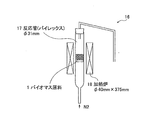
- the carbide 2 stored in the carbide storage tank 13 may be subjected to sampling investigation. However, in some cases, a reaction tube 17 and a heating furnace 18 as shown in FIG. 2 are provided. The carbide obtained by the carbonization experiment apparatus 16 may be analyzed.
- the molding is performed by a molding apparatus.
- a 3 mm screen sieve is used to select only those having a particle size of 3 mm or less. If necessary, the produced carbide 2 is crushed by a cutter mill, and then only those having a particle size of 3 mm or less are selected using a 3 mm screen sieve.
- the median particle diameter D50 is preferably 2 mm or less.
- the median particle diameter D50 is a particle having a mass percentage of 50% in a graph plotted with the mass percentage (%) passing through the sieve of the particle diameter on the vertical axis and the particle diameter on the horizontal axis of the logarithmic scale. Determine the diameter by reading it.
- the sulfur content after being molded into the converter heat-up material is 0.1% by mass or less.
- the use ratio of the carbide 2 which is a low-sulfur-containing carbon material is set in the dry state of the converter heat-up material. It is preferable to set it as 80 mass% or more of the mass of.
- the carbide 2 and the mixed auxiliary material (coal, etc.) are sieved so that the crushing strength of the converter heat-up material (dried briquette) is 50 kgf / piece or more, and the particle size is 3 mm or less. It is preferable to do this. If the particle size of the carbide 2 and the mixed auxiliary raw material (coal, etc.) is 2 mm or less, more preferably 1.5 mm or less, the strength increases, which is more desirable.
- coal or the like (coal or / and coke) 22 is added to the carbide 2 having a particle diameter of only 3 mm or less, or to the carbide 2 as necessary.
- a predetermined amount of binder 24 and water 23 are added to the mixed mixture, and the mixture is stirred with a mixer 25 (stirring blade 26).
- the obtained raw material powder 2A is as shown in FIG.
- the linear pressure between the rolls 21 is set to a predetermined value (for example, 2 tf / cm), and the briquette 3 is molded.
- molding is put into the thermostat of predetermined
- the crushing strength of the obtained heat-up material for converter (the briquette 3 after drying) is 50 kgf / piece or more as a first grade acceptable product. This is because if the crushing strength is about 50 kgf / piece, handling in actual operation becomes easy and the ratio of cracking and scattering when used as a heating material in a converter can be reduced. is there.
- binder if the sulfur content after shape
- C and H are the main components, and the amount of heat as a heating material can be obtained from the binder, and that SiO 2 is not included.
- the amount of binder added varies depending on the shape and particle size of the carbide, but is preferably 1% by mass or more and 15% by mass or less based on the mass of the carbide.
- the addition amount of the binder is 1% by mass or less, the strength of the briquette 3 is less than 50 kgf / piece, and handling becomes difficult.
- the addition amount of a binder exceeds 15 mass%, mold release of a molded object will worsen from the roll for shaping
- the carbonized experimental apparatus shown in FIG. 2 is used as a raw material for plant biomass of palm palm PKS (coconut shell). Manufacturing and sieving the obtained carbide, adjusting the particle size to 3 mm or less, mixing coal or the like (coal or / and coke) as necessary, the mass of the combined carbide and coal Add 4% by weight starch (alpha-treated), then add 14% by weight of the combined weight of carbide and coal, and stir and mix with a mixer. A briquette was molded using a roll-type molding machine obtained, and after the molding, it was dried at a temperature of 105 ° C. at a temperature of 105 ° C. until the water content became 1% by mass or less of the briquette mass, to produce a converter heating material . And the composition of the converter heat-up material after manufacture was analyzed.
- the composition of the molded converter heat-up material was investigated by adjusting the particle size to 3 mm or less using carbides (coal, coke) conventionally used as the heat-up material for converters.
- Conventional Example 1 shows an example of the composition of the converter heat-up material formed from coal as a raw material.
- Conventional example 2 shows an example of the composition of the converter heat-up material molded from coke as a raw material.
- the converter heat-up material using coke as a raw material has more fixed carbon than the case of using coal as a raw material (conventional example 1), and a heat-up effect can be expected.
- composition example 1 of the present invention the composition of the converter heat-up material molded from a carbide (PKS charcoal) obtained by carbonizing PKS of palm palm biomass at 800 ° C. for 1 hour in a nitrogen atmosphere. Show.
- Example 3 of the present invention the composition of a converter heat-up material formed by using as a raw material a carbide (EFB charcoal) obtained by carbonizing EFB of palm palm biomass at 700 ° C. for 1 hour in a nitrogen atmosphere is shown. .
- a carbide EFB charcoal
- Example 4 of the present invention the composition of a converter heat-up material formed by using a carbide (palm trunk charcoal) obtained by carbonizing a palm palm biomass stem at 600 ° C. for 1 hour in a nitrogen atmosphere as a raw material is shown. Yes.
- Comparative Example 1 the composition of the converter heat-up material formed by using as a raw material a carbide (PKS charcoal) obtained by carbonizing PKS of palm palm biomass at 400 ° C. for 1 hour in a nitrogen atmosphere is shown.
- PKS charcoal carbide
- the converter heat-up material formed from a carbide obtained by carbonizing a palm-coconut biomass raw material at a temperature of 600 ° C. or higher and 800 ° C. or lower shown in Invention Examples 1 to 4 has the composition Is 75% by mass or more of fixed carbon, 12% by mass or less of volatile matter, and 0.1% by mass or less of sulfur.
- the fixed carbon content is equal to or higher than the fixed carbon content of the converter heat-up material (conventional example 1) molded from coal as a raw material, and it can be expected to generate heat equal to or higher than coal.
- the sulfur content is less than 0.1% by mass, and is less than a quarter of the converter heat-up material (conventional example 1 and conventional example 2) molded from coal and coke as raw materials. Sulfur in molten steel even when an amount equivalent to four times is added when used as a converter heating material instead of a converter heating material (conventional example 1 and conventional example 2) molded as a raw material There is no fear that the minutes will rise.
- the converter heat-up material formed from a carbide obtained by carbonizing a palm palm biomass material at 400 ° C. shown in Comparative Example 1 has a fixed carbon content of 68.1% by mass, In order to obtain an equivalent amount of heat, it is necessary to add a larger amount than coal.
- Example 11 of the present invention converter heating using PKS palm palm biomass obtained by carbonizing at 800 ° C. for 1 hour in a nitrogen atmosphere and coal as raw materials and forming the blending ratio at 90:10 The composition of the material is shown.
- Example 12 of the present invention converter heating with PKS palm palm biomass was carbonized at 800 ° C. for 1 hour in a nitrogen atmosphere and coal was used as a raw material, and the blending ratio was molded as 85:15. The composition of the material is shown.
- Example 13 of the present invention converter heating using PKS palm palm biomass obtained by carbonizing carbon dioxide and coke obtained by carbonizing at 800 ° C. for 1 hour in a nitrogen atmosphere at a blending ratio of 85:15 was performed. The composition of the material is shown.
- Comparative Example 11 a converter heat-up material obtained by using as a raw material carbide and coal obtained by carbonizing PKS of palm palm biomass at 800 ° C. in a nitrogen atmosphere for 1 hour, and forming the blending ratio thereof as 50:50. The composition of is shown.
- the composition of the converter heat-up material molded with the compounding ratio of the produced carbide of 80% by mass or more is 75% by mass or more of fixed carbon, 12% by mass or less of volatile matter, and 0.1% by mass or less of sulfur.
- the fixed carbon content is equal to or higher than the fixed carbon content of the converter heat-up material (conventional example 1) molded from coal as a raw material, and it can be expected to generate heat equal to or higher than coal. .
- the sulfur content is 0.1% by mass or less, and is less than one-quarter compared to the converter heating material (conventional example 1 and conventional example 2) formed from coal and coke as raw materials. Even when the amount equivalent to four times is added when used as a converter heating material in place of the converter heating material (conventional example 1 and conventional example 2) molded as a raw material, sulfur in the molten steel There is no fear that the minutes will rise.
- Comparative Example 11 the PKS of palm-based biomass carbide and coal obtained by carbonizing 1 hour at 800 ° C. in a nitrogen atmosphere as a raw material, converter Noborinetsu that molding the blending ratio as 50:50
- the material contains 0.2% by mass of the sulfur content, and can be used as a heating material in order to stop the increase of the sulfur content in the molten steel equally when compared with Invention Example 11 and Invention Example 12.
- the amount is halved.
- the amount of CO 2 generated from fossil resources that can be reduced when an equivalent amount is used is reduced to one fifth.
- the palm palm biomass raw material is carbonized at a temperature of 800 ° C. or higher, a carbide with a high fixed carbon can be obtained.
- a large amount of energy is required for maintaining the temperature of the carbonization furnace. The necessary energy efficiency may be reduced.
- the K content of the EFB carbide is high because the K content of the raw EFB is high. It has been confirmed that this can be suppressed to 0.1% by mass or less by rinsing the EFB raw material before carbonization or rinsing the EFB carbide after carbonization.
- the dried briquette may absorb moisture during storage and the moisture content may be 1 to 3% by mass, but there is no particular problem in use. However, when the water content increases significantly due to rain, etc., the amount of heat lost to sensible and latent heat of water increases during use, and the briquette strength decreases, so storage is not possible in warehouses or roofs. A certain yard is desirable.
- the carbide of PKS used for the converter heat-up material shown in Example 2 of the present invention was observed with the naked eye at the time before adjusting the particle size, and the particle size was about 1 mm to about 10 mm or less. It was a mixture of
- Example 5 of the present invention as a pretreatment for molding by the roll molding machine 20, the carbide was adjusted to a particle size that passed through a screen having a screen size of 3 mm. At this time, the median particle diameter D50 was 2.34 mm. Then, starch corresponding to 4% by mass of the above-described PKS carbide (alpha-treated) was added as a binder, and the mixture with water corresponding to 14% by mass was stirred with a mixer. The roll type molding machine shown in Fig. 1 was used, the linear pressure between the rolls was 2 tf / cm, and a 44 mm square Macek type roll was used to form the briquette. The molded briquette was placed in a constant temperature bath having an atmospheric temperature of 105 ° C. and dried until a constant weight was reached.
- the crushing strength of 10 briquettes after drying was measured, and the average value was determined to be 80 kgf / piece. As described above, it is empirically known that if the crushing strength is about 50 kgf / piece, handling in actual operation is possible, and the briquette shown in the present invention example 5 has sufficient crushing strength to withstand use. It can be judged that it has.
- Example 6 of the present invention as a pretreatment of molding by the roll molding machine 20, the PKS carbide was crushed with a cutter mill and adjusted to a particle size that passed through a screen having a screen size of 3 mm. At this time, the median particle diameter D50 was 1.56 mm.
- the crushing strength after molding / drying of briquettes when the addition amount of the starch corresponding to 6% by mass of the above PKS carbide is added as a binder is the maximum. It was 180 kg / piece.
- an increase in the amount of binder added will lead to an increase in briquette costs. If the crushing strength is 116 kg / piece, problems during handling such as briquette destruction will not occur, so the amount of binder added will be determined as necessary. do it.
- Example 7 of the present invention a carbide (a carbide having a particle size of about 1 mm to about 10 mm or less) in which the step of adjusting the particle size to pass through a sieve having a screen size of 3 mm as a pretreatment of molding by the roll molding machine 20 is omitted.
- Example 7 of the present invention the briquette is damaged during transportation, and in order to put the entire amount into the converter, an extra step of collecting the briquettes damaged during transportation is required. And briquettes having the crushing strength shown in FIGS.
- the PKS carbide used in the converter heating material shown in Invention Example 11 had a particle size of about 1 mm to about 10 mm or less when observed with the naked eye before adjusting the particle size. It was a mixture of
- Example 11 of the present invention PKS carbide and coal were adjusted to a particle size passing through a sieve having a screen size of 3 mm as a pretreatment for molding by the roll molding machine 20. At this time, the median particle diameter D50 was 2.47 mm. Then, the above PKS carbide and starch corresponding to 4% by mass of the mass of the coal (alpha-treated) are added as a binder, and the mixture to which water corresponding to 14% by mass is added is stirred with a mixer, The roll type molding machine shown in FIG. 3 was used, the linear pressure between the rolls was 2 tf / cm, and a 44 mm square Macek type roll was used to form the briquette.
- the molded briquette was placed in a constant temperature bath having an atmospheric temperature of 105 ° C. and dried until a constant weight was reached.
- the crushing strength of 10 briquettes after drying was measured and the average value was determined to be 78 kgf / piece.
- Example 14 of the present invention as a pretreatment of molding by the roll molding machine 20, the PKS carbide and coal were crushed with a cutter mill and adjusted to a particle size that passed through a screen having a screen size of 3 mm. At this time, the median particle diameter D50 was 1.47 mm. And the briquette was shape
- Example 14 of the present invention has sufficient crushing strength to withstand use. It can be judged that it has.
- Example 15 of the present invention a carbide (a particle size of about 1 mm to about 10 mm or less of carbide having a particle size passing through a sieve having a screen size of 3 mm as a pretreatment of molding by a roll type molding machine is omitted.
- Mixture and coal that has passed through a screen with a screen size of 3 mm to obtain a mixture in which the same binder and water as in Example 13 of the present invention are added, and briquettes are molded and dried by the same procedure as in Example 11 of the present invention.
- Example 15 of the present invention a carbide (a particle size of about 1 mm to about 10 mm or less of carbide having a particle size passing through a sieve having a screen size of 3 mm as a pretreatment of molding by a roll type molding machine is omitted.
- Mixture and coal that has passed through a screen with a screen size of 3 mm to obtain a mixture in which the same binder and water as in Example 13 of the present invention are added, and
- Example 15 of the present invention the briquette is damaged during the conveyance, and in order to put the entire amount into the converter, an extra step for collecting the briquettes damaged during the conveyance is required. And briquettes with crushing strengths shown in FIGS.
- Example 2 The converter heating material obtained in Example 1 was applied to the converter equipment. The results are described below as Example 2.
- the top-bottom blown converter used has a converter capacity of about 250 tons per charge (ch), and Ar gas is used as the bottom blown gas for stirring.
- the hot metal was desulfurized using a mechanical stirring desulfurization apparatus.
- iron scrap (such as slabs and steel plate crops) generated at an ironworks was used.
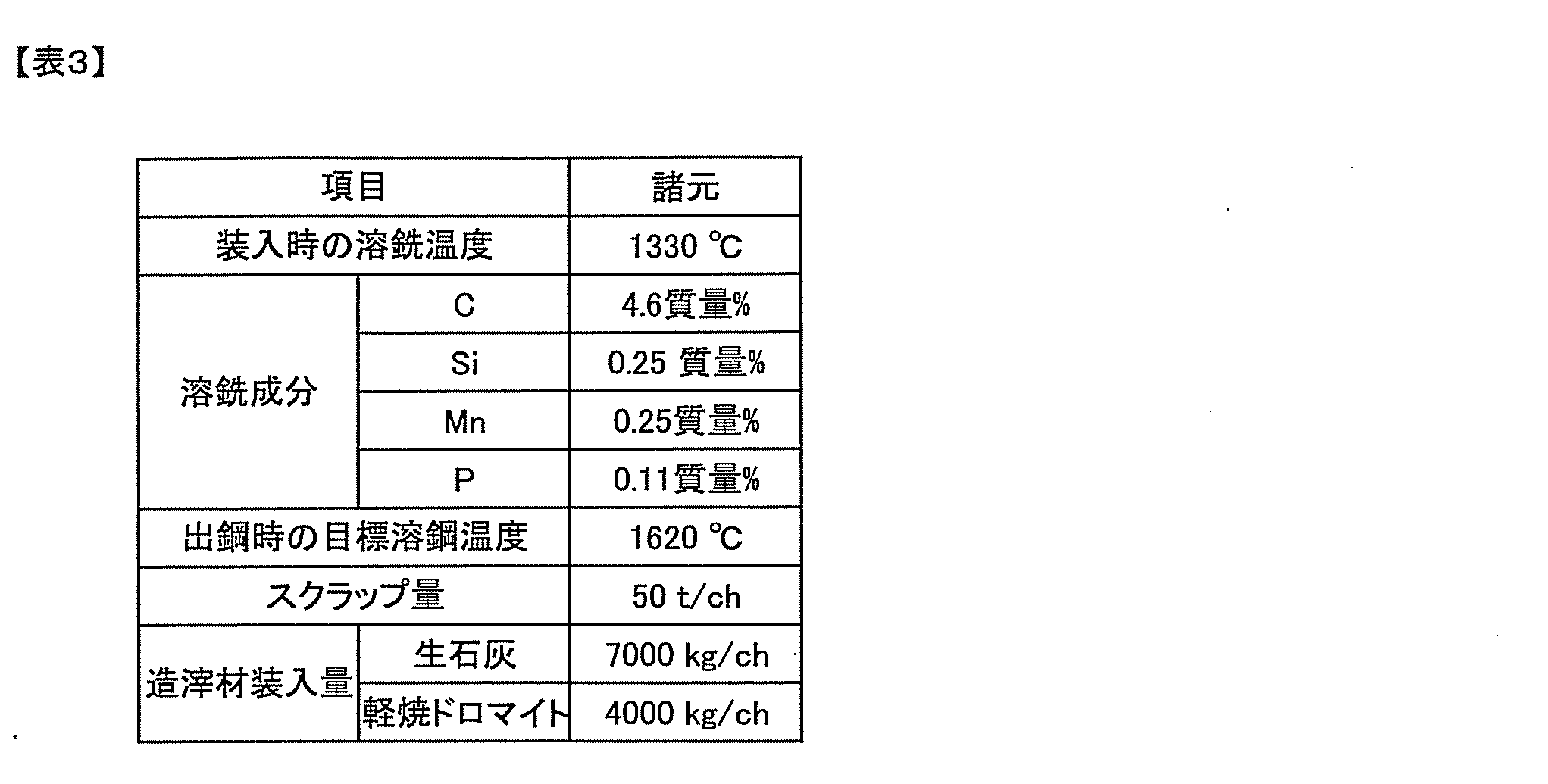
- Table 3 shows examples of converter operating conditions and typical hot metal components in Example 2. And the operation result which performed the converter operation on the operation conditions shown in Table 3 is shown in Table 4.
- the amount of the converter heat-up material introduced was set to the amount of fixed carbon equivalent to the case where 2500 kg / ch of the heat-up material of 85% by mass of fixed carbon was introduced.
- the charging hot metal temperature was set to a constant condition of 1330 ° C., and the scrap amount and the iron making material charging quantity were also set to a fixed condition.
- Example 14 of the present invention the temperature at the time of steel output was 1630 to 1650 ° C., which was about 20 ° C. higher than that of Examples 11 to 13 of the present invention. This is because the briquette crushing strength was as high as 100 kgf / piece or more, so the decrease in heat receiving efficiency due to scattering when it was put into the converter was reduced. This is more preferable because it can dissolve the scrap.
- the steel output temperature was 1595 to 1615 ° C., which was about 15 ° C. lower than that of Invention Examples 11 to 13. This is presumably because when the heating material was charged into the converter, it was easily cracked and scattered by thermal shock during charging in addition to cracking during the transfer process, resulting in a decrease in heat receiving efficiency.
- Example 15 of the present invention the temperature at the time of steel output was low, but by increasing the amount added, the temperature range from 1610 to 1630 ° C. at the time of steel output can be maintained.
- the present invention it is possible to reduce the amount of CO 2 generation derived from fossil resources produced by manufacturing a carbide using plant-based biomass such as palm palm as a raw material and molding the carbide using the binder as a main raw material.
- a heat exchanger for converters with a low sulfur content the consumption of fossil resources can be reduced by substituting the heat exchanger for converters made from fossil resources used in steelworks as a raw material. This contributes to the solution of global warming problems. It also contributes to the development of palm oil industry countries, mainly Malaysia and Indonesia, by improving the profitability of the palm oil industry and improving the environment of palm palm cultivation areas.
Landscapes
- Engineering & Computer Science (AREA)
- Environmental & Geological Engineering (AREA)
- Chemical & Material Sciences (AREA)
- Materials Engineering (AREA)
- Metallurgy (AREA)
- Organic Chemistry (AREA)
- Carbon Steel Or Casting Steel Manufacturing (AREA)
- Manufacture And Refinement Of Metals (AREA)
- Solid Fuels And Fuel-Associated Substances (AREA)
- Processing Of Solid Wastes (AREA)
Abstract
化石資源由来のCO2発生量を削減することが可能であり、かつ硫黄含有量が低く、しかも必要量を安定して製造することが可能な転炉用昇熱材を提供する。 植物系バイオマスを炭化して炭化物を製造し、前記炭化物を主原料にしてバインダーおよび水分を加えて成型した転炉用昇熱材であって、水分を除いた乾燥状態での組成が固定炭素分70質量%以上、揮発成分20質量%以下、硫黄分0.1質量%以下、残部灰分であり、別途水分が前記水分を除いた乾燥状態での質量の5質量%以下である、転炉用昇熱材。
Description
本発明は、カーボンニュートラルなパームヤシ由来などの植物系バイオマスを原料とした炭化物を製造し、前記炭化物にバインダーを加えて成型した、硫黄含有量が低い転炉用昇熱材に関する。
製鋼工程において、転炉は酸素吹錬によって、炭素をはじめとする不純物を酸化物として除去する。
一方、転炉の前工程である溶銑予備処理において、鉄鋼製品の材料特性面の要求から溶銑中のS、Pなどを除く処理を行っているが、処理により溶銑温度が低下する。また、二酸化炭素排出量削減の観点から転炉に投入するスクラップを増やし、溶銑配合率を低下させることを指向した操業が試みられている。
このため、転炉では、従来は溶銑に含まれている炭素分の酸化熱を利用していた熱量が不足し、石炭、コークス粉、黒鉛、電極粉、SiCなどを成型した固形物を昇熱材として投入し、不足する熱量を補っている。
そのような転炉用昇熱材については、以下のような技術が開示されている。
たとえば、特許文献1では、特定粒度分布の石炭、コークス粉、黒鉛などの炭素粉とバインダーとを、特定水分率に調湿して混練後、高圧成形、乾燥することにより、炭素粉を十分な強度の固形物に成型することを可能としている。
また、特許文献2では、炭素粉を高温で焼成された電極又は電極屑から得られたものに限定することで、硫黄分を0.01質量%以下とすることを可能としている。
しかしながら、特許文献1に記載された石炭、コークス粉などの炭素粉を用いた転炉用昇熱材は、硫黄の含有量が0.5質量%前後と多いので、鉄鋼製品の材料特性面の要求から決定される溶鋼中の硫黄の含有量の上限を考慮すれば、使用量が制限される。
逆に、所望の昇熱量を得るのに必要な昇熱材量を加えたことによって、結果的に溶鋼中の硫黄の含有量の上限を超える量の硫黄が溶鋼中に存在する場合には、転炉の後工程でRH真空脱ガス設備などにより脱硫する必要が生じ経済性に劣る。
また、特許文献2に記載されたように、使用する炭素粉を電極または電極屑に限定する場合には、廃棄される電極及び電極屑の発生量を超えては昇熱材を製造することができない。
本発明は、上記のような事情に鑑みてなされたものであり、カーボンニュートラルなバイオマスを転炉用昇熱材の主原料とすることによって、従来原料として用いられてきた、石炭、コークス、黒鉛等の化石資源に由来するCO2発生量を削減することが可能であり、かつ硫黄含有量が低く、しかも必要量を安定して製造することが可能な転炉用昇熱材を提供することを目的とするものである。
上記課題を解決するために、本発明では、植物系バイオマスを原料とした炭化物を製造し、その炭化物にバインダーと水を加えて所定の形状の固形物に成型することによって、化石資源由来のCO2発生量を削減することが可能であり、なおかつ硫黄含有量が低い転炉用昇熱材を得るようにしている。
ここで、原料にする植物系バイオマスは、例えば、木質系および草本系の植物系バイオマスである。特に好適な植物系バイオマスとしては、主としてマレーシア、インドネシア両国のプランテーションで栽培されているパームヤシ(アブラヤシ)から粗パーム油を製造する過程で排出されるパームヤシ由来のバイオマスを使用する。
より詳しく述べると、パームヤシ由来のバイオマスとは、パームヤシのPKS(Palm Kernel Shell、やし殻)、EFB(Empty Fruit Bunch、空果房)、トランク(幹)、剪定屑(剪定した枝や葉など)などである。
より詳しく述べると、パームヤシ由来のバイオマスとは、パームヤシのPKS(Palm Kernel Shell、やし殻)、EFB(Empty Fruit Bunch、空果房)、トランク(幹)、剪定屑(剪定した枝や葉など)などである。
以上のことに基づいて、本発明は以下のような特徴を有している。
[1]植物系バイオマスを炭化して炭化物を製造し、前記炭化物にバインダーおよび水分を加えて成型した転炉用昇熱材であって、水分を除いた乾燥状態での組成が、固定炭素分70質量%以上、揮発成分20質量%以下、硫黄分0.1質量%以下、残部灰分であり、別途水分が前記水分を除いた乾燥状態での質量の5質量%以下である、転炉用昇熱材。
[2]植物系バイオマスを炭化して炭化物を製造し、前記炭化物を主原料として、石炭とコークスとからなるグループから選択された少なくとも一つを混合して混合物を製造し、前記混合物にバインダーおよび水分を加えて成型した転炉用昇熱材であって、水分を除いた乾燥状態での組成が、固定炭素分70質量%以上、揮発成分20質量%以下、硫黄分0.1質量%以下、残部灰分であり、別途水分が前記転炉用昇熱材の乾燥状態での質量の5質量%以下である、転炉用昇熱材。
[3]前記転炉用昇熱材が、50kgf/個以上の圧潰強度を有する、[1]または[2]に記載の転炉用昇熱材。
[4]前記植物系バイオマスが、パームヤシのやし殻、空果房、幹と剪定屑のグループから選択された少なくとも一つである、[1]または[2]に記載の転炉用昇熱材。
[5]前記バインダーが、澱粉、カルボキシメチルセルロースとコーンスターチのグループから選択された少なくとも一つである、[1]または[2]に記載の転炉用昇熱材。
[6]前記バインダーが、前記炭化物の質量の1質量%~15質量%の添加量を有する[1]または[2]に記載の転炉用昇熱材。
[7]前記圧潰強度が、50~116kgf/個である、[3]に記載の転炉用昇熱材。
[8]前記転炉用昇熱材の原料とする炭化物が3mm以下の粒径を有する、[1]または[2]に記載の転炉用昇熱材。
[9]前記固定炭素分が70~86質量%である、[1]または[2]に記載の転炉用昇熱材。
[10]前記揮発成分が5~20質量%である、[1]または[2]に記載の転炉用昇熱材。
[11]前記副原料が主原料に対して10~15質量%である、[2]に記載の転炉用昇熱材。
本発明においては、カーボンニュートラルなパームヤシ由来などの植物系バイオマスを原料とした炭化物を製造し、その炭化物を主原料にしてバインダーを加えて成型した、硫黄含有量が0.1質量%以下と低い転炉用昇熱材によって、従来用いられてきた、石炭、コークス、黒鉛等の化石資源を原料とする転炉用昇熱材を代替することにより、化石資源消費量を低減し、温室効果ガスであるCO2の発生を低減させ、地球温暖化問題の解決に寄与する。
ちなみに、近年、地球温暖化防止の観点から二酸化炭素の排出量削減が緊急の課題であり、二酸化炭素排出量削減の方法として、以下の技術開発が行われている。
・インプットの炭素量を削減する。
・アウトプットの二酸化炭素を回収する。
・従来の石炭・石油等をカーボンニュートラルな炭素源に代替する。
・インプットの炭素量を削減する。
・アウトプットの二酸化炭素を回収する。
・従来の石炭・石油等をカーボンニュートラルな炭素源に代替する。
ここで、上記のカーボンニュートラルの炭素源としては、植物系バイオマスが知られている。日本国内で収集可能な植物系バイオマスとしては、建築家屋の解体で発生する木材廃棄物、製材所発生の木質系廃棄物、森林等での剪定廃棄物、農業系廃棄物などがある。
しかし、建築家屋の解体で発生する木材廃棄物、製材所発生の木質系廃棄物は発生源が集中しており、また収集ルートが確立されているものが多いため用途開発が進み、需要が供給を上回ってきており、エネルギー源としての利用可能な量は制約を受ける状況にある。また、森林等での剪定廃棄物、農業系廃棄物などは発生源が広く国内に分布しており搬出、収集にコストが発生するため価格面からエネルギー源としての利用が困難な状況にある。
これに対して、パーム油は、世界で年間約3,600万トン生産され、そのうちの約9割をマレーシアとインドネシアの2カ国で生産される農産物である。パーム油はパームヤシの実から製造され大豆油等と比較し安価であることから、食用油のほか洗剤など工業用途にも多用されている。パーム油を採取するパーム果実はBunch(房)と呼ばれている塊状の繊維の集合体に結実する。パーム果実を搾油し粗パーム油を得るが、その際にパーム果実の殻であるPKSが粉砕された状態で副生する。
パーム果実を採取した後のBunchはEFB(Empty Fruit Bunch、空果房)と呼ばれている。EFBはアルカリ含有量、特にKの含有量が高く、そのまま燃料として使用すると、揮発したKがボイラの熱交換器でクリンカを生じ、運転の妨げとなる場合があり、一般的には燃料として利用されていない。また、工業原料としての用途も開発されていないため、現状ではほとんどの場合、パームオイル工場の周辺域で放置されており、腐食によるメタンガスなど温室効果ガスの発生による地球温暖化促進が懸念される。
このため、PKS、EFB、トランク(幹)、剪定枝などのパームヤシ由来のバイオマス原料から製造したカーボンニュートラルな炭化物を成型した固形物を、石炭、コークス粉、黒鉛、電極粉、SiCなどを成型した固形物に替えて転炉用昇熱材として使用することは地球温暖化防止の観点から非常に重要である。
パーム油の製造工程において、パーム果実が実ったパームヤシの房は搾油のためにパームオイル工場に集積される。そのため、パームヤシ由来のバイオマス原料の中でも、特に、PKS及びEFBは、収集費用を別途必要とすることなく、パームオイル工場内に集積される。収集費用を必要としない安価な原料を使用することで、安価な炭化物を製造することが可能となる。
上述したように、転炉用昇熱材中の炭素源として植物系バイオマスを炭化して得られる炭化物のみを用いるのが、転炉用昇熱材中の硫黄含有量を少なくする点と、石炭、コークス、黒鉛等の化石資源を代替してCO2発生量を削減する点の両方の点から最も好ましいが、転炉用昇熱材中の硫黄含有量が0.1質量%以下となる範囲内で、植物系バイオマスを炭化して得られる炭化物の一部を石炭やコークスに置き換えて成型しても良い。
また、わずかながら添加することとなる硫黄分を効率良く脱硫するために、さらに脱硫剤を加えて転炉用昇熱材を成型しても良い。
本発明の一実施形態を図面に基づいて説明する。
本発明の一実施形態においては、原料である植物系バイオマスを炭化装置によって炭化して炭化物を製造し、その炭化物を主原料にしてバインダーと水を加えて成型装置によって成型することで、転炉用昇熱材を得るようにしている。
その際に、原料の植物系バイオマスとしては、主にパームヤシのPKS(やし殻)やEFB(空果房)等を用いる。そして、その植物系バイオマスから製造した炭化物を用いて成型した転炉用昇熱材の組成は、水分を除いた乾燥状態で、固定炭素分70質量%以上、揮発成分20質量%以下、残部灰分であるとともに、硫黄分0.1質量%以下であり、成型後に、別途水分が前記乾燥状態での質量の5質量%以下となるまで乾燥するようにして製造する。ちなみに、乾燥状態とは、105℃の高温槽に入れて乾燥し、恒量となった状態を言う。転炉用昇熱材の組成は、この乾燥状態のものを工業分析および成分分析で求める。
ここで、転炉用昇熱材の組成は、水分を除いた乾燥状態で、固定炭素分75質量%以上、揮発成分12質量%以下、残部灰分であるとともに、硫黄分0.1質量%以下であれば、質量あたりの熱量が増加するため、より望ましい。また、水分が前記乾燥状態での質量の1質量%以下となるまで乾燥すれば、強度が上昇するので、より望ましい。
なお、転炉用昇熱材(乾燥後のブリケット)の圧潰強度が50kgf/個以上となるように、炭化物の粒径は3mm以下とするのが好ましい。炭化物の粒径が2mm以下、さらには1.5mm以下であれば、強度が上昇するので、より望ましい。
そして、植物系バイオマスを炭化する炭化装置としては、ロータリーキルン炉(外部から炭化に必要な熱を得る外熱式ロータリーキルン炉、原料の一部を燃焼して炭化に必要な熱を得る内熱式ロータリーキルン炉)、バッチ式の炉、シャフト式の炉などを使用する。
図1は、炭化装置10として、外熱式ロータリーキルン炉11を用いた場合を示しており、外熱式ロータリーキルン炉11に投入されたバイオマス原料(植物系バイオマス)1が、燃焼炉12からの高温ガスの熱によって炭化されて炭化物2となり、炭化物貯留槽13に貯留される。なお、バイオマス原料1が炭化する際に発生したタールはタール回収槽14に回収される。
また、マレーシアでは地面を掘り下げ、空気の流れを限定することで酸素の供給を制限しながらPKSを炭化し、炭化物を製造する方法も実施されている。
ここで、製造した炭化物の組成については、炭化物貯留槽13に貯留された炭化物2をサンプリング調査してもよいが、場合によっては、図2に示すような、反応管17と加熱炉18を備えた炭化実験装置16で得られた炭化物で分析してもよい。
そして、上記のようにして製造された炭化物2について、粒径が3mmを超えているものが含まれている場合(例えば、粒径が約1mm~約10mmの範囲に分布)、成型装置による成型の前処理として、3mmスクリーンの篩を用いて、粒径が3mm以下のものだけを選別する。必要に応じて、製造された炭化物2をカッターミルにて破砕してから、3mmスクリーンの篩を用いて、粒径が3mm以下のものだけを選別する。
この時に、メジアン粒径D50が2mm以下であることが好ましい。ここで、メジアン粒径D50とは、粒径のふるい目を通過した量の質量百分率(%)を縦軸に、粒径を対数目盛の横軸にしてプロットしたグラフにおいて質量百分率50%にあたる粒径を読み取って定める。
なお、転炉用昇熱材の原料としては、主原料である炭化物2以外に、必要に応じて副原料として石炭等(石炭または/およびコークス)を混合してもよい。ただし、転炉用昇熱材に成型した後の硫黄含有量が0.1質量%以下とする。転炉用昇熱材に成型した後の硫黄含有量を0.1質量%以下とするには、低硫黄含有炭材である炭化物2の使用比率を、転炉用昇熱材の乾燥状態での質量の80質量%以上とすることが好ましい。また、必要に応じて、精錬剤(脱硫材)を混合しても良い。
その際に、転炉用昇熱材(乾燥後のブリケット)の圧潰強度が50kgf/個以上となるように、炭化物2および混合した副原料(石炭等)を篩って粒径を3mm以下とするのが好ましい。炭化物2および混合した副原料(石炭等)の粒径が2mm以下、さらには1.5mm以下であれば、強度が上昇するので、より望ましい。
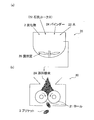
次に、図3(a)に示すように、粒径が3mm以下のものだけになった炭化物2に対して、あるいは、必要に応じて炭化物2に石炭等(石炭または/およびコークス)22を混合した混合物に対して、所定量のバインダー24と水23を加えて、ミキサー25(撹拌翼26)で攪拌した後、得られた原料粉末2Aに対して、図3(b)に示すようなロール式成型機20を使用し、ロール21間の線圧を所定の値(例えば、2tf/cm)にして、ブリケット3に成型する。そして、成型後のブリケット3を所定の雰囲気温度(例えば、105℃)の恒温槽に入れ、恒量となるまで乾燥して、転炉用昇熱材を得る。
その際に、得られた転炉用昇熱材(乾燥後のブリケット3)の圧潰強度が50kgf/個以上を1級合格品とする。これは、圧潰強度が50kgf/個程度あれば、実操業上でのハンドリングが容易になることと、転炉で昇熱材として使用した際に割れて飛散し有効利用されない比率を小さくできるからである。
なお、上記のバインダーとしては、転炉昇熱材に成型した後の硫黄含有量が0.1質量%以下であれば、硫黄分を含んでいるものを用いてもかまわない。より望ましくは、硫黄分を含まない澱粉、カルボキシメチルセルロース、コーンスターチなどを用いる。
これらはベントナイトなどの無機系のバインダーと比較すると、CやHが主成分でありバインダーからも昇熱材としての熱量を得られること、またSiO2を含まない点で優れている。
バインダーの添加量は炭化物の形状、粒度によって適切な量が異なるが、炭化物の質量に対して1質量%以上、15質量%以下であることが望ましい。バインダーの添加量が1質量%以下の場合には、ブリケット3の強度が50kgf/個を下回り、ハンドリングが難しくなる。また、バインダーの添加量が15質量%を超えた場合には、成型用のロールから成型体の型離れが悪くなり、生産性が低下する。
このようにして、この実施形態においては、化石資源由来のCO2発生量を削減することが可能で、かつ硫黄含有量が低い転炉用昇熱材を安定して必要量製造することができる。
本発明の実施例を述べる。
まず、製造された転炉用昇熱材(転炉昇熱材)の組成の比較を行った。
その際に、本発明例として、上記の本発明の実施形態に基づいて、図2に示した炭化実験装置を用いて、パームヤシのPKS(やし殻)の植物系バイオマスを原料にして炭化物を製造し、得られた炭化物を篩って、粒径を3mm以下に調整し、その炭化物に必要に応じて石炭等(石炭または/およびコークス)を混合し、炭化物と石炭等を合わせた質量の4質量%の澱粉(アルファー化処理されたもの)を加え、さらに、炭化物と石炭等を合わせた質量の14質量%の水分を加えてミキサーで攪拌・混合し、44mm角のマセック型の成型体が得られるロール式成型機を用いてブリケットを成型し、成型後に乾燥炉にて105℃の温度で、水分がブリケット質量の1質量%以下となるまで乾燥し、転炉昇熱材を製造した。そして、製造後の転炉昇熱材の組成を分析した。
また、従来例として、従来から転炉用昇熱材に用いられている炭化物(石炭、コークス)を原料として粒径を3mm以下に調整し、成型した転炉昇熱材の組成も調査した。
その結果を表1に示す。

表1において、従来例1は、石炭を原料として成型した転炉昇熱材の組成の一例を示している。また、従来例2は、コークスを原料として成型した転炉昇熱材の組成の一例を示している。コークスを原料とした転炉昇熱材は石炭を原料とした場合(従来例1)と比較して固定炭素が多く昇熱効果が期待できる。
しかし、従来例1及び従来例2は硫黄分が多いため、鉄鋼製品の材料特性面の要求から決定される溶鋼中の硫黄の含有量の上限を超える量を昇熱材として溶鋼中に加えることはできない。
これに対して、本発明例1として、パームヤシ系バイオマスのPKSを窒素雰囲気中で800℃で1時間炭化して得られた炭化物(PKS炭)を原料として成型した転炉昇熱材の組成を示している。
また、本発明例2として、パームヤシ系バイオマスのPKSを窒素雰囲気中で600℃で1時間炭化して得られた炭化物(PKS炭)を原料として成型した転炉昇熱材の組成を示している。
また、本発明例3として、パームヤシ系バイオマスのEFBを窒素雰囲気中で700℃で1時間炭化して得られた炭化物(EFB炭)を原料として成型した転炉昇熱材の組成を示している。
また、本発明例4として、パームヤシ系バイオマスの幹を窒素雰囲気中で600℃で1時間炭化して得られた炭化物(パーム幹炭)を原料として成型した転炉昇熱材の組成を示している。
また、比較例1として、パームヤシ系バイオマスのPKSを窒素雰囲気中で400℃で1時間炭化して得られた炭化物(PKS炭)を原料として成型した転炉昇熱材の組成を示している。
表1に示すとおり、本発明例1~4に示す、パームヤシ系バイオマス原料を600℃以上800℃以下の温度で炭化して得られた炭化物を原料として成型した転炉昇熱材は、その組成が固定炭素75質量%以上、揮発分12質量%以下、硫黄0.1質量%以下となっている。特に、固定炭素の含有量が石炭を原料として成型した転炉昇熱材(従来例1)の固定炭素の含有量と同等以上であり、石炭と同等以上の熱量を発生することが期待できる。また、硫黄分は0.1質量%未満であり石炭およびコークスを原料として成型した転炉昇熱材(従来例1及び従来例2)に比較すると4分の1以下であり、石炭及びコークスを原料として成型した転炉昇熱材(従来例1および従来例2)の代わりに転炉用昇熱材として使用した場合に、4倍に相当する量を加えた場合においても、溶鋼中の硫黄分が上昇する恐れはない。
一方、比較例1に示す、パームヤシ系バイオマス原料を400℃で炭化して得られた炭化物を原料として成型した転炉昇熱材は、固定炭素の含有量が68.1質量%であり、石炭よりも劣るため、同等の熱量を得るためには、石炭よりも多量に加える必要がある。
さらに、本発明例11として、パームヤシ系バイオマスのPKSを窒素雰囲気中で800℃で1時間炭化して得られた炭化物と石炭を原料とし、その配合率を90:10として成型した転炉昇熱材の組成を示している。
また、本発明例12として、パームヤシ系バイオマスのPKSを窒素雰囲気中で800℃で1時間炭化して得られた炭化物と石炭を原料とし、その配合率を85:15として成型した転炉昇熱材の組成を示している。
また、本発明例13として、パームヤシ系バイオマスのPKSを窒素雰囲気中で800℃で1時間炭化して得られた炭化物とコークスを原料とし、その配合率を85:15として成型した転炉昇熱材の組成を示している。
また、比較例11として、パームヤシ系バイオマスのPKSを窒素雰囲気中で800℃で1時間炭化して得られた炭化物と石炭を原料とし、その配合率を50:50として成型した転炉昇熱材の組成を示している。
表1に示すとおり、本発明例11~13に示す、パームヤシ系バイオマスのPKSを窒素雰囲気中で800℃で1時間炭化して得られた炭化物と石炭またはコークスを原料とし、植物系バイオマスを炭化して製造した炭化物の配合率を80質量%以上として成型した転炉昇熱材は、その組成が固定炭素75質量%以上、揮発分12質量%以下、硫黄0.1質量%以下となっている。特に、固定炭素の含有量が、石炭を原料として成型した転炉昇熱材(従来例1)の固定炭素の含有量と同等以上であり、石炭と同等以上の熱量を発生することが期待できる。また、硫黄分は0.1質量%以下であり、石炭およびコークスを原料として成型した転炉昇熱材(従来例1および従来例2)に比較すると4分の1以下であり、石炭およびコークスを原料として成型した転炉昇熱材(従来例1および従来例2)の代わりに転炉昇熱材として使用した場合に、4倍に相当する量を加えた場合においても、溶鋼中の硫黄分が上昇する恐れはない。
一方、比較例11に示す、パームヤシ系バイオマスのPKSを窒素雰囲気中で800℃で1時間炭化して得られた炭化物と石炭を原料とし、その配合率を50:50として成型した転炉昇熱材は、硫黄分が0.2質量%含まれており、本発明例11および本発明例12と比較すると、溶鋼中の硫黄分の上昇を同等に止めるためには、昇熱材として使用可能な量が半減する。また、本発明例11と比較すると、同等の量を使用した場合に削減できる化石資源由来のCO2発生量が5分の1に止まる。
なお、パームヤシ系バイオマス原料を800℃以上の温度で炭化しても、固定炭素の高い炭化物を得ることができるが、炭化炉の温度維持のためのエネルギーが多く必要となり、一定量の炭化物製造に必要なエネルギー効率が低下することが考えられる。
また、パームヤシ系バイオマスのEFBを炭化物の原料とした場合には、原料のEFBのKの含有量が高いため、EFB炭化物のK含有量が高くなる。これは、炭化前のEFB原料の水洗、あるいは炭化後のEFB炭化物の水洗により0.1質量%以下に抑制することが可能であることを確認している。
乾燥後のブリケットは保管中に吸湿して、水分が1~3質量%となる場合があるが、特に使用上の問題はない。しかし、雨ざらしになるなどして水分含有量が著しく増加した場合には、使用時に水の顕熱及び潜熱に奪われる熱量が増加し、またブリケットの強度が低下するため保管には倉庫や屋根のあるヤードが望ましい。
次に、本発明例2に示すPKSの炭化物を原料として成型した転炉昇熱材(乾燥後のブリケット)を用いて、圧潰強度を調査した。
その際に、本発明例2に示す転炉昇熱材に使用したPKSの炭化物は、粒径を調整する前の時点では、肉眼で観察したところ、粒径が約1mmから約10mm以下の炭化物の混合物であった。
その結果を表2に示す。
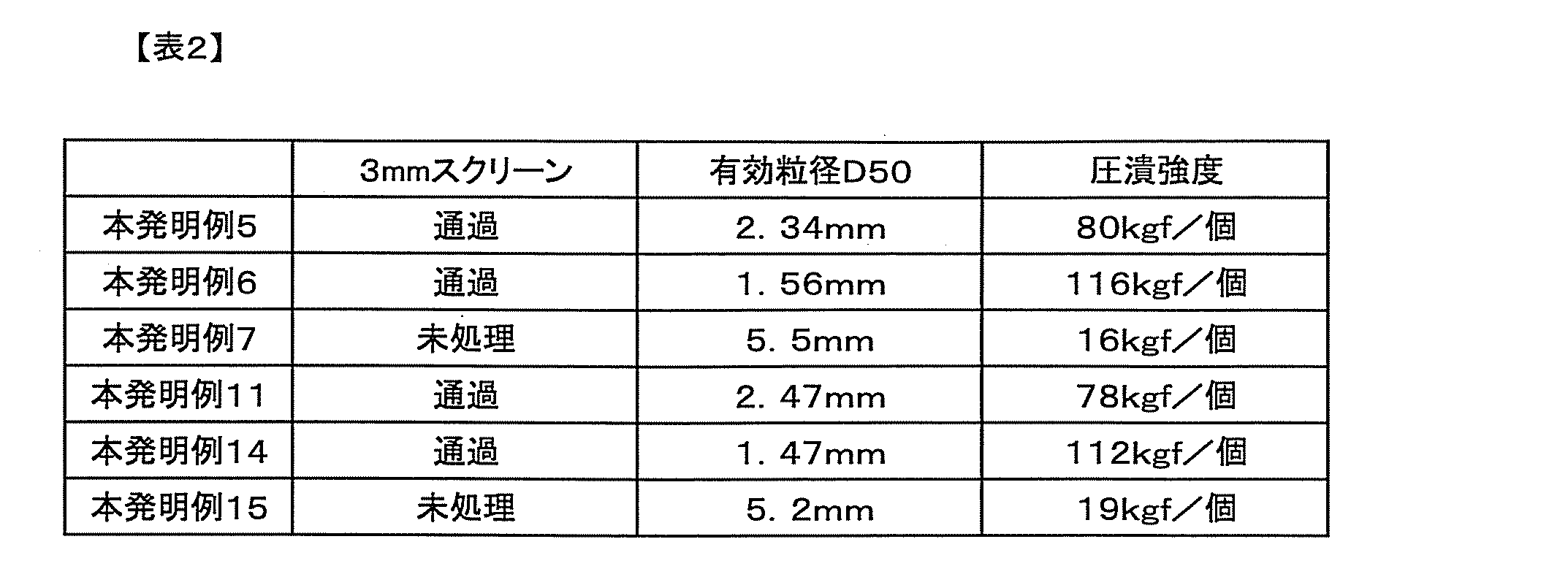
表2において、本発明例5では、ロール式成型機20による成型の前処理として、炭化物をスクリーンサイズ3mmの篩を通過する粒径に調整した。このとき、メジアン粒径D50は2.34mmであった。そして、上記のPKSの炭化物の質量の4質量%に相当する澱粉(アルファー化処理されたもの)をバインダーとして添加し、14質量%に相当する水を加えた混合物をミキサーで攪拌し、図3に示したロール式成型機を使用し、ロール間の線圧を2tf/cmとして、44mm角マセック型のロールを使用してブリケットに成型した。成型後のブリケットを雰囲気温度105℃の恒温槽に入れ、恒量となるまで乾燥した。
乾燥後のブリケット10個について圧潰強度を測定し、平均値を求めたところ80kgf/個であった。前述したように、圧潰強度が50kgf/個程度あれば、実操業上でのハンドリングが可能となることが経験的にわかっており、本発明例5に示すブリケットは使用に耐える十分な圧潰強度を持つと判断できる。
また、本発明例6では、ロール式成型機20による成型の前処理として、PKSの炭化物をカッターミルにて破砕し、スクリーンサイズ3mmの篩を通過する粒径に調整した。このとき、メジアン粒径D50は1.56mmであった。上記のPKSの炭化物100質量%に対して本発明例5と同様のバインダーと水を加えた混合物とし、本発明例5と同様の手順によってブリケットを成型・乾燥して、その圧潰強度を求めたところ、116kg/個であった。ブリケットの強度が上がると、ブリケット同士の衝突による粉化が抑制され、ハンドリング中の発塵が低下し、作業環境が向上することが経験的に知られている。ただし、カッターミルによる破砕によって一工程増加することは、ブリケットコストの上昇につながるため、必要に応じてその採用の要否を決定すればよい。また、バインダーの添加量を、上記のPKSの炭化物の質量の6質量%に相当する澱粉(アルファー化処理されたもの)をバインダーとして添加した場合のブリケットの成型・乾燥後の圧潰強度は最大で180kg/個であった。ただし、バインダー添加量の増加は、ブリケットコストの上昇につながり、圧潰強度は116kg/個を確保すれば、ブリケットの破壊などのハンドリング中の問題は生じないため必要に応じてバインダーの添加量を決定すればよい。
一方、本発明例7では、ロール式成型機20による成型の前処理としてのスクリーンサイズ3mmの篩を通過する粒径に調整する工程を省略した炭化物(粒径が約1mmから約10mm以下の炭化物の混合物)100質量%に対して本発明例5と同様のバインダーと水を加えた混合物とし、本発明例5と同様の手順によってブリケットを成型・乾燥して、圧潰強度を求めたところ、16kgf/個であった。
このように、炭化物の粒径を3mm以下に調整しない場合には、炭化物一粒あたりの体積に対してバインダーが付着した接触面積が小さくなり、転炉用昇熱材として好ましい圧潰強度(50kgf/個)が得られなかった。
したがって、本発明例7においては、搬送中にブリケットが破損し、転炉に全量を投入するためには、搬送中に破損したブリケットを回収する余分な工程が必要となるため、本発明例5及び6に示す圧潰強度をもつブリケットのほうが望ましい。
さらに、本発明例11に示す配合率に調整したPKSの炭化物と石炭を原料として成型した転炉昇熱材(乾燥後のブリケット)を用いて、圧潰強度を調査した。
その際に、本発明例11に示す転炉昇熱材に使用したPKSの炭化物は、粒径を調整する前の時点では、肉眼で観察したところ、粒径が約1mmから約10mm以下の炭化物の混合物であった。
その結果も表2に示す。
表2において、本発明例11では、ロール式成型機20による成型の前処理として、PKSの炭化物と石炭をスクリーンサイズ3mmの篩を通過する粒径に調整した。このとき、メジアン粒径D50は2.47mmであった。そして、上記のPKSの炭化物と石炭の質量の4質量%に相当する澱粉(アルファー化処理されたもの)をバインダーとして添加し、14質量%に相当する水を加えた混合物をミキサーで攪拌し、図3に示したロール式成型機を使用し、ロール間の線圧を2tf/cmとして、44mm角マセック型のロールを使用してブリケットに成型した。成型後のブリケットを雰囲気温度105℃の恒温槽に入れ、恒量となるまで乾燥した。乾燥後のブリケット10個について圧潰強度を測定し、平均値を求めたところ78kgf/個であった。
また、本発明例14では、ロール式成型機20による成型の前処理として、PKSの炭化物と石炭をカッターミルにて破砕し、スクリーンサイズ3mmの篩を通過する粒径に調整した。このとき、メジアン粒径D50は1.47mmであった。そして、上記のPKSの炭化物と石炭に対して本発明例11と同様の手順によってブリケットを成型・乾燥した。乾燥後のブリケット10個について圧潰強度を測定し、平均値を求めたところ、112kg/個であった。
前述したように、圧潰強度が50kgf/個程度あれば、実操業上でのハンドリングが可能となることが経験的にわかっており、本発明例14に示すブリケットは使用に耐える十分な圧潰強度を持つと判断できる。
また、ブリケットの強度が上がると、ブリケット同士の衝突および破壊による粉化が抑制され、ハンドリング中の発塵が低下し、作業環境が向上することが経験的に知られている。ただし、カッターミルによる破砕によって一工程増加することは、ブリケットコストの上昇につながるため、必要に応じてその採用の要否を決定すればよい。
一方、本発明例15では、ロール式成型機による成型の前処理としてのスクリーンサイズ3mmの篩を通過する粒径に調整する工程を省略した炭化物(粒径が約1mmから約10mm以下の炭化物の混合物)およびスクリーンサイズ3mmの篩を通過した石炭に対して本発明例13と同様のバインダーと水を加えた混合物とし、本発明例11と同様の手順によってブリケットを成型・乾燥して、圧潰強度を求めたところ、19kgf/個であった。
このように、PKS炭化物の粒径を3mmに調整しない場合には、炭化物一粒あたりの体積に対してバインダーが付着した接触面積が小さくなり、転炉昇熱材として好ましい圧潰強度(50kgf/個)が得られなかった。
したがって、本発明例15においては、搬送中にブリケットが破損し、転炉に全量を投入するためには、搬送中に破損したブリケットを回収する余分な工程が必要となるため、本発明例11および14に示す圧潰強度をもつブリケットのほうが望ましい。
上記の実施例1によって得られた転炉昇熱材を転炉設備に適用した。その結果を実施例2として以下に述べる。
使用した上底吹き型転炉は、転炉容量は1チャージ(ch)約250トンで、底吹きガスは攪拌用としてArガスを用いた。溶銑は機械攪拌式脱硫装置を用い、脱硫処理を施してある。冷鉄源としては、製鉄所で発生する鉄スクラップ(鋳片や鋼板のクロップ屑など)を使用した。
この実施例2における転炉操業条件および代表的な溶銑成分の例を表3に示す。そして、表3に示す操業条件で転炉操業を行った操業結果を表4に示す。
なお、転炉昇熱材の投入量は、固定炭素85質量%の昇熱材を2500kg/ch投入した場合と同等の固定炭素が投入される量とした。また、本発明の効果を確認するために、装入溶銑温度を1330℃の一定の条件とし、さらに、スクラップ量と造滓材装入量も一定の条件とした。

本発明例11~13は、3mmの篩で篩った篩下を原料として成型したブリケットを転炉昇熱材として投入したものであり、表4に示すように、出鋼時の温度は1610~1630℃の範囲であるとともに、硫黄濃度上昇量は0.001質量%であり、問題なく操業することができた。
これに対して、本発明例14では、出鋼時の温度が1630~1650℃となり、本発明例11~13に比べて約20℃高くなった。これは、ブリケットの圧潰強度が100kgf/個以上と高強度であったことから、転炉に投入した際の飛散による着熱効率の低下が減ったためであり、溶鋼温度が高くなった分、より多くのスクラップを溶解できるので、より好ましい。
また、本発明例15では、出鋼温度が1595~1615℃となり、本発明例11~13に比べて約15℃低くなった。これは、昇熱材を転炉に装入した際に、搬送過程での割れに加え、装入時の熱衝撃で容易に割れて飛散し、着熱効率が低下したためと考えられる。
なお、本発明例15では、出鋼時の温度が低目となったが、添加量を増量することで出鋼時の温度1610~1630℃の範囲を保つことができる。
一方、比較例11および従来例1、2の場合には、出鋼時の温度を1610~1630℃に保ちつつ、硫黄濃度上昇量を許容量である0.001質量%以内に抑えることはできなかった。
本発明においては、パームヤシ由来などの植物系バイオマスを原料とした炭化物を製造し、その炭化物を主原料にしてバインダーを加えて成型した、化石資源由来のCO2発生量を削減することが可能で、なおかつ硫黄含有量が低い転炉用昇熱材によって、製鉄所で使用される化石資源を原料とする転炉用昇熱材を代替することにより、化石資源消費量を低減し、温室効果ガスの発生を低減させ、地球温暖化問題の解決に寄与するものである。また、パームオイル産業の収益性の向上、パームヤシ栽培地の環境改善などを通じて、マレーシア、インドネシアを中心とするパームオイル産業国の発展にも寄与するものである。
1 バイオマス原料(植物系バイオマス)
2 炭化物
2A 原料粉末
3 ブリケット
10 炭化装置
11 外熱式ロータリーキルン炉
12 燃焼炉
13 炭化物貯留槽
14 タール回収槽
16 炭化実験装置
17 反応管
18 加熱炉
20 ロール式成型機
21 ロール
22 石炭等(石炭または/およびコークス)
23 水
24 バインダー
25 ミキサー
26 攪拌翼
2 炭化物
2A 原料粉末
3 ブリケット
10 炭化装置
11 外熱式ロータリーキルン炉
12 燃焼炉
13 炭化物貯留槽
14 タール回収槽
16 炭化実験装置
17 反応管
18 加熱炉
20 ロール式成型機
21 ロール
22 石炭等(石炭または/およびコークス)
23 水
24 バインダー
25 ミキサー
26 攪拌翼
Claims (11)
- 植物系バイオマスを炭化して炭化物を製造し、前記炭化物にバインダーおよび水分を加えて成型した転炉用昇熱材であって、水分を除いた乾燥状態での組成が、固定炭素分70質量%以上、揮発成分20質量%以下、硫黄分0.1質量%以下、残部灰分であり、別途水分が前記水分を除いた乾燥状態での質量の5質量%以下である、転炉用昇熱材。
- 植物系バイオマスを炭化して炭化物を製造し、前記炭化物を主原料として、石炭とコークスとからなるグループから選択された少なくとも一つを混合して混合物を製造し、前記混合物にバインダーおよび水分を加えて成型した転炉用昇熱材であって、水分を除いた乾燥状態での組成が、固定炭素分70質量%以上、揮発成分20質量%以下、硫黄分0.1質量%以下、残部灰分であり、別途水分が前記転炉用昇熱材の乾燥状態での質量の5質量%以下である、転炉用昇熱材。
- 前記転炉用昇熱材が、50kgf/個以上の圧潰強度を有する、請求項1または2に記載の転炉用昇熱材。
- 前記植物系バイオマスが、パームヤシのやし殻、空果房、幹と剪定屑のグループから選択された少なくとも一つである、請求項1または2に記載の転炉用昇熱材。
- 前記バインダーが、澱粉、カルボキシメチルセルロースとコーンスターチのグループから選択された少なくとも一つである、請求項1または2に記載の転炉用昇熱材。
- 前記バインダーが、前記炭化物の質量の1質量%~15質量%の添加量を有する請求項1または2に記載の転炉用昇熱材。
- 前記圧潰強度が、50~116kgf/個である、請求項3に記載の転炉用昇熱材。
- 前記転炉用昇熱材の原料とする炭化物が3mm以下の粒径を有する、請求項1または2に記載の転炉用昇熱材。
- 前記固定炭素分が70~86質量%である、請求項1または2に記載の転炉用昇熱材。
- 前記揮発成分が5~20質量%である、請求項1または2に記載の転炉用昇熱材。
- 前記副原料が主原料に対して10~15質量%である、請求項2に記載の転炉用昇熱材。
Priority Applications (2)
| Application Number | Priority Date | Filing Date | Title |
|---|---|---|---|
| JP2014501982A JP5846289B2 (ja) | 2012-02-29 | 2013-01-15 | 転炉用昇熱材 |
| CN201380011800.7A CN104160042A (zh) | 2012-02-29 | 2013-01-15 | 转炉用加热材料 |
Applications Claiming Priority (4)
| Application Number | Priority Date | Filing Date | Title |
|---|---|---|---|
| JP2012-043616 | 2012-02-29 | ||
| JP2012043616 | 2012-02-29 | ||
| JP2012182060 | 2012-08-21 | ||
| JP2012-182060 | 2012-08-21 |
Publications (1)
| Publication Number | Publication Date |
|---|---|
| WO2013128786A1 true WO2013128786A1 (ja) | 2013-09-06 |
Family
ID=49082005
Family Applications (1)
| Application Number | Title | Priority Date | Filing Date |
|---|---|---|---|
| PCT/JP2013/000129 Ceased WO2013128786A1 (ja) | 2012-02-29 | 2013-01-15 | 転炉用昇熱材 |
Country Status (4)
| Country | Link |
|---|---|
| JP (1) | JP5846289B2 (ja) |
| CN (1) | CN104160042A (ja) |
| MY (1) | MY172130A (ja) |
| WO (1) | WO2013128786A1 (ja) |
Cited By (8)
| Publication number | Priority date | Publication date | Assignee | Title |
|---|---|---|---|---|
| JP2015059257A (ja) * | 2013-09-20 | 2015-03-30 | 太平洋セメント株式会社 | 加炭材及び加炭材の製造方法並びに使用済み活性炭の利用方法 |
| JP2016056412A (ja) * | 2014-09-10 | 2016-04-21 | Jfeスチール株式会社 | 転炉用昇熱材 |
| JP2016108638A (ja) * | 2014-12-10 | 2016-06-20 | Jfeスチール株式会社 | 転炉用昇熱材 |
| JP2023068357A (ja) * | 2021-11-02 | 2023-05-17 | 日本製鉄株式会社 | 溶鋼処理炉の操業方法および溶鋼処理炉の副原料 |
| JP2023115784A (ja) * | 2022-02-08 | 2023-08-21 | 日本製鉄株式会社 | 転炉の操業方法および転炉の昇熱用副原料 |
| JP2023132282A (ja) * | 2022-03-10 | 2023-09-22 | 日本製鉄株式会社 | 転炉用昇熱材およびその製造方法 |
| JP2024508270A (ja) * | 2021-02-18 | 2024-02-26 | カーボン テクノロジー ホールディングス, エルエルシー | カーボンネガティブ冶金製品 |
| WO2025057314A1 (ja) * | 2023-09-12 | 2025-03-20 | 日本製鉄株式会社 | 炭化物成型体およびその製造方法 |
Citations (5)
| Publication number | Priority date | Publication date | Assignee | Title |
|---|---|---|---|---|
| JPH02270922A (ja) * | 1989-04-12 | 1990-11-06 | Nippon Jiryoku Senko Kk | 炭素粉の製団方法 |
| JPH08269523A (ja) * | 1995-03-27 | 1996-10-15 | Nisshin Steel Co Ltd | 転炉用溶鋼昇熱材 |
| JPH10140223A (ja) * | 1996-11-05 | 1998-05-26 | Nkk Corp | 鋼の転炉精錬方法 |
| JP2010265485A (ja) * | 2009-05-12 | 2010-11-25 | Jfe Steel Corp | アーク炉の操業方法 |
| JP2011184567A (ja) * | 2010-03-09 | 2011-09-22 | Jfe Engineering Corp | バイオマス炭化装置及びバイオマス炭化方法 |
Family Cites Families (1)
| Publication number | Priority date | Publication date | Assignee | Title |
|---|---|---|---|---|
| CN1121114A (zh) * | 1994-10-20 | 1996-04-24 | 刘德生 | 氧气顶吹转炉用压渣剂及其生产方法 |
-
2013
- 2013-01-15 MY MYPI2014702053A patent/MY172130A/en unknown
- 2013-01-15 WO PCT/JP2013/000129 patent/WO2013128786A1/ja not_active Ceased
- 2013-01-15 CN CN201380011800.7A patent/CN104160042A/zh active Pending
- 2013-01-15 JP JP2014501982A patent/JP5846289B2/ja active Active
Patent Citations (5)
| Publication number | Priority date | Publication date | Assignee | Title |
|---|---|---|---|---|
| JPH02270922A (ja) * | 1989-04-12 | 1990-11-06 | Nippon Jiryoku Senko Kk | 炭素粉の製団方法 |
| JPH08269523A (ja) * | 1995-03-27 | 1996-10-15 | Nisshin Steel Co Ltd | 転炉用溶鋼昇熱材 |
| JPH10140223A (ja) * | 1996-11-05 | 1998-05-26 | Nkk Corp | 鋼の転炉精錬方法 |
| JP2010265485A (ja) * | 2009-05-12 | 2010-11-25 | Jfe Steel Corp | アーク炉の操業方法 |
| JP2011184567A (ja) * | 2010-03-09 | 2011-09-22 | Jfe Engineering Corp | バイオマス炭化装置及びバイオマス炭化方法 |
Cited By (10)
| Publication number | Priority date | Publication date | Assignee | Title |
|---|---|---|---|---|
| JP2015059257A (ja) * | 2013-09-20 | 2015-03-30 | 太平洋セメント株式会社 | 加炭材及び加炭材の製造方法並びに使用済み活性炭の利用方法 |
| JP2016056412A (ja) * | 2014-09-10 | 2016-04-21 | Jfeスチール株式会社 | 転炉用昇熱材 |
| JP2016108638A (ja) * | 2014-12-10 | 2016-06-20 | Jfeスチール株式会社 | 転炉用昇熱材 |
| JP2024508270A (ja) * | 2021-02-18 | 2024-02-26 | カーボン テクノロジー ホールディングス, エルエルシー | カーボンネガティブ冶金製品 |
| JP2023068357A (ja) * | 2021-11-02 | 2023-05-17 | 日本製鉄株式会社 | 溶鋼処理炉の操業方法および溶鋼処理炉の副原料 |
| JP7799168B2 (ja) | 2021-11-02 | 2026-01-15 | 日本製鉄株式会社 | 溶鋼処理炉の操業方法および溶鋼処理炉の副原料 |
| JP2023115784A (ja) * | 2022-02-08 | 2023-08-21 | 日本製鉄株式会社 | 転炉の操業方法および転炉の昇熱用副原料 |
| JP2023132282A (ja) * | 2022-03-10 | 2023-09-22 | 日本製鉄株式会社 | 転炉用昇熱材およびその製造方法 |
| JP7832466B2 (ja) | 2022-03-10 | 2026-03-18 | 日本製鉄株式会社 | 転炉用昇熱材およびその製造方法 |
| WO2025057314A1 (ja) * | 2023-09-12 | 2025-03-20 | 日本製鉄株式会社 | 炭化物成型体およびその製造方法 |
Also Published As
| Publication number | Publication date |
|---|---|
| MY172130A (en) | 2019-11-14 |
| JP5846289B2 (ja) | 2016-01-20 |
| JPWO2013128786A1 (ja) | 2015-07-30 |
| CN104160042A (zh) | 2014-11-19 |
Similar Documents
| Publication | Publication Date | Title |
|---|---|---|
| JP5846289B2 (ja) | 転炉用昇熱材 | |
| JP5729582B2 (ja) | 環境調和型再生可能還元剤或いは再生還元剤を用いた鉄の生産 | |
| EP2714863B1 (en) | Method for producing bio-coke | |
| JP5625320B2 (ja) | 成型炭の製造方法 | |
| KR101402445B1 (ko) | 바이오매스의 고로 이용 방법 | |
| JP6172095B2 (ja) | 植物系バイオマス由来の転炉用昇熱材の製造方法および使用方法 | |
| JP2012046729A (ja) | 繊維状バイオマスからの炭化物の製造方法 | |
| CN101775301A (zh) | 一种生物质焦炭及其制备方法 | |
| Funke et al. | Application of fast pyrolysis char in an electric arc furnace | |
| JP5880941B2 (ja) | 還元鉄の製造方法 | |
| KR101545985B1 (ko) | 바이오매스를 활용한 소결광의 제조방법 | |
| JP2005274122A (ja) | バイオマスを利用する廃棄物溶融処理方法 | |
| JP6167777B2 (ja) | バイオマス炭の製造方法 | |
| Fan et al. | Preparation technologies of straw char and its effect on pollutants emission reduction in iron ore sintering | |
| DK2874763T3 (en) | PROCEDURE AND PLANT TO RECOVER PHOSPHOR CONTAINING WASTE MATERIALS AND / OR ENERGY | |
| CN103450964B (zh) | 一种型煤及其加工方法 | |
| JP2024140065A (ja) | コークスの製造方法 | |
| JP2005053986A (ja) | 高炉用フェロコークスの製造方法 | |
| JP6201973B2 (ja) | 転炉用昇熱材の製造方法 | |
| JP3920775B2 (ja) | 低灰分含有率燃料の製造方法 | |
| KR20090077663A (ko) | 코크스 대체용 고형 탄화연료 및 그 제조방법 | |
| JP7584687B1 (ja) | 固形燃料及びその製造方法 | |
| EP4540352B1 (en) | BINDER AND MANUFACTURING PROCESSES | |
| RU2730462C1 (ru) | Способ получения минеральной ваты | |
| JP2004263279A (ja) | 廃木材の吹き込み高炉操業方法 |
Legal Events
| Date | Code | Title | Description |
|---|---|---|---|
| 121 | Ep: the epo has been informed by wipo that ep was designated in this application |
Ref document number: 13755765 Country of ref document: EP Kind code of ref document: A1 |
|
| ENP | Entry into the national phase |
Ref document number: 2014501982 Country of ref document: JP Kind code of ref document: A |
|
| NENP | Non-entry into the national phase |
Ref country code: DE |
|
| 122 | Ep: pct application non-entry in european phase |
Ref document number: 13755765 Country of ref document: EP Kind code of ref document: A1 |