WO2013062011A1 - 着色感光性組成物、着色スペーサ、カラーフィルター、及び液晶表示装置 - Google Patents
着色感光性組成物、着色スペーサ、カラーフィルター、及び液晶表示装置 Download PDFInfo
- Publication number
- WO2013062011A1 WO2013062011A1 PCT/JP2012/077503 JP2012077503W WO2013062011A1 WO 2013062011 A1 WO2013062011 A1 WO 2013062011A1 JP 2012077503 W JP2012077503 W JP 2012077503W WO 2013062011 A1 WO2013062011 A1 WO 2013062011A1
- Authority
- WO
- WIPO (PCT)
- Prior art keywords
- photosensitive composition
- group
- colored photosensitive
- colored
- alkali
- Prior art date
- Legal status (The legal status is an assumption and is not a legal conclusion. Google has not performed a legal analysis and makes no representation as to the accuracy of the status listed.)
- Ceased
Links
Images

Classifications
-
- G—PHYSICS
- G03—PHOTOGRAPHY; CINEMATOGRAPHY; ANALOGOUS TECHNIQUES USING WAVES OTHER THAN OPTICAL WAVES; ELECTROGRAPHY; HOLOGRAPHY
- G03F—PHOTOMECHANICAL PRODUCTION OF TEXTURED OR PATTERNED SURFACES, e.g. FOR PRINTING, FOR PROCESSING OF SEMICONDUCTOR DEVICES; MATERIALS THEREFOR; ORIGINALS THEREFOR; APPARATUS SPECIALLY ADAPTED THEREFOR
- G03F7/00—Photomechanical, e.g. photolithographic, production of textured or patterned surfaces, e.g. printing surfaces; Materials therefor, e.g. comprising photoresists; Apparatus specially adapted therefor
- G03F7/004—Photosensitive materials
-
- G—PHYSICS
- G02—OPTICS
- G02B—OPTICAL ELEMENTS, SYSTEMS OR APPARATUS
- G02B5/00—Optical elements other than lenses
- G02B5/20—Filters
-
- G—PHYSICS
- G02—OPTICS
- G02F—OPTICAL DEVICES OR ARRANGEMENTS FOR THE CONTROL OF LIGHT BY MODIFICATION OF THE OPTICAL PROPERTIES OF THE MEDIA OF THE ELEMENTS INVOLVED THEREIN; NON-LINEAR OPTICS; FREQUENCY-CHANGING OF LIGHT; OPTICAL LOGIC ELEMENTS; OPTICAL ANALOGUE/DIGITAL CONVERTERS
- G02F1/00—Devices or arrangements for the control of the intensity, colour, phase, polarisation or direction of light arriving from an independent light source, e.g. switching, gating or modulating; Non-linear optics
- G02F1/01—Devices or arrangements for the control of the intensity, colour, phase, polarisation or direction of light arriving from an independent light source, e.g. switching, gating or modulating; Non-linear optics for the control of the intensity, phase, polarisation or colour
- G02F1/13—Devices or arrangements for the control of the intensity, colour, phase, polarisation or direction of light arriving from an independent light source, e.g. switching, gating or modulating; Non-linear optics for the control of the intensity, phase, polarisation or colour based on liquid crystals, e.g. single liquid crystal display cells
- G02F1/133—Constructional arrangements; Operation of liquid crystal cells; Circuit arrangements
- G02F1/1333—Constructional arrangements; Manufacturing methods
- G02F1/1335—Structural association of cells with optical devices, e.g. polarisers or reflectors
- G02F1/133509—Filters, e.g. light shielding masks
- G02F1/133514—Colour filters
-
- G—PHYSICS
- G03—PHOTOGRAPHY; CINEMATOGRAPHY; ANALOGOUS TECHNIQUES USING WAVES OTHER THAN OPTICAL WAVES; ELECTROGRAPHY; HOLOGRAPHY
- G03F—PHOTOMECHANICAL PRODUCTION OF TEXTURED OR PATTERNED SURFACES, e.g. FOR PRINTING, FOR PROCESSING OF SEMICONDUCTOR DEVICES; MATERIALS THEREFOR; ORIGINALS THEREFOR; APPARATUS SPECIALLY ADAPTED THEREFOR
- G03F7/00—Photomechanical, e.g. photolithographic, production of textured or patterned surfaces, e.g. printing surfaces; Materials therefor, e.g. comprising photoresists; Apparatus specially adapted therefor
- G03F7/0005—Production of optical devices or components in so far as characterised by the lithographic processes or materials used therefor
- G03F7/0007—Filters, e.g. additive colour filters; Components for display devices
-
- G—PHYSICS
- G03—PHOTOGRAPHY; CINEMATOGRAPHY; ANALOGOUS TECHNIQUES USING WAVES OTHER THAN OPTICAL WAVES; ELECTROGRAPHY; HOLOGRAPHY
- G03F—PHOTOMECHANICAL PRODUCTION OF TEXTURED OR PATTERNED SURFACES, e.g. FOR PRINTING, FOR PROCESSING OF SEMICONDUCTOR DEVICES; MATERIALS THEREFOR; ORIGINALS THEREFOR; APPARATUS SPECIALLY ADAPTED THEREFOR
- G03F7/00—Photomechanical, e.g. photolithographic, production of textured or patterned surfaces, e.g. printing surfaces; Materials therefor, e.g. comprising photoresists; Apparatus specially adapted therefor
- G03F7/004—Photosensitive materials
- G03F7/027—Non-macromolecular photopolymerisable compounds having carbon-to-carbon double bonds, e.g. ethylenic compounds
-
- G—PHYSICS
- G03—PHOTOGRAPHY; CINEMATOGRAPHY; ANALOGOUS TECHNIQUES USING WAVES OTHER THAN OPTICAL WAVES; ELECTROGRAPHY; HOLOGRAPHY
- G03F—PHOTOMECHANICAL PRODUCTION OF TEXTURED OR PATTERNED SURFACES, e.g. FOR PRINTING, FOR PROCESSING OF SEMICONDUCTOR DEVICES; MATERIALS THEREFOR; ORIGINALS THEREFOR; APPARATUS SPECIALLY ADAPTED THEREFOR
- G03F7/00—Photomechanical, e.g. photolithographic, production of textured or patterned surfaces, e.g. printing surfaces; Materials therefor, e.g. comprising photoresists; Apparatus specially adapted therefor
- G03F7/004—Photosensitive materials
- G03F7/027—Non-macromolecular photopolymerisable compounds having carbon-to-carbon double bonds, e.g. ethylenic compounds
- G03F7/028—Non-macromolecular photopolymerisable compounds having carbon-to-carbon double bonds, e.g. ethylenic compounds with photosensitivity-increasing substances, e.g. photoinitiators
- G03F7/031—Organic compounds not covered by group G03F7/029
-
- G—PHYSICS
- G03—PHOTOGRAPHY; CINEMATOGRAPHY; ANALOGOUS TECHNIQUES USING WAVES OTHER THAN OPTICAL WAVES; ELECTROGRAPHY; HOLOGRAPHY
- G03F—PHOTOMECHANICAL PRODUCTION OF TEXTURED OR PATTERNED SURFACES, e.g. FOR PRINTING, FOR PROCESSING OF SEMICONDUCTOR DEVICES; MATERIALS THEREFOR; ORIGINALS THEREFOR; APPARATUS SPECIALLY ADAPTED THEREFOR
- G03F7/00—Photomechanical, e.g. photolithographic, production of textured or patterned surfaces, e.g. printing surfaces; Materials therefor, e.g. comprising photoresists; Apparatus specially adapted therefor
- G03F7/004—Photosensitive materials
- G03F7/027—Non-macromolecular photopolymerisable compounds having carbon-to-carbon double bonds, e.g. ethylenic compounds
- G03F7/032—Non-macromolecular photopolymerisable compounds having carbon-to-carbon double bonds, e.g. ethylenic compounds with binders
-
- G—PHYSICS
- G03—PHOTOGRAPHY; CINEMATOGRAPHY; ANALOGOUS TECHNIQUES USING WAVES OTHER THAN OPTICAL WAVES; ELECTROGRAPHY; HOLOGRAPHY
- G03F—PHOTOMECHANICAL PRODUCTION OF TEXTURED OR PATTERNED SURFACES, e.g. FOR PRINTING, FOR PROCESSING OF SEMICONDUCTOR DEVICES; MATERIALS THEREFOR; ORIGINALS THEREFOR; APPARATUS SPECIALLY ADAPTED THEREFOR
- G03F7/00—Photomechanical, e.g. photolithographic, production of textured or patterned surfaces, e.g. printing surfaces; Materials therefor, e.g. comprising photoresists; Apparatus specially adapted therefor
- G03F7/004—Photosensitive materials
- G03F7/09—Photosensitive materials characterised by structural details, e.g. supports, auxiliary layers
- G03F7/105—Photosensitive materials characterised by structural details, e.g. supports, auxiliary layers having substances, e.g. indicators, for forming visible images
-
- G—PHYSICS
- G02—OPTICS
- G02B—OPTICAL ELEMENTS, SYSTEMS OR APPARATUS
- G02B5/00—Optical elements other than lenses
- G02B5/20—Filters
- G02B5/22—Absorbing filters
- G02B5/223—Absorbing filters containing organic substances, e.g. dyes, inks or pigments
Definitions
- the present invention relates to a colored photosensitive composition and the like. More specifically, the present invention relates to a colored photosensitive composition that is preferably used as a colored spacer in a color filter such as a liquid crystal display, and a colored spacer, a color filter, and a liquid crystal display device formed thereby.
- a color filter such as a liquid crystal display
- Liquid crystal display utilizes the property that the arrangement of liquid crystal molecules is switched by turning on / off the voltage to the liquid crystal.
- each member forming an LCD cell is often formed using a photosensitive composition typified by photolithography.
- the range of application of the photosensitive composition tends to further expand in the future because it is easy to form a fine structure and it is easy to process a substrate for a large screen.
- Patent Document 1 describes that a spacer is made light-shielding.
- Patent Document 2 discloses that the spacer shape and level difference having different desired heights can be realized by controlling the exposure amount and the remaining film ratio.
- Patent Document 2 relates to a spacer to which no pigment is added, and when applied to the batch formation of colored spacers to which a pigment is added, the pigment absorbs light in the ultraviolet region contributing to photopolymerization, and thus the light transmittance of the opening. It has been found that a pattern having a small number has poor curability, and it is difficult to achieve characteristics such as spacer shapes having different heights, step control, and adhesion to a substrate.
- the present invention has been made in view of such circumstances. That is, the main problem of the present invention is that in the method for forming colored spacers having different heights by photolithography, the liquid crystal voltage holding ratio is ensured, the formation of a desired shape, the control of the step, the substrate and An object of the present invention is to provide a colored photosensitive composition having excellent adhesion. Another object of the present invention is to provide a colored spacer formed from such a colored photosensitive composition.
- Still another object of the present invention is to provide a color filter having such a colored spacer. Still another object of the present invention is to provide a liquid crystal display device having such a color filter. Still another object of the present invention is to provide a method for collectively forming colored spacers having different heights using such a colored photosensitive composition by a photolithography method.
- the present inventors use a specific alkali-soluble resin and a dispersant, and specify the weight ratio of the alkali-soluble resin to the ethylenically unsaturated compound and the content ratio of the specific alkali-soluble resin.
- the gist of the present invention is as follows. [1] Photolithography containing (a) a colorant, (b) an alkali-soluble resin, (c) a photopolymerization initiator, (d) an ethylenically unsaturated compound, (e) a solvent, and (f) a dispersant.
- a colored photosensitive composition used to collectively form colored spacers having different heights by a method (B) the alkali-soluble resin includes at least one of the following alkali-soluble resin (A-1) and alkali-soluble resin (A-2); (F) As a dispersant, an acrylic block copolymer containing a nitrogen atom is included, (D) the weight ratio of (b) alkali-soluble resin to ethylenically unsaturated compound is less than 7, A colored photosensitive composition in which the total proportion of the alkali-soluble resin (A-1) and the alkali-soluble resin (A-2) with respect to the total solid content in the colored photosensitive composition is 12% by weight or more.
- the total ratio of the alkali-soluble resin (A-1) and the alkali-soluble resin (A-2) to the total solid content in the colored photosensitive composition [2] is 20% by weight or more.
- [3] The colored photosensitive composition according to the above [1] or [2], wherein the content ratio of (a) the colorant is less than 30% by weight with respect to the total solid content in the colored photosensitive composition.
- AB block comprising, as a dispersant, an A block having at least one of a quaternary ammonium base and an amino group in a side chain and a B block having no quaternary ammonium base and an amino group
- an AB block copolymer comprising an A block having a quaternary ammonium base and an amino group in a side chain, and a B block having no quaternary ammonium base and an amino group, and The colored photosensitive composition according to any one of the above [1] to [6], comprising at least one of BAB block copolymers.
- an AB block consisting of an A block having an amino group without a quaternary ammonium base in the side chain, and a B block having no quaternary ammonium base and an amino group.
- a color filter comprising the colored spacer according to [11].
- a liquid crystal display device comprising the color filter according to [12].
- FIG. 1A and 1B are diagrams for explaining the shape of the substantially cylindrical spacer pattern of the embodiment, and FIG. 1A is a plan view of the spacer pattern, and FIG. ) Is a cross-sectional view of a spacer pattern.
- (meth) acrylic acid means that both acrylic acid and methacrylic acid are included, and (meth) acrylic, (meth) acrylate, (meth) acryloyl groups, and the like have the same meaning.
- (co) polymer means to include both a single polymer (homopolymer) and a copolymer (copolymer), and “(acid) anhydride”, “(anhydrous) ... acid”. "Is meant to include both acids and anhydrides.
- the term “monomer” has a meaning corresponding to a so-called polymer substance, and includes a dimer, a trimer, an oligomer and the like in addition to a monomer (monomer) in a narrow sense.
- the “total solid content” indicates the total of all components other than the solvent contained in the colored photosensitive composition of the present invention.
- a method for forming colored spacers having different heights by photolithography is a method mainly characterized by an exposure mask in an exposure process.
- the exposure mask has a light shielding layer that blocks light transmission and a plurality of openings that transmit light, and the average light transmittance of some openings is smaller than the average light transmittance of other openings.
- a method of using is known. This has a light-shielding layer (light transmittance 0%) and a plurality of openings, and averages over the opening having the highest average light transmittance (usually light transmittance 100%, hereinafter referred to as a perfect transmission opening).
- an exposure mask having an opening having a small light transmittance average light transmittance is more than 0% and less than 100%, preferably more than 5% and less than 50%, hereinafter referred to as an intermediate transmission opening.
- the degree of cure of the formed pattern depends on the difference in average light transmittance between the intermediate transmission opening and the complete transmission opening, that is, the difference in exposure amount. Differences can be made and then colored spacers of different heights can be formed through development and thermosetting processes.
- the colored photosensitive composition according to the present invention comprises (a) a colorant, (b) an alkali-soluble resin, (c) a photopolymerization initiator, (d) an ethylenically unsaturated compound, ( e) a colored photosensitive composition used for collectively forming colored spacers having different heights by a photolithography method, comprising a solvent, and (f) a dispersant, (B) the alkali-soluble resin includes at least one of the following alkali-soluble resin (A-1) and alkali-soluble resin (A-2); (F) As a dispersant, an acrylic block copolymer containing a nitrogen atom is included, (D) the weight ratio of (b) alkali-soluble resin to ethylenically unsaturated compound is less than 7, The total ratio of the alkali-soluble resin (A-1) and the alkali-soluble resin (A-2) to the total solid content in the colored photosensitive composition is 12% by
- a pigment is usually used as the colorant.
- various color pigments such as a blue pigment, a green pigment, a red pigment, a yellow pigment, a purple pigment, an orange pigment, a brown pigment, and a black pigment can be used.
- organic pigments such as azo, phthalocyanine, quinacridone, benzimidazolone, isoindolinone, dioxazine, indanthrene and perylene
- various inorganic pigments can be used. It is.
- specific examples of usable pigments are indicated by pigment numbers. Terms such as “CI Pigment Red 2” mentioned below mean the color index (CI).
- C.I. I. Pigment Red 48 1, 122, 168, 177, 202, 206, 207, 209, 224, 242, 254, more preferably C.I. I. Pigment red 177, 209, 224, 254.
- C.I. I. Pigment Blue 1 As blue pigment, C.I. I. Pigment Blue 1, 1: 2, 9, 14, 15, 15: 1, 15: 2, 15: 3, 15: 4, 15: 6, 16, 17, 19, 25, 27, 28, 29, 33, 35, 36, 56, 56: 1, 60, 61, 61: 1, 62, 63, 66, 67, 68, 71, 72, 73, 74, 75, 76, 78, 79. Of these, C.I. I. Pigment Blue 15, 15: 1, 15: 2, 15: 3, 15: 4, 15: 6, more preferably C.I. I. Pigment blue 15: 6. *
- Green pigments include C.I. I. Pigment green 1, 2, 4, 7, 8, 10, 13, 14, 15, 17, 18, 19, 26, 36, 45, 48, 50, 51, 54, 55. Of these, C.I. I. And CI Pigment Green 7 and 36. *
- ⁇ As yellow pigment C.I. I. Pigment Yellow 1, 1: 1, 2, 3, 4, 5, 6, 9, 10, 12, 13, 14, 16, 17, 24, 31, 32, 34, 35, 35: 1, 36, 36: 1, 37, 37: 1, 40, 41, 42, 43, 48, 53, 55, 61, 62, 62: 1, 63, 65, 73, 74, 75, 81, 83, 87, 93, 94, 95, 97, 100, 101, 104, 105, 108, 109, 110, 111, 116, 117, 119, 120, 126, 127, 127: 1, 128, 129, 133, 134, 136, 138, 139, 142, 147, 148, 150, 151, 153, 154, 155, 157, 158, 159, 160, 161, 162, 163, 164, 165, 166, 167, 168, 169, 170, 172, 17 174, 175, 176, 180, 181, 182, 183,
- C.I. I. Pigment yellow 83, 117, 129, 138, 139, 150, 154, 155, 180, 185 more preferably C.I. I. Pigment yellow 83, 138, 139, 150, 180.
- C.I. I. Pigment Orange 1 2, 5, 13, 16, 17, 19, 20, 21, 22, 23, 24, 34, 36, 38, 39, 43, 46, 48, 49, 61, 62, 64, 65, 67, 68, 69, 70, 71, 72, 73, 74, 75, 77, 78, 79.
- black pigments examples include perylene black (BASF K0084, K0086), cyanine black, and first black HB (C.I. 26150).
- a single black color material or a black color material obtained by mixing red, green, blue and the like can be used.
- These black color materials can be appropriately selected from inorganic or organic pigments and dyes such as carbon black and titanium black, and can be used alone or in combination.
- Examples of commercially available carbon black include the following brands. Mitsubishi Chemical Corporation: MA7, MA8, MA11, MA100, MA220, MA230, # 52, # 50, # 47, # 45, # 2700, # 2650, # 2200, # 1000, # 990, # 900, etc. Made by Degussa: Printex95, Printex90, Printex85, Printex75, Printex55, Printex45, Printex40, Printex30, Printex3, PrintexA, PrintexG, Sck, 350, 350, S350, 250, 350
- the colored photosensitive composition of the present invention includes (a) the following red pigment as (1) as a colorant, and at least one of the following (2) blue pigment and the following (3) purple pigment: It is preferable from the viewpoint of light shielding properties.
- C.I. I. Red pigments selected from among pigment reds 177 and 254 (2) C.I. I. Blue pigment which is a pigment blue 15: 6 (3) C.I. I. Among the purple pigments that are the pigment bio red 23, inclusion of (1) and (2) is preferable from the viewpoint of securing the electric retention of the liquid crystal, controlling the level difference, and adhesion to the substrate.
- the content ratio of (a) the colorant is preferably 35% by weight or less, and less than 30% by weight based on the total solid content in the colored photosensitive composition. Is more preferable. If it is 35% by weight or less, the difference ( ⁇ H) between the height of the colored spacer pattern in the completely transmissive opening and the height of the colored spacer pattern in the intermediate transmissive opening is preferably increased. If it is less than 30% by weight, the difference ( ⁇ H) between the height of the colored spacer pattern in the completely transmissive opening and the height of the colored spacer pattern in the intermediate transmissive opening exceeds 0.35 ⁇ m. A preferred range is 5% to 28% by weight, more preferably 10% to 25% by weight.
- alkali-soluble resin (A-1) used in the present invention is an ⁇ , ⁇ -unsaturated monocarboxylic acid or ester moiety having an ⁇ , ⁇ -containing ester group on an epoxy resin.
- An unsaturated monocarboxylic acid ester is added, and a polybasic acid anhydride is further reacted to provide alkali solubility.
- Such a reaction product has substantially no epoxy group due to its chemical structure.
- cresol novolac type epoxy resin cresol novolac type epoxy resin, phenol novolac type epoxy resin, bisphenol A type epoxy resin, bisphenol F type epoxy resin, trisphenol methane type epoxy resin, biphenyl novolac type epoxy resin, naphthalene novolak type epoxy resin,
- An epoxy resin, an adamantyl group-containing epoxy resin, a fluorene type epoxy resin, or the like that is a reaction product of a polyaddition reaction product of dicyclopentadiene and phenol or cresol and epihalohydrin can be suitably used.
- the molecular weight of the epoxy resin is measured by gel permeation chromatography (GPC) and is expressed in terms of polystyrene-equivalent weight average molecular weight (hereinafter referred to as “Mw”) as Mw, usually in the range of 200 to 200,000, preferably 300 to 100,000. It is. When the molecular weight is less than the above range, it may be difficult to obtain a preferable Mw alkali-soluble resin (A-1). Conversely, when the molecular weight exceeds the above range, ⁇ , ⁇ -unsaturated monocarboxylic acid Gelation is likely to occur during the addition reaction, and production may be difficult.
- Mw polystyrene-equivalent weight average molecular weight
- ⁇ , ⁇ -unsaturated monocarboxylic acid examples include acrylic acid, methacrylic acid, itaconic acid, crotonic acid, cinnamic acid, and the like. Acrylic acid and methacrylic acid are preferable, and acrylic acid is particularly rich in reactivity. preferable.
- ⁇ , ⁇ -unsaturated monocarboxylic acid esters having a carboxyl group in the ester moiety include 2-succinoyloxyethyl acrylate, 2-maleinoyloxyethyl acrylate, and 2-phthaloyloxy acrylate.
- Ethyl acrylic acid-2-hexahydrophthaloyloxyethyl, methacrylic acid-2-succinoyloxyethyl, methacrylic acid-2-malenoyloxyethyl, methacrylic acid-2-phthaloyloxyethyl, methacrylic acid-2-hexa And hydrophthaloyloxyethyl and crotonic acid-2-succinoyloxyethyl.
- the addition reaction between an ⁇ , ⁇ -unsaturated monocarboxylic acid or an ⁇ , ⁇ -unsaturated monocarboxylic acid ester having a carboxyl group at the ester moiety and an epoxy resin can be carried out using a known method.
- the amount of ⁇ , ⁇ -unsaturated monocarboxylic acid or ⁇ , ⁇ -unsaturated monocarboxylic acid ester having a carboxyl group in the ester moiety is 0.5 to 1.2 relative to 1 equivalent of the epoxy group of the raw material epoxy resin. A range of equivalents is preferable, and a range of 0.7 to 1.1 equivalents is more preferable.
- the amount of ⁇ , ⁇ -unsaturated monocarboxylic acid or ⁇ , ⁇ -unsaturated monocarboxylic acid ester having a carboxyl group in the ester portion is small, the amount of unsaturated groups introduced is insufficient, and the subsequent polybasic acid anhydride The reaction may be insufficient. Also, it is not advantageous that a large amount of epoxy groups remain. On the other hand, when the amount used is large, ⁇ , ⁇ -unsaturated monocarboxylic acid or ester thereof may remain as an unreacted product. In either case, the curing characteristics of the coating film may be deteriorated.
- the alkali-soluble resin (A-1).
- examples thereof include a method of reacting, for example, a novolac resin and an unsaturated group-containing epoxy compound.
- a known method can also be used for the addition reaction of polybasic acid anhydride.
- the addition amount of the polybasic acid anhydride is preferably such that the acid value of the resulting epoxy acrylate resin is in the range of 10 mgKOH / g to 150 mgKOH / g, and more preferably in the range of 20 mgKOH / g to 140 mgKOH / g. preferable.
- the acid value is below the above range, the alkali developability is poor, and when it exceeds the above range, a tendency to be inferior in curing performance is recognized.
- the weight average molecular weight (Mw) in terms of polystyrene measured by gel permeation chromatography (GPC) of the alkali-soluble resin (A-1) used in the present invention is usually 1500 or more, preferably 2000 or more, usually 50000 or less, Preferably it is 30000 or less, More preferably, it is 10,000 or less. If the weight average molecular weight of the alkali-soluble resin (A-1) is too small, the sensitivity tends to decrease, and if it is too large, the solubility in the developer may be insufficient.
- the alkali-soluble resin (A-2) used in the present invention is obtained by adding an ⁇ , ⁇ -unsaturated monocarboxylic acid or an ⁇ , ⁇ -unsaturated monocarboxylic acid ester having a carboxyl group to the ester moiety to an epoxy resin, and It is obtained by reacting a polyhydric alcohol and a polybasic acid anhydride. All components other than the synthesis method and polyhydric alcohol used for the synthesis of the alkali-soluble resin (A-1) can be used for the synthesis of the alkali-soluble resin (A-2).
- the alkali-soluble resin (A-2) is usually a reaction obtained by adding an ⁇ , ⁇ -unsaturated monocarboxylic acid or an ⁇ , ⁇ -unsaturated monocarboxylic acid ester having a carboxyl group to the ester moiety to an epoxy resin.
- the product is obtained by mixing a polyhydric alcohol and a polybasic acid anhydride with heating. In this case, the mixing order of the polyhydric alcohol and the polybasic acid anhydride is not particularly limited.
- Examples of the polyhydric alcohol used for the synthesis of the alkali-soluble resin (A-2) include trimethylolpropane, ditrimethylolpropane, pentaerythritol, dipentaerythritol, trimethylolethane, and 1,2,3-propanetriol. It is preferable that it is 1 type, or 2 or more types of polyhydric alcohol chosen.
- a polyhydric alcohol By using a polyhydric alcohol, it is possible to increase the molecular weight of the alkali-soluble resin (A-2), introduce branching into the molecule, and balance the molecular weight and viscosity. Moreover, the rate of introduction of acid groups into the molecule can be increased, and an organic binder having a good balance of sensitivity and adhesion can be obtained.
- the amount of polyhydric alcohol used is usually about 0.01 to 0.5 times by weight, preferably about 0.02 to 0.2 times by weight with respect to the reaction product with the ⁇ , ⁇ -unsaturated monocarboxylic acid ester component.
- the acid value of the alkali-soluble resin (A-2) thus obtained is usually 10 mgKOH / g or more, preferably 50 mgKOH / g or more. If the acid value is less than 10 mgKOH / g, developability may be insufficient.
- the acid value is excessively high, there is a problem with the alkali resistance of the colored photosensitive composition (that is, the alkaline developer may cause roughening of the pattern surface or film loss). It is preferably 200 mgKOH / g or less, and more preferably 150 mgKOH / g or less.
- the weight average molecular weight (Mw) in terms of polystyrene as measured by gel permeation chromatography (GPC) of the alkali-soluble resin (A-2) is preferably 1,500 or more, and more preferably 2,000 or more. . Moreover, it is preferable that it is 20,000 or less, and it is more preferable that it is 10,000 or less. If the weight average molecular weight is too small, there may be a problem in sensitivity, coating strength, and alkali resistance, and if it is too large, a problem may occur in developability and re-solubility.
- the total ratio of the alkali-soluble resin (A-1) and the alkali-soluble resin (A-2) to the total solid content in the colored photosensitive composition of the present invention is 12% by weight or more, preferably 20% by weight or more. More preferably, it is 30% by weight or more, usually 70% by weight or less, preferably 60% by weight or less, more preferably 50% by weight or less. If the proportion of the alkali-soluble resin is too much within this range, the developability is lowered, and at the same time, the proportion of the pigment is too small, so that the necessary light-shielding properties tend not to be ensured. May not be possible.
- an alkali-soluble resin other than the alkali-soluble resin (A-1) and the alkali-soluble resin (A-2) may be used in combination.
- Photopolymerization initiator is a compound capable of generating radicals that polymerize ethylenically unsaturated groups by ultraviolet rays or heat. Specific examples of the photopolymerization initiator that can be used in the present invention are listed below.
- An imidazole derivative of Benzoin, benzoin alkyl ethers such as benzoin methyl ether, benzoin phenyl ether, benzoin isobutyl ether, benzoin isopropyl ether;
- Anthraquinone derivatives such as 2-methylanthraquinone, 2-ethylanthraquinone, 2-t-butylanthraquinone, 1-chloroanthraquinone; Benzanthrone derivatives;
- Benzophenone derivatives such as benzophenone, Michler's ketone, 2-methylbenzophenone, 3-methylbenzophenone, 4-methylbenzophenone, 2-chlorobenzophenone, 4-bromobenzophenone, 2-carboxybenzophenone; 2,2, -dimethoxy-2-phenylacetophenone, 2,2-diethoxyacetophenone, 1-hydroxycyclohexyl phenyl ketone, ⁇ -hydroxy-2-methylphenylpropanone, 1-hydroxy-1-methylethyl- (p- Isopropylphenyl) ketone, 1-hydroxy-1- (p-dodecylphenyl) ketone, 2-methyl- (4 ′-(methylthio) phenyl) -2-morpholino-1-propanone, 1,1,1-trichloromethyl- Acetophenone derivatives such as (p-butylphenyl) ketone; Thioxanthone derivatives such as thioxanthone,
- Phenazine derivatives such as 9,10-dimethylbenzphenazine; Di-cyclopentadienyl-Ti-di-chloride, di-cyclopentadienyl-Ti-bis-phenyl, di-cyclopentadienyl-Ti-bis-2,3,4,5,6-pentafluoropheny -1-yl, di-cyclopentadienyl-Ti-bis-2,3,5,6-tetrafluorophen-1-yl, di-cyclopentadienyl-Ti-bis-2,4,6-tri Fluorophen-1-yl, di-cyclopentadienyl-Ti-2,6-di-fluorophen-1-yl, di-cyclopentadienyl-Ti-2,4-di-fluorophen-1-yl Di-methylcyclopentadienyl-Ti-bis-2,3,4,5,6-pentafluorophen-1-yl, di
- oxime derivatives As photopolymerization initiators, oxime derivatives (oxime-based and ketoxime-based compounds) are particularly effective in terms of sensitivity, which is disadvantageous in terms of sensitivity when using an alkali-soluble resin containing a phenolic hydroxyl group. Therefore, oxime derivatives (oxime and ketoxime compounds) excellent in such sensitivity are particularly useful.
- the oxime compound include a compound including a structural moiety represented by the following general formula (2), and preferably include an oxime ester compound represented by the following general formula (3).
- R 2 is an optionally substituted alkanoyl group having 2 to 12 carbon atoms, a heteroarylalkanoyl group having 1 to 20 carbon atoms, an alkenoyl group having 3 to 25 carbon atoms, and a carbon number.
- R 1a is hydrogen or an optionally substituted alkyl group having 1 to 20 carbon atoms, an alkenyl group having 2 to 25 carbon atoms, or a heteroarylalkyl group having 1 to 20 carbon atoms.
- R 1b represents an arbitrary substituent containing an aromatic ring or a heteroaromatic ring.
- R 1a may form a ring together with R 1b , and the linking group may be an alkylene group having 1 to 10 carbon atoms which may have a substituent, a polyethylene group (— (CH ⁇ CH) r -), A polyethynylene group (-(C ⁇ C) r- ), or a group formed by a combination thereof (where r is an integer of 0 to 3).
- R 2a is an optionally substituted alkanoyl group having 2 to 12 carbon atoms, a heteroarylalkanoyl group having 1 to 20 carbon atoms, an alkenoyl group having 3 to 25 carbon atoms, and a cycloalkanoyl group having 3 to 8 carbon atoms.
- R 2 in the general formula (2) and R 2a in the general formula (3) are preferably an alkanoyl group having 2 to 12 carbon atoms, a heteroarylalkanoyl group having 1 to 20 carbon atoms, or 3 to 8 carbon atoms. Of the cycloalkanoyl group.
- R 1a in the general formula (3) is preferably an unsubstituted methyl group, ethyl group, propyl group, or a propyl group substituted with an N-acetyl-N-acetoxyamino group.
- R 1b in the general formula (3) is preferably a carbazoyl group which may be substituted, a thioxanthonyl group which may be substituted, or a phenyl sulfide group which may be substituted.
- oxime ester-based compound suitable for the present invention include compounds exemplified below, but are not limited to these compounds.
- ketoxime compounds include compounds containing a structural moiety represented by the following general formula (4), and preferably oxime ester compounds represented by the following general formula (5).
- R 4 has the same meaning as R 2 in the formula (2).
- R 3a is a phenyl group, an alkyl group having 1 to 20 carbon atoms, an alkenyl group having 2 to 25 carbon atoms, or a heteroaryl having 1 to 20 carbon atoms, which may be substituted.
- R 3b represents an arbitrary substituent containing an aromatic ring or a heteroaromatic ring.
- R 3a may form a ring together with R 3b , and each of the linking groups thereof may have an optionally substituted alkylene group having 1 to 10 carbon atoms, a polyethylene group (— (CH ⁇ CH) r -), A polyethynylene group (-(C ⁇ C) r- ), or a group formed by a combination thereof (where r is an integer of 0 to 3).
- R 4a is optionally substituted alkanoyl group having 2 to 12 carbon atoms, alkenoyl group having 3 to 25 carbon atoms, cycloalkanoyl group having 4 to 8 carbon atoms, benzoyl group having 7 to 20 carbon atoms, carbon Heteroaryloyl group having 3 to 20 carbon atoms, alkoxycarbonyl group having 2 to 10 carbon atoms, aryloxycarbonyl group having 7 to 20 carbon atoms, heteroaryl group having 2 to 20 carbon atoms, or alkylamino having 2 to 20 carbon atoms Represents a carbonyl group.
- R 4 in the general formula (4) and R 4a in the general formula (5) are preferably an alkanoyl group having 2 to 12 carbon atoms, a heteroarylalkanoyl group having 1 to 20 carbon atoms, or 3 to 8 carbon atoms. And a cycloalkanoyl group and an aryloyl group having 7 to 20 carbon atoms.
- R 3a in the general formula (5) is preferably an unsubstituted ethyl group, propyl group, butyl group, or an ethyl group or propyl group substituted with a methoxycarbonyl group.
- R ⁇ 3b> in the said General formula (5) Preferably the carbazoyl group which may be substituted and the phenyl sulfide group which may be substituted are mentioned.
- ketoxime ester-based compound suitable for the present invention include compounds exemplified below, but are not limited to these compounds.
- oxime and ketoxime ester compounds are known per se, such as a series of compounds described in Japanese Unexamined Patent Publication No. 2000-80068 and Japanese Unexamined Patent Publication No. 2006-36750. It is a kind.
- the said photoinitiator may be used individually by 1 type, and may use 2 or more types together.
- the ratio of the photopolymerization initiator in the light-shielding photosensitive resin composition of the present invention is usually 0.4 to 15% by weight, preferably 0.5 to 10% by weight, based on the total solid content. If the ratio of the photopolymerization initiator is too much within this range, the developability tends to be lowered, while if it is too small, the preferred voltage holding ratio, the shape of the colored spacer, and the formation of a step may not be formed.
- the colored photosensitive composition according to the present invention is characterized in that the weight ratio of the alkali-soluble resin to the ethylenically unsaturated compound is less than 7.
- the alkali-soluble resin in this case means the total of all alkali-soluble resins including at least one of the alkali-soluble resin (A-1) and the alkali-soluble resin (A-2).
- the weight ratio of the alkali-soluble resin to the ethylenically unsaturated compound is usually 1 or more, preferably 1.5 or more, more preferably 2 or more, preferably 6 or less, and more preferably 5 or less. If it is 7 or more, the required step may not be formed, and if it is too small, the developability may be deteriorated. When a large amount of alkali-soluble resin having a long dissolution time with respect to the developer is used, the developability may be lowered even if it is 7 or more.
- Ethylenically unsaturated compound Said photoinitiator is used with an ethylenically unsaturated compound.
- an ethylenically unsaturated compound means a compound having at least one ethylenically unsaturated bond in the molecule, but it is polymerizable, crosslinkable, and a developer for exposed and non-exposed areas associated therewith.
- the compound is preferably a compound having two or more ethylenically unsaturated bonds in the molecule, and the unsaturated bond is derived from a (meth) acryloyloxy group (meta ) Acrylate compounds are more preferred.
- the voltage holding ratio it is preferable for the voltage holding ratio to use a compound having three or more ethylenically unsaturated bonds in the molecule.
- the compound having one or more ethylenically unsaturated bonds in the molecule include unsaturated carboxylic acids such as (meth) acrylic acid, crotonic acid, isocrotonic acid, maleic acid, itaconic acid, citraconic acid, and alkyl esters thereof. , (Meth) acrylonitrile, (meth) acrylamide, styrene and the like.
- the compounds having two or more ethylenically unsaturated bonds are typically esters of unsaturated carboxylic acids and polyhydroxy compounds, (meth) acryloyloxy group-containing phosphates, hydroxy (meth) acrylates.
- esters of unsaturated carboxylic acids and polyhydroxy compounds include (meth) acryloyloxy group-containing phosphates, hydroxy (meth) acrylates.
- examples include urethane (meth) acrylates of a compound and a polyisocyanate compound, and epoxy (meth) acrylates of a (meth) acrylic acid or hydroxy (meth) acrylate compound and a polyepoxy compound.
- esters of an unsaturated carboxylic acid and a polyhydroxy compound include the following compounds.
- Reaction product of unsaturated carboxylic acid and sugar alcohol specifically, sugar alcohol includes ethylene glycol, polyethylene glycol (addition number 2-14), propylene glycol, polypropylene glycol (addition number 2-14), trimethylene glycol, Examples include tetramethylene glycol, hexamethylene glycol, trimethylolpropane, glycerol, pentaerythritol, dipentaerythritol and the like.
- Reaction product of unsaturated carboxylic acid and alkylene oxide adduct of sugar alcohol; sugar alcohol is the same as above.
- Specific examples of the alkylene oxide adduct include an ethylene oxide adduct and a propylene oxide adduct.
- Reaction product of unsaturated carboxylic acid and alcohol amine; specific examples of alcohol amines include diethanolamine and triethanolamine.
- Specific esters of unsaturated carboxylic acid and polyhydroxy compound are as follows.
- esters of unsaturated carboxylic acids and polyhydroxy compounds include unsaturated carboxylic acids and aromatic polyhydroxy compounds such as hydroquinone, resorcinol, pyrogallol, bisphenol F, bisphenol A, or their ethylene oxide adducts. And the reaction product.
- R 10 represents a hydrogen atom or a methyl group
- p and p ′ are integers of 1 to 25, and q is 1, 2 or 3.
- p and p ′ are preferably 1 to 10, particularly 1 to 4, and specific examples thereof include, for example, (meth) acryloyloxyethyl phosphate, bis [(meth) acryloyloxyethyl] phosphate, (Meth) acryloyloxyethylene glycol phosphate and the like may be mentioned, and these may be used alone or as a mixture.
- urethane (meth) acrylates of a hydroxy (meth) acrylate compound and a polyisocyanate compound examples include hydroxy (meth) acrylates such as hydroxymethyl (meth) acrylate, hydroxyethyl (meth) acrylate, and tetramethylolethane tri (meth) acrylate.
- aliphatic polyisocyanate such as hexamethylene diisocyanate, 1,8-diisocyanate-4-isocyanate methyloctane, cyclohexane diisocyanate, dimethylcyclohexane diisocyanate, 4,4-methylenebis (cyclohexyl isocyanate), isophorone diisocyanate, bicycloheptanetri Cycloaliphatic polyisocyanates such as isocyanate, 4,4-diphenylmethane diisocyanate, tri Aromatic polyisocyanates such as (isocyanate phenyl) thiophosphate, heterocyclic polyisocyanates such as isocyanurate, a reaction product of a polyisocyanate compounds and the like. *
- Examples of such products include trade names “U-4HA”, “UA-306A”, “UA-MC340H”, “UA-MC340H”, and “U6LPA” manufactured by Shin-Nakamura Chemical Co., Ltd.
- a compound having 4 or more urethane bonds [—NH—CO—O—] and 4 or more (meth) acryloyloxy groups in one molecule is preferable, and examples of the compound include pentaerythritol, poly A compound obtained by reacting a diisocyanate compound such as hexamethylene diisocyanate, trimethylhexamethylene diisocyanate, isophorone diisocyanate, tolylene diisocyanate with a compound having 4 or more hydroxyl groups in one molecule such as glycerin, or ethylene glycol
- Duranate 24A-100 “Duranate 22A-75PX”, “Duranate 21S-75E”, “Duranate
- Biuret type same A compound having three or more isocyanate groups in one molecule such as adduct type such as “Duranate P-301-75E”, “Duranate E-402-90T” and “Duranate E-405-80T” is reacted.
- epoxy (meth) acrylates of (meth) acrylic acid or a hydroxy (meth) acrylate compound and a polyepoxy compound examples include (meth) acrylic acid, or a hydroxy (meth) acrylate compound as described above, and (poly) Ethylene glycol polyglycidyl ether, (poly) propylene glycol polyglycidyl ether, (poly) tetramethylene glycol polyglycidyl ether, (poly) pentamethylene glycol polyglycidyl ether, (poly) neopentyl glycol polyglycidyl ether, (poly) hexamethylene Glycol polyglycidyl ether, (poly) trimethylolpropane polyglycidyl ether, (poly) glycerol polyglycidyl ether, (poly) sorbitol polyglycidyl ether Aliphatic polyepoxy compounds such as ruthenium,
- ethylenically unsaturated compounds include, for example, (meth) acrylamides such as ethylenebis (meth) acrylamide, allyl esters such as diallyl phthalate, vinyl group-containing compounds such as divinyl phthalate, ether bonds Thioether bond-containing compounds in which the ether bond of the ethylenically unsaturated compound is sulfurized with phosphorus pentasulfide or the like to change to a thioether bond to improve the crosslinking rate, and for example, Japanese Patent No.
- a polyfunctional (meth) acrylate compound and a silica sol having a particle diameter of 5 to 30 nm for example, isopropanol-dispersed organosilica sol (“IPA-ST” manufactured by Nissan Chemical Co., Ltd.)), methyl ethyl ketone-dispersed organo described in JP-A-9-100111, etc.
- silica sol (Nissan Chemical Co., Ltd.) MEK-ST ”), methyl isobutyl ketone-dispersed organosilica sol (“ MIBK-ST ”manufactured by NISSAN CHEMICAL CO., LTD.)] And the like, and the like, by using an isocyanate group or a mercapto group-containing silane coupling agent.
- silica sol Nisan Chemical Co., Ltd.
- MIBK-ST methyl isobutyl ketone-dispersed organosilica sol
- MIBK-ST methyl isobutyl ketone-dispersed organosilica sol
- examples thereof include compounds in which the strength and heat resistance as a cured product are improved by reacting and bonding a silica sol with a functional unsaturated compound via a silane coupling agent.
- ester (meth) acrylates or urethane (meth) acrylates are preferable, and among them, dipentaerythritol hexa (meth) acrylate, dipentaerythritol penta (meth) acrylate, and the like. Those having 5 or more functional groups are particularly preferable.
- the above ethylenically unsaturated compounds may be used alone or in combination of two or more.
- the ratio of the ethylenically unsaturated compound in the light-shielding photosensitive resin composition of the present invention is usually 1 to 60% by weight, preferably 5 to 40% by weight, particularly preferably 12 to 30% by weight, based on the total solid content. It is. If the ratio of the ethylenically unsaturated compound is too much within this range, the developability tends to be lowered. On the other hand, if the amount is too small, it tends to be difficult to ensure the voltage holding ratio and to form the colored spacer and the step. In the present invention, the above-mentioned alkali-soluble resin is not included in the ethylenically unsaturated compound.
- solvent used here include diisopropyl ether, mineral spirit, n-pentane, amyl ether, ethyl caprylate, n-hexane, diethyl ether, isoprene, ethyl isobutyl ether, butyl stearate, n-octane, valsol # 2, Apco # 18 solvent, diisobutylene, amyl acetate, butyl acetate, apcocinner, butyl ether, diisobutyl ketone, methylcyclohexene, methyl nonyl ketone, propyl ether, dodecane, soak solvent no.
- the content of the solvent is not particularly limited, but is usually 90% by weight or less and usually 60% by weight from the viewpoint of ease of application during film formation and film thickness control.
- the content is preferably 70% by weight or more. That is, the colored photosensitive composition of the present invention is preferably prepared so that the total solid content concentration is usually 10% by weight or more, usually 40% by weight or less, particularly 30% by weight or less.
- a dispersant is used to improve the dispersibility and dispersion stability of the colorant.
- an acrylic block copolymer containing a nitrogen atom is used as a dispersant.
- the acrylic block copolymer containing such nitrogen atoms has a nitrogen atom contained therein having an affinity for the colorant surface, and a portion other than the nitrogen atom increases the affinity for the medium. It is estimated that it contributes to the improvement of dispersion stability.
- the performance of a dispersant is its adsorption behavior on the solid surface.
- the reason why the block copolymer is excellent in adsorption behavior is not clear in detail, but the following is presumed. That is, in the case of a normal random copolymer, the monomer constituting the copolymer has a high probability of being stably arranged in the copolymer sterically and / or electrically at the time of copolymerization. . Since the portion (molecule) in which the monomer is stably arranged is sterically and / or electrically stable, it may become an obstacle when adsorbing to the colorant.
- a portion that prevents adsorption of the dispersant can be arranged at a position away from the adsorption portion of the pigment and the dispersant. That is, an optimum portion for adsorption can be arranged in the adsorbing portion between the colorant and the dispersing agent, and a portion suitable for it can be arranged in a portion requiring solvent affinity.
- the dispersion of a colorant containing a colorant having a small crystallite size is presumed to have an effect on good dispersibility due to this molecular arrangement.
- the acrylic block copolymer includes an AB block copolymer consisting of an A block having at least one of a quaternary ammonium base and an amino group in a side chain and a B block having no quaternary ammonium base and an amino group. At least one of a polymer and a BAB block copolymer is preferable.
- the quaternary ammonium base is preferably —N + R 21 R 22 R 23 • M ⁇ (wherein R 21 , R 22 and R 23 are each independently hydrogen Represents an atom or an optionally substituted cyclic or chain hydrocarbon group, or two or more of R 21 , R 22 and R 23 may be bonded to each other to form a cyclic structure; M ⁇ represents a counter anion.
- the quaternary ammonium base may be directly bonded to the main chain, but may be bonded to the main chain via a divalent linking group.
- a cyclic structure formed by combining two or more of R 21 , R 22 and R 23 with each other for example, a 5- to 7-membered nitrogen-containing heterocyclic monocycle or A condensed ring formed by condensing two of these may be mentioned.
- the nitrogen-containing heterocycle preferably has no aromaticity, more preferably a saturated ring. Specifically, the following are mentioned, for example.
- These cyclic structures may further have a substituent.
- R represents any group of R 21 to R 23.
- R 21 - R 23 in -N + R 21 R 22 R 23 more preferred are an alkyl group of 1-3 1 carbon atoms which may have a substituent, which may have a substituent phenyl Or a benzyl group which may have a substituent.
- the A block having a quaternary ammonium base is particularly preferably one containing a partial structure represented by the following general formula (VI).
- R 21 , R 22 and R 23 each independently represents a hydrogen atom or an optionally substituted cyclic or chain hydrocarbon group. Alternatively, R 21 , R 22 and Two or more of R 23 may be bonded to each other to form a cyclic structure, R 24 represents a hydrogen atom or a methyl group, X represents a divalent linking group, M ⁇ represents Represents a counter anion.
- the hydrocarbon groups of R 21 , R 22 , and R 23 are each independently a substituent having an alkyl group having 1 to 10 carbon atoms or an aromatic group having 6 to 20 carbon atoms. preferable.
- Specific examples include a methyl group, an ethyl group, a propyl group, an isopropyl group, a butyl group, an isobutyl group, a benzyl group, and a phenyl group. Of these, a methyl group, an ethyl group, a propyl group, and a benzyl group are preferable.
- examples of the divalent linking group X include, for example, an alkylene group having 1 to 10 carbon atoms, an arylene group, —CONH—R 25 —, —COO—R 26 — (provided that R 25 and R 26 represents a direct bond, an alkylene group having 1 to 10 carbon atoms, or an ether group having 1 to 10 carbon atoms (—R 27 —O—R 28 —: R 27 and R 28 are each independently an alkylene group).
- -COO-R 26 - is preferable.
- examples of the counter anion M ⁇ include Cl ⁇ , Br ⁇ , I ⁇ , ClO 4 ⁇ , BF 4 ⁇ , CH 3 COO ⁇ , and PF 6 — .
- the partial structure containing the specific quaternary ammonium base as described above may be contained in one or more A blocks.
- two or more quaternary ammonium base-containing partial structures may be contained in the A block in any form of random copolymerization or block copolymerization.
- the partial structure which does not contain this quaternary ammonium base may be contained in the A block, and examples of the partial structure include a partial structure derived from a (meth) acrylic acid ester monomer described later. It is done. *
- the content of the partial structure containing no quaternary ammonium base in the A block is preferably 0 to 50% by weight, more preferably 0 to 20% by weight. Most preferably, it is not included in the A block.
- the A block of the acrylic block copolymer described above may have an unreacted tertiary amino group that has not been quaternized.
- the amino group may be any one of primary to tertiary.
- the content ratio of the monomer having a primary to tertiary amino group is preferably 20 mol% or more, more preferably 50 mol in the monomer composition constituting the acrylic block copolymer. % Or more.
- This amino group may be directly bonded to the main chain, but may be bonded to the main chain via a divalent linking group.
- the primary to tertiary amino group is preferably —NR 41 R 42 (wherein R 41 and R 42 are each independently a cyclic or chain alkyl group which may have a substituent, An aryl group which may have a substituent or an aralkyl group which may have a substituent is preferable.
- R 41 and R 42 are each independently a cyclic or chain alkyl group which may have a substituent, An aryl group which may have a substituent or an aralkyl group which may have a substituent is preferable.
- R 41 and R 42 are each independently a cyclic or chain alkyl group which may have a substituent
- An aryl group which may have a substituent or an aralkyl group which may have a substituent is preferable.
- a structure represented by the general formula can be given.
- R 41 and R 42 have the same meanings as R 41 and R 42 described above, R 43 represents an alkylene group having 1 or more carbon atoms, and R 44 represents a hydrogen atom or a methyl group.
- R 41 and R 42 are preferably a methyl group
- R 43 is preferably a methylene group or an ethylene group
- R 44 is preferably a hydrogen atom or a methyl group.
- a structure derived from dimethylaminoethyl acrylate or dimethylaminoethyl methacrylate represented by the following general formula is particularly preferably used.
- the partial structure containing the said amino group may be contained 2 or more types in one A block.
- the two or more amino group-containing partial structures may be contained in the A block in any form of random copolymerization or block copolymerization.
- a partial structure not containing an amino group may be partially contained in the A block, and examples of such a partial structure include a partial structure derived from a (meth) acrylate monomer. .
- the content of such a partial structure not containing an amino group in the A block is preferably 0 to 50% by weight, more preferably 0 to 20% by weight. Most preferably it is not included.
- the A block may have either one of a quaternary ammonium base or an amino group, or may have both.
- the solubility of a quaternary ammonium base is low and the solubility of an amino group is high in a solvent with low polarity. Therefore, when many solvents with low polarity are used in the resist, from the viewpoint of improving the solubility of the dispersant in the resist solvent, the A block has a quaternary ammonium base and an amino group or quaternary ammonium. It preferably has an amino group without a group, and more preferably has an amino group without a quaternary ammonium group.
- the B block constituting the acrylic block copolymer has no quaternary ammonium base and amino group described above, and is composed of a monomer that can be copolymerized with the monomer constituting the A block described above.
- the B block is a solvophilic site that does not have a nitrogen atom-containing functional group that serves as a pigment adsorbing group, and has an affinity for the solvent, and thus has a function of stabilizing the pigment adsorbed on the dispersant in the solvent. .
- B block examples include styrene monomers such as styrene and ⁇ -methylstyrene; methyl (meth) acrylate, ethyl (meth) acrylate (propyl) (meth) acrylate, isopropyl (meth) acrylate, (meth) acrylic.
- R 41 represents a hydrogen atom or a methyl group.
- R 42 may have a cyclic or chain alkyl group which may have a substituent, or a substituent. Represents an allyl group or an aralkyl group which may have a substituent.
- Two or more kinds of the partial structure derived from the (meth) acrylic acid ester monomer may be contained in one B block.
- the B block may further contain a partial structure other than these.
- each partial structure is contained in the B block in any form of random copolymerization or block copolymerization. May be.
- the content of the partial structure other than the (meth) acrylic acid ester monomer in the B block is preferably Is from 0 to 99% by weight, more preferably from 0 to 85% by weight.
- the acrylic dispersant used in the present invention is an AB block or BAB block copolymer type polymer compound composed of such an A block and a B block. Such a block copolymer Is prepared, for example, by a living polymerization method.
- the living polymerization method includes an anion living polymerization method, a cation living polymerization method, and a radical living polymerization method.
- the amine value of the acrylic block copolymer is usually about 1 to 300 mgKOH / g in terms of effective solid content, but the preferred range is when the A block has a quaternary ammonium base and when it does not. It is different.
- the amine value is a value expressed in mg of KOH corresponding to the molar equivalent of acid necessary for neutralizing the amino group in 1 g of the copolymer.
- the amount of the quaternary ammonium base in 1 g of the copolymer is Usually, it is preferably 0.1 to 10 mmol, and outside this range, it may not be possible to combine good heat resistance and dispersibility.
- Such a block copolymer usually contains an amino group produced in the production process, but its amine value is usually about 1 to 100 mgKOH / g, preferably 1 to 80 mgKOH / g. . More preferably, it is 1 to 50 mgKOH / g.
- the amine value of the copolymer is usually about 50 to 300 mgKOH / g, preferably 50 to 200 mgKOH / g, more preferably 80 mgKOH / g or more and 150 mgKOH / g. Hereinafter, it is more preferably 90 to 150 mgKOH / g.
- the acid value of such an acrylic block copolymer depends on the presence and type of the acid group that is the basis of the acid value, but is generally preferably lower, usually 100 mgKOH / g or less, preferably 50 mgKOH / g. g or less, more preferably 40 mgKOH / g or less.
- the molecular weight of the acrylic block copolymer is usually in the range of 1000 or more and 100,000 or less in terms of polystyrene-reduced weight average molecular weight (Mw) measured by GPC.
- Mw weight average molecular weight
- the content of the acrylic block copolymer containing a nitrogen atom is usually 5% by weight or more and 90% by weight or less, preferably 5% by weight or more and 60% by weight or less based on the pigment. Or 5 to 40% by weight. If the content of the acrylic block copolymer containing a nitrogen atom is too small, sufficient dispersibility may not be obtained. If it is too much, the proportion of other components will decrease and the voltage holding ratio will decrease. On the other hand, the shape of the colored spacer and the formation of the step may not be possible.
- a dispersant other than an acrylic block copolymer containing a nitrogen atom may be used in combination.
- the dispersant used in combination is preferably a polymer dispersant, and is preferably a polymer having a completely different structure from the colorant.
- dispersant used in combination examples include a urethane-based dispersant, a polyallylamine-based dispersant, a dispersant composed of a monomer having an amino group and a macromonomer, a polyoxyethylene alkyl ether-based dispersant, a polyoxyethylene diester-based dispersant, Examples thereof include polyether phosphate dispersants, polyester phosphate dispersants, sorbitan aliphatic ester dispersants, and aliphatic modified polyester dispersants.
- the dispersion aid means a pigment derivative or the like for improving the dispersibility of the colorant.
- pigment derivatives azo, phthalocyanine, quinacridone, benzimidazolone, quinophthalone, isoindolinone, dioxazine, anthraquinone, indanthrene, perylene, perinone, diketopyrrolopyrrole, dioxazine Derivatives such as quinophthalone are preferable.
- substituent of the pigment derivative examples include a sulfonic acid group, a sulfonamide group and a quaternary salt thereof, a phthalimidomethyl group, a dialkylaminoalkyl group, a hydroxyl group, a carboxyl group, and an amide group directly on the pigment skeleton or an alkyl group, an aryl group, a complex Examples thereof include those bonded via a ring group or the like, and a sulfonic acid group is preferable. Further, a plurality of these substituents may be substituted on one pigment skeleton.
- the pigment derivative examples include phthalocyanine sulfonic acid derivatives, quinophthalone sulfonic acid derivatives, anthraquinone sulfonic acid derivatives, quinacridone sulfonic acid derivatives, diketopyrrolopyrrole sulfonic acid derivatives, and dioxazine sulfonic acid derivatives.
- These pigment derivatives can be used alone or in combination of two or more.
- the amount used is usually from 0.1 to 30% by weight, preferably from 0.1 to 20% by weight, more preferably from 0.1 to 10% by weight, still more preferably from 0.1 to 30% by weight based on the pigment. 1 to 5% by weight.
- the light-shielding photosensitive resin composition of the present invention further includes a polymerization accelerator, a sensitizing dye, a surfactant, a photoacid generator, a crosslinking agent, an adhesion improver, a plasticizer, and a storage.
- a stabilizer, a surface protective agent, an organic carboxylic acid, an organic carboxylic acid anhydride, a development improver, a thermal polymerization inhibitor and the like may be contained.
- Photoacid generator is a compound capable of generating an acid by ultraviolet rays.
- a crosslinking agent such as a melamine compound. If there is, it will advance a crosslinking reaction.
- photoacid generators those having a high solubility in a solvent, particularly in a solvent used in a colored photosensitive composition, are preferable.
- Crosslinking agent A cross-linking agent can be further added to the colored photosensitive composition of the present invention, and for example, a melamine or guanamine compound can be used.
- crosslinking agents include melamine or guanamine compounds represented by the following general formula (XI).
- R 61 represents a —NR 66 R 67 group or aryl, and when R 61 is a —NR 66 R 67 group, one of R 62 , R 63 , R 64 , R 65 , R 66 and R 67 ) And when R 61 is aryl, one of R 62 , R 63 , R 64 and R 65 represents a —CH 2 OR 68 group, and R 62 , R 63 , R 64 , R 65 , R 66 and R 67 The rest independently of one another represent hydrogen or a —CH 2 OR 68 group, where R 68 represents hydrogen or alkyl.
- the aryl is typically phenyl, 1-naphthyl or 2-naphthyl, and a substituent such as alkyl, alkoxy or halogen may be bonded to the phenyl or naphthyl.
- Alkyl and alkoxy can each have about 1 to 6 carbon atoms.
- alkyl represented by R 68 is generally methyl or ethyl, particularly methyl.
- Melamine compounds corresponding to the general formula (XI), that is, compounds of the following general formula (XI-1) include hexamethylol melamine, pentamethylol melamine, tetramethylol melamine, hexamethoxymethyl melamine, pentamethoxymethyl melamine, tetramethoxy Methyl melamine, hexaethoxymethyl melamine and the like are included.
- R 62 , R 63 , R 64 , R 65 , R 66 and R 67 is aryl
- one of R 62 , R 63 , R 64 and R 65 represents a —CH 2 OR 68 group.
- R 62 , R 63 , R 64 , R 65 , R 66 and the rest of R 67 independently of one another represent hydrogen or a —CH 2 OR 68 group, where R 68 represents hydrogen or alkyl.
- guanamine compounds corresponding to the general formula (XI), that is, compounds in which R 61 in the general formula (XI) is aryl include tetramethylol benzoguanamine, tetramethoxymethyl benzoguanamine, trimethoxymethyl benzoguanamine, tetraethoxymethyl benzoguanamine. Etc. are included.
- a crosslinking agent having a methylol group or a methylol alkyl ether group can also be used. Examples are given below. 2,6-bis (hydroxymethyl) -4-methylphenol, 4-tert-butyl-2,6-bis (hydroxymethyl) phenol, 5-ethyl-1,3-bis (hydroxymethyl) perhydro-1,3 , 5-triazin-2-one (commonly known as N-ethyldimethyloltriazone) or its dimethyl ether, dimethylol trimethylene urea or its dimethyl ether, 3,5-bis (hydroxymethyl) perhydro-1,3,5- Oxadiazin-4-one (commonly called dimethyloluron) or a dimethyl ether thereof, tetramethylol glyoxal diurein or a tetramethyl ether thereof.
- crosslinking agents may be used individually by 1 type, or may be used in combination of 2 or more type.
- the amount when the crosslinking agent is used is preferably 0.1 to 15% by weight, particularly preferably 0.5 to 10% by weight, based on the total solid content of the light-shielding photosensitive resin composition.
- the light-shielding photosensitive resin composition of the present invention may contain an adhesion improver in order to sufficiently adhere fine lines and dots.
- an adhesion improver a compound containing a nitrogen atom, a phosphoric acid group-containing compound, a silane coupling agent or the like is preferable.
- the compound containing a nitrogen atom include diamines (described in Japanese Patent Application Laid-Open No. 11-184080). And other azoles are preferred.
- azoles are preferable, and in particular, imidazoles (adhesion improvers described in JP-A-9-236923, etc.), benzimidazoles, benzotriazoles (adhesion improvement described in JP-A-2000-171968). Agents, etc.), and imidazoles and benzimidazoles are most preferred.
- 2-hydroxybenzimidazole, 2-hydroxyethylbenzimidazole, benzimidazole, 2-hydroxyimidazole, imidazole, 2-mercaptoimidazole, 2 are less likely to cause fogging and greatly improve adhesion.
- -Aminoimidazole is preferred, with 2-hydroxybenzimidazole, benzimidazole, 2-hydroxyimidazole and imidazole being particularly preferred.
- silane coupling agents such as epoxy, methacrylic, amino and the like can be used, and epoxy silane coupling agents are particularly preferable.
- the blending ratio varies depending on the type of adhesion improver used, but is 0.01 to 5% by weight, particularly 0.05%, based on the total solid content of the colored photosensitive composition. It is preferable to set it to 3% by weight. If it is less than this, sufficient adhesion improving effect may not be obtained, and if it is too much, developability may be lowered.
- Sensitizing dyes examples include xanthene dyes described in JP-A-4-221958, JP-A-4-219756, JP-A-3-239703, JP-A-5-289335.
- JP-A-52-112681, JP-A-58-15503, JP-A-60-88005, JP-A-59-56 No. 03 Japanese Laid-Open Patent Publication No. 2-69, Japanese Laid-Open Patent Publication No. 57-168088, Japanese Laid-Open Patent Publication No. 5-107761, Japanese Laid-Open Patent Publication No. 5-210240, Japanese Laid-Open Patent Publication No. 4-4.
- Examples thereof include dyes having a dialkylaminobenzene skeleton described in JP-A-288818.
- the content of the sensitizing dye in the total solid content in the colored photosensitive composition is usually 0.01 to 5% by weight, preferably 0.05 to 3% by weight. If it is less than this, the sensitization effect may not be obtained, and if it is too much, the developability may be lowered.
- surfactant As the surfactant, one or more of various types such as anionic, cationic, nonionic, and amphoteric surfactants can be used. It is preferable to use an ionic surfactant. In addition, fluorine-based and silicon-based materials are effective in terms of coating properties.
- the blending ratio of the surfactant is usually 0.001 to 10% by weight, preferably 0.005 to 1% by weight, more preferably 0.01 to 0. 0% by weight with respect to the total solid content in the colored photosensitive composition. It is in the range of 5% by weight, most preferably 0.03-0.3% by weight. If the addition amount of the surfactant is less than the above range, the smoothness and uniformity of the coating film may not be expressed. If the addition amount is large, the smoothness and uniformity of the coating film may not be expressed, and other characteristics may be exhibited. It may get worse.
- the colored photosensitive composition of the present invention is at least one of an organic carboxylic acid and an organic carboxylic anhydride for the purpose of improving developability and improving background stains. May be included.
- the organic carboxylic acid include at least one of an aliphatic carboxylic acid and an aromatic carboxylic acid.
- aliphatic carboxylic acid examples include monoacids such as formic acid, acetic acid, propionic acid, butyric acid, valeric acid, pivalic acid, caproic acid, diethyl acetic acid, enanthic acid, caprylic acid, glycolic acid, acrylic acid, and methacrylic acid.
- dicarboxylic acids such as succinic acid, cyclohexanedicarboxylic acid, cyclohexenedicarboxylic acid, itaconic acid, citraconic acid, maleic acid, and fumaric acid
- tricarboxylic acids such as tricarbaryl acid, aconitic acid, and camphoric acid.
- aromatic carboxylic acid examples include benzoic acid, toluic acid, cumic acid, hemelic acid, mesitylene acid, phthalic acid, phthalic acid, isophthalic acid, terephthalic acid, trimellitic acid, trimesic acid, and merophanic acid. , Pyromellitic acid, phenylacetic acid, hydroatropic acid, hydrocinnamic acid, mandelic acid, phenylsuccinic acid, atropic acid, cinnamic acid, methyl cinnamate, benzyl cinnamate, cinnamylideneacetic acid, coumaric acid, umbelic acid, etc. Examples thereof include a carboxylic acid in which a carboxyl group is directly bonded to a group, and a carboxylic acid in which a carboxyl group is bonded from a phenyl group through a carbon bond. *
- organic carboxylic acids monocarboxylic acids and dicarboxylic acids are preferable, and among them, malonic acid, glutaric acid, and glycolic acid are more preferable, and malonic acid is particularly preferable.
- the molecular weight of the organic carboxylic acid is usually 1000 or less, and usually 50 or more. If the molecular weight of the organic carboxylic acid is too large, the effect of improving background stains may be insufficient.
- Examples of the organic carboxylic acid anhydride include at least one of an aliphatic carboxylic acid anhydride and an aromatic carboxylic acid anhydride.
- Specific examples of the aliphatic carboxylic acid anhydride include acetic anhydride, trichloroacetic anhydride, and anhydrous Trifluoroacetic acid, tetrahydrophthalic anhydride, succinic anhydride, maleic anhydride, itaconic anhydride, citraconic anhydride, glutaric anhydride, 1,2-cyclohexenedicarboxylic anhydride, n-octadecyl succinic anhydride, 5-norbornene anhydride
- Examples thereof include aliphatic carboxylic acid anhydrides such as 2,3-dicarboxylic acid.
- Specific examples of the aromatic carboxylic acid anhydride include phthalic anhydride, trimellitic anhydride, pyromellitic anhydride, and naphthalic anhydride.
- the organic carboxylic acid anhydrides maleic anhydride, succinic anhydride, itaconic anhydride, and citraconic anhydride are preferable, and maleic anhydride is more preferable.
- the molecular weight of the organic carboxylic acid anhydride is usually 800 or less, preferably 600 or less, more preferably 500 or less, and usually 50 or more. If the molecular weight of the organic carboxylic acid anhydride is too large, the effect of improving background stains may be insufficient.
- One of these organic carboxylic acids and organic carboxylic acid anhydrides may be used alone, or two or more thereof may be mixed and used.
- the addition amount of these organic carboxylic acid and organic carboxylic acid anhydride is usually 0.01% by weight to 5% by weight, preferably 0.03% in the total solid content of the light-shielding photosensitive resin composition of the present invention. % By weight to 3% by weight. If the addition amount is too small, a sufficient addition effect may not be obtained. If the addition amount is too large, surface smoothness and sensitivity may be deteriorated, and undissolved peeling pieces may be generated.
- thermal polymerization inhibitor for example, one or more of hydroquinone, p-methoxyphenol, pyrogallol, catechol, 2,6-t-butyl-p-cresol, ⁇ -naphthol and the like are used.
- the blending ratio of the thermal polymerization inhibitor is preferably in the range of 0 to 2% by weight based on the total solid content in the light-shielding photosensitive resin composition. Sensitivity may be reduced.
- plasticizer examples include dioctyl phthalate, didodecyl phthalate, triethylene glycol dicaprylate, dimethyl glycol phthalate, tricresyl phosphate, dioctyl adipate, dibutyl sebacate, and triacetyl glycerin. It is done.
- the blending ratio of these plasticizers is preferably in the range of 5% by weight or less with respect to the total solid content in the light-shielding photosensitive resin composition.
- a pigment dispersion is produced using (a) a pigment, (f) a dispersant and necessary components.
- the pigment dispersion obtained above, (b) an alkali-soluble resin, (c) a photopolymerization initiator, (d) an ethylenically unsaturated compound, and (e) a solvent are mixed to give a colored photosensitive composition. Manufacturing. You may mix the other above-mentioned component as needed.
- a paint conditioner, a sand grinder, a ball mill, a roll mill, a stone mill, a jet mill, a homogenizer, or the like can be used.
- a sand grinder it is preferable to use glass beads or zirconia beads having a diameter of 0.1 to several mm. Since the pigment is finely divided by this dispersion treatment, the colored photosensitive composition using the pigment dispersion is improved in plate making performance such as coating characteristics and linearity.
- the alkali-soluble resin or the like When dispersing the pigment, the alkali-soluble resin or the like may be used in combination as appropriate.
- the temperature during the dispersion treatment is usually set in the range of 0 ° C. to 100 ° C., preferably in the range of room temperature to 80 ° C.
- the appropriate dispersion time depends on the composition of the pigment dispersion (pigment, solvent, dispersant / dispersion aid, etc.), the size of the sand grinder apparatus, and the like.
- the content of the pigment (a) in the pigment dispersion is usually 5% by weight to 50% by weight, and preferably 10% by weight to 40% by weight.
- the content of the dispersant (f) in the pigment dispersion is usually 5% by weight to 90% by weight, preferably 5% by weight to 60% by weight, more preferably 5% by weight, based on the pigment. It is 40 weight or less.
- the content of the dispersion aid in the pigment dispersion is usually 0.1 to 30% by weight, preferably 0.1 to 20% by weight or less, more preferably 0.1 to 10% by weight, still more preferably based on the pigment. Is 0.1 to 5% by weight.
- the content of the alkali-soluble resin (b) in the pigment dispersion is usually 0 to 100% by weight, preferably 5 to 80% by weight, more preferably 5% by weight based on the pigment. % To 60% by weight.
- the pigment dispersion (ink) obtained by the above dispersion treatment and the above-mentioned other components necessary as a colored photosensitive composition component are added and mixed with stirring to obtain a uniform colored photosensitive composition solution.
- fine dust is often mixed in the liquid. Therefore, it is desirable to filter the obtained colored photosensitive composition solution with a filter or the like.
- the coloring photosensitive composition using other than a pigment (for example, dye) as a coloring agent can be manufactured by a well-known method.
- the colored photosensitive composition of the present embodiment is used in the same manner as a known colored photosensitive composition for a color filter. explain. Usually, a colored photosensitive composition solution is supplied into a film or pattern by a method such as coating on a substrate on which a colored spacer is to be provided, and the solvent is dried. Subsequently, pattern formation is performed by a photolithography method in which exposure and development are performed. Then, if necessary, a colored spacer is formed on the substrate by performing additional exposure or thermosetting treatment.
- the colored photosensitive composition of the present embodiment is usually supplied onto a substrate in a state dissolved or dispersed in a solvent.
- a conventionally known method such as a spinner method, a wire bar method, a flow coating method, a die coating method, a roll coating method, a spray coating method, or the like can be used.
- the usage amount of the coating liquid is greatly reduced, and there is no influence of mist adhering when the spin coating method is used. It is preferable from the viewpoint.
- the coating amount varies depending on the application.
- the dry film thickness is usually in the range of 0.5 ⁇ m to 10 ⁇ m, preferably 1 ⁇ m to 9 ⁇ m, particularly preferably 1 ⁇ m to 7 ⁇ m.
- the variation is large, a nonuniformity defect occurs in the liquid crystal panel.
- it may be supplied in a pattern by an ink jet method or a printing method.
- a known substrate such as a glass substrate can be used as the substrate.
- the substrate surface is preferably a flat surface.
- Drying after supplying the colored photosensitive composition solution onto the substrate is preferably performed by a drying method using a hot plate, IR oven, or convection oven. Moreover, you may combine the reduced pressure drying method of drying in a reduced pressure chamber, without raising temperature. Drying conditions can be appropriately selected according to the type of solvent component, the performance of the dryer used, and the like.
- the drying time is usually selected within a range of 15 seconds to 5 minutes at a temperature of 40 ° C. to 130 ° C., preferably 50 ° C. to 110 ° C., depending on the type of solvent component and the performance of the dryer used.
- the temperature is selected in the range of 30 seconds to 3 minutes.
- Exposure method The exposure is performed by superimposing a negative mask pattern on the coating film of the colored photosensitive composition and irradiating an ultraviolet or visible light source through the mask pattern.
- the exposure mask When exposure is performed using an exposure mask, the exposure mask is placed close to the coating film of the colored photosensitive composition, or the exposure mask is placed at a position away from the coating film of the colored photosensitive composition, and the exposure is performed.
- a method of projecting exposure light through a mask may be used. Further, a scanning exposure method using a laser beam without using a mask pattern may be used.
- an oxygen blocking layer such as a polyvinyl alcohol layer on the photopolymerizable layer or in a deoxygenated atmosphere. Or you may.
- the light source used for the above exposure is not particularly limited.
- the light source include a xenon lamp, a halogen lamp, a tungsten lamp, a high-pressure mercury lamp, an ultra-high pressure mercury lamp, a metal halide lamp, a medium-pressure mercury lamp, a low-pressure mercury lamp, a carbon arc, and a fluorescent lamp, an argon ion laser, a YAG laser,
- laser light sources such as excimer laser, nitrogen laser, helium cadmium laser, blue-violet semiconductor laser, and near infrared semiconductor laser.
- An optical filter can also be used when used by irradiating light of a specific wavelength. *
- the optical filter for example, a thin film type that can control the light transmittance at the exposure wavelength may be used, and as a material in that case, for example, Cr compound (Cr oxide, nitride, oxynitride, fluoride, etc.), MoSi, Si, W, Al, etc. are mentioned.
- the exposure mask includes a light shielding layer that blocks light transmission and an opening portion that transmits light, and a part of the opening portions.
- an exposure mask whose average light transmittance is smaller than the average light transmittance of other openings that is, an opening having a light shielding layer (light transmittance 0%) and a plurality of openings, and having the highest average light transmittance
- a method using an exposure mask having an opening (intermediate transmission opening) having a small average light transmittance with respect to a portion (usually 100% light transmission, hereinafter referred to as a complete transmission opening) can be used.
- the above optical filter is arbitrarily arranged in the opening (translucent part) of the mask pattern, that is, the opening provided with the optical filter (intermediate transmission opening) and the opening not provided.
- a method using a mask in which portions (completely transmissive openings) are appropriately arranged can be employed. This makes it possible to form patterns with different photopolymerization rates in accordance with the light transmittance of the openings by a single exposure process, for example, simultaneously forming patterns having different heights in a single exposure process. Is possible. *
- the light shielding portion and the complete transmission portion are formed in a fine matrix pattern shape or a fine slit pattern shape.
- the exposure mask having an intermediate transmission opening whose average light transmittance is adjusted (the light transmission is smaller than that of the complete transmission opening) can be formed.
- the exposure amount in the present embodiment usually, 1 mJ / cm 2 or more, preferably 5 mJ / cm 2 or more, more preferably 10 mJ / cm 2 or more, usually 300 mJ / cm 2 or less, preferably 200 mJ / cm 2 Hereinafter, it is more preferably 150 mJ / cm 2 or less.
- the distance between the exposure object and the mask pattern is usually 10 ⁇ m or more, preferably 50 ⁇ m or more, more preferably 75 ⁇ m or more, and usually 500 ⁇ m or less, preferably 400 ⁇ m or less, more preferably 300 ⁇ m or less.
- an image pattern can be formed on the substrate by development using an aqueous solution of an alkaline compound or an organic solvent.
- This aqueous solution may further contain a surfactant, an organic solvent, a buffering agent, a complexing agent, a dye or a pigment.
- Alkaline compounds include sodium hydroxide, potassium hydroxide, lithium hydroxide, sodium carbonate, potassium carbonate, sodium bicarbonate, potassium bicarbonate, sodium silicate, potassium silicate, sodium metasilicate, sodium phosphate, potassium phosphate
- Inorganic alkaline compounds such as sodium hydrogen phosphate, potassium hydrogen phosphate, sodium dihydrogen phosphate, potassium dihydrogen phosphate, ammonium hydroxide, mono-di- or triethanolamine, mono-di- or trimethylamine , Mono-di- or triethylamine, mono- or diisopropylamine, n-butylamine, mono-di- or triisopropanolamine, ethyleneimine, ethylenediimine, tetramethylammonium hydroxide (TMAH), choline, etc.
- Organic alkaline compounds may be a mixture of two or more. *
- surfactant examples include nonionic surfactants such as polyoxyethylene alkyl ethers, polyoxyethylene alkyl aryl ethers, polyoxyethylene alkyl esters, sorbitan alkyl esters, monoglyceride alkyl esters; Anionic surfactants such as acid salts, alkylnaphthalene sulfonates, alkyl sulfates, alkyl sulfonates, sulfosuccinic acid ester salts; amphoteric surfactants such as alkylbetaines and amino acids.
- nonionic surfactants such as polyoxyethylene alkyl ethers, polyoxyethylene alkyl aryl ethers, polyoxyethylene alkyl esters, sorbitan alkyl esters, monoglyceride alkyl esters
- Anionic surfactants such as acid salts, alkylnaphthalene sulfonates, alkyl sulfates, alkyl sulfon
- the organic solvent examples include isopropyl alcohol, benzyl alcohol, ethyl cellosolve, butyl cellosolve, phenyl cellosolve, propylene glycol, diacetone alcohol and the like.
- the organic solvent can be used alone or in combination with an aqueous solution.
- the development processing method is not particularly limited, but is usually performed at a development temperature of 10 ° C. to 50 ° C., preferably 15 ° C. to 45 ° C., by a method such as immersion development, spray development, brush development, or ultrasonic development. .
- thermosetting treatment conditions are such that the temperature is selected in the range of 100 ° C. to 280 ° C., preferably in the range of 150 ° C. to 250 ° C., and the time is selected in the range of 5 minutes to 60 minutes.
- the colored photosensitive composition of the present embodiment is a colored photosensitive composition that is suitably used when forming a black matrix, an overcoat, a rib, a colored spacer, and the like in a color filter such as a liquid crystal display.
- a colored photosensitive composition suitable for a method for simultaneously forming colored spacers having different heights by a photolithography method can be provided.
- a high-quality color filter, a liquid crystal display device, and the like can be provided.
- the colored spacer formed from the colored photosensitive composition of the present invention preferably has a substantially cylindrical spacer pattern.
- the lower cross-sectional diameter of the colored spacer pattern of the complete transmission opening is usually more than 15 ⁇ m and less than 45 ⁇ m, preferably more than 18 ⁇ m and less than 40 ⁇ m. If it is lower than this range, the compression characteristics tend to be poor, and if it is higher than this range, the area on the substrate increases, which is not preferable on the panel structure.
- the lower cross-sectional diameter of the colored spacer pattern of the intermediate transmission opening is usually more than 20 ⁇ m and less than 50 ⁇ m, preferably more than 30 ⁇ m and less than 40 ⁇ m. If it is lower than this range, the compression characteristics tend to be poor, and if it is higher than this range, the area on the substrate increases, which is not preferable on the panel structure.
- the difference ( ⁇ H) between the height of the colored spacer pattern in the completely transmissive opening and the height of the colored spacer pattern in the intermediate transmissive opening is that the height of the colored spacer pattern in the completely transmissive opening exceeds 2.8 ⁇ m and less than 3.2 ⁇ m.
- it is usually 0.25 ⁇ m or more and 1.0 ⁇ m or less, preferably 0.35 ⁇ m or more and 0.80 ⁇ m or less, more preferably 0.4 ⁇ m or more and 0.6 ⁇ m or less.
- the load resistance tends to deteriorate
- the compression limit tends to be exceeded.
- Color filter of the present invention includes the above-described colored spacer of the present invention. For example, a black matrix and red, green, and blue pixel coloring layers on a glass substrate as a transparent substrate. And an overcoat layer are laminated to form a colored spacer, and then an alignment film is formed.
- a resin film such as polyimide is suitable.
- liquid crystal display device of the present invention is provided with a color filter having the colored spacer of the present invention as described above.
- a liquid crystal cell is formed by laminating the above color filter and a liquid crystal driving side substrate. Form. Manufactured by injecting liquid crystal into the formed liquid crystal cell.
- the present embodiment will be described more specifically with reference to examples and comparative examples.
- the present embodiment is not limited to the following examples unless it exceeds the gist.
- the components of the colored photosensitive composition used in the following examples and comparative examples are as follows. In the following, “part” represents “part by weight”.
- ⁇ Alkali-soluble resin-4> In a 500 mL four-necked flask, 61.2 g of styrene / acrylic acid resin, Jonkrill 680 (BASF Japan Ltd.) was uniformly dissolved in 138.6 g of propylene glycol monomethyl ether acetate at 80 ° C. To this, 0.24 g of tetraammonium chloride and 0.09 g of p-methoxyphenol were added and dissolved. 71.4 g of propylene glycol monomethyl ether acetate and 3,4-epoxycyclohexylmethyl acrylate (Cyclomer A400 Daicel Chemical Co., Ltd.) 19 .9 g of the mixed solution was dropped over 40 minutes. The reaction solution was stirred for 32 hours while maintaining at 80 ° C. to obtain a resin having a weight average molecular weight of 6700 and an acid value of 106 mgKOH / g.
- Examples 1 to 3 Comparative Examples 1 to 4
- the pigment dispersion prepared above and the components shown in Table 2 were blended in the proportions shown in Table 2 and stirred to prepare colored photosensitive composition coating solutions.
- a substantially cylindrical spacer pattern was formed by the method described later, and the shape, level difference, adhesion to the substrate, and voltage holding ratio (VHR) were evaluated. The results are shown in Table 2.
- the said photosensitive composition was apply
- the obtained coating film was subjected to exposure treatment using an exposure mask having a circular transmission pattern having a circular pattern with a diameter of 15 ⁇ m and an intermediate transmission opening having a circular pattern with a diameter of 35 ⁇ m.
- the intermediate transmission opening is a thin film of Cr oxide having a light transmittance of 12.1% at a wavelength of 365 nm, a light transmittance of 405 nm at 16.5%, and a light transmittance at 436 nm of 19.6%. .
- the light transmittance before and after the three points is continuous, and there is no inflection point.
- the exposure gap (distance between the mask and the coated surface) was 250 ⁇ m. Further, ultraviolet rays having an intensity at 365 nm of 32 mW / cm 2 were used. The exposure amount was 50 mJ / cm 2 . Moreover, ultraviolet irradiation was performed under air.
- FIGS. 1A and 1B are diagrams for explaining the shape of the substantially cylindrical spacer pattern.
- the colored spacer pattern 1 is formed in a convex shape on a glass substrate 2 and has a substantially circular outline in plan view.
- FIG. 1B is an XX cross-sectional view through the central axis 3 of the colored spacer pattern 1 of FIG.
- the colored spacer pattern 1 has a substantially rectangular outline.
- Such an outline is defined as a profile 4 of the colored spacer pattern 1
- intersections between the pattern side surface 41 of the profile 4 and the glass substrate 2 are defined as intersections A and A '.
- the distance from the surface of the glass substrate 2 to the highest point of the profile 4 is the pattern height H, and the distance between the intersection A and the intersection A ′ is the lower cross-sectional diameter L.
- the size of the intermediate transmission opening is 5, 6, 7, 8, 9, 10, 11, 12, 13, 14, 15, 16, 17, 18, 19, 20, 25, 30, 35.
- 24 patterns of different sizes were formed using a mask provided with 24 intermediate transmission openings of 40, 45, and 50 ⁇ m. The size (diameter) of the smallest intermediate transmission aperture where no 24 patterns disappeared was measured. Those having a size of 15 ⁇ m or less were rated as “ ⁇ ” and those having a size exceeding 15 ⁇ m were rated as “ ⁇ ”. The results are shown in Table 2.
- VHR voltage holding ratio
- Each colored photosensitive composition solution was applied onto the electrode substrate A, vacuum-dried for 1 minute, and then pre-baked at 110 ° C. for 70 s on a hot plate to obtain a coating film having a dry film thickness of 3.5 ⁇ m. Thereafter, the outer edge portion was masked by 2 mm, and image exposure was performed using 3 kW high-pressure mercury under exposure conditions of 50 mJ / cm 2 .
- shower development with a water pressure of 0.15 MPa was performed at 25 ° C. using an approximately 0.1 wt% potassium hydroxide aqueous solution at 25 ° C., and then development was stopped with pure water and rinsed with a water spray.
- the shower development time was adjusted between 10 and 120 seconds, and was about 1.6 times the time (break time) for dissolving and removing the photosensitive layer. Those that did not melt even after 120 seconds could not be developed.
- the electrode substrate thus image-formed was post-baked at 230 ° C. for 20 minutes to obtain a resist-coated electrode substrate (resist substrate). Thereafter, a polyimide solution was applied to the resist substrate, pre-baked on a hot plate at 70 ° C. for 2 minutes, and post-baked at 220 ° C. for 24 minutes.
- the resist substrate thus obtained was cut into a 2.5 cm square substrate to complete an evaluation electrode substrate A.
- a polyimide solution was applied also onto the electrode substrate B, pre-baked on a hot plate at 70 ° C. for 2 minutes, and post-baked at 220 ° C. for 24 minutes to complete an evaluation electrode substrate B.
- an epoxy resin sealant containing silica beads having a diameter of 5 ⁇ m is applied on the outer periphery of the electrode substrate B using a dispenser, and then the electrode substrate A for evaluation is placed on the front side (the sealant side) of the electrode substrate B.
- the application surface was pasted and bonded to complete the empty cell. Heating was performed at 180 ° C. for 2 hours in a hot air circulating furnace.
- a liquid crystal (MLC-6608 manufactured by Merck Japan Co., Ltd.) was injected into the empty cell thus obtained, and the peripheral portion was sealed with a UV curable sealant to complete a voltage holding ratio liquid crystal cell.
- VHR voltage holding ratio
- the formation of the shape of the completely transmissive opening portion and the intermediate transmissive opening portion pattern, the control of the level difference, the good adhesion, and the liquid crystal voltage holding ratio are excellent. It can be seen that it is possible to obtain colored spacers, which is useful for a method of forming colored spacers having different heights at once.
- the colored photosensitive composition of the present invention is a colored photosensitive composition that is suitably used when forming a colored spacer or the like in a color filter such as a liquid crystal display, and is a colored spacer having a different height by a photolithography method in particular. In the case of forming all together, it is excellent in shape formation, level difference, adhesion, and liquid crystal electrical reliability.
- the present invention can provide a high-quality color filter, a liquid crystal display device, and the like.
Landscapes
- Physics & Mathematics (AREA)
- General Physics & Mathematics (AREA)
- Spectroscopy & Molecular Physics (AREA)
- Optics & Photonics (AREA)
- Nonlinear Science (AREA)
- Chemical & Material Sciences (AREA)
- Structural Engineering (AREA)
- Mathematical Physics (AREA)
- Architecture (AREA)
- Crystallography & Structural Chemistry (AREA)
- Engineering & Computer Science (AREA)
- Materials For Photolithography (AREA)
- Liquid Crystal (AREA)
- Optical Filters (AREA)
- Polymerisation Methods In General (AREA)
- Compositions Of Macromolecular Compounds (AREA)
Abstract
Description
また、本発明の他の課題は、このような着色感光性組成物により形成された着色スペーサを提供することにある。
また更に、本発明の他の課題は、このようなカラーフィルターを備える液晶表示装置を提供することにある。
また更に、本発明の他の課題は、このような着色感光性組成物を用いて、フォトリソグラフィー法により高さの異なる着色スペーサを一括形成する方法を提供することにある。
[1] (a)着色剤、(b)アルカリ可溶性樹脂、(c)光重合開始剤、(d)エチレン性不飽和化合物、(e)溶剤、及び(f)分散剤を含有する、フォトリソグラフィー法により高さの異なる着色スペーサを一括形成するために用いられる着色感光性組成物であって、
(b)アルカリ可溶性樹脂として、下記アルカリ可溶性樹脂(A-1)及びアルカリ可溶性樹脂(A-2)のうち少なくとも一方を含み、
(f)分散剤として、窒素原子を含有するアクリル系ブロック共重合体を含み、
(d)エチレン性不飽和化合物に対する(b)アルカリ可溶性樹脂の重量比が、7未満であり、
着色感光性組成物中の全固形分に対するアルカリ可溶性樹脂(A-1)及びアルカリ可溶性樹脂(A-2)の合計の割合が12重量%以上である着色感光性組成物。
<アルカリ可溶性樹脂(A-1)>
エポキシ樹脂に、α,β-不飽和モノカルボン酸又はエステル部分にカルボキシル基を有するα,β-不飽和モノカルボン酸エステルを付加させ、さらに、多塩基酸無水物を反応させることにより得られる樹脂
<アルカリ可溶性樹脂(A-2)>
エポキシ樹脂に、α,β-不飽和モノカルボン酸又はエステル部分にカルボキシル基を有するα,β-不飽和モノカルボン酸エステルを付加させ、さらに、多価アルコール及び多塩基酸無水物を反応させることにより得られる樹脂
[2] 着色感光性組成物中の全固形分に対するアルカリ可溶性樹脂(A-1)及びアルカリ可溶性樹脂(A-2)の合計の割合が20重量%以上である上記[1]に記載の着色感光性組成物。
[3] (a)着色剤の含有比率が、着色感光性組成物中の全固形分に対し30重量%未満である上記[1]又は[2]に記載の着色感光性組成物。
[4] (a)着色剤の含有比率が、着色感光性組成物中の全固形分に対し25重量%以上である上記[1]乃至[3]のいずれか1つに記載の着色感光性組成物。
[5] (a)着色剤として、以下の(1)赤色顔料を含み、かつ以下の(2)青色顔料及び以下の(3)紫色顔料のうち少なくとも一方を含む上記[1]乃至[4]のいずれか1つに記載の着色感光性組成物。
(1)C.I.ピックメントレッド177、254から選ばれる赤色顔料
(2)C.I.ピックメントブルー15:6である青色顔料
(3)C.I.ピックメントバイオレッド23である紫色顔料
[6] (a)着色剤として、C.I.ピックメントレッド254及びC.I.ピックメントブルー15:6を含む上記[1]乃至[4]のいずれか1つに記載の着色感光性組成物。
[7] (f)分散剤として、側鎖に4級アンモニウム塩基及びアミノ基のうち少なくとも一方を有するAブロックと、4級アンモニウム塩基及びアミノ基を有さないBブロックからなる、A-Bブロック共重合体及びB-A-Bブロック共重合体のうち少なくとも一方を含む上記[1]乃至[6]のいずれか1つに記載の着色感光性組成物。
[8] (f)分散剤として、側鎖に4級アンモニウム塩基及びアミノ基を有するAブロックと、4級アンモニウム塩基及びアミノ基を有さないBブロックからなる、A-Bブロック共重合体及びB-A-Bブロック共重合体のうち少なくとも一方を含む上記[1]乃至[6]のいずれか1つに記載の着色感光性組成物。
[9](f)分散剤として、側鎖に4級アンモニウム塩基を有さずアミノ基を有するAブロックと、4級アンモニウム塩基及びアミノ基を有さないBブロックからなる、A-Bブロック共重合体及びB-A-Bブロック共重合体のうち少なくとも一方を含む上記[1]乃至[6]のいずれか1つに記載の着色感光性組成物。
[10] (c)光重合開始剤として、オキシムエステル化合物を含む上記[1]乃至[9]のいずれか1つに記載の着色感光性組成物。
[11] 上記[1]乃至[10]のいずれか1つに記載の着色感光性組成物により一括形成された高さの異なる着色スペーサ。
[12] 上記[11]に記載の着色スペーサを備えるカラーフィルター。
[13] 上記[12]に記載のカラーフィルターを備える液晶表示装置。
[14] 上記[1]乃至[10]のいずれか1つに記載の着色感光性組成物を用いて、フォトリソグラフィー法により高さの異なる着色スペーサを一括形成する方法。
なお、本発明において、「(メタ)アクリル酸」とは、アクリル酸とメタクリル酸の双方を含むことを意味し、(メタ)アクリル、(メタ)アクリレート、(メタ)アクリロイル基なども同様の意味であり、「(共)重合体」とは、単一重合体(ホモポリマー)と共重合体(コポリマー)の双方を含むことを意味し、「(酸)無水物」、「(無水)…酸」とは、酸とその無水物の双方を含むことを意味する。
また、本発明において「モノマー」とは、いわゆる高分子物質に相対する意味であり、狭義の単量体(モノマー)の外に、二量体、三量体、オリゴマー等も含む意味である。なお、ここで、「全固形分」とは、本発明の着色感光性組成物に含まれる溶剤以外のすべての成分の合計を示す。
フォトリソグラフィー法により高さの異なる着色スペーサを一括形成する為の方法は、主として露光工程における露光マスクに特徴を有する方法である。
その露光マスクとして、光の透過を遮る遮光層と光を透過させる複数の開口部とを有し、一部の開口部の平均光透過率が他の開口部の平均光透過率より小さい露光マスクを用いる方法が知られている。これは、遮光層(光透過率0%)と複数の開口部を有し、平均光透過率の最も高い開口部(通常、光透過率100%。以下完全透過開口部という)に対して平均光透過率の小さい開口部(平均光透過率が0%超過100%未満。好ましくは、5%超過50%未満。以下中間透過開口部という)、を有する露光マスクを用いる方法である。この方法により、例えばネガ型の着色感光性組成物の場合であれば、中間透過開口部と完全透過開口部の平均光透過率の差異、即ち露光量の差異により、形成したパターンの硬化度の差異を生じさせ、その後、現像及び熱硬化プロセスを経て高さの異なる着色スペーサを形成することができる。
本発明に係る着色感光性組成物は、(a)着色剤、(b)アルカリ可溶性樹脂、(c)光重合開始剤、(d)エチレン性不飽和化合物、(e)溶剤、及び(f)分散剤を含有する、フォトリソグラフィー法により高さの異なる着色スペーサを一括形成するために用いられる着色感光性組成物であって、
(b)アルカリ可溶性樹脂として、下記アルカリ可溶性樹脂(A-1)及びアルカリ可溶性樹脂(A-2)のうち少なくとも一方を含み、
(f)分散剤として、窒素原子を含有するアクリル系ブロック共重合体を含み、
(d)エチレン性不飽和化合物に対する(b)アルカリ可溶性樹脂の重量比が、7未満であり、
着色感光性組成物中の全固形分に対するアルカリ可溶性樹脂(A-1)及びアルカリ可溶性樹脂(A-2)の合計の割合が12重量%以上であることを特徴とする。
<アルカリ可溶性樹脂(A-1)>
エポキシ樹脂に、α,β-不飽和モノカルボン酸又はエステル部分にカルボキシル基を有するα,β-不飽和モノカルボン酸エステルを付加させ、さらに、多塩基酸無水物を反応させることにより得られる樹脂。
<アルカリ可溶性樹脂(A-2)>
エポキシ樹脂に、α,β-不飽和モノカルボン酸又はエステル部分にカルボキシル基を有するα,β-不飽和モノカルボン酸エステルを付加させ、さらに、多価アルコール及び多塩基酸無水物を反応させることにより得られる樹脂。
着色剤としては、通常顔料が用いられる。顔料としては青色顔料、緑色顔料、赤色顔料、黄色顔料、紫色顔料、オレンジ顔料、ブラウン顔料、黒色顔料等各種の色の顔料を使用することができる。また、その構造としてはアゾ系、フタロシアニン系、キナクリドン系、ベンズイミダゾロン系、イソインドリノン系、ジオキサジン系、インダンスレン系、ペリレン系等の有機顔料の他に種々の無機顔料等も利用可能である。以下、使用できる顔料の具体例をピグメントナンバーで示す。以下に挙げる「C.I.ピグメントレッド2」等の用語は、カラーインデックス(C.I.)を意味する。
本発明の着色感光性組成物には単独の黒色色材、又は赤、緑、青色等の混合による黒色色材が使用可能である。これら黒色色材は、カーボンブラック、チタンブラックなどの無機又は有機の顔料、染料の中から適宜選択することができ、単独使用もしくは複数種混合して使用することができる。
三菱化学社製:MA7、MA8、MA11、MA100、MA220、MA230、#52、#50、#47、#45、#2700、#2650、#2200、#1000、#990、#900等。
デグサ社製:Printex95、Printex90、Printex85、Printex75、Printex55、Printex45、Printex40、Printex30、Printex3、PrintexA、PrintexG、SpecialBlack550、SpecialBlack350、SpecialBlack250、SpecialBlack100等。
チタンブラックの市販品の例としては、三菱マテリアル社製チタンブラック10S、12S、13R、13M、13M-Cなどが挙げられる。
本発明の着色感光性組成物は、(a)着色剤として、以下の(1)の赤色顔料を含み、かつ以下の(2)の青色顔料及び以下の(3)の紫色顔料のうち少なくとも一方を含むことが、遮光性の観点から好ましい。
(2)C.I.ピックメントブルー15:6である青色顔料
(3)C.I.ピックメントバイオレッド23である紫色顔料
中でも、(1)と(2)を含むことが、液晶の電気保持率の確保、段差のコントロール、基板との密着性の観点から好ましい。また、C.I.ピックメントレッド254及びC.I.ピックメントブルー15:6を含むことが、可視光領域の遮光性が向上する観点から好ましい。
本発明に用いるアルカリ可溶性樹脂(A-1)は、エポキシ樹脂に、α,β-不飽和モノカルボン酸又はエステル部分にカルボキシル基を有するα,β-不飽和モノカルボン酸エステルを付加させ、更に多塩基酸無水物を反応させることによりアルカリ可溶性を付与する等の方法で得られる。かかる反応生成物は化学構造上、実質的にエポキシ基を有さない。
エポキシ樹脂にα,β-不飽和モノカルボン酸又はエステル部分にカルボキシル基を有するα,β-不飽和モノカルボン酸エステルを付加させた生成物に更に付加させる多塩基酸無水物としては、無水マレイン酸、無水コハク酸、無水フタル酸、無水テトラヒドロフタル酸、無水ヘキサヒドロフタル酸、無水ピロメリット酸、無水トリメリット酸、ベンゾフェノンテトラカルボン酸二無水物、無水メチルヘキサヒドロフタル酸、無水エンドメチレンテトラヒドロフタル酸、無水クロレンド酸、無水メチルテトラヒドロフタル酸、ビフェニルテトラカルボン酸二無水物等が挙げられ、好ましくは、無水マレイン酸、無水コハク酸、無水フタル酸、無水テトラヒドロフタル酸、無水ヘキサヒドロフタル酸、無水ピロメリット酸、無水トリメリット酸、ビフェニルテトラカルボン酸二無水物であり、特に好ましい化合物は、無水テトラヒドロフタル酸及びビフェニルテトラカルボン酸二無水物である。
アルカリ可溶性樹脂(A-1)の合成に用いる合成方法や多価アルコール以外の成分は、全てがアルカリ可溶性樹脂(A-2)の合成に用いることができる。アルカリ可溶性樹脂(A-2)は、通常は、エポキシ樹脂に、α,β-不飽和モノカルボン酸又はエステル部分にカルボキシル基を有するα,β-不飽和モノカルボン酸エステルを付加させてなる反応物に、多価アルコール及び多塩基酸無水物を混合し、加温することにより得られる。この場合、多価アルコールと多塩基酸無水物の混合順序に、特に制限はない。
多価アルコールを用いることにより、アルカリ可溶性樹脂(A-2)の分子量を増大させ、分子中に分岐を導入することが出来、分子量と粘度のバランスをとることができる。また、分子中への酸基の導入率を増やすことができ、感度や密着性等のバランスのとれた有機結合剤を得ることができる。
このようにして得られるアルカリ可溶性樹脂(A-2)の酸価は、通常10mgKOH/g以上、好ましくは50mgKOH/g以上である。酸価が10mgKOH/g未満では現像性が不足する場合がある。また酸価が過度に高いと、着色感光性組成物のアルカリ耐性に問題がある(すなわち、アルカリ性現像液により、パターン表面の粗面化や、膜減りが生じる)場合があるので、酸価は200mgKOH/g以下であることが好ましく、150mgKOH/g以下であることがより好ましい。
アルカリ可溶性樹脂としては、アルカリ可溶性樹脂(A-1)、アルカリ可溶性樹脂(A-2)以外の他のアルカリ可溶性樹脂を併用してもよい。
本発明に係る光重合開始剤とは、紫外線や熱によりエチレン性不飽和基を重合させるラジカルを発生させることのできる化合物である。
本発明で用いることができる光重合開始剤の具体的な例を以下に列挙する。
2-(4-メトキシフェニル)-4,6-ビス(トリクロロメチル)-s-トリアジン、2-(4-メトキシナフチル)-4,6-ビス(トリクロロメチル)-s-トリアジン、2-(4-エトキシナフチル)-4,6-ビス(トリクロロメチル)-s-トリアジン、2-(4-エトキシカルボニルナフチル)-4,6-ビス(トリクロロメチル)-s-トリアジンなどのハロメチル化トリアジン誘導体;
ハロメチル化オキサジアゾール誘導体;
ベンゾインメチルエーテル、ベンゾインフェニルエーテル、ベンゾインイソブチルエーテル、ベンゾインイソプロピルエーテルなどのベンゾイン、ベンゾインアルキルエーテル類;
2-メチルアントラキノン、2-エチルアントラキノン、2-t-ブチルアントラキノン、1-クロロアントラキノンなどのアントラキノン誘導体;
ベンズアンスロン誘導体;
2,2,-ジメトキシ-2-フェニルアセトフェノン、2,2-ジエトキシアセトフェノン、1-ヒドロキシシクロヘキシルフェニルケトン、α-ヒドロキシ-2-メチルフェニルプロパノン、1-ヒドロキシ-1-メチルエチル-(p-イソプロピルフェニル)ケトン、1-ヒドロキシ-1-(p-ドデシルフェニル)ケトン、2-メチル-(4’-(メチルチオ)フェニル)-2-モルホリノ-1-プロパノン、1,1,1-トリクロロメチル-(p-ブチルフェニル)ケトンなどのアセトフェノン誘導体;
チオキサントン、2-エチルチオキサントン、2-イソプロピルチオキサントン、2-クロロチオキサントン、2,4-ジメチルチオキサントン、2,4-ジエチルチオキサントン、2,4-ジイソプロピルチオキサントンなどのチオキサントン誘導体;
p-ジメチルアミノ安息香酸エチル、p-ジエチルアミノ安息香酸エチルなどの安息香酸エステル誘導体;
9-フェニルアクリジン、9-(p-メトキシフェニル)アクリジンなどのアクリジン誘導体;
ジ-シクロペンタジエニル-Ti-ジ-クロライド、ジ-シクロペンタジエニル-Ti-ビス-フェニル、ジ-シクロペンタジエニル-Ti-ビス-2,3,4,5,6-ペンタフルオロフェニ-1-イル、ジ-シクロペンタジエニル-Ti-ビス-2,3,5,6-テトラフルオロフェニ-1-イル、ジ-シクロペンタジエニル-Ti-ビス-2,4,6-トリフルオロフェニ-1-イル、ジ-シクロペンタジエニル-Ti-2,6-ジ-フルオロフェニ-1-イル、ジ-シクロペンタジエニル-Ti-2,4-ジ-フルオロフェニ-1-イル、ジ-メチルシクロペンタジエニル-Ti-ビス-2,3,4,5,6-ペンタフルオロフェニ-1-イル、ジ-メチルシクロペンタジエニル-Ti-ビス-2,6-ジ-フルオロフェニ-1-イル、ジ-シクロペンタジエニル-Ti-2,6-ジ-フルオロ-3-(ピル-1-イル)-フェニ-1-イルなどのチタノセン誘導体;
2-メチル-1[4-(メチルチオ)フェニル]-2-モルフォリノプロパン-1-オン、2-ベンジル-2-ジメチルアミノ-1-(4-モルフォリノフェニル)-ブタノン-1、2-ベンジル-2-ジメチルアミノ-1-(4-モルフォリノフェニル)ブタン-1-オン、4-ジメチルアミノエチルベンゾエ-ト、4-ジメチルアミノイソアミルベンゾエ-ト、4-ジエチルアミノアセトフェノン、4-ジメチルアミノプロピオフェノン、2-エチルヘキシル-1,4-ジメチルアミノベンゾエート、2,5-ビス(4-ジエチルアミノベンザル)シクロヘキサノン、7-ジエチルアミノ-3-(4-ジエチルアミノベンゾイル)クマリン、4-(ジエチルアミノ)カルコン等のα-アミノアルキルフェノン系化合物;
オキシム系化合物としては、下記一般式(2)で示される構造部分を含む化合物が挙げられ、好ましくは、下記一般式(3)で示されるオキシムエステル系化合物が挙げられる。


R1bは芳香環あるいはヘテロ芳香環を含む任意の置換基を示す。
なお、R1aはR1bと共に環を形成してもよく、その連結基は、それぞれ置換基を有していてもよい炭素数1~10のアルキレン基、ポリエチレン基(-(CH=CH)r-)、ポリエチニレン基(-(C≡C)r-)あるいはこれらを組み合わせてなる基が挙げられる(なお、rは0~3の整数である。)。
R2aは、それぞれ置換されていてもよい、炭素数2~12のアルカノイル基、炭素数1~20のヘテロアリールアルカノイル基、炭素数3~25のアルケノイル基、炭素数3~8のシクロアルカノイル基、炭素数3~20のアルコキシカルボニルアルカノイル基、炭素数8~20のフェノキシカルボニルアルカノイル基、炭素数3~20のヘテロアリ-ルオキシキシカルボニルアルカノイル基、炭素数2~10のアミノカルボニル基、炭素数炭素数7~20のアリーロイル基、炭素数1~20のヘテロアリーロイル基、炭素数2~10のアルコキシカルボニル基又は炭素数7~20のアリールオキシカルボニル基を示す。)
また、上記一般式(3)におけるR1bとしては、好ましくは置換されていてもよいカルバゾイル基、置換されていてもよいチオキサントニル基、置換されていてもよいフェニルスルフィド基が挙げられる。




なお、R3aはR3bと共に環を形成してもよく、その連結基は、それぞれ置換基を有していてもよい炭素数1~10のアルキレン基、ポリエチレン基(-(CH=CH)r-)、ポリエチニレン基(-(C≡C)r-)あるいはこれらを組み合わせてなる基が挙げられる(なお、rは0~3の整数である。)。
また、上記一般式(5)におけるR3bとしては、好ましくは置換されていてもよいカルバゾイル基、置換されていてもよいフェニルスルフィド基が挙げられる。
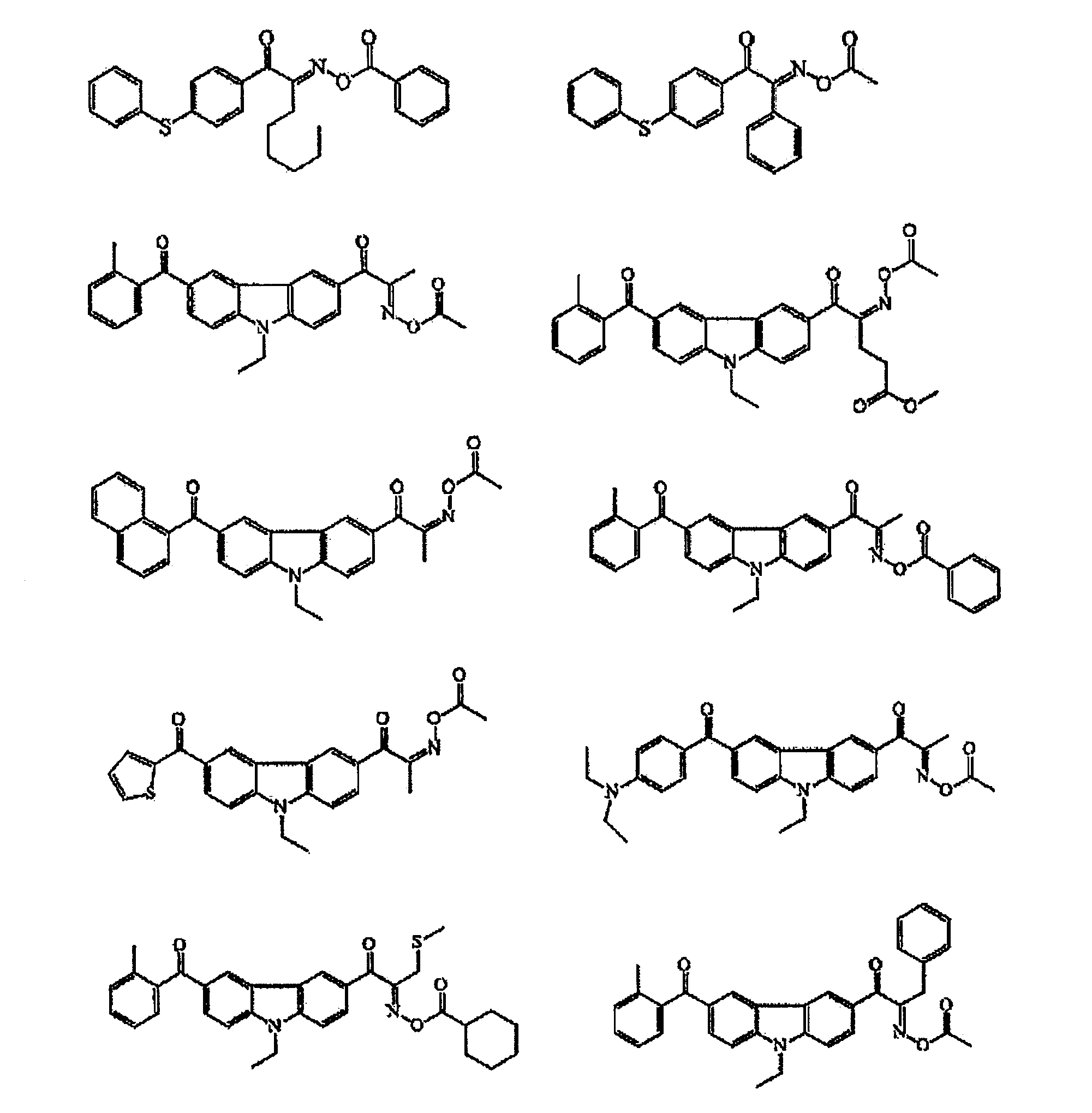
上記光重合開始剤は1種を単独で用いてもよく、2種以上を併用してもよい。
本発明の遮光性感光性樹脂組成物中の光重合開始剤の割合は、全固形分に対して通常0.4~15重量%、好ましくは0.5~10重量%である。この範囲よりも光重合開始剤の割合が多すぎると現像性が低下する傾向があり、一方少なすぎると好ましい電圧保持率や着色スペーサの形状、段差の形成ができない場合がある。
上記の光重合開始剤は、エチレン性不飽和化合物と共に用いられる。
ここで使用されるエチレン性不飽和化合物としては、エチレン性不飽和結合を分子内に1個以上有する化合物を意味するが、重合性、架橋性、及びそれに伴う露光部と非露光部の現像液溶解性の差異を拡大できる等の点から、エチレン性不飽和結合を分子内に2個以上有する化合物であることが好ましく、また、その不飽和結合は(メタ)アクリロイルオキシ基に由来する(メタ)アクリレート化合物が更に好ましい。
エチレン性不飽和結合を分子内に1個以上有する化合物としては、例えば、(メタ)アクリル酸、クロトン酸、イソクロトン酸、マレイン酸、イタコン酸、シトラコン酸等の不飽和カルボン酸、及びそのアルキルエステル、(メタ)アクリロニトリル、(メタ)アクリルアミド、スチレン等が挙げられる。
不飽和カルボン酸と糖アルコールとの反応物;糖アルコールは具体的には、エチレングリコール、ポリエチレングリコール(付加数2~14)、プロピレングリコール、ポリプロピレングリコール(付加数2~14)、トリメチレングリコール、テトラメチレングリコール、ヘキサメチレングリコール、トリメチロールプロパン、グリセロール、ペンタエリスリトール、ジペンタエリスリトール等が挙げられる。
不飽和カルボン酸とアルコールアミンとの反応物;アルコールアミン類とは具体的にはジエタノールアミン、トリエタノールアミン等が挙げられる。
具体的な不飽和カルボン酸とポリヒドロキシ化合物とのエステル類は以下の通りである。
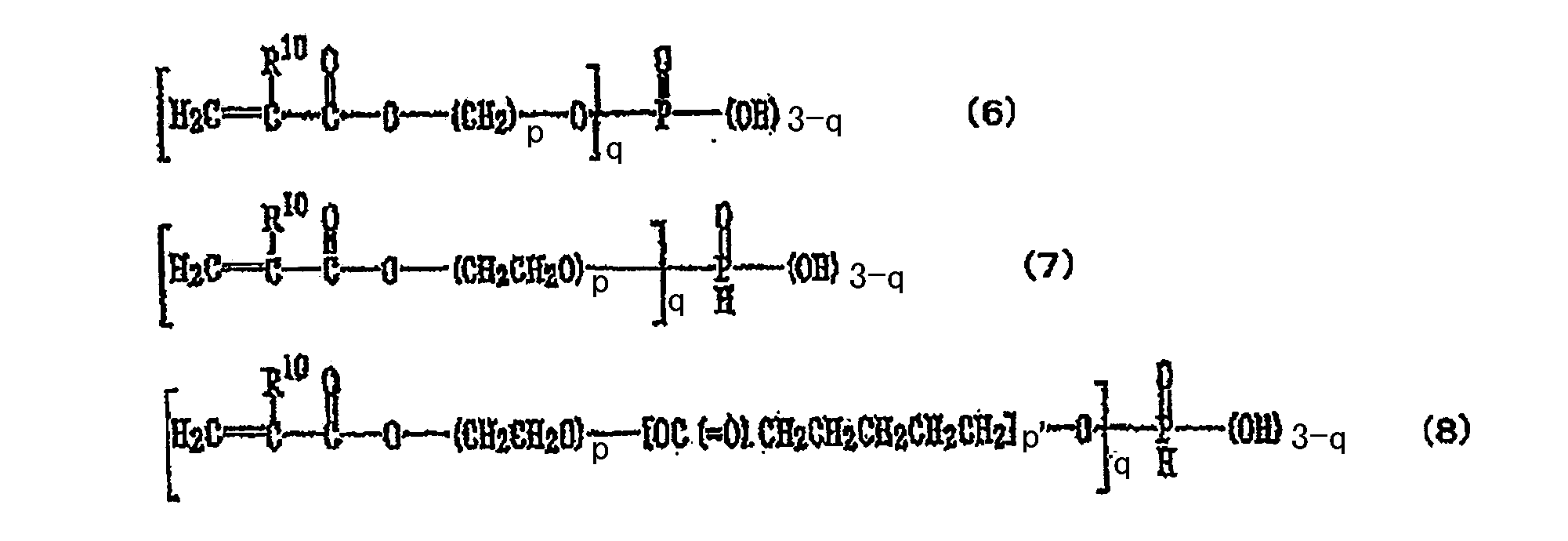
ここで、p及びp’は1~10、特に1~4であるのが好ましく、これらの具体例としては、例えば、(メタ)アクリロイルオキシエチルホスフェート、ビス〔(メタ)アクリロイルオキシエチル〕ホスフェート、(メタ)アクリロイルオキシエチレングリコールホスフェート等が挙げられ、これらはそれぞれが単独で用いられても混合物として用いられてもよい。
これらの中でも、1分子中に4個以上のウレタン結合〔-NH-CO-O-〕及び4個以上の(メタ)アクリロイルオキシ基を有する化合物が好ましく、該化合物は、例えば、ペンタエリスリトール、ポリグリセリン等の1分子中に4個以上の水酸基を有する化合物に、ヘキサメチレンジイソシアネート、トリメチルヘキサメチレンジイソシアネート、イソホロンジイソシアネート、トリレンジイソシアネート等のジイソシアネート化合物を反応させて得られた化合物、或いは、エチレングリコール等の1分子中に2個以上の水酸基を有する化合物に、旭化成工業社製「デュラネート24A-100」、同「デュラネート22A-75PX」、同「デュラネート21S-75E」、同「デュラネート18H-70B」等ビウレットタイプ、同「デュラネートP-301-75E」、同「デュラネートE-402-90T」、同「デュラネートE-405-80T」等のアダクトタイプ等の1分子中に3個以上のイソシアネート基を有する化合物を反応させて得られた化合物、或いは、イソシアネートエチル(メタ)アクリレート等を重合若しくは共重合させて得られた化合物等の、1分子中に4個以上、好ましくは6個以上のイソシアネート基を有する化合物等、例えば、旭化成工業社製「デュラネートME20-100」と、ペンタエリスリトールジ(メタ)アクリレート、ジペンタエリスリトールトリ(メタ)アクリレート、ジペンタエリスリトールテトラ(メタ)アクリレート、ジペンタエリスリトールペンタ(メタ)アクリレート等の、1分子中に1個以上の水酸基及び2個以上、好ましくは3個以上の(メタ)アクリロイルオキシ基を有する化合物とを、反応させることにより得ることができる。
以上のエチレン性不飽和化合物は、それぞれ単独で用いられてもよく、2種以上が併用されてもよい。
尚、本発明において、エチレン性不飽和化合物には、上述のアルカリ可溶性樹脂は含まれない。
以上に示した本発明の着色感光性組成物に含まれる各成分は、通常、溶剤に溶解又は分散させ、着色感光性組成物溶液として用いられる。
ここで用いられる溶剤としては、例えば、ジイソプロピルエーテル、ミネラルスピリット、n-ペンタン、アミルエーテル、エチルカプリレート、n-ヘキサン、ジエチルエーテル、イソプレン、エチルイソブチルエーテル、ブチルステアレート、n-オクタン、バルソル#2、アプコ#18ソルベント、ジイソブチレン、アミルアセテート、ブチルアセテート、アプコシンナー、ブチルエーテル、ジイソブチルケトン、メチルシクロヘキセン、メチルノニルケトン、プロピルエーテル、ドデカン、ソーカルソルベントNo.1及びNo.2、アミルホルメート、ジヘキシルエーテル、ジイソプロピルケトン、ソルベッソ#150、(n,sec,t-)酢酸ブチル、ヘキセン、シェルTS28 ソルベント、ブチルクロライド、エチルアミルケトン、エチルベンゾエート、アミルクロライド、エチレングリコールジエチルエーテル、エチルオルソホルメート、メトキシメチルペンタノン、メチルブチルケトン、メチルヘキシルケトン、メチルイソブチレート、ベンゾニトリル、エチルプロピオネート、メチルセロソルブアセテート、メチルイソアミルケトン、メチルイソブチルケトン、プロピルアセテート、アミルアセテート、アミルホルメート、ビシクロヘキシル、ジエチレングリコールモノエチルエーテルアセテート、ジペンテン、メトキシメチルペンタノール、メチルアミルケトン、メチルイソプロピルケトン、プロピルプロピオネート、プロピレングリコール-t-ブチルエーテル、メチルエチルケトン、メチルセロソルブ、エチルセロソルブ、エチルセロソルブアセテート、カルビトール、シクロヘキサノン、酢酸エチル、プロピレングリコール、プロピレングリコールモノメチルエーテル、プロピレングリコールモノメチルエーテルアセテート、プロピレングリコールモノエチルエーテル、プロピレングリコールモノエチルエーテルアセテート、ジプロピレングリコールモノエチルエーテル、ジプロピレングリコールジメチルエーテル、ジプロピレングリコールモノメチルエーテル、ジプロピレングリコールモノメチルエーテルアセテート、3-メトキシプロピオン酸、3-エトキシプロピオン酸、3-エトキシプロピオン酸メチル、3-エトキシプロピオン酸エチル、3-メトキシプロピオン酸メチル、3-メトキシプロピオン酸エチル、3-メトキシプロピオン酸プロピル、3-メトキシプロピオン酸ブチル、ジグライム、エチレングリコールアセテート、エチルカルビトール、ブチルカルビトール、エチレングリコールモノブチルエーテル、プロピレングリコール-t-ブチルエーテル、3-メトキシブタノール、3-メチル-3-メトキシブタノール、トリプロピレングリコールメチルエーテル、3-メチル-3-メトキシブチルアセテート等が挙げられる。これらの溶剤は、1種を単独で使用しても、2種以上を混合して使用してもよい。
本発明の感光性樹脂組成物は、着色剤の分散性の向上、分散安定性の向上のために、分散剤が使用される。
本発明では、分散剤として窒素原子を含有するアクリル系ブロック共重合体が用いられる。このような窒素原子を含有するアクリル系ブロック共重合体は、これに含まれる窒素原子が着色剤表面に対して親和性を持ち、窒素原子以外の部分が媒質に対する親和性を高めることにより、全体として分散安定性の向上に寄与するものと推定される。
即ち、通常のランダム共重合体の場合、共重合体を構成するモノマーは、共重合時において、立体的に、及び/又は電気的に共重合体中に安定的に配置される確率が高くなる。モノマーが安定的に配置された部分(分子)は、立体的に、及び/又は電気的に安定しているため、着色剤に吸着するとき、かえって障害となる場合がある。これに対し、ブロック共重合体のように分子配列が制御された樹脂は、分散剤の吸着を妨げる部分を、顔料と分散剤との吸着部から離れた位置に配置することができる。つまり、着色剤と分散剤との吸着部には吸着に最適な部分を、溶媒親和性が必要な部分にはそれに適した部分を配置することができる。特に結晶子サイズの小さい着色剤を含有する色材の分散は、この分子配置が良好な分散性に影響するものと推察される。
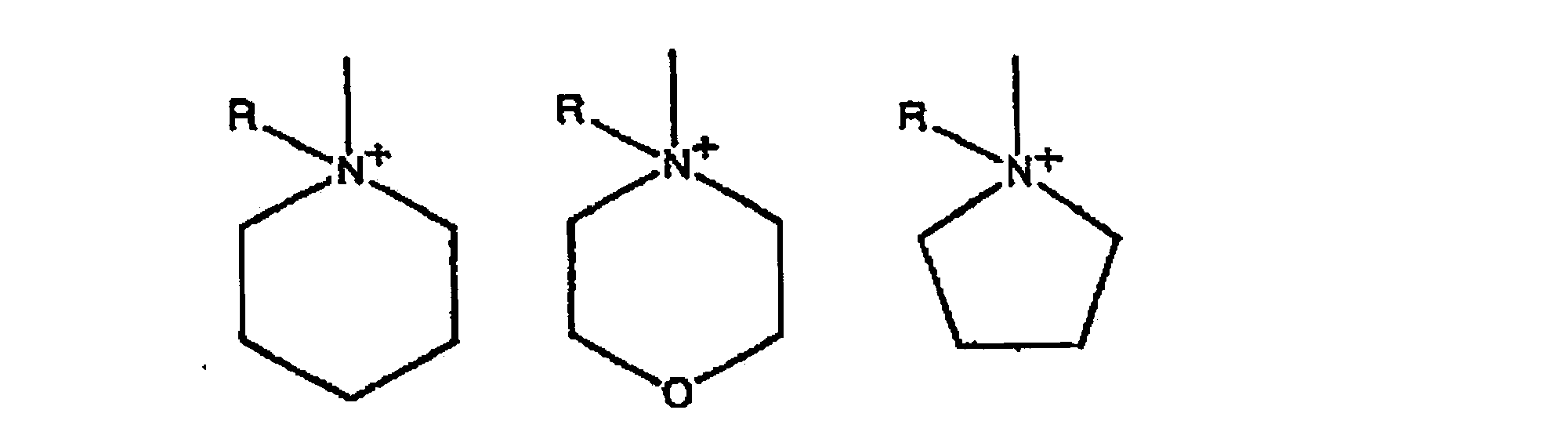
-N+R21R22R23におけるR21~R23として、より好ましいのは、置換基を有していてもよい炭素数1~3のアルキル基、置換基を有していてもよいフェニル基、又は置換基を有していてもよいベンジル基である。
また、4級アンモニウム塩基を有するAブロックとしては、特に、下記一般式(VI)で表される部分構造を含有するものが好ましい。

上記一般式(VI)において、R21、R22、R23の炭化水素基は、それぞれ独立して、炭素数1~10のアルキル基、炭素数6~20の芳香族基を有する置換基が好ましい。具体的には、メチル基、エチル基、プロピル基、イソプロピル基、ブチル基、イソブチル基、ベンジル基、フェニル基等を挙げることができる。中でもメチル基、エチル基、プロピル基、ベンジル基が好ましい。
また、対アニオンのM-としては、Cl-、Br-、I-、ClO4 -、BF4 -、CH3COO-、PF6 -等が挙げられる。
尚、上述するアクリル系ブロック共重合体のAブロックは、4級化されていない未反応の3級アミノ基を有していてもよい。
このアミノ基は、直接主鎖に結合していてもよいが、2価の連結基を介して主鎖に結合していてもよい。
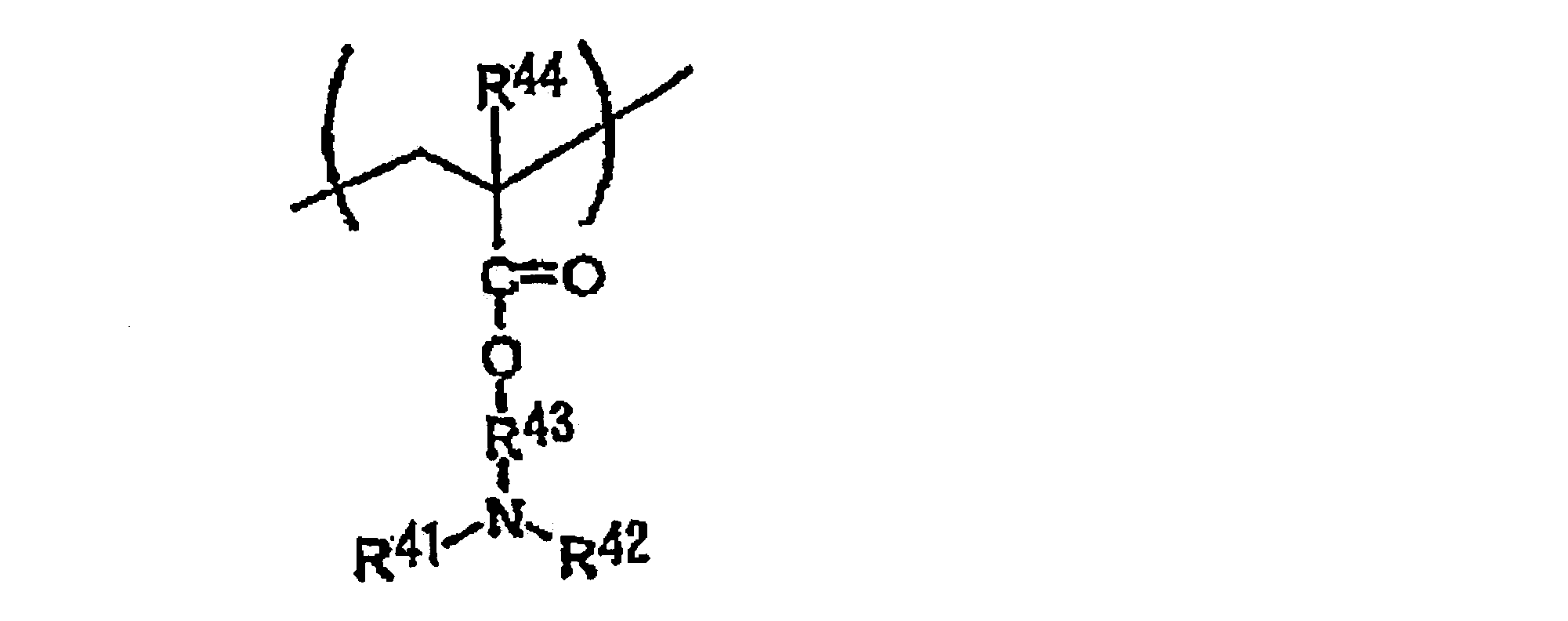
中でも、R41及びR42はメチル基が好ましく、R43はメチレン基、エチレン基が好ましく、R44は水素原子もしくはメチル基であるのが好ましい。このような部分構造としては下記一般式で表されるジメチルアミノエチルアクリレートやジメチルアミノエチルメタアクリレート由来の構造等が、特に好適に用いられる。

更に、上記アミノ基を含有する部分構造は、1つのAブロック中に2種以上含有されていてもよい。その場合、2種以上のアミノ基含有部分構造は、該Aブロック中においてランダム共重合又はブロック共重合の何れの態様で含有されていてもよい。又、アミノ基を含有しない部分構造が、Aブロック中に一部含まれていてもよく、そのような部分構造の例としては、(メタ)アクリル酸エステル系モノマー由来の部分構造等が挙げられる。係るアミノ基を含まない部分構造の、Aブロック中の含有量は、好ましくは0~50重量%、より好ましくは0~20重量%であるが、係るアミノ基非含有部分構造はAブロック中に含まれないことが最も好ましい。
一方、アクリル系ブロック共重合体を構成するBブロックは、上述した4級アンモニウム塩基及びアミノ基を有さず、上述したAブロックを構成するモノマーと共重合しうるモノマーから成るものであれば、特に制限は無い。Bブロックは、顔料吸着基となる窒素原子含有官能基を有さない親溶媒性の部位であり、溶媒に親和性があるため、分散剤に吸着した顔料を溶媒中に安定化させる働きがある。

上記(メタ)アクリル酸エステル系モノマー由来の部分構造は、1つのBブロック中に2種以上含有されていてもよい。もちろん該Bブロックは、更にこれら以外の部分構造を含有していてもよい。2種以上のモノマー由来の部分構造が、4級アンモニウム塩基を含有しないBブロック中に存在する場合、各部分構造は該Bブロック中においてランダム共重合又はブロック共重合の何れの態様で含有されていてもよい。
本発明で用いるアクリル系分散剤は、このようなAブロックとBブロックとからなる、A-Bブロック又はB-A-Bブロック共重合型高分子化合物であるが、このようなブロック共重合体は、例えばリビング重合法にて調製される。
尚、上記アクリル系ブロック共重合体のアミン価は、有効固形分換算で通常1~300mgKOH/g程度であるが、その好ましい範囲は、Aブロックが4級アンモニウム塩基を有する場合とそうでない場合とで異なる。なお、アミン価は、共重合体1g中のアミノ基を中和するのに必要な酸のモル当量に対応したKOHのmg数で表した値である。
なお、このようなブロック共重合体中には、通常、製造過程で生じたアミノ基が含有される場合があるが、そのアミン価は通常1~100mgKOH/g程度、好ましくは1~80mgKOH/g。より好ましくは1~50mgKOH/gである。
このようなアクリル系ブロック共重合体の酸価は、該酸価の元となる酸性基の有無及び種類にもよるが、一般に低い方が好ましく、通常100mgKOH/g以下であり、好ましくは50mgKOH/g以下、より好ましくは40mgKOH/g以下である。
本発明においては、上述のものと同様の構造を有する市販のアクリル系ブロック共重合体を適用することもできる。
併用する分散剤としては、例えば、ウレタン系分散剤、ポリアリルアミン系分散剤、アミノ基を持つモノマーとマクロモノマーからなる分散剤、ポリオキシエチレンアルキルエーテル系分散剤、ポリオキシエチレンジエステル系分散剤、ポリエーテルリン酸系分散剤、ポリエステルリン酸系分散剤、ソルビタン脂肪族エステル系分散剤、脂肪族変性ポリエステル系分散剤等を挙げることができる。
顔料誘導体としてはアゾ系、フタロシアニン系、キナクリドン系、ベンズイミダゾロン系、キノフタロン系、イソインドリノン系、ジオキサジン系、アントラキノン系、インダンスレン系、ペリレン系、ペリノン系、ジケトピロロピロール系、ジオキサジン系等の誘導体が挙げられるが、中でもキノフタロン系が好ましい。顔料誘導体の置換基としてはスルホン酸基、スルホンアミド基及びその4級塩、フタルイミドメチル基、ジアルキルアミノアルキル基、水酸基、カルボキシル基、アミド基等が顔料骨格に直接又はアルキル基、アリール基、複素環基等を介して結合したものが挙げられ、好ましくはスルホン酸基である。またこれら置換基は一つの顔料骨格に複数置換していてもよい。
これらの顔料誘導体は1種を単独で或いは2種以上を組み合わせて用いることができる。
顔料誘導体を用いる場合、その使用量は顔料に対して通常0.1~30重量%、好ましくは0.1~20重量%以下、より好ましくは0.1~10重量%、さらに好ましくは0.1~5重量%である。
本発明の遮光性感光性樹脂組成物には、上記の成分の他に、さらに重合加速剤、増感色素、界面活性剤、光酸発生剤、架橋剤、密着性向上剤、可塑剤、保存安定剤、表面保護剤、有機カルボン酸、有機カルボン酸無水物、現像改良剤、熱重合防止剤等を含んでいてもよい。
光酸発生剤とは、紫外線により酸を発生することができる化合物であり、露光を行った際に発生する酸の作用により、例えばメラミン化合物等架橋剤があることで架橋反応を進行させることとなる。係る光酸発生剤の中でも、溶剤に対する溶解性、特に着色感光性組成物に使われる溶剤に対する溶解性が大きいものが好ましいものであり、例えば、ジフェニルヨードニウム、ジトリルヨードニウム、フェニル(p-アニシル)ヨードニウム、ビス(m-ニトロフェニル)ヨードニウム、ビス(p-tert-ブチルフェニル)ヨードニウム、ビス(p-クロロフェニル)ヨードニウム、ビス(n-ドデシル)ヨードニウム、p-イソブチルフェニル(p-トリル)ヨードニウム、p-イソプロピルフェニル(p-トリル)ヨードニウムなどのジアリールヨードニウム、あるいはトリフェニルスルホニウムなどのトリアリールスルホニウムのクロリド、ブロミド、あるいはホウフッ化塩、ヘキサフルオロフォスフェート塩、ヘキサフルオロアルセネート塩、芳香族スルホン酸塩、テトラキス(ペンタフルオロフェニル)ボレート塩等や、ジフェニルフェナシルスルホニウム(n-ブチル)トリフェニルボレート等のスルホニウム有機ホウ素錯体類、あるいは、2-メチル-4,6-ビストリクロロメチルトリアジン、2-(4-メトキシフェニル)-4,6-ビストリクロロメチルトリアジンなどのトリアジン化合物等を挙げることができるがこの限りではない。
本発明の着色感光性組成物には、さらに架橋剤を加えることができ、例えばメラミン又はグアナミン系の化合物を用いることができる。これら架橋剤としては、例えば、下記一般式(XI)で示されるメラミン又はグアナミン系の化合物を挙げることができる。

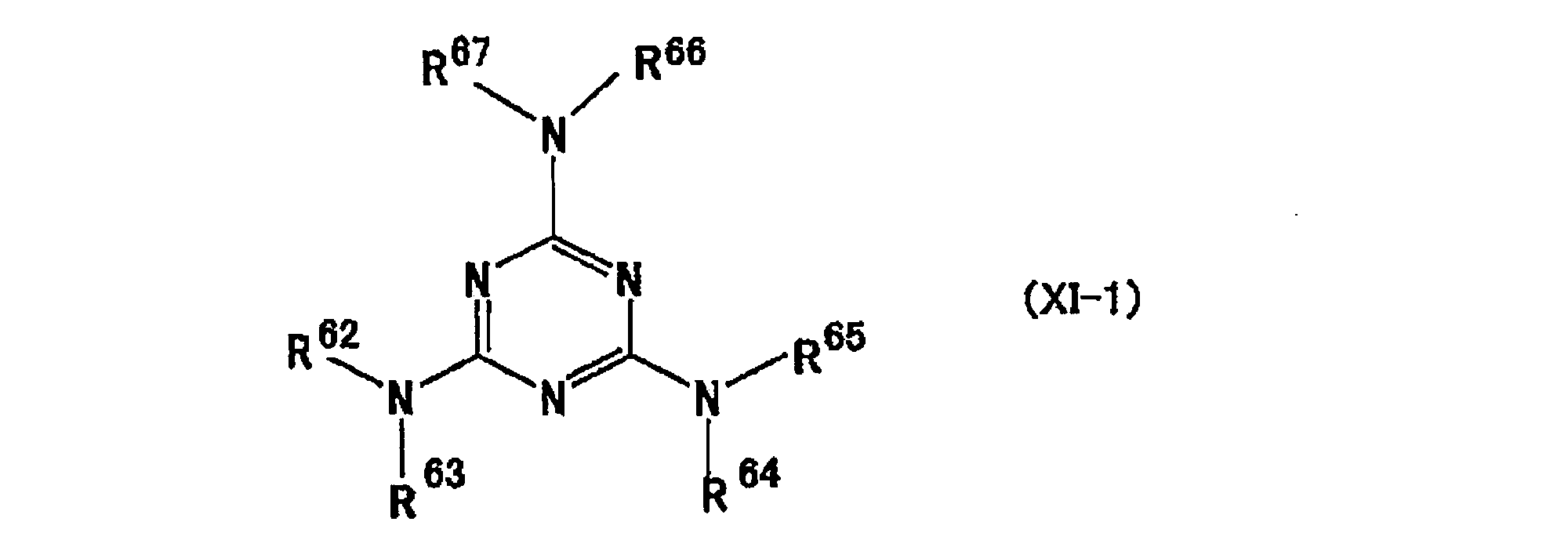
2,6-ビス(ヒドロキシメチル)-4-メチルフェノール、4-tert-ブチル-2,6-ビス(ヒドロキシメチル)フェノール、5-エチル-1,3-ビス(ヒドロキシメチル)ペルヒドロ-1,3,5-トリアジン-2-オン(通称N-エチルジメチロールトリアゾン)又はそのジメチルエーテル体、ジメチロールトリメチレン尿素又はそのジメチルエーテル体、3,5-ビス(ヒドロキシメチル)ペルヒドロ-1,3,5-オキサジアジン-4-オン(通称ジメチロールウロン)又はそのジメチルエーテル体、テトラメチロールグリオキザールジウレイン又はそのテトラメチルエーテル体。
尚、これら架橋剤は1種を単独で用いても、2種以上を組み合わせて使用してもよい。 架橋剤を用いる際の量は、遮光性感光性樹脂組成物の全固形分に対して0.1~15重量%が好ましく、特に好ましくは0.5~10重量%である。
本発明の遮光性感光性樹脂組成物には細い線やドットを充分密着させるために、密着向上剤を含有させてもよい。
密着向上剤としては、窒素原子を含有する化合物や燐酸基含有化合物、シランカップリング剤などが好ましく、窒素原子を含有する化合物としては、例えば、ジアミン類(日本国特開平11-184080号公報記載の密着増強剤、他)やアゾール類が好ましい。なかでもアゾール類が好ましく、特にイミダゾール類(日本国特開平9-236923号公報記載の密着向上剤、他)、ベンゾイミダゾール類、ベンゾトリアゾール類(日本国特開2000-171968号公報記載の密着向上剤、他)が好ましく、イミダゾール類とベンゾイミダゾール類が最も好ましい。これらのなかで、カブリが生じにくく、密着性を大きく向上させることができる点から2-ヒドロキシベンゾイミダゾール、2-ヒドロキシエチルベンゾイミダゾール、ベンゾイミダゾール、2-ヒドロキシイミダゾール、イミダゾール、2-メルカプトイミダゾール、2-アミノイミダゾールが好ましく、2-ヒドロキシベンゾイミダゾール、ベンゾイミダゾール、2-ヒドロキシイミダゾール、イミダゾールが特に好ましい。シランカップリング剤の種類としては、エポキシ系、メタクリル系、アミノ系等種々の物が使用できるが、特にエポキシ系のシランカップリング剤が好ましい。
これらの密着向上剤を配合する場合、その配合割合は、用いる密着向上剤の種類によっても異なるが、着色感光性組成物の全固形分に対して0.01~5重量%、特に0.05~3重量%とすることが好ましい。これよりも少ないと十分な密着性の向上効果が得られない場合があり、多すぎると現像性を下げる場合がある。
増感色素としては、例えば日本国特開平4-221958号公報、日本国特開平4-219756号公報に記載のキサンテン色素、日本国特開平3-239703号公報、日本国特開平5-289335号公報に記載の複素環を有するクマリン色素、日本国特開平3-239703号公報、日本国特開平5-289335号公報に記載の3-ケトクマリン化合物、日本国特開平6-19240号公報に記載のピロメテン色素、その他、日本国特開昭47-2528号公報、日本国特開昭54-155292号公報、日本国特公昭45-37377号公報、日本国特開昭48-84183号公報、日本国特開昭52-112681号公報、日本国特開昭58-15503号公報、日本国特開昭60-88005号公報、日本国特開昭59-56403号公報、日本国特開平2-69号公報、日本国特開昭57-168088号公報、日本国特開平5-107761号公報、日本国特開平5-210240号公報、日本国特開平4-288818号公報に記載のジアルキルアミノベンゼン骨格を有する色素等を挙げることができる。
増感色素を配合する場合、着色感光性組成物中の全固形分中における増感色素の含有率は、通常0.01~5重量%、好ましくは0.05~3重量%である。これより少ないと増感効果が出ない場合があり、多すぎると現像性を下げる場合がある。
界面活性剤としてはアニオン系、カチオン系、非イオン系、両性界面活性剤等各種のものの1種又は2種以上を用いることができるが、諸特性に悪影響を及ぼす可能性が低い点で、非イオン系界面活性剤を用いるのが好ましい。また、フッ素系やシリコン系のものは、塗布性の面で効果的である。
界面活性剤の配合割合としては、着色感光性組成物中の全固形分に対して通常0.001~10重量%、好ましくは0.005~1重量%、さらに好ましくは0.01~0.5重量%、最も好ましくは0.03~0.3重量%の範囲である。界面活性剤の添加量が上記範囲よりも少ないと塗布膜の平滑性、均一性が発現できない場合があり、多いと塗布膜の平滑性、均一性が発現できない場合がある他、他の特性が悪化する場合がある。
本発明の着色感光性組成物は、現像性の向上や地汚れ改善の目的で有機カルボン酸及び有機カルボン酸無水物のうち少なくとも一方を含んでいてもよい。
有機カルボン酸としては、脂肪族カルボン酸及び芳香族カルボン酸のうち少なくとも一方が挙げられる。
上記有機カルボン酸の分子量は、通常1000以下であり、通常50以上である。上記有機カルボン酸の分子量が大きすぎると地汚れ改善効果が不十分となる場合があり、少なすぎると昇華、揮発などにより、添加量の減少やプロセス汚染を起こす恐れがある。
上記有機カルボン酸無水物の分子量は、通常800以下、好ましくは600以下、更に好ましくは500以下であり、通常50以上である。上記有機カルボン酸無水物の分子量が大きすぎると地汚れ改善効果が不十分となる場合があり、少なすぎると昇華、揮発などにより、添加量の減少やプロセス汚染を起こす恐れがある。
これらの有機カルボン酸及び有機カルボン酸無水物の添加量は、それぞれ、本発明の遮光性感光性樹脂組成物の全固形分中、通常0.01重量%~5重量%、好ましくは0.03重量%~3重量%である。その添加量が少なすぎると十分な添加効果が得られない場合があり、多すぎると表面平滑性や感度が悪化し、未溶解剥離片が発生する場合がある。
熱重合防止剤としては、例えば、ハイドロキノン、p-メトキシフェノール、ピロガロール、カテコール、2,6-t-ブチル-p-クレゾール、β-ナフトール等の1種又は2種以上が用いられる。
熱重合防止剤の配合割合は、遮光性感光性樹脂組成物中の全固形分に対し0~2重量%の範囲であることが好ましく、これよりも多いと遮光性、感光性樹脂組成物の感度を低下させる場合がある。
可塑剤としては、例えば、ジオクチルフタレート、ジドデシルフタレート、トリエチレングリコールジカプリレート、ジメチルグリコールフタレート、トリクレジルホスフェート、ジオクチルアジペート、ジブチルセバケート、トリアセチルグリセリン等の1種又は2種以上が用いられる。
これら可塑剤の配合割合は、遮光性感光性樹脂組成物中の全固形分に対し5重量%以下の範囲であることが好ましく、これよりも多いと樹脂ブラックマトリックスの硬化点が低下する。
次に本発明の着色感光性組成物の製造方法について説明する。
以下、着色剤として顔料を使った着色感光性組成物について説明する。
まず(a)顔料と(f)分散剤および必要な成分を用い、顔料分散液を製造する。次に、上述得られた顔料分散液、(b)アルカリ可溶性樹脂、(c)光重合開始剤、(d)エチレン性不飽和化合物、及び(e)溶剤を混合して着色感光性組成物はを製造する。必要に応じて、前述の他の成分を混合してもよい。
本発明に係る顔料分散液の製造方法としては種々の方法を採用することができる。以下にその一例を示す。
まず、顔料、溶剤、及び分散剤/分散助剤を各々所定量秤量し、分散処理工程において、顔料を分散させて液状の顔料分散液とする。顔料、溶剤、及び分散剤/分散助剤としては、前述の着色感光性組成物の構成成分として記載されたものが使用できる。
この分散処理を行うことによって顔料が微粒子化されるため、この顔料分散液を用いた着色感光性組成物は塗布特性および直線性などの製版性能が向上する。
分散処理する際の温度は通常0℃~100℃の範囲、好ましくは室温~80℃の範囲に設定する。なお、分散時間は、顔料分散液の組成(顔料、溶剤、分散剤/分散助剤等)、及びサンドグラインダーの装置の大きさなどにより適正時間が異なるため、適宜調整する必要がある。
顔料分散液中の(f)分散剤の含有量は、顔料に対して通常5重量%以上90重量%以下であり、好ましくは5重量%以上60重量%以下、更にこのましくは5重量%以上40重量以下である。
顔料分散液中のアルカリ可溶性樹脂(b)の含有量は、顔料に対して通常0重量%以上100重量%以下であり、好ましくは5重量%以上80重量%以下、更にこのましくは5重量%以上60重量%以下である。
次に上記分散処理により得られた顔料分散液(インキ)と着色感光性組成物成分として必要な前記の他の分を添加、攪拌混合して均一な着色感光性組成物溶液とする。この製造工程においては微細なゴミが液中に混じることが多いため、得られた着色感光性組成物溶液はフィルター等により濾過処理するのが望ましい。
尚、着色剤として顔料以外(例えば染料)を使った着色感光性組成物は、公知の方法で製造できる。
本実施の形態の着色感光性組成物は、公知のカラーフィルター用着色感光性組成物と同様の方法により使用されるが、以下、着色スペーサとして使用される場合について説明する。
通常、着色スペーサが設けられるべき基板上に、着色感光性組成物溶液を、塗布等の方法により膜状或いはパターン状に供給し、溶剤を乾燥させる。続いて、露光-現像を行うフォトリソグラフィー法によりパターン形成を行う。その後、必要により追露光や熱硬化処理を行うことにより、該基板上に着色スペーサが形成される。
本実施の形態の着色感光性組成物は、通常、溶剤に溶解或いは分散された状態で、基板上へ供給される。その供給方法としては、従来公知の方法、例えば、スピナー法、ワイヤーバー法、フローコート法、ダイコート法、ロールコート法、スプレーコート法などによって行うことができる。中でも、ダイコート法によれば、塗布液の使用量が大幅に削減され、かつ、スピンコート法によった際に付着するミストなどの影響が全くない、異物発生が抑制されるなど、総合的な観点から好ましい。
尚、基板としてはガラス基板など、公知の基板を使用することができる。また、基板表面は平面であることが好適である。
基板上に着色感光性組成物溶液を供給した後の乾燥は、ホットプレート、IRオーブン、コンベクションオーブンを使用した乾燥方法によるのが好ましい。また、温度を高めず、減圧チャンバー内で乾燥を行う、減圧乾燥法を組み合わせても良い。
乾燥の条件は、溶剤成分の種類、使用する乾燥機の性能などに応じて適宜選択することができる。乾燥時間は、溶剤成分の種類、使用する乾燥機の性能などに応じて、通常は、40℃~130℃の温度で15秒~5分間の範囲で選ばれ、好ましくは50℃~110℃の温度で30秒~3分間の範囲で選ばれる。
露光は、着色感光性組成物の塗布膜上に、ネガのマスクパターンを重ね、このマスクパターンを介し、紫外線又は可視光線の光源を照射して行う。露光マスクを用いて露光を行う場合には、露光マスクを着色感光性組成物の塗布膜に近接させる方法や、露光マスクを着色感光性組成物の塗布膜から離れた位置に配置し、該露光マスクを介した露光光を投影する方法によっても良い。また、マスクパターンを用いないレーザー光による走査露光方式によっても良い。この際、必要に応じ、酸素による光重合性層の感度の低下を防ぐため、脱酸素雰囲気下で行ったり、光重合性層上にポリビニルアルコール層などの酸素遮断層を形成した後に露光を行ったりしてもよい。
また、フォトリソグラフィー法により高さの異なる着色スペーサを一括形成する為の方法においては、露光マスクとして、光の透過を遮る遮光層と光を透過させる開口部とを有し、一部の開口部の平均光透過率が他の開口部の平均光透過率より小さい露光マスクを用いる方法、即ち遮光層(光透過率0%)と複数の開口部を有し、平均光透過率の最も高い開口部(通常、光透過率100%。以下完全透過開口部という)に対して平均光透過率の小さい開口部(中間透過開口部)を有する露光マスクを用いる方法を利用することができる。
本実施の形態における露光量としては、通常、1mJ/cm2以上、好ましくは5mJ/cm2以上、より好ましくは10mJ/cm2以上であり、通常300mJ/cm2以下、好ましくは200mJ/cm2以下、より好ましくは150mJ/cm2以下である。
また、近接露光方式の場合には、露光対象とマスクパターンとの距離としては、通常10μm以上、好ましくは50μm以上、より好ましくは75μm以上であり、通常500μm以下、好ましくは400μm以下、より好ましくは300μm以下である。
上記の露光を行った後、アルカリ性化合物の水溶液、又は有機溶剤を用いる現像によって、基板上に画像パターンを形成することができる。この水溶液には、さらに界面活性剤、有機溶剤、緩衝剤、錯化剤、染料又は顔料を含ませることができる。
現像処理の方法については特に制限は無いが、通常、10℃~50℃、好ましくは15℃~45℃の現像温度で、浸漬現像、スプレー現像、ブラシ現像、超音波現像等の方法により行われる。
現像の後の基板には、必要により上記の露光方法と同様な方法により追露光を行っても良く、また熱硬化処理を行っても良い。この際の熱硬化処理条件は、温度は100℃~280℃の範囲、好ましくは150℃~250℃の範囲で選ばれ、時間は5分間~60分間の範囲で選ばれる。
本発明の着色感光性組成物により形成された着色スペーサは、略円柱状スペーサパターンが好ましい。
完全透過開口部の着色スペーサパターンの下断面径は、通常15μm超過45μm未満であり、好ましくは18μm超過40μm未満である。この範囲より低い場合、圧縮特性が悪くなる傾向があり、この範囲より高い場合、基板上の面積が増えるためパネル構造上には好ましくない。
完全透過開口部の着色スペーサパターンの高さと中間透過開口部の着色スペーサパターンの高さの差異(ΔH)は、完全透過開口部の着色スペーサパターンの高さが2.8μm超過3.2μm未満の場合、通常0.25μm以上1.0μm以下であり、好ましくは0.35μm超過0.80μm以下であり、より好ましくは0.4μm超過0.6μm以下である。この範囲より低い場合、耐荷重性が悪くなる傾向があり、この範囲より高い場合、圧縮限界を超える傾向がある。
本発明のカラーフィルターは、上述のような本発明の着色スペーサを備えるものであり、例えば透明基板としてのガラス基板上に、ブラックマトリクスと、赤色、緑色、青色の画素着色層と、オーバーコート層とが積層されて、着色スペーサを形成した後配向膜を形成して製造される。配向膜としては、ポリイミド等の樹脂膜が好適である。
本発明の液晶表示装置は上述のような本発明の着色スペーサを有するカラーフィルター備えるものであり、例えば、上述のようなカラーフィルターと液晶駆動側基板を貼り合わせて液晶セルを形成する。形成した液晶セルに液晶を注入して製造される。
以下の実施例及び比較例で用いた着色感光性組成物の構成成分は次の通りである。
なお、以下において「部」は「重量部」を表す。
新中村化学工業(株)製 「ADEP02」((MW=3500~4500、酸価=約110mg-KOH/g、アルカリ可溶性樹脂(A-2)に該当)
<アルカリ可溶性樹脂-2>
日本化薬(株)製「ZCR-1664H」(MW=5000~6000、酸価=約60mg-KOH/g、アルカリ可溶性樹脂(A-1)に該当)
<アルカリ可溶性樹脂-3>
昭和高分子(株)製「SPCM-82」(MW=約10000、酸価=約24mg-KOH/g、アクリレート系アルカリ可溶性樹脂)
500mL4つ口フラスコにスチレン/アクリル酸樹脂、ジョンクリル680(BASFジャパン(株))61.2gをプロピレングリコールモノメチルエーテルアセテート138.6gに80℃で均一に溶解させた。これにテトラアンモニウムクロライド0.24g、p-メトキシフェノール0.09gを加えて溶解させ、プロピレングリコールモノメチルエーテルアセテート71.4gと3,4-エポキシシクロヘキシルメチルアクリレート(サイクロマーA400 ダイセル化学(株))19.9gの混合液を40分かけて滴下した。反応溶液を80℃に保ったまま32時間攪拌し、重量平均分子量6700、酸価106mgKOH/gの樹脂を得た。
昭和高分子(株)製「SPCM-121B」(MW=約8300、酸価=約80mg-KOH/g、アクリレート系アルカリ可溶性樹脂)
ビックケミー社製「DisperBYK-2000」(側鎖に4級アンモニウム塩基を有するAブロックと、4級アンモニウム塩基を有さないBブロックからなる、アクリル系A-Bブロック共重合体)
<分散剤-2>
ビックケミー社製「DisperBYK-LPN21116」(側鎖に4級アンモニウム塩基及びアミノ基を有するAブロックと、4級アンモニウム塩基及びアミノ基を有さないBブロックからなる、アクリル系A-Bブロック共重合体)
<分散剤-3>
ビックケミー社製「DisperBYK-167」(ウレタン系分散剤)
<分散助剤>
ループリゾール社製「S12000」
大日本インキ化学社製 メガファック F-475
<溶剤-1>
PGMEA:プロピレングリコールモノメチルエーテルアセテート
<溶剤-2>
MB:3-メトキシブタノール
<溶剤-3>
MBA:酢酸3-メトキシブチル
<溶剤-4>
CHN:シクロヘキサノン
<光重合開始剤>
下記式で表される化合物。
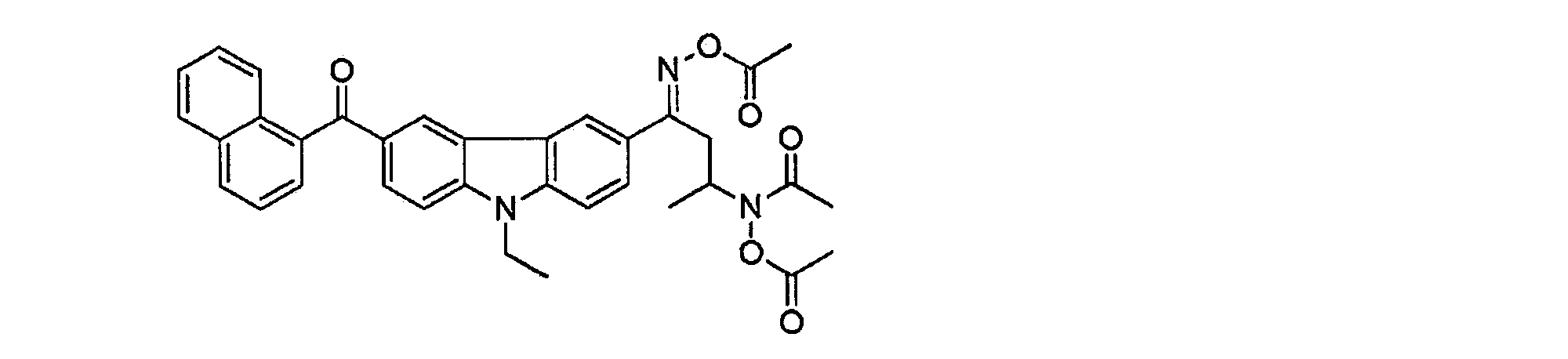
DPHA:日本化薬(株)製 ジペンタエリスリトールヘキサアクリレート
<顔料分散液-1~4の調製>
表1に記載の顔料、分散剤、分散助剤、アルカリ可溶性樹脂、溶剤としてプロピレングリコールモノメチルエーテルアセテート(PGMEA)とメトキシブチルアセテート(MBA)を表1に記載の重量比で混合した。ここに、分散容器の容積の80%のジリコニアビーズを混合した後、ピコミル分散容器に充填し、必要なリテンション時間にて分散させて各顔料分散液を調製した。
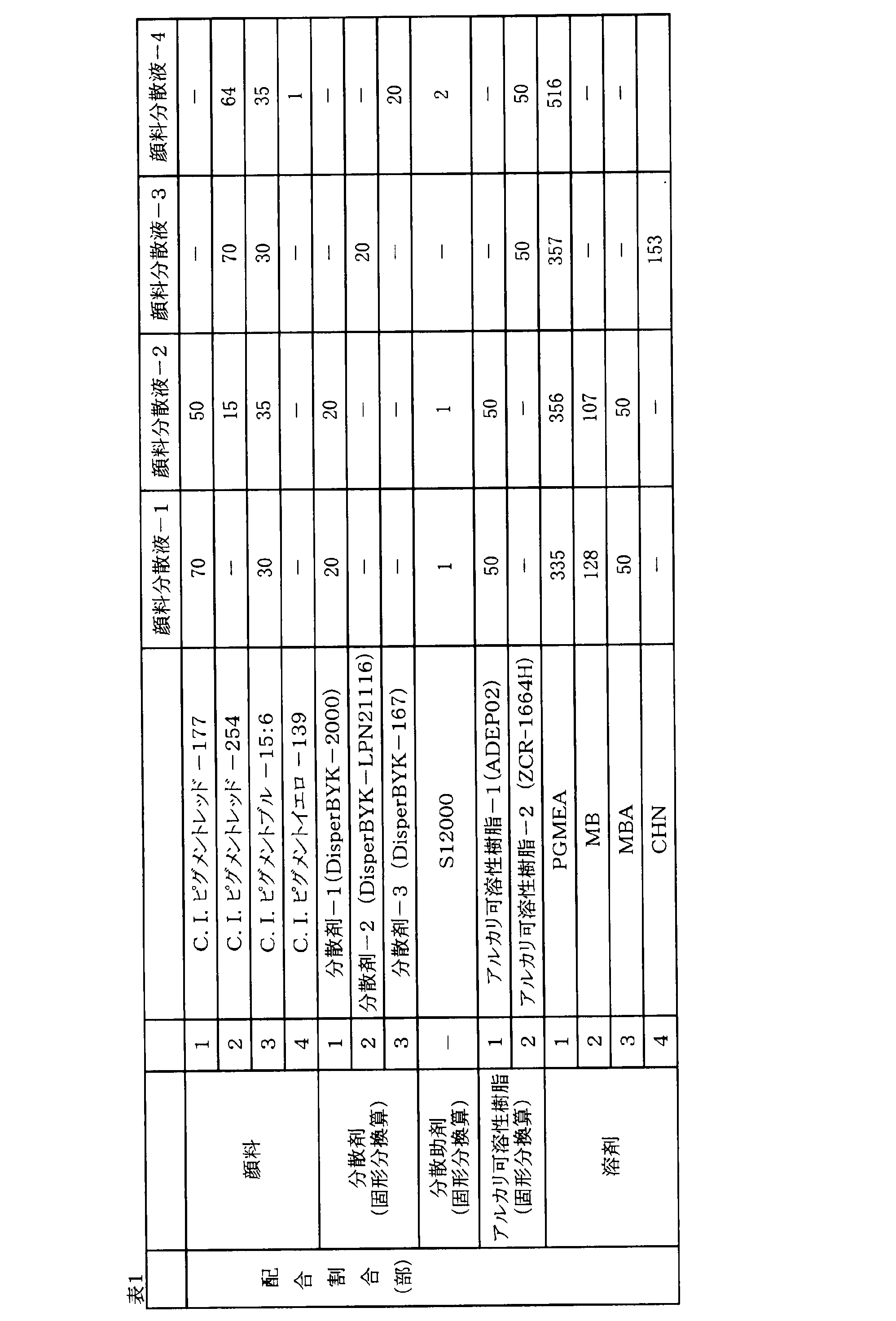
上記で調製された顔料分散液と、表2に示す成分とを表2に示す割合で配合、攪拌してそれぞれ着色感光性組成物塗布液を調製した。得られ着色感光性組成物溶液を用いて、後述の方法により、略円柱状スペーサパターンを形成し、形状、段差、基板との密着性及び電圧保持率(VHR)を評価した。結果を表2に併記した。
表面にITO膜を形成したガラス基板の該ITO膜上に、スピナーを用いて上記感光性組成物を塗布した。次いで、110℃にて70s、ホットプレート上で加熱乾燥して塗布膜を形成した。乾燥膜厚は3.5μmであった。
得られた塗布膜に対し、直径15μmの円形パターンの完全透過開口部及び直径35μmの円形パターンの中間透過開口部を有する露光マスクを用いて露光処理を施した。中間透過開口部は、Cr酸化物の薄膜で波長365nmにおける光透過率を12.1%、405nmにおける光透過率を16.5%、436nmにおける光透過率を19.6%としたものである。尚、上記3点の前後及び間の光透過率は連続的であり、変曲点も存在しない。露光ギャップ(マスクと塗布面間の距離)としては、250μmであった。
また、365nmでの強度が32mW/cm2である紫外線を用いた。露光量としては50mJ/cm2とした。また、紫外線照射は空気下で行った。次いで、25℃の0.1%水酸化カリウム水溶液を用いて、最小現像時間の1.6倍の時間、スプレー現像を行い、更に純水でリンスした。120秒でも溶けないものは現像できないこととした。
これらの操作により、不要部分を除去したパターンを得た。当該パターンの形成された基板をオーブン中、230℃で20分間加熱してパターンを硬化させ、略円柱状のスペーサパターンを得た。
上記略円柱状の着色スペーサパターンについて、着色スペーサパターンの中軸を通る縦断面をプロファイルし、着色スペーサパターンの高さと上、下底面の断面径を計測した。計測には、株式会社菱化システム製三次元非接触表面形状計測システムMicromapMM3500-M100を用いた。
完全透過開口部の着色スペーサパターンの高さと中間透過開口部の着色スペーサパターンの高さの差異(ΔH)が0.35μm超過0.8μm以下のものを○、0.25μm以上0.4μm以下のものを△、0.25μm未満のものを×とした。結果を表2に示した。
上記のようにして、中間透過開口部のサイズが5、6、7、8、9、10、11、12、13、14、15、16、17、18、19、20、25、30、35、40、45、50μmの中間透過開口部を24個ずつ設けたマスクを使って、サイズの異なるパターンを24個ずつ形成した。24個のパターンが1個も消失しない、最も小さい中間透過開口部のサイズ(直径)を測定した。そのサイズが15μm以下のものを○、15μmを超えるものを×とした。結果を表2に示した。
以下で説明した方法により、電圧保持率(VHR)の評価を行い、結果を表2に示した。
<液晶セルの作製>
5cm角の片全面にITO膜を形成した電極基板A(イーエッチシー製、評価用ガラスITOベタ)と、2.5cm角の同ガラス基板の片面中央部に、2mm幅の取り出し電極がつながった1cm角のITO膜を形成した電極基板B(イーエッチシー製、評価用ガラスSZ-B111MIN(B))を用意した。
その後、電極基板Bの外周上に、ディスペンサーを用いて、直径5μmのシリカビーズを含有するエポキシ樹脂系シール剤を塗布した後、電極基板Bの表側(シール剤側)に評価用電極基板Aの塗布面を圧着したまま貼り付けて、空セルが完成した。熱風循環炉内で180℃で2時間加熱した。
上記液晶セルを、アニール処理(熱風循環炉内で105℃、2.5時間加熱)した後、評価用電極基板A、Bに電圧5Vで、0.6Hz、フレーム時間1667msecの条件で印加し、電圧保持率を(株)東陽テクニカ製「VHR-6254型」にて測定した。

Claims (14)
- (a)着色剤、(b)アルカリ可溶性樹脂、(c)光重合開始剤、(d)エチレン性不飽和化合物、(e)溶剤、及び(f)分散剤を含有する、フォトリソグラフィー法により高さの異なる着色スペーサを一括形成するために用いられる着色感光性組成物であって、
(b)アルカリ可溶性樹脂として、下記アルカリ可溶性樹脂(A-1)及びアルカリ可溶性樹脂(A-2)のうち少なくとも一方を含み、
(f)分散剤として、窒素原子を含有するアクリル系ブロック共重合体を含み、
(d)エチレン性不飽和化合物に対する(b)アルカリ可溶性樹脂の重量比が、7未満であり、
着色感光性組成物中の全固形分に対するアルカリ可溶性樹脂(A-1)及びアルカリ可溶性樹脂(A-2)の合計の割合が12重量%以上である着色感光性組成物。
<アルカリ可溶性樹脂(A-1)>
エポキシ樹脂に、α,β-不飽和モノカルボン酸又はエステル部分にカルボキシル基を有するα,β-不飽和モノカルボン酸エステルを付加させ、さらに、多塩基酸無水物を反応させることにより得られる樹脂
<アルカリ可溶性樹脂(A-2)>
エポキシ樹脂に、α,β-不飽和モノカルボン酸又はエステル部分にカルボキシル基を有するα,β-不飽和モノカルボン酸エステルを付加させ、さらに、多価アルコール及び多塩基酸無水物を反応させることにより得られる樹脂 - 着色感光性組成物中の全固形分に対するアルカリ可溶性樹脂(A-1)及びアルカリ可溶性樹脂(A-2)の合計の割合が20重量%以上である請求項1に記載の着色感光性組成物。
- (a)着色剤の含有比率が、着色感光性組成物中の全固形分に対し30重量%未満である請求項1又は2に記載の着色感光性組成物。
- (a)着色剤の含有比率が、着色感光性組成物中の全固形分に対し25重量%以上である請求項1乃至3のいずれか1項に記載の着色感光性組成物。
- (a)着色剤として、以下の(1)赤色顔料を含み、かつ以下の(2)青色顔料及び以下の(3)紫色顔料のうち少なくとも一方を含む請求項1乃至4のいずれか1項に記載の着色感光性組成物。
(1)C.I.ピックメントレッド177、254から選ばれる赤色顔料
(2)C.I.ピックメントブルー15:6である青色顔料
(3)C.I.ピックメントバイオレッド23である紫色顔料 - (a)着色剤として、C.I.ピックメントレッド254及びC.I.ピックメントブルー15:6を含む請求項1乃至4のいずれか1項に記載の着色感光性組成物。
- (f)分散剤として、側鎖に4級アンモニウム塩基及びアミノ基のうち少なくとも一方を有するAブロックと、4級アンモニウム塩基及びアミノ基を有さないBブロックからなる、A-Bブロック共重合体及びB-A-Bブロック共重合体のうち少なくとも一方を含む請求項1乃至6のいずれか1項に記載の着色感光性組成物。
- (f)分散剤として、側鎖に4級アンモニウム塩基及びアミノ基を有するAブロックと、4級アンモニウム塩基及びアミノ基を有さないBブロックからなる、A-Bブロック共重合体及びB-A-Bブロック共重合体のうち少なくとも一方を含む請求項1乃至6のいずれか1項に記載の着色感光性組成物。
- (f)分散剤として、側鎖に4級アンモニウム塩基を有さずアミノ基を有するAブロックと、4級アンモニウム塩基及びアミノ基を有さないBブロックからなる、A-Bブロック共重合体及びB-A-Bブロック共重合体のうち少なくとも一方を含む請求項1乃至6のいずれか1項に記載の着色感光性組成物。
- (c)光重合開始剤として、オキシムエステル化合物を含む請求項1乃至9のいずれか1項に記載の着色感光性組成物。
- 請求項1乃至10のいずれか1項に記載の着色感光性組成物により一括形成された高さの異なる着色スペーサ。
- 請求項11に記載の着色スペーサを備えるカラーフィルター。
- 請求項12に記載のカラーフィルターを備える液晶表示装置。
- 請求項1乃至10のいずれか1項に記載の着色感光性組成物を用いて、フォトリソグラフィー法により高さの異なる着色スペーサを一括形成する方法。
Priority Applications (4)
| Application Number | Priority Date | Filing Date | Title |
|---|---|---|---|
| CN201280052634.0A CN103890660B (zh) | 2011-10-25 | 2012-10-24 | 着色感光性组合物、着色间隔物、滤色片及液晶显示装置 |
| KR1020147010655A KR101921369B1 (ko) | 2011-10-25 | 2012-10-24 | 착색 감광성 조성물, 착색 스페이서, 컬러 필터, 및 액정 표시 장치 |
| KR1020187033158A KR102007133B1 (ko) | 2011-10-25 | 2012-10-24 | 착색 감광성 조성물, 착색 스페이서, 컬러 필터, 및 액정 표시 장치 |
| JP2013540808A JP6143298B2 (ja) | 2011-10-25 | 2012-10-24 | 着色感光性組成物、着色スペーサ、カラーフィルター、及び液晶表示装置 |
Applications Claiming Priority (2)
| Application Number | Priority Date | Filing Date | Title |
|---|---|---|---|
| JP2011-233900 | 2011-10-25 | ||
| JP2011233900 | 2011-10-25 |
Publications (1)
| Publication Number | Publication Date |
|---|---|
| WO2013062011A1 true WO2013062011A1 (ja) | 2013-05-02 |
Family
ID=48167838
Family Applications (1)
| Application Number | Title | Priority Date | Filing Date |
|---|---|---|---|
| PCT/JP2012/077503 Ceased WO2013062011A1 (ja) | 2011-10-25 | 2012-10-24 | 着色感光性組成物、着色スペーサ、カラーフィルター、及び液晶表示装置 |
Country Status (5)
| Country | Link |
|---|---|
| JP (4) | JP6143298B2 (ja) |
| KR (2) | KR102007133B1 (ja) |
| CN (2) | CN110262189A (ja) |
| TW (2) | TWI611263B (ja) |
| WO (1) | WO2013062011A1 (ja) |
Cited By (8)
| Publication number | Priority date | Publication date | Assignee | Title |
|---|---|---|---|---|
| JP2017053942A (ja) * | 2015-09-08 | 2017-03-16 | 三菱化学株式会社 | 感光性着色組成物、硬化物、着色スペーサー、及び画像表示装置 |
| KR20170045125A (ko) | 2015-10-16 | 2017-04-26 | 신닛테츠 수미킨 가가쿠 가부시키가이샤 | 스페이서 기능을 갖는 차광막용 감광성 수지 조성물, 차광막, 액정 표시 장치, 스페이서 기능을 갖는 차광막용 감광성 수지 조성물의 제조 방법, 차광막의 제조 방법, 및 액정 표시 장치의 제조 방법 |
| WO2017110893A1 (ja) * | 2015-12-24 | 2017-06-29 | 三菱化学株式会社 | 感光性着色組成物、硬化物、着色スペーサー、画像表示装置 |
| KR20180098169A (ko) | 2017-02-24 | 2018-09-03 | 신닛테츠 수미킨 가가쿠 가부시키가이샤 | 차광막용 감광성 수지 조성물, 차광막, 액정표시장치, 스페이서 기능을 갖는 차광막의 제조방법, 및 액정표시장치의 제조방법 |
| KR20180111661A (ko) | 2017-03-31 | 2018-10-11 | 신닛테츠 수미킨 가가쿠 가부시키가이샤 | 감광성 수지 조성물, 차광막, 액정 표시 장치, 및 액정 표시 장치의 제조 방법 |
| JP2019133167A (ja) * | 2013-09-25 | 2019-08-08 | 三菱ケミカル株式会社 | 感光性着色組成物、着色スペーサー及び画像表示装置 |
| CN113608408A (zh) * | 2015-03-11 | 2021-11-05 | 三菱化学株式会社 | 着色间隔物形成用感光性着色组合物、固化物、着色间隔物、图像显示装置 |
| US12495974B2 (en) | 2021-12-31 | 2025-12-16 | Boston Scientific Scimed, Inc. | Systems and methods for vascular image co-registration |
Families Citing this family (10)
| Publication number | Priority date | Publication date | Assignee | Title |
|---|---|---|---|---|
| WO2016027798A1 (ja) * | 2014-08-20 | 2016-02-25 | 東レ株式会社 | 感光性着色組成物、それを用いた固体撮像素子の製造方法、および固体撮像素子 |
| KR102218948B1 (ko) | 2014-09-23 | 2021-02-23 | 동우 화인켐 주식회사 | 흑색 감광성 수지 조성물, 및 이로써 제조된 액정 표시장치용 블랙 매트릭스 및 칼럼 스페이서 |
| WO2017138605A1 (ja) * | 2016-02-12 | 2017-08-17 | 三菱化学株式会社 | 着色スペーサー形成用感光性着色組成物、硬化物、着色スペーサー、画像表示装置 |
| TWI664499B (zh) * | 2016-06-04 | 2019-07-01 | 奇美實業股份有限公司 | 黑色感光性樹脂組成物及其應用 |
| KR102487545B1 (ko) * | 2016-10-21 | 2023-01-11 | 동우 화인켐 주식회사 | 착색 감광성 수지 조성물, 이를 이용하여 제조된 컬러필터 및 화상 표시 장치 |
| KR101848567B1 (ko) * | 2016-11-18 | 2018-04-12 | 롬엔드하스전자재료코리아유한회사 | 착색 감광성 수지 조성물 및 이로부터 제조된 차광성 스페이서 |
| KR102036683B1 (ko) * | 2017-04-28 | 2019-10-25 | 삼성에스디아이 주식회사 | 감광성 수지 조성물, 이를 이용한 흑색 감광성 수지막 및 컬러필터 |
| CN110809585B (zh) * | 2017-07-13 | 2022-04-05 | 富士胶片株式会社 | 组合物、膜、红外线透射滤波器、固体摄像元件、图像显示装置及红外线传感器 |
| CN111133344A (zh) * | 2017-09-26 | 2020-05-08 | 大阪有机化学工业株式会社 | 光间隔体形成用感光性树脂组合物、光间隔体的形成方法、带光间隔体的基板、及滤色器 |
| KR102386493B1 (ko) * | 2018-01-15 | 2022-04-14 | 동우 화인켐 주식회사 | 착색 감광성 수지 조성물, 이를 포함하는 컬러필터 및 화상표시장치 |
Citations (6)
| Publication number | Priority date | Publication date | Assignee | Title |
|---|---|---|---|---|
| JP2008015393A (ja) * | 2006-07-10 | 2008-01-24 | Jsr Corp | 着色層形成用感放射線性組成物、カラーフィルタおよびカラー液晶表示素子 |
| JP2008143941A (ja) * | 2006-12-06 | 2008-06-26 | Showa Highpolymer Co Ltd | 感光性樹脂及びそれを含む感光性樹脂組成物 |
| JP2009014927A (ja) * | 2007-07-03 | 2009-01-22 | Mitsubishi Chemicals Corp | 着色光重合性組成物、カラーフィルター及び液晶表示装置 |
| JP2009031778A (ja) * | 2007-06-27 | 2009-02-12 | Mitsubishi Chemicals Corp | 感光性組成物、方法、硬化物及び液晶表示装置 |
| JP2009053652A (ja) * | 2007-07-27 | 2009-03-12 | Mitsubishi Chemicals Corp | カラーフィルタ用着色組成物、カラーフィルタ、及び液晶表示装置 |
| JP2009069822A (ja) * | 2007-08-22 | 2009-04-02 | Mitsubishi Chemicals Corp | 樹脂ブラックマトリックス、遮光性感光性樹脂組成物、tft素子基板及び液晶表示装置 |
Family Cites Families (20)
| Publication number | Priority date | Publication date | Assignee | Title |
|---|---|---|---|---|
| JPH08234212A (ja) | 1995-02-28 | 1996-09-13 | Casio Comput Co Ltd | 液晶表示素子 |
| JPH11337949A (ja) * | 1998-05-28 | 1999-12-10 | Hitachi Chem Co Ltd | 着色樹脂スペーサ形成用感光性フィルム |
| JP4561062B2 (ja) * | 2003-08-07 | 2010-10-13 | 三菱化学株式会社 | カラーフィルタ用感光性着色樹脂組成物、カラーフィルタ、及び液晶表示装置 |
| JP4794870B2 (ja) * | 2005-02-24 | 2011-10-19 | 東京応化工業株式会社 | 遮光層形成用感光性樹脂組成物ならびに遮光層およびカラーフィルタ |
| WO2007105649A1 (ja) * | 2006-03-10 | 2007-09-20 | Mitsubishi Chemical Corporation | 硬化性組成物、カラーフィルター、及び液晶表示装置 |
| JP2009003442A (ja) * | 2007-05-23 | 2009-01-08 | Mitsubishi Chemicals Corp | 感光性樹脂組成物、液晶配向制御突起、スペーサー、カラーフィルター及び画像表示装置 |
| KR101477981B1 (ko) * | 2007-06-11 | 2014-12-31 | 미쓰비시 가가꾸 가부시키가이샤 | 컬러 필터용 감광성 착색 수지 조성물, 컬러 필터, 액정 표시 장치 및 유기 el 디스플레이 |
| CN102719148B (zh) * | 2007-06-21 | 2015-04-08 | 三菱化学株式会社 | 颜料分散液、滤色片用着色组合物、滤色片、液晶显示装置及有机el显示器 |
| JP5487564B2 (ja) * | 2007-06-21 | 2014-05-07 | 三菱化学株式会社 | 着色樹脂組成物、カラーフィルタ、液晶表示装置及び有機elディスプレイ |
| DE102007033191A1 (de) * | 2007-07-17 | 2009-01-22 | Clariant International Ltd. | Feinteilige epsilon-Kupferphthalocyanin-Pigmentzubereitung |
| JP5407199B2 (ja) * | 2008-07-03 | 2014-02-05 | 三菱化学株式会社 | 顔料分散液、着色組成物、カラーフィルタ、液晶表示装置及び有機elディスプレイ |
| JP5018691B2 (ja) * | 2008-08-13 | 2012-09-05 | 三菱化学株式会社 | 顔料分散液、カラーフィルタ用着色組成物、カラーフィルタ、液晶表示装置及び有機elディスプレイ |
| WO2010038978A2 (en) * | 2008-09-30 | 2010-04-08 | Kolon Industries, Inc. | Photopolymer resin composition |
| KR101148548B1 (ko) * | 2008-09-30 | 2012-05-21 | 코오롱인더스트리 주식회사 | 감광성 수지 조성물 |
| JP5363844B2 (ja) * | 2009-03-17 | 2013-12-11 | 株式会社Dnpファインケミカル | アルカリ可溶型感光性着色組成物およびカラーフィルタ |
| JP5120349B2 (ja) * | 2009-08-03 | 2013-01-16 | 三菱化学株式会社 | カラーフィルタ用感光性着色樹脂組成物、カラーフィルタ、及び液晶表示装置 |
| JP5760374B2 (ja) * | 2009-10-23 | 2015-08-12 | 三菱化学株式会社 | ケトオキシムエステル系化合物及びその利用 |
| JP2011107474A (ja) * | 2009-11-18 | 2011-06-02 | Toppan Printing Co Ltd | カラーフィルタ基板および液晶表示装置 |
| US8574794B2 (en) * | 2009-11-18 | 2013-11-05 | Kolon Industries, Inc. | Photosensitive resin composition |
| JP5429721B2 (ja) * | 2012-06-25 | 2014-02-26 | 和雄 齋藤 | 手動麺打機 |
-
2012
- 2012-10-24 CN CN201910370369.4A patent/CN110262189A/zh active Pending
- 2012-10-24 KR KR1020187033158A patent/KR102007133B1/ko active Active
- 2012-10-24 WO PCT/JP2012/077503 patent/WO2013062011A1/ja not_active Ceased
- 2012-10-24 CN CN201280052634.0A patent/CN103890660B/zh active Active
- 2012-10-24 KR KR1020147010655A patent/KR101921369B1/ko active Active
- 2012-10-24 JP JP2013540808A patent/JP6143298B2/ja active Active
- 2012-10-25 TW TW101139425A patent/TWI611263B/zh active
- 2012-10-25 TW TW106140131A patent/TWI665520B/zh active
-
2013
- 2013-09-05 JP JP2013184142A patent/JP5605481B2/ja active Active
-
2017
- 2017-05-01 JP JP2017091089A patent/JP6421837B2/ja active Active
-
2018
- 2018-10-18 JP JP2018196717A patent/JP2019035970A/ja active Pending
Patent Citations (6)
| Publication number | Priority date | Publication date | Assignee | Title |
|---|---|---|---|---|
| JP2008015393A (ja) * | 2006-07-10 | 2008-01-24 | Jsr Corp | 着色層形成用感放射線性組成物、カラーフィルタおよびカラー液晶表示素子 |
| JP2008143941A (ja) * | 2006-12-06 | 2008-06-26 | Showa Highpolymer Co Ltd | 感光性樹脂及びそれを含む感光性樹脂組成物 |
| JP2009031778A (ja) * | 2007-06-27 | 2009-02-12 | Mitsubishi Chemicals Corp | 感光性組成物、方法、硬化物及び液晶表示装置 |
| JP2009014927A (ja) * | 2007-07-03 | 2009-01-22 | Mitsubishi Chemicals Corp | 着色光重合性組成物、カラーフィルター及び液晶表示装置 |
| JP2009053652A (ja) * | 2007-07-27 | 2009-03-12 | Mitsubishi Chemicals Corp | カラーフィルタ用着色組成物、カラーフィルタ、及び液晶表示装置 |
| JP2009069822A (ja) * | 2007-08-22 | 2009-04-02 | Mitsubishi Chemicals Corp | 樹脂ブラックマトリックス、遮光性感光性樹脂組成物、tft素子基板及び液晶表示装置 |
Cited By (8)
| Publication number | Priority date | Publication date | Assignee | Title |
|---|---|---|---|---|
| JP2019133167A (ja) * | 2013-09-25 | 2019-08-08 | 三菱ケミカル株式会社 | 感光性着色組成物、着色スペーサー及び画像表示装置 |
| CN113608408A (zh) * | 2015-03-11 | 2021-11-05 | 三菱化学株式会社 | 着色间隔物形成用感光性着色组合物、固化物、着色间隔物、图像显示装置 |
| JP2017053942A (ja) * | 2015-09-08 | 2017-03-16 | 三菱化学株式会社 | 感光性着色組成物、硬化物、着色スペーサー、及び画像表示装置 |
| KR20170045125A (ko) | 2015-10-16 | 2017-04-26 | 신닛테츠 수미킨 가가쿠 가부시키가이샤 | 스페이서 기능을 갖는 차광막용 감광성 수지 조성물, 차광막, 액정 표시 장치, 스페이서 기능을 갖는 차광막용 감광성 수지 조성물의 제조 방법, 차광막의 제조 방법, 및 액정 표시 장치의 제조 방법 |
| WO2017110893A1 (ja) * | 2015-12-24 | 2017-06-29 | 三菱化学株式会社 | 感光性着色組成物、硬化物、着色スペーサー、画像表示装置 |
| KR20180098169A (ko) | 2017-02-24 | 2018-09-03 | 신닛테츠 수미킨 가가쿠 가부시키가이샤 | 차광막용 감광성 수지 조성물, 차광막, 액정표시장치, 스페이서 기능을 갖는 차광막의 제조방법, 및 액정표시장치의 제조방법 |
| KR20180111661A (ko) | 2017-03-31 | 2018-10-11 | 신닛테츠 수미킨 가가쿠 가부시키가이샤 | 감광성 수지 조성물, 차광막, 액정 표시 장치, 및 액정 표시 장치의 제조 방법 |
| US12495974B2 (en) | 2021-12-31 | 2025-12-16 | Boston Scientific Scimed, Inc. | Systems and methods for vascular image co-registration |
Also Published As
| Publication number | Publication date |
|---|---|
| KR102007133B1 (ko) | 2019-08-02 |
| CN110262189A (zh) | 2019-09-20 |
| JP6143298B2 (ja) | 2017-06-07 |
| JPWO2013062011A1 (ja) | 2015-04-02 |
| CN103890660B (zh) | 2019-05-31 |
| JP5605481B2 (ja) | 2014-10-15 |
| KR20140093216A (ko) | 2014-07-25 |
| JP6421837B2 (ja) | 2018-11-14 |
| TW201812453A (zh) | 2018-04-01 |
| JP2017146618A (ja) | 2017-08-24 |
| TW201324044A (zh) | 2013-06-16 |
| KR20180126090A (ko) | 2018-11-26 |
| TWI665520B (zh) | 2019-07-11 |
| JP2019035970A (ja) | 2019-03-07 |
| KR101921369B1 (ko) | 2018-11-22 |
| JP2014146018A (ja) | 2014-08-14 |
| CN103890660A (zh) | 2014-06-25 |
| TWI611263B (zh) | 2018-01-11 |
Similar Documents
| Publication | Publication Date | Title |
|---|---|---|
| JP6421837B2 (ja) | 着色感光性組成物、着色スペーサ、カラーフィルター、及び液晶表示装置 | |
| JP6409936B2 (ja) | 着色感光性組成物、ブラックフォトスペーサー、カラーフィルター、及び液晶表示装置 | |
| KR101477981B1 (ko) | 컬러 필터용 감광성 착색 수지 조성물, 컬러 필터, 액정 표시 장치 및 유기 el 디스플레이 | |
| US20100243970A1 (en) | Resin black matrix, light blocking photosensitive resin composition, tft element substrate and liquid crystal display device | |
| JP6037706B2 (ja) | 感光性樹脂組成物、カラーフィルタ及び液晶表示装置 | |
| JP2009228006A (ja) | 顔料分散液、カラーフィルタ用着色組成物、カラーフィルタ、及び液晶表示装置 | |
| JP2013174714A (ja) | 感光性着色樹脂組成物、及びカラーフィルタ、及び液晶表示装置 | |
| JP2014139668A (ja) | 着色硬化物体及びその製造方法と、カラーフィルター、及び液晶表示装置 | |
| WO2006016467A1 (ja) | 感光性樹脂組成物、カラーフィルタ及び液晶表示装置 | |
| JP2012083549A (ja) | カラーフィルタ用感光性着色樹脂組成物、カラーフィルタ、液晶表示装置及び有機elディスプレイ | |
| JP2012181509A (ja) | 着色感光性組成物、着色スペーサ、カラーフィルター、及び液晶表示装置 | |
| JP2013035917A (ja) | 顔料分散液、着色樹脂組成物、カラーフィルタ、液晶表示装置及び有機el表示装置 | |
| JP2016080728A (ja) | 着色感光性組成物、エレクトロウェッティングデバイス用着色隔壁、及びエレクトロウェッティングデバイス | |
| JP2013195971A (ja) | カラーフィルタ用着色樹脂組成物、カラーフィルタ、液晶表示装置及び有機el表示装置 | |
| JP2013040287A (ja) | 顔料分散液、着色樹脂組成物、カラーフィルタ、液晶表示装置及び有機el表示装置 | |
| JP2013205775A (ja) | 着色樹脂組成物、カラーフィルタ、液晶表示装置及び有機el表示装置 | |
| JP2012208266A (ja) | 着色樹脂組成物、カラーフィルタ、液晶表示装置及び有機el表示装置 |
Legal Events
| Date | Code | Title | Description |
|---|---|---|---|
| 121 | Ep: the epo has been informed by wipo that ep was designated in this application |
Ref document number: 12844309 Country of ref document: EP Kind code of ref document: A1 |
|
| ENP | Entry into the national phase |
Ref document number: 2013540808 Country of ref document: JP Kind code of ref document: A |
|
| ENP | Entry into the national phase |
Ref document number: 20147010655 Country of ref document: KR Kind code of ref document: A |
|
| NENP | Non-entry into the national phase |
Ref country code: DE |
|
| 122 | Ep: pct application non-entry in european phase |
Ref document number: 12844309 Country of ref document: EP Kind code of ref document: A1 |