WO2013061471A1 - 水性樹脂組成物およびその製造方法 - Google Patents
水性樹脂組成物およびその製造方法 Download PDFInfo
- Publication number
- WO2013061471A1 WO2013061471A1 PCT/JP2011/074994 JP2011074994W WO2013061471A1 WO 2013061471 A1 WO2013061471 A1 WO 2013061471A1 JP 2011074994 W JP2011074994 W JP 2011074994W WO 2013061471 A1 WO2013061471 A1 WO 2013061471A1
- Authority
- WO
- WIPO (PCT)
- Prior art keywords
- parts
- monomer
- polymer
- meth
- resin composition
- Prior art date
- Legal status (The legal status is an assumption and is not a legal conclusion. Google has not performed a legal analysis and makes no representation as to the accuracy of the status listed.)
- Ceased
Links
Classifications
-
- C—CHEMISTRY; METALLURGY
- C08—ORGANIC MACROMOLECULAR COMPOUNDS; THEIR PREPARATION OR CHEMICAL WORKING-UP; COMPOSITIONS BASED THEREON
- C08F—MACROMOLECULAR COMPOUNDS OBTAINED BY REACTIONS ONLY INVOLVING CARBON-TO-CARBON UNSATURATED BONDS
- C08F265/00—Macromolecular compounds obtained by polymerising monomers on to polymers of unsaturated monocarboxylic acids or derivatives thereof as defined in group C08F20/00
- C08F265/04—Macromolecular compounds obtained by polymerising monomers on to polymers of unsaturated monocarboxylic acids or derivatives thereof as defined in group C08F20/00 on to polymers of esters
- C08F265/06—Polymerisation of acrylate or methacrylate esters on to polymers thereof
-
- C—CHEMISTRY; METALLURGY
- C08—ORGANIC MACROMOLECULAR COMPOUNDS; THEIR PREPARATION OR CHEMICAL WORKING-UP; COMPOSITIONS BASED THEREON
- C08F—MACROMOLECULAR COMPOUNDS OBTAINED BY REACTIONS ONLY INVOLVING CARBON-TO-CARBON UNSATURATED BONDS
- C08F285/00—Macromolecular compounds obtained by polymerising monomers on to preformed graft polymers
-
- C—CHEMISTRY; METALLURGY
- C08—ORGANIC MACROMOLECULAR COMPOUNDS; THEIR PREPARATION OR CHEMICAL WORKING-UP; COMPOSITIONS BASED THEREON
- C08L—COMPOSITIONS OF MACROMOLECULAR COMPOUNDS
- C08L51/00—Compositions of graft polymers in which the grafted component is obtained by reactions only involving carbon-to-carbon unsaturated bonds; Compositions of derivatives of such polymers
- C08L51/003—Compositions of graft polymers in which the grafted component is obtained by reactions only involving carbon-to-carbon unsaturated bonds; Compositions of derivatives of such polymers grafted on to macromolecular compounds obtained by reactions only involving unsaturated carbon-to-carbon bonds
-
- C—CHEMISTRY; METALLURGY
- C09—DYES; PAINTS; POLISHES; NATURAL RESINS; ADHESIVES; COMPOSITIONS NOT OTHERWISE PROVIDED FOR; APPLICATIONS OF MATERIALS NOT OTHERWISE PROVIDED FOR
- C09D—COATING COMPOSITIONS, e.g. PAINTS, VARNISHES OR LACQUERS; FILLING PASTES; CHEMICAL PAINT OR INK REMOVERS; INKS; CORRECTING FLUIDS; WOODSTAINS; PASTES OR SOLIDS FOR COLOURING OR PRINTING; USE OF MATERIALS THEREFOR
- C09D151/00—Coating compositions based on graft polymers in which the grafted component is obtained by reactions only involving carbon-to-carbon unsaturated bonds; Coating compositions based on derivatives of such polymers
- C09D151/003—Coating compositions based on graft polymers in which the grafted component is obtained by reactions only involving carbon-to-carbon unsaturated bonds; Coating compositions based on derivatives of such polymers grafted on to macromolecular compounds obtained by reactions only involving unsaturated carbon-to-carbon bonds
Definitions
- the present invention relates to an aqueous resin composition and a method for producing the same. More specifically, for example, the present invention relates to an aqueous resin composition useful for a top coating used for building exteriors, ceramic building materials, and the like, and a method for producing the same.
- the water-based resin composition of the present invention can be suitably used for, for example, a top coat material (water-based paint) called a top coat that is coated on the surface of a building exterior or a ceramic building material.
- water-based paints using water-dispersed resins such as water-soluble resins and emulsions have been used in place of solvent-based paints.
- water-based paints are generally inferior in the durability and appearance of paint films such as drying, water resistance, and weather resistance compared to organic solvent paints due to water as a solvent.
- an aqueous coating composition containing two resin components having different glass transition temperatures in a specific ratio as an aqueous coating composition having enhanced coating film hardness and good coating film appearance and durability (for example, patent documents) 1), an aqueous coating composition excellent in weather resistance, water resistance, discoloration resistance, crack resistance, polymerization stability, storage stability, warm water resistance, film-forming property, temperature resistance resistance and coating film appearance.
- an aqueous coating composition in which multilayer structure particles having a core part and a shell part made of an acrylic polymer having a specific glass transition temperature are dispersed in water has been proposed (for example, see Patent Document 2).
- each of the water-based coating compositions has a drawback that it is inferior in film-forming property and frost damage resistance because it is necessary to increase the glass transition temperature of the shell portion of the particles in order to impart blocking resistance. is there.
- the present invention has been made in view of the above prior art, and an object thereof is to provide an aqueous resin composition and an aqueous paint excellent in weather resistance, hot water whitening resistance, blocking resistance and frost damage resistance.
- the present invention (1) An aqueous resin composition containing emulsion particles having an inner layer and an outer layer, wherein the inner layer is co-polymerized with 75 to 100% by weight of a monomer having an alicyclic structure and a monomer having the alicyclic structure.
- a polymer (II) formed of a polymer (I) obtained by emulsion polymerization of a monomer component containing 0 to 25% by weight of a polymerizable monomer, wherein the outer layer has a glass transition temperature of 40 ° C. or lower.
- the weight ratio of the polymer (I) to the polymer (II) [polymer (I) / polymer (II)] is 25/75 to 75/25, and the polymer in the emulsion particles
- the content of the monomer having an alicyclic structure in all monomer components used as a raw material in the polymer constituting the emulsion particles is 30 to 100% by weight, and the alicyclic structure is The aqueous resin composition according to the above (1), wherein the content of the monomer other than the monomer having 0 to 70% by weight,
- the monomer copolymerizable with the monomer having an alicyclic structure is at least one monomer selected from the group consisting of an aromatic monomer and an ethylenically unsaturated monomer.
- the ethylenically unsaturated monomer is an alkyl (meth) acrylate, a hydroxyl group-containing (meth) acrylate, a carboxyl group-containing monomer, an oxo group-containing monomer, a fluorine atom-containing monomer, or a nitrogen atom-containing monomer.
- the content of the carboxyl group-containing monomer in the monomer component used in the polymer (II) is greater than the content of the carboxyl group-containing monomer in the monomer component used in the polymer (I).
- the present invention relates to a method for producing an aqueous resin composition which is adjusted so that the amount is 50 to 100 wt% .
- an aqueous resin composition and an aqueous paint excellent in weather resistance, hot water whitening resistance, blocking resistance and frost damage resistance are provided.
- the aqueous resin composition of the present invention is an aqueous resin composition containing emulsion particles having an inner layer and an outer layer as described above.
- the inner layer comprises 75 to 100% by weight of a monomer having an alicyclic structure and 0 to 25% by weight of a monomer copolymerizable with the monomer having the alicyclic structure.
- polymer (II) in a weight ratio of [polymer (I) / polymer (II)] of 25/75 to 75/25, and the polymer (I) and polymer (II) in the emulsion particles
- the total content is 50 to 100% by weight.
- monomer component A the monomer component used as the raw material for the polymer (I)
- monomer component B the monomer component used as the raw material for the polymer (II)
- a layer other than the inner layer and the outer layer may be formed in the emulsion particles as long as the object of the present invention is not impaired.
- the polymer (I) forming the inner layer contains 75 to 100% by weight of a monomer having an alicyclic structure and 0 to 25% by weight of a monomer copolymerizable with the monomer having the alicyclic structure. It is obtained by emulsion polymerization of monomer component A.
- the alicyclic structure is preferably a cycloalkyl group having 4 to 20 carbon atoms, more preferably a cycloalkyl group having 4 to 10 carbon atoms.
- Examples of the monomer having an alicyclic structure include cycloalkyl (meth) acrylate and cycloalkylalkyl (meth) acrylate, and these monomers may be used alone or in combination of two or more. May be used in combination. Moreover, these monomers may have a substituent.
- substituents examples include alkyl groups such as methyl group and tert-butyl group, nitro group, nitrile group, alkoxyl group, acyl group, sulfone group, hydroxyl group, halogen atom and the like. It is not limited to illustration only.
- cycloalkyl (meth) acrylate for example, a cycloalkyl group such as isobornyl (meth) acrylate, cyclohexyl (meth) acrylate, etc., preferably has 4 to 20 carbon atoms, more preferably 4 to 10 cycloalkyl (meth) acrylates. These cycloalkyl (meth) acrylates may be used alone or in combination of two or more.
- cycloalkylalkyl (meth) acrylate examples include carbon numbers of cycloalkyl groups such as cyclohexylmethyl (meth) acrylate, cyclohexylethyl (meth) acrylate, cyclohexylpropyl (meth) acrylate, and 4-methylcyclohexylmethyl (meth) acrylate. Is preferably 4 to 20, more preferably 4 to 10 cycloalkylalkyl (meth) acrylates. These cycloalkylalkyl (meth) acrylates may be used alone or in combination of two or more. May be.
- cycloalkyl (meth) acrylate having a cycloalkyl group having 4 to 20 carbon atoms is preferable, and cycloalkyl (meth) having a cycloalkyl group having 4 to 10 carbon atoms.
- Acrylates are more preferred, and isobornyl (meth) acrylate and cyclohexyl (meth) acrylate are more preferred.
- the content of the monomer having an alicyclic structure in the monomer component A is 75 to 100% by weight from the viewpoint of improving weather resistance, hot water whitening resistance, blocking resistance and frost damage resistance. Therefore, the monomer component A may be comprised only with the monomer which has an alicyclic structure.
- the monomer component A includes a monomer having an alicyclic structure within the range of 0 to 25% by weight from the viewpoint of improving weather resistance, warm water whitening resistance, blocking resistance and frost damage resistance.
- a copolymerizable monomer may be contained.
- Examples of the monomer copolymerizable with the monomer having an alicyclic structure include aromatic monomers and ethylenically unsaturated monomers, and these may be used alone. Two or more types may be used in combination.
- both the aromatic monomer and ethylenically unsaturated monomer referred to in the present specification mean a monomer having no alicyclic structure.
- aromatic monomers examples include styrene monomers and aralkyl (meth) acrylates, but the present invention is not limited to such examples.
- styrenic monomer examples include styrene, ⁇ -methylstyrene, p-methylstyrene, tert-methylstyrene, chlorostyrene, vinyltoluene, and the like, but the present invention is limited only to such examples. is not. These monomers may be used alone or in combination of two or more. Styrene monomers have alkyl groups such as methyl and tert-butyl groups, nitro groups, nitrile groups, alkoxyl groups, acyl groups, sulfone groups, hydroxyl groups, halogen atoms and the like in the benzene ring. Also good. Among the styrene monomers, styrene is preferable from the viewpoint of increasing the water resistance of the coating film.
- aralkyl (meth) acrylate examples include aralkyl having 7 to 18 carbon atoms such as benzyl (meth) acrylate, phenylethyl (meth) acrylate, methylbenzyl (meth) acrylate, naphthylmethyl (meth) acrylate, and the like. Although (meth) acrylate etc. are mentioned, this invention is not limited only to this illustration. These aralkyl (meth) acrylates may be used alone or in combination of two or more.
- Examples of the ethylenically unsaturated monomer include alkyl (meth) acrylate, hydroxyl group-containing (meth) acrylate, carboxyl group-containing monomer, oxo group-containing monomer, fluorine atom-containing monomer, and nitrogen atom-containing monomer.
- Examples include monomers, epoxy group-containing monomers, alkoxyalkyl (meth) acrylates, silane group-containing monomers, carbonyl group-containing monomers, aziridinyl group-containing monomers, and the present invention is only such examples. It is not limited to. These ethylenically unsaturated monomers may be used alone or in combination of two or more.
- alkyl (meth) acrylate examples include methyl (meth) acrylate, ethyl (meth) acrylate, n-propyl (meth) acrylate, isopropyl (meth) acrylate, n-butyl (meth) acrylate, isobutyl (meth) acrylate, tert-butyl (meth) acrylate, sec-butyl (meth) acrylate, 2-ethylhexyl (meth) acrylate, n-octyl (meth) acrylate, tridecyl (meth) acrylate, n-lauryl (meth) acrylate, dodecyl (meth) Examples thereof include alkyl (meth) acrylates having an ester group of 1 to 18 carbon atoms such as acrylate and stearyl (meth) acrylate, but the present invention is not limited to such examples. These alkyl (meth) acrylates may be
- Examples of the hydroxyl group-containing (meth) acrylate include 2-hydroxyethyl (meth) acrylate, 2-hydroxypropyl (meth) acrylate, 3-hydroxypropyl (meth) acrylate, 2-hydroxybutyl (meth) acrylate, and 4-hydroxy Examples thereof include a hydroxyl group-containing (meth) acrylate having an ester group having 1 to 18 carbon atoms, such as butyl (meth) acrylate, but the present invention is not limited to such examples. These hydroxyl group-containing (meth) acrylates may be used alone or in combination of two or more.
- carboxyl group-containing monomer examples include (meth) acrylic acid, maleic acid, fumaric acid, crotonic acid, itaconic acid, citraconic acid, maleic anhydride, maleic acid monomethyl ester, maleic acid monobutyl ester, and itaconic acid monomethyl.
- carboxyl group-containing aliphatic monomers such as esters, itaconic acid monobutyl ester, and vinyl benzoic acid, but the present invention is not limited to such examples.
- carboxyl group-containing monomers may be used alone or in combination of two or more.
- acrylic acid, methacrylic acid and itaconic acid are preferable, and acrylic acid and methacrylic acid are more preferable from the viewpoint of improving the dispersion stability of the emulsion particles.
- oxo group-containing monomer examples include (di) ethylene glycol (methoxy) (meta) such as ethylene glycol (meth) acrylate, ethylene glycol methoxy (meth) acrylate, diethylene glycol (meth) acrylate, and diethylene glycol methoxy (meth) acrylate. ) Acrylate and the like, but the present invention is not limited to such examples. These oxo group-containing monomers may be used alone or in combination of two or more.
- fluorine atom-containing monomer examples include fluorine atom-containing alkyl having an ester group of 2 to 6 carbon atoms such as trifluoroethyl (meth) acrylate, tetrafluoropropyl (meth) acrylate, and octafluoropentyl (meth) acrylate. Although (meth) acrylate etc. are mentioned, this invention is not limited only to this illustration. These fluorine atom-containing monomers may be used alone or in combination of two or more.
- nitrogen atom-containing monomer examples include (meth) acrylamide, N-monomethyl (meth) acrylamide, N-monoethyl (meth) acrylamide, N, N-dimethyl (meth) acrylamide, and Nn-propyl (meth).
- epoxy group-containing monomer examples include epoxy group-containing (meth) acrylates such as glycidyl (meth) acrylate, ⁇ -methylglycidyl (meth) acrylate, and glycidyl allyl ether. It is not limited to only. These epoxy group-containing monomers may be used alone or in combination of two or more.
- alkoxyalkyl (meth) acrylate examples include methoxyethyl (meth) acrylate, methoxybutyl (meth) acrylate, ethoxybutyl (meth) acrylate, and trimethylolpropane tripropoxy (meth) acrylate.
- the present invention is not limited to such examples.
- These alkoxyalkyl (meth) acrylates may be used alone or in combination of two or more.
- silane group-containing monomer examples include vinyltrimethoxysilane, vinyltriethoxysilane, vinyltri (methoxyethoxy) silane, ⁇ - (meth) acryloyloxypropyltrimethoxysilane, 2-styrylethyltrimethoxysilane, vinyltrimethoxysilane.
- examples include chlorosilane, ⁇ - (meth) acryloyloxypropylhydroxysilane, and ⁇ - (meth) acryloyloxypropylmethylhydroxysilane, but the present invention is not limited to such examples.
- These silane group-containing monomers may be used alone or in combination of two or more.
- Examples of the carbonyl group-containing monomer include acrolein, humylstyrene, vinyl ethyl ketone, (meth) acryloxyalkylpropenal, acetonyl (meth) acrylate, diacetone (meth) acrylate, and 2-hydroxypropyl (meth) acrylate.
- Examples include acetyl acetate, butanediol-1,4-acrylate acetyl acetate, and 2- (acetoacetoxy) ethyl (meth) acrylate, but the present invention is not limited to such examples.
- These carbonyl group-containing monomers may be used alone or in combination of two or more.
- aziridinyl group-containing monomer examples include (meth) acryloylaziridine and (meth) acrylic acid 2-aziridinylethyl, but the present invention is not limited to such examples. These aziridinyl group-containing monomers may be used alone or in combination of two or more.
- Suitable monomers copolymerizable with a monomer having an alicyclic structure include, for example, aromatic monomers, alkyl (meth) acrylates, hydroxyl group-containing (meth) acrylates, carboxyl group-containing monomers, Examples thereof include ethylenically unsaturated monomers such as oxo group-containing monomers, fluorine atom-containing monomers, nitrogen atom-containing monomers, and epoxy group-containing monomers. Or two or more of them may be used in combination.
- an ethylenically unsaturated monomer is preferable from the viewpoint of improving weather resistance, blocking resistance and frost damage resistance, and alkyl (meth) Acrylates are more preferred, with tert-butyl (meth) acrylate and 2-ethylhexyl (meth) acrylate being more preferred.
- (meth) acrylate means “acrylate” and / or “methacrylate”
- (meth) acryl means “acryl” and / or “methacryl”.
- an ultraviolet stable monomer, an ultraviolet absorbing monomer, and the like are simply used within a range that does not impede the purpose of the present invention. You may make it contain in a mass component.
- UV-stable monomers examples include 4- (meth) acryloyloxy-2,2,6,6-tetramethylpiperidine, 4- (meth) acryloylamino-2,2,6,6-tetramethylpiperidine.
- 4- (meth) acryloyloxy-1,2,2,6,6-pentamethylpiperidine (4- (meth) acryloyl-1-methoxy-2,2,6,6-tetramethylpiperidine, 4-cyano -4- (meth) acryloyloxy-2,2,6,6-tetramethylpiperidine, 1- (meth) acryloyl-4- (meth) acryloylamino-2,2,6,6-tetramethylpiperidine, 4- Crotonoylamino-2,2,6,6-tetramethylpiperidine, 4- (meth) acryloylamino-1,2,2,6,6-pentamethylpiperidine, 4- Ano-4- (meth) acryloylamino-2,2,6,6
- UV-absorbing monomer examples include benzotriazole-based UV-absorbing monomers and benzophenone-based UV-absorbing monomers, but the present invention is not limited to such examples. These monomers may be used alone or in combination of two or more.
- benzotriazole ultraviolet absorbing monomer examples include 2- [2′-hydroxy-5 ′-(meth) acryloyloxymethylphenyl] -2H-benzotriazole, 2- [2′-hydroxy-5′- (Meth) acryloyloxyethylphenyl] -2H-benzotriazole, 2- [2′-hydroxy-5 ′-(meth) acryloyloxymethylphenyl] -5-tert-butyl-2H-benzotriazole, 2- [2 ′ -Hydroxy-5 '-(meth) acryloylaminomethyl-5'-tert-octylphenyl] -2H-benzotriazole, 2- [2'-hydroxy-5'-(meth) acryloyloxypropylphenyl] -2H-benzo Triazole, 2- [2′-hydroxy-5 ′-(meth) acryloyloxyhe Silphenyl] -2H-benzotriazole, 2- [
- benzophenone-based UV-absorbing monomers examples include 2-hydroxy-4- (meth) acryloyloxybenzophenone, 2-hydroxy-4- [2-hydroxy-3- (meth) acryloyloxy] propoxybenzophenone, 2- Hydroxy-4- [2- (meth) acryloyloxy] ethoxybenzophenone, 2-hydroxy-4- [3- (meth) acryloyloxy-2-hydroxypropoxy] benzophenone, 2-hydroxy-3-tert-butyl-4- Examples include [2- (meth) acryloyloxy] butoxybenzophenone, but the present invention is not limited to such examples.
- These benzophenone-based ultraviolet absorbing monomers may be used alone or in combination of two or more.
- Examples of the method for emulsion polymerization of monomer component A include, for example, an aqueous medium containing a water-soluble organic solvent such as lower alcohol such as methanol and water, an emulsifier dissolved in a medium such as water, and a single amount under stirring.
- the method of dropping the body component A and the polymerization initiator, the method of dropping the monomer component A previously emulsified using an emulsifier and water, into water or an aqueous medium, and the like are mentioned. It is not limited only to the method.
- the amount of the medium may be appropriately set in consideration of the nonvolatile content contained in the obtained aqueous resin composition.
- the medium may be charged in the reaction vessel in advance or used as a pre-emulsion.
- the medium may be used when a resin emulsion is produced by emulsion polymerization of monomer components as required.
- the monomer component A When the monomer component A is emulsion polymerized, the monomer component A, the emulsifier and the medium may be mixed and then the emulsion polymerization may be performed.
- the monomer component A, the emulsifier and the medium may be emulsified by stirring.
- the emulsion polymerization may be performed after preparing the pre-emulsion, or the emulsion polymerization may be performed by mixing at least one of the monomer component A, the emulsifier and the medium and the remaining pre-emulsion.
- the monomer component A, the emulsifier and the medium may be added all at once, may be added in portions, or may be continuously dropped.
- the monomer component is emulsion-polymerized in the resin emulsion in the same manner as described above to form the outer layer on the emulsion particles.
- An outer layer can be formed.
- an outer layer is further formed on the emulsion particles on which the outer layer is formed, an outer layer is further formed on the emulsion particles by emulsion polymerization of the monomer component in the resin emulsion in the same manner as described above. Can be made.
- a resin emulsion containing emulsion particles having a multilayer structure can be prepared by a multistage emulsion polymerization method.
- one or more stages of emulsion polymerization may be performed before the emulsion polymerization for forming the inner layer.
- the emulsion polymerization for forming the inner layer and the intermediate layer may be performed.
- One-stage or multi-stage emulsion polymerization may be performed between the emulsion polymerization to be formed.
- one or more stages of emulsion polymerization may be performed after the emulsion polymerization for forming the outer layer.
- emulsifier examples include an anionic emulsifier, a nonionic emulsifier, a cationic emulsifier, an amphoteric emulsifier, and a polymer emulsifier. These emulsifiers may be used alone or in combination of two or more.
- anionic emulsifier examples include alkyl sulfate salts such as ammonium dodecyl sulfate and sodium dodecyl sulfate; alkyl sulfonate salts such as ammonium dodecyl sulfonate, sodium dodecyl sulfonate and sodium alkyl diphenyl ether disulfonate; ammonium dodecyl benzene sulfonate and sodium dodecyl naphthalene sulfonate.
- alkyl sulfate salts such as ammonium dodecyl sulfate and sodium dodecyl sulfate
- alkyl sulfonate salts such as ammonium dodecyl sulfonate, sodium dodecyl sulfonate and sodium alkyl diphenyl ether disulfonate
- Polyoxyethylene alkyl sulfonate salts polyoxyethylene alkyl sulfate salts; polyoxyethylene alkyl aryl sulfate salts; dialkyl sulfosuccinates; aryl sulfonic acid-formalin condensates; ammonium laurate, sodium stearate, etc.
- Fatty acid salt bis Polyoxyethylene polycyclic phenyl ether) methacrylate sulfonate salt, propenyl-alkylsulfosuccinate ester salt, (meth) acrylic acid polyoxyethylene sulfonate salt, (meth) acrylic acid polyoxyethylene sulfonate salt, allyloxymethylalkyloxypolyoxyethylene
- sulfonate esters having an allyl group such as sulfonate salts or salts thereof; sulfate esters of allyloxymethylalkoxyethyl polyoxyethylene, polyoxyalkylene alkenyl ether sulfate ammonium salts, and the like, but the present invention is limited only to such examples. Is not to be done.
- Nonionic emulsifiers include, for example, polyoxyethylene alkyl ether, polyoxyethylene alkyl aryl ether, condensate of polyethylene glycol and polypropylene glycol, sorbitan fatty acid ester, polyoxyethylene sorbitan fatty acid ester, fatty acid monoglyceride, ethylene oxide and aliphatic Examples include condensation products with amines, allyloxymethylalkoxyethylhydroxypolyoxyethylene, and polyoxyalkylene alkenyl ethers, but the present invention is not limited to such examples.
- Examples of the cationic emulsifier include alkylammonium salts such as dodecyl ammonium chloride, but the present invention is not limited to such examples.
- amphoteric emulsifiers examples include betaine ester type emulsifiers, but the present invention is not limited to such examples.
- polymer emulsifier examples include poly (meth) acrylates such as sodium polyacrylate; polyvinyl alcohol; polyvinyl pyrrolidone; polyhydroxyalkyl (meth) acrylates such as polyhydroxyethyl acrylate; single polymers constituting these polymers.
- poly (meth) acrylates such as sodium polyacrylate
- polyvinyl alcohol such as polyvinyl alcohol
- polyvinyl pyrrolidone polyhydroxyalkyl (meth) acrylates
- polyhydroxyethyl acrylate single polymers constituting these polymers.
- the emulsifier is preferably an emulsifier having a polymerizable group, that is, a so-called reactive emulsifier from the viewpoint of improving weather resistance and frost damage resistance, and a non-nonylphenyl emulsifier is preferable from the viewpoint of environmental protection.
- reactive emulsifiers include propenyl-alkylsulfosuccinic acid ester salts, (meth) acrylic acid polyoxyethylene sulfonate salts, (meth) acrylic acid polyoxyethylene phosphonate salts [for example, manufactured by Sanyo Chemical Industries, Ltd.
- the amount of the emulsifier is preferably 0.5 parts by weight or more, more preferably 1 part by weight or more, further preferably 2 parts by weight or more, particularly preferably from the viewpoint of improving the polymerization stability per 100 parts by weight of the monomer component A. Is 3 parts by weight or more, and preferably 10 parts by weight or less, more preferably 6 parts by weight or less, still more preferably 5 parts by weight or less, particularly preferably from the viewpoint of improving weather resistance, blocking resistance and frost damage resistance. 4 parts by weight or less.
- polymerization initiator examples include azobisisobutyronitrile, 2,2-azobis (2-methylbutyronitrile), 2,2-azobis (2,4-dimethylvaleronitrile), 2,2-azobis ( Azo compounds such as 2-diaminopropane) hydrochloride, 4,4-azobis (4-cyanovaleric acid), 2,2-azobis (2-methylpropionamidine); persulfates such as potassium persulfate; hydrogen peroxide , Benzoyl peroxide, parachlorobenzoyl peroxide, lauroyl peroxide, peroxides such as ammonium peroxide, and the like, but the present invention is not limited to such examples. These polymerization initiators may be used alone or in combination of two or more.
- the amount of the polymerization initiator is preferably 0.05 parts by weight or more, more preferably from the viewpoint of increasing the polymerization rate and reducing the residual amount of the unreacted monomer component A per 100 parts by weight of the monomer component A. From the viewpoint of improving the weather resistance and frost damage resistance, it is preferably 1 part by weight or less, more preferably 0.5 part by weight or less.
- the method for adding the polymerization initiator is not particularly limited. Examples of the addition method include batch charging, divided charging, and continuous dripping. Further, from the viewpoint of accelerating the completion time of the polymerization reaction, a part of the polymerization initiator may be added before or after the monomer component A is added to the reaction system.
- a reducing agent such as sodium bisulfite and a polymerization initiator decomposition agent such as transition metal salt such as ferrous sulfate are added in an appropriate amount to the reaction system. Also good.
- a chain transfer agent can be used to adjust the weight average molecular weight of the emulsion particles.
- the chain transfer agent include 2-ethylhexyl thioglycolate, tert-dodecyl mercaptan, n-octyl mercaptan, n-dodecyl mercaptan, mercaptoacetic acid, mercaptopropionic acid, 2-mercaptoethanol, ⁇ -methylstyrene, ⁇ -methyl
- a styrene dimer etc. are mentioned, this invention is not limited only to this illustration.
- These chain transfer agents may be used alone or in combination of two or more.
- the amount of the chain transfer agent is preferably 0.01 to 10 parts by mass per 100 parts by mass of the monomer component A from the viewpoint of adjusting the weight average molecular weight of the emulsion particles.
- additives such as a pH buffer, a chelating agent, and a film-forming aid may be added to the reaction system as necessary. Since the amount of the additive varies depending on the type, it cannot be determined unconditionally. Usually, however, it is preferably about 0.01 to 5 parts by mass, more preferably 0.1 to 5 parts by mass per 100 parts by mass of the monomer component A. About 3 parts by mass.
- the atmosphere in which the monomer component A is emulsion polymerized is not particularly limited, but is preferably an inert gas such as nitrogen gas from the viewpoint of increasing the efficiency of the polymerization initiator.
- the polymerization temperature when the monomer component A is emulsion-polymerized is not particularly limited, but is usually preferably 50 to 100 ° C., more preferably 60 to 95 ° C.
- the polymerization temperature may be constant or may be changed during the polymerization reaction.
- the polymerization time for emulsion polymerization of the monomer component A is not particularly limited, and may be appropriately set according to the progress of the polymerization reaction, but is usually about 2 to 9 hours.
- part or all of the acidic groups of the obtained polymer may be neutralized with a neutralizing agent.
- the neutralizing agent may be used after the monomer component is added in the final stage.
- the neutralizing agent may be used between the first stage polymerization reaction and the second stage polymerization reaction. It may be used at the end of the polymerization reaction.
- the neutralizing agent examples include alkali metal and alkaline earth metal hydroxides such as sodium hydroxide; alkali metal and alkaline earth metal carbonates such as calcium carbonate; and organic amines such as ammonia and monomethylamine.
- alkaline substance is mentioned, this invention is not limited only to this illustration.
- an alkaline substance having volatility such as ammonia is preferable from the viewpoint of improving weather resistance and hot water whitening resistance.
- a silane coupling agent may be used in an appropriate amount from the viewpoint of improving weather resistance and hot water whitening resistance.
- the silane coupling agent include a silane coupling agent having a polymerizable unsaturated bond such as a (meth) acryloyl group, a vinyl group, an allyl group, and a propenyl group. It is not limited.
- the polymer (I) forming the inner layer is obtained in the form of emulsion particles.
- the polymer (I) may have a crosslinked structure.
- the weight average molecular weight of the polymer (I) is the weather resistance, hot water whitening resistance, blocking resistance and the case where the polymer (I) has either a crosslinked structure or no crosslinked structure. From the viewpoint of improving the frost damage resistance, it is preferably 100,000 or more, more preferably 300,000 or more, further preferably 550,000 or more, and particularly preferably 600,000 or more.
- the upper limit of the weight average molecular weight of the polymer (I) is not particularly limited when it has a crosslinked structure, since it is difficult to measure the weight average molecular weight. From the viewpoint of improving the property and frost damage resistance, it is preferably 5 million or less.
- gel permeation chromatography manufactured by Tosoh Corporation, product number: HLC-8120GPC, column: TSKgel G-5000HXL and TSKgel GMHXL-L are used in series
- the weight average molecular weight (in terms of polystyrene) measured by
- an outer layer made of polymer (II) having a glass transition temperature of 40 ° C. or lower is formed on the surface of the inner layer.
- the emulsion component may be subjected to emulsion polymerization after the polymerization reaction rate of the polymer (I) reaches 90% or more, preferably 95% or more. It is preferable from the viewpoint of forming a layer separation structure.
- the object of the present invention is not hindered after forming the inner layer made of the polymer (I) and before forming the outer layer made of the polymer (II).
- an operation of forming a layer made of another polymer may be included.
- the monomer component B a monomer component containing a carboxyl group-containing monomer can be used.
- Examples of the carboxyl group-containing monomer include those similar to the carboxyl group-containing monomer used in the monomer component A.
- the carboxyl group-containing monomers may be used alone or in combination of two or more.
- acrylic acid, methacrylic acid and itaconic acid are preferable, and acrylic acid and methacrylic acid are more preferable from the viewpoint of improving the dispersion stability of the emulsion particles.
- the content of the carboxyl group-containing monomer in the monomer component B is preferably 3% by weight or more from the viewpoint of improving frost damage resistance, and preferably from the viewpoint of improving weather resistance and hot water whitening resistance. 10% by weight or less.
- Examples of the monomer copolymerizable with the carboxyl group-containing monomer used for the monomer component B include aromatic monomers, alkyl (meth) acrylates, hydroxyl group-containing (used for the monomer component A ( (Meth) acrylate, oxo group-containing monomer, fluorine atom-containing monomer, nitrogen atom-containing monomer, epoxy group-containing monomer, alkoxyalkyl (meth) acrylate, silane group-containing monomer, carbonyl group-containing monomer Examples include monomers and aziridinyl group-containing monomers, but the present invention is not limited to such examples. The monomers copolymerizable with these carboxyl group-containing monomers may be used alone or in combination of two or more.
- alkyl (meth) acrylate is preferable from the viewpoint of improving weather resistance, blocking resistance and frost damage resistance, and tert-butyl (meth) acrylate and 2-Ethylhexyl (meth) acrylate is more preferred.
- the content of the monomer copolymerizable with the carboxyl group-containing monomer in the monomer component B is preferably 90% by weight or more from the viewpoint of improving weather resistance and hot water whitening resistance, and is resistant to frost damage. From the viewpoint of improving the content, it is preferably 97% by weight or less.
- the method and polymerization conditions for subjecting the monomer component B to emulsion polymerization may be the same as the method for subjecting the monomer A to emulsion polymerization and the polymerization conditions.
- emulsion particles in which the polymer (II) forming the outer layer is formed on the surface of the inner layer can be obtained.
- a surface layer made of another polymer may be further formed as necessary within the range not hindering the object of the present invention.
- the polymer (II) may have a crosslinked structure.
- the weight average molecular weight of the polymer (II) is a case where the polymer (II) has a crosslinked structure and a case where the polymer (II) does not have a crosslinked structure, weather resistance, hot water whitening resistance, blocking resistance and From the viewpoint of improving the frost damage resistance, it is preferably 100,000 or more, more preferably 300,000 or more, further preferably 550,000 or more, and particularly preferably 600,000 or more.
- the upper limit of the weight average molecular weight of the polymer (II) is not particularly limited when it has a crosslinked structure, since it is difficult to measure the weight average molecular weight. From the viewpoint of improving warm water whitening resistance, it is preferably 5 million or less.
- the glass transition temperature of the polymer (I) is preferably 75 ° C or higher, more preferably 80 ° C or higher, from the viewpoint of improving weather resistance, blocking resistance, hot water whitening resistance and frost damage resistance. From the viewpoint of improving, it is preferably 200 ° C. or lower, more preferably 180 ° C. or lower.
- the glass transition temperature of the polymer (I) can be easily adjusted by adjusting the composition of the monomer used for the monomer component A.
- the glass transition temperature of the polymer (II) is 40 ° C. or lower, preferably 35 ° C. or lower, more preferably 30 ° C. or lower, from the viewpoint of improving the frost damage resistance.
- the glass transition temperature of the polymer (II) is preferably ⁇ 40 ° C. or higher, more preferably ⁇ 25 ° C. or higher, and further preferably ⁇ 10 ° C. or higher from the viewpoint of improving weather resistance and blocking resistance.
- the glass transition temperature of the polymer (II) can be easily adjusted by adjusting the composition of the monomer used for the monomer component B.
- the glass transition temperature of the emulsion particles is preferably ⁇ 10 ° C. or higher, more preferably 0 ° C. or higher, and even more preferably 10 ° C. or higher, from the viewpoint of improving weather resistance and hot water whitening resistance. From the viewpoint, it is preferably 60 ° C. or lower, more preferably 55 ° C. or lower, and further preferably 50 ° C. or lower.
- the glass transition temperature of the polymer is, for example, -70.degree. C. for 2-ethylhexyl acrylate homopolymer, 95.degree. C. for acrylic acid homopolymer, 105.degree. C. for methyl methacrylate homopolymer, and butyl acrylate homopolymer. -56 ° C, methacrylic acid homopolymer 130 ° C, ⁇ -methacryloxypropyltrimethoxysilane (TMSMA) homopolymer 70 ° C, cyclohexyl methacrylate homopolymer 83 ° C, cyclohexyl acrylate homopolymer 16 ° C., 180 ° C. for isobornyl methacrylate homopolymer, 130 ° C. for 4-methacryloyloxy-2,2,6,6-tetramethylpiperidine homopolymer.
- TMSMA ⁇ -methacryloxypropyltrimethoxysilane
- the glass transition temperature of the polymer is a value obtained based on the Fox equation, but the measured value of the glass transition temperature of the polymer was obtained based on the Fox equation.
- the value is preferably the same.
- the actual measured value of the glass transition temperature of the polymer can be obtained, for example, by measuring the differential scanning calorific value.
- Examples of the differential scanning calorie measuring device include Seiko Instruments Co., Ltd. product number: DSC220C. Further, when measuring the differential scanning calorific value, a method of drawing a differential scanning calorific value (DSC) curve, a method of obtaining a first derivative curve from the differential scanning calorific value (DSC) curve, a method of performing a smoothing process, and a method of obtaining a target peak temperature There is no limitation in particular. For example, when the measuring device is used, the drawing may be performed from data obtained by using the measuring device. At that time, analysis software capable of performing mathematical processing can be used.
- analysis software examples include analysis software [manufactured by Seiko Instruments Inc., product number: EXSTAR6000], but the present invention is not limited to such examples.
- the peak temperature obtained in this way may include an error due to plotting of about 5 ° C. up and down.
- the solubility parameter (hereinafter also referred to as SP value) of the polymer (II) is preferably higher than the SP value of the polymer (I) from the viewpoint of forming a layer separation structure in the emulsion particles. Further, the difference between the SP value of the polymer (I) and the SP value of the polymer (II) is preferably large from the viewpoint of forming a layer separation structure in the emulsion particles.
- the emulsion particles are composed of a polymer (I) in which a large amount of a monomer having an alicyclic structure having a low SP value is used, and a polymer containing a carboxyl group-containing monomer having a high SP value. Since it is composed of the union (II), it has an ideal structure in which the inner layer and the outer layer are clearly separated.
- the SP value is a value defined by the regular solution theory introduced by Hildebrand and is also a measure of the solubility of the binary solution. In general, substances having similar SP values tend to be mixed with each other. Therefore, the SP value is also a measure for judging the ease of mixing of the solute and the solvent.
- the weight ratio of the polymer (I) to the polymer (II) [polymer (I) / polymer (II)] is 25/75 or more, preferably 35 from the viewpoint of improving the weather resistance and blocking resistance. From the viewpoint of improving hot water whitening resistance and frost damage resistance, it is 75/25 or less, preferably 65/35 or less.
- the total content of the polymer (I) and the polymer (II) in the emulsion particles is 50% by weight or more, preferably 65% by weight or more from the viewpoint of improving weather resistance, frost resistance and warm water whitening resistance. Yes, the higher the total content of the polymer (I) and the polymer (II) in the emulsion particles, the better, and the upper limit is 100% by weight.
- the content of the monomer having an alicyclic structure in all monomer components used as a raw material in the polymer constituting the emulsion particles is a viewpoint that improves weather resistance and frost damage resistance. Therefore, it is preferably 30 to 100% by weight. Therefore, the content of monomers other than the monomer having an alicyclic structure in all monomer components used as raw materials in the polymer constituting the emulsion particles improves weather resistance and frost damage resistance. From the viewpoint of achieving the above, it is preferably 0 to 70% by weight.
- the aqueous resin composition of the present invention contains a resin emulsion containing emulsion particles prepared as described above.
- the minimum film-forming temperature of the aqueous resin composition of the present invention is preferably ⁇ 5 ° C. or higher, more preferably 5 ° C. or higher, further preferably 20 ° C. or higher, from the viewpoint of improving weather resistance and frost damage resistance. From the viewpoint of improving frost damage, it is preferably 70 ° C. or lower, more preferably 65 ° C. or lower, and further preferably 60 ° C. or lower.
- the minimum film-forming temperature of the aqueous resin composition is applied with an applicator so that the thickness of the aqueous resin composition is 0.2 mm on a glass plate placed on a thermal gradient tester. It means the temperature when it is dried and cracks occur.
- the content of the carboxyl group-containing monomer in the monomer component used in the polymer (II) is the carboxyl content in the monomer component used in the polymer (I) from the viewpoint of forming a layer separation structure in the emulsion particles. It is preferably higher than the content of the group-containing monomer.
- the difference between the content of the carboxyl group-containing monomer in the monomer component used in the polymer (II) and the content of the carboxyl group-containing monomer in the monomer component used in the polymer (I) is From the viewpoint of obtaining emulsion particles having an ideal structure in which the inner layer and the outer layer are clearly separated, it is preferably 1 point or more, more preferably 3 points or more.
- the nonvolatile content in the aqueous resin composition of the present invention is preferably 30% by weight or more, more preferably 40% by weight or more from the viewpoint of improving productivity, and preferably 70% by weight from the viewpoint of improving handleability. Below, more preferably 60% by weight or less.
- the non-volatile content in the aqueous resin composition is determined by weighing 1 g of the aqueous resin composition and drying it with a hot air dryer at a temperature of 110 ° C. for 1 hour.
- [Nonvolatile content in water-based resin composition (mass%)] ([Residue mass] ⁇ [aqueous resin composition 1 g]) ⁇ 100 Means the value obtained based on
- the average particle diameter of the emulsion particles is preferably 30 nm or more, more preferably 50 nm or more, and further preferably 70 nm or more, from the viewpoint of improving weather resistance and frost damage resistance. , Preferably 250 nm or less, more preferably 200 nm or less.
- the average particle size of the emulsion particles is measured using a particle size distribution measuring instrument (Particle Sizing Systems, trade name: NICOMP Model 380) by a dynamic light scattering method. It means the volume average particle diameter.
- the aqueous resin composition of the present invention can be provided with crosslinkability by further containing a crosslinker.
- a crosslinking agent a crosslinking reaction may be started at room temperature, or a crosslinking reaction may be initiated by heat.
- crosslinking agents examples include oxazoline group-containing compounds, isocyanate group-containing compounds, aminoplast resins, and the like. These crosslinking agents may be used alone or in combination of two or more. Among these crosslinking agents, an oxazoline group-containing compound is preferable from the viewpoint of improving hot water whitening resistance and blocking resistance.
- the oxazoline group-containing compound is a compound having two or more oxazoline groups in the molecule that can react with the carboxyl group that the carboxyl group-containing monomer used as the monomer component has as a functional group.
- Examples of the oxazoline group-containing compound include 2,2′-bis (2-oxazoline), 2,2′-methylene-bis (2-oxazoline), 2,2′-ethylene-bis (2-oxazoline), 2 , 2'-trimethylene-bis (2-oxazoline), 2,2'-tetramethylene-bis (2-oxazoline), 2,2'-hexamethylene-bis (2-oxazoline), 2,2'-octamethylene -Bis (2-oxazoline), 2,2'-ethylene-bis (4,4'-dimethyl-2-oxazoline), 2,2'-p-phenylene-bis (2-oxazoline), 2,2'- m-phenylene-bis (2-oxazoline), 2,2'-m-phenylene-bis (4,4'-dimethyl-2-oxazoline), bis (2-oxazolinylcyclohexane) sulfur , Bis (2-oxazolinyl sulfonyl norbornane)
- oxazoline group-containing compounds may be used alone or in combination of two or more.
- a water-soluble oxazoline group-containing compound is preferable, and a water-soluble oxazoline ring-containing polymer is more preferable.
- the oxazoline ring-containing polymer contains an addition-polymerizable oxazoline as an essential component, and can be easily prepared by polymerizing a monomer component containing a monomer copolymerizable with the addition-polymerizable oxazoline as necessary. Can do.
- addition polymerizable oxazoline examples include 2-vinyl-2-oxazoline, 2-vinyl-4-methyl-2-oxazoline, 2-vinyl-5-methyl-2-oxazoline, 2-isopropenyl-2-oxazoline, Examples include 2-isopropenyl-4-methyl-2-oxazoline, 2-isopropenyl-5-methyl-2-oxazoline, and 2-isopropenyl-5-ethyl-2-oxazoline. It is not limited to only. These addition polymerizable oxazolines may be used alone or in combination of two or more. Among these addition-polymerizable oxazolines, 2-isopropenyl-2-oxazoline is preferable because it is easily available.
- Examples of the monomer copolymerizable with the addition polymerizable oxazoline include methyl (meth) acrylate, ethyl (meth) acrylate, n-butyl (meth) acrylate, isobutyl (meth) acrylate, and tert-butyl (meth) acrylate.
- Oxazoline group-containing compounds are readily available commercially, for example, as Nippon Shokubai Co., Ltd., trade names: Epocross WS-500, Epocross WS-700, Epocross K-2010, Epocross K-2020, Epocross K-2030, etc. can do.
- water-soluble oxazoline group-containing compounds such as Nippon Shokubai Co., Ltd., trade names: Epocross WS-500 and Epocross WS-700 are preferred.
- the isocyanate group-containing compound is a compound containing an isocyanate group that can react with a hydroxyl group that the hydroxyl group-containing monomer used as a monomer component has as a functional group.
- isocyanate group-containing compound examples include water-dispersed (block) polyisocyanate.
- block polyisocyanate means polyisocyanate and / or block polyisocyanate.
- water-dispersed polyisocyanate examples include those obtained by dispersing a polyisocyanate imparted with hydrophilicity by a polyethylene oxide chain in water with an anionic dispersant or a nonionic dispersant.
- polyisocyanate examples include diisocyanates such as hexamethylene diisocyanate and isophorone diisocyanate; and polyisocyanate derivatives (modified products) of these diisocyanates such as trimethylolpropane adduct, burette, and isocyanurate.
- diisocyanates such as hexamethylene diisocyanate and isophorone diisocyanate
- polyisocyanate derivatives (modified products) of these diisocyanates such as trimethylolpropane adduct, burette, and isocyanurate.
- the present invention is not limited to such examples.
- These polyisocyanates may be used alone or in combination of two or more.
- Water-dispersed polyisocyanates are, for example, made by Nippon Polyurethane Industry Co., Ltd., trade names: Aquanate 100, Aquanate 110, Aquanate 200, Aquanate 210, etc .; manufactured by Sumika Bayer Urethane Co., Ltd., trade name: Baihijur TPLS-2032, SUB-isocyanate L801, etc .; manufactured by Mitsui Takeda Chemical Co., Ltd., trade names: Takenate WD-720, Takenate WD-725, Takenate WD-220, etc .; manufactured by Dainichi Seika Kogyo Co., Ltd., trade name: Rezamin It can be easily obtained commercially as D-56 or the like.
- Water-dispersed block polyisocyanate is obtained by blocking the isocyanate group of water-dispersed polyisocyanate with a blocking agent.
- the blocking agent include diethyl malonate, ethyl acetoacetate, ⁇ -caprolactam, butanone oxime, cyclohexanone oxime, 1,2,4-triazole, dimethyl-1,2,4-triazole, 3,5-dimethylpyrazole , Imidazole and the like can be mentioned, but the present invention is not limited to such examples.
- These blocking agents may be used alone or in combination of two or more. Among these blocking agents, those that cleave at a temperature of 160 ° C. or lower, preferably 150 ° C. or lower are desirable.
- Suitable blocking agents include, for example, butanone oxime, cyclohexanone oxime, 3,5-dimethylpyrazole and the like. Of these, butanone oxime is more preferred.
- water-dispersed block polyisocyanates examples include Mitsui Takeda Chemical Co., Ltd., trade names: Takenate WB-720, Takenate WB-730, Takenate WB-920, etc .; Sumika Bayer Urethane Co., Ltd., trade name: Bihijoule. BL116, Bihijoule BL5140, Bihijoule BL5235, Bihijoule TPLS2186, Death Module VPLS2310, etc. can be easily obtained commercially.
- the functional group of polymer (II) contained in the emulsion particles (functional group for oxazoline group-containing compound: carboxyl group, functional group for isocyanate group-containing compound: hydroxyl group), oxazoline group-containing compound, isocyanate group-containing compound, etc.
- Equivalent ratio (functional group of polymer (II) / functional group of crosslinking agent) with the functional group of the crosslinking agent (functional group of oxazoline group-containing compound: oxazoline group, functional group of isocyanate group-containing compound: isocyanate group) is: Usually, it is preferably 0.1 to 2.5, more preferably 0.2 to 2, and still more preferably 0.3 to 1.8.
- An aminoplast resin is an addition condensate of a compound having an amino group such as melamine or guanamine with formaldehyde, and is also called an amino resin.
- aminoplast resins examples include dimethylol melamine, trimethylol melamine, tetramethylol melamine, pentamethylol melamine, hexamethylol melamine, fully alkyl methylated melamine, fully alkyl butylated melamine, fully alkyl isobutylated melamine, completely Melamine resins such as alkyl mixed etherified melamine, methylol group methylated melamine, imino group methylated melamine, methylol group mixed etherified melamine, imino group mixed etherified melamine; butylated benzoguanamine, methyl / ethyl mixed alkyl Benzoguanamine, methyl / butyl mixed alkylated benzoguanamine, guanamine resins such as butylated glycoluril, and the like.
- these aminoplast resins may be used alone or in combination of two or more
- Aminoplast resin is, for example, manufactured by Mitsui Cytec Co., Ltd., trade names: My Coat 506, My Coat 1128, Cymel 232, Cymel 235, Cymel 254, Cymel 303, Cymel 325, Cymel 370, Cymel 771, Cymel 1170, etc. It can be easily obtained commercially.
- the amount of aminoplast resin is usually such that the weight ratio of the solid content of the polymer contained in the emulsion particles to the solid content of the aminoplast resin (solid content of polymer / solid content of aminoplast resin) is 60/40. It is preferable to adjust so as to be ⁇ 99 / 1.
- a crosslinking agent such as a polyvalent metal compound represented by a zirconium compound, a zinc compound, a titanium compound, an aluminum compound, etc. It can be used as long as it is not inhibited.
- the aqueous resin composition of the present invention may contain a pigment.
- the pigment include organic pigments and inorganic pigments, and these may be used alone or in combination of two or more.
- organic pigments examples include azo pigments such as benzidine and hansa yellow, azomethine pigments, methine pigments, anthraquinone pigments, phthalocyanine pigments such as phthalocyanine blue, perinone pigments, perylene pigments, diketopyrrolopyrrole pigments, thioindigo pigments, and iminoisoindoline.
- azo pigments such as benzidine and hansa yellow
- azomethine pigments methine pigments, anthraquinone pigments
- phthalocyanine pigments such as phthalocyanine blue
- perinone pigments perylene pigments
- diketopyrrolopyrrole pigments diketopyrrolopyrrole pigments
- thioindigo pigments examples include iminoisoindoline.
- Pigments iminoisoindolinone pigments, quinacridone pigments such as quinacridone red and quinacridone violet, flavantron pigments, indanthrone pigments, anthrapyrimidine pigments, carbazole pigments, monoarylide yellow, diaryride yellow, benzimidazolone yellow, tolyl orange , Naphthol orange, quinophthalone pigment, and the like, but the present invention is not limited to such examples.
- These organic pigments may be used alone or in combination of two or more.
- inorganic pigments include titanium dioxide, antimony trioxide, zinc white, lithopone, lead white, red iron oxide, black iron oxide, iron oxide, chromium oxide green, carbon black, yellow lead, molybdenum red, ferrocyanide Pigment with flat shape such as ferric (Prussian blue), ultramarine, lead chromate, mica, clay, aluminum powder, talc, aluminum silicate, calcium carbonate, magnesium hydroxide, aluminum hydroxide And extender pigments such as barium sulfate and magnesium carbonate, but the present invention is not limited to such examples. These inorganic pigments may be used alone or in combination of two or more.
- the amount of the pigment per 100 parts by weight of the non-volatile content of the resin emulsion is preferably 50 parts by weight or more, more preferably 60 parts by weight or more from the viewpoint of improving the weather resistance and blocking resistance. From the viewpoint of improving frost damage, it is preferably 190 parts by weight or less.
- the aqueous resin composition of the present invention includes, for example, an ultraviolet absorber, an ultraviolet stabilizer, a filler, a leveling agent, a dispersant, a thickener, a wetting agent, a plasticizer, and the like within the range in which the object of the present invention is not inhibited.
- Additives such as additives, stabilizers, dyes, and antioxidants may be contained in appropriate amounts.
- examples of the ceramic building materials include tiles and outer wall materials. Ceramic building materials are obtained by adding inorganic fillers, fibrous materials, etc. to hydraulic glue that is the raw material of inorganic hardened bodies, molding the resulting mixture, curing the resulting molded body, and curing it. can get.
- an inorganic building material which comprises the exterior of a building, a flexible board, a calcium silicate board, a gypsum slag perlite board, a piece of wood cement board, a precast concrete board, an ALC board, a gypsum board etc. are mentioned, for example.
- a surface coating material (water-based paint) is usually applied to the surface of such a building material in order to impart a desired design.
- the aqueous resin composition of the present invention can be suitably used for this topcoat material (aqueous paint).
- the aqueous resin composition of the present invention may contain other resin emulsions other than the resin emulsion as long as the object of the present invention is not impaired. In that case, it is included in the aqueous resin composition. What is necessary is just to adjust so that the average particle diameter of the whole emulsion particle
- the aqueous resin composition of the present invention may be applied alone in one layer, or may be applied by recoating two or more layers. When the coating is performed by recoating two or more layers, only some of the layers may be formed by the aqueous resin composition of the present invention, and all the layers may be formed by the aqueous resin composition of the present invention. Also good.
- a first layer for example, undercoat layer
- a second layer for example, overcoat layer
- this invention is not limited by this method. When applying the paint, for example, spray, roller, brush, or iron can be used.
- the aqueous resin composition of the present invention obtained as described above is formed of the polymer (I) obtained by emulsion polymerization of a monomer component containing a monomer having an alicyclic structure in the inner layer. Therefore, it is excellent in weather resistance and blocking resistance.
- the aqueous resin composition of the present invention contains emulsion particles having the above-described configuration, it is excellent in film-forming properties, and therefore has excellent frost damage resistance even when a large amount of pigment is contained. Yes.
- the water-based resin composition of the present invention is excellent in weather resistance, warm water whitening resistance, blocking resistance, and frost damage resistance, so that, for example, it is applied to the surface of a building exterior or a ceramic building material. It can be suitably used for a top coat material (water-based paint) called a top coat.
- part means “part by weight” and “%” means “% by weight” unless otherwise specified.
- Example 1 In a flask equipped with a dropping funnel, a stirrer, a nitrogen gas introduction tube, a thermometer, and a reflux condenser, 810 parts of deionized water was charged.
- a dropping funnel 145 parts of deionized water, 60 parts of a 25% aqueous solution of an emulsifier (Daiichi Kogyo Seiyaku Co., Ltd., trade name: Aqualon HS-10), 40 parts of 2-ethylhexyl acrylate, 50 parts of methyl methacrylate, cyclohexyl methacrylate
- a pre-emulsion for dripping consisting of 400 parts and 10 parts of acrylic acid is prepared, of which 71 parts, which is 5% of the total amount of all polymerizable monomer components, are added to the flask and up to 80 ° C.
- the mixture was maintained at 80 ° C. for 60 minutes, followed by 145 parts of deionized water, 60 parts of a 25% aqueous solution of an emulsifier [Daiichi Kogyo Seiyaku Co., Ltd., trade name: Aqualon HS-10], 2-ethylhexyl. 120 parts of 200 parts of acrylate, 190 parts of methyl methacrylate, 100 parts of cyclohexyl methacrylate and 10 parts of acrylic acid, second stage pre-emulsion, 43 parts of 3.5% ammonium persulfate aqueous solution and 30 parts of 2.5% sodium hydrogen sulfite aqueous solution It was dripped uniformly over a period of minutes.
- an emulsifier Daiichi Kogyo Seiyaku Co., Ltd., trade name: Aqualon HS-10
- 2-ethylhexyl 120 parts of 200 parts of acrylate, 190 parts of methyl methacrylate, 100 parts of
- the temperature was maintained at 80 ° C. for 120 minutes, and the pH was adjusted to 8 by adding 25% aqueous ammonia to complete the polymerization.
- the obtained reaction liquid After cooling the obtained reaction liquid to room temperature, it filtered with a 300 mesh (JIS mesh, the same hereafter) wire mesh, the resin emulsion was prepared, and the obtained resin emulsion was used as an aqueous resin composition.
- Example 2 In a flask equipped with a dropping funnel, a stirrer, a nitrogen gas introduction tube, a thermometer, and a reflux condenser, 810 parts of deionized water was charged.
- a Manjika funnel 116 parts of deionized water, 48 parts of a 25% aqueous solution of an emulsifier [Daiichi Kogyo Seiyaku Co., Ltd., trade name: Aqualon HS-10], 350 parts of isobornyl methacrylate, 42 parts of methyl methacrylate and acrylic
- a pre-emulsion for dripping consisting of 8 parts of acid was prepared, 71 parts corresponding to 5% of the total amount of all polymerizable monomer components were added to the flask, and the temperature was raised to 80 ° C.
- the mixture was maintained at 80 ° C. for 60 minutes, followed by 174 parts of deionized water, 72 parts of a 25% aqueous solution of an emulsifier (Daiichi Kogyo Seiyaku Co., Ltd., trade name: Aqualon HS-10), 2-ethylhexyl. 150 parts of 215 parts of acrylate, 300 parts of cyclohexyl methacrylate, 73 parts of methyl methacrylate, 12 parts of acrylic acid, 52 parts of 3.5% aqueous ammonium persulfate solution and 36 parts of 2.5% aqueous sodium hydrogen sulfite solution It was dripped uniformly over a period of minutes.
- an emulsifier Daiichi Kogyo Seiyaku Co., Ltd., trade name: Aqualon HS-10
- 2-ethylhexyl 150 parts of 215 parts of acrylate, 300 parts of cyclohexyl methacrylate, 73 parts of
- the temperature was maintained at 80 ° C. for 120 minutes, and the pH was adjusted to 8 by adding 25% aqueous ammonia to complete the polymerization.
- the obtained reaction solution was cooled to room temperature, and then filtered through a 300-mesh wire mesh to prepare a resin emulsion, and the obtained resin emulsion was used as an aqueous resin composition.
- Example 3 In a flask equipped with a dropping funnel, a stirrer, a nitrogen gas introduction tube, a thermometer, and a reflux condenser, 810 parts of deionized water was charged.
- a dropping funnel 145 parts of deionized water, 60 parts of a 25% aqueous solution of an emulsifier [Daiichi Kogyo Seiyaku Co., Ltd., trade name: Aqualon HS-10], 90 parts of cyclohexyl methacrylate, 400 parts of cyclohexyl acrylate and 10 parts of acrylic acid
- a pre-emulsion for dripping consisting of 71 parts of the total amount of polymerizable monomer components was added to the flask, and the temperature was raised to 80 ° C.
- the mixture was maintained at 80 ° C. for 60 minutes, followed by 145 parts of deionized water, 60 parts of a 25% aqueous solution of an emulsifier [Daiichi Kogyo Seiyaku Co., Ltd., trade name: Aqualon HS-10], 10 parts of acrylic acid.
- 2 parts pre-emulsion comprising 400 parts of cyclohexyl acrylate and 90 parts of 2-ethylhexyl acrylate, 43 parts of 3.5% aqueous ammonium persulfate solution and 30 parts of 2.5% aqueous sodium hydrogen sulfite solution are uniformly added dropwise over 120 minutes. did.
- the temperature was maintained at 80 ° C. for 120 minutes, and the pH was adjusted to 8 by adding 25% aqueous ammonia to complete the polymerization.
- the obtained reaction solution was cooled to room temperature, and then filtered through a 300-mesh wire mesh to prepare a resin emulsion, and the obtained resin emulsion was used as an aqueous resin composition.
- Example 4 In a flask equipped with a dropping funnel, a stirrer, a nitrogen gas introduction tube, a thermometer, and a reflux condenser, 810 parts of deionized water was charged. For dropping, consisting of 116 parts of deionized water, 48 parts of 25% aqueous solution of emulsifier [Daiichi Kogyo Seiyaku Co., Ltd., trade name: Aqualon HS-10], 394 parts of cyclohexyl methacrylate and 6 parts of acrylic acid. A pre-emulsion was prepared, 71 parts corresponding to 5% of the total amount of all polymerizable monomer components were added to the flask, and the temperature was raised to 80 ° C.
- the temperature was maintained at 80 ° C. for 120 minutes, and the pH was adjusted to 8 by adding 25% aqueous ammonia to complete the polymerization.
- the obtained reaction solution was cooled to room temperature, and then filtered through a 300-mesh wire mesh to prepare a resin emulsion, and the obtained resin emulsion was used as an aqueous resin composition.
- Example 5 In a flask equipped with a dropping funnel, a stirrer, a nitrogen gas introduction tube, a thermometer, and a reflux condenser, 810 parts of deionized water was charged. In a Manjika funnel, 96 parts of deionized water, 40 parts of a 25% aqueous solution of an emulsifier [Daiichi Kogyo Seiyaku Co., Ltd., trade name: Aqualon HS-10], 285 parts of cyclohexyl methacrylate, 40 parts of methyl methacrylate and 5 parts of acrylic acid 2.
- an emulsifier Daiichi Kogyo Seiyaku Co., Ltd., trade name: Aqualon HS-10
- a pre-emulsion for dripping consisting of parts is prepared, of which 71 parts, which is 5% of the total amount of all polymerizable monomer components, are added into the flask, and the temperature is raised to 80 ° C. while gently blowing nitrogen gas. 14 parts of 5% aqueous ammonium persulfate solution was added to initiate the polymerization. Next, 29 parts of a 3.5% aqueous ammonium persulfate solution and 20 parts of a 2.5% aqueous sodium hydrogen sulfite solution together with the remainder of the pre-emulsion for dropping were added dropwise uniformly over 90 minutes.
- the mixture was maintained at 80 ° C. for 60 minutes, followed by 96 parts of deionized water, 40 parts of a 25% aqueous solution of an emulsifier [Daiichi Kogyo Seiyaku Co., Ltd., trade name: Aqualon HS-10], 2-ethylhexyl.
- An emulsifier [Daiichi Kogyo Seiyaku Co., Ltd., trade name: Aqualon HS-10], 2-ethylhexyl.
- a second pre-emulsion consisting of 125 parts of acrylate, 200 parts of cyclohexyl methacrylate and 5 parts of acrylic acid, 29 parts of 3.5% aqueous ammonium persulfate solution and 20 parts of 2.5% aqueous sodium hydrogen sulfite solution are uniformly added dropwise over 90 minutes. did.
- the temperature is maintained at 80 ° C. for 60 minutes, followed by 100 parts of deionized water, 40 parts of a 25% aqueous solution of an emulsifier [Daiichi Kogyo Seiyaku Co., Ltd., trade name: Aqualon HS-10], 2-ethylhexyl. 90 parts of 100 parts of acrylate, 150 parts of cyclohexyl methacrylate, 80 parts of methyl methacrylate and 10 parts of acrylic acid, a third pre-emulsion, 29 parts of 3.5% ammonium persulfate aqueous solution and 20 parts of 2.5% sodium hydrogensulfite aqueous solution It was dripped uniformly over a period of minutes.
- the temperature was maintained at 80 ° C. for 120 minutes, and the pH was adjusted to 8 by adding 25% aqueous ammonia to complete the polymerization.
- the obtained reaction solution was cooled to room temperature, and then filtered through a 300-mesh wire mesh to prepare a resin emulsion, and the obtained resin emulsion was used as an aqueous resin composition.
- Example 6 In a flask equipped with a dropping funnel, a stirrer, a nitrogen gas introduction tube, a thermometer, and a reflux condenser, 810 parts of deionized water was charged. In a full funnel, 73 parts of deionized water, 30 parts of a 25% aqueous solution of an emulsifier [Daiichi Kogyo Seiyaku Co., Ltd., trade name: Aqualon HS-10], 215 parts of cyclohexyl methacrylate, 31 parts of methyl methacrylate and acrylic acid 4 2.
- an emulsifier Daiichi Kogyo Seiyaku Co., Ltd., trade name: Aqualon HS-10
- a pre-emulsion for dripping consisting of parts is prepared, of which 71 parts, which is 5% of the total amount of all polymerizable monomer components, are added into the flask, and the temperature is raised to 80 ° C. while gently blowing nitrogen gas. 14 parts of 5% aqueous ammonium persulfate solution was added to initiate the polymerization. Next, 21 parts of a 3.5% aqueous solution of ammonium persulfate and 15 parts of a 2.5% aqueous solution of sodium hydrogensulfite with the remainder of the pre-emulsion for dripping were dropped uniformly over 60 minutes.
- the mixture was maintained at 80 ° C. for 60 minutes, followed by 145 parts of deionized water, 60 parts of a 25% aqueous solution of an emulsifier [Daiichi Kogyo Seiyaku Co., Ltd., trade name: Aqualon HS-10], 2-ethylhexyl.
- An emulsifier [Daiichi Kogyo Seiyaku Co., Ltd., trade name: Aqualon HS-10], 2-ethylhexyl.
- a third pre-emulsion consisting of 138 parts of acrylate, 350 parts of cyclohexyl methacrylate and 12 parts of acrylic acid, 44 parts of a 3.5% aqueous solution of ammonium persulfate and 30 parts of a 2.5% aqueous solution of sodium hydrogen sulfite are uniformly added dropwise over 120 minutes. did.
- the temperature was maintained at 80 ° C. for 120 minutes, and the pH was adjusted to 8 by adding 25% aqueous ammonia to complete the polymerization.
- the obtained reaction solution was cooled to room temperature, and then filtered through a 300-mesh wire mesh to prepare a resin emulsion, and the obtained resin emulsion was used as an aqueous resin composition.
- Example 7 In a flask equipped with a dropping funnel, a stirrer, a nitrogen gas introduction tube, a thermometer, and a reflux condenser, 810 parts of deionized water was charged. In a full funnel, 145 parts of deionized water, 60 parts of a 25% aqueous solution of an emulsifier (Daiichi Kogyo Seiyaku Co., Ltd., trade name: Aqualon HS-10), 430 parts of cyclohexyl methacrylate, 62 parts of 2-ethylhexyl acrylate and acrylic A pre-emulsion for dripping consisting of 8 parts of acid was prepared, 71 parts corresponding to 5% of the total amount of all polymerizable monomer components were added to the flask, and the temperature was raised to 80 ° C.
- an emulsifier Disaiichi Kogyo Seiyaku Co., Ltd., trade name: Aqualon HS-10
- the temperature was maintained at 80 ° C. for 120 minutes, and the pH was adjusted to 8 by adding 25% aqueous ammonia to complete the polymerization.
- the obtained reaction solution was cooled to room temperature, and then filtered through a 300-mesh wire mesh to prepare a resin emulsion, and the obtained resin emulsion was used as an aqueous resin composition.
- Example 8 In a flask equipped with a dropping funnel, a stirrer, a nitrogen gas introduction tube, a thermometer, and a reflux condenser, 810 parts of deionized water was charged. A pre-emulsion for dripping consisting of 96 parts of deionized water, 40 parts of a 25% aqueous solution of emulsifier [Daiichi Kogyo Seiyaku Co., Ltd., trade name: Aqualon HS-10] and 330 parts of cyclohexyl methacrylate is prepared in a lower funnel. Of these, 71 parts corresponding to 5% of the total amount of all polymerizable monomer components were added to the flask, the temperature was raised to 80 ° C.
- the temperature was maintained at 80 ° C. for 120 minutes, and the pH was adjusted to 8 by adding 25% aqueous ammonia to complete the polymerization.
- the obtained reaction solution was cooled to room temperature, and then filtered through a 300-mesh wire mesh to prepare a resin emulsion, and the obtained resin emulsion was used as an aqueous resin composition.
- Example 9 In a flask equipped with a dropping funnel, a stirrer, a nitrogen gas introduction tube, a thermometer, and a reflux condenser, 810 parts of deionized water was charged. A pre-emulsion for dripping consisting of 96 parts of deionized water, 40 parts of a 25% aqueous solution of emulsifier [Daiichi Kogyo Seiyaku Co., Ltd., trade name: Aqualon HS-10] and 330 parts of cyclohexyl methacrylate is prepared in a lower funnel. Of these, 71 parts corresponding to 5% of the total amount of all polymerizable monomer components were added to the flask, the temperature was raised to 80 ° C.
- the mixture was maintained at 80 ° C. for 60 minutes, followed by 96 parts of deionized water, 40 parts of a 25% aqueous solution of an emulsifier [Daiichi Kogyo Seiyaku Co., Ltd., trade name: Aqualon HS-10], 10 parts of acrylic acid. Parts, 10 parts of methacrylic acid, 150 parts of cyclohexyl methacrylate, 140 parts of butyl acrylate and 30 parts of methyl methacrylate, 29 parts of 3.5% ammonium persulfate aqueous solution and 20 parts of 2.5% sodium hydrogen sulfite aqueous solution Were uniformly added dropwise over 90 minutes.
- an emulsifier Daiichi Kogyo Seiyaku Co., Ltd., trade name: Aqualon HS-10
- the temperature was maintained at 80 ° C. for 120 minutes, and the pH was adjusted to 8 by adding 25% aqueous ammonia to complete the polymerization.
- the obtained reaction solution was cooled to room temperature, and then filtered through a 300-mesh wire mesh to prepare a resin emulsion, and the obtained resin emulsion was used as an aqueous resin composition.
- Example 10 In a flask equipped with a dropping funnel, a stirrer, a nitrogen gas introduction tube, a thermometer, and a reflux condenser, 810 parts of deionized water was charged.
- a Manjika funnel 96 parts of deionized water, 40 parts of a 25% aqueous solution of an emulsifier (Daiichi Kogyo Seiyaku Co., Ltd., trade name: Aqualon HS-10), 210 parts of cyclohexyl methacrylate, 115 parts of 2-ethylhexyl acrylate and acrylic
- a pre-emulsion for dropping consisting of 5 parts of acid was prepared, 71 parts corresponding to 5% of the total amount of all polymerizable monomer components were added into the flask, and the temperature was raised to 80 ° C.
- the mixture was maintained at 80 ° C. for 60 minutes, followed by 96 parts of deionized water, 40 parts of a 25% aqueous solution of an emulsifier [Daiichi Kogyo Seiyaku Co., Ltd., trade name: Aqualon HS-10], cyclohexyl methacrylate 325 2 parts pre-emulsion consisting of 5 parts of acrylic acid and 29 parts of 3.5% ammonium persulfate aqueous solution and 20 parts of 2.5% sodium hydrogen sulfite aqueous solution were uniformly added dropwise over 90 minutes.
- an emulsifier Daiichi Kogyo Seiyaku Co., Ltd., trade name: Aqualon HS-10
- cyclohexyl methacrylate 325 2 parts pre-emulsion consisting of 5 parts of acrylic acid and 29 parts of 3.5% ammonium persulfate aqueous solution and 20 parts of 2.5% sodium hydrogen sulfite aqueous solution were uniformly
- the temperature was maintained at 80 ° C. for 120 minutes, and the pH was adjusted to 8 by adding 25% aqueous ammonia to complete the polymerization.
- the obtained reaction solution was cooled to room temperature, and then filtered through a 300-mesh wire mesh to prepare a resin emulsion, and the obtained resin emulsion was used as an aqueous resin composition.
- Table 1 shows the properties of the aqueous resin composition obtained in each Example.
- surface means the following.
- Number of layers Number of layers formed (amount of alicyclic structure monomer in the inner layer) Content of monomer having a ring structure in monomer component A used as a raw material for polymer (I) constituting the inner layer (%)
- Outer layer Tg Glass transition temperature of polymer (II) constituting the outer layer (°C) (Layer composition ratio) Weight ratio of polymer (I) constituting the inner layer and polymer (II) constituting the outer layer [polymer (I) / polymer (II)] [Total amount of inner and outer layers] Total content of polymer (I) and polymer (II) in emulsion particles (%) [Total amount of alicyclic structure monomer] Content of monomer having alicyclic structure in all monomer components used as raw material for polymer constituting emulsion particles (%) [Inner layer Tg]
- Comparative Example 1 In a flask equipped with a dropping funnel, a stirrer, a nitrogen gas introduction tube, a thermometer, and a reflux condenser, 810 parts of deionized water was charged. In a Manjika funnel, 290 parts of deionized water, 120 parts of a 25% aqueous solution of an emulsifier (Daiichi Kogyo Seiyaku Co., Ltd., trade name: Aqualon HS-10), 500 parts of cyclohexyl methacrylate, 240 parts of methyl methacrylate, 2-ethylhexyl A pre-emulsion for dropping consisting of 240 parts of acrylate and 20 parts of acrylic acid was prepared, of which 71 parts corresponding to 5% of the total amount of all polymerizable monomer components were added into the flask, and 80 ° C.
- an emulsifier Disaiichi Kogyo Seiyaku Co., Ltd., trade name: Aqualon
- the temperature was maintained at 80 ° C. for 60 minutes, and the pH was adjusted to 8 by adding 25% aqueous ammonia to complete the polymerization.
- the obtained reaction solution was cooled to room temperature, and then filtered through a 300-mesh wire mesh to prepare a resin emulsion, and the obtained resin emulsion was used as an aqueous resin composition.
- the mixture was maintained at 80 ° C. for 60 minutes, followed by 145 parts of deionized water, 60 parts of a 25% aqueous solution of an emulsifier [Daiichi Kogyo Seiyaku Co., Ltd., trade name: Aqualon HS-10], 10 parts of acrylic acid.
- 120 parts of a second pre-emulsion consisting of 200 parts of cyclohexyl methacrylate, 90 parts of methyl methacrylate and 200 parts of 2-ethylhexyl acrylate, 43 parts of a 3.5% aqueous ammonium persulfate solution and 30 parts of a 2.5% aqueous sodium hydrogen sulfite solution. It was dripped uniformly over a period of minutes.
- the temperature was maintained at 80 ° C. for 120 minutes, and the pH was adjusted to 8 by adding 25% aqueous ammonia to complete the polymerization.
- the obtained reaction solution was cooled to room temperature, and then filtered through a 300-mesh wire mesh to prepare a resin emulsion, and the obtained resin emulsion was used as an aqueous resin composition.
- Comparative Example 3 In a flask equipped with a dropping funnel, a stirrer, a nitrogen gas introduction tube, a thermometer, and a reflux condenser, 810 parts of deionized water was charged. In a dropping funnel, 145 parts of deionized water, 60 parts of a 25% aqueous solution of an emulsifier (manufactured by Daiichi Kogyo Seiyaku Co., Ltd., trade name: Aqualon HS-10), 400 parts of cyclohexyl methacrylate, 90 parts of 2-ethylhexyl acrylate and acrylic acid A pre-emulsion for dripping consisting of 10 parts was prepared, of which 71 parts corresponding to 5% of the total amount of all polymerizable monomer components were added to the flask, and the temperature was raised to 80 ° C.
- an emulsifier manufactured by Daiichi Kogyo Seiyaku Co., Ltd., trade name: Aqualon HS
- the mixture was maintained at 80 ° C. for 60 minutes, followed by 145 parts of deionized water, 60 parts of a 25% aqueous solution of an emulsifier [Daiichi Kogyo Seiyaku Co., Ltd., trade name: Aqualon HS-10], 10 parts of acrylic acid.
- 120 parts of a second pre-emulsion consisting of 100 parts of cyclohexyl methacrylate, 300 parts of methyl methacrylate and 90 parts of 2-ethylhexyl acrylate, 43 parts of 3.5% aqueous ammonium persulfate solution and 30 parts of 2.5% aqueous sodium hydrogen sulfite solution. It was dripped uniformly over a period of minutes.
- the temperature was maintained at 80 ° C. for 120 minutes, and the pH was adjusted to 8 by adding 25% aqueous ammonia to complete the polymerization.
- the obtained reaction solution was cooled to room temperature, and then filtered through a 300-mesh wire mesh to prepare a resin emulsion, and the obtained resin emulsion was used as an aqueous resin composition.
- Comparative Example 4 In a flask equipped with a dropping funnel, a stirrer, a nitrogen gas introduction tube, a thermometer, and a reflux condenser, 810 parts of deionized water was charged. In a full funnel, 40 parts of deionized water, 12 parts of a 25% aqueous solution of an emulsifier [Daiichi Kogyo Seiyaku Co., Ltd., trade name: Aqualon HS-10], 100 parts of cyclohexyl methacrylate, 27 parts of methyl methacrylate and acrylic acid 3 2.
- an emulsifier Daiichi Kogyo Seiyaku Co., Ltd., trade name: Aqualon HS-10
- a pre-emulsion for dripping consisting of parts is prepared, of which 71 parts, which is 5% of the total amount of all polymerizable monomer components, are added into the flask, and the temperature is raised to 80 ° C. while gently blowing nitrogen gas. 14 parts of 5% aqueous ammonium persulfate solution was added to initiate the polymerization. Next, 12 parts of a 3.5% aqueous solution of ammonium persulfate and 9 parts of a 2.5% aqueous solution of sodium hydrogensulfite together with the remainder of the pre-emulsion for dropping were added dropwise uniformly over 30 minutes.
- the mixture was maintained at 80 ° C. for 60 minutes, followed by 160 parts of deionized water, 60 parts of a 25% aqueous solution of an emulsifier [Daiichi Kogyo Seiyaku Co., Ltd., trade name: Aqualon HS-10], 2-ethylhexyl. 120 parts of 155 parts of acrylate, 300 parts of cyclohexyl methacrylate, 75 parts of methyl methacrylate and 10 parts of acrylic acid, third stage pre-emulsion, 44 parts of 3.5% ammonium persulfate aqueous solution and 30 parts of 2.5% sodium hydrogen sulfite aqueous solution It was dripped uniformly over a period of minutes.
- an emulsifier Daiichi Kogyo Seiyaku Co., Ltd., trade name: Aqualon HS-10
- 2-ethylhexyl 120 parts of 155 parts of acrylate, 300 parts of cyclohexyl methacrylate
- the temperature was maintained at 80 ° C. for 120 minutes, and the pH was adjusted to 8 by adding 25% aqueous ammonia to complete the polymerization.
- the obtained reaction solution was cooled to room temperature, and then filtered through a 300-mesh wire mesh to prepare a resin emulsion, and the obtained resin emulsion was used as an aqueous resin composition.
- Comparative Example 5 In a flask equipped with a dropping funnel, a stirrer, a nitrogen gas introduction tube, a thermometer, and a reflux condenser, 810 parts of deionized water was charged. In a lower funnel, 61 parts of deionized water, 20 parts of a 25% aqueous solution of an emulsifier [Daiichi Kogyo Seiyaku Co., Ltd., trade name: Aqualon HS-10], 165 parts of cyclohexyl methacrylate, 31 parts of methyl methacrylate and acrylic acid 4 2.
- an emulsifier Daiichi Kogyo Seiyaku Co., Ltd., trade name: Aqualon HS-10
- a pre-emulsion for dripping consisting of parts is prepared, of which 71 parts, which is 5% of the total amount of all polymerizable monomer components, are added into the flask, and the temperature is raised to 80 ° C. while gently blowing nitrogen gas. 14 parts of 5% aqueous ammonium persulfate solution was added to initiate the polymerization. Next, 17 parts of a 3.5% aqueous solution of ammonium persulfate and 12 parts of a 2.5% aqueous solution of sodium hydrogensulfite together with the remainder of the pre-emulsion for dropping were added dropwise uniformly over 50 minutes.
- the mixture was maintained at 80 ° C. for 60 minutes, followed by 169 parts of deionized water, 80 parts of a 25% aqueous solution of an emulsifier [Daiichi Kogyo Seiyaku Co., Ltd., trade name: Aqualon HS-10], 2-ethylhexyl.
- an emulsifier [Daiichi Kogyo Seiyaku Co., Ltd., trade name: Aqualon HS-10], 2-ethylhexyl.
- a second pre-emulsion consisting of 228 parts of acrylate, 360 parts of cyclohexyl methacrylate and 12 parts of acrylic acid, 52 parts of 3.5% aqueous ammonium persulfate solution and 36 parts of 2.5% aqueous sodium hydrogen sulfite solution are uniformly added dropwise over 140 minutes. did.
- the temperature is maintained at 80 ° C. for 60 minutes, followed by 61 parts of deionized water, 20 parts of a 25% aqueous solution of an emulsifier (Daiichi Kogyo Seiyaku Co., Ltd., trade name: Aqualon HS-10), 2-ethylhexyl. 50 parts of a third pre-emulsion comprising 56 parts of acrylate, 100 parts of cyclohexyl methacrylate, 40 parts of methyl methacrylate and 4 parts of acrylic acid, 17 parts of 3.5% aqueous ammonium persulfate and 12 parts of 2.5% aqueous sodium hydrogen sulfite It was dripped uniformly over a period of minutes.
- an emulsifier Daiichi Kogyo Seiyaku Co., Ltd., trade name: Aqualon HS-10
- 2-ethylhexyl 50 parts of a third pre-emulsion comprising 56 parts of acrylate, 100 parts of cycl
- the temperature was maintained at 80 ° C. for 120 minutes, and the pH was adjusted to 8 by adding 25% aqueous ammonia to complete the polymerization.
- the obtained reaction solution was cooled to room temperature, and then filtered through a 300-mesh wire mesh to prepare a resin emulsion, and the obtained resin emulsion was used as an aqueous resin composition.
- a matting agent [manufactured by Nippon Shokubai Co., Ltd., trade name: Eposta MA1010] was added to the mixture at a ratio of 8.8 parts per 100 parts of the obtained mixture, and a Craves unit viscometer (manufactured by Brookfield, Thickener [made by Nippon Shokubai Co., Ltd., trade name: Acryset WR-503A] was added to the mixture so that the viscosity when measured at 25 ° C. using product number: KU-1) was 65 ⁇ 1 KU. Then, this mixture was dispersed with a homodisper at a rotational speed of 1500 min -1 for 30 minutes to obtain a clear coating. The obtained clear paint was allowed to stand at room temperature for 1 day, and the following physical properties were examined. The results are shown in Table 3. In addition, in the physical properties, those having at least one “D” evaluation are determined to be unacceptable.
- the obtained test plate was cured at 23 ° C. for 24 hours, and then the L value (L 0 ) of the test plate was measured using a color difference meter (manufactured by Nippon Denshoku Industries Co., Ltd., trade name: spectroscopic color difference meter SE-2000).
- the test plate was further immersed in warm water adjusted to 60 ° C. for 240 hours, then pulled up from the warm water, wiped with Kim Towel (manufactured by Nippon Paper Crecia Co., Ltd.), and within 1 minute.
- the L value (L 1 ) was measured with a color difference meter.
- ⁇ L (L 1 ) ⁇ (L 0 ) And evaluated based on the following evaluation criteria.
- film-forming aid 15 parts of butyl cellosolve, 15 parts of 2,2,4-trimethyl-1,3-pentanediol monoisobutyrate [manufactured by Chisso Corporation, product number: CS-12]) black paste [ Product made by Yokohama Kasei Co., Ltd., trade name: Unilant 88], 10 parts / foam suppressant [manufactured by San Nopco, trade name: Nopco 8034L]
- the clear paint obtained above was applied to a slate plate coated with the base coat paint with a 5 mil applicator and dried with a hot air drier at 100 ° C. for 10 minutes to prepare a test plate.
- test plate Immediately move the obtained test plate into a hot air dryer at 60 ° C., adjust the temperature for 1 minute, and then apply gauze [manufactured by Hyoe Sanitary Materials Co., Ltd., Japanese Pharmacopoeia Gauze Type 1], float glass on the test plate.
- gauze manufactured by Hyoe Sanitary Materials Co., Ltd., Japanese Pharmacopoeia Gauze Type 1
- a board manufactured by Nippon Test Panel Co., Ltd., 70 mm in length, 150 mm in width, 2 mm in thickness
- a weight were loaded in this order and left at a temperature of 60 ° C. for 2 hours. At this time, the load was adjusted to 280 g / cm 2 .
- Environmental load was evaluated according to the following evaluation criteria based on the amount (parts) of the film-forming aid used in the experimental example per 100 parts of the aqueous resin composition.
- evaluation criteria A: The amount of the film forming aid is less than 3 parts
- each of the aqueous resin compositions obtained in each Example forms a coating film excellent in hot water whitening resistance, frost damage resistance, blocking resistance and weather resistance. I know that there is. Moreover, since the aqueous resin composition obtained in each Example can reduce the usage-amount of a film-forming aid, it turns out that it is excellent also in an environmental aspect.
- the aqueous resin composition of the present invention is expected to be used for, for example, a top coat material (water-based paint) called a top coat that is coated on the surface of a building exterior or a ceramic building material. .
- a top coat material water-based paint
Landscapes
- Chemical & Material Sciences (AREA)
- Chemical Kinetics & Catalysis (AREA)
- Organic Chemistry (AREA)
- Health & Medical Sciences (AREA)
- Medicinal Chemistry (AREA)
- Polymers & Plastics (AREA)
- Life Sciences & Earth Sciences (AREA)
- Engineering & Computer Science (AREA)
- Materials Engineering (AREA)
- Wood Science & Technology (AREA)
- Paints Or Removers (AREA)
Abstract
内層および外層を有するエマルション粒子を含有する水性樹脂組成物であって、前記内層が、脂環構造を有する単量体75~100重量%および当該脂環構造を有する単量体と共重合可能な単量体0~25重量%を含有する単量体成分を乳化重合させてなる重合体(I)で形成され、前記外層が、ガラス転移温度が40℃以下である重合体(II)で形成され、重合体(I)と重合体(II)との重量比〔重合体(I)/重合体(II)〕が25/75~75/25であり、前記エマルション粒子における重合体(I)と重合体(II)との合計含有量が50~100重量%である水性樹脂組成物。当該水性樹脂組成物は、耐候性、耐温水白化性、耐ブロッキング性および耐凍害性に優れている。
Description
本発明は、水性樹脂組成物およびその製造方法に関する。さらに詳しくは、例えば、建築物の外装や窯業系建材などに用いられる上塗り塗料に有用な水性樹脂組成物およびその製造方法に関する。本発明の水性樹脂組成物は、例えば、建築物の外装や窯業系建材などの表面に塗装されるトップコートと呼ばれている上塗り材(水性塗料)に好適に使用することができる。
近年、大気中への揮発性有機化合物の放出などによる環境問題を回避するために、溶剤系塗料に代えて、水溶性樹脂、エマルションなどの水分散型樹脂を用いた水性塗料が用いられている。しかし、水性塗料は、一般に、水を溶媒とすることに起因して有機溶媒系塗料と比較して、乾燥性、耐水性、耐候性などの塗膜の耐久性や塗膜外観などに劣るとともに、塗膜硬度を高めることが困難であるという技術的課題がある。
そこで、塗膜硬度が高められ、良好な塗膜外観および耐久性を有する水性塗料組成物として、異なるガラス転移温度を有する2つの樹脂成分を特定比率で含有する水性塗料組成物(例えば、特許文献1参照)、耐候性、耐水性、耐変色性、耐クラック性、重合安定性、貯蔵安定性、耐温水性、造膜性、耐温度変化性および塗膜外観に優れた水性塗料組成物として、特定のガラス転移温度を有するアクリル重合体からなるコア部とシェル部を有する多層構造粒子が水中に分散された水性塗料組成物(例えば、特許文献2参照)などが提案されている。
しかし、前記水性塗料組成物には、いずれも、耐ブロッキング性を付与するために粒子のシェル部のガラス転移温度を高くする必要があることから、造膜性および耐凍害性に劣るという欠点がある。
そこで、耐ブロッキング性を改善するために、ガラス転移温度が高く、分子量が低い水溶性ポリマーを使用したり、顔料の含有量を多くすることが考えられる。しかし、ガラス転移温度が高く、分子量が低い水溶性ポリマーを使用した場合には、耐凍害性などに劣るという欠点があり、顔料の含有量を多くした場合には、造膜性が低下することから耐温水白化性が低下するという欠点がある。
本発明は、前記従来技術に鑑みてなされたものであり、耐候性、耐温水白化性、耐ブロッキング性および耐凍害性に優れた水性樹脂組成物および水性塗料を提供することを課題とする。
本発明は、
(1)内層および外層を有するエマルション粒子を含有する水性樹脂組成物であって、前記内層が、脂環構造を有する単量体75~100重量%および当該脂環構造を有する単量体と共重合可能な単量体0~25重量%を含有する単量体成分を乳化重合させてなる重合体(I)で形成され、前記外層が、ガラス転移温度が40℃以下である重合体(II)で形成され、重合体(I)と重合体(II)との重量比〔重合体(I)/重合体(II)〕が25/75~75/25であり、前記エマルション粒子における重合体(I)と重合体(II)との合計含有量が50~100重量%である水性樹脂組成物、
(2)エマルション粒子を構成している重合体に原料として使用されている全単量体成分における脂環構造を有する単量体の含有量が30~100重量%であり、当該脂環構造を有する単量体以外の単量体の含有量が0~70重量%である前記(1)に記載の水性樹脂組成物、
(3)脂環構造を有する単量体と共重合可能な単量体が、芳香族系単量体およびエチレン性不飽和単量体からなる群より選ばれた少なくとも1種の単量体である前記(1)または(2)に記載の水性樹脂組成物、
(4)エチレン性不飽和単量体が、アルキル(メタ)アクリレート、水酸基含有(メタ)アクリレート、カルボキシル基含有単量体、オキソ基含有単量体、フッ素原子含有単量体、窒素原子含有単量体、エポキシ基含有単量体、アルコキシアルキル(メタ)アクリレート、シラン基含有単量体、カルボニル基含有単量体およびアジリジニル基含有単量体からなる群より選ばれた少なくとも1種の単量体である前記(1)~(3)のいずれかに記載の水性樹脂組成物、
(5)重合体(I)のガラス転移温度が75~200℃である前記(1)~(4)のいずれかに記載の水性樹脂組成物、
(6)エマルション粒子のガラス転移温度が-10~60℃である前記(1)~(5)のいずれかに記載の水性樹脂組成物、
(7)70℃以下の最低造膜温度を有する前記(1)~(6)のいずれかに記載の水性樹脂組成物、
(8)重合体(II)に用いられる単量体成分におけるカルボキシル基含有単量体の含有率が、重合体(I)に用いられる単量体成分におけるカルボキシル基含有単量体の含有率よりも高い前記(1)~(7)のいずれかに記載の水性樹脂組成物、
(9)前記(1)~(8)のいずれかに記載の水性樹脂組成物を含有してなる水性塗料、および
(10)内層および外層を有するエマルション粒子を含有する水性樹脂組成物の製造方法であって、脂環構造を有する単量体75~100重量%および当該脂環構造を有する単量体と共重合可能な単量体0~25重量%を含有する単量体成分Aを乳化重合させ、得られた重合体(I)からなる内層を形成させた後、ガラス転移温度が40℃以下である重合体(II)からなる外層を形成させる際に、重合体(I)と重合体(II)との重量比〔重合体(I)/重合体(II)〕を25/75~75/25に調整し、前記エマルション粒子における重合体(I)および重合体(II)の含有量が50~100重量%となるように調整する水性樹脂組成物の製造方法
に関する。
(1)内層および外層を有するエマルション粒子を含有する水性樹脂組成物であって、前記内層が、脂環構造を有する単量体75~100重量%および当該脂環構造を有する単量体と共重合可能な単量体0~25重量%を含有する単量体成分を乳化重合させてなる重合体(I)で形成され、前記外層が、ガラス転移温度が40℃以下である重合体(II)で形成され、重合体(I)と重合体(II)との重量比〔重合体(I)/重合体(II)〕が25/75~75/25であり、前記エマルション粒子における重合体(I)と重合体(II)との合計含有量が50~100重量%である水性樹脂組成物、
(2)エマルション粒子を構成している重合体に原料として使用されている全単量体成分における脂環構造を有する単量体の含有量が30~100重量%であり、当該脂環構造を有する単量体以外の単量体の含有量が0~70重量%である前記(1)に記載の水性樹脂組成物、
(3)脂環構造を有する単量体と共重合可能な単量体が、芳香族系単量体およびエチレン性不飽和単量体からなる群より選ばれた少なくとも1種の単量体である前記(1)または(2)に記載の水性樹脂組成物、
(4)エチレン性不飽和単量体が、アルキル(メタ)アクリレート、水酸基含有(メタ)アクリレート、カルボキシル基含有単量体、オキソ基含有単量体、フッ素原子含有単量体、窒素原子含有単量体、エポキシ基含有単量体、アルコキシアルキル(メタ)アクリレート、シラン基含有単量体、カルボニル基含有単量体およびアジリジニル基含有単量体からなる群より選ばれた少なくとも1種の単量体である前記(1)~(3)のいずれかに記載の水性樹脂組成物、
(5)重合体(I)のガラス転移温度が75~200℃である前記(1)~(4)のいずれかに記載の水性樹脂組成物、
(6)エマルション粒子のガラス転移温度が-10~60℃である前記(1)~(5)のいずれかに記載の水性樹脂組成物、
(7)70℃以下の最低造膜温度を有する前記(1)~(6)のいずれかに記載の水性樹脂組成物、
(8)重合体(II)に用いられる単量体成分におけるカルボキシル基含有単量体の含有率が、重合体(I)に用いられる単量体成分におけるカルボキシル基含有単量体の含有率よりも高い前記(1)~(7)のいずれかに記載の水性樹脂組成物、
(9)前記(1)~(8)のいずれかに記載の水性樹脂組成物を含有してなる水性塗料、および
(10)内層および外層を有するエマルション粒子を含有する水性樹脂組成物の製造方法であって、脂環構造を有する単量体75~100重量%および当該脂環構造を有する単量体と共重合可能な単量体0~25重量%を含有する単量体成分Aを乳化重合させ、得られた重合体(I)からなる内層を形成させた後、ガラス転移温度が40℃以下である重合体(II)からなる外層を形成させる際に、重合体(I)と重合体(II)との重量比〔重合体(I)/重合体(II)〕を25/75~75/25に調整し、前記エマルション粒子における重合体(I)および重合体(II)の含有量が50~100重量%となるように調整する水性樹脂組成物の製造方法
に関する。
本発明によれば、耐候性、耐温水白化性、耐ブロッキング性および耐凍害性に優れた水性樹脂組成物および水性塗料が提供される。
本発明の水性樹脂組成物は、前記したように、内層および外層を有するエマルション粒子を含有する水性樹脂組成物である。
本発明の水性樹脂組成物においては、前記内層が、脂環構造を有する単量体75~100重量%および当該脂環構造を有する単量体と共重合可能な単量体0~25重量%を含有する単量体成分を乳化重合させることによって得られる重合体(I)で形成され、前記外層が、ガラス転移温度が40℃以下である重合体(II)で形成され、重合体(I)と重合体(II)との重量比〔重合体(I)/重合体(II)〕が25/75~75/25であり、前記エマルション粒子における重合体(I)と重合体(II)との合計含有量が50~100重量%である。
以下、重合体(I)の原料として用いられる単量体成分を単量体成分Aといい、重合体(II)の原料として用いられる単量体成分を単量体成分Bという。
なお、本発明においては、本発明の目的が阻害されない範囲内であれば、エマルション粒子には前記内層および前記外層以外の層が形成されていてもよい。
前記内層を形成する重合体(I)は、脂環構造を有する単量体75~100重量%および当該脂環構造を有する単量体と共重合可能な単量体0~25重量%を含有する単量体成分Aを乳化重合させることによって得られる。
脂環構造を有する単量体において、脂環構造は、好ましくは炭素数が4~20のシクロアルキル基、より好ましくは炭素数が4~10のシクロアルキル基である。脂環構造を有する単量体としては、例えば、シクロアルキル(メタ)アクリレート、シクロアルキルアルキル(メタ)アクリレートなどが挙げられ、これらの単量体は、それぞれ単独で用いてもよく、2種類以上を併用してもよい。また、これらの単量体は、置換基を有していてもよい。置換基としては、例えば、メチル基、tert-ブチル基などのアルキル基、ニトロ基、ニトリル基、アルコキシル基、アシル基、スルホン基、ヒドロキシル基、ハロゲン原子などが挙げられるが、本発明は、かかる例示のみに限定されるものではない。
シクロアルキル(メタ)アクリレートとしては、例えば、イソボルニル(メタ)アクリレート、シクロヘキシル(メタ)アクリレートなどのシクロアルキル基の炭素数が好ましくは4~20、より好ましくは4~10のシクロアルキル(メタ)アクリレートなどが挙げられ、これらのシクロアルキル(メタ)アクリレートは、それぞれ単独で用いてもよく、2種類以上を併用してもよい。シクロアルキルアルキル(メタ)アクリレートとしては、例えば、シクロヘキシルメチル(メタ)アクリレート、シクロヘキシルエチル(メタ)アクリレート、シクロヘキシルプロピル(メタ)アクリレート、4-メチルシクロヘキシルメチル(メタ)アクリレートなどのシクロアルキル基の炭素数が好ましくは4~20、より好ましくは4~10のシクロアルキルアルキル(メタ)アクリレートなどが挙げられ、これらのシクロアルキルアルキル(メタ)アクリレートは、それぞれ単独で用いてもよく、2種類以上を併用してもよい。
脂環構造を有する単量体のなかでは、炭素数が4~20のシクロアルキル基を有するシクロアルキル(メタ)アクリレートが好ましく、炭素数が4~10のシクロアルキル基を有するシクロアルキル(メタ)アクリレートがより好ましく、イソボルニル(メタ)アクリレートおよびシクロヘキシル(メタ)アクリレートがさらに好ましい。
単量体成分Aにおける脂環構造を有する単量体の含有量は、耐候性、耐温水白化性、耐ブロッキング性および耐凍害性を向上させる観点から、75~100重量%である。したがって、単量体成分Aは、脂環構造を有する単量体のみで構成されていてもよい。また、単量体成分Aには、耐候性、耐温水白化性、耐ブロッキング性および耐凍害性を向上させる観点から、0~25重量%の範囲内で、脂環構造を有する単量体と共重合可能な単量体が含有されていてもよい。
脂環構造を有する単量体と共重合可能な単量体としては、例えば、芳香族系単量体、エチレン性不飽和単量体などが挙げられ、これらは、それぞれ単独で用いてもよく、2種類以上を併用してもよい。なお、本明細書にいう芳香族系単量体およびエチレン性不飽和単量体は、いずれも、脂環構造を有しない単量体を意味する。
芳香族系単量体としては、例えば、スチレン系単量体、アラルキル(メタ)アクリレートなどが挙げられるが、本発明は、かかる例示のみに限定されるものではない。
スチレン系単量体としては、例えば、スチレン、α-メチルスチレン、p-メチルスチレン、tert-メチルスチレン、クロロスチレン、ビニルトルエンなどが挙げられるが、本発明は、かかる例示のみに限定されるものではない。これらの単量体は、それぞれ単独で用いてもよく、2種類以上を併用してもよい。スチレン系単量体は、ベンゼン環にメチル基、tert-ブチル基などのアルキル基、ニトロ基、ニトリル基、アルコキシル基、アシル基、スルホン基、ヒドロキシル基、ハロゲン原子などの基が存在していてもよい。スチレン系単量体のなかでは、塗膜の耐水性を高める観点から、スチレンが好ましい。
アラルキル(メタ)アクリレートとしては、例えば、ベンジル(メタ)アクリレート、フェニルエチル(メタ)アクリレート、メチルベンジル(メタ)アクリレート、ナフチルメチル(メタ)アクリレートなどの炭素数が7~18のアラルキル基を有するアラルキル(メタ)アクリレートなどが挙げられるが、本発明は、かかる例示のみに限定されるものではない。これらのアラルキル(メタ)アクリレートは、それぞれ単独で用いてもよく、2種類以上を併用してもよい。
エチレン性不飽和単量体としては、例えば、アルキル(メタ)アクリレート、水酸基含有(メタ)アクリレート、カルボキシル基含有単量体、オキソ基含有単量体、フッ素原子含有単量体、窒素原子含有単量体、エポキシ基含有単量体、アルコキシアルキル(メタ)アクリレート、シラン基含有単量体、カルボニル基含有単量体、アジリジニル基含有単量体などが挙げられるが、本発明は、かかる例示のみに限定されるものではない。これらのエチレン性不飽和単量体は、それぞれ単独で用いてもよく、2種類以上を併用してもよい。
アルキル(メタ)アクリレートとしては、例えば、メチル(メタ)アクリレート、エチル(メタ)アクリレート、n-プロピル(メタ)アクリレート、イソプロピル(メタ)アクリレート、n-ブチル(メタ)アクリレート、イソブチル(メタ)アクリレート、tert-ブチル(メタ)アクリレート、sec-ブチル(メタ)アクリレート、2-エチルヘキシル(メタ)アクリレート、n-オクチル(メタ)アクリレート、トリデシル(メタ)アクリレート、n-ラウリル(メタ)アクリレート、ドデシル(メタ)アクリレート、ステアリル(メタ)アクリレートなどのエステル基の炭素数が1~18のアルキル(メタ)アクリレートなどが挙げられるが、本発明は、かかる例示のみに限定されるものではない。これらのアルキル(メタ)アクリレートは、それぞれ単独で用いてもよく、2種類以上を併用してもよい。
水酸基含有(メタ)アクリレートとしては、例えば、2-ヒドロキシエチル(メタ)アクリレート、2-ヒドロキシプロピル(メタ)アクリレート、3-ヒドロキシプロピル(メタ)アクリレート、2-ヒドロキシブチル(メタ)アクリレート、4-ヒドロキシブチル(メタ)アクリレートなどのエステル基の炭素数が1~18の水酸基含有(メタ)アクリレートなどが挙げられるが、本発明は、かかる例示のみに限定されるものではない。これらの水酸基含有(メタ)アクリレートは、それぞれ単独で用いてもよく、2種類以上を併用してもよい。
カルボキシル基含有単量体としては、例えば、(メタ)アクリル酸、マレイン酸、フマル酸、クロトン酸、イタコン酸、シトラコン酸、無水マレイン酸、マレイン酸モノメチルエステル、マレイン酸モノブチルエステル、イタコン酸モノメチルエステル、イタコン酸モノブチルエステル、ビニル安息香酸などのカルボキシル基含有脂肪族系単量体などが挙げられるが、本発明は、かかる例示のみに限定されるものではない。これらのカルボキシル基含有単量体は、それぞれ単独で用いてもよく、2種類以上を併用してもよい。これらのカルボキシル基含有単量体のなかでは、エマルション粒子の分散安定性を向上させる観点から、アクリル酸、メタクリル酸およびイタコン酸が好ましく、アクリル酸およびメタクリル酸がより好ましい。
オキソ基含有単量体としては、例えば、エチレングリコール(メタ)アクリレート、エチレングリコールメトキシ(メタ)アクリレート、ジエチレングリコール(メタ)アクリレート、ジエチレングリコールメトキシ(メタ)アクリレートなどの(ジ)エチレングリコール(メトキシ)(メタ)アクリレートなどが挙げられるが、本発明は、かかる例示のみに限定されるものではない。これらのオキソ基含有単量体は、それぞれ単独で用いてもよく、2種類以上を併用してもよい。
フッ素原子含有単量体としては、例えば、トリフルオロエチル(メタ)アクリレート、テトラフルオロプロピル(メタ)アクリレート、オクタフルオロペンチル(メタ)アクリレートなどのエステル基の炭素数が2~6のフッ素原子含有アルキル(メタ)アクリレートなどが挙げられるが、本発明は、かかる例示のみに限定されるものではない。これらのフッ素原子含有単量体は、それぞれ単独で用いてもよく、2種類以上を併用してもよい。
窒素原子含有単量体としては、例えば、(メタ)アクリルアミド、N-モノメチル(メタ)アクリルアミド、N-モノエチル(メタ)アクリルアミド、N,N-ジメチル(メタ)アクリルアミド、N-n-プロピル(メタ)アクリルアミド、N-イソプロピル(メタ)アクリルアミド、メチレンビス(メタ)アクリルアミド、N-メチロール(メタ)アクリルアミド、N-ブトキシメチル(メタ)アクリルアミド、ジメチルアミノエチル(メタ)アクリルアミド、N,N-ジメチルアミノプロピルアクリルアミド、ジアセトンアクリルアミドなどのアクリルアミド化合物、ジメチルアミノエチル(メタ)アクリレート、ジエチルアミノエチル(メタ)アクリレートなどの窒素原子含有(メタ)アクリレート化合物、N-ビニルピロリドン、(メタ)アクリロニトリルなどが挙げられるが、本発明は、かかる例示のみに限定されるものではない。これらの窒素原子含有単量体は、それぞれ単独で用いてもよく、2種類以上を併用してもよい。
エポキシ基含有単量体としては、例えば、グリシジル(メタ)アクリレート、α-メチルグリシジル(メタ)アクリレート、グリシジルアリルエーテルなどのエポキシ基含有(メタ)アクリレートなどが挙げられるが、本発明は、かかる例示のみに限定されるものではない。これらのエポキシ基含有単量体は、それぞれ単独で用いてもよく、2種類以上を併用してもよい。
アルコキシアルキル(メタ)アクリレートとしては、例えば、メトキシエチル(メタ)アクリレート、メトキシブチル(メタ)アクリレート、エトキシブチル(メタ)アクリレート、トリメチロールプロパントリプロポキシ(メタ)アクリレートなどが挙げられるが、本発明は、かかる例示のみに限定されるものではない。これらのアルコキシアルキル(メタ)アクリレートは、それぞれ単独で用いてもよく、2種類以上を併用してもよい。
シラン基含有単量体としては、例えば、ビニルトリメトキシシラン、ビニルトリエトキシシラン、ビニルトリ(メトキシエトキシ)シラン、γ-(メタ)アクリロイルオキシプロピルトリメトキシシラン、2-スチリルエチルトリメトキシシラン、ビニルトリクロロシラン、γ-(メタ)アクリロイルオキシプロピルヒドロキシシラン、γ-(メタ)アクリロイルオキシプロピルメチルヒドロキシシランなどが挙げられるが、本発明は、かかる例示のみに限定されるものではない。これらのシラン基含有単量体は、それぞれ単独で用いてもよく、2種類以上を併用してもよい。
カルボニル基含有単量体としては、例えば、アクロレイン、ホウミルスチロール、ビニルエチルケトン、(メタ)アクリルオキシアルキルプロペナール、アセトニル(メタ)アクリレート、ジアセトン(メタ)アクリレート、2-ヒドロキシプロピル(メタ)アクリレートアセチルアセテート、ブタンジオール-1,4-アクリレートアセチルアセテート、2-(アセトアセトキシ)エチル(メタ)アクリレートなどが挙げられるが、本発明は、かかる例示のみに限定されるものではない。これらのカルボニル基含有単量体は、それぞれ単独で用いてもよく、2種類以上を併用してもよい。
アジリジニル基含有単量体としては、例えば、(メタ)アクリロイルアジリジン、(メタ)アクリル酸2-アジリジニルエチルなどが挙げられるが、本発明は、かかる例示のみに限定されるものではない。これらのアジリジニル基含有単量体は、それぞれ単独で用いてもよく、2種類以上を併用してもよい。
脂環構造を有する単量体と共重合可能な好適な単量体としては、例えば、芳香族系単量体、アルキル(メタ)アクリレート、水酸基含有(メタ)アクリレート、カルボキシル基含有単量体、オキソ基含有単量体、フッ素原子含有単量体、窒素原子含有単量体、エポキシ基含有単量体などのエチレン性不飽和単量体などが挙げられ、これらの単量体は、それぞれ単独で用いてもよく、2種類以上を併用してもよい。脂環構造を有する単量体と共重合可能な単量体のなかでは、耐候性、耐ブロッキング性および耐凍害性を向上させる観点から、エチレン性不飽和単量体が好ましく、アルキル(メタ)アクリレートがより好まく、tert-ブチル(メタ)アクリレートおよび2-エチルヘキシル(メタ)アクリレートがさらに好ましい。
なお、本明細書において、「(メタ)アクリレート」は、「アクリレート」および/または「メタクリレート」を意味し、「(メタ)アクリル」は、「アクリル」および/または「メタクリル」を意味する。
また、本発明においては、エマルション粒子に紫外線安定性や紫外線吸収性を付与する観点から、本発明の目的が阻害されない範囲内で、紫外線安定性単量体、紫外線吸収性単量体などを単量体成分に含有させてもよい。
紫外線安定性単量体としては、例えば、4-(メタ)アクリロイルオキシ-2,2,6,6-テトラメチルピペリジン、4-(メタ)アクリロイルアミノ-2,2,6,6-テトラメチルピペリジン、4-(メタ)アクリロイルオキシ-1,2,2,6,6-ペンタメチルピペリジン(、4-(メタ)アクリロイル-1-メトキシ-2,2,6,6-テトラメチルピペリジン、4-シアノ-4-(メタ)アクリロイルオキシ-2,2,6,6-テトラメチルピペリジン、1-(メタ)アクリロイル-4-(メタ)アクリロイルアミノ-2,2,6,6-テトラメチルピペリジン、4-クロトノイルアミノ-2,2,6,6-テトラメチルピペリジン、4-(メタ)アクリロイルアミノ-1,2,2,6,6-ペンタメチルピペリジン、4-シアノ-4-(メタ)アクリロイルアミノ-2,2,6,6-テトラメチルピペリジン、4-クロトノイルオキシ-2,2,6,6-テトラメチルピペリジン、1-(メタ)アクリロイル-4-シアノ-4-(メタ)アクリロイルアミノ-2,2,6,6-テトラメチルピペリジン、1-クロトノイル-4-クロトノイルオキシ-2,2,6,6-テトラメチルピペリジンなどが挙げられるが、本発明は、かかる例示のみに限定されるものではない。これらの単量体は、それぞれ単独で用いてもよく、2種類以上を併用してもよい。
紫外線吸収性単量体としては、例えば、ベンゾトリアゾール系紫外線吸収性単量体、ベンゾフェノン系紫外線吸収性単量体などが挙げられるが、本発明は、かかる例示のみに限定されるものではない。これらの単量体は、それぞれ単独で用いてもよく、2種類以上を併用してもよい。
ベンゾトリアゾール系紫外線吸収性単量体としては、例えば、2-[2’-ヒドロキシ-5’-(メタ)アクリロイルオキシメチルフェニル]-2H-ベンゾトリアゾール、2-[2’-ヒドロキシ-5’-(メタ)アクリロイルオキシエチルフェニル]-2H-ベンゾトリアゾール、2-[2’-ヒドロキシ-5’-(メタ)アクリロイルオキシメチルフェニル]-5-tert-ブチル-2H-ベンゾトリアゾール、2-[2’-ヒドロキシ-5’-(メタ)アクリロイルアミノメチル-5’-tert-オクチルフェニル]-2H-ベンゾトリアゾール、2-[2’-ヒドロキシ-5’-(メタ)アクリロイルオキシプロピルフェニル]-2H-ベンゾトリアゾール、2-[2’-ヒドロキシ-5’-(メタ)アクリロイルオキシヘキシルフェニル]-2H-ベンゾトリアゾール、2-[2’-ヒドロキシ-3’-tert-ブチル-5’-(メタ)アクリロイルオキシエチルフェニル]-2H-ベンゾトリアゾール、2-[2’-ヒドロキシ-3’-tert-ブチル-5’-(メタ)アクリロイルオキシエチルフェニル]-5-クロロ-2H-ベンゾトリアゾール、2-[2’-ヒドロキシ-5’-tert-ブチル-3’-(メタ)アクリロイルオキシエチルフェニル]-2H-ベンゾトリアゾール、2-[2’-ヒドロキシ-5’-(メタ)アクリロイルオキシエチルフェニル]-5-クロロ-2H-ベンゾトリアゾール、2-[2’-ヒドロキシ-5’-(メタ)アクリロイルオキシエチルフェニル]-5-シアノ-2H-ベンゾトリアゾール、2-[2’-ヒドロキシ-5′-(メタ)アクリロイルオキシエチルフェニル]-5-tert-ブチル-2H-ベンゾトリアゾール、2-[2’-ヒドロキシ-5’-(β-(メタ)アクリロイルオキシエトキシ)-3’-tert-ブチルフェニル]-4-tert-ブチル-2H-ベンゾトリアゾールなどが挙げられるが、本発明は、かかる例示のみに限定されるものではない。これらのベンゾトリアゾール系紫外線吸収性単量体は、それぞれ単独で用いてもよく、2種類以上を併用してもよい。
ベンゾフェノン系紫外線吸収性単量体としては、例えば、2-ヒドロキシ-4-(メタ)アクリロイルオキシベンゾフェノン、2-ヒドロキシ-4-[2-ヒドロキシ-3-(メタ)アクリロイルオキシ]プロポキシベンゾフェノン、2-ヒドロキシ-4-[2-(メタ)アクリロイルオキシ]エトキシベンゾフェノン、2-ヒドロキシ-4-[3-(メタ)アクリロイルオキシ-2-ヒドロキシプロポキシ]ベンゾフェノン、2-ヒドロキシ-3-tert-ブチル-4-[2-(メタ)アクリロイルオキシ]ブトキシベンゾフェノンなどが挙げられるが、本発明は、かかる例示のみに限定されるものではない。これらのベンゾフェノン系紫外線吸収性単量体は、それぞれ単独で用いてもよく、2種類以上を併用してもよい。
単量体成分Aを乳化重合させる方法としては、例えば、メタノールなどの低級アルコールなどの水溶性有機溶媒と水とを含む水性媒体、水などの媒体中に乳化剤を溶解させ、撹拌下で単量体成分Aおよび重合開始剤を滴下させる方法、乳化剤および水を用いてあらかじめ乳化させておいた単量体成分Aを水または水性媒体中に滴下させる方法などが挙げられるが、本発明は、かかる方法のみに限定されるものではない。なお、媒体の量は、得られる水性樹脂組成物に含まれる不揮発分量を考慮して適宜設定すればよい。媒体は、あらかじめ反応容器に仕込んでおいてもよく、あるいはプレエマルションとして使用してもよい。また、媒体は、必要により、単量体成分を乳化重合させ、樹脂エマルションを製造しているときに用いてもよい。
単量体成分Aを乳化重合させる際には、単量体成分A、乳化剤および媒体を混合した後に乳化重合を行なってもよく、単量体成分A、乳化剤および媒体を攪拌することによって乳化させ、プレエマルションを調製した後に乳化重合を行なってもよく、あるいは単量体成分A、乳化剤および媒体のうちの少なくとも1種類とその残部のプレエマルションとを混合して乳化重合を行なってもよい。単量体成分A、乳化剤および媒体は、それぞれ一括添加してもよく、分割添加してもよく、あるいは連続滴下してもよい。
前記で得られた樹脂エマルションに含まれているエマルション粒子上に外層を形成させる場合には、前記樹脂エマルション中で前記と同様にして単量体成分を乳化重合させることにより、前記エマルション粒子上に外層を形成させることができる。また、前記外層が形成されたエマルション粒子上にさらに外層を形成させる場合には、前記と同様にして樹脂エマルション中で単量体成分を乳化重合させることにより、前記エマルション粒子上にさらに外層を形成させることができる。このように多段乳化重合法により、多層構造を有するエマルション粒子を含有する樹脂エマルションを調製することができる。
なお、多層構造を有するエマルション粒子を調製する際、前記内層を形成する乳化重合を行なう前に1段または複数段の乳化重合を行なってもよく、前記内層を形成する乳化重合と前記中間層を形成する乳化重合との間に1段または複数段の乳化重合を行なってもよい。また、前記中間層を形成する乳化重合と前記外層を形成する乳化重合との間に1段または複数段の乳化重合を行なってもよい。さらに、前記外層を形成する乳化重合の後に1段または複数段の乳化重合を行なってもよい。
乳化剤としては、アニオン性乳化剤、ノニオン性乳化剤、カチオン性乳化剤、両性乳化剤、高分子乳化剤などが挙げられ、これらの乳化剤は、それぞれ単独で用いてもよく、2種類以上を併用してもよい。
アニオン性乳化剤としては、例えば、アンモニウムドデシルサルフェート、ナトリウムドデシルサルフェートなどのアルキルサルフェート塩;アンモニウムドデシルスルホネート、ナトリウムドデシルスルホネート、ナトリウムアルキルジフェニルエーテルジスルホネートなどのアルキルスルホネート塩;アンモニウムドデシルベンゼンスルホネート、ナトリウムドデシルナフタレンスルホネートなどのアルキルアリールスルホネート塩;ポリオキシエチレンアルキルスルホネート塩;ポリオキシエチレンアルキルサルフェート塩;ポリオキシエチレンアルキルアリールサルフェート塩;ジアルキルスルホコハク酸塩;アリールスルホン酸-ホルマリン縮合物;アンモニウムラウリレート、ナトリウムステアリレートなどの脂肪酸塩;ビス(ポリオキシエチレン多環フェニルエーテル)メタクリレートスルホネート塩、プロペニル-アルキルスルホコハク酸エステル塩、(メタ)アクリル酸ポリオキシエチレンスルホネート塩、(メタ)アクリル酸ポリオキシエチレンスルホネート塩、アリルオキシメチルアルキルオキシポリオキシエチレンスルホネート塩などのアリル基を有するスルホン酸エステルまたはその塩;アリルオキシメチルアルコキシエチルポリオキシエチレンの硫酸エステル塩、ポリオキシアルキレンアルケニルエーテル硫酸アンモニウム塩などが挙げられるが、本発明は、かかる例示のみに限定されるものではない。
ノニオン性乳化剤としては、例えば、ポリオキシエチレンアルキルエーテル、ポリオキシエチレンアルキルアリールエーテル、ポリエチレングリコールとポリプロピレングリコールとの縮合物、ソルビタン脂肪酸エステル、ポリオキシエチレンソルビタン脂肪酸エステル、脂肪酸モノグリセライド、エチレンオキサイドと脂肪族アミンとの縮合生成物、アリルオキシメチルアルコキシエチルヒドロキシポリオキシエチレン、ポリオキシアルキレンアルケニルエーテルなどが挙げられるが、本発明は、かかる例示のみに限定されるものではない。
カチオン性乳化剤としては、例えば、ドデシルアンモニウムクロライドなどのアルキルアンモニウム塩などが挙げられるが、本発明は、かかる例示のみに限定されるものではない。
両性乳化剤としては、例えば、ベタインエステル型乳化剤などが挙げられるが、本発明は、かかる例示のみに限定されるものではない。
高分子乳化剤としては、例えば、ポリアクリル酸ナトリウムなどのポリ(メタ)アクリル酸塩;ポリビニルアルコール;ポリビニルピロリドン;ポリヒドロキシエチルアクリレートなどのポリヒドロキシアルキル(メタ)アクリレート;これらの重合体を構成する単量体のうちの1種類以上を共重合成分とする共重合体などが挙げられるが、本発明は、かかる例示のみに限定されるものではない。
また、前記乳化剤として、耐候性および耐凍害性を向上させる観点から、重合性基を有する乳化剤、すなわち、いわゆる反応性乳化剤が好ましく、環境保護の観点から、非ノニルフェニル型の乳化剤が好ましい。
反応性乳化剤としては、例えば、プロペニル-アルキルスルホコハク酸エステル塩、(メタ)アクリル酸ポリオキシエチレンスルホネート塩、(メタ)アクリル酸ポリオキシエチレンホスフォネート塩〔例えば、三洋化成工業(株)製、商品名:エレミノールRS-30など〕、ポリオキシエチレンアルキルプロペニルフェニルエーテルスルホネート塩〔例えば、第一工業製薬(株)製、商品名:アクアロンHS-10など〕、アリルオキシメチルアルキルオキシポリオキシエチレンのスルホネート塩〔例えば、第一工業製薬(株)製、商品名:アクアロンKH-10など〕、アリルオキシメチルノニルフェノキシエチルヒドロキシポリオキシエチレンのスルホネート塩〔例えば、(株)ADEKA製、商品名:アデカリアソープSE-10など〕、アリルオキシメチルアルコキシエチルヒドロキシポリオキシエチレン硫酸エステル塩〔例えば、(株)ADEKA製、商品名:アデカリアソープSR-10、SR-30など〕、ビス(ポリオキシエチレン多環フェニルエーテル)メタクリレート化スルホネート塩〔例えば、日本乳化剤(株)製、商品名:アントックスMS-60など〕、アリルオキシメチルアルコキシエチルヒドロキシポリオキシエチレン〔例えば、(株)ADEKA製、商品名:アデカリアソープER-20など〕、ポリオキシエチレンアルキルプロペニルフェニルエーテル〔例えば、第一工業製薬(株)製、商品名:アクアロンRN-20など〕、アリルオキシメチルノニルフェノキシエチルヒドロキシポリオキシエチレン〔例えば、(株)ADEKA製、商品名:アデカリアソープNE-10など)などが挙げられるが、本発明は、かかる例示のみに限定されるものではない。
乳化剤の量は、単量体成分A100重量部あたり、重合安定性を向上させる観点から、好ましくは0.5重量部以上、より好ましくは1重量部以上、さらに好ましくは2重量部以上、特に好ましくは3重量部以上であり、耐候性、耐ブロッキング性および耐凍害性を向上させる観点から、好ましくは10重量部以下、より好ましくは6重量部以下、さらに好ましくは5重量部以下、特に好ましくは4重量部以下である。
重合開始剤としては、例えば、アゾビスイソブチロニトリル、2,2-アゾビス(2-メチルブチロニトリル)、2,2-アゾビス(2,4-ジメチルバレロニトリル)、2,2-アゾビス(2―ジアミノプロパン)ハイドロクロライド、4,4-アゾビス(4-シアノ吉草酸)、2,2-アゾビス(2-メチルプロピオンアミジン)などのアゾ化合物;過硫酸カリウムなどの過硫酸塩;過酸化水素、ベンゾイルパーオキサイド、パラクロロベンゾイルパーオキサイド、ラウロイルパーオキサイド、過酸化アンモニウムなどの過酸化物などが挙げられるが、本発明は、かかる例示のみに限定されるものではない。これらの重合開始剤は、それぞれ単独で用いてもよく、2種類以上を併用してもよい。
重合開始剤の量は、単量体成分A100重量部あたり、重合速度を高め、未反応の単量体成分Aの残存量を低減させる観点から、好ましくは0.05重量部以上、より好ましくは0.1重量部以上であり、耐候性および耐凍害性を向上させる観点から、好ましくは1重量部以下、より好ましくは0.5重量部以下である。
重合開始剤の添加方法は、特に限定されない。その添加方法としては、例えば、一括仕込み、分割仕込み、連続滴下などが挙げられる。また、重合反応の終了時期を早める観点から、単量体成分Aを反応系内に添加する終了前またはその終了後に、重合開始剤の一部を添加してもよい。
なお、重合開始剤の分解を促進するために、例えば、亜硫酸水素ナトリウムなどの還元剤、硫酸第一鉄などの遷移金属塩などの重合開始剤の分解剤を反応系内に適量で添加してもよい。
また、エマルション粒子の重量平均分子量を調整するために、連鎖移動剤を用いることができる。連鎖移動剤としては、例えば、チオグリコール酸2-エチルヘキシル、tert-ドデシルメルカプタン、n-オクチルメルカプタン、n-ドデシルメルカプタン、メルカプト酢酸、メルカプトプロピオン酸、2-メルカプトエタノール、α-メチルスチレン、α-メチルスチレンダイマーなどが挙げられるが、本発明は、かかる例示のみに限定されるものではない。これらの連鎖移動剤は、それぞれ単独で用いてもよく、2種類以上を併用してもよい。連鎖移動剤の量は、エマルション粒子の重量平均分子量を調整する観点から、単量体成分A100質量部あたり、0.01~10質量部であることが好ましい。
また、反応系内には、必要により、pH緩衝剤、キレート剤、造膜助剤などの添加剤を添加してもよい。添加剤の量は、その種類によって異なるので一概には決定することができないが、通常、単量体成分A100質量部あたり、好ましくは0.01~5質量部程度、より好ましくは0.1~3質量部程度である。
単量体成分Aを乳化重合させる際の雰囲気は、特に限定されないが、重合開始剤の効率を高める観点から、窒素ガスなどの不活性ガスであることが好ましい。
単量体成分Aを乳化重合させる際の重合温度は、特に限定されないが、通常、好ましくは50~100℃、より好ましくは60~95℃である。重合温度は、一定であってもよく、重合反応の途中で変化させてもよい。
単量体成分Aを乳化重合させる重合時間は、特に限定されず、重合反応の進行状況に応じて適宜設定すればよいが、通常、2~9時間程度である。
なお、単量体成分Aを乳化重合させるとき、得られる重合体が有する酸性基の一部または全部が中和剤で中和されるようにしてもよい。中和剤は、最終段で単量体成分を添加した後に使用してもよく、例えば、1段目の重合反応と2段目の重合反応との間に使用してもよく、初期の乳化重合反応の終了時に使用してもよい。
中和剤としては、例えば、水酸化ナトリウムなどのアルカリ金属やアルカリ土類金属の水酸化物;炭酸カルシウムなどのアルカリ金属やアルカリ土類金属の炭酸化物;アンモニア、モノメチルアミンなどの有機アミンなどのアルカリ性物質が挙げられるが、本発明は、かかる例示のみに限定されるものではない。これらの中和剤のなかでは、耐候性および耐温水白化性を向上させる観点から、アンモニアなどの揮発性を有するアルカリ性物質が好ましい。
また、単量体成分を乳化重合させるとき、耐候性および耐温水白化性を向上させる観点から、シランカップリング剤を適量で用いてもよい。シランカップリング剤としては、例えば、(メタ)アクリロイル基、ビニル基、アリル基、プロペニル基などの重合性不飽和結合を有するシランカップリング剤などが挙げられるが、本発明は、かかる例示のみに限定されるものではない。
以上のようにして単量体成分Aを乳化重合させることにより、内層を形成する重合体(I)がエマルション粒子の形態で得られる。
重合体(I)は、架橋構造を有していてもよい。重合体(I)の重量平均分子量は、重合体(I)が架橋構造を有する場合および架橋構造を有しない場合のいずれの場合であっても、耐候性、耐温水白化性、耐ブロッキング性および耐凍害性を向上させる観点から、好ましくは10万以上、より好ましくは30万以上、さらに好ましくは55万以上、特に好ましくは60万以上である。重合体(I)の重量平均分子量の上限値は、架橋構造を有する場合、その重量平均分子量を測定することが困難なため、特に限定されないが、架橋構造を有しない場合には、耐温水白化性および耐凍害性を向上させる観点から、500万以下であることが好ましい。
なお、本明細書において、重量平均分子量は、ゲルパーミエイションクロマトグラフィー〔東ソー(株)製、品番:HLC-8120GPC、カラム:TSKgel G-5000HXLとTSKgel GMHXL-Lとを直列に使用〕を用いて測定された重量平均分子量(ポリスチレン換算)を意味する。
次に、重合体(I)からなる内層を形成させた後、当該内層の表面にガラス転移温度が40℃以下である重合体(II)からなる外層を形成させる。
単量体成分Bを乳化重合させる際には、重合体(I)の重合反応率が90%以上、好ましくは95%以上に到達した後に単量体成分Bを乳化重合させることが、エマルション粒子内で層分離構造を形成させる観点から好ましい。
なお、重合体(I)からなる内層を形成させた後、重合体(II)からなる外層を形成させる前に、本発明の目的が阻害されない範囲内で、必要により、他の重合体からなる層が形成されていてもよい。したがって、本発明の水性樹脂組成物の製造方法においては、重合体(I)からなる内層を形成させた後、重合体(II)からなる外層を形成させる前に、本発明の目的が阻害されない範囲内で、必要により、他の重合体からなる層を形成させる操作が含まれていてもよい。
単量体成分Bとしては、カルボキシル基含有単量体を含有する単量体成分を用いることができる。
カルボキシル基含有単量体としては、単量体成分Aに用いられるカルボキシル基含有単量体と同様のものを例示することができる。カルボキシル基含有単量体は、それぞれ単独で用いてもよく、2種類以上を併用してもよい。カルボキシル基含有単量体のなかでは、エマルション粒子の分散安定性を向上させる観点から、アクリル酸、メタクリル酸およびイタコン酸が好ましく、アクリル酸およびメタクリル酸がより好ましい。
単量体成分Bにおけるカルボキシル基含有単量体の含有量は、耐凍害性を向上させる観点から、好ましくは3重量%以上であり、耐候性および耐温水白化性を向上させる観点から、好ましくは10重量%以下である。
単量体成分Bに用いられるカルボキシル基含有単量体と共重合可能な単量体としては、単量体成分Aに用いられる、芳香族系単量体、アルキル(メタ)アクリレート、水酸基含有(メタ)アクリレート、オキソ基含有単量体、フッ素原子含有単量体、窒素原子含有単量体、エポキシ基含有単量体、アルコキシアルキル(メタ)アクリレート、シラン基含有単量体、カルボニル基含有単量体、アジリジニル基含有単量体などが挙げられるが、本発明は、かかる例示のみに限定されるものではない。これらのカルボキシル基含有単量体と共重合可能な単量体は、それぞれ単独で用いてもよく、2種類以上を併用してもよい。
カルボキシル基含有単量体と共重合可能な単量体のなかでは、耐候性、耐ブロッキング性および耐凍害性を向上させる観点から、アルキル(メタ)アクリレートが好ましく、tert-ブチル(メタ)アクリレートおよび2-エチルヘキシル(メタ)アクリレートがより好ましい。
単量体成分Bにおけるカルボキシル基含有単量体と共重合可能な単量体の含有量は、耐候性および耐温水白化性を向上させる観点から、好ましくは90重量%以上であり、耐凍害性を向上させる観点から、好ましくは97重量%以下である。
単量体成分Bを乳化重合させる方法および重合条件は、前記単量体Aを乳化重合させる方法および重合条件と同様であればよい。
以上のようにして単量体成分Bを乳化重合させることにより、外層を形成する重合体(II)が前記内層の表面に形成されたエマルション粒子を得ることができる。なお、重合体(II)からなる外層の表面上には、本発明の目的が阻害されない範囲内で、必要により、他の重合体からなる表面層がさらに形成されていてもよい。
重合体(II)は、架橋構造を有していてもよい。重合体(II)の重量平均分子量は、重合体(II)が架橋構造を有する場合および架橋構造を有しない場合のいずれの場合であっても、耐候性、耐温水白化性、耐ブロッキング性および耐凍害性を向上させる観点から、好ましくは10万以上、より好ましくは30万以上、さらに好ましくは55万以上、特に好ましくは60万以上である。重合体(II)の重量平均分子量の上限値は、架橋構造を有する場合、その重量平均分子量を測定することが困難なため、特に限定されないが、架橋構造を有しない場合には、耐凍害性および耐温水白化性を向上させる観点から、500万以下であることが好ましい。
重合体(I)のガラス転移温度は、耐候性、耐ブロッキング性、耐温水白化性および耐凍害性を向上させる観点から、好ましく75℃以上、より好ましくは80℃以上であり、耐凍害性を向上させる観点から、好ましくは200℃以下、より好ましくは180℃以下である。重合体(I)のガラス転移温度は、単量体成分Aに使用される単量体の組成を調整することにより、容易に調節することができる。
重合体(II)のガラス転移温度は、耐凍害性を向上させる観点から、40℃以下、好ましくは35℃以下、さらに好ましくは30℃以下である。なお、重合体(II)のガラス転移温度は、耐候性および耐ブロッキング性を向上させる観点から、好ましくは-40℃以上、より好ましくは-25℃以上、さらに好ましくは-10℃以上である。重合体(II)のガラス転移温度は、単量体成分Bに使用される単量体の組成を調整することにより、容易に調節することができる。
エマルション粒子のガラス転移温度は、耐候性および耐温水白化性を向上させる観点から、好ましくは-10℃以上、より好ましくは0℃以上、さらに好ましくは10℃以上であり、耐凍害性を向上させる観点から、好ましくは60℃以下、より好ましくは55℃以下、さらに好ましくは50℃以下である。
なお、本明細書において、重合体のガラス転移温度は、当該重合体を構成する単量体成分に使用されている単量体の単独重合体のガラス転移温度を用いて、式:
1/Tg=Σ(Wm/Tgm)/100
〔式中、Wmは重合体を構成する単量体成分における単量体mの含有率(重量%)、Tgmは単量体mの単独重合体のガラス転移温度(絶対温度:K)を示す〕
で表されるフォックス(Fox)の式に基づいて求められた温度を意味する。
1/Tg=Σ(Wm/Tgm)/100
〔式中、Wmは重合体を構成する単量体成分における単量体mの含有率(重量%)、Tgmは単量体mの単独重合体のガラス転移温度(絶対温度:K)を示す〕
で表されるフォックス(Fox)の式に基づいて求められた温度を意味する。
重合体のガラス転移温度は、例えば、2-エチルヘキシルアクリレートの単独重合体では-70℃、アクリル酸の単独重合体では95℃、メチルメタクリレートの単独重合体では105℃、ブチルアクリレートの単独重合体では-56℃、メタクリル酸の単独重合体では130℃、γ-メタクリロキシプロピルトリメトキシシラン(TMSMA)の単独重合体では70℃、シクロヘキシルメタクリレートの単独重合体では83℃、シクロヘキシルアクリレートの単独重合体では16℃、イソボルニルメタクリレートの単独重合体では180℃、4-メタクリロイルオキシ-2,2,6,6-テトラメチルピペリジンの単独重合体では130℃である。
重合体のガラス転移温度は、前記フォックス(Fox)の式に基づいて求められた値であるが、重合体のガラス転移温度の実測値は、前記フォックス(Fox)の式に基づいて求められた値と同じであることが好ましい。重合体のガラス転移温度の実測値は、例えば、その示差走査熱量の測定によって求めることができる。
示差走査熱量の測定装置としては、例えば、セイコーインスツル(株)製、品番:DSC220Cなどが挙げられる。また、示差走査熱量を測定する際、示差走査熱量(DSC)曲線を描画する方法、示差走査熱量(DSC)曲線から一次微分曲線を得る方法、スムージング処理を行なう方法、目的のピーク温度を求める方法などには特に限定がない。例えば、前記測定装置を用いた場合には、当該測定装置を用いることによって得られたデータから作図すればよい。その際、数学的処理を行なうことができる解析ソフトウェアを用いることができる。当該解析ソフトウェアとしては、例えば、解析ソフトウェア〔セイコーインスツル(株)製、品番:EXSTAR6000〕などが挙げられるが、本発明は、かかる例示のみに限定されるものではない。なお、このようにして求められたピーク温度には、上下5℃程度の作図による誤差が含まれることがある。
重合体(II)の溶解パラメーター(以下、SP値ともいう)は、重合体(I)のSP値よりも高いことが、エマルション粒子内で層分離構造を形成させる観点から好ましい。また、重合体(I)のSP値と重合体(II)のSP値の差は、エマルション粒子内で層分離構造を形成させる観点から、大きいことが好ましい。本発明では、エマルション粒子は、SP値が低い脂環構造を有する単量体が多量で使用されている重合体(I)と、SP値が高いカルボキシル基含有単量体が使用されている重合体(II)で構成されているので、内層と外層とが明確に分離されているという理想的な構造を有する。
SP値は、ヒルデブラント(Hildebrand)によって導入された正則溶液論によって定義される値であり、2成分系溶液の溶解度の目安にもなっている。一般に、SP値が近い物質同士は互いに混ざりやすい傾向がある。したがって、SP値は、溶質と溶媒との混ざりやすさを判断する目安にもなっている。
重合体(I)と重合体(II)との重量比〔重合体(I)/重合体(II)〕は、耐候性および耐ブロッキング性を向上させる観点から、25/75以上、好ましくは35/65以上であり、耐温水白化性および耐凍害性を向上させる観点から、75/25以下、好ましくは65/35以下である。
エマルション粒子における重合体(I)と重合体(II)との合計含有量は、耐候性、耐凍害性および耐温水白化性を向上させる観点から、50重量%以上、好ましくは65重量%以上であり、エマルション粒子における重合体(I)と重合体(II)との合計含有量が多いほど好ましく、その上限値は100重量%である。
本発明においては、エマルション粒子を構成している重合体に原料として使用されている全単量体成分における脂環構造を有する単量体の含有量は、耐候性および耐凍害性を向上させる観点から、好ましくは30~100重量%である。したがって、エマルション粒子を構成している重合体に原料として使用されている全単量体成分における脂環構造を有する単量体以外の単量体の含有量は、耐候性および耐凍害性を向上させる観点から、好ましくは0~70重量%である。
本発明の水性樹脂組成物は、前記のようにして調製されたエマルション粒子を含む樹脂エマルションを含有するものである。
本発明の水性樹脂組成物の最低造膜温度は、耐候性および耐凍害性を向上させる観点から、好ましくは-5℃以上、より好ましくは5℃以上、さらに好ましくは20℃以上であり、耐凍害性を向上させる観点から、好ましくは70℃以下、より好ましくは65℃以下、さらに好ましくは60℃以下である。
なお、本明細書において、水性樹脂組成物の最低造膜温度は、熱勾配試験機の上に置いたガラス板上に水性樹脂組成物を厚さが0.2mmとなるようにアプリケーターで塗工して乾燥させ、クラックが生じたときの温度を意味する。
重合体(II)に用いられる単量体成分におけるカルボキシル基含有単量体の含有率は、エマルション粒子内で層分離構造を形成させる観点から重合体(I)に用いられる単量体成分におけるカルボキシル基含有単量体の含有率よりも高いことが好ましい。重合体(II)に用いられる単量体成分におけるカルボキシル基含有単量体の含有率と重合体(I)に用いられる単量体成分におけるカルボキシル基含有単量体の含有率との差は、内層と外層とが明確に分離されているという理想的な構造を有するエマルション粒子を得る観点から、好ましくは1ポイント以上、より好ましくは3ポイント以上である。
本発明の水性樹脂組成物における不揮発分量は、生産性を向上させる観点から、好ましくは30重量%以上、より好ましくは40重量%以上であり、取り扱い性を向上させる観点から、好ましくは70重量%以下、より好ましくは60重量%以下である。
なお、本明細書において、水性樹脂組成物における不揮発分量は、水性樹脂組成物1gを秤量し、熱風乾燥機で110℃の温度で1時間乾燥させ、得られた残渣を不揮発分とし、式:
〔水性樹脂組成物における不揮発分量(質量%)〕
=(〔残渣の質量〕÷〔水性樹脂組成物1g〕)×100
に基づいて求められた値を意味する。
〔水性樹脂組成物における不揮発分量(質量%)〕
=(〔残渣の質量〕÷〔水性樹脂組成物1g〕)×100
に基づいて求められた値を意味する。
エマルション粒子の平均粒子径は、エマルション粒子の貯蔵安定性を向上させる観点から、好ましくは30nm以上、より好ましくは50nm以上、さらに好ましくは70nm以上であり、耐候性および耐凍害性を向上させる観点から、好ましくは250nm以下、より好ましくは200nm以下である。
なお、本明細書において、エマルション粒子の平均粒子径は、動的光散乱法による粒度分布測定器〔パーティクル・サイジング・システムズ(Particle Sizing Systems)社製、商品名:NICOMP Model 380)を用いて測定された体積平均粒子径を意味する。
本発明の水性樹脂組成物には、さらに架橋剤を含有させることにより、架橋性を付与することができる。架橋剤としては、常温で架橋反応を開始するものであってもよく、熱により架橋反応を開始するものであってもよい。本発明の水性樹脂組成物に架橋剤を含有させることにより、耐温水白化性および耐ブロッキング性を向上させることができる。
好適な架橋剤としては、例えば、オキサゾリン基含有化合物、イソシアネート基含有化合物、アミノプラスト樹脂などが挙げられる。これらの架橋剤は、それぞれ単独で用いてもよく、2種類以上を併用してもよい。これらの架橋剤のなかでは、耐温水白化性および耐ブロッキング性を向上させる観点から、オキサゾリン基含有化合物が好ましい。
オキサゾリン基含有化合物は、単量体成分として用いられるカルボキシル基含有単量体が官能基として有するカルボキシル基と反応し得るオキサゾリン基を分子中に2個以上有する化合物である。
オキサゾリン基含有化合物としては、例えば、2,2’-ビス(2-オキサゾリン)、2,2’-メチレン-ビス(2-オキサゾリン)、2,2’-エチレン-ビス(2-オキサゾリン)、2,2’-トリメチレン-ビス(2-オキサゾリン)、2,2’-テトラメチレン-ビス(2-オキサゾリン)、2,2’-ヘキサメチレン-ビス(2-オキサゾリン)、2,2’-オクタメチレン-ビス(2-オキサゾリン)、2,2’-エチレン-ビス(4,4’-ジメチル-2-オキサゾリン)、2,2’-p-フェニレン-ビス(2-オキサゾリン)、2,2’-m-フェニレン-ビス(2-オキサゾリン)、2,2’-m-フェニレン-ビス(4,4’-ジメチル-2-オキサゾリン)、ビス(2-オキサゾリニルシクロヘキサン)スルフィド、ビス(2-オキサゾリニルノルボルナン)スルフィド、オキサゾリン環含有重合体などが挙げられるが、本発明は、かかる例示のみに限定されるものではない。これらのオキサゾリン基含有化合物は、それぞれ単独で用いてもよく、2種類以上を併用してもよい。オキサゾリン基含有化合物のなかでは、反応性を向上させる観点から、水溶性のオキサゾリン基含有化合物が好ましく、水溶性のオキサゾリン環含有重合体がより好ましい。
オキサゾリン環含有重合体は、付加重合性オキサゾリンを必須成分として含み、必要に応じて付加重合性オキサゾリンと共重合可能な単量体を含む単量体成分を重合させることにより、容易に調製することができる。
付加重合性オキサゾリンとしては、例えば、2-ビニル-2-オキサゾリン、2-ビニル-4-メチル-2-オキサゾリン、2-ビニル-5-メチル-2-オキサゾリン、2-イソプロペニル-2-オキサゾリン、2-イソプロペニル-4-メチル-2-オキサゾリン、2-イソプロペニル-5-メチル-2-オキサゾリン、2-イソプロペニル-5-エチル-2-オキサゾリンなどが挙げられるが、本発明は、かかる例示のみに限定されるものではない。これらの付加重合性オキサゾリンは、それぞれ単独で用いてもよく、2種類以上を併用してもよい。これらの付加重合性オキサゾリンのなかでは、入手が容易であることから、2-イソプロペニル-2-オキサゾリンが好ましい。
付加重合性オキサゾリンと共重合可能な単量体としては、例えば、メチル(メタ)アクリレート、エチル(メタ)アクリレート、n-ブチル(メタ)アクリレート、イソブチル(メタ)アクリレート、tert-ブチル(メタ)アクリレート、シクロへキシル(メタ)アクリレート、2-エチルへキシル(メタ)アクリレート、メトキシポリエチレングリコール(メタ)アクリレート、ラウリル(メタ)アクリレート、ステアリル(メタ)アクリレート、2-ヒドロキシエチル(メタ)アクリレート、2-ヒドロキシプロピル(メタ)アクリレート、(メタ)アクリル酸とポリエチレングリコールとのモノエステル化物、2-アミノエチル(メタ)アクリレートおよびその塩、(メタ)アクリル酸のカプロラクトン変性物、(メタ)アクリル酸-2,2,6,6-テトラメチルピペリジン、(メタ)アクリル酸-1,2,2,6,6-ペンタメチルピペリジンなどの(メタ)アクリル酸エステル;(メタ)アクリル酸ナトリウム、(メタ)アクリル酸カリウム、(メタ)アクリル酸アンモニウムなどの(メタ)アクリル酸塩;(メタ)アクリロニトリルなどの不飽和ニトリル;(メタ)アクリルアミド、N-メチロール(メタ)アクリルアミド、N-(2-ヒドロキシエチル)(メタ)アクリルアミドなどの不飽和アミド;酢酸ビニル、プロピオン酸ビニルなどのビニルエステル;メチルビニルエーテル、エチルビニルエーテルなどのビニルエーテル;エチレン、プロピレンなどのα-オレフィン;塩化ビニル、塩化ビニリデン、フッ化ビニルなどのハロゲン含有α,β-不飽和脂肪族炭化水素化合物;スチレン、α-メチルスチレン、スチレンスルホン酸ナトリウムなどのα,β-不飽和芳香族炭化水素化合物などが挙げられるが、本発明は、かかる例示のみに限定されるものではない。これらの付加重合性オキサゾリンと共重合可能な単量体は、それぞれ単独で用いてもよく、2種類以上を併用してもよい。
オキサゾリン基含有化合物は、例えば、(株)日本触媒製、商品名:エポクロスWS-500、エポクロスWS-700、エポクロスK-2010、エポクロスK-2020、エポクロスK-2030などとして商業的に容易に入手することができる。これらのなかでは、反応性を向上させる観点から、(株)日本触媒製、商品名:エポクロスWS-500、エポクロスWS-700などの水溶性を有するオキサゾリン基含有化合物が好ましい。
イソシアネート基含有化合物は、単量体成分として用いられる水酸基含有単量体が官能基として有する水酸基と反応し得るイソシアネート基を含有する化合物である。
イソシアネート基含有化合物としては、例えば、水分散型(ブロック)ポリイソシアネートなどが挙げられる。なお、(ブロック)ポリイソシアネートとは、ポリイソシアネートおよび/またはブロックポリイソシアネートを意味する。
水分散型ポリイソシアネートとしては、例えば、ポリエチレンオキシド鎖によって親水性が付与されたポリイソシアネートをアニオン性分散剤またはノニオン性分散剤で水に分散させたものなどが挙げられる。
ポリイソシアネートとしては、例えば、ヘキサメチレンジイソシアネート、イソホロンジイソシアネートなどのジイソシアネート;これらのジイソシアネートのトリメチロールプロパンアダクト体、ビューレット体、イソシアヌレート体などのポリイソシアネートの誘導体(変性物)などが挙げられるが、本発明は、かかる例示のみに限定されるものではない。これらのポリイソシアネートは、それぞれ単独で用いてもよく、2種類以上を併用してもよい。
水分散型ポリイソシアネートは、例えば、日本ポリウレタン工業(株)製、商品名:アクアネート100、アクアネート110、アクアネート200、アクアネート210など;住化バイエルウレタン(株)製、商品名:バイヒジュールTPLS-2032、SUB-イソシアネートL801など;三井武田ケミカル(株)製、商品名:タケネートWD-720、タケネートWD-725、タケネートWD-220など;大日精化工業(株)製、商品名:レザミンD-56などとして商業的に容易に入手することができる。
水分散型ブロックポリイソシアネートは、水分散型ポリイソシアネートのイソシアネート基をブロック化剤でブロックさせたものである。ブロック化剤としては、例えば、マロン酸ジエチル、アセト酢酸エチル、ε-カプロラクタム、ブタノンオキシム、シクロヘキサノンオキシム、1,2,4-トリアゾール、ジメチル-1,2,4-トリアゾール、3,5-ジメチルピラゾール、イミダゾールなどが挙げられるが、本発明は、かかる例示のみに限定されるものではない。これらのブロック化剤は、それぞれ単独で用いてもよく、2種類以上を併用してもよい。これらのブロック化剤なかでは、160℃以下の温度、好ましくは150℃以下の温度で開裂するものが望ましい。好適なブロック化剤としては、例えば、ブタノンオキシム、シクロへキサノンオキシム、3,5-ジメチルピラゾールなどが挙げられる。これらのなかでは、ブタノンオキシムがより好ましい。
水分散型ブロックポリイソシアネートは、例えば、三井武田ケミカル(株)製、商品名:タケネートWB-720、タケネートWB-730、タケネートWB-920など;住化バイエルウレタン(株)製、商品名:バイヒジュールBL116、バイヒジュールBL5140、バイヒジュールBL5235、バイヒジュールTPLS2186、デスモジュールVPLS2310などとして商業的に容易に入手することができる。
エマルション粒子に含まれている重合体(II)の官能基(オキサゾリン基含有化合物に対する官能基:カルボキシル基、イソシアネート基含有化合物に対する官能基:水酸基)と、オキサゾリン基含有化合物、イソシアネート基含有化合物などの架橋剤の官能基(オキサゾリン基含有化合物の官能基:オキサゾリン基、イソシアネート基含有化合物の官能基:イソシアネート基)との当量比〔重合体(II)の官能基/架橋剤の官能基〕は、通常、好ましくは0.1~2.5、より好ましくは0.2~2、さらに好ましくは0.3~1.8である。
アミノプラスト樹脂は、メラミン、グアナミンなどのアミノ基を有する化合物とホルムアルデヒドとの付加縮合物であり、アミノ樹脂とも呼ばれている。
アミノプラスト樹脂としては、例えば、ジメチロールメラミン、トリメチロールメラミン、テトラメチロールメラミン、ペンタメチロールメラミン、ヘキサメチロールメラミン、完全アルキル型メチル化メラミン、完全アルキル型ブチル化メラミン、完全アルキル型イソブチル化メラミン、完全アルキル型混合エーテル化メラミン、メチロール基型メチル化メラミン、イミノ基型メチル化メラミン、メチロール基型混合エーテル化メラミン、イミノ基型混合エーテル化メラミンなどのメラミン樹脂;ブチル化ベンゾグアナミン、メチル/エチル混合アルキル化ベンゾグアナミン、メチル/ブチル混合アルキル化ベンゾグアナミン、ブチル化グリコールウリルなどのグアナミン樹脂などが挙げられるが、本発明は、かかる例示のみに限定されるものではない。これらのアミノプラスト樹脂は、それぞれ単独で用いてもよく、2種類以上を併用してもよい。
アミノプラスト樹脂は、例えば、三井サイテック(株)製、商品名:マイコート506、マイコート1128、サイメル232、サイメル235、サイメル254、サイメル303、サイメル325、サイメル370、サイメル771、サイメル1170などとして商業的に容易に入手することができる。
アミノプラスト樹脂の量は、通常、エマルション粒子に含まれている重合体の固形分とアミノプラスト樹脂の固形分との重量比〔重合体の固形分/アミノプラスト樹脂の固形分〕が60/40~99/1となるように調整することが好ましい。
なお、本発明においては、前記した架橋剤以外にも、例えば、カルボジイミド化合物;ジルコニウム化合物、亜鉛化合物、チタニウム化合物、アルミニウム化合物などに代表される多価金属化合物などの架橋剤を本発明の目的が阻害されない範囲内で用いることができる。
本発明の水性樹脂組成物には、必要により、顔料を含有させることができる。顔料としては、有機顔料および無機顔料が挙げられ、これらは、それぞれ単独で用いてもよく、2種類以上を併用してもよい。
有機顔料としては、例えば、ベンジジン、ハンザイエローなどのアゾ顔料、アゾメチン顔料、メチン顔料、アントラキノン顔料、フタロシアニンブルーなどのフタロシアニン顔料、ペリノン顔料、ペリレン顔料、ジケトピロロピロール顔料、チオインジゴ顔料、イミノイソインドリン顔料、イミノイソインドリノン顔料、キナクリドンレッドやキナクリドンバイオレットなどのキナクリドン顔料、フラバントロン顔料、インダントロン顔料、アントラピリミジン顔料、カルバゾール顔料、モノアリーライドイエロー、ジアリーライドイエロー、ベンゾイミダゾロンイエロー、トリルオレンジ、ナフトールオレンジ、キノフタロン顔料などが挙げられるが、本発明は、かかる例示のみに限定されるものではない。これらの有機顔料は、それぞれ単独で用いてもよく、2種類以上を併用してもよい。
無機顔料としては、例えば、二酸化チタン、三酸化アンチモン、亜鉛華、リトポン、鉛白、赤色酸化鉄、黒色酸化鉄、酸化鉄、酸化クロムグリーン、カーボンブラック、黄鉛、モリブデン赤、フェロシアン化第二鉄(プルシアンブルー)、ウルトラマリン、クロム酸鉛などをはじめ、雲母(マイカ)、クレー、アルミニウム粉末、タルク、ケイ酸アルミニウムなどの扁平形状を有する顔料、炭酸カルシウム、水酸化マグネシウム、水酸化アルミニウム、硫酸バリウム、炭酸マグネシウムなどの体質顔料などが挙げられるが、本発明は、かかる例示のみに限定されるものではない。これらの無機顔料は、それぞれ単独で用いてもよく、2種類以上を併用してもよい。
樹脂エマルションの不揮発分100重量部あたりの顔料の量は、耐候性および耐ブロッキング性を向上させる観点から、好ましくは50重量部以上、より好ましくは60重量部以上であり、耐温水白化性および耐凍害性を向上させる観点から、好ましくは190重量部以下である。
また、本発明の水性樹脂組成物には、本発明の目的が阻害されない範囲内で、例えば、紫外線吸収剤、紫外線安定剤、充填剤、レベリング剤、分散剤、増粘剤、湿潤剤、可塑剤、安定剤、染料、酸化防止剤などの添加剤が適量で含まれていてもよい。
なお、窯業系建材としては、例えば、瓦、外壁材などが挙げられる。窯業系建材は、無機質硬化体の原料となる水硬性膠着材に無機充填剤、繊維質材料などを添加し、得られた混合物を成形し、得られた成形体を養生し、硬化させることによって得られる。建築物の外装を構成する無機質建材としては、例えば、フレキシブルボード、珪酸カルシウム板、石膏スラグパーライト板、木片セメント板、プレキャストコンクリート板、ALC板、石膏ボードなどが挙げられる。
このような建材の表面には、通常、所望の意匠を付与するために、上塗り材(水性塗料)が塗布されている。本発明の水性樹脂組成物は、この上塗り材(水性塗料)に好適に使用することができる。
なお、本発明の水性樹脂組成物には、本発明の目的が阻害されない範囲内で、前記樹脂エマルション以外の他の樹脂エマルションが含まれていてもよいが、その場合、水性樹脂組成物に含まれているエマルション粒子全体の平均粒子径が前記範囲内となるように調整すればよい。
本発明の水性樹脂組成物は、それ単独で1層で塗工してもよく、2層以上に重ね塗りすることによって塗工してもよい。2層以上に重ね塗りすることによって塗工する場合、その一部の層のみが本発明の水性樹脂組成物によって形成されてもよく、全部の層が本発明の水性樹脂組成物で形成されてもよい。重ね塗りは、例えば、プライマー処理やシーラー処理などを施した被塗物に、第1層(例えば、下塗り層)用塗料を塗布して乾燥させた後、第2層(例えば、上塗り層)用塗料を上塗りし、乾燥させる方法などが挙げられるが、本発明は、かかる方法によって限定されるものではない。塗料を塗布する際には、例えば、スプレー、ローラー、ハケ、コテなどを用いることができる。
以上のようにして得られる本発明の水性樹脂組成物は、内層が、脂環構造を有する単量体を含有する単量体成分を乳化重合させることによって得られる重合体(I)で形成されているので、耐候性および耐ブロッキング性に優れている。また、本発明の水性樹脂組成物は、前記構成を有するエマルション粒子を含有するので、造膜性に優れていることから、多量の顔料を含有させた場合であっても耐凍害性に優れている。このように、本発明の水性樹脂組成物は、耐候性、耐温水白化性、耐ブロッキング性および耐凍害性に優れているので、例えば、建築物の外装や窯業系建材などの表面に塗装されるトップコートと呼ばれている上塗り材(水性塗料)に好適に使用することができる。
次に本発明を実施例に基づいてさらに詳細に説明するが、本発明は、かかる実施例のみに限定されるものではない。なお、以下の実施例において、特に断りがない限り、「部」は「重量部」を意味し、「%」は「重量%」を意味する。
実施例1
滴下ロート、撹拌機、窒素ガス導入管、温度計および還流冷却管を備えたフラスコ内に、脱イオン水810部を仕込んだ。滴下ロートに、脱イオン水145部、乳化剤〔第一工業製薬(株)製、商品名:アクアロンHS-10〕の25%水溶液60部、2-エチルヘキシルアクリレート40部、メチルメタクリレート50部、シクロヘキシルメタクリレート400部およびアクリル酸10部からなる滴下用プレエマルションを調製し、そのうち全重合性単量体成分の総量の5%にあたる71部をフラスコ内に添加し、ゆるやかに窒素ガスを吹き込みながら80℃まで昇温し、3.5%過硫酸アンモニウム水溶液14部を添加し、重合を開始した。次に、滴下用プレエマルションの残部との3.5%過硫酸アンモニウム水溶液43部と2.5%亜硫酸水素ナトリウム水溶液30部を、120分間をかけて均一に滴下した。
滴下ロート、撹拌機、窒素ガス導入管、温度計および還流冷却管を備えたフラスコ内に、脱イオン水810部を仕込んだ。滴下ロートに、脱イオン水145部、乳化剤〔第一工業製薬(株)製、商品名:アクアロンHS-10〕の25%水溶液60部、2-エチルヘキシルアクリレート40部、メチルメタクリレート50部、シクロヘキシルメタクリレート400部およびアクリル酸10部からなる滴下用プレエマルションを調製し、そのうち全重合性単量体成分の総量の5%にあたる71部をフラスコ内に添加し、ゆるやかに窒素ガスを吹き込みながら80℃まで昇温し、3.5%過硫酸アンモニウム水溶液14部を添加し、重合を開始した。次に、滴下用プレエマルションの残部との3.5%過硫酸アンモニウム水溶液43部と2.5%亜硫酸水素ナトリウム水溶液30部を、120分間をかけて均一に滴下した。
滴下終了後、80℃で60分間維持し、引き続いて、脱イオン水145部、乳化剤〔第一工業製薬(株)製、商品名:アクアロンHS-10〕の25%水溶液60部、2-エチルヘキシルアクリレート200部、メチルメタクリレート190部、シクロヘキシルメタクリレート100部およびアクリル酸10部からなる2段目のプレエマルションと3.5%過硫酸アンモニウム水溶液43部と2.5%亜硫酸水素ナトリウム水溶液30部とを120分間にわたって均一に滴下した。
滴下終了後、80℃で120分間維持し、25%アンモニア水を添加することによってpHを8に調整し、重合を終了した。得られた反応液を室温まで冷却した後、300メッシュ(JISメッシュ、以下同じ)の金網で濾過することにより、樹脂エマルションを調製し、得られた樹脂エマルションを水性樹脂組成物として用いた。
実施例2
滴下ロート、撹拌機、窒素ガス導入管、温度計および還流冷却管を備えたフラスコ内に、脱イオン水810部を仕込んだ。満下ロートに、脱イオン水116部、乳化剤〔第一工業製薬(株)製、商品名:アクアロンHS-10〕の25%水溶液48部、イソボルニルメタクリレート350部、メチルメタクリレート42部およびアクリル酸8部からなる滴下用プレエマルションを調製し、そのうち全重合性単量体成分の総量の5%にあたる71部をフラスコ内に添加し、ゆるやかに窒素ガスを吹き込みながら80℃まで昇温し、3.5%過硫酸アンモニウム水溶液14部を添加し、重合を開始した。次に、滴下用プレエマルションの残部との3.5%過硫酸アンモニウム水溶液34部と2.5%亜硫酸水素ナトリウム水溶液24部を、90分間をかけて均一に滴下した。
滴下ロート、撹拌機、窒素ガス導入管、温度計および還流冷却管を備えたフラスコ内に、脱イオン水810部を仕込んだ。満下ロートに、脱イオン水116部、乳化剤〔第一工業製薬(株)製、商品名:アクアロンHS-10〕の25%水溶液48部、イソボルニルメタクリレート350部、メチルメタクリレート42部およびアクリル酸8部からなる滴下用プレエマルションを調製し、そのうち全重合性単量体成分の総量の5%にあたる71部をフラスコ内に添加し、ゆるやかに窒素ガスを吹き込みながら80℃まで昇温し、3.5%過硫酸アンモニウム水溶液14部を添加し、重合を開始した。次に、滴下用プレエマルションの残部との3.5%過硫酸アンモニウム水溶液34部と2.5%亜硫酸水素ナトリウム水溶液24部を、90分間をかけて均一に滴下した。
滴下終了後、80℃で60分間維持し、引き続いて、脱イオン水174部、乳化剤〔第一工業製薬(株)製、商品名:アクアロンHS-10〕の25%水溶液72部、2-エチルヘキシルアクリレート215部、シクロヘキシルメタクリレート300部、メチルメタクリレート73部およびアクリル酸12部からなる2段目のプレエマルションと3.5%過硫酸アンモニウム水溶液52部と2.5%亜硫酸水素ナトリウム水溶液36部とを150分間にわたって均一に滴下した。
滴下終了後、80℃で120分間維持し、25%アンモニア水を添加することによってpHを8に調整し、重合を終了した。得られた反応液を室温まで冷却した後、300メッシュの金網で濾過することにより、樹脂エマルションを調製し、得られた樹脂エマルションを水性樹脂組成物として用いた。
実施例3
滴下ロート、撹拌機、窒素ガス導入管、温度計および還流冷却管を備えたフラスコ内に、脱イオン水810部を仕込んだ。滴下ロートに、脱イオン水145部、乳化剤〔第一工業製薬(株)製、商品名:アクアロンHS-10〕の25%水溶液60部、シクロヘキシルメタクリレート90部、シクロヘキシルアクリレート400部およびアクリル酸10部からなる滴下用プレエマルションを調製し、そのうち全重合性単量体成分の総量の5%にあたる71部をフラスコ内に添加し、ゆるやかに窒素ガスを吹き込みながら80℃まで昇温し、3.5%過硫酸アンモニウム水溶液14部を添加し、重合を開始した。次に、滴下用プレエマルションの残部との3.5%過硫酸アンモニウム水溶液43部と2.5%亜硫酸水素ナトリウム水溶液30部を、120分間をかけて均一に滴下した。
滴下ロート、撹拌機、窒素ガス導入管、温度計および還流冷却管を備えたフラスコ内に、脱イオン水810部を仕込んだ。滴下ロートに、脱イオン水145部、乳化剤〔第一工業製薬(株)製、商品名:アクアロンHS-10〕の25%水溶液60部、シクロヘキシルメタクリレート90部、シクロヘキシルアクリレート400部およびアクリル酸10部からなる滴下用プレエマルションを調製し、そのうち全重合性単量体成分の総量の5%にあたる71部をフラスコ内に添加し、ゆるやかに窒素ガスを吹き込みながら80℃まで昇温し、3.5%過硫酸アンモニウム水溶液14部を添加し、重合を開始した。次に、滴下用プレエマルションの残部との3.5%過硫酸アンモニウム水溶液43部と2.5%亜硫酸水素ナトリウム水溶液30部を、120分間をかけて均一に滴下した。
滴下終了後、80℃で60分間維持し、引き続いて、脱イオン水145部、乳化剤〔第一工業製薬(株)製、商品名:アクアロンHS-10〕の25%水溶液60部、アクリル酸10部、シクロヘキシルアクリレート400部および2-エチルヘキシルアクリレート90部からなる2段目のプレエマルションと3.5%過硫酸アンモニウム水溶液43部と2.5%亜硫酸水素ナトリウム水溶液30部とを120分間にわたって均一に滴下した。
滴下終了後、80℃で120分間維持し、25%アンモニア水を添加することによってpHを8に調整し、重合を終了した。得られた反応液を室温まで冷却した後、300メッシュの金網で濾過することにより、樹脂エマルションを調製し、得られた樹脂エマルションを水性樹脂組成物として用いた。
実施例4
滴下ロート、撹拌機、窒素ガス導入管、温度計および還流冷却管を備えたフラスコ内に、脱イオン水810部を仕込んだ。満下ロートに、脱イオン水116部、乳化剤〔第一工業製薬(株)製、商品名:アクアロンHS-10〕の25%水溶液48部、シクロヘキシルメタクリレート394部およびアクリル酸6部からなる滴下用プレエマルションを調製し、そのうち全重合性単量体成分の総量の5%にあたる71部をフラスコ内に添加し、ゆるやかに窒素ガスを吹き込みながら80℃まで昇温し、3.5%過硫酸アンモニウム水溶液14部を添加し、重合を開始した。次に、滴下用プレエマルションの残部との3.5%過硫酸アンモニウム水溶液34部と2.5%亜硫酸水素ナトリウム水溶液24部を、90分間をかけて均一に滴下した。
滴下ロート、撹拌機、窒素ガス導入管、温度計および還流冷却管を備えたフラスコ内に、脱イオン水810部を仕込んだ。満下ロートに、脱イオン水116部、乳化剤〔第一工業製薬(株)製、商品名:アクアロンHS-10〕の25%水溶液48部、シクロヘキシルメタクリレート394部およびアクリル酸6部からなる滴下用プレエマルションを調製し、そのうち全重合性単量体成分の総量の5%にあたる71部をフラスコ内に添加し、ゆるやかに窒素ガスを吹き込みながら80℃まで昇温し、3.5%過硫酸アンモニウム水溶液14部を添加し、重合を開始した。次に、滴下用プレエマルションの残部との3.5%過硫酸アンモニウム水溶液34部と2.5%亜硫酸水素ナトリウム水溶液24部を、90分間をかけて均一に滴下した。
滴下終了後、80℃で60分間維持し、引き続いて、脱イオン水174部、乳化剤〔第一工業製薬(株)製、商品名:アクアロンHS-10〕の25%水溶液72部、アクリル酸14部、シクロヘキシルメタクリレート250部および2-エチルヘキシルアクリレート336部からなる2段目のプレエマルションと3.5%過硫酸アンモニウム水溶液52部と2.5%亜硫酸水素ナトリウム水溶液36部とを150分間にわたって均一に滴下した。
滴下終了後、80℃で120分間維持し、25%アンモニア水を添加することによってpHを8に調整し、重合を終了した。得られた反応液を室温まで冷却した後、300メッシュの金網で濾過することにより、樹脂エマルションを調製し、得られた樹脂エマルションを水性樹脂組成物として用いた。
実施例5
滴下ロート、撹拌機、窒素ガス導入管、温度計および還流冷却管を備えたフラスコ内に、脱イオン水810部を仕込んだ。満下ロートに、脱イオン水96部、乳化剤〔第一工業製薬(株)製、商品名:アクアロンHS-10〕の25%水溶液40部、シクロヘキシルメタクリレート285部、メチルメタクリレート40部およびアクリル酸5部からなる滴下用プレエマルションを調製し、そのうち全重合性単量体成分の総量の5%にあたる71部をフラスコ内に添加し、ゆるやかに窒素ガスを吹き込みながら80℃まで昇温し、3.5%過硫酸アンモニウム水溶液14部を添加し、重合を開始した。次に、滴下用プレエマルションの残部との3.5%過硫酸アンモニウム水溶液29部と2.5%亜硫酸水素ナトリウム水溶液20部を、90分間をかけて均一に滴下した。
滴下ロート、撹拌機、窒素ガス導入管、温度計および還流冷却管を備えたフラスコ内に、脱イオン水810部を仕込んだ。満下ロートに、脱イオン水96部、乳化剤〔第一工業製薬(株)製、商品名:アクアロンHS-10〕の25%水溶液40部、シクロヘキシルメタクリレート285部、メチルメタクリレート40部およびアクリル酸5部からなる滴下用プレエマルションを調製し、そのうち全重合性単量体成分の総量の5%にあたる71部をフラスコ内に添加し、ゆるやかに窒素ガスを吹き込みながら80℃まで昇温し、3.5%過硫酸アンモニウム水溶液14部を添加し、重合を開始した。次に、滴下用プレエマルションの残部との3.5%過硫酸アンモニウム水溶液29部と2.5%亜硫酸水素ナトリウム水溶液20部を、90分間をかけて均一に滴下した。
滴下終了後、80℃で60分間維持し、引き続いて、脱イオン水96部、乳化剤〔第一工業製薬(株)製、商品名:アクアロンHS-10〕の25%水溶液40部、2-エチルヘキシルアクリレート125部、シクロヘキシルメタクリレート200部およびアクリル酸5部からなる2段目のプレエマルションと3.5%過硫酸アンモニウム水溶液29部と2.5%亜硫酸水素ナトリウム水溶液20部とを90分間にわたって均一に滴下した。
滴下終了後、80℃で60分間維持し、引き続いて、脱イオン水100部、乳化剤〔第一工業製薬(株)製、商品名:アクアロンHS-10〕の25%水溶液40部、2-エチルヘキシルアクリレート100部、シクロヘキシルメタクリレート150部、メチルメタクリレート80部およびアクリル酸10部からなる3段目のプレエマルションと3.5%過硫酸アンモニウム水溶液29部と2.5%亜硫酸水素ナトリウム水溶液20部とを90分間にわたって均一に滴下した。
滴下終了後、80℃で120分間維持し、25%アンモニア水を添加することによってpHを8に調整し、重合を終了した。得られた反応液を室温まで冷却した後、300メッシュの金網で濾過することにより、樹脂エマルションを調製し、得られた樹脂エマルションを水性樹脂組成物として用いた。
実施例6
滴下ロート、撹拌機、窒素ガス導入管、温度計および還流冷却管を備えたフラスコ内に、脱イオン水810部を仕込んだ。満下ロートに、脱イオン水73部、乳化剤〔第一工業製薬(株)製、商品名:アクアロンHS-10〕の25%水溶液30部、シクロヘキシルメタクリレート215部、メチルメタクリレート31部およびアクリル酸4部からなる滴下用プレエマルションを調製し、そのうち全重合性単量体成分の総量の5%にあたる71部をフラスコ内に添加し、ゆるやかに窒素ガスを吹き込みながら80℃まで昇温し、3.5%過硫酸アンモニウム水溶液14部を添加し、重合を開始した。次に、滴下用プレエマルションの残部との3.5%過硫酸アンモニウム水溶液21部と2.5%亜硫酸水素ナトリウム水溶液15部を、60分間をかけて均一に滴下した。
滴下ロート、撹拌機、窒素ガス導入管、温度計および還流冷却管を備えたフラスコ内に、脱イオン水810部を仕込んだ。満下ロートに、脱イオン水73部、乳化剤〔第一工業製薬(株)製、商品名:アクアロンHS-10〕の25%水溶液30部、シクロヘキシルメタクリレート215部、メチルメタクリレート31部およびアクリル酸4部からなる滴下用プレエマルションを調製し、そのうち全重合性単量体成分の総量の5%にあたる71部をフラスコ内に添加し、ゆるやかに窒素ガスを吹き込みながら80℃まで昇温し、3.5%過硫酸アンモニウム水溶液14部を添加し、重合を開始した。次に、滴下用プレエマルションの残部との3.5%過硫酸アンモニウム水溶液21部と2.5%亜硫酸水素ナトリウム水溶液15部を、60分間をかけて均一に滴下した。
滴下終了後、80℃で60分間維持し、引き続いて、脱イオン水73部、乳化剤〔第一工業製薬(株)製、商品名:アクアロンHS-10〕の25%水溶液30部、2-エチルヘキシルアクリレート96部、シクロヘキシルメタクリレート150部およびアクリル酸4部からなる2段目のプレエマルションと3.5%過硫酸アンモニウム水溶液21部と2.5%亜硫酸水素ナトリウム水溶液15部とを60分間にわたって均一に滴下した。
滴下終了後、80℃で60分間維持し、引き続いて、脱イオン水145部、乳化剤〔第一工業製薬(株)製、商品名:アクアロンHS-10〕の25%水溶液60部、2-エチルヘキシルアクリレート138部、シクロヘキシルメタクリレート350部およびアクリル酸12部からなる3段目のプレエマルションと3.5%過硫酸アンモニウム水溶液44部と2.5%亜硫酸水素ナトリウム水溶液30部とを120分間にわたって均一に滴下した。
滴下終了後、80℃で120分間維持し、25%アンモニア水を添加することによってpHを8に調整し、重合を終了した。得られた反応液を室温まで冷却した後、300メッシュの金網で濾過することにより、樹脂エマルションを調製し、得られた樹脂エマルションを水性樹脂組成物として用いた。
実施例7
滴下ロート、撹拌機、窒素ガス導入管、温度計および還流冷却管を備えたフラスコ内に、脱イオン水810部を仕込んだ。満下ロートに、脱イオン水145部、乳化剤〔第一工業製薬(株)製、商品名:アクアロンHS-10〕の25%水溶液60部、シクロヘキシルメタクリレート430部、2-エチルヘキシルアクリレート62部およびアクリル酸8部からなる滴下用プレエマルションを調製し、そのうち全重合性単量体成分の総量の5%にあたる71部をフラスコ内に添加し、ゆるやかに窒素ガスを吹き込みながら80℃まで昇温し、3.5%過硫酸アンモニウム水溶液14部を添加し、重合を開始した。次に、滴下用プレエマルションの残部との3.5%過硫酸アンモニウム水溶液44部と2.5%亜硫酸水素ナトリウム水溶液30部を、120分間をかけて均一に滴下した。
滴下ロート、撹拌機、窒素ガス導入管、温度計および還流冷却管を備えたフラスコ内に、脱イオン水810部を仕込んだ。満下ロートに、脱イオン水145部、乳化剤〔第一工業製薬(株)製、商品名:アクアロンHS-10〕の25%水溶液60部、シクロヘキシルメタクリレート430部、2-エチルヘキシルアクリレート62部およびアクリル酸8部からなる滴下用プレエマルションを調製し、そのうち全重合性単量体成分の総量の5%にあたる71部をフラスコ内に添加し、ゆるやかに窒素ガスを吹き込みながら80℃まで昇温し、3.5%過硫酸アンモニウム水溶液14部を添加し、重合を開始した。次に、滴下用プレエマルションの残部との3.5%過硫酸アンモニウム水溶液44部と2.5%亜硫酸水素ナトリウム水溶液30部を、120分間をかけて均一に滴下した。
滴下終了後、80℃で60分間維持し、引き続いて、脱イオン水73部、乳化剤〔第一工業製薬(株)製、商品名:アクアロンHS-10〕の25%水溶液30部、2-エチルヘキシルアクリレート94部、シクロヘキシルメタクリレート150部およびアクリル酸6部からなる2段目のプレエマルションと3.5%過硫酸アンモニウム水溶液21部と2.5%亜硫酸水素ナトリウム水溶液15部とを60分間にわたって均一に滴下した。
滴下終了後、80℃で60分間維持し、引き続いて、脱イオン水73部、乳化剤〔第一工業製薬(株)製、商品名:アクアロンHS-10〕の25%水溶液30部、2-エチルヘキシルアクリレート70部、シクロヘキシルメタクリレート174部およびアクリル酸6部からなる3段目のプレエマルションと3.5%過硫酸アンモニウム水溶液21部と2.5%亜硫酸水素ナトリウム水溶液15部とを60分間にわたって均一に滴下した。
滴下終了後、80℃で120分間維持し、25%アンモニア水を添加することによってpHを8に調整し、重合を終了した。得られた反応液を室温まで冷却した後、300メッシュの金網で濾過することにより、樹脂エマルションを調製し、得られた樹脂エマルションを水性樹脂組成物として用いた。
実施例8
滴下ロート、撹拌機、窒素ガス導入管、温度計および還流冷却管を備えたフラスコ内に、脱イオン水810部を仕込んだ。満下ロートに、脱イオン水96部、乳化剤〔第一工業製薬(株)製、商品名:アクアロンHS-10〕の25%水溶液40部、シクロヘキシルメタクリレート330部からなる滴下用プレエマルションを調製し、そのうち全重合性単量体成分の総量の5%にあたる71部をフラスコ内に添加し、ゆるやかに窒素ガスを吹き込みながら80℃まで昇温し、3.5%過硫酸アンモニウム水溶液14部を添加し、重合を開始した。次に、滴下用プレエマルションの残部との3.5%過硫酸アンモニウム水溶液29部と2.5%亜硫酸水素ナトリウム水溶液20部を、90分間をかけて均一に滴下した。
滴下ロート、撹拌機、窒素ガス導入管、温度計および還流冷却管を備えたフラスコ内に、脱イオン水810部を仕込んだ。満下ロートに、脱イオン水96部、乳化剤〔第一工業製薬(株)製、商品名:アクアロンHS-10〕の25%水溶液40部、シクロヘキシルメタクリレート330部からなる滴下用プレエマルションを調製し、そのうち全重合性単量体成分の総量の5%にあたる71部をフラスコ内に添加し、ゆるやかに窒素ガスを吹き込みながら80℃まで昇温し、3.5%過硫酸アンモニウム水溶液14部を添加し、重合を開始した。次に、滴下用プレエマルションの残部との3.5%過硫酸アンモニウム水溶液29部と2.5%亜硫酸水素ナトリウム水溶液20部を、90分間をかけて均一に滴下した。
滴下終了後、80℃で60分間維持し、引き続いて、脱イオン水96部、乳化剤〔第一工業製薬(株)製、商品名:アクアロンHS-10〕の25%水溶液40部、シクロヘキシルメタクリレート200部、2-エチルヘキシルアクリレート120部およびアクリル酸10部からなる2段目のプレエマルションと3.5%過硫酸アンモニウム水溶液29部と2.5%亜硫酸水素ナトリウム水溶液20部とを90分間にわたって均一に滴下した。
滴下終了後、80℃で60分間維持し、引き続いて、脱イオン水100部、乳化剤〔第一工業製薬(株)製、商品名:アクアロンHS-10〕の25%水溶液40部、アクリル酸10部、シクロヘキシルメタクリレート170部、ブチルアクリレート140部、メチルメタクリレート10部およびγ-メタクリロキシプロピルトリメトキシシラン10部からなる3段目のプレエマルションと3.5%過硫酸アンモニウム水溶液29部と2.5%亜硫酸水素ナトリウム水溶液20部とを90分間にわたって均一に滴下した。
滴下終了後、80℃で120分間維持し、25%アンモニア水を添加することによってpHを8に調整し、重合を終了した。得られた反応液を室温まで冷却した後、300メッシュの金網で濾過することにより、樹脂エマルションを調製し、得られた樹脂エマルションを水性樹脂組成物として用いた。
実施例9
滴下ロート、撹拌機、窒素ガス導入管、温度計および還流冷却管を備えたフラスコ内に、脱イオン水810部を仕込んだ。満下ロートに、脱イオン水96部、乳化剤〔第一工業製薬(株)製、商品名:アクアロンHS-10〕の25%水溶液40部、シクロヘキシルメタクリレート330部からなる滴下用プレエマルションを調製し、そのうち全重合性単量体成分の総量の5%にあたる71部をフラスコ内に添加し、ゆるやかに窒素ガスを吹き込みながら80℃まで昇温し、3.5%過硫酸アンモニウム水溶液14部を添加し、重合を開始した。次に、滴下用プレエマルションの残部との3.5%過硫酸アンモニウム水溶液29部と2.5%亜硫酸水素ナトリウム水溶液20部を、90分間をかけて均一に滴下した。
滴下ロート、撹拌機、窒素ガス導入管、温度計および還流冷却管を備えたフラスコ内に、脱イオン水810部を仕込んだ。満下ロートに、脱イオン水96部、乳化剤〔第一工業製薬(株)製、商品名:アクアロンHS-10〕の25%水溶液40部、シクロヘキシルメタクリレート330部からなる滴下用プレエマルションを調製し、そのうち全重合性単量体成分の総量の5%にあたる71部をフラスコ内に添加し、ゆるやかに窒素ガスを吹き込みながら80℃まで昇温し、3.5%過硫酸アンモニウム水溶液14部を添加し、重合を開始した。次に、滴下用プレエマルションの残部との3.5%過硫酸アンモニウム水溶液29部と2.5%亜硫酸水素ナトリウム水溶液20部を、90分間をかけて均一に滴下した。
滴下終了後、80℃で60分間維持し、引き続いて、脱イオン水96部、乳化剤〔第一工業製薬(株)製、商品名:アクアロンHS-10〕の25%水溶液40部、アクリル酸10部、メタクリル酸10部、シクロヘキシルメタクリレート150部、ブチルアクリレート140部およびメチルメタクリレート30部からなる2段目のプレエマルションと3.5%過硫酸アンモニウム水溶液29部と2.5%亜硫酸水素ナトリウム水溶液20部とを90分間にわたって均一に滴下した。
滴下終了後、80℃で60分間維持し、引き続いて、脱イオン水100部、乳化剤〔第一工業製薬(株)製、商品名:アクアロンHS-10〕の25%水溶液40部、シクロヘキシルメタクリレート180部、2-エチルヘキシルアクリレート120部、4-メタクリロイルオキシ-2,2,6,6-テトラメチルピペリジン20部およびγ-メタクリロキシプロピルトリメトキシシラン10部からなる3段目のプレエマルションと3.5%過硫酸アンモニウム水溶液29部と2.5%亜硫酸水素ナトリウム水溶液20部とを90分間にわたって均一に滴下した。
滴下終了後、80℃で120分間維持し、25%アンモニア水を添加することによってpHを8に調整し、重合を終了した。得られた反応液を室温まで冷却した後、300メッシュの金網で濾過することにより、樹脂エマルションを調製し、得られた樹脂エマルションを水性樹脂組成物として用いた。
実施例10
滴下ロート、撹拌機、窒素ガス導入管、温度計および還流冷却管を備えたフラスコ内に、脱イオン水810部を仕込んだ。満下ロートに、脱イオン水96部、乳化剤〔第一工業製薬(株)製、商品名:アクアロンHS-10〕の25%水溶液40部、シクロヘキシルメタクリレート210部、2-エチルヘキシルアクリレート115部およびアクリル酸5部からなる滴下用プレエマルションを調製し、そのうち全重合性単量体成分の総量の5%にあたる71部をフラスコ内に添加し、ゆるやかに窒素ガスを吹き込みながら80℃まで昇温し、3.5%過硫酸アンモニウム水溶液14部を添加し、重合を開始した。次に、滴下用プレエマルションの残部との3.5%過硫酸アンモニウム水溶液29部と2.5%亜硫酸水素ナトリウム水溶液20部を、90分間をかけて均一に滴下した。
滴下ロート、撹拌機、窒素ガス導入管、温度計および還流冷却管を備えたフラスコ内に、脱イオン水810部を仕込んだ。満下ロートに、脱イオン水96部、乳化剤〔第一工業製薬(株)製、商品名:アクアロンHS-10〕の25%水溶液40部、シクロヘキシルメタクリレート210部、2-エチルヘキシルアクリレート115部およびアクリル酸5部からなる滴下用プレエマルションを調製し、そのうち全重合性単量体成分の総量の5%にあたる71部をフラスコ内に添加し、ゆるやかに窒素ガスを吹き込みながら80℃まで昇温し、3.5%過硫酸アンモニウム水溶液14部を添加し、重合を開始した。次に、滴下用プレエマルションの残部との3.5%過硫酸アンモニウム水溶液29部と2.5%亜硫酸水素ナトリウム水溶液20部を、90分間をかけて均一に滴下した。
滴下終了後、80℃で60分間維持し、引き続いて、脱イオン水96部、乳化剤〔第一工業製薬(株)製、商品名:アクアロンHS-10〕の25%水溶液40部、シクロヘキシルメタクリレート325部およびアクリル酸5部からなる2段目のプレエマルションと3.5%過硫酸アンモニウム水溶液29部と2.5%亜硫酸水素ナトリウム水溶液20部とを90分間にわたって均一に滴下した。
滴下終了後、80℃で60分間維持し、引き続いて、脱イオン水100部、乳化剤〔第一工業製薬(株)製、商品名:アクアロンHS-10〕の25%水溶液40部、アクリル酸10部、シクロヘキシルメタクリレート170部、ブチルアクリレート140部、メチルメタクリレート10部およびγ-メタクリロキシプロピルトリメトキシシラン10部からなる3段目のプレエマルションと3.5%過硫酸アンモニウム水溶液29部と2.5%亜硫酸水素ナトリウム水溶液20部とを90分間にわたって均一に滴下した。
滴下終了後、80℃で120分間維持し、25%アンモニア水を添加することによってpHを8に調整し、重合を終了した。得られた反応液を室温まで冷却した後、300メッシュの金網で濾過することにより、樹脂エマルションを調製し、得られた樹脂エマルションを水性樹脂組成物として用いた。
また、各実施例で得られた水性樹脂組成物の性質を表1に示す。なお、以下の各表に記載の用語は、以下のことを意味する。
〔層の数〕
形成されている層の数
〔内層中の脂環構造単量体量〕
内層を構成する重合体(I)の原料として使用されている単量体成分Aにおける環構造を有する単量体の含有率(%)
〔外層Tg〕
外層を構成している重合体(II)のガラス転移温度(℃)
〔層構成比〕
内層を構成している重合体(I)と外層を構成している重合体(II)との重量比[重合体(I)/重合体(II)]
〔内外層合計量〕
エマルション粒子における重合体(I)と重合体(II)との合計含有率(%)
〔トータル脂環構造単量体量〕
エマルション粒子を構成している重合体に原料として使用されている全単量体成分における脂環構造を有する単量体の含有率(%)
〔内層Tg〕
内層を構成している重合体(I)のガラス転移温度(℃)
〔トータルTg〕
エマルション粒子自体のガラス転移温度(℃)
〔MFT〕
水性樹脂組成物の最低造膜温度(℃)
〔層の数〕
形成されている層の数
〔内層中の脂環構造単量体量〕
内層を構成する重合体(I)の原料として使用されている単量体成分Aにおける環構造を有する単量体の含有率(%)
〔外層Tg〕
外層を構成している重合体(II)のガラス転移温度(℃)
〔層構成比〕
内層を構成している重合体(I)と外層を構成している重合体(II)との重量比[重合体(I)/重合体(II)]
〔内外層合計量〕
エマルション粒子における重合体(I)と重合体(II)との合計含有率(%)
〔トータル脂環構造単量体量〕
エマルション粒子を構成している重合体に原料として使用されている全単量体成分における脂環構造を有する単量体の含有率(%)
〔内層Tg〕
内層を構成している重合体(I)のガラス転移温度(℃)
〔トータルTg〕
エマルション粒子自体のガラス転移温度(℃)
〔MFT〕
水性樹脂組成物の最低造膜温度(℃)
〔内層/外層の各層のカルボキシル基含有単量体含有率〕
単量体成分Aにおけるカルボキシル基含有単量体の含有率(重量%)/単量体成分Bにおけるカルボキシル基含有単量体の含有率(重量%)
〔不揮発分量〕
水性樹脂組成物における不揮発分の含有率(%)
〔平均粒子径〕
エマルション粒子の平均粒子径(nm)
単量体成分Aにおけるカルボキシル基含有単量体の含有率(重量%)/単量体成分Bにおけるカルボキシル基含有単量体の含有率(重量%)
〔不揮発分量〕
水性樹脂組成物における不揮発分の含有率(%)
〔平均粒子径〕
エマルション粒子の平均粒子径(nm)

比較例1
滴下ロート、撹拌機、窒素ガス導入管、温度計および還流冷却管を備えたフラスコ内に、脱イオン水810部を仕込んだ。満下ロートに、脱イオン水290部、乳化剤〔第一工業製薬(株)製、商品名:アクアロンHS-10〕の25%水溶液120部、シクロヘキシルメタクリレート500部、メチルメタクリレート240部、2-エチルヘキシルアクリレート240部およびアクリル酸20部からなる滴下用プレエマルションを調製し、そのうち全重合性単量体成分の総量の5%にあたる71部をフラスコ内に添加し、ゆるやかに窒素ガスを吹き込みながら80℃まで昇温し、3.5%過硫酸アンモニウム水溶液14部を添加し、重合を開始した。次に、滴下用プレエマルションの残部との3.5%過硫酸アンモニウム水溶液86部と2.5%亜硫酸水素ナトリウム水溶液60部を、240分間をかけて均一に滴下した。
滴下ロート、撹拌機、窒素ガス導入管、温度計および還流冷却管を備えたフラスコ内に、脱イオン水810部を仕込んだ。満下ロートに、脱イオン水290部、乳化剤〔第一工業製薬(株)製、商品名:アクアロンHS-10〕の25%水溶液120部、シクロヘキシルメタクリレート500部、メチルメタクリレート240部、2-エチルヘキシルアクリレート240部およびアクリル酸20部からなる滴下用プレエマルションを調製し、そのうち全重合性単量体成分の総量の5%にあたる71部をフラスコ内に添加し、ゆるやかに窒素ガスを吹き込みながら80℃まで昇温し、3.5%過硫酸アンモニウム水溶液14部を添加し、重合を開始した。次に、滴下用プレエマルションの残部との3.5%過硫酸アンモニウム水溶液86部と2.5%亜硫酸水素ナトリウム水溶液60部を、240分間をかけて均一に滴下した。
滴下終了後、80℃で60分間維持し、25%アンモニア水を添加することによってpHを8に調整し、重合を終了した。得られた反応液を室温まで冷却した後、300メッシュの金網で濾過することにより、樹脂エマルションを調製し、得られた樹脂エマルションを水性樹脂組成物として用いた。
比較例2
滴下ロート、撹拌機、窒素ガス導入管、温度計および還流冷却管を備えたフラスコ内に、脱イオン水810部を仕込んだ。滴下ロートに、脱イオン水145部、乳化剤〔第一工業製薬(株)製、商品名:アクアロンHS-10〕の25%水溶液60部、シクロヘキシルメタクリレート300部、メチルメタクリレート160部、2-エチルヘキシルアクリレート30部およびアクリル酸10部からなる滴下用プレエマルションを調製し、そのうち全重合性単量体成分の総量の5%にあたる71部をフラスコ内に添加し、ゆるやかに窒素ガスを吹き込みながら80℃まで昇温し、3.5%過硫酸アンモニウム水溶液14部を添加し、重合を開始した。次に、滴下用プレエマルションの残部との3.5%過硫酸アンモニウム水溶液43部と2.5%亜硫酸水素ナトリウム水溶液30部を、120分間をかけて均一に滴下した。
滴下ロート、撹拌機、窒素ガス導入管、温度計および還流冷却管を備えたフラスコ内に、脱イオン水810部を仕込んだ。滴下ロートに、脱イオン水145部、乳化剤〔第一工業製薬(株)製、商品名:アクアロンHS-10〕の25%水溶液60部、シクロヘキシルメタクリレート300部、メチルメタクリレート160部、2-エチルヘキシルアクリレート30部およびアクリル酸10部からなる滴下用プレエマルションを調製し、そのうち全重合性単量体成分の総量の5%にあたる71部をフラスコ内に添加し、ゆるやかに窒素ガスを吹き込みながら80℃まで昇温し、3.5%過硫酸アンモニウム水溶液14部を添加し、重合を開始した。次に、滴下用プレエマルションの残部との3.5%過硫酸アンモニウム水溶液43部と2.5%亜硫酸水素ナトリウム水溶液30部を、120分間をかけて均一に滴下した。
滴下終了後、80℃で60分間維持し、引き続いて、脱イオン水145部、乳化剤〔第一工業製薬(株)製、商品名:アクアロンHS-10〕の25%水溶液60部、アクリル酸10部、シクロヘキシルメタクリレート200部、メチルメタクリレート90部および2-エチルヘキシルアクリレート200部からなる2段目のプレエマルションと3.5%過硫酸アンモニウム水溶液43部と2.5%亜硫酸水素ナトリウム水溶液30部とを120分間にわたって均一に滴下した。
滴下終了後、80℃で120分間維持し、25%アンモニア水を添加することによってpHを8に調整し、重合を終了した。得られた反応液を室温まで冷却した後、300メッシュの金網で濾過することにより、樹脂エマルションを調製し、得られた樹脂エマルションを水性樹脂組成物として用いた。
比較例3
滴下ロート、撹拌機、窒素ガス導入管、温度計および還流冷却管を備えたフラスコ内に、脱イオン水810部を仕込んだ。滴下ロートに、脱イオン水145部、乳化剤〔第一工業製薬(株)製、商品名:アクアロンHS-10〕の25%水溶液60部、シクロヘキシルメタクリレート400部、2-エチルヘキシルアクリレート90部およびアクリル酸10部からなる滴下用プレエマルションを調製し、そのうち全重合性単量体成分の総量の5%にあたる71部をフラスコ内に添加し、ゆるやかに窒素ガスを吹き込みながら80℃まで昇温し、3.5%過硫酸アンモニウム水溶液14部を添加し、重合を開始した。次に、滴下用プレエマルションの残部との3.5%過硫酸アンモニウム水溶液43部と2.5%亜硫酸水素ナトリウム水溶液30部を、120分間をかけて均一に滴下した。
滴下ロート、撹拌機、窒素ガス導入管、温度計および還流冷却管を備えたフラスコ内に、脱イオン水810部を仕込んだ。滴下ロートに、脱イオン水145部、乳化剤〔第一工業製薬(株)製、商品名:アクアロンHS-10〕の25%水溶液60部、シクロヘキシルメタクリレート400部、2-エチルヘキシルアクリレート90部およびアクリル酸10部からなる滴下用プレエマルションを調製し、そのうち全重合性単量体成分の総量の5%にあたる71部をフラスコ内に添加し、ゆるやかに窒素ガスを吹き込みながら80℃まで昇温し、3.5%過硫酸アンモニウム水溶液14部を添加し、重合を開始した。次に、滴下用プレエマルションの残部との3.5%過硫酸アンモニウム水溶液43部と2.5%亜硫酸水素ナトリウム水溶液30部を、120分間をかけて均一に滴下した。
滴下終了後、80℃で60分間維持し、引き続いて、脱イオン水145部、乳化剤〔第一工業製薬(株)製、商品名:アクアロンHS-10〕の25%水溶液60部、アクリル酸10部、シクロヘキシルメタクリレート100部、メチルメタクリレート300部および2-エチルヘキシルアクリレート90部からなる2段目のプレエマルションと3.5%過硫酸アンモニウム水溶液43部と2.5%亜硫酸水素ナトリウム水溶液30部とを120分間にわたって均一に滴下した。
滴下終了後、80℃で120分間維持し、25%アンモニア水を添加することによってpHを8に調整し、重合を終了した。得られた反応液を室温まで冷却した後、300メッシュの金網で濾過することにより、樹脂エマルションを調製し、得られた樹脂エマルションを水性樹脂組成物として用いた。
比較例4
滴下ロート、撹拌機、窒素ガス導入管、温度計および還流冷却管を備えたフラスコ内に、脱イオン水810部を仕込んだ。満下ロートに、脱イオン水40部、乳化剤〔第一工業製薬(株)製、商品名:アクアロンHS-10〕の25%水溶液12部、シクロヘキシルメタクリレート100部、メチルメタクリレート27部およびアクリル酸3部からなる滴下用プレエマルションを調製し、そのうち全重合性単量体成分の総量の5%にあたる71部をフラスコ内に添加し、ゆるやかに窒素ガスを吹き込みながら80℃まで昇温し、3.5%過硫酸アンモニウム水溶液14部を添加し、重合を開始した。次に、滴下用プレエマルションの残部との3.5%過硫酸アンモニウム水溶液12部と2.5%亜硫酸水素ナトリウム水溶液9部を、30分間をかけて均一に滴下した。
滴下ロート、撹拌機、窒素ガス導入管、温度計および還流冷却管を備えたフラスコ内に、脱イオン水810部を仕込んだ。満下ロートに、脱イオン水40部、乳化剤〔第一工業製薬(株)製、商品名:アクアロンHS-10〕の25%水溶液12部、シクロヘキシルメタクリレート100部、メチルメタクリレート27部およびアクリル酸3部からなる滴下用プレエマルションを調製し、そのうち全重合性単量体成分の総量の5%にあたる71部をフラスコ内に添加し、ゆるやかに窒素ガスを吹き込みながら80℃まで昇温し、3.5%過硫酸アンモニウム水溶液14部を添加し、重合を開始した。次に、滴下用プレエマルションの残部との3.5%過硫酸アンモニウム水溶液12部と2.5%亜硫酸水素ナトリウム水溶液9部を、30分間をかけて均一に滴下した。
滴下終了後、80℃で60分間維持し、引き続いて、脱イオン水91部、乳化剤〔第一工業製薬(株)製、商品名:アクアロンHS-10〕の25%水溶液48部、2-エチルヘキシルアクリレート95部、シクロヘキシルメタクリレート228部およびアクリル酸7部からなる2段目のプレエマルションと3.5%過硫酸アンモニウム水溶液30部と2.5%亜硫酸水素ナトリウム水溶液21部とを90分間にわたって均一に滴下した。
滴下終了後、80℃で60分間維持し、引き続いて、脱イオン水160部、乳化剤〔第一工業製薬(株)製、商品名:アクアロンHS-10〕の25%水溶液60部、2-エチルヘキシルアクリレート155部、シクロヘキシルメタクリレート300部、メチルメタクリレート75部およびアクリル酸10部からなる3段目のプレエマルションと3.5%過硫酸アンモニウム水溶液44部と2.5%亜硫酸水素ナトリウム水溶液30部とを120分間にわたって均一に滴下した。
滴下終了後、80℃で120分間維持し、25%アンモニア水を添加することによってpHを8に調整し、重合を終了した。得られた反応液を室温まで冷却した後、300メッシュの金網で濾過することにより、樹脂エマルションを調製し、得られた樹脂エマルションを水性樹脂組成物として用いた。
比較例5
滴下ロート、撹拌機、窒素ガス導入管、温度計および還流冷却管を備えたフラスコ内に、脱イオン水810部を仕込んだ。満下ロートに、脱イオン水61部、乳化剤〔第一工業製薬(株)製、商品名:アクアロンHS-10〕の25%水溶液20部、シクロヘキシルメタクリレート165部、メチルメタクリレート31部およびアクリル酸4部からなる滴下用プレエマルションを調製し、そのうち全重合性単量体成分の総量の5%にあたる71部をフラスコ内に添加し、ゆるやかに窒素ガスを吹き込みながら80℃まで昇温し、3.5%過硫酸アンモニウム水溶液14部を添加し、重合を開始した。次に、滴下用プレエマルションの残部との3.5%過硫酸アンモニウム水溶液17部と2.5%亜硫酸水素ナトリウム水溶液12部を、50分間をかけて均一に滴下した。
滴下ロート、撹拌機、窒素ガス導入管、温度計および還流冷却管を備えたフラスコ内に、脱イオン水810部を仕込んだ。満下ロートに、脱イオン水61部、乳化剤〔第一工業製薬(株)製、商品名:アクアロンHS-10〕の25%水溶液20部、シクロヘキシルメタクリレート165部、メチルメタクリレート31部およびアクリル酸4部からなる滴下用プレエマルションを調製し、そのうち全重合性単量体成分の総量の5%にあたる71部をフラスコ内に添加し、ゆるやかに窒素ガスを吹き込みながら80℃まで昇温し、3.5%過硫酸アンモニウム水溶液14部を添加し、重合を開始した。次に、滴下用プレエマルションの残部との3.5%過硫酸アンモニウム水溶液17部と2.5%亜硫酸水素ナトリウム水溶液12部を、50分間をかけて均一に滴下した。
滴下終了後、80℃で60分間維持し、引き続いて、脱イオン水169部、乳化剤〔第一工業製薬(株)製、商品名:アクアロンHS-10〕の25%水溶液80部、2-エチルヘキシルアクリレート228部、シクロヘキシルメタクリレート360部およびアクリル酸12部からなる2段目のプレエマルションと3.5%過硫酸アンモニウム水溶液52部と2.5%亜硫酸水素ナトリウム水溶液36部とを140分間にわたって均一に滴下した。
滴下終了後、80℃で60分間維持し、引き続いて、脱イオン水61部、乳化剤〔第一工業製薬(株)製、商品名:アクアロンHS-10〕の25%水溶液20部、2-エチルヘキシルアクリレート56部、シクロヘキシルメタクリレート100部、メチルメタクリレート40部およびアクリル酸4部からなる3段目のプレエマルションと3.5%過硫酸アンモニウム水溶液17部と2.5%亜硫酸水素ナトリウム水溶液12部とを50分間にわたって均一に滴下した。
滴下終了後、80℃で120分間維持し、25%アンモニア水を添加することによってpHを8に調整し、重合を終了した。得られた反応液を室温まで冷却した後、300メッシュの金網で濾過することにより、樹脂エマルションを調製し、得られた樹脂エマルションを水性樹脂組成物として用いた。
各比較例で得られた水性樹脂組成物の性質を実施例1と同様にして調べた。その結果を表2に示す。また、表2中の単量体成分において、「-」は、その層が形成されていないことを意味する。
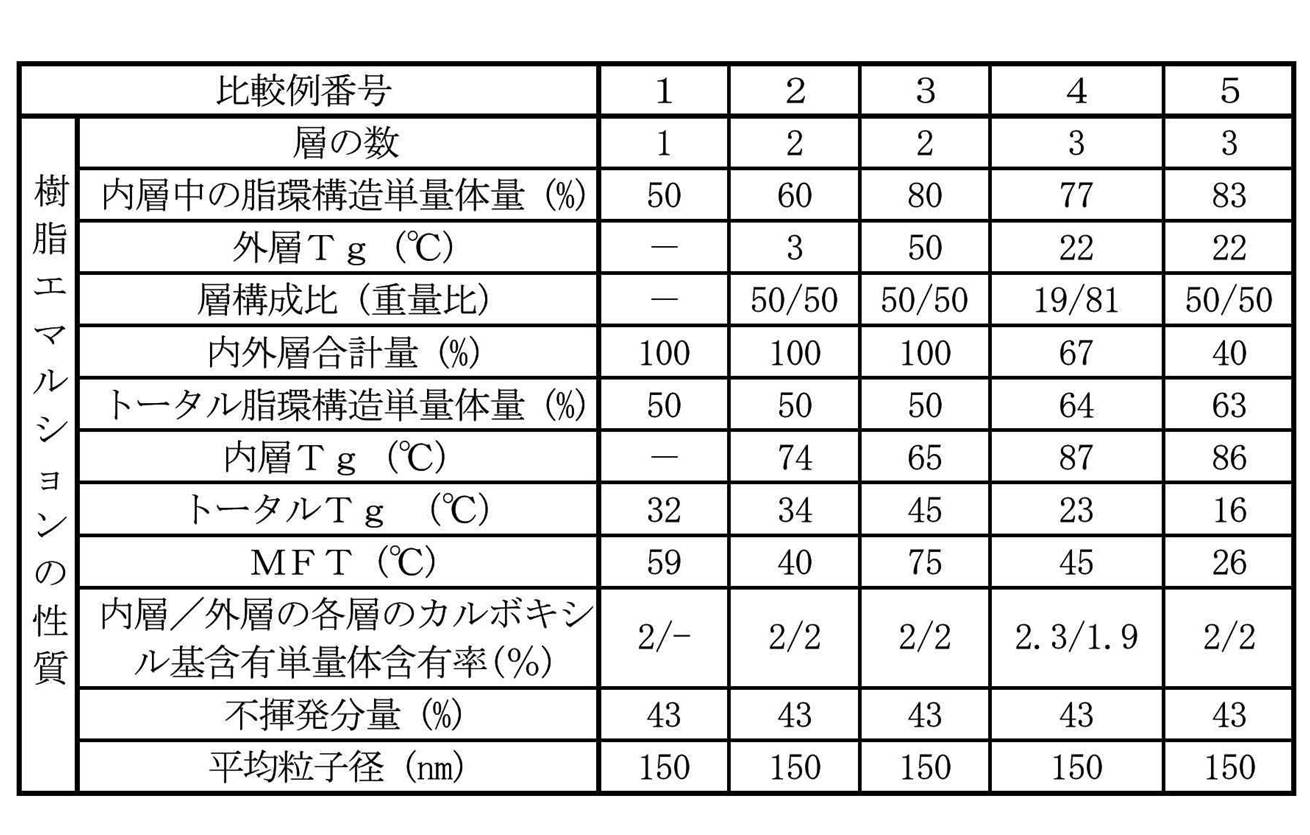
実験例
各実施例または各比較例で得られた水性樹脂組成物をホモディスパーで回転速度1500min-1にて分散させながら、成膜助剤として2,2,4-トリメチル-1,3-ペンタンジオールモノイソブチレート〔チッソ(株)製、品番:CS-12〕とブチルセロソルブとを等重量で混合することによって得られた混合溶液を添加し、水性樹脂組成物の最低造膜温度が5℃となるように調整した後、希釈水および抑泡剤〔サンノプコ(株)製、商品名:SNデフォーマー777〕を添加することによって不揮発成分の含有率が30%となるように調整した。
各実施例または各比較例で得られた水性樹脂組成物をホモディスパーで回転速度1500min-1にて分散させながら、成膜助剤として2,2,4-トリメチル-1,3-ペンタンジオールモノイソブチレート〔チッソ(株)製、品番:CS-12〕とブチルセロソルブとを等重量で混合することによって得られた混合溶液を添加し、水性樹脂組成物の最低造膜温度が5℃となるように調整した後、希釈水および抑泡剤〔サンノプコ(株)製、商品名:SNデフォーマー777〕を添加することによって不揮発成分の含有率が30%となるように調整した。
得られた混合物100部あたり8.8部の割合で、当該混合物に艶消し剤〔(株)日本触媒製、商品名:エポスターMA1010〕を添加し、さらにクレーブス単位粘度計(ブルックフィールド社製、品番:KU-1)を用いて25℃で測定したときの粘度が65±1KUとなるように増粘剤〔(株)日本触媒製、商品名:アクリセットWR-503A〕を前記混合物に添加した後、この混合物をホモディスパーで回転速度1500min-1にて30分間分散させることにより、クリヤー塗料を得た。得られたクリヤー塗料を室温中で1日間静置した後、以下の物性を調べた。その結果を表3に示す。なお、物性において「D」の評価が1つでもあるものは、不合格であると判定される。
(1)耐温水白化性
JIS K6717(2006年)に準じ、メチルメタクリレートを押出成形によって成形することによって得られた黒色アクリル板〔日本テストパネル(株)製、縦:75mm、横:150mm、厚さ:3mm〕に、前記で得られたクリヤー塗料を5milアプリケーターで塗布し、100℃の熱風乾燥機にて10分間乾燥させることによって試験板を作製した。
JIS K6717(2006年)に準じ、メチルメタクリレートを押出成形によって成形することによって得られた黒色アクリル板〔日本テストパネル(株)製、縦:75mm、横:150mm、厚さ:3mm〕に、前記で得られたクリヤー塗料を5milアプリケーターで塗布し、100℃の熱風乾燥機にて10分間乾燥させることによって試験板を作製した。
得られた試験板を23℃にて24時間養生した後、その試験板のL値(L0)を色差計〔日本電色工業(株)製、商品名:分光式色差計SE-2000〕で測定し、さらにこの試験板を60℃に温調された温水中に240時間浸漬させた後、温水から引き上げ、キムタオル〔日本製紙クレシア(株)製〕で水分を拭き取り、1分間以内に前記色差計でL値(L1)を測定した。
次に、L値の変化値を式:
ΔL=(L1)-(L0)
に基づいて求め、以下の評価基準に基づいて評価した。
〔評価基準〕
A:ΔLが2.0未満
B:ΔLが2.0以上4.0未満
C:ΔLが4.0以上6.0未満
D:ΔLが6.0以上
ΔL=(L1)-(L0)
に基づいて求め、以下の評価基準に基づいて評価した。
〔評価基準〕
A:ΔLが2.0未満
B:ΔLが2.0以上4.0未満
C:ΔLが4.0以上6.0未満
D:ΔLが6.0以上
(2)耐凍害性
JIS A5430(2004年)に準じ、スレート板〔日本テストパネル(株)製、縦:70mm、横:150mm、厚さ:6mm〕に、溶剤系シーラー〔エスケー化研(株)製、商品名:EXシーラー〕を乾燥重量が20g/m2となるようにエアスプレーにて塗装し、23℃にて24時間乾燥させた後、以下の組成からなるベースコート用塗料を5milアプリケーターで塗布し、100℃の熱風乾燥機で10分間乾燥させた。
JIS A5430(2004年)に準じ、スレート板〔日本テストパネル(株)製、縦:70mm、横:150mm、厚さ:6mm〕に、溶剤系シーラー〔エスケー化研(株)製、商品名:EXシーラー〕を乾燥重量が20g/m2となるようにエアスプレーにて塗装し、23℃にて24時間乾燥させた後、以下の組成からなるベースコート用塗料を5milアプリケーターで塗布し、100℃の熱風乾燥機で10分間乾燥させた。
〔ベースコート用塗料の組成〕
・アクリル樹脂エマルション〔(株)日本触媒製、商品名:アクリセットEX-41〕300部
・白色ペースト135部
なお、白色ペーストは、分散剤〔花王(株)製、商品名:デモールEP〕60部、分散剤〔第一工業製薬(株)製、商品名:ディスコートN-14〕50部、湿潤剤〔花王(株)製、商品名:エマルゲンLS-106〕10部、プロピレングリコール60部、脱イオン水210部、酸化チタン〔石原産業(株)製、品番:CR-95〕1000部、抑泡剤〔サンノプコ(株)製、商品名:ノプコ8034L〕10部およびガラスビーズ(直径:1mm)500部をホモディスパーで回転速度3000min-1にて60分間分散させることによって調製した。
・成膜助剤(ブチルセロソルブ15部、2,2,4-トリメチル-1,3-ペンタンジオールモノイソブチレート〔チッソ(株)製、品番:CS-12〕15部)30部
・黒色ペースト〔横浜化成(株)製、商品名:ユニラント88〕10部
・抑泡剤〔サンノプコ(株)製、商品名:ノプコ8034L〕1.5部
・アクリル樹脂エマルション〔(株)日本触媒製、商品名:アクリセットEX-41〕300部
・白色ペースト135部
なお、白色ペーストは、分散剤〔花王(株)製、商品名:デモールEP〕60部、分散剤〔第一工業製薬(株)製、商品名:ディスコートN-14〕50部、湿潤剤〔花王(株)製、商品名:エマルゲンLS-106〕10部、プロピレングリコール60部、脱イオン水210部、酸化チタン〔石原産業(株)製、品番:CR-95〕1000部、抑泡剤〔サンノプコ(株)製、商品名:ノプコ8034L〕10部およびガラスビーズ(直径:1mm)500部をホモディスパーで回転速度3000min-1にて60分間分散させることによって調製した。
・成膜助剤(ブチルセロソルブ15部、2,2,4-トリメチル-1,3-ペンタンジオールモノイソブチレート〔チッソ(株)製、品番:CS-12〕15部)30部
・黒色ペースト〔横浜化成(株)製、商品名:ユニラント88〕10部
・抑泡剤〔サンノプコ(株)製、商品名:ノプコ8034L〕1.5部
次に、前記で得られたクリヤー塗料を5milアプリケーターで、前記ベースコート用塗料が塗布されたスレート板に塗布し、100℃の熱風乾燥機で10分間乾燥させることにより、試験板を作製した。
得られた試験板を23℃の雰囲気中で24時間養生させた後、試験板の側面および背面を2液硬化型溶剤系樹脂でシールし、凍結融解試験機で耐凍害性試験を行なった。そのときの凍結融解条件は、気中凍結(-20℃で2時間)および水中融解(20℃で2時間)とし、これら気中凍結と水中融解の4時間を1サイクルとして、倍率が30倍のルーペを用いて目視にて観察し、試験板にクラックが入るまでのサイクルを測定し、以下の評価基準に基づいて耐凍害性を評価した。
〔評価基準〕
A:400サイクルでクラックなし
B:300サイクル以上400サイクル未満でクラックが発生
C:200サイクル以上300サイクル未満でクラックが発生
D:200サイクル未満でクラックが発生
〔評価基準〕
A:400サイクルでクラックなし
B:300サイクル以上400サイクル未満でクラックが発生
C:200サイクル以上300サイクル未満でクラックが発生
D:200サイクル未満でクラックが発生
(3)耐ブロッキング性
JIS R3202(1996年)に準じ、フロートガラス板〔日本テストパネル(株)製、縦70mm、横150mm、厚さ2mm〕に、前記で得られたクリヤー塗料を5milアプリケーターで塗布し、100℃の熱風乾燥機で10分間乾燥させることにより、試験板を作製した。
JIS R3202(1996年)に準じ、フロートガラス板〔日本テストパネル(株)製、縦70mm、横150mm、厚さ2mm〕に、前記で得られたクリヤー塗料を5milアプリケーターで塗布し、100℃の熱風乾燥機で10分間乾燥させることにより、試験板を作製した。
得られた試験板をただちに60℃の熱風乾燥機内に移動させ、1分間調温した後に、その試験板上にガーゼ〔萬星衛生材料(株)製、日本薬局方ガーゼタイプ1〕、フロートガラス板〔日本テストパネル(株)製、縦70mm、横150mm、厚さ2mm〕およびおもりの順で積載し、60℃の温度で2時間放置した。このとき、荷重は280g/cm2となるように調整した。
次に、試験板を室温まで冷却し後、その試験板上のガーゼをゆっくりと剥がして塗膜の状態を目視にて観察し、以下の評価基準に基づいて評価した。
〔評価基準〕
A:異常なし(ガーゼ痕なし)
B:わずかにガーゼ痕あり
C:浅いガーゼ痕あり
D:深いガーゼ痕あり
〔評価基準〕
A:異常なし(ガーゼ痕なし)
B:わずかにガーゼ痕あり
C:浅いガーゼ痕あり
D:深いガーゼ痕あり
(4)耐候性
前記「(2)耐凍害性」と同様にして試験板を作製した後、得られた試験板を23℃の雰囲気中で24時間養生させた。養生後、試験板の側面および背面をアルミニウムテープでシールし、その試験板のクリヤー塗料が塗布された面の色差(L0、a0、b0)を色差計〔日本電色工業(株)製、商品名:分光式色差計SE-2000〕で測定し、さらに以下の耐候性試験の試験条件で1000時間耐候性試験を行ない、前記色差計でその試験板のクリヤー塗料が塗布された面の色差(L1、a1、b1)を測定し、E値の変化値(ΔE)を式:
ΔE=[(L1-L0)2+(a1-a0)2+(b1-b2)2]1/2
に基づいて求め、以下の評価基準に基づいて評価した。
前記「(2)耐凍害性」と同様にして試験板を作製した後、得られた試験板を23℃の雰囲気中で24時間養生させた。養生後、試験板の側面および背面をアルミニウムテープでシールし、その試験板のクリヤー塗料が塗布された面の色差(L0、a0、b0)を色差計〔日本電色工業(株)製、商品名:分光式色差計SE-2000〕で測定し、さらに以下の耐候性試験の試験条件で1000時間耐候性試験を行ない、前記色差計でその試験板のクリヤー塗料が塗布された面の色差(L1、a1、b1)を測定し、E値の変化値(ΔE)を式:
ΔE=[(L1-L0)2+(a1-a0)2+(b1-b2)2]1/2
に基づいて求め、以下の評価基準に基づいて評価した。
〔耐候性試験の試験条件〕
試験機:メタルウェザー〔ダイプラ・ウィンテス(株)製、品番:KU-R4〕
照射:気温65℃で相対湿度50%の雰囲気で4時間照射(照射強度:80mW/cm2)
湿潤:気温35℃で相対湿度98%の雰囲気で4時間
シャワー:湿潤前後に各30秒間
試験機:メタルウェザー〔ダイプラ・ウィンテス(株)製、品番:KU-R4〕
照射:気温65℃で相対湿度50%の雰囲気で4時間照射(照射強度:80mW/cm2)
湿潤:気温35℃で相対湿度98%の雰囲気で4時間
シャワー:湿潤前後に各30秒間
〔評価基準〕
A:ΔEが2.0未満
B:ΔEが2.0以上3.0未満
C:ΔEが3.0以上4.0未満
D:ΔEが4.0以上
A:ΔEが2.0未満
B:ΔEが2.0以上3.0未満
C:ΔEが3.0以上4.0未満
D:ΔEが4.0以上
(5)環境に対する負荷
前記実験例で用いられた成膜助剤の水性樹脂組成物100部あたりの量(部)に基づいて、環境に対する負荷を以下の評価基準にしたがって評価した。
(評価基準)
A:成膜助剤の量が3部未満
B:成膜助剤の量が3部以上5部未満
C:成膜助剤の量が5部以上8部未満
D:成膜助剤の量が8部以上
前記実験例で用いられた成膜助剤の水性樹脂組成物100部あたりの量(部)に基づいて、環境に対する負荷を以下の評価基準にしたがって評価した。
(評価基準)
A:成膜助剤の量が3部未満
B:成膜助剤の量が3部以上5部未満
C:成膜助剤の量が5部以上8部未満
D:成膜助剤の量が8部以上

表3に示された結果から、各実施例で得られた水性樹脂組成物は、いずれも、耐温水白化性、耐凍害性、耐ブロッキング性および耐候性に優れた塗膜を形成するものであることがわかる。また、各実施例で得られた水性樹脂組成物は、いずれも、造膜助剤の使用量を低減させることができるので、環境面にも優れていることがわかる。
本発明の水性樹脂組成物は、例えば、建築物の外装や窯業系建材などの表面に塗装されるトップコートと呼ばれている上塗り材(水性塗料)に使用することが期待されるものである。
Claims (10)
- 内層および外層を有するエマルション粒子を含有する水性樹脂組成物であって、前記内層が、脂環構造を有する単量体75~100重量%および当該脂環構造を有する単量体と共重合可能な単量体0~25重量%を含有する単量体成分を乳化重合させてなる重合体(I)で形成され、前記外層が、ガラス転移温度が40℃以下である重合体(II)で形成され、重合体(I)と重合体(II)との重量比〔重合体(I)/重合体(II)〕が25/75~75/25であり、前記エマルション粒子における重合体(I)と重合体(II)との合計含有量が50~100重量%である水性樹脂組成物。
- エマルション粒子を構成している重合体に原料として使用されている全単量体成分における脂環構造を有する単量体の含有量が30~100重量%であり、当該脂環構造を有する単量体と共重合可能な単量体の含有量が0~70重量%である請求項1に記載の水性樹脂組成物。
- 脂環構造を有する単量体と共重合可能な単量体が、芳香族系単量体およびエチレン性不飽和単量体からなる群より選ばれた少なくとも1種の単量体である請求項1または2に記載の水性樹脂組成物。
- エチレン性不飽和単量体が、アルキル(メタ)アクリレート、水酸基含有(メタ)アクリレート、カルボキシル基含有単量体、オキソ基含有単量体、フッ素原子含有単量体、窒素原子含有単量体、エポキシ基含有単量体、アルコキシアルキル(メタ)アクリレート、シラン基含有単量体、カルボニル基含有単量体およびアジリジニル基含有単量体からなる群より選ばれた少なくとも1種の単量体である請求項1~3のいずれかに記載の水性樹脂組成物。
- 重合体(I)のガラス転移温度が75~200℃である請求項1~4のいずれかに記載の水性樹脂組成物。
- エマルション粒子のガラス転移温度が-10~60℃である請求項1~5のいずれかに記載の水性樹脂組成物。
- 70℃以下の最低造膜温度を有する請求項1~6のいずれかに記載の水性樹脂組成物。
- 重合体(II)に用いられる単量体成分におけるカルボキシル基含有単量体の含有率が、重合体(I)に用いられる単量体成分におけるカルボキシル基含有単量体の含有率よりも高い請求項1~7のいずれかに記載の水性樹脂組成物。
- 請求項1~8のいずれかに記載の水性樹脂組成物を含有してなる水性塗料。
- 内層および外層を有するエマルション粒子を含有する水性樹脂組成物の製造方法であって、脂環構造を有する単量体75~100重量%および当該脂環構造を有する単量体と共重合可能な単量体0~25重量%を含有する単量体成分を乳化重合させ、得られた重合体(I)からなる内層を形成させた後、ガラス転移温度が40℃以下である重合体(II)からなる外層を形成させる際に、重合体(I)と重合体(II)との重量比〔重合体(I)/重合体(II)〕を25/75~75/25に調整し、前記エマルション粒子における重合体(I)および重合体(II)の含有量が50~100重量%となるように調整する水性樹脂組成物の製造方法。
Priority Applications (1)
| Application Number | Priority Date | Filing Date | Title |
|---|---|---|---|
| PCT/JP2011/074994 WO2013061471A1 (ja) | 2011-10-28 | 2011-10-28 | 水性樹脂組成物およびその製造方法 |
Applications Claiming Priority (1)
| Application Number | Priority Date | Filing Date | Title |
|---|---|---|---|
| PCT/JP2011/074994 WO2013061471A1 (ja) | 2011-10-28 | 2011-10-28 | 水性樹脂組成物およびその製造方法 |
Publications (1)
| Publication Number | Publication Date |
|---|---|
| WO2013061471A1 true WO2013061471A1 (ja) | 2013-05-02 |
Family
ID=48167334
Family Applications (1)
| Application Number | Title | Priority Date | Filing Date |
|---|---|---|---|
| PCT/JP2011/074994 Ceased WO2013061471A1 (ja) | 2011-10-28 | 2011-10-28 | 水性樹脂組成物およびその製造方法 |
Country Status (1)
| Country | Link |
|---|---|
| WO (1) | WO2013061471A1 (ja) |
Citations (5)
| Publication number | Priority date | Publication date | Assignee | Title |
|---|---|---|---|---|
| JP2002012816A (ja) * | 2000-06-30 | 2002-01-15 | Nippon Paint Co Ltd | 水性塗料組成物 |
| JP2002249701A (ja) * | 2001-02-23 | 2002-09-06 | Toray Ind Inc | エマルジョン塗料組成物 |
| JP2004277491A (ja) * | 2003-03-13 | 2004-10-07 | Mitsubishi Rayon Co Ltd | 水性低汚染被覆材 |
| JP2010126666A (ja) * | 2008-11-28 | 2010-06-10 | Nippon Shokubai Co Ltd | 防錆塗料用エマルション |
| JP2011168770A (ja) * | 2010-01-20 | 2011-09-01 | Nippon Shokubai Co Ltd | 建築塗料用水性樹脂組成物 |
-
2011
- 2011-10-28 WO PCT/JP2011/074994 patent/WO2013061471A1/ja not_active Ceased
Patent Citations (5)
| Publication number | Priority date | Publication date | Assignee | Title |
|---|---|---|---|---|
| JP2002012816A (ja) * | 2000-06-30 | 2002-01-15 | Nippon Paint Co Ltd | 水性塗料組成物 |
| JP2002249701A (ja) * | 2001-02-23 | 2002-09-06 | Toray Ind Inc | エマルジョン塗料組成物 |
| JP2004277491A (ja) * | 2003-03-13 | 2004-10-07 | Mitsubishi Rayon Co Ltd | 水性低汚染被覆材 |
| JP2010126666A (ja) * | 2008-11-28 | 2010-06-10 | Nippon Shokubai Co Ltd | 防錆塗料用エマルション |
| JP2011168770A (ja) * | 2010-01-20 | 2011-09-01 | Nippon Shokubai Co Ltd | 建築塗料用水性樹脂組成物 |
Similar Documents
| Publication | Publication Date | Title |
|---|---|---|
| JP5627928B2 (ja) | 水性樹脂組成物およびその製造方法 | |
| JP5854998B2 (ja) | 親水化処理剤 | |
| JP6343417B2 (ja) | 塗料用樹脂組成物 | |
| JP6144461B2 (ja) | 水性樹脂組成物およびその製造方法 | |
| JP6346769B2 (ja) | 積層塗膜 | |
| JP5919131B2 (ja) | 塗料用樹脂組成物 | |
| JP6674187B2 (ja) | 樹脂エマルション | |
| JP5760014B2 (ja) | 積層塗膜 | |
| JP6014097B2 (ja) | 水性樹脂組成物およびその製造方法 | |
| JP5890881B2 (ja) | 水性樹脂組成物およびその製造方法 | |
| JP6712891B2 (ja) | 上塗り塗料用樹脂エマルション | |
| JP6853726B2 (ja) | 塗料用樹脂組成物 | |
| JP7428511B2 (ja) | 樹脂エマルション | |
| JP6463452B2 (ja) | 塗料用樹脂組成物 | |
| JP6259145B2 (ja) | 塗料用樹脂組成物 | |
| JP6426960B2 (ja) | 補修用塗料組成物 | |
| WO2013061471A1 (ja) | 水性樹脂組成物およびその製造方法 | |
| JP7051783B2 (ja) | 水性樹脂分散体の製造方法 | |
| JP6566690B2 (ja) | 水性樹脂分散体の製造方法 | |
| JP7033568B2 (ja) | 塗料用樹脂組成物 | |
| JP6430765B2 (ja) | 積層塗膜 | |
| JP2014034617A (ja) | 塗料用樹脂組成物 | |
| JP5933340B2 (ja) | 耐水透湿性樹脂フィルム | |
| JP6624863B2 (ja) | 塗料用樹脂エマルション | |
| JP6693705B2 (ja) | 水性樹脂分散体の製造方法 |
Legal Events
| Date | Code | Title | Description |
|---|---|---|---|
| 121 | Ep: the epo has been informed by wipo that ep was designated in this application |
Ref document number: 11874608 Country of ref document: EP Kind code of ref document: A1 |
|
| NENP | Non-entry into the national phase |
Ref country code: DE |
|
| 122 | Ep: pct application non-entry in european phase |
Ref document number: 11874608 Country of ref document: EP Kind code of ref document: A1 |
|
| NENP | Non-entry into the national phase |
Ref country code: JP |