WO2013005693A1 - 液晶シール剤及びそれを用いた液晶表示セル - Google Patents
液晶シール剤及びそれを用いた液晶表示セル Download PDFInfo
- Publication number
- WO2013005693A1 WO2013005693A1 PCT/JP2012/066793 JP2012066793W WO2013005693A1 WO 2013005693 A1 WO2013005693 A1 WO 2013005693A1 JP 2012066793 W JP2012066793 W JP 2012066793W WO 2013005693 A1 WO2013005693 A1 WO 2013005693A1
- Authority
- WO
- WIPO (PCT)
- Prior art keywords
- liquid crystal
- component
- epoxy resin
- sealant
- dropping method
- Prior art date
- Legal status (The legal status is an assumption and is not a legal conclusion. Google has not performed a legal analysis and makes no representation as to the accuracy of the status listed.)
- Ceased
Links
Classifications
-
- C—CHEMISTRY; METALLURGY
- C09—DYES; PAINTS; POLISHES; NATURAL RESINS; ADHESIVES; COMPOSITIONS NOT OTHERWISE PROVIDED FOR; APPLICATIONS OF MATERIALS NOT OTHERWISE PROVIDED FOR
- C09K—MATERIALS FOR MISCELLANEOUS APPLICATIONS, NOT PROVIDED FOR ELSEWHERE
- C09K3/00—Materials not provided for elsewhere
- C09K3/10—Materials in mouldable or extrudable form for sealing or packing joints or covers
-
- G—PHYSICS
- G02—OPTICS
- G02F—OPTICAL DEVICES OR ARRANGEMENTS FOR THE CONTROL OF LIGHT BY MODIFICATION OF THE OPTICAL PROPERTIES OF THE MEDIA OF THE ELEMENTS INVOLVED THEREIN; NON-LINEAR OPTICS; FREQUENCY-CHANGING OF LIGHT; OPTICAL LOGIC ELEMENTS; OPTICAL ANALOGUE/DIGITAL CONVERTERS
- G02F1/00—Devices or arrangements for the control of the intensity, colour, phase, polarisation or direction of light arriving from an independent light source, e.g. switching, gating or modulating; Non-linear optics
- G02F1/01—Devices or arrangements for the control of the intensity, colour, phase, polarisation or direction of light arriving from an independent light source, e.g. switching, gating or modulating; Non-linear optics for the control of the intensity, phase, polarisation or colour
- G02F1/13—Devices or arrangements for the control of the intensity, colour, phase, polarisation or direction of light arriving from an independent light source, e.g. switching, gating or modulating; Non-linear optics for the control of the intensity, phase, polarisation or colour based on liquid crystals, e.g. single liquid crystal display cells
- G02F1/133—Constructional arrangements; Operation of liquid crystal cells; Circuit arrangements
- G02F1/1333—Constructional arrangements; Manufacturing methods
- G02F1/1339—Gaskets; Spacers; Sealing of cells
-
- C—CHEMISTRY; METALLURGY
- C09—DYES; PAINTS; POLISHES; NATURAL RESINS; ADHESIVES; COMPOSITIONS NOT OTHERWISE PROVIDED FOR; APPLICATIONS OF MATERIALS NOT OTHERWISE PROVIDED FOR
- C09K—MATERIALS FOR MISCELLANEOUS APPLICATIONS, NOT PROVIDED FOR ELSEWHERE
- C09K2200/00—Chemical nature of materials in mouldable or extrudable form for sealing or packing joints or covers
- C09K2200/06—Macromolecular organic compounds, e.g. prepolymers
- C09K2200/0645—Macromolecular organic compounds, e.g. prepolymers obtained otherwise than by reactions involving carbon-to-carbon unsaturated bonds
- C09K2200/0647—Polyepoxides
Definitions
- the present invention relates to a liquid crystal sealant for a liquid crystal dropping method that has good curability by heat. More specifically, a liquid crystal sealant for liquid crystal dropping method having good curability by heat, excellent storage stability, and excellent moisture resistance of the cured product, and liquid crystal sealed with the cured product Regarding display cells.
- Patent Documents 1 and 2 a so-called liquid crystal dropping method with higher mass productivity has been proposed as a liquid crystal display cell manufacturing method. Specifically, it is a method of manufacturing a liquid crystal display cell in which liquid crystal is sealed by dropping a liquid crystal inside a weir of a liquid crystal sealant formed on one substrate and then bonding the other substrate.
- the liquid crystal sealant in an uncured state comes into contact with the liquid crystal. At that time, the components of the liquid crystal sealant are dissolved (eluting) in the liquid crystal to reduce the resistance value of the liquid crystal, There is a problem that a display defect occurs.
- a photothermal combination type liquid crystal sealant for a liquid crystal dropping method is currently used and put into practical use (Patent Documents 3 and 4).
- the liquid crystal dropping method using the liquid crystal sealant is characterized in that the liquid crystal sealant sandwiched between the substrates is irradiated with light to be primarily cured and then heated to be secondarily cured.
- the uncured liquid crystal sealant can be quickly cured by light, and dissolution (elution) of the liquid crystal sealant component into the liquid crystal can be suppressed.
- the problem of insufficient adhesive strength due to curing shrinkage or the like at the time of photocuring occurs only by photocuring, but the photothermal combination type has an advantage that such problems can be solved by secondary curing by heating.
- Patent Documents 5 and 6 disclose a method using a thermal radical initiator.
- Patent Documents 7 to 9 disclose methods using polyvalent carboxylic acids as curing accelerators.
- the present invention relates to a liquid crystal sealant for a liquid crystal dropping method that is cured only by heating or by combined use of light and heat, and since the reaction by heat is fast, it is extremely low in contamination with liquid crystal throughout the process and also has good storage stability.
- the present invention proposes a liquid crystal sealing agent for a liquid crystal dropping method which is excellent and has excellent cured properties such as moisture resistance reliability.
- the present inventors have found that a liquid crystal sealing agent for a liquid crystal dropping method containing a specific compound having a carboxy group has excellent thermal reactivity, and as a result, it is possible to suppress liquid crystal contamination. Furthermore, the present inventors have found that the storage stability and the moisture resistance reliability are excellent, and have completed the present invention. That is, the present invention relates to the following 1) to 10).
- curing containing 1 type (s) or 2 or more types selected from an epoxy resin, a (meth) acrylated epoxy resin, and a partial (meth) acrylated epoxy resin In order to avoid complications described as “reactive resin”, it may be described as “component (a) curable resin” or simply “component (a)”.
- component (a) curable resin In order to avoid complications described as “reactive resin”, it may be described as “component (a) curable resin” or simply “component (a)”.
- component (meth) acryl means one or both of “acryl” and “methacryl”.
- (meth) acryloyl” means one or both of “acryloyl” and “methacryloyl”.
- the liquid crystal sealant for liquid crystal dropping method of the present invention has a high reaction speed at the time of thermosetting, it has sufficient curability even under wiring where light is difficult to reach in the photothermal combined liquid crystal dropping method.
- the degree of freedom in wiring design can be ensured, and the manufacture of a highly reliable liquid crystal display panel can be facilitated. Furthermore, it can be applied to a liquid crystal dropping method in which a liquid crystal sealant is cured only by heat. .
- the liquid crystal sealant of the present invention contains component (c) a compound having a carboxy group in the molecule and an acid value of 50 to 250 mgKOH / g, thereby achieving both thermal reactivity and storage stability. It is possible.
- the carboxy group of this compound functions as a thermosetting accelerator. Therefore, when the oxidation is less than 50 mg, sufficient thermal reactivity cannot be obtained. Moreover, when oxidation is larger than 250 mg, the polarity of a molecule
- the acid value is more preferably 50 to 180 mgKOH / g, still more preferably 50 to 100 mgKOH / g, and particularly preferably 60 to 100 mgKOH / g.
- the acid value is defined as the number of mg of potassium hydroxide required to neutralize the carboxylic acid present in 1 g of component (c).
- the component (c) preferably has a mass average molecular weight of 3000 to 10000 g / mol. If the mass average molecular weight is too small, it itself dissolves in the liquid crystal and causes display defects. On the other hand, if the mass average molecular weight is too large, the compatibility with other components is deteriorated, and the thermal reaction promoting effect is remarkably reduced.
- the mass average molecular weight is more preferably 4000 to 8000 g / mol.
- the content of component (c) is preferably 0.1 to 20 parts by mass, particularly 1 to 10 parts by mass, when the total amount of component (a) curable resin is 100 parts by mass. preferable. If the content is too small, sufficient thermosetting property cannot be obtained. If the content is too large, the liquid crystal sealant has a high viscosity, which is unsuitable because it imposes restrictions on the blending of other components.
- the component (c) include compounds obtained by reacting an acid anhydride or a polyvalent carboxylic acid (including an anhydride) with an epoxy (meth) acrylate having a hydroxyl group, and one or more types of polyvalent carboxylic acid Examples thereof include compounds obtained by reacting a terminal alcoholic hydroxyl group of a polyester resin obtained by a dehydration condensation reaction with one or more polyhydric alcohols and a polyvalent carboxylic acid (including an anhydride).
- a compound obtained by reacting an epoxy (meth) acrylate having a hydroxyl group with an acid anhydride or a polyvalent carboxylic acid (including an anhydride) can be obtained, for example, by the method described in JP-A-5-32746. It is.
- a compound obtained by reacting bisphenol A type epoxy (meth) acrylate with an acid anhydride is preferable.
- the terminal alcoholic hydroxyl group of the polyester resin obtained by subjecting one or more types of polycarboxylic acid and one or more types of polyhydric alcohol to dehydration condensation reaction is allowed to react with polyvalent carboxylic acid (including anhydride).
- the obtained compound can be easily obtained from the market under the trade names (Iupika Coat GV230 and Iupika Coat GV250), for example.
- Iupika Coat GV230 (acid value 53 mgKOH / g, mass average molecular weight 7900 g / mol) and Iupika Coat GV250 (acid value 74 mgKOH / g, mass average molecular weight 5200 g / mol) are preferably used, and Iupika Coat GV250 is particularly preferably used.
- thermosetting agent that is the component (b) used in the liquid crystal sealing agent of the present invention is not particularly limited, and examples thereof include polyvalent amines, polyhydric phenols, hydrazide compounds, and the like. Compounds are particularly preferably used.
- the aromatic hydrazide terephthalic acid dihydrazide, isophthalic acid dihydrazide, 2,6-naphthoic acid dihydrazide, 2,6-pyridinedihydrazide, 1,2,4-benzenetrihydrazide, 1,4,5,8-naphthoic acid examples include tetrahydrazide and pyromellitic acid tetrahydrazide.
- aliphatic hydrazide compound examples include form hydrazide, acetohydrazide, propionic acid hydrazide, oxalic acid dihydrazide, malonic acid dihydrazide, succinic acid dihydrazide, glutaric acid dihydrazide, adipic acid dihydrazide, pimelic acid dihydrazide, 1,4- Cyclohexane dihydrazide, tartaric acid dihydrazide, malic acid dihydrazide, iminodiacetic acid dihydrazide, N, N'-hexamethylenebissemicarbazide, citric acid trihydrazide, nitriloacetic acid trihydrazide, cyclohexanetricarboxylic acid trihydrazide, 1,3-bis (hydrazinocarbono Hydantoin skeleton such as ethyl) -5-isopropylhydantoin, preferably valine hydanto
- Examples of the compound represented by the above (1) include tris (1-hydrazinocarbonylmethyl) isocyanurate, tris (2-hydrazinocarbonylethyl) isocyanurate, tris (2-hydrazinocarbonylethyl) isocyanurate, tris. (3-hydrazinocarbonylpropyl) isocyanurate, bis (2-hydrazinocarbonylethyl) isocyanurate, and the like can be mentioned, but the structure of the formula (1) is not limited thereto.
- isophthalic acid dihydrazide isophthalic acid dihydrazide, malonic acid dihydrazide, adipic acid dihydrazide, tris (1-hydrazinocarbonylmethyl) isocyanurate, tris (2-hydrazinocarbonylethyl) isocyanurate, tris (2-hydrazinocarbonylethyl) isocyanurate and tris (3-hydrazinocarbonylpropyl) isocyanurate, particularly preferably tris (2-hydrazinocarbonylethyl) isocyanurate.
- the content of component (b) is preferably 0.1 to 20 parts by mass, more preferably 1 to 10 parts by mass, when the total amount of component (a) curable resin is 100 parts by mass. Two or more kinds may be mixed and used.
- the liquid crystal sealing agent of the present invention comprises a curable resin composed of one or more selected from an epoxy resin, a (meth) acrylated epoxy resin, and a partial (meth) acrylated epoxy resin. contains. Examples thereof include an epoxy resin, a mixture of an epoxy resin and a (meth) acrylated epoxy resin, a (meth) acrylated epoxy resin, and a partial (meth) acrylated epoxy resin.
- the component (a) used in the present invention preferably has low contamination and solubility for liquid crystals.
- suitable epoxy resins include bisphenol A type epoxy resin, bisphenol F type epoxy resin, bisphenol S type epoxy resin, phenol novolac type epoxy resin, cresol novolac type epoxy resin, bisphenol A novolak type epoxy resin, bisphenol F novolak type.
- diglycidyl etherified products of bifunctional phenols diglycidyl etherified products of bifunctional alcohols, their halides, hydrogenated products, etc.
- the (meth) acryloylated epoxy resin and the partial (meth) acryloylated epoxy resin can be obtained by a known reaction between an epoxy resin and (meth) acrylic acid.
- epoxy resin, (meth) acrylic acid having a predetermined equivalent ratio catalyst (for example, benzyldimethylamine, triethylamine, benzyltrimethylammonium chloride, triphenylphosphine, triphenylstibine, etc.), and a polymerization inhibitor (for example, methoquinone)
- catalyst for example, benzyldimethylamine, triethylamine, benzyltrimethylammonium chloride, triphenylphosphine, triphenylstibine, etc.
- a polymerization inhibitor for example, methoquinone
- hydroquinone, methylhydroquinone, phenothiazine, dibutylhydroxytoluene, etc. and an esterification reaction is carried out at 80 to 110
- An epoxy resin more than bifunctional is preferable, for example, a bisphenol A type epoxy resin, a bisphenol F type epoxy resin, a bisphenol S type epoxy resin, a phenol novolac type epoxy resin , Cresol novolac type epoxy resin, bisphenol A novolac type epoxy resin, bisphenol F novolac type epoxy resin, alicyclic epoxy resin, aliphatic chain epoxy resin, glycidyl ester type epoxy resin, glycidylamine type epoxy resin, hydantoin type epoxy resin , Isocyanurate type epoxy resins, phenol novolac type epoxy resins having a triphenolmethane skeleton, diglycidyl ethers of difunctional phenols, difunctional alcohols Diglycidyl ether compound, and their halides, hydrogenated product and the like.
- bisphenol type epoxy resin and novolac type epoxy resin are more preferable from the viewpoint of liquid crystal contamination.
- the ratio of the epoxy group to the (meth) acryloyl group is not limited, and is appropriately selected from the viewpoint of process compatibility and liquid crystal contamination.
- the content of the component (a) is appropriately determined in consideration of workability and physical properties of the obtained liquid crystal sealant, and is usually about 25 to 80% by mass, preferably 25 to 75% by mass in the liquid crystal sealant. It is.
- a silane coupling agent can be used to improve adhesive strength and moisture resistance reliability.
- silane coupling agents include 3-glycidoxypropyltrimethoxysilane, 3-glycidoxypropylmethyldimethoxysilane, 3-glycidoxypropylmethyldimethoxysilane, 2- (3,4-epoxycyclohexyl) ethyltrimethoxy Silane, N-phenyl- ⁇ -aminopropyltrimethoxysilane, N- (2-aminoethyl) 3-aminopropylmethyldimethoxysilane, N- (2-aminoethyl) 3-aminopropylmethyltrimethoxysilane, 3-amino Propyltriethoxysilane, 3-mercaptopropyltrimethoxysilane, vinyltrimethoxysilane, N- (2- (vinylbenzylamino) ethyl)
- an inorganic filler can be used to improve the adhesive strength and improve the moisture resistance reliability.
- this (e) inorganic filler fused silica, crystalline silica, silicon carbide, silicon nitride, boron nitride, calcium carbonate, magnesium carbonate, barium sulfate, calcium sulfate, mica, talc, clay, alumina, magnesium oxide, zirconium oxide, Aluminum hydroxide, magnesium hydroxide, calcium silicate, aluminum silicate, lithium aluminum silicate, zirconium silicate, barium titanate, glass fiber, carbon fiber, molybdenum disulfide, asbestos, etc., preferably fused silica, crystalline silica, nitriding Silicon, boron nitride, calcium carbonate, barium sulfate, calcium sulfate, mica, talc, clay, alumina, aluminum hydroxide, calcium silicate, aluminum silicate, more preferably
- the particle size can be measured with a laser diffraction / scattering particle size distribution analyzer (dry type) (manufactured by Seishin Enterprise Co., Ltd .; LMS-30).
- the content of the inorganic filler (e) that can be used in the liquid crystal sealant of the present invention in the liquid crystal sealant is usually 10 to 60 parts by mass when the total amount of the liquid crystal sealant of the present invention is 100 parts by mass, The amount is preferably 20 to 50 parts by mass.
- the amount is preferably 20 to 50 parts by mass.
- the liquid crystal sealant of the present invention may contain a component (f) a photopolymerization initiator in order to obtain a photothermal combined curing liquid crystal sealant.
- a photopolymerization initiator is not particularly limited as long as it is a compound that generates radicals by UV or visible light irradiation and initiates a chain polymerization reaction.
- benzyldimethyl ketal 1-hydroxycyclohexyl phenyl ketone, diethylthioxanthone, benzophenone 2-ethylanthraquinone, 2-hydroxy-2-methylpropiophenone, 2-methyl- [4- (methylthio) phenyl] -2-morpholino-1-propane, 2,4,6-trimethylbenzoyldiphenylphosphine oxide Etc.
- 2-methacryloyloxyethyl isocyanate and 1- [4- (2-hydroxyethoxy) -phenyl]- The reaction product with 2-hydroxy-2methyl-1-propan-1-one is preferably used.
- This compound can be obtained by the method described in International Publication No. 2006/027982.
- the content of the component (f) photopolymerization initiator that can be used in the liquid crystal sealant of the present invention in the liquid crystal sealant is usually 0.1 to 5 when the total amount of the liquid crystal sealant of the present invention is 100 parts by mass. Parts by mass, preferably 0.2 to 3 parts by mass.
- a monomer or oligomer of (meth) acrylic acid ester may be used as necessary.
- Such monomers and oligomers include, for example, a reaction product of dipentaerythritol and (meth) acrylic acid, a reaction product of dipentaerythritol / caprolactone and (meth) acrylic acid, etc., but has a contamination property to liquid crystals. If it is low, it will not be restricted in particular.
- the liquid crystal sealant of the present invention may further contain organic fillers and additives such as pigments, leveling agents, antifoaming agents, and solvents as necessary.
- An example of a method for obtaining the liquid crystal sealant of the present invention is the following method. First, the component (a) is dissolved in an organic solvent, and then the component (c) is added and mixed by heating to dissolve the component (c). Thereafter, the organic solvent is removed by heating or the like, and if necessary, the component (f) is dissolved and mixed under heating. (B) component is added after cooling to room temperature, (d) component, (e) component, and an organic filler, an antifoamer, a leveling agent, a solvent, etc. are added as needed, and a well-known mixing apparatus, for example, 3
- the liquid crystal sealing agent of the present invention can be produced by mixing uniformly with a roll, sand mill, ball mill or the like and filtering with a metal mesh.
- the liquid crystal display cell of the present invention is a cell in which a pair of substrates having predetermined electrodes formed on a substrate are arranged opposite to each other at a predetermined interval, the periphery is sealed with the liquid crystal sealant of the present invention, and the liquid crystal is sealed in the gap. is there.
- the kind of liquid crystal to be sealed is not particularly limited.
- the substrate is composed of a combination of substrates made of at least one of glass, quartz, plastic, silicon, etc. and having light transmission properties.
- a spacer spacer (gap control material) such as glass fiber
- the liquid crystal sealant is applied to one of the pair of substrates using a dispenser or a screen printing device.
- the liquid crystal display cell of the present invention can be obtained by curing at 90 to 130 ° C. for 1 to 2 hours.
- the liquid crystal sealant part is irradiated with ultraviolet rays by an ultraviolet irradiator and photocured.
- UV irradiation dose is preferably 500 ⁇ 6000mJ / cm 2, more preferably 1000 ⁇ 4000mJ / cm 2.
- the liquid crystal display cell of the present invention can be obtained by curing at 90 to 130 ° C. for 1 to 2 hours.
- the liquid crystal display cell of the present invention thus obtained is free from display defects due to liquid crystal contamination and has excellent adhesion and moisture resistance reliability.
- the spacer include glass fiber, silica beads, and polymer beads.
- the diameter varies depending on the purpose, but is usually 2 to 8 ⁇ m, preferably 4 to 7 ⁇ m.
- the amount used is usually about 0.1 to 4 parts by weight, preferably 0.5 to 2 parts by weight, more preferably about 0.9 to 1.5 parts by weight with respect to 100 parts by weight of the liquid crystal sealant of the present invention. is there.
- the liquid crystal sealant of the present invention has a very good thermosetting property and quickly cures in the heating step in the liquid crystal dropping method. Accordingly, the elution of the constituent components into the liquid crystal is extremely small, and display defects of the liquid crystal display cell can be reduced. Moreover, since it is excellent also in storage stability, it is suitable for manufacture of a liquid crystal display cell. Furthermore, since the cured product is excellent in various cured product characteristics such as adhesive strength, heat resistance, and moisture resistance, it is possible to produce a liquid crystal display cell with excellent reliability by using the liquid crystal sealant of the present invention. is there. In addition, the liquid crystal display cell prepared using the liquid crystal sealant of the present invention satisfies the characteristics required for a liquid crystal display cell having a high voltage holding ratio and a low ion density.
- Synthesis Example 1-1 The reaction solution obtained in Synthesis Example 1 was washed with water, and toluene was distilled off to obtain 395 g of the desired bisphenol A type epoxy acrylate (KAYARAD RTM R-93100).
- Example 3 Each resin component (component (a)) was mixed and stirred at the ratio shown in Table 1 below, and then component (c) was added and dissolved by heating at 90 ° C.
- the radical polymerization initiator (component (f)) was heated and dissolved therein, and then cooled to room temperature.
- a silane coupling agent (component (d)), an inorganic filler (component (e)), a thermosetting agent (component) (B)) was added and stirred, and then dispersed by a three-roll mill and filtered through a metal mesh (635 mesh) to prepare a liquid crystal sealant for liquid crystal dropping method of Example 3.
- thermosetting test After applying the liquid crystal sealing agent for each liquid crystal dropping method between polyethylene terephthalate films, it was stretched to a thickness of 100 ⁇ m using a laminator and irradiated with 3000 mJ / cm 2 of ultraviolet rays (sample 1). The resulting film was heat cured at 120 ° C. for 1 hour (Sample 2). The enthalpies of Sample 1 and Sample 2 were measured using a differential scanning calorimeter (Seiko Instruments Inc., measurement conditions: 30 ° C. to 250 ° C., heating rate 10 ° C.), and the thermal reaction rate was calculated using the following formula. did.
- Thermal reaction rate [1 ⁇ (enthalpy of sample 1 ⁇ enthalpy of sample 2) / enthalpy of sample 1] ⁇ 100 The result was determined as follows. ⁇ : Thermal reaction rate of 90% or more ⁇ : Thermal reaction rate of less than 90% The thermal reaction rate of Example 1 was 92%, the thermal reaction rate of Example 2 was 91%, and the thermal reaction rate of Example 3 was 94%. It was.
- a PCT test (conditions: temperature 120 ° C., humidity 100%, atmospheric pressure 2 atm, test time 12 hours) was performed using the glass substrate after curing, and the shear adhesive strength of the subsequent glass pieces was measured. Then, the adhesion retention before and after the PCT test was calculated and determined as follows. ⁇ : Adhesion retention 50% or more ⁇ : Adhesion retention 25% or more and less than 50% ⁇ : Adhesion retention 25% or less Example 1 has an adhesion retention of 69%, and Example 2 has an adhesion retention of 65%. The adhesion retention of Example 3 was 55%.
- Comparative Example 3 containing no curing accelerator component is inferior in curability, and as a result, orientation failure occurs in the panel display characteristics.
- the thing using the thermal radical initiator and CIC acid as a hardening accelerator has improved sclerosis
- Examples 1 to 3 it is confirmed that other characteristics are at a usable level while improving the curability.
- Examples 1 and 2 show very excellent results in all characteristics. From these results, it can be said that the liquid crystal sealant of the present invention is excellent in workability because of its excellent storage stability and curability, and also excellent in liquid crystal contamination, moisture-resistant adhesion, and panel display characteristics. It can be said that high reliability can be realized.
- the liquid crystal sealant of the present invention is excellent in workability, it enables stable production of liquid crystal display cells and contributes to ensuring long-term reliability of the liquid crystal display cells.
Landscapes
- Physics & Mathematics (AREA)
- Chemical & Material Sciences (AREA)
- Nonlinear Science (AREA)
- Optics & Photonics (AREA)
- Crystallography & Structural Chemistry (AREA)
- General Physics & Mathematics (AREA)
- Mathematical Physics (AREA)
- Engineering & Computer Science (AREA)
- Materials Engineering (AREA)
- Organic Chemistry (AREA)
- Liquid Crystal (AREA)
- Sealing Material Composition (AREA)
- Epoxy Resins (AREA)
Abstract
熱による反応が速く、工程を通して液晶に対して極めて汚染性が低く、かつ保存安定性にも優れ、また耐湿信頼性等の硬化物特性にも優れる液晶滴下工法用液晶シール剤を提供することを目的とする。 本発明の液晶滴下工法用液晶シール剤は、(a)エポキシ樹脂、(メタ)アクリル化エポキシ樹脂、及び部分(メタ)アクリル化エポキシ樹脂から選択される1種又は2種以上を含有する硬化性樹脂、(b)熱硬化剤、(c)分子内にカルボキシ基を有し、かつ酸価が50~250mgKOH/gである化合物を含有することを特徴とする。
Description
本発明は、熱による硬化性が良好である液晶滴下工法用液晶シール剤に関する。より詳細には、熱による良好な硬化性を有し、かつ保存安定性にも優れ、更に硬化物の耐湿性等にも優れる液晶滴下工法用液晶シール剤、及びその硬化物でシールされた液晶表示セルに関する。
近年の液晶表示セルの大型化に伴い、液晶表示セルの製造方法として、より量産性の高い、いわゆる液晶滴下工法が提案されている(特許文献1、2)。具体的には、一方の基板に形成された液晶シール剤の堰の内側に液晶を滴下した後、もう一方の基板を貼り合わせることにより液晶が封止される液晶表示セルの製造方法である。
しかし、液晶滴下工法は、未硬化の状態の液晶シール剤が液晶に接触するため、その際に液晶シール剤の成分が液晶に溶解(溶出)して液晶の抵抗値を低下させ、シール近傍の表示不良を発生させるという問題点がある。
この課題を解決するため、現在は液晶滴下工法用の液晶シール剤として光熱併用型のものが用いられ、実用化されている(特許文献3、4)。この液晶シール剤を使用した液晶滴下工法では、基板に挟まれた液晶シール剤に光を照射して一次硬化させた後、加熱して二次硬化させることを特徴とする。この方法によれば、未硬化の液晶シール剤を光によって速やかに硬化でき、液晶シール剤成分の液晶への溶解(溶出)を抑えることが可能である。さらに、光硬化のみでは光硬化時の硬化収縮等による接着強度不足という問題も発生するが、光熱併用型であれば加熱による二次硬化によって、そういった問題も解消できるという利点を有する。
しかし、近年では、液晶表示素子の小型化に伴い、液晶表示素子のアレイ基板のメタル配線部分やカラーフィルター基板のブラックマトリックス部分により液晶シール剤に光が当たらない遮光部が生じ、シール近傍の表示不良の問題が以前よりも深刻なものとなっている。すなわち、遮光部の存在によって上記光による一次硬化が不十分となり、液晶シール剤中に未硬化成分が多量に残存する。この状態で熱による二次硬化工程に進んだ場合、当該未硬化成分の液晶への溶解は、熱によって促進されてしまうという結果をもたらし、シール近傍の表示不良を引き起こす。
この課題を解決するため、熱反応性を改良する様々な検討がなされている。上記遮光部において、光によって十分に硬化していない液晶シール剤を、低温から速やかに反応させ、液晶汚染を抑えようという試みである。例えば、特許文献5、6では、熱ラジカル開始剤を用いる方法が開示されている。また、特許文献7~9では、硬化促進剤として多価カルボン酸を用いる方法が開示されている。
しかし、これらの方法では、熱反応性は向上するものの、使用した熱ラジカル開始剤や硬化促進剤自体が液晶に溶出し、表示不良を引き起こすといった問題がある。また、カルボン酸のような高極性の官能基の存在は、シール剤硬化物の吸水性を上げ、その結果、耐湿信頼性の低下といった問題を引き起こすことが知られている。更に、硬化促進剤の添加は、熱反応性を向上する反面、常温においても反応進行させるため、保存安定性を極度に低下させる。
以上述べたように、液晶滴下工法用液晶シール剤の開発は非常に精力的に行われているにも拘わらず、優れた熱反応性を有しながら、良好な保存安定性をも併せもち、更には硬化物特性にも優れるといった液晶シール剤は未だ実現していない。
本発明は、加熱のみ、又は光熱併用によって硬化する液晶滴下工法用液晶シール剤に関するものであり、熱による反応が速いため、工程を通して液晶に対して極めて汚染性が低く、かつ保存安定性にも優れ、また耐湿信頼性等の硬化物特性にも優れる液晶滴下工法用の液晶シール剤を提案するものである。
本発明者らは、鋭意検討の結果、カルボキシ基を有する特定の化合物を含有する液晶滴下工法用の液晶シール剤が上記熱反応性に優れ、その結果、液晶汚染性も抑えることが可能であり、更には保存安定性や耐湿信頼性にも優れることを見出し、本発明を完成するに至った。
すなわち本発明は、次の1)~10)に関するものである。なお、本明細書中、全ての成分(a)について、「エポキシ樹脂、(メタ)アクリル化エポキシ樹脂、及び部分(メタ)アクリル化エポキシ樹脂から選択される1種又は2種以上を含有する硬化性樹脂」と記載する煩雑さを避けるため、「成分(a)硬化性樹脂」又は単に「成分(a)」と記載する場合がある。また、本明細書中、「(メタ)アクリル」とは、「アクリル」及び「メタクリル」の一方又は両方を意味する。同様に、本明細書中、「(メタ)アクリロイル」とは、「アクリロイル」及び「メタクリロイル」の一方又は両方を意味する。
すなわち本発明は、次の1)~10)に関するものである。なお、本明細書中、全ての成分(a)について、「エポキシ樹脂、(メタ)アクリル化エポキシ樹脂、及び部分(メタ)アクリル化エポキシ樹脂から選択される1種又は2種以上を含有する硬化性樹脂」と記載する煩雑さを避けるため、「成分(a)硬化性樹脂」又は単に「成分(a)」と記載する場合がある。また、本明細書中、「(メタ)アクリル」とは、「アクリル」及び「メタクリル」の一方又は両方を意味する。同様に、本明細書中、「(メタ)アクリロイル」とは、「アクリロイル」及び「メタクリロイル」の一方又は両方を意味する。
1)
(a)エポキシ樹脂、(メタ)アクリル化エポキシ樹脂、及び部分(メタ)アクリル化エポキシ樹脂から選択される1種又は2種以上を含有する硬化性樹脂、(b)熱硬化剤、(c)分子内にカルボキシ基を有し、かつ酸価が50~250mgKOH/gである化合物を含有することを特徴とする液晶滴下工法用液晶シール剤。
2)
上記成分(c)の質量平均分子量が3000~10000g/molである上記1)に記載の液晶滴下工法用液晶シール剤。
3)
上記成分(c)の含有量が、成分(a)を100質量部とした場合に0.1~20質量部である上記1)又は2)に記載の液晶滴下工法用液晶シール剤。
4)
上記成分(b)熱硬化剤が多価ヒドラジド化合物である上記1)乃至3)のいずれか一項に記載の液晶滴下工法用液晶シール剤。
5)
上記成分(b)熱硬化剤が、下記式(1)で表される1又は2以上のヒドラジド化合物である上記4)に記載の液晶滴下工法用液晶シール剤。

[式中、R1~R3は各々独立して水素原子、又は下記式(2)
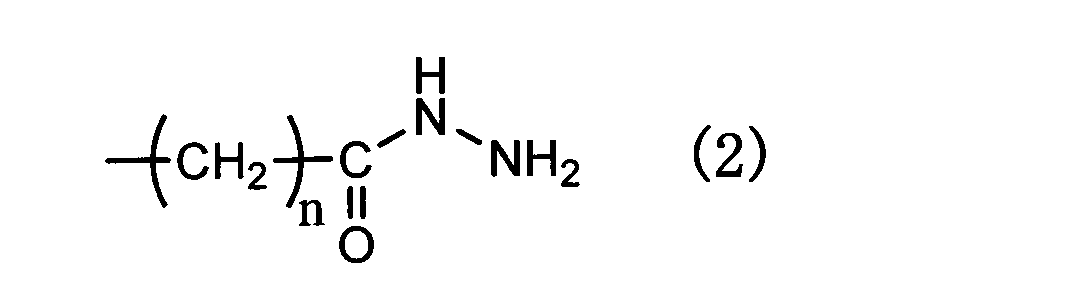
(式中、nは1~6の整数を示す。)
で表される分子骨格を示す。]
6)
前記成分(a)硬化性樹脂が、(メタ)アクリル化エポキシ樹脂及びエポキシ樹脂の混合物である上記1)乃至5)のいずれか一項に記載の液晶滴下工法用液晶シール剤。
7)
更に、成分(d)シランカップリング剤を含有する上記1)乃至6)のいずれか一項に記載の液晶滴下工法用液晶シール剤。
8)
更に、成分(e)無機フィラーを含有する上記1)乃至7)のいずれか一項に記載の液晶滴下工法用液晶シール剤。
9)
更に、(f)光重合開始剤を含有する上記1)乃至8)のいずれか一項に記載の液晶滴下工法用液晶シール剤。
10)
上記1)乃至9)のいずれか一項に記載の液晶滴下工法用液晶シール剤を硬化して得られる硬化物でシールされた液晶表示セル。
(a)エポキシ樹脂、(メタ)アクリル化エポキシ樹脂、及び部分(メタ)アクリル化エポキシ樹脂から選択される1種又は2種以上を含有する硬化性樹脂、(b)熱硬化剤、(c)分子内にカルボキシ基を有し、かつ酸価が50~250mgKOH/gである化合物を含有することを特徴とする液晶滴下工法用液晶シール剤。
2)
上記成分(c)の質量平均分子量が3000~10000g/molである上記1)に記載の液晶滴下工法用液晶シール剤。
3)
上記成分(c)の含有量が、成分(a)を100質量部とした場合に0.1~20質量部である上記1)又は2)に記載の液晶滴下工法用液晶シール剤。
4)
上記成分(b)熱硬化剤が多価ヒドラジド化合物である上記1)乃至3)のいずれか一項に記載の液晶滴下工法用液晶シール剤。
5)
上記成分(b)熱硬化剤が、下記式(1)で表される1又は2以上のヒドラジド化合物である上記4)に記載の液晶滴下工法用液晶シール剤。
で表される分子骨格を示す。]
6)
前記成分(a)硬化性樹脂が、(メタ)アクリル化エポキシ樹脂及びエポキシ樹脂の混合物である上記1)乃至5)のいずれか一項に記載の液晶滴下工法用液晶シール剤。
7)
更に、成分(d)シランカップリング剤を含有する上記1)乃至6)のいずれか一項に記載の液晶滴下工法用液晶シール剤。
8)
更に、成分(e)無機フィラーを含有する上記1)乃至7)のいずれか一項に記載の液晶滴下工法用液晶シール剤。
9)
更に、(f)光重合開始剤を含有する上記1)乃至8)のいずれか一項に記載の液晶滴下工法用液晶シール剤。
10)
上記1)乃至9)のいずれか一項に記載の液晶滴下工法用液晶シール剤を硬化して得られる硬化物でシールされた液晶表示セル。
本発明の液晶滴下工法用液晶シール剤は、熱硬化時の反応速度が速いため、光熱併用型液晶滴下工法において、光の届き難い配線下においても十分な硬化性を有し、このため、パネルの配線設計の自由度を確保でき、信頼性の高い液晶表示パネルの製造を容易にすることができ、また更には、熱のみで液晶シール剤を硬化させる液晶滴下工法への応用も可能である。
本発明の液晶シール剤は、成分(c)分子内にカルボキシ基を有し、かつ酸価が50~250mgKOH/gである化合物を含有し、それによって熱反応性と保存安定性とを両立することが可能となっている。この化合物が有するカルボキシ基は熱硬化促進剤として機能する。したがって、酸化が50mg未満の場合には十分な熱反応性が得られない。また、酸化が250mgより大きい場合、分子の極性が大きくなり、硬化物の耐湿信頼性を劣化させる。この酸価としてより好ましくは50~180mgKOH/gであり、更に好ましくは50~100mgKOH/g、特に好ましくは60~100mgKOH/gである。なお、酸価は成分(c)1g中に存在するカルボン酸を中和するのに必要な水酸化カリウムのmg数で定義する。
また、成分(c)は、質量平均分子量が3000~10000g/molであることが好ましい。質量平均分子量が小さすぎると、それ自体が液晶に溶解し、表示不良を引き起こす。また質量平均分子量が大きすぎると、他の成分との相溶性が悪くなり、熱反応促進効果が著しく減少する。この質量平均分子量として、更に好ましくは、4000~8000g/molである。
成分(c)の含有量は、成分(a)硬化性樹脂の総量を100質量部とした場合に、0.1~20質量部であることが好ましく、1~10質量部であることが特に好ましい。含有量が少な過ぎると十分な熱硬化性が得られず、また多過ぎると液晶シール剤が高粘度化するため、その他の成分の配合に制約を生じることになり、不適である。
成分(c)の具体例としては、水酸基を有するエポキシ(メタ)アクリレートに酸無水物や多価カルボン酸(無水物を含む)を反応さて得られる化合物や、一種類以上の多価カルボン酸と一種類以上の多価アルコールとを脱水縮合反応させて得られるポリエステル樹脂の末端アルコール性水酸基に、多価カルボン酸(無水物を含む)を反応させて得られる化合物等が挙げられる。水酸基を有するエポキシ(メタ)アクリレートに酸無水物や多価カルボン酸(無水物を含む)を反応さて得られる化合物は、例えば、特開平5-32746号公報等に記載の方法で得ることが可能である。このうちビスフェノールA型エポキシ(メタ)アクリレートに酸無水物を反応させて得られる化合物が好ましい。また、一種類以上の多価カルボン酸と一種類以上の多価アルコールとを脱水縮合反応させて得られるポリエステル樹脂の末端アルコール性水酸基に、多価カルボン酸(無水物を含む)を反応させて得られる化合物は、例えば、ユピカコートGV230、ユピカコートGV250という商品名(日本ユピカ株式会社)で市場より容易に入手することができる。このうち、ユピカコートGV230(酸価53mgKOH/g、質量平均分子量7900g/mol)、ユピカコートGV250(酸価74mgKOH/g、質量平均分子量5200g/mol)が好ましく用いられ、ユピカコートGV250が特に好ましく用いられる。
本発明の液晶シール剤で用いられる成分(b)である熱硬化剤は特に限定されるものではなく、多価アミン類、多価フェノール類、ヒドラジド化合物等を挙げることができるが、多価ヒドラジド化合物が特に好適に用いられる。例えば、芳香族ヒドラジドであるテレフタル酸ジヒドラジド、イソフタル酸ジヒドラジド、2,6-ナフトエ酸ジヒドラジド、2,6-ピリジンジヒドラジド、1,2,4-ベンゼントリヒドラジド、1,4,5,8-ナフトエ酸テトラヒドラジド、ピロメリット酸テトラヒドラジド等を挙げることができる。また、脂肪族ヒドラジド化合物であれば、例えば、ホルムヒドラジド、アセトヒドラジド、プロピオン酸ヒドラジド、シュウ酸ジヒドラジド、マロン酸ジヒドラジド、コハク酸ジヒドラジド、グルタル酸ジヒドラジド、アジピン酸ジヒドラジド、ピメリン酸ジヒドラジド、1,4-シクロヘキサンジヒドラジド、酒石酸ジヒドラジド、リンゴ酸ジヒドラジド、イミノジ酢酸ジヒドラジド、N,N’-ヘキサメチレンビスセミカルバジド、クエン酸トリヒドラジド、ニトリロ酢酸トリヒドラジド、シクロヘキサントリカルボン酸トリヒドラジド、1,3-ビス(ヒドラジノカルボノエチル)-5-イソプロピルヒダントイン等のヒダントイン骨格、好ましくはバリンヒダントイン骨格(ヒダントイン環の炭素原子がイソプロピル基で置換された骨格)を有するジヒドラジド化合物、上記式(1)で表される化合物等を挙げることができる。上記(1)で表される化合物としては、例えばトリス(1-ヒドラジノカルボニルメチル)イソシアヌレート、トリス(2-ヒドラジノカルボニルエチル)イソシアヌレート、トリス(2-ヒドラジノカルボニルエチル)イソシアヌレート、トリス(3-ヒドラジノカルボニルプロピル)イソシアヌレート、ビス(2-ヒドラジノカルボニルエチル)イソシアヌレート等を挙げることができるが、式(1)の構造であればこれらに限定されるものではない。硬化反応性と潜在性とのバランスから好ましくは、イソフタル酸ジヒドラジド、マロン酸ジヒドラジド、アジピン酸ジヒドラジド、トリス(1-ヒドラジノカルボニルメチル)イソシアヌレート、トリス(2-ヒドラジノカルボニルエチル)イソシアヌレート、トリス(2-ヒドラジノカルボニルエチル)イソシアヌレート、トリス(3-ヒドラジノカルボニルプロピル)イソシアヌレートであり、特に好ましくはトリス(2-ヒドラジノカルボニルエチル)イソシアヌレートである。
成分(b)の含有量は、成分(a)硬化性樹脂の総量を100質量部とした場合に、0.1~20質量部であることが好ましく、更に好ましくは1~10質量部であり、2種以上を混合して用いてもよい。
本発明の液晶シール剤は、成分(a)として、エポキシ樹脂、(メタ)アクリル化エポキシ樹脂、及び部分(メタ)アクリル化エポキシ樹脂から選択される1種又は2種以上からなる硬化性樹脂を含有する。例えば、エポキシ樹脂、エポキシ樹脂と(メタ)アクリル化エポキシ樹脂との混合物、(メタ)アクリル化エポキシ樹脂、部分(メタ)アクリル化エポキシ樹脂等が挙げられる。本発明で用いる成分(a)は、いずれも液晶に対する汚染性、溶解性が低いものが好ましい。好適なエポキシ樹脂の例としては、ビスフェノールA型エポキシ樹脂、ビスフェノールF型エポキシ樹脂、ビスフェノールS型エポキシ樹脂、フェノールノボラック型エポキシ樹脂、クレゾールノボラック型エポキシ樹脂、ビスフェノールAノボラック型エポキシ樹脂、ビスフェノールFノボラック型エポキシ樹脂、脂環式エポキシ樹脂、脂肪族鎖状エポキシ樹脂、グリシジルエステル型エポキシ樹脂、グリシジルアミン型エポキシ樹脂、ヒダントイン型エポキシ樹脂、イソシアヌレート型エポキシ樹脂、トリフェノールメタン骨格を有するフェノールノボラック型エポキシ樹脂、その他、二官能フェノール類のジグリシジルエーテル化物、二官能アルコール類のジグリシジルエーテル化物、及びそれらのハロゲン化物、水素添加物等が挙げられるが、これらに限定されるものではない。(メタ)アクリロイル化エポキシ樹脂、部分(メタ)アクリロイル化エポキシ樹脂は、エポキシ樹脂と(メタ)アクリル酸との周知の反応により得ることができる。例えば、エポキシ樹脂に、所定の当量比の(メタ)アクリル酸、触媒(例えば、ベンジルジメチルアミン、トリエチルアミン、ベンジルトリメチルアンモニウムクロライド、トリフェニルホスフィン、トリフェニルスチビン等)、及び重合防止剤(例えば、メトキノン、ハイドロキノン、メチルハイドロキノン、フェノチアジン、ジブチルヒドロキシトルエン等)を添加して、例えば80~110℃でエステル化反応を行うことにより得られる。原料となるエポキシ樹脂としては、特に限定されるものではないが、2官能以上のエポキシ樹脂が好ましく、例えばビスフェノールA型エポキシ樹脂、ビスフェノールF型エポキシ樹脂、ビスフェノールS型エポキシ樹脂、フェノールノボラック型エポキシ樹脂、クレゾールノボラック型エポキシ樹脂、ビスフェノールAノボラック型エポキシ樹脂、ビスフェノールFノボラック型エポキシ樹脂、脂環式エポキシ樹脂、脂肪族鎖状エポキシ樹脂、グリシジルエステル型エポキシ樹脂、グリシジルアミン型エポキシ樹脂、ヒダントイン型エポキシ樹脂、イソシアヌレート型エポキシ樹脂、トリフェノールメタン骨格を有するフェノールノボラック型エポキシ樹脂、その他、二官能フェノール類のジグリシジルエーテル化物、二官能アルコール類のジグリシジルエーテル化物、及びそれらのハロゲン化物、水素添加物等が挙げられる。これらのうち液晶汚染性の観点から、より好ましいものはビスフェノール型エポキシ樹脂、ノボラック型エポキシ樹脂である。また、エポキシ基と(メタ)アクリロイル基との比率は限定されるものではなく、工程適合性及び液晶汚染性の観点から適切に選択される。
成分(a)の含有量は、得られる液晶シール剤の作業性、物性を考慮して適宜決定され、通常、液晶シール剤中に25~80質量%程度であり、好ましくは25~75質量%である。
本発明の液晶シール剤では、(d)シランカップリング剤を用いて、接着強度向上や耐湿信頼性向上を図ることができる。シランカップリング剤としては、3-グリシドキシプロピルトリメトキシシラン、3-グリシドキシプロピルメチルジメトキシシラン、3-グリシドキシプロピルメチルジメトキシシラン、2-(3,4-エポキシシクロヘキシル)エチルトリメトキシシラン、N-フェニル-γ-アミノプロピルトリメトキシシラン、N-(2-アミノエチル)3-アミノプロピルメチルジメトキシシラン、N-(2-アミノエチル)3-アミノプロピルメチルトリメトキシシラン、3-アミノプロピルトリエトキシシラン、3-メルカプトプロピルトリメトキシシラン、ビニルトリメトキシシラン、N-(2-(ビニルベンジルアミノ)エチル)3-アミノプロピルトリメトキシシラン塩酸塩、3-メタクリロキシプロピルトリメトキシシラン、3-クロロプロピルメチルジメトキシシラン、3-クロロプロピルトリメトキシシラン等が挙げられる。シランカップリング剤(d)の液晶シール剤に占める含有量は、本発明の液晶シール剤の総量を100質量部とした場合、0.05~3質量部が好適である。
本発明の液晶シール剤では、(e)無機フィラーを用いて、接着強度向上や耐湿信頼性向上を図ることができる。この(e)無機フィラーとしては、溶融シリカ、結晶シリカ、シリコンカーバイド、窒化珪素、窒化ホウ素、炭酸カルシウム、炭酸マグネシウム、硫酸バリウム、硫酸カルシウム、マイカ、タルク、クレー、アルミナ、酸化マグネシウム、酸化ジルコニウム、水酸化アルミニウム、水酸化マグネシウム、珪酸カルシウム、珪酸アルミニウム、珪酸リチウムアルミニウム、珪酸ジルコニウム、チタン酸バリウム、硝子繊維、炭素繊維、二硫化モリブデン、アスベスト等が挙げられ、好ましくは溶融シリカ、結晶シリカ、窒化珪素、窒化ホウ素、炭酸カルシウム、硫酸バリウム、硫酸カルシウム、マイカ、タルク、クレー、アルミナ、水酸化アルミニウム、珪酸カルシウム、珪酸アルミニウムであり、更に好ましくは溶融シリカ、結晶シリカ、アルミナ、タルクである。これら無機フィラーは2種以上を混合して用いてもよい。その平均粒径は、大きすぎると狭ギャップの液晶セル製造時に上下ガラス基板の貼り合わせ時のギャップ形成がうまくできない等の不良要因となるため、3μm以下が適当であり、好ましくは2μm以下である。粒径はレーザー回折・散乱式粒度分布測定器(乾式)(株式会社セイシン企業製;LMS-30)により測定できる。
本発明の液晶シール剤で使用し得る無機フィラー(e)の液晶シール剤中の含有量は、本発明の液晶シール剤の総量を100質量部とした場合、通常10~60質量部であり、好ましくは20~50質量部である。無機フィラーの含有量が少な過ぎる場合、ガラス基板に対する接着強度が低下し、また耐湿信頼性も劣るために、吸湿後の接着強度の低下も大きくなる場合がある。一方、無機フィラーの含有量が多過ぎる場合、つぶれにくく液晶セルのギャップ形成ができなくなってしまう場合がある。
本発明の液晶シール剤は、光熱併用硬化型の液晶シール剤とするために、成分(f)光重合開始剤を含有してもよい。光重合開始剤は、UVや可視光の照射によって、ラジカルを生じ、連鎖重合反応を開始させる化合物であれば特に限定されないが、例えば、ベンジルジメチルケタール、1-ヒドロキシシクロヘキシルフェニルケトン、ジエチルチオキサントン、ベンゾフェノン、2-エチルアンスラキノン、2-ヒドロキシ-2-メチルプロピオフェノン、2-メチル-〔4-(メチルチオ)フェニル〕-2-モルフォリノ-1-プロパン、2,4,6-トリメチルベンゾイルジフェニルホスフィンオキサイド等を挙げることができる。また、液晶汚染性の観点から、分子内に(メタ)アクリロイル基を有するものを使用することが好ましく、例えば2-メタクリロイルオキシエチルイソシアネートと1-[4-(2-ヒドロキシエトキシ)-フェニル]-2-ヒドロキシ-2メチル-1-プロパン-1-オンとの反応生成物が好適に用いられる。この化合物は国際公開第2006/027982号記載の方法にて製造して得ることができる。
本発明の液晶シール剤で使用し得る成分(f)光重合開始剤の液晶シール剤中の含有量は、本発明の液晶シール剤の総量を100質量部とした場合、通常0.1~5質量部であり、好ましくは0.2~3質量部である。
本発明の液晶シール剤には、さらに必要に応じて、(メタ)アクリル酸エステルのモノマーやオリゴマーを使用してもよい。そのようなモノマー、オリゴマーとしては、例えば、ジペンタエリスリトールと(メタ)アクリル酸との反応物、ジペンタエリスリトール・カプロラクトンと(メタ)アクリル酸との反応物等が挙げられるが、液晶に対する汚染性が低いものならば特に制限されるものではない。
本発明の液晶シール剤には、さらに必要に応じて、有機フィラー、並びに顔料、レベリング剤、消泡剤、溶剤等の添加剤を配合することができる。
本発明の液晶シール剤を得る方法の一例としては、次に示す方法がある。まず、(a)成分を有機溶剤に溶解した後、(c)成分を添加し、加熱混合を行い、(c)成分を溶解する。その後、有機溶剤を加熱等によって除去し、更に必要に応じ、(f)成分を加熱下で溶解混合する。室温まで冷却後、(b)成分を添加し、必要に応じ(d)成分、(e)成分、並びに有機フィラー、消泡剤、レベリング剤、溶剤等を添加し、公知の混合装置、例えば3本ロール、サンドミル、ボールミル等により均一に混合し、金属メッシュにて濾過することにより本発明の液晶シール剤を製造することができる。
本発明の液晶表示セルは、基板に所定の電極を形成した一対の基板を所定の間隔に対向配置し、周囲を本発明の液晶シール剤でシールし、その間隙に液晶が封入されたものである。封入される液晶の種類は特に限定されない。ここで、基板とはガラス、石英、プラスチック、シリコン等からなる少なくとも一方に光透過性がある組み合わせの基板から構成される。その製法としては、本発明の液晶シール剤に、グラスファイバー等のスペーサー(間隙制御材)を添加後、該一対の基板の一方にディスペンサー、又はスクリーン印刷装置等を用いて該液晶シール剤を塗布した後、必要に応じて、80~120℃で仮硬化を行う。その後、該液晶シール剤の堰の内側に液晶を滴下し、真空中にてもう一方のガラス基板を重ね合わせ、ギャップ出しを行う。ギャップ形成後、90~130℃で1~2時間硬化することにより本発明の液晶表示セルを得ることができる。また、光熱併用型として使用する場合は、紫外線照射機により液晶シール剤部に紫外線を照射させて光硬化させる。紫外線照射量は、好ましくは500~6000mJ/cm2であり、より好ましくは1000~4000mJ/cm2である。その後必要に応じて、90~130℃で1~2時間硬化することにより本発明の液晶表示セルを得ることができる。このようにして得られた本発明の液晶表示セルは、液晶汚染による表示不良が無く、接着性、耐湿信頼性に優れたものである。スペーサーとしては、例えばグラスファイバー、シリカビーズ、ポリマービーズ等が挙げられる。その直径は、目的に応じ異なるが、通常2~8μm、好ましくは4~7μmである。その使用量は、本発明の液晶シール剤100質量部に対し、通常0.1~4質量部、好ましくは0.5~2質量部、更に好ましくは0.9~1.5質量部程度である。
本発明の液晶シール剤は、熱硬化性が非常に良好であり、液晶滴下工法における加熱工程において速やかに硬化する。したがって、構成成分の液晶への溶出も極めて少なく、液晶表示セルの表示不良を低減することが可能である。また、保存安定性にも優れるため、液晶表示セルの製造に適している。更に、その硬化物は接着強度、耐熱性、耐湿性等の各種硬化物特性にも優れるため、本発明の液晶シール剤を用いることにより、信頼性に優れる液晶表示セルを作成することが可能である。また、本発明の液晶シール剤を用いて作成した液晶表示セルは、電圧保持率が高く、イオン密度が低いという液晶表示セルとして必要な特性も充足される。
以下、合成例、実施例により本発明を更に詳細に説明するが、本発明は実施例に限定されるものではない。なお、特別の記載のない限り、本文中「部」及び「%」とあるのは質量基準である。
[合成例1:ビスフェノールA型エポキシ樹脂のエポキシアクリレートの合成]
ビスフェノールA型エポキシ樹脂282.5g(製品名:YD-8125、新日鉄化学株式会社製)をトルエン266.8gに溶解し、これに重合禁止剤としてジブチルヒドロキシトルエン0.8gを加え、60℃まで昇温した。その後、エポキシ基の100%当量のアクリル酸117.5gを加え、更に80℃まで昇温し、これに反応触媒であるトリメチルアンモニウムクロライド0.6gを添加して、98℃で約30時間撹拌し、反応液を得た。
ビスフェノールA型エポキシ樹脂282.5g(製品名:YD-8125、新日鉄化学株式会社製)をトルエン266.8gに溶解し、これに重合禁止剤としてジブチルヒドロキシトルエン0.8gを加え、60℃まで昇温した。その後、エポキシ基の100%当量のアクリル酸117.5gを加え、更に80℃まで昇温し、これに反応触媒であるトリメチルアンモニウムクロライド0.6gを添加して、98℃で約30時間撹拌し、反応液を得た。
[合成例1-1]
合成例1で得られた反応液を水洗し、トルエンを留去することにより、目的とするビスフェノールA型のエポキシアクリレート395gを得た(KAYARADRTMR-93100)。
合成例1で得られた反応液を水洗し、トルエンを留去することにより、目的とするビスフェノールA型のエポキシアクリレート395gを得た(KAYARADRTMR-93100)。
[合成例1-2]
合成例1で得られた反応液に更にテトラヒドロ無水フタル酸を151.6g加え、98℃で約30時間撹拌した。得られた反応液を6回水洗した後、エバポレーターでトルエンを留去することにより、目的とする化合物を640g得た(ビスフェノールA型エポキシアクリレートの酸無水物付加物)。GPC(ゲルパーミエーションクロマトグラフィー)測定による、この化合物の質量平均分子量は828g/molであった。
合成例1で得られた反応液に更にテトラヒドロ無水フタル酸を151.6g加え、98℃で約30時間撹拌した。得られた反応液を6回水洗した後、エバポレーターでトルエンを留去することにより、目的とする化合物を640g得た(ビスフェノールA型エポキシアクリレートの酸無水物付加物)。GPC(ゲルパーミエーションクロマトグラフィー)測定による、この化合物の質量平均分子量は828g/molであった。
(液晶滴下工法用液晶シール剤の調製)
[実施例1、2]
下記表1に示す割合で各樹脂成分(成分(a))を混合撹拌した後、アセトンを添加し、樹脂成分を溶解した。そこへ、成分(c)を添加し、70℃で加熱溶解した後、エバポレーターでアセトンを留去した。そこへ、ラジカル重合開始剤(成分(f))を添加し、加熱溶解させた後、室温まで冷却し、シランカップリング剤(成分(d))、無機フィラー(成分(e))、熱硬化剤(成分(b))を添加し、撹拌した後、3本ロールミルにて分散させ、金属メッシュ(635メッシュ)で濾過し、実施例1、2の液晶滴下工法用液晶シール剤を調製した。
[実施例1、2]
下記表1に示す割合で各樹脂成分(成分(a))を混合撹拌した後、アセトンを添加し、樹脂成分を溶解した。そこへ、成分(c)を添加し、70℃で加熱溶解した後、エバポレーターでアセトンを留去した。そこへ、ラジカル重合開始剤(成分(f))を添加し、加熱溶解させた後、室温まで冷却し、シランカップリング剤(成分(d))、無機フィラー(成分(e))、熱硬化剤(成分(b))を添加し、撹拌した後、3本ロールミルにて分散させ、金属メッシュ(635メッシュ)で濾過し、実施例1、2の液晶滴下工法用液晶シール剤を調製した。
[実施例3]
下記表1に示す割合で各樹脂成分(成分(a))を混合撹拌した後、成分(c)を添加し、90℃で加熱溶解した。そこへ、ラジカル重合開始剤(成分(f))を加熱溶解させた後、室温まで冷却し、シランカップリング剤(成分(d))、無機フィラー(成分(e))、熱硬化剤(成分(b))を添加し、撹拌した後、3本ロールミルにて分散させ、金属メッシュ(635メッシュ)で濾過し、実施例3の液晶滴下工法用液晶シール剤を調製した。
下記表1に示す割合で各樹脂成分(成分(a))を混合撹拌した後、成分(c)を添加し、90℃で加熱溶解した。そこへ、ラジカル重合開始剤(成分(f))を加熱溶解させた後、室温まで冷却し、シランカップリング剤(成分(d))、無機フィラー(成分(e))、熱硬化剤(成分(b))を添加し、撹拌した後、3本ロールミルにて分散させ、金属メッシュ(635メッシュ)で濾過し、実施例3の液晶滴下工法用液晶シール剤を調製した。
[比較例1~3]
下記表1に示す割合で各樹脂成分(成分(a))を混合撹拌した後、ラジカル重合開始剤(成分(f))を90℃で加熱溶解させた。室温まで冷却し、成分(c)、シランカップリング剤(成分(d))、無機フィラー(成分(e))、熱硬化剤(成分(b))を添加し、撹拌した後、3本ロールミルにて分散させ、金属メッシュ(635メッシュ)で濾過し、比較例1~3の液晶滴下工法用液晶シール剤を調製した。
下記表1に示す割合で各樹脂成分(成分(a))を混合撹拌した後、ラジカル重合開始剤(成分(f))を90℃で加熱溶解させた。室温まで冷却し、成分(c)、シランカップリング剤(成分(d))、無機フィラー(成分(e))、熱硬化剤(成分(b))を添加し、撹拌した後、3本ロールミルにて分散させ、金属メッシュ(635メッシュ)で濾過し、比較例1~3の液晶滴下工法用液晶シール剤を調製した。
以下に調製した各液晶滴下工法用液晶シール剤の評価項目内容とその結果を示す。
(熱硬化性試験)
各液晶滴下工法用液晶シール剤をポリエチレンテレフタレートフィルム間に塗布した後、ラミネーターを用いて100μmの厚みに伸ばし、3000mJ/cm2の紫外線を照射した(サンプル1)。できたフィルムを120℃×1時間熱硬化した(サンプル2)。サンプル1、サンプル2のエンタルピーを示差走査型熱量計(セイコーインスツル社製、測定条件:30℃から250℃、昇温速度10℃)を用いて測定し、下記計算式により熱反応率を計算した。
熱反応率=[1-(サンプル1のエンタルピー-サンプル2のエンタルピー)/サンプル1のエンタルピー]×100
結果を以下のように判定した。
○:熱反応率90%以上
×:熱反応率90%未満
実施例1の熱反応率は92%、実施例2の熱反応率は91%、実施例3の熱反応率は94%であった。
各液晶滴下工法用液晶シール剤をポリエチレンテレフタレートフィルム間に塗布した後、ラミネーターを用いて100μmの厚みに伸ばし、3000mJ/cm2の紫外線を照射した(サンプル1)。できたフィルムを120℃×1時間熱硬化した(サンプル2)。サンプル1、サンプル2のエンタルピーを示差走査型熱量計(セイコーインスツル社製、測定条件:30℃から250℃、昇温速度10℃)を用いて測定し、下記計算式により熱反応率を計算した。
熱反応率=[1-(サンプル1のエンタルピー-サンプル2のエンタルピー)/サンプル1のエンタルピー]×100
結果を以下のように判定した。
○:熱反応率90%以上
×:熱反応率90%未満
実施例1の熱反応率は92%、実施例2の熱反応率は91%、実施例3の熱反応率は94%であった。
(液晶汚染性試験)
3000mJ/cm2の紫外線を照射した液晶滴下工法用液晶シール剤のフィルム(上記サンプル1)を5mm2程度の大きさに切ったものを10mlバイアル瓶に100mg程度入れた後、液晶(MLC-6866-100:メルク株式会社製)をその質量基準で10倍量加えた。120℃で1時間加熱した後、30分間冷却した。それぞれの上澄みをデカンテーションにて分け取り、デジタル超高抵抗計(R8340:株式会社アドバンテスト製)にて比抵抗値を測定し、シール剤なしのものの比抵抗値と比較した。以下により判定を行った。
○:比抵抗値9.5E+11以上
△:比抵抗値1.0E+11以上9.5E+11未満
×:比抵抗値1.0E+11未満
なお、比抵抗値の「1.0E+12」は「1.0×10¹²」を表し、他の記載も同様である。
実施例1の比抵抗値は3.8E+12、実施例2の比抵抗値は9.7E+11、実施例3の比抵抗値は2.7E+12であった。
3000mJ/cm2の紫外線を照射した液晶滴下工法用液晶シール剤のフィルム(上記サンプル1)を5mm2程度の大きさに切ったものを10mlバイアル瓶に100mg程度入れた後、液晶(MLC-6866-100:メルク株式会社製)をその質量基準で10倍量加えた。120℃で1時間加熱した後、30分間冷却した。それぞれの上澄みをデカンテーションにて分け取り、デジタル超高抵抗計(R8340:株式会社アドバンテスト製)にて比抵抗値を測定し、シール剤なしのものの比抵抗値と比較した。以下により判定を行った。
○:比抵抗値9.5E+11以上
△:比抵抗値1.0E+11以上9.5E+11未満
×:比抵抗値1.0E+11未満
なお、比抵抗値の「1.0E+12」は「1.0×10¹²」を表し、他の記載も同様である。
実施例1の比抵抗値は3.8E+12、実施例2の比抵抗値は9.7E+11、実施例3の比抵抗値は2.7E+12であった。
(保存安定性試験)
各液晶滴下工法用液晶シール剤を23℃恒温槽で保温し、24時間後の粘度を測定した。
初期の粘度と比較し、下記のように判定した。なお、粘度はE型粘度計(東機産業社製)を用いて測定した。
○:粘度増加率5%未満
△:粘度増加率5%以上10%未満
×:粘度増加率10%以上、又はゲル化
実施例1の粘度増加率は3%、実施例2の粘度増加率は3%、実施例3の粘度増加率は4%であった。
各液晶滴下工法用液晶シール剤を23℃恒温槽で保温し、24時間後の粘度を測定した。
初期の粘度と比較し、下記のように判定した。なお、粘度はE型粘度計(東機産業社製)を用いて測定した。
○:粘度増加率5%未満
△:粘度増加率5%以上10%未満
×:粘度増加率10%以上、又はゲル化
実施例1の粘度増加率は3%、実施例2の粘度増加率は3%、実施例3の粘度増加率は4%であった。
(耐湿接着性試験)
各液晶滴下工法用液晶シール剤100gにスペーサーとして5μmのグラスファイバー1gを添加して混合撹拌した。この液晶シール剤を50mm×50mmのガラス基板上に塗布し、その液晶シール剤上に1.5mm×1.5mmのガラス片を貼り合わせ、UV照射機により3000mJ/cm2の紫外線を照射した後、120℃オーブンに1時間投入して硬化させた。そのガラス片のせん断接着強度を測定した。また、硬化後のガラス基板を用いてPCT試験(条件:温度120℃、湿度100%、気圧2atm、試験時間12時間)を行い、その後のガラス片のせん断接着強度を測定した。そして、PCT試験前後での接着保持率を計算し、以下のように判定した。
○:接着保持率50%以上
△:接着保持率25%以上50%未満
×:接着保持率25%未満
実施例1の接着保持率は69%、実施例2の接着保持率は65%、実施例3の接着保持率は55%であった。
各液晶滴下工法用液晶シール剤100gにスペーサーとして5μmのグラスファイバー1gを添加して混合撹拌した。この液晶シール剤を50mm×50mmのガラス基板上に塗布し、その液晶シール剤上に1.5mm×1.5mmのガラス片を貼り合わせ、UV照射機により3000mJ/cm2の紫外線を照射した後、120℃オーブンに1時間投入して硬化させた。そのガラス片のせん断接着強度を測定した。また、硬化後のガラス基板を用いてPCT試験(条件:温度120℃、湿度100%、気圧2atm、試験時間12時間)を行い、その後のガラス片のせん断接着強度を測定した。そして、PCT試験前後での接着保持率を計算し、以下のように判定した。
○:接着保持率50%以上
△:接着保持率25%以上50%未満
×:接着保持率25%未満
実施例1の接着保持率は69%、実施例2の接着保持率は65%、実施例3の接着保持率は55%であった。
(パネル表示特性試験)
各液晶滴下工法用液晶シール剤をシリンジに充填・脱泡した後、ディスペンサー(武蔵エンジニアリング社製 ショットマスター300)にてガラス基板上に塗布し、適量の液晶をシール枠内に滴下した。その基板を真空張り合わせ装置に設置し、真空下でもう一方の基板を重ね合わせた後、120℃で1時間硬化した。できた模擬パネルに通電し、偏光フィルム上で観察した。観察結果は以下のように判定した。
○:配向不良が確認されなかった
×:配向不良が確認された
※:シール剤から気泡が発生し、液晶漏れを引き起こした
各液晶滴下工法用液晶シール剤をシリンジに充填・脱泡した後、ディスペンサー(武蔵エンジニアリング社製 ショットマスター300)にてガラス基板上に塗布し、適量の液晶をシール枠内に滴下した。その基板を真空張り合わせ装置に設置し、真空下でもう一方の基板を重ね合わせた後、120℃で1時間硬化した。できた模擬パネルに通電し、偏光フィルム上で観察した。観察結果は以下のように判定した。
○:配向不良が確認されなかった
×:配向不良が確認された
※:シール剤から気泡が発生し、液晶漏れを引き起こした
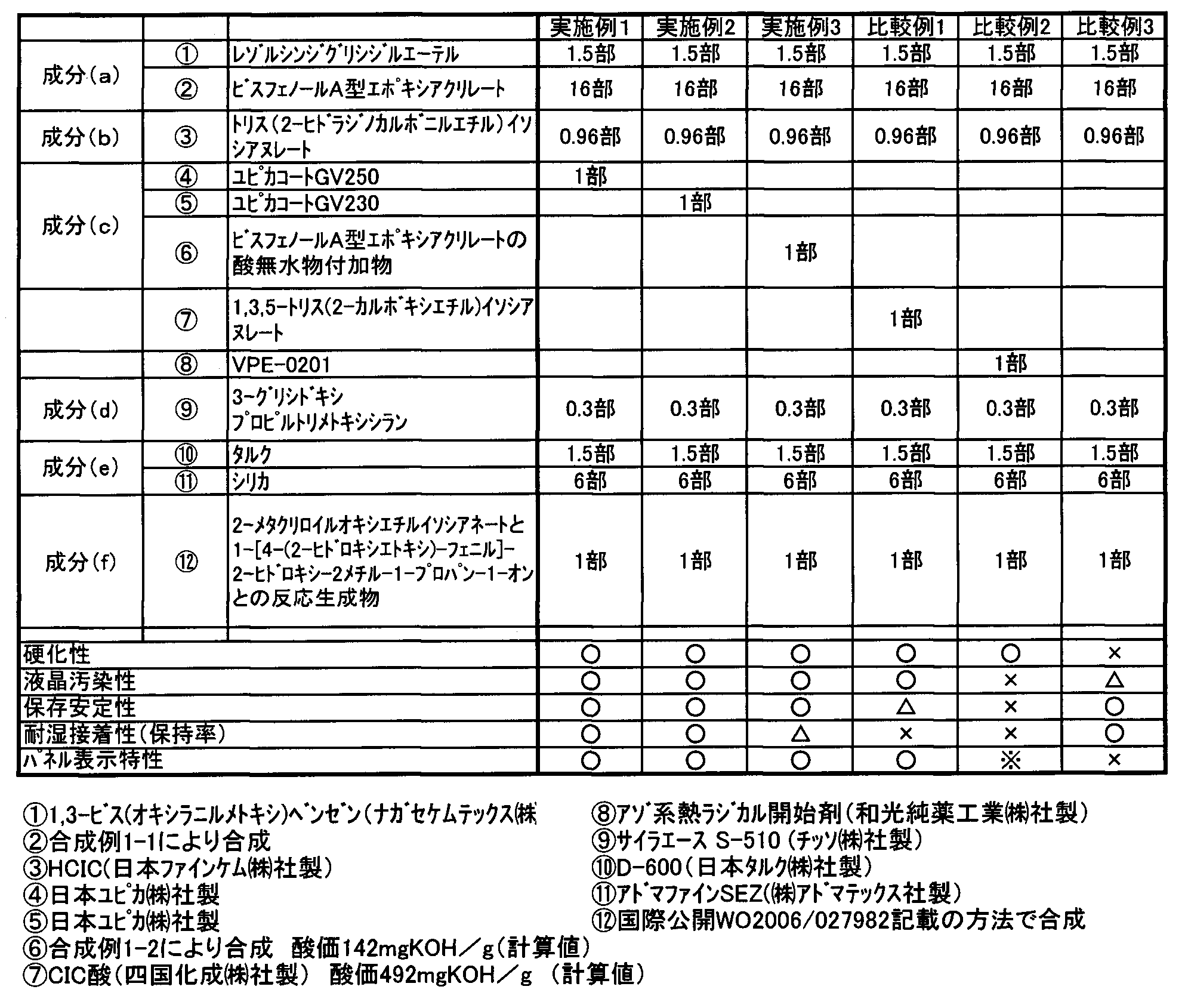
表1の結果より、硬化促進剤成分を含有しない比較例3は硬化性に劣り、その結果、パネル表示特性において配向不良を生じている。また、硬化促進剤として熱ラジカル開始剤や、CIC酸を用いたものは、硬化性の向上は達成しているものの、液晶汚染性や耐湿接着性に不具合を生じている。これに対し、実施例1~3については、硬化性向上を実現しながら、他の特性も使用可能レベルであることが確認される。特に実施例1、2においては全ての特性において非常に優れた結果を示している。
この結果より、本発明の液晶シール剤は、保存安定性、硬化性に優れることから作業性に優れるといえ、また液晶汚染性、耐湿接着性、パネル表示特性に優れることから、液晶表示セルの高信頼性を実現できるといえる。
この結果より、本発明の液晶シール剤は、保存安定性、硬化性に優れることから作業性に優れるといえ、また液晶汚染性、耐湿接着性、パネル表示特性に優れることから、液晶表示セルの高信頼性を実現できるといえる。
本発明の液晶シール剤は、作業性に優れるため、液晶表示セルの安定生産を可能とし、更には液晶表示セルの長期信頼性確保にも貢献するものである。
Claims (10)
- (a)エポキシ樹脂、(メタ)アクリル化エポキシ樹脂、及び部分(メタ)アクリル化エポキシ樹脂から選択される1種又は2種以上を含有する硬化性樹脂、(b)熱硬化剤、(c)分子内にカルボキシ基を有し、かつ酸価が50~250mgKOH/gである化合物を含有することを特徴とする液晶滴下工法用液晶シール剤。
- 前記成分(c)の質量平均分子量が3000~10000g/molである請求項1に記載の液晶滴下工法用液晶シール剤。
- 前記成分(c)の含有量が、成分(a)を100質量部とした場合に0.1~20質量部である請求項1又は2に記載の液晶滴下工法用液晶シール剤。
- 前記成分(b)熱硬化剤が多価ヒドラジド化合物である請求項1乃至3のいずれか一項に記載の液晶滴下工法用液晶シール剤。
- 前記成分(b)熱硬化剤が下記式(1)で表される1又は2以上のヒドラジド化合物である請求項4に記載の液晶滴下工法用液晶シール剤。


で表される分子骨格を示す。] - 前記成分(a)硬化性樹脂が、(メタ)アクリル化エポキシ樹脂及びエポキシ樹脂の混合物である請求項1乃至5のいずれか一項に記載の液晶滴下工法用液晶シール剤。
- 更に、成分(d)シランカップリング剤を含有する請求項1乃至6のいずれか一項に記載の液晶滴下工法用液晶シール剤。
- 更に、成分(e)無機フィラーを含有する請求項1乃至7のいずれか一項に記載の液晶滴下工法用液晶シール剤。
- 更に、(f)光重合開始剤を含有する請求項1乃至8のいずれか一項に記載の液晶滴下工法用液晶シール剤。
- 請求項1乃至9のいずれか一項に記載の液晶滴下工法用液晶シール剤を硬化して得られる硬化物でシールされた液晶表示セル。
Priority Applications (2)
| Application Number | Priority Date | Filing Date | Title |
|---|---|---|---|
| KR1020147000426A KR20140036301A (ko) | 2011-07-03 | 2012-06-29 | 액정 시일제 및 그것을 사용한 액정 표시 셀 |
| CN201280032943.1A CN103635854B (zh) | 2011-07-03 | 2012-06-29 | 液晶密封剂及使用其的液晶显示单元 |
Applications Claiming Priority (2)
| Application Number | Priority Date | Filing Date | Title |
|---|---|---|---|
| JP2011147814A JP5645765B2 (ja) | 2011-07-03 | 2011-07-03 | 液晶シール剤及びそれを用いた液晶表示セル |
| JP2011-147814 | 2011-07-03 |
Publications (1)
| Publication Number | Publication Date |
|---|---|
| WO2013005693A1 true WO2013005693A1 (ja) | 2013-01-10 |
Family
ID=47437045
Family Applications (1)
| Application Number | Title | Priority Date | Filing Date |
|---|---|---|---|
| PCT/JP2012/066793 Ceased WO2013005693A1 (ja) | 2011-07-03 | 2012-06-29 | 液晶シール剤及びそれを用いた液晶表示セル |
Country Status (5)
| Country | Link |
|---|---|
| JP (1) | JP5645765B2 (ja) |
| KR (1) | KR20140036301A (ja) |
| CN (1) | CN103635854B (ja) |
| TW (1) | TW201319156A (ja) |
| WO (1) | WO2013005693A1 (ja) |
Cited By (3)
| Publication number | Priority date | Publication date | Assignee | Title |
|---|---|---|---|---|
| WO2018201428A1 (en) * | 2017-05-05 | 2018-11-08 | Henkel Ag & Co. Kgaa | Thermally curable sealant composition and use thereof |
| FR3121790A1 (fr) | 2021-04-09 | 2022-10-14 | Valeo Systemes Thermiques | Compartiment pour un équipement susceptible de dégager de la chaleur |
| US12345846B2 (en) | 2018-01-26 | 2025-07-01 | Fugro N.V. | Detecting objects submerged in a body of water or at least partly buried in a bed of the body of water |
Families Citing this family (3)
| Publication number | Priority date | Publication date | Assignee | Title |
|---|---|---|---|---|
| TW201619213A (zh) * | 2014-07-17 | 2016-06-01 | Nippon Kayaku Kk | 液晶密封劑及使用該液晶密封劑之液晶顯示單元 |
| JP6497809B2 (ja) * | 2015-07-21 | 2019-04-10 | 日本化薬株式会社 | 液晶シール剤及びそれを用いた液晶表示セル |
| CN110136581B (zh) * | 2019-04-01 | 2022-01-04 | 陈波 | 热塑性光学胶的贴合方法和应用及一种显示器 |
Citations (6)
| Publication number | Priority date | Publication date | Assignee | Title |
|---|---|---|---|---|
| JPH0540254A (ja) * | 1991-02-25 | 1993-02-19 | Sumitomo Electric Ind Ltd | 液晶表示素子およびその製造方法 |
| JP2000347203A (ja) * | 1999-04-01 | 2000-12-15 | Mitsui Chemicals Inc | 液晶シール剤組成物 |
| JP2003149651A (ja) * | 2001-11-13 | 2003-05-21 | Dainippon Ink & Chem Inc | 液晶表示装置用スペーサー及びそれを用いた液晶表示装置 |
| JP2004012671A (ja) * | 2002-06-05 | 2004-01-15 | Dainippon Ink & Chem Inc | 液晶表示素子用スペーサーおよびそれを用いた液晶表示素子 |
| JP2006039096A (ja) * | 2004-07-26 | 2006-02-09 | Three Bond Co Ltd | 液晶表示装置用組成物 |
| JP2008019303A (ja) * | 2006-07-11 | 2008-01-31 | Nippon Kayaku Co Ltd | 液晶シール剤およびそれを用いた液晶表示セル |
Family Cites Families (6)
| Publication number | Priority date | Publication date | Assignee | Title |
|---|---|---|---|---|
| JPS62172014A (ja) * | 1986-01-25 | 1987-07-29 | Matsushita Electric Works Ltd | 一液性エポキシ樹脂組成物 |
| JP2868190B2 (ja) * | 1991-07-29 | 1999-03-10 | 日本化薬株式会社 | 樹脂組成物、ソルダーレジスト樹脂組成物及びこれらの硬化物 |
| EP1559735B1 (en) * | 2002-11-06 | 2007-09-26 | Nippon Kayaku Kabushiki Kaisha | Sealing material for liquid crystal and liquid crystal display cell using same |
| WO2004090621A1 (ja) * | 2003-04-08 | 2004-10-21 | Nippon Kayaku Kabushiki Kaisha | 液晶シール剤およびそれを用いた液晶表示セル |
| JP2005010601A (ja) * | 2003-06-20 | 2005-01-13 | Dainippon Ink & Chem Inc | 液晶パネル用光硬化性シール剤組成物、及び液晶パネルの製造方法 |
| JP5268235B2 (ja) * | 2006-07-05 | 2013-08-21 | 日本化薬株式会社 | 液晶シール剤およびそれを用いた液晶表示セル |
-
2011
- 2011-07-03 JP JP2011147814A patent/JP5645765B2/ja not_active Expired - Fee Related
-
2012
- 2012-06-29 CN CN201280032943.1A patent/CN103635854B/zh not_active Expired - Fee Related
- 2012-06-29 KR KR1020147000426A patent/KR20140036301A/ko not_active Withdrawn
- 2012-06-29 TW TW101123493A patent/TW201319156A/zh unknown
- 2012-06-29 WO PCT/JP2012/066793 patent/WO2013005693A1/ja not_active Ceased
Patent Citations (6)
| Publication number | Priority date | Publication date | Assignee | Title |
|---|---|---|---|---|
| JPH0540254A (ja) * | 1991-02-25 | 1993-02-19 | Sumitomo Electric Ind Ltd | 液晶表示素子およびその製造方法 |
| JP2000347203A (ja) * | 1999-04-01 | 2000-12-15 | Mitsui Chemicals Inc | 液晶シール剤組成物 |
| JP2003149651A (ja) * | 2001-11-13 | 2003-05-21 | Dainippon Ink & Chem Inc | 液晶表示装置用スペーサー及びそれを用いた液晶表示装置 |
| JP2004012671A (ja) * | 2002-06-05 | 2004-01-15 | Dainippon Ink & Chem Inc | 液晶表示素子用スペーサーおよびそれを用いた液晶表示素子 |
| JP2006039096A (ja) * | 2004-07-26 | 2006-02-09 | Three Bond Co Ltd | 液晶表示装置用組成物 |
| JP2008019303A (ja) * | 2006-07-11 | 2008-01-31 | Nippon Kayaku Co Ltd | 液晶シール剤およびそれを用いた液晶表示セル |
Cited By (3)
| Publication number | Priority date | Publication date | Assignee | Title |
|---|---|---|---|---|
| WO2018201428A1 (en) * | 2017-05-05 | 2018-11-08 | Henkel Ag & Co. Kgaa | Thermally curable sealant composition and use thereof |
| US12345846B2 (en) | 2018-01-26 | 2025-07-01 | Fugro N.V. | Detecting objects submerged in a body of water or at least partly buried in a bed of the body of water |
| FR3121790A1 (fr) | 2021-04-09 | 2022-10-14 | Valeo Systemes Thermiques | Compartiment pour un équipement susceptible de dégager de la chaleur |
Also Published As
| Publication number | Publication date |
|---|---|
| CN103635854A (zh) | 2014-03-12 |
| KR20140036301A (ko) | 2014-03-25 |
| JP2013015646A (ja) | 2013-01-24 |
| JP5645765B2 (ja) | 2014-12-24 |
| TW201319156A (zh) | 2013-05-16 |
| CN103635854B (zh) | 2016-04-13 |
Similar Documents
| Publication | Publication Date | Title |
|---|---|---|
| JP4211942B2 (ja) | 液晶シール剤およびそれを用いた液晶表示セル | |
| JP4490282B2 (ja) | 液晶シール剤およびそれを用いた液晶表示セル | |
| JP5257941B2 (ja) | 液晶シール剤及びそれを用いた液晶表示セル | |
| JP5651177B2 (ja) | 液晶シール剤及びそれを用いた液晶表示セル | |
| EP1630594B1 (en) | Sealant for liquid crystal and liquid-crystal display cell made with the same | |
| JP2004061925A (ja) | 液晶シール剤およびそれを用いた液晶表示セル | |
| WO2011118191A1 (ja) | 液晶シール剤、それを用いた液晶表示パネルの製造方法、および液晶表示パネル | |
| WO2008004455A1 (fr) | Agent d'etanchéite pour cristaux liquides et cellules d'affichage à cristaux liquides utilisant cet agent | |
| JP5645765B2 (ja) | 液晶シール剤及びそれを用いた液晶表示セル | |
| JP4241452B2 (ja) | 光硬化性樹脂組成物およびこれを含む液晶シール剤組成物 | |
| JP2010277072A (ja) | 液晶シール剤及びそれを用いた液晶表示セル | |
| JP5748273B2 (ja) | 液晶シール剤及びそれを用いた液晶表示セル | |
| WO2006043454A1 (ja) | 放射線硬化性樹脂、液晶シール剤およびそれを用いた液晶表示セル | |
| JP4974344B2 (ja) | 液晶シール剤及びそれを用いた液晶表示セル | |
| JP5112433B2 (ja) | 液晶シール剤及びそれを用いた液晶表示セル | |
| JP2017203830A (ja) | 液晶シール剤及びそれを用いた液晶表示セル | |
| JP2014006325A (ja) | 液晶シール剤及びそれを用いた液晶表示セル | |
| JP2005115255A (ja) | 液晶シール剤及びそれを用いた液晶表示セル | |
| KR20190103351A (ko) | 방사선 경화성 실란트 조성물 | |
| JP2014006324A (ja) | 液晶シール剤及びそれを用いた液晶表示セル | |
| JP2018040947A (ja) | 液晶シール剤及びそれを用いた液晶表示セル |
Legal Events
| Date | Code | Title | Description |
|---|---|---|---|
| 121 | Ep: the epo has been informed by wipo that ep was designated in this application |
Ref document number: 12806952 Country of ref document: EP Kind code of ref document: A1 |
|
| NENP | Non-entry into the national phase |
Ref country code: DE |
|
| ENP | Entry into the national phase |
Ref document number: 20147000426 Country of ref document: KR Kind code of ref document: A |
|
| 122 | Ep: pct application non-entry in european phase |
Ref document number: 12806952 Country of ref document: EP Kind code of ref document: A1 |