WO2012176743A1 - タイヤ用ゴム組成物及び空気入りタイヤ - Google Patents
タイヤ用ゴム組成物及び空気入りタイヤ Download PDFInfo
- Publication number
- WO2012176743A1 WO2012176743A1 PCT/JP2012/065555 JP2012065555W WO2012176743A1 WO 2012176743 A1 WO2012176743 A1 WO 2012176743A1 JP 2012065555 W JP2012065555 W JP 2012065555W WO 2012176743 A1 WO2012176743 A1 WO 2012176743A1
- Authority
- WO
- WIPO (PCT)
- Prior art keywords
- group
- carbon atoms
- rubber composition
- branched
- mass
- Prior art date
- Legal status (The legal status is an assumption and is not a legal conclusion. Google has not performed a legal analysis and makes no representation as to the accuracy of the status listed.)
- Ceased
Links
Classifications
-
- B—PERFORMING OPERATIONS; TRANSPORTING
- B60—VEHICLES IN GENERAL
- B60C—VEHICLE TYRES; TYRE INFLATION; TYRE CHANGING; CONNECTING VALVES TO INFLATABLE ELASTIC BODIES IN GENERAL; DEVICES OR ARRANGEMENTS RELATED TO TYRES
- B60C1/00—Tyres characterised by the chemical composition or the physical arrangement or mixture of the composition
- B60C1/0016—Compositions of the tread
-
- C—CHEMISTRY; METALLURGY
- C08—ORGANIC MACROMOLECULAR COMPOUNDS; THEIR PREPARATION OR CHEMICAL WORKING-UP; COMPOSITIONS BASED THEREON
- C08C—TREATMENT OR CHEMICAL MODIFICATION OF RUBBERS
- C08C19/00—Chemical modification of rubber
- C08C19/30—Addition of a reagent which reacts with a hetero atom or a group containing hetero atoms of the macromolecule
- C08C19/42—Addition of a reagent which reacts with a hetero atom or a group containing hetero atoms of the macromolecule reacting with metals or metal-containing groups
- C08C19/44—Addition of a reagent which reacts with a hetero atom or a group containing hetero atoms of the macromolecule reacting with metals or metal-containing groups of polymers containing metal atoms exclusively at one or both ends of the skeleton
-
- C—CHEMISTRY; METALLURGY
- C08—ORGANIC MACROMOLECULAR COMPOUNDS; THEIR PREPARATION OR CHEMICAL WORKING-UP; COMPOSITIONS BASED THEREON
- C08F—MACROMOLECULAR COMPOUNDS OBTAINED BY REACTIONS ONLY INVOLVING CARBON-TO-CARBON UNSATURATED BONDS
- C08F236/00—Copolymers of compounds having one or more unsaturated aliphatic radicals, at least one having two or more carbon-to-carbon double bonds
- C08F236/02—Copolymers of compounds having one or more unsaturated aliphatic radicals, at least one having two or more carbon-to-carbon double bonds the radical having only two carbon-to-carbon double bonds
- C08F236/04—Copolymers of compounds having one or more unsaturated aliphatic radicals, at least one having two or more carbon-to-carbon double bonds the radical having only two carbon-to-carbon double bonds conjugated
- C08F236/10—Copolymers of compounds having one or more unsaturated aliphatic radicals, at least one having two or more carbon-to-carbon double bonds the radical having only two carbon-to-carbon double bonds conjugated with vinyl-aromatic monomers
-
- C—CHEMISTRY; METALLURGY
- C08—ORGANIC MACROMOLECULAR COMPOUNDS; THEIR PREPARATION OR CHEMICAL WORKING-UP; COMPOSITIONS BASED THEREON
- C08K—Use of inorganic or non-macromolecular organic substances as compounding ingredients
- C08K3/00—Use of inorganic substances as compounding ingredients
- C08K3/34—Silicon-containing compounds
- C08K3/36—Silica
-
- C—CHEMISTRY; METALLURGY
- C08—ORGANIC MACROMOLECULAR COMPOUNDS; THEIR PREPARATION OR CHEMICAL WORKING-UP; COMPOSITIONS BASED THEREON
- C08F—MACROMOLECULAR COMPOUNDS OBTAINED BY REACTIONS ONLY INVOLVING CARBON-TO-CARBON UNSATURATED BONDS
- C08F212/00—Copolymers of compounds having one or more unsaturated aliphatic radicals, each having only one carbon-to-carbon double bond, and at least one being terminated by an aromatic carbocyclic ring
- C08F212/02—Monomers containing only one unsaturated aliphatic radical
- C08F212/04—Monomers containing only one unsaturated aliphatic radical containing one ring
- C08F212/06—Hydrocarbons
- C08F212/08—Styrene
Definitions
- the present invention relates to a tire rubber composition and a pneumatic tire including the tire rubber composition.
- the tire tread rubber is required to have low hysteresis loss for improving fuel efficiency and high wet skid resistance for improving wet grip performance.
- low hysteresis loss and high wet skid resistance is contradictory, and it is difficult to solve the problem with only one performance improvement.
- a typical method for improving the rubber composition for tires is to improve the raw materials used, improving the structure of the raw rubber typified by styrene butadiene rubber and butadiene rubber, reinforcing fillers such as carbon black and silica, Improvements in the structure and composition of vulcanizing agents and plasticizers have been made.
- silica As a method for improving fuel economy and wet grip performance in a well-balanced manner, there is a method using silica as a filler.
- Silica has strong self-aggregation property and there is room for improvement in that it is difficult to disperse.
- Patent Document 1 a styrene butadiene rubber terminal-modified with a specific compound containing a nitrogen atom and a silicon atom and an aliphatic carboxylic acid zinc salt are blended, and a rubber composition excellent in fuel efficiency and wet grip performance is obtained.
- the present invention solves the above-mentioned problems, maintains a good workability and workability, and can improve fuel economy, wear resistance and wet grip performance in a well-balanced manner, and a rubber composition for a tire.
- An object of the present invention is to provide a pneumatic tire using an object for each member (particularly, tread) of the tire.
- the present invention is obtained by copolymerizing 1,3-butadiene, styrene and a compound represented by the following formula (I), having an amino group at one end and nitrogen, oxygen and silicon at the other end.
- the present invention relates to a rubber composition for tires containing the compound represented.
- R 101 represents a hydrogen atom, a branched or unbranched alkyl group having 1 to 30 carbon atoms, a branched or unbranched alkenyl group having 2 to 30 carbon atoms, a branched or unbranched carbon number of 6;
- R 102 and R 103 are the same or different and each represents a hydrogen atom, a branched or unbranched alkyl group having 1 to 30 carbon atoms, a branched or unbranched carbon group having 2 to 30 carbon atoms.
- the hydrogen atom of the alkenyl group, alkynyl group or aryl group may be substituted with a hydroxyl group or a carboxyl group, R 101 and R 102 , R 101 and R 103 , or R 1 02 and R 103 may form a ring structure, and r represents an integer of 0 to 8.
- R 104 represents a branched or unbranched alkylene group having 1 to 30 carbon atoms.
- R 105 represents a hydrogen atom, a branched or unbranched alkyl group having 1 to 30 carbon atoms, branched or Represents an unbranched alkenyl group having 2 to 30 carbon atoms, a branched or unbranched aryl group having 6 to 30 carbon atoms, or a hydroxyl group, and t represents an integer of 0 to 10.
- the functional group is preferably an alkoxysilyl group, and more preferably an alkoxysilyl group and an amino group.
- the amino group at one end is preferably an alkylamino group or a group represented by the following formula (II). (Wherein R 11 represents a divalent hydrocarbon group having 2 to 50 carbon atoms, and may have a nitrogen atom or an oxygen atom.)
- the group represented by the formula (II) is preferably a group represented by the following formula (III). (Wherein R 12 to R 19 are the same or different and each represents a hydrogen atom or a hydrocarbon group having 1 to 5 carbon atoms, and may have a nitrogen atom or an oxygen atom.)
- the content of the compound represented by the formula (I) is preferably 0.05 to 35% by mass.
- the copolymer is prepared by copolymerizing 1,3-butadiene, styrene and a compound represented by the above formula (I) using a compound having a lithium atom and an amino group as a polymerization initiator, and then polymerizing the terminal with nitrogen, oxygen. And a material obtained by modification with a modifier having a functional group containing at least one atom selected from the group consisting of silicon and silicon.
- the modifying agent is preferably a compound represented by the following formula (IV), the following formula (V), or the following formula (VI).
- R 21 , R 22 and R 23 are the same or different and each represents an alkyl group, an alkoxy group, a silyloxy group, a carboxyl group, a mercapto group, or a derivative thereof.
- R 24 and R 25 are the same or different.
- And represents a hydrogen atom or an alkyl group, and n represents an integer.
- R 26 , R 27 and R 28 are the same or different and each represents an alkyl group, an alkoxy group, a silyloxy group, a carboxyl group, a mercapto group or a derivative thereof.
- R 29 represents a cyclic ether group. p and q represent integers.) (Wherein R 30 to R 33 are the same or different and each represents an alkyl group, an alkoxy group, a silyloxy group, a carboxyl group, a mercapto group, or a derivative thereof.)
- the polymerization initiator preferably has an alkylamino group or a group represented by the following formula (II). (Wherein R 11 represents a divalent hydrocarbon group having 2 to 50 carbon atoms, and may have a nitrogen atom or an oxygen atom.)
- the group represented by the formula (II) is preferably a group represented by the following formula (III). (Wherein R 12 to R 19 are the same or different and each represents a hydrogen atom or a hydrocarbon group having 1 to 5 carbon atoms, and may have a nitrogen atom or an oxygen atom.)
- the polymerization initiator has an isoprene unit.
- the content of the compound represented by the above formula (A) is preferably 0.1 to 20 parts by mass with respect to 100 parts by mass of silica.
- the silica content is preferably 10 to 150 parts by mass with respect to 100 parts by mass of the rubber component.
- the tire rubber composition is preferably used as a tread rubber composition.
- the present invention also relates to a pneumatic tire produced using the rubber composition.
- a copolymer having a functional group containing at least one atom selected from the group consisting of silicon and having a weight average molecular weight within a specific range, silica, and a compound represented by the above formula (A) Since it is a rubber composition for tires, while maintaining good processability and workability, it is possible to improve fuel economy, wear resistance, wet grip performance in a well-balanced manner, and the rubber composition can be used for each component of a tire (particularly, By using it in a tread), a pneumatic tire having excellent performance can be provided with high productivity.
- the rubber composition for tires of the present invention is obtained by copolymerizing 1,3-butadiene, styrene and a compound represented by the following formula (I), and has an amino group at one end and the other end.
- R 101 represents a hydrogen atom, a branched or unbranched alkyl group having 1 to 30 carbon atoms, a branched or unbranched alkenyl group having 2 to 30 carbon atoms, a branched or unbranched carbon number of 6;
- R 102 and R 103 are the same or different and each represents a hydrogen atom, a branched or unbranched alkyl group having 1 to 30 carbon atoms, a branched or unbranched carbon group having 2 to 30 carbon atoms.
- the hydrogen atom of the alkenyl group, alkynyl group or aryl group may be substituted with a hydroxyl group or a carboxyl group, R 101 and R 102 , R 101 and R 103 , or R 1 02 and R 103 may form a ring structure, and r represents an integer of 0 to 8.
- R 104 represents a branched or unbranched alkylene group having 1 to 30 carbon atoms.
- R 105 represents a hydrogen atom, a branched or unbranched alkyl group having 1 to 30 carbon atoms, branched or Represents an unbranched alkenyl group having 2 to 30 carbon atoms, a branched or unbranched aryl group having 6 to 30 carbon atoms, or a hydroxyl group, and t represents an integer of 0 to 10.
- the copolymer has an amino group at one end and the functional group at the other end, interaction with the filler occurs at both end portions of the copolymer, and the dispersibility of the filler is reduced. As it improves, the movement of the copolymer is constrained. As a result, hysteresis loss can be reduced, fuel efficiency can be improved, and good wet grip performance and wear resistance can be obtained. And in the said copolymer which combined the structural unit based on the compound represented by the said Formula (I), the amino group which has one terminal, and the said functional group which has the other terminal, low fuel consumption, wet grip performance, Abrasion resistance (especially low fuel consumption) can be improved synergistically.
- R 1 represents a hydrocarbon group having 1 to 10 carbon atoms. If the carbon number exceeds 10, the cost tends to be high. In addition, there is a tendency that fuel efficiency, wear resistance, and wet grip performance cannot be sufficiently improved.
- the carbon number is preferably 1 to 8, more preferably 1 to 6, and still more preferably 1 to 3 from the viewpoint that the resulting polymer is highly effective in improving fuel economy, wear resistance and wet grip performance. .
- Examples of the hydrocarbon group represented by R 1 include a monovalent aliphatic hydrocarbon group such as an alkyl group, and a monovalent aromatic hydrocarbon group such as an aryl group.
- R 1 is preferably an alkyl group, more preferably a methyl group or a tert-butyl group, from the viewpoint that the resulting polymer is highly effective in improving fuel economy, abrasion resistance and wet grip performance.
- Examples of the compound represented by the above formula (I) include p-methoxystyrene, p-ethoxystyrene, p- (n-propoxy) styrene, p- (tert-butoxy) styrene, m-methoxystyrene and the like. It is done. These may be used alone or in combination of two or more.
- the content of the compound represented by the above formula (I) in the copolymer is preferably 0.05% by mass or more, more preferably 0.1% by mass or more, and further preferably 0.3% by mass or more. Moreover, it is preferably 35% by mass or less, more preferably 20% by mass or less, further preferably 10% by mass or less, particularly preferably 5% by mass or less, and most preferably 2% by mass or less. If it is less than 0.05% by mass, it is difficult to obtain an effect of improving fuel economy, wear resistance and wet grip performance, while if it exceeds 35% by mass, the cost tends to be high.
- the styrene content in the copolymer is preferably 2% by mass or more, more preferably 5% by mass or more, still more preferably 10% by mass or more, particularly preferably 15% by mass or more, and preferably 50% by mass.
- it is more preferably 30% by mass or less, further preferably 25% by mass or less, and particularly preferably 22% by mass or less. If it is less than 2% by mass, the wet grip performance tends to deteriorate, whereas if it exceeds 50% by mass, the fuel efficiency tends to deteriorate.
- the content of 1,3-butadiene in the copolymer is not particularly limited, and may be appropriately adjusted according to the content of other components, but is preferably 15% by mass or more, more preferably 20% by mass or more, More preferably, it is 60 mass% or more, Preferably it is 97 mass% or less, More preferably, it is 85 mass% or less, More preferably, it is 80 mass% or less. If it is less than 15% by mass, the wet grip performance tends to deteriorate, whereas if it exceeds 97% by mass, the fuel efficiency tends to deteriorate.
- the content of the compound represented by the above formula (I), 1,3-butadiene and styrene in the copolymer can be measured by the method of Examples described later.
- the amino group (primary amino group, secondary amino group, tertiary amino group) at one end may be an acyclic amino group or a cyclic amino group.
- Examples of the acyclic amine constituting the acyclic amino group include 1,1-dimethylpropylamine, 1,2-dimethylpropylamine, 2,2-dimethylpropylamine, 2-ethylbutylamine, pentylamine, 2,2 -Monoalkylamines such as dimethylbutylamine, hexylamine, cyclohexylamine, octylamine, 2-ethylhexylamine, isodecylamine, dimethylamine, methylisobutylamine, methyl (t-butyl) amine, methylpentylamine, methylhexylamine Methyl (2-ethylhexyl) amine, methyloctylamine, methylnonylamine, methylisodecylamine, diethylamine, ethylpropylamine, ethylisopropylamine, ethylbutylamine, e
- the fuel economy, wear resistance and wet grip performance are more synergistic.
- an alkylamino group (a group in which a hydrogen atom bonded to a nitrogen atom of a monoalkylamine or dialkylamine is eliminated) is preferred, and a dialkylamino group (bonded to a nitrogen atom of a dialkylamine) A group from which a hydrogen atom is eliminated) is more preferred.
- the alkyl group of the alkylamino group or dialkylamino group preferably has 1 to 10 carbon atoms, and more preferably 1 to 3 carbon atoms.
- Examples of the cyclic amine constituting the cyclic amino group include aziridine, 2-methylaziridine, 2-ethylaziridine, a compound having a pyrrolidine ring (pyrrolidine, 2-methylpyrrolidine, 2-ethylpyrrolidine, 2-pyrrolidone, succinimide).
- Piperidine 2-methylpiperidine, 3,5-dimethylpiperidine, 2-ethylpiperidine, 4-piperidinopiperidine, 2-methyl-4-pyrrolidinopiperidine, 1-methylpiperazine, 1-methyl-3-ethyl Piperazine morpholine, 2-methylmorpholine, 3,5-dimethylmorpholine, thiomorpholine, 3-pyrroline, 2,5-dimethyl-3-pyrroline, 2-phenyl-2-pyrroline, pyrazoline, 2-methylimidazole 2-ethyl-4-methylimidazole, 2 Phenyl imidazole, pyrazole, pyrazole carboxylic acid, alpha-pyridone, .gamma.-pyridone, aniline, 3-methylaniline, N- methyl aniline, N- isopropyl aniline.
- a cyclic amino group is formed by elimination of a hydrogen atom bonded to a nitrogen atom of these cyclic amines.
- R 11 represents a divalent hydrocarbon group having 2 to 50 carbon atoms (preferably 2 to 10, more preferably 3 to 5).
- the hydrocarbon group include alkylene groups having 2 to 10 carbon atoms, alkenylene groups having 2 to 10 carbon atoms, 2 to 10 alkynylene groups, and arylene groups having 6 to 10 carbon atoms. Of these, an alkylene group is preferable.
- R 12 to R 19 are the same or different and each represents a hydrogen atom or a hydrocarbon group having 1 to 5 carbon atoms, and may have a nitrogen atom or an oxygen atom.
- Examples of the hydrocarbon group having 1 to 5 (preferably 1 to 3) carbon atoms of R 12 to R 19 include the same groups as the hydrocarbon group represented by R 1 . Of these, an alkyl group is preferable, and a methyl group and an ethyl group are more preferable.
- R 12 to R 19 are preferably hydrogen atoms, and more preferably all of R 12 to R 19 are hydrogen atoms.
- One terminal preferably has an isoprene unit (unit represented by the following formula (VII)) together with the amino group.
- an isoprene unit unit represented by the following formula (VII)
- the fuel economy, wear resistance and wet grip performance can be improved more synergistically.
- s represents an integer of 1 to 100 (preferably 1 to 50, more preferably 1 to 10, more preferably 1 to 5).) (In the formula, s represents an integer of 1 to 100 (preferably 1 to 50, more preferably 1 to 10, more preferably 1 to 5).)
- examples of the functional group containing at least one atom selected from the group consisting of nitrogen, oxygen and silicon at the other end include an amino group, an amide group, an alkoxysilyl group, an isocyanate group, an imino group, and an imidazole.
- the functional group at the other end includes a structural unit based on the compound represented by the above formula (I) and, when combined with an amino group at one end, low fuel consumption, wear resistance, wet grip performance Are more preferable to have both an alkoxysilyl group and an amino group.
- Examples of the amino group include the same groups as the amino group at one end described above. Of these, an alkylamino group is preferable, and a dialkylamino group is more preferable. Note that the alkyl group of the alkylamino group or dialkylamino group preferably has 1 to 10 carbon atoms, and more preferably 1 to 3 carbon atoms.
- alkoxysilyl group examples include a methoxysilyl group, an ethoxysilyl group, a propoxysilyl group, and a butoxysilyl group.
- the alkoxy group possessed by the alkoxysilyl group preferably has 1 to 10 carbon atoms, and more preferably 1 to 3 carbon atoms.
- the copolymer of the present invention for example, after copolymerizing 1,3-butadiene, styrene and the compound represented by the above formula (I) using a compound having a lithium atom and an amino group as a polymerization initiator, Can be produced by modifying with a modifier having a functional group containing at least one atom selected from the group consisting of nitrogen, oxygen and silicon. Specifically, it can be produced by the following production method.
- Polymerization method There is no particular limitation on the polymerization method when copolymerizing monomer components such as styrene, 1,3-butadiene and the compound represented by the above formula (I), and there are no limitations on solution polymerization method, gas phase polymerization method and bulk polymerization method. Any of them can be used, but the solution polymerization method is particularly preferable from the viewpoint of the stability of the compound represented by the formula (I). Moreover, any of a batch type and a continuous type may be sufficient as the superposition
- the monomer concentration in the solution is preferably 5% by mass or more, more preferably It is 10 mass% or more.
- the monomer concentration in the solution is preferably 50% by mass or less, more preferably 30% by mass or less. If the monomer concentration in the solution exceeds 50% by mass, the solution viscosity becomes too high, stirring becomes difficult, and polymerization tends to be difficult.
- the amino group possessed by the polymerization initiator compound having a lithium atom and an amino group
- the same groups as the acyclic amino group and the cyclic amino group described above Is preferred.
- the preferred embodiment is also the same.
- the compound having a lithium atom and an amino group can be obtained, for example, by reacting a lithium compound with a compound having an amino group (for example, a lithium amide compound).
- Hydrocarbyl lithium is used preferably.
- the hydrocarbyl lithium those having a hydrocarbyl group having 2 to 20 carbon atoms are preferable.
- n-butyllithium is particularly preferred.
- the amino group remains at the polymerization initiation terminal. Therefore, the acyclic amine constituting the above-mentioned acyclic amino group, the cyclic amine constituting the cyclic amino group (particularly, the pyrrolidine ring is formed).
- the compound similar to the compound having () can be preferably used. Therefore, the compound having an amino group is preferably a compound having an alkylamino group (monoalkylamine or dialkylamine), and more preferably a compound having a dialkylamino group (dialkylamine).
- the preferable carbon number of the alkyl group which an alkylamino group and a dialkylamino group have is the same as that of the case of the above-mentioned acyclic amino group.
- the compound which has group represented by the said Formula (II) is preferable, and the compound which has group represented by the said Formula (III) is more preferable.
- the preferred embodiment of the group represented by the above formula (II) and the group represented by the above formula (III) is the same as in the case of the above-mentioned cyclic amino group.
- the conditions for reacting the lithium compound with the amino group-containing compound are not particularly limited.
- the lithium compound and the amino group-containing compound are dissolved in a hydrocarbon solvent, and the reaction temperature is 0 to 80 ° C.
- the reaction may be performed for up to 1 hour.
- the molar ratio of the lithium compound to be used and the compound having an amino group is not particularly limited, and may be, for example, 0.8 to 1.5.
- the hydrocarbon solvent used in the reaction is not particularly limited, but preferably has 3 to 8 carbon atoms.
- propane, n-butane, isobutane, n-pentane, isopentane, n-hexane, cyclohexane, propene examples include 1-butene, isobutene, trans-2-butene, cis-2-butene, 1-pentene, 2-pentene, 1-hexene, 2-hexene, benzene, toluene, xylene, and ethylbenzene. These may be used alone or in combination of two or more.
- the compound having a lithium atom and an amino group may be obtained by reacting a lithium compound with a compound having an amino group, or a commercially available product may be used.
- a lithium compound with a compound having an amino group it may be allowed to react in advance before adding the monomer component, and the lithium compound and the compound having an amino group are reacted in the presence of the monomer component. Also good. Even if the monomer component is present, the compound having an amino group is more reactive, so that the reaction between the lithium compound and the compound having an amino group proceeds preferentially.
- lithium amide compound examples include lithium hexamethylene imide, lithium pyrrolidide, lithium piperide, lithium heptamethylene imide, lithium dodecamethylene imide, lithium dimethyl amide, lithium diethyl amide, lithium dibutyl amide, lithium dipropyl amide, and lithium di Putylamide, lithium dihexylamide, lithium dioctylamide, lithium di-2-ethylhexylamide, lithium didecylamide, lithium-N-methylpiverazide, lithium ethylpropylamide, lithium ethylbutyramide, lithium ethylbenzylamide, lithium methylphenethylamide, below Examples include compounds represented by the formula. Of these, lithium pyrrolidide, lithium dimethylamide, and lithium diethylamide are preferable.
- the compound which has an isoprene unit (unit represented by following formula (VII)) with an amino group as a compound which has a lithium atom and an amino group can also be used conveniently.
- the fuel economy, wear resistance and wet grip performance can be improved more synergistically.
- s represents an integer of 1 to 100 (preferably 1 to 50, more preferably 1 to 10, more preferably 1 to 5).
- the compound represented by a following formula is suitable.
- Method of anionic polymerization There is no restriction
- a hydrocarbon solvent such as an aliphatic, alicyclic or aromatic hydrocarbon compound
- the hydrocarbon solvent is preferably one having 3 to 8 carbon atoms.
- the randomizer is a microstructure control of a conjugated diene moiety in a copolymer (for example, an increase in 1,2-bonds in butadiene, etc.) and a control of the composition distribution of monomer units in the copolymer (for example, A compound having an action such as a butadiene unit in a butadiene-styrene copolymer or randomization of a styrene unit.
- the randomizer is not particularly limited, and any known compound generally used as a conventional randomizer can be used.
- the amount of randomizer used is preferably 0.01 molar equivalents or more, more preferably 0.05 molar equivalents or more per mole of the polymerization initiator. If the amount of randomizer used is less than 0.01 molar equivalent, the effect of addition tends to be small and it tends to be difficult to randomize.
- the amount of randomizer used is preferably 1000 molar equivalents or less, more preferably 500 molar equivalents or less per mole of the polymerization initiator. When the amount of the randomizer used exceeds 1000 molar equivalents, the monomer reaction rate changes greatly, and conversely, it tends to be difficult to randomize.
- a well-known method can be used. For example, after synthesizing a copolymer whose main chain is modified by anionic polymerization, the anion at the end of the copolymer reacts with the functional group of the modifying agent by bringing the copolymer into contact with the modifying agent. The terminal end of the copolymer is modified.
- the amount of the modifying agent to react is usually 0.01 to 10 parts by mass with respect to 100 parts by mass of the copolymer.
- modifiers examples include 3-glycidoxypropyltrimethoxysilane, (3-triethoxysilylpropyl) tetrasulfide, 1- (4-N, N dimethylaminophenyl) -1-phenylethylene, 1,1- Dimethoxytrimethylamine, 1,2-bis (trichlorosilyl) ethane, 1,3,5-tris (3-triethoxysilylpropyl) isocyanurate, 1,3,5-tris (3-trimethoxysilylpropyl) isocyanurate, 1,3-dimethyl-2-imidazolidinone, 1,3-propanediamine, 1,4-diaminobutane, 1- [3- (triethoxysilyl) propyl] -4,5-dihydroimidazole, 1-glycidyl- 4- (2-pyridyl) piperazine, 1-glycidyl-4-phenylpiperazine, 1-glycidyl
- a compound represented by the following formula (IV), the following formula (V), or the following formula (VI) is preferable, and a compound represented by the following formula (IV) or the following formula (V) is more preferable.
- the compound represented by the following formula (IV) is more preferable.
- R 21 , R 22 and R 23 are the same or different and each represents an alkyl group, an alkoxy group, a silyloxy group, a carboxyl group (—COOH), a mercapto group (—SH) or a derivative thereof
- R 24 And R 25 are the same or different and each represents a hydrogen atom or an alkyl group, and n represents an integer.
- R 26 , R 27 and R 28 are the same or different and each represents an alkyl group, an alkoxy group, a silyloxy group, a carboxyl group (—COOH), a mercapto group (—SH) or a derivative thereof
- R 29 Represents a cyclic ether group, and p and q represent an integer.
- R 30 to R 33 are the same or different and each represents an alkyl group, an alkoxy group, a silyloxy group, a carboxyl group (—COOH), a mercapto group (—SH) or a
- examples of the alkyl group of R 21 , R 22 and R 23 include an alkyl group having 1 to 4 carbon atoms such as a methyl group (preferably having 1 to 3 carbon atoms). Is mentioned.
- the alkoxy group includes a cycloalkoxy group and an aryloxy group.
- Examples of the silyloxy group for R 21 , R 22 and R 23 include silyloxy groups substituted with an aliphatic group having 1 to 20 carbon atoms and an aromatic group (such as a trimethylsilyloxy group and a tribenzylsilyloxy group). .
- examples of the alkyl group of R 24 and R 25 include the same groups as the above alkyl groups (alkyl groups of R 21 , R 22 and R 23 ). .
- R 21 , R 22 and R 23 are preferably an alkoxy group, and R 24 and R 25 are preferably an alkyl group because of the large improvement in fuel economy, wear resistance and wet grip performance.
- n integer is preferably 0 to 5 for reasons of availability. Further, n is more preferably from 2 to 4, and most preferably 3. If n is 6 or more, the cost increases.
- the compound represented by the formula (IV) include 3- (N, N-dimethylamino) propyltriethoxysilane and 3- (N, N-dimethylamino) propyltrimethoxy exemplified as the modifier. Silane etc. are mentioned. Of these, 3- (N, N-dimethylamino) propyltrimethoxysilane is preferable.
- R 26 , R 27 and R 28 are the same as R 21 , R 22 and R 23 in the compound represented by the above formula (IV).
- R 26 , R 27, and R 28 an alkoxy group is preferable because it has a large effect of improving fuel economy and wet grip performance.
- examples of the cyclic ether group of R 29 include a cyclic ether group having one ether bond such as an oxirane group and a cyclic ether group having two ether bonds such as a dioxolane group. And a cyclic ether group having three ether bonds such as a trioxane group.
- a cyclic ether group having one ether bond is preferable, and an oxirane group is more preferable because the effect of improving fuel economy and wet grip performance is great.
- the number of carbon atoms of the cyclic ether group is preferably 2 to 7, more preferably 2 to 4.
- the cyclic ether group preferably has no unsaturated bond in the ring skeleton.
- p integer is preferably 0 to 5 for reasons of availability and reactivity. Further, p is more preferably from 2 to 4, and most preferably 3. If p is 6 or more, the cost increases.
- q integer is preferably 0 to 5 for reasons of availability and reactivity. Furthermore, q is more preferably 1 to 3, and most preferably 1. If q is 6 or more, the cost increases.
- the compound represented by the formula (V) include 3-glycidoxypropyltrimethoxysilane and 3-glycidoxypropyltriethoxysilane exemplified as the modifying agent. Of these, 3-glycidoxypropyltrimethoxysilane is preferable.
- R 30 to R 33 are the same as R 21 , R 22 and R 23 in the compound represented by the above formula (IV).
- R 30 to R 33 an alkoxy group is preferable because of its great effect of improving fuel economy and wet grip performance.
- the compound represented by the formula (VI) include tetraethoxysilane and tetramethoxysilane exemplified as the modifier. Of these, tetraethoxysilane is preferable.
- Suitable modifiers other than the compounds represented by the above formula (IV), (V), or (VI) include N- (3-triethoxysilylpropyl) -4,5-dihydroimidazole, silicon tetrachloride, and the like. It can also be mentioned.
- a known anti-aging agent or alcohol may be added as necessary to stop the polymerization reaction.
- the copolymer has a weight average molecular weight Mw of 1.0 ⁇ 10 5 to 2.5 ⁇ 10 6 .
- Mw weight average molecular weight
- the lower limit of Mw is preferably 2.0 ⁇ 10 5 or more, more preferably 3.0 ⁇ 10 5 or more, and the upper limit is preferably 1.5 ⁇ 10 6 or less, more preferably 1.0 ⁇ 10 6. It is as follows.
- Mw can be adjusted suitably by methods, such as changing the quantity of the polymerization initiator used at the time of superposition
- the content of the copolymer in 100% by mass of the rubber component is preferably 5% by mass or more, more preferably 10% by mass or more. If the amount is less than 5% by mass, the effects of improving fuel economy, wear resistance and wet grip performance tend to be difficult to obtain.
- the copolymer content is preferably 90% by mass or less, more preferably 80% by mass or less, still more preferably 60% by mass or less, particularly preferably 50% by mass or less, and most preferably 35% by mass or less. . When it exceeds 90 mass%, it will become high cost and there exists a tendency for abrasion resistance to fall.
- the above copolymer may be used in combination with other rubber components.
- a diene rubber As another rubber component, it is preferable to use a diene rubber.
- the diene rubber natural rubber (NR) and diene synthetic rubber can be used.
- the diene synthetic rubber include isoprene rubber (IR), butadiene rubber (BR), styrene butadiene rubber (SBR), and acrylonitrile butadiene rubber. (NBR), chloroprene rubber (CR), butyl rubber (IIR) and the like.
- IR isoprene rubber
- BR butadiene rubber
- SBR styrene butadiene rubber
- IIR chloroprene rubber
- NR, BR, and SBR are preferable because of low fuel consumption, wear resistance, and wet grip performance, and it is more preferable to use NR, BR, and SBR together with the copolymer.
- These rubber components may be used alone or in combination of two
- the content of NR in 100% by mass of the rubber component is preferably 5% by mass or more, more preferably 10% by mass or more, and preferably 40% by mass or less, more preferably 30% by mass or less. If it is in the said range, low-fuel-consumption property, abrasion resistance, and wet grip performance will be obtained with good balance.
- the content of BR in 100% by mass of the rubber component is preferably 5% by mass or more, more preferably 8% by mass or more, and preferably 30% by mass or less, more preferably 20% by mass or less. If it is in the said range, low-fuel-consumption property, abrasion resistance, and wet grip performance will be obtained with good balance.
- the content of SBR in 100% by mass of the rubber component is preferably 35% by mass or more, more preferably 45% by mass or more, and preferably 95% by mass or less, more preferably 90% by mass or less, still more preferably. 75% by mass or less. If it is in the said range, low-fuel-consumption property, abrasion resistance, and wet grip performance will be obtained with good balance.
- the rubber composition of the present invention contains silica.
- the dispersion of silica is promoted by the copolymer, and the effect of improving fuel economy, wear resistance and wet grip performance can be enhanced.
- Silica that can be used is not particularly limited, and those commonly used in the tire industry can be used. Silica may be used alone or in combination of two or more.
- the nitrogen adsorption specific surface area (N 2 SA) of silica is preferably 50 m 2 / g or more, more preferably 80 m 2 / g or more, and preferably 300 m 2 / g or less, more preferably 250 m 2 / g. It is as follows. When the silica has a nitrogen adsorption specific surface area of less than 50 m 2 / g, the reinforcing effect of the rubber composition tends to be small, and the wear resistance of the rubber composition tends to decrease. When the silica exceeds 300 m 2 / g, the rubber composition The dispersibility of the rubber composition is poor, the hysteresis loss of the rubber composition increases, and the fuel efficiency tends to decrease. Note that the nitrogen adsorption specific surface area of silica by the BET method can be measured by a method based on ASTM D3037-81.
- the content of silica is preferably 10 parts by mass or more, more preferably 15 parts by mass or more, and preferably 150 parts by mass or less, more preferably 100 parts by mass or less, with respect to 100 parts by mass of the rubber component. .
- the content of silica is preferably 10 parts by mass or more, more preferably 15 parts by mass or more, and preferably 150 parts by mass or less, more preferably 100 parts by mass or less, with respect to 100 parts by mass of the rubber component. .
- blended the silica that content of silica is less than 10 mass parts is not fully acquired.
- silica exceeds 150 parts by mass, silica is difficult to disperse and the processability of the rubber composition tends to deteriorate.
- silane coupling agent In the present invention, it is preferable to use a silane coupling agent together with silica.
- the silane coupling agent is not particularly limited, and those conventionally used in the tire field can be used. For example, sulfide-based, mercapto-based, vinyl-based, amino-based, glycidoxy-based, nitro-based, chloro-based silane coupling Agents and the like.
- a sulfide system can be preferably used.
- bis (3-triethoxysilylpropyl) tetrasulfide and 3-trimethoxysilylpropylbenzothiazolyl tetrasulfide are preferable from the viewpoint of improving the reinforcing property of the rubber composition.
- These silane coupling agents may be used alone or in combination of two or more.
- the content of the silane coupling agent is preferably 1 part by mass or more, more preferably 2 parts by mass or more with respect to 100 parts by mass of silica.
- the content of the silane coupling agent is preferably 20 parts by mass or less, more preferably 15 parts by mass or less with respect to 100 parts by mass of silica.
- the content of the silane coupling agent exceeds 20 parts by mass, the blending effect of the silane coupling agent as much as the content cannot be obtained, and the cost tends to be high.
- R 101 represents a hydrogen atom, a branched or unbranched alkyl group having 1 to 30 carbon atoms, a branched or unbranched alkenyl group having 2 to 30 carbon atoms, a branched or unbranched carbon number of 6; Represents an aryl group having 30 to 30 or a hydroxyl group (—OH), and R 102 and R 103 are the same or different and each represents a hydrogen atom, a branched or unbranched alkyl group having 1 to 30 carbon atoms, a branched or unbranched carbon; An alkenyl group having 2 to 30 carbon atoms, a branched or unbranched alkynyl group having 2 to 30 carbon atoms, a branched or unbranched aryl group having 6 to 30 carbon atoms, or a group represented by the following formula (B)
- R 105 represents a hydrogen atom, a branched or unbranched alkyl group having 1 to 30 carbon atoms, branched or Represents an unbranched alkenyl group having 2 to 30 carbon atoms, a branched or unbranched aryl group having 6 to 30 carbon atoms, or a hydroxyl group (—OH), and t represents an integer of 0 to 10.
- Examples of the branched or unbranched alkyl group of R 101 having 1 to 30 carbon atoms include, for example, a methyl group , Ethyl group, n-propyl group, isopropyl group, n-butyl group, iso-butyl group, sec-butyl group, tert-butyl group, pentyl group, hexyl group, heptyl group, 2-ethylhexyl group, octyl group , Nonyl group, decyl group, undecyl group, dodecyl group, tridecyl group, tetradecyl group, pentadecyl group, octadecyl group and the like.
- Examples of the branched or unbranched alkenyl group of R 101 having 2 to 30 carbon atoms include, for example, a vinyl group 1-propenyl group, 2-propenyl group, 1-butenyl group, 2-butenyl group, 1-pentenyl group, 2-pentenyl group, 1-hexenyl group, 2-hexenyl group, 1-octenyl group, decenyl group, undecenyl Group, dodecenyl group, tridecenyl group, tetradecenyl group, pentadecenyl group, octadecenyl group and the like.
- Examples of the branched or unbranched aryl group having 6 to 30 carbon atoms (preferably 6 to 10 carbon atoms) of R 101 include a phenyl group, a tolyl group, a xylyl group, a naphthyl group, and a biphenyl group.
- R 101 is preferably a hydrogen atom, a branched or unbranched alkyl group having 1 to 30 carbon atoms, or a hydroxyl group (—OH), and more preferably the above alkyl group.
- R 102 and R 103 have 1 to 30 branched or unbranched carbon atoms (preferably 1 to 25 carbon atoms, more preferably 1 to 20 carbon atoms, still more preferably 1 to 10 carbon atoms, and particularly preferably 1 to carbon atoms).
- Examples of the alkyl group of 5) include the same groups as the branched or unbranched alkyl group having 1 to 30 carbon atoms of R 101 .
- R 102 and R 103 have 2 to 30 branched or unbranched carbon atoms (preferably 2 to 25 carbon atoms, more preferably 2 to 20 carbon atoms, still more preferably 2 to 10 carbon atoms, particularly preferably 2 to 2 carbon atoms).
- Examples of the alkenyl group of 5) include the same groups as the branched or unbranched C 2-30 alkenyl group of R 101 .
- R 102 and R 103 have 2 to 30 branched or unbranched carbon atoms (preferably 2 to 25 carbon atoms, more preferably 2 to 20 carbon atoms, still more preferably 2 to 10 carbon atoms, particularly preferably 2 to 2 carbon atoms).
- Examples of the alkynyl group of 5) include an ethynyl group, a propynyl group, a butynyl group, a pentynyl group, a hexynyl group, a heptynyl group, an octynyl group, a nonynyl group, a decynyl group, an undecynyl group, and the like.
- Examples of the branched or unbranched aryl group having 6 to 30 carbon atoms (preferably 6 to 10 carbon atoms) of R 102 and R 103 include, for example, the branched or unbranched aryl group having 6 to 30 carbon atoms of R 101 described above. The same group can be mentioned.
- R 102 and R 103 include a hydrogen atom, a branched or unbranched alkyl group having 1 to 30 carbon atoms, a branched or unbranched alkyl group having 1 to 30 carbon atoms substituted with a hydroxyl group or a carboxyl group, a hydroxyl group or a carboxyl group.
- a branched or unbranched aryl group having 6 to 30 carbon atoms substituted with a group, and a group represented by the above formula (B) are preferable, and the above alkyl group substituted with an alkyl group, a hydroxyl group or a carboxyl group is more preferable.
- a combination of the alkyl group and the alkyl group substituted with a hydroxyl group or a carboxyl group is more preferable.
- r represents an integer of 0 to 8, and r is preferably 0 to 3 because the workability, workability, rolling resistance characteristics, wear resistance, and grip performance can be improved in a balanced manner. , 0 is more preferable.
- Examples of the branched or unbranched alkylene group having 1 to 30 carbon atoms (preferably 1 to 15 carbon atoms, more preferably 1 to 3 carbon atoms) of R 104 include, for example, a methylene group, an ethylene group, a propylene group, and a butylene group. Pentylene group, hexylene group, heptylene group, octylene group, nonylene group, decylene group, undecylene group, dodecylene group, tridecylene group, tetradecylene group, pentadecylene group, hexadecylene group, heptadecylene group, octadecylene group and the like.
- Examples of the branched or unbranched alkyl group having 1 to 30 carbon atoms (preferably 3 to 25 carbon atoms, more preferably 10 to 20 carbon atoms) of R 105 include, for example, the branched or unbranched carbon number of R 101 described above. Examples thereof include the same groups as 1 to 30 alkyl groups.
- Examples of the branched or unbranched alkenyl group having 2 to 30 carbon atoms (preferably 3 to 25 carbon atoms, more preferably 10 to 20 carbon atoms) of R 105 include, for example, the branched or unbranched carbon number of R 101 described above. Examples thereof include the same groups as 2 to 30 alkenyl groups.
- Examples of the branched or unbranched aryl group having 6 to 30 carbon atoms (preferably 6 to 10 carbon atoms) of R 105 are the same as the branched or unbranched aryl group having 6 to 30 carbon atoms of R 101 .
- the group can be mentioned.
- R 105 is preferably a branched or unbranched alkyl group having 1 to 30 carbon atoms.
- t represents an integer of 0 to 10, but t is preferably 0 to 3 because the workability, workability, rolling resistance characteristics, wear resistance, and grip performance can be improved in a balanced manner. , 0 is more preferable.
- Examples of the compound represented by the above formula (A) include N, N-dimethylformamide, octadecanamide, N- (4-hydroxyphenyl) octadecanamide, ⁇ -caprolactam, sarcosine, N-lauroyl sarcosine, N-octadecyl.
- Examples include sarcosine, N, N′-ethylenebisoctadecanamide, N- (1-oxooctadecyl) sarcosine and the like. These may be used alone or in combination of two or more.
- the content of the compound represented by the above formula (A) is preferably 0.1 parts by mass or more, more preferably 0.5 parts by mass or more, and further preferably 1 part by mass or more with respect to 100 parts by mass of silica. is there. There exists a possibility that the effect acquired by mix
- the content is preferably 20 parts by mass or less, more preferably 15 parts by mass or less, still more preferably 10 parts by mass or less, and particularly preferably 8 parts by mass or less with respect to 100 parts by mass of silica. When it exceeds 20 parts by mass, the wear resistance may be deteriorated.
- the dispersibility of a silica can be improved more suitably and the effect (especially workability and workability) of the present invention can be more suitably obtained.
- HT254 manufactured by Schill + Seilacher which is commercially available as a mixture of the compound represented by the above formula (A) and the amino acid derivative. Etc. may be used.
- the total content of the compound represented by the above formula (A) and the amino acid derivative is preferably 0.2 parts by mass or more, more preferably 1 part by mass or more with respect to 100 parts by mass of silica.
- the total content is preferably 15 parts by mass or less, more preferably 11 parts by mass or less, and still more preferably 5 parts by mass or less with respect to 100 parts by mass of silica. When it exceeds 15 parts by mass, the wear resistance may be deteriorated.
- the rubber composition of the present invention can contain an anti-aging agent.
- an anti-aging agent amine-based, phenol-based, and imidazole-based compounds, carbamic acid metal salts, waxes, and the like can be appropriately selected and used.
- Softeners include petroleum-based softeners such as process oil, lubricating oil, paraffin, liquid paraffin, petroleum asphalt, and petroleum jelly, and fatty oil-based softeners such as soybean oil, palm oil, castor oil, linseed oil, rapeseed oil, and coconut oil. Agents, waxes such as tall oil, sub, beeswax, carnauba wax and lanolin, and fatty acids such as linoleic acid, palmitic acid, stearic acid and lauric acid.
- the blending amount of the softening agent is preferably 100 parts by mass or less with respect to 100 parts by mass of the rubber component. In this case, there is little risk of reducing the wet grip performance.
- the rubber composition of the present invention can contain a vulcanizing agent.
- a vulcanizing agent an organic peroxide or a sulfur vulcanizing agent can be used.
- the organic peroxide include benzoyl peroxide, dicumyl peroxide, di-t-butyl peroxide, t-butyl cumyl peroxide, methyl ethyl ketone peroxide, cumene hydroperoxide, 2,5-dimethyl-2, 5-di (t-butylperoxy) hexane, 2,5-dimethyl-2,5-di (benzoylperoxy) hexane, 2,5-dimethyl-2,5-di (t-butylperoxy) hexyne 3 or 1,3-bis (t-butylperoxypropyl) benzene or the like can be used.
- sulfur type vulcanizing agent sulfur, morpholine disulfide, etc.
- the rubber composition of the present invention can contain a vulcanization accelerator.
- a vulcanization accelerator examples include sulfenamide, thiazole, thiuram, thiourea, guanidine, dithiocarbamic acid, aldehyde-amine, aldehyde-ammonia, imidazoline, and xanthate vulcanization accelerators. Is mentioned. These may be used alone or in combination of two or more.
- the rubber composition of the present invention can contain a vulcanization aid.
- a vulcanization aid stearic acid, zinc oxide (zinc white) or the like can be used.
- various reinforcing agents, various oils, plasticizers, coupling agents, etc., various compounding agents and additives compounded for tires or general rubber compositions can be blended. . Moreover, the content of these compounding agents and additives can also be set to general amounts.
- the rubber composition of the present invention can be produced by a conventionally known production method, and the production method is not limited. For example, it can be produced by kneading each of the above components using a kneading machine such as a Banbury mixer or a kneading roll under ordinary methods and conditions.
- a kneading machine such as a Banbury mixer or a kneading roll under ordinary methods and conditions.
- the rubber composition of the present invention thus obtained, a pneumatic tire having improved fuel economy, wear resistance, and wet grip performance in a well-balanced manner can be obtained with high productivity.
- the rubber composition can be used for each member of a tire, and in particular, can be suitably used for a tread, a sidewall, and the like.
- the pneumatic tire of the present invention is produced by a usual method using the rubber composition. That is, by extruding a rubber composition containing the above components in accordance with the shape of a tread or the like at an unvulcanized stage, and molding it with a tire molding machine by a normal method along with other tire members, Form an unvulcanized tire.
- the unvulcanized tire is heated and pressurized in a vulcanizer to obtain a pneumatic tire.
- A-1 Dimethylamine modification agent manufactured by Kanto Chemical Co., Ltd.
- A-2 Pyrrolidine modification agent manufactured by Kanto Chemical Co., Ltd.
- n-Butyllithium 1.6M n-butyllithium hexane solution modifier manufactured by Kanto Chemical Co., Ltd.
- B-1 Tetraethoxysilane modifier B-2 manufactured by Kanto Chemical Co., Ltd.
- B-2 3-glycol manufactured by Amax Co.
- Sidoxypropyltrimethoxysilane modifier B-3 3- (N, N-dimethylamino) propyltrimethoxysilane 2,6-tert-butyl-p-cresol manufactured by AMAX Co., Ltd .: Ouchi Shinsei Chemical Co., Ltd. Made of no crack 200
- the weight average molecular weight Mw of the copolymer is gel permeation chromatograph (GPC) (GPC-8000 series, manufactured by Tosoh Corp., detector: differential refractometer, column: TSKGEL SUPERMALTPORE HZ-M, manufactured by Tosoh Corp.) It calculated
- GPC gel permeation chromatograph
- copolymer (1) was obtained by reprecipitation purification.
- the weight average molecular weight of the obtained copolymer (1) is 500,000
- the content of the compound represented by the above formula (I) is 1.1% by mass
- the styrene content is 1.1% by mass
- the component content was 19% by mass.
- NR RSS # 3 BR: BR150B manufactured by Ube Industries, Ltd.
- SBR E15 manufactured by Asahi Kasei Corporation (Styrene unit amount: 23% by mass) Copolymers (1) to (8): Synthetic silica by the above method: Ultrasil VN3 (N 2 SA: 175 m 2 / g) manufactured by Evonik Degussa Silane coupling agent: Si69 (bis (3-triethoxysilylpropyl) tetrasulfide) manufactured by Evonik Degussa Compound A: N-octadecyl sarcosine (compound represented by the above formula (A)) manufactured by Tokyo Chemical Industry Co., Ltd.
- Compound B N, N-dimethylformamide (compound represented by the above formula (A)) manufactured by Tokyo Chemical Industry Co., Ltd.
- Compound C HT254 (fatty acid amide processing aid (fatty acid amide (compound represented by the above formula (A) (N- (1-oxooctadecyl) sarcosine)) and amino acid derivative) (fatty acid amide) manufactured by Schill + Seilacher Content: 25-50 mass%))
- Aromatic oil Diana Process AH-24 manufactured by Idemitsu Kosan Co., Ltd.
- Zinc oxide Zinc oxide stearic acid manufactured by Mitsui Mining & Smelting Co., Ltd.
- Anti-aging agent Antigen 6C (N-1,3-dimethylbutyl-N′-phenyl-p-phenylenediamine) manufactured by Sumitomo Chemical Co., Ltd.
- Sulfur Powder sulfur vulcanization accelerator CZ manufactured by Karuizawa Sulfur Co., Ltd .: Noxeller CZ manufactured by Ouchi Shinsei Chemical Co., Ltd.
- Vulcanization accelerator DPG NOCELLER D manufactured by Ouchi Shinsei Chemical Industry Co., Ltd.
- the chemicals were kneaded and blended to obtain an unvulcanized rubber composition.
- the obtained unvulcanized rubber composition was press vulcanized at 170 ° C. for 15 minutes to obtain a vulcanized rubber composition. Further, the unvulcanized rubber composition is formed into a tread shape and bonded together with other tire members to form an unvulcanized tire, press vulcanized at 170 ° C. for 10 minutes, and a test tire ( Size 195 / 65R15) was produced.
- the performance of the obtained unvulcanized rubber composition, vulcanized rubber composition and test tire was evaluated by the following test method.
- Comparative Example 8, 7, 4, Comparison of Example 1, Comparison Example 8, 7, 5, Comparison of Example 2, Comparison of Comparative Examples 8, 7, 6, and Example 3 It was also found that by using the compound represented by the above formula (A) in combination, the fuel efficiency can be improved synergistically, and good processability and workability can be obtained.
- the compound represented by the above formula (A) can be used together with the silica without blending the above copolymer. It turned out that the outstanding workability
Landscapes
- Chemical & Material Sciences (AREA)
- Health & Medical Sciences (AREA)
- Chemical Kinetics & Catalysis (AREA)
- Medicinal Chemistry (AREA)
- Polymers & Plastics (AREA)
- Organic Chemistry (AREA)
- Engineering & Computer Science (AREA)
- Mechanical Engineering (AREA)
- General Chemical & Material Sciences (AREA)
- Tires In General (AREA)
- Compositions Of Macromolecular Compounds (AREA)
- Addition Polymer Or Copolymer, Post-Treatments, Or Chemical Modifications (AREA)
Abstract
良好な加工性、作業性を維持しつつ、低燃費性、耐摩耗性、ウェットグリップ性能をバランス良く向上できるタイヤ用ゴム組成物、及び該タイヤ用ゴム組成物をタイヤの各部材(特に、トレッド)に用いた空気入りタイヤを提供する。 本発明は、1,3-ブタジエン、スチレン及び下記式(I)で表される化合物を共重合して得られ、一方の末端にアミノ基を有し、他方の末端に窒素、酸素及びケイ素からなる群より選択される少なくとも1種の原子を含む官能基を有する重量平均分子量が1.0×10⁵~2.5×10⁶である共重合体と、シリカと、下記式(A)で表される化合物とを含むタイヤ用ゴム組成物に関する。
Description
本発明は、タイヤ用ゴム組成物、及び該タイヤ用ゴム組成物を含む空気入りタイヤに関する。
近年省資源、省エネルギー、加えて、環境保護の立場から、排出炭酸ガスの低減に対する社会的要求が強まっている。自動車に対しても排出炭酸ガスの低減を目的として、自動車の軽量化、電気エネルギーの利用等の様々な対応策が検討されている。
自動車の共通の課題として、タイヤの転がり抵抗改善による低燃費性の向上が必要とされており、更に自動車に対しては、走行時の安全性向上の要求も強まっている。これら自動車の低燃費性及び安全性は使用されるタイヤの性能に負うところが大きく、自動車用のタイヤに対しては、低燃費性、ウェットグリップ性能、操縦安定性、耐久性の改善要求が強まっている。これらのタイヤ特性は、タイヤの構造・使用材料等種々の要素に左右されるが、特に路面に接するトレッド部分に用いるゴム組成物の性能に大きく左右される。このため、タイヤ用ゴム組成物の技術的改良が多く検討・提案され、実用化されている。
例えば、タイヤトレッドゴムの性能として、低燃費性向上にはヒステリシスロスが小さいこと、ウェットグリップ性能向上にはウェットスキッド抵抗性が高いことが要求されている。しかしながら、低ヒステリシスロスと高ウェットスキッド抵抗性との関係は相反するものであり、一つだけの性能向上では問題点の解決は難しいのが現状である。タイヤ用ゴム組成物の改良の代表的な手法は、使用する原材料の改良であり、スチレンブタジエンゴムやブタジエンゴムに代表される原料ゴムの構造の改良、カーボンブラック、シリカ等の補強用充填剤、加硫剤、可塑剤等の構造や組成の改良が行われている。
低燃費性及びウェットグリップ性能をバランス良く改善する方法として、充填剤としてシリカを用いる方法が挙げられるが、シリカは自己凝集性が強く、分散が困難であるという点で改善の余地がある。また、特許文献1では、窒素原子及びケイ素原子を含む特定の化合物で末端変性されたスチレンブタジエンゴムと脂肪族カルボン酸亜鉛塩などとを配合し、低燃費性及びウェットグリップ性能に優れたゴム組成物を得る方法が記載されているが、他の方法の提供も求められている。
本発明は、前記課題を解決し、良好な加工性、作業性を維持しつつ、低燃費性、耐摩耗性、ウェットグリップ性能をバランス良く向上できるタイヤ用ゴム組成物、及び該タイヤ用ゴム組成物をタイヤの各部材(特に、トレッド)に用いた空気入りタイヤを提供することを目的とする。
本発明は、1,3-ブタジエン、スチレン及び下記式(I)で表される化合物を共重合して得られ、一方の末端にアミノ基を有し、他方の末端に窒素、酸素及びケイ素からなる群より選択される少なくとも1種の原子を含む官能基を有する重量平均分子量が1.0×10⁵~2.5×10⁶である共重合体と、シリカと、下記式(A)で表される化合物とを含むタイヤ用ゴム組成物に関する。
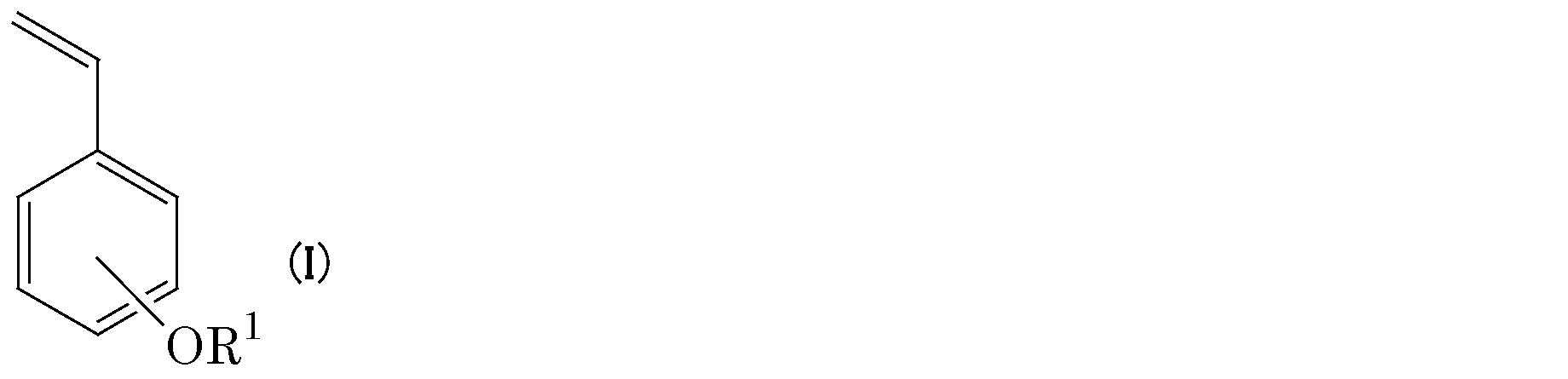
(式中、R1は、炭素数が1~10の炭化水素基を表す。)

(式(A)中、R101は、水素原子、分岐若しくは非分岐の炭素数1~30のアルキル基、分岐若しくは非分岐の炭素数2~30のアルケニル基、分岐若しくは非分岐の炭素数6~30のアリール基、又は水酸基を表す。R102及びR103は、同一若しくは異なって、水素原子、分岐若しくは非分岐の炭素数1~30のアルキル基、分岐若しくは非分岐の炭素数2~30のアルケニル基、分岐若しくは非分岐の炭素数2~30のアルキニル基、分岐若しくは非分岐の炭素数6~30のアリール基、又は下記式(B)で表される基を表し、該アルキル基、該アルケニル基、該アルキニル基、該アリール基が有する水素原子が水酸基又はカルボキシル基で置換されていてもよい。R101とR102、R101とR103、又はR102とR103とで環構造を形成してもよい。rは、0~8の整数を表す。)

(式(B)中、R104は、分岐若しくは非分岐の炭素数1~30のアルキレン基を表す。R105は、水素原子、分岐若しくは非分岐の炭素数1~30のアルキル基、分岐若しくは非分岐の炭素数2~30のアルケニル基、分岐若しくは非分岐の炭素数6~30のアリール基、又は水酸基を表す。tは、0~10の整数を表す。)
上記官能基がアルコキシシリル基であることが好ましく、アルコキシシリル基及びアミノ基であることがより好ましい。
上記一方の末端に有するアミノ基が、アルキルアミノ基、又は下記式(II)で表される基であることが好ましい。

(式中、R11は、炭素数が2~50の2価の炭化水素基を表し、窒素原子、酸素原子を有してもよい。)
上記式(II)で表される基が下記式(III)で表される基であることが好ましい。

(式中、R12~R19は、同一又は異なって、水素原子、又は炭素数が1~5の炭化水素基を表し、窒素原子、酸素原子を有してもよい。)
上記一方の末端にアミノ基と共に、イソプレン単位を有することが好ましい。
上記共重合体中、上記式(I)で表される化合物の含有量が0.05~35質量%であることが好ましい。
上記共重合体は、リチウム原子とアミノ基を有する化合物を重合開始剤として、1,3-ブタジエン、スチレン及び上記式(I)で表される化合物を共重合した後、重合末端を窒素、酸素及びケイ素からなる群より選択される少なくとも1種の原子を含む官能基を有する変性剤により変性して得られるものであることが好ましい。
上記変性剤が下記式(IV)、下記式(V)、又は下記式(VI)で表される化合物であることが好ましい。

(式中、R21、R22及びR23は、同一若しくは異なって、アルキル基、アルコキシ基、シリルオキシ基、カルボキシル基、メルカプト基又はこれらの誘導体を表す。R24及びR25は、同一若しくは異なって、水素原子又はアルキル基を表す。nは整数を表す。)

(式中、R26、R27及びR28は、同一若しくは異なって、アルキル基、アルコキシ基、シリルオキシ基、カルボキシル基、メルカプト基又はこれらの誘導体を表す。R29は、環状エーテル基を表す。p及びqは整数を表す。)

(式中、R30~R33は、同一若しくは異なって、アルキル基、アルコキシ基、シリルオキシ基、カルボキシル基、メルカプト基又はこれらの誘導体を表す。)
上記重合開始剤が、アルキルアミノ基、又は下記式(II)で表される基を有することが好ましい。

(式中、R11は、炭素数が2~50の2価の炭化水素基を表し、窒素原子、酸素原子を有してもよい。)
上記式(II)で表される基が下記式(III)で表される基であることが好ましい。

(式中、R12~R19は、同一又は異なって、水素原子、又は炭素数が1~5の炭化水素基を表し、窒素原子、酸素原子を有してもよい。)
上記重合開始剤がイソプレン単位を有することが好ましい。
上記式(A)で表される化合物の含有量が、シリカ100質量部に対して、0.1~20質量部であることが好ましい。
上記シリカの含有量が、ゴム成分100質量部に対して、10~150質量部であることが好ましい。
上記タイヤ用ゴム組成物は、トレッド用ゴム組成物として用いられることが好ましい。
本発明はまた、上記ゴム組成物を用いて作製した空気入りタイヤに関する。
本発明によれば、1,3-ブタジエン、スチレン及び上記式(I)で表される化合物を共重合して得られ、一方の末端にアミノ基を有し、他方の末端に窒素、酸素及びケイ素からなる群より選択される少なくとも1種の原子を含む官能基を有する重量平均分子量が特定の範囲内である共重合体と、シリカと、上記式(A)で表される化合物とを含むタイヤ用ゴム組成物であるので、良好な加工性、作業性を維持しつつ、低燃費性、耐摩耗性、ウェットグリップ性能をバランス良く向上でき、該ゴム組成物をタイヤの各部材(特に、トレッド)に使用することにより、上記性能に優れた空気入りタイヤを生産性良く提供することができる。
本発明のタイヤ用ゴム組成物は、1,3-ブタジエン、スチレン及び下記式(I)で表される化合物を共重合して得られ、一方の末端にアミノ基を有し、他方の末端に窒素、酸素及びケイ素からなる群より選択される少なくとも1種の原子を含む官能基を有する重量平均分子量が1.0×10⁵~2.5×10⁶である共重合体と、シリカと、下記式(A)で表される化合物とを含む。

(式中、R1は、炭素数が1~10の炭化水素基を表す。)

(式(A)中、R101は、水素原子、分岐若しくは非分岐の炭素数1~30のアルキル基、分岐若しくは非分岐の炭素数2~30のアルケニル基、分岐若しくは非分岐の炭素数6~30のアリール基、又は水酸基を表す。R102及びR103は、同一若しくは異なって、水素原子、分岐若しくは非分岐の炭素数1~30のアルキル基、分岐若しくは非分岐の炭素数2~30のアルケニル基、分岐若しくは非分岐の炭素数2~30のアルキニル基、分岐若しくは非分岐の炭素数6~30のアリール基、又は下記式(B)で表される基を表し、該アルキル基、該アルケニル基、該アルキニル基、該アリール基が有する水素原子が水酸基又はカルボキシル基で置換されていてもよい。R101とR102、R101とR103、又はR102とR103とで環構造を形成してもよい。rは、0~8の整数を表す。)

(式(B)中、R104は、分岐若しくは非分岐の炭素数1~30のアルキレン基を表す。R105は、水素原子、分岐若しくは非分岐の炭素数1~30のアルキル基、分岐若しくは非分岐の炭素数2~30のアルケニル基、分岐若しくは非分岐の炭素数6~30のアリール基、又は水酸基を表す。tは、0~10の整数を表す。)
シリカと共に上記共重合体を配合すると、低燃費性、耐摩耗性、ウェットグリップ性能を向上できるものの、作業性が悪化する傾向がある。一方、シリカと共に上記式(A)で表される化合物を配合すると、加工性、作業性を向上できる。
そして、上記共重合体とシリカと上記式(A)で表される化合物とを併用することにより、低燃費性、耐摩耗性、ウェットグリップ性能(特に、低燃費性)を相乗的に向上でき、更に、良好な加工性、作業性も得られる。特に、作業性に関しては、シリカと共に上記共重合体を配合した場合であっても、更に上記式(A)で表される化合物を併用することにより、上記共重合体を配合せずにシリカと共に上記式(A)で表される化合物を配合した場合と同等の優れた作業性が得られる。
そして、上記共重合体とシリカと上記式(A)で表される化合物とを併用することにより、低燃費性、耐摩耗性、ウェットグリップ性能(特に、低燃費性)を相乗的に向上でき、更に、良好な加工性、作業性も得られる。特に、作業性に関しては、シリカと共に上記共重合体を配合した場合であっても、更に上記式(A)で表される化合物を併用することにより、上記共重合体を配合せずにシリカと共に上記式(A)で表される化合物を配合した場合と同等の優れた作業性が得られる。
[ゴム成分]
<共重合体>
本明細書において「共重合体」は、ゴム成分に含まれる概念として記載する。
上記共重合体は、上記式(I)で表される化合物で主鎖が変性されているため、該化合物(特に、該化合物中に含まれる酸素原子)とフィラーとの相互作用が生じ、フィラーの分散性が向上するとともに、共重合体の動きが拘束される。その結果、ヒステリシスロスが低減して低燃費性が改善でき、また、良好なウェットグリップ性能、耐摩耗性が得られる。さらに、共重合体の一方の末端にアミノ基を有し、他方の末端に上記官能基を有するため、共重合体の両方の末端部分においてもフィラーとの相互作用が生じ、フィラーの分散性が向上するとともに、共重合体の動きが拘束される。その結果、ヒステリシスロスが低減して低燃費性が改善でき、また、良好なウェットグリップ性能、耐摩耗性が得られる。そして、上記式(I)で表される化合物に基づく構成単位、一方の末端に有するアミノ基、他方の末端に有する上記官能基を組み合わせた上記共重合体では、低燃費性、ウェットグリップ性能、耐摩耗性(特に、低燃費性)を相乗的に改善できる。
通常、主鎖に官能基を有する重合体(主鎖変性重合体)の末端に、更に官能基を付加した場合(主鎖末端変性重合体とした場合)であっても、上記性能が向上するとは一概には言えない。これは、官能基の種類によりシリカとの親和性が異なるためであり、性能を好適に向上させるためには官能基の組合せが非常に重要である。本発明では、上記式(I)で表される化合物に基づく構成単位、一方の末端に有するアミノ基、他方の末端に有する上記官能基の組合せが非常に良好であるため、低燃費性、ウェットグリップ性能、耐摩耗性(特に、低燃費性)を相乗的に改善できるものと推測される。

(式中、R1は、炭素数が1~10の炭化水素基を表す。)
<共重合体>
本明細書において「共重合体」は、ゴム成分に含まれる概念として記載する。
上記共重合体は、上記式(I)で表される化合物で主鎖が変性されているため、該化合物(特に、該化合物中に含まれる酸素原子)とフィラーとの相互作用が生じ、フィラーの分散性が向上するとともに、共重合体の動きが拘束される。その結果、ヒステリシスロスが低減して低燃費性が改善でき、また、良好なウェットグリップ性能、耐摩耗性が得られる。さらに、共重合体の一方の末端にアミノ基を有し、他方の末端に上記官能基を有するため、共重合体の両方の末端部分においてもフィラーとの相互作用が生じ、フィラーの分散性が向上するとともに、共重合体の動きが拘束される。その結果、ヒステリシスロスが低減して低燃費性が改善でき、また、良好なウェットグリップ性能、耐摩耗性が得られる。そして、上記式(I)で表される化合物に基づく構成単位、一方の末端に有するアミノ基、他方の末端に有する上記官能基を組み合わせた上記共重合体では、低燃費性、ウェットグリップ性能、耐摩耗性(特に、低燃費性)を相乗的に改善できる。
通常、主鎖に官能基を有する重合体(主鎖変性重合体)の末端に、更に官能基を付加した場合(主鎖末端変性重合体とした場合)であっても、上記性能が向上するとは一概には言えない。これは、官能基の種類によりシリカとの親和性が異なるためであり、性能を好適に向上させるためには官能基の組合せが非常に重要である。本発明では、上記式(I)で表される化合物に基づく構成単位、一方の末端に有するアミノ基、他方の末端に有する上記官能基の組合せが非常に良好であるため、低燃費性、ウェットグリップ性能、耐摩耗性(特に、低燃費性)を相乗的に改善できるものと推測される。
上記式(I)において、R1は、炭素数が1~10の炭化水素基を表す。炭素数が10を超えると、高コストになる傾向がある。また、低燃費性、耐摩耗性及びウェットグリップ性能を充分に改善できない傾向がある。得られる重合体による低燃費性、耐摩耗性及びウェットグリップ性能の改善効果が高いという点から、炭素数は、好ましくは1~8、より好ましくは1~6、更に好ましくは1~3である。
R1で表される炭化水素基としては、例えば、アルキル基などの1価の脂肪族炭化水素基、アリール基などの1価の芳香族炭化水素基などが挙げられる。得られる重合体による低燃費性、耐摩耗性及びウェットグリップ性能の改善効果が高いという点から、R1は、アルキル基が好ましく、メチル基、tert-ブチル基がより好ましい。
また、得られる共重合体による低燃費性、耐摩耗性及びウェットグリップ性能の改善効果が高いという点から、上記式(I)で表される化合物のなかでも、下記式(I-I)で表される化合物が好ましい。

(上記式(I-I)中のR1は、上記式(I)中のR1と同様である。)
上記式(I)で表される化合物としては、例えば、p-メトキシスチレン、p-エトキシスチレン、p-(n-プロポキシ)スチレン、p-(tert-ブトキシ)スチレン、m-メトキシスチレンなどが挙げられる。これらは単独で用いてもよく、2種以上を組み合わせてもよい。
上記共重合体における上記式(I)で表される化合物の含有量は、好ましくは0.05質量%以上、より好ましくは0.1質量%以上、更に好ましくは0.3質量%以上であり、また、好ましくは35質量%以下、より好ましくは20質量%以下、更に好ましくは10質量%以下、特に好ましくは5質量%以下、最も好ましくは2質量%以下である。0.05質量%未満では低燃費性、耐摩耗性及びウェットグリップ性能の改善効果が得られにくく、一方、35質量%を超えると高コストになる傾向がある。
上記共重合体におけるスチレン含有量は、好ましくは2質量%以上、より好ましくは5質量%以上、更に好ましくは10質量%以上、特に好ましくは15質量%以上であり、また、好ましくは50質量%以下、より好ましくは30質量%以下、更に好ましくは25質量%以下、特に好ましくは22質量%以下である。2質量%未満ではウェットグリップ性能が悪化する傾向があり、一方、50質量%を超えると低燃費性が悪化する傾向がある。
上記共重合体における1,3-ブタジエンの含有量は特に限定されず、他の成分の含有量に合わせて適宜調整すればよいが、好ましくは15質量%以上、より好ましくは20質量%以上、更に好ましくは60質量%以上であり、また、好ましくは97質量%以下、より好ましくは85質量%以下、更に好ましくは80質量%以下である。15質量%未満ではウェットグリップ性能が悪化する傾向があり、一方、97質量%を超えると低燃費性が悪化する傾向がある。
上記共重合体における上記式(I)で表される化合物、1,3-ブタジエン及びスチレンの含有量は、後述する実施例の方法で測定できる。
一方の末端に有するアミノ基(1級アミノ基、2級アミノ基、3級アミノ基)は、非環状アミノ基であっても、環状アミノ基であってもよい。
非環状アミノ基を構成する非環状アミンとしては、例えば、1,1-ジメチルプロピルアミン、1,2-ジメチルプロピルアミン、2,2-ジメチルプロピルアミン、2-エチルブチルアミン、ペンチルアミン、2,2-ジメチルブチルアミン、ヘキシルアミン、シクロヘキシルアミン、オクチルアミン、2-エチルヘキシルアミン、イソデシルアミンなどのモノアルキルアミンや、ジメチルアミン、メチルイソブチルアミン、メチル(t-ブチル)アミン、メチルペンチルアミン、メチルヘキシルアミン、メチル(2-エチルヘキシル)アミン、メチルオクチルアミン、メチルノニルアミン、メチルイソデシルアミン、ジエチルアミン、エチルプロピルアミン、エチルイソプロピルアミン、エチルブチルアミン、エチルイソブチルアミン、エチル(t-ブチル)アミン、エチルペンチルアミン、エチルヘキシルアミン、エチル(2-エチルヘキシル)アミン、エチルオクチルアミン、ジプロピルアミン、ジイソプロピルアミン、プロピルブチルアミン、プロピルイソブチルアミン、プロピル(t-ブチル)アミン、プロピルペンチルアミン、プロピルヘキシルアミン、プロピル(2-エチルヘキシル)アミン、プロピルオクチルアミン、イソプロピルブチルアミン、イソプロピルイソブチルアミン、イソプロピル(t-ブチル)アミン、イソプロピルペンチルアミン、イソプロピルヘキシルアミン、イソプロピル(2-エチルヘキシル)アミン、イソプロピルオクチルアミン、ジブチルアミン、ジイソブチルアミン、ジt-ブチルアミン、ブチルペンチルアミン、ジペンチルアミン、ジシクロヘキシルアミンなどのジアルキルアミンやラウリルアミンメチルブチルアミンなどが挙げられる。これらの非環状アミンが有する窒素原子に結合している水素原子が脱離することにより非環状アミノ基となる。
非環状アミノ基としては、上記式(I)で表される化合物に基づく構成単位、他方の末端に有する上記官能基と組み合わせた場合に、低燃費性、耐摩耗性、ウェットグリップ性能をより相乗的に改善できるという理由から、アルキルアミノ基(モノアルキルアミン、ジアルキルアミンが有する窒素原子に結合している水素原子が脱離した基)が好ましく、ジアルキルアミノ基(ジアルキルアミンが有する窒素原子に結合している水素原子が脱離した基)がより好ましい。なお、アルキルアミノ基、ジアルキルアミノ基が有するアルキル基の炭素数は、1~10が好ましく、1~3がより好ましい。
また、環状アミノ基を構成する環状アミンとしては、例えば、アジリジン、2-メチルアジリジン、2-エチルアジリジン、ピロリジン環を有する化合物(ピロリジン、2-メチルピロリジン、2-エチルピロリジン、2-ピロリドン、スクシンイミド)、ピペリジン、2-メチルピペリジン、3,5-ジメチルピペリジン、2-エチルピペリジン、4-ピペリジノピペリジン、2-メチル-4-ピロリジノピペリジン、1-メチルピペラジン、1-メチル-3-エチルピペラジンモルフォリン、2-メチルモルフォリン、3,5-ジメチルモルフォリン、チオモルフォリン、3-ピロリン、2,5-ジメチル-3-ピロリン、2-フェニル-2-ピロリン、ピラゾリン、2-メチルイミダゾール、2-エチル-4-メチルイミダゾール、2-フェニルイミダゾール、ピラゾール、ピラゾールカルボン酸、α-ピリドン、γ-ピリドン、アニリン、3-メチルアニリン、N-メチルアニリン、N-イソプロピルアニリンなどが挙げられる。これらの環状アミンが有する窒素原子に結合している水素原子が脱離することにより環状アミノ基となる。
環状アミノ基としては、上記式(I)で表される化合物に基づく構成単位、他方の末端に有する上記官能基と組み合わせた場合に、低燃費性、耐摩耗性、ウェットグリップ性能をより相乗的に改善できるという理由から、下記式(II)で表される基が好ましい。

(式中、R11は、炭素数が2~50の2価の炭化水素基を表し、窒素原子、酸素原子を有してもよい。)
R11は、炭素数が2~50(好ましくは2~10、より好ましくは3~5)の2価の炭化水素基を表す。
該炭化水素基としては、例えば、炭素数2~10のアルキレン基、炭素数2~10のアルケニレン基、2~10のアルキニレン基、炭素数6~10のアリーレン基などが挙げられる。なかでも、アルキレン基が好ましい。
該炭化水素基としては、例えば、炭素数2~10のアルキレン基、炭素数2~10のアルケニレン基、2~10のアルキニレン基、炭素数6~10のアリーレン基などが挙げられる。なかでも、アルキレン基が好ましい。
上記式(II)で表される基の中でも、下記式(III)で表される基が好ましい。
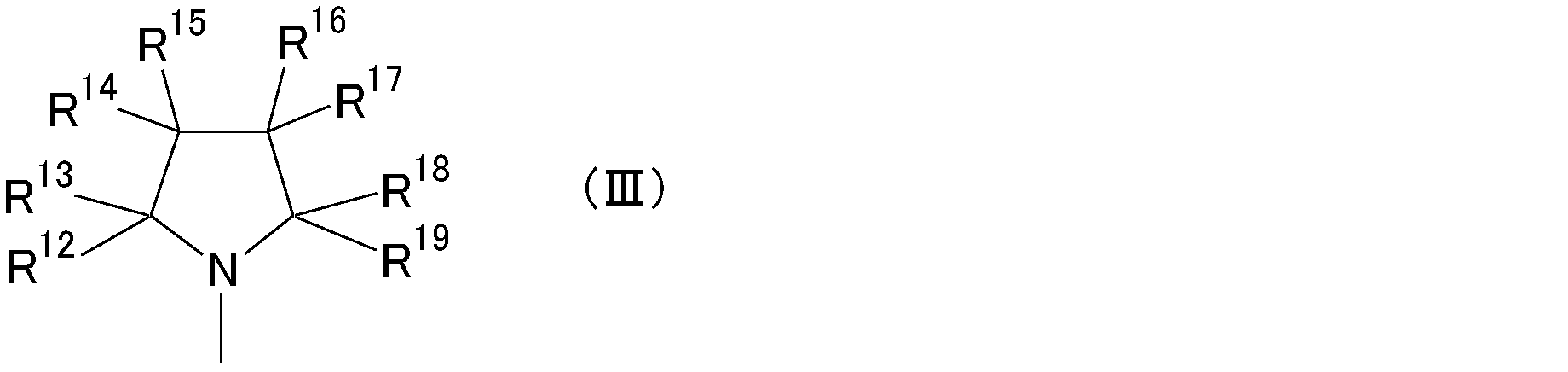
(式中、R12~R19は、同一又は異なって、水素原子、又は炭素数が1~5の炭化水素基を表し、窒素原子、酸素原子を有してもよい。)
R12~R19の炭素数が1~5(好ましくは1~3)の炭化水素基としては、R1で表される炭化水素基と同様の基が挙げられる。なかでも、アルキル基が好ましく、メチル基、エチル基がより好ましい。
R12~R19としては、水素原子が好ましく、R12~R19の全てが水素原子であることがより好ましい。
一方の末端には、上記アミノ基と共に、イソプレン単位(下記式(VII)で表される単位)を有することが好ましい。これにより、上記式(I)で表される化合物に基づく構成単位、他方の末端に有する上記官能基と組み合わせた場合に、低燃費性、耐摩耗性、ウェットグリップ性能をより相乗的に改善できる。特に、アルキルアミノ基と共に、イソプレン単位を有することがより好ましく、ジアルキルアミノ基と共に、イソプレン単位を有することが更に好ましく、例えば、下記式(A)で表される基が好適である。

(式中、sは、1~100(好ましくは1~50、より好ましくは1~10、更に好ましくは1~5)の整数を表す。)

(式中、sは、1~100(好ましくは1~50、より好ましくは1~10、更に好ましくは1~5)の整数を表す。)
一方、他方の末端に有する、窒素、酸素及びケイ素からなる群より選択される少なくとも1種の原子を含む官能基としては、例えばアミノ基、アミド基、アルコキシシリル基、イソシアネート基、イミノ基、イミダゾール基、ウレア基、エーテル基、カルボニル基、カルボキシル基、ヒドロキシル基、ニトリル基、ピリジル基などが挙げられる。
他方の末端に有する上記官能基としては、上記式(I)で表される化合物に基づく構成単位、一方の末端に有するアミノ基と組み合わせた場合に、低燃費性、耐摩耗性、ウェットグリップ性能をより相乗的に改善できるという理由から、アルコキシシリル基、アミノ基、エーテル基が好ましく、アルコキシシリル基、アミノ基を両方有することがより好ましい。
アミノ基としては、上述の一方の末端に有するアミノ基と同様の基が挙げられる。なかでも、アルキルアミノ基が好ましく、ジアルキルアミノ基がより好ましい。なお、アルキルアミノ基、ジアルキルアミノ基が有するアルキル基の炭素数は、1~10が好ましく、1~3がより好ましい。
アルコキシシリル基としては、メトキシシリル基、エトキシシリル基、プロポキシシリル基、ブトキシシリル基などが挙げられる。アルコキシシリル基が有するアルコキシ基の炭素数は、1~10が好ましく、1~3がより好ましい。
<共重合体の製造方法>
本発明の共重合体は、例えば、リチウム原子とアミノ基を有する化合物を重合開始剤として、1,3-ブタジエン、スチレン及び上記式(I)で表される化合物を共重合した後、重合末端を窒素、酸素及びケイ素からなる群より選択される少なくとも1種の原子を含む官能基を有する変性剤により変性することにより製造でき、具体的には、以下の製造方法で製造できる。
本発明の共重合体は、例えば、リチウム原子とアミノ基を有する化合物を重合開始剤として、1,3-ブタジエン、スチレン及び上記式(I)で表される化合物を共重合した後、重合末端を窒素、酸素及びケイ素からなる群より選択される少なくとも1種の原子を含む官能基を有する変性剤により変性することにより製造でき、具体的には、以下の製造方法で製造できる。
(重合方法)
スチレン、1,3-ブタジエンおよび上記式(I)で表される化合物などのモノマー成分を共重合する際の重合方法については特に制限はなく、溶液重合法、気相重合法、バルク重合法のいずれも用いることができるが、特に上記式(I)で表される化合物の安定性の観点から、溶液重合法が好ましい。また、重合形式は、回分式及び連続式のいずれであってもよい。
スチレン、1,3-ブタジエンおよび上記式(I)で表される化合物などのモノマー成分を共重合する際の重合方法については特に制限はなく、溶液重合法、気相重合法、バルク重合法のいずれも用いることができるが、特に上記式(I)で表される化合物の安定性の観点から、溶液重合法が好ましい。また、重合形式は、回分式及び連続式のいずれであってもよい。
溶液重合法を用いた場合には、溶液中のモノマー濃度(スチレン、1,3-ブタジエン、上記式(I)で表される化合物などの合計)は、好ましくは5質量%以上、より好ましくは10質量%以上である。溶液中のモノマー濃度が5質量%未満では、得られる共重合体の量が少なく、高コストになる傾向がある。また、溶液中のモノマー濃度は、好ましくは50質量%以下、より好ましくは30質量%以下である。溶液中のモノマー濃度が50質量%を超えると、溶液粘度が高くなりすぎて撹拌が困難となり、重合しにくくなる傾向がある。
(アニオン重合における重合開始剤)
アニオン重合を行う場合、重合開始剤として、リチウム原子とアミノ基を有する化合物を使用することが好ましい。これにより、重合開始末端にアミノ基を有し、他方の末端が重合活性部位である共役ジエン系重合体(リビングポリマー)が得られる。
アニオン重合を行う場合、重合開始剤として、リチウム原子とアミノ基を有する化合物を使用することが好ましい。これにより、重合開始末端にアミノ基を有し、他方の末端が重合活性部位である共役ジエン系重合体(リビングポリマー)が得られる。
重合開始剤(リチウム原子とアミノ基を有する化合物)が有するアミノ基としては、当該アミノ基が重合開始末端にそのまま残存することとなるため、上述の非環状アミノ基、環状アミノ基と同様の基が好適である。なお、好適な態様も同様である。
リチウム原子とアミノ基を有する化合物は、例えば、リチウム化合物とアミノ基を有する化合物とを反応させて得られる(例えば、リチウムアミド化合物)。
リチウム化合物としては特に制限はないが、ヒドロカルビルリチウムが好ましく用いられる。ヒドロカルビルリチウムとしては、炭素数2~20のヒドロカルビル基を有するものが好ましく、例えばエチルリチウム、n-プロピルリチウム、イソプロピルリチウム、n-ブチルリチウム、sec-ブチルリチウム、tert-オクチルリチウム、n-デシルリチウム、フェニルリチウム、2-ナフチルリチウム、2-ブチル-フェニルリチウム、4-フェニル-ブチルリチウム、シクロへキシルリチウム、シクロペンチルリチウム、ジイソプロペニルベンゼンとブチルリチウムとの反応生成物などが挙げられるが、これらの中で、特にn-ブチルリチウムが好適である。
アミノ基を有する化合物としては、当該アミノ基が重合開始末端に残存することとなるため、上述の非環状アミノ基を構成する非環状アミン、環状アミノ基を構成する環状アミン(特に、ピロリジン環を有する化合物)と同様の化合物を好適に使用できる。そのため、アミノ基を有する化合物としては、アルキルアミノ基を有する化合物(モノアルキルアミン、ジアルキルアミン)が好ましく、ジアルキルアミノ基を有する化合物(ジアルキルアミン)がより好ましい。なお、アルキルアミノ基、ジアルキルアミノ基が有するアルキル基の好ましい炭素数は、上述の非環状アミノ基の場合と同様である。
また、アミノ基を有する化合物としては、上記式(II)で表される基を有する化合物が好ましく、上記式(III)で表される基を有する化合物がより好ましい。なお、上記式(II)で表される基、上記式(III)で表される基の好適な態様は上述の環状アミノ基の場合と同様である。
リチウム化合物とアミノ基を有する化合物とを反応させる条件は、特に限定されないが、例えば、リチウム化合物とアミノ基を有する化合物を炭化水素系溶剤に溶解させ、反応温度0~80℃で、0.01~1時間反応させればよい。使用するリチウム化合物とアミノ基を有する化合物のモル比(リチウム化合物/アミノ基を有する化合物)は、特に限定されないが、例えば、0.8~1.5であればよい。
また、反応に使用する炭化水素系溶剤は、特に限定されないが、炭素数3~8のものが好ましく、例えばプロパン、n-ブタン、イソブタン、n-ペンタン、イソペンタン、n-ヘキサン、シクロヘキサン、プロペン、1-ブテン、イソブテン、トランス-2-ブテン、シス-2-ブテン、1-ペンテン、2-ペンテン、1-ヘキセン、2-ヘキセン、ベンゼン、トルエン、キシレン、エチルベンゼンなどを挙げることができる。これらは単独で用いてもよく、2種以上を混合して用いてもよい。
リチウム原子とアミノ基を有する化合物(例えば、リチウムアミド化合物)としては、リチウム化合物とアミノ基を有する化合物とを反応させて得てもよく、また、市販品を使用してもよい。リチウム化合物とアミノ基を有する化合物とを反応させる場合、モノマー成分を投入する前に、事前に反応させておいてもよく、モノマー成分の存在下でリチウム化合物、アミノ基を有する化合物を反応させてもよい。モノマー成分が存在しても、アミノ基を有する化合物の方が反応性が高いため、リチウム化合物とアミノ基を有する化合物の反応が優先的に進行する。
リチウムアミド化合物としては、例えば、リチウムヘキサメチレンイミド、リチウムピロリジド、リチウムピぺリジド、リチウムへプタメチレンイミド、リチウムドデカメチレンイミド、リチウムジメチルアミド、リチウムジエチルアミド、リチウムジブチルアミド、リチウムジプロピルアミド、リチウムジへプチルアミド、リチウムジへキシルアミド、リチウムジオクチルアミド、リチウムジ-2-エチルへキシルアミド、リチウムジデシルアミド、リチウム-N-メチルピベラジド、リチウムエチルプロピルアミド、リチウムエチルブチルアミド、リチウムエチルベンジルアミド、リチウムメチルフェネチルアミド、下記式で表される化合物などが挙げられる。なかでも、リチウムピロリジド、リチウムジメチルアミド、リチウムジエチルアミドが好ましい。
また、リチウム原子とアミノ基を有する化合物として、アミノ基と共に、イソプレン単位(下記式(VII)で表される単位)を有する化合物も好適に使用できる。これにより、上記式(I)で表される化合物に基づく構成単位、他方の末端に有する上記官能基と組み合わせた場合に、低燃費性、耐摩耗性、ウェットグリップ性能をより相乗的に改善できる。

(式中、sは、1~100(好ましくは1~50、より好ましくは1~10、更に好ましくは1~5)の整数を表す。)
なかでも、特に、アルキルアミノ基と共に、上記イソプレン単位を有することがより好ましく、ジアルキルアミノ基と共に、上記イソプレン単位を有することが更に好ましく、例えば、下記式で表される化合物が好適である。なお、下記式で表される化合物のうちs=2の化合物は、FMCリチウム社により商品名AI-200として販売されている。

(式中、sは、1~100(好ましくは1~50、より好ましくは1~10、更に好ましくは1~5)の整数を表す。)
(アニオン重合の方法)
上記リチウム原子とアミノ基を有する化合物を重合開始剤として用い、アニオン重合によって共重合体を製造する方法としては、特に制限はなく、従来公知の方法を用いることができる。具体的には、反応に不活性な有機溶剤、例えば脂肪族、脂環族、芳香族炭化水素化合物などの炭化水素系溶剤中において、上記リチウム原子とアミノ基を有する化合物を重合開始剤とし、必要に応じてランダマイザーの存在下で、スチレン、1,3-ブタジエン及び上記式(I)で表される化合物などとをアニオン重合させればよい。なお、アニオン重合後に、必要に応じて、公知の老化防止剤や、重合反応を停止する目的でアルコールなどを加えてもよい。
上記リチウム原子とアミノ基を有する化合物を重合開始剤として用い、アニオン重合によって共重合体を製造する方法としては、特に制限はなく、従来公知の方法を用いることができる。具体的には、反応に不活性な有機溶剤、例えば脂肪族、脂環族、芳香族炭化水素化合物などの炭化水素系溶剤中において、上記リチウム原子とアミノ基を有する化合物を重合開始剤とし、必要に応じてランダマイザーの存在下で、スチレン、1,3-ブタジエン及び上記式(I)で表される化合物などとをアニオン重合させればよい。なお、アニオン重合後に、必要に応じて、公知の老化防止剤や、重合反応を停止する目的でアルコールなどを加えてもよい。
(アニオン重合における炭化水素系溶剤)
上記炭化水素系溶剤としては、炭素数3~8のものが好ましく、例えばプロパン、n-ブタン、イソブタン、n-ペンタン、イソペンタン、n-ヘキサン、シクロヘキサン、プロペン、1-ブテン、イソブテン、トランス-2-ブテン、シス-2-ブテン、1-ペンテン、2-ペンテン、1-ヘキセン、2-ヘキセン、ベンゼン、トルエン、キシレン、エチルベンゼンなどを挙げることができる。これらは単独で用いてもよく、2種以上を混合して用いてもよい。
上記炭化水素系溶剤としては、炭素数3~8のものが好ましく、例えばプロパン、n-ブタン、イソブタン、n-ペンタン、イソペンタン、n-ヘキサン、シクロヘキサン、プロペン、1-ブテン、イソブテン、トランス-2-ブテン、シス-2-ブテン、1-ペンテン、2-ペンテン、1-ヘキセン、2-ヘキセン、ベンゼン、トルエン、キシレン、エチルベンゼンなどを挙げることができる。これらは単独で用いてもよく、2種以上を混合して用いてもよい。
(アニオン重合におけるランダマイザー)
また、上記ランダマイザーとは、共重合体中の共役ジエン部分のミクロ構造制御(例えば、ブタジエンにおける1,2-結合の増加など)や、共重合体におけるモノマー単位の組成分布の制御(例えば、ブタジエン-スチレン共重合体におけるブタジエン単位、スチレン単位のランダム化など)などの作用を有する化合物のことである。このランダマイザーとしては、特に制限はなく、従来ランダマイザーとして一般に使用されている公知の化合物の中から任意のものを用いることができる。例えば、ジメトキシベンゼン、テトラヒドロフラン、ジメトキシエタン、ジエチレングリコールジブチルエーテル、ジエチレングリコールジメチルエーテル、ビステトラヒドロフリルプロパン、トリエチルアミン、ピリジン、N-メチルモルホリン、N,N,N’,N’-テトラメチルエチレンジアミン、1,2-ジピペリジノエタンなどのエーテル類及び第三級アミン類などを挙げることができる。また、カリウム-t-アミレート、カリウム-t-ブトキシドなどのカリウム塩類、ナトリウム-t-アミレートなどのナトリウム塩類も用いることができる。
また、上記ランダマイザーとは、共重合体中の共役ジエン部分のミクロ構造制御(例えば、ブタジエンにおける1,2-結合の増加など)や、共重合体におけるモノマー単位の組成分布の制御(例えば、ブタジエン-スチレン共重合体におけるブタジエン単位、スチレン単位のランダム化など)などの作用を有する化合物のことである。このランダマイザーとしては、特に制限はなく、従来ランダマイザーとして一般に使用されている公知の化合物の中から任意のものを用いることができる。例えば、ジメトキシベンゼン、テトラヒドロフラン、ジメトキシエタン、ジエチレングリコールジブチルエーテル、ジエチレングリコールジメチルエーテル、ビステトラヒドロフリルプロパン、トリエチルアミン、ピリジン、N-メチルモルホリン、N,N,N’,N’-テトラメチルエチレンジアミン、1,2-ジピペリジノエタンなどのエーテル類及び第三級アミン類などを挙げることができる。また、カリウム-t-アミレート、カリウム-t-ブトキシドなどのカリウム塩類、ナトリウム-t-アミレートなどのナトリウム塩類も用いることができる。
ランダマイザーの使用量は、重合開始剤1モル当たり、0.01モル当量以上が好ましく、0.05モル当量以上がより好ましい。ランダマイザーの使用量が0.01モル当量未満では、添加効果が小さく、ランダム化しにくい傾向がある。また、ランダマイザーの使用量は、重合開始剤1モル当たり1000モル当量以下が好ましく、500モル当量以下がより好ましい。ランダマイザーの使用量が1000モル当量を超えると、モノマーの反応速度が大きく変化してしまい、逆にランダム化しにくくなる傾向がある。
上記変性剤による変性方法としては特に限定されず、公知の方法を用いることができる。例えば、アニオン重合で主鎖が変性された共重合体を合成した後、該共重合体と変性剤とを接触させることにより、共重合体末端部のアニオンと変性剤の官能基とが反応し、共重合体末端部が変性される。変性剤を反応させる量は、通常、共重合体100質量部に対して0.01~10質量部とすればよい。
<変性剤>
上記変性剤としては、例えば3-グリシドキシプロピルトリメトキシシラン、(3-トリエトキシシリルプロピル)テトラスルフィド、1-(4-N,Nジメチルアミノフェニル)-1-フェニルエチレン、1,1-ジメトキシトリメチルアミン、1,2-ビス(トリクロロシリル)エタン、1,3,5-トリス(3-トリエトキシシリルプロピル)イソシアヌレート、1,3,5-トリス(3-トリメトキシシリルプロピル)イソシアヌレート、1,3-ジメチル-2-イミダゾリジノン、1,3-プロパンジアミン、1,4-ジアミノブタン、1-[3-(トリエトキシシリル)プロピル]-4,5-ジヒドロイミダゾール、1-グリシジル-4-(2-ピリジル)ピペラジン、1-グリシジル-4-フェニルピペラジン、1-グリシジル-4-メチルピベラジン、1-グリシジル-4-メチルホモピベラジン、1-グリシジルヘキサメチレンイミン、11-アミノウンデシルトリエトキシシラン、11-アミノウンデシルトリメトキシシラン、1-ベンジル-4-グリシジルピペラジン、2-(3,4-エポキシシクロヘキシル)エチルトリメトキシシラン、2-(4-モルフォリノジチオ)ベンゾチアゾール、2-(6-アミノエチル)-3-アミノプロピルトリメトキシシラン、2-(トリエトキシシリルエチル)ピリジン、2-(トリメトキシシリルエチル)ピリジン、2-(2-ピリジルエチル)チオプロピルトリメトキシシラン、2-(4-ピリジルエチル)チオプロビルトリメトキシシラン、2,2-ジエトキシ-1,6-ジアザ-2-シラシクロオクタン、2,2-ジメトキシ-1,6-ジアザ-2-シラシクロオクタン、2,3-シクロロ-1,4-ナフトキノン、2,4-ジニトロベンゼンスルホニルクロライド、2,4-トリレンジイソシアナート、2-(4-ピリジルエチル)トリエトキシシラン、2-(4-ピリジルエチル)トリメトキシシラン、2-シアノエチルトリエトキシシラン、2-トリブチルスタニル-1,3-ブタジエン、2-(トリメトキシシリルエチル)ピリジン、2-ビニルピリジン、2-(4-ピリジルエチル)トリエトキシシラン、2-(4-ピリジルエチル)トリメトキシシラン、2-ラウリルチオエチルフェニルケトン、3-(1-ヘキサメチレンイミノ)プロピル(トリエトキシ)シラン、3-(1,3-ジメチルブチリデン)アミノプロピルトリエトキシシラン、3-(1,3-ジメチルブチリデン)アミノプロピルトリメトキシシラン、3-(2-アミノエチルアミノプロピル)トリメトキシシラン、3-(m-アミノフェノキシ)プロピルトリメトキシシラン、3-(N,N-ジメチルアミノ)プロピルトリエトキシシラン、3-(N,N-ジメチルアミノ)プロピルトリメトキシシラン、3-(N-メチルアミノ)プロピルトリエトキシシラン、3-(N-メチルアミノ)プロピルトリメトキシシラン、3-(N-アリルアミノ)プロピルトリメトキシシラン、3,4-ジアミノ安息香酸、3-アミノプロピルジメチルエトキシシラン、3-アミノプロピルトリエトキシシラン、3-アミノプロピルトリメトキシシラン、3-アミノプロピルトリス(メトキシジエトキシ)シラン、3-アミノプロピルジイソプロピルエトキシシラン、3-イソシアネートプロピルトリエトキシシラン、3-グリシドキシプロピルトリエトキシシラン、3-グリシドキシプロピルトリメトキシシラン、3-グリシドキシプロピルメチルジメトキシシラン、3-ジエチルアミノプロピルトリメトキシシラン、3-ジエトキシ(メチル)シリルプロピル無水コハク酸、3-(N,N-ジエチルアミノプロピル)トリエトキシシラン、3-(N,N-ジエチルアミノプロピル)トリメトキシシラン、3-(N,N-ジメチルアミノプロピル)ジエトキシメチルシラン、3-(N,N-ジメチルアミノプロピル)トリエトキシシラン、3-(N,N-ジメチルアミノプロピル)トリメトキシシラン、3-トリエトキシシリルプロピル無水コハク酸、3-トリエトキシシリルプロピル無水酢酸、3-トリフェノキシシリルプロピル無水コハク酸、3-トリフェノキシシリルプロピル無水酢酸、3-トリメトキシシリルプロピルベンゾチアゾールテトラスルフィド、3-ヘキサメチレンイミノプロピルトリエトキシシラン、3-メルカプトプロピルトリメトキシシラン、(3-トリエトキシシリルプロピル)ジエチレントリアミン、(3-トリメトキシシリルプロピル)ジエチレントリアミン、4,4’-ビス(ジエチルアミノ)ベンゾフェノン、4,4’-ビス(ジメチルアミノ)ベンゾフェノン、4’-(イミダゾール-1-イル)-アセトフェノン、4-[3-(N,N-ジグリシジルアミノ)プロピル]モルホリン、4-グリシジル-2,2,6,6-テトラメチルピベリジニルオキシ、4-アミノブチルトリエトキシシラン、4-ビニルピリジン、4-モルホリノアセトフェノン、4-モルホリノベンゾフェノン、m-アミノフェニルトリメトキシシラン、N-(1,3-ジメチルブチリデン)-3-(トリエトキシシリル)-1-プロパンアミン、N-(1,3-ジメチルブチリデン)-3-(トリメトキシシリル)-1-プロパンアミン、N-(1-メチルエチリデン)-3-(トリエトキシシリル)-1-プロパンアミン、N-(2-アミノエチル)-3-アミノブロピルメチルジエトキシシラン、N-(2-アミノエチル)-3-アミノプロピルメチルジメトキシシラン、N-(2-アミノエチル)-3-アミノプロピルトリエトキシシラン、N-(2-アミノエチル)-3-アミノプロピルトリメトキシシラン、N-(2-アミノエチル)-11-アミノウンデシルトリエトキシシラン、N-(2-アミノエチル)-11-アミノウンデシルトリメトキシシラン、N-(2-アミノエチル)-3-アミノイソブチルメチルジエトキシシラン、N-(2-アミノエチル)-3-アミノイソブチルメチルジメトキシシラン、N-(3-ジエトキシメチルシリルプロピル)サクシンイミド、N-(3-トリエトキシシリルプロピル)-4,5-ジヒドロイミダゾール、N-(3-トリエトキシシリルプロピル)ピロール、N-(3-トリメトキシシリルプロピル)ピロール、N-3-[アミノ(ポリプロピレンオキシ)]アミノプロピルトリメトキシシラン、N-[5-(トリエトキシシリル)-2-アザ-1-オキソペンチル]カプロラクタム、N-[5-(トリメトキシシリル)-2-アザ-1-オキソペンチル]カプロラクタム、N-(6-アミノヘキシル)アミノメチルトリエトキシシラン、N-(6-アミノヘキシル)アミノメチルトリメトキシシラン、N-アリル-アザ-2,2-ジエトキシシラシクロペンタン、N-アリル-アザ-2,2-ジメトキシシラシクロペンタン、N-(シクロヘキシルチオ)フタルイミド、N-n-ブチル-アザ-2,2-ジエトキシシラシクロペンタン、N-n-ブチル-アザ-2,2-ジメトキシシラシクロペンタン、N,N,N’,N’-テトラエチルアミノベンゾフェノン、N,N,N’,N’-テトラメチルチオ尿素、N,N,N’,N’-テトラメチル尿素、N,N’-エチレン尿素、N,N’-ジエチルアミノベンゾフェノン、N,N’-ジエチルアミノベンゾフェノン、N,N’-ジエチルアミノベンゾフラン、N,N’-ジエチルカルバミン酸メチル、N,N’-ジエチル尿素、(N,N-ジエチル-3-アミノプロピル)トリエトキシシラン、(N,N-ジエチル-3-アミノプロピル)トリメトキシシラン、N,N-ジオクチル-N’-トリエトキシシリルプロピルウレア、N,N-ジオクチル-N’-トリメトキシシリルプロピルウレア、N,N-ジエチルカルバミン酸メチル、N,N-ジグリシジルシクロヘキシルアミン、N,N-ジメチル-o-トルイジン、N,N-ジメチルアミノスチレン、N,N-ジエチルアミノプロピルアクリルアミド、N,N-ジメチルアミノプロピルアクリルアミド、N-エチルアミノイソブチルトリエトキシシラン、N-エチルアミノイソブチルトリメトキシシラン、N-エチルアミノイソブチルメチルジエトキシシラン、N-オキシジエチレン-2-ベンゾチアゾールスルフェンアミド、N-シクロヘキシルアミノプロピルトリエトキシシラン、N-シクロヘキシルアミノプロピルトリメトキシシラン、N-メチルアミノプロピルメチルジメトキシシラン、N-メチルアミノプロピルメチルジエトキシシラン、N-ビニルベンジルアザシクロヘプタン、N-フェニルピロリドン、N-フェニルアミノプロピルトリエトキシシラン、N-フェニルアミノプロピルトリメトキシシラン、N-フェニルアミノメチルトリエトキシシラン、N-フェニルアミノメチルトリメトキシシラン、n-ブチルアミノプロピルトリエトキシシラン、n-ブチルアミノプロピルトリメトキシシラン、N-メチルアミノプロピルトリエトキシシラン、N-メチルアミノプロピルトリメトキシシラン、N-メチル-2-ピペリドン、N-メチル-2-ピロリドン、N-メチル-ε-カプロラクタム、N-メチルインドリノン、N-メチルピロリドン、p-(2-ジメチルアミノエチル)スチレン、p-アミノフェニルトリメトキシシラン、γ-グリシドキシプロピルトリメトキシシラン、γ-メタクリロキシプロピルトリメトキシシラン、(アミノエチルアミノ)-3-イソブチルジエトキシシラン、(アミノエチルアミノ)-3-イソブチルジメトキシシラン、(アミノエチルアミノメチル)フェネチルトリエトキシシラン、(アミノエチルアミノメチル)フェネチルトリメトキシシラン、アクリル酸、アジピン酸ジエチル、アセタミドプロピルトリメトキシシラン、アミノフェニルトリメトキシシラン、アミノベンゾフェノン、ウレイドプロピルトリエトキシシラン、ウレイドプロピルトリメトキシシラン、エチレンオキシド、オクタデシルジメチル(3-トリメトキシシリルプロピル)アンモニウムクロリド、グリシドキシプロピルトリエトキシシラン、グリシドキシプロピルトリメトキシシラン、グリセロールトリステアレート、クロロトリエトキシシラン、クロロプロピルトリエトキシシラン、クロロポリジメチルシロキサン、クロロメチルジフェノキシシラン、ジアリルジフェニルスズ、ジエチルアミノメチルトリエトキシシラン、ジエチルアミノメチルトリメトキシシラン、ジエチル(グリシジル)アミン、ジエチルジチオカルバミン酸2-ベンゾチアゾイルェステル、ジエトキシジクロロシラン、(シクロヘキシルアミノメチル)トリエトキシシラン、(シクロヘキシルアミノメチル)トリメトキシシラン、ジグリシジルポリシロキサン、ジクロロジフェノキシシラン、ジシクロヘキシルカルボジイミド、ジビニルベンゼン、ジフェニルカルボジイミド、ジフェニルシアナミド、ジフェニルメタンジイソシアネート、ジフェノキシメチルクロロシラン、ジブチルジクロロスズ、ジメチル(アセトキシ-メチルシロキサン)ポリジメチルシロキサン、ジメチルアミノメチルトリエトキシシラン、ジメチルアミノメチルトリメトキシシラン、ジメチル(メトキシ-メチルシロキサン)ポリジメチルシロキサン、ジメチルイミダゾリジノン、ジメチルエチレン尿素、ジメチルジクロロシラン、ジメチルスルホモイルクロライド、シルセスキオキサン、ソルビタントリオレイン酸エステル、ソルビタンモノラウリン酸エステル、チタンテトラキス(2-エチルヘキシオキシド)、テトラエトキシシラン、テトラグリシジル-1,3-ビスアミノメチルシクロヘキサン、テトラフェノキシシラン、テトラメチルチウラムジスルフィド、テトラメトキシシラン、トリエトキシビニルシラン、トリス(3-トリメトキシシリルプロピル)シアヌレート、トリフェニルホスフェート、トリフェノキシクロロシラン、トリフェノキシメチルケイ素、トリフェノキシメチルシラン、二酸化炭素、ビス(トリエトキシシリルプロピル)アミン、ビス(トリメトキシシリルプロピル)アミン、ビス[3-(トリエトキシシリル)プロピル]エチレンジアミン、ビス[3-(トリメトキシシリル)プロピル]エチレンジアミン、ビス[3-(トリエトキシシリル)プロピル]ウレア、ビス[(トリメトキシシリル)プロピル]ウレア、ビス(2-ヒドロキシメチル)-3-アミノプロピルトリエトキシシラン、ビス(2-ヒドロキシメチル)-3-アミ
ノプロピルトリメトキシシラン、ビス(2-エチルヘキサノエート)スズ、ビス(2-メチルブトキシ)メチルクロロシラン、ビス(3-トリエトキシシリルプロピル)テトラスルフィド、ビスジエチルアミノベンゾフェノン、ビスフェノールAジグリシジルエーテル、ビスフェノキシエタノールフルオレンジグリシジルエーテル、ビス(メチルジエトキシシリルプロピル)アミン、ビス(メチルジメトキシシリルプロピル)-N-メチルアミン、ヒドロキシメチルトリエトキシシラン、ビニルトリス(2-エチルヘキシルオキシ)シラン、ビニルベンジルジエチルアミン、ビニルベンジルジメチルアミン、ビニルベンジルトリブチルスズ、ビニルベンジルピペリジン、ビニルベンジルピロリジン、ピロリジン、フェニルイソシアナート、フェニルイソチオシアナート、(フェニルアミノメチル)メチルジメトキシシラン、(フェニルアミノメチル)メチルジエトキシシラン、フタル酸アミド、ヘキサメチレンジイソシアナート、ベンジリデンアニリン、ポリジフェニルメタンジイソシアネート、ポリジメチルシロキサン、メチル-4-ピリジルケトン、メチルカプロラクタム、メチルトリエトキシシラン、メチルトリフェノキシシラン、ラウリルチオプロピオン酸メチル、四塩化ケイ素などが挙げられる。
上記変性剤としては、例えば3-グリシドキシプロピルトリメトキシシラン、(3-トリエトキシシリルプロピル)テトラスルフィド、1-(4-N,Nジメチルアミノフェニル)-1-フェニルエチレン、1,1-ジメトキシトリメチルアミン、1,2-ビス(トリクロロシリル)エタン、1,3,5-トリス(3-トリエトキシシリルプロピル)イソシアヌレート、1,3,5-トリス(3-トリメトキシシリルプロピル)イソシアヌレート、1,3-ジメチル-2-イミダゾリジノン、1,3-プロパンジアミン、1,4-ジアミノブタン、1-[3-(トリエトキシシリル)プロピル]-4,5-ジヒドロイミダゾール、1-グリシジル-4-(2-ピリジル)ピペラジン、1-グリシジル-4-フェニルピペラジン、1-グリシジル-4-メチルピベラジン、1-グリシジル-4-メチルホモピベラジン、1-グリシジルヘキサメチレンイミン、11-アミノウンデシルトリエトキシシラン、11-アミノウンデシルトリメトキシシラン、1-ベンジル-4-グリシジルピペラジン、2-(3,4-エポキシシクロヘキシル)エチルトリメトキシシラン、2-(4-モルフォリノジチオ)ベンゾチアゾール、2-(6-アミノエチル)-3-アミノプロピルトリメトキシシラン、2-(トリエトキシシリルエチル)ピリジン、2-(トリメトキシシリルエチル)ピリジン、2-(2-ピリジルエチル)チオプロピルトリメトキシシラン、2-(4-ピリジルエチル)チオプロビルトリメトキシシラン、2,2-ジエトキシ-1,6-ジアザ-2-シラシクロオクタン、2,2-ジメトキシ-1,6-ジアザ-2-シラシクロオクタン、2,3-シクロロ-1,4-ナフトキノン、2,4-ジニトロベンゼンスルホニルクロライド、2,4-トリレンジイソシアナート、2-(4-ピリジルエチル)トリエトキシシラン、2-(4-ピリジルエチル)トリメトキシシラン、2-シアノエチルトリエトキシシラン、2-トリブチルスタニル-1,3-ブタジエン、2-(トリメトキシシリルエチル)ピリジン、2-ビニルピリジン、2-(4-ピリジルエチル)トリエトキシシラン、2-(4-ピリジルエチル)トリメトキシシラン、2-ラウリルチオエチルフェニルケトン、3-(1-ヘキサメチレンイミノ)プロピル(トリエトキシ)シラン、3-(1,3-ジメチルブチリデン)アミノプロピルトリエトキシシラン、3-(1,3-ジメチルブチリデン)アミノプロピルトリメトキシシラン、3-(2-アミノエチルアミノプロピル)トリメトキシシラン、3-(m-アミノフェノキシ)プロピルトリメトキシシラン、3-(N,N-ジメチルアミノ)プロピルトリエトキシシラン、3-(N,N-ジメチルアミノ)プロピルトリメトキシシラン、3-(N-メチルアミノ)プロピルトリエトキシシラン、3-(N-メチルアミノ)プロピルトリメトキシシラン、3-(N-アリルアミノ)プロピルトリメトキシシラン、3,4-ジアミノ安息香酸、3-アミノプロピルジメチルエトキシシラン、3-アミノプロピルトリエトキシシラン、3-アミノプロピルトリメトキシシラン、3-アミノプロピルトリス(メトキシジエトキシ)シラン、3-アミノプロピルジイソプロピルエトキシシラン、3-イソシアネートプロピルトリエトキシシラン、3-グリシドキシプロピルトリエトキシシラン、3-グリシドキシプロピルトリメトキシシラン、3-グリシドキシプロピルメチルジメトキシシラン、3-ジエチルアミノプロピルトリメトキシシラン、3-ジエトキシ(メチル)シリルプロピル無水コハク酸、3-(N,N-ジエチルアミノプロピル)トリエトキシシラン、3-(N,N-ジエチルアミノプロピル)トリメトキシシラン、3-(N,N-ジメチルアミノプロピル)ジエトキシメチルシラン、3-(N,N-ジメチルアミノプロピル)トリエトキシシラン、3-(N,N-ジメチルアミノプロピル)トリメトキシシラン、3-トリエトキシシリルプロピル無水コハク酸、3-トリエトキシシリルプロピル無水酢酸、3-トリフェノキシシリルプロピル無水コハク酸、3-トリフェノキシシリルプロピル無水酢酸、3-トリメトキシシリルプロピルベンゾチアゾールテトラスルフィド、3-ヘキサメチレンイミノプロピルトリエトキシシラン、3-メルカプトプロピルトリメトキシシラン、(3-トリエトキシシリルプロピル)ジエチレントリアミン、(3-トリメトキシシリルプロピル)ジエチレントリアミン、4,4’-ビス(ジエチルアミノ)ベンゾフェノン、4,4’-ビス(ジメチルアミノ)ベンゾフェノン、4’-(イミダゾール-1-イル)-アセトフェノン、4-[3-(N,N-ジグリシジルアミノ)プロピル]モルホリン、4-グリシジル-2,2,6,6-テトラメチルピベリジニルオキシ、4-アミノブチルトリエトキシシラン、4-ビニルピリジン、4-モルホリノアセトフェノン、4-モルホリノベンゾフェノン、m-アミノフェニルトリメトキシシラン、N-(1,3-ジメチルブチリデン)-3-(トリエトキシシリル)-1-プロパンアミン、N-(1,3-ジメチルブチリデン)-3-(トリメトキシシリル)-1-プロパンアミン、N-(1-メチルエチリデン)-3-(トリエトキシシリル)-1-プロパンアミン、N-(2-アミノエチル)-3-アミノブロピルメチルジエトキシシラン、N-(2-アミノエチル)-3-アミノプロピルメチルジメトキシシラン、N-(2-アミノエチル)-3-アミノプロピルトリエトキシシラン、N-(2-アミノエチル)-3-アミノプロピルトリメトキシシラン、N-(2-アミノエチル)-11-アミノウンデシルトリエトキシシラン、N-(2-アミノエチル)-11-アミノウンデシルトリメトキシシラン、N-(2-アミノエチル)-3-アミノイソブチルメチルジエトキシシラン、N-(2-アミノエチル)-3-アミノイソブチルメチルジメトキシシラン、N-(3-ジエトキシメチルシリルプロピル)サクシンイミド、N-(3-トリエトキシシリルプロピル)-4,5-ジヒドロイミダゾール、N-(3-トリエトキシシリルプロピル)ピロール、N-(3-トリメトキシシリルプロピル)ピロール、N-3-[アミノ(ポリプロピレンオキシ)]アミノプロピルトリメトキシシラン、N-[5-(トリエトキシシリル)-2-アザ-1-オキソペンチル]カプロラクタム、N-[5-(トリメトキシシリル)-2-アザ-1-オキソペンチル]カプロラクタム、N-(6-アミノヘキシル)アミノメチルトリエトキシシラン、N-(6-アミノヘキシル)アミノメチルトリメトキシシラン、N-アリル-アザ-2,2-ジエトキシシラシクロペンタン、N-アリル-アザ-2,2-ジメトキシシラシクロペンタン、N-(シクロヘキシルチオ)フタルイミド、N-n-ブチル-アザ-2,2-ジエトキシシラシクロペンタン、N-n-ブチル-アザ-2,2-ジメトキシシラシクロペンタン、N,N,N’,N’-テトラエチルアミノベンゾフェノン、N,N,N’,N’-テトラメチルチオ尿素、N,N,N’,N’-テトラメチル尿素、N,N’-エチレン尿素、N,N’-ジエチルアミノベンゾフェノン、N,N’-ジエチルアミノベンゾフェノン、N,N’-ジエチルアミノベンゾフラン、N,N’-ジエチルカルバミン酸メチル、N,N’-ジエチル尿素、(N,N-ジエチル-3-アミノプロピル)トリエトキシシラン、(N,N-ジエチル-3-アミノプロピル)トリメトキシシラン、N,N-ジオクチル-N’-トリエトキシシリルプロピルウレア、N,N-ジオクチル-N’-トリメトキシシリルプロピルウレア、N,N-ジエチルカルバミン酸メチル、N,N-ジグリシジルシクロヘキシルアミン、N,N-ジメチル-o-トルイジン、N,N-ジメチルアミノスチレン、N,N-ジエチルアミノプロピルアクリルアミド、N,N-ジメチルアミノプロピルアクリルアミド、N-エチルアミノイソブチルトリエトキシシラン、N-エチルアミノイソブチルトリメトキシシラン、N-エチルアミノイソブチルメチルジエトキシシラン、N-オキシジエチレン-2-ベンゾチアゾールスルフェンアミド、N-シクロヘキシルアミノプロピルトリエトキシシラン、N-シクロヘキシルアミノプロピルトリメトキシシラン、N-メチルアミノプロピルメチルジメトキシシラン、N-メチルアミノプロピルメチルジエトキシシラン、N-ビニルベンジルアザシクロヘプタン、N-フェニルピロリドン、N-フェニルアミノプロピルトリエトキシシラン、N-フェニルアミノプロピルトリメトキシシラン、N-フェニルアミノメチルトリエトキシシラン、N-フェニルアミノメチルトリメトキシシラン、n-ブチルアミノプロピルトリエトキシシラン、n-ブチルアミノプロピルトリメトキシシラン、N-メチルアミノプロピルトリエトキシシラン、N-メチルアミノプロピルトリメトキシシラン、N-メチル-2-ピペリドン、N-メチル-2-ピロリドン、N-メチル-ε-カプロラクタム、N-メチルインドリノン、N-メチルピロリドン、p-(2-ジメチルアミノエチル)スチレン、p-アミノフェニルトリメトキシシラン、γ-グリシドキシプロピルトリメトキシシラン、γ-メタクリロキシプロピルトリメトキシシラン、(アミノエチルアミノ)-3-イソブチルジエトキシシラン、(アミノエチルアミノ)-3-イソブチルジメトキシシラン、(アミノエチルアミノメチル)フェネチルトリエトキシシラン、(アミノエチルアミノメチル)フェネチルトリメトキシシラン、アクリル酸、アジピン酸ジエチル、アセタミドプロピルトリメトキシシラン、アミノフェニルトリメトキシシラン、アミノベンゾフェノン、ウレイドプロピルトリエトキシシラン、ウレイドプロピルトリメトキシシラン、エチレンオキシド、オクタデシルジメチル(3-トリメトキシシリルプロピル)アンモニウムクロリド、グリシドキシプロピルトリエトキシシラン、グリシドキシプロピルトリメトキシシラン、グリセロールトリステアレート、クロロトリエトキシシラン、クロロプロピルトリエトキシシラン、クロロポリジメチルシロキサン、クロロメチルジフェノキシシラン、ジアリルジフェニルスズ、ジエチルアミノメチルトリエトキシシラン、ジエチルアミノメチルトリメトキシシラン、ジエチル(グリシジル)アミン、ジエチルジチオカルバミン酸2-ベンゾチアゾイルェステル、ジエトキシジクロロシラン、(シクロヘキシルアミノメチル)トリエトキシシラン、(シクロヘキシルアミノメチル)トリメトキシシラン、ジグリシジルポリシロキサン、ジクロロジフェノキシシラン、ジシクロヘキシルカルボジイミド、ジビニルベンゼン、ジフェニルカルボジイミド、ジフェニルシアナミド、ジフェニルメタンジイソシアネート、ジフェノキシメチルクロロシラン、ジブチルジクロロスズ、ジメチル(アセトキシ-メチルシロキサン)ポリジメチルシロキサン、ジメチルアミノメチルトリエトキシシラン、ジメチルアミノメチルトリメトキシシラン、ジメチル(メトキシ-メチルシロキサン)ポリジメチルシロキサン、ジメチルイミダゾリジノン、ジメチルエチレン尿素、ジメチルジクロロシラン、ジメチルスルホモイルクロライド、シルセスキオキサン、ソルビタントリオレイン酸エステル、ソルビタンモノラウリン酸エステル、チタンテトラキス(2-エチルヘキシオキシド)、テトラエトキシシラン、テトラグリシジル-1,3-ビスアミノメチルシクロヘキサン、テトラフェノキシシラン、テトラメチルチウラムジスルフィド、テトラメトキシシラン、トリエトキシビニルシラン、トリス(3-トリメトキシシリルプロピル)シアヌレート、トリフェニルホスフェート、トリフェノキシクロロシラン、トリフェノキシメチルケイ素、トリフェノキシメチルシラン、二酸化炭素、ビス(トリエトキシシリルプロピル)アミン、ビス(トリメトキシシリルプロピル)アミン、ビス[3-(トリエトキシシリル)プロピル]エチレンジアミン、ビス[3-(トリメトキシシリル)プロピル]エチレンジアミン、ビス[3-(トリエトキシシリル)プロピル]ウレア、ビス[(トリメトキシシリル)プロピル]ウレア、ビス(2-ヒドロキシメチル)-3-アミノプロピルトリエトキシシラン、ビス(2-ヒドロキシメチル)-3-アミ
ノプロピルトリメトキシシラン、ビス(2-エチルヘキサノエート)スズ、ビス(2-メチルブトキシ)メチルクロロシラン、ビス(3-トリエトキシシリルプロピル)テトラスルフィド、ビスジエチルアミノベンゾフェノン、ビスフェノールAジグリシジルエーテル、ビスフェノキシエタノールフルオレンジグリシジルエーテル、ビス(メチルジエトキシシリルプロピル)アミン、ビス(メチルジメトキシシリルプロピル)-N-メチルアミン、ヒドロキシメチルトリエトキシシラン、ビニルトリス(2-エチルヘキシルオキシ)シラン、ビニルベンジルジエチルアミン、ビニルベンジルジメチルアミン、ビニルベンジルトリブチルスズ、ビニルベンジルピペリジン、ビニルベンジルピロリジン、ピロリジン、フェニルイソシアナート、フェニルイソチオシアナート、(フェニルアミノメチル)メチルジメトキシシラン、(フェニルアミノメチル)メチルジエトキシシラン、フタル酸アミド、ヘキサメチレンジイソシアナート、ベンジリデンアニリン、ポリジフェニルメタンジイソシアネート、ポリジメチルシロキサン、メチル-4-ピリジルケトン、メチルカプロラクタム、メチルトリエトキシシラン、メチルトリフェノキシシラン、ラウリルチオプロピオン酸メチル、四塩化ケイ素などが挙げられる。
上記式(I)で表される化合物に基づく構成単位、一方の末端に有するアミノ基と組み合わせた場合に、低燃費性、耐摩耗性、ウェットグリップ性能をより相乗的に改善できるという理由から、上記変性剤としては、下記式(IV)、下記式(V)、又は下記式(VI)で表される化合物が好ましく、下記式(IV)、下記式(V)で表される化合物がより好ましく、下記式(IV)で表される化合物が更に好ましい。

(式中、R21、R22及びR23は、同一若しくは異なって、アルキル基、アルコキシ基、シリルオキシ基、カルボキシル基(-COOH)、メルカプト基(-SH)又はこれらの誘導体を表す。R24及びR25は、同一若しくは異なって、水素原子又はアルキル基を表す。nは整数を表す。)

(式中、R26、R27及びR28は、同一若しくは異なって、アルキル基、アルコキシ基、シリルオキシ基、カルボキシル基(-COOH)、メルカプト基(-SH)又はこれらの誘導体を表す。R29は、環状エーテル基を表す。p及びqは整数を表す。)

(式中、R30~R33は、同一若しくは異なって、アルキル基、アルコキシ基、シリルオキシ基、カルボキシル基(-COOH)、メルカプト基(-SH)又はこれらの誘導体を表す。)
上記式(IV)で表される化合物において、R21、R22及びR23のアルキル基としては、例えば、メチル基などの炭素数1~4のアルキル基(好ましくは炭素数1~3)などが挙げられる。R21、R22及びR23のアルコキシ基としては、例えば、メトキシ基などの炭素数1~8のアルコキシ基(好ましくは炭素数1~6、より好ましくは炭素数1~4)などが挙げられる。なお、アルコキシ基には、シクロアルコキシ基、アリールオキシ基も含まれる。R21、R22及びR23のシリルオキシ基としては、例えば、炭素数1~20の脂肪族基、芳香族基が置換したシリルオキシ基(トリメチルシリルオキシ基、トリベンジルシリルオキシ基など)などが挙げられる。
上記式(IV)で表される化合物において、R24及びR25のアルキル基としては、例えば、上記アルキル基(R21、R22及びR23のアルキル基)と同様の基を挙げることができる。
低燃費性、耐摩耗性及びウェットグリップ性能の改善効果が大きいという理由から、R21、R22及びR23としては、アルコキシ基が好ましく、R24及びR25としては、アルキル基が好ましい。
n(整数)としては、入手容易性という理由から0~5が好ましい。更には、nは2~4がより好ましく、3が最も好ましい。nが6以上であるとコストが増大する。
上記式(IV)で表される化合物の具体例としては、上記変性剤として例示した3-(N,N-ジメチルアミノ)プロピルトリエトキシシラン、3-(N,N-ジメチルアミノ)プロピルトリメトキシシランなどが挙げられる。なかでも、3-(N,N-ジメチルアミノ)プロピルトリメトキシシランが好ましい。
上記式(V)で表される化合物において、R26、R27及びR28は、上記式(IV)で表される化合物におけるR21、R22及びR23と同様である。R26、R27及びR28としては、低燃費性及びウェットグリップ性能の改善効果が大きいという理由から、アルコキシ基が好ましい。
上記式(V)で表される化合物において、R29の環状エーテル基としては、例えば、オキシラン基などのエーテル結合を1つ有する環状エーテル基、ジオキソラン基などのエーテル結合を2つ有する環状エーテル基、トリオキサン基などのエーテル結合を3つ有する環状エーテル基などが挙げられる。なかでも、低燃費性及びウェットグリップ性能の改善効果が大きいという点から、エーテル結合を1つ有する環状エーテル基が好ましく、オキシラン基がより好ましい。環状エーテル基の炭素数は、好ましくは2~7、より好ましくは2~4である。また、環状エーテル基は環骨格内に不飽和結合を有していないことが好ましい。
p(整数)としては、入手容易性、反応性という理由から0~5が好ましい。更には、pは2~4がより好ましく、3が最も好ましい。pが6以上であるとコストが増大する。
q(整数)としては、入手容易性、反応性という理由から0~5が好ましい。更には、qは1~3がより好ましく、1が最も好ましい。qが6以上であるとコストが増大する。
上記式(V)で表される化合物の具体例としては、上記変性剤として例示した3-グリシドキシプロピルトリメトキシシラン、3-グリシドキシプロピルトリエトキシシランなどが挙げられる。なかでも、3-グリシドキシプロピルトリメトキシシランが好ましい。
上記式(VI)で表される化合物において、R30~R33は、上記式(IV)で表される化合物におけるR21、R22及びR23と同様である。R30~R33としては、低燃費性及びウェットグリップ性能の改善効果が大きいという理由から、アルコキシ基が好ましい。
上記式(VI)で表される化合物の具体例としては、上記変性剤として例示したテトラエトキシシラン、テトラメトキシシランなどが挙げられる。なかでも、テトラエトキシシランが好ましい。
上記式(IV)、(V)、又は(VI)で表される化合物以外の好適な変性剤として、N-(3-トリエトキシシリルプロピル)-4,5-ジヒドロイミダゾール、四塩化ケイ素などを挙げることもできる。
本発明においては、上記変性剤による変性反応を行った後に、必要に応じて、公知の老化防止剤や、重合反応を停止する目的でアルコールなどを加えてもよい。
上記共重合体の重量平均分子量Mwは、1.0×10⁵~2.5×10⁶である。Mwが1.0×10⁵未満の場合は低燃費性が悪くなる傾向があり、一方、Mwが2.5×10⁶を超えると加工性が悪くなる傾向がある。Mwの下限は、好ましくは2.0×10⁵以上、より好ましくは3.0×10⁵以上であり、上限は、好ましくは1.5×10⁶以下、より好ましくは1.0×10⁶以下である。
なお、Mwは、重合時に使用する重合開始剤の量を変更するなどの方法により適宜調節することができ、後述の実施例の方法で測定できる。
なお、Mwは、重合時に使用する重合開始剤の量を変更するなどの方法により適宜調節することができ、後述の実施例の方法で測定できる。
ゴム成分100質量%中の共重合体の含有量は、好ましくは5質量%以上、より好ましくは10質量%以上である。5質量%未満であると、低燃費性、耐摩耗性及びウェットグリップ性能の改善効果が得られにくい傾向がある。また、共重合体の含有量は、好ましくは90質量%以下、より好ましくは80質量%以下、更に好ましくは60質量%以下、特に好ましくは50質量%以下、最も好ましくは35質量%以下である。90質量%を超えると、高コストになり、耐摩耗性が低下する傾向がある。
上記共重合体は、他のゴム成分と併用してもよい。他のゴム成分としては、ジエン系ゴムを用いることが好ましい。ジエン系ゴムは、天然ゴム(NR)、ジエン系合成ゴムを使用でき、ジエン系合成ゴムとしては、例えば、イソプレンゴム(IR)、ブタジエンゴム(BR)、スチレンブタジエンゴム(SBR)、アクリロニトリルブタジエンゴム(NBR)、クロロプレンゴム(CR)、ブチルゴム(IIR)などが挙げられる。なかでも、低燃費性、耐摩耗性及びウェットグリップ性能をバランス良く示すことから、NR、BR、SBRが好ましく、上記共重合体と共にNR、BR、SBRを併用することがより好ましい。これらのゴム成分は単独で用いてもよく、2種以上を組み合わせてもよい。
ゴム成分100質量%中のNRの含有量は、好ましくは5質量%以上、より好ましくは10質量%以上であり、また、好ましくは40質量%以下、より好ましくは30質量%以下である。上記範囲内であれば、低燃費性、耐摩耗性及びウェットグリップ性能がバランス良く得られる。
ゴム成分100質量%中のBRの含有量は、好ましくは5質量%以上、より好ましくは8質量%以上であり、また、好ましくは30質量%以下、より好ましくは20質量%以下である。上記範囲内であれば、低燃費性、耐摩耗性及びウェットグリップ性能がバランス良く得られる。
ゴム成分100質量%中のSBRの含有量は、好ましくは35質量%以上、より好ましくは45質量%以上であり、また、好ましくは95質量%以下、より好ましくは90質量%以下、更に好ましくは75質量%以下である。上記範囲内であれば、低燃費性、耐摩耗性及びウェットグリップ性能がバランス良く得られる。
(シリカ)
本発明のゴム組成物は、シリカを含む。上記共重合体によってシリカの分散が促進され、低燃費性、耐摩耗性及びウェットグリップ性能の向上効果を高めることができる。使用できるシリカとしては特に限定されず、タイヤ工業において一般的なものを使用できる。また、シリカは単独で用いてもよく、2種以上を組み合わせて用いてもよい。
本発明のゴム組成物は、シリカを含む。上記共重合体によってシリカの分散が促進され、低燃費性、耐摩耗性及びウェットグリップ性能の向上効果を高めることができる。使用できるシリカとしては特に限定されず、タイヤ工業において一般的なものを使用できる。また、シリカは単独で用いてもよく、2種以上を組み合わせて用いてもよい。
シリカのチッ素吸着比表面積(N2SA)は、好ましくは50m2/g以上、より好ましくは80m2/g以上であり、また、好ましくは300m2/g以下、より好ましくは250m2/g以下である。チッ素吸着比表面積が50m2/g未満のシリカでは、ゴム組成物の補強効果が小さく、ゴム組成物の耐摩耗性が低下する傾向があり、300m2/gを超えるシリカでは、ゴム組成物中での分散性が悪く、ゴム組成物のヒステリシスロスが増大し、低燃費性が低下する傾向がある。
なお、シリカのBET法によるチッ素吸着比表面積は、ASTM D3037-81に準拠した方法により測定することができる。
なお、シリカのBET法によるチッ素吸着比表面積は、ASTM D3037-81に準拠した方法により測定することができる。
シリカの含有量は、ゴム成分100質量部に対して、好ましくは10質量部以上、より好ましくは15質量部以上であり、また、好ましくは150質量部以下、より好ましくは100質量部以下である。シリカの含有量が10質量部未満であると、シリカを配合した効果が充分に得られない傾向がある。一方、シリカの含有量が150質量部を超えると、シリカが分散しにくくなり、ゴム組成物の加工性が悪化する傾向がある。
(シランカップリング剤)
本発明では、シリカとともに、シランカップリング剤を使用することが好ましい。シランカップリング剤としては特に限定されず、従来からタイヤ分野において汎用されているものを使用でき、例えば、スルフィド系、メルカプト系、ビニル系、アミノ系、グリシドキシ系、ニトロ系、クロロ系シランカップリング剤などが挙げられる。なかでも、ビス(3-トリエトキシシリルプロピル)テトラスルフィド、ビス(2-トリエトキシシリルエチル)テトラスルフィド、ビス(3-トリエトキシシリルプロピル)ジスルフィド、ビス(2-トリエトキシシリルエチル)ジスルフィドなどのスルフィド系を好適に使用できる。なかでも、ゴム組成物の補強性改善効果などの点から、ビス(3-トリエトキシシリルプロピル)テトラスルフィド及び3-トリメトキシシリルプロピルベンゾチアゾリルテトラスルフィドが好ましい。これらのシランカップリング剤は単独で用いてもよく、2種以上を組み合わせて用いてもよい。
本発明では、シリカとともに、シランカップリング剤を使用することが好ましい。シランカップリング剤としては特に限定されず、従来からタイヤ分野において汎用されているものを使用でき、例えば、スルフィド系、メルカプト系、ビニル系、アミノ系、グリシドキシ系、ニトロ系、クロロ系シランカップリング剤などが挙げられる。なかでも、ビス(3-トリエトキシシリルプロピル)テトラスルフィド、ビス(2-トリエトキシシリルエチル)テトラスルフィド、ビス(3-トリエトキシシリルプロピル)ジスルフィド、ビス(2-トリエトキシシリルエチル)ジスルフィドなどのスルフィド系を好適に使用できる。なかでも、ゴム組成物の補強性改善効果などの点から、ビス(3-トリエトキシシリルプロピル)テトラスルフィド及び3-トリメトキシシリルプロピルベンゾチアゾリルテトラスルフィドが好ましい。これらのシランカップリング剤は単独で用いてもよく、2種以上を組み合わせて用いてもよい。
シランカップリング剤の含有量は、シリカ100質量部に対して、好ましくは1質量部以上、より好ましくは2質量部以上である。シランカップリング剤の含有量が1質量部未満では、未加硫ゴム組成物の粘度が高く、加工性が悪くなる傾向がある。また、シランカップリング剤の含有量は、シリカ100質量部に対し、好ましくは20質量部以下、より好ましくは15質量部以下である。シランカップリング剤の含有量が20質量部を超えると、その含有量ほどのシランカップリング剤の配合効果が得られず、高コストになる傾向がある。
(式(A)で表される化合物)
本発明では、下記式(A)で表される化合物が使用される。

(式(A)中、R101は、水素原子、分岐若しくは非分岐の炭素数1~30のアルキル基、分岐若しくは非分岐の炭素数2~30のアルケニル基、分岐若しくは非分岐の炭素数6~30のアリール基、又は水酸基(-OH)を表す。R102及びR103は、同一若しくは異なって、水素原子、分岐若しくは非分岐の炭素数1~30のアルキル基、分岐若しくは非分岐の炭素数2~30のアルケニル基、分岐若しくは非分岐の炭素数2~30のアルキニル基、分岐若しくは非分岐の炭素数6~30のアリール基、又は下記式(B)で表される基を表し、該アルキル基、該アルケニル基、該アルキニル基、該アリール基が有する水素原子が水酸基(-OH)又はカルボキシル基(-COOH)で置換されていてもよい。R101とR102、R101とR103、又はR102とR103とで環構造を形成してもよい。rは、0~8の整数を表す。)

(式(B)中、R104は、分岐若しくは非分岐の炭素数1~30のアルキレン基を表す。R105は、水素原子、分岐若しくは非分岐の炭素数1~30のアルキル基、分岐若しくは非分岐の炭素数2~30のアルケニル基、分岐若しくは非分岐の炭素数6~30のアリール基、又は水酸基(-OH)を表す。tは、0~10の整数を表す。)
本発明では、下記式(A)で表される化合物が使用される。
R101の分岐若しくは非分岐の炭素数1~30(好ましくは炭素数3~25、より好ましくは炭素数10~20、更に好ましくは炭素数15~20)のアルキル基としては、例えば、メチル基、エチル基、n-プロピル基、イソプロピル基、n-ブチル基、iso-ブチル基、sec-ブチル基、tert-ブチル基、ペンチル基、へキシル基、へプチル基、2-エチルヘキシル基、オクチル基、ノニル基、デシル基、ウンデシル基、ドデシル基、トリデシル基、テトラデシル基、ペンタデシル基、オクタデシル基等が挙げられる。
R101の分岐若しくは非分岐の炭素数2~30(好ましくは炭素数3~25、より好ましくは炭素数10~20、更に好ましくは炭素数15~20)のアルケニル基としては、例えば、ビニル基、1-プロペニル基、2-プロペニル基、1-ブテニル基、2-ブテニル基、1-ペンテニル基、2-ペンテニル基、1-ヘキセニル基、2-ヘキセニル基、1-オクテニル基、デセニル基、ウンデセニル基、ドデセニル基、トリデセニル基、テトラデセニル基、ペンタデセニル基、オクタデセニル基等が挙げられる。
R101の分岐若しくは非分岐の炭素数6~30(好ましくは炭素数6~10)のアリール基としては、例えば、フェニル基、トリル基、キシリル基、ナフチル基、ビフェニル基等が挙げられる。
R101としては、水素原子、分岐若しくは非分岐の炭素数1~30のアルキル基、水酸基(-OH)が好ましく、上記アルキル基がより好ましい。
R102及びR103の分岐若しくは非分岐の炭素数1~30(好ましくは炭素数1~25、より好ましくは炭素数1~20、更に好ましくは炭素数1~10、特に好ましくは炭素数1~5)のアルキル基としては、例えば、上記R101の分岐若しくは非分岐の炭素数1~30のアルキル基と同様の基を挙げることができる。
R102及びR103の分岐若しくは非分岐の炭素数2~30(好ましくは炭素数2~25、より好ましくは炭素数2~20、更に好ましくは炭素数2~10、特に好ましくは炭素数2~5)のアルケニル基としては、例えば、上記R101の分岐若しくは非分岐の炭素数2~30のアルケニル基と同様の基を挙げることができる。
R102及びR103の分岐若しくは非分岐の炭素数2~30(好ましくは炭素数2~25、より好ましくは炭素数2~20、更に好ましくは炭素数2~10、特に好ましくは炭素数2~5)のアルキニル基としては、例えば、エチニル基、プロピニル基、ブチニル基、ペンチニル基、ヘキシニル基、へプチニル基、オクチニル基、ノニニル基、デシニル基、ウンデシニル基、ドデシニル基等が挙げられる。
R102及びR103の分岐若しくは非分岐の炭素数6~30(好ましくは炭素数6~10)のアリール基としては、例えば、上記R101の分岐若しくは非分岐の炭素数6~30のアリール基と同様の基を挙げることができる。
R102及びR103としては、水素原子、分岐若しくは非分岐の炭素数1~30のアルキル基、水酸基若しくはカルボキシル基で置換された分岐若しくは非分岐の炭素数1~30のアルキル基、水酸基若しくはカルボキシル基で置換された分岐若しくは非分岐の炭素数6~30のアリール基、上記式(B)で表される基が好ましく、上記アルキル基、水酸基若しくはカルボキシル基で置換された上記アルキル基がより好ましく、上記アルキル基と、水酸基若しくはカルボキシル基で置換された上記アルキル基との組合せが更に好ましい。
rは、0~8の整数を表すが、より好適に加工性、作業性、転がり抵抗特性、耐摩耗性、グリップ性能をバランス良く向上できるという理由から、rは0~3であることが好ましく、0であることがより好ましい。
R104の分岐若しくは非分岐の炭素数1~30(好ましくは炭素数1~15、より好ましくは炭素数1~3)のアルキレン基としては、例えば、メチレン基、エチレン基、プロピレン基、ブチレン基、ペンチレン基、ヘキシレン基、へプチレン基、オクチレン基、ノニレン基、デシレン基、ウンデシレン基、ドデシレン基、トリデシレン基、テトラデシレン基、ペンタデシレン基、ヘキサデシレン基、ヘプタデシレン基、オクタデシレン基等が挙げられる。
R105の分岐若しくは非分岐の炭素数1~30(好ましくは炭素数3~25、より好ましくは炭素数10~20)のアルキル基としては、例えば、上記R101の分岐若しくは非分岐の炭素数1~30のアルキル基と同様の基を挙げることができる。
R105の分岐若しくは非分岐の炭素数2~30(好ましくは炭素数3~25、より好ましくは炭素数10~20)のアルケニル基としては、例えば、上記R101の分岐若しくは非分岐の炭素数2~30のアルケニル基と同様の基を挙げることができる。
R105の分岐若しくは非分岐の炭素数6~30(好ましくは炭素数6~10)のアリール基としては、例えば、上記R101の分岐若しくは非分岐の炭素数6~30のアリール基と同様の基を挙げることができる。
R105としては、分岐若しくは非分岐の炭素数1~30のアルキル基が好ましい。
tは、0~10の整数を表すが、より好適に加工性、作業性、転がり抵抗特性、耐摩耗性、グリップ性能をバランス良く向上できるという理由から、tは0~3であることが好ましく、0であることがより好ましい。
上記式(A)で表される化合物としては、例えば、N,N-ジメチルホルムアミド、オクタデカンアミド、N-(4-ヒドロキシフェニル)オクタデカンアミド、ε-カプロラクタム、サルコシン、N-ラウロイルサルコシン、N-オクタデシルサルコシン、N,N’-エチレンビスオクタデカンアミド、N-(1-オキソオクタデシル)サルコシンなどが挙げられる。これらは、単独で用いてもよく、2種以上を併用してもよい。
上記式(A)で表される化合物の含有量は、シリカ100質量部に対して、好ましくは0.1質量部以上、より好ましくは0.5質量部以上、更に好ましくは1質量部以上である。0.1質量部未満であると、上記式(A)で表される化合物を配合したことにより得られる効果を充分に得られないおそれがある。また、該含有量は、シリカ100質量部に対して、好ましくは20質量部以下、より好ましくは15質量部以下、更に好ましくは10質量部以下、特に好ましくは8質量部以下である。20質量部を超えると、耐摩耗性が悪化するおそれがある。
本発明では、上記式(A)で表される化合物に加えて、更にアミノ酸誘導体を配合することが好ましい。これにより、より好適にシリカの分散性を向上でき、本発明の効果(特に、加工性、作業性)がより好適に得られる。
上記式(A)で表される化合物に加えて、更にアミノ酸誘導体を配合する場合には、上記式(A)で表される化合物とアミノ酸誘導体との混合物として市販されているSchill+Seilacher社製のHT254等を使用してもよい。
上記式(A)で表される化合物とアミノ酸誘導体の合計含有量は、シリカ100質量部に対して、好ましくは0.2質量部以上、より好ましくは1質量部以上である。0.2質量部未満であると、上記式(A)で表される化合物を配合したことにより得られる効果を充分に得られないおそれがある。また、該合計含有量は、シリカ100質量部に対して、好ましくは15質量部以下、より好ましくは11質量部以下、更に好ましくは5質量部以下である。15質量部を超えると、耐摩耗性が悪化するおそれがある。
(老化防止剤)
本発明のゴム組成物は、老化防止剤を含むことができる。老化防止剤としては、アミン系、フェノール系、イミダゾール系の各化合物や、カルバミン酸金属塩、ワックスなどを適宜選択して使用することが可能である。
本発明のゴム組成物は、老化防止剤を含むことができる。老化防止剤としては、アミン系、フェノール系、イミダゾール系の各化合物や、カルバミン酸金属塩、ワックスなどを適宜選択して使用することが可能である。
(軟化剤)
軟化剤としては、プロセスオイル、潤滑油、パラフィン、流動パラフィン、石油アスファルト、ワセリンなどの石油系軟化剤、大豆油、パーム油、ヒマシ油、アマニ油、ナタネ油、ヤシ油などの脂肪油系軟化剤、トール油、サブ、蜜ロウ、カルナバロウ、ラノリンなどのワックス類、リノール酸、パルミチン酸、ステアリン酸、ラウリン酸などの脂肪酸、などが挙げられる。軟化剤の配合量は、ゴム成分100質量部に対して、好ましくは100質量部以下である、この場合、ウェットグリップ性能を低下させる危険性が少ない。
軟化剤としては、プロセスオイル、潤滑油、パラフィン、流動パラフィン、石油アスファルト、ワセリンなどの石油系軟化剤、大豆油、パーム油、ヒマシ油、アマニ油、ナタネ油、ヤシ油などの脂肪油系軟化剤、トール油、サブ、蜜ロウ、カルナバロウ、ラノリンなどのワックス類、リノール酸、パルミチン酸、ステアリン酸、ラウリン酸などの脂肪酸、などが挙げられる。軟化剤の配合量は、ゴム成分100質量部に対して、好ましくは100質量部以下である、この場合、ウェットグリップ性能を低下させる危険性が少ない。
(加硫剤)
本発明のゴム組成物は、加硫剤を含むことができる。加硫剤としては、有機過酸化物もしくは硫黄系加硫剤を使用できる。有機過酸化物としては、たとえば、ベンゾイルパーオキサイド、ジクミルパーオキサイド、ジ-t-ブチルパーオキサイド、t-ブチルクミルパーオキサイド、メチルエチルケトンパーオキサイド、クメンハイドロパーオキサイド、2,5-ジメチル-2,5-ジ(t-ブチルパーオキシ)ヘキサン、2,5-ジメチル-2,5-ジ(ベンゾイルパーオキシ)ヘキサン、2,5-ジメチル-2,5-ジ(t-ブチルパーオキシ)ヘキシン-3あるいは1,3-ビス(t-ブチルパーオキシプロピル)ベンゼンなどを使用することができる。また、硫黄系加硫剤としては、たとえば、硫黄、モルホリンジスルフィドなどを使用することができる。これらの中では硫黄が好ましい。
本発明のゴム組成物は、加硫剤を含むことができる。加硫剤としては、有機過酸化物もしくは硫黄系加硫剤を使用できる。有機過酸化物としては、たとえば、ベンゾイルパーオキサイド、ジクミルパーオキサイド、ジ-t-ブチルパーオキサイド、t-ブチルクミルパーオキサイド、メチルエチルケトンパーオキサイド、クメンハイドロパーオキサイド、2,5-ジメチル-2,5-ジ(t-ブチルパーオキシ)ヘキサン、2,5-ジメチル-2,5-ジ(ベンゾイルパーオキシ)ヘキサン、2,5-ジメチル-2,5-ジ(t-ブチルパーオキシ)ヘキシン-3あるいは1,3-ビス(t-ブチルパーオキシプロピル)ベンゼンなどを使用することができる。また、硫黄系加硫剤としては、たとえば、硫黄、モルホリンジスルフィドなどを使用することができる。これらの中では硫黄が好ましい。
(加硫促進剤)
本発明のゴム組成物は、加硫促進剤を含むことができる。加硫促進剤としては、例えば、スルフェンアミド系、チアゾール系、チウラム系、チオウレア系、グアニジン系、ジチオカルバミン酸系、アルデヒド-アミン系、アルデヒド-アンモニア系、イミダゾリン系、キサンテート系加硫促進剤などが挙げられる。これらは単独で用いてもよいし、2種以上を併用してもよい。
本発明のゴム組成物は、加硫促進剤を含むことができる。加硫促進剤としては、例えば、スルフェンアミド系、チアゾール系、チウラム系、チオウレア系、グアニジン系、ジチオカルバミン酸系、アルデヒド-アミン系、アルデヒド-アンモニア系、イミダゾリン系、キサンテート系加硫促進剤などが挙げられる。これらは単独で用いてもよいし、2種以上を併用してもよい。
(加硫助剤)
本発明のゴム組成物は、加硫助剤を含むことができる。加硫助剤としては、ステアリン酸、酸化亜鉛(亜鉛華)などを使用することができる。
本発明のゴム組成物は、加硫助剤を含むことができる。加硫助剤としては、ステアリン酸、酸化亜鉛(亜鉛華)などを使用することができる。
(その他の成分)
本発明のゴム組成物には、その他の補強剤、各種オイル、可塑剤、カップリング剤などのタイヤ用又は一般のゴム組成物用に配合される各種配合剤及び添加剤を配合することができる。また、これらの配合剤、添加剤の含有量も一般的な量とすることができる。
本発明のゴム組成物には、その他の補強剤、各種オイル、可塑剤、カップリング剤などのタイヤ用又は一般のゴム組成物用に配合される各種配合剤及び添加剤を配合することができる。また、これらの配合剤、添加剤の含有量も一般的な量とすることができる。
<ゴム組成物の製造方法>
本発明のゴム組成物は、従来公知の製造方法により製造することができ、その製造方法が限定されるものではない。例えば、上記各成分をバンバリーミキサーや混練ロールなどの混練機を用いて、通常の方法及び条件で混練することによって製造することができる。
本発明のゴム組成物は、従来公知の製造方法により製造することができ、その製造方法が限定されるものではない。例えば、上記各成分をバンバリーミキサーや混練ロールなどの混練機を用いて、通常の方法及び条件で混練することによって製造することができる。
このようにして得られた本発明のゴム組成物を用いることで、低燃費性、耐摩耗性、ウェットグリップ性能がバランス良く改善された空気入りタイヤが生産性良く得られる。上記ゴム組成物は、タイヤの各部材に使用でき、なかでも、トレッド、サイドウォールなどに好適に使用できる。
<空気入りタイヤ>
本発明の空気入りタイヤは、上記ゴム組成物を用いて通常の方法で製造される。
すなわち、上記成分を配合したゴム組成物を、未加硫の段階でトレッドなどの形状にあわせて押出し加工し、他のタイヤ部材とともに、タイヤ成型機上にて通常の方法で成形することにより、未加硫タイヤを形成する。この未加硫タイヤを加硫機中で加熱加圧することにより空気入りタイヤを得る。
本発明の空気入りタイヤは、上記ゴム組成物を用いて通常の方法で製造される。
すなわち、上記成分を配合したゴム組成物を、未加硫の段階でトレッドなどの形状にあわせて押出し加工し、他のタイヤ部材とともに、タイヤ成型機上にて通常の方法で成形することにより、未加硫タイヤを形成する。この未加硫タイヤを加硫機中で加熱加圧することにより空気入りタイヤを得る。
実施例に基づいて、本発明を具体的に説明するが、本発明はこれらのみに限定されるものではない。
以下、合成、重合時に用いた各種薬品について、まとめて説明する。なお、薬品は必要に応じて定法に従い精製を行った。
n-ヘキサン:関東化学(株)製
スチレン:関東化学(株)製
1,3-ブタジエン:東京化成工業(株)製
p-メトキシスチレン:関東化学(株)製(式(I)で表される化合物)
p-(tert-ブトキシ)スチレン:和光純薬工業(株)製(式(I)で表される化合物)
テトラメチルエチレンジアミン:関東化学(株)製
変性剤A-1:関東化学(株)製ジメチルアミン
変性剤A-2:関東化学(株)製ピロリジン
変性剤A-3:FMCリチウム社製のAI-200(下記式で表される化合物(s=2))

n-ブチルリチウム:関東化学(株)製の1.6M n-ブチルリチウムヘキサン溶液
変性剤B-1:関東化学(株)製のテトラエトキシシラン
変性剤B-2:アヅマックス社製の3-グリシドキシプロピルトリメトキシシラン
変性剤B-3:アヅマックス社製の3-(N,N-ジメチルアミノ)プロピルトリメトキシシラン
2,6-tert-ブチル-p-クレゾール:大内新興化学工業(株)製のノクラック200
n-ヘキサン:関東化学(株)製
スチレン:関東化学(株)製
1,3-ブタジエン:東京化成工業(株)製
p-メトキシスチレン:関東化学(株)製(式(I)で表される化合物)
p-(tert-ブトキシ)スチレン:和光純薬工業(株)製(式(I)で表される化合物)
テトラメチルエチレンジアミン:関東化学(株)製
変性剤A-1:関東化学(株)製ジメチルアミン
変性剤A-2:関東化学(株)製ピロリジン
変性剤A-3:FMCリチウム社製のAI-200(下記式で表される化合物(s=2))
変性剤B-1:関東化学(株)製のテトラエトキシシラン
変性剤B-2:アヅマックス社製の3-グリシドキシプロピルトリメトキシシラン
変性剤B-3:アヅマックス社製の3-(N,N-ジメチルアミノ)プロピルトリメトキシシラン
2,6-tert-ブチル-p-クレゾール:大内新興化学工業(株)製のノクラック200
<共重合体の分析>
下記により得られた共重合体の分析は以下の方法で行った。
下記により得られた共重合体の分析は以下の方法で行った。
(重量平均分子量Mwの測定)
共重合体の重量平均分子量Mwは、ゲルパーミエーションクロマトグラフ(GPC)(東ソー(株)製GPC-8000シリーズ、検出器:示差屈折計、カラム:東ソー(株)製のTSKGEL SUPERMALTPORE HZ-M)による測定値を基に標準ポリスチレン換算により求めた。
共重合体の重量平均分子量Mwは、ゲルパーミエーションクロマトグラフ(GPC)(東ソー(株)製GPC-8000シリーズ、検出器:示差屈折計、カラム:東ソー(株)製のTSKGEL SUPERMALTPORE HZ-M)による測定値を基に標準ポリスチレン換算により求めた。
(共重合体の構造同定)
共重合体の構造同定は、日本電子(株)製JNM-ECAシリーズの装置を用いて行った。測定結果から、共重合体中の1,3-ブタジエン、式(I)で表される化合物(p-メトキシスチレン、p-(tert-ブトキシ)スチレン)、及びスチレンの含有量を算出した。
共重合体の構造同定は、日本電子(株)製JNM-ECAシリーズの装置を用いて行った。測定結果から、共重合体中の1,3-ブタジエン、式(I)で表される化合物(p-メトキシスチレン、p-(tert-ブトキシ)スチレン)、及びスチレンの含有量を算出した。
<共重合体の合成>
(共重合体(1))
十分に窒素置換した耐熱容器にn-ヘキサン1500ml、スチレン100mmol、1,3-ブタジエン800mmol、p-メトキシスチレン5mmol、テトラメチルエチレンジアミン0.2mmol、変性剤A-1 0.12mmol、n-ブチルリチウム0.12mmolを加えて、0℃で48時間攪拌した。その後、変性剤B-1 0.15mmolを加えて0℃で15分間撹拌した。その後、アルコールを加えて反応を止め、反応溶液に2,6-tert-ブチル-p-クレゾール1gを添加後、再沈殿精製により共重合体(1)を得た。得られた共重合体(1)の重量平均分子量は500,000、上記式(I)で表される化合物の含有量(アルコキシスチレン成分含有率)は1.1質量%、スチレン含有量(スチレン成分含有率)は19質量%であった。
(共重合体(1))
十分に窒素置換した耐熱容器にn-ヘキサン1500ml、スチレン100mmol、1,3-ブタジエン800mmol、p-メトキシスチレン5mmol、テトラメチルエチレンジアミン0.2mmol、変性剤A-1 0.12mmol、n-ブチルリチウム0.12mmolを加えて、0℃で48時間攪拌した。その後、変性剤B-1 0.15mmolを加えて0℃で15分間撹拌した。その後、アルコールを加えて反応を止め、反応溶液に2,6-tert-ブチル-p-クレゾール1gを添加後、再沈殿精製により共重合体(1)を得た。得られた共重合体(1)の重量平均分子量は500,000、上記式(I)で表される化合物の含有量(アルコキシスチレン成分含有率)は1.1質量%、スチレン含有量(スチレン成分含有率)は19質量%であった。
(共重合体(2)~(8))
表1のレシピにて共重合体(1)と同様の方法で合成した。得られたポリマーの特性を表1に示す。
表1のレシピにて共重合体(1)と同様の方法で合成した。得られたポリマーの特性を表1に示す。
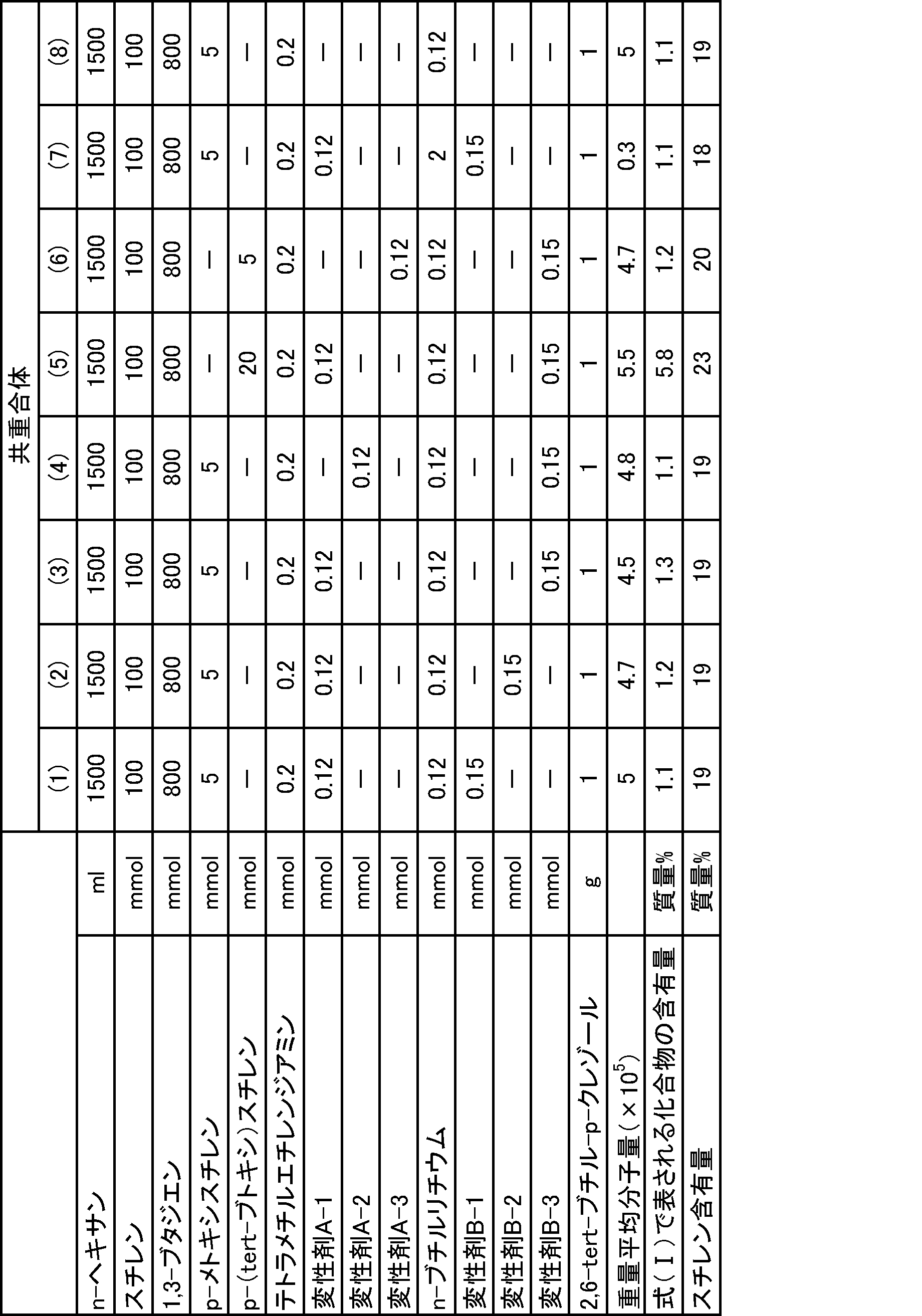
<実施例及び比較例>
以下に、実施例及び比較例で用いた各種薬品について説明する。
NR:RSS#3
BR:宇部興産(株)製のBR150B
SBR:旭化成(株)製のE15(スチレン単位量:23質量%)
共重合体(1)~(8):上記方法で合成
シリカ:エボニックデグッサ社製のウルトラシルVN3(N2SA:175m2/g)
シランカップリング剤:エボニックデグッサ社製のSi69(ビス(3-トリエトキシシリルプロピル)テトラスルフィド)
化合物A:東京化成工業(株)製のN-オクタデシルサルコシン(上記式(A)で表される化合物)
化合物B:東京化成工業(株)製のN,N-ジメチルホルムアミド(上記式(A)で表される化合物)
化合物C:Schill+Seilacher社製のHT254(脂肪酸アミド系加工助剤(脂肪酸アミド(上記式(A)で表される化合物(N-(1-オキソオクタデシル)サルコシン))とアミノ酸誘導体の混合物)(脂肪酸アミドの含有率:25~50質量%))
アロマチックオイル:出光興産(株)製のダイアナプロセスAH-24
酸化亜鉛:三井金属鉱業(株)製の酸化亜鉛
ステアリン酸:日油(株)製のステアリン酸「椿」
老化防止剤:住友化学(株)製のアンチゲン6C(N-1,3-ジメチルブチル-N’-フェニル-p-フェニレンジアミン)
硫黄:軽井沢硫黄(株)製の粉末硫黄
加硫促進剤CZ:大内新興化学工業(株)製のノクセラーCZ
加硫促進剤DPG:大内新興化学工業(株)製のノクセラーD
以下に、実施例及び比較例で用いた各種薬品について説明する。
NR:RSS#3
BR:宇部興産(株)製のBR150B
SBR:旭化成(株)製のE15(スチレン単位量:23質量%)
共重合体(1)~(8):上記方法で合成
シリカ:エボニックデグッサ社製のウルトラシルVN3(N2SA:175m2/g)
シランカップリング剤:エボニックデグッサ社製のSi69(ビス(3-トリエトキシシリルプロピル)テトラスルフィド)
化合物A:東京化成工業(株)製のN-オクタデシルサルコシン(上記式(A)で表される化合物)
化合物B:東京化成工業(株)製のN,N-ジメチルホルムアミド(上記式(A)で表される化合物)
化合物C:Schill+Seilacher社製のHT254(脂肪酸アミド系加工助剤(脂肪酸アミド(上記式(A)で表される化合物(N-(1-オキソオクタデシル)サルコシン))とアミノ酸誘導体の混合物)(脂肪酸アミドの含有率:25~50質量%))
アロマチックオイル:出光興産(株)製のダイアナプロセスAH-24
酸化亜鉛:三井金属鉱業(株)製の酸化亜鉛
ステアリン酸:日油(株)製のステアリン酸「椿」
老化防止剤:住友化学(株)製のアンチゲン6C(N-1,3-ジメチルブチル-N’-フェニル-p-フェニレンジアミン)
硫黄:軽井沢硫黄(株)製の粉末硫黄
加硫促進剤CZ:大内新興化学工業(株)製のノクセラーCZ
加硫促進剤DPG:大内新興化学工業(株)製のノクセラーD
表2、3に示す配合処方にしたがって薬品を混練り配合し、未加硫ゴム組成物を得た。そして、得られた未加硫ゴム組成物を170℃で15分間プレス加硫し、加硫ゴム組成物を得た。
また、上記未加硫ゴム組成物をトレッドの形状に成形し、他のタイヤ部材とともに貼り合わせて未加硫タイヤを形成し、170℃の条件下で10分間プレス加硫し、試験用タイヤ(サイズ195/65R15)を製造した。
得られた未加硫ゴム組成物、加硫ゴム組成物及び試験用タイヤについて以下に示す試験方法により性能を評価した。
また、上記未加硫ゴム組成物をトレッドの形状に成形し、他のタイヤ部材とともに貼り合わせて未加硫タイヤを形成し、170℃の条件下で10分間プレス加硫し、試験用タイヤ(サイズ195/65R15)を製造した。
得られた未加硫ゴム組成物、加硫ゴム組成物及び試験用タイヤについて以下に示す試験方法により性能を評価した。
<評価項目及び試験方法>
(加工性)
得られた未加硫ゴム組成物について、JIS K6300に準拠したムーニー粘度の測定方法に従い、130℃で測定した。比較例8のムーニー粘度(ML1+4)を100とし、下記計算式により指数表示した(ムーニー粘度指数)。指数が大きいほどムーニー粘度が低く、加工性に優れる。
(ムーニー粘度指数)=(比較例8のML1+4)/(各例のML1+4)×100
(加工性)
得られた未加硫ゴム組成物について、JIS K6300に準拠したムーニー粘度の測定方法に従い、130℃で測定した。比較例8のムーニー粘度(ML1+4)を100とし、下記計算式により指数表示した(ムーニー粘度指数)。指数が大きいほどムーニー粘度が低く、加工性に優れる。
(ムーニー粘度指数)=(比較例8のML1+4)/(各例のML1+4)×100
(ゴム肌)
得られた未加硫ゴム組成物を押出し成形し、得られたゴムシートのシート性状を目視により以下の基準で評価した。シート性状が良好なほど、作業性に優れることを示す。
◎:シート形状が非常に良好
○:シート形状が良好
×:シート形状がボロボロ
得られた未加硫ゴム組成物を押出し成形し、得られたゴムシートのシート性状を目視により以下の基準で評価した。シート性状が良好なほど、作業性に優れることを示す。
◎:シート形状が非常に良好
○:シート形状が良好
×:シート形状がボロボロ
(低燃費性)
(株)上島製作所製スペクトロメーターを用いて、動的歪振幅1%、周波数10Hz、温度50℃でtanδを測定した。tanδの逆数について比較例8を100として指数表示した。数値が大きいほど転がり抵抗が小さく、低燃費性に優れることを示している。
(株)上島製作所製スペクトロメーターを用いて、動的歪振幅1%、周波数10Hz、温度50℃でtanδを測定した。tanδの逆数について比較例8を100として指数表示した。数値が大きいほど転がり抵抗が小さく、低燃費性に優れることを示している。
(摩耗試験)
得られた加硫ゴム組成物について、ランボーン摩耗試験機を用いて、温度20℃、スリップ率20%及び試験時間2分間の条件下でランボーン摩耗量を測定した。更に、測定したランボーン摩耗量から容積損失量を計算し、比較例8のランボーン摩耗指数を100とし、下記計算式により、各配合(加硫物)の容積損失量を指数表示した。なお、ランボーン摩耗指数が大きいほど、耐摩耗性に優れることを示す。
(ランボーン摩耗指数)=(比較例8の容積損失量)/(各配合の容積損失量)×100
得られた加硫ゴム組成物について、ランボーン摩耗試験機を用いて、温度20℃、スリップ率20%及び試験時間2分間の条件下でランボーン摩耗量を測定した。更に、測定したランボーン摩耗量から容積損失量を計算し、比較例8のランボーン摩耗指数を100とし、下記計算式により、各配合(加硫物)の容積損失量を指数表示した。なお、ランボーン摩耗指数が大きいほど、耐摩耗性に優れることを示す。
(ランボーン摩耗指数)=(比較例8の容積損失量)/(各配合の容積損失量)×100
(ウェットグリップ性能(1))
(株)上島製作所製フラットベルト式摩擦試験機(FR5010型)を用いてウェットグリップ性能を評価した。上記加硫ゴム組成物からなる幅20mm、直径100mmの円筒形のゴム試験片をサンプルとして用い、速度20km/時間、荷重4kgf、路面温度20℃の条件で、路面に対するサンプルのスリップ率を0~70%まで変化させ、その際に検出される摩擦係数の最大値を読みとった。そして、下記計算式により測定結果を指数表示した。指数が大きいほどウェットグリップ性能に優れることを示す。
(ウェットグリップ性能(1)指数)=(各配合の摩擦係数の最大値)/(比較例8の摩擦係数の最大値)×100
(株)上島製作所製フラットベルト式摩擦試験機(FR5010型)を用いてウェットグリップ性能を評価した。上記加硫ゴム組成物からなる幅20mm、直径100mmの円筒形のゴム試験片をサンプルとして用い、速度20km/時間、荷重4kgf、路面温度20℃の条件で、路面に対するサンプルのスリップ率を0~70%まで変化させ、その際に検出される摩擦係数の最大値を読みとった。そして、下記計算式により測定結果を指数表示した。指数が大きいほどウェットグリップ性能に優れることを示す。
(ウェットグリップ性能(1)指数)=(各配合の摩擦係数の最大値)/(比較例8の摩擦係数の最大値)×100
(ウェットグリップ性能(2))
水を撒いて湿潤路面としたテストコースにて、上記試験用タイヤを排気量2000ccの国産FR車に装着し、速度70km/hで制動し、タイヤに制動をかけてから停車するまでの走行距離(制動距離)を測定した。そして、下記計算式により測定結果を指数表示した。指数が大きいほどウェットグリップ性能に優れることを示す。
(ウェットグリップ性能(2)指数)=(比較例8の制動距離)/(各配合の制動距離)×100
水を撒いて湿潤路面としたテストコースにて、上記試験用タイヤを排気量2000ccの国産FR車に装着し、速度70km/hで制動し、タイヤに制動をかけてから停車するまでの走行距離(制動距離)を測定した。そして、下記計算式により測定結果を指数表示した。指数が大きいほどウェットグリップ性能に優れることを示す。
(ウェットグリップ性能(2)指数)=(比較例8の制動距離)/(各配合の制動距離)×100

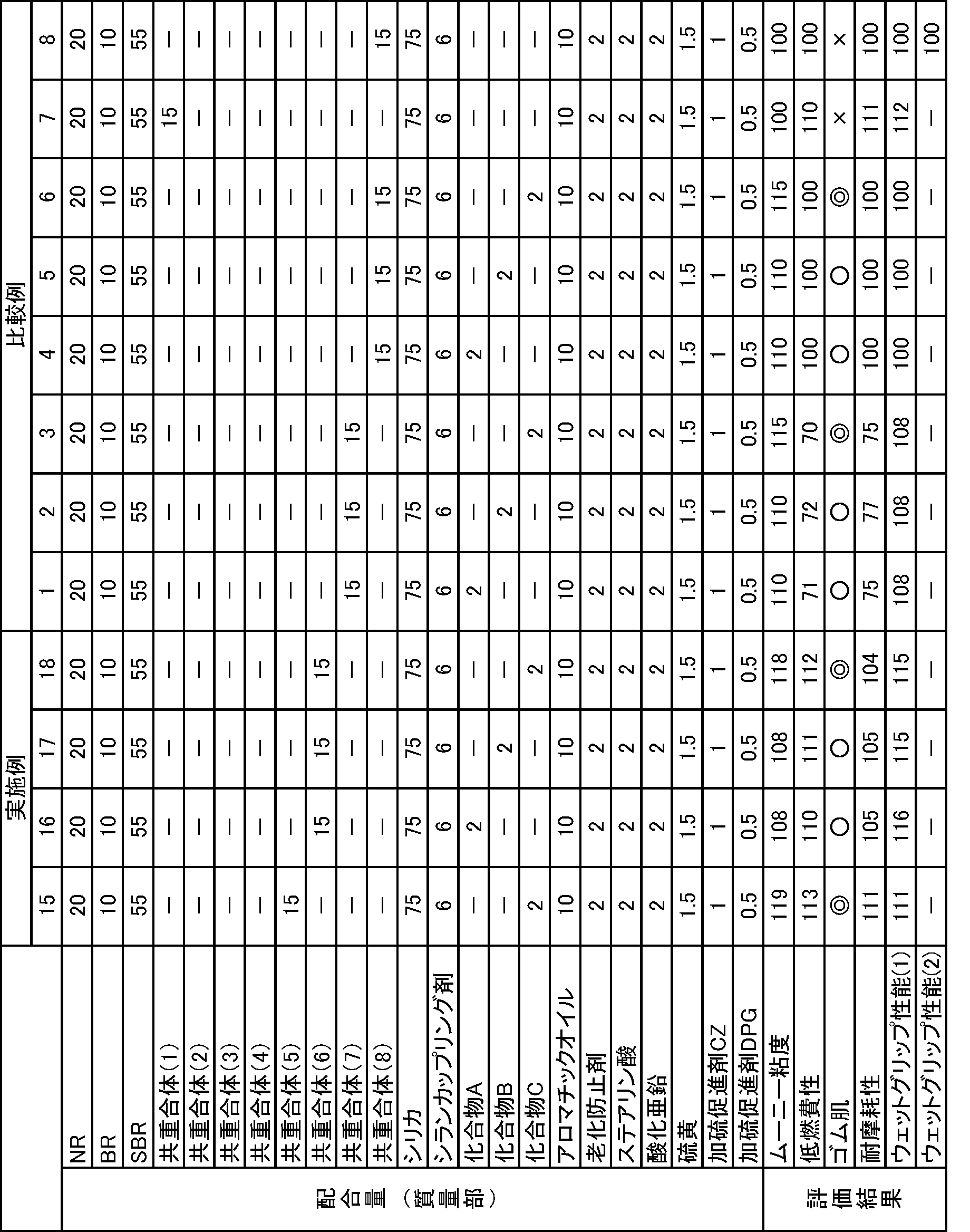
表2、3に示すように、1,3-ブタジエン、スチレン及び上記式(I)で表される化合物を共重合して得られ、一方の末端にアミノ基を有し、他方の末端に窒素、酸素及びケイ素からなる群より選択される少なくとも1種の原子を含む官能基を有する重量平均分子量が特定の範囲内である共重合体と、シリカと、上記式(A)で表される化合物とを含む実施例は、良好な加工性、作業性を維持しつつ、低燃費性、耐摩耗性、ウェットグリップ性能をバランス良く向上できた。
比較例8、7、4、実施例1の比較、比較例8、7、5、実施例2の比較、比較例8、7、6、実施例3の比較により、上記共重合体と、シリカと、上記式(A)で表される化合物を併用することにより、低燃費性を相乗的に向上でき、更に、良好な加工性、作業性も得られることが分かった。特に、作業性に関しては、シリカと共に上記共重合体を配合した場合であっても、更に上記式(A)で表される化合物を併用することにより、上記共重合体を配合せずにシリカと共に上記式(A)で表される化合物を配合した場合と同等の優れた作業性が得られることが分かった。
Claims (16)
- 1,3-ブタジエン、スチレン及び下記式(I)で表される化合物を共重合して得られ、一方の末端にアミノ基を有し、他方の末端に窒素、酸素及びケイ素からなる群より選択される少なくとも1種の原子を含む官能基を有する重量平均分子量が1.0×10⁵~2.5×10⁶である共重合体と、シリカと、下記式(A)で表される化合物とを含むタイヤ用ゴム組成物。



- 前記官能基がアルコキシシリル基である請求項1記載のタイヤ用ゴム組成物。
- 前記官能基がアルコキシシリル基及びアミノ基である請求項1記載のタイヤ用ゴム組成物。
- 前記一方の末端に有するアミノ基が、アルキルアミノ基、又は下記式(II)で表される基である請求項1~3のいずれかに記載のタイヤ用ゴム組成物。

- 前記式(II)で表される基が下記式(III)で表される基である請求項4記載のタイヤ用ゴム組成物。
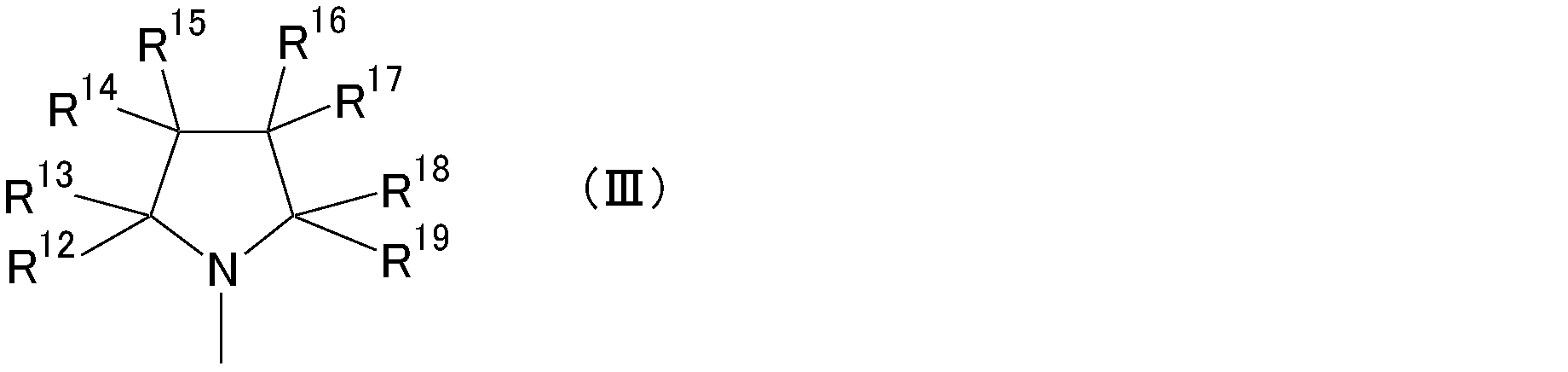
- 前記一方の末端にアミノ基と共に、イソプレン単位を有する請求項1~5のいずれかに記載のタイヤ用ゴム組成物。
- 前記共重合体中、前記式(I)で表される化合物の含有量が0.05~35質量%である請求項1~6のいずれかに記載のタイヤ用ゴム組成物。
- 前記共重合体は、リチウム原子とアミノ基を有する化合物を重合開始剤として、1,3-ブタジエン、スチレン及び前記式(I)で表される化合物を共重合した後、重合末端を窒素、酸素及びケイ素からなる群より選択される少なくとも1種の原子を含む官能基を有する変性剤により変性して得られるものである請求項1~7のいずれかに記載のタイヤ用ゴム組成物。
- 前記変性剤が下記式(IV)、下記式(V)、又は下記式(VI)で表される化合物である請求項8記載のタイヤ用ゴム組成物。



- 前記重合開始剤が、アルキルアミノ基、又は下記式(II)で表される基を有する請求項8又は9記載のタイヤ用ゴム組成物。

- 前記式(II)で表される基が下記式(III)で表される基である請求項10記載のタイヤ用ゴム組成物。
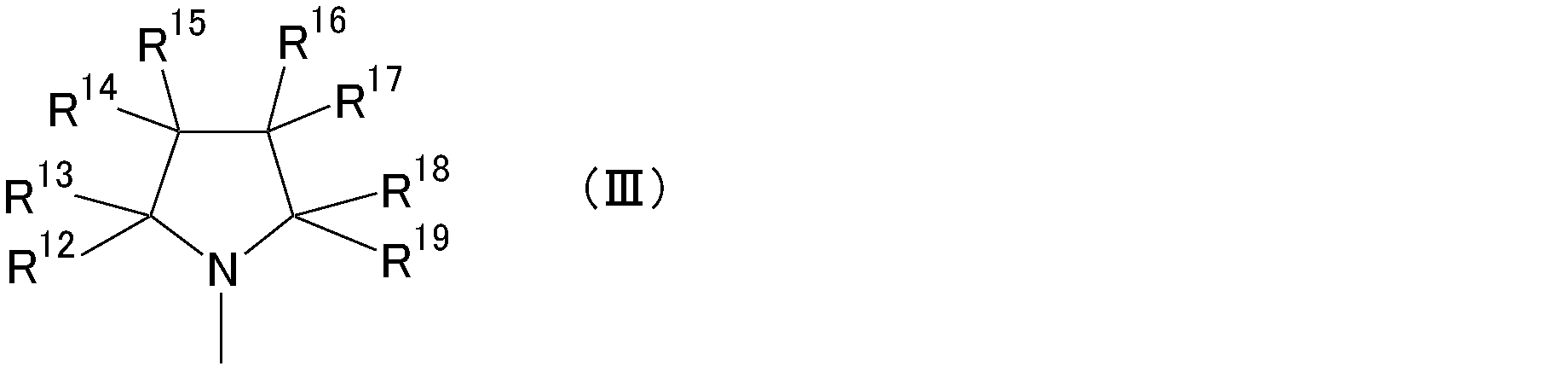
- 前記重合開始剤がイソプレン単位を有する請求項8~11のいずれかに記載のタイヤ用ゴム組成物。
- 前記式(A)で表される化合物の含有量が、シリカ100質量部に対して、0.1~20質量部である請求項1~12のいずれかに記載のタイヤ用ゴム組成物。
- 前記シリカの含有量が、ゴム成分100質量部に対して、10~150質量部である請求項1~13のいずれかに記載のタイヤ用ゴム組成物。
- トレッド用ゴム組成物として用いられる請求項1~14のいずれかに記載のタイヤ用ゴム組成物。
- 請求項1~15のいずれかに記載のゴム組成物を用いて作製した空気入りタイヤ。
Applications Claiming Priority (2)
| Application Number | Priority Date | Filing Date | Title |
|---|---|---|---|
| JP2011-136609 | 2011-06-20 | ||
| JP2011136609A JP5519584B2 (ja) | 2011-06-20 | 2011-06-20 | タイヤ用ゴム組成物及び空気入りタイヤ |
Publications (1)
| Publication Number | Publication Date |
|---|---|
| WO2012176743A1 true WO2012176743A1 (ja) | 2012-12-27 |
Family
ID=47422580
Family Applications (1)
| Application Number | Title | Priority Date | Filing Date |
|---|---|---|---|
| PCT/JP2012/065555 Ceased WO2012176743A1 (ja) | 2011-06-20 | 2012-06-19 | タイヤ用ゴム組成物及び空気入りタイヤ |
Country Status (2)
| Country | Link |
|---|---|
| JP (1) | JP5519584B2 (ja) |
| WO (1) | WO2012176743A1 (ja) |
Families Citing this family (1)
| Publication number | Priority date | Publication date | Assignee | Title |
|---|---|---|---|---|
| JP7312638B2 (ja) * | 2018-08-30 | 2023-07-21 | 旭化成株式会社 | 変性共役ジエン系重合体組成物の製造方法 |
Citations (3)
| Publication number | Priority date | Publication date | Assignee | Title |
|---|---|---|---|---|
| JP2010116546A (ja) * | 2008-10-16 | 2010-05-27 | Sumitomo Rubber Ind Ltd | ゴム組成物及びタイヤ |
| JP2011063714A (ja) * | 2009-09-17 | 2011-03-31 | Sumitomo Rubber Ind Ltd | 共重合体ならびにそれを用いたゴム組成物および空気入りタイヤ |
| JP2011084650A (ja) * | 2009-10-15 | 2011-04-28 | Sumitomo Rubber Ind Ltd | タイヤ用ゴム組成物及び空気入りタイヤ |
-
2011
- 2011-06-20 JP JP2011136609A patent/JP5519584B2/ja active Active
-
2012
- 2012-06-19 WO PCT/JP2012/065555 patent/WO2012176743A1/ja not_active Ceased
Patent Citations (3)
| Publication number | Priority date | Publication date | Assignee | Title |
|---|---|---|---|---|
| JP2010116546A (ja) * | 2008-10-16 | 2010-05-27 | Sumitomo Rubber Ind Ltd | ゴム組成物及びタイヤ |
| JP2011063714A (ja) * | 2009-09-17 | 2011-03-31 | Sumitomo Rubber Ind Ltd | 共重合体ならびにそれを用いたゴム組成物および空気入りタイヤ |
| JP2011084650A (ja) * | 2009-10-15 | 2011-04-28 | Sumitomo Rubber Ind Ltd | タイヤ用ゴム組成物及び空気入りタイヤ |
Also Published As
| Publication number | Publication date |
|---|---|
| JP5519584B2 (ja) | 2014-06-11 |
| JP2013001874A (ja) | 2013-01-07 |
Similar Documents
| Publication | Publication Date | Title |
|---|---|---|
| JP5244064B2 (ja) | 重合体、ゴム組成物およびそれを用いたタイヤ | |
| US8431644B2 (en) | Rubber composition and tire | |
| WO2013027746A1 (ja) | ゴム組成物及び空気入りタイヤ | |
| JP2011089086A (ja) | 変性共重合体およびそれを用いたゴム組成物 | |
| JP5681575B2 (ja) | ゴム組成物及び空気入りタイヤ | |
| US20100099795A1 (en) | Rubber composition and tire | |
| JP2011132298A (ja) | 変性共重合体、それを用いたゴム組成物および空気入りタイヤ | |
| WO2013027814A1 (ja) | ゴム組成物及び空気入りタイヤ | |
| JP5466473B2 (ja) | ゴム組成物およびそれを用いたタイヤ | |
| JP2011079913A (ja) | 重合体、タイヤ用ゴム組成物及び空気入りタイヤ | |
| JP5580255B2 (ja) | ゴム組成物及び空気入りタイヤ | |
| JP5543392B2 (ja) | 共重合体、ゴム組成物及び空気入りタイヤ | |
| JP5592809B2 (ja) | 共重合体、ゴム組成物及び空気入りタイヤ | |
| JP2012167207A (ja) | 共重合体、ゴム組成物及び空気入りタイヤ | |
| JP2011132411A (ja) | タイヤ用ゴム組成物及び空気入りタイヤ | |
| JP2012057097A (ja) | 共重合体、ゴム組成物及び空気入りタイヤ | |
| JP2012229383A (ja) | タイヤ用ゴム組成物及び空気入りタイヤ | |
| JP2013173893A (ja) | タイヤ用ゴム組成物及び空気入りタイヤ | |
| JP5571627B2 (ja) | ゴム組成物及び空気入りタイヤ | |
| JP2012224768A (ja) | タイヤ用ゴム組成物及び空気入りタイヤ | |
| JP5519584B2 (ja) | タイヤ用ゴム組成物及び空気入りタイヤ | |
| JP2012172138A (ja) | 共重合体、ゴム組成物及び空気入りタイヤ | |
| JP5437765B2 (ja) | タイヤ用ゴム組成物及びスタッドレスタイヤ | |
| JP2013173892A (ja) | タイヤ用ゴム組成物及び空気入りタイヤ | |
| JP2013035991A (ja) | タイヤ用ゴム組成物及び空気入りタイヤ |
Legal Events
| Date | Code | Title | Description |
|---|---|---|---|
| 121 | Ep: the epo has been informed by wipo that ep was designated in this application |
Ref document number: 12802727 Country of ref document: EP Kind code of ref document: A1 |
|
| NENP | Non-entry into the national phase |
Ref country code: DE |
|
| 122 | Ep: pct application non-entry in european phase |
Ref document number: 12802727 Country of ref document: EP Kind code of ref document: A1 |