WO2012173171A1 - 被覆繊維状銅微粒子、並びに該被覆繊維状銅微粒子を含む導電性コーティング剤および導電性フィルム - Google Patents
被覆繊維状銅微粒子、並びに該被覆繊維状銅微粒子を含む導電性コーティング剤および導電性フィルム Download PDFInfo
- Publication number
- WO2012173171A1 WO2012173171A1 PCT/JP2012/065187 JP2012065187W WO2012173171A1 WO 2012173171 A1 WO2012173171 A1 WO 2012173171A1 JP 2012065187 W JP2012065187 W JP 2012065187W WO 2012173171 A1 WO2012173171 A1 WO 2012173171A1
- Authority
- WO
- WIPO (PCT)
- Prior art keywords
- fine particles
- copper fine
- fibrous copper
- fibrous
- coated
- Prior art date
- Legal status (The legal status is an assumption and is not a legal conclusion. Google has not performed a legal analysis and makes no representation as to the accuracy of the status listed.)
- Ceased
Links
Images
Classifications
-
- C—CHEMISTRY; METALLURGY
- C22—METALLURGY; FERROUS OR NON-FERROUS ALLOYS; TREATMENT OF ALLOYS OR NON-FERROUS METALS
- C22C—ALLOYS
- C22C9/00—Alloys based on copper
-
- B—PERFORMING OPERATIONS; TRANSPORTING
- B22—CASTING; POWDER METALLURGY
- B22F—WORKING METALLIC POWDER; MANUFACTURE OF ARTICLES FROM METALLIC POWDER; MAKING METALLIC POWDER; APPARATUS OR DEVICES SPECIALLY ADAPTED FOR METALLIC POWDER
- B22F1/00—Metallic powder; Treatment of metallic powder, e.g. to facilitate working or to improve properties
-
- B—PERFORMING OPERATIONS; TRANSPORTING
- B22—CASTING; POWDER METALLURGY
- B22F—WORKING METALLIC POWDER; MANUFACTURE OF ARTICLES FROM METALLIC POWDER; MAKING METALLIC POWDER; APPARATUS OR DEVICES SPECIALLY ADAPTED FOR METALLIC POWDER
- B22F1/00—Metallic powder; Treatment of metallic powder, e.g. to facilitate working or to improve properties
- B22F1/06—Metallic powder characterised by the shape of the particles
- B22F1/062—Fibrous particles
-
- B—PERFORMING OPERATIONS; TRANSPORTING
- B22—CASTING; POWDER METALLURGY
- B22F—WORKING METALLIC POWDER; MANUFACTURE OF ARTICLES FROM METALLIC POWDER; MAKING METALLIC POWDER; APPARATUS OR DEVICES SPECIALLY ADAPTED FOR METALLIC POWDER
- B22F1/00—Metallic powder; Treatment of metallic powder, e.g. to facilitate working or to improve properties
- B22F1/17—Metallic particles coated with metal
-
- C—CHEMISTRY; METALLURGY
- C09—DYES; PAINTS; POLISHES; NATURAL RESINS; ADHESIVES; COMPOSITIONS NOT OTHERWISE PROVIDED FOR; APPLICATIONS OF MATERIALS NOT OTHERWISE PROVIDED FOR
- C09D—COATING COMPOSITIONS, e.g. PAINTS, VARNISHES OR LACQUERS; FILLING PASTES; CHEMICAL PAINT OR INK REMOVERS; INKS; CORRECTING FLUIDS; WOODSTAINS; PASTES OR SOLIDS FOR COLOURING OR PRINTING; USE OF MATERIALS THEREFOR
- C09D5/00—Coating compositions, e.g. paints, varnishes or lacquers, characterised by their physical nature or the effects produced; Filling pastes
- C09D5/24—Electrically-conducting paints
-
- C—CHEMISTRY; METALLURGY
- C09—DYES; PAINTS; POLISHES; NATURAL RESINS; ADHESIVES; COMPOSITIONS NOT OTHERWISE PROVIDED FOR; APPLICATIONS OF MATERIALS NOT OTHERWISE PROVIDED FOR
- C09D—COATING COMPOSITIONS, e.g. PAINTS, VARNISHES OR LACQUERS; FILLING PASTES; CHEMICAL PAINT OR INK REMOVERS; INKS; CORRECTING FLUIDS; WOODSTAINS; PASTES OR SOLIDS FOR COLOURING OR PRINTING; USE OF MATERIALS THEREFOR
- C09D7/00—Features of coating compositions, not provided for in group C09D5/00; Processes for incorporating ingredients in coating compositions
- C09D7/40—Additives
- C09D7/60—Additives non-macromolecular
- C09D7/61—Additives non-macromolecular inorganic
- C09D7/62—Additives non-macromolecular inorganic modified by treatment with other compounds
-
- C—CHEMISTRY; METALLURGY
- C09—DYES; PAINTS; POLISHES; NATURAL RESINS; ADHESIVES; COMPOSITIONS NOT OTHERWISE PROVIDED FOR; APPLICATIONS OF MATERIALS NOT OTHERWISE PROVIDED FOR
- C09D—COATING COMPOSITIONS, e.g. PAINTS, VARNISHES OR LACQUERS; FILLING PASTES; CHEMICAL PAINT OR INK REMOVERS; INKS; CORRECTING FLUIDS; WOODSTAINS; PASTES OR SOLIDS FOR COLOURING OR PRINTING; USE OF MATERIALS THEREFOR
- C09D7/00—Features of coating compositions, not provided for in group C09D5/00; Processes for incorporating ingredients in coating compositions
- C09D7/40—Additives
- C09D7/66—Additives characterised by particle size
- C09D7/69—Particle size larger than 1000 nm
-
- C—CHEMISTRY; METALLURGY
- C09—DYES; PAINTS; POLISHES; NATURAL RESINS; ADHESIVES; COMPOSITIONS NOT OTHERWISE PROVIDED FOR; APPLICATIONS OF MATERIALS NOT OTHERWISE PROVIDED FOR
- C09D—COATING COMPOSITIONS, e.g. PAINTS, VARNISHES OR LACQUERS; FILLING PASTES; CHEMICAL PAINT OR INK REMOVERS; INKS; CORRECTING FLUIDS; WOODSTAINS; PASTES OR SOLIDS FOR COLOURING OR PRINTING; USE OF MATERIALS THEREFOR
- C09D7/00—Features of coating compositions, not provided for in group C09D5/00; Processes for incorporating ingredients in coating compositions
- C09D7/40—Additives
- C09D7/70—Additives characterised by shape, e.g. fibres, flakes or microspheres
-
- H—ELECTRICITY
- H01—ELECTRIC ELEMENTS
- H01B—CABLES; CONDUCTORS; INSULATORS; SELECTION OF MATERIALS FOR THEIR CONDUCTIVE, INSULATING OR DIELECTRIC PROPERTIES
- H01B1/00—Conductors or conductive bodies characterised by the conductive materials; Selection of materials as conductors
- H01B1/02—Conductors or conductive bodies characterised by the conductive materials; Selection of materials as conductors mainly consisting of metals or alloys
- H01B1/026—Alloys based on copper
-
- H—ELECTRICITY
- H01—ELECTRIC ELEMENTS
- H01B—CABLES; CONDUCTORS; INSULATORS; SELECTION OF MATERIALS FOR THEIR CONDUCTIVE, INSULATING OR DIELECTRIC PROPERTIES
- H01B1/00—Conductors or conductive bodies characterised by the conductive materials; Selection of materials as conductors
- H01B1/20—Conductive material dispersed in non-conductive organic material
- H01B1/22—Conductive material dispersed in non-conductive organic material the conductive material comprising metals or alloys
-
- Y—GENERAL TAGGING OF NEW TECHNOLOGICAL DEVELOPMENTS; GENERAL TAGGING OF CROSS-SECTIONAL TECHNOLOGIES SPANNING OVER SEVERAL SECTIONS OF THE IPC; TECHNICAL SUBJECTS COVERED BY FORMER USPC CROSS-REFERENCE ART COLLECTIONS [XRACs] AND DIGESTS
- Y10—TECHNICAL SUBJECTS COVERED BY FORMER USPC
- Y10T—TECHNICAL SUBJECTS COVERED BY FORMER US CLASSIFICATION
- Y10T428/00—Stock material or miscellaneous articles
- Y10T428/12—All metal or with adjacent metals
- Y10T428/12014—All metal or with adjacent metals having metal particles
-
- Y—GENERAL TAGGING OF NEW TECHNOLOGICAL DEVELOPMENTS; GENERAL TAGGING OF CROSS-SECTIONAL TECHNOLOGIES SPANNING OVER SEVERAL SECTIONS OF THE IPC; TECHNICAL SUBJECTS COVERED BY FORMER USPC CROSS-REFERENCE ART COLLECTIONS [XRACs] AND DIGESTS
- Y10—TECHNICAL SUBJECTS COVERED BY FORMER USPC
- Y10T—TECHNICAL SUBJECTS COVERED BY FORMER US CLASSIFICATION
- Y10T428/00—Stock material or miscellaneous articles
- Y10T428/12—All metal or with adjacent metals
- Y10T428/12181—Composite powder [e.g., coated, etc.]
Definitions
- the present invention relates to coated fibrous copper fine particles, and a conductive coating agent and a conductive film containing the coated fibrous copper fine particles.
- Spherical copper fine particles are widely used as raw materials for conductive coating agents and the like because they are excellent in conductivity and inexpensive.
- Such conductive coating agents are widely used in materials for forming circuits using various printing methods on printed wiring boards and the like, various electrical contact members, and the like.
- transparent conductive material transparent conductive material
- transparent conductive film for example, applications such as touch panels and flat panel displays
- spherical copper fine particles as a conductive material in a transparent conductive material such as a conductive coating agent or a conductive film.
- the performance which can form a conductive film is requested
- the conductive coating agent containing spherical copper fine particles coated with conventional silver as described above is applied as a coating material for forming a conductive layer of a transparent conductive film used for a touch panel, for example.
- the content of the spherical copper fine particles coated with silver is increased, the transparency in the conductive layer is lowered.
- the content of the copper fine particles coated with silver is reduced in order to ensure transparency, there is a problem that the conductivity in the conductive layer is lowered. That is, in the conventionally known transparent conductive material containing spherical copper fine particles coated with a noble metal such as silver, any one of conductivity and transparency required for the conductive layer of the transparent conductive film is used. Is difficult to satisfy.
- an object of the present invention is to solve the above-mentioned problems, and to provide coated fibrous copper fine particles that are excellent in both conductivity and transparency when contained in a transparent conductive material.
- the present inventors have found that metal other than copper, such as silver, with respect to fibrous copper fine particles formed from copper, which is a metal that is significantly less expensive than silver. It was found for the first time that the coated fibrous copper fine particles formed by coating can be a conductive material excellent in both conductivity and transparency when contained in a transparent conductive material, and the present invention has been completed.
- the present invention has the following purpose.
- Coated fibrous copper fine particles characterized by being.
- the minor axis of the fibrous copper fine particles is 1 ⁇ m or less, and the proportion of the copper particles having a minor axis of 0.3 ⁇ m or more and an aspect ratio of 1.5 or less in the fibrous copper fine particles is fibrous copper.
- a conductive coating agent comprising the coated fibrous copper fine particles of (1) or (2).
- a conductive film comprising the coated fibrous copper fine particles of (1) or (2).
- the coated fibrous copper fine particles of the present invention are coated fibrous copper fine particles in which at least a part of the surface of the fibrous copper fine particles is coated with a metal other than copper, and the length of the fibrous copper fine particles is 1 ⁇ m or more. And has a specific shape and configuration with an aspect ratio of 10 or more. Therefore, by using such coated fibrous copper fine particles, it is possible to obtain a conductive coating agent, a conductive film and a conductive film having both excellent conductivity and transparency.
- coated fibrous copper fine particles of the present invention are coated fibrous copper fine particles in which at least a part of the surface of the fibrous copper fine particles is coated with a metal other than copper, and the length of the fibrous copper fine particles is 1 ⁇ m or more. Yes, and the aspect ratio is 10 or more.
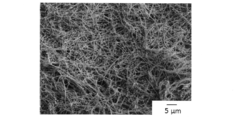
- the coated fibrous copper fine particles of the present invention are obtained by coating the surface of the fibrous copper fine particles with a metal other than copper. As shown in FIG. The shape is maintained. Fibrous copper fine particles coated with a metal other than copper are superior in stability in a solvent or in the air as compared with uncoated fibrous copper fine particles.
- metals other than copper for coating the fibrous copper fine particles include noble metal elements (gold, platinum, silver, palladium, rhodium, iridium, ruthenium, osmium, etc.) and base metal elements (iron, cobalt, tin, etc.). It is done. These may be used alone or in combination of two or more. Among these, at least silver is preferably used from the viewpoints of conductivity and stability.
- the method for coating uncoated fibrous copper fine particles with a metal other than copper, such as silver is not particularly limited, but an electroless plating method is preferably used.
- an electroless plating method for example, when silver is coated, silver nitrate, ammonium carbonate or ethylenediaminetetraacetate silver
- a method of depositing a silver coating on the surface of the fibrous copper particles can be used.
- the fibrous copper fine particles not coated with metal (that is, uncoated) will be described.
- the length of the fibrous copper fine particles needs to be 1 ⁇ m or more, preferably 5 ⁇ m or more, and more preferably 10 ⁇ m or more.
- the length of the fibrous copper fine particles is less than 1 ⁇ m, it is difficult to achieve both good conductivity and transparency in the transparent conductive material containing the coated fibrous copper fine particles of the present invention.
- it may be preferable that the length of the fibrous fine particles does not exceed 500 ⁇ m from the viewpoint of handling the coating agent when forming the conductive film or conductive film containing the coated fibrous copper fine particles of the present invention. .
- the minor axis of the fibrous copper fine particles is preferably 1 ⁇ m or less, more preferably 0.5 ⁇ m or less, further preferably 0.2 ⁇ m or less, and particularly preferably 0.1 ⁇ m or less. If the short diameter of the fibrous copper fine particles exceeds 1 ⁇ m, the transparent conductive material containing the coated fibrous copper fine particles of the present invention may be inferior in transparency.
- the aspect ratio of the fibrous copper fine particles (the length of the fibrous body / the short diameter of the fibrous body) needs to be 10 or more, preferably 100 or more, and more preferably 300 or more. .
- the aspect ratio of the fibrous copper fine particles is less than 10 (that is, close to spherical)
- the transparent conductive material containing the coated fibrous copper fine particles of the present invention achieves both transparency and conductivity. It becomes difficult.
- the entire surface is coated with a metal other than copper, but there is a portion where copper is not exposed and is not coated with metal. Also good.
- the content of the coating metal other than copper in the coated fibrous copper fine particles is preferably 1 to 50% by mass, more preferably 10 to 50% by mass, and more preferably 15 to 30% with respect to the total mass of the coated fibrous copper fine particles. More preferred is mass%. If the content is less than 1% by mass, the improvement in conductivity, which is an effect produced by coating the metal, may be insufficient.
- the metal coating amount can be obtained, for example, by dissolving the coated fibrous copper fine particles of the present invention in a strong acid to obtain a measurement solution, and measuring this solution by ICP (high frequency inductively coupled plasma). I can do it.
- the method for obtaining the short diameter and length (major diameter) of the fibrous copper fine particles and the copper particles described later, and the method for calculating the number of copper particles per fibrous copper fine particle are as follows. It is. That is, an aggregate of fibrous copper fine particles is observed using a transmission electron microscope (TEM), a scanning electron microscope (SEM), or the like. For example, a digital microscope (manufactured by Keyence Corporation, “VHX-1000, VHX-D500 / 510”) or the like can be used for observing the fibrous copper fine particles.
- 100 fibrous copper fine particles are selected from the aggregate.
- the short diameter and the length of the fibrous copper fine particles and the copper particles adhering to or in contact with the fibrous copper fine particles are measured, and the average value of these can be used as the short diameter and the length.
- the aspect ratio of the fibrous copper fine particles and the copper particulates can be calculated by dividing the length obtained as described above by the minor axis. Further, by counting the number of copper particles present and dividing the number of copper particles by the number of fibrous copper particles (100), the number of copper particles per fibrous copper particle is calculated. can do.
- the fibrous copper fine particles of the present invention when observing the fibrous copper fine particles of the present invention, if the fibrous copper fine particles overlap and are densely packed, the shapes of the fibrous copper fine particles and the copper particulates may not be accurately evaluated. . Therefore, in such a case, the fibrous copper fine particles that are densely packed until the adjacent fibrous copper fine particles are not in close contact with each other can be solved by using an ultrasonic dispersion device or the like.
- the proportion of copper particles having a minor axis of 0.3 ⁇ m or more and an aspect ratio of 1.5 or less is 0.1 or less per fibrous copper fine particle.
- the number is preferably 0.08 or less, more preferably 0.05 or less, and most preferably none.
- the transparent conductive material containing the coated fibrous copper fine particle of the present invention may be inferior in transparency.
- the minor axis of the copper granule that affects the transparency is 0.3 ⁇ m or more, and the aspect ratio (the length of the copper granule / the minor axis of the copper granule) is 1.5 or less.
- the following method is used. That is, a method of depositing fibrous copper fine particles from an aqueous solution containing a copper ion, an alkaline compound, a nitrogen-containing compound capable of forming a stable complex with copper ion, and a reducing compound is used. At this time, it is preferable to use a reducing compound that does not react with dissolved oxygen in the alkaline aqueous solution.
- the presence ratio of copper particulates exceeds 0.1 per one fibrous copper fine particle. In other words, only fibrous copper fine particles having a large number of copper particles may be obtained.
- the “reducing compound that does not react with dissolved oxygen” is defined by the following index.
- the dissolved oxygen concentration 1 is 8.3 mg / L.
- a dissolved oxygen meter “DO-5509” manufactured by Lutron
- a reducing compound is added to the alkaline aqueous solution so as to have a concentration of 0.50 mol / L.
- a magnetic stirrer so that the aqueous solution does not vortex and dissolve.
- the dissolved oxygen concentration in the aqueous solution is measured 0.5 minutes, 5 minutes, 10 minutes, 15 minutes and 30 minutes after the addition of the reducing compound while continuing stirring after dissolution.
- the dissolved oxygen concentration 10 minutes after the addition of the reducing compound is defined as “dissolved oxygen concentration 2”.
- A (Dissolved oxygen concentration 2) / (Dissolved oxygen concentration 1) (1)
- a reducing compound having a numerical value A of 0.5 or more obtained by the formula (1) is defined as “a reducing compound that does not react with dissolved oxygen”.
- the reducing compound whose numerical value A is less than 0.5 is defined as "the reducing compound which reacts with dissolved oxygen”.
- Examples of the reducing compound that does not react with dissolved oxygen include ascorbic acid, erythorbic acid, glucose, or hydroxylammonium salt.
- the numerical value A of these reducing compounds that do not react with dissolved oxygen is 0.5 or more.
- the copper fine particles are generally precipitated by using hydrazine as a reducing compound contained in the reaction solution.
- a “reducing compound that reacts with dissolved oxygen” such as hydrazine
- only fibrous copper fine particles with an increased proportion of copper particles may be obtained.
- the fibrous copper fine particles themselves cannot be deposited.
- the numerical value A obtained by the above formula (1) is about 0.05.
- the water contained in the aqueous solution is preferably one having a dissolved oxygen concentration of 1 mg / L or more, and more preferably 3 mg / L or more.
- the ratio of copper particles per fibrous copper fine particle exceeds 0.1, and as a result contained in a transparent conductive material or the like. In some cases, only fibrous copper fine particles having poor transparency can be obtained.
- the reducing compound as described above is preferably used in a proportion of 0.5 to 5.0 molar equivalents relative to copper ions in the aqueous solution, and is preferably used in a proportion of 0.75 to 3.0 molar equivalents. More preferred. When used in a proportion of less than 0.5 molar equivalent, the formation efficiency of the fibrous copper fine particles may be lowered. On the other hand, even if it exceeds 5.0 molar equivalent, the formation effect of the fibrous copper fine particles is saturated, which is not preferable from the viewpoint of cost.
- Copper ions can be generated by dissolving a water-soluble copper salt in water.
- the water-soluble copper salt include copper sulfate, copper nitrate, copper chloride, and copper acetate.
- copper sulfate or copper nitrate can be preferably used from the viewpoint of easy formation of the fibrous copper fine particles of the present invention.
- the alkaline compound is not particularly limited, and sodium hydroxide, potassium hydroxide and the like can be used.
- the concentration of the alkaline compound in the aqueous solution is preferably 15 to 50% by mass, more preferably 30 to 50% by mass, and further preferably 35 to 45% by mass.
- concentration of the alkaline compound is less than 15% by mass, it may be difficult to form the fibrous copper fine particles of the present invention.
- concentration exceeds 50% by mass, it may be difficult to handle the aqueous solution.
- the concentration of copper ions in the aqueous solution is defined by the molar ratio of hydroxide ions and copper ions of the alkaline compound. That is, (hydroxide ion of alkaline compound) / (copper ion) is preferably set to have a molar ratio of 3000/1 to 6000/1, preferably 3000/1 to 5000/1. More preferably, the range is set.
- the molar ratio is less than 3000/1, the formation of the copper particles cannot be suppressed, and as a result, the existence ratio of the copper particles exceeds 0.1 per one fibrous copper fine particle.
- the shape of the copper fine particles may not be fibrous but spherical.
- the molar ratio exceeds 6000/1 the formation efficiency of the fibrous copper fine particles may deteriorate.
- Examples of the nitrogen-containing compound that forms a stable complex with a divalent copper ion in an aqueous solution include ammonia, ethylenediamine, or triethylenetetramine.
- ethylenediamine can be preferably used from the viewpoint of easy formation of fibrous copper fine particles.
- said nitrogen-containing compound is used in the ratio of 1 mol or more with respect to 1 mol of copper ions from a viewpoint of the formation efficiency of fibrous copper microparticles.
- the aqueous solution containing the above-described components is heated with an appropriate heat source, and then the heating of the aqueous solution is continued, or the liquid temperature of the aqueous solution is lowered to precipitate the desired fibrous copper fine particles.
- the latter method that is, a method of lowering the liquid temperature after heating is more preferable.
- the heating temperature of the aqueous solution is not particularly limited, but is preferably 50 to 100 ° C. from the viewpoint of the balance between precipitation efficiency and cost.
- Precipitated fibrous copper fine particles can be recovered by solid-liquid separation by methods such as filtration, centrifugation, and pressure levitation. Further, if necessary, the recovered fibrous copper fine particles may be washed or dried. In addition, when taking out fibrous copper fine particles, since the surface is easy to be oxidized, it is preferable to work in inert gas atmosphere (for example, nitrogen gas atmosphere).
- inert gas atmosphere for example, nitrogen gas atmosphere
- an inert gas atmosphere for example, a nitrogen gas atmosphere, or a solution in which a trace amount of a reducing compound is dissolved, or an organic substance having a copper antioxidant function. It is preferable to re-disperse and store in a solution dissolved in a small amount.
- the fibrous copper fine particles precipitated by the above method are recovered by solid-liquid separation, and then washed with a solution in which a trace amount of a reducing compound such as ascorbic acid is dissolved.
- the coated fibrous copper fine particles of the present invention may be obtained by subjecting to a step of coating with a metal other than copper immediately after washing without storing in the state of fine particles. This method is more preferable from the viewpoint of suppressing the surface oxidation of the fibrous copper fine particles.
- a conductive coating agent By mixing and dispersing the coated fibrous copper fine particles of the present invention in which the fibrous copper fine particles having a specific shape as described above are coated with a metal other than copper in a binder component and a solvent, A conductive coating agent can be made.
- the binder component is not particularly limited.
- acrylic resins acrylic silicone-modified resins, fluorine-modified acrylic resins, urethane-modified acrylic resins, epoxy-modified acrylic resins, etc.
- polyester resins polyurethane resins, olefin resins
- semi-synthetic polymer carboxymethylcellulose, hydroxyethylcellulose, methylcellulose, hydroxyethylmethylcellulose, hydroxypropylmethylcellulose
- Cellulose derivatives such as water-soluble polymers such as synthetic polymer polyvinyl alcohol, polyacrylic acid polymer, polyacrylamide, polyethylene oxide, polyvinyl pyrrolidone, etc. Rukoto can.
- the solvent is not particularly limited, and examples thereof include organic solvents such as water, alcohols, glycols, cellosolves, ketones, esters, ethers, amides, and hydrocarbons. These can be used alone or in combination of two or more. Among these, it is preferable to use a solvent mainly composed of water or alcohols.
- the blending ratio of the coated fibrous copper fine particles and the binder is a volume ratio (A / B) between the volume of the coated fibrous copper fine particles (A) and the volume of the binder (B). It is preferably 1/100 to 5/1, more preferably 1/20 to 1/1.
- the conductive coating agent obtained or the conductive film obtained from the coating agent can conduct electricity. May be low.
- the binder is so small that the volume ratio exceeds 5/1, the surface smoothness and transparency of the conductive film may be inferior, or the conductive coating agent may be used as a base material. In some cases, the adhesion with the substrate may be reduced.
- the solid content in the conductive coating agent of the present invention is a concentration that is excellent in balance between conductivity and handleability. Therefore, 1 to 99% by mass is preferable, and 1 to 50% by mass is more preferable.
- the viscosity at 20 ° C. of the conductive coating agent of the present invention is preferably 0.5 to 100 mPa ⁇ s, preferably 1 to 50 mPa ⁇ s from the viewpoint of excellent handling properties and ease of application to a substrate. It is more preferable that
- an aldehyde-based, epoxy-based, melamine-based, or isocyanate-based cross-linking agent may be used as necessary within the range not impairing the effects of the present invention.
- the conductive film of the present invention can be obtained by forming the conductive coating agent of the present invention into a film. Furthermore, the conductive film of the present invention can be obtained by forming the conductive film on a substrate.
- the conductive film and conductive film of the present invention are excellent in both transparency and conductivity.
- the conductive coating agent of the present invention is applied on the surface of a substrate such as a plastic film, then dried, and then cured as necessary to form a film.
- a phase film forming method can be mentioned.
- Application methods include roll coating, bar coating, dip coating, spin coating, casting, die coating, blade coating, gravure coating, curtain coating, spray coating, and doctor coating. Can be used.
- the film thickness of the conductive film may be, for example, about 0.1 to 10 ⁇ m from the viewpoint of practicality.
- a conductive film or conductive film containing the coated fibrous copper fine particles of the present invention only the coated fibrous copper fine particles of the present invention are applied on the surface of a substrate such as a plastic film and necessary.
- a method of forming a coating layer for protecting the coated coated copper fine particles can also be used.
- the dissolved oxygen concentration 1 is the dissolved oxygen concentration in the alkaline aqueous solution measured as described above.
- the dissolved oxygen concentration 2 is the dissolved oxygen concentration in the aqueous solution 10 minutes after the addition of the reducing compound, measured as described above.
- Dissolved oxygen concentration in alkaline aqueous solution Measured using a dissolved oxygen meter “DO-5509” (manufactured by Lutron).
- Aspect ratio of fibrous copper fine particles and copper granules The aspect ratio of the fibrous copper fine particles and the copper granules was calculated by dividing the length obtained in (1) by the minor axis.
- Number of copper particles per fibrous copper fine particle Prepared an aggregate of fibrous copper fine particles, and in order to prevent the fibrous copper fine particles from sticking too much together, it was lightly solved using an ultrasonic dispersing device. . Thereafter, observation was performed using a digital microscope (manufactured by Keyence Corporation, “VHX-1000, VHX-D500 / 510”). 100 fibrous copper particles are selected from the aggregate, the number of copper particles in the fibrous copper particles is counted, and the number of copper particles is divided by the number of fibrous copper particles (100). Thus, the number of copper particles per one fibrous copper fine particle was calculated.
- Coating amount of metal on fibrous copper fine particles The coated fibrous copper fine particles obtained in the examples were collected in a glass beaker, dissolved and diluted with nitric acid, and used as a measurement solution. The measurement solution was subjected to quantitative evaluation by ICP (manufactured by Nippon Jarrell Ash). And the metal coating amount with respect to fibrous copper microparticles was computed from the content ratio of each metal (namely, metals other than copper and copper) quantified. In addition, in the Example of this specification, since silver is used as metals other than copper, the metal coating amount means the silver coating amount.
- volume specific resistance and resistance value change of coated fibrous copper fine particles (unit: ⁇ ⁇ cm)
- the coated fibrous copper fine particles obtained in the examples or the uncoated fibrous copper fine particles used in the comparative examples are dispersed in an ascorbic acid aqueous solution (10% by mass), and then pressure filtration with nitrogen ( Filter: PTFE membrane filter having a pore size of 1 ⁇ m (manufactured by Advantech Co., Ltd.), and a sample in which fine particles were laminated in a sheet form on the filter was prepared.
- the obtained sample was dried at atmospheric pressure for 30 minutes with a drier set at 60 ° C., and then subjected to a vacuum drying treatment for 1 hour.
- a resistivity meter manufactured by Dia Instruments, Loresta AP, MCP-T400
- the molar ratio of hydroxide ions to copper ions in the aqueous solution was 4500/1.
- the precipitated fibrous copper fine particles are recovered by pressure filtration with nitrogen (PTFE membrane filter having a pore size of 1 ⁇ m, manufactured by Advantech), and washed once with an aqueous corcorbic acid solution (10% by mass) and three times with pure water. And drying in a dryer set at 50 ° C. This was designated as “uncoated fibrous copper particles 1”. With respect to the uncoated fibrous copper fine particles 1, the above 3. 4. And 5. was evaluated. The evaluation results are shown in Table 1. The evaluation results are shown in the item of the shape of the fibrous copper fine particles in Examples 1 to 4 and Comparative Example 1.
- the obtained precipitate was recovered in the same manner as in Example 1, and this was designated as “uncoated fibrous copper fine particles 2”. With respect to the uncoated fibrous copper fine particles 2, the above 3. 4. And 5. was evaluated. The evaluation results are shown in Table 1. The evaluation results are shown in the item of the shape of the fibrous copper fine particles in Example 5 and Comparative Example 2.
- Example 1 In a plastic container containing a stirrer chip, 0.01 g of “uncoated fibrous copper particles 1” and 18 g of an ascorbic acid aqueous solution (10 mass%) were added to prepare a suspension. While stirring the suspension at room temperature at 700 rpm, 2 g of a pre-dip solution for substitution type electroless silver plating (Shikoku Kasei Kogyo Co., Ltd., “SSP-700P”) was added, and stirring was continued for 5 minutes after the addition. did.
- a pre-dip solution for substitution type electroless silver plating Shikoku Kasei Kogyo Co., Ltd., “SSP-700P”
- the suspension is subjected to pressure filtration with nitrogen (filter: PTFE membrane filter with a pore size of 1 ⁇ m, manufactured by Advantech) and washed with ion-exchanged water, whereby fine particles are formed in a sheet form on the filter.
- filter PTFE membrane filter with a pore size of 1 ⁇ m, manufactured by Advantech
- ion-exchanged water washed with ion-exchanged water, whereby fine particles are formed in a sheet form on the filter.
- stacked on was produced.
- the sample was dried in a drier set at 60 ° C., and thus, fibrous copper fine particles coated with silver were obtained in a state of being deposited on the filter. With respect to the obtained coated fibrous copper fine particles, the above-mentioned 6., 7. and 8. Was evaluated.
- the evaluation results are shown in Table 1.
- Example 2 In Example 1, a solution obtained by mixing 0.5 g of a substitution type electroless silver plating solution (“SSP-700M” manufactured by Shikoku Kasei Kogyo Co., Ltd.) and 19.5 g of ion-exchanged water was mixed into 1 g and 19 g, respectively.
- SSP-700M substitution type electroless silver plating solution
- ion-exchanged water 19.5 g
- the coated fibrous copper fine particles coated with silver were obtained in the same manner as in Example 1 except that the above was changed. Evaluation similar to Example 1 was performed with respect to the obtained coated fibrous copper fine particles. The evaluation results are shown in Table 1.
- Example 3 a solution obtained by mixing 0.5 g of a substitutional electroless silver plating solution (“SSP-700M”, manufactured by Shikoku Kasei Kogyo Co., Ltd.) and 19.5 g of ion-exchanged water, Coated fibrous copper fine particles coated with silver were obtained in the same manner as in Example 1 except that the amount was changed to 19.8 g. Evaluation similar to Example 1 was performed with respect to the obtained coated fibrous copper fine particles. The evaluation results are shown in Table 1.
- SSP-700M substitutional electroless silver plating solution
- Example 4 In Example 1, a solution obtained by mixing 0.5 g of a substitution-type electroless silver plating solution (“SSP-700M” manufactured by Shikoku Kasei Kogyo Co., Ltd.) and 19.5 g of ion-exchanged water was used. Except for changing to 19.9 g, fibrous copper fine particles coated with silver were obtained in the same manner as in Example 1. Evaluation similar to Example 1 was performed with respect to the obtained coated fibrous copper fine particles. The evaluation results are shown in Table 1.
- SSP-700M a substitution-type electroless silver plating solution manufactured by Shikoku Kasei Kogyo Co., Ltd.
- Example 5 Except for using “uncoated fibrous copper particles 2” instead of “uncoated fibrous copper particles 1”, fibrous copper fine particles coated with silver were obtained in the same manner as in Example 1. Evaluation similar to Example 1 was performed about items other than volume specific resistance with respect to the obtained coated fibrous copper fine particle. The evaluation results are shown in Table 1.
- Example 1 The same evaluation as in Example 1 was performed on the “uncoated fibrous copper particles 1” without performing metal coating. The evaluation results are shown in Table 1.
- Example 2 The same evaluation as in Example 1 was performed on items other than the volume resistivity without performing a coating treatment with metal on the “uncoated fibrous copper particles 2”. The evaluation results are shown in Table 1.
- the volume resistivity was measured for the sample after the drying under reduced pressure using a resistivity meter (Dore Instruments, Loresta AP, MCP-T400). The initial volume resistivity value was 5.7 ⁇ 10 ⁇ 5 ( ⁇ ⁇ cm). Thereafter, the volume resistivity value after heat treatment at 180 ° C. for 1 hour was 5.0 ⁇ 10 ⁇ 5 ( ⁇ ⁇ cm).
- the coated fibrous copper fine particles obtained in Examples 1 to 5 were simply obtained from fibrous copper fine particles having a length of 1 ⁇ m or more and an aspect ratio of 10 or more, and excellent in stability. Met.
- the coated fibrous copper fine particles obtained in Examples 1 to 4 have a minor axis of 1 ⁇ m or less and an extremely large aspect ratio, a minor axis of 0.3 ⁇ m or more and an aspect ratio of 1.5 or less. It was obtained by coating fibrous copper fine particles with a small proportion of copper particles with silver. Therefore, compared with uncoated fibrous copper fine particles (Comparative Example 1), the volume specific resistance was a low value, that is, good conductivity was exhibited. The conductivity was almost the same as that of the fibrous silver fine particles (Comparative Example 3), and was comparable to the fibrous fine particles consisting of only silver.
- Comparative Examples 1 and 2 the evaluation was performed using fibrous copper fine particles whose surface was not coated with a metal other than copper.
- the fibrous copper fine particles did not have good characteristics in stability.
- Examples 1 to 4 show for the first time that the silver coating amount on the fibrous copper fine particles having a length of 1 ⁇ m or more and an aspect ratio of 10 or more can be controlled.
- the change in the volume resistivity value due to the heat treatment of the silver-coated fibrous copper fine particles in Examples 1 to 4 was almost the same as that of the fibrous silver fine particles shown in Comparative Example 3, and was a good characteristic.
- Comparative Example 1 was a fibrous copper fine particle whose surface was not coated with a metal other than copper, the volume resistivity after the heat treatment was remarkably increased and the conductivity was deteriorated.
- a conductive coating agent By using the coated fibrous copper fine particles of the present invention, a conductive coating agent, a conductive film and a conductive film having both excellent conductivity and transparency can be obtained, which is very useful.
Landscapes
- Chemical & Material Sciences (AREA)
- Engineering & Computer Science (AREA)
- Materials Engineering (AREA)
- Organic Chemistry (AREA)
- Wood Science & Technology (AREA)
- Life Sciences & Earth Sciences (AREA)
- Nanotechnology (AREA)
- Dispersion Chemistry (AREA)
- Physics & Mathematics (AREA)
- Spectroscopy & Molecular Physics (AREA)
- Inorganic Chemistry (AREA)
- Metallurgy (AREA)
- Mechanical Engineering (AREA)
- Powder Metallurgy (AREA)
- Paints Or Removers (AREA)
- Conductive Materials (AREA)
- Non-Insulated Conductors (AREA)
- Chemical Or Physical Treatment Of Fibers (AREA)
- Manufacture Of Metal Powder And Suspensions Thereof (AREA)
Abstract
Description
(1)繊維状銅微粒子の少なくとも一部が銅以外の金属で被覆された被覆繊維状銅微粒子であって、該繊維状銅微粒子の長さが1μm以上であり、かつアスペクト比が10以上であることを特徴とする被覆繊維状銅微粒子。
(2)繊維状銅微粒子の短径が1μm以下であり、該繊維状銅微粒子における、短径が0.3μm以上かつアスペクト比が1.5以下である銅粒状体の存在割合が繊維状銅微粒子1本あたり0.1個以下であることを特徴とする(1)の被覆繊維状銅微粒子。
(3)(1)又は(2)の被覆繊維状銅微粒子を含有することを特徴とする導電性コーティング剤。
(4)(1)又は(2)の被覆繊維状銅微粒子を含有することを特徴とする導電性皮膜。
(5)(4)の導電性皮膜を基材上に有することを特徴とする導電性フィルム。
本発明の被覆繊維状銅微粒子は、繊維状銅微粒子の表面の少なくとも一部が銅以外の金属で被覆された被覆繊維状銅微粒子であって、該繊維状銅微粒子の長さが1μm以上であり、かつアスペクト比が10以上であるものである。
繊維状銅微粒子の長さは1μm以上であることが必要であり、5μm以上であることが好ましく、10μm以上であることがより好ましい。繊維状銅微粒子の長さが1μm未満であると、本発明の被覆繊維状銅微粒子を含む透明導電材料においては、良好な導電性と透明性とを両立させることが困難になる。一方、本発明の被覆繊維状銅微粒子を含む導電性皮膜や導電性フィルムを形成する際のコーティング剤のハンドリングの観点からは、繊維状微粒子の長さが500μmを超えないことが好ましい場合がある。
つまり、透過型電子顕微鏡(TEM)や走査型電子顕微鏡(SEM)などを用い、繊維状銅微粒子の集合体を観察する。繊維状銅微粒子の観察には、例えば、デジタルマイクロスコープ(キーエンス社製、「VHX-1000、VHX-D500/510」)などを用いることができる。
まず、純水500gに10%水酸化ナトリウム水溶液を数滴添加し、pHを10.4に調整したアルカリ水溶液(水温25℃)を調製する。このアルカリ水溶液の溶存酸素濃度を「溶存酸素濃度1」とする。具体的には、溶存酸素濃度1は、8.3mg/Lである。なお、溶存酸素濃度の測定には、例えば、溶存酸素計「DO-5509」(Lutron社製)を用いる。
A=(溶存酸素濃度2)/(溶存酸素濃度1) (1)
本発明においては、(1)式にて得られた数値Aが0.5以上である還元性化合物を「溶存酸素と反応しない還元性化合物」と定義する。そして、数値Aが0.5未満である還元性化合物を「溶存酸素と反応する還元性化合物」と定義する。
1.溶存酸素と反応しない還元性化合物の評価
上記式(1)[つまり、A=(溶存酸素濃度2)/(溶存酸素濃度1)]による還元性化合物と溶存酸素の反応についての判断基準に基づき、実施例及び比較例にて用いられた還元性化合物の溶存酸素との反応性について評価した。
なお、溶存酸素濃度1は、上記のようにして測定された、アルカリ水溶液中の溶存酸素濃度である。溶存酸素濃度2は、上記のようにして測定された、還元性化合物の添加後から10分後の水溶液中の溶存酸素濃度である。
溶存酸素計「DO-5509」(Lutron社製)を用いて測定した。
繊維状銅微粒子の集合体を準備し、該繊維状銅微粒子同士が密着しすぎないようにするため、超音波分散装置を用いて軽く解した。その後、デジタルマイクロスコープ(キーエンス社製、「VHX-1000、VHX-D500/510」)を用いて観察した。集合体の中から100本の繊維状銅微粒子を選択し、それぞれの繊維状銅微粒子及び銅粒状体の、短径及び長さを測定し、それらの平均値を短径及び長さとした。
上記3.にて求めた長さを短径で除することにより、繊維状銅微粒子及び銅粒状体のアスペクト比を算出した。
繊維状銅微粒子の集合体を準備し、該繊維状銅微粒子同士が密着しすぎないようにするため、超音波分散装置を用いて軽く解した。その後、デジタルマイクロスコープ(キーエンス社製、「VHX-1000、VHX-D500/510」)を用いて観察した。集合体の中から100本の繊維状銅微粒子を選択し、該繊維状銅微粒子における銅粒状体の個数をカウントし、銅粒状体の個数を繊維状銅微粒子の本数(100本)で除することにより、繊維状銅微粒子1本あたりの銅粒状体の個数を算出した。
実施例にて得られた被覆繊維状銅微粒子をガラスビーカーに採取し、硝酸で溶解、希釈したものを測定溶液とした。この測定溶液に対して、ICP(日本ジャーレルアッシュ社製)による定量評価を実施した。そして、定量された各金属(つまり、銅及び銅以外の金属)の含有量比から、繊維状銅微粒子に対する金属の被覆量を算出した。なお、本明細書の実施例においては、銅以外の金属として銀を用いているため、金属の被覆量とは銀の被覆量をいうものである。
実施例にて得られた被覆繊維状銅微粒子、および比較例にて用いられた未被覆の繊維状銅微粒子を7日間水に浸漬し、室温にて静置した。その後、リガク社製の「RINT-TTR III」を用いたX線回折法により、被覆繊維状銅微粒子あるいは未被覆の繊維状銅微粒子の表面における、銅、及び銀以外の物質(例えば、酸化銅など)のピークの有無を確認することにより、該物質の検出をおこなった。以下の基準で、安定性の評価をおこなった。
○:銅、及び銀以外の物質が検出されなかった。
×:銅、及び銀以外の物質が検出された。
実施例にて得られた被覆繊維状銅微粒子、あるいは比較例にて用いられた未被覆の繊維状銅微粒子をアスコルビン酸水溶液(10質量%)中に分散させた後、窒素による加圧ろ過(フィルター:孔径が1μmであるPTFEメンブレンフィルター、アドバンテック社製)によって回収し、フィルター上に微粒子がシート状に積層されたサンプルを作製した。得られたサンプルを60℃に設定した乾燥機で30分間常圧乾燥したのち、1時間の減圧乾燥処理をおこなった。抵抗率計(ダイアインスツルメンツ社製、ロレスタAP、MCP-T400)を用いて、シート状に積層された各微粒子の体積固有抵抗を測定した。
300mLの三口フラスコ内にて、アルカリ性化合物としての108.0gの水酸化ナトリウム(ナカライ社製)を、純水(27℃における溶存酸素濃度:8.7mg/L)180.0gに溶解した。次いで、銅イオンを生成させるための銅塩としての0.15gの硝酸銅三水和物(ナカライ社製)を6.2gの純水で溶解させた水溶液、及び含窒素化合物としての0.81gのエチレンジアミン(ナカライ社製)を添加し、200rpmで撹拌をおこない、均一な青色の水溶液を調製した。ここで、該水溶液中における水酸化物イオンと銅イオンのモル比は4500/1とした。

300mL三口フラスコ内にて、アルカリ性化合物としての108.0gの水酸化ナトリウム(ナカライ社製)を、純水(27℃における溶存酸素濃度:8.7mg/L)180.0gに溶解した。次いで、銅イオンを生成させるための銅塩としての0.22gの硝酸銅三水和物(ナカライ社製)を9.2gの純水で溶解させた水溶液、及び含窒素化合物としてのエチレンジアミン(ナカライ社製)1.2gを添加して、200rpmで撹拌をおこない、均一な青色の水溶液を調製した。ここで、水溶液中における水酸化物イオンと銅イオンのモル比は3000/1とした。
スターラーチップを入れたプラスチック容器中に、「未被覆繊維状銅粒子1」0.01gと、アスコルビン酸水溶液(10質量%)18gとを添加し懸濁液を作製した。該懸濁液を、室温にて700rpmで撹拌しながら、置換型無電解銀メッキ用プレディップ液(四国化成工業社製、「SSP-700P」)2gを添加し、添加後5分間撹拌を継続した。さらに、700rpmでの撹拌を継続したまま、置換型無電解銀メッキ液(四国化成工業社製、「SSP-700M」)0.5gとイオン交換水19.5gを混合した溶液を5分間かけて滴下添加したところ、この懸濁液の色調が赤褐色から薄茶色に変化した。
実施例1において、置換型無電解銀メッキ液(四国化成工業社製、「SSP-700M」)0.5gとイオン交換水19.5gを混合した溶液を、それぞれの混合量を1gと19gとに変更した以外は、実施例1と同様の方法により、銀で被覆された被覆繊維状銅微粒子を得た。得られた被覆繊維状銅微粒子に対して、実施例1と同様の評価をおこなった。評価結果を表1に示す。
実施例1において、置換型無電解銀メッキ液(四国化成工業社製、「SSP-700M」)0.5gとイオン交換水19.5gを混合した溶液を、それぞれの混合量を0.2gと19.8gに変更した以外は、実施例1と同様の方法により、銀で被覆された被覆繊維状銅微粒子を得た。得られた被覆繊維状銅微粒子に対して、実施例1と同様の評価をおこなった。評価結果を表1に示す。
実施例1において、置換型無電解銀メッキ液(四国化成工業社製、「SSP-700M」)0.5gとイオン交換水19.5gを混合した溶液を、それぞれの混合量を0.1gと19.9gに変更した以外は、実施例1と同様の方法により、銀で被覆された繊維状銅微粒子を得た。得られた被覆繊維状銅微粒子に対して、実施例1と同様の評価をおこなった。評価結果を表1に示す。
「未被覆繊維状銅粒子1」の代わりに「未被覆繊維状銅粒子2」を用いた以外は、実施例1と同様の方法により、銀で被覆された繊維状銅微粒子を得た。得られた被覆繊維状銅微粒子に対し、体積固有抵抗以外の項目について、実施例1と同様の評価をおこなった。評価結果を表1に示す。
「未被覆繊維状銅粒子1」に対して、金属による被覆処理をおこなわずに、実施例1と同様の評価をおこなった。評価結果を表1に示す。
「未被覆繊維状銅粒子2」に対して、金属による被覆処理をおこなわずに、体積固有抵抗以外の項目について、実施例1と同様の評価をおこなった。評価結果を表1に示す。
繊維状銀微粒子としての短径が0.1μmかつ長さが30μmであるシルバーナノワイヤー分散液6g(Aldrich社製、品番739448、シルバーナノワイヤーが0.5質量%の割合でイソプロパノール中に分散している分散液)に対して、窒素による加圧ろ過処理(フィルター:孔径が1μmであるPTFEメンブレンフィルター、アドバンテック社製)をおこない、フィルター上において繊維状銀微粒子がシート状に積層されたサンプルを作製した。このサンプルを60℃に設定した乾燥機で30分間常圧乾燥したのち、1時間の減圧乾燥処理をおこなった。
Claims (5)
- 繊維状銅微粒子の少なくとも一部が銅以外の金属で被覆された被覆繊維状銅微粒子であって、該繊維状銅微粒子の長さが1μm以上であり、かつアスペクト比が10以上であることを特徴とする被覆繊維状銅微粒子。
- 繊維状銅微粒子の短径が1μm以下であり、該繊維状銅微粒子における、短径が0.3μm以上かつアスペクト比が1.5以下である銅粒状体の存在割合が繊維状銅微粒子1本あたり0.1個以下であることを特徴とする請求項1に記載の被覆繊維状銅微粒子。
- 請求項1又は2に記載の被覆繊維状銅微粒子を含有することを特徴とする導電性コーティング剤。
- 請求項1又は2に記載の被覆繊維状銅微粒子を含有することを特徴とする導電性皮膜。
- 請求項4に記載の導電性皮膜を基材上に有することを特徴とする導電性フィルム。
Priority Applications (4)
| Application Number | Priority Date | Filing Date | Title |
|---|---|---|---|
| CN201280024258.4A CN103547396B (zh) | 2011-06-14 | 2012-06-14 | 被覆纤维状铜微粒、以及包含该被覆纤维状铜微粒的导电性涂布剂和导电性膜 |
| JP2013520573A JP6076249B2 (ja) | 2011-06-14 | 2012-06-14 | 被覆繊維状銅微粒子、並びに該被覆繊維状銅微粒子を含む導電性コーティング剤および導電性フィルム |
| US14/123,632 US20140120360A1 (en) | 2011-06-14 | 2012-06-14 | Coated fibrous copper microparticles, and electrically conductive coating agent and electrically conductive film each containing said coated fibrous copper microparticles |
| KR1020137027406A KR20140020286A (ko) | 2011-06-14 | 2012-06-14 | 피복 섬유상 구리 미립자, 및 그 피복 섬유상 구리 미립자를 포함하는 도전성 코팅제 및 도전성 필름 |
Applications Claiming Priority (2)
| Application Number | Priority Date | Filing Date | Title |
|---|---|---|---|
| JP2011-132345 | 2011-06-14 | ||
| JP2011132345 | 2011-06-14 |
Publications (1)
| Publication Number | Publication Date |
|---|---|
| WO2012173171A1 true WO2012173171A1 (ja) | 2012-12-20 |
Family
ID=47357153
Family Applications (1)
| Application Number | Title | Priority Date | Filing Date |
|---|---|---|---|
| PCT/JP2012/065187 Ceased WO2012173171A1 (ja) | 2011-06-14 | 2012-06-14 | 被覆繊維状銅微粒子、並びに該被覆繊維状銅微粒子を含む導電性コーティング剤および導電性フィルム |
Country Status (5)
| Country | Link |
|---|---|
| US (1) | US20140120360A1 (ja) |
| JP (1) | JP6076249B2 (ja) |
| KR (1) | KR20140020286A (ja) |
| CN (1) | CN103547396B (ja) |
| WO (1) | WO2012173171A1 (ja) |
Cited By (1)
| Publication number | Priority date | Publication date | Assignee | Title |
|---|---|---|---|---|
| WO2013187384A1 (ja) * | 2012-06-11 | 2013-12-19 | ユニチカ株式会社 | 繊維状銅微粒子およびその製造方法 |
Families Citing this family (2)
| Publication number | Priority date | Publication date | Assignee | Title |
|---|---|---|---|---|
| JP6631806B2 (ja) * | 2014-07-30 | 2020-01-15 | 日産化学株式会社 | ハイパーブランチポリマー、金属微粒子及び樹脂プライマーを含む無電解めっき下地剤 |
| US20180264548A1 (en) * | 2015-01-09 | 2018-09-20 | Clarkson University | Silver Coated Copper Flakes and Methods of Their Manufacture |
Citations (4)
| Publication number | Priority date | Publication date | Assignee | Title |
|---|---|---|---|---|
| JPH0246641B2 (ja) * | 1987-11-02 | 1990-10-16 | Mitsui Mining & Smelting Co | |
| JP2002266007A (ja) * | 2001-03-08 | 2002-09-18 | Japan Science & Technology Corp | 金属ナノワイヤー及びその製造方法 |
| JP2009215573A (ja) * | 2008-03-07 | 2009-09-24 | Fujifilm Corp | 棒状金属粒子及びその製造方法、並びに棒状金属粒子含有組成物、及び帯電防止材料 |
| JP2010065260A (ja) * | 2008-09-09 | 2010-03-25 | Tohoku Univ | 銀被覆銅微粉の製造方法 |
Family Cites Families (3)
| Publication number | Priority date | Publication date | Assignee | Title |
|---|---|---|---|---|
| JPH03150302A (ja) * | 1989-11-02 | 1991-06-26 | Sumitomo Metal Mining Co Ltd | 繊維状銅粉及びその製造方法 |
| CN101232963B (zh) * | 2005-07-25 | 2011-05-04 | 住友金属矿山株式会社 | 铜微粒分散液及其制造方法 |
| EP2681745B1 (en) * | 2011-02-28 | 2020-05-20 | Nthdegree Technologies Worldwide Inc. | Metallic nanofiber ink, substantially transparent conductor, and fabrication method |
-
2012
- 2012-06-14 US US14/123,632 patent/US20140120360A1/en not_active Abandoned
- 2012-06-14 CN CN201280024258.4A patent/CN103547396B/zh active Active
- 2012-06-14 KR KR1020137027406A patent/KR20140020286A/ko not_active Withdrawn
- 2012-06-14 WO PCT/JP2012/065187 patent/WO2012173171A1/ja not_active Ceased
- 2012-06-14 JP JP2013520573A patent/JP6076249B2/ja active Active
Patent Citations (4)
| Publication number | Priority date | Publication date | Assignee | Title |
|---|---|---|---|---|
| JPH0246641B2 (ja) * | 1987-11-02 | 1990-10-16 | Mitsui Mining & Smelting Co | |
| JP2002266007A (ja) * | 2001-03-08 | 2002-09-18 | Japan Science & Technology Corp | 金属ナノワイヤー及びその製造方法 |
| JP2009215573A (ja) * | 2008-03-07 | 2009-09-24 | Fujifilm Corp | 棒状金属粒子及びその製造方法、並びに棒状金属粒子含有組成物、及び帯電防止材料 |
| JP2010065260A (ja) * | 2008-09-09 | 2010-03-25 | Tohoku Univ | 銀被覆銅微粉の製造方法 |
Cited By (3)
| Publication number | Priority date | Publication date | Assignee | Title |
|---|---|---|---|---|
| WO2013187384A1 (ja) * | 2012-06-11 | 2013-12-19 | ユニチカ株式会社 | 繊維状銅微粒子およびその製造方法 |
| US20150147584A1 (en) * | 2012-06-11 | 2015-05-28 | Unitika Ltd. | Fibrous copper microparticles and method for manufacturing same |
| JPWO2013187384A1 (ja) * | 2012-06-11 | 2016-02-04 | ユニチカ株式会社 | 繊維状銅微粒子およびその製造方法 |
Also Published As
| Publication number | Publication date |
|---|---|
| JPWO2012173171A1 (ja) | 2015-02-23 |
| CN103547396B (zh) | 2016-09-28 |
| US20140120360A1 (en) | 2014-05-01 |
| KR20140020286A (ko) | 2014-02-18 |
| CN103547396A (zh) | 2014-01-29 |
| JP6076249B2 (ja) | 2017-02-08 |
Similar Documents
| Publication | Publication Date | Title |
|---|---|---|
| JP6379228B2 (ja) | 銀コーティング銅ナノワイヤー及びこれの製造方法 | |
| TWI557270B (zh) | 無電解鍍敷用觸媒、使用其之金屬皮膜及其製造方法 | |
| JP6171189B2 (ja) | 材料上の薄いコーティング | |
| CN108728835B (zh) | 一种表面镀银材料的制备方法 | |
| CN109423637B (zh) | 一种高导电材料的制备方法 | |
| JP6536581B2 (ja) | 金属微粒子分散液 | |
| JP6766057B2 (ja) | 導電層形成用塗布液及び導電層の製造方法 | |
| US10076032B2 (en) | Substrate for printed circuit board, printed circuit board, and method for producing substrate for printed circuit board | |
| CN109957144B (zh) | 一种表面镀银导电填料的制备方法 | |
| CN105903980A (zh) | 铜纳米粉及其制备方法,银包铜粉末及其制备方法 | |
| CN105728714A (zh) | 银-金属氧化物电触头材料的制备方法、装置以及应用 | |
| JP6076249B2 (ja) | 被覆繊維状銅微粒子、並びに該被覆繊維状銅微粒子を含む導電性コーティング剤および導電性フィルム | |
| JP3766161B2 (ja) | 被覆粉体、銀被覆銅粉及びその製造方法、導電性ペースト並びに導電膜 | |
| CN111318689A (zh) | 一种壳核结构的银包铜粉及其制备方法与应用 | |
| JP5648229B2 (ja) | 無電解めっき金属皮膜の製造方法及びめっき被覆基板 | |
| JP6181367B2 (ja) | 被覆繊維状銅微粒子集合体 | |
| KR101759400B1 (ko) | 회로 인쇄용 및 전도성 접착제용 페이스트에 적용 가능한 구리분말의 은코팅 방법 | |
| JP6192639B2 (ja) | 繊維状銅微粒子の製造方法 | |
| KR20160099513A (ko) | 은 코팅 구리 나노와이어의 제조방법 | |
| Kim et al. | Fabrication of Electrically Conductive Nickel–Silver Bimetallic Particles via Polydopamine Coating | |
| CN103071788A (zh) | 一种制备镍银核壳结构纳米粒子的方法 | |
| JP6181368B2 (ja) | 繊維状銀微粒子集合体 | |
| CN104781023B (zh) | 纤维状铜微粒及其制造方法 |
Legal Events
| Date | Code | Title | Description |
|---|---|---|---|
| 121 | Ep: the epo has been informed by wipo that ep was designated in this application |
Ref document number: 12800564 Country of ref document: EP Kind code of ref document: A1 |
|
| ENP | Entry into the national phase |
Ref document number: 20137027406 Country of ref document: KR Kind code of ref document: A |
|
| ENP | Entry into the national phase |
Ref document number: 2013520573 Country of ref document: JP Kind code of ref document: A |
|
| WWE | Wipo information: entry into national phase |
Ref document number: 14123632 Country of ref document: US |
|
| NENP | Non-entry into the national phase |
Ref country code: DE |
|
| 122 | Ep: pct application non-entry in european phase |
Ref document number: 12800564 Country of ref document: EP Kind code of ref document: A1 |